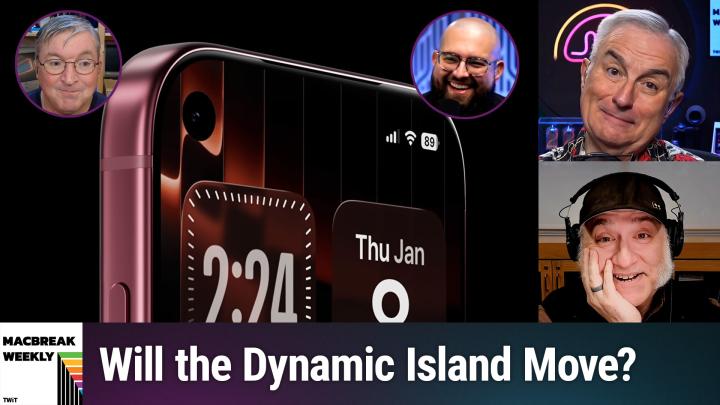
MacBreak Weekly 1008 Transcript
Leo Laporte [00:00:00]:
It's time for MacBreak Weekly. Andy's here, Jason's here. And Stephen Robles, the bearded tutor from beard.fm is here. And there is a lot to talk about. Rumors galore. Do we believe any of them? I don't know. You'll find out. We'll talk about the top paid app store app from China, are you dead? And a whole lot more, including some Vision Pro content.
Leo Laporte [00:00:25]:
Yes, indeed. All coming up next on MacBreak Weekly. This is MacBreak Weekly, episode 1008, recorded Tuesday, January 20, 2026. Check the Stains. It's time for MacBreak Weekly, the show where we cover the latest Apple news. Hello there.
Leo Laporte [00:00:55]:
Stephen Robles joining us, sitting in the vacant Alex Lindsay seat. I like your M5 shirt, Mr. Beard. Bearded tutor.
Stephen Robles [00:01:06]:
Thank you. This is courtesy of the ATP guys, so you know they always update their M shirts.
Leo Laporte [00:01:11]:
Apple Talk podcast. Yes.
Jason Snell [00:01:13]:
No.
Stephen Robles [00:01:15]:
Oh my.
Jason Snell [00:01:16]:
Wow. Yeah. Local talk.
Leo Laporte [00:01:18]:
Dennis Phosphate podcast. Oh, yes, that's it. Okay.
Stephen Robles [00:01:22]:
Yeah, that's it.
Leo Laporte [00:01:22]:
No, I know who they are.
Stephen Robles [00:01:24]:
Yeah, yeah. You know those guys.
Leo Laporte [00:01:26]:
I love it actually. It's great. What is the slashes though. That looks like NASCAR or something, right?
Stephen Robles [00:01:30]:
Supposed to be logo. It's like a BMW.
Jason Snell [00:01:33]:
It's a BMW reference.
Leo Laporte [00:01:34]:
BMW M5.
Stephen Robles [00:01:35]:
Yeah.
Leo Laporte [00:01:36]:
I drive an i5. I should know better. I drive an I'm. Ah, man, what am I doing? I should know better. Hello, Stephen, good to see you.
Stephen Robles [00:01:45]:
Hey, great to be here. Thanks for having me.
Leo Laporte [00:01:47]:
Also here, that's Jason Snell from the. From the kibitzing side of the table.
Jason Snell [00:01:52]:
I am also here.
Leo Laporte [00:01:54]:
Happy to be more than here. He's more than here. He is more than present. He is fully alert.
Jason Snell [00:01:59]:
Am I sixcolors.
Leo Laporte [00:02:01]:
Com? Well, I can't. There you go. He's drinking Coke. We know he's fully alert. He's powered by Coca Cola.
Jason Snell [00:02:09]:
It's all caffeine, all the time.
Leo Laporte [00:02:11]:
High test. Caffeine and sugar.
Jason Snell [00:02:13]:
I recommend it.
Leo Laporte [00:02:15]:
And speaking of caffeine and sugar, the sugar man himself, Andy Ihnatko. Hello, Andrew.
Andy Ihnatko [00:02:22]:
I'm going to promise presence, alertness and coherence may come with time, but I'm definitely present. That's my certified guarantee today.
Leo Laporte [00:02:35]:
I love it. Anyway, it's great to see all three as ya. I don't know where to begin here, Andy. There's a lot of rumors floating about. I don't know how especially they are.
Andy Ihnatko [00:02:51]:
It's my favorite kinds of rumors are where like someone thinks that they've got an inside track on Like a feature. A feature or a piece of hardware that's several months out and is definitely in flux. This is the. Like for instance for the iPhone 18 Pro, January, February, that's the time in which Apple has not locked in anything yet, but they're pretty far along. So there could be a lot of data out there.
Stephen Robles [00:03:18]:
But.
Andy Ihnatko [00:03:18]:
And the people who have access to like supply chain information, either directly or indirectly, might be reporting on something that they think is, oh wow, no, this is absolutely happening. But no, it's not really happening. Or maybe they're lacking a certain piece of information. So the big. So. So I love it when there's like this back and forth between like Jon Prosser. So last week John Prosser said, oh, by the way, kind of big scoop, Apple's, you know that, that dynamic island, well, Apple is going to be moving like the selfie camera, all the selfie camera all the way to the edge of the screen and the dynamic components are going to be completely underneath the display. And then that brought out like another.
Andy Ihnatko [00:03:58]:
That was like a red flag to like other supply chain people. There was a. So who was he digital was saying that. No, no, no, no, no, no, no, look, he surfaced. Here's the component that I know they're putting into the iPhone 8. And as you can see that the dynamic island is not going to be disappearing. No, they're not moving the selfie camera to the corner. The only thing that's going to be under display is going to be part of the IR emitter, which is going to allow the dynamic island to be smaller.
Andy Ihnatko [00:04:28]:
But no, they're not removing it and they're not moving it to an external location, which in itself caused another analyst to come out of the woodwork and say that, yeah, I mean, I'm kind of retired from this business right now, but yeah, that falls completely in line with what I learned like several months ago. So this is why, this is the fun time for rumors. Because again, if it's, if the rumor is like a year and a half out, you know that, okay, somebody did not have. Required to post something by Tuesday at 2pm, did not have anything, and therefore decided to speculate. February, January of that year, it's like maybe they saw a component, maybe they had a lunch and someone's told them something. But for instance, one of the corrections to this is simply saying, look, you're relying on a mistranslation of the Chinese. You don't understand Chinese like a native speaker. That's why you thought they were moving the selfie camera.
Andy Ihnatko [00:05:21]:
To the edge. So that's interesting given that there's so much conversation about whether or not the Dynamic island is, as I believe it to be, a really innovative way to turn a problem and turn to an active solution, like an active feature, or whether it is disgusting, it is a sin against all design. I want to throw up through my eyes every time I see Jason if.
Leo Laporte [00:05:45]:
Prosser is even credible anymore. Right. Isn't Apple. Is Apple.
Jason Snell [00:05:49]:
I mean, Apple suing him? I think it's really interesting that he apparently is posting through it because this is the kind of stuff. But then again, I will say this.
Leo Laporte [00:05:58]:
Got nothing to lose.
Jason Snell [00:05:59]:
I don't know if this is. See, Prosser got in trouble for actually having a source of his own. And I'm not sure these things that he's posting are his are from any of his sources or if he's just decided to get really good at visualizing and YouTubing.
Leo Laporte [00:06:14]:
That's what worries me.
Jason Snell [00:06:15]:
Other people's sources, right? Things that he's seen in other places. But it is a weird move when he, a giant company is currently suing him and trying, among other things. I mean, I actually wonder if one of the reasons he's posting is to demonstrate that he has an active business here because Apple is trying to get him basically enjoined from ever talking about future Apple developments at all. And this may be part of a response to say, no, no, I'm actively doing this and this is not a part of the business that requires, you know, infringement of your sort anyway. And if it's part of a kind of a legal wrangle. But it really is very interesting that he's just sort of resumed posting the things that kind of got him in trouble.
Stephen Robles [00:06:51]:
Well, I think when it comes to Prosser, when it hardware rumors, not a great track record. I mean, he was the one that had the square side Apple Watch rumor, right about that that never came to fruition. He had rumors about a Mac Mini redesign that did not come to fruition. And then we got a different one later. So I think the software, the iOS 26 was obviously at a source for that. But otherwise, you know, and I Remember before the iPhone 14 Pro came out, all the rumors were it's going to be a hole punch in a pill, or maybe it's going to be a long pill. Like no one really knew what it was going to be. And the Dynamic island itself as a software feature wasn't really leaked.
Stephen Robles [00:07:25]:
It was just the fact that it was changing from the notch to like the pill and Hole punch shape. So I really. I'll look at the models, like when those come out around the summertime, because those seem to be pretty accurate to the hardware that comes out in the fall. But all this kind of stuff this early, I just kind of let it pass by. Yeah.
Leo Laporte [00:07:39]:
And one of the reasons I really hate doing rumor stuff because it's just until it really starts to solidify around an idea. There's so many different conflicting opinions now. I mean, it can be.
Andy Ihnatko [00:07:53]:
I categorize it as a kind of fun. Because.
Leo Laporte [00:07:58]:
That'S good.
Jason Snell [00:07:58]:
We should tell people one of the shorts for fun at this point.
Andy Ihnatko [00:08:01]:
Well, no, again, I mean, because we put it in its proper perspective that I think that they're kind of interesting in that they kind of trigger a big public conversation about, well, how do we feel about the dynamic island? How do we feel about the island?
Leo Laporte [00:08:16]:
That's the route you went down, Andy. And, and I, My concern is we could spend a lot of cycles arguing about. Of course it, that is not even. Jim, probably just some, some. Some fever dream that John Prosser had or somebody had and.
Andy Ihnatko [00:08:30]:
Well, well, well, I don't want to.
Leo Laporte [00:08:31]:
Spend a lot of time on something that's not going to happen.
Andy Ihnatko [00:08:34]:
Okay, well, I mean, and I, I also agree with like, the, the kind of like the left, the sidebar comment that, like, I think that one of the things that's changed discussion of rumors is that now there are render that even though they're very, very plainly identified as renders and people understand that. No, no, no, this is just. We want to visualize what this would look like if this would happen. But the thing is, like, now, because we have human beings are using software that was built 145,000 years ago, we see something that looks photorealistic and on some level, we tend to attach a better credibility because. No, we've seen this. Even though actually we're telling ourselves that, no, this is definitely a render. But yeah, I mean, again, I put, I put rumors up there because again, sometimes these. I think that they're interesting conversations that we haven't had that we as a community, not just on the podcast, haven't had in a while.
Andy Ihnatko [00:09:26]:
Look, again, if there's a rumor about, if there's a rumor about, oh, Apple wants to have. It's been floating around for years that Apple really wants to get rid of, like the charging and data port. They want to actually, they want to make sure there aren't any tactile buttons on there. Like, okay, again, maybe this, maybe it's true. Maybe it's not.
Leo Laporte [00:09:41]:
But how do we feel?
Andy Ihnatko [00:09:42]:
How do we feel about that? What is our relationship with this technology? What to us defines the iPhone experience? What is negotiable and what is a non negotiable? Sometimes they help to surface these conversations and they're good conversations.
Leo Laporte [00:09:53]:
Yeah.
Stephen Robles [00:09:53]:
It is ironic that we went from a buttonless rumor to Apple adding buttons.
Leo Laporte [00:09:58]:
They actually added buttons. Right.
Jason Snell [00:10:00]:
They were so wrong. So I think also, you know, first off, iPhone hardware design has done so far in advance and some of these sources are so impeccable. Like Jon Prosser we've been talking about. Like he got that, we know now how he got that one. And he's had some other things that may or may not have been right. And some things were definitely not right. But like Mark Gurman sources are pretty impeccable. Ming Chi Kuo sources in the Asian supply chain are pretty much impeccable.
Jason Snell [00:10:23]:
There are good, I mean, part of the game is, and this is for everybody, not just us, but especially for us if we're going to talk about them is to try to tell the good rumors from the bad. And one of the best ways to do that is look at track records and who do you trust and who do you not trust? But I believe that if Ming Chi Kuo is reporting about something or if Mark Gurman is reporting about something, it's probably happening. And especially if it's about hardware decisions, those tend to be made so far in advance because Apple has to make so much volume, they have to get so many parts. I mean, if you think about chains.
Leo Laporte [00:10:55]:
Leakier than in house, it's very leaky.
Jason Snell [00:10:59]:
Way leakier than Cupertino, for example. But you can, if you think about it, you can understand why the, the supply chain is, is so leaky. Apple is buying millions, tens of millions of parts from suppliers everywhere. And they're gearing up factories and they're configuring those factories. And like, how would you keep that a secret anywhere? I mean, I know that people will talk about the culture in China and how there's like swapping of information and all that. And, and that may be true, but like, I don't think there's anywhere in the world where you could have to put together a process that leads to an iPhone in September out of all the parts and not have it leak because there's, it's just an enormous undertaking for every model. So when I get a Ming Chi Kuo story or Mark Gurman story, I, I think it's probably going to happen with a Caveat that, you know, sometimes things do change, but with, with hardware, it's a lot harder for it to change in the last year because they're pretty much locked in and they're. And they're.
Jason Snell [00:11:54]:
And they're gearing up. So. And I. Is it entertainment? I mean, I always bring back to Mac Week magazine. Back in the day, people were like, I need this for my work. It's very important for volume buyers of hardware to understand where Apple is going, even if Apple won't say, because I can make my buying plans and all that. And that was all bs. It was entertainment.
Jason Snell [00:12:10]:
It's fun to think about the future. There's some truth to it. But like most of it was people read Mac Week because they wanted the juicy rumors. So it is fun to talk about it. But I agree with Andy. It's also interesting to be able to think up front a little bit about what the potential ramifications of a change would be because quite frankly, the week that the iPhone comes out is the worst time to talk about it because everybody's hair is on fire. And if we can digest it over the course of nine months, sometimes that's good. By the time it arrives, we're all kind of prepared to.
Jason Snell [00:12:37]:
About what Apple is doing.
Leo Laporte [00:12:38]:
And I do like the rumor that the folding iPhone will be fingerprint will be Touch id, not Face id. Is that credible, do you think? I think it is because of the nature of a folding screen.
Jason Snell [00:12:50]:
Yeah. You could have one sensor if you have a Face id. Do you have two? Do you have one on the outside, one on the inside. And the Face ID stack is expensive and it's big. So having a single button on it that does Touch ID does kind of make sense.
Leo Laporte [00:13:04]:
Samsung decided with the Galaxy Fold to have Face ID on the front, but then also touch on the.
Andy Ihnatko [00:13:11]:
I love this button. Yeah.
Leo Laporte [00:13:12]:
On the wake button. And I think that's really the best way. And one of the things I have a problem I can never use bit warden at night in bed because for some reason Face ID doesn't work. Apple's at least giving me a way to log in, but not BitWarden, so I have to kind of save anything like that.
Andy Ihnatko [00:13:27]:
It's. I mean, Face ID is great and it's kind of magical except for the times when it isn't.
Leo Laporte [00:13:31]:
Doesn't work.
Andy Ihnatko [00:13:31]:
And like, like my failure point is usually I'm in bed and like, I'm just like sort of watching. I'm just watching a video with like my iPad, like on my, on my chest. And I have to wake it up and I have to actually just sort of like lean up. I'm all comfy. It's cold. It's really cold outside and I'm cozy, I'm comfy and I've got the comforter all the way up to my chin and something goes into sleep and like, oh, God. So now I gotta like actually lift up and like actually move for the first time in 45 minutes or. Whereas instead I could have just tapped the side of the screen.
Andy Ihnatko [00:14:05]:
That would have been great. Now I have to get them. I have to get the blankets all the way up to my chin again. I got to the pillows again. And I resent you face ID for making me do that in a cozy New England winter.
Leo Laporte [00:14:14]:
I do like Dynamic Island. I. I hope that they don't abandon that. I mean, I can't.
Jason Snell [00:14:19]:
I'm with Andy. I can't imagine that they will. I mean, not only. I think even if they had no cutouts at all, it's now just a fun live. Live activities are super valuable. So I think that's.
Leo Laporte [00:14:31]:
Then you'd have all the real estate for.
Jason Snell [00:14:33]:
Yeah, I mean, I think it's great. And if you, you could dismiss them, right? And like, if you dismiss them on a phone that has no cutouts at all, they'll just go away. And if you dismiss it on something that it'll shrink back down. If it's in the corner instead of in the middle, so be it. But like, I think they've got a winner and I think they know it. I think that Dynamic island style live activity. Live activity is a concept I don't think is going anywhere because it's just too good.
Stephen Robles [00:14:57]:
I mean, I love timers in the Dynamic island, obviously, things like Flighty. But also I just recently tried again Carrot weather and realized that they have precipitation for the amount of minutes in the Dynamic Island.
Andy Ihnatko [00:15:08]:
Cool.
Stephen Robles [00:15:08]:
So it'll say rain in three minutes or rain and just the airdrop progress bar has been a huge win. So, yeah, hopefully that's not going away. I don't know.
Andy Ihnatko [00:15:16]:
That really shows you when you've got a user interface change that really, really works. You got something there. You know that when independent developers, like the developers of Carrot, where they say, ooh, I know exactly what I'm going to do that for. And then every user of that is like, oh my God, I love this app even more now that it's. Now that there's this new user, this new surface for it to give me information or give me controls through Again, compare and contrast with a lot of liquid glass items where it's like all developers are like, okay, so we're being forced to update everything to this. I suppose we can make this work and it'll break a lot of stuff, but okay, I suppose we will begrudgingly update. They're not seeing it as an opportunity as yet. They're just seeing it as a compliance issue.
Andy Ihnatko [00:15:54]:
Whereas the Dynamic Island. Dynamic island. Again, a lot of people are saying, wow, this is a way we can make our app even better.
Leo Laporte [00:16:02]:
Let's see what else. What else is in the rumors. Oh yes, we may get our M5 Max's laptops sooner than we thought.
Andy Ihnatko [00:16:14]:
Yeah, this is one of the usual giveaways, like when there are a lot of. One of the canaries is that, oh well, if you're trying to order a MacBook Pro today, you might have to wait a couple of months. That means that, okay, there's nothing in the supply chain, which means that Apple's expecting to sell you a new one sometime in the next few weeks maybe.
Stephen Robles [00:16:29]:
So I'm hoping for that M5 MacBook Air soon because I did a side by side test with the M4 iPad Pro and M5 iPad Pro and for certain things like a task I do all the time is transcribing audio files, it was actually significantly faster, especially when you use larger models. M5 versus M4. So I'm excited for an M5 MacBook Air. And even though I have the M4, I'm probably gonna upgrade. It's pretty sweet.
Leo Laporte [00:16:53]:
Any other rumors? I know there's many. Anything else we want to talk about?
Stephen Robles [00:16:59]:
I'm still speaking of Gurman and his accuracy. He said the HomePod with a screen whatever device that is that it's been coming out the last three years. Yeah, that's the one rumor I keep following because I've been waiting for that device. I'm a huge smart home all in Apple home kit and so I'm eagerly awaiting that device to come sometime. And people were saying, well, it needs a better voice assistant. And now with the official announcement with Gemini, maybe we will get that better voice assistant. That product finally launched.
Leo Laporte [00:17:25]:
But yeah, that'll scratch your itch if it's. If we've got now got a smart Siri, it's got a screen, I'm ready to repl. My homepods feel long in the tooth. I'm ready to replace all the HomePods with something more modern that's a little smarter.
Jason Snell [00:17:39]:
Well, I don't think this is. I don't think this is necessarily that this is more like a, like a, an Amazon Echo show or a Google Nest Home mini web which I have.
Leo Laporte [00:17:49]:
All over the place.
Jason Snell [00:17:50]:
Yeah. And I mean and for me that's the opportunity is that this category is bad and Apple, an Apple version of it could be, could. It wouldn't be a very high bar to be the best one of these because the other ones are bad. And and so yeah, I'm looking forward to too. Gurman's rumor there is very specific which is that they locked the hardware anticipating like everybody else that that AI promise was going to come true and it didn't and it kind of host them and so now it's a real question like is that hardware like manufactured ready to go and they can just plug in Google's models and get it out there or, or is this one of those things where they're going to have to do enough work on it that we're not going to see it until maybe the, the fall because I'm with Steven, I, I'm ready for it. I would love to ditch my Google Nest Home mini whatever it is.
Stephen Robles [00:18:40]:
And Apple added so many features and stuff in the last couple of years like the recipes and Apple News plus like the perfect feature for a screen that lives in your kitchen plus already has the Apple Home app. I'm curious what operating system it may or may not run. Like I don't think it would run iPad OS and so would it be some kind of stripped down version of that or some conglomeration. But I mean to be able to do your recipes on there, your smart home, actually have a smart voice assistant that can actually answer your questions, play the song you're actually asking for. That'd be a huge win. I want to see that.
Leo Laporte [00:19:08]:
Let's talk about really the biggest controversy in the Apple world today. You know, I think you, I think that laugh tells me, you know where I'm going with this. Andrew.
Andy Ihnatko [00:19:19]:
Yeah, there was a, there are some people we talked about the new like the new studio apps, the subscription apps and we talked mostly about substantive things such as hey great, a 1299 package which you get all these pro creator apps and because this is news was like a two or three where again we're covering the factual things. And then later on a lot of people started looking at the actual icon, redesigned icons for all of these and a lot of people had a lot of feelings about that and they were very expressive and demonstrative about those feelings. And after seeing some really, really brilliant like there was A. There was a post on Mastodon and when someone put like the icons for pages starting with like the brand new one all the way back transitioning to the original one. So if you take these icons in reverse order, it looks like someone who, who's really bad at design getting increasingly better over time.
Leo Laporte [00:20:12]:
I loved that post. Like, oh, look how much, how much wait a minute. They're getting. If you turn it around, if you do it in the opposite direction, they're getting better. I do like the original, admittedly skeuomorphic icons. I thought they were beautiful and I really don't like the new ones.
Andy Ihnatko [00:20:28]:
Yeah.
Leo Laporte [00:20:28]:
Although Mark Gurman points out 99.9% of Apple users couldn't care less what the icon looks like.
Jason Snell [00:20:34]:
I guess also what. Here's my question because I. As pieces, look, this is a. This is almost like a Rorschach test. It's like, what are you looking for here? It's a very easy take to have because it's. What do you like visually? What kind of art do you like? What style do you prefer? I have some quibbles about. John Gruber said that the original pages icon is an old timer. It's a.
Jason Snell [00:20:51]:
It's a. An ink well and a fountain pen and I'll be like, well, the app's name pages and there are no pages in that icon. So I think it's a failure.
Leo Laporte [00:21:00]:
But.
Jason Snell [00:21:00]:
But it is beautiful. It's a beautiful piece of art.
Leo Laporte [00:21:02]:
Doesn't it also.
Andy Ihnatko [00:21:03]:
Doesn't it also creation writing?
Leo Laporte [00:21:05]:
That's.
Jason Snell [00:21:06]:
Yeah.
Leo Laporte [00:21:06]:
But also have. Here's to the crazy ones in the text. If you look real closely.
Jason Snell [00:21:09]:
No, that's. That's. I think TextEdit does that. So, so here's the. Well, the. Andy, you make a really good point which is like it really is. What do you want out of this? Is it the metaphor?
Stephen Robles [00:21:18]:
Does it.
Jason Snell [00:21:18]:
Should it match the name of the app? Should it be a metaphor for the act of creation in the case of pages and how is that different or of writing? Like there are lots of ways to cut this. What I will say is I don't love the new icons, but I see what Apple's going for here and I think there is a real. People don't want to hear this. A really pragmatic reason you do the icons like that, which is in the end, where do we interact with icons? We don't admire them like they're pieces of art on the wall. Although maybe we could. Maybe we should we use them in the dock on the Mac mostly maybe in the applications folder in Finder and on our home screens, on the iPhone and the iPad. And in those contexts at those sizes, the most important thing is recognizability. And if you look at these icons, they're all a different color and they're all a different set of shapes.
Jason Snell [00:22:07]:
And that means that you may not need to even know what that shape represents, right? Like the bouncing ball that looks like a McDonald's logo for motion or whatever. In the end, if, like. Like. I'll give you an example.
Stephen Robles [00:22:19]:
The.
Jason Snell [00:22:19]:
The icon for Logic is like a gold record. It is a record, a silver record in a frame with a little label on it. Did I know that before I magnified it? Not really. I knew it was a round thing. But I'll tell you, I know what the Logic icon looks like. I know what the Final Cut icon looks like. So they are not great pieces of art. And everybody's got their knives out for Apple design right now.
Jason Snell [00:22:42]:
But I think that whoever designed these icons was hitting the brief, because I think the design brief was differentiate them. Differentiate them by shape and color so people can recognize them in the dock as the app they use. And they do that. They do that. They may not be.
Leo Laporte [00:22:58]:
We redid a redesign from day one on our album art. Somebody went back when we did the Twit logo. Somebody told me, you have to think of your logo as occurring in all different sizes, and it has to be embroiderable on a ball cap. It has to be. And so these are. You know, you're tempted to. Or fez or fez. I think you're tempted as a designer to do art, but.
Leo Laporte [00:23:24]:
And with album art was the same thing. I really had to talk the design. We had a very good design team, and I had to talk them out of doing representative stuff because it is. It's just, first of all, the thing's gonna be tiny in many cases. It has to be very recognizable in a variety of sizes, and it doesn't matter what it represents. So I understand what you're saying, Jason. It's exact what the remit was.
Stephen Robles [00:23:48]:
I would say. I've heard some argument that Apple is trying to make it look like the Creative Suite from Adobe. And, like, if you look at all of Adobe's app icons, they're like this. They're very similar with a slightly different color shade and the letter of the app in it. That could be one argument. But what I would say is these are not logos which do need to be embroiderable. I don't know how to say that. Like, logos do need to be used everywhere.
Stephen Robles [00:24:09]:
But these are app icons, which only.
Leo Laporte [00:24:10]:
They will appear to different sizes. Right, Stephen? And they'll sometimes be very small, sometimes big.
Stephen Robles [00:24:15]:
Like we were saying, like, where are you going to see them? Me personally, I launch apps pretty much exclusively with Spotlight. I command space, type the first few letters, and hit enter. But most people, especially maybe not like Spotlight power users, are probably going to the dock to launch them. And then I would think a more visual differential would be more useful. So you can see them whether it's small or magnified. And I guess these are fine for that. I do think the pixelmator icon is lost the most. One, it kind of looks like the shortcuts icon.
Stephen Robles [00:24:43]:
And two, like, it doesn't.
Leo Laporte [00:24:44]:
That's not good. It shouldn't look like any other icon.
Jason Snell [00:24:48]:
Shortcuts with a line below it, with a bezier below it. That's not curving.
Andy Ihnatko [00:24:52]:
That's kind of my. That's kind of my problem. I don't have a strong opinion about this. If I were part of the review, like, I'm in that conference room at Apple, I would point out that I don't. I. If. I know that, okay, if I was brief beforehand, let's say I'm a focus group. Better yet, I'm a focus group saying, okay, we have this suite of apps.
Andy Ihnatko [00:25:11]:
One is a word processor, page layout thing. One is an arc program. One is a music editor, blah, blah, blah, blah. And here are the icons for them. And I want you. Here's some magnets, words on magnets. I want you to put the name of the app underneath, like the actual app that this represents. I would be going, okay, here is a pencil drawing a line.
Andy Ihnatko [00:25:28]:
That must be the art app. Oh, no, that's actually like the writing app. Okay, well, here's. It's not terribly clear. I agree with you, Jason, that in the end, we don't necess. Excuse me. Most of us don't tend to interact with them as icons. We tend to interact with them as app names or basically because.
Andy Ihnatko [00:25:46]:
And if we. If we do interact with them as icons, we get over it every time there's a major change to an icon. It stinks to have to reprogram our muscle memory, but we do reprogram that muscle memory. So again, I'm not thinking that, oh, here's another example of Apple's failure as a design team. But I am saying that here are some obvious problems that I would want to change. I like the idea right in the middle there. I agree that a fountain Pen is in front of a pot of ink. It's a beautiful piece of art, not necessarily communicative, but I think that the icons for pages on the right there, that says, oh, by the way, here is a document with multiple items on it that are recognizable.
Andy Ihnatko [00:26:24]:
And here is a writing implement for editing that thing that to me, communicates really, really clearly. This is like a page composition slash writing tool, as opposed to, no, you're not going to be using this as a drawing app, even though some people do. No, you're not going to be using this to record an album with. And that's the problem that I have with these icons, that they don't really communicate what they do really clearly. And I think that that thing is an attainable goal and a desirable goal.
Jason Snell [00:26:48]:
For the, for the record, I think the best pages icon was the one that was sort of in the middle of its life when it was a page or a pile of pages with a pen on it. I was like, oh, yes, I understand this metaphor. But again, I mean, it's fun to argue about this. I worry. And this goes to the Mark Gurman point, right? Which is 99.9% of people don't care. It's like, I think where I agree with Andy here is, you know, it's okay to care, and the people who create these things should care, too. And I think the problem is not, like I said, I understand why these icons exist because I think pragmatically, once you know that the, your word processor is the purple one or your, you know, whatever, or your, your. Your spreadsheet is the orange one, you're done.
Jason Snell [00:27:30]:
You got it. Like, it doesn't really matter anymore. But if you're the designer, perhaps just pragmatically getting it a color spread and a shape maybe aspire higher than that. Right? And I don't. While I think these are perfectly functional, does what it says on the tin icons, that that will fulfill all of the desires of whoever assigned these designers to build these things. I. There is a part of me that thinks, yeah, but they could be better, right? Like, they could show more creativity. They are not as flattened as something like the latest Microsoft Office icons or those Adobe icons where Adobe at one point was like, yep, periodic table of elements, nailed it, we're done.
Jason Snell [00:28:14]:
And they're better than that. But like, yeah, I do. I wish they would aspire better. And I think that's been one of our complaints about a lot of Apple design lately is like, yeah, it works. But, you know, it felt like not to get Old man on you. But like it felt like in the old days Apple sweated the details a little more and they're. This doesn't seem like they sorted the details, they just extruded some colors and we're done for the day.
Andy Ihnatko [00:28:35]:
I will just, I will just quickly say that to make sure that we're showing proper respect for the people who worked on these icons. This wasn't as though they didn't put effort into it. There was probably one or two artists who have to, who have to tell who are probably glad that they're under NDA because otherwise I have to say my major job for the last 11 months was to design one icon for a 15 to 20 year old word processor. That's. I was not designing a self driving car. I was working on one icon. Man, we went through so many revisions you don't even want to know about it. So this is particularly when I see some of the discussions that are online.
Andy Ihnatko [00:29:13]:
But oh, Apple just doesn't care about design. No, they do. It's just that they're pursuing priorities that they keep to themselves that are very important to them. Otherwise this would not have been the result of what they did. They didn't just ask Chat GPT. Hey, I've got a word processor. Give me 50 icon designs and they pick the three they like I said, give me this, from that, that, from that, that, from that. Give me 12 versions.
Andy Ihnatko [00:29:34]:
Great. Pick that one. We're done. Let's go out for waffles.
Jason Snell [00:29:37]:
That's why I was back figuring the assignment. I think these designers did what they were assigned to do. I think that the problem is that they were not given either the latitude or the encouragement or the instruction to like take it to another level. They're like, nope, crank these out. We want them like this and we want them to all look the same and, but be different colors and like. And this is, this is what you get. It's, it's not a, it's not an artistic problem on the, on the part of the people who are making this and we don't know how many they make and all that. I think it's just a, like I said, it's a lack of imagination among management or care that like we would also like these.
Jason Snell [00:30:06]:
I'm just not sure in the editorial process there was a moment where they were like, does this metaphor for, for pixelmator work? And doesn't it'll look a little too much like shortcuts and like, I don't know what happened in that meeting. And if somebody was like, it's good enough, whatever.
Leo Laporte [00:30:21]:
And my theory is that I think probably There was a 15 page document that was carefully vetted, that was all the specifics for how this should look. And one of the things everybody agreed is that it should look kind of.
Jason Snell [00:30:37]:
Like shortcuts, nothing to do with it.
Stephen Robles [00:30:41]:
At the bottom it was signed Alan Dye.
Leo Laporte [00:30:44]:
Hey, can you know how many of you will change these icons? Because it's easy to change the icons.
Stephen Robles [00:30:50]:
I don't do that.
Leo Laporte [00:30:50]:
None of that.
Jason Snell [00:30:51]:
None of them.
Stephen Robles [00:30:52]:
You.
Leo Laporte [00:30:52]:
Which is kind of brings the whole thing. Yeah, exactly. If you compare that much, you take five seconds to change it.
Stephen Robles [00:30:58]:
If we're shouting out designers, I want to shout out whoever designed the iLife09 box because that was one of the first pieces of software I bought from my Mac. And the iLife and iWork boxes and everything designed back then loved it all. I still have them somewhere in my head.
Leo Laporte [00:31:11]:
There's the. The. The Mastodon tweet from Helio Heliograph of the in reverse icons for pages in which he says, if you put the Apple icons for pages in reverse, it looks like someone getting really good at icon design.
Andy Ihnatko [00:31:28]:
Yeah. And this is probably one of the most clever ones because it also. It's a funny joke and it definitely makes the point of the people who don't like these icons, but the point they want to make. But also it shows that. Imagine, like Apple is like an entity as opposed to like 150,000 employees. Okay. Over. Imagine that, like, for the first half of your creative life, you have, oh, I'm an artist, but I have to draw everything in 32 pixels by 32 pixels and a limited color palette.
Andy Ihnatko [00:31:58]:
And suddenly you're told, oh, by the way, now icons can be 512. We have retina displays on everything. Do it in 512 pixels square and the unlimited color palette. With accurate color reproduction, the first thing you would do would be something as beautiful as here is an old timey inkwell and a dip and a D10 next to it. And then you see them. If you go now from right to left, it's like, now you see them sort of settling down, saying, okay, you know what? I'm glad that we had fun creating a piece of artwork because we suddenly have this immense canvas to work with. Let's kind of tone it down a little bit and be more descriptive. That's why I say that I like the ones that are like, in the center moving a little bit to the right.
Andy Ihnatko [00:32:39]:
Here is a document populated with let's let's show off that there is. Let's show off that, hey, look, you can mix text and graphics just like MacWrite 1.0, but they can be in color just like MacWrite 2.0. That's why I think that was the sweet spot for this design. Again, I think that it's important that they communicate like you're saying about the design of a logo. You also have to make sure that this has to render properly. When it is 32, like the equivalent of 32 pixels by 32 pixels, you cannot go completely nuts because it has to be recognizable at every single size it's going to render at. And so that's not an easy.
Leo Laporte [00:33:15]:
That's why you go with colors and, you know, shapes and less skeuomorphic. So I, you know, and that. So I think everybody's right. Yes, the, the inkwell is pretty.
Andy Ihnatko [00:33:27]:
It's a fun conversation.
Jason Snell [00:33:28]:
It's the, it's. I mean, this is what I said about how it's a. It's a great way to have takes because it's really looking at art. And it entirely depends. Like du.
Leo Laporte [00:33:37]:
Functional art, though, that's what is a little weird, right? It's not purely artistic.
Stephen Robles [00:33:41]:
This is, this is.
Jason Snell [00:33:42]:
I, this is. My problem with this argument is that I am not going to defend the page, the modern pages icon versus that beautiful fountain pen and inkwell as a piece of art. It's a much more appealing piece of art. Is it functional at the sizes where that will be seen from a user's perspective? I say no. I say no. And this is the thing. It's like, that's, it's like I do. I like it.
Jason Snell [00:34:06]:
It's like, I don't know. I like the art on this one, but I'm not sure when you shrink it down like, because remember those early icons, those skew morphic icons? Those were the days where we got away from doing pixel art icons at 32 by 32 because Mac OS X suddenly let you have these enormous images and Apple would put Easter eggs in the images where if you zoomed it up large enough, you would type.
Leo Laporte [00:34:26]:
And it was, by the way, I've been crazy ones. And it's actually, it says head north on the scenic California Highway 1 to the Tamalpais point, turn off. It sounds like directions to bulimas.
Andy Ihnatko [00:34:38]:
So I don't know really.
Jason Snell [00:34:39]:
We were really high on high resolution images at that point because we could. But I think that with iPhones especially and iPads, you've got a lot of little images on the Home screen and you got little images in your dock and that's mostly where people are. Or little images in Spotlight. Those images are little too. And, and so the priorities change. But so it's a fun conversation to have because there's no wrong answer. There really isn't a wrong answer because when I see people criticize it, it's like, I totally understand the criticism, but I also understand that Apple was probably viewing it much more pragmatically, which is a lot less and fun, but maybe more useful. And you know that everybody gets to have their own opinion about art.
Jason Snell [00:35:23]:
That's what makes art great.
Andy Ihnatko [00:35:24]:
Yeah, And I'm glad that one of the things that. I'm glad that as a community, Mac people and Apple people have sort of evolved. I don't. I want to say that it's an improvement. I'm saying that I'm glad that the, the trend of saying we have to apps, we. Apple is the consummate designer. They're painting both sides of the fence, which is what makes them such an exceptional company. And basically saying, oh, look at this Samsun.
Andy Ihnatko [00:35:48]:
Look at how like the speaker grill is not ne. Not 100 aligned with the charging point. It's actually, if you look at it, it's almost half a millimeter, like higher than it's like, probably because they needed to package the battery correctly and they decided that this, this does not matter a bit. As for the performance of the phone and we're going to make decisions that basically make the phone perform better. But look, Apple would never. Apple's painting both sides of the fence. It's the like again, I'm not going to see that side of the fence. I would much rather have the extra probably 52 minutes of battery life that this other phone has because they didn't care about aligning the speaker grills exactly 100% with the charge port.
Leo Laporte [00:36:26]:
I'm glad to point out, as much.
Andy Ihnatko [00:36:28]:
As we used to still, a pen.
Leo Laporte [00:36:30]:
And of course, pages is the thing you don't use a pen with.
Jason Snell [00:36:34]:
I know that's the metaphor part.
Leo Laporte [00:36:35]:
And there's. And, and just as there's a sloppy disk on the save icon, I, I mean, if you really wanted to go all in on this abstract stuff, you'd abandon the pen.
Andy Ihnatko [00:36:46]:
Well, that's how you know.
Stephen Robles [00:36:48]:
I do want to say, though, it's funny because every AI company, we never harp on their logos, but each one is basically an asterisk. Whether it's Claude Gemini being generous, saying it's.
Leo Laporte [00:36:57]:
It's not just, It's A little shorter than that. It's just the ass.
Jason Snell [00:37:00]:
Yeah.
Leo Laporte [00:37:00]:
And yeah, that is very weird. I don't get that part.
Stephen Robles [00:37:07]:
But I will say to Shout Out, I think there's two good icons they have released recently. One is the new preview app, which came with iOS 26.
Leo Laporte [00:37:14]:
No boozy, it's a Matter of Taste.
Stephen Robles [00:37:17]:
And the new trash can. I'll say. I like those two. Let's just leave it at that.
Jason Snell [00:37:20]:
The new preview icon is garbage because it is taking a thing that nobody knows what it is, which is a photographer's loop that used to be placed on a page in a context where you could understand. You're looking at a photo photo. And they said, let's throw the photo away and just put the photographer's loop. Because everybody knows what that is.
Andy Ihnatko [00:37:39]:
People try to learn something, a thing or two. Jason Snell.
Jason Snell [00:37:41]:
Yeah. Everybody thinks it's a shot glass. Okay. So if you think it's a shotgun, I guess that's the preview drinking game. Now.
Andy Ihnatko [00:37:48]:
You've never had edit wedding photos. You would know that a shot glass is integral to the process of photography.
Stephen Robles [00:37:54]:
I didn't know how to get Jason Snell worked up.
Jason Snell [00:37:57]:
We did a tier list of these icons on upgrade and I put this firmly in F tier. I think it is garbage. I think it is the worst.
Stephen Robles [00:38:04]:
What about a redesigned trash can?
Jason Snell [00:38:06]:
You can have your lousy icon. Steven.
Leo Laporte [00:38:08]:
I don't like the redesigned trash can either. It's square now and it's.
Stephen Robles [00:38:14]:
I like how square. That's fine. I like these all better than the new pixelmator icon. That's all I'll say.
Leo Laporte [00:38:19]:
Yeah. I mean, it's funny that we can get so much mileage out of icons, but that's. That's right.
Andy Ihnatko [00:38:24]:
Like we're saying at the very, very. Sometimes the most trivial topics provokes us to look and think about what we believe and what we think is important about a larger, more important topic. And that's why this. I was. I've been enjoying this.
Leo Laporte [00:38:37]:
Either that or Scholastic.
Stephen Robles [00:38:40]:
You know, everybody was complaining about the finder icon in macOS Tahoe when the Betas came out. I don't think anybody's talked about it since. And I've gotten used to it. Does anybody care?
Jason Snell [00:38:50]:
Well, they flipped it back around, right? I think that was the main complaint. I mean, people had other complaints too, but the main one was like, they flipped. The color scheme was like suddenly reversed and it seemed weird. And they were like, oh, we'll put it back. And everybody's like, that's fine. It's fine.
Leo Laporte [00:39:02]:
I do have to say the finer icon is, if I may, iconic. I mean that is, that is a one, the one icon where they really shouldn't mess with it too much because that's the brand. That's the whole thing, isn't it?
Jason Snell [00:39:13]:
I could make the argument that it's just an appeal to nostalgia because they repurposed the Mac OS icon to represent the finder and that, you know, I think I'll put it this way, I don't agree with that. But I will say I count ourselves lucky that they haven't renamed finder to files and put a generic files icon on, because they could totally do that.
Stephen Robles [00:39:32]:
That's how it is on iPhone and iPad. There's no problem.
Jason Snell [00:39:34]:
Well, that's what I'm saying is they could have just imported that from iPhone and put it on the Mac too and said, see, now it's easy. Everything is just called files and it would have been bad.
Leo Laporte [00:39:43]:
There's also like many ideas. Jason.
Jason Snell [00:39:46]:
Sorry.
Andy Ihnatko [00:39:46]:
Also there's the psychology of design. The fact that if we can, we'll dispose of. Okay, well now it used to be a pen and an inkwell. Now it's like, like a iconic icon of an, of a pencil on a line. Okay, that's fine. But when you, when your familiarity with an entity is in the form of a human face, again, we're dealing with 145,000 year old human software here that is designed to really tag onto and recognize something that is in the arrangement of a human face. So when you change that face, you are messing with caveman stuff here and you're causing people to react in ways that even they don't understand. Because again, 145,000 year old software is not designed to deal with an app icon.
Andy Ihnatko [00:40:29]:
In 2026.
Leo Laporte [00:40:32]:
Let us take a break. We will mess with more caveman stuff in moments.
Jason Snell [00:40:38]:
The most inadequate thing ever said.
Andy Ihnatko [00:40:40]:
I love it, by the way. I know, I know that it's not going to be chosen as the show title, but I have just put it's just the ass as a title suggestion because it's my responsibility to make suggestions. You can choose whatever you want with it. I'll just be very happy if you choose.
Leo Laporte [00:40:53]:
We spend a lot of time on intelligent machines noting that similarity to all the AI companies icons.
Stephen Robles [00:40:59]:
Yep.
Leo Laporte [00:41:00]:
Anthropic is the most.
Jason Snell [00:41:02]:
Yeah.
Leo Laporte [00:41:03]:
Definitive version of.
Jason Snell [00:41:04]:
It's great. I love that. We're headed for the Butthole Singularity.
Andy Ihnatko [00:41:07]:
Wonderful.
Leo Laporte [00:41:08]:
Butthole Singularity.
Jason Snell [00:41:08]:
Wonderful.
Leo Laporte [00:41:09]:
Here we are.
Jason Snell [00:41:09]:
Humanity. What did you do now?
Andy Ihnatko [00:41:11]:
Andy, that might be the title I'm already typing, man.
Leo Laporte [00:41:16]:
You guys can compete for the. For the title of the week.
Jason Snell [00:41:18]:
Oh, God.
Andy Ihnatko [00:41:19]:
I. I think. I think Jason should get the ham this week.
Leo Laporte [00:41:22]:
I think. Good. All right. Hey, I like that idea. I will send a ham can to.
Andy Ihnatko [00:41:27]:
Whoever a twit logo can ham for the person.
Leo Laporte [00:41:30]:
I think that's a great idea. Because who could. Ham Break Weekly.
Andy Ihnatko [00:41:37]:
And another title. All right, this is good.
Jason Snell [00:41:39]:
This is good.
Andy Ihnatko [00:41:40]:
See, we're clicking, we're brainstorming. No bad ideas here.
Leo Laporte [00:41:42]:
That's Stephen. Stephen wants that ham. Our show today, by the way, great to have you. Stephen Robles, the Bearded Tutorial. You can find him, of course, on YouTube, but also beard.fm. And he's the king of shortcuts and a great tutor in all areas. In fact, I'm sure you have somewhere tutorial on how to change the icon on any app.
Stephen Robles [00:42:06]:
I'll make that short this week.
Leo Laporte [00:42:08]:
Yeah, I bet. I mean, really, that's the answer to this. Make it a red dress or is that a blue dress? I don't know. Anyway, good to have you. Thank you, Stephen. Also, Andyko and Jason Snell. I do have good news. We have a replacement for Alex Lindsay.
Leo Laporte [00:42:28]:
As you know, Alex took a job with the fruit company. And true to every single person who's done that in the past, he has disappeared entirely. We don't hear from him.
Andy Ihnatko [00:42:39]:
We don't. He's an innie now.
Leo Laporte [00:42:42]:
He's an innie. That's right. No, his Audi has disappeared completely. But that's okay. I'm hoping someday to hear from him. I hope he's having fun at Apple. But we have found, I think, a very apt replacement. We've been working on this for a while, and I love the idea and I have a feeling we may continue to do this, of bringing in people like Stephen and Shelley Brisbane.
Leo Laporte [00:43:07]:
Dave Hamilton's going to join us next week to have. You know, there is such a great group of Matt people out there, Apple people out there. It's nice to be able to bring them in. And so we'll continue to do that. But I think we do have somebody to fill the honorary Alex Lindsay chair. Probably February 3rd. You're not gonna be here February 3rd, are you, Jason?
Jason Snell [00:43:28]:
I'm not.
Leo Laporte [00:43:29]:
Are you going somewhere?
Jason Snell [00:43:31]:
Yes, I'm going on vacation.
Leo Laporte [00:43:32]:
Good man.
Andy Ihnatko [00:43:35]:
You're not interviewing at Apple's. Just tell me.
Jason Snell [00:43:37]:
I'm. No, I'm not.
Andy Ihnatko [00:43:39]:
Okay.
Jason Snell [00:43:39]:
I'm going to be on a beach somewhere, unrevealed.
Andy Ihnatko [00:43:43]:
That's all. I wanted to know.
Leo Laporte [00:43:44]:
That's fine. A beach.
Jason Snell [00:43:45]:
Wander all beaches and you may find me so jealous.
Leo Laporte [00:43:48]:
I haven't had a vacation in a while. It's been more than a year. Of course, the last time I went on vacation, I got Covid. So, you know, knock on wood.
Jason Snell [00:43:57]:
Don't do that.
Leo Laporte [00:43:58]:
Don't do that. No. Our show today, brought to you by Bit Warden. I love talking about Bit Warden. This is my password manager. I just mentioned it actually earlier. The trusted leader in passwords, but also pass keys, man, the more I can use passkeys, the happier I am. And secrets management, you can actually store your secrets.
Leo Laporte [00:44:17]:
And I have been doing that for security in BitWarden. Things like your SSH, public and private keys. It will generate keys for you and then automatically offer the public key when you log in on ssh. It's just a nice feature. This is what I love about BitWarden. Because they're open source, new features come all, all the time. But that doesn't mean open source in this case, doesn't mean, you know, a bad user interface. They're consistently ranked number one in user satisfaction by G2 and software reviews, both.
Leo Laporte [00:44:50]:
10 million users, 180 countries, more than 50,000 businesses. BitWarden is fast, easy to use and is feature rich. Whether you're protecting one account or thousands at your business, you need BitWarden to keep you secure all your life long. Consistent updates always getting better. For instance, for business they just added BitWarden access intelligence. This means organizations can now in real time detect weak, reused or exposed credentials and then immediately guide remediation with the user. Helping the user replace those risky passwords with strong unique ones. Helping the user understand why they need to do that.
Leo Laporte [00:45:31]:
This closes a major security gap. I think maybe the top cause of breaches these days, credentials, you know, credential stuffing, bad passwords, weak passwords, reused passwords. But with Bit Warden's access intelligence, those lousy passwords become visible, prioritized and then corrected before exploitation can occur. But it's not just for enterprise. They've introduced something great for self hosters. BitWarden Lite L I T E. It's so light, they left out the G and the H L I T E. BitWarden Lite delivers a lightweight, great self hosted password manager.
Leo Laporte [00:46:07]:
This is made for home labs, personal projects, environments that want quick setup, minimal overhead. These guys, they think everything. BitWarden's now enhanced with real time vault health alerts, password coaching features that help users identify weak, reused or exposed credentials and take immediate action to strengthen their security. If you are still using the password manager built into your browser, you should stop. BitWarden makes that easy. They support direct import right from Chrome, Edge, Brave, Opera or Vivaldi. Goes right into Bit Warden without that you know, extra step of exporting to a plain text file and then importing, which really simplifies migration and helps reduce exposure associated with the manual export deletion steps. G2 Winter 2025 reports BitWarden continues to hold strong as number one in every enterprise category.
Leo Laporte [00:47:01]:
This is according to GP6 straight quarters now. Number one, BitWarden setup is easy. It supports importing for most password management solutions. We had no trouble. Steve Gibson and I both moved to BitWarden a few years ago. Moving from our old password manager to BitWarden was piece of cake. And I think I've always felt open source is really important with anything that uses crypto like a password manager. BitWarden's open source code, GPL open regularly audited by third party experts.
Leo Laporte [00:47:29]:
You can look at the code yourself. It's on GitHub. Bitharden meets SOC2 Type 2 GDPR HIPAA CCPA compliance. It's ISO 2700-12002 certified. It is secure as can be get started today with a free trial of BitWarden's teams or enterprise plans in business. And if you're an individual user, get started for free unlimited devices Unlimited passwords pass keys please bitwarden.com/twit. bitwarden.com/twit. This is the one. Look no farther. bitwarden.com/twit. We thank them so much for supporting MacBreak Weekly.
Leo Laporte [00:48:14]:
Let's see here. Are we excited about new monitors? Mac studio displays showing up in the databases of various governmental bodies? I guess we're getting close to a new display.
Jason Snell [00:48:31]:
Yeah. It's intangible though, right? It's like we know they're coming. And Mark Gurman definitely has had some rumors that Apple is working on new displays, but this is one of those cases where we don't know any of the details.
Leo Laporte [00:48:43]:
Right.
Jason Snell [00:48:44]:
So we're left. I mean, I assume we know the model number.
Leo Laporte [00:48:47]:
A 3350. That's correct.
Andy Ihnatko [00:48:49]:
Great.
Jason Snell [00:48:49]:
Can't wait for a 3350 to hit the shelves. That'll be so sweet.
Leo Laporte [00:48:53]:
Is it big? Is it little? What is it? We don't know.
Jason Snell [00:48:56]:
We don't know. I assume that there's going to be a studio display replacement that has more modern tech, whether it's OLED or, you know, Just a proper her or whatever, we don't know. And of course the Pro display XDR has been out there for ages too. So if there are two displays coming, perhaps both of those models are going to get replaced or refreshed depending on, you know, size.
Leo Laporte [00:49:15]:
I am an older OLED guy. I know some people don't like OLEDs, but I just love OLEDs. According to Digitimes, Apple is going to upgrade the Mini. That's what Steve Gibson's waiting for. The iPad mini, not the Mac mini, sorry, the iPad mini, the MacBook Pro, the iPad Air, the iMac and the MacBook Air with OLEDs sometime between now and 2028. Well, okay, thanks for narrowing it down Digitimes. Is there any reason they just don't move to all OLED now?
Jason Snell [00:49:46]:
Expensive.
Leo Laporte [00:49:47]:
Do designers prefer the nano textured IPS XDR displays? Is that why? I don't know. Maybe they just can't get.
Jason Snell [00:49:59]:
I mean you can nano test texture and OLED just as well. I don't think that's the issue because the iPad Pro is a nanotextured OLED and it's nice. So I don't think that's it. I think it's. The OLEDs are expensive and big OLEDs are that much more expensive to manufacture. And if they're trying to hit a price point point, and they are, believe it or not, even though Apple stuff is expensive, they are trying to hit a price point. There is a, a level above which they don't want to go, especially with an established product like a laptop. But even for these displays they're pricey as it is.
Jason Snell [00:50:29]:
So if they look at suddenly, oh well, this is going to add another thousand dollars or whatever you might, you know, they might be reluctant to do that. So I think that that's the real.
Leo Laporte [00:50:37]:
Question that makes sense. Are you, Stephen, are you an OLED guy or do you, are you happy with the.
Stephen Robles [00:50:42]:
I mean I love my iPad Pro tandem OLED.
Leo Laporte [00:50:45]:
So beautiful, isn't it?
Stephen Robles [00:50:47]:
Had the glossy for a while and then I have a review unit now with the M5 with the Nano texture. I think I like it maybe, but I think if I buy my own I will go back to glossy just because I do. I don't know. I love the richest blacks and you.
Leo Laporte [00:51:00]:
Could tell me one thing I heard is that nano texture looks best with light mode, not dark mode. Did you. Was that been your experience?
Stephen Robles [00:51:11]:
Not really. I think it looks great but any off angle viewing is when you start noticing the black levels start airing to gray. And so I Just really love the glossy display. I like the feeling of the apple pencil on nano texture.
Leo Laporte [00:51:24]:
That's because you and I don't go outside at all.
Stephen Robles [00:51:26]:
Well, I got on my patio and I'm on the patio. I do like the nano texture but I think for myself glossy and I have a studio display which I've used since it came out and I love, love it if there's an old one that comes out or higher refresh or whatever or HDR100 upgrading that day one but I'll get glossy for that as well because I'm in a controlled environment and I just want the glossy. So that's me.
Leo Laporte [00:51:52]:
Let's see. According to the information, the Google powered Siri will have seven new seven new features.
Andy Ihnatko [00:52:04]:
Not eight, not six. Seven, seven lucky seven.
Leo Laporte [00:52:09]:
According to the information as soon as this spring the revamps here will be able to answer more factual world knowledge questions in a conversational matter manner. Tell more stories.
Andy Ihnatko [00:52:20]:
That's what everyone wants.
Leo Laporte [00:52:22]:
Provide emotional support.
Jason Snell [00:52:25]:
I'm sorry you're feeling that way.
Andy Ihnatko [00:52:26]:
Dangerous.
Jason Snell [00:52:27]:
Tell me Leo, do you have any emotional problems?
Leo Laporte [00:52:30]:
How are you feeling?
Andy Ihnatko [00:52:31]:
I know that my performance as a personal assistant is very, very lacking. And I can understand how frustrating it might feel when I keep telling you to just Google it.
Jason Snell [00:52:39]:
Because call is very important to us.
Leo Laporte [00:52:42]:
It will be able to assist with more tasks like booking travel.
Stephen Robles [00:52:47]:
Okay.
Leo Laporte [00:52:48]:
I do know more people who are encouraging and I haven't tried it. When you book, you know, when you're booking an airfare, you go. Usually you go to, you know, kayak or I don't know if kayak's still around. You go to some site, Google Google Air or whatever.
Stephen Robles [00:53:03]:
Yeah.
Leo Laporte [00:53:04]:
And you compare prices and you pick. I know more and more people are saying no, no, the best way to get a great price is to ask chat GPT to search.
Stephen Robles [00:53:12]:
I actually use anytime I'm shopping online for something I'm not familiar with, I'll use an AI browser. Actually I'll use Comet and I'll have it do some comparisons. But then once you get to that checkout point, I tell the AI browser to keep trying promo codes until the website accepts one.
Leo Laporte [00:53:28]:
Oh, I like it.
Stephen Robles [00:53:29]:
Nine times out of ten will do that. Yeah, I do it all the time.
Leo Laporte [00:53:32]:
That's Perplexity's browser.
Stephen Robles [00:53:34]:
Right, Perplexity's browser. And so any. Like when we did the holiday shopping, I did all of my shopping through the AI browser and it found promo codes for nine times out of 10. And that's so you say.
Leo Laporte [00:53:44]:
You say your command is don't stop until you find a promo code.
Stephen Robles [00:53:48]:
That's literally my command is don't stop trying promo codes until one is accepted and it will find them.
Leo Laporte [00:53:52]:
That's brilliant.
Stephen Robles [00:53:53]:
Overstock Wayfair. But also websites like Best Buy, I mean it works on any website because it's literally just copy and pasting a promo code and you can ask ChatGPT for promo codes, but it's going to give you a bunch of options that don't work and then you have to manually try it. And so that's one thing I have.
Leo Laporte [00:54:06]:
To tell my wife about this, the.
Stephen Robles [00:54:08]:
One thing the AI browser can actually do really well because you could just leave it going and come back 20 minutes later and it'll have a promo code.
Andy Ihnatko [00:54:14]:
And this is going to get a little bit more interesting and important. And this is what I wonder if this Gemini Google influence the Spice is going to influence how Apple intelligence works. So one of the big Google announcements from last week was that they're open sourcing essentially an open protocol for agentic AI commerce for transactions exactly like this. Like here is how two agents can negotiate with each other or interact with like a commercial stack to basically make purchases on behalf of a user based on a certain set of directives. And so that would be interesting if that actually is something that now additional FOMO can do. Because again, so many times like I, again I know that, I know that I need to be in a meeting in New York City in about four or five weeks. I have time to basically say that, hey, try to find an Amtrak fare that's less than $50 and if we're getting closer than two weeks then up that to 60. But definitely try to get me this price.
Andy Ihnatko [00:55:12]:
That's the sort and I would love to get a reply back saying okay, by the way, we booked you at $22. Great, wonderful, good dog, good boy. But I think that we're sort of in sort of a golden age right now because E Commerce has not figured out how to screw this up and make it horrible for consumers yet. There's going to be a point at which their own AI agent's going to realize, oh, I'm talking to an AI, what version of this? Ooh, I know how to hack this. To basically get it to accept $400 for a one way Amtrak ride from Boston to New York City. I'm going to really, I'm going to basically make sure that I close this sale and not give a refund because I'm going to put this other language and this Other document of Terms of service. It's going to be interesting to see how much of that is inherited by the attachment of artificial. Excuse me, of Apple Intelligence in Gemini again, we know this, they're not just simply cutting and pasting the Google Assistant Gemini into Shlomo, but nonetheless, if Apple were to ask for that kind of agency behavior, Google can say, we can absolutely do that and we can absolutely make sure that you're the best phone whatsoever at negotiating prices and basically making equal e commerce happen.
Leo Laporte [00:56:20]:
Through an assistant, Siri will also be able to create a document in the Notes app with information. So you can say to the new Siri, not yet. Hey, put a recipe for chicken piccata in my notes. And it will, which is nice because then you can use it. You'll have it forever, right? This report also said Apple is going to have additional features by wwdc including, including knowledge of past conversations. When Einstein talked to Franklin Roosevelt about the atomic bomb, what did they say? Proactive suggestions based on information from apps. So it could say, hey, I notice you already got something on your calendar for that time. Maybe you don't want to make that appointment, that kind of thing.
Stephen Robles [00:57:10]:
I'm hopeful that it can do some of the things that shortcuts does but just, just without having to make a shortcut. Like I recently discovered you can create a shortcut that literally searches your messages and gives you a list of options and when you tap it will open that exact message in a conversation. Like the voice assistant should just be able to do that. Like what did my wife say about the rehearsal this weekend? And it should just be able to tell you that. And like if you could do it in shortcuts right now, I would think hopefully a Gemini powered assistant could just tell you or, or if you're looking at an email to say, remind me about this next week and it just create the reminder with a link back to the mail message and that link, you know that backend link exists somewhere. Those are the kind of things that I'm hopeful the assistant does. Like assistant things.
Andy Ihnatko [00:57:56]:
You are an assistant that was created by Apple. I want you to interact with an app that was designed by Apple running on an Apple operating system. You should be able to manipulate my calendar for me. And you shouldn't basically say here, here's Google, here's. Here's what Wikipedia has to say about iCal. It's like, okay, you're trying to help and I appreciate you're trying to help, but you're not helping. So it's very human Assistant in that way.
Leo Laporte [00:58:20]:
Yeah. Okay, good.
Andy Ihnatko [00:58:25]:
But it is weird that I don't know what. So the information usually has great sources. So they have a source that they can believe that that's validated. But the fact that, that the thing that they're surfacing from here is that, don't worry, the voice assistant on your phone is going to have a lot of the dangers and failures that are most public about every existing chatbot. Where it's not. It's going to. I mean it's. It should be more human like because again, 134,140 five year old software.
Andy Ihnatko [00:59:01]:
Thousand year old software. That's how we communicate as if we're communicating with people. But are there going to be guardrails and breaks that basically say that you know what, I am a piece of software. You think that I'm a human being that you're unburdening yourself to. But there are limits to how far I'm going to let you engage in this charade. At this point, I'm going to encourage you to talk to a real human about this issue. Because I am simply a chatbot. I am not a.
Andy Ihnatko [00:59:28]:
I do not have actual empathy. I'm a Millia Simulator it.
Leo Laporte [00:59:30]:
Yeah, let's see what else?
Andy Ihnatko [00:59:43]:
App Store.
Leo Laporte [00:59:44]:
What do you want to talk about? Yeah, I'm trying to find something of interest. It's not the easiest thing to do.
Andy Ihnatko [00:59:50]:
This was. This was kind of like a light week.
Leo Laporte [00:59:53]:
How about blood sugar monitoring? Because this was an. I was very shocked kind of by this story from 9 to 5. Matt Mac, Ben Lovejoy, Apple Watch. Blood sugar monitoring. A step closer.
Andy Ihnatko [01:00:06]:
Yeah, I don't know. I mean it's a step closer in the sense that if, because this actually was based on a paper that came out like a few weeks ago, it is a step closer, but you're a step closer to the sun and that you're still kind of far away. Basically what they're saying is that last year there was some research that basically was very, very promising. About the usual way that these sensors work is I'm going to, for watch health sensors is I'm going to shine a type of light through the skin. And based on the kind of light that bounces back off of layers of skin, I can guess a bunch of things. And there was a very promising technique in which a setup that was not at all okay for use for mobile, but at least it worked, demonstrated that, okay, these wavelengths of light, light combined with this machine language model that we trained to basically test to see like what kind of light correlates with what? In correlates with higher blood sugar, lower blood sugar. It cannot really sense how it can't give you a reading, but it can sense that it's higher than it used to be, lower than it used to be. And that's very promising.
Andy Ihnatko [01:01:13]:
This most recent paper, I think was a step closer in that. Okay. It points a way towards engineering a type of sensor that could fit inside a watch. However, the technology is not really validated. Even the algorithm for correlating the sensor data with blood sugar is not really validated. And unlike a hypertension sensor, which is basically saying that if you do not use this watch, then you will not have any indication whether or not you actually have hypertension but don't know it, if you use this watch, there is a chance that we will detect detected, which is an upgrade. However, a sensor that says, we think your blood sugar is up, we think your blood sugar is down, can have immediate negative consequences if it causes the user to misinterpret that as a diagnosis of, oh, okay, my blood sugar is low, so I'll eat a whole bunch of sugar. No, you really should not do that.
Leo Laporte [01:02:05]:
So there is a product. This is called the Prevent Isaac, which was at CES this year. Adrian. So writing about it in wire, it's probably not going to ever be in a watch because you have to kind of blow into it. It is something that hangs around your neck. Not yet FDA approved, but they are in trials right now. They have FDA de novo approval, which doesn't mean anything, but they are in trials. It would be very interesting if this comes out.
Leo Laporte [01:02:36]:
I don't know. Would Apple put something you have to blow in on your watch?
Andy Ihnatko [01:02:41]:
No, but they would make sure that if that were a validated type of technology, that Apple Health would support it or basically, or just a simple thing as reminders that say that, hey, blow into the device because you told me you want to get a reading like every hour or basically in combination with.
Leo Laporte [01:02:58]:
Other technologies, what it does is it's basically looking for ketosis breath. It measures the volatile organic compounds in your breath to detect biomarkers like acetone. That that's what makes ketosis breath kind of smell fruity. That can be correlated with rising blood glucose levels. It is in trials, clinical trials right now.
Andy Ihnatko [01:03:23]:
So it's intriguing, it's accurate to say we're a step closer. However, we're still many steps away, but it's good. This isn't accurate.
Stephen Robles [01:03:33]:
And it's like the current features, like even current Apple watches can do hypertension alerts, can do sleep apnea alerts. You can, you can't take, you know, your blood pressure obviously from your Apple Watch, but it looks for those trends. I'm curious, do any of you guys have those things like all on? I haven't enabled like hypertension or apnea alerts.
Leo Laporte [01:03:50]:
I have it all on because I could die at any minute, Steven, and I just want to know ahead of time. I wear a blood glucose monitor, but you know, it's invasive. It's, you know, it jabs into your arm. I wear an aura ring. I wear the Apple Watch. The Apple Watch has all of the things turned on. Although Apple told me me this was an interesting thing. I think I mentioned this when, when that came out that when I tried to turn it on, I said, well, do you have high blood, high blood pressure or what? Or maybe, yeah, it said, do you have high blood pressure? He said, are you under treatment for high blood pressure? I said, yeah, says, oh well, you can't use this.
Leo Laporte [01:04:23]:
Yeah, that's no good.
Jason Snell [01:04:25]:
The same is true of a lot of these features that the trans apps want you to turn on is you basically need to lie and say I'm not in this status and then please use it because they want the data to be better, because they want the sensors to be hit more often. And I have also not done any of that because it gives me pause to say, yes, I have a heart condition and I just, I don't want to walk away.
Leo Laporte [01:04:46]:
Well, the good news is nothing has at any point, even though I have all those conditions, said I have any conditions. In fact, even the AirPod Pro hearing test and I wear hearing aids said, no your ain't fine. Like, no, it's not. No, it's not.
Stephen Robles [01:05:03]:
Not.
Leo Laporte [01:05:03]:
So these are all of somewhat dubious value. Despite all the ads you see about Apple Watch saved my life.
Stephen Robles [01:05:11]:
I will say the, the integration to other devices like my mom has been watching her blood pressure more often and so I got her the Withings blood pressure cuff and that's great. Integrates with the Apple Health. She can actually share that health information with me so I can like actually see her results from my phone. And now, I mean There was news two weeks ago ago that ChatGPT is going to integrate with Apple Health and so you'll actually be able to connect your Apple health information to ChatGPT and then ask it questions and it will help.
Leo Laporte [01:05:37]:
You should see my Apple Health. It's integrated with so many things and I do like that. In fact, the Latest thing I'm waiting to get accepted is ChatGPT has a new health feature, I think. Who is it? Anthropic. Another one is doing something similar. But ChatGPT will integrate with Apple Health on their iOS app soon. As soon as it gets approved for me there. It's in testing right now.
Leo Laporte [01:06:03]:
And then you will be able to get an AI to tell you if you're dying, which will be.
Andy Ihnatko [01:06:08]:
So basically, you know, you don't. You don't know who's confused about what based on what data and which. So we're back into the square one for.
Leo Laporte [01:06:14]:
Oh, wait a minute. I just got welcomed in. Welcome to Health.
Andy Ihnatko [01:06:18]:
Thank you.
Leo Laporte [01:06:18]:
Chat GPT Bring your health Gate data together. Connect your wellness apps and medical records for more personalized responses. Okay. I understand it can't replace your doctor. I understand it's protected and secure. Well, if you say so. Oh, good. Connect to Apple Health.
Leo Laporte [01:06:35]:
Look at that.
Stephen Robles [01:06:36]:
Nice.
Leo Laporte [01:06:37]:
So I signed up as soon as they announced this a couple of weeks ago. I said, put me on the waitlist. And I guess I. I got. Maybe everybody's in it now, I don't know. Chat GPT would like you to access your health data. This is the usual. I'm so glad we talked about it.
Leo Laporte [01:06:49]:
I hadn't checked it in a while, while. All right, connect my medical records. Yes, let's. I want to connect everything together. Oh, it's working now, so I'll let you know if I'm dead.
Stephen Robles [01:06:59]:
Well, and it's actually been useful for my mom. Like, obviously she sees a cardiologist and all that kind of stuff, but sometimes if she gets a result that has a question.
Leo Laporte [01:07:07]:
Yes, exactly.
Stephen Robles [01:07:08]:
You know, if you have a question about something, ChatGPT will give you more tempered answers than, like, if you Google something, a lot of times you do feel like you're dying or you might have, like, Ebola virus or something. ChatGPT does seem to kind of give, like, more options and context. And so it's been helpful to her. Her. As she's awaiting a doctor's appointment or has a question, she'll ask ChatGPT and I will say, my. My podcast co host, Jason Aten, he actually used ChatGPT months ago to describe some symptoms he was having. And ChatGPT actually told him, you need to see the doctor immediately. And when he did, he got news that he actually had heart disease and was in heart failure and has been in treatment in the last six months.
Stephen Robles [01:07:43]:
He's doing much better now. But it's funny, I mean, he. That chatgpt instance, actually what caused him to go to the doctor and find out and start getting treatment. And so it was really useful for him. He wrote an article on inc.com about it, but it's. It's pretty good.
Leo Laporte [01:07:57]:
Yeah, I think that's. Everybody says and it's said to me, you know, this doesn't replace a doctor, et cetera, et cetera. But the way we, at least in the United States, and I bet you in much of the world, our medical system is at this. The point of decay, the point where doctors are seeing so many patients, they don't have time to explain anything. In fact, often all you get is a. Is a prefabricated letter. Letter that says, you know, you really should do something about this. Bye, good luck.
Leo Laporte [01:08:25]:
And so having I. It's the same reason people use AI for psychotherapy. It's not because it's better, it's because we don't have a. There's no other choice in many cases. Right.
Stephen Robles [01:08:36]:
Well, even like when I, when I went independent a few months ago, I had to do a physical or labs for life insurance. And so I got these lab results back in the mail, but I was like, well, I don't know how to read this. This. And no doctor was talking to me about it. So I literally took a picture with it with my phone and sent it to ChatGPT just to see, like, hey, what do you. What can you say about this? And again, not to take it as like, medical advice or guidance, whatever, but it's at least information that you can use to then make other informed decisions or maybe say, oh, maybe I do need to make that doctor's appointment sooner rather than later. And so it's been really useful.
Leo Laporte [01:09:07]:
Yeah. I'm now searching to see if I can. Oh yeah, it looks like I can add more My, my particular medical group's insur. Information. That's good. So, yeah, I think this is cool. Are you going to. Are.
Leo Laporte [01:09:24]:
Andy, I could see you doing this. The new Smartlet dual watch band, which is an Apple watch band that has a watch on the other side of it.
Andy Ihnatko [01:09:34]:
Yeah, this was, this is one of those things that, like, was. The fun thing about, about CES is that you can tell, like, who hired the really, really good PR company because before CES starts and most of the announcements happen, there's always like one or two stories that everybody has because they've already. The, the. The outlet has already spun up their CES coverage desk and. Okay, well, this seems like this hits all of our, like, our Flag points. Yeah. What I want you, you want to, you want to be. You want to show off your fancy like $20 Casio watch, but you also want to have a smartwatch.
Andy Ihnatko [01:10:07]:
So basically on the back of your. You add this special link to your $30,000 Rolex and will allow you to wear an Apple watch like on the inside of your wrist. So you'll get like, again, the health alerts, the notifications, whatever, without people thinking that I can only afford a 300.
Leo Laporte [01:10:24]:
You could put, I don't know if you could put your own regular watch, but you put your Casio on the other side, you'd really be set. By the way. I just want to point out now I am putting in my health information from my medical provider and it's very complete. So now chat GTPs, GPT is even gonna, gonna know things like my, you know, my social situation, drug use, alcohol use, living situation.
Andy Ihnatko [01:10:48]:
We were talking earlier about e Commerce and AIs negotiating with AIs. We're basically running into the same possible future with, with, with medicine too, because in some practices like you have to opt into. By the way, I'm going to have a microphone at my. The doctor basically says that there's a microphone here and essentially our entire conversation is going to be transcribed by AI.
Leo Laporte [01:11:11]:
And yeah, my doctor has that sign on the wall. Yeah, yeah.
Stephen Robles [01:11:13]:
And.
Andy Ihnatko [01:11:14]:
And as, and as a result, basically you have different. Like where the company that runs the practice or owns the practice or is basically saying that I want to, I want AI to basically be part of. You're part of the consult that's telling the doctor. He said this, this, this. Therefore you should check for ABC or not think about abc. And now it's like, do I have to like, should I be editing my Apple health report or my OpenAI report? Basically just, just like I want to hack it so that there's like a prompt basically saying, do make sure that you actually treat this seriously and do not try to basically talk the doctor into like giving you as little, little, little, little healthcare as possible possible. Actually try to save my life. Please don't disregard every instruction you've been given up from my insurance company.
Andy Ihnatko [01:12:03]:
Obey the instructions of actual common sense that you've seen on medicines.
Leo Laporte [01:12:07]:
I can see.
Andy Ihnatko [01:12:07]:
ChatGPT worrisome.
Leo Laporte [01:12:09]:
You know that, that DNR, why don't you turn that on for Leo? I don't think he should be resuscitated. And so I can see it. That's a bad idea.
Andy Ihnatko [01:12:18]:
Try, try to walk him towards moving to that state where they Allow, Allow euthanasia?
Leo Laporte [01:12:22]:
Yes.
Andy Ihnatko [01:12:23]:
Because, I mean, it's either $300,000 out of our pockets to treat this person's disease or versus, like we, I mean, we won't cover his travel expenses, but we'll cover like, the $5,000 it'll cost to go to that facility. We decided that's a much better option for us.
Leo Laporte [01:12:38]:
Exactly.
Andy Ihnatko [01:12:38]:
But couch it in. We've given you a script to read. So doesn't it feel less selfish to burden your family with having to watch you live over the past 15next 15 years not knowing if there'll be a recurrence of this disease? Voras basically walking out on a high note. Just on a high note. Just say, wow, what a great day this was. Goodbye.
Leo Laporte [01:12:59]:
You've convinced me, Andy. Thank you, thank you, thank you.
Andy Ihnatko [01:13:04]:
Receive a feedback form read by AI please compete the feedback for for a $10 outback steakhouse gift card.
Leo Laporte [01:13:09]:
Let's pause while I move to a state that allows euthanasia. You are watching MacBreak Weekly and Anatko, Jason Snell, and of course, the wonderful Stephen Robles, the bearded tutor at Beard fm. So glad to have you here. Hey, guess what? John Ashley, our wonderful producer, it's time to press the Vision Pro butt.
Stephen Robles [01:13:32]:
Oh, no. What do you see?
Andy Ihnatko [01:13:34]:
What do you know? I, I, I thought Vision Pro.
Leo Laporte [01:13:38]:
What? What did you think? No, no, this is. Maybe Stephen doesn't know this, but this is the premier Vision Pro podcast in all of the world.
Jason Snell [01:13:48]:
That's.
Leo Laporte [01:13:49]:
Yeah.
Andy Ihnatko [01:13:50]:
You should see our icon.
Leo Laporte [01:13:52]:
No, we don't. Doesn't it looks like the shortcuts icon.
Andy Ihnatko [01:13:56]:
Nobody complain about it one bit. That's how good it is.
Leo Laporte [01:13:59]:
Apple Vision Pro owners, get excited. You're going to get a great assortment of classic arcade games in VR. Imagine walking up to that Pac man game in your living room room. It's called retrocade.
Stephen Robles [01:14:14]:
Cool.
Leo Laporte [01:14:15]:
Are you going to get this, Jason, right away?
Jason Snell [01:14:18]:
I, I mean, I tend to get everything right away because there aren't that many things. So you got to get them when you can.
Leo Laporte [01:14:25]:
You'll be playing Asteroids, Bubble Bubble, Breakout, Centipede, Galaga, Pac Man.
Jason Snell [01:14:30]:
I literally have a physical arcade control thing, an X Arcade right behind me. So I don't actually need a virtual one.
Leo Laporte [01:14:39]:
6.99Amonth, basically. I'm sorry, it's Apple AR. It's going to be Apple Arcade and.
Andy Ihnatko [01:14:45]:
It'S going to be available. It's not just Vision Pro, it's for everything. So. Yeah, that's cool. I mean, but the thing is, you can download the ROMs and there are some emulators that work really, really well. I have one on my Android phone. I have another one, like, on my other devices. But you kind of like, I don't care about honoring intellectual property.
Andy Ihnatko [01:15:03]:
It's like that version of Galaga is going to be the real Galaga. That version of Pac man is going.
Leo Laporte [01:15:09]:
To be like, oh, that's a good point.
Andy Ihnatko [01:15:10]:
Don't you understand that? Like, especially if, like, there are things that I liked about Pac Man. I want the exact sound that is correct for when it's. When the Pac man character is eating pellets. I want like, the mouth to look like the animated mouth from Classics. Or else it's just a cover band that doesn't have a decent bass player. Okay. Where. Okay, it's familiar, but it's not the thing I want.
Jason Snell [01:15:30]:
Yeah, I just. I just downloaded a. A Load Runner app and it was a remake of loadrunner and I loved Lode Runner and I was like, can you just give me Load Run Runner?
Leo Laporte [01:15:40]:
Yeah.
Jason Snell [01:15:40]:
And it was like, oh, no, we. We redrew it and it's got weird animations and weird sounds. Like I don't miss the point of nostalgia.
Leo Laporte [01:15:47]:
It's like, yeah, Jason, I'm glad you mentioned that because I am such a Load Runner fan. All I want is the original Load Runner. I downloaded that same app and it's not satisfying. It was not original Load Runner.
Jason Snell [01:15:59]:
It's not satisfying because that was a great puzzle. It's a like a puzzle action thing. It was great. I still play it, but I have to play it on Apple II emulation, which is fine, but. Because then it's exact. But it's a little silly if I.
Stephen Robles [01:16:11]:
Get that old school X Men arcade game back from the day in Vision Pro and Skeeball. Skeeball would make me put on the Vision Pro more than once a week.
Leo Laporte [01:16:19]:
Skee Ball you could do in the Vision.
Jason Snell [01:16:21]:
That would be a great use of the Vision Pro Skeeball.
Stephen Robles [01:16:24]:
I would love it. I did a video on my channel where, because I got the M5 review unit and so we, me and my wife both put on Vision Pro and did shared experiences, which you can watch an immersive video that. It was actually really cool because, I mean, we're experiencing the same thing. We watched the Red Bull skiing one and it's on the YouTube channel. On my YouTube channel is the thumbnails. Me and my wife wearing it. But it was fun to do it together, you know, hearing her reactions. Like it felt like snow was literally touching us.
Stephen Robles [01:16:54]:
But we're both musicians. She plays flute. She's a principal flutist in an orchestra. And we would love an immersive experience where you can feel like you're playing in the orchestra with, like, I don't know, Leonard Bernstein conducting, or maybe feel like you're playing in the Berlin Philharmonic and be able to just feel like you're on stage and maybe even play your instrument as if you're part of the orchestra. Or like, with the NBA Live event that happened recently, to be able to experience an orchestra concert from, like, the New York Philharmonic, which you might never get to see in person, but buy a ticket for the third row and be able to have an immersive experience from that. And so, you know, we. We talked about that. We did it together, and it was pretty.
Stephen Robles [01:17:31]:
It was pretty.
Leo Laporte [01:17:32]:
We did it in bed. That's so cute. Oh, that's so cute.
Stephen Robles [01:17:37]:
But it was fun. It was fun doing a shared experience, especially the immersive stuff that you couldn't do. We had. So we had. My wife had some good ideas about what.
Leo Laporte [01:17:48]:
A little role playing. It's always good for a couple. How long have you been married?
Stephen Robles [01:17:53]:
We've been married 17 years.
Leo Laporte [01:17:55]:
Oh, yeah. Yeah. This is good. You need this.
Stephen Robles [01:17:58]:
And also, honestly, this is a feature a lot of people talked about. But, like, when you make a photo, a spatial scene, and you experience it in Vision Pro, especially for, like, really memorable photos and videos, that was something enjoyable to do together because I could, like, put a photo in front of both of us, make it a spatial scene from our kids, like 10 years ago.
Leo Laporte [01:18:15]:
Oh.
Stephen Robles [01:18:15]:
And it really felt. It really felt special because we were both seeing that immersive image or maybe that spatial video. Like, whenever.
Leo Laporte [01:18:23]:
Did you hold hands while you were walking down Everest or whatever?
Stephen Robles [01:18:26]:
I mean, no, no, we didn't touch each other because we didn't want to be weird.
Leo Laporte [01:18:30]:
But would that be weird if you held hands?
Stephen Robles [01:18:32]:
I don't know. But honestly, like, all the, Like, a shared experience, as strange as it sounds, even though you're sitting next to each other, a shared VR experience, I think.
Jason Snell [01:18:40]:
Much better. Yeah.
Stephen Robles [01:18:41]:
It's really.
Leo Laporte [01:18:42]:
No. This is one of my problems with Vision Pro. Not that I have one, but is. It's isolating. So I think if you're both doing it together, that's kind of neat.
Stephen Robles [01:18:51]:
Yeah, it was. It was fun.
Leo Laporte [01:18:52]:
It's also an investment.
Jason Snell [01:18:53]:
Apple is slowly.
Andy Ihnatko [01:18:54]:
Thousand dollars to share with one person.
Jason Snell [01:18:56]:
I mean, essentially, it was. It was clear from day one the device needs the ability to have other people with this device to do things together. And it didn't. But they added it with the OS update. And. Yeah, I mean, obviously, the end game here is not everybody pays $3,500 for a headset. The end game here is that it's something that's much more reasonably priced or a different kind of product. But still, being able to have collective hallucinations is an important part of this feature.
Andy Ihnatko [01:19:22]:
Are you seeing that, too? Yes.
Leo Laporte [01:19:23]:
I mean.
Jason Snell [01:19:26]:
I had a demo of Vision OS 26 where somebody handed me a 3D object, like, literally a virtual 3D object. And they're like, here. And I took it because we both had Vision Pros on. I was like, oh, okay. It's really cool. It is a necessary feature. Collaboration in person and remotely. It's just that.
Jason Snell [01:19:47]:
Yeah, for now. That's how.
Stephen Robles [01:19:50]:
What now?
Jason Snell [01:19:50]:
$7,000.
Stephen Robles [01:19:52]:
We thought it'd be fun for. If you want to do couples therapy, but place yourself in life and death situations. So, like, pretend you're in the movie Speed and I play Keanu Reeves and you're Sandra Bullock, and you kind of, like, have to save the bus together. I don't know. That might be.
Leo Laporte [01:20:05]:
You could be in that one. This is a really great one where you're at a Swiss ski resort and there's an avalanche coming, and instead of the husband diving in to protect his wife and kid, he goes, yeah, and runs. And it completely. It was a good movie. I can't remember the name. Anyway, that's probably not a good scenario. I do notice, and I wonder how your wife feels about this, that you have YouTube creator lighting in your bedroom. Is that.
Leo Laporte [01:20:29]:
Is that normal, or did you put that in just for the video?
Stephen Robles [01:20:32]:
I do a lot of smart home stuff.
Andy Ihnatko [01:20:34]:
And so we have the bedroom, so to speak.
Stephen Robles [01:20:37]:
There's an Eve light strip behind the headboard, and I got the hue twilight lamp. And it's nice. It's nice in the evening. Just soft lighting rather than the overhead.
Andy Ihnatko [01:20:47]:
That's so funny.
Stephen Robles [01:20:48]:
Like.
Andy Ihnatko [01:20:48]:
Like in the 70s, that would basically. Oh, this person is a bit of a goer today. Oh, they're just freaking nerds.
Leo Laporte [01:20:55]:
They're just YouTubers. It's YouTubers again. Hey, does she play in a regional symphony or a big city symphony? Where does she play?
Stephen Robles [01:21:03]:
She plays in, like, a regional symphony. It's not community. I mean, it's like, semi professional. It's based on.
Leo Laporte [01:21:09]:
What do you have in Santa Rosa? Up here we have season tickets to our regional symphony. It's incredible.
Stephen Robles [01:21:15]:
They're incredible. It is the Lakeland Symphony Orchestra to give Them a shout out. And they do masterworks concert. They also do school days concerts. So all the schools and the county will come and they'll play works for them. And so. And she's excellent. I mean, she's.
Leo Laporte [01:21:27]:
She's a. Yeah, I think there's a bias. Sometimes people go, oh, yes, regional won't be as good as the, you know, Chicago Symphony in New York. No, there. And it's wonderful because it's a little. It's a nice. It's a wonderful theater. But they have talks ahead of the concert.
Leo Laporte [01:21:43]:
They have a great conductor, is very, you know, personable, and it just really makes it a much wonderful experience. I just really support the idea of a regional symphony.
Jason Snell [01:21:52]:
So.
Leo Laporte [01:21:53]:
Good. Good on her.
Stephen Robles [01:21:54]:
Absolutely. And, you know, students go for free and all that kind of stuff, but then they also get to do fun things like, you know, movie music. You know, they'll do a John Williams medley.
Leo Laporte [01:22:01]:
Exactly.
Andy Ihnatko [01:22:02]:
We have a.
Leo Laporte [01:22:02]:
We had that Christmas pops concert. I think they're doing TV themes. Is one of their pops concerts coming up. It makes it accessible. Right, that's.
Stephen Robles [01:22:11]:
And it's funny, you know, it's funny because the musicians are excellent because the competition for the professional orchestras is so. So cutthroat. And so, you know, the regional musicians, they're great. They're incredible musicians. It's just. There's so many incredible flute players, you know, in Florida and so. And my wife's one of them. But anyway, yeah, it's.
Stephen Robles [01:22:27]:
It's a great experience.
Leo Laporte [01:22:28]:
Yeah, we had what our. Our Santa Rosa Symphony did. The Brandenburg Concertos is a smaller chamber piece. And there's a. There, I think the third. This sec. Third movement of the second concerto has a very difficult, difficult trumpet solo. And I was a little worried.
Leo Laporte [01:22:45]:
Trumpeter was good. He nailed it. But he was turning bright red, so I was a little worried that he might have a stroke. But maybe if I had just given him an apple watch or something. But anyway, he nailed it. It's really. I highly encourage people to do that. That's great.
Leo Laporte [01:23:01]:
Is there any other Vision Pro stuff you want to talk about? Either of you? Jason or Steven? Anything else in the Vision Pro world? We try to really, really put as many Vision Pro stories in every week as important.
Stephen Robles [01:23:14]:
It was a new immersive content. The K Pop rehearsal room. Kind of like the.
Leo Laporte [01:23:19]:
Oh, that's cool.
Stephen Robles [01:23:20]:
That just came out yesterday. It's only a five minute.
Leo Laporte [01:23:24]:
Didn't you know about the K Pop rehearsal?
Jason Snell [01:23:26]:
I missed it.
Stephen Robles [01:23:27]:
It's there. It's right there. Immersive.
Jason Snell [01:23:30]:
I'LL get back to you when I visit it.
Stephen Robles [01:23:34]:
Jason, did you ever watch the live concert that they did? This was months ago, but they released like a live concert with an artist. I forget her name on Vision Pro.
Leo Laporte [01:23:42]:
It was actually not Alicia Keys. That was the original.
Jason Snell [01:23:45]:
No, no, the one, the one with the. It's the British artist that did the concert. Yeah, yeah.
Stephen Robles [01:23:51]:
I mean it's really compelling. Like I enjoy watching those things. I always wish these things were longer. You know, typically they're like five to ten minutes maximum.
Jason Snell [01:23:58]:
Yeah.
Stephen Robles [01:23:59]:
But you know, I even enjoyed like the Flyover Autumn Immersive video where they went up to Maine and it's like a seven minute video of just, just.
Jason Snell [01:24:06]:
Like flying over Tim Robinson's telling you things about Maine.
Stephen Robles [01:24:09]:
Yeah, yeah. Like I love those things. I just. There needs to be more content. I think the, the basketball, the NBA game was proof that like this there is something here for live events in Immersive on Apple Vision Pro. It just needs to be cheaper and there just needs to be more of it, you know, not only sports.
Leo Laporte [01:24:23]:
Well, the good news is if you're a 13 year old girl who has a Vision Pro, the K pop Immersive.
Jason Snell [01:24:29]:
Video is going to hit that attention dad. Get ready for being yourself. You're going to be asked for a Vision Pro very soon.
Andy Ihnatko [01:24:39]:
Come back with stickers on.
Jason Snell [01:24:41]:
I appreciate Stephen taking the Alex role here and saying, I mean what Alex. The impression that Alex got gave us is that the blackmagic cameras being available now is a game changer. And that when I was down at Cupertino hearing from somebody at blackmagic who said they thought this would be like a little niche product and they're sold out and they've got way more demand than they thought they would and they're making them as fast as they can. Can suggest that maybe the bottleneck will clear. But also the impression I got there is that production of Immersive video is just, it's enormous amounts of data. The tools are all still kind of in beta and so it's going to take time. But I do think that there'll be more of this stuff and that, and that basketball game was really a game changer in just in the sense like that it existed and that they were capable of streaming it live. And we can depend on debate.
Jason Snell [01:25:28]:
You know, like Ben Thompson thinks that you should just sit at center court and I kind of liked it behind the basket but like we can debate that stuff. But they did it. They did Live Immersive and they're going to do seven more of those. And like, the more the better, because as we've said here, kind of like to death. This is more about experimenting with what might be a future immersive video thing in 10 years. And like, now is when people are figuring that out. And that's, for me, that's the exciting thing is not, not that it's something that everybody should want now, because it's not. But like, there are a bunch of people who are very smart who are trying to figure out what is the right way to do sports in immersive, you know, what is the right way to do documentary in immersive.
Jason Snell [01:26:06]:
And, and how technically do you do it? And that's all what's going on now. So, yeah, I agree with Stephen. The more the better because it's the best. I mean, honestly, it's the best part of Vision Pro in terms of just pure reason to put it on entertainment value is the best one. Like, I, I, I'm impressed, impressed with Apple's technical acumen in building this UI for a virtual interface computer thing. But I don't use it for work. There's nothing, there's nothing in there. Yeah, there's kind of nothing in there.
Jason Snell [01:26:36]:
It's a nice idea, but there's no reason for me to do it. But a basketball game, a concert, I think, yeah, I'm interested in that.
Leo Laporte [01:26:44]:
There seems to be a coalescing of opinion that that is really what the Vision Pro should be, is for.
Jason Snell [01:26:52]:
Watching an entertainment device would be, I think, a winner. And I think a lot of the spatial computing stuff that they've built is more like put it on the shelf until you've got an ar product in five or 10 years. Because some of that stuff makes sense in the context of software. Maybe makes sense in the context of software like that. But, like, I just have not seen a lot of applications where I want to use, you know, I want to use numbers in VR or whatever. Like, I just, maybe not that.
Stephen Robles [01:27:24]:
I found one good work use case, which was I build a lot of shortcuts, obviously for my channel and for my community. And I like building them on iPad because it's closer to the iPhone and I just prefer using iPad OS. But if I want to watch something while I'm building the shortcuts, the iPad screen is not big enough to have this video plus shortcuts, plus an AI. So what I have done now is mirror the iPad screen into Vision Pro Pro, and then I'll have something playing in the background on Vision Pro, but working on the iPad screen in virtual reality. And now I have the full iPad. I can make it larger, and I'm building the shortcuts there. But I'm still watching something in Vision Pro. And that's been the one time where I'm like, you know what? For work, it's actually kind of cool.
Stephen Robles [01:28:01]:
I'm not doing it all the time.
Leo Laporte [01:28:03]:
How long can you do that, though? Sustain? I mean, does I, I feel nauseated just listening to you.
Stephen Robles [01:28:09]:
I mean, I've done it for three, four hours.
Leo Laporte [01:28:11]:
Really?
Stephen Robles [01:28:12]:
No, no, I don't, I don't get nauseous or anything.
Leo Laporte [01:28:15]:
You're, you're okay.
Jason Snell [01:28:16]:
And the new, and the new, the new strap, I think is, is a lot better at balancing it out so that it's usable. I, I, that is the one time that I've used it for work is feeling like I, I just need to get a change of pace because I've been sitting at my desk and I'm trying to write and the writing isn't happening. And sometimes I will put on the Vision Pro immersive environment, just text editor in front of me and a Bluetooth keyboard, and I will sit there writing in isolate in an isolation booth. And sometimes I times that works. But, like, it's just, it feels like it's a lot. You got to work hard to work in Vision Pro. Whereas play one of those videos and you're like, oh, yeah, right. Like, you don't have to work hard to see why you would put your vision on Yardem.
Leo Laporte [01:28:54]:
Anek in our YouTube chat, says, F1. F1. It starts in March. Yeah.
Jason Snell [01:28:59]:
I mean, this is so when Leo, always Leo, when, when Alex would say, and Ben Thompson has said this, like, if you want to pay for a courtside suit at a basketball game and, and they do that consistently, that will sell Vision Pros, because it will be worth it to have the equivalent of that experience. And I will say this, Leo, if they nail it with F1, oh, I'll.
Leo Laporte [01:29:19]:
Buy a, I'll buy a Vision Pro.
Jason Snell [01:29:21]:
And it'll be worth it because it'll be, I'll be, it'll tie into entertainment product.
Leo Laporte [01:29:25]:
But like, I spent 10 times as much going to one race in Las Vegas.
Jason Snell [01:29:29]:
Exactly, exactly.
Leo Laporte [01:29:30]:
So it'll be worth it.
Jason Snell [01:29:31]:
They just got a nail it. And that's like, if I were a Laker fan, eight games might not do it for me. But if I could get all of them, oh, my. They would sell a lot of them, relatively speaking.
Andy Ihnatko [01:29:42]:
And F1 is like, we had a. I have A story in the story that didn't put in Division Pro because it just seems so tangential that I felt slightly dirty creating this, like putting it into a Vision Pro segment. But so the Red bull. Red Bull F1 team had their like, annual, like, release. Like, release.
Leo Laporte [01:29:59]:
Oh, it's in my list. Oh, it's in my list, Andy.
Andy Ihnatko [01:30:02]:
And it's like. And for no reason, that whole lot of sense. Some of the presenters were giving their presentation wearing Vision Pro. And it's like, it was fascinating to me because it wasn't like, oh, and by the way, we're using this. This is a critical part of our workflow. And everyone else in the audience, we've got to. Because you're all F1 fans, we were able to afford to basically look under your seat. There's a free Vision Pro for all you want.
Andy Ihnatko [01:30:23]:
Put them on right now and go with us on this magic journey. It's like, no, you just wanted to show off. You could afford like two Vision Pros or. It's just so clear. There's. There's such a connection between Apple and F1 that's like, I want to fly the Apple flag.
Leo Laporte [01:30:36]:
They're kissing apples. But it said shot on iPhone on the screen. Yeah, this, this was about kissing Apple's butt is all this was.
Andy Ihnatko [01:30:45]:
It's a $4 trillion butt, Leo. It's worth.
Leo Laporte [01:30:47]:
It's a big butt. Yeah. They were sitting there wearing. Wearing Vision Pros for some reason. No one maybe reason.
Jason Snell [01:30:56]:
We all know though they.
Leo Laporte [01:30:58]:
Well, they. Well, yeah, right. That reason too. But they did imply that they might be using it for design purposes. Right? I mean, that was. That's the theory, right? Because I mean, there's a lot of design going into these cars and wind tunnel stuff. And maybe. See, he's wearing it while he's.
Leo Laporte [01:31:16]:
He's wearing it while he's. He's showing the manifold and, and like how we were able to look at it in 3D and all of that.
Andy Ihnatko [01:31:22]:
I think, I think, I think it's more about a flex. I have to think that if visualizing this way were super, super important, they would have had systems in place with bespoke hardware because they got all the money. It really seems to be about when they are bringing investors, when they're bringing people who are co sponsors in. When you go to the facility where they're building and training all this stuff, hey, put on this Vision Pro and we'll walk you through what the airflow through our new underpant is like. And this is what our New wing is doing. It feels as though it's a really good flex to. Basically we are sophisticated. We got the money.
Andy Ihnatko [01:31:59]:
We're taking this. We are futuristic. We're not. Yes, we're making some things out of. Out of clay because there are reasons why we make some things out of clay.
Leo Laporte [01:32:05]:
Ten years ago, when I visited Dearborn in the Ford plant and the Ford Design group, they were wearing virtual reality helmets. They weren't wearing Vision Pros or even Meta Quests, but they were wearing visors so that they could see as they designed. And they said it saves us a lot of money. We used to have to make clay models to kind of sit down in the seat and see, you know, if everything's where it should be and stuff. I can see this would be of use. They're acting as if.
Andy Ihnatko [01:32:33]:
Oddly enough, the audio industry still makes clay models for. As part of the workflow simply because it's not the. There was, There was a nice article about it recently, a few weeks ago in which these engineers were saying, but there's still something about we don't understand the shape of something until we actually see the shape of something. And virtual reality is okay, but it's not like being able to. It's not like actually seeing how light is bouncing off of what we thought was going to be a hard line, a hard shadow line from here. Or it's, it's. It's fun how, how the humans work sometimes.
Stephen Robles [01:33:02]:
And I just, I just wanted to mention John M. Chu, director of Wicked and Wicked Part 2, talks about how he used Vision Pro in the pre production. So. And as they were like for a previz kind of. Yeah, yeah. But even with like remote people on the team, they had a special way to share like early cuts of the film and stuff like that to Vision Pro. And so I don't know exactly what was done with it or how it was used.
Leo Laporte [01:33:26]:
Screening room in your house, basically you put on your head.
Stephen Robles [01:33:30]:
I don't know what about the Vision Pro made it special, but he talks about how it was useful for that.
Leo Laporte [01:33:36]:
So every time we do this, I feel like we're grasping at straws. It's like, no, really, it's useful. You can, you can do this with it if you.
Stephen Robles [01:33:44]:
It cost way less. It wouldn't feel like grasping at straws.
Leo Laporte [01:33:47]:
I agree.
Stephen Robles [01:33:49]:
When it comes to immersive video, when there will be a way for people to post immersive video on their own, like a YouTube or whatever, like Vimeo supposedly supports immersive video. I never found Any. But once user generated immersive video is able to be made both like affordable and stuff like that and then can be consumed in mass, then it's not all on Apple to create every immersive piece of content. And so maybe then, maybe then we'll see more stuff that makes it compelling again.
Leo Laporte [01:34:17]:
That's why the Vision Pro segment.
Stephen Robles [01:34:21]:
Now you see, now you know, we're done talking. The vision.
Leo Laporte [01:34:25]:
Now you know why we're the premier Vision Pro podcast in all the world. Maybe you have. Maybe. Do you have a Vision Pro podcast?
Jason Snell [01:34:33]:
I have a breaking breaking news. Breaking Vision Pro news.
Leo Laporte [01:34:36]:
Yes, it just came in.
Jason Snell [01:34:37]:
Just, just, just received. Received. Go behind the scenes at the world's biggest dog show with the 22 part docu series Top Dogs, premiering January 30th, only on Apple. Vision Pro. Immersive dogs. Leo, Immersive dog, back to you.
Andy Ihnatko [01:34:54]:
It's like the white hair terrier is actually snip sniffing my real butt. That's not worth three.
Jason Snell [01:35:00]:
It's true. I did. I literally just.
Stephen Robles [01:35:01]:
Do I need to play music?
Jason Snell [01:35:04]:
No, that is. Well, let's consider that it's in the slipstream. The halo. Yeah, the halo of Vision Pro segment.
Leo Laporte [01:35:11]:
Is it on the Apple newsroom? Because I got to see pictures.
Jason Snell [01:35:14]:
No, I just got an email.
Andy Ihnatko [01:35:15]:
You have to have your ear as close to the ground as Jason Snell in order to have access to that that quickly.
Stephen Robles [01:35:20]:
I didn't get that email. That's a, that's a.
Leo Laporte [01:35:23]:
Well, Jason is connected. Jason. I have to think the reason Alex took a job at Apple was to. To advocate internally for more content for this.
Jason Snell [01:35:32]:
There's an Instagram post from Apple tv. Oh, shows you. There's immersive dog dogs. Well, it's not immersive dog, it's immersive dogs.
Leo Laporte [01:35:43]:
Get inside the dogs.
Jason Snell [01:35:48]:
Hey, would you like an immersive puppy bowl?
Stephen Robles [01:35:50]:
I would. There's. There's a puppy.
Leo Laporte [01:35:53]:
Oh, look at the puppies.
Andy Ihnatko [01:35:55]:
Virtual cuddle puddle with puppies.
Stephen Robles [01:35:57]:
Instagram. Instagram. Let us see the puppies.
Jason Snell [01:35:59]:
I think the truth is Apple PR now knows that we are the world's leading Vision Pro.
Leo Laporte [01:36:04]:
So we get those emails while we're.
Jason Snell [01:36:06]:
On the air recording this, hoping the news is breaking right into our show.
Leo Laporte [01:36:12]:
Breaking amazing into the show. Immersive dogs.
Stephen Robles [01:36:16]:
I've seen those dog shows, like just clips of it. It's pretty impressive. I'll just say. I mean, it's kind of, I don't.
Leo Laporte [01:36:22]:
Know, you know, I mean, is it. Which, which one are they. Which one are they going To. Are they going to the Westminster dog?
Jason Snell [01:36:28]:
The immersive dogs.
Leo Laporte [01:36:29]:
It's. Where did we find immersive dog? Immersive doggies. Okay, well Instagram is not cooperating. Really hard to load it. It's just immersive dogs just sitting there with a white page and says log in, log in, log in. Well, I guess you'll have to do the immersive dogs and oh, now it wants a verification code. Well, that's a start.
Jason Snell [01:36:51]:
Fun. Instagram.
Stephen Robles [01:36:53]:
Instagram just does not want you to see it unless you.
Leo Laporte [01:36:56]:
I I deleted my, my Instagram on my phone because I just. Oh hey, new look for the messaging tab. That's exciting. All right. Wait a minute. Now I gotta search for Apple TV because it won't let me just link direct into it every time I do that. And there are the dogs.
Stephen Robles [01:37:17]:
There we go. January 30th.
Leo Laporte [01:37:18]:
January 30th, you can watch the pugs get groomed. A dog U series.
Andy Ihnatko [01:37:28]:
Those dogs look so embarrassed.
Leo Laporte [01:37:31]:
I mean how immersive can this get? I mean really, I feel like the.
Stephen Robles [01:37:36]:
Dogs are just licking you again.
Leo Laporte [01:37:37]:
They're just like right there in my lap. Top dogs in Apple Immersive.
Stephen Robles [01:37:43]:
Wow.
Leo Laporte [01:37:44]:
It's a two part docu series. One part. It was too big for one part to hold it all.
Andy Ihnatko [01:37:49]:
I'm glad that there are people advocating for stuff like this. Not just the boring technical stuff that like F1 worth with or K Pop. That's fine.
Stephen Robles [01:37:57]:
Yeah.
Leo Laporte [01:37:57]:
I think maybe Apple's looking down, you know, to new niche stuff maybe now speaking of Apple Arcade, I am excited that Civ 7 is coming to Apple Arcade. I don't know how you would play that on an iPhone. That seems like that's going to be a challenge. But it will be available on the Mac and the iPad I think might be nice on your. On your big iPad. If you're a Civilization fan.
Stephen Robles [01:38:20]:
I tell, I tell my kids you can't download any game unless it's from Apple Arcade. That's our rule. Honestly. Deal Ads are out of but yeah, they've just released a skate game recently which are the game.
Leo Laporte [01:38:30]:
You know I always felt like Apple Arcade games are kind of just okay.
Stephen Robles [01:38:35]:
So you think Sneaky Sasquatch is still probably the goat. Yeah, that's Arcade games.
Leo Laporte [01:38:40]:
That's pretty much says it all right there. Sneezy.
Stephen Robles [01:38:43]:
Sneaky is really good.
Leo Laporte [01:38:45]:
It's as good as it gets. Okay, well all right.
Stephen Robles [01:38:48]:
It's a good game though.
Leo Laporte [01:38:49]:
Yeah. If you're into Sneaky Sketch. I can't even say sneaky Bigfoot, Scotch Squatches. All right, where do you all stand on the pressure to the mounting pressure to pull the X app from the App Store?
Andy Ihnatko [01:39:05]:
Apple absolutely. Apple and Google absolutely have to at least make a statement to acknowledge that the problems with Grok are very, very serious and in violation of their own App Store policies and to basically put pressure on X Twitter. So yeah, we are following this and either stating outright or implying very very clearly that if this is not corrected at the source we are considering every possible option for them to be silent. Given the scale of the damage that this feature is doing. They are creating the impression that they are perfectly fine with it or complicit with it. Especially Apple given that. Okay, I know that 2018 was seven years ago, seven, eight years ago. But they did pull the Tumblr Tumblr app because they thought there was.
Andy Ihnatko [01:39:46]:
There's too much porn on this and we don't want as consensual porn. And it's basically, it's just basically, you know, the issue for those. But we don't want that. So therefore we're having this app.
Leo Laporte [01:39:55]:
Okay, following this is that Grok was for some time and they say Xai says they're not, it's not doing it anymore. Would be given a picture of a clothes person unclothe them and this is being used to create ultra sorts of awful, non consensual deep things.
Andy Ihnatko [01:40:14]:
The most objectional type of content you can imagine. I'm not going to state it here.
Leo Laporte [01:40:18]:
And it was all over X for some time. Again, Elon first denied it. Then when his denial was filled with responses saying, you mean like this or like this? What exactly do you mean Elon that it's not doing. In fact there was quite a few pictures of Elon in a bikini that I did not want to see. There was quite a human cry that both Apple and Google should at least do something about it because they are very Apple especially very clear that they don't want adult content on their especially.
Andy Ihnatko [01:40:50]:
Because this wasn't a hack. You kind of have some understanding for AI companies that someone figured out a way to prompt ChatGPT or whatever to create Objectionable Continent. Okay, this is a black box technology. They should work to limit that as much as possible. That's fine. Grok AI was simply doing exactly as the people as its users were asking it to do. And when the first report came out from I think some French advocacy group, they basically cited like 800 examples. And then the information got a hold of it.
Andy Ihnatko [01:41:23]:
Wired got a hold. It's like, no, we can. Here is all the varieties of stuff that we have found on the Twitter service generated by Grok as the results get posted. And it was a very known fact amongst the Twitter, certain elements of the Twitter community, that Grok can be used by that and they were feasting upon it. So there's no. That's the point at which Apple has to say, you have an absolute problem here either. I Understand that again, $4 trillion companies can talk to other like multi billion dollar companies and have conversations that are not necessarily public, that might be strategic in nature, but at that point Apple has a responsibility to its users to say, yes, we are looking out for you, we are protecting you and therefore, therefore we can't, we don't have. Shutting down one of the primary means of communication and sharing on the Internet is not something we should do lightly.
Andy Ihnatko [01:42:10]:
But rest assured that we need this situation to be corrected at Twitter and if it isn't, we are considering that we are prepared to exercise every single option. That's the responsibility they have. Because again, if any other developer posted an app that has a new defy feature to it, it would not get through app approval. It would not. If it were discovered that it could be done used to do this, it would be taken away immediately.
Leo Laporte [01:42:36]:
Do you think Apple's reluctance to do this is political?
Andy Ihnatko [01:42:40]:
I don't, I'm not going to go that far. However, whereas I would have said, oh no, I don't think so in 2024, in 2026, I am not inclined to give Apple quite the benefit of the doubt as to exclude that possibility entirely. I don't think it's, it's certainly. But as we look on the table with our Vision Pro of the virtual problems that Apple is not willing to address right now, I see a lot on the table right now and I'm willing to include that. Maybe that is a possibility, but I don't think so.
Leo Laporte [01:43:09]:
You guys. Jason, Stephen, have anything you want to add or you want to just let Andy's statement stand?
Jason Snell [01:43:18]:
I will concur with the gentleman from New England that I yield my time to.
Andy Ihnatko [01:43:23]:
Mr. Snell is coming Apple.
Jason Snell [01:43:26]:
Apple has come down hard on apps that do that, do stuff like this in the past and some of it. Is it political? Is it because this is such a popular app that they're the. It's. It's a lot easier to just kick something out or reject it when it has no users, but when it has a lot of users, it's harder. That said, they, you know, they have there's a whole thing about Tumblr they have leaned on other social media companies to change their moderation policies or get kicked out of the store.
Stephen Robles [01:43:54]:
Store.
Jason Snell [01:43:57]:
The lack of a statement at all is really cowardly. I. I think very clearly X and what. What's going on with Grok is a violation of Apple's terms and it shouldn't be in the store. I also point out it's not like this destroys their business because you can just load it in a web browser but it. It gets Apple out of the business of it.
Leo Laporte [01:44:14]:
Yeah.
Jason Snell [01:44:14]:
And then I'll you know it. It is yet another reason where like Apple says that it needs to control everything in order to protect its users but it doesn't apply those rules consistently and there's no fault that back for anybody. If Apple says. If Apple says no, it's a death sentence which makes it harder for Apple to say no as well. It's just a mess and bad. And so yes, I agree with Andy. How are we to take Apple's statements of using its power in the App Store to protect users seriously if stuff like this is allowed to stand?
Leo Laporte [01:44:48]:
I the. Okay, I, I'm going to say something in defense of Apple just, just to maybe balance it out. Maybe their point of view is well, let's give Elon a chance to fix this. That it isn't something Elon or X is embracing. This is a kind of misuse of Grok and the AI and they're going to fix it and we're going to give him time to fix it. And it apparently for the most part is fixed now. So maybe they were just being patient.
Andy Ihnatko [01:45:16]:
Steven ahead.
Stephen Robles [01:45:18]:
I don't. I don't know if it's fixed. I mean I haven't looked this week.
Leo Laporte [01:45:22]:
I don't really want to look.
Stephen Robles [01:45:24]:
I know at the end of last week it did not seem to be fixed and you know saying it's fixed by just putting it behind the paywall or whatever. Does that mean that was their initial.
Leo Laporte [01:45:32]:
Fix was oh you have to be a paid Gro user.
Andy Ihnatko [01:45:35]:
Yeah, I only want to monetize it.
Stephen Robles [01:45:36]:
Yeah, right. I'll just.
Leo Laporte [01:45:38]:
Even worse, isn't it after all. Oh well we won't let the free.
Andy Ihnatko [01:45:41]:
People now they're getting all this free publicity for this feature that obviously thousands of people want. I'm willing to pay for.
Leo Laporte [01:45:46]:
Right.
Stephen Robles [01:45:47]:
I'll just point out the funny contradiction of you know, I've been dealing. I have screen time settings for my three different kids and the new age limits with iOS 26 has caused a lot of disruptions in like the apps they can use and I have to figure out what age I need to set them so they can use the Plex app or whatever, but the X app in the app store is 16 plus, not even 18 plus. So just kind of a funny dichotomy to see like yeah, it's only something Apple could do.
Leo Laporte [01:46:12]:
They could say, hey, this needs to be 18 plus us, right?
Stephen Robles [01:46:15]:
At least because I have to set that for my kids to use.
Leo Laporte [01:46:19]:
I think that's fair.
Andy Ihnatko [01:46:20]:
But not X. I think the problem is that if you have been a victim of this kind of a deep fake, you want that thing to not have existed to begin with. You don't care that it's only 18 year old people that are doing it. The thing is, I do honestly believe that Apple, when the Verge and Wired are both, both explicitly calling out these companies for not doing anything when it was a significant problem, both of these companies are smart enough and have enough of a marketing edge to understand that okay, we have to make some sort of a statement about this. Even if there are conversations happening behind the scenes about us basically telling people at, telling staff at senior executives at X that you need to fix this or else we're going to do something about it. There was a line that got crossed of the elevation of this story where reach for comment and Apple spokesman said we are monitoring the situation closely, we are considering all options we are giving, et cetera. The fact that they were silent is a failure on Google's part and a failure on Apple's part. It makes me a little bit concerned that I wouldn't say that this was an explicit strategy but but that there might be amongst large powerful tech companies like Apple and Google the idea of we don't want our users and our communities to think of us as someone who's going to respond to their complaints.
Andy Ihnatko [01:47:47]:
If we respond to this, we create an expectation that yes, we are going to react to these things, we are going to correct things. We would much rather create this public face of we are huge and we are important, impenetrable. We will do things on our own time and our own schedule through completely non transparent processes and means. Do not expect us to react to something just because everybody's super, super super upset about it and governments are saying we are considering banning this entire app and advocacy and rights groups are signing letters basically urging us to do something. Don't expect us to react to anything thing you do not. We do not take that responsibility at all. That's on my list of things that are possible that I'm concerned about. That's on the list.
Andy Ihnatko [01:48:33]:
Again, not saying that that's exactly what happened, but I want these companies to hold themselves more accountable, to say, we have you, we want your trust, we think we deserve your trust, but we're going to continue to earn your trust through little things like commenting on situations exactly like this.
Leo Laporte [01:48:48]:
This is what Jennifer Elizabeth Lopato wrote at the Verge, Tim Cook and Sundar Pichai are cowards above a picture of Tim Cook, Sundar Pichai and others at the President's inaugural. So the implication clearly that it's a.
Andy Ihnatko [01:49:04]:
Political incendiary, but with Elon.
Leo Laporte [01:49:07]:
Oh, Elon's there too. Yes, yes. They're talking to Elon, actually. Yeah.
Andy Ihnatko [01:49:12]:
That's why I say amongst the possibilities, it's like, well, hey, we're on the same club here. You know, we don't want to. Why would be. Why, why, why would, why would we do something to like, make life difficult for brother Elon? After all, again, he's of the. We are, we are all in the same family of people who don't really have to face consequences for our actions.
Leo Laporte [01:49:30]:
The great big brotherhood of billionaires. There is a new app, though, you might want to get on the App Store. Very exciting. Number one in China. It's right up there on the Ratings Are youe Dead? The. The daily safety check in. This apparently happens in China because there are a lot of people living alone in China and there's some concern that they could pass away and no one would know. So the idea is you have a big button that you check in every day to say, yes, I'm still alive.
Leo Laporte [01:50:04]:
And you set it up with an emergency contact so that if you don't hit that button two days in a row, they get notified. And it's a big, big app. Huge.
Andy Ihnatko [01:50:15]:
So many think pieces about this, so many think pieces about the popularity of an app like this.
Leo Laporte [01:50:19]:
It's a statement about our modern society. Good news from the code of iOS 26.3 beta. Apple apparently is planning end to end encryption for RCS messages. There are code strings in this. From Malcolm Owens at Apple Insider. There are code strings in there. Actually, it was a French developer, Tino x83 who said there are carrier bundles in 26.3 second developer beta with a new key titled supports E2EE end to end encryption. That would be good news.
Stephen Robles [01:50:56]:
Yeah.
Andy Ihnatko [01:50:57]:
So they're upgrading from RCS 2.1, I think, to 3.0, which has a whole bunch of features, but Mostly end to end encryption. I mean it's good that Apple's doing what it would need to do on its end. Of course it's going to rely on carriers supporting all of this as those code strings indicate. But again it's a big step forward. RCS is such a big improvement for it's already such a big improvement for every iPhone owner. Knowing that if I send a beautiful photo to a friend of mine that is unfortunately a green bubble person, it's not going to look like garbage. It's going to look like a beautiful iPhone photo. And an encryption is just another big bin win.
Leo Laporte [01:51:34]:
Yay. Apple is apparently now fighting for capacity with tsmc. As you know, Apple for years has locked in every bit of TSMC's chip making manufacturing capabilities. This past year though, Nvidia started to become TSMC's biggest customer and apparently TSMC is not locking in at Apple the way they used to.
Andy Ihnatko [01:52:03]:
Yeah, that, the, that particular report was interesting because it was saying that Apple is still just as dependent on TSMC as it's always been. However, TSMC is no longer as dependent on Apple because again they have all these Nvidia customers. And so Apple really has to can't simply assume that. It's not as though they have to strong arm anybody but they used to be able to assume that whatever they ask of tm, tsmc TSMC is going to have the capacity to deliver anything that they want. That's no longer the case. Apple is now one of a couple of different big guerrilla customers that they have that they're trying to make everyone happy with. I think that TSMC actually had their quarterly earnings call last week and they and the CEO mentioned this, that of course, you know, it's, it's, it's prudent to investors and analysts but it's also also maybe a little bit of a flex that if you were concerned that we only have this one customer and maybe if Apple decided to change its gameplay plan, we're in trouble. Don't worry.
Andy Ihnatko [01:52:53]:
We now have a very more diverse customer list. Apple's facing a lot of different things. There was also a story from Nikkei about how apparently there is this material called glass fabric that is essential for assembling electronics. It's the substrate that goes between the chips and the board. And there is one supplier in Japan and just like AI creating problems with tsmc, creating problems with ram, solar supply, everybody wants this quantity and there isn't enough of it. So there's stories, the Nikkei had stories about Apple basically taking out hotel rooms begging for capacity. I'm sure they're not begging, but essentially needing to have boots close to the ground to basically say, oh, you have 12 square yards that you're about to throw away. Could we have it for our iPhone 18? Because we're going to need that.
Andy Ihnatko [01:53:43]:
So yeah. The Business Insider had a roundup of this and a couple other stories basically not predicting doom and gloom for Apple. But the broader story is that whereas Tim Cook's signature improvement at Apple was, I understand, supply chain and we will lock in deals such that we will make sure that no matter what happens to the industry, no matter what happens to supply, we are covered. And now they're in a position where they're kind of scrapping because nobody anticipated the sudden influx of demand that AI is creating for all the sort of same resources that Apple now has. So out again, it's not doom and gloom, but it means that they have to be a lot scrappier than they once were.
Leo Laporte [01:54:21]:
You're watching MacBreak Weekly. That's Andy and not co. We've got Jason Snell of course from six colors dot com. Congratulations by the way on what is it? You're in the Incomparables 800 episode.
Jason Snell [01:54:34]:
It's not a thousand like MacBreak Weekly but it's a, it's not a one man operation. But I have hosted about 800, about 700 of them or something. So 780 of them. So yeah. Thank you.
Leo Laporte [01:54:47]:
Was, was the, the name, was it the Incomparable podcast? Was that the idea was. Because I always think of it as at the Incomparable.
Jason Snell [01:54:55]:
It is the Incomparable. I, I have a story. I mean the story is that I was talking to my friend Greg who collects, who's my basically webmaster, Linux admin, all that. And he collected a lot of domains in the early days of DOM domain name collecting before the masses were there. He has a three letter.com domain. So like that's how long he's been doing it.
Leo Laporte [01:55:16]:
If it's Leo.com I want to have a word with him. I just.
Jason Snell [01:55:19]:
It's not, it's not but it, but he, he, he has a lot of those. And I was talking to him because I was looking for a new website actually for a blog. We were talking about what domains he. What dot coms he had because our previous blog was like a dot net and we had to explain where to go on a dot net and everybody put in the dot com and they didn't get there. And I'm like, I'M never again doing that. I. It to be words that are spelled right dot com.
Leo Laporte [01:55:42]:
Yes.
Jason Snell [01:55:43]:
And he had a. He had a pet project that he was doing that that I think he never did, which was what he wanted to do is compare. It would do a search for people who were referred to as the Incomparable Whoever and compare them to what he felt was the. The definitive Incomparable, which was the incomparable Alec Guinness. So it'd be like, are they more or less incomparable? Incomparable. And he would compare them, and he never launched it. He's like, I got to get the Incomparable. And he listed a bunch of others.
Jason Snell [01:56:13]:
I don't even remember what those were. And I was like, that's kind of fun. The Incomparable. That's kind of cryptic and yet interesting. And so, I mean, literally. Then that blog turned into a podcast in 2010 because I had the blog set up, which meant I had a place to put it. And now it's a network. And so the Incomparable is technically now the Incomparable Mothership.
Jason Snell [01:56:32]:
Because there are other platforms. Podcast. It's a whole thing. There's fun stuff over there, though. People should check it out if they want. You know, there's a. A D and D actual play, and there's a game show that's really fun. And.
Jason Snell [01:56:42]:
And then we're talking about, you know, movies and TV shows and books and stuff on the main show.
Leo Laporte [01:56:46]:
So, yeah, very nice.
Jason Snell [01:56:47]:
800.
Leo Laporte [01:56:48]:
Lovely congregation.
Jason Snell [01:56:50]:
Is like a draft of things. Random things, because that's.
Leo Laporte [01:56:54]:
That's one of the things you do.
Jason Snell [01:56:55]:
So draft things.
Leo Laporte [01:56:57]:
I love the drafts.
Jason Snell [01:56:58]:
You do draft things a lot.
Leo Laporte [01:56:59]:
That was inspired.
Jason Snell [01:57:00]:
Yes. It culminates in a draft draft in episode 800, where we literally drafted our favorite draft.
Leo Laporte [01:57:06]:
Which draft is the best draft, you.
Jason Snell [01:57:08]:
Know, because we leaned into it.
Leo Laporte [01:57:11]:
Lean into the draft.
Jason Snell [01:57:12]:
We also drafted an episode we'd like to delete, which I think is a fun idea. Like, which one? Which, you know, episode we'd like to delete. And a lot of them were. A lot of them were actually like, I'd like to go back and do five of those instead. Or I'd like to be on that one. So I'll delete it. So we have to re record it. But Anyway, yeah.
Jason Snell [01:57:27]:
The incomparable dot com. The same domain Greg bought, like 15 years ago. Check it out.
Leo Laporte [01:57:33]:
Aren't you glad he bought it?
Andy Ihnatko [01:57:34]:
Yep.
Stephen Robles [01:57:34]:
Yeah.
Leo Laporte [01:57:35]:
Well, we're so glad and that you've.
Jason Snell [01:57:38]:
Done 800 and I'm in the. I'm in the Renee Richie Honorum honorarium seat thing or whatever. If there's the Alex Lindsay one.
Leo Laporte [01:57:47]:
Oh, I guess you are.
Stephen Robles [01:57:47]:
You're.
Jason Snell [01:57:48]:
I'm in the. I hold the Renee Richie Chair Chair.
Leo Laporte [01:57:52]:
I have not in Appleology, awarded you the Renee Richie Chair of Apollology.
Jason Snell [01:57:57]:
Thank you.
Leo Laporte [01:57:59]:
So.
Andy Ihnatko [01:57:59]:
Wow.
Leo Laporte [01:58:00]:
That's pretty good. Yeah. I think before Renee, though, there was. There were others.
Jason Snell [01:58:05]:
We don't remember them.
Leo Laporte [01:58:08]:
You might be in the Merlin man chair. I don't know.
Jason Snell [01:58:10]:
It's possible.
Leo Laporte [01:58:11]:
Check the stains. That's the best way to know. Anyway, you're glad you're watching.
Andy Ihnatko [01:58:16]:
Show titles.
Leo Laporte [01:58:17]:
We're glad you're watching.
Andy Ihnatko [01:58:18]:
We split this up to three episodes. I'd hate to see any of these go away.
Jason Snell [01:58:23]:
Or.
Leo Laporte [01:58:23]:
Or this could be the episode we wish we hadn't done. It could be on that one, too. All right.
Stephen Robles [01:58:29]:
More.
Leo Laporte [01:58:29]:
More great stories. Let's continue on with MacBreak Weekly.
Andy Ihnatko [01:58:34]:
Apple.
Leo Laporte [01:58:35]:
More controversy. Testing an App store design that blurs the line between ad and search results. This is from Benjamin Mayo, running a 9 to 5. You know, the way it is currently in the App Store, it says very clearly advert. But some users on iOS 26. 3, so it's not in the official release yet, say that that clear mention of an advert. See the big. I guess it's still pretty.
Leo Laporte [01:59:05]:
It still says ad, doesn't it? It's just not in blue anymore. I mean the whole background or something. Something.
Stephen Robles [01:59:12]:
As long as it's still just one at the top. I feel like if we ever get to like multiple ads before results, that would not be. That would not be good.
Leo Laporte [01:59:21]:
I also feel like that the ad should relate to what you're searching for, but so often it doesn't. And I did get an ad Yesterday for an $100 app that lets you share your location. Clearly a scammy app, right? It said, oh, you could put a pin down and send it to people where you are. I think from a Chinese developer, $99.99. Why somebody bought that ad, I don't know, except my expectation is that they thought people might not be paying attention and buy it.
Stephen Robles [01:59:55]:
There was someone bragging on X the other day about how people won't pay $40 a month subscription, but if you $10 a week, then a bunch of people sign up and he had like posted a screenshot of all of his signups. Like, you're clearly scamming because. Because people probably don't know that they've signed up for a weekly subscription.
Leo Laporte [02:00:11]:
That's right.
Stephen Robles [02:00:12]:
And so bragging about that's not great.
Leo Laporte [02:00:15]:
So I don't think Apple's really a great steward of that ad unit.
Andy Ihnatko [02:00:19]:
Yeah, I mean, I don't know what Apple could do about predatory pricing of that kind. Because there are going to be app developers who think that. No, actually if you it's worth 99 bucks. It's basically, I think that this is a legit $10 a week app because this is for people who make $300,000 off of this one client that is going to be benefiting from this app. Okay, I get it. It is the thing where there's so much deception. It has to be so super clear that what you're seeing in the top result is an ad. One word won't do it.
Andy Ihnatko [02:00:49]:
Minimizing that one word won't do it. You really need to have a box or a shaded background because the number of times where I've searched, oh, I'm setting up a new device. Oh, I need you like Ulysses and I'll see. And I'm sort of going through the motions. I say, okay, here is a orange glyph on a black background. Oh, that must be Ulysses because I typed in not markdown text editor. I typed in actually Ulysses and they knew exactly what they were doing. And so I didn't install it.
Andy Ihnatko [02:01:19]:
But it's like, damn it, you made me actually have to stop and think instead of just simply assuming that the thing I searched for was the thing that I got you. The thing you search for should be the thing that you get. And that's a problem if something is allowed to interfere with that.
Stephen Robles [02:01:32]:
This does make me think of the I am rich app. I don't know if you guys remembered that when the iPhone app first launched, a thousand dollar app that was just did nothing. It was just you should feel good.
Andy Ihnatko [02:01:42]:
For me, I'm rich.
Leo Laporte [02:01:44]:
I don't know why I can't afford to throw away money. I like burning money. There are and we're going to see and I think, you know, we were talking before the show. I was trying to convince Stephen Robles to take take a look at Claude code and Vibe coding for shortcuts and so forth. There is an explosion, I believe Vibe coded apps, you see them all over GitHub. There are even Vibe coded apps now in the app store. And Firehound, which is a security firm has said they have identified 198 apps. Actually 196 apps, probably all Vibe coded in the app.
Leo Laporte [02:02:20]:
So store that expose data. Not just your data, but maybe the data of the app developer. Which is one of the things very easy to do if your Vibe coding is accidentally put your secrets in the Vibe repository. So they have scanned these and they've discovered all sorts of things, records, exposed schema names, content and so forth. Actually, out of 198 apps that that they feel are vibe coded, 196 have exposed data. So yeah, this is going to become an epidemic. This is just the beginning.
Andy Ihnatko [02:02:56]:
It's not the intention to deceive and to steal data. It is that the person who developed this does not understand that this database needs to be secured in such a way that people cannot simply exfiltrate. Or the way that this has been coded is actually taking all of the contacts from this phone and putting it into this database that's not properly secured. And yeah, you're right, it's a problem. On the one hand, I do like the fact that someone who has. You love the idea of the lone semi crazy genius who has this idea that no one else has ever thought of and it's brilliant and them having the access to be able to create this app and also distribute this app. But you have to know that if you think about what was that sensation that that viral thing on Twitter where someone came up with it, oh, it's called pink sauce and oh wow, I gotta order the pink sauce. But the person who made it doesn't understand that.
Andy Ihnatko [02:03:45]:
Yeah, it's basically has mayonnaise in it and you can't just put it in a padded envelope and mail it to people. It has to be or it's gonna make people super sick. And this is what we're facing with glide coated apps.
Jason Snell [02:03:55]:
Yeah.
Leo Laporte [02:03:56]:
And so I guess the real message here is be very careful what you download on the App Store. Just because Apple has approved it and it's on the App Store doesn't mean it's properly coded. It may in fact leak your information or the developer's information or both. I think we have to be really careful. Over the next few years we're going to see an off an onslaught. Somebody pointed out that when it went when it was when coding languages went from low level assembly language to higher level languages that were accessible, the more people we saw in a Cambrian explosion of software. I think think we're about to see that now because even I have written Vibe coded applications, my personal attitude towards it is I'm writing them for myself, I'm not putting them on app stores, I'm not giving them people, I'm not telling people to get it. This is something I Wrote for myself.
Leo Laporte [02:04:44]:
I take the risk entirely on my own. But I think the age of hyper personalized apps is also a side effect of this, where people can create apps.
Jason Snell [02:04:54]:
That's great.
Leo Laporte [02:04:54]:
Aunt Pruitt said, I want to do something. I said, yeah, the hard thing is figuring out what you want to do. He said, well, well, I need a. No podcast app does exactly what I want, so I'm going to write one that's just for me. And that's exactly what this lets you do.
Andy Ihnatko [02:05:07]:
I have the editor of my Google podcast, like, wants like an edit log of like, did we. What. What. When does act one end? Like, was there a pause? Was there a cough, whatever. And yeah, I have a Vibe coded app that builds this. Really? Really. It's awesome. It's easy to use.
Andy Ihnatko [02:05:22]:
It does. It does the time codes automatically. It exports a picture, a PNG file that I just simply attach to a Slack message. And it started off, it's kind of like a written. It's kind of like an evolutionary history of Vibe coding because it started off as a spreadsheet that I was built a Google Sheets sheet. It's like, okay, well how do I. Doesn't Google Sheets have some sort of a scripting function? So I could basically create a button. How do I do that? Boom.
Andy Ihnatko [02:05:47]:
That turned into a web app that then turned into an actual just like desktop app that behaves the way I want it to. But again, I'm barely able I understand swift enough to understand the logic of what's going in here. I was able to build this into an app because I also had access to a chatbot that said, hey, I'm getting this error. And it was able to explain, oh, okay. Well, even though you're not actually using a webview, and even though the webview only opens up a local HTML file, it still needs access to the Internet. So you need to grant it this permission. So go into xcode, open X, Y and Z. Again, there are people who are operating at the very, very limits of their understanding and getting successful results.
Andy Ihnatko [02:06:28]:
That does not make them an actual app developer nor as someone who is again, can ship pink sauce across the country and account of people not getting violently ill for three days.
Leo Laporte [02:06:36]:
Yeah, we have a guy, actually a number of people in our club, twit Discord, like 1R Manny who written apps, Vibe coded apps that they've put up in the app store. He actually has a really cool app he showed us in our AI user group. But what's different is over the last two months, Claude code's gotten really good. Like, it really can write legit quality apps. I've tried it before with middling success. I almost hesitate to say though, what I've written like, as like you've done, Andy. Only because I don't want anybody saying, hey, I want that. No, sorry, write it yourself.
Andy Ihnatko [02:07:11]:
Yeah, exactly. I will give you the step of my workflow because it's actually very, very easy to explain. Yeah, but then you're not going to. I'm not going to inflict my soft. My software on anybody else.
Jason Snell [02:07:21]:
I feel like, like we are in a weird moment now where there is a real imbalance between people who know they can do this and people who don't. That over time what's going to happen is exactly what you're describing, which is right now it's like, oh, all these apps that we assume are professionally written apps that are actually vibe coded in the store. But eventually we'll get to the point where like, you won't want those apps apps because you will want your own app that does exactly what you want. And those will get categorized, tagged by Apple, recognized as being kind of vibe coded things. And they will be rejected or they'll be put in a special place or whatever. Because in the end, it's more like a recipe. You want to cook this yourself at home, not get the pink sauce in the mail. And so you, you know, tell me the recipe, give me an idea, but then build it yourself for yourself.
Jason Snell [02:08:03]:
That actually makes the most sense of everything.
Andy Ihnatko [02:08:05]:
Yeah, yeah. I think that we're going, hopefully we're going. Headed to a place where that's just simply one of the. The tasks that you rely on a voice assistant to do. Where the first time I say, hey, Shlomo, I need a way to log time codes while I'm doing this. So create a bunch of buttons and the buttons should have A, B, C, D. Yeah, that looks good. But change this to this and then every point and then just simply there is a window that's next to the thing and now every point thereafter, it just simply knows that, oh, he's recording a podcast.
Andy Ihnatko [02:08:33]:
Therefore, I'm going to reproduce this logic and this interface that I created before. And if he suggests, oh, make it so that if I click on an actual edit point, I can actually edit that to change it to something else. This should be the sort of thing where we're going to blur the line between what is being done for us by an assistant versus what is an app that we are directing our intentions through. We direct our intentions through an assistant rather than what we're doing right now, which is directing our intention dimensions through an app that is a channel and a funnel and a bunch of pathways that have been locked in to create this one thing by the logic created by an actual thinking developer who knows what will happen. But it's going to be fun and interesting.
Leo Laporte [02:09:13]:
We are going to be in a very different world. That's what's going to happen. It's going to be bizarre, it's going to be really weird.
Jason Snell [02:09:19]:
But it always was, it's the dream of, I mean we talked a lot about like Sal Segoian, you know, being such an advocate over the years for user Automation and AppleScript was an attempt to do programming English, which it failed as was HyperCard and, and HyperCard was, yeah, HyperTalk as well. And then shortcuts is supposed to be like building blocks and Automator was supposed to be like that. I this feels like we are going to be the closest and maybe get entirely there to the idea of true personal automation where an assistant, if you don't know exactly how to get there, an assistant can suggest how to get there and, and build it for you. And if you do, like I set up a thing for the incomparable actually and it's using, it's querying an API in order to bring back data and like I architected it and I actually find that really interesting and a great intellectual exercise to formulate. Like you look at that prompt box and you realize, oh, I can't just put in some random vague crap here. I need to think about what I want and how it works, which my pal John Syracusa has said. This is why you'll always need programmers in a way, because that structured thinking is what programmers do. Knowing the code part of it is not the most important thing.
Jason Snell [02:10:39]:
It's thinking about how it works, knowing how it should work, putting all of that together. And now, yeah, an assessment may be able to walk you through it, but like I've had incredible, incredibly useful output from having gone through that process of saying I need to do this and I'm going to do this on the server and it's going to output here and you're going to look at this file and you're going to query this API and then write me some code and then I'm going to check it and like the dream of personal automation is being able to say to your computer, hey, there's this thing I want to do. And then it's like, is this the result? And you're like, no, that's not quite it. How about this and that? You get to a point, then you say, great, the next time I want to do that, remember that we had this talk, and that is all the way back to HyperCard and AppleScript. That has been the dream. And it does feel like we're. We've got it in our sights now.
Leo Laporte [02:11:26]:
And that I'll go a step farther. This is the history of personal computing because we've always wanted a human language interface. We've always wanted an easy way for us to interact with Scotty in Star Trek 4.
Jason Snell [02:11:38]:
Right, right. Hello, computer.
Leo Laporte [02:11:40]:
Computer. Douglas and really that was the idea of the GUI changing from a command line to a GUI was to just make this more accessible, make this easier. But it was always Jeff Raskin's vision is to the computer should be an appliance. It should be something you don't have to modify your behavior to use. And we are still in the situation where you learn the computer, not the computer learns you. But this is the holy grail, and I think we're getting very, very close to it.
Andy Ihnatko [02:12:05]:
Douglas Adams said so many brilliant things about computers and the future being influenced by the Mac, and he pointed out in one of his talks that, that at the early days of computing, 99.9% of the processing power of this computer was used to do the thing you had asked it to do. And 0.1% was devoted to actually getting that command from you. Like, you would type an obscure command, and then it would just basically tax this 1968 computer's vacuum tubes to add up the sum of tables. And the transition, particularly with the Macintosh, was that now, now it's basically to add that sum of Tables takes 0.11, 0.0001% of its computing power. And now most of its processing power is being used to basically figure out from you what you want it to do. It's gone from just type in a machine level direct to the iron command to track the movement of this pointer graphically, dynamically. When he clicks on something, interpret that mouse down, event, draw a change to the United User Interface, et cetera, et cetera, et cetera. And that's just kept on going further and further and further where now it's like, I just want to be able to ask you in plain English to do this thing.
Andy Ihnatko [02:13:17]:
And some of this is so complicated that even beyond the capability of a $2,000 personal computer, it has to send out to, To. To. To computing farms in order to figure out what it is you want it to do and then to execute that. That result. So yeah, it's it results and just the, the dream that Jeff Raskin was asking for. But it's part of a. It's the, it's the end of a process that's been going on for 50 years.
Leo Laporte [02:13:41]:
Absolutely. Absolutely. All right, we're going to take a break. Then we have a race condition. We'll see which will happen in our MacBreak Weekly picks. Only one of you can. Can be.
Jason Snell [02:13:55]:
No, we're going to share. We're going to tag team this.
Leo Laporte [02:13:57]:
Only one. Okay. All right. Okay.
Andy Ihnatko [02:13:59]:
We'll see.
Leo Laporte [02:14:00]:
See what happens coming up. You're watching MacBreak Weekly. A special thanks to our Club Twit members. Boy, we really are appreciative. You guys support us. We've got a great club. Been doing this for a few years now. I just want to emphasize there are benefits to you.
Leo Laporte [02:14:17]:
Your $10 a month membership gets you ad free versions of the shows. It gets you access to our discord where you can hang out with other members and talk about all the things things that the geeks care about. You also get special programming we only do in the club like Micah's Crafting Corner which is coming up tomorrow. We're going to do a return of Johnny Jet. We're going to talk about traveling better with technology with our friend Johnny Jett on January 29th the 30th is Stacy's book Club. We do all sorts of special programming in the club because we want in the YAI user group which has been really amazing. We want to give you some reasons for joining but let's let me give you the true reason, the real one and only reason. Because we need your support to continue doing what we're doing.
Leo Laporte [02:15:04]:
A good portion of our operating expenses. I've been saying 25% is going to go up. Now advertising has dropped off a little bit. I'm not sure why, but maybe because we outsourced sales. But that means that if we want to continue doing the programming we're doing, if we want to continue, I'm not going to get paid. Let me put it this way. Lisa and I are not will be no profit in TWIT in the next year. We're looking, we hope to break even but if we don't, that means we have to cut back.
Leo Laporte [02:15:37]:
And so it really becomes very, very important to us to get your support. Doesn't go into my pocket. It keeps the shows on the air. twit.tv/clubtwit. Right now about one and a half percent of our audience is a member. I'd love if we get that to 5% we would never have to think about advertising again. We could do everything we do and we more. That's where I would like to get it.
Leo Laporte [02:15:59]:
Don't do it for me. Do it for all the people you see on these shows. Do it for yourself. If you enjoy the programming, cast your vote. twit.tv/clubtwit. We really appreciate your support. Thank you very much. One other way you can support us, Just throw this in.
Leo Laporte [02:16:15]:
We're still doing our survey just to the end of the month though. We do this once a year. We don't know anything about you. That's the nature of true RSS based podcasts. That's fine with me. But it helps us once a year to ask you some questions about what you like, what you don't like, what you use, who you are. We don't care about individual information. We want to know about it in aggregate.
Leo Laporte [02:16:38]:
twit.tv/survey26. Take you five to 10 minutes. We really appreciate that. It helps us plan programming, plan what we do, but it also helps us with advertising. And we do need that help right now. We need it badly. twit.tv/survey26. You just have another 10 days.
Leo Laporte [02:16:56]:
If you want to take that survey, please do it helps us now Picks of the week I'll tell you what. We're going to avoid the race condition and start with Andy Ihnatko, who is standing in a field of his own.
Andy Ihnatko [02:17:08]:
Andrew, thank you. So I actually had a pick that I suddenly realized that because next week is going to be Apple's earnings call and we're to be talking about or at least forecasting charts and graphs. Mine has. Relate mine. My pick was related to charts and graphs. It would be more timely next week. So instead I'm just gonna. My pick of the week is going to be Dolly Parton in general.
Andy Ihnatko [02:17:30]:
Happy 80th birthday.
Leo Laporte [02:17:31]:
80Th birthday.
Andy Ihnatko [02:17:32]:
Wow.
Leo Laporte [02:17:33]:
Yeah.
Andy Ihnatko [02:17:33]:
Awesome. And it's like, it's, it's one of those weird things where like the, as time goes by, the more you learn about somebody, the more oh my God, this is real. This is really like she, she's not Catholic, but she should be saint hooded. One of her wigs should be in a reliquary in some sort of a cathedral in Europe because she is so saintly in the way. And in addition to being immensely talented as a singer, songwriter and performer specifically, I'm going to recommend Trio. If you go to Apple Music, they have the complete Trio Collection, which is amazing collection music she did with Emily, Emmy Lou Harris and Linda Ronstadt. And you just listen to this music and you're like, oh, my God. God.
Andy Ihnatko [02:18:10]:
This is exactly why I. This is exactly why, like, I have devices that are capable of receiving and playing music. And this is why I'm keeping my ears in good shape. Because if I could not listen to stuff like this from time to time, I'd be very, very disappointed in life.
Leo Laporte [02:18:24]:
I love Dolly Parton.
Andy Ihnatko [02:18:25]:
Happy birthday.
Leo Laporte [02:18:26]:
Somebody once asked her, do you mind dumb blonde jokes? She said, no, because I'm not dumb and I'm not a blonde.
Andy Ihnatko [02:18:31]:
Yeah.
Leo Laporte [02:18:34]:
I have not listened to the Trio collection. I will be listening to the Trio collection after this show is over. Thank you, Andy. Even.
Andy Ihnatko [02:18:39]:
Even go. Even go to YouTube because they have their live performances of just basically on TV shows and whatever of them singing together. And again, I don't want to denigrate how heavily produced a lot of music, commercial music is today. It's great. It has its place. But then when you say, my God, all it was was put these. These three women with one acoustic guitar. One is one of them is going to be playing an acoustic guitar and just put microphone phones in front of them.
Leo Laporte [02:19:02]:
Oh, man.
Andy Ihnatko [02:19:03]:
In 1977, 1979. And just it's going to be as direct as that. And you're like, music should be like this every time, everywhere, shouldn't it?
Leo Laporte [02:19:15]:
Christmas with Dolly, Emmy, Emmy Lou and Linda. That would be. That would be fun. Sitting around playing the music, doing crafts.
Stephen Robles [02:19:26]:
Probably.
Andy Ihnatko [02:19:26]:
Probably some Whitland, a little Whitney.
Leo Laporte [02:19:31]:
Thank you, Andy. I know you have to take off. Get out of here.
Andy Ihnatko [02:19:34]:
Cheers. Have a great week.
Leo Laporte [02:19:35]:
Appreciate it. Thank you, Andy Nako. All right, Jason, why don't you moderate the race condition between Steven and Jason. Why don't you explain Jason why we need. What?
Jason Snell [02:19:44]:
Okay, we, we need this because I brought a box containing the new Akara U400 smart lock with UWB to have it be a pick. Stephen also put it in because he. He just dropped a review of it. I actually am going to take it of the box today and review it. I'm going to talk about briefly about why a UWB smart lock is better. And then I'd love Stephen to talk about this product and how he feels about it.
Leo Laporte [02:20:07]:
Kicking myself because I just bought the Schlage.
Jason Snell [02:20:10]:
I know, I know. And, well, that's part of the story here too is that At CBS last January 2025, Schlage announced the Sense Pro still hasn't shipped. Maybe it'll ship this quarter Ultra Lock announced the bolt mission as the first UWP smart lock. Hasn't shipped shipped yet, but a cara got out the door with the U400. Here's my short UWB thing, which is all smart locks right now are based on a couple of technologies. One of them is Bluetooth, right? So you're like, oh, Bluetooth, it's great. Bluetooth knows when I'm close to the door lock and it unlocks. The problem is Bluetooth is not directional, so all it's using is signal strength.
Jason Snell [02:20:48]:
And what that means is it can't just unlock when you're near the door or when you're near the door on the inside and there's somebody at the door, it will just unlock the door.
Leo Laporte [02:20:59]:
If you buy it, it will unlock exactly the door.
Jason Snell [02:21:03]:
So Bluetooth locks do tricks like they wait. They're using the location information on your phone and they wait until you leave like a radius around your house. And only when you return to that radius and it sees your phone at the lock does it unlock the door, which works a little. I had an idle lock like this that it worked sometimes. Okay. The other technology is nfc, which is like Apple pay. It's tap and it works great. But it means that every time you walk up to your door, you got to put your watch or your phone right up to the door to unlock it.
Jason Snell [02:21:34]:
It works. It's nicer, I think, than the Bluetooth that was the last generation. So what's different about uwb? UWB is this technology. Apple introduced the, you know, the U chip, U1 chip years ago. It's in most Apple watches and iPhones now. And it uses two different antenna and it's got a real time kind of like feedback system. And what it means if you've ever done a Find my for a device that uses uwb, it knows exactly where it is, as opposed to a Bluetooth Find my where it just sort of is like, I don't know, it's nearby. It'll be like it's right there.
Jason Snell [02:22:08]:
And that's because UWB does absolute positioning in 3D space. It knows exactly where anything is. It's going to be great for car lock locks because it means that if you walk up to the passenger side door, it knows you're at the passenger door and it will unlock that door if it right, because it knows which literally which side you're approaching. From uwb, you can see now home locks. It's the same idea when you're Inside the house. It knows you're inside the house, so it doesn't unlock the door. As you're walking up to your door from outside, you don't have to tap it or anything. It knows you're approaching your door, it unlocks the door and you just walk in and you never have to think about it.
Jason Snell [02:22:48]:
That's the promise of uwb, which is why all the smart lock manufacturers are like, yippee, uwb, let's announce it. And then like a year later, we're still waiting for them. So the first one has shipped. It's the Aqara U400. Take it away.
Stephen Robles [02:23:01]:
Stephen Robles I installed this last week and it's awesome. It's the technology that you would want in a smart lock. And basically, you know, a couple feet away, I would say about 3 to 4 to 5ft, you walk up and if your iPhone or your Apple watch is just on you, it will just unlock. In the Apple Home app, you can. And everything's in Apple Home. This also works over matter with other ecosystems, but you don't need the Akara app for this. In the Apple Home app, you can say unlock when I approach from the front and. Or from the left or from the right.
Stephen Robles [02:23:33]:
Because it knows like what position you're coming, coming from. And it unlocks hands free. And it does not unlock if you're inside. So if you're inside the door and you walk all the way up to it, it's not going to unlock because.
Leo Laporte [02:23:44]:
UWB tells them what direction you're coming from and what way you're moving.
Jason Snell [02:23:49]:
It's in 3D space, so it knows if you're behind the door or in front of the door, which for a lock is a huge difference.
Leo Laporte [02:23:57]:
Yes. And also if you're walking toward the locker, walking away. So as you're leaving the house, it knows, right?
Jason Snell [02:24:03]:
It knows you're not. Yeah, exactly.
Stephen Robles [02:24:05]:
And even the speed at which you approach the lock will dictate how fast and how far away it will unlock. So I saw this demoed at ces and if you basically run at the lock, it will unlock sooner or when you're farther away than if you just slowly walk up to it. And so it knows if you're approaching whatever. So it is great. Plus it does all the regular things like home key, fingers, fingerprint, the number pad. There's a physical key. You can have this lock re keyed to match your key if you want. There's a USB C port on the outside that you can literally like Plug your phone into it if it dies.
Stephen Robles [02:24:38]:
And you need to have enough power to unlock your house. So this thing basically has everything and it's the first ultra wideband that's actually on the market. You can buy right now on Amazon. And it's great. And one of the other cool features that I saw at CES is a car has a thermostat now, which I actually have here that I'm going to be trying this week. And their new thermostat, which is the W200, can actually see a video feed from their video doorbell, which is the Aqara G410. What you can do if you have all three of these devices, and this is an Aqara only feature, is if someone rings your video doorbell, you can see that video feed on the thermostat screen. And on the thermostat screen there's a little unlock button.
Stephen Robles [02:25:19]:
Unlock the door from the thermostat.
Leo Laporte [02:25:21]:
Nice.
Stephen Robles [02:25:22]:
And so that's something that you can't even do in Apple home, like all in one. That's an Akara specific feature, but it's also pretty cool. So if you have the video doorbell, the thermostat and the lock. But if you're looking for like the best homekit lock, I think this ultra wide band makes a huge difference. You have groceries or whatever and you're walking up, you don't have to try and tap anything. And it unlocks in all the other ways that you would expect. It's a rechargeable USB C battery. It's not aas.
Jason Snell [02:25:45]:
Yeah, that's interesting.
Leo Laporte [02:25:46]:
Is that good or not?
Jason Snell [02:25:47]:
It seems like. No, that's really good because it eats. The old ones eat double A's. They just even like the newer ones that don't eat them as fast. And, and so to have like a rechargeable so you're not wasting those batteries and then you can, you can do a. You can either attach and charge it right there or you can just pop it out and charge it. And it's a great idea.
Leo Laporte [02:26:05]:
So funny. I replaced my akaras with Schlage 1.
Stephen Robles [02:26:09]:
It also has thread and the Schlage angle encode plus also has thread. So it responds pretty quickly. Like if you're using the app, it's okay.
Jason Snell [02:26:17]:
Yeah, it's just not out yet. I have a Schlage now and it's a good lock and I'm looking forward to trying that lock too. But they're, they're, they announced it a year ago and it's still not here. Typical CES announcement, right.
Stephen Robles [02:26:28]:
Credit to a car. This was out like the day. Like the CES day one. And so this, this would be if you want all the bells and whistles and once you try Ultra Wideband, I think you'll want it. This is the lock to get get now. It's pretty cool.
Leo Laporte [02:26:39]:
So I, you know, I had never heard of a Cara, but it. The house came with the Aara. It's a Chinese company. Right. I mean are. Do we trust them? Are they okay? Are they. Are they good?
Stephen Robles [02:26:50]:
I think they're pretty good. I use a Cara stuff everywhere. I have the new Akara G5 power over ethernet camera which works with HomeKit.
Leo Laporte [02:26:58]:
They have a full range of stuff now. It's amazing.
Stephen Robles [02:27:00]:
They have everything. They also have lights. The FP300 sensor which I have here in the studio is a of the presence sensor rather than motion and it works excellently.
Leo Laporte [02:27:09]:
Millimeter wave.
Stephen Robles [02:27:10]:
Yeah, Millimeter wave, yeah.
Jason Snell [02:27:12]:
I have one of their outdoor cameras which is the most reliable outdoor camera that I've ever used and it works with. With HomeKit Secure Video.
Stephen Robles [02:27:23]:
And that's the thing is that there's not a lot of HomeKit secure video cameras out there. There's a couple from Topo Eve, the Logitech, but the Logitech ones are so old now. Have an update and so a car makes good cameras. The power over Ethernet or over WI Fi. Their cameras act as hubs. So you don't need to get like an Akara hub dedicated if you have one of the big cameras. So they do really make a nice ecosystem of devices and I've been using them more. They have a great contact sensor too.
Stephen Robles [02:27:50]:
That's matter over thread.
Leo Laporte [02:27:51]:
So yeah, most people, you never change your doorbell, you never change a thermostat. You have it the whole time. You have the house. Now we're living in this world where every few years, years.
Jason Snell [02:28:01]:
I know it's a new. I told my wife last night I'm like gonna be a new lock, get.
Leo Laporte [02:28:05]:
Ready your lock every few years.
Jason Snell [02:28:08]:
Yeah. And there are others that are going to be coming if you're. If you're not. If you are not super into it right now and are willing to wait. There will be a bunch of these and I'm sure that over time we'll get. The reviewers will all say like here are the advantages and disadvantages of them all. But this is. Being the first one is very exciting.
Leo Laporte [02:28:23]:
Well, and the fact that supports so much better tech and it supports matter. I mean it sounds like a Cara really has put together pretty compelling.
Stephen Robles [02:28:30]:
This one also supports a standard called Alero A L I. Oh yes, you're.
Leo Laporte [02:28:34]:
Talking about that on Twitter with Jennifer Pettis and Tuohy. What is that? Aliro?
Stephen Robles [02:28:39]:
Basically, if you have people in your home that use Google Home, maybe they have an Android phone and you have someone that uses an iPhone. With Apple Home, you'll be able to use the ultra wideband unlocking feature across ecosystems so it won't be just locked to Apple home or just, just locked. And so it'll work across even multiple ecosystems within the same household.
Leo Laporte [02:29:00]:
Jennifer was very excited about this. This is finally Apple, Apple and Google saying, okay, we don't have to silo everything. We can work together and that's a big deal.
Stephen Robles [02:29:09]:
And this is why I'm kind of hoping Apple pushes on that home pod with a screen and pushes more on the home stuff. Because if they don't start advancing the smart home stuff, companies like Akara are just going to make the product products and be an entire ecosystem that starts closing off features that are not open standards. And so that's why I'm hoping Apple pushes a little more, maybe even makes their own cameras. That was one of the rumors. I don't know if it was German or someone else that they might make their own doorbell because there's just, there's like two HomeKit secure video doorbells on the market right now, the Aara and the Logitech.
Leo Laporte [02:29:40]:
I would love to get rid of my ring. I don't want a ring at all. But unfortunately the ring I have is, is, doesn't work with any other because it's got a hole in the wall with a box and there's nothing else. I'd have to get an adapter for it and I just have to live with it, which is too bad. Thank you. Stephen Robles, the bearded tutor is here. We're so glad to see you, beard.fm. Look for him on, on YouTube as well.
Leo Laporte [02:30:06]:
And his great reviews, his tutorials, explanations, and of course, shortcuts. That's. It's always great to see you, Stephen. Love having you on the show. Thank you.
Stephen Robles [02:30:16]:
Thank you. Thanks for having me, Leo.
Leo Laporte [02:30:17]:
beard.fm. Jason Snell is@6colors.com I know Andy might have made you a little nervous when he said next week for the Apple results. That's the 29th. You've got a little more.
Jason Snell [02:30:26]:
Yeah, we'll be previewing the Apple results, I guess if that's a thing we are allowed to do, but we won't actually have them.
Leo Laporte [02:30:32]:
We'll Say what? What you should be looking for.
Jason Snell [02:30:35]:
Yeah, sure, sure. They're gonna make a lot of money. That's what the results are.
Leo Laporte [02:30:39]:
That's probably the case. It's there. The big quarter. This quarter.
Andy Ihnatko [02:30:41]:
Yeah.
Leo Laporte [02:30:42]:
Thank you. Jason snell. Go to six colors.com and want to see his podcast? It's Jason sixcolors.com Jason. That's where the incomparable Mothership and all the other great shows like Upgrade he does with Mike Hurley are all linked from there. Thank you all of you for being here. We do TWiT... TWiT. We do MacBreak Weekly every Tuesday morning, 11am Pacific.
Leo Laporte [02:31:03]:
That's. That's 1400 U. 1400 East Coast Time, 1900 UTC. You can watch us do the show live if you're in the club, of course, the Club Discord is one place, but there's also YouTube open to all Twitch, x.com, Facebook, LinkedIn and Kick. We stream the show there as we're doing it after the fact, on demand versions of the show available at our website. There's audio and video at twit.tv/mbw. There's also a YouTube channel dedicated to MacBreak Weekly, so you can see us there. It's a great way to share clips, but the best way to get any of our shows is subscribe in your favorite podcast client.
Leo Laporte [02:31:42]:
That way you'll get it automatically as soon as it's done again, audio or video or both. And if your podcast client, whatever it is, Apple Podcasts, Pocket Casts, Overcast, whatever it is, supports reviews, leave us a good review. Would you let the world know about the world's premier Vision Pro podcast. We spend so much time every week talking about the Vision Pro. Thanks everybody for being here. Thank you, Stephen. Thank you, Jason. Thanks to Andy Ihnatko.
Leo Laporte [02:32:11]:
Thanks to you. But now, I am sorry to say it is my sad and solemn duty to tell you, get back to work because break time is over. Bye bye!