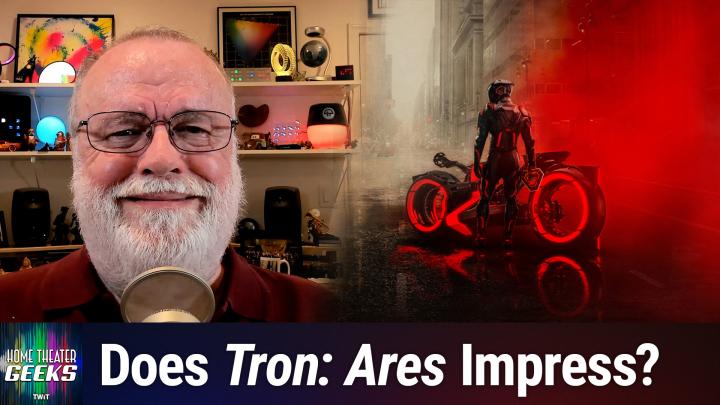
Home Theater Geeks 505 Transcript
Please be advised this transcript is AI-generated and may not be word for word. Time codes refer to the approximate times in the ad-supported version of the show.
Scott Wilkinson [00:00:00]:
In this episode of Home Theater Geeks, I give you my review of tron Ares in IMAX 3D. So stay tuned. Podcasts you love from people you trust. This is Twit. Hey there, Scott Wilkinson here, the home theater geek. In this episode I'm going to talk about the new movie Ares, which I went to see in IMAX 3D. Now, I've been a fan of the Tron franchise ever since the first movie came out in 1982. It used state of the art CGI which looks really crude by today's standards, but back then they had three CGI companies, computer graphic companies working on it.
Scott Wilkinson [00:01:04]:
And as a matter of fact, my sister was an assistant to the executive of one of those companies. So her name is actually in the credits of the original Tron, in case you haven't seen it. I'll give you a quick, quick recap. In the original movie Tron, a video game programmer by the name of Kevin Flynn, played by Jeff Bridges, gets digitized using a laser and enters the mainframe where the game is being developed. It's this environment is called the Grid and he has an adventure trying to get back into the real world. Other characters in the movie that are important to understand. For the new one, David Warner plays Ed Dillinger, CEO of the game company NCom, which Kevin worked for. He also plays a character in the in the grid called Sark.
Scott Wilkinson [00:02:13]:
Who's the bad guy? Bruce Boxleitner is also important in that original movie. He plays Alan Bradley, Kevin's friend and collaborator, as well as the program program Tron when when the in the scenes on the Grid. Second in the franchise was Tron Legacy in 2010, so already 30 years plus beyond the original, it had a much better CGI as you would expect, and a great score by Daft Punk. It also had an interesting story. I thought the reviews were only mixed, but I thought it was great. It followed from the first film. Kevin Flynn's son Sam, played by Garrett Hedlund, enters the grid looking for his father who has disappeared and is being held captive or he's trapped there. In the Grid he faces the evil program Clue, which is played by a digitally de aged Jeff Bridges, which a lot of people objected to.
Scott Wilkinson [00:03:26]:
I thought it was. There was no problem at all. Since it's in the grid now, Kevin has created a race of sentient programs that Clue has all but wiped out. There's only one survivor whose name is Cora, played by Olivia Wilde. Now Flynn destroys Clue at the end of the movie and by sacrificing himself While Sam and Cora escape into the real world. And Bruce Boxleitner returns as Alan. Alan Bradley and as Tron in the grid. Okay, now, 15 years after that comes the third installment, which is the subject of this review.
Scott Wilkinson [00:04:09]:
Tron Aries. It stars Jared Leto as the titular character. A security program written by Julian Dillinger, played by Evan Peters, who is seen in this photo with Jillian Anderson, who plays his mother. Julian Dillager is Ed Dillinger's grandson, and he now runs Dillinger Systems, which is a competitor to Encompass. And his mother, Elizabeth, as I said, played by Gillian Anderson, is there as well. Now, Julian has devised a way to bring things from the Grid into the real world using lasers, including tanks and vehicles, as well as individual quote unquote people such as Ares and another security program called Athena. They're big into Greek mythology here, obviously, the Athena characters played by Jody Turner Smith. Now, the problem is things from the Grid who are created into the real world only have 29 minutes before they de res and vanish back into the Grid.
Scott Wilkinson [00:05:33]:
Why that is is not really explained. It certainly didn't occur in the the second movie. Okay. Other characters of import. Eve Kim, played by Greta Lee, is the CEO now of encom. And she and Julian are racing to find something called the Permanence code, which was written by Flynn 40 years ago, that will allow things from the Grid to be permanent in the real world. They don't have to disappear after 29 minutes. None of this is spoken about in the first or second movies.
Scott Wilkinson [00:06:13]:
They just all of a sudden, this thing, this concept appears. Now, Jeff Bridges returns as Kevin Flynn in this movie for a kind of an extended cameo, is the only actor to appear in all three movies. And he looks a lot older even than he did in Legacy, which. Which he looked, you know, quite a bit older than he did in the original Tron or that that his de aged version, the program Clue, looked in the second movie. Now, the whole point of this movie, Tron, Ares, is that Aries starts to go beyond his militaristic programming and become more human with empathy and feelings. It's a common sci fi trope. I mean, data from Star Trek Next Generation, right? And there are lots of things carried over from the first two movies. Light cycles, for example, flying suits, those big floating ships called recognizers.
Scott Wilkinson [00:07:26]:
And there are a lot of Easter eggs in this movie that hearken back to the previous two. Especially there's a scene or two in the original grid from the 1982 movie with a light cycle and a little character called Bit, which is Kind of supposed to be a computer bit. And there are some other more subtle ones too that people who are fans of the first movie will catch.
Leo Laporte [00:07:58]:
Hey everybody, it's Leo laporte. Are you trying to keep up with the world of Microsoft? It's moving fast, but we have two of the best experts in the world, Paul Thurat and Richard Campbell. They join me every Wednesday to talk about the latest from Microsoft on Windows Weekly. It's a lot more than just Windows. I hope you'll listen to the show every Wednesday. Easy enough. Just subscribe in your favorite podcast client to Windows Weekly or visit our website at Twit TV www.Microsoft's moving fast, but there's a way to stay ahead. That's Windows Weekly every Wednesday on Twitter now.
Scott Wilkinson [00:08:31]:
Tron Ares was shot on IMAX cameras for a 1.90 to 1 aspect ratio in IMAX theaters. So that's where I went to see it. I found the largest IMAX screen I could, which is about an hour's drive away from my house. But I really wanted to check it out and it was post processed to be in 3D. It wasn't shot in 3D like Avatar, but they post processed it into 3D and I said okay, I'll go check it out in 3D. IMAX uses polarizing 3D glasses like real real D does in Dolby Cinemas and other theaters. Now. Visually, the movie is stunning.
Scott Wilkinson [00:09:17]:
It's beautiful and the 3D works really well, especially in the grid in the computer world. It, it just looks beautiful and it works really well. I liked especially the, the effect of the light bands that trail the light cycles and even the, some of the soldiers pikes have this light band effect going on which is, is I, I thought it was great. There was especially a shot of in the real world, Ares is riding his light cycle and the light band behind it cuts a police car in half. Cool effect. Really very good. Likewise, the sound is beautiful. Highly immersive.
Scott Wilkinson [00:10:09]:
In IMAX they use a six channel sound system. And in, in that case, even though it's not Dolby Atmos, the sound was swirling all around. Really, really good. And even better, the dialogue intelligibility was excellent. I could understand everything even when I had my earplugs, in which I did for about half the movie. And the reason of course is that it was very loud. They were, they kept it just barely within industry specifications, which is very interesting to me. It's usually what I find.
Scott Wilkinson [00:10:44]:
So they, they keep it within where it has to be, but just barely the average level over the entire movie was 84.3 DBA. The average over the whole film is what's called Leq LMAX, which is the highest 1 second peak was 101.6 DBA. And it stayed over 89, 10% of the time and over 77.7 50% of the time. So, you know, it wasn't. By measurement standards, it wasn't terribly loud, but it sure sounded loud to me. And so, as I said, I wore my earplugs for about half of the movie and I could still understand the dialogue quite well. Now, unlike Tron Legacy, which the score was by Daft Punk and the original Tron, whose score was by Wendy Carlos, this one, the music was by Trent Reznor and Atticus Ross of Nine Inch Nails and they sort of. It was music by Nine Inch Nails.
Scott Wilkinson [00:11:59]:
I have to say, I didn't like it as much as the Daft Punk score. I thought the Daft Punk score was beautiful. Really good. This was, you know, energetic and everything, but I just didn't like it as much. That's personal opinion. You. I have to say, I didn't care much for the story either. AI spontaneously developing sentience and human feelings is a pretty tired trope by now.
Scott Wilkinson [00:12:25]:
Aries goes from cold and calculating to warm and fuzzy very quickly. That was not very believable. And the permanence code motivation seems very contrived to me. There's no mention of it in the previous movies. It just all of a sudden appeared that, oh no, people can't stick. Stick around from the grid in the real world. Even more interesting, it's this. This permanence code written by Flynn 40 years ago, stored on a 5 1/4 inch floppy drive.
Scott Wilkinson [00:13:00]:
And how did Kevin Flynn survive to appear in this movie when he destroyed himself to save his son? And this sentient program, Korra, in the previous movie, that's never explained. I would have much preferred if Disney had continued the story from Legacy. What happened to Sam Flynn and Kora after they emerged into the real world? That would have been much more interesting. But of course, Garrett Hedlund and Olivia Wilde are now 15 years older than they were then. I don't think that would be a problem for Sam because he's a. He's a human being. But Cora, they probably would have had to de age Olivia Wilde a little bit so that she looked the same because she's a digital person. Or did Cora d res after 29 minutes in the real world? I would like to have known that from what I've read Disney was trying to make a standalone movie that did not depend on the previous titles.
Scott Wilkinson [00:14:07]:
Although, as I said before, there were a ton of Easter eggs and lots of references back to the other two titles. I think they were trying to appeal to a wider audience than fans, the Tron fans. But it didn't work. The box office for the opening weekend was very poor. $33 million in the US and Canada and a little less than 67 million worldwide. The estimated budget to make this movie, $180 million. So I don't think I've read a number of things that say there ain't going to be any more Tron movies. And I wouldn't be surprised if that's true.
Scott Wilkinson [00:14:48]:
So is it worth the 25 bucks I paid with a senior discount and a midday discount I went in the middle of the day? I'd have to say no, unless you're a big Tron fan. And even then, the story is likely to disappoint, as it did me. Now, the visuals and the soundtrack are phenomenal, so to see the state of the art in that regard, sure. And the Easter eggs are kind of fun. There were a couple in there that were very subtle, and you probably would have missed them if you weren't a big fan. But as for the movie itself, I can't say I can really recommend it. So there you are. That's my impression of Tron Ares.
Scott Wilkinson [00:15:36]:
Now, if you have a question for me, send it along to htgtwit TV and I'll answer as many as I can right here on the show. And as you know, TWIT has all of its shows on YouTube for free, but with ads. If you want to go ad free, join the club. Go to TWIT tv Club Twit. And join today. Until next time, geek out.