Windows Weekly 966 Transcript
Please be advised this transcript is AI-generated and may not be word for word. Time codes refer to the approximate times in the ad-supported version of the show.
Leo Laporte [00:00:00]:
It's time for Windows Weekly. Paul Thurat and Richard Campbell are together again in Acapulco, Mexico, which means there may be some tequila involved in this episode. We'll also talk about Microsoft and AI who's really running Microsoft. Paul doesn't think it's such a Nadella much longer. We'll also talk about Xbox gaming and the best advice for 2026 from Paul Thurat. It's all coming up next on Windows Weekly. Podcasts you love from people you trust. This is twit.
Leo Laporte [00:00:42]:
This is Windows Weekly with Paul Thurat and Richard Campbell. Episode 966, recorded Wednesday, January 14, 2026. You can't spell Gmail without AI. It's time for Windows Weekly. Hello, you winners and you dozers. We're going to talk about Microsoft. Before we do, let's take a trip down south to Acapulco.
Paul Thurrott [00:01:09]:
There we are.
Leo Laporte [00:01:11]:
Where Paul Thurat and Richard Campbell once again united in an attempt to conquer the beach. Hello, guys. Are you enjoying.
Paul Thurrott [00:01:19]:
The beach has conquered us.
Richard Campbell [00:01:20]:
I was going to say the beach conquered us, but that's okay. We put up a good.
Paul Thurrott [00:01:26]:
We did the beach winds most of the time.
Richard Campbell [00:01:28]:
Yeah, yeah, We.
Paul Thurrott [00:01:30]:
We were touring around Aapulco yesterday and that's fun.
Richard Campbell [00:01:33]:
By.
Paul Thurrott [00:01:34]:
By the afternoon, the sun had gotten to us and we were. We were all ready.
Richard Campbell [00:01:37]:
That was literally delirious. Yeah, it was.
Paul Thurrott [00:01:39]:
It was. It was time for exposure. We all needed a nap. Needed a nap.
Leo Laporte [00:01:43]:
That's what you want. And then add a little tequila to that and life is good.
Paul Thurrott [00:01:48]:
There might have been tequila involved. Why, yes. Yes, there was.
Richard Campbell [00:01:51]:
Yes.
Leo Laporte [00:01:52]:
So Paul Thurrott@therot.com and leanpub.com for his books. Richard Campbell@.net rocks and runasradio.com are here with us today. Our esteemed pair of Microsoft analysts. Let's talk about the latest news.
Richard Campbell [00:02:10]:
I don't know why I laugh when you say that. Okay, I guess so.
Leo Laporte [00:02:15]:
There was an interesting copilot story which I noted earlier today. We'll probably talk about it on Windows Weekly where I think it was a police department used co pilot to. To do something and it didn't. Didn't work out so well. I have to. I have to. I have to look up the.
Richard Campbell [00:02:35]:
This is the standard copilot experience, I think.
Leo Laporte [00:02:38]:
Yeah.
Richard Campbell [00:02:39]:
Fortunately, it was just law enforcement. It's not like anything bad would have happened if it screwed up.
Paul Thurrott [00:02:43]:
Yeah.
Leo Laporte [00:02:46]:
Hey, well, you got to know where. Look, I'm an AI fanatic, as you know, but you got to know where to use it and where not to use it. Oh, this is it. It was the uk, right? UK police department soccer game. Yes. At the soccer game, they used copilot AI, which hallucinated.
Richard Campbell [00:03:04]:
Yep.
Leo Laporte [00:03:05]:
And banned football fans based.
Richard Campbell [00:03:08]:
I mean, to be fair, most of those people should be banned.
Leo Laporte [00:03:11]:
Well, the Chief Constable of the West Midlands police has finally admitted that a hugely controversial decision to ban Maccabee Tel Aviv football fans from the UK was purely based on a hallucination. So don't.
Richard Campbell [00:03:27]:
We always said we're gonna. They're gonna be news stories where this stuff screws up.
Paul Thurrott [00:03:31]:
Yep.
Richard Campbell [00:03:31]:
Yeah. At least no one died this time.
Leo Laporte [00:03:33]:
No, and I hope we all learned something.
Richard Campbell [00:03:38]:
We gave them back three hours of their life, so it was probably okay.
Leo Laporte [00:03:43]:
No one needs to see that. Beautiful.
Paul Thurrott [00:03:45]:
Have you been asking a non deterministic programming model for facts? Well, error was your first mistake.
Richard Campbell [00:03:53]:
Yeah.
Leo Laporte [00:03:55]:
Kev, who is in the uk, says it's kicked up a huge stink here in the uk.
Paul Thurrott [00:03:59]:
Yeah. I suspect mostly because the police lied that they did it in the first place. Right. And then finally realized, no, it's better to blame the II than try and cover up for it.
Leo Laporte [00:04:07]:
Yes, I think precisely so. But Microsoft is still. I mean, I see all the ads. It's funny because the PC makers, at least at CES the story was, are downplaying the AI. PCs a little bit.
Paul Thurrott [00:04:22]:
Just Dell.
Richard Campbell [00:04:22]:
It's a little more nuanced than that.
Leo Laporte [00:04:24]:
Just Dell.
Richard Campbell [00:04:24]:
We'll get to that.
Leo Laporte [00:04:25]:
Yeah. Okay. Okay. It's your show. What am I saying? I'm going to show.
Richard Campbell [00:04:29]:
No, I mean, we are absolutely going to address this.
Paul Thurrott [00:04:32]:
Yeah.
Leo Laporte [00:04:35]:
Go ahead, address it.
Richard Campbell [00:04:38]:
Oh, I guess we'll do it right now.
Leo Laporte [00:04:41]:
No time like the present.
Richard Campbell [00:04:42]:
So part of the problem.
Leo Laporte [00:04:43]:
No, you can address whatever you want.
Richard Campbell [00:04:45]:
No, it's fine. We can do this right now. I don't care.
Leo Laporte [00:04:48]:
Oh, dear. That sounds like. Could see Kila talking.
Richard Campbell [00:04:51]:
What's the matter? Nothing. Yeah, so CS was last week. You know, this kind of thing bugs me because it's so cheap and easy to. Everyone sees this headline and they're like, yep, this verifies everything. I think it's perfect. But some guy from Dell, I guess, on a stage somewhere said something like, consumers are not buying PCs because of AI. And so you're like, all right, well, objectively that's probably true. But the problem is, like, the lot of people are anti AI.
Richard Campbell [00:05:25]:
Deny that AI is real or that it's not going to destroy the world or whatever it is. And so that becomes the point of those Stories. And when I hear this, I think to myself, Dell is one of the top three PC makers in the world. However, I cover their earnings every single quarter. And one thing I know is that they don't sell a lot of computers to consumers. So I looked it up and I got to tell you, of the companies that actually do make PCs, there is no company less qualified to talk on the subject than dell about consumer PCs.
Paul Thurrott [00:06:00]:
Anyway. Yeah, yeah, they're a business place.
Richard Campbell [00:06:03]:
But that's what I. That's. But that's what I meant. That's what they're talking about. They're talking about consumers PCs. So I look at the world's biggest PC makers like Lenovo and hp, and what are they saying about AI? And they sell a lot of computers to consumers. And then I compare it to what Dell's doing and they're going to tell you there's a little bit of a disconnect here. So Lenovo, the world's biggest computer maker, PC maker, record market share this past year, will not stop talking about AI.
Leo Laporte [00:06:35]:
I know my X1 has a nice big copilot button.
Richard Campbell [00:06:38]:
Yeah. They make far more money selling computers to consumers than any other company. $15 billion in the previous quarter. This is not the December quarter. Sorry. This is the latest data I had at the time. Up 12% year over year record. Almost 26% market share, which is unit sales industry leading profitability.
Richard Campbell [00:06:58]:
33% of their sales are now AI PCs. Also, they're the biggest maker of AI PCs in the world with 31.30, 31.1% market share. They're doing pretty good.
Paul Thurrott [00:07:09]:
Yeah.
Richard Campbell [00:07:10]:
You know, those guys are kind of kicking ass with AI. HP number two, 10.4 billion that quarter. Consumer PC sells, up 10% year over year. 30% of the PCs it sells. No AI PCs. Net revenues from consumer PC sold for $11 billion. They're marketing the hell out of AI, et cetera, et cetera. Both these companies, maybe uniquely, I don't think this is a useful thing for them to do, but they're both making their own AI chatbots and services.
Richard Campbell [00:07:39]:
Right? Even Dell. Not even Dell. Sorry. Even Apple. Right. Mac revenues of $8.7 billion. Most of those to consumers. They don't break it down.
Richard Campbell [00:07:47]:
But we have to assume most of that's consumers. 13% up year over year, obviously pushing Apple intelligence really hard across all their platforms. They're all doing great. What about Dell? 1.9 billion in revenues from PCs to consumers. That's approximately 1/6 or 7th of what Lenovo does. Decline is 7% year over year by far. Most of their revenues come from commercial customers, meaning businesses, governments, whatever. This company makes boring, terrible computers that no human being could ever love.
Richard Campbell [00:08:20]:
And they do it because that's what businesses want. That's where all their money comes from. So for a guy from that company stand up on a stage and say, let me tell you what consumers don't want, I have to tell you, I don't think he knows.
Leo Laporte [00:08:31]:
Good way to get it. So we can ignore that. Yeah.
Paul Thurrott [00:08:34]:
Well, also a good way to justify terrible sales.
Richard Campbell [00:08:38]:
Yeah, you could, right? In other words, yeah, don't blame our marketing.
Paul Thurrott [00:08:41]:
We would be doing production. Blame the industry.
Richard Campbell [00:08:44]:
The problem for Dell is these trends have been going on for years. This is not anything new. They're, they're, they're basically walking away from consumer PC sales. I, with the exception of, you know, premium kind of gaming class computers because there's a lot of good margins there.
Paul Thurrott [00:08:56]:
But they did kill the XPS brand and then bring it back when they realized, boy, that was a really dumb thing to do.
Richard Campbell [00:09:01]:
Just in case you thought they knew anything about marketing or consumers. Yeah. So I don't know. Also less, less newsworthy, I guess. Sorry, I know this is boring, but the CEO of Lenovo also spoke at CES and he said, I don't see a world without AI. Nobody can avoid it. It's not going to replace you, it will empower you. And that's why we're doing what we're doing.
Richard Campbell [00:09:24]:
So I get it's a cheap, easy headline. Consumers aren't buying PCs because of AI. Yeah, they probably aren't, but consumers aren't buying PCs. So whatever. When they do buy a PC, just like when they do upgrade a phone or whatever else, they're going to get a lot of AI capabilities. And they may understand that that's what they're doing, but they're getting real advantages from having those capabilities on the computer. So it may not be why they're buying it, but that's like saying, I'm not buying a car because it has power windows or wiper blades or four tires or something. It's like, yeah, it's just part of it.
Richard Campbell [00:10:03]:
It's not even the most important part. Or it's, it's a bunch of little things that you just expect and don't think about. But you know, and you know, no one would ever say like, this is why I did it. It's not flashy, it's just a lot of little things that work. So, so.
Paul Thurrott [00:10:19]:
And no more are people buying PCs because they have a on it than Dell's statement that people aren't buying PCs because they have AI? Yeah, maybe it's not a driving force in any of this actually this is really just seems like Dell trying to find an excuse for sucking at consumer.
Richard Campbell [00:10:37]:
Products or just, you know, we're at ces, we don't have a big consumer presence. How can we make some new news?
Paul Thurrott [00:10:42]:
Yeah, I know, I'll say what a group of people really want to hear, which is AI sucking.
Richard Campbell [00:10:48]:
Yep. And then everyone can just knee jerk, write about it and say he told you so. And it's like, well, okay, but I, I see a world. I can tell you something. Five years from now AI is going to be a big thing. Five years from now, Dell may not even have consumer PC. So we'll see. Yeah, we'll see what happens.
Richard Campbell [00:11:08]:
So that's my take on that. It's not the thing you would have read on every other news site, but it's, I think it's a lot closer to the truth. So whatever. But we'll get back to the AI stuff because there's a lot there unfortunately. But the one thing I kind of do want to address, and I think this is a legit controversy I guess is Microsoft, perhaps in concert with the United States government, it's hard to say here, has decided that they're going to make their AI sustainable, which I think we can all agree is impossible. And they have specified how they're going to do that. They're going to make sure they're actually paying for it, which is hilarious. They're going to make sure that their data centers don't increase electricity price, electricity prices for people in that community or wherever those things are, minimize their water use, replenish that water that they do use.
Richard Campbell [00:12:05]:
They're going to create jobs, which we all sort of understand is not actually possible.
Paul Thurrott [00:12:11]:
But there's a few. But most data centers are basically empty.
Richard Campbell [00:12:15]:
They're going to add to their like the local tax base so they can afford things like police forces, hospitals, schools, practice, etc. And then they're going to invest in local AI training and nonprofits.
Paul Thurrott [00:12:26]:
And the big one on the tax based one. The thing that hit me that what Brad Smith said was we are not going to ask for tax breaks because they have been like, they've been pretty consistently going in. We'll build a data center, but only if we get reduced taxes for five years. Like that could be.
Richard Campbell [00:12:41]:
Did he say that if unsolicited tax break offers were Made, they would not accept them.
Paul Thurrott [00:12:47]:
That's not what he said. Do not say that.
Richard Campbell [00:12:49]:
Okay, I'm just curious. Look, Brad Smith is the guy you send out for this kind of a thing. He's good at this.
Paul Thurrott [00:12:56]:
That thing is a tome, but it's very well written.
Richard Campbell [00:13:00]:
Yeah, it doesn't seem possible or feasible or believable, but this is the. You know, Microsoft is in the middle of a very serious problem with AI messaging. And it's of their own make do, you know.
Paul Thurrott [00:13:16]:
But you realize this is exactly the same message they were saying about data centers. Like five years ago when they were struggling to build data centers in, in like 19, in 2019 and 2020, they rolled out almost this exact narrative, more or less. It looks like they've just swapped the word data center for AI.
Richard Campbell [00:13:34]:
So I think in the. I think the only difference here is literally the, the term AI, Right. That AI has such a negative, visceral reaction with so many people. In part maybe largely because Microsoft and other companies like Microsoft have pushed it so hard that the reality of what they're delivering, it has not ever met the, whatever the promises that they have.
Paul Thurrott [00:14:00]:
Said, like they never can.
Richard Campbell [00:14:03]:
Yeah, I mean, we entered the agentic AI era about 18 months ago and I still don't have a single agent doing a single thing on my behalf anywhere. And I don't. They're just talking about stuff and it's like, okay, but where, where is this going to happen? So this is, like I said, this is a. This is a problem of their own making. It's. It's interesting. Sometime last year, I don't remember September, ish. Satya Nivella ceded a large chunk of his CEO responsibilities to another person.
Paul Thurrott [00:14:32]:
Jensen.
Richard Campbell [00:14:34]:
Yeah.
Paul Thurrott [00:14:34]:
And he.
Richard Campbell [00:14:35]:
I don't know what he's been doing since then.
Paul Thurrott [00:14:38]:
You know, the funny thing is he's been doing exactly the same job he was always doing because he was always responsible for. For commercial business. It's just that he was a president in charge of commercial business.
Richard Campbell [00:14:48]:
No, I mean, I don't know what Sasha's been doing.
Paul Thurrott [00:14:50]:
I don't know, other than wearing more leather jackets and hanging out with Jensen.
Richard Campbell [00:14:54]:
But apparently he's bored because he started blogging. Yeah, there's something, and I, I think I might have mentioned this in passing last week or whenever the last time we spoke was, but. Or at some previous time, but I didn't. You don't get too far into this initial blog post before you kind of throw up a little bit in your mouth, because he's just the Way he communicates is so terrible. But what this boils down to is please stop ragging on AI. Right. Which is a message we're starting to see in multiple quarters. Right.
Richard Campbell [00:15:24]:
Open AI is doing this now. Anthropic did this at ces. Actually Nvidia's doing it.
Paul Thurrott [00:15:29]:
The CEO of Jensen did the thing was on a podcast.
Richard Campbell [00:15:34]:
And I'm sorry, but in the sense that I have my own visceral response to AI deniers because I feel they're so off base. I also have a visceral reaction to the way these companies are marketing these capabilities that do not exist and that what they should be focusing on are the real world benefits which are there. And there's stuff happening here. It's very interesting, it's good, it's going to be long lasting, it's going to only get better, et cetera, et cetera. But all the money that's being thrown around the partnerships that literally exist between every single company in this space and all of the other companies in the space, they're trying to end run around regulation and any government interaction whatsoever, it feels wrong.
Paul Thurrott [00:16:22]:
I love that they feel surprised that the average consumer doesn't like AI after spending all that time telling investors, hey, we're going to get rid of all jobs with this.
Richard Campbell [00:16:31]:
Yeah, but that's like somebody walks up and punches you in the face and then you get mad and you're like what are you mad at me for? I'm a good guy, you know. And well, I think it's because you punched me in the face. So like I said earlier and the.
Paul Thurrott [00:16:43]:
Punch in the face looks like it was a lie.
Richard Campbell [00:16:45]:
Right, Right.
Paul Thurrott [00:16:48]:
All these companies that have laid off people to because AI is going to do the job of now hiring them back because it can't.
Richard Campbell [00:16:53]:
Yeah. So this, I find this, this is kind of fascinating. So I mentioned this in passing this morning to Brad. I, I, I kind of want to throw this by you guys because this is ill formed and it's not it. I'm not, this maybe doesn't make any sense but if you are familiar with Microsoft's history, if you're deeply involved in a Microsoft ecosystem, whatever it might be, you would know that Bill Gates co founded this company in the mid-70s. They've had three CEOs. Gates Ballmer and now Sachin Nadella. Gates and Sachin Adela are engineer types, I guess we'll call them Balmer.
Richard Campbell [00:17:38]:
More of a businessman, although he had an excellent understanding of the business. I mean he wasn't, you know, a Non, he didn't come up in the world as a technical guy but obviously by nature of the job you can very technically know, you know, what he's doing. But we've made the case sort of right that who's really running this company. I just mentioned the fact that he ceded a lot of his responsibilities about six, nine months ago, whatever that was. And in some ways you could make the argument that Amy Hood is running Microsoft. I've also talked a lot especially she's a CFO 4/4.
Paul Thurrott [00:18:11]:
And even before this whole play with Judson happened, you said this about the, the quarterlies. You know, Satya would say something and then Amy would literally.
Richard Campbell [00:18:21]:
Oh yeah, she would almost put him down. I mean she didn't ever actually say but let me, let me add some color to that.
Leo Laporte [00:18:28]:
Cute.
Richard Campbell [00:18:30]:
You know, and it was like, oh geez, you can, you can hear this stuff yourself. It's out there. It's very strange. But in the sense that we, maybe some of us criticize Google because they're really an ad company that makes so much money they can invest in and create tech products, right. That on their own may or may not ever be successful, but certainly don't generate as much money as any of the ad stuff. You could make the point that Microsoft today is transitioning to its own different kind of a company where yes, they have obviously a huge tech business infrastructure and the actual products that end users and businesses use. But really the business there in some ways is the money and that the management of money and the external management of the forces arrayed against them which are not competitors, but governments and regulators suggest that maybe the next CEO of Microsoft should not be an engineer but should be someone like Amy Hood and or Brad Smith.
Leo Laporte [00:19:25]:
Interesting.
Richard Campbell [00:19:26]:
In other words people or a person or people who are good at those things where obviously you're going to have technical people running the businesses inside Microsoft, Azure, Windows Server, whatever they have, but at the top Microsoft success, that arc of market cap. I guess you guys would be that way. Sorry. Is not because Azure is super good or Windows is doing great or any of that stuff. It's because they're doing such a good job managing money and managing expectations of Wall street, managing investors and potential investors, shareholders, et cetera. And this gets us into a well weighted area. Again, this is ill formed. I just came up with this.
Leo Laporte [00:20:10]:
I think you could be arguing against this though as a technologist, Paul. I mean this isn't this why we have insidification is the financialization of technology?
Richard Campbell [00:20:20]:
Oh yeah, no, I'm not saying this is a good thing. I want to be super clear. I'm saying this might be the natural next step for this company that I am increasingly at odds with because they have ruined some of their own products for these reasons, and I hate it. But given that, if you kind of take. What does the next step look like or the future, you could almost make a case. I mean, if you believe that Amy Hood is technically sort of running Microsoft as a business today, which I think you could argue effectively, maybe the next CEO of Microsoft needs to be that kind of a person and not a technology.
Paul Thurrott [00:20:56]:
You know, this is a parallel to something like McDonald's where eventually they figured out the real estate business of the restaurant was more important than the food. Because Microsoft is really not a software company anymore. Right. They're an infrastructure company. They own a huge number of data centers.
Richard Campbell [00:21:10]:
Yeah. And you're talking about the same thing. It's real estate. It's the cost of items that go. What do you call it over time? You kind of amortize something over time.
Paul Thurrott [00:21:21]:
And the capital costs.
Richard Campbell [00:21:25]:
This is not tech.
Paul Thurrott [00:21:26]:
Yeah.
Richard Campbell [00:21:27]:
This is not. It's becoming a utility loop in a software program. It's financial market manipulation and. Well, in arguably hiring companies so you don't have to worry about regulators.
Paul Thurrott [00:21:37]:
Yeah, yeah. Managing regulation. And then ultimately the product is this software that generates software.
Richard Campbell [00:21:45]:
Right. Listen, all three of us, no matter where we are in life right now, got into this world because we were enthusiastic about technology. We care about this stuff. We care about the products. And these companies are not. I don't feel like they're not enthusiastic about these products anymore. I mean, I think they're enthusiastic about making money, which. Yeah, I mean, I get on some level, they're businesses.
Richard Campbell [00:22:08]:
But I'm so far removed now from the point of this company, I don't even know where to start anymore. Like, I don't even understand how we got here. So we can look at something like Copilot and say, yeah, it's good, bad, and different. We can talk about that. But the reality is, from Microsoft's perspective, that's just about perception and growth and future opportunity. And I don't know that they even care if that thing's good, bad, or indifferent. If it was selling fine and it was terrible, they wouldn't care at all. So I don't know.
Richard Campbell [00:22:41]:
It's kind of a. I don't know. I need to. I need to work on this a little bit in my brain. But I was just thinking about this this morning. You know, there's a lot of speculation, for example, about when, you know, Tim Cook will step down at Apple. I think we could ask similar questions about Sachin Adele at Microsoft, because unlike Tim Cook, he actually did give up part of his job. You know, it's a different situation.
Paul Thurrott [00:23:07]:
Yeah. I wondered if Satya was freeing up time to try and straighten the AI shift, but I have no evidence of that. I also saw it as a, hey, maybe I'll leave. I'll let the blame land on Judson rather than me when the bubble bursts.
Richard Campbell [00:23:18]:
Yeah.
Paul Thurrott [00:23:19]:
You know, I, the other point is he's been CEO almost as long as Ballmer was.
Leo Laporte [00:23:24]:
Yeah.
Richard Campbell [00:23:25]:
Right.
Paul Thurrott [00:23:25]:
Time for him to go.
Richard Campbell [00:23:26]:
Anyway, I think I, I was, I was working toward this idea, but not on purpose, but I, I, but I had mentioned to Richard earlier on this trip something that was along these lines and, and you made the point, Richard, that Sachin Nadell is the chairman of the board.
Paul Thurrott [00:23:41]:
Yep.
Richard Campbell [00:23:43]:
And to me, you know, if you, you're setting up a guy to be a fall guy, potentially, I would say, well, yeah, but the board of directors should be the thing that looks at the real culprit, so to speak, and says, well, it's you guys that have to go. You or whoever. And I suppose there's a, I mean, if he's the chairman of the board, I don't know how this works, but maybe he would be able to prevent that from happening.
Paul Thurrott [00:24:06]:
It's a fundamental, you know, there's always been a complaint, especially in tech companies, that their boards have been crony boards. Yeah, right. The CEO is also the chairman and he puts his friends on the board and they all make money from it and they just affirm whatever that person does. And there was a real, I think it was a real important move when Washington took control of the board, the, the chair, when Satch was initially brought in, and now they've switched back. Like now they've sort of re. Cronied the board.
Richard Campbell [00:24:34]:
Re cronies. The re. Cronying of the board.
Paul Thurrott [00:24:38]:
Yeah.
Richard Campbell [00:24:39]:
Yep.
Paul Thurrott [00:24:40]:
And to be, and to be clear, even if you don't worry about the cronyism, all those guys have options and those shares only keep going up. So the horror show in this entire thing is this. You are beholden to the shareholders and you've made all the board members. Shareholders means as long as they're making money, everything is fine.
Richard Campbell [00:25:00]:
But this is why at some point it won't be okay.
Paul Thurrott [00:25:04]:
No, it'll all, It'll hit it hard when it, when it hits, for sure.
Richard Campbell [00:25:13]:
Well, trying to send it to this guy. But that's not going to work anyhow. So anyway, it's just a thought but I, when I look at the. Look, we've been complaining about the marketing of AI for what, three years now. We've seen multiple instances of stories or rumors that Copilot is not doing very well compared to other AIs. Tiny market share or usage share I guess in this case.
Leo Laporte [00:25:39]:
But do they need to do well with selling Copilot or is it Copilot just a feature that sells Windows?
Richard Campbell [00:25:46]:
No, they're selling Copilot directly because it's. And they need to an added on skew kind of a thing.
Paul Thurrott [00:25:51]:
Well, they've committed to doing it that way. But you know, there's also an interesting movement towards AI just being an integrated part of software. And you don't even call it.
Richard Campbell [00:25:59]:
No, that's the way it should be. But I, So I think the last year in the fall, I think ahead of Ignite, they made the point every, every PC is going to be an AI PC. Okay. So there's this weird thing now going on where you can get co pilot capabilities capabilities without paying for Copilot. But I think that's sort of the point. They're trying to expose people to it so that they will want to upgrade to a paid SKU or whatever it might be in businesses. You would, that would be more prevalent.
Paul Thurrott [00:26:29]:
But maybe the mistake is they made it a paid sku. If they just said hey, Copilot's included in everything, everybody gets it. Look at their current profits and look at their current quarter. Like the numbers are awesome. The only problem is market share compared to OpenAI. If you just gave it to everyone. So the numbers were automatically as big as your customer base.
Richard Campbell [00:26:48]:
Well, you're okay. So the problem with that is just the actual cost to Microsoft of that.
Paul Thurrott [00:26:53]:
Infrastructure which nobody's actually talking about in a meaningful way so far.
Richard Campbell [00:26:57]:
Yep.
Paul Thurrott [00:26:58]:
But still it's like you're making a self fulfilling prophecy by trying to measure it from the outset and showing you're behind, you're making it even harder to cover those costs.
Richard Campbell [00:27:06]:
So yeah, the way this started was we're going to have this paid SKU for businesses and then one for consumers. They got rid of the one for consumers. They added a new SKU of Microsoft 3 365. They raise prices across the board on Microsoft 365. Actually I think the business one's going to kick in in what, July? So you're like all right, well it sounds like they're leaning toward that. But really, I feel like they would have to raise prices more than whatever that, you know, depending on whatever the average was 15 or percent or something. Like maybe for this to make sense, it would have to be 25% or whatever the number is. But I think they really want to make this like a growth explosion from a revenue perspective and they want people to pay for this thing.
Paul Thurrott [00:27:51]:
Well, there was always an argument that cloud growth was slowing down in 23 when they jumped on the AI horse.
Richard Campbell [00:27:58]:
Yeah, yeah, yeah. I mean, and this is the whole insertification thing. Like what do you do when you've either saturated a market or you just whatever you've plateaued for whatever reason, you've got this thing that's doing great. It's been the growth engine for a long time. Remember, Azure was 70% growth for several years every quarter. Then it was 60 and 40 and 30s. And that's when they are like, oh, AI. You know, because Wall street getting, starting getting a little edgy.
Richard Campbell [00:28:24]:
We don't, we're not having those massive growth numbers anymore like we used to on cloud. I just, I don't know. There's something. This is, we've gotten into a weird.
Paul Thurrott [00:28:33]:
Area here, but it definitely feels the. This is the bubble feeling, right?
Richard Campbell [00:28:37]:
Yeah.
Paul Thurrott [00:28:40]:
Well, you've been, you've been making these promises to investors at these huge rates for this huge amount of growth, which is alienated the customer base and they are starting to hate on it. And you have to keep coming up with bigger and bigger expectations to keep justifying those valuations.
Richard Campbell [00:28:54]:
Yeah, we need a better term for this too. Because when you hear the term like the AI bubble is going to pop, you picture like a little like you're blowing a bubble out of one of those little plastic things. It's a cute little boop. It's more like when Alderaan got destroyed in Star Wars. You know, that's that kind of a pop, you know. So, yeah, I think it's going to pop, but I think it's a little more violent than the word pop implies.
Paul Thurrott [00:29:13]:
And we've seen it before. This is the dot com bust, right? It's that when the investor's money runs away, all those companies that don't have their money in place and don't have positive cash flow and so forth, they unravel collectively.
Richard Campbell [00:29:26]:
Forget everything. The Internet was this thing that occurred after it seemed like the tech world had stabilized. It became like a mature business. And then it was like, oh, my God. Okay, we didn't get in on the PC, boom. Now we get this new thing. It's gonna be awesome, you know?
Paul Thurrott [00:29:40]:
Yeah.
Richard Campbell [00:29:41]:
And then that it's kind of settled down. Everyone has phones and the web's everywhere, we all have broadband, blah, blah, blah. It's like, oh, now it's AI and it's like nothing bad ever happened. Right. By getting overly exuberant about this stuff, you know.
Paul Thurrott [00:29:53]:
You know, it's not. It's greed. You wanted your billion dollar win.
Richard Campbell [00:29:58]:
Yeah.
Paul Thurrott [00:29:58]:
And a part of, you know, I have to feel like part of the reason that Microsoft has presented the product this way, if they had just continued with the way they do their accounting where you can't tell where any of the money comes from, but they were going to get this massive growth anyway and keep increasing revenue numbers, they could have been saying good news about Copilot the whole time. Except that Satya wants to make AI his story.
Richard Campbell [00:30:19]:
Right. So Microsoft was this big, safe, successful company that was not generating headlines, was not exciting and I think he wanted to get in on that, which is understandable. Right. I mean, to somebody, are you seeing these companies like Apple, Google especially consumer side companies, just so newsworthy all the time. It's all anyone cares about. People used to talk about the biggest companies in tech and they had these terms like now it's like Magnificent Seven. But whatever the previous term was like the top three, four terms, Microsoft wasn't even part of it. Even though they were bigger than all of those companies except for one.
Richard Campbell [00:30:50]:
They were just like Oldsmobile. They're over there in the corner. Just nobody cares. So I get it, you know, to some degree. But it's been. This is so exaggerated.
Paul Thurrott [00:31:01]:
Yeah.
Richard Campbell [00:31:01]:
And unnecessary. It's too bad.
Paul Thurrott [00:31:03]:
I mean, the good news you can say from the Microsoft perspective, maybe we'll be to Amy Hood, is they have not leveraged at all. They've just spent cash and they've mostly built data centers like they're in the place of the companies that built all the cables.
Richard Campbell [00:31:17]:
There's more to it than that. There's things like, you know, I, this is an area, I'm just not an expert and I don't know enough. But it's the type of thing where for purposes of your accounting, meaning your quarterly reports that you're spacing out the, the life cycle of whatever components on a basis that's about double the normal rate and it makes it look better than it is. I mean there are very real costs here.
Paul Thurrott [00:31:42]:
Yeah.
Richard Campbell [00:31:44]:
And also they, I don't know if it's 2/4 now, but at least 1/4, I think it was 2/4 in a row. Now they spent more on AI infrastructure than they earned in profits. So they've kind of.
Paul Thurrott [00:31:54]:
They're starting to cut into the cash.
Richard Campbell [00:31:56]:
Yeah. Yep.
Paul Thurrott [00:31:58]:
It's still cash, you know.
Richard Campbell [00:32:00]:
No, I understand. I'm just. But, but as a potential investor, there's different ways you can reward those people. And I think we're going to get to the point now where some are going to say, hey, why are we doing this? And this is a lot of cash, heavy upfront infrastructure investment, whatever you want to call it.
Paul Thurrott [00:32:23]:
Well. And over cost. Like they're spending more on it than they should.
Richard Campbell [00:32:26]:
Yeah. Like it may. This may not make sense. Yeah. To an investor, I mean. Yeah.
Paul Thurrott [00:32:32]:
But they got nowhere else to go because the rest of the market is bad news.
Richard Campbell [00:32:36]:
It is. Yeah. It is an astonishing reality of our industry that you see these kind of relationships all the time. Apple will do whatever they do in mobile and Google just copies it. You know, Microsoft did whatever they're doing and I know they're all doing the same thing and they're all copying each other and it's. And to the. Not just. I don't mean features, but just the way they're spending money.
Richard Campbell [00:32:55]:
Yeah. You know, there's this real, almost irrational fear among these CEOs of these big companies that if they don't do exactly the same thing everyone else is doing, they're going to get left behind.
Paul Thurrott [00:33:05]:
Well, and there's a case for that. The three big. The Google, Amazon, Microsoft have all built enough data centers that they've stretched out their lead compared to anybody else, that when this stupidity ends and you're sort of left with the pieces behind.
Richard Campbell [00:33:20]:
Yeah.
Paul Thurrott [00:33:20]:
It's still going to be unbreachable. Oh, yeah, they're going. They've now built a mold, those three, and that's, you know, what was the race. Make sure none of them got ahead of the other.
Richard Campbell [00:33:30]:
I write too much about this stuff to even remember when I wrote this, but at some point in the past, a year ago, maybe, I don't know, I made the case, you know, the outcome of all this, regardless what anyone thinks about AI or its efficacy, whatever, is going to be that when the dust settles, the top five companies in the world will still be the same. Top five companies in the world. And I think that.
Paul Thurrott [00:33:48]:
And they'll distance themselves from everyone else. It'll just be that much further away.
Richard Campbell [00:33:53]:
Yep.
Leo Laporte [00:33:55]:
Well, I'm betting on the success of AI and I've put all my money into AI stocks.
Richard Campbell [00:34:02]:
Well, Leo, you're hallucinating.
Paul Thurrott [00:34:04]:
No, I'm excited for you, Leo. This is going to be great.
Leo Laporte [00:34:07]:
I have it. But it's almost impossible not to. If you. If you are buying index funds, which I am.
Paul Thurrott [00:34:14]:
Yeah.
Leo Laporte [00:34:14]:
Because the s and P500 is so dominated by the Magnificent Seven. So in effect I am buying AI, but you know, I'm not buying gold or silver. I know I'm. A lot of people are. I'm not thinking that there's going to be a big crash. I think there's real value in AI.
Richard Campbell [00:34:28]:
No, there absolutely is. Yeah.
Leo Laporte [00:34:29]:
And I think genuine.
Richard Campbell [00:34:30]:
Correction.
Leo Laporte [00:34:31]:
There'll be maybe. Why maybe there's a huge economic benefit to AI that will be. Certainly some companies will. There'll be winners and losers. I'm not saying that, but I think the overall value creation from AI is dramatic. Is more than the industry.
Paul Thurrott [00:34:46]:
Might be a while. Might be a while to be realized. You know, typical. These things don't grow symmetrically. They grow and then they recover and tune and then they grow again.
Richard Campbell [00:34:55]:
Yeah.
Leo Laporte [00:34:55]:
But this thing is not like those things. I think this thing is unique.
Paul Thurrott [00:34:58]:
But, you know, that is definitely the way it's being sold, Leo.
Leo Laporte [00:35:01]:
Yeah, I know. And I'm buying it.
Paul Thurrott [00:35:04]:
Yeah. I said that same thing about the Internet back in 2000 and I bought.
Leo Laporte [00:35:08]:
The other things and I invested my entire career and way of life into the success of computing. Then the Internet and now AI.
Paul Thurrott [00:35:15]:
And it took a few. And it took a few years.
Richard Campbell [00:35:17]:
It took a.
Paul Thurrott [00:35:18]:
Correct.
Leo Laporte [00:35:18]:
Yeah. If you're impatient, of course. You know who lost money in the 1929 bust? The people who said, oh, I'm getting out. That sold at the bottom.
Richard Campbell [00:35:28]:
Yes, of course. Yep. Yeah.
Paul Thurrott [00:35:30]:
No, I specifically people who were leveraged.
Richard Campbell [00:35:33]:
Don't misunderstand.
Leo Laporte [00:35:33]:
It was because of leveraging some. A lot of had to.
Richard Campbell [00:35:36]:
AI is real and it's. It is going to be a big deal and we're going to look back and maybe not us, but a future generation will look back and say, I can't believe there were human beings that sat in front of a human computer. News stories or whatever it is, the things that we're so excited about.
Leo Laporte [00:35:49]:
I think that's going to happen this year.
Richard Campbell [00:35:51]:
Yep. But be honest, people are doing those jobs. In other words, like if. If some scientists came up with fusion energy or something, we didn't need fossil fuel or any kind of fuel. That would be all kinds of job loss. But. Right. We still.
Leo Laporte [00:36:07]:
It's a disruptive force. I'm not denying that. And if I were in college today, I Would not be studying Python or coding. That would be a foolish thing to do. Yeah, but that's just me. We're living in college.
Richard Campbell [00:36:21]:
It's hard to say.
Leo Laporte [00:36:22]:
I studied Chinese in college. That actually turned out to be smart, but about 30 years ahead of time.
Richard Campbell [00:36:28]:
Right. So no, let's take a StageCoach driver in 1888. If you know about his feelings on trains and planes and whatever else, he would have negative feelings about these things.
Leo Laporte [00:36:39]:
I'm starting a buggy whip factory because I think the future's in buggy whips.
Richard Campbell [00:36:44]:
And I'm going to go right for steel. I think steel and oil are pretty much the futures.
Leo Laporte [00:36:49]:
You know, we live in uncertain times. That's. That's the one certainty is that we are in a very disruptive time. And I think all sorts of things are going to happen. And I'm just praying that my retirement funds survive.
Richard Campbell [00:37:06]:
Right. Well, you might not need retirement funds. I just learned, apparently, because we're never gonna have to work. We won't even need that money. So honestly, what you should do is just spend it now because you definitely aren't gonna need it later. That's some good advice.
Leo Laporte [00:37:21]:
Okay, I'm buying that boat.
Richard Campbell [00:37:24]:
You're like, yay.
Leo Laporte [00:37:25]:
Yay. Let's take a break because I do wanna do an ad and then we will come back. We're gonna talk about Windows stuff, including Patch Tuesday. You're watching Windows weekly with these two guys, these lucky guys who are in Acapulco, Mexico. Mr. Paul Thurat and Richard Campbell. Our show today, brought to you by Zscaler. Zscaler actually is the world's largest cloud security platform.
Leo Laporte [00:37:56]:
And one of the things that they have understood, I think very well, is that as we were just talking, there are pluses and minuses to AI. The potential rewards for AI to your business are too great to ignore, but so are the risks. And the risks are multifarious, partly from bad guys who are using AI to attack you in vigorous ways that they have never had before, but also through the risk of using AI in your business, the loss of sensitive data. You know, people are attacking enterprise managed AI as well, trying to get information out of it. Right? You don't want proprietary information to be leaking out of your company. So generative AI increases the opportunities for threat actors. It helps them to rapidly create phishing lures, write malicious code to automate data extraction. And using AI can cause problems for you.
Leo Laporte [00:38:48]:
There were 1.3 million instances of Social Security numbers leaked to AI applications, not through malicious activity, but through inadvertency through user error. ChatGPT and Microsoft Copilot last year saw nearly 3.2 million data violations. There is a solution, a modern approach Zscaler's Zero Trust plus AI. With Zero Trust you eliminate your attack surface. You can secure your data everywhere cloud on prem. It safeguards your use of public and private AI and it protects you against ransomware and those AI powered phishing attacks. You don't have to take my word for it. Just check out what Shiva, the director of security and infrastructure at Zuora says about using Zscaler.
Richard Campbell [00:39:35]:
AI provides tremendous opportunities but it also.
Leo Laporte [00:39:39]:
Brings tremendous security concern when it comes to data privacy and data security.
Richard Campbell [00:39:43]:
The benefit of Zscaler with ZIA rolled out for us right now is giving us the insights of how our employees are using various Genai tools. So ability to monitor the activity make sure that what we consider confidential and sensitive information according to you know, companies data classification does not get fed into the public LLM models et cetera.
Leo Laporte [00:40:05]:
With Zero Trust plus AI you can thrive in the AI era. You can stay ahead of the competition and you can remain resilient even as threats and risks evolve. Learn more@zscaler.com security that's Zscaler.com security we thank them so much for their support. Zscaler.com security we appreciate your support by going to that address so they know you saw it here. Back to Acapulco and the latest on Patch Tuesday.
Richard Campbell [00:40:37]:
At the end of the show we're gonna dive off a cliff.
Leo Laporte [00:40:40]:
Oh, that's right. Isn't that where the.
Paul Thurrott [00:40:41]:
Yeah, the cliff divers is where the cliff divers are. Yeah, we were at the Miraba, the Mirador to yesterday.
Leo Laporte [00:40:47]:
They still do it.
Paul Thurrott [00:40:48]:
They still do it.
Leo Laporte [00:40:49]:
Wow. Yeah, that's probably not the same ones that did it before.
Paul Thurrott [00:40:55]:
They look, they're pretty young.
Richard Campbell [00:40:56]:
Yeah, they did.
Leo Laporte [00:40:58]:
It's a young man's job.
Richard Campbell [00:41:01]:
As Norm MacDonald observed, you're either an expert cliff diver or you're stuff on a rock.
Paul Thurrott [00:41:09]:
Wow. These guys all did a great job and then came up for their chips. Because they're no fools.
Leo Laporte [00:41:16]:
Yes. So was it yesterday? Was patch two? I guess it was yesterday.
Richard Campbell [00:41:21]:
Yes, it was. Yeah. If you didn't notice this, you didn't miss anything. If you think back to December, we never had preview updates. Microsoft was off the second half of the month. So this month's patch Tuesday was just bug and security fixes. Nothing major in my opinion, but whatever. Anyway, I, you know, did the whole reboot thing, see if anything changed, blah blah blah.
Richard Campbell [00:41:46]:
I didn't see anything.
Paul Thurrott [00:41:46]:
It's still a spinning icon in my sys tray, but okay, now that you say it's all right, I guess I'll do it.
Richard Campbell [00:41:52]:
Well, this is on one computer. I usually have more systems.
Paul Thurrott [00:41:56]:
You're used to wrecking more machines than that at once.
Richard Campbell [00:41:58]:
I get that. So we'll have more. I mean this year I'm sure we'll be just as big as last year. We'll see.
Paul Thurrott [00:42:03]:
I'm just wondering when all the reorgang that's happened with pavan and so forth starts to affect this flow. It's going to take a while.
Richard Campbell [00:42:13]:
You might make the argument that the agentic stuff that they announced for Windows that was the big controversy ahead of Ignite might be the, I don't know, the big focus this year. And whether or not that turns into a new version of Windows, I guess is probably the big Windows story of 2026 and see what happens. But we did get a new build for dev and beta. So the first of 2026. Some copilot related features, whatever. Nothing I guess super dramatic. Although if you really follow this stuff closely, you might know that if you have a Copilot plus PC you can get image descriptions through narrator. They're bringing that to all PCs with copilot.
Richard Campbell [00:42:58]:
So it's going to be cloud powered instead of local. Right? Which is maybe speaks to that every PC is an AI PC. So I could be wrong. No, I am wrong. Well, no, I could be wrong, but I think this is the first example of a Copilot Plus PC feature that was exclusive coming to all PCs. We've seen the reverse. There was a set of AI features for Notepad that were about writing summary, etc. Etc.
Richard Campbell [00:43:25]:
That are cloud based. But if you have a Copilot plus PC you can actually do that locally as well. So they've gone in the other direction with that one feature. I think this might be the first example of that happening. So maybe there'll be more of that. We'll see. But it's not even. It's funny.
Richard Campbell [00:43:41]:
Laurent didn't even really write this for some reason. But the bigger thing to me about this new set of builds is that Microsoft specifically used the term window, which I enjoy because I invented it and said that you're on a timer now. So at some point dev and beta are going to diverge again and and dev will be on twice. They didn't say this, but it will be 26H1, which right now is Canary only, I believe. So these things are going to Diverge. Although you know, again it probably won't matter because they're all getting the same features. Right. So no big deal.
Richard Campbell [00:44:13]:
And let me make sure this is next. Yes, some hardware related stuff. We already covered the Dell thing but IDC came out with their numbers for 2025 PC cells. And remember they had warned weeks ago back in December, I guess that 2026 was going to be kind of iffy. So the fourth quarter of last year and then all of last year were good for the PC market. Not double digit increases per SE, but 8% for the year, 9.6 for the quarter which now they're saying is might have been better because of the memory problems that are going to be the big issue this year because people were starting to buy a PCs, companies were anyway companies and or people ahead of expected price increases in 2026. So I usually do a big roundup of stuff in January about PC stuff, but PC soles rather I'll do that when Gartner weighs in. But for now what IDC is saying.
Richard Campbell [00:45:13]:
285 million PC sold. Update 8 Like I said for the year, Lenovo's number one by far. 71 million units for the year 25 market share roughly HP, Dell, Apple Aces. Right. So that's all the same as before. Apple's market share for people care about this is 9% which it was a year ago as well. So you know, like they're doing fine. But I mean I, I think people have this idea that Apple's like outselling the rest of the market somehow that's not the case.
Paul Thurrott [00:45:43]:
They're just making very good machines but they priced accordingly and they sell a small portion of the market. The other part is that most PCs aren't sold by selection by consumers. They're sold to businesses who are buying them on lease as part of a pattern approach that goes back decades.
Richard Campbell [00:45:59]:
Yep. We've never had a firm grasp of what the percentages are. I think we're still working on that rough 2/3 to 1/3 thing. But it might be different now. It's hard to say. You know, and I did that bit about Dell earlier. I kind of mentioned this in passing. Some PC makers split it out and you can see what the differences are.
Richard Campbell [00:46:19]:
Some do not. So it's kind of hard to say. But the big thing here is that IDC is warning for this year that things are going to be volatile. In fact, I think they use the term extremely volatile. Seems like an unnecessary escalation of that term. But it's like a. It's an explosive. Explosive.
Richard Campbell [00:46:39]:
So they see higher prices, potential for lower, lower starting RAM configurations where you have to pay extra to get, you know, the acceptable amount of ram. Slower growth. Obviously they do still see growth.
Paul Thurrott [00:46:52]:
They would be irresponsible to say anything other than that in this tariff regime, in this product availability regime, like, well, how can you guarantee sales of any kind? You don't.
Richard Campbell [00:47:02]:
Yeah.
Paul Thurrott [00:47:02]:
So extreme volatility.
Richard Campbell [00:47:04]:
I, I think the only big impact here is honestly for the DIY types, you know, the people who build their own computers. Yes. That's going to be a real cost.
Paul Thurrott [00:47:13]:
Yep. I'm really glad I got my machines done when I did.
Richard Campbell [00:47:16]:
Really. But I think for the majority of people, or maybe companies, but people certainly who buy a computer this coming year, this is not something they're going to understand as a year over year increase. Like they, you only buy a computer every several years. Right. So the cost is what it is. You know, I think about the computers that I reviewed last year and you know, maybe the cheapest was in the 600 range or something and the most expensive was the price of a Tesla. But you know, a 700 computer versus a 650 computer, it's like whatever. It's not, it's not a big deal.
Paul Thurrott [00:47:54]:
Well, I saw a DIY of a guy who was taking old dims.
Richard Campbell [00:47:58]:
Yes.
Paul Thurrott [00:47:59]:
Taking sodium, soldering sodium chips onto them. Please, this is such a bad idea.
Leo Laporte [00:48:05]:
Don't do that.
Richard Campbell [00:48:06]:
Ah.
Paul Thurrott [00:48:08]:
So I bought this incredibly unreliable think.
Leo Laporte [00:48:10]:
Had a month ago with 32 gigs of RAM. It was about two grand. Oh, that's great. That doesn't.
Richard Campbell [00:48:17]:
That seems it's going to be good for a long time.
Leo Laporte [00:48:18]:
Yeah.
Richard Campbell [00:48:19]:
The reality is, you know, we're also special cases in some ways. Right. All of it like the people listening to the show. Right. And us, you know, we gravitate toward the most powerful configurations, the most random storage, etc. If you think about computers that today would be almost several years old, like a, like a 13th gen Intel Core computer, whatever it is, with 16 gigs of RAM or whatever kind of storage, like the RAM that would be slower than the RAM you could buy in the very latest computer storage smaller and slower than the very best computer you might buy today. That's a perfectly good. Well second the intel part of it, a perfectly good computer for most people today.
Richard Campbell [00:49:01]:
And I don't, I mean it's not like there's a big market for this stuff or anything. I mean I don't think they're selling this but I mean lower end configurations are probably okay. For a lot of people.
Leo Laporte [00:49:13]:
So I live in the Lenovo subreddit and Everybody's buying used ThinkPads or actually it's the ThinkPad subreddit. And you go on your ebay. A lot of companies sell them after a few years.
Richard Campbell [00:49:25]:
You still buy them a few years. Like the Butterfly keyboard. That old or not that old?
Leo Laporte [00:49:29]:
No, but you can get a really nice Lenovo if you're probably, you know, it's going to have 16 gigs of RAM, probably. You could put Windows.
Richard Campbell [00:49:40]:
Right. Which, you know, I think for most people is great.
Leo Laporte [00:49:42]:
Yeah.
Richard Campbell [00:49:42]:
Yep.
Leo Laporte [00:49:43]:
You still get the great keyboard, I think. Oled. I'm kind of a fan of OLED screens now. I don't think I would buy a IPSCI anymore.
Richard Campbell [00:49:52]:
I do. I like them, too. But all you're doing, you got to think about people who aren't on a computer all day long. Right. And they. They open it because they need the screen size and maybe they're doing a spreadsheet or writing something. I don't think the OLED thing's a big deal for them. If you're living on a computer, that's my problem.
Richard Campbell [00:50:11]:
Or you're a gamer. Well, I mean, I'm on the computer. This is my primary interaction with technology. Right. As a computer. So, like, I care about these things, but I feel like it's a secondary device for most people, so it may not be as important. I know it's better for PC makers, too. Higher margins, et cetera.
Richard Campbell [00:50:30]:
But.
Paul Thurrott [00:50:32]:
Well, it's just another incentive for the bubble to burst for all that over ordering of stuff for data centers to go away and parts supply to come back.
Leo Laporte [00:50:41]:
That is a big concern. You brought that up. You brought that up several times. And now with the new Vera Rubin platform from Nvidia, which they announced at CES, that's 10 times more efficient. There's going to be all this incentive to say, well, I don't need those Blackwells anymore. The good news is the reseller market, you might be able to put together last year's AIPC for a lot less.
Paul Thurrott [00:51:04]:
So I was asking you, so what's going to happen after the AI bulb versus I suspect GPUs will be cheaper.
Leo Laporte [00:51:09]:
Yeah.
Richard Campbell [00:51:10]:
Windows will actually be able to use a GPU for Windows. Wouldn't that be something?
Leo Laporte [00:51:14]:
And they'll be turning those data centers into malls, so that's good.
Paul Thurrott [00:51:17]:
Well, I think they need those data centers either way, whether they run AI workload. Yeah, Yeah.
Leo Laporte [00:51:24]:
I think people forget that this is the Internet. This is everything we do this is the cloud. It's not just cloud.
Paul Thurrott [00:51:30]:
Concrete structures with power and water. Water that, you know, it's still utility compute. This is the sprint to cement utility compute.
Leo Laporte [00:51:38]:
Exactly.
Paul Thurrott [00:51:39]:
Just wrapped it in an AI B a way to get there.
Leo Laporte [00:51:42]:
This is the, this is what happens when you say to the cloud.
Richard Campbell [00:51:48]:
True.
Paul Thurrott [00:51:49]:
Without anybody actually having a plan, but.
Richard Campbell [00:51:51]:
Without even understanding what that means.
Leo Laporte [00:51:52]:
You got to have a cloud. That's the, you know.
Richard Campbell [00:51:55]:
Yep. Well, into every life a little rain must fall.
Leo Laporte [00:52:01]:
And that comes as long as it falls on the golf courses. That's what I'm.
Richard Campbell [00:52:07]:
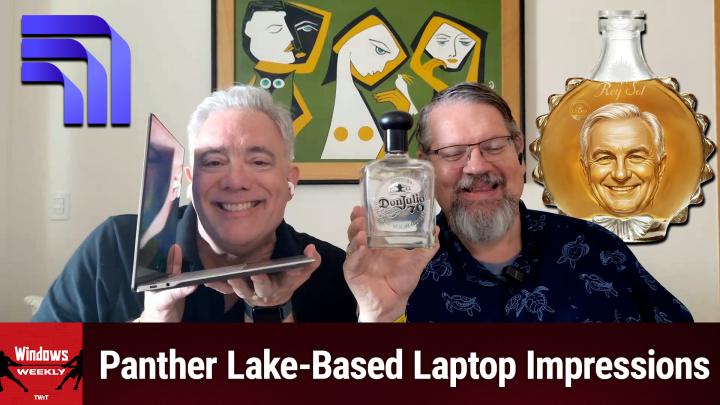
Okay. So, yeah, I mean, speaking of stupid and mpus and AI and all that stuff, I've been using this Panther Lake based laptop for the past month. Right.
Paul Thurrott [00:52:17]:
A CPU assembled in the US supposedly.
Richard Campbell [00:52:22]:
64 gigs of RAM, which I think is not going to be a common configuration in 2026, you know, whatever. So this thing has slightly improved CPU, I should say a vastly improved GPU and a good NPU. Not that we use those for anything, but it's there if you need it. So to me, the big thing is I fell for this when Lunar Lake was announced at IFA 2024. It came out strong. Intel did. And I thought, here we go, they're doing it, they're turning around. And the next year was a disaster of reliability problems.
Richard Campbell [00:53:00]:
And the other big thing on Lunar Lake that maybe doesn't get enough press unless you're AMD or Snapdragon or Qualcomm because they can't stop talking about this, is that when you unplug the power from these things, the performance drops off of cliff. And so you have that kind of combination of chips that are designed only for laptops that don't work well on battery and had pretty good battery life improvements, decent compute and graphic improvements, but still massive reliability issues. Right. And so what's the story with Panther Lake? I can't really say that this is a fact that this probably only one of these things. I need multiple computers. Some of the stuff I'm seeing might be from the PC maker. One thing that is unique about this laptop is I could crank up whatever Call of Duty game I'm play for an hour and you don't hear the fan, which is unbelievable. Like that's, that is, that's almost magic.
Richard Campbell [00:53:56]:
I mean that, that doesn't happen. But I also open the lid and it doesn't come on. And that's something I'm very familiar with with intel computers. So there's that reliability kind of thing too. My initial battery Life stuff is not great. I didn't even write about that. It's just too early. It's not fair to even talk about it.
Richard Campbell [00:54:13]:
But I'm going to have to say I'm going to have to see more. I need more experience with more computers before it can be fully sure what's happening here. But initially I will say the GPU advantages are real. Like it's big, it's approaching dedicated graphics territory and that's interesting. It's actually better than amd, which is unexpected and they're super proud of that. Maybe they should be. It seems like that stuff's good, but even then there's weirdness going on because they're using AI to do for frame generation. There's stuff going on with the drivers that will enable and improve that over time.
Richard Campbell [00:54:52]:
There are utilities on PCs, including Intels with their graphics drivers. They have their own utility, but then like hp, which this is, has their own software and these things are all trying to improve the performance of games, right? And the. And the quality of games. So this is a lot like the super resolution stuff you see on Windows and ARM computers today, where the native resolution of this computer is something like 18 or 2880 by 1800, something like that. The game says that it's running at that native resolution, but it's actually running it under full hd. But it's doing the upscale stuff, right, which has been common in gaming for a while, but is now being pretty dramatically increased because of AI, I guess, and just whatever chip capabilities. So you run these games at lower res, but it looks beautiful. And I will say this is as good as this game has ever looked off of dedicated graphics.
Richard Campbell [00:55:48]:
The performance is incredible. I can't explain this one, but it seems to work really well on battery, which I would normally not do because I'm not an idiot, but you could do that if you wanted to. And it's good, but it's intel, right? So there's all these caveats. If you look at the grid of core Ultra Series 3 chips, which is this family of chips, I believe there are. I'm just going to throw out a number that could be wrong, but like 18 of them, only three of them have the latest graphics like, or maybe four like most of them just have. It's not pre. I don't know that it's pretty confusing. It's super confusing.
Richard Campbell [00:56:28]:
And there are two tiers of the new graphics engine. So when they talk about these graphics improvements, when you see all the charts and, and all the numbers they have are all based on you having the very highest end version of this thing, which is only I think on two or three of those chips. So when you buy a computer this year and you're getting like intel core Ultra Series 3, you're like, I did it. Like, not necessarily. There's a pretty good chance you're not getting those graphics. You have to buy one of the really highest end chips to get it. Which, you know, if you cared about this stuff, you would. Right.
Richard Campbell [00:56:59]:
You would take the time. But you have to be careful about the stuff because the vast majority of the stuff they're selling is not that.
Leo Laporte [00:57:07]:
But now I want to check and see what did I just buy.
Richard Campbell [00:57:11]:
One you have is the previous gen. Right. So you have, you have, you have a Lunar Lake.
Leo Laporte [00:57:15]:
Yeah, it's Lunar Lake. So I don't have to worry so much as that.
Richard Campbell [00:57:17]:
You have to worry about it. It's. It is what it is. It's this. They don't have this kind of thing with. There's so many tiers of this stuff. It's very confusing, but.
Leo Laporte [00:57:26]:
It's confusing.
Richard Campbell [00:57:28]:
Yep. But I, I did this one does happen to have that chip, so. Or the highest end chip.
Leo Laporte [00:57:34]:
Of course, we're going to only send you the good one. They're not going to send you the.
Richard Campbell [00:57:37]:
That's the thing. Right.
Leo Laporte [00:57:38]:
The slow one.
Richard Campbell [00:57:39]:
And, but again, this is the difference between what an enthusiast might want and what a typical consumer would want. If someone just buying a laptop doesn't even understand these generations and the different chips and whatever.
Leo Laporte [00:57:50]:
Yeah, I didn't understand.
Richard Campbell [00:57:52]:
No, I didn't. It's confusing. Even people who know what they're talking about find it confusing. It's. It is confusing.
Leo Laporte [00:57:57]:
Mine's a ultra 7 258V, whatever that is.
Richard Campbell [00:58:04]:
So the two in the number tells you it's Lunar Lake. That's the two V. V is Lunar Lake as well. Is, is that gen? Right? Okay, so two and it's second gen. It's Lunar Lake. The. This is the mobile intel chipset. Right.
Richard Campbell [00:58:21]:
I don't know, you know, I need, like I said, I need more of these things. But here's the two big takeaways for me are I open the lid, nothing happens. That's not great.
Leo Laporte [00:58:31]:
Oh, that's not great. But is that Windows or is that.
Richard Campbell [00:58:36]:
The last performance is crazy. Like it's good.
Leo Laporte [00:58:39]:
Yeah.
Richard Campbell [00:58:40]:
And battery life, I can't say yet. It's been all over the map. I have never seen anything extraordinarily good, I'll tell you that. So if you kind of accept the, the, the rough, high level view that you're going to get 11 to 12 hours on Snapdragon and you're going to get eight to nine on AMD and you're going to get seven to eight on Intel. It's that or less. It's. It's in there. Yeah.
Richard Campbell [00:59:04]:
The other concern is whether or not they're going to have the same problem on battery. And this is something. I didn't see that in the game, but I've only looked at that a little bit. And so one of the things they were talking about at their introduction was they have more E chorus, which is the efficient chorus. That's what's responsible for that performance drop off. But then again, it's been another year. Maybe they were optimizing things for that. I know they worked with game makers, literally hundreds of games to make sure that these things ran great on this processor.
Richard Campbell [00:59:32]:
So maybe if you're playing games, you won't see it as much, but if you were trying to think what you might be doing, like a normal kind of workload that you're in Word, Excel, web browsing, maybe then you would see it. I don't know. I. It's just too soon. I can't really. I don't want to. I can't roll in this, so to speak. But the game stuff is good, so that is good.
Richard Campbell [00:59:53]:
So we got that going.
Leo Laporte [00:59:54]:
It looks like it's sitting on a pretty hefty little wedge there.
Richard Campbell [00:59:58]:
What is the.
Leo Laporte [01:00:00]:
The Omni.
Paul Thurrott [01:00:01]:
The laptop has that sort of plinth effect or the, the platform underneath, it's super thin.
Richard Campbell [01:00:06]:
This particular computer, they did something with the cooling system.
Leo Laporte [01:00:10]:
What is this?
Richard Campbell [01:00:11]:
Yeah, well, that's just the speaker. I was just trying to show the speaker.
Leo Laporte [01:00:14]:
Yeah, but. Okay.
Richard Campbell [01:00:16]:
Like a downwards firing speaker. But yeah, I mean, I, I have it here in front of me. I don't know if you can. I think I should.
Leo Laporte [01:00:22]:
Okay.
Richard Campbell [01:00:22]:
Maybe that's.
Leo Laporte [01:00:23]:
Maybe that's the trick.
Richard Campbell [01:00:24]:
It is very thin. It's okay.
Leo Laporte [01:00:26]:
Okay. It's just the picture.
Paul Thurrott [01:00:28]:
Yeah. I think that's just the photo angle makes it look vast.
Richard Campbell [01:00:31]:
I just wanted to. No, it's one photo of the bottom that's like.
Leo Laporte [01:00:35]:
All the omnibooks are really thin. They're nice. I like them.
Richard Campbell [01:00:37]:
Yeah.
Leo Laporte [01:00:38]:
This is.
Paul Thurrott [01:00:39]:
But it does, it is undercut, like.
Richard Campbell [01:00:41]:
Yeah, they seem like it's. Yes. And that's right.
Paul Thurrott [01:00:43]:
And I equate this to my Surface Studio 2, which literally has this platform that it sits on. So it has these vents where it's dumping very hot air out of right now.
Richard Campbell [01:00:52]:
So this one, it's, you know, the intake is on the bottom. Very traditional. Oh.
Paul Thurrott [01:00:56]:
I said this is actually a wedge that's just lifting it up.
Leo Laporte [01:00:58]:
It's psychological too.
Richard Campbell [01:00:59]:
I think it feels thinner. No, it's not hot at all.
Paul Thurrott [01:01:03]:
Try this. Put your hand beside this thing.
Richard Campbell [01:01:05]:
Yeah, that's night and day. I mean that.
Paul Thurrott [01:01:06]:
That's crazy.
Richard Campbell [01:01:07]:
That's Acapulco. This is the Arc.
Paul Thurrott [01:01:09]:
This thing warps the cases on. On my phones. Ask me how I know. Right? Like, what is that?
Leo Laporte [01:01:14]:
What is that laptop, Richard.
Paul Thurrott [01:01:15]:
This is the Studio 2 with the 4060 in it. This is all the 4060 heat running out.
Leo Laporte [01:01:20]:
Oh, yeah. You know, sure.
Richard Campbell [01:01:22]:
Yeah, yeah. That's basically a desktop.
Leo Laporte [01:01:25]:
And you don't.
Paul Thurrott [01:01:25]:
You're not basically working on that.
Leo Laporte [01:01:27]:
What are you doing?
Paul Thurrott [01:01:27]:
No, no, this is just running the two screens and the camera like invariably streaming and the fans aren't cranking. Like this will get loud if it's really. If I do game on it. But this is enough that the air is genuinely hot coming out of it.
Richard Campbell [01:01:40]:
Yeah. If you play games on a computer, you understand this thing's going to sound like a jet engine.
Paul Thurrott [01:01:44]:
Yes.
Richard Campbell [01:01:45]:
It's normal.
Paul Thurrott [01:01:45]:
And you've got your headphones in so you don't care.
Richard Campbell [01:01:47]:
You need to worry about else. Sad. But this one though, it's notable. It's because, I mean, I'm not saying obviously the fans are kicking. It's doing something right. But it, it is not loud.
Paul Thurrott [01:01:56]:
Whoever did the fan design on this one is smart.
Richard Campbell [01:01:57]:
This is something very good going. So we'll see. You know, Lenovo, other companies are going to make these computers as well.
Paul Thurrott [01:02:02]:
In the Studio 2 they chose to make optional and gpus. Right. And I took one of the really high end ones and I think. So this one runs hotter than. Yeah, some of the others would. But it is, it.
Richard Campbell [01:02:13]:
It literally, it has.
Paul Thurrott [01:02:14]:
It has loosened the case on this phone and this is the second time it's done.
Richard Campbell [01:02:18]:
So I mean it's like a. You have like a. Like a big block eight cylinder engine.
Paul Thurrott [01:02:22]:
Yeah.
Richard Campbell [01:02:22]:
And this thing is occasionally electric that.
Paul Thurrott [01:02:24]:
It roars at me.
Richard Campbell [01:02:25]:
Yeah, it's different. It's definitely different.
Paul Thurrott [01:02:29]:
Yeah. Okay.
Richard Campbell [01:02:31]:
Okay. And then this is related to nothing. And we talked about Dell. So I had.
Paul Thurrott [01:02:37]:
Yeah, we did the Dell story, the.
Richard Campbell [01:02:38]:
Other hardware story there. But just as a reminder, I didn't know where else to put this. They announced this last fall. We would have talked about at the time, but we did on March 9th Microsoft will end of life Microsoft Lens.
Paul Thurrott [01:02:53]:
He's going to pull it.
Richard Campbell [01:02:55]:
Yeah, they're going to pull it from the store on February 9th and then it will lose its abilities to scan on March. Oh, interesting.
Paul Thurrott [01:03:00]:
Because it does talk to OneDrive. So they're actively killing it.
Richard Campbell [01:03:04]:
Yep. Interesting. I mean, these capabilities are built into the Copilot app, probably the Copilot365 app or whatever it's called.
Paul Thurrott [01:03:11]:
I mean, let's face it, any picture you take now of something like a whiteboard or a receipt or anything, it's just normal for any photo app on any device to just straighten.
Richard Campbell [01:03:22]:
Yeah. When this thing debuted and go. Google had a version instead which was called Google Lens actually.
Paul Thurrott [01:03:26]:
Yeah.
Richard Campbell [01:03:27]:
The ability to take a picture of a. Like if you're a business traveler and you have to send in your receipts, you know, you take it on, it's on the table, it's at an angle, whatever. But it will straighten it out and, you know, cut it, crop it and all that. Like that was magical, you know, 10, 15 years ago. But today it's very common. So we all have something on our phone that does this. It's not a. Not a huge deal, but.
Leo Laporte [01:03:50]:
So let's pause so that we can recap Silence and.
Richard Campbell [01:03:55]:
Or prayer.
Paul Thurrott [01:03:56]:
I do. I'm going to need a moment at some point to go get the tequila, which is in the fridge.
Leo Laporte [01:04:00]:
Okay. Okay. This would be a moment.
Paul Thurrott [01:04:02]:
We'll do that in the next break.
Leo Laporte [01:04:04]:
Oh, well, the next break's not very.
Richard Campbell [01:04:06]:
We drank too much yesterday.
Paul Thurrott [01:04:08]:
It's only through the back of the book. So we'll do it before the back of the book.
Leo Laporte [01:04:11]:
Okay. Oh, yeah. Okay, good. Just need to.
Paul Thurrott [01:04:14]:
Just need it long enough to run over.
Richard Campbell [01:04:15]:
Great.
Paul Thurrott [01:04:15]:
Grab the booze.
Leo Laporte [01:04:16]:
So, okay, a little teaser. Maybe not whiskey this week on the show.
Paul Thurrott [01:04:21]:
Same thing happened last year.
Richard Campbell [01:04:22]:
It was a. We'll tease the fact that it is a formally brown liquor.
Paul Thurrott [01:04:27]:
Yeah, there's a good one.
Richard Campbell [01:04:28]:
It was formerly brown.
Leo Laporte [01:04:30]:
It was brown in its use.
Richard Campbell [01:04:31]:
True.
Paul Thurrott [01:04:33]:
Yeah.
Richard Campbell [01:04:33]:
It has that skin condition thing and now it's lighter colored.
Leo Laporte [01:04:38]:
It's been sitting in the sun. We'll talk about that in a little bit.
Paul Thurrott [01:04:41]:
It was aged in wood.
Leo Laporte [01:04:43]:
Oh, yum. I love that woody flavor in my tequila. Lisa's funny. She orders margaritas and she always says, you know, I want the top shelf margarita, but she always wants it with a blanco with. And they always say, oh, no, we give you the reposado, we give you the anejo because it's more expensive, it's fancier. She says, no, I don't want the smoky flavor. I just want blanco.
Richard Campbell [01:05:08]:
Well, you're gonna. Lisa's might want to watch this.
Paul Thurrott [01:05:10]:
We're going to go down that whole story.
Leo Laporte [01:05:12]:
Oh, good.
Paul Thurrott [01:05:13]:
Yeah.
Leo Laporte [01:05:13]:
Oh, I'll tell Lisa.
Richard Campbell [01:05:14]:
Yeah, it's going to be right in her wheelhouse.
Leo Laporte [01:05:16]:
Yeah, yeah. And she's a. She's a margarita fan. Our show.
Paul Thurrott [01:05:21]:
Your friend.
Leo Laporte [01:05:22]:
Yes. Well, they're my friend. I don't know about Lisa. Sometimes she has regrets. The episode. The episode. You're watching a Windows Weekly. I'll tell you what, if Lisa's had a few too many, there's nothing better than falling backwards onto our beautiful Helix Sleep mattress.
Leo Laporte [01:05:44]:
How about that for a segue? Ladies and gentlemen, our sponsor for this segment, we love.
Richard Campbell [01:05:49]:
We love.
Leo Laporte [01:05:49]:
We got this Helix Sleep. When did we get it? Six months ago. We realized I had been looking around and I saw that it's considered by most experts that you should trade in your mattress, get a new one after six to 10 years. Because mattresses where they get. And it was, it was. They get saggy. They don't. So I thought, well, it's time for us to buy a new mattress.
Leo Laporte [01:06:10]:
And we said we got to do some research. We looked at all the reviews, all the magazines. We looked everywhere. We. We looked at reviews in the consumer reviews and we found, I think, the best mattress we've ever had. Are you preparing for the. The colder season? Maybe spending more time indoors? Isn't this a good time to invest in a new mattress? People think, oh, you know, I'm the same way with computers. The user interface, the screen and the keyboard are what you're spending time with.
Leo Laporte [01:06:41]:
You spend eight to 10 hours a day. For me, it's more like 12 on your mattress. Not just sleeping, but relaxing, reading, cuddling up with the pets. Why not? Why not have a nice. Invest in something for yourself. A comfortable mattress with your Helix mattress. And I gotta tell you, no more night sweats. It sleeps beautifully.
Richard Campbell [01:07:06]:
Cool.
Leo Laporte [01:07:07]:
No back pain because it's not saggy. It's supportive. No motion transfer. I used to the old mattress. The cat would jump on the bed. I'd say, earthquake. No more. Don't settle for a mattress made overseas with low quality and questionable materials and then shipped for six months in a container ship.
Leo Laporte [01:07:24]:
And it smells like bunker fuel number two when you open the box. No, don't get that. Get the Helix mattress, which is assembled, packaged, and shipped from Arizona. That beautiful desert air. Within days of placing your order. They make them to order. So it's fresh, brand New and it's so nice. Well, you could do what we do too, which is take the Helix Sleep quiz, which asks you your sleeping style, height, what kind of mattress you prefer.
Leo Laporte [01:07:51]:
It'll match you up because they have a broad range of choices with the perfect mattress based on your preferences, your sleep needs. I gotta tell you, my deep sleep score has gone straight up. My sleep quality has gone straight up. Actually, Wesper did a sleep study. Helix commissioned a sleep study with Wesper to measure this. They measured the sleep performance of participants after switching from their old mattress like we did to a Helix mattress. And here's what we found. 82% of participants saw an increase in their deep sleep cycle.
Leo Laporte [01:08:25]:
That's the most important one, right? You only spend maybe half an hour, an hour a day in deep sleep, but you gotta have that deep sleep. But what if you could increase the amount? Participants on average achieve 25 more minutes of deep sleep a night. That's like for many of you a 50% increase or more. For me it was that. What a difference that makes. The next day, participants on average achieve 39 more minutes of total sleep, overall sleep per night.
Richard Campbell [01:08:54]:
Nice.
Leo Laporte [01:08:54]:
Time and time again, Helix Sleep is the most awarded mattress brand from the experts at Forbes and Wired and all of the brands. Helix delivers your mattress right to your door. Free shipping in the US and the rest is easy. You don't have to rely. You can relax. They got seamless returns and exchanges. If you want something different or you're unhappy, but you won't be, you're going to love it. That's why they have the Happy with Helix guarantee which guarantees a risk free customer first experience.
Leo Laporte [01:09:25]:
I want you to go to helixsleep.comwindows for 20% off sitewide during their New Year sale extended. That's helixsleep.comwindows for twenty percent off the New Year sale extended. This offer ends January 15th. Make sure you enter our show name after checkout so they know we sent you. And if you're listening, after the sale ends, still check them out@helixsleep.com Windows helixsleep.com Windows we love our Helix Sleep mattress. We really do. Helixsleep.com Windows thank you, Helix. Now back to.
Paul Thurrott [01:10:04]:
Are we gonna. Are we going to talk about AI?
Richard Campbell [01:10:07]:
Yeah, I thought we should.
Paul Thurrott [01:10:08]:
So far.
Leo Laporte [01:10:09]:
No, it's.
Richard Campbell [01:10:09]:
Well, here's the thing. I feel like the rest of the tech world is ignoring this topic, so that's about time. Yeah, yeah. I mean, someone's got to talk about it.
Paul Thurrott [01:10:20]:
I'm glad you brought this up. I'm really excited.
Richard Campbell [01:10:22]:
We're just glossing over the top of it, you know, we're not going to go into every little stupid story about.
Leo Laporte [01:10:27]:
AI you want me to do. I did 20 minutes on security now yesterday about how I vibe coded this app. You want me to do that for you?
Richard Campbell [01:10:34]:
No, no.
Leo Laporte [01:10:36]:
Anybody?
Paul Thurrott [01:10:37]:
Let's see what's fine.
Richard Campbell [01:10:41]:
If we can get there organically. I mean, maybe. No, no, I'm sorry.
Leo Laporte [01:10:44]:
You can because I will tell anybody. I've been telling people at the grocery store. I've been telling everybody. So don't you just.
Paul Thurrott [01:10:51]:
I dislike that. It's in the style you like, right?
Leo Laporte [01:10:54]:
Yeah. That's the point. It's exactly what I didn't want to.
Paul Thurrott [01:10:56]:
You've got your 80 by 25 screen back. I'm just surprised to use more colors than green.
Richard Campbell [01:11:00]:
Oh, dude, I'm two seconds away from joining you in the same space. I might literally start using that Microsoft text editor.
Paul Thurrott [01:11:06]:
Yeah.
Richard Campbell [01:11:07]:
In command line just to demouse yourself. Yeah, it's.
Leo Laporte [01:11:10]:
You know what happened is I got the Emacs bug and once I got Emacs everything. In fact, I probably should have just done this in Emacs.
Richard Campbell [01:11:18]:
All I need is. I need. It's smart down. That's all I care about.
Paul Thurrott [01:11:22]:
Yeah, yeah.
Leo Laporte [01:11:22]:
Emacs is a laser. Markdown. Yeah. Emacs invented Markdown. You know, they have. Org mode preceded Markdown and it's. Yeah, it's very similar.
Richard Campbell [01:11:31]:
Yeah. Right. I guess. Right. I know they're.
Paul Thurrott [01:11:33]:
And yogurt. Right. They also invented yogurt.
Leo Laporte [01:11:35]:
Emacs invented yogurt and wearing socks with sandals. Maybe. Many people don't know that. Yeah. On we go. Let's talk about AI, please.
Richard Campbell [01:11:46]:
So after months of speculation, Google and Apple have finally partnered on something. It's good to see these two guys getting together. So Apple is going to use Gemini for Siri and for. Also to train or for their foundational models. I don't know if it's just for training or to help them build their foundation models, but even more than maybe we thought was going to happen, there are some rumors around this, like there won't be any Gemini or Google branding anywhere. Blah, blah, blah, whatever. We don't know about that stuff, but I believe the first way we're going to see this will be March or April when whatever it is, iOS 26.4 probably comes out. And then of course there'll be more, I'm sure in the summer when they do WWDC and then the next release of iOS and the other one this.
Paul Thurrott [01:12:34]:
Is the real fallout of Gemini 3 is they finally impressed Apple.
Richard Campbell [01:12:37]:
Yeah. I mean, yeah, they looked at ChatGPT, they looked at Anthropic Cloud. There was a rumor, a story that maybe Anthropic wanted too much money. They might have overreached. It's hard to say. Google always seemed like the natural partner here. Yeah.
Paul Thurrott [01:12:51]:
Because they've already got the relationship, but they got to bet on the winning horse.
Richard Campbell [01:12:53]:
So of course, yeah, they got to do something that actually works. Yeah. Yep.
Paul Thurrott [01:12:56]:
Because their stuff, clearly.
Leo Laporte [01:12:59]:
We talked a lot about this on Mac Break Weekly. I think it also probably has something to do with how easy it will be to integrate Siri with the Gemini models. Remember, they're just taking the models and putting them on their own servers. You know, you, you won't talk.
Richard Campbell [01:13:12]:
That's a big part of it. Yeah. The private cloud compute stuff. Yeah. Yep. So I think this is a, this is. I, I'm not the biggest Apple fan, but the notion that Apple will sort of, on your behalf, anonymize this stuff and whatever, there's something to be said for this. I, this is interesting.
Richard Campbell [01:13:28]:
So I'm, I'm curious. But yeah, this was. I. If you're going to bet money on this, this is the most likely outcome. Right.
Paul Thurrott [01:13:35]:
Like an int. I mean, again, I appreciate Gemini 3 is the point where you go, okay, all these folks are competitive with each other. Any one of them could be the lead any time. Pick the one you're most comfortable with.
Richard Campbell [01:13:45]:
Yep. Yeah, they're right in the mix now. So they're, they're good. Samsung talked about it. They talked about every, like a sponsored report, but really this was a survey just of some of the users in the US and basically what it boiled down to is most people don't think they're using any AI on their phone. And almost everyone is. Every single day. It's like.
Richard Campbell [01:14:05]:
Right. So they kind of spelled out like where AI is being used the most by this is US users, but on Samsung flagship phones. But, you know, weather alerts, call screening, autocorrect voice assistance, auto brightness, and then all the camera features.
Paul Thurrott [01:14:19]:
Right.
Richard Campbell [01:14:19]:
Night mode, auto generated slideshows, etc. So this is kind of the antidote. Antidote. Antidote to the antidote. Is that a term? That's a good term. I'm gonna. It's like factoid, sort of an anecdote to the, the Dell story. Right.
Richard Campbell [01:14:37]:
It's like a company that's actually selling, you know, hundreds of millions of these things every year is like actually people using, using this stuff a lot. You know, the, the thing is, they don't think they are, they don't understand that they are. But that's the point. You know, when things just work, you don't think about it. There's just a feature, it's kind of boring. Maybe it just works. I mean, very rarely would someone do something on any device and it does what they expect and they, they, they tweet about it or something and they're like, yeah, this is the way it's supposed to work, you know. So anyway, Samsung obviously also all in on AI.
Richard Campbell [01:15:17]:
I don't know what to say about this one. It's like Microsoft has added a feature called Checkout to Copilot that will allow it to shop for items for you, which I think we all know is kind of inevitable and also more than kind of scary because, you know, Copilot can't even add three and three together. So I'm not sure how it's going to work, but I'm not going to be trying this. They're probably going to have plugins or whatever they're calling them, Connections. Right. For different retailers. They already have some of those, like Anthropologie, which I love as well. I love that word.
Richard Campbell [01:15:53]:
It's an apology for all of my ancestors. Ashley furniture, Etsy, etc. You know? And then in even scarier news related to this, OpenAI launched a health experience in Chat GPT. And this maybe inarguably is the most scary, the scariest potential use case for AI and hallucination.
Leo Laporte [01:16:14]:
It's funny, as soon as OpenAI announced this, Google announced it and.
Richard Campbell [01:16:18]:
Yep.
Leo Laporte [01:16:18]:
And then Anthropic announced. So they're all going to do it.
Richard Campbell [01:16:22]:
This is exactly what's happened. This is this, this is that industry in a nutshell. Exactly. What are they doing? Yeah, we're doing that too.
Leo Laporte [01:16:28]:
It's all fungible, you know, and that's. So I'm, I did upgrade to the Claude Max, $250 a month. Well, I'm, I'm using it so much.
Richard Campbell [01:16:40]:
And.
Leo Laporte [01:16:40]:
But the thing is, it's, it's fungible. So to, you know, tomorrow I could say, yeah, no more of that. I'm going to go to Codex or Open AI or whatever. So you just use what's best for the moment. That's why Apple.
Richard Campbell [01:16:50]:
Yeah.
Leo Laporte [01:16:52]:
Kind of saying, well, we're going to use Gemini is like, well, it's a little risky. It may not be the best next week.
Richard Campbell [01:16:56]:
For all the complaining about subscription services, which is a very valid complaint the one thing that's pretty much universal is that you can go in and out on a monthly basis. Right. And so if you're paying too much this month for whatever it is, Netflix, you know, Spotify, whatever, you can just leave, right. Come back two months later, whatever it is. Like that's.
Leo Laporte [01:17:14]:
Or if I don't use it as much as I thought I might. Yeah.
Richard Campbell [01:17:18]:
You can say, well, you're not paying for a year. Right, Exactly. You know, with. If you sign up for Adobe CC today, any, any of the tiers and you pay them, you, you can leave early, but you have to pay the remainder of the year.
Paul Thurrott [01:17:29]:
Right, Right.
Richard Campbell [01:17:30]:
So that first year is. You're paying for a year.
Paul Thurrott [01:17:32]:
Yeah.
Richard Campbell [01:17:34]:
So that is not like the other things. This is, is like that. So yeah, if you find out that it says you have cancer and you don't, you can just quit. It's no problem.
Leo Laporte [01:17:43]:
So what I like about it, and this is what OpenAI is doing, is it will integrate because it's for the iOS initially it will integrate with all the Apple health stuff. So I wear an aura ring, I have a continuous glucose monitor, I have a Y things scale. I have all of these, you know, quantified self bs. But it will all go into the database.
Richard Campbell [01:18:03]:
So I mean honestly that is. And that's what people are going to want. I mean that, that's. Yeah.
Leo Laporte [01:18:09]:
And I know a lot of people who get their lab results and then.
Richard Campbell [01:18:14]:
You have to wait on some conversation with your doctor. It's like I, well, and doctors are probably get some information right away.
Leo Laporte [01:18:19]:
Who was it?
Richard Campbell [01:18:20]:
No, I, I look, I every look, it's very easy to criticize. I made fun of it right up top. Right. But the reality is a lot of people are. I'll be using these things for this. They will sure do. So, so it's fine. I.
Richard Campbell [01:18:32]:
My issue is the thing you just mentioned reminds me of the situation in with Smart Hub. So we have things like matter, especially right now, which is a nice standard. And so there's a lot of good interoperability where you can use devices that previously only worked in certain ecosystems, but you can use them together in whatever ecosystem you choose. Nice. But there's always these exceptions. You know, there's especially Smart speakers are a good example where those things are very specific to an ecosystem. You can't use Google Nest smart speakers in Apple home or whatever and vice versa. Health is like that.
Richard Campbell [01:19:05]:
And hopefully this will be the great equalizer where we see that same kind of.
Leo Laporte [01:19:09]:
Did you see the interoperability it was the CEO of who, who was it? Shopify? Toby Luke, who went home after a doctor's visit with a bunch of AI, I mean, MRI scans. And he said, you know, I wanted to understand it better. So I used Claude to write to take the DICOM files he got from the mri. He says, my annual MRI scan gives me a USB stick with the data, but you need this commercial Windows software to open it. I ran Claude on the stick and asked it to make me an HTML based viewer tool. It looks better than the Windows software. And. And he then said, okay, well, what's the, you know, what's that? And they said, oh yeah, that's your seventh vertebrae.
Leo Laporte [01:20:03]:
That's where you've got the compression. Oh, that's your L3. L3 to L5. I mean. Yep, this is what I'm talking about. Ultra personalized software.
Richard Campbell [01:20:14]:
Yeah.
Leo Laporte [01:20:15]:
People are so much required now to buy a package or have a package.
Richard Campbell [01:20:23]:
Fundamental, I'm trying to translate a difference or whatever, or it's not advantage, but the fundamental change here is intent. You go to the system, whatever it is, however you interact with you speak, type, whatever, and you say, this is what I want. It's not like the old days being the past 50 years where you had to understand commands and how they worked, or you had to understand the ui, what to click and where to go and. And you can see the handholding over time. You know, Microsoft Office, the Word Word, et cetera, added that kind of search box at the top where you could ask it a question and it would tell you where to go. Right. To find that thing, or it would just do it for you in line. But now it's like we don't really care about the app in the sense that I might use 8 or 10% of Word's features, probably less.
Richard Campbell [01:21:14]:
I could now say to it, I just need that thing. Yeah.
Leo Laporte [01:21:16]:
You know, this is the next stage from search. Right. So we went, everybody got trained on how to Google stuff and over time, most of us got good at Googling and we.
Richard Campbell [01:21:29]:
It's good we did because they made it worse so that you had to try harder.
Leo Laporte [01:21:33]:
We learned how to interact.
Richard Campbell [01:21:34]:
No, I mean, I mean, I'm not being funny. I mean, it's real.
Leo Laporte [01:21:37]:
So this is the next so what it really is somehow communicating with a device. Help me understand this or let me get more information on this. And so what Lookey says is, this is a good example of what I mean with reflexively reaching for AI. You tinker with AI for a while and you just Reach for this. This was an obvious thing to try when I saw I needed to use Windows and I was on my Mac. You want to train your brain on this intuition. You want to start thinking this way because you do have now a tool. Maybe it's not perfect and I know hallucinations, blah, blah, blah, but it's like learning how to Google.
Leo Laporte [01:22:15]:
Right? You know, Google gives you stupid results too.
Paul Thurrott [01:22:20]:
We used to be way worse at it. We've just forgotten how much we've learned.
Leo Laporte [01:22:24]:
Right? We learn how to do it. Yeah. And I think that's the next step on this, is learning how to interact. Basically, I think of AI as an interface to computing and the Internet and it's an interface between me and natural speech and getting what we want done. Done.
Richard Campbell [01:22:39]:
Google kind of gathered the world's information, but AI is making sense of it.
Leo Laporte [01:22:46]:
Plus, this wouldn't exist if we hadn't spent the last 40 years putting everything on the Internet.
Richard Campbell [01:22:53]:
Right.
Paul Thurrott [01:22:53]:
Yeah.
Leo Laporte [01:22:55]:
Because of that, we now have this incredibly massive repository. Better than any library of information. Admittedly, some of it's wrong. Dumb.
Richard Campbell [01:23:04]:
Yeah. You know, I feel bad that you, like, feel the need to qualify that. And I think the reason you do is because so many people bitch and moan every time someone ever talks about AI. Well, what about the hallucinations?
Leo Laporte [01:23:15]:
They are AI haters out there. They really are.
Richard Campbell [01:23:18]:
It's too much. It's just so much noise. We get it. Yeah.
Paul Thurrott [01:23:21]:
And I'm just thinking you found a way around HIPAA. You know, HIPAA's rules are pretty straight about companies can't sell your health care data to other companies. Yeah, but if you loop AI, you get permission, then it's your data that you're selling to the other companies. So. Yep, HIPAA solved.
Leo Laporte [01:23:37]:
Well, okay, so here, I don't know how Lutke did it, but the way I would have done it is not send that MRI data to the cloud, but ask Claude to write me a program that I am running locally that will interpret that. And I think that's what he did. He wrote an HTML browser of that data so that data is not being sent to.
Richard Campbell [01:23:58]:
He did have the data locally.
Leo Laporte [01:23:59]:
I mean, but now that. That's not what Chat GPT is going to do with your health information. No, of course.
Richard Campbell [01:24:04]:
No, no, no, not at all.
Leo Laporte [01:24:05]:
But it's going to have to set.
Richard Campbell [01:24:06]:
It to the class. This is, this is how this stuff evolves. We're going to have these local capabilities that will be good enough. It will be good.
Leo Laporte [01:24:15]:
And I think, I think for the Doubters and haters. I understand. And you know what? You're entitled to your opinion, but if you don't, if you're, if you're not yet at that point, you might think about what would be the value of getting to know this and getting these intuitions. And for me, it's been incredible. It's a journey.
Richard Campbell [01:24:35]:
Right.
Leo Laporte [01:24:35]:
But it's been very, very valuable. I still like to work.
Richard Campbell [01:24:40]:
Your role has not changed. You are on the leading edge of the stuff.
Leo Laporte [01:24:44]:
That's what I do.
Richard Campbell [01:24:44]:
Experimenting with it. You're doing it when maybe a lot.
Leo Laporte [01:24:46]:
Of it did with the Internet, not. So it did with the time they get there.
Richard Campbell [01:24:50]:
Right. It will be better. Right. It will be more accurate. Whatever you want to, Whatever your concerns are. So, yeah, I mean, to me, not a lot has changed, but I just, you know, when the first electronic spreadsheets appeared, the people who needed that stuff thought it was the greatest thing in the world. But I'm sure there were these mathematicians over in the corner going, but what about my job? I use, I write this stuff on a board, you know? Yeah. What about your job? I don't know, sorry.
Leo Laporte [01:25:17]:
Well, your job now might be to get better at intermediating between AI and humans or using AI or, I don't know, there's.
Richard Campbell [01:25:26]:
To me, this is just, this is just new capabilities that make it so much easier to do things that I was never going to learn how to do in the first place. And they get so good that over time, like I said, we're going to look back and be like, I don't understand why we were doing things like this before for. And it's because that was the only way we could do it.
Leo Laporte [01:25:46]:
Well, this has been the holy grail.
Richard Campbell [01:25:49]:
Of computing freaking out because they're like, I'm not going to be necessary anymore.
Leo Laporte [01:25:53]:
Yeah. So neither are the buggy whip makers, you find. Find something else.
Richard Campbell [01:25:57]:
Exactly. I always use Stagecoach drivers, whatever it is, the women in the short skirts selling cigarettes on planes. Not necessary anymore. Yeah.
Leo Laporte [01:26:05]:
Thank goodness.
Richard Campbell [01:26:06]:
Is anyone worried about the job?
Leo Laporte [01:26:09]:
There should be a quarter of a million jobs, people fired this past year in 2025 in the tech industry. Quarter of a million. That's a lot of people out of work.
Richard Campbell [01:26:17]:
You could also find out whatever number of jobs were lost supposedly because of AI, and I bet 90 something percent of them was really just bad management.
Leo Laporte [01:26:25]:
Oh, yeah. It was an excuse. Yeah, yeah, no, it was an excuse. Yeah.
Richard Campbell [01:26:29]:
Yep. Yeah. Now this next story sounds so boring, I'm not even sure why it's here. But so Google is inevitably adding AI to Gmail because of course they are. But I, the observation, I think I made the notes probably is that when you think about data and how AI needs data and how AI is at its best with data and what are the use cases and email is a pretty obvious one. This is like the wall hanging fruit, if you will. So the big, the bigger thing in here to me though is there are some features that are better if you have a paid subscription. I think there's one feature you have to have a paid subscription.
Richard Campbell [01:27:10]:
But of course you can't take AI functionality and only give it to paying customers when you have a Gmail service that I think has what, several billion users, whatever the figure is 3 billion. So a lot of this stuff is actually just free for everybody. So this is something I'm always looking at. You know, what, what was the ladies. The term for this? When you can move from service to service. What's the word you use? I don't remember the term, but Migrate. Well, no, well, you were saying if you find this thing not to be adequate, you can go to the next thing.
Leo Laporte [01:27:48]:
Oh, fungible is. They're all the same.
Richard Campbell [01:27:50]:
Yeah, yeah, they're.
Leo Laporte [01:27:52]:
They're equivalent. You can, they're commodities. Commodities is some.
Richard Campbell [01:27:57]:
This is setting it up so that, you know, Outlook or whatever or what used to be Hotmail or whatever services can't not do this stuff now. Right. We're going to have these capabilities everywhere. And this is kind of interesting because I think these other companies or a lot of companies would want to discharge for this. But if others aren't, you can't, you know, so it's gonna, it's gonna be an interesting little arms race here. So we'll see happens. But yeah, anyway, obviously they're putting AI in Gmail. You can't spell Gmail without AI.
Richard Campbell [01:28:29]:
Nailed it. I don't know.
Leo Laporte [01:28:36]:
Yeah, well, it's not just. Is, is it just Gmail or. It's everything. It's like, well, it's everything.
Richard Campbell [01:28:39]:
But they very specifically called out the features.
Paul Thurrott [01:28:41]:
They were. It's a ton of data, man. Holy.
Leo Laporte [01:28:44]:
See, I stopped using Gmail years ago. I have a Gmail account. We use it at our corporate. You know, we're a Google workspace customer for the business.
Richard Campbell [01:28:51]:
Right. See, I use it every day, but I. You can see how it changes over time. Right. They have the little recommended replies and all that stuff.
Leo Laporte [01:29:02]:
So much stuff is written for Gmail and Microsoft Outlook. So much stuff. And I always, I have a little bit of envy When I look over the fence and go, yeah. Oh, well, can't do any of that. I did. You can with Claude. Since I'm spending so much money on Claude, I decided I better use every possible feature. You can't connect your Google Drive, your Gmail and all that stuff.
Leo Laporte [01:29:28]:
You can give it permission to read it and write it if you want. So if you get emails from me.
Paul Thurrott [01:29:34]:
Saying weird things, lots of emojis and dashes, I think your AI is aware.
Leo Laporte [01:29:41]:
Let's delve into this. Paul. Yeah. That wasn't. That wasn't me.
Richard Campbell [01:29:45]:
It wasn't you. Okay.
Leo Laporte [01:29:48]:
But I am a little jealous, you know, and I. By the way, Gemini 3. Gemini 3 is really. Is really good.
Paul Thurrott [01:29:53]:
Impressive.
Leo Laporte [01:29:54]:
Yeah, I mean, I think the big three, OpenAI, Anthropic and Google are really neck and neck.
Paul Thurrott [01:30:02]:
Yeah.
Richard Campbell [01:30:03]:
Yeah.
Leo Laporte [01:30:04]:
There's a whole bunch of interesting but not nearly as capable Chinese models.
Richard Campbell [01:30:09]:
Yeah.
Leo Laporte [01:30:10]:
There's some French stuff like Mistral.
Richard Campbell [01:30:14]:
And.
Leo Laporte [01:30:14]:
Then there's Llama, which is Open A. I mean, Meta's AI. But honestly, I really think it's, it's. Right now it's a horse race between OpenAI, Anthropic and Google. And Google has the advantage because they don't have to make money on AI particularly. They've got all this other revenue.
Richard Campbell [01:30:32]:
Right?
Paul Thurrott [01:30:33]:
Yeah.
Richard Campbell [01:30:33]:
And there's something like. I think.
Paul Thurrott [01:30:35]:
But they're quickly trying to tie it to. To generating.
Leo Laporte [01:30:38]:
They're trying to spend stuff. No question about that.
Paul Thurrott [01:30:40]:
Yeah.
Richard Campbell [01:30:43]:
Yeah.
Leo Laporte [01:30:44]:
I don't know. Do you feel. Do you feel Microsoft's models are.
Paul Thurrott [01:30:48]:
We really haven't seen.
Richard Campbell [01:30:49]:
I don't have any experience with them. I mean, there's the small models, like five, that are fine, I guess. I don't know.
Leo Laporte [01:30:57]:
We're going to get. I want to get somebody on from Microsoft. Lou Maresca, who's a regular on our network, is responsible. He's at Microsoft. He's a product manager for AI and Excel for Copilot.
Richard Campbell [01:31:09]:
So, you know, all the big guys have the small models too. Right. So Google does this with gemma. You know, OpenAI does this and I think there's something there. But I wouldn't be surprised if the future of small models is more open than big AI, if that makes sense. I feel like that's where that's heading. And especially when you get into specific use cases where we have small models for particular tasks, you can. Or the system will maybe orchestrate it.
Richard Campbell [01:31:37]:
Right. Where you pick this one, this one, and then maybe tomorrow it's a slightly different mix, but it won't Matter because you'll always have the best. Whatever the best is at the time.
Leo Laporte [01:31:44]:
Right.
Richard Campbell [01:31:44]:
I bet a lot of it's going to be open. We'll see.
Leo Laporte [01:31:49]:
I hope so. I mean, honestly, that would be the best outcome for us as users, you know.
Richard Campbell [01:31:55]:
Yes.
Leo Laporte [01:31:55]:
The insidification thing is problematic.
Richard Campbell [01:32:01]:
Yeah.
Paul Thurrott [01:32:03]:
It's happening.
Leo Laporte [01:32:05]:
Yeah.
Richard Campbell [01:32:06]:
I decided I was joking with him during the break. I'm going to insure to find my website just because I just want to see what it's like.
Paul Thurrott [01:32:13]:
Yeah.
Richard Campbell [01:32:15]:
I mean, everyone's doing it.
Leo Laporte [01:32:17]:
Everybody's doing it. All the kids. All time. The cool kids are doing it.
Richard Campbell [01:32:21]:
Yeah. There must be a reason.
Leo Laporte [01:32:22]:
What would it look like if you insuredified thorat.com?
Richard Campbell [01:32:25]:
Well, the reason I said it was because I was clicking the links in the notes to bring up the next several articles and I saw something I'd never seen before, which was like. It looked like a. Like we were blocking ad blockers or something. We don't do that. And I was like, what the hell is this thing? And it was. I think it was caused by a plugin in the page that was for like displaying a Twitter tweet or whatever.
Leo Laporte [01:32:47]:
Oh, yeah. Because I'm getting something weird happening when I go to thorat.com as soon as I log into Premium.
Richard Campbell [01:32:55]:
Oh.
Leo Laporte [01:32:56]:
And what's weird is I see the page briefly, which means you there's some weird and it's going to report something.
Richard Campbell [01:33:03]:
And maybe he's working on something. But the web guy there.
Leo Laporte [01:33:08]:
Well, I have a lot of weird ad blocking stuff. See that?
Richard Campbell [01:33:11]:
Yeah. Oh, yeah, look at that.
Leo Laporte [01:33:12]:
I have a lot of weird ad blocking stuff going on.
Richard Campbell [01:33:15]:
So.
Leo Laporte [01:33:18]:
It'S probably. You know what? I wouldn't be surprised if my Open.
Richard Campbell [01:33:23]:
Nextdm is blocking okay here. But I did see something weird earlier and I showed it to. I was like, this is my site.
Leo Laporte [01:33:30]:
I've never. So it is. Congratulations. Well done.
Paul Thurrott [01:33:34]:
It turns out it's insuredification as a service.
Richard Campbell [01:33:36]:
Yeah, exactly. Can I subscribe to it? Something I could pay for every month. Yeah. I don't know.
Leo Laporte [01:33:45]:
You are watching. I'm sure you're glad. You are. The great, the wonderful Windows weekly with these two beautiful cats here. Paul Thurat of Thorat.com.
Richard Campbell [01:33:56]:
We got good art. That's what we got. We got good.
Leo Laporte [01:33:57]:
Got the best faux Picassos in the world behind him.
Richard Campbell [01:34:01]:
Faux Picasso.
Leo Laporte [01:34:03]:
Faux Picasso.
Paul Thurrott [01:34:03]:
Focasso.
Leo Laporte [01:34:07]:
Yeah, it's kind of. I don't know, it's interesting. I feel like it's the Jetsons meet Picasso or something. And what's the owl doing there?
Richard Campbell [01:34:13]:
I know, I was just looking at the owl. The owl. The owl's like, what the heck's going on behind me?
Leo Laporte [01:34:18]:
I like the color choices. I do.
Richard Campbell [01:34:21]:
Yeah.
Leo Laporte [01:34:21]:
And then on the right there, that's Mr. Richard Campbell. We're hanging out in his place in Acapulco. Great to have you with us today. Let's continue on because I think it's time for. Yes. You've waited for it, you've begged for it, you've pleaded for it. The long awaited Xbox segment.
Richard Campbell [01:34:43]:
Oh, don't blink. This is a short one, unfortunately.
Paul Thurrott [01:34:46]:
Get the Halo music in there, man. Stretch it out.
Richard Campbell [01:34:52]:
Well, you know, we're right at the holiday season. It's not like they haven't a lot to announce.
Paul Thurrott [01:34:56]:
Yeah.
Richard Campbell [01:34:57]:
There was a really curious announcement today that came out of Xbox. In fact, I wonder if I could bring it up easily. Probably not, which I couldn't summarize easily if I had to. But it basically. Yeah, here we go. So Microsoft is partnering with Nintendo and Sony to improve player safety across all the platforms. And then there's a thousand words that don't say anything and that's the whole thing. And I have no idea what they're talking.
Richard Campbell [01:35:22]:
It's just like, okay, like. And I saw this and I was like, I can't even write about this. This doesn't make any sense. Like, obviously you guys all care. Yeah, we care about people. We don't want people to be toxic. We get it. I don't know.
Richard Campbell [01:35:34]:
It's not a lot there. Anyway, so the next big online event for Xbox Games is January 22nd. It's called Xbox Developer Direct. This is a recurring event and the two of the bigger things are going to talk about. It's the next is Fable, which I think is the remake. Right. Of Fable. And then Forza Horizon 6, which will be the next installment in that game.
Richard Campbell [01:35:57]:
And presumably other games. Right. As well. But that'll be something to look forward to. And then the other one is, you know, it's with us against this kind of a thing, depending on your perspective. But avowed, which I want to say came out in late 2024, I believe it's over a year old now, is going to be coming to the PlayStation 5 on February 17th. And this is one, if I remember correctly, it was very. It's very reminiscent of other RPGs like this.
Richard Campbell [01:36:27]:
Like a. I don't know, I play these kind of games. So I don't really even know what to compare this to. But it's. It it's well regarded, it's got good scores, etc. Etc. When we're trying to figure out when it came out, I guess maybe it was. Maybe it was actually just last year.
Richard Campbell [01:36:45]:
Okay. Could be less than a year.
Paul Thurrott [01:36:47]:
Yeah. Out in February 25th.
Richard Campbell [01:36:49]:
Oh, it's February. Okay.
Paul Thurrott [01:36:50]:
It'll be out in February 26th for the PS5. But it's Obsidian. They cross platform the games all the time, don't they? I guess they're owned by Xbox, so.
Richard Campbell [01:37:00]:
Yeah, that's the thing. So this will just be more angst for people. But honestly, I don't see how this is anything but good news. Don't worry about it. Yeah, they're all good.
Leo Laporte [01:37:12]:
Okay.
Richard Campbell [01:37:12]:
That's it. That's all I got. I'm so sorry, but it's the, you know, beginning of January. This is not a lot going on in the game world.
Leo Laporte [01:37:19]:
This is all I got.
Paul Thurrott [01:37:20]:
Peaceful. Yeah.
Richard Campbell [01:37:21]:
Those are great looking icons though I will say it's the guy who designed them.
Leo Laporte [01:37:25]:
Well, if I, if I scroll down, I get you and. Oh, wow. Yeah. You see it's, it's loading and then it's saying no. Yeah, but I think that's my, that's, that's.
Richard Campbell [01:37:36]:
It might be something, but. Yeah, yeah, yeah.
Leo Laporte [01:37:38]:
You didn't just start putting a crypto. Crypto I can't.
Paul Thurrott [01:37:44]:
Signed up for Insertify as a service.
Leo Laporte [01:37:46]:
That's how you, that's how you do it. Sure.
Richard Campbell [01:37:49]:
No, it's coming up.
Leo Laporte [01:37:49]:
Certify me dot com.
Paul Thurrott [01:37:51]:
There we go.
Richard Campbell [01:37:53]:
I kind of want to see that weird ad blocker thing I saw earlier.
Paul Thurrott [01:37:56]:
That's not going to happen again. Now that you're looking for it, I've.
Leo Laporte [01:38:00]:
Whitelisted you in next DNS and as soon as that propagation gates, I'll let you know if that.
Richard Campbell [01:38:05]:
I appreciate the trust. Yeah. Nice.
Leo Laporte [01:38:07]:
Oh, I trust you. It's our show today, ladies and gentlemen. Brought to you by you, the people you are Club Twit members. Gosh, I could not thank you more for your support. I really appreciate it. We have so many members now. It's great. But even with whatever it is, 12, 13,000 members, that's still a fraction like one and a half percent of the total audience.
Leo Laporte [01:38:39]:
And I know even that you 1 percenters are supporting us to the point that 25% of our operating expenses, 1/4 of everything we pay the light bill, the staff, the hosts, is paid by the club, which is fantastic. I'd love that to be 100%. We wouldn't need to show you ads. We wouldn't need to do anything. We just. You. It's your way of voting for the content. So here, let me give you the pitch.
Leo Laporte [01:39:07]:
It's 10 bucks a month, $120 a year. There are corporate and family memberships. You do get two weeks free if you want to try it. I think the biggest benefit, besides the nice fuzzy, warm feeling knowing that you're supporting this show and all the shows we do, is that you get ad free versions of all the shows. So you, you'll never see this plug or, you know, no more begging. You won't see any of our ads. You get access to the Club Twit Discord, which is a great social site, really good. Now maybe you've used this Discord before and this, this is not like any other Discord channel.
Leo Laporte [01:39:41]:
This is great, smart, interesting people and, and having great conversations, not just during the shows, but all the time about all kinds of stuff geeks are into. So that's a great reason to join. We also do special shows in the Club Twit Discord. In fact, tonight, Micah, 6pm Pacific, I should say 1800 Pacific, is going to be doing his monthly chill session. You know, he does Lego, but you can do any kind of craft or creation or whatever. Just hang out for an hour with Micah calmly chatting about all sorts of things. It's really fun. Our book club is coming up this week.
Leo Laporte [01:40:21]:
No, I think the photo. I'm sorry, photo time with Chris Marquardt's coming up this week. Book clubs at the end of the month. We have a AI user group. That's fantastic because we have a lot of users in the Discord who are active AI users who are really smart, really intelligent. I've learned so much from them. And so we get together on the first Friday of every month and talk about what we're doing. We've just scheduled.
Leo Laporte [01:40:41]:
Thank you, Anthony. We've just scheduled for the 29th the return of Johnny Jet, who used to be on the radio show all the time talking travel. He is the. He is. His whole motto is travel better with technology. So that will be a lot of fun. All of this is because of your support. So if you're not yet a member, please.
Leo Laporte [01:41:00]:
TWiT TV Club TWiT. We would really love to have you in the club and it would make such a difference to us. And it is my goal. You know, I just saw the stats on ad sales. Billions and billions of dollars in ad sales going online, but most of it's going to influencers. In fact, the top I think 1% of influencers get 30% of all the ads. Ads. The top 10% get half of all the ad revenue.
Leo Laporte [01:41:28]:
Yeah, I'm an influencer. I'm not a Mr. Beast. We aren't getting all those ad dollars. They're really all going to people like Mr. Beast. And so I don't want to be dependent on that. I really would like to be the ideal would be dependent on you, the listeners.
Leo Laporte [01:41:44]:
If you like what we do, you want to support it? Join the 1% who support TWiT. TWiT TV Club. TWiT. Maybe we can get it up to 5%. I think if we got it to 5%, we wouldn't actually have to have ads at all. Hey, everybody, Leo laporte here. It's your last chance. We're in the final stretch of our 2020, 2026 audience survey.
Leo Laporte [01:42:05]:
So important for us both to know you better because we don't gather information about you except this one time a year. And it helps us with advertising and we collect no personal information. We just want to know about you in general. So if you would help us out. If you haven't filled out our survey yet, this is the time. It closes January 31st. TWIT TV survey 26. It helps us improve our shows and it helps us make money.
Leo Laporte [01:42:33]:
And we need to do both. So Survey is at TWIT TV survey 26 should only take a few minutes. Thanks in advance. Back to Acapulco. Did you have time, Richard? I stalled for you.
Paul Thurrott [01:42:45]:
No, I got it. You did a great job. Okay, we're ready. We're ready.
Leo Laporte [01:42:51]:
We're ready. But first, but first, as we go to the back of the book, let's do Paul Thurat's Tip of the Week.
Richard Campbell [01:42:57]:
Week. Yeah. I'm getting started on this one a little later than I intended, but I.
Paul Thurrott [01:43:03]:
Like this one a lot.
Richard Campbell [01:43:05]:
The security one.
Paul Thurrott [01:43:05]:
This is a great topic.
Richard Campbell [01:43:07]:
Yeah. So, you know, in the sort of a January sort of resolution type of thing, like start the year right, looking at like kind of a security checkup. And this came out of something I started back in December when I was working on the new passkeys chapter for the book. And I did the same thing two years ago when I looked into pass keys. And then I went down this rabbit hole, ended up writing a bunch of stuff about the best ways to scare your Microsoft account and do pass keys, et cetera, et cetera. So there will be a sequence of things that comes out of this. I did some stuff. I did two episodes for Hands on Windows that aren't out yet on pass keys.
Richard Campbell [01:43:45]:
And then I'm going to do some stuff on related topics. But the big thing for me is properly securing your online accounts because that's the key to everything that you are and own. Right? You know, your Apple, Microsoft, Google, Amazon, whatever accounts you know, where you have financial, personal data, whatever it might be, they all offer various ways to secure these accounts. And it all goes back to accounts are in, in the online world anyway, an email address plus a password which is insecure. So then we have like MFA2FA schemes where you get a text message, an email at a second account, an authenticator app. Now we have passkeys and passkeys. I know this is still a weird thing for people, but when passkeys are properly implemented and properly configured by you on the client, whether it's a phone or a computer or whatever device, you don't have to type in anything. You just sign in and it uses the biometrics of the device to identify and you're in.
Richard Campbell [01:44:43]:
It's awesome. So I'm going to go through a series of things about this, but the, the big one, the big one to start with, and this will be the next thing I write is just about password managers and how important it is to have a single password manager that you use to manage all of your passwords and passkeys and that you don't have any duplicate passwords anywhere. You're using passkeys everywhere you can and where you can't, using some form of good2fa, which to me is an authentic authenticator app would be the first choice. But not.
Paul Thurrott [01:45:12]:
Not phone.
Richard Campbell [01:45:13]:
Not a phone. Yeah. So, you know, if you think about a Microsoft account, all the, the different ways that you can verify your identity, you can have multiple secondary accounts that it can email to get, send you a code if you have to. Right. So if it's a Microsoft account, maybe it's a Hotmail account, whatever it is, you could have a Gmail account, an Apple id, whatever it is. And that's, that's acceptable because those things have their own forms of protection built in. Right. But an authenticator app is the best if you can.
Richard Campbell [01:45:40]:
Well, passkey is the best, but if you don't have that authenticator app. So that's a big chunk of it. So we'll go through this over the next few weeks, but I got over the hump of trying to get that passkey thing out because when I looked at passkeys in Windows 11, I'm going to miscount this. But I bet there are seven different ways you can authenticate yourself using passkeys in Windows 11 right now. And it's stupidity but all anyone really needs is their passkey manager on their phone which is a password manager. Which using for autofill. And you can use the QR code on a PC and then an extension for your browser for that thing. Right.
Richard Campbell [01:46:20]:
That's it. Simple. Works great. You don't need any of the built in stuff.
Paul Thurrott [01:46:24]:
But you got to do it in the first place. The setup to get going with it is some effort and you just got to get used to it.
Richard Campbell [01:46:31]:
Yep.
Paul Thurrott [01:46:31]:
I've also found. You know my annual now is going through and checking what's what I haven't not logged into in a year or two.
Richard Campbell [01:46:37]:
Right.
Paul Thurrott [01:46:38]:
Maybe go delete that account if you can. Not. Whether that means anything or not is a question.
Richard Campbell [01:46:42]:
This is. Yeah. And it's actually been two years since I've done this. So I try to think what the best time frame is. But I think this kind of review is important at least on an annual basis.
Paul Thurrott [01:46:53]:
Yeah.
Richard Campbell [01:46:53]:
If you go into a password manager right now and look at your Just look at it. I'm sure it will tell you you're using dozens and dozens of repeat passwords like everyone does.
Paul Thurrott [01:47:02]:
That's one of the nice things in the tool is telling you hey, you should change those passwords are the same as other ones. Yeah. Retire all those.
Richard Campbell [01:47:07]:
If the password manager you use requires a password, that's the only password you should ever remember yourself. That's it. The rest of it should be just something the password manager knows. You don't need to know that stuff. You're gonna have this thing everywhere.
Paul Thurrott [01:47:20]:
That's password is one you don't even know.
Richard Campbell [01:47:23]:
Right. It can't hurt you if it doesn't exist.
Leo Laporte [01:47:28]:
Another password on my Bitcoin Wallet. That one? Yeah.
Richard Campbell [01:47:32]:
That one you might want to remember. Not an expert but the goal here is passwordless. Right. Microsoft is fairly notable today because they actually let you remove your password from your Microsoft account if you want. But my experience signing into.
Leo Laporte [01:47:51]:
You know what? That's caused a problem.
Richard Campbell [01:47:53]:
It sounds scary.
Leo Laporte [01:47:54]:
No, it's caused a problem with my Xbox.
Richard Campbell [01:47:57]:
Yes. Well you can create app passwords for that kind of a thing. There are ways.
Leo Laporte [01:48:01]:
I'm trying to log into my Microsoft account on my Xbox because it doesn't have a password.
Richard Campbell [01:48:05]:
Yeah.
Leo Laporte [01:48:06]:
And I don't have.
Richard Campbell [01:48:07]:
You can get around that?
Leo Laporte [01:48:08]:
Well, you could if I had my Microsoft authenticators working. But I got a new phone and it Anyway, I'm kind of in a loop.
Richard Campbell [01:48:16]:
You're in the.
Paul Thurrott [01:48:16]:
In between time, space.
Leo Laporte [01:48:18]:
Yeah, it's okay. I didn't really want to plug any.
Paul Thurrott [01:48:20]:
Games and there's always the argument of it's you're not really secure with pass keys until you've deleted your password. But.
Leo Laporte [01:48:26]:
Well, that's why I did it. Right.
Paul Thurrott [01:48:28]:
Yeah. You know, the reality is most people aren't worried about being secure. They're worried about convenience. And pass keys are actually more convenient than pass.
Leo Laporte [01:48:34]:
Oh, they're great.
Richard Campbell [01:48:35]:
I love passkeys. They're more secure and more.
Paul Thurrott [01:48:37]:
Yeah, yeah.
Richard Campbell [01:48:37]:
So if I bring, you know, when I bring up a new computer or a new web browser, the first time I use the web browser, I, I will install or sync the password manager and I have to sign into that. So at that time I type in the account and the password. I have an authenticator app that I do the two FA on and then I'm in. So then I go to gmail.com and it just pops. In the past, I don't even type in my username. A passkey dialog appears from my password manager and in this case, because I have multiple Gmail accounts, it says, which one do you want? I click on it. Windows, hello. I'm in.
Richard Campbell [01:49:11]:
That's it. I don't type anything. It doesn't get more convenient than that.
Paul Thurrott [01:49:14]:
Yeah.
Richard Campbell [01:49:15]:
And to Leo's point too, if it. Or maybe it's you. I'm sorry, whoever said this, you know, if you leave that account or that maybe I put the computer away, I never touch it. Six months goes by. Turn it on next time. I've authenticated with Windows. Hello. However I did it and I go to the browser and it's like, you need to sign in again.
Richard Campbell [01:49:34]:
Passkey comes up and authenticates me. I'm done. I don't type so fast. It's wonderful. So I know this is kind of scary and it feels complex to people, but the reality is it is in fact much more convenient. The fact that it's also more secure is amazing. But if what you're worried. I feel like a lot of people make convenience based decisions and compromise security.
Paul Thurrott [01:49:52]:
Yeah.
Richard Campbell [01:49:52]:
And task is beautiful because you don't have to do that. It's actually the best security. Well, maybe other than the hardware key, but it's right there. Yeah.
Paul Thurrott [01:50:01]:
The hard keyword keys are never convenient.
Richard Campbell [01:50:04]:
But they're not convenient. That's right. So it combines those two things. Yep. Big deal.
Paul Thurrott [01:50:09]:
Yeah.
Richard Campbell [01:50:11]:
I hope that this was going to be a little. I would Hope to. I was going to publish something on this by now, but I hadn't. But I've been experimenting with ways to do AI locally. Last week I think it was, I talked about what's something called Pam or Jan. Sorry, Pam. Jan, Jan, AI. Right.
Richard Campbell [01:50:27]:
So I was looking at the Microsoft stuff because I want to add AI capabilities to the app I'm working on and there is a whole thing there. But Microsoft has Windows Foundry which is for cloud based AI, but they also something called Local Foundry and this is completely command line based. So you install it with winget in the terminal then you can browse the list of models that are available. So it's like Phi 45353, Mistral, DeepSeq, Quinn, some others. But the thing I like about this is aside from the text mode thing which I have to say I'm really laying it so I'm kind of getting back into this. It lists models by what they can run against. So for example for 5.4 I could choose between GPU and CPU based models and actually MPU depending on the family. So I installed a couple of these and you just run a command line to view what's available, view what you have installed, run a model.
Richard Campbell [01:51:30]:
So I just, I did this during the break, I just ran. It's like a deep seq r1 distil quen 7B openvino but it runs on the MPU. So I could do something like the thing I always do like I need a, let's see a five day Mexico City itinerary because Rich is going to be there, see what it says. But what's kind of cool about this to me it thinks and it talks and it does this interactive thing. When I was doing this in Gen I and this was a CPU based model, actually it's doing the same thing here a little bit. It's faster than it is on the Gen one but it seems like it's debating itself. It's like okay, so you're going to do this thing. It's like first I should do this.
Richard Campbell [01:52:14]:
Oh wait, it will say wait comma actually you got to do this. And it does this whole thing but. But it spews out this little in this case an itinerary because that's what I asked it. And I suppose this is a little slower than some of the cloud based stuff but honestly just kind of read this quickly here as it go because it's just doing it live here.
Paul Thurrott [01:52:33]:
But is it correct?
Richard Campbell [01:52:34]:
It's yeah. And the big thing I'm looking for And I always do this one. Well, a. I know. Obviously, I know Mexico City. But the very first, that.
Paul Thurrott [01:52:41]:
First.
Richard Campbell [01:52:42]:
The first announcement that Microsoft did for Copilot, which they weren't calling Copilot at the time. Yusuf Benny used this as an example because he was going to Mexico City because of a wedding. And so I thought, well, okay, this is a good way I can test these things. And for the first year or so, it would recommend things that were good to do in Mexico City, but they weren't near each other. So they, you know, drive 40 miles out into the desert and do this, then come back and go to the far other, far end of the city and go do this. It's like, no, that's not a good day. Yeah, this thing is still going, by the way.
Paul Thurrott [01:53:11]:
It's going to town, but now it's detailed.
Richard Campbell [01:53:13]:
Yeah. It's kind of interesting the way it does this. So if you are. This is perhaps of a more technical nature, I get that. But if you want something that's specifically going to run against a GPU or an mpu, this is not the only way to do this, by the way, but this is one way to do it. And I came into this because I was kind of looking at it from a dev angle. But this is free. You install it through the command line, you use it through the command line.
Richard Campbell [01:53:38]:
And honestly, I have to say, the performance is good. Like, it's. It seems like it works pretty well. And you have your choice of models, of course, which I kind of like. So it's definitely worth looking at. You can do this on the Mac. I know, and I don't know Linux, but I. It is Mac and Windows, at least.
Richard Campbell [01:53:51]:
I feel like this is probably available everywhere, but if it's on Mac, Enjoy a traditional. Thank you. I will. Yeah.
Leo Laporte [01:54:00]:
What's going on?
Richard Campbell [01:54:01]:
It's worth looking at.
Leo Laporte [01:54:02]:
Let's go. Okay.
Richard Campbell [01:54:04]:
It's still funny.
Paul Thurrott [01:54:08]:
Thank you.
Leo Laporte [01:54:09]:
Well, you know, is the fan on.
Richard Campbell [01:54:11]:
Participate in a traditional pueblo dance or music performance?
Leo Laporte [01:54:16]:
Let's do it.
Richard Campbell [01:54:18]:
Use a combination of buses, trolleys and bikes. Oh. These are additional tips. Avoid peak hours to reduce crowds. Yep, that's true everywhere. As Norm MacDonald says. I'm going to take a brief moment because actually all moments are brief to do this thing.
Leo Laporte [01:54:36]:
Nice.
Richard Campbell [01:54:37]:
Oh, it finished.
Leo Laporte [01:54:39]:
Let us continue with the back of the book because Tequila awaits. But in between us and Tequila is a fabulous episode of Run as Radio.
Paul Thurrott [01:54:50]:
Oh, the amazing Jeremy Winter. Because every so often I get a, you know, cbp. And I'm fortunate with Jeremy because I've known him since the early days of Microsoft.
Leo Laporte [01:55:00]:
Was he Hawk, the Hawk in the Marvel comic?
Paul Thurrott [01:55:04]:
I don't think so, no. It's a different.
Richard Campbell [01:55:07]:
Also not Jeremy Piven.
Leo Laporte [01:55:10]:
He wasn't an entourage, okay?
Richard Campbell [01:55:12]:
No, he wasn't an entourage.
Paul Thurrott [01:55:14]:
Now these days he's a cvp, but he's also the chief product officer for the Azure Core platform. So he basically has overview on all the products that related to Azure Core, which means, I mean, just an unbelievable job. I think I asked him on the show, it's like this means it's all your fault, isn't it? But they're trying to be aware of what all the products are doing and how they interact and so forth, which is certainly a part of a challenge. When you think Microsoft has something like 200 products in the Azure space is kind of crazy. So we were doing very much a catch up show in the concept of so what can we expect for 2026 for Azure as a whole from the guy who's largely responsible for what we're going to see in 2026? And Jeremy leaned heavily on what they talked about at Ignite, which was in November when I was taking my little grandbaby around Australia, New Zealand, because I was not there. And a lot of emphasis on things like simplifying the process of migrating workloads into Azure, not for, you know, landing you in virtual machine land if you don't want to be there, but rather giving you more gradients and so forth to, to be able to get more platform experience and decrease costs and resources and all of that. And of course that means we have to talk a little bit about AI because there's certainly roles for LLMs in helping sysadmins deal with those workloads and also instrumentation, understanding the kind of telemetry they can expect, how things are behaving, what things are going to cost effective are operating when they have runaway problems, that sort of thing. And we kind of wrapped up with some of the topics like Brad Smith with how they're building out new data centers and trying to do it responsibly and what that actually means for all of us and just increasing choice and data sovereignty.
Paul Thurrott [01:56:59]:
He was savvy to the fact that more and more folks in other countries want their data remain in those countries, even if they're in Azure data stores.
Leo Laporte [01:57:09]:
Nice.
Richard Campbell [01:57:11]:
Yeah.
Leo Laporte [01:57:12]:
Well, now I think we've, we've earned.
Richard Campbell [01:57:16]:
A little disappointed we don't have more of this.
Paul Thurrott [01:57:19]:
There was more of it yesterday.
Leo Laporte [01:57:20]:
There was more.
Paul Thurrott [01:57:23]:
So yeah, we were on a, we Did a. A city tour yesterday with the significant others, and there were a number of beverages available to us while we were on the tour. And one of them was his bottle of Don Julio 70, literally this bottle.
Richard Campbell [01:57:37]:
And I was like, we're, we're gonna. We're taking this with it.
Paul Thurrott [01:57:41]:
Don Julio is considering tequila, without a doubt. And maybe we should run down, you know, tequila versus. Versus whiskey. Where whiskey is derived from barley, tequila is derived from agave. The process of growing agave is a bit more complicated than barley. You don't grow near as much scale. It's a succulent. It prefers to grow at altitude 5,000ft and above, which is why places like Jalisco grow so well.
Paul Thurrott [01:58:08]:
It takes about five years for the plant to mature. It is a complicated grant to grow. Today, the seedlings are grown in indoor controlled spaces. And then the seedlings are put in the ground and carefully, their root beds are seeded. And it'll take at least, like I said, about five years for them to grow sufficiently that it actually makes a seeding stock called the chiete. And then once that matures enough, you have a central bulb called a pina. And that is what is harvested from the plant. And this is where all the sugars, the carbohydrates reside that you're going to break into sugars.
Paul Thurrott [01:58:40]:
The traditional. Now, in the case of barley, same thing. Barley matures in about four months, and then you harvest that and you malt it to release the sugars by letting it partially sprout and then drying it to stop it. In the case of a pinafore, it is cut into pieces and then it is roasted. And the heating is what actually breaks the sugars down. In the same way that if you. When you're malting barley, if you use the heat to dry, it actually is full of smoke because it's peat. You get a peaty whiskey.
Paul Thurrott [01:59:08]:
If you use smoky wood to heat the penis, you get a smoky mezcal and a reminder that all agave based alcohols are mezcals. But not all mezcals are tequilas. It's only certain regions that are allowed to be called tequila, including the Jalisco is not the only one. And then once the bean is sufficiently mature, the sugars are extracted from it. It comes out as kind of a syrup, so it is shredded. Modern methods, they use an extraction diffuser instead of manual means. But ultimately, it's kind of like sugarcane that it actually gets. They call it a honey, although it depends on the quality of it, of course.
Paul Thurrott [01:59:49]:
Traditionally the fermentation takes place in kind of in a lambic way. They don't directly control the yeast. Today, yeast is much more tightly controlled, so it's mixed with water and allowed to ferment to create a musto, much the same way that barley turns into a wart. And of course, all that open method has its own challenges. And then once you're up to that 5, 6, 7, 8% alcohol, you're ready to start doing distillation. Tequila is traditionally distilled twice. Sometimes it's called in a column still, they call it the shredding phase. And then with a pot still for rectification.
Paul Thurrott [02:00:27]:
In the case of Don Julio, it's all pot stills. They're typically stainless steel rather than copper because there is no sulfur to chelate. So they don't need the copper in this equation, although some do use copper as well. Raw product ends up being about 65% alcohol. It is typically traditionally chill filtered. Now has been for some time to reduce the cloudiness, flocculation the same way. Many whiskeys are chill filtered as well. And if you take that product at that point and cut it with water to be at 40%, you've made Blanco Silver tequila, considered the most traditional type of tequila.
Paul Thurrott [02:00:59]:
It's all agave flavoring. Getting from that, if you now put it in oak barrels for a few months, it's now a reposado. It's been rested. That's reposado means and it'll have a little color. If you put it in for more than a year in an oak barrel, it's now in a naho. And then there are extra nahos, which will be three plus years reposados. The barrel size doesn't matter much. They'll use as big as 20,000 liter barrels.
Paul Thurrott [02:01:21]:
In the case of a naho, an ajos, it's no larger than 600 liters. And it's becoming very hip. And what I planned on talking about for today's show was it's become very hip to age in used oak barrels, bourbons, wines and so forth. Very much the way that the whiskey industry has gone. But we ended up with this particular bottle of Don Julio. We of course never talked about Don Julio on there. He is a man, or was a man. He has passed away now.
Paul Thurrott [02:01:48]:
Don Julio Gonzalo Frosto Estrada. He was born in 1925 in Jalisco and from a family of distillers. He worked in his uncle's distillery as young as 7 years old. But his father died when he was 15. And then he started working full time to help support his family. And the best, grand most money he could make was selling tequila. He sold it from horseback. Had two 15 gallon barrels on either side of the horse.
Paul Thurrott [02:02:10]:
And he was selling whiskey that way. It was his uncle's or selling tequila that way. His uncle's tequila. At 17 years old, he convinced one of the wealthiest men in his town to lend him 20,000 pesos to start his own distillery in 17. It's 1942. That distillery is called the La Primavera, the spring. And it's still in operation today.
Richard Campbell [02:02:35]:
In.
Paul Thurrott [02:02:35]:
I mean, I'm sure some of these stories are apocryphal, but Don Julio was very much a quality over quantity kind of guy. He was big on vertical integration, which is to say he owned the land to grow the agave right through to the bottling plant. He was big on allowing natural maturation of agave. Gave the plants more space. He let them grow for longer. He would only harvest them when they're fully mature rather than doing a whole field. They would take them out about 20% of the time as they were maturing. So they optimized the quality of the juices.
Paul Thurrott [02:03:11]:
He did longer roasting than most to increase the amount of juice extracted. He also would throw away the initial juices that came out as they were more bitter and only take the sort of heart of those extractions. And his original protege was called, called Tres Maguys or the Three Agaves, possibly named for his three sons. They didn't actually start making a whiskey called don Julio until 1987. So for 40 plus years, he was making his own whiskey under his own brand. He never thought to name it himself. But as he got older and more of the family was involved, they started dealing with the larger corporations. And in 1999, the Seagram company made a major acquisition into Don Julio and started expanding it.
Paul Thurrott [02:03:54]:
And then promptly went bankrupt in 2000. And in the process of Seagram's insolvency, which is a big complicated story, some of which we've talked about before, the beverage assets of Seagrams were broken up between Diageo and Pernod Ricard. This was the first time that Diageo got into the tequila market. And they got real excited about it because it was a pretty good market. So they also while only have a minority stake in Don Julio, which was.
Richard Campbell [02:04:21]:
A very small craft brand.
Paul Thurrott [02:04:23]:
Then went to drive by one of the largest brands, which was Jose Cuervo at the time. Don Julio passes away at 87 years old in 2012. And that's the first year of the Don Julio 70, which nominally was 70 year old company at that point. He started in 1942, it's now 2012. And that first edition, they called that a nejo claro. So as I just described the way they were making their tequila, they would age it in barrels up to 18 months, but then they'd run it through a carbon, a charcoal filtration step so that it went crystal clear again. And so they called it a Clara, which is an odd thing to do. You're kind of taking flavors and color back out of it.
Paul Thurrott [02:05:06]:
But it was sort of an aesthetic thing and it was a special edition. And let's face it, Don Julio was dead at that point. So why, how is he going to complain?
Richard Campbell [02:05:13]:
Let's just trample on his grave. That's it. Yeah.
Paul Thurrott [02:05:16]:
Diageo ultimately fails to take over Cuervo entirely and ends up making a deal in 2014 to buy the rest of Don Julio, which now partly owned by Cuervo and by Diageo, take sole control of Don Julio by selling Cuervo, the Beckman Group, the Bushmills distillery in Ireland, as you do. And so that by 2015, none of Don Julio's family is involved in making Don Julio two tequila anymore. And so we come to this version.
Richard Campbell [02:05:46]:
Which explains this thing.
Paul Thurrott [02:05:48]:
Yeah. And what. And the direction we're about to go in. So this edition is called The Don Julio 70 Cristalino, or Crystal, because it's the world's first Crystallino Anejo tequila. Now, crystallinos have emerged on the market in the past few years as these filtered anejos so matured, but then filtered to clarity. And that is weird, but not ultimately horrible. Again, a lot of purists think you should just use drink Blanco in the first place. It's the most pure manifestation of the agave that resting in barrels is sort of diminishing.
Paul Thurrott [02:06:26]:
But then to rest in barrels and then filter it all out is just bloody odd. But the bigger issue here is the issue of additives, that things get added to tequila as well in these finishing steps, sometimes to stabilize them. Like, we have additives that occur in whiskey too. Right. We'll often add caramel color. Some companies like caramel color to make a more consistent product. You can make exactly the same whiskey or exactly the same Gila, exactly the same way. But because plants are plants and are not always the same, and the environment changes, humidity change, temperatures change, you're not going to get an identical looking or tasting product.
Paul Thurrott [02:07:01]:
And often with the looking, we don't care all that much. The fact that they colored a bit, whatever. When you start playing with the taste is when people start getting worried. And so in Crystalinos in general, and it's not just Don Julio, there's been a bunch of crystallinos because so many flavors get stripped out of it, they start to add things back in. And according to the rules of tequila, up to 1% can be other things. And so the most obvious one is some sweeteners or some flavor. It's like vanillas. So they got a little bit of vanilla to lighten up the flavor and so forth.
Paul Thurrott [02:07:33]:
We've even seen cases where they put oak extracts in to sort of add back woody flavors. Kind of strange. The one that disturbs me is adding glycerin. Now, this is edible glycerin, but it gives a thickness and a richness to it that's entirely artificial.
Leo Laporte [02:07:46]:
That's disgusting. I don't want to drink glycerin.
Paul Thurrott [02:07:50]:
Well, and it's, you know, you not be alone. And you got to say, well, what's the whole idea? Why are you doing this? Why are you doing all this extra work to make a crystallino in the first place, additives or no? And the argument is just like last week's show. We were talking about the Singleton of Dufton, where it was a recruitment malt. It was an easy to drink malt, by the way, also made by Diageo. Yeah, this is a recruitment tequila designed to be sweeter and lighter. Yeah, sweeter and lighter on the. Better suited to the North American palate. The of and particularly the American palate.
Paul Thurrott [02:08:28]:
On the idea that if you like this, maybe you'll start buying into other tequilas as well. You know, tequilas by their nature are sort of a bold and complex product.
Leo Laporte [02:08:37]:
They are.
Paul Thurrott [02:08:37]:
And some people find that off putting.
Leo Laporte [02:08:39]:
Like drinking kerosene peppery.
Paul Thurrott [02:08:41]:
Yeah, they can be very pointy in that respect. The same way some whiskeys come that way too. And so this is sort of an entry part that's not the real problem. Let's talk about the real problems.
Leo Laporte [02:08:52]:
Okay.
Paul Thurrott [02:08:53]:
And I'm going to talk about a website that was originally called Taste Tequila and then has been called Tequila Matchmaker for some time. Today it's called Agave Matchmaker, started back in 2009 and it's very much like tapped for beer. This was an app you could get on your phone as well as a website to help you pick tequila. It was created by a guy named Grover Sanskarjian. And as they turned to that social media dynamic where people were ranking their tequilas what they liked and so forth. This whole discussion about additives came into play and not just for cas but for others. But Kristalino's particularly notorious. And they started building up an additive free list.
Paul Thurrott [02:09:31]:
And it got to the point that in 2019, Grover helps organize a group called the Additive Free Alliance. It's a website still up today. And this whole idea that truly pure tequila really 100% agave is better tequila. Now there is a regulator for tequila. It's called the Concierge del Tequila or crt. It is not actually a Mexican federal agency. It's partially funded by the Mexican government. It's an independent agency.
Paul Thurrott [02:09:59]:
And all products called Tequila have to be certified by them. This is when we get into the things like it's going to be called Tequila. It has to be 100% agave if you want to put other spirits into. It's called a mix dough, which those products do exist that they're not particularly popular. By 2023, the AFA, this additive free alliance is popular enough that some tequila makers have signed on and are now putting labels on their bottles saying, we're part of the Additive Free Alliance. This is additive free tequila. Right. Really powerful stuff and really upsets the crt.
Paul Thurrott [02:10:32]:
They're the regulatory body. And here's this independent guy and he's American, although at this point he's living in Mexico and has been experimenting with tequila and so forth. And so they announced their own adult fee program and they federal, the federales roll on tequila matchmaker. They, they actually go into their offices and seize computers and the little stills they're experimenting with and so forth and set up this case against, against Grover and his wife. Now at the time they happened to be in New Yorker. They've never been back to Mexico. Mexico, but there is litigation going on. And in that process, recently he had to announce that they're removing all brands from the additive free list.
Paul Thurrott [02:11:16]:
He announced that on social media. So it sounds like what's happened is the CRT has basically gone to the whiskey makers to say, if you put this on your bottle, we won't certify your tequila anymore. And so they've got these set of ongoing court cases both in the US and Mexico to resolve this. And that's not where this ends. So as that whole thing blew up, several large law firms got involved and they're now class action lawsuits both in New York and California, identifying specifically Don Julio and not just 70, but many of the different brands. Also Casamigos, which is another Diego Diageo product, to the point where they want to file Rico racketeering charges that Diageo has been collaboration with CRT to conceal the fact that these 100% agave labeled bottles aren't 100% agave spirit. That grass chromograph testing has shown they're less than 50% of the alcohol content is agave. The rest is grain spirit.
Paul Thurrott [02:12:18]:
Now oddly enough, Diageo has access to a lot of grain spirit. And so it's a way they're basically making mixed doughs. Although even a mix dough is supposed to be 51%. 51% of God.
Leo Laporte [02:12:28]:
Disappointed even less. That's terrible.
Paul Thurrott [02:12:32]:
And further testing is starting to show other brands, including Michael Jordan, Sincoro818, that this has been going on for some time. And it begs the question why? I mean is it just to save money cheap? There had tequila has become incredibly popular the past few years.
Richard Campbell [02:12:51]:
Right.
Leo Laporte [02:12:52]:
Every celebrity. Celebrity brands tequila.
Paul Thurrott [02:12:54]:
Yeah, totally. And they're all manufactured the same places.
Leo Laporte [02:12:56]:
Oh it's. Is it a high profit thing? Is that why the celebrities do it?
Paul Thurrott [02:13:00]:
Well, it is because it's very inexpensive to produce. But one of the problems that's happened is and. And it's crashed the agave market itself. So in the early 2000s, as tequila was taking off, agave prices jumped up. They an average agave farmer and many of them are independents. Right. They're not like the original Don Julio where they're growing their own. They're in their independence were able to sell penis for as much as $30 a p.
Paul Thurrott [02:13:22]:
Today it's $3.
Leo Laporte [02:13:24]:
Yeah.
Paul Thurrott [02:13:25]:
So the market and that part of that is overgrowing. But the bigger issue here is as demand went up, the distilleries didn't keep up. It maybe penas have gotten cheap, but stills haven't. Right. And the cost to expand your distillery is expensive and time consuming and difficult. In a place like Mexico, there's only so much land, there's only so many spaces, so many trained people. And you know what's easy to do? Add green spirit.
Richard Campbell [02:13:48]:
Yeah. And sure.
Paul Thurrott [02:13:49]:
A way to stretch the product very effectively. So the agave farmers have really taken on the head. They were completing the CRT for some time about this disruption and the fact that their penis sales were dropping off even more. And they're. They're aware of the mix though, of the fact that there was other things going into that. And so they certainly hit it. There's a. There's a big outcry towards the government now to intercede on all of this, that it is a collusion.
Paul Thurrott [02:14:14]:
And there's so many different ounce of. You've got the farmers saying this is going on. You've got a bunch of lawyers in the class action lawsuit. Have you have the whole discovery side of the additive free alliance, so forth. It's massive. It's just sort of everywhere in this space. And so it's a really bad time for tequila now.
Richard Campbell [02:14:33]:
That being said, it's very good.
Paul Thurrott [02:14:35]:
It's very good.
Leo Laporte [02:14:36]:
Is there a way to know if one's also actives?
Richard Campbell [02:14:40]:
I mean, just from sort of ambition, anecdotal experience like we started. We spend a little bit of time at bars and in Mexico. Back in September, October, you started seeing like Patron. Yeah. Classic kind of silver with the green top was starting to get replaced by their version of crystal with a black top just like this. So they're doing the same thing. And this is everywhere in Mexico City.
Paul Thurrott [02:15:06]:
And I think it is all the same problem, which is that they're the popular. Tequila has jumped up enough that it's a rush to stay in the market. And you can't speed a guy. A cabbage takes five years to grow.
Richard Campbell [02:15:17]:
Right. Yeah.
Paul Thurrott [02:15:18]:
We saw this happen in the whiskey market. There was a period there where Macallan fell behind. Their production just couldn't make more Macallan 12 and they started making these no age statements like Sienna and all these different brandings just to have more product.
Richard Campbell [02:15:31]:
This is less of an issue for tequila maybe than it is for scotch or whiskey. But this is like the gateway drug. This is how you get people in who maybe aren't into hard alcohol. You could drink this as we are just by itself or with some ice or whatever and some lime. It's good by itself.
Paul Thurrott [02:15:46]:
Yep.
Richard Campbell [02:15:47]:
You know, I think that's the appeal.
Paul Thurrott [02:15:48]:
Yes.
Leo Laporte [02:15:48]:
It's the glycerin.
Paul Thurrott [02:15:49]:
Approachable.
Richard Campbell [02:15:50]:
It's approachable. It's the glycerin. Yes, exactly.
Paul Thurrott [02:15:52]:
But you know, you're in this industry glycerin. I rarely talk about the flavors of these products. Right. Because they're all pretty good one way or the other. You know, not as refined.
Leo Laporte [02:16:05]:
I get the sense as whiskies.
Richard Campbell [02:16:08]:
Well, I feel like they, they, they.
Paul Thurrott [02:16:10]:
Could be, but they tend not to age for really long.
Richard Campbell [02:16:13]:
Right.
Paul Thurrott [02:16:13]:
It's just not. Not the style. Right.
Richard Campbell [02:16:16]:
So this is like silver, but aged.
Paul Thurrott [02:16:18]:
Yeah. So you spent 18 months in a barrel and then they sucked all the color and flavor out of it.
Richard Campbell [02:16:22]:
Yeah.
Paul Thurrott [02:16:23]:
And then added it back in.
Richard Campbell [02:16:24]:
So making Food rich.
Leo Laporte [02:16:28]:
So we were, of course, in Oaxaca with Mike Elgin and his wife Amira during one of their gastro nomads. And I'll show you. Actually, we went out into the agave fields and we actually went. So mezcal, which is funny, you can't get in the United States. Really good mezcal. They don't export it. They don't feel like there's a market for it. Look at.
Leo Laporte [02:16:51]:
These are all the agave growing.
Richard Campbell [02:16:54]:
This is half of Mexico. Looks like this. It's just agave everywhere. Yeah.
Leo Laporte [02:16:58]:
And then we went to. So what they do is they roast it. That's where you get that smoky flavor. And here I am chopping the roasted pinas up. They roasted it in a. But this is mezcal.
Richard Campbell [02:17:08]:
I don't appreciate it when people from another country come in and take this away.
Leo Laporte [02:17:11]:
I brought my own machete.
Richard Campbell [02:17:13]:
Yeah.
Leo Laporte [02:17:14]:
And then they grind it with this giant millstone.
Richard Campbell [02:17:19]:
Yeah.
Leo Laporte [02:17:19]:
And then they ferment it, of course. And then afterwards, that's the. That's the ferment coming off the still. And this is what happens after you drink too much of it.
Richard Campbell [02:17:31]:
That's what we were doing that in the van yesterday, actually.
Leo Laporte [02:17:34]:
This is a pulque bar. One of the things I wish they sold in the US Is the precursor to a tequila or mezcal, which is kind of partially fermented. It's more like a beer. And it's delicious. I love pulque. So we're in a pulque bar, and I've had a little too much.
Richard Campbell [02:17:50]:
As one would.
Leo Laporte [02:17:51]:
As one does a little too much pulque.
Paul Thurrott [02:17:58]:
So the funny part, of course, is I did not go into talking about this. I was going to talk about crystallinos, but then as we sort of unpeeled the anganolis, and every so often I'd lean over, Paul, like, I blame you for this.
Leo Laporte [02:18:10]:
So you would recommend this. This is a good. A good bottle.
Richard Campbell [02:18:13]:
If more had been open, we might have gone direction. But honestly, this is very good. That's the problem. It is approachable.
Paul Thurrott [02:18:21]:
Yeah, it's super approachable.
Leo Laporte [02:18:22]:
Yeah.
Paul Thurrott [02:18:23]:
But I. Again, why are you buying something like this? Product has now been tailored so that it tastes really good, rather than the typical craftsman approach.
Richard Campbell [02:18:32]:
It's the Cheeto product of tequilas 100.
Paul Thurrott [02:18:34]:
It's been cheetoized.
Richard Campbell [02:18:36]:
Yeah.
Paul Thurrott [02:18:37]:
Yeah, of course it's good. It had no choice to be good. They made it. They tuned it to be good with things you cannot resist.
Richard Campbell [02:18:43]:
Yeah. Vanilla. Super disappointed by how empty this thing is.
Paul Thurrott [02:18:46]:
Yeah. I. I have to also admit that. Are you milking that bottle now?
Richard Campbell [02:18:51]:
Okay, that's great.
Paul Thurrott [02:18:55]:
Wow.
Leo Laporte [02:18:56]:
Paul, Paul, I'm sure you can.
Richard Campbell [02:18:59]:
I'm sorry.
Paul Thurrott [02:19:00]:
Yeah.
Leo Laporte [02:19:00]:
I'm sure you can get some more at some point.
Paul Thurrott [02:19:02]:
There's some more tequila.
Richard Campbell [02:19:03]:
If only. If only there was a place I could get more of this.
Paul Thurrott [02:19:07]:
I don't want to get to a place where all I talk is about the crisis is of various alcohols because there's certainly stories in whiskey like this as well. But. And I've not been a person to necessarily pile onto Diageo because I've seen them protect various brands and styles and help smaller companies be grow. But this is very much hand in the cookie jar. There's so much evidence there. And of course they're denying it all. They've moved to dismiss the class action. Like they're doing their thing.
Paul Thurrott [02:19:37]:
They are a giant company.
Richard Campbell [02:19:38]:
You know what they need? Brad Smith.
Paul Thurrott [02:19:40]:
Yeah, apparently. Yeah.
Leo Laporte [02:19:44]:
Well, all right. So do you have a recommended tequila? I mean, is this it?
Paul Thurrott [02:19:50]:
You know, I would still go to what the site is now called Agave Matchmakers and take a look at what they're coming up with.
Leo Laporte [02:19:56]:
So in the US they're allowed to say non additive. It's only in Mexico.
Paul Thurrott [02:19:59]:
They are not. They're not now pulled. They've had to pull off. But they. But if you look at the way they're ranking things, you'll know that the folks there. It's their community are very aware of what's additive or not.
Richard Campbell [02:20:10]:
But honestly, if you. We can't get good. Well, I don't wanna get. I'm not in the. I say so I'm not really sure. But if you can find an anejo.
Paul Thurrott [02:20:18]:
Yeah.
Richard Campbell [02:20:19]:
Of Don Julio or.
Paul Thurrott [02:20:20]:
Yeah.
Leo Laporte [02:20:21]:
It's pretty darn good.
Paul Thurrott [02:20:23]:
And by the way, this, this. If you. I did a crisis at Bedmo. It's $80.
Richard Campbell [02:20:28]:
Yeah.
Paul Thurrott [02:20:29]:
And it's arguably an adulterated whiskey. Like what are they. It should be 25.
Richard Campbell [02:20:34]:
It's a tequila flavored sugar drink that I find to be very pleasing. Yeah.
Paul Thurrott [02:20:38]:
You're very happy with it.
Leo Laporte [02:20:39]:
I can tell. It's not just the glycerin, it's the shoe.
Richard Campbell [02:20:43]:
Yeah. No, it's got the glycerin aftertaste, but really. Yeah.
Leo Laporte [02:20:48]:
That just gives it a syrupy texture.
Paul Thurrott [02:20:50]:
The sugar will keep you there.
Leo Laporte [02:20:51]:
That's the point of that.
Richard Campbell [02:20:52]:
I just.
Paul Thurrott [02:20:53]:
Oh.
Richard Campbell [02:20:53]:
That you feel yourself nodding off and.
Leo Laporte [02:20:55]:
Make it be good for like if you wanted to massage your rub down and be a very nice.
Paul Thurrott [02:21:00]:
So the. The they say the way to know if a tequila has additives into it is you, is you drip a little on the back of your hand and you let it dry. And then if you're sticky, there was something in it because that's because pure tequila will be just agave spirit and.
Richard Campbell [02:21:16]:
Water there for so long.
Paul Thurrott [02:21:17]:
Yeah.
Richard Campbell [02:21:18]:
You know, it's well addicted.
Leo Laporte [02:21:22]:
Agave.
Paul Thurrott [02:21:23]:
Agave matchmaker or go to tequila matchmaker. It's the same location.
Leo Laporte [02:21:28]:
Okay.
Paul Thurrott [02:21:29]:
And that is this.
Leo Laporte [02:21:31]:
That's a reasonable place to grow.
Richard Campbell [02:21:33]:
Go.
Leo Laporte [02:21:34]:
Yes. Yeah.
Paul Thurrott [02:21:34]:
I've never even heard folks have been at the forefront of all this additive issue.
Leo Laporte [02:21:38]:
That's so funny. I've never heard of any of these brands.
Paul Thurrott [02:21:40]:
Yeah.
Leo Laporte [02:21:41]:
Portaleza Ocho.
Paul Thurrott [02:21:44]:
Well, and this is the thing that's happened as tequila has become so popular, small producers have been able to. To play.
Richard Campbell [02:21:49]:
Yeah, I've seen a few of those, but they're not very. Not in the U.S. no.
Leo Laporte [02:21:53]:
Isn't that interesting?
Richard Campbell [02:21:54]:
But even in Mexico, I've only seen a few of them. Yeah, yeah, yeah.
Leo Laporte [02:21:59]:
So some, you know, I think a lot of people think tequila is not great. Maybe they've just not been drinking.
Richard Campbell [02:22:04]:
No, those people are wrong.
Paul Thurrott [02:22:05]:
Maybe they not met the right tequila.
Richard Campbell [02:22:07]:
No, they're, they're, they're incorrect.
Leo Laporte [02:22:10]:
At least it certainly.
Richard Campbell [02:22:11]:
And really practice makes perfect is all I'm saying.
Paul Thurrott [02:22:15]:
And you know, even if the first was not that great, by the third one, it'll be amazing.
Richard Campbell [02:22:19]:
Right, right. 3 o' clock in the afternoon on a very hot day in, in Acapulco or Oaxaca, actually.
Paul Thurrott [02:22:26]:
Yeah.
Richard Campbell [02:22:28]:
It's going to be the perfect trip.
Leo Laporte [02:22:29]:
What do you think of Mezcal compared? I mean, that's, it's all. They're all Mezcal. Tequila is a type of mess.
Paul Thurrott [02:22:35]:
It's the subset.
Richard Campbell [02:22:36]:
So I don't, I don't personally like smoky drinks.
Leo Laporte [02:22:39]:
I don't either.
Paul Thurrott [02:22:40]:
And Mezcals automatically smoky, right? It all depends on what they did with the penis.
Leo Laporte [02:22:45]:
Yeah.
Paul Thurrott [02:22:45]:
It's only how they roasted out the penis.
Leo Laporte [02:22:47]:
I tell you, every day we were in Oaxaca for a week, every meal they would.
Richard Campbell [02:22:54]:
Oh my God.
Leo Laporte [02:22:55]:
Force mezcal on you.
Richard Campbell [02:22:56]:
Yep.
Leo Laporte [02:22:57]:
It's like you couldn't.
Richard Campbell [02:22:58]:
I, as the guy in taco bar said to me one time, he, he kept trying to give me mezcal. I said, I've told you this a hundred times, I don't like mezcal. And he says, but you should like it.
Leo Laporte [02:23:07]:
Yeah, exactly. They love it.
Richard Campbell [02:23:09]:
I should, but I don't. So they love it easier if I did. But yeah.
Leo Laporte [02:23:17]:
Well, I think we've learned a lot here. I didn't realize how common adulterated tequilas were. I'm actually.
Paul Thurrott [02:23:24]:
And we don't know how common it is. It would only make sense for the organizations that have easy access to grain spirit. So most of the small producers are just not going to have that.
Richard Campbell [02:23:32]:
Right. So, for example, the patron makes a version of this. I wonder if theirs is similarly.
Paul Thurrott [02:23:38]:
They're up. Most crystals are suspect. Right.
Leo Laporte [02:23:41]:
Oh, really?
Paul Thurrott [02:23:42]:
Crystallinos. Yes. Because they have a problem with the flavoring. It's become very stylish, and now they're trying to get the flavors right.
Leo Laporte [02:23:49]:
Right.
Paul Thurrott [02:23:50]:
That being said, like, they. They've been clear that there are crystallinos that don't have any additive, so they're just harder to find. But in, you know, we get back to this craftsmanship thing, it's like, you know, the closer you get to these guys are just making tequila, they're not a massive conglomerate. The chance. The higher the chances this is going to be their product.
Richard Campbell [02:24:09]:
It actually says it is.
Leo Laporte [02:24:10]:
Okay.
Paul Thurrott [02:24:10]:
Which is the reverse of the way things used to be.
Leo Laporte [02:24:14]:
Yeah.
Paul Thurrott [02:24:14]:
You know, the 100 years ago, it was the big companies that were making safe products Right. Now, today. And little guys couldn't afford to make safe products, which is too expensive right now. The big guys are the ones making this. The sketchy stuff.
Richard Campbell [02:24:29]:
Yeah.
Leo Laporte [02:24:30]:
What's the tequila? When we were in. In Cabo, they have a tequila that's in a kind of ceramic bottle with blue.
Richard Campbell [02:24:40]:
Yeah. So that's widely considered to be garbage.
Leo Laporte [02:24:43]:
Yeah, yeah. It's fancy. It's fancy.
Richard Campbell [02:24:46]:
The bottle is beautiful.
Paul Thurrott [02:24:47]:
Yeah.
Richard Campbell [02:24:47]:
And the top looks like an agave plant. Yeah.
Leo Laporte [02:24:51]:
But not good, huh?
Richard Campbell [02:24:53]:
Well, I've never actually had it so expensive, but everyone I've talked to said no. That's terrible.
Leo Laporte [02:24:58]:
Yeah. They sell the tourists, I'm sure.
Richard Campbell [02:25:00]:
Yeah.
Paul Thurrott [02:25:01]:
Yeah.
Richard Campbell [02:25:01]:
But it's a beautiful bottle. I mean, just to have it on your shelf. It's.
Paul Thurrott [02:25:04]:
Well, it's funny because that price, it ought to be.
Leo Laporte [02:25:06]:
We went to our local restaurant, Mexican restaurant, last night, and they have. The lamps are made out of those bottles. And they took. They put the bells on the wall. So this is a very good use of them. Maybe. Yeah. Okay.
Leo Laporte [02:25:18]:
This is good. This is all good, good information. I think we've all learned something today.
Richard Campbell [02:25:23]:
It's. It's for the ladies. And also, I love it for some reason, which is weird, but it's.
Leo Laporte [02:25:29]:
Well, you know the old song, Paul and I, and I would remind you, tequila makes your clothes fall off.
Richard Campbell [02:25:35]:
Yes. So.
Leo Laporte [02:25:36]:
So careful.
Richard Campbell [02:25:37]:
Yep.
Leo Laporte [02:25:37]:
Okay.
Richard Campbell [02:25:37]:
Yep.
Leo Laporte [02:25:38]:
Paul Thurat.
Richard Campbell [02:25:41]:
What? What? Sorry, what?
Leo Laporte [02:25:43]:
You're gonna say something. Paul thurat is@therot.com that's of course join become a premium member. It is a great place for lots of great content. And of course his books are@leanpub.com including the Field Guide to Windows 11 and Windows Everywhere, a tour through the history of Windows via its programming frameworks. Mr. Richard Campbell's@runisradio.com, that's where you'll find his podcasts, run his radio and dotnet rocks. How much longer, Paul? You're going to stay in Acapulco.
Richard Campbell [02:26:13]:
So we go back tomorrow. But Richard and Stacy are coming the next day and they'll be here over the weekend. Weekend. So.
Leo Laporte [02:26:18]:
Oh wonderful. You're going to go to Mexico City next.
Paul Thurrott [02:26:22]:
Yeah, we spent a few days Mexico City together and then I'm headed home on so next show will be from the coast.
Leo Laporte [02:26:29]:
Paul will be in Mexico City and Mr. Campbell will be in British Columbia. And I never go anywhere. I'll be sitting right. Don't worry.
Paul Thurrott [02:26:38]:
The following week I'll be in London. You'll be fine.
Leo Laporte [02:26:41]:
We do Windows Weekly every Wednesday at 1100. No, 1100 Pacific. Let's see, that'd be 1300 East coast time be 1900 UTC. 1900 UTC. You can watch us do it live. We stream to our club, of course, Club Twit, discord, but also YouTube, Twitch, X.com, facebook, LinkedIn and Kick. So watch live if you want, but you don't have to. On demand versions of the show available at our website, Twit tv.
Leo Laporte [02:27:09]:
Dub Dub. There's audio and video there. There's a video on the YouTube channel dedicated to Windows Weekly. Great way to share clips with friends and family. And the best thing to do, subscribe that way you'll get it automatically as soon as we're done fixing it up. And incidentally, if you do get a podcast client that allows reviews, would you leave us a nice five star review? Because we never put glycerin in this show. No additives, nothing but purist.
Richard Campbell [02:27:39]:
Maybe a little sugar in there, but.
Paul Thurrott [02:27:40]:
No vanilla for sure.
Leo Laporte [02:27:41]:
Sometimes, but nothing's. Everything's better with sugar. Thank you, Paul. Thank you, Richard. Have fun. What are you doing tonight? Anything fun?
Paul Thurrott [02:27:52]:
Oh, I'm sure we'll get into some trouble.
Leo Laporte [02:27:55]:
I have a feeling it'll be down.
Paul Thurrott [02:27:56]:
I think we're on that. We're on the lookout for some popo. It's his favorite.
Leo Laporte [02:28:02]:
Yeah, that sounds good.
Richard Campbell [02:28:04]:
It's okay.
Leo Laporte [02:28:05]:
I've. I've designed my own celebrity tequila. And we figured out the bottle I think is going to look like this.
Richard Campbell [02:28:11]:
Oh, I saw that.
Leo Laporte [02:28:11]:
I hope you like it. And we will be selling that in better liquor stores everywhere. Guaranteed less than 50% glycerin promise.
Richard Campbell [02:28:22]:
Well, that doesn't sound that good.
Paul Thurrott [02:28:24]:
How good could it be?
Leo Laporte [02:28:26]:
It's smooth. Very.
Richard Campbell [02:28:28]:
Just make it call it the Big. The Big Big G.
Leo Laporte [02:28:33]:
That's what we call it, actually. Big G. Tequila. Big G. Thank you, everybody. We'll see you next time on Windows Weekly. Bye. Bye.