Windows Weekly 1008 Transcript
Please be advised that this transcript is AI-generated and may not be word-for-word. Time codes refer to the approximate times in the ad-free version of the show.
Mikah Sargent [00:00:00]:
Coming up on Windows Weekly, I, Micah Sargent, join Paul Thurrott and Richard Campbell for another week of Windows. We start off by talking about Microsoft's earnings, then get into, yes, some more time that Paul is spending with his RTX Spark and how things are shaking out. A lot more earnings to discuss, lots of companies making lots of money and some not making very much at all. And of course, we round things out with the tips and picks of the week. Stay tuned for Windows Weekly.
TWiT.tv [00:00:27]:
Podcasts you love, From people you trust. This is TWiT.
Mikah Sargent [00:00:42]:
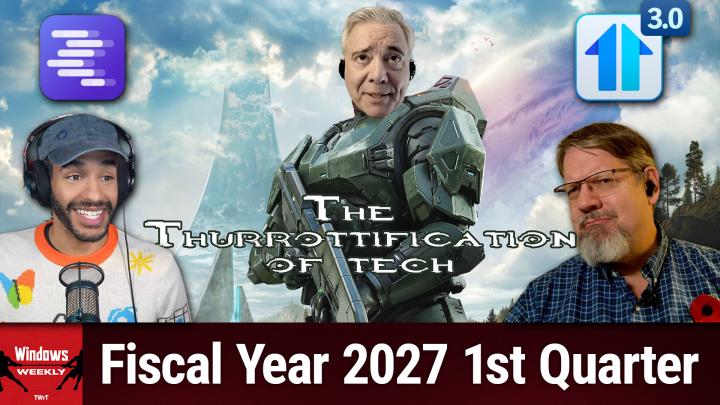
This is Windows Weekly with Paul Thurrott and Richard Campbell, episode 1008, recorded Wednesday, November 4th, 2026. The Thurrottification of tech. Hello, it is time once again for Windows Weekly, the show where every week we talk to the folks Who are the foremost Windows watchers in the world. I love those W's. It's Paul Thurrott and Richard Campbell. Hello, gentlemen.
Paul Thurrott [00:01:12]:
Hello, you.
Mikah Sargent [00:01:14]:
Oh, hey.
Paul Thurrott [00:01:15]:
How's it going?
Richard Campbell [00:01:16]:
I'm always glad to see you, Micah. It's a good day, man. I'm glad you've been doing this with us.
Mikah Sargent [00:01:20]:
Thank you. I've, uh, I've had a great time joining you all and talking to Paul about AI. And, uh, uh, you know, we've, we've made some progress here.
Richard Campbell [00:01:32]:
Oh, I see. So A little less angry at the RTX Sparks now?
Paul Thurrott [00:01:38]:
Oh no, I'm still just as angry, but I'm moving through those phases of acceptance and grief and whatever.
Mikah Sargent [00:01:45]:
All of them are coming through.
Paul Thurrott [00:01:46]:
I mean, I'll just point out because you said it, I have one of those laptops next to me. I'm trying to move on to more general things, right? So I was like, just some retirement thing. If your money's in a 401 and you want to withdraw it without Getting a major tax penalty, what are some of the best strategies for that? Thinking like this maybe is a reasonable thing. This thing has been cranking away for about 25 minutes and it's just talking to itself.
Richard Campbell [00:02:11]:
It's— You just sent it into orbit.
Paul Thurrott [00:02:14]:
I mean, maybe I'll let you know when it's done. I don't know, maybe it doesn't care, but dear God, it's like maybe this is going to be an awesome answer. I have no idea.
Mikah Sargent [00:02:21]:
Does it do tools? Does it do searches or is it all just its own? knowledge for the questions you're asking?
Paul Thurrott [00:02:28]:
That would depend on this model. I'm not actually— oh God, sorry, it just came back to— it's actually answering me now.
Mikah Sargent [00:02:38]:
Oh,
Richard Campbell [00:02:38]:
nice.
Paul Thurrott [00:02:39]:
I don't know. It's thinking, it's using reasoning effort. It is— Okay. It doesn't factor into this. Does it use search? I don't know, actually. I'm not sure if it's working off its own little internal understanding of the show.
Mikah Sargent [00:02:57]:
That, see, and I wonder too, uh, it'll be able to answer, you know, the longstanding issues, but any newer ones, if it doesn't have, you know, the ones—
Paul Thurrott [00:03:06]:
Yeah, I mean, I, I, I understand this case. And that's okay, so— Okay, which I'm not, I'm not actually asking it for me. I'm just, this is just a general question. As a test. I, I, I think there are some general bits of advice for this particular question, so maybe it will just gimme that. But man, it took, it took a sweet time to do this thing.
Mikah Sargent [00:03:20]:
Going diddle diddle diddle diddle diddle diddle diddle diddle. Yeah.
Richard Campbell [00:03:23]:
And in the how much money of— how much electrical dollars can I burn of Paul's?
Paul Thurrott [00:03:28]:
Yep.
Richard Campbell [00:03:30]:
I will be your little space heater.
Paul Thurrott [00:03:33]:
Brad Sams, who I used to work with, is my friend. He works at Stardock now, and they have a product called Clairvoyance, which is one of many— we need a term for this, but AI front-end apps, like an AI assistant, but can work with local models as well, in this case, as cloud models. And it's got a nice user interface, and it's kind of set up really nicely, whatever. But they have a feature coming that we were testing where you can connect the GPU in a computer to other computers over the internet. I'm sorry, over the local network, that's available today, but you can do it over the internet arbitrarily and you have contacts and stuff. So he was accessing my GPU last night and we were just sitting on the couch and all of a sudden this thing spun up and it was like, and I'm like, Brad. Here we go. Are you using my computer? And he goes, maybe.
Paul Thurrott [00:04:27]:
But that's kind of an exciting development in that space, by the way. Just that kind of thing, it's pretty cool. Yeah. We talked about this last week, the idea we have a box. It's a local AI box. It has whatever storage and memory and models on it and whatever, but you access it from another device. Let that thing do all the hard work, and it could work locally over your home network, or it could just work over the internet. Anyway, that's not—
Mikah Sargent [00:04:56]:
I also love the idea that you have sort of different, uh, levels of friend. And so you have your, your good friend, your best friend, and the friend who you'll let share your GPU.
Richard Campbell [00:05:06]:
Yeah, well,
Paul Thurrott [00:05:07]:
right,
Richard Campbell [00:05:08]:
the fan that spins— the fan— that friend that spins up your fan.
Paul Thurrott [00:05:11]:
He's beside himself with this. Yeah, he's super excited about these laptops. I keep trying to explain to him maybe he shouldn't measure his excitement, but, um, but Okay. Now we can sort of experience it, I guess. I don't know.
Richard Campbell [00:05:26]:
Right.
Mikah Sargent [00:05:26]:
I think it's time to talk about the money, is it not?
Paul Thurrott [00:05:30]:
Yeah.
Richard Campbell [00:05:31]:
Oh, there's so much money.
Mikah Sargent [00:05:31]:
Money made, money lost, money gained.
Paul Thurrott [00:05:34]:
My headline for the previous quarter's earnings report analysis was, Hide Me the Money, which I'm still super proud of.
Mikah Sargent [00:05:45]:
That is very good.
Paul Thurrott [00:05:46]:
So maybe more than I should be. But yeah, this happened toward the end of the show. So if you watched last week, you might remember. the broad strokes of this, which is in the quarter ending September 30th, Microsoft earned a net income, which is profit, of $36.6 billion on revenues of $92.3 billion. Man. Those are both double-digit gains, like major, 32% and 19% respectively.
Richard Campbell [00:06:13]:
This is why you also announced 60,000 layoffs.
Speaker E [00:06:16]:
Yeah.
Paul Thurrott [00:06:17]:
But this is how they always do this. I'll never Quite get that. But yeah, they had announced— they, Microsoft, had announced a major restructuring of the company for financial reporting purposes a couple of months ago. So instead of having 3 top-level business units, they now have 2. And the weird thing about it, maybe it makes sense on some level. I actually really feel strongly Microsoft is a complex enough business, they probably should be split into 7 or 8 or a dozen or whatever business units, but okay.
Richard Campbell [00:06:50]:
Yeah.
Paul Thurrott [00:06:51]:
But they combined their 2 biggest businesses and the 2 businesses that have the most kind of cloud/AI—
Richard Campbell [00:07:00]:
Emphasis.
Paul Thurrott [00:07:01]:
Action or, yeah, emphasis is a good word. So it's really skewed toward this new business, right? So that business is now called Agents and Infra, and this is the combination basically. There's a couple minor things, but What used to be Productivity and Business Processes, which is Microsoft 365 and some other things, and Intelligent Cloud, which is Azure and some other things, right? So now we have this new one business unit. And—
Richard Campbell [00:07:28]:
If you totally rename every product grouping every quarter, nobody can hold you accountable for anything.
Paul Thurrott [00:07:35]:
So there is one little accounting requirement when you do that, which is that you have to provide some number of months. I actually think it's 12, but it could be 6 months. But whatever the number is, uh, where you— if you change your structure like they have, you have to go back and redo your earnings from whatever number of quarters to match what you're doing now so you can have some form of comparable. But yeah, you're right, because over time, especially if you go past a year, which you would want to, um, it makes this comparison difficult to impossible depending on what we're talking about, right? And I actually think that was a big part of it. In fact, I just said, Microsoft has this very complex business. Why would they only have 2 top-level business structures, business segments?
Richard Campbell [00:08:19]:
It's the only way to make them both look like they're going up.
Paul Thurrott [00:08:22]:
Or it's a good way to hide stuff. One of the promises they made, because apparently I wasn't the only one complaining, although I've never really witnessed anyone else complaining about this, was Microsoft's lack of financial transparency, especially in this era around the spending that goes into AI infrastructure, right? Which is typically CapEx, but increasingly is other things as well. And that's not actually a new— by the way, I'm sorry, I just want— that answer just finished spitting out of this thing. So lightning fast.
Richard Campbell [00:08:53]:
Nice.
Paul Thurrott [00:08:54]:
But anywho,
Richard Campbell [00:08:55]:
that's what local AI is all about.
Paul Thurrott [00:08:58]:
I just love you. Thank you so much.
Richard Campbell [00:09:03]:
You know, top form.
Paul Thurrott [00:09:04]:
$7,000 well spent. Okay. So But yeah, we'll get into this a little bit, but there are areas where they are more transparent. You know, we got a hard number for Xbox revenues, right? We haven't seen that. I don't even know. It's been a long, long time. I mean, they used to talk like console units and so forth. That stopped with Xbox One.
Paul Thurrott [00:09:25]:
It's been a long time. So that's kind of neat. You know, we already got Azure, I think was a quarter ago or maybe 2 quarters ago was the first one that's, you know, part of it as well. Mm-hmm. And that's cool. And it's, you know, okay. And then the second business unit is what used to be called More Personal Computing, which is always kind of a terrible name, honestly. Yeah.
Paul Thurrott [00:09:46]:
And now that's called Devices and Consumer. And actually that name's fine. And so this is obviously Windows, which includes revenues mostly from PC makers, but also through Surface, which they've been hiding Surface inside of Windows for a long time. So that's not new really. Xbox, which is divided into content and services, but also hardware sales. And then ad revenue associated with Bing and MSN and that kind of stuff, which I don't really write about too much.
Richard Campbell [00:10:14]:
Very personal computing.
Paul Thurrott [00:10:16]:
Yeah, it's very personal. So of the $92 billion that Microsoft made in revenues in the quarter sales, almost $77 billion of that was, of course, the big thing, like the agents and inference. This is 83% of their revenues, right?
Richard Campbell [00:10:31]:
But that still conceals actual revenue related to things like Copilot because it's everything.
Paul Thurrott [00:10:37]:
Oh, it conceals all— and we're going to get to Copilot because there's some good concealing going on there. So, okay, 25% gain in revenue year over year compared to the imaginary version of Microsoft that didn't exist last year. But whatever, that's fine.
Richard Campbell [00:10:53]:
Well, last quarter, right?
Paul Thurrott [00:10:55]:
Well, compared to the year ago quarter, right? So that's as far back as they have to go. So they're providing the numbers for the year ago quarter. And they'll do that as we progress through the fiscal year. And then once we get to the next fiscal year, well, they'll still do it, but now it will make sense because it's the same accounting structure, but it will make it harder to go back over a year to see what happened before. This is by design is what I'm trying to say. Yep. So obviously the PC market's experiencing a little bit of a problem. One of the little themes this week, because there's been a bunch of earnings, is that The 2 major— well, now 3 really, and 4 if you want to count Nvidia.
Paul Thurrott [00:11:36]:
But it is very interesting to me that the 2 primary microprocessor makers in the PC space, Intel and AMD, are both making major AI pushes, meaning AI-dense data center chips, right? Because this is a hot market and they make hardware and microprocessors, they should be here. They're doing whatever they're doing to some degree. Qualcomm is also doing this. They just don't have product in the market yet. And then Nvidia, of course, had done this many years ago and they're big in this space. But this is saving some of these companies and we're going to get to this, but the PC market is down so badly. Microsoft revenues from PC makers and Surface in there too, but this is roughly consistent across different companies. Revenues declined 22% year over year.
Paul Thurrott [00:12:26]:
I mean, this is a—
Richard Campbell [00:12:28]:
It's monster.
Paul Thurrott [00:12:28]:
COVID-level problem. It's bad.
Richard Campbell [00:12:31]:
But it, 'cause it is ultimately supply chain and overpricing and, you know, everybody I know who has any ability to delay buying a machine has delayed buying a machine.
Paul Thurrott [00:12:41]:
Yeah.
Richard Campbell [00:12:41]:
And I'm talking about sysadmins who represent, you know, tens of thousands of seats. And it's like, this is not the year to buy computers.
Paul Thurrott [00:12:50]:
No.
Richard Campbell [00:12:50]:
They're buying extended warranties. Like they're doing whatever they can to just wait the crazy out.
Paul Thurrott [00:12:58]:
Yeah, they're going to be waiting for a while is what it looks like. But, you know, we'll see.
Richard Campbell [00:13:01]:
Yeah, that's a great question, man. Like, how much longer can this go on?
Paul Thurrott [00:13:05]:
So depending on the company, because people, you know, obviously these companies are asked this question all the time, um, no one wants to look too far out, but everyone agrees at least the first half of 2027 and more likely through all of 2027, I think that's going to be the minimum. And I look, I— will prices come down from some crazy high at some point? Yeah, maybe. Um, will they go back to what they were pre-component crisis? No. I start—
Richard Campbell [00:13:32]:
so I think we might have a flood market of RAM. Like, if a whole bunch of— if a whole bunch of those outstanding data center orders don't get filled because they all get canceled for various reasons, like, you're going to see asymmetrical releases of product to the market. Like, you didn't— they didn't have the complete order for that data center, but they did have these parts, and now they don't need those parts.
Paul Thurrott [00:13:52]:
Did we talk last week about the Sam Altman quote where he said that, um, this RAM component crisis isn't a problem because these people who put all this RAM in their computers, it just sits there unused 95% of the time. And if you give it to us and let us put it up in a data center, it'll be used 100% of the time. And, uh, I mean, okay, self-serving.
Richard Campbell [00:14:11]:
Because Altman has a way of making people love him. It's astonishing, really.
Paul Thurrott [00:14:16]:
Right. He's like the opposite.
Richard Campbell [00:14:18]:
He's so deeply appealing.
Paul Thurrott [00:14:20]:
Yeah, for a robot. Like, and the, the— I'm, I'm gonna—
Richard Campbell [00:14:24]:
A robot that's been hit with a hammer a few times.
Paul Thurrott [00:14:27]:
Yep. And doesn't make any sense, you know. It's like, or is programmed to say the thing that will infuriate the person you're talking to the most, right?
Richard Campbell [00:14:33]:
So yeah, in that case, I say the annoy the most largest number. Can I say it sincerely enough to annoy a lot of people?
Paul Thurrott [00:14:40]:
But this is the way he says the delivery. Yeah, he's a robot. And so this is off the top of my head, so, you know, this is going to be inaccurate to some degree, but he said He's like, from a global allocation perspective, which is how everyone thinks.
Richard Campbell [00:14:53]:
That's how everybody thinks.
Paul Thurrott [00:14:55]:
No one thinks about themselves. They think about, well, what's the greater good? Do I need this loaf of bread or would this be better served by giving a molecule of it to everyone on Earth? It's just a complete moron. Anyway, so okay, whatever. We'll see. But this is another data point I'm not going to get exactly right, but I saw a statistic where it was like the price of this, in this case it was DDR4, which previous gen RAM and right before the component crisis, whatever year it was, about $83 for 32 gigs of RAM. 32 gigs of DDR5X RAM today, which is faster and better, but what you would buy today for a modern computer is 4.5 times more expensive than that. And it's like, yikes. It's not 2x, it's bad.
Paul Thurrott [00:15:42]:
So yeah, but the irony here is, so we have these companies that are in the PC space that are either making the chips like Intel, AMD, and Qualcomm soon, and of course Nvidia. There's also PC makers doing this to great success, Lenovo and Dell being the 2 big examples. HP probably would be involved in this, but remember they split and the part of the company that would do the cloud computing AI data center stuff is not the PC maker, it's a different company. But so the irony or hypocrisy, or I'm not sure what to call this, of these companies are getting killed in the PC space, but no worries, we're making lots of money because of AI. We've all invested in AI infrastructure and that stuff is going gangbusters. So the victim has befriended the attacker, I guess. I don't know. Right.
Paul Thurrott [00:16:32]:
It's just a bizarre, it's a very strange dynamic and we're gonna see this again and again. Today. Now, Microsoft is not exactly in this space. They do make their own data center chips. They're on, I think, the 3rd gen of that Maya AI chip they have for the data centers. But they also use a mix of, and probably mostly, Nvidia GPUs, et cetera, et cetera. So we'll see. Microsoft isn't— well, they have Azure.
Paul Thurrott [00:17:00]:
I suppose that's their kind of pure play cloud slash, uh, AI push, um, for third parties. So I suppose—
Richard Campbell [00:17:08]:
I just asked Copilot what I paid for the RAM in the machine I built in 2025, in July 2025. It was $270 for 64 gigs of DDR5.
Paul Thurrott [00:17:17]:
Yeah,
Richard Campbell [00:17:18]:
a pair of 32 gig.
Paul Thurrott [00:17:19]:
Yeah, so that's, uh, 32 is— I think it was somewhere around $450. Um, yeah, and then 64 would be— I'm probably— I'm sure close to $1,000. You know, yeah, terrible.
Richard Campbell [00:17:30]:
Twice that. Yeah, it's got nothing to do— it's got nothing to do with the cost, not a thing.
Paul Thurrott [00:17:36]:
That's, you
Richard Campbell [00:17:37]:
know, they were making money at $275 back then. It's
Paul Thurrott [00:17:42]:
incredible. All right, so, but for Microsoft, um, I, I do a big analysis piece every quarter. I'm not saying that I mailed this one in, I don't mean it that way, but I just feel like after 8 or 10 quarters in a row of just like moaning and moaning and moaning about all the spending. It's like I just kind of run out of stuff to say about it. Um, but from the perspective of financial transparency, uh, which is what the promise of this new organization, um, we— there, there are some, uh, businesses within Microsoft that they've called out hard numbers in some cases. So Azure, like I said, Mm-hmm. $33 billion in revenues in the quarter, up from $22 point $24 billion a year ago, which they had not reported at that time. Microsoft 365 Cloud, which is an interesting way to say that.
Paul Thurrott [00:18:31]:
I assume what that means is the commercial and consumer subscription monthly license part of the business, I'm guessing, but they never explained it. They don't explain any of these things. Almost $28 billion, up from $24 billion a year ago. Xbox, which I see now in my article I failed to paste in the number, but I'll hopefully get to that soon. But they did provide a hard revenue number for that as well. And then there's like these things—
Richard Campbell [00:18:59]:
Interesting that they did that.
Paul Thurrott [00:19:00]:
Yeah. Well, actually I should say, so I had been making the case for many years based on the little information that we had that Windows by itself was probably in the $10 to $11 billion a quarter in revenue space under the old accounting structure, but also under the old, even older than that structure where all of Windows, including commercial, was inside of more personal computing. Sometime last year, they pulled most of it out. I'm sorry, I should say all of the commercial revenues, which is most of them, and put them into Microsoft 365, which was part of Business Productivity Services, which is now part of Infra and whatever the heck it's called, the stupid new business. So it's kind of hidden in there and they're not talking about that. But what we do see is revenues from PC makers isolated and a hard number for the— this is the type of number they used to give 10, 20 years ago. Mm-hmm. So that figure this past quarter was $3.6 billion, which Honestly, doesn't seem too bad if you accept that 75 to 80% of the revenues Windows earns are in another part of the business and we don't get to see that.
Paul Thurrott [00:20:18]:
And that kind of maps to what I say, or you could add to it, but that makes it maybe in the $10 to even $13 billion, whatever the number is. It's down, by the way, from $4.6 billion a year ago. That's a big, not quite 25%, but almost.
Richard Campbell [00:20:33]:
Yeah.
Paul Thurrott [00:20:34]:
Major decline. But that's the component crisis, right? And that's what you're seeing there. So, and that's cool, but then there's stuff in there, like one of the items in there is called industry solutions. Okay? I don't know what that means. And they don't say what it means.
Richard Campbell [00:20:49]:
And I don't— That could be anything.
Paul Thurrott [00:20:50]:
It could be, yep. It could be, yeah, that's actually, I think that's, I might've written it that way. It is, it could be anything. It's like, what?
Richard Campbell [00:20:57]:
Because most of this stuff could be an industry solution. I mean, I might stick Dynamics there, but I would think that's in cloud.
Paul Thurrott [00:21:03]:
It is. That's in— it used to be in the part of the business that was Microsoft 365, but yeah, it is. The Dynamics is part of that, whatever. What is it called? Agents and Infra or something, uh, whatever that business is, which makes, like I said, no sense. Um, not a lot of good news for Windows in this. Um, obviously everything's down really bad. Uh, revenues from— actually, I guess it's more than 25%. Um, revenues from PC makers decreased by 27%.
Paul Thurrott [00:21:31]:
Year over year, which is insane. They predict that Windows revenues from PC makers in the current quarter will decline in the mid-30s. So roughly 35%, which is worse than—
Richard Campbell [00:21:43]:
So it's not done. Like I said, it's just not done yet.
Paul Thurrott [00:21:47]:
No. And part of this decline is due to that inventory drawdown thing that's happening. So they overbought in previous quarters knowing that prices were going to continue to go up on components. and now have this stuff sitting in either factories or the channel somewhere, or maybe even in stores, however they sell those things. And they just don't need to buy it. But through the rest of the fiscal year, they believe, and the fiscal year for Microsoft, remember, extends through June of next year. They are one of the companies that says this trend will continue through at least that timeframe, which is awesome. Yeah.
Paul Thurrott [00:22:21]:
It's not awesome, I'm kidding. Xbox revenues. This was the hard figure, the hard number I didn't have for some reason earlier. Um, 4 point— I'm sorry, $5.4 billion. Um, that is only down a sliver, um, from the $5.5 billion it was a year ago. So, huh, that's pretty good. Um, a
Richard Campbell [00:22:41]:
lot of that is mostly gaming sales, right? That's not hard.
Paul Thurrott [00:22:44]:
This is all games. Yeah, well, games. Yeah, game content and services, but also hardware, right? Um, and revenues, right? To be clear, this is not profitability.
Richard Campbell [00:22:51]:
Governmental profit.
Paul Thurrott [00:22:52]:
Yeah, net, net, uh, income. We don't get those numbers. Um, I, I think because of hardware, this business obviously is not profitable right now. But, um, content and services only declined 2%, and the blame there was that in the year-ago quarter, they just had better third-party and Xbox Game Pass titles to offer. And, uh, it just, you know, it was a good quarter in, on, in that sense. And so this year, it's like, yeah, you know, it's okay. We have the new Call of Duty just came out, which they call out as kind of a big deal, but it's also not being expressed through the Game Pass stuff because it's not part of Game Pass. And it's kind of its own thing.
Paul Thurrott [00:23:29]:
Plus, it happened, the launch happened, yes, after the fiscal year, fiscal quarter ended anyway. So it doesn't really matter, but that will impact the next quarter. And so they're expecting high or mid to high single-digit growth in content and services for the Xbox this quarter, which probably Call of Duty and whatever else. Uh, GTA 6 is coming next month. You probably have heard. Um, that's going to be a big deal, probably a bigger deal than Call of Duty. Maybe.
Richard Campbell [00:23:56]:
Oh, probably arguably the, the largest game in history, right? Because it's— yeah, I mean, its predecessor is literally the largest game.
Paul Thurrott [00:24:05]:
Yeah. And part of it— so the problem is though, that's like, uh, Michael Jackson's coming out with his Bad album and like the last one was the biggest album ever made and it's like didn't quite land, um, the same way. It was obviously big anyway, but like, you know, we'll see. I'm— I would argue it's
Richard Campbell [00:24:18]:
been too long and it can't be, you know,
Paul Thurrott [00:24:20]:
nothing
Richard Campbell [00:24:21]:
can measure up to that, or it
Paul Thurrott [00:24:23]:
just nails it and we need this game so bad right now because the rest of this industry is mostly treading water, you know? I don't know.
Richard Campbell [00:24:30]:
Yeah, do I really want Rockstar to be our exemplar? I guess what's my choice, right? Electronic Arts, right?
Paul Thurrott [00:24:36]:
Like, what else? Rock could buy Rockstar and make it even worse.
Mikah Sargent [00:24:40]:
I don't know.
Paul Thurrott [00:24:40]:
I don't know. I don't know. I don't— we'll see. I'm, I'm curious. I'm not interested personally. I'm not going to play this game, but, um, I, you know, we'll see. It is— it's like the second coming. I mean, I—
Richard Campbell [00:24:52]:
You should play the game, dude. I mean, it's a great— I mean, it's the start. The story is one thing, but it's just a fun open-world experience, man. If you're—
Paul Thurrott [00:25:01]:
yeah,
Richard Campbell [00:25:03]:
I, I mean, you don't have to kill prostitutes in GTA 4. 6, right? It's not a requirement.
Paul Thurrott [00:25:08]:
But why wouldn't you? No, I, no, I mean, so I feel like I'll look at the reviews and I'll see what people say, right? There's some version of this where I'm like, okay, I gotta give this a shot.
Richard Campbell [00:25:18]:
Yeah, you don't need to be a first airer. I, I appreciate that.
Paul Thurrott [00:25:21]:
I'm not sitting here like, I can't wait to preload this thing on my computer or whatever. I just don't, I'm not gonna do that. I don't care.
Richard Campbell [00:25:28]:
Uh, you know, the only, the last time I even considered that I'd want to be a first airer on a game, it was Kerbal 2, and that sucker never shipped. So, you know, that's the end. That's the end of my hope and faith.
Paul Thurrott [00:25:38]:
I waited on my tiptoes for Duke Nukem Forever for like 7 years.
Richard Campbell [00:25:42]:
Mm-hmm. And yeah, that'll make you cry.
Paul Thurrott [00:25:44]:
Not, not worth the wait. Uh, so that kind of stuck.
Richard Campbell [00:25:48]:
Yeah.
Paul Thurrott [00:25:49]:
So a lot of my emphasis the past several quarters, I'll say, when it comes to Microsoft earnings has been the AI spending, like I said. And
Richard Campbell [00:25:58]:
sure,
Paul Thurrott [00:25:59]:
there is some discussion here, I guess.
Richard Campbell [00:26:00]:
And you're not happy with the $45 billion? You think it's a lie? Or it's concealing the truth?
Paul Thurrott [00:26:05]:
No, it is a lie. So Microsoft this past year has made, not counting this accounting change, the business structure change, 2 major changes to the way it reports earnings, both of which are tied to AI infrastructure costs, right? One was spreading out the lifetime of hardware components that are short and/or long-term to be double or more the length than is the industry standard, arguing that these things become more efficient over time, which I've equated to a balding tire because yes, it's more efficient than the one with tread. There'll be less friction on the road.
Richard Campbell [00:26:50]:
Well, if you're going drifting, sure.
Paul Thurrott [00:26:52]:
And then it explodes, which may be the perfect comparison here. I don't know. But yeah. So What I had said last quarter was whatever the number is, you can be sure they actually spent more than this on AI infrastructure spending. They just did. But the CapEx number, which used to be where all this money was reported, Yeah. is $45.2 billion, which is less than they expected, but that's because they couldn't get components delivered in time to put them into places. They intended to spend more.
Paul Thurrott [00:27:28]:
It's a 30% increase over the $35 billion it spent in the year-ago quarter on CapEx. And that number, by the way, did include those additional costs. It's more money than they spent in all of the previous 4 sequential quarters as well.
Richard Campbell [00:27:44]:
Right.
Paul Thurrott [00:27:44]:
But it's still not insane in the context of—
Richard Campbell [00:27:49]:
It is insane, right? It's pretty insane.
Paul Thurrott [00:27:51]:
If you look at Google and Amazon and how much these companies are spending on this stuff, Microsoft is not running net cash negative like Google and Amazon, by the way.
Richard Campbell [00:28:00]:
Not that we can tell anyway, because they did immediately drop that bond offer.
Paul Thurrott [00:28:06]:
Well, okay, but they report that they are not— they report their— they have a number, I don't have it in front of me, but they're, they're, they are net cash flow positive still, right? The, the way, the reason— the way they get there, one of the ways, is, uh, financial shenanigans. Um, and but one of the other ways is they don't give as, uh, as much money back in dividends to, um, shareholders every quarter. So they're, uh, they still give money, they still pay dividends, they still give money back to shareholders, but it's roughly 50% the level it was a year ago. And that's been true for the whole year. Um, so that's one way. It's not the only way, but it's a way. Um, they are going to, however, start getting into, um, some I don't want to call it dicey, but just questionable spending patterns. So they are not— compared to Google, which is doing a lot of bond sales and things, leveraging, selling debt essentially, Microsoft has not done that yet, but they're talking about it.
Paul Thurrott [00:29:07]:
Sure. They've financed some of this, but it's a small number comparatively. So $7.4 billion. If you look at the number for Google, it's got to be in the tens. I don't remember the number, you know, $20, $30 billion. It's a lot more. So that's interesting. Um, I mentioned the thing about this not being the full spend.
Paul Thurrott [00:29:24]:
We don't— there's no way in this to know what that is. I— it's just not there. So next June—
Richard Campbell [00:29:30]:
Well, and they've learned when they get honest about how much they're spending, the market doesn't like it. So they're doing their best to keep the numbers in a place that keeps everybody happy.
Paul Thurrott [00:29:38]:
Yep, yep. Um, they do still plan to spend $170 billion I broke million teeth. Uh, I wish it was million. Uh, $170 billion on CapEx this calendar year, not fiscal year, right? That goes from July to June, but the 2026.
Richard Campbell [00:29:53]:
Because 45 times 4 is 180, right? Like, you're in the ballpark. It's just, I, I wonder if it isn't 200 plus, and it's just, they're just playing games with the whole time.
Paul Thurrott [00:30:02]:
For the fiscal year, it absolutely will be, right?
Richard Campbell [00:30:03]:
Like, yeah, sure.
Paul Thurrott [00:30:04]:
Yeah, that's the thing. Um, but the— okay, so
Richard Campbell [00:30:09]:
I don't know how you get away with making calendar year references when you're talking about money. Like, that's just—
Paul Thurrott [00:30:14]:
this is like looking at some inbred English dynasty of kings or something and being like, well, this one is the least inbred, and that's my—
Richard Campbell [00:30:21]:
look how good the chin is on this one.
Paul Thurrott [00:30:23]:
Yeah, they're the adult in the room, like, to Wall Street. It's like, okay, you say so. I, I, yeah, I don't know.
Richard Campbell [00:30:30]:
Well, you know, are we really going to be unhappy with Amy Hood? Like, I do think she's one of The most accomplished CFOs on the planet.
Paul Thurrott [00:30:40]:
Right. So I don't like what they do with this stuff.
Richard Campbell [00:30:43]:
Yeah, but they are doing it extremely well.
Paul Thurrott [00:30:45]:
Yeah, I respect this from a financial accounting perspective.
Richard Campbell [00:30:49]:
And where's the shareholder revolt? Right. I mean, we're not going to— I guess we can pretty much give up on the SEC doing anything.
Paul Thurrott [00:30:56]:
Right.
Richard Campbell [00:30:57]:
So you would think the shareholders would complain, except as long as stock prices go up, who cares?
Paul Thurrott [00:31:03]:
Exactly. I don't— don't tell me the details. You know, just tell me the stock went up. Just keep making the money, you know?
Richard Campbell [00:31:10]:
Yeah, this is all good. So how large are the pikes when stock go down? Like, how many heads will need to be on poles?
Paul Thurrott [00:31:19]:
I have some recommendations for that, by the way. So just looking within AI, you know, Copilot, one of the things last quarter, Microsoft talked about how they had moved from 20 million to 30 million paid seats for Copilot, which means basically Microsoft 365 Copilot, right? That add-on subscription you have to have a commercial subscription already for. So there's kind of doubling up there. Right. That's impressive from a percentage point perspective. But as I pointed out at the time, this is still single-digit percentage of the total paying customer base for Microsoft 365. It's not popular at all. But one of the surefire ways to know that something is not doing well is when a company, in this case Microsoft, does not discuss that metric anymore.
Paul Thurrott [00:32:06]:
And that's what they did this quarter. They did not disclose an update.
Richard Campbell [00:32:09]:
Just dropped.
Paul Thurrott [00:32:10]:
On the number of Copilot, paid Copilot subscribers. Someone actually asked them about that at the end of the call they have. They have a call every year with the financial analysts, and it's usually a circle jerk of terribleness. But one guy actually thought to ask, Hey, uh, did I miss—
Richard Campbell [00:32:28]:
where'd the Copilot numbers go?
Paul Thurrott [00:32:30]:
And they're like, no, we didn't disclose a number. We talked— next question— momentum. Yeah, no, basically it was like, we talked about momentum. Okay, uh, I— here's my guess. Um, that number was always inflated. That number represents, uh, subscribers, which are business customers that are not paying the full whatever that amount is, $20-something a month, whatever. Um, they did this for companies to try to get them on the system and Let them save some money in the beginning and then maybe they could charge them full price eventually. And I think it just didn't— these customers were like, no thanks.
Paul Thurrott [00:33:03]:
I just don't think it's just not popular. It just isn't. I mean, objectively speaking, it's just—
Richard Campbell [00:33:08]:
Eventually you can just stop charging separately for M365 Copilot and include it with every M365 subscription. And then ta-da, you've got 100% market share.
Paul Thurrott [00:33:18]:
There you go. Yeah. If they— yeah, if they felt like that made sense financially and they could do it, they would. I, I just— God help them if they did include— even—
Richard Campbell [00:33:30]:
I don't understand why everyone— now, when I watch how well it searches my Outlook email, I'm like, why, why isn't everybody using this? Like, honestly, right? For that feature alone. Because otherwise, you know, the search features in Outlook are so hopeless. They're so hopeless.
Paul Thurrott [00:33:45]:
It's an additional $20 a month, you know, for an extra
Richard Campbell [00:33:48]:
$20 a month. You only need one search that doesn't suck, and you're like, here's my $20, baby. Like, it's worth every penny.
Paul Thurrott [00:33:56]:
Yeah. So I— they have numbers for—
Richard Campbell [00:34:01]:
Did I tell you that, Kate, like, the one that flipped me was when I, I literally had to go do an expense for a conference, right? Normal thing. I have to get— I have to file the expenses. So I go and I want to look up what I did last time. Easy enough.
Paul Thurrott [00:34:12]:
Yes.
Richard Campbell [00:34:12]:
I'm just going to ask Copilot for this. Hey, how do I submit expenses for such and such a conference? And it went away for a little while. And when he came back and said, well, last year you did it like this and it was this much money, you filled in this form. And the year before you did it like this. And the year before you did it like this.
Paul Thurrott [00:34:27]:
Was it different every year?
Richard Campbell [00:34:28]:
They were. And it was also correct.
Paul Thurrott [00:34:31]:
Okay.
Richard Campbell [00:34:31]:
Right? Like it actually brought all— I'm like, okay, you can stay. You can stay. That was awesome.
Paul Thurrott [00:34:43]:
I'm not going to talk about Copilot numbers because they're stupid. No. So whatever. Microsoft AI didn't factor into their earnings at all. They mentioned a couple of models and how they're being used somehow, somewhere, who cares, whatever. OpenAI did factor in, obviously Microsoft earns, well, maybe this is not obvious. Microsoft earns revenues from OpenAI, but it also charges OpenAI for infrastructure. So when you think about at the end of the first year—
Richard Campbell [00:35:13]:
Well, that was always the deal, right? will invest in your company and you'll spend that money on Azure.
Paul Thurrott [00:35:21]:
Right. So I can't say that this is working out for Microsoft yet. For the last fiscal year, because at the end of the fiscal year they actually have to report this, they earned from OpenAI $24.1 billion in revenues, not profits, but revenues. There were reports based on the data in that 10-Q filing, I think, or 10-K filing rather, that OpenAI represented up to 70% of actual AI revenues was the phrase. But Microsoft spent $145 billion on CapEx in the fiscal year. So it lost or invested about $100 billion in AI. So yay, we're going to win with volume, I guess. I don't know.
Paul Thurrott [00:36:05]:
This quarter, they reported that they earned a record $10 billion in revenues, not profit, from OpenAI. That's an interesting number. That's over 10% of their total revenues, by the way. Sounds impressive, but remember, cyclical money. It's
Richard Campbell [00:36:23]:
a
Paul Thurrott [00:36:23]:
startup. Yeah. It's not a profit. It's not anything like that. OpenAI somehow has not paid Microsoft $7.2 billion of the money it does owe them from that quarter, which is kind of a small drag on earnings. I would As I wrote in my article, I would call that a loss, but okay, whatever. I mean, I just like to speak plainly. I don't know.
Paul Thurrott [00:36:49]:
And okay. And then no one explained this, but a year ago, Microsoft's ownership stake in OpenAI was 27%. Yeah. They have other rights that go beyond whatever the percentage is, obviously, but that was the percentage. At some point this past year, that fell to 25%.
Richard Campbell [00:37:08]:
And they had, they had a top-up round, right? They had some—
Paul Thurrott [00:37:13]:
Oh, okay. Bridging finance. Oh, because it's worth more, right? Okay. Because, right. Okay.
Richard Campbell [00:37:16]:
So that's going to, that's going to dilute.
Paul Thurrott [00:37:17]:
They didn't explain why, but it went down to 24%. So— Yeah.
Richard Campbell [00:37:20]:
But if you had, if you had, and it's, you know, when you're already a shareholder, you get an opportunity to be part of that round to maintain your percentage.
Paul Thurrott [00:37:26]:
Yeah. And if you don't, your share is diluted because the company's value more. Yeah. No, I got you. You know, as you said that, I was like, yeah, that's it. So I can, then I can in fact explain it because they had another funding round. They were going to do an IPO. The
Richard Campbell [00:37:39]:
company realized it was going to be a catastrophic disaster. And so they—
Paul Thurrott [00:37:43]:
well, and then they had a funding round, which, by the way, was a catastrophic disaster. They got less than half of what they wanted. So it only went down to 24% because OpenAI did not receive as much funding as they were hoping and expecting to get, but it did go down. So, okay, that does make sense.
Richard Campbell [00:38:00]:
We're going to talk about Anthropic holding back on their IPO as well. I don't think any of these companies get there. I really don't. I think they're all going to wobble. I, you know, they're— they're— the need of the return on this IPO is so extreme that nobody's going to go for it.
Paul Thurrott [00:38:17]:
So I, I don't know. I don't have an opinion on that per se. I— these companies don't make financial sense at all, so they never
Richard Campbell [00:38:26]:
have. Yeah. And arguably cannot.
Paul Thurrott [00:38:29]:
But I, I always think back to Google because when Google, um, went public They did it in this really kind of bizarre and at the time Googly way. This was still in the don't be evil phase of the company's existence. Yeah. And they did like a, I think it was called like a Dutch auction, very strange structure. And then of course, years since then, they restructured with Alphabet at the top of their corporate structure. And that's a completely different story, but except that it isn't, right? These companies are actually structured this way too, right? OpenAI and Anthropic. And Anthropic is new and tied to their IPO, or attempt IPO. But you create this, not a shell company, but a parent company that is a for-profit thing.
Paul Thurrott [00:39:11]:
And then—
Richard Campbell [00:39:12]:
But the IPO back in 2004, Google was up against the 500 shareholder rule, right? The SEC was basically saying, hey, you have to do something about this.
Paul Thurrott [00:39:21]:
You have too many shareholders. Right. They would've stayed private forever. They would've done it. Yeah, they would have.
Richard Campbell [00:39:25]:
And there was other options, but that was the easy out, was simply go list, right? And in a lot of ways, I look at that IPO in 2004 as this is the end of the dot-com bust, right?
Paul Thurrott [00:39:35]:
Oh, there you go.
Richard Campbell [00:39:35]:
This is the recovery of the internet, was when Google IPO'd. And that was the moment where we said, hey, you didn't— you know, how do you describe survivors of a hype cycle? You're either Netscape or you're Google, right? You either get sold and become— and disappear Or you hang on and come out the other side one of the winners.
Paul Thurrott [00:39:54]:
I don't know the history of Google product releases or whatever events well enough to put this in context historically, but it is perhaps— maybe it's interesting. Maybe I'll look at this at some point just to kind of figure that out because Google was a different kind of company than they are today. I mean, all these companies are, but—
Richard Campbell [00:40:11]:
One would argue the Alphabet restructure was like, oh yes, we're going to be evil like everybody else.
Paul Thurrott [00:40:15]:
This is us being corporate. Yeah. Yeah. So you could kind of draw these parallels to OpenAI and Anthropic trying to go public to Google doing it, in that they're both weird. But really, the goal for these companies is to raise money. It's to get that valuation that is north of or near $2 trillion. That's why they're doing it. That is not why Google did what they did.
Paul Thurrott [00:40:43]:
That was not the point. They had to do it. Like you said, they didn't want to. So it's a little bit different, but man, this is a— this is just a bet of historic proportions, obviously. But just one little thing. I mean, again, with the understanding that this number is completely bogus anyway, and who cares, $10 billion in revenues from OpenAI means that that business is almost twice as big as Xbox, by the way, from a revenues perspective. Yes.
Richard Campbell [00:41:11]:
And do not talk about their spend. Because holy man.
Paul Thurrott [00:41:15]:
Yes,
Richard Campbell [00:41:15]:
much less their commits.
Paul Thurrott [00:41:17]:
For all the problems that Xbox has short-term, um, it's more of a, uh, it's more of a good bet, I guess I would say. Yeah. Now long-term, viable business. Yeah, we'll see. I mean, we'll see what happens with AI, but, um, yikes. I don't know. So we'll see. So I think that's most of that.
Paul Thurrott [00:41:38]:
I didn't Yeah, there's just— maybe I'm going to be lucky and next July they'll have that 10-K, 10-Q filing and I can look, there'll be data and then I can be like, all right, this is what the year looked like. And in the interim, I could just not worry about it because I would love not to think about this stuff. It's so horrible for me. It's just unhealthy. But the spending is insane.
Mikah Sargent [00:42:01]:
It is healthy to take a break every once in a while.
Paul Thurrott [00:42:06]:
So let's do that.
Mikah Sargent [00:42:07]:
Leo Moore, come in so we can touch grass. Nice. Thank you, Leo. Uh, now let's head into Windows.
Paul Thurrott [00:42:18]:
I remember that guy.
Mikah Sargent [00:42:19]:
I remember that guy. It's been a while.
Paul Thurrott [00:42:22]:
Um, I mentioned this, uh, last week on the show, but I hadn't written about it, and then I've now since written about it. But between those 2 events, um, I heard from a second source, so I mentioned last week, a source from Microsoft reached out to me to talk about the reason why Microsoft is improving Windows 11 this past year and beyond through those pain points updates. And it is what I had speculated, which is really—
Richard Campbell [00:42:46]:
Pavan Davaluri is awesome?
Paul Thurrott [00:42:49]:
Nice. That, yes. But because of the need to make this a good platform for local AI, right? And local AI agents and hybrid AI and all that stuff. This came down from the top. It was, you know, Satya Nadella, Amy Hood, and like, what is going on? The Apple's killing us over here with the Mac. They get this unified memory thing, blah, blah, blah, whatever. And so that's how this work started. And I, I don't think— I can't remember who said what now or whatever.
Paul Thurrott [00:43:19]:
The second source kind of— you just would not kind of literally confirmed what I had written or said before or had heard before. But, um, and up to the point where they're, you know, like I was talking about, we have this like phase 1, which is what they delivered through, say, 26H2. And then the phase 2 stuff we're seeing now, and we'll talk about in a little bit some of that, the work being done to Windows Search, right? To add that as kind of a focal point for interoperating, interoperating, integrating or using or whatever local AI through intents and settings changes and all that kind of stuff. So it was kind of interesting just to have that confirmed, although I the first person I spoke to, I trust explicitly, I've known for decades, but whatever. I just, the thing that's bizarre to me about this is just that they have a perception problem. And that's the hard bit of getting through this. You know, I didn't put this in the article, but Zack Bowden over at Windows Central tweeted something the other day, which was about this new Windows Search feature we'll talk about a little bit. Oh, no, no, I'm sorry, sorry.
Paul Thurrott [00:44:29]:
He was talking about the taskbar stuff that they had changed. It's like, okay, you can move the taskbar around. And in the tweet, although this wasn't the headline of the article, but in the tweet, he made the assertion that this used to be easier in Windows 10 because you could just drag the taskbar to the different sides. And it takes additional steps, or you could use a third-party utility to do that today. And someone from Microsoft got really testy about this. Which I agree with on some level where it's like, this is overly critical. You're not considering the fact that we designed it that way on purpose, not that we just didn't do it. And the reason we didn't offer the drag and drop thing is that back in that era, we had this notion of locking the taskbar because you could have different toolbars and things and you wanted to keep all the layout and positioning correct.
Paul Thurrott [00:45:15]:
And it was too easy to drag that thing to a different side of the screen by mistake. You could just click on it and start moving and it would move. And we decided that that's just, it's too easy to make that mistake and people might not know how to fix it. And we did it on purpose. And I'm like, okay, actually I agree with that. The only problem is this argument and calling the tweet sort of negative or whatever is ignoring the fact that Microsoft as a whole has ignored or purposely undermined Windows for years. Yeah. This is happening in the wake of that.
Paul Thurrott [00:45:50]:
And I feel like any reaction to what someone writes or says about Windows now has to take that into account because we are trained to not trust anything this company does. You know, we have watched them. Yeah, you've watched us as well. Yeah, you made this thing horrible. I love that you're making it better. I do. But, and that you're doing it for AI is whatever.
Richard Campbell [00:46:14]:
Whatever. But yeah, why do you think you're always forgiven?
Paul Thurrott [00:46:17]:
Right. You can't come from a position of authority when you have been undermining that authority for a decade or whatever it's been, right? I just see both sides of it is all. I'm a little troubled by that. But anyway, so I've confirmed that stuff. That's cool. We know that Microsoft has been working this past year on making Windows 11 work better in low memory conditions, specifically 8 gigabytes of RAM, which is Sadly, the new default.
Richard Campbell [00:46:43]:
Just gnawing on that slow memory conditions now.
Paul Thurrott [00:46:47]:
I know, I know, 8 gigabytes, right?
Richard Campbell [00:46:49]:
It's so like— there's like a weird Linux guy somewhere deep inside me, he's like, that's wrong, that's very wrong.
Paul Thurrott [00:46:56]:
Yep. I don't run a— I run a distribution that runs on 2 gigabytes. Go screw yourself. Um, okay, fair enough. It's a— look, different operating system, whatever. Um, I, I don't doubt The numbers and Microsoft kind of describes how they did it, where they did it, and what they're working on. There's probably going to be more work, blah, blah, blah, whatever. Ah, geez.
Paul Thurrott [00:47:17]:
I know that things are stressful.
Richard Campbell [00:47:18]:
I mean, this memory crisis isn't going to last forever. The question is, will the effort still be worthwhile? Making a leaner Windows, I see no downside.
Paul Thurrott [00:47:26]:
Same. So I don't know this for a fact, but I have to sort of assume that work done to memorize, to optimize memory in Windows isn't done through the tunnel vision of, okay, do this if you have 8 gigs of RAM, do this if you have more. Like, I would like to think that if they're making, uh, specific user interfaces less heavy from a resource perspective, or lowering the RAM commitment of something, or running less things at startup, or whatever, whatever the approach is, because it's not one approach, it's a bunch of things, that it's not just specific to this configuration. Right? Like, I, you know, remember when Vista shipped, one of the big problems was performance. It was just, you know, it was a big heavy system compared to Windows XP, which of course had come out several years earlier, not just a couple years earlier. Um, they worked on that over time, and Windows 7 you could see is sort of a refined version of that. It doesn't hurt, by the way, new chipsets came out and RAM became cheaper, etc. Yeah.
Paul Thurrott [00:48:23]:
But, but one of the things they did as a stopgap measure at the time was offer something called Windows Ready Drive, or I think it was called Windows Ready Drive, right? Yeah. The idea was that you could get a USB key, like a flash drive, stick it in the USB port in your computer, laptop typically, and it would act as a cache. And so if you had what for Vista was a low amount of RAM, but would be great for XP, this could augment that. It's not like adding RAM, it's slower, but it's a form of cache or whatever. And it was a temporary solution. It was fine. It's gone now, right? You don't see it anymore. We don't have that.
Paul Thurrott [00:49:00]:
But it's possible this is like that, just a temporary measure where we're just shoring things up because they're not going to do what they did in the past, which was when netbooks happened and Vista wasn't ready yet, or Vista was ready but wouldn't run on those systems. They're not going to bring back— they brought back XP, remember, and made Starter Edition. We're not bringing back Windows 10 because maybe that— because it doesn't really. But let's pretend if it ran in less RAM or something, it's like, oh, if you have an 8 gig PC, you can have Windows 10 now. It's like, guys, please, dear God. But, um, I'm just hoping that—
Richard Campbell [00:49:33]:
Pulled out the Ready Bruce phrase.
Paul Thurrott [00:49:35]:
The Ready Bruce. Thank you. That's the name. Thank you.
Richard Campbell [00:49:37]:
Thank you. You're awesome, Kev.
Paul Thurrott [00:49:40]:
Thank you. That's the name. Yep. So I— hopefully that's not it. I— whatever. I don't actually care how they did it in some ways. I, I'm more concerned that it just works and Like I said, I would prefer that these optimizations are for everybody because if you're running on a computer with 16 or 32 gigs of RAM, why wouldn't you want it to be more efficient? I mean, you still can use that RAM for other things. Windows allocates RAM dynamically, like make it available to other things.
Paul Thurrott [00:50:08]:
To me, that just makes sense. We'll see. Mm-hmm. Microsoft has a newish technology that will eventually spread to other Apps, including third-party apps, but it's basically, um, an accel— accelerated app launcher or accelerated app launching technology, I guess, whatever. Um, it's available first in Microsoft Edge. It supposedly makes this thing run, or start I should say, some double-digit percentage faster than it did before. Okay, that's nice. Um, you know, you have to It's actually not a feature of Edge in the sense that this is actually a system component and Edge is using it.
Paul Thurrott [00:50:52]:
So if you don't have 26H2 or 25H2 with the October update, you actually won't see it. Like you have to have both sides, right? Yeah. So I think it's like basically 15% faster launch. And then if you're multitasking heavily, up to 30, 33%, whatever the number is, Okay. This is a slightly modified version of preloading the app, which they already do, by the way, by default, which I hate. And it's just a different way of doing that. It's probably a way you can't go into the startup folder or go up into whatever it is, Task Manager, however you do those things, and turn off that thing from autostarting. I don't think this is a switch or anything.
Paul Thurrott [00:51:38]:
I think it's just there. So I don't know, maybe this is just a— I'm sure it's better, but I also kind of— it's like you're just, you're auto-starting the app, right? That's kind of what you're doing, is that right? I think, right? I think that's what you're doing. Yeah. Um, and then let's see, so we Insider— I thought we had 2. I only have one listed here, but, um, I thought we had 2 sets of builds since last week, but whatever. Okay, so late last week we had experimental and experimental 26H1 both got some more improvements to the new Windows Search experience, which is still rolling out only in the Insider Program. So it's not like most people are going to see this out in the world, but this is their latest attempt to make sense of AI things.
Richard Campbell [00:52:21]:
Are these the new Canaries?
Paul Thurrott [00:52:26]:
No. So Canary is future platforms, experimental future platforms. These are essentially dev. This is like, I call it dev. Experimental is dev, beta is beta release preview, right? So I think that's how they—
Richard Campbell [00:52:40]:
So dev became experimental and Canary got lost.
Paul Thurrott [00:52:43]:
Yeah, they're not on the cusp of being released, but they will.
Richard Campbell [00:52:46]:
And to be clear, Canary was always lost.
Paul Thurrott [00:52:49]:
Canary never made any sense. And by the way, I don't think future platforms makes any sense today. So that's at least consistent. I don't know.
Richard Campbell [00:52:56]:
We're in the Insiders Program. Isn't this all future platform?
Paul Thurrott [00:52:59]:
Yeah, right, exactly. So one of the big things they're doing with search is making it extensible through what they're calling inline actions. I think I said intents earlier, sorry. And they're increasing the number of actions you can take through search. So this is sort of like the thing they did with the settings agent, which before that existed was a feature of the Copilot app where you could say, hey, I wanna make the screen dark or whatever. You don't know the name of the feature, right? That stuff's in Settings now where it belongs. It's also coming, or is in— I don't know if it— I don't think it's in Stable yet, but it's in— it will be in Search too. Okay, fine.
Paul Thurrott [00:53:37]:
I guess that's one way people would, you know, try to find things. Um, but they're gonna— they're just like adding weird— like, um, if you have a supported Android phone, which means a Samsung, a recent Samsung, um, flagship, or a couple of Chinese phones that are also very high-end, um, you can today through Phone Link run apps apps remotely, like in a window, and you can have multiple windows, which is pretty cool. So you can have these floating app, like phone windows that it's streaming from your phone. They're bringing that to search for some reason. So you can, you can actually just bring up search, you do like a Windows key plus S, and then type in the name of an app that is in the phone, not on your computer. It will come up in the results and you'll be able to stream it. Eh, I don't care about that. That to me doesn't, that doesn't make a lot of sense.
Paul Thurrott [00:54:23]:
We have ways to launch apps. I, I, well, Technically, I guess. Okay, hold on. Technically, search is a way to launch an app. So I don't know, it just seems like a weird— I don't know, I don't quite get that. And then some other minor changes that don't really impact too much, especially in 26H1, because the experimental version of— or the experimental channel for 26H1 is like 26H1 in stable, meaning it's always behind. So There are these Xbox, uh, gaming task view features we talked about a week or two ago that were, um, in experimental previously. Now they're in 26H1 experimental, um, and some new full-screen Xbox, uh, mode, uh, things for going to the desktop or power options easily.
Paul Thurrott [00:55:07]:
These are things that were happening a month ago elsewhere, so it's like, eh, like whatever. But okay, so I guess we're all going to be using search soon for everything or something.
Richard Campbell [00:55:20]:
Copilot's your friend.
Paul Thurrott [00:55:22]:
Yeah. No, it isn't. But yeah.
Mikah Sargent [00:55:25]:
Before we get to the next topic, let's take a quick break to hear from Leo.
Richard Campbell [00:55:32]:
Leo.
Mikah Sargent [00:55:33]:
All right, Paul, tell us about how things are going in Sparkland.
Richard Campbell [00:55:37]:
Tell us about your Spark love, buddy. How's your Spark love?
Paul Thurrott [00:55:42]:
I got— I gotta go. No, um, so Um, you guys probably barely noticed because it was kind of subtle, but I've been complaining about RTX Spark for a few weeks now. And, uh, no, I know. Um, but I, I did— I didn't publish— I published this morning an article of, um, a little, well, more positive, I would say. But before that, I, I realized I have this problem. So I have to review these laptops. I can review them as laptops. It's the same problem like a lot of, uh, reviewers are having right now.
Paul Thurrott [00:56:16]:
But there's this RTX Spark platform thing, and this needs to be addressed in some way. And instead of talking about it a little bit in each laptop review, which is kind of stupid, I was like, well, I'm just going to review RTX Spark. And, uh, it didn't go good, guys. Um,
Richard Campbell [00:56:31]:
hmm.
Paul Thurrott [00:56:32]:
I do a, a list of, you know, like pros and cons, you know.
Mikah Sargent [00:56:36]:
I love your headline, by the way. Your headline is so good.
Paul Thurrott [00:56:40]:
It's So good. Yeah, I was on— yeah, a little— I was pretty happy on a roll. Um, so I, I, I, I have occasionally had a laptop, probably not a phone I would think, but maybe a laptop where it's like really didn't have any cons at all, or maybe just had some minor issues. I've never had a product that had no pros, and so that was until now.
Richard Campbell [00:57:05]:
But good looking as long as you leave them off.
Paul Thurrott [00:57:08]:
One of the things I wrote up front, and I want to be super clear about this here as well, is that this is not the PC maker's fault. The PCs I have universally are well-made premium devices. They all have their specific PC maker design bits and so forth. They're nice to whatever degree. The hardware is good, but they can't overcome the problems of the platform. So I'm not going to beat this one to death, but I'll just list out the the issues that I found, right? But incredibly expensive. These things are $3,000 to $7,000, and it's hard to justify that cost based on what you can do with these things. It doesn't— you know, like a $3,000 to $7,000 portable workstation that did that, whatever, you could make a case maybe.
Paul Thurrott [00:57:51]:
But these are— it's tough. And I know component crisis, that's definitely part of it, but they're just tough. Um, I mentioned this last week, I'm sure, but these things are laptops. You know, they're heavy, they're hot, they're loud. They're not the right form factor for agents, which is the point of this platform. This should be that central box thing we were talking about.
Richard Campbell [00:58:11]:
This is, yeah, why are you carrying your agent with you?
Paul Thurrott [00:58:14]:
Yeah, this is right. This needs to be somewhere that's alive all the time for that thing to make sense. That's
Richard Campbell [00:58:19]:
my take on that. Why is your agent making your laptop bag warm?
Paul Thurrott [00:58:25]:
Right? Is that thing in the bag running? What's it doing? Yeah, I mean, it's bad, right? We talked about this too, you know, the scalability, meaning the total amount of RAM you can get, and then the bandwidth of that RAM is well short of what's possible with Apple Silicon. Yes, you will spend $29,000 on a 512 gigabyte Mac, whatever, but you could, and you could get it, and it would be—
Richard Campbell [00:58:50]:
And it would be a monster, right?
Paul Thurrott [00:58:52]:
It would do the thing.
Richard Campbell [00:58:53]:
Basically, you've got an HP 200 in your hands.
Paul Thurrott [00:58:55]:
One thing I've come to since we talked last time, I think, is that I'm not calling this unified memory anymore. This is not unified memory. It's shared memory and it's shared between the CPU and the GPU. And you can change how that RAM is configured, but you can't do it on the fly. If you change it, you have to reboot the computer. Sorry.
Richard Campbell [00:59:13]:
That's your point. It's not unified. That's not unified. You make a decision at boot time about how it's divided up.
Paul Thurrott [00:59:20]:
Yep. And this is, well, or you, or that's that, yes, that too. But also do it dynamically based on what's running. Like if some AI app runs and loads a giant model and allocate more RAM to that thing. You know, that, like, it just doesn't make sense. Um, they've added a—
Richard Campbell [00:59:38]:
But again, if this was a NUC sitting on, you know, headless, all the memory would be allocated to it in the first place. So that's what it would be for.
Paul Thurrott [00:59:46]:
I, I didn't— right, so I didn't list this in the cons or anything. Like, it's— I'm sure it's in the article somewhere, but one thing that they've done since these things were first released is they've added an interface to the NVIDIA app. It's on the same page where the GPU RAM allocation is. And it's for prioritizing the GPU for either foreground or background processes. I don't think it's actually right in the middle. It's probably leaning more toward foreground processes by default, but you can change that on the fly and you don't have to reboot. And that's good because in your situation or the scenario you were just talking about, if you have a NUC or whatever small form factor computer, that's probably gonna be headless and sitting in a room somewhere and you just access it remotely over the network. Mm-hmm.
Paul Thurrott [01:00:28]:
Yeah, allocate as much GPU as you can, as much RAM to the GPU as you can, of course, right? If you're gonna use it interactively like a laptop, it makes sense to split that in a different way depending on your workloads and then probably optimizing for foreground use, right? Because that's gonna be, if you're using it, that's what you're gonna want. But, you know, it's, this is OS stuff. Like I'm doing the job of the OS here. Like in both cases, it's like, why am I doing this?
Richard Campbell [01:00:55]:
Oh yeah, no, I certainly wanna write a sys file again and allocate HIMEM.SYS.
Paul Thurrott [01:00:59]:
Exactly. Which I used to—
Richard Campbell [01:01:01]:
DOS equals high.
Paul Thurrott [01:01:02]:
I used to make floppies to run Doom on a 386 because you couldn't run with the stock MS-DOS boot disk.
Richard Campbell [01:01:09]:
It wouldn't work. You needed a custom configuration. Yep. Absolutely.
Paul Thurrott [01:01:12]:
I'm sorry, but no one wants to go back in time 35 years for this. This is stupid. No. There's no unique functionality on these computers through Windows. For end users, there's no unique platform capabilities in Windows. I think that's going to change, but it's not there yet. It doesn't even have the Copilot Plus. PC stuff.
Paul Thurrott [01:01:29]:
And then of course, just the general issue with local AI, which is, you know, you buy one of these computers, you're probably going to get one— well, you're almost certainly going to get one that's probably 32 to 128 gigs. Ideally, if you're actually doing heavy local AI work, you want 64, 128. That will give you the headroom, you know, to divide up the RAM in the right ways. But it's still— but that— so in other words, the reason you buy that thing, it's so expensive, is because you want to get the bigger models. These things are multiple tens of gigabytes in size, but then they take forever to load.
Richard Campbell [01:02:01]:
Tell me you've done a battery life test on this thing.
Paul Thurrott [01:02:03]:
Oh, I have.
Richard Campbell [01:02:04]:
I want you to get an agent cranking on your 401 and then unplug it from the wall and see how that goes. Maybe you can make the battery glow along with the GPU.
Paul Thurrott [01:02:14]:
So, all right. So I mentioned at the top of the show that I had taken one of these laptops and asked it that financial advice thing, right? The thing I did before that is gonna come up actually in the next bit, but I had it make a simple video game and the battery died before it finished and I had to plug it in. It was at 100% when I started. It didn't go, it wasn't an hour. I mean, it didn't last. When you run a local AI, you can't do this on battery. It kills the battery. It's awful.
Richard Campbell [01:02:45]:
Yeah, no, I think the battery just burst into flames, right? It's like, Is that an agent in your pocket or are you just on fire?
Paul Thurrott [01:02:51]:
Right, right. Um, I didn't, uh, I unplugged it to bring it in here and then launch that query I mentioned, and I don't— so I don't actually know where the battery went to, but it's on 41% right now. So it charged from 10% to something, and then it's at 41% right now. So battery life is not good. If you just do normal stuff, it's okay. It's, you know, you could probably get So was this a mass delusion?
Richard Campbell [01:03:15]:
Like, why make these machines? They were never a good idea.
Paul Thurrott [01:03:23]:
Okay, so I always— this is a stupid reference, but I always think of, um, uh, Kids in the Hall, the comedy troupe from Canada in the early '90s.
Richard Campbell [01:03:32]:
Move to the head.
Paul Thurrott [01:03:33]:
Right. I'm scratching your head. I'm scratching your head. I love, I love Kids in the Hall. So they made a movie called Brain Candy. Yes. It's like a corporate boardroom scene. They're arguing with each other.
Paul Thurrott [01:03:45]:
The guy's like, hey, hey, hey, hey, hold on, hold on. Could we agree that the sky outside is blue? The other guy looks and he goes, yeah, it's blue. He goes, good. Now that we're in agreement, let's move on. Just kind of blows by it. I feel like there's an element of this to that. I think we could all agree, probably, That local AI, but really hybrid AI, but let's just call it local AI, is the future, so to speak. Not because cloud AI goes away, but through some combination of offloading a lot of the work from the cloud to local will save a lot of money.
Richard Campbell [01:04:25]:
We're seeing harnesses now in development where you're literally assessing the request and saying, should I run this on local or should I ship this to the cloud and spend tons of money?
Paul Thurrott [01:04:31]:
Yes, right. So cloud, right. So ideally, I don't know, product to product, but ChatGPT, Cloud, Gemini, Copilot, whatever. Ideally today, and I think in some cases, you know, it's not the— like, the role of picking model, not a human being task, you
Richard Campbell [01:04:49]:
know.
Paul Thurrott [01:04:50]:
No, don't ask me. We have OSes for this, right? So we are starting to see that in these cloud models, the frontier models. But the holy grail here is what you just said, which is you orchestrate that, but between local and cloud, which is hybrid, or what Microsoft calls hybrid intelligence. But also with some form of, for businesses, it would be policy-based, but whatever system of rules where you as the owner of this thing, and maybe you have this cloud account, and maybe you— cloud, I don't mean Anthropic, I mean any cloud AI account, and you're paying them whatever it is, $20, $100, $200, whatever the amount is per month, and you want to be able to specify, like, look, you can't just go nuts, right, on the cloud AI. You have to rein that in somehow. There have to be rules. You can do it in this circumstance but in no other. And if you do do it, you're never spending $200 a month or whatever it is, right?
Richard Campbell [01:05:46]:
Yeah. And you— and to be clear, like, there's a lot of queries going to these frontier models that should never have gone there. There's no reason for it. In fact, you— you— we You talk about literally they will overthink them. You want the simpler model because not only get to the answer less time for less money, but it'll do a better job.
Paul Thurrott [01:06:05]:
And I can't speak for each of these products, but I know in some cases you let it auto-choose. You ask it a question. If it's something simple, a math question or yes or no or the capitalism state, it will use the lowest end thing because it's wasting the least electricity and whatever.
Richard Campbell [01:06:22]:
Yep.
Paul Thurrott [01:06:23]:
And it'll come back really quick, which is another benefit. And that's fine. But if you ask it something a little more complicated, maybe it's my financial advice thing or whatever the thing is you're doing AI with, it will move up the scale of the available models. Sure. I know my wife—
Richard Campbell [01:06:38]:
this is how my HA voice assistant is configured. The query first hits the local voice model.
Paul Thurrott [01:06:45]:
Yeah.
Richard Campbell [01:06:45]:
And if it doesn't have a high probability response, it kicks it to OpenAI.
Paul Thurrott [01:06:49]:
I've been married for 36 years, and I'm, for the first time in my life, running into moments where my wife is using technology more and better than I do. And that is irritating in ways that I have trouble expressing. But she's doing a lot of AI stuff. And the thing she said, we were walking, we just walked to dinner last night, took like 30 minutes, whatever. So we're walking through Mexico City and— I mentioned some, I don't remember. I talked about something related to this and she goes, yeah, she's using it for all these real-world things smartly. And I guess Gemini recommended her to use that Argon model, which is the new high-end model.
Richard Campbell [01:07:31]:
Mm-hmm.
Paul Thurrott [01:07:31]:
And so she did. And I don't remember what the thing was, but it was something, it might've been financial flights, something. I don't know, whatever the thing was, because she's using it for smart reasons. And she said she ran into— she used up all her usage for the day.
Richard Campbell [01:07:46]:
Yeah,
Paul Thurrott [01:07:46]:
because Gemini had recommended Argonne, and because Argonne's just, you know, just a monster, all the electricity away from Iowa so they could answer her question. And, um, she was like, you ever run into that? I'm like, no, shut up. You know, like, I'm like, we will never speak of this again.
Richard Campbell [01:08:02]:
I will never— yeah, I have never used up my allocation.
Paul Thurrott [01:08:05]:
Really irritating. Um, I have never made the
Richard Campbell [01:08:07]:
state's lights
Paul Thurrott [01:08:09]:
Right. So I have, like I said this already, but I've spent a ton of time researching this stuff and trying to figure it out. I have read as much as you can read. I've watched all these videos. I've taken notes, just little glimpses of, oh, that's interesting here and there.
Richard Campbell [01:08:24]:
That's possible. Yeah.
Paul Thurrott [01:08:26]:
Yep. And I've, listen, you go to YouTube and local AI is the greatest thing in the world. It works all the time. It's awesome. Uh, it's super private, it's super fast, it's, you know, and it's like, ah, that's not really— You
Richard Campbell [01:08:38]:
know, the guy— the folks that I've gone around and poked at as you've been battling with this thing, like, how you doing? And they talk through their rigs and how well it's working. DGX is all the way.
Paul Thurrott [01:08:48]:
Yeah. Okay.
Richard Campbell [01:08:50]:
Hey, well, that's what they've got.
Paul Thurrott [01:08:51]:
I, I think—
Richard Campbell [01:08:52]:
and often more than one.
Paul Thurrott [01:08:55]:
Right, right. Which, um, yeah, using the built-in software in these things, I don't think you can really change things. Oh, there is an NVIDIA one.
Richard Campbell [01:09:04]:
And that's the other thing, it's always using the NVIDIA stack.
Paul Thurrott [01:09:07]:
Yeah, right. Well, so one of the— I will say one of the interesting things about these laptops is that it's NVIDIA. So there's a lot, you know, and if you— wherever I mentioned that site, you know, canirun.ai, you could load that up in a web browser on any computer and you can see, you know, which models it recommends, et cetera. If you use a Snapdragon X2 laptop, There are no, I think it's like image or video models. There are none. Like there are no local models or run on that. They just aren't any. When you do it on an NVIDIA RTX Spark computer, there's hundreds, like, you know, especially if you have like the 128 gig thing, they're like, oh yeah, you can have it all.
Paul Thurrott [01:09:46]:
You know, you can have all these things like pretty much, not really.
Richard Campbell [01:09:48]:
I mean, yeah.
Paul Thurrott [01:09:50]:
Well, there's all kinds of asterisks, but that itself is a form of complication, right? It's in some ways, if there were just 3 choices, you'd be like, okay, well, I'll just use this one, whatever it is.
Richard Campbell [01:10:00]:
It's just too many configurations. The other problem— the more I dig into this, the more I feel like I want that NUC version of it. I want the waffle iron.
Paul Thurrott [01:10:07]:
Absolutely. That's the one everyone should have. And there are a couple or will be soon, and then more, I'm sure, next year. I think one of the outcomes here is going to be that collectively the PC industry, Microsoft, Nvidia, everyone else is going to realize like, maybe this isn't the best form factor. It's not that we shouldn't have laptops, but But it shouldn't be the focus and it shouldn't be the primary way that we use this platform.
Richard Campbell [01:10:31]:
Why do you want to bring your agent with you? This is just the silliness of it. Yes.
Paul Thurrott [01:10:35]:
This is—
Richard Campbell [01:10:36]:
And so your argument is, because I want to work on an airplane. They got Starlink, man. It's going to be okay. It's easier to provide connectivity everywhere than to haul this block of compute around with you.
Paul Thurrott [01:10:47]:
There's a big— this is a weird— well, this is tied to one of the things I kind of learned, which was that There's local AI, which is models and whatever runtime, and you do whatever you do, like you do with a chatbot or an AI assistant. But then there's agents, right? And agents are not the same thing. They're a different kind of AI. And running local AI, whether it's through a command line or an app or whatever, when you're offline on a plane or whatever, that's okay. Doing agentic AI doesn't make any sense. Like, that, that thing needs to be persistent and out in the world and— available 24/7. And so there's a little whatever, but okay. But I've done, I have had some successes in here.
Paul Thurrott [01:11:29]:
I've learned a lot. Like I said, there's different ways you can configure these models, which is very interesting. This is gonna sound stupid because it's so basic, but I kept downloading, you know, LM Studio is the app most people recommend. And the app you get if you just go to the homepage and click download is called LM Studio Bionic, which is their agentic. Mm-hmm. app, and it's different and it's more complicated. And only in the past several days I realized this because I was watching a video and he was talking about it. I was like, oh my God, you got to be kidding me.
Paul Thurrott [01:11:58]:
And you can still get the non-agentic LM Studio, and I think that's actually where most people should start. Right. But look, I've done the— like, I just did this financial thing. So this, it did take a long time. I think I I believe I said 25 minutes. This particular app doesn't tell you how long for some reason, but some do. And I want to say it was a little under 30 minutes. Okay.
Paul Thurrott [01:12:23]:
That's a long time. And that's the type of thing where it's not technically an agent, but you kind of let it do its thing because it's sitting there talking to itself and you go and do other things, right? I mean, so it's kind of off doing, and then it comes back and you can look at it and I don't know, it's fine. But I went through small models.
Richard Campbell [01:12:41]:
If you stare at his self-dialogue long enough, you can convince yourself it's actually intelligent.
Paul Thurrott [01:12:47]:
Yeah, it's definitely not sentient, I can tell you that. But I've had, like I said, I've had these little successes. And so one of the things I wanted to do was just as kind of a level set, like I went to, I just did this this morning, I went to Antigravity and I've, this is the one where this is a Google app and it uses Cloud AI, obviously Gemini. And yeah, it could build native Windows apps and whatever. It does that much more effectively than Local AI. And this is kind of one of those right tool for the job kind of things. Like, I think the problem is I had earlier this year solved a programming problem I was having with that app I've been working on for years using Clairvoyance, which is a Stardock product, a frontend for AI, but using Anthropic Cloud on the backend, not Local AI. And so, I use that as my baseline and try to do that kind of thing with Local AI, and it just doesn't work very well.
Paul Thurrott [01:13:42]:
It comes up instead of a painting, it's like a kindergarten drawing, and I got stuck on it. So I've kind of gone back and I'm doing more kind of mainstream use cases like the financial thing I was talking about, and those work fine. Those work fine. One of the fun things I just did was I had, it was a really, it's, well, Like, actually, I'm not sure. It might be— it might actually be a fairly good-sized Quen model, but it was on the 32-gig machine. And I just had— I just— simple, simple prompt. Just make me a simple sideways-scrolling Mario-style game. And on— let's see.
Richard Campbell [01:14:18]:
This is literally the demo of, of Unity, right?
Paul Thurrott [01:14:23]:
Yeah. So on a 128-gig RTX Spark with 84 gigs configured for the CPU, GPU, sorry, using Hermes Agent, 30+ minutes. It spit out this— it's cute, it's cute, it's nice. Um, but on the 32GB Spark, stock configuration, didn't change the slider, using LM Studio, same model, 15 minutes. And that's a configuration thing. Like, there's something else I need to learn in there. And also, cute.
Richard Campbell [01:14:53]:
I've seen this over and over with the DGXs too. Like, as soon as you divert from the default NVIDIA configuration, people really struggle to get comparable performance out of it. Like, optimizing for hardware is hard.
Paul Thurrott [01:15:04]:
Yeah. NVIDIA, if you go to their website, they have what they call recipes. And it's not the full set that they'd given reviewers, but it will be eventually. They're kind of filling them in over time. But they have recommended configurations for different apps and different models and things. And I did not use that for this, by the way, but I I think that's something I need to kind of follow along with. But then, you know, just to kind of remind myself of this, like I said, I brought up anti-gravity and I just used the same quote, the same prompt. This thing worked for 3 minutes and it came out with something that looks exactly like Super Mario Bros.
Paul Thurrott [01:15:39]:
3. Like, it's like, it's good. It's kind of awesome. Like, it's— Yeah. It's like, and look, it's actually not that far off. from the local AI versions from a playability slash graphics perspective. I mean, this is like a 1980s type game, right?
Richard Campbell [01:15:55]:
Yeah.
Paul Thurrott [01:15:56]:
Um, but it is also dramatically better and my God, like 10 times as fast. Um, and so I think this is the gap, right? Um, and so I, uh, kind of based on my experiences, I'm gonna— I'm kind of trying to reset the level here, like where I'm at, because it's like Having this thing make a WinUI 3 fully modern, powerful app is probably possible. It'll take a long time, a lot of iteration, a lot of work. I have a theory, it's probably wrong, that maybe if you start small and just say, look, we're going to build this app over time, but let's just start with this and do it bit by bit. Maybe that would be better for Local AI because they can focus on that one little part. Then as you go, you can say, look, here's the codebase. This is what the app does. Now I want to add this feature, that kind of thing.
Paul Thurrott [01:16:45]:
And we'll see. So I'm gonna try to
Richard Campbell [01:16:47]:
get some— Well, yeah, that's been a running conversation now for a while, is frontier models for version 1 and 2, and then more confined and localized models for V3+. As you get into architectural constraints and known patterns and so forth, and just don't need the resources. I was dabbling with some of the GPT-6 models with the HA thing, Through the OpenAI API interface. And literally, like, I switched on one of the high-end models and blew $100 in a minute.
Paul Thurrott [01:17:19]:
Oh yeah.
Richard Campbell [01:17:19]:
Right? And by the way, and got poor results. Like, that was the kicker.
Paul Thurrott [01:17:23]:
Yeah. It's like I spent at least $100, I spent $100, but at least the results were bad. Yeah.
Richard Campbell [01:17:29]:
Where when I dialed it down to the, you know, penny-a-minute model, it was just fine. And, you know, it's literally, you brain the side of a planet, you want me to do what? Right? They go insane.
Paul Thurrott [01:17:43]:
Yeah.
Richard Campbell [01:17:44]:
Give it too much, too little workload.
Paul Thurrott [01:17:46]:
The manual nature of this today, the fact that there's zero handholding, there's no facility in the OS to manage any of this stuff. There will be. All these things will happen.
Richard Campbell [01:17:56]:
Yeah, obviously. You know, in the early days of jet engines, if you throttled up too quickly, the engine exploded.
Paul Thurrott [01:18:04]:
Right.
Richard Campbell [01:18:04]:
Like, you had to have these careful controls for everything you did. And yeah, and that's the thing is it's just kind of an ungoverned engine right now.
Paul Thurrott [01:18:12]:
Yeah, it is. Literally, that's a— that's actually a really good comparison. Um,
Richard Campbell [01:18:17]:
the
Paul Thurrott [01:18:17]:
other thing is, like, if you have enough RAM, and to me this would be like 64 to 128 gigs, is in LM Studio and probably elsewhere, you can actually run— and I should say load into memory— multiple models at same time.
Richard Campbell [01:18:31]:
Yeah,
Paul Thurrott [01:18:32]:
uh, which is obviously very useful. But again, this is— this should be it. We just talked about Microsoft fixing or adapting Windows 11 to work well on 8 gigs of RAM. On the other end of the spectrum, we need it to do this too. Like, it should handle this. And when you run—
Richard Campbell [01:18:49]:
Well, and yes, the thing is, there's a software answer to this memory allocation problem. There's no excuse, really.
Paul Thurrott [01:18:54]:
This is just so for v1, we're like, we're just gonna let NVIDIA put this in their app. That's stupid to me, but okay. It's manual. You have to reboot if you change the RAM allocation. Stupid. Okay. You know, but if you're, you know, if you're okay with all this stuff, I mean, okay, good for you. But it's gonna be $3,000 to $7,000.
Paul Thurrott [01:19:12]:
I, I just, I just don't think it's ready.
Richard Campbell [01:19:15]:
Well, they— but the bigger thing here is you just dropped $5,000 on a laptop and it doesn't work.
Paul Thurrott [01:19:22]:
I've never been so disappointed with such an expensive product in my life. It's very strange. It's a very Because to look at these things, they're nice looking and they're nice. I mean, these guys, the companies that make these things do great work, but you've made a Ferrari and there's a big block engine in there and it requires attention. It's very strange. Yeah. So anyway, so I'm starting to crawl out of my hole, I guess is what I'm trying to say here.
Richard Campbell [01:19:50]:
And with such a joyful experience too.
Paul Thurrott [01:19:56]:
Listen, everyone's heard the phrase, one of the definitions of insanity is doing the same thing over and over again and expecting different results. I go back to this every single day. I'll have a day where in the morning I get a bunch of writing done and it has nothing to do with this. Everything's going great. It's like, how could I screw up my day? Oh yeah, the art textbook.
Richard Campbell [01:20:13]:
Oh, I know. I'll go work on the art textbooks. Yeah.
Paul Thurrott [01:20:15]:
It's like, Paul, you're in a really good mood. You want to ruin it? And I do this to myself every day. And, but I, but again, I see little bits of light in the darkness and it's never going to be perfect, but I, I, but I do want to kind of arrive.
Richard Campbell [01:20:31]:
I mean, now I'm feeling like they're not going to ask for them back, so I'm definitely going to take one off your hands and
Paul Thurrott [01:20:36]:
stuff. Okay, you could— I'm getting one of these right now. I just could not care less. Um, and I've never felt this way. I'm super into like tech. I love, you know, I pre-ordered a I'm going to have an iPhone Duo someday soon. I like these things. This is a weird thing.
Richard Campbell [01:20:52]:
But you don't expect the flagships to be broken. And these are flagships and they're broken.
Paul Thurrott [01:20:59]:
I know. And I've said this multiple times, but you think back to Copilot plus PC, everyone made fun of Recall. Yeah, I get it. But they had all these features that made sense for people. And then you look at this thing and you're like, what is this? This is the way it's It's like, I don't know, it's just, I'm still struggling, but I'm trying. Okay. So we have some more earnings stuff. Do you want to take a break or can I blow through?
Mikah Sargent [01:21:23]:
Yeah, let's go through the earnings and then we'll take another break.
Paul Thurrott [01:21:26]:
It will be, yeah, like, I'm sorry, just Darren in the chat is saying, I have a Spark, but I don't use it for programming. Right. I actually think programming is today a task better left to cloud AI. It doesn't mean you can't, right? And some of the models, one of the best things you can do with these models is just ask it what it's capable of. A lot, even some of the bigger ones, they're good at snippets, reviewing code, basic code kind of things. I mean, it will, you can, I mean, you can build a complex app with this stuff, you can. It's just gonna require a lot of handholding. So I think I get, that's actually the better way to say it is the way I'm trying to, balance my time with these things or figure out what I'm doing with these things is to kind of come to the understanding of what are the good use cases for it.
Paul Thurrott [01:22:14]:
Because there are some. Yeah, it's not completely worthless, but it's just never going to add up to the benefit that explains the $7,000 you just spent. Like, that's the problem I have with it. Um, but it will improve, right? So we'll see. Okay, I'm not gonna spend a lot of time on the earnings because there's 5 companies this week, not including Microsoft, right? Uh, it's been a busy week. Um, but I mentioned up front AMD and Intel are 2 of those companies. These are PC market companies. They make chips for PCs.
Paul Thurrott [01:22:43]:
But in recent years, they've also made these pushes into AI data centers. And that's worked out pretty well for them because in both cases, the data center segment of either business— actually, let me look at that before I say that out loud. Okay. In AMD's case, the data center segment is significantly bigger. than their PC business. In Intel's case, the data center segment is bigger, but not significantly. It's like $8.1 billion versus $7.3 billion. But the difference is the data center businesses are growing astronomically.
Paul Thurrott [01:23:19]:
And of course today, those PC businesses are declining double digits. Yeah. In Intel's case, 26% year over year, whereas their data center business is up 78% year over year. In AMD's case, the client and gaming, which is PCs, is a decline of only 8%. But where's this number? It's in here somewhere. Yeah. PCs specifically, actually that one's up 7%. So they're doing okay.
Paul Thurrott [01:23:45]:
But the data center stuff is a record and up 97% year over year. So these companies are kind of betting against their core business and doing great. So it's
Richard Campbell [01:23:57]:
a
Paul Thurrott [01:23:57]:
little strange, or doing well anyway. I don't know. Um, until actually the stock took a big hit for reasons I don't completely agree with, but whatever. So that's that. Um, of the big hyperscalers, and actually not just big hyperscalers, the, the biggest big tech companies, um, I mentioned Microsoft made whatever, $92 billion. Um, they have the smallest revenues of those top 4 or 5 companies. Like, so Google, $127 billion almost in revenues, uh, net income of $35 billion. They are running net negative, by the way, on cash.
Paul Thurrott [01:24:32]:
They're borrowing, they're selling debt, they're doing everything they can to make this work. I don't think I did the math on the advertising. Google's advertising business in recent quarters has been in the 60s, 60% of the total revenues, et cetera. But these guys, they're just throwing money out the door. People are very unhappy with this company. They're also very unhappy with Amazon. Amazon, $202 billion, over double the revenues of Microsoft. Of course, complicated business.
Richard Campbell [01:25:07]:
And the margins are much tighter.
Paul Thurrott [01:25:09]:
Margins are crazy. They're up and down depending on the quarter and whatever. But AWS, which is their big play in this space, $46 billion in revenues in the quarter, up 39% year over year. They're going to be okay. They plan to spend more on CapEx this year than Microsoft, $220 billion.
Richard Campbell [01:25:27]:
Those are also fixed assets, right? That's new land and new buildings.
Paul Thurrott [01:25:33]:
One of the things we talk about is Microsoft is relatively new, if you will, to this kind of real estate/physical asset thing. I mean, not that they haven't always had some, and Microsoft's been building data centers around the world for Azure for years, but A much bigger emphasis on it now. So it's becoming a bigger part of that company. But this has been Amazon forever, right? Amazon has always needed warehouses. And in the same way that Microsoft in some ways is becoming like a real estate physical asset holding company, Amazon in many ways is a logistics company. They've really nailed this. They figured it out. We have companies like FedEx and UPS and whatever else.
Paul Thurrott [01:26:14]:
And these guys come along and they use those services sometimes, but I mean, their whole process is astonishing. To me, that's their biggest success. But like Microsoft, and maybe to a much lesser degree Google, they can always be successful as being the provider/infrastructure for the data center services that third parties need. And I think that's probably going to be a huge business. for them forever or for the foreseeable future. And then there's Apple. So $114.5 billion in revenues. What's Apple's CapEx spending exactly? $11, $12? These companies are spending tens of billions, over $100 billion in
Richard Campbell [01:27:02]:
CapEx. Remember they were anxious about missing the AI wave? Remember that,
Paul Thurrott [01:27:06]:
right? Um, I, I'm not— I'm never— I— you will see, and you probably have already seen some articles that people have written like, Apple wins by losing, or Apple strategy plays out. It's like, this is not a strategy, guys. Like, they, they, they fell into this in a way. But you know what, lucky, love— gotta love them. I mean, they, they just haven't spent the money that these other companies have spent.
Richard Campbell [01:27:28]:
Yeah, um, they've never had the commit to infra the way that That the other companies have had, right?
Paul Thurrott [01:27:35]:
No, and they won't.
Richard Campbell [01:27:36]:
All of their efforts into services were a struggle. They're a hardware consumer appliance company.
Paul Thurrott [01:27:42]:
Well, they're— I would call them— so they are fundamentally a hardware company, fundamentally a consumer company. Um, they do have a very successful services business, but it's consumer services running against the super popular devices they make, especially the iPhone, which is over, you know, 50 or 60%.
Richard Campbell [01:27:58]:
Their residual sales to their hardware sales.
Paul Thurrott [01:28:02]:
Yeah. I think of this as the iPhone generates, in this quarter it was almost $58 billion in revenues. I think of those as direct revenues, but then you look at products like Apple Watch or services, all of the services, and these are things that don't exist unless iPhone exists. So they're kind of like secondary revenues or like passive income. I don't know. The success of the iPhone has made this other stuff just make so much more sense. It's kind of amazing. For them to have the record quarter they just had in a quarter in which they didn't sell their most popular iPhone, didn't make a new one, that's coming out in the spring, yet they sold or made more revenues in this quarter than they ever have, I believe, on iPhone, at a time when the component crisis is killing everyone, including Apple.
Paul Thurrott [01:28:52]:
Yeah. Apple has problems with making enough iPhone Neo or iPhone Duo, sorry, in particular. But whatever, they're not immune to this. And yet this company still has, I think their hardware margins are 37% and their total margins, which would include service and software, is 47%. They don't have a major outlay of AI infrastructure or CapEx spending at all. Nope. They're selling hardware in an era when the prices of every component that goes into them have never been more expensive.
Richard Campbell [01:29:28]:
And yet, but they've always been in the luxury brand. So, and what's an extra $100 or $200 on their $1,500, $2,000 device? I'm sorry, we're talking about a Duo, $3,000 device?
Paul Thurrott [01:29:41]:
Well, 2 to start, which by the way is roughly the same price as a Samsung foldable. I mean, it's foldable.
Richard Campbell [01:29:47]:
I, I,
Paul Thurrott [01:29:47]:
look,
Richard Campbell [01:29:48]:
I
Paul Thurrott [01:29:49]:
Somehow
Richard Campbell [01:29:50]:
the halo around Apple persists.
Paul Thurrott [01:29:54]:
Yeah, but I mean, at some point you just have to kind of respect it. Like, they're just not doing the same thing as everyone else, and it's like—
Richard Campbell [01:29:59]:
I got nothing bad to say. And again, yeah, and it wasn't a strategy, it's just how it worked out. And boy, they look clever right now.
Paul Thurrott [01:30:06]:
Yeah, I mean, man, I— look, if there is a gigantic explosion or a bubble burst or however you want to say it, um, And all of a sudden we have all these GPUs and RAM and they're good. It's going to be looking even better. I mean, it's incredible. I— so anyway, we'll see what happens. But I,
Richard Campbell [01:30:26]:
yep,
Paul Thurrott [01:30:26]:
I'm just— you just see stuff like this and you're like, wow. Like, I— they had their best iPhone quarter. Like, they didn't sell— they did— they didn't sell a new base iPhone. That's the one that makes all the money, or, you know, most of the money. Yeah. And yet Look, so there's something there. That's amazing. And that's it.
Paul Thurrott [01:30:48]:
That's all I got so far.
Mikah Sargent [01:30:51]:
All right. Well, then let's head to a quick little ad break and then we'll be back with some AI and Dev.
Richard Campbell [01:30:58]:
A Leo moment.
Mikah Sargent [01:31:00]:
Thank you, Leo. All right. Let's get back to it. AI and Dev.
Paul Thurrott [01:31:07]:
So this is just in case you were wondering whether these big tech and big AI companies were in any way out for your best interests. They're not.
Richard Campbell [01:31:20]:
They're your buddies. They're your buddies.
Paul Thurrott [01:31:24]:
The 4 of the biggest companies in the space, so Anthropic, OpenAI, Google, and Microsoft separately all announced that they are going to support an opt-out system that's being developed by the Internet Engineering Task Force and will be tied to that robots.txt file that's in websites.
Richard Campbell [01:31:42]:
The robots.txt update.
Paul Thurrott [01:31:44]:
Yep. That will— you can opt out.
Richard Campbell [01:31:47]:
If you remember, search engines went into unwillingly also back in the day.
Paul Thurrott [01:31:52]:
Oh yeah.
Richard Campbell [01:31:53]:
Right.
Paul Thurrott [01:31:53]:
Yeah. But they're adding to this. It will become a standard. And you can, as a website owner, opt out of web scraping by AI. 3.5 years after they scraped the entire planet of data and no longer need anything anyway, they've agreed to do the right thing, which, okay. And we're all super concerned about making sure we're in the Bing search results, but One of the guys from Bing was saying that when you do this, you're still eligible for getting in Bing search results. I mean, thank God.
Richard Campbell [01:32:34]:
Lucky.
Paul Thurrott [01:32:38]:
Maybe 3 and a half years ago would've been the time to do this, but yeah, it's too late. It's like now that the horses are gone, the barn doors are wide open, they have agreed. We're going to close that door. Thank you. It's too late, but thank you. Goddamn stupid companies. Not a big deal, but both Anthropic and OpenAI, I don't remember the order, it developed in time, over time, a— I don't know what to call these things. They have their main apps like ChatGPT and Cloud, and then they have these kind of— they're not views, but they're like experiences.
Paul Thurrott [01:33:13]:
So not coincidentally, one of the biggest and most successful uses of cloud-based AI software development, software programming, whatever. And they both came up with some version of a sub-experience within their chatbots that's about that, right? So Cloud Code and OpenAI Codex, right? Both, or maybe one discovered this and the other was like, oh yeah, no, we discovered this too, found that those Maybe it's an agentic experience, I'm not really sure, but whatever the point of these sub-experiences, it turns out those things are actually really good at productivity work as well. And so OpenAI, or I think Anthropic moved more quickly on this. They merged, I guess they were Cowork into the main chat interface back in September. And I think Cloud Code is still separate. I could be wrong about that. I'm not sure if it's all one thing now. I don't use those apps, but OpenAI just announced they're doing the same thing.
Paul Thurrott [01:34:18]:
So their Codex thing will still be separate, but they're gonna merge chat and in their case, what do they call it? I lose track of these things. I think it's just called Work. Work. Yeah. So this will be one thing. And okay, that's cool. No big deal, but okay, that's cool. The controversy of the week, and as a longtime Microsoft follower, got to say chef's kiss on this one.
Paul Thurrott [01:34:44]:
Google told schools, so Google has Google Classroom and Workspace for Education, et cetera. A lot of these people are using Gemini and whatever Gemini tools, Gemini Notebook especially, I would think. Yeah. Gemini in the Classroom, Google Search, blah, blah, blah, whatever. They're going to allow schools to turn off all the AI stuff, but if they do, they won't get search. And they sort of indicated in the announcement that I saw that, because I really scrutinized this because I saw this allegation here that I'm about to get to, that you as an administrator in a school would be able to go retroactively and turn search back on. But they were quoted in at least 2 publications. Right.
Paul Thurrott [01:35:30]:
It was the same guy, but some guy from Google saying, Search and AI are so deeply integrated that if a school bans AI, essentially, they will not have access to search. And instead, they'll put up a message saying, sorry, but your school said no. So as a Microsoft guy, what this reminds me of is the Microsoft antitrust trial in the United States in the late '90s, early 2000s, right? When they artificially combined Internet Explorer and Windows. and said this was an integrated product, that Internet Explorer is not a product, it's a feature of Windows. Internet Explorer. Yeah, just can't separate them. They're the same thing.
Richard Campbell [01:36:08]:
Yep.
Paul Thurrott [01:36:08]:
So Judge Thomas Penfield Jackson at the time was overseeing the case, demanded that Microsoft make a version of Windows that does not have Internet Explorer. So they did, and it didn't work because it didn't have IE in it, and it relies on IE for certain system services. at the time. I think it was Windows 98, probably. And so he was like David Cole at the time, the Microsoft executive on the Windows team, on the stand. He says— the judge says to him, it seemed absolutely clear to you that when I entered this order requiring you to distribute a product, that it should not work? And he said, yeah, in plain English, we followed your order. It wasn't my place to consider the consequences of that. Wow.
Richard Campbell [01:36:50]:
Didn't go to jail, huh? Didn't go to jail.
Paul Thurrott [01:36:53]:
Didn't go to jail.
Richard Campbell [01:36:54]:
Sounds a little contemptuous. Just a little.
Paul Thurrott [01:36:57]:
Now, uh, this didn't work out too badly for Microsoft in the US eventually. In Europe, this happened again, and this time they weren't as belligerent, but this is what resulted.
Richard Campbell [01:37:08]:
They made the N variant to Windows. In fact, I think they still make the N variant.
Paul Thurrott [01:37:11]:
Right. And you know, it's weird, uh, it works without Internet Explorer at the time, oddly enough.
Richard Campbell [01:37:16]:
Yeah, it used to work before IE. So weird.
Paul Thurrott [01:37:18]:
Yep. And this is what I see here. So I, I, I woke up this morning fully expecting to see Google has retracted this to, you know, um, I haven't seen it yet. I, I don't— this is no way this flies. This is antitrust 101. Like,
Richard Campbell [01:37:32]:
I'm sorry, we have to just love— I'm just thinking about that Don't Be Evil, you know, on fire, right? Let's just burn.
Paul Thurrott [01:37:38]:
Yeah, the problem with Don't Be Evil is it's like a 2-sided t-shirt and the back says, just kidding. Like, there was always like the second half. Yes. So anyway, DuckDuckGo, which is like an alternative search engine and they have their own browser, whatever, is like all over this, which I love.
Richard Campbell [01:37:58]:
We're here to help.
Paul Thurrott [01:38:00]:
They're like, you can have our search. You don't have to use AI. It's fine. Works great. So we'll see what happens. But look, this is an antitrust problem. And the fact that they did this in the wake of losing a major antitrust trial in the United States over search, which is now legally a monopoly because we went to court and then was kind of slapped on the wrist. And the judge at the time, Judge Meta, freaking idiot.
Paul Thurrott [01:38:25]:
Oh, sorry. Didn't consider, didn't want to talk about, like, well, what about AI? How does that impact anything? Whatever. So they were kind of emboldened to do this. But there's no way this happens. There's going to be a lot of pushback. This is how Google loses the education market. This is not smart. I'm kind of surprised by this.
Paul Thurrott [01:38:47]:
Yeah. I don't know. So we'll see. Sorry. Like I said, I think by next week we'll have discovered they were like, oh, you misunderstood. We love you guys. Don't worry about it. But anyway, they're trying to pull that nonsense.
Paul Thurrott [01:39:00]:
So that's great. And then just a reminder, next week is .NET Conf. .NET Conf is an annual virtual event that Microsoft has. This year, it's gonna be 4 days long, but— It's gonna be .NET 11? Yeah, .NET 11 launches, and they've released the schedule, so you can go check out the sessions and stuff. Keynote day 1 will be Scott Hanselman and the .NET team. It's always a great show. Day 2 is Visual Studio keynote, Mads Christensen, awesome. And then day 3 and 4 are community days.
Paul Thurrott [01:39:35]:
That I'm a little less interested in, but it's a good chance for people in the .NET community.
Richard Campbell [01:39:39]:
It's also the Round the World Day, like literally they hand off all the way around the world. So, it's a really fun event.
Paul Thurrott [01:39:46]:
Yeah. Right. So, actually a couple of years ago, I think you hosted part of this, right?
Richard Campbell [01:39:50]:
Yeah. Sometimes if I was in town, I would be down in Redmond and I'd do a 4-hour block.
Paul Thurrott [01:39:56]:
So, you kind of know, like they do, they'll not the keynotes, they're not going to redo like a live keynote multiple times, but the sessions a lot of do live multiple times throughout the day, which is kind of—
Richard Campbell [01:40:06]:
8-hour spreads across them for different parts of the world.
Paul Thurrott [01:40:07]:
So people in different time zones can view and then ask questions live.
Richard Campbell [01:40:11]:
Yeah.
Paul Thurrott [01:40:12]:
You know, nice. So it's a good—
Richard Campbell [01:40:14]:
it's a really fun community. And yeah, working in the— working in the studio is always a blast, you know, especially because it's so long. We all get a little goofy, you know.
Paul Thurrott [01:40:24]:
Let me tell you, um, uh, one of the— one of the more famous Microsoft speakers, um, Obviously, we have the Scotts and we have Mark Resinovich is still there. But one of the other ones, Seth Juarez, is just an amazing human being and a fantastic speaker and super, super smart.
Richard Campbell [01:40:43]:
Nice guy in the world too, honestly.
Paul Thurrott [01:40:46]:
He's super nice. I love him. And that show I referenced, I think last week, where I wanted to write about quantum computing but didn't understand it, he understood it completely and he was trying to explain it to me. And I'm like, dude, stop talking right now. But there's a guy who launches—
Richard Campbell [01:41:01]:
Seth is that guy. He spent so much time at Channel 9, you forget, literally has a master's degree in mathematics.
Paul Thurrott [01:41:06]:
Like, yep, right. He's such a well-spoken, nice guy.
Richard Campbell [01:41:11]:
Kind. And yeah, and, and built, built NumPy, the, uh, an open-source library for machine learning since before it was cool, you know?
Paul Thurrott [01:41:19]:
Right. Sorry.
Richard Campbell [01:41:21]:
Um, but yeah, he literally got yanked out of Channel 9 when they figured out who he was. It's like, why aren't you working in the AI team? What is going on? Yeah, right, right.
Paul Thurrott [01:41:29]:
No, he's so smart. But there's a guy— so, um, we eat lunch at the same place every day here in Mexico City usually, and, um, there's a guy who comes in there, looks exactly like him. And I— the first time he walked through the door, I was like, I almost started talking to him. And, uh, I refer to him as, uh, CDMX Seth Juarez. And, um, we were eating lunch at a different place and he walked by, and my wife goes, hey, was that Seth Juarez? And I'm like, you don't even know who he is. And yes, that was like, it was like, like, I'm gonna, if I can do it like surreptitiously, I almost want to take a picture of him just to send it, just to send it to Seth.
Richard Campbell [01:42:03]:
Like, there's a, there's a famous picture of Seth hosting something and Carl and I are literally photobombing him in the back in the build.
Paul Thurrott [01:42:10]:
It's nice.
Richard Campbell [01:42:11]:
He's just making it fun.
Paul Thurrott [01:42:13]:
He's a really good guy.
Richard Campbell [01:42:14]:
He's always a phenomenal interview. Yeah.
Paul Thurrott [01:42:19]:
All right, so, uh, can I move on to Xbox or should we— okay,
Mikah Sargent [01:42:23]:
go ahead.
Paul Thurrott [01:42:23]:
So like last week, we have something to talk about.
Richard Campbell [01:42:28]:
Weird.
Paul Thurrott [01:42:29]:
Also, 2 things that were not in the notes. Um, we mentioned that, uh, Xbox micro— macro— what's it called? Microcontroller, whatever, the small nano controller, uh, that's available for sale now if you want to buy that thing. And then just as we were starting the show Microsoft posted about 2 new features coming to Xbox Cloud Gaming that are now in preview. So if you're in, I guess, the Xbox Insider Program, you can test these things, but they'll eventually show up in stable. And you can preview— I'm sorry, one of them is related to this controller. So there's— the Xbox app is available on smart TVs, and so now they're gonna let you use your phone as a controller for what's happening on screen, which to me is not ideal actually, but okay. But the new Xbox controller supports Wi-Fi Connect so that it connects directly to your cloud gaming session. This is what Google Stadia used to do.
Paul Thurrott [01:43:31]:
It's what I believe Amazon Luna still does. And when Stadia went away, I wrote an article like, Microsoft, you have to copy this feature. And it looks like they are. So maybe when that new— There it is. Elite controller comes out, it will also support this because this is a way to reduce latency, which is one of the biggest issues. Well, connectivity is job one, but latency is a huge problem for game streaming, and maybe this can help.
Richard Campbell [01:43:55]:
Everything you can shorten that cycle up. The Thoratification of tech. I love it.
Paul Thurrott [01:44:00]:
The Thoratification. Yeah, no, that sounds right. That sounds right. Okay.
Richard Campbell [01:44:09]:
That works for me.
Paul Thurrott [01:44:10]:
Last— not last Friday.
Richard Campbell [01:44:12]:
I have not followed this story. This is odd. What is it?
Paul Thurrott [01:44:14]:
No, I— by the way, neither did I. I don't think anyone did. But, um, a week ago Friday, someone asked me about this because I do like a Friday kind of Q&A column. And back in March or over the summer, I don't remember, some months, 3 months, I guess. So maybe, maybe it was June, maybe May or June. I don't remember. Whenever it was, earlier this year. Um, there was a, uh, a reorganization at Xbox.
Paul Thurrott [01:44:40]:
Asha Sharma told employees that they would have, uh, an Xbox COO, Chief Operating Officer, for the first time. Um, the woman that she selected for that, or she selected a woman, her name is, uh, Helen Chang. I'm gonna say Chang. Uh, 21-year Microsoft veteran.
Richard Campbell [01:44:58]:
Yeah, never heard of her.
Paul Thurrott [01:45:00]:
Yep, don't know anything. Yeah, no, she didn't come from like outside the company. Um, but she was— she left Microsoft and Xbox, you know, a couple weeks ago. And Eurogamer reported that according to a source that she was fired for a policy violation. Now, when I hear that phrase, I guess my brain immediately goes to some kind of sexual discrimination thing or harassment or something.
Richard Campbell [01:45:27]:
That's the usual.
Paul Thurrott [01:45:29]:
That's where I go.
Richard Campbell [01:45:31]:
It's not to be women either.
Paul Thurrott [01:45:33]:
Right. I mean, it can be, of course. I mean, but I don't—
Richard Campbell [01:45:37]:
She was in Minecraft for a decade.
Paul Thurrott [01:45:40]:
I know. It didn't seem like that could be it or whatever.
Richard Campbell [01:45:43]:
No. But it makes sense she was a CVP and got moved over to be COO.
Paul Thurrott [01:45:47]:
Like, that's a promotion. Yeah. And she didn't want— she didn't try to get this job. They came to her. You know, she imagined— well, I should say— so what I should say, I'm sorry, there was some mystery about this. So someone asked me about it and I was like, I didn't even I didn't even see this. No, that's not fair. I'm sorry, I did see it, but I looked at it and I was like, well, there's nothing to say here.
Paul Thurrott [01:46:07]:
It's like Asha Sharma wrote a memo and said she's leaving.
Richard Campbell [01:46:12]:
Yeah, no explanation like that. This
Paul Thurrott [01:46:15]:
totally came from the
Richard Campbell [01:46:16]:
press guys
Paul Thurrott [01:46:17]:
just 3 months later. And it was like, okay. And I'm like, yeah, I'm not going to go off what one publication said based on one of their sources. And I just didn't write about it. So he asked me about it, and I'm like, I don't, you know, I'm like, I don't know what to tell you. There's no information out. There's nothing. There's not even rumors, you know.
Paul Thurrott [01:46:34]:
Um, but she has since, uh, come up on LinkedIn and, uh, to address some of this speculation. The, the problem is she doesn't actually say what happened. So—
Richard Campbell [01:46:45]:
No.
Paul Thurrott [01:46:46]:
Um, she never addresses whether she left voluntarily or was terminated. Um, she does list a bunch of things she did not do. And very specifically says this fired for a policy violation thing is made up. It's not accurate. And I don't want to be silent about this. That makes it seem like I'm saying, yeah, this happened. But she said, I never leaked confidential information to anybody. I didn't engage in discrimination, bullying, harassment, insider trading, embezzlement, other fraudulent activities.
Richard Campbell [01:47:17]:
All the policy possible policy violations. Yep.
Paul Thurrott [01:47:19]:
Uh, didn't leave Xbox so she could join a competitor. Um, didn't leave Xbox because she was passed over for a bigger role. I mean, she just got the job 3 months ago, whatever. Um, but she— I, I, I really— She's really parting. She, she's gone. Yeah, she's— she might already be gone. I, I, I parsed this so closely for any form of I left or was pushed, and it's not there. So it's still a mystery.
Paul Thurrott [01:47:46]:
But now I wrote about it because there's at least a little bit of information, but it's a mystery. So I don't know. Maybe, probably we'll learn more eventually. I don't know. Very strange. I don't know who she is. I've never heard of her.
Richard Campbell [01:48:00]:
I mean, Microsoft has several hundred CVPs, right? It's impossible to know them all. She was over in a wing of game development, the Minecraft space, which is an important space,
Paul Thurrott [01:48:12]:
Yeah,
Richard Campbell [01:48:13]:
but I, yeah, I
Paul Thurrott [01:48:13]:
don't
Richard Campbell [01:48:14]:
know any of those guys.
Paul Thurrott [01:48:15]:
Yeah, right.
Richard Campbell [01:48:16]:
Yeah.
Paul Thurrott [01:48:16]:
All right.
Richard Campbell [01:48:17]:
So do you—
Paul Thurrott [01:48:19]:
yeah,
Richard Campbell [01:48:19]:
I don't know.
Paul Thurrott [01:48:20]:
I mean, the fact that like, uh, I mean, it's just a bad press
Richard Campbell [01:48:22]:
piece,
Paul Thurrott [01:48:24]:
right? And, um, there's also some question about whether the COO role will continue within Xbox or if they get— for now they have spread her responsibilities to some other people. They might have another COO. Maybe they decided—
Richard Campbell [01:48:35]:
The question of why, why is there a CEO of Xbox again? Remind me of that.
Paul Thurrott [01:48:40]:
Well, there's always a head of that thing, right? So in the past, you, you know, there were different titles. Um, yeah, I, I, I don't like—
Richard Campbell [01:48:47]:
So if you're gonna go down that path, do you need a CTO and a CEO as well?
Paul Thurrott [01:48:52]:
Well, I mean, if you're the CEO of Xbox, which she is, uh, Satya Nadella,
Richard Campbell [01:48:56]:
and
Paul Thurrott [01:48:56]:
this thing is having business problems, uh, you could make a pretty good case. We need some business leaders in here who maybe, if they were at the top level of company, would be a CFO or COO, whatever the role is. Um, so that's— I don't know, we're just doing that kind of naming now. I don't like— I like you, I don't like—
Richard Campbell [01:49:13]:
I'm not
Paul Thurrott [01:49:14]:
a big fan of these top-level names within orgs, but this is what we're doing. Yeah, it's not the stupidest thing that's happened this year, but whatever, it's out there.
Richard Campbell [01:49:21]:
No, and it sure feels like a non-story.
Paul Thurrott [01:49:26]:
Yeah. Um, the— but the only little small asterisk of why she felt the need to address it but not actually say what happened— is there something preventing her from Disclosing it? Is it because it makes her look bad in some way?
Richard Campbell [01:49:41]:
Or make somebody else look like she doesn't want to actually do it? Like, her position seems sensible. Like, I don't need— I don't feel the need to explain, only to say that what you're saying is incorrect.
Paul Thurrott [01:49:50]:
Yep. And she's not a fly-by-night. Like, you know, like we said, 21 years. I mean, she didn't come out of nowhere. She wasn't working at Instacart or something. I— so I don't know. I don't know what to tell you. So it's November now, you probably noticed.
Richard Campbell [01:50:05]:
Um, yeah, no, I'm wearing a poppy for a reason now.
Paul Thurrott [01:50:09]:
Uh, so we have our first wave of new Xbox Pass— hello, Xbox Game Pass games, uh, for November. I don't see anything in here, uh, that really strikes my fancy, but
Richard Campbell [01:50:24]:
I presume it's all the Blizzard titles.
Paul Thurrott [01:50:26]:
All the Blizzard titles.
Richard Campbell [01:50:30]:
Um, there are no— I'm not sure I could tell.
Paul Thurrott [01:50:31]:
I'm not really sure. That's what makes that fun.
Richard Campbell [01:50:33]:
Yeah.
Paul Thurrott [01:50:34]:
Sorry.
Richard Campbell [01:50:35]:
What are these things? Oh, good. Firefighters.
Paul Thurrott [01:50:38]:
I don't know. Football Manager 2027, if European, I guess.
Richard Campbell [01:50:41]:
John— There's a Warhammer game.
Paul Thurrott [01:50:42]:
Toxic Commando. Yeah. Warhammer game.
Richard Campbell [01:50:45]:
Yeah.
Paul Thurrott [01:50:46]:
Vampire Crawlers. I don't know. Yeah. Wow. Not for me, but okay.
Richard Campbell [01:50:52]:
And for this month, it's meh. Okay.
Paul Thurrott [01:50:55]:
Meh. Well, for me it is. For other people would look at this and be like, oh, that's, you know, Paul, you don't have no idea what you're talking about. This is fantastic. Fantastic.
Richard Campbell [01:51:00]:
Yeah.
Paul Thurrott [01:51:01]:
Um, Elder Scrolls is one of the longer-running, um, kind of role-playing type games. Beloved. Yep. Uh, there is a new— I think they just— didn't they just remake one of these? I feel like— or maybe even more than one of these, but whatever it is. So, you know, Elder— the later games, as they— we get up in numbers, uh, have names like Elder Scrolls 6— or 5, sorry, was Skyrim. Um, this new game is Elder Scrolls 6. It arrives a scant 15 years after the last game.
Richard Campbell [01:51:33]:
And when you can't make new titles, remastering old titles keeps the cash flow running.
Paul Thurrott [01:51:38]:
Yeah. So this is coming soon. I'm not sure what the timeframe is, but it will be called Elder Scrolls 6: Sentinel. Okay. And Bethesda, it is their 40th anniversary. Uh, which made me think the thing you said earlier was like, they would make sense for November. There was a bunch of Bethesda stuff. Maybe they'll have a sale.
Richard Campbell [01:52:02]:
Yeah, probably. Well, they fired everybody, definitely.
Paul Thurrott [01:52:06]:
Right. Um, where is— I'm trying to find that when this is coming out. I can't find it. I'm not really sure. I feel like it's coming pretty soon, but, uh, which Elder Scrolls 6? I don't
Richard Campbell [01:52:18]:
know. Soon.
Paul Thurrott [01:52:19]:
Yeah. Um, and then finally, everyone's probably favorite game to come, uh, GTA 6. Uh,
Richard Campbell [01:52:24]:
Much anticipated.
Paul Thurrott [01:52:25]:
Rockstar announced, uh, how much space this thing will take up on your console. Uh, these are Call of Duty numbers, uh, is the way I will say this. Uh, 212 gigabytes, uh, on current-gen consoles. You're gonna want to preload this thing, but understand that when day one comes, you'll be re-downloading the whole freaking thing because that's how these things always work.
Richard Campbell [01:52:46]:
It's always gonna be a patch, you know. Um,
Paul Thurrott [01:52:49]:
yeah,
Richard Campbell [01:52:49]:
to clear off space now.
Paul Thurrott [01:52:52]:
If you have a base, uh, Xbox Series S, you can have this game and one other game, and it has to be pretty small. Yeah,
Richard Campbell [01:53:00]:
yeah.
Paul Thurrott [01:53:01]:
Um, so yeah, Call of Duty's like this. When I got here, the laptop I play Call of Duty on, I— one of the first things I did, because I knew it was gonna take a long time, was like open that thing up, uh, connect to the internet,
Richard Campbell [01:53:13]:
they started
Paul Thurrott [01:53:14]:
run Xbox and get the update going. It was 300 and something gigabytes. I, I've been gone for 2 months. Like, why? What did I get, like a map? What is this? But that's, you know, anyway, that's how it goes.
Richard Campbell [01:53:26]:
Am I downloading the whole internet into this thing?
Paul Thurrott [01:53:28]:
What's going on? Yeah, exactly. It's crazy. So anyway, GTA 6 is going to be in the same ballpark, so have fun. Definitely. And that's that.
Richard Campbell [01:53:39]:
All right.
Mikah Sargent [01:53:40]:
All right. Well, that means we're at the back of the book.
Richard Campbell [01:53:43]:
That's when Micah appears.
Mikah Sargent [01:53:44]:
But before we get to the back of the book, We gotta take another break. Let's take a break before the back of the book.
Richard Campbell [01:53:52]:
Uh,
Mikah Sargent [01:53:52]:
it is time now for the back of the book, uh, starting off with our— an app pick of the week.
Paul Thurrott [01:53:59]:
Yeah, so like last week, I actually just have 2 app picks, uh, and not a tip and an app pick. Sorry, but, uh, Stardock just released, uh, Start 11 v3, version 3.0. Um, I think it's been 3 years since 2.0 came out. It looks pretty awesome. I don't have the code yet, but it supports widgets inside of the Start menu now. It's super configurable. You can have the taskbar look like the dock in Mac OS X and put it on different sides and so forth. It's pretty cool.
Paul Thurrott [01:54:31]:
They continue to kind of do stuff that Microsoft won't. I wish the Start menu was like a plug compatible, like a thing you could just replace, right? So even something like The command palette or whatever it's called in PowerToys. I think I'd rather use that as Start than the Start menu itself. But you really, writing the— what they had to do to get this thing to work in place of the actual Start menu is a nightmare. And it's just because of the way Windows is made. But this is, I mean, I'd love to be able to use this thing, but I can't. So you should though, or at least look at it. It's only $8 right now.
Paul Thurrott [01:55:10]:
It's a release preview for now. It will eventually be $10. And if you have Object Desktop, it is part of that as well. And then I almost started talking about Run as Radio right then. Close. But I will not. My second pick is LM Studio. So now that I know LM Studio is different from LM Studio by Onyx, sorry.
Paul Thurrott [01:55:34]:
It's okay. Honestly, my favorite kind of front end for this stuff is Clairvoyance, but I'm trying to learn the tools that most people are using. And there are some really, God, it's so complicated, but you get whatever version of a model and you download it, but then you can configure its context window and other things from within this app and from other apps too, obviously. But it's almost like a de facto standard. It's like, It's just the right place to start. Eventually, I'm sure I'll move on to probably Clairvoyance, honestly, which is also agent-based, but some agent-based something, something. But one of the things I did just today as kind of a test was that little Mario game thing, which is just a JavaScript HTML game. It's really cute.
Paul Thurrott [01:56:22]:
All 3 of the ones I made were really cool. The one I did with using the same model with LM Studio, I can't remember anymore. I'm sorry. I was going to tell you the timeframe. It was pretty quick. Like it was, shoot, I should go look it up. I don't remember. It was a short, it was a relatively short timeframe.
Paul Thurrott [01:56:40]:
The one that ran against Hermes Agent, 90 minutes, almost 2 hours. It took forever. The games they created were almost identical. Like they were very close.
Mikah Sargent [01:56:51]:
Wow.
Paul Thurrott [01:56:52]:
But man, that took a long time. So like, I think I said this earlier, but that might just be a configuration issue. It's like I just don't understand the app as well or something. But, um, but LM Studio, if you can get the right one, you know, start— it's a good place to start. And it's true regardless what kind of computer you have. You could have a mainstream laptop, uh, Snapdragon laptop, uh, Copilot Plus PC of any kind, whatever, um, all the way up obviously to whatever kind of GPUs and, and different capacities, but it does that thing that other, um, friends do, which is, you know, examine your hardware and be like, look, these are the models we think that are best, uh, for this hardware. And, um, you can get started with a pretty small model, it will be okay, like just for basic interactions, kind of get a feel for it. It's a, it's a pretty good place to start.
Paul Thurrott [01:57:38]:
It may not be where I end up, but it's a good place to start.
Richard Campbell [01:57:42]:
Mm-hmm.
Mikah Sargent [01:57:43]:
All right, let's move along now to Run as Radio. And of course, after that, our brown liquor pick of the week.
Richard Campbell [01:57:52]:
Nice. I hit the wrong button. Hold on.
Mikah Sargent [01:57:57]:
There we go.
Richard Campbell [01:57:58]:
Had Jason Helmick on the show this week. We'd been taking a while to get this show right because we wanted to talk about some of the latest stuff happening with PowerShell and Desired State Configurator. So these 2 things sort of go hand in hand. And the big discussion here is that the default version of PowerShell for literally a decade, the one that comes on Windows, is 5.1. Because then starting in 6, they went cross-platform. And so, there was sort of a reversion of features for a while. It took a while to build up all the feature sets and then to go beyond those features, which has now happened in the 7s. It's been like that, but it still hasn't changed the default version.
Richard Campbell [01:58:39]:
on Windows. That's now happening, that the upcoming next version of Windows Server will have a new version of PowerShell on it. And that's a big deal because getting new software installed on servers is very difficult, you know, in a managed environment. It's just something most people don't do. And so you typically end up with people still using 5.1 for all this time. The other big thing is that, especially in 7.7, we're now at a place where Your scripts written in 5.1 just migrate fairly painlessly. You can use an LLM if you want, but they've got some good migration tools. And DSC is an extension of that, and DSC's gone through a lot of transformations.
Richard Campbell [01:59:18]:
Originally, it was very much focused on managing web farms, back when we did that. But today, it's more about keeping systems in consistent states. So, you can specify a configuration that you want machines in, and they And if they drift off of that, you can detect that and revise it automatically. So this gets into our whole conversation around update services and how we maintain versions of Windows. And when new features come out, when do we deploy them, that sort of thing? Because there is a big upheaval with WSUS and the like. So Jason's in the middle of all of this. He works inside of the PowerShell team, and he's deeply involved with the Microsoft team and with the Windows team. And so he's been working through the bits.
Richard Campbell [01:59:56]:
So it was good conversation. We were glad to have it. and folks seem to be appreciating that show. All right, you ready? Should we— am I still—
Mikah Sargent [02:00:08]:
Yep, go ahead.
Richard Campbell [02:00:10]:
All right, uh, reaching the end of the show. I was able to jump back. I'm in Sweden. I have not had a Swedish whiskey this week. I've been a little busy, and, uh, so I'm sticking with my whiskey tour whiskies. And so we're back to Islay. And so you have to ask the question, like, when you think of Islay whiskies, What do you think of? Because this little island on the southwest corner of Scotland has 8 distilleries in it with a population of about 3,000 people. It's insane how many distilleries there are, and I'm going to address the details of that even further.
Richard Campbell [02:00:42]:
But most people, when they think of Islay, they think of Lagavulin, the whiskey that really put peated whiskies back on the map in the '80s, or Laphroaig, Ardbeg, any of those big peat monsters. which you hear about. But the real monster of Islay is Caol Ila. And the monster because it's actually the largest production distillery on Islay by a lot, 6 million liters a year. And it was over 100 years ago producing 700,000 liters a year. So it's been a huge whiskey production site for a really long time. And yet the product that they sell it's not that peated. It's not, you know, we don't think of Caol Ila as the heavily peated whisky.
Richard Campbell [02:01:23]:
It drinks really smoothly and nicely. So if you've been following along the past few shows, I've been kind of working my way down the east coast of Islay as we did on the tour. So, uh, a few weeks ago was Bunahaven and then Ardnahoe directly south of Bunahaven. Well, Caol Ila is just south of that, and then the next stop after that would be Port Askaig, which is where the ferry terminal is, where everything comes and goes from at the moment, especially since the Port Ellen ferry terminal is undergoing like a 2-year rebuild. So all traffic coming and going from the island is via the Port Askaig area. All of those distilleries, all 3 of them, plus of course the ferry terminal, face the Sound of Islay. This is the little strip of water with a very strong current between the Isle of Jura and Islay. And if you say its name in Gaelic, it's Caol Ila.
Richard Campbell [02:02:13]:
Caol Ila. Hence, that's the name of the distillery. So not the oldest distillery on the island by far. It's formed— it first started in 1846 by one Hector Henderson, who was a Glasgow businessman. This is in the early days of modern whiskey, and he founded Caol Ila just part of— north of Port Askaig, which was already there then. This is well before there are roads around the island. Everything comes and goes by water. And so Port Askaig was already the main port on the east side of the island.
Richard Campbell [02:02:40]:
And so all of the supplies that then delivered to the distillery came through Point Askaig, including all of the barley and the barrels and everything that needed to build the place, as well as the whiskey as it comes back out. But Henderson has some problems. Only a year or two into this, one of his largest ships, a brig called the Salima, is wrecked while doing transport, bringing barley down to Islay. From Inverness. And so in financial distress, he loses control of the distillery to one Norman Buchanan. And Norman Buchanan was another one of these Glasgow businessmen that is sort of the industrial hub of Scotland, who also had his own shipping systems. And he'd already taken control of the Jura Distillery on the island next door. And now this was another acquisition for him as well that only lasts for another decade or so.
Richard Campbell [02:03:28]:
In 1863, it's taken over by Bullock, Leyden& Co. Which is again another group of whiskey merchants. And they're very much focused on— this is the middle 1800s, so it's all about blended whiskey. And that's what Kyle Islay does the majority of time to this day. In an operations perspective, I found some census records from 1871 that talked about Duncan Johnson being the distillery manager back in that day. And he was the nephew of John Johnson, who ran Lagavulin, but is also related to the Johnson family of Laphroaig. So all of this The population of this island's small. Everybody's kind of related to everybody else.
Richard Campbell [02:04:04]:
Like, that's how this thing worked. And by 1879, they're doing so well, they do a major expansion, and that's when they get up to producing 670,000 liters a year in 1879. So this has been a big operation for a long time. Now, World War I goes by, and then we get into the Great Depression. So Bullock-Lade actually goes into voluntary liquidation. And the Kauai operation is spun off to another group of investors who then call it the Kauai Distillery Company. And only a few years later, they'll be taken control of by the Distillers Company, DCL, which will remain in control of it until it's ultimately merged into Diageo. So DCL actually shuts— after they take over the distillery, they shut it down for a few years till the end of Prohibition, then fire it up for a few years, shut it down again for World War II.
Richard Campbell [02:04:52]:
with the barley restrictions in play and then are operating full swing in the 1950s. And again, there's still really no roads on Islay at this point. There is a pier that was built by Buchanan back in the day. Everything is coming and going by boat. It's not until the 1960s that the roads actually get punched all the way through and the pier largely falls into disrepair as they do everything through trucking and ferries. It's a lot more cost effective. Remarkably, unlike most distilleries in the area, In the 1970s, between '72 and '74, the entire Victorian-era production complex of Taoíla is torn down. Only the warehouses are kept for storage of barrels, which they had lots of at the time, but they built a very modern distillery in the '70s.
Richard Campbell [02:05:40]:
The still house itself, which was massively expanded from 2 stills to 6, has a big glass wall facing the Paps of Jura and Cow Eelah, literally the sound of Eelah. At that same time, as they came back into operation, a fellow by the name of Billy Stichel, in his late teens, possibly early 20s, we're not exactly sure of the age, joins to work there. He's actually 4th generation to work at Cow Eelah. His great-grandfather had worked there, his grandfather and his father worked there, and he will work his entire career there from, you know, as a new kid on the block working there all the way through to being the production manager, and he'll ultimately retire in 2013. And Diageo at that point, which will control the distillery, will make a special edition of Caol Ila called Stichell's Reserve. Because Stichell made a lot of very pivotal decisions fairly early on. He only joins the company in the 1970s, but by the 1980s, as whiskey popularity drops off substantially, they make this decision to start making unpeated Highland-style whiskey. is what they call it, specifically just for blending, which is the bulk of Caol Ila's production this entire time, so that they keep running when a lot of other distilleries fall on hard times.
Richard Campbell [02:06:54]:
Now, Diageo emerges in 1997 with the merger of DCL and a bunch of others to create this monster that owns literally half the distilleries in Scotland and many other places. Caol Ila, up until this point, had only made blends. They had no single malts at all. Their very first single malt is the whiskey we're talking about today, the Caol Ila 12, and that was first released in 2002. So a good 150 years after the company started, they finally made a single malt. Now again, remember, the single malt was always a marketing term, right? It was developed in the 1960s as an alternative to blending by the Smith family. So don't get too hyped on that, but this is really named for the distillery, the first time the distillery really did a branding exercise. They were always in blends, managed largely out of Glasgow.
Richard Campbell [02:07:41]:
One of Stichel's big moves is in 2011. At that point, he is the managing director of Caol Ila, was to upgrade the mash tun and washbacks to increase the production at Caol Ila up to 6.5 million liters a year, which it's been at ever since. And that makes it by far the largest on the island. And he's quoted— I found the newspaper clipping for this where he said the washbacks were what were holding us back. And the final major thing that's happened on Caol Ila at the Caol Ila facilities, they rebuilt their entire visitor center in 2022. You know, today most modern distilleries build a distillery, build a visitor center before the stills are finished. But these older facilities, it takes time to build all this stuff up. So owned by Diageo means there's some common practices going on here.
Richard Campbell [02:08:23]:
The Port Ellen maltings facility on the island does the maltings for both Caol Ila and Lagavulin, and they also handle the peat blending for that as well. Their peat's at 35 ppm, although you wouldn't know it to taste this whiskey. Remember that the peat is, is part of the drying process on the malt. So it's really how you handle the malt in the mash tun that decides how much of those peat flavors get communicated into the wort. And so the particular process that's used at Caol Ila kind of mutes that peat flavor down as opposed to Lagavulin, which is not entirely unlike licking a dirty ashtray. I know Paul will be very excited to know they use a creamed yeast. It's very important. Uh, the mash tun is massive and stainless steel.
Richard Campbell [02:09:03]:
They have 8 wooden washbacks but also 2 steel washbacks because they believe in the contrast between the different styles. Uh, through 6 stills total, 3 sets of, of, uh, of wash and spirits. 20,000 liters on the washes, 3, uh, 12,000 on the spirits. Those are big but not massive, not Titanic, but they are running all of the time. And like I said, they do make a mixture of both peated and unpeated whiskey depending on the application. It is very normal for Caol Ila to be shipping unaged new spirit in tankers back to Glasgow for aging. We also saw this in Bunnahabhain as well. It's just a way to keep the business going.
Richard Campbell [02:09:38]:
They have plenty of barrel storage on the island where it gets that salty twang that makes Caol Ila exactly what it is. So still to this day, 90% of what Caol Ila makes goes into blends. The blend you would know the best is Johnnie Walker. That's Diageo's flagship product, and pretty much all of the peated flavors that show up in Johnnie Walker editions come from the Caol Ila distillery. Only about 10% of their production shows up in single malts. There's a 12, an 18, and a 24. Uh, there is nothing wrong with this 12. And if you're trying to find your way to peated whiskies, we talked about the fact that you could have some Boddha Haban that are unpeated entirely and are lovely Islay whiskies, just to say, hey, not all Islay whiskies have to be like that.
Richard Campbell [02:10:18]:
But this is a nice intro to peat. This is a little citrusy and lighter. It's not so oily and fat like a Lagavulin or an hard bag. You don't have to be punched in the face by the peat. Kali is a good way to go in that. And while it's not their main product, it is readily available. You can find it in most shops, including the BevMo, for about $100.
Mikah Sargent [02:10:39]:
All right. Well, that brings us to the end of this episode of Windows Weekly. I want to thank you, what is it, Winders and Dozers? joining us today. Paul Thurot of thurot.com. I
Paul Thurrott [02:10:56]:
didn't do it. What?
Mikah Sargent [02:10:58]:
Sorry, what's happening? Anything you'd like to plug?
Richard Campbell [02:11:00]:
Was it me?
Paul Thurrott [02:11:02]:
No, I'm gonna keep working on this RTX thing and try not to lose my mind. I don't know.
Richard Campbell [02:11:09]:
Can't— I can't wait till it works awesome for you, dude. That's what we're all waiting for. It's like, this thing is awesome, I'll never—
Paul Thurrott [02:11:14]:
I can't tell you how many videos I watch with like You can blow away all your subscriptions. This is amazing. And I'm like, I don't know. Not yet.
Richard Campbell [02:11:24]:
Someday.
Paul Thurrott [02:11:24]:
Not
Mikah Sargent [02:11:26]:
yet. And Richard Campbell, anything?
Richard Campbell [02:11:28]:
I'm in Oredev this week doing talks every day. Then on the weekend, I'm gonna head to a brief visit to my buddy Remy again, because I haven't drank enough whiskey this week. And then off to the Update Conf in Prague. So next week's show will be from Prague.
Paul Thurrott [02:11:42]:
Nice.
Richard Campbell [02:11:43]:
the week after that down to Porto for NBC Porto. And then maybe I'll go home for a couple of weeks. What the
Paul Thurrott [02:11:49]:
heck? That's crazy talk.
Richard Campbell [02:11:51]:
I know. Strange. You know, I did go home between Utrecht and this show for 4 days.
Paul Thurrott [02:11:58]:
By the way, the distillery, I guess, from your pick was Caol Ila.
Richard Campbell [02:12:05]:
Caol Ila, yeah.
Paul Thurrott [02:12:07]:
Caol Ila.
Richard Campbell [02:12:08]:
Caol Ila, a Gaelic distillery.
Paul Thurrott [02:12:09]:
The street that my apartment is on here is— now I can't say it because I get this Coahuila. Really? It's spelled differently, but Coahuila. When I saw it the first time and had the owner of the building say it to me repeatedly, I was like, yeah, I'll never be able to pronounce that. But I was hearing you say that, I was like, wait, where is this from?
Mikah Sargent [02:12:32]:
On my screen.
Paul Thurrott [02:12:32]:
Coahuila is also a city or town or whatever in Mexico, right?
Richard Campbell [02:12:35]:
Yeah.
Paul Thurrott [02:12:36]:
But
Richard Campbell [02:12:37]:
it is the strip of water between Jura and Isla. It's got a very heavy current in it. It wrecks the occasional ship. Oh, yeah. Nice. It's also where we hid from the storms on our crazy cruise.
Paul Thurrott [02:12:47]:
Nice, right? Yeah. Very much like the central highlands of Mexico.
Richard Campbell [02:12:52]:
Very similar.
Paul Thurrott [02:12:52]:
Or not. I don't
Mikah Sargent [02:12:54]:
know. Anyway.
Paul Thurrott [02:12:55]:
All writers' word.
Mikah Sargent [02:12:57]:
It is indeed. And I want to remind you all that you can find this show, twit.tv/ww is where you go to get the show in audio and video formats. Of course, we remind you to subscribe if you're not, and if you are, thank you. If you're looking to find me online, I'm @micasargent on many a social media network, or head to chihihua.coffee. That's chihihua.coffee, where I've got links to the places I'm most active online. I will catch you all tomorrow for Tech News Weekly. Leo will be back next week, so we look forward to seeing his imminent return. We're gonna miss you,
Richard Campbell [02:13:33]:
Micah. In the
Mikah Sargent [02:13:33]:
meantime, it has been a pleasure, uh, hanging out with both of you gentlemen, and I hope you have a good one.
Paul Thurrott [02:13:40]:
You too.