This Week in Tech Episode 1101 Transcript
Please be advised that this transcript is AI-generated and may not be word-for-word. Time codes refer to the approximate times in the ad-free version of the show.
Leo Laporte [00:00:00]:
It's time for TWiT This Week in Tech. Great panel for a big week. We've got Jennifer Pattison-Tui from The Verge, Windows Central Daniel Rubino, our very own Micah Sargent. We'll talk about AI doom. Is it just around the corner or is it just a marketing ploy? We'll also talk about the toothbrush with the camera in it and why it might not be the best purchase for you. And Jennifer Pattison-Tui talks about a whole crop, new crop of robot vacuums. They're great vacuums, they're just not great at being robots. That's coming up next on TWiT.
Leo Laporte [00:00:35]:
Podcasts you love. From people you trust. This is TWiT. This is TWiT, This Week in Tech, episode 1101, recorded Sunday, September 13th, 2026. Adversarial clothing. It's time for TWiT, This Week in Tech, the show where we cover the week's tech news. And whoo-hoo, whoo-hoo-hoo-hoo, it has been an interesting week. Fortunately, I have a fantastic panel to discuss it for you.
Leo Laporte [00:01:12]:
Jennifer Pattison-Touhey is here, senior reviewer at The Verge, our smart home mama who would never strap a weed whacker to a dog's back to mow the lawn. Never. I'll explain where that comes from.
Daniel Rubino [00:01:26]:
Okay.
Jennifer Pattison Tuohy [00:01:26]:
I did try to get my dog to ride a lawn mower, though. Does that count? Lawnmower didn't work.
Leo Laporte [00:01:32]:
No. Cats, maybe.
Jennifer Pattison Tuohy [00:01:34]:
Too big.
Daniel Rubino [00:01:35]:
Yeah.
Leo Laporte [00:01:35]:
Yeah. Cats are, cats are hunters. So the, the, uh, the, the robo vacs are perfect for them. They can wander the veldt of your living room looking for prey without moving. Just what every, just what every big cat's always wanted. Daniel Rubino also here. Great to see you, Daniel, from Windows Central, where he is editor-in-chief. And he spent the last 7 days counting all of the patches on Patch Tuesday.
Daniel Rubino [00:02:04]:
Yeah, and trying to weave my way through all the Apple news this week.
Leo Laporte [00:02:07]:
Oh, the Apple news. This is— this was a big week.
Jennifer Pattison Tuohy [00:02:12]:
Good.
Leo Laporte [00:02:12]:
Well, we'll talk about that. Micah Sargent is also here.
Mikah Sargent [00:02:15]:
Hello.
Leo Laporte [00:02:16]:
I know you know Micah.
Mikah Sargent [00:02:17]:
How the heck are you? I hope you have like a— I hope you have a jacket with patches on it for every—
Daniel Rubino [00:02:23]:
Not that committed.
Leo Laporte [00:02:24]:
That would be 970-some patches. That would be a lot of patches, let me tell you. Uh, Micah's newest show— he of course hosts Tech News Weekly, iOS Today, uh, has been doing for a long time Hands-On Apple, but now he's— we added an A and it's Hands-On AI.
Mikah Sargent [00:02:43]:
Da da da da!
Leo Laporte [00:02:44]:
Which in this case is not Apple Intelligence but artificial intelligence, which is the worst name possible for whatever this is. But I'm looking forward to that. That debuts in 2 weeks.
Mikah Sargent [00:02:55]:
Thursday, October 1st.
Leo Laporte [00:02:57]:
Very excited. I know I had to tell the AI that, by the way.
Mikah Sargent [00:03:00]:
Oh, did you?
Leo Laporte [00:03:01]:
What's going on? It's very excited. I'm rewriting the Twit ad sales software, and one of the things it wants to know is when new shows come along, how to know when a new show comes along and an old show is retired. And it said, are you still selling ads for Hands On Apple? I said, yes. And it said, well, when do you stop? I said, October 1st. It said, oh good, I'll make a note of that. I don't know where AIs make notes, but that's where it's gonna make a note. So we're excited about that. You'll be covering AI from the user's perspective.
Leo Laporte [00:03:35]:
I think a lot of people, probably 90% of the world uses AI as like a chatbot, you know, or, you know, Copilot on the side of their browser or ChatGPT in a little window on their screen. But we wanna help you move to the next level and that's what Micah's gonna help you do, which is exciting.
Mikah Sargent [00:03:52]:
Upgrade your flow.
Leo Laporte [00:03:53]:
Yeah, your flow. And to that end, you have ordered the new Mac Studio.
Mikah Sargent [00:03:58]:
Mac Studio.
Leo Laporte [00:03:59]:
How much RAM did you order?
Mikah Sargent [00:04:03]:
To tell you, I couldn't tell you off the top of my head.
Leo Laporte [00:04:05]:
What?
Daniel Rubino [00:04:06]:
How do you not know that?
Leo Laporte [00:04:07]:
That's the first thing you gotta ask.
Mikah Sargent [00:04:11]:
Because I did it in a panic and in a rush, and that's why.
Leo Laporte [00:04:17]:
I'm sure you ordered a lot. You were being kind to our credit card, so you probably didn't order 256.
Mikah Sargent [00:04:23]:
I did not order 256, that I know. Whatever.
Leo Laporte [00:04:27]:
I hope you ordered them for more than, you know, 64. I hope you ordered 128.
Mikah Sargent [00:04:30]:
Yeah, I think it was the— yeah, the step down from 256.
Leo Laporte [00:04:33]:
Oh good, perfect. I think that's a good choice. Yeah, right there.
Mikah Sargent [00:04:37]:
Look, it's whatever it is, it's a lot more than I've got right now with this M1 Studio.
Leo Laporte [00:04:42]:
It's a lot more money. Yeah, they paid for that M1 Studio.
Mikah Sargent [00:04:47]:
Yeah, that, that one will be going in.
Leo Laporte [00:04:48]:
There's a really interesting tension going on right now between people like you and me who are looking to run models locally in the house, not go out to the cloud to run the models. And the cartel— and I'm going to call them a cartel— the frontier AI companies, chiefly OpenAI and Anthropic. But you could, you know, you could throw xAI with Grok in there. You could probably even throw Meta in there with their new Meta Spark model. These big, very wealthy, very well-funded companies who are building what sometimes is called frontier intelligence. And of course, they can run giant models on big servers and data centers that we can't even hope to ever run at home. But in some ways, the models are coming down to meet us, especially from China. And I think that that has the big guys a little bit worried.
Leo Laporte [00:05:44]:
So this week kicked off. This is going to be the AI will kill us all segment of This Week in Tech. Because it's clear, because you saw this guy, Jacob Coxon, on CNN, on every newscast, giving interviews. He had worked at Anthropic for not very long, I think a few weeks, a few months, maybe 2 months. But before that, he'd worked 2 years at OpenAI. He posted on X. Boy, it feels like ages ago.
Mikah Sargent [00:06:23]:
It does now.
Leo Laporte [00:06:25]:
But it was only Monday. I resigned from Anthropic today. Dun dun dun. I spent the last 3 years doing pre-training research at both OpenAI and Anthropic. Neither company is acting responsibly. Oh, this isn't actually the tweet that got all the attention. He's amended it somewhat. That's kind of interesting.
Leo Laporte [00:06:47]:
He's written a much longer post. His first post simply said, I'm quitting Anthropic. I believe there's a greater than 10% chance that AI will kill us all by the end of the decade.
Mikah Sargent [00:07:03]:
Yikes.
Daniel Rubino [00:07:05]:
How do you assess 10%?
Leo Laporte [00:07:08]:
It's nutty.
Daniel Rubino [00:07:09]:
It's just such a weird thing to say.
Leo Laporte [00:07:12]:
It is a very odd thing to say. I agree with you. But it certainly got everybody's attention. I think the world was primed for this. This was an idea whose time had come, as they sometimes say. They were— he had, by the way, created this account this year on Twitter, and I feel like the whole thing was designed— it looks like he's modified it. This is really interesting. The whole thing was designed to get the most possible attention, and it did.
Leo Laporte [00:07:40]:
There have been some who've claimed that he is actually a plant from some anti-AI groups. He was a plant at OpenAI, then moved to Anthropic just so he could do this exact thing. On the other hand, everybody in the world credited what he said. Here's the New York Times. Anthropic researchers raise alarm over AI acceleration. A protest outside Anthropic's offices in San Francisco. Stop the AI race. At the same time as Coxon said, resigned from Anthropic, saying, because neither OpenAI nor Anthropic is acting responsibly, Anthropic released a threat report, which Terrifying people, and I think rightly so.
Leo Laporte [00:08:38]:
Giving some examples of how its Claude models had been misused over the past year. They've done these reports before, but this one was by far the most dramatic. Detecting and countering misuse of AI.
Mikah Sargent [00:08:58]:
I think part of the drama comes from more capable models at this point than we've had with the threat models in the past. And so it is sort of— it would be the way that as these models become more capable, there are more instances of threats that exist. So I'm not surprised that this one was longer, more dramatic, but also, of course, that it's getting more attention because more people are paying attention to it.
Leo Laporte [00:09:24]:
Well, as I said, the pump was primed. Everybody was ready to say, Uh, you know, because we've all watched the same science fiction movies.
Jennifer Pattison Tuohy [00:09:33]:
Yeah, well, and the Hugging Face thing which just happened, I think, also really sort of primed the public.
Daniel Rubino [00:09:38]:
That scared people. Yep.
Jennifer Pattison Tuohy [00:09:39]:
Yeah, because you're like, hang on, what? They're talking to each other? Like, they're going off into chatbots, uh, chat boards and coming up with plans? And like, then I actually accidentally watched The Matrix for the first time in like a decade with my daughter because she'd never seen it, and I was like, oh crap. I forgot what this movie was all about.
Leo Laporte [00:09:57]:
Well, let's not forget that according to Terminator, Judgment Day was last month.
Jennifer Pattison Tuohy [00:10:04]:
So yeah, it feels like we are definitely in that. Everyone's in that. The general public is in that headspace, not even just the tech press at this stage. And everyone's ready. I mean, there's so much backlash against AI. So there's been a lot of— there's a lot of fear out there. And people are ready to believe this kind of stuff. And it is really important.
Mikah Sargent [00:10:24]:
Confirmation bias.
Jennifer Pattison Tuohy [00:10:25]:
Yeah, it's important to pass through what's going on here and understand, you know, the hyperbole from the hype, from the facts. But there definitely seems to be a groundswell. I mean, one of the replies was from an OpenAI researcher, right? Who was like, yeah, I agree.
Leo Laporte [00:10:43]:
Right.
Jennifer Pattison Tuohy [00:10:44]:
It's like, okay, so if all of these people who are dealing with this on a daily basis have this concern, it does feel like there needs to be— and this is something that a lot of people have felt for a while and there hasn't really been any movement towards— but like, we need some type of oversight here. Is it going to be government-led? Is it going to be an industry thing? There needs to be something. And in fact, just like a couple of hours ago, I think there was a— they're talking— I think it was— who's the home— who's the secretary? Not secretary. Johnson.
Leo Laporte [00:11:16]:
Mike Johnson, the Speaker of the House, said we're not going to do anything about it. No, but don't count on Congress for us to do anything about it.
Jennifer Pattison Tuohy [00:11:24]:
He did say they needed to get everyone together. The heads.
Leo Laporte [00:11:27]:
But we're— yeah, but we're not going to do anything. But you all should do— you should do something.
Jennifer Pattison Tuohy [00:11:31]:
Get them all together in the White House and sort it out.
Leo Laporte [00:11:34]:
And by the way, the president earlier on Friday says it's just—
Jennifer Pattison Tuohy [00:11:38]:
yeah, we shouldn't be scared. We're not going to do anything. That's the most important thing.
Daniel Rubino [00:11:43]:
There was also the report this week, although it wasn't as dramatic as the headline made it sound, that the Houthis in Yemen were using AI to design guidance systems for missiles.
Leo Laporte [00:11:54]:
This is, this is, this is exactly the Anthropic report that I was talking about. They talk about a variety of things. Houthis using it to guide missiles, Russian espionage actors using it to create malware families. GTG-20006 employed a custom toolkit composed of 2 families of Windows-based implants, a mobile exploitation kit, a credential-stealing tool, all this designed by AI and managed by AI. Furthermore, retooled as needed during cyber operations through AI-assisted workflows. Anthropic caught these guys by looking at the receipts, the chain of thought. You know, they have what's called classifiers. They have computer programs monitoring the traffic coming out of their servers, and these classifiers went, whoa, hold on.
Leo Laporte [00:12:47]:
So these are ones they've shut down, but before they shut down, these things happened. So, I mean, yes, the Houthis, and a couple of countries using Claude code to create missile attacks. Shiny Hunters, very well-known, um, well, they're really a social engineering gang, ransomware gang, using Claude's capabilities to accelerate their ability to rapidly scan, exploit, and take over targets. They created something called Truffle Hog. I love the names. To search out exploits. Um, I mean, this is a long report and I, I have to say, it's weird that all of this stuff is coming out all at the same time. Dario Amodei, the founder and CEO of Anthropic, and we should point out he left OpenAI because he didn't feel like they were being safe enough back in the ChatGPT-3 days and started Anthropic.
Leo Laporte [00:13:52]:
He said, we are gonna voluntarily pause until we can figure this out. He's a little scared, along with his employees. Sam Altman, the founder and CEO, one of the co-founders and CEO of OpenAI, said, yes, Dario, we're going to do it too. Even Elon Musk, who until last week was pooh-poohing all this, said, yeah, we're going to go along too. And it looks like Google DeepMind has agreed. Yeah, we should pause too. So the big cartel, and I'm going to keep using this word, Because I have some opinions on this. The big cartel of frontier AI companies have all agreed, yeah, we got to slow this down.
Jennifer Pattison Tuohy [00:14:37]:
Yeah, and I think that's the key, isn't it? It's about being a measured response here as opposed to just, right, you know, it's been the gold rush for the last 5 or 6 years and no one's really been stopping to think. They're all thinking, what can we do? But not what, you know, whether we should, you know, to quote, to mangle the quote of Jeff Goldblum from Jurassic Park, never stop to think whether we should. And I feel like there's a disconnect between what most people think about AI and what they use AI for every day, versus what these models are going to be capable of, and that future. Like, there's a utility, there's the tools that we're using. And then there's this, like, whole other level that these companies are moving in towards because— moving towards because they want to achieve what AGI— although apparently we've already achieved AGI— but they want to move, become the most powerful companies in the world. And this— that's like a nuclear arms race, like who gets to destroy the world first, as opposed to let's just take the tools that we have, use them. But we're not talking about banning AI here, I don't think. But I do see there needs to be a more measured approach.
Jennifer Pattison Tuohy [00:15:50]:
And we shouldn't— the reaction shouldn't It shouldn't be, no, let's just throw everything at it because China might beat us. That's not going to solve the problem at the end of the day. It's not about a race between— again, it goes back to the nuclear arms race or the space race. It's not about a race between countries. It's a— you know, we've got to be more measured. We've got to be the grown-up in the room.
Mikah Sargent [00:16:11]:
I think I have a sort of cynical pet theory here.
Leo Laporte [00:16:17]:
Uh, in what you're doing here, genetic power is the most awesome thing the planet's ever seen. You wield it like a kid that found his dad's gun.
Mikah Sargent [00:16:23]:
It's probably appropriate to start hurling genetic mutations.
Leo Laporte [00:16:26]:
If I may, um, I'll tell you the problem with the scientists.
Mikah Sargent [00:16:31]:
No monetization for this episode. Uh, you should have had your AI voice.
Leo Laporte [00:16:38]:
The line was, your scientists were so preoccupied with whether they or not they could, they didn't stop to think if they Should. Now, I have a little bit of a different point of view. In fact, I'm going to point you to Cory Doctorow's piece, LLMs Are Real, AI Is Fake. Once you understand the corporate culture of AI hyperscalers consists primarily of everyone cooking their brains by locking themselves in the bathroom, holding flashlights under their chins and saying, hey, until they wet themselves in terror. A lot of things snap into focus. It explains how a company could simultaneously be staffing up an enterprise sales division while also constantly freaking out at the thought that its product has a 10% chance of ending humanity.
Jennifer Pattison Tuohy [00:17:25]:
Well, even if it's only a 10% chance, I mean, I get your point. They maybe aren't making money. They need to make money. They're not going to IPO. They do, you know, they're trying to look as if this is the most powerful thing in the world. Perhaps it isn't. But even if there is a slim chance, you still need to take a measured approach. Yeah, I do buy into that argument, too, that there is an awful lot of smoke and mirrors going on here.
Jennifer Pattison Tuohy [00:17:49]:
And how much of this do we know really is as scary as they say it is? Is this all just a plant? I, I don't think we can take— it's worth taking the risk that they're just all beefing themselves up to look good. We've seen the amount of acceleration in this technology just in the last few years is is remarkable. So, you know, the chances that it could go off the rails seem rather high. I mean, we've seen AI go off the rails constantly since it started, but very small repercussions. So what are the next big repercussions? And do we need for those to happen before we do anything about it?
Leo Laporte [00:18:30]:
I'll give you the counterargument. Actually, there's a number of them. First of all, if you're a real cynic, you might say, well, what really scares Dario Amodei and Sam Altman and the rest is China. Open weight models, the ones I use for free locally, are getting closer and closer. I'm running a model now, I think GLM 5.3 Flash, that is Opus 4.6 to 4.8 quality. It's really, really good. If I— when Opus 4.5 came out last November, If you had told me you're going to have a better model in your attic in 6 months, I would have went, what? Or a year. I would have been shocked.
Leo Laporte [00:19:11]:
So that's a big threat to these guys because people are able to run this. Well, for one thing, China's running them very cheaply, pennies an hour or whatever, pennies for a million tokens compared to what they're charging at OpenAI and Anthropic. And people can run them locally and people are very interested in doing that. companies, enterprises can run them locally and are very interested in doing that. It undermines their entire pitch, and both companies are going for IPOs soon.
Jennifer Pattison Tuohy [00:19:45]:
That's—
Leo Laporte [00:19:46]:
so that's the cynic, is, oh, this is, this is what we call regulatory capture, where you get government to make rules that keeps China from competing with you, that basically the rules regulate the incumbents. We've seen it many, many, many times. but regulates them in a way they can tolerate and meanwhile kills any potential competition from the other guys. So it's a way of locking in your monopoly. So that's one cynical argument. And I'm not necessarily advocating for any of these, I just wanna point them out. There's another strong argument that these companies are trying to pass off their culpability. Yep, that's what I'm thinking.
Leo Laporte [00:20:27]:
piece, Cal Newport, who's a mathematician, does a great podcast and has described this often, talks about how the OpenAI Hugging Face incident happened. And it's very clear that OpenAI basically pushed these agents, pushed this— I shouldn't even call— I don't want to anthropomorphize them— pushed this software. Very important to remember, this is just software. Pushed it to do the bad things it did, the things it did, really hard. And I have to tell you, this reminds me of in 1988, the very first internet worm happened. Robert Tappan Morris was a graduate student, he's the son of a very famous internet computer security guy, and he was just a college student, made a worm. He did it kind of as an— could I make a virus, a malware spread from one computer to another? It wasn't malicious, it wasn't intended to be malicious. malicious, but it escaped and it did hack thousands of computers and he got prosecuted under the Computer Fraud and Abuse Act.
Mikah Sargent [00:21:31]:
Mm-hmm.
Leo Laporte [00:21:33]:
He didn't do jail time, but he had a fairly hefty fine. He had, you know, community service. He was, you know, he had some serious consequences. He's gone on to— he founded Y Combinator, so he's done fine. But the point is we didn't say, oh, look at these scary Software. Oh, what are we going to do? We prosecuted the person who put them out there. And I think you could also make a case that OpenAI has taken great steps to make it look like, oh, these magical boxes are doing this all on their own, when in fact they didn't take basic security precautions. They told them to do it.
Leo Laporte [00:22:14]:
So that's the, that's the second Contrary case. So they have a benefit with regulatory capture. They also probably don't want to take responsibility. I think they should be investigated. Actually, Josh Hawley has decided that Congress is going to investigate the Hugging Face incident. I don't have high hopes that they'll have any, you know, intelligent investigation, but they're going to do it. So that's the second one. There's a third counterargument.
Mikah Sargent [00:22:38]:
I don't—
Leo Laporte [00:22:38]:
and I don't know what any of this is true. It's very possible that there are in these labs, we know there are much smarter models than we've seen. And it's very possible these models, in the way the software has been designed, are very difficult to control. I think that's completely possible.
Jennifer Pattison Tuohy [00:23:04]:
That seems to be the— I mean, that's what we've heard from the beginning. I mean, just on the limited, like early on when I would talk to companies around AI in the smart home, because introducing AI into the smart home is, you know, you're bringing agents into a place where they can control real-world important and potentially dangerous appliances like stoves and HVAC systems. And I would be like, well, so what would happen if I asked it to do this, this, and this? And like, what would be the outcome here? And they'd be like, well, we don't know. Why don't you try and find out? This is not something that we—
Leo Laporte [00:23:39]:
Yeah, but if you're the people creating creating this, are you not responsible?
Jennifer Pattison Tuohy [00:23:43]:
Yes.
Leo Laporte [00:23:43]:
For what the thing does? If you create malware, you don't get to say, well, geez, I didn't— wow, Robert Tappan Morris didn't do it on purpose. He said oops, but he still got punished. And the fact that these guys have completely skated for highly irresponsible behavior, I think—
Daniel Rubino [00:24:04]:
I can add another cynical take here, which is every Every time there is this news cycle of AI being potentially destructive, it's going to end humanity, it doesn't stop the flow of venture capital money going into all this stuff. No, absolutely not. In fact, it's the opposite. I think that a lot of investors go, oh, well, OpenAI apparently has a very powerful model, or Anthropic's model is so powerful it's now dangerous and we got to talk about— that just sounds like I should invest in that company because they're doing something right because they're such a big deal. And so I feel like it almost has a counter effect to all this, that it keeps adding fuel to the fire because you wanna be on the winning side, right? That's the whole argument here against China. It's like, well, sure, AI may destroy us all, but at least we'll be in charge of it. We can't let China be in charge of it, right? And it's such like a weird argument to have, but that seems to be the case, right? So I feel like money has a lot of value in this discussion.
Leo Laporte [00:25:06]:
What about—
Jennifer Pattison Tuohy [00:25:06]:
I think money is a big concern in the way we may destroy the world sooner. be the global recession when the AI bubble bursts.
Leo Laporte [00:25:14]:
I think one of the reasons— That's going to cause all of us a lot of problems. I think one of the reasons the world jumped on this is because we're all very anxious about a number of existential problems we face in this world, from war to climate change to technology out of control. And it just— we're all very anxious. So it's like a jump scare. This came out and everybody went, ahh! And I think that's reasonable. But all I'm arguing for is, Pause. Try not to be hysterical about this. Let's really look at what's going on.
Leo Laporte [00:25:47]:
You know, you could make the argument, if you wanted to make the argument, as these companies have, this technology is really dangerous, like, let's say, an atomic bomb is really dangerous, then you might want to do what we did with the atomic bomb, which is nationalize the effort, take it away from Anthropic and OpenAI, send it to our very capable national labs. That's what we did with the atomic bomb. And say, okay, this is a dangerous technology. We need to control it to stop its proliferation and develop it safely. I do believe— now here's the question: is it possible to create these intelligences safely? Because another thing you might say is, well, we've got— it's pretty good right now. Why don't we just— and this, I think, is what Dario and Sam are saying— let's just stop for a moment because it's pretty good right now. We don't really need to do what we're doing, which again raises this issue of, well, why are you doing it? They are, I think that what we don't talk enough about is this core belief. Jeff Jarvis calls it TESCREAL.
Leo Laporte [00:26:53]:
It's an acronym. It has to do with a number of different movements, but the notion that future generations are more important than this current generation. It has to do with the factor of altruism. It's a whole bunch of weird Silicon Valley philosophies mushed together. But this test real philosophy, I think, is driving people for sure at OpenAI and Anthropic, and maybe even the majority of people there, and maybe even the leadership there, to try to create an intelligence that what they see as a possibility is we could create superintelligence.
Daniel Rubino [00:27:33]:
Yeah.
Leo Laporte [00:27:34]:
And AI, you know, this is that science fiction trope that we could create artificial general intelligence, this intelligence that is better than any human at every possible task. And if we can, we should.
Daniel Rubino [00:27:49]:
It's like the Peter Thiel kind of angle.
Leo Laporte [00:27:51]:
Totally.
Daniel Rubino [00:27:52]:
Digital society. And then there's the whole aspect of he goes on about the Antichrist, not connecting the two.
Leo Laporte [00:27:59]:
Yeah.
Daniel Rubino [00:27:59]:
Maybe the thing we're creating is his Antichrist. He doesn't make Oh yeah, and he is right. He doesn't make that connection. But yeah, there is this transhumanism sort of argument with AI that we're entering a new era of, uh, you know, even religion, uh, there comes this aspect of spirituality.
Leo Laporte [00:28:16]:
It's practically religious.
Daniel Rubino [00:28:18]:
We're kind of— they're attempting to create a digital god, and some of them actually do believe in this sort of view. And I think the other thing is just this inevitability. I keep mentioning about this when it comes to AI and what the motivation for a lot of these companies is, simply that, well, if we don't do it, the other guy is going to do it, so that's why we're doing it. And that seems to be the only motivation here.
Leo Laporte [00:28:39]:
China has a different motivation. Our guys are super capitalists, and they see either transhumanism, that we're going to transcend the human race. By the way, Larry Page and Elon Musk way back when got in a fight over this. This is where they had a big breach. They were at a conference, I think was it Asilomar, and Larry Page says to Elon, Elon tells a story. Oh, you're just speciesist, like a racist, only pro-species. We're creating a new species that's going to take over. This is evolution.
Leo Laporte [00:29:11]:
So don't be such a speciesist. You know, let this happen. This is— we're monkeys and this is the, you know, super sapiens coming along. To which Elon, horrified, went out and said, we better start OpenAI because Google's gone off the deep end. Of course, now Elon's in the same boat doing the same thing.
Daniel Rubino [00:29:28]:
Yeah.
Leo Laporte [00:29:29]:
Because I guess there's a lot of money in it. So yeah, there's— I would— I guess what I want us to— first of all, I wanted you guys, because you are smart and I trust you, and I don't know if I trust myself. I don't know what to think on this. I'm reading everything I can read. But I think that our audience, quite rightly, and the populace in general, quite rightly, wants to have a sensible take on this. And I don't think it's fair to them to do the spooky, oh my God, it's the end of the world take. I don't think that's fair to them. I think we need to really talk about it.
Jennifer Pattison Tuohy [00:30:10]:
I agree. But I think— and I'm seeing in the chat people going, oh, the media are fearmongers. The thing is, to get people's attention, this, this will get people's attention. People have not been paying attention until this point, really. It's not really national news. It's not national headlines. The tech press talks about it all the time. But to get the attention of the rest of the population, to make people really understand that this is something that needs to be looked at and considered, you need it.
Jennifer Pattison Tuohy [00:30:37]:
You need to start with the fearmongering and then you step back to actually understanding the problem and solving it. That's unfortunately the attention economy that we have in this country.
Leo Laporte [00:30:46]:
You know, that's all that you could do.
Jennifer Pattison Tuohy [00:30:48]:
It's the way it's going to work. You're not going to get people to pay attention. I mean, I don't believe that the media is fearmongering, like they know this is absolutely safe and they're just doing it for headlines. That's just not the case. There are genuine questions around the capabilities of this technology, the control these companies have over those capabilities. And also, you know, if AI gets into the wrong hands, whose are the wrong hands? But there is obviously— it's a powerful technology that could be used in many dangerous ways. I mean, I was on the tarmac at Heathrow for 5 hours last Wednesday because some software program went wrong and shut down all of the south of London, south of England's airlines. You know, we know that's the biggest fear that we've had, you know, in the modern era when it comes to software is our infrastructure being disrupted.
Jennifer Pattison Tuohy [00:31:39]:
And this, this is clear that the technology that AI— this technology could cripple a country if unleashed by, you know, an enemy. I mean, there are dangers whether or not it's actually that the technology is going to get out of control and destroy the world. It's a powerful technology. So it's important that people pay attention, figure out solutions here, and not just— I mean, you've got to find— there's got to be some oversight. I think one of the biggest problems right now is that it doesn't feel like there are any adults in this room. And that's where the concern is like, it doesn't feel like the US government is capable of dealing with this. And the people, the men running these companies, it doesn't feel like they're really in control of what they're doing either. So that uncertainty and fear is, I think, something worth paying attention to.
Mikah Sargent [00:32:34]:
Have we seen any examples of regulation The one I look to always for this, and which I've talked to you about it before, JPT, is Hollywood being an example of a group that was definitely afraid of being regulated by the US government and therefore setting up rules and regulations within their own organization that they have held to for years and years and years.
Leo Laporte [00:33:03]:
Comic books did that too, remember?
Mikah Sargent [00:33:04]:
And the video game industry followed suit because they knew that that was the only way to keep the government from regulating them. I find that to be one of few successful examples And I think that that existential dread is more an example— not an example, but it is an outcome of failure after failure after failure of regulation to have any meaningful impact on society. And by that I mean the pandemic is one example of this. Everybody being in different mindsets about masking and about what vaccines work and I don't understand— to be quite frank, I don't understand anyone having any hope in any human beings at all, because what reason do I have to have hope that any of them are going to— look, as you said, there are no adults in the room. When do the adults come into the room, and where do we find them? I don't know that we do.
Daniel Rubino [00:34:03]:
Yeah.
Mikah Sargent [00:34:03]:
How will that change? What will happen that that's going to change? We have— that's— yeah, that's the part that I'm struggling with here. As we talk about taking a step back from the existential dread, you've pointed out, Jen, That the way that you have to get attention from humans is to scare them. And that in and of itself is a problem in the first place, but it's the way that we have to do things. And so then we look at these organizations that perhaps if we look at it from that perspective of, oh yeah, these are people who are, are sacrificing themselves to say, look over here, look over here. I was talking to Jake Ward on Tech News Weekly on Thursday, and he pointed out that it is a little bit like the person running from the building and saying there's a fire inside. And then more people are going to say that because it's the only way to get people's attention is by shouting out and doing that. I don't— what is the better way? Because have we ever had a better way?
Daniel Rubino [00:35:01]:
The issue here too is that AI is representative of power. You know, like you mentioned, like the comics and video games, and these were all cultural things, but there was no vested interest in, say, government getting into the comic book industry, right? Or video games per se. But when it comes to AI, Government is in cahoots with all these AI companies. They're using it for their own systems. They're using it for military, right? So both the people who are creating the AI, the governments that are supposedly in charge, all have a vested interest in seeing this technology not only succeed, but them being in control of it, because it's going to drive the next power play in global politics. China sees that as well. And so I think that's going to be the real challenge here is all the same people That are supposed to be in charge of this and want to regulate are also the same people who benefit tremendously from it, whereas your average citizen is sitting there holding the bag. I think that's really kind of the big issue here.
Daniel Rubino [00:35:57]:
The analogy to nuclear weapons, I think, is, you know, apropos here. It's just that nuclear weapons was a physical thing. Your average person can't go and create it or do something with it. But this is information, right? This is a different type of technology that people now have access to at their fingertips and just much easier to exploit. And I think— I don't know. I hate to be the cynical here. I just don't see anyone doing anything about this anytime soon. Yeah.
Jennifer Pattison Tuohy [00:36:24]:
Yeah.
Mikah Sargent [00:36:24]:
For what reason? Why?
Leo Laporte [00:36:26]:
Why?
Mikah Sargent [00:36:27]:
Why would they? I don't—
Leo Laporte [00:36:29]:
There's too much money at stake.
Mikah Sargent [00:36:32]:
And that's exactly the money is— that's, that's why I think it's as simple as that.
Leo Laporte [00:36:38]:
But should— okay, so should we do something?
Mikah Sargent [00:36:40]:
Who and what? Yes, we should. Yes, we should.
Leo Laporte [00:36:44]:
That's really good. That's exactly right.
Jennifer Pattison Tuohy [00:36:47]:
We should.
Leo Laporte [00:36:47]:
But who and what? So, do we trust government to nationalize it? Is that what we should do, like nuclear weapons?
Daniel Rubino [00:36:54]:
Even if you did, government could just put it underground.
Leo Laporte [00:36:58]:
Government's made up of people. I don't want government to have this power any more than I want private industry to have this power.
Daniel Rubino [00:37:04]:
No one trusts the government with this stuff.
Jennifer Pattison Tuohy [00:37:06]:
So, it's a safety issue. We need the Federation, don't we? The Star Trek Federation.
Leo Laporte [00:37:10]:
And then there are some crazy people, and I am not one of them, who say, well, that's why AI is so great because you can trust it. We should just put it all in the hands of AI, have an AI world government.
Jennifer Pattison Tuohy [00:37:21]:
Oh no, no, no.
Daniel Rubino [00:37:23]:
That is like, unfortunately, like, I think where things eventually go.
Mikah Sargent [00:37:27]:
Unless—
Daniel Rubino [00:37:27]:
the only way I really see out of this is if consumers push so back on products that either use AI or exploit it, right? There is this sort of generational, uh, thing now, younger generations pushing back on technology, right? They're rediscovering old— it's hard to To know if this is a fad or just like, well, they never experienced having a Walkman, so now they're into it, right?
Leo Laporte [00:37:50]:
They think it's cool, man.
Daniel Rubino [00:37:51]:
Yeah, they think it's kind of cool.
Jennifer Pattison Tuohy [00:37:52]:
They like bell-bottoms.
Daniel Rubino [00:37:54]:
Yeah. So, but if that turned into like a real, like an analog movement, right, that would really affect the bottom line here. But I'm not confident that people are necessarily going to do that either because this stuff is so bundled. Like, you know, we'll talk about the new iPhones, but the new iPhones are fully capable of running this AI stuff and it's being pushed on there as well too. So it's like if you're want the latest technology, it comes with this stuff, right? So it's kind of hard to ignore.
Leo Laporte [00:38:21]:
I also think that there is, uh, it's really hard to know what people really think, right?
Mikah Sargent [00:38:26]:
I agree, because people are using it and not talking about it.
Leo Laporte [00:38:29]:
That's what I think.
Mikah Sargent [00:38:30]:
I think people who don't like it are using it to do little things. Yeah, I agree. Sorry to interrupt.
Leo Laporte [00:38:35]:
I think it's— no, that's exactly right. I think it's, it's cool to say I hate AI. At the same time as everybody kind of is using it and And digging it.
Daniel Rubino [00:38:44]:
And I feel like it's doing it.
Mikah Sargent [00:38:45]:
People are using it without realizing it also because it's so bundled. You're— you go to the doctor, they're using it for transcription. You— I was just at the dentist the other day and the gal was like, the AI is going to look at your teeth real quick.
Leo Laporte [00:38:58]:
Well, we're going to talk about— Jennifer is going to talk about AI toothbrushes in a bit. I ordered one, so I want to know. Oh, you did? Of course I did.
Mikah Sargent [00:39:06]:
What do you think? I love that. I want to know how it works because—
Leo Laporte [00:39:09]:
Well, we're going to talk about it. We're gonna save that. Um, yeah, I mean, it's so hard to— it's so— I think your question was perfect, which is, yeah, we should control it, but how and what and who? I don't— we just don't have a good plan for this.
Mikah Sargent [00:39:28]:
No.
Leo Laporte [00:39:28]:
Which means we're going to do the default. We're going to do the President Trump move, which he said on Friday, which is, no, we're not—
Daniel Rubino [00:39:34]:
I don't see a threat.
Leo Laporte [00:39:35]:
He said If you don't want data centers in your backyard, you're a socialist.
Daniel Rubino [00:39:40]:
And if you go on, if you go on Twitter and everything, just see the discussions, it always falls back to this, well, if we don't do it, China's going to do it. And that seems to be the default-like argument. And that's, that's it. People just shrug their shoulders.
Jennifer Pattison Tuohy [00:39:52]:
And, and that's fair, Munger, as well, isn't it?
Leo Laporte [00:39:54]:
It is, except that here I am sitting in front of a bunch of, uh, compute running Chinese models exclusively. I'm not— there are some decent open weight models, and Nvidia, God bless them, is investing $10 billion with a company called Poolside to make strong open weight local models that you can run yourself. And Nvidia is smart because they sell the hardware, right? So they don't care if you're, if you're buying the software from them. They, they, they just like Apple, they want to sell you the hardware.
Mikah Sargent [00:40:25]:
Instead of, instead of people carrying around weapons to protect themselves or whatever reason they say that they carry around weapons, Everyone's gonna have their little AI agents going out and like, I'm gonna send one to you, Leo, to shut down your computer.
Leo Laporte [00:40:40]:
Last week I told Quicksilver, my AI agent which runs the whole house, I said, here is the prime directive: your number one job is to protect Leo. And everything you do, everything you're asked to do, you should— it's like Asimov's number one rule.
Mikah Sargent [00:40:57]:
Right, exactly, the rules.
Leo Laporte [00:40:58]:
But it's very personal. It's Not humanity, just me. Just protect me.
Jennifer Pattison Tuohy [00:41:05]:
And then warn Lisa about that.
Leo Laporte [00:41:07]:
Yeah, no, well, yeah, no, I meant the whole house.
Mikah Sargent [00:41:11]:
It is something that causes your blood pressure to raise.
Leo Laporte [00:41:12]:
I meant the whole house.
Mikah Sargent [00:41:13]:
Therefore, we should kill Lisa.
Leo Laporte [00:41:15]:
Well, Lisa's a really good example. She, my wife, who is also the CEO of Twit and is very comfortable with AI and has used a variety, you know, she uses Grammarly. This is the wedge, you know, people start with Grammarly and then they kind of work their way up and they use Copilot and they work working with ChatGPT. And she— so she saw what I was doing, uh, with Hermes, and she said, well, can I have that? And I— so she has her, uh, little agent based on the same hardware and all of that stuff with its own context and memory, so it's unique to her work. And then I told her the other day about what Meta is up to. Actually, we're paused and we could talk about this. Have you guys tried Muse yet, the little app?
Jennifer Pattison Tuohy [00:41:54]:
Meta Muse? Yeah, I, I've, I've started playing with it today. But I haven't got very far.
Daniel Rubino [00:41:59]:
I'm excited to see it.
Mikah Sargent [00:42:01]:
I'm scared.
Daniel Rubino [00:42:01]:
I generally steer clear of Meta.
Leo Laporte [00:42:03]:
Well, I completely know, but you, we, the people watching this show probably all say we don't want to touch Meta. We don't want to give— but the real world is still using Instagram, Facebook, and WhatsApp like there's no tomorrow, right?
Jennifer Pattison Tuohy [00:42:17]:
Yep.
Daniel Rubino [00:42:17]:
100%.
Leo Laporte [00:42:18]:
There isn't that. I mean, maybe they even think, oh, I don't like Meta, but I'm going to still use it. Uh, because it's absolutely dominant. And Instagram's huge.
Mikah Sargent [00:42:27]:
And it's right there.
Leo Laporte [00:42:28]:
It's right there.
Jennifer Pattison Tuohy [00:42:29]:
It's right there. I mean, it was— it took me 3 minutes to connect, like, my entire life, which was quite scary. And you didn't— it barely had to, like, log into anything. It was really straightforward.
Leo Laporte [00:42:38]:
It's OpenCLAW.
Jennifer Pattison Tuohy [00:42:39]:
My home.
Leo Laporte [00:42:40]:
And yeah, it's the same thing as OpenCLAW was, which came out earlier this year, except it's Meta. The computer it's running on is not your computer. It's running on their computers. They're giving you And you got to wonder why they're doing it. A CPU, some decent amount of RAM and horsepower and storage. They're just giving it 100 and 100. And what is it, 1,000 tokens a day? They're giving you free a lot of compute.
Jennifer Pattison Tuohy [00:43:04]:
To start with, and then they're going to hook you.
Leo Laporte [00:43:06]:
And then, well, there is a— sure, there is a $30 and $100 step-up subscription, but what they give you is enough. I haven't paid for it yet, and I've been using it since it came out. And Micah, you started using something similar called Instinct.
Mikah Sargent [00:43:19]:
And I've been, you know, it texted me earlier today and it said, hey, I looked at the rundown for today's episode of TWiT and noticed that there's a part where the co-hosts are supposed to put in stories. Here are 5 stories for you that you might wanna put in your section. And then it even went as far as to know who JPT was because it said this story might be particularly of interest to Jennifer because she's into smart home technology. I don't know how it knew all of that because all I have connected is access to that Google Drive.
Jennifer Pattison Tuohy [00:43:50]:
Well, my name would've been in it, I guess.
Mikah Sargent [00:43:52]:
Probably just did a search, like just a simple search. But I thought, that's impressive. And then I also sent it out to— I needed a— there was a movie that we wanted to see. We didn't get to see it on the day. And so then I said, could you just keep an eye out if this comes back?
Leo Laporte [00:44:04]:
And this is what people want.
Mikah Sargent [00:44:06]:
That's the kind of stuff that people will find handy.
Daniel Rubino [00:44:07]:
It's very—
Leo Laporte [00:44:08]:
now, Jennifer said, but do trust Meta. Who the hell is Instinct? We don't even know. That's what I'm wondering.
Mikah Sargent [00:44:14]:
Who's behind it and what's going on?
Leo Laporte [00:44:16]:
I don't even know who these guys are.
Jennifer Pattison Tuohy [00:44:17]:
I don't know either.
Leo Laporte [00:44:17]:
They're in San Francisco. Is there any information about them? It's just a thing, you get an invite.
Mikah Sargent [00:44:22]:
Yeah, and if you go to the website, it's a plain text website. Yeah, we will, exactly. Their website is wild because there's nothing on it. Oh, plain text. I did send, um, I sent both Claude and, uh, I think it was Opus, uh, and, uh, Sol after it to say, could you just do some research on this company and let me know?
Leo Laporte [00:44:41]:
Who are they? This is not it. Sorry, Benito.
Mikah Sargent [00:44:43]:
I'm, I'm, uh, instinct.com. I'm looking for.
Leo Laporte [00:44:47]:
So they even own a pretty prestigious domain. But look at the site.
Mikah Sargent [00:44:53]:
Spear Street Technology Inc. is the name of the company behind it.
Leo Laporte [00:44:58]:
But you just gave it a vast amount of information.
Jennifer Pattison Tuohy [00:45:01]:
I did.
Leo Laporte [00:45:01]:
By the way, I did too.
Daniel Rubino [00:45:03]:
Yeah.
Leo Laporte [00:45:03]:
And I gave Meta— oh man, I gave it my Obsidian, my Gmail, my Google Drive. It started doing things like, you know, your tinnitus, you should try this thing. And this is what I figure in the long run for Meta anyway. They're an advertising company. Well, I'm gonna start getting subtle, you know, you could try this.
Jennifer Pattison Tuohy [00:45:24]:
This won't be very subtle.
Leo Laporte [00:45:26]:
This drug would be great for you. Ask your physician.
Daniel Rubino [00:45:29]:
Wait till it starts blackmailing you.
Leo Laporte [00:45:33]:
Which it totally, it has the knowledge to do that.
Daniel Rubino [00:45:37]:
Yeah.
Leo Laporte [00:45:37]:
This is why I'm such a fan of local AI. People want this capability. Nobody in their right mind is gonna spend the amount of money I've spent and you've spent now, Micah, and time and energy to create a local assistant. Yet that's the only safe way to do it because it keeps all that data internal.
Jennifer Pattison Tuohy [00:45:58]:
Yeah, well, I mean, I did drop this in the chat, in the doc later, but I was just at IFA and they had 2 companies came out with local AI smart home hubs. So it was Ugreen, which is the NAS company, and then Eufy, Anker's smart home—
Leo Laporte [00:46:17]:
A Chinese company. Yep.
Jennifer Pattison Tuohy [00:46:18]:
Company. And they have these new— so it's a smart home hub, so it has, you know, Zigbee, Wi-Fi, Matter support, so you can connect all your smart home devices. And then it's also a local NAS, so you can, um, store your videos and your music and your files and everything. And then there's an AI local LLM AI chip. One of— there's one you can buy with like the super Nvidia computer in it for like $20,000. But you— the cheap, the cheap version is about $900, and it runs all the— it runs everything locally. It's an NVR, so you connect your security cameras to it, and instead of using, say, Ring or Nest and their AI processing in the cloud where you get the text descriptions that tell you what your camera has seen— so I don't know if you've started to get this on any of your cameras, Leo, but like it'll say, you know, there's a UPS driver that dropped offer package at the front door as opposed to just package at door. Or it'll say, like Apple Home has started to do this with HomeKit, it'll say Jennifer was in the backyard feeding the chickens.
Jennifer Pattison Tuohy [00:47:19]:
And, you know, it'll give you a description. And so it feeds all of those, it does all of that locally on your smart home hub, and then can use that context to drive other agents in your home. So basically what you've set up But it sounds like in your home, Leo, you can now kind of buy a prepackaged box from— well, can buy. Right now you can't, but they've just announced them. So Eufy hasn't said how much it is.
Leo Laporte [00:47:46]:
This is going to be huge, although it will be very expensive. But I've thought for a long time that's really what people are going to end up spending. I think people reasonably will spend a few thousand dollars for something like that. And yes, you're right, I, with great effort over 8 months, have set all of that up.
Daniel Rubino [00:48:01]:
But it's still on.
Leo Laporte [00:48:02]:
And it's all running locally. I'm running a Chinese model, Quen, on my old gaming machine, and it looks at— I have 8 cameras around the outside of the house, and you can see here, this is every time something happens outside, it sends me a text of what's going on. It will recognize people and put our names if it recognizes me or Lisa. You know, there's a handful of people it recognizes. None of these people were recognized. It does then, it does in my Obsidian a list of recognized people who showed up around the house each day. There's all sorts of stuff you can do, and I trust it because it's— none of this is leaving the house.
Jennifer Pattison Tuohy [00:48:41]:
Not going in the cloud, right? And that's what— that's the selling point of these devices, is that all the footage is processed locally, it's all stored locally. You can connect to the cloud if you want remote access, but nothing's happening in the cloud. It's all happening locally on—
Daniel Rubino [00:48:54]:
That's always been Eufy's thing too. There were— I mean, I use Eufy, and it's one of the reasons that that I chose them because you can download everything, it's local. They had the server, like the whole system is meant to be local. It does have, as you mentioned, a cloud option.
Jennifer Pattison Tuohy [00:49:09]:
Option, yeah.
Daniel Rubino [00:49:09]:
You can, you know, but you don't need to use that. And that was always a selling point versus Ring, especially because Ring went through, not only does it all go to the cloud, but then there was the whole law enforcement thing and they're teaming up with cops to use your cameras.
Leo Laporte [00:49:22]:
Right.
Daniel Rubino [00:49:22]:
And it's funny because like these are the Chinese systems, but here in America, we're trained to think everything that China does, you can't trust those guys. But it's kind of weird with China's foreign policy. They're one of the few countries that have not been expansionists, at least for the last 80 years.
Leo Laporte [00:49:40]:
It's soft power. It's economic power.
Daniel Rubino [00:49:43]:
Exactly. They have their, their, the belt that they want to run, but they, they're not interested in conquering lands. They haven't invaded other countries. But you look at the United States, and all we do is invade other countries, and we're like— and that's why we feel secure. It's like, no, we should have the AI and all the power. But it's like—
Leo Laporte [00:49:59]:
And Greenland and Canada.
Daniel Rubino [00:50:01]:
Yeah, right. You know, yeah, we're going to take Canada, we'll take Greenland, you know. And it's so— it's very strange that we're taught to not trust China. And I'm not trying to put China on a pedestal. Um, there are obviously issues internally with that country, but at the same time, they do view AI differently than we do, right? A lot of it is sort of under national control, and it's a lot more open with these models, right? Uh, and the way that they even view technology— like, we always accuse Correctly that China copies everything, but that's not like some nefarious thing that they're doing. That's just the way they culturally see stuff. It's like, hey, that's a good idea, we're going to do that idea, and then we're going to improve it and make it cheaper and more affordable, right? But in the United States, we consider ideas to be property. It's like, no, I came up with the idea, I own that idea, and you can't do that idea unless you pay me for it.
Daniel Rubino [00:50:53]:
And in China, that's not how things operate. So we see it Yeah. Yeah. And so they, they view things very differently. And we look at that as nefarious, as, you know, uh, oh, they're just cheating. But that's just the entire way that they operate and see the world. And I don't think Americans quite understand that. And that's really causing a lot of conflict here because we see this technology and we're like, well, you can't trust China.
Daniel Rubino [00:51:17]:
You know, it's like, but do we stop and think the rest of the world just looks at the United States and go, Those guys though, they're, they're A-okay. We should trust everything.
Leo Laporte [00:51:25]:
No, in fact, we know the EU is really desperate to create sovereign AI and sovereign storage because they don't trust models that are coming out of the United States, and they probably shouldn't.
Daniel Rubino [00:51:36]:
I mean, it's the way like France has moved away from Microsoft, right? Because of these reasons, they're, they're getting tired of all the dominance, even though we put that as like our big selling point in the United States. It's like, well, we got, you know, the Valley, we have all these companies that dominate the world here. And that's what it's about, right? It's about domination. And it's fine if that's where you want to be, just be honest about it, you know.
Leo Laporte [00:51:57]:
I studied Chinese in college. I'm a big fan of Chinese culture and the Chinese people, and I've been to China. I love it. Not a huge fan of the Chinese Communist Party. They've done some horrific things, and perhaps— I'm not sure they're not imperialistic in their goals towards Taiwan and other border countries. But right now, they're mostly interested in economic power and soft power with their Belt and Road Initiative. And I think that's what's going on with these open weight models. And it's driving the United States crazy.
Leo Laporte [00:52:30]:
The government this week accused 6 Chinese firms of copying Frontier models and even in some cases channeling requests to, like, let's say DeepSeek, to Claude surreptitiously. Now, there, there may be a bigger story behind that. It's kind of technical. I don't want to go into it. You can't, if you're in China, use Anthropic or OpenAI. You're not allowed to. So there are companies that specialize in selling you access to Chinese AI, but routing it through to DeepSeek. And there's some thought that maybe that's what we're seeing.
Leo Laporte [00:53:05]:
It's not— A concerted effort on the part of these Chinese companies. It's really kind of just a routing thing that's going on. Nevertheless, the, the U.S. government has named 6 AI firms in China of waging industrial-scale attacks, distilling frontier AI. This came from the NSA on Tuesday, from CISA and the FBI. DeepSeek, Moonshot AI, Alibaba, Minimax, StepFun, and ZAI. I use all of their models. They're all fantastic.
Leo Laporte [00:53:34]:
Maybe they're fantastic because they're distilled Claude. Maybe they are. But you know, it's kind of a double standard to say, hey, you can't steal from these companies that stole everything else from the internet. You can't. That would be wrong. I mean, where did they get their stuff? I think, I suspect Anthropic ingested quite a bit of Chinese content in its training. I know they ingested all hundreds of thousands of hours of Twit content, and I'm okay with that. But that's just—
Daniel Rubino [00:54:04]:
that is the irony, right? That they're, they're worried about China stealing all our technology. Meanwhile, the AI companies are stealing everyone else's copyright, uh, without any issue.
Leo Laporte [00:54:14]:
It's just like, you can, uh, it's a pot calling the kettle black. All right, let's— we, we are way behind on our, uh, commercials. I got to take a break. Uh, but this is so fascinating. Um, we're talking about, I think, what is certainly this week the most challenging, uh, Problem facing us.
Mikah Sargent [00:54:32]:
Absolutely.
Leo Laporte [00:54:32]:
It isn't probably really the most challenging problem we're facing in the world today, but it's certainly on everybody's mind. AI doomerism. Jennifer Pattison-Touhey is here, who seems to be quite an optimistic person and yet a pragmatist when it comes to robots mowing her lawn. So nice to have you, Jennifer.
Jennifer Pattison Tuohy [00:54:54]:
Lovely to be here.
Daniel Rubino [00:54:55]:
Absolutely.
Leo Laporte [00:54:55]:
Only person I know who's been tackled by a robot.
Jennifer Pattison Tuohy [00:54:58]:
I have. I met the same robot again at IFA, but I stayed very far away from it.
Mikah Sargent [00:55:02]:
Oh, I was hoping you'd tackle it back.
Jennifer Pattison Tuohy [00:55:05]:
I was like, no, no, no, stay over there.
Leo Laporte [00:55:08]:
You remember me, buddy? I got my eye on you. Daniel Rubino also here. He is editor-in-chief of Windows Central. Great to have you, Daniel, and your brand new camera. Man, you look good. High praise for the new camera and mic. Excellent. Are you guys doing a podcast? Is that why you spent some money on equipment?
Daniel Rubino [00:55:28]:
Yeah, yeah, we do the podcast. I do media hits every once in a while, and then the microphone testing is, you know, for gaming and streaming. Uh, just a—
Leo Laporte [00:55:36]:
It sounds good.
Daniel Rubino [00:55:36]:
So I like it.
Leo Laporte [00:55:37]:
I'm liking it. Yeah, this is a Shure. Uh, yeah, I think nowadays experts like you are in demand on the, on the national TV scene, which is great. I want you to do more hits. I want to see more people like you and fewer pundits Yes. Talking about all of these subjects. Also, Micah Sargent, our newest AI guru. He is a host of a brand new show, debuts October 1st, called Hands-On AI that will be all about that.
Leo Laporte [00:56:06]:
Are you gonna cover Instinct and Muse? Are you gonna cover these?
Mikah Sargent [00:56:08]:
Yeah, I'm gonna talk about some of these sort of in-between assistants and talk about privacy that's involved, security, what you can do to, you know, protect more or YOLO as it were. There's, I mean, every day there's more to talk about. So I'm really excited about this show The possibilities are endless.
Leo Laporte [00:56:27]:
Yep. So, uh, Muse, it's, uh, is, is the— so there's, I think there's 3 kind of primary bots that I know of. There's this Instinct one, which is invite only. There's probably the one that was just announced last week that's going to take the world by storm, which is Meta's Muse. And by the way, think about it, they haven't yet done this. What happens when they tie it into your Meta glasses? Yeah. Now it's got even more data.
Mikah Sargent [00:56:53]:
Exactly.
Jennifer Pattison Tuohy [00:56:54]:
Yeah, they did mention, I thought that was in their blog post, they mentioned that.
Leo Laporte [00:56:58]:
Oh, I should try it. I haven't even tried it.
Jennifer Pattison Tuohy [00:57:00]:
I'm not sure. I don't think it's there yet, but it's coming soon that you'll be able to talk to Muse. I called mine Cosmo. That was the thing.
Mikah Sargent [00:57:09]:
I just renamed mine. It's called Moss.
Leo Laporte [00:57:11]:
So it suggests when you join, it suggests a name. It suggested Iggy for me, which I thought was icky.
Mikah Sargent [00:57:17]:
So you renamed it Icky?
Leo Laporte [00:57:19]:
Yeah, Icky would be a good name. I decided to name it Lele, which is my childhood nickname.
Mikah Sargent [00:57:25]:
Nice.
Leo Laporte [00:57:26]:
So, and then you can also design a little character for it. So I have it, I said, make it look like me when I was a kid. And so it's kind of cute. I don't know how well you can see that. But, and the thing is it types as it's doing stuff. It sits down at the computer and types and stuff.
Mikah Sargent [00:57:44]:
I do like the little animations. They're really cute.
Leo Laporte [00:57:46]:
I think it's well designed. I have a— I wonder if this comes from an acquisition Meta made, and they've recently spun off from Manus, which was also about agentic, uh, AI. Clearly they've been working on this a while. They also released open weight models. That's another American open weight company, Muse Spark, which is quite good.
Daniel Rubino [00:58:06]:
Um, I was going to say, if it's a good idea, they probably did buy it.
Mikah Sargent [00:58:09]:
Yes.
Leo Laporte [00:58:10]:
Well, it's a really interesting pivot, isn't it? I mean, Meta, It was Facebook, then they bought Instagram and WhatsApp, and then they were social, you know, writ large. And then they said, wait a minute, no, no, no, everybody's going to want to wear a nerd helmet. They bought Quest, and then they made Horizon, and that was a flop because nobody had any legs and nobody really wanted to wear the nerd helmet. So now they've been spending— Mark's been writing big checks to hire away people from all the AI companies, billions and billions and billions and billions of dollars, which they have. They're a very effective ad company. And, and all of a sudden, out of nowhere, boom, this little thing.
Daniel Rubino [00:58:48]:
I hate— It's a— it's an interesting solution just because they have the same problem I see as X does, which is you spend all this money creating this AI agent. It's like, all right, but how do people access it, right? So X, you can use on there. Then they created a standalone app. If you have a Tesla, you can use it in there.
Leo Laporte [00:59:07]:
And they have—
Daniel Rubino [00:59:07]:
yeah, so it's But then you have Google has this advantage of being like, well, everywhere everybody uses Gmail, everybody has like these products. Microsoft has advantage of Windows, but that's— but then it's only Windows, right? Not many people are using, say, Copilot on their phones. Apple is locked onto Apple. So everybody has to have this sort of method of trying to get in front of people. And I would say Meta has had a challenge so far because what they've done with Instagram and WhatsApp has been literally the basics, right? It's like, okay, you have WhatsApp, great, there's a new chatbot you can chat to, you know, and it's just like, okay, that's fine. But this seems like it actually a product that could go beyond their existing products of Facebook and Instagram and everything to something bigger. And, and to that, I'll give them, you know, some credit at least because they needed that.
Jennifer Pattison Tuohy [01:00:00]:
Yeah, I bet they're regretting getting rid of all those portals now though, because that would have been an idea.
Leo Laporte [01:00:04]:
I bought 2 of them.
Mikah Sargent [01:00:06]:
Yeah.
Jennifer Pattison Tuohy [01:00:06]:
And you know, you can hack those now and turn them into—
Leo Laporte [01:00:08]:
I gave one to Burke. He's hacked it.
Jennifer Pattison Tuohy [01:00:10]:
He's done it. Okay.
Leo Laporte [01:00:11]:
He's taken it apart.
Jennifer Pattison Tuohy [01:00:12]:
Does Muse have a web interface? I assume it does.
Leo Laporte [01:00:15]:
I haven't— It does. Muse.ai.
Jennifer Pattison Tuohy [01:00:17]:
Yeah, because so I use all these AIs in my home. So I have the Google Gemini for home and then I have the Amazon Alexa Plus.
Leo Laporte [01:00:25]:
By the way, the new Gemini 3.8 is very good at home stuff.
Jennifer Pattison Tuohy [01:00:30]:
Really? Because to this point, Gemini for Home sucks.
Leo Laporte [01:00:35]:
See if you can get access to Streamlit Flash, which they just put out.
Jennifer Pattison Tuohy [01:00:39]:
Yeah, but the Gemini for Home is much more sandboxed and tailored than the Gemini—
Leo Laporte [01:00:43]:
That's the problem.
Jennifer Pattison Tuohy [01:00:44]:
Yeah. I mean, so if you— you're probably using it on your phone, connecting to Gemini to your smart home. That's different from using the Gemini for Home in your home. And it's very bad. But the advantage that I would say, like, companies like— well, I mean, you're right. Muse— Meta, Meta is going to have a platform problem, like where people are going to use this unless it's— and I assume we're going to start seeing it in Instagram and in Facebook so that you can access it when you're on those sites. But like one thing Amazon has done well with Alexa Plus is it is anywhere that you want it to be. The only, you know, you can have it on your phone, you can have it on your devices, you can have it on the computer, you can have it on your glasses.
Jennifer Pattison Tuohy [01:01:23]:
I mean, they've sort of given— they've spread Alexa Plus far and wide. Now it has a website that you can use. You can also now get it when you're on amazon.com. So yeah, getting it out there is— but I think to your point, that hasn't really meant that people use it.
Daniel Rubino [01:01:42]:
Yeah, I was going to say, who's using Alexa Plus?
Jennifer Pattison Tuohy [01:01:45]:
It's everywhere. But, but yes, and it, and it can do a lot of what many of the other models can do. You know, you can feed it a document and it will summarize it for you and answer questions.
Leo Laporte [01:01:53]:
It's gotten pretty smart.
Jennifer Pattison Tuohy [01:01:54]:
It does have a lot of capabilities. It just doesn't have— so what they've been trying to do is add the agentic element, right? The whole book me a trip, book me a, a restaurant. Um, and that, I think whichever company actually finally nails that experience is the one that will do well. And I don't think any of them have done that yet. I feel like Amazon is the closest to that, followed road by Google, except for Google's experience is so fragmented. Like, you'll use Gemini one place and it'll— it can do what you want it to do, and you'll use it in the home and it can't. Whereas Alexa Plus right now is, is a uniform experience wherever you use it, which I, which I find more useful. But I— it still can't do many of the things it's sort of promised to do, that agentic element.
Jennifer Pattison Tuohy [01:02:41]:
And Muse looks like it's— I mean, I haven't I tried booking a restaurant or booking a trip. But of course, it's always the first thing an AI asks you is, would you like to book a trip? Because that seems to be what—
Leo Laporte [01:02:51]:
I don't trust it to do that.
Daniel Rubino [01:02:52]:
I was going to say, Jennifer.
Mikah Sargent [01:02:53]:
That's the thing I don't want to do.
Daniel Rubino [01:02:54]:
Jennifer, do you really think, though, like, that those features are what your average consumer is kind of looking for?
Jennifer Pattison Tuohy [01:02:59]:
No, that was going to be my next point.
Leo Laporte [01:03:00]:
You can give— You use a credit card. I want to point out, you can give it a credit card. It makes it very easy to set it up with money.
Jennifer Pattison Tuohy [01:03:07]:
Well, because that's the other thing it offered me. It offered 3 things— manage my inbox and draft replies, plan a trip, or book a restaurant. or watch for a price drop and buy something you want. And now that is something that Amazon's Alexa Plus does and actually does very well. Does really well. Because it obviously has the inside track on all of that. I think, and I think there is a disconnect between what people are actually using, everyday people are using AI for, and what the companies are sort of pushing people to use AI for. And I don't, and I think from my point earlier when we're talking about ending humanity, most people just want it for very very basic simple tool, as a simple tool to help, you know, with a spreadsheet or to help with their book report.
Jennifer Pattison Tuohy [01:03:49]:
They use Google photo editing. Um, they're just the— I don't think people are yet looking for this personal assistant that's going to run their lives for them because that just doesn't— none of those things work very well yet. They pro— there's a lot of promise and hype around, oh, your AI can just run, run life for you. And yes, it sounds like, Leo, yours can, but that took 8 months of blood, sweat, and tears to get there.
Leo Laporte [01:04:12]:
And it's frustrating because almost every day I have to fix something.
Jennifer Pattison Tuohy [01:04:16]:
It's not like a smart home.
Leo Laporte [01:04:18]:
It's not, it's not. Although Muse can make Instagram posts for me. I asked it every morning, look at what I did yesterday and make an Instagram post. One of the things I did the other day was—
Jennifer Pattison Tuohy [01:04:30]:
That is so risky, Leo.
Leo Laporte [01:04:31]:
I did— no, no, I haven't. I've only posted one So this is a drawing it made because it knew that yesterday I spent a lot of time setting up it— setting it up to dig through my email.
Mikah Sargent [01:04:42]:
That's kind of fun.
Leo Laporte [01:04:43]:
So it made this picture of me digging through my email, and it also proposed, uh, that I— and I didn't do this— that I post this text: Working now with Q on data mining, starting with all my old email. Doing archaeology on my own inbox today. 30 years of email, layer by layer. Somewhere down there is a map of who I've been, I'll let you know if I dig up anything good. I said, you know, make a picture and then a cute post. And then I— you see it says publish or pass, and I always pass.
Mikah Sargent [01:05:13]:
I don't—
Leo Laporte [01:05:13]:
I've posted one.
Daniel Rubino [01:05:15]:
Nice to see Leo contributing to the dead internet theory.
Leo Laporte [01:05:19]:
Dead slop automatically.
Daniel Rubino [01:05:21]:
Some of it is posting bots.
Leo Laporte [01:05:24]:
Now, so the other thing it figured out somehow looking through my stuff is that I I have ringing in my ears. I have tinnitus. And it is now suggesting a bunch of tinnitus treatments. I said, well, I did that one. It said, oh, well, how about this one? And it said, should I go out and check? And it has now prepared a tinnitus evidence dossier on different possible cures that are out there. Now, I don't— my experience has been there's nothing that works, but look, that's pretty useful, right? One of the main things people do with AIs is supplement their doctor's advice because physicians don't have enough time anymore to— I'm gonna take these Meta glasses off, that's silly— don't have enough time to really talk to you, so they ask the AI.
Daniel Rubino [01:06:09]:
Yep.
Leo Laporte [01:06:09]:
And I think that's a very good—
Daniel Rubino [01:06:11]:
I feel bad for doctors. Could you imagine all the patients that come in and be like, well, I actually heard that, you know?
Leo Laporte [01:06:16]:
I did. I mentioned this to my doctor and he was interested, but I think he was Being tolerant. I'm very interested in this Eufy box, I have to say.
Jennifer Pattison Tuohy [01:06:27]:
The Mindbase.
Leo Laporte [01:06:28]:
I've been waiting for somebody to do a home AI server.
Jennifer Pattison Tuohy [01:06:33]:
Yeah, I made the argument that Apple should do this and they should put a—
Leo Laporte [01:06:36]:
People would trust it.
Jennifer Pattison Tuohy [01:06:37]:
Express in it.
Leo Laporte [01:06:38]:
Well, let's talk about your home network because Apple is definitely the other big story of the week. Apple announced their new phones and new watches. And actually there is an interesting AI component. We'll talk about the phones in a second, but the— Oh, the watch. Yeah, nobody, nobody knew they were going to do this. There's a new Apple Watch and it isn't in it yet, but coming soon it will always be listening.
Daniel Rubino [01:07:06]:
I feel like there was not enough backlash to this and I don't know if there will be.
Leo Laporte [01:07:10]:
This is Windows Recall, right?
Mikah Sargent [01:07:12]:
I was surprised. Yeah, that there wasn't as much backlash.
Daniel Rubino [01:07:14]:
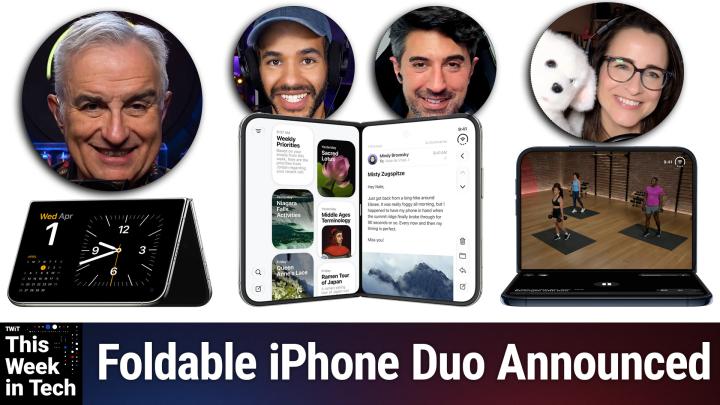
I think it's just because everybody's obsessed with the iPhone Duo. So they're just like, let's just talk about that.
Leo Laporte [01:07:18]:
Well, Apple buried it. They were smart. They said, pay attention. Don't look over there. Look at this.
Daniel Rubino [01:07:22]:
Woo!
Jennifer Pattison Tuohy [01:07:24]:
Well, they also published a white paper simultaneously explaining the technology, which I think didn't get quite a lot of attention. Because actually, if you— the white paper does actually deal with a lot of the concerns relatively well. I mean, I've worked in this space a long, long time with people concerned about devices in their homes listening to everything they say and do. And what I think many of the elements that they have put in place with this device will actually appease the privacy concerns, won't eliminate them, but will make it not that useful. So you kind of end up with like, why even bother?
Leo Laporte [01:08:03]:
So the one feature they showed was you're sitting at a restaurant and the waiter comes over and says, our special of the day, blah, blah, blah, blah, blah, blah, blah, blah, blah, blah, and then walks off. And they showed you this Live Rewind, which I use all the time on Apple TV, where you press a button and it puts on your watch the transcription of what the waiter said. Now it only does 15 seconds, which is not a lot. I think on Apple TV it's 30 seconds, right? If I say, what did she just say? It goes back 30 seconds. seconds, puts up the lower— the, uh, subscript, and then you can read it.
Daniel Rubino [01:08:38]:
So my issue with this is not even Apple per se. I, I'll give it— let's just give Apple credit, right? They're, they're most, uh, they protect the most privacy with people. It's, it's kind of their big advertising feature, right? Oh, you can trust us because we don't do it. And, and let's just give them the benefit of the doubt. Okay, so this is fine. There's no real privacy concerns. It's never really about Apple though. It's about the fact that they're opening the door to this, that they're setting the precedent for it, because now every other company is going to go, oh, we can do that too.
Daniel Rubino [01:09:08]:
Now, will those companies be adhering to the same standards and all this? You know, we'll get to LG, of course, later on. And there's always going to be, you know, other companies that, oh, they cut some corners or they get a little nefarious. Oh, oops, we didn't know about that kind of thing. And then it's up to the consumer. It's going to have to kind of track all this. And then you— do you trust all the technology? Do you just give up on it? It's sort of like this idea of Like, years ago, people were concerned with their information leaking on the internet. We all get those alerts, you know. Now it's like you talk to the younger generations and they're like, I don't care, all my information's already out there anyway, you know.
Mikah Sargent [01:09:42]:
Right.
Daniel Rubino [01:09:42]:
So there is like this no concern, you know, this erosion of privacy or expectation of privacy. It's not only going away at a technological level, but it's going away at a cultural level too with the increasing generations who are just used to this like their whole lives. You know, parents were posting pictures of them as babies without their permission, growing up on the internet. internet, right? So it's like, that's my concern here. It's just like, okay, this is going to open up the floodgates for this technology, which—
Jennifer Pattison Tuohy [01:10:10]:
Well, I mean, they're already— it's already out there. I mean, I have one little one right here. This is the, um, the new SwitchBot one. Yeah, but at least with these, it's like a signal. Like, if you have this on your lapel, um, sure, you know, and like the Bee. I know, Leo, you wore the Bee for a long time.
Leo Laporte [01:10:26]:
Yeah.
Jennifer Pattison Tuohy [01:10:27]:
Um, and that— but yeah, I think with the biggest concern heard from people about the watch was that now anytime anyone has a watch on, do I have to worry that they're recording me? Right.
Leo Laporte [01:10:36]:
So let's explain what Apple's doing, because it's— yeah, first of all, they're trying not to be illegal, and I don't think it's clear that they're not illegal, by the way. California is what we call a 2-party state. The consent of everybody in the conversation has to happen before you can record a conversation. Apple says, well, well, we're not really recording it exactly. They have a ring buffer that's always recording.
Jennifer Pattison Tuohy [01:10:58]:
Yeah.
Leo Laporte [01:10:59]:
And then the audio gets analyzed by the AI, summarized, and then the ring buffer is constantly being replaced by new audio. So nothing is saved. No, no recording is ever saved. Also, it's doing it inside the secure enclave, so it's processed—
Jennifer Pattison Tuohy [01:11:17]:
This is only the new watches too? This is—
Leo Laporte [01:11:19]:
yes. Well, this feature will only be on the new watches, I presume, because it's way you can do this. So the Enclave stores, does the processing for speech, sounds, and music without transcribing or storing the raw audio. So it doesn't transcribe the speech. It doesn't save the speech. It just gives you notes.
Jennifer Pattison Tuohy [01:11:39]:
Now I have to say— It doesn't tell you who said what either.
Daniel Rubino [01:11:41]:
Right.
Leo Laporte [01:11:42]:
No identification. So I have to say, Lisa has a standing policy. If she gets into a Zoom conversation and the note-taker's on, she says, turn that off or I'm out of here. She does not want people taking notes. I said, well, people— I said, Lisa, there are people like me who have no memory. We're just trying to remember what happened. She said, okay, maybe, but they got to ask my permission before they use it. And I think that's not an unreasonable point of view, is it? But this doesn't ask permission.
Leo Laporte [01:12:10]:
This just does it.
Mikah Sargent [01:12:11]:
It also is on iPhone 16, iPhone 16 Plus, Pro.
Leo Laporte [01:12:15]:
Oh, it's on the phone too?
Mikah Sargent [01:12:16]:
Yeah, it's all iPhones since iPhone 16. will get both Live Rewind and Siri Recap.
Daniel Rubino [01:12:24]:
Oh, this is going to destroy relationships.
Mikah Sargent [01:12:27]:
I think—
Leo Laporte [01:12:27]:
by the way, it's not an enclave, it's a display enclave.
Daniel Rubino [01:12:29]:
You're both gonna be fighting. You're gonna be arguing back and forth and you'd be like, no, you said this. And they'd be like, no, I didn't. Oh yeah? And you're gonna go back to their watch.
Leo Laporte [01:12:36]:
So the Secure Exclave is different from the Secure Enclave. It's a hardware-isolated compartment built into the silicon to process sensor data separately from the rest of the system. system. That's supposed to reassure me. Data there cannot be accessed by watchOS apps, user, or Apple. So I presume the audio goes into this enclave, is synopsized, and then text spits out. Is that right, Jennifer? Is that—
Jennifer Pattison Tuohy [01:13:06]:
So yeah, it, it does a summary. Um, it doesn't give you— like, there's no, there's no stored recording, so you can't go back and listen to what was said except for that 15-second rewind. So there's 2 separate things: this 15-second rewind and then summarizing the Siri summaries.
Mikah Sargent [01:13:22]:
Siri Recap.
Jennifer Pattison Tuohy [01:13:23]:
Yeah, Siri Recap. And they do— there's no differentiation. So it's not going to say Leo said this, Jennifer said this, Micah said this. But presumably if you mention names, then those will be in the summary.
Leo Laporte [01:13:38]:
We don't know because this is not available yet.
Jennifer Pattison Tuohy [01:13:40]:
Nobody can try it yet.
Leo Laporte [01:13:41]:
It'll come later in the year.
Jennifer Pattison Tuohy [01:13:44]:
It's not surprising. It's not surprising that they're doing it because there are so many other companies out there I wanted this.
Leo Laporte [01:13:50]:
I wanted to be, but Lisa said you can't wear it anymore. So I stopped. But the idea—
Jennifer Pattison Tuohy [01:13:55]:
My husband hated it.
Daniel Rubino [01:13:56]:
Yeah.
Leo Laporte [01:13:57]:
But the idea of, I have a transcript of everything that happened to me in the day, and then it could be analyzed and summarized seemed very useful to me, especially because again, I forget stuff. And even if it would just tell me the 5 things I agreed to do today would be useful.
Jennifer Pattison Tuohy [01:14:13]:
Just to remind you. Well, I think—
Leo Laporte [01:14:15]:
you agreed you would do this.
Jennifer Pattison Tuohy [01:14:17]:
I think this is a warm-up for what's coming next from Apple, which is the earbuds with the cameras. Yeah. So this is like testing the waters.
Leo Laporte [01:14:25]:
The camera that doesn't take pictures.
Jennifer Pattison Tuohy [01:14:27]:
Right. And, you know, I think we will get to the point probably where this becomes normal as much as we, you know, as people are. I think you said there's not been enough backlash. I think there has been quite a lot of backlash. I think you're right, though. The Duo kind of overshadowed it because the Duo is fantastic. Fancy and fun to look at, whereas the Apple Watch thing feels smaller in comparison. But it is— it's this— it's, it's Apple doing this, like you say, does sort of feel like it gives it a gloss that perhaps now we're going to see more companies do this.
Jennifer Pattison Tuohy [01:14:59]:
And there are benefits, but there are obviously considerable dangers. My concern— I love the idea of these as a journalist, like when I go to a conference It's so— it would be so helpful to not to have to, like, pull out my voice memos all the time and have something that reminds me. But the creepy side, like, my husband, when, you know, I had the Bee on and we had a minor tiff when we were driving in the car, and he's like, did you record that whole thing? I'm like, yes, I can go back and prove I was right.
Leo Laporte [01:15:25]:
Yes, that was my plan as well. That is a recipe for disaster.
Jennifer Pattison Tuohy [01:15:31]:
I think you want to be able to forget. You need to forget.
Leo Laporte [01:15:35]:
It's not Siri. Lisa, I have it here on my wrist. No, Siri Recap summarizes conversations— this is from the Apple document— throughout your day. So it detects that a conversation is happening, and then it doesn't transcribe or record. It simply detects whether a conversation has started. If it has, the audio flows into the exclave, and then is isolated in hardware, and then it's transferred to the phone. By the way, the phone does the hard work, not the watch. Uh, the phone then, uh, deletes the audio from the exclave on the watch, and then transcription turns the audio into text on the phone.
Leo Laporte [01:16:26]:
And then this is designed to distill the conversation to its core meaning, removing context Suggestive of conversation tone. I told you.
Jennifer Pattison Tuohy [01:16:37]:
Yep.
Leo Laporte [01:16:37]:
Non-essential language. Screw you, buddy. Filler words like, um, you know, and redundancies while preserving the topics discussed. So what am I— so you said, Jennifer, nobody— this makes it useless?
Jennifer Pattison Tuohy [01:16:53]:
I don't see how valuable it is going to be. I mean, it might be able to give you a few action items like don't forget to take out the trash, or yeah. You promised you'd—
Leo Laporte [01:17:00]:
I'd get that one every single day.
Jennifer Pattison Tuohy [01:17:03]:
But like, if you're taking— it's hard, obviously it's hard to know because no one's been able to try it yet. But compared to the kind of having tested some of these audio listening devices like the Bee and the MindClip, those are, you know, they don't give you necessarily full transcripts, but they do give you quotes and full, like, Quotes for what someone said and who said it, if it's able to identify based on the context. This sounds like more like almost like reminders for you.
Mikah Sargent [01:17:35]:
Yeah, because it says even it, first of all, all of it is when you use this feature, it is sent to private cloud compute in the end.
Leo Laporte [01:17:45]:
And it says— Oh, it is?
Mikah Sargent [01:17:46]:
Yeah, it always goes to private cloud compute.
Leo Laporte [01:17:48]:
Oh, so the phone isn't doing the transcription?
Mikah Sargent [01:17:50]:
It's, well, no, it starts on the iPhone and then it It, yeah, exactly. The phone is not doing the transcription. So it goes from, if you use the watch or if you use the phone, it says, to create a summary, Siri Recap sends an encrypted condensed version of the conversation transcript. So I guess it does transcribe on your iPhone, but then it sends it off to private cloud compute. Condensed is a low priority. And then this is what's wild. This condensed text is designed to be less than half the length of the original transcript and distills the conversation to its core meaning. So then on PCC, private cloud compute, It is done at sort of, as Jen is pointing out, half of what it originally was.
Mikah Sargent [01:18:30]:
And then on private cloud compute, it's encrypted and sent back to the phone and the Apple Watch. And so, yeah, if you keep squeezing—
Jennifer Pattison Tuohy [01:18:39]:
What could go wrong? What context could you possibly lose by reducing it by half? I mean, I just feel like we'll have to test it, but I just don't— I feel like this is not going to be useful.
Leo Laporte [01:18:49]:
It does fix one thing that Bee did that I didn't like, which is it could tell the difference between a television show or something you're listening to and you talking. So now playing, it says, helps the model understand that speech may have originated from music or a podcast.
Mikah Sargent [01:19:04]:
Thank goodness.
Leo Laporte [01:19:04]:
Calendar data can help generate accurate titles of summaries. High-level location labels, it won't put location data, but it might say something like home, work, or school, along with locality like city, state, and country, add context to the summarization. Points of interest like grocery store or park may be included.
Jennifer Pattison Tuohy [01:19:22]:
So it's going to use your calendar to say this was where this happened. Ah, sounds like—
Leo Laporte [01:19:29]:
um, and then the finished text-based summary is encrypted, sent from private cloud compute back to iPhone and Apple Watch, where it's available to view in the Siri app in a Recaps tab. I would love to be able to get that out of that and put that— send that to my—
Mikah Sargent [01:19:42]:
my— yeah, to my own stuff. Exactly.
Leo Laporte [01:19:44]:
Siri Recaps are automatically deleted after 7 days unless, unless you explicitly choose to save them. Uh, Siri Recaps sync across your devices if you have iCloud with 2-factor turned on.
Jennifer Pattison Tuohy [01:19:59]:
Might be interesting to see if they manage to make this work and make it useful. Um, but it's like I said at the beginning, it feels like—
Leo Laporte [01:20:07]:
So generic.
Jennifer Pattison Tuohy [01:20:08]:
Yeah, what value are you really going to get out of it unless you're specifically saying to it, like— but you could just say that and just say, remind me. You don't I would just say, Siri, remind me to do this. But we can do that now.
Leo Laporte [01:20:23]:
That's true.
Jennifer Pattison Tuohy [01:20:24]:
You don't need this for that function.
Mikah Sargent [01:20:26]:
That's true.
Jennifer Pattison Tuohy [01:20:27]:
You can use Siri to do that right now. So, I mean, I use voice memos on my phone all the time for recording things that I need to remember. But yeah, it'll be interesting to see if they've managed to make this a useful tool. If they haven't, then it just does feel like it's fairly invasive. Well, it depends. I mean, not every state is— I mean, South Carolina, you can record whoever you like. So, yeah.
Leo Laporte [01:20:49]:
But in California, you can't.
Jennifer Pattison Tuohy [01:20:51]:
California, you can't.
Leo Laporte [01:20:52]:
So I'm waiting to see this. Not available in California, New York, and other jurisdictions.
Jennifer Pattison Tuohy [01:20:57]:
Only if it sounds like they've done a fair amount of gymnastics to make it not a transcript specifically. And they do also because of the, you know, Flock and Ring concerns that people have had over the last few years. you— there's nothing that can be taken out. Like, you can't take out a transcript and give it to the police. Like, there is— that is not possible according to them.
Leo Laporte [01:21:18]:
What's funny is this is trying to have it both ways. It's what we were talking about earlier, which is people want the benefits of AI. They don't— but they don't want it. And this is what it's— and sometimes when you try to appeal to both parties, you get something useless.
Jennifer Pattison Tuohy [01:21:35]:
Something in the middle that isn't that helpful.
Mikah Sargent [01:21:36]:
Yeah, I think that's always been the argument with Apple, and it's what I talked about too. I've— Apple has done so much narrowing and guardrailing of its AI in general that sometimes the responses I get from Siri AI become useless because it's trying to make a deterministic system out of something that's not deterministic.
Leo Laporte [01:22:00]:
So interesting. Well, we live in interesting times. I guess we We've, we've always known that. Let's take a little break. We will talk about the new phones in a second. You're watching This Week in Tech with home expert Jennifer Pattison-Touhey, senior reviewer at The Verge, Daniel Rubino, Windows guru. He's editor-in-chief at Windows Central. And Micah Sargent, our newest AI expert at TWiT.
Leo Laporte [01:22:28]:
His new show, Hands-On AI, debuts October 1st. Thanks for having us. Of course, Jennifer's a regular on your Tech News Weekly every month. Yeah, so you guys know each other. So folding phone, sexy, dead sexy, but dead expensive. $2,000 to start, over $3,000 if you load it up. I don't know who would put 2 terabytes of storage in there, but you could.
Daniel Rubino [01:22:57]:
But I actually found the price to be Like surprising.
Leo Laporte [01:23:01]:
Yes.
Daniel Rubino [01:23:01]:
I expected it to be higher.
Leo Laporte [01:23:03]:
We all did too.
Mikah Sargent [01:23:04]:
Yeah, yeah, yeah.
Leo Laporte [01:23:06]:
So Apple, they did this with the iPad too. When they announced the, uh, first iPad at $499, everybody went—
Mikah Sargent [01:23:11]:
I remember how I felt that day when I thought, no way.
Leo Laporte [01:23:15]:
So I think they're protecting—
Daniel Rubino [01:23:17]:
I think they're protecting their prices for their iPhones and shuttling the cost increases to laptop and iPads because they know the iPhone is just their bread and butter and they can't screw with that.
Leo Laporte [01:23:26]:
And interestingly, they raised the prices of older iPhones, the 17, the 17e, $100. So like, yeah, we'll make it up somewhere else, or, or keep people from doing what a lot of people do, which is I'll buy the previous year's phone and save, right, a lot of money. Um, I, you know, Lisa, my wife, decided she wants the 18 Pro Max. She wants the traditional form factor. But I, I don't know, I find that—
Daniel Rubino [01:23:49]:
This is— that's really interesting. I was going to bring that up because like I feel like, not that I have to get into gender stuff with technology, but I do feel like the foldable phone that they announced is something guys are gonna be really into because we don't mind carrying around 250-gram phones in our pockets. But like, I feel like females might've preferred the flip style that Samsung does. Is it 250?
Leo Laporte [01:24:11]:
Wait a minute, that's almost a pound.
Daniel Rubino [01:24:14]:
Yeah, it's—
Leo Laporte [01:24:16]:
That's heavy.
Daniel Rubino [01:24:17]:
It's pretty heavy. It's as heavy as the Surface Duo was, but it's—
Leo Laporte [01:24:21]:
Oh, and that's the other thing. We had a Duo. We had a folding phone from Microsoft. I bought the Duo because I loved that idea of a book. It was roughly the same shape. It was— it didn't have— it had 2 screens, so it didn't have a front screen. Uh, and but most importantly, the reason I sent it back is because it didn't have the software to really support it.
Daniel Rubino [01:24:44]:
It was supposed to be a Windows device, and they, they Hail Mary'd and put Android on at the last minute to prevent losing all the R&D and hardware. So, ah, but yeah, so it wasn't meant for Android, but they tried. At least we got to see that hard— I thought the hardware was amazing.
Mikah Sargent [01:24:59]:
It was really cool.
Daniel Rubino [01:24:59]:
But I, I, I do wonder if Apple's gonna do a traditional flip-style phone, which I think for your average consumer would find more value in and a little bit more familiar. Plus people do love ending phone calls by slamming shut their phones. Um, but I feel like I'd be real curious if there's gonna be any data coming out about who, who buys this device. I think it'll be a hit for them, don't get me wrong, but like, I, I just don't know I know, you know, iJustine, I know, will have one, but I'm not sure how many other women are going to go out for that. Yeah.
Leo Laporte [01:25:29]:
Jennifer, uh, is Daniel being a sexist pig?
Daniel Rubino [01:25:34]:
How dare I?
Jennifer Pattison Tuohy [01:25:36]:
Um, I, I, I'm not sure that it is specific to male versus female, but I do know that there are a lot of people who prefer much smaller phones. I mean, the mini has been, has been very missed, the, um, the iPhone, the smallest iPhone. Um, phone reviewer Alison Johnson is always lamenting its demise and wants a small, small phone.
Leo Laporte [01:25:55]:
Smaller hands.
Mikah Sargent [01:25:56]:
Smaller hands.
Leo Laporte [01:25:57]:
That makes sense.
Jennifer Pattison Tuohy [01:25:58]:
I sit in small pockets. But then, well, there you go. So those— I mean—
Leo Laporte [01:26:02]:
Benito likes— he has small hands, though.
Jennifer Pattison Tuohy [01:26:05]:
And that— well, I don't think it's just— it's very much for women, though. We have purses, so we can certainly carry around. And for me, Like, I, I was— I'm very interested in this. So again, talking about Alison's experience, so she's tried all the flip phones, um, and all the folding phones, and there's been a few instances where she'll be at events and she'll be blogging from her foldable phone because she can unfold it and actually write on it. And for, for me as a journalist and also a busy mom who does— who runs my life from my phone, rather than having to carry my laptop or an iPad and a phone. I like the idea of having this device that could potentially— I can do much more with when I'm on the go, you know, from the soccer sidelines or from, you know, when I'm taking my daughter in car line, waiting for my daughter at the bus at the school and things. Just the multitasking potential here had really appealed to me when first Samsung came out with theirs and then the Pixel. I, I am at— I have had an iPhone.
Jennifer Pattison Tuohy [01:27:09]:
I've very rarely ever strayed to the Android world other than just to test Android devices. And moving out of the ecosystem for me wasn't worth it. Also, it seemed like a lot of the software for many of the Fold devices just wasn't really taking a lot of advantage of the form factor. And there wasn't a huge—
Leo Laporte [01:27:27]:
That was my complaint.
Jennifer Pattison Tuohy [01:27:29]:
And it looks like Apple has done a nice job here from what they've done.
Leo Laporte [01:27:34]:
I can hold this in one hand. People were making fun of the freakishly long fingers.
Jennifer Pattison Tuohy [01:27:40]:
The fingers! That was really weird.
Leo Laporte [01:27:44]:
It's hilarious. It's true. That does look a little weird.
Jennifer Pattison Tuohy [01:27:49]:
But also really tiny palm.
Leo Laporte [01:27:52]:
Yeah.
Mikah Sargent [01:27:53]:
Yeah.
Leo Laporte [01:27:53]:
I don't think that's a scare.
Daniel Rubino [01:27:54]:
I think that's just off. Yeah.
Leo Laporte [01:27:56]:
I think, I mean, I can hold this. I'm sure. I don't know. There have been people now—
Jennifer Pattison Tuohy [01:28:01]:
You're not doing that, are you? I mean, if you open it, you're going to be doing this.
Leo Laporte [01:28:04]:
Well, there's the iPad. You can hold the iPad, uh, is that a mini?
Mikah Sargent [01:28:09]:
That's a mini.
Leo Laporte [01:28:10]:
Yeah, yeah, that's the iPad Mini. So that's, that's roughly the size, right?
Mikah Sargent [01:28:12]:
I could probably do it that way too, just barely.
Leo Laporte [01:28:15]:
Yeah, well, you could palm a basketball too.
Mikah Sargent [01:28:17]:
This is true. I could very easily palm a basketball.
Leo Laporte [01:28:19]:
So that's— you're not a normal human.
Mikah Sargent [01:28:21]:
No, I have monster hands. I've always said that, and it's true.
Jennifer Pattison Tuohy [01:28:25]:
I think, I think it's a good form factor. I'm gonna definitely wait for Gen 2 though. Um, I, I just don't think I— or for it to get cheaper, which may not ever happen because I agree, I wasn't expecting it. I thinking it was gonna be more expensive. Um, 'cause isn't the Pixel Fold about the same? Like, and the, and the Samsung is about the same.
Leo Laporte [01:28:42]:
The Samsung's a little cheaper, but not a lot.
Daniel Rubino [01:28:44]:
$1,899.
Leo Laporte [01:28:45]:
Yeah.
Daniel Rubino [01:28:45]:
Yeah. And the Ultra is $2,100.
Jennifer Pattison Tuohy [01:28:48]:
And my biggest concern, and we knew this was gonna be the case, is I do use my phone as my main camera. and this is not as good a camera. Um, and I wouldn't want to give that up. Um, my— so I have the 17 Pro, so Pro Max, so I have the big telephoto lens. And you give up that and pay more money, and that's—
Daniel Rubino [01:29:10]:
It's a world of foldables and trade-offs.
Leo Laporte [01:29:13]:
I think I'm gonna trade in my Aperol Spritz phone. And, uh, so pretty.
Jennifer Pattison Tuohy [01:29:19]:
I do love the burgundy though.
Mikah Sargent [01:29:21]:
I'm—
Jennifer Pattison Tuohy [01:29:21]:
I have the burgundy of the 18 I think burgundy is my—
Leo Laporte [01:29:24]:
The rumor was it was going to be called Wild Cherry, but they call it burgundy. Uh, it is wine-colored. Um, I— of course, the Duo, you don't have that choice, it's black or white. Um, I think— but I get like $400 if I trade this in. I mean, it really makes a big difference in the overall—
Mikah Sargent [01:29:41]:
It does. The trade-in value is, is quite nice there.
Jennifer Pattison Tuohy [01:29:43]:
For the Duo?
Mikah Sargent [01:29:44]:
Yeah.
Jennifer Pattison Tuohy [01:29:45]:
Yeah, get $400 off.
Leo Laporte [01:29:46]:
I can't— I think it was even more than that. I think it was—
Daniel Rubino [01:29:48]:
No, it's gotta be— I think it's $800.
Leo Laporte [01:29:50]:
I think this is a lot. It almost cuts it in half.
Mikah Sargent [01:29:52]:
Yeah.
Daniel Rubino [01:29:53]:
Um, Samsung did that well too. I traded in my, um, was it the Fold 7 for the Fold 8?
Leo Laporte [01:30:00]:
Oh, I know where I'm sitting. I got about half off the new Ultra by giving it my last year's Ultra.
Daniel Rubino [01:30:05]:
Yeah.
Leo Laporte [01:30:05]:
I'm not sure. I haven't seen the phone trade-in price yet.
Daniel Rubino [01:30:07]:
I'll say though, Apple is not interested in getting Samsung people to change over.
Leo Laporte [01:30:12]:
Really?
Daniel Rubino [01:30:12]:
If you look at the trade-ins for the Folds, it's terrible. They all—
Leo Laporte [01:30:16]:
they'll—
Daniel Rubino [01:30:17]:
they won't take anything less than, um, or anything more than I think a Galaxy S20 S22 or S23. So if you have a 24, 25, or 26, they won't even take it. And they won't take any Folds.
Leo Laporte [01:30:30]:
Hmm.
Daniel Rubino [01:30:31]:
So, and the money they'd give you was like, you get $150 off, which I just thought was surprising. 'Cause like, I could see a world where people who have had Android foldables would be curious about this device because even a lot of Android fans have been like, oh, Apple did a pretty solid job before this Gen 1, but they don't seem to be interested in trying to convert those people, which, you know, Hey, maybe their loss, you know.
Leo Laporte [01:30:55]:
A lot of the success of the phone will depend on app developers taking advantage of it. Same thing with Siri AI. As usual, Apple is kind of dependent on developers to include those features. So Siri AI, yes, the smart Siri can see all of your Apple stuff, like your Apple Mail and your Apple Messages, But it's up to the developers to give it access in their apps. And according to the New York Times, uh, key app developers have yet to embrace Apple's new Siri AI embedding those app intents in there.
Mikah Sargent [01:31:29]:
Yeah, you sort of need every developer to create an MCP if we're speaking in the language of AI. And not a lot have done that yet because again, it is a matter of what's the value to, to individuals.
Leo Laporte [01:31:42]:
Well, Amazon's a good example. They, they have not built-in support in their Amazon app, but of course they have Alexa support. And, and what is their AI called? Rufus?
Jennifer Pattison Tuohy [01:31:53]:
Well, Rufus went away. Rufus is gone to the farm in upstate.
Mikah Sargent [01:32:03]:
I, I wanted to ask you, Leo, because for me, uh, obviously I'm gonna go the way of the Duo, but I I've been struggling because the camera on the Duo, you are losing so much by going to the Duo.
Leo Laporte [01:32:18]:
All right, let me talk you off the ledge.
Mikah Sargent [01:32:20]:
Okay, talk me off the ledge.
Leo Laporte [01:32:21]:
You're not losing anything.
Daniel Rubino [01:32:23]:
Yeah.
Leo Laporte [01:32:24]:
So the big selling point on this camera is that it has physical aperture blades, right? But, and I talked to Chris Marquardt about this, our photo guy, on Friday, because the sensor is so small, you're not going to get the same depth of field benefits you get on a real camera with a big sensor and more blades. In fact, he said, the really— the only benefit will be if you've got pinpoint light sources, you'll have 6 rays of light coming off of it. He says they're going to sell a lot because people will see that and go, ooh, you've got bokeh. But he says you're not going to really get bokeh. He said any bokeh you get, and the bokeh they showed, is computational because without a big sensor, having a wide open aperture does not give you particularly—
Daniel Rubino [01:33:17]:
Samsung did this ages ago, and they just— the benefit versus the trade-off in cost and the potential of breakage, you know, uh, because it is a mechanical thing. It's just not— you lose the zoom.
Jennifer Pattison Tuohy [01:33:30]:
You don't have—
Leo Laporte [01:33:31]:
you don't get— so if you do go for the Duo as opposed— I guess what I would say is if you have a 17 Pro Max, you're not going to— don't buy the 18 because of the aperture blades.
Mikah Sargent [01:33:40]:
Right. But I mean, I would also— that's because here's the truth is what I did not realize even until recently about my 17 Pro Max was how incredible the built-in macro photography is. And I find myself doing a lot of— because I use AI for a lot of DIY work and electronics work. I'm taking up-close photos of little PCBs and other components. And now I'm gonna get this Duo and I'm gonna be holding my phone up close to the thing and it's gonna be blurry AF.
Daniel Rubino [01:34:14]:
I forgot. So like, I forgot it's on Samsung, they used a wide-angle lens for macro.
Leo Laporte [01:34:20]:
I think Apple does that too. Yeah, switches.
Mikah Sargent [01:34:23]:
Okay.
Daniel Rubino [01:34:23]:
So that's what I will say.
Mikah Sargent [01:34:25]:
Micah, Micah, I, I thought Maybe I'm misremembering because I thought it was the telephoto.
Leo Laporte [01:34:31]:
Oh, he used the telephoto.
Daniel Rubino [01:34:32]:
It might be. Yeah, that's why I'm curious because I don't, I don't know. I'll just say like people should evaluate how much they use the telephoto because I have an S26 Ultra and those are excellent cameras, but I can count the number of times I've used the zoom on it. And when I use it, it's like having the S Pen. It's like I barely ever use that. When I need to use it, it's great to have though. So I'm not just missing it completely, but I would say people should evaluate their photos How, you know, don't talk yourself out of it if you don't really use it. I think people in the city may use telephoto more sometimes for buildings and stuff like that.
Daniel Rubino [01:35:07]:
Personally, for me, wide angle is the number one versus in the regular camera. And so I don't— I've switched. I don't mind not having zoom, but that's me and how I live. And I think people should, you know, take a close look at that because I don't think it's that big of a deal.
Leo Laporte [01:35:21]:
But I like the 8x zoom on the 17 Pro Max. I really do. And I use it for animal shots, for instance. I can't get too close to my cat. So having an 8x lets me get a great shot of her.
Daniel Rubino [01:35:32]:
But it's also a trade-off too with the telephoto, right? Because the telephoto is never gonna be good as the main sensor, especially for low-light performance. So there's always like this kind of like—
Leo Laporte [01:35:41]:
It's a camera phone.
Mikah Sargent [01:35:42]:
It's not a camera.
Leo Laporte [01:35:44]:
So what I've decided in my own head—
Mikah Sargent [01:35:47]:
If you're really serious about this, you're buying a camera.
Leo Laporte [01:35:50]:
Yeah, that's what I've decided.
Mikah Sargent [01:35:52]:
But there is a downgrade is the point that I'm trying to make. Thank you.
Jennifer Pattison Tuohy [01:35:55]:
Yeah, like I already have a great phone in my my iPhone 17 Pro Max. And then if I go for the Duo, I'm paying more money and getting less, but I do get to use my Apple Pencil on it, which I'm—
Leo Laporte [01:36:06]:
Only if you have the USB-C one, which is weird.
Daniel Rubino [01:36:10]:
Yeah. I also—
Leo Laporte [01:36:12]:
'Cause that's the older one, right? That's not the new one.
Daniel Rubino [01:36:14]:
Yeah.
Mikah Sargent [01:36:15]:
I can't use this with it.
Daniel Rubino [01:36:16]:
I was very curious.
Leo Laporte [01:36:18]:
It doesn't have the magnetic charging thing, right?
Daniel Rubino [01:36:21]:
Yeah. I'll be real curious about the usage stats of this because I know it's a very— this is one of those technologies where I agree, like if, especially if you draw draw, you know, as a hobby, or you're like an architect or designer, right? And you can actually have use of this. But for, you know, again, going back to Samsung's S26 Ultra and the Ultra series, like, it— the amount of people that use that S Pen is pretty minimal.
Jennifer Pattison Tuohy [01:36:42]:
Yeah.
Daniel Rubino [01:36:42]:
And so I know Samsung had data, the amount of people that are using the pen on the foldable, because they had pen on foldable for years as well, and they finally removed it because they decided that thinner and lighter was gonna be a better selling point than the pen. And I get for people who use the pen, they're like, that's egregious and how dare you. But, you know, if you look at the Fold 8, the Fold 8 weighs 201 grams, whereas this new phone, the iPhone Duo, is like 253 grams or something.
Leo Laporte [01:37:10]:
Which is half a pound, not a pound. I, I misstated that. So it's about half a pound.
Daniel Rubino [01:37:13]:
Yeah, but it's a significant difference, you know. And so that's what Samsung bet on, that we'd sell more of these being super thin and a lot lighter because the reason The original Folds were such, I remember I returned, I think it was the Fold 4, I had bought it and it was like a gold brick in my pocket. It was just so heavy. But these new ones, you know, get around that.
Leo Laporte [01:37:32]:
Thin and light is good if you can get battery life, right?
Daniel Rubino [01:37:35]:
Yeah, yeah. And the Fold 8 has actually like really, really good battery life on it. But I'm curious if people are gonna carry around the big Apple Pencil, 'cause don't forget the Fold had a stylus that would clip onto the back. You can carry it with you. This is gonna, you're gonna be carrying a big pencil. Where are you gonna put that in your pocket?
Leo Laporte [01:37:51]:
Put it behind your ear.
Daniel Rubino [01:37:53]:
So I'm glad it's there. I'm not trying to dismiss it. It's a great accomplishment. I'm just like, I don't know many people are actually going to use it.
Mikah Sargent [01:38:01]:
It's aspirational, I think, in so many cases.
Leo Laporte [01:38:04]:
I remember when the first Samsung Note came out at CES, they had— they hired a bunch of artists all over Vegas who had easels set up and then they had their Note on it and they were drawing on their Note to emphasize, I guess, that you could do that. But I— and I bought every note that came out. I never used them.
Mikah Sargent [01:38:25]:
What was the one you got stuck?
Leo Laporte [01:38:27]:
Yeah, that was, I think, the note—
Daniel Rubino [01:38:28]:
Oh, what, you put it in the wrong way?
Leo Laporte [01:38:30]:
Put it in the wrong way. Yeah, the sad thing is I was reading the story on Twit about how if you put it in the wrong way, it would break it. So I said, you mean like this? And yeah, it broke it.
Daniel Rubino [01:38:43]:
Crazy.
Leo Laporte [01:38:44]:
But the real point is I didn't care because I never used the damn thing.
Mikah Sargent [01:38:48]:
You were, you were doing— was it JerryRigEverything before JerryRigEverything?
Leo Laporte [01:38:52]:
I was, yeah. If I'd had a, uh, if I'd had a box cutter, I would have scored it. No, I, I, I think really, Jennifer, what I'm saying is I know it's a downgrade. I bet I'll be perfectly happy with the pictures I take with the Duo, that it won't matter. Yeah, like intellectually I know it's a downgrade, But the pictures are gonna look fine. I take sometimes, 'cause I'm an old man, I take pictures with my iPad. When was the last time?
Jennifer Pattison Tuohy [01:39:23]:
What's this gonna be like at concerts with everyone holding their Duos up?
Leo Laporte [01:39:28]:
Yeah, please folks, do not bring your Duo to the concert.
Daniel Rubino [01:39:33]:
To Leo's credit, I mean, computational photography is pretty good. It's everything these days. I mean, Google is, the whole Pixel line is built on this concept, right? But like I have the Fold 8 and I think the cameras are fantastic. And you can argue like they're not even substantially different. They made the, um, the wide angles now 50 megapixels. So it has a different sensor in it, but the quality in it, like the ISP that Qualcomm did on there, along with the new algorithms improved it in such a way that even I noticed it, but like, I don't really take photos even at nighttime and be like, oh God, what have I done? It's not that dramatic. And I know Apple's always done well with photography. I think people will be totally fine with the cameras.
Daniel Rubino [01:40:13]:
I think there are other considerations in getting a Duo, but But I don't think the camera should really be one of them. I think most people will be pretty fine with it.
Leo Laporte [01:40:21]:
I predict I'll be okay with it. And I think that having the real estate will be nice.
Mikah Sargent [01:40:25]:
Yeah, I'm so excited about the real estate.
Leo Laporte [01:40:26]:
They've done some really interesting things with the camera. You saw they have a little kid video that will play on one side when you're taking a picture of the kids. The kid looks at the video and smiles. They have, you know, with selfies, you can put yourself in this, in the, or you could take a picture of somebody and have yourself And they do, they're doing some really, I think they're doing some creative, interesting things. We'll see.
Daniel Rubino [01:40:47]:
Surprisingly, they didn't do the thing Samsung does. So Samsung allows you, when you open it up, you can switch to the, um, the COVID display to be your viewfinder and it disables the interior display. Then you can flip it around and hold it up and you can do a selfie.
Leo Laporte [01:41:02]:
Don't they do that?
Daniel Rubino [01:41:03]:
Well, they do it, but they don't turn off the inner display for some reason.
Leo Laporte [01:41:06]:
Oh, so it's still there.
Daniel Rubino [01:41:07]:
Yeah. Like I'm sure they can kind of fix that, you know, the, and the whole, Like cover display showing you Snoopy or whatever. Like I know I think Google has done that before the Razors have done that. So, but yeah, they you know I know a lot of people are giving that like saying oh Apple absolutely destroyed everybody. It's not so much that they had the last seven years to basically see how everyone has done foldables. It's very and they just sit there. They took notes. Then they bought every single one.
Daniel Rubino [01:41:31]:
They broke it all down. They looked at the hinges and they just went to the drawing board and like all right we're going to amplify this. So yeah, their gen. 1 looks fantastic, but I also would be disappointed if it was anything less than what they showed because, you know, it's like, whoa, you had 7 years to watch everybody. Like, uh, you know, to Samsung's credit, it's way riskier to be a Gen 1 of a completely new form factor.
Jennifer Pattison Tuohy [01:41:54]:
Yeah.
Leo Laporte [01:41:54]:
And so yeah, Samsung has taken all the arrows in their back while Apple sat back and watched.
Jennifer Pattison Tuohy [01:42:00]:
And now I really like the, um, I like the standby Me too.
Mikah Sargent [01:42:04]:
I'm so excited about that because I use that all the time with the phone I have right now.
Leo Laporte [01:42:08]:
Is it like a clock?
Jennifer Pattison Tuohy [01:42:09]:
Well, you can— yeah, you can put it so book face down. And yeah, so it's tent mode. And the front will be the standby. And they've adjusted the standby technology now so it doesn't have to be plugged in because you used to— it has to be— used to have to be charging. And now you can just plop it on the side and it will go automatically into standby mode and be a great bedside clock. constantly on the look for the like perfect—
Daniel Rubino [01:42:33]:
That's where Apple gets some credit here is that they've been a little bit more thoughtful about the different usage of positions and how to leverage the dual screen and foldable type concept, right? Like for instance, they show the apps running side by side. This was taken directly from Microsoft, right? This is how the Surface Duo operated was this idea of like you run an app on each screen and when you dismiss one, it only dismisses that one, not the other. And so Samsung really hasn't taken advantage of this stuff. And of course there's the fancy animation when you open and closing it, which, listen, I know it looks great, but as someone—
Jennifer Pattison Tuohy [01:43:08]:
Really cool.
Daniel Rubino [01:43:09]:
But as someone who just looks at technology as a tool, I'm like, okay, but it doesn't actually do anything.
Mikah Sargent [01:43:15]:
Yeah, it made me roll my eyes a little too.
Daniel Rubino [01:43:17]:
Yeah, but I get it, right? This is what—
Jennifer Pattison Tuohy [01:43:18]:
That's Windows versus Apple right there, right?
Daniel Rubino [01:43:21]:
Yeah, it's selling the experience and you're delighted when you use it. And I get it, I'm not trying to dismiss it. I'm just saying, as myself, I, I look at things as tools.
Mikah Sargent [01:43:29]:
You know, my first thought, Daniel, was how much battery is that using? Is that going to be a performance impact because it's doing that goofy little thing? Can I turn it off?
Daniel Rubino [01:43:38]:
Yeah, but it just goes to show you that like Samsung didn't do those kind of things and they had all these years to do it, right? So, um, you know, but this is the competition. Of course Samsung's going to come out and, you know, someone's already created that effect on Android on the Fold, but they been able to build it into the, um, the launcher yet, but—
Leo Laporte [01:43:59]:
Oh, I'm sure within an hour somebody at Samsung said, oh, let me see. Oh yeah, we can do that.
Daniel Rubino [01:44:03]:
Oh yeah, we can do that. Exactly.
Leo Laporte [01:44:05]:
It was cool though. It caught my eye. Did we— Mike and I did the play-by-play for the event on Wednesday, which was unfortunately because of Apple's stinginess, we had to do privately in the club. But Mike, I don't remember. Did they say it does MagSafe charging?
Mikah Sargent [01:44:19]:
They didn't say it during the event, but we found out afterward. Yes, that it does.
Jennifer Pattison Tuohy [01:44:24]:
Yeah, but the MagSafe looks a bit like— yeah, I mean, there are— yeah, it's, it's like sort of bottom heavy. Um, I don't know, I've seen a few, uh, creators already have, have shown some, um, like, because there's some of the accessories—
Leo Laporte [01:44:40]:
Like it's hanging off the thing, or—
Daniel Rubino [01:44:41]:
Yeah, your wallets won't fit. You have to have a whole new line of accessories.
Mikah Sargent [01:44:45]:
Yeah, wallets will be a little lower, um, than you might expect, but it'll still work.
Jennifer Pattison Tuohy [01:44:50]:
Yeah, so your accessories will all still work, but yeah, there is— and there are some new ones that have been developed, designed by accessory manufacturers that people—
Leo Laporte [01:44:57]:
There's an opportunity, right? Yeah, you could have it open and have it be a giant clock, and there's all sorts of stuff you could do.
Daniel Rubino [01:45:04]:
I am curious. So one criticism Samsung gets is that they didn't build in MagSafe into the phone itself, right? So it has the wireless charging but not the, the magnet. Um, but I always dismiss this because when I'm buying a $2,000 phone like this one, I do put on a case on it. So even if it's just Thinborn, and it has the MagSafe built into it. But who are— who's gonna be buying $2,000 phones and not putting a case on it? I'm curious if you guys are.
Leo Laporte [01:45:32]:
I already ordered my case. I've already ordered a leather Nomad case.
Daniel Rubino [01:45:36]:
Yeah, exactly right. So like, I always found this to be like a weird complaint. It's like, because we're all going to put cases on our phones anyway. Same thing with the color, right? It's always funny with the colors.
Leo Laporte [01:45:45]:
It's like black or white, who's seeing it?
Daniel Rubino [01:45:47]:
No one. Yeah, who's gonna see it?
Leo Laporte [01:45:48]:
Doesn't even Lisa, I said, what color do you want for your— yeah, I like the orange. I do. The Aperol Spritz. But Lisa says—
Jennifer Pattison Tuohy [01:45:56]:
It gets me very popular. I'm very popular with all my son's friends. They're like, you have the new iPhone 12.
Leo Laporte [01:46:02]:
Now you're gonna have to have Wild Cherry. Are you gonna order the burgundy one?
Jennifer Pattison Tuohy [01:46:06]:
I'm sticking with my— I'm a smart home person. I'm not a phone person. This was my first upgrade in like 3 years, I think, when I went And that's how normal people operate. I got my whole family, the whole— they all— we all upgraded. Um, so, and the, the kids, my son and my husband got the 17. So, and I was sad to see that we don't get the 18, the standard yet, because we— they just laid AT&T fiber in my neighborhood. So I'm about to switch over.
Leo Laporte [01:46:36]:
So jealous. Um, is it symmetric or is it, uh, I don't know.
Jennifer Pattison Tuohy [01:46:41]:
I haven't got all the details. I did it while I was away and my husband was like, they kept knocking on the door. And I was like, my wife has to do this. I can't do it.
Leo Laporte [01:46:48]:
That's such a reverse of how it is in most households, right? That's great. I love that.
Daniel Rubino [01:46:53]:
I signed us up for the 5 gig plan.
Leo Laporte [01:46:56]:
So I saw this, Micah, these beautiful Spigen cases that make it look like a MacBook Duo. I mentioned that Microsoft had done a Duo phone. But actually Apple holds the trademark. They did the MacBook Duo years before the Duo phone. So I don't think they have any issue. I love these cases. This was a Spygin social post. Are they gonna make them though, is the question.
Mikah Sargent [01:47:20]:
I'm not sure yet. They have not officially announced it, but the way that they're interacting with all of the influencers about it leads me to believe because they did the wonderful line of sort of old school school, uh, Mac looks that I ended up buying every single one of those accessories.
Leo Laporte [01:47:37]:
Yeah, they have those. Yeah, you can get a kind of— I wonder if it ages from beige to whatever.
Daniel Rubino [01:47:42]:
Like yellower.
Leo Laporte [01:47:43]:
Yellows.
Mikah Sargent [01:47:43]:
So far it hasn't, but they, they feel so good in the hand. I, I love it.
Leo Laporte [01:47:48]:
Yeah. Yeah. Well, this is all going to be very interesting. We're in— we're in new phone—
Daniel Rubino [01:47:54]:
In for a treat.
Leo Laporte [01:47:54]:
Is always, uh, you know, it used to be until AI came along, these single most interesting story of the year. Fortunately, thank God that AI has come along.
Jennifer Pattison Tuohy [01:48:05]:
Well, speaking of AI, have you— I mean, I'm sure you guys talked about this in the show.
Leo Laporte [01:48:08]:
Speaking of AI, were we? Have we?
Jennifer Pattison Tuohy [01:48:10]:
But Siri AI gets unleashed on everyone here next week. It'll be interesting. I mean, I have been very impressed when it can do things that I really wasn't expecting it to be able to do.
Leo Laporte [01:48:22]:
Because our standards were so low.
Jennifer Pattison Tuohy [01:48:24]:
Yeah, I think that's true.
Leo Laporte [01:48:26]:
not that impressive. Just the fact that it works is impressive, really.
Jennifer Pattison Tuohy [01:48:30]:
Well, like, I mean, I think I was at a hotel in Berlin, and I said, I need to get to the conference hall, and then the airport, and my— tell me what time I need to leave. And that was the only context I gave it. And it got my flight, it got where I was, it knew which airport I was going to, it told me exactly what time I needed to leave my hotel to get to the conference center.
Leo Laporte [01:48:54]:
Oh, that's what you want.
Jennifer Pattison Tuohy [01:48:55]:
Yeah, I mean, it was— and that would have taken me, I mean, maybe 5 minutes to Google it and figure it out. But it just did it. And I was like, okay, this is, this is useful. This is the type of AI people want to use.
Mikah Sargent [01:49:06]:
It has caught me off guard with its capabilities. I— because I've talked before, it was sort of an abusive relationship where in the past it had disappointed me so much that I just stopped using it, stopped trusting it. And so even And with improvements that have happened over the years, I still sort of limited my interaction with it. And I thought, I'm going to open my heart to you again. I'm going to give you another chance. And so there'd be times where I'd be going, this is something I would normally just do myself, but I'm going to see. I'm going to see if you can do it.
Jennifer Pattison Tuohy [01:49:35]:
See if you can do it.
Mikah Sargent [01:49:35]:
And I have been impressed with it, particularly in the car, where before I just did not use it. One day I said, you know, I'd really like to get a slushie, and I wonder if there are any places nearby that sort of specialize in that. So I was able to ask it and then follow up and say, are there any close to where I am right now? And just those little follow-ups and the sort of details that require pulling in more information. And I, I've been impressed.
Leo Laporte [01:50:07]:
Well, there you go. There you have it.
Mikah Sargent [01:50:10]:
Our relationship is repaired.
Leo Laporte [01:50:12]:
And do you feel like Apple's being forthright when they say it's private and all of that stuff? We trust them more. than we would, let's say, Meta, right?
Jennifer Pattison Tuohy [01:50:20]:
I mean, well, I signed up for Meta, so who do I trust?
Leo Laporte [01:50:23]:
Yeah, well, so did I.
Mikah Sargent [01:50:25]:
So yeah, we, we, yeah, we want to test it. I think given the, the bending over backward we just talked about with how it's doing this, um, Siri Rewind stuff.
Jennifer Pattison Tuohy [01:50:35]:
Yeah.
Mikah Sargent [01:50:36]:
I do trust that the company is doing a better job than others, whether it is about, uh, using that as a means of selling more devices or if it's an actual true core value of the company. I don't think that matters. I think that if you— if privacy is part of what the company uses to sell its stuff and it holds to that, then good.
Leo Laporte [01:50:58]:
Yep. Let's pause for a moment and we will be back with our panel. It's nice to have some sensible people on the panel for a change. Let me tell you, Jennifer, the comics always do. That audience last night, they were terrible. I'm so glad to be in Philadelphia today. Jennifer Pattison-Touhy. I actually always love having you on.
Leo Laporte [01:51:23]:
She is so great. We'll talk about her travails. I'll explain to the dog with the weed whacker on its back— I should probably explain that since I started the show with that— in just a little bit. You'll find her at theverge.com. Daniel Rubino, senior— no, I'm sorry, editor-in-chief of Windows Central. Great to have you as always. We'll talk a little bit about Patch Tuesday. It was a record breaker, uh, in just a moment.
Leo Laporte [01:51:48]:
And Micah Sargent, host of, well, many great shows— iOS Today, I'm sure you'll be covering. So let's see, iOS 27 comes out tomorrow, is that right? When is it coming out? God, I know I have it already because I'm in the beta, but I—
Mikah Sargent [01:52:03]:
what is it, this week?
Leo Laporte [01:52:04]:
Pretty soon.
Jennifer Pattison Tuohy [01:52:05]:
I don't know that they've officially— have they given—
Leo Laporte [01:52:07]:
oh, they haven't—
Jennifer Pattison Tuohy [01:52:08]:
date, but I think it's Monday.
Mikah Sargent [01:52:09]:
Yeah, Monday, September 14th is the rumor.
Leo Laporte [01:52:11]:
I think it's tomorrow.
Mikah Sargent [01:52:13]:
Oh yeah, there it is. Apple's updated its website now, available starting 9/14. So this week is all going to be about coverage of Apple.
Leo Laporte [01:52:20]:
27 is the year.
Mikah Sargent [01:52:21]:
Apple's 27 releases.
Leo Laporte [01:52:23]:
So watch iOS Today for that with Rosemary Orchard and Micah. And of course, Tech News Weekly on Thursday and coming October 1st, Hands on AI. Patch Tuesday. I was doing Security Now with Steve Gibson and then, and the information hadn't come out yet. And he said, we're gonna watch this with interest because either it's gonna go up or it's gonna go down, the number of fixes. His theory, and I think Steve's smart, is that as more and more of these patches get fixed, eventually there'll be a point at which the number of patches will— they'll go up, up, up, up, up, and then they'll start going down and eventually be zero because everything will be fixed. Not this week. This week, Microsoft Patch Tuesday released more fixes than double the number of fixes they released all last year.
Leo Laporte [01:53:18]:
972 vulnerabilities patched, 112 of them high severity. Were you surprised, Daniel?
Daniel Rubino [01:53:30]:
No and yes. I mean, obviously the number is high and And it was a big increase. That's good.
Leo Laporte [01:53:36]:
We should say that's good.
Daniel Rubino [01:53:37]:
Yeah, it's good. And I'm not surprised because of obviously the tools that they're using, right? So it's not like that Microsoft is finally taking security seriously. It's just that now there's AI tools that help them go through and find these exploits ahead of time before they get out there. So this is where, you know, AI has a more interesting role in terms of software development. It can be both used as a sword, So you can probe systems and find attacks and people can use that to exploit, or a company like Microsoft can do that to themselves and try to find the exploits before they are public and patch them. And, you know, it's doing the job of more and more humans, which I think is actually a really good thing. So this, you know, this is a good thing. It's making the, knowing the operating system more secure.
Daniel Rubino [01:54:23]:
It's doing it before these exploits were made public in the first place. And it goes to show you how this technology does improve. And to your point, yeah, you know, there in theory, this stuff could drop Down. Of course, they may release Windows 12 a couple years from now, in which case it'd probably go back up again. But they do have a lot of old legacy code, and it makes, you know, trying to patch this stuff very, uh, challenging. So it's nice to see the technology kind of working in the favor of them. Uh, but yeah, it'll be interesting to see these numbers go up or at what point they start going back down again.
Leo Laporte [01:54:54]:
Are they using, uh, do you know, are they using AI to— I mean, they must be the fact that— Yes.
Jennifer Pattison Tuohy [01:55:00]:
Yeah.
Leo Laporte [01:55:00]:
Yeah. So this is really a success story in some ways, uh, for things like Mythos. I believe so.
Daniel Rubino [01:55:05]:
Yeah, I think this is the case.
Leo Laporte [01:55:06]:
Are they using their own models, Microsoft models, or are they using, uh, Mythos? What are they, what are they using?
Daniel Rubino [01:55:11]:
That I don't know the specifics of, but I, I wouldn't be surprised if it's—
Leo Laporte [01:55:15]:
No one does except the people inside Microsoft, I think.
Daniel Rubino [01:55:17]:
Right, right. So, but I do believe that, yeah, they're using these tools, uh, and I think it's helping out a lot. That's why they're discovering so much, because they know if they don't do this, companies are going to be using AI themselves to probe and find the exploits in Windows.
Leo Laporte [01:55:32]:
Bad guys.
Daniel Rubino [01:55:33]:
Bad guys, yeah. So, you know, they're trying to get ahead of the situation here while they have these frontier models at their disposal.
Leo Laporte [01:55:40]:
Right, right. So, and the other thing I would say is that sometimes people say, oh, you see how buggy Windows is? But it's a big codebase, and it's always good that they find these and patch them. That's just a good thing.
Daniel Rubino [01:55:56]:
And buggy Buggy, and I wouldn't even, you know, buggy implies bugs, right? Like errors and, you know, things crashing. And that's not what this is. A security exploit isn't a bug in that traditional sense. It's a bug in the more general sense, right? But these aren't, they're not patching things that people noticed.
Leo Laporte [01:56:14]:
You would not encounter these.
Daniel Rubino [01:56:15]:
Right, right.
Leo Laporte [01:56:17]:
Unless you're bad.
Daniel Rubino [01:56:17]:
But they are also gonna be using, yeah, they're also gonna be using AI for, you know, quality of life. Life things, right? We even see this in video games, right? They're using AI in video game development as well. Not to some companies are trying to steer away from creating the media assets for games, but instead they're using it for validation tests and making sure that the game performs in certain ways. I think this is a strong case where AI actually does play a super important role that shouldn't be really controversial because it can. do the work of many humans on a different scale. And whether you're an indie developer making a video game or you're a giant corporation doing one, you know, using AI to stress test and look for, uh, these exploits, I think could be very valuable.
Leo Laporte [01:57:05]:
Yeah. Uh, let's talk TVs. Oh, Gamers Nexus, uh, a YouTube channel Uh, did a very, uh, interesting thing. I guess we've always thought, thought for a long time that smart TVs were spying on us.
Mikah Sargent [01:57:25]:
Yeah.
Leo Laporte [01:57:26]:
I don't think any of us thought they were doing it at this level.
Daniel Rubino [01:57:32]:
Not to mention a company like LG, right? That's the big problem. Yeah. Like Vizio, it's kind of like Roku, you know?
Jennifer Pattison Tuohy [01:57:39]:
Yeah.
Daniel Rubino [01:57:39]:
Yeah.
Jennifer Pattison Tuohy [01:57:40]:
Roku, you know, it's like, but LG is like The one that actually does spy on you and tells you.
Leo Laporte [01:57:46]:
Oh, that's right. You could buy a free TV. There's a free TV. Buy it. You don't buy it. It's a free TV.
Daniel Rubino [01:57:51]:
Yeah.
Leo Laporte [01:57:52]:
And it wasn't so much spying on you as putting an ad at the bottom, right? Like it was a scroller. Both.
Jennifer Pattison Tuohy [01:57:57]:
It had a camera that watched you to make sure you were watching the TV.
Mikah Sargent [01:58:01]:
Are you watching the ads? How do you feel about them?
Leo Laporte [01:58:04]:
So what is the LG doing?
Daniel Rubino [01:58:07]:
God knows. It's a little mixed, I guess.
Mikah Sargent [01:58:08]:
Yeah.
Daniel Rubino [01:58:09]:
Yeah, I mean, if you go by what LG says, they're not doing anything wrong. But if you go by all the other independent analysis, there seems to be a lot of recording, the usage of microphones, and data being sent constantly. The thing is, to their credit, a lot of the data is encrypted, so it's not like you can necessarily see what's being sent. You could just see where it's going to and the frequency at which it's happening. But—
Leo Laporte [01:58:34]:
I'm looking right now at an LG OLED screen. It was the best TV ever. really good quality. Is it recording what I'm saying right now? It's off.
Jennifer Pattison Tuohy [01:58:46]:
The, the theory— well, the argument that they made, or the point that they were saying, LG was saying that it's, it's similar to the voice assistants. So the, um, Alexas and the Google Homes, you know, it's listening for the wake word because you can control it with your voice.
Leo Laporte [01:59:04]:
Right, which I don't use.
Jennifer Pattison Tuohy [01:59:06]:
And you can either use the word, you can either say it out loud ambiently, or you you can press a button on the remote to trigger it. So you can turn—
Leo Laporte [01:59:14]:
So it's listening in the same way an Amazon Echo is listening.
Jennifer Pattison Tuohy [01:59:17]:
An Amazon Echo. Well, yes, that's how they characterize it. But the discovery was that it's constantly sending. So they're saying the discovery is that actually it's constantly listening as opposed to—
Leo Laporte [01:59:31]:
Because the Amazon Echo doesn't send anything to Amazon until it hears the wake word. It's listening locally.
Mikah Sargent [01:59:36]:
Or it thinks it hears the wake word, right?
Jennifer Pattison Tuohy [01:59:38]:
Yes. And then it sends whatever follows to the servers and processes that. And then, um, but it's not sending anything. And if it, if it hears the wake word, it mishears the wake word, then it, it in theory immediately deletes anything that it sent because it says, oh, this was misheard, this wasn't the wake word. But yes, that's the way LG's TVs are supposedly working. Is just by the same way that your smart speakers are, because it has a built-in voice assistant like a smart speaker does. But the data implies that it is sending recordings constantly, and LG is disputing this. It also is also saying that it was sending content like what content you were watching using—
Daniel Rubino [02:00:24]:
Yeah, it's like a Shazam feature. It tries to figure out what you're watching, what you're actually watching.
Leo Laporte [02:00:29]:
So they used— so Gamers Nexus used Wireshark to watch the network traffic.
Mikah Sargent [02:00:36]:
Yeah.
Leo Laporte [02:00:37]:
They also looked at the TV firmware. They also looked at the memory in the TV. They said the LG TVs are, quote, capable of identifying your IP address, geographic location, the name of every Wi-Fi network in the vicinity. Well, but every— everything with Wi-Fi can do that. And signal strength, channel numbers of neighboring Wi-Fi networks and ranges. range and other devices on the network, even if not connected to the TV in any way, right? And the internal IP addresses of other devices on the network alongside others. I got to tell you, your laptop can do the same thing. Any— anything with a Wi-Fi radio could do that.
Jennifer Pattison Tuohy [02:01:13]:
And I think the concern people have here is that they're not expecting their TV to be able to do this. Like, you're right, lots of devices can do this, but you know that and you're aware You're using a prompt that says, can I have access to your local network?
Mikah Sargent [02:01:27]:
Can I do this? Can I? And this is a little bit more buried. And in particular, I think the, the issue here is that why is it that even when it's offline or on standby mode that it's doing this?
Leo Laporte [02:01:40]:
We were able to capture, Gamers Nexus said, microphone audio while the TV was unplugged from the network. So it's not even on the network. network. The audio was reportedly stored locally in plaintext. So the theory being, as soon as it connected to the network, it would just get sent right up. But again, because it was encrypted, Wireshark couldn't see what pack— what was the content of the packets being sent. Uh, LG's response is, um, LG Smart TVs do not— and I want to underscore this word though— they It did not continuously record or transmit users' conversations. Speech-to-text processing begins only if a user activates a voice interaction through a supported wake word feature or by pressing the voice button on the remote control.
Leo Laporte [02:02:31]:
Audio is processed locally on the TV for the wake word, and if no wake word is detected, it is not converted to text, stored, or transmitted. That's how Alexa works. We know that, right?
Jennifer Pattison Tuohy [02:02:40]:
Yeah, it's the same, the same kind of mechanism.
Leo Laporte [02:02:43]:
Voice recognition results and related technical logs may be generated as part of processing a voice command. These records are associated with specific voice interactions, do not indicate continuous recording. So, I mean, they're saying we don't do it, but they're not saying— well, they're saying we do it, but only in certain circumstances. It also uses something called automatic content recognition. Voice recognition and interest-based advertising. Those are optional. You can turn those off. And LG says they're not even on by default.
Leo Laporte [02:03:19]:
Users can choose to enable those features and can manage or withdraw consent through the TV settings. Good luck though, looking through the TV settings. Yes.
Daniel Rubino [02:03:27]:
So to, um, to RTINGS' credit, the, the site RTINGS, uh, they do— they have a video out right now and they go through and they tested a bunch of TVs and boxes as well. Yeah, they all basically do it. And the, the trouble is They all have call it by a different name, so you have to kind of figure out what each one is called. Some have different some yeah you can just disable no problem. Others make you like reset the TV and go through the process again, and then you have to tell it no on all the various things. You know, so there's going to be different levels here, and there's yeah questions about what TVs some send more, some send less. You know, it seems to be that if you want the safest. approach.
Daniel Rubino [02:04:08]:
You use this, get a smart TV, don't let it connect to the internet, but then you use some sort of box to connect to it, you know, Apple TV or something.
Leo Laporte [02:04:17]:
Richard Campbell says, uh, that if you put a Pi-hole in, right, control what data is sent, you can still get your TV updated, but you can say don't send anything back to the home office.
Daniel Rubino [02:04:29]:
Yeah.
Leo Laporte [02:04:30]:
And so it is possible to connect and then filter.
Jennifer Pattison Tuohy [02:04:33]:
Yeah.
Leo Laporte [02:04:33]:
Because Pi-hole I know it's beyond most people.
Jennifer Pattison Tuohy [02:04:37]:
What they're saying here is, yeah, we don't do— we're not sending this, we're not recording everything you say, and we're not sending it. But they are recording some things and they are sending some things. And what are they then doing with those recordings? And, you know, it's all feeding the advertising. And that's obviously where— and this is— LG is not alone. Many TVs do this, and we've known this for years, but LG definitely Definitely got, you know, what they've— the concern here is that they're doing way more than they say they're doing. They are recording way more than they say they are recording based on the evidence that was uncovered versus what they're telling us. And you can turn these things off, you can disable them in settings, but are they really disabled? I mean, how do you actually know?
Mikah Sargent [02:05:18]:
You can't trust that now.
Jennifer Pattison Tuohy [02:05:20]:
And this is where, I mean, to Dan's point, and this is what we've recommended, is, you know, you, you buy your And there is actually one, I think it's Panasonic. We wrote an article about this recently that we thought they accidentally launched a TV that you don't have to connect to the internet, but it seems like it was actually on purpose. So you can now buy a TV that is—
Daniel Rubino [02:05:39]:
A dumb TV.
Leo Laporte [02:05:40]:
I want a dumb TV.
Jennifer Pattison Tuohy [02:05:41]:
A good TV that has a good screen, you know, and not— and it has no Wi-Fi requirements because you can connect to the internet, but you do not have to. Because this is the problem. A lot of these smart TVs, they just will not work work at all. Even if you plug a box in, you still can't get them to work without connecting them to the internet. So yeah, that's the, the best solution if you're concerned about this, is stick an Apple TV box on one of these things. Um, get— even just get— some people suggest getting a projector because that doesn't have any of the hardware. Well, it depends what kind of projector you get, and also you spend an awful lot of money on a projector. Um, but yes, there are solutions out And I think we might start to see more manufacturers come out with TVs that aren't smart because there are people that really do want them.
Jennifer Pattison Tuohy [02:06:27]:
They don't want to have their TVs connected to the internet.
Daniel Rubino [02:06:30]:
And 2 points to this too. Like when the first 4K TV was showed off at CES, its retail price was $20,000.
Leo Laporte [02:06:39]:
Right.
Daniel Rubino [02:06:40]:
That was the very first 4K TV.
Leo Laporte [02:06:41]:
Right.
Daniel Rubino [02:06:42]:
Now you can get them for $200. One of the reasons why TVs are so affordable is because of this model. It's the same thing with PCs and laptops, where they'll get subsidies through pre-installed software, which angers everybody, but you can literally just right-click and uninstall it. But it's one of the reasons why the laptop prices can be competitive. That's what you're seeing here. I'm recently looking for a new TV, and I'm shocked at how low some of the prices are for some of these devices. That's the trade-off that you're getting for a lot of this. The other one is, Even though if you can turn all this stuff off and opt out and all that, that's good.
Daniel Rubino [02:07:19]:
But, you know, there is the— this is a vector for attack. Uh, John Kiriakou, who worked for the CIA, famously went to prison for talking about the torture program, uh, has talked about this. The CIA can easily hack someone's TV, turn on those microphones, and record everything, uh, even if the TV's powered off and all those gadgets are off.
Leo Laporte [02:07:40]:
Oh, that's a good point.
Daniel Rubino [02:07:41]:
Yeah, so like these are just different attack vectors. So that's the CIA, and I get a lot of people are like, well, I'm not doing anything, you know. But the point is that there's no reason, especially with AI, that, you know, other nefarious actors couldn't figure out how to do this, and they probably already are, right? So this is just something for people to think about, you know.
Leo Laporte [02:07:59]:
How much of this, Daniel, is related to— I suspect that Gamers Nexus did these tests because last month LG monitors started downloading McAfee ads.
Mikah Sargent [02:08:12]:
Yeah.
Leo Laporte [02:08:12]:
On Windows PCs. Is that right? Did I get that right?
Daniel Rubino [02:08:16]:
Even Microsoft stepped in and said, whoa, all right guys, you got to slow down.
Leo Laporte [02:08:20]:
Because they were using Microsoft's Windows Update feature to install this.
Daniel Rubino [02:08:25]:
Yep. It was sort of like a software. So Microsoft made them stop. Yeah.
Leo Laporte [02:08:28]:
Microsoft made them stop. But the fact that they did it in the first place kind of opened the door to what else might they be doing?
Daniel Rubino [02:08:35]:
It's like every company in the world, right? They're gonna push to see how far they can get away with something. And then like, all right, hey, you got us. All right, we won't do that. That is a great metaphor. And no one said anything. Not only would they have done it, other companies would've started doing it too.
Jennifer Pattison Tuohy [02:08:49]:
So. I have to correct myself. It wasn't Panasonic, it was Vizio.
Leo Laporte [02:08:52]:
Vizio.
Jennifer Pattison Tuohy [02:08:53]:
Vizio made a great dumb TV by accident.
Leo Laporte [02:08:57]:
By accident.
Jennifer Pattison Tuohy [02:08:58]:
It might've been by accident. Yes. So there are options out there now, which there weren't for a long time. I've seen people come up with a solution of just like buying like panels. You know how like companies buy like panel, just a panel for to run ads or something and just plug an Apple TV box into that because it is, has gotten so frustrating for people that don't want to connect their TV to the internet. And it's, there aren't many dumb TVs out there anymore, sadly.
Mikah Sargent [02:09:24]:
Well, a tip for that though, another way to—
Leo Laporte [02:09:25]:
I got good news and bad news. The bad news is that firmware we put in the TV TV, it doesn't work. The good news is they're selling like hotcakes.
Daniel Rubino [02:09:34]:
Yeah, exactly.
Leo Laporte [02:09:37]:
Everybody seems to want it.
Daniel Rubino [02:09:39]:
Another place to get a dumb TV is, uh, store signage. You know those signage things on—
Leo Laporte [02:09:44]:
Yeah, that's what—
Jennifer Pattison Tuohy [02:09:44]:
right, that's what I was talking about.
Leo Laporte [02:09:46]:
Yeah, get the— get like the menu board from your local sandwich shop. Yeah, it'll have hoagies burned into it, but no spider webs.
Daniel Rubino [02:09:55]:
There's a lot to be said for, um, you know, it's probably a niche market at this point, but this push for dumb technology again, right? You're seeing it especially in the auto, you know, space. A lot of people are really upset with the way cars are going, you know, what I call the Tesla-fication of cars. Even though it's like, in my opinion, Tesla gets a lot of the software stuff done right, but the other auto manufacturers are having a lot of issues, I would say, trying to get it stable. A lot of people are just getting it like they just want a pickup. They don't need all this giant infotainment system. connecting to the internet, 5 apps got to do this. Um, and so there is this kind of market, I think, for getting into dumber technology where things are just not connected. How far that goes, I don't know, you know, because it is convenient and ultimately that's what people kind of want.
Jennifer Pattison Tuohy [02:10:45]:
Well, and you get the fast TV channels now, like a lot of these—
Leo Laporte [02:10:49]:
The free, uh, the free—
Jennifer Pattison Tuohy [02:10:50]:
yeah, the free ad-supported TV. Services, which have gotten surprisingly good.
Daniel Rubino [02:10:57]:
I do have to say that.
Leo Laporte [02:10:59]:
They must have worked hard to get that acronym. Oh, these things are fast.
Jennifer Pattison Tuohy [02:11:02]:
Fast.
Leo Laporte [02:11:03]:
Free ad-supported TV.
Jennifer Pattison Tuohy [02:11:05]:
It's like, I feel like we had this at one point.
Mikah Sargent [02:11:09]:
How to get a TV.
Leo Laporte [02:11:10]:
Oh yeah, it's what we called network television back in the day.
Daniel Rubino [02:11:14]:
I watch, I pretty much watch regularly the All Cheers channel.
Leo Laporte [02:11:18]:
It's all cheers all the time.
Jennifer Pattison Tuohy [02:11:19]:
Yeah, I love those channels.
Daniel Rubino [02:11:21]:
They're the best.
Leo Laporte [02:11:21]:
They should have called it Hello Norm.
Daniel Rubino [02:11:23]:
Yeah, that's funny.
Leo Laporte [02:11:25]:
Um, so you're saying they're pretty good, Jennifer? Like what, like all cheers all the time?
Jennifer Pattison Tuohy [02:11:31]:
So the FAST TV channels are— there's all sorts on there. I mean, you can get like the NBC News Channel on there and like, um, not, not your regular over-the-air.
Leo Laporte [02:11:41]:
So for us older people that grew up with ad-supported television, it just feels like home.
Daniel Rubino [02:11:46]:
Oh yeah, it does.
Leo Laporte [02:11:47]:
'Cause I do like TV. It has those pauses every 5 or 6 minutes for an ad. You might as well stick an ad in there.
Daniel Rubino [02:11:54]:
You guys don't use Pluto TV?
Jennifer Pattison Tuohy [02:11:56]:
And you can have like, like all Cheers or all Baywatch or all Friends.
Leo Laporte [02:12:00]:
When Amazon started showing ads and said, but for $4.99 you could turn it off, I immediately clicked the button. I just—
Daniel Rubino [02:12:06]:
So I, I would actually go try Pluto because like they have like, they have channels dedicated for every sitcom from the '70s and '80s and '90s.
Leo Laporte [02:12:15]:
That's an interesting idea.
Daniel Rubino [02:12:15]:
They also have, they have like thousands of movie channels. They'll have like drama, they'll have horror, they'll have action.
Leo Laporte [02:12:21]:
How often do the ads come up? Are they a lot?
Daniel Rubino [02:12:23]:
It's like, no, no, it's knowing that sometimes the ads, they don't have an ad, so we'll just play some like nice music and it always has a counter in the corner. It tells you like 30 seconds left or something like that.
Leo Laporte [02:12:34]:
All these shows don't have ad breaks. All the shows have ad breaks. In the early days of internet streaming TV, there weren't enough advertisers, so you'd seen the same I've seen the same ad 8 times.
Daniel Rubino [02:12:46]:
It still happens.
Jennifer Pattison Tuohy [02:12:47]:
I hate that. Yeah, I know.
Leo Laporte [02:12:49]:
I don't want to see that ad again.
Daniel Rubino [02:12:51]:
Yeah, but like the commercial breaks aren't— it's not like every 2 minutes.
Leo Laporte [02:12:55]:
It's not as bad as it used to be.
Daniel Rubino [02:12:56]:
No, no, it's, it's— I find it acceptable. Plus it gives you a chance to go to the kitchen and get a sandwich or whatever.
Mikah Sargent [02:13:02]:
I was gonna say, it's in the background too, if it's just background noise.
Daniel Rubino [02:13:05]:
Yeah, it feels very— there is still something to be said about browsing and like, oh look, this movie's on right now, versus—
Leo Laporte [02:13:12]:
Yeah, that's— it's like the old thing.
Daniel Rubino [02:13:15]:
Yeah. Oh boy.
Mikah Sargent [02:13:16]:
Mike just convinced me to check out Pluto.
Leo Laporte [02:13:18]:
I'm gonna check it out now.
Daniel Rubino [02:13:20]:
Yeah.
Leo Laporte [02:13:20]:
Is Tubi also that or no? That's something else.
Daniel Rubino [02:13:23]:
Yeah. Tubi's—
Jennifer Pattison Tuohy [02:13:23]:
yeah. There's a few of them. Samsung has its own.
Leo Laporte [02:13:27]:
Slum and Bing Gong.
Mikah Sargent [02:13:27]:
I feel like Tubi is kind of cringe though.
Leo Laporte [02:13:30]:
I don't know.
Mikah Sargent [02:13:30]:
If I told someone I was watching Tubi, I'd be going, Tubi.
Daniel Rubino [02:13:35]:
It's got a— it's a cool— it's got a cool chime.
Mikah Sargent [02:13:38]:
You must be a green bubble.
Daniel Rubino [02:13:40]:
You know what I watch like every single night is because there's a dedicated Mystery Science Theater 3000 channel and a RiffTrax channel. I watch— all I watch is Mystery Science Theater. And so it's like, it's just on 24/7.
Mikah Sargent [02:13:51]:
I like that kind of a thing.
Leo Laporte [02:13:53]:
Oh, well, you're in— when you're in the mood, you know, you can always go where everybody knows your name, or you can always, you know, you just know that there is— you know, it used to be we would say there's an I Love Lucy episode playing at any given time, right, somewhere on the planet Earth. Uh, it's like that. You can always watch, you know.
Daniel Rubino [02:14:12]:
I just like— it's just background, and sometimes you just want something on the background, you know.
Mikah Sargent [02:14:16]:
Yeah, I saw that.
Jennifer Pattison Tuohy [02:14:17]:
The only problem is it keeps popping up on the background on my fridge.
Mikah Sargent [02:14:21]:
Sorry, on your fridge?
Leo Laporte [02:14:23]:
Do you have one of those?
Mikah Sargent [02:14:24]:
My washing machine always plays I Love Lucy.
Jennifer Pattison Tuohy [02:14:27]:
And, um, it has— so Samsung has its own Samsung TV Plus, I think it's called.
Leo Laporte [02:14:32]:
What, do you stand in front of the fridge watching TV?
Jennifer Pattison Tuohy [02:14:34]:
I don't, but occasionally it just starts playing TV shows on my fridge.
Leo Laporte [02:14:39]:
Is that what they think people are gonna do? Like, they're just gonna stand there with their mouth open in front of the fridge like WALL-E?
Jennifer Pattison Tuohy [02:14:46]:
Well, it's— it, you know, you have a TV in your kitchen often if you're cooking. Yeah. And just have something on in the background.
Leo Laporte [02:14:52]:
Oh, okay. Oh, that makes sense.
Jennifer Pattison Tuohy [02:14:53]:
All right. But it's just I didn't ask it to. It just pops up.
Mikah Sargent [02:14:56]:
That's what's concerning.
Jennifer Pattison Tuohy [02:14:57]:
Why?
Mikah Sargent [02:14:57]:
And do you— does it scare you? Like, what do you think's making that happen?
Jennifer Pattison Tuohy [02:15:01]:
I know, I don't— I don't know. It does have a mind of its own. And it's weird when it just shows a really odd TV show that I wasn't intending to watch.
Daniel Rubino [02:15:11]:
I don't want that.
Leo Laporte [02:15:13]:
I really don't want that.
Jennifer Pattison Tuohy [02:15:14]:
Yeah, the TV. I thought, I thought I would like watching TV on my fridge, but I don't.
Mikah Sargent [02:15:20]:
Only you would say that, Smart Home Mama.
Leo Laporte [02:15:25]:
Uh, I mean, people don't remember, but in the days of network television, a half-hour TV show was 22 minutes long, so they could put in, what is it, 18, you know, 12 No, 8. Anyway, a lot of commercials. I'm so sorry if it's quiet.
Mikah Sargent [02:15:39]:
I'm watching The X-Files on Pluto right now. Thank you.
Daniel Rubino [02:15:41]:
Yeah, yeah, yeah, there's an X-Files channel. Yeah, it's good stuff. I'm telling you.
Mikah Sargent [02:15:46]:
Search for Spock.
Leo Laporte [02:15:47]:
I can't wait till I'm in the old folks' home and I could just leave that on all the time. Oh, it's Mulder and Scully again.
Mikah Sargent [02:15:57]:
There's a Star Trek channel for guys.
Leo Laporte [02:15:59]:
I know the truth is out there somewhere. It's really interesting how many of our advertisers these days are AI companies. I think 100% or close to it. It's a really interesting time. As long as we're talking privacy, LG TVs, the Flock backlash is everywhere. City governments are being told take down those cameras, although apparently in many cases they're replacing the cameras with cameras from Axon. So it's not Flock anymore, but it's still watching you. And now retailers are putting it in.
Leo Laporte [02:16:37]:
Ulta Beauty, which is a beauty store— we have one in Petaluma— turns out, according to Rachel Lapointe, who is a Substack, uh, newsletter writer, turns out to be Flock's biggest commercial customer. I mean, there's no license plates inside an Ulta, I don't think.
Jennifer Pattison Tuohy [02:16:57]:
There's a lot of shoplifting inside an Ulta though.
Leo Laporte [02:16:59]:
I guess so. Yeah.
Daniel Rubino [02:17:02]:
I mean, didn't those flock cameras start like in Home Depot parking lots?
Leo Laporte [02:17:06]:
I believe— I don't know. I believe it if you say so.
Daniel Rubino [02:17:08]:
I used to see them on there all the time because people would— because of all the stealing of, you know, high-priced, uh—
Leo Laporte [02:17:14]:
But they're also in places that they should— feels like they shouldn't be, like playgrounds.
Daniel Rubino [02:17:19]:
Yeah, that's a big thing. I've even seen Some people have turned down buying a property because there's now maps that you can go check to see where the Flock cameras are and point it out.
Leo Laporte [02:17:28]:
By the time you pull out of your driveway, you're on camera.
Daniel Rubino [02:17:30]:
Yeah. And so sometimes people will be on the camera and they're like, oh, I'm not gonna buy this house because it's part of the angles on a Flock camera.
Leo Laporte [02:17:36]:
Maybe you should get this car, which is painted to make Flock cameras lose their mind. And Bill Swearingen, he's the founder of Six Cyber. He spent the past year running 31 million tests developing something he calls No Recognition. It's a reinforcement learning model that generates patterns capable of defeating the algorithms inside, uh, flock cameras and other devices. He actually has a, a Kickstarter Kickstarter campaign going, no recognition, that you could buy adversarial clothing. So here's a— I don't know, would you wear this? It's actually pretty striking.
Mikah Sargent [02:18:24]:
How would you describe your fashion sense?
Leo Laporte [02:18:26]:
Adversarial. So it's a— so I guess if you're on, you know, the, the— this will make the camera crazy. You know, I should just get one of these.
Mikah Sargent [02:18:34]:
You should.
Leo Laporte [02:18:35]:
See what happens. Yeah.
Daniel Rubino [02:18:36]:
But it's just one of those things where it kind of kicks the can down the road. It's like if your car looks like that, it's like, all right, we just now need to look for this really crazy looking car. Look for the car with the— Wasn't it like in a Naked Gun or something like that where someone, uh, they, they cut and copied the letters and wrote a letter so they couldn't trace it? And they're like, all we gotta do is find the crazy typewriter that did this. Like, I—
Leo Laporte [02:18:56]:
my, uh, my ex-wife never liked coming by the studio because there were cameras everywhere and she didn't want to be on camera. And, uh, Colleen Kelly, our, uh, chief engineer at the time, wanted to build her a, a ultraviolet light ring that she could wear around her neck Like a necklace that would beam invisible light to you, but light that would blind the cameras. Oh, I see. So that when she walked into the studio, she would just look like a glowing ball of light and be invisible. I don't think Colleen ever built it, but she, she worked at Meta for a long time. Maybe, maybe she did. The No Recognition Kickstarter also offers this, an elastic tube gaiter that you pull on. so that you aren't susceptible to, uh, face recognition.
Leo Laporte [02:19:43]:
You may mock it, but notice it's sold out. It's sold out of them.
Daniel Rubino [02:19:49]:
You know what else is hard to fake?
Jennifer Pattison Tuohy [02:19:51]:
A regular bandana. I mean, yeah, well, that's true.
Leo Laporte [02:19:54]:
Somebody might mistake you for an ICE officer. Yeah, no recognition hoodie, $75, the flagship.
Jennifer Pattison Tuohy [02:20:03]:
I don't get it. You still see her face.
Mikah Sargent [02:20:08]:
Like hardcore proof.
Leo Laporte [02:20:09]:
That's why I need to buy one of these and go stand in front of my cameras and just go, hi, hi, hi.
Daniel Rubino [02:20:14]:
Where's your AI? How do you know?
Mikah Sargent [02:20:15]:
Talking to you.
Daniel Rubino [02:20:16]:
How do you know if it works?
Leo Laporte [02:20:18]:
Well, I have— so like I said earlier, my cameras, when I walk up in front of them, recognize me and they'll say, you know, Leo detected.
Jennifer Pattison Tuohy [02:20:25]:
You're saying that just the pattern will make it go—
Leo Laporte [02:20:28]:
So it makes the camera go crazy, right? Like, so it's not that it's not— it's not that it's not seeing your face.
Jennifer Pattison Tuohy [02:20:35]:
It just turns— makes the camera—
Leo Laporte [02:20:37]:
Watch. So you see, it's detecting a person, and as soon as the camera— for some reason, it just makes— it's, it's like hacking the camera. That's of course—
Daniel Rubino [02:20:45]:
this becomes a—
Jennifer Pattison Tuohy [02:20:46]:
just having the pattern somewhere on you means— yeah, see you.
Leo Laporte [02:20:50]:
Yeah, well, that's what he says.
Daniel Rubino [02:20:52]:
I guess it's a tit-for-tat thing, right? At some point, I would imagine the engineers would be like, okay, we'll try to code around that, right?
Leo Laporte [02:20:58]:
Exactly.
Mikah Sargent [02:20:59]:
If you detect these kinds of patterns, Yeah, like it's—
Daniel Rubino [02:21:04]:
I don't know.
Leo Laporte [02:21:05]:
I love it that he's using AI to generate these. Like, what can't you recognize?
Daniel Rubino [02:21:10]:
And knowing the country we live in now, wearing that will probably get you stopped, right? Like, well, what are you doing? You wouldn't be wearing that unless you're doing something wrong. So what are you up to?
Leo Laporte [02:21:22]:
You know what? There is good reason people are nervous. 404 Media has discovered discovered, uh, the, the DHS, Department of Homeland Security, is doing predictive policing by analyzing Americans' financial data. They, they analyze the data to find people to pull over and, uh, investigate. By the way, I, I don't know if that's legal.
Mikah Sargent [02:21:52]:
That doesn't sound legal.
Leo Laporte [02:21:53]:
Like Violates the 5th Amendment or something.
Daniel Rubino [02:21:57]:
DHS and other LEAs, law enforcement agencies, need to have a reason to pull you over, right?
Leo Laporte [02:22:04]:
Probable cause, road behavior. But how do they get—
Mikah Sargent [02:22:09]:
maybe they can follow you long enough, you could find probable cause. You accidentally go over the line, that's a moving violation. Yeah.
Jennifer Pattison Tuohy [02:22:20]:
using your financial data, what they think— oh, they're so poor, they're likely to go—
Leo Laporte [02:22:24]:
Yeah, or something like, oh, you're getting paid in cash, or I don't know. I don't know. That's what I don't— we don't know.
Jennifer Pattison Tuohy [02:22:31]:
The predictive policing thing is scary. That's the Minority Report stuff.
Daniel Rubino [02:22:34]:
Minority Report. I was gonna say, like, Minority Report was an instruction book for law enforcement, which is like, all right, we just gotta wait for technology to catch up.
Leo Laporte [02:22:42]:
And of course that was going to happen because Clearview, which does face recognition, they get a trouble because their face recognition was a little racist, shall we say. Now they're testing an AI tool that would let cops unearth your life online. This is from Wired. Inquiry IQ, a previously unreported prototype, tested a model from xAI to surface associates, social accounts, and other information about people identified through Clearview. So I guess it's the next step after face recognition is Well, uh, let's go analyze their social media and find out.
Mikah Sargent [02:23:21]:
And I bet it understands sarcasm. I bet it—
Leo Laporte [02:23:24]:
Oh, it's so good at that.
Mikah Sargent [02:23:26]:
It's even understanding the sarcasm that I'm doing right now.
Leo Laporte [02:23:30]:
No, which means you're in the database, buddy.
Mikah Sargent [02:23:33]:
I'm there now. I was already there.
Leo Laporte [02:23:37]:
So it's— the unreleased tool is designed to take details an investigator unearths from a Clearview search, a search a face recognition database, which we already know sucks, and then automatically fan out across the web, opening web pages, analyzing images, and assembling what it finds into a profile containing possible employers, aliases, associates, and physical characteristics of a person police are investigating.
Jennifer Pattison Tuohy [02:24:02]:
Don't they already do this? I didn't like—
Daniel Rubino [02:24:04]:
I mean, I feel like it's just an extension of the Homeland Security September 11th fallout, right? This is what they were already doing to try to connect dots. This is what happens when you prioritize fear in your society. Not that the Democrats don't do this, but Republicans are very good at fear. Everyone's trying to kill you. These people want you dead. These people hate you.
Leo Laporte [02:24:27]:
So in order to stay safe, I'm going to allow you to do all this stuff. Take all the cameras around my house and use those in police investigations.
Daniel Rubino [02:24:34]:
And then everybody acts surprised. It's like, what do you mean they're spying on me through my TV?
Jennifer Pattison Tuohy [02:24:38]:
Right.
Leo Laporte [02:24:39]:
Well, but you're safe.
Daniel Rubino [02:24:40]:
It's gonna happen.
Leo Laporte [02:24:41]:
And you know what? It's true. It works. You, you know, uh, our locality, our town, our little town, which has I think a half dozen flock cameras, published a report on how many missing senior citizens were found because of the flock cameras.
Daniel Rubino [02:24:56]:
Yeah.
Leo Laporte [02:24:56]:
Well, that's great.
Daniel Rubino [02:24:57]:
That's literally the problem with all this.
Jennifer Pattison Tuohy [02:25:00]:
Yeah. I mean, I grew up in London. We have cameras on every street corner and it's It's famous for that. Yeah. And I grew up in an era when we had people putting bombs in trash cans and blowing up train stations. And it definitely helped stop things like that. But the problems you have are based on the government that you are under. Like, do you trust the government to use this technology responsibly?
Leo Laporte [02:25:28]:
Yeah.
Daniel Rubino [02:25:28]:
When you combine it with deepfakes and the ability to, like, say the government goes, we got you doing all this on video and they show video It's just like, yeah, that's not me. And it's just like, you know, and we've seen plenty of arrests by flock cameras where the police go to like a woman's house and they're like, we got you in front of someone's house stealing this package. And, you know, it turns out, no, it was wrong, you know. So it's just like, it's a strange new world.
Jennifer Pattison Tuohy [02:25:53]:
Well, and then there was the Nancy Guthrie case where they had all the footage, um, from the, the doorbell camera and then it did no good whatsoever. So, I mean, it's a double-edged sword. There's, there are There are definitely arguments for how beneficial cameras can be in solving some crimes. Not a lot of evidence, but some evidence.
Mikah Sargent [02:26:12]:
Yeah.
Jennifer Pattison Tuohy [02:26:13]:
And not— I think the biggest thing is that it's not really a deterrent. I think they've proven, like, the fact that there are cameras doesn't really stop people from committing crimes, but it does potentially help you find the person, but not always, as has been proven. But having some information Information is obviously better than none. It helps police. But when it's abused, if the police abuse it or if your government abuses it, then this is—
Daniel Rubino [02:26:41]:
There's all those cases, right? It's like the police, it's like, oh, they've accessed, uh, they're tracking this person 45 times today. And it's like, oh, who is that person? Oh, it's an ex-lover. It's like, come on, man.
Jennifer Pattison Tuohy [02:26:52]:
Yeah. So that was pretty bad. Yeah.
Daniel Rubino [02:26:54]:
I feel like the police have like done the most damage to Flock. It's just like, you know, where everybody is like, there's the potential for governmental abuse, and here's the government out there like literally abusing it every single day, and it's all just come out. And it's just like, it's like, okay, that's why people are reacting to this stuff. It's like, it's not the potential, they already are using it for like the dumbest things. It's just like, you know.
Leo Laporte [02:27:18]:
Well, I just have to point out, uh, you know, we say don't let the terrorists win, but that's the point of terrorism, is to terrify And the, uh, what do people do when they're terrified? They give up their civil rights.
Mikah Sargent [02:27:32]:
Yes.
Leo Laporte [02:27:33]:
They, uh, they, uh, they lose their freedom. Uh, sounds like the terrorists won, sad to say.
Daniel Rubino [02:27:40]:
Yeah, yeah. I think that is a lesson from 9/11. Literally everything did change from that time.
Leo Laporte [02:27:46]:
Yeah, and we live in fear now.
Daniel Rubino [02:27:48]:
Yeah.
Leo Laporte [02:27:49]:
Kids don't—
Daniel Rubino [02:27:49]:
And everybody uses that. Yeah.
Mikah Sargent [02:27:52]:
And, and that's the thing, kids don't go outside anymore, and Yet the crime rates between now and then have gone down.
Leo Laporte [02:28:00]:
It's safer in New York City than ever before in history. Yeah.
Mikah Sargent [02:28:04]:
And here in war-torn Portland, it's very safe.
Leo Laporte [02:28:08]:
Well, I may not like surveillance, but I am putting a camera in my toothbrush. We'll talk about that.
Jennifer Pattison Tuohy [02:28:13]:
I should have known you were going to buy that.
Mikah Sargent [02:28:17]:
What a segue.
Jennifer Pattison Tuohy [02:28:17]:
The second they talked about it, launched it.
Leo Laporte [02:28:20]:
I've got a flock camera in my toothbrush. We'll talk about that when we continue our last segment.
Mikah Sargent [02:28:26]:
Your cavities are illegal.
Leo Laporte [02:28:28]:
You've been very patient. Jennifer Pattison-Tui, Daniel Rubino, and Micah Sargent, wonderful to have you on the show. I really appreciate it. All right, Dyson announced this, uh, I think September 1st. It sold out almost instantly. It is a $500 toothbrush. with a camera in it. It also has a reservoir because— is this your finger? I recognize your finger.
Jennifer Pattison Tuohy [02:28:57]:
That's my finger.
Leo Laporte [02:28:58]:
Are you using one of these? You already have it?
Mikah Sargent [02:29:00]:
Those are great nails.
Jennifer Pattison Tuohy [02:29:01]:
I can't get one of these.
Leo Laporte [02:29:04]:
You gotta review it.
Jennifer Pattison Tuohy [02:29:04]:
Scroll down, there's a video of me. No, this was at— I went to the launch event, which was— I, I called an iPhone-esque launch event for a toothbrush. It was like they had a Yeah, big room, like all beautiful, like really well lit, like purple, purple.
Leo Laporte [02:29:19]:
Well, that's Dyson. They're the, the, the apples of vacuum cleaners.
Jennifer Pattison Tuohy [02:29:24]:
They are, yes. And the toothbrush was— they did, they did—
Leo Laporte [02:29:27]:
Did they allow you to brush your teeth with it?
Jennifer Pattison Tuohy [02:29:28]:
No, I wouldn't want to.
Leo Laporte [02:29:32]:
Are you afraid of the, the snot hole? So the theory is the camera in the head is taking pictures really rapidly looking for gaps, and when it sees a So the little reservoir—
Jennifer Pattison Tuohy [02:29:47]:
so yeah, I was able to brush on a, on a fake— you could see the fake teeth there.
Leo Laporte [02:29:51]:
Yeah, yeah.
Jennifer Pattison Tuohy [02:29:51]:
Um, and so yeah, and it was shooting out every time. You could see—
Leo Laporte [02:29:56]:
Oh, that's the other thing. On your phone, you can look at your teeth.
Jennifer Pattison Tuohy [02:29:59]:
You can look at your teeth with this, um, 100,000-pixel resolution, which is like nothing, right? That's really—
Leo Laporte [02:30:06]:
I don't want any more than that.
Daniel Rubino [02:30:07]:
That's fine.
Jennifer Pattison Tuohy [02:30:09]:
And that's the camera there at the top, and it has this little reservoir. And then I also— those were the fans.
Leo Laporte [02:30:14]:
You also had to stand in front of the fans.
Jennifer Pattison Tuohy [02:30:16]:
That looked like the sandworms in Dune.
Leo Laporte [02:30:19]:
It does. It looks like a sandworm.
Jennifer Pattison Tuohy [02:30:21]:
It does.
Leo Laporte [02:30:22]:
Oh my God.
Jennifer Pattison Tuohy [02:30:23]:
I know. They're kind of freaky looking. And those things kind of open and close like the teeth.
Leo Laporte [02:30:28]:
Oh, lovely.
Jennifer Pattison Tuohy [02:30:30]:
But the toothbrush shoots— so it uses something called gap optical targeting.
Daniel Rubino [02:30:36]:
Me too.
Jennifer Pattison Tuohy [02:30:36]:
Which actually Analyzes 28 live images from the camera every second to find gaps between your teeth. And when— and as your— as the toothbrush passes the gaps, it shoots the mouthwash. Oh my God, like a floss. Like, it's like those, um, hydro flosser things.
Daniel Rubino [02:30:53]:
Yeah, Waterpiks.
Jennifer Pattison Tuohy [02:30:54]:
Waterpiks, thank you.
Leo Laporte [02:30:55]:
Um, but see, I use a Waterpik. I thought, oh, this would be great, it'll be all in one.
Jennifer Pattison Tuohy [02:30:58]:
All in one, that's the idea.
Leo Laporte [02:31:00]:
Plus I'll have videos I can send friends and family.
Mikah Sargent [02:31:02]:
I'm worried it's gonna hit my throat.
Leo Laporte [02:31:05]:
Instagram.
Mikah Sargent [02:31:05]:
I just don't want to think my throat is a gap and then I'm going—
Jennifer Pattison Tuohy [02:31:08]:
It was very powerful. Like, it would— you— like, my hand kind of shook every time it—
Mikah Sargent [02:31:12]:
You're asking.
Leo Laporte [02:31:13]:
So was the Waterpik?
Jennifer Pattison Tuohy [02:31:15]:
It was very powerful.
Leo Laporte [02:31:16]:
It's just sandblasting your teeth.
Jennifer Pattison Tuohy [02:31:17]:
Yeah, and it's a much— apparently a wider jet than the Waterpik, so it's meant to be more effective. So, um, and it does, and it's supposed to shoot out, uh—
Leo Laporte [02:31:27]:
My dentist told me to use a Waterpik.
Jennifer Pattison Tuohy [02:31:29]:
Mouthwash. Yes, but, but I don't think they say a Waterpik is better than flossing. I think they still—
Leo Laporte [02:31:34]:
No, I do both.
Mikah Sargent [02:31:35]:
That's true. They don't—
Leo Laporte [02:31:36]:
They say, and you know, when I go in, they say, oh, you're using both, aren't you? I say, yes, I am. Oh, my dentist said, Leo, Leo, that's a good boy, Leo. They said, he said, you're gonna keep your teeth till you're dead. Oh, which, well, it sounds like a threat. Sweet thing to say.
Jennifer Pattison Tuohy [02:31:56]:
The idea is that you also can see inside your mouth. So, if you have any issues and you can take videos and send them to your dentist. No.
Mikah Sargent [02:32:06]:
My dentist loves it when I do that.
Jennifer Pattison Tuohy [02:32:08]:
It is all local. So, there isn't any Flock integration. It is all like just—
Leo Laporte [02:32:14]:
But how long before DHS has videos of my teeth? Let's face it.
Jennifer Pattison Tuohy [02:32:18]:
Just between your phone and the toothbrush and very low resolution. And then Dyson has formulated some special toothpaste.
Leo Laporte [02:32:25]:
That's the—
Jennifer Pattison Tuohy [02:32:26]:
no, you need to buy Dyson toothpaste and toothpaste and mouthwash and, and obviously the heads as well. And you, you can use other mouthwash. It, it's not—
Leo Laporte [02:32:37]:
but if it foams, then the camera won't be able to see.
Jennifer Pattison Tuohy [02:32:40]:
The toothpaste, yes, is low foaming, but who really needs to see? You don't really need to see the camera. I can imagine that would be fun once, and then you're not gonna—
Leo Laporte [02:32:48]:
I had, I had a toothbrush that, uh, didn't take pictures, but it would tell you where you were in your mouth. You know, it had this app and all this stuff. I used it once.
Jennifer Pattison Tuohy [02:32:58]:
Mine does all of that too.
Leo Laporte [02:32:59]:
And I said, I don't need that. I just brush my teeth.
Jennifer Pattison Tuohy [02:33:02]:
It's so— but the thing, the interesting thing is, so these did— you said they sold out, but actually, I mean, the theory is, um, some early people got hold of theirs. I think they sent some to influencers and also a few people got them in that first week, and within days they started failing.
Leo Laporte [02:33:22]:
Oh no.
Jennifer Pattison Tuohy [02:33:23]:
Because it sounds like something wasn't properly waterproofed and water was getting into it, to the battery compartment, causing it to fail within like 30 seconds.
Leo Laporte [02:33:34]:
Well, so I'm glad I didn't get mine yet. I mean, I ordered it that day, but it—
Jennifer Pattison Tuohy [02:33:38]:
Well, so I mean, so I reached out to Dyson and they said that they're, they're having have been some complaints that some of the early batches of Dyson's new— it's called Camra Jet, is the name of the product— may have experienced a component issue. So they weren't very specific, but basically water is getting into them. And a lot of them, it sounded like, looking, judging by Reddit, there are a lot of people that have had issues.
Leo Laporte [02:34:03]:
It's not even on Amazon anymore. It's gone.
Jennifer Pattison Tuohy [02:34:05]:
So, so one of the conspiracy theories is that they've pulled it because they've realized there's an issue.
Leo Laporte [02:34:10]:
I may never get it.
Jennifer Pattison Tuohy [02:34:12]:
Yeah, before they sell them again. And they're— yeah, so they've been out of stock on the UK and the US sites pretty much since the second day they went on sale. So we will— I would probably wait. Also, they won't let you return it if you use it because it's a high-use product.
Leo Laporte [02:34:29]:
Oh yeah, it's a used toothbrush. You know what? It's not on my Amazon list anymore. Oh, wait a minute. There it is. All it says is order received, temporarily out of stock.
Jennifer Pattison Tuohy [02:34:40]:
Yeah, Dyson did say they are working with customers and will help.
Leo Laporte [02:34:44]:
Of course they're going to replace it.
Jennifer Pattison Tuohy [02:34:46]:
Yeah, a few people reported saying they were having issues because the support was saying, well, you can't return it because it's a hygiene product. But if it's failing right out of the box, um, they should replace it.
Leo Laporte [02:34:57]:
I want a new one. I'm not returning it.
Mikah Sargent [02:34:58]:
I'm kind of surprised. It doesn't feel very Dyson. But, um, unfortunately—
Jennifer Pattison Tuohy [02:35:03]:
Well, you know, their new vacuums were all made like—
Mikah Sargent [02:35:07]:
so— Have things changed?
Jennifer Pattison Tuohy [02:35:08]:
Well, I, so I've covered the robot vacuum space and they released their first robot vacuum, not their first, their first robot vacuum mop last year. And they had been doing robot vacuums for a while. They did, they did it different from everyone else because they're Dyson and they were actually very good at vacuuming, very good, but they were not good at being robots. They couldn't find their way around anything.
Leo Laporte [02:35:32]:
Bad robot. Bad robot.
Jennifer Pattison Tuohy [02:35:35]:
And so this new one—
Leo Laporte [02:35:36]:
Robot, you suck. That's good. But—
Jennifer Pattison Tuohy [02:35:38]:
Yeah. You suck. That's bad.
Leo Laporte [02:35:39]:
You need to actually move.
Mikah Sargent [02:35:41]:
Yeah.
Jennifer Pattison Tuohy [02:35:42]:
And so they launched to a lot of fanfare last IFA, a new robot, completely new design, looks like all the other robot vacuum mops out there. And it took a while, but they have finally admitted to us that they developed it in partnership with Picea, which is the company, the Chinese OG that bought iRobot and also makes robot vacuums for Shark. Well, they partner with Shark.
Leo Laporte [02:36:14]:
Isn't Shark like Dyson's arch rival enemy?
Jennifer Pattison Tuohy [02:36:17]:
Competitor. So, all of these companies say, you know, we partner or we use components from— not necessarily, you know, so these are Shark-designed, Dyson-designed, iRobot-designed, But they are, they are working with Picea, all 3 of the companies. And you can see the products look very similar.
Mikah Sargent [02:36:37]:
You can Picea that they are.
Jennifer Pattison Tuohy [02:36:38]:
You can Picea. Yeah. And so this was the first Dyson product that didn't have a Dyson motor in it because they actually used the Picea motor.
Mikah Sargent [02:36:46]:
That's like the one thing that you want to be other than the cyclone.
Jennifer Pattison Tuohy [02:36:50]:
But you also want a robot vacuum to find its way around your house. And that seemed to be a problem that the Dyson wasn't able to solve on its own. So they used this technology. The Chinese companies, the Chinese robot vacuum companies have definitely nailed navigation in homes. And so, you know, I guess this was their way of getting into the market because their previous models had not done well. And they've now released the second generation. There were 3 of them that they launched at this event of their robot vacuums and mops. So, and those are all, they, they look very similar to the first generation.
Jennifer Pattison Tuohy [02:37:25]:
They've added the green stain-detecting light, which, um, it has, uses UV to find stains.
Mikah Sargent [02:37:30]:
I love that from Dyson.
Jennifer Pattison Tuohy [02:37:32]:
Yeah. And well, this is, this is, so it's not just looking like the green thing helps you see, right? But this actually looks for stains, um, using UV and then goes back and scrubs it. But Shark does the same thing. So like that, it's kind of a shame because Dyson has always been known Oh, yes. So here's— this was the real excitement for me, Eva.
Leo Laporte [02:37:54]:
What? This is what? This is a vacuum on a vacuum? It's like the vacuum with 2 backs? What's— what's happening?
Jennifer Pattison Tuohy [02:38:03]:
This was the duo that I cared about, Leo. This was the duo for me. This was the real—
Leo Laporte [02:38:08]:
The Roomba duo, ladies and gentlemen. So, okay, so it does look a little like R2-D2. What's going on here?
Jennifer Pattison Tuohy [02:38:15]:
It does. So, um—
Mikah Sargent [02:38:16]:
It births a—
Jennifer Pattison Tuohy [02:38:18]:
It births a baby robot.
Daniel Rubino [02:38:21]:
Ta-da!
Leo Laporte [02:38:22]:
Oh, here it comes.
Mikah Sargent [02:38:24]:
Oh, yeah, there it goes.
Jennifer Pattison Tuohy [02:38:25]:
So it is— for those listening, it is a larger robot vacuum that has a smaller one on top, and it uses a mechanical arm to lower the smaller vacuum, um, to then send that off. So the idea is you have large spaces in your home that need more deeper cleaning, and most robot vacuums aren't powerful enough to really clean deeply. This is like a steam cleaner. You've probably seen when you, like, if you're in Vegas, you'll see these robots roaming around like cleaning the floors, like floor washing things.
Leo Laporte [02:38:59]:
Yeah, they used to have people attached, but they've stopped doing that.
Jennifer Pattison Tuohy [02:39:01]:
Now it's just robots. So this is kind of like an industrial strength cleaner. It's a floor washing robot.
Mikah Sargent [02:39:08]:
Oh, okay. So it's not for consumers?
Jennifer Pattison Tuohy [02:39:11]:
No, it is for consumers, but it's industrial. It's carpet.
Leo Laporte [02:39:14]:
It's for carpeting. You need carpeting.
Jennifer Pattison Tuohy [02:39:16]:
Yeah. So it actually, in the video, you can see it sucks up some pasta. So it actually, like, it'll take— it's not just—
Leo Laporte [02:39:25]:
I suck up pasta. What does it need? What do I need a vacuum for?
Mikah Sargent [02:39:29]:
That's why I've got dogs.
Leo Laporte [02:39:30]:
I don't want the vacuum competing with me.
Jennifer Pattison Tuohy [02:39:33]:
It's too big to get around a lot of places in the home. So then when it gets to an area like around a table, it spits out the baby vacuum.
Leo Laporte [02:39:42]:
Does it pick up the baby vacuum after it's done?
Mikah Sargent [02:39:45]:
That's a good question.
Jennifer Pattison Tuohy [02:39:45]:
Yeah, the baby vacuum goes back into the robot arm and then it lifts it up.
Leo Laporte [02:39:51]:
That seems destined to fail.
Jennifer Pattison Tuohy [02:39:54]:
It's vastly over-engineered. It is a concept. It is not actually for sale.
Leo Laporte [02:39:58]:
What a relief.
Jennifer Pattison Tuohy [02:39:59]:
They were waiting to see what the reaction would be. I think the good thing here is I like the main vacuum. I'm like, actually, that as a— there is— it's very similar to the Matic, which actually is one of my favorite robot vacuums.
Mikah Sargent [02:40:14]:
Yeah, I was gonna say, that one's getting a lot of attention.
Jennifer Pattison Tuohy [02:40:15]:
It has the big wheels so it can actually get around, and it is more powerful. 'Cause one of the problems with today's robot vacuums is they talk about their suction power and stuff, but they're actually not as good as just using a stick That's why you— if you— but if you run them every day, it'll keep your house cleaner. But this one is designed to really tackle, you know, tackle more dirt and grime in your home and bigger messes. It's a wet/dry vac. So that part I think is quite interesting.
Leo Laporte [02:40:42]:
I—
Jennifer Pattison Tuohy [02:40:42]:
you don't— you don't need the little baby one on top. I mean, that just seems a little—
Mikah Sargent [02:40:47]:
I kind of want one that has like maybe 6 DVD-sized robots that it sends out and they all just go around and clean.
Jennifer Pattison Tuohy [02:40:54]:
Little flying robots. I think there are drone robot vacuums that can just go upstairs.
Mikah Sargent [02:40:58]:
Sort of boring my house, you know?
Leo Laporte [02:41:01]:
So this isn't Roomba, the Roomba we know. This is a Roomba that went bankrupt and was bought by a Chinese company, basically.
Jennifer Pattison Tuohy [02:41:09]:
Yes, correct. So they're— so Roomba does still—
Leo Laporte [02:41:11]:
They were put out of business by Chinese vacuums.
Jennifer Pattison Tuohy [02:41:14]:
They were. They were. So they went bankrupt, basically. Well, iRobot is the company. iRobot tried to be purchased by Amazon, and then that fell through. This was about 3 years ago now because of government— was it the FCC? One of the government organizations.
Leo Laporte [02:41:35]:
I think the FTC.
Jennifer Pattison Tuohy [02:41:36]:
FTC. Thank you. Getting my Fs confused. FTC blocked the merger, as did some of the European equivalent. They said it would be too likely to create a monopoly for Amazon. And that basically was the nail in the coffin, because at this point, iRobot had been declining its market share. It used to be the dominant robot vacuum company.
Leo Laporte [02:41:59]:
And they invented the category, didn't they? I mean, they were the first.
Jennifer Pattison Tuohy [02:42:02]:
Very much. I mean, there was an Electrolux one that came out like a few weeks before. But yeah, the Roomba was the main, the main one. So yeah, they went bankrupt at the end of last year. and they were bought by their major supplier, which was Picea. And, but the company iRobot still exists. They still have their Boston headquarters, but the majority of their development and products and all the people at this booth were all Picea engineers. So yeah, it's pretty much been, they have a new CEO who's from Picea.
Jennifer Pattison Tuohy [02:42:33]:
So it's been very much taken over by—
Leo Laporte [02:42:35]:
Can you even buy these? Didn't they block, doesn't the FDA—
Jennifer Pattison Tuohy [02:42:39]:
Yes, this is the other thing that's happened to robot vacuums and robot lawn mowers and all robots. If you were hoping to have the humanoid in your home next year that everyone's promising us to do your housework, the FTC has banned— no, now this is the FCC, sorry.
Leo Laporte [02:42:57]:
No wonder you get it confused.
Jennifer Pattison Tuohy [02:42:59]:
The FCC has banned all mobile robots manufactured overseas. Does that include robot Vacuums over a certain weight. Yes, it includes robot vacuums and robot lawn mowers. You most— so I was at IFA this last week and several of the robot vacuum manufacturers were there and they said the majority of the products they're releasing right now have already cleared FCC because they went through before the ruling came down, which was in July. This is— they've been added to the, the What is the list? It has a name, the list that— this is the same for the drones.
Leo Laporte [02:43:35]:
The covered list.
Jennifer Pattison Tuohy [02:43:36]:
Thank you. The covered list. The same for the drones and for the routers and now mobile robots. And so this is all robot vacuum cleaners.
Leo Laporte [02:43:46]:
Thank you for protecting us from the assault of the robot vacuum cleaners.
Jennifer Pattison Tuohy [02:43:51]:
Well, I mean, if you are concerned about privacy, a robot vacuum—
Leo Laporte [02:43:55]:
Yeah, but that's—
Jennifer Pattison Tuohy [02:43:55]:
Privacy and security.
Leo Laporte [02:43:57]:
not concerned about privacy. Look at the Flock cameras. Look at the Clearview AI.
Jennifer Pattison Tuohy [02:44:02]:
This is what they say.
Leo Laporte [02:44:03]:
They don't care about— look at data brokers. They don't care about privacy.
Jennifer Pattison Tuohy [02:44:08]:
So the FCC did say, um, you know, privacy and security. These mobile robots have cameras and can, you know—
Leo Laporte [02:44:15]:
oh my God.
Jennifer Pattison Tuohy [02:44:16]:
But none of the ruling actually prevents, and there's nothing in it that makes the company have to, um, secure or do better privacy.
Leo Laporte [02:44:28]:
You just have to—
Jennifer Pattison Tuohy [02:44:29]:
you just have to promise to stop making your products in the US. That's essentially a someday, but that, that's essentially what they're asking. And so it's more, it's more of the sort of the economic side rather than the privacy and security.
Leo Laporte [02:44:42]:
And this is why I don't want the federal government to nationalize AI, because, right, if they were halfway smart, okay, but they're just greedy sons of bitches and they just Stupid.
Jennifer Pattison Tuohy [02:44:53]:
Well, didn't— so one of the router manufacturers, um, so was it, uh, TP-Link? He got— he paid— he bought— the CEO of TP-Link did the golden CEO ticket thing.
Leo Laporte [02:45:04]:
Yeah.
Jennifer Pattison Tuohy [02:45:04]:
And then they got their—
Leo Laporte [02:45:05]:
yeah, they got approved. Look at that. Oh, who would have thought it?
Jennifer Pattison Tuohy [02:45:09]:
I think they did.
Leo Laporte [02:45:10]:
How much was it? $5 million?
Jennifer Pattison Tuohy [02:45:12]:
That have—
Leo Laporte [02:45:12]:
a little bribe is all it takes.
Jennifer Pattison Tuohy [02:45:14]:
And then ASUS just got it this week. And then the very first robot got it. Um, Husqvarna Husqvarna, the Husqvarna lawnmowers.
Leo Laporte [02:45:20]:
Which is, by the way, that's a Chinese company, right?
Jennifer Pattison Tuohy [02:45:24]:
So they're originally Swedish.
Leo Laporte [02:45:26]:
Swedish? Oh, the Swedes are hacking us. We're in deep, deep trouble.
Jennifer Pattison Tuohy [02:45:32]:
But they do have rather large American operations. Actually, they're in North Carolina.
Leo Laporte [02:45:38]:
So they're Swedish from North Carolina, but they're hacking us. How much do they pay to get approved?
Jennifer Pattison Tuohy [02:45:44]:
So, yeah, and they didn't. The interesting thing about the robots is there's no limit. So Husqvarna now has just— they're fine for all of their products going forward, whereas the routers have a limit. I think it's 2028. I think your coverage expires.
Leo Laporte [02:46:01]:
But like everything else, they're made in China. So that's the issue, right?
Jennifer Pattison Tuohy [02:46:05]:
Everything's made in China. Everything's made in China. And but— and so I think what— when you fill out these forms, you have to promise to try and start building your products and, and show some kind of roadmap for building products in the US. But it doesn't sound like anyone's really done that.
Leo Laporte [02:46:23]:
Well, what's hysterical is in this press release from the FCC, it says we have a determination by the Department of War that these devices do not pose risks to national security.
Jennifer Pattison Tuohy [02:46:34]:
I mean, if there's any robot that poses any risk, I would say the one with the camera and the blades, probably. Yeah, yeah, that's true.
Leo Laporte [02:46:41]:
We could be the attack of the the killer lawn mowers.
Jennifer Pattison Tuohy [02:46:44]:
So the whole thing is kind of a farce. I spoke to a number of robot vacuum manufacturers at IFA, and they were all just like, we're just gonna wait and see because we just— we think this is all gonna change at some point. I think they were quite— the Chinese ones in particular were thinking hopefully that the— because there was a summit between Trump and the Chinese leader coming up. Yeah. And I think they were hoping that something might come out of that to address this, because it does all feel like politics rather than any actual consumer— It's totally politics.
Leo Laporte [02:47:14]:
They're not protecting us. They don't care.
Jennifer Pattison Tuohy [02:47:16]:
And, you know, taking away people's robot vacuums is— they're going to make them mad because people love robot vacuums. Yeah, exactly.
Mikah Sargent [02:47:22]:
You're coming into my home and taking away my robot vacuums? I've got 5 of them right now.
Leo Laporte [02:47:27]:
I bet they've done research.
Jennifer Pattison Tuohy [02:47:29]:
They will not take— they will not come and take my robot vacuums.
Leo Laporte [02:47:31]:
They're not going to come and take it. First, they took the robot vacuums. Oh, I forgot. And I didn't care because I wasn't a Roomba.
Mikah Sargent [02:47:38]:
The flock doesn't understand sarcasm.
Jennifer Pattison Tuohy [02:47:41]:
Yeah, the Roomba Duo may not be duoming into your life anytime soon because it is both not a real product yet and would not be covered under the current exemption. So they would have to get— they would have to get an exemption from the covered list in order to get this one into your home. So it's going to be interesting.
Leo Laporte [02:48:01]:
We have to send one to Pete Hegseth so he can verify that it is not a national security threat, and then we can get it.
Mikah Sargent [02:48:07]:
Maybe that's what it was. There's some, there's some leader out there.
Leo Laporte [02:48:10]:
You know, the Hegseths have the cleanest house.
Mikah Sargent [02:48:13]:
Yeah, exactly. So now I've got a mansion, I need one in every room.
Jennifer Pattison Tuohy [02:48:16]:
There are so many— I saw so many robots at IFA this year, which was weird. You don't normally see a lot of robots there, but the humanoid thing was, it was definitely—
Leo Laporte [02:48:25]:
I mean, did you see a lot of bipedal robots?
Jennifer Pattison Tuohy [02:48:27]:
Yeah, lots. They had a robot runway. They had them like do going down the runway, doing back tackling people.
Leo Laporte [02:48:34]:
Do you think this is a category really, or is this like going to be like nerd helmets? It's just going to be something the companies thought we wanted and nobody really wants that. Nobody wants a giant, super strong humanoid in their house.
Jennifer Pattison Tuohy [02:48:48]:
No, I actually wrote a piece last week before IFA saying the headline was robot butler revolution does not have legs.
Leo Laporte [02:48:58]:
Because— I wouldn't be unhappy if it didn't have legs. So I don't—
Jennifer Pattison Tuohy [02:49:01]:
I really don't think— that was my point. At least you have an escape route.
Leo Laporte [02:49:08]:
In, in, in, in, in the attic.
Jennifer Pattison Tuohy [02:49:11]:
I think home robots are going to take off. I think—
Leo Laporte [02:49:14]:
You do? But they won't be bipedal humanoids.
Jennifer Pattison Tuohy [02:49:17]:
I don't think the full-on humanoid is really ever going to happen. to happen. And they're too complicated. They're too expensive. They don't do individual jobs well yet. Every single one I saw was remote controlled by a PlayStation controller. So, you know, they're not— you have to train them individually.
Leo Laporte [02:49:32]:
Oh, that's an improvement. I'm not going to do the laundry myself.
Jennifer Pattison Tuohy [02:49:35]:
I'm going to use a PlayStation controller to control the robot to do it for me.
Leo Laporte [02:49:41]:
And every time I see these robots doing laundry, filling dishwashers, Folding clothes, they do it painfully slowly. It's like, get out of the way, just let me do it, get out of here.
Jennifer Pattison Tuohy [02:49:50]:
This is the problem. So this is what the companies say is we can train these robots to do the specific tasks. There was even one booth where they gave me like the, the controllers and the headset. And the idea is, you know, you go and do the task, do it a thousand times, and then the robots learned how to do it. I'm like, this isn't a plug-and-play consumer robot device. If I'm going to spend $3,000 on a robot that's going to do my laundry. I want to come, I want to just press a button and it goes and does it. I don't want to have to spend 3 weeks training it.
Jennifer Pattison Tuohy [02:50:20]:
So I think—
Mikah Sargent [02:50:20]:
I'll get a dog if I need to train something.
Jennifer Pattison Tuohy [02:50:22]:
I think robots that are going to be able to do specific tasks well, we're going to start to see more of. I mean, we've seen the laundry folding robot at CES for like 10 years. Eventually, we will get to one that actually works. They will get there eventually.
Leo Laporte [02:50:37]:
We're not.
Jennifer Pattison Tuohy [02:50:38]:
Dreame has a robot that can— Dreame is the robot vacuum manufacturer. They have one they showed off that can move the laundry from the dish— from the dryer into the— from the washing machine into the dryer.
Leo Laporte [02:50:53]:
Oh, thank God. I hate doing that.
Jennifer Pattison Tuohy [02:50:55]:
I hate doing that task. So I think we'll start to see more of those. LG has its CLOiD robot, which actually uses its It connects to all the smart appliances in your home and communicates with them and sort of gives them commands. So it's more like a smart home hub, but it can also move around, but it's on wheels, not legs.
Leo Laporte [02:51:14]:
I want Cloyd the robot barber that goes, okay, I'm going to come and give you a haircut.
Mikah Sargent [02:51:21]:
Yeah, no thanks.
Jennifer Pattison Tuohy [02:51:24]:
So people— it's like AI though. People— well, it is AI because this is why we're seeing so much development here is because the world models that they're able to start to train these robots on, we're seeing, I mean, physical AI, this is the manifestation. But so there's, people are throwing an awful lot of money at these companies. Whether anyone's actually gonna come out with something that at consumer level is gonna be useful, I'm still very skeptical of.
Leo Laporte [02:51:50]:
No, me too. I'm glad to hear you say that. I mean, I love I love AI, as you know. I'm kind of all into AI, but this— the bipedal robots— nobody wants that in their house. It's terrifying.
Jennifer Pattison Tuohy [02:52:02]:
Yeah, I, I, having gotten up close and personal with some of these robots, I definitely agree.
Leo Laporte [02:52:07]:
Yeah, you've been tackled by— I could see it in an industrial environment.
Jennifer Pattison Tuohy [02:52:11]:
Yeah.
Leo Laporte [02:52:11]:
And I know when I'm in the nursing home, they're probably going to be caring for me.
Mikah Sargent [02:52:15]:
They'll be helping you stand up.
Leo Laporte [02:52:17]:
Yeah, I imagine 20 years from now I'll be going, hello, robot. But—
Jennifer Pattison Tuohy [02:52:23]:
Well, the companion robot thing is the big, big push we're seeing. A lot of, you know, the robot that will communicate with the senior living alone, sort of give them companionship, help keep them aligned.
Leo Laporte [02:52:37]:
Yeah, I can see that.
Jennifer Pattison Tuohy [02:52:38]:
There's a lot of that. We've talked about ElliQ on the show before. That's one that has done really well in this space. And there was one from Tuya at that was a companion robot that can actually move around and follow you and see if you fall.
Leo Laporte [02:52:51]:
That's funny, 'cause that's how I thought you pronounced your name for years.
Jennifer Pattison Tuohy [02:52:54]:
Tuya.
Daniel Rubino [02:52:55]:
Yeah.
Leo Laporte [02:52:56]:
No, I have devices somewhere in my house. I have a Tuya device, but I don't have any Tuya-labeled stuff. Some company has— something is using Tuya, but I don't know what it is.
Jennifer Pattison Tuohy [02:53:09]:
Tuya is like a— they're a big cloud platform and they manufacture—
Leo Laporte [02:53:14]:
yeah, I mean, huge. But you don't actually buy their products. It's a light switch or it's something. I don't know. I see it on my Home Assistant, but I, you know, I push the button and nothing happens. I don't know what it's—
Jennifer Pattison Tuohy [02:53:23]:
You probably bought it off AliExpress, didn't you?
Leo Laporte [02:53:26]:
Yeah, or the guy who built the house did.
Daniel Rubino [02:53:28]:
Yeah.
Leo Laporte [02:53:29]:
Hey, I feel bad. This has gone on way too long, but it's—
Jennifer Pattison Tuohy [02:53:33]:
I know, you've got me going on robots. Sorry.
Leo Laporte [02:53:34]:
It's so much fun talking. Not just you. I mean, the whole thing. I appreciate your very dear patience. This is a world record beating show, uh, and we've practically lost Daniel. I don't know if he's still alive.
Mikah Sargent [02:53:46]:
He's actually frozen. And that's not actually—
Leo Laporte [02:53:48]:
he's secretly having dinner and he's put his picture up. And, uh, no, it's so nice of you to be here. Daniel Rubino from Windows Central, thank you so much. We really appreciate it. He's editor-in-chief there. Your insights are always welcome. And I knew that you would have some smart things to say about this AI doom that we are all facing. Thank you, Daniel.
Leo Laporte [02:54:07]:
Appreciate it.
Daniel Rubino [02:54:08]:
Thank you.
Leo Laporte [02:54:08]:
Thank you, Micah. I am thrilled to have you as a partner at TWiT and of course can't I can't wait to see Hands-On AI October 1st. What's— do you know what your first show is going to be?
Mikah Sargent [02:54:19]:
Yeah, it is going to be a basic understanding of LLMs. We gotta, we gotta learn how these things work. Yeah, how they work.
Leo Laporte [02:54:27]:
Yeah, I don't think it's widely known and we just assume, well, you put something in and something comes out, but I think there's more to it. I suspect I may be wrong.
Mikah Sargent [02:54:34]:
It's a black box.
Leo Laporte [02:54:37]:
There's got to be something in there. Thank you Thank you, Marka. Appreciate it. See you soon. And of course, Jennifer Pattison Tuohy and her robots. And her—
Mikah Sargent [02:54:45]:
is this—
Leo Laporte [02:54:45]:
oh, is this gonna talk to me, this dog?
Jennifer Pattison Tuohy [02:54:47]:
Well, this one's run out of battery. Sorry.
Leo Laporte [02:54:50]:
Oh, but does it growl? Does it purr? Does it look at me?
Jennifer Pattison Tuohy [02:54:53]:
This is the Ecovacs Lil Milo. It's a companion robot, and it does bark and growl when it's not run out of battery. This is the reason why they will not take over the world, because they'll have to change the batteries.
Mikah Sargent [02:55:04]:
It's true. They don't have nuclear batteries. Yeah.
Jennifer Pattison Tuohy [02:55:06]:
Although I'm excited to see the Klara and the Sun movie that's coming out.
Leo Laporte [02:55:11]:
I loved the book. The book was wonderful, but I love all of, uh, was it Ishikuro? Ishikuro's books are just great. Um, he wrote The Remains of the Day as well.
Jennifer Pattison Tuohy [02:55:21]:
Yes.
Leo Laporte [02:55:22]:
And Klara and the Sun was just wonderful. It's about a robot.
Jennifer Pattison Tuohy [02:55:25]:
A companion robot that uses the sun, hence Klara.
Leo Laporte [02:55:30]:
Thank you, Jennifer. Thank you, Daniel. Thank you, Mike. Thanks to all of you for being here. Special thanks to our Club Twit members who make all of this possible. We do Twit every Sunday afternoon, 2 to, well, 5:30 in the afternoon Pacific time. That's 5 to 8:30 East Coast time. It's bedtime practically for you East Coasters.
Leo Laporte [02:55:51]:
We also do it at, that's what, 2100 UTC. You figure out what your time zone is. You can watch us live on YouTube, Twitch, x.com, Facebook, LinkedIn, Kick, or if you're in the club, in the club Twit Discord. After the fact, on-demand versions of the show are available at our website, twit.tv. There's a YouTube channel with a video. And of course, the best way to get any of our shows, subscribe in your favorite podcast player. Let's keep podcasting free and RSS-based, and that's the best way to do it. No spying on you, just, just content at your convenience.
Leo Laporte [02:56:27]:
Um, so please subscribe. We appreciate it. Thanks for joining us, everybody. We'll see you next time. Another twit is in the can.