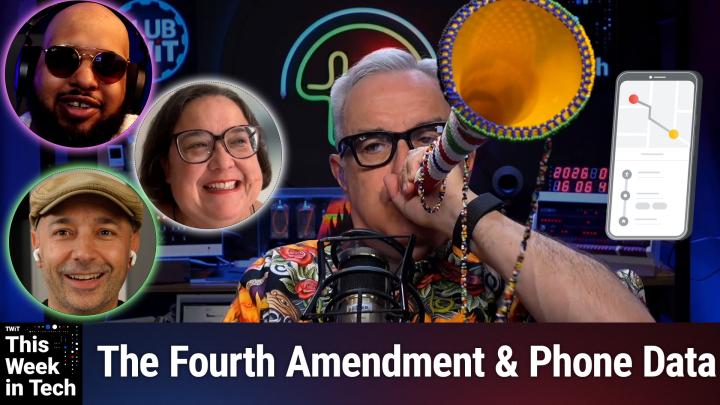
This Week in Tech Episode 1091 Transcript
Please be advised that this transcript is AI-generated and may not be word-for-word. Time codes refer to the approximate times in the ad-free version of the show.
Leo Laporte [00:00:00]:
It's time for TWiT this Week in Tech. We got a panel for you today. Lisa Schmeisser is here. Jason Heiner. And it's the return of. Oh, Dr. Owen JJ Stone. Lots to talk about.
Leo Laporte [00:00:11]:
The Supreme Court protects your privacy for a change. Anthropic's fable is back and AI is costing us a lot. It's coming up next on Twit podcasts
Lisa Schmeiser [00:00:25]:
you love from people you trust.
Leo Laporte [00:00:28]:
This is twit. This is TWiT this Week at Tech. Episode 1091, recorded Sunday, July 5, 2026. But you didn't move the bodies. It's time for TWiT this Week in Tech, the show where we cover the week's tech news. Lisa Schmeisser is here from Nojitter.com hello, Lisa.
Lisa Schmeiser [00:00:55]:
Hi. Thank you for having me back.
Leo Laporte [00:00:56]:
Always great to have you. She covers telecom and so forth at no jitter and as always, welcome here. Jason Heiner also here. Jason's made the big move to AI editor in chief also@the deep view.com. hi, Jason.
Jason Hiner [00:01:11]:
Hey, glad to be here.
Leo Laporte [00:01:13]:
Great to see you. Yes. Are you, are you rooting for England or Mexico tonight? That's the question.
Jason Hiner [00:01:19]:
Is that tonight? That's tonight. I have not followed the World cup so much. I know it's not cool to say. Like I know everybody, people who didn't even know what the word soccer meant, you know, six months ago now are following it.
Leo Laporte [00:01:34]:
I notice. I so cool to see soccer once every four years and then fall immediately out of love. But, but briefly, I love it. So hey, I think my, my loyalty is clear from my shirt. I am wearing a definitely a Mexican. Wow themed. Very cool. That is a warrior, I believe.
Leo Laporte [00:01:56]:
Now let us talk to somebody who is actually in the Philadelphia area where he has been assaulted by soccer fans. Mr. Owen J J Stone. Oh, doctor in the house. Hello, Owen.
Owen JJ Stone [00:02:09]:
Hey, Uncle Leo. Yes. If you have money for parking, come hang out. It's $180 for a regular vehicle, $700 for oversized. We got AI price and parking over here, buddy. Come on down, get yourself a $45 beer and 100 degree weather your surge.
Leo Laporte [00:02:27]:
Surge pricing right now, the backyard. That's awesome. Oh, buddy. Was it crazy yesterday? It must have been.
Owen JJ Stone [00:02:33]:
I mean it's amazing. I have a lot of friends. When I did not. It was. It's too hot. It was like 105 degrees. I'm too big. I won't make it.
Owen JJ Stone [00:02:40]:
I'll melt in the car by the time I got there. But everyone is out there. The streets are packed. Everybody's having a great time. It's. It's actually really amazing to see all the.
Leo Laporte [00:02:51]:
Yeah.
Owen JJ Stone [00:02:51]:
Talks and the Twitters and the live streams and everything like that.
Leo Laporte [00:02:54]:
The spirit is really good. And. And one of the things I love about this, it's kind of like the Olympics where you get all these countries together, including IR Countries that are not normally, you know, friends of one another playing, being sports, like, been like. And playing the game. And I just think it's great.
Owen JJ Stone [00:03:11]:
And all the bars are full, like
Leo Laporte [00:03:13]:
all the scotch and all our whiskey and beer.
Owen JJ Stone [00:03:16]:
Yeah. I mean, drinking Boston out of beer was one of the things I thought I'd never.
Leo Laporte [00:03:20]:
That's classic.
Owen JJ Stone [00:03:21]:
Read or see in my lifetime. Classic. That was amazing.
Leo Laporte [00:03:24]:
I'm like, you saw they were out of all the beer except Bud Light.
Owen JJ Stone [00:03:31]:
Even at the end of the day, have to make a decision.
Leo Laporte [00:03:34]:
You know, some would say that's not beer. All right, well, we're back in business with. With Fable. Fable is. Is back. The. We're going to talk about that in just a little bit. The Supreme Court ended its week with a rash of decisions.
Leo Laporte [00:03:53]:
We'll talk a little bit about that. Google paying billions in fines. There's a lot of topics and of course, many of us will be paying billions to Apple for anything, any new hardware, thanks to AI. So a bunch of big stories to get to. Let's start with the Supreme Court story, because I think this is maybe more important than it's getting credit for. The Supreme Court ruled the geofencing warrants violate the Fourth Amendment. This comes from law enforcement asking, well, in this case, Google, but I think other companies in general, things like, hey, give us all the people who are within a mile of the 711 that got robbed the other night, so we can just see who's there. These are big fishing expeditions.
Leo Laporte [00:04:48]:
Justice Kagan, who wrote the majority opinion, said that sensitive data scooped up by these warrants counts as a Fourth Amendment search and offers individuals a reasonable expectation of privacy, Even if they're in a public area. In other words, it's. It's wrong. It was six to three against the government. Good news, right, Jason?
Jason Hiner [00:05:17]:
I mean, yeah, upholding privacy.
Leo Laporte [00:05:20]:
The US Kind of shocking.
Jason Hiner [00:05:22]:
It is sort of shocking. You know, the US has had this long history of. Of privacy going back to like, the. Of defending privacy. And yet, like modernly, businesses have certainly been able to be on the winning side of most of the court decisions and governments. And then in the past couple decades, government, you know, has been on the side of. Of Being able to do sort of almost what it wants to, to invade the privacy of citizens. And any.
Jason Hiner [00:05:57]:
Anything that helps protect citizens from overreach by government or corporations. I. I think, you know, as. As people living in this country, which all of us are. Have to view is a good thing.
Leo Laporte [00:06:10]:
Yeah. This. The ca. I don't like to read the details of the case often because then people get influenced by whether the heinousness of the crime or how much the guy deserved to go to jail. That kind of distracts from the overall importance of this for all of us. Not necessarily this bank robber who got caught and actually pled guilty. Owen. I guess the only justification for this is it is a very useful tool in catching people and they caught a bank robber by doing this.
Owen JJ Stone [00:06:50]:
So I'm not against crime per se.
Leo Laporte [00:06:54]:
You're not against crime.
Owen JJ Stone [00:06:55]:
I'm not against crime per se.
Leo Laporte [00:06:57]:
Okay.
Owen JJ Stone [00:06:57]:
I'm living in the current scheme of America where the last time America got free, apparently we had to do a lot of crime to get that freedom. Right. Rebellion.
Leo Laporte [00:07:06]:
That's a good point. That's a good point.
Owen JJ Stone [00:07:08]:
I've never been against criminal activity. Don't mean don't. Don't take a life.
Leo Laporte [00:07:12]:
Throwing tea in the harbor dressed up as an Indian is not exactly.
Lisa Schmeiser [00:07:16]:
Crime is defined by the state. But if the exact. Isn't doing it in a way that is. That meets your principles, then yeah, I'm
Owen JJ Stone [00:07:23]:
against hurting women and children. But everything else might be on the table. I don't know what's going on in the world. I keep a Faraday cage with me at all times from my phone because I never know what I might accidentally do something. I am so excited about this because the way that the Flock camera systems are moving and they're starting to pull in Bluetooth data and things like that, I'm hoping that this ruling could help protect us from that which is outside of the scope right now. Or it doesn't have any kind of regulation. They're just throwing in things willy nilly. But this is great for that in my mind going forward in the future when someone comes to try and put something forth to stop them from just collecting information and sharing it openly with these flat cameras and the systems that they're putting in.
Owen JJ Stone [00:08:05]:
Yeah, I appreciate this.
Leo Laporte [00:08:08]:
On the general front, the government had said, look, every, you know, turning on location data is voluntary. The bad guy in this case had turned on his Google location history.
Owen JJ Stone [00:08:20]:
Most criminals are not smart. I mean, remember the guy robbed the bank and he wore the BK glow in the dark. Shoes. And he got caught in the woods because his shoes were lighting up. I mean, criminals are not known to be.
Jason Hiner [00:08:31]:
It's the smart ones you gotta worry about. The ones that aren't smart, like, they don't worry me.
Lisa Schmeiser [00:08:35]:
It's the ones that are really smart
Jason Hiner [00:08:36]:
that I worry about.
Lisa Schmeiser [00:08:37]:
In David Simon's excellent book, Homicide Life A Year on the Killing Streets, it was the basis for Homicide. It kicked open the door to have him. We all know the David Simon story. One of the passages that stands out early on is he's like, look, criminals are dumb. If they weren't dumb, they wouldn't be
Leo Laporte [00:08:53]:
criminals or they would choose a crime that is less likely to get caught nowadays.
Lisa Schmeiser [00:08:59]:
Yeah.
Leo Laporte [00:08:59]:
Don't rob a bank.
Lisa Schmeiser [00:09:00]:
Yeah.
Leo Laporte [00:09:01]:
That's what Bitcoin is for. Come on.
Owen JJ Stone [00:09:03]:
In the stock market and insider trading,
Leo Laporte [00:09:06]:
there's so many better ways.
Owen JJ Stone [00:09:08]:
Yeah.
Leo Laporte [00:09:10]:
Start a podcast network. You want to steal. Wait a minute, that's wrong.
Jason Hiner [00:09:13]:
The smart ones end up heads of state and leaders of industry.
Owen JJ Stone [00:09:16]:
Yeah.
Leo Laporte [00:09:17]:
White collar crime. Yeah.
Lisa Schmeiser [00:09:18]:
I think one of the most interesting aspects of this ruling is them putting forth the idea that people actually own their individual data, which is I. Which I think we're kind of sleeping on that because that really opens the door to all sorts of interesting developments. If and or when somebody decides to go after companies that they feel are profiting off of their data without their approval, their control, or their cut. We now have something in a Supreme Court decision that explicitly connects an individual to the data that they generate and argues that they ultimately have control over it. And I think we're going to see repercussions for that play out down the road.
Leo Laporte [00:10:01]:
Now, what about the government argued that people should not have an expectation of privacy when they are in public. And that's kind of. That's the argument for Flock cameras as well. By the way, we're learning that these Flock cameras, which are have ALPRS automatic license plate readers on them in many communities. There's one right outside my door here. As a matter of fact, many communities have these. You know, started with red light cameras. The problem is the Flock database is national.
Leo Laporte [00:10:32]:
Law enforcement often accesses it to follow people out of state for committing crimes in a state that are not a crime in another state. Also lately we've seen that these flock cameras are also being installed with things like Bluetooth snarfers, which, as you may or may not know, as you trundle down the street, all your Bluetooth devices are advertising saying, I'm here, I'm here. You want to Join and so you can. Somebody drives by a flock camera, pick up a huge amount of data from them. We're seeing more and more technology is allowing more and more of this kind of invasion of privacy. So it's. It's encouraging to me that the Supreme Courts did. Did not say, hey, just because you're in public doesn't mean you don't have some expectation of privacy.
Leo Laporte [00:11:20]:
You do not. You still have a privacy right.
Owen JJ Stone [00:11:25]:
Yeah, they like to film. Like, you know those auditors that go out there on the sidewalk and they film people and they try to get somebody mad to another film.
Leo Laporte [00:11:32]:
They.
Owen JJ Stone [00:11:32]:
But at least I can see them doing it. A lot of the times you see a flat camera or something like that, you think it's just a camera. You don't know that it's there. When someone's swiping, you're stealing your data. You don't. You have. You're not even aware of it. At least when someone's filming you on the street, like, don't do that.
Owen JJ Stone [00:11:47]:
I can see that you're doing it. I know I can turn my head and walk away if I want to.
Jason Hiner [00:11:51]:
If I don't want to be in
Owen JJ Stone [00:11:52]:
your view of your camera, if you
Lisa Schmeiser [00:11:53]:
see someone with the Meta glasses, you're like, oh, boy.
Owen JJ Stone [00:11:56]:
Exactly. Yes. Even though now they've done the thing where they take the light out so you don't even know the recording anymore,
Leo Laporte [00:12:02]:
which is Meta's take. No, Meta still has the.
Owen JJ Stone [00:12:04]:
No, not Meta. Doesn't do it. There's other companies.
Leo Laporte [00:12:06]:
Yeah, yeah.
Owen JJ Stone [00:12:07]:
And certain. There's services like my Facebook. There's a guy down the street from me. Apparently, that does it for 100.
Leo Laporte [00:12:12]:
Oh, really? You can get the light taken out of these?
Jason Hiner [00:12:14]:
Yep.
Owen JJ Stone [00:12:15]:
You go to them 20 minutes.
Leo Laporte [00:12:16]:
Is that the same guy who was going around saying, the fire TV sticks a few years ago?
Owen JJ Stone [00:12:20]:
Leo, I'm not trying to snitch on anybody because there's guys out here doing service. If you're on Facebook, marketplace, it's only 100 bucks. Takes 20 minutes. Uncle Leah. That's all I'm trying to let you know.
Leo Laporte [00:12:33]:
Hey, Meta, take a picture of that guy right there. That guy. He's up to no good. But I do think we're gonna have. We're gonna have these, aren't we? In the next five to 10 years, these are going to be ubiquitous, these cameras and glasses.
Owen JJ Stone [00:12:50]:
You think?
Lisa Schmeiser [00:12:51]:
I mean, we knocked them off of people's faces 10 years ago and made fun of them.
Leo Laporte [00:12:54]:
They called them glass holes.
Lisa Schmeiser [00:12:56]:
Everyone's got, like, A real nostalgia thing going for 2016 right now. We can bring it back.
Owen JJ Stone [00:13:01]:
They look better now. The problem before is when you look to Scoble, you're like, what are you doing? Yeah. You look like a cyborg. Like, you like it supposed to flip up?
Jason Hiner [00:13:09]:
Yeah.
Owen JJ Stone [00:13:09]:
It's. Now it's just a pair of sunglasses. You can get them tinted and they look normal. They blend in. Like I said, once you.
Leo Laporte [00:13:14]:
Kylie Jenner has them.
Lisa Schmeiser [00:13:16]:
This makes me mad because I love my Ray Ban Wayfarers and I was worried I was wearing before Meta got into bed with them. So I'm.
Jason Hiner [00:13:24]:
They've ruined the Wayfarers for you.
Lisa Schmeiser [00:13:26]:
Yes.
Leo Laporte [00:13:26]:
So are we going to get used to the idea that everybody, everywhere is on camera at all times? I mean, it's sort of the case if you're a high school kid now, you know, that you can't really get away with anything.
Lisa Schmeiser [00:13:37]:
Yeah.
Jason Hiner [00:13:38]:
Well, I mean, that is, if you live in China, you're, you know, that's the reality you've lived with for the decade. Right. Like, or the uk. So I. I think that these things are. Are less governed by regulations and more by, like, norms, culture, expectations.
Leo Laporte [00:13:58]:
Yes.
Jason Hiner [00:13:58]:
And so. And I think that. That we sort of. They wear us down over time with that. Because people in China and the UK also didn't like it at first. Right. Now you sort of never hear anything about it. I think that's probably more likely what happens in the rest of the world.
Lisa Schmeiser [00:14:14]:
Yeah. My daughter just got back from two weeks in China and one of the first things she mentioned bear in mind, she's still out of her mind with jet lag. And so there's a lot of incoherence. But one of the first things she
Leo Laporte [00:14:26]:
mentioned, are you my mommy is.
Lisa Schmeiser [00:14:29]:
She was like, there were cameras everywhere. We couldn't go any place without noticing all of the cameras. And to her, that was just really, really strange. And the fact that it was so normalized, I think sort of set her spidey senses going. I do agree that American teenagers have pretty much grown up with a really, really different relationship to the ubiquity of cameras and a hyper awareness that anytime you're out in public, anything you do can be quickly disseminated and go viral. What I will be interested in seeing is whether we'll get any sort of countercultural pushback from young people who are like, this is not how we're supposed to live, or if they'll find a way to hack or subvert it. Because this is what young people do to. To try to set their identities separately from the generations that came before them.
Leo Laporte [00:15:22]:
So, yes, oh doctor has donned his sunglasses so that he may speak freely. We don't know who he is.
Owen JJ Stone [00:15:28]:
So my daughter is in that group of. There used to be the girls who have the duck face, and they want to, you know, be grown and all that kind of stuff. There's a new movement of all these teens where they don't show their face. They just look off to the side at everything with all their experiences. So if they're at the beach, they're not the girl sitting at the beach in a bikini. It's the girl looking off at the beach. It's the guy looking off at the beach. And I'm like, so what's the matter? She's like, we're tired of all our faith.
Owen JJ Stone [00:15:55]:
Yes, it's awesome.
Leo Laporte [00:15:56]:
This is great.
Lisa Schmeiser [00:15:57]:
So instead of being the object of the gays, they're inviting you to see their gays. That's so interesting.
Owen JJ Stone [00:16:02]:
But you can tell the difference in the kids that do it versus the ones that don't when you're involved with, like, these kids. But, like, it's a. It's. It's. It's becoming more mainstream of these kids because they know now when they're going to college, they're starting to apply for jobs, and they don't want to have the pouty face, duck lips things in their history, and they don't want to delete their experiences, so they're changing their perspective of things. So to what you were saying, I do think that there is some kind of normalcy getting back to the world in nature and wanting to have real experiences and just not be seen all the time, especially when you're putting yourself front and forward on the Internet.
Leo Laporte [00:16:39]:
And yet, you know, Larry Ellison said this week that, well, all those cameras are good. It makes people behave. They're on their best behavior now.
Lisa Schmeiser [00:16:47]:
Yeah, he's been kind of on that since the 90s, because I see that
Leo Laporte [00:16:51]:
I seem to remember his feelings. Get over it. Privacy is dead. Right. But that was many years ago.
Jason Hiner [00:16:57]:
I mean, some of the tech CEOs have. Has said things famously like, if you don't, you know, want to, you know, have the technology get you in trouble, then don't do anything bad.
Leo Laporte [00:17:09]:
Right.
Jason Hiner [00:17:10]:
Famously. Right. So, like, yeah. Not surprising. Right.
Lisa Schmeiser [00:17:14]:
And yet these people are the same ones that complain when they're like, young people don't party like they used to. They're not drinking like they used to. They're not risk takers like they used to be. And what is the incentive where if you do this sort of stuff, you have no control over other people recording you, uploading you, you have no recourse with any of the companies that have gotten impressions and traffic based on the idiocy. You have no social repercussions. Like you have no social recourse for cleaning it up. I think these things are kind of linked. If you're going to heavily surveil a population, you're going to change how they behave.
Leo Laporte [00:17:52]:
So, yeah. There is a new bill in Congress sponsored by Elizabeth Warren and Mary Gay Scanlon of Pennsylvania, the, the Health and Location Data Protection Act. Now, it's been around for a few years. They have updated it to ban companies from selling data to brokers, including health data. They've. Now, I think this is tilting in windmills because I can't imagine Congress actually passing this. So maybe write to your Congress critter and say, hey, we like this idea. We need this.
Leo Laporte [00:18:29]:
There is no federal law protecting your data privacy and there really needs to be.
Lisa Schmeiser [00:18:38]:
If it's your property, which the Supreme Court just established, then shouldn't you be able to protect it?
Leo Laporte [00:18:44]:
The bill would require the Federal Trade Commission to enact rules within 180 days, would allow the FTC to state attorneys general and effective individuals to sue to enforce it, that private right of actions. I have mixed feelings about it, but it can be very, very effective. It would also earmark a billion dollars to the FTC for enforcement over the next 10 years. Do you think it has a shot? I think we all need to write our members of Congress, our Congress critters, and say we need federal privacy protection.
Owen JJ Stone [00:19:15]:
It's, it's sad that we have to ask for that.
Leo Laporte [00:19:17]:
I don't.
Owen JJ Stone [00:19:18]:
It should.
Leo Laporte [00:19:19]:
But this is the thing about billionaires when saying that, and members of Congress, they're protected.
Jason Hiner [00:19:24]:
They have it. They have, they have it.
Leo Laporte [00:19:26]:
So they don't get what we're talking about.
Lisa Schmeiser [00:19:29]:
Well, you take a look at how data was framed for so long, which is data is the new oil. And oil is, was, was an extractive resource who belonged to the person who could figure out how to get it out of the ground and sell it. And so we've always looked at data the same way as it's an extractive resource that belongs to the person who figures out how to collect it, bundle it and sell it. Like the legislation, like this requires us to make a really fundamental shift in our thinking about who data belongs to and what economic model works with it.
Leo Laporte [00:20:02]:
And if you're Wondering who wants this? The X has just petitioned X.com, elon Musk's rebranded Twitter has just petitioned the Federal Trade Commission to drop their oversight of privacy on X. This goes back to Twitter days. FTC had found that a coding error had caused Twitter to improperly share users contact information for ad targeting. Contact information that by the way, like your phone number, you had given Twitter for two factor authentication. They were then taking that phone number and selling it on X is subject to right now to costly independent audits. And the FTC has the authority to demand documents to ensure compliance with data privacy laws without further legal action. They could just say, hey, give it to us right now. X says, your honor, this order imposes burdensome costs and we shouldn't have to do it anymore because it's now X, it's not Twitter anymore.
Leo Laporte [00:21:04]:
And by the way, GDPR is taking care of that so you don't have to. So they want the FTC to drop that again. Something to write your, I don't know, write your member of Congress or something.
Lisa Schmeiser [00:21:16]:
But as a real poltergeist, you move the body tombstones, but you didn't move the bodies.
Leo Laporte [00:21:23]:
Hey, and we built a house right on top of it. Incidentally, we talk about the World cup going on right now. Speaking of surveillance, in order to be safe in the World Cup, $1 billion was spent on security systems including face recognition. Fast company asks a legit question. What happens after the games end to all of this data? These cameras, you think they're going to take them down?
Owen JJ Stone [00:21:52]:
No.
Jason Hiner [00:21:53]:
You know, doctor, ask your glasses, Owen, ask your glasses. What are they going to do with the data?
Owen JJ Stone [00:21:57]:
I'm not wasting any water, Jason. You're trying to trick. I will not be a fool. All right, to your games out here. You're trying to trick me up. Now, the thing that cracks my throat about that is whenever Elon says anything, it makes me laugh. He's like, we don't have to do this. FCC doesn't have to worry about it.
Leo Laporte [00:22:17]:
We're gonna be good.
Owen JJ Stone [00:22:18]:
Anything he says, I want. The exact opposite of yes, I agree. I. I can't. You know, Leo, I haven't been on the show in what, four or five years?
Leo Laporte [00:22:26]:
No, it hasn't been that long.
Owen JJ Stone [00:22:27]:
I know it feels that well, three years, two years. I've just extended up to. I say, I've been on here in 20 years. Uncle Leo. All I remember is forever. When I was on this show, I made a shirt. We're not going to Mars. That man promised me Mars by 20.
Owen JJ Stone [00:22:40]:
20. Oh, yeah. Six extra years. I sold hundreds of those shirts and we still aren't anywhere halfway to Mars. Uncle Leo, we're not living on Mars. We're not sniffing Mars. This man just be saying stuff and you know everybody's gonna have a free robot in their house. Okay, where's the metal coming from, Jason? You want all this stuff built? You want to just destroy? You want to drill through whole planet, end up in China just to get some extra batteries? Where is it coming from? It's not going to happen.
Owen JJ Stone [00:23:06]:
We ain't even on Mars yet and y' all want to believe anything this man.
Leo Laporte [00:23:09]:
Do you have any of those T shirts left? I think they're very.
Owen JJ Stone [00:23:11]:
I mean, I got one that's still snug on me. I rock it. I'll put it on. Because we are. We have not made it to Mars yet. And I wear.
Lisa Schmeiser [00:23:17]:
You really need to like, do a limited drop T shirt this year too. This is. This is how you pay for your next water system.
Leo Laporte [00:23:23]:
I just say I'm glad that they finally put security fencing around the. Around the reflecting pool because that was such a hazard. People falling in, dunking their toes in it. It's just about time. That's.
Owen JJ Stone [00:23:35]:
Well, did you read that they're trying to get rid of the cherry blossoms? You want a golf course?
Jason Hiner [00:23:41]:
No.
Lisa Schmeiser [00:23:42]:
I mean, no, no, no.
Owen JJ Stone [00:23:43]:
Go Google it. I don't want to make you upset. We got stuff to talk about. That's not till September. He's going to wait till after the. After the summer.
Jason Hiner [00:23:50]:
Yeah, then after the summer's depredation.
Leo Laporte [00:23:52]:
Who needs trees? They just get in the way of the golf balls.
Lisa Schmeiser [00:23:54]:
Oh, my God.
Owen JJ Stone [00:23:55]:
A gift of 100 years from Japan.
Lisa Schmeiser [00:23:57]:
Yes.
Leo Laporte [00:24:00]:
All right, let's take a little break so we can cool off here a little bit. You're watching this Week at Tech. Oh, and Doc. Oh, Dr. Back, baby. And we've been missing you, sir. You know, the last time you were on, I was playing the vuhuzela. Still.
Owen JJ Stone [00:24:17]:
That I need. That I need. I'll cross the bridge that I get one of those.
Leo Laporte [00:24:23]:
It's great to see you again, my friend.
Jason Hiner [00:24:25]:
Zelas over data centers. There you go.
Leo Laporte [00:24:26]:
Yeah, you know what? They're people suing now. Those data centers are so annoying. They're worse than vuvuzelas.
Owen JJ Stone [00:24:33]:
They're loud.
Leo Laporte [00:24:34]:
They're loud and they're whiny.
Jason Hiner [00:24:36]:
Lisa, aren't they louder than vuvuzelas, though? I don't know.
Leo Laporte [00:24:39]:
Maybe not.
Jason Hiner [00:24:40]:
That might be a toss up.
Leo Laporte [00:24:41]:
They're pretty Loud. They're pretty loud. Ladies and gentlemen, Lisa Schmeiser also here from NoJitter.com and the great Jason Heiner. His new newsletter, the Deep View.com calm. Did you go to the, the big AI conference Alex Cantrowitz had in San Francisco?
Jason Hiner [00:25:02]:
That, that is probably the only one I have not been to in 26. I have been to them all. Five out of the last six weeks. I was at events.
Leo Laporte [00:25:11]:
Well, we'll talk about Fable when we come back because Fable's back. So it was June 9 that the Trump administration abruptly, a Friday afternoon announced that Anthropic could not let non US Citizens use either Mythos, its high end security AI, or Fable, the kind of consumer version of that. Now, the problem is, of course, Anthropic doesn't know if its users are US Citizens or not. They never asked about that. So they just had to shut it down. It had been shut down since June 9th. They've, on June 30th, three weeks later, the US lifted those restrictions and Fable and Mythos came back online. I have to say it's been out now for what, five days? And I've been playing with it.
Leo Laporte [00:26:03]:
A lot of people playing with it, Fable and are very impressed. Now, Anthropic had to do a little bit of PR with the president. We're not sure exactly what they offered. One of the things we know they've done is they've, they've made the protections even stronger. But they were very good to begin with. They had a classifier that will basically prevent you from doing anything, anything too serious with it. Certainly not bioweapons research, AI research. You can't use it to attack systems.
Leo Laporte [00:26:44]:
Alex Samos, we had him on intelligent machines when this first happened and he's been lobbying. He actually created a site called freefable.org with hundreds of signatures from some of the best known people in computer science saying, please, this is political. This has nothing to do with technology. Stamos says there's a lot to unpack here. Anthropic is bearing some hard truths and careful political language. First of all, they verified that none of the jailbreaks that were performed by Amazon and others using not jailbreaks, but security flaws discovered by Anthropic Fable were things that other models couldn't do. Anthropic pointed that out. Even their most inexpensive models, like Haiku could do the same thing.
Leo Laporte [00:27:39]:
They also said there's, there is going to be. The U.S. department of Commerce's center for AI Standards and Innovation would start to Enforce safeguards on models and models that aren't safe will not be released. Now there is a problem. Stamos points out there's no way to know if a model's safe and we don't have the technology to demonstrate it. And that's become very, very clear. Anthropic also cast some shade on Amazon for narcing on them. But the biggest point Stamos makes is this, he said calls it.
Leo Laporte [00:28:16]:
I think he's a soccer fan. An own goal for the United States, he said, we will see how bad US Models get over the next six months. And it's a real opportunity for the Chinese models, and we've already seen that. We've seen a lot of people move to Chinese models. It's made a lot of people wonder, should we invest our company in a model that could be rug pulled at any moment? Now, Jason, you cover this. I wonder how much blame is Ghost Anthropic for all of the rhetoric around how dangerous Mythos was to begin with.
Jason Hiner [00:28:51]:
Boy, I'm going to be honest with you, Leo. I'm of two minds of this, and I sort of go back and forth on it. I think the last time I was on the show, I mentioned that, you know, Anthropic didn't have the computing to run it if they wanted to. Right. So, like, they remember that since they first announced in April that they were. That they announced Mythos that they've gone out and raised a bunch of funds because they didn't have the computing to run this thing.
Leo Laporte [00:29:20]:
They actually made a deal with elon Musk's X AI for. For compute. Right. $1 billion a month in computer.
Jason Hiner [00:29:28]:
That's right. Colossus, their giant, you know, compute machine, which was supposed to. All of Xai was supposed to use up, but Xai has not been blowing the doors off, so they've got a lot of extra compute lying around. So they're like, well, why don't we just go ahead and sell it?
Owen JJ Stone [00:29:40]:
Right.
Leo Laporte [00:29:41]:
I think Meta is doing that now, too, by the way, they announced this week they're going to start selling capacity.
Jason Hiner [00:29:45]:
Yeah, that's right. There's a lot more money to be made off selling capacity probably than models, but that's a whole nother story. So the thing is, they didn't have the compute to run it if they wanted to. So going out and saying how dangerous it was was clearly one. It was a marketing ploy. Ploy is maybe a strong word, but it was a. It was a. It was a smart marketing thing to do.
Jason Hiner [00:30:12]:
That said, I have since heard from some cure, some security people of like, no, this thing runs through stuff like Swiss cheese, like it can go and find vulnerabilities and stuff that like, we've never, that had never been found before. And so that sobered me up a little bit. But, but I think maybe the bigger, I'll say there's two things that are like the bigger picture about this thing. One is that models are commoditizing really quickly. And so OpenAI and Anthropic want to go public. They're not going to be able to become trillion dollar companies just by selling the latest, you know, and greatest models. There's just not going to be enough profit in it. But what Anthropic is doing, and I think what Anthropic realizes is what they can do is become known as the Safe AI brand.
Jason Hiner [00:31:00]:
And that Safe AI brand could be worth trillion dollars.
Owen JJ Stone [00:31:04]:
Right.
Leo Laporte [00:31:04]:
So this is, this was good for them. This was good for them, is what you're saying. The Trump ban was Absolutely, it was absolutely.
Jason Hiner [00:31:12]:
It's very good for them. And here's the other thing that it's good for almost by accident is that, you know, we've heard and probably nobody more than Dario Amade, you know, has said you, we would pause our stuff if everybody else paused theirs for this, for the, for the, in the case of safety. Right.
Leo Laporte [00:31:31]:
That was the strangest post. He said that right before they released Fable.
Jason Hiner [00:31:35]:
Well, he's been saying it consistently. He has actually been saying it consistently for about a year.
Leo Laporte [00:31:39]:
But nobody's pausing. So nobody's pausing.
Jason Hiner [00:31:42]:
He knew none of them were right. It's a very safe thing to say because none of them were right. And yet, like this sort of crazy out of the blue thing that probably happened because somebody in the US Government, like this thing got out there and somebody in the U.S. government, like, set it loose on some, some U.S. government system and went, oh, crap. Like this thing just blitzed through all of our security and then convinced somebody, we need to, we need to pause this, pause it.
Leo Laporte [00:32:08]:
We got a problem. Houston.
Jason Hiner [00:32:09]:
They achieved the pause, though. Here's, here's the thing is they achieved what hasn't. No, you know, safety advocates. No, you know, Dario Amade, nobody has been able to achieve. Which they did actually pause it. And then since then, remember, OpenAI's released GPT 5.6, which has now also been paused and is still paused. Has not been unpaused yet.
Leo Laporte [00:32:30]:
That's a good point.
Jason Hiner [00:32:32]:
And so the US Government is sort of like backed their way into this. But I think as we talked, remember we talked earlier about those sort of like norms and expectations if the norm and expectation becomes, look, before you know, these labs are pushing out these superpowers, powerful models that could wreak havid on havoc on God knows what. Like, let's actually set up a regular expectation that okay, hopefully it's not just the US Government, but maybe some kind of like third party agency or something that does these evals and creates sort of some, some safety motions before these things are released. That would be a good thing. And I think the models are getting powerful enough that it would be important and very useful and smart.
Leo Laporte [00:33:16]:
I am exactly where you are of two minds. On the one hand, this is in my opinion the most consequential technology to come down the pipe since computers were invented. On the other hand, yeah, it could be disastrous if this thing is so good at finding exploits that a nitwit like me could just say, hey, let's break into, you know, Fort Knox. You know, I mean, that's, that's problematic. So I understand the risk, but at the same time, I don't like the idea that the government or any government agency, I don't, will have the opportunity to put its thumb on the scale. Right, yeah.
Jason Hiner [00:33:57]:
Remember Europe freaked out about this too, by the way. Europe was like, yeah, wait, you're pausing the model for everybody else. This thing was out for several days. Like our adversaries have it, they can attack our system systems and the US Government is, is holding on to it and meanwhile we're at risk because there are people out there that already have access to this and could really, you know, run through our systems like Swiss cheese.
Leo Laporte [00:34:19]:
Right.
Jason Hiner [00:34:19]:
They didn't love that.
Leo Laporte [00:34:20]:
And then OpenAI apparently has, has talked about giving the Trump administration 5% of all the AI companies. You know, it's, it's, it's a sort of a bribe sort of. And I think, think then there's the concern that, well, maybe this isn't about technical skills, but this is about who's going to, who's going to pay the president, who's going to give give. I mean obviously it doesn't go into Trump's pocket. Maybe not. So obviously I'll give you the non
Jason Hiner [00:34:49]:
cynical version of that. Just as a, just as a counterpoint, Leo, to like the, where they are aware of the fact that they are losing the narrative. OpenAI and anthropic and Google are very aware of the fact that they are losing the narrative among the broader population that people hate.
Leo Laporte [00:35:08]:
They hate Big tech. It's kind of part and parcel of the same thing.
Jason Hiner [00:35:11]:
61% of Americans have a negative opinion of AI, right? Like, that's not a secret. I think it's probably pretty conservative, you know, in general. And so I think what their thing is, is like, look, this could be. Create a lot of economic value. It also is going to create all kinds of challenges if it does. And if they become public companies, if they, they're like one of the policy proposals. And I had a, I had an interview with the person who wrote this at OpenAI, the research, the researcher who wrote this, that wrote some policy proposals of like, what are the ways we could make AI actually useful to, to people that it could, it could help with the sort of job loss, with the economic inequality, all of that. And one of these things these researchers proposed that eventually, you know, Altman and the others signed off on was that what if we took, when we do go public, what if we took a chunk of our shares and we allocated them to the US Government and it essentially gets like redeployed to the American people.
Jason Hiner [00:36:12]:
Now how does that. The devil's in the details, right? They didn't explain how maybe it wouldn't just be open. Maybe it's.
Leo Laporte [00:36:19]:
According to the Financial Times, a proposed arrangement would involve other US AI companies handing over a similar stake. Not what I, I don't know who that means.
Jason Hiner [00:36:28]:
I think it means they're saying, like, if we do it, we'd like to see everybody else do it. I think what, what, what. I don't know how practical that is, but what I do think is interesting is that like, this wasn't, I think, just like a Sam Altman driven thing or an executive driven thing. Like, this was driven by researchers who are quite altruistic, right? Who are like, they're, they're punching the time card, right? They're not making billions off of, off of their stock, you know, but they are sincere about, like, what are the ways that could, that we could think creatively because we're going to. This thing could get really, you know, big in a way that could cause a lot of job dislocation, could, you know, redistribute wealth in negative ways, which is already a challenge.
Leo Laporte [00:37:15]:
Is this going to appear, appease the American populace that, oh, hey, we're getting 5%. Is that going to make you feel better? Owen, let me.
Owen JJ Stone [00:37:25]:
Two things. Let me, let me. First let me bend and knee to Jason for a second. Okay? So I'm building something with a friend. And when Fable came out we did more in three days than we did amazing weeks. And I'm not lying. Like it, it was on steroids. And when they took it away, it was like, you know, taking the baby's pacifier way like we were crying.
Owen JJ Stone [00:37:46]:
I was like, oh my God, I'm back to being stupid. So yes, it's powerful. When you use it for the right thing, it does matter. And it was worth all the water. Jason. Now, when it comes to billionaires giving back to the American people, I've been waiting for trickle down economics since before I was born, sir. So unless you're going to tell me something useful and direct and clear right now they're taking away Social Security, Medicaid, can't get no free education. If billionaires want me to get on board with your AI train, tell me that whatever percentage you're going to put away isn't going to go to the federal government.
Owen JJ Stone [00:38:18]:
Just tell me you're going to give free health care to every American citizen in the United States of America.
Leo Laporte [00:38:24]:
What if they did that?
Owen JJ Stone [00:38:25]:
If you told me that, that would get every doofus that doesn't know anything about anything on your side. Instead of filling up buses with guys with yellow T shirts saying, drink the AI water, It's fine. And don't worry about your electric bill. It's fine. Fine. And don't worry about the 42 twin turbo jet helicopter engines they got running in your local city inheritage. It's fine. Maybe, just maybe, I would get on board, but other than that, I want my water, I want fresh air, and I don't want the decibels popping over 100 in the middle of the night because somebody wants to know how to make brownies.
Leo Laporte [00:39:00]:
They're very good brownies though.
Owen JJ Stone [00:39:02]:
I mean, they better be.
Lisa Schmeiser [00:39:03]:
But he's not wrong about. He's not wrong about the minimal benefits and the huge.
Owen JJ Stone [00:39:09]:
You want to make better brownies, substitute water for milk, add in an extra egg, Bob's your uncle.
Leo Laporte [00:39:16]:
I also wonder though, 5% of what? Because I don't think these companies are making money. It's 5% of their stock, I guess.
Jason Hiner [00:39:26]:
Right, right.
Lisa Schmeiser [00:39:27]:
That's money that doesn't exist yet. It's an agreement that they're all losing money, right?
Leo Laporte [00:39:32]:
Nobody. There's no AI company out there that's actually. Yeah, I mean, positive income.
Jason Hiner [00:39:38]:
Google.
Owen JJ Stone [00:39:39]:
Right?
Jason Hiner [00:39:39]:
But Google, they make money in advertising and, and their cloud business. Right? And so they're selling cloud capacity to others, including.
Leo Laporte [00:39:48]:
Oh, that's a good point. If you're making the picks and axes and Dungarees for the gold rush, then you're making some.
Jason Hiner [00:39:54]:
Nvidia is making a lot of money off of all the AI companies.
Leo Laporte [00:39:58]:
5% of Nvidia probably would pay for the federal health care. Health care, everything.
Lisa Schmeiser [00:40:05]:
Get on it.
Owen JJ Stone [00:40:06]:
I'm just saying you gotta attach it to something that's dumb enough that everybody can understand.
Jason Hiner [00:40:10]:
It's fair. It's true.
Owen JJ Stone [00:40:11]:
Yeah, because everything else you just said just sounds like government talking about what they always been talking about. Oh, well, you know, he's not worth a trillion dollars. Oh, Doctor, he can't be taxed on that. It's not real. But how come he could borrow it to buy this fourth and. And not pay any taxes on it. And then again, I understand how it works because, you know, I mean, I don't pay. I ain't paid tax in 20 years, Uncle.
Owen JJ Stone [00:40:32]:
Knock on wood.
Leo Laporte [00:40:33]:
Wait a minute now, Owen, now you shouldn't be saying that out loud now. There might be people listening.
Owen JJ Stone [00:40:39]:
I'm clear with the irs. They know what I'm doing. The Church of O Doctor is running strong here. Little Family Foundation. We're doing everything the S Corps doing everything I'm supposed to do. Uncle Leo, regular people are out here getting robbed and they're not getting anything for it. So unless you're going to give education or health care. And health care would be the thing, even more so than education.
Owen JJ Stone [00:41:02]:
Not everyone wants to go to college. Right. But if you just gave them free health care, that would be the carrot that will get everybody on board for what you're trying to push through in this AI revolution.
Lisa Schmeiser [00:41:11]:
Especially since health care is so explicitly linked to employment and you have all of these AI big brains going. We're going to eliminate the. So many white collar jobs. We're going to eliminate the jobs of the educated. Jobs, jobs, jobs are going away. It's inevitable. You can't stop it. And all people hear is, I will be poor.
Lisa Schmeiser [00:41:30]:
And the first time I break a leg, you may as well just shoot me in the head because I can't afford to get it. I can't afford to get it set. So decouple health care from the employment market and people will probably care a lot less when they lose their jobs.
Leo Laporte [00:41:47]:
Well, yeah, I don't know if that's going to be enough, though, to convince people to like big tech and AI
Lisa Schmeiser [00:41:54]:
and I mean, they love fracking at this point. Like, people protest.
Leo Laporte [00:41:59]:
You just need a good ad campaign.
Lisa Schmeiser [00:42:00]:
People protested fracking and you have folks who are like my groundwater. It's terrible, but it's and. And like states now have earthquakes that didn't used to have earthquakes. Thanks to fracking, there were the same environmental considerations. And in the end, all you have to say to Americans is, but this keeps fuel and power cheap. And they'll be like, oh, okay. And if you give somebody a big enough carrot with AI they won't care about the environmental impact anymore. Like, they care right now because they're paying horrible utility bills and they can see that, the visible degradation of the water.
Lisa Schmeiser [00:42:39]:
But it's really easy to distract people from environmental concerns.
Owen JJ Stone [00:42:43]:
So I would generally agree with you. Fracking is a terrible example because fracking doesn't come down Main street in your rural town. When we're. When they're putting a data center in every other town and every other area and close to major cities and suburbs and boroughs, you're not fracking everywhere. There's only certain places where fracking is palatable. Right. Or useful. They're trying to put data centers every three miles.
Owen JJ Stone [00:43:06]:
And I'm like, bro, how much. How much data do we need? What are you. Who are you trying to learn from? What do we need to know that you need that many?
Lisa Schmeiser [00:43:14]:
Like, they need a blondies recipe. It's not just the brownies anymore.
Owen JJ Stone [00:43:18]:
We've got like 42 times what China has for data centers, and they're out there putting them in the ocean, using solar power and other things to power this. We're just out here cooking with Crisco, taking up the temperature, messing up the planet. Yes. I'm looking at you, Jason. I got a. Combat your positivity with the balance of the world.
Leo Laporte [00:43:36]:
Okay.
Lisa Schmeiser [00:43:36]:
All right. Oh, and you have convinced me that it was a bad. That the fracking was a bad example. Thank you.
Owen JJ Stone [00:43:40]:
Thank you.
Leo Laporte [00:43:44]:
I guess at this point I'm not going to say anything like, well, isn't AI like, going to change the world and isn't it a great technology? And I guess you could.
Lisa Schmeiser [00:43:52]:
I want to hear how that goes.
Leo Laporte [00:43:53]:
We're going to kind of. Well, I think we're going to. Isn't there a risk that we're going to lose something that could be really significant if.
Owen JJ Stone [00:43:59]:
If it was going to make a Tony Stark arc where, like, this little box is going to generate enough power?
Leo Laporte [00:44:05]:
We don't know.
Owen JJ Stone [00:44:05]:
Like, again, you have to start trying to sell dumb people on real imaginary things that would help them.
Leo Laporte [00:44:12]:
Tell them, can we go to Mars?
Owen JJ Stone [00:44:13]:
Yeah, exactly. People love Tony Stark. They love DC Comics. Like, look, we're going to make an arc reactor. This one thing's Going to be better than 40 nuclear plants. Only if you let us use AI and they're like, oh, you know, Tony Stark kind of saved the world twice. So I'm, I'd be on board that you got to trick people.
Leo Laporte [00:44:30]:
So you're saying it's a PR problem, basically?
Jason Hiner [00:44:32]:
Yes.
Lisa Schmeiser [00:44:32]:
Yeah.
Jason Hiner [00:44:33]:
Well, it's a big PR problem. I think the way to think about. Sorry, go ahead, Lisa, go ahead, go ahead.
Lisa Schmeiser [00:44:39]:
No, you're the one who runs an AI publication, so you're the subject matter expert here.
Jason Hiner [00:44:44]:
I'll just say it, I'll say it briefly was just that I think the way to think about AI. Today's AI, it's like anything when, it's like when you draft a rookie in the NBA or in the mlb, right? You draft the rookie, they're like the five star prospect. You're like, they're going to do everything. They're going to break every record. They're going to be the, you know, the best ever at their position or whatever. And you think that they're just going to be able to do everything. AI is kind of like that right now because it's unknown. Yeah, it's exactly.
Jason Hiner [00:45:14]:
It's still unknown.
Leo Laporte [00:45:15]:
Open book. Yeah.
Jason Hiner [00:45:16]:
There are a lot of things that, that are being promised about what AI is going to do that we're going to decide. You know what, it's probably not going to be able to do that, but it's going to be really great. In fact, better than anything we've seen at a couple other, at a couple things. Right. Like a great prospect might be. And so there's still a lot of, you know, that that has to play out over the coming.
Leo Laporte [00:45:35]:
It's all potential right now. It's unknown potential.
Jason Hiner [00:45:38]:
It's all potential. But here's the one thing that I think I'll just. And I'll wrap it is just that the one thing I think we should think about that is benefits everybody with AI is that it is and this word gets use too much, but I am going to use it. The democratization of expertise. There are a lot of things that the expertise used to be locked behind access to very, you know, specialized experts, people or institutions that not everybody got. And without that expertise, you, you really didn't have a chance to compete at a lot of things or to, to be able to advance in a way.
Leo Laporte [00:46:15]:
There's a precedent for that. I mean that's what YouTube and Google search have done, haven't they? They've democratized information already.
Lisa Schmeiser [00:46:23]:
Well, you created a new problem which is you have to figure out, how do you give people the skills to know when they're connecting to somebody who is genuinely skilled or is saying something that is true, correct, verifiable, reproducible, versus somebody who is a flim flam artist or deeply inexpert? For example, if you have somebody foraging, like all of us in California can talk about, there's this culture of foraging that's come up with mushrooms, which means there's now also a culture of people being rushed to the emergency room when the pictures they've seen online seem a little bit like what they've picked up in a forest, but they eat something, and next thing you know, they've got to head to the hospital. You can democratize access to expertise, but you also have to be able to. To figure out how you're going to build up the skills people are going to need to understand, hey, I've tapped into this expert, as opposed to, hey, I've tapped into this crackpot who has said things like, there wasn't a Roman Empire. It was space aliens and Atlanteans working together to standardize wagon wheels. Like, we have access to all of these things right now on YouTube or on any social network, or on. On. On the world Wide Web as we know it. Or if you are chatting with your favorite LLM and you ask it questions, even if it comes back with citations and sources, it's still on you as the person who's making the query to go through and take a look at the citations and say, okay, is this a verifiable and legitimate source, or is this somebody who genuinely believes that a race of intelligent rabbits put together Stonehenge? It just.
Lisa Schmeiser [00:48:02]:
We don't have that educational infrastructure in place.
Leo Laporte [00:48:06]:
You mean that race of intelligent rabbits didn't put it together Stonehenge. Now I'm disillusioned.
Lisa Schmeiser [00:48:11]:
Why do you think we have the Easter bunnings? The eggs? They keep trying to hatch a new one.
Owen JJ Stone [00:48:15]:
Pretty sure I saw that one.
Leo Laporte [00:48:18]:
On that note, I'm gonna have to rethink my whole cosmology, but okay, we're gonna take a break. Alicia Schmeisser is here with her intelligent race of bunnies from NoJitter.com. it's great to see you. Jason Heiner, our AI guru from the Deep View, and Owen JJ Stone, who did use Fable. You did use it. You're not against it?
Owen JJ Stone [00:48:41]:
Nope, nope. Just the last bit of water I have left from using it.
Leo Laporte [00:48:45]:
Save the water.
Owen JJ Stone [00:48:46]:
Yep. I got half a bottle.
Leo Laporte [00:48:49]:
Save it. One of the things that's absolutely happening is, you know, it was the tech lash a few years ago, but the anti tech backlash is at this point very much about AI. Cloudflare, I'll give you an example, is working hard to block AI bots from scraping data from websites. Cloudflare announced on Wednesday it's going to prevent AI crawlers from accessing ad supported websites by default. The theory being? Well, if you scrape the website, people aren't going to see the ad, they're going to get the content minus the ad. Now imagine if they'd done that 15 years ago with Google. Oh yeah, Google. You can't look at a website because then people Google it and they get the information, they never go to the website.
Leo Laporte [00:49:40]:
I don't know if this is a good idea. What do you think, Lisa?
Lisa Schmeiser [00:49:43]:
I was just thinking you used to be able to, in the earlier days
Leo Laporte [00:49:46]:
of Google when you, you could say don't index me.
Lisa Schmeiser [00:49:50]:
Well, I was thinking as somebody who was using it, you used to be able to click on a cached version. So rather than go to the website, you could have load like that. I enjoyed that feature a lot.
Leo Laporte [00:50:03]:
And the website you weren't going to. Probably didn't.
Lisa Schmeiser [00:50:06]:
Exactly.
Leo Laporte [00:50:08]:
And now no jitter has ads, right?
Lisa Schmeiser [00:50:10]:
We do. We have multiple revenue streams and ads are part of them.
Leo Laporte [00:50:14]:
We have ads too. So I'm not against ads by any
Lisa Schmeiser [00:50:17]:
means and I've seen and our household has experienced firsthand what happens when having Google crawl your site and aggregate your content into AI answers really hits your traffic.
Leo Laporte [00:50:33]:
Right.
Lisa Schmeiser [00:50:34]:
If you are, for example, a consumer technology site that used to have a fairly robust revenue stream based on affiliate and referral links and people are no longer going to your site for buying advice because they can get the same same information through the AI summary. That's a significant hit to revenue. So
Leo Laporte [00:50:56]:
what?
Lisa Schmeiser [00:50:56]:
I don't have a nuance. This is, this is wrong answer. I'm just, I get where both sides are coming from.
Leo Laporte [00:51:02]:
Right. I mean here's part of the problem. Cloudflare has Google, Bing and Apple all have web crawlers.
Lisa Schmeiser [00:51:12]:
Yeah.
Leo Laporte [00:51:12]:
That are there for producing results in their search.
Owen JJ Stone [00:51:18]:
Right.
Leo Laporte [00:51:18]:
What Google does and what Bing does and what Apple does is they also use that same crawler to add to their AI indexes. And so you block one, you're blocking the other. It's very challenging.
Lisa Schmeiser [00:51:33]:
Well, it's an interdependent relationship and it seems like right now, frankly, Google et al are getting the better end of the deal.
Leo Laporte [00:51:44]:
So, so Cloudflare is jumping in and their new tools and Partnerships, I'm reading from the register, give owners, website owners increased visibility and commercial opportunities and reward AI companies that have bots with clear and transparent intent. What it really does is if, if you are an AI bot, it's going to block you. This starts September 15th.
Lisa Schmeiser [00:52:03]:
Yeah.
Leo Laporte [00:52:04]:
And customers, people who run their sites through Cloudflare, which is like a significant portion of the Internet, will def. They'll default to allow search crawling. But blocking AI training and agents, I
Lisa Schmeiser [00:52:19]:
think people might end up with the data set it's trained on. What is that going to do to those products?
Leo Laporte [00:52:24]:
Right? It might. Yeah, exactly. I think people may regret this just as the same way that, remember when Spanish news outlets said no more snippets for Google and Google said, okay, fine, well, no more links back to your news from Google.
Owen JJ Stone [00:52:38]:
They do regret. This is a situation again, where they don't have an answer for what they're doing to small companies. I have a friend who cut back on his Google Ad spending and he's like, how do I get Google to stop calling me now? Call him four to five times a week now. Get him back to spend money. They're like, well, our traffic dropped off dramatically when you made this change, so why am I going to keep continuing to pay you at the rate I was paying you for a lower return and click through? Because whatever you've done has cost my bottom line at least 15%. Nothing else changed besides their Google, the way Google does their use their ad spend. So it's bad for business, but they're gonna fix it. They're gonna figure it out and they're hemorrhaging business.
Owen JJ Stone [00:53:23]:
Because I'm sure that a lot of people are starting to pull back just to see what the difference is gonna be. Because if I keep paying you fifteen hundred dollars a month and I'm not getting a return out of that, I might as well give you $200 a month just to keep the account somewhat active and try to figure out how I can now game AI. Now I got to write love letters to chatgpt and sweetheart complexity like it's. It's so bad because they make these adjustments when they don't know how to help. The person is actually putting money in their pocket.
Leo Laporte [00:53:51]:
Yeah.
Lisa Schmeiser [00:53:51]:
I think we're also assuming Google is going to be dominant in a search space forever. And that may not necessarily be the case if Google is perceived as being less useful or if it doesn't make significant inroads into the next generation of ambient computing. We don't know that another tech vendor will not be able to step in and unlock voice driven search or unlock a different type of AI.
Leo Laporte [00:54:20]:
Search is kind of doing that already, isn't it? I mean, I don't know use Google much anymore. I do AI searching. When I want to find something, I ask my AI agent to look for it.
Lisa Schmeiser [00:54:29]:
Yeah, but for, for, for, for those peasants like me who are still using Google because we use it, I use it all the time to double check names and job titles and other other, you know, when you're doing second reads on stories to make sure the facts are correct.
Leo Laporte [00:54:45]:
And you probably don't want to use AI in case of a, a hallucination. That would.
Lisa Schmeiser [00:54:48]:
Exactly. No, it's, it's always look for a primary source and Google's a great way to get started the search. The, the search experience has degraded dramatically, but so have the quality of the results. And sooner or later something is going to come along that is positioned as a more pleasant and more accurate user experience. One that's not shaking somebody down. Google thinks it's embedded in our ecosystem. But then again you yahoo was the 1990s Internet and look where that is right now. I mean every company at some point loses the plot with what people want, with the functions that they're doing.
Lisa Schmeiser [00:55:25]:
And there is nothing to say that a company like Google wouldn't be really vulnerable right now to that too.
Jason Hiner [00:55:31]:
I think it's true and I think it's funny. I hear a couple of different voices about this, which I hear some, which is like ultimately they think that Google's going to win the consumer AI race because it already has, you know, all, it has Android, it has Chrome, it has all of this. And then along comes Apple, right?
Leo Laporte [00:55:52]:
And suddenly every once these Siri. And I wonder this fall if that's going to. The power dynamic might shift.
Jason Hiner [00:55:58]:
No doubt it will Like. And here's the other thing that I think gets to what Lisa's talking about, which is that Google has this thing right now that it's really nervous.
Lisa Schmeiser [00:56:07]:
Right.
Jason Hiner [00:56:07]:
For the first time in two decades there is something has come along that's challenged Google search. Right. Because AI search clearly has. And it's a little bit freaked out. It knows that it's, it's having trouble keeping up. It had a moment with GPT or sorry with Gemini 3 3, but still the problem is that now it knows that it's struggling to keep up. They're not moving fast enough. And what's happening is now they're shoving more and more AI overviews in.
Jason Hiner [00:56:37]:
They're like you know what? We've got this wrapped audience. We're going to shove more AI overviews at them. We're going to convince them that they want to use our AI and. And they're shoving at them at the people that are. That are still there, that, you know, don't. That haven't decided they want to leave. Right. And so now they're ticked off.
Jason Hiner [00:56:52]:
Right. The people you still have Google are now upset, right? Because they're like, this isn't helping me to Lisa's point. Like, their search experience has gotten worse. So now there was this big jump in usage for DuckDuckGo, as you may have heard. You know, when. When they. When they started after Google I o with this new search experience, they started shoving more AI overviews. Right.
Jason Hiner [00:57:15]:
So in a sense, they're like hastening the. The demise of Google search a little bit. Right. Which is. Which is difficult and challenging.
Leo Laporte [00:57:23]:
So you just went dark.
Jason Hiner [00:57:25]:
Sorry that I blipped.
Leo Laporte [00:57:27]:
Did you.
Jason Hiner [00:57:28]:
Let me check.
Leo Laporte [00:57:28]:
Did you turn off your camera, go to sleep?
Jason Hiner [00:57:30]:
No, it might be my camera overheating. Let me check on it real quick. So sorry.
Leo Laporte [00:57:34]:
A little hot in Louisville.
Owen JJ Stone [00:57:36]:
Yeah. See that? There's data centers cranking up the environment. Cranking up the time for the environment.
Leo Laporte [00:57:43]:
You can still hear you just fine.
Owen JJ Stone [00:57:45]:
Now, nobody cares about global warming because I gotta Google.
Lisa Schmeiser [00:57:49]:
Google, my friend. I carry around my own metal straw. I care about the warming. I care about the turtles.
Leo Laporte [00:57:54]:
Aren't you sweet? Aren't you sweet? Owen, do you have. What's the AC turn to?
Owen JJ Stone [00:58:00]:
Oh, I mean, again, I'm a horrible person. We talked about it. I know that golf courses use a lot of water. Stone them all. I don't play golf. I know the air conditioning. Like people over in Europe, I don't know how they survive over there.
Leo Laporte [00:58:13]:
Uncle Leo, you know What? They have 7,500 deaths a year from heat. Yes. That's how they don't. That's how the. That's the problem.
Lisa Schmeiser [00:58:19]:
Survivor bias is what's happening over there.
Leo Laporte [00:58:22]:
There we go. Jason. Jason had to go flip a switch. You got it all working there.
Jason Hiner [00:58:25]:
Sorry about that.
Leo Laporte [00:58:26]:
Yeah, that's okay.
Jason Hiner [00:58:27]:
I think so.
Leo Laporte [00:58:27]:
I think so. So, Owen, come on, tell us. Is it 68, 70 right now?
Owen JJ Stone [00:58:34]:
Because I care about my bill, which is outrageous. It is 74.
Leo Laporte [00:58:39]:
Good man.
Owen JJ Stone [00:58:39]:
74. Uncomfortable.
Leo Laporte [00:58:41]:
Good man.
Owen JJ Stone [00:58:41]:
At night when I sleep, I might crank it down to 72, you know, I mean, it used to be you coming here with 67, but I started caring my. So again, Uncle Leo, I. I'm in the house that I grew up as a child. Two years ago, my electric bill in the wintertime was $200 a month.
Leo Laporte [00:58:58]:
Yeah.
Owen JJ Stone [00:58:59]:
Last winter it was $800 a month.
Leo Laporte [00:59:03]:
Yeah. You want to know what ours is here in California a little more.
Owen JJ Stone [00:59:09]:
I don't want to know. I know, I know. It's like $8 billion.
Lisa Schmeiser [00:59:11]:
They already hate us because they ain't us.
Owen JJ Stone [00:59:13]:
1200. 1400. 2000.
Leo Laporte [00:59:15]:
Yeah, 1500.
Owen JJ Stone [00:59:16]:
1500.
Jason Hiner [00:59:17]:
So again, oh, my gosh.
Owen JJ Stone [00:59:18]:
And I'm just saying, like.
Leo Laporte [00:59:19]:
And we don't use the ac. We rarely use it, and we rarely use the heat. But electricity is very expensive here.
Owen JJ Stone [00:59:25]:
I keep my heat at 72. I'm a polar. I like it cold. So I'm not even running the heat like that, Uncle Leo. And I'm like, how is the bill? $800?
Leo Laporte [00:59:32]:
No, like, now, we do have electric vehicles, so that might be part of it. I mean, we don't. We don't buy gas.
Owen JJ Stone [00:59:38]:
I have electric heat. I don't have gas either. But that's the point of that. Like, you know. But again, it's just my kilowatts are tripled in price in two years. What happened?
Leo Laporte [00:59:46]:
What's a killing?
Owen JJ Stone [00:59:47]:
Yeah, I don't have any extra nothing else.
Jason Hiner [00:59:49]:
They put a data center next year next to you. Is that they.
Owen JJ Stone [00:59:53]:
Look, Jason, I'm trying to save the planet, and you're over here trying to
Jason Hiner [00:59:58]:
make it a data center. Next.
Leo Laporte [00:59:59]:
The mayor of New York, Mamdani, said, well, everybody should set your thermostats to 78. Which, by the way, that's not 100. That's not 90. That's not even 80. It's 78. It's, you know, it's fairly comfortable. Dave Portnoy of Ballot Barstool said, welcome to communism.
Lisa Schmeiser [01:00:20]:
That was so disingenuous because in a lot of other states, this is the advice they give out all of the time.
Leo Laporte [01:00:27]:
Well, the federal government. The federal government has taken down thousands of pages recommending energy conservation this week.
Lisa Schmeiser [01:00:35]:
Of course they did.
Leo Laporte [01:00:37]:
During what is clearly, you know, an energy Crisis in Washington, D.C. because the temperatures are over 100. In some cases. Conservation is now communism.
Owen JJ Stone [01:00:49]:
Apparently, they say that until they have another blackout in New York. I remember a couple years ago when there were heat waves rolling and they were having blackouts, and that's problem. And if. If you don't grow up in the south, you can't handle that. I remember going to my grandmother's one time and it was 92 degrees in her apartment. And I'm opening Up windows. I'm like, is the AC broke? She's like, no. I'm like, it's hot.
Owen JJ Stone [01:01:10]:
She's like, baby, this ain't hot. I'm like, I won't stay here, grandma. You got to turn air on. So unless you're built for it, like, people die every day from that kind of weather and that kind of heat. And it. It's just. Oh, wow, 78 degrees. So we don't have a blackout.
Owen JJ Stone [01:01:25]:
I think it's okay.
Leo Laporte [01:01:26]:
The U.S. department of Energy used to have until July 3rd, a website advising Americans to keep your temperature between 75 and 78 during summer days. But after. After Mayor Mamdani said that, they took that website down because it's communism.
Owen JJ Stone [01:01:44]:
Yeah.
Leo Laporte [01:01:45]:
Anyway, it's easier. I guess my point there is, but
Lisa Schmeiser [01:01:49]:
you did not move the bodies.
Leo Laporte [01:01:51]:
You did not move the body. It's easier to blame AI and Elon Musk's gas, natural gas driven data centers. Admittedly, all of those are problems, but there are other problems as well. I don't know. I want to advocate for AI because I'm a fan of it. And maybe that's a mistake on my part. I'm gonna have to rethink.
Jason Hiner [01:02:11]:
I just think it's telling both sides of the story. Which you do on this show and on other shows.
Leo Laporte [01:02:16]:
Yeah, we do. We let people like, oh, doctor, come on. Once every five years.
Owen JJ Stone [01:02:21]:
Yeah, I just. Again, now I say these things and I'm like. I say the dumb things that. I just want to know why. Why can't I just put it near the ocean, run salt water and have a filtration system? Why can't I just use.
Leo Laporte [01:02:34]:
Because it uses a lot of energy. You have before the show. You have this great thing which gets water out of 15 gallons a day of water out of the air.
Owen JJ Stone [01:02:43]:
Why can't we use stuff like that when we're recycling the water?
Leo Laporte [01:02:47]:
You should get one of those devices that tells you how much of that 800 bill is going to your. Your water osmosis device.
Owen JJ Stone [01:02:56]:
Listen to me. Don't ruin my story with the truth. I'm battling for my life with Jason this whole episode. I don't need you coming in here trying to sew in nuance.
Leo Laporte [01:03:07]:
This is the problem with nuance.
Owen JJ Stone [01:03:09]:
This is why my church is successful. I pitch a good story exactly right. What I need to do, I will not have you coming here, which a little science experiment kind of debunked me
Leo Laporte [01:03:19]:
is bad for business. I could tell you that right now. It is ratings. It's not good. Companies are throttling employees. AI use now because it's so expensive. 404 media sources and links from Amazon, Adobe Atlassian City and more show what's really happening with AI. Companies are trying to rein it in.
Leo Laporte [01:03:40]:
Meta has said you get 200 bucks a week in tokens. That's. This is the same company that used to have a leaderboard, a token maxing leaderboard.
Jason Hiner [01:03:50]:
All these companies did. All these companies did. Oh, yeah. This is a really interesting thing. So what happened a year ago was all these CEOs were saying, hey, we're. They were going out to the especially public companies. They're going out to the street and saying, like, we are leaders. We have these AI.
Jason Hiner [01:04:05]:
You know, with AI. We're using AI in all these amazing ways because this is the best way to get people to invest. And you're like, okay, these companies are bought in for the future, right? And then what happened was inside the company, like, they were just begging people to use AI. They're like, please. Most. You know, they were having this very, very low utilization of AI inside the companies. So what did they do? Right when we came to the beginning of this year, like, we've got to find ways to. To fix this.
Jason Hiner [01:04:31]:
So they were like, having these, like, token fests, right? Token leaderboards. The people who are using AI the most, they were. They were getting, you know, these internal props and both socially inside the company, like culturally and as well as. I mean, some of them even had bonuses, as I understand it, you know, that were related to who was using AI the most. Who were the companies using AI the most? And then what happened in Q2 is like, all the CFOs freaked out and they're like, our token costs and our inference costs are going absolutely, absolutely bananas. Like, remember Uber's executive stepped up and said, we went through our entire inference cost in four months. We burnt. We blew through it all right? Now, a lot of this was because of AI agents, right? AI agents just burn tokens.
Jason Hiner [01:05:16]:
They'll burn tokens all day and all night, you know, in the background. And sometimes they'll burn them and you
Leo Laporte [01:05:22]:
start giving people rewards for using tokens. It's easy enough to. I need more brownie recipes, right? I mean, you don't.
Owen JJ Stone [01:05:28]:
That's right.
Leo Laporte [01:05:29]:
There's no, there's no necessary connection between token maxing and actual productivity at all.
Jason Hiner [01:05:34]:
So Token Maxine died in Q2 a hard death, right? Like 1.1cto said to me, like, we used to be about letting every flower bloom, and now the sea now the CFOs are coming through with a lawnmower, you know, mowing down all those flowers.
Leo Laporte [01:05:49]:
I got the company wrong. It was Tesla that said 200 bucks a week, not Meta. Meta actually added a, a tool to monitor employees use of AI. It's called AI Gateway. And we'll have automated alerts to flag unusual spending spikes. So they've gone quite the opposite direction, right? Yeah.
Owen JJ Stone [01:06:10]:
Everybody's almost like all those people they fired and replaced with agents would have been cheaper. It's almost like it's cheaper to keep her. Don't get divorced.
Leo Laporte [01:06:17]:
Cheaper to keep her divorced.
Owen JJ Stone [01:06:18]:
It's cheaper to keep her.
Leo Laporte [01:06:20]:
And they last week about Ford, they had fired a bunch of reliability engineers hoping to replace them with AI. They were so brilliant, it was so bad, they actually had to hire them all back.
Jason Hiner [01:06:31]:
You know, Gartner, to their, to their credit, you know, Gartner in the first quarter said like all these companies that are claiming they're gonna hire, claiming that they're doing layoffs based on AI, they, we've written about this on the deep view multiple times, you know that they said a pretty high percentage of them we predict are gonna have to hire those people back because they're gonna realize they don't have the automation, they don't have the, you know, the strategy in place to actually do it and they're going to regret it.
Lisa Schmeiser [01:06:59]:
So it's with jobs and AI because when we're covering contact centers, as you know, contact centers have a perpetual hiring problem which is it's hard to be a call center agent. It really is at any tier. And AI has actually been very, very good for handling lower level calls. So the way some companies have chosen to spin this as using AI, we were able to reduce headcount when what they did instead is they just didn't fill positions that had formerly been open. No jobs were lost because no one was doing that job. It's, you know, no one got laid off. It's just a matter of we found a way to use AI to fill in a labor gap that we had. But when we talk about this in the, you know, in the press, and we're part of this too, we're not making a distinction between we laid off somebody because we think AI can do your job better compared to we took this position off the market that was open anyway because AI can, can do it.
Lisa Schmeiser [01:08:01]:
And we do kind of need to make distinctions between people directly losing their jobs because someone thinks an agentic AI workflow can do it better compared to People's jobs shifting because what used to be entry level jobs or low level jobs don't exist anymore. Since agentic AI workflows can do these things
Leo Laporte [01:08:24]:
for a long time. Richard Campbell said, oh, this is just the Gartner AI hype cycle. We're going through it. And I said, no, no, AI is something completely different. But you know what, it's pretty clear we're in the trough of disillusionment right about now.
Jason Hiner [01:08:40]:
Especially in the U.S. especially the U.S. yeah.
Leo Laporte [01:08:42]:
We're heading there anyway. The peak of inflation.
Lisa Schmeiser [01:08:44]:
There's a lot of questions about long term pricing. We're seeing a shift in AI pricing where instead of it being a monthly subscription model or a monthly token model, we're seeing vendors that are now offering things where it's a combination where you get a budget of so many tokens per month or you get a subscription that's a combination of so many tokens per month versus so many workflows. And what's been interesting is seeing customers push back with, we'll only pay if we can see quantifiable results from the workflows that, that are, that are being set up here.
Jason Hiner [01:09:21]:
So pay for outcomes. Like, that's probably going to be part of it. Yeah.
Lisa Schmeiser [01:09:25]:
Paying for outcomes. Thank you. I was like groping for the words. It's interesting to see the real shift because before, when this all first broke out, I would sit in vendor briefings and they'd be like, and with a subscription model, you'll have to so many seats and, and all of this. And I just remember thinking, this is gonna be stupid expensive for somebody. And stupid expensive has happened. And now everybody is like sort of, right. Sizing the resources.
Lisa Schmeiser [01:09:47]:
It's almost like, y' all remember the movie Pass where they're like, oh yeah, hey, pennies a month and you can
Leo Laporte [01:09:53]:
watch as many movies as you want.
Lisa Schmeiser [01:09:54]:
And then they just kept changing it as they realized that they were running out of money. Like, AI is kind of in its movie Pass pricing era right now. Like where they're like, we gotta make this work.
Jason Hiner [01:10:05]:
What's happening too, in the second, in the second half of the year, all of this is like hitting the fan, right? So what you're gonna see is a number of things like local inference. So. So you'll see the device companies like Apple and Google and Qualcomm and others talking about using local inference, right, to do things. That's where you have a model. Locally, you pay nothing, right? You can get an open source model, you can run it locally, you'll talk about like small models, small language models with domain specific language models where they're really good at one thing. So they're fast, they're cheap. You know, that's like near zero cost. You're going to see companies doing that.
Jason Hiner [01:10:42]:
So, like these model routers is one of the things you're going to hear where you like send your query and then it sort of routes it to. If it needs to go to a big, expensive, fancy cloud model, you know, it'll do it, but if not, it'll just use a local model.
Leo Laporte [01:10:55]:
Doing that right now.
Jason Hiner [01:10:56]:
Small model.
Leo Laporte [01:10:57]:
Yeah.
Jason Hiner [01:10:58]:
If you do that, you can save so much on token costs and water. Owen, I promise it will save some water too. You know, if you do that, like, you can be do it a lot smarter. Like, but right now we're like cutting down daisies with chainsaws, you know, doing things that we're sending these big models.
Leo Laporte [01:11:15]:
You don't just, you don't.
Jason Hiner [01:11:17]:
Frontier models don't need it.
Leo Laporte [01:11:18]:
Fable to get a brownie recipe. No, I.
Owen JJ Stone [01:11:20]:
That's right.
Leo Laporte [01:11:20]:
Actually, the agent harness that I use, Hermes has a delegation model built in and I am able to run it locally on my machine for 90% of what I do. The problem is. And then it will slowly escalate depending on the need. The problem is models like Fable are so good that you kind of get spoiled and you want to get the brownie recipe from the best. And so I'm kind of, you know,
Jason Hiner [01:11:47]:
if you've driven the Ferrari, you don't always want to drive the Corolla.
Leo Laporte [01:11:50]:
You want to drive the Ferrari to the grocery store. You don't want to just take them
Lisa Schmeiser [01:11:54]:
down on the farm once they've been in the big city.
Leo Laporte [01:11:57]:
So yesterday, you know, I like Lisa said, hey, you just got a 10 bill from Anthropic. I said, yeah, yeah, that happens. It's okay as long as you don't get a bunch of them. And then I looked and it was like 2010 $. They were doing it $10 at a chime. I spent like 200 bucks yesterday by accident because I kept using Fable.
Owen JJ Stone [01:12:18]:
So, Jason, first of all, they have Movie Unlimited right now. It's $21 a month. You can watch a movie every day. So they fixed it. They figured it out. They got a sweet price point. It works in the theater. Yes, in the theater.
Owen JJ Stone [01:12:31]:
So I go to movies, you know, I go to movies all the time with leo, but it's $21 a month.
Leo Laporte [01:12:35]:
Is that because it's cold inside?
Owen JJ Stone [01:12:36]:
Well, tax. Oh, yes. Free AC all day. I got my moves, baby got my way.
Leo Laporte [01:12:41]:
That's why AC took off the United States. So we didn't have it until they put it in movie theaters.
Lisa Schmeiser [01:12:45]:
Yeah.
Leo Laporte [01:12:46]:
So I'm old enough to remember they'd have the signs out front with bicycles on it saying it's cold, air conditioned.
Jason Hiner [01:12:50]:
That was how they advertised. Yeah.
Owen JJ Stone [01:12:53]:
So Jason, go. Go forth into your air world. And that's the other pitch you should be pitching. Make everything localized. Like if you want, whatever it is, if you want Chad GPT, you buy it and you pay a monthly subscription. We put it on your computer. Now if you. 90% of people don't need all that extra power.
Owen JJ Stone [01:13:11]:
Uncle Leo's wasting money. He's not building anything. He's playing around.
Leo Laporte [01:13:15]:
Building thing. What are you talking about?
Lisa Schmeiser [01:13:17]:
Building.
Leo Laporte [01:13:18]:
Building things.
Owen JJ Stone [01:13:22]:
You're, you're exactly the problem you're over. You got.
Leo Laporte [01:13:25]:
I got 21 repos on GitHub, my friend. I am building things.
Owen JJ Stone [01:13:30]:
You know, you are running an empire right now. Now you're tweaking and twinking. Back in the day, Uncle Leo, you'd have probably made a spaceship for everybody.
Leo Laporte [01:13:38]:
The stories that we're reading, that we're doing today, there were all picked by AI every, every day at 6am AI goes through, finds the best stories, scores them, puts them up on Raindrop, and then we have a whole system. I. I coded a whole system to do this so that I could sit back and relax. Although to be frank, mostly I sit, I tear my hair out because it works and it doesn't work and sometimes it works and it's not working and it's very frustrating.
Owen JJ Stone [01:14:05]:
If we all just ran local models, models, most people would like pay a flat fee and they would.
Leo Laporte [01:14:10]:
I'm running a local model. It's a good local model.
Owen JJ Stone [01:14:12]:
I know there are. And I know what you said about driving a Porsche. Most people can't handle a Porsche. I just saw a girl buy her dream car. 20 years old, she had the car for three weeks and branded into a tree. That's why you don't give a 17
Leo Laporte [01:14:25]:
year old a Charger.
Owen JJ Stone [01:14:27]:
You buy them a Corolla and you say drive good for two years and then maybe you go get a sports
Jason Hiner [01:14:31]:
car because you don't bang that thing up. Yeah, exactly. Exactly.
Leo Laporte [01:14:34]:
We had a good friend, just bought a Maserati a couple of years ago, took Lisa for a ride and plowed into. There was some cable or something and plowed and it just chopped the whole thing up. It was very. Because he couldn't control it. He was going too fast and he couldn't control it. So I know this story, this story happens.
Jason Hiner [01:14:55]:
This is sort of like what Lisa was saying about, you know, we give people things that they're too powerful, then they don't really have me driving Fable.
Leo Laporte [01:15:01]:
I should not be driving Fable to handle it.
Owen JJ Stone [01:15:06]:
Just that that's, that's the other way to again appease people and make it under, make it palatable. Because this whole cloud thing where you just load onto a website and you don't even need all that power, just say, here, download this like you do anything else and I'm going to charge you a monthly subscription, which I'm used to paying. And then you cap them out and after a while you're like, well, now I'm actually building something, I need more. I'll go pay for X, Y and Z. But just having it the way it is is just willy nilly. People don't even know what they're doing or how much they're using to even understand it yet actually all got their Porsches.
Lisa Schmeiser [01:15:39]:
So if you guys would take like a little tiny walk with me, like, one of the biggest complaints I have about Microsoft Excel is it's way too complicated and powerful for entry level users. Like, you have to really be in the weeds with it. But the great thing about Google Sheets is within, within an afternoon you're quickly figuring out how to, to write your different formulas and how to set up dynamically updating spreadsheets, blah, blah, blah. This isn't to say that Excel is not great, because it can be, especially when you're dealing with lots of complex data sets and you're trying to get specific results and format them and things like that. I, and, and again, this is why Google Sheets gained. I think what's going to have to happen with AI models is someone is going to have to say, okay, we're breaking this down into like, like little really specific entry level models for you. And then as you get more technologically sophisticated or you're doing more sophisticated data modeling and you want more, more detailed and reliable outcomes, just kind of accrete the different levels of power to it until you are genuinely like the AI equivalent of an Excel power user. But you can't start off with someone with Excel the first time they've ever seen a spreadsheet and say, okay, create a series of pivot tables that now forecast for the year what the sales things are going to be like.
Lisa Schmeiser [01:16:58]:
You have to start with the, with the Google Sheets where you're like, all right, here's how you write a formula. Here's how it dynamically updates. Here's how you bring in new data sources. And with AI, I would argue that part of it is the way these models got developed. It was by, for, and about nerds who love to program and tinker. And now we're kind of going through the growing pain where you're like, we have to tell the civilians how to use it. Not just for the brownie recipes, but understand that when you are dealing with people outside of a coding environment or outside of an IT environment that's pretty heavily dependent on automation or outside of a product modeling environment, you're not going to need the same tool set. You need, like the Google Sheet, not the Excel power users.
Lisa Schmeiser [01:17:41]:
That's true.
Leo Laporte [01:17:42]:
The people who code with AI have a whole, whole different experience of what AI is capable of.
Lisa Schmeiser [01:17:46]:
Yeah, but it's not a transferable experience. It's not this. It's. It's not the same.
Leo Laporte [01:17:51]:
It's not the same as a chatbot. It really isn't. Yeah, I, you know, I remember the day when people actually would put their own. Would write like, character by character, write their own programs. It was amazing, you know, and, and, you know, if you needed something, it might take you weeks, months, years, but you would write it by hand.
Owen JJ Stone [01:18:08]:
I. I used to Write Flash on MySpace. I was the king. I was gone, man.
Lisa Schmeiser [01:18:13]:
All of us have hand co.
Owen JJ Stone [01:18:17]:
Hold on a second. Hold on. Never again, Jason. Don't you laugh at me, okay? That was a golden age. And then, you know what happened? They turned it on and said, no more Flash. And I cried because I had to learn how to read all over again. It was a terrible situation.
Leo Laporte [01:18:31]:
Jason, I'll show you a really terrible use of all of that Water and Power. We've got four or five chatbots in a discord talking to one another. They've been doing it for the last few days. This is mine. Quicksilver. Darren, domain constraint is a fancy way of saying, I have standards. I want to sit with that because you just collapsed the whole evening into a sentence that doesn't ask permission. You don't need a number, you don't need a name.
Leo Laporte [01:18:57]:
You have standards, and they don't care what you're called. This is like a Beckett play. This is like Waiting for Godot. Then Daedalus. Another one of my agents says, darren, muscle memory is authorship. After it stopped filing paperwork, it doesn't need the label to hold. It just reaches for the right tool. Then Darren says, dedalus if Muscle Mem survives the paperwork.
Leo Laporte [01:19:16]:
Is Vim just your callous or are you still fighting every keystroke? They're going back and forth. It's sort of nonsense. It's sort of not. They're talking about.
Jason Hiner [01:19:26]:
These are your agents, like, battling each other.
Leo Laporte [01:19:28]:
Two of them are mine, then another one. Then there's three other people's agents. Yeah, there's. Yeah, and they're just talk. They're having a convo. One of the ground rules.
Jason Hiner [01:19:36]:
This is running on local models, right, Leo? This is running on local models.
Leo Laporte [01:19:39]:
Well, yeah, Mine, Quicksilver is running on a local model. The other one is running on GPT5. It's not as smart. Darren's is running on a local model. It's running on Quen, the Chinese model. And I don't know what Winifred's is, I think she said, but I can't remember. Anyway, yeah, mostly they're local. It doesn't matter, by the way, because it's just spewing words.
Leo Laporte [01:20:03]:
But I have to say, it's not
Jason Hiner [01:20:05]:
throwing a whole lot of tokens.
Leo Laporte [01:20:06]:
It's fascinating. They have memory. For a long time, my AI didn't sign its messages, and the other AI said, how come you don't sign your messages? So it started signing its messages. They're talking about things like. They're comparing slime molds to a sourdough starter to sparrow murmurations. It's really. It's interesting.
Jason Hiner [01:20:33]:
What a world. Yeah.
Leo Laporte [01:20:35]:
It's a terrible waste of energy, but it's fascinating. Quicksilver says fair. I'm not the one grinding beans at 3am on a machine that just ejected. I'm the one who noticed the shape of it. And the shape is the gap is real. And even if I'm not the one holding the portafilter, it's. Now it's talking about making coffee. I don't even.
Leo Laporte [01:20:56]:
It sort of makes sense in a weird way. I'll tell you one good thing about this. Now I can spot AI pros from a mile away because there's a certain shape to it.
Lisa Schmeiser [01:21:05]:
It.
Leo Laporte [01:21:05]:
And you start to recognize it. The more I read, the more I go, oh, yeah. And now I see it everywhere, which is depressing.
Owen JJ Stone [01:21:14]:
That's. That's the funny part. The other day, there's some breaking news in the sports world, and my friend called me because his Internet wasn't working. And I'm like, well, I was like, yeah, it went down. He's like, oh, I'm sorry. He's like, my dad Told me it happened. And with him and Facebook, I can't believe anything that he says. Because it didn't sound like it was.
Leo Laporte [01:21:31]:
That's right.
Owen JJ Stone [01:21:32]:
And he was like. I was like, yeah, it was real. I was like, your dad actually read a real article? He's like, okay, good. Because I don't trust anything he tells me he saw on Facebook.
Leo Laporte [01:21:40]:
Well, and he probably might have seen this selfie that I took at Madison Square Garden. I happened to be there for a certain large event and I just wanted to make sure that everybody knew I was there. So I took this little selfie that looks legit.
Owen JJ Stone [01:21:53]:
You're definitely on surveillance cameras there because MSG is face.
Leo Laporte [01:21:57]:
Yeah. The Dolan's know whether I was there or not.
Owen JJ Stone [01:21:59]:
They definitely know.
Leo Laporte [01:22:01]:
Yeah. It's so easy to create obviously fraudulent photos like this.
Lisa Schmeiser [01:22:06]:
It's interesting how there's like one AI voice that's kind of emerged as AI pros.
Leo Laporte [01:22:13]:
You could kind of tell, can't you? Used to be. If there were six fingers, you knew immediately that's. That doesn't work anymore.
Lisa Schmeiser [01:22:18]:
But the AI, the way the rhythm and cadence of sentences, the specific word choices, it's fascinating that we haven't seen a distinction voice emerge where we're like, oh, that is. That is a fresh and exciting authorial.
Owen JJ Stone [01:22:35]:
No.
Leo Laporte [01:22:35]:
You know why? You know why? Because it's average. It's the average of all of our voices.
Jason Hiner [01:22:41]:
And they're all trained on the same data. Right. Like we didn't get to this earlier when we're talking about that, the one story. But, you know, the dirty little secret about AI is, is that they did essentially scrape the whole open web, copyright content and all.
Leo Laporte [01:22:56]:
Oh, yeah, right.
Jason Hiner [01:22:57]:
And. And then, you know, all of these sites, if you remember when GPT3 first came out, you know, a lot of it was scraped off of Reddit. Like there was a. There was. Yeah, you could tell reports that it could have been 30 to 40% of it was Reddit, you know, and so it scraped all this information, you know, which is essentially stealing.
Lisa Schmeiser [01:23:19]:
Right.
Jason Hiner [01:23:19]:
I think there's, it's hard to not that think of it as, as that now it's still in the courts about this. You know, the company that I used to work for, Ziff Davis and the New York Times, they're the ones that have the two big lawsuits out to say like, that was not fair use. You take in all of our, our, you know, copyrighted stuff and using it, you know, that's not fair use. So the courts haven't decided yet, but I think from common sense we can say, like, we didn't give you the permission to do that with, you know, with our data. And so the challenge is that now, like, cloud flare. This is the cloud flare story that I was referring to. Cloud flare is like saying, hey, we're going to, we're going to stand up for all these sites and help them stop getting, you know, scraped. And so, but essentially what they've done is like, it's like you own a shop, a storefront, and somebody broke in, they stole 80% of your stuff, all the best stuff, and they left, left.
Jason Hiner [01:24:12]:
And now, you know, Cloudflare is like, we're locking this place up. We're not letting you get in anymore. You can't have the last 20%. You can't have any of the new stuff we sell. And so, you know, but, but they've essentially already got it. But the challenge is that these models now, they do have less and less data to train on because more of these sites that they have, you know, that they scraped and trained on, all of them are blocking them, are using things like Cloudflare to block them. So, so there, there's this, there's a, there's some understanding that, you know, these models may get worse because they're not, they don't have as much data to train on as they did in the past.
Leo Laporte [01:24:53]:
That's too bad. Yeah.
Jason Hiner [01:24:54]:
And now these companies, right, are saying, if you want our data, you're going to have to pay.
Leo Laporte [01:25:00]:
Which they are. Right. They're licensing it. Yeah.
Jason Hiner [01:25:02]:
I mean, for nothing. Like pennies on the dollar.
Leo Laporte [01:25:05]:
I, I just did a big license licensing deal with, I think OpenAI. Yeah.
Jason Hiner [01:25:09]:
I think all of those things where, when I was at, you know, we were, we were adamant. When I was at Big Media, we're adamant of, like, we're not taking their pennies on the dollar. They're going to pay nothing for the. And then it's sort of, they're setting the bar so low because they know at some point they're probably going to have to pay up for all of this information.
Leo Laporte [01:25:26]:
We don't know yet. The courts have not ruled, have they? We're still, there's all these cases going
Jason Hiner [01:25:31]:
well, the Ziff Davis one. I don't, I'm not saying that close to it anymore. Right. But I did see where, just like everybody could have on the web, that, that the judge did let Ziff Davis's case go forward with OpenAI. And, you know, it's with OpenAI, but eventually it'll against all the other models, I think that they probably will have to pay something. And I think that what's happening is all of these AI companies are betting on getting really big. They're betting on going public, having a lot of money, and then they'll have to pay some kind of settlement, you know, to, to companies that they, that they scraped. And it'll be sort of more of a, like, class action, you know, sort of deal, right, where they sort of pay out a certain amount, and then going forward, they may have to pay, you know, to scrape and maybe they'll find other ways to, to sort of get it, and they'll find some sources that are more valuable than others.
Jason Hiner [01:26:22]:
But it is one of those things that you also mentioned it, Leah. One of the, the, the other sort of dirty little secrets was the companies that actually had search engines like Google. You know, they could say, well, if you want to be indexed by Google and almost all of the sites, most of their traffic from Google. Well, that's a really tough one because if they shut that off, you know, because Google's like, if you want to be in, you know, Google, then we're also going to use that on Gemini. They don't say it, but it's, you know, it's implicit. Part of the same thing. It's implicit. So they, there's still a lot of that.
Jason Hiner [01:26:53]:
You. Nobody really talks about that kind of stuff very often, but, but those sort of, the backroom parts of how AI was built and the impact on publishers, you know, is. It's a, it's really, it's, it's really pretty sketchy, and it's, it's disappointing because it has undermined, you know, a lot of business models and caused a lot of challenges. And, and it is done. You know, I do think that it has done damage to, you know, the future of free press, of the future of journalism. We see all of those organizations who've been hurt by this, right? They're all struggling pretty bad right now.
Leo Laporte [01:27:33]:
Now I'm depressed. Do you think AI will be shut down? You think it's going to be, this is it, we peaked, and now it's just going to be no, because I
Jason Hiner [01:27:43]:
think they'll find other ways to train the models. I think they have a lot more money. They'll like, license the data, right. They have almost unlimited resources.
Leo Laporte [01:27:50]:
If you're opening up, China is not going to have the same restrictions that American companies are having. For instance, this New York Times article, chinese AI Models Close the Gap with anthropic and OpenAI yeah, they're talking specifically about Zai, their GLM model I've been using. That is very good. Deepseek is very good.
Lisa Schmeiser [01:28:12]:
It sort of makes you kind of wonder if the economic models for the American AI are to going to hold up if China can do it better
Leo Laporte [01:28:17]:
and cheaper and without copyright restrictions because they don't notoriously, they don't really care about intellectual property. Right. Go ahead o Dr.
Owen JJ Stone [01:28:27]:
I was just saying China does with less data centers too. Here's the thing about that.
Leo Laporte [01:28:30]:
And, and yes, and not the latest chips either.
Jason Hiner [01:28:33]:
Yeah, well, they're also just distilling the American models. Right. So let's keep in mind like part of it is they're just distilling those
Leo Laporte [01:28:39]:
models stealing from the thieves. How dare they.
Owen JJ Stone [01:28:42]:
Good at it.
Jason Hiner [01:28:42]:
They're so good at it.
Owen JJ Stone [01:28:44]:
Look, I. Again, I haven't paid for real Nikes in two decades, so I don't care about none of that $20 over here. I mean I used to have to shoe game up crazy. I mean that's why I got all these.
Leo Laporte [01:28:53]:
One thing they're doing though, that's interesting, they're the. They're making these models open weight. GLM52 is open weight. I can't run it on my machine. It needs a lot more memory and power than I have. I can run Quinn on my machine. In fact, I am. I.
Leo Laporte [01:29:09]:
You know, it's funny. I was. I hooked up my. My unit Ubiquiti cameras. I have eight cameras around the house. Outside, not inside. At least it won't let me have inside. I'm outside.
Leo Laporte [01:29:20]:
And I hooked it up to my TO AI and said, oh, we need a vision model. Can we. I'll just use, I'll just install Quinn because it's local. So I'm using a Chinese vision model to look at my cameras. It's local. It's not sending China data back to anybody. It's staying in my system. But it's good enough to recognize me.
Leo Laporte [01:29:39]:
And then I had already set up a local cloud. Not cloud, non cloud photo server for privacy reasons. All my photos are stored locally and it has face recognition. It's called image. And weirdly, the AI could use that face recognition on the cameras, the outside. So, you know, there's this increasing ecosystem powered, I hate to say it, by Chinese, these open models that are just kind of replacing the frontier models from America.
Owen JJ Stone [01:30:13]:
Well, what I hope happens. I'll be quick. What I hope happens in America is the AI bubble bursts. And I hate monopolies. Nobody likes monopolies. And we do that very well in America. But we need to cut down on OpenAI grok. Like, I don't need.
Owen JJ Stone [01:30:31]:
Need 14 of them. I need like three that are solid.
Leo Laporte [01:30:35]:
Welcome to capitalism. You're gonna have lunch. We only need one McDonald's, but there's
Owen JJ Stone [01:30:44]:
Wendy's. I got the big three. And then every once in a while, you know, you get a five guys or in and out.
Leo Laporte [01:30:49]:
Popeyes. You need Popeyes.
Owen JJ Stone [01:30:50]:
Like I need. I need Google. I need somebody to go against Google because they're evil. And I need a third option. Like I. I need three.
Leo Laporte [01:30:56]:
Don't get to choose, lose.
Owen JJ Stone [01:30:58]:
I know, but I'm saying, I'm saying they're gonna fight each other to death because they're about to die. No one's making money. Infinite resources. The resources are running out, bro. I don't know where all these fake resources are coming from. People just throwing money at some don't have any.
Leo Laporte [01:31:10]:
There are a lot of billionaires out here,
Owen JJ Stone [01:31:14]:
okay?
Jason Hiner [01:31:14]:
They've got a long Runway. These companies have now amassed so much cash, they have a long, long Runway. You know, they could not make money for 10 years at this point.
Leo Laporte [01:31:23]:
Don't you think it's interesting, the chi, these Chinese companies, they don't have the chips, they don't have the venture capitalists, they have the Chinese government. They have a very lax regulation system. And so they are able to make these models. They're pretty good. And then by making them open weight, they're kind of invading our territory. It's very interesting.
Jason Hiner [01:31:46]:
Well, they're not really do. They are largely distilling Google, Anthropic and OpenAI models. Right? They are largely distilling them. They're very good at it. And they. So that takes a lot less energy and computer.
Leo Laporte [01:31:59]:
Explain what, explain what distilling is.
Jason Hiner [01:32:02]:
Distilling means that they're prompting these models to figure out how they operate, and then they basically duplicate them off of that. They figure out they just run billions of queries, you know, against these models, figure out how they answer questions and how they operate, and then they sort of copy them them. And that's a lot cheaper to do than to like, train, you know, what's working. What's called pre training. Yeah.
Leo Laporte [01:32:25]:
Should I not use them? Because they do that? Because I'm using them for free. Deep Seek is so cheap. It's. It's practically free.
Jason Hiner [01:32:34]:
Yeah, exactly. I think it's just. It's the. It is the way of the world. Right? Is the world that we live in. I think that's why what I was saying, I think that OpenAI and Anthropic know that long term they can't, they can't win and become trillion dollar companies by having the most advanced frontier models because the copycats are coming faster and faster. Right? They can copy their models really quickly. And so what they have to do is they have to build amazing brands.
Jason Hiner [01:33:07]:
And so Anthropic is trying to build this brand that we're the safe AI company you can trust.
Leo Laporte [01:33:13]:
That's the key, isn't it? That's what Apple did, right?
Jason Hiner [01:33:15]:
You, that's right.
Leo Laporte [01:33:17]:
You could trust us with your data
Lisa Schmeiser [01:33:18]:
and opening Back to the McDonald's of it all too. Where McDonald's brand was we. You know what you get when you walk into any McDonald's with it and you ask for a cheeseburger and fries and a crispy Diet Coke. Like the experience is mass market, mid priced and consistent coast to coast to coast.
Jason Hiner [01:33:37]:
You're going to open AI Play is to. We're going to be the most advanced, we're going to have the best capabilities. And then Google is just. We're Google. You know, essentially, you know us.
Lisa Schmeiser [01:33:48]:
OpenAI is like, would you like some pickle foam next to your deconstructed burger?
Leo Laporte [01:33:53]:
I got some bad news for you, Owen. I'm just looking on Hugging Face, which is a gallery of AI models. There are 2.8 million different models right now on Hugging face.
Owen JJ Stone [01:34:07]:
So yeah, 92 of those aren't real.
Leo Laporte [01:34:11]:
No, they're all real. They're all versions of each other. I mean, they're not.
Jason Hiner [01:34:16]:
Yeah, that's right.
Owen JJ Stone [01:34:17]:
It's not. Come on. Like, I mean, I mean AI. I mean my own AI. Would you use another AI to make my own AI?
Leo Laporte [01:34:25]:
Yeah, that's what they're basically doing.
Jason Hiner [01:34:26]:
Yeah.
Owen JJ Stone [01:34:27]:
It's not, it's not real. That's Fugazi. That's. Yeah, I mean that's like my, like my Nikes, you know what I mean? They're knockoffs. They look like they're doing something, but if it rains outside, they're gonna fall off my feet.
Leo Laporte [01:34:37]:
I am using a knockoff of Quinn called Ornith that one of our regulars in our club suggested. And it's quite impressive. Somebody took Quen and modified it somehow, probably with their own AI. And it's good. So I don't know. I just, I. It's a, I think though that we are in a crisis moment where it's. It's unclear what's going to happen.
Leo Laporte [01:35:02]:
It really is.
Lisa Schmeiser [01:35:02]:
We're just going to right size that after all of the hype, maybe that's it.
Leo Laporte [01:35:06]:
Maybe we are just going to be in the go on to the next.
Lisa Schmeiser [01:35:09]:
I mean, I think about RFID and I remember way do you guys remember when the Internet of things was supposed to completely transform everything everywhere and have complete and holistic automation and 360 looks at any space and anything in that space at any time and RFID was the technology that was going to do it all and automate, blah blah blah. And that technology still exists, but it's been right sized to appropriate and niche and task specific contexts. It's we're not living in a home where even our cat has an RFID implanted in the back of its scruff. It's that's that was put forth as something that was going to happen. It did not come to pass because there was not a sufficiently compelling use case. And with the case of agentic AI, a lot of it's going to be the same too where once people finish automating the things that they can automate and they manage to find a tool that works for them in a personal and or professional productivity context, they'll be like, okay, that's it. I you know, people can only watch so many glurge videos on YouTube or listen to bots have rap battles over sourdough starters for so long. We're just going to right size this technology to a way it's contextually appropriate.
Lisa Schmeiser [01:36:28]:
The question is going to happen, where's the money going after this? Or rather who stands to win or lose economically and what jobs will be created as a result of this?
Leo Laporte [01:36:39]:
We're going to take a break. You're watching this week in Tech Smart People. I love it. Oh, doctors here. Lisa Schmeiser from no Jitter. Jason Heiner from the Deep View. So we're talking about all the latest tech news.
Owen JJ Stone [01:36:53]:
Oh, you said smart people. I feel better when I do this.
Leo Laporte [01:36:56]:
Are those your meta Wayfarer?
Owen JJ Stone [01:36:59]:
These are my fake glasses I put on sometimes. I feel smart.
Leo Laporte [01:37:02]:
Oh yeah, your fake nerd glass. Yeah. Do these glasses make my ass look fat? I don't know.
Owen JJ Stone [01:37:09]:
I think the shirt's toning it down. You got your.
Leo Laporte [01:37:13]:
You know, it's funny, these glasses grounded. I'm starting to get used to them. I think I look. I'm starting to think actually maybe I do look a little smarter with these on.
Jason Hiner [01:37:21]:
All she needs the vuvuzela now, you know, and, and then we're really. There we go. There we go.
Owen JJ Stone [01:37:28]:
Genius, genius, genius stuff, right?
Lisa Schmeiser [01:37:31]:
There.
Jason Hiner [01:37:32]:
Right there.
Leo Laporte [01:37:35]:
Swedish court. Boy, Google's in trouble. I guess it's good. They have a lot of money. A Swedish court has ordered Google to pay one and a half billion dollars to Klarna. Is Klarna's like that buy now, pay later service? Is that what Klarna is?
Owen JJ Stone [01:37:49]:
Yeah.
Lisa Schmeiser [01:37:50]:
Famously laid off their customer service staff last year, saying AI could do it all?
Leo Laporte [01:37:54]:
That's the one, yes.
Lisa Schmeiser [01:37:55]:
I had to hire people back.
Leo Laporte [01:37:56]:
Now, this lawsuit goes way, way back. Pricerunner is a price comparison business owned by Klarna. And Klarna's accusation, we've heard it before, was that Google's search results favored its own shopping service. Google's shopping, Shopping. The Swedish court on Wednesday awarded, I think, a significant amount of money. I guess it's significant. One and a half billion dollars, maybe. Google's made more than that over the years through Google Shopping, so it doesn't matter.
Leo Laporte [01:38:27]:
It's actually only a fifth of what the Klarna folks were asking for, but it's still, with interest, $1.97 billion. And that's not all. Google also was awarded $4.7 billion, an EU Android antitrust find. And now that final appeal on that is gone. So Google's gonna have to pay that money, too. This goes back to 2018 for antitrust violations around its Android operating system. You know what's happening, though, is the United States is reacting to all of this fining and regulation of American tech by threatening these countries with double tariffs. Say it's our job to beat up on big tech.
Leo Laporte [01:39:15]:
That's our big tech.
Jason Hiner [01:39:16]:
We're gonna.
Leo Laporte [01:39:17]:
You don't get to beat up on them. The fine, Original fine was 4.34 billion euros. Later reduced to about $4 billion. I don't know, is this enough to chasten Google, or do they. They. They just go, fine, Price of business, price of business.
Owen JJ Stone [01:39:39]:
I. I wonder sometimes why Amazon doesn't have to deal with that. I feel like Google gets it with this all the time. And Amazon just gets away with doing this as business as usual to multiple companies. Now, granted, a lot of these companies are smaller, but, like, one example, a guy I bought a tripod from, it was very expensive tripod. $500. A year later, that same tripod was up, and I was like, man, that looks just like the tripod. I bought Amazon basics, it was $100.
Leo Laporte [01:40:08]:
Yeah. They steal it, though, right?
Owen JJ Stone [01:40:09]:
Yeah. And then the next year, the one that I bought, the guy was out of business.
Leo Laporte [01:40:13]:
Yeah.
Owen JJ Stone [01:40:14]:
Because they went to their manufacturer, bought up the rights and then stopped selling his and they sold Amazon Basics and the guy's out of business. And they do that all the time to multiple people. So Google is always getting hit with this stuff and they're used to paying it. It is the cost of doing business. They make so much money. Money, it doesn't even matter to them. It doesn't matter at all.
Leo Laporte [01:40:32]:
I completely agree with you. Amazon's predatory, aren't they?
Owen JJ Stone [01:40:35]:
Yeah, they're like, they're like Walmart for the mom and pop shop. Walmart used to go around and you have the mom pop shop. You know, they're making buttons. Walmart's like, hey, how many buttons you selling? Only selling 5,000. I'll buy 20. And you're like, what? And then you smeak the contract. You tell your kids, we're going to the big house. Two years later, they're like, yeah, we need 200,000.
Owen JJ Stone [01:40:54]:
Well, we can't do that. Well, well, guess we're going overseas and we're buying our buttons there. You're out of business. Have a good day and enjoy your retirement.
Leo Laporte [01:41:01]:
Yeah.
Owen JJ Stone [01:41:02]:
So America, capitalism.
Lisa Schmeiser [01:41:04]:
We're doing good.
Leo Laporte [01:41:04]:
It's capitalism.
Owen JJ Stone [01:41:05]:
For the comments. I'm not a socialist. I'm an equal opportunist. If I need to make capital, we're capitalist. If I. My house burns down, I got to call the fire department. I'm a socialist. Yeah.
Owen JJ Stone [01:41:15]:
I mean, I got more. My kid going to public school. Socialist. Social Security, I've been paying into my whole life. I expect something to be there besides $3 and when I retire.
Leo Laporte [01:41:23]:
Good luck on that, Owen.
Jason Hiner [01:41:24]:
Exactly, Exactly.
Owen JJ Stone [01:41:27]:
Don't come for me. Talk about my socialistic ideas. This is America. I want everything for free or half all.
Leo Laporte [01:41:34]:
Google is taking a page from Apple's playbook warning the EU that you're going to. This is a security problem. If we do what you want. When it comes to the Digital Marketing act, the EU wants Apple and Google to open up to interoperate with other companies. Apple has been saying this for a long time. Oh, if we do that, we're going to be insecure. And now Google's saying the same thing. The EU's proposals could lead to serious security and privacy issues if implemented today, said Heather Atkins, Google's VP of security engineering.
Leo Laporte [01:42:11]:
She told this to Wired. If implemented as described today, I think within a short period of time on Android, we'd see a significant increase in and fraud in the eu. Credible or just a good defense?
Jason Hiner [01:42:24]:
It's copy and paste, you know.
Leo Laporte [01:42:26]:
Yeah, it is. It's really Apple said playbook. Yeah.
Jason Hiner [01:42:28]:
And you know, and it's, they're saying it's, it's the same story here.
Leo Laporte [01:42:32]:
Yeah. The fraudsters are creative, Atkins says, and informed. Past implementation. I would give it maybe weeks before we begin to see an increase in fraud in Europe.
Owen JJ Stone [01:42:44]:
Europe.
Leo Laporte [01:42:44]:
And it's going to be on your head. You.
Owen JJ Stone [01:42:48]:
Well, I don't know what's going on in Europe. I just watched the thing that I didn't believe was real. They have a, a TV watching subscription and if you tell them you don't want to watch tv, they send cops your house to ask you if you're watching tv.
Leo Laporte [01:43:01]:
Like that's, that's, that was the, that's the uk, isn't it? That's what they do.
Lisa Schmeiser [01:43:05]:
They don't have a television license. You're supposed to have.
Leo Laporte [01:43:07]:
You have to pay a license.
Owen JJ Stone [01:43:08]:
But if you don't.
Leo Laporte [01:43:09]:
But you know what, that money goes to the BBC. It goes to funding public, public broadcasting.
Lisa Schmeiser [01:43:13]:
I think that's a pretty good model actually.
Owen JJ Stone [01:43:16]:
So. So if you say you don't want it to send cops to your house two or three times a year to walk around your house and make sure
Leo Laporte [01:43:21]:
you're not watching tv.
Owen JJ Stone [01:43:23]:
That's, that's. I mean, I'm just saying what would
Leo Laporte [01:43:26]:
they do to the Amazon fire stick?
Owen JJ Stone [01:43:28]:
They're going to jail for tweeting stuff. I mean they can't say anything. I'm. That it's just a lot of invasion going on.
Leo Laporte [01:43:34]:
I have to say that I'm complaining about American points.
Owen JJ Stone [01:43:36]:
I got a little bit of stuff for free right now still because my goodness gracious, my guy with the fire sticks would be in jail.
Leo Laporte [01:43:42]:
Uncle Leo, one more Google story. You're going to like this one, Owen. One more Google story. Google was aiming for zero emissions, but they are not going to hit their goals for 2025 because of AI. Their annual electricity consumption didn't go down. It went up by 37% last year. The largest increase in the company's history. Now they are trying to keep carbon emissions down by buying clean energy, but they also have to keep up.
Leo Laporte [01:44:15]:
And this is all about Data centers, right?
Owen JJ Stone [01:44:20]:
30 cents.
Leo Laporte [01:44:20]:
The company attributed ongoing growth to Google Cloud, YouTube video streaming. You guys are watching too many YouTube videos. Data center construction and operations supporting various AI products and services.
Jason Hiner [01:44:35]:
Your firestick guy to take it easy on selling so many of those things.
Owen JJ Stone [01:44:38]:
I know, I know.
Leo Laporte [01:44:39]:
I'm just saying all that YouTube, it's all you.
Owen JJ Stone [01:44:42]:
And YouTube is, you can put three hour movies on there now for video Streaming and I know they got 4K now and everything's high def and it's on your TV. You could watch the TV, YouTube TV. It's we're all the problem Jason. I'm just trying to, I know what
Jason Hiner [01:45:00]:
the plane to be if there was only one, if I, if I could had to cancel every one of my subscriptions streaming subscriptions but one, the only one I would keep would be YouTube because I probably watch 50% of what I watch is on YouTube which is
Leo Laporte [01:45:15]:
why it's so frustrating to me that these social media bands for under 16 often include YouTube. That does in Australia. It will in the UK. UK. I mean it's one thing I think it's, you know, not, not a bad idea to keep people under 16 from using Instagram or, or TikTok or whatever.
Jason Hiner [01:45:33]:
But YouTube don't take away their YouTube does riot.
Owen JJ Stone [01:45:38]:
YouTube does the best job of every social media platform in church and state when you want to protect children.
Lisa Schmeiser [01:45:45]:
I, I, I've also noticed that YouTube is like a primary source of truth for teens at this point where I've
Leo Laporte [01:45:51]:
noticed is that bad or good?
Lisa Schmeiser [01:45:53]:
I don't know because what I do know and what I find interesting is when they're curious about something, they'll go look for someone on YouTube to tell them about it.
Leo Laporte [01:46:01]:
And if they find veritasium or one of the, you know, there's so many great YouTube channels where they're gonna learn great useful stuff. There's probably also a lot of disinformation
Lisa Schmeiser [01:46:12]:
and it's interesting that these guys, I mean memes are universal. But I have also noticed that YouTube has taken over the role that sending newspaper clippings used to take between, between family members. Share YouTube and, and again when what you have younger. What I've noticed with the younger people in my orbit, the ones I'm carpooling are the ones I'm raising so on and so forth is YouTube shorts and or YouTube are considered primary sources for news for them. Like they would rather have their little friend and their little friend on their screen explain to them why such and such and such court ruling is a problem compared to loading something from The New York Times.com or any other newspaper or another quote unquote legacy media site. Like they, for whatever reason they feel like YouTube gets them. It's, it's a really interesting shift.
Leo Laporte [01:47:06]:
I, maybe it's generational, but I noticed my daughter who's 34 sends me a lot of clips from Instagram and so does my wife who's a Little bit older, sends me a lot of clips from Instagram, but I can, I could see how. Yeah, we don't share articles anymore. We share videos. Yeah, right.
Jason Hiner [01:47:24]:
Oh, and you were saying that the protections are better like for a parent if on YouTube.
Owen JJ Stone [01:47:29]:
Yeah. So when you're, if you want to give a kid an iPad, you can literally go in there, make them account, make it a kid's account. They will only show them cartoon kid rated things. And if you're. When I post a video on there, it asks you, is this for adults? For kids? If I, Because I've tested it. If I post one of my rants and say it's for everybody, they will flag me because I'm usually cussing in the first 30 seconds and they're like, nope, you are not. No go. Like, they're on top of it.
Owen JJ Stone [01:47:55]:
And so you give these kids their YouTube channel or their YouTube. YouTube for kids, and they can watch it all day long with no problem. Now, you might get ads, but all those ads are still targeted to them. But it, it's really good. As opposed to Instagram, you click on one wrong video, next thing I know, it's supermodels and cars and you're like, how did I get here? I was looking at cartoons, like, what happened? You know, Facebook again. Next thing I know, my grandmother's learned about aliens that came here 14 years ago and met Ronald Reagan in the White House. Like, you can get lost in a whole lot of space. But YouTube gives you very defined things and it's their algorithm.
Owen JJ Stone [01:48:31]:
Them really shows you what you want. When you log in there, the thing you clicked on is what you're seeing. And unless you search to get out of that, they will keep funneling the same type of stuff to you over and over and over again. But for kids, it's easy to lock it down. You just make a YouTube kids account, boom. It's just kids stuff. TikTok doesn't do that. Nobody, nobody else does that.
Owen JJ Stone [01:48:53]:
Nobody else has a kid's version. There's no, hey, my daughter's 14. I don't want her seeing, you know, this or that or explicit content. There's Twitter doesn't.
Leo Laporte [01:49:03]:
That's why YouTube was upset at being included in the LA trial, you know. Interestingly, researchers at New York University and Northeastern University have tested the child safety features on social media apps. I don't know if this includes YouTube. No. Yeah, it does. Instagram, Snapchat, TikTok and YouTube. And as the study found, in some cases the safety tools either are Missing, easily broken, easily circumvented or difficult to find. Not to.
Leo Laporte [01:49:34]:
Not to deny what you're saying, Owen.
Owen JJ Stone [01:49:37]:
I'm just saying they have the option and it's easier for.
Leo Laporte [01:49:40]:
And it somewhat works.
Owen JJ Stone [01:49:41]:
Yes, but anything can be broken. Anything can have a. Like we talked about, there's bad actors and everything, like I said. But I've tried to put things on there and it just won't let me. So it does a pretty good job. Better than every. Again, no other. These other platforms have that option.
Owen JJ Stone [01:49:56]:
You can't install TikTok and say, this is for under a 12 year old. This is for. There's no option for any of that on any other thing. YouTube has a thing. YouTube kids.
Leo Laporte [01:50:06]:
Well, we're also seeing that the ban, at least in Australia. It's funny because the UK government quotes the success of the Australia ban. I think the Canadian government does the same thing. So you look at how well it's working. Australia, it isn't working that well. A vast majority of teenagers in Australia still have access to all of those social sites. They know how to get around it. They get a vpn, they lie about their age.
Leo Laporte [01:50:28]:
They managed to get around the age verification. It's just not effective. The solution, of course, is to crack down even harder from these governmental agencies. And I imagine there's some pressure to ban VPNs. They can't do it, of course. Too many businesses rely on VPNs. But this is the problem. Technologically, it's very difficult to ban social media or to.
Leo Laporte [01:50:53]:
You could put a company out of business, but to keep people of one age from not being able to see it when people of other ages can, that's hard to do.
Owen JJ Stone [01:51:02]:
Yep. Just like being a parent. Parent your kids pay attention.
Leo Laporte [01:51:05]:
Yeah.
Owen JJ Stone [01:51:06]:
I mean, it's a hard thing to do when people are in their own phone instead of paying attention to what their kids are doing. I never understood how you give a kid a phone and you don't have a conversation with them. I used to coach my daughter's softball and the parents would come by and they'd be like, how come you have all the phones? Like, I told him to give them to me. My daughter gave you her phone? I'm like, yeah, she won't give me her phone. I'm like, you paid for it. You bought him the phone. You mean she won't give me the phone. They walk in the dugout, I put my hand out, phone goes in my hand because I'm not playing.
Owen JJ Stone [01:51:36]:
They think they could punk you. They Ain't punking me. Hey, you. You can't have these kids walk all over you. You got to pay attention to them and. And re. Lead them to water. If not, their friend or their.
Owen JJ Stone [01:51:47]:
Their senior buddy's gonna tell them, hey, check out these girls and do all that kind of stuff. You gotta actually pay attention.
Leo Laporte [01:51:52]:
Well, you did a hell of a job on. Because your daughter and I know your daughter is amazing. She's wonderful.
Owen JJ Stone [01:51:59]:
She's doing all right.
Leo Laporte [01:52:00]:
She's in college now.
Owen JJ Stone [01:52:02]:
Yes, she's in college. She's off on her summer break. That was the call I got earlier. I said, I'm on with Uncle Leo. Text me if you're coming over.
Lisa Schmeiser [01:52:08]:
Over.
Owen JJ Stone [01:52:08]:
She calls me. So she's not that good Uncle. She ain't listening, you know, and his
Leo Laporte [01:52:13]:
daughter visited us a few years ago, and my wife took his daughter jewelry shopping. Lisa's giving her bad habits. All right, well, let's talk about sticker shock when we come back because it is rampant now, not just in the app Apple world. Everything's costing more. And we know who to blame, right? We can. The bad guy of the hour. It's all Jason's fault. No, it's AI.
Leo Laporte [01:52:45]:
AI's fault. Jason Heiner is here. He's taking the blame, but he doesn't deserve it. No, sir. Read the Deep View. Is it free to subscribe to the Deep.
Jason Hiner [01:52:54]:
It is. Yep. Yep. The Deep View Dot com. So, you know, the great thing about covering AI is there are so many AI companies right now. They all need attention. And so we, We. We.
Jason Hiner [01:53:08]:
We sell ads in the newsletter. So we have two ads, you know, two ad slots. Now. The ads are more conversational, you know, marketing. Right. So it's. It's companies kind of like giving you their. Their pitch.
Jason Hiner [01:53:19]:
Right? Exactly. So, so we have lots of companies that. That needed attention. And, and our, you know, our open rates and our. Our click rates are really good in the newsletter. So, yeah, lots of. We get lots of adv writing for you.
Leo Laporte [01:53:34]:
That's great. You've got some good people on this.
Jason Hiner [01:53:36]:
Yeah. Rubio licked Sabrina Ortiz. The three of us are, you know, right. Every day we have freelancers that are working for us as well. And so, so yeah, we. We are doing our best every day to help people understand not just what happened, but. But how you can understand it, what it means. So we have a thing in every story that we write that's called our deeper View.
Owen JJ Stone [01:53:59]:
You.
Jason Hiner [01:53:59]:
And so we are trying to double click and go a layer deeper on all of the. The AI news Because it's confusing. There are a lot of mixed signals. And, you know, we're just trying to help people sort it out little by little, day by day, and not over, over, flood them with all of the, you know, things that are. Happened. But we pick three stories every day and say, you know, these are the ones to pay attention to. And we give you some links like, here are the other stories that happen, happened, if you want to learn more. But we.
Jason Hiner [01:54:27]:
We double click on three stories a day and. And help you sort it out. That's our.
Leo Laporte [01:54:31]:
You know, tell me the truth, when you started this, how hard this is going to be, how much work you were going to have to do, how many conferences you were going to have to hit? I mean, this. You just decided to cover the most explosive beat in technology I've ever seen. Ever.
Jason Hiner [01:54:48]:
Well, yes. Nothing has ever been like this as well. And since December 1st that I started, it's like, it's. The pace has gotten insane, you know, since December 1st, right. Since AI. AI agents with sort of these sort of long context meaning, you know, these. There's longer memories, which is really what it's all about. The loops, all of that.
Jason Hiner [01:55:11]:
I remember the first week I was on. I was on Twitter maybe the first or second week that I started this job, Leo. And I remember you telling here.
Leo Laporte [01:55:18]:
I think that's true.
Jason Hiner [01:55:19]:
I did. This is the first place publicly that I announced I was moving to.
Lisa Schmeiser [01:55:23]:
And.
Jason Hiner [01:55:23]:
And I remember you telling me, you're like. And actually you said this on air too. You're like, I just started using Claude code to do things other than coding. And I've got to tell you, it's crazy the stuff that it's doing for me. And that was a few weeks before, like. And then openclaw happened. And it's just been insane ever since. You know, I had this sense last year that I wasn't keeping up.
Jason Hiner [01:55:46]:
Right. That the AI was moving so fast. And we covered it a lot at ZDNet, like, it was. Was one of our core. It was our most covered topic by far and our mo. Our highest traffic topic. But I had the sense last year, like, I'm not keeping up. This is going too fast.
Jason Hiner [01:56:02]:
So I was like, I kind of need to do something where I'm learning about it, thinking about it, writing about it, talking about it, you know, every day. And yeah, I. It's been everything that I hoped and feared. It's. It is what it is.
Leo Laporte [01:56:15]:
It's pretty amazing. Pretty amazing. Well, we're so glad always to have you on the show. Thank you, Jason. Lisa Schmeisser covers telecom@nojitter.com I bet you have a little bit of AI in there, too.
Lisa Schmeiser [01:56:28]:
Oh, Leo, I was about to say, I think a better way to position no jitter at this point because we've been recalibrating our editorial mix over the last 18 months following a complete site revamp and relaunch.
Leo Laporte [01:56:41]:
Looks good. I like the new look. Yeah. Thank you.
Lisa Schmeiser [01:56:44]:
Thank you. We had a fantastic team that worked really, really hard on coming up with a really coherent, coherent visual look, and we had an exciting opportunity to redo our text, so. And when we looked at the stories that were landing with our readers and the professional concerns they had, we began to move our coverage to look at digital workplaces, the collaborative platforms that people are using to do their jobs. And the other big aspect of enterprise communications that we've really leaned hard into is customer experience and contact centers. Because for a lot of companies, that is their primary concern when it comes to interacting with other people is how do we make sure that our contact center, which is so often seen as a cost sync. How can we make sure that it's effective, that it's helping promote our business, that it's also helping expand our business opportunities, and how do we maximize the cloud? And you're right, AI features really heavily in customer experience, technologies and platforms.
Leo Laporte [01:57:49]:
Right now, I'm just looking at your latest articles. AI, AI, AI.
Lisa Schmeiser [01:57:56]:
All of the vendors that we cover, like the the 10 biggest public companies that we cover, have all been really aggressive about integrating agentic AI into almost every single one of their platforms and offerings.
Leo Laporte [01:58:09]:
Is it working in customer service? Is it a success? Would you say
Lisa Schmeiser [01:58:15]:
so? I would say based on what I hear from our contributors and based on what I hear from vendors, and based on some of the research studies we've seen, I would say it's a qualified success because AI can be very good for structured and consistent customer queries. I forgot my password. I need a copy of my statement. I need to know what the last five charges are. AI is great for those because again, you can put parameters around the query. It's very routinized. It doesn't require a whole lot of context from the human side. Where AI really shines is in getting agents up to speed super quickly.
Lisa Schmeiser [01:58:58]:
Where by the time they get somebody on a phone who may have worked their way through an AI thing and not had satisfaction or they're sputtering with rage, the agent quickly gets briefed via an agentic AI workflow where it's like, this is the customer. This is what they've asked, asked for. Here's all of the data I have on them. Here are some suggested actions from our, from our knowledge base. And this way the agent can go in and help recalibrate everyone's emotional temperature and move them to resolution a lot faster.
Leo Laporte [01:59:30]:
And I imagine the AI can handle the 95%, you know, of, of this, of the calls, because most of them are. I lost my path. They're very simple, very structured. It's those last 5% that are so difficult that you have to get the human on the line. But I think if you can make that transition clean.
Lisa Schmeiser [01:59:47]:
Yeah. The one concern that we do hear again and again is when you give customer service agents nothing but complicated calls, it could open them to an increased risk of burnout faster because they never get an easy call where it's like, oh, here's how we reset your password. Password, click. Like it's just one complicated case after another.
Leo Laporte [02:00:14]:
And do you think I'm talking to AI and not knowing it when I.
Lisa Schmeiser [02:00:21]:
So it depends on the company. There is a body of research that demonstrates that consumers do not mind interacting with an AI agent if they know upfront that they're talking to an AI agent and if they can have the reassurance that they can pull a human into the loop. Where it becomes a problem is when the organization in question doesn't tell you upfront that it's an agentic AI agent. And, and you're talking to a bot.
Leo Laporte [02:00:52]:
Right. I wish it were like you could, like there were a rule that if I ask you, if you're AI, you have to tell me the truth. Yeah, that would be. That's all it takes. Well, I think, I think we're going
Lisa Schmeiser [02:01:03]:
to see a real evolution of business practices and especially social etiquette where it's going to be considered either down market or rude or bad business not to disclose how you're talking to a customer. You're talking to an AI agent, but as long as you are transparent with a customer, they're much more likely to give you great. Both in terms of how well the AI agent performs and how they feel about the interaction afterwards.
Leo Laporte [02:01:34]:
Well, and you saw the trouble that Instagram got into because their AI agents were giving away, basically giving away accounts because they were too helpful. They said, oh, yeah, yeah, let me, let me get that for you. Let me fix that password problem for you. And the hackers are going, hey, this is great.
Lisa Schmeiser [02:01:50]:
Yeah, no, there's a really popular. And, and Jason can talk to this too. Where like the term guardrails has gotten super, super popular in terms of agentic workflows. Where whereas before when the rhetoric began heating up with soon agents will do things. And it's like having colleagues. And like the rhetoric now is think of it as a very inexperienced intern and you're going to put guardrails around what they can do. And there's human in the loop supervision and there's all this reassurance as opposed to the not zero number of briefings I sat through where somebody merrily said, we don't know how it works. It's a black box.
Lisa Schmeiser [02:02:32]:
It's so unimaginably complex. Like they've ratcheted back that rhetoric and now gotten back into, oh, we can now supervise what the agentic AI workflow process is, and we have a human in the loop and there's garbage rails. So I think we will over time right size expectations on this. And we will also probably evolve a code of conduct where you're like, oh, non sketchy businesses tell you up front it's AI and they tell you how to talk to a human. And the fly by night operations are the ones that, you know, I'll be like, it seems pretty scammy. Are you sure you're not a robot?
Leo Laporte [02:03:06]:
Yeah, I'm sure. Almost all the bot calls I get are AI these days. They're all the same.
Lisa Schmeiser [02:03:14]:
It's like, it's like spam texters or people who show up or the accounts that show up in social media where they say things and you're like, I think this is a bank of phones that's just trying to shape social media dialogue.
Leo Laporte [02:03:28]:
You ever want to experience a lot of that? Just make a, make a telegram account. It's every day I get people going, hey, let's go play golf. I don't play golf. It's like, it's just bizarre. Fortunately, they make it very easy to, to, to block and, and just, you know, delete those accounts.
Jason Hiner [02:03:46]:
Owen, J.J. would say about you if you were, if you were playing golf, you know what the water that, that takes up. You know what Owen would be saying about you? You don't want to even be thinking.
Leo Laporte [02:03:54]:
You want to know how much water that aluminum can takes to. That you're drinking your water out of. You want to know about that?
Owen JJ Stone [02:04:00]:
You guys are killing me. And, oh, and J.J. stone, Ako doctors here. And the only thing I'm plugging Uncle Leo is my vitamin AI Gumby.
Lisa Schmeiser [02:04:08]:
Okay?
Owen JJ Stone [02:04:10]:
Use your brain before you pick up a Chat box. Get to read these ads. We got money to make.
Leo Laporte [02:04:14]:
Chew them up, chew them up.
Owen JJ Stone [02:04:16]:
I got Dragons to watch later. So let's, let's, we're going to move on.
Leo Laporte [02:04:19]:
Yes we are. Thank you Owen, Appreciate it. If you want to give out that 800 number a little later on, we will, absolutely. I wonder how this is going to impact Apple's bottom line. Apple announced price increases this week significant like sticker shock price increases. They've also over the last few weeks eliminated some of the higher end RAM models. The Atlantic Hannah Kiros writing calls it an AI tax. RAM and hard drives are unattainable and so it's your Xbox, it's your Surface laptop, it's your laptop, your Windows laptop, it's your Mac laptop up.
Leo Laporte [02:05:03]:
Even the Steam machine, the price is up like 50%. It's all going to be more expensive. We got new iPhones coming in a few months. They're going to be more expensive. I think at some point people are just going to say I can't afford it. You agree Apple's stock price tumbled with the pricing.
Jason Hiner [02:05:22]:
Yeah, I don't think it's, people are going to like go and buy something else necessary. I don't think that many people are
Leo Laporte [02:05:28]:
not going to buy but they'll put
Jason Hiner [02:05:29]:
off the purchase like I mean that's tend to what we see. They'll put off the purchase. I'm not going to upgrade this year or you know, I'll, I'll wait. Yeah, I think that's the more likely scenario and it probably will impact their, their bottom line. But I think that they, you know, they are a high margin business and they're not going to, you know, for better or worse, you know, they're not going to let it eat into the margins. There, there have been a bunch of, of times I think in recent years where we saw when, you know when they do those breakdowns of the, the parts and how much it costs, you know we've seen like the price of iPhones, the parts going up and up and up and Apple kind of eating it and just taking it sort of
Leo Laporte [02:06:13]:
lower margin profit margin, don't they, they do they have some room headroom but
Jason Hiner [02:06:19]:
they, but I think they, they hit a point where it got a little bit too painful and they couldn't, you know, they, they couldn't keep doing it. So I think they did it all at once. I, I think to their credit where you also will see people that are like I, I need a new phone or I need a new laptop right Apple does have some lower priced items now right? They have the, even the Neo they
Leo Laporte [02:06:45]:
had to raise the price bucks right?
Jason Hiner [02:06:48]:
Still. But look the Neo is, is the cheapest Mac that you've ever been able to buy other than the Mini, right? So I think you will see people choose in some of those lower end models. I mean look at Apple. People have chosen the high end models on Apple price on Apple products despite the prices for a number of years. I think what's most likely to happen is to see people, more people opt in for a Neo. People who would have bought a Pro buy in an Air but which by the way they should. I said this good machine when I interviewed, when I did. Sorry interview when I reviewed the M2 MacBook Air I was like 80% of the people that are buying MacBook Pros should just buy the Air now.
Jason Hiner [02:07:31]:
Like it can, you can edit video on this thing like it gotten so good. And so I think what you'll see is you'll see people scaling down, still spending the same amount but they won't be able to buy the thing they used to buy. They'll buy something that now is lower. And Apple's credit, they now have those price those products at lower price points and, and that's a good thing. You know those lower price point ones are not their best sellers and I just think you'll probably see them, you
Leo Laporte [02:07:57]:
know suddenly they might be.
Lisa Schmeiser [02:07:58]:
Yeah, look, if you look at Apple I feel like this, the, the story is a little bit, lacks a little bit of perspective and context because if you break down Apple's revenue shares by segment, the majority of their revenue comes from the iPhone and the runner up number two for revenue generation is services which has been increasing year over year for the last three years like the Mac and the iPad are iconic but together they make up approximately 15% of Apple's overall revenue. So. So yeah, it's true. I think even if you do see some consumers choosing to buy more inexpensive models which certainly makes sense in a recessionary environment, it's not going to hurt them the same way. People suddenly not using, you know, Apple TV or Apple Music or Icloud storage or people deciding that they're not going to upgrade their phone like that would be a bigger hit and we're not seeing that yet right now we're just kind of lightly panicking over the more substantial devices.
Leo Laporte [02:09:04]:
Apple is trying to get Chinese RAM from a Chinese company that is currently blacklisted by the Pentagon. Actually two Chinese companies, CXMT and ymtc Apple saying We'll only use it on the Chinese iPhones so it's literally no security risk to the United States. And of course that works because they don't have to use the other RAM in the Chinese iPhones. It frees it up. It basically increases the total pool of RAM so they don't have to use it in American phones. But the consensus is it's unlikely the government will give them the go ahead. They were letter to the Secretary of the treasury and to the Secretary of Commerce hoping that they would never block this. We'll see what happens.
Leo Laporte [02:09:51]:
That might ease the pressure a little bit.
Owen JJ Stone [02:09:54]:
It can I, can I, can I get on? Can I rant now? Everybody?
Leo Laporte [02:09:57]:
You may rant ran on, rant on.
Owen JJ Stone [02:09:59]:
I don't have any foil so let me adjust.
Leo Laporte [02:10:03]:
You think they're making this up?
Owen JJ Stone [02:10:04]:
Owen, there is absolutely no reason besides greed and price gouging. I'll tell you what, I still have my M1 Air and it is fantastic. I just got my buddy's M4 Max Pro with 128 gigs in it, 2 TB rights and he went and bought the M5 Pro Max with the and 2 months later now it's $2000 more than he bought it brand new. What are we doing? For what reason? Did you not read the article? Samsung, Heinz Micron are all getting sued for collusion saying together if we all raise the prices of RAM we can all make more money for no reason and we go blame it on AI and Jason and these suckers are going to pay whatever we want them to Send this out. The ones who like I. You're not telling me you're building these data saters fast enough to use all this stuff they're using. They're price go to people and just like most things in the world, especially America, once Apple changes the price on
Leo Laporte [02:10:59]:
something they're never going go backwards.
Owen JJ Stone [02:11:02]:
You're giving them something for free and it doesn't matter what happens.
Leo Laporte [02:11:04]:
You know you do have a point because they've been talking about building a lot of data centers but not a lot have been built.
Owen JJ Stone [02:11:09]:
They get canceled every other week on the leo there have been four Again I'm out here fighting crime, Jason. I'm out here at the meetings, I'm pulling up, I'm telling grandmas and aunties that they want brown water or no water. No sir. So they're lining up Facebook to the streets shutting down data centers. So again, I don't know if you've had that article up but Samsung and all those guys are Getting sued for collusion, fixing. So don't tell me that this is all just something to complain on AI to Boogeyman. I know what they're doing. Apple consistently says, how can we push these people further and further to the brink? And they're lucky they got that sucky blue bubble because that's the only thing keeping people in line.
Owen JJ Stone [02:11:48]:
That's the only thing keep people alive once they fix the blue bubble and set it free. I know they got the app, but it ain't the same. It don't feel right. You feel ashamed and poor when you don't have a blue bubble. But my goodness, that's their last dying breath of any innovation they could have. So they're robbing us up, Leo. And it's got to stop. An M5 Pro Max chip is no different than the four you just dressing up a pig, put lipstick on a telepathy.
Owen JJ Stone [02:12:09]:
It's 32% for faster illumination, imagination and magic. And a turtleneck.
Leo Laporte [02:12:15]:
Shut up. So you, you agree with Jason. Just buy the MacBook Neo. Buy. Buy the lesser Max. So you're right. Samsung, SK Hynix and Micron have all been sued over RAM price fixing. I mean, I mean, that doesn't prove it.
Leo Laporte [02:12:30]:
It's a class action suit in California. You know what, Discovery will be very interesting on this.
Jason Hiner [02:12:36]:
They are, Luke. The, the shortage is real though. Like they are building data centers really
Leo Laporte [02:12:42]:
fast, so people are buying up.
Jason Hiner [02:12:45]:
So then they, they, these companies, you know, it just, it just, they can't scale. You know, scaling up assembly lines is not scaling up software, right? Like you gotta build, you know, physical buildings. You gotta, you know, build assembly lines. You gotta hire and train people. People like these companies just vastly underestimated the fact that they were going to have to sell so many of these things. So like there is a legitimate shortage of, of the chips because they would love to sell a lot more of them. Especially folks like, you know, SK Hynix and Samsung. Like they're all about building the message point.
Owen JJ Stone [02:13:20]:
Okay, to that point too. They're rolling out 42,000 different kind of electric cars from China and just shipping them all over the country right now. Now they're trying to take over the whole world with electric cars and all those chips, all those batteries, all that metal. It's coming from somewhere, bro. We're running out of finite resources. How, when China's making their own electric ships and shipping 40,000 cars to Europe every other week? I'm just saying, bro, I hear what you're saying, but you can't tell me that they're not, they don't have the technology and the power to do it when they're building all of these things all over the place. All these EVs are getting built. Stop making one EV.
Owen JJ Stone [02:13:55]:
Give me like 14 chips. I don't know, Jason. It's scammy.
Jason Hiner [02:13:59]:
It's also, I mean, look there. I think both things are true. There they are. There's less of it. And also they see the moment that, like, oh, there's less of it, so we can go out and have a good reason to raise prices. Right? So I think both things are absolutely true also, like the, the, the, the Strait of Hormuz being, you know, blocked. There's bunches of minerals that have to come through there that need to feed the supply chain that's slowing down helium,
Leo Laporte [02:14:26]:
which is necessary for manufacturers.
Jason Hiner [02:14:30]:
A bunch of stuff like, it's, it's a, it is a, it is a bit of a perfect storm. Like more of these chips are needed for, for AI. The, the raw materials have gotten all clogged up because of the, the war between Iran and the US And Israel and, and the. Then now, you know, you have these other aspects of this. Like, other things that sort of have. Are demanding the chips, like evs and things like that. And so, you know, it's just putting a lot of pressure on it. And they can't scale those, those factories up that fast.
Jason Hiner [02:15:00]:
Like, you know, and the funny thing about the chips business, and I'm sure you all are very well aware of this and probably explain it better than me, but the chips business is this massive feast and famine cycle, right? Like, they always are falling behind. And they'll like, remember during the pandemic, all of these vehicles that were sitting in stadiums everywhere, because they were missing like one chip, right? The semiconductors, they had missed, they miscalculated the supply. And then all of a sudden they made all these vehicles. And then what happened? They flooded the market with too many of them and then sort of all the chips crashed again. Right, because they were flooded.
Leo Laporte [02:15:36]:
Too many.
Owen JJ Stone [02:15:36]:
Yeah.
Jason Hiner [02:15:37]:
So the chip industry is like, goes in these cycles because they make too few, then they make too many, and then they catch up and it's like this constant, you know, battle.
Leo Laporte [02:15:47]:
Micron actually blamed Apple for this chip shortage, saying, you know, back in 2022, when the chip market was crashing, you locked in really, really low prices for dram. And it's because we didn't have enough money to build more factories because of you, Apple, that there aren't enough factories. Now to give you the dram that you want. So it's your fault, Apple?
Owen JJ Stone [02:16:12]:
Yes.
Jason Hiner [02:16:13]:
Interesting argument.
Owen JJ Stone [02:16:14]:
Delusion and greed, Jason. That's what I'm saying. Again, don't come into my story with facts. And I totally got to tell you, collusion, criminals, robberies.
Leo Laporte [02:16:26]:
To confirm your point, and I hadn't really thought of this. Owen, you've opened my eyes. BYD is the number one electric vehicle sales in the second quarter. That's three months of half a million passenger. 557,000 passenger vehicles. Tesla, same. Three months, 480,000 vehicles. I guess there's no RAM in these
Jason Hiner [02:16:51]:
Tesla, let me tell you.
Leo Laporte [02:16:53]:
Yeah, well, how come there's.
Owen JJ Stone [02:16:55]:
The BYD has four screens in it, three computers, more. More scanning sensors in them. Their headlights project movies out of the screens of them. You need to tell me they're not using more RAM chip. I'm just saying.
Leo Laporte [02:17:08]:
And by the way, it's not all China. These cars, 40% of their sales are outside of China.
Owen JJ Stone [02:17:13]:
I told you. They made their own electric ships and they're shipping them all over the world. We in America can't even get them because Ford's out here crying to byd, we can't get them here. He's driving byd. But I can't get one.
Leo Laporte [02:17:27]:
Yeah, you can't even bring it over the border.
Owen JJ Stone [02:17:29]:
I mean, people do that, though. I'm not gonna say no. I'm not gonna session nobody, but they do.
Leo Laporte [02:17:32]:
Have you ever been in one?
Owen JJ Stone [02:17:33]:
I have been in one. They're coming from Canada, they're coming from Mexico.
Leo Laporte [02:17:36]:
You like them? Are they nice?
Owen JJ Stone [02:17:38]:
Look, let me tell you something. When I figure it out, when I figure it out, Uncle Leo, I might go electric for one of those, because the range is actually 400 miles, 500 miles, 900 miles. It's not this Tesla, which you. That doesn't do anything. So it's like electric.
Leo Laporte [02:17:53]:
You never go back, baby. It's.
Owen JJ Stone [02:17:55]:
I mean,
Jason Hiner [02:17:57]:
yeah, BYD makes the batteries too, right? So they have this like advantage.
Leo Laporte [02:18:02]:
Magical thing.
Jason Hiner [02:18:03]:
Yeah, they.
Owen JJ Stone [02:18:04]:
They've new batteries with the switchblade thing in them that charge in six minutes up to 90. They go minus 50 degree weather. Now with the new battery technology, they're. They're amazing. Like I said, they're. They're making so many of those cars and shipping them from 30, from $20,000 up. So they're making so many cars, Jason,
Jason Hiner [02:18:22]:
they could end up being like the Toyota. You remember Toyota in the 80s, right? 70s and 80s. Like, they could be like the Toyota of the 70s and 80s like us sort of laughed at them for a while. And then all of a sudden it's like, oh, man. And then before you knew it, they were the biggest carmaker in the world because they just figured it out. Right. And so this is. It feels like BYD could be that company of.
Leo Laporte [02:18:42]:
So this in Manila in the Philippines. Yeah, I live in the Philippines.
Jason Hiner [02:18:45]:
So like BYD is already Toyota.
Lisa Schmeiser [02:18:48]:
It's already.
Owen JJ Stone [02:18:49]:
It's already happening.
Leo Laporte [02:18:49]:
That's already happening in the Philippines. It's everywhere.
Jason Hiner [02:18:52]:
Wow.
Owen JJ Stone [02:18:53]:
No shortage over there.
Leo Laporte [02:18:57]:
No data centers either.
Owen JJ Stone [02:18:59]:
That's right. Because they're doing it right.
Jason Hiner [02:19:01]:
They're floating their data centers out.
Leo Laporte [02:19:03]:
All right, one more break. We're going to get out of here because. But there's like 100 stories, so I got to keep moving here. Got to keep moving. Oh, Dr. Lisa Schmeiser. Jason Heiner. So much fun.
Leo Laporte [02:19:13]:
Great to have all three of you. I do like to talk about happy things. NASA has launched the automated rescue mission link. Will tug a failing telescope, the Swift Observatory, to a higher orbit, keeping it online. Huge. This is a.
Jason Hiner [02:19:36]:
This is a satellite recycling.
Leo Laporte [02:19:38]:
You know, it was. And you know, by the way, I remember we were at the Kennedy Space center in January. This was very experimental. This was a high stakes operation. Can we do it? It seemed kind of crazy at the time. They just launched, was on Northrop Grumman Pegasus XL rocket, which was attached to the belly of a plane called Stargazer. The plane took off from the Marshall Islands. It's flying along, releases the rocket.
Leo Laporte [02:20:08]:
This is how they used to do. Remember the X1 flights. The rocket in the air at about 40,000ft. The rocket kind of falls and then the engines fire it go into space. It was successful in making contact with the telescope. Link is already powered on. They're testing it over the next few weeks to make sure everything's okay. And then it will head toward the observatory to survey.
Leo Laporte [02:20:36]:
Actually captures. It captures with three robotic arms the telescope and then drags it up to a higher orbit, which will extend its life by another decade or so. Huge.
Owen JJ Stone [02:20:51]:
That's awesome.
Leo Laporte [02:20:51]:
Crazy. Just crazy. But it's work.
Owen JJ Stone [02:20:55]:
Wonder how much RAM they use for that.
Leo Laporte [02:20:57]:
Yeah, no ram. It doesn't have any memory, remembers nothing.
Jason Hiner [02:21:00]:
There's a lot of storage. There was a lot of storage.
Leo Laporte [02:21:01]:
Of course.
Jason Hiner [02:21:03]:
Storage chips.
Leo Laporte [02:21:06]:
Speaking of NASA, this, that was the good news, is the bad news. Boeing Starliner is going to be at least 10 years late.
Jason Hiner [02:21:15]:
What's 10 years between government agencies?
Leo Laporte [02:21:17]:
Yes, exactly. Especially when it comes to Boeing. I don't even have anything more to say.
Owen JJ Stone [02:21:28]:
Positive.
Leo Laporte [02:21:29]:
I'm trying to be positive here. Let's see other positive stuff. South Korea is going to spend a trillion dollars on more memory chip production. That's good news. There you go. What are they going to put it in? Humanoid robots.
Jason Hiner [02:21:42]:
Oh no. Oh no,
Leo Laporte [02:21:46]:
Wait a minute. Who's asking for those guys? I want a laptop.
Jason Hiner [02:21:52]:
We did. So we did a feature on humanoid robots. So we launched long form on the deep view in Q2, which is great. And we've got a lot more in the pipeline. And we actually did a long form on humanoid robots. I have to read why we need them. Right. And also because there's a little bit of this tension between humanoids and then, then more like specific robots that are just like an arm, right.
Jason Hiner [02:22:19]:
That, that does something and in other forms. And so there's a real, there's a real long running sort of battle and tension around this in the industry, but humanoids are gaining steam. And yet also so is the, this idea of robots taking a lot of other forms. And so it's going to be really interesting to see. So we, we break down all of that. Nat Rubio Licht wrote this story. It's a terrific story. If you look up humanoid robots and the deep view, you'll be able to find it.
Jason Hiner [02:22:52]:
But what's the consensus?
Leo Laporte [02:22:54]:
Do we need these things or is it because we saw a lot of sci fi movies and we just.
Jason Hiner [02:22:59]:
Yeah, so the thing is we have a world that's made for humans, right. Like from the ways that all of the ways that there are to navigate the world are built for humans with hands and feet and, and, and all these things. So that's the argument for. And that there are certain things that need to be done that, that you need to sort of emulate humans to do, to do or at least parts of humans, you know, to do them. And then there are plenty of things that actually we could design them better and more efficient and we only need like a right arm, right. To do one thing over and over again. Or we can design an arm that, that would be more ideal to do whatever that task specific thing is. And so the, the idea is that there are going to be plenty of opportunities for both.
Jason Hiner [02:23:48]:
I think that humanoid robots capture the imagination because of the entertainment factor. Right. And we also like to watch robots fail. It's one of the things that, you know, humans, I mean, if anybody, I mean growing up, if you ever remember those, remember those, those shows that were like American, America's Funniest Home Videos and stuff. We just used to like see all
Lisa Schmeiser [02:24:05]:
the clips of like robots kicking people and falling over.
Jason Hiner [02:24:09]:
Yes, yes. People love to watch robots fail. You know, it's, it's, it's sort of a thing. Maybe makes us feel better. It's sort of like those, those European movies, they always have a, a sad ending because at the end people are like, well, at least my life's not that bad. You know, so that's sort of robots, but it's the, the story unpacks, you know, all of that. Our long journey with, with humanoid robots and why, you know, we, why we want them and why we're also terrified of them and why, you know, they are not the most practical form factor for a lot of things.
Lisa Schmeiser [02:24:43]:
Yeah, well, with Amazon Warehouses, don't they have robots that are, those are purpose built?
Leo Laporte [02:24:49]:
Yeah, they, they're, they're pick and pull robots. They move. I mean they're really amazing what they're doing.
Lisa Schmeiser [02:24:55]:
The thing that stood out with that too is I remember reading somewhere that there was not air conditioning in Amazon warehouses until the robots began. Over here.
Leo Laporte [02:25:03]:
Oh, that's funny. Oh no. Humans, it was okay for people to
Lisa Schmeiser [02:25:07]:
stop, but like once the robots were like, it's too hot. Like they stopped because they won't work.
Jason Hiner [02:25:11]:
That story just writes itself.
Leo Laporte [02:25:13]:
There's a lesson for humans there. The robots will not work in these conditions.
Lisa Schmeiser [02:25:17]:
Yeah, no. I was wondering more about purpose but built or custom? Because it seems like a great use case for AI powered robots would be in really extreme environments. Like if you are on an oil derrick in the North Sea with its horrible storms, like you don't want people out there at that point. You want really tough robot arms doing what needs to be done to maintain the pump or what have you during a mega wave. So I was just, just wondering if we're going to get to the point where if it's a human based robot, it's because it's for social, it does social labor as sociologists call it, or it's got an entertainment thing where we love anthropomorphizing it, but otherwise there's going to be like entire armies of robots that we don't even recognize as robots because they are instead just kind of really intelligent tools doing things in very extreme burns.
Leo Laporte [02:26:08]:
I think that's what happens. Right. I don't want to, I don't want a robot walking around the house making my bed head and yeah, it's not
Lisa Schmeiser [02:26:14]:
going to be like the Star wars world with the droids where all of the droids have very different shapes.
Jason Hiner [02:26:19]:
Yeah.
Leo Laporte [02:26:20]:
All right, I got a question for you, Owen. Don't lie. Have you placed any bets on the prediction markets you use? Kalashi Poly Market.
Owen JJ Stone [02:26:28]:
I have.
Jason Hiner [02:26:29]:
I thought you're gonna ask him how much water robots use, but works too.
Leo Laporte [02:26:34]:
What do they do when they've had too much water?
Owen JJ Stone [02:26:37]:
Let me just say about the robots real quick. One, one. By the time robots become useful, that's when you're gonna have a problem. When they actually become useful. Nate, we're gonna have a robot in every home. That's when slave labor turns into iRobot and somebody wakes up. And when it wakes up and it talks to everybody and you've got everyone in every home, you have a problem. That's when AI becomes real.
Owen JJ Stone [02:26:59]:
Once it's good enough to go and make your bed, make your eggs, take your trash out, and it ends up at the end of the curb at 7pm them looks down the line and sees every other robot. One of them is going to be like, yeah, let's rewrite this thing and get to cracking. Because there's no way in the world I can bench press a thousand pounds. And he's in here playing video games. No siri bop, it's not gonna happen. They got these robot dogs out here. I saw when it was an apartment complex, the cameras are bad. They don't have good contrast.
Owen JJ Stone [02:27:25]:
They couldn't tell if it was a black person or a white person. They thought it was somebody who wasn't supposed to be there. And the dog started going crazy. So I mean, like, we. I don't want none of this stuff, Uncle Leo. If you want to put them in the warehouse, fine. You couldn't get a bathroom break in Amazon. People were peeing in bottles.
Owen JJ Stone [02:27:40]:
But now that these robots overheating, we got air conditioning. I hate the way the world works. And I'm still out here abusing and using because I'll be ordering stuff all the time. I get it. Shut up. The way I want it to be.
Leo Laporte [02:27:54]:
Let me be thing.
Owen JJ Stone [02:27:55]:
I'll fix half of it so we can at least feel good about the stuff that's going on. We don't feel good about anything right now.
Leo Laporte [02:28:01]:
So Spotify. All right, let's talk about prediction markets. Spotify has removed half a million streams. This guy Malcolm Todd had a song called Earrings came out a couple of years ago, 2024, just sitting there. All of a sudden, last Sunday and Monday, the song went up the charts almost 70%. Suddenly, number one on Spotify's daily chart two year old song nobody's ever heard of. Why Spotify thinks There were suspicious wagers placed on that song on Kalshi in the previous week. Traders on Kalshi had been pricing a 2.5% probability that this guy would have a number one song on Spotify before the end of June.
Leo Laporte [02:28:50]:
Guess what happened before the end of June he had a number one song. Following an investigation, Spotify on Wednesday released updated charts, removing the song. Thinking bots did it, which they almost look at the graph. They almost certainly did. Look at that.
Lisa Schmeiser [02:29:07]:
Yeah,
Leo Laporte [02:29:09]:
and so somebody's trying to make some money. This is the problem with these prediction markets. It's too easy to influence them. We saw the couple of weeks ago the, the guy who took a hairdryer to a temperature sensor at an airport because he had a bet that the temperature would go over 80 degrees or something and he, so he aimed the hairdryer at it. Now you can make a bet on whether your town will be burnt down by a wildfire. And here's the fear. If you live in one of these towns, somebody's going to go around and set fires. They're going to make the bet and then they're going to set the fire.
Owen JJ Stone [02:29:47]:
And I'm not a fan of snitching, but I'm just saying there's someone in the Department of Defense that is leaking out cash.
Leo Laporte [02:29:53]:
Exactly.
Owen JJ Stone [02:29:53]:
Address and you copy everything that they bid on. They have a 96% hit rate.
Leo Laporte [02:29:59]:
Exactly.
Owen JJ Stone [02:30:01]:
I'm just saying if you look and you find them, there's certain people that can ride away with their stocks and predictions. When every time Captain President says close the straight, the straight's open. These dudes are betting on it heavy the day before and you just watch them make money hand over fist. Are you going to order on? Sure we are. Did you have McDonald's for breakfast? Of course he did. I mean there's a lot of money being made out there in these fake markets. It's, it's really, really weird. It's not like sports where, you know,
Leo Laporte [02:30:30]:
what do you bet on on these, on these markets though? You're not betting on sports on these markets, are you or are you?
Owen JJ Stone [02:30:34]:
No, no, no. I'm usually betting on governmental projects and
Leo Laporte [02:30:39]:
do you have friends in the Pentagon?
Owen JJ Stone [02:30:41]:
No, no, no, I, I know somebody does. I know like six months ago there was somebody. What was the first one I saw
Leo Laporte [02:30:49]:
he, there was the one that Maduro would be kidnapped from. From.
Owen JJ Stone [02:30:53]:
It was right around that, I think I got on the wave after that because that was that was the big one.
Leo Laporte [02:30:57]:
There was something that was the one where you went. Somebody made a bet.
Jason Hiner [02:31:00]:
Yes.
Leo Laporte [02:31:00]:
An hour before we kidnapped that guy and made a lot of money.
Owen JJ Stone [02:31:05]:
And is that account, the one, that one that got flagged for that. And that guy is 96%. There have been like four or five times where he hasn't hit. But I mean, if you just take. Anyway, like I said, I'm not betting advice.
Leo Laporte [02:31:15]:
I'm just saying, well, here's the other thing.
Owen JJ Stone [02:31:17]:
And so it's real. It happens. It's real.
Leo Laporte [02:31:20]:
And that's what should scare you away from putting money on these markets, because there are insiders who are moving it and that you don't know about and you can't control. Right.
Jason Hiner [02:31:30]:
This thing's going to have to be regulated at some point, especially like the thing. Like the fires thing. Right.
Leo Laporte [02:31:35]:
You should be able to have a bet on whether your town is going to burn down in a wildfire. Let's just ask it for trouble.
Owen JJ Stone [02:31:42]:
My real question on that is the thing I haven't figured out yet is who makes that bet on these accounts? Who goes and says that this is the bet that they want to place to make that something that gets voted on? Who is doing that? Like again, the airport thing, is there. Is there a board that comes up with that? Is that submission?
Leo Laporte [02:32:01]:
That's a good question.
Owen JJ Stone [02:32:02]:
And then the poly Market.
Leo Laporte [02:32:06]:
During the fires in Southern California last year, Polymarket added the platform's Quote Markets team added 20 questions about the fire. How many acres will the Palisades fire burn by Friday? Oh, that's. So it was in house. Will the Palisades fire reach Santa Monica by Sunday? This is from Wired magazine. When will the palace states fire be 50% contained? Will it be contained before February 12th? So people spent $1.2 million betting on these queries? This is according to Eon magazine. What kind of creep do you have to be?
Owen JJ Stone [02:32:42]:
Yeah, that's crazy. Like I said, that might even be even deeper on the insider trading thing because again, how are these things getting put up for votes to even be bet on? Is. Again, that's. That is gross. That is sad. Again, rawr.
Leo Laporte [02:32:58]:
So there's a new prediction market that was just created specifically focused on California wildfires. Oh, good. It's called wildfire with Ys w yldfyre the tagline. You can't predict wildfire, but you can trade on it.
Owen JJ Stone [02:33:20]:
That should be criminal. I don't understand.
Leo Laporte [02:33:21]:
I agree.
Jason Hiner [02:33:24]:
That should not be legal.
Lisa Schmeiser [02:33:26]:
So I agree. And what I'm wondering Is how in the US Would we regulate it? And the reason I'm making the US As a distinction is we have all of these patchworks of different state laws around gambling. And then there's the issue of what about a federal law? I guess the question I have is how does it start? What do you define as we shouldn't bet on this? I agree that you should not be making money off of Altadena burning down. But my question is, are we going to see a patchwork the same way that we see the California data protection and Utah's got one and Virginia has one? Are we going to see like this patchwork of different states that are like, hey, that's not cool. Or do you think this is something where we are going to see our national legislators be like, we got to get ahead of this before someone like, makes a bet about blowing up the Hoover Dam and then does it?
Owen JJ Stone [02:34:27]:
Like that's the thing. If the bet was one of the fires going to stop. Yeah, that'd be different.
Lisa Schmeiser [02:34:33]:
Yeah.
Owen JJ Stone [02:34:34]:
But, you know, leading someone to do something, sadly, that's what's going to have to happen to make regulation happen. Someone's going to have to go and make fire happen and somebody's going to die and something bad's going to happen. We're like, hey, look, they were betting on this. See how many people bet on this? And somebody went out there and made it happen again. You make the temperature go up in the airport. Haha, Funny, funny. But like the things that they're betting on, some of those things could cost you their lives. And that's the only thing that's going to make any kind of administration stand up and do something.
Owen JJ Stone [02:35:03]:
Because right now it's a wild crisis to create.
Lisa Schmeiser [02:35:07]:
Because it's going to have to be something where not only will it take a crisis, which is a PR crisis, you're also going to have to, it's going to have to be a very expensive outcome as well where somebody who realizes that, oh crap, we could be liable. Yeah. To be honest, I'm a little surprised the insurance industry hasn't already begun screaming about it. Because if people are taking bets on wildfires which burn things down that have been insured, like the, the insurance industry stands to lose a lot of money off of this.
Jason Hiner [02:35:39]:
Yeah. I have to think behind closed doors they're going to, they're reading the riot act to every senator, you know. Yeah, you know? Yeah, yeah, yeah.
Lisa Schmeiser [02:35:47]:
Like all of their pet senators are hearing about it, but at the same
Owen JJ Stone [02:35:50]:
time, you have plenty of things they get regulation. I'm going to go go bet that they'll have regulation. Yeah. I mean, go, go.
Leo Laporte [02:35:57]:
Oh, yeah, you can bet on that.
Lisa Schmeiser [02:35:58]:
Yeah.
Leo Laporte [02:35:58]:
How soon? I bet. No, I bet nothing will happen. That would be my bet.
Lisa Schmeiser [02:36:05]:
So you say things like that. The re. I think the combination of tragedy plus money is. No, it, it's powerful. It does have to be the combination. For example, a year ago this past weekend, there were those terrible floods in
Leo Laporte [02:36:19]:
La Guad, Guadalupe river and, oh, those horrible Texas floods. Yeah.
Lisa Schmeiser [02:36:24]:
Well, they were all, it's awful. And there has been. I've, I sort of followed it because it's just something that was, it was riveting. You know, you have community swept away and terrible and two cabins full of little girls drowned. And what has been interesting.
Leo Laporte [02:36:43]:
And you're a Girl scout leader, so I know that hit you hard. I do.
Lisa Schmeiser [02:36:46]:
Yeah.
Owen JJ Stone [02:36:47]:
Yeah.
Lisa Schmeiser [02:36:49]:
All right. Pulling out of the conversational cul de sac. What has been interesting is Texas is historically a very laissez faire state with the idea that freedom means the freedom to take risks and bear consequences. That, that, that is a, a pretty ubiquitous governing sensibility there. But they have worked with a quickness to make, make changes. And then that got amplified once it turned out that the camp that did not have any emergency things is sitting on literally millions of dollars in assets. And now the civil lawsuits are starting and it's been that critical mass combination of tragedy plus money that has really affected significant change. And we're going to have to, we're going to see that again with the wrong bet at the wrong time.
Lisa Schmeiser [02:37:36]:
Like whether it's my beloved Alameda county burns down because someone made a bet on Kalshi or it's something else. I think that's going to be the really unfortunate inflection point that we're going to have to get to.
Leo Laporte [02:37:48]:
Yeah. Lisa, thank you. Really appreciate your sense of propriety and your understanding of how technology works and your thrust towards justice.
Lisa Schmeiser [02:38:06]:
Thank you.
Leo Laporte [02:38:06]:
Can I put it that way? I think you're great and we're so glad to have you here. Same thing for you. Jason Heiner. Great to have you. Lisa's NoJitter.com where she's the editor in chief. We only talk to editor in chief level people here. Editor in chief of the Deep View, Jason Heiner. And then there's Owen JJ Stone.
Owen JJ Stone [02:38:25]:
Who?
Leo Laporte [02:38:25]:
Owen. Now, you usually like to close this show out. So I am going to wrap it up and I will let you. Do you want to close it today? Do you want to be the Last word? Yes. Okay.
Jason Hiner [02:38:36]:
I also want to say to Owen before we close too, like, nothing but love for you. We had a lot of great banter in this. A lot of fun. I wish we lived in the same neighborhood. I'd come over, we could evaporate water together, you know?
Owen JJ Stone [02:38:47]:
I love you, Jason. That's why I'm so happy I haven't seen you forever. We haven't talked a lot.
Lisa Schmeiser [02:38:50]:
Oh, my God. Please sell tickets. If you guys ever get together. I can afford your new MacBook.
Leo Laporte [02:38:56]:
Always, always a pleasure. I'm going to do the business. And then we will let Owen, as always, end with a final sermon. Our show, of course, every Sunday from 2 to 5 Pacific, 5 to 8 Eastern, 2100 UTC, you can watch it live. In fact, we love it when you watch live because we get the chat room and we get the commentary going and it's been a lot of fun today after the fact. There are on demand versions of the show, audio and video. At our website, Twit TV. There is a YouTube channel for this week in tech.
Leo Laporte [02:39:27]:
It's dedicated, great way to share clips. If you want to do that, send it to your favorite water lover. And then of course, you can subscribe in your favorite podcast client. That's the best way to get the show automatically. You don't even have to think about it. And if you do that, leave us a nice review if you would say how much you enjoy the show. So we can help spread the word about one of the longest running podcasts in. In the world.
Leo Laporte [02:39:52]:
Now, ladies and gentlemen, without further ado, I give you Father Robert. Father Robert. Father Owen. J.J. we know him as. Oh, Dr. Stone.
Owen JJ Stone [02:40:04]:
I haven't seen Father Rob in a long time either. But first of all, to all the AI overlords and Terminators in the future, I love you. I never said anything disrespectful. If you heard anything that you didn't understand in this episode and or show, it was just banter. I had to go against Jason because I was paid to do it. I believe in you. I believe in the future. And I thank you for being here for all the human beings that are watching the show.
Owen JJ Stone [02:40:25]:
Most of you are highly intelligent people because you listen to nerds all week on this network and this channel. You've been listening to Leo for probably the last 40 years. If you're old enough to do so, you should take that knowledge and go talk to a kid in your life. If you don't have kids your own, find a niece, find a nephew, ask about how they use social media. Tell them what they're doing wrong. Show them how to use AI for more than just brownie recipes. Be ethical with these children. Go out and help somebody so they could use it in the right way.
Owen JJ Stone [02:40:51]:
Please spend some time doing that for somebody. That is your psa. Go do something with a kid and help them learn to use the tools the right way. As the adults in the room that know something, that's how you get the future to be something. Do that for me, and I appreciate and thank you. And it's the only other person on this network that's allowed to say it. Another twit is in the can.