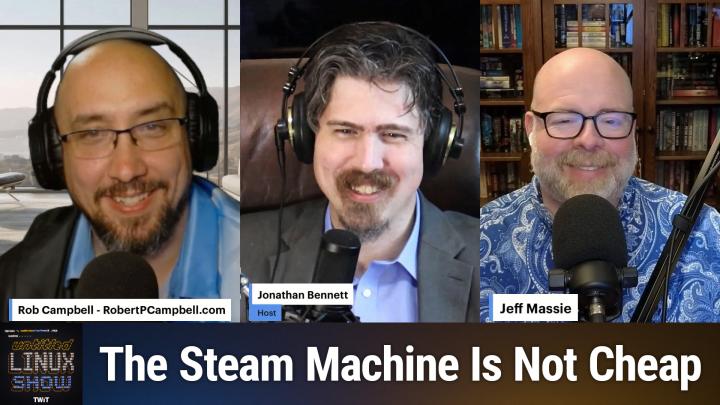
This Week in Tech 1090 Transcript
Please be advised that this transcript is AI-generated and may not be word-for-word. Time codes refer to the approximate times in the ad-free version of the show.
Jonathan Bennett [00:00:00]:
This week we're talking about the Steam machine. We finally have pricing and it's a little expensive, but maybe not terrible. And then the Academy Software foundation is talking about Wayland. A lot of businesses are talking about ACwrites and trying to fix open source software in the age of AI vulnerability disclosure. There's a smart speaker that you might be interested in. There's ups and downs for performance and a couple of really interesting updates for our favorite desktop environments. You don't want to miss it, so stay tuned.
Rob Campbell [00:00:33]:
Podcasts you love from people you Trust.
Jonathan Bennett [00:00:38]:
This is TWiT. This is the Untitled Linux show, episode 261, recorded Saturday, June 27th. I regret my decisions. Hey folks, it is Saturday and that means it's time to geek out about Linux. It's the show about hardware and software, the desktop, the server, all the things that you want to know about Linux. It's the Untitled Linux Show. I'm your host, Jonathan Bennett and today we've got Rob, we've got Jeff. It is the trio the Three Amigos.
Jonathan Bennett [00:01:08]:
We're probably not going down to Mexico to fight the infamous Lo. What's his name? The infamous from the Three Amigos.
Jeff Massie [00:01:18]:
I don't remember, I don't remember.
Jonathan Bennett [00:01:20]:
Guapo. El Guapo, that's it. Probably not heading down to Mexico to fight El Guapo, but we're going to be entertaining all the same. And first off, there was a thing. Several things happened this week, but one of the big ones was that we finally got a little bit of a peek at the Steam machine and there were some big YouTubers that got their hands on one and we got some pricing and there's this thing going on called the AI craze that I think messed with the pricing a little bit. Rob's got the full story. I will stop stealing his lead and let him get to it.
Rob Campbell [00:01:55]:
Yeah, so since Jonathan pretty much covered it all, I'll just end it right there and go on to the next one.
Jonathan Bennett [00:02:01]:
Hopefully you had more than that now.
Rob Campbell [00:02:03]:
So. So we have been waiting for the Valve for Valve's new Steam machines for quite a while now. And I think a lot of us, you know, had a number in our heads. I don't remember if we predicted anything last, you know, January 1st, December whenever we did our production show or not, but I know some of us, at least since them had had some numbers and you know, maybe not cheap, but maybe we're thinking somewhere around 7, $800, as I recall, something more expensive than a console, but still close enough that you could call it a living room gaming box and not feel completely ridiculous. But Valve has finally announced the pricing and pre order details and the short version is, it is real, it is coming. As you know, Jonathan said some people got their hands on some, but it's, it's not exactly cheap. The so the base steam machine with 512 gigabytes of storage starts at $1049 and these are US dollars that I am quoting here. For anyone wondering.
Rob Campbell [00:03:13]:
The two terabyte model jumps to $1,349 and if you bundle in the Steam controller you are looking at $1120 or $1428 depending on the storage option. So if you compare this to a PlayStation or Xbox, which the Xbox I hear just announced a price increase to $800. The price looks a little rough, but that's a Series X Xbox for those wondering. But you know, even with console prices rising, it doesn't really quite fit into that range very nicely. But if you compare against a gaming PC it gets a little more reasonable. Valve is not really selling this like a traditional console. They're selling it more like a compact gaming PC for the living room. And when you look at it that way, the price starts to make a little more sense.
Rob Campbell [00:04:11]:
You're getting a small form factor PC with a semi custom AMD Zen 4 CPU, rDNA 3 graphics, 16 gigs of DDR5 memory, 8 gigs of video memory, NVMe storage, micro SD expansion, Wi Fi 6e, Bluetooth, Ethernet and SteamOS. Could you build a bigger gaming PC for less? Probably. Could you buy a standard gaming desktop around the same price that beats it in raw performance? Yeah, I think you could. But the Steam Machine is more like a console sized game and PC. With the Steam Deck experience moved into the living room. You pay for the small size, the integrated hardware, the control support, the quiet coach gaming experience. You know a lot of those desktops people make aren't that quiet and the fact that it just boots in the steamos instead of drop you into Windows
Jonathan Bennett [00:05:09]:
or something like that.
Rob Campbell [00:05:11]:
And for Linux fans you are paying to support the Valve push to make the gaming experience a first class gaming experience on Linux. The bigger story is that Valve is still pushing linux gaming forward. SteamOS is no longer just for handhelds, it's becoming a full living room platform. Hopefully if this takes off, that price may slow it down a little. But you know, even if Steam Machine itself ends up being a niche product, the idea behind it is is still important. You know no, this, this is not going to be the affordable Gabe cube many of us hope for. But as a compact Lynx gaming PC for Living Room, the price is at least easier to understand, even if still a little hard to love. And I am still hoping to get my hands on one, partly just to throw my support in for Valve and all they've been doing for Linux.
Rob Campbell [00:06:09]:
But if anyone wants to help me, you can donate to the cause and you know, maybe you don't have, don't, don't want to spend the whole thousand plus on a, on a, on one, but you want to support them, you can help support them. Donate to me and I'll chip that towards my Steam machine.
Jonathan Bennett [00:06:30]:
Yeah, I think it's probably the right call. There is that. Think of it as a small gaming machine rather than a powerful console. There's an interesting point. Keith's 512 makes it here that you could buy it and upgrade it. Like this is not a framework. You can't expect to get new motherboards in the future. But if you want to put 64 gigs of RAM and so like particularly this makes sense if you look at the world right now and you go we're in the AI craze, but that bubble is going to pop, things are going to get cheaper.
Jonathan Bennett [00:07:03]:
Well, you can buy the cheapest one and then in six months from now maybe you can afford to put 64 gigs of RAM into it and a bigger solid state drive or what have you. So it is more of a computer than it is a console. It is upgradable, which, that's cool.
Rob Campbell [00:07:21]:
So maybe I got to go for the cheaper model now and just plan to upgrade it later.
Jonathan Bennett [00:07:25]:
Yeah, that's, I mean it's not a terrible idea. You know, you'll eventually be able to
Jeff Massie [00:07:29]:
do it or upgrade it. Now I haven't looked at all the prices, but sometimes it's just cheaper to upgrade it yourself.
Jonathan Bennett [00:07:37]:
Right, that's true. They, they, you know, you figure Valve wants to make a little bit of money on the upgrades too. You know, one, one of their versions might be a loss leader and, and they want to make money on the upgrade. So it might be cheaper to do it yourself maybe. Yep. Yeah, interesting stuff. I, I tell you the thing I'm really most interested in not, not this. I'm waiting for the Steam frame.
Jonathan Bennett [00:08:02]:
I think that's going to be interesting. I think that's going to be the fun one.
Jeff Massie [00:08:07]:
I haven't heard that one.
Jonathan Bennett [00:08:08]:
So that's the VR goggles.
Rob Campbell [00:08:12]:
Were you gone for that?
Jonathan Bennett [00:08:13]:
How did you not Hear about this Jeff, we talked about it.
Jeff Massie [00:08:16]:
I must have been gone.
Jonathan Bennett [00:08:17]:
He must have been out in the desert, right in the ride of the Indian. They made a movie about Jeff, didn't they? Riding an Indian motorcycle out in the desert.
Jeff Massie [00:08:24]:
World's fastest Indian.
Rob Campbell [00:08:26]:
Yeah, we had this on the show last fall sometime that I remember.
Jonathan Bennett [00:08:31]:
But yeah, the Steam Frame, that one is particularly interesting because it is a Snapdragon. It's going to be standalone. So you can run it one of two ways. You can either run it and I think they're talking, they're doing a wireless link. So either way it's going to be sort of standalone, but you can do a wireless link to your desktop to get like the full graphics and full frame and experience. Or for some games, like, you know, you think about your games that are a little less graphically demanding, like maybe a VR chat, that sort of thing. It'll just emulate and run right on the Snapdragon. And so like there's some, there's some pretty, that's going to be pretty interesting, like to UNTETHER youR, your VR experience, go round on your backfield, your backyard with it or what have you.
Rob Campbell [00:09:14]:
Well, for, for reference, like, like the Oculus Quest, you can do the same thing that's already untethered, but you can hook it up to the PC and play Steam games and get a higher end experience. But for Jeff, like some of the things we implied here, the Steam frames, that's on a Snapdragon, it's Linux on a Snapdragon though, which wasn't necessarily implied. So that's going to be some, a VR headset running Linux on a Snapdragon and connected to a Linux Steambox if you want.
Jeff Massie [00:09:55]:
Honestly, I thought Steam Frame was like, oh, framework was going to come out with a dedicated Steam machine. That would, I mean, that too would be cool. That would be really cool. Big collaboration.
Rob Campbell [00:10:06]:
Yeah.
Jonathan Bennett [00:10:07]:
All right, so Jeff, you've got a story here about the Academy Software Foundation. Are we winning Academy Awards or are we talking about Wayland here?
Jeff Massie [00:10:18]:
A little of both. Maybe not winning Academy Awards, but we're involved. Okay, so the Academy Software foundation announced the formation of a new working group to help Wayland adoption for artists. To break this down, let's first start with what the Academy Software foundation is. It's an industry standard nonprofit created by the Academy of Motion Picture Arts and Sciences, you know, the same organization behind the Oscars, hence why we're in the same Venn diagram and the Linux Foundation. So its mission is to support, develop and standardize open source software used throughout the motion picture, animation and VFX industries or special effects. If you've watched a modern animated film or a blockbuster, you know, visual effects sequence, you most certainly benefited from ASWF projects. You know, it's.
Jeff Massie [00:11:14]:
They're kind of everywhere, just not always in the very forefront. Some of the technologies they've had a hand in or open vdb, which is the industry standard for volumetric effects like smoke and clouds open shading language or OSL used in production renders for material and lighting Open Color IO which is a cornerstone of color management and film pipelines and open EXR which is the high dynamic range image format used across studios. They do other things, but that's just kind of an example of what they do. Now we talk a lot about X11 going away and things moving to Wayland, so I won't go into the detail here on why that's happening, but what I will say is that the working group has been created to make the transfer easier. Nick Cannon, Chair of the VES Technology Committee and SVP Production and Technology at Walt Disney Animation Studios, had this to say about Wayland for the Wayland for Artists Working Group. As the Linux desktop is evolving to replace its underlying aging X11 display system with Wayland, the goal of the working group is to explore and understand the impact this shift will have on the professional workstations used by many studios and artists in our industry. Right now our industry doesn't yet understand the full impact of the transition on high end content creation applications, whether open source, commercial or proprietary, as well as high performance remote access solutions. So critical modern on critical modern workflows, this working group will bring together stakeholders from across the community to better understand this evolution and plan the best path forward.
Jeff Massie [00:12:54]:
So the Academy Software foundation further went on to explain the Wayland for Artists Working group will explore the range of industry specific areas that may be impacted, including graphics, tablet support, window management, input focus, key bindings, desktop customizations, remote access solutions, GPU acceleration, color management, high dynamic range displays and compatibility with commercial, open source and in house applications. Applications or in simple terms, its mission is to ensure that Wayland fully supports the needs of professional animation, digital art and special effects workflows. Now keep in mind that a lot of the high end and professional software, it moves a little slower. So you know, a lot of it hasn't made the jump to Wayland right away. In high end production environments, people are not swapping out kernels as the latest one comes out. You know, think of enterprise like server software so take a look at the article in the Show Notes. It also has a link to the ASWF announcement and from there you can discover a lot more details about the foundation.
Jonathan Bennett [00:14:00]:
Yeah, this is cool. We've looked at them. I've looked at them before. I thought about trying to invite somebody from there to floss weekly to talk about this kind of thing. What I didn't realize is that apparently I knew things like Blender were used pretty widely in the, you know, the motion effects industry. I didn't realize that Sony people were running Linux underneath, but apparently that's fairly popular.
Jeff Massie [00:14:22]:
Yeah. And I didn't realize when I was doing the story all the, the standards and stuff that, you know, we might not know about, but it's, it's like standard at studio level, professional level.
Rob Campbell [00:14:33]:
I didn't realize, you know, that they cared what was underneath. I thought they just, you know, used it and just, I don't know, went out of their day.
Jonathan Bennett [00:14:41]:
No, I mean you, you got to think about it though. They, they need either really accurate or at least really standardized color grading so that every time they look at a monitor they're looking at the same colors. You want to make sure that your workflow works the same way in every place. I think color grading is probably the biggest thing that they would really.
Rob Campbell [00:15:01]:
Right. I knew they wanted that stuff. Just did not really associate that. Associate it with Linux and Wayland and X and it's like, you know, just run whatever display server is there. I don't know what's the display server. I'm just dealing with my colors. My color work good.
Jonathan Bennett [00:15:18]:
Very, very dependent upon your display server.
Rob Campbell [00:15:21]:
Very dependent on it. But no one knowing that if it's,
Jonathan Bennett [00:15:27]:
I mean, if it's broke, people pay attention. Or if it changes, all it has to do is change and people notice.
Jeff Massie [00:15:33]:
Yeah, you know, a lot of this it could, could have naturally went to Linux because back in the day, you know, like companies like Silicon Graphics, you know, which was Unix heavy into the studios and graphical industry.
Jonathan Bennett [00:15:50]:
Absolutely.
Jeff Massie [00:15:51]:
So a lot of that, hey, we're going to run Linux. Hey, Studio saves money because it's free. It's pretty close to the same operating. It's in the same area.
Jonathan Bennett [00:16:03]:
Same family. Yeah, in the same family as a Unix. Yeah.
Rob Campbell [00:16:06]:
Every Unix like.
Jonathan Bennett [00:16:08]:
Absolutely. All right, we have more to come, but first we are going to take a quick break and then we've got some security stuff coming up after this. So this week we've got the announcement of Ackwrights. It is the new working group from the Linux foundation. But you also have Amazon and anthropic and OpenAI and Nvidia and Microsoft and Red Hat, IBM, Google, Ericsson, JP Morgan Chase. Just about everybody is interested in this. The Rust foundation is in there. Goodness.
Jonathan Bennett [00:16:49]:
So many different backers on this. It is pretty incredible. And this is essentially a working group, a project to deal with AI bug reports, to put it simply, to put it in a single point. That is what they are looking to do. The statement says that they are establishing a shared security incident response team and a single standardized, coordinated vulnerability disclosure process built on confidentiality first principles and industry standard tooling. And so that kind of reads like this is going to be another sort of like a bug bounty or bug reporting platform. But the really interesting thing here is that, well, they talk about confidentiality and they want bug fixes to flow back into the project's original homes. But, and here's the one that caught my eye, I think this is real fascinating.
Jonathan Bennett [00:17:40]:
Where a critical package has no active maintainer, ACwrites will serve as a maintainer of last resort. So fixes to the latest version reach everyone in a timely fashion. The initiative will also coordinate with government efforts, so public and private defenders move together. And that's real fascinating because we've talked about this. There's the famous XKCD cartoon of all of the modern infrastructure stacked on top of each other. And then you've got the one little pillar holding everything up, and that's one guy in Kansas, which for a few projects it's literally the case, right? And then the question happened, the question comes like, what happens when that one guy in Kansas is no longer maintaining it or is unavailable for something. And you know, there's been a few, few times where either you have to fork something or someone else steps in. And this is as far as I can remember, this is the first time that we've sort of formally stepped into this, where there is now a group that says if one of these things is important, there's no maintainer, we will step in and essentially fork it, is what they're saying.
Jonathan Bennett [00:18:48]:
Like if they've got access to the infrastructure, maybe they'll just take it over direct or fork it. And then they kind of have this agreement that the rest of the software world will use these releases, which, you know, I mean, it's sort of on one hand, this is a very powerful thing that they're looking to do. And I kind of have the wise words of Uncle Ben going through my mind. Where there's great power, there's also great Responsibility, but also like this is kind of a needed thing. I'm surprised that this. Thinking about it, I'm surprised that we haven't formally done this yet. We say if an open source project is not being maintained and people are using it, here's the process to step in and get patches out. Yeah, it's real interesting and a lot of different groups coming together on this one to get an incident response team.
Jonathan Bennett [00:19:40]:
So we'll have to watch and see. I'm sure at some point they'll release some information about how this goes in the real world, some actual incidents that they've responded to and we'll have to see how that goes. But it's, it's pretty fascinating to me like, so it's a probably a needed step, I think for open source as a whole.
Rob Campbell [00:20:01]:
Yeah, they could have jumped in and take all those abandoned AUR packages.
Jonathan Bennett [00:20:07]:
I don't know that the AUR packages were critical infrastructure, but that is, that is sort of a valid example of like the style of thing that this. Apparently this group is looking to do.
Rob Campbell [00:20:18]:
You know what else Uncle Ben does?
Jonathan Bennett [00:20:20]:
Well, makes rice.
Rob Campbell [00:20:22]:
Rice
Jonathan Bennett [00:20:26]:
indeed. Yeah, but I mean you think about it and you've got different groups, different open source projects that are struggling under just the load of AI vulnerability disclosures. For example, you've got Curl and Daniel Stenberg came out this week or last week and said that they're going to take a summer of bliss. The Curl developers, they're going to take a summer off, a month off and essentially they're going to say you can send a security bug reports, we're going to be at the beach. Sorry, if you pay, then we'll, we'll take a look at your bug reports. But if you're not a paying customer, we're at the beach. We'll get to you next month and we'll see how that goes.
Rob Campbell [00:21:09]:
But yeah, but I, I think this, this does sound like a good thing. In fact, I think it kind of really aligns with something I've said in previous, previous episodes that the Linux community needs to figure out how to work with these bug reports rather than fighting against them.
Jonathan Bennett [00:21:26]:
Yeah, well, so, yes, I don't think the problem is that people want to fight against them. The problem is that we're coming to the point where there's just so many, many of them. It's just overwhelming and.
Rob Campbell [00:21:40]:
Right. I'm not saying they wanted to, but I said you got to find a solution, which is what this is hopefully aiming to do.
Jonathan Bennett [00:21:48]:
Right, right. Well, I mean you either have to hire more developers, like pay people to do the maintenance work or you do something like start automating the response, using AI to automate bug fixes, which like, understandably so people are hesitant to do and people hate the idea or some of us do, at least to some extent. I mean, I don't want to let, I like using Claude to write code. I do not want Claude to write code without any, without a human watching it.
Jeff Massie [00:22:17]:
Like.
Rob Campbell [00:22:18]:
Yeah, I mean maybe it doesn't need to, you know, accept and review and patch the request, but maybe what it can do is analyze them, review them, filter out what needs to be brought to a person. What just needs to, you know, get discarded.
Jonathan Bennett [00:22:35]:
Yeah, kind of that, that first level of triage. Although apparently that's what Microsoft was doing and they, they ended up taking off a developer and that didn't go so well for them. So yeah, you know, there's pros and cons.
Jeff Massie [00:22:48]:
Yeah. But if you can screw it up, they'll find a way.
Jonathan Bennett [00:22:51]:
No, that's true. Yeah, that's Murphy's Law. Absolutely. There's a way to mess it up. Somebody will.
Jeff Massie [00:22:59]:
And I, I just one little thing to add is I think sometimes even these dumb little programs that people use and you just think, oh, it's just a simple little thing. It just, it can wind up being a lot of work and a lot of support for just a little thing. And usually people aren't grateful, they're just fix this garbage. I need this now, you know, do all the work for me.
Jonathan Bennett [00:23:24]:
Yeah. And you've got things like the Cyber Security Resilience act in Europe that sort of leads to that too because now companies are going to use some of these software packages. Like you suddenly have to have a bill of material, software bill of materials and you have to have all these assurance, assurances about the underlying software. And so in some cases they're going to open source maintainers and they're like, we need this to be able to keep using your software. And a lot of these open source maintainers, like, we're just doing it for free, for fun in our spare time. We're not going to be able to do that. And so I've said several times on several different shows that open source projects need to get used to, they need to get comfortable with. We will be glad to do that for you.
Jonathan Bennett [00:24:03]:
Here is our fee. And if open source is going to become a more sustainable thing, then yeah, there's got to be some money change hands because even open source developers have mortgages to pay and got to buy groceries. So anyway, let's move on and let's talk about the speaker, the smart speaker from Pine Rob what is the Pine 64 speaker?
Rob Campbell [00:24:33]:
So Pine 64 is getting into the smart speaker space, but thankfully not in the quote, let's put another cloud microphone in your house because Jonathan definitely doesn't want that. Actually most of these many many of us in this community don't. Yeah, I'm kind of agnostic, whatever, but this is not that kind of speaker. Anyway, so their their new device is called the Pine Voice and It is a $49 smart speaker designed around Home Assistant instead of Alexa or Google Assistant. And that's where it gets kind of cool for privacy focused Linux users, because this is not trying to be another Amazon Echo clone. It's not really meant to be a full general purpose speaker either. Pine64 describes it more like a voice satellite for Home assistant. In other words, it is the thing sitting in the room listening for a wake word, capturing your voice and passing it along to home assistant.
Rob Campbell [00:25:40]:
And as a pretty big home assistant fan and user myself, this one immediately has my attention. I AM probably about 99% sure I am going to get one of these because this is exactly the kind of smart home device I want to see more of. So the hardware is very Pine 64 ish. It is a budget friendly, developer friendly and maybe just a little bit weird in in the best way possible. Inside it comes with a Buffalo lab that's a BL606P RISC V chip with a 480Mhz 64bit T head C C906 core plus two smaller companion cores. It has 32 megabytes of PS RAM, 16 megabytes of flash storage, WI fi, Bluetooth, a dual microphone array, a built in speaker, physical volume buttons, and most importantly a hardware microphone switch. Not the highest specs if you're going to run a whole desktop on it, but for this I'm sure it's fine. The last part is worth calling out the muted switch part, because when you're talking about a device whose entire job is to sit in your house and listen, a real hardware mute switch is something privacy focused Linux users can appreciate.
Rob Campbell [00:27:10]:
The wake word detection runs locally using Microwake Word currently with a hey Jarvis model from Esphome and then it talks back to Home Assistant using the Wyoming protocol, which is what Home Assistant uses for their voice satellite devices. Now there are some caveats. Pine 64 is being pretty upfront that this is still early stage hardware and software Wake word detection may not be perfect and this is probably not the kind of device you buy for somebody who just wants to plug it in and never think about it again. It's probably going to take a little tinker and you're going to have to connect to the home assistant, whatever that's going to consist of. But for home assistant crowd we're used to tinkering like myself, that may be just fine, kind of what we're used to and maybe it's even part of the appeal. This is for people who want local control, nothing in the cloud, open firmware, self hosted automation and a smart home that does not depend on Amazon, Google or Apple deciding what features you get next year. The smart home market has been dominated by these big cloud platforms and Alpine Voice is a small reminder that it does not have to be that way. It is cheap, it's hackable, it's risk five, all things we like so far and it's built for home assistant.
Rob Campbell [00:28:41]:
That may not make it the best smart home speaker for everyone, but for people like me who are already deep into home assistant, this is exactly the kind of device I'm going to waste some money on this year.
Jonathan Bennett [00:28:58]:
I've done a little bit of poking around on this already and Pine is using Codeberg to host their source code for this and as of 33 minutes ago, Codeberg was completely down. So, you know, your, your mileage may vary. It's a cool looking little device. I am humored that they're using the Buffalo Labs chips. That is a quirky little mcu. I do know that one or two of the people that work with Pine really like the Buffalo devices, so I'm not terribly surprised to hear that. Um, I, I do have, I do have sort of questions about what the software support is going to look like for the long term because this is, this is something that Pine has done before is, you know, they, they make things, they make really cool hardware and then they just sort of. Well, I want, I want to say this carefully and charitably.
Jonathan Bennett [00:29:57]:
Not always does a community form around the hardware and create software for it in the way that one might hope, let's put it that way. Well, I've heard that said even less charitably than that. I will be a little bit more careful here on the show.
Rob Campbell [00:30:14]:
I feel like the requirements for this are probably somewhat minimal. I mean you have to, as long as you can update the OS and the drivers, keep working for the hardware on there, the rest kind of just works with what's already in Home Assistant. Home Assistant's a very strong project. I think the functionality, the real functionality behind is going to be what you do in Home Assistant, I think.
Jeff Massie [00:30:41]:
Yeah.
Jonathan Bennett [00:30:41]:
So that's. That the operating system is essentially what I'm talking about. And probably the trickiest thing there is going to be the Wake Word. Getting it to, to really reliably understand that Wake word and wake up when it's supposed to. And then, I mean, all the other stuff like programming MCUs is not trivial there. There's lots of pitfalls to fall into.
Rob Campbell [00:31:04]:
And that Wake Word isn't their own software either, though. That's, you know, stuff that's.
Jonathan Bennett [00:31:08]:
Well, I mean, it's implementing a library inside of their own os.
Rob Campbell [00:31:12]:
Sure.
Jonathan Bennett [00:31:13]:
So, you know, this is, this is not necessarily a trivial thing to do. I mean, I understand that we live in a world now where you could just say, hey Claude, please write for me an operating system that runs on this MCU that gives me. Uses Microwake Word. And it will probably do it. It's just, you know, there's got to be a human there at some point to answer the bug requests and fix things when they're broken.
Jeff Massie [00:31:38]:
Well, and how many times have you been sitting around and I, I know everybody's at least experienced it once, where somebody's like, oh, yeah, so when you're making chocolate chip cookies, make sure you cream the butter. And then your phone assistant or whatever starts going, oh, hello, what am I? It's like we didn't.
Jonathan Bennett [00:31:53]:
Did you want to search for creamed butter? No, no, it just goes, hello?
Jeff Massie [00:31:58]:
Yeah, it's like I didn't say anything near your, your activation voice and something triggered.
Rob Campbell [00:32:06]:
Yeah, well, I think, I think a lot of that's just soft for me. Like you can, you can make one of these yourself, essentially. So as long as, as long as, you know, future distros keep working, I think the rest of it, somebody can, can go on there and keep working.
Jonathan Bennett [00:32:23]:
Yeah. To be clear though, that this Buffalo Chip, you're not running Linux on it. It's not a Linux distro that you're putting on here? Oh, I don't think so. We're way down in MCU territory. What we're talking about on the specs
Rob Campbell [00:32:37]:
on this thing, I suppose at that small. It's got a,
Jonathan Bennett [00:32:43]:
it's got 32 megs of PSRAM, 788k of SRAM, it has 788k of RAM on it. You know, you're not running the Linux kernel. You're running some kind of Little real time operating system, like maybe Zephyr or maybe just, you know, bare metal, like Arduino style stuff, which, I mean that's not a problem. That's not the worst thing. I do a lot of programming on that kind of stuff. I'm what's now my day job. But like just understand you're not running the full Linux kernel on this. That's not what it is.
Rob Campbell [00:33:18]:
So anyway, yeah, that, that, that does change. That makes it interesting since a lot of the things they do is Linux. But I guess their little watch wasn't either.
Jonathan Bennett [00:33:28]:
Indeed. Yeah, the Pine Time wasn't. The Pinetime was cool. I always liked it. I, I, I have it around here somewhere. I've not worn it for a while, but you kind of had the same problem there. Like the software support, while it was cool, what it would do, it just never quite got to the point to where it was really good. Like there was always a few things that you wanted it to do that it was missing.
Jeff Massie [00:33:49]:
So just to be clear, you're still interested, Rob?
Rob Campbell [00:33:52]:
Well, I mean you're making me think.
Jonathan Bennett [00:33:54]:
But on the other side of it, I will say it's only 49.99.
Rob Campbell [00:33:58]:
Yeah. And a huge part of the functionality is still going to be in Home Assistant. So as long as that could keep talking and it doesn't get some vulnerability, I guess, and it's still on my network, I can isolate it or something.
Jonathan Bennett [00:34:10]:
Yeah, absolutely. I think it's interesting. All right, we are going to talk performance next, but before we do that, we are going to perform a little break in the show here and we'll be right back after this.
Jeff Massie [00:34:22]:
I have two stories about hardware improvements and while they're interesting, I think they're even more interesting together. So my first story is how Linux cache Aware scheduling has had a large improvement in things like MySQL and Hackbench. Why did this happen? Cache Aware scheduling tries to make sure that all the tasks are run on the same LLC or last level cache. Now if it isn't, then there's a miss because it needs to pull data from somewhere else and that somewhere else will have more latency built in because of the extra steps to get the data to where it needs to be. You know, whether that's another cache ram, a disk, wherever, it's going to take longer and it's going to slow things down. Now what this series of patches does is to take even more topology of the hardware to make the cache aware go beyond just the last level cache. So what if the Workload needs more cores and not all the cores can be on the same last level Cache or the size of the workload changes dynamically. Now the cache aware scheduling can better handle that.
Jeff Massie [00:35:31]:
Now the headline does say when you look at the article in the show notes, 360% improvement. That's cherry picked number. And most of the results are not that big. But it is for MySQL using 64 threads and only 64 threads. Though you know there are other big improvements. The very smallest improvement when using 256 Threads was only 6% improvement. And I know only 6%. It's still big when you're running heavy workloads and when you're looking at little fine tuning improvements, a lot of times we're talking, you know, 1% or half a percent, 6% for the lowest.
Jeff Massie [00:36:10]:
That's, that's still pretty good. There was a lot of them that were in the high teens. We had some at like 136%, you know, and it was all based on the number of threads. It really mattered how many threads you were using at the time. And if you're wondering this is going to show up in the 7.2 kernel when it comes out. The second story is about the GCC compiler getting a 12% improvement. For modern intel and AMD CPUs how did they make this improvement? And it's only in one line. By changing the weight of a branch prediction miss, they increase the miss by 3.
Jeff Massie [00:36:47]:
3 the rating in GCC by 3. And that gave a 12% improvement because the compiler took a missed possibility much more seriously. Now modern CPUs they have a much deeper pipeline of instructions, which means if a branch prediction is wrong, then all those instructions which were evaluated no longer are valid and the state of the code goes back to the branch and the pipeline needs filled with the proper branch instructions. The longer the pipeline, the bigger the time hit. What GCC does with this miss weight is determine how it handles a code. It becomes more conservative about keeping the branches and instead of doing things like just tuning branch, it does things like instead it, it turns branch code into branchless code. And there's other things it can do too. There's other mitigations it can do to get rid of the branch or mitigate some of the misses in a branch prediction.
Jeff Massie [00:37:54]:
Now I do want to say this is only going to happen for the normal X8664 compiling and it's not when you build natively against a specific CPU. So if you're running just the basic x86,64 instructions. That's where this is going to kick up. Now why did I bring up these two stories? The optimization, you know, of the hardware, you know, like the kernel, gcc, you know, the Linux sphere, you know, it's really now getting into the specifics of the hardware and architecture of the system to explain extract the most out of the hardware, you know. To me it shows a very mature ecosystem and it shows that performance out of the hardware is getting very specific. You know, in, in both cases the architecture tuning is where the performance came from and looking at bigger and bigger chunks of that architecture to get more out of it. So instead of just saying, oh, let's just keep all this on the same cores, let's keep expanding that view so we can optimize every level of the architecture. Take a look at both articles linked in the show notes for full details and further links to the pull requests and the merge requests and all the good stuff.
Jeff Massie [00:39:16]:
And for those wondering, the GCC update will be out in next year's GCC17 stable release. So that one's a little further out, but happy benchmarking.
Jonathan Bennett [00:39:29]:
Yeah. Ironically, I had two stories as well that I was going to talk about and one of them was that one line change. It was just a tuning tweak. Let's correct all of this by 3 and makes quite the difference. The other one that I've been following when it comes to performance is the new Raspberry PI kernel. This one was sort of a mixed bag. Raspberry PI OS was went to Linux 6.18 LTS and as you flip through, I've got the link to Michael's article on it as you flip through like there's multiple times that he makes the statement like it came in as a surprise that there were slowdowns observed and it came as a surprise that this did not do. There were about half of these that there was actual slowdowns, performance regressions found.
Jonathan Bennett [00:40:18]:
And what I found really interesting if you actually click through. I don't always recommend this, but in this case it's interesting. Click through to the comments. There is someone there that has a link off to a GitHub issue because Raspberry PI has a GitHub organization and that's where people can open bug reports and they're generally really responsive there. By the way, I've reported things, gotten them fixed and so there's a bug report there where someone has predicted that this slowdown was going to be a problem. And the guys from Raspberry PI have done the tests and like, you know, multiple times done benchmarking and it's, you know, it's basically been, it works on my machine. And so there's been some back and forth as to like why exactly things are, are slower in some cases. On 6.18.
Jonathan Bennett [00:41:11]:
One of the obvious possibilities here is more mitigations because we've had more hardware problems found and so you have security mitigations against it, but apparently you could turn the mitigations off and you still see some of these slowdowns. The going theory right now is that it is, as we just talked about, scheduling is a big deal. So apparently the scheduler has changed in the ARM world and that affects some things on the Raspberry PI as well. So something to keep an eye on there to try to figure out what's going to happen next. Will these get fixed or is this just going to be sort of the way the PI performs with these few quirks? I mean, it's not like a huge loss of performance, but for certain workloads it is really a problem, particularly with the Raspberry PI. You're talking about things like because it's got i2C ports and spy ports GPIO on it, certain things that you would do, you may run into real problems if your scheduler changes and, you know, suddenly you can't support, you know, a 40 MHz spy bus because your GPUs or your CPU is not running fast enough. It can't wake up fast enough to talk. And you do run into some bits of oddness like that.
Jonathan Bennett [00:42:24]:
So that's the performance side of it. And then we had a real interesting question that we've talked about a little bit, but not for a couple of weeks. A real interesting question from the chat room. And I'll go ahead and bring the other guys in and then we'll show the question. And it's lavabing asks any conversation yet around the news of the supposed HDMI 2.1 support. And this is something that I think we talked about a couple of weeks ago, but it's worth touching base on again. Something happened, something changed, and the AMD guys are pushing out HDMI 2.1. And in fact it's in the pull Request for kernel 7.2, which is the merge window is open there.
Jonathan Bennett [00:43:08]:
And so I think that's landed. Once you get kernel 7.2 and then the surrounding bits that go with that, HDMI 2.1 is supposed to start working, that's going to be like Fedora 45 Ubuntu 2610 sort of the releases towards the end of this year. All the pieces are not quite there yet. I will keep an eye on this though, and I'll try to watch it because I am currently running. In fact, I was messing around with my desktop earlier today and I killed my screen for a little bit because I am running a DisplayPort HDMI adapter just to get the essential HDMI 2.1 capabilities to my monitor. The ability to actually do variable refresh rate and 120Hz and 4K display without doing like Chroma subsampling, which just looks terrible in some cases. This was the only way to do it until the AMD stuff lands. So I am also very, very much looking forward to that.
Jonathan Bennett [00:44:11]:
I think it's going to be a much nicer setup for my system at least to be able to just plug HDMI directly in without having to mess with the dongle. It's a little flaky sometimes. Still coming. Coming soon.
Jeff Massie [00:44:23]:
And I believe you mentioned before that your display does not have DisplayPort. So you.
Jonathan Bennett [00:44:28]:
That's why HDMI is the only game in town for me. Yes.
Rob Campbell [00:44:31]:
Yeah.
Jonathan Bennett [00:44:32]:
Because otherwise, yeah, I would just throw a DisplayPort. Like I think DisplayPort is probably the better solution overall. I just don't have a DisplayPort on that because it's a TV. It's actually an LG TV that I'm using as a. As a monitor, which has worked great. It's beautiful. Just as HDMI only. So there is that.
Jeff Massie [00:44:51]:
And isn't it off by default right now? You can. The HDMI 2.1. You have to. If you load.
Jonathan Bennett [00:45:01]:
It's not. It's not landed upstream yet, so I don't. I don't even know.
Rob Campbell [00:45:05]:
Oh, okay.
Jonathan Bennett [00:45:06]:
How that's going to. Whether it's going to be turned on or not. But like it's not. It's not even fully landed yet. It's still just in the. It's in the merge tree kernel next. Yeah, so they think it's going to land at 7.2, but you're kind of reading the tea leaves there. I'll see if I can find the link that I was looking at and if I could find it.
Jonathan Bennett [00:45:29]:
I'll get that. Here we go. I'll get that dropped into. Into the show notes as well. All right. We are going to take a quick break and then when we come back we're going to talk about browsers and yeah, that'll be fun, right? If this
Rob Campbell [00:45:48]:
on Linux, we're pretty much used to Fending for ourselves. Windows usually gets the best supported versions of an app and you know, we got to figure it out. You know, it gets, it gets the big commercial release and you know, we get this, whatever's left, the installer that works the way the company intended, you know, and then on Linux, you know, we either get ignored, get the community version or we get to spend a Saturday afternoon figuring out how to make it work and that, you know, that that's not always the case, but it's common enough that we know the routine so it's kind of fun when the situation is flipped around. Brave, the web browser Brave has launched something called Brave Origin. And this time Linux users are the ones getting the better deal. Brave Origin is basically a cleaner stripped down version of the Brave browser. It removes a lot of the extra stuff some people do not want in their browser, like the AI assistant. Brave rewards the crypto wallet and VPN features, but keeps the part Brave is probably best known for.
Rob Campbell [00:47:03]:
And that's built in ad and tracking, blocking. So you know, which is even more critical with I believe the, I believe Chrome. I didn't do a new any read on this, but I believe Chrome is like finally updating their extensions now. So like u block Origin won't even work. I believe I saw something about that. But anyway onto Brave. So this, you know, with all these things moved out, removed, it's not Brave light in the sense of being less secure, less maintained. It's more like Brave without the things that make some users turn away and find something else.
Rob Campbell [00:47:43]:
Especially you know, the typical privacy focused and minimalist minimalist fans that many Linux users are. And here's the fun part. Brave origin cost $59.99. That's US dollars for, for those wondered it costs that on Windows and Mac os, but Linux users get it for free. And that's not something we get to say every day. It kind of reminds me a little bit of Ardor. You know, Ardor is free and open source and on Linux a lot of users can just install it straight from their distros repo. But on Windows, you know, if you want the official ready to run build, you're you're generally going to pay for the download anyway.
Rob Campbell [00:48:33]:
It's not exactly the same situation, but it's another one of those rare cases where being on Linux is not the compromise, it is the advantage. Now anyway, Brave does have a reason for doing this. Some Linux distributions already offered Brave builds with certain features disabled. So making Origin free on Linux gives Brave a more consistent experience. Across Linux world. And to be fair, Windows and Mac users can still disable or hide many of the unwanted features in regular brave without paying. But we all know the average Windows user isn't typically smart enough to figure out how to do that. Still, the optics here of having it free for us looks good for once.
Rob Campbell [00:49:23]:
Linux users are not the afterthought. We are not waiting around for a port or using the almost good enough version. We're getting the best version available to us. Linux users get the cleaner paid version of, of the browser for free. And I think we can all appreciate that when Linux gets the best deal. Sorry Windows users.
Jonathan Bennett [00:49:48]:
I mean there's a lot of things out there that you can either only run on Linux or you can only run on Windows with pain and suffering. Goodness. You want decent command line tools. Have fun with doing an emphasis 2 install on Windows. You want a web browser or excuse me, a web host, a server server side. You want to run Apache or NGINX on Windows. I mean, good luck. There's a reason that Microsoft went out of their way and built WSL2.
Rob Campbell [00:50:18]:
Well now core utils are coming.
Jonathan Bennett [00:50:21]:
Yeah. But it's been a lot of work to make it happen. We've had all of that good stuff on Linux just natively for forever.
Rob Campbell [00:50:27]:
Yeah. And I guess really this is more related to pretty much the desktop apps, the desktop user world. When it comes to anything deeper than that. Yeah, we got it all. That's why we rule the server world. For sure.
Jonathan Bennett [00:50:43]:
It's true. Or maybe it's the other way around. We have all the toys because we get used in the server world.
Jeff Massie [00:50:49]:
Well, and Microsoft had a, it might be about seven years ago now, eight years ago when they decided, well, we're gonna, we're gonna run NT and we're gonna use that. We're gonna compete against Unix and Linux and yeah, it didn't go well at all. They basically had, they had to fall back to.
Jonathan Bennett [00:51:09]:
Yeah, it was, it was, it was difficult. It was a challenge. I've heard, I've heard horror stories about trying to run things. Somebody was telling me just the other day that Microsoft built a, that stripped down version of windows that was 64 bit only. No, no, no, no. It was like it was a server side thing that didn't have a GUI and it was 64 bit core. Server core. That's what it was.
Jonathan Bennett [00:51:36]:
And he's like, so many people thought it was the greatest thing until they tried to port their software to it and realized that they had a 15 year old, 32 bit dependency in there that they didn't know about. It's like everything just blew up when you tried to run it on.
Rob Campbell [00:51:49]:
I didn't realize it's 64 bit only. But I had played with that before and well, I tried to play with it. I don't know Powershell that well.
Jonathan Bennett [00:51:59]:
Yeah, Microsoft has tried this a couple of times now where it's like let's do the Linux thing in Windows and man, Windows is just not architected to
Rob Campbell [00:52:06]:
be able to do it. I think it'd be great. I think that would, that would drastically improve Windows for the server world. But they need to have the command line stuff there. You know, maybe coreutils. That's a good step. I mean it is, that's what they're doing.
Jonathan Bennett [00:52:19]:
Core Utils is a great step for Microsoft.
Jeff Massie [00:52:22]:
Microsoft just needs to go the Mac OS route and just go, okay, you know what, we're adopting Linux. We'll just put our own little GUI on top of it and just call it a day.
Rob Campbell [00:52:30]:
I agree, but if they don't do that, you know, Windows Core with Core utils and WSL just like built into like command line, no gui, that's kind of cool.
Jonathan Bennett [00:52:43]:
I will say either of those ideas are much less impossible now than they used to be. They used to be unthinkable and now it's like probably not.
Rob Campbell [00:52:53]:
Well, you know, now Microsoft loves Linux before they thought was a cancer.
Jonathan Bennett [00:52:59]:
Yeah, well that's definitely an upgrade.
Jeff Massie [00:53:01]:
Yeah, now they probably run more Linux than they do Windows because it's on all their, you know, it's run Azure.
Jonathan Bennett [00:53:07]:
Yeah, absolutely. Linux makes them a lot of money these days and not just from patent agreements.
Jeff Massie [00:53:14]:
If they just port office 360 over or office 365 over.
Jonathan Bennett [00:53:20]:
There you go, that's the one that's missing. All right, Jeff, let's talk about, let's get out of the Linux or out of the Windows world back to Linux. Let's talk KDE and the Plasma system monitor. What is new there?
Jeff Massie [00:53:34]:
Yeah, I'm not going full Rob. I'm in the Linux world here. So you know, we talk a lot about KDE and the upgrades and changes that seem to be coming out all the time. You know, just last week we talked about new version of Plasma. This story though I thought I would be nice to highlight some of the customization that could be done. And I'm going to use the system monitor as an example. Now all the applications can't be customized this much but if you have something you use and you don't think it's the best layout or style or the information displayed is quite right. It's worth taking a look to see if you can change it.
Jeff Massie [00:54:08]:
There are a lot that you can have quite a bit of configuration on if you so desire. So the KDE Plasma system monitor is like it sounds. It just gives information on your system, how much your CPU or memory is being used, you know what's the network use overall or per application, is the GPU being loaded or you know, a ton of other information just like you would expect from a system System monitor. Now to begin, it's helpful to understand how the system monitor organizes organizes information. The interface is built using a layered structure. At the highest level are rows. Within those rows are columns, and within the columns are sections. Each section contains widgets, which are the individual components that display the system information.
Jeff Massie [00:54:57]:
When you enter Edit mode, hovering over different parts of the layout reveals which layer you're interacting with. This structure matters because each layer offers different configuration options. For example, selecting a column allows you to add additional or selecting a column allows you to add additional columns, while selecting a section allows you to add or rearrange widgets within that section. When you first open the application, it also has four default pages, but you can add pages of your own and you know, basically you're starting with a completely blank canvas if you so desire. The article linked in the Show Notes talks about and shows how to convert the default widgets into a horizontal bar that shows the CPU load for each, each and every core. And you know, KDE exposes a wide range of sensors including CPU usage, temperature, disk activity, GPU load, memory consumption, and network throughput. You know, selecting the appropriate sensors is the key to building a meaningful dashboard. If you have an active sensor, you can use it and display the information, both instant and historical type on a display.
Jeff Massie [00:56:06]:
Another example is a pie chart and this this is in the article that is used for available ram. Another example involves adding a color grid widget to represent additional system metrics. After, you know, say you're playing around after the layout's complete, you can save your custom page and have it load automatically in future sessions. And you can also designate a custom page as your default startup page. And if you decide later you no longer need a page, you can delete it or simply hide it from the page list if you think maybe you want it in the future. Or you know, you can just hide it for a while. There's also community created pages. Users have shared many custom dashboards, and those can be browsed and installed directly from within the System Monitor.
Jeff Massie [00:56:58]:
While it's always wise to exercise caution when installing community content, these pages can, if nothing else, even serve as an excellent starting point or sources of inspiration for your own design. And finally, you get that page exactly how you want it. You got that customization done and you work across four machines and you're thinking, now I got to do it all over again on each machine I use. Well, the System Monitor has the ability to export and import pages. So you have that perfect page or multiple pages, whatever it is, you can send it across to multiple machines and then you can load it into each and every one. So you just design your dashboard once, export it as a file, whatever system you want it on, then you just import it and it matches across all the machines. Take a look at the article linked in the show notes for a lot more step by step instructions. There's a lot of pictures and diagrams in there as well.
Jeff Massie [00:57:56]:
So when they're leading you through the instructions, it's, you know, click here, see this? You know, and lots of arrows and boxes and where to click and drag and pull and makes it makes it really simple to follow along. The capability and power of the System Monitor, you know, goes well beyond what first appearances would show. So have a look and play around and don't be afraid to experiment. Happy monitoring.
Rob Campbell [00:58:20]:
I was a little worried before you mentioned there were pictures. I feel much better now.
Jonathan Bennett [00:58:25]:
Yeah, yeah, lots of, lots of fun stuff happening in, in KDE and yeah,
Jeff Massie [00:58:33]:
really, I've played with, I've played with that before. It's pretty cool. All the stuff you can do with System Monitor and you know, some things it's like, oh, I want to see the usage of all my cores. Well, sometimes, you know, if you play around and put too much and you're like, whoa, I've got a eye chart going on here.
Jonathan Bennett [00:58:48]:
I regret, regret my decisions.
Rob Campbell [00:58:50]:
High Week one Wet yes.
Jonathan Bennett [00:58:54]:
All right, there is another desktop that's got a new shiny system monitor. And more than just that, Cosmic has released Epoch 1.1. It's their six month update to the Cosmic 1.0. And it's a lot of bug fixes and various little things, little tweaks, but one of the big ones is the new Cosmic system monitor. And it also is really pretty snazzy looking. It really looks pretty nice and it's got all the stuff on it that you would want. You can monitor your disk usage, your processes, your CPU usage, your RAM usage, all the things that you would want to be able to watch it's got applications versus processes. It sort of feels like the Windows System Monitor, but of course, with that nice Cosmic spin on it.
Jonathan Bennett [00:59:52]:
And then the full epoch 1.1 has, like I said, some bug fixes. It's got a particularly useful fix for a RAM leak. But the other big thing that they're doing there is instead of just making it 1.1, it's Cosmic Epoch 1 1.0, which I think means that they're going to try to start shipping some smaller releases more. More often, rather than just waiting and doing it once every six months or once a year or something like that. But, you know, it's. It's just. It's good seeing the. The Cosmic system coming together and getting a little bit more mature, a little bit more ready for business.
Jonathan Bennett [01:00:28]:
And, you know, all of the. All of the things coming, including the system monitor, it kind of makes me want to run Cosmic someplace again. I've not done that. Did I ever. I don't remember if I ever ran that on one of my main machines. I ran it on a virtual machine for a while. Rob, you ran Cosmic for a little while, didn't you?
Rob Campbell [01:00:45]:
Yeah, I like it.
Jonathan Bennett [01:00:47]:
Do you still run Cosmic?
Rob Campbell [01:00:48]:
Yeah.
Jonathan Bennett [01:00:50]:
Have you gotten the 1.1 update yet?
Rob Campbell [01:00:52]:
I haven't updated yet, no.
Jonathan Bennett [01:00:54]:
You have to update it and let us know how it goes. Apparently it fixes a bunch of things, like minimizing is no longer stuttery. It minimizes butter smooth. And some fun stuff like that. It's neat to see the new desktop environment come along and like, you know, some of these things we've had in KDE for forever. It's. They're getting them now. You.
Jonathan Bennett [01:01:10]:
You guys. You poor guys are getting them in. In Cosmic. But it's just. I like it.
Rob Campbell [01:01:15]:
It's came out like a year ago.
Jonathan Bennett [01:01:17]:
Exactly. I mean, that's the point. That's what I mean. It's just. It's neat to see something new being done rather than just the old. The old two main desktop environments continue to putter along. It's interesting. We're talking about KDE and Cosmic, and that other one's just.
Jonathan Bennett [01:01:36]:
Oh, yeah, there was that too. There is Gnome, too.
Rob Campbell [01:01:39]:
I guess the speed of Cosmic, though, from a aesthetics point, it's. It's definitely closer to the default Gnome than it is the default kde.
Jonathan Bennett [01:01:51]:
No, that's fine. Like, I don't. I don't hate it for looking a little bit like Gnome. That's what. That's sort of what it was inspired from. Right. Because Papa west ran GNOME for the longest time and they just, they had their vision of where they wanted it to go and that it was not the GNOME vision and the two sort of went their separate ways and cosmic's what came out of that. So I mean, it's not, it's not surprising that it's very GNOME as far as that goes.
Rob Campbell [01:02:13]:
All the desktop environments look a little like each other one way or another.
Jonathan Bennett [01:02:17]:
So ever since Xerox Park.
Rob Campbell [01:02:18]:
Right.
Jonathan Bennett [01:02:19]:
They, they sort of, they sort of figured that out the first time. Yeah, yeah. I don't know.
Jeff Massie [01:02:24]:
CDE looks a lot different.
Jonathan Bennett [01:02:27]:
Cde, I should know what that is, but I don't.
Jeff Massie [01:02:29]:
Common desktop environment like old unix. It's pretty funky looking.
Jonathan Bennett [01:02:37]:
Oh yeah, it looks like Windows 3.1. Sort of a 3.1 or 95, but
Jeff Massie [01:02:42]:
it works way different.
Jonathan Bennett [01:02:43]:
Oh, I'm sure.
Jeff Massie [01:02:46]:
No, they look a lot alike. But you know, the problem with GNOME is they've had a lot of people and organizations that said, I don't like the direction this is going. We're kind of taking off and doing our own thing.
Jonathan Bennett [01:02:59]:
Yeah, Gnome, we talked about this a little bit last week too. I think gnomes had some problems on the biggest business organization side of things too. Yes, it did not go super well and now people are starting to talk about that. Yeah, we don't have to retread all of that, but yeah, we'll see what happens.
Jeff Massie [01:03:19]:
I always pull for new desktops because, you know, I'm a big KDE fan. But it doesn't mean they don't learn from other ones and other ones learn from kde and you know, true. It's kind of like ships in the bay. When the tide comes in, we all rise together.
Jonathan Bennett [01:03:33]:
Absolutely.
Rob Campbell [01:03:33]:
It amazes me a little bit though how like KDE financially seems to be doing great relatively and GNOME doesn't, considering that GNOME is used by default on more commercial. Definitely commercial distros and a lot of others too.
Jonathan Bennett [01:03:52]:
Yeah, there's just, there's just.
Rob Campbell [01:03:53]:
You think that should trickle down, huh?
Jonathan Bennett [01:03:55]:
There's just some problems there. Well, I'm, I'm not going to go into my thoughts on the problems, but not, not on the show at least. But there's some obvious problems with the management there at gnome.
Jeff Massie [01:04:06]:
Well, but if you look back, I mean, KDE had their misstep, they had the three series which everybody loved, and then they went to four and that was a rough ride.
Rob Campbell [01:04:15]:
That was so long ago. Let's, let's not.
Jonathan Bennett [01:04:18]:
I think it's a, I think that's a Fundamentally. I think that's a fundamentally different sort of misstep, though. Yeah, right. With. With KDE 4. That was just a big technical change. And yeah, they may not have handled the technical change well, but, like, the things happening at GNOME are more like business. Yeah, they ejected people out of their ecosystem.
Jonathan Bennett [01:04:41]:
I don't think anybody got permanently banned from KDE for not liking KDE 4.
Jeff Massie [01:04:47]:
Well, no, but I.
Jonathan Bennett [01:04:49]:
Well, not to dive into all of that.
Rob Campbell [01:04:52]:
Which one was the first plasma? Was it 5 or was it 4?
Jonathan Bennett [01:04:56]:
4. KDE4 was when Plasma came out.
Jeff Massie [01:04:58]:
But that's where Neon came around is because somebody wasn't. Oh, I guess they got kicked out of Ubuntu for it doesn't matter. But I guess I was going back to like. No, I think it was GNOME three when they first redid all their interfaces and it broke a lot of stuff and it really. I was leaving the political stuff. I was going just on the technical
Rob Campbell [01:05:24]:
shifts because people didn't like it.
Jonathan Bennett [01:05:27]:
I couldn't leave it there. I couldn't leave it out.
Rob Campbell [01:05:30]:
But. So KDE4 was. KDE4 was the one at the widgets, right?
Jonathan Bennett [01:05:35]:
Yes. Sniper Blue on YouTube says, I still remember KDE 4. Yeah, me too. It was a wild time to be running KDE well, and they screwed up because it started working. What happened is they released the KDE 4.0. They said, this is 4.0. Don't anybody use it because it's the dot O. It's still broken.
Jonathan Bennett [01:05:55]:
And all of the distro shipped it and they're like, no, it wasn't ready yet. It wasn't ready until like 4.2 or 4.3.
Jeff Massie [01:06:04]:
It was like, yeah, yeah, it was like 4 or 3 or something like that. I was going to guess 4 4, but it was like they treated it as a beta before then, but nobody else got the memo. So everybody just jumped on it and went, this. This thing is broken. And it's like, which.
Rob Campbell [01:06:19]:
Whichever version I started using, I liked
Jonathan Bennett [01:06:21]:
it at the time. Yeah, I remember running, you know, Fedora. What would that have been? Like 18 or something? And 17 somewhere around there, it seems like I'd have to go back and look the exact number. But you would run one Fedora and KDE would be so broken. You would pull the packages from the being developed. Next version from Rawhide is what they call them. Fedora. You pull packages from Rawhide because they were more stable and more featureful than the KDE that your version of Fedora came with.
Jonathan Bennett [01:06:49]:
It was a real wild time to Be a KDE user. Fun times. All right, I think that is it for the show, for the news part of it at least. We got some command line tips. We got some fun stuff coming. We are going to dive into those and then wrap it up. But first off, we're going to take a real quick break and we'll be back. Lava being asks, is there any reason why major version releases don't do negative minor version numbers when still in beta? That's a cool idea.
Jonathan Bennett [01:07:17]:
It would break so many things off. So much automation, so much automation software would just lose its mind with a negative number.
Rob Campbell [01:07:25]:
Well, you know what though, maybe it wouldn't be bad because, like, the system would be looking for an update for a higher version and it would see negatives. Like, well, that's not higher. I'm not upgrading to that.
Jonathan Bennett [01:07:36]:
Half of those systems looking at that would see the negative number and go, hey, look, it's version 65,535. This is the one we want to go to.
Jeff Massie [01:07:46]:
Or they'd go, hey, it's an EM Dash. Oh, okay. This is the new version.
Rob Campbell [01:07:51]:
AI.
Jonathan Bennett [01:07:53]:
Yep. All right. Rob, what is Harold, Are they singing?
Rob Campbell [01:08:00]:
Yes. Hark. The Herald. So I haven't gotten too deep into this one, but I've been playing around with this a little bit. This Herald is a TUI application for email. So it is a. Get this right here.
Jonathan Bennett [01:08:20]:
It's an inbox.
Rob Campbell [01:08:21]:
Yes, yes. So this is not my email. They actually have a demo flag, so you can do dash dash demo and actually just look at a demo. So one thing to note, if you try this, it seems like the directions on the page are actually for installing it with Brew on Mac os. I tried to install with Brew on Linux. Didn't work. With some help from one of my good friends.
Jonathan Bennett [01:08:53]:
One of your. One of your good friends on the Internet?
Rob Campbell [01:08:56]:
Yes, one of my good friends on the Internet. First name Chat, last name GPT.
Jonathan Bennett [01:09:03]:
That's the friend I was thinking of.
Rob Campbell [01:09:04]:
It helped guide me that I can install it with God. So I included the Go install link also in the show notes. So you can do a GO install and it seems to work just fine then on Linux, even though apparently Linux was not what they had in mind. So anyway, this is a. It's just a full email client in a tui, you know, with the directories folders on the left and your email on the right. So you know, you can go and pick an email and read it and escape back. And at the bottom there's Enter to open Control N. If you Want to.
Rob Campbell [01:09:48]:
If I want to do a new email. Okay, that's not.
Jonathan Bennett [01:09:54]:
You broke it. You broke it, Rob.
Rob Campbell [01:09:58]:
Yeah, so anyway, you can do a new email with a control and control R to reply Dell delete.
Jonathan Bennett [01:10:07]:
So one of the. One of the other fun things about this one is it's got mouse support too, right?
Rob Campbell [01:10:12]:
It does have mouse support. So I am testing it here in. It's in a. An LXC container, so this is not even a gui. So quite often when. When you have a TUI mouse support usually doesn't work directly in the console, but here it does.
Jonathan Bennett [01:10:36]:
Nice.
Rob Campbell [01:10:37]:
So anyway, super cool.
Jonathan Bennett [01:10:41]:
Until it was cool.
Rob Campbell [01:10:42]:
Till you broke it. Until I broke it. Yeah. So it's got contacts, calendar, memories at the top. So, yeah, contacts, calendar, memories.
Jonathan Bennett [01:10:58]:
Nice.
Rob Campbell [01:10:58]:
Anyway, yeah, there you go. If you want a full email client in the command line, as I said, I've only really just been kind of playing around with it. I just found it playing around with it, seeing how it works. It seems to work fine. When I had it going with my. One of my Gmail accounts, it seemed to work fine with that. But yeah, there you go.
Jonathan Bennett [01:11:21]:
Neat. I like it. Might have to go play with that one. All right, Jeff, you've got something that makes me think of a C programming and I don't think it's the same thing. We're not doing sling streams here, are we?
Jeff Massie [01:11:35]:
No, we are not. My command line tip for the week is SS or Socket Statistics. It's the modern replacement for the old netstat command. And if you're still using Netstat, it's time to make a switch, as SS is faster, more detailed, is available by default on most every modern Linux distribution. Now, why is SS faster than netstat? Netstat works by reading and parsing a large text file in slash proc, which on a server with thousands of connections, that'll make it go slow because it's got a big file to parse through. Now, SS communicates directly with the Linux kernel via the NetLink socket interface, using a binary protocol that only retrieves the data you actually ask for. So on a busy server, Netstat might take several seconds. SS returns the results almost instantly.
Jeff Massie [01:12:27]:
At its most basic, just typing SS with no arguments dumps a list of all current network socket connections, showing you the state send and receive queues, local address and port, and the remote peer address and port. Of course, if you like almost all Linux command line tips, the powers and the flags. So if you use SS T, it shows only TCP connections, U shows udp, L shows only Listening sockets, meaning services that are waiting for an incoming connection. You can combine them like SS TL to see only listening TCP sockets, which is great for, you know, quickly checking which services are running. You can add, then add a dash N to skip hostname resolution and just show off raw IP addresses and port numbers. Add dash p and you get the process name and the PID attached with each socket. So you can immediately see which application owns which connection, which. Which can be a lifesaver when you're trying to figure out what's going on or what's using a particular port.
Jeff Massie [01:13:41]:
For quick high level overview, SS S gives you a clean summary of total socket counts broken down by type and state. You can also filter by port. For example, if you do an SS T space sport equals colon 22, it shows all TCP connections on the ssh Port and SSpace UL lists UDP listening ports. You know, handy if you're checking some services like DNS or ntp. Another one is tlnp, which shows listening TCP sockets, skips DNS resolution and includes the process info all in one shot. So take a look at the article linked in the Show Notes and also your Local man page for more information on a bunch of other flags and ways you can use the SS command. So happy listening.
Jonathan Bennett [01:14:38]:
All right, very cool. I've got a command here that brought back all kinds of old memories. My command is Relay D and it comes from actually a hackaday article that I think was Al Williams. Yeah, Al wrote about putting open WRT on an old router and, you know, working some magic with it. And he mentioned Relay D and the reason, like the problem that you would solve with this. And then it kind of sent me down the rabbit hole of like, what all can you do with Relay D? And the answer is a whole lot. So the problem here is trying to bridge like two ethernet networks over WI fi. It's like the old problem of I've got a network here and then over in the next building or whatever.
Jonathan Bennett [01:15:27]:
I've got a couple of computers and I want to be able to wire them together, but have the whole thing share over WI fi. And a lot of us have had a problem like this at some point or another. And you might just ask the question, well, can't you just bridge it with WI FI and then connect the network together and everything just works. The answer is no, you can't. And the reason is that Wi Fi is A3. The headers and WiFi have three Mac addresses. It has the original source Mac address. It's got the access point Mac address and then it's got the destination's Mac address but it doesn't have room for a fourth one in the header.
Jonathan Bennett [01:16:06]:
And so like if you have multiple devices on the other side of that destination WI Fi, the Mac addresses conflict. And so you've got to either do. You've got to do some sort of special magic to be able to put multiple devices downstream on that one WI Fi. And there's, you know, this is sort of an old, old problem. There's new ways that WI FI networks fix this, but one of the ways to fix it is to use something like Relay D, which gives you a. It essentially does that magic. It does that. It's almost like a nat.
Jonathan Bennett [01:16:40]:
It's almost like network address translation. It's more like a Mac address translation. But Relay D will do it for you. And so I've got a couple of links here about how to set it up. One to the Hackaday article and then one also how to set it up. But you can do it really surprised me. There's a lot of things you can do with Relay D. Like you can build a proxy, you can do apparently some like round robin balancing.
Jonathan Bennett [01:17:12]:
Yeah, load balancers. That's the term. Load balancers use Relay D internally. You can do transparent proxying with it. All kinds of fun stuff. And in fact, I'm probably going to start playing around with this because I'm doing some proxying for a different project, doing it with SSH and I might be able to skip a step if I use Relay D instead. So something to be aware of. It's one of those Swiss army knives on the Linux command line for doing networking stuff and definitely something to have in your bag of tricks for WI fi, if nothing else.
Jonathan Bennett [01:17:44]:
Rob, have you ever fought with that three Mac address problem with WI Fi?
Rob Campbell [01:17:49]:
No.
Jonathan Bennett [01:17:52]:
Yeah, it's fun. You see all kinds of weird stuff out in user networks and that's one of the ones that just is odd sometimes. What you will see, you've probably seen this. You pull the list of devices on the network work and you have multiple IP addresses that are listed under the same Mac address. That's what it is.
Rob Campbell [01:18:12]:
Oh yeah, okay.
Jonathan Bennett [01:18:13]:
That's exactly what it is. It's that same problem. All right, well that is it for the show. We got a little geeky there at the end, but that's all right. We are comfortable getting geeky. We're gonna let each of the guys plug whatever they want to. I know Rob is going to beg some donations to be able to buy that new steam machine. We'll let him get started with that.
Rob Campbell [01:18:33]:
All right, for those who want any more of me, you can find me at robert p.campbell.com link at the top. For those watching and always during the whole show, it's, it's right there at the bottom. Anyway, for those watching, it's there. For those listening, listen very closely. That's Robert P. As in Patrick campbell, like the soup.com. and on that page there are links to my LinkedIn, my Twitter, my blue sky, my mastodon and the all important place. The place you can help me get a steam machine right here below a cup of coffee where you can donate in five dollar increments.
Rob Campbell [01:19:12]:
Now that's a thousand dollar machine. So that's. Lots of coffees please. Thank you.
Jonathan Bennett [01:19:20]:
Lots of coffees please and thank you. All right, Jeff,
Jeff Massie [01:19:25]:
Nothing much to go over. So another haiku. Yesterday it worked, today it is not working. Windows is like that. Have a great week, everybody.
Jonathan Bennett [01:19:39]:
I like it. Thank you guys. Was a blast to have you both with me today. All right, if you want to find more of me, there's of course hackaday. That is where Floss Weekly lives. And we have had a lot of fun past couple of weeks. We had Tris last week talking about the law and the big Craig Wright bitcoin suit that was really cool to talk about. The plan is this Tuesday to have a risk five sort of show talking with the president of one of the Risk five associations.
Jonathan Bennett [01:20:07]:
And definitely looking forward to that as well. Don't miss it. Otherwise. We appreciate everybody that's here. Thank you so much. Whether you watch or listen, get us live or on the download, we appreciate it. And we'll be back next. No, not next week.
Jonathan Bennett [01:20:20]:
Next week's fourth of July. We are taking a week off. We'll be back in two weeks on the Untitled Linux show.