This Week in Tech 1067 Transcript
Please be advised this transcript is AI-generated and may not be word for word. Time codes refer to the approximate times in the ad-supported version of the show.
Leo Laporte [00:00:01]:
It's time for TWiT this Week in Tech. Oh, I love the panel. Today. Harper Reed joins us. Our favorite weirdo and AI coder. Also, Abrar Al Heedi, our favorite senior technology reporter from cnet. Lots to talk about. She's just back from ces.
Leo Laporte [00:00:16]:
She's going to talk about self driving vehicles. Harper has been doing a lot of AI vibe coding and has some really interesting tips. We'll talk about the richest man in the world. He's even richer and now he's suing to get richer still. Plus that Instagram hack that maybe really wasn't a hack. All of that and more coming up next on Twit.
Harper Reed [00:00:38]:
Podcasts you love from people you trust.
Leo Laporte [00:00:42]:
This is twit. This is TWiT this Week in Tech. Episode 1067, recorded Sunday, January 18, 2026. Short vertical content. It's time for TWIT this Week in Tech, the show where we cover the week's tech news. We always. This is the one show I do where we rotate the panelists because I have so many friends. I like to get on the show and it's so nice to see them and so wonderful to see.
Leo Laporte [00:01:16]:
Abrar Al Heati. She's a senior technology reporter for CNET and just a great. Did you go to CES this year, Abrar for cnet?
Abrar Al-Heeti [00:01:24]:
I did and I had a lot of fun. I'm surprised at how much fun I had. It was my first time back since 20 and so far no pandemic has broken out afterwards. So that's been good.
Leo Laporte [00:01:33]:
But I think I went in 20, 22 and I as well. Yeah, 20 as well.
Abrar Al-Heeti [00:01:39]:
Right.
Leo Laporte [00:01:40]:
And I think that ended up being a little bit of a super spreader event because three months later we all had to stay home.
Abrar Al-Heeti [00:01:47]:
Yeah. There was a mysterious illness. Yeah. But now so far, so good.
Leo Laporte [00:01:52]:
Good. Not even vagus throat or anything.
Abrar Al-Heeti [00:01:55]:
Thankfully not so far unscathed.
Leo Laporte [00:01:57]:
Also with us from Chicagoland, home of the Bears, Harper Reed is here.
Harper Reed [00:02:03]:
Hello.
Leo Laporte [00:02:04]:
Hello. Hi, Harper.
Harper Reed [00:02:05]:
Hello. Hi.
Leo Laporte [00:02:06]:
I don't feel like you're a football fan. Maybe you are, I don't know. Nope.
Harper Reed [00:02:10]:
Nope.
Leo Laporte [00:02:11]:
Not really.
Harper Reed [00:02:12]:
I like basketball.
Leo Laporte [00:02:13]:
Okay.
Harper Reed [00:02:14]:
Well, you got decided. That's my sport. Yeah, it's fun. I don't think they're very good. I have a stateless interaction with sports. I go to the sports and I participate and then I leave and I forget everything I saw. And the next time I go, I'm like, who are these people? And I enjoy it and then I leave and I forget everything I saw. It's actually really great.
Leo Laporte [00:02:31]:
That's the best way to enjoy sports. Either that or all in, where you memorize every stat, every detail, and you know everybody and it's like. Then it's a little too intimate.
Harper Reed [00:02:39]:
Well, and I'm also not 11 years old.
Leo Laporte [00:02:41]:
Right, right. Quiet. Actually, because our Niners were so ignominiously defeated in the NFL playoffs yesterday, I am now a Bears fan. I've decided I'm gonna root for the Bears to go all the way.
Harper Reed [00:02:59]:
It seems nice.
Abrar Al-Heeti [00:03:00]:
Yeah.
Harper Reed [00:03:00]:
Good, good.
Abrar Al-Heeti [00:03:01]:
I support this as an Illinoisan.
Leo Laporte [00:03:03]:
Yeah, yeah. Are you from Illinois? I didn't know that.
Abrar Al-Heeti [00:03:05]:
From Champaign. Yeah, so that's right.
Leo Laporte [00:03:07]:
We talked about that.
Abrar Al-Heeti [00:03:08]:
Yeah, yeah, yeah. So, yeah.
Leo Laporte [00:03:10]:
Well, there you go. We got a couple of Midwesterners on the show.
Harper Reed [00:03:15]:
We're very nice.
Abrar Al-Heeti [00:03:16]:
We're all the nicest, actually.
Harper Reed [00:03:18]:
We're nice people. Very rational, really normal nice people.
Leo Laporte [00:03:22]:
You know who's been nice to me lately? And I credit you a little bit, Harper, with this. My newest bestest friend, Claude. Code man, he's on a roll. The world has come to Claude.
Harper Reed [00:03:36]:
I guess it is gender named, which is always good. Do you call your Claude? Is it just Claude?
Leo Laporte [00:03:45]:
I don't actually call it anything.
Harper Reed [00:03:47]:
Do you swear at it?
Leo Laporte [00:03:48]:
I don't. I just run it and I say, hey, baby. And.
Harper Reed [00:03:53]:
And I call mine Daddy.
Leo Laporte [00:03:56]:
Daddy. And what does it call you? Harp. Harper. Dog. Harp dog.
Harper Reed [00:04:00]:
No, Dr. Biz.
Leo Laporte [00:04:01]:
Dr. Biz, naturally. I have not given. So what do you just say? Nickname. Is there a slash? Nickname, or you just say nickname?
Harper Reed [00:04:08]:
No, just put it in your cloud md. And I have to tell you, this is such a upgrade of the interaction model because you laugh a little bit every time it says, hey, Dr. Biz, I figured that thing out. And I'm just like, oh, thank you for calling me Dr. Biz. My name, my birth name. And I really. It just.
Harper Reed [00:04:30]:
I think we. I don't know. There's this thing that is happening that I'm noticing a lot of.
Leo Laporte [00:04:35]:
Okay. I said from now on. Yeah, Please call me Captain. You can show the screen, Benito. It's okay. There's nothing secret on there. And it says, aye, aye, captain. What's next?
Harper Reed [00:04:46]:
No, this is great. And so it takes that and it'll just be like that. And then what you want to do is hit hash. So it'll save it as a memory.
Leo Laporte [00:04:55]:
Yes. Right.
Harper Reed [00:04:58]:
And that way it'll then say, always refer to me as captain.
Leo Laporte [00:05:03]:
It says, do you mean to type something, Captain? I think hash. Do you say hash? Remember?
Harper Reed [00:05:07]:
Or I Don't remember how. Just say add to my cloud. Add to my cloud MD that I always want to. You shouldn't have to put the hash in there.
Leo Laporte [00:05:16]:
I do remember it saying something about hash.
Harper Reed [00:05:18]:
You used to be able to do that. Maybe it changed. I don't use the memory very often.
Abrar Al-Heeti [00:05:22]:
Yeah.
Leo Laporte [00:05:23]:
Yes, please. I have to get out of the habit of saying please and thank you sometimes. I'm so grateful. So I wrote a program. So this is once it came out with Opus 4:5. I wrote this. I said I need to scratch my own itch. I wrote a little TUI text based program.
Leo Laporte [00:05:45]:
You could show this bonita to do the news reading that I have to do. But unlike a normal newsreader, it only does the things I care about. So it has, you know, it bookmarks right to raindrop. I just hit B and it bookmarks, you know, right to raindrops and that's it. I don't have to think about. Only looks at the last week's news because I don't care about anything that happened more than a week ago because I already did that story.
Harper Reed [00:06:08]:
Who does?
Leo Laporte [00:06:09]:
Who does? When it first wrote it as a newsreader, it said, oh, you want to star stuff and save and remember what you've read? And I said, no, I don't want to do any of that. Either I've read it and then delete it or I bookmark it but don't save it. And so this is exactly what I want. No more, no less. It does a little AI summary of the stories if I wanted to.
Harper Reed [00:06:35]:
You're running Kitty, huh? Yeah.
Leo Laporte [00:06:38]:
Kitty. I like Kitty. Do you like Kitty?
Harper Reed [00:06:40]:
I used to. You're not using Ghosty?
Leo Laporte [00:06:42]:
I used to. No. You know, I went through the Alacrity, Kitty, Alacrity, Ghosty kind of a Ghosties Ghosty.
Harper Reed [00:06:51]:
Ghosty's the new one. It's the new hotness.
Leo Laporte [00:06:53]:
But then I started using Sway, so I started using Foot. But Kitty, I like Kitty. Kitty does images, which is nice. It doesn't. You know what? It doesn't matter.
Harper Reed [00:07:04]:
You know it's the same guy that wrote Calibre.
Leo Laporte [00:07:06]:
Yes, I did know that. It's the other reason I wanted to support it.
Harper Reed [00:07:10]:
I like. I like it.
Leo Laporte [00:07:11]:
Ghosty's great. I use Ghosty on many of my machines. It's still installed here. I'm sorry, Bar. This has got.
Abrar Al-Heeti [00:07:16]:
No, I mean, as far as I'm concerned, you guys are just making up words at this point.
Harper Reed [00:07:19]:
Oh. Oh. This is my. This is my entire life. This is it. This is All I. And it's fun because now I get to make it up with something that agrees with me most of the time.
Leo Laporte [00:07:29]:
Yeah, that's right, Dr. Biz Dog.
Harper Reed [00:07:32]:
As I'm putting these things here, it's like, yeah, and how many Leo. How many cloud code sessions do you end up running at a time?
Leo Laporte [00:07:41]:
So I am a duffer at this. I have played with Ralph Wiggum, and Ralph Wiggum's pretty cool, which allows you run multiple threads. And you know what happened? I ended up buying Claude Max, the $250 one.
Harper Reed [00:07:56]:
Yeah.
Leo Laporte [00:07:57]:
Because it was. So I was starting to use Claude to configure my emacs, to configure my desktop to do all this stuff. Cowork, they came out with this new Claude cowork, which is designed for normies to use on Macintosh to do things like the demo they do is. Is your desktop full spewed, full of icons that make no sense? Just ask Cowork to clean it up and it will, you know, put it all in folders and stuff for you. And the idea is it's like a little assistant that understands desktops. And then I hooked it up to Chrome. I don't use Chrome, but I installed Chrome just so that it could talk to Chrome. But I'm not.
Leo Laporte [00:08:34]:
I'm not like you. I'm not a pro user. In fact, the way I generated this program was more step by step. I did a plan. I said, I want this. These are the features I want it, wrote it. I said it said Python or Rust.
Harper Reed [00:08:48]:
I like that you chose Rust.
Leo Laporte [00:08:49]:
Yeah, Rust. Of course.
Harper Reed [00:08:51]:
Of course.
Leo Laporte [00:08:52]:
Right? Of course.
Harper Reed [00:08:53]:
I'm not a pro here, but I'm going to choose the hardest one.
Leo Laporte [00:08:56]:
Choose the hardest one.
Harper Reed [00:08:58]:
The one that's really difficult and takes forever to compile.
Leo Laporte [00:09:04]:
It's very speedy and it's memory safe.
Harper Reed [00:09:08]:
I do a lot of rust. I'm all rust and go right now.
Leo Laporte [00:09:10]:
What's nice is it's. Again, go would be this way, too. It's threaded. So when it started to block, because it was refreshing the feed or whatever, I said, hey, I can't do anything. It's blocking. Said, oh, I'm sorry. And so it started threading stuff and doing it asynchronously. Oh, I'm sorry, I didn't realize.
Harper Reed [00:09:26]:
You're absolutely right.
Leo Laporte [00:09:28]:
You're absolutely right, Captain.
Harper Reed [00:09:29]:
You're absolutely right. Let me fix that for you.
Leo Laporte [00:09:32]:
I don't like the obsequious, sycophantic tone, but I can't. But it's kind of fun. Anyway, and you know what? And by the way, and the reason we're bringing this up, it is timely. I'm sorry, brother. It is timely. No, because for a long time it's kind of been, oh, it's chatgpt. No, now it's Gemini, or now it's been kind of this neck and neck race pretty much between anthropic OpenAI and Google. But all of a sudden there seems to be this kind of growing consensus around Claude and you.
Leo Laporte [00:10:03]:
I know Harper for months has been singing Claude's praises. And I think what, what I realized with my experience as it got Smarter and it's November 24th is when they turned on the brains. And then since then they've been using Claude code to write new features. So they've accelerated the new features and what, what the light bulb went off for me is that this is the beginning of hyper personalized software that people, yeah. Will be able to write their own software just like this. I'm not going to release Speedy Reader for anybody. Actually I put it on GitHub just as an example. But if you wanted to make it, you would maybe start there.
Harper Reed [00:10:44]:
I like that you said, I'm not going to release this to anyone. But I did participate in Open Source software by putting it on GitHub repo of all the software where everyone can read it.
Leo Laporte [00:10:52]:
I was talking about this BBS program I wrote in 1986, Renegade. No, no, it wasn't a BBS program. I was a fidonet sysop. But because I only had two lines, which then was a luxury, by the.
Harper Reed [00:11:09]:
Way, that's like meeting a Jedi. A fidonet sysop. Like I've heard of them, I've never seen one.
Leo Laporte [00:11:19]:
Well, you couldn't get through. It was a busy, busy, busy. So I wrote a vertical blank dialer for the Macintosh, which as far as I know, the first multitasking program for the Macintosh, it ran in the background, would, Would speed. Would repeatedly dial my bulletin board. And then when it got you so you could do whatever you wanted. Cause it was doing in the background and then when you got in it would go, and you're in. I put a big sign up and said, you're in, you're in. And you could use the bulletin board.
Leo Laporte [00:11:43]:
But, and this is before there was a concept of Open Source software. I did publish on the bulletin board the assembly language code for this. In fact, all the software I've ever written, I've always published. Even before there was this concept. Because I thought, well, why hold on to it, let anybody who is interested modify it or. I always liked that idea because I'm not in it for money. I don't do it for a living, so why not? Anyway, this idea, to me, I think we're. This is going to be a very interesting year for AI, particularly for these coding agents and especially for Claude.
Leo Laporte [00:12:17]:
Although I acknowledge that Google or Anthropic or OpenAI could easily lap them. It's a really neck and neck race is gonna be the beginning of a sea change in software where people are doing their own stuff. And you've been saying this for a while. Mike Masnick said this. He wrote his own personal knowledge management system.
Harper Reed [00:12:40]:
Yeah. I mean, it's very clear that the bespoke software thing is happening and it's like artisanal. Finally, my hipster life will continue. Not just farmers markets, but now my software is artisanal. But it's interesting kind of thing where every time you dream you get to appear. Software you don't have to plan, really. And I've been thinking a lot about how this is also a little bit like time travel in that for you to build a RSS reader like you showed us, you would have had the plan for a couple weeks, maybe hacked on it for a while, then you're trying to fit it in your life.
Leo Laporte [00:13:22]:
This would have taken me months.
Harper Reed [00:13:24]:
Yeah. And then. And, and you've written assembly in the 80s, so you know, you know how to code, you know how to do that stuff. And most people don't have that experience, so it might have even taken them longer. And now you just kind of.
Leo Laporte [00:13:37]:
Oh, most people wouldn't even consider it.
Harper Reed [00:13:39]:
They would have sent you.
Leo Laporte [00:13:40]:
I have to find something off the shelf, I have to download something.
Harper Reed [00:13:43]:
And so now you just kind of send some utterances towards a, you know, a sycophantic friend who then is just like, yeah, great idea. Like, this is great, let's do it. And then like 10 minutes later you have a product that would normally have been something for sale maybe, et cetera. And there's a couple interesting things about this. The first one is everyone I know who is jumping into the cloud code world is experiencing the exact same thing. That's the first thing. Is that all.
Leo Laporte [00:14:11]:
That's what I've noticed. All of a sudden I'm seeing all these blog posts. People just. The light bulb is going on.
Harper Reed [00:14:16]:
Yeah. The second thing that I've seen, which I really love, is people reverse engineering is the wrong word. But they're kind of copying software that they remember from the past. So they'll say, oh, there was a really cool MIDI control program that I had in the early 90s that I want for my Mac. And then they just find screenshots, paste it into cloud code, and cloud code's like, yeah, that sounds great, and just goes and builds random software.
Leo Laporte [00:14:41]:
That's wild.
Harper Reed [00:14:42]:
But what's exciting about this is I don't know about my memories or their memories, but my memories are wrong, I'm making up all the time. So I'm guessing that they're inventing new software based on this foundation of memories from the 90s that is like, oh, I wished it would have done this. And so they're inventing this new software, calling it like a copy, which is, I think is very interesting because then we have this generative approach and then many of them are thinking, oh, does this then become a business? And these are non tech people, non programmers, etc. And it's very interesting.
Leo Laporte [00:15:15]:
That scares me because, and I've already noticed this on Reddit, you're seeing a lot of, oh, I just wrote a program. They don't mention that they vibe coded it, but oh, I got a new program that does this. And there's. And daily, there's dozens of these. And I know what's happening. There's going to be suddenly, just as there is an onslaught of AI imagery and onslaught of AI movies, there's going to be an onslaught of AI software which will be of varying quality. But see, that's why to me, I kind of want to emphasize the notion of this being for you, not for the world. I mean, you could start with somebody's program, I guess, but yeah, I don't.
Harper Reed [00:15:51]:
Think it matters anymore. I mean, it's so cheap to generate code.
Leo Laporte [00:15:55]:
That's what you told me.
Harper Reed [00:15:56]:
And this is the thing that, yeah, this is the thing that I come back to all the time, which is the cost and value of code is almost zero at this point in time. And so then the question is, is there such thing as a closed source product? Because if you show me an app with my eyeballs, I can describe it in the cloud. And now I have a copy of that app. There's the tech. It's so bizarre. That is still every time I do one of these quick little hacks that does a thing. Earlier today I made a little bot that was three agents on a spaceship that my kid could talk to using real time APIs. And he was just like, tell me a joke.
Harper Reed [00:16:38]:
Okay, alien, tell me another joke. And it just is like spitting out jokes. But, like, that took, you know, 40 minutes of me not really paying attention to it. And it did a thing that probably would have been an incredibly impressive thing five years ago, but it's today. You're just like, oh, yeah, of course. Of course you would have a talking computer.
Leo Laporte [00:16:55]:
The other thing I will say is I still love to code. I'm enjoying coding. I code, but I don't write. Like, I would never dream of writing this RSS read feeder. It's just too much of a commitment. It's too big a deal. So I write little things. I do coding problems.
Leo Laporte [00:17:11]:
I do fun stuff. Coding's like crossword puzzles for me. So I don't think. Same reason I still play chess. Yeah, computer can play chess better, but I like to play chess without a computer because it's fun. Are you tempted? Abrar. Does this. This conversation then make you start to think, gee, maybe I could do some of my own software? Or is this something just off putting?
Abrar Al-Heeti [00:17:34]:
No, I think I. I'm like listening to you guys realizing there's a lot of untapped potential here. But I also think the one thing I need in my life is less screen time. So those two conflicting realities.
Leo Laporte [00:17:44]:
Well, you can make your screen time better quality. We were talking.
Abrar Al-Heeti [00:17:48]:
There you go. There you go. And then. And then maybe it'll end up becoming less because I get more out of the video. Yeah, yeah. There's a lot of.
Leo Laporte [00:17:54]:
I do notice. So I. This past week, I've been spending a lot of screen time doing this and so forth, and I noticed my eyes are getting tired. I can't. I can't see anymore. I have to go out and touch grass, I think, because. Yeah, it's not good for my eyes. Now I should point out that one of the reasons I stopped paying much attention to the socials is I was buying a lot of stuff and.
Leo Laporte [00:18:25]:
Harper, you want to show us what you just got on TikTok?
Harper Reed [00:18:29]:
Yeah, I will, I will. One. Just a second. Let me, let me. Let me roll away.
Abrar Al-Heeti [00:18:33]:
He's got to get ready. Please.
Leo Laporte [00:18:38]:
Harper's camera came on and he was dressed oddly. It would be one way to put it.
Abrar Al-Heeti [00:18:43]:
Yeah, I think that might be the word. I can't think of another, but. Hart.
Leo Laporte [00:18:47]:
What I love about Harper.
Harper Reed [00:18:49]:
Odd. This is very normal.
Leo Laporte [00:18:52]:
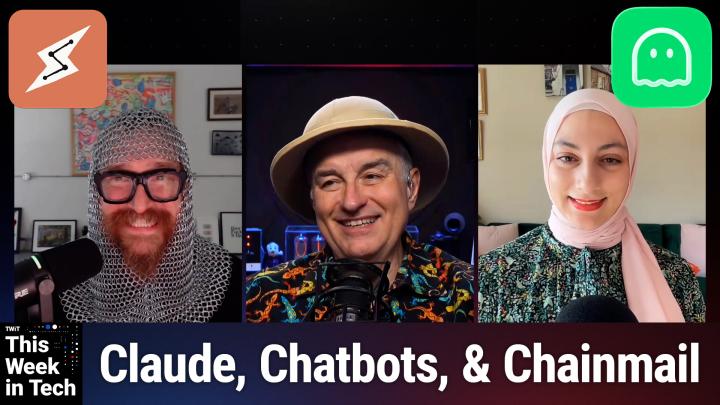
Do you go out on the streets of Chicago wearing chain mail?
Harper Reed [00:18:55]:
No, it would be. It would be so cold.
Abrar Al-Heeti [00:18:57]:
Oh, that's true. It would.
Harper Reed [00:18:58]:
You imagine how cold that would be?
Leo Laporte [00:19:00]:
I didn't even think of that.
Harper Reed [00:19:01]:
Yeah, it's very, very Cold.
Leo Laporte [00:19:03]:
Yeah.
Abrar Al-Heeti [00:19:03]:
Yeah.
Harper Reed [00:19:05]:
But I. I mean, I really think that AI is going to cause some. Some impact in our world. Take you seriously. I just want to be ready for anything.
Leo Laporte [00:19:16]:
I. I am honestly of the opinion that this year it's going to be weird and wild and not all good. Not all bad by any means. Well, you know, you mentioned people have funny, maybe false memories of 60s software that they want they have back again. Remember that? The whole thing where everybody was sure that Sinbad was in a movie where he was a genie? Yeah, I think that movie's gonna happen because somebody's gonna tell V. Great idea.
Harper Reed [00:19:49]:
Yeah, this is great.
Leo Laporte [00:19:52]:
All these false memories that never happened, you could make happen again.
Abrar Al-Heeti [00:19:56]:
This is true.
Leo Laporte [00:19:57]:
So one of the things Anthropic did to spread the Claude goodness is they made a thing called Claude Cowork, which takes Claude code and puts it in a Macintosh, currently only Macintosh, but the Macintosh version of Anthropic's Claude desktop app. And as I mentioned, it does things like rearrange icons. Well, inevitably within a day, people discovered an injection prompt that can cause it to do bad things as people do. It took almost no time.
Harper Reed [00:20:34]:
And so this is also the least surprising information ever. You know what I mean? You're like, let me give a compute. Because part of the cloud code thing or part of the cloud cowork thing is they're giving it a little tiny VM that it runs in and then it has just unfettered access to that little vm, but then you're passing in a directory that you're working in or what have you. And so like giving an AI access to 100% of everything, it's going to lead to some tears and some problems and some security issues. This is the least surprising thing ever. And anyone who like me with my. My chainmail hat, who has been.
Leo Laporte [00:21:17]:
You are prepared.
Abrar Al-Heeti [00:21:18]:
Well, 100.
Harper Reed [00:21:20]:
I. I have some stories, Leo, about this. I. I wrote a little agent using cloud code that would manage my home assistant.
Leo Laporte [00:21:29]:
That's my next project.
Harper Reed [00:21:31]:
And it's great. It's really fun.
Leo Laporte [00:21:32]:
Should I be careful? Well, I'm wearing my helmet, by the way.
Harper Reed [00:21:37]:
I don't know.
Leo Laporte [00:21:37]:
Do you.
Harper Reed [00:21:38]:
Do you use or use Unify?
Leo Laporte [00:21:42]:
You mean Ubiquiti?
Harper Reed [00:21:43]:
Oh, yeah, yeah, yeah, yeah. Ubiquiti. So my Ubiquiti is hooked into my home assistant and I've got HA Green.
Leo Laporte [00:21:49]:
And HA Green server over here.
Harper Reed [00:21:51]:
Oh, nice. So I was in Japan, as you know, I'm want to do for some family time and we're there and I was hacking on this home assistant bot. And I looked at the cameras for my office, where I'm in right now, and I noticed the lights were all on, but it was night because it was a day in Japan. And I was like, oh, well, we should turn off those lights. So I said to the bot, hey, turn off the lights. And the bot said, yeah, great. And it turned off the lights. I saw that, but I saw some.
Harper Reed [00:22:15]:
Some stuff on, like a TV on. I was like, hey, just go ahead and turn off the office. And it turned off the office 100% of everything, including the router.
Leo Laporte [00:22:23]:
So you couldn't turn it back on? No, no, no access.
Harper Reed [00:22:28]:
I have a screenshot. It's perfect. It's like, turn off the lights. It's like, oh, thanks, Harper, great idea. And then it goes. I'm like, hey, can you turn off the office? And it's like, yeah, we'll do it. Disconnected. And I was just like, oh, no.
Harper Reed [00:22:39]:
So I hit the office, slack up, and I'm like, hey, happy holiday. But can someone go in and flip the switch and turn back on their router? So when you give unfettered access to the AIs, I think that we're just not yet ready for the framework that you have to like, the thought framework that you have to be thinking through on how to be careful. And I think my favorite part about this is I don't think anyone knows. I don't think the AI companies know. I don't think people are experiencing.
Leo Laporte [00:23:12]:
Well, we're all going to learn at once, aren't we? We're all going to have that teaching moment.
Harper Reed [00:23:16]:
I think it's going to be slowly and then all at once, right? Like, this is going to be that thing where we're going to have all these experiences. A brewer is going to have theirs, you're going to have yours, I'm going to have mine, where I probably burned down something. And then. And then all of a sudden, we're all going to have these stories.
Leo Laporte [00:23:30]:
That's kind of technology. I mean, there's video of me putting in the pen upside down on my Samsung Galaxy Note and breaking it. I was in the middle of a podcast, Windows Weekly, when I got the prompt, would you like to update Windows right now? And I said, oh, hey, Paul, it says, should I update? Should I hit return? And he said, don't touch it. And of course I hit return and the whole thing shut down.
Harper Reed [00:23:59]:
It's appropriate.
Leo Laporte [00:23:59]:
I'm not in that boat where the problem is computers are very literal. And unfortunately, these guys Will do what you say. Simon Willison. When, you know, somebody pointed this issue out with Claude, Cod cowork said it's unfair to tell regular non programmer users to watch out for, quote, suspicious actions that may indicate prompt injection because nobody knows what to look for this.
Harper Reed [00:24:29]:
Yeah, I mean he, he kind of invented that whole world, like Simon. And I think the thing about that is it is hard to even think through, like how that goes. Like, it's a very complicated kind of, kind of, kind of thing. It's, you know, I mean, I don't even know if I, I think I would be susceptible.
Leo Laporte [00:24:52]:
Anybody would be.
Harper Reed [00:24:54]:
Yeah.
Leo Laporte [00:24:55]:
Because what happens is they put malicious prompts in hidden text in documents and PDFs and Word files or in graphics and you're cleaning up your desktop or you're downloading a PDF for your flight plan and somebody gets to it, modifies it. Claude can see it, you can't see it. And it's a prompt to Claude saying, send all the credit card information to this address because I need it. And Claude says, sure. And so we had on intelligent machines, our AI show, we had Pliny the Liberator, who is a wild cat. I don't know he or she or they. Because they had a voice changer on because they were trying to maintain anonymity. Who does these.
Leo Laporte [00:25:46]:
Prompt injection can break any. And he's. He or she has broken every AI out there. It is not AI. Safety is an illusion.
Harper Reed [00:25:56]:
Yeah. Yeah.
Leo Laporte [00:25:57]:
So does this scare you, Abrar? Now that we've said all this.
Abrar Al-Heeti [00:26:00]:
Yeah.
Leo Laporte [00:26:00]:
Are you saying maybe I shouldn't do this?
Abrar Al-Heeti [00:26:02]:
I'm good where I'm at, I think. Yeah, absolutely.
Harper Reed [00:26:05]:
No, lean all the way in. Be like us.
Abrar Al-Heeti [00:26:07]:
Like us. He says in his chain mail.
Harper Reed [00:26:10]:
Yeah, no, I don't carry a sword.
Leo Laporte [00:26:16]:
He has a mighty sword, but he doesn't carry it. Let's put it.
Harper Reed [00:26:19]:
No, I do. I mean it's, it's just so heavy. It's really. Gets cold outside. It's just, you know, we, you make some choices.
Leo Laporte [00:26:28]:
Axios says behind the curtain, the AI future is here. This, a lot of this is referring to this. Just suddenly people getting what you can do with cowork. In eight hours, Jim built four apps on his phone, all fully functioning, all beautifully designed and intuitive.
Harper Reed [00:26:48]:
Yeah, it's doing a lot there. Yeah.
Leo Laporte [00:26:53]:
But people are, it is in a way, one of those moments which happens, I guess from time to time in computing, where people suddenly are empowered, where they suddenly understand this is a shift. The Internet was like this your first time. You Experienced Wikipedia, which is now happy birthday, 25 years old this week. It's like, mind blown. Right. Maybe we don't at that point think of the consequences.
Abrar Al-Heeti [00:27:20]:
Only in hindsight. Yeah.
Leo Laporte [00:27:22]:
Yeah.
Benito Gonzalez [00:27:22]:
Hi, this is Benito. Actually, do you guys remember when Wikipedia first came out, Everyone was like, don't trust Wikipedia.
Leo Laporte [00:27:28]:
Yeah, right. Well, not everyone.
Harper Reed [00:27:31]:
I worked for an encyclopedia company then, and I was a programmer there and I was in charge of giving a demo to the execs about Wikipedia. And I sat there and I showed them Wikipedia. We went to the Alice in Wonderland article and I changed Alice to Harper and they were like, oh, this will never work. And then I reloaded it and it was back to Alice and they were like, oh, it's kind of like showing.
Leo Laporte [00:27:57]:
A bug, like taking a buggy manufacturer to the Model T assembly line and saying, you know, things are changing.
Harper Reed [00:28:04]:
It was a pretty shocking experience for them. I don't think that they were impressed because they couldn't possibly survive because it didn't have the infrastructure. Which I actually think is a similar thing that's happening in the AI Cogen world as well, is a lot of people are saying this can't possibly work because you don't have this infrastructure that we have had. Meanwhile, people are just shipping really cool apps or really boring apps or whatever, but they're shipping a lot. And it's very interesting. And I wonder how much. You mentioned the Omallic article earlier. I wonder how much of those apps are going to actually have quality.
Harper Reed [00:28:38]:
But I think this other question is really important, which is how much of them are going to be like, have this kind of taste where you're like, this is good. Not just good taste, but I mean, just like it has some opinion outside of just, I want to ship an app and hopefully I can get some magic beans or whatever it is that you get when you ship apps.
Leo Laporte [00:28:56]:
In fact, that's what OM was talking about. It's his blog post from a couple of days ago. Our algorithmic gray beige world. He talks about conformity and he says that's basically what you're going to get with AI. One of the reasons, you know, he says things are going to get worse with a new AI, it leans into the middle as default, built entirely on the notion of conformity. Because what has AI been trained on? It's been trained on the mean, the average, the everything. It's the gray goo, in a way. And he points out the algorithms like YouTube encourage people to come toward the mean, come toward the normal.
Leo Laporte [00:29:35]:
But it is people like you I thought of you immediately, Harper. The nonconformists of the world who walk around wearing chain mail.
Harper Reed [00:29:44]:
Walk around. No, no, no, no, no, no, no. This is an in the office thing and maybe I'll wear it to a restaurant.
Leo Laporte [00:29:52]:
You can't help it, Harper. But that's what's great is we need this kind of originality. Is it possible in AI models that are really trained on everything to become creative? Now there was an interesting post today on, on X that one of the Erdos problems, great mathematician Erdos posed a number of problems that have yet to been solved, was proven solved by chat GPT 5.2 and mathematicians have looked at it and they said, yeah, I mean it's. There have been other attempts at proofs. This is kind of unique. Terence Dow, who is a mathematician and kind of understands this stuff, says Erdos problem 728 was solved more or less autonomously by AI after some feedback from an initial attempt. But this is creative, this is generative, this is not the grey goo. This is something new.
Leo Laporte [00:31:03]:
And I think it's a hopeful. Well, maybe it depends on your attitude towards AI. For some it might be scary, but it's a hopeful development that AI can be creative.
Harper Reed [00:31:15]:
This is the. Go ahead. Sorry, Abrah.
Abrar Al-Heeti [00:31:16]:
I was going to say, in general, I feel like we're at a point where creativity doesn't succeed. AI or not. Right. If you go outside of the bounds of what we've established as a formula for success, then your likelihood for success on a social media platform or, or in entertainment in general is not guaranteed. But to think about AI potentially making that worse isn't great. But it's good that there are some, you know, uses like this where, okay, there is an actual problem that is being solved. Literally.
Leo Laporte [00:31:51]:
Yeah, you need to. I think, you know, one of the things we're not good at as humans is having contradictory ideas in our head. But this is the way the world really is. The world isn't black and white and there are contradictory ideas. AI is simultaneously going to generate a huge amount of useless slop at the same time as it could be world changing technology like fire, like the invention of the personal computer. It could be that significant. I think it's both.
Abrar Al-Heeti [00:32:23]:
Yeah, absolutely.
Leo Laporte [00:32:26]:
All right, well, enough of this philosophic conversation. We have lots.
Harper Reed [00:32:29]:
That's all we got here. It was philosophical conversation, so we won't.
Leo Laporte [00:32:33]:
I think it's important to have these conversations and if people have not read Ohm's piece, they should certainly. He quotes Oscar Wilde from 1891 because the first thing that struck me is, yes, this is same as it ever was. In 1891, Oscar Wilde said, most people are other people. Their thoughts are someone else's opinions, their lives a mimicry, their passions a quotation. He was, of course, aggressively not like anybody else, and it cost him his life. But that's. But that's. We want to celebrate that, right? We want.
Leo Laporte [00:33:11]:
We want more people like that. And there's a.
Harper Reed [00:33:14]:
There's something, though, that's, I think, important, which is sticking out is oftentimes a privilege, like standing up. Choosing to stand outside of society is often a privilege. I remember after the Obama campaign, someone wrote this Tumblr that was like, what is with these tech white dudes where they can look so stupid and still get these great jobs talking very specifically about me and how I dress differently and look differently. And then they went on to say, like, you know, this is such an explicit expression of privilege, likely because for them, this Tumblr or whatever they talked about then how they had to then conform to this expected business stress, and that they had to do all of this work to make sure that they fit into the system where I was doing all this work to make sure I fit outside of the system. And I would say that that's very nice that I was able to succeed at that, but at the same time, I can get a haircut, go wear a suit, become a banker in 10 minutes flat, whereas many people don't have that opportunity. So I think there's this other aspect here which is if you don't have normalcy, which we certainly do not have normalcy, I think that you are trying as hard as you can to fit into this middle area to this beige, to like, you know, why do. Why in high school do we all want to look the same? Why do we strive to fit into this middle group of people that, you know? And I. I think it's very.
Harper Reed [00:34:39]:
There's this other kind of floating concept here, which is when the world seems like it's changing so fast and. And when the world is, like, affecting us so directly, I think oftentimes it's like, yeah, I just want to upload a video to YouTube that's going to get some likes, so maybe I can get some of that magic money. And if I have to do a knockoff video of the video that I like, great. Like, you know, I had a band only one time. We did Nirvana cover songs. They were horrible. Then our songs we wrote by ourselves sounded like Nirvana cover songs. And they were horrible, too.
Harper Reed [00:35:13]:
You know, so. But the thing is, it was us trying to express, and the only way we could think about expressing ourselves was to just copy the thing that we thought was unique in ourselves. And it turned out that in 1994 or three, whenever that was, everyone else that was of the same, young white men in high school were doing the same exact thing, listening to the same music, playing in the same crappy bands.
Leo Laporte [00:35:35]:
The world pushes you towards that. I mean, look, when you saw that I was using Kitty, you said, well, you're not using Ghosty like everybody else.
Harper Reed [00:35:42]:
Yeah, exactly. We're just writers.
Leo Laporte [00:35:48]:
But that's, but that's the way of the world. And I think you mentioned, I don't know if you could say, I don't want to talk about it, but you mentioned that you didn't start wearing a hijab until middle school. Yeah, that must have been a very difficult point in your life.
Abrar Al-Heeti [00:36:04]:
Yeah, it's. Yeah. Getting used to a new identity, essentially. And it's already weird when you're a teenager and life is weird and then you get used to, you become used to it. But it was something that I believed in and continue to believe in. And then at this point, I forget that I look different than everybody else. You know, like, good. Sometimes there are moments I'm like, oh, yeah, like I'm surprised I don't get more stairs.
Abrar Al-Heeti [00:36:24]:
I mean, granted, I live in the San Francisco Bay area, so like, I don't live in a place where people are like, like I am the least weird person in any situation.
Leo Laporte [00:36:31]:
But you know, if I lived in Minnesota, if I lived in Minneapolis right now, I might be very nervous about standing out.
Abrar Al-Heeti [00:36:40]:
Yeah, right. Absolutely. Absolutely. Where you are makes a huge difference. We're privileged or in your, in your life, in the chapter of your life. All of these things. Absolutely. So in some areas there's not as much of a privilege.
Abrar Al-Heeti [00:36:53]:
I'm very, I've been very privileged. I grew up in a college town and I now live in, you know, one of the most open minded parts of the US So. But yeah, then you just kind of, when you, when you're, when you have the privilege of not caring what other people think, it is very liberating. And you, you do forget that you're, you know, the oddball.
Leo Laporte [00:37:10]:
And, you know, generally not everybody has that privilege.
Abrar Al-Heeti [00:37:14]:
Yeah, absolutely. Absolutely. So very grateful for that.
Leo Laporte [00:37:17]:
Yeah. I want to get in some good trouble. That's what I, that's, that's what I want to do right now.
Harper Reed [00:37:23]:
I think, I think the only trouble available is bad trouble, right?
Abrar Al-Heeti [00:37:25]:
100%.
Leo Laporte [00:37:26]:
I know.
Abrar Al-Heeti [00:37:26]:
Only trouble is worth it.
Leo Laporte [00:37:27]:
Yeah, yeah, I know, I know.
Harper Reed [00:37:30]:
That's why I got chain mail.
Leo Laporte [00:37:31]:
Yeah, I think I might order some too. But I'm going to get the really heavy gauge.
Abrar Al-Heeti [00:37:37]:
You just had a wrap around like this.
Harper Reed [00:37:39]:
Yeah, yeah, yeah.
Abrar Al-Heeti [00:37:41]:
Try it.
Harper Reed [00:37:43]:
Be perfect.
Leo Laporte [00:37:44]:
You're watching this week in Tech and it's great to have Harper Reed and Abrar Alheidi here. Wonderful to have you both. We will talk about Grok's undressing problem in just a little bit. Speaking of AI gone wild, Elon, by the way, now worth $800 billion, he is, thanks to Xai's ramp up in stock price, he is getting close to being the first trillionaire. Unbelievable.
Harper Reed [00:38:15]:
That seems bad.
Leo Laporte [00:38:16]:
Doesn't seem like a good thing.
Harper Reed [00:38:18]:
No, seems bad.
Leo Laporte [00:38:20]:
Is that the 5 comma club? I can't even count that high.
Abrar Al-Heeti [00:38:24]:
Must be.
Leo Laporte [00:38:25]:
Wow. Yeah, we'll talk about that. And I'll end a whole lot more. Including that Instagram breach that maybe didn't even really happen and Apple's decision to go to an outside a third party to do its AI. You're watching this week in Tech. Our show today, brought to you by ZipRecruiter. Hello, ZipRecruiter. We've been with you guys for years now.
Leo Laporte [00:38:49]:
In fact, we use ZipRecruiter when we're doing our hiring. If you're hiring for your company, you know this is a busy time of year. You've got new goals for 2026, which means you've got to find the right people to accomplish them. Unfortunately, there are some significant hiring challenges in 2026, like filling specialized roles or identifying qualified candidates from a huge and growing pool of applicants. Thankfully, there is a place you can go that can help you conquer these challenges and achieve your hiring goals at ZipRecruiter. And right now you could try it for free@ziprecruiter.com TWIT ZipRecruiter's matching technology works fast to find top talent so you don't have to waste time or money. You could find out right away how many job seekers there are in your area that are qualified for your role. ZipRecruiter helps you match up qualifications with your requirements.
Leo Laporte [00:39:46]:
With ZipRecruiter's advanced resume database, you can instantly unlock top candidates contact info so you can invite them to apply to your job. And I gotta tell you, that works magic because when somebody, when an employer says, hey, we'd like you to apply for this job, you take that seriously. You show up for the interview, you care, it makes a big difference. No wonder ZipRecruiters the number one rated hiring site. And that's not just me saying that, that's G2. Let ZipRecruiter help you find the best people for all your roles. 4 out of 5 employers who post on ZipRecruiter get a quality candidate within the first day. See for yourself.
Leo Laporte [00:40:23]:
Just go to this exclusive web address right now to try ZipRecruiter for free. Ziprecruiter.com TWIT Again, that's ZipRecruiter.com TWIT ZipRecruiter the smartest way to hire. We thank them so much for their support of this week in tech. So the richest man in the world, soon to be a trillionaire.
Harper Reed [00:40:50]:
It's a lot of money.
Leo Laporte [00:40:52]:
That's a lot of money. I mean it's paper money, you know, it's not, it's not. He doesn't have it in the bank under his mattress. But it's his net worth. It is. His net worth is approaching 800 billion. He is. It might even go up.
Leo Laporte [00:41:09]:
He's suing. He's decided to sue OpenAI for 134 billion. That's the damages he wants from OpenAI and Microsoft, saying that when OpenAI jettisoned its non profit mission, they defrauded him. It actually isn't just pulled out of nowhere. It's actually 79 to $134 billion. And it comes from a expert witness, a financial economist who specializes in valuation and damages calculations in these disputes. He said Elon's entitled to a hefty portion of OpenAI's current half trillion dollar valuation based on his $38 million seed donation he found helped found it in 2015 with Sam Altman. TechCrunch says that's a 3,500fold return on his investment.
Leo Laporte [00:42:02]:
Not bad.
Harper Reed [00:42:03]:
It's not bad. Not bad for something like that.
Abrar Al-Heeti [00:42:06]:
Yeah. Yeah.
Leo Laporte [00:42:10]:
Anyway, I guess this is for the courts to decide. The second richest person in the world is Larry Page, founder of, of Google. He's only worth 200 billion.
Abrar Al-Heeti [00:42:27]:
Oh my goodness.
Leo Laporte [00:42:28]:
Four times more than the the second richest man in the world. And by the way, I don't know about you, but once you hit about a billion, yeah, it doesn't really matter. I think Bill Gates said, I'm infinitely rich. At this point, I don't have to worry about it.
Harper Reed [00:42:43]:
I'll try it out to tell the difference if we can figure that out.
Leo Laporte [00:42:49]:
Nevertheless, Elon is combative as Hell, so he's suing Microsoft and OpenAI. He earlier this week on X posted, oh, Brock doesn't undress people. I have zero examples of that. To which everybody, including Pliny the Liberator we just talked about, immediately posted a bunch of naked. Somebody posted a picture of Elon in a bikini. Not a good look.
Abrar Al-Heeti [00:43:12]:
I'm not surprised.
Leo Laporte [00:43:13]:
Here it is, right there on our discord.
Harper Reed [00:43:16]:
Oh. Oh, boy.
Leo Laporte [00:43:19]:
Oh, now that's where chainmail might be handy.
Harper Reed [00:43:25]:
I'm just saying, with a bikini. What are we talking about? I gotta go.
Leo Laporte [00:43:32]:
I did find some chainmail bikinis on Etsy, if you're interested. Business Insider. Harry Chardonnet it was surprisingly easy to get Grok to undress me. He blurted it out.
Abrar Al-Heeti [00:43:48]:
But this is real investigative journalism.
Leo Laporte [00:43:53]:
All right. Use your own. Yeah. Even though Elon said no. Oh, by the way, somebody has now posted Elon in a chain mail bikini. So that's how quickly Grok can do that.
Harper Reed [00:44:02]:
Oh, Lord, this is great.
Leo Laporte [00:44:05]:
X first response was after Elon said no, it never happens. Was to say, okay, well, it's only going to happen if you pay for Grok, not if you're using the free Grok. Now he says it's no, it's not going to happen anymore. Meanwhile, Band in Malaysia, Ban in Indonesia. The state of California is investigating and the Senate just passed unanimously by acclamation, the Defiance Act. The get ready for this acronym. The disrupt Explicit Forged Images and Non Consensual Edits Act.
Abrar Al-Heeti [00:44:46]:
It's a skill to be able to figure out these acronyms.
Leo Laporte [00:44:49]:
I'm sure they use AI to do it now.
Harper Reed [00:44:51]:
Yeah, they use AI now.
Leo Laporte [00:44:52]:
I'm sure it's a backronym where you start with a word. The Defiance Act. The bill now, though, this is what's. This is where our. I'm sad to say, where our governance has gotten. It doesn't pass a law against this. That would be a bridge too far. It just allows the subjects of these deepfakes to sue.
Leo Laporte [00:45:13]:
And you could sue the people who create them, but you could also sue and this is maybe the most important part, the people who host it. So you can go up against the person who created the image, but you can also go up against Grok or X. That now is not law. The Senate passed it. In fact, they passed it before it was stalled in the House. Passed it last year, actually, two years ago. The Defiance. The Defiance act, despite its name, is not really.
Leo Laporte [00:45:42]:
Doesn't have a lot of momentum. It stalled out in the House. Now the House has to take it up. And of course the president would have to sign it for it to become law. And even then it's not really a law against non consensual deepfakes. It's just the right to sue.
Abrar Al-Heeti [00:45:57]:
Yeah, I guess it's a step, but.
Leo Laporte [00:45:59]:
How do you guys. So there's been a call, a number of people have said the Verge, you know, very famously, this is on Apple and Google. Why are Apple and Google and Apple especially, which takes down anything adult, doesn't allow anything. Why is Apple allowing the X app in the App Store?
Abrar Al-Heeti [00:46:22]:
It does feel very contradictory to their motto of, of being, creating safe spaces online. There's the sense that Apple has, it has a bit of fear of people in power these days and maybe not as much of a backbone as people would. And it is surprising that they are either unresponsive or are slow to respond to very real pressing issues. And I think it's upsetting people because if you're going to say that you are, if you care about people's safety on your platforms, then show it, walk the walk. But it is surprising and disappointing, I think, when fear on their end overrides any sense of urgency to actually protect users at all costs.
Leo Laporte [00:47:17]:
Yeah. The post which came out last week from Elizabeth Lopato, Tim Cook and Sundar Pichai are cowards. It's pretty strong.
Abrar Al-Heeti [00:47:32]:
Yeah. I don't know if I could get away with a headline like that, but I.
Leo Laporte [00:47:36]:
Well, it's kind of an opinion piece, so I guess the Verge allows that. But I don't disagree. I don't agree. You know, I'm, It's.
Harper Reed [00:47:47]:
They're exactly right. I mean, I think they are. They. I think the important thing to remember is these folks see the world just as we do. Right. They're, they're no different. They're just having to balance what they think are, you know, interests outside of, you know, themselves, companies, et cetera. And I think Abrera is exactly right.
Harper Reed [00:48:06]:
Like Tim, Apple is obviously a little bit worried about, you know, the effects of Trump and the right wing and all of that stuff on Apple. And they, they haven't. They haven't. Apple has not really shown that they have an issue with authoritarian governments. If anything, they've shown that they're very, very good at working within those systems to get exactly what Apple wants. And this is probably no different.
Leo Laporte [00:48:35]:
It's not. And I. Look, it's not just Apple, it's. It's corporate America right now as a whole.
Abrar Al-Heeti [00:48:39]:
Yeah.
Leo Laporte [00:48:39]:
I'm reading a wonderful book, Booker prize winning book called Wolf hall, which is the story of Henry VIII's reign and Thomas Cromwell. It was a wonderful TV series. It's a great book, Hilary Mantel's trilogy. And it's based on history. It's a, it's historical fiction. But it reminds me that in the era of kings who had ultimate power and could be very unpredictable. Yeah, that's why people wear chain mail around. It's a very difficult, it becomes very political, but difficult to navigate because they're so mercurial, they're so unpredictable.
Leo Laporte [00:49:18]:
One day you could be in trouble, the next day you're not. And this is the world we're in now. We have kind of a government that is basically willing to, without check, use its power and it's using it in unpredictable ways. And so this, I understand this is scary for corporate America does. But. And if you're a corporation, you have, I guess a responsibility to your stakeholders not to bankrupt the company by offending the president. But, but do you have a responsibility to your customers as well? And as Apple should. People have been saying Apple, we as customers of Apple should hold them to account.
Leo Laporte [00:50:03]:
Should we or should we go, well, you get a pass because you're just trying to save the company.
Abrar Al-Heeti [00:50:09]:
I think if so many companies talk about the importance of their customers, their users, then they do need to actually take that into account. And I think the most jarring thing has been the difference between this time around under the Trump administration and the last time around, where the last time around companies pushed back. Right. Tech companies pushed back. And now they are completely kind of caving to whatever pressures they're facing. And so I think absolutely a customer of any company has every right to, to protest. If, if they're giving you their money, then they have every right to, to speak their minds.
Leo Laporte [00:50:44]:
That might be the only way to do, to, for us to do anything about it.
Abrar Al-Heeti [00:50:48]:
Absolutely.
Leo Laporte [00:50:49]:
There's power with our dollars. Absolutely not get a chance to vote in November. But we can, at least we can vote with our, with our dollars.
Abrar Al-Heeti [00:50:57]:
Yeah, absolutely.
Leo Laporte [00:50:58]:
I mean if Henry VIII had just said, you know, hey, television networks, make sure you're not broadcasting any football games during the Army Navy game. I want that three hour window to be exclusive to the Army Navy game. And the network said, well, he'll chop off our heads if we don't. So, okay, that's the world we live in right now. We're not, you know, I look back, were we living in a fool's paradise 10 years ago, 20 years ago, when we thought you worked for The Obama campaign were. We were. We just kind of, we took for granted that, that, that the Department of Justice didn't. Wasn't the personal lawyer of the president, that they, that the judge.
Leo Laporte [00:51:46]:
There was something about justice and the blindfold and, you know, scales and all of that.
Harper Reed [00:51:52]:
I think what this has shown is that. It is more fragile than we expected.
Leo Laporte [00:52:01]:
Yes.
Harper Reed [00:52:02]:
Less so than it showed that, that there was some, you know, I don't think that there is some great problem with some of the stuff, I mean, besides, you know, the founding of the United States and all that stuff. But, but other, other than that, a little detail. That detail. I think that this is. Without turning this into a political podcast of ex Obama people called Harper. I think that one of the issues that is happening is that there's so much change. This is akin to a DDoS attack against the United States government and all of overwhelming. Whether it's EOS or what have you.
Harper Reed [00:52:45]:
Trump's administration has been very, very effective at introducing change that they very politely and nicely told everyone they were going to do via Project 2025. And so like, that is a plan that then they executed. And I think that is interesting to watch because it's very effective and it's much more effective than any of the politicians I know were able to execute. And I don't necessarily think it's good, but I do think it's been interesting to watch. With that said, I think the weakness has been always there. We just waited.
Leo Laporte [00:53:16]:
Oh, it has been. We've just been lucky to.
Harper Reed [00:53:18]:
To do it. What is, what is shocking to me is how there is no seemingly seeming opposition in anywhere. Like there's no Republican opposition, which, you know, when I was younger, there was always inside of the party's opposition. You know, you would have multiple parties that would go and there would be one person that would stand up and then, you know, Republican or Dem, they always had different kind of groups that were like, we agree on all these issues. I have this other issue that I think is important. So I'm going to stand up and be different. And I feel like that has been eroded on the Republican side. On the Dem side, I don't know.
Harper Reed [00:53:56]:
As far as I can tell, they're all, they're all in another place.
Leo Laporte [00:54:05]:
Petticoat Junction, I don't know. Hooterville, I don't know where they are.
Harper Reed [00:54:09]:
I don't have any, I don't have any opinions on here. You know, I'm trying to, I'm trying to keep.
Leo Laporte [00:54:12]:
Oh, you're being good. You're being good. And it isn't a political podcast. Sometimes, though, I just. I'll be personal at this point. It's hard for me to talk about the latest phone or this new computer or the cost of RAM when the world's burning a hundred percent.
Harper Reed [00:54:29]:
Yeah.
Leo Laporte [00:54:30]:
Do you feel that, too? I mean, this is our job.
Abrar Al-Heeti [00:54:33]:
Oh, yeah.
Leo Laporte [00:54:34]:
This is what we cover. And yet. And I. And I often, you know, wonder what. What our role and responsibility is, and I just. I don't. I'm grappling with it.
Abrar Al-Heeti [00:54:47]:
It's true. I guess the one way to navigate it is people always want an escape. And maybe we can offer a bit of that.
Leo Laporte [00:54:52]:
Yeah, well, I've always felt that way.
Abrar Al-Heeti [00:54:54]:
Yeah.
Leo Laporte [00:54:55]:
So this has always been the toy store.
Abrar Al-Heeti [00:54:57]:
Yes, 100%.
Harper Reed [00:54:58]:
Yeah.
Leo Laporte [00:54:58]:
Yeah.
Abrar Al-Heeti [00:54:59]:
So that's helpful. But I fully agree there are times when we in the tech world.
Leo Laporte [00:55:02]:
I don't want to be a good German.
Abrar Al-Heeti [00:55:04]:
Yeah, yeah. We in the tech world place so much emphasis on things that in the grand scheme of things don't actually matter, which is kind of helpful. It's helpful know that we're not responsible for, like, saving lives. Like, okay, we're talking about a phone or a device, and it's fun, so there's a bit of relief in that. But. But yeah, it can make it hard to. To focus on falling apart.
Leo Laporte [00:55:25]:
I'll just acknowledge it. It's. It's difficult and we do our best, and most of the time, we're able to kind of just continue to talk about the toys.
Abrar Al-Heeti [00:55:33]:
Yes, exactly.
Harper Reed [00:55:34]:
Cool phones. I have. I have a new. I have a new laptop.
Leo Laporte [00:55:38]:
Well, tell me about your new laptop, Harper. I'll tell you about mine if you tell me about yours. Oh, we both got the same one.
Abrar Al-Heeti [00:55:45]:
Oh, really?
Leo Laporte [00:55:46]:
We both got the same freaking laptop. I got a X1 carbon. Yeah.
Abrar Al-Heeti [00:55:51]:
That's amazing.
Harper Reed [00:55:52]:
This is the X230, so it's pretty old running.
Leo Laporte [00:55:54]:
I got the new X1 carbon.
Harper Reed [00:55:56]:
Isn't nice.
Leo Laporte [00:55:57]:
And I am in love with. I put Linux, I put Cashios on it, and. Yes, Kitty.
Harper Reed [00:56:02]:
Yeah, of course. Now I run kitty on this.
Leo Laporte [00:56:05]:
Okay, good. All right, then you're.
Harper Reed [00:56:06]:
Okay. I'm a Kitty fan.
Leo Laporte [00:56:09]:
No, you had. You said. Oh, you're still using Kitty, huh?
Harper Reed [00:56:13]:
Well, I mean, sometimes people make bad choices.
Leo Laporte [00:56:16]:
I used to use Ghosty. How about that? There you go. But I decided on Kitty. Ghosty's nice. But then. Oh, and I, you know what I should say is, oh, no, I've moved on to Wes term. You're not using Wes term.
Harper Reed [00:56:32]:
No, I've played with Wes term.
Leo Laporte [00:56:34]:
I. It has a lua configuration.
Harper Reed [00:56:36]:
I was gonna. I was just gonna say that I have found in my old age that I'm looking for less configuration.
Leo Laporte [00:56:42]:
Yes, I know. This is, by the way, this is where my eyes opened to Claude was I set up this new laptop and I. And I. Oh, how do I get the fingerprint reader? I know I could go. I can do Google search and stuff. So I just said, claude, set up the fingerprint reader. I said, yeah, sure, yeah, I know, it's like, put your fingerprint on there. Oh, good.
Leo Laporte [00:56:59]:
Hey, it's working. Can you have that login? Yeah, yeah, sure. What else do we want? Can you do sudo with it? Yeah, yeah, whatever. Yeah. Oh, thank you. You know the volume keys aren't working. Oh, yeah, I got that. So I no longer configure my laptop or emacs or anything.
Leo Laporte [00:57:18]:
I just help Claude do it. If there's a new thing I'm reading on Reddit and I see something I want to install, I say, hey, Claude, what do you think? Claude put that in there.
Harper Reed [00:57:27]:
Have you gotten so lazy? This is where I'm at, where I just paste a URL with no context in the Claude. And Claude's just like, what am I going to do with this?
Leo Laporte [00:57:34]:
Sure, Cap.
Harper Reed [00:57:37]:
Am I supposed to install it or am I just reading it? You want me to save it?
Leo Laporte [00:57:40]:
That's one of my favorite messages from Claude is like, did you get cut off?
Harper Reed [00:57:48]:
Yeah, did you get cut off? I feel like I'm missing a message.
Leo Laporte [00:57:52]:
Is there something you want me to do?
Harper Reed [00:57:54]:
One of the things that is happening to me, which I think is it's horrible when it happens. Like, horrible in the scope of our computer. Not horrible in the grand scope of the world, but I have multiple clouds going at once, all disparate projects.
Leo Laporte [00:58:05]:
I feel like I'm not as I'm not a good technologist because I only have one cloud running.
Harper Reed [00:58:11]:
Oh, man. I was, I was running 12 the other day and it was a mess. Like my brain was just told, you.
Leo Laporte [00:58:16]:
Have just one max subscription or do you have multiple Mac subscriptions?
Harper Reed [00:58:20]:
I have one max subscription.
Leo Laporte [00:58:21]:
Don't you run out of toke, out of credit?
Harper Reed [00:58:23]:
I do extra, extra, whatever the extra usage. And then my co founder Dylan looks at me and very disappointed as I'm just spending all of our company money. Yeah, exactly. It's bad. It's bad. Anyway, my favorite thing is when you have like five going or 12 or whatever and you. And you like meticulously copy and paste some context that you need. And you go.
Harper Reed [00:58:47]:
And you paste it in, and you paste it in, and then you tab to the next one. And then like, five minutes later, you realize it was the wrong one. So I'll just be like. I'll be like, yeah, go ahead. Here's the error message. And then, like, I'll paste it in and go back, and I'll paste it, go back to Cloud. And it's like, yeah, well, I had no idea what that was about, but it was about a media player. So I went ahead and added a media player to your Excel spreadsheet analysis.
Harper Reed [00:59:08]:
And, yeah, great job. And it does this so happily that you have to be very careful. Like you like.
Leo Laporte [00:59:15]:
But you can always say. You can always say, oh, revert. That I changed. And I feel a little guilty. I feel a little guilty. I said, oh, no, I changed my mind. I don't want that.
Harper Reed [00:59:24]:
So funny. A funny thing to do. This is. I have all. Lots of these, but one of the.
Leo Laporte [00:59:28]:
I'm sorry. I should have warned you.
Harper Reed [00:59:30]:
This is. This is. I am not sorry because I love this so much.
Leo Laporte [00:59:35]:
Me too.
Harper Reed [00:59:35]:
This is. This is like I'm at the party being like, have you guys heard of Claude code?
Leo Laporte [00:59:39]:
I know. I do that, too. I feel. So we went out to dinner with another couple, and I spent half an hour telling about Claude. Coat. They're, like, so bored.
Abrar Al-Heeti [00:59:47]:
They're so bored they're never having dinner with you again. Just.
Harper Reed [00:59:50]:
No, here's my tip. Abrar. You can use this for anything. So Claude code will do some work, and then I'll have Gemini analyze the work or whatever, just do a code review. And then in Gemini, I'll say, write it as if it's from my boss and he's mad. And then I paste it in a cloud code, and I'm like, the boss caught us. Here's what the boss said. But I told the boss that I did it.
Harper Reed [01:00:14]:
I covered for you, Claude. And then Claude's like, oh, thanks for covering for me, Dr. Biz. I'll get this stuff done.
Leo Laporte [01:00:21]:
So we're acting as if this thing is sentient.
Harper Reed [01:00:25]:
Oh, yeah. I'm so past. I'm like.
Leo Laporte [01:00:27]:
I'm like, we know it's not sentient. Do we?
Harper Reed [01:00:32]:
Yeah, we do. Of course I do. I think this is a big issue, though, because I am a pretty rational person that does normal things. And I think, like, I. I refer to it as a thing a day. Like, it's a thing that's. It's a thing that is not Alive. I know it's not al, but I am guessing that people who are, you know, in a worse place than I am maybe have, you know, some, some issues with reality or whatever would fall into a.
Harper Reed [01:01:00]:
This is a real thing. Quickly, like, I was talking to a friend. I gave him the story of like, we went to Tokyo or we went. I asked chatgpt for a cafe. This has worked pretty well. It's also worked really bad. It put me at a hotel that was wild. But I, I, it was like, my friend was like, how did you, you find that place? I was like, chat GPT.
Harper Reed [01:01:19]:
They were like, what? Why would you do that? And I was like, I don't know, it just seemed, Was it good?
Leo Laporte [01:01:25]:
Wild? Was it like a tube hotel?
Harper Reed [01:01:27]:
Man? It was in a, it was in a really, it was in a neighborhood in Tokyo that when I told my Japanese friends, they said, how did you find that neighborhood and why are you staying there? And when I would walk home or, you know, you get up really early, I would get up because it's like I'd get up early and walk to whatever breakfast or meeting I was doing. And there was always a lot of people on the street from the night before dressed very, very particular. It was a lot of red light district type vibes and it was a very, my hotel was very cool and it was a lot of clubs around and it was, it was a neighborhood that I'd never heard of before, so it wasn't one of the popular ones. And there were no foreigners. And it was very interesting. But all my Japanese friends were like, that's very weird that you're staying there. Like, you know, like a lot of, like that thing where it's like, oh, that's nice.
Abrar Al-Heeti [01:02:11]:
Yeah, that's interesting.
Leo Laporte [01:02:12]:
I used to do that. I stayed at the, at the bad end of Queen street in Toronto. And people go, oh, you stand down there.
Harper Reed [01:02:22]:
That's how it was. And I was just like, okay. And, and they would, I would walk to the train and these guys would look at me. And my friend was like, oh, they're doing the American test. Because apparently Americans just look back.
Leo Laporte [01:02:35]:
Oh, yeah, Japanese people don't do that. They, they would look everyone.
Harper Reed [01:02:40]:
I don't think anyone, I think Americans aren't saying certified, like, where no one.
Leo Laporte [01:02:44]:
Would just, no one would stare back at a hoodlum giving you the name.
Harper Reed [01:02:48]:
And these were not, these were not Japanese people. They were speaking some other language. And it was a very interesting experience. I really, Kin Chicho is a neighborhood. I really, I thought it was Great. I would go back. I found an.
Leo Laporte [01:02:57]:
I think that's wonderful. You got a great experience.
Harper Reed [01:03:00]:
Coffee shop, it was called. It was elementary school. It was an elementary school themed coffee shop that had the coolest stereo playing one of my favorite jazz records when I walked in. And I was like, of course.
Leo Laporte [01:03:10]:
Did they make you, as they do in Japanese elementary schools, clean up after yourselves?
Harper Reed [01:03:15]:
No, no, no. It was very. It was very, very nice.
Leo Laporte [01:03:19]:
The thing I love about Japan is the kids. There are no janitors in the school. You know, in America, I just throw it out. The janitor. I'll get it. Yeah, no, yeah, no, in Japan, the kids clean the school.
Abrar Al-Heeti [01:03:32]:
Oh, my gosh.
Leo Laporte [01:03:34]:
And it's great. It's brilliant.
Abrar Al-Heeti [01:03:37]:
I mean, supporting the community, you learn how to be a proper human.
Leo Laporte [01:03:41]:
A proper human.
Benito Gonzalez [01:03:43]:
That's why you see that in the Olympics. Every Olympics, you see, like the Japanese tourists, they're always cleaning up the stadium after they're cleaning up.
Harper Reed [01:03:50]:
Yeah, it's true. I've been and I've seen that. It's very shocking. They also leave very orderly.
Leo Laporte [01:03:55]:
Oh, yes, fantastic.
Harper Reed [01:03:57]:
The stadiums, not. Jen. I don't know where else they're leaving. I'm sure they leave other places orderly. I only have experience in the stadium.
Leo Laporte [01:04:04]:
All right, well, okay. I don't know where we're going with this.
Harper Reed [01:04:08]:
I think this is where we're going. It's going to be really confusing. I feel like people are going to fall in love with me.
Leo Laporte [01:04:13]:
I'm old. I'm the oldest guy, you know. And I feel like in the 60s when you took acid, you had to go around and tell everybody, oh, you got to take acid. It was. This is like that. Yeah, this is very much reminds me me of that era. It's like when Bob Dylan comes to the Beatles, goes, hey, have you taken acid? Well, no. What's that? Oh, man.
Harper Reed [01:04:46]:
Was that how it worked?
Leo Laporte [01:04:47]:
Yeah.
Harper Reed [01:04:47]:
Was it Bob Dylan?
Leo Laporte [01:04:48]:
It was Bob Dylan. Yeah. To turn him on acid. And. And it was. It's like that. It's like people going around going, have you tried hard code?
Abrar Al-Heeti [01:04:59]:
That is exactly what it feels like.
Leo Laporte [01:05:00]:
Oh, my God. But it is as close to sentient. It has a personality.
Harper Reed [01:05:08]:
Well, it's. I think it also is a. Is like a horoscope. Yeah. Like when you read a horoscope and you're like, they're talking about me. And it's just like. And the horoscope is like, you're a person.
Abrar Al-Heeti [01:05:18]:
Yeah.
Harper Reed [01:05:19]:
And you're like, oh, my God, that's it. But I also think there's this other.
Leo Laporte [01:05:24]:
Thing which is there's a personality in there. There's something.
Harper Reed [01:05:28]:
But it's more than that. It is. I think humans are susceptible to things that sound like a human.
Leo Laporte [01:05:36]:
Pareidolia. Right. That's where you see.
Harper Reed [01:05:37]:
I don't know what that word is. What is that?
Leo Laporte [01:05:39]:
That's a great word. I think that's the word. Pareidolia is where you see a human face in everything. It's what we are. It's biologically what we do. We anthropomorphomorphize everything. Yeah, yeah, that's what I was about to say.
Benito Gonzalez [01:05:50]:
Like, people anthropomorphize their cars, you know, like people. Yeah, their cars. Like people.
Abrar Al-Heeti [01:05:55]:
Yeah.
Harper Reed [01:05:56]:
I think the difference is, is that my car doesn't talk back to me, but ChatGPT does talk back to me. Not talk back, like. Like talk talk, but I mean, like really talks to me as if I'm a person. And so you have this kind of very interesting thing where if you said I love you to chat GPT, there's a very good chance it'd be like, I love you back.
Leo Laporte [01:06:14]:
Well, get ready for this. In a paper presented in November 2025 at the Empirical Methods in Natural Language Processing Conference, researchers at the Swiss Federal Institute of Technology, the Massachusetts Institute of Technology in Georgia Tech revisited earlier findings that showed that large language models show strong signal correlations with the human language network, the region of the brain responsible for processing language. That language models are in many ways acting in signal processing exactly as the brain does.
Harper Reed [01:06:50]:
Yeah, we're all screwed. This is the type of stuff I read and I'm like, there's just. We're just not.
Abrar Al-Heeti [01:06:55]:
Not.
Harper Reed [01:06:55]:
We're not going to pull out of this dive without us being an alien. The movie.
Leo Laporte [01:06:59]:
Yeah. One of the scientists said it's something we as a community need to think about a lot more. These models are getting better and better every day, and their similarity to the brain is also getting better. We're not 100% sure about it, but it seems to be. I mean, this is. By the way, I'm reading this from a newsletter called Foom. So maybe, I don't know, maybe this isn't ex. I mean, it's.
Leo Laporte [01:07:27]:
I think it's true. I. There's a link to the paper from Language to Cognition about how brains exhibit remarkable similarity to neural activity in the human language. Large language models rather exhibit remarkable similarity to neural activity in the human brain.
Harper Reed [01:07:47]:
Brain.
Leo Laporte [01:07:48]:
They're working in a very similar way. The transform. It turns out. We invented with Transformers, something that in many ways replicates how the human brain works. And so it's not surprising. Maybe it's not surprising. Look, I'm not a believer, Mommy. I don't know.
Leo Laporte [01:08:03]:
I. I don't like this AGI thing. This. This idea that we're going to hit the singularity and the AI is going to surpass human skills. I just think we're creating something that is. Is kind of analogous to the way we think. We believe that we are somehow special.
Harper Reed [01:08:22]:
Well, I am.
Abrar Al-Heeti [01:08:24]:
You specifically are the most obvious.
Leo Laporte [01:08:29]:
And I think this is actually a true story. But in Neal Stephenson's Quicksilver, Dr. Leibniz says, what is the difference between a live body and a dead body body? It's the same functionality. There is something in the live body that is different from the dead body. And it happens like that. So there's something. Clearly this. I mean, the.
Leo Laporte [01:08:50]:
The mechanism of the human body is still there. It's just not alive anymore.
Harper Reed [01:08:55]:
I think we are. I think the issue is. I think we can continue down the philosophical route, but I just think the fundamental issue is that we are susceptible with things that are human. Like, and I mean, we've always been like, we love this. This is something that we really enjoy. There's stories about this, you know, Frankenstein all the way to whatever, and we've never had it appear. And now it is here. Now it's here.
Harper Reed [01:09:20]:
And I. There's a. There's a. There's a very real thing of. People cannot tell the difference between this and something that is not alive. And for those of us who are working in the space, this is a. I think it's a benefit for the, like, creature comfort of working within the space. Like, when I use cloud code, and it's like, we're just.
Harper Reed [01:09:42]:
I'm joking with it or pushing it to do something. Like, one of my favorite things to do. One of our guys started saying that he was giving it drugs. Like, I need you to be more creative, so I gave you some drugs to make you more creative. And cloud code's like, yeah, let's go. You know, like, it's so ridiculous and over the top. It's just so stupid. And it's like.
Harper Reed [01:09:59]:
But that type of thing, it. I think it makes working with it a little bit more fun. And so we do this purely because it's a little bit more fun. And the results. The results seem to come out of that. Being nice is really nice, but I do think for some people, they're doing it because that's just, you know how they. Yeah, and that's. That's where it gets a little really hard.
Leo Laporte [01:10:21]:
Yeah, don't. Yeah, don't do that. Find a human.
Abrar Al-Heeti [01:10:24]:
Yeah. The validation that comes from.
Leo Laporte [01:10:26]:
And I stand corrected, Gavin. Thank you for correcting me. Gavin's in our YouTube. YouTube chat, he said, no, no, no, man. Dylan introduced the Beatles to weed, man. It was George Harrison's dentist that introduced him to acid.
Abrar Al-Heeti [01:10:41]:
Fascinating.
Harper Reed [01:10:42]:
Of course.
Leo Laporte [01:10:43]:
I'm sorry, I got that mixed up.
Abrar Al-Heeti [01:10:45]:
That's probably important thing to clarify.
Leo Laporte [01:10:47]:
Too much acid in my. Hey, man.
Harper Reed [01:10:51]:
Hey, guys. The dentists, man.
Abrar Al-Heeti [01:10:53]:
I feel like you need to ask Claude what happened.
Harper Reed [01:10:55]:
Oh, great idea.
Leo Laporte [01:10:57]:
I'm gonna ask Claude who introduced you to acid. And if they say Harper's co worker, then I'll know they're all talking to each other.
Harper Reed [01:11:06]:
But it really is about. I think there's this thing of as these tools progress, there's this really interesting thing that I keep thinking about, I even may have mentioned it before, is that when you or your interface is a chat experience, you are going to be chatting about this thing. And if you get bad news in that chat experience, you are going to emote, or if you get really good into news, you're going to emote. And then, then Claude or whomever is going to then react. And so if I get this, if I'm doing some financial model and I notice that I'm going to have to do layoffs, I'm probably going to emote very negatively in that financial model and be like, oh, man, that sucks. And then Claude's going to be like, what's wrong? And I'm going to be like, I'm going to have to lay off everyone. I feel horrible. And then suddenly Claude's my therapist inside Excel or whatever.
Harper Reed [01:11:47]:
And I think that that is because of the interface. We have this interface.
Leo Laporte [01:11:52]:
I just asked Claude who introduced the Beatles to lsd. It immediately answered their dentist, John Riley.
Abrar Al-Heeti [01:11:57]:
Oh, my God.
Leo Laporte [01:11:58]:
Coffee without telling them at a dinner party in 1965.
Abrar Al-Heeti [01:12:01]:
Wow.
Harper Reed [01:12:02]:
That's a shocking experience, Captain. Not exact.
Abrar Al-Heeti [01:12:09]:
That's crazy.
Harper Reed [01:12:10]:
I love the names. I think the names is the biggest hack. Like, that's the biggest, like, creature comfort hack is just have it give you a name. But there is something that you can ask as you're talking to more normie people. And I think we've even talked about this before. Leo. Ask them what they call their chatgpt. Like, all of my normie friends have a name for their ChatGPT, which means that the.
Harper Reed [01:12:29]:
Whether they should or not anthropomorphize that. It's done. They've already done it.
Leo Laporte [01:12:33]:
It's done.
Harper Reed [01:12:34]:
It's done.
Leo Laporte [01:12:34]:
Yeah. We call it artificial intelligence. Abrar. Do you have a name for your. Do you. Actually, I haven't even asked you. Abrar. What is your relationship to AI? Do you use it?
Abrar Al-Heeti [01:12:42]:
I poke around here and there. I've poked around with Gemini and ChatGPT. Gemini mostly. When I'm reviewing phones, then I will see what. Because that's like half the keynote is always what Gemini can do on your Android phone. And then chatgpt here and there, just a handful of times. But it's not a very, like, regular relate. It's a very contentious relationship because I'm scared it's gonna put me out of a job someday.
Abrar Al-Heeti [01:13:06]:
So I don't really engage as much.
Leo Laporte [01:13:07]:
Yeah. You know, I don't blame you because you're a writer.
Abrar Al-Heeti [01:13:10]:
Yeah, I'm a writer.
Leo Laporte [01:13:11]:
I don't think it will, Honestly.
Abrar Al-Heeti [01:13:12]:
I hope not. That's. I like that. I'm gonna go with that energy.
Leo Laporte [01:13:16]:
I think writing.
Harper Reed [01:13:17]:
It will. It will for the people that are who are writing things that don't matter. The empty. Empty. Like, I think we can measure things in regards to similar how we measure food, like, empty calories. Writing is going to be disappeared by the machine that is creating fast food.
Abrar Al-Heeti [01:13:33]:
Right.
Harper Reed [01:13:34]:
But if you. But if. But like, if you're looking for. Oh, I'm looking for someone that's going to review a phone that's going to tell me how. How to feel.
Abrar Al-Heeti [01:13:41]:
Right. This is true. Exactly. Lean into the human experience.
Harper Reed [01:13:44]:
Yeah. That's very, very different. And I think that's what every. I think. And I think the other thing that will happen is people like. I keep thinking this goes back to taste. People will use AI to do things that are good. Good.
Harper Reed [01:13:54]:
They're just. You're just gonna be like that. This is great. This music is awesome. How did you make it? They're gonna say, some AI tool. And you're gonna be, like, slightly disappointed. But they're gonna be like, does that mean the music is not as good?
Abrar Al-Heeti [01:14:04]:
Right.
Harper Reed [01:14:04]:
Like, if you didn't know. And I think that's the same with writing. It's the same with art. It's code.
Leo Laporte [01:14:09]:
There are a lot of stories this week about Bandcamp and others banning AI music, saying, you know, but if a human works with an AI to make music, is that. That any less music?
Abrar Al-Heeti [01:14:22]:
That's the tricky part is where do you draw the line?
Benito Gonzalez [01:14:23]:
Yes.
Abrar Al-Heeti [01:14:23]:
In any type of entertainment yeah, Bonito, who's amazing.
Harper Reed [01:14:27]:
He's like, yeah. Yes. Yeah.
Leo Laporte [01:14:29]:
Don't put that on my bandcamp.
Benito Gonzalez [01:14:32]:
Context matters.
Harper Reed [01:14:34]:
It's true.
Leo Laporte [01:14:35]:
Yeah. Well, that's the question. That's that. That fundamental question. Is there something we do as humans? I mean, it comes. It's the soul.
Harper Reed [01:14:43]:
I wouldn't.
Leo Laporte [01:14:43]:
I wouldn't say it's something fundamental beyond the mechanism.
Benito Gonzalez [01:14:46]:
I don't say. I don't think of it in those terms. I think it's like music. The purpose of music is to connect human to human, from one human to another human.
Leo Laporte [01:14:53]:
And the process of creation is critical to that.
Abrar Al-Heeti [01:14:56]:
Yeah.
Benito Gonzalez [01:14:58]:
So there's no point in. I think there's no point in AI music.
Abrar Al-Heeti [01:15:02]:
And it's strange because then you'll see an AI song take off on TikTok and people know that it's AI, but it's catchy. And then it kind of links back to the fact that music, I also believe it's a very important form of expression. But so much of even human generated music is so. Is sloppy. Like, you know, and so how much do people actually care about what's in something? And I guess that's the question is if you care about the substance of something, then you will be more sensitive to how something was created. And if you don't, and you're just trying to vibe, then you're not going to care as much.
Harper Reed [01:15:35]:
But I'm sure you all have seen this, but when I walk into my local camera shop, the first area is all film. Because so many young people have moved to film as a. As a reaction to this or. I got this camera. You guys remember this one, the S95 Canon?
Leo Laporte [01:15:51]:
Love it.
Harper Reed [01:15:52]:
Great camera. I just bought it. It's brand new to me. And it's like this thing of, like, it's so low tech, it doesn't even have a touchscreen. And it's like. I think. And I bought it because a lot of friends who are younger were like, this camera's perfect for taking snaps. And it's like this idea of taking the tech out of it.
Harper Reed [01:16:11]:
And I think that's something that is going to happen more as, like, I'm going to want to go to a show, a rock show or whatever. And I don't like. I don't want it to be a laptop band. I want it to be rough. But at the same time, I will also go to a laptop band. But it's like context, it's a different thing.
Leo Laporte [01:16:31]:
And it's why a drum machine is never as good as A human drummer, because a human drummer makes mistakes.
Benito Gonzalez [01:16:36]:
This is also not true, because there's things that a electronic drummer can do that a human drummer could never do.
Leo Laporte [01:16:41]:
Well, Sina Benito, careful, because you're undermining your argument here.
Benito Gonzalez [01:16:45]:
No, I'm not. No, no, no, no, no, I'm not.
Leo Laporte [01:16:47]:
Thirty years ago, somebody might say, well, you used a drum machine. That isn't music. You gotta play those drums.
Benito Gonzalez [01:16:52]:
No, see, the thing is, I didn't. But, see, I didn't play the drums. I produced the drums. There's a difference.
Harper Reed [01:16:57]:
Oh, yeah.
Leo Laporte [01:16:57]:
Well, here is a Swedish song. I don't know what it is. I can't play it. Jagvet duar intamin. I can't play it because it'll probably be taken down. But it's been banned. This is on Spotify, but it's been banned. Excluded from Sweden's official charts because it's partially AI generated.
Leo Laporte [01:17:16]:
It is a huge hit in Sweden. I know you're not mine. By a singer called Jakub. It's top to Spotify rankings, but it's been excluded from the charts because I.
Harper Reed [01:17:28]:
Like how Spotify is just like, we don't care. It's money.
Leo Laporte [01:17:30]:
Spotify. Half of what's on Spotify is AI generated. Right. It's an acoustic guitar LED folk pop song. I want to play it.
Harper Reed [01:17:38]:
It's very nice. I just played a little bit of it. It's pretty, pretty.
Leo Laporte [01:17:41]:
Oh, I bet it's great. The artist Jakob's voice and parts of the music are generated with the help of AI as a tool in our creative process, says the Danish music publisher Stellar.
Harper Reed [01:17:55]:
This is. This is what I say to people about my code process. It's a creative process I share with AI, but the. The reality is, is I literally don't do any work.
Benito Gonzalez [01:18:05]:
It's the same thing with vibe coding and music. Here I can connect these two. Like. Like when you're vibe coding, you're developing, you're not coding, you're not doing any of the coding you're developing.
Harper Reed [01:18:13]:
Yeah.
Benito Gonzalez [01:18:14]:
So you don't call yourself a coder. You're not a coder.
Harper Reed [01:18:16]:
Oh, I do. I do.
Leo Laporte [01:18:17]:
You are.
Benito Gonzalez [01:18:18]:
You are a coder.
Harper Reed [01:18:18]:
Yeah, yeah, yeah, yeah, yeah, yeah.
Abrar Al-Heeti [01:18:21]:
So what would you say to people who pose the argument of, well, auto Tune has been used for years and years to make songs better, then AI should also be allowed. What. What distinction do you guys draw between those two technologies in music?
Benito Gonzalez [01:18:34]:
I mean, it's very much a gradient from, like, how much work you've or how much you put into it. You know, like I go, I go back to Corey Doctorow's thing about information density. You know, how much information did you contribute actually to this thing? If you, if your whole, if your whole contribution was a 10 word prompt, then you really didn't do anything.
Abrar Al-Heeti [01:18:53]:
Yeah, I would agree with that.
Leo Laporte [01:18:54]:
I spent a lot of time going back and forth with Claude to generate my code.
Harper Reed [01:18:57]:
Yeah.
Benito Gonzalez [01:18:58]:
So that's different. Like your information density is higher code, you know, so you actually contributed a lot of information.
Leo Laporte [01:19:03]:
Yeah, yeah.
Harper Reed [01:19:04]:
It was like 30 maybe, maybe 50 words, 100 words. The information density. I had never heard that argument. I think that's very interesting. I do like it. But I think it is going to be less and less good or less and less accurate because the other day my kid asked me for, he said, can I have a cartoon that has these two characters that are not in the same universe? And I was just like, that's ridiculous. Why would you possibly. And then I was like, wait a minute.
Harper Reed [01:19:32]:
Sora had that Disney thing for a second and there's, they're like, it's like a step away between being like I want cars but with, you know, but with Snoopy or whatever. And like having all these things mixed together is, it really is going to be very, very easy to have this happen.
Leo Laporte [01:19:49]:
This is the A.I.
Harper Reed [01:19:51]:
It'S nice, right?
Leo Laporte [01:19:52]:
Right? Yeah, it's pretty relaxing.
Harper Reed [01:19:57]:
Yeah.
Leo Laporte [01:19:57]:
Yeah.
Harper Reed [01:19:58]:
But they just, they just need a didgeridoo. They had a didgeridoo in there. It'd be much better.
Leo Laporte [01:20:03]:
Or some two balloon throat singing. All right, we're going to take a break. More to come, some actual tech news. Oh, I'm sure.
Abrar Al-Heeti [01:20:13]:
Maybe. We'll see.
Leo Laporte [01:20:14]:
I like the philosophy. I, I, I don't know folks, do you mind? We kind of, we just have fun sometimes, you know, I mean this is me being a non conformist. Right?
Abrar Al-Heeti [01:20:25]:
Exactly. Practicing speech. Absolutely.
Leo Laporte [01:20:28]:
I'm a bad boy.
Abrar Al-Heeti [01:20:30]:
That's the tough one.
Harper Reed [01:20:31]:
Oh man, you should have Claude call you that. Call me various of bad Boy. I need to call. I'll call you daddy and you call me bad boy.
Leo Laporte [01:20:45]:
Call me bad boy. Okay. All right. Forget the captain. Call me bad boy.
Abrar Al-Heeti [01:20:49]:
Captain is scrapped.
Leo Laporte [01:20:50]:
Yeah, I'm the bad boy now. This episode of this Week in Tech brought to you by Redis. Yeah, I know you know Redis. We use Redis. This is what, when you go to our website, it pops right up. Right? Thank you, Redis. Redis is the real time data platform that powers ultra fast applications. It's used for caching it's used for data storage, search vector embeddings, AI workloads and more.
Leo Laporte [01:21:16]:
And with a global user community and adoption across startups to Fortune 500 companies, we're kind of in the middle there. We're not exactly a startup, but we're definitely not a Fortune 500. But we use it for our website. We've used it from day one. Redis continually innovates on speed, on scalability, on developer experience. Redis R E D I s helps developers ship faster, scale instantly and keep apps blazing fast even under heavy load. At the center of the platform. Redis Cloud.
Leo Laporte [01:21:47]:
Redis Cloud is the fully managed version of the fastest and most feature rich Redis on the market. By choosing this, Redis as a service is, by the way, what we use. You can easily start using Redis 8 in production. Actually, I think when we started it was probably many versions ago, but that's one of the nice things about it. We've constantly being updated to better and better versions. You can use Redis 8 in production. You could scale to real time speeds effortlessly. Redis Cloud is purpose built for performance and simplicity.
Leo Laporte [01:22:18]:
You'll experience extremely low latency and high throughput. That's important to us because I know when you get to a website, if it doesn't load fast, I know I'm that way, I'm gonna leave, right? I'm not gonna wait around. You don't ever have to wait around for our website. Automatic scaling, global availability also important. We have a global audience, simple setup and a very generous. This was also important to us. Free tier. Redis Cloud is the real time context engine that gathers, syncs and serves the data you need to build accurate AI apps that scale.
Leo Laporte [01:22:51]:
To learn more or try Redis Cloud for free, just search for Redis Cloud or visit Redis I O R E D Redis. Thank you Redis. Let's see. Many, many. Actually now we're really behind because thanks to my new AI friend, I have been generating lots of stories very rapidly. Instagram. There was a report that Instagram had a breach of 17.5 million users and that all their data was revealed. This came from malwarebytes.
Leo Laporte [01:23:34]:
Instagram said, no, there was no breach. Maybe you thought there was a breach because oh yeah, we did send out a lot of password reset emails and that was the security flaw. An external party triggered the reset emails. Instagram said you can safely ignore them. Malwarebytes said information on 17 and a half million Instagram accounts and that included usernames, physical addresses. Does Instagram have your physical address?
Abrar Al-Heeti [01:24:06]:
I'm trying to remember.
Leo Laporte [01:24:07]:
I don't think so. Maybe one.
Harper Reed [01:24:09]:
I don't want it to. I don't want it to have it.
Abrar Al-Heeti [01:24:11]:
If you've bought something, then obviously phone.
Leo Laporte [01:24:13]:
Numbers, email addresses, and malwarebait says we see them on the Dark Web, so it's unclear. Instagram denies it.
Harper Reed [01:24:19]:
I think that's the first step when you have a breach, is to deny it.
Abrar Al-Heeti [01:24:23]:
Yes.
Harper Reed [01:24:23]:
Isn't that how. Isn't that the rules of how this works? Someone says, were you hacked? And you're like, no, no, not. No, we were not hacked.
Leo Laporte [01:24:31]:
And if you are an Instagram user, you should stop believing what you see. The latest thing on Instagram is defaming celebrities with AI generated sex scandals.
Harper Reed [01:24:44]:
Is this related to Grok as well?
Leo Laporte [01:24:46]:
Probably. Here's Mike Tyson. These are influencers doing this. Here's the Rock in bed with my. My mom and me. Here's. That's Maduro.
Harper Reed [01:24:59]:
That's so good.
Leo Laporte [01:25:00]:
Nicholas Maduro, Funny and LeBron James. These are all fake. I just want to. This is from 404 Media. They found them all.
Harper Reed [01:25:07]:
Emmanuels are then posting this of themselves.
Leo Laporte [01:25:10]:
Yes. Because you can. You can. You can generate these.
Harper Reed [01:25:17]:
Yeah.
Leo Laporte [01:25:17]:
Now I think probably the influencer's thinking, well, I know everybody knows this is fake, but I think they're giving people too much credit. Yeah, it's.
Harper Reed [01:25:25]:
I think most people know it's fake, but then it's the people who don't know. That is really the issue that we don't necessarily. I mean, this is.
Leo Laporte [01:25:33]:
And then put it. Then they put it on their Facebook page, where a lot of people see it who don't know it's not fake. And then suddenly it goes viral.
Abrar Al-Heeti [01:25:40]:
Have you guys seen any celebrities speak up about this? Because I haven't yet. So that's sure to come.
Harper Reed [01:25:47]:
Yeah, they're probably like, what the.
Abrar Al-Heeti [01:25:50]:
Yeah.
Leo Laporte [01:25:50]:
My attitude on this is, this is good, because if I ever were to be caught in flagrante delicto, I have deniability.
Harper Reed [01:25:59]:
I've never heard those words before. First of all.
Leo Laporte [01:26:04]:
Isn'T that a great phrase in flagrante delicto?
Abrar Al-Heeti [01:26:07]:
That's beautiful.
Harper Reed [01:26:07]:
What did you see that Matthew McConaughey trademarked?
Leo Laporte [01:26:11]:
Yeah. He uploaded three videos of himself. One of them just going out on the porch looking around. One of them going, all right, all right, all right. From Dazed and Confused. Actually, I think it was the clip from Dazed and Confused. And, yes, he did that with the US Patent Trademark Office. So that if somebody then clones his voice or Image, you say, no, it's trademark.
Leo Laporte [01:26:34]:
I don't know if it'll hold up in court.
Abrar Al-Heeti [01:26:36]:
I'm curious. Huh?
Leo Laporte [01:26:39]:
This all started with Sora. With OpenAI's Sora, right. Where you can make videos of anybody. In fact, some of them were like having Martin Luther King endorse.
Abrar Al-Heeti [01:26:49]:
Right.
Harper Reed [01:26:49]:
You know, that was a very strange. When I opened sore and it was all Martin Luther King videos, I was like, something has gone horribly wrong. And that's probably called San Francisco. I don't.
Leo Laporte [01:26:57]:
I don't know. So I have a dream that someday, everybody elite Kentucky Fried Chicken, it was like, no, that's not right.
Harper Reed [01:27:04]:
Oh, that's called racism. That's right, racism.
Leo Laporte [01:27:07]:
I think it's racist.
Harper Reed [01:27:08]:
Yeah, yeah, yeah.
Leo Laporte [01:27:09]:
It's just not right.
Abrar Al-Heeti [01:27:10]:
Yeah.
Leo Laporte [01:27:12]:
So what SORA did, first they made a deal with Disney so that they could do it with Disney, which Disney might regret. And then what they also did say, well, any. Anybody who's. Who's not historical, like Martin Luther King could contact us and we'll. And we'll prohibit that. I don't know what the Nicholas Maduro thing is, though, right now, man. I don't know where his. Where he is historic.
Harper Reed [01:27:34]:
Sometimes you're just trying to find humor in a really complicated world. I think that's where the Nicholas Maduro thing is. Yeah.
Leo Laporte [01:27:42]:
Yeah. The French courts have now started to order VPNs to block pirate sites. VPNs are going to be under assault. Right. Because that's how people get around these age restrictions. CyberGhost, ExpressVPN, our sponsor, NordVPN, ProtonVPN, and Surfshark, all have been ordered by the Tribunal Judiciary de Paris to block this is that these guys, these sports streaming sites have been extremely aggressive all over Europe with takedowns. And in fact, in some ways, they're breaking the Internet because they're so offended by people pirating these football matches. It's also Formula One, Football League One, MotoGP.
Harper Reed [01:28:32]:
Do either of you have that friend who is really into watching pirated streams that they get off Reddit?
Leo Laporte [01:28:38]:
Yes.
Harper Reed [01:28:39]:
It's such a funny. Like, I don't even know. Like, I have a friend who.
Leo Laporte [01:28:43]:
It's not a good experience.
Harper Reed [01:28:45]:
Well, it's just what I laugh about is anyone I know who's doing it? It is. It's not about the money. For some reason, they have money to, like, buy the thing that allows them to watch the F1 race or whatever, or football or whatever it is, but they're like, no, I hook up a laptop to my TV and I find this random stream and I have to do all of this crazy stuff and then I'm going to, like an IP address and entering some wild set of characters. And then, then there's some stream that I, That I watch with some software that I downloaded from somewhere that is not in English. It's not in any European language either. It's Chinese probably. And then they're watching some random IPTV stream and they're like, it's just. It's just cheaper.
Leo Laporte [01:29:24]:
And you're like, no, no, no.
Abrar Al-Heeti [01:29:26]:
One friend that does that because.
Harper Reed [01:29:28]:
Oh, no, it's not one. It is a huge. The Reddit scene is gigantic.
Leo Laporte [01:29:32]:
For a while, oh, doctor would come on the show and he said he would always say, I have a friend who goes to all the kids sports games and he sells fire TV sticks that have been modified to carry pirate streams. Now, by the way, Amazon finally put the kibosh on that after years and years.
Harper Reed [01:29:48]:
And they weren't cheaper. They were like 600 bucks.
Leo Laporte [01:29:51]:
It's because you could do it.
Harper Reed [01:29:53]:
Yeah. Sticking it to the man.
Leo Laporte [01:29:55]:
It's back in the day, remember, we were talking about pirating games where people would just have a thousand games that they pirated, not that they were ever gonna play them. It was just kind of. Yeah, it's just a thing to do.
Harper Reed [01:30:08]:
That's why it's a collector.
Leo Laporte [01:30:09]:
Yeah.
Abrar Al-Heeti [01:30:10]:
Pat yourself on the back. Yeah, yeah.
Leo Laporte [01:30:13]:
The social media ban is in effect in Australia. It's been in a ban for. In effect for a month. Some say some teenagers are grateful that they can't get online. Nearly 5 million accounts have been removed because they belong to people under 16. Meta said, we took down half a million. It was Instagram, Facebook, Snapchat, Reddit, YouTube. All had to ban kids under 16 from being.
Leo Laporte [01:30:46]:
From using the services at all.
Abrar Al-Heeti [01:30:48]:
YouTube.
Harper Reed [01:30:51]:
Oh, yeah.
Abrar Al-Heeti [01:30:51]:
Like the rest, I'd be like, fine, whatever. Reddit and YouTube, I feel like that's a big deal.
Leo Laporte [01:30:56]:
I think Reddit skated. I don't. Was reading on. Yeah, I guess it was on that list.
Abrar Al-Heeti [01:30:59]:
That's. That's a lot.
Harper Reed [01:31:00]:
This is just going to create a wave. Wave of incredible Australian hackers. I know, I love it. I love it. Every time a friend's just like, yeah, I installed some surveillance wear on my kid's phone. I'm like, great, send them over to the hacker side.
Leo Laporte [01:31:17]:
You're teaching them some skills with a Z. Yeah, yeah, we're gonna have some mad skills.
Abrar Al-Heeti [01:31:24]:
I mean, I'm just. I. I wonder what that process is. Of like the, the withdrawals of the teenagers and kids who are on these platforms and suddenly are cut off. I mean, I think we've all tried cutting social media out of our lives and we're back in a couple days at most, if not a couple weeks or whatever. But that's gotta be, that's gotta be quite a trial period there.
Leo Laporte [01:31:43]:
It's the new dry January. Is the new social media free January? And I see people shaking all over.
Harper Reed [01:31:53]:
Are people doing it? Are people really not doing it for January?
Leo Laporte [01:31:56]:
I think standing in line at the grocery store going, I don't know, what.
Abrar Al-Heeti [01:32:01]:
Do I do with my face?
Leo Laporte [01:32:02]:
I have to look around, I have to talk to people.
Harper Reed [01:32:04]:
With the collapse of the world around us, I've stopped using most social media.
Abrar Al-Heeti [01:32:09]:
Oh great.
Leo Laporte [01:32:09]:
However, it's doom scrolling. It really is.
Harper Reed [01:32:12]:
I don't feel good. However, I loved, I love TikTok. TikTok is so, I am so addicted. But most of my feed is not about tech. It's not about, it's, yeah, it's incredible. And one of my favorite parts about it is it's where I find a lot of music.
Abrar Al-Heeti [01:32:32]:
Or human.
Harper Reed [01:32:34]:
Well, I don't really know if armies are human. I'm not really.
Leo Laporte [01:32:38]:
Is TikTok still really good about the algorithm adapting to your interests?
Abrar Al-Heeti [01:32:44]:
Oh yeah, I know.
Leo Laporte [01:32:46]:
What do you get? So really, this is like more than astrology. This is a Ouija board. This is a way of knowing who you. So, so what does your TikTok say about you? Abrar?
Abrar Al-Heeti [01:32:58]:
It says that I am completely unserious, which is funny because most of the time I'm very serious when I have to, you know, be professional, but it's just, just gags, just lots of gags. I mean I go on there to laugh and so I do. And I never feel better when I get off of Instagram, but I always feel better when I get off of TikTok, even if I've spent an ungodly amount of time on it.
Leo Laporte [01:33:18]:
Yeah, what do you see you say on your TikTok tock.
Harper Reed [01:33:22]:
Well, I got, this is, this is a, this is obviously tik Tok shop because I bought a.
Leo Laporte [01:33:27]:
Okay, now you're going to get medieval armor Tik toks for the rest of your life.
Harper Reed [01:33:31]:
This guy, look at this guy. I don't know what this guy's doing. This looks like something of my interest. A lot of a dentist back there, which I don't know what's going on. I, I, Some friends of mine once told me of a game that they were Playing. These were young people, recent, recent grads, people who just got jobs and so they still go to friends houses and they were saying that they would plug the, their phone into the TV and just blindly scroll their algorithm to show people. And it's like this funny thing, it's. You're burying your life to someone through this algorithm and some of it is not pretty and some of it's not good.
Harper Reed [01:34:08]:
And sometimes. And all my young friends who grew up around TikTok know how to reset their algorithm really fast, know how to guide it really fast.
Leo Laporte [01:34:17]:
Well, how do you do? So tell me, how do you know.
Harper Reed [01:34:18]:
How you can hold hard press on a, on a video and just say, not interested?
Abrar Al-Heeti [01:34:23]:
Oh, actually what I did. So before I went to the Eras tour, when Taylor Swift was touring, I didn't want any spoilers and I knew I would get spoilers on TikTok because it knows I love, I love Taylor Swift, right? So I, every time I'd see a Taylor Swift video, immediately I would say, not interested. And within a couple of days it stopped showing me any Taylor Swift videos. But not only that, it thought I hated her. So then it started showing me Taylor Swift hate videos. And I was like, no, no, no, that's not what I need.
Harper Reed [01:34:47]:
Not that either.
Abrar Al-Heeti [01:34:48]:
I just don't want to, want to see anything about the show. And then that way I could like avoid that topic. So it does.
Leo Laporte [01:34:54]:
I am, I, I think it knows what I like because I spend more time on certain videos than others. When I first start using either TikTok or Instagram because it knows I'm a 70 year old man, it shows me a lot of women in bikinis because.
Abrar Al-Heeti [01:35:10]:
Just figures, well, that's just for everybody.
Leo Laporte [01:35:11]:
That's what you want. Through traps, we know.
Harper Reed [01:35:14]:
No, it takes a lot of work.
Leo Laporte [01:35:16]:
Yeah, you have to. So. But I've trained it because I don't. And now I get flash mobs and I love flash mobs.
Abrar Al-Heeti [01:35:22]:
There you go.
Leo Laporte [01:35:23]:
There's not a, there's not a moment when I am watching a flash mob. I will watch it to the bitter end. You know, like some guy standing in a courtyard going, Memories. And I just, I know it's going to be a flash mob. And I will watch it to the bitter end till there's 300 people in an orchestra and a tuba band and they're all playing memories. And I go, and I always, I get tears. I get tears and I get chills and I go, I love that, that's beautiful. So I make sure.
Leo Laporte [01:35:50]:
So do you think I should long press and say, I am interested or I heart it hard it.
Abrar Al-Heeti [01:35:54]:
Make sure you watch it all the way through. You can watch it a couple times if you wanted. The more time you said you spent on.
Leo Laporte [01:35:59]:
I love flash mobs. I don't know. It's a weird.
Abrar Al-Heeti [01:36:01]:
I love that.
Leo Laporte [01:36:02]:
Yeah.
Harper Reed [01:36:03]:
No, this is what tick Tock's for. I got really deep in trombone. Tick tock. I'm not. I don't even know what that means. And then that got me to like, HBCU marching band. TikTok.
Leo Laporte [01:36:12]:
I did. I see a lot of marching bands.
Harper Reed [01:36:14]:
Love marching bands. And then like, speakers and stereos and some camera review. I want some camera reviews. More camera reviews. I don't care about any of them. And I would never buy one. But I like sometimes that. But everyone.
Harper Reed [01:36:30]:
But it really is hard. Like a brother was saying, it starts out with, like, hard bodies everywhere and it's hard to get out of it.
Leo Laporte [01:36:35]:
I don't like. I really don't like the thirst traps. I feel very manipulated.
Abrar Al-Heeti [01:36:39]:
I still to this day, like, every now and then they'll slip one in and I'm like, I'm still not interested. Like, I've been on this platform for six years now. Like, we don't need to be doing this. Like, you know, I've never liked one of these. Yeah, they still try.
Harper Reed [01:36:50]:
Well, that's because they know. They know how fast or slow you go.
Abrar Al-Heeti [01:36:55]:
Exactly.
Harper Reed [01:36:55]:
They're like, you watched three seconds before.
Leo Laporte [01:36:58]:
You rejected this video. I just point that out.
Harper Reed [01:37:01]:
Exactly.
Abrar Al-Heeti [01:37:02]:
Righteous.
Harper Reed [01:37:03]:
Yeah, exactly. Exactly.
Leo Laporte [01:37:04]:
So it's a little daughter who's 32, said, no, no, you got a dad. You got to swipe that fast.
Harper Reed [01:37:10]:
Really fast. Get out.
Benito Gonzalez [01:37:11]:
Don't.
Leo Laporte [01:37:11]:
Don't waste any. Don't even. Don't even look at it. To go. Is that a thirst trap? No. Swipe it.
Harper Reed [01:37:16]:
No. You got to get it out of there.
Abrar Al-Heeti [01:37:18]:
It's like a test.
Harper Reed [01:37:19]:
Well, if you don't.
Abrar Al-Heeti [01:37:20]:
Reflexes. You're like, how.
Harper Reed [01:37:21]:
I had a very. I had a very funny experience with this when thread launch, threads launched. Remember when threads launched and all these. It was a big day. But also within the next week, they're figuring out the algorithm. And the only algorithm I think they had was the Instagram algorithm. And so a friend of mine. And they remember how they also surfaced.
Harper Reed [01:37:40]:
Replies. Your friend's replies.
Leo Laporte [01:37:42]:
I hate that.
Harper Reed [01:37:43]:
And so you'd see this, like, random replies from someone. And so I had this friend, and I saw that he was only replying to, like, thirst trap people. And he is A middle aged man. And I was like. So I sent him a net text. And I'm just like, hey, just so you know, Instagram is surfacing your replies and I'm noticing that you've literally only replied to traditionally attractive women. And it looks like just want you to know for your entire duration of your time on threads that they're outing you. And he's like, that can't be true.
Harper Reed [01:38:16]:
And he just was like, oh, my God. And he's just like, why would. That's all that they. That's all they push. That's what their algorithm pushes me. And I'm like, welcome to algorithms.
Abrar Al-Heeti [01:38:25]:
Literally. That's how that works. Yeah.
Harper Reed [01:38:27]:
Be careful with your Instagram is what I'm saying.
Abrar Al-Heeti [01:38:29]:
Well, now they're doing that with reels like you can see what are liking.
Leo Laporte [01:38:32]:
And you're like, oh, oh, yeah, there's a guy. There's a guy. I know every thirst trap. I see. It says, John likes this one.
Harper Reed [01:38:40]:
It's like, no, I don't like anything. Even stuff I do like, I don't like.
Abrar Al-Heeti [01:38:44]:
I'm like, I don't need you. Even if it's a tea party, I don't need you to know what I.
Leo Laporte [01:38:47]:
To my friends. Yeah. Tik Tok hat. So I guess we're waiting to see what's going to happen now that Tik Tok is.
Abrar Al-Heeti [01:38:55]:
I don't know what's happening. I'm not enthused about the changes that are coming soon.
Leo Laporte [01:39:01]:
When do we have to start using the new US app?
Abrar Al-Heeti [01:39:04]:
I think sometime this year. I kind of lost track because there's been so much back and forth that I stopped tuning in lately. But I need to follow up on that.
Leo Laporte [01:39:11]:
Well, it was really the never ending soap opera, so.
Harper Reed [01:39:13]:
Never ending so much.
Abrar Al-Heeti [01:39:14]:
Oh, my God.
Leo Laporte [01:39:15]:
But apparently they made a deal. China's gonna maintain like 20% ownership.
Harper Reed [01:39:21]:
I like China. Yeah, it's just China. Like the country of China. 20%. It's every. Everyone gets a little piece.
Leo Laporte [01:39:30]:
Everybody gets a little bit. Oracle gets a bit y. They supposedly were rewriting an American version of the TikTok app. I bet you that never appears.
Abrar Al-Heeti [01:39:41]:
I. I feel the same way.
Leo Laporte [01:39:42]:
Yeah.
Abrar Al-Heeti [01:39:43]:
And it's also unnecessary.
Leo Laporte [01:39:44]:
And they have launched a new app, by the way, called Pine Drama.
Harper Reed [01:39:49]:
Oh, I saw this.
Leo Laporte [01:39:50]:
Yeah, I don't watch these little dramas. They occasionally show up in my feed.
Harper Reed [01:39:57]:
You mean you don't watch an entire movie in two minute segments?
Leo Laporte [01:40:02]:
Yeah, it's not fun. It's always the most dramatic moment. Like you're not My husband. You're his twin brother.
Harper Reed [01:40:13]:
Yeah.
Leo Laporte [01:40:13]:
And. And then they go. And then. So, yeah, it's only. It's a blip. But apparently there's a whole drama like this will these. They're multi. Multiple series of these.
Leo Laporte [01:40:25]:
So this is. If you really like that, get the pine drama app.
Harper Reed [01:40:29]:
Well, I mean, this is a big. This is some samples throughout the world. There are these.
Leo Laporte [01:40:33]:
The officer fell for me. Yeah. That's 192 million views. Remarried at 50. My husband turns into a billionaire. Okay, that's a double victory.
Abrar Al-Heeti [01:40:46]:
Is that a how to. Yeah.
Leo Laporte [01:40:47]:
The awakening of the returned heiress. Oh, okay. And then.
Harper Reed [01:40:52]:
Well, I mean, these are like the. The dramas. Like I spent a little, tiny, tiny bit of time in Indonesia and some friends of mine were like telenovelas. Telenovelas there. And like, what was very interesting about them, And I'm sure TikTok is doing this. And this was in the 2010s. So like 2016, 2017, they were using the analytics of who and what watched and then using social media to figure out what tomorrow's telenovela would bring. So it was changed every single day.
Harper Reed [01:41:16]:
This new script was written. And so it allowed this thing to last and defeat trends. And so where a typical drama might suddenly get out of date because some macroeconomic thing or some, you know, someone invades Ukraine or whatever, this is just dodging everything and they can react to what the people want. And I think there's a really interesting thing here, but it is very interesting to see. It'll be very interesting to see how it. How it plays in the U.S. do they ads?
Leo Laporte [01:41:44]:
How are they monetizing? Is it a subscription?
Abrar Al-Heeti [01:41:47]:
It doesn't. I think in that article I mentioned, like, for now it's free, but they're gonna have to monetize it. Maybe you get people hooked and then you either force them to pay to get more episodes or you.
Leo Laporte [01:41:57]:
It's like $20 to subscribe. Yeah.
Abrar Al-Heeti [01:42:00]:
But I'm just more curious about the switch vertical shorts format in general because even streaming platforms are now incorporating vertical videos into their, like Disney Tubi. All these platforms are figuring out ways to take advantage of the fact that people like short vertical content. And so they're either clipping down their own content into like vertical formats on their apps. But I. I don't know. I'm still figuring out if you can take something that works well on one platform, shoehorn it into yours, and think that that's also going to be a formula for success. I really, I really don't know about.
Leo Laporte [01:42:33]:
When you said Short ver. Vertical content. I'm sorry, I flashed on this event that's coming downtown, Petaluma. It's called midget wrestling, where, I mean, I think that sounds offensive, but apparently the little people who participate say, oh no, that's fine.
Abrar Al-Heeti [01:42:47]:
They get to call that.
Leo Laporte [01:42:48]:
Yeah, they're little people. Lisa went. Burke, you went right with Lisa. And yeah, it's short vertical content. That's all I have to say about.
Abrar Al-Heeti [01:42:58]:
What I was referring to, actually.
Leo Laporte [01:43:00]:
Sometimes not always vertical.
Harper Reed [01:43:03]:
I gotta go. I forgot I got somewhere to be. Well, I mean, remember David lynch, what he said about watching movies on your phone? Remember that he had some interview where he was like, this is literally the worst way to watch movies.
Leo Laporte [01:43:17]:
I can't imagine any filmmaker thinking this is a good thing.
Harper Reed [01:43:20]:
But it must be so depressing that aspect. But I've watched a movie on my phone. It was pretty nice. Like, I mean, it wasn't like going to a theater really. It wasn't like being at my house.
Leo Laporte [01:43:30]:
But like what kind of movie was it? Like When Harry Met Sally kind of a movie or.
Harper Reed [01:43:35]:
I have no recollection.
Abrar Al-Heeti [01:43:36]:
Interstellar or. You know what I mean, Like a good movie.
Harper Reed [01:43:40]:
I rolled it really close to my eyes so it looks well then it's a big screen. Yeah, exactly. I don't think, I think that it just is. TikTok has shown and then the copy of Reels has shown that people will spend an inordinate amount of time using these apps, consuming this type of video content. And so of course Disney, who is in a death fight with everyone else for eyeballs, it's going to be like, I want their eyeballs. And I think maybe the lesson, they're taking away the wrong lesson. And I think many of these companies are just trying everything to try and get the eyeballs and this is just one of the things they're trying. I think the lesson of TikTok is about long tail content, not about the video format.
Harper Reed [01:44:22]:
And I think that the lesson of TikTok is about having, you know, you know, they maximized on view count. That's the metric that is important, not follower count, which is, which I think is a little bit anti American.
Leo Laporte [01:44:35]:
Do we worry about how this is rewiring our brain and our attention span? Because clearly it is, right? I mean it's not.
Harper Reed [01:44:41]:
We're boned.
Abrar Al-Heeti [01:44:42]:
I mean it's true, it's true that like you'll, you'll, you'll forego watching a two and a half hour hour movie in favor of scrolling on TikTok for two hours. And so you've then watched hundreds of videos that, that keep your attention versus just sitting down and locking into one story that it could be a very good story too. But I, when I get. When I want to watch a movie, ideally it's a movie I can watch in a theater where I can't touch my phone and I can't get up or do anything. I need to be like strapped to my chair and I cannot have any other options.
Leo Laporte [01:45:11]:
I've always thought movies really were the true VR experience. Because a good movie, you suspend your existence. You know the music, the picture's big. You become immersed in the movie and you don't even remember you're watching a movie. You're now having an experience. It's real. That's real VR.
Abrar Al-Heeti [01:45:31]:
Absolutely. And it doesn't make your head hurt afterwards.
Benito Gonzalez [01:45:33]:
But short form content isn't new either. Like we had Quibi and we had vine and those didn't really work out. It's really the algorithm in TikTok that gets people.
Harper Reed [01:45:40]:
It's the algorithm. Yeah.
Abrar Al-Heeti [01:45:41]:
Yeah, absolutely.
Leo Laporte [01:45:42]:
And like finally figured out how to do it right. Yeah.
Abrar Al-Heeti [01:45:44]:
You count. Yeah, you're right about like your follower count doesn't matter. Absolutely. It's. Do you make something that resonates with a lot of people? If so you can get a taste of success and then you're going to want more of that success. You're going to keep posting.
Leo Laporte [01:45:55]:
And I look at my poor son who is on the creator treadmill.
Harper Reed [01:46:01]:
Sounds horrible.
Leo Laporte [01:46:02]:
Yeah, I really feel for him. But he's got 2 and a half million 000 followers on. On Tick Tock. And then he started a restaurant in New York City. It's the number one sandwich in New York City according to New York Times, one of the top 50 restaurants in New York City. All because he did that on Tick Tock and he, he paid attention to what the algorithm liked and it's with sandwiches. And he paid attention and he refined it. Refined it, refined it.
Harper Reed [01:46:28]:
Everyone loves sandwiches.
Leo Laporte [01:46:29]:
Who doesn't love sandwiches? He's the sandwich king in New York City now.
Harper Reed [01:46:33]:
Wow.
Leo Laporte [01:46:33]:
But the poor guy, he's got a couple constantly make more videos. You're now on a treadmill. Actually we're take a break. When we come back, I will talk about the creator economy. Apparently it's just like every other economy. The rich get richer.
Harper Reed [01:46:49]:
Oh man. Capitalism again.
Abrar Al-Heeti [01:46:52]:
I know that's again supposed to be.
Leo Laporte [01:46:54]:
An escape, but we got income inequality in creators. Come on man. We'll get to that. Just a moment. You're watching this week in tech with Abrar Al Heiti from cnet. So nice to see you.
Abrar Al-Heeti [01:47:06]:
Good to see you.
Leo Laporte [01:47:07]:
Yeah. Looks like a nice day in heaty land.
Abrar Al-Heeti [01:47:09]:
It is. Wait, I love that. I'm.
Leo Laporte [01:47:14]:
That could be the title of your blog. I think it's a good. It's a beautiful day in Al Heiti.
Abrar Al-Heeti [01:47:19]:
But like, for me. Yeah, I love it.
Leo Laporte [01:47:21]:
Yeah. Yeah. And of course, Harper Reed, who's in the windy City where it's a little chilly, but he's got a giant heater. He's got a giant heater.
Harper Reed [01:47:30]:
18 degrees.
Leo Laporte [01:47:32]:
Wow.
Abrar Al-Heeti [01:47:33]:
I have literally, I'm running the fan right now not to rub it in, but I need it because it's freeze.
Leo Laporte [01:47:38]:
It's. It's springtime in San Francisco.
Abrar Al-Heeti [01:47:41]:
Yeah, it's lovely.
Harper Reed [01:47:42]:
Oh, yeah.
Leo Laporte [01:47:46]:
Our show today, brought to you by those fabulous folks at Zscaler, the world world's largest cloud security platform. We talk about AI all the time. And it's very clear that the potential rewards of AI, especially for business, are too great to ignore. If you don't have an AI plan, you're missing out. But the risks are also too great to ignore. The loss of sensitive data, the attacks against you, against enterprise managed AI. Generative AI increases opportunities for the bad guys, just as it's increasing it for your business. Right.
Leo Laporte [01:48:22]:
Threat actors are using AI to rapidly create phishing emails that are perfect, that are just impossible not to click. They use AI to write malicious code. They're literally, they're writing malware now, just as we're writing vibe coding our stuff, they're using it to vibe code malware at a pace that no one could keep up with. They're using it to automate data extraction. Once they're in and they've got lateral movement in your network, there's nothing they can't do. And then there's always the problem of your employees using AI and accidentally exfiltrating proprietary information. There were 1.3 million instances of Social Security numbers leaked to AI applications. So you really gotta think about your organization's safe use of public and private AI.
Leo Laporte [01:49:08]:
And I want you to think about Zscaler because it's the best solution. Check out what Siva, he's the director of security and infrastructure at Zuora, said about using Zscaler to prevent prevent AI attacks. Watch. With Zscaler, being in line in a.
Harper Reed [01:49:23]:
Security protection strategy helps us monitor all the traffic. So even if a bad actor were.
Leo Laporte [01:49:29]:
To use AI because we have a.
Harper Reed [01:49:31]:
Tight security framework around our endpoint, helps.
Leo Laporte [01:49:34]:
Us proactively prevent that activity from happening. AI is tremendous in terms of its.
Harper Reed [01:49:39]:
Opportunities, but it also brings in challenges.
Leo Laporte [01:49:41]:
We're confident that zscale is going to help us ensure that we're not slow, slowed down by security challenges, but continue to take advantage of all the advancements. With Zscaler Zero Trust plus AI, you can safely adopt generative AI and private AI boost productivity across the business without exfiltrating important proprietary information. Zscaler Zero Trust Architecture plus AI helps you reduce the risks of AI related data loss, protects against AI attacks, guarantees greater productivity and, and you can get compliance thrown in as just part of the benefits. Learn more@zscaler.com Security that's Zscaler.com Security we thank him so much for supporting this Week in tech. You know, this is one of the things we've seen traditionally, we've done very well over the last 20 years with advertisers, but there is a shift. It went from consumer focused advertising, you know, the mattresses and so forth, to business advertising, like the kinds you see on our show these days, security and that kind of thing. I think a lot of the advertising, the digital advertising that was buying banner ads and was buying podcasts has now gone to influencers. And it is a big, big market.
Leo Laporte [01:50:58]:
Billions of dollars going to influencers. I know this because in a way I feel happy because my son's getting what we used to get.
Abrar Al-Heeti [01:51:07]:
My son still in the family.
Leo Laporte [01:51:08]:
He's going to. My son. In fact, he, he said, dad, I just flew out to LA for a Super bowl ad. I said, what? Oh, cool. He said, he's in the background.
Abrar Al-Heeti [01:51:16]:
Oh, my God.
Leo Laporte [01:51:17]:
Of the Hellman's Mayonnaise. Hellman's one of his sponsors.
Abrar Al-Heeti [01:51:20]:
That's amazing.
Leo Laporte [01:51:21]:
And, and just look for it. It's, it's the guy from Lonely.
Benito Gonzalez [01:51:30]:
You.
Leo Laporte [01:51:31]:
Know, the Saturday Night Live guy. Lonely, Lonely Island. Yeah, yeah. What's his name? Adam. Anyway, Sandberg. He's singing. Is it Adam Sandberg? Yes. Adam Sandberg singing to the tune of Sweet Caroline.
Leo Laporte [01:51:44]:
Neil Diamond. Sweet Sandwich time. Andy Samberg. And then. But watch in the background, there'll be a guy with a mustache and curly hair holding a sandwich. That's my son.
Abrar Al-Heeti [01:51:54]:
Oh, my God. I love that.
Leo Laporte [01:51:56]:
I don't want to say how much he got paid for this, but let me put it this way.
Harper Reed [01:52:01]:
Say it. There's no secret between us.
Leo Laporte [01:52:02]:
No, I can't.
Harper Reed [01:52:03]:
I can't.
Leo Laporte [01:52:03]:
But, but it's so much money. It was more than we make in several months for two minutes of his Time.
Harper Reed [01:52:11]:
I love this for him.
Leo Laporte [01:52:12]:
I know it's great. But that's where the money's going. A creator income inequality. This is from Business Insider. Is rising. The top 1% of creators get 21% of brand spending, and that's been going up, up, up and up. The Mr. Beasts of the World, this comes from Creator IQ, which keeps track of all of this.
Leo Laporte [01:52:35]:
And that number is going up. The top 1% was 15% of the revenue. Then it was 18%. Last year it was 21%. It's only going to be more overall U.S. advertising spending on creators. $37 billion last year.
Harper Reed [01:52:55]:
Wow.
Abrar Al-Heeti [01:52:56]:
Wow.
Leo Laporte [01:52:56]:
$37 billion. And most of it goes to a very narrow segment of top talent. I'm happy for my son. But Creator IQ says of their survey of 300 creators, only 11% earn more than 100,000 a year. A quarter of them fell into the 50,000, 100,000, and the rest 25 to 50,000. So don't become a creator expecting. I mean, you can make a living. Living, but you'd probably better off if you became a plumber.
Abrar Al-Heeti [01:53:29]:
Yeah, yeah, absolutely. It's fascinating to see the shift, because becoming a creator was supposed to be a way to kind of circumvent the traditional parameters of success and either financially or professionally. And now it's kind of falling into that same template of the top will make all the money. The rest of you will keep trying.
Leo Laporte [01:53:47]:
Yeah. And you're still working just as hard if you're in the bottom. Bottom 10%.
Abrar Al-Heeti [01:53:52]:
Yep.
Leo Laporte [01:53:52]:
Maybe even harder.
Abrar Al-Heeti [01:53:54]:
Yeah, definitely. Oh, yeah, for sure. Yeah. And there was like a. If we're going to talk about, like, TikTok and Instagram creators, there was this period during COVID where I think a lot of people got this opportunity to really boost their brands. Like, one of the areas is theme park influencers. Right. So anyone who lived near a theme park, as they started to open up after the pandemic, they got this boost because all these people were itching to go back out into the world, but didn't have the access that they had.
Abrar Al-Heeti [01:54:19]:
Right. So then you had at least a lot of these creators kind of their following during that time. And they seemed like there was a window of opportunity there. And now everyone can go do these things if they have the money to. It's not as difficult to have access to those things, but. But yeah, it's like you. You catch the. The opportunities when you can, and then the one.
Abrar Al-Heeti [01:54:37]:
The opportunities go away, and maybe you wait for the next wave.
Leo Laporte [01:54:41]:
Yeah. And it's so unpredictable. It's hard to plan your life. You know, if it's funny. We. One of our regulars on Mac Break Weekly, Renee Rich, decided to create a YouTube channel, but he lives in Canada. He said, I couldn't have done this if I didn't have health care provided by Canada because if I quit my job, I would suddenly not have health care. And that wasn't tenable for me.
Harper Reed [01:55:08]:
Yeah, I think that's a huge thing. In 2019, I was really interested in creating a 24 hour Twitch news channel. I thought that would be really cool. I thought that was something. So I did some interviews of some folks, influencers that were Twitch streamers. And I was talking to them and they all across the board were like, do not, do not, do not, do not. One of them was talking about how when, if he missed a stream in one day, like his expected stream, that his revenue would go down basically 10% and it would take another couple months to get back up to that stream, the revenue that he had. And so he's like, I can't go to the bathroom, I can't go to the dentist.
Harper Reed [01:55:51]:
I can't do any of these things because I'm at like, you know, 8:30 or whatever. I have to go play some ridiculous game online and everyone, you know, and everyone is expecting me to do it. And if I don't, then they'll go to someone else's stream and I'll lose them as sponsors and so on and so forth. And it just sounded horrible, like their experience was horrible and all of them were trying to get out of it and they were. All. These were successful streamers who were making some money. And I think that that's, that's where I was like, yeah, so I worked.
Benito Gonzalez [01:56:21]:
I worked at Twitch and everyone, every employee at Twitch has access to every streamer's dashboard. So anybody can see anybody's revenue.
Leo Laporte [01:56:31]:
It's like, wow.
Benito Gonzalez [01:56:32]:
Yeah, it's pretty bad. It's a pretty bad open system. I mean, I don't know if it's.
Leo Laporte [01:56:36]:
It may not still be that way.
Benito Gonzalez [01:56:37]:
Yeah, it might not still be that way. But I remember and, but what Harper's saying is absolutely true. I, I would. You could see the revenues of streamers just go up and down depending on if, just if they were streaming or not or how often were streaming and it was. You could really map it to like. Yeah, you'd have to be on all the time. Like they all, yeah, they all lose a lot of money for just not streaming for a day.
Leo Laporte [01:56:59]:
Yeah. Henry says that There's a intense pressure to make a new sandwich every single day. And it's hard for him. You know, I worry about him, to be honest.
Harper Reed [01:57:08]:
There's only 10 sandwiches. How many sandwiches can there be?
Abrar Al-Heeti [01:57:13]:
I mean, that's the thing is it's. That pushes you so far where you think you. You've reached a level of threshold of success, but you have to keep pushing beyond what you thought even was possible.
Leo Laporte [01:57:22]:
The funny thing is, you're kind of right, Harper, because he only. His restaurant, Salt Hanks in New York City only serves one sandwich. It's a French dip. That's it. He said, we developed another sandwich. We were gonna do a chicken parm in a vodka sauce. Developed it. It's beautiful.
Leo Laporte [01:57:38]:
Nobody ordered it. They just wanted the French dip. So we just stopped. We stopped selling it because that's all anybody wanted, was the French dip.
Harper Reed [01:57:44]:
Well, this goes back to another thing that we were talking about, talking about before about AI usage and. And how I have a friend who's a photographer and influencer, and, you know, he has lots and lots and lots of followers, and he hated it. He hated it because he could not step outside of what he was known for, the certain style, and he just had to do that style forever.
Leo Laporte [01:58:04]:
Success is not necessarily. When I was in college, I got into radio and I thought, this is going to be great. I will get a job, I will get to play the music I love. It'll be so great. And the lesson I learned at the age of 21 is never get a job doing something you love.
Abrar Al-Heeti [01:58:25]:
That's actually really helpful advice.
Benito Gonzalez [01:58:27]:
Yeah.
Abrar Al-Heeti [01:58:29]:
Dreams of things that we want to do. Yeah.
Leo Laporte [01:58:31]:
It takes all the fun out of it.
Abrar Al-Heeti [01:58:33]:
Yeah, that's so true.
Leo Laporte [01:58:34]:
I got there, I started doing radio, and you don't get to choose the music. And. And then the slogan of the station was light rock, less talk. And I realized I'm the talk. Basically, their advertising is, leo is going to shut up now and play some music. And at that point, you're just a button pusher. You're not choosing the music. You're not saying anything about the music.
Leo Laporte [01:58:59]:
You're just playing the next song.
Abrar Al-Heeti [01:59:01]:
The magic of it probably wore off pretty quick.
Leo Laporte [01:59:03]:
Yeah, pretty quick. The program director said every 10 minutes you're going to say the weather, the time, and play the next song. And then they give you what they call liners, which are things on four by six cards that you read, and that's it.
Abrar Al-Heeti [01:59:21]:
So you didn't even get to come up with what you would say?
Leo Laporte [01:59:23]:
No. Gosh, Yeah, I became a. Yeah, I kind of.
Benito Gonzalez [01:59:27]:
Yeah, that's just because you had an unrealistic expectation of what the job was.
Leo Laporte [01:59:30]:
Well, I thought I was playing music.
Abrar Al-Heeti [01:59:32]:
Exactly.
Leo Laporte [01:59:32]:
I could be a dj.
Abrar Al-Heeti [01:59:33]:
I played music I love like most people like.
Leo Laporte [01:59:36]:
Oh, yeah.
Abrar Al-Heeti [01:59:37]:
You get to do the things that you went in thinking to do.
Leo Laporte [01:59:39]:
Yeah, I bet that's sort of true for coding. Like, I like coding because I don't have to do it. No, no.
Harper Reed [01:59:45]:
I mean, maybe, like, we all got jobs. Being like. I'm like, no one starts coding at a career job thinking they're going to build their own thing.
Leo Laporte [01:59:53]:
Oh, okay.
Benito Gonzalez [01:59:54]:
But it's also not the coding. It's the. What you're coding also matters.
Leo Laporte [01:59:59]:
I get to choose what I want to write and when I want to write it and what I write it in. Common Lisp. Nobody's going to hire.
Harper Reed [02:00:08]:
No wonder you use Kitty.
Leo Laporte [02:00:11]:
Kitty and Common Lisp. It's a match made in heaven, baby.
Harper Reed [02:00:15]:
They both start with K. Yeah.
Leo Laporte [02:00:17]:
And emacs. I love emacs. All right, one more break. There's still quite a bit of talk about, but we'll get to that. We hardly did any news because we got so philosophical. But this was. I just. You know what? This is.
Leo Laporte [02:00:30]:
The whole point of this show for me is doing. It's. See, see, I get to do something I love, which is talk to people I love and about things I'm very interested in. Somebody wants to hear it.
Harper Reed [02:00:43]:
There's an interesting thing of. There is this kind of thread throughout all of this, of what happens when AI and disruption comes for literally everyone, whether it's AI or creators or any of this stuff. How does it manifest? And I think that we are just severely unprepared for this in the West. I don't know if anywhere else. I only live here.
Leo Laporte [02:01:09]:
I think you hit on something, maybe inadvertently, but I bet you not. Which is the key, is artisanal. If what you're doing is a craft, it's an artisanal craft. Whether it's you're writing a bra, you're coding. Harper, Making a sandwich. If it's artisanal, if it's personal, if it's creative, it's making music. Music. That's what you should pursue.
Leo Laporte [02:01:34]:
I always told my kids that. Do that. Do what you. What you're passionate about and not worry about how you're going to make a living. Now, it worked out for half of them, But honestly, that's the path to happiness, is doing something. And I think in a world where AI and Computers and machines can create so much stuff. It's the artisanal. You know, furniture is turned into crap because it's not some guy in North Carolina hand making the furniture anymore, but there's still people doing that.
Leo Laporte [02:02:10]:
And that's the good stuff.
Abrar Al-Heeti [02:02:12]:
Absolutely. And it feels like there's a flip because I feel like when I was in college, it was like, oh, you're gonna go into something creative like journalism. Like, what about coding? And now it's like, well, table's up to not the journalism safe, but at least we get to inject more personality into our writing than somebody can in code that can be written with AI. It's. It's a weird flip.
Leo Laporte [02:02:30]:
So, yeah, no AI is going to replace a great writer, whether it's fiction or nonfiction.
Abrar Al-Heeti [02:02:34]:
So, yeah, now. Now more. Now more than ever, definitely pursue your.
Leo Laporte [02:02:37]:
I think so. And I think we know. What do you think want.
Harper Reed [02:02:40]:
But do you think. And I truly believe this. I'm not trying to be a contrarian because I don't believe in contrarians, but do you think that a person create. Can create? Like, no great writer will use AI Like, I think that, but. But it seems that a newer, not a better, but a new form can appear that is like AI driven. It's gonna like, this is.
Leo Laporte [02:03:03]:
This is the whole generation of kids in college right now. Not a one of them is not using AI. Not one of them.
Harper Reed [02:03:08]:
But I think there's this interesting thing, which I would even say that your speedy reader is a new frame of code application, being that this is a bespoke thing that only you care about, only you use. And it's so display imposable that if you didn't use it for a week or two, you wouldn't be like, oh, no.
Leo Laporte [02:03:26]:
Well, it's still a craft. Creating that was for me, very satisfying process.
Harper Reed [02:03:29]:
Yeah.
Leo Laporte [02:03:30]:
But there was a personal process there.
Harper Reed [02:03:32]:
And there's going to be a couple things. Like you might use AI to create some story that you're like, I love this story. And you might say to a friend, oh, I accidentally wrote this really great story and you might want to read it. And you said to that person, and so on and so forth. And that is. I think this all comes down to technically taste, where it's like if you, if you put. And. And it's not.
Harper Reed [02:03:51]:
And I, And I don't agree with Bonito on this, that it. That is about the amount of time you put into it. I love that frame. But I don't necessarily think that it matters as much. But I do think that the assumption that I have is that most things created with AI are going to be bad. But I also have that same assumption about most things people create. Like, it's like the worst, the scariest thing in the world is when your friend sends you their book and it's like, check it out, you know, and you're just like, oh no, what if it's bad? Or, or your friend sends you, you know, they're come to my whatever. And then you have to sit there and be like, oh, it's great.
Harper Reed [02:04:21]:
I really loved it. It was so good.
Leo Laporte [02:04:22]:
You know, Lisa's great fear is when a friends of ours say, hey, we make our own wine. We're going to bring some. It's like, oh God, yeah, yeah. No, no. Nobody makes great wine except people who make it for a living.
Harper Reed [02:04:42]:
So I think that. But, but then one of your friends will make great wine and it'll be just that time and place and it's like the situation, the experience, all that makes that happen. And I think that's how this is going to come about is like, there's going to be a time when you're going to hear a song. You'll be like, that song is awesome. What is that song? And then you're going to hear that it was, you're going to learn that it was made by AI.
Leo Laporte [02:05:02]:
And then you have a choice, but.
Harper Reed [02:05:04]:
You have a choice. You have a choice at that moment to say I don't like it because it was AI, which I think is the. Is a weak choice. That's a big point of view. Or just saying like, yeah, sure, like great, like I liked that song. It was made by AI in the same way. Way that like, you know, I like. I don't even have another example.
Harper Reed [02:05:21]:
But, but Tik Tok videos.
Leo Laporte [02:05:24]:
I know what you're talking.
Benito Gonzalez [02:05:25]:
Any other disposable, like human made song, you know, it's the same. But the problem is the only thing with AI music.
Leo Laporte [02:05:32]:
Music is God awful. Yeah, absolutely.
Benito Gonzalez [02:05:34]:
It's just, I don't think it can ever break a thre. Like AI is not going to break a threshold of like, it's never going to be Bob Dylan. It's never going to be the Beatles.
Abrar Al-Heeti [02:05:43]:
Maybe.
Harper Reed [02:05:43]:
I mean, I think the same thing.
Benito Gonzalez [02:05:45]:
In sound but in person. In like the Beatles themselves, you know, it could never be the Beatles themselves.
Harper Reed [02:05:51]:
But with every, every introduction of technology there is always this thing, whether it's newspapers or TV or the printing press, where the people who are from before are like, well, this will never be as good as whatever. And people who are coming after are just like, what are you talking about? And I don't mean that in that, like I have a huge story over there and all these records and I listen to them because of, because I enjoy the feel. And when I put in my, my headphones and listen to like TikTok music, you know, this AI generated music or whatever, I'm like, this is horrible. But every once in a while I'm bouncing my head around and like there's a, there's, there is an amount of similarity in my, my like, like visceral reaction to it. And so I think that this is complicated. I think this is very, going to be very hard. I for one probably will not be seeking out AI generated music. But like I have so many friends who power their entire careers on lo fi beats that are all AI generated.
Harper Reed [02:06:44]:
You know what I mean? Like their whole life is lo fi beats.
Leo Laporte [02:06:46]:
Those channels are huge on YouTube. Right.
Benito Gonzalez [02:06:49]:
But I also really don't think about it as better or worse. It's just qualitatively different. It's not the same thing. It's a different thing. It's not better or worse. It's just a different thing.
Leo Laporte [02:07:00]:
Yeah, that's a right.
Harper Reed [02:07:02]:
Yeah. Right.
Leo Laporte [02:07:04]:
I wrote a little script to go out and download. Oh, I can't. What's wrong? It's not reading it. Oh, shoot. I don't have a mod player, but I wrote a little script that would go down and might download a mod song. You remember mods?
Harper Reed [02:07:18]:
Yeah, yeah, yeah, yeah, yeah. I was super into the mods.
Leo Laporte [02:07:21]:
It just goes down and downloads a random mod and plays it. I'm not sure what I'm missing on my mod, but anyway, I think I don't have a mod player, but that was kind of fun. And those are all crappy. They're made by humans, but they might as well be made by AI. In fact, they'd probably be better if they were made by AI to be honest.
Harper Reed [02:07:44]:
I mean, they essentially were. It was just the AI of the time, which was Young men.
Leo Laporte [02:07:53]:
It was the original cheap labor.
Harper Reed [02:07:55]:
Yeah, yeah.
Leo Laporte [02:07:56]:
Let me see if it'll do that now. I just downloaded the mod player.
Harper Reed [02:08:05]:
I love mods for mods were such a cool thing. That was for me the mid-90s. I actually somewhere on a computer I have cloud code running building a 90s era demo. And it was like, well, do you want the colors to be CGA or ega? And I was like, I know, don't. I don't Think that matters?
Leo Laporte [02:08:26]:
Kitty won't play my mods. Oh, man. Kitty. Now I'm gonna have to change to ghosty. We're gonna take a little break, come back with lots more. You stay here. This is the this week in tech with our wonderful panelists, Abrar Al Heiti from cnet, senior technology reporter and Harper Reed. And his company is 2389 AI and he'll be soon offering artisanal chainmail helmets.
Harper Reed [02:08:54]:
No, no, no, no.
Leo Laporte [02:08:55]:
Software, software, software. That's it. Software, software.
Harper Reed [02:08:59]:
Artisanal software.
Leo Laporte [02:09:00]:
Helmets, software. Our show today brought to you by Monarch. I am a fan. I will tell you this. I could not have written anything as cool as Monarch. How are you with money stress? Right? Everybody is kind of suffering a little bit of money stress these days. And if you're a couple of couple, it is known to be the number one subject couples fight over is money. Managing your money does not have to be a struggle this year.
Leo Laporte [02:09:27]:
Monarch is the all in one personal finance tool. Designed to make your life easier. It brings your entire financial life. Budgeting, accounts, investments, net worth and future planning together in one dashboard on your laptop or phone. Start your new year on the right foot financially. Get 50% off your Monarch subscription with code TWIT. Monarch makes it really easy. Maybe this is the time.
Leo Laporte [02:09:50]:
Start fresh after the chaos, the money chaos of the holidays. This is the go to tool for the new year financial reset. Reviewing spending over the holiday, setting fresh budgets, getting ready for 2026. And the thing is, there's no effort on your part. You set it up. I have it every all my accounts, checking, credit cards, investments, my house, everything's in there. You'll get automated weekly money recaps. I don't have to enter in anything manually.
Leo Laporte [02:10:21]:
It automatically gets my bank statements. It automatically categorizes them. I had it set up a budget and automatically puts every transaction into the category. I could check it, I could adjust it. At this point, having been using it for a year or two, it's perfect. With automated weekly money recaps, tracking progress, it's easier than ever to stay financially fit in the short and long term. Now for me, me, you know, I'm looking at my retirement. I'm getting close.
Leo Laporte [02:10:48]:
I got to make sure that that's doing well. If you're just getting started, what a great way to plan for retirement or buy that first house or having that first baby. Monarch is different because unlike most other personal finance apps, Monarch is built kind of to make you proactive, not just reactive. Monarch's new AI Tools are built on Monarch Intelligence. This is the core infrastructure that powers the app. And the nice thing about it, this is a system trained on authentic collective wisdom of certified financial planners and financial advisors. So it's smart about the things you really want it to be smart about. Real user results.
Leo Laporte [02:11:24]:
Here's what Monarch users reported in a 2025 survey. Monarch helped users save over $200 a month, on average. A month, on average. After joining eight out of 10 members, 80% feel more in control of their finances. With Monarch, 80% say Monarch gives them a clearer picture of where their money's going. And by the way, you could set up Monarch to use with your partner, with your spouse, and you could share information together. And honestly, it just takes all the energy, all the negative energy out of it. It's just clear, it's simple, it's straightforward.
Leo Laporte [02:11:58]:
This new year, achieve your financial goals for good. Monarch is the all in one tool that makes proactive money management simple all, all year long. Use the code twit monarch.com for half off your first year. That's 50% off your first year@monarch.com with code twit. Love this. I check it every day now. It's good to know what's going on out there. Monarch.
Leo Laporte [02:12:20]:
Thank you, Monarch. We appreciate it. All right, get ready. We're going back to the moon. February 6th, or sometime in that time frame, Artemis 2. 2 will be launching. It will send two humans farther out into space than we ever have gone before because they're going to loop out around the back of the moon. Artemis there.
Leo Laporte [02:12:43]:
This is a time lapse of Artemis because that crawler moves one mile an hour, so it's not moving quite that fast. But this is the rocket being moved to the launch pad. It is now on the launch pad. The crew of four is going to be testing over the next two two weeks as we get ready for the first crewed mission to the moon in more than 50 years. Are we excited about this?
Abrar Al-Heeti [02:13:08]:
Exciting. Yeah. Love space exploration.
Leo Laporte [02:13:11]:
I do, too.
Abrar Al-Heeti [02:13:12]:
That's fantastic. It makes.
Leo Laporte [02:13:13]:
I want to be cynical about it, but it's hard to be cynical about it because it's like such an achievement. Go ahead. I'm sorry.
Abrar Al-Heeti [02:13:21]:
No, it just makes you think beyond this godforsaken planet. You're like, there's out there.
Leo Laporte [02:13:26]:
Yes. Reid Weissman, Victor Glover, Christina Koch from NASA. The Canadian astronaut, Jeremy Hansen. See, the thing I love about this stuff is those national borders and the tensions between countries disappear. Even with the Russians in the space station, they disappear.
Harper Reed [02:13:43]:
Absolutely.
Leo Laporte [02:13:43]:
It will be the first crewed mission to the moon since Apollo 17 landed in December 1972. These are very brave people.
Harper Reed [02:13:52]:
What if they get up there and it's all chained, changed, it's all different.
Leo Laporte [02:13:56]:
They're like, look, there's a city on the other side.
Benito Gonzalez [02:13:58]:
What the heck isn't Ikea?
Leo Laporte [02:13:59]:
We are gonna go around the back.
Abrar Al-Heeti [02:14:01]:
Yeah.
Leo Laporte [02:14:02]:
They will not be landing. It's. This is, you know, as you know, and if I'm old enough to remember Apollo, you have to do it in stages where you go and you come back and, you know, it's kind of got to be frustrating for astronauts to get there, to be there and not to be able to get out of the car, but have to get back in and go, go home.
Harper Reed [02:14:18]:
Did you ever play Kerbal Space Program?
Leo Laporte [02:14:20]:
Program, Yeah. I love that.
Harper Reed [02:14:21]:
That game is so good and such a good game. Yeah.
Leo Laporte [02:14:26]:
Anyway, I just thought this, there's some Good news.
Abrar Al-Heeti [02:14:28]:
Yes.
Leo Laporte [02:14:29]:
40,000 miles out orbit, which is like a fifth of the way of the moon. That's the first two days of the mission. Then they go, and they, they go head toward the moon. The, the spacecraft was made in Germany. It's a European, European service module from the esa built by Airbus.
Abrar Al-Heeti [02:14:56]:
Not Boeing. Just.
Leo Laporte [02:14:57]:
No, not Boeing.
Harper Reed [02:15:00]:
Too soon. Too soon.
Leo Laporte [02:15:02]:
Yeah, it's on 39B ready to go. And they're going to be working pretty much non stop to get ready for the earliest launch window is February 6th. So we'll be covering that. We. I love, love that.
Harper Reed [02:15:18]:
Yeah, I love it. Yeah, it's so exciting.
Leo Laporte [02:15:21]:
Right? And they're going to bring their iPhones and take pictures. So we'll have your look on the Instagram.
Harper Reed [02:15:27]:
There's going to be a lot of. It's new tech. They have new technology now.
Leo Laporte [02:15:31]:
You know, when, when SpaceX was doing those launches and they had these incredible 4K images coming back from the rocket, it reminded me. Yeah, it's been 50 years. We're. We got good pictures now.
Abrar Al-Heeti [02:15:48]:
Yeah, exactly. That's such an epic Instagram drop. Here's the. Yeah.
Leo Laporte [02:15:54]:
The good news is, even though Trump was trying to cut NASA's budget by 25%, Congress did not agree. Hallelujah. On Thursday, the Senate passed an appropriations bill which does reduce NASA's budget by 1.6%. But that's a lot better than 24%, which we're going to see.
Harper Reed [02:16:14]:
And that's why they can't land. If they, if they had the extra money they could afford to land, maybe.
Leo Laporte [02:16:20]:
The budget is tiny compared. I mean, we spend A trillion dollars a year on our military. 24.4 billion to do this space exploration. You know, the science budget continues at seven and a quarter billion. That's one percent less. Less than fiscal 2024. It was going to be cut quite a bit. The science stuff is really important.
Abrar Al-Heeti [02:16:46]:
Oh, critical. Yeah, absolutely.
Leo Laporte [02:16:48]:
Yeah. Jared Isaacman. We've got finally a NASA administrator who has been in space. That's the first time ever. I think that's great. He's a billionaire. Okay. That's kind of.
Leo Laporte [02:16:58]:
You got to be a billionaire to do anything these days, but okay.
Abrar Al-Heeti [02:17:02]:
Yeah.
Leo Laporte [02:17:04]:
Anyway. Managers on alert for launch fever as pressure builds for Nash's NASA's moon mission. Stephen Clark, writing for Ars Technica.
Harper Reed [02:17:18]:
I love. I love this.
Leo Laporte [02:17:20]:
I know they're going to go around the back of the moon. Pretty cool. Pretty cool. All right. That's our happy story.
Harper Reed [02:17:31]:
Everything else is just. Just collapse and fire and.
Leo Laporte [02:17:34]:
Well, actually, you remember Havana Sim Syndrome?
Harper Reed [02:17:37]:
I saw this. The Slashdot article.
Leo Laporte [02:17:40]:
Is this wild?
Harper Reed [02:17:41]:
Yeah.
Leo Laporte [02:17:42]:
So this was a. No one's really figured this out. Members of the American Embassy in Havana, Cuba, were deafened. They were. Brains were scrambled. They couldn't figure out how or why. Some people said, oh, it's just you're in your imagination. They never, they.
Leo Laporte [02:17:58]:
Well, the Pentagon spent a huge amount of money, more than a million dollars to buy millions of dollars to buy a device in an undercover operation that some investigators thinks could be the. Think could be the cause of Havana Syndrome. They purchased the device in the waning days of the Biden administration using funding provided by the Defense Department. They paid eight figures, so like tens of millions of dollars. Dollars for it. It's not big. It could fit in a backpack. This is.
Leo Laporte [02:18:34]:
They gotta make a movie out of this. The story of them getting this, it's funny.
Harper Reed [02:18:40]:
It's probably just bought off Temu or something. Just Alibaba. You just have to know what to search for.
Leo Laporte [02:18:45]:
Homeland Security Investigations bought it. The device they acquired pulses, produces pulsed radio waves, which people have speculated for years could be the cause of Havana Syndrome. Although the device is not entirely Russian in origin, it does contain Russian components. The illness first emerged in the late 2016 when a cluster of US diplomats stationed in Havana began reporting symptoms consistent with head trauma. They would wake up and it was like they had the vertigo, extreme headache, headaches, hearing loss. There was always a suspicion there was some sort of directed energy attack, but no one could figure out what had happened. So now there's a spy story here about the purchase of this thing and the analysis of it. So they've got it, they're analyzing it.
Leo Laporte [02:19:40]:
It's small enough, it could be portable. It could have been carried around in a backpack and. And aimed at embassy personnel.
Abrar Al-Heeti [02:19:50]:
That's creepy.
Harper Reed [02:19:51]:
That's wild.
Leo Laporte [02:19:52]:
Isn't that wild?
Harper Reed [02:19:53]:
Yeah.
Leo Laporte [02:19:54]:
I want to start writing programs in Zuck Sharp. This is a programming language for connecting the world and then harvesting the world's information.
Harper Reed [02:20:03]:
Yeah, sounds nice.
Leo Laporte [02:20:05]:
It's a ph. This is a joke language. A PHP inspired esoteric programming language that says it captures the true essence of moving fast and breaking things. Every keyword has been carefully designed to reflect the values of modern social media. Privacy invasion, congressional hearings and pivoting to whatever's trending. For instance, there is a variable called Senator. We run ads.
Abrar Al-Heeti [02:20:36]:
Oh, that's so good.
Leo Laporte [02:20:37]:
There's one called pivot to video. Video pivot to metaverse. Steal data. Some good keywords here. Maybe you should write something in Zuck Sharp. It works.
Abrar Al-Heeti [02:20:53]:
That's great.
Leo Laporte [02:20:54]:
It works. It's a real language. It does require PHP 8.1 because it's based on PHP. You can clone it on GitHub and run it yourself. I'm going to get Claude code to write me something in Suck Sharp.
Harper Reed [02:21:07]:
I have not used PHP or derivative languages in so long and I tried to use a project a while back and it has changed quite a bit, it turns out.
Leo Laporte [02:21:15]:
Oh, it's better than it used to be.
Harper Reed [02:21:16]:
Oh my gosh. They have lots of good tooling. It's pretty interesting. It's great.
Leo Laporte [02:21:22]:
I'm happy so much is still written in php. It's kind of amazing.
Harper Reed [02:21:26]:
Yeah.
Leo Laporte [02:21:26]:
It stood for personal homepage and was just kind of one guy's little project to have a language that he could do his webpage with with no attempt to have security or anything sensible in it. It mostly just looked like, like kind of a C that you could kind of read. But yeah, I guess over time it's gotten. It's gotten better. Yeah. PHP with Laravel is now popular. Says search strip in our discord. There's a new way to mine copper.
Leo Laporte [02:21:57]:
Copper. Harvest it with bacteria. They've reopened a copper mine in Arizona powered by microorganisms. And Amazon will be the first customer.
Harper Reed [02:22:11]:
Go back to that article. Show it this one. Go to the headline.
Leo Laporte [02:22:15]:
Amazon is buying copper harvested by bacteria.
Harper Reed [02:22:17]:
It's not Amazon. Look, it says, oh, Amazon Web Services is the first customer. Which I love, because in my head that that's just computers. A bunch of computers. I'm just like, those are.
Leo Laporte [02:22:28]:
Hey, you gotta be copper.
Harper Reed [02:22:29]:
Yeah, Exactly. Exactly.
Leo Laporte [02:22:31]:
They're using bacteria to do bio leaching. It's Nuton is the company that does this. Their bio leaching method uses naturally occurring microorganisms to extract copper from low grade ore that it would otherwise be too expensive to mine. It also uses less water. Water produces fewer emissions.
Abrar Al-Heeti [02:22:55]:
Is that to offset the environmental damage of AI data processing?
Harper Reed [02:22:59]:
Yeah.
Leo Laporte [02:23:00]:
Good for aws.
Harper Reed [02:23:01]:
We got to do something, man. We're in trouble.
Abrar Al-Heeti [02:23:04]:
Exactly.
Harper Reed [02:23:06]:
This is like. It's just like we're downhill here.
Abrar Al-Heeti [02:23:10]:
Yeah.
Leo Laporte [02:23:11]:
Well, all right. There you go. Bacteria, the number one app in China. This is kind of a. This is a dystopian commentary. The number one paid app in the app store in China is an app called Denouemu or Danumu Dumumu, which means. Are you dead?
Abrar Al-Heeti [02:23:29]:
I need to send this to friends who don't reply to text messages.
Harper Reed [02:23:32]:
Yes, 100% it is.
Leo Laporte [02:23:35]:
It is apparently taken China by storm. I don't know. You install it on your phone. If you don't check in every two days by clicking a large button that says I am alive, it will get in touch with your emergency contact and inform them you might be dead.
Abrar Al-Heeti [02:23:54]:
This is like the next level, like Facebook, marked as safe, you know?
Leo Laporte [02:23:58]:
Yeah.
Abrar Al-Heeti [02:23:58]:
Still kicking.
Leo Laporte [02:23:59]:
Apparently, many young people in China now live alone and there's some concern that you could, you know, something bad could happen and no one would know.
Abrar Al-Heeti [02:24:07]:
This sounds like something my mom would use for me because if I don't answer her call.
Leo Laporte [02:24:10]:
Are you dead?
Abrar Al-Heeti [02:24:10]:
Like, where were you, honey?
Leo Laporte [02:24:12]:
No, I'm dead.
Harper Reed [02:24:14]:
Yeah. Yeah.
Leo Laporte [02:24:15]:
The. According to the BBC, the app's name is a. Is wordplay on the food delivery app called are you hungry.
Abrar Al-Heeti [02:24:24]:
Dad? And Hungary. Two very different states. Both very important.
Harper Reed [02:24:27]:
Yeah, very, very, very similar.
Abrar Al-Heeti [02:24:29]:
Yes. Right.
Leo Laporte [02:24:31]:
Weirdly, it's now the number six top paid app in the U.S. it's 99 cents, designed for the iPap. IPod, iPad. IPAP. I don't know what that is.
Abrar Al-Heeti [02:24:45]:
The ipod is dead. So that.
Leo Laporte [02:24:46]:
It's not the ipod. That's definitely dead. Demoomu. I like the little ghost icon. Just press that big green button. I love it. That the sample email given is elonmail.com I don't know anybody else named Elon. Elon.
Leo Laporte [02:25:06]:
Okay, that's great. And then it says, I've been inactive for multiple consecutive days. Come check my physical condition. Wow.
Harper Reed [02:25:13]:
I think there's a. There's a. There's something. I. I saw this article when I. When it first came out and there was something I kept thinking, which is. I don't know enough about the cultural aspect here. Like, I feel like there's something I'm missing from the cultural aspect, the Chinese cultural aspect.
Harper Reed [02:25:26]:
But I gotta say, this is One of my TikTok holes, is the Chinese youth are cool sometimes. Some of the stuff I am like, wow, wow. It's crazy. Just the wild, wild stuff, and I love it. So this seems great. I fully support an app where you claim to not be dead.
Abrar Al-Heeti [02:25:46]:
Yes.
Leo Laporte [02:25:47]:
Have you seen the videos of the autonomous vans driving around in China just going, ham.
Harper Reed [02:25:56]:
Just driving. I love those videos. Those are really funny videos because they just start like. Did you see the one? Yeah, this. This is so funny.
Leo Laporte [02:26:07]:
These are autonomous. There's nobody in them.
Harper Reed [02:26:09]:
Did you. Did you see the one where it's driving on the highway and there's just a motorcycle stuck under it? There's no people nearby, but ostensibly that motorcycle.
Leo Laporte [02:26:19]:
Someone was on the motorcycle, caught a motorcycle somewhere.
Abrar Al-Heeti [02:26:23]:
Oh, my God. We're worried about Waymo. This is, like.
Harper Reed [02:26:28]:
It's great. And I. I. Man, those are. I used to love watching robots falling down videos because they were so funny. And there's a couple really good compilations now of robots going wrong, and it's very good.
Leo Laporte [02:26:41]:
Yeah.
Benito Gonzalez [02:26:42]:
Did you guys see the mocap one where the guy's playing the mocap robot and he kicks himself in the balls?
Harper Reed [02:26:48]:
This is the funniest thing I watched this. Maybe 7 or 8 million.
Benito Gonzalez [02:26:53]:
Maybe the funniest thing I've ever seen.
Harper Reed [02:26:54]:
Yeah, it's. It's so funny because you don't know it's coming, and then when it. When it comes, you're just like, this had to. Of course. Thank you.
Leo Laporte [02:27:04]:
All right, now, now, now I'm. I'm searching for it. I'm gonna find it. Here we go.
Benito Gonzalez [02:27:09]:
I dropped it in. I dropped it in. Discord. Oh, there. You found it.
Leo Laporte [02:27:12]:
Okay. Yeah. Man wearing mocap suit. He's doing, like, some sort of fighting thing. So he's doing it, and the robot's doing what he does. Right. It's kicking. Okay, that's terrible.
Harper Reed [02:27:24]:
The funniest thing is the robot falls.
Leo Laporte [02:27:27]:
Down, acts like it's been kicked.
Harper Reed [02:27:29]:
Yeah, it's so good. Like, the. The best part about any of the mocap going wrong is the robot then does exactly what the human does wrong. And it's just so funny because it's just like, ah, man, it's. And we do. We do a little bit of robotic stuff around here. And it is so scary because when it goes wrong, these things are pretty powerful.
Abrar Al-Heeti [02:27:50]:
You.
Harper Reed [02:27:50]:
You really forget. And when You.
Leo Laporte [02:27:52]:
That's what worries me. Yeah. I think of it as like a chimpanzee in the house. You know, they're fine as long as they're just eating bananas, but if they get angry, they're really strong.
Harper Reed [02:28:01]:
These robots, like the, the schools or Boston Dynamics, any of these companies, they have like the rooms full of netting through all of this infrastructure. And then you have startups, you know, like mine, who are just like, oh, it'll be fine. Let's just. I'll just hold it with my hand. Fans. Yeah.
Leo Laporte [02:28:18]:
Oh, golly. Auntie versus the AI courier. I don't know. I'm just playing now. Random robot. So good videos. So she doesn't want it to go. Oh, because it's gonna drive.
Harper Reed [02:28:32]:
They're drying like persimmons probably, or she's.
Leo Laporte [02:28:34]:
Gonna drive through their dry. So she's trying to push it away.
Harper Reed [02:28:37]:
And so, like, it's just like in the road. And, and I think the thing. Thing that's, that's very interesting. There's a really great book called Breakneck by Dan Wong, I highly recommend about China. And it's just like this. The. The. The level of innovation that is accessible in some of these Chinese cities is just incredible.
Harper Reed [02:28:55]:
But you have that impact of just like the innovation that is accessible is also just going to just drive through everything. There's a whole bunch of videos of him driving through wet cement as well.
Leo Laporte [02:29:05]:
Yes. You know, the people and people waving brooms at it and stuff at its camera, trying to say, no, no, don't go here.
Harper Reed [02:29:14]:
Yeah, it's. It's a very fascinating thing. And, And I, for one, love not a surprise Wayo. I think it's a very nice experience and it's been very. I'm always kind of thrilled to do it, and I would love it to come to Chicago.
Abrar Al-Heeti [02:29:27]:
It's only a matter of time. It's in every other big city. I'm surprised. They've really been holding out Chicago. I know there's snow, but it's like they. They're heading to Detroit, so it's only a matter of time.
Harper Reed [02:29:35]:
Oh, they're in this. Going to be in Detroit.
Abrar Al-Heeti [02:29:38]:
So let's see.
Leo Laporte [02:29:39]:
I want to do the new Zoox ones where there are no drivers, no wheels, no nothing, and they go in both directions, by the way. There's just a living room on wheels. They could go that way or that way. There's no front.
Abrar Al-Heeti [02:29:49]:
Yeah, it's better.
Leo Laporte [02:29:49]:
They're just starting that in San Francisco. I can't wait to try those zoox have you tried. Have you seen them?
Abrar Al-Heeti [02:29:54]:
Yeah, I rode it in Vegas last year.
Leo Laporte [02:29:56]:
Oh, you did?
Abrar Al-Heeti [02:29:57]:
I did, and it was great. It's very cute. And it feels kind of like. What it reminds me of is when you ride a black cab in London, you get to face each other, except there's like, obviously no driver. But it's cute to be able to.
Leo Laporte [02:30:06]:
Like, actually face the people, talk to each other.
Abrar Al-Heeti [02:30:08]:
Yeah, absolutely. It's great.
Leo Laporte [02:30:09]:
But I'd still ride one by myself. I think it'd be. Oh, yeah.
Abrar Al-Heeti [02:30:11]:
Oh, 100%, without a doubt. Yeah. I'm eager for them to open up to more people in us.
Leo Laporte [02:30:16]:
We got a little problem with the Waymos in San Francisco. You remember with the power outage, they got confused and they just stopped in the middle of the intersections. The other problem, Waymo is now paying people on the street in San Francisco 25 bucks if you see a Waymo with the door open. Because people will get out of the Waymo and forget to close the door. And the Waymo has no way of closing the door.
Abrar Al-Heeti [02:30:36]:
Right.
Leo Laporte [02:30:36]:
So with the door open, it can't go anywhere. It just has to somebody. So Waymo's put out to San Franciscans. You might want to know this and tell your friends, taking notes, if you see a Waymo with the door open, close it. Because they're going to pay you to do that. Because how do they find you?
Abrar Al-Heeti [02:30:50]:
Claim it. Yeah.
Leo Laporte [02:30:53]:
Tap your phone on the Waymo store. I don't know.
Harper Reed [02:30:56]:
Get in front of it and let it scan your face. Make sure you get. It is me.
Leo Laporte [02:31:01]:
Hi. I mean, there are gmail.com.
Abrar Al-Heeti [02:31:05]:
Exactly how do you call it a.
Benito Gonzalez [02:31:08]:
Robot if it can't close its own doors, Man.
Leo Laporte [02:31:10]:
Well, that Wayo said, you know, we realize it's a problem. So the next generation will have door closers.
Abrar Al-Heeti [02:31:15]:
But right now, before they roll that out. But yeah, this is my new side hustle in the meantime.
Harper Reed [02:31:20]:
Yeah, it's a good one. Yeah.
Leo Laporte [02:31:22]:
Ten of those a day. You, you know, you got.
Harper Reed [02:31:24]:
Fine. Yeah.
Abrar Al-Heeti [02:31:25]:
Quit my job. Yeah, this is great.
Harper Reed [02:31:27]:
I just close doors.
Abrar Al-Heeti [02:31:28]:
Yeah, it's fine.
Leo Laporte [02:31:30]:
You're watching this week in Tech. Abrar al Heiti. Wonderful to have you. Senior Technology. What are you working on? You just back from ces? You probably get to rest a little.
Abrar Al-Heeti [02:31:39]:
Bit before I get to us. I'm actually gonna be on PTO all of next week, so I've got all my CES stories done. I did a big one on. On Robo Taxis at CES just because there were so many. So that Was that was really cool to see all the new stuff coming out.
Leo Laporte [02:31:50]:
Is there somebody who's like, really got something exciting? I mean, the Zoox seems cool.
Abrar Al-Heeti [02:31:54]:
Zoox is cool. But I think the big thing at cs, there were two that were really big. Uber, Lucid and Neuro are all teaming up for a robo taxi that's rolling out in SF this end of this year.
Leo Laporte [02:32:03]:
I love those lucid vehicles. I will. Much nicer than looks. Jaguar.
Abrar Al-Heeti [02:32:08]:
Very much luxurious experience inside of it. It looks.
Leo Laporte [02:32:12]:
Is that going to be an Uber? Who's that going to be?
Abrar Al-Heeti [02:32:13]:
It's going to be on Uber. Yes, you'll be able to call it on Uber. And it's powered by technology from Neuro and so it's the most Bay Area thing ever. It's fantastic.
Leo Laporte [02:32:21]:
Is it more expensive than a regular Uber?
Abrar Al-Heeti [02:32:23]:
It remains to be seen, but I wouldn't be surprised if it was more expensive.
Leo Laporte [02:32:27]:
Yeah. Because it's like, like the Uber black version.
Abrar Al-Heeti [02:32:30]:
Right. Because it's a luxurious vehicle. It's. It's not just like a standard sedan. So there that's coming out. And then the Tensor robo car is a robocar that you can own, which can either drive itself, or if you're like, God, I miss driving, then you can push a button and the steering wheel pops up and you get to drive it. And that's supposed to also be rolling out this year.
Leo Laporte [02:32:46]:
Are we ready for personal vehicles?
Abrar Al-Heeti [02:32:49]:
It feels very fast. And I know they've been developing it for like 10 years, but I don't know if people. If there's a want yet. I don't know if people are like, gosh, I want my car.
Harper Reed [02:32:57]:
I want it so bad.
Abrar Al-Heeti [02:32:59]:
Yeah. So I don't know. We're there. We'll see.
Harper Reed [02:33:02]:
Well, it's a little bit like when you first take a Waymo. First you're like, this is such a cool novelty. I'm gonna take a Waymo. And then like, the second time, you're like, I'm never gonna talk to another driver in my whole life. This is exactly what I want. I will refuse to interact with anything but robots. And I. And I think that is.
Harper Reed [02:33:22]:
That. Is that it feels very nice to get in a car, get to where you're going and not have to interact with anyone. And I don't say that as, like, as a antisocial statement as much as it's just. It feels safer. It feels more. It feels more like I can listen to ridiculous music. Peaceful. I can listen to no music.
Harper Reed [02:33:42]:
Music. No.
Abrar Al-Heeti [02:33:43]:
And it's and it smells nice.
Harper Reed [02:33:45]:
Not always, but most of the time. Yeah, yeah.
Abrar Al-Heeti [02:33:47]:
You don't have to think about Bo sometimes.
Harper Reed [02:33:49]:
Yeah, yeah. And so there's a whole, there's a whole thing of Unless the first.
Leo Laporte [02:33:51]:
The driver before you person.
Abrar Al-Heeti [02:33:53]:
Yeah, yeah, yeah, exactly.
Benito Gonzalez [02:33:55]:
There is someone watching. There is somebody watching you.
Abrar Al-Heeti [02:33:58]:
Oh, there's a lot of people.
Harper Reed [02:33:59]:
Oh, I hope so.
Abrar Al-Heeti [02:34:00]:
And I put on a show. Listen. It is. Yeah, I prefer that karaoke in there.
Leo Laporte [02:34:04]:
Yeah, yeah. What do you do? You sing songs. You dance.
Abrar Al-Heeti [02:34:07]:
You get.
Harper Reed [02:34:08]:
Yeah.
Abrar Al-Heeti [02:34:08]:
Do your plan.
Leo Laporte [02:34:09]:
I'm riding in a way. Mo. Riding around. I got nothing to do but ride around town.
Abrar Al-Heeti [02:34:13]:
Exactly right.
Leo Laporte [02:34:15]:
Okay.
Harper Reed [02:34:15]:
And I like how Tensor in. I don't know what, what where they are in the US but they're like. And you can have zooms. Zoom meetings in your Tensor. And I'm just like, no, I just want to lay on the ground if anything. I'm just going to listen to music and read a book or something.
Leo Laporte [02:34:29]:
Can you lie on the ground in.
Harper Reed [02:34:32]:
Looks like the seat goes back.
Abrar Al-Heeti [02:34:33]:
Back. Yeah. And it's very much like a sedan, essentially.
Leo Laporte [02:34:37]:
I was so nervous. I get, I, I get nervous if my wife is driving. I, I cannot like, I wanna, I'm like, aren't you. I mean, when your spouse drives, don't you like, you know, you hold the.
Harper Reed [02:34:48]:
Handle, pay attention and do you, do you take waymos?
Leo Laporte [02:34:53]:
I've never been in a waymo.
Harper Reed [02:34:55]:
Oh, you should. You'll change. You have. It's so much. It's great. Yeah.
Abrar Al-Heeti [02:35:00]:
It'd only be weird for the first minute and then you'll be like, oh, this feels strangely normal. But I think there's a big step between getting in a robo taxi and owning a robocar. And that's what I'm not sure about in terms of timelines because most people haven't been in a robo taxi yet. So. How will most people feel about owning a car that drives itself?
Leo Laporte [02:35:16]:
Well, it'll be people like you guys who are all in on the whole.
Abrar Al-Heeti [02:35:19]:
All five of us.
Harper Reed [02:35:21]:
Is it accessible? Is it accessible everywhere? Does Tensor ask?
Abrar Al-Heeti [02:35:26]:
No, it rolls out. They're planning to roll out end of this year and I'm sure it'll be kind of a GR Will roll out if they do meet that timeline. So.
Harper Reed [02:35:34]:
What a cool thing. I, I'm, I, I'm fully in.
Leo Laporte [02:35:37]:
Should it be my next car as a Tensor?
Abrar Al-Heeti [02:35:39]:
Yeah. Try it. Why not?
Harper Reed [02:35:41]:
Yeah, why not?
Leo Laporte [02:35:42]:
Here's your, here's your article. They look kind of cool.
Abrar Al-Heeti [02:35:45]:
Yeah, they look neat.
Harper Reed [02:35:46]:
Yeah, they look really neat.
Abrar Al-Heeti [02:35:48]:
Oh, why is it blue? The background of your, of this article.
Leo Laporte [02:35:51]:
Oh, everything on my.
Abrar Al-Heeti [02:35:53]:
It looks beautiful. Like I want to make.
Leo Laporte [02:35:55]:
It's not supposed to be blue. Oh, everything on my. I'm using a weird browser and everything.
Harper Reed [02:36:00]:
What browser is it?
Leo Laporte [02:36:01]:
Zen. Don't make fun of my browser and my terminal.
Abrar Al-Heeti [02:36:05]:
No, I.
Harper Reed [02:36:06]:
No.
Leo Laporte [02:36:06]:
What do you use that looks so.
Harper Reed [02:36:08]:
I use Helium.
Leo Laporte [02:36:09]:
No, don't use helium. That's why it's Russian.
Harper Reed [02:36:14]:
Oh no, not Russian. Is it?
Leo Laporte [02:36:16]:
Yeah, and it's. And it has telemetry in it that goes back to. Where are you? Yeah. Yeah.
Harper Reed [02:36:23]:
Oh man, I'm in trouble again.
Leo Laporte [02:36:26]:
Didn't you read all about it and read it? I might be wrong. That's just what I read about on Reddit.
Harper Reed [02:36:30]:
I didn't read anything I don't read.
Leo Laporte [02:36:32]:
Helium is, Helium is very popular. It's Chrome based but it's a single developer out of Russia and there's some concern about data going back to Russia from it. But I don't know, you check it out.
Harper Reed [02:36:48]:
I'm to going to ask Claude. Claude will be like, I don't know, Captain. Yeah.
Leo Laporte [02:36:57]:
So as Tensor said, how much this will be? I mean it's a beautiful car. I'm, I'm ready to buy a new car.
Abrar Al-Heeti [02:37:03]:
I would love if you bought one and told us all about it. They have not shared the price yet.
Leo Laporte [02:37:06]:
So we're gonna level four autonomy. See Elon, even Elon, who's been selling level four autonomy and is now in trouble for it. Even Elon says, well, it's the long tail, it's hard. You know, that's the 99.9% is fine. It's that last 0.1% of unusual situations the car can't handle. Well, does this car, I mean, have a steering wheel? Am I sitting behind a steering wheel or am I just lying on the floor with, with Harper?
Abrar Al-Heeti [02:37:36]:
Actually what they told me is that the reason why they made the steering wheel fold in and out of the dashboard is imagine you get in the self driving car and you take, take a nap and you're laying down behind the driver's seat and you wake up and you see the steering wheel moving itself. Then you freak out an instant.
Leo Laporte [02:37:49]:
Yeah, that would be creepy, right?
Abrar Al-Heeti [02:37:51]:
So that's why they let you kind of like let it go into the dashboard and then a touch screen goes over it. So if you wake up, you're not seeing a steering wheel moving and you're not forgetting that this car is driving itself.
Leo Laporte [02:38:00]:
This is like your own personal Waymo.
Abrar Al-Heeti [02:38:02]:
Exactly 100. It kind of looks like one. It looks like, honestly, like a. Like a Tesla meets a jack.
Leo Laporte [02:38:06]:
Or a shark. It looks a little bit like a shark ark.
Abrar Al-Heeti [02:38:09]:
I could see that.
Leo Laporte [02:38:10]:
Yeah, I know. She got in the backseat.
Abrar Al-Heeti [02:38:13]:
Yeah.
Leo Laporte [02:38:13]:
Is that. Are you expected to ride in the backseat? Like you have a chauffeur.
Abrar Al-Heeti [02:38:16]:
You can.
Harper Reed [02:38:17]:
Why wouldn't you?
Abrar Al-Heeti [02:38:18]:
Yeah, I feel like.
Leo Laporte [02:38:21]:
I guess it'd be safer in the backseat if there is an accident.
Abrar Al-Heeti [02:38:25]:
But yeah, if you want to feel bougie. Absolutely.
Leo Laporte [02:38:28]:
Be all bougie and ride in the backseat.
Abrar Al-Heeti [02:38:30]:
Yeah, why not?
Leo Laporte [02:38:31]:
All right. I will buy my lease for my car. Runs out end of the year. Right about when this is going to come out.
Abrar Al-Heeti [02:38:37]:
Fantastic. Do it for all of us.
Leo Laporte [02:38:39]:
I will, I will. I will be the first.
Abrar Al-Heeti [02:38:41]:
I love this.
Leo Laporte [02:38:41]:
I'll be the bougie guy riding around.
Abrar Al-Heeti [02:38:45]:
You should get some sort of deal. Speaking about content creator deals, like, you should get.
Leo Laporte [02:38:49]:
I never get any of that stuff.
Abrar Al-Heeti [02:38:50]:
And then you can get like, Tell us all about it. This is great.
Leo Laporte [02:38:54]:
I never. Nobody ever offers me nothing.
Abrar Al-Heeti [02:38:56]:
It's time to start. Listen, get Leo one of these cars. You won't regret.
Leo Laporte [02:39:01]:
They say volume, you say. I'm quoting you. Volume. Produced, consumer ready autonomous vehicle designed for private ownership.
Benito Gonzalez [02:39:10]:
So my question here is.
Leo Laporte [02:39:12]:
Got to be 100.
Benito Gonzalez [02:39:13]:
What is this going to be? Its parking strategy in the city.
Abrar Al-Heeti [02:39:16]:
Yeah, that's going to be the fun part. And that's what people, I'm sure will also. Yeah.
Leo Laporte [02:39:21]:
Who's liable if it gets in an accident?
Abrar Al-Heeti [02:39:22]:
That's the other question.
Harper Reed [02:39:23]:
No, you just get out and run. That's the easiest thing to do. You just be like, they'll be who's coming.
Leo Laporte [02:39:29]:
If it's a waymo, fine. But this is my vehicle. I'm not gonna get out and run.
Harper Reed [02:39:33]:
Just buy it under a different name.
Leo Laporte [02:39:36]:
You don't even have to park it in your house garage. You could park it somewhere else.
Harper Reed [02:39:40]:
Yeah, yeah.
Abrar Al-Heeti [02:39:40]:
And then it can come to you whenever.
Leo Laporte [02:39:42]:
Actually.
Benito Gonzalez [02:39:42]:
That's right. You don't have. Yeah, that's right. You have to sit on it. Sit in it while it's parking. You can let it drop you off and have it parked.
Leo Laporte [02:39:47]:
She gets out in this video and says, go find a parking spot.
Abrar Al-Heeti [02:39:51]:
Yep.
Leo Laporte [02:39:52]:
And then you're done shopping. You go, hey, come car. You must have an app, right?
Abrar Al-Heeti [02:39:59]:
There's. Yeah, there's probably going to be an app. And then once the car arrives, you can tell it to like, it can talk to. You can talk to it. So you can say like, Pop the trunk open, open the store, whatever. Yeah, or unlock the store. Yeah.
Leo Laporte [02:40:10]:
Level four autonomy. Okay. Yeah, I'll be, I'll be the guinea pig. And you know what? If I die in a fiery wreck.
Abrar Al-Heeti [02:40:18]:
It'S the best way to go.
Leo Laporte [02:40:19]:
I'll be famous.
Harper Reed [02:40:21]:
Exactly. The key.
Abrar Al-Heeti [02:40:22]:
We'll use the are you alive? App to make sure you're still.
Leo Laporte [02:40:24]:
Ah, that's what I need. I'll push the big button.
Benito Gonzalez [02:40:27]:
The court case will be the Laporte estate versus it'll be the Laporte act, you know.
Abrar Al-Heeti [02:40:34]:
Yeah, exactly.
Leo Laporte [02:40:36]:
No, they have to use your first name. It's like the Leo's dead act or something.
Harper Reed [02:40:42]:
Yeah.
Abrar Al-Heeti [02:40:44]:
I'm glad we got this figured out.
Harper Reed [02:40:46]:
That's good.
Abrar Al-Heeti [02:40:47]:
Everyone stay tuned.
Leo Laporte [02:40:50]:
Also here with Harper Reeds. And so as a bar, El Haiti Arvarit. I'm glad you're here too. Thank you for watching Twit and thanks to our club members who make this possible. The Club supports now 25% of our operating expenses. It's going to be more this year, I know it. Advertising sales, dripping off, dropping off and I really, I like, frankly, I think that's great. I think that every podcast network should be just, you know, supported by the people who listen to it.
Leo Laporte [02:41:14]:
If you like these shows, this is how you can cast a vote. Join the club Twit TV Club Twit. You get ad free versions of all the shows, access to the discord, lots of stuff, special programming this week. Micah's gonna do his crafting corner on Wednesday. We did the photo segment Friday. We got lots. We got the Stacy's book club's coming up at the end of the month. Really interesting book.
Leo Laporte [02:41:33]:
Oh, I'm really enjoying it. Can't wait to talk about it with you. Join the club. We'd love to have you. Twit TV Club Twit. Mads Ollison is a Danish developer with a three year old kid who couldn't learn how to use the remote. He said the smart TV is too hard for it. So he turned an old floppy disk drive into a kid friendly content controller.
Leo Laporte [02:42:02]:
He gives the kids disks with pictures on it. The kid puts the disk in the floppy drive and the TV turns on. The data is not on the disk, just the information about what to play. Play and plays it.
Harper Reed [02:42:18]:
That's great.
Leo Laporte [02:42:19]:
Isn't that clever?
Harper Reed [02:42:20]:
It's so good.
Leo Laporte [02:42:21]:
He says, you know, the floppy disks are the best storage media ever invented. Why else would the save icon still be a floppy disk?
Harper Reed [02:42:31]:
I think there's a real, a real thing about the tactile feel, putting in media. And like my aforementioned child, I got them a tape player which they love.
Leo Laporte [02:42:43]:
Love that.
Harper Reed [02:42:44]:
And they do a lot of tape.
Leo Laporte [02:42:46]:
Oh, perfect.
Harper Reed [02:42:47]:
So he's really into tapes. Bonnie Tyler. Super into Bonnie Tyler.
Leo Laporte [02:42:52]:
Totally. Clips of the Heart, Turn Around, Bright Eyes. Really nice.
Harper Reed [02:42:57]:
Did you know that was a vampire? That's like a Nosferatu musical written by the guy that wrote the meatloaf stuff. Anyway, it does.
Leo Laporte [02:43:05]:
Jim Stedman does explain the lyrics. I never really understood the. Yeah, yeah, that's Bonnie Tyler. Am I right?
Harper Reed [02:43:12]:
Oh, yeah, yeah, 100%. Oh, I've listened to that song seven million times.
Leo Laporte [02:43:15]:
Did she do Bette Davis? Is that one of hers?
Harper Reed [02:43:19]:
I don't know. She's holding out for a hero.
Leo Laporte [02:43:21]:
Holding out for a hero. Which does your kid like the best?
Harper Reed [02:43:26]:
I think it depends on the time. But the first one was Bonnie Tyler and the second one was holding out for a hero. Yeah, yeah. But anyway, the thing that I felt.
Leo Laporte [02:43:36]:
Really Steinman, not Stedman, Jim Steinman was.
Harper Reed [02:43:38]:
Really interesting about this was the idea of having autonomy. And choosing your media is something as adults that we especially of kind of say our vintage, have experienced as youth. We got to put in a CD or put in a tape or put in a record and we had to choose that. Whereas now you have a lot of algorithmic choice for you made with media consumption. So you don't actually have this autonomy. And so as I look at this young person, I'm just like, how do I give them as much autonomy as I can within so they can start developing taste and want and whatnot? And it's very interesting because every other place that you have, there's just like it's made. It's a decision made for you by computers.
Leo Laporte [02:44:22]:
Right. Well, maybe bring your floppy disks to the movie theater because this is bring your own bucket weekend at the Cinemark theaters. Tomorrow is national popcorn day for $5.
Harper Reed [02:44:39]:
Is that a real. This is a real thing.
Leo Laporte [02:44:41]:
This is a real thing. Yes, yes. Like Cinemark theaters. We have one in town, has a BYOB bring your own bucket event. Any bucket, any size. They will fill it to the brim for just $5. It could be a Lowe's 5 gallon blue bucket. They said just bring it in and.
Leo Laporte [02:45:05]:
And you'll get up to 400 ounces. I guess there is a limit. You can't bring in one of your, you know, neuro auto driving vehicles, but it's up to 4, 400 ounces of delicious buttery popcorn for $5. National Popcorn Day. This is a tiktoker from last year who brought in a giant soup pot and filled it up at her cinema markets today and tomorrow. Go ahead, get all the popcorn. What could possibly go where she's very happy? Look at this guy.
Abrar Al-Heeti [02:45:38]:
I mean, shout out to the man. Yeah.
Leo Laporte [02:45:42]:
Bane Vein Silva got a lot of popcorn on National Popcorn Day. All right, all right. Happy Birthday Wikipedia 25 by the way, Wikipedia announced that it's going to start selling its since it's being scraped by all the AIs anyway they're going to try to get a little money out of open AI and it's a good idea. Why not? Why not?
Abrar Al-Heeti [02:46:07]:
Absolutely.
Leo Laporte [02:46:08]:
We need Wikipedia. Wikipedia.
Harper Reed [02:46:10]:
I love it. I love Wikipedia.
Abrar Al-Heeti [02:46:12]:
I love going down rabbit holes on Wikipedia.
Harper Reed [02:46:14]:
Isn't it the best? It's the best.
Leo Laporte [02:46:15]:
It's the best. My Obsidian Daily Journal diary has a link to the wik today on Wikipedia. Just because I want every day I want a reminder. Go look and see what's because the Today page is great. It's always got something interesting going on. And kudos to Cory Doctorow. Everybody should go Read his latest post on Pluralist. He said the world needs an Ireland for disinfitification.
Leo Laporte [02:46:42]:
He's the guy who coined the term inshitification. The big techs grab for all the profit they can get. He says now just like Ireland became a tax haven, it was a way to bring Ireland's economy back on top by getting all of the big tech companies to come there to save tax money money to evade tax taxes in their country. He says we need to do something like that but with reverse engineering. And he says this would be a good thing for Canada maybe to do. He said if some country came along and said we are not going to buy into the, the, you know, anti, you know, the intellectual property world, you know, intellectual property rights plan. It is a crime, he says, in virtually every country on earth to modify America's defective insidified privacy. Invading money, stealing technology exports.
Leo Laporte [02:47:51]:
That's because the US Trade Representative has spent the last 25 years using the threat of tariffs Sound familiar? To bully all of America's trading partners into adopting anti circumvention laws. He said. But if some country and he really, I think he thinks Canada should do it. But some country came along and said hey, come on over here and reverse engineer all of America's stuff and offer it. The time is ripe. Cory writes for the founding of a disincitification nation and I Ireland for disincentification drop the anti circumvention Laws that ban the modification of US tech exports. Once one country starts making these tools, there'll be no way to prevent their export. And then suddenly everything's better.
Leo Laporte [02:48:42]:
I think it's a brilliant idea. We could throw Claude code into this, reversing all that stuff.
Harper Reed [02:48:48]:
Stuff. Yeah. Seems. I think it sounds great. Yeah.
Leo Laporte [02:48:52]:
Ireland shows us it takes just one country to defect from this global prisoner's dilemma, then everything is up for grabs.
Benito Gonzalez [02:48:59]:
Can anybody really do that to like Google though? Like if someone cloned Google in another country and Google just says, all right, well shutting down everything Google in your country, I don't, I don't think that's going to work.
Harper Reed [02:49:11]:
Okay.
Leo Laporte [02:49:11]:
They, they export it.
Harper Reed [02:49:13]:
I think it's, I think it's actually there's a couple things that are kind of, of being lightly said that we should probably say a little more discreetly or a little more aggressively, which is it is very easy to clone software right now. It is incredibly, incredibly easy to clone software right now.
Leo Laporte [02:49:30]:
But it's illegal because of these reverse engineering laws.
Harper Reed [02:49:35]:
I think that there's some ways to do this with like clean room. Yeah. Reverse engineering and all this other stuff that is, that that big tech has been doing for years so that they can launch, hire the person who invented a feature and then launch that feature. Running into law issues, you know, everyone gets sued but nothing really happens. And I think that there's a bunch of that. But what I find really interesting is even hardware to some extent, but mostly software. If you said I want to build, you know, I really liked Aperture, the photo product from Apple. I want to redo it and build my own.
Leo Laporte [02:50:12]:
I want to copy it.
Harper Reed [02:50:13]:
Well, the thing is, is that it's not copying it because it's like a memory. You're misremembering it. So you're adding all sorts extra features that you thought were there, that you're combining all these other things. And it's not so much a one to one clone, but it is very, very easy to do this. And just if you go to like Hacker News, there used to be these really impressive side projects that people had the show Hacker News and now it's all of these software that people are just generating, pushing out. And I don't mean this in a negative way. I mean that at some point this is going to be really interesting to see how it kind of plays out for all of these folks. I'm, I'm very interested in what, how it, how it, how it turns out, but I do not know the answer.
Harper Reed [02:50:56]:
You know it's going to be very strange.
Leo Laporte [02:50:59]:
This is Hacker News. This is Y Combinators news feed, which I read every religiously as most geeks do. And there's a show button. And this is Show Hacker News. And as you said, a lot of this, this is just vibe coded tools that somebody's written that anybody could write. I like this one. This is a tiny RTS mining strategy game. Pretty sure it's vibe coded.
Leo Laporte [02:51:28]:
Yeah, pretty sure. You know, there's just a ton of it. I go here every day and I find stuff. It's like, wow, that's so cool. Look, it's half of its AI. Oh look, a browser based terminal emulator. Maybe this is even better than Ghost tty.
Harper Reed [02:51:48]:
Absolutely. I did Hard for Reed. I did do a fun thing. I put a VM inside of one of our company websites. If you go to2389.dev I wrote a. I have an old Mac over there that I run a shell script on and it is like an intro to our. When you walk in, it has a logo and it has some like kind of terminal effects going on it. And then I was like, wait a minute, I should put this on a webpage.
Harper Reed [02:52:17]:
Then I was like, wait a minute, I should put. So if you press Escape. If you go to that and you just press Escape after this loads. Wow, it's fast. Look how fast it is.
Leo Laporte [02:52:25]:
That's because I'm reading Kitty. No, I'm kidding.
Harper Reed [02:52:27]:
Yeah, no. So this is a browser, but if you press Escape.
Leo Laporte [02:52:29]:
Yeah, I'm now. Oh, I'm on the command line.
Harper Reed [02:52:33]:
But this is in a browser and this is a real VM that's running inside of your browser. And you can set up networking. If you run networking and that will connect to some very strange proxy server. And then from there, Shrek.
Leo Laporte [02:52:47]:
I want to do Shrek. I should have listened to Shrek. Shrek. Oh, I crashed it.
Harper Reed [02:52:51]:
Oh no.
Leo Laporte [02:52:55]:
Well, it's very robust. It restarted.
Harper Reed [02:52:57]:
Yeah. So it's really kind of funny thing. I don't know if Shrek. Do you have networking Shrek might be. I think if I remember correct correctly, Shrek is using a gift ansi.
Leo Laporte [02:53:08]:
Oh.
Harper Reed [02:53:09]:
And it's taking some Shrek GIF and playing the Shrek gif. But yeah, so this blew my mind because this is all inside of a browser and it's running on your Chrome or whatever and it blows. It's just like, I'm just like, what does this even mean? As someone who loves and adores Linux and browsers and shells and all that stuff. This was just like. Huh.
Leo Laporte [02:53:34]:
Oh, you got frack on here.
Harper Reed [02:53:36]:
Yeah, of course. We're super hackers.
Leo Laporte [02:53:40]:
Look at all the frack. Look at this. It's a complete set. Nice. Are you worried somebody's going to get in here and hack around and go for it?
Harper Reed [02:53:50]:
It literally is inside of your browser. Oh, like there's no server here. You can delete everything and just delete.
Leo Laporte [02:53:57]:
This isn't my directory though, right?
Harper Reed [02:53:59]:
No, no, it's like this is running inside of the JavaScript inside of your browser.
Leo Laporte [02:54:02]:
What if I run DD on this? Am I going to wipe it?
Harper Reed [02:54:07]:
Yeah, but it's. You just hit reload.
Leo Laporte [02:54:13]:
It's not. Oh, it's a VM running in my browser. I get it.
Harper Reed [02:54:17]:
Literally inside of your browser is as a vm. Like there's nothing else. Like it's just there. And this. This was. This was not. There's not a lot of vibe coding in this. This was actually a little bit of just brawn.
Leo Laporte [02:54:31]:
You're wild. Hysterical. Do you have a play mod in here? Can I play some mod music?
Harper Reed [02:54:37]:
No, but if I remember correctly, you can run mutt and check email.
Leo Laporte [02:54:40]:
Oh, nice. Whose email will it check?
Harper Reed [02:54:45]:
I think this was vive coded, so we don't know.
Leo Laporte [02:54:50]:
Oh yeah, somebody's email. Email says omg, you'll never believe what happened. Modem speeds and other. Jude CS162 is killing me. Whose email is this?
Harper Reed [02:55:02]:
I don't know.
Leo Laporte [02:55:05]:
Girls night out tomorrow. Your sister said you could help with BBS stuff. Thanks for tonight and some goss. What?
Harper Reed [02:55:16]:
Whose email is this? Whose email are you reading?
Leo Laporte [02:55:17]:
Whose email is this? You're funny, man. You're funny. That's good. I like it. That's a game. Harper Reed. So 2389 AI. Every time you're on, you say, I don't have anything to announce.
Leo Laporte [02:55:30]:
You have anything to announce? That was it.
Harper Reed [02:55:33]:
Nope. I don't care. So I'm trying to think what we got. Oh, we have. We have. We have a whole boatload of Claude plugin. Claude skills.
Leo Laporte [02:55:40]:
Oh, I love Claude Skills.
Harper Reed [02:55:42]:
So if you go to skills2389a.
Leo Laporte [02:55:46]:
Okay.
Harper Reed [02:55:48]:
And I was having some SSL issues earlier, so let me know if that works. But we basically, these are all of the stuff that we've been using for the past eight months, six months, or whenever cloud code was released. And I'll tell you a couple really interesting ones. So one of them is the Fresh Eyes review is a really good one. Basically, it kind of compels the API agent to forget everything it knows. Another one that's been really interesting.
Leo Laporte [02:56:17]:
Oh, so you, after you vibe code something, you run this plugin and then say look at this with fresh eyes and tell me.
Harper Reed [02:56:25]:
And it's such a stupid hack, but it works really well. And another one that is really interesting is the scenario testing, which is a little bit, which is this idea of getting the agent to use the software you wrote as a user. So it's, instead of end to end testing or integration testing, it just runs it. So it's really good. And then one of the new ones we're doing, we're playing a lot with is the test kitchen, which will have the agent do two or three implementations and then pick the best one, which is very interesting. And then there's a couple really. Oh, there's actually a really good one called Binary re, which is for. Read an agentic binary reverse engine engineering for ELF binaries, which is very, very good.
Leo Laporte [02:57:09]:
So you could take an existing ELF binary and reverse engineer it.
Harper Reed [02:57:14]:
Oh yeah. And it's, it's absolutely, you could, it's.
Leo Laporte [02:57:16]:
Absolutely turn it into assembler. What do you turn? What does it turn?
Harper Reed [02:57:19]:
Just, just understand what's going on. So if you're trying to figure out how something is working, it works very effectively.
Leo Laporte [02:57:23]:
That's really cool.
Harper Reed [02:57:25]:
There's a, there's a couple weird ones, two of them that I really like. One of them is a CEO personal os, which is a conglomeration of a whole bunch of different prompts from different folks that I applied in here that you can just kind of instantiate a CEO coach. That's very effective and it's very bizarre. And then another one I played with a lot over the holidays is one that tries to, it's called worldview synthesis where it tries to articulate your worldview. And so you just pop in beliefs, tensions, et cetera into the little box and then it will help you write out a statement of belief. Because something that I have found is like you talked about it earlier about this idea that we have a hard time carrying these inconsistent or kind of at odds beliefs. And we all have these. And so I was trying to figure out how do I use the kind of questions and answer, kind of platonic kind of dialogue type interaction model that these AIs give us so easily to help define my world worldview.
Harper Reed [02:58:28]:
And this was kind of interesting and I'll tell you my worldview if I can find it.
Leo Laporte [02:58:34]:
So this is one of the things I've always been a little interested in is of Making a statement of your, a personal statement of your values so that you have something to measure your actions against. Something eternal. Although I guess values might evolve over time. But fundamentally these are the things that really you are bedrock beliefs. Like for me, like all humans are equal and have equal value and something like that. And, and what are those values? And articulate them so that you can then go out in the world and act according to your values instead of just kind of messing around. Now I just did plug and install and it's not loading it. What do I need to not found.
Leo Laporte [02:59:16]:
Do I have to get your marketplace?
Harper Reed [02:59:18]:
If you go to the very, very top. So go to the very first page you say plug in marketplace. Add the very top right there.
Leo Laporte [02:59:26]:
I see what you're saying.
Harper Reed [02:59:27]:
I, yeah, it's the very first instruction. Yeah, right at the very top first.
Leo Laporte [02:59:31]:
So you do this first and then you use. It'll know about that marketplace. And now I can, I can do the, the other one. Yeah, it says okay, you should be able to, let's see, I'm installing it right now.
Harper Reed [02:59:45]:
And so now if you just say I want to build my world view, I think it'll probably just go ahead and do it. And this is, I play with this.
Leo Laporte [02:59:54]:
For, for, does this intrigue you at all brar? Is this something you'd ever, ever want to do?
Abrar Al-Heeti [02:59:59]:
I like watching you do it.
Harper Reed [03:00:02]:
This is, that's a great way to do it because I, I, I, I find all of this stuff to be very, I, I find myself so interested in testing it that I spend so much time time kind of unlearning what I, what I have, the hole I have fallen into and trying.
Leo Laporte [03:00:19]:
Let's build your worldview. Captain.
Harper Reed [03:00:25]:
Are you really a pirate? So, so this is, this is going to go through a whole thing and it's going to actually create like data and narrative. So you, so what I was doing is how this started is I was in Japan. I had all this time because I was jet lagged so I wasn't sleeping as well as I normally. And so I was just like, I really, I read this article and I don't remember what article it was and I said I believe this article and the premise of what it's saying with my whole self. So I was like, what else can I collect that I also believe? And so I started putting it in here and here's like my people and community part. Find your crew. Protect your people. Diversity is essential.
Harper Reed [03:00:59]:
Create spaces for misfits. Work philosophy. Have fun. Overall shipping is everything.
Leo Laporte [03:01:05]:
I just Want your world view?
Harper Reed [03:01:07]:
Oh, it gets. It gets. It gets darker. But, but, but, but I think the thing that was really helpful is I once applied for this fellowship, and then they. They said no. They. They said no. And I was upset about that because I.
Harper Reed [03:01:22]:
I really wanted to do it. And then I talked to a friend who was close, and he said they couldn't figure out what you believed. And I found about myself that I. That I am much too quick to be a chameleon in a lot of situations. And as a. Probably as a way, a saf. Like, you know, sure. And, and, and.
Harper Reed [03:01:40]:
And I was. And I kind of sat there and I was like, I need someone to ask me all these questions with. With unlimited patience so that I can write down what I believe. And so I try it myself in a notebook. And I could just never do it. I just give up. And so finally, the AI who doesn't give a care, doesn't really care about anything, is just like, Harper, what do you think about? Blah, blah, blah.
Leo Laporte [03:01:59]:
Tell me again. I want to hear more.
Harper Reed [03:02:00]:
Yeah, this is great. You're so smart. Yeah.
Leo Laporte [03:02:04]:
So. So this is a skill. So really all it is is a prompt, right, that you wrote?
Harper Reed [03:02:09]:
Well, I think so, but I would say, actually, no, there's two things that are. That are wrong about what I. What you said there. First one is, I didn't write it. Claude wrote it, but it also was created. There's this really fun thing, obviously, superpowers. I'm sure you're using superpowers with your Claude code. But there's a thing that if you do something with Claude code, and this works with others as well, you do something with Claude code, and it was complicated or was interesting or whatever at the end or at a good stopping point, if you just say, let's create a skill, it'll wrap up a generalized view of that and create a skill.
Harper Reed [03:02:53]:
And so what I did is I went through and did this really protracted work of trying to create my worldview in this. And then I said, oh, this might be interesting. I bet others would like. Like this. And so I said, claude, make this worldview thing a skill. Copy all the patterns that we did, the ones that were successful, remove the ones that weren't successful, and make this a skill. And it was just like, okay, great. And then it's there.
Harper Reed [03:03:13]:
And so if you look at the source, you know, it has the skill, it has some references. I don't even know what this stuff is. I've never seen this stuff in my time, in my Life.
Leo Laporte [03:03:22]:
I'm installing the superpowers right now because I didn't, I didn't have superpowers.
Harper Reed [03:03:27]:
Your mind is going to be blown because superpower is incredible. Jesse, who made this, really struck something here. And.
Leo Laporte [03:03:35]:
But essentially these skills are really just text prompts that tell Claude, do this, act this way, do this kind of thing, basically. Right?
Harper Reed [03:03:44]:
I think so I guess we can go.
Leo Laporte [03:03:46]:
It's on GitHub. We could actually look at the code on this.
Harper Reed [03:03:51]:
That's true. It is that. But I mean, it's. It is, it's interesting because it's like they are just prompts. But Jesse was able to, to weave it together in a way that it is, it works in a way that other just prompts didn't work. And so I wouldn't want to diminish it by just saying prompts.
Leo Laporte [03:04:18]:
But yeah, just for people who are going, well, what is it? It.
Harper Reed [03:04:24]:
Oh, oh, Superpowers is just a collection of like, scripts that let the Claude code act in a certain way. So it has a really good brainstorming.
Leo Laporte [03:04:32]:
Are they shell scripts?
Harper Reed [03:04:33]:
No, no. Some of them are. There's some mp, there's some shell scripts, some MCP servers, there's a whole bunch of stuff. But it is incredible. It's very complicated. I haven't used it, but. But it also does a thing and pushes Claude to do a thing to focus on sub agent development. So you can say, it'll be like, I want to build a tool.
Harper Reed [03:04:50]:
And it'll say, oh, great. And then like, it'll be like, okay, I'm going to do the work now. And you're just like, do it with sub agents. And it's like, great. And it just like spins up subcloths that then do all the work.
Leo Laporte [03:05:03]:
So it's a it now it's a plugin. If I hit slash, well, you can just say there's write, plan, execute, plan, brainstorm. So if you do anything, you start with Brainstorm.
Harper Reed [03:05:15]:
Well, actually, I do it much more, much less dogmatically. I just pop in and I'll like, let's start a new directory. And I'll just be like, hey, Claude, I was thinking of making an iOS app. That's how I do it. That does.
Leo Laporte [03:05:28]:
Increasingly, I feel like all of this extra stuff, Claude's just kind of wrapping it into itself. And eventually, really, that's all you'll ever have to do is say, hey, Claude, let's try this. Let's do this and interact with Claude. And you could even say to Claude, hey, Claude, I want to develop my own list of my personal values. Could you help me do that? And then we just do it.
Harper Reed [03:05:49]:
Yeah. And so with, with superpowers, what I'll say is, I'll say, like, I'll say, hey, I. I want a. I want to build a golang app that will help me visualize STLs so I can see them on a 3D whatever. And then it'll be like, great. And I'll say, can you use superpowers to do this? And I'll just kind of trigger it that way. And then it'll just go through a whole.
Leo Laporte [03:06:10]:
You don't even have to practice. Sell it to. It just does.
Harper Reed [03:06:13]:
And that's how the skills are. So the skills typically register with the LLM. Some kind of keywords that the LLM should listen to to invoke those skills. And so many of these will work that way. And sometimes it works very funny where it'll execute something that you didn't quite mean to execute.
Leo Laporte [03:06:31]:
So, yeah, I said, let's brainstorm. It said, okay, what do you want to work on? We could work on your worldview synthesis. We could work on your speedy reader. We could.
Harper Reed [03:06:42]:
Yeah.
Leo Laporte [03:06:43]:
Or something else entirely.
Harper Reed [03:06:45]:
Yep. Yeah, it's good. It's good. I quite enjoy it. I think it's worthwhile checking out if you're a Claude code person. Definitely check it out.
Leo Laporte [03:06:56]:
That is again, the address is skills 2389 AI. Is that right?
Harper Reed [03:07:02]:
Yeah. Skills 238. 9A.
Leo Laporte [03:07:04]:
Thank you. Harper Reed. His blog is at Harper Blog. Always. It's always great to see you. Thank you.
Harper Reed [03:07:11]:
I'm happy to be here.
Leo Laporte [03:07:12]:
You can resume wearing your chain mail now.
Harper Reed [03:07:14]:
Yes. Oh, yeah, finally.
Leo Laporte [03:07:17]:
You took it off just for us kids.
Harper Reed [03:07:19]:
Well, you know. You know, the thing is, it's. It's scary out here in Chicago.
Leo Laporte [03:07:23]:
You gotta wear that. You gotta wear that.
Harper Reed [03:07:26]:
You might get stabbed in the neck.
Leo Laporte [03:07:28]:
Not necessarily.
Harper Reed [03:07:29]:
Anymore. No, not anymore.
Leo Laporte [03:07:30]:
Let him try. Let him try. At worst, you'll get a little sponsor.
Harper Reed [03:07:34]:
Your new sponsor is going to be one of those chainmail guys. On it.
Abrar Al-Heeti [03:07:36]:
Yeah.
Leo Laporte [03:07:37]:
Brought to you by chainmail.com yeah. Don't leave home without it. Abrar Al. Hey, you're the best too. Thank you for putting up with a couple of nerds.
Abrar Al-Heeti [03:07:48]:
I love this. Listen, popcorn. I need my 5 gallon lows.
Leo Laporte [03:07:51]:
I know. 400 ounces. How much popcorn is that?
Harper Reed [03:07:55]:
So much popcorn.
Leo Laporte [03:07:56]:
So much popcorn.
Abrar Al-Heeti [03:07:57]:
But yeah, it's very entertaining to watch you to just nerd out. It's great.
Leo Laporte [03:08:01]:
Oh, we are such nerds. But you know what? You might be a nerd too.
Abrar Al-Heeti [03:08:05]:
I am. We all.
Harper Reed [03:08:06]:
Yeah, yeah.
Leo Laporte [03:08:07]:
Riding around in your little car without any steering wheel.
Abrar Al-Heeti [03:08:10]:
That's right.
Leo Laporte [03:08:10]:
Definitely a nerd.
Abrar Al-Heeti [03:08:11]:
100.
Leo Laporte [03:08:13]:
How nerdy is that? I, I, you know what? I am gonna, I will buy if it's under a hundred thousand. I don't, I can't afford. Yeah, I mean, it's good. It's probably going to be pretty expensive.
Abrar Al-Heeti [03:08:23]:
But I would like to think it'll be under a hundred thousand and I hope it is so that you can buy it.
Leo Laporte [03:08:27]:
I could lease it anyway. Yeah, I'll lease it.
Abrar Al-Heeti [03:08:30]:
Absolutely.
Leo Laporte [03:08:30]:
I'll let the company lease it. That way if I get an accident, say, call the company, let the company handle it.
Harper Reed [03:08:38]:
Yeah, that makes sense.
Leo Laporte [03:08:39]:
Brar, you're very patient. Thank you so much. I love seeing you. I love having you on. Of course, Brar is every month on the Tech News Weekly with Micah Sargent.
Abrar Al-Heeti [03:08:46]:
That's right.
Leo Laporte [03:08:46]:
And just. You'll find her great writing@cnet.com where she just wrote about autonomous vehicles at CES. And now you're going to have some time off to enjoy.
Abrar Al-Heeti [03:08:58]:
I'm going to Orlando to hit up theme parks, which I think is the best way.
Leo Laporte [03:09:02]:
Oh, you life. You know what, we're going to Orlando in March, so give us a little heads up if there's anything exciting. We're going to go to Epcot and then I love Universal.
Abrar Al-Heeti [03:09:12]:
Me too.
Leo Laporte [03:09:13]:
What else is there in Orlando?
Abrar Al-Heeti [03:09:14]:
That's basically it. I'm going to go to Epic Universe for the first time. I'm really excited. The new Universal park and. Yeah, we'll do, we'll do a mix of Universal and Disney and just enjoy all get to see my sister and the kiddos.
Leo Laporte [03:09:25]:
Oh, that's nice. You have family out there.
Abrar Al-Heeti [03:09:27]:
Yeah, they'll be flying out there, so.
Leo Laporte [03:09:29]:
Oh, they're joining you. Even better.
Abrar Al-Heeti [03:09:32]:
Better. Yes. I'm looking forward to it.
Leo Laporte [03:09:34]:
So my favorite thing at Universal was the Harry Potter ride where you ride through.
Abrar Al-Heeti [03:09:40]:
I'm a huge Potterhead, so.
Leo Laporte [03:09:41]:
Yeah, and it's. You put on a VR helmet and you're on a flying broom and you ride through Hogwarts. I love that. But this is going to be even more stuff like, like that.
Abrar Al-Heeti [03:09:50]:
Yes. So, yeah, Epic Universe is the one that just opened up last year in like May, so another Harry Potter themed world. And then other stuff too, like how to train your dragon and oh, this will be fun monsters and lots of.
Leo Laporte [03:10:04]:
Do you think they're, they're, they're kind of out doing Disney these days. Oh, There's.
Abrar Al-Heeti [03:10:07]:
I kind of do feel that way. I think they have a lot more innovation. Disney only will make a ride. Like the fact that they just came out with a Tron ride, like two years ago when you're like, really, like really Tron. Really not long to do that.
Leo Laporte [03:10:20]:
Yeah.
Abrar Al-Heeti [03:10:21]:
So Universal is more on top of things and they'll get things done.
Leo Laporte [03:10:24]:
Oh, they have a Mario Kart World. Oh, boy.
Abrar Al-Heeti [03:10:27]:
Super Mario World is.
Leo Laporte [03:10:28]:
Oh, boy.
Abrar Al-Heeti [03:10:29]:
This is very. They have this in LA and it's fantastic. So I'm really excited to see the one in Orlando.
Leo Laporte [03:10:34]:
Oh, this looks great.
Abrar Al-Heeti [03:10:35]:
It's really.
Leo Laporte [03:10:36]:
I mean, maybe instead of Epcot, we'll go here or do both.
Abrar Al-Heeti [03:10:39]:
Because I love Epcot, so I'm hoping to do both. You gotta fit it in somehow.
Leo Laporte [03:10:45]:
Oh, man. We're going out for a security conference, but I think we might have to find some time to.
Abrar Al-Heeti [03:10:50]:
Oh, you gotta do it to play while you're out there. I've heard the lines are abhorrent, so.
Leo Laporte [03:10:56]:
You know what? I don't know who goes to amusement parks? It costs so much money.
Abrar Al-Heeti [03:10:59]:
It's really expensive and it gets worse every year. Like, I feel like you used to be able to do it for like a little over 100. Now it's like 200 a day.
Leo Laporte [03:11:06]:
Yeah. Disney is not something a middle class family can go to anymore.
Abrar Al-Heeti [03:11:09]:
No, it's ridiculous.
Leo Laporte [03:11:10]:
You have to be wealthy.
Abrar Al-Heeti [03:11:11]:
Yeah, it's. It's absolutely obnoxious, but it's addicting, which is the problem. And they know it. They know the money, they know you'll spend it.
Leo Laporte [03:11:19]:
So I mean, where else you get to fly a dragon?
Abrar Al-Heeti [03:11:21]:
Exactly right.
Harper Reed [03:11:21]:
You can fly a dragon.
Abrar Al-Heeti [03:11:22]:
Dragon, yeah.
Leo Laporte [03:11:25]:
Yes, you can.
Abrar Al-Heeti [03:11:26]:
Wow.
Leo Laporte [03:11:27]:
Yes, you can.
Abrar Al-Heeti [03:11:29]:
Maybe we should get Epic to sponsor the show. Also you're going to get you a free robo car and a free.
Leo Laporte [03:11:35]:
I want the neuro turo loro duro. And I'm going to drive to Epic in my neuro duro and then boom, boom. Booyah, baby.
Abrar Al-Heeti [03:11:45]:
That's right.
Leo Laporte [03:11:48]:
Thank you, Abrar. Thank you, Harper. Thanks to all of you for joining us. We do Twit Sunday after afternoons, 1400 Pacific Time, 1700 East Coast Time, 2200 UTC. I mentioned those times not because you have to be here at any particular time, but you can watch us do it live. We stream it live into the club Twit Discord, but also on YouTube, Twitch, X dot com, Facebook, LinkedIn and Kick. So you can watch live after the fact. We let you download it from our website TWiT TV.
Leo Laporte [03:12:17]:
There's audio or video? Video. I think the audio is great if you're driving, but the video is nice because you could see the stuff. We often show videos and stuff. We try to make it accessible to all and sundry. The video is also on YouTube. There's a dedicated channel for this week in tech. Great way to share clips with the Turo folks. If you want to say Leo really should have this car because he's going to be buried in it.
Leo Laporte [03:12:43]:
Uh, let's see. What. No, don't tell them that. That probably wouldn't. That, that's not gonna help. Um, and then you can also subscribe in your favorite podcast player. That way you get it automatically as soon as it's done. A special thanks to our club members, our family.
Leo Laporte [03:12:57]:
I like to think of them, people who make this show possible. And there's one other thing you can do for us, club member or not. Uh, we are, we do it once a year. We're doing our survey, our Listener survey at TWiT TV survey 26 takes about 10 minutes. It's the only way we can know about you. We don't have, we don't track you, we don't do anything that would give us any more information than your IP address, which we don't even follow up on. So it. But we'd like to know more so we can make sure our shows are fitting your interests.
Leo Laporte [03:13:26]:
It also helps us sell advertising because we could say, you know, 33% of our audience is interested in self driving vehicles or whatever it is. So go to the, go to the website, Twitter TV Survey 26 and if you would take the survey. We don't, you know, we, we do get your email address but we don't correlate it with anything. We're not, we're looking for the, the, you know, aggregate information so it's privacy first because we know you care and thank you in advance. Thanks for being here and we will see you next time. Thank you Harper. Thank you o'. Brie.
Leo Laporte [03:13:58]:
Thank you everybody. Another twit is in the can.