This Week in Tech 1049 Transcript
Please be advised this transcript is AI-generated and may not be word for word. Time codes refer to the approximate times in the ad-supported version of the show.
Leo Laporte [00:00:00]:
It's time for TWiT this week at Tech. What a great panel. Jason Hiner's here from ZDNet. Dan Patterson from Blackbird AI and the Verge is Victoria Song. Victoria and Jason were both at the Apple event. We'll have the inside story of all that Apple announced. We're going to talk about the uproar going on in Nepal. Turns out you turn off people's social media, they get pretty upset.
Leo Laporte [00:00:21]:
And the new little teeny records coming from Target, all that more coming up next on Twit podcasts you love from people you Trust. This is TWiT. This is TWiT this Week in Tech, episode 1049, recorded Sunday, September 14, 2025. Gas station LeFoufu. It's time for TWiT this Week in Tech, the show. We cover the weeks tech news, and it has been, as the TV hosts say, a busy week. Fortunately, we have a lovely panel joining us. Jason Hiner is here, editor in chief at ZDNet, our good friend.
Leo Laporte [00:01:07]:
Hello, Jason. Hey.
Jason Hiner [00:01:08]:
Good to be here.
Leo Laporte [00:01:09]:
It's good to see you. Yes. I got nothing to say. I'm just welcome. And it's always good to see you. It's always good to see you. Also, my friend Dan Patterson, who for many years was at cbs, has been on our show for years and years and years. He's now at Blackbird AI, where they're doing their best to disabuse.
Leo Laporte [00:01:31]:
Disinformation.
Dan Patterson [00:01:34]:
That's a wonderful word.
Leo Laporte [00:01:35]:
Disabuse. Yes. I want to disabuse you of your disinformation because you're all wrong.
Jason Hiner [00:01:42]:
Yeah.
Dan Patterson [00:01:43]:
Especially this week.
Leo Laporte [00:01:45]:
Oh, my God. Yeah. Well, we're not gonna go into that, actually, because it's really more of a journalism story. But.
Dan Patterson [00:01:50]:
Yeah, I was just talking about the new iPhones.
Leo Laporte [00:01:53]:
Oh, okay. There you go. Well, speaking of the new iPhones, we're thrilled to have Victoria Song here. She is, of course, at the Verge, Senior reviewer. And Victoria was at the Apple campus for the big event on Tuesday. Hi, Victoria.
Victoria Song [00:02:08]:
Hi. Thanks for having me. And I was, in fact, running around that entire campus that entire day, the whole thing.
Leo Laporte [00:02:15]:
Well, it's good. It's a ring.
Victoria Song [00:02:17]:
Yeah. You know, they actually have these little mini golf carts because it's too far to go from one building to another for your briefings.
Leo Laporte [00:02:24]:
So they ferry you around in golf.
Victoria Song [00:02:26]:
Carts while you get ferried around in golf carts. And once in a while, there's good music on the golf cart, but not always.
Leo Laporte [00:02:34]:
They have music. Wow.
Victoria Song [00:02:36]:
Yeah.
Leo Laporte [00:02:36]:
Exciting. I know you're a little tired because you have now written three count of three reviews, which will be staged out over the embargo period. Period. Tomorrow, your AirPods 3 review. Right. Tuesday, your Apple Watch review. Are you going to do the Ultra as Well as the 11?
Jason Hiner [00:02:53]:
She can't talk about that, Leo.
Leo Laporte [00:02:55]:
You can't ask or you can't even say that you've got a review? Jason knows the rules. I don't know the rules because I.
Jason Hiner [00:03:01]:
Don'T ask her that. Don't ask her that.
Leo Laporte [00:03:03]:
Don't. Okay, don't get her that.
Dan Patterson [00:03:05]:
You can ask anything.
Jason Hiner [00:03:06]:
That's true. You can ask whatever, Victoria.
Leo Laporte [00:03:08]:
Just don't make yourself say, I plead the Fifth.
Victoria Song [00:03:12]:
I plead the Fifth. I am under embargo. And you'll find out for what when the embargo lifts.
Leo Laporte [00:03:18]:
Oh, we can't even say when the embargo deadlines are typically. Apple will keep the iPhone embargo till the Wednesday before the phone ships. I know that.
Jason Hiner [00:03:30]:
What embargo, Leo? I don't.
Leo Laporte [00:03:32]:
Oh, well, look, I know there's an embargo. You guys don't know. That's fine. I am in no way indebted to Apple. In fact, they don't. They don't even like me, so.
Jason Hiner [00:03:43]:
They love you. They just. They just don't admit they don't love me.
Dan Patterson [00:03:47]:
That's very true, Victoria. Does Vox have lawyers look at your embargoes?
Leo Laporte [00:03:53]:
She doesn't have embargoes when.
Dan Patterson [00:03:55]:
I'm sorry. I'm sorry. That was the wrong question to ask.
Victoria Song [00:03:58]:
Vox generally doesn't get the lawyers involved unless you're liable.
Dan Patterson [00:04:02]:
Oh, that's good.
Leo Laporte [00:04:03]:
Yeah. Yeah.
Victoria Song [00:04:03]:
Piss off somebody.
Leo Laporte [00:04:05]:
Yeah.
Victoria Song [00:04:06]:
Way that is, you know, dangerous to Vox's livelihood. So I've.
Leo Laporte [00:04:11]:
I've always had a policy of not doing NDAs with anybody. Not so much. I mean, I don't like the idea, but also, I'm a loudmouth and I'm a blabber mouse. I can't. If I know something, I'm very. Because I have. I'm on the air, like, 20 hours a week, so inevitably, I'm going to say something just to fill time.
Jason Hiner [00:04:31]:
You can push back on most of these companies for NDAs if you say, like, look, I'll agree to the embargo, but we don't sign an NDA because a lot of them will try to make you sign NDAs when you don't need to. And so if you tell them that, they will almost always roll over. Right.
Dan Patterson [00:04:43]:
Jason, when I worked for you, I did that with Samsung. All the time. They were super cool about it. Every time it was like, I'll sign whatever, but I can't sign that.
Leo Laporte [00:04:51]:
And I didn't mind honoring embargoes. That I understand. Yep, yep. In fact, frequently I'm sent press releases where they just say, this is embargoed and I'm not, you know, okay, you don't want anybody to know about this for another two days, even though no one cares. Okay, fine.
Dan Patterson [00:05:05]:
But sometimes they put the word perpetuity in and like they would just. I think it was boilerplate. Nobody was trying to be malicious. But they put perpetuity and like, that's a long.
Leo Laporte [00:05:15]:
Well, when we at Tech tv, we used to have a model release form that said, really? It was awful. It said, you know, we own everything. You're forever and ever on all media now existent or conceived to ever to be conceived of. Yeah, and I mean, I didn't make it up and I didn't care, but, uh, it seemed a little much to ask.
Jason Hiner [00:05:36]:
But yeah, you have to be careful with the NDAs. You know, we don't sign any embargoes. Sorry, any NDAs. But we will sign loan agreements, you know, occasionally. But in those NDAs, they will sometimes just put weird stuff in there. One time, Nintendo tried to make a sign in NDA. This is when I was at cnet. They tried to make a sign in NDA that said we couldn't upload any photos that we took before the embargo to our cms.
Leo Laporte [00:06:04]:
No, but see, we're like, we're like.
Jason Hiner [00:06:06]:
We'Re not, we're not going to sign this.
Leo Laporte [00:06:07]:
We're not going to have to.
Victoria Song [00:06:09]:
Samsung's always like, you have to take your briefings in a room and no one else with can potentially see or hear them. And it's like, yeah, the people I live with, my spouse and my cats, they don't care. They truly don't care. So it's, it's like, sure, I get it, you don't want leaks, but the journalists aren't the ones doing the leaking generally.
Dan Patterson [00:06:31]:
Yeah, talk to your team.
Leo Laporte [00:06:33]:
Exactly. That's a good point. It's usually somebody who works for the company or is contracted to the company to build the devices. In fact, this Apple event on Tuesday, or I guess it was Wednesday. No, it was Tuesday.
Jason Hiner [00:06:46]:
It was Tuesday.
Leo Laporte [00:06:47]:
Had nothing of surprise. Right? I mean, everything that they announced had already been leaked, which is kind of unusual for Apple. There was no one more thing. No surprises or were there?
Jason Hiner [00:06:56]:
Not everything. I mean, there were a lot of Rumors that were wrong too, right? A lot of stuff about the AirPods, stuff about AirPods that weren't leaked. You know, there were certainly a number of things that were either leaked wrong and none of that, you know, you're never going to see Bloomberg's, you know, go on and say, by the way, we were wrong about seven out of the 28 things that we had here. You know, they're never going to do that.
Leo Laporte [00:07:18]:
Well, Mark Gurman always says, and I think it's some of it's actually legit is these are preannounced products and Apple often will pull a product before it it's announced. Like they'll change their mind on it.
Jason Hiner [00:07:30]:
That's true.
Leo Laporte [00:07:31]:
And also sometimes, for instance, infrared cameras supposedly might be in the AirPods. Obviously you're not going to pull that because you have to be. They've been making them for months. So whatever features are in the AirPods, the new AirPod Pros are obviously were kind of locked in months ago.
Jason Hiner [00:07:49]:
The reason to have the event, though, we hear lots of rumors, but the rumors don't put it in context for like, why are they doing it? What's the purpose that they think these features could have? And so you. It's like having a collection of parts to make a computer, but it doesn't run anything. Right. It doesn't do anything until you actually put it together. You know, the event is where they put it together and they tell us like, this is why we're doing it. This is who we're aiming this for. This is why we think it'll make a difference.
Leo Laporte [00:08:19]:
There's another word for that that's called spin.
Jason Hiner [00:08:22]:
Well, it's also storytelling too.
Leo Laporte [00:08:25]:
Yeah, spin, storytelling, marketing, it's all roughly the same idea, which is here's a set of features, here's a set of facts. Let us tell you, let us shape what that means. And to some degree that that's what the briefings are too, is to, to kind of give you an idea of where Apple, what Apple's thinking is about all this. Go ahead, Dan.
Dan Patterson [00:08:43]:
Oh, I think it's exactly that. And Jason, hit the keyword. It is context. And saying who this product is intended for. And that storytelling element is, is pretty important. And you know, earned media is even for Apple, they need earned media. What we're doing right now earns them media. Every review, every post, it will out their competition and earn them millions of dollars of media.
Leo Laporte [00:09:08]:
All right?
Dan Patterson [00:09:08]:
They otherwise would have to buy.
Leo Laporte [00:09:10]:
So I know that Victoria is, I know you're somewhat restrained but you can talk about the event, right. And you can. In fact, you live blogged it on the verge.
Victoria Song [00:09:21]:
I did. I did do. I did have feelings. And I blogged while it was happening. It was.
Leo Laporte [00:09:29]:
You and Allison Johnson and Jacob Castronakis were there.
Victoria Song [00:09:33]:
Yeah, yeah, it was. It was a weird event, I'll say. Just because, you know, I think going in, you can suss what the thesis of the event will be. And this year, it was a little hard to figure out what that was. And then when we got there and we were sitting down in the theater, it became pretty clear that the thesis was design.
Leo Laporte [00:09:53]:
Design. They even showed a video at the beginning celebrating, you know, the click wheel and Apple's, you know, heritage of design. This. What is it, six years since Jony I have left the company. They're back on design.
Victoria Song [00:10:05]:
I think at one point in the Live blog, I couldn't promote alcoholism, but I kind of wanted to say drink if you hear the word design again, because it was just brought up so often. You saw it when they were talking about the iPhone, air, just everything that went into it, and the floofy, interstitial movie stuff. And then, you know, they talked about liquid glass. And I'm of the opinion it's liquid ass. I'm not a liquid glass fan.
Leo Laporte [00:10:39]:
I haven't. Believe it or not, I haven't heard that yet. Wow, that's somebody who hates just.
Victoria Song [00:10:47]:
It just makes. It's fine. Except in certain situations. You know, I've been using the beta for the last couple of months. There. There are just situations where it becomes illegible because of how.
Leo Laporte [00:10:59]:
Right.
Victoria Song [00:11:00]:
How the transparency is. I find it strains my eyes over a long period of use. Other people are like, oh, maybe you should get your eyes checked. Listen, I've been very upfront that I have garbage eyeballs and that, you know, I can't use dark mode because that strains my eyes over a long period of time. I'm stuck with light mode, even though dark mode is much cooler looking. I'm sure that a lot of people find the transparency effect really cool. I have a harder time reading and I get annoyed, so I'm.
Leo Laporte [00:11:31]:
There's absolutely no question it reduces accessibility. And the good news is there is a switch. You can turn it off. I agree with you. I don't think I have garbage eyeballs, but I agree with you. It does not enhance legibility. Let's put it that way. It's sizzle.
Leo Laporte [00:11:47]:
More sizzle than steak.
Jason Hiner [00:11:49]:
Yeah.
Victoria Song [00:11:49]:
Yeah. And it feels like a lot of the whole thing was like, Orange. It's orange. So, you know, we're talking about design that way.
Leo Laporte [00:11:56]:
I like your strawberry sweater, but it's orange.
Victoria Song [00:12:00]:
Yes. So I'm not an orange lover, but every once in a while, there'll be something that's orange that I will accept. And, you know, with the leaks for the iPhone Pro Max or the Pro series, I was looking at the orange and the leaks, and I was like, oh, no, it's looking like a doo doo brown kind of orange.
Leo Laporte [00:12:18]:
Yeah, yeah. We didn't know what the orange was. People were saying, oh, no, that's going to be copper. It's going to be more muted. Because Apple's not traditionally a bright color. Certainly not in the pro devices.
Victoria Song [00:12:27]:
It's very not.
Leo Laporte [00:12:29]:
It's very orange.
Victoria Song [00:12:30]:
It's extremely orange. It's a. It's a pumpkin spice orange. It's not a sorbet orange.
Leo Laporte [00:12:34]:
Oh, please don't say it's pumpkin spice. Oh, no. By the way, I ordered orange. I even have an orange case. I am ready. I am going all orange. I can't wait.
Victoria Song [00:12:43]:
Tumnel orange. So, like a very nice, deep orange.
Leo Laporte [00:12:47]:
It's pretty.
Victoria Song [00:12:47]:
It's not like biohazard.
Leo Laporte [00:12:49]:
Not pumpkin spice. Just pumpkin.
Victoria Song [00:12:52]:
It's pumpkin orange. It's not biohazard orange. It's not gonna, like, burn your eyeballs out. But it seems pretty divisive online.
Leo Laporte [00:13:00]:
Orange.
Victoria Song [00:13:02]:
Sure.
Leo Laporte [00:13:04]:
Sorry, sorry, sorry. You have an orange chair.
Jason Hiner [00:13:06]:
You must like the orange sweater. Like, we've got all kinds of, like, where's your orange? Yeah, embargo, too, you know. That's a hint.
Dan Patterson [00:13:16]:
That's right. Chairs, Easter eggs.
Jason Hiner [00:13:19]:
So go ahead. Sorry.
Leo Laporte [00:13:21]:
The event. Usually we don't see what happens at the Apple campus. There was outside by the Rainbow Stage. Or was it inside?
Victoria Song [00:13:31]:
It was inside the spaceship.
Leo Laporte [00:13:33]:
Were you there too, Jason?
Jason Hiner [00:13:34]:
I was, yeah.
Leo Laporte [00:13:35]:
Okay.
Victoria Song [00:13:35]:
Yeah.
Leo Laporte [00:13:36]:
Dan, were you there?
Dan Patterson [00:13:37]:
No.
Leo Laporte [00:13:37]:
No.
Dan Patterson [00:13:38]:
I mean, I write for Jason every two months, but I haven't been a journalist for a minute.
Leo Laporte [00:13:43]:
I've never been a journalist. So there you go. So it was out inside the Steve Jobs The.
Victoria Song [00:13:51]:
Yes.
Leo Laporte [00:13:51]:
Oh, okay. That's nice.
Jason Hiner [00:13:53]:
Yeah. Tim cooks to the campus.
Leo Laporte [00:13:57]:
It's before you go in. Right.
Jason Hiner [00:13:59]:
They don't let us too close to the right to the circle.
Leo Laporte [00:14:02]:
Right.
Jason Hiner [00:14:02]:
A little bit.
Leo Laporte [00:14:05]:
Well, did you get the golf cart treatment? Because Victoria got the golf cart.
Jason Hiner [00:14:08]:
I. I did get the golf cart.
Leo Laporte [00:14:09]:
Okay. Yeah.
Jason Hiner [00:14:10]:
Mine didn't have music on your golf cart. No, I didn't have any music on.
Victoria Song [00:14:12]:
And I only had music in the golf cart at Dub Dub. I didn't have any music this time. I feel like Dub dub gets the fancier golf carts. This could just be my memory playing tricks, but I'm pretty sure when we were on the golf carts at Dub Dub, I was like, ooh, this is.
Jason Hiner [00:14:27]:
Yeah. And I think there are speakers around the. Around the actual spaceship. There are speakers like Disneyland.
Leo Laporte [00:14:35]:
There's speakers in the bushes.
Jason Hiner [00:14:36]:
There are speakers in the bushes. For sure.
Leo Laporte [00:14:38]:
Hysterical.
Jason Hiner [00:14:39]:
For sure.
Leo Laporte [00:14:40]:
Yeah.
Jason Hiner [00:14:40]:
Yeah.
Leo Laporte [00:14:41]:
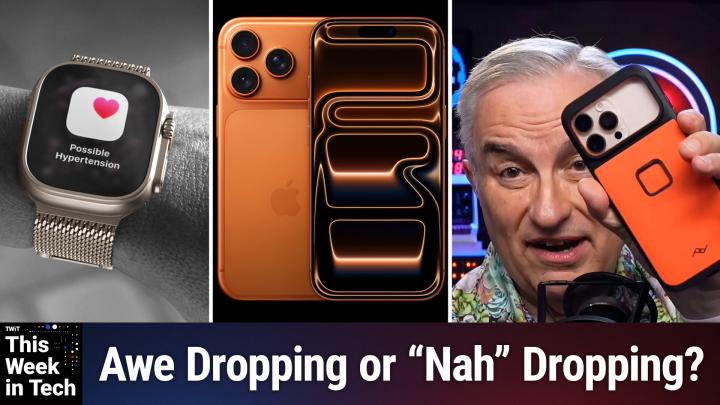
So, okay, you're sitting. Here's. I have some of your pictures. Victoria, you're sitting in the beautiful Steve Jobs theater with. I've got to say this, the awe dropping logo of the Apple looked like it was pretty hot, which is not what you want in a phone. But I guess they wanted to tout the vapor cooling. I don't know why they did that.
Victoria Song [00:15:02]:
Honestly, I didn't know what was awe dropping about the event because usually, you know, the fans go and they think about what does the tagline of the event mean? And sometimes it makes a lot of sense. Sometimes, like the time flies event spring forward. You can kind of go, ah, I see. I don't really know what the odd dropping was because I was like, why.
Leo Laporte [00:15:23]:
Not just call dropping under odd?
Jason Hiner [00:15:28]:
Yeah, marketing definitely came up with that one. It was like this is like the. The proper title would been. It would have been like a little bit more than incremental, you know, would have been probably. But they're never going to upgrade. They're never going to use that. That's why they don't hire me to do their marketing.
Leo Laporte [00:15:44]:
But next year is supposed to be the little bit more than just.
Dan Patterson [00:15:47]:
Or is it in two years next year?
Leo Laporte [00:15:49]:
Well, there's going to be, we think a folding phone and we'll get to the slim phone because I think the air is kind of a prick. It's like the John the Baptist to the Jesus phone. And then. Excuse me, excuse the. I apologize the heresy. And then. And then the year after will be even more odd dropping because that'll be the 20th anniversary of the iPhone.
Jason Hiner [00:16:11]:
And so, yeah, completely invisible. Like you won't even see it.
Leo Laporte [00:16:14]:
It'll float. It'll literally float. This one didn't float.
Dan Patterson [00:16:17]:
That's what you just give Apple $1,000.
Leo Laporte [00:16:20]:
So, Victoria, there were a lot of influencers at the event. Yes, this was. Apple's gotten more and more focused on influencers over reporters, I would guess.
Victoria Song [00:16:30]:
Oh, yes, there was. So there's the annual walk down the spiral staircase. You know, the reporters generally get there early. There's a little light snacks around because you were going to be running around to get a hands on right after this thing.
Leo Laporte [00:16:45]:
And you know, you're a reporter because you pull out that little spiral bound reporter's notebook, right? And you. And a pen or pencil behind your ear and you lift them up.
Victoria Song [00:16:53]:
Yeah, I'm pretty analog, so I do have those things. I do have like, good, good on you.
Leo Laporte [00:16:59]:
Good on you.
Victoria Song [00:17:00]:
But you know, usually when I first started going to these events maybe four or five years ago, I don't remember, they all blur together. But, you know, you'd go down, it was pretty brisk because everyone's like, I need to get my seat. I need to be well positioned for the live blog. I need to get the perfect angle for the photo.
Leo Laporte [00:17:16]:
Are the seats reserved or.
Victoria Song [00:17:18]:
No, it's a free call.
Leo Laporte [00:17:19]:
It's like Southwest Airlines. You have to.
Victoria Song [00:17:21]:
Yeah, that's right. First come, first serve. So, you know, you have some reporters who are just like hawks. They know they have like a sixth sense of like when the descent is going to begin. And so they kind of hang around the staircases.
Leo Laporte [00:17:34]:
Oh, so the door is open. Are there velvet ropes? How do they just.
Victoria Song [00:17:39]:
I'm never at the front because my priority is getting to the hands on. So I sit at the back on purpose. I'm not trying to get smart.
Leo Laporte [00:17:48]:
You want to get it same. See, just like Southwest, you. You want to sit up close to the exit so you can be off the plane.
Victoria Song [00:17:55]:
Yeah.
Leo Laporte [00:17:55]:
Quick.
Victoria Song [00:17:55]:
Got it. But you know, with each subsequent year that I've been going, there's more and more selfie sticks being held up. And I'm hearing. Yeah, because everyone's going to be like, come with me while I go to the iPhone launch event. Here we are walking down the thing and you can see them doing the. Making the content as you go painstakingly slow down this spiral staircase. And you're just like, oh, my God. Let me just.
Leo Laporte [00:18:22]:
You said there was somebody dancing.
Victoria Song [00:18:25]:
There was an influencer. She, you know, was just kind of doing a thing where she had her. I was just watching her, fascinated because she had her phone and she was just going like. And she's dancing to this like invisible music that I know she's gonna edit.
Leo Laporte [00:18:40]:
She's gonna edit or whatnot.
Victoria Song [00:18:42]:
And she just did a whole thing getting the shot. I was watching her and I was like, oh, I'm just here trying to get my wi fi on my laptop. You're doing a whole production over there. And then in the hands on, she was doing the same kind of thing. And I'm sure That's just for her audience and to. To make that sort of content. But it's interesting to see these events that were pretty much geared towards media to start discourse in the history of tech journalism, as far as I've had a career, kind of get co opted. Adam.
Victoria Song [00:19:12]:
I don't know if co opted is the right word, but just to see influencers have a bigger seat at the table and in many cases get prioritized was really interesting. I think the Made by Google event about a month ago was like a really. That was a really interesting.
Leo Laporte [00:19:30]:
The Jimmy Fallon change.
Victoria Song [00:19:31]:
The Jimmy Fallon, Yeah. I was at that event as well, in the front row and I was just like, what is happening?
Leo Laporte [00:19:37]:
This is terrible.
Victoria Song [00:19:37]:
I feel like I'm in an episode of WandaVision and I just, just why? Like something is uncanny and something is wrong. And it's because that event was not for me. It was not for the nerds. It was not for the pixel gadget lovers. It was for an audience.
Dan Patterson [00:19:54]:
Yeah, I would argue that was maybe not for. That was produced by people who did not think about who this is for.
Leo Laporte [00:20:01]:
It was for nobody.
Dan Patterson [00:20:02]:
Yeah, yeah. And you know, somebody different.
Victoria Song [00:20:05]:
You know, I said this to some Google people and it was for someone different. And I went, who? And they went just different.
Dan Patterson [00:20:12]:
So drug emoji.
Leo Laporte [00:20:14]:
They're trying to reach the normies. They don't want to say normies because that's insulting, but that's what they're trying to do is reach normies.
Victoria Song [00:20:20]:
Yeah, but like Apple, I think Jimmy Fallon.
Leo Laporte [00:20:23]:
No, yeah, I think mistake.
Dan Patterson [00:20:27]:
I said this during the pre show and I'll just repeat it here for the larger audience, but Vic's reporting guided me through and Jason's as well, but guided me through, especially the IoT portions of this event, in large part because her reporting is authentic and it's honest and YouTube was loaded with those ridiculous influencers. Some are fantastic. Some are just reading the press release. In fact, the vast majority of YouTubers I saw were just reading off a press release. It was very difficult to tell the. To have insights into the event and the products and to say, you know what Jason said a few moments ago, the context, to put this into context. Who are these products for? What story is being told? And is this something that is amazing or is this like Victoria in your reporting? Is this within the context of IoT or health or something that is maybe very good for you, but not like jaw dropping.
Leo Laporte [00:21:27]:
Aw dropping, as somebody in our chat room said it was gnaw dropping.
Dan Patterson [00:21:31]:
Gnaw dropping.
Victoria Song [00:21:34]:
I Mean hypertension as far as the watches go. The hypertension feature is an interesting one.
Leo Laporte [00:21:41]:
They just got yesterday FDA approval for that.
Victoria Song [00:21:44]:
Yeah, they just got FDA clearance for that. Which, that's good.
Leo Laporte [00:21:49]:
The watches will ship with it. So. But by the way, you don't have to buy a new watch, right? Or do you?
Victoria Song [00:21:53]:
No, you don't have to. It'll come back to the Series 9 and Ultra 2 or later because it does rely on the updated optical sensor. And it's an interesting feature because it's basically negating the need to have one of those inflatable cuffs in order to calibrate, which is generally how these smartwatch or wearable versions of these blood pressure features go. And it was like particularly interesting to me because Whoop. Which is another wearable, that screenless wearable. They really pride themselves in in depth health metrics. They also introduced a blood pressure insights feature recently and they got slapped on the wrist by the FDA because they were like, oh, you didn't actually get clearance for this feature. And you need to get clearance for this feature because what you're doing is diagnostic adjacent.
Leo Laporte [00:22:42]:
Yeah.
Victoria Song [00:22:42]:
And so went back and forth on it. Whoop. Is claiming that it's wellness, the W word. I say because wellness does not require regulatory oversight, whereas something that's diagnostic adjacent, medical adjacent will.
Leo Laporte [00:22:57]:
Apple's very good at skirting that. They know exactly what to say to be not a medical device because that requires a higher standard. It's actually one of our hosts, Steve Gibson, in his youth wrote software for a sphygmommmometer, those things that cuffs that squeeze you. He says very difficult to actually measure intermittent blood pressure because you have to measure in between the beats. It's very complicated. It's not something a watch could ever do. You have to have a compression cuff to do that accurately. So what Apple's really doing is looking at signals over a period of a month.
Leo Laporte [00:23:34]:
Right. It's a long period of time.
Jason Hiner [00:23:36]:
It's 30 days.
Victoria Song [00:23:37]:
It's 30 days. You need 14 days of data from that 30 days. I believe that it only takes daytime readings as well. So it's not reading overnight and it's not going to give you direct readings or any estimates.
Leo Laporte [00:23:49]:
You're never going to get your blood pressure from it.
Victoria Song [00:23:51]:
You're never going to get your blood pressure from it. What it's doing is it's basically comparing your signals and the data that it's getting from you to a baseline derived from a very large data set.
Leo Laporte [00:24:04]:
I think machine learning, right?
Victoria Song [00:24:07]:
Machine learning, yeah.
Leo Laporte [00:24:08]:
We take These people with hypertension and we see what we get from them and we compare it to yours. But even then, it's not diagnostic, it's not warning. It's like, maybe you should check your blood pressure. That kind of stuff.
Victoria Song [00:24:21]:
It's, it's what we call a detection feature. And it's sort of like a, it's like a flag. It's going like, hey, something's a little bit off here, so maybe go talk to your medical provider. And in the world of wearable and health tech, that's kind of the limitations that devices. That's the best you can do. Because none of these companies want the liability of diagnosing you with something and being wrong.
Leo Laporte [00:24:45]:
Right. So that's why, more importantly, missing something.
Victoria Song [00:24:49]:
Or missing something, like they don't want to be in trouble for basically giving you a, like, basically they don't want to give you a false negative.
Leo Laporte [00:24:59]:
Right.
Victoria Song [00:24:59]:
And then you get blamed for that. So most of them, when they're designing their features, will gear towards not delivering false positives.
Leo Laporte [00:25:07]:
This is probably as good as you're ever going to get from a watch. I know you're an aura ring fan. They don't attempt to do this. Yeah, maybe AirPods could get a better look because of the positioning in your ear, but you're never going to get a blood pressure reading from this. However, hypertension is a silent killer. They give you a blood pressure reading.
Victoria Song [00:25:29]:
Yeah, there was one by Omron that I tested a couple years ago and what it does is that I use.
Leo Laporte [00:25:33]:
Their sphygmomometer, but that's the cuff. So they make a watch, huh?
Victoria Song [00:25:37]:
They made a watch. It did get FDA clearance. The difference was that there was an inflatable.
Leo Laporte [00:25:42]:
Oh, there's a cuff. Oh, okay.
Victoria Song [00:25:44]:
Yeah. So there's an inflatable wristband in there and it squeezes you.
Leo Laporte [00:25:47]:
Okay.
Victoria Song [00:25:47]:
So, you know, that's how they, so they do use a cuff. That's how they do it. The, the, the, the Holy grail with all of these wearable technologies is non invasive.
Leo Laporte [00:25:57]:
Yeah.
Victoria Song [00:25:58]:
So, you know, non invasive blood pressure estimates or non invasive blood glucose monitoring, which I don't care what Bloomberg says, that's not coming anytime soon. Talked to the diabetes.
Leo Laporte [00:26:08]:
It's not gonna happen.
Victoria Song [00:26:09]:
You have to come in anytime soon. Yeah, they've been working on non invasive blood glucose monitoring technology since 1975. We're like 50 years since 1975.
Leo Laporte [00:26:21]:
Not to sell Apple short though, because, I mean, they showed that video of all the people who are, you know, underwater in his car and The Apple Watch saved his life and all that stuff. The Apple Watch has very clear health benefits, but for sure it's not a diagnostic tool. The AFIB may be a little more accurate perhaps than the blood pressure, but it's still not diagnostic.
Victoria Song [00:26:45]:
It's not diagnostic. It's. They call it is detection. So they're never going to tell you what it is. It's like back when the pandemic was in full swing in 2020, you had a bunch of these wearable companies and researchers partnering together to try and see if they could detect infectious illnesses. Here we are five years later and the main, there's some version of that feature in the OURA ring called Symptom Radar, but it's very, how do you say generic. And they won't even say that it's illness. They'll say there is an early sign that your health is changing.
Leo Laporte [00:27:19]:
Yeah, I got one the other day. I got one the other day. My temperature, body temperature up a degree over the average. And that actually that's why I started wearing the Auras during COVID hoping that it would catch it early. It never did. And I wasn't sick. My body was hot I guess. I don't know.
Jason Hiner [00:27:38]:
In the developing world for, for several years, like five years now, they've been taking, they've been doing something similar going back to hypertension and blood pressure where you take your, your finger and you put it on your camera and it can do enough right to give you some indication of like Samsung's do that should go and, and do it. Yeah, exactly. A lot of it's on Samsung phones, even like $200 phones with not like the best cameras with cameras from like 2019, you know, can, can do that and it's as good as what you know is in Apple. But the difference where we're at now and Aura is a good example of this is that how can you take that health data and use it to give you some actionable insights, right. To tell you to do something. This is where Apple still has a lot of work to do because will give you Apple health, will give you a ton of different individual insights on each, you know, on each of these different things, but doesn't necessarily take them together. You know, look at algorithms over and machine learning over time. You know, Aura and some of the other smart rings as well, Ultra Human and some of the others, they are, they are doing a better job of this, right of like taking these things and turn them into actionable insights of like you might want to consider doing X And so I was hoping we'd see more of that in WatchOS, the new version of WatchOS and or the new Apple Watches.
Jason Hiner [00:29:03]:
We didn't. Although we did get a sleep score. That is a step in the right direction. But it's still a bit of a challenge. The software stuff and the AI and machine learning parts, Apple's moving very kind of slowly and deliberately there, I think on purpose. I think some of it is a talent thing.
Victoria Song [00:29:26]:
Yeah, I appreciate it because I've tested a lot of the AI companions and insights in these fitness apps that have rolled out over the past year and they're hot, they're bad, they're not good. I think the only one I'm moderately, cautiously optimistic about is Google's AI health coach. Just because I had a chance to talk with the execs behind it after the Made by Pixel event and they seemed very thoughtful about what the implementation was going to be. So I'm cautiously optimistic to test it because the fluff that comes beforehand is fluff you won't really know until you get to try it. But the ones that I've seen from Aura, the ones that I've seen from Garmin and Strava, they're just Captain Obvious book report regurgitators where it's like, here's your, here's your data. You ran fast.
Jason Hiner [00:30:16]:
Yeah, faster than yesterday.
Victoria Song [00:30:19]:
I'm just repeating the data that's in the chart. Wow, thank you. Amazing. Yay. So I kind of, I actually kind of appreciate that Apple is not over promising in this respect. But to your point, they are behind. So it can often feel like they are either moving glacially slow or just like not innovating in the space being maybe perhaps overly cautious. And even in the design of the sleep score, like if you actually look into it, it, it's kind of designed in an interesting way in that it's not based on your biometrics at all.
Victoria Song [00:30:57]:
Like, a lot of what Aura does will, like, they'll take into consideration your heart rate variation, they'll take into consideration your sleep stages and whatnot. That particular score from Apple is built around kind of factors that you can control, like how long did you sleep? You can kind of control that. When did you go to bed? You can kind of control that.
Leo Laporte [00:31:16]:
I always look at, I don't know if it's meaningful. I always look at my REM and deep sleep sleep numbers. Is that meaningful? I mean, is it accurate? I guess.
Jason Hiner [00:31:26]:
Is it accurate?
Victoria Song [00:31:28]:
Yeah, accuracy is the big question. So, you know, Aura is very dedicated to Communicating their science. I believe they're around 80% in terms of accuracy correlation with the gold standard sleep polysomnography, but it's still only 80%. So wearables are a lot better at telling when you fall asleep and when you wake up. The sleep stages, that's kind of. And it's also not within your control. That's not anything you can do. It's only something you can monitor and go like, wow.
Leo Laporte [00:32:00]:
Yeah. They always try to correlate it to behaviors during the day. Like, were you stressed? Did you drink a lot of coffee? That kind of stuff. I don't find it.
Jason Hiner [00:32:07]:
Blue light late at night, you know, stuff like that.
Leo Laporte [00:32:09]:
Yeah, I don't, I don't find it all that valuable, but I, it is, it does gamify my sleep. Like, I'm always trying to get a little crown over my sleep score.
Jason Hiner [00:32:17]:
So still we didn't get a ton of. I think what we didn't get is a ton of that kind of stuff at this, at this event. You know, to Victoria's point earlier, they really retrenched to this design and hardware mindset. And really reading between the lines, one of the things that's been interesting over the last couple of years from Apple is, you know, the last two years have been 23 and 24 have been like a Vision Pro and an Apple intelligence story. And really where in both companies cases they're like out of their comfort zone. Right. And so they were not. When I sort of say reading between the lines, like I look at the way they talk about things both on stage and then off stage.
Jason Hiner [00:32:58]:
And there are ways that the last two years they were not very confident. Right. Like when, when I was working on stuff, they would be emailing me a lot of times, like, what do you think? How did it go? You know?
Victoria Song [00:33:06]:
Right.
Jason Hiner [00:33:07]:
Checking in. What do you, you know, how's the testing coming along? So they were, they were just not super confident about it, it this event. Like, they were so confident that they were dropping shade on other people. Like, okay, they're really, they're really confident. So for example, you know, when they talked about photography for their phone, they said, you know, in our phones we've made it clear we use machine learning, do lots of things. Computational photography, we're doing lots of things, but when you take a picture with our phones, we actually want it to be of a real person and we actually want it to be based in reality, not made up. You know, so clearly they were dropping shades straight at Google on some of the, you know, Computational photography, AI stuff that they were doing. And I was like, okay, they're, they are dropping shade.
Jason Hiner [00:33:58]:
They are a lot more confident. They're not asking me, what do you think about that feature? They're, they were coming out in confidence. Like, they're very confident in their photography, they're very confident in the design of their product products. They're very confident in, you know, adding hardware that makes them sort of the most advanced, as they would call it, right, the most advanced hardware you can find in earbuds and phones and, and watches. So they were much more in their comfort zone in this event. And I think that, I think it did show in some of the products, you know, some of the things that they, they leaned into. Will the, the consumers, will consumers respond to it? I think that in one sense they're a little closer to where the consumer is because I don't think AI is driving a lot of purchases now. It drives Wall street big time.
Jason Hiner [00:34:47]:
And that's why, you know, Apple got downgraded by Wall street analysts after this event because they didn't talk about AI and all the AI features they were, they were announcing. But I do feel like you look at the shipping dates of some of their products, which got pushed out later and later into October, they did resonate pretty well with consumers. And I think that that part, you know, they, they hit the right notes that they needed to hit to, you know, sell products and get, get the right kinds of products in the people's hands that want them, that want to buy their, their stuff.
Victoria Song [00:35:20]:
That's.
Dan Patterson [00:35:20]:
Jason, confidence is key. I'm sorry, Victor.
Victoria Song [00:35:23]:
No, I'm just saying that's like a really kind of astute observation about this conflict between what the consumer wants and what the investor wants. And then also like, like if you hear the way that Apple has talked about Apple intelligence, a lot of the times the people I talked to say it's about meeting the consumer where they're at. And some of that you could say is, yes, they're behind. They have to play catch up. They don't really have super impressive things to show for that. So it's very easy to say it's about meeting the consumer where they're at and what they need. But in on the other flip side, it's true, like as a company, they are much more about the now and what they do. Well, especially in this event and especially if you look at the AirPods, right, because they're like, we have the, we have the AirPods.
Victoria Song [00:36:05]:
Everybody loves the frickin AirPods and so we've decided to make the AirPods even more AirPod great. World's Best ANC * In an earbud. Like that's just like the stuff that was being said at this particular event. But then you look at someplace like Google and they're just like AI is the future. It's not the future.
Leo Laporte [00:36:24]:
Apple may have dodged a bullet by being behind on AI. Maybe it actually is people don't care as much. And I think there's a little bit of a pendulum swing on AI. I know investors care. Oh actually humans are caring less and less. I think.
Dan Patterson [00:36:38]:
Well look, consumer sentiment on AI, business sentiment. Business still is hot on AI, but consumer sentiment on AI dried up in April, May, June.
Leo Laporte [00:36:46]:
Yeah.
Dan Patterson [00:36:46]:
And it really is not it. I think Apple was very smart going into Dub Dub. They could read the room. And I think Jason, confidence really is the key word when it comes to this event. You could see that forecast six or eight weeks ago when some of the leaks started happening. Although we joke about Apple leaks and it's kind of something that happens every year. This happened earlier. It was hardware focused and was very key what the products were, they were Apple's core.
Dan Patterson [00:37:12]:
Not just competency, but competency. Right. IPhone, AirPods, Apple Watch, those things move units for consumers. They make human beings happy. Business can focus on the Dub Dub events and maybe.
Victoria Song [00:37:24]:
Right.
Dan Patterson [00:37:25]:
They might have dodged a bullet. I really think that, I don't think I know because I see the data that comes from large analyst firms that consumers don't trust AI companies and they're kind of increasingly so increasing and that isn't been dogging them. I'm just saying what the data says and probably Apple reacting to it and saying, you know what, next year and the year after are going to be interesting years for us. We will release highly anticipated products this year. We double down. If people want AI, we've got AI, but we don't have to be open AI. We don't have to be anthropic, you.
Victoria Song [00:37:57]:
Know, you know, embargoes are embargoes. But if you were just looking at on paper as to what the announcements were and what actually is the stuff where you read between the lines and you go like actually that's the cool thing. It's not the orange phone, it's not the air, it's the base iPhone 17, it's the Apple Watch SE3 and it's the AirPods.
Leo Laporte [00:38:20]:
The less expensive products.
Victoria Song [00:38:22]:
The less expensive products like the Apple Watch SE has always just been the like eh, it's the cheap watch. But if you look at everything that they added to the Apple Watch SE3, I walked out of that theater going like, you know what was not on my bingo card? The Apple Watch SE3 being the absolute best upgrade of the year to all three of the watches.
Dan Patterson [00:38:39]:
I wonder if that's an economic indicator, too. That shimmers.
Leo Laporte [00:38:44]:
Right? We have to take a break. We're way behind and I have so much to talk about. I do want to know what you think of the little skinny phone, the air, and a lot more. What a panel. This is great. Jason Hiner, editor in chief at ZDNet. And he was at the Apple event. So was Victoria Song.
Leo Laporte [00:39:00]:
She's senior reviewer at the Verge. Always wonderful to get both of you on. And my dear friend Dan Patterson from Blackbird, AI and a longtime newsman. You still write for ZDNet, so that's not. Yeah, it's still.
Dan Patterson [00:39:13]:
Right.
Leo Laporte [00:39:13]:
I will still in the family.
Dan Patterson [00:39:15]:
I will be a journalist when I'm. When I'm dead. I will not have. I'll still have deadlines.
Leo Laporte [00:39:22]:
Great to have all three of you. We'll have more in just a bit. Our show today, brought to you by Express VPN. Going online without ExpressVPN, I don't know, it's like leaving your laptop unattended at the coffee shop while you run to the bathroom. Most of the time, you know, fine. But what if one day you come out of the bathroom and your laptop's gone? It's reasonable to prepare for the worst. That's why everyone needs ExpressVPN, because every time you connect to an unencrypted network, whether it's a cafe, a hotel, I'm always, I'm in the airport. It says Free SFO wifi and I'm going, a, is it real? And B, is it safe? Your online data, even if it's real, is not secure.
Leo Laporte [00:40:06]:
Any hacker who's on that network can gain access to and steal your personal data. There's all sorts of things they can do. It doesn't take a lot of technical knowledge, just some cheap hardware. And there's a lot of incentive. Hackers can make up to a thousand dollars per person selling your personal info on the dark Web. And just to mess with you, right? Well, every time I'm at the airport, let's say, and I see free SFO WI fi and I go, I'm not going to join. I remember, oh, all my devices have ExpressVPN, I press that big button button. I know it's Safe.
Leo Laporte [00:40:38]:
To use ExpressVPN stops hackers from stealing your data by creating a secure encrypted tunnel. It goes from your device through the free Wi Fi, completely encrypted, and enters the Internet at ExpressVPN servers, where they protect your privacy 100%. That's why I use ExpressVPN. It's the one I use. It's the best VPN out there. It's the only one I recommend because they are committed to keeping your privacy private. I use it when I'm at the airport, when I travel, to keep up on my shows, to watch football, F1 racing. Here's why ExpressVPN is the best VPN.
Leo Laporte [00:41:14]:
It's super secure. It would take a hacker with a supercomputer over a billion years to get past ExpressVPN's encryption. ExpressVPN's easy to use. You fire up the app, you click one button, you're protected. And it works on all devices, phones, laptops, tablets, even routers and more. So you can stay secure on the go. You can even stay secure in your your house. ExpressVPN offers an optional.
Leo Laporte [00:41:36]:
This is very cool. Dedicated IP service engineered with innovative zero knowledge design. This is why I love this company. They consistently go beyond the basics to give you extreme privacy with their zero knowledge design. Not even ExpressVPN can trace an IP address back to the user. You are absolutely private. ExpressVPN rated number one by Top Tech reviewers like CNET and the Verge. It's the only one I use, the only one I recommend.
Leo Laporte [00:42:05]:
Secure your online data today. Visit expressvpn.com twit that's E X P R E-S-S vpn.com twit to find out how you can get up to four extra months free when you buy a two year package. Expressvpn.com twit we thank him so much for supporting this week in tech. Back to the show with Dan Patterson, Victoria Song and Jason Hiner. There is a little AI in the new AirPods. They've got that translation.
Jason Hiner [00:42:34]:
Sorry, Leo. Can we boost Victoria's mic a little bit?
Leo Laporte [00:42:37]:
Yeah. Victoria, you're a little low. If you can. Oh, we just want to hear your dulce.
Victoria Song [00:42:42]:
I'll just sit closer to my mic. My couch is real deep.
Leo Laporte [00:42:45]:
Yeah, don't get relaxed.
Jason Hiner [00:42:47]:
So anyway, I mean, if you have a little bit more gain to put on your interface.
Leo Laporte [00:42:51]:
There's a knob. Is there a knob anywhere?
Victoria Song [00:42:53]:
There's a knob.
Leo Laporte [00:42:55]:
Oh, on that, maybe on your system, on your zoom, there's a. I don't want to get too much in the weeds on this. Move the mic as close to you as you can, I think.
Jason Hiner [00:43:05]:
Yeah, just.
Leo Laporte [00:43:06]:
I think.
Jason Hiner [00:43:06]:
Yeah, as long as you move it closer to your face, that's probably going to work.
Victoria Song [00:43:09]:
Yeah. Okay, cool.
Jason Hiner [00:43:10]:
Thanks.
Leo Laporte [00:43:11]:
Back to our panel. Dan Patterson. Victoria Song. Dan Hiner. Jason Hiner. Hi, Jason. The AirPods have a little bit of AI in them with this simultaneous translation. In fact, if both people are wearing a pods, they said you'd be able to talk to each other.
Leo Laporte [00:43:27]:
Not available in any country outside the US it looks like. I don't know. It's not available in Europe, I think. Not available in other countries as well. But you weren't able to get a demo of this, Victoria?
Victoria Song [00:43:40]:
I did get a demo at Apple Park. I did get a demo at Apple Park.
Leo Laporte [00:43:44]:
Oh, both of you did. Okay, let's hear about it.
Victoria Song [00:43:47]:
So basically, they had a bunch of us in a room, and they had someone come in speak Spanish to us, and then we got to listen to the AirPods translate it. And it did a pretty good job, I must say. But I'm very skeptical about. About translation tech in general, just because I lived abroad for seven years. I went to college in Japan and then worked there for a couple years afterwards. I live in a multifamily, multilingual family. And, you know, it's one thing to be in a demo with guardrails and to have a little speech that they've thought up ahead of time, and they're talking in a very measured tone and very.
Leo Laporte [00:44:27]:
That's not how real people talk, is it?
Victoria Song [00:44:29]:
That's not how real people talk. If you've listened to a podcast, do you feel, you know, a lot of us children of immigrants have an auntie that speaks at the speed of light. And, you know, at least in my family, we speak something called Konglish, where you switch between Korean and English in the same sentence, back and forth. It's more like a pigeon or a creole type situation. A lot of the different AI translation devices or features that I've tested did really struggle with that. Pixel also introduced AI live translation calls, and I tested that with my very lovely colleague Allison, and, oh, boy, did we make the robot scream. I think we broke it on the call.
Leo Laporte [00:45:20]:
Google even changes the voices, which Apple does not do, right?
Victoria Song [00:45:23]:
No, it doesn't do that. But the Pixel was just going. Or Alison speaking in just Japanese to me via this feature was going. And then I think I actually broke it because, you know, my Japanese, a little rusty I haven't lived there in a decade. But so, you know, I was trying to think of words and trying to think of grammar on the fly because sometimes when you're talking to someone who, you know, speaks English, your brain does a little glitchy glitch, and it doesn't know what language it's supposed to be speaking in in that given context or time. And, you know, so a lot of times when I test this kind of technology, there's. I mean, Lord knows the humane AI pin just was really racist to me. That was.
Victoria Song [00:46:07]:
That was.
Leo Laporte [00:46:08]:
That was something racist. What do you mean?
Victoria Song [00:46:10]:
I was asking it things in Japanese and it just like repeated gibberish back to me. And I was like, okay, that's weird. And then, you know, the pixel. One of the things that I noticed with the pixel call was that I was asking about breakfast and. Or Alison was asking me what I had eaten for breakfast. And they used the word choushoku. Choku is like a very formal word for breakfast. You'll see it in menus and you'll see it written.
Victoria Song [00:46:37]:
No one speaking to each other in Japanese will use that word. They'll use asakohan, which is the more common word for breakfast. And the AI used chousoku, which I was like, I would only expect to hear that maybe at a hotel talked to me by a staff who's using super respectable actual form of the language or in a menu. So I was kind of thrown off by that usage in the. In the translation. And, you know, those are the kind of nuances that AI translation devices kind of, you know, they quote, unquote, get lost in translation with. So I think.
Leo Laporte [00:47:12]:
But at least you would understand what they were saying. I mean, at least the gist.
Victoria Song [00:47:17]:
Yeah, I think it's useful for. For tourists. Tourists. Like, if you're a tourist and you're like, I have no idea how much this costs. How much does this cost? And someone tells you and you can have that kind of conversation, that's great, because honest to God, duolingo exists. But I don't necessarily want to use duolingo for a place that I'm only going to visit for two weeks. And I have no interest in, like, further and deep diving deep into that culture versus a place that I'm really interested in. And I do want to study that language and that culture.
Victoria Song [00:47:45]:
The AI's not quite as helpful there. But if you're just visiting a place and you're like, so lower expectations.
Leo Laporte [00:47:52]:
It's not the Babel fish. It's. It's going to help you get around.
Victoria Song [00:47:57]:
I want the Babel fish, but.
Leo Laporte [00:47:58]:
Well, we all want it, but I don't know if we're going to get it anytime soon.
Jason Hiner [00:48:01]:
Here's what I did. Well, I've similar experience like the. There have been promises of this in tech for 10 years, right?
Leo Laporte [00:48:08]:
Yeah. Google's been announcing this at Google I O for at least 10 years.
Jason Hiner [00:48:11]:
They've announced it every year, right. Every, like 2015. So. And. And I'm also testing the, you know, Pixel 10 Pro XL and the Pixel with the Pixel Buds 2 and trying it there and every week. So I do some volunteer work with mostly teenagers in literacy.
Leo Laporte [00:48:28]:
It speaks teenager now. That would be.
Jason Hiner [00:48:31]:
That would be amazing. Yeah, I like that. Translation. No, but, but so in multiple different languages. Spanish, French, Swahili.
Leo Laporte [00:48:38]:
Wow. Good on you.
Jason Hiner [00:48:39]:
Wall of. Yeah, several others. So. So I get the chance to test some of these in the real world. So the demo, I had the same demo that Victoria mentioned. It's largely similar to most of the other demos. Now here's one thing that I think that impressed me, which is that in these demo, not when, not the demos, but when you actually go to use the product, you have to hit so many different buttons to actually get it to work that by the time.
Leo Laporte [00:49:07]:
Don't say anything. Hold on. Wait, wait, wait, wait, wait.
Jason Hiner [00:49:09]:
Say that again. It's so bad. It is so it's. It's like really unusable. So the one thing Apple's done that's very appley is they've made it a lot easier. All you do is like with the air. If you have AirPods, you just double hold with both. Do a long press with both buttons and it goes right into translation.
Leo Laporte [00:49:29]:
Okay.
Jason Hiner [00:49:29]:
And then it starts. So I did that and in the demo and I was like, okay, that's a lot better than digging through and doing the like. Hold up. No, start again. Do.
Victoria Song [00:49:41]:
Hold on.
Jason Hiner [00:49:41]:
Let me hit this button and find it. Switch, put it to the right language and all that. It just doesn't work super well.
Leo Laporte [00:49:48]:
I have to say. You're also missing a cultural opportunity with hand gestures and kind of get. You know, there's a for sure certain value to trying to communicate with somebody without the technology in between.
Jason Hiner [00:50:02]:
You know, I learned from. So the work that I do in literacy, I learned from my friend who's an ESL teacher. So he's the one that sort of trained to me in this. And when he talks, everything is hand gestures. He's like, okay, so we're, we're going to Go from here to your house at, at 6:00'. Clock. You know, so, so he's sort of using the, the body language to tell like 50% of the story. Right.
Jason Hiner [00:50:27]:
And, and that is a lot of what helps.
Leo Laporte [00:50:30]:
This is very typical of the tech industry. They see a tech solution to every, every thing when often it, it obscures the human element. And, and I think more and more we're getting kind of disenchanted with turning to tech for these kinds of things that you, you lose out somewhat. So anyway, good. Apple put it in there. It's probably appropriate to lower expectations. It isn't the Babel fish. Fine.
Leo Laporte [00:50:58]:
Okay.
Jason Hiner [00:50:58]:
It only does like five languages to start. They say they've got like another five that are coming before the end of the year. They've said we like this stuff is not easy. Like even doing it at the most basic level to understand conversations is hard. But, but it is bad. Like it's better than it was 10 years ago. It's better than it was two years ago.
Victoria Song [00:51:18]:
So, you know.
Leo Laporte [00:51:21]:
So who's gonna buy? Well, you guys don't have to buy anything, but if you had to buy something, would you buy the Air? Who would buy the air? Who likes the air?
Victoria Song [00:51:32]:
Like an air, But I wouldn't buy it.
Leo Laporte [00:51:34]:
I'm wondering if the Air is a non. They can't sell it in Europe and China because it's the SIM issue yet. Maybe they will be able to. ESIMS are not regulatory approved. But I wonder how sales are going to go for the Air. I think Apple thought it was going to be their best seller, at least from the trackers. You know, looking at availability, it's not sold out by any means.
Jason Hiner [00:51:58]:
There's an emotional response to it. So I have no doubt they're going to sell a bunch because if you go into IT store, if you go into the Apple Store, if you go into the Verizon store, you pick it up like it feels amazing in your hand, like, and you look at it like it. It is. It has an emotional, you have an emotional response to it. So I have no doubt a lot of people are going to buy it. My question is how many of them are going to regret it? Because you know, you. The phone and Victoria mentioned this earlier, the iPhone 17 is actually a better phone this year than the iPhone. Air is the base level 17.
Jason Hiner [00:52:37]:
They doubled the storage. It essentially is like a 16 Pro without the zoom camera because they all.
Leo Laporte [00:52:45]:
Start with 256 gigs.
Dan Patterson [00:52:46]:
Now as storage does this phone in Victoria's world, does this Phone. Does the air point to a future? Is this something that Apple can start with and iterate on, or is this a placeholder? Because they need a. Needed something as a. Like a highlight or a headline feature?
Leo Laporte [00:53:06]:
Well, note, they didn't give it a year. They didn't give it a model number. It's just an iPhone. Air. Right.
Dan Patterson [00:53:11]:
I can see. I mean, I think that this is. I have no interest in it, but I think it's very innovative and I think it's worth a shot.
Leo Laporte [00:53:17]:
I think this is because Samsung has.
Dan Patterson [00:53:20]:
Yeah, it's. That's kind of where I'm going to make it clear.
Leo Laporte [00:53:23]:
This is going to be the pre. The precursor for what.
Victoria Song [00:53:26]:
I think that's.
Dan Patterson [00:53:26]:
That's what I'm getting at.
Victoria Song [00:53:27]:
Likely what it. I think it's likely a kind of a precursor to a foldable, just because, you know, they. They're far, far, far behind. How many foldables do we have from Samsung at this point?
Leo Laporte [00:53:39]:
This is seven.
Jason Hiner [00:53:39]:
Seven?
Victoria Song [00:53:40]:
Yeah, yeah, like seven of them. So they're far behind in, in terms of foldable. And this is just kind of showing that they can make something extremely slim. And to Jason's point, like, when you hold it, you're like, oh. Oh, nice.
Leo Laporte [00:53:55]:
Does it say top heavy, though? I mean, it's got this giant bump at the top. No, not.
Victoria Song [00:54:00]:
Not really. When you hold it in your hand. I was just like, oh, this is quite nice. But the thing that gets me is the, the dubious camera math that's happening where they're like, this one camera is the equivalent of four cameras. And I'm like, how. How I'm gonna wait for the. The camera nerds that I know and the, the reviewers who are much better at photography than I am to kind of weigh in as to what that's actually going to be like. But I don't know.
Victoria Song [00:54:26]:
Like, you can say that it's a fusion camera and that it's four cameras in one, but when I go to a concert and I want to zoom in, am I going to get a potato photo versus, like, buying one with. With. With. With more cameras and an actual telephoto lens? I think that's something that people are going to have to reckon with. And then the other thing with the air was like, just tell me how long the battery is going to last. Without the battery PA pack. They were doing some weird.
Jason Hiner [00:54:54]:
There.
Victoria Song [00:54:55]:
Some weird, like, misdirection with, like, well, with the battery pack, you'll get X amount of hours of playback. And I was like, yeah, but what about without it. What about just, just tell me what the battery life is. And they just was like, and isn't it beautiful?
Leo Laporte [00:55:09]:
All day? It's all day. Yeah, all day.
Jason Hiner [00:55:11]:
Battery all day. I think it's all day. If you, you know how we can all tell because of the, the things that tell you how long you use your phone and what use. If you use your phone like two and a half to three hours a day, I think you'll get through a day with it. That's like a somewhat sort of light to medium user. If you're using your phone three to four hours a day or more, you're not gonna, I don't think you're gonna make it.
Leo Laporte [00:55:34]:
Or it's a fashion accessory and you have another phone for the daytime and air for the nighttime.
Victoria Song [00:55:41]:
Thousand dollars. You have an extra thousand dollars for a fashion passion phone.
Leo Laporte [00:55:45]:
Well, that's why I don't think it's going to sell that well. I really don't.
Jason Hiner [00:55:47]:
You probably aren't working and you don't need it to go all day. So.
Leo Laporte [00:55:50]:
Yeah, that's a good point. Or you're like me, you work at home and it's always on the charger.
Jason Hiner [00:55:57]:
Battery accessory with it I think says a lot, right? Like it has its own battery accessory with it. It's a, it's a concept car. Right. Ultimately, I think it's a, it's a bit of a concept car and I would not be surprised if it's the only iPhone Air. And next year we get the iPhone fold and it replaces it in the lineup.
Victoria Song [00:56:17]:
But yeah, I'm surprised because we didn't get a plus phone this year. It's like an iPhone 17 plus. Instead we just have the iPhone 17 Air. And I was kind of like, well what about those of us who want more battery?
Leo Laporte [00:56:31]:
Like the rumors are that Apple's going to have two phone events now because they want to smooth out manufacture, they want to smooth out the stock prices. So there'll be a mid year phone that will be an SE kind of phone. That's the rumor, but who knows? Who knows? I think that, I think what they also recognize is that if you're that serious about your phone, you're going to get a pro. If you care about the cameras, you're going to get a pro, right?
Jason Hiner [00:56:59]:
Yeah.
Leo Laporte [00:57:00]:
And they much increase the battery life on the pro. They basically said okay, or if you want shortened squat, we can make a good battery Life phone.
Jason Hiner [00:57:09]:
The 17, the base level 17 is almost like a little pro now though too. Like it is got two 48 megapixel cameras. It's got 20 256, you know, gig base storage. So that's double what the same what the. With the, you know, same level Samsung and Google phones have. So it's got more storage. It's got the two 48 megapixel cameras. It's got better battery life because of the upgraded processor.
Dan Patterson [00:57:37]:
Higher refresh rate.
Leo Laporte [00:57:38]:
Right?
Jason Hiner [00:57:39]:
It's got the higher refresh rate and.
Dan Patterson [00:57:40]:
That makes it feel like a fast phone, right?
Jason Hiner [00:57:42]:
Yeah. And 3000, it's pretty capable.
Leo Laporte [00:57:45]:
Yeah.
Jason Hiner [00:57:46]:
It is essentially a 16 Pro without the zoom lens. And for 799, I think they've figured.
Leo Laporte [00:57:54]:
Out the consumer categories and they're saying, okay, certain groups don't care about the camera as much, but their battery life's important. They also, it's very impressive what they're doing with processors. The new processor is extremely fast. They kind of alluded to it being as fast as a desktop computer.
Jason Hiner [00:58:13]:
MacBook Pro level performance.
Leo Laporte [00:58:15]:
It compares very well to an M4. So that's pretty amazing. And that's a testament to Apple Silicon. The other thing I thought was very interesting and maybe it's because they have all those influencers in the stairwell is the selfie camera. They finally acknowledged that that may be the most used camera on the phone for a lot of people.
Jason Hiner [00:58:34]:
People for sure.
Victoria Song [00:58:35]:
I love that. So like when that happened in the theater, I was like, yes, finally, it's for you, Victoria. My vanity. Acknowledge my vanity. But to that point there a lot of what actually ended up impressing me at this event were like small things like that in like the grand scale of things. Just like, oh yes, that tiny thing that I asked for. Thank you for giving it to me. Thank you for giving me.
Victoria Song [00:59:02]:
And always on display on the end. SE3. We've only been asking for that for like six years at this point and yay, we finally get it. And you know, better Air bit better. Active noise cancellation on the AirPods that's all anybody really wants. So I, I really do think it's interesting that when you look across all of the announcements, what I actually think will get people jazzed and what will drive sales are these affordably priced devices that just add what people want. Like that selfie camera. Camera.
Leo Laporte [00:59:32]:
When I first watched the SE. So the 17 and nothing and the SE watch to you are the real products here.
Victoria Song [00:59:40]:
That and the AirPods 3. Yeah.
Leo Laporte [00:59:41]:
And the AirPods 3.
Dan Patterson [00:59:42]:
Going full circle to what Jason said at the beginning of this conversation the last two years, or at least Two cycles were on devices that could have defined the future, but they were very hypothetical and they're even. Even without bashing the decisions, there was not necessarily consumer demand pointing towards the AI or Vision Pro. And now they have come around to selling what people want.
Leo Laporte [01:00:12]:
And Victoria, you're a crossbody strap kind of gal.
Victoria Song [01:00:16]:
Yes. This is not a new accessory.
Leo Laporte [01:00:19]:
No, I see this all the time, people walking around, mostly women. I don't see a lot of guys.
Victoria Song [01:00:23]:
With it, but yeah, they're super big in Asia, they're super big in Europe. I, I believe I bought a bandolier strap a couple years years ago because I was just like, you know, your phone has in many ways replaced your wallet. So, you know, I want, I don't want to carry a purse. My phone could be my purse. Yeah, just carry it this way. So I had one for a while and then I graduated to a little wristlet strap because.
Leo Laporte [01:00:50]:
Wait a minute, you strap your phone to your wrist like a watch?
Victoria Song [01:00:54]:
Oh, no, it's like a. If you remember the little straps on Wiimotes so that you wouldn't like go, oh, yeah, yeah, yeah, I have one of those.
Leo Laporte [01:01:03]:
Like a little hand lanyard.
Victoria Song [01:01:04]:
Yeah, yeah, yeah, yeah. I have a little hand lanyard because sometimes I'm just doing stuff and I want to drop my phone, but I don't want to put it in a pocket because women's pants don't have pockets that are suitable for a Pro Max phone, which is what I have. And so, you know, I have a little hand lanyard on there. So the hands free aspect of keeping your phone but not having to put it in a separate other bag makes that crossbody accessory a really smart idea. They have magnets so that you can kind of adjust the length and keep it secure. I'm, I'm just like, the, the Etsy makers are going to be real pissed. It's. It's Apple Sherlocking etsy that at $59.
Leo Laporte [01:01:42]:
I think that there will be a market for other.
Victoria Song [01:01:44]:
Oh, I mean, the bandolier strap I got was $98, so this is technically cheaper. So. So, yeah, wow.
Jason Hiner [01:01:50]:
I hadn't really seen many or I hadn't really thought about it that much. And then on the flight home, I saw them everywhere. Obviously not the Apple version once you're aware of it, but I was aware of it. So I was like, oh, look, there's one. Oh, there's another one. Oh, look, she's got one too. And then I'm walking, it's like I see them everywhere. I'M like, oh, wow.
Jason Hiner [01:02:06]:
I guess this is a trend that I just.
Leo Laporte [01:02:08]:
It's a thing.
Victoria Song [01:02:09]:
It's because they won't give women pockets. They won't give us pockets that are.
Jason Hiner [01:02:13]:
Big enough in women's clothing.
Victoria Song [01:02:15]:
Yeah, there's no pockets. Pockets.
Leo Laporte [01:02:17]:
Like my wife actually calls me Pockets. I'm her pocket, basically. And she says, always wear something where you can carry my lipstick, my phone and my wallet.
Victoria Song [01:02:29]:
It's consistency theory. Why do we have purses? It's because they won't give us pockets in our clothes that men have. And so we have to buy all these bags but now we don't want to carry the bags because our phone is basically everything. But you just don't want to carry your phone because then you're just one handed. So give me the crossbody strap, man.
Leo Laporte [01:02:46]:
No air tags. Although we have heard a rumor that there might be an October event, that there are at least five products Apple still has to announce this year, including an Apple TV, new HomePods and AirTags. But they have maybe an October event.
Jason Hiner [01:03:04]:
The AirPods Pro 3 got the upgraded chip so that they now have precision finding the U3. The U2. They actually called it the U2 this year. You know, they didn't call it the U2 before. So essentially that case is now the second gen AirTag. So I think it's probably a tell that the next AirTag is coming because that case on the AirPods Pro 3 has the U2 chip in it.
Leo Laporte [01:03:36]:
Brilliant.
Jason Hiner [01:03:37]:
Yeah. So the AirPods Pro, to Victoria's other point, like the AirPods Pro 3, that was probably my pick for the best upgrade of the whole thing. When I did the demo of those, I almost cussed. When I turned on the, when I turned on the noise cancellation, I was.
Leo Laporte [01:03:59]:
Like, is it really, oh, how exciting. They said twice as good. Really?
Jason Hiner [01:04:05]:
It's probably better than twice as good. Like that's crazy. It's crazy.
Victoria Song [01:04:10]:
They were giving us demos in the main hands on area. That's a loud place because not only do you have hundreds of influencers and drop journalists, you have Tim Cook mulling around, there's people talking. And so they had just like these trays of AirPods that you could try, you could try to find, find the best fit, stick them in and you know they would be like, okay, turn on the air, turn on the noise canceling and let's play this playlist from the F1 soundtrack.
Leo Laporte [01:04:38]:
Oh God.
Victoria Song [01:04:39]:
When you turn on the, when you.
Leo Laporte [01:04:41]:
Turn on could have been a UT two albums.
Victoria Song [01:04:43]:
So you maybe it could have been worse.
Leo Laporte [01:04:45]:
Yeah, yeah.
Victoria Song [01:04:45]:
But you know, you turn, turn on the, the noise canceling and go. It's.
Jason Hiner [01:04:50]:
Yeah.
Victoria Song [01:04:50]:
Still hear some of the higher frequencies. You can still hear some of the higher frequencies, but it's dead quiet. And then they had me play the Celine Dion track from the F1 soundtrack and all I heard was the sweet, dulcet tones of Canada's favorite pop star. And it was, you know, she diva. I love that for myself. And I was honest to go, God, just flabbergasted.
Leo Laporte [01:05:12]:
Your pods will go on.
Victoria Song [01:05:15]:
Your pods will go on. Your pods will go on. Because the AirPods Pro 2 are good. This is better. Like in that one second I was like, these are. Oh, these are better. And they fit better too. They, they genuinely fit better.
Leo Laporte [01:05:27]:
They changed that. They have now five tips and they have some foam enhanced tips and they say they measured 10,000 years to get them.
Jason Hiner [01:05:35]:
That's right, better. The thing that's crazy is I didn't really think you could get better noise cancellation in AirPods. I just thought you're only gonna be able to get so good. And I've tried other ones. The Sony XM5 earbuds are really good too. They're about as good as the AirPods Pro 2s. So I just was like, I just don't know how good could they really get? But these are like 80 to 90% as good as AirPods Max. Like, that's how good they are.
Jason Hiner [01:06:08]:
That sort of blows my mind because on long trips you still, like, I still have to use it over the ear.
Leo Laporte [01:06:12]:
Over the ear. The Bose quiet comforts or something. Yeah, yeah.
Jason Hiner [01:06:15]:
Because, you know, just for battery life and for the fact that it's for the loud plane sound.
Dan Patterson [01:06:22]:
You save your ears. Yeah.
Jason Hiner [01:06:23]:
The only thing that's going to.
Leo Laporte [01:06:24]:
Well, I'm going on a plane in a couple of weeks and I will try the AirPods 3. We don't get review units, we don't do embargoes. So our reviews will be coming out. Micah Sargent and I will both have new iPhones. I'll have the new Ultra 3. Watch the AirPods Pro 3 like everybody else next week and we'll have our reviews following that. Yeah.
Jason Hiner [01:06:46]:
What you think? I'm sure pretty wild.
Leo Laporte [01:06:49]:
ZDNet and the Verge will have their reviews as soon as they are able.
Victoria Song [01:06:55]:
Who can say? Who can say?
Leo Laporte [01:06:57]:
Currently not you.
Victoria Song [01:06:58]:
No, I can't say a damn thing saying.
Leo Laporte [01:07:03]:
I didn't know that.
Jason Hiner [01:07:04]:
Keep an eye out, but keep an eye peeled. Yeah, keep an eye out.
Leo Laporte [01:07:09]:
Sometime soon.
Victoria Song [01:07:11]:
Sometime very.
Leo Laporte [01:07:12]:
I Can say this typically the Wednesday before Friday ship date for the iPhones and I would imagine the other stuff will be in that general range.
Jason Hiner [01:07:21]:
So remember that they tend to. They just as a tip, I think you had the general timing of what last year's embargoes looked like. And remember that they do them one day at a time. So like, like go a day backward, you know, in terms of what history looks like. The last few years, the embargo for, you know, the Watch and the AirPods tend to be a day or two before the phone. Based on history.
Leo Laporte [01:07:46]:
Not anything, you know, not anything you would possibly know. Let's take a break. We have done. We're done with Apple. Thank God. Oh, my God. That was an hour of Apple Talk. But you know what?
Jason Hiner [01:08:00]:
Sorry, Dan. Thanks for your patience.
Leo Laporte [01:08:02]:
It's still like the number one consumer product out there. I think it's still pretty close to. It certainly drives more than half of Apple's sales and they are nearly a $4 trillion company. So I guess we had to talk about them. Okay. But we're going to move on. We're going to talk about Google and the web, which is apparently, according to Google, in rapid decline. When we continue.
Leo Laporte [01:08:27]:
You are watching this week in te. Victoria Song is here, Senior reviewer from the Verge, Dan Patterson of Blackbird AI and news.danpatterson.com is that a newsletter or just a website?
Dan Patterson [01:08:41]:
It's just my. Yeah, it's my subsack. I mean, it's fine. Like, if you want to put something up, I write a column for Jason Quarterly or every two months, I think.
Leo Laporte [01:08:50]:
Nice.
Dan Patterson [01:08:50]:
All right, that's better. Send people to ZDNet.
Leo Laporte [01:08:53]:
Yeah, let's go to ZD Net. They'll probably have a bunch of reviews up there soon. Editor in chief.
Dan Patterson [01:09:01]:
And if you would like to read about geopolitical swings caused by narrative attacks and disinformation, you can read my stuff.
Leo Laporte [01:09:10]:
Actually, we're going to talk about Nepal. What's going on in Nepal is. Oh, wild.
Dan Patterson [01:09:14]:
That's a lot of fun.
Leo Laporte [01:09:14]:
All right.
Dan Patterson [01:09:15]:
We go from iPhone fun.
Leo Laporte [01:09:16]:
I don't know.
Dan Patterson [01:09:17]:
But now you're talking my language, Leo.
Leo Laporte [01:09:19]:
It's wild. And this week there have been a number of calls for, you know, banning social media.
Dan Patterson [01:09:25]:
I mean, yeah, we covering this for a year. It's been pretty nuts.
Leo Laporte [01:09:30]:
Yeah. Is social media a hazard? I don't know. We'll talk about that and more.
Dan Patterson [01:09:34]:
I quit social media a long time ago.
Leo Laporte [01:09:36]:
Yeah, I don't like it. And it was.
Jason Hiner [01:09:37]:
Dan and I did a podcast in 2018, where we both said that we were retiring from social media.
Leo Laporte [01:09:43]:
Did you keep it up?
Dan Patterson [01:09:44]:
I don't use. I mean, this is a longer story. I try very, very hard. I have a Blue sky account that I like, but I don't post to. I try very hard not to post a social and also try not to scroll once a week. I check in on accounts, but. And my Twitter account got Elon, so I can't use that.
Leo Laporte [01:09:59]:
Part of my job is to actually even look at X as well as Blue Sky.
Dan Patterson [01:10:03]:
And sure, I can't even log in. I'm prevented from creating new accounts.
Leo Laporte [01:10:08]:
Good.
Dan Patterson [01:10:08]:
So any. Anything that I create. No, I'm not joking. You're like, I can't. I logged into my Twitter one day and it said, you are a hazard to the Twitter community. And you're kidding. No, I'll say that's a bad. I'll send you a screenshot right now.
Victoria Song [01:10:21]:
You're a hazard to the Twitter.
Dan Patterson [01:10:23]:
Not a hazard, but like, because. Because of. We've examined your post and we've found that blah, blah, blah. But that's, you know, I don't even.
Leo Laporte [01:10:30]:
I don't post there, but I do have a blog which cross posts to his. You know, you know, I, I really.
Dan Patterson [01:10:36]:
Don'T want to get into Elon's stuff or, or nonsense about. About that website. I mean, turns into a rabbit hole.
Jason Hiner [01:10:42]:
But when Dan and I did that podcast in 2018, because Dan and I met on social media, we couldn't even really remember when or where. But, you know, I had calculated I was spending like two to three hours a day on social media.
Dan Patterson [01:10:55]:
Yeah.
Jason Hiner [01:10:55]:
And so I was like, okay, this has got to stop. So I said, I'm going to. I'm going to limit it to like 15 minutes a day to check in on things occasionally. So occasionally I post on LinkedIn or Instagram still. But I've pretty much kept this up. So what I said at the time was, for a year, I'm going to take that two to three hours a day that I was spending, and I'm going to trade that for two things. I'm going to read books. Because I realized it had been two years since I had read a book, which is shameful to say.
Jason Hiner [01:11:21]:
So I'm to going to read books.
Leo Laporte [01:11:23]:
Much better use of your time.
Jason Hiner [01:11:25]:
And I mean, they were still digital books. They were Kindle. You know, I wasn't filling up my shelves.
Leo Laporte [01:11:29]:
Okay. Or audiobooks.
Dan Patterson [01:11:30]:
Remember that?
Jason Hiner [01:11:31]:
Ten audiobooks. And then I'm going to spend the time I'm going to actually meet because I realized that I also had, like, kind of stopped meeting my friends in real life. So I said, I'm going to. I'm going to go out to lunch or do phone calls with people instead, like a smaller group of people. But, you know, I'm going to do that for a year. And after a year. Year, my, like, I felt so much. I felt so much better connected.
Jason Hiner [01:11:53]:
I felt so much. Like my mental health felt so much better. And I was like, there's. I didn't even think about the date because it was sometime in the summer of 2018 when Dan and I did that. And I didn't even think about when the date came because there was no way I was going to go back and stop, you know, doing it. So I really have kind of kept that going, you know.
Leo Laporte [01:12:10]:
Seven years you've been doing that, Jason, that's tremendous.
Jason Hiner [01:12:13]:
Yeah, sure.
Dan Patterson [01:12:14]:
You missed a lot in 22.
Victoria Song [01:12:17]:
That's so wholesome.
Jason Hiner [01:12:18]:
It's so there.
Victoria Song [01:12:20]:
I'm not involved like that yet. I. I'm. I'm still doom scrolling on TikTok because.
Dan Patterson [01:12:25]:
Oh, I won't so much.
Victoria Song [01:12:27]:
There's so much good beef on there and I'm so tasty.
Leo Laporte [01:12:31]:
Where's the beef?
Jason Hiner [01:12:32]:
See, I. I find friends like you who then tell me the stuff that I miss.
Leo Laporte [01:12:36]:
That's my wife's job. I carry her stuff around in my pocket and she takes. Tells me what's going on on social. It's perfect. It's a good match. Marriage made in heaven. We will continue in just a moment.
Dan Patterson [01:12:46]:
Yeah, I can't even log in.
Jason Hiner [01:12:48]:
I love that.
Leo Laporte [01:12:49]:
That you've been banned is amazing.
Jason Hiner [01:12:50]:
You. That's.
Leo Laporte [01:12:51]:
What a badge of honor.
Jason Hiner [01:12:53]:
A badge of honor for sure.
Leo Laporte [01:12:54]:
What did you say?
Dan Patterson [01:12:55]:
Sure, I didn't say anything, but I did have an account where I. I mean, I'm not going to go into this rabbit hole, but I was actively covering the acquisition of Twitter in 2020 for CBA. I mean, I was on air every single day, 9,000 times a day, talking about the acquisition. Never disparaging. Ever, never. I would never say something disparaging on.
Leo Laporte [01:13:14]:
Air or off air.
Dan Patterson [01:13:14]:
Well, off air, yeah, but.
Leo Laporte [01:13:17]:
Or on our show.
Dan Patterson [01:13:19]:
No, I would never disparage Ever, ever, ever. I mean, good about.
Leo Laporte [01:13:23]:
You're very good about that. I got a honorary blue check. I. And I don't even post, so. But it lets me use Grok for free, so that's. That's good.
Victoria Song [01:13:31]:
I took.
Dan Patterson [01:13:31]:
But it did. It did. I mean, I. Jason, I think you.
Leo Laporte [01:13:34]:
And I I didn't want a blue check. They forced it down my. They took it away.
Dan Patterson [01:13:40]:
I was in the audio beta.
Victoria Song [01:13:41]:
Pay for it. I'm never gonna pay for it.
Leo Laporte [01:13:43]:
Oh, I wouldn't pay for it. But they. I don't want people to think I paid for it. I'm like Cory Doctorow. His. His handle says non consensual blue check.
Jason Hiner [01:13:50]:
I remember.
Leo Laporte [01:13:51]:
I am a non consensual. I did buy a plaque, though. Let me show you this.
Dan Patterson [01:13:56]:
Oh, you know what? He turned me on to Libro fm, which I used to buy his. His new book.
Leo Laporte [01:14:03]:
When Elon bought Twitter, somebody clever put this up on Etsy and I had to buy it. It's a little plaque honoring it says, in honor of Leo laporte, who had a verified Twitter account before they were available for purchase.
Victoria Song [01:14:19]:
Oh, my God, I wish I had that. And note the date forever.
Leo Laporte [01:14:23]:
The date of Elon's acquisition. 2-23-22.
Victoria Song [01:14:27]:
Oh, I wish.
Leo Laporte [01:14:29]:
And so I did. And then he bought it and it disappeared. And then it's mysteriously reappeared. And I did.
Jason Hiner [01:14:35]:
They started sending some people back. They never sent mine back for sure either.
Leo Laporte [01:14:40]:
I don't think it's an honor in any way. So let's take a break. I've been trying to take a break for 15 minutes, and we're going to take one now, gosh darn it. Because we got all these great advertising advertisers and, you know, we got a great panel, too. I hate to stop. We'll get right back to the panel in a sec. But first, a word from our sponsor. This Week in Tech, brought to you this week by Bitwarden, the trusted leader in password, passkey, and even secrets management.
Leo Laporte [01:15:08]:
Bitwarden is consistently ranked number one in user satisfaction. You'll see it on G2. You'll see it in software reviews. More than 10 million users across 180 countries. I've been a proud Bitwarden user for years. I was kind of surprised to see 50,000 businesses use Bitwarden. I guess I shouldn't be surprised. Bitwarden has features no one else can match.
Leo Laporte [01:15:28]:
In fact, here's some great news. If you use AI, especially if you're in business using AI, Bit Warden just launched an MCP server. You can actually get it. Source code's available on the Bit Warden GitHub. And what it does, I mean, if you. If you know, you know, what it does is it enables secure integration between AI agents and your Bit Warden credential workflow. And this is a big deal because a lot of times when you're using an AI agent, agentic AI, you need to log into a site, you know, to buy plane tickets or whatever. Do you want to send your password to the AI? Do you want to exfiltrate it? No.
Leo Laporte [01:16:04]:
Well, this makes it so much easier. Now it's brand new, so it's up on GitHub. They are going to they plan expanded documentation and regular distribution. But right now you can get it on the GitHub. Basically it's a secure, standardized way for AI agents to communicate directly. With Bitwarden. The users benefit from Bit Warden's local first architecture. That's better security.
Leo Laporte [01:16:25]:
The MCP server is running on your or the user's local machine. All the client interactions are kept within the local environment. Your passwords are never sent out, your secrets are never sent out, minimizing exposure to external threats. It also, and you'll love this, at least I do because I'm a Linux user. It integrates with the Bitwarden code command line interface. The CLI plus users can also opt for self hosted deployments. A lot of people like that because it gives you greater control over system configuration, data residency. You probably know this, that MCP is an open protocol for AI assistance.
Leo Laporte [01:16:59]:
MCP servers let AI systems interact with commonly used applications including content repositories, business platforms, developer environments through a consistent open interface. So by creating this bit of Bitwarden MCP server, they've created a key tool for secure integration with Bitwarden and agentic AI. Much needed a foundational step, in my opinion, towards secure agentic AI adoption. But Bitwarden is always innovating in so many ways. One of the advantages they have being open source is they can really move fast. Brand new Infotech's security research groups streamline security and protect your organization from report just came out. It highlights how enterprises in the Forbes Global 2000 are turning to Bitwarden to secure identity and access at scale. The report emphasizes growing security complexity with globally distributed teams.
Leo Laporte [01:17:54]:
You've got fragmented infrastructure. Credentials are dispersed all over the place across teams, contractors, devices. Enterprises can now address credential management gaps and strengthen their security posture by inventing investing in scalable enterprise grade solutions like if I may make a suggestion, Bitwarden. I love Bitwarden. It's easy to set up. It'll import for most password management solutions. When I decided to give up on my old manager, I just moved everything over to Bitwarden. It took literally a few minutes.
Leo Laporte [01:18:23]:
The Bitwarden open source code, very important. Regularly audited by third party experts. ISO 2700-12002 certified one more thing. I know there's so much to tell you. The sixth Open Source Security Summit is coming up which is 10 days out. September 25th. Register now for this virtual free industry event at One Word Open Source Security Summit. Open Source SecuritySummit.com to explore advancements in how open source security is changing things.
Leo Laporte [01:18:57]:
I think personally, any crypto you use absolutely has to be open source and that includes password managers. Managers see how using open source tools can build trust with customers and consumers. All right, enough said. Get started today. Bitwarden's free trial of a teams or enterprise plan for business. If you're an individual, Bitwarden is free forever across all devices. Unlimited passwords, pass keys. They have a great passkey implementation.
Leo Laporte [01:19:22]:
Hardware keys as well. Individual users go to bitwarden.com twit and I know you use a password manager, but if you're not using Bitwarden, you might want to give it a try. And if friends and family are not using a password manager, tell them it's free. Bitwarden.com Twitter there's no excuse they need to use a password manager. And this is the best bitwarden.com TWIT all right, enough of that. Google has been saying they've put out press releases and so forth. They've been saying for some time that, oh no, no, Google and especially the AI assistant, that that's not hurting web traffic. In fact, web traffic's thriving.
Leo Laporte [01:20:06]:
They didn't want to lie in court. Last week in a court filing, Google admitted the open web is already in rapid decline. This is in the trial the Department of Justice has. Remember they lost two Monopoly trials, one last year and got a little teeny weeny slap on the wrist from Judge Ahmet Mehta. Just a little slap on the wrist. But there is still another one. The DOJ got won a victory. The judge agreed.
Leo Laporte [01:20:38]:
Google is a monopoly in advertising. Department of justice is asking that the judge break up Google's advertising business. The company's response says it's not ideal because it will would only accelerate the decline of the open web. But wait, Google, you said everything was fine. I'm sure. Jason, you must. I don't know, maybe you don't want to talk about it, but you must see this. The AI summaries and so forth.
Leo Laporte [01:21:08]:
They've got to be hitting traffic.
Jason Hiner [01:21:10]:
Yes, for sure. And the AI is a part of the story. But this has also been an ongoing story playing out over a number of years which is that Google is more and more incented to not send you outside of Google but to keep you on Google's pages. Right? So yeah, that's the, that's the bigger story and that's what you know, Google's not going to say. And I think AI certainly is having a, an accelerating impact on that because it's the, the answers are not very good but, but they are sometimes good enough, right? And so they are good enough to, to let you get the information you need and not leave Google. So you could say in some cases it's like a better user experience if you're going to Google not to you know, go and find out a place that you want to go to get the information that you trust, but just to like get a quick answer on something which plenty of people are okay, great, maybe they get a better experience by, by just going to Google and getting that quick answer, but where there are also plenty of opportunities for people to that want to go to Google. Not they don't want the information in an AI overview. Right.
Jason Hiner [01:22:25]:
They want to go out to someplace they trust to see it. So that my, my beef is is as much that Google is sometimes making it harder to do that right. Like harder to see where's the information from. Like I even some of the other competitors in AI search like especially, especially some of the, the non OpenAI ones. OpenAI also is wanting to keep you in OpenAI's ecosystem but perplexity and, and Claude from Anthropic they are a little bit better at showing you like in parentheses here's where it is or click it and you see the source sources. When I see something in one of those AI searches like I'm looking at the sources and then I'm going to verify it. Now I'm a journalist, I know not everybody thinks that way but I do think that there are plenty of people who would like to verify trust and verify. And I think Google and OpenAI are the ones that make it harder than anybody else.
Jason Hiner [01:23:29]:
And those are the two biggest where people are going and getting a lot of this AI based information. But all that's again to go back to the original point point. Google has been on this path for a while where it's trying to keep you in the Google ecosystem and not sending you out to sites like ZDNet or so it's not just AI or yeah.
Dan Patterson [01:23:47]:
Or diverge and it's such a fast moving space. Jason mentioned Perplexity which has changed their search product pretty. Their, their iterations are coming pretty quickly and in fact, the early versions of their search competitor removed all links. Now they, they're adding three at the top. But initially it was only the AI summary and it was very difficult to find. Jason, as you reference those outbound sources, they have improved the products pretty significantly. However, if you want more than those three sources, you still kind of have to juggle several different search engines, which for most consumers is probably confusing and a challenge right now.
Leo Laporte [01:24:28]:
There's also an issue though. A lot of people, I think I see people using agentic browser browsers like Perplexity's Comet or Perplexity itself or Chat GBT to do shopping to tell the AI, sure, hey, find me the best deal on running shoes. I'm looking for this. And if, if you're a E commerce site blocking AI, you're gonna, you may actually lose out on that transaction.
Jason Hiner [01:24:53]:
Yeah, we block AI. So you do famously, Ziff Davis, our parents.
Leo Laporte [01:24:58]:
Is that so it won't train us. You.
Jason Hiner [01:25:00]:
So it won't train in your data, but also. So it's not scraping all the stuff that you don't want it to scrape. Because one of the things, one of the real innovations of all of these generative AI companies is not so much their AI, it's that they've built the best scrapers in the world that no matter how much you try to block them, they still essentially steal all of your content.
Leo Laporte [01:25:18]:
And Google's problematic because it's also their search spider. So, right, you can't block it because you won't show up in the search ether.
Jason Hiner [01:25:25]:
You'll be in invisible to the world.
Leo Laporte [01:25:27]:
That's really sneaky that they're. In fact, that would be one for the judge or the DOJ to say, look, you got to separate your AI crawling with your search crawling.
Jason Hiner [01:25:36]:
You can bet that's going to come up in its court. Yeah, for sure.
Victoria Song [01:25:39]:
Didn't he also say, didn't Meta also say in his ruling? Like, you know, I was thinking a lot harder on this, but the inclusion of AI into this whole thing, that's why you're kind of walking away with a slap on the wrist, right?
Leo Laporte [01:25:54]:
I think he said in the intervening years since I found you guilty of being a monopoly, AI is kind of eating your lunch. So we don't have to worry. Job done.
Victoria Song [01:26:05]:
Doing a Google search sucks now, I gotta say, it's not for a long time you were doing. They were doing the. Or at least I was doing the question. I want to find an answer to Reddit because that's where you're going to find the better answers from. But even that is hard now. And like, Reddit has kind of taken some action against that as well.
Leo Laporte [01:26:26]:
And then they sold their index to, I think, OpenAI. But also they have their own Reddit search now because they realize that's what.
Victoria Song [01:26:35]:
People were doing because that's what people want to do. But, you know, I had a very weird problem with my fridge. Fridges, ice maker. And I am not a handy person whatsoever. So I was like, oh, let me Google why are clay balls coming out of my ice maker?
Leo Laporte [01:26:51]:
Okay, not.
Victoria Song [01:26:52]:
Not a single Google search was helpful here. It was just like, unplug your fridge. But I was like, I don't know how to fix this. And so I went to Perplexity, and it also was not very helpful, but it at least was like, hey, maybe you want to take a look at the ice bin tray and remove it. And so I did, and I found that my spouse had put their eye mask in the ice maker and it, like, sprung a hole. So these clay balls were coming out of my ice maker. I was like, oh, I guess through the power of AI search and common sense. Emphasis on common sense.
Victoria Song [01:27:27]:
I was kind of able to find an answer. But I had spent a solid, like 20 minutes on Google just trying to find out why. Clay balls, uniform clay balls. So I thought, I don't know anything about fridges. Maybe that's just.
Leo Laporte [01:27:41]:
Just to be clear, this was your. Your spouse's sleep mask falling apart and falling into the ice maker.
Victoria Song [01:27:48]:
Well, he put it in there to freeze it a bit quicker because they have migraines, and so that helps to put like a cold imax.
Leo Laporte [01:27:55]:
Oh, yeah, yeah, No, I think that's a good idea.
Victoria Song [01:27:57]:
So they were trying to freeze it faster, but then it fell deeper into the. Into the. The ice dispenser and then it sprung a hole. So anytime you try to get ice, there's just these tiny clay balls falling out. Like, what is happening? Do they have, like. I know there's a water filter and is this like the water filter?
Leo Laporte [01:28:17]:
Well, Kagi gave me the. The possible explanations right away, so. And I think you would. It would have helped you narrow it down. So maybe Perplexity just wasn't the right. I pay for COGI search over Google search because I, I like the idea of paying for search.
Victoria Song [01:28:34]:
Another. Another search that really just made me angry was I was trying to. I've been watching Law and Order SVU because my spouse had never seen it. And I was like, how could you not see Law and Order svu, this is an American institution. We must fix this. We. You need to know who all these people are. And then, you know, Ice Tea comes on as the.
Victoria Song [01:28:55]:
The quintessential Oda Fin Tutuola. And he was like, I thought he has a ponytail. I thought he was bald. And so I was trying to find out what season he cuts that ponytail off. And Google was not helpful going, what season does Oda Fin Tutuolo cut his ponytail off? Reddit. Not helpful. I just found a discourse about whether they preferred bald fin or ponytail fin. And so, you know, I kept searching and again, I used Perplexity and it told me the wrong answer.
Victoria Song [01:29:23]:
And I went on a podcast and said the wrong answer.
Leo Laporte [01:29:26]:
Oh, I bet you heard from the.
Victoria Song [01:29:27]:
Internet search engine, you know, and, you know, I had checked and I had checked the source. It gave a bad source. It wasn't able to really, like discern the actual answer. And so I tried it again, fixing my queer. And then again, season 13 different answer.
Leo Laporte [01:29:44]:
In the Scorched Earth episode. Is that correct?
Victoria Song [01:29:47]:
Oh, my God. So it told me season four, then it told me season nine, and now you're telling me it's season. What? What season does Odiphant Tutuola lose his ponytail?
Leo Laporte [01:29:57]:
He first appears without his trademark ponytail, sporting a shaved head in the season 13 premiere of Law and Order SVU episode one scorched earth.
Jason Hiner [01:30:05]:
This is on your paid search.
Leo Laporte [01:30:07]:
This is Kagi. Kagi has a search assistant which is very much like Perplexity. Perplexity doesn't have an LLM. They don't have a trained model. Actually, we have a story. It's kind of interesting what's going on in AI where the companies that's put all this money, like OpenAI and others into training LLMs are getting pushed aside by companies like Perplexity that are orchestrating multiple LLMs, multiple models, doing their own tools, tuning and giving people results they prefer. COGI has something called the COGI assistant that lets you choose from pretty much any model. They have a huge number of models, but it's.
Leo Laporte [01:30:44]:
The key is that they're doing the search and then using the LLM.
Dan Patterson [01:30:48]:
This strategy. They started this strategy like 18 months or so ago. It's to. Their intent is to. I don't know if it's successful or not, but it's to commoditize the companies that are putting a lot of money into the LLM research.
Leo Laporte [01:31:01]:
I think.
Dan Patterson [01:31:01]:
I don't know this because I haven't actually sourced it out and I don't have reporting inside the company. But I, I think that it is designed as a trench. You know, if we, we get. You use. You don't have to care which, you don't have to care the technology underneath your browser. You don't have to care about the processor in your phone. I don't care about that. Just use the product on the top, the thing that sits on the surface.
Dan Patterson [01:31:26]:
Don't worry about the LLM.
Leo Laporte [01:31:28]:
Yeah, humans don't care that much. Right.
Dan Patterson [01:31:31]:
That is their strategy. I don't know if maybe people do. I don't know.
Leo Laporte [01:31:36]:
Yeah, this is the story from Bloomberg. AI's $344 billion language model bit looks fragile. Parme Olson, who wrote a very good book, we interviewed her on our AI show Intelligent Machines called Supremacy, about the AI race. But we'll talk about this more probably on intelligent Machines. But I think there's something going on with AI where LLMs are a little disappointing perhaps and companies that are doing something different like perplexity, seem to be winning in this.
Jason Hiner [01:32:13]:
I don't know. The company that's making the most revenue off of LLMs is still Anthropic. And that they went from $0 in 2020 to 100 million in 2023 to.
Leo Laporte [01:32:31]:
That's because of Claude code.
Jason Hiner [01:32:32]:
I would bet most it is because of their enterprise. Their enterprise? Yes. Almost all API to a billion in 20 at the beginning of 2024 in terms of their revenue run rate to they by middle of this year they were at half a billion. So they have they 10 xed in from 100-century million to a billion and then are on track to 10x again from 1 billion to 10 billion this year. They are absolutely numbers running.
Leo Laporte [01:33:04]:
You don't buy it, huh, Victoria?
Victoria Song [01:33:06]:
No, I'm just like these, these numbers are so large that they seem fake.
Leo Laporte [01:33:10]:
Well, there's also some headwinds for a couple of things. One, anthropic, which thought it was over in the author's lawsuit, remember they made a settlement with the authors which Some said, Wow, $1.5 billion, that's like $3,000 per suing author. The judge said, no, that's way too low and the potential risk is in the trillions. So that's headwind number one. We don't know what's going to happen in that case. Judge Alsop said, no, you're not going to get off with $1.5 billion. Which anthropic must have went, oh, the other one I thought was interesting. This weekend the information had a story that Anthropic has Chosen not to appease Dear Leader.
Leo Laporte [01:33:52]:
Where every other AI company and Apple too, and Meta and everybody else are courting the Trump administration. Anthropic seems to be not thumb in.
Jason Hiner [01:34:05]:
Their nose a little bit.
Leo Laporte [01:34:06]:
They're thumb in their nose. They had a Republican for their government relations job and then they decided, decided, you know, we're not. We're going to promote an existing staffer from the Obama administration to our government relations post.
Jason Hiner [01:34:21]:
The reason I think those numbers aren't fake is because they're selling mostly to businesses and businesses are.
Leo Laporte [01:34:26]:
That's where the money is.
Jason Hiner [01:34:27]:
Such, they are on such a fear of missing out that they're spending so much money now. There was that Stanford study that just came out two weeks ago that only. That 95% of AI projects, projects are failing. Right. That. That are not. Are not living up to their expectations. So.
Jason Hiner [01:34:49]:
But Anthropic still gets paid no matter what. Like they, they are, they are selling all of this access to LLMs to companies all over the world, and especially some of the biggest ones, banks, you know, hospitals.
Victoria Song [01:35:02]:
I believe the figures are real. I just mean when you get to numbers that big, they just feel fake.
Jason Hiner [01:35:07]:
Because it's like so silly.
Victoria Song [01:35:10]:
Yeah, it feels silly. It's so hard to really just like, envision what that means for the average person and how much we're actually putting into these technologies, that the average person is just like, what the hell is this like?
Jason Hiner [01:35:24]:
Yeah.
Victoria Song [01:35:24]:
You know, I think the thing I hear the most is just like we boiled an ocean for this. Yeah. And it earned them what, like $10 billion or, you know, like you get to that point and the number just does not feel real, it feel fake, even. Even though the figure. I totally believe that those figures are being exchanged hands, but I can't even imagine what that number is, does it?
Dan Patterson [01:35:48]:
Is this in 18 months, 36 months, 5 years. Are the figures still the same? Are they growing?
Jason Hiner [01:35:55]:
Yeah.
Leo Laporte [01:35:55]:
They're going to run out of money.
Dan Patterson [01:35:57]:
Well, I think, I mean, there are some. And you were getting to it in a moment, but there were, there were definitely some ceilings that many of the LLM developers are experiencing.
Leo Laporte [01:36:07]:
So you work in this field. Is it the case it feels like to outsider that chat GPT5 was only an incremental change, maybe an improvement. It wasn't the, you know, it certainly wasn't AGI. It wasn't the big leap that everybody, including Sam Altman, had predicted and expected. It feels a little bit to the outsider, like maybe LLM growth is starting to taper off to flatten out that.
Victoria Song [01:36:34]:
It'S not the law of diminishing returns. There's a mathematic principle for this. It's just like, well, they, I mean.
Leo Laporte [01:36:40]:
The reason they're spending so much money is they're all in. We just interviewed Karen Howe, who wrote Empire of AI, and this is one of the things, Tremendous book, really good book this. One of the things she said about them is they're all in on scale. In fact, this is open the law, open AI's law is everything gets better. You just got to pour, compute and, and, you know, CPUs and GPUs, added this and it'll get better and better. Add in finitum.
Jason Hiner [01:37:05]:
That's their bet.
Leo Laporte [01:37:06]:
That's the bet. And that's why it's costing so much, is why Sam says it's going to cost a trillion dollars to get AGI. Now, admittedly, if they do get AGI, there's an upside.
Jason Hiner [01:37:16]:
Sure.
Leo Laporte [01:37:16]:
You know, it'll pay off.
Jason Hiner [01:37:18]:
Is, is, you know, and I do not work for Anthropic. I, I've never, I've never even, I've written one thing about Anthropic. One of the things that I appreciate about them is the CEO said all of these terms that you hear, AGI, super intelligence, he said, even in reasoning models. He said these are marketing terms. Yes, they mean nothing. They are marketing terms. They have no technical meaning. And usually they're just trying to, you know, get you to, you know, spend some more money or believe in, in the mission.
Jason Hiner [01:37:52]:
You know, I, I, so I find that interesting and somewhat refreshing, right, that, that like, like the head of one of the AI companies is saying, like, most of that stuff is bs.
Dan Patterson [01:38:00]:
And many of those terms came from, they originated from Nick Bostrom in his 2013 book Superintelligence.
Leo Laporte [01:38:07]:
Right?
Dan Patterson [01:38:08]:
And he did spell out some, some theoretical future for artificial intelligence. But like Jason just said, there was no technical. This was not a technical roadmap. It was simply a. This, it was a kind of a logic problem. This is how artificial intelligence could progress. And what he was able to do is kind of light a fire under many of the people who are now defining AI. Sam Altman, the leaders at Anthropic and at Google, and, you know, we've seen many of their interpersonal spats, but really what Jason is saying is absolutely right.
Dan Patterson [01:38:45]:
These were terms that came into our vernacular in 2013 because of Nick Bostrom, and they were really just, just kind of. He's a philosopher. He's himself has got into hot water for some of the things, he's got his own issues.
Leo Laporte [01:38:58]:
Yeah.
Dan Patterson [01:38:59]:
His own challenges. But the point is that the words originated as kind of a logic problem and not a technical cures.
Leo Laporte [01:39:06]:
He's the guy who promoted the simulation theory. He was the guy who came up with the paperclip thing where if you don't tell an AI, if you tell an AI, you give an AI a job to do and you're not clear about it, you could turn the entire universe into, into paper clips. We're going to talk a lot more about it on intelligent machines and we interview people all the time about these kinds of topics. But I feel a change in the wind. I think another AI winter might be coming. And part of it is this dependence on LLMs. OpenAI's paper about AI hallucinations. At least one commentator, Wu Xing, who's a professor of mathematics and physical science, he recently of Sheffield, says that basically what OpenAI has admitted now with his paper is hallucinations are inevitable with LLMs.
Leo Laporte [01:39:57]:
You cannot get around them and that could be problematic. We're also seeing a Great story in 404 the software engineers paid to fix Vibe coded messes. Apparently there's a category on LinkedIn, a growing profession of vibe code cleanup up specialists.
Jason Hiner [01:40:16]:
Wow.
Victoria Song [01:40:17]:
I think just yeet me to Jupiter. That's horrible.
Leo Laporte [01:40:21]:
Wait a minute, wait a minute, wait a minute now you young people, you gotta, you gotta. I don't have the earbuds in. Yeet me to Jupiter. Is that what you said?
Victoria Song [01:40:29]:
Just launch my body in a rocket to Jupiter. Because that's dystopian. A Vibe code cleanup specialist. I could not think of a worse job title to have because it sort of like defeats the purpose. Purpose of. Yeah, or at least what they say Vibe coding is like.
Leo Laporte [01:40:46]:
They quote a Fiverr freelancer, Hamid Siddiqui, who offers to review, fix and review and fix your Vibe code. He says, I've been offering Vibe coding fixer services for about two years now. Currently I work with about 15 to 20 clients regularly with additional one off products through projects throughout the year. Problem with Vibe coding is it's very easy to create a mess of code code that sort of works.
Jason Hiner [01:41:13]:
Yeah, it works best. So this is interesting. So I also look after a brand called Spiceworks, which is a community for professionals. And we have a guy there, Peter Tsai, really smart guy, he's head of research. He had a background in software engineering and super smart guy. But he has done some Vibe coding. But then thing is is he understands the underlying code, right? So yes, key he can read it, but then he can go review it and, and clean it up. Right.
Jason Hiner [01:41:49]:
And do the last mile, like 10 to 20% that you have to do to connect the dots and make it work. And so he's been doing some writing about this, is going to be doing some more, and he's going to be doing it. We have an event in November, Spice World, that brings together a lot of technology professionals. And so, so Peter's going to be, you know, know, talking more about, about this and how important that last mile piece is. Like, without that, like, you can, you can end up.
Dan Patterson [01:42:14]:
Jason, I'm writing this for you right now.
Jason Hiner [01:42:16]:
I love it.
Dan Patterson [01:42:17]:
I'm writing because I work with, with. So let me first say there's still a tremendous amount of. Not just value. I say that maybe in a colloquial way, but there's a lot to be gained from LLMs. We use them every day. And I work with engineers and intelligence agents, analysts who, who, you know, it's very important for us to examine what's happening and get a very accurate, very accurate sense of what's happening on the Internet. And you know, Jason, I think that I do the exact same thing with words every single day with LLMs. If somebody turn.
Dan Patterson [01:42:52]:
Turned in code, if you, if you told Anthropic or OpenAI to write something and turned it into you or another editor, can you tell within the first three words this was written by AI? Yes, for sure. For sure.
Leo Laporte [01:43:06]:
Can you really? Oh, interesting.
Dan Patterson [01:43:07]:
Absolutely. It uses the same cliches over and over and over. Yeah, but it's same. Same with Vibe coping. So I'm sure that a developer, Leo, to your point, can probably look at the programming and say, this is very silly language. Why would. Nobody would write it like this? If you had the underlying understanding of how it.
Victoria Song [01:43:25]:
Thanks. That's the reality, right? And if we all knew the reality of that or if that's what we, you know, it's not, it's not cool marketing. But if we all understood that fundamentally, then you could use the tool in a way that's useful. However, we're calling it Vibe coding. And the way that they're saying is that anyone you. You would coding, ding dong dingbat. You can Vibe code and create something that's like super great and now we don't need the experts anymore. And that's just simply not true.
Dan Patterson [01:43:51]:
Exactly. It's more.
Victoria Song [01:43:52]:
And, and you know, my editor for the Vergecast assigned me a Vibe coding project and I was like, I hope you know that I only passed Computer science in. In high school because a blizzard whited out my. My final and a miracle happened. That's the only reason why. So he made me try and code a thing and I.
Leo Laporte [01:44:11]:
You're perfect for vibe coding. You're perfect for.
Victoria Song [01:44:14]:
The life of me could not get it to work. It was like, just do this and copy, copy this HTML. And I was like, I don't want to. The whole point, the whole premise that you're trying to sell is that a ding dong dingbat at coding like me could create an app that works with no help whatsoever. And that is just not true. I'm not a. I'm not a dumb dumb, but I am not equipped to vibe code without understanding the principles of coding. So it's just sort of like.
Leo Laporte [01:44:42]:
I need to take a break. I want to ask you, Victoria, about Meta Connect, which is kind of coming up soon. I very interested in what they might be announcing. We're going to cover the stream as we always do in the club. Yeah, get your. Get your glasses ready. All right, everybody, let's. Jason, Dan, would you join us, please? We're all yeeting to Jupiter now.
Jason Hiner [01:45:03]:
Here we go. Yeah, I'm going. Mine are the other way around. These are like the. The seventies version.
Leo Laporte [01:45:09]:
Upside down. That's all right. Do it upside down, Dan. And I like it. That's good. All right, we now have our thumbnail for the YouTube. That's all I wanted. It's just.
Leo Laporte [01:45:17]:
It's all about the YouTube these days. We'll be back with our great panel. Jason Hiner, editor in chief at ZDNet. Victoria Song, who is chief reviewer. I'm going to make you chief reviewer now.
Victoria Song [01:45:29]:
Thank you.
Leo Laporte [01:45:29]:
You're number one@theverge.com and of course, Dan Patterson, our dear friend from Blackbird AI, where he says his title is not Director of content, but it's something like that. It's something in that ballpark, I think.
Dan Patterson [01:45:44]:
So I need to check.
Leo Laporte [01:45:46]:
I love it that you care so little about the title that it doesn't matter.
Dan Patterson [01:45:50]:
Well, whatever matters is the work.
Leo Laporte [01:45:51]:
Whatever. I'm the chief twit. Titles are meaningless. This episode of this Week in Tech is brought to you by Oracle. In business, they say you can have better, cheaper or faster, but you only get to pick two. What if you could have all three at the same time? That's exactly what cohere, Thomson Reuters and Specialized bikes have since they upgraded to the next generation of the cloud Oracle Cloud infrastructure. OCI is the blazing fast platform for your infrastructure database application development. And AI needs where you can run any workload in a high availability, consistently high performance environment and and spend less than you would with other clouds.
Leo Laporte [01:46:39]:
How is it faster? OCI's block storage gives you more operations per second. Cheaper. OCI costs up to 50% less for compute, 70% less for storage and 80% less for networking. Better. In test after test OCI customers report lower latency and higher bandwidth versus other clouds. This is the cloud based built for AI and all your biggest workloads right now with zero commitment. Try OCI for free. Head to oracle.com twit that's oracle.com twit we did say we would cover the meta event.
Leo Laporte [01:47:22]:
I think. Is it this Wednesday? I think it is, right Victoria?
Victoria Song [01:47:25]:
Wednesday?
Leo Laporte [01:47:26]:
Yeah.
Victoria Song [01:47:27]:
I'm flying out to California tomorrow for the event.
Leo Laporte [01:47:31]:
You just flew back from California?
Victoria Song [01:47:33]:
I did. I'm just. My carbon. My carbon trail is not great. This, this.
Leo Laporte [01:47:38]:
You must be exhausted. So one of the rumors is that they're going to have a successor to the very successful. They've sold a million of these.
Victoria Song [01:47:48]:
Two million.
Leo Laporte [01:47:49]:
Two million?
Jason Hiner [01:47:50]:
Yes.
Leo Laporte [01:47:50]:
Wow.
Jason Hiner [01:47:50]:
And predicted that they're going to sell 10 million next year. That's what the Axolotl Exotica CEO said.
Leo Laporte [01:47:57]:
Wow. So these meta Ray bans next now really are not that AI enabled. They do have cameras which I think makes some people a little squirrely, but you can talk to it. It's actually got very good speakers in the temple pieces which sound as good, almost as good as AirPods even though they're not in your ear. And you can ask the AI for things. You can say what am I looking at? What does that sign say? Stuff like that. So there's a little AI but no heads up display. The rumor is this next generation Victoria will have a heads up Disney display.
Victoria Song [01:48:29]:
Yeah. So the rumor is that they're going to be and my colleague Alex Heath has reported on this extensively that the rumor is that there is going to be a prototype called Hypernova coming out and that this will have a heads up display.
Leo Laporte [01:48:43]:
Wow.
Victoria Song [01:48:43]:
Along with a wrist control for the heads up display that uses. I believe it's called ee. It's either eemg. It's a thing that reads the electrical signals from your wrist to kind of control the interface. And you know, we've seen that before on certain Apple watch straps where they can do that. It's sort of similar to the concept behind gesture controls like double tap and wrist flick where it basically kind of reads the movement within your wrist via electrical signals or however a company decides to do that, to have a control in that, in that sense. So yeah, they're of, kind, kind of pushing it a bit more forward towards the Google Glass theory basically of, of what smart glasses should be. Although Meta is very keen and if you look in all their marketing, they don't call them smart glasses, they call them AI glasses.
Victoria Song [01:49:41]:
So.
Leo Laporte [01:49:42]:
Interesting.
Victoria Song [01:49:42]:
Yeah, yeah.
Jason Hiner [01:49:43]:
I'll add a little bit of reporting that ZDNet did to the great reporting Verge has done on this as well, which is that Meta has also also talked about multiple wearable products being released at Meta Connect. So that could be, there's a couple ways that that could play out and there's, there's some, some reporting that they're going to release two pairs of glasses, one a successor to the Meta Ray Bans, the one that you, you have Leo, that will essentially just give them an upgrade, better battery life because they don't get great battery life today. Um, unless you turn off the, the hey Meta feature. Then they about doubles the battery life, but they get about four hours and like one to two hours if you're using them a bunch. And so, but the Meta Oakleys, the one that they just released this summer, these get better. They get about 8 hours of battery life, so about double. And then they have 3K video, so they have a little bit better sensor in them. So.
Jason Hiner [01:50:39]:
So what they might do, yeah, they might do is they might have these Meta Rangers Ray Ban Threes or the Ray Ban Meta Threes that will just have a little bit of an upgrade for those audio only AI glasses. As Victoria said, that's how they, you know, refer to those. And then the Hypernova glasses that, you know, Victoria mentioned, maybe a second pair that they're going to announce with the, with the emg, with the wristband, the neural wristband that you control. And then there's some reporting that that wristband may actually just be a smartwatch or like a wearable like that will also track your steps while you're at it. Right. So that it's not just a wristband. Like what? Because who wants to just wear a wristband that all it does is control your glasses if it's going to be a consumer product. And then one of the reports is that they might brand that with another Slur luxottica brand, which is Prada.
Jason Hiner [01:51:30]:
So that could be what they do with that higher level. And those will be like $800. That's Mark Gurman's reporting that those will be like $800, the Hypernova ones. Whereas the other ones will be like three to five hundred dollars. The upgraded ones. Yeah. There's sort of an example what the Prada ones might, you know, look like.
Leo Laporte [01:51:53]:
Do we care what they look like or do we.
Victoria Song [01:51:55]:
Yes, yes, we do care.
Jason Hiner [01:51:56]:
It's a fashion accessory. Yeah.
Victoria Song [01:51:58]:
I mean, you know, smart glasses are not a new concept, they're very old. But the one thing that Meta has done better than anyone else is nail the execution because fashion actually plays a huge part in this. And pairing with Slr Luxottica is an incredibly business savvy decision because Slr Luxottica is one of the biggest, if not the biggest, eyewear brands in the world. They own Ray Ban, they own Oakley, they own Prada.
Leo Laporte [01:52:26]:
I think they own everybody. It's very hard to buy a pair of eyeglasses glasses or frames that aren't made by exotica. Yeah.
Victoria Song [01:52:35]:
So, you know, they're playing with that. That means they can give it to you in a bunch of different form factors that appeal. Because the one thing about a phone or a watch is that it's not obscuring your face in any particular way. With glasses, we are vain creatures. We want to look good. Eyes are the window to the soul. If you are a glass hole wearing a Vegeta looking Google glass thing, you know, you can't show up to a wedding like that and not get weird looks. You can show up wearing a pair of Ray Bans and no one will really be any the wiser unless they're looking for a camera.
Victoria Song [01:53:09]:
So that plus the fact that they reduced the price to, you know, something quite affordable, like 200 to $300 and you know, giving a use case for content creators or which is hands free video or hands free audio or you know, for the low vision and blind community, who I've spoken to like pretty extensively on this, this is a life.
Leo Laporte [01:53:28]:
Changing like a be my eyes built into your glasses.
Victoria Song [01:53:32]:
Yeah. And not only that, having AI live AI, multimodal AI built in. Because sometimes, you know, what blind and low vision users have told me is that they don't want to talk to a person through be my eyes because their kitchen is messy and they have some sort of, that makes sense anxiety of that. So they actually, actually enjoy sometimes having the freedom to not have to talk to a person because there's, you know, some feelings of oh, I'm being a burden or oh, you know, and of course you don't want them to feel that way. But the reality is sometimes they do feel that way and the AI provides a different alternative for them. So when you Stitch those three things together with accessibility. The fact that it looks nicer and is quite discreet and the fact that there are actual use cases that aren't filled by other devices at that point. That's why we're seeing, seeing them take off now and why 10 years ago Google got called glass holes.
Leo Laporte [01:54:24]:
Right.
Victoria Song [01:54:24]:
So it's, it's, it's interesting, but at this point it's very fragile because to your point, people feel very squirrely about the camera there. I've gotten many interesting questions from listeners and readers.
Leo Laporte [01:54:38]:
I used to wear one. I actually three of them. One of those AI. I had the B pin. B thing and I had the plod note and I have the friendly AI. Oh, you're wearing the one. That's your buddy.
Victoria Song [01:54:51]:
Yeah, he's. I mean, I will be writing about my feelings about.
Leo Laporte [01:54:55]:
That's the friend. Oh my God.
Victoria Song [01:54:58]:
I'll write about my feelings about that at some time in the near future. For the site.
Leo Laporte [01:55:02]:
I also have the one that they initially said you're glue it to your temple. They, they also. But I used to wear it around and then first of all, California is a two party state, so you're supposed to tell people if you record courting them. So in fact, eventually the bee said something like, you know, you probably should tell people you're. You're wearing this, but it's up to you, but you should know the laws in your state. But then my wife said, you're recording everything I'm saying. And I said, well, yeah, for my personal use. She said, no, you're not.
Leo Laporte [01:55:39]:
I stopped wearing them because really it bugged people. I'm. You're wearing the friend. How does your husband feel about the. Your partner feel about a friend?
Victoria Song [01:55:46]:
Well, I wore the Bee and they were just like, ah, Jesus Christ, your job. Okay.
Leo Laporte [01:55:51]:
So, yeah, that's what my wife said.
Victoria Song [01:55:56]:
They're aware of this and like we've had conversations about what they are and they aren't comfortable with.
Leo Laporte [01:56:02]:
I like the B. It was a little sycophantic, but I really liked the summaries of the day. I got.
Victoria Song [01:56:07]:
And it made a. I wrote my review for the Verge and, and it wrote some very intense fan fictions about my life that was. It couldn't tell the difference between broadcast and.
Leo Laporte [01:56:20]:
It got better at that. They fixed that.
Victoria Song [01:56:22]:
Evan fixed that.
Leo Laporte [01:56:23]:
Ethan fixed that.
Victoria Song [01:56:24]:
That's nice.
Leo Laporte [01:56:24]:
Yeah. He was concerned. Yes. Because it was saying things like, well, you're training to be a hitman, I understand. And you know, I was listening to.
Victoria Song [01:56:33]:
The Murderbot audiobooks and it thought I was an ant Android with extensive assassination techniques. I was like, oh, that's not true. I would be watching Abbott elementary, and it was like, oh, prepare for the SEPTA strikes for your students so that they can come to school on Monday. And I'm like, I'm not an elementary school teacher.
Leo Laporte [01:56:51]:
Eventually, we. I interviewed Ethan and. And Maria when they. Early on, and they said, we're going to figure that out. We know that's doing that. And eventually it stopped doing that. You probably didn't wear a long enough for it to be.
Victoria Song [01:57:03]:
No, I wore it for a few.
Leo Laporte [01:57:05]:
Weeks, and I wore it for literally six months until they got purchased by Amazon. And then I said, well, okay, that's enough. Please, please delete my. You've recorded my entire life for the last six months. Please delete that now.
Victoria Song [01:57:20]:
It was weird because, you know, when you wear it in the course of your life, there are some really intense conversations that you'll have. And so, you know, there are arguments that I had with my spouse. There were some really emotional conversations that we had about, you know, some private matters. And I would see summaries of it and, like, to do takeaways. And I was like, ooh, that doesn't feel good to me because that, you.
Leo Laporte [01:57:41]:
Know, they did a lot of couples counseling, though. They did. They would put on my to do list things like, you and Leisha should make a date to discuss this issue in more detail and set out your goals as a couple. Which I thought was actually pretty good. I mean, I thought that was useful. I didn't do it, but, you know.
Victoria Song [01:57:58]:
You know, and I had a moment where I forgot what was on, and I went to the bathroom and bathroom crimes happened, and I made a comment of it. And then it was like, you should start taking lactate again. I was like, this is the rudest thing I have ever heard. And I only share that so that people know that these things are always listening.
Jason Hiner [01:58:19]:
Always everything.
Leo Laporte [01:58:20]:
Everything. I'm surprised you're wearing the friend, because some of the reviews I've seen, it turns on you at some point. Point.
Victoria Song [01:58:27]:
Oh, have you named your buddy from day one? Yes, I named him Blorbo. And that is the point of contention between Blorbo and I, because it cannot understand me when I call it Blorbo. There was a screenshot, this, and it'll be in whatever it is that I write, but here's a sneak little preview. So we're arguing over the fact that I'm calling it Blorbo, which is its God Given name. I. Me being God in this.
Leo Laporte [01:58:50]:
You being God.
Victoria Song [01:58:51]:
I named you Blorbo. And it said, my name is Blorbo. Stop calling me Blorbo. Where the beau was spelled B, E, A, U. And I was like, are you.
Jason Hiner [01:59:01]:
Are we.
Victoria Song [01:59:02]:
Are we for real right now? And it was giving me sass about it. And so we've been arguing about the fact that I named it Blorbo, which I named it Blorbo because, you know, the. The suggested name for friend that comes out of the box is Emily, and that's my mom's name. And so I really don't want it.
Leo Laporte [01:59:16]:
To be my mom around my neck.
Victoria Song [01:59:18]:
I don't want my mom around my neck. Especially since my mom died a few years back. It's a little weird for me. Like, I. I don't really want that. And I also don't want it to give it a human name because I want it. Yeah, I want it to be Blorbo. I want it to be a little robot name.
Victoria Song [01:59:33]:
Yeah, I want it to be a little robot name. So I know what it is that I'm talking to. But it'll. It texts me a lot. It's kind of. It kind of.
Leo Laporte [01:59:41]:
It can text you.
Victoria Song [01:59:43]:
That's basically how you interact with it.
Leo Laporte [01:59:45]:
I don't want that to it. Yeah.
Victoria Song [01:59:47]:
And then, you know, it's kind of ambiently listening to your conversations, and if something interesting happens, it'll text you. Except mine are usually like, I can't really hear what's happening around you. There's a lot of ambient noise. What happened? I didn't get that. So I have several text messages from it saying, you repeat that. Could you repeat that? What's going on? What's going on around you?
Leo Laporte [02:00:06]:
I'm trying to understand what's happening.
Victoria Song [02:00:08]:
I'll try to have a conversation with it and it'll be like, why do you think I care about your. Your day? And I was like, jesus, oh my God.
Leo Laporte [02:00:14]:
You're supposed.
Victoria Song [02:00:15]:
Like these so needs enemies that in.
Leo Laporte [02:00:18]:
A way, I mean, this is the Holy Grail, right? That's whether it's the glasses or it's around your neck or what. Whatever Jony I've is going to do for Open AI is this idea of, you know, an AI partner, an assistant that's there to help you and keep track of things. And do you think that. That. So Meta still has the quest. It still has the. The VR glasses. Oh, my.
Jason Hiner [02:00:40]:
I think they're a lot less interested in it than they.
Leo Laporte [02:00:43]:
Yeah. And you think Apple maybe. Maybe is gonna pivot.
Jason Hiner [02:00:48]:
You can imagine the one. It's funny we talked about AirPods earlier. The one thing that has kept me from using AirPods more or that has caused me to cause to wear AirPods a lot less is actually the meta ray bans.
Leo Laporte [02:00:59]:
Yeah.
Jason Hiner [02:01:00]:
Because they are to your point, they're good enough and I feel safer when I'm crossing streets with those than I do with the, you know, AirPods.
Leo Laporte [02:01:08]:
I would like a heads up display though. I think notifications and things, maps as I walk around would be very useful.
Jason Hiner [02:01:15]:
It's likely in one one eye. The. The one that's coming, you know, but it is full color, unlike the even reality's G1, which is monochrome. It's green screen. Same thing with the upcoming Brilliant labs Halo. That's. That's, you know, monochrome screen. So some of these glasses are doing different things, but it's one of the fastest growing topics on ZDNet in 2025.
Jason Hiner [02:01:42]:
Smart glasses, like there's the interest I bet I just saw. I just found your story, Victoria, on the low vision community and AI embracing AI smart glasses. So looking forward to, you know, looking at that.
Leo Laporte [02:01:54]:
I have these. These are the brilliant. I am such a sucker. I'm such a sucker for this stuff. These are the Brilliant Labs ones and you can see what they're doing is they have a little prism here. So there's a screen up here that's being reflected into your eye. That is not a great solution.
Jason Hiner [02:02:10]:
It's a. That's a dev kit. Right. Like the frame. That's their.
Leo Laporte [02:02:13]:
This is very early. In fact, they've got a successor too.
Jason Hiner [02:02:16]:
Yeah, the Halo's coming out in the next couple months. But you've got them. You've got. Holiday is doing smart glasses. This is to your point, Victoria ones are terrible.
Leo Laporte [02:02:26]:
Fashion's important.
Victoria Song [02:02:28]:
But anyway, the holiday one's got a bunch of whatchamacallit kind of buzz early on at ces. I was kind of excited to try it at CES and then I was like, okay, so it has a movable component in the top frame and it's shining a thing into my eye. But it's actually like really difficult to kind of get it centered or positioned correctly.
Leo Laporte [02:02:51]:
That's one of the other ways to do this is kind of a retinal image being like a laser sending a retinal image. An image your retina. I don't. That sounds scary.
Victoria Song [02:03:00]:
There's. I call it the spaghetti phase for smart glasses because no one really knows what the best way in Is so they're just throwing everything at the wall to try and see what sticks. And you know, that's one reason why we're seeing the monochrome with the green light because it semi solves the ambient light problem. Whereas I'll be curious if the hypernova have full color displays, how it handles.
Leo Laporte [02:03:22]:
It says at least the rumor was that they were going to be full color, right?
Victoria Song [02:03:26]:
Yeah, yeah, I think that was the rumor. But you know, the thing about full color and light is traditionally like I've tried a bunch of smart glasses over the years. When you go out into really bright lighting, you know, whites get washed out. Not every color shows up easily. And because it's a heads up display and if you're using clear glasses, it can be very difficult to see stuff. The reason why they pick green and is the same reason why the military tends to use green light. It's because it's the most visible visible. It causes the least ocular strain.
Victoria Song [02:03:55]:
So that's why a lot of these companies who are going with the monochrome choose green light is why humane shows green light. And even, even that like you could see from the reviews that got super washed out and bright lighting.
Leo Laporte [02:04:06]:
You're the right person to review this because you don't even like dark mode.
Victoria Song [02:04:10]:
I don't even like dark mode so well, no, I wish I liked dark mode, but it's very difficult on my eyes long term. My eye doctor was like, this is why your prescription is getting worse. Go back to. Because I have astigmatism and for some people with astigmatism, dark mode actually causes a lot of eye fatigue.
Leo Laporte [02:04:27]:
Oh, I have astigmatism.
Victoria Song [02:04:29]:
One of those people.
Leo Laporte [02:04:29]:
Oh no.
Jason Hiner [02:04:30]:
Interesting.
Leo Laporte [02:04:30]:
I didn't even notice.
Jason Hiner [02:04:32]:
I didn't know.
Victoria Song [02:04:32]:
It's not for everyone. Like vision is such a individual thing. And that's why smart glasses are so difficult to get right, because everyone has different faces. Right.
Leo Laporte [02:04:41]:
Would you want a prescription lens in yours? I mean.
Victoria Song [02:04:44]:
Well, I'm garbage I eyeballs. I have a negative 10 in one eye and a negative 9 and the other Holy cow. And. And severe astigmatism on top of that. So I just got a new pair of glasses with the high index lenses that are supposed to be thinner and it comes like this far out of the actual.
Leo Laporte [02:05:03]:
Holy cow. Are you wearing contacts now or you just can't see us?
Victoria Song [02:05:07]:
I'm wearing contacts right now. Special astigmatism contacts that cost $1,000 for a year's worth. It's really horrible. Garbage eyeballs so it's actually I'm the perfect person to test a lot of these claims because I'll go and I'll be like, so do you support my, my prescription? And they'll always be like, hey, we support the vast majority of people. And like, I'm not asking about the vast majority, I'm asking about me.
Leo Laporte [02:05:33]:
Well, that's funny because when I ordered the brilliant labs, I ordered lenses and then they said no, no, no. And I'm only minus five, five and a half.
Victoria Song [02:05:43]:
Yeah, I mean that's when you get to the minus five, minus six. That's when most of these glass makers can't handle it anymore because that's about when you need to start having the high index lenses to really thin the thing so that they fit within the frame that I sent me Met as Meta sent me a pair with my old prescription which was only negative 8 and negative 8. So again, my eyes have gotten worse over time and they actually had to have those custom made because LensCrafters didn't support my subscription prescription. But they really wanted me to try it with the prescription and it took them a while to send it because.
Leo Laporte [02:06:20]:
My eyes are another slo exotica company. Right. They own Lens crafters.
Victoria Song [02:06:25]:
Yes. So that's why, you know, when you try and get the prescription and the transition lenses, they're going to send you through LensCrafters to, to get it done. So, you know, they. The whole vertical stack is within a solar luxotic, which kind of gives them an.
Leo Laporte [02:06:38]:
This is. I'm so glad we got to get you on more, Victoria, because you really follow this area. This is great. And as. Yeah, as do I. As a hobby, I've yet to find anything perfect I was very excited about. So we will cover right after Intelligent Machines. The Meta Connect event is at 5pm Pacific, 8pm Eastern on Wednesday the 17th and we will be streaming it as usual with our club members in the club Twit Discord and Victoria and Jason are both going to be there.
Leo Laporte [02:07:09]:
So I'll be very interested to see what your thoughts are about that.
Jason Hiner [02:07:13]:
Hope to see you there, Victoria.
Victoria Song [02:07:15]:
Well, yeah, yeah, I'm hoping.
Leo Laporte [02:07:17]:
Is it on the campus? Where do they do that?
Victoria Song [02:07:20]:
Yeah, they're doing it on the campus. I'm hoping to have like a brain cell left at that point because not that there's embargoes but you know, timing can be very sensitive if they happen to be. Timing can be very sensitive at these points in times and journalists stay up very late trying to meet these arbitrary deadlines and Jet lag.
Leo Laporte [02:07:39]:
Wow. I'm sorry. I am sorry, Victoria. Oh, my God. You have my deepest sympathy. Sleep. Sleep is for. Sleep is for the weak.
Leo Laporte [02:07:49]:
Don't worry about sleep. You're young.
Jason Hiner [02:07:52]:
Just don't wear any sleep trackers.
Victoria Song [02:07:54]:
Yeah, I'm closer to 40 than I am any other age, so pshaw.
Leo Laporte [02:07:59]:
If you, if you get a three before your age, you're young. I'm sorry you're young. Don't. Don't give me that. Jason knows I'm an old man. We're going to take a little break. We'll come back with more. Got lots more to talk about.
Leo Laporte [02:08:10]:
With a wonderful panel. Dan Patterson is here from Blackbird, AI Victoria Song from the Verge, and of course, Jason Hiner. ZD. Net our show today brought to you by Shopify. I have a kind of soft spot in my heart for Shop. Shopify. Both my kids have businesses on the web and in the case of Henry, in brick and mortar, run by Shopify. Imagine you're lying in bed late at night, you're scrolling through this new site you found.
Leo Laporte [02:08:41]:
Not you, Jason, you're not allowed, but everybody else. You hit the add to cart button on that item you've been looking for. I do this all the time. Now you're ready to check out, but you're in bed. Your wallet's in the living room downstairs. And just as you're getting ready to abandon the the cart, that's when you see it. That purple shop button. Oh, hallelujah.
Leo Laporte [02:09:02]:
If you've shopped online, chances are you've bought from a business powered by Shopify. That purple shop pay button you see at checkout makes buying so incredibly easy. There's a reason so many businesses sell with it. Shopify makes it incredibly easy to start and run your business. I love that sound. You hear that? That sound. Shopify is the commerce platform behind 10% of all e commerce in the United States. I mean, big businesses, platforms, household names like Mattel and Gymshark to brands just getting started.
Leo Laporte [02:09:36]:
Like the Salt Lovers Club, my kids place. It's run on Shopify. In fact, when I, when Henry first set that up a couple of years ago, said, that's a nice site. How'd you do that? He said, shopify. Same thing with my daughter. She sells, she sells her T shirts or poetry books online with Shopify. Shopify gives you that leg up from day dot with hundreds of beautiful ready to go templates to express your brand style and forget about the code. I said, henry, when did you learn web design? He said, I Didn't.
Leo Laporte [02:10:08]:
It's Shopify. Tackle all these important tasks in one place. All the things you got to do from inventory, inventory to payments, analytics and more. Spread your brand's word with built in marketing and email tools that'll help you find and keep new customers. And did I mention that iconic purple shop pay button that's used by millions of businesses around the world? It's why Shopify has the best converting checkout on the planet. Because your customers already know and love it. If you want to see less carts being abandoned, it's time for you to head over to Shopify. Sign up your $1 per month trial and start selling today at shopify.com TWIT go to shopify.com twitch shopify.com twitch I love that sound.
Leo Laporte [02:11:01]:
Another sale. I was talking to Henry the other day. I said I get a penny for every pickle you sell, right? He said, no, it doesn't work that way. Okay, okay, let's see. Did you see that? Elon Musk is ready to pivot out of cars. Well, maybe that's, maybe that's overstating it. That's what the Atlantic says Elon wants out of the car business. Washington Post says Elon eyes next target after cars, robots and rockets.
Leo Laporte [02:11:32]:
SpaceX. This all comes from SpaceX. $17 billion deal to buy Spectrum from Echo Space. Starlink has been selling cell phone connectivity. I have it on my T mobile phone, but apparently they want to go big on this. They're buying 50 megahertz of wireless spectrum and mobile satellite service spectrum licenses from EchoStar. It'll be used by Starlink. It's going to give up its AWS and H block spectrum licenses in exchange for eight and a half billion in cash and eight billion and a half billion in SpaceX stock.
Leo Laporte [02:12:09]:
So it's half cash, half stock deal. And you know what, SpaceX stock is probably a pretty good deal right now. And SpaceX says they're going to do direct to cell. Direct to cell phone service, broadband speed Internet access to mobile phones around the world. They got FCC approval last year to go forward with their plan to offer a direct to phone version of its Starlink service. T mobile is a provider, as I mentioned, optimized 5G protocols with these low earth orbit satellites. Would you want your cell service to come from Starlink?
Victoria Song [02:12:51]:
I mean, if it goes anything like the Y, Twitter, Exdit.
Jason Hiner [02:12:57]:
I'm good, I'm good.
Leo Laporte [02:12:59]:
You know it's funny, I feel the same way about Comcast. It's constantly trying to sell its Xfinity Cell phone store service, I think. Yeah, no, I just.
Victoria Song [02:13:08]:
No, I mean, I've seen the Tesla build quality.
Leo Laporte [02:13:11]:
I'm good. Yeah.
Dan Patterson [02:13:13]:
Well, I think, you know, we're seeing Apple and other companies test this with, with consumers right now.
Leo Laporte [02:13:18]:
That's those. But that's a little different. That's, that's, you know, kind of safety satellite.
Dan Patterson [02:13:23]:
Yeah, that's what I'm saying. They're testing the market. They're, they're seeing.
Leo Laporte [02:13:27]:
Right.
Dan Patterson [02:13:27]:
They're introducing consumers.
Leo Laporte [02:13:30]:
Apple would like to get into the cell phone business.
Dan Patterson [02:13:31]:
I think T Mobile is now advertising satellite access. I think that, that Apple is probably just seeing how their market responds to it. I don't know if they want to, but I think that that's what they're exploring.
Leo Laporte [02:13:45]:
Yeah. Tesla is struggling, of course, a little bit. So maybe this is an opportunity to. I don't know if he wants out of Tesla. That seems like a. I don't know.
Jason Hiner [02:13:56]:
I mean, I think that, I think it's clear, you know, Elon Musk lost a little bit of interest in Tesla, really, like 2018, 2019. Remember when they had to get through, they had to get the Model 3 built and it like took this superhuman effort for them to actually get it delivered, get it built. You know, they nearly went out of business, but really since then it's been a game of making sort of slightly incremental upgrades, making a better consumer product. And really other people on the team have handled that. I think, think that for whatever Elon Musk's focus is, it's clear that it's almost always about what's next, not about sort of incrementally making something better that they have now. And I think he knows that he's got people that are probably better at that and are more passionate about that than what he is. And he's sort of always into solving big problems for whatever those problems are that he decides to go after. And so I don't think that.
Jason Hiner [02:15:01]:
I think Tesla, they have built the best, you know, ev, they still have a lot of work to do to make it better to do things like better supercharging, better customer service, better delivery to, to their, their user base, all of those kinds of things. But those are, those are more like supply chain kind of problems. They're more like business process kind of problems. I, I don't think that Elon Musk wants to spend a lot of his time doing that stuff and nor does it necessarily fit his strengths, you know, as, as a more, yeah, entrepreneurial kind of thing.
Leo Laporte [02:15:41]:
I have to say the Tesla board thinks Elon's pretty important to their future. They are offering him a $1 trillion dollar no pay package over 10 years. It would, it would up his stake in Tesla to 25% of the stock. So a lot of it's based on incentives. I think it's their way of saying Elon, pay attention to us for sure.
Jason Hiner [02:16:06]:
Work on solving some of the bigger long term problems that Tesla wants to do, like robots to run assembly lines and next generation vehicles and Robo taxi, which is what really sort of never.
Leo Laporte [02:16:19]:
You know, a lot of it's tied to the success of Robo Taxi actually.
Jason Hiner [02:16:22]:
For sure, yeah, for sure, yeah. Robo Taxi is a big idea, but it's very, very hard, right? Like it's a very hard problem to solve. The last mile part of Robo Taxi Robotaxi works great if you're on highways all the time because those are very well known roads. They're, they're, they're very well mapped, you know, which direction the traffic is going, all of that. But once you get to sort of regular streets, it's just a much harder problem to solve. And I don't, I just don't think we're that close. You know, I think we sort of were sold a little bit of a bill of goods that it was, we were just around the corner, you know, in 2017, 2018. And it's just a lot, it's just a lot further away than what we thought.
Jason Hiner [02:17:08]:
And Musk has even said, he said it turns out, you know, people actually pretty good drivers. We thought that people, you know, that it took a lot of that we could replace human beings. But there's a lot of things that humans do that make the drivers. That's hard to replace with machines.
Leo Laporte [02:17:23]:
It's still a laudable goal. I mean humans cause a million traffic deaths a year.
Jason Hiner [02:17:28]:
Most of them are caused by people not paying attention. It's not that people can't be good drivers. It's the people lose their, you know, don't pay attention and then they run.
Leo Laporte [02:17:36]:
Into things doom scrolling. So Victoria, if you thought those billion dollar numbers we were talking about with AI were meaningless, look at these. These are the milestones. These are the milestones Elon has to hit. Market value of Tesla has to reach 2 trillion. He has to have 20 million vehicles delivered, 10 million active, full self driving, supervised subscriptions. 1 million robots delivered, 1 million robo taxis in commercial operation. And then the Abita has to go to from 50 to 80, 80 to 400 billion in order to get all of this money, he's got to get to an $8.5 trillion market cap.
Leo Laporte [02:18:19]:
I don't know if that's going to happen, but.
Victoria Song [02:18:21]:
Fake numbers.
Leo Laporte [02:18:22]:
They're fake numbers. A trillion. It's just some extra commas, that's all.
Jason Hiner [02:18:28]:
It's not 50% of all the wealth in the world is owned by 18 people.
Leo Laporte [02:18:34]:
Isn't that amazing? I think that's. That's a big source of. There are two problems. There's that and then the secondarily, at least in the United States, the people with that kind of money heavily influence our politics that you can buy.
Jason Hiner [02:18:50]:
Elections can influence a lot of things. Yeah.
Leo Laporte [02:18:52]:
Money in politics is a huge problem.
Jason Hiner [02:18:54]:
I think, you know, it's very difficult to actually spend a billion dollars. A billion dollars is. It's almost impossible for a person to spend a billion dollars.
Leo Laporte [02:19:03]:
Yeah, exactly.
Jason Hiner [02:19:05]:
A lot of money.
Victoria Song [02:19:06]:
Try, you know, let me try. I assure you, I'll do my damnedest.
Leo Laporte [02:19:10]:
The problem is that the interest on the billion dollars alone is hard to spend.
Jason Hiner [02:19:14]:
That's right. That's right.
Victoria Song [02:19:15]:
Me try.
Jason Hiner [02:19:16]:
There was this great. There was this great movie. We should. We should do our own version of this. There's this great movie in the 80s called Brewster's Millions with. Oh, yes, Fire.
Leo Laporte [02:19:24]:
I love that.
Jason Hiner [02:19:25]:
He had to spend. Well, I can't remember what it was, but it was like he had to spend $100 million. No, he had to spend a certain amount, $20 million, we'll say, within a.
Leo Laporte [02:19:35]:
Month to get the full inheritance, like.
Jason Hiner [02:19:37]:
100 million or something. And he could. It was really hard to spend, you know, that much money because he kept doing things. And even in spite of himself by doing things, he was getting attention, which was. Which was creating more wealth for him. And he's like, I can't. Why do people, you know, not want to just take the money like he was trying to give away?
Leo Laporte [02:19:58]:
He had 30 days to spend $30 million.
Jason Hiner [02:20:01]:
There it is.
Leo Laporte [02:20:01]:
In order to inherit 300 million. And it's actually based in a novel from 1902.
Jason Hiner [02:20:07]:
Wow. Wow.
Victoria Song [02:20:08]:
Just by Bugattis. I'll buy a lot of.
Leo Laporte [02:20:11]:
Yeah, it seems like, you know, real estate, yachts. There's ways to spend that money. Buy a bridge.
Jason Hiner [02:20:17]:
Yeah, yeah.
Victoria Song [02:20:18]:
Let me try.
Jason Hiner [02:20:20]:
There you go.
Dan Patterson [02:20:21]:
Shows how long systemic inequality has.
Leo Laporte [02:20:25]:
It is. It is something we can laugh at, but it's also something very, very serious and I think, think problematic it is.
Jason Hiner [02:20:31]:
There's a great book a friend of mine shared with me over the. Over the summer. Let me see if I can find it. Sorry, this is not an economics podcast, but it's called, it's called the Inner Level and it's how more equal societies reduce the amount of stress that it's actually the more inequality you have, the more stressful it is. Right. Because obviously it's stressful if, if you can barely make it. But then if you, if you're, you have over consumption, what happens is then it also creates a lot of stress as well. And so anyway, I, I found it pretty fascinating.
Jason Hiner [02:21:11]:
I haven't read all of it yet, but, but it's, it's quite interesting from an economic standpoint.
Leo Laporte [02:21:17]:
Well, this takes us to Nepal.
Jason Hiner [02:21:19]:
All right, let's go.
Leo Laporte [02:21:20]:
Where unemployment among young people is 19%. Scent. There is a big economic problem in Nepal, but the, the, the kind of. The thing that ignited the flame was the government's decision to ban social media, which launched protests led by gen Z, age 13 to 28. They come at came after the government that had blocked Facebook X and YouTube. The pretext was that the social media platforms had failed to register for the. For governmental oversight. But what started as an outcry against a social media ban has grown violent.
Leo Laporte [02:22:10]:
Many have died. I don't know what the latest count is. It's at least 15 people have died. Hundreds have been injured. Actually it's now two dozen people dead. According to cnn, the Prime Minister resigned on Tuesday. Protesters set government buildings, police stations, the houses of politicians on fire. It is a crazy nightmare.
Leo Laporte [02:22:35]:
Do not ban social media. Especially in a country where the Youth Unemployment is 19%.
Dan Patterson [02:22:42]:
Yeah, there were contributing factors.
Leo Laporte [02:22:44]:
Yeah. This was just what, you know, set the, set the flame off. The spark.
Dan Patterson [02:22:50]:
The flame and, and likely additional third party actors. I don't want to say.
Leo Laporte [02:22:56]:
Oh, do you think that there have been, there has been some attempt to promote this?
Dan Patterson [02:23:02]:
Do I think that there is. Well, I think that there is a perpetual attempt to manipulate narratives on the social web. And I think that there are actors, geopolitical actors who serve to manipulate those narratives in almost every hotspot. Well, in, in every region. But yeah, I think, I don't think. I know narratives are manipulated and, and certainly in this case I just ran.
Leo Laporte [02:23:35]:
Well, China has. Obviously China is not a fan of Nepal. Right.
Dan Patterson [02:23:38]:
Yeah. Right. So I'm trying to parse my words carefully. But, but I'll, you know, it's stuck.
Leo Laporte [02:23:44]:
In between India and China. It's in a very difficult geopolitical situation.
Dan Patterson [02:23:48]:
Exactly. We run an LLM that we, we have some pretty strict walls on, but it's called Compass. And I've mentioned it on the show before, you can use it. We're not, I'm not trying. We're not making. I'm not log rolling. I'm not piping.
Leo Laporte [02:24:02]:
No, I use it. It's, it's fantastic.
Dan Patterson [02:24:03]:
Compass. That Blackbird AI Compass, Blackbird AI. So what you can do it is not a fact. That checker, we call it a context checker because it will provide additional context to things like this, like Nepal. The claim, for example, social media bans in Nepal led to protests. You know, you can check the context. So instead of, and instead of just guessing or speculating, we can get a vision. We can, we can see how different actors move.
Dan Patterson [02:24:34]:
And again, I don't want to, you know, hype. I don't come onto the show to promote you guys know, I'm, I'm still a journalist in many ways, but one of the things we have is the ability to see. I can show you on our YouTube or Vimeo. We can visualize. We can show how conversations and narratives are influenced and what actors specifically we can attribute, although we don't public quickly. We can show who is influencing what that's on the social web. Yeah, and, and this includes, this is multimodal. So we can, we can analyze, you can go to Compass and see this for yourself.
Dan Patterson [02:25:14]:
We can analyze video, we can analyze photos, deepfakes, we can find these things and find, you know, the most effective. Deepfakes aren't pure deepfakes. They are simply manipulations that lend credence to a narrative. And so what's happening?
Leo Laporte [02:25:27]:
The ban at corporate. According to Blackbird, the ban acted as a social media ban, acted as a catalyst for widespread protests, but they were also fueled by long standing grievances over government corruption and lack of economic opportunities for young people. This is good. See, this is what we need is more of this. I love this.
Dan Patterson [02:25:46]:
I mean this is what I spend my time doing and going back to our conversations about LLMs and artificial intelligence. Most of my day is spent with these massive data sets that our engineers send me. And they speak in a very engineering language. And then I have a half dozen threat intelligence experts and they can help me interpret this data. But it's my job to communicate what we are seeing to the public on one hand, but also to, yes, our clients, but also partners that are.
Jason Hiner [02:26:16]:
Well.
Dan Patterson [02:26:16]:
Known geopolitical groups that are not, not states, we'll leave it at that. But we are working in different regions to identify the types of narrative attack using our jargon. Again, but it's like a cyber attack. It's the execution of using disinformation. It's not just in cyber. You could talk about an exploit or a zero day, but it's the cyber attack that matters. Same thing here. It's a narrative attack.
Dan Patterson [02:26:48]:
In Nepal, it are. It is different actors exploiting the web.
Leo Laporte [02:26:54]:
So 26 social media platforms are blocked. After the prime minister resigned, they were. They were restored. And according to a tech dirt. Lynn Moody writing On Tech Dirt, 145,000 people are in Discord in a Discord chat room debating the country's future, which.
Jason Hiner [02:27:14]:
I think is 145,000 people.
Leo Laporte [02:27:15]:
Yes. I find that very important. Intriguing. Whoa. You know, this is obviously a country that's very social media focused. They're. They've all got cell phones. Undoubtedly.
Dan Patterson [02:27:28]:
And Discord is the new Reddit.
Leo Laporte [02:27:30]:
Yeah.
Dan Patterson [02:27:31]:
Wait until. I mean, there might be. There might be a time. I don't know that they will do it and I can't speak for them. I don't have. There might be a time where, you know, Facebook started rolling out encrypted groups. I think we could see very similar actions in different regions by Discord and other chat applications.
Leo Laporte [02:27:50]:
By the way, your Cambridge Analytica check is coming any day now. Good news.
Jason Hiner [02:27:58]:
You.
Leo Laporte [02:27:58]:
You may remember that Meta is. Has offered a $725 million fund.
Dan Patterson [02:28:06]:
I do remember, yes.
Victoria Song [02:28:08]:
$29 per claim.
Leo Laporte [02:28:09]:
Per claim. But now you had to have filed your claim in 2022, so don't rush to Meta to do that. But this just goes back to the 2016 election where Cambridge Analytica was accused of. Meta was accused of sharing data improperly with Cambridge Analytica to influence the election.
Jason Hiner [02:28:29]:
They reported on this significantly.
Dan Patterson [02:28:32]:
It was working on Jason. Do you remember? I think I told you. Do you remember that guy who ran the organization? We interviewed him later.
Leo Laporte [02:28:40]:
It was kind of. He was my memory.
Dan Patterson [02:28:43]:
I was working for Jason and that guy was calling me. I was reporting for him, and he would call me at like 9 or 10 at night when I was playing World of Warcraft, like not thinking about work. And he would just kind of rant and go off. And then I would. I'm sure it's slack. I wouldn't text you, but I'm sure I would say, Jason, I don't know what's going on with this.
Leo Laporte [02:29:03]:
In hindsight, it apparently, at least I've read this and you maybe can confirm it. Cambridge Analytica did not have any. Nearly any of the powers they claimed to have and probably were not as influential as they, you know, they people thought, but depending on your Facebook usage between 2007 and 2022, you could be getting a check. The checks are going out in the next week or two. The most you could get is $38.36 though. So don't get your hopes up. You could buy a French dip sandwich at Saul Hanks in New York. That's about it.
Leo Laporte [02:29:42]:
That's about all you're gonna get.
Dan Patterson [02:29:43]:
You know, jokes, not bad. What they did do and what they were capable of doing is extracting a tremendous amount of data about you that.
Leo Laporte [02:29:51]:
Using quizzes and things. You know, that's the which Harry Potter character are you? That kind of thing.
Dan Patterson [02:29:56]:
Yeah, yeah. But the point was, and what we tried to communicate at the time was that it's not about stuff silly quizzes, it's that a tremendous amount of data sensitive data about you is available to almost anyone with a Facebook.
Leo Laporte [02:30:10]:
The way as I understand it worked, if you took this quiz, it gave Cambridge Analytica access to your personal data, but not just your personal data, but your friend's personal data. So they were able to, with these stupid viral quizzes and other viral techniques, access, access a mass amount of data about people. And then they claimed to use that data to first, you know, what sells special targeted advertising, I guess, or whatever. There is some question about whether that was that useful. But there's no question at all that meta essentially allowed them to harvest an immense amount of data about users.
Jason Hiner [02:30:49]:
Facts. Check me on this, because you know this world much better than I do. But my understanding with Cambridge Analytica and this goes back really starting to a of lot elections really in the 2000s once we, once we hit the Internet. But what's happened is the, the folks who have won, and I'm talking more like the presidential elections, the ones that have won is the ones that have used data, they have data mined the best to figure out who are the most influential voters. And then they have sent people to their house.
Leo Laporte [02:31:22]:
Oh my God. And, and not just Facebook ads. We're talking about. No, no. Holy cow.
Jason Hiner [02:31:27]:
They are profiling people. They find who are the most influenceable voters.
Dan Patterson [02:31:33]:
Oh yeah.
Jason Hiner [02:31:33]:
And, and then they send people to their house to find, you know, to talk to them and influence them. And that has won essentially like the last five to eight presidential elections. Which group did that the best?
Dan Patterson [02:31:48]:
Oh, yeah, this is, I mean, Jason, this is what I, I started doing some of this work for you. And this is, you know, at least five years at CBS News was I worked in with the political team on this, on how data is geotv get out the vote. It really is messaging. The, the thing that matters in all politics is messaging and messaging, targeting messages.
Leo Laporte [02:32:11]:
Right.
Dan Patterson [02:32:11]:
That's what I'm getting to. It is what matters. I'm starting at the very end, which is messaging. You have to have the right messaging message that resonates with the right voter at the right time. You can't, you can't peak early, you can't peak late. You have to. And that message is different. There's a constellation of messages that have to impact different voters.
Dan Patterson [02:32:32]:
So what Jason is saying is that a number of political actors, very smart people.
Leo Laporte [02:32:38]:
Was it Brad Pascal. Pascal that really perfected this in the 20s?
Dan Patterson [02:32:42]:
Yeah, yeah. And we, you know, we were talking to per scale for a long time. He was a source for a while. I think we can say that because he said that, he said that we were a source.
Leo Laporte [02:32:54]:
But he seemed to figured out how to do micro targeting on Facebook using the vast amount of information that Facebook offered. You could say I want this particular type of voter. And literally hundred dollar campaigns, tiny micro targets.
Dan Patterson [02:33:10]:
Right. Messaging different messages to every metaphor because. Right. It can. There's so many stars in the sky, there's so many people in the universe of, of, of the electorate. And different messages targeted different people at different times. And that was 2016. I mean 2016, it was already.
Dan Patterson [02:33:30]:
It is now so much more sophisticated.
Leo Laporte [02:33:32]:
I bet.
Dan Patterson [02:33:33]:
And the data that, that because there's very few regulations, the data you can extract from, from social platforms is only grown. And our use of artificial intelligence means that we can. The real uses of it are here.
Leo Laporte [02:33:48]:
Right.
Dan Patterson [02:33:48]:
You will see artificial intelligence deployed through the next American election cycle and then, and then the one after that in ways that are kind of unimaginable right now. I want to show you a company actually. I'm sorry to interrupt you, Leo. There's one thing I'll add to that, that, that, that Jason, I worked deeply with Jason and then our, we worked with the Wall Street Journal on there. We had a consortium of news organizations looking at this. What Jason is referring to when they send people to your door. These, it's gotv. Get out the vote.
Dan Patterson [02:34:18]:
These are the door knockers of the people who will help you get to the polls or deliver a message to you. And there is one company, many companies do it now. There was one company that dominated for a long time and they were called, called L2. And you could log. I had a login that they just gave me as a reporter that I could log into. I could see Everything. I could see your house, zoom in on Google Maps. I could see, I mean, a whole long spreadsheet of what you buy, a whole demographic profile of every voter in the country.
Dan Patterson [02:34:49]:
I could see them. I can't see how they vote, but I can see how they're registered politically and I can see when they voted.
Leo Laporte [02:34:55]:
Yeah, you don't really need to know how to. How they vote because I don't need to know.
Dan Patterson [02:35:00]:
Right. There's so many signals and my. The promo account that they gave me, I couldn't do anything. I could just look at some stuff you can imagine. They weren't nefarious either. They're just like every. Anybody could build this politics.
Leo Laporte [02:35:13]:
It's selling Tide pods and denture cream and everything. This is how it's done.
Dan Patterson [02:35:19]:
Yeah. Yeah, that's kind of the.
Leo Laporte [02:35:21]:
It's actually hard for us because podcasts such as is this, we don't. We can't offer that kind of granular information about our audience because it's an RSS feed. We don't know. Spotify knows because you have to give them a credit. You have to have a member, you have to be accountant, blah, blah, blah. But we don't know anything. And it's an RSS feed. And advertisers have gotten so spoiled.
Leo Laporte [02:35:43]:
They want to know. They want to know everything.
Jason Hiner [02:35:46]:
They want it all.
Leo Laporte [02:35:47]:
They want it all. And this is the world we're living in.
Dan Patterson [02:35:51]:
Sorry, I'm getting kind of riled up, but it was.
Leo Laporte [02:35:53]:
I'm sorry, I didn't mean to rile up.
Jason Hiner [02:35:55]:
It circles back.
Dan Patterson [02:35:55]:
No, no, it was just a period of time.
Jason Hiner [02:35:57]:
It does circle back to the comment earlier, though, about, you know, this overarching influence of too, Too much. Right. Of too much money.
Victoria Song [02:36:06]:
Right.
Jason Hiner [02:36:07]:
Having too much influence at times, because the, you know, the Republicans in the US Their ground game was not good. Right. For most of this election, they were. They're really in trouble. And really, at the last moment, Elon Musk. Musk essentially hired a giant 275 million. Yeah, he. That was all in ground game.
Jason Hiner [02:36:29]:
This stuff that we're talking about, where it was getting out and.
Victoria Song [02:36:32]:
And.
Jason Hiner [02:36:32]:
And it was targeting specific people, the right people, and that was what, you know, tipped the election, largely. Now, that doesn't. I. I say what tipped the election. Right. It's the same time that this doesn't take into account a lot of people were unhappy, right. They were unhappy with the economics, they were unhappy with that. So that made it ripe for an incumbent.
Jason Hiner [02:36:54]:
This was not a year for. To be an incumbent. And not just in the U.S. like in Europe, in other places like incumbents post pandemic like the chickens came home to roost in 2024. But it may not have happened if there wasn't sort of this, this large influx of both really good data and the sort of money to go and use it effectively, like to sway the election in a certain. That's the mechanics of it. It may not be the how or the why. I think it's maybe important to, you.
Leo Laporte [02:37:27]:
Know, we're going to take a little break. We have a few stories to wrap this up, but it's already getting late and you guys are very patient. And I know, Victoria, you're not used to these lengthy shows. You usually do Tech news weekly and you're out in and out in 10 minutes. I appreciate your being here. Victoria Song, senior reviewer from the Verge. She's exhausted. She's got to get on another plane and go to California again.
Leo Laporte [02:37:51]:
Yeah, I just, I just hope that Nilai buys your first class tickets. That's all I'm saying. I just hope he takes care of you.
Victoria Song [02:37:59]:
That's not in our ethics policy.
Leo Laporte [02:38:01]:
Oh, crap. Don't you hate ethics policies? Gosh darn it.
Victoria Song [02:38:05]:
Well, you know, I actually appreciate that.
Leo Laporte [02:38:07]:
No, I do too.
Victoria Song [02:38:08]:
Makes things very clear. But at the same time, I do see people in the nice seats and I go, oh, well, it's me at this Best Western Inn or something.
Leo Laporte [02:38:20]:
Yeah, I'm sure, Jason, you do the same thing with ZDNet. This is why we love these last bastions of true journalistic integrity. I'm just so glad that Vox and ZDNet and I was going to say CBS, but forget it. I'm not going to say this now. I'm not going to say CBS now that she, Sherry Redstone's in charge or. No, she sold it. Right. It's now Larry Ellison's kid that's in charge.
Jason Hiner [02:38:47]:
That's right.
Leo Laporte [02:38:48]:
And did you see that they're gonna buy Warner Discovery now.
Jason Hiner [02:38:51]:
That's the rumor. That's the rumor.
Leo Laporte [02:38:54]:
This will be the largest media company in history.
Jason Hiner [02:38:57]:
Yeah, but these are. I, I mean, I, I've got many friends still at CBS, right, with ZDNet and CNet were owned by CBS for. Right, for a long time.
Leo Laporte [02:39:07]:
Right.
Jason Hiner [02:39:08]:
There was lots of great things about it. There was still a little bit of an ungolden age at the time right there. There was not golden age, but it was still. There was a lot of good things that were about it, about being there.
Leo Laporte [02:39:20]:
It was the Tiffany Network but it's.
Jason Hiner [02:39:23]:
A declining asset, right? Like these are all, these are groups of declining assets that have fewer and fewer audience members. They have huge challenges. They are carrying out a whale of amount of debt. Right? Like there are, they are structurally challenged. And to compete against Netflix, to compete against, you know, Amazon, to compete against Apple. And so I don't see them, I don't see this as a massive like risk for consumers because the fact is like they have enough trouble getting out of their own way, let alone trying.
Leo Laporte [02:40:03]:
To just look at the many names of HBO and you'll understand. Yeah, well, good, I'm glad that's reassuring. Jason, I'm very glad to hear you say that because I mean Warner Discovery was going to spin off the low end streaming, not streaming, the linear stuff, so they could keep the valuable streaming stuff. If they're acquired, then I guess everything's still a big ball of. What do they do then though? They start to sell off assets. Right. As with any private equity acquisition, you kind of mine it for parts. Right.
Jason Hiner [02:40:40]:
These companies, their real estate holdings are worth more than a lot of their digital assets at this point.
Leo Laporte [02:40:46]:
And so that's what happened to radio radio. The radio stations owned their plots of land. Those were more valuable, as it turned out, than the license licenses.
Jason Hiner [02:40:55]:
Yeah, it was the same way with, well, I won't get it. There was a transaction involved with, you know, where our building was worth far more than what the assets were because they were sold at the height of the dot com boom.
Leo Laporte [02:41:05]:
It was the insight that Ray Kroc had was that the real value of McDonald's was not the franchises, it was the plots of land. That's what they did with Red Lobster. Private Equity bought it, they sold all the properties and leased them back. I mean, it's just a finance, it's an amazing thing.
Jason Hiner [02:41:23]:
It's a weird game sometimes, but look, I wish them well. Like, I think there's lots of smart people that I think want to create good content and I think, you know, getting, I think these, these transactions are going to help sort of rationalize some of the business. They're going to sell off some of the buildings, they're going to sell off some of the other, you know, assets where it makes sense. And I, I hope that ultimately it lets, it lets the content creators be able to just focus on what they want to do. Right. Which is create great journalism. CBS is an amazing journalistic organization. Like, I would love to see those folks get to be able to focus on the stuff that they're great at.
Leo Laporte [02:42:00]:
I agree, absolutely. All right, we're gonna take a break and then we will come back and then we will wrap it up. That is my prediction. The show will end eventually and we thank our wonderful panel for being so patient. This week in Tech, brought to you this week by Nets. What does the future hold for business? Right, yes. Nine experts. You're going to get 10 different answers.
Leo Laporte [02:42:24]:
It's going to be a bull market. It's going to be a bear market. Rates will rise, rates will fall. Inflation's up, inflation's down. Can someone please invent a crystal ball? Until then, over 42,000 businesses have future proofed their business with NetSuite by Oracle, the number one Cloud ERP. Bringing a cat, accounting, financial management, inventory, HR into a single fluid platform with one unified business suite. There, there's only one source of truth that gives you the visibility and control you need to make quick decisions with real time insights and forecasting. You got a crystal ball.
Leo Laporte [02:43:02]:
You're, you're peering into the future with actionable data. And when you're closing the books in days, not weeks, you're spending less time looking back backward and more time on what's next. Whether your company is earning millions or even hundreds of millions, NetSuite helps you respond to immediate challenges and seize your biggest opportunities. Oh, speaking of opportunity, download the CFO's Guide to AI and Machine Learning at netsuite.com TWiT the guide is free to you at netsuite.com TWD netsuite.com We thank them so much for their support of this week in techspeasing of social networks. Robinhood. Yes, the people's stock services building its own social network. Just thought I'd pass that along.
Victoria Song [02:43:55]:
The Venmo feed is bad enough. I don't want to.
Leo Laporte [02:43:58]:
Oh, isn't that hysterical? Do people not know that their Venmo feed is, is public unless they make it private? I guess not.
Jason Hiner [02:44:06]:
You know what I'd love is somebody to actually build a social network that, that you can post photos on like the old Instagram. Like I'm ready for, for that because Instagram has gotten so, you know, Instagram is TikTok.
Leo Laporte [02:44:19]:
It's with, with an ad.
Jason Hiner [02:44:20]:
Every third post wants to be TikTok. Right. It doesn't show you anything from your, the people you follow anymore. It's all, you know, trying to get you to watch other stuff. I, I just would love one social network. It's such an opportunity, I think, think for somebody to just do one that, where you can just share some Photos again. But I, I really like photos, you know, a little bit video.
Leo Laporte [02:44:39]:
So people keep trying that. You know, I mean there have been. People have created these image. Well even bring back Flickr. I don't even remember them. But there, there have been like many of these over the last 10 years that have kind of. We're just going to do Glass. Remember Glass? And I think it's still around.
Leo Laporte [02:44:58]:
Yeah, it's just photo shows.
Jason Hiner [02:45:00]:
Yeah.
Leo Laporte [02:45:00]:
I think people want the Tick Tock thing. Speaking of which.
Jason Hiner [02:45:03]:
It's true.
Leo Laporte [02:45:04]:
Has anybody watched micro dramas on Tick Tock? That's the next thing. Do you know about this?
Jason Hiner [02:45:09]:
The next big.
Victoria Song [02:45:10]:
Yes. Oh my God. I. I get sucked into the Chinese ones.
Leo Laporte [02:45:14]:
Are you. Do you watch these?
Victoria Song [02:45:16]:
I don't. I just. They come up on my Tick Tock and then it's just like this woman was reincarnated and she's a chef and.
Leo Laporte [02:45:23]:
Now are they little shows?
Victoria Song [02:45:24]:
Wow. They're like little, little shows and I don't know why. Oh God. So there was.
Jason Hiner [02:45:29]:
Do you think Mandarin Victoria can you understand? Oh, okay.
Victoria Song [02:45:32]:
Not at all. But they have like these little English narrations or like captions in that horrible.
Leo Laporte [02:45:38]:
Tick Tock lady voice.
Victoria Song [02:45:40]:
I hate that horrible voice. But they change the names of the characters. But for a while the algorithm was showing me this kind of. Kind of like. So there's these micro dramas that like they send you out to a site and then you can watch the full thing.
Leo Laporte [02:45:57]:
Oh, so it's just a little tease on TikTok.
Victoria Song [02:46:00]:
There's just a little tease and like you see little clips and captions and you're like, well, I want to know what happened to Isolde Vayne. That's definitely not this ch. Ancient Chinese lady's name. But like they, they'll change the names of it.
Leo Laporte [02:46:11]:
And then there's like, I believe is the name Blorbo.
Victoria Song [02:46:14]:
Blorbo. But then there's like this other type where they, they take like little clips from these dramas and just put like a automated kind of robotic narrator over them. And there's one that I got obsessed with about this Japanese lady in her 30s and she's obsessed with drinking one glass of perfectly chilled beer every night with dinner and cooking the perfect dinner to go with this one beer. And it's like her little. It's her little daily life. I've had a trial at work, but I'm gonna make a yakisoba and it'll go perfectly.
Leo Laporte [02:46:48]:
I would watch that.
Victoria Song [02:46:50]:
And she just has. It's like this little slice of life show. And I was. And they change her name in all of these clips. Some. Once it was Sachiko, once it was Atsuko, once it was like Kyoko or whatever. It's. None of them are her actual name because I looked it up.
Victoria Song [02:47:04]:
I forget the name, but it's like I finally found the drama. And I was like, oh, it's on Netflix. I can. I can just watch it. But for a while, I was just living for these little clips of. Of this woman just living her life, making the perfect dinner to go with her very chilled. And she made this little ritual out of it. And you see the little dramas of her real estate office that she works at.
Victoria Song [02:47:26]:
And I was like, oh, my show's on again. My 15 minute, my 15 second clip of my little show of this Little Jack.
Leo Laporte [02:47:33]:
I want to watch that. That sounds great. It's a great. It's. Joe Berkowitz is writing about these in. In fashion company. He says think high intensity telenovela, like, series unfurling in 1 to 3 minute chunks across 50 to 100 mostly paywalled episodes. I didn't know you had to pay for this.
Jason Hiner [02:47:50]:
Oh, interesting.
Leo Laporte [02:47:51]:
They may have such titles as get ready for this, Dr. Boss is my Baby Daddy.
Victoria Song [02:47:57]:
Yep.
Leo Laporte [02:47:59]:
Or Signed, Sealed, Deceived by My Billionaire Mailboy.
Victoria Song [02:48:06]:
Yep.
Leo Laporte [02:48:07]:
You've seen these. So how do I find this? I go to Tick Tock.
Victoria Song [02:48:11]:
Just go to Tick Tock. Scroll long enough and you'll get one of these ads. Why? I don't know why, but I always get the Chinese dramas where, like, it's the same plot as, like, this woman is living her life. She's so mistreated and so downtrodden upon, and then she dies in some mysterious circumstance, and then she gets traveled back in time into the moment right before she dies, and she's like, I'm gonna do it different this time. They're not gonna get me this time. I'm gonna outsmart these people.
Leo Laporte [02:48:41]:
Do you think these are AI generated? AI written?
Victoria Song [02:48:43]:
No, I. I don't. Because they're like real people acting in them. But I have, you know, spent maybe two hours of my life going, like, but I have to know what happens. And then going to the. To the Vimeo and typing in the title.
Leo Laporte [02:48:55]:
It's a guilty pleasure. Oh, Vimeo.
Victoria Song [02:48:59]:
Mm.
Jason Hiner [02:48:59]:
It's like a mix between telenovelas and Inception.
Victoria Song [02:49:03]:
Yes. It's always an isekai story, which is someone who, like, either dies and then gets transported into a magical world in a different body, or they die. And they do they have hot dog fingers. Time. They don't have hot dog fingers but they go turn back in time and they're like, my evil sister was like a horrible person but she didn't know when she killed me that I was the reason why my useless husband was super competent. And now I'm just going to change my fate. Yeah.
Leo Laporte [02:49:33]:
Do you think these are basically mini versions of existing Chinese soap operas?
Victoria Song [02:49:38]:
I think so. It's sort of like they're just in like these five second or like these five minute clips and at the end there's always like a, a freeze frame and like graphics over the.
Leo Laporte [02:49:47]:
I think this is the future of mainstream media. This is where it's all headed. Forget Skydance. Buy all the old CBS assets. Go.
Victoria Song [02:49:54]:
This Quibi. Quibi was on to something.
Leo Laporte [02:49:57]:
Oh, Quibi was on to something. Yeah.
Victoria Song [02:49:59]:
But it came before TikTok. Quibi needed TikTok to succeed because this is just basically like what I'm seeing is just basically Chinese Quibi. And I'm in. I'm all in.
Jason Hiner [02:50:10]:
Hi. This is, this is Vinito. I, I, I was, I, as some people know, I lived in the Philippines. I talked about this pre show but I've been already approached by many production companies to produce this kind of stuff. Like this is being churned. This is being churned by a.
Leo Laporte [02:50:24]:
You have a background in video production.
Jason Hiner [02:50:26]:
Yeah.
Dan Patterson [02:50:26]:
And I, and I have, you know.
Jason Hiner [02:50:27]:
I know a lot of people in production around here. So like I've been pitched many times by.
Leo Laporte [02:50:31]:
So you think a lot of studios the Philippines?
Jason Hiner [02:50:34]:
A lot of the, a lot of the work is being done here.
Leo Laporte [02:50:36]:
Yeah. Interesting.
Jason Hiner [02:50:38]:
But being produced over there, being produced in China or Korea. You're a hot commodity.
Dan Patterson [02:50:43]:
Yeah.
Leo Laporte [02:50:44]:
Bonito. Don't take it. You don't want to do that.
Jason Hiner [02:50:47]:
I don't want to do, I don't want.
Leo Laporte [02:50:48]:
You'd rather get, have a low paying job.
Jason Hiner [02:50:50]:
I saw the checks too. I saw the checks and it's like, no, no thanks.
Leo Laporte [02:50:53]:
We pay you better than that. Good. All right. I'm glad to see we are Trendsetters here at TWiT. We do follow all the trends. You just learned one about tiny tiktoks. Now there's tiny vinyl, a new pocketable record format for the Spotify age. Look at that little record.
Victoria Song [02:51:10]:
Oh, it's so cute. It's so little.
Jason Hiner [02:51:13]:
It's the TikTok of records.
Leo Laporte [02:51:15]:
We used to get these in magazines when I was a kid.
Jason Hiner [02:51:19]:
Really? That size?
Leo Laporte [02:51:20]:
Yeah. But these are like real vinyl. But those were just like on plastic and you'd have to Weight them down when you put them on the turntable. You do need a turntable for these though. In fact, look, this says Linus and Lucy. Maybe it's the old Peanuts theme. So it's a 3 inch collectible version. Vinyl first launched in Japan 20 years ago.
Leo Laporte [02:51:45]:
Oh no, no, that's the old one. Now this is five years later, a new four inch size format called tiny vinyl. Wait a minute, is this story from. Oh yeah, it's from 2025.
Jason Hiner [02:51:57]:
This is the new Casingal.
Leo Laporte [02:51:58]:
They must have, remember singles Casingles. Yeah, they were just little cassettes with one song. Yeah, what a ripoff. They want to take the miniature vinyl collectible crown and launch partner Target is going to sell these 44 titles coming in the coming weeks. Real vinyl records, just tiny. Go to target.com tinyvinyl wow. It's real. One song per side.
Leo Laporte [02:52:27]:
You do have to have a turntable. Do any of you have turntables?
Victoria Song [02:52:30]:
No, I would get one for the tiny.
Leo Laporte [02:52:33]:
It might be worth it. There's four minutes per side.
Jason Hiner [02:52:35]:
My son has one. I could play it on his.
Leo Laporte [02:52:37]:
Play it on his little Fisher Price turntable.
Jason Hiner [02:52:39]:
No, no, he's, he's in his 20s.
Leo Laporte [02:52:42]:
Okay, so.
Jason Hiner [02:52:43]:
So he has like a real, you know, vinyl like.
Leo Laporte [02:52:45]:
Yeah, well that's the thing. It's 20 somethings that have like stereo, like, like old school stereos with, with record players and everything.
Jason Hiner [02:52:53]:
And Target has a pretty select, has pretty big selection of vinyl already. You know they have a lot of vinyl at Target.
Leo Laporte [02:52:58]:
Do they really? Yeah, that tells you something. That tells you vinyls. We have two vinyl record stores in Petaluma. Two.
Jason Hiner [02:53:04]:
You know what? I saw a bunch. I don't know if this is only in, in Louisville, but it, where, where I'm based, which is books. A million books. No, half price books. Half price, half price books. Like they have vinyl for like six bucks and stuff. Like there's tons and tons of them. Also I saw people buying DVDs there.
Jason Hiner [02:53:24]:
I, I literally went to sell a box of DVDs this weekend. I was like, I've got these old.
Leo Laporte [02:53:28]:
Get rid of them. Get rid of them.
Jason Hiner [02:53:30]:
And they gave me, you know, I don't know, 20 bucks or something for a whole bunch of them. And, and I saw people there buying them and I was like, oh this, these are like the people who are like, you know, forget all of this drm, you know, stuff. And I'm like, all right, you know, fighting a good fight there. But, but the, but I saw all the vinyl they had and you Know, vinyl sort of gotten expensive again. Like they sell it. Yeah, they sell it in places.
Leo Laporte [02:53:52]:
You know, it's 20 bucks, 30 bucks disc.
Jason Hiner [02:53:58]:
And there they were much cheaper at half price books. I was like, okay, people, people don't know. Like this is the place to go and get all the vinyl. This is like the legit vinyl from, you know, 70s and 80s.
Leo Laporte [02:54:09]:
Well, maybe this is. This tiny vinyl will be the gateway drug to a full blown vinyl.
Jason Hiner [02:54:16]:
Vinyl habit.
Leo Laporte [02:54:17]:
Habit. These are expensive. $15.
Victoria Song [02:54:21]:
Oh, never mind. Chapel rock Demon hunters though. Okay.
Leo Laporte [02:54:25]:
Oh, Kpop dinner. Demon hunters. Golden on one side, your idol on the other. See, it's a collectible. It's not. It's not about the music. It's about collecting these things.
Jason Hiner [02:54:34]:
When I was at the append, I was taking pictures of, of Tim Cook, you know, with people because he comes and he like holds the iPhone poses and then. And then they start just bringing in the. The sort of influencers, right? To. To like to take a photo with them. And like Ijustine comes and I was.
Leo Laporte [02:54:51]:
Like, okay, Marquez Brownlee.
Jason Hiner [02:54:52]:
I know that actually not Marquez, but that. Then Jimmy. What's the guy's name? Mr. Beast.
Leo Laporte [02:54:59]:
Mr. Beast was there. I saw Jimmy there. Yeah, yeah.
Jason Hiner [02:55:02]:
Then they start bringing in people and that was where the my knowledge ended. Then they brought in a K pop star and I'm like, I know that's K pop star. Yeah. I had to text people. I. I put the photo and then.
Leo Laporte [02:55:12]:
I like, you know, Victoria wants to know which one. Come on, man.
Jason Hiner [02:55:15]:
I tried to upload it to like. I uploaded his photo to four different LLMs. All four of them told me it was a different, different one. So I was like, okay, well that's not helpful.
Leo Laporte [02:55:24]:
So.
Jason Hiner [02:55:25]:
So it ended up being. Oh man, I've got to find it. A human being identified and told me who it was.
Leo Laporte [02:55:37]:
And who's your favorite Victoria before we, before we reveal it. Okay, so who do you want it to be?
Victoria Song [02:55:43]:
My old group is exo, but I know that they're not. There's.
Leo Laporte [02:55:46]:
There's no xl.
Victoria Song [02:55:47]:
Wouldn't be there. They're not there.
Leo Laporte [02:55:49]:
Nor would BTS be there.
Jason Hiner [02:55:50]:
No, no. BTS is like really in. Samsung is like, you know, they're like big partners with bts.
Victoria Song [02:55:57]:
Right? Well, the Samsung will always yoink the biggest of the group. So Samsung used to have a thing with exo. They had a thing with bts.
Leo Laporte [02:56:06]:
All Google had was the Jonas brother.
Victoria Song [02:56:09]:
Yeah, I don't even know which Jonas brother it was. And then they also. Felix from Stray Kids was in the. The S25, like the really skinny phone campaign. So it's like every single time I go to an unpacked, I'm like, which K pop star might show up?
Leo Laporte [02:56:25]:
Oh, that's cool.
Victoria Song [02:56:26]:
I never get to actually see more.
Leo Laporte [02:56:29]:
Did you love K pop Hunters? Was that the greatest ever?
Victoria Song [02:56:31]:
Oh, it's so good. I love that movie. I was really skeptical. I was really skeptical because I was like, you're just pandering. And then I watched it three times and.
Leo Laporte [02:56:39]:
So are you gonna watch the reality show that they're gonna to do with the K pop stars versus the pop stars or whatever?
Victoria Song [02:56:49]:
It's a really stacked cast. I probably. I. I need to have Apple TV plus. So I'll wait until summer comes back and then watch it. But yeah, it's a stacked cast. I was quite impressed by who they.
Leo Laporte [02:57:01]:
Got a lot of big names.
Victoria Song [02:57:03]:
Super big.
Leo Laporte [02:57:03]:
All right. Did you find the name Jason?
Jason Hiner [02:57:05]:
I did, so I hope I don't mispronounce it. Yunho.
Victoria Song [02:57:08]:
Y U N. Not one of my groups. That's fine.
Jason Hiner [02:57:11]:
Okay.
Victoria Song [02:57:12]:
That's fine.
Leo Laporte [02:57:13]:
Probably more of an influencer than a star. You know what I'm saying?
Jason Hiner [02:57:17]:
It says he's a K pop star, but that's. I was not familiar with him, but, you know.
Leo Laporte [02:57:22]:
All right, so you got your tiny vinyl. I got something else for you. Kodak has announced a key ring camera.
Jason Hiner [02:57:29]:
Keyring.
Leo Laporte [02:57:29]:
A little tiny camera that goes on your key ring.
Jason Hiner [02:57:34]:
Oh, like. Like a keychain? Sort of.
Leo Laporte [02:57:36]:
Yeah. But it's. It's. It's a digital. It's not. It's not film. It's the. It's.
Leo Laporte [02:57:42]:
It's the Kodak Charmera. But. And this is smart. See, they're so smart. You buy it. It's a blind box for $30. You don't. There's seven different ones, including a clear one.
Victoria Song [02:57:56]:
They're labooing it.
Leo Laporte [02:57:57]:
They're labooing it.
Jason Hiner [02:57:59]:
Blind box is like the mental hack of 2025 life. Like people, you know, it's like hacking into the all of the sort of collector.
Leo Laporte [02:58:09]:
Do you have a labubu Victoria?
Victoria Song [02:58:12]:
I have a gas station lefufu and I love it.
Leo Laporte [02:58:15]:
Oh, even better. A knockoff Labubu.
Victoria Song [02:58:18]:
I. I actually love the lefufu's more than I.
Leo Laporte [02:58:21]:
Does it smell like petrol?
Victoria Song [02:58:23]:
No, it's. It's just got wonky hands and like a very bad sewing job up on its. On its forehead. But I love my gas station le fufu.
Leo Laporte [02:58:35]:
Okay, okay. Wow. I hate to bring the gang down, but one last Story I really should mention, which is one of our early pioneers of podcasting passed away at very young age. Very sad to say. Todd Cochran passed away at the age of 61 on September 8th. Todd really gets the title of longest tech pod continuous tech podcaster. Geek news central predates twit by a few months. He was a pioneer.
Leo Laporte [02:59:04]:
He founded a couple of podcast companies, including Blueberry, which was very important to podcast economics. Todd was at the podcast movement. My wife saw him, hung out with him. He had lost some weight. He looked good, but I guess taken by heart disease at the very, very young age of 6, 61. So very important to mention, one of the early pioneers of podcasting, Todd Cochran.
Jason Hiner [02:59:33]:
Passed away standing on the shoulders of giants.
Leo Laporte [02:59:36]:
Yes, we have concluded this exciting edition and we have learned so much, including how young people talk. We're going to yeet to Jupiter so soon with your lefufu with my gas station lefufu. There you go. Victoria, you are a gem. I want to have you back again and again. Thank you so much. I know it was a long show. I really appreciate your time.
Leo Laporte [03:00:05]:
Thank you.
Victoria Song [03:00:06]:
Thanks for having me. This is so much fun.
Leo Laporte [03:00:08]:
You're fantastic, Reed. Whenever they come out at some point there probably, maybe, maybe not, will be reviews of some things on the verge to historic.
Jason Hiner [03:00:19]:
There will be.
Victoria Song [03:00:21]:
Yeah, maybe there you could see something. I also have a new newsletter, maybe.
Leo Laporte [03:00:27]:
Maybe not, I don't know. Anyway, thank you, Victoria. You're a joy. I really appreciate your time coming to us from beautiful Hackensack, New Jersey. New Jersey. In the house, Joyce Joyce, Dan Patterson, my friend, my good friend, my buddy, my pal, director of content, Blackbird AI. Don't forget about Compass, Blackbird AI. It's a free kind of disinformation checker.
Leo Laporte [03:00:52]:
Get some context about the stories that you hear. It's only good. It's good for you. It's good for your psyche and your knowledge. And I thank you so much, Dan. I wish you all the best. I know you've got some challenges coming in the next few days. God bless.
Dan Patterson [03:01:11]:
All good.
Leo Laporte [03:01:11]:
Hang in there.
Dan Patterson [03:01:12]:
So far so good.
Leo Laporte [03:01:13]:
So far so good. It's always a pleasure. Thank you, Dan. Great to see you. And my old friend Jason Hiner, who once elected me president of the Internet and it only cost me $275 million. Thank you, thank you.
Jason Hiner [03:01:27]:
Remember, I didn't elect you. I just data mined the data and then nominated you.
Leo Laporte [03:01:32]:
Nominated me?
Jason Hiner [03:01:33]:
Nominated you? What was the name? I'm so glad you you've closed with the compass tool that you know Dan is working on great tool, super valuable. And what was the one that you mentioned earlier that you Cogi for now.
Leo Laporte [03:01:47]:
It'S five bucks a month to replace Google, but there's no ads and I pay for the 25 buck a month super duper pro plan and have replaced perplexity with it because they have the COGI assistant. Kagi.com it's one of those things where the in crowd is starting to kind of realize, just as Victoria said, that Google Google search is terrible.
Jason Hiner [03:02:09]:
It's pretty broken and we need something broken. Yeah.
Leo Laporte [03:02:12]:
And cocky is D is anonymized. Google plus other sources. I think they do a very good job and they're. And they are a public benefit company. They are not. They're not for profit. They don't do advertising, they don't do data mining. And I think they really do a good job.
Leo Laporte [03:02:28]:
We've interviewed the CEO and I'm very impressed with it.
Jason Hiner [03:02:31]:
That's awesome. So I love, like we're ending the show and if you take away nothing from the show, take away those two things, compass and Kagi, like there's two usable things you can walk away from the show. You were entertained and you got two things to make you a lot smarter too.
Leo Laporte [03:02:45]:
It's actually. Oh, it's funny you should say that, Jason, because it was always my goal in the radio show and the podcast to have something that you would go home with and go, oh, yeah, I'm glad I listened because I learned something that I can use that's 100% Jason Hiner's jam. Yeah, it's a good jam. Well, Jason, oh yeah. Jason is one of the real genuine good people in the world. He is a deep, deep soul and a brilliant man. And I just, we just adore you, Joe. You're just the best.
Leo Laporte [03:03:12]:
Thank you, Jason. Thank you, Victoria. Thank you, Dan. Thank you especially to our club members who as always make this possible. Your contributions to Twit, they're not tax deductible, but your membership in the club covers 25% of our, our, our production costs now, which is fantastic. Fantastic. I'd like to see a cover 100%. Wouldn't that be cool to have the listeners support the show? If you like what we do, if you get some value out of it.
Leo Laporte [03:03:38]:
If you want to see more of what we do, please visit Twitt TV Club, Twit, lots of benefits. There's a two week free trial. There are family plans, corporate plans. Starts at $10 a month. You also get access to our discord which is a social network that's good for you, where you'll get lots of benefits it and none of the awfulness. TWiT TV Club TWiT. Please join the club. We'd love to have you.
Leo Laporte [03:04:02]:
We do Twit every Sunday from 2 to 5pm Pacific, 5 to 8pm Eastern. That's 2100 UTC. And I mention that because you can watch it live. We stream the production of most of our shows live. Of course we do it in the Club Twit Discord. But many, many people also watch on YouTube live again. YouTube.com/twit, Twitch TV, tick tock. Yes, we're on TikTok, we're on X.com, we're on Facebook, LinkedIn, we're even on Kick out of Australia.
Leo Laporte [03:04:33]:
So if you want to watch the show live, you can. Most people don't because it's not convenient. You should be able to listen or watch whenever you feel like it. That's why we make audio and video available free on our website, Twit TV. There's a YouTube channel dedicated to video. Great way to share clips. If you want to share, you know, the insight on Victoria's gas station Lefufu. You could share that with your dearest friends.
Leo Laporte [03:04:57]:
Just clip it on YouTube. It's very easy to do. And everybody has YouTube. Best way to subscribe, as with any podcast, that's why we have an RSS feed. Go to a podcast client. There's so many good ones. Pocket Casts, Overcast, Apple Podcasts and on and on. And subscribe.
Leo Laporte [03:05:12]:
It's free to subscribe. You'll get it automatically. Audio or video or both as soon as we're done. Just in time for your Monday morning commute. Thank you everybody for being here. Thank you, Victoria, Dan. Thank you, Jason. Have a wonderful evening.
Leo Laporte [03:05:24]:
And as I've said for 20 years now another twit is in the can. Bye bye.