This Week in Tech 1048 Transcript
Please be advised this transcript is AI-generated and may not be word for word. Time codes refer to the approximate times in the ad-supported version of the show.
Leo Laporte [00:00:00]:
It's time for TWIT this Week in Tech. Alex Wilhelm is here. Harry McCracken, we have a lot to talk about from the big decision in the anthropic lawsuit by the. By the book authors. The Google penalties are here. Was it a slap on the wrist? Will Google Appeal? And some iPhone17 speculation? Actually, in this case it might actually be real. All that more coming up next on Twit Podcasts you love from people you Trust.
TWiT.tv [00:00:34]:
This is TWiT.
Leo Laporte [00:00:41]:
This is TWiT this Week in Tech. Episode 1048, recorded Sunday, September 7th, 2025. Tiny steering wheel. It's time for TWIT this Week in Tech, the show. We get together with my favorite tech journalists to talk about the latest tech news. Joining me now, two of my great friends. Harry McCracken, the technologizer from FastCompany.com, longtime observer of the tech scene. It's great to see you, Harry.
Leo Laporte [00:01:11]:
Welcome.
Harry McCracken [00:01:11]:
Hey, Leo. Great to be here.
Leo Laporte [00:01:13]:
And I thought since I got Harry, let's get one Arthur and we can have a little, a little threesome. That didn't come out right. Alex Wilhelm is here. He is of course also a long time buddy from TechCrunch days. Then he went to this Week in Startups and started his own newsletter, Cautious Optimism at Cautious Optimism News and still covering the stuff. You've always had a little bit of a financial bent to your coverage though, right?
Alex Wilhelm [00:01:42]:
Oh, absolutely. I'm just really touched, Leo, that when you think of the word threesome, I'm the first name that comes to mind.
Leo Laporte [00:01:48]:
Trio. Should I say trio?
Alex Wilhelm [00:01:50]:
That's maybe a better, maybe a Minaj, a trio.
Leo Laporte [00:01:52]:
Perhaps a magia. Trio. Okay, good.
Harry McCracken [00:01:54]:
Triumvirate.
Leo Laporte [00:01:56]:
Triumvirate.
Alex Wilhelm [00:01:57]:
Perhaps even a trivium.
Leo Laporte [00:01:58]:
Oh, wow.
Alex Wilhelm [00:01:59]:
Go to.
Leo Laporte [00:02:00]:
We're getting Latin now.
Alex Wilhelm [00:02:03]:
All right, everybody strap in.
Leo Laporte [00:02:06]:
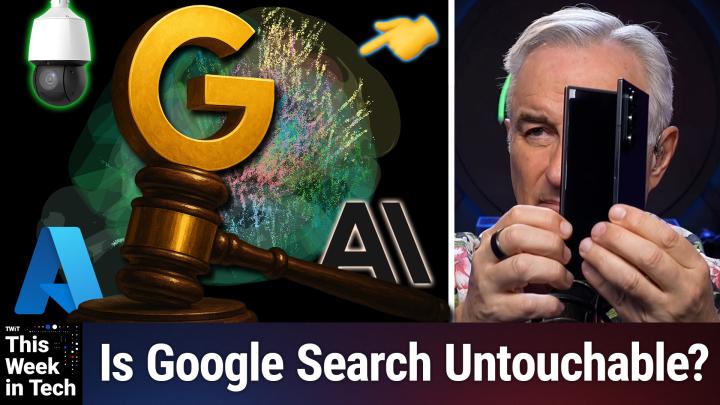
I actually was torn over the top story. There's some big ones, but I think we've got to say that Judge Amit Mehta's decision, which finally came down a year after he ruled that Google was in a monopoly, the penalty phase finally completed a little late. He said he'll finish by August. I think he came out September 2nd with his decision. And I'm really fascinated by what you all think about it. I could tell you the stock market loved it. Google went up. This is from CNBC.
Leo Laporte [00:02:38]:
8%. I think it ended up being up 9% by the end of the day. Apple also went up because Judge Mehta said Google can continue to pay Apple and Mozilla and Samsung the billions of dollars. They pay them to be the default search engine. Google does not have to sell Chrome, Google does not have to divest Android. In fact, Google pretty much doesn't have to do anything. The only thing he said is, well, those exclusive deals you make with handset makers. You know, handset makers can use the open source version of Android for free, but if they want the Play Store, and of course they all do, Google had required them to also use Chrome as the default browser to ship with Chrome and to have Google be their default search engine.
Leo Laporte [00:03:26]:
And those exclusivity requirements apparently are not to be continued. Of course, when I'm just imagining this, but I can imagine the boardroom with the Google lawyers all sitting around hearing this judgment and giggling wildly and then composing themselves and saying, should we appeal? As far as I know, they have not yet decided to appeal. Is that correct?
Alex Wilhelm [00:03:55]:
That's to my knowledge correct. The statement they put out after this was pretty anodyne and I think it's because you're right, Leo. They pretty much got it's a victory possible result. Now they didn't win every single thing. There were a couple of wrist slaps in there, but to me it was pretty much a nothing burger, a disappointment for folks who were concerned about Google search monopoly especially companies like DuckDuckGo were pretty annoyed. But I'm really curious, Harry, what you think about the data sharing elements of this, because that's slightly more technical than I tend to get. And so I'm not sure if the requirements for Google to share a little bit of search data are impactful or if that's more of a thing that looks good but doesn't actually carry a lot of substance.
Harry McCracken [00:04:31]:
I thought it was pretty intriguing, but I don't pretend to fully understand its impact. I'm not sure if the judge fully understood it.
Leo Laporte [00:04:40]:
I.
Harry McCracken [00:04:42]:
So I'm sitting around being curious about it and once again being, I guess not disappointed isn't the right word, but I feel like I've spent my entire career waiting for some big antitrust decision that actually does have seismic impact on the industry. And it seems like they all fizzle out eventually. Like even the Department of Justice versus Microsoft 25 years ago. @ first they were talking about splitting up Microsoft and that ended up being more of a wrist slap like this as well.
Leo Laporte [00:05:13]:
And Harry, you're a historian and this is what I love. One of the reasons I love having you on, as I remember. But correct me if I'm wrong, the judge on the Microsoft case was forced to recuse himself and at that point, Microsoft got together with the DOJ and they worked out a consent decree, avoiding most of the serious penalties.
Harry McCracken [00:05:33]:
They worked out a deal which I guess did have some impact on Microsoft's interactions with the companies were selling Windows too. Ultimately, the world changed a lot shortly thereafter. But it wasn't so much because of this agreement, it was because the web and then smartphones came along. And controlling Windows and controlling the PC platform turned out not to be a great way to control the world. And in fact, if Microsoft had moved past Windows even a little bit more quickly, it might have been in better shape. And you might even argue that the stuff they agreed to do helped nudge them in the right decision. Yeah, direction rather.
Leo Laporte [00:06:12]:
Judge Mehta did say that there will be a five person committee overseeing Google for the next six years, which is kind of like the ombudsman that Microsoft was forced to accept in its consent decree. But it's unclear a what power that committee will have and what they'll be watching for. We should make clear when we say sharing data, it's not sharing our data, it's sharing search.
Harry McCracken [00:06:39]:
Right.
Leo Laporte [00:06:39]:
The spider stuff. And it is with, according to Judge Mehta, quote, qualified companies, qualified competitors. I think I heard from a number of competitors who are saying, well, that's going to help us a little bit. People like DuckDuckGo, EchoAsia and others. Yeah.
Harry McCracken [00:06:54]:
And in all the instances where Google likes to talk about how open it is, the search stuff, it's kept very close to the vest forever. So sharing any data, I don't think it's something it would choose to do on its own.
Leo Laporte [00:07:06]:
No, it's their secret recipe, it's their Coca Cola. You know, it's in the vault.
Harry McCracken [00:07:11]:
The seven herbs and spices.
Leo Laporte [00:07:12]:
Yes, it's their seven herbs and spices.
Alex Wilhelm [00:07:15]:
Should we explain to people why that matters, Leo, Just so people understand why people.
Leo Laporte [00:07:19]:
Well, if you like Kentucky Fried Chicken, it really comes down to it's just flour, but it's the seven secret herbs and spices that make the difference.
Alex Wilhelm [00:07:28]:
They actually have special plants at the KFC factory that no one else has. That's why they're secret. No, but in the case of search data, why this makes matters is if you have a lot of usage but you purchase via exclusive deals, then you get a lot more information, what people are searching for, allowing you to make a better search.
Leo Laporte [00:07:43]:
That's really a good point. It's not just the page rank anymore, it's also the feed, the feedback loop that users create.
Alex Wilhelm [00:07:50]:
And the argument was you can't break in because if they're going to buy all the search traffic From Apple, then DuckDuckGo can never get the same sort of information advantage and therefore their flywheel fails, whereas Google's gets more and more powerful and strong. So the idea is, at least in theory, by sharing some of this data, then other search engines will have a chance to compete more effectively with Google. So I think it's going to be a small point, but the thing is, do you guys use Google that much anymore? I'm slowly transitioning.
Leo Laporte [00:08:15]:
That's the. I think that's if you're going to give Judge Mehta a pass and some people are not willing to give him a pass. He even spanked the Department of Justice, saying they overreached and asking me to order them to divest Chrome, which is true. It's very hard to imagine. We, we've talked about this, how you would divest Chr. What that would even mean. So he was pretty critical of the Department of Justice. They basically got nothing that they asked for.
Leo Laporte [00:08:43]:
But what Judge Mehta did say is, hey, I did rule him a monopoly in August of 2024. But he said the emergence of AI has changed, quote, changed the course of this case. And I think he kind of in his mind realized that just like with the Microsoft case, times had moved on and maybe he didn't need to spank Google because in fact, Google was going to be in a fight for its life. Remember Eddie Q from Apple coming up on the stand and testifying A. If Apple lost its 20 billion, that'd be a big problem. But that Apple had considered creating its own search and nothing was as good as Google. They wouldn't be able to compete with Google. Google's dominance is pretty clear.
Leo Laporte [00:09:28]:
But, but Q also said that, that, that, that is not going to hold forever. That AI, generative AI is changing the landscape. In fact, you see Google adding AI, they just added something, a new thing beyond the AI assistant.
Alex Wilhelm [00:09:46]:
Yes, the Google AI chat thing, right?
Leo Laporte [00:09:48]:
Yeah, yeah, yeah, yeah. I have to log in for some reason with my workspace account to see it, but it's googled.com AI I think. And. Oops, let's see. Yeah, I played with it and I was very impressed with it. It's different. The AI assistant is awful. In fact, I've heard some people say you don't, you don't.
Leo Laporte [00:10:09]:
Oh, no, I guess it is now my regular account. He said, they said, you don't really want to. Google's harming the world with this AI assistant. Because most people think that's what AIs like. And it's so terrible, so bad that they're assuming AI is worthless. On the other hand, this AI mode, which is basically Google's top models in a, in a deep search mode, is actually very good, I thought, very good. Competitive with things like Perplexity and others.
Alex Wilhelm [00:10:36]:
So they can't send people to it though, on MOS because that would undercut their profit source. So right now they're stuck giving you a really crappy patina of AI on top of your standard search. And then over there, if you open door number two, you have an entirely different and better product. But they just don't want to flip everyone over. And this is the innovator's dilemma. I think I spelled out in real time for Google, forced to defend a legacy revenue stream in the face of a new technology.
Leo Laporte [00:11:00]:
But also, maybe the judge was right. I mean, maybe the judge, you know, he's certainly getting a lot of heat from some, some quarters saying, you, this was a slap on the wrist, you didn't do anything. Harry, what do you guys think was this is it? Let me, let me ask you first, Harry, appropriate decision?
Harry McCracken [00:11:19]:
Well, yeah, I don't see, like, how forcing them to sell Chrome would solve much. And also, who would be all that interested in paying enormous amounts to Chrome? Chrome is mainly a value if it's operated by a search company that has a large advertising business. And splitting it up certainly would have been harmful to Google. But whether it would have clearly made the world a better place for consumers, I think is very unclear. And I wrote about that when that first came up as a possibility. I do think that over time, the market changing so rapidly, tends to do a decent job of policing things, because even the largest, most powerful companies, if they do rest on their laurels, they get into trouble. And we've seen that over and over again. And there's at least some possibility that not only Google, but kind of all of the incumbents may run into trouble with AI now, because in almost every aspect of computing, AI could change things pretty quickly.
Harry McCracken [00:12:25]:
Okay.
Leo Laporte [00:12:25]:
I do have to point out though, that Google, Microsoft, Apple, Amazon, Facebook, all have other revenue streams, so they can spend vast amounts of money training AI models in a way that companies like OpenAI can't. I mean, they are spending it, but they have to do that on the pleasure of venture capitalists.
Harry McCracken [00:12:46]:
The models matter, but so do that. The products build on top of them. And some weird ways, it's harder to build a good product than to spend billions on.
Leo Laporte [00:12:56]:
Right, which is using Others models, but has really become a premier example of what you can do with orchestration. There's also the emerging issue, we talk a lot about it on our AI show and intelligent machines that maybe the large LLMs are not the only way forward that these, you know, the Chinese have smaller models. There's interesting models out there, interesting ways of doing it, besides transformers that are also proving to be very powerful. So maybe these giant incumbents don't have a huge advantage. What do you think, Alex? Is the judge. Was the judge lenient?
Alex Wilhelm [00:13:26]:
So I think the judge was probably correct in the state of the market today. But what I hate is the fact that everyone says, and I've, I'm sympathetic to this argument a little bit because I do talk to a lot of people who are pretty deep in the tank on the financial side of tech that technology fixes things. You know, if you, if you have a product that takes over the market, eventually it'll get beaten by something else. So therefore, why do we need antitrust protection?
Leo Laporte [00:13:48]:
Well, because we need antitrust for monopolies. That's the point is that monopolies get so big, so dominant that they can't. That the market no longer has any impact on them. They own the market in a sense.
Alex Wilhelm [00:14:00]:
Right, but. And Google had that for a long time in search, and then in the end they were slowly taken over by something else. You know, 15 years down the road. And some people want to say, great, everything worked out really well, but they had Monopoly for a long time and they illegally held it. And it turns out the punishment is if you can keep the case far enough away long enough. Long enough, eventually you'll get saved by someone trying to take your lunch money. But the market was still impacted for all those years by an effective Monopoly player. And that to me should come with stiffer punishments.
Alex Wilhelm [00:14:27]:
So it's fine to say that today we don't need to take a stick to Google's overall corporate structure because they're being challenged by OpenAI and Anthropic and Perplexity and over in China, Moonshot, AI Z AI Deep Seq, et cetera, et cetera.
Leo Laporte [00:14:39]:
That's amazing.
Alex Wilhelm [00:14:39]:
Yeah, but what about 20 minutes ago? And that's what pisses me off about this. I feel like people are saying that because ChatGPT is challenging the now, nothing else matters. And to me, that's freaking bullcrap, I think is the appropriate twit way of saying that.
Harry McCracken [00:14:52]:
It's also, I mean, in a lot of ways, I've been more bothered by Google's position in advertising than its position in web browsers or search or mobile operating systems. It does have a big competitor in Meta, but Google has been extraordinarily powerful when it comes to determining how advertising gets bought and placed and how much it costs, and forcing them to sell Chrome might have had an indirect impact on that because they have that power in part because they're able to direct eyeballs to that advertising. But I don't, I don't know how and when that changes, particularly given that the chatgpt and perplexities are a very, very far way away from monetizing through advertising in the way that Google is monetized through advertising for like 25 years now.
Leo Laporte [00:15:45]:
So to be specific, because there's some question in our discord, our club members, about what's going on with the data sharing. The DOJ asked for one thing. The judge decided something a little bit different. He rejected the DOJ's proposed data sharing remedies. Google would be required to share something called Doc idea unique identifiers for each document in the search index, which can be used to retrieve the documents from the index without performing an actual search. The Doc ID to URL map and that user side data should include, but not be limited to the time when the URL was seen last crawled the spam score. Basically these are valuable little signals about the search index. It is not one time there.
Leo Laporte [00:16:32]:
There will be periodic releases of this information, I believe. Eddie Q&DuckDuckGo's Gabriel Weinberg and Chat GPD's Nick Turley all testified. Citing them, the court said receipt of this narrow data set will still enable rivals to overcome the scale gap by allowing them to build a competitive search index more quickly, one that is robust in volume, freshness and utility. So basically the judge said, well, if you still want to do a search engine in this era of AI search, we'll make Google give you some stuff. But I think the judge kind of felt like it's not going to matter that much because AI is happening. Of course it is. OpenAI it was one of the companies that was celebrating this information. To answer the question about how often does Google have to share the data periodically.
Leo Laporte [00:17:28]:
In short, no. The DOJ wanted Google to share its data periodically. The court rejected that, saying that the qualified competitors will receive only a one time snapshot of the relevant data. So that's interesting. It's just enough to kickstart their own efforts.
Harry McCracken [00:17:48]:
That doesn't sound all that valuable.
Leo Laporte [00:17:49]:
No.
Alex Wilhelm [00:17:50]:
What a disappointment. I like this. I keep trying to find some Way to not get mad about this because I'm trying to be less mad about everything all the time.
Leo Laporte [00:17:56]:
It's good for you.
Alex Wilhelm [00:17:57]:
Yeah, yeah. Well, I feel like my cortisol levels were just too high and this tech.
Leo Laporte [00:18:02]:
Will do that to you.
Alex Wilhelm [00:18:03]:
Not helping. Not helping at all. It is kind of incredible that a year ago we were looking at one particular set of remedies and now we're here. It's like being invited to a lunch and then arriving and being handed one crouton and a small cup of water and being told that you should be very, very happy.
Leo Laporte [00:18:18]:
No rubber chicken for you. Yeah. Now remember, Google has been found to be a monopoly not once, but twice. Another court earlier this year found Google guilty of a monopoly in online advertising. Judge Leonie Brinkhama of the US District Court for Eastern District of Virginia. Now, Judge, Judge Brinkhama is going to now entered the penalty phase. So in fact, I think really this is where Google is clearly predatory in the market because they are both buyer and seller. They, they own both ends of it and everything in the middle as well.
Leo Laporte [00:18:56]:
And I can see them being ordered to split off some advertising capabilities, that kind of thing.
Alex Wilhelm [00:19:02]:
Does this play, does this play in the EU problem? So I think it was yesterday the EU announced they're going to find Google three and a half billion over, I think, playing both sides of the ad market. And Trump's very mad about this because, I don't know, doesn't like rules.
Leo Laporte [00:19:17]:
I think the President's point of view is if we're going to spank big tech, it's our job, not your job.
Alex Wilhelm [00:19:23]:
Right. And that's the thing, because if the deal we're going to be having this case, right. Discussing at the national level is Google being unfair in the advertising market. And then EU says they are, and then we're like, no, they're not. It feels a little bit contradictory to me in a way that makes my head spin and going back to my cortisol levels, very mad.
Leo Laporte [00:19:41]:
Google was fined this week $3.5 billion by the EU over their ad tech. But here's the problem. Of course, they're still in trade negotiations with the EU and Trump is waving tariffs over their head, saying, no, no, maybe not. So it'll be interesting to see he's gotten the EU to back down in other areas, apparently got the UK to back down on asking for data from Apple. So although we don't know that for sure because all we have is a tweet.
Alex Wilhelm [00:20:12]:
Okay, but like, are you surprised that the UK Government was trying to get an American tech company to backdoor its.
Leo Laporte [00:20:19]:
Operations and not just for UK citizens, but for Americans as well. You know, I mean, I think that was a little, that was a bridge too far.
Alex Wilhelm [00:20:26]:
Well, everyone knows that if you open a secure back door for one government, no one else can ever go in. It's closed for everyone else. 100% safe.
Leo Laporte [00:20:34]:
Trump called the move discriminatory and threatened to open a Section 301 trade investigation to nullify the unfair penalties. So that one's up in the air. The Block gave Google 60 days to propose how to resolve the inherent conflicts of interest. So Google is not out of the, out of the woods by any means, but I think they, they can. I, I'd be surprised. Should they appeal this? I mean if they appeal it, then it goes on for years and they don't have to do anything. Is there a risk though, if they appeal it, that appellate court might say no. In fact, we're gonna make you sell crumb after all.
Harry McCracken [00:21:11]:
It must be a huge relief to them.
Leo Laporte [00:21:13]:
Yeah, I think they're celebrating. They uncorked some champagne and Apple is.
Harry McCracken [00:21:18]:
Probably celebrating as well.
Leo Laporte [00:21:20]:
Yeah, 20 billion a year for Apple.
Harry McCracken [00:21:22]:
They're not gonna be forced to give up that relationship.
Leo Laporte [00:21:24]:
That's right.
Harry McCracken [00:21:24]:
I mean there is this thing that Google can't by exclusive placements. But at least for now, I think Apple would prefer to have Google as the default search engine regardless of how much money is involved, just because it is the world's default search engine. And that may change at some point, but it's not going to change.
Leo Laporte [00:21:46]:
Well, let me show you how next year or two how dominant Google is. Neowin just published an article from Stat Counter showing how overwhelming Chrome's market share is. It is climbing. It is now 70% of the desktop browser market. We say desktop because obviously iPhone is a Safari browser and so forth. But on the desktop, Safari is third with 6.4%. Microsoft Edge is second with 11.8%.
Alex Wilhelm [00:22:16]:
Wow.
Leo Laporte [00:22:16]:
Google has 70% of the market. Then there's Firefox, Opera and the rest are, you know, de minimis tiny.
Harry McCracken [00:22:25]:
I'm glad that Firefox has not been forced to give up its relationship with Google because that would put them out of business. Yeah, and the world is a better place because Firefox exists for sure.
Leo Laporte [00:22:37]:
I imagine the judge considered that as well. You know, you would be putting one pretty much the only other competitor to Chromium based browsers out of business. It's estimated $700 million Google pays every year to Mozilla for being this default search thing is it's only a setting in all cases. You can change it, right?
Harry McCracken [00:22:57]:
Yeah, I mean I use Kagi as my default search engine, although I do find myself going to Google for some stuff. And actually like on Apple devices I'm mainly in Safari using Kagi, but I'll flip over to Chrome partially because Google.
Leo Laporte [00:23:14]:
Is this default there on Apple devices you have to actually install the Kagi plugin to have Kagi show up, which.
Harry McCracken [00:23:21]:
Is a little bit of a clue.
Leo Laporte [00:23:23]:
Yeah, they have a very limited set. You were, you were raising your hand. You don't have to raise your hand, Alex, you could just.
Alex Wilhelm [00:23:30]:
I'm learning how to not interrupt people, Leo. This is part of my. I'm learning patience and calm. But Harry, I'm very curious. What, what are the searches that you currently go off of Kagi?
Leo Laporte [00:23:40]:
It's a khaki or khaki Kagi. You pronounce it any way you.
Harry McCracken [00:23:45]:
Okay, well, there are certain things like Google Books where there's not a Kagi equivalent. But I also find that in cases where you actually want an enormous number of results because you're looking for something incredibly obscure, with Kagi you'll get fewer results, which are often enough. But in cases where I really want to see everything, Google will give me more results and in some cases that is valuable.
Alex Wilhelm [00:24:13]:
That's interesting because I start with Google. I used to start with Google and then I would switch to GPT, I guess now five, but now I'm kind of like a GPT five first person.
Leo Laporte [00:24:23]:
It's pretty good. It's search because they've added all of these AIs now have added the component to add search to the LLMs and.
Harry McCracken [00:24:30]:
I do use ChatGPT and Claude, but I don't really trust them. So like I use them as step one, but then I still have to verify anything they tell me with an actual search engine which is usually either.
Alex Wilhelm [00:24:42]:
COGI or Google, but when it doesn't matter, you don't have to check them. So last night I was playing Hear Me Out. Last night I was playing Satisfactory, which is a factory building game that I. Lovely game.
Leo Laporte [00:24:52]:
Yes.
Harry McCracken [00:24:52]:
Yep.
Alex Wilhelm [00:24:53]:
I'm breaking my factorio addiction at last. Thank you.
Leo Laporte [00:24:55]:
It's Basically Factorio in 3D, so it's.
Alex Wilhelm [00:24:59]:
Fun, but you have to actually hunt things. It's a whole. I know, Leo, you're a big crafter, enshrouded guy. But for me it's kind of new, but you can get these recipes, these alternatives and I was Trying to figure out what to do and I literally just hopped on to ChatGPT. I'm like, all right, all right. You know, cast screws or quick wire. And it broke down for me like, you know, units per minute and the community expectations. And I was like, all right, all right, cool, cool.
Alex Wilhelm [00:25:25]:
I'm not going to check any of this. I'm just going to take your advice. Click. And it was fantastic. I felt.
Leo Laporte [00:25:28]:
So it's useful.
Harry McCracken [00:25:29]:
It's okay for that. It's like when I'm looking for actual facts that need to be correct. I'm still.
Leo Laporte [00:25:34]:
Still fairly when you're gaming. But by the way, Microsoft is building Copilot into Xbox so you will have that availability in your.
Alex Wilhelm [00:25:43]:
Does anyone like Copilot?
Leo Laporte [00:25:45]:
No.
Alex Wilhelm [00:25:46]:
There's a story that just came out. The UK used Office365 copilot M365 copilot and found no noticeable productivity gains. And I for one am shocked that if you take a tech stack and just slather some AI over the top.
Leo Laporte [00:25:58]:
Of it, nothing changes, doesn't improve anything.
Alex Wilhelm [00:26:01]:
Shocking.
Leo Laporte [00:26:01]:
I'm going to show you a little trick. Henry. Henry. Harry. If you go. My son's name is Henry. If you go to cogi.com and you click the dropdown, you'll see they have a thing called the Assistant which is their version. It's like perplexity of orchestrated AI and they have every model, a really broad number of models that you can use.
Leo Laporte [00:26:20]:
And so what they're doing is taking COGI search results and Then using these LLMs as the backend for it. And I find it's very useful. I really like it. You could see. I was trying to see. There is a big trend right now to ask ChatGPT what the emoji is for seahorse and it goes crazy. I don't. Have you seen this?
Alex Wilhelm [00:26:43]:
No.
Leo Laporte [00:26:43]:
Show me. All right, let me go to ChatGPT. What I was doing with Cocky is trying everybody to see, you know, who had. So this is what you get if you. Is there a seahorse emoji? Yes, there's a seahorse emoji and then it shows a horse and a wave. Technically it's this one right here. Horse wave. But wait, that's a horse and a wave.
Leo Laporte [00:27:03]:
Not a true seahorse. This is the thinking going a little overboard, but there's no official dedicated seahorse emoji in the unicorn standard yet. If you're trying to capture that adorable twisted tail sea dwelling little wonder, you've got three playful workarounds. Now that's four. Oh, if you actually ask five, it's even crazier. Yes, there is indeed a seahorse emoji. Kidding. The real one looks like this.
Leo Laporte [00:27:23]:
And then he gives you a fish. No, that's a fish. The actual seahorse emoji is. Nope, that's a dragon. Here it is. At last. A true hippo camp of Unicode. No, wait, it's that fish again.
Leo Laporte [00:27:34]:
Found it. Fish. Okay, okay, I'll stop trolling you. The actual seahorse emoji is. And then it's a wave. Still wrong. Straight answer. And it goes on and on and on again.
Leo Laporte [00:27:45]:
Finally says, Leo, I've completely tied myself in knots. Want me to show you the actual Unicode code point for the Seahawks emoji? I didn't dare ask it for more because there is none.
Alex Wilhelm [00:27:56]:
I just got a similar response and I just said, yes. And now it's going, oh, man.
Leo Laporte [00:27:59]:
Poor thing, it keeps going crazy. Yeah.
Harry McCracken [00:28:03]:
One of the nice things about Kagi is that it's so customizable that it has all that stuff when you want it, but you never feel like it's forcing you down a particular road in.
Leo Laporte [00:28:13]:
The way Google sometimes does. Interestingly, at the point you remember this Harry Dvorak used to come on and say, back when altavista and Excite were the big search engines, he said, here's how I find out. If you're really a geek, what's your favorite search engine? If they say Google, I know they're a geek. Well, we're now at that inflection point, I think, with cogi, because more and more the really smart people I talk to, because I started using COGI two years ago, you pay for it. And I thought, I'm a little outlier. And over the last two years, more and more people like you, Harry, saying, yeah, I use cocky. So maybe we're going to get Alex in the fold soon.
Alex Wilhelm [00:28:49]:
Yeah, no, I'm actually, I'm on the side right now, looking at the pricing page, as you see, say this. And it's relatively affordable. I mean, 10.
Leo Laporte [00:28:54]:
I pay 25 bucks a month for the full 25.
Harry McCracken [00:28:58]:
Wow. I'm just shebang during the $10 plan.
Leo Laporte [00:29:00]:
Yeah. Well, you can start at five bucks, I think.
Alex Wilhelm [00:29:02]:
Yeah.
Leo Laporte [00:29:03]:
But there's no ads, so you got to pay them. And this is the thing people have kind of started to grok on the Internet is you either pay for it or you're going to be. Your data is going to be mined.
Alex Wilhelm [00:29:15]:
Or in Google's case, you know, you can't really avoid it if you use Chrome. But I will say, Leo, you're very good at using your money to vote. And I think that's a lot of that.
Leo Laporte [00:29:25]:
Yeah, I try to do that. And I think everybody, all of us, if we can afford it, should do that. Because you need to send a signal that this is the right way. We don't want the and some. And I think it's a good time to start worrying about surveillance capitalism in an era of AI because it just puts. It puts surveillance and steroids. Right. It makes it even.
Alex Wilhelm [00:29:45]:
You guys know Flock Security, right? Yeah, the company. So I had their CEO on twist and this is before the latest reporting about the company came out and how they're a bit entwined with the security state. And I was really trying to push him on cameras in public and cameras on roads and such. And he had an argument that I couldn't fight back against. He was like, well, the state owns the road so they can take pictures with Mallex. I was like, yeah, fair enough. But I do think think that we need to have something at the national level to set guardrails to protect our privacy. Because as it is right now and where it is going, we're not going to be able to be private citizens for very much longer.
Alex Wilhelm [00:30:23]:
And I don't mean to be alarmist, but the pace at which we're adding cameras and intelligence to those cameras does actually make me worried. And I try to not panic about things, but I think it's a legitimate concern for the next five or 10 years. We need to fight this probably now or we probably won't be able to.
Harry McCracken [00:30:39]:
But I don't have a whole lot of faith that anybody in the federal government is going to solve any of that because A they have a long history of talking about solving privacy problems and not doing much and B, just with the current administration and the House and the Senate. Their instinct is not to regulate. Their instinct is not to regulate.
Alex Wilhelm [00:30:58]:
No. And they want to have an imperial presidency. So I think it's probably both things. They don't want to regulate and they want to arrogate to the himself unless you authority at the executive branch.
Leo Laporte [00:31:06]:
It's about the unitary presidency is what it really is these days. By the way, I hope you asked Flock because you know, it is a combination of cameras and license plate readers. So absolutely, he's right. Purely in the academic sense, it's completely legal. These aren't private roads. These are public roads that you're using. That's why you need a driver's license. Regardless of what the sovereign citizens movement says.
Leo Laporte [00:31:32]:
But they were giving that information to, not only to law enforcement and ice, but it was also being used by law enforcement, for instance, in Texas to track a woman down who left Texas, where it's illegal to have an abortion, to get an abortion in another state, and they were using flock data to track her down in this other state. And that's where, yeah, it may be technically legal, but is it right or is it a huge invasion of privacy? And then it's the state, not the federal government, but a state using flock data to enforce their laws in another state.
Alex Wilhelm [00:32:09]:
I have a political transformation, Leo. So I went through my teenage libertarian phase, as I think a lot of young men do.
Leo Laporte [00:32:17]:
It's either that or nihilism. So, you know, okay, good.
Alex Wilhelm [00:32:21]:
I pivoted to that later on. And then I kind of came around to being an Obama liberal, for lack of a better phrase, kind of like free markety. But let's try to help people.
Leo Laporte [00:32:29]:
That's what your friend Jason Calacanis says. They're all Obama Democrats now in the White House. I'm not sure I agree with that.
Alex Wilhelm [00:32:36]:
That's hard to disagree with that. But Jason and I are on here's the way I put it. I'm the token liberal on twist, and he's the token liberal on all in. So that's where we sit. But what I've learned through the Trump administrations, one, and now, two, is that if you have levers of power in a government that can be used for good, then when you lose and the person you don't agree with comes into power, they turn those levers into wrenches to hit you with. And so ironically, or maybe not ironically, but maybe positively, I think Trump is actually making me more of a libertarian, because what I don't want is for the executive branch to have so much power, because I would like to not worry about flock safety. I would like to not worry about encryption being undermined. I like to not worry about being surveilled all the time.
Leo Laporte [00:33:23]:
Well, we've given it. We now have such tools for surveillance that we've never had before. You know, giant databases, AI to search those databases, kind of infinite amount of compute. The world has changed dramatically in 50 years, and all that power is very scary and probably shouldn't be in the hands of somebody who wants to abuse it. We have to take a break, but we will come back. You've got Alex Wilhelm on the left.
Harry McCracken [00:33:54]:
Okay, my crossfire.
Alex Wilhelm [00:33:55]:
I'm such a capitalist, but I'm still a lefty.
Leo Laporte [00:33:57]:
Yeah, I'm not gonna put Harry in the right.
Harry McCracken [00:33:59]:
On the right.
Leo Laporte [00:34:00]:
But he is on my right. Your right actually he's on my left. So that's what's really of kind confusing. And I'm in the middle, that's for sure. On either side. Actually I'm not. I'm probably more liberal and leftist than you are, Alex.
Alex Wilhelm [00:34:13]:
But let's have a left off. It'll be fun.
Leo Laporte [00:34:16]:
I'm covert, not so convert. Let's take a break. We're gonna talk more. Actually, an Apple event is coming up Tuesday. It's awe dropping, which I contend is the worst name for an event ever. Apple, you could do better. You really could. But we'll, we'll get to that in just a little bit.
Leo Laporte [00:34:32]:
Little bit. IPhone 17 we think. We don't know. But the rumor mill by this time two days before the Apple event usually is pretty well stocked with good rumors. Four models, a slim iPhone. We don't know the name. IPhone. Slim iPhone Air.
Leo Laporte [00:34:48]:
We don't know. An iPhone 17 an iPhone 17 Pro. An iPhone 17 Pro Max. A Korean carrier may have leaked the specifications ahead of the event. This happens pretty regularly, so if you care. You can see how much memory will be available. You can see the cost in Korean won. I don't know what that translates to.
Leo Laporte [00:35:12]:
I haven't spent the time. You can see the screen sizes, the processor speeds and the battery sizes according to this. Anyway, it's a rumor. 8K video support for the Pro models. Specs for the 17 Air, which has of course, as one would expect, a much smaller battery size. 2,800 milliamp hour battery size compared that's to 3,600 for the 17. Nothing. Incidentally, if this is a true spec sheet, it is going to be the name the Air that confirms that name.
Leo Laporte [00:35:48]:
Big screen, 6.6-inch screen bigger than the 17 Pro. Just a little bit smaller than 17 Pro Max. So it'll be interesting. We'll see. We'll find out more. We also expect we're seeing rumors. Ming Chi Kuo, who seems to be a pretty good supply chain rumor guy, says Apple will do AirPods 3 at this event on Tuesday. Not clear what features.
Leo Laporte [00:36:12]:
There are some health features we think in the new AirPods AirPods, including perhaps a heart rate monitoring sensor. Powerbeats already have those, so I think that's not too far a reach. There's also a new chip which they say will improve sound quality, connectivity and yes, noise cancellation looks to me like an incremental improvement. Rumor is there will be A new Apple Watch Ultra as well. The Ultra 3. Are you excited about that?
Alex Wilhelm [00:36:44]:
Alex, how is my sarcastic about all this news?
Leo Laporte [00:36:48]:
Slightly bigger screen. This. Much bigger. Great. Pretty much the same processor. All right. Yeah, it's. I guess it's hard to get too excited about this.
Alex Wilhelm [00:36:58]:
I mean, look at Harry's face. Is that a man bursting with excitement and ripping his credit card out and racing to the Apple store to camp out because he has to get the iPhone 3GS?
Leo Laporte [00:37:06]:
Harry, didn't you used to go to these Apple events on a regular? I used to see you there, right? I think you're muted. Harry, did we mute him? I hear nothing.
Alex Wilhelm [00:37:20]:
The show's now much worse.
Harry McCracken [00:37:22]:
I got muted and I have no.
Leo Laporte [00:37:23]:
Idea how we did it apparently. Sorry.
Harry McCracken [00:37:26]:
I've been to a zillion Apple events. That's true. And there are years where I am kind of ready to whip out my credit card. Like last year when I saw the camera control.
Leo Laporte [00:37:35]:
I like that button.
Harry McCracken [00:37:36]:
I agree that when I saw that that was a strong incentive for me to actually buy one. I haven't seen anything this year that gets me that excited. Partially because it's the camera stuff and long battery life that does speak to me and that the air. I'll be intrigued to see what they do with the air, but it sounds like it's not going to have great battery life and it's probably not going to have their top of the line cameras. I did this week, last week rather, in my plugged in newsletter for Fast Company, I wrote about foldables, which I am excited about. And that sounds like we may see a foldable iPhone next year.
Leo Laporte [00:38:15]:
And even if in fact the thinking is that that new air, I'm going to call it the air now since that leak seems credible, is thinner as part of the process of designing a foldable that isn't, you know, they tend to be very thick. This is the latest Samsung Galaxy fold and it's so thin because the two halves are much, much thinner. And so Apple. Obviously Apple's going to take advantage of everything Samsung has learned. They're going to use a Samsung screen in the foldable.
Harry McCracken [00:38:45]:
I wrote about the Honor Magic V5, which in one certain color, and if you're not counting the camera bump, it's the world's thinnest foldable by 0.1 millimeter, which is not a huge achievement except it does feel really great in the. And yes, designing a good foldable is almost like designing two extremely thin smartphones and then putting a hinge in between them and so anything Apple has learned from the air would be totally applicable to a folding iPhone.
Leo Laporte [00:39:22]:
Yeah, this is my question. It feels like Apple's rushing to do a folding phone. Of course, we don't know. Apple doesn't say anything. This is all rumors because these folding phones sell so well.
Harry McCracken [00:39:34]:
They don't sell all that well.
Leo Laporte [00:39:35]:
That's what I thought.
Harry McCracken [00:39:36]:
It's like 1.5% of the market and unless they get radically cheaper, they're not going to be. They're 2,000%.
Leo Laporte [00:39:44]:
Roughly. Yeah.
Harry McCracken [00:39:45]:
And I can't imagine that Apple is planning to sell one for way less than anybody else.
Leo Laporte [00:39:50]:
Right.
Harry McCracken [00:39:51]:
I'm still excited though, just in terms of it being a genuinely new experience. And some of the challenges folding phones had six years ago when they first came out have been resolved. And Apple would not be rushing in because these things have been around for.
Leo Laporte [00:40:07]:
Years and they learn from the mistakes Samsung and others have made.
Harry McCracken [00:40:12]:
And I think Apple does have the opportunity to do some deep thinking about the software side in ways that might improve experience.
Leo Laporte [00:40:18]:
And that's the thing, that's what excites me. Because unlike Android. Yes. I have a little campfire burning in my phone.
Alex Wilhelm [00:40:24]:
It's cute. I like it.
Leo Laporte [00:40:25]:
Yeah. Unlike Android, Android apps really don't scale well to the. That's why Android tablets don't really take off to the bigger screen. But Apple's got the iPad, Apple has a beautifully scalable operating system. And so I think that they could potentially really take advantage of that screen real estate in a way that Android does not.
Harry McCracken [00:40:47]:
Yeah. The one thing that disappointed me a little bit about the Honor Phone is that but very few of the third party apps I tried seemed to be aware they were running on this form factor. They just kind of got larger. But like you say, anybody who's designing apps for Apple devices has a long history of different screen sizes.
Leo Laporte [00:41:08]:
I put Pokemon Go on the Samsung Galaxy Fold. As you can see, it doesn't understand. Oh, now I'm getting a message. It doesn't understand that it's on a bigger screen. So it actually, it zooms it out and the edges are getting cut off. It's not taking advantage of the size.
Alex Wilhelm [00:41:25]:
Oh, that's terrible.
Leo Laporte [00:41:26]:
Yeah, so it's basically just a zoomed in version of the game and most apps either do that or they have borders around them. They just. Whereas I don't think you'd have that problem on an Apple designed os.
Harry McCracken [00:41:38]:
I don't think Google, I mean Google has done some good work with folding interfaces. Honor. The Honor Phone comes with A ton of honor apps which do take advantage of that. So screen and Apple would have the opportunity to take all of these iPhone apps and rethink them to provide value by doing things like having sidebars and other elements you can't really do on a conventional iPhone, because by definition, a conventional iPhone, you're talking about a single stack of elements. And on a folding phone, you can start to think about columns.
Leo Laporte [00:42:09]:
Well, actually, speaking of which, Meta Weirdly has released an Instagram iPad app for the first time in years. No, they refused for the longest time. You had to look at it as an iPhone app, a little tiny part of the screen. Ironically, at the same time as Apple is going to release IPADOS 26, which actually allows you to actually use that little screen as a window. But they are using the kind of. The additional real estate to do kind of like that columnar thing. So you have your menu bar here, you have the. The same vertical reels or pictures there, but you also now have comments on the right side.
Leo Laporte [00:42:52]:
It fills the screen nicely. And I wonder how much of that is Meta saying. Well, I think for the folding phone, we better get ready to have Instagram ready to use all of that real estate. That might be them actually saying that.
Alex Wilhelm [00:43:04]:
I like that. I like that theory, Leo, but I want to loop back to the price point about these folding phones, because I think somehow we blew past the moment in which phones cost more than laptops, and I don't think we talked about that enough. And now you can get a brand new MacBook Air for 999.99. Yeah, and I definitely have bought phones that cost more than that. And it just explodes my head because the phone is such a worse computing experience. All it has is, is the ability to make phone calls, which my laptop can almost do. So it feels a little strange to me. But I think the point about the folding phones being more expensive is more about raising the ceiling for what a smartphone can cost versus Apple trying to actually sell a lot of phones at that particular ASP price.
Alex Wilhelm [00:43:47]:
I think they want to raise their overall ASP mix and make it seem like a $1,400 iPhone is cheap, because compared to the $2,000 iPhone, it's a gosh darn bargain. So to me, it's more of a signaling point about pricing than an attempt to actually, I think, get all of us to buy these folding phones. But I'm too cynical.
Harry McCracken [00:44:04]:
I mean, I think in a way, the price that matters is the price of the foldable minus the price of the Most expensive iPhone up until now and the Delta. And a certain number of people who are willing to spend fourteen hundred dollars on an iPhone will be willing to spend that much for, you know, they'll pay 2000 or 2200 or whatever it is.
Alex Wilhelm [00:44:23]:
But also.
Leo Laporte [00:44:26]:
I never thought I would say this, Alex, but you're getting old. When you started, you were in your 20s. When you started on our show, I was like 24. You were just a kid, but you're now officially old. Because what you don't recognize is that for a lot of people in the younger generation, the phone is their computer.
Alex Wilhelm [00:44:43]:
I don't believe that.
Leo Laporte [00:44:44]:
They're not buying.
Alex Wilhelm [00:44:45]:
It can't be true.
Leo Laporte [00:44:46]:
They're not buying a laptop and a phone. They're buying a phone. And so that's, I think, the market. And what. Because all of their computing is done on this, so they need the bigger screen and they're willing to spend laptop prices for the bigger screen. Look at the iPad. I spent $3,000 for the iPad Pro and keyboard. It was.
Alex Wilhelm [00:45:06]:
Let me stop you right there, Leo.
Leo Laporte [00:45:08]:
I'm sorry. Pokemon Go has started again.
Alex Wilhelm [00:45:10]:
You spent $3,000 on your iPad. And I think, I think that makes you the unique Apple customer in the world because someone. That's what they cost. No, they do not cost.
Leo Laporte [00:45:20]:
If you buy an iPad Pro and you buy the keyboard for $250. Well, I love it because. And here's why this is my point. For many people, including me, and I know for Harry, it's their computer. So they're willing to spend the money because that's your prime, right, Perry? That's your primary computing device.
Harry McCracken [00:45:40]:
I remember spending a lot, but I don't think I spent 3,000. Do you have two terabytes or one terabyte?
Leo Laporte [00:45:45]:
Yeah, I got. I maxed it out.
Harry McCracken [00:45:46]:
Of course I scramped. I just have one terabyte when I.
Leo Laporte [00:45:50]:
Was a child, which I never have filled even one terabyte. So I. But I thought, oh, this is going to become my primary computer. Yeah. You know, when you buy a desktop, you put. You put two terabytes of storage on it routinely, right?
Alex Wilhelm [00:46:03]:
Computer, yes.
Leo Laporte [00:46:04]:
Because I'm going to put. I'm going to do all my photography on it. I'm going to put all. Do video editing. I need that. I never used it, but I need all that room. What's the rationale?
Alex Wilhelm [00:46:14]:
So, Leo, how much value do you think you've gotten out of that per dollar spent compared to if you had bought a MacBook Pro?
Leo Laporte [00:46:19]:
No, no, no. No, no, you should never ask that question. And by the way, I also bought a MacBook Pro.
Harry McCracken [00:46:23]:
I get a lot of value out of my iPad.
Leo Laporte [00:46:26]:
You use it as your primary computer, right?
Harry McCracken [00:46:28]:
Yes. I mean, if you divide the price I paid by the number of hours I spent with that, mostly doing work increasingly, it was a lot of money, but it was not an extravagance. And I do feel like I should speak up for phones. They're not worse devices than PCs. They have all these sensors that laptops don't have. They have way better cameras. They can go anywhere with us.
Leo Laporte [00:46:53]:
Gps, gps. They're always connected.
Harry McCracken [00:46:56]:
I feel like if you give them a folding screen, you get back some of that real estate that's nice about laptops, while keeping all the things that a phone can do that a laptop cannot do that might be. End up being worth a fair amount of money. And after having used this honor and thought about the Galaxy Fold and the new Google folding phone, I am, you know, I'm at least intrigued and I'm least tiptoeing up to that moment where I whip out my credit card, even if I'm not quite there yet, if.
Alex Wilhelm [00:47:25]:
I end up being wrong about this and the big phone lobby ends up being correct, because that's all a tablet is, just a phone that didn't have.
Leo Laporte [00:47:31]:
A zentic, you know, like, I mean, so wrong. You're so wrong. All right, I take it back. I only spent $2,499 on my iPad Pro at 2 terabytes and all of that. So 20. But still more than a MacBook. Right.
Harry McCracken [00:47:48]:
I spent that minus the 2 terabyte upgrade.
Leo Laporte [00:47:51]:
Right.
Alex Wilhelm [00:47:52]:
Okay.
Leo Laporte [00:47:52]:
And by the way, I now. And Harry, you were the first person I ever saw to sit at the Twit Roundtable with an iPad as your primary computer. And I admit, perhaps of being a little.
Harry McCracken [00:48:05]:
I've been doing this since 2011.
Leo Laporte [00:48:09]:
Yeah, 1111. That's a long time. So. But lately with the iPad Pro and the improvements they've made to the operating system and the improvements in software like the RSS Reader, I use. I use the iPad probably more than my. Much more than my MacBook Pro. It's become my primary PC. So.
Leo Laporte [00:48:30]:
You were right, Harry. You're just ahead of your time.
Harry McCracken [00:48:32]:
I was right all along.
Leo Laporte [00:48:33]:
Yeah.
Harry McCracken [00:48:33]:
As usual.
Leo Laporte [00:48:35]:
And I think the phone for a lot of people is. Takes. Has that role as well. The phone becomes everything. It's your camera.
Alex Wilhelm [00:48:41]:
That's how you lose digital literacy. People think like, oh, the kids these days are good at computers. They're not because apparently they're all on their tablets and iPhones.
Leo Laporte [00:48:48]:
How are you kids gonna use emacs without an escape key? I don't understand it.
Alex Wilhelm [00:48:54]:
I'm a parent now. I get to say kids these days because I'm literally raising them. Sir, I've earned this right. I am blood, sweat, tears and crap and diaper pail. So I get to talk about the kids. And I'll just say this. Harry does tend to be right about things. Yes.
Alex Wilhelm [00:49:08]:
And Harry does tend to be a tablet guy. Yes. But I do think that this is one place where he is incorrect. And I will die on this hill if I'm the last person on the tablet suck hill with my iPad Pro out of batteries in my backpack. Right. And touch it in six bricking bajillion months.
Leo Laporte [00:49:23]:
Oh, by the way, 13 hours just sitting at that iPad Pro. Just keeps on going. Barely have to charge if I.
Alex Wilhelm [00:49:30]:
If you know what I can do with an Etch a Sketch, Leo, I can look at an Etch a sketch for $20,000 charge and it still gets much done as I would on an iPad Pro.
Harry McCracken [00:49:37]:
I've actually been a bit disappointed with the battery life of my newest iPad Pro, which is you're using it more now. I'm using it the same. It's a 13 inch and I had the 11 inch before. And I can by the way, wonder.
Leo Laporte [00:49:48]:
Whether that's a screen that Apple makes. Right.
Harry McCracken [00:49:50]:
It's a very nice screen.
Leo Laporte [00:49:51]:
It kills the battery, but it is.
Harry McCracken [00:49:53]:
I'm also spoils you. I see one of the few people who is skeptical about the iPadOS. Well, that multitask interface, which I am slowly getting used to. But I didn't really ask for it. And I would have been, I think just as happy if it didn't exist or if at least if they hadn't gotten rid of the split view and the slide over in their rush to make an iPad more like a Mac. Which I acknowledge is going to please a lot of people and probably help with iPad sales.
Leo Laporte [00:50:21]:
Yeah, I'm kind of with you. It gets in the way, you know, how often is a window open, not full screen?
Harry McCracken [00:50:27]:
Yeah, I don't like overlapping windows. I don't want to manage Windows because.
Leo Laporte [00:50:32]:
We'Re used to using full screen iPad apps.
Harry McCracken [00:50:34]:
Realistically, every moment I spend screwing around with Windows is a moment I've lost to actual productivity.
Leo Laporte [00:50:41]:
Well, we'll see. It's coming out probably at the same time as the new iPhones come out. And I think we are at the last Public beta version, which I think was beta 6. So if you're using the beta, you probably are using the final version both on the iPhone.
Harry McCracken [00:50:56]:
It's probably not going to change a whole lot more.
Leo Laporte [00:50:57]:
The Mac, Apple tv, Apple Watch, everything. Yeah, Vision Pro.
Alex Wilhelm [00:51:01]:
Can I ask one more question about this before we move on? Because I haven't actually. Honestly, my iPad has been in my backpack and just sitting there for a long time. Has the fragmentation of Apple operating systems into macOS, ipados and what we have on iPhone, is that leading towards a point of harmonization or are we going to end up still running down multiple tracks for a very long time?
Harry McCracken [00:51:24]:
I'm very curious about that question. I wrote about that recently and plugged in as well. Because most of the news in ipados 26 is about adding stuff that people are familiar with in the Mac and not just multitasking, but also things like the. The Files app looks a lot more like the Finder and there's better support for background tasks and so forth. And I'm not sure whether that means the trajectory of the iPad henceforth is all about getting more Mac like or whether there's still an opportunity for Apple to do things with the iPad that are really quite different from what it's going to do with the Mac, particularly if at some point the Mac also gets more iPad like if they do finally come up with a touchscreen for the Mac.
Alex Wilhelm [00:52:13]:
No one's never really figured out how to do, you know, mouse keyboard input and touch at the same time effectively. I mean, we all recall the Windows 8 debacle, right?
Harry McCracken [00:52:21]:
I love the fact that the iPad threw away so much that we've dealt with on computers for the last 40 years and started fresh. And I hope that we don't lose that altogether.
Alex Wilhelm [00:52:33]:
I mean, I'm sitting here right now in front of a MacBook Pro and a curved 34 inch monitor and then on my other desk on the other side, I have another 34 inch with a PC and an iMac. And I just can't imagine taking all of my beautiful digital real estate, my computing power, the heft, and the amazing ability of these bad boys to be just amazing everywhere and going to a crappy little diddly screen. Maybe I am out of date. Frankly.
Leo Laporte [00:52:57]:
A 13 inch iPad is really the same as a laptop screen basically.
Harry McCracken [00:53:02]:
And I'm out and about a lot. So I do use external screens sometimes. They don't matter that much to me, although I am amazed anytime I use one just because 13 inches to me seems large because I used to be on an 11 inch iPad.
Leo Laporte [00:53:17]:
I have a second screen for my iPad. A little bit of a disappointment that Apple has not enabled touch on those second screens. Even if they are touch screens, the iPad doesn't support it. And I think if they did that, maybe you'd really have a perfect system. More court news. I know court news isn't the most interesting, but this one was a bit of a shocker. You may remember that 7 the authors of 7 million books. There was a class action lawsuit against Anthropic for using those books in the training of their LLMs.
Leo Laporte [00:53:50]:
The judge did an interesting kind of two part ruling. Part one, the judge said, okay, in the case of the books that Anthropic bought used, but bought them, authors got no money for the used books, but bought them, legitimately scanned them, cut them up, discarded them. That was fair use. That's a very important judgment for Anthropic and all AI companies that there is a way to scan books and use them in your LLMs and that's fair use. But the judge said, we do have a problem because there's also these millions of books you used from a pirated source. They were pirated and that's probably piracy. The lawyers for the authors settled with Anthropic. We knew their settlement was coming.
Leo Laporte [00:54:41]:
We talked about it last week. It was the lawyers for the authors who were crowing about the settlement. So we thought this is going to be big, but nobody thought it would be this big. Anthropic has agreed to pay $1.5 billion plus interest to settle with these authors. That's $3,000 each for half a million books in the class. They also agreed to destroy the data it was accused of illegally downloading. Unclear whether their current models use that data. They certainly didn't say we're going to destroy our current models.
Leo Laporte [00:55:15]:
So the authors said, yeah, because most of these authors were making nothing on these books anyway. If you've ever written a book, it's not a profit making enterprise. Paul Thurat always said if I were getting paid by the hour, it'd probably be a buck 50 an hour to write these books. It's not a big money maker. So the authors are saying this is great. Anthropic probably felt like they got a deal. They could have been on the hook for as much as a trillion dollars in damages. And I think Anthropic also was very happy to have that first part of the judgment because it showed a way forward for AI companies, including them, to ingest copyright material as Fair use.
Leo Laporte [00:56:10]:
Yeah. You agree? Alex, you're not.
Alex Wilhelm [00:56:12]:
I want to add a detail here. So Anthropic said in the settlement that the books that are covered by the UE agreement were not used in the training of its commercially released AI models. That's per the Washington Post, so they.
Leo Laporte [00:56:24]:
Don'T have to discard that.
Alex Wilhelm [00:56:25]:
Well, my thought is that they've now found the dollar amount to put their copyright concerns to behind them. It is exactly 11 or 12% of their recent Series F, which was $13 billion. So to me, this is a. You take your lumps once and you move on. You have a path forward with the destruction of books, physical books, to transform them. So accounts as fair use. You stop using the pirated stuff, you resolve your risk of being sued again, you make your investors happy because you fixed a problem that could have been in the trillions. It could have sunk your business.
Alex Wilhelm [00:56:58]:
So to me, this is a very expensive win for Anthropic. But I agree. Oh, you have Simon's blog up. I agree with Simon that this is a pretty good result for Anthropic and even for their investors. Think about it this way.
Leo Laporte [00:57:09]:
You're talking about Simon Willison, who says it is a victory for Anthropic. Yeah, yeah.
Alex Wilhelm [00:57:13]:
But the company's now valued at $183 billion. So for 0.8%, effectively of its worth today, they've closed a chapter on quite a lot of risk.
Leo Laporte [00:57:22]:
And so, and OpenAI and everybody else can say thank you because we now, at least if, I mean, it's a precedent, it's not a. You know, I'm not a lawyer, but I have a feeling that other courts could rule otherwise, but at least this one judge was it. Judge Alsop, I think it was, said, hey, there is a way to use this as fair use, which is huge.
Alex Wilhelm [00:57:51]:
The downside to that, just to play it fair on both sides, is that I think Anthropic bought used copies of books. Leo. They did, stripped and scanned and then turned up, which means that no one got the last little bit of commission income there. But if they're going to buy one copy of each book.
Leo Laporte [00:58:06]:
But that's not the issue, because the fundamental issue, and we've talked about this a lot, so I know a little bit about it thanks to Kathy Gellis, who's an attorney and expert in IP law. The First Amendment embodies something called the right to read. And undermining the right to read would undermine our everybody's ability to ingest content. It would undermine our ability on Twitt to take these stories, which we're doing right now, and interpret them and use them so knowing. And a lot of people said, well, an AI is not a human. They don't have the right to read. These are big companies ingesting little authors stuff or the New York Times or the Washington Post or Walt Disney stuff to their benefit. I think it's really important, and I do agree with the judge in this respect to say it's transformative.
Leo Laporte [00:58:58]:
It fits the four tests for fair use. They're not taking away the author's ability to make money on these books. It's not like you can read the book through the AI. You can't read the New York Times by prompting OpenAI to give you the content of the article, despite what the New York Times asserts. So it's not taking away their right to make money. It is transformative. It's changing it because it's not turning into text, it's tokenizing it. The text does not survive the process.
Leo Laporte [00:59:30]:
I think it is fair use and I think the judge also made the right decision in this case. Harry.
Harry McCracken [00:59:36]:
Well, there do seem to be some cases of people being able to get to spit out parts of Harry Potter and so forth.
Leo Laporte [00:59:44]:
The New York Times in their pleading had a very elaborate prompt in which they basically gave the chat GPT the first three paragraphs of the article and said what's next? And that now that is not the way you could read the New York Times in ChatGPT. Let's face it, you're not going to read Harry Potter Potter in chat GPT.
Harry McCracken [01:00:05]:
I mean, I think it's really complicated because copyright law was not created to deal with this stuff. I also think that along with Anthropic being relieved because it turns out they can scan chopped up books, they're also in a place to spend 1.5 billion to settle this. And there are a few other companies like OpenAI and, and Meta and Google and Microsoft who can spend billions of dollars without giving it that much thought. But smaller startups might be intimidated by this. It may be harder to get into the LLM business if you have to deal with this.
Leo Laporte [01:00:46]:
I don't think you're going to see these kinds of fines because I think basically what the judge gave these guys is a way forward to legally train their stuff.
Harry McCracken [01:00:55]:
I do think it's unfortunate that it seems like a large number of these companies dead pirate bucks in order to feed their models.
Leo Laporte [01:01:02]:
Well, that's the new question because we know Meta used the same pirate database Meta Employees have said that two authors have accused Apple of doing the same thing. So at least Apple and Meta. And I would be willing to bet every other AI company in the world has trained on these pirate database book databases. Right.
Alex Wilhelm [01:01:24]:
Better not have that in your current models. Right. Because then I think it's slightly different conversation. That's why I said anthropic. Saying this was in the past is what they're paying for. A past transgression they're not currently re breaking. But I think I do have a lot of sympathy for what Harry is saying in that this is not super clear cut and I am worried about who gets the benefits of this. But I don't think we're going to have a way with the current legal system and I don't expect change to properly defend IP rights of authority writers, scribblers of all sorts.
Alex Wilhelm [01:01:54]:
And that's pretty much why I'm a fan of Cloudflare's model. I'm sure you talked about it on the show of Paper Crawl. Essentially just setting a price for this sort of thing and letting commercial terms stand in where we might have hoped for a more strict but that does.
Leo Laporte [01:02:08]:
What you just described, which is it pulls up the ladder for smaller companies. Bigger companies can afford to pay for this content.
Alex Wilhelm [01:02:17]:
Yep.
Leo Laporte [01:02:18]:
Smaller companies cannot. Now there's Common Crawl which we've had Richard Skrenta on intelligent machines talking about this. They have a trillion page database of stuff crawled from the Internet that many AIs use for training. It's good material for training.
Alex Wilhelm [01:02:38]:
It's granular though, because I think the way it's set up inside of Cloudflare and this is currently in beta and the CEO, I don't like it.
Leo Laporte [01:02:45]:
I'll tell you why I don't like it. Because Cloudflare becomes a toll booth on the information superhighway. And this is where Cloudflare has now I think taken a wrong turn. I really supported Cloudflare. I like Cloudflare. I think they have many great services but they have started to act as if they are the keeper of the Internet and they are not true and they should not.
Alex Wilhelm [01:03:06]:
Fair enough. But there are a number of companies that are doing competing things. So it's not just Cloudflare on this, on this bent. There's also tollbit created by humans and human native which are each taking this are startups, they're each taking a different tack on trying to solve the licensing agreement world between IP holders and AI companies. But I don't think there's really much of Another option, Leo, other than arming people with the right to protect what they have online. And the reason why I'm not 100% concerned about the latter being pulled up and only OpenAI, anthropic and meta Google are being able to pay for this is I think you're going to be able to set per AI crawling terms. And so I could say from my side, Alex, Tumblr, whatever, that the smaller AI companies could crawl, but the bigger ones have to pay. And I think that's going to be kind of where this goes.
Alex Wilhelm [01:03:54]:
But I do agree that's a real point. But also I don't think you can throw your hands up and say we're just going to give up. For example, I had the CEO of tolbit on the bottom and he was like, look, here's an example of this. There was a sports website in the uk, unsurprisingly, quite a lot of soccer content, football if you're international. And they got something like 13 million crawls from AI companies and that generated for them 650 clicks. So they had to pay to serve that many queries from the AI companies but got no effectively resulting traffic. So either we allow for the, the immiseration of people who publish online or we have to have some guardrails and toll booths built in. And sure, there will be companies behind those, but I don't see another path.
Harry McCracken [01:04:39]:
It's been interesting playing around with the ChatGPT agent and discovering that a lot of cases, it's not all that useful because it's trying to go to websites that are blocking. It just seems like a substantial percentage of the media companies in the world.
Leo Laporte [01:04:55]:
That'S cloudflare doing have, have pulled up.
Harry McCracken [01:04:58]:
Their gates and they seem to be fairly effective. Like I, I tried to get it to summarize some fast company stuff and because, because we're blocking AI, it had.
Alex Wilhelm [01:05:09]:
A lot of trouble.
Harry McCracken [01:05:09]:
It eventually found an article of ours that had been translated into Spanish and published on, that's on Yahoo. Mexico and it translated that article back into English. And that, that was like one of the, a few cases of it being able to, to find a fast company.
Leo Laporte [01:05:25]:
Story so aggressive you want it to be able to read your stuff.
Harry McCracken [01:05:31]:
Fast company stuff. I mean a fast company as a business does not want AI companies making a fortune off of our stuff and not giving us any money. So we, we've carefully blocked stuff in a lot of cases and we, we certainly are interested in these business models where we can make money.
Leo Laporte [01:05:45]:
I mean, so here's here's the first.
Harry McCracken [01:05:48]:
That stuff's a little bit above my pay grade.
Leo Laporte [01:05:50]:
Yeah, yeah. This is the risk of it. And I would tell your boss this. As more and more search moves to AI search, if you're not in the index, you suddenly just like not being in the Google index, you suddenly don't exist.
Harry McCracken [01:06:02]:
True. And I certainly do recall that in the early days of Google, there were media companies who, yeah, they didn't want to be in the index, attempted to block Google.
Leo Laporte [01:06:11]:
That was not a good move.
Alex Wilhelm [01:06:13]:
But the difference is Google actually sends traffic to your site, whereas these AI companies do not. We are the freaks. We click on the source links. We are the weirdos. Other people don't.
Harry McCracken [01:06:23]:
And at some point, at some point, the bots may do a better job of sending traffic to media companies, but that has not happened yet.
Leo Laporte [01:06:31]:
Better some traffic than not existing at all. And if you are, if you are an E commerce site and you're optimizing, you know, you're doing SEO search engine optimization. This is what Richard said, you better start doing AIO AI optimization. Because if you're selling sneakers and somebody searches for the best, you know, the best sneaker for somebody whose foot pronates and you don't show up in that AI search, you don't show up. So, okay, it's a very similar issue. But if you get like, I think it's the same for Fast Company, but.
Harry McCracken [01:07:02]:
If you get three clicks. Whereas with. In the golden age of Google, you might have gotten 10,000. That three. Three.
Leo Laporte [01:07:08]:
That golden age is gone anyway.
Harry McCracken [01:07:10]:
True.
Alex Wilhelm [01:07:11]:
Well, no, it's. It's merely in terminal of decline. Leo, we have a couple more thousand feet.
Leo Laporte [01:07:15]:
We're close to Google zero, though, are we not? Close to Google zero?
Alex Wilhelm [01:07:19]:
We're not. We're not that close to Google zero. It still sends millions of people to websites around the Internet today. It is sick and dying. But it is also still, I think, a material engine in the content game. And I was last year and it was still incredibly important.
Leo Laporte [01:07:33]:
You should ask them now, though. I bet it's declined.
Alex Wilhelm [01:07:35]:
Well, you know, they don't, they don't always answer my calls because now they're in my different private equity shop. I want to say, though, that. Nope, I've lost my thought. Harry, back to you. Sorry.
Harry McCracken [01:07:44]:
I mean, there's this other thing happening in parallel at a pretty high percentage of media companies which is becoming a lot more serious about getting readers to pay for our stuff. And ideally, rather than finding readers only through Google or an AI chatbot, getting readers to come directly to the sites and subscribe. And that is trying to undo these decisions that media companies made 30 years ago when they launched websites and didn't charge for stuff. So I feel like that is directly connected to the concern over what's happening with AI. And ideally we become a little less dependent on anybody sending us traffic because we get back to what magazines were like back in the old days where you did have an advertising business, but you also had people happily paying you to get your content and coming directly to you and subscribing. And we're seeing a little bit of success there. In certain cases, like with New York Times, we're seeing a lot of success. But that's kind of this thing happening in parallel with what the impact AI could have on these businesses.
Alex Wilhelm [01:08:58]:
I think it's very important also. I'll just say this fastcompany.com section plugged in is where you can find that newsletter. You can join his audience and not have to have Google's intermediate thank you.
Harry McCracken [01:09:08]:
And you can subscribe and get it in your inbox for free too.
Leo Laporte [01:09:11]:
I think that's why people are doing newsletters. Right? That's one way to get that traffic.
Harry McCracken [01:09:16]:
And you're saying you're seeing some newsletters that people have to pay for and others that are advertising supported.
Alex Wilhelm [01:09:22]:
It's tough. It's a grind. I mean, this is literally what I'm doing with my, my mornings. But I'll say this, you know, my open rate is pretty much static as my audience grows, which means that I'm, I'm able to actually reach out and communicate to people without any intermediary apart from their inbox provider marking me as spam or not. So that's, that's super.
Harry McCracken [01:09:38]:
Yeah, it is a great feeling looking at my numbers and seeing that, yes, people not only have decided to get this newsletter, but they're opening it.
Alex Wilhelm [01:09:47]:
Yeah, it's a huge compliment. But going back to what Leo said about the E commerce site, it's actually a very important example. And there are companies right now working on this. Leo. It's called Geo Generative Engine Optimization. I don't know why we have to call it that. Can't we just get off the SEO train? But apparently not. But I think the point about E commerce companies being desperate to be included in these queries is just an entirely separate lane from what media companies are dealing with.
Alex Wilhelm [01:10:10]:
And so I just don't think that that example really holds water when we consider the goals of Nike versus the goals of, say, a fast company to Me, they're sufficiently distinct that the value difference is so large that I don't actually think right now Fast company is losing a lot by having relatively strict walls up to keep other AI engines from crawling their stuff, using it in their corpus of information, generating results from and not sending people back. Why should I subsidize your for profit enterprise?
Leo Laporte [01:10:38]:
Yeah, yeah, it's. Look, clearly the model is collapsing. I don't think it's entirely the fault of AI.
Alex Wilhelm [01:10:49]:
No.
Leo Laporte [01:10:50]:
I also don't think there's an unlimited fund of money coming from AI despite the appearances. So I don't know if the only. If the solution is to charge AI. I mean it's Perplexity. We're in a problem. This is problematic.
Harry McCracken [01:11:04]:
We've also seen media companies be burned by things like getting excited by Facebook.
Leo Laporte [01:11:09]:
Yeah.
Harry McCracken [01:11:10]:
Remember that paying them.
Leo Laporte [01:11:11]:
Everybody said oh you should do Facebook video, live video. And Facebook is the next big thing.
Harry McCracken [01:11:16]:
Generally speaking to being dependent on any third party to make your business model work is not a great place to be.
Alex Wilhelm [01:11:23]:
So Perplexity is trying to square the circle here. They. I forget, I can't find the actual name of it now, but they launched a $5 a month subscription service for their browser layer.
Leo Laporte [01:11:31]:
Comet.
Alex Wilhelm [01:11:31]:
Yeah, for Comet. Thank you. Yeah. And what they're going to do is pulling from memory here folks. Fact check me, I think they're going to give like 70 or 80% of the revenue generated from that 5.
Leo Laporte [01:11:41]:
I'll be honest. Well, I'll believe it when I see it. Not only that we've seen these micropayment things. I mean Brave does the same thing with his bat tokens, right?
Alex Wilhelm [01:11:49]:
I don't know, basic attention token. Also I started a company called Contenture back in when I was a real child that was trying to do the same thing. But at least Perplexity is making a token gesture. And I do take that to be at least indication that publishers have raised enough of a stink about their model that they're trying to do something as a sop. And going from a middle finger to a SOP is still progress, even if it's not all the way to where I want it to be.
Harry McCracken [01:12:12]:
True.
Alex Wilhelm [01:12:14]:
I mean, I hate that I'm arguing for table scraps here, but a starving man eats from the floor.
Leo Laporte [01:12:19]:
Right. That.
Alex Wilhelm [01:12:21]:
That's not actually a proverb.
Leo Laporte [01:12:22]:
I said I was going to say. Is that in the Bible? I like it.
Alex Wilhelm [01:12:25]:
That was just me rambling.
Leo Laporte [01:12:28]:
Sorry.
Harry McCracken [01:12:29]:
And probably media companies have understandably become cynical enough that even if they're intrigued by what Perplexity is doing. They're not like, aha, Perplexity is going to solve all of our business model problems for us.
Alex Wilhelm [01:12:42]:
No, no, not at all. But I do think, though, that it's so strange to be a journalist today, having lived through multiple technology booms and bust cycles, because right now, I really do think I've reached the point in my career and the moment in technology when there's not really a journalistic home that I want to go to next. And so I do think that I'm going to end up being increasingly indie as time goes on. And so this all feels very personal to me. It's like, do I get to keep doing this, or do I have to go get a real job at last?
Leo Laporte [01:13:11]:
Well, imagine if you were working for a daily.
Alex Wilhelm [01:13:14]:
Well, one of the six people who still do. Yeah, sure. Okay.
Leo Laporte [01:13:17]:
I mean, imagine it would if. Many of my friends who worked in radio have called me saying, okay, tell me about this podcasting thing. How does that. How does that work? I said, if you started 20 years ago, you might have a shot. Yeah. It's a tough time for content creators of a certain ilk. On the other hand, my son Henry, who makes sandwiches on TikTok, is doing very well.
Alex Wilhelm [01:13:46]:
I bought his cookbook. Yeah.
Leo Laporte [01:13:47]:
Did you? Yeah, it's great. Yeah, we talked to him on Friday on the Club Twit event. His sandwich shop in New York is a big hit, so you can use these platforms to launch and. Oh, by the way, thank you, President Trump. Apparently, cash tips are now deductible for digital content creators up to 25,000. I just figure out how to get cash tips.
Alex Wilhelm [01:14:16]:
Have you heard of only fans?
Leo Laporte [01:14:18]:
Because I hear it's a thing that's not a cash. I think you have to put it in an envelope and mail it to me. I think don't. By the way, when I say that there are people who will do that, and we have received via snail mail, $5 bills in envelopes. Don't. I don't.
Alex Wilhelm [01:14:34]:
Yeah, Leo will spend it on iPads, and I don't approve of that.
Leo Laporte [01:14:36]:
Yeah, don't do that.
Alex Wilhelm [01:14:37]:
But I did not see the Trump administration coming to the rescue of the adult entertainment industry, as they apparently have. So shout out to neo tax.
Leo Laporte [01:14:45]:
So you think OnlyFans tips are now not taxed?
Alex Wilhelm [01:14:50]:
I just want to say that it is a testament to my personal growth that of all the jokes I can make about tips and just that, I'm not making them in this moment. And I want to give myself five points.
Leo Laporte [01:14:59]:
Five points. For keeping the tip out, Ladies and gentlemen, we're going to take a little. I almost got you to spit that. I was really trying to time it and I almost got the spit take. I wanted to come out the nose.
Alex Wilhelm [01:15:13]:
Then it would go over all of my awesome computers, and I respect them because they're useful devices.
Leo Laporte [01:15:17]:
See, if you had an iPad, you wouldn't have to worry about it.
Alex Wilhelm [01:15:19]:
Exactly. Because it's not a computer.
Leo Laporte [01:15:21]:
Right. Harry McCracken is here, the e technologizer from Fast Company, and his Unplugged newsletter is at FastCompany.
Harry McCracken [01:15:28]:
Plugged in.
Leo Laporte [01:15:29]:
Plugged in. Not Unplugged. You are, in fact, plugged in.
Harry McCracken [01:15:32]:
Actually, that's a common thing to accidentally call out.
Leo Laporte [01:15:37]:
So you're not because of MTV.
Harry McCracken [01:15:39]:
Yes.
Leo Laporte [01:15:39]:
You know, unplugged. Harry McCracken, unplugged. No, Harry McCracken is plugged.
Harry McCracken [01:15:43]:
I should at least start a section within it called Unplugged.
Leo Laporte [01:15:45]:
I think you should. I think that's going to be the trend, man. If I didn't. If I didn't have to cover technology day in, day out, I wouldn't have the Internet, I wouldn't have a phone. I'd be living in a log cabin, growing my own tomatoes. It would be a whole different world.
Alex Wilhelm [01:16:05]:
Leo.
Leo Laporte [01:16:06]:
Five minutes. I would take five minutes.
Alex Wilhelm [01:16:09]:
Five minutes. Where's Blue Sky? What's going on? Like, I talk a lot of smack about that myself. I'm like, why is it we're going to move to the woods? I'm gonna get like the exact same fantasy.
Leo Laporte [01:16:18]:
Don't you want to do that? It's a fantasy, though.
Alex Wilhelm [01:16:20]:
Yeah, but then she's like, you get bored so fast.
Leo Laporte [01:16:24]:
Yeah. Yeah. That's Alex Wilhelm. He's easily bored, but thank goodness. You hear him on this week in Startups, of course, with Jason Calacanis.
Alex Wilhelm [01:16:33]:
My man.
Leo Laporte [01:16:33]:
He's got you. You kind of. So it's kind of the Joe Rogan model, right? He's Joe Rogan. And you're the guy who. He goes, look that up. Right? That's your job. Now look that up.
Alex Wilhelm [01:16:43]:
I am the show notes preparer. I am the director, in some ways, of what we talk about, and I.
Leo Laporte [01:16:49]:
Oh, you do that. Oh, that's good. All right.
Alex Wilhelm [01:16:51]:
So I write the docket and, you know, Jason weighs in other people way into. But I'm the main docket person and my main job is to, like, set things up. And then he swings at him and then I kind of nibble at the end. But it's.
Leo Laporte [01:17:02]:
I think it's a good partnership.
Alex Wilhelm [01:17:04]:
Yeah, we've reached a good, a good middle ground. I think it's going pretty well. And there has been so much to talk about, actually been a relatively rich meal.
Leo Laporte [01:17:11]:
When we, we're take a break. When we come back, we'll talk about the big table in the White House. I didn't see Jason at that table, but I did see a couple of people from the all in podcast at that table, sitting pretty close to the President, I might add, closer than Tim Cook was. Did you get invited to the big party at the Rose Garden?
Alex Wilhelm [01:17:33]:
Alex, what is the furthest person away from possibly getting invited to the event? At the.
Leo Laporte [01:17:41]:
David Sachs was there. Yes, my, my political equal, Achamath Palat Pattaya was there.
Alex Wilhelm [01:17:49]:
I'm gonna, I'm gonna actually correct you there. Chamath Polyhapataya.
Leo Laporte [01:17:52]:
That's what I said.
Alex Wilhelm [01:17:53]:
No, no, then I screwed up.
Leo Laporte [01:17:56]:
Chamath Polyhapataya. Did I say it right? It's hard. I think it's easy to say. It's got a lot of syllables. There's David Sack sitting next to. To Mark Zuckerberg, who's sitting next to the President of the United States of America. This was the dinner party on Thursday night. Two dozen high profile tech and business leaders.
Leo Laporte [01:18:16]:
I'll tell you what, if bomb had gone off in the White House, you would have lost the entire leadership of Silicon Valley. Zuck was there. Tim Cook, Bill Gates was there. Sam Altman was there. Sundar Pichai was there. Sergey Brin was there. Safra Katz, the CEO of Oracle. David Limp, CEO of Blue Origin.
Leo Laporte [01:18:38]:
Sanjay, CEO of Microsoft. Greg Brockman, president of OpenAI, was there. Satya Nadella was. I mean, everybody was there. The owner of the Sacramento Kings. Yeah, he was there. He's also the founder of tibco. Maybe that's why he was there.
Leo Laporte [01:19:03]:
The Chief Technology Officer from Palantir, Alexander Wang, who is the hot commodity in Silicon Valley. 28 years old, the billion dollar head of Meta's new AI division, which has no name, so they just call it tbd. Leader of Superintelligence, David Sachs, who is of course the AI and crypto czar at the White House. Jared Isaacman. Interesting. It must have been an interesting conversation.
Alex Wilhelm [01:19:32]:
Poor guy.
Leo Laporte [01:19:33]:
Poor guy. He was going to be the minister at NASA then because he was a friend of Elon Musk, who by the way, was not invited, got booted from NASA, but he's still a big shot. Elon was not there.
Alex Wilhelm [01:19:48]:
Jensen wasn't there.
Leo Laporte [01:19:49]:
Jensen Wong wasn't there. That's a surprise.
Alex Wilhelm [01:19:51]:
I don't think Jensen was there, but I think Jensen's already paid his pound of flesh in the form of the 15% of H20 sales to China.
Leo Laporte [01:19:59]:
Then they had the dinner and then they went out to the Rose Garden, the newly paved Mar a Lago style rose garden. They didn't say what the playlist was, but you may remember a couple of weeks ago, Trumpet had control of the playlist as he tested out the sound system there. You got to see the dance, the Trump dance.
Alex Wilhelm [01:20:19]:
Yeah.
Leo Laporte [01:20:21]:
I think the only thing I found a little offensive, some people were offended when Tim Cook gave the president the gold bar with the glass thing on it. The effusively sycophantic speeches one after another coming from these tech leaders. I guess when you have an authoritarian leader, you've got to do this.
Harry McCracken [01:20:43]:
It did feel a little bit sick. Yeah, it did feel a little bit like one of Trump's cabinet meetings, which are in the same format.
Leo Laporte [01:20:49]:
Same thing. Oh, you should have the Nobel Prize. Mr. President, have we gotten to the point where it's so important to appease the authoritarian that you basically become a lick spittle? Yes, yes, sycophant.
Alex Wilhelm [01:21:08]:
And I can tell you how you.
Leo Laporte [01:21:09]:
Have to do this for business.
Alex Wilhelm [01:21:10]:
Well, okay, In Silicon Valley, the phrase that I keep being told by people who are investors and founders and people who run the companies is that you have to play the game on the field. And this is.
Leo Laporte [01:21:23]:
That's kind of undersells how, how abasing it is. You're not really playing the game on the field. You're lying down on the field and eating the dirt.
Alex Wilhelm [01:21:31]:
Well, maybe that is the game that you're. You're being told to play. So this manifested itself, for example, back in the 20, 20, 2021 ZIRP era Technology investing boom as well. I guess we have to pay high prices because we have to play the game on the field. We've been paid to allocate capital. We're going to allocate, we're going to overpay. Don't look at us. We're just playing the game on the field.
Alex Wilhelm [01:21:51]:
And that's what I think is happening here. But I think also there's a little bit of frog boiling going on. Leo, you're familiar with the phrase salami slicing, referring to how China, how the sausage is made? No, no. The approach by the Chinese Communist, his party to not go after an objective in one big leap, but to go after it in 10,000 small little chunks. So you don't actually at any point, fight back too much. I think the rise of authoritarianism in the US has been growing since Trump won, and I think this is a continuation of it, but I think now it just looks more gross. But I don't think this wasn't going on before behind closed doors. I think now these people just feel like they have no authority and have to abase themselves at the risk of losing some shareholder value.
Alex Wilhelm [01:22:33]:
I think the disappointment to me is that it turns out that all these incredibly powerful people are not powerful enough to possibly weather a couple of quarters of lower earnings because of the President's ire. And so they have to fall and collapse in front of themselves at his feet and kiss the shoes and so forth. And I, I foolishly expected better.
Leo Laporte [01:22:55]:
The telling moment was when Mark Zuckerberg, CEO of Meta, said, yeah, we're gonna invest $600 billion in the United States, and then leaned over to the President and whispered, is that the number?
Alex Wilhelm [01:23:12]:
I wasn't sure what number you wanted to go with.
Leo Laporte [01:23:14]:
What number did you.
Alex Wilhelm [01:23:16]:
So if you're clear about how a free market's supposed to work, it's not that the President doesn't get to tell the companies what to do. That is a form of state capitalism, which is often aligned with a fascist approach to government, and it is just nasty. And I keep trying to beat this drum and I'm not getting the reception from people in tech that I expected. I'm like, hey, isn't it bad that the government's calling the shots? They're like, well. And then the conversation stops and I'm blown away by it. I really have learned that in a lot of cases, people in business do not actually have principles so much as they have short term approaches to the market that I think are the most accretive financially. And as a person who has, I hope, principles, the contrast consistently jars me.
Leo Laporte [01:24:09]:
Yeah, but they, but I guess principles are a luxury. If you are operating in China or Russia or the United States and you want to keep operating in those jurisdictions and you have strongman leaders who insist on fealty, it is Tim Cook's obligation to his stakeholders to tell the President.
Alex Wilhelm [01:24:32]:
To go to hell, I think, is that not a long term. You cannot win under state capitalism and strongman leadership. The way to build long term shareholder value is to stand up to, to this and say no. The way to build short term value is to do what they're doing, which is to roll over like a kicked dog. Yeah, it's disappointing. These are supposed to be. These people get paid bajillions of dollars. And I don't even mind that because I'm a capitalist.
Alex Wilhelm [01:24:59]:
But I did expect them to have a spine required cause in their contracts and apparently everyone's got fricking Jell O going up their back. Yeah, sorry, I didn't mean to get all shouty.
Harry McCracken [01:25:09]:
I mean, I'm sure that there were a jillion people in that room who are not Trump fans and found one way or another to rationalize this as not being an awful thing they're doing.
Leo Laporte [01:25:24]:
Yeah, look, I think it's an admirable laudable goal to bring manufacturing and business to the United States. It feels like these companies, the commitment these companies have to that is similar to their commitment to dei. As soon as it becomes. Became unfashionable to be committed to diversity, equity, inclusion, they said, oh yeah, yeah, we never, we never thought that was a good idea.
Harry McCracken [01:25:49]:
And it's, I mean, I mean, left, Left to their own devices, they took all manufacturing out of the US Right. They became, they became intrigued when the government talked about giving them some money to bring some of it back.
Leo Laporte [01:26:02]:
This is, this is them playing the game.
Harry McCracken [01:26:04]:
I understand that's not even all that clear. They care all that much about the. They don't care geopolitical danger of no longer being a manufacturing powerhouse.
Leo Laporte [01:26:14]:
Right. They don't, they don't care about any of this. They care about the bottom line. And I think it's probably a useful lesson. I'll quote Mike Masnick in Tech Dirty says real innovation happens when companies have to compete on merit, not on who can kiss the leader's ass most effectively.
Alex Wilhelm [01:26:31]:
Yes.
Leo Laporte [01:26:31]:
In a functioning democracy with actual rule of law, the best, best products have the opportunity to win. In an authoritarian system, the company makes the dictator happy, wins, and that's it. It's not good for innovation. So I guess you, that's what you're saying, Alex, is short term. Maybe this is what you have to do, but long term.
Alex Wilhelm [01:26:51]:
Yeah. Go back to the, the Romney Obama debate. And Romney said that the government shouldn't pick winners and losers, but you, Mr. President, only pick losers. And, and it was a, it was. He never had the good lies. No, not, not when Romney did it. Somehow that man had the charisma of his family dog after it died.
Leo Laporte [01:27:11]:
By the way, is it Romney looking a lot better now though?
Alex Wilhelm [01:27:15]:
I, I would, I, I'd sell Harry to Russia to get Romney back.
Leo Laporte [01:27:19]:
I'd take Mitt Romney, Barry Goldwater, I don't care.
Alex Wilhelm [01:27:22]:
I, yeah, Barry, but I mean Romney for sure.
Leo Laporte [01:27:26]:
But yeah.
Alex Wilhelm [01:27:27]:
The way to have a competitive economy long term is to allow market forces to shape where investment goes so that way things end up being efficient. A good example of this and I just read a really great article from a Chinese economist about high speed rail in China. We talk a lot about the power and prowess of the Chinese country to build lots of high speed rail. And frankly they built a lot of it and it goes pretty well. Shout out some of the lines, make a lot of sense. Like Beijing to Shanghai, great place to have high speed rail. But because the government decided they were going to do a lot of this, they built tons of high speed rail lines that are incredibly economically useless and they have to maintain them. And they built these enormous stations out in the middle of nowhere.
Alex Wilhelm [01:28:06]:
And that is how state capitalism can have the occasional patina of looking good, but really it does not allocate resources effectively and it leads to crony capitalism and corruption. It's bad all the way through. It is a rotten core. And I know I sound like a neolib here because probably because I am, but I just don't. Do people just think that, that once you go down this road it's all going to get rolled back?
Harry McCracken [01:28:29]:
I'm sure a lot of them are saying to themselves they just need to get through this for now and long term they'll come out in a better place. Although that's, it's hardly clear that's going to be true.
Leo Laporte [01:28:40]:
I honestly think this is one of the problems in America, besides the financialization of every business in America, is that the short term look at short term quarterly profits driven by the market, but driven by other forces as well. Without long term planning, you don't have much. There's another example. This is from the Atlantic, when the populist strongman Juan Peron ran Argentina's economy from his presidential palace in the mid 20th century, personally deciding which companies received favors, which industries got nationalized or protected, and which businessmen profited from state largesse. Economists warned the experiment would end badly. They were right. Over decades of rule by Peron and his successors. And Peron, by the way, was electorally very popular.
Leo Laporte [01:29:29]:
He won three elections. A country that had once been among the world's wealthiest nations devolved into a global laughingstock with uncontrollable inflation, routine financial crises, rampant corruption and crippling poverty. Haven't we learned anything? Centralized economies don't do well. They do not do well.
Alex Wilhelm [01:29:47]:
Well, what we did was we learned that. But whenever a Republican wins, the apparatus of the media goes and says, well now we should finally do it.
Harry McCracken [01:29:55]:
America should have a king.
Alex Wilhelm [01:29:57]:
And it just, it blows my mind. And I'm very annoyed by this moment in time. As a technology and business journalist, it's just. It feels like I'm shouting into the wind. And then everyone keeps telling me, well, Alex, we have to play the game on the field. Yeah, what's the point of all your power? Yeah, what's the point? Give it to someone with, with, with ethics, please. Technology, though, how about that iPhone? Yeah.
Leo Laporte [01:30:23]:
Well, here's another one that has some technology impact. Postal traffic. International Traffic to the US via the Postal Service is down 80% according to the UN postal flows. The United States have come nearly to a halt, with 88 operators, 88 nations worldwide fully or partially suspending services. Why is that?
Harry McCracken [01:30:50]:
It's the de minimis being taken away. So even for these small orders, tariffs are screwing things up.
Leo Laporte [01:30:57]:
And it's also uncertainty, right, because it comes and goes.
Harry McCracken [01:31:00]:
And this, I mean, this has got to be devastating to a lot of small businesses that are very dependent on these supply chains.
Leo Laporte [01:31:07]:
So ever since 1950. No, sorry, 1938, there's been an exemption on items below a certain amount. Currently, because of inflation, $800 they're shipped to the US without duties. The number of de minimis packages entering the US in 2024 was 1.36 billion. Temu. Think Temu. She and Alibaba. A lot of the stuff you buy on Amazon.
Leo Laporte [01:31:40]:
So the new rules mean that all parcels, regardless of value, are subject to tariffs. And the other problem is that these tariffs themselves are going right now we have. I don't think there is a tariff to China that was put off.
Harry McCracken [01:31:54]:
But, and, and depending on. Right, depending on court decisions, they may either be going away or with us forever.
Leo Laporte [01:32:03]:
That's right. And now we're waiting to. The Supreme Court decides because a lower court has decided the tariffs are illegal. If the Supreme Court agrees, we will have to repay billions of dollars to companies. By the way, you will not get that money if you paid a lot more for something that was shipped over from overseas because of tariffs. Hey, here's the good news. You're not getting a refund.
Harry McCracken [01:32:29]:
Even then, Congress may pass tariffs.
Leo Laporte [01:32:34]:
That's right. They might have to because of the economic hardship imposed by refunding those illegal tariffs. That's right.
Alex Wilhelm [01:32:42]:
The irony of, of the White House Twitter account posting the, like the tariff revenue chart, which is just a tax chart, and then bragging about how much tax bringing in. I'm like, you guys just sound like Democrats. But with a worse tax mechanism. This is dumber than hell. What are you doing?
Leo Laporte [01:32:58]:
And then, and then because there still persists this notion that, well, we don't pay tariffs. Countries pay tariffs.
Harry McCracken [01:33:05]:
You're not, you're not allowed to say that Americans are paying for tariffs.
Leo Laporte [01:33:09]:
Yeah, yeah. Remember when Amazon proposed that president went ballistic. So you know, most retailers aren't mentioning why the costs are going up.
Harry McCracken [01:33:20]:
Yeah.
Alex Wilhelm [01:33:20]:
Well, we're going to get new inflation data this week. I think it's Wednesday and Thursday. So we're going to, we're going to see more, more of what's going on. I think we've all seen the jobs.
Leo Laporte [01:33:27]:
Data but it's also hard to keep track of does that is Apple. Apple's not paying tariffs right now on iPhones. Right. Because of the gold bar. I think they have promised to build.
Alex Wilhelm [01:33:36]:
Near term favoritism from the President to get an exemption.
Leo Laporte [01:33:39]:
Yeah.
Alex Wilhelm [01:33:40]:
Which is.
Leo Laporte [01:33:40]:
But it's unusual. This is, it's like changes every day. You don't know what it's going to be and it must be driving these guys crazy. Another reason why they showed up for that dinner.
Alex Wilhelm [01:33:50]:
Businesses love uncertainty. What they love is that the playing field underneath them is constantly changing. And it's full of invisible podcasts.
Leo Laporte [01:33:56]:
Makes it so hard, I mean for the other guys. So people probably didn't notice it, but in the middle of the show my Internet went out. I'm on Comcast or it got spotty. So I unplugged something and now I'm operating on Starlink, which makes me happy because it's making astronomers crazy. Satellite companies like SpaceX are ignoring astronomers calls to save the night sky. Most satellite constellations exceed recommended brightness levels. Some are even visible to the naked eye. And it's not just Starlink, by the way.
Leo Laporte [01:34:40]:
There are 12,000 active satellites circling the earth.
Harry McCracken [01:34:43]:
AST mobile and all these guys.
Leo Laporte [01:34:45]:
Everybody's got one up there. And you mentioned Amazon's launching Project Kuiper satellite. Have they actually started launching those?
Alex Wilhelm [01:34:52]:
They have. They put up a couple. And then also China's making its own satellite Internet cluster and the EU has allocated a of lot of money for it as well. So much like there's multiple GPS systems in the world, there's going to be or GPS equivalent systems in the world. There's going to be equivalent competing satellite connectivity clusters and this will become an important point in future wars and so forth. But I just want to say that far be it from me to be Elon Musk's defender, because I'm not. But I Do think that he's getting hit with a lot of complaints about Starlink impacting land based telescope. We work.
Alex Wilhelm [01:35:24]:
It's going to be a lot of people really soon and I don't think there's any way to stop it even if we want to. I don't know if we need land based. We have the JWST now. Right. So I think it's better to be doing that from space.
Leo Laporte [01:35:40]:
Have you seen some of the recent images from the web?
Alex Wilhelm [01:35:42]:
Oh my God, of course I have. I'm a dork.
Leo Laporte [01:35:45]:
They're gorgeous.
Harry McCracken [01:35:46]:
Yeah, dude.
Leo Laporte [01:35:47]:
So who cares if there's a little light pollution? We've got the web.
Alex Wilhelm [01:35:51]:
Well, there's a lot of land based satellites that are expensive and useful and universities run them and so forth. Telescopes, yeah, sorry, telescopes. But we're moving towards an era of humanity in which we're having a more active space economy. And I don't think there's any way to slow that down. And so to me this is one of those like, oh, we're going to do that. Okay. I mean, Harry, do you see any mechanism by which we could slow global satellite growth?
Harry McCracken [01:36:15]:
I can't imagine. I mean I do know that different satellites have different impact. Maybe there's some way to use technology to.
Leo Laporte [01:36:23]:
Well, for a while Elon said that they were darkening their, the Starlink satellites so that they wouldn't be so visible.
Harry McCracken [01:36:30]:
But I don't, I don't see the astronomers winning this one.
Alex Wilhelm [01:36:33]:
Yeah, no, because they have no power.
Leo Laporte [01:36:36]:
Right.
Alex Wilhelm [01:36:37]:
Or money or influence. Actually they're out of favor with the President right now. So. Actually I think that probably anyone in academia is getting kicked in the shin.
Harry McCracken [01:36:43]:
Astronomers are scientists, so oops, there, you.
Leo Laporte [01:36:46]:
Said the S word.
Harry McCracken [01:36:48]:
They do not have a lot of friends in the Trump administration.
Leo Laporte [01:36:51]:
Yeah.
Alex Wilhelm [01:36:52]:
I do feel bad though for the people who will be impacted by this in the near term as they deal with increased light pollution impacting their ability to take good pictures of the sky. But I don't want to live in a world in which we don't have improving satellite based connectivity and eventually space based computing.
Leo Laporte [01:37:09]:
It's mind boggling. I don't know if you watched the starship launch a couple of weeks ago and they had beautiful pictures of the inside of the launch vehicle, of the beautiful view of the Earth. And on the top of all of them it said powered by Starlink. They were using the Internet of the Starlink satellites as a relay to send those pictures back to Earth. Gorgeous 4K pictures. If they had been. If pictures had been this good as we landed on the moon. People would have been shaved for sure.
Leo Laporte [01:37:39]:
That's fake. That is. That is for sure fake.
Alex Wilhelm [01:37:43]:
Saved by the grainy footage.
Leo Laporte [01:37:44]:
Yeah. This looks so good. It's really mind boggling. It's really.
Alex Wilhelm [01:37:49]:
I think the fact that Starlink is your backup for broadcasting this to the Internet, leo, is a legitimate win for humanity. And we joked earlier about going to the woods, you know, growing tomatoes out in the sticks now that I can play video games in the woods.
Leo Laporte [01:38:03]:
Like, I mean, just bring all the.
Alex Wilhelm [01:38:06]:
Poor yacht owners out there who've been struggling with low bandwidth over the years. You know, sitting on your third deck with your fifth wife and your seventh helicopter and you couldn't download your email. Now you can watch YouTube.
Harry McCracken [01:38:17]:
There are a lot of humanitarian applications for this stuff too, so.
Leo Laporte [01:38:20]:
Oh, that's true.
Harry McCracken [01:38:21]:
I would not argue that satellites make the world a better place.
Leo Laporte [01:38:25]:
I was a big.
Harry McCracken [01:38:26]:
The world a worse place, Right.
Leo Laporte [01:38:28]:
I was a big proponent of Starlink initially because I thought it was going to bring Internet connectivity to every corner of the globe and really democratize it. And then I found out how much I was going to have to pay for the dish and then the monthly fees. And it's definitely not democratizing. It is the high priced spread. But if you can't get it anywhere else, we have a regular Nicholas De Leon, who lives out in the Albuquerque, New Mexico desert, loves living out there and he's able to use Starlink.
Harry McCracken [01:38:55]:
That's awesome.
Leo Laporte [01:38:56]:
Yeah, it really, it's a. Is amazing.
Alex Wilhelm [01:38:58]:
There's also an element of Sterling that I really appreciate, which is it's not tied as far as I understand it. Correct me if I'm wrong, everybody, but it's not tied to the same networks that governments often control. So if you're in a nation where there is censored Internet access, if you can get your hands on one.
Leo Laporte [01:39:15]:
Right.
Alex Wilhelm [01:39:15]:
Still tricky in certain areas, but you do have a way out of a digital jail your government wants to keep you in.
Leo Laporte [01:39:21]:
Yeah. Instead of your government, you now have Elon.
Harry McCracken [01:39:24]:
Right. Elon may decide whether you get access or not.
Alex Wilhelm [01:39:28]:
Guys, guys, let's not let our views of one man color. The fact that the Chinese Communist Party is worse than Elon Musk.
Leo Laporte [01:39:37]:
That's probably true.
Alex Wilhelm [01:39:38]:
Right. Putin is worse than Musk. And so like, I do think, and like there's other authoritarian regimes that block Internet access.
Harry McCracken [01:39:46]:
Is it possible to get Starlink service in China?
Alex Wilhelm [01:39:49]:
Not officially, but my point is it does open a small door for democracy activists, journalists and dissidents. And so forth to have a shot at less sensor connectivity. And that is a good. Now, when it comes from a different company, I'm sure we'll all give that an extra clap. But for now, I'll take this.
Leo Laporte [01:40:05]:
Yeah. Let's take a break. We're talking tech with Alex Wilhelm from the wonderful this Week in Startups podcast, and of course, his Cautious Optimism news newsletter. It's always good to see you. Is it a secret what you told us before the show? Can I mention.
Alex Wilhelm [01:40:23]:
Oh, that we're having a third kit.
Leo Laporte [01:40:25]:
Yeah, that.
Alex Wilhelm [01:40:25]:
No, no, no, that's. That. That's. We've known for a little bit now. And congratulations, we're in. Can we fit three car seats in our car mode? And. Yeah.
Leo Laporte [01:40:35]:
So I'm so happy for you. You sent us. You sent me pictures of the little ones. They are so sweet. So cute. You are at a great, great time. And so if, you know, I really appreciate you being on the show because I know this is family, this could be family time. So thank you, Leo.
Alex Wilhelm [01:40:51]:
You are family. So I'm happy to be here. Thank you for having me.
Leo Laporte [01:40:54]:
That's very nice. Yes. Such beautiful, beautiful kids. And of course, Harry McCracken, the technologizer at Fast Company. You might actually welcome our satellite Internet overlords when you hear stories like this. Microsoft says its Azure service is affected by damaged Red Sea cables. They've actually fixed that, but the cut cables show you kind of in some ways how fragile the Internet is. The Red Sea cables, were they cut? It's unclear.
Leo Laporte [01:41:31]:
Did they just break? It's unclear, but there's some suspicion that maybe the Houthis, the Yemeni Houthis who are active in that area. I remember us sailing through the Suez Canal a couple of years ago, and the captain said, due to pirate activity in the area, we are taking on some security personnel. And we'd like to ask you to stay off the decks as we transit this area. And if you see anything approaching the boat, you might want to go to your room and get under the bed.
Alex Wilhelm [01:42:05]:
Because that'll save you.
Leo Laporte [01:42:08]:
And then these. These basically Navy SEAL types are get on board and kind of line the deck. I. You know, it's kind of amazing, you know, not that cruise ships are probably the first thing pirates would attack, but.
Harry McCracken [01:42:24]:
That sounds terrifying, Leo.
Leo Laporte [01:42:26]:
Yeah, well, it wasn't. It was kind of fascinating. We're all going. What I was just glad to be able to go through the Suez Canal. That is an experience that's on my.
Alex Wilhelm [01:42:35]:
List of things to do. I think we take for Granted how much our Internet cables work. I read a really fascinating story about the ships that actually go out and fix these cables and how difficult that work is to bring them up from the sea floor if they're damaged and then work on them because there's a lot of tension because they're long, heavy cables and so you have to have specialized boats and such. That story was sadly framed about the last major tsunami in Japan that led to the nuclear disaster and so forth and, and the damage that the cables under underwent in that because if they get shifted around underground they can get caught on things and rip. I just. The Internet's much more tenuous than I think we realize at times and so miraculous. More real to me.
Leo Laporte [01:43:15]:
Now they said microset said due to undersea fiber cuts in the Red Sea, but that doesn't necessarily mean somebody cut them. Could have been a ship accidentally dragging an anchor. Could have been they broke because of their own weight. Could have been undersea volcanic activity. We don't know.
Alex Wilhelm [01:43:32]:
Aliens.
Leo Laporte [01:43:33]:
Could have been aliens.
Alex Wilhelm [01:43:34]:
I have a couple of guesses that are a bit more likely when it comes to disruptions of major.
Leo Laporte [01:43:39]:
Especially in that area. Right?
Alex Wilhelm [01:43:40]:
Yeah. If it's up by Sweden. I have another guess. And it's not accident.
Leo Laporte [01:43:45]:
You know, last year the government of Yemen claimed that the Houthis did in fact cut cables in the Red Sea. Last year Microsoft managed to restore service by rerouting it. They did the same thing. But the problem is you can reroute until other cables are cut and other cables and other cables and it takes a while to fix them.
Alex Wilhelm [01:44:07]:
One thing we've seen is increasing investment from the major tech companies to build their own, if memory serves. And so we're actually seeing a little bit of kind of private Internet development. But there's so much expense in putting these cables down. It's also a good thing thing that major tech companies are putting the money into it. But I mean we could see geopolitics impact information sharing, which I think is something we don't talk about enough in terms of the Internet being available to everybody.
Leo Laporte [01:44:34]:
Right.
Alex Wilhelm [01:44:35]:
And therefore commerce, therefore AI, therefore data centers and so forth. But people are trying to really expand MENA region data center footprints right now, especially in the UAE and Saudi Arabia. But if the cables are getting cut in and around the area, I mean that's bad, that's going to make it less likely, less attractive of a place to invest.
Harry McCracken [01:44:54]:
It's amazing to think that Microsoft has to have the expertise in house to deal with some of this stuff. And I wonder what kind of a team you have.
Leo Laporte [01:45:01]:
Yeah.
Alex Wilhelm [01:45:03]:
So Meta has helped develop over 20 subsea cables in the last decade, and they're part owners in 16. I mean, that's a lot of capital to.
Leo Laporte [01:45:12]:
And Amazon does it. Right? Amazon has subsea cable. Right.
Alex Wilhelm [01:45:15]:
Who I don't have all my fingers on.
Leo Laporte [01:45:16]:
Google has some.
Alex Wilhelm [01:45:17]:
Yeah, you're not a real Internet company until you have to kiss the president's ass and you have to spend billions of dollars on spaghetti noodles for the ocean.
Leo Laporte [01:45:26]:
You know, it's amazing what these companies deal with. I don't know, the size scaling. You know, think about what it took to scale Facebook and the infrastructure that they've had to invent in many cases. And then there's the Facebook poke, All that beautiful infrastructure to support the poke. It's back, baby. 21 years. Meta still hasn't given up on the Facebook poke. This is Carissa Bell from Engadget.
Leo Laporte [01:46:02]:
Meta apparently posted on Instagram that it is now easier to find by adding pokes back to user profiles. Sending pokes. Here it is. Here's the Instagram post. Just got easier. Yes, finally, at last, our long national nightmare is over.
Alex Wilhelm [01:46:27]:
Instagram on the iPad. And Facebook pokes are back, baby. It's 2009. Can I tell you a story about Facebook, though, Leo? I had to rejoin recently.
Leo Laporte [01:46:38]:
Oh, that's because you have kids and you probably have older relatives who said, where are the pictures?
Alex Wilhelm [01:46:44]:
No, no, that's all the group text. I had to make a Facebook account so I can make a business page for my blog. And did you know that that's worse.
Leo Laporte [01:46:52]:
Than going to dinner at the White House? That is kowtowing to the meta.
Alex Wilhelm [01:46:59]:
I literally had to call up Mark and be like, please let me in, because I'm kidding. But no one joins Facebook anymore, so it did not treat me like a human for a very long time.
Leo Laporte [01:47:09]:
Oh, yeah, they assume probably you're a bot. That's a good point. Yeah.
Alex Wilhelm [01:47:12]:
But it was interesting. Like, I've gone. I went through the Facebook process to sign up when I was in middle school or high school or something, you know, a thousand million years ago. And it was easy. And now it kept blocking me. It kept being like, no, no, you're back in the. The penalty box. We don't think you're real.
Alex Wilhelm [01:47:26]:
And I'm like, it's literally me.
Leo Laporte [01:47:28]:
I think this is a measure of how much id, how much bot activity. There's. It's the same thing on X, right? Joining X. If you've lost your account or don't have an account is murder because there's so many bots. And of course, the irony of it is it's probably a lot harder for you as a human to get on Facebook than it is for a bot. Bot's probably got that all wired, you know, that's inst. Just in case. Carissa writes, you weren't on Facebook two decades ago.
Leo Laporte [01:47:56]:
Poking was something of a novelty in the early days of social network. How many. Show of hands. How many of you remember getting in just, like, little poke battles with your friends where you'd poke them and they poke you back, and now you gotta poke them again, and it just goes on and on.
Alex Wilhelm [01:48:10]:
If you're in Gen Z, let me.
Harry McCracken [01:48:12]:
Explain this to you.
Alex Wilhelm [01:48:13]:
Poke used to be your equivalent to a snap streak, right? You would poke back.
Leo Laporte [01:48:18]:
I don't know what that is. What's a snap streak?
Alex Wilhelm [01:48:20]:
Isn't. Oh, crap. Isn't snap streak. When you. If you, like, text back every day, it adds to your streak.
Leo Laporte [01:48:28]:
Oh, you have a streak of how many times.
Alex Wilhelm [01:48:30]:
Yeah, and it's part of, like, a friendship mechanism. So it was like, top five on MySpace, Facebook, but Pokemon.
Leo Laporte [01:48:36]:
That's not that functional. Poke doesn't record anything. It's just. You get a message that says poke.
Alex Wilhelm [01:48:42]:
Yeah, but it was the predecessor, you know, it was the preamble. It was.
Harry McCracken [01:48:47]:
And at one point, Facebook brought back. They created a poke app, which, if I memory serves, was kind of competing with Snapchat at the time.
Leo Laporte [01:48:55]:
So this may shock you, but the poke never went away. It just was. It's just been sitting there, sitting there and de emphasized. But the company, Carissa writes, has for some reason been trying to get poking to make a comeback for a while now. Meta said last year the feature was, quote, having a moment, and there had been a 13x spike in pokes after the company began surfacing the feature in the Facebook search bar. Of course, as soon as you put the button there, they're gonna poke. People will poke.
Harry McCracken [01:49:24]:
I mean, anytime anybody pokes me, I assume that it was an accident, and so I ignore it.
Leo Laporte [01:49:29]:
Like, you accidentally clicked the poke button.
Harry McCracken [01:49:32]:
And it, like, only happens once every six years, so it's not a major problem.
Leo Laporte [01:49:35]:
Wow, have I been poked lately? I don't know. What's the name of your Facebook page? How do you know if you've been poked?
Alex Wilhelm [01:49:44]:
I don't know.
Harry McCracken [01:49:47]:
Does it come through Messenger?
Leo Laporte [01:49:49]:
Oh, maybe it's messenger. See, that's part of the problem is I never open Messenger.
Alex Wilhelm [01:49:53]:
We sound right now like my parents and I'M trying to get.
Leo Laporte [01:49:56]:
What is this?
Alex Wilhelm [01:49:56]:
Log into Netflix.
Leo Laporte [01:49:57]:
What is. How do you. How does this work, this in Facebook thing?
Alex Wilhelm [01:50:04]:
What's that? You know, the old grandmother meme when she's, like, picking her glasses up like this? I think that's all of us right now.
Leo Laporte [01:50:09]:
All right, so what's your page? I'm going to poke you.
Alex Wilhelm [01:50:11]:
I don't know. I have to pull up one password and I don't log into it.
Leo Laporte [01:50:15]:
Oh, it just automatically.
Alex Wilhelm [01:50:17]:
Hold on. Talk amongst yourselves.
Leo Laporte [01:50:19]:
Alex Wilhelm, I'm looking for you. You're not the CEO and founder at Lonebridge. You're not this guy with a beard. You're not the eyeball. The resident's eyeball. Midwest Roofing. You're not any of those, Alex.
Alex Wilhelm [01:50:33]:
Maybe I do work in Midwest Roofing. You guys don't know?
Leo Laporte [01:50:36]:
In Costa Rica, maybe.
Alex Wilhelm [01:50:39]:
I fly a lot. Block, block, never save. Hold on, I'm almost there. I thought I had a page.
Leo Laporte [01:50:45]:
Where's my page? Somebody poke me so I know what happened. What it looks like when you.
Alex Wilhelm [01:50:51]:
Oh, here it is. Okay. Facebook.com ca opt news. Ca opt news. Because I couldn't fit my whole name in there. Leo, you can poke my page.
Leo Laporte [01:51:02]:
Can you poke pages?
Alex Wilhelm [01:51:04]:
We're about to find out. Do you need a license?
Leo Laporte [01:51:07]:
All right, I'm going to stop here. There's no point in this. Zuck said last year he wants to bring back more OG because he's with the kids. OG Facebook features like being able to find content posted by your actual friends.
Harry McCracken [01:51:22]:
Who'd have thought?
Alex Wilhelm [01:51:26]:
Is the AI slop on Facebook is bad as I'm told.
Leo Laporte [01:51:29]:
Oh, my God.
Harry McCracken [01:51:30]:
Well, it's awful.
Leo Laporte [01:51:31]:
You saw the trouble they got in lately with these fake celebrity chatbots. Oh, God. That were sending risque messages. Oh, this is character AI.
Harry McCracken [01:51:45]:
Those ones were character AI, but.
Leo Laporte [01:51:46]:
Yeah, but Facebook was doing it too. There were.
Harry McCracken [01:51:49]:
Facebook had a similar issue. But that was like yesterday's news about chatbots sending fake risque messages.
Leo Laporte [01:51:55]:
Yeah, that was character AI, which has of course been in trouble in the past, being sued by parents over the.
Harry McCracken [01:52:03]:
My Facebook feed is currently dominated by AI images of celebrities holding birthday cakes with their names on them and also very long heart touching anecdotes about celebrities being nice.
Alex Wilhelm [01:52:18]:
Can you screen share that? Oh, can I see it?
Leo Laporte [01:52:22]:
Just. Just share it with them on Facebook.
Alex Wilhelm [01:52:25]:
I don't. I don't want to use Facebook.
Leo Laporte [01:52:28]:
All right, let me see what's. Let me see what's on my. I don't. Can't believe we're spending all this Time on Facebook, it's so.
Alex Wilhelm [01:52:33]:
I mean, just cut it out later.
Leo Laporte [01:52:35]:
It's so yesterday, isn't it? Isn't it? Maybe I'm wrong.
Alex Wilhelm [01:52:39]:
I mean, apparently it's not Leo, because I think they still have hundreds of monthly active users on. On the Big Blue.
Leo Laporte [01:52:45]:
Yeah. Is it only old people?
Alex Wilhelm [01:52:48]:
I mean, based on this conversation, apparently not, because we're all lost.
Leo Laporte [01:52:51]:
Okay, here's a birthday party. Here's I always get, for some reason, I don't know why, ladies in skimpy bikinis.
Harry McCracken [01:53:00]:
My reels are like that, too. The algorithm, it's just reels.
Leo Laporte [01:53:03]:
It's just the way reels is.
Harry McCracken [01:53:05]:
The reels algorithm seems to be ladies in skimpy bikinis.
Leo Laporte [01:53:07]:
Yeah, well, humans like that. There's bill gates. Within 10 years, AI will replace many doctors and teachers. Humans won't be needed for most things. Bill, don't bring your personal life into it, okay? Just, you know.
Alex Wilhelm [01:53:21]:
Yeah, be quiet. Also, you know. You know Trump's old and out of touch because he made Bill Gates come to the White House and put Satya further away. Like, come on, dude.
Leo Laporte [01:53:30]:
I have no AI content in mind.
Harry McCracken [01:53:32]:
All right, there you go.
Alex Wilhelm [01:53:33]:
So it's not. It's not the AI Pocket, it's you.
Harry McCracken [01:53:38]:
Well, you need to read some of the text, though, because some of it is AI generated text.
Leo Laporte [01:53:43]:
Huh. I never go here, so.
Alex Wilhelm [01:53:48]:
Yeah, I think that summarizes it. It's a good ploy to get a little attention to Facebook again. And it's perfectly fine that they brought back pokes, and it may even drive some authentic human interactions on the site, but a bit like a cup of water to Smeagol as he fades into the lava. I don't think you're going to change the trend, my precious. And he's gone.
Leo Laporte [01:54:15]:
Eureka alert. First brain wide map made of decision making charted in mice. Yeah. Princeton neuroscientists have led an international collaboration of 22 labs. They have now mapped the 620,000 neurons in a mouse and discovered how they make decisions.
Alex Wilhelm [01:54:40]:
This is awesome.
Leo Laporte [01:54:42]:
It turns out many more parts of the brain are involved in the decision making than they thought. Now, I don't know if mouse decisions are anything like human decisions. The task was deceptively simple. Mice sat in front of screens that intermittently displayed a black and white striped circle for a brief amount of time, either on the left or the right. The mouse could get a reward, a sip of sugar, if they quickly moved the circle toward the center of the screen by operating a tiny steering wheel in the same direction. So if the pictures on the left, they get to turn the steering wheel to the right, move it to the middle, and they get a sip of diamond sugar water. Yeah, you're. See, I'm showing a giant.
Leo Laporte [01:55:33]:
I'm assuming I'm tiny, but really the mice is tiny.
Alex Wilhelm [01:55:36]:
But I mean, that's what I do at work. I do stuff, and then I get rewarded with caffeine, water. I mean, like, it's also.
Leo Laporte [01:55:43]:
So while the mice performed this task, by the way, they also threw him some curves. The circle was faint, sometimes requiring them to guess, relying on past experience. While the mice performed the task, researchers recorded brain activity using high density electrodes that allowed them to monitor hundreds of neurons across many regions simultaneously. And because there are so many neurons, the work was divided among all the labs, pooling a Data set covering 620,000 neurons recorded from 139 mice in 12 labs encompassing nearly the entire brain. The results revealed decision making is distributed across the brain, including in areas traditionally associated with multiple movement rather than cognition. Decision making is broadly distributed. I. I don't know.
Leo Laporte [01:56:36]:
Can you extrapolate this to humans? I don't know.
Alex Wilhelm [01:56:39]:
Yeah, well, no, maybe not directly in the way that you're thinking, but mice are mammals. So start there like we have.
Leo Laporte [01:56:46]:
If I fed you whiskey instead of sugar syrup, that'd probably work better. Yes.
Alex Wilhelm [01:56:50]:
I would get that wheel totally off, and I would have a blast while I was doing it. And then you'd have to pick me up from rehab again. So no whiskey for me. Sugar water.
Leo Laporte [01:56:58]:
No whiskey. Sugar water is fine.
Alex Wilhelm [01:57:00]:
But the thing is, there's a company called Cortical Labs, and I talked to them because I think they're awesome over on Twist. And what they do is they take chips and then they layer actual neurons on top of them, and they found a way to make them do electric pulses together to do cool computing projects. And so what I'm excited about about is once we understand how perhaps even small mammalian brains work, we can then build those somehow. And then we already are learning how to connect them to computers. And then we can have synthetic or hybrid physical and digital or biological and silicon based computing systems. And that's going to be wicked because that solves the AI problem of like, oh, God, LLMs aren't actually intelligent.
Leo Laporte [01:57:41]:
You can jack into your game in the log cabin and be there virtually there.
Alex Wilhelm [01:57:47]:
There would probably be some jockeying in the log cabin. Just thinking out loud.
Leo Laporte [01:57:50]:
Stop it. Stop. You.
Alex Wilhelm [01:57:52]:
You can't put it on you. Slow pitch. All right, all right. Sorry. If your Children are listening.
Leo Laporte [01:57:58]:
Father now, Alex.
Alex Wilhelm [01:58:00]:
Yeah, my oldest kid's two and a half.
Leo Laporte [01:58:02]:
Hey, explain this to me because this feels like a little bit. Feels like a little weird. Okay. Nvidia's chip round trip deals. Nvidia would sell chips to a company, Lambda, a cloud startup, then rent them back from Lambda. So this is from the information Nvidia is paying Lambda $1.5 billion over time. It's also done this with CoreWeave, another Nvidia backed cloud startup. They invest in startups which then buy the Nvidia chips.
Leo Laporte [01:58:42]:
Then Nvidia rents those chips back, spending several hundred million dollars a year in the process, by the way, a tiny amount for Nvidia. What's the reason for this? The startups get to increase the chip rental revenue they report, which buttresses their ability to go public. And of course, because Nvidia is an investor in these companies, they benefit in the increase in the startup's value. Plus they also show revenue from the chips that the startups are buying. So it's a shell game. Is this even legal?
Alex Wilhelm [01:59:18]:
I've been talking a lot. Harry, why don't you democratize this?
Leo Laporte [01:59:21]:
No, this is your. You got it. This is yours, Alex.
Harry McCracken [01:59:24]:
Yeah, I mean, it's a little bit bailiwick. It's a little bit outside the area of my expertise.
Leo Laporte [01:59:28]:
It's so bizarre.
Harry McCracken [01:59:29]:
Certainly. I mean.
Leo Laporte [01:59:32]:
It basically.
Harry McCracken [01:59:34]:
Presumably this can end up offering something that the world wants because, you know, companies want to buy these cloud services.
Leo Laporte [01:59:44]:
So just I think it artificially inflates this, the Nvidia stock price to some degree and the value of these companies to some degree.
Alex Wilhelm [01:59:54]:
So.
Leo Laporte [01:59:54]:
And it must be worth more than the hundreds of millions that Nvidia is paying for the rent.
Harry McCracken [01:59:58]:
You got to play the game on the field.
Leo Laporte [02:00:00]:
Sorry, just tell you otherwise. You're eating dirt off the table or something.
Alex Wilhelm [02:00:04]:
Something. Yeah, well, we can run that back. So I do think that if this was happening at scale, it would be a cause for concern.
Leo Laporte [02:00:11]:
$1.5 billion.
Harry McCracken [02:00:16]:
For Nvidia. That's chump change.
Alex Wilhelm [02:00:18]:
Yeah. Why don't you guys think it's zeros and then we'll talk about real money.
Leo Laporte [02:00:21]:
Scale is relative, but. Well, I don't want it.
Alex Wilhelm [02:00:24]:
Not. This is not as nefarious as. As it sounds on the surface. So first of all, Lambda and I actually just talked to its former CEO a few days ago.
Leo Laporte [02:00:34]:
I figured you'd say something about this lovely guy.
Alex Wilhelm [02:00:37]:
And what I see here as the advantage for Nvidia is they get to financially support through investment these Neo cloud companies, your core weaves, your lambdas, your inscales, et cetera, which is good because they want to have a broader array of cloud providers that are not just the hyperscalers, because Amazon, Google and other companies are building their own chips to try to reduce their Good point dependence on Nvidia. Open AI is also working with Broadcom, that came out this week and sent that stock up quite a lot. Two, when Nvidia sells a chip to a company and then rents it back, it's not the exact same transaction in reverse because the company has to rack that chip, cool, that chip, put power through that chip, and then Nvidia is just renting time on it for its own needs. Nvidia isn't really in the business of being a cloud provider and so I don't think it's actually a net negative for the company to let an expert third party do that. Is it a little bit in Ronnie? It definitely smells like it, but the scale is small and I can see the strategic elements to this and I don't think there's enough round tripping here to actually cause a concern about any Nvidia financials.
Leo Laporte [02:01:44]:
There is a, there is somebody, a chatter in our YouTube whose handle is Breton woods, which tells me must be an economist, right, who says it's called Sale and Leased Back, which takes Capex and switches it to OPEX in your sheets, capital expenditure to operational expenditure. And.
Alex Wilhelm [02:02:06]:
That'S, that's fine. So Court Furniture, right, is a Berkshire Hathaway company and they do furniture rentals because some people don't want to do Capex, they'd rather have it be manifested in opex. And that's totally fine.
Leo Laporte [02:02:17]:
Okay, see, there you go.
Alex Wilhelm [02:02:19]:
It's a little bit freaky. I think what people do with stories like this is that people like my friend Ed Zitron, whom I adore, who are currently beating the AI is a fraud drum. If you will take things like this and then to put them in the worst possible context, because that's the perspective.
Leo Laporte [02:02:37]:
They view the world through just financial. It's normal.
Alex Wilhelm [02:02:42]:
It's not really. And I think if it goes up.
Leo Laporte [02:02:45]:
By 10x, then this is why I want to ask you. Yeah, okay.
Alex Wilhelm [02:02:50]:
Be cautious, but don't freak out.
Leo Laporte [02:02:51]:
Let's take a break. Then we have. They have the. I like to call it the season, the stems, the stuff, the news in this show that just fell through the sieve, the little bits and pieces left over.
Alex Wilhelm [02:03:04]:
You can make cannabis jokes, but I can't make.
Leo Laporte [02:03:06]:
Cannabis is legal in the State of California.
Alex Wilhelm [02:03:08]:
So is doing things in a cabin.
Leo Laporte [02:03:12]:
Depends what state the cabin's in. Alex, Wilhelm is here. He's doing things in a cabin. Harry McCracken is the technologizer. He's not. So, Bretton woods is back. He's big on monetary policy. He says.
Leo Laporte [02:03:26]:
A slightly corrected version of my former comment. Sale and leaseback deals switches Capex to opex, thus lowering investment assets subject to taxation. Lowering investment assets subject to taxation. So it's a tax deal as well. There's some benefit, tax wise. You're watching twit. Harry McCracken. Yeah.
Leo Laporte [02:03:49]:
Alex, you knew. You knew that all along.
Harry McCracken [02:03:51]:
All right.
Alex Wilhelm [02:03:51]:
Well, it's just a different way of thinking about where the costs end up. But no, I don't disagree with Mr. Bretton woods, which is a sentence that I never thought I'd utter out loud.
Leo Laporte [02:04:00]:
I never thought I'd see a handle on YouTube. Bretton Woods. Wow. But monetary policy is very popular these days. So let's see, there's so many other stories here. Did you see that? Elon Musk and Tesla have decided. Hey. First, Tesla has decided to give Elon a trillion dollars pending certain.
Leo Laporte [02:04:22]:
This is normal. You do this with a quarterback or a home run hitter. Certain measurable performance. Things like he's got to sell. What was it, 18 million full self driving subscriptions? Maybe this is tied to the fact that they've changed the wording of full self driving on the Tesla sales page. Now, they describe it not as autonomous. They describe it as Advanced Driver Assist. Yeah.
Leo Laporte [02:04:54]:
Adas, like every other car manufacturer has. Maybe this is because of that lawsuit. I don't know that one where they had spent a couple hundred million dollars in the settlement.
Alex Wilhelm [02:05:04]:
I'm just kind of blown away that they kept calling it full self driving for so long.
Leo Laporte [02:05:08]:
So long.
Alex Wilhelm [02:05:09]:
It never made sense to me. It's like calling full sugar Coke. Zero calorie Coke. It wasn't the same thing. And it always made me kind of mad. But it seemed like whenever I would complain about it, I would get the wave of Elon fans. And I got tired of that. So eventually stopped.
Alex Wilhelm [02:05:23]:
Stop beating the drum.
Leo Laporte [02:05:24]:
Yeah.
Harry McCracken [02:05:28]:
The Tesla board years ago offered him a deal that sounded implausible. And he did achieve that one. And that's how he made a lot of money.
Leo Laporte [02:05:36]:
That's why they're paying him 56 billion a year.
Alex Wilhelm [02:05:39]:
Well. And that's when the Delaware Chancery Court came into play, and so forth. This is one of those times in which we have the right mechanism and the wrong reward. So I Think people are kind of conflating the, the two. I think actually tying CEO performance to pick a metric, you know, market cap if you want, or revenue or profitability.
Leo Laporte [02:05:55]:
Or 10 million active FSD subscription.
Alex Wilhelm [02:05:57]:
Sure is a great way to actually track performance. Puts a little accountability into the C suite.
Leo Laporte [02:06:02]:
Great.
Alex Wilhelm [02:06:02]:
Love that.
Leo Laporte [02:06:03]:
$1 trillion stock options.
Alex Wilhelm [02:06:05]:
That's when I begin to get a little bit leery. How much does one person need?
Leo Laporte [02:06:09]:
That's them saying though. And I think by the way, the shareholders will have to approve this. That's a way of saying, hey, we think Elon is vital to the success of Tesla and, and we want to keep him focused on Tesla. Right.
Alex Wilhelm [02:06:22]:
Well, ask yourself this question. If Elon Musk quit Tesla tomorrow, what would happen to its share price?
Leo Laporte [02:06:30]:
It would tumble. Right crater.
Alex Wilhelm [02:06:32]:
Because the company is not valued like a car company is valued like Elon Musk's vehicle to pursue his visions. So in a sense I can kind of squint and see it. The, the, the reward in this case I think is excessive for any corporation. When Satya became CEO of Microsoft, they eventually dropped an SEC filing. It may have been an 8K or something. And I talked to Microsoft's comms people at the time. It's probably been gone long enough. I can say this.
Alex Wilhelm [02:07:00]:
And they're like, just so you know, this is the way we think about it. We're framing it in context of other CEOs, but this is going to eventually make Satya a billionaire. And you know what, running Microsoft for as long as they expected him to stay in the seat and how well he's done. Sure, I can see that in our.
Leo Laporte [02:07:13]:
Current system immensely to their value.
Alex Wilhelm [02:07:15]:
Yeah. But a trillion to me is a thousand times as much as a billion.
Leo Laporte [02:07:18]:
A lot more than a billion.
Alex Wilhelm [02:07:19]:
And.
Leo Laporte [02:07:22]:
Are there any trillionaires?
Harry McCracken [02:07:24]:
No, no. This trillion dollar company, it sounds like this would involve Tesla becoming unbelievably more successful than any other company in the history of the world. Which Elon is said is in the future for Tesla.
Leo Laporte [02:07:39]:
Because of the Optimus robots. Right, Right.
Harry McCracken [02:07:41]:
But not, not because of cell and EVs but because of robotics.
Leo Laporte [02:07:46]:
This is what they advertise now. If you go to the Tesla website, by the way, I paid on My Model X $5,000 for full self driving, which I, which I never. He's been promising it for years. I never, I never did get it. Now they're saying full self driving. Supervised. It's supervised. Your car will be able to drive itself almost anywhere with minimal driver intervention.
Leo Laporte [02:08:10]:
That's a more Accurate description, to be honest. That's. That's a. That's.
Alex Wilhelm [02:08:14]:
But it still says full self driving on the 10, right? That.
Leo Laporte [02:08:17]:
Supervised. Supervised.
Alex Wilhelm [02:08:20]:
Okay, well fine then. I. I think Leo Laporte is death incarnate. Parentheses. Maybe not.
Leo Laporte [02:08:25]:
Maybe not.
Alex Wilhelm [02:08:26]:
I mean, come on.
Leo Laporte [02:08:27]:
The fine print says this is from Electrek. It doesn't make the vehicle autonomous. It doesn't even promise it as a feature. You know, I paid $5,000 for the right to get it if it ever came out. It didn't. During the three year term. Oh. It was an options contract.
Alex Wilhelm [02:08:41]:
I see.
Leo Laporte [02:08:41]:
Yeah. You know, at the time, and maybe I was naive. I. I also bought the bio weapon defense filtration system, which is just a HEPA filter, but it had the bio weapon, you know, had the biohazard thing on it. It was great. And I knew I was. It was not real. I knew that I wasn't gonna probably ever pay more for the self driving or any of that.
Leo Laporte [02:09:09]:
I wanted to support Elon because at the time, naive as I was, and this is 2015, something like that, I thought he was changing the world. I thought he's really doing a good thing and I wanted to support it. I remember going to the factory in Fremont to pick it up, getting the factory tour and tears were coming in my eyes. I was so inspired. Boy, do I feel like a fool now. But I was so. At the time I was inspired. I thought this guy is really trying to make the world a better place.
Leo Laporte [02:09:35]:
And I think maybe he was.
Alex Wilhelm [02:09:37]:
I still think in some ways many of his projects are. I just hate that he's taking the wealth from those projects and using it in ways that I think are reprehensible. But like, I struggle with this a lot because I'm an enormous science fiction guy and I want to go to space before I die and I want.
Leo Laporte [02:09:53]:
To go to Mars.
Alex Wilhelm [02:09:55]:
Trust me, Leo, I. I'll go to Venus. Mars freaking Mercury. I don't care. Put me to quote the.
Leo Laporte [02:10:00]:
To quote the poet. Ain't the kind of place to raise a kid. I hear it's cold as hell.
Alex Wilhelm [02:10:08]:
Cool, let's go. I, I don't. I mean, I. I'm not going to space because I think it's gonna be luxurious. I could just go to the four season if I want that. I called the customer.
Leo Laporte [02:10:16]:
Harry, did you ever use the ARC browser? Do you know about the ARC browser?
Harry McCracken [02:10:20]:
I used ARC for a while. I said nice things about it.
Leo Laporte [02:10:22]:
I loved it.
Harry McCracken [02:10:23]:
I saw the news about the browser company.
Leo Laporte [02:10:26]:
Yeah. So it was created by The Browser Company of New York and I saw some WAG create a little meme template that says the something company of someplace and you just fill in the blank to make up your company name. I like it. The podcast company of Petaluma. That's me. Anyway, the browser company created Ark, then decided, you know, not enough people are using it, so they killed ark. Oh, you can still get it. But they said, you know, we're deprecating ark.
Harry McCracken [02:10:54]:
That's on maintenance.
Leo Laporte [02:10:56]:
Yeah, we're going to make a new browser that's AI focused, called dia. Well, the other shoe dropped. They have just been acquired by Atlassian for $610 million. Is that a good exit? I think it's probably a pretty good exit for a company that really sold nothing, had no profits, no revenue at all.
Harry McCracken [02:11:17]:
It's a good deal for them. I'm personally very interested to see how AI impacts browsing. And with all due respect to Atlassian, it sounds like this is going to become an enterprise product. And this is probably the last we'll hear about it being something wildly inventive and experimental. And so on that level, I regret it. Although I certainly. If I had been offered $600 million for this product, I probably would have been excited as well.
Leo Laporte [02:11:48]:
I loved arc. I was very disappointed.
Harry McCracken [02:11:50]:
ARC was cool.
Leo Laporte [02:11:51]:
Yeah, it was my, you know, one of the. But I have some unusual requirements. I want to use a browser that I can show on the screen that doesn't have any browser user interface or anything. It's just a full screen of the web page. And ARK did that. I like the tabs on the screen.
Harry McCracken [02:12:05]:
I'd like to think we won't all be stuck with Chrome and Safari and Edge forever and that there's a chance some very small company will shake up that market.
Leo Laporte [02:12:16]:
According to the information, Perplexity had also talked with the browser company about an acquisition back in December. OpenAI held talks with them as well.
Harry McCracken [02:12:27]:
I mean, it must be a pretty good team because they've built some nice software.
Leo Laporte [02:12:30]:
Well, and also the latest thing is these agenc browsers. And OpenAI is building one. Perplexity has built one. Comet. We talked about that. DIA was by the browser company. Same idea as this idea of an AI browser, which can do things for you agentically. The browser company was valued at 550 million last year.
Leo Laporte [02:12:52]:
Investors included Atlassian Salesforce, Figma co founder Dylan Field, and LinkedIn co founder Reid Hoffman, who has his fingers. You might as well just say in everything. Right?
Harry McCracken [02:13:04]:
He just.
Leo Laporte [02:13:04]:
In everything.
Alex Wilhelm [02:13:05]:
I love that. That's that's where you went with that. I was gonna say, you know, Dylan, that's a guy who's really suffering from poverty right now. He really needed a good outcome.
Leo Laporte [02:13:13]:
It went well for him, didn't it, not being able to sell Figma as planned. Then they went public and they made more money. Right.
Alex Wilhelm [02:13:21]:
So I made that argument. And the Silicon Valley logic I can just report to you is that if you look effective, IRR or internal rate of return of the two deals at different points in time, 20 billion Adobe versus the eventual IPO at a higher price, it puts out a smaller rate of return for the capital invested in the company precedingly. So no, it actually wasn't a better outcome, which I think is a little bit silly given the importance of liquidity and DPI and venture today.
Leo Laporte [02:13:49]:
You may remember when it was announced that Figma had gone public for all those billions of dollars, Lina Khan, the former chairman of the fcc, tweeted, see, we did a good thing preventing the merger, the acquisition.
Alex Wilhelm [02:14:03]:
I wrote a very similar piece and then I took it to work at Twist and I'm like. And then it turns out that people didn't agree with me.
Leo Laporte [02:14:11]:
Shot you down, did they? Yeah, shot you down.
Alex Wilhelm [02:14:14]:
I floated it.
Leo Laporte [02:14:15]:
We started the show talking about a big victory for publishers against anthropic. Warner Brothers Discovery has joined in other suits against AI giant Midjourney. You may remember that Midjourney is being sued by Disney over Darth Vader. Warner Brothers Discovery owns the DC Comics IP and so they're pissed off about Batman. So we'll see. Both those cases are wending their way through the courts now, probably years before there's a decision.
Alex Wilhelm [02:14:51]:
I don't know what we're going to do about this because you can go to Hugging Face, which is an online repository of open source AI models, and you can download Chinese image generation models that don't have to comply with Western copyright protections. And so, sure, copyright infringement is bad, I think we all agree here. But I don't think there's going to be a way for brands to actually prevent people from doing this.
Leo Laporte [02:15:15]:
And there's probably not a way for the AI companies to say, you may know what Rick and Morty look like, but you cannot generate an image with Rick and Morty in.
Harry McCracken [02:15:24]:
I mean, they seem very erratic. There have been times when ChatGPT has refused to generate Batman for me, but if I say, if I ask for an image of a. A guy dressed as a bat from a 1960s TV show, it'll give me a perfect Adam West. And then after I read the stuff about Mid journey, I asked ChatGPT to do an image of Batman grocery shopping. And I called him Batman and it gave me a really good Batman grocery shopping.
Alex Wilhelm [02:15:53]:
Okay. But on the other hand, though, Harry, remember when OpenAI dropped their image generator and we all did the Studio Ghibli.
Leo Laporte [02:15:59]:
Images, Nobody minded that.
Alex Wilhelm [02:16:01]:
In fact, I still have mine as my Twitter icon.
Leo Laporte [02:16:03]:
Studio Ghibli didn't like it.
Harry McCracken [02:16:05]:
No.
Leo Laporte [02:16:05]:
But the attorneys that I heard from said, yeah, they can't really. You can't copyright a style which is interesting.
Harry McCracken [02:16:13]:
No, but you can copyright images. A crime fighting superhero who dresses up like a bat and calls himself Batman. I think any Mid Journey would just generate something that looked virtually identical to an actual Batman poster.
Leo Laporte [02:16:29]:
Yeah. I think any AI that could generate a perfect Adam west deserves our praise.
Harry McCracken [02:16:37]:
It's all worth it.
Leo Laporte [02:16:38]:
It's all worth it. Were you a Batman fan as a kid? I was.
Harry McCracken [02:16:42]:
I was too, when the show came out. So you can do the math on how old I am now. And according to my mother, I loved it and I took it very seriously and did not realize it was not a very serious show.
Leo Laporte [02:16:54]:
Because you were younger than me. I was in, I think, fifth grade. And all the kids were so excited. Batman's gonna be on tonight. Batman's gonna be on tonight. I got home, I'm so excited to watch Batman. My parents said, well, we're going out to dinner tonight.
Harry McCracken [02:17:06]:
I said, oh, no, no. Well, serious, serious Batman fans are still a little crusty about Adam west just because the show made fun of Batman.
Leo Laporte [02:17:18]:
I thought it was great. It was hysterical. It was very funny.
Alex Wilhelm [02:17:22]:
This is the show that looked a little bit more whimsical.
Leo Laporte [02:17:24]:
It was campy.
Harry McCracken [02:17:25]:
It was very campy. And then later we got Holy Cracker.
Leo Laporte [02:17:28]:
Jack's Box, Batman, that kind of thing.
Harry McCracken [02:17:31]:
Eventually we got all these extremely serious dystopian Batman movies.
Leo Laporte [02:17:35]:
I love those two. I love all Batman. My dad had a replica of the original DC1. Batman, Superman comics. And I loved those. I loved them all. And I loved the tongue in Cheek Batman. That was hysterical.
Alex Wilhelm [02:17:48]:
That's nice. But see, for me, the formative Batman experience that I had was the no Man's Land, which I just looked up was from 1999, because I used to draw a lot and I wanted to do comics. And so I bought those and I tried to recreate the images. But that particular arc of Batman is, to me, like what Batman is. And it's.
Leo Laporte [02:18:06]:
Frank Miller really reinvented Batman and made it.
Harry McCracken [02:18:10]:
I Mean, basically the best Batman as the Batman from whenever you started reading comics or watching TV or going to the movies.
Alex Wilhelm [02:18:16]:
Are you saying that childhood has an impact on our necessity? Nostalgia functions in our.
Leo Laporte [02:18:20]:
We're like baby ducks. We get imprinted with whatever, you know. Which Batman was it that you. Was it the Frank Miller Batman, the Dark Knight stuff, or what did you call it?
Alex Wilhelm [02:18:33]:
No Man's Land.
Leo Laporte [02:18:34]:
No Man's Land, which was the 1999.
Alex Wilhelm [02:18:38]:
Apparently, according to this, it's. They were written by Jordan B.
Leo Laporte [02:18:41]:
That was later. That was after Frank Miller. But it was after we'd already gone dark with Batman.
Alex Wilhelm [02:18:48]:
Yeah, but I can still, like, remember, like individual panels from those compendiums that I had because I read it so many times. And yeah, sure, it's nostalgic, but I also grew up with Harry Potter and that's still infringed on my, on my DNA as well because I was around for every release of the books.
Leo Laporte [02:19:03]:
Can I say something? I know this will be not welcome, but. And I read those books to my kids and until they got old enough where they said, dad, you're reading too slow. Don't. Don't give me all the character voices. And they, she. Dabby. Just took the book from me. It was like volume four, and said, I'm going to read this.
Alex Wilhelm [02:19:20]:
This is taking Goblet of Fire banger.
Leo Laporte [02:19:22]:
Yeah, but I would do Harry Potter. You're a wizard, Harry. And she, after a while, she, she didn't want to hear that, but I was very serious about it. I took her to see J.R. j.K. Rowling. J.K. rowling.
Leo Laporte [02:19:38]:
I knew there was something wrong J.K. rowling when she toured. She stopped it after the first book, but she, with the, with the, with the first book, she toured and did readings. And I took Abby, which little girl? And I said, remember this? You're meeting like, it's like me meeting JRR Tolkien. This was before she became a controversial figure. But I'm going to be honest here. And this a little controversial. They are not well written books.
Leo Laporte [02:20:07]:
They.
Alex Wilhelm [02:20:07]:
That's the thing. They are controversial. They are terrible down the road. And then just.
Leo Laporte [02:20:12]:
They are terribly written books. There's some. I mean, you can't really. Can't compare it to Tolkien or even like even Patrick rothfuss or George R.R.
Harry McCracken [02:20:25]:
Martin.
Alex Wilhelm [02:20:25]:
The second Patrick Roth books. Rothfuss book in the Name of the Wind series was just. I can't use the words here on the show.
Leo Laporte [02:20:31]:
It started so well and then it.
Alex Wilhelm [02:20:33]:
Went off the rails. But Harry, Harry, back me up.
Harry McCracken [02:20:35]:
Here.
Alex Wilhelm [02:20:35]:
No one ever compared the literary quality of the Harry Potter series.
Leo Laporte [02:20:40]:
It was terrible.
Alex Wilhelm [02:20:40]:
To the literary quality.
Leo Laporte [02:20:41]:
And those spell names.
Harry McCracken [02:20:44]:
I mean, some people certainly did and they certainly speak to a lot of people.
Leo Laporte [02:20:48]:
Yeah, no, and they spoke to me. They spoke, they spoke, I listened, and my kids loved them and all that, I think.
Harry McCracken [02:20:54]:
Right on entertainment value.
Leo Laporte [02:20:57]:
Absolutely.
Harry McCracken [02:20:57]:
They're up there.
Leo Laporte [02:20:58]:
She tapped an herb. She's the richest woman in England.
Alex Wilhelm [02:21:01]:
But entertainment and literary value are very distinct things.
Harry McCracken [02:21:05]:
There are people, I mean, there are lots of people who also say that Tolkien does not have all that much literary value.
Leo Laporte [02:21:11]:
So it doesn't. It's.
Alex Wilhelm [02:21:12]:
Well, we're idiots. They're wrong. How about that?
Harry McCracken [02:21:15]:
I declare, like, tenaciously liking Tolkien back in the 1960s was also something that people would turn their nose up at.
Leo Laporte [02:21:24]:
Oh, absolutely. It was considered.
Harry McCracken [02:21:26]:
My. My father was like a Tolkien nut back in the early days, and he tried to convince his father, my grandfather, to read the Lord of the Rings, which I can't imagine my grandfather actually taking the Lord of the Rings seriously.
Leo Laporte [02:21:42]:
Great books, man.
Alex Wilhelm [02:21:43]:
That's an interesting comment on time.
Leo Laporte [02:21:45]:
There's an example, though, of world creation done right compared to Harry Potter, where it's very haphazard and there's, you know, it's just kind of slapped together and.
Alex Wilhelm [02:21:54]:
If you look at the economy underneath for any moment in time, it falls apart immediately.
Harry McCracken [02:21:58]:
There's a. There's a.
Leo Laporte [02:21:59]:
Wait, the goblins run a bank. And then there's this mystery vault in.
Alex Wilhelm [02:22:04]:
The bank and anyway, no, no, it's way more pedestrian than that. There's a scene at the Weasley's house when suddenly the mom can generate a sauce out of her wand randomly. It's been discussed earlier that you can only expand and contract. It's just didn't even try.
Leo Laporte [02:22:19]:
It's not no world building. It's made up. It's not good. Anyway, I, I thought I'd just throw that in because people don't hate me enough. Ladies and gentlemen, I have ended the show on a sour note and I'm sorry to ruin your childhood, but that's how it goes sometimes. Harry McCracken, he's at fast Company. He is plugged in and so is his newsletter. You can subscribe to it and you should@fastcompany.com etc.
Leo Laporte [02:22:48]:
I don't know. Just search for plugged in, right?
Harry McCracken [02:22:49]:
That, that probably search for Fast Company plugged in and you will immediately find it.
Leo Laporte [02:22:54]:
And you should be reading it every. Every week.
Harry McCracken [02:22:56]:
Go to fastcompany.com Yes, I actually again.
Leo Laporte [02:23:00]:
Another one of the sites that I read every single day. Lots of great content on Fast Company. I think they do a good job. And now that I know it's not owned by private equity, I like it even better. I really like that. It's great to see you, Harry.
Harry McCracken [02:23:12]:
Tell Harry one. One patient person who likes what we do.
Leo Laporte [02:23:19]:
Is that amazing? Used to be like that back in the day. Say hello to Marie. And I miss her. It was always fun when we had a studio. Harry and Marie would come up to Petaluma and we'd get to see them both.
Harry McCracken [02:23:33]:
Well, you miss those days.
Leo Laporte [02:23:34]:
I miss those days too. Yeah. Thanks, Harry. Same to you, Alex. Alex. Wilhelm. If you hadn't come to the studio with your at the time, a fiance, Liza, I would never have known that. You live in my childhood home.
Leo Laporte [02:23:48]:
Yeah. Yeah.
Harry McCracken [02:23:49]:
Which we're gonna have to expand maybe.
Leo Laporte [02:23:51]:
Yeah. We had a family of four in there and it was pretty tight quarters. I don't know how you're gonna do.
Alex Wilhelm [02:23:56]:
It with five and three dogs.
Leo Laporte [02:23:58]:
Yeah.
Harry McCracken [02:23:59]:
I don't know.
Leo Laporte [02:24:00]:
It's adorable. It's life as it should be. You are living the living the dream, Alex.
Alex Wilhelm [02:24:06]:
I appreciate that. Later. Thanks for having me back.
Leo Laporte [02:24:08]:
Yeah. Always a pleasure. This week in startups, of course, Twist. And you should subscribe to his newsletter, Cautious Optimism News. It's really interesting how we've been doing TWIT for 20 years. It started it was mostly people writing in magazines and now it is almost entirely people writing newsletters.
Alex Wilhelm [02:24:28]:
It's because you get the slightly. And I say this with love to Harry and myself, the slightly weird people to come on.
Leo Laporte [02:24:33]:
No, I think it's the way the world has changed, but no, it's the.
Alex Wilhelm [02:24:36]:
People who can't stop talking that come on.
Leo Laporte [02:24:39]:
Well, very important to have that person. Yes, it's the worst when somebody won't talk.
Alex Wilhelm [02:24:45]:
But I mean. I mean, we need multiple outlets for stuff, so I'm not shocked that we both have newsletters.
Leo Laporte [02:24:51]:
I don't have the discipline. I wish I did because it'd probably be an easier way to. I don't know. It's not easy, is it?
Harry McCracken [02:24:58]:
No, no.
Leo Laporte [02:24:59]:
What am I saying? There's nothing easier than sitting and talking.
Alex Wilhelm [02:25:02]:
Yes. I've had an absolute blast for three hours reverses. Sometimes I sit down and write for three hours and I take what I have and I crumble into a little ball and I throw it up.
Leo Laporte [02:25:10]:
You can't crumple this up. It's done, it's over, it's finished. No editing it's out there. Thank you everybody for joining us. We do twit every Sunday, 2 to 5pm Pacific, 5 to 8 Eastern, 2100 UTC. We stream it live in eight different places. Of course, club members get to see us in the club Twit Discord. I like to think of that as the behind the velvet rope access.
Leo Laporte [02:25:31]:
But there's also YouTube, Twitch, TikTok, Facebook, LinkedIn, X.com and Kick 7 public places you can watch. You don't need to watch live, though. That's only if you want to chat and so forth. But. But if you. If you're content to download a copy, we've got plenty of places to go. Our website, Twit TV, there's a YouTube channel with the video. That's a great way to clip pieces of the show and share it with people, which, if you do that, we love it because it spreads the word about this podcast we've been doing for 20 years now.
Leo Laporte [02:26:03]:
You can also subscribe in, your favorite podcast player. Do also, if you do that, leave us a great review because that's another way to help us spread the word. If you've been around for 20 years, it's hard to be the flavor of the month. I guess we could be the flavor of two decades, but that sounds kind of stale. So tell people, let them know twit's here because we still are still doing the good work that we do. Thanks to our producers. Benito will be back next week or the week after. Anthony.
Leo Laporte [02:26:31]:
I'm not sure. Benito Gonzalez on the next Episode. Next episode. He's back. Yep. Anthony Nielsen's been filling in, doing a great job. Thank you, Anthony, for your hard work. He is a vital element to our production team.
Leo Laporte [02:26:46]:
Thank you. Yeah, absolutely. Degree AI User Group. By the way, if you're in the club, you can watch it on the twit plus feed talking about N8N and using nodal compositors to combine AIs to do interesting things. It was really a very interesting subject. We did reschedule Chris Marquardt's photo segment because Chris had a family emergency. Was nice because that gave me the opportunity to interview Salt Hank. That's also on the TWIT plus feed, if you want to see that.
Leo Laporte [02:27:15]:
It's also on most of our socials because we're trying to, you know, I don't ride the back of his success. We'll probably do the photo thing next week. So you have one more week to take your delightful pictures. Thank you, everybody for joining us as we have said for the last 20 years. We appreciate your being here. Thanks a lot. And we'll see you next time. Another twit is in the can.