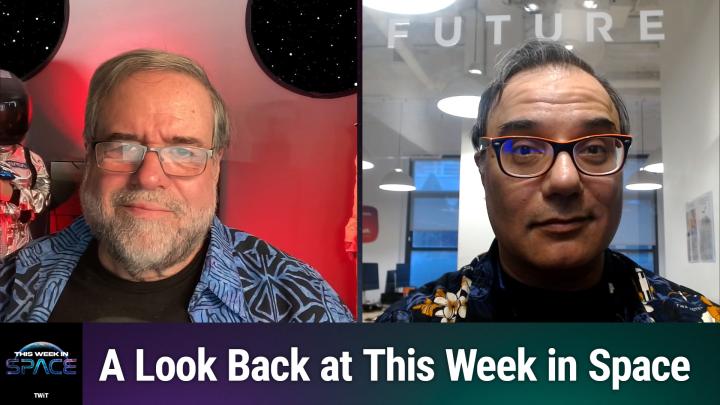
This Week in Space 237 Transcript
Please be advised that this transcript is AI-generated and may not be word-for-word. Time codes refer to the approximate times in the ad-free version of the show.
Tariq Malik [00:00:00]:
Coming up on This Week in Space, Rod and I take a long look back at over 230 episodes of this podcast, plus some headlines and a lot of space jokes. Tune in and don't miss it.
Rod Pyle [00:00:20]:
This is This Week in Space, episode number 237, recorded on November 20th, 2026: A Fond Farewell. Hello everyone and welcome to yet another episode of This Week in Space, the fond farewell edition. We'll be talking more about that. I'm Rod Pyle, editor-in-chief of Ad Astra Magazine, and I'm here with my pal, the master of all things space, Tariq with a Q Malik. How are you, sir?
Tariq Malik [00:00:46]:
Um, I'm doing well, Rod. I'm doing well. How are you doing today? That's a mighty fine TWiS shirt that you're wearing today.
Rod Pyle [00:00:52]:
And a nice shot. Wait a minute.
Tariq Malik [00:00:55]:
Yeah, there you go. We're matching shirts. Look at that with the Hawaiian shirts. Mine actually has a Saturn V on it.
Rod Pyle [00:01:03]:
Soon to be available in the secondhand market.
Tariq Malik [00:01:05]:
Can you see right there?
Rod Pyle [00:01:07]:
Our guest this week will be us because Tariq's mom says we're special.
Tariq Malik [00:01:12]:
I am special. No, she says I'm special and that you should treat me nicer.
Rod Pyle [00:01:19]:
It all comes out towards the end. All right, but before we go anywhere else, let's have a space joke from Shahad Choudhury.
Tariq Malik [00:01:26]:
Shahad!
Rod Pyle [00:01:28]:
Why is Jupiter jealous of movies about the Sun?
Tariq Malik [00:01:31]:
Uh, I don't know why.
Rod Pyle [00:01:33]:
Because it wanted to be a star!
Tariq Malik [00:01:35]:
Oh,
Rod Pyle [00:01:36]:
that's nice. Boom! All right, with that, before we get too mired down, let's go to headline news.
Tariq Malik [00:01:44]:
Do we have to explain that one? No. Because Jupiter's Almost a Star. Headline news! Oh wait, early headline news! Do it again, do it again, John. We're not gonna— we're not— do it again,
John Ashley [00:01:56]:
Rod. I need you to set it up.
Tariq Malik [00:01:58]:
You gotta do it again.
Rod Pyle [00:01:59]:
Let's go to headline news.
Tariq Malik [00:02:04]:
Headline news. Look at that, nailed it, nailed it. First, first try. First
Rod Pyle [00:02:10]:
slap on the backside on the way out the door. All right. First up, Next up, Queen's Brian May, who just received his National Space Society Space Pioneer Award, by the way.
Tariq Malik [00:02:23]:
Oh,
Rod Pyle [00:02:23]:
wow. It was given to him years ago, but he wasn't able to come fetch it, so we took it to him. Sees asteroid Hera in 3D. And—
Tariq Malik [00:02:35]:
Well, it's not asteroid Hera.
Rod Pyle [00:02:37]:
Hera is the program. That's what it says here. Hera is the probe.
Tariq Malik [00:02:40]:
Yeah, the probe. Yeah, it's asteroid Didymos and Dimorphos.
Rod Pyle [00:02:44]:
Yeah, but you wrote right here, sees asteroid 3D.
Tariq Malik [00:02:47]:
I wrote— yeah, I wrote the wrong one.
Rod Pyle [00:02:51]:
You know, you can't turn your back for a moment. Anyway, Brian May,
Tariq Malik [00:02:54]:
mea culpa,
Rod Pyle [00:02:55]:
lead guitarist for Queen, right?
Tariq Malik [00:02:57]:
Yes. Who is also an astrophysicist. He actually, he actually got his degree, um, like about 10 years ago, 15 years ago, something like that. Like, like well after his like peak with Queen and, and whatnot. Uh, also, by the way, Sir Brian May, he is a knight. Good sir, a knight of the realm.
Rod Pyle [00:03:19]:
Yeah,
Tariq Malik [00:03:20]:
but a
Rod Pyle [00:03:21]:
lot of things.
Tariq Malik [00:03:22]:
But I picked this one because it's really fun and also it's a bit timely. I'm not sure if we're going to talk about it later, but I will talk about it here. The European Space Agency launched the Hera spacecraft a while ago on a mission to asteroid Didymos and Dimorphos. And if that sounds familiar to you, Rod, it's because NASA smacked this asteroid Dimorphos in the face. It's a little moonlet of the asteroid Didymos a couple of years ago. And I was there. It was just as spectacular as you would like to see. But the whole point was to see, like, can we actually move an asteroid appreciably if one was, like, coming straight at us and going to endanger the Earth?
Rod Pyle [00:04:02]:
With a kinetic impactor.
Tariq Malik [00:04:03]:
Exactly. With a kinetic impactor. It was just aimed straight at the thing. And so what Brian May has done on this Hera mission— Hera is like the follow-up to go look at the aftermath, look for maybe even, like, the crater. He has put in these stereoscopic cameras, and he's done this many times. It's like his specialty to try to image these, like, deep space objects with 3D stereoscopic cameras so that, you know, when you put them together, like those old red and blue glasses, right, they all pop out almost like the old-timey stereoscopic types of things. And he has a whole book about it. But this is our first view now of Didymos.
Tariq Malik [00:04:44]:
That's the main asteroid for the pair. And he's going to hopefully hopefully end up starting to look at Dimorphos too, is maybe we'll see the crater left by the DART spacecraft impact way back when in 3D. And we've seen this with, uh, uh, Arrokoth, right? The, uh, the, the Kuiper Belt object that we saw after Pluto with New Horizons. We saw it with, uh, a few of the other asteroids too. Kind of any rendezvous in deep space, he's trying to get these cameras on board. So it's pretty exciting to see. And I wanted to share it because next week as we're recording this is the actual close-up first images. So we've got these 3D images now with Brian May, but next week we're going to get the even better ones from the Hera spacecraft.
Tariq Malik [00:05:29]:
It's going to be a whole big event in London. Are you going to go, Rod? I think my ticket got lost in the mail.
Rod Pyle [00:05:35]:
So just to make a point, Hera is an ESA mission.
Tariq Malik [00:05:40]:
Yes.
Rod Pyle [00:05:41]:
That is, if I recall properly, was supposed to fly at the same time DART did but got delayed, correct? It did.
Tariq Malik [00:05:46]:
It got delayed. They were supposed to fly kind of in tandem so that it would actually be seeing really fresh kind of impact things. And it was delayed largely because it's going to launch on a Russian rocket, I believe, if memory serves. And then all that stuff got pushed off to the side. So if I remember correctly. So,
Rod Pyle [00:06:04]:
well, I guess we'll find out someday. All right. Russian space weapons. Ew.
Tariq Malik [00:06:10]:
Yeah.
Rod Pyle [00:06:10]:
So we have an outer space treaty that says you can't have weapons of mass destruction in space. And Russia signed it, we signed it, many others have signed it. The question is, how long will it hold up?
Tariq Malik [00:06:22]:
Well, I think it might be kind of unraveling right now because the, uh, the U.S. military did, uh, did a report, I believe. Is it military? Yeah, it was a, it was a United States delegation to the United Nations in a committee last month, and this is just being reported in military.com today, that, um, those weird maneuvers that we saw of a Russian satellite kind of orbiting in tandem and like circling the ICEYE X-36 satellite. That's a Finnish satellite built for a US company. It's a remote sensing satellite that was being used by Ukraine, you know, to observe the Earth. That it's actually— they're classifying it now as a space weapon, right? Because it's getting kind of close, it can interrupt with observations and all of that thing. And there's more about space weapons that we're going to talk about later in this episode. But this one is in particular, interesting because it is like an official declaration now of an orbital weapon of any kind of nature.
Tariq Malik [00:07:22]:
And whether— where we go from that, I think, is going to be very interesting to see, like, what's going on, because it means that there's like a whole new tier now, like a new realm of warfare that we're going to have to be dealing with over time. And I thought that would be very important to point that one out. So
Rod Pyle [00:07:43]:
Well, I guess maybe we'll get that bigger budget for Space Force after all. Do you think maybe they launched it just so they get more money?
Tariq Malik [00:07:52]:
Well, probably like ComSpock. And we didn't get a chance, by the way, to invite ComSpock on the show. But ComSpock is like a company that tracks everything in space using available data, like from different, like LeoLabs and a few other things. And they have been, you know, they flagged this Russian Cosmos 2612 satellite, uh, you know, doing all of this stuff. And there's other ones too that they're seeing doing the same things. Plus they saw 2 satellites from Russia do the same thing about a year ago where they were like rehearsing it all. So they've actually tracked the evolution of this over time. So we'll have to see how it all turns out.
Rod Pyle [00:08:28]:
All right. And Blue Origin, oh, where are your rockets to launch Google data centers into space? Because everybody's got to have a data center in orbit.
Tariq Malik [00:08:37]:
Everyone, enter Project Suncatcher. That's the name of this Google research project. It is an interconnected network of solar-powered satellites equipped with AI chips, something called a tensor processing unit. That gives me, like, what is that word? Like PTSD from my astronomy final about defining the Einstein rotation tensor. Oh my God.
Rod Pyle [00:09:06]:
Yeah.
Tariq Malik [00:09:06]:
And the whole point is that it's going to scale, quote unquote, machine learning in space. And so they want to use the New Glenn rocket and its heavy lift capacity starting in 2029 to launch like a bajillion of these satellites on like a sun-synchronous orbit. And each of them, they're going to have like a data center rack. So if you can imagine, that sounds to me like it's a phone booth size. kind of a thing. That's what a data rack is to me, kind of like what I'm in right now. But I could be wrong. I don't know what AI data racks look like these days.
Tariq Malik [00:09:38]:
And so they're going to just— it's a huge deal because they're going to launch satellite after satellite after satellite of these things, build some sort of AI infrastructure in orbit, I guess, to rival the SpaceX AI, like, mega ultra constellation of 100,000 satellites. I don't know. So we'll have to see who gets there first because New Glenn not launching fast enough to be able to get all that stuff set up. So we'll have to see how that goes.
Rod Pyle [00:10:02]:
Speaking of astronomy finals, although I was an astronomy major for, I think, a grand total of a year and a half at UCLA, my first class was at a community college here in Pasadena, California. The teacher was a Caltech PhD, and he was— what's the word— dour. So the class started off with about 60 people, and by the time we got the final, I think we had 12. Wow. Because they had been chased out by Mr. Dour.
Tariq Malik [00:10:31]:
Well, I only had 4 people in my class, so you You made out good.
Rod Pyle [00:10:34]:
Well, so the final comes up and, you know, we struggle through the whole thing, and then at the end he gives us some, uh, some observa— some astronomical observations. Says calculate where you are on Earth.
Tariq Malik [00:10:46]:
Oh no.
Rod Pyle [00:10:47]:
In water.
Tariq Malik [00:10:48]:
In water?
Rod Pyle [00:10:49]:
The last part, yeah. So I mean, he's trying to do us a solid, right? But I'm working and working and working, and then page after page of calculations and getting nowhere. And finally, I think I put myself down somewhere in, in, in, uh, Iowa in a pond because I couldn't think of any other way to resolve the problem. So to my everlasting embarrassment, um, there I am. Okay, we got to go to a break, uh, but just before we do, I, I don't want to drop a bummer on everybody up front, but I also don't want to keep a lid on this till the end of the show. We need to tell you This Week in Space will be going on a hiatus starting in about, uh, 50 minutes. We found out after last week's show this will be our last episode for Twit. We do still have our Instagram, Facebook feeds and so forth.
Rod Pyle [00:11:35]:
We do have a new one, @TariqAndRod. Actually, that's—
Tariq Malik [00:11:40]:
You put Tariq first!
Rod Pyle [00:11:40]:
Sorry, it's Rod and Tariq. I don't know why I wrote that.
Tariq Malik [00:11:43]:
Wait, no, no, you wrote @TariqAndRod, so it has to be that.
Rod Pyle [00:11:46]:
That's Tariq with a Q. You can follow for updates and a weekly space joke because we got to have our space jokes, right? None of us are happy about this, but Leo and Lisa have made truly heroic efforts at Twit to keep us on the air.
Tariq Malik [00:12:00]:
Yeah.
Rod Pyle [00:12:01]:
Did everything they could, but the podcast market is shrinking and it has lots of victims. And here we are. So by hook or by crook though, we'll be back sometime in January. So stay tuned for updates. You can also write me at rod@pylbooks.com. That's Pyle with a P-Y. Never a PI. Yeah.
Rod Pyle [00:12:22]:
To get on a mailing list as we move forward. So let's move forward to a break and we'll be right back. Stand by. All right, here we are. So we're gonna do a bit of a potpourri for this last episode. Uh, we got, we got a bunch of space jokes to use up because you guys have been prolific. Thank you very much. We love that from you.
Rod Pyle [00:12:40]:
Got a couple of clips and we, uh, got some, some stories to tell. So, Tariq,
Tariq Malik [00:12:47]:
Yes, Rod.
Rod Pyle [00:12:47]:
Did you look at the rundown today?
Tariq Malik [00:12:49]:
I did. Did you notice there's links and everything and there's actually news stories and stuff?
Rod Pyle [00:12:54]:
Just wanted to check if you went below segment A because I want to hear your first space memory.
Tariq Malik [00:13:01]:
So I was actually thinking about this. By the way, I won't say if I looked at the rundown 5 minutes before I tried to log in.
Rod Pyle [00:13:10]:
And wasn't able to. That was the thing.
John Ashley [00:13:11]:
That's very on brand for you right there.
Tariq Malik [00:13:13]:
Today has kind of run off the rails a bit, but that's every Friday, right, for Tariq J. Malik.
Rod Pyle [00:13:19]:
Why are you limiting it to Fridays?
Tariq Malik [00:13:21]:
Well, well, yes,
Rod Pyle [00:13:21]:
I speak 2 other days of the week. Okay, don't tell
Tariq Malik [00:13:27]:
everybody. Oh, by the way, by the way, I'm gonna point out really quick yesterday. I'm glad that I'm actually here because yesterday I sat down to do an event like a podcast like this, and I came up after lunch, which is when we do the podcast here, and my cats had thrown up all over underneath where I do the podcast. Just for fun, right? So we could be dealing with that. I'm so happy that I'm not. So anyway,
Rod Pyle [00:13:52]:
well, that just made my lunch plans splendid. Okay, go ahead.
Tariq Malik [00:13:58]:
So it's really hard for me to try to figure out what my first space memory is, because I was thinking about it, and I've talked about this on the show, but the very first thing when I was thinking about what do I remember, I remember 2 things actually. So the very first one was reading That Time-Life book that I've shown a picture of on the show before. We talked about that, I think, in the career episode, which was like one of the first ones that we ever did. It was this Time-Life, like, hardcover book on the floor of our dining room. There's like a bookshelf there. And I read it like cover to cover with all these pictures of what life could look like on all the planets and everything. That's what I remember. And the other one was from '86.
Tariq Malik [00:14:43]:
And I, I, there must have been something before that, but in '86, I remember that, um, we just moved into a new house and I was very excited to try to find Halley's Comet. And I was frustrated.
Rod Pyle [00:14:55]:
Halley's Comet.
Tariq Malik [00:14:56]:
Ha, ha, ha, ha, ha. Halley.
Rod Pyle [00:14:58]:
Halley.
Tariq Malik [00:14:58]:
Actually, I think it's Comet Halley anyway. But anyway, I was frustrated that we couldn't see it from the backyard. Because what's the point of a comet that's supposed to be that close if you can't see it from your backyard? So those are like the 2 things that really stood out when I was trying to think about—
Rod Pyle [00:15:13]:
So this is 1984?
Tariq Malik [00:15:15]:
'86, man.
Rod Pyle [00:15:16]:
'86?
Tariq Malik [00:15:17]:
Yeah.
Rod Pyle [00:15:18]:
Okay,
Tariq Malik [00:15:19]:
wait, wait, was it '84? No, it was '86. Was it?
Rod Pyle [00:15:23]:
It was in the '80s.
Tariq Malik [00:15:24]:
Yeah, I should ask. I'm gonna ask the robot.
Rod Pyle [00:15:29]:
I went almost to, uh, Not Ecuador. What's that country just below Mexico? I was going to say Guadalajara. Venezuela. No, no, no. The next one just below. Anyway, I went to the southern, the lowest point of Mexico before it crosses in the next country to a town called Puerto Escondido to see Halley's Comet. And Puerto Escondido was an attempted resort that sort of stalled. So they had foundations of big hotels with rusted pipes and, and, and rotting concrete.
Rod Pyle [00:16:10]:
The place was really weird and spooky. But the strangest thing was they had all their trash cans were 55-gallon drums with a fiberglass pelican head with a big open mouth. Oh. Like that, you could throw trash in. Um, it was a failed resort town, uh, that was ruled by the, the local Guardia outpost. There were constantly 16-year-olds wandering around with very dangerous-looking M16s, chasing the imagined criminals. But we did go out on the beach the night it cleared up. And if you imagine holding a Q-tip at arm's length, that's exactly what Halley's Comet looked like.
Tariq Malik [00:16:43]:
Yeah.
Rod Pyle [00:16:43]:
It was a little disappointing, especially after, you know, if you read stuff from previous sightings, especially the most recent one before that, you know, spectacular, took up half the sky, every, you know, animals cried and hid in the barns and all that. And here I am looking at this smudge thinking, Huh. I traveled all the way to one of the most dangerous parts of Mexico to see a smudge.
Tariq Malik [00:17:03]:
In '96, Comet Hyakutake came by. Remember?
Rod Pyle [00:17:08]:
I sure do.
Tariq Malik [00:17:09]:
And we actually drove out to the beach in Malibu because I was at USC at that point in time to go see it. And that was spectacular. It's the great big green comet and everything. Rod is coughing, everyone. Because he couldn't afford to go to USC, so he had to go to UCLA. So,
Rod Pyle [00:17:31]:
uh, you got to realize there's, there's a year differential here. When I was getting out of high school, you went to USC because you didn't have the grades to go anywhere else.
Tariq Malik [00:17:41]:
Oh,
Rod Pyle [00:17:42]:
and then by the time you got there, it had improved. And then the last 20 years, it has become truly a world-class, uh, university. But at the time That's where you went. But I
Tariq Malik [00:17:52]:
actually, I was marred by every sports, uh, uh, controversy to get into that school that you can have. So
Rod Pyle [00:18:01]:
what?
Tariq Malik [00:18:03]:
Oh, you didn't know that? Like, there was like a whole big thing where a lot of famous people went to jail because they were getting their kids into USC.
Rod Pyle [00:18:09]:
Oh, oh yeah, yeah, yeah. Well, and then let's not forget all the proctology exams that guy was doing, for God's sakes, or whatever it was. Horrible thing. Um, all right, we, we gotta go to break pretty soon, but first, My memory—
Tariq Malik [00:18:21]:
Yes, what's your memory?
Rod Pyle [00:18:22]:
Is going to the library of Longfellow Elementary School and saying, do you have any space books? In probably, I don't know, 3rd grade or something. Yes, honey, follow me. So, you know, we're halfway through the Gemini program, huge things are happening. We've seen the, the Titan fly, you know, we've seen the Atlas fly with John Glenn, all this great stuff. And she pulls down The Big Golden Book of Space. And I open up this obvious— this thing obviously written for like pre-kindergarten, and all the rockets look like silver bananas. And, you know, someday we'll, we'll, we'll leave Earth on rockets. It's like, we've already done that.
Rod Pyle [00:19:04]:
This book was at least 10 or 20 years old by the time I saw it. I was so bent. But I then do remember—
Tariq Malik [00:19:10]:
How old were you again?
Rod Pyle [00:19:11]:
It was probably 3rd grade.
Tariq Malik [00:19:13]:
So you're like, uh, uh, 9? Is that right?
Rod Pyle [00:19:17]:
8. Yeah.
Tariq Malik [00:19:18]:
Yeah. Okay.
Rod Pyle [00:19:18]:
I was always a year behind because my birthday falls at a weird time. So I was a year younger than everybody. Then my next real memory is Gemini 12. And, you know, you know, you could barely—
Tariq Malik [00:19:35]:
Buzz Aldrin and, uh, uh, that's, uh, and Uh, gosh, come on, come on, Tariq, you got it. Buzz Aldrin and Jim Lovell, right?
Rod Pyle [00:19:46]:
Yep. Buzz Aldrin saving the Apollo program because he finally got, uh, extravehicular activities right after years of trying. And, uh, sadly, shortly after that, Apollo 1.
Tariq Malik [00:19:57]:
Yeah.
Rod Pyle [00:19:57]:
And then the long, long laydown, uh, just under 2 years while they figured out what had happened and got us going for Apollo 7. And then it took off and The rest was great. And of course, the best young boys' science fiction movie ever, Robinson Crusoe on Mars. But we've already talked about it on this show, so I'll, uh, I'll leave that. Uh, oh, John, you're telling me we have a little more time? My timer says 21 minutes.
John Ashley [00:20:24]:
We have a little longer— more time because, because I know we're gonna be showing some of our favorite moments from This Week in Space, and I have one personally that I Really thoroughly enjoyed. Oh, oh, I really wanted to play it right now. Oh no.
Tariq Malik [00:20:37]:
Oh no. Uh, thank you. Thank you everyone, by the way, still listening for your questions and for writing in because, you know, like you saw, we actually, Rod was worried that we weren't gonna get like, that it was gonna be like crickets and stuff like that.
Rod Pyle [00:20:51]:
Well, I was worried we'd have like 2 questions from people we, we had to ask to get them or something.
Tariq Malik [00:20:57]:
Yeah. And, and, and I, I was just like, well, we'll, if that happens, we'll have to just chew the, the bleep or whatever. And, you know, I could, I could talk to myself for an hour.
Rod Pyle [00:21:06]:
Why are you bleeping the fat?
Tariq Malik [00:21:09]:
Oh, the fat. Well, I wasn't gonna say fat.
Rod Pyle [00:21:11]:
You gonna say the S-word? What were you gonna say? What do you chew on?
Tariq Malik [00:21:16]:
Okay, wow. This, this— I just took a turn,
Rod Pyle [00:21:20]:
but I chew on my moves.
Tariq Malik [00:21:23]:
That's a callback, people.
John Ashley [00:21:25]:
And on that note, thank you everybody for watching the recording of this week's
Rod Pyle [00:21:30]:
Okay.
John Ashley [00:21:31]:
I do not want to hear you guys talk about moobs ever. I'm banning the word moobs from recording. And if I hear the word moobs, I am going to add a strike to your guys' strike card. And I'm gonna bring this up with Lisa.
Rod Pyle [00:21:51]:
You broke Tark.
John Ashley [00:21:56]:
I seriously do not want to hear the word moobs come out of your guys' grown-ass mouths.
Rod Pyle [00:22:06]:
Well, you know that's related to moon, right? That's what I meant.
John Ashley [00:22:11]:
On that note, thank you everybody for watching.
Rod Pyle [00:22:14]:
We gotta keep this for, for twists after hours.
John Ashley [00:22:18]:
This is probably gonna go up to the TWiT+ clips, not gonna lie. I'm gonna put this up on TWiT+ clips.
Tariq Malik [00:22:27]:
So I gotta go. I gotta go. Wow. It goes on for so long.
Rod Pyle [00:22:41]:
I, John, I thank you from the bottom of my heart for finding that. I was trying to figure out a way to download it, but I couldn't get it to play. So
Tariq Malik [00:22:49]:
I forgot that even happened, man.
Rod Pyle [00:22:51]:
I remembered that we had a bit of a breakdown with you getting the giggles. I just couldn't remember which episode it was.
Tariq Malik [00:22:59]:
It just hits you.
Rod Pyle [00:23:01]:
Let's laugh our way into a break and then we'll come crawling back. Standby. All right. We've recovered our dignity slightly.
Tariq Malik [00:23:09]:
I forgot that even happened.
Rod Pyle [00:23:11]:
What did you want to say, Tariq?
Tariq Malik [00:23:12]:
No. So that got me thinking. I have a related story and it's going to make Jon upset,
Rod Pyle [00:23:19]:
but—
Tariq Malik [00:23:19]:
Yay! Rod and I have been on our kind of separate fitness journeys the last couple of years and to much success. Big congratulations, Rod. I'm not fit. I'm just smaller. Well, I mean,
Rod Pyle [00:23:31]:
you're the one that does, you know, kills, murders boards everywhere and all that stuff.
Tariq Malik [00:23:36]:
Well, not, not, not, not, not recently, but hopefully soon. I'm gonna test for my black belt again on December 3rd, so everyone wish me luck. But when I was about 30 pounds heavier, I, like, I was, I was out at the swimming pool with my daughter and my niece, and we were swimming and everyone was— I was just watching, making sure that they're being safe. And she came up to me, my niece did, and she poked me right in the chest. And she said to me, are those moobs? And so I had like flashbacks when that happened to us. So I was so embarrassed, you know?
Rod Pyle [00:24:18]:
That's pretty cute. See, I said I, I find your moobs adorable.
Tariq Malik [00:24:23]:
Hey, family show. My mom listens to this show.
Rod Pyle [00:24:25]:
Yeah, I know.
Tariq Malik [00:24:25]:
I didn't tell her what was happening. I'm gonna get in trouble. Oh, okay.
Rod Pyle [00:24:30]:
I'm sorry, are you— you're not 50 yet, right? But you're close.
Tariq Malik [00:24:35]:
No, I'm still, you know, Mrs. Malik's little boy. So, oh
Rod Pyle [00:24:39]:
boy. Uh, hey,
Tariq Malik [00:24:41]:
50 in April.
Rod Pyle [00:24:42]:
Hey, said Ken Kramer, why did the sun go to school?
Tariq Malik [00:24:45]:
Why, Ken? Why?
Rod Pyle [00:24:47]:
To get brighter.
Tariq Malik [00:24:49]:
That's a good one. That's a really good one. That's
Rod Pyle [00:24:51]:
enough of the sun jokes today. Yeah, I didn't say they're all going to be winners. I just said we'd have some repeats of There's some new ones. Hey, Tariq.
Tariq Malik [00:24:59]:
Yes, Rod.
Rod Pyle [00:25:00]:
Who was your favorite guest on the show?
Tariq Malik [00:25:02]:
Oh my God.
Rod Pyle [00:25:02]:
Or favorite guests?
Tariq Malik [00:25:04]:
My favorite guests.
Rod Pyle [00:25:05]:
Okay. You can't think of any. I'll
Tariq Malik [00:25:08]:
say, whoa,
Rod Pyle [00:25:08]:
I thought John Delancey was fun.
Tariq Malik [00:25:11]:
I was gonna say that that was a treat, but I don't think that we were doing live shows back then, right?
Rod Pyle [00:25:17]:
We were, uh,
Tariq Malik [00:25:19]:
it was like beta. That was during beta, right?
Rod Pyle [00:25:21]:
That was early on. I think it was audio only.
Tariq Malik [00:25:23]:
Yeah, but it's on, it's on the, the, it's on the—
Rod Pyle [00:25:26]:
It's in the archive channel. Yeah, yeah, which is staying, by the way. You may, you may lose us temporarily, but you're not losing the episodes. So, so while you're waiting for us to return in January, you can go back and listen to all 200, uh, for actually 242 episodes because we had a bunch of betas that were, uh, not numbered.
Tariq Malik [00:25:45]:
Yeah,
Rod Pyle [00:25:46]:
yeah, don't listen to those though. We were still trying to figure out which, which way.
John Ashley [00:25:49]:
Oh no, listen to those. Those are the most— oh my God, Rod and Tariq back in the day.
Tariq Malik [00:25:55]:
Before we got corrupted by the showbiz, right? Back when it was about the real space.
Rod Pyle [00:26:01]:
I'm hoping for more corruption because there's usually money attached. Okay, so we had Delancey, we had Pam Melroy from NASA, which is great.
Tariq Malik [00:26:08]:
Pam Melroy twice. Remember when she was Deputy Associate Administrator and she stepped in?
Rod Pyle [00:26:14]:
That was really sweet.
Tariq Malik [00:26:15]:
She photobombed.
Rod Pyle [00:26:16]:
Yeah, she actually photobombed us. Eileen Collins.
Tariq Malik [00:26:19]:
That's right. Eileen was a— that was a treat. Eileen Collins was great because she was the commander of the first space shuttle mission I ever covered, like, as, like, full-time. And, and then I, I think I saw her, like, 4 times that year. It was, like, the strangest thing. So, and then I, I think she signed my book. I was so happy. So.
Rod Pyle [00:26:38]:
Well, and she's, she's one of the kindest people, astronaut or not, that I've ever met. And she's got a great story because, you know, you listen to Peggy Whitson and a lot of the other astronauts, it's like, yeah, you know, I got out of high school with a with a GPA of 9, and then I went to Stanford, of course, and then I went to MIT and got my doctorate and blah, blah, blah, blah. And Eileen's story is, you know, I got out of high school, I was kind of a party girl, I sort of spent a little bit of time at junior college, couldn't really figure my life out. Then I joined the military.
Tariq Malik [00:27:12]:
Yeah, then she joined the Air Force.
Rod Pyle [00:27:14]:
Yeah, so she had a very kind of spotty journey, but what I liked about that is it shows that you don't have to You know, exit grade school like you're coming out of a circus cannon to be a success in the astronaut corps. You can be somebody who takes a little longer to figure things out. And she still— when you see pictures of her flying the shuttle, sitting up at the, at the control console, she looks like she's about 12, you know. So she, she didn't lose many years. Now, that doesn't explain what happened to you and me, unfortunately, because— Oh. We did finally come out the other end, but there you go.
Tariq Malik [00:27:46]:
You know, roll the dice. Roll the dice. There's like 7 other Tariks in other dimensions who are out in space doing all the fun things. I really liked José Hernández.
Rod Pyle [00:27:58]:
Yes,
Tariq Malik [00:27:58]:
that
Rod Pyle [00:27:58]:
was a good story.
Tariq Malik [00:27:59]:
That was a great— so José Hernández, NASA astronaut, graduate of Franklin High School of Stockton, California, my alma mater. Stockton's own astronaut. That's really cool.
Rod Pyle [00:28:11]:
Because when I think good times, I think the Stockton Stockyards.
Tariq Malik [00:28:15]:
Hey, hey, well, I mean, like, in the Roaring '20s, Stockton Hotel, or Hotel Stockton, was the speakeasy du jour that people would come to from Sacramento so they can get away from the, the capital.
Rod Pyle [00:28:28]:
People just tuning in are going, what happened to the, the show about space? I know, I know. Okay, who are the other guests you like?
Tariq Malik [00:28:35]:
So, so, so, I mean, aside from, aside from the astronauts themselves?
Rod Pyle [00:28:39]:
Well, Well, yes, and, and, uh, Tanya mentions, uh, Tanya, yeah, Pascal Lee, enjoying Pascal Lee's appearances. He's a, a frequent returner, has been a frequent returner. Rick Genet was fun.
Tariq Malik [00:28:57]:
That's right, that's right. How about, uh, how about Jim Bridenstine? I know that that might be a controversial pick.
Rod Pyle [00:29:01]:
No, but he was great because
Tariq Malik [00:29:03]:
he's NASA, former NASA chief. We, you know, it's not every day that you get one of those on site.
Rod Pyle [00:29:07]:
No, and pretty apolitical, I thought.
Tariq Malik [00:29:10]:
I thought so too.
Rod Pyle [00:29:10]:
Yeah, he's very right down the center, kept it, kept it, uh, clean and balanced. Gosh, there's so many.
Tariq Malik [00:29:17]:
There's—
Rod Pyle [00:29:18]:
I'm either forgetting somebody that's going to call me and say, hey, why didn't you mention my name after having been on the show? Oh, Isaac, of course. Let's not forget Isaac Arthur with his 1.1 million followers on YouTube.
Tariq Malik [00:29:31]:
That's right, that's right.
Rod Pyle [00:29:32]:
Or subscribers, I guess, whatever it is they are.
Tariq Malik [00:29:36]:
Yeah, subscribers. So
Rod Pyle [00:29:38]:
any others?
Tariq Malik [00:29:39]:
Oh man, I can't, I can't pick the rest of them. It's, it's very—
Rod Pyle [00:29:43]:
We should have had Jammer B on.
Tariq Malik [00:29:45]:
Yeah.
Rod Pyle [00:29:46]:
Because, you know, continually while we're, we're flubbering around trying to remember some space fact, he goes, hey,
Tariq Malik [00:29:51]:
Jammer. Yeah, he's got them all ready to go
Rod Pyle [00:29:54]:
right here,
Tariq Malik [00:29:54]:
you know. But, uh,
Rod Pyle [00:29:56]:
so
Tariq Malik [00:29:56]:
by the way, as a callback, I did confirm that, uh, Halley's Comet, Halley's Comet did actually show back in 1986. So
Rod Pyle [00:30:03]:
86. Okay. Well, uh, speaking of such things, this is a repeat from Matthew McCormick. Hey, Tariq.
Tariq Malik [00:30:11]:
Matthew, yes. Uh, yes, Rod.
Rod Pyle [00:30:13]:
Did you hear about the flea market that just set up near the black hole?
Tariq Malik [00:30:16]:
Oh, I like this one. Yeah, no, I didn't. Tell me all about it.
Rod Pyle [00:30:19]:
They were hawking radiation.
Tariq Malik [00:30:21]:
Huh. I love it. I love it.
Rod Pyle [00:30:26]:
Okay, let's, uh, take our Zuzu velas and go to a break, and we'll be right back. So go nowhere.
Tariq Malik [00:30:31]:
What's a Zuzuvela?
Rod Pyle [00:30:33]:
And exiting the confusion zone back into the show. So
Tariq Malik [00:30:36]:
we were talking very deep discussions about Zuzuvelas. Yeah, yeah.
John Ashley [00:30:44]:
Look, you guys, I know this is the last show, but can we just— can we just be professional, please? Professionals, come on.
Rod Pyle [00:30:49]:
I'm sorry, who do you think you're talking to? Okay, uh,
Tariq Malik [00:30:51]:
I don't know, Ron's going using big words.
Rod Pyle [00:30:53]:
Yeah, let's talk about Voyager at One Light Day. This is a really neat story, not just because It's amazing. The Voyager's lasted just shy of 50 years and is still running on its original power supply of nuclear elements in an RTG. Plutonium. Right. Small plutonium plugs. And my favorite part is that it's still using a very expensive form of what we used to know as 8-track tape recorders for all its data storage. So to this day, 50 years later, every time we send up a command or it plays something back to us, this tape has to be dragged across a magnetic tape head.
Rod Pyle [00:31:36]:
And I don't even know how you make the emotion last that long on the tape in space where it's really cold and saturated with radiation. So amazing mission.
Tariq Malik [00:31:47]:
Yeah.
Rod Pyle [00:31:47]:
Kudos to JPL and everybody that worked on building that thing because, um, I interviewed, uh, John Cassani, who was the managing engineer, I think. They basically brought him in to save it because it was in trouble a couple years before it launched. And the stories he told were just heroic.
Tariq Malik [00:32:04]:
Yeah, yeah. I saw John talk about Cassini before it launched way back when in like the '90s at Griffith Observatory. So, but that was well after the Voyager missions because I am just a tiny bit older than Voyager 1 by like 6 months, I want to say, right? April. Yeah.
Rod Pyle [00:32:28]:
So wait, when did you hear this talk at Griffith?
Tariq Malik [00:32:32]:
Like '95, '96, maybe.
Rod Pyle [00:32:34]:
Okay.
Tariq Malik [00:32:34]:
That's maybe, maybe a little bit after that. '97.
Rod Pyle [00:32:36]:
I was no longer working there terrorizing customers.
Tariq Malik [00:32:40]:
Yeah. But, but this is interesting because Voyager 1 is 16.1 billion miles away. Billions and billions of miles. Let's call it again.
Rod Pyle [00:32:50]:
Got inflated cheeks.
Tariq Malik [00:32:52]:
And it's, it's been interesting because of the celebration. I have to admit, I mean, to you and to me, and maybe to all of our listeners, Rod, Voyager 1 and Voyager 2 are very special because of just their place. You know, you had the Grand Tour when they were launched. They launched in the '70s. They got out to the outer planets in the '80s. They took all these amazing images. I have posters of every planet flyby in my house. I haven't put them up, but I'm probably gonna for the 50th anniversary.
Tariq Malik [00:33:23]:
I did. I had them up.
Rod Pyle [00:33:24]:
I still have my posters.
Tariq Malik [00:33:26]:
But I had them because I got them from JPL when I did a multimedia project about their press site as an undergrad. And I actually had them on display in my dorm room as well as in my first apartment before I moved out to New York. And so it has done so much with what I would consider, I guess, these days so little, right? I mean, like, not a lot is working. They turned the camera off after, you know, the Saturn flyby, because Voyager 1 just flew through Jupiter and Saturn, right? I mean, that was just— that was their big—
Rod Pyle [00:33:59]:
Its last stop was Titan, and the gravitational field of Titan swung it out of the plane of the ecliptic, so it let it start heading out of the solar system, and now there's nothing to see.
Tariq Malik [00:34:09]:
Yeah, well, there was the helioshock, and like one of the first big long-running narratives of my career was, did they or did they not get to interstellar space with Voyager 1? And that happened in like, what, 2012 or something like that? Yeah. You know, it took forever. And so like, I'm kind of dancing around the point of how like, it's special. I get it, you get it, our listeners get it. But this week they turned the Empire State Building gold. for Voyager, like one at light day. They turned the Seattle Space Needle gold for it. It's far beyond just like the space geek people.
Rod Pyle [00:34:50]:
No, it's a cultural phenomenon.
Tariq Malik [00:34:52]:
And I was actually— because to me, all that should happen next year, you know, in August and September with the 50th anniversary of the launches. And no, this is when it's happening now. And just to show you, and you have this in the notes too, Voyager 1, one light day away, 16.1 billion miles. Takes 24 hours for a signal that we send to say hello to get there. And then it gets it, runs its little 8-track tape, says hello back. And then we have to wait another 24 hours, 48 hours to get the hey back.
Rod Pyle [00:35:24]:
Well, this is like trying to get a hold of you during the week if I send a text.
Tariq Malik [00:35:27]:
It's probably— let's be honest, Rod, Voyager 1 will get back to you faster than I would.
Rod Pyle [00:35:34]:
That's actually true.
Tariq Malik [00:35:39]:
Voyager 2 will not hit this milestone until 2035. 2035. That is almost another 10 years away. And then after that is what, Pioneer 10? Pioneer 11? That's like, who knows when that's going to be, you know?
Rod Pyle [00:35:54]:
Well, there's nothing left of those anyway. We haven't talked to them for decades.
Tariq Malik [00:35:58]:
Yeah,
Rod Pyle [00:35:58]:
but they were the first 2 that went to the outer solar system in the early '70s and, and had a very weird You know, they were spin stabilized, so they had to have their— their camera platform just scanned, right?
Tariq Malik [00:36:12]:
Yeah.
Rod Pyle [00:36:12]:
Because it's basically just a photodiode. And yet somehow they managed to build pictures out of that signal, which blew my mind. They were, I think, 2-color. They're very primitive. But man, to see actual photos of the outer planets up close like that was pretty mind-bending.
Tariq Malik [00:36:28]:
They found volcanoes on Io. You know, they found like all sorts of stuff.
Rod Pyle [00:36:34]:
Io, or 10, as the press called it a number of times. It's like, wait, 10 moons? Oh, I see. Um, and by the way, each of the, uh, RTGs on the 2 Voyagers have been losing 4 watts per year. So I think in 1977 they had a total of 477 watts. So you can do the math. They're operating on, you know, it's, it's An ultimate kind of physical irony of the universe that the further they get, the lower their power output. So really, it's like looking at a flickering match in New York from LA. You know, it's just astonishing that they can continue to get data back from these things.
Tariq Malik [00:37:11]:
You know what's that I heard about Voyager 1 and Voyager 2 that just, just left me dumbstruck this week? That,
Rod Pyle [00:37:18]:
you know,
Tariq Malik [00:37:18]:
they are—
Rod Pyle [00:37:19]:
Things that leave you dumbstruck completely.
Tariq Malik [00:37:21]:
It's not hard. It doesn't take a lot. You're right. It doesn't. I don't even understand how the Wi-Fi works in the house to cast Netflix to the TV from my phone. So, but But what I'm trying to say is, I was— I either read it or I overheard it, that, that from like some of the mission team, where they're talking about Voyager 1 and Voyager 2, mostly Voyager 1, old technology, dated, right? And yet, when the end comes in 4.5 billion, like 2 billion years, like when the Sun goes into the red death of its red giant phase and swallows up the Earth and swallows up Mars and gets, you know, eats everything up. That's what's, that's what's left over to prove that humanity was here. Yeah, was Voyager 1.
Tariq Malik [00:38:12]:
It's the first thing that people can find, and it will be one of the last things left over of humanity's presence. Isn't that crazy to think about?
Rod Pyle [00:38:21]:
Oh, that's how crazy it is. It's like
Tariq Malik [00:38:23]:
a safety Message in a bottle
Rod Pyle [00:38:24]:
is the very insulting GIF that John just put up on Discord, which I think was aimed at me because it couldn't really be aimed at anyone else.
John Ashley [00:38:32]:
It was aimed at Tariq because he didn't— I don't want you to like the
Rod Pyle [00:38:36]:
router. Wow, finally an old age joke.
John Ashley [00:38:37]:
I've got— I got— I have a special one for you, Rod. No, I don't.
Tariq Malik [00:38:42]:
No, he doesn't.
Rod Pyle [00:38:45]:
Okay, um, space joke. John, did you want to play the clip before the break? Was that—
John Ashley [00:38:50]:
whatever you want, whatever you want to do.
Rod Pyle [00:38:52]:
Um, from Sean Hart. Hey, Tariq.
Tariq Malik [00:38:55]:
Sean! Yes, yes, Rod.
Rod Pyle [00:38:56]:
An astronaut couple recently got married and decided to honeymoon on the asteroid Ryugu, but they had to cut the honeymoon short. However, once they discovered the relationship was on the rocks.
Tariq Malik [00:39:08]:
Ah, yuck, yuck, yuck, because it's an asteroid, everybody.
Rod Pyle [00:39:12]:
Asteroid humor. Uh, did we finish Voyager up properly? Okay.
Tariq Malik [00:39:18]:
Yeah, I thought so. Like the, the, like the last evidence of humanity in the heat death of the solar system. Yeah.
Rod Pyle [00:39:24]:
Yeah, that kind of finishes everything, doesn't it?
Tariq Malik [00:39:28]:
It's got a bit of finality to it.
Rod Pyle [00:39:30]:
I'm gonna cry for a bit, but while I'm doing that, John has a show memory he'd like to share with us. Go nuts.
Speaker F [00:39:36]:
Join NASA's OSIRIS-REx on September 24th to watch pieces of asteroid Bennu return to Earth for scientists to enjoy. $20 a seat, but you'll only need the edge!
Tariq Malik [00:39:46]:
You need the edge.
Speaker G [00:39:47]:
On this episode of This Week in Space, clearly we're talking about bringing stardust back to Earth
Rod Pyle [00:39:53]:
with
Speaker G [00:39:53]:
Angenette Pollitt, the Mission Implementation Systems Engineer for the OSIRIS-REx mission to asteroid Bennu. Stay with us. That's a, that's a golf clap for sure.
Speaker F [00:40:07]:
Hey, you know, nicely done. Legit.
Speaker G [00:40:09]:
Maybe we'll do these together from now on. That was kind of fun. That was nice. And Nobody's Got Energy, you know, that's second only to Star Trek, which I haven't counted how many views it got yet, but it's got to be huge because you were just—
Speaker H [00:40:25]:
that was nice.
Speaker G [00:40:26]:
Shall I say it? You were adorable.
Speaker F [00:40:29]:
No. Well, Ant, Ant, you live, you live in like the Central Bay Area kind of Area. I mean, because we, we used to have that every, every weekend at ARCO Arena. Sunday, Sunday, Sunday, you know, watch Bigfoot and Truckasaurus.
Speaker G [00:40:44]:
That's because you lived in Stockton, brother.
Speaker H [00:40:46]:
I'm from in the South. Yes, we had those quite regularly. Bigfoot and Gravedigger and all those guys. Yeah. Oh man. And the ads were Sunday, Sunday, Sunday,
Speaker F [00:40:57]:
Sunday.
Speaker H [00:40:59]:
They drag out that last one. Sunday.
Speaker F [00:41:02]:
$20 a seat, but you'll only need the edge, right?
Speaker H [00:41:05]:
You'll be deaf when you come out of this show because you can't hear a thing.
Speaker F [00:41:10]:
That's right.
Speaker G [00:41:11]:
Eric, I think you missed your alternative career path.
Speaker F [00:41:13]:
Oh my gosh. I'm gonna go to Monster Jam pretty soon. I want— I have to go see those trucks. So, um, all right.
Speaker G [00:41:20]:
Personal problem to me.
Speaker F [00:41:22]:
I have to— I have to give my— I have to give my chair to my daughter now because she has her Dungeons and Dragons And she has to be in the next room.
Speaker G [00:41:29]:
Did you grab your daughter's chair to replace that piece of shit you were using?
Speaker F [00:41:33]:
No, I'll tell you, I bought a new— I bought a new—
Rod Pyle [00:41:37]:
Oops.
Speaker F [00:41:38]:
Your poor daughter.
Speaker G [00:41:39]:
She's sitting on the ground on cold hard cement because Dan took her
Rod Pyle [00:41:44]:
chair.
Speaker F [00:41:45]:
That's not it at all. That's not it at all. No, we, we, we went— I told you, so I'm building a new computer, but I don't have a place to put it. So I went to IKEA with the family. And I bought a, a much larger desk. Nice. And, and so I have this giant desk. It's why I had the, the, the tech check with Burke earlier.
Speaker H [00:42:03]:
Yeah.
Speaker F [00:42:04]:
But they sold 2 versions of the desk. We bought a desk for, for Zadie in her, her room.
Tariq Malik [00:42:09]:
This is a really long clip, Tariq.
Speaker F [00:42:10]:
There's no chair. She doesn't have a chair yet. And they sell 2 versions of this desk. And I didn't realize this when I ordered it off the computer after—
John Ashley [00:42:18]:
That's the reason why it's long, Tariq.
Speaker F [00:42:19]:
And one comes with the chair and one is just the table. And I thought I bought the table, but then they sent the chair too. And then I'm like, oh, free chair. But no, I paid for the chair. I got schmucked, right? And so I've got this chair that I paid for now, and I didn't feel like I needed, but you know, I haven't fallen off this chair in another week now, and it is so amazing.
Speaker G [00:42:43]:
You know, guys, I, I hope I'm still alive when Tariq becomes a senior citizen so we can spend all our time— Oh, you're muted, Rob. About goiters. And ingrown hairs and hemorrhoids and all that stuff.
Speaker H [00:42:55]:
Oh my gosh.
Speaker G [00:42:56]:
I got up this morning. I can't hear. I had the weirdest pain and it was oozing. Let me talk about that for half an hour.
Speaker H [00:43:03]:
Oh gosh. You can't hear us. You can't hear us.
Speaker G [00:43:07]:
'Cause that's probably for the best.
Speaker F [00:43:11]:
You know what the really funny thing is? So that's from 2023. There's 2 things.
Rod Pyle [00:43:17]:
Aunt Pruitt.
Speaker F [00:43:18]:
Ant Pruitt. That was great. I couldn't, I remember not being able to know like where his booth was in that view. So I, I never understood why we were just looking at an empty screen the whole time, but he was way in the
Rod Pyle [00:43:27]:
back. I think, I think that was social commentary.
John Ashley [00:43:29]:
No, it was way in the back. And that was the one camera that was always, that was on for us to be able to just kind of point it back to the, like, kind of see the studio view.
Speaker F [00:43:37]:
The, so, but the, the funny thing is, so first of all, it's great to hear Ant again. Yeah.
John Ashley [00:43:42]:
Number 2, I had to make sure at least get Ant in there.
Rod Pyle [00:43:44]:
I had to.
Speaker F [00:43:44]:
Yeah. It's, it's been, that was in 2023, episode 79. I still have not seen Monster Jam. But in the time, the 3 years that it has been, the chair lost all its wheels and I fell off the chair and it was up on blocks. Then I fixed the chair with new wheels and now it's lost all those wheels and it's back up on blocks again.
John Ashley [00:44:07]:
So how do you make that happen? How?
Speaker F [00:44:11]:
I guess I am not a small guy.
John Ashley [00:44:12]:
What is it with you and chairs? What is it with you and chairs?
Rod Pyle [00:44:16]:
Pure man. And the,
Speaker F [00:44:18]:
the sad thing is this is like supposed to be a nice gaming chair brand, that Star Trek chair. And like now that pleather has all cracked.
Rod Pyle [00:44:26]:
It looks awful. And yes, it's all, it's on blocks again. Okay. So, hey, Tariq.
Speaker F [00:44:33]:
Yes, Rod.
Rod Pyle [00:44:35]:
From Jamie Marsh. A friend said she wanted to become a star, but I told her to be serious.
Speaker F [00:44:41]:
That's a good one.
Rod Pyle [00:44:43]:
Because let me try another.
Tariq Malik [00:44:44]:
Okay. Okay.
Rod Pyle [00:44:45]:
Dolores Fantasy. I don't know if it's a screen name or not. Um, I went to a librarian and said, I'm looking for a book that's been recommended to me. It's about Pavlov's dogs and Schrödinger's cat. Do you know it? And the librarian answered, hmm, that rings a bell, but I'm not sure if it's here or not. Physics jokes. Jammer B liked it.
Tariq Malik [00:45:08]:
That's right, jammer.
Rod Pyle [00:45:12]:
Okay,
Tariq Malik [00:45:12]:
Judy, I'm just sitting in the chair, man. I'm just sitting in the chair.
Rod Pyle [00:45:18]:
So getting back to our G-rated episode, uh, I think we need to go to a break, right, John? Let's do that.
John Ashley [00:45:24]:
Yeah, I think we're overdue.
Rod Pyle [00:45:25]:
Okay, let's, let's do our way to a break. Standby.
John Ashley [00:45:29]:
I'm not gonna miss these really terrible segues.
Rod Pyle [00:45:32]:
Hey, Tariq.
Tariq Malik [00:45:33]:
Yes, Rod.
Rod Pyle [00:45:34]:
Says Tom Kent Jr. What did the scientists do when they got bored studying the sun moving across the sky?
Tariq Malik [00:45:40]:
I don't know. What did they do?
Rod Pyle [00:45:41]:
They called it a day.
Tariq Malik [00:45:44]:
Oh, oh, that took me a while.
Rod Pyle [00:45:45]:
Actually, I got it. I mean, that— I think he's like 12 years old or something. It's the son of one of our listeners. Uh, let's try another one for Joel Olson. Hey, Tariq.
Tariq Malik [00:45:54]:
Yes. Well, yes, Joel. Yes, Rod.
Rod Pyle [00:45:56]:
Did you— yeah. Did you hear about the difficulties the Artemis astronauts were having with their space toilet? Oh,
Tariq Malik [00:46:02]:
I heard all about that, but please tell me more.
Rod Pyle [00:46:04]:
Well, they tried to investigate the problem, but they had nothing to go on.
Tariq Malik [00:46:08]:
Get it?
Rod Pyle [00:46:10]:
And on, something like that.
Tariq Malik [00:46:12]:
Can I tell you a really fun story about that real quick?
Rod Pyle [00:46:14]:
Do I have a choice?
Tariq Malik [00:46:15]:
Well, yeah. So, you know, during Artemis II, we were watching the live downlink the entire time, and the space toilet— the whole funny part is that the space toilet was kind of broken. And there's a call in the morning, so we wait for the astronauts to wake up. And Christina Cook gets on the horn, and she's like, hey, what's the story about the toilet? Can we use it again? And—
Rod Pyle [00:46:36]:
Like, now, please?
Tariq Malik [00:46:37]:
And they're like, no, sorry, you have to still keep going in. Like, they have these tubes they have to pee into, like a portable tube.
Speaker F [00:46:45]:
And she goes, what if it was just one of us that could use it? You know, like asking for a friend.
Rod Pyle [00:46:52]:
Yeah, right.
Tariq Malik [00:46:54]:
Yeah.
Speaker F [00:46:54]:
So anyway, that was it.
Tariq Malik [00:46:55]:
That was the story.
Rod Pyle [00:46:56]:
Okay. And I believe you have a story about Starship for us.
Tariq Malik [00:47:00]:
Yes, we have not talked about it. We had a whole big lead-up last episode, and here we are now, 7 days later exactly. SpaceX has done it, Rod. They have launched Starship into orbit, they have brought it back to Earth, and they have caught it with the chopsticks. So in fact, we got some pictures of that.
Rod Pyle [00:47:19]:
Just the upper stage though.
Tariq Malik [00:47:20]:
Yeah, so it's, it's online. 45. So that's where you can see it. Yeah, he's scrambling. He's scrambling. It's okay though. It's okay. But yeah, so that expression—
Rod Pyle [00:47:32]:
so I'm thinking, but it hurts.
Tariq Malik [00:47:34]:
So this was Starship Flight 15. It was their 15th test flight of the Starship mega rocket. They did hope for a double catch on this mission, you know, to do something like this. This is a photo that we've got for folks that are watching of that final approach. It took 2 days. So they launched it on Friday the 13th. No kind of crypto-whatever phobia here from SpaceX. And then the ship orbited the Earth about like 300 miles or so above and came back over South Texas in the afternoon at like 3 o'clock in the afternoon.
Tariq Malik [00:48:11]:
There's another photo of it. Absolutely picture-perfect landing. They did not capture the first stage, but the interesting part was the plan because they had like a fuel issue on the way up. The plan was to actually use the same chopsticks. So it launches the whole rocket from one launch pad, goes into orbit. The first stage was gonna come back, get caught by these chopsticks, and they would lower it to the ground, then bring the other one back and catch it with the same thing. That's pretty slick. I mean, but they were able to do it for the orbital one.
Tariq Malik [00:48:39]:
That could change the game. Right.
Rod Pyle [00:48:41]:
They do have 2 pads there now, right? They could have caught it. They do.
Tariq Malik [00:48:43]:
They're refurbishing the first pad to have all the new bells and whistles that the current Pad 2 that they're using Right now works. But, but this is like it. They have now demonstrated capture and landing of both stages. They can probably just, you know, try on Flight 16, which I expect is going to happen before this year is out as we're recording it. So in the next few weeks, actually recover an entire orbital rocket, the first time that has ever been done. And this was the very first time a rocket has launched and landed at the exact Same spot, you know, like the exact same spot, the actual launch pad. That's what you, Rod, and I were promised in all those old, like, sci-fi, uh, uh, launches, you know, with the Thunderbirds. That's what we were promised, and now they're making it happen.
Tariq Malik [00:49:32]:
It's pretty good.
Rod Pyle [00:49:32]:
Yeah, back when rockets had, like, the lower 10% of them devoted to fuel instead of the upper 90%.
Tariq Malik [00:49:38]:
That's right.
Rod Pyle [00:49:39]:
All right, well, uh, Guy, Couturier has something to say about that. Hey, Tariq.
Tariq Malik [00:49:45]:
Yes, Rod.
Rod Pyle [00:49:46]:
The bartender says, we don't serve your kind here. A time traveler walks into a bar. I like that one, John. That's good. Yeah, it's pretty good once you think about it. Ah, okay. Um, by golly. Uh, hey, Tariq.
Tariq Malik [00:50:04]:
Yes, Rod.
Rod Pyle [00:50:05]:
2 chemists go into a bar. The first one says, I think I'll have an H2O. The second one says, I think I'll have an H2O2. And then he died.
Tariq Malik [00:50:13]:
Oh no, what is that, chlorine? Ammonia?
Rod Pyle [00:50:16]:
I think it's hydrogen peroxide, isn't it? Yeah. Here we are once again proving why we couldn't be scientists.
Tariq Malik [00:50:23]:
That's my— the chemist is my father, man.
Rod Pyle [00:50:26]:
So call your dad, use your lifeline. Okay, um, pick a story and then we're gonna do another clip.
Tariq Malik [00:50:32]:
All right, let's do, um, let's do Let's do something fun. The first Pakistani astronaut in orbit is going to the Tiangong space station. That's really exciting. It's actually going to be one of, of two. There's Muhammad, uh, Zeeshan Ali, and there's, uh, Haram— I think it's Daud, right? And they, they are gonna fly as the first international visitors and partners of China's manned space agency. And they're going to launch in about a week as we're recording. So in the next few days, right before Thanksgiving, and spend a little bit of time there during the handover on the space station, very much like what the visiting astronauts with Russia would do on Mir and what NASA and Russian cosmonauts would do on the International Space Station when they used to do that. They don't do that as much anymore.
Tariq Malik [00:51:22]:
So I think that's really exciting. And it shows that China's kind of space efforts are having much more of a reach beyond China. than, you know, being solely a nationalistic, you know, part of the military there, that they're actually involving other countries, doing international cooperation beyond just the science that we've seen with the Chinese moon landings that they've done and the sample return, because they have been sharing those samples, that now they're bleeding that into or extending that into human spaceflight. And, you know, my culture benefits With Pakistan launching an astronaut to a space station. So,
Rod Pyle [00:52:00]:
well, remind us of your cultural background.
Tariq Malik [00:52:04]:
Oh, so yeah, I'm Pakistani-Mexican, so, and my daughter is Pakistani-Mexican-Chinese.
Rod Pyle [00:52:09]:
Now there's something you don't see every day.
Tariq Malik [00:52:12]:
Yeah.
Rod Pyle [00:52:13]:
Hey, Tariq.
Tariq Malik [00:52:14]:
Yes, Rod.
Rod Pyle [00:52:15]:
Why can't skeletons become astronauts?
Tariq Malik [00:52:17]:
I don't know.
Rod Pyle [00:52:18]:
Because it takes guts to be an astronaut. Speaking of butts, I believe we have yet another clip in which I will be insulted with good reason.
Tariq Malik [00:52:32]:
John found the new button.
Rod Pyle [00:52:34]:
I think John's having a stroke. I just keep pushing this button.
John Ashley [00:52:37]:
Didn't
Speaker F [00:52:39]:
even talk about,
John Ashley [00:52:40]:
uh, by the way, it was 6 seasons and a movie. Thank you very much.
Speaker F [00:52:43]:
I thought it was 7 seasons and a movie.
Rod Pyle [00:52:46]:
Nope. From Community?
John Ashley [00:52:48]:
Yeah, 6 seasons and a movie.
Rod Pyle [00:52:49]:
Oh, is that a quote? No, because the truth of it is, if you were doing syndicated TV back in the day when I was— you may not know this, but I worked on Star Trek.
John Ashley [00:52:59]:
You mention like every single time, Rob.
Rod Pyle [00:53:02]:
It was always 7 seasons and a feature. So there. Oh, shut up, you guys.
John Ashley [00:53:08]:
I mean, I worked on Star Trek.
Speaker F [00:53:12]:
It's like me saying, you know, like I went on that zero-g flight that one time, right?
John Ashley [00:53:16]:
No, I like you say that. I met Patrick Stewart, you know, no big deal.
Rod Pyle [00:53:19]:
I did meet Patrick Stewart. He was very nice. Okay. Oh, rest in peace, Patrick Stewart. Speaking of such things, says Chris Clark, hey Tariq.
Tariq Malik [00:53:31]:
Yes, Rod?
Rod Pyle [00:53:32]:
Why haven't aliens come to our solar system yet?
Tariq Malik [00:53:34]:
Uh, I don't know why.
Rod Pyle [00:53:36]:
Because they read the reviews. Only 1 star.
Tariq Malik [00:53:39]:
Oh, but it's a good star. We love you, son.
Rod Pyle [00:53:44]:
To which Benji Kirk responded, I hate how Uranus is the butt of all space jokes. I do not— Proper pronunciation.
Tariq Malik [00:53:54]:
I do not hate that Uranus is the butt of all space jokes. I will ride that until, uh, my dying day, I tell you. So—
John Ashley [00:54:02]:
Please don't ride that.
Rod Pyle [00:54:04]:
Oh boy. Okay, guys, get a room. This is gonna get weird. Because as Benji Kirk says—
Tariq Malik [00:54:13]:
Can I, can I say what my favorite headline on space.com ever was?
Rod Pyle [00:54:15]:
Because as Benji Kirk says—
Tariq Malik [00:54:17]:
Yes?
Rod Pyle [00:54:18]:
What's E.T. short for?
Tariq Malik [00:54:20]:
What is it?
Rod Pyle [00:54:21]:
He has short legs. Oh, oh, I get it.
Tariq Malik [00:54:27]:
I get it. My favorite headline, by the way, on space.com is, I want to see Uranus full moon face to way.
Rod Pyle [00:54:34]:
So blooper number 2 for today. They're going out in style. Oh gosh. John, how much more time are you going to give us? I
John Ashley [00:54:44]:
don't know.
Tariq Malik [00:54:46]:
We don't have to talk about the rest of this stuff. I mean, Russia wants to put nuclear weapons in space.
Rod Pyle [00:54:52]:
Pick something really juicy.
Tariq Malik [00:54:54]:
You know, let's talk about Space for Humanity. I didn't get a chance to write that story yet, and I really would like to. And you might have all noticed that I've got this kind of fancy shirt. here. It is the Mission '60s exclusive space Hawaiian shirt. It's got a Saturn V and the TWA Hotel on it. And, and the reason I say that is because I was there at the TWA Hotel when Space for Humanity— so it's this nonprofit that is trying to—
Rod Pyle [00:55:25]:
Started by Dylan Taylor.
Tariq Malik [00:55:26]:
Started by Dylan Taylor, right? And he was there. He was there at this event where they had a big auction, but they, they have done And 2 things of note that I think are really interesting. Number one is they bought out 3 full flights on Virgin Galactic's new Delta spaceship, which I think is like 6 flights, 6 seats apiece. And what is that times 3? Is that 18? 18. 18 astronauts they're going to make, that they're just going to make citizen astronauts out of all that. And at the same time, and this is something that we haven't talked about much at space.com, but I do want to, they founded a new civilian space agency. That's what it's called, the Civilian Space Agency. And it's also a nonprofit.
Tariq Malik [00:56:10]:
And the whole point of that is to make more civilian astronauts, expose people to training, to the space experiences, and then to get them on flights to go on Virgin Galactic or eventually, I guess, New Shepard again, if Blue Origin ever starts doing tourism. It does seem like Jeff Bezos got his flight and now the that they're done. They don't want to do it anymore. But, but I think that this is really interesting because it shows like another step forward. Space for Humanity has brokered the flights or funded the flights of many, like, civilian astronauts, you know, people that who normally wouldn't get a chance to go to do some, some science and whatnot. And then here they are making an entire pipeline now to get more and more people. Now, we do need more rides. But Virgin Galactic is gonna bring in, I think, at least 2 of its Delta planes online in the next few years.
Tariq Malik [00:57:06]:
And so hopefully that will, that will ease things up a little bit and get people into space much faster.
Rod Pyle [00:57:14]:
Okay. Jim Reed responds with, hey Tariq.
Tariq Malik [00:57:19]:
Yes, Rod and Jim.
Rod Pyle [00:57:21]:
Did you hear that 2 antennas on the ISS got married?
Tariq Malik [00:57:25]:
I didn't. I didn't. What happened?
Rod Pyle [00:57:27]:
The ceremony wasn't much, but the reception was fantastic.
Tariq Malik [00:57:30]:
I love it. I love it. That sounds familiar though.
Rod Pyle [00:57:34]:
Well, I, I said some of these are repeats, so.
Tariq Malik [00:57:36]:
Oh, okay. I still, I dig it. I dig it. Thank you, Jim. Thanks for the, for the sending.
Rod Pyle [00:57:40]:
Um, so, so we got time for, uh, do you have any final thoughts?
Tariq Malik [00:57:46]:
Are there any fun ones? Are there any fun ones? I think that it's going to be exciting.
Rod Pyle [00:57:50]:
Everything is fun with you.
Tariq Malik [00:57:52]:
We might be ending, but space is not. And there is so much more to come. We've got Artemis III coming up. I'm sure that you and I are going to be there together, Rod, one way or another, in the next year. I think the things are really— it's been a really exciting 4 years. I didn't realize that we've been doing this for 4 years at all until I went through the playlist to try to find— And by the way, you haven't noticed, You may have not noticed, everybody, that we haven't played the clip where I fell off the chair. And I know it happened twice. I know it happened at least once.
Tariq Malik [00:58:26]:
It did. I could not find the clip of it at all. And maybe we edited it out. Maybe that was John or Anthony or Ant being really nice to me to make me look like less of a space buffoon. But the nice part is that if we get to go to space, I won't have to fall off a chair because there's no gravity to fall off a chair from. Right?
Rod Pyle [00:58:49]:
You just drift away like you did on that zero-g flight that you stole away.
John Ashley [00:58:53]:
Knowing you, Tariq, you would still find a way to fall off the chair.
Tariq Malik [00:58:56]:
Probably. Well,
Rod Pyle [00:58:58]:
you know, we might not be able to believe that it's been 4 years, but I imagine if you ask any of our kind board ops, they probably would say, oh, easily, easily long
Tariq Malik [00:59:09]:
4 years.
Rod Pyle [00:59:09]:
Who include— I'll just say again— John Ashley, our current favorite, Say hello, John.
John Ashley [00:59:16]:
Hello, John.
Rod Pyle [00:59:18]:
Hello, John. Did you see what he
Tariq Malik [00:59:20]:
did there? And
Rod Pyle [00:59:22]:
Anthony Nielsen and Anthony Jammer B. Jammer was with us at the beginning. Did I miss anybody? That was, that was all, all of them, right? Yeah,
John Ashley [00:59:32]:
yeah,
Rod Pyle [00:59:33]:
yeah. And of course, uh, again, we, we extend our thanks to the Twit Network and to Leo and, and Lisa Laporte who gave us our wings to do this show. So we'd like to thank everybody for joining us today for episode 237 that we're calling A Fond Farewell. As noted, this is our last episode of This Week in Space, but we'll be back with something else, probably with a new name. You could track us at @rodandtariq, with a Q. So that's R-O-D-A-N-D-T-A-R-I-Q, not a K.
Tariq Malik [01:00:03]:
I did make a bid for my name to be first, but, uh—
Rod Pyle [01:00:06]:
On Instagram and Facebook. Yes, you failed. And we'll post our progress towards the new show there, which we think will be in January or February. And of course, until then, space jokes. All right. Don't forget about space jokes.
Tariq Malik [01:00:22]:
Yeah, we burned through the whole supply. The whole
Rod Pyle [01:00:25]:
inventory.
Tariq Malik [01:00:26]:
So there's a whole lot more space by the time we get to whenever we resume. I think that Voyager 1 will have like another billion miles under its belt. So I expect more jokes. All about that, please.
Rod Pyle [01:00:36]:
Uh, John, will people be able to still email us through, uh, the TWiS server for a while? Okay, so you can use the regular email that you've heard through all these shows, twis@twit.tv, or you can just write rod@pylebooks.com with a P-Y-L-E. And, um, listen everybody, it's been a fantastic trip. We've loved being with you for these 4 years. We love having everybody on Discord. We love getting email from our listeners. And we're just grateful that anybody puts up with us at all.
Tariq Malik [01:01:05]:
That's right.
Rod Pyle [01:01:06]:
And, uh, you know, we're deeply grateful to you for listening, writing in, and sending us those space jokes. So, uh, before we go, we have a brief video. Hopefully this will play smoothly, and this is, uh, my nod of remembrance to all of you.
John Ashley [01:01:40]:
(Editor's Note) Rod plays a video tribute to This Week in Space.
Tariq Malik [01:04:54]:
Oh, that's nice.
Rod Pyle [01:04:56]:
That's all she wrote, ladies and gentlemen. Oh, we're gonna cry again. And, uh, don't forget to, uh, visit us on our social media, @rodandtariq. And, uh, we will see you on the flip side in the new year.
Tariq Malik [01:05:09]:
Yeah, we'll see you then. See you then. All the best. Keep looking up, everybody. All right.