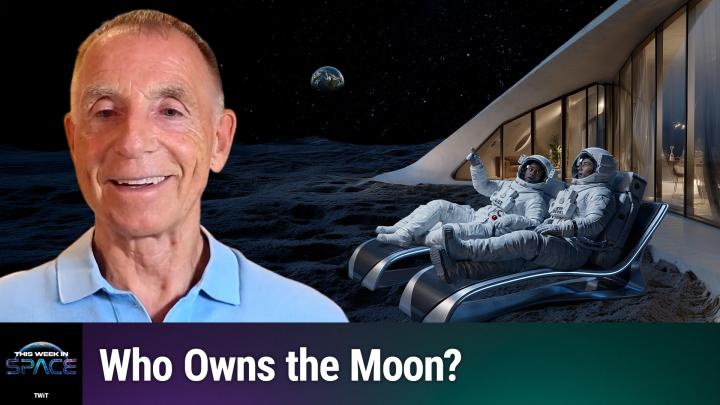
This Week in Space 226 Transcript
Please be advised that this transcript is AI-generated and may not be word-for-word. Time codes refer to the approximate times in the ad-free version of the show.
Tariq Malik [00:00:00]:
Coming up on This Week in Space, NASA's Roman Space Telescope is finally on its way to unlock mysteries of the universe. Uh, we've got 2 spacecraft on their way to Mercury, and who would want to own some real estate on the moon? We get down to it with Dr. Rainer Zittelmann, author of the new book New Space Capitalism, which is all about property rights in space. Check it out.
TWiT.tv [00:00:23]:
Podcasts you love.
TWiT.tv [00:00:25]:
From people you trust.
Rod Pyle [00:00:27]:
This is To It. This is This Week in Space, episode number 226, recorded on September 4th, 2026. Who owns the Moon? Hello and welcome to another episode of This Week in Space, the Who Owns the Moon edition. I'm Rod Pyle, editor-in-chief, Mad Astor Magazine. I'm here with my dear old friend, Tarek Malik. How are you, sir?
Tariq Malik [00:00:54]:
I would say dear young friend, but I'm doing quite well, Rod. How are you doing today?
Rod Pyle [00:00:58]:
You're not that— you're young to me, but you're not young to other people, so don't get carried away.
Rod Pyle [00:01:02]:
I'm fine.
Tariq Malik [00:01:02]:
Gasp! Scandalous!
Rod Pyle [00:01:04]:
But you'll be the youngest guy on the podcast today, so there you go. Uh, because today we're going to be speaking with Dr. Rainer Zitelmann, author of the new book The New Space Capitalism, to talk about how capitalism and property rights could dictate our future in space. It's a very interesting topic, um, so I encourage you to stick around. But first, and don't let this dissuade you, we have another space joke.
Tariq Malik [00:01:29]:
Space jokes.
Rod Pyle [00:01:30]:
From friend of the show Bruce McCandless.
Tariq Malik [00:01:32]:
Bruce!
Rod Pyle [00:01:33]:
Hey, Tarek.
Tariq Malik [00:01:34]:
Yes, Rod.
Rod Pyle [00:01:35]:
Why did the astronaut take down his Tinder profile?
Tariq Malik [00:01:38]:
Uh, I don't know why.
Rod Pyle [00:01:39]:
Because he was trying to avoid his SpaceX.
Tariq Malik [00:01:43]:
I love it. We have Tinder space jokes now. I love it.
Rod Pyle [00:01:46]:
Yeah, we had one that was that same riff on SpaceX about 2 years ago, but it was different, so. Thank you for that, Bruce. You're always welcome to provide more, and we will use them until the cows come home. Now, I've heard that some folks want to swipe left on both of us when it's joke time in this show.
Tariq Malik [00:02:03]:
Never!
Rod Pyle [00:02:03]:
But you can help by sending us your best, worst, or most indifferent space joke to us at twistedtwit.tv. We'll be happy to blame it on you on the air, regardless of whether it gets a rimshot or a groan or whatever. And swiping left means you don't like the person, right?
Tariq Malik [00:02:18]:
Or do I have it wrong? I don't know. I've been happily married for 2 decades, Rod.
Rod Pyle [00:02:22]:
Yeah, I never—
Tariq Malik [00:02:23]:
I don't, I don't use such sites.
Rod Pyle [00:02:26]:
So I may have botched that, but we'll see. Well, anyway, let's go on to headline news.
Tariq Malik [00:02:38]:
I think you're right, though. I think you're right. Headline news.
Tariq Malik [00:02:40]:
Headline news.
Tariq Malik [00:02:43]:
I think I was a bit draggy today. I think.
Dr. Rainer Zitelmann [00:02:46]:
Yeah.
Tariq Malik [00:02:47]:
Yeah. I felt a little off. Little off. So I'll catch up to her one day.
Rod Pyle [00:02:52]:
So we— I believe both of us had people down at the Cape to cover the launch of the—
Tariq Malik [00:02:59]:
I heard your guy ask his question in the press conference.
Rod Pyle [00:03:02]:
Nancy Grace Gromicki.
Tariq Malik [00:03:02]:
Oh, did you?
Rod Pyle [00:03:03]:
Well, we had 2. We had Burt Dicht and Jordan Strickler.
Tariq Malik [00:03:07]:
Yeah, I heard Burt's question.
Rod Pyle [00:03:09]:
Okay.
Tariq Malik [00:03:10]:
And Mona. We had 3 people. Yeah, the Roman Space Telescope, $4 billion. Space telescope.
Rod Pyle [00:03:16]:
A bargain.
Tariq Malik [00:03:17]:
Finally, finally, yeah, bargain, right? Because of the fact that these were built out of leftover, um, leftover spy satellite buses that the National Reconnaissance— oh, we got, we got a video for folks watching the video of the launch. Launched on a Falcon Heavy rocket by SpaceX.
Rod Pyle [00:03:34]:
The, the rarely used Falcon Heavy.
Tariq Malik [00:03:36]:
Yeah, I think it's like the 8th launch of it.
Rod Pyle [00:03:38]:
Yeah, it's a shame because it's really capable and it could be taking us to the moon.
Tariq Malik [00:03:42]:
Yeah, it could.
Rod Pyle [00:03:43]:
With astronauts and everything.
Tariq Malik [00:03:45]:
But exactly. But, but for folks who may not know, the Roman Space Telescope is NASA's newest flagship space observatory. It is, it is going to the Lagrange Point 2. And unlike the Hubble Space Telescope or James Webb, which are built in their varying wavelengths to zero in on a specific part of the Universe, like a star or a solar system, this space telescope has a wide field of view. It's something like 100 times the field of view as the Hubble Space Telescope. And they're talking about the science campaign that's going to look at 20 billion, with a B, stars to be able to hunt for dark energy and dark matter, to be able to really refine how many candidates for exoplanets and habitable worlds that there actually are, that sort of thing. And in fact, it's going to create images that are so large that there isn't a TV like 4K or otherwise on the planet that can actually display an entire image in its entirety. You need something like those.
Tariq Malik [00:04:47]:
Yeah, yeah, full, because it's— these are going to be billion-pixel images on the small side, and the biggest ones are going to be a trillion pixels. You know, if I had a dollar for every one of those pixels, I'd be almost as rich as Elon Musk, right?
Rod Pyle [00:05:00]:
So how big the actual optical pickup is. So I remember writing about this at JPL in like 20 '16. At that point, it had already been a long journey of, it's a spy telescope. Nah, we don't need it anymore. We're going to give it to NASA. Okay, we're going to call it WFIRST.
Tariq Malik [00:05:17]:
WFIRST, Wide Field Infrared Space Telescope, I think is what that stands for.
Rod Pyle [00:05:25]:
I just call it WFIRST. And that went on for a long time. Then it finally morphed into this. But the actual optical train, I think, dates back to late '90s, early 2000s. It's been around a long time.
Tariq Malik [00:05:36]:
It's got new— it's got like New avionics, new all sorts of upgraded stuff for now.
Rod Pyle [00:05:41]:
Right.
Tariq Malik [00:05:41]:
But like the core of it, the heart of it was built in the '90s for the National Reconnaissance Office's space telescope, spy satellite program.
Rod Pyle [00:05:51]:
And you got to wonder if they actually saved any money at the end of the day using— it's a little bit like the SLS and recycled shuttle engines. I haven't looked into it. And I didn't when I wrote the story because it was— that was not the focus of it. But you got to wonder, hmm. was there really a benefit to this? But hey, we're glad it got off the ground. And it's our best by far coronagraph ever.
Tariq Malik [00:06:12]:
Yeah.
Rod Pyle [00:06:13]:
Not dedicated to looking at the Sun, but to looking at other suns.
Tariq Malik [00:06:16]:
So it's an active coronagraph too. It's the first of its kind where it actually moves and stuff on the telescope, as opposed to already being like a static filter that's there. And so this is actually like a brand new piece of science that could revolutionize our search for alien planets, habitable worlds, that kind of thing. And it's going to be time, like they're gonna, it's gonna take about 60 days of commissioning, 6 months of, of final tests and stuff. We expect the first images to come from the space telescope in, in January of 2027. So it should be something like a sight to see. I got to see this telescope when they were wrapping it up to ship it down to Florida for launch from the Goddard Space Flight Center. But a very cool thing to have concurrently now operating with James Webb and the Hubble Space Telescope, which I'm gonna remind everyone is over 30 years old, right? So, so this could have a long life ahead of it, in terms of what it's the science that we're going to get from it.
Tariq Malik [00:07:16]:
A couple of small things of interest. This was a mission where it's the first time I've ever seen it. The President of the United States called during the post-launch press conference to congratulate everybody. And the NASA Administrator Jared Isaacman actually got up in the middle of the press conference and left and then came back and put President Trump on speakerphone, where he hailed the project and how great it was for everybody. I would be remiss, though, if I didn't point out that during his first administration, Trump and his leadership did try to cancel this mission. And it was survived by, you know, Congress approval, because it was already built by that point, for the most part.
Dr. Rainer Zitelmann [00:07:56]:
Yeah.
Tariq Malik [00:07:57]:
And it was a free space telescope. And they tried to cut some of the budget as well earlier this year. And it sounds like Isaacman might have had some discussions to save that money. Like, you know, before it became finalized. So there's a bit of a, like a duality that that phone call presented there too. But politics aside, a very successful space telescope launch. And I think that the— it only gets better because now we get the photos and all of that. And it's nowhere near as complicated a deployment.
Rod Pyle [00:08:27]:
I was gonna say it looks like Webb Space Telescope has a couple of dozen mechanical functions as opposed to the 460 or whatever Webb was.
Tariq Malik [00:08:34]:
Oh my God.
Rod Pyle [00:08:35]:
That had to go perfectly right.
Tariq Malik [00:08:37]:
That was terrifying just to get the mirrors in order. And I just got to give a hat tip to— I mean, we had 3 people there, you had 2 people there. We had Josh Dinner, Monisha Ravissetti— it was her first launch ever and it was a Falcon Heavy— and Chelsea Goad. But Josh Dinner, with 45 minutes remaining to liftoff, decided to leave the Space Center and drive to a Hobby Lobby in Titusville, which for folks who don't know is like a town that is really close to the Space Center, because the program that tracks where to get a sun crossing said that if you're in that Hobby Lobby parking lot, you will see the rocket cross the sun. And lo and behold—
Dr. Rainer Zitelmann [00:09:19]:
Wow.
Tariq Malik [00:09:20]:
Josh was able to do it. We've got a picture of it online. Line 22, if, um, if we can show it. I don't know. But yeah, there it is.
Rod Pyle [00:09:28]:
Oh my God.
Tariq Malik [00:09:29]:
Right? Isn't that amazing?
Rod Pyle [00:09:30]:
What did he shoot that with?
Tariq Malik [00:09:32]:
Uh, with a Canon Mark II something something. You can find all about it on—
Rod Pyle [00:09:36]:
With a solar filter or what?
Tariq Malik [00:09:37]:
Yeah, he's like, he had a solar filter that another photographer let him borrow.
Rod Pyle [00:09:41]:
Yeah, because that would burn out your sensor. That is spectacular, Josh.
Tariq Malik [00:09:45]:
I know, right, man? And he told me today that the sun was behind the, the building that the launch site was behind the building. So he did not know where it was going to be. So as soon as they called liftoff, he just hit the shutter on the Sun, hoping to get something.
Rod Pyle [00:10:01]:
Well, I'm sure if it was a high-end Canon DSLR, he put it on full automatic fire, went— just to make sure he got it.
Tariq Malik [00:10:09]:
I'm sure he has like a million photos.
Rod Pyle [00:10:13]:
That is pretty spectacular.
Tariq Malik [00:10:15]:
I did have a couple more things to say, though. There were 2 other things that I do want to shout out. Blue Origin is now officially going to Mars. NASA picked them this week to build their Mars telecommunications.
Rod Pyle [00:10:24]:
You completely messed up my headline read.
Tariq Malik [00:10:27]:
Oh, I'm sorry, I'm sorry. Go ahead, go ahead.
Rod Pyle [00:10:29]:
Have communication needs at Mars? Order it from Amazon.
Tariq Malik [00:10:33]:
Oh, there you go. I'm sorry, I didn't mean to step on your toes.
Dr. Rainer Zitelmann [00:10:39]:
Wow.
Tariq Malik [00:10:41]:
And if you have Amazon Prime, the delivery is free, right?
Rod Pyle [00:10:43]:
That's right.
Tariq Malik [00:10:44]:
NASA should get that. But, but no, NASA apparently doesn't have Amazon Prime. They are spending $700 million on to have Blue Origin build this for them. Rod, why do you think NASA needs a telecommunications orbiter at Mars?
Rod Pyle [00:10:59]:
Because they lost— what was the one that just went down?
Tariq Malik [00:11:03]:
Was it Odyssey, right?
Rod Pyle [00:11:04]:
Was it Odyssey?
Tariq Malik [00:11:05]:
Yeah.
Rod Pyle [00:11:06]:
Yeah, because they count on multiple relays for the rovers and future rover missions.
Tariq Malik [00:11:11]:
Yeah, and like their most powerful one right now is the Mars Reconnaissance Orbiter, and it's a bit long. Which is old.
Rod Pyle [00:11:16]:
Yeah.
Tariq Malik [00:11:17]:
2005 is when it launched. And so, and so, so this is, this is kind of gonna be a vanguard. It's gonna be a high-powered communications relay satellite for, for future missions to get there, you know, including orbiters. But also, you know, if they get Mars sample return, they're gonna need that. They are gonna send, remember, 3 at least helicopters to Mars, if not more than that, on their nuclear mission. So they're gonna need it for that there too. And for whatever other commercial stuff that are going to be coming out on the way. So the interesting thing, though, is that Blue Origin, which has not launched anything to orbit yet, aside from a demonstration flight with their— a couple of flights, actually, right, with their New Glenn, in terms of their spacecraft, they haven't launched to Mars yet.
Tariq Malik [00:12:08]:
They beat Rocket Lab, and Rocket Lab has already flown a couple spacecraft to Mars. So I don't know what Rocket Lab is going to do. They're behind on their Venus mission, but we'll have to see. But you know who's not behind? Japan and Europe at Mercury, because after 8 years, their BepiColombo mission— and this is on line 24— their BepiColombo mission has begun the official arrival process at Mercury. And that means that this week, I think, as of yesterday, as we're recording this, the 2 spacecraft— there's 2 of them, there's one for Europe, and one for Japan. They're both orbiters. So it's gonna be the first time we've ever had 2 orbiters orbiting Mercury at the same time. But they rode the same kind of space tug, the Mars— the Mercury Transfer Module, I think is what it was called.
Tariq Malik [00:12:57]:
And on Thursday, they separated from it. So they've started their, their final, final approach. They have flown by 9 different planets. They've made 9 different planetary flybys. They've flown around Mercury a few times, they flew by Earth, you know, Venus too, in order to slow themselves down enough to go into orbit around Mercury. And in November, these 2 spacecraft will separate into separate spacecraft and then go into their final orbits for the— to begin their final missions. But they have to get away from this tug in the first place. And it's been a long time, 8 years to get to Mercury.
Tariq Malik [00:13:33]:
You'd think that would be— that it being so close to the sun and so close to us, it'd be faster. But there you go.
Rod Pyle [00:13:39]:
It's interesting that one of them, I don't know which one from the picture you just put up, has a solar panel about the size of my dining table and the other one has solar panels about the size of a football field. What's that all about?
Tariq Malik [00:13:49]:
Yeah, well, they are different in size because they're doing different things. The European orbiter is much larger. And it's kind of like the mothership for Japan's JAXA spacecraft, which is called Mio, which is going to look at the atmosphere and plasma environment, as I understand it. Whereas the orbiter from, from the European Space Agency is going to really do like really detailed mapping. And so like in this image, you can see that the 2 spacecraft are together. And the Japanese spacecraft is inside that little cylinder thing, because that's actually a sunshade to protect it from the harshness before they— it gets deployed. So it'll be very interesting to see how they, how they work together over time and what they build on the MESSENGER mission, which was the first spacecraft to orbit Mercury, NASA's probe, which also took forever to slow itself down to get down there too.
Rod Pyle [00:14:39]:
So. All right, very good. We'll stick around. We'll be back in a moment to discuss property rights off Earth with Dr. Rainer Zitelmann. So stick around. And we are back with Dr. Rainer Zitelmann, an author and historian who's got some very interesting things to say about property ownership in space and how capitalism is going to continue to drive New Space to ever greater heights.
Rod Pyle [00:15:06]:
Rainer, thank you for joining us today. It's a pleasure having you here.
Dr. Rainer Zitelmann [00:15:09]:
Thank you for inviting me.
Rod Pyle [00:15:12]:
So primarily, at this point, Do you spend most of your time as a writer or an analyst, or what kind of is your daily work?
Dr. Rainer Zitelmann [00:15:26]:
Yes, today I do my research, I write books. The last years, every year one new book, and I produced every year one new film. For example, next week I go to South Korea. This will be my next film. I produced films about Poland, about Sweden, about Germany, also about Vietnam. So that's, that's what I'm doing.
Rod Pyle [00:15:54]:
So when you say you're producing these films, are these like economic analyses or are these more travelogue type things?
Dr. Rainer Zitelmann [00:16:00]:
No, no, it's about economic history. For example, Vietnam was one of the poorest countries in the world in 1990. with 80% living in poverty, and today it's only 3%. And the film is about how did it happen, this reduction of poverty, with free market reforms. And this is— these are the topics. And yes, this has also something to do with the book, because the last books and films that I had, these were analysis about countries, and I showed that more economic Freedom brings more prosperity and helps to increase the standard of living. And after dealing with a lot of countries, then I looked for industry that were almost 100% government-led some decades ago, the space industry, and only very few people could imagine that it would be private sometime. and to see what happens there if you add more markets and less government.
Dr. Rainer Zitelmann [00:17:08]:
So it's a similar question as if I studied, for example, Poland or Vietnam.
Rod Pyle [00:17:16]:
That's interesting. Tartt?
Tariq Malik [00:17:18]:
I was gonna say, like, the book is what we really want to talk to you about, like, today too. I've got my copy here, right? New Space Capitalism: The Entrepreneurial Path to the Stars. But I do have a question Rainer, that I ask everybody, and it's about how they found an interest in space. Because, you know, an economist and an entrepreneur like yourself, usually not the first person I would think would be really interested in space to the point where you'd write a book or a few on the subject. What was your uh, I guess, introduction to space or space exploration, and why did you find it interesting?
Dr. Rainer Zitelmann [00:18:02]:
This was exactly when I was 10 years old. I'm born 1957, and so this was 2 years before the first moon landing when I was 10 years old. And there was a science fiction series in German TV, and I was so fascinated. It was all about space. At Carnival, when the other children, they were cowboy or Native Americans, I was an astronaut. And in my children's room, there was a huge poster from the Saturn V rocket and another very, very huge poster from the moon. And it was all around space and even I started editing a newspaper, it was called Galaktische Zeitung, what means like galactical newspaper, when I was 10 years old and I sold it to my class comrades and teachers and I reported about astronomy, this time I read a lot of books about astronomy and space, and then there was the moon landing. Of course, we had a special edition about the, the moon landing and all this stuff.
Dr. Rainer Zitelmann [00:19:24]:
So I was very fascinated by space, and I wanted to be an astronaut. This was my, my goal. But to be honest, it was not all the decades in between. All the time I was interested but not as intensive as I was as a kid. And then it came a few years ago that I read about Elon Musk and about SpaceX and I saw that something happened in the space industry, that an industry that was more or less government-led before became private and this wasn't interesting question for me as an historian, an economic historian, because this is the same that happened in the countries that I analyzed. I analyzed— I mentioned this before— countries like Poland and Vietnam that were socialist, with means of production were nationalized without any private property, no free market. And then I analyzed what happened happened with free market reforms. And I think what happened with the space industry is something similar.
Dr. Rainer Zitelmann [00:20:41]:
Let me explain it a little bit how I mean it. I have a theory, maybe it's not a theory, maybe more a metaphor. Imagine a test tube with 2 ingredients, market and state. capitalism and socialism. And then I watch as a historian what happens if you add more market and what happens if you add more state. One example for adding more state, like Venezuela, what was a free capitalist country, and since Hugo Chavez came to power in the end of the '90s, They added more state, state, state, and the result is now that 80% of the population lives in poverty. 8 million people fled from Venezuela because they forgot to build this wall, what socialists usually should do, as we know in Germany. Or on the other hand, when you add more market, as they did in Poland, what was one of the poorest countries in Europe in the '80s, and now it's since decades Europe's growth champion.
Dr. Rainer Zitelmann [00:21:51]:
And the reason is because they added more market in this test tube. And so if I— if we talk now about the space industry, I think this is exactly what happened in the last decades. It's not without government. And the countries that I mentioned is also— it's not pure free market, not pure capitalism. But I don't think about pure capitalism or pure pure free market. I think also about this relationship between the two. How does this change? And so I found with the space industry that the same happened that I saw in some countries. Adding, adding more market means that it becomes more, much more efficient.
Tariq Malik [00:22:41]:
That's amazing.
Rod Pyle [00:22:42]:
That's, that's very interesting.
Tariq Malik [00:22:44]:
It's really interesting how you and I, Rod, we're on like the ground for the news and it kind of creeps up on us, right? The commercial side of things where now it's kind of normal. But Rainer, with your expert eye, you can see like how it's actually changed the economy and the economics of the entire industry just in like, you know, 10, 15 years, it seems.
Rod Pyle [00:23:07]:
Well, and not directly related to that, but I have to say, Rainer, you and I are sort of brothers in arms here because I was born probably about 6 months before you, so we're about the same age. Grew up looking at a lot of the same stuff, you know, became aware of the Gemini program. When I went to my school library to look at books about space and rockets, they were all kids' books. All the rockets looked like a V-2, you know, and space was only von Braun's big orbiting wheel and so forth. And we kind of knew already by 1964, '65 that wasn't how things were shaping up. I wish they had, actually. But, um, and I too did a space newsletter that I distributed to my neighborhood.
Tariq Malik [00:23:50]:
Did you really?
Dr. Rainer Zitelmann [00:23:51]:
Oh, I'm a host!
Rod Pyle [00:23:52]:
But because then we didn't have duplicating machines down the street, so I used a hectograph. Hectograph was a tray with gelatin in it, and you put down an ink master on it, then you could get about 40 copies off before it fell apart. But we're getting off of the weeds here. So let's run off to a break and we'll be right back with our next urgent question. Don't go anywhere. Stand by. So Rainer, one of the core tenets of, of what you talk about is property ownership, which is always a difficult discussion to have about space because we have the Outer Space Treaty on one side, we have the Moon Treaty kind of off to the left, and then we've got the idea of property ownership resource ownership, at the very least control of resources and assets to make this worthwhile. Because as we've seen from the British East India Company up through the American railroad era and many other times in many different places, what seems to really drive things is a profit motivation.
Rod Pyle [00:25:00]:
You could say greed, but let's just say, to be fair, a profit motivation. You have to be able to make one and it's going to be challenging in space. I think your premise is if you can't own what you're working, especially with regard to land, is that a correct assessment?
Dr. Rainer Zitelmann [00:25:16]:
Yes, absolutely. Let's go a little bit deeper into this. If you do anything, you need a motive and if it costs a lot of money, you need a huge motive. And the motive for the space race in the '60s was of course the competition between the United States on the one hand, the Soviet Union on the other hand. But as soon as they planted the flag on the moon, the wind was out of the balloon. Then there was no motive any longer to, to go on. And at this time, they asked this pioneer from the Apollo program, Wernher von Braun, what would be— what should be the next step? And he said the next step should be to make it profitable, that you find a way to earn money with this. And of course, money makes the world go round.
Dr. Rainer Zitelmann [00:26:05]:
But this is what didn't happen. And so there was no longer a motive. Let's assume a kind of thought experiment for a moment. Imagine it would be possible to claim ownership over an asteroid or land on the moon or Mars. if you go there successful. I think it would be such a great motive for people to go there. But of course, as you mentioned, these 2 treaties of— fortunately, we can forget the Moon Treaty because it signed, I think, only 20 countries and none of the spacefaring countries.
Rod Pyle [00:26:42]:
Right.
Dr. Rainer Zitelmann [00:26:42]:
But the Outer Space Treaty that is signed by almost all countries, there we have this Article 2 And according to this article, it's prohibited for countries to claim ownership over celestial bodies or land on celestial bodies. This is crystal clear, and there is no dispute among space lawyers that this is prohibited. But how about companies and how about private people? There's nothing in the Outer Space Treaty, but because I think in the '60s when they negotiated the treaty, almost no one could imagine that some decades later there would be people like Elon Musk or Jeff Bezos who have the money and the technical skills to go there. So there is nothing in the treaty. And there are— there's a dispute among space lawyers. There's one group that say it's also forbidden for private companies and private persons. Then there's another group that say no, it's nothing in there and it's allowed. The only thing that is clear that it's not clear.
Dr. Rainer Zitelmann [00:27:43]:
And of course, This is not a real good situation for investors. And so I think it's the main question for me today for the future in space is a private property question, because now they want to build a small city on moon or Elon Musk, you know, even he claimed to settle 1 million people on Mars. But how would you do this without private property? In the last 100 years, there were more than 24 experiments with socialism on Earth, so without private property, and they failed without any exceptions. And so I think it's ridiculous to assume that something that didn't work on Earth nowhere, that now it should work on Moon or on Mars. No, of course not. And we have this experience that socialism doesn't work. And this Outer Space Treaty is in a way, for some interpretations, like socialism. But today I think it's not so bad that it's prohibited for countries to claim ownership.
Dr. Rainer Zitelmann [00:28:51]:
Why should they? So this is maybe an opportunity for private companies. And the idea in my book, my argument is this: if someone is able to reach Mars, for example, and start to build something there, they should claim ownership. Of course, not the whole planet, a manageable area. Let's give an example. If SpaceX will be able to reach Mars and start to build there something, they should claim ownership, maybe an area the size of Singapore. We spoke about Singapore before. And the Mars surface is 200,000 times larger than Singapore. So I mean, there would be enough place for others.
Dr. Rainer Zitelmann [00:29:38]:
And if you want to make it a little bit smaller, Manhattan is maybe also enough. And then he should bring it to the stock market. This is my idea, because this would be a way to finance all the things. And then everyone could be an owner, every shareholder. You, me, everyone, because you have to find a way to finance it. It costs a lot of money. Of course, you can send a group of astronauts again with taxpayers' money to Mars, but you can't settle a million or not thousand or one hundred people on Mars or on Moon with taxpayers' money. So we have to find a way how to finance it.
Dr. Rainer Zitelmann [00:30:21]:
And you know, I. Maybe the reason why I see it this way, I'm a rare combination of an economic historian on the one hand, and a real estate investor on the other hand. I've spent almost 20 years in the real estate industry as a real estate investor. So, I thought, why we shouldn't have REITs like this real estate investment trust, like Moon REIT or Mars REIT or So let's assume someone is able to go to an asteroid and start mining. I think he should claim ownership of this asteroid, bring it to the stock market as a real estate investment trust, and then everyone could be a shareholder. And this is, I think, a realistic way to finance all this. But because you have to find ways how to finance all this stuff.
Tariq Malik [00:31:14]:
You know, and it's interesting that you bring up like the stock market, because in the, in the course of your book coming out, I think we were at the same dinner where like that same week, SpaceX's own IPO, you know, set like a world record, like of all time, at their value, at their valuation of $2 trillion. And that's just like an Earth company, let alone you know, if they go to Psyche, right, the, the all-metal asteroid, which I think has been valued at something quadrillion, right, dollars in terms of how much minerals it has, and you set up some kind of trust to develop that, I'm sure that you'd be able to find a lot of, a lot of people that would want a piece of that.
Dr. Rainer Zitelmann [00:31:59]:
So absolutely, yes. For example, you mentioned Psyche. This is only one of a lot of very valuable asteroids. Between Mars and Jupiter, as you know, we have, I think, between 1 and 1.7 million asteroids, and you have even 40,000 near-Earth asteroids. Not all of them are valuable, but a lot of them. And some of them, for example, their worth, of course, only in theory, is as high as the whole gross product of the whole world for one year or even more, of course, only in theory. Because if you would bring all this platinum to Earth, the platinum prices would plummet. But anyway, there are a lot of resources.
Dr. Rainer Zitelmann [00:32:41]:
And I think, of course, a lot of people would be interested to invest there. You need also fantasy for this. And you see, even today, there are people— I think it's fraud. It's not realistic. But you know that there are people who even today try to sell parts of the moon like this. How's his name? I think Hope.
Tariq Malik [00:33:04]:
Yeah, I have a deed. I have a deed for the moon. Yeah, 1 square acre.
Dr. Rainer Zitelmann [00:33:09]:
So yes, of course, this is a little bit crazy because only to claim ownership doesn't mean you really own something though. Otherwise, I could sell you now maybe 1,000 planets or even solar system and maybe with a discount or something like this. No, only to claim ownership doesn't mean— there's even one woman living in Spain, and because Hope didn't claim ownership for the sun, and so she sells now part of the sun. So this is all crazy. But if even then, tens of thousands of people buy shares for this, what I think it's not realistic, it's a kind of fraud. How would it be when it'd be really realistic. And if spaceships going there and start mining there with all this platinum— no, I think it's the best and the only way, to be honest, to see it. Because real estate is the biggest asset class in the world.
Dr. Rainer Zitelmann [00:34:09]:
I think if you sum up everything, it's like $400 trillion or something like this. It's the biggest asset class. And it belongs to no one, not to any state, not to any government. What I think is great. So I will give you an analogy how I think this will happen. If you look back in the history of America, when the first settlers, when they conquered the West, it was This way they claimed ownership for a piece of land first. They, they went there and they claimed ownership, and that was not legal at this time. It was only later it was legalized by the Homestead Act.
Dr. Rainer Zitelmann [00:34:57]:
But the first thing was to— for settlers, or they called them squatters at this time, to go there and claim ownership. And it happened, by the way, in a very similar way In Vietnam and in China, after the end of communism, the peasants left their collectives, and then they claimed ownership of land, what was illegal at this time. But later on, with economic reforms from Deng Xiaoping in China or the so-called Doi Moi reforms in Vietnam, it was legalized. And so I think, yes, some people. Criticized me. I had an interview with a German real estate newspaper a few weeks ago, and she told me, oh, what you say, it sounds like Wild West, what was a negative word for her. And I said, first of all, I think Wild West is not so bad, because without Wild West, there wouldn't be the United States today. But Wild West means first, there's the entrepreneur or the farmer or the settler, Of course, later you need a sheriff for some reason, but the sheriff is not the first person to go there, or the courts.
Dr. Rainer Zitelmann [00:36:09]:
The first one is the entrepreneur and the settler. And later on, only later on, there will be the sheriff. And so I don't know whether it will happen this way or not. But as a historian, I look back in history, how did it happen in the past?
Rod Pyle [00:36:24]:
And I think, why should it be very different Well, and we're gonna talk about that, Sheriff, later, but I wanna thank you on the platinum discussion for pointing out, you know, we hear a lot of people talk about asteroid mining and, oh, we're gonna bring back platinum, we'll get rich. Very little talk about how you get it back to Earth in any quantity. And almost never, other than one interview I did for a 2019 book of mine with Steve Jurvetson, almost never does anybody say, Yeah, but that's gonna sort of crush the price of platinum if you bring down 40 tons of it in one fell swoop. It is interesting to think about what we could do with rare earth elements from asteroids though. But before we do that, let's go to a quick break and we'll be right back, so stand by. So, Rainer, at this point we buy the bulk of our rare earth elements from China, which, you know, depending on what side of the fence you're on, but certainly if you're in the business that uses them like semiconductors is probably a little scary because that supply could be throttled any minute like OPEC did with oil back in the '70s. And, um, you know, asset— being able to own assets in space becomes more, more appealing. But of course then that raises the question of our near-peer, uh, space— Yeah, I don't want to say adversary, but China doing the same thing.
Rod Pyle [00:37:51]:
So once we try to legitimize ownership of resources and land in space, of course the risk is, in some people's minds, that China will get there first and say, great, here we are on Mars. We want those frozen water deposits and we want Valles Marineris because it's got a nice low altitude for landings with less propulsive fuel needed or something like that. Any thoughts on that competition?
Dr. Rainer Zitelmann [00:38:21]:
Sure, absolutely. I think China is the biggest threat. In my book, I have one chapter only about China and I studied a lot the Chinese economy. There are a lot of misconceptions about the Chinese economy. A lot of people think that it's like communism or 100 100% planned economy. This is not true. I have a good friend at the Beijing University. His name is Wang Chang, and he says every time our success was not because of the state, but in spite of the state.
Dr. Rainer Zitelmann [00:38:54]:
We came from 100% state and then we reduced it. Unfortunately, Xi Jinping goes again in the direction more government and less market. what I think it's very bad. But even he, and this is important, even Xi Jinping understood that space, it's not possible to do it only by the government. So 12 years ago, he allowed private space companies, he, what is really an exception. And today you have, I think, something like 450 private space companies in China. And their big role model is, of course, SpaceX. And yes, first they try to copy it.
Dr. Rainer Zitelmann [00:39:44]:
They try to copy everything. And a lot of people maybe laughed at them. Oh, these Chinese, they can't do anything else as copy. But I think it's crazy because the first thing, if you learn something, is always to copy. Think about children. They copy everything from their parents in the first years of their life. Later, when they become teenagers, they don't copy everything. They got opposition, having some fights and finding their own way.
Dr. Rainer Zitelmann [00:40:15]:
But so they became adult now in China. And I have this example from the German automotive industry. We were number one in the world, as you know, with our BMW. Mercedes, Volkswagen, and they laughed all about China, but now they laugh about us because first they copy it and then they innovate in the next thing and even make things cheaper, make things better in a way. And I think this could happen with space. Yes, and if they were the first on Mars, or now maybe the question is also for the moon, Yes, China signed also the Outer Space Treaty. So it's also prohibited for China to claim ownership. But you can cancel or quit the Outer Space Treaty with 1-year notice.
Dr. Rainer Zitelmann [00:41:06]:
And this is something I'm afraid of. They go to Mars or to moon, and then they leave the agreement and they claim ownership of moon This should be a reason for the United States and for private companies to be— to really hurry up and to understand it. I think who dominates space will dominate the Earth. And if we don't want that China is dominating the whole Earth, it's also for— with military questions, then you should really speed up and hurry up. And I think that's the point. The question is whether China would allow someone to come into existence like Elon Musk, who is so powerful and famous. So this is their problem with their political system, because there were people like in another industry, you know, Jack Ma, for example, the founder of Alibaba, and he became He was the richest man a few years ago in China and became very famous. And then the government went against him and he got a lot of problems.
Dr. Rainer Zitelmann [00:42:19]:
And I don't think that China would allow someone to become so really famous and influential as Elon Musk in the United States. And so I think in the competition between the United States and China, we should be aware that our biggest strength is what made America great. This is capitalism, competition, private enterprise, and we should get a lot rid of this bureaucracy. I think there's still too much bureaucracy in space, also in the United States. Not so bad as it is in Europe, of course, but I think this is is the main question in the competition between the United States and China. Who will give more freedom to the market? It's not about claiming any goals as we had it now. I think it was in December, this space paper from the Trump administration for— with such goals like $50 billion investment or 1,000 launches a year. I don't think so much about claiming this goals.
Dr. Rainer Zitelmann [00:43:29]:
But much more important would be give more freedom to the space industry. And the development went in a good way. And, you know, this is also a topic in my book that I analyzed. How did it happen that something like SpaceX was possible? And what a lot of people don't understand, some people ask me, is this science fiction? What you are talking about new space capitalism. And I said, no, it's not. Because last year, as you know, of course, we had 324 rocket launches and 165 out of them were SpaceX. So it means if SpaceX were a country, it would be number one, far ahead of China. China had 88 launches.
Dr. Rainer Zitelmann [00:44:15]:
And they're not the only one. Even Rocket Lab from Peter Beck, the New Zealander, they had 21 rocket launches with a 100% success rate. And this is even 3 times more as Europe. We had only 8 launches last year. So I think it's very important to understand that all the success today, it's because of private entrepreneurship. Imagine how would the United States be without SpaceX today? I think number 4 or 5. Uh, maybe. So this is very important to, to, to understand.
Rod Pyle [00:44:54]:
Uh, okay, I've got a, a, another question that I'm going to ask, but I think the answer might be kind of long, so why don't we jump to a break early and, uh, we'll be right back. Stand by. Uh, Rainer, you've been talking, uh, largely about private ownership and control of land and resources, and of course you mentioned the outer space Treaty and the difficulties there. But I wonder, given the kind of dynamics that are gonna take place in any given launch and landing and operations site, either on the Moon or Mars— so let's talk about the Moon, for instance. We go somewhere near the South Pole where everybody thinks they wanna be in the long run, and we set up a couple of landing pads and a couple of nuclear reactors to supply power. especially if you're operating in one of the permanently dark or mostly dark regions. There's every argument in the world to be made that you should have an exclusion or safety zone claimed that could be miles across, either for radioactive effects or for the effects of a liftoff from the moon or a landing with these very sharp particles going out at at almost orbital velocities. So can you have a de facto land claim based on either safety or operational concerns that acts as de facto ownership of land?
Dr. Rainer Zitelmann [00:46:20]:
Yes and no. Of course, this was— of course, I'm not the only one, the first one who is aware of the problem. And in this Artemis Accord, I think it's signed now by 60 countries. They have this about the so-called safety zones. What is if you start mining, for example? Of course, you have to build something like, how do you call it, a fence or barrier or anything. But it's not private ownership. Maybe it comes in a way close because it can take not— it will take not only years, but maybe decades. And if you have a safety zone there for decades, worth the difference to private ownership.
Dr. Rainer Zitelmann [00:47:08]:
But I think the biggest and most important difference for me is that what would not work with this to bring it to the stock market, then you can make the safety zone, but It's something completely different as really legal property, a property right. And so I think it's a way or a step in the right direction. It's the same in this Artemis Accord that they say it's not a violation or they say it's not necessarily a violation of Article 2 of the Outer Space Treaty, if you take the resources there from asteroids or from the moon. So these are always also ways to go around the problem. And I think it's better than nothing. But I don't think that they really solve the problem. It's only like maybe a first step in the right direction and there have to be the next steps.
Tariq Malik [00:48:20]:
You know, I'm really curious about like the idea, Rainer, like how you see like the start off, because a lot of what we're talking about, it's a discussion of a missing framework on how like commercial operations in space might work. But someone has to be first. And I was really struck when you were speaking at a recent dinner at kind of a scenario where you were suggesting that someone has to be bold. If it's SpaceX, or maybe SpaceX has a customer that's going to do something, but that someone has to be first to go and do it before any of the frameworks that we have can be tested. And I'm curious how that scenario would work. to really, I guess, open up this whole thing? Because my, I guess, my understanding up until I met you was that, yes, we have this Outer Space Treaty and this framework on how things should work, but no one can enforce anything because there is no sheriff, like you said earlier. There's no one on the Moon right now with a sign that says, off my lawn, and that kind of thing. But someone has to be first.
Tariq Malik [00:49:33]:
And so how would that evolve? Like, if Elon Musk and Gwynne Shotwell say, we're gonna, we're gonna land on the moon. That Starship part, that pad, that's our pad now, because our Starship is there. And I guess come and, come and get it if you want it. I'm just curious how you would see that working out.
Dr. Rainer Zitelmann [00:49:53]:
I think the good thing is that it's one thing is crystal clear in the Outer Space Treaty, that for countries, for states, it's prohibited to claim ownership. And I think this is a good thing. So, and there are lawyers with very good arguments that say, no, it's not for the government, it's not possible, it's prohibited, but for private companies it's allowed. And they have a lot of very good arguments for this. Of course, I know there are others who discuss and who are against it, but it is a position or an opinion where you have very good reasons.
Tariq Malik [00:50:38]:
Yeah.
Dr. Rainer Zitelmann [00:50:38]:
What is not prohibited in the first place, it's allowed. And of course, what would happen? For example, he would go there and claim ownership, and then the question is, whether, for example, the United States would recognize it or not, because this is not prohibited. You have to distinguish between claiming ownership as a country, what is not allowed, or to accept as a country that someone else claims ownership. It's possible, for example, that the United States or some other country say, okay, Musk claimed ownership and we accepted, not only maybe one country but several countries. Of course there will be others who say no, we don't accept it. But this is a similar situation today with the Artemis Accords. They are signed by 60 countries and what there is about resources, space mining, China and Russia, they say no, we don't accept it. It's against the Outer Space Treaty.
Dr. Rainer Zitelmann [00:51:45]:
So it will be a similar situation then. And the question is, who can enforce it?
Tariq Malik [00:51:52]:
Yeah.
Dr. Rainer Zitelmann [00:51:53]:
On the moon or on Mars, you have no army and no police, no weapons and nothing like this. The question is everything will happen on Earth. And the question is, what should they do against him if the United States— and I think this is the question of political lobbyism to say that the United States, as soon as someone claims it, who is first. And I think it's fair that it belongs to those people who, who go there first. Think about it in a, in a more— in a moral way. If I, if I ask the main question, who should have the right to own it? I or you? No, I don't have the money to go there. I don't have the technical skills to go there. I've not any rocket to go there.
Dr. Rainer Zitelmann [00:52:40]:
Why should I own something there? But I think the person who's willing to take the risk, who has the technical skills to go there, also has the technical skills to start to develop something there, pays, makes an investment, takes the risk, has the ability. I think it is fair that this person should be the owner, as, as it was on, on, on Earth. I, I made this analogy through, through the settling of America, of the United States. The only difference is that at this time there were the, the Native Americans, and of course you can give the argument that, that we stole the land from there. Yes, but there are no native Martians or No one's living there on the moon, so it makes things a little bit easier. And I think it is fair and there should be an incentive. You know, you should get a reward for— it's always in the economy, in every system. If you are willing to take the risk, if you are willing to make an investment, if you have the skills, I think it's like— it's, it's morally good-founded that, that you are the one who should own it.
Dr. Rainer Zitelmann [00:54:00]:
But I, I think this is my idea. It's not that you own it and that then you will not share it with others because then you can finance it. My idea is then to bring it to the stock market, and then in the next step, everyone can be an owner. Every shareholder in such a real, uh, real estate real estate investment trust can own it.
Tariq Malik [00:54:24]:
And can I ask, that stock market concept, is that something that would be part of an existing framework? Or would we need like a completely separate space stock market, like stock exchange for off-world resources? Or is there a place where, you know, a European company could be in the FTSE or other equivalent uh, we're owned by a British company, space.com, so I, I follow that one.
Rod Pyle [00:54:54]:
So giving you a nod to the boss.
Tariq Malik [00:54:56]:
Or, or the, or the New York Stock Exchange if it's SpaceX, or, or, or NASDAQ, you know, that kind of thing. Would it— would each one have their own space offshoot, or should, should we have a separate space stock exchange that is a central place for all of these things?
Dr. Rainer Zitelmann [00:55:12]:
Okay, I, I don't know how it will happen, but I think the first one would be, of course, maybe on the New York Stock Exchange.
Tariq Malik [00:55:21]:
Yeah.
Dr. Rainer Zitelmann [00:55:21]:
Whether NASDAQ or whatever. But maybe later, like NASDAQ, we have a whole segment with a lot of asteroid treats and land on the moon, land on Mars, and whatever. And maybe sooner or later it becomes a whole new segment. I think it's similar. Let's give you another analogy. Maybe if you— I think you're my age, then you should know this movie Once Upon a Time in the West.
Tariq Malik [00:55:57]:
Yes.
Dr. Rainer Zitelmann [00:55:58]:
And you know, this was about this farmer who bought a piece of land. I think he was from Ireland in the desert. And they called him crazy. Why does he buy this land in the middle of the desert? He's crazy. He's stupid. But he was smart because he knew that there was water near there and that the railroad had to cross it. And his idea was that it will increase in value later on. And this is how investments in the real estate market happen.
Dr. Rainer Zitelmann [00:56:34]:
For example, a friend of mine, he's very rich, he's a billionaire, and he bought close to Munich a lot of farmland decades ago, and it was very, very cheap farmland. But later it became a development area to build houses, and so he became a billionaire. It's always that you have— if you invest on the stock market, It's like having a picture about the future. You have the idea maybe this area is more valuable than the others, but in the end, the decision will be on the stock exchange every day with prices. There will be as for every other stock, hundreds of thousands or millions of different opinions about this. And this is, I think, the fairest and best way. And of course, there will be also speculation in there about the future. I think there will be not a huge difference.
Dr. Rainer Zitelmann [00:57:44]:
You have this whole segment too with the so-called REITs, the real estate investment trusts. You can even today buy a piece of land or property, and I think it will work in a similar way.
Rod Pyle [00:58:00]:
That's awesome. So you've kind of addressed this, but I just wanted to put a finer point on it. You know, the conversation we're having makes a lot of sense, especially from a traditionally United States-focused perspective. But, I think there are those in Western Europe, some in the US, and certainly in other parts of the world that would consider what we're talking about to be a form of imperialism, colonial roots. And, of course, colonialism implies, as you pointed out, that there's an indigenous population that you're putting to task. But, in the case of Mars and the Moon, obviously, that's not the case unless you count microbes on Mars. But a lot— I think a lot of the smaller players out there who are non-space powers— I mean, I think this is one of the issues with the Moon Treaty, right? That the non-space powers would be given way too much say in that. You know, I can't do anything on the Moon for the next 80 years, but I want to have a say in how that land's allocated.
Tariq Malik [00:59:03]:
Yes.
Rod Pyle [00:59:03]:
Because I don't want the leftovers when Elon Musk and Jeff Bezos take good stuff, right? So, yes, any thoughts on that?
Dr. Rainer Zitelmann [00:59:11]:
This is a typical socialist idea. I'm, I'm not able to do it and I don't want to spend money. I don't have the ability, but they should share it with, with me in, in the end. This is a typical socialist idea. No, but there's also this, uh, this woke people— don't underestimate them. I have a lot in my, my book about especially the discussion about Mars. There's, for example, one author, her name is Rubinstein. Usually she does more gender studies and all this stuff, but she wrote also a book about space travel, and she's absolutely against colonization of Mars and Moon.
Dr. Rainer Zitelmann [00:59:53]:
And her first argument is maybe there are microbes on Mars and we can't violate their rights because Mars should belong to the microbes. So these are people, usually they don't have so much respect for private property, but when it comes to microbes on Mars, oh, it's very— don't do anything against them, don't violate their rights. But, you know, we don't even know, it's not sure whether there are any microbes crops on Mars or not. And so she has another argument. Even the rocks on Mars have their own rights. And she says we can't violate the rights of the rocks. And she proves her argument with, for example, with one thing. When the first man who landed on the moon in 1969, when they tried to plant the flag on the moon.
Dr. Rainer Zitelmann [01:00:52]:
It was a kind of difficult to do it. And her argument is, this was what the moon said, we don't want to have you there and go away there. So of course, this is very crazy. And I think almost everyone would laugh about them. But don't underestimate them. There were even inside NASA inside NASA today, inside NASA working groups. I have their examples in my book about working groups inside NASA who are against capitalism, against imperialism, against colonialism, with a lot of woke and left-wing stuff. I thought that maybe Trump made an end to it because he, he ended this DEA things, but now I learned A friend of mine sent me an email that some of these people are even inside there in important positions.
Dr. Rainer Zitelmann [01:01:52]:
So don't underestimate these people. As a historian, I learned one thing. There is no idea and no ideology that is so crazy that there will be not any people to try to realize it in reality. This happens so often in history. And the problem is that the more people who think more in a rational way, like entrepreneurs, that they underestimate it. They're all, these are idiots, stupid, forget them. No, they can be very, very dangerous. And of course, as you mentioned, it has also to do something with envy.
Dr. Rainer Zitelmann [01:02:32]:
When there are a lot of countries who are not able to to go there and say, we want to have a part of it. And this is— so this is— I wrote an article about it a few years ago in Economic Affairs about this discussion about space colonization. And I have also a chapter there in my book. Don't underestimate this, like, left-wing and woke people. They can be— very, very dangerous, and they were very often dangerous in history, and they will be also in the future.
Rod Pyle [01:03:09]:
Well, I personally, I tend to stay away from discussions about woke, but I will say, you know, I've endured for decades the argument about rocks have rights, and, you know, how do you apply the ideas of Gaia to the Moon and Mars and so forth. And, I have a certain amount of sympathy for people who don't want us to exactly replicate there what we've done here, but there are limits. And, I have to confess personally, I use soap every day and antibiotics a couple times a year.
Tariq Malik [01:03:42]:
The microbes. So, I have violated the microbes.
Rod Pyle [01:03:44]:
The microbes, Rod. The microbes. Oh, the microbes. Yes. So, there we go.
Tariq Malik [01:03:51]:
Rainer Can I just say something real quick though, bud? I just want to say that just like with the 49ers, like when the gold rush and whatnot, like the people that really made out weren't the miners, right? It was the folks that were selling the pickaxes, the shovels, and the rope and the clothes. That's what we should do. We should make a company to like sell whatever the space equivalent is for that, right? For, for this, for this new era that's coming up.
Rod Pyle [01:04:15]:
Actually, I think we just need to, to study Rainer's book and learn how to become successful in our, in our post-journalism careers, which will not make us wealthy.
Tariq Malik [01:04:24]:
Right here.
Rod Pyle [01:04:25]:
Um, Rainer, where can we get your book?
Dr. Rainer Zitelmann [01:04:28]:
Oh, everywhere. Amazon or Barnes Noble, you can get it everywhere. And the funny thing is that, uh, I had another interview a few weeks ago and someone told me that he gave his book to his teenage children. It was a boy and he was, as I was when I was young, fascinated by space, but more or less left-leaning politically, what is very often the case today with young teenagers, especially in the United States. And after reading the book, he became not 100% pro-capitalist, but he had some doubts. And so So maybe if some parents listen to us who have these left-leaning children and they want to maybe get them, make them think about it twice, and they're fascinated with space, please give them this book. Maybe it can help a little bit.
Rod Pyle [01:05:24]:
Well, I can tell you with some confidence, I have family members that are left-leaning that are also quite fond of capitalism. So you can have the two living in the same room. Folks, I'd like to Thank everybody for joining us today for episode 226 that we're calling Who Owns the Moon? Rainer, besides your book, where's the best place for us to keep up with your research and your papers online?
Dr. Rainer Zitelmann [01:05:48]:
Yes, it's here, rainerseidman.com. I publish very often articles there in English language. If you scroll there on the website, like 2026, for example. Today I published an interesting article in the Washington Examiner today with the question, was Hitler a socialist? Because this was the topic of my first doctoral dissertation. And, you know, Elon Musk is very interested in this topic. Of course, he understands much more about space than about history. But in this case, I made the case he's right. And yes, Hitler is a socialist, you know, in a way.
Dr. Rainer Zitelmann [01:06:32]:
And so you can find it today in the Washington Examiner, but you can find it also on the website there, reinerseidelmann.com. But to be honest, I prefer people going to Amazon or Barnes Noble and Google for my books. I wrote 32 books that I translated in 35 languages. And I think 15 of them are available in English, so a lot to read.
Rod Pyle [01:06:58]:
Very good. And hopefully royalties coming in. Tarek, where can we find you doing your thing?
Tariq Malik [01:07:03]:
I'll just point out real quick that you can also find a great article about property rights in space by Dr. Zittleman at space.com, which he wrote for us as an op-ed there too. So it was really interesting read. But no, you can find me at space.com. As always, kind of coming down from our recent flurry of activity with the Roman Space launch and then this week's BepiColombo news, which was exciting. And if you like video games, you can find me at Spacetron Plays on YouTube too. So on the socials, @tarkjmellick.
Rod Pyle [01:07:37]:
I will never do that. But you can always find me at pilebooks.com or at astromagazine.com, the magazine that I edit. And you You can drop us a line at twists@twit.tv. We welcome your comments, suggestions, ideas, and space jokes. New episodes of this podcast publish every Friday on your favorite podcatcher, so make sure to subscribe, tell your friends, and give us reviews, hopefully nice ones. You can also follow the Twit Tech Podcast Network @twit on Twitter and on Facebook and twit.tv on Instagram. And please consider joining Club Twit. It helps the network.
Rod Pyle [01:08:10]:
It helps them like us. And you'll be able to hear these things without ads. So there you go. Thanks, everybody. It's been a real pleasure. Rainer, thank you for joining us today.
Tariq Malik [01:08:20]:
And especially so, especially so late at night for you in Berlin. Thank you so much.
Dr. Rainer Zitelmann [01:08:26]:
It's not late in the night. Thanks a lot. I appreciate it. And I'm happy to come back. Thank you.
Rod Pyle [01:08:32]:
Good. Well, that's good because we only got through about half the questions. Thanks, everybody. We'll We'll see you next week.
Tariq Malik [01:08:37]:
Bye-bye.
Dr. Rainer Zitelmann [01:08:38]:
Goodbye.