This Week in Space 210 Transcript
Please be advised that this transcript is AI-generated and may not be word-for-word. Time codes refer to the approximate times in the ad-free version of the show.
Tariq Malik [00:00:00]:
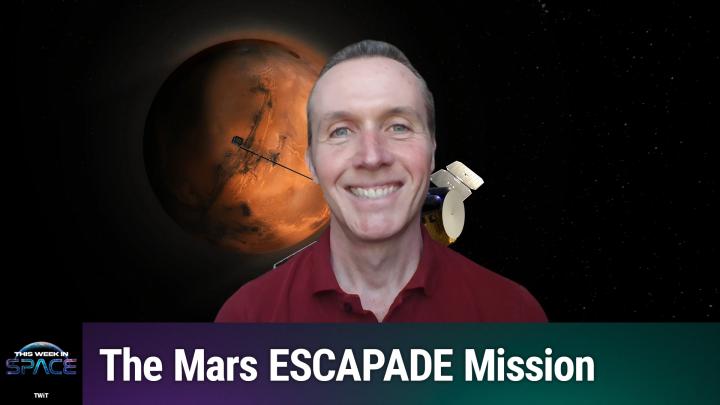
Coming up on this week in space, SpaceX's Starship V3 is ready for its debut launch. NASA's Artemis 3 mission in 2027 gets some new details. And what's the deal with Mars Escapade? We find out with the principal investigator, Dr. Robert Lillis of the University of California, Berkeley. Tune in.
Rod Pyle [00:00:27]:
This is This Week in Space, episode number 210, recorded on May 15, 2020 26. Escapades at Mars. Hello, and welcome to another episode of This Week in Space, the ESCAPADES at Mars edition. I'm Rod Pyle, editor chief, Badass magazine, and I'm here escapading with Tariq Malik of Space.com. hello, sir.
Tariq Malik [00:00:47]:
Hi. How are you doing? Happy, happy. Escapade Day. Escapade, yeah. Escapade Day. Escapade Day. No. Well, it is payday.
Rod Pyle [00:00:57]:
Nice, you can show yourself out, but
Tariq Malik [00:01:02]:
I almost got there. It could have. It could have worked out.
Rod Pyle [00:01:04]:
But relating to your attempt, we'll be chatting today with Dr. Robert Lillis, the principal investigator for the Escapade Mars probe. So this will be very interesting because Mars is losing, and he's going to tell you why. Mars is losing its hair. Mars is losing its air. Hair. Air everywhere. Yes, Dr.
Rod Pyle [00:01:20]:
Seuss. But first, it's that time for a quasi. It's just the coffee. A quasi space physicist joke. This one from Stephen Christian.
Tariq Malik [00:01:31]:
Hey, yes, Rod?
Rod Pyle [00:01:33]:
Why don't scientists trust atoms?
Tariq Malik [00:01:36]:
Why? Why?
Rod Pyle [00:01:37]:
Because they make up everything.
Tariq Malik [00:01:39]:
Oh, that's a pretty good one, isn't it?
Rod Pyle [00:01:41]:
Yeah, I've heard that one before.
Tariq Malik [00:01:43]:
There's a. You can. You can buy a shirt like that, actually. But. But it's good. It's good. It's a nice classic, right?
Rod Pyle [00:01:50]:
See? Suits me, right? For. For not getting out enough. Now, I've heard that some people want to atomize us when it's joke time on the show.
Tariq Malik [00:01:56]:
Oh, that's even better.
Rod Pyle [00:01:58]:
But you can help send us your best, worst and most indifferent space joke. We take them all at Twist tv and we'll be happy to blame it on you on the air. So there you go. All right.
Tariq Malik [00:02:08]:
I like.
Rod Pyle [00:02:09]:
Very good.
Tariq Malik [00:02:09]:
I like it.
Rod Pyle [00:02:10]:
And now let's go to Headline news.
Tariq Malik [00:02:18]:
Headline news. Headline news. Oh, I. Wow. I was way off. Oh, no. Oh, I'm so did it. Wait, that.
Tariq Malik [00:02:25]:
That had a longer run up. That had a longer run up, didn't it?
Rod Pyle [00:02:29]:
You did something to the pooch, as they used to say. All right, SpaceX, at last we have a launch date announced for the version three starship.
Tariq Malik [00:02:38]:
That's right.
Rod Pyle [00:02:39]:
Why is it different? When's it going to fly and what's the proposed mission?
Tariq Malik [00:02:42]:
Well, well, so this is exciting and it may be changing as we speak, Rudd, because this week we got an official target of May 19, which is next Tuesday as we are recording this. And this is going to be the big debut of, of the new version three of the starship. And you know, this is like their biggest and apparently like more most powerful starship yet. It's using these new engines that they've, they put together, these new, these new engines. It's, it has different fins, I think it has an extra fin, I think on, on one of the three. Yeah, well, no, they had four. They had four and now they have three. Yeah, now they have three.
Tariq Malik [00:03:25]:
But they're bigger, they're like 50% bigger and they're really, they're like a lot stronger than the original fins. They've, they've made some, some other modifications so that the, the hot stage part that joins the booster and the upper stage is actually built into the super stage. Now they don't like discard it afterward, which is what was with their initial temporary fix. After the first one they've got these newly designs of the, the, the 33 raptor engines. Now that kind of, it looks really slick because you don't see all that plumbing stuff in there. It just, it looks like a sci fi kind of rocket engine. And so the, the idea is that all of these modifications will make the vehicle, you know, more effective. It'll be able to flip faster and, and do all sorts of maneuvers a lot better.
Tariq Malik [00:04:17]:
It still has the door for the Starlink. The Starlink satellites, they're going to do that demonstration. But there's a big twist because in the, for the first time ever, they're going to have cameras on the Starlink simulators and they're going to show potentially in real time views of the starship in space so that they can look at the heat shield and see how the heat shield is doing as part of an inspection. So that'll be really interesting to see. Now they're not going into orbit though on this flight.
Rod Pyle [00:04:47]:
Hold on one second, I have a question. So does that mean they're actually going to maneuver a starlink to see the heat shield? Because the heat shields on the opposite side from the cargo bay opening, correct?
Tariq Malik [00:04:58]:
Well, it's unclear to me. Right. They could also flip the starship over while they're in space or roll it while they're in space. So that it turns it into view. It's, it's really, it's, it's. They're going to do this one way or another, but they're, they're really just Starlink simulators. They're not really capable of, of much of anything else. So this reminds me of when Japan put the lipstick cameras on the Akatsuki spacecraft for the solar sail.
Tariq Malik [00:05:26]:
And so it kind of spit out tiny cameras so they could see the, the, the, the sail unfurl and then it was all done and it didn't really do anything. So it kind of feels like that.
Rod Pyle [00:05:36]:
All right, next up, NASA Art of.
Tariq Malik [00:05:40]:
Oh, oh. I promise that there's another update. I did what it does the tldr, like, the hidden thing is it may not actually launch on the 19th at all. It could be later in the week, next week. Because we found out today that there's new beach closures and they're actually not for the launch on, on the, the 19th. It's actually for the 18th and 19th, which suggests that there might, there might be additional testing for like wet dress things, which could mean that there's going to be a delay going forward. So just don't, don't be surprised if there is an adjustment in the date itself or Dr.
Rod Pyle [00:06:16]:
Evil has something else planned.
Tariq Malik [00:06:18]:
Yeah, we'll have to see. I don't know what you're referring to there.
Rod Pyle [00:06:25]:
Next up, NASA unveils Artemis 3 plans. Now, we had heard that in the rejiggering of the Artemis missions, Artemis 3 was going to fly an Earth orbital flight, much like Apollo 9, and rendezvous and dock with one or more of the two planned lunar landers if they're ready in time. If they're not, I don't know what's going to happen. What have you heard?
Tariq Malik [00:06:46]:
Yeah, well, this is really interesting because it's. I had assumed, and this is like when you and I were talking with Mike Wall recently about Artemis and like the whole like what's next? And everything about the moonlanders that Artemis 3 was gonna require two kind of functional landers in orbit for them to test. And what we learned from this announcement, cause NASA this week kind of really said this is what Artemis 3 is going to look like. We learned a couple of things. Number one, obviously there may not be two landers. There could be just one. But they, they hint that there's the possibility that the astronauts would be able to go inside, which I thought was really weird about. Why have the lander in orbit as, as a target if the astronauts aren't Going to go inside to demonstrate that it actually works and to do maneuvering, you know, with that whole thing and that whole.
Tariq Malik [00:07:44]:
So I was a bit surprised to hear that. But you know, it does seem like they're trying to outline a lot of the, the, the critical objectives for that flight, make sure that people know it. One of the other big things that, that we learned is that they're not going to have the exploration, not the exploration upper stage, but the, the, the cryogenic like propulsion. Cryogenic, yeah. They're not going to have the icps, the intermediate cryogenic propulsion stage on this flight. They're going to have what they call a spacer upper stage, which sounds really sci fi and cool, but it sounds like it's just like a, it's going to be a simulator for, for the upper stage. So it'll have like the ring on it. Yeah, but it's going to just simulate the mass and stuff of the upper stage and that says they're not going to go too far away.
Tariq Malik [00:08:30]:
Like they, they're probably going to stay relatively close, like a low Earth orbit and not a really, really like far out like distant orbit right now. Well, which I mean, well there were some people that were wondering were they going to want to try like a really high Earth orbit.
Rod Pyle [00:08:47]:
Yeah, but why?
Tariq Malik [00:08:48]:
Well, I, to make it more interesting. I don't know why.
Rod Pyle [00:08:52]:
I mean it'd be more interesting if they'd actually climb in the lunar landers and throttle up the engines to make sure they work.
Tariq Malik [00:08:57]:
Yeah, well that's what I thought that the engine was.
Rod Pyle [00:08:59]:
Because if it's just rendezvous and docking, you could do that robotically today you don't need astronauts.
Tariq Malik [00:09:04]:
And, and I mean, I mean you would probably get good astronaut experience of them trying to actually do the docking and I see the value in that, but I see more value in docking and then going inside the ship and saying yes, now we are in the ship and the ship, you know, can support life. Which is what the whole point of the Artemis 2 test flight was that the Orion ship can support the astronauts on that flight. It's also going to last longer than Artemis 2, which was another surprise. Instead of it being a 10 day mission, it sounds like it's going to be quite long for them and that makes me wonder like are they going to, are they going to park near the ISS for a bit or not? Probably not, but it sounds like it's going to be a bit of a marathon rather than a sprint around the moon.
Rod Pyle [00:09:47]:
And you wonder what they do for that amount of time, especially if they're. If the original plan was not to enter the landers, you rendezvous, you dock, what do you do for the next two weeks?
Tariq Malik [00:09:57]:
That's interesting. Yeah. My one, my wondering is, is it that they wait? That they wait for the landers to arrive? Is, is that why it's going to be that long? Because you know, one thing that NAS is this is the first time in the Artemis program's history that they will have a mission that includes multiple launches and multiple vehicles, all like, in conjunction with each other. So if you've got an SLS that has to launch, even if it's modified, you have a starship potentially and a blue Moon lander all launching from the same period. But over time, because they're going to have to wait a day or two, maybe depending on the range restrictions they decide, that'll be interesting to see.
Rod Pyle [00:10:42]:
All right. Psyche flies by Mars.
Tariq Malik [00:10:45]:
Yeah, by Mars. This is a fun. Yeah, this is. Today is the day. NASA has sent us a space probe to Psyche the asteroid, and it flew by Mars today. So why did it go by Mars? Can you guess, Rod?
Rod Pyle [00:10:59]:
Because it had nothing else to do.
Tariq Malik [00:11:01]:
Well, yeah, that's part of it. That's part of it. But no, just, just as in Star Trek 4. I'm going to put it in, in perspective, sir.
Rod Pyle [00:11:10]:
There be whales here, and I'm one of them.
Tariq Malik [00:11:12]:
That's right. That's right. Just like that, where they had to slingshot around the sun in order to go back in time. NASA has sent the Psyche asteroid probe sling-shotting within 3,000 miles of Mars. So it's going to whip itself around Mars so that it can slingshot itself out into the asteroid belt with a gravity assist, which saves them a lot of fuel instead of having to do the trajectory maneuvers themselves and also gets them a little bit of extra opportunity to visit Mars. Because who doesn't want to go visit Mars? Would you want to see Mars, Rod?
Rod Pyle [00:11:44]:
I've been there.
Tariq Malik [00:11:45]:
Oh, yeah. There you go.
Rod Pyle [00:11:46]:
Thank you. I would, I just wouldn't want to stay there very long. Well, I think a great place to explore. I mean, here, here's a guy who's closing on 70. It's like, yeah, fat chance. But we're, we're. It's something we could teleport to. I would love to go up there and walk around and spend a week and then come home quickly.
Rod Pyle [00:12:06]:
But yeah, given what it takes with current. Sorry, I'm being distracted by the discord with current technologies and everything else. Not so much.
Tariq Malik [00:12:16]:
Yeah.
Rod Pyle [00:12:16]:
All right.
Tariq Malik [00:12:17]:
But let's. I should, I should just, just to let everyone know that this is happening today, we're going to assume that it was okay. But as John was showing earlier, we've got some great pictures of Mars that Psyche has been taking on the way in to close in. That was the next line there. And mark your calendars for July 2029. That's actually when Psyche will arrive at the metal rich asteroid. 16 Psyche calendar marked.
Rod Pyle [00:12:45]:
All right, we will be back in a moment after this break to talk about escapade. Stay with us. And we are back with Dr. Robert Lillis, who is the principal investigator of the Escapade mission to Mars, the associate director of the UC Berkeley Space Sciences Laboratory, and as a planetary space physicist and geophysicist who also worked on Maven and the Emirates Mars missions. Welcome to the show and thank you for joining us.
Dr. Robert Lillis [00:13:08]:
Thanks very much for having me. Appreciate it.
Rod Pyle [00:13:10]:
That's a very Mars dense reservoir.
Tariq Malik [00:13:12]:
I was gonna say. That's a lot of Mars.
Dr. Robert Lillis [00:13:15]:
Yeah, it's been about 90 to 95% of my career. Done a bit of other work on the moon and Mercury, but Mars has been the gift that keeps on giving. This is my first fourth Mars mission now started on Mars Global surveyor back in 2002. And there's just been a continuous stream of interesting missions, a lot of great data sets, a lot of great discoveries. So yeah, I'm a Martian, what can I say.
Rod Pyle [00:13:39]:
And Mars Global Surveyor went on for how long?
Dr. Robert Lillis [00:13:43]:
It arrived in 97 and lasted till 2006 when it died, unfortunately.
Rod Pyle [00:13:48]:
Yeah, that's still not bad though.
Dr. Robert Lillis [00:13:51]:
Yeah, it was good.
Rod Pyle [00:13:52]:
Tarek has a very special question you like to ask.
Tariq Malik [00:13:55]:
Yeah. Aside from trying to get how you got bit by the Mars bug, one of the question that we do like to ask folks that come on is kind of what their path to space was like. Is this something like a career that you had planned on when you were a little kid, you got bit by the space bug real early or was it a path or a specialty that you discovered later in life, either in college or beyond while at Berkeley?
Dr. Robert Lillis [00:14:24]:
Yeah, that's a great question, Tariq. I think it's maybe a bit of both for me because I was bit by the space bug as a kid. I remember at a school fair buying a secondhand book when I was about 13 and it was full of glossy pictures from the Viking missions to Mars back in 93 probably. I just thought it was so cool, the pictures from orbit, the pictures from the surface. But I kind of just at that Point in Ireland. I didn't really think this was like a practical, like realistic career. So I didn't, didn't really follow up there. But you know, I always loved physics, loved astronomy, you know, read popular science books.
Dr. Robert Lillis [00:15:04]:
My undergrad was in math and physics in Dublin and I did a couple of summer internships in the US 1 in foam rheology. So how bubbles move, that was kind of, was kind of cool. And then another one in high energy physics and I found that neither of those really grabbed me. So when I was looking at grad Schools late summer 2000, came across Berkeley, visited Berkeley and knew they had a lot of stuff. Berkeley was so big, it was like, well no matter what you're into, Berkeley's going to have someone at the top of their field working on it. But that's when I discovered the UC Berkeley Space Sciences Lab and Professor Robert Lynn, who ended up being my PhD advisor, he was there and I just got bitten by the breadth of what was being studied in space. That's kind of when my eyes got, got opened to the NASA funded science world in general. And it was sort of when I got to grad school, it wasn't Mars right away.
Dr. Robert Lillis [00:16:02]:
I was working on a project called RESI or HESI as it was called at the time, the High Energy Solar Spectroscopic Imager. And its launch was delayed and I didn't find it quite as interesting and I was like, well, is this going to be my Ph.D. maybe. And then I came across a data set from Mars Global Surveyor. There was an instrument called the Electron reflectometer that we had built at Berkeley and the data had sat really not sufficiently utilized. And in 2002 I discovered it. I talk to someone and then I started working on it and that became my PhD. I was able to exploit that data set, make some discoveries and then everything just kind of flowed from there into maven, the Emirates Mars mission and then eventually escapade.
Tariq Malik [00:16:48]:
I like how you say I was able to exploit that data set and make some discoveries about Mars. As one does. As one does. Right. That is amazing.
Dr. Robert Lillis [00:16:56]:
Well, well I mean there's so much more data than there are people to analyze it that really there are discoveries to be made. If you take the time to look at these data sets that totally there are.
Tariq Malik [00:17:05]:
Where in Ireland did you grow up?
Dr. Robert Lillis [00:17:07]:
I grew up in South Dublin, a little suburb called Monkstown by the sea.
Tariq Malik [00:17:12]:
Wow, wow. From South Dublin to Mars, that's an amazing journey there.
Rod Pyle [00:17:16]:
So well, so as long as we have you on and you're up at UC Berkeley. Who has the axe this year?
Dr. Robert Lillis [00:17:23]:
Oh, man. Oh, I am a terrible bear. Who won the big game this year? I don't know.
Rod Pyle [00:17:29]:
I'm a Stanford alum and I never keep track.
Dr. Robert Lillis [00:17:31]:
Yeah, I had season tickets for nine straight years, and then since 2010, I just haven't really followed them too much.
Rod Pyle [00:17:39]:
Well, I can't blame you for that. So let's get right to it. Can you explain to us what Escapade is? Because it's, it's. I think it's a little harder for people to get their head wrapped around this one than a rover. For instance, we know a rover is going to land, look at rocks, do some drilling, so on and so forth. Escapades a little more of a story.
Dr. Robert Lillis [00:17:58]:
Yeah. So Escapade is a twin satellite orbiter at Mars. And yeah, it's. It's certainly different from rover in that it's going to be able to samp large parts of the near Mars space environment in pretty quick succession. It's going to be orbiting, the orbital periods are going to be between four and six hours at different parts of the mission. And it carries instruments that mostly make in situ measurements. Okay, what does that mean? That just means that the quantity you're measuring must be measured where the spacecraft is at that time. There are measurements you cannot make remotely, such as magnetic field measurements or ion escape measurements, things of that nature.
Dr. Robert Lillis [00:18:40]:
And these are measurements that have been made at Mars before, including by the MAVEN mission, which orbited Mars for 11 years. So why do we need escapade? You know, we already had 11 years of maven data. Well, the biggest answer is that when you only have a single orbiter, you can only be in one place at one time. And there's two fundamental, fundamental limitations with having that. And one of them is that if you see something change in your data as the spacecraft's orbiting the planet, you don't know whether you've just witnessed a global change. Have things changed everywhere, or have you just entered a new spatial region where things are different? You literally cannot distinguish those two situations if you're one spacecraft. The other limitation of having one spacecraft is that we want to understand what is the solar wind? What is the space weather environment doing to Mars's atmosphere? How is it helping to strip that atmosphere away over time? How is it causing variability in the ionosphere? It's. It's a very complex system.
Dr. Robert Lillis [00:19:47]:
In order to do that, you need to know the cause or the upstream solar wind conditions, and you need to also know the effect. Meaning if you're so you're measuring conditions in the upper atmosphere, but you can't be in two places at once. And with a mission like Maven, you could be in the upstream solar wind, and then you have to wait two more hours before you get close to the planet and you say, okay, well, there's this rate of atmosphere escaping Mars now, based on, based on what we're measuring, but we got to just assume the solar wind is the same as what it was two hours ago, and it probably isn't actually. So there was like the previous missions could do kind of statistical. They could be like, well, we kind of think this is this what the solar wind was, and these are what the effects are. But you can't get that cause and effect at the same time with two spacecraft. You can. That's what Escapade is going to do.
Dr. Robert Lillis [00:20:36]:
So it's almost like having a stereo perspective on the Mars upper atmosphere for the first time that other missions couldn't do beforehand.
Rod Pyle [00:20:44]:
And we're about to go to break, but I just had a quick follow up. Sorry, Tarek. So is it almost like having a 3D data set? It's.
Dr. Robert Lillis [00:20:52]:
It is. I mean, a fully 3D data set would literally take hundreds of spacecraft measuring all the time. But two is so much better than one. So, yes, it is. It is going to be some part of the way towards getting to a 3D understanding of the environment.
Tariq Malik [00:21:06]:
And as principal investigator, is this mission like your baby, where you came up with it and then propose it and NASA's like, hey, yeah, that's a great idea. You know, like Maven's. Well, hopefully Maven's still out there. We don't know. But, but, but, but, you know, is that how that works? Or did you have to kind of convince NASA that you were the team, that you were the, the guy to, to lead this mission? How do you become a PI?
Dr. Robert Lillis [00:21:28]:
Yeah, so you become a PI. I mean, there's. The route to becoming a PI is different for everybody. On one hand, you kind of have to want it. You have to be okay with spending a lot of time sort of socializing your idea around and getting, you know, getting skepticism about it and being persistent. And you also have to be okay with handling maybe the less glamorous aspects of things like management and money and things like that for, for a whole mission and like pr. So, you know, most scientists just kind of want to get on with doing the science. And I totally get that.
Dr. Robert Lillis [00:22:10]:
That's what I love, too. But PIs are a little bit of a Different breed. We are, we're a little bit more of maybe gluttons for punishment a little bit. But. Okay, so the question is how, how Escapade came, came to be. Well, yes, as in many cases, NASA runs a competition and this was a competition called Simplex. And Simplex was back in 2018 it stood for small Innovative missions for Planetary Exploration. And this was really an experiment by NASA in trying to see if the cost for interplanetary missions could be significantly lowered in exchange for accepting a little more risk.
Dr. Robert Lillis [00:22:52]:
So just to give some background, a typical planetary mission is on the order of 500, 600, $800 million. And these missions have been extremely successful. Not since the twin Mars failures of 1999 has there been a single deep space mission beyond the moon that has failed by NASA. It's an amazing record of success, Discovery, but it's come at a pretty high cost. And NASA was just wondering, well, hold on, if we don't need to get that 99.5% success probability, what if we could just get 90%? Could we save a lot of money by still having 90? And the answer is, well, no one really knew. So that's where the Simplex program came from. And we proposed to that in July 2018 and in June 2019, NASA selected the three winners out of the 12 proposals and escapade was, was one of them. And yeah, we made all those same points I just mentioned about getting that, that stereo perspective on the Mars upper atmosphere.
Rod Pyle [00:23:51]:
All right, well we're gonna jam off to a quick break and we'll be right back. So go nowhere. So I guess the sixty four thousand dollar question for those of us who aren't scientists and don't make our living doing cool stuff like this is why do we care so much about the atmospheric loss at Mars? And does that have some implication for what we know about Earth?
Dr. Robert Lillis [00:24:11]:
Yeah, so, okay, so there's a few different kind of like, you know, why do we care answers for the Escapade mission. Yeah, I think part of it is just plain, plain curiosity about our nearest planetary neighbor. We know that liquid water was stable on the surface of Mars, at least episodically in its early history. We have ample evidence of that. Things like, things like valley networks that were carved by rain. We have stream beds where we know water flowed. But we know that Mars doesn't have enough atmosphere today to support stable liquid water. So the question is, where did the atmosphere go? And one of the, the major culprits is that solar, solar wind and space weather essentially Stripped it away.
Dr. Robert Lillis [00:25:01]:
And understanding exactly how that process happened is a big part of why we're sending escapade and getting that stereo perspective that earlier missions couldn't. Okay, what does that have to do with atmospheric evolution on Earth? Okay, well, we actually understand atmospheric escape at Mars, even with the limited data we have, arguably better than we do on Earth, at least up until the TRACERS mission launched about a year ago. That was a mission launched to understand atmospheric escape at Earth. But on Earth, even though it's interesting, it is not determinative in terms of Earth's climate history in nearly the same way as it is on Mars. On Earth, we have plate tectonics, we have active volcanoes that are constantly feeding the Earth's atmosphere from, from, from below, you have magma with water and CO2 and other sorts of dissolved elements in it. And that actually is a source of atmosphere from underneath. So even if Earth is losing a lot of atmosphere, it's all been replenished. Mars, on the other hand, hasn't had serious volcanism since its early history, since maybe three and a half billion years ago.
Dr. Robert Lillis [00:26:05]:
The amount of volcanism on Mars has decreased over time, and it's at a trickle, if anything, right now. So that atmospheric escape is that much more important for Mars climate history. So this is all just to point out that comparative planetology comparing the same processes, whether it's volcanism, whether it's atmospheric escape on different planets, shows us how these processes work when the conditions are different. Because if you have a planet, you can't suddenly say, hey, well, what would happen if Earth had half as much atmosphere? We can't run that experiment. We only have one Earth. But with other planets, we can explore different parts of the parameter space that defines what a planet can be. And there's a huge parameter space there.
Tariq Malik [00:26:49]:
Is there a way that escapade can tell us how? I guess I always wonder how thick Mars's atmosphere truly was or could have been. And a mission like Escapade, where you can kind of study that loss, like with a time scale, you know, with dual spacecraft, seems like you'd be able to go back and say, well, okay, it used to be a nice balmy whatever, one piece. What is it, 12.7. What it, what is the. In at one atmosphere, I guess a one atmosphere, right? So for, for. There you go. There you go. I mean, like, is, is there a way to, to, to know just what that was or has just been the billions of years since the formation been too much time to pass to know
Dr. Robert Lillis [00:27:32]:
that yeah, that is a great question. Oh, my God. This is. I could bounce this a bunch of different ways. Okay, so on one one hand, Mars's atmospheric escape is comprised of different, different kinds. Escapade is only going to be studying two of the four kinds, and we don't fully understand which of the different types. So one is called ion escape, which is literally just ionized particles in the upper atmosphere being torn away by the electromagnetic fields of the solar wind. That's the main process by which escapades going to measure atmospheric escape.
Dr. Robert Lillis [00:28:07]:
There's also one called sputtering, where those same ions can be accelerated by those same electromagnetic fields, almost like a kid jumping into a ball pool to splash out atmosphere. That's called atmospheric sputtering. Escapade is going to measure those too. There's a couple other ones which were measured by maven that don't really need two spacecraft. One is called genes escape, one is called photochemical escape, and that's different ways that hydrogen and oxygen can leave the planet. Okay, so escapade is going to improve our understanding of the ion escape and the sputtering escape significantly. But what we do really still need is we need the sun to somewhat cooperate, because we know that the early sun in the early solar system, even though it was fainter than our sun is today in the visible and the infrared, so it would have been a little cooler in the past. It was much more active in terms of the solar wind.
Dr. Robert Lillis [00:29:03]:
There was, there were more solar flares, the solar wind was faster, it was more gusty, it was denser at times. So when we are able to use the escapade data to measure how that rate of atmospheric escape changes as a function of solar wind speed. So when the solar wind gets much denser or faster, what happens? So we need the sun to actually cooperate a little bit in give us a wide range of those conditions so that we can kind of go back in time like you were just talking about and say, well, hey, if the atmospheric escape rate is X today under these conditions, what about under conditions that are, say, three times harsher, Whether it's faster or dense or whatever. We do need the sun to give us that so that we can start to go back in time. That's, that's one piece of it. I can go into some more details about other things that complicated because your question did also say, hey, is it like, is it just too complicated and kind of. Yeah, and kind of no. Like, no, in the sense that, like, you know, if we, if we do just, you know, know, what the atmosphere is today and we just subtract it backwards in time, sorry, add it backwards in time, I should say.
Dr. Robert Lillis [00:30:18]:
We can kind of build it up. But there's one key point that makes it really hard, and this is called obliquity. So obliquity is just the tilt of Mars with respect to the sun. Okay, so Earth has a 23 degree tilt. That's why we have seasons on Earth. Okay, Mars tilt right now is 25.2 degrees. So actually pretty similar to the Earth. So Mars has spring, summer, autumn and winter.
Dr. Robert Lillis [00:30:43]:
But that 25.2 degrees, it changes on Mars, it changes a lot. The gravitational fields of Jupiter and to a little degree the Earth, but mostly Jupiter and the sun kind of torque Mars's tilt around from as little as 10 and as much as 60, really. And I mean even potentially as much as 0 or 80 over the course of the whole history of Mars. And you can imagine how different a planet's climate must be when that obliquity changes to either zero or, or 80. Like, like, imagine an 80 degree tilt. You would just have like constant sunlight for, you know, six months of the year and then constant darkness, like, like blaring sunlight. So on Earth, the orbit of our moon actually keeps our tilt really, in a really, really small range, 22 to 24 degrees. That's it.
Dr. Robert Lillis [00:31:35]:
So our moon is the anchor that keeps our tilt actually pretty stable and allows our seasons to persist over billions of years. Mars didn't have that. Mars has this chaotic obliquity that's gone back and forth and we can tell what it was up to about 10 million years ago, but beyond that, we don't know what it was. It's chaotic, it's unknowable. And so we don't actually know how conditions might have been different. We can model it and people are modeling it, but that's not the same as knowing.
Tariq Malik [00:32:02]:
Yeah. So I'm gathering that Phobos and Deimos just can't cut it. So for Mars. Well, I did have a follow up to that too because like reading about the mission and thinking about space weather's effects on Earth, I know that we have this great magnetic field. Thank you. Liquid core of the planet spinning around to protect us from the harshness of, of, of, of the, that the cosmic, you know, radiation has to offer us. But I know Mars is different. I'm curious what the role of that magnetosphere then and its magnetic field is going to play and how the solar wind interacts then with the atmosphere, which then escapade is going to be studying.
Tariq Malik [00:32:41]:
And is that like a big question mark as well or do we understand that fairly, fairly well, I guess at this point.
Dr. Robert Lillis [00:32:48]:
Great question, Tara. So I guess let's just go back to the magnetic field I did not mention, but you certainly hinted at this. Mars does not have a global magnetic field the way, the way the Earth does. But before I answer that, let me just correct maybe a slight misperception. So Earth, Earth does have a liquid conducting metal core that, that the turns. But that's not the only reason the Earth has a magnetic field. It's a necessary condition, but it's not sufficient. You need enough thermal convection within that liquid core on top of the rotation and the conductivity to get the global magnetic field.
Dr. Robert Lillis [00:33:24]:
Mars does have a liquid core and Mars does, does rotate fast enough, but it does not have enough convection in that outer core. And the reason is on Earth we have plate tectonic plate titanics. And plate titanics are an easy way to get heat out and to get cold stuff down. So like when a plate subducts under another plate, that's, that's coal stuff on the surface going down. When volcanoes erupt, hot stuff coming up. So Earth has a way of losing heat much more effectively. So that heat flux from the core into the mantle and out the crust, that is enough to keep that outer court churning. Mars doesn't have plate tectonics, so Mars doesn't have a way to lose its heat.
Dr. Robert Lillis [00:34:04]:
Mars is kind of like this like lid keeping all the heat in. So because the heat isn't being lost enough, Mars outer core doesn't convect. And so Mars doesn't have a global magnetic field. So anyway, that was just something they wanted to say anyway. But yes, you're right. Earth, Earth is protected both by our thick atmosphere and by our, by our global magnetic field from high energy cosmic rays. On Mars, anything with about more than about 130 mega electron volts will make it to the surface of Mars. So astronauts in future on the Martian surface are going to be much more exposed to the dangers of galactic cosmic rays and particularly energetic solar particle storms too.
Dr. Robert Lillis [00:34:49]:
So yeah, that's certainly a concern that we have. And, and your question is, are we going to be able to understand space weather at Mars better with missions like escapade? And I think the answer is yes, particularly you know, since there's been no contact from the Navy spacecraft for a while, we're not sure what's actually happening there. But escapade is going to be able to measure the energetic particles and the coronal mass ejections that the sun belches out, you know, they're called CMEs. There's about a billion tons of hot gas that gets blown out at about, about 3 or 4 million miles an hour. And yeah, so escapade is going to be able to characterize how many CMEs Mars gets, how strong they are, what the radiation dose is. So it'll help to characterize that environment in Mars orbit. And then plus we also have the Curiosity rover on the surface that has its own radiation detector called RAD Radiation Assessment Detector Radio. And it's able to measure what is seen on the surface.
Dr. Robert Lillis [00:35:52]:
So between understanding what's happening in space and on the surface, we can, we can have a better idea for how radiation is, what the radiation environment is in Mars orbit and how much of that gets down to the surface and therefore how thick of habitat walls we need to build when people are living there. And whether or not, and this is, this is something which maybe you were hinting at as well, is that Mars does not have a globe magnetic field, but it does have crustal magnetic fields. It has magnetized rocks in the crust, and those can produce pretty strong magnetic fields. We don't know how strong yet. We got to fly some helicopters there at low altitude to be sure, but it's possible that certain areas of Mars will have. It's not going to be a game changer, but you could get 10, 20, 30% less radiation in certain areas because there'd be a shielding effect from.
Tariq Malik [00:36:42]:
Wow.
Dr. Robert Lillis [00:36:43]:
From some of these magnetic fields. But again, we don't know. We've only ever measured magnetic fields in orbit. We don't know how strong they are close to the surface. Until we get a bunch of helicopters to do a bunch of surveys.
Rod Pyle [00:36:53]:
Then we'll know very see how well he got that pitch for the helicopter mission in there.
Tariq Malik [00:36:58]:
I know. I was going to say if only there were plans to send more helicopters to Mars.
Rod Pyle [00:37:03]:
Oh, wait, we're going to have loss of signal for a few seconds for a break. So standby. So once Maven arrives at Mars, you have to separate basically into two spacecraft and then establish whatever mission phases you're going to have, which, if I understand correctly, is different orbits. Can you kind of walk us through that and what each of those accomplishes?
Dr. Robert Lillis [00:37:24]:
Yeah, so actually escapade will, will arrive at Mars separately. We're actually not splitting up when we get there. That was a, that was an architecture that we did look at super early on, but no escapade. The two Spacecraft are going to make their way separately to Mars and, but let's talk about how they get there. First of all, because this is unprecedented, Escapade had to launch about halfway between the two closest interplanetary launch windows to get to Mars. Just your viewers may know that there's only about a 3 to 4 week window every 25 to 26 months where you can execute a trajectory that will get you ballistically from Earth to Mars. It's different if you have electric propulsion, but if you just want to burn your engine once and just go ballistically, it's a, it's a narrow window. Escapade launched in November 2025.
Dr. Robert Lillis [00:38:20]:
The previous window was October 2024. The next one is November 2026. So escapade had to, is having, is currently spending about a year in a very loosely gravitationally bound orbit, which we're calling the loiter phase. It kind of shaped like a kidney bean. It was invented by our lead mission designer, Jeff Parker. And we're going to be coming back to a low altitude around Earth November 7th and then again for the other spacecraft, November 9th this year. And we're going to be executing the first ever powered Earth gravity assist from a deep space mission. This has never been attempted before.
Dr. Robert Lillis [00:38:57]:
And it means we have to burn the engines at just the right time over Western Australia at about 7-800km altitude on November 7th and 9th in order to use the Earth's gravity to amplify that, that engine burn to get us on that path to Mars. Then we're, then it's about, then it's a pretty standard 10 month, what's called a Hohmann transfer trajectory to Mars. And we arrive at Mars in September 2027. And then we have to fire those engines again at just the right time in order to get captured by Mars's gravity. And then we'll spend a few months shrinking the orbit and then we'll have to synchronize the two, the two spacecraft's orbits so that they will become like a pair of pearls on a string. So they're basically both spacecraft are going to be occupying the same orbit. Sometime in early spring 2028, we're going to finally be in a position to start what we're calling science Campaign A, that is pearls on a string. This is optimized so that we can pass through the same region twice in quick succession.
Dr. Robert Lillis [00:40:11]:
This is important because we want to know how the system is changing on those short timescales. Previously with missions like Maven. Maven took four and A half hours to orbit. So we would have to wait that long to see how much things change. And these things can change a lot. Escapade is going to have that time between the two spacecraft be as little as two minutes and as much as 30 minutes. So we're going to be able to really characterize how is the system changing, how is the, the upper atmosphere changing, the minosphere changing on those short timescales. Now, because the two spacecraft are going to be somewhat close to each other, we're not going to be able to do those, that kind of upstream downstre cause and effect bit.
Dr. Robert Lillis [00:40:51]:
For that we have to wait till the science Campaign B. So after about six months in Campaign A, we're going to fire the engines again. We're going to raise one orbit and lower the other orbit. Now the two orbits are going to have different periods. Different periods. Mars gravity field is going to torque them differently. So if these are the, the two orbital planes, they're now going to separate like this. And this is going to allow the spacecraft to be simultaneously measuring two very distant or at least sometimes distant regions of the Mars magnetosphere.
Dr. Robert Lillis [00:41:24]:
So that'll allow us to get that upstream solar wind and that downstream effect at the same time. So that's, and then once we're in Campaign B, we cannot get back to Campaign A. We don't have enough fuel. Be too difficult. So Campaign A is just, it'll be gone once it's gone.
Tariq Malik [00:41:38]:
That was really interesting when I was reading about this because I think I read that your, your altitude is like up between 100 and 6200 miles, I think for the initial campaign. Is that correct?
Dr. Robert Lillis [00:41:50]:
Yeah, 6200km will be the highest point, the highest point for campaign A. Yeah,
Tariq Malik [00:41:56]:
but, but changing orbits in mid mission is like no mean feat. Yeah, and, and, and, and, and, and you've just outlined kind of why you opted to do that. But I would not, I guess as like a project leader say, you know what, we're going to just change how the spacecraft are going to behave halfway through and then that's going to be it. But it seems like it's built into the science plan.
Dr. Robert Lillis [00:42:22]:
Yes, it was necessary to get the science done. Yeah, sorry, I should say it's going to be 8,400km is going to be the altitude in science campaign. And then campaign B1 will be 7,000, one will be 10,000. But yes, this was, this was, this was built into the science plan. So we made sure to carry enough fuel that we could do all these engine burns At Earth and Mars. I mean, these are, these are flying gas tanks. These are 200 kilogram spacecraft dry. They were 5, 550 kilograms wet.
Dr. Robert Lillis [00:42:51]:
So two thirds or more of the mass was just fuel. And thanks to our partners at Rocket Lab for designing great spacecraft, they're able to do that.
Tariq Malik [00:43:00]:
I'm really glad that you brought up Rocket Lab because one of the. From like a spaceship angle of my part. But we didn't even mention that you named the spacecraft Blue and Gold, right?
Dr. Robert Lillis [00:43:10]:
Yes.
Rod Pyle [00:43:13]:
Well explain that for those of us who didn't go to Cal.
Dr. Robert Lillis [00:43:16]:
Exactly. Yeah. Yeah. So blue and gold are the two colors of UC Berkeley. Although as a happy accident, we have several other partner universities. Embryo Riddler Nautical University, West Virginia University and ucla. We have science team membership from all those three. And they all have the same blue and gold too.
Rod Pyle [00:43:35]:
So I always wondered if, if UCLA considered that to be blue and gold or blue and yellow.
Dr. Robert Lillis [00:43:42]:
Yeah, that's much lighter blue. It's not really the same blue. Yeah, yeah.
Tariq Malik [00:43:47]:
I went to usc, so I'm going to hold my.
Rod Pyle [00:43:49]:
Oh, stop. We don't hold that against you, even though.
Tariq Malik [00:43:53]:
Oh, no, thank you. Thank you very much. I appreciate it. But the reason that I was happy that you brought up Rocket Lab is because the, that that commercial spaceflight part of this mission was really unique from like an outsider view, you know, Rocket Lab as the builder of the spacecraft. Then you launched on Blue Origin's new Glenn rocket, which was really exciting as well. And so you have. And then as you mentioned, this loiter launch launching in 2025, like not an even mission, you know, Mars year at all seem very striking from a space flight angle because you're, you're able to get to Mars in a time when most people wouldn't even try to go to Mars. And it seemed to me that the launch itself demonstrated a new approach to planetary exploration that says you don't have to wait for these optimum windows, that you could just design your mission in a way that it can just get to space and then leave in that optimum window.
Tariq Malik [00:44:59]:
And I'm curious as a scientist, how you feel that might change the game or the paradigm in planetary exploration going forward because it, it seems to really have worked out for, for escapade at this point in time.
Dr. Robert Lillis [00:45:12]:
Yeah, I mean, it certainly wouldn't have been our first choice because it does add risk, because instead of having two critical maneuvers when we do Mars orbit insertion, we have two additional critical maneuvers with this Trans Mars injection. So it definitely adds risk. But I think it's a great demonstration of creativity in mission design and it will enable, you know, maybe this is a little dramatic, but if you think about the science fiction future where you might have hundreds of, you know, spacecraft or spaceships going to Mars every 25 or 26 months, when those windows open, there aren't enough launch pads on Earth to get them all off the ground and tell, you know, there's like weather delays. Like there's a lot of reasons why you wouldn't want to try to launch that many, you know, spacecraft, even a couple dozen, honestly, within that narrow window. But if you can launch them over the space of 10 or 11 months and just kind of, you know, stack them up in different size loiter orbits so they're all just kind of lined up and ready to go and they can actually do their powered Earth gravity assist just, you know, potentially minutes apart or certainly hours apart and you can just, you know, send them all like that. I think that would be, that would be extremely enabling for, you know, future plans for exploration of Mars.
Rod Pyle [00:46:30]:
Wow. Well, we're going to launch ourselves into a quick break, so stay with us. So Rob, since you are the consummate Mars guy, all these missions, and this is a little different from what we've been talking about, but looking at these future propulsion systems, ion propulsion, nuclear, thermal, nuclear, electric, whatever is going to be done, and the nuclear stuff might be overkill for, for uncrewed probes, but maybe not. How would that change your planning for something like this? Or would it?
Dr. Robert Lillis [00:47:01]:
Well, you know, we, we did very early drafts of the escapade mission design did use electric propulsion, so, so that would have been just regular solar electric propulsion. And those paths for getting to Mars were significantly longer. They were more like 18 months in space or potentially even more than that instead of only 10. But that's certainly a way to get to Mars. There are other missions planned in the future that may well take that approach, approach to get to Mars. Now if we had nuclear thermal propulsion and you could potentially have much more efficient engines, much higher thrusts, you could think about getting to Mars in the space of weeks instead of months. But that's, that's still sci fi as far as I'm concerned. But I'm really glad to see such a great push from the new administrator at NASA.
Dr. Robert Lillis [00:47:59]:
He's a big fan of all new, of all nuclear propulsion technologies. And I think we really need to get there so that we're not shackled forever to this two year cadence of, of getting to Mars. So yeah, I'm all for as much investment in that technology as possible.
Rod Pyle [00:48:16]:
Well, and, and, and I've whined about it a bit on this show, but being an older person, I can just barely remember reading about Nerva when I was a kid and Rover before that, and the fact that we, you know, we kind of had that technology in hand early on and they fired those engines for hours and hours and hours and they worked on the ground. And as engineers will say, you know, all space technology is doomed to succeed on the ground. But, you know, we did kind of have a handle on it, and then they just walked away from it for a variety of factors, political and environmental and so forth. But I really like you. I would love to see it come back because it just opens up. Seems like it would open up the solar system in a big way.
Tariq Malik [00:48:56]:
Yeah, yeah, cool. Build, Build yourself a cycler going back and forth in weeks right here. Yeah, you know. Well, I should ask the question. You mentioned the launch in November of 2025 and the Earth grav assist to get to, you know, depart from Mars in November of 2026. So what do you do, what do you do in the, in the, in the meantime? Is it, is it all checked out like you got all the, the checks on the, on the trip out to the, the, to the loiter point, or is there stuff that you can study while you're at that point, or is it just mostly like you want to save the instruments for their big showtime when they arrive at Mars?
Dr. Robert Lillis [00:49:34]:
Yeah, I mean, it's all, all the above in various ways. So we certainly were able to take our time to check out the spacecraft, the solar arrays, the engines, etc. We did most of that before Christmas. The instruments were turned on briefly, but were not turned on to collect data constantly until maybe mid February following a flight software upload. The reason we wanted to get them done in that time frame was that escapade, as part of its loitering orbit, is passing through a very interesting plasma region called the Earth's magnetotail. So if you can imagine, the Earth's magnetic field field is this kind of like a bar magnet, you know, sort of shape like that. And the solar wind actually kind of kind of stretches it out behind the Earth. And the stretched out piece is called the magneto tail.
Dr. Robert Lillis [00:50:29]:
And in the magneto tail is actually where a lot of the plasma acceleration happens that causes aurora on Earth and also causes some, some of the, the Earth's radiation belts to be either loaded or unloaded. There are processes there that, that affect that too. And so we didn't really know whether the Earth's magneto tail extended more than about a million and a half kilometers behind Earth escapade traveled through the, where the tail might or should be at more than 2 million kilometers. And so this was really an opportunity to explore, explore a brand new region of space that's never been explored before. So that's why we were rushing to get the instruments turned on in time for that. And we did, and I did announce this a little bit at a conference in Europe last week. But we saw definite evidence of the Earth's main entail a lot of really interesting plasma conditions. There were places there where the solar wind completely disappeared.
Dr. Robert Lillis [00:51:32]:
It was just totally excluded from that region. So we're still analyzing that data, we're gonna write some papers on it. But yeah, we just, just luckily we managed to do some real discovery level science as we were doing our kidney bean shaped loiter orbit and we're gonna have one more passage through the tail close to the moon that's less unexplored but still going to be interesting in June of this year. And yeah, we should just let our
Tariq Malik [00:51:58]:
listeners know that, that, that Rob just said that he just announced that at a conference in a little bit and that they have still yet to write the paper. So that's, that's new stuff that everyone got to hear right now. That's really exciting.
Dr. Robert Lillis [00:52:09]:
Yeah, I guess I broke some news a little bit. Yeah, yeah, there's, there's some very interesting stuff in that data.
Tariq Malik [00:52:15]:
So cool. That is so cool. I guess, you know, because we're kind of coming down to the, to the end here for, for escapade. Usually, you know, you got like, like a year or so for your primary mission. Are there extended mission plans just based on the performance of the spacecraft that you've drawn up or what would you like to see of an extended mission for the probes once they're in that final science campaign B orbit?
Dr. Robert Lillis [00:52:43]:
Yeah, exactly. So currently the science mission is slated to end in May or June 2029 and the spacecraft were certainly designed to last that long and a little longer than that. It's, it's up to NASA whether they want to extend the mission beyond that. But we are, we're taking active steps to for example conserve fuel, particularly our precious reaction control fuel, which is nitrogen as opposed to hydrazine. So we're taking steps to confer to conserve some of that fuel early on so that we can allow an extended mission if indeed the two spacecraft are both healthy and if NASA has the Budget and wants to. To keep funding us.
Tariq Malik [00:53:25]:
Oh, that sounds great. Is there an Easter egg? Like one little secret that people don't know about the mission yet that you've been hiding on or that. That you wish that people knew about that you'd like that you don't want to. I just, I just want to ask. I just wanna. Right.
Dr. Robert Lillis [00:53:39]:
Well, it's not exactly a super secret, but we haven't really been talking about it much. Is the fact that we're actually carrying cameras on board too. Northern Arizona University and their administration donated about a half million dollars to get some engineers, but mostly students, to build infrared and visible cameras that we actually did find mass and power for. And NASA blessed it. You know, they don't pay for it. And Rocket Lab also paid for integrating these onto the spacecraft. And so we're, we're going to be taking pictures. We'll take a family portrait picture of the Earth and moon in a bit, maybe, if we're lucky.
Dr. Robert Lillis [00:54:24]:
And we're also going to be taking pictures, hopefully of the aurora on Mars. There's. There's never been visible images of the Mars aurora taken from orbit. We think we have a camera sensitive enough to do it. We'll see whether we're right or not.
Tariq Malik [00:54:38]:
Rob, can they take a picture of each other in orbit at all?
Dr. Robert Lillis [00:54:42]:
No. Well, actually, no, no, wait, that is a great question. Could they? I mean, it would be a single point of light. Like it'd be a single pixel, but could we get it? That is a great question. I will ask the camera team that.
Tariq Malik [00:54:53]:
Oh, I'd be so excited. Well, yeah, that's the nerd in me, like just being able to do that kind of thing. I get really excited about that.
Dr. Robert Lillis [00:55:01]:
I mean, honestly, we're seeing now whether we can maybe whether anyone can take a picture of the two spacecraft when they pass over Western Australia in November. That'd be kind of cool.
Tariq Malik [00:55:12]:
Yeah. Yeah.
Rod Pyle [00:55:13]:
Awesome. Hey, Tarek, maybe if they do that, we can name that pixel after you.
Tariq Malik [00:55:19]:
I think it would be the name of the spacecraft. So, anyway.
Rod Pyle [00:55:22]:
Okay, well, this has been absolutely delightful, Rob, I want to thank you and all our listeners for joining us today for episode number 210 that we like to call Escapades at Mars. Rob, where can we follow your Martian adventures online?
Dr. Robert Lillis [00:55:36]:
You can find us on Twitter/X. Escapade Mars Mission is there. You can. I have an account also Robert Lillis there too. Or escapade.ssl.berkeley.edu. We actually have a Where is Escapade Live page. Anyone can go and click and See where Escapade is at any point. And if you want to put that link in the show notes, I'll give it to you afterwards.
Tariq Malik [00:56:01]:
Yeah, that'd be great.
Rod Pyle [00:56:02]:
Tarek, where can we find you shining your new pixel these days?
Tariq Malik [00:56:06]:
Well, you can. You can find me space.com, as always, if you like video game news, you can find me @spacetronplays on YouTube. And this weekend, I'm gonna get some new glasses, so you'll find me at the eye doctor, because I want to be able to see these, these great Mars findings when they come down in better clarity than what I can see right now.
Rod Pyle [00:56:27]:
So, all right. You can always find me, of course, at pylebooks.com or at adastramagazine.com remember, you can always drop us a line at Twisted Twit tv. We welcome your comments, suggestions, ideas, and of course, space jokes. New episodes of this podcast publish every Friday in your favorite podcatcher, so make sure to subscribe. Tell your friends that give us reviews. We'll take whatever you got. You can also follow the Twit Tech podcast network at Twit on Twitter and on Facebook and TWiT.tv at Instagram.
Rod Pyle [00:56:54]:
Rob, thank you very much. It's been a real pleasure.
Tariq Malik [00:56:57]:
Thank you. Yeah.
Dr. Robert Lillis [00:56:57]:
And thanks, Ron Tar. Appreciate it.
Rod Pyle [00:56:59]:
We hope to have you back when you're. When you're close to, to your Mars rendezvous.
Dr. Robert Lillis [00:57:05]:
I'd be happy to come back in a year or so. That'll be great.
Rod Pyle [00:57:07]:
Fantastic. Thanks, everybody. See you next time.
Dr. Robert Lillis [00:57:10]:
All right, bye.