This Week in Space 169 Transcript
Please be advised this transcript is AI-generated and may not be word for word. Time codes refer to the approximate times in the ad-supported version of the show.
0:00:00 - Tariq Malik
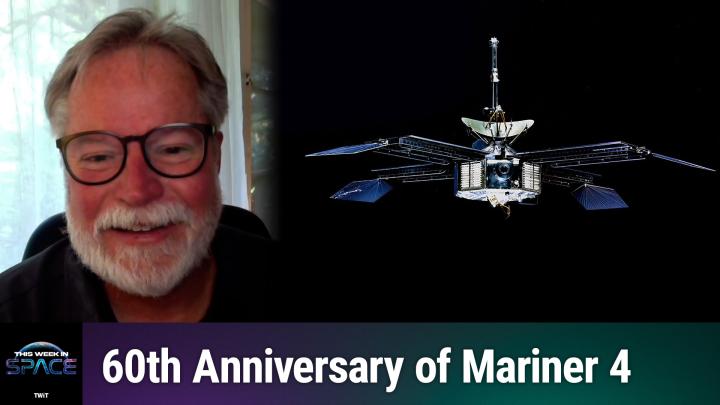
Coming up on this Week in Space. We're looking at 50 years since the Apollo-Soyuz historic docking. I check out the biggest piece of Mars on Earth and Rob Manning, jpl Engineer, Extraordinaire Chief Engineer Emeritus, is going to walk us through Mariner 4, 60 years after our first close-up of Mars. Check it out.
0:00:21 - Rod Pyle
This is This Week In Space, episode number 169, recorded on July 18th 2025: The Day Mars Died. Hello and welcome to another episode of this week in space, the day the mars died edition. I'm Rod Pyle, editor-in-chief at Ad Astra magazine and I'm joined by my fellow, martian Tariq Malik, also editor-in-chief of the much larger space.com. How are you?
0:00:52 - Tariq Malik
doing hello. Happy mars day.
0:00:55 - Rod Pyle
I guess it's not mars day, it's just well actually it is because we have we're coming up in two days, we have apollo 11 day, which is landing on the moon on July20th, but that was also the date that the viking one, the viking one lander day, which is landing on the moon on July 20th, but that was also the date that the Viking one, the Viking one lander, set down, which is a successful landing on Mars.
We often forget about Viking, but I don't, because I'm an old man and I was there. In a few minutes, we'll be joined by another guy my age, rob Manning, who's one of our favorite returning guests, former chief engineer, now chief engineer emeritus at the jet propulsion laboratory in Pasadena, and we're going to talk about the 60th anniversary of America's first successful spacecraft to mars, mariner 4 in 1965. However, before then, please don't forget to do us a solid make sure to like, subscribe and do all the other podcast things that make us feel loved, because we love you and we need your support, and so forth. Now we have an encore joke from paul woolley, encore, encore. I thought you were going to scream, Paul, isn't it? Paul, Paul, there we go. Hey Tariq, yes, rod, why did the Mars rover apply for therapy? Why? Why did they do that? Because it had abandonment issues. Oh, no, wah, wah, wah. That was a few weeks ago. I used that, Okay.
I don't remember Because it was a recycled joke, a fresh one from Nate Tanner. Nate hey Tarek, yes, Rod. How did Pluto react when Neil deGrasse Tyson said it wasn't a planet anymore?
0:02:28 - Tariq Malik
Oh, I don't know, was it sad?
0:02:30 - Rod Pyle
It said I think Neil deGrasse Tyson is fat.
0:02:34 - Tariq Malik
What.
0:02:38 - Rod Pyle
Nate, that's not nice. Yeah, a little bit of a reach there Now.
0:02:41 - Tariq Malik
I've heard that some people want to abandon he looks good now, by the way, he's good. I reach there now. I've heard that some people want to be good now, by the way, he's good.
0:02:46 - Rod Pyle
I don't know he's in shape. Thank you. I've heard that some people want to abandon us on Mars was joke time of the show, but you can help send us your best, worst or most of different space jokes to twist at Twitter TV he's also got the best space of vests too. That's pretty cool well, but gene Kranz, you know well, there's, that, yep, all right.
0:03:03 - Tariq Malik
yeah, right, stan corrected Stan.
0:03:05 - Rod Pyle
Oh my God, how did these guys get these GIFs up so quick? He's got to dice it up already, all right. Headlines Headlines Headline news. Headline news. Headline news.
0:03:19 - Tariq Malik
I got that from science.
0:03:21 - Rod Pyle
Never did we get so much use out of something it took me so little time to make.
Hey, tarek, yeah, let's zoom through these because we've got a show ahead 50 years ago we had the Apollo-Soyuz flight, or, as they called it in Russia, the Soyuz-Apollo flight, that's right which was the final flight and that was so cool and all that. At the time I think the public it was a little bit of a yawner. You know, we had been on these incredible missions of exploration to the moon. We had had three crews up at Skylab which was rescued from near disaster because of a launch that broke some things. And then came apollo soya's, which was cool primarily, at least from the public view, because it was detente in space. It was the americans and the soviet union docking two spacecraft, shaking hands, sharing some borscht and some jokes and then going their separate ways. But it was kind of a it felt just. Personally it felt a little bit like kind of a sad ending to this, this amazing program.
0:04:35 - Tariq Malik
But it's been what well, 60th, 50th anniversary, right 50, 50 years later, we've got an international space station where we flew one of the most international missions I've ever seen, just like a week ago, you know, you've got Russians and Americans in space overseeing a station that also has, I think it had, let's see, we had India's space agency's first astronaut, poland, bulgaria, hungary, and then there's more all up there. So I think that the legacy is far reaching, given where we are now. I know there's more on, uh, all all up there. So I I think that the legacy is far-reaching, given where we are now.
I know there's a lot of stuff with russia and and ukraine and stuff that's throwing a lot of mix, uh, uh, a lot of, a lot of waves in that international cooperation. Uh, hopefully we'll get through all of that and that that conflict will end and then they can resume. Or maybe there's another partner that's going to rise up, yeah, and be even more cooperative and and more, what's the word? Um, uh, what's it when you're good, beneficent and good if it's, yeah, more good, yeah.
0:05:35 - Rod Pyle
Well, you know, it would be great if we could work with china, because I think honestly uh, they wouldn't say so, but I think china would would would turn off their relationship with russia in terms of space in a hot, hot minute if we could find a way to work together cooperatively, because really there isn't a lot left going on in russia. They've got some old hardware, they've got some capability, but they've had huge brain drain through retirement and other things. Their budget at this point is tiny, yeah, and their spacecraft break.
0:06:03 - Tariq Malik
So yeah, you mentioned Skylab, by the way, and we just passed the 40th anniversary of the Skylab fall from space into into Australia. So, all right, let's. Let's hope we don't do that with the ISS.
0:06:16 - Rod Pyle
Well speaking of falling from space. Uh, starliner got a brief moment back in the news. Uh, that's right. Yes, we finally got an announcement after many months of silence. This is Boeing's.
0:06:26 - Tariq Malik
It's been since March. Can you believe it that they said anything publicly at all?
0:06:30 - Rod Pyle
Boeing's competition for SpaceX to deliver astronauts to the space station, and the headline I picked was Starliner in or out of the doghouse? Nyuk, nyuk, nyuk, where do we?
0:06:43 - Tariq Malik
stand with this darn thing? Well, that was the question. Back in March, nasa and Boeing put out a statement that said that they were looking firmly into early 2026, no longer looking at the end of 2025 for the Starliner 1 mission, the next Starliner mission, and they were trying to decide if they get all the testing done that was slated for this summer and then, uh, if they would put people on it or not, or not. We actually reached out to them like a week or two ago, boeing and nasa and they're like, hey, no, like what we said in march, that that's what we said, you know. And so that's the latest news. That's what they told our writer, josh dinner, who, by the way, wrote this great story.
Because during the crew 11, uh, up fronts, for the crew 11 mission, which is is launching by SpaceX at the end of this month as we're recording it, July 31st is the launch date. There, they did give an update on their plans for Boeing and they did confirm that not only is Starliner launching in 2026, that next launch will also not have astronauts on board. So they're stepping back and they're doing another cargo kind of slash test flight for this version, for whatever fixtures that they're going to be making, and so it's a pretty definitive stake in the ground now that that is what the next mission is going to do. Now the testing is going to be set for the summer to test the doghouse stuff that they were tracking for the thruster issues to see if they can manage the temperatures there so that they don't pose a problem again and have like a lot of the glitches that they saw on this last week Temperature on the thrusters.
0:08:14 - Rod Pyle
Exactly, exactly, and I guess what I read anyway was they're redesigning the material for the seals on the valves, since valves seem to be a problem for them, even though they've been building them for space for 60 years. It'll be, interesting to see what happens. There was a good story on Ars Technica not by Eric Berger by another writer about we're counting down to the end of the space station.
0:08:37 - Tariq Malik
Is it still worth it? Yeah.
0:08:38 - Rod Pyle
How many flights can they get done in time? Yeah, why don't you pick the third story? Whatever you like the best.
0:08:43 - Tariq Malik
Yeah, well, I would just point out I mean, there's a lot of great stuff. There will be the Apollo 11 anniversary on Sunday, July20th of this year. There's going to be a protest scheduled at NASA headquarters by NASA workers, by NASA workers, contractors and employees who are protesting both the mass layoffs as well as the budget cuts there. It'll be interesting to see what that turnout is like and if it has any impact into the ongoing budget discussions. But I did kind of want to end on a high note and I would just add that I did get the chance to see the biggest piece of Mars on Earth this week, rod, because it was here in New York City and I got a little video. Now, is this the new meteorite? Yeah, it was here in new york city and I got a little video. Now, is this the new meteorite? Yeah, it's. It's not a new meteorite, it's, but I mean it's it's newly found. They found it in 2023 right newly on sale yeah, there's.
There's a bit of a, a video in the background from from from my visit earlier this week. As at sotheby's is it? Is it sotheby's or sotheby's, doesn't matter.
0:09:42 - Rod Pyle
Okay yeah, how big is this piece.
0:09:45 - Tariq Malik
It is 50, I think it's like 56 pounds or 54 pounds something like that.
0:09:51 - Rod Pyle
This is multi, multi-million dollar specimen right, so I'm glad you asked.
0:09:55 - Tariq Malik
It was actually up, Froggy. This is the big suspense building here. I am walking through their exhibit. All this stuff was on sale. And there it is. You can see it in real time. Wow, it got its own gallery Look at that.
It's its own gallery. There's no barrier. I could have just grabbed that thing and ran out of that building. Right, I can't carry 50 pounds. That much. That far, I'd find a way. Look at that. Yeah, so this was discovered in 2023 in Niger, in the Sahara Desert, and it's the largest chunk of Mars single chunk of Mars that I guess has been on display and up for auction ever. They're billing it as like the biggest. It did sell for $5.3 million and that is above their top estimated price of $4 million.
0:10:45 - Rod Pyle
We should have bought it and taken it to NASA headquarters and said we've just solved your Mars sample return problem. Yeah, I know, I know, only $10 million.
0:10:56 - Tariq Malik
So it's very exciting to see. I feel, like Indiana Jones, that it does belong in a museum.
0:11:03 - Rod Pyle
But maybe that is the one moment of Indiana Jones you'll ever have in your life, my friend oh.
0:11:10 - Tariq Malik
But maybe you don't know, I could like discover a tomb right. My life's not over yet, oh you've been in my office.
0:11:18 - Rod Pyle
A space tomb, hopefully, yeah.
0:11:21 - Tariq Malik
But we'll see. Maybe they'll donate it to a museum somewhere and then we'll all get to enjoy it forever.
0:11:26 - Rod Pyle
All right. Well, we are going to buzz off now to a quick break and then we'll be back with Rob Manning, chief Engineer Emeritus from NASA JPL, to talk about the 60th anniversary of Mariner 4 to Mars. Stay with us and we are back with Rob Manning, chief Engineer Emeritus which is a title I can only covet in my dreams of passing as NASA's Jet Propulsion Laboratory. Hello, rob, thanks for joining us today.
0:11:52 - Rob Manning
Rob, it's great to see you again.
0:11:54 - Rod Pyle
It's great to be back here, it's really cool, well, and it's always a treat for us because you're the most fun a guy can have talking to an engineer for sure. So can you just give us, for people that haven't heard you speak before, give us kind of a rundown of your career at JPL?
0:12:13 - Rob Manning
Sure Antiquity. So I start off at JPL, ironically, remarkably, as a oops can you hear me, okay? Mm-hmm? Okay, I started off as a technician and a draftsman at JPL nearly 45 years ago and I've worked my way up through the ranks, working first as doing electronics.
Electronic systems, Came out of Caltech as a student and learned how to make electronic systems for spacecraft and for some reason I've managed to find myself becoming a chief engineer for a Mars Pathfinder mission, a little mission to land, a low-cost mission to land a little rover and do some science and some pictures on the surface of Mars after a 20-year hiatus from after the Viking missions that landed two missions on Mars in the 70s. So, and then after that I've been doing a lot of chief engineer work. I was chief engineer for well, essentially not quite chief engineer, you know the title, but for a Spirit and Opportunity rover, as well as chief engineer for Curiosity rover as well as the mars program office, and then eventually chief engineer for the jeff impulsion laboratory for six years. So as a consequence, I just I know a lot of the mars stuff and I've been working. I've worked on many of the mars missions, um, uh, in fact maybe the majority of them, um, that came out of the United States and so it's and had to do. Had involved in Phoenix Insight landing to Mars 2020, perseverance, rover, mars Reconnaissance Orbiter, odyssey, mars Global Surveyor, mars Observer didn't make it to Mars. And including the ones that didn't work Mars Polar Lander, mars Climate Orbiter infamous ones that had that didn't work in 1999.er. Mars climate orbiter the infamous ones that had that didn't work in 1999.
Anyway, so I've been fun. I did. I missed that I was too young for the to work on the mariner series spacecraft. I did. I did work also on galileo, uh, and to jupiter, uh, before it was my first cut of doing electronics. And then, uh, a cassini mission magellan to Venus, cassini to Saturn, I should say, and many others. So I've been, I know a lot about, I've been lucky to be in the right spot at the right time and learn about how to make spaceships and how to land them, how to drive them around another planet.
0:14:40 - Rod Pyle
Hey Tarek. Look, we have a modest guest. How nice is that? So actually, by my math and there's a very good reason, I'm not an engineer but by my back of my hand calculation, you've been involved with NASA's Mars exploration for about half its total time.
Hmm yeah, wow, is that about right? Maybe, but you're right, the majority of the missions, because the success rate really picked up in the seventies. Okay, well, my next question was your history with Mars and every probe since Pathfinder. But you kind of covered that Before I let Tarek jump in with his burning question. I wonder if you might just have a capsule thought on sort of the legacy of robotics on Mars through JPL. I mean, other countries have tried. The Soviet Union actually started flinging stuff towards Mars many years before the US did, and over, and, over, and, over and over again and has never had a complete success.
0:15:42 - Tariq Malik
Mars 2 had a beep, it's hard.
0:15:45 - Rob Manning
March 2, yeah, march 2 made it March 3,. March 3, I think March 3, right, march 3, and it lasted a few seconds.
That's why I said complete success, tomer, but thanks. But I mean I mean it's you know, to be honest with you, having a few seconds says a lot. You know you have to do a lot of right, do a lot, get a lot of things right in order to get something to last even for a little while. So you know I give them a score, not an A+, but it's up there. I mean they got to Mars, anyway. Yeah, it's oh man. That's such a loaded question, rod, From the point of view of science.
I mean we'll talk about Mariner 4 later, but this has been. You can only go to humans, can go to a place for the first time once, and we've been incredibly I guess the word is blessed to have the privilege funded by thank you, american taxpayers to explore and learn and share this with everybody and share it with families, schools, kids, people from really all walks of life. And it's not just a thing we do for a few handful of secretive scientists at all. It's something that's out there. Our pictures go out there to the world, and what we learn about it we share. And so it's such a great privilege, and so I've been very lucky to be part of it.
I mean, you mentioned you probably noticed that a lot of organizations are attempting to go to the moon or land there, and sometimes they work. Oftentimes they don't land there, and sometimes they work, oftentimes they don't. And you see, well, jpl's contributions have been relatively successful over the last few years. It's not always been that way and you do build on it. I think one of the key things that really has made this program program amazing I mean it's for me is that NASA has let the same people, effectively the same community of people, learn from their mistakes, make a step, take, take those lessons and feed them into the next mission and the next mission and the next mission to eventually the probability of it working goes up, and and the complexity goes up and the scope goes up. And mission and the next mission to eventually the probability of it working goes up and the complexity goes up and the scope goes up. And, of course, with complexity and scope goes money, things like that.
So they are getting more expensive? Well, not really. Actually, they were pretty expensive at the beginning too. They've always been pretty expensive. They've always been pretty expensive, but over time, this accumulation of knowledge and experience has really paid off. I mean, listen, can you imagine having a chance to do another mission after you've maybe got the last mission off by the skin of your teeth and all the things you can think? Oh well, I'm not going to do that again. Oh boy, remember that guys. Yeah, that was pretty scary. Let's not do that, okay. Okay, let's not do that again. Okay, let's do something else, let's fix it.
And so we were able to build on those experiences Not perfectly, guess what, because we're human beings, we make mistakes, so things still go wrong and still things still break, but altogether, what a privilege it's been. And so we've got a chance to build on those capabilities and take them through for decades, and I hope people will say that it paid off from the taxpayer's perspective as well. It's not just giving Rob Manning this incredible set of experiences that only a 12-year-old would dream of. It's about hopefully taking everyone with us, taking people for a ride.
I mean they talk about we should put flags on Mars. Well, we've been planting flags on Mars and there are people who go to Mars every day, virtually through their machines and extensions of themselves on these other on Mars, and that's just not true of Mars was also to other planets, other places we've gone, but these extensions of ourselves have really opened up doors to these new worlds and revealed a lot of complexity and it's really informed a lot about what we know about our own earth, our own place, our own home, and it's been just. You know, I can't say. I can go on and on. I can give thousands of examples, but I'll stop there.
0:20:30 - Tariq Malik
No, I want to see the Martians. That's what I want, on and on. I can give thousands of examples, but I'll stop there. No, I want to see the Martians. That's what I want my taxpayer money to go. I want the Martians, right.
0:20:36 - Rod Pyle
I want to see that fossilized femur up there.
0:20:38 - Tariq Malik
Yeah, or get it out of the archives. Why were you hiding it, rob? Are you part of the system? Is?
0:20:45 - Rob Manning
that what it is, Absolutely yes.
0:20:47 - Tariq Malik
I'm not going to tell you Before we get too much into the history, because clearly there's a lot of legacy to build on. I did want to ask, because I usually ask I think I asked a version of this last time you were on the show as well about your path to space, because clearly you are a Mars guy as an engineer, but were you a Mars boy? You know as an engineer, but were you a Mars boy as well as a kid? Is that something that you thought? About on your road to space.
0:21:16 - Rob Manning
Or was it something along? Well, mars seemed like a long ways away for me and, by the way, if you can hear, there's some sound, that, uh, that's some, there's some gardening out going on behind me, but but um, the there's a uh. When I was growing up in the early 60s, mars was not you didn't. Mars is what you read about in in in heinlein's books, or or ray bradbury, or arthur c clark, or orke, or all these great writers, isaac Asimov, these are the people I read about, and so space was distant.
But the thought, the vision we had as a kid I had as a kid is about just getting people off of earth and maybe being in a space station or maybe walking on the moon. Oh, that would be really cool for humans to actually go to the moon. So my scope was closer to Earth in my head. But space was definitely a huge thing and the thought that maybe I might be able to have a role in that is almost impossible to believe. But it was something I imagined as a kid and I daydreamed about this all the time I was in space, all the time I grew up in this beautiful island in Puget Sound, and I'd walk through the woods near the beach and I'd look up at the sky, this beautiful blue sky with the clouds going by, and I although it was beautiful right there, I was flying, I was in space, I was already out there. I was imagining being above us, flying above the blue sky and seeing the universe with my own eyes.
0:23:05 - Tariq Malik
Wow.
0:23:08 - Rod Pyle
We have to go to a break. So, everybody, hold your Mars spacecraft and we'll be right back All right, coming back from one of my most lame transitions ever. So you know, rob, you touched on something that has kind of blown my mind for decades now because I think a lot about my mortality. And you know, you and I are the people in the room here today that are old enough to remember the classical Mars. You know the Mars before we understood the ugly truth of the solar system and I mean there's beauty and wonder in the solar system.
But when I was a young man, when you were a young man, you know, people were still looking at Venus, maybe not the hardcore scientists, but a lot of science writers and dreamers saying oh, venus is probably hot and swampy and it might have dinosaurs and all that kind of thing. And Mars, oh, it's a little colder than Earth and you know the air is going to be thin maybe one-tenth Earth's atmosphere, but we can go there and maybe you can walk around without a pressure suit and, you know, breathe out of an oxygen bottle like Robinsonin sucruso on mars or something. And then this amazing probe kind of came out of. Well, for my awareness kind of came out of nowhere, nowhere. Yeah, young m erin or four, and flew past mars, sent back a scant 22 and a half very low res pictures, but everything spun on a dime and the news was mars is dead.
Mars is the moon. Oh, I know, mars is an arid desert planet. There's nothing there, so get over it. And of course, the scientists are so rock and rolling because they're like yeah, look, we got that radio occultation experiment, so we measured the atmosphere and we got these pictures back and that's fantastic, and everything but the romantics among us are going you killed my planet, yeah that's true, and and even you know, there's even people, even after then, who didn't give up on the idea there's life on the surface of Mars, by the way.
0:24:57 - Rob Manning
It just there were just no canals and cities or forests. There's some, maybe something else was there, so it wasn't exactly dead. But what happened was you're absolutely right, the imagination about. So the main imagination is amazing thing you can imagine, we, you know, um, and that's what I was doing as a kid. I was imagining these worlds, these places, and just just, you know, and, and, and it was, it was so fun, so free.
I mean, we, um, so in some sense, the mariner four, when I pictured that one image, that the, the crater with the, with craters and craters on it, um, just like, destroyed people's hopes of, of an imaginative world, they thought they, they didn't you know, it turns out didn't have to actually give up, give on it, give up on, give up on those imaginary, those visions, but completely.
But it wasn't the world they were hoping for, there weren't people to talk to there, but it certainly did. It did take the wind out of people's sails and their imagination. So they had to imagine more far off places to go and other parts of the other solar systems systems, because clearly, if mars wasn't any good and venus is already kind of not looking so trashed yeah, it's looking a little too hot, a little too much pressure, um, but going out further, other solar systems and other places became that, became the way of thinking about it. And of course, that was the same time that star trek was out and they were using their imagination of going to other stellar systems. And so that was the same time that Star Trek was out and they were using their imagination of going to other stellar systems.
0:26:32 - Rod Pyle
That's true, that was the same year, wasn't it the same year?
0:26:33 - Rob Manning
1965. Right, so Star Trek was a huge influence on how people thought about what space exploration might be and particularly about how humanity might actually evolve in a positive way. Um, it was kind of cool in that sense, uh, but it was. But it was that mars was a shock and it was, and it really hit people hard and I think, uh, you know, so someone looked for all the world like somebody took the moon and spray painted it red, yeah, and and that was it. Okay, we have a red version of our moon. In fact, the thing is, the thing is now people start thinking that all the moons of all the other planets look the same. We're all, we're all. Just, I mean, uh, they've already had that, we're convinced of that for phobos and deimos on mars, but maybe all these the galilean satellites were also equally boring, um, and so it really actually it put took the wind out of sales for not just mars but for interplanetary work all together. Um, fortunately, we had missions. Uh, already had.
The ball had bounced, started bouncing for, uh, for voyager, even before Mariner 4 started. The Grand Tour hadn't been invented yet, but the notion of getting money for going out to the outer planets, the momentum had already been built for that. So Voyagers were already on their in some sense the momentum, because Voyager was actually the last Mariner series spacecraft. We don't talk about that and it's actually the same, actually the same designs, just modified. Each Mariner spacecraft had new augmentations or additions, upgrades from previous ones. But it was so. It really just so. Those those minor four images really took the land of sales for planetary exploration period to a large extent. If it wasn't for the momentum already built, it would may have actually put the brakes on Voyager, for that matter.
0:28:40 - Rod Pyle
So just to set the stage, mariner four launched in 1965, after a failed launch by Mariner three a few weeks earlier.
0:28:49 - Tariq Malik
But up till that time, just a quick correction it was in December, was it not In 64? Because, it took six months to get there.
0:28:57 - Rod Pyle
Yes, sorry.
You did, okay, flew by in 1965. Thank you, wait a minute. Slapping hand, okay, but it was because I got all wound up in the bigger idea, which is up till that point. But it was because I got all wound up in the bigger idea which is, you know, up till that point. You know, mars really became a target of telescopic study in the mid to late 1800s. And then here comes Percival Lowell with all his money to Arizona I'm going to build a telescope to study Mars and wrote a series of increasingly fanciful books between the 1890s and early 1900s by the time he was done, and if you read those books today you can kind of see how he got there with what he knew at the time. But he had an advanced species of Martians that were building canals to duct water from the poles down to the arid equatorial regions to help grow crops, and they had televisions and teleporters and all kinds of stuff. Great reading, a little fanciful, but you know that persisted well into the 20th century. And then in the, I think, late forties, here comes Palomar, mount Palomar observatory. So we're getting pictures of Mars through this 200 inch telescope, but it's still looking through earth's atmosphere, so you're still kind of seeing this wavering red blob and you can, you know, use spectroscopes and other things to to get, uh, a little bit more science down off of the planet.
But really, even when mariner was flying, some of the the maps we were using dated back 40, 50 years and there wasn't a lot known. There was still talk and correct me if I'm wrong, rob, but there's still talk about the wave of darkening which they thought might be plants growing and then dying off during the seasons. Um, still not quite certain about how much water there was in the atmosphere. Temperature was kind of, uh, better known, but there was still this possibility of, if not intellectually advanced life, at least more complex life forms. And the canal question hung over everything, which was a leftover from Giovanni Schiaparelli, who called the lines he saw on Mars canali, which we, of course, looked at and said, oh, canali, that sounds like canals, that means intelligent people. So here's this classical Mars, and then, as I alluded to before, in this kind of one moment, moment, mariner four goes by. So, uh, if you don't mind, maybe you could just kind of walk us through how, how this began and what happened when they flew by.
0:31:17 - Rob Manning
Well, the the big thing was. So mariner four was actually a modified version, same with mariner two and three, but there are modified versions of of the ranger spacecraft, if you remember crashing relentlessly into the moon or missing the moon or something it was, it was, it was a, it was a series. Uh, I forget what was it. Mariners? I don't know, I'm getting my man, I think it's ranger.
0:31:45 - Rod Pyle
Six of them, yeah, the first six, I think there, yeah, the first six failed, I think there were nine, but the first six failed.
0:31:50 - Tariq Malik
Six failed.
0:31:51 - Rob Manning
There was a big space between six and five. I think the first five died and they said okay enough, jpl, you've got to get your act together. So they went and stopped and refactored but they pulled off one of the spacecraft. I think the first Mariner 2 was actually pulled off in the actual line spacecraft, the, for I think the first mariner 2 was actually pulled off in the actual line. They took later on a version and modified it more further um to create actually a mars version of that.
But if you look carefully you'll see the structure and the architecture and the layout of the ranger missions in the on the mariner series spacecraft. They're all there. Um, the control system, they looked many identical pieces of electronics, some of the structure. They had to add a lot of things like new solar panels. They put those veins, weather veins on the ends of the solar panels. Steering vanes Steering vanes, yeah, actually to minimize impact of solar torque so they can keep the attitude of the vehicle from being pushed out of the way impact of solar torque, so they can keep the attitude of the vehicle from being pushed out of the way. But they realized that they wouldn't have they'd run out of fuel if they had to keep moving the spacecraft to point the antenna, keep the antenna pointed toward Earth because of the pressure that the solar photons had on the solar panels. So they had to do these little tricks to make that panels. So they had to do these little tricks to make that happen. So they had to do a lot of modifications, a lot of things, and their control systems were not good. And so it was.
But it was pretty darn exciting because there's a lot. There was a lot of it, like many of our missions, a lot of things that were skin of your teeth, close calls, and I think you'd mentioned this in your article Rod is the Canopus tracker. So what's interesting is that, if you're, one way to control your orientation space is to have a sun sensor. The nice thing about the sun, it's hard to miss, right, it's hard to miss and it's really bright. And so there's a little sun sensor which basically measures the angle, the sun, and a bunch of fan detectors that can measure the sun in this axis and another one, identical it's 90 degrees that measures it this way and from that, if you, if you move the spacecraft, so the sun is kind of pointed along a particular point. Now all you need to know is the roll, how much it's rolling. But to get the roll, um, the orientation you need to know.
Look at stars, and there's a really bright star in the southern hemisphere called Canopus, and if you know how far the mission is, you know where to point. If you had a little tiny telescope that had kind of like a sun sensor, except just focused on that one star, you point that thing at the right angle relative to the sun, and so as you go around the orientation of the sun, this Canopus tracker will bump into Canopus eventually. And so if you spin really slowly about the sun, eventually the detector will say whoa, it's getting real bright, it's bright, bright, bright, bright. Oh, it's getting dim again, go back, go back, go back, go back. The vehicle would control itself that way. However, it's easy. Canopa isn't that bright. I mean, if you have like paint particles and other things floating around, you know our spacecraft. If you're not careful, they look a little bit like Pigpen from Charlie Brown, right?
It kind of launched with its own little constellation of dust and debris.
Remember how many times we had Apollo astronauts go? There seems to be something following us, oh little bright, little twinkly thingies. They're just I don't know what those are. They're surrounding us, they're floating around. Well, they're just basically stuff that's kind of roughly in orbit around your vehicle, affected by the magnetic field and just basically trapped there. Sometimes they'll wander off, but it's easy to. So that's what happened. So some particles and stuff got in front of the field of view and that thing actually locked onto those and they're like huh, this isn't, this doesn't appear to be Canopus. What happens? It disappeared. It seemed to wander off in the wrong direction. Canopus doesn't usually do that, and so it took a long time for them to keep looking, hunting that down. But it was the same technology. Actually, Voyager has a Canopus tracker. I mean, it became part of the whole toolkit. You just have to kind of realize it has these features of locking onto things that aren't stars.
0:36:32 - Tariq Malik
I was really struck by the duality of Mariner 4. And the fact that they launched Mariner 3 and Mariner 4, and Mariner 3 failed. And then Mariner 4 is based on an evolved Mars version of Mariner 2, which went to Venus, and Mariner 1 also. And then Mariner 4 is based on an evolved Mars version of Mariner 2, which went to Venus, and Mariner 1 also failed to go to Venus, and so there's like a mirroring and an acceptance, I guess, of the challenge we take Mars, maybe landing on Mars or getting to Mars for granite, maybe now.
0:37:03 - Rob Manning
Well, we shouldn't, no one should. It's hard stuff, we couldn't do it. It's hard to get it right. I mean, I have to admit I am a personal fan of this idea of dual redundant missions, where you have two missions, that they may have some slightly different science, where they cover different parts of the planet or look at different things Spirit and Opportunity rovers. You know they're identical rovers. You know I tell you how convenient it was for me to be able to say well, no, they're not single fault, tolerant individually.
And the whole bunch, thousands, if not millions, of failures could happen on any one of those rovers and they would die. But I have another rover there. Yeah, it's on the other side of the planet, but who cares? It's on Mars. And so this ideal of dual missions, the duality you're talking about, is a real plus. It's a real plus because if one fails you can go like shoot, why did it fail? What went wrong? Can we figure out a way to avoid that? On the other one and it's interesting you can Oftentimes, if you know what happened, there's things you could do to kind of skirt that by how you operate it. And so, and you don't carefully, well, it's like hitting your head with a hammer. That's way down to get yourself.
0:38:17 - Rod Pyle
What a great thing to have the budget for two missions at once and, speaking of budgets, we have to support ours by running to a quick break, so we'll be right back. So this is one that's that's really gotten to me for years. I'm sorry I have many passions about this mission just because I've written about a lot, I guess. But when I was a kid, my father used to give music lessons. One of his students was a kid named Alan Layton and his father was Robert Layton. Yeah, it was on the the Mariner for imaging team. He was an astronomer at Caltech, and so I got to hang out with him when I was a kid, of course, you know at the time.
0:38:53 - Rob Manning
You're going to tell that story right Online, alive. Which one? You're going to tell the same story? Which one?
0:39:03 - Rod Pyle
Oh, the one you're telling right now, well, no, what got me about this was, you know, he said. He said originally, you know, we weren't going to send a tv camera on mariner 4, and I said what? Yeah, so it was going to go out, as mariner 2 did to venus. It was one of those, you know, what your people call squiggly line missions where you get back this, this cool data, but but not pictures.
And layton, being an optical astronomer, said well, you know, this is an incredible opportunity to do more than any 10 big earth telescopes could do. And in his opinion, we owed it to the taxpayer, so kind of I. As I recall, late in the game they started working very rapidly to add a TV camera and, at this point, a studio TV camera over at, you know, tv City in downtown Los Angeles where CBS was or something. These cameras were about the size of a small dishwasher, a very large microwave. They were big, they had lens, turrets and all that kind of stuff, and Vidicon tubes were kind of delicate glass vacuum tubes with a photos with a photosensitive pickup on the back and I think they were in clusters for for burgeoning color at that point, no, just one?
0:40:13 - Rob Manning
no, was this one? Yeah, at least the first ones.
0:40:16 - Rod Pyle
Yeah, it's amazing so, but they had to figure out a way to uh I, I think oversee the manufacturing and testing of something in fairly short order for this mission, correct?
0:40:27 - Rob Manning
Yeah, no, this is. It is so funny. The argument was so much that people didn't want a camera. Really, it was just that the squiggly. It's so much easier to build a mission with squiggly lines Because it's the total data rate is so much less, because the total data rate is so much less and you can take turns, measuring different samples, sampling different analog channels like plasma, wave and other things, and actually get it down and get it in real time. You didn't need anything like the trouble with a camera, even with a fairly slow exposure, on a Viticon tube.
And the Viticon tubes are only about this big right, they're really small. They have a screen. It's a screen. People don't realize it's actually a television tube, just like the TVs that we had as kids. A little TV tube that kind of worked backwards through and then basically write, scan back and forth and was brighter where it was stronger beam where the pixel needed to be right. So there's fosters painted, little dots painted on the screen. In fact there are three colors of dots and if you carefully aim it you can pick which color the beam is aiming for. And you can do that scan, scan, scan, scan, scan, scan, scan. And that's how and they do it, it fast enough, their eyes don't notice it, and it looks like a real moving picture.
And now what's cool about a Vidicon tube is it's basically the same thing in reverse. Basically, you project an image on the end of your video tube and you have another, exactly like the same electron beam scanning it, but this time the electron beam is sensitive to the brightness of the light that's on the screen and the amount of current on that beam drops if there's not much light. If there's a lot of light it gets stronger. And if you just measure that and send it down, you get a squiggly line, just like other squiggly lines where you measure things. But then you have to do it for that line, then that line, then that line, and you have to go all the way down. Oh, by the way, only one color, one color, and to get the other colors you have to do this all over again with a different color lens. We put it between the lens and the light, so basically we'll find the lens, I think, and so it basically blocks all the other colors except for red, and so red goes on there. Then you have to take three colors, three different pictures, to get a color. But Mariner was just black and white, right, black and white, so they only had one. They didn't have a color wheel. We call it a color wheel, but that's how they got colored later on, like on Voyager.
But the trip was that that's a lot of data compared to just I'm listening to the plasma wave, up and down it goes. So this is like so just a huge amount of stuff and you can't get it down to Earth that fast, so you have to put it someplace. So you need a tape recorder to shove this stuff in. And they need a mechanism to play the tape recorder, usually backwards and reverse from. We don't actually go back and rewind and play it again. You go back, you play the whole thing backwards and that comes out the other way and then it goes into a tape recorder on earth.
It's a huge amount of data and it's a huge amount and it over overshadows the squiggly line data that the other scientists wanted. So the other scientists are worried that they're going to lose their data. If you put a tv camera, put one of these little vidicon tubes in there, they're not going to be able to get their data because they're, because the tv is such a hog. And it's a hog in other respects, not just data, it's also a hog in money, because you have to have this complexity of this extra tape recorder. You need a complexity of of, um, of getting the data down, and it's, it's so it's going to threaten the viability of the mission itself.
So they're like ah man, t-peg television. Oh, and, by the way, they're going to take all my mass because they're going to grow in mass. It's going to go from a, it's going to be something small, and it's going to grow from a microwave oven to a refrigerator, just like you said. I mean because they really hadn't really mastered the art of making these things reliable, because they're so dinky, they're really small and you have to get it focused nicely. So, and that was the. So there was a lot of risk and there was a lot of development. So there were people at JPL who became really good at designing, or at least monitoring that companies were good at designing these vacuum tubes designed specially for these applications. Everything was very bespoke, all designed by hand, because in those days we didn't have computers to help us design stuff, but you had slide rules, speaking of by hand, there was that first TV image from Mariner 4 of Mars.
0:45:11 - Tariq Malik
You know, I think, dear listeners, you heard Rod and Rob talking about how this camera was black and white, but there is a color image that I actually met what I was here as a little college, you know, cub reporter, when I was visiting JPL press, you know, press corps. They were walking me through like how they did everything, how they shared images with the public, and they took me into the back room where the the image specialist and I can't remember his name broad, you'd probably know him, but yeah, yuri.
0:45:45 - Rob Manning
Yeah yeah, yuri, yuri, oh Yuri, oh yeah, yuri VanderWoort, yuri VanderWoort.
0:45:49 - Tariq Malik
He's like this is the room, this is where we got the big thing and we hand-colored the picture of Mars.
0:45:53 - Rob Manning
That's right yeah.
0:45:55 - Tariq Malik
Oh wow, We've got it, John. We've got it on line 46 there for folks that see it. There it is.
0:46:08 - Rob Manning
It was in color only because they picked a range of a spectrum of pastel colors, right? Yeah, they colored it with black and white.
0:46:15 - Rod Pyle
It's such a cool story, I mean so just again for context. There's a paper printout of this first digital image. It's 200 pixel right digital image of ours image.
0:46:27 - Rob Manning
Well, well, do you remember those old, like line printers go, yeah, don't, don't. It went and they had to take scissors, and they had to because their spaces were so big. They had to just cut them out. And each one had a, had a octal number uh, that would represent the brightness of that pixel, and they had to light it up. And they light it up vertically across, and they took their colored pastels and colored each pixel based on the numbers.
0:46:55 - Rod Pyle
So it's like paint by numbers, exactly the same thing and I don't know if this is apocryphal or not, but I did read one account that said that a couple of because this is NASA and JPL in their ad hoc days, right.
So a couple of guys said, oh, I got an idea, and drove down to Pasadena Art Supply, which was open for many decades, since closed, and said we need some grease pencils, some pastels. They said okay, and they said we got orange and yellow or green and brown and they were like, according to them, there was a toss-up moment in their thinking. It would have been a really different experience if it had been green and brown. I don't know why they'd pick green and brown, or maybe it was they only had green and brown and then had to go back to find the orange and yellow or something. There was some hang-up there. But when I first went into the comms building and saw that thing set hanging there, realize what it was, it was like this Holy relic moment for me, because it was such a cool thing that they did and then the actual image finally gets printed out and dried and hung up and it was really close, except that it was black and white and this was in color and a little stretched out this way.
0:48:03 - Rob Manning
Yeah, they had to cut them a little bit closer together, but you're absolutely right. You may ask the question well, why did they do that? So remember now these images, they come down two ways. They were coming into the tape recorder first, and then over the next hours, like six or seven hours, a good chunk of a day, right, rod? You know the numbers, I forget and they play it back.
Then it takes a fair amount of time to process that stuff because we didn't have a bunch of computers back then to help us. But the data was there and they just, the imaging team, just printed it out on their teletype line printer. And so they said you know, we don't have to wait, we can just do it. Now what? You just need a bunch of this, a gradation of color, of a single color. It doesn't have to be blue, green, whatever they pick Brown, I guess, orange.
But the funny thing is, when they finished that and I'm sure Yuri mentioned that right that they they said look what we did, don't show anybody. We don't know if that's right, I mean part of it. They didn't know what they're looking at, for example, that bottom part of that image. Is it possible, you could pop it back up again, the big white blob. Well, no, all the black stuff down below, oh yeah, that's black space, stuff down below. That's, that's black space.
So that's a. That's the limb of mars, oh, and, and so if to the middle, the lower part of the black part, the dark brown actually in this picture, but it's actually black the lower left hand, uh, quadrant, uh, you can sort of see lines in the, in the, in the, uh, in the black, or the grant on the brown in this case, and that's, that's the atmosphere, that's the, that's the, that's the you can sort of see. So, and that's the atmosphere, that's the you can sort of see. So what you're looking at is, if you turn it upside down, you can see. You're looking out over the curvature of Mars.
0:49:55 - Tariq Malik
Oh, yeah, yeah, yeah. Okay.
0:49:59 - Rob Manning
Yeah, so it's. But they didn't know that, they didn't know what they were looking at Well and to be, fair to the squiggly line scientists.
0:50:06 - Rod Pyle
Just to cap off your your tv camera story. Yeah, I think each image took eight hours to send down and they had to do it twice. So I now that you contextualize this way, I have to lighten up on my. They wanted to send it around a tv camera because it actually probably made a lot of sense to those guys.
0:50:22 - Rob Manning
well, it made sense because the price is right, too right because Because adding a television is a huge step up in complexity, and it wasn't just the ground, software, this whole. How do you get a tube that doesn't shatter itself during? Launch Shake all the phosphorus off the back.
0:50:41 - Rod Pyle
Yeah, yeah.
0:50:41 - Rob Manning
I mean making things that can survive a launch vibration. You don't put glass out there. God, are you kidding me?
0:50:47 - Tariq Malik
Why did you put?
0:50:48 - Rob Manning
little, yeah, so you need had to be very, had to be very good at holding it, stiffening it up, making sure it doesn't vibrate, and all the issues associated with the contaminants and everything else that associated with with making a tube that that doesn't leak. I mean, it's really hard to make a tube, by the way. Um, that's that's. That's why in the old days remember the old deals we're talking to old people like old people, we used to have stereo stereos with all these tubes in it.
0:51:16 - Rod Pyle
But the typical lifetime of a stereo amplifier with all those, um, those glass tubes, vacuum tubes were was about a year or two before you got, you lost one of those tubes and you had to go find another one and they all burned out on you, kind of like old, like the old light bulbs except worse and it's something Tariq has never seen is the tube testing console at the grocery store, where you'd take your vacuum tube out of your stereo, your television set, and you'd go look at a little book and you'd you'd fit in the right plug and it would test it and then it would sell you another one.
0:51:49 - Tariq Malik
I had a stereo with tubes. My mom gave me her stereo and it had tubes.
0:51:53 - Rob Manning
Yeah, you nerd.
0:51:53 - Tariq Malik
Very, very nice. It had a nice hum when it warmed up.
0:51:56 - Rod Pyle
All right, I know you have many questions and we've been ignoring you, so we'll be right back in this next break. That was how I was getting to the segue to listen to Little Tarek. So stand by.
0:52:05 - Tariq Malik
I don't know whether to feel thankful or feel patronized, Rod. All right, I'm just saying that I had a stereo with a turntable and everything that had tubes is all Well and people still seek those out.
0:52:20 - Rod Pyle
That's a head scratcher for me. I've got a tube amp in storage somewhere, Rob. Is it because the sound is warmer or something?
0:52:29 - Rob Manning
Taste, it's whatever you like to hear. I mean, I think in some sense they do have different roll-off properties, so there is slightly different sounds, but it's a matter of what you like. We've lived in our digital world for so long. We know how to render things with incredible precision, but in some sense these tubes actually alter the sound in ways that people enjoy.
0:52:55 - Tariq Malik
And it's not. Yeah, we should get the sounds of Mars through those tubes. That'd be awesome.
0:53:00 - Rod Pyle
Hey, tarek when you ask your next question. We also got one from Wizardling on Discord. What were the highest and lowest tech parts of the Mariner mission? So we'll get to that after you're done.
0:53:10 - Tariq Malik
That's actually good. We talked a lot about TV camera and I'm very curious about everything else that we learned from Mars, from Mariner 4. Because this is where you know people might have missed it it's a flyby. You didn't go into orbit right with Mariner 4. This was like a zoom. You take all your pictures and then you know that's it. Mom's not going to pull over so that we can get out and take a picture with the dinosaur. So you know, like the roadside dinosaurs, like in California, we used to drive by those all the time.
0:53:37 - Rod Pyle
The cement dinosaurs yeah.
0:53:39 - Tariq Malik
Yeah, and so you know, this is like that first close-up. Look, rob, there's like a occultation experiment that we mentioned. There's a few others. What did we learn? That was the first of all of this stuff.
0:53:54 - Rob Manning
Well, I think the big ones first of all realizing there are certainly no canals on Mars and no trees, no cities, but also this kind of shock that and Rod, you mentioned this is the discovery that Mars' atmosphere is a lot thinner than they thought. Yeah, so Wernher von Braun's idea of landing a dozen or so astronauts on a glider, on unprepared surface, on skids, may not have been in the safest thing to do. May not have been in the safest thing to do. I calculate that if you were to land on the actual Mars atmosphere with a large glider, you'd be going very close to a thousand miles an hour.
Oh my God, on skids, unprepared surfaces what are the odds? Can you imagine there's nothing? Yeah, can you imagine there's nothing? It would be a bad day. It would be a bad day. And I think we learned that Mars is going to be more challenging than I thought in terms of how to get to the surface of Mars, because you don't land on Mars like you do. They're hoping to be able to land on Mars, an extension of how we do it on Earth, maybe not with parachutes, but certainly with wings or something. But even parachutes, it turned out, won't do the job by themselves, without something else.
0:55:16 - Rod Pyle
And you've landed on Mars five times by my count, right Not?
0:55:20 - Rob Manning
me personally, I have never been there, but yes, I do, I do, I'm joking, yeah, I've been there virtually with my robotic friends and it is a real pain, but that's what's. Through the discovery, like, oh crikey, it's going to be really hard to land on Mars in the future. And so it really kind of changed and it really changed the modality from a lot of different perspectives, because it looked like with much less atmosphere, there's less likely that to have a more dynamic place, where would the water be? How could you have had water if there's no atmosphere there? It's only 1% the density of Earth. Maybe Mars was never wet. Mars was never wet. And it wasn't until we got later images from first Mariner 9 and Viking orbiters that we realized that Mars had been altered by vast amounts of water flowing on its surface, which kind of changed the dynamic even more. Again, like plop, flip flop, you know, but that was years later, half a decade, no, a decade later. So it was, but it was. I think those are the two biggies that we learned, I mean.
And of course, from a technology perspective, it was modeled a lot after Mariner 2 in terms of the technologies for guiding your vehicles, one of the challenges for getting your spacecraft across is knowing where your spacecraft is. There are actually two issues knowing where the planet is and knowing where the spacecraft is. How do you figure out where your planet is? Well, you take pictures of Earth with a camera and a mount and a telescope on polymer. You center it in your screen. What, what direction is that absolute as l elevation at that point, at that long latitude, longitude and that date? What is that? Uh, well, it's, it's roughly that. It's kind of fuzzy. How is the gimbal because the gimbal says calibrated properly? Well, normally we don't actually try to get the accuracy from that thing. We just look at relative to other stars. Oh, creaky, I mean. So it was like it's. So it was like there's a fuzziness in your understanding of the direction to Mars and even larger fuzziness in terms of a ruler, in terms of how far Mars is away from you.
You have to use, rely on models such as Professor Kepler, who, johannes Kepler, who gave us the equations for orbital dynamics, orbital space as shapes, and we could use those to help estimate where things are. But it's going to be off by many, many kilometers, many, many, many kilometers, and so so they had to aim a good distance away. There's two reasons out of focus. The focus was not that great. One is it was actually taken from a good distance away. They didn't want to get too close to the darn planet and bump into it, so they kind of erred to be on one side of Mars.
The trouble with that is how do you know where to point the camera and when to point the camera? When to go click? That's also a real challenge, because you're moving by so quickly. When to go click? That's also a real challenge because you're moving by so quickly. If you go click, click, click, click and you've got a Cassegrainian telescope that we put in front of this Vidicon television. By the way, we use the word television. They called it television in those days. It's a television image, not a television motion picture. It doesn't move. So just a click, we're done, put it in the tape recorder as you're recording it.
So it's really challenging to get your vehicle to do all those things, to do the motions click, click, click, click, click, click, click and the telescope is. You're far away. If you were on the vehicle looking at Mars as it was going by. It's not that this planet going whoa right going by. It's not that this planet going way past you, it's more like this this, this dot going this quarter, going by in front of you and you're trying to like, click, click, click, click. Maybe it's a little bigger than a quarter, but it's not very big, it's pretty small, it's pretty small in front of you. So it's. It was a tough, tough challenge and those kinds of things were really pushing the envelope of getting the measurements right and doing the right metrology, measuring angles of the vehicle, knowing where things are. The one good thing is, as they approached Mars, they did something like they started doing some Venus too, and you got to better understand where Venus was relative to your vehicle.
But you're taking pictures of the vehicle and you take the pictures in a direction that you think this thing, copas, is up there, the sun's over there. Okay, I'm going to take this picture in this direction. Click, where's Mars in the frame of the picture I took? And from that you can figure out. If you know how the camera's pointed on the vehicle very precisely and you count the number of pixels where you put it, where the center of Mars showed up, you can sort of estimate. In fact you can estimate even less than a pixel because it's a blur. You can estimate we call something called point spread function to see how the blur is kind of spread out. You can estimate where the center of that blur is, even inside of a pixel, to try to make a better job of doing angles. So people whose job it is to do this incredible checking and double checking of all these Matt, these very tiny devil measurements that's a lot of Matt.
1:00:32 - Tariq Malik
That's a lot of Matt.
1:00:33 - Rod Pyle
Is your head hurting like fine yet? So just just to clarify, Tariq, and then I'll let you get back to your your question. Uh, this is not a real time. Oh, we got a picture back. We're pointing in the right direction or we're not. Let's make an adjustment. This is a. You have to have all this figured out before the flyby, or you're going to be taking pictures of empty space instead of your target well, well, that that's right and that's kind of, yeah, it's easy to do.
1:00:58 - Rob Manning
I mean, in the case of manor, one of our marriages ranger spacecraft we're supposed to take pictures on the way to moon. It took all its pictures before it got to the moon, oh no, inside the fairing on the way up to outer space, oh Click click, click, click. Oh, I got pictures of the moon.
1:01:14 - Rod Pyle
This is the problems that the Soviet Union had, where they'd reprogram their spacecraft and then they couldn't reprogram them. Yes, when Mariner Mine arrived and there was a dust storm on Mars and the Russians, you know, blew their wad, shooting pictures of of dust Dust.
1:01:31 - Rob Manning
Yeah, no, that's true. And and and and and thing is you speak. I said well, that's silly, why wouldn't they program? Well, it turns out, kepler's laws say you should be there in roughly the right spot so you can program. You know when things are going to happen. At nice thing about Kepler's laws and the position in orbit, you can predict where things are going to be with some pretty remarkable precision in the future if you know what the thrusters are doing and there's no one pushing your spacecraft around. So that's what the Russians were counting on.
And there's a lot of complexity by having it pre-programmable in those days, because we didn't have very complicated computers. All the computers we put on our spacecraft in those days because it didn't have we didn't have very complicated computers. All the computers we put on our spacecraft in those days were very simple things. They couldn't even do computing. They couldn't do arithmetic. Uh, I'm so simple, all handmade, bespoke specifically for the mission. Um, and so it was again.
Everything's wired by hand, designed by hand by individuals. Then we had huge amounts of technicians at JPL doing so. We had more technicians doing things like wiring and checking solder joints and making sure all the wires went to the right spot and all hand assembled. Even the circuit boards were hand laid out. They didn't have computers to do that either. So in the case we didn't have circuit boards, we just had wires. The wires would come out to a little stub and they would take a little soldering wire from here to here and then glue it down and glue down the back of the board. So it's just a bundle of wires down there that any one of which could break. So that's one of the things we started doing is putting a little bit of redundancy. There wasn't a lot of redundancy on Mariner 4, but there were some. But it was easy to break.
1:03:17 - Tariq Malik
That's great and I guess really quickly I would probably want to run down. There was like a magnetometer to study the magnetic field. Oh, yes, oh, yes, that's true, a dust detector uh for the dust, of our radiation detector right uh, and a solar plasma probe.
1:03:30 - Rob Manning
So a lot of a lot of different things. Yeah, yeah, yeah, they got for the first time, yeah, and and discovery that there's not much of a magnetic field on mars.
1:03:37 - Tariq Malik
It's a pretty big deal yeah, yeah, yeah, that's a lot. And by the way.
1:03:41 - Rob Manning
What's so cool is that we're jpl and was really because ranger was going on at the same time as the Mariner program. Jpl was. The people were just learning this on the fly and we had at the time. The leader for Mariner 4 was a fellow by the name of John Cassani who a couple of weeks ago passed away sadly at the age of 92, 93, something like that. He's still working. Yeah, yeah, he was still working. Yes, I was working with him as recently as last summer, um, uh, and he started, I think 56, I think 1956, uh, uh, as a young engineer and he was, he was, was the manager for the uh, for Mariner 4, um, and, to make that happen, to make those decisions. So he's the one that struggled to get this camera put on and uh, to a lot he was, he agreed. He's the one that had to agree that we're going to put that on there, um, but, uh, uh, but he became a fan of cameras. Ever since he's been uh and and he, he huge influence on all of us in terms of being among the inventor.
How you do this stuff, how do you build these things? How do you test them? How do you tell you can't? Can you test your spacecraft on earth? Can you? How can you test it? By being able to turn around it.
They actually tried testing those things. They're testing our thrusters to see whether it would work and get enough in our big thermal vacuum chamber. That didn't work out. So they just realized that some things you just can't test, you just have to do the best you can and build it up.
And so it was a lot of things like that how much margin you put in your design, what the temperature range is. Things need to be checked out to make sure they work, because some parts of the vehicle are really hot, other parts are really cold. It was a free-for-all really to figure this out and the kinds of things you need to do that they were just basically inventing at the time and we've all benefited from those experiences that those people had and John was the technical leader for those. And John was the leader, technical leader for those and he was a big inspiration because he was project manager for Galileo, for Cassini, for many other missions, and an advisor to me and he, you know, a spirit and opportunity wouldn't have ever happened if it wasn't for John. It turned out. I'll tell that story some other day out.
1:06:09 - Rod Pyle
I'll tell that story some other day. And I mean, you know him a thousand times better than I do, but I had the chance to interview him for quite a number of hours and one of the things that always struck me is he wasn't shy about expressing himself and he wasn't shy about speaking truth to power. And when I was in your archives going through various memos back and forth from the Mariner and the Viking era for this Mars book I was doing, I asked for a bunch of boxes of John Cassani memos and so they rolled them out and they all had like red tape along the side. I said what's that for? She said, oh, these are restricted. I said why? She said, oh, you'll see. So I, you know, had my white gloves on.
I opened them up and he used some very compelling language to get NASA to come in line to support what you guys were doing. I mean, he was a real fighter for the lab and he wasn't afraid to put his apparently from what I saw again, you know him better didn't seem to be afraid to jeopardize his career standing to say, look, this is what we have to do to make this work, and if you don't, it's going to fall apart. So get with it. And I think sometimes you know, as Tarek and I and I'm sure you kind of watch the machinations going on in Washington and at headquarters. You know I kind of I hope there's somebody there doing that now, right, I don't know.
1:07:29 - Rob Manning
We definitely needed people like that to speak truth to power and to do it with unabashedly and totally fearlessly. And that was John. All the way he was. I don't know, he's either self-confident or I don't know what he was, but he was definitely one of these people that you know. This is my opinion. Get over it. I mean, look at it. He put this golden record. It was him that he worked with Carl Sagan and his wife to what's her name. I'm getting a mental blank. Ann Ann Ann Maria.
Yeah, and who actually muscled a lot of this stuff to reality was her energy behind it. But John let that happen, and he not just let it happen, he was encouraging it. He encouraged us to go ahead and put cameras on our vehicle, on Perseverance, making those movies about EDL. He was a huge supporter of the Mars helicopter, just pushing the state of the art, becoming innovative, taking risks at the right time and the right place. He was not afraid, he wasn't, he was not afraid. And that really, and that, I think, really inspired me, among other people at JPL, to realize that, you know, this is a very scary business. I mean, it's nerve wracking. It's nerve wracking to be on national television, responsible for billions of dollars of taxpayers money and trying to land another planet. You got to imagine it's very stressful when everyone's looking at you and expect, you know, expecting the worst, um and it. You know, but you got to be. There's a part of you just has to be like you know, I'm going to do the best I can. It's not good enough.
1:09:21 - Rod Pyle
Not good enough which mission was it where you had the nasa administrator and I think it was the vice president of the united states standing in the control room right while you're trying to get this thing on the ground?
1:09:34 - Rob Manning
Yeah, it was Spirit and Opportunity. We did have the national administrator. We had Dan Golden in the room for Pathfinder landing, though I think he was hiding with Tony Spe Spear, the project manager, in the back room in total fear. No, he wasn't, but they were like. They were like they were, you know, very nervous, and rightly so. I mean they're out of control. It's not their control, but but but it's.
You have to again. You have to be a little. You have to be a little bit Nerves of steel. No, you have to be properly paranoid, as Gentry Lee likes to say, Properly paranoid and being afraid at the right level and being wise about that. But once you've made your decision and you've tested, you've done the best, you can keep pushing. Make sure you're at the top of the mountain, Cause that's the hard part, is knowing when you're done, because you don't often know when you're done. You don't know if there's something more out there that you didn't find, and when we're seeing that with some of these missions that are not working, that that don't land well on the moon, for example, these are people who've never done it before, who are struggling and they've just realized they don't know how to get to the top of the mountain. They've never been up there. They don't know that this little valley that they're on is actually not the top. There's more ahead.
1:10:54 - Rod Pyle
Yeah, there seems to be a and I don't want to get off on another tangent because we're running out of time but there does seem to be, in the private sector, a little hint of how hard can it be. You know, we'll show those NASA guys. It's easy, it's cheap. Oh wait, no, it's not. Oh, I guess they knew something after all. Am I manufacturing this, or is there?
1:11:19 - Rob Manning
Well, I think it's a little of that, but I think it's mostly, you know, hope.
It can be a great strategy.
You know it's a great motivator and you know, especially since I've been guilty of that you know Mars Pathfinder we did on a fraction of the just a tiny fraction of the cost of a major motion picture in a fixed price environment, and to land on Mars and deliver a little rover and drive around and do a little bit of science and just prove to the world that we can actually go there again after a 20-year hiatus.
But to do that we need to be able to be a little arrogant and a little bit stupid, and that really does help to a certain extent. And the nice thing about it you can also be innovative. You can try out things that no one else would dare to do, because you don't know that you're being daring in the first place, and so that's the kind of environment that we grew up with in Pathfinder. But over time it's harder to make that happen because of the cost and complexity and the visibility that people are looking over your shoulder and questioning your every move. Rightly so, because we're talking a lot of money and, uh, it's not our money, it's your money.
1:12:51 - Rod Pyle
and that's true, but but the, as I recall from speaking to you years ago during another book project, you're the lack of, and not oversight. The lack of uh, scrutiny from from the big masters on pathfinder may have helped keep it inexpensive and rolling along it did it did it was we?
1:13:14 - Rob Manning
basically because we didn't have any. I mean, the first major review of the details of inter descent landing was done five days before we landed and these guys, these guys are like looking, they're like whitish sheets and it's like, uh, expecting it to fail. By the way, why didn't you tell us this before? Yeah, I know it's like yeah. So I went through all the, explained all the details of interest in landing and all the testing we did and they looked at me as like so you think this is going to work? They thought maybe it was. You know. I said well, I I can't say for sure, but we did. We did everything we thought we could do and we finished, finished on schedule.
1:13:54 - Rod Pyle
We finished our testing. You were in your mid forties then. Uh, that would have been like 96.
1:14:00 - Rob Manning
Yeah, yes, I got got around 40. Yeah, that's, uh, yeah, that's gutsy.
1:14:06 - Rod Pyle
So my last question for you is you're Rob Manning, chief Engineer Emeritus. What does a Chief Engineer Emeritus do with his next act?
1:14:16 - Rob Manning
My next act is just to help out the next generation as much as I can, and so to try to get the next group of people to feel confident, brave to learn from the past. Understand our patterns, but don't fall prey to heritage or history. Be innovative, but do your best to understand why we are the way we are, what happened and how things work. Figure it all out. Then go out and go off road. Do what you need to do to make it work.
1:14:49 - Rod Pyle
Wow, that's cool. That's a cool statement. Tarek, you got anything else?
1:14:53 - Tariq Malik
No, I mean, that's great. That's great. Dare mighty things right, Got us to Mars over and over. Let's go back again, right?
1:15:00 - Rod Pyle
I've heard that phrase a few times. All right well, I want to thank everybody, especially Rob Manning, for joining us today for episode number 169, that we like to call the Day Mars Died. Sorry, that's a little bit of a downer, but it's got drama to it. Other than the various pages on the web for JPL and NASA at large, where can we keep track of what you're up to, Rob?
1:15:25 - Rob Manning
I would stick with the DMPL pages. I think there's still.
1:15:30 - Rod Pyle
Your original Mars Pathfinder site is still up with you with a dark beard like I had in the days and all that. It's cool because it's optimized for Netscape.
1:15:41 - Tariq Malik
Well, you can find me at space.com, as always on the Twitter, or X, pardon me, and blue sky at Tariq j malik. And if you like video games and I can hear rod's eyes rolling out the back of his head you can find me on youtube @spacetron plays. I got a great video there about uh, Krypto and space dogs like real life space dogs. So uh, and and Krypto came first.
1:16:03 - Rod Pyle
I was very surprised okay, okay, okay got it, and I I didn't get to finish my lead into it. I was going to say, tarek, where can we see you grabbing my suborbital flights online? You missed that part.
1:16:13 - Tariq Malik
Oh, shout out to Steven, by the way, who followed us on the podcast and then followed me on the YouTube. That's great. Thank you, Steven.
1:16:20 - Rod Pyle
One fan at a time. Rob, we're still getting requests for questions to ask you. We're going to have to roll them over to next time, but clearly you are a beloved storyteller and of course, you can find me at pylebooks.com or at adastramagazine.om, my two increasingly aged websites. However, we just did get a shot of money to revamp the Ad Astra magazine site, so stay tuned, remember. You can drop us a line at twis@twit.tv. That's T-W-I-S@twit.tv. We welcome your comments, suggestions and ideas and one of us will answer them probably me within a day of receiving them.
New episodes of this podcast published every Friday on your favorite podcatcher. So make sure to subscribe, tell your friends, give us reviews and all that kind of stuff, because we love you and you need us to leave us and don't forget. Love us and don't forget. We're counting on you to join club twit in 2025. It's only ten dollars a month. What else can you get for ten dollars a month? That is as much fun as this was today, helps, keeps us on the air and, uh, bringing you all this great goodness. Ten dollars a month, month. Sign up now, rob thank you very much.
1:17:30 - Rob Manning
You're welcome. It's my pleasure, thank you so much for inviting me Anytime, you guys.
1:17:34 - Rod Pyle
And behind the scenes, John Ashley doing a fine job between yawns and love, peace. And Bobby Sherman. To everybody, We'll see you next time.
1:17:42 - Leo Laporte
No matter how much spare time you have, twit.tv has the perfect tech news format for your schedule. Stay up to date with everything happening in tech and get tech news your way with twit.tv. Start your week with this Week in Tech for an in-depth, comprehensive dive into the top stories every week and for a midweek boost, Tech News Weekly brings you concise, quick updates with the journalists breaking the news. Whether you need just the nuts and bolts or want the full analysis, stay informed with TWITTV's perfect pairing of tech news programs.