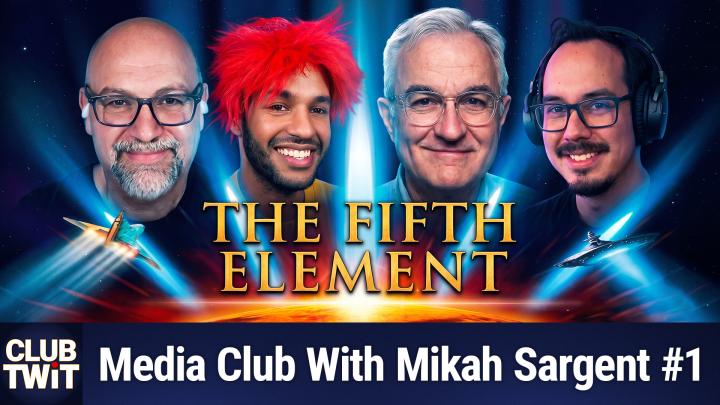
TWiT+ Club Shows 755 Transcript - Media Club With Mikah #1
Please be advised that this transcript is AI-generated and may not be word-for-word. Time codes refer to the approximate times in the ad-free version of the show.
Leo Laporte [00:00:00]:
This is Twit. Hello.
Mikah Sargent [00:00:04]:
This is Media Club. The long awaited, long promised, and finally here, show where we watch, listen, consume different forms of media and talk about them here in Club Twit. First and foremost, thank you to all of you who are members of the club. If you are watching live right now, we do have a link somewhere that you can use to join the fun. But in the meantime, I hope that you are here after having watched the film the fifth element from 1997, because that is what we're talking about today. It's why my hair is red, and it is why my shirt is multiple colors in honor of the film. But this is a film that, for me, I can remember watching it the first time and going, what am I watching? And then going back and watching it again and watching it again and watching it again and going, oh, I see. What.
Mikah Sargent [00:01:05]:
What. What's going on here? This is. This is something I could get into, but I wanted to kind of start. We have at least two others here right now. Leo will be joining us as well to kind of discuss just general feelings before we kind of get into the plot breakdown. I'm curious to hear what was your first. Your first exposure to this film? How do you feel about this film? And, Joe, as one of our club members, let's start with you.
Joe Esposito [00:01:37]:
Yeah. This movie. I remember my father had made the basement of our house at the time when this movie was available. Because I didn't see this in the theater, I really didn't know who Luc Bassam was. I didn't really get into his filmography till later. But when it came out on home video, my father had converted our basement into basically a media room. And so he had a row of, like, he built a shelf of movies, and he had a nice TV at the time, and we put this thing on. And I don't think he knew what it was either.
Joe Esposito [00:02:04]:
He was definitely not as much of a fan as I was. But, you know, number one, I'm a visual artist. That's my background. I love art. This movie is just a rich visual tapestry for your eyes. There's a lot of great sound design. It's just such a beautifully constructed movie. Even beyond the basic plot structure and everything else.
Joe Esposito [00:02:25]:
It's just magnificent to look at. And on top of that, I. There's an Italian concept. The Italian for it is Coppo di Fulmini. And what most people know it as is the Thunderbolt. Now, normally, when you hear that, said it by Italians, it means love at first sight, but that's not strictly what it means. And when I saw me on this film, bang, nailed. And she became like my muse, like somebody that I just looked at and, like, her eyes just capture me and I just.
Joe Esposito [00:02:56]:
She's great. She's great.
Mikah Sargent [00:02:58]:
Apparently, you're not alone, because that seemed to happen to the director of this film as well. She became his muse. That was one of the fascinating things about this, is that this was sort of a passion project for the director. I'm very bad at French. Is it Besson, do we know?
Joe Esposito [00:03:17]:
I believe it's Besson, Yeah.
Mikah Sargent [00:03:18]:
Luke Besson.
Joe Esposito [00:03:19]:
That's why I've always heard it.
Mikah Sargent [00:03:20]:
And, yeah, he wrote this originally as a novel at like 16, 17 years old, and then ended up releasing it much later. And we'll get into a little bit more about some of the characters and their relations to each other. But it was funny you brought up the Italian phrase. I didn't realize how French this film was and how much of it was not just French cinematography and French filmmaking, but also French artistry, French crafts, crafting. It's very, very, very French, which I think is really cool. But again, going back to having that moment of seeing her, because it takes a while for her to get there. So did you originally. How much knowledge did you have about it leading into it? And did Bruce Willis appearance, you know, oh, there's Bruce Willis.
Mikah Sargent [00:04:22]:
Did that sort of shape how you thought the film was going to go?
Joe Esposito [00:04:26]:
Well, my primary interest was I knew Mobius was involved and Mobius is a magnificent illustrator. If you don't know who that is, I will mispronounce his actual name. But if you look up artist Mobius, you will see his work. He was influential in heavy metal, in many films. Jodorowsky's, if I'm pronouncing that right, Dune, he did the original designs for. And he and Jean Paul Gutierre, which I'm also probably mispronouncing, who is a fashion designer, were really responsible for making this film. My interest was from Mobius because I had gotten really heavy into him because I was young and stupid, thought I could ever get close to being as good as he was. And I was really just consuming his work.
Joe Esposito [00:05:03]:
And I had read that he had been working on this and done all this type of design work, and that was really it. Bruce Willis, though, now that you mentioned him, I think this is one of his funniest roles. I actually think his comedy work in this, some of his line delivery, some of his physical acting is sensational. Like when his mother calls him he goes, yes, yes, yes. Like, just the face he makes and the way he says it. And then when he gets conked on the head and falls. Because a lot of people have said both about Bruce and Mila, that their range is limited, which I think is bs. It just.
Joe Esposito [00:05:32]:
They made a lot of movies that didn't make them have a lot of range.
Leo Laporte [00:05:35]:
Yeah.
Joe Esposito [00:05:35]:
But this is, I think, one of the funniest things I've ever seen him in. So that was definitely an appeal because I like them anyway. But it was really Mobius. Mobius got me to this movie. And then I just. I didn't know anything about French filmmaking, any of this stuff, and I was just blown away by how much was packed into every frame of it. And I just love it. It's just great.
Mikah Sargent [00:05:52]:
I want to talk more about the packing aspect in a moment, but, Anthony, I wanted to give you an opportunity to also answer that question, if you can remember when you first saw it and sort of where it is on the scale of, like, to dislike.
Anthony Nielsen [00:06:09]:
I couldn't. I tried to remember how I first watched it, and it's definitely not in theaters. You know, it might have been, like, on one of, like, you know, on cable and one of the movie channels and then later on, you know, repeats when it was like, kind of. Or when, you know, when. When it would show up on other networks later. But yeah, like, just the. The. The design of the city and stuff like that really kind of captivated me and stuff.
Anthony Nielsen [00:06:42]:
And then I happened to re. Watch it last night just for this event. And, like, it's been a long time. I think I was more enamored with it back as he, you know, when I was younger.
Mikah Sargent [00:06:54]:
Oh, yeah.
Anthony Nielsen [00:06:55]:
But like, what, like, it's a. You know, I enjoyed it, but it. I don't think I have the same feeling now as I did back when I was younger.
Mikah Sargent [00:07:03]:
Interesting. Yeah, yeah, yeah. No, that makes sense. I find that interesting because usually it feels like what our instinct to do is to reinforce beliefs that we hold.
Leo Laporte [00:07:16]:
Right.
Mikah Sargent [00:07:17]:
And so, you know, if you go into it, oh, I have this positive feeling about this film. You're kind of looking for those moments that you had. And I think it is rare to wear rarer that you go back and you go, actually, because another movie, the Princess Bride, obviously my awareness of social understanding has shifted, and that makes that film a little bit more difficult to enjoy. And so that's one of those rare films that I went back and went, oh, man, I don't have the same feeling about this now. That I did then what I like about this film now, going to what you were saying, Joe, this idea of things being packed in. I did not know before I started researching for this that Luc Besson had come up with this idea as a kid and had carried it through for so long, and that this was such a passion project. But I think that that is what I subconsciously enjoyed about this film. It's got a magnum opus feel to it in the sense of, there are things that I want to do.
Mikah Sargent [00:08:32]:
The director. There are things that I want to do that I want to see, that I want to put out there. And we're gonna make sure that this happens. And those little moments I find really enjoyable. Sometimes you'll see it in novels where there'll be a character who has an aside. I can't remember which book this was, but there was a book where the main character was talking about the word decimate and how its original definition is tied to Des or Deca and has to do with a very specific destruction. Not sort of whole scale destruction, but how it's changed over time. And this.
Mikah Sargent [00:09:14]:
This character spent a long time complaining about decimate and people's modern usage of the word. And I'm thinking in my head, wow, that's an author who finally gets the opportunity to have some other people captive audience listening to what he's saying. And he's got a problem with. With the use of the word dec. And there's something kind of enjoyable about that where you go, you're making a statement here, or you have had this experience and you really wanted people to see it. And I think that, Joe, that. Because there's no reason that that mom scene, mom on the phone scene needed to happen. Like, it doesn't.
Mikah Sargent [00:09:50]:
It is a little bit of character work, yes, but it is not a. The plot did not have to be driven by that. It could have been that he heard things on the radio. It could have been some other way. But the humor of a mom that calls and makes you feel guilty because you never call her is something that many of us can relate to. And so having that in the film felt like one of those moments where Besson said, you know, I'm gonna check this off. I'm gonna make sure that this is part of it. And I just love that from the start of the film, throughout, listen, we're telling a story, and we're gonna make sure that this story gets told and that all of the little pieces are put together.
Mikah Sargent [00:10:31]:
I mean, it starts out in 1914 in Egypt, and we get to see this, get built out. Each of the characters, even the people who are helping to reflect the light, we learn so much about them in that moment. There's time taken and I don't see that as much in a lot of modern media. This time that's taken to give everybody room to breathe and put their story forward. And there's, there's craft to that that I really appreciate from this, from this film. And I wanted to ask you, Joe, as someone who is definitely, I think you would say, a cinephile. Is that a French thing or where do you, where does that come from, do you think?
Joe Esposito [00:11:16]:
Well, it does, it does feel European in some ways. Because European films tend to take more time. They can be extremely long and they don't care if you are. A lot of the movies I love the most that are not American, don't care if nothing's happening, because what they want is for you to take something from them. And when this movie came out metal, her lot, which became heavy metal when it got moved to the UK and then the States, was highly influential. And it was a lot of this type of work. Just beautiful, weird artists just telling strange stories. No care if it had a commercial appeal or not.
Joe Esposito [00:11:51]:
They didn't care if they were longer or shorter. Some were in segments, some were a couple of pages long. And this does feel like an expression of that sensibility because when the, when the creatures first show up at the, at the, the Egyptian or wherever it's supposed to be, I just assume Egyptian. But at this, where the secret layer is, they are weird looking, clomping, big metal things that never get an explanation. Then later you see them in their spaceship and two of them are vertically, like upside down.
Mikah Sargent [00:12:21]:
Yeah.
Joe Esposito [00:12:22]:
And there's no explanation. These movies don't care to explain every detail. Which I think is something that American films often trip on is you have to stop and have a character with a chalkboard who has to spend five minutes explaining, well, they travel this way because of inertial G forces when they enter the atmosphere of a low level M class planet. Just so everybody's on the same page. Who cares? It looks weird and it's beautiful. Just shut up and enjoy the movie. That's what this feels like, is we're just going to throw visual wonder at you. And later you will appreciate it through repeated viewings and looking around and seeing all this stuff and coming up with your own reason why we have a lack of imagination that, you know, movies try to take it all away and explain everything, Put your own Thing in there.
Joe Esposito [00:13:05]:
Why are they upside down? You tell me. You're just as right as anybody else. That's what makes these movies great. That's what I love about it.
Mikah Sargent [00:13:11]:
Now, Leo. Leo is here now. And I had asked the other gentleman here about if. Rather if they remembered the first time they watched this film and what that experience was like, and then now watching it back. If you feel like your appreciation of the film has changed at all. Before we get into the bigger spoilers, I'm curious to hear about it.
Leo Laporte [00:13:35]:
I've watched this so many times, I don't remember the first time I saw it. I doubt it was in a movie theater. It came out in, what, 97.
Mikah Sargent [00:13:44]:
Yes.
Leo Laporte [00:13:45]:
So. But I was a Luc Besson fan from before then. I'd seen a very strange movie he did in 88 called the Big Blue or deeply the Big Blue. What a great people who hold their breath for competition.
Mikah Sargent [00:14:00]:
Oh, is it a documentary?
Leo Laporte [00:14:02]:
No, no, it's a beautiful film. Yeah, he was definitely a stylist. And then I loved Lafam, Nikita, the French version, the. That was later made into an American movie. But that was interesting because its pacing was so frenetic. I was a fan of. You mentioned Metal Hurlan or Heavy Metal magazine as it was when it came out in the United States. I was a real fan of Heavy Metal.
Leo Laporte [00:14:28]:
And Mobius, who was the artist who was most famous. And of course, Mobius did the art direction for this. So I. Combining all those elements, Luc Besson, Moebius, I was gonna love the picture no matter what. Then you add on top of it, Gary Oldman, who. It may be one of the most memorable performances of a villain I have ever seen. Bruce Willis, who adds a great amount of kind of levity and fun to it. It is actually a variety of movies because you have this.
Leo Laporte [00:15:06]:
This crazy character played by. Is it Chris Rock?
Mikah Sargent [00:15:09]:
Chris Tucker.
Leo Laporte [00:15:10]:
Chris Tucker, rather. Yes. Who? I mean, it's really a bunch of different movies in one. It's the Mummy, it's Time Bandits. It's crazy. I mean, Chris Tucker is incredible in it. Gary Oldman. Well, I don't want to get any spoilers, but all in all, I've seen this movie many, many, many times because it's always been one of my favorites.
Leo Laporte [00:15:38]:
And it's also a great sci fi movie because of the future. It imagines when Chris or Bruce Willis is a cab driver and when he jumps into the traffic in his cab. It's incredible. It's just an amazing scene. So there's so many good elements in it. There's so much good comic elements in it.
Mikah Sargent [00:16:00]:
Yeah, I agree.
Leo Laporte [00:16:01]:
And the music is great. I loved the diva.
Mikah Sargent [00:16:04]:
Yes. There's so much lore with the diva that I'm looking forward to getting to. I wanted to sign up.
Leo Laporte [00:16:09]:
I heard you correct me, and you're right, I forgot it wasn't sister, it was wife. Until he met Mila.
Mikah Sargent [00:16:15]:
But anyway, yeah, that got wild. But speaking of the music and the artistry, that is such a big part of this, again, this passion project that ended up becoming so important for how he put it forward and who he hired.
Leo Laporte [00:16:34]:
Wikipedia says he started writing it when he was 16.
Mikah Sargent [00:16:37]:
16 years old, yeah. And it was his sister. Now, this, of course, is Whether this is 100% true or not, I'm not sure. But the story goes that he was working with his sister on some homework, and it was Plato who inspired the idea of these multiple elements, of which one was the human element.
Leo Laporte [00:16:57]:
That kind of makes sense.
Mikah Sargent [00:16:58]:
Yeah. He said that he stole that directly, but again, whether that's one of those things that gets added afterward, we're not 100% sure on. In any case, let's go ahead and get into it. So if you have not watched the film yet, what are you doing here? Go watch the film.
Leo Laporte [00:17:12]:
Go watch it, because we're gonna break
Mikah Sargent [00:17:14]:
into the actual plot of it. So as I mentioned, it starts out 1914. We believe in Egypt, and we see a scientist, a professor, working on hieroglyphs, sort of trying to understand what they mean. And what ends up happening is not long after he discovers what's going on, we start to see, oh, the guy that's here with him, this sort of priest like character is trying to poison him. And then aliens suddenly arrive and touch down. And this is what I wanted to ask you all because something that ended up being this was the outset. 1997, especially at the end of the 90s, was the outset of really getting into a lot of cgi. And Besson specifically said, I want to do this old school style as much as possible.
Mikah Sargent [00:18:05]:
And that ended up costing a lot more money. The budget, around $90 million. But watching it back, for me, that I really enjoyed seeing those practical effects, because when I'm watching a film, part of it for me is picking apart how they did this, how they did that, and seeing this robot sort of alien creature come walking forth looking like a Jim Henson, you know, creature was really exciting. Did you. Did you find that the inclusion of practical effects just sort of felt comfortable to you? You were at home with that. Did it stand out to you at all? And what did you think about the touches of cgi?
Anthony Nielsen [00:18:47]:
You know, watching it now, it seems like they hit the perfect balance of practical and cg because they use it all types of methods and it still really holds up well, like having, like, you know, the city has, like. They use, you know, bigotures for New York then. But you saw the CG cars and stuff like that.
Leo Laporte [00:19:08]:
I think the song is a film buff would be my guess. And I think that the movie is filled with allusions to other movies.
Mikah Sargent [00:19:17]:
Yes.
Leo Laporte [00:19:17]:
The whole Egyptian part is definitely Indiana Jones. Right. So you start in the movie and you're in Indiana Jones and you're thinking, oh, this is not what I thought it was going to be. And then you zip forward to the future with flying cars. I have to say, the things that most stick with me are not the effects at all. They are little, very human scale things. Like Bruce Willis is trying to quit cigarettes and he gets a little vending machine and gives him a cigarette that's this big. It's all filter.
Leo Laporte [00:20:00]:
I mean, it's little things like that. Or him or Mila getting made into his bed and then she's freezing or. No, I guess she goes in the fridge.
Anthony Nielsen [00:20:10]:
She's in the shower.
Leo Laporte [00:20:12]:
Shower.
Anthony Nielsen [00:20:13]:
The priest goes in the bed and then the military people end up in the fridge.
Leo Laporte [00:20:17]:
Yeah.
Joe Esposito [00:20:18]:
I love the General Blade Runner. That's Brian James. That's who you're talking about. The big guy.
Leo Laporte [00:20:23]:
Exactly.
Joe Esposito [00:20:23]:
He's a genre veteran.
Leo Laporte [00:20:25]:
Right. And he's a great character actor who has this small role, but it's a wonderful role. Was he a replicant in Blade Runner?
Joe Esposito [00:20:33]:
I think he was.
Mikah Sargent [00:20:33]:
Yes, he was.
Joe Esposito [00:20:34]:
What's his name? Leon. I think it was Leon in that, which is also a Luc Besson film, not the professional watch. Leon.
Leo Laporte [00:20:40]:
That's Leon.
Joe Esposito [00:20:42]:
Just as a tip for everybody, I
Leo Laporte [00:20:44]:
think Gary Oldman with his plastic hat and just a little bit of blood going down when he's talking to the aliens. I will never forget.
Mikah Sargent [00:20:54]:
Yeah.
Leo Laporte [00:20:55]:
The demonstration of the gun is unbelievable. Now, that's special effects, but, boy, were those well done. I don't think those are practical. I think that's got to be cgi.
Mikah Sargent [00:21:08]:
The replay moment, right? Yeah.
Leo Laporte [00:21:09]:
Where he replays. Yeah.
Anthony Nielsen [00:21:11]:
But I agree with Leo. Like, you know, I think these vignettes, it's all the, like the little, like, quirky moments when it's not really taking itself too seriously is when it's really shiny.
Leo Laporte [00:21:21]:
I agree. Yeah.
Joe Esposito [00:21:22]:
And when even the opening. The opening with the music where there's that low thrum that's of the music, the soundtrack. You're just seeing these asteroids and you really don't know what it is.
Anthony Nielsen [00:21:32]:
Right.
Joe Esposito [00:21:32]:
So as Leo said, you get into Indiana Jones with America's sweetheart Luke Perry, which at the time he would have been the biggest person in the country because of 90210. So I'm sure that was partially.
Leo Laporte [00:21:41]:
I missed that. You're right.
Joe Esposito [00:21:44]:
I would assume 97 audiences in 97
Leo Laporte [00:21:47]:
had a whole different appreciation of what's happening here of that cast.
Mikah Sargent [00:21:52]:
Yeah. Huh. Speaking of the cast, I want to talk about this too because it's kind of interesting. Corbin Dallas, of course, played by Bruce Willis. There had been some other suggestions. Originally they weren't going to do a well known actor for the lead role. It was going to be a lesser known person that they could save money again, $90 million. Willis ended up doing it after reading the film, but Mel Gibson was apparently considered.
Mikah Sargent [00:22:21]:
Sylvester Stallone was also considered for this. I cannot imagine Sylvester stuff.
Leo Laporte [00:22:27]:
What was great about Willis, who was a star at the time from Moonlighting is he was a romantic lead and he had this great kind of tongue in cheek style about everything he did. It was always. Even in Die Hard, it was always like he's got a little smirk, a little smile and it's just he's always never taken anything seriously. Stallone would have been. It would have been too serious. Gibson would have been too serious. You needed, and I think Bessant did the perfect casting. You need somebody who added a comedic element to it.
Leo Laporte [00:23:01]:
And when Mila falls into his cap and they're driving, it's Keystone Cops. It's broad comedy.
Joe Esposito [00:23:14]:
Bruce Willis is a lot like Roddy, Roddy Piper was. And they live in the blue collar believability.
Anthony Nielsen [00:23:19]:
Yes.
Joe Esposito [00:23:19]:
You could buy the character in the role and Stallone, you would never have seen a hulking muscle man that would have operated that way.
Leo Laporte [00:23:27]:
It wouldn't have been the same.
Joe Esposito [00:23:27]:
Bruce Willis had that perfect middle ground where you bought him as an action guy. But also you could just see him having a beer and having a terrible day and it was just equal weight.
Mikah Sargent [00:23:36]:
Yeah. Yeah. And let's. We can kind of fast forward to that because the aliens arrive. We've got there. Yes. They promise that, hey, we're going to come back in 300 years. We're going to bring this weapon right now.
Mikah Sargent [00:23:48]:
We don't really trust you humans to have it. The things are about to get bad. Some sort of evil entity appears 300 years later.
Joe Esposito [00:23:57]:
Ish.
Leo Laporte [00:23:58]:
Gary Ullman Zorg, right?
Anthony Nielsen [00:24:00]:
Yeah.
Mikah Sargent [00:24:00]:
Gary.
Joe Esposito [00:24:00]:
It's called Mr. Shadow or the Dark Planet. It's never given a real name.
Mikah Sargent [00:24:04]:
Yeah, Mr. Shadow's the closest that we come to it. And so it speaks to Zorg. And that is the same time where we see those aliens come back. But one of the most important scenes in the film, after the ship gets shot down, we think, oh, no, it's all over. I love that we have the technology at this time to take just a hand, maybe with a little bit of forearm juice on there, put it into a machine, and replicate an entire human body or body from it. That is where Mila as Leeloo appears.
Leo Laporte [00:24:41]:
She's wrapped in the skimchiest costume in history.
Mikah Sargent [00:24:45]:
Yes. And in fact, Mila said at the time that they didn't do padding underneath and that it ended up causing, when she was inside that thing, some bruising along her back as she was sort of flail coming back to life. But it was her idea to do These sort of 3M bandages for this part. Yeah.
Leo Laporte [00:25:07]:
Versus being exploited.
Mikah Sargent [00:25:09]:
Yeah, exactly. At that point.
Leo Laporte [00:25:12]:
She was a rock star at the time, Right? Was she model at the time?
Mikah Sargent [00:25:18]:
And this is. We haven't seen the Diva yet, but we'll get to the Diva. But the whole idea of this being a model, of her being a model, plays into things as well. Corbin Dallas is this cab driver that somehow ex Special Forces, down on his luck. Now, that is also believable. I think that Bruce Willis is this totally. I have a particular set of skills.
Leo Laporte [00:25:44]:
He's world weary. Yeah, he's world weary. His life is going like crap. He's got how many points on his license?
Mikah Sargent [00:25:51]:
I love the points system. That's so great.
Joe Esposito [00:25:56]:
Also, his name is Finger, and he's got a little finger ball hanging from his. I don't know if you noticed it from the mirror. There's a little ball of fingers. All that little stuff that I eat up where I'm like, ah, that's a ball of fingers. And his boss's name is Fingers.
Leo Laporte [00:26:07]:
This is Besson, and this is why he's a great director. There is so much detail. There's so many vignettes in here. The way Mila teaches herself English is marvelous. I mean, there's just so many wonderful things. And of course, the priest, who's the actor who plays the priest. He's also home in Home in home.
Anthony Nielsen [00:26:28]:
Yeah.
Leo Laporte [00:26:29]:
Who, of course, you know from the Hobbit. Right.
Joe Esposito [00:26:32]:
Or Alien, depending how old you are. Cause that's what I know. I know him as alien.
Leo Laporte [00:26:36]:
That's right. He's alien.
Anthony Nielsen [00:26:37]:
Yeah.
Leo Laporte [00:26:38]:
I wanted so many great actors in
Mikah Sargent [00:26:40]:
this movie, and they do again. There's room for them all to breathe, and I really appreciate that they all stay with you. I wanted to ask you all, you are Corbin Dallas. You don't know anything about a Fifth Element, anything like that. You're a taxicab driver. You've got a lot of points on your license, and someone falls into the backseat of your vehicle, and the police are after this person. Do you go the Corbin Dallas route of deciding to save this person?
Leo Laporte [00:27:10]:
Yes. Cause she's hot.
Joe Esposito [00:27:12]:
I have a Mila bias, so of course I do.
Leo Laporte [00:27:14]:
It's obvious why she's hot and she's
Mikah Sargent [00:27:17]:
half naked and she's asking for help.
Anthony Nielsen [00:27:20]:
Yeah.
Leo Laporte [00:27:20]:
In a weird language. She doesn't really help, help me, help. So, yeah, she's perfect. It's kind of cool that she's actually. She's not a human. Right, right.
Mikah Sargent [00:27:31]:
She's a sort of. She's like. She's like a fern version of a human. Meaning that she's got way more chromosomes or whatever than she is.
Leo Laporte [00:27:39]:
Is she the Fifth Element?
Mikah Sargent [00:27:40]:
Yeah, she is. I mean.
Anthony Nielsen [00:27:42]:
Well, that's another question. That's another question, too.
Mikah Sargent [00:27:45]:
We'll have to talk about that because different people read that differently. But, yes, certainly her being in the back of the cab and needing this damsel in distress moment, I can imagine a lot of people are going to. Now then, I want to flip it on its head because as you were talking about, the priest kind of finds her and is trying to get her caught up with things. You need to understand our language, our history, et cetera. She learns about war, and that shifts the script where she's thinking, maybe these humans don't deserve to be saved.
Leo Laporte [00:28:23]:
Yeah.
Mikah Sargent [00:28:23]:
Yeah. That is a difficult sort of conundrum that I was glad was included. I think that, you know, that that was part of it. It wasn't just, we found the weapon, we're done, we're goodbye. But that there is more of a moral dilemma there that played into it. It adds an extra little bit of taste, a little layer. Now, I wanted to go into, of course, the way that the government gets Corbin Dallas into the sort of Pleasure Island, Pleasure Planet situation.
Leo Laporte [00:29:00]:
Ruby rocks. Ruby rocks.
Mikah Sargent [00:29:03]:
Finally, by the way, Prince was the original desire for that. Prince said, look, I'm too busy on tours. And also the costumes seem a little too effeminate for me, which.
Leo Laporte [00:29:15]:
Have you seen products really, for wearing panties and garments?
Mikah Sargent [00:29:19]:
Yeah. Like, have you imagine if he had looked down at himself when he said that.
Leo Laporte [00:29:23]:
I find that not credible.
Mikah Sargent [00:29:25]:
I agree. I agree. It doesn't make sense.
Leo Laporte [00:29:27]:
He wisely realized this is too big a role, too difficult a role for him. Only Chris could have done this. Yeah.
Joe Esposito [00:29:35]:
Because you can see the DNA of them wanting him in that role. It's very clever for money.
Leo Laporte [00:29:41]:
But you needed that energy, that buzz.
Mikah Sargent [00:29:44]:
That's why they actually wanted Jamie Foxx first. So after Jamie Foxx. I agree, I agree. I'm so glad they ended up getting it. The reason that they didn't go with Jamie Foxx, he. Well, this is what they say. He was too built. And they wanted someone who looked very small and shrimp like.
Mikah Sargent [00:30:02]:
That's literally what the director said.
Leo Laporte [00:30:04]:
Because he's scared in the gunfight. He's.
Mikah Sargent [00:30:06]:
Yeah.
Leo Laporte [00:30:06]:
Colman, Colman, Coleman come with that. And he's little microphone. I think I also liked it because I was a DJ at the time and I kind of identified with the giveaway.
Joe Esposito [00:30:18]:
Yes.
Mikah Sargent [00:30:18]:
I love that character.
Joe Esposito [00:30:19]:
I did not originally answers.
Mikah Sargent [00:30:24]:
You gotta say something. We were talking in the chat too. A lot of people did not like him the first watch through. And this has been anecdotally I've heard a lot of people say this. I hated that character the first time I saw this film. They watch it back and then they annoying.
Anthony Nielsen [00:30:42]:
I think I agree with that.
Leo Laporte [00:30:43]:
Yeah, yeah, he's annoying. But I.
Joe Esposito [00:30:47]:
When he first showed up movie the Fear, I initially, when I remember watching this first time, I'm like, oh, no, this is going to be a terrible gay stereotype. Is this where we're going with this? And then it's not now at that point, I was like, okay, they're using the voice. The voice is the gimmick. Okay. He's a chicken who has a very shrieky voice. Got it. I'm locked in. We're fine, dj.
Mikah Sargent [00:31:07]:
Speaking of the voice, this is a cool little fun fact. Of course, when a film is made and they want to show it in different places, you can do subtitles, but you can also do voiceover. And so a lot of times they'll have voiceover actors play these different roles. The French voiceover actor for Chris Tucker's character throughout the film used just fine. However, he was not able to hit the high notes that Chris Tucker could hit when he was screaming. So they actually left in Chris Tucker's screams. So those screams are not French. I'll have you know.
Mikah Sargent [00:31:41]:
They are the original English from Chris Tucker.
Leo Laporte [00:31:43]:
Remember, Luc Besson is French and his first few movies were in French. And he. I think he wanted to make this in France, but they. No French company would pay for this, right?
Mikah Sargent [00:31:53]:
Yeah, no French company would pay for it. And we're very fortunate.
Leo Laporte [00:31:56]:
We're very fortunate. I agree.
Mikah Sargent [00:31:59]:
They also had trouble finding locations in France that were big enough for the sound stages that they needed. The number of soundstages they used is one of those details that gets argued. But we believe it's between seven and nine different soundstages that they built out for this. Arguably, one of the most iconic moments in this whole show is the introduction of the diva who performs the legendary aria. And anytime I show this film to someone new, that's the moment where I look away from the screen and my movie is watching the person watch the film and see this aria. It was written to not be possible for a human to sing, given the need to go between high and lower notes very quickly. Now, there is, of course, this idea out there that the singer was able to hit all of those notes. I have to say I'm sorry, but that is not correct.
Mikah Sargent [00:33:06]:
What?
Joe Esposito [00:33:08]:
Come on.
Leo Laporte [00:33:08]:
Mariah Carey could have done it.
Mikah Sargent [00:33:10]:
If it was only Mariah Carey who did this, then you know what? Probably would have been fine. But in this case, what's really neat is that the person. Because the person who performs as the actor on stage is different from the person who actually sang. So on screen, the blue tentacled woman is a French actress, and the voice is an Albanian woman named Inva Mula, and she was the one who sang it. And they were actually surprised at how much she was able to sing 60% of the song. But they ended up having to kind of cut things together to be able to get the notes to work. Interestingly, too, it turns out that the director was originally married to the actress who played the diva. Ended up leaving her for Lilu, and they were married for a few years before.
Leo Laporte [00:34:10]:
Just a couple of years. Yeah, yeah, yeah.
Joe Esposito [00:34:13]:
But tell me, European approach to relationships can be more fluid than American. So perhaps it was not a big deal other places.
Mikah Sargent [00:34:22]:
What do we think about the. The aria? And I think, more importantly, you were talking earlier, Joe, about how sometimes people end up getting little bits of. Through osmosis. Right. And they don't necessarily know the original. I know a lot of people who know about this diva who don't know anything about the fifth element. How does that. How does that resonate for you? Or perhaps not resonate for you? Is it a frustrating thing when someone doesn't know the original content? Or are you just happy to see something that you like out there in the world.
Joe Esposito [00:34:57]:
No, I don't take that hostile. You don't know this. So I have to talk down to your approach. I would rather have somebody. I'd rather convince somebody why they should see the rest of it. That's my approach, is I'd rather bring you into it than yell at you because you're not aware of it. However, the funny part about this is because I agree with you, a lot of people. And I don't know if it's just that it was clipped a lot or something or it was a big deal when it happened, because a lot of people, I remember saying, oh, yeah, that's the one with the blue woman who's singing.
Joe Esposito [00:35:21]:
And then there's a shootout or something, and they hadn't seen the rest of it. And I hate that scene. That's the one part of this movie I do not like. I think it's so. It's too engineered for what the rest of the movie is. For me, I'm not shootout or the aria. I don't like the cutting back and forth where she's beating people up in time to the music. That just feels like something out of a TV show to me.
Joe Esposito [00:35:45]:
Again, that's just me. If you love it, love it. I'm not trying to criticize anybody's enjoyment of any media. For me, that's the weakest part of the movie. I just want to be like, okay, can we just get to the. The rest of. Of it now? Because I would have rather seen the whole fight scene with Mila beating everybody up. And then we could have had the aria, and we could have watched the reaction, all that stuff.
Joe Esposito [00:36:03]:
But the cutting back and forth is what bothers me. And I don't know why, but there's something about that where I'm just like. My teeth just start to grade a bit, and I'm just like.
Leo Laporte [00:36:11]:
I understand that. I do understand that. If the music weren't so sublime, maybe that's what distracted me.
Anthony Nielsen [00:36:18]:
Well, there's like, the. The opera has, like, two parts, right? It's like the first calm part.
Mikah Sargent [00:36:23]:
That's the chill, and then it picks up, and that's when.
Anthony Nielsen [00:36:25]:
That's when the action hits.
Leo Laporte [00:36:26]:
Yeah.
Anthony Nielsen [00:36:27]:
I don't know. I mean, the movie does have. Well, they do it more for jokes, but they do do a lot of things where they're cutting between parallel story lines that, like.
Leo Laporte [00:36:37]:
Right.
Mikah Sargent [00:36:41]:
I'm trying to find a way out,
Joe Esposito [00:36:42]:
like with the case and the cutting back and forth. Yes, but that all works because it's jokes. So it's the. That's really.
Anthony Nielsen [00:36:47]:
It's usually with a joke.
Joe Esposito [00:36:49]:
Yeah, that's really good.
Leo Laporte [00:36:51]:
Remember, Besson likes action. I mean, La Fam Nikita is all about combat and action, and so I think he has a kind of a penchant for that kind of story. I'm not a big fan of gunfight action scenes at all, so I kind of agree with you, Joe. Although I felt like there was enough fun elements in the gunfight. I loved the music, and I thought it was a very interesting kind of scenario. So it didn't. But it didn't bother me in the way that.
Joe Esposito [00:37:20]:
By the way, to be clear, the singing was beautiful. This is. No. No criticism of the.
Leo Laporte [00:37:25]:
Any of the music in any of
Joe Esposito [00:37:27]:
that part is impeccable.
Leo Laporte [00:37:28]:
It's just a shot.
Mikah Sargent [00:37:29]:
For me, it sounds like it took you out of it.
Leo Laporte [00:37:31]:
Although, like, it's a little Batman comicy, you know, Pow.
Joe Esposito [00:37:35]:
That's what I'm saying. It got a little bit too structured for. Okay. This is very clearly what he's trying to evoke. Yeah, but that's just me.
Leo Laporte [00:37:43]:
I think it was like that a little bit, too, so.
Joe Esposito [00:37:46]:
Yeah.
Leo Laporte [00:37:47]:
Yeah. I don't know. I think. I think Besson is an underappreciated genius, to be honest with you. He's made some bad movies, but this
Joe Esposito [00:37:56]:
one is almost made some great movies too.
Leo Laporte [00:37:58]:
Yeah. This is about as close to a perfect movie as I can imagine. Huh.
Mikah Sargent [00:38:02]:
Interesting.
Leo Laporte [00:38:03]:
Yeah.
Joe Esposito [00:38:04]:
Big Blue are my favorites of his. I think Big Blue is a much more emotional film. You come into much more about the characters.
Leo Laporte [00:38:10]:
Wonderful actor. Yeah.
Joe Esposito [00:38:12]:
I mean, Chopper. No, it's just great. Yeah.
Leo Laporte [00:38:13]:
He's also.
Joe Esposito [00:38:13]:
And this one, as far as sci fi, I think is. I agree with you. This is the best thing he made because, man, oh, man, it's. It's. I have to reach to nitpick this movie, and that's really all I can come up with.
Leo Laporte [00:38:23]:
So I think it's important to kind of put it in its time, too. In 97 is 20 years after Star Trek. I mean, Star Wars. You've had some bad sequels. You know, you kind of. Of comic booky, not so great sci fi. I feel like he wanted to show that genre not as serious as, say, 2001 A Space Odyssey, not as kiddie as Star wars, but he wanted. I think he was.
Leo Laporte [00:38:49]:
It was very much heavy metal. It was very much that. That style. And I just. The art direction in this is incredible. The. The set piece in Corbin Dallas's weird apartment.
Mikah Sargent [00:39:03]:
Yes. God, I love this apartment so much.
Leo Laporte [00:39:05]:
Yeah. So good. And it. It reminds me a little bit of another one of my favorites, which is Terry Gilliam's Brazil, which also had a kind of interesting, almost comedic take on the future.
Joe Esposito [00:39:19]:
That's a movie to put on the list because, boy, oh boy, the discussion around that. Just about the cuts, the two different cuts, the one that they wanted to put out, the ones he fought for, you could do a whole thing on that. But I agree, it does have that feeling.
Leo Laporte [00:39:30]:
Another one of my favorite movies. I guess I like sci fi movies that break the mold a little bit. I don't want to. I loved Alien, but. And I love 2001, but they're so self serious. And this is a sci fi movie that doesn't take itself seriously. That is very much more in the comic book without being comic booky, which I really like. And I guess that one scene that you don't like, Joe, that's the comic book scene for sure, right? That's pure comic book.
Joe Esposito [00:40:00]:
Almost like the Batman comparison is a very good one. That's a very good comparison to what it felt like we're missing. Word of words coming up on the screen.
Leo Laporte [00:40:09]:
He's doing a comic book. Yeah, I guess. When did Total Recall come out? Before then. So there's a little bit of Total Recall in that.
Mikah Sargent [00:40:18]:
The airport scene, because. Yeah, there's some unserious parts in that, for sure.
Anthony Nielsen [00:40:24]:
1990.
Leo Laporte [00:40:25]:
Okay. So I think Besson was very aware of what had come before. And there's homage. It really is homage to Indiana Jones and Total Recall. Yeah, there's.
Joe Esposito [00:40:38]:
And I agree the humor in this is actually very good.
Leo Laporte [00:40:41]:
As I think about it, it's much more of a comedy than I really remember. It
Joe Esposito [00:40:46]:
is burping and his face is starting to change. Great.
Leo Laporte [00:40:50]:
Yeah.
Anthony Nielsen [00:40:51]:
Where everyone's going up to the. The. They're trying to get on the airline is Corbin Dallas. Like there's like four.
Leo Laporte [00:40:58]:
Four different groups push the button and she disappears. The gate agent goes away. Just so many where you go, whoa, that was funny. I just. In fact, now I want to watch it again. I haven't seen it in a while. I remember two guys cleaning off the
Joe Esposito [00:41:12]:
bugs off the bottom of the spaceship for no reason. They just get seen with these two guys and they're high.
Leo Laporte [00:41:17]:
Yeah.
Joe Esposito [00:41:17]:
They're killing the things off.
Leo Laporte [00:41:19]:
Yeah, that's just a random that. But that's very. That's like you're watching Star wars and it's that same. It's that. It's that. That scene in the hangar from the original Star wars, but there's bugs in the wings and they have to kill them. I just love. I think he has a very puckish sense of humor.
Leo Laporte [00:41:37]:
And it's very French.
Joe Esposito [00:41:39]:
That.
Mikah Sargent [00:41:40]:
That's what I've learned, is that it is very French. Some of the things that we can kind of talk about as little Easter eggs. One thing that you may not realize is that Corbin, obviously, the hero, and Zorg, the human villain, never meet in the film. They are never in the same scene. They share no scenes together. They do pass near each other at one point in the hangar, but they never share any scenes. And then the.
Leo Laporte [00:42:11]:
It does feel like two different movies to some. In some respects, there are different movies. In this one movie.
Mikah Sargent [00:42:16]:
Yeah.
Joe Esposito [00:42:16]:
You know, without Ian Holm, it would really feel like two different movies because he interacts with everybody, so he's kind of your. Your interface. But otherwise it. Yeah, they don't even speak. It's not even like Khan, who talked to Shatner, at least on the. On the video screen. They never meet, but these two never even talk to each other at all. There's.
Joe Esposito [00:42:35]:
There's no communication.
Leo Laporte [00:42:36]:
They're not really aware of each other, are they?
Mikah Sargent [00:42:38]:
No, no, no. As a. As a. And also as. I think this is a little bit something that I appreciate as a Dungeon Master is the idea of setting things up that people don't know about and then seeing how things play out. And apparently that's something that Besson likes to do with his actors. For example, the language, the divine language, was not something that they taught Willis about beforehand. And so Jovovich was learning this divine language with the director and spoke it for the first time in front of Corbin in that scene.
Mikah Sargent [00:43:17]:
So Corbin's bafflement there is supposed to be. Is said to be genuine. And then the same thing applies for the. Seeing the diva for the first time. He never got to see what that costume looked like and also didn't know what the performance was going to sound like. So his surprise and delight there was also. But I wanted to ask you all because while I appreciate that as a viewer and hearing about that, if you were an actor, do you think you'd want to be caught off guard in those moments? I've been watching a lot of David lynch stuff lately, and that was his whole M.O. too, was just like, let's see what happens whenever they act against this.
Mikah Sargent [00:43:59]:
How would you. Do you think you'd feel as an actor in this? Do you want to be caught off guard? Do you feel like that's a director who's not taking your credit craft seriously that you couldn't perform if you know ahead of time? I don't know. I just have some thoughts about that. That's an interesting question.
Leo Laporte [00:44:13]:
Yeah. Many directors, many of the best directors are famous for being actor hostile. Alfred Hitchcock was very much so. Kubrick, Stanley Kubrick is notorious for hundreds of takes. It's not unusual. James Cameron, same thing.
Mikah Sargent [00:44:32]:
Oh, I didn't know Cameron did it too.
Joe Esposito [00:44:34]:
He's a workhorse type.
Anthony Nielsen [00:44:35]:
There's a. The Abyss. Like I think there's a documentary about it. It was kind of wild on set.
Leo Laporte [00:44:44]:
So I think a lot of directors are egotists. You have to be because, you know, it's all resting on your shoulders. And I think actors are pawns to a lot of them. They're just, they're like set, direct, set piece, you know, scene pieces. They're not, they're just part of the fabric of the movie.
Mikah Sargent [00:45:01]:
That is funny that you say that, Leo, because another thing that I was reading the story is that there were times where he would go onto the set and grab the actors and physically move them around in the scene. He also didn't like people to run the camera for him. He preferred to do it himself. And he was very, very, very hands on. I think it's particularly makes sense when this was something he'd been working on since, since he was 16. But yeah, I had that moment where I thought, I wonder if I was an actor if I would feel a little upset at the idea that the director thinks I can't bring out the full experience if I don't know about things ahead of time. That's like a lack of trust in my mind.
Leo Laporte [00:45:43]:
I guess my point is that probably actors are somewhat used to it. Yeah, this is not unexpected.
Joe Esposito [00:45:50]:
Lynch is actually to bring up is a good one to bring up because one of the things that actors who work with lynch talk about is that he made them feel like a trusted part of it. So when he would demand something, they didn't take it as a hostile action. He was discussing, he was bringing them in. He wanted to know that, you know, what they needed to know, what they didn't. He let them bring their own thing to it. So it depends, I think largely on how the director handles it. So being moved around, if you feel that you trust the director, that's not a big deal. If you feel like you are being treated like a piece of meat, then I think you're going to start to react to it.
Joe Esposito [00:46:21]:
But if it's more of A collaboration then I think people understand because especially with something like this, I would hope. I don't know, I've never seen anything specific about it, but that he said, okay, this is a really important project to me. This is what I'm going for. I want you to bring what you've got to it. But this is ultimately what the scene's about. So in that, in that instance, if he were to say to Bruce Wells, okay, she's going to be talking gibberish. I'm not going to tell you what she's saying, but she's basically going to be saying something and you're going to react to it with. And I think he improv that I only speak two languages, English and bad English line.
Joe Esposito [00:46:55]:
Which if true, that's great because when somebody's allowed to improv, it does suggest that they're a little bit. Because like Kevin Smith would never let anybody improv. You had to read what I wrote. That's it. You can't do that. Can be grading on an actor who feels like they're supposed to be contributing. So I think the director's way of handling it is what's important. And if it was collaborative, my guess is nobody would have a complaint.
Mikah Sargent [00:47:16]:
Yeah, that makes sense. That makes sense.
Leo Laporte [00:47:17]:
Just playing the trailer, there was some of the. Like the. His cab is very Mobius the way it's kind of a look at this
Joe Esposito [00:47:28]:
ship flying through, shape of it and everything.
Leo Laporte [00:47:31]:
Yeah, I just look at the set design. It's just so much fun. There's so much in this movie. There's so many elements, so many details. It's worth. This is one. I don't really usually watch movies more than once, but this is one the of you can watch over and over again and see so many details. And I think it's okay to play the trailer without the sound.
Joe Esposito [00:47:55]:
Well, even like the scientists in the lab, they have this haircut thing where there's symmetry and attack. Nobody commented.
Leo Laporte [00:48:01]:
It's the future, man. Look at Zorg's haircut. It's the future, baby.
Mikah Sargent [00:48:09]:
Now, I want to talk about at the time, as we sort of round this out here at the time, the reception of this film.
Leo Laporte [00:48:15]:
Oh yeah. How was it?
Joe Esposito [00:48:18]:
Yeah.
Mikah Sargent [00:48:18]:
So it was at the 50th Cannes Film Festival that this set and it did have a record setting party because they spent between 1 million and $3 million to build a screening area of over 100,000 square feet. It had a Jean Paul Gaultier fashion show, a futuristic ballet, fireworks. It also had. You got a swatch watch. And that was your ticket to get in. Apparently, the film really divided the audience. That's a direct quote from critic Mark Kermode. Roger Ebert, three out of four stars, saying, one of the great goofy movies.
Mikah Sargent [00:49:00]:
But it was the Hollywood Reporter who called it, quote, a generic monstrosity. A generic monstrosity. Despite
Joe Esposito [00:49:13]:
it didn't.
Mikah Sargent [00:49:14]:
It ended up that, you know, they spent a lot of money on it, but globally, it picked up, I think, 200 some million dollars. 200. Let me see. I have to find the direct.
Leo Laporte [00:49:26]:
Well, Michael, in our YouTube chat, says he still has the collector's swatch and case. Oh, no way. He remembers meeting Luc Besson, showing it to him. He says, but we ended up mostly talking about. About the Deep Blue and actors Gary Oldman and others, instead of about the.
Joe Esposito [00:49:44]:
Extraordinarily envious of that.
Leo Laporte [00:49:46]:
I am so envious. You're very fortunate, Michael. Did you get it in. Did you get it in Cannes?
Anthony Nielsen [00:49:53]:
Yeah.
Mikah Sargent [00:49:53]:
How'd you get it?
Leo Laporte [00:49:54]:
Wow. Yeah, I can see how the reaction to this. This is one of those movies that's a cult classic that you can tell was ahead, like, not understood when it came out. You can really tell that I'm not absolutely at all.
Mikah Sargent [00:50:07]:
I think I feel like they knew that it wouldn't be.
Leo Laporte [00:50:09]:
Yeah.
Mikah Sargent [00:50:10]:
Quite understood at. At the time as well. And that was okay. Maybe that's what I like is a film that says it's okay if not everybody's going to get this and we're gonna. We're going to do what we're going to do. We're not going to go lowest common denominator with everything. Because, yeah, if there's one thing that I would expect would be left out, the thought of an arguably very effeminate black man would immediately, at the time, cut out a certain bit of the audience. And then you have near nudity in the lead female role, which is going to cut out a certain form of the audience, maybe also draw in another form of audience.
Mikah Sargent [00:50:59]:
But there are just choices that are made throughout this film that. That I'm going, you know what? I'm glad that you chose to do this regardless of how this was going to play out. And I suppose there is something to be said for the fact that it launched at Cannes despite being the most expensive European film ever made at the time. He always saw it as something that belonged there as a piece of art, as opposed to being, you know, a blockbuster.
Joe Esposito [00:51:24]:
That's right. Interesting.
Leo Laporte [00:51:26]:
Go ahead.
Joe Esposito [00:51:27]:
Sorry. Go ahead.
Leo Laporte [00:51:28]:
I'm just gonna say that's why it doesn't surprise me that he was rough on actors because you have to have a massive ego. Just belief in yourself to do this, to spend that money to make this movie. And God damn it, I'm so glad Luc Besson exists, because what a gift. What a gift he gave us with this movie. It's just the art direction alone.
Mikah Sargent [00:51:53]:
I want so much of it. I want all of it.
Anthony Nielsen [00:51:56]:
It's $8 on Apple. Leo.
Leo Laporte [00:51:59]:
I think I bought the UHD. Oh, I bought the laser disc of this, actually. I can't remember. I remember I loved it so much. Here comes Ruby Rod, by the way.
Mikah Sargent [00:52:08]:
I want every single one of these outfits.
Leo Laporte [00:52:09]:
I didn't ever think of him as gay. Isn't that funny?
Joe Esposito [00:52:12]:
I never thought he was a. Because.
Mikah Sargent [00:52:14]:
And he's not.
Joe Esposito [00:52:15]:
I always just felt like he's not action oriented. He's a character and they show him with women. He's all.
Mikah Sargent [00:52:19]:
And he.
Joe Esposito [00:52:19]:
He.
Mikah Sargent [00:52:20]:
Yeah.
Leo Laporte [00:52:20]:
Look at him painting these autographs on Theatrical.
Joe Esposito [00:52:25]:
That's just operatic and big and personality.
Mikah Sargent [00:52:28]:
He's the diva.
Leo Laporte [00:52:30]:
That's why I liked it, because it was. He's a dj.
Joe Esposito [00:52:32]:
This is that guy's haircut. That is the best haircut I know. I love it. The half. Yes. All the little stuff. All this little stuff.
Leo Laporte [00:52:39]:
So many details.
Mikah Sargent [00:52:40]:
And look at the set design. I mean, those I've really been into, like, crafter sort of makerspace stuff lately, but because I just did the Ren Faire. And so seeing all the stuff that. And so knowing about how these props are, knowing more about how these props are made and all the work that it takes to put those lines into things, into, you know, each of these costumes having their little pieces that make them feel.
Leo Laporte [00:53:03]:
This is before 3D printers, folks, right?
Mikah Sargent [00:53:06]:
Like this. This is hard work. All of the little pockets on. On his vest that he's wearing there. Good. There's so much to eat in this film. It is packed full of. Look at that.
Mikah Sargent [00:53:19]:
That's like a piece of acetate with printing on it. It's impractical, but it's wonderful.
Joe Esposito [00:53:24]:
And the stewardess or the air flight attendants outfits look like they're made of some kind of styrofoam nylon blend of.
Leo Laporte [00:53:30]:
It's some weird fabric. Look at that.
Anthony Nielsen [00:53:32]:
Look at this.
Leo Laporte [00:53:32]:
Yeah, it's very sexy. Without being in any way revealing or. Everything in. This is very sensual. And it is sensual.
Mikah Sargent [00:53:43]:
That's French, isn't it?
Leo Laporte [00:53:44]:
It's very French. I think it's very French.
Mikah Sargent [00:53:47]:
Yeah.
Joe Esposito [00:53:48]:
You know about this movie that's so particular that I've started to realize I love now as far as art design direction is, like when they do that speckle paint where it's like little pieces of flaky paint, like on the big. The Banda Chiwans have it on their thing. It's all over movies from the 90s and shows from the 90s, and I've realized I've kind of fallen in love with it. I forgot about it. But now when I see that speckle pattern, I'm like, I missed that. Why don't we have more speckle paint on things? It gives it a texture, even if there isn't one. It's great.
Leo Laporte [00:54:14]:
Yeah.
Mikah Sargent [00:54:15]:
Well, I really enjoyed getting to watch this back again, and now I'm gonna watch it tonight.
Leo Laporte [00:54:21]:
I can't. I love this movie.
Anthony Nielsen [00:54:23]:
Wait, before you wrap it up, I got a question. What is the. Is it.
Mikah Sargent [00:54:26]:
Oh, yeah.
Anthony Nielsen [00:54:26]:
Is she the fifth Element or is it. Yes.
Leo Laporte [00:54:28]:
Love or love the Fifth Element, or is love embodied? She's the Fifth Element.
Mikah Sargent [00:54:32]:
She is love. So she's God.
Leo Laporte [00:54:37]:
Well, you know what? I'll have to watch it again to answer that one.
Joe Esposito [00:54:42]:
A contested concept, but I don't think it's love. It's. But she is the Fifth Element. Whatever it is that activates her. That could be anything. It could be.
Anthony Nielsen [00:54:49]:
So he just had to convince her to. He just had to convince her to actually do the thing.
Joe Esposito [00:54:54]:
Yeah. The four things shoot into her. She fires a beam. What else could it be? Everybody. I mean, it's right there. What is this debate? She is the weapon. She fires a bolt of super lightning out of her mouth and blows up a plot or freezes the. The Dark Planet.
Joe Esposito [00:55:09]:
Done. She's the Fifth Element. Come on.
Anthony Nielsen [00:55:11]:
Okay, I just wanted to ask.
Mikah Sargent [00:55:15]:
That's a good question, because remember, she was not going to save us, but when she discovered that she felt love and loved this one person, then that made it worth it for her to be the weapon and save everyone else. So if love is not. If love is not the Fifth Element, then love is the fuse for the Fifth Element in this case. But maybe if we'd never taught her about war, we wouldn't have needed love.
Joe Esposito [00:55:42]:
That's what I think, because she's been activated before. So what? Every time the planet shows up, she's got to find somebody to love? That seems awfully tough to be able to scare up every 300 years. You gotta hope that you can find that person. But maybe I'm getting to it. To the wheat. So.
Mikah Sargent [00:55:56]:
No, no, no, I think.
Leo Laporte [00:55:57]:
Where did she come from? Where did she come from?
Mikah Sargent [00:55:59]:
Where'd she come from? Where'd she go?
Joe Esposito [00:56:01]:
Soon the Manda Chiwen made her because they knew about the Dark Planet.
Mikah Sargent [00:56:04]:
I want a movie or a book or something about the mons. Because I need to know why they get to be the saviors of the universe. What gave them the power? Like, what. What's their.
Leo Laporte [00:56:14]:
Where's she been all this time?
Mikah Sargent [00:56:15]:
And where have she been?
Leo Laporte [00:56:17]:
They made you out of.
Joe Esposito [00:56:18]:
She was. They carded her out. She was frozen or whatever.
Mikah Sargent [00:56:22]:
But that. Isn't that sa.
Joe Esposito [00:56:23]:
Sad.
Mikah Sargent [00:56:23]:
That's a sad existence.
Anthony Nielsen [00:56:25]:
Like, they alluded to that she was like. She's been out for 5,000 years in the show. So that's why she was catching up on history.
Leo Laporte [00:56:32]:
Right, Right.
Mikah Sargent [00:56:33]:
Yeah. So hopefully while she's in that stasis, she's truly in stasis and not living that out, because I think that'd make anyone insane.
Joe Esposito [00:56:40]:
I really hope the Mata Chiwans are tiny little people in giant suits. They're just these little.
Mikah Sargent [00:56:43]:
Oh, my God, I love that idea.
Joe Esposito [00:56:45]:
And they're just piloting a big suit that they clomp around in because they have kind of of like a. We're really short complex. So they built these big, tall suits to be like, yeah, yeah, I love that idea.
Mikah Sargent [00:56:54]:
That's fantastic. All right, so the Fifth Element is your choice there. Yeah. I think this is a great film to go and watch. It's got a lot of rewatch value, which is also. I. I think it's great. I, of course, have been walking around the house just saying multipass a bunch, and that's probably getting us on my significant other's nerves, but I'll keep doing it.
Mikah Sargent [00:57:20]:
Now, this is the part where I remind you all that we have a poll for the next media club conversation. As I promised, when one gets picked, we'll leave the others that are on the list and then add something else. And I have decided to add the first Matrix film to the list, which I just rewatched.
Leo Laporte [00:57:43]:
I ordered Paris convinced me to order the UHD steel box of all four. And I got through the first one. I can't really bring myself to watch the rest.
Mikah Sargent [00:57:55]:
That's fair.
Anthony Nielsen [00:57:56]:
I will. I will.
Mikah Sargent [00:57:57]:
Because we're only going to talk about the first one because at first I thought, maybe I'll do the Matrix trilogy. And I thought, no, that's a lot. So currently on the list, probably the one that'll be the next one we'll see is the one that was in second place last time. Top animated episodes.
Leo Laporte [00:58:12]:
That was a Pretty good one.
Mikah Sargent [00:58:13]:
Yeah, I'm really looking forward to that. I'm gonna try to get Christina Warren on for that since we used to do that show about cartoons then. Perfect days from 2023.
Leo Laporte [00:58:25]:
That was my pick. Yeah.
Mikah Sargent [00:58:26]:
Begonia from 2025, which I was sad to see. So few votes. I really think that deserves. If you haven't seen it, it's amazing. It's really. That's delightful. And then lastly now the Matrix is on there. So we'll keep adding as different ones get picked and we'll be back again with more of Media Club.
Mikah Sargent [00:58:49]:
But gentlemen, this was a great first Media Club with all of you. Thank you for taking the time to share your thoughts on this film and, you know, join us in. In. In Pleasure paradise as we see the diva sing into the night.
Leo Laporte [00:59:09]:
Blotsam Paradise.
Mikah Sargent [00:59:11]:
All right.
Leo Laporte [00:59:11]:
Is that what it's called, Fawkes?
Joe Esposito [00:59:12]:
Yeah.
Anthony Nielsen [00:59:13]:
Flawston.
Mikah Sargent [00:59:14]:
Flawston. That's right. Floston. Which. Where they came up with that name, who knows? But there are apparently a lot of little references throughout, including. I forgot to say the. Corbin's name may have been a reference to. Sorry, where is it? Oh, no, that's okay.
Mikah Sargent [00:59:34]:
Corbin's name may have been a reference to the magazine that you guys were talking about.
Joe Esposito [00:59:39]:
Oh, yeah, I can never pronounce that correctly.
Mikah Sargent [00:59:43]:
No, I can't.
Joe Esposito [00:59:44]:
It wouldn't surprise me. Anyway, I do remember a character named Corbin. You might be right, because now I do think there was a significant storyline around Corbin. Something. Yeah. But I don't remember. I read so many heavy metals, I can't remember all of them now.
Leo Laporte [00:59:56]:
Oh, I read. Read them all when I was in college. Loved them.
Joe Esposito [00:59:59]:
There was so much good artwork in that magazine, it's unbelievable. We launched it and the new one's good, but it ain't like that old one was.
Leo Laporte [01:00:04]:
Well, and it's funny because Alien was also a spin off, come to think of it.
Joe Esposito [01:00:10]:
Let's see.
Leo Laporte [01:00:11]:
Look at the Corbin Dallas is a former Special Forces soldier for the Federated Army. Main protagonist. On retirement, he works as a cab driver for six months until he was fired by Zorg's company. Oh, so he does know Zorg. He's the boss. However, despite being chased by police, the army hired him again to retrieve four stones to prevent evil from consuming the Earth. Let me see if there's any trivia.
Joe Esposito [01:00:34]:
I felt like kind of everybody worked for Zorg. It felt like Zorg was a megacorp. He was running everything.
Leo Laporte [01:00:39]:
The original suitcase that housed the Elemental Stones is a Corbin suitcase. It's a luxury suitcase brand. When General Monroe shows up to hand Corbin his mission, one of the qualities he mentions is, of the members in your unit, you're the only one alive. Yet early in the movie, Fingers says, you've forgotten who sat next to you for a thousand missions. I know you can drive. It seems possible the General was mistaken and there's maybe two members of the unit left. And then finally, during the scene where Leeloo and Cornelius go to Corbin's apartment, Ian Holm mistakenly calls Bruce Mr. Wallace.
Leo Laporte [01:01:17]:
Bruce blithely corrects him, simply saying Dallas in response. Since the rest of the scene went so well, it was decided to leave the blooper in place.
Mikah Sargent [01:01:26]:
That's funny.
Joe Esposito [01:01:27]:
I know. When they blew up that one stage, too, they almost lost control of the fire. I remember them talking about that. That it almost. Yeah, they had a hard time getting it back under control.
Mikah Sargent [01:01:34]:
The largest indoor explosion ever filmed at the time.
Joe Esposito [01:01:37]:
It looks great.
Mikah Sargent [01:01:38]:
And the fire nearly got out of control. Yeah. So the. The name Corbin Dallas is believed to be a nod to heavy metal comic artist Richard Corbin and Leeloo, if Leo wants to tell us the French pronunciation
Leo Laporte [01:01:56]:
there,
Mikah Sargent [01:01:59]:
it's supposed to mean the chosen one.
Leo Laporte [01:02:01]:
Oh, lilu means the chosen one.
Mikah Sargent [01:02:05]:
All right, I think that covers it.
Leo Laporte [01:02:07]:
Grab your multi passes, everybody.
Mikah Sargent [01:02:09]:
Grab your multi passes asses and slap those. Never mind. Everybody.