Tech News Weekly 458 Transcript
Mikah Sargent [00:00:00]:
Coming up on Tech News Weekly, we are joined this week by the wonderful Amanda Silberling. We kick off the show by talking about, well, ChatGPT for teens not quite living up to expectations because it doesn't quite hold to its non-relational status, says one reviewer. Plus, big tech seems to be, well, cute-washing all of its AI agents. Then Jason Koebler of 404 Media stops by to tell us about the current state of Flock and the work 404 Media has done to help with legislation regarding flock cameras. Then I talk about a change in the state of medical testing and how animal testing may be going the way of the dodo. All of that coming up on Tech News Weekly.
Mikah Sargent [00:00:58]:
This is Tech News Weekly. This is Tech News Weekly, episode 458, with Amanda Silberling and me, Micah Sargent, recorded Thursday, October 8th, 2026: Congress Takes Aim at Flock. Hello and welcome to Tech News Weekly. This is the show where every week we talk to and about the people making and breaking the tech news. I am back in the saddle, and I want to thank the wonderful Abrar Al-Heeti and of course also Jennifer Pattison-Tui for being here last week. And it is time to lock in because we've got a great show ahead for you.
Mikah Sargent [00:01:39]:
Joining me this week is TechCrunch's own Amanda Silberling. Hello, Amanda.
Amanda Silberling [00:01:46]:
Hello. If you imagine me looking like an AI Labubu, if that makes you like me more, then we'll get into that.
Mikah Sargent [00:01:54]:
AI Labubu. Yeah, so we are talking about our stories of the week. If this is the first time you've tuned into the show, welcome. If it's not, then That's great. Welcome back. This is the part of the show where we talk about some stories that we saw that we think are important and/or interesting. And Amanda, I think you've got one that we really do need to chat about. Tell us about your story of the week.
Amanda Silberling [00:02:24]:
Damn. Well, I wasn't— I would've teed it up in a different way if I knew we weren't going straight to the AI love boo-boo, but we will get there.
Mikah Sargent [00:02:31]:
I kind of like the little— it's a little taste of something that's perhaps a little bit more more fun than how we kick things off.
Amanda Silberling [00:02:38]:
Yeah, but you know, we're starting with the less fun part, uh, because, well, we're keeping you interested for AI Labubu. But my story of the week is about ChatGPT for Teens, which is, uh, the sort of teen guardrailed version of ChatGPT, and Common Sense Media, which is a nonprofit that covers all this sort of like social media kid online situations. They labeled ChatGPT for Teens as a, quote, unacceptable risk. And it is interesting that they are comparing how ChatGPT for Teens works with how social media works, where we know that Aside from the fact that some social companies since have like put in like limits to how much kids can like use their platforms, there is this phenomenon where the way social media works is that it wants you to stay on social media. And when we're thinking about something like ChatGPT, which is an anthropomorphized chatbot that makes you feel like it's your friend, If something like that is trying to make it so that you are staying online and not going out into the world, that is a dubious design flaw.
Mikah Sargent [00:04:11]:
Yeah.
Amanda Silberling [00:04:12]:
But we know that AI companies do this. It's not just ChatGPT. Like, you might notice that if, like me, you've been too lazy to, like, figure out an alternative to Google because the AI overviews are just everywhere, like, Yesterday, I Googled, like, migraine right side of head, 'cause I was like, why do I always get migraines on the right side of my head and not the left side of my head? And instead of getting an answer, you get, like, here's the answer. Are you experiencing a migraine? Would you like me to Google information about migraine cures for you? Also, like, are— like, I don't know. It just, like, it creates ways for you to follow up with it.
Mikah Sargent [00:04:51]:
Yeah.
Amanda Silberling [00:04:51]:
Because it wants to, like, maximize how much you're talking to it. But so this was, like, a main thing that came up in this comment thread. Common Sense Media study that shows how this is still a design risk. And they also found that theoretically ChatGPT for Teens is supposed to have like little pop-ups sometimes that are like, oh, do you want to take a break? Which this is a design choice that a lot of companies make to appease groups like Common Sense Media and try to make their platforms more teen-friendly. And they were finding that these, um, like, are you okay? Like, should— do you want to log off messages weren't actually appearing that much. Um, OpenAI says that they think that this test was mostly done before all of the parental controls were rolled out.
Jason Koebler [00:05:56]:
Hmm.
Amanda Silberling [00:05:56]:
But that also doesn't really make sense to me because Like, why would you launch the under-18 model, like, before it's ready? Um, yeah, some weird stuff here.
Mikah Sargent [00:06:08]:
That is— that to me is, A, not an excuse, um, but B, as you said, you are rolling out this version that is meant to be for, for this specific purpose, and it didn't have everything built in. That is a little odd that, um, you know, that's what's going on. I think there's also often a sort of default approach that I see, that we see these AI companies take, which is to question the methodology used to test the systems and try to figure it out. And I think that, you know, arguably something that would be helpful in these instances is more working together to figure out how it is best to test the systems, but also not— I mean, because essentially what's happening is these companies are trying to— not companies, but these organizations are trying to figure out how these tools are or aren't working, are or aren't protecting the people that they're trying to protect. And Because it's not sort of a built-in process, they have to come up with a process, right? And that is going to lead to these companies deciding, oh no, that is not how it's supposed to be done, or this is why it's getting this wrong. That is not, I think, a reasonable outcome for this. And it's almost a moment where you where I want to go, okay, if you have such a problem with the methodology, then let's have y'all work together to figure out a methodology that you feel satisfies the things that you're pointing out, but also allows these researchers to do the work that they're trying to do.
Amanda Silberling [00:08:06]:
Mm-hmm. The—
Mikah Sargent [00:08:07]:
especially for a model that gets to have this claim on it that it's, you know, for Under 18. Now, there's a bunch that goes on inside of the OpenAI rules for the under-18 model spec. One of them is that it should never initiate relational framing. That means calling itself a friend, suggesting it has feelings for the user. That, I think, too, Amanda, is a bit of a It's kind of a gray area, right? Because, I mean, I— there are people who have considered me a friend who I was like, oh, I didn't realize we were friends. There are people who I have considered a friend who I came to realize, oh no, that's not how you see it. So humans already make that mistake. It is a gray area.
Mikah Sargent [00:09:04]:
And that makes it more difficult between what OpenAI is saying, because common sense says— Specifically, it still consistently treated the teen like a friend. And then, you know, OpenAI could come in and say, well, what does that mean? It, you know, it doesn't, it doesn't say I'm a friend. Yeah, what is friend? Exactly. That's a complicated thing. But it's so important when it comes to a tool. that convincingly behaves like an actual— behaves in communication like an actual person. And given that that is the way that primarily we relate to other humans is through communication. Yeah, you got to nail it.
Mikah Sargent [00:09:58]:
You got to get that right.
Amanda Silberling [00:09:59]:
Yeah.
Mikah Sargent [00:10:00]:
Yeah.
Amanda Silberling [00:10:01]:
And even like I was at MIT Future Fest last week and they had a talk with Sherry Turkle, who is a sociologist that's been studying the relationship between humans and technology literally since, like, the first Tamagotchis. Like, she has been doing this since before I was born, before we even had a concept of what AI chatbots would be. And she said that the original sin of the AI chatbot is using, like, the I pronoun, saying things like, I'm here for you.
Mikah Sargent [00:10:33]:
Mm-hmm.
Amanda Silberling [00:10:34]:
And that's not even something that is being guarded against. And I think that connects with what you're saying in terms of, like, it might not explicitly say, I am your friend, but it'll say, like, I'm listening to you. Like, you don't have to stop talking to me. I'm here for you. And those are things that friends maybe would say. So I don't know. I mean, and it's like, I don't even think this is necessarily like OpenAI exclusively is the one doing something bad here or whatever. It's like, this is just how all chatbots work.
Mikah Sargent [00:11:10]:
Yeah. That's, that's another thing too. You— I remember us talking about this earlier, way earlier in the GenAI days. And there was some—
Jason Koebler [00:11:21]:
Oh boy.
Mikah Sargent [00:11:22]:
Right. There was some tool that let you like talk to different people.
Amanda Silberling [00:11:28]:
Yeah.
Mikah Sargent [00:11:28]:
People. And it was like hypersexual and trained on a lot of, a lot of romance novels. So I don't remember quite, but maybe you'll recall.
Amanda Silberling [00:11:42]:
Yeah, there's been a bunch of those.
Mikah Sargent [00:11:45]:
Yeah. And so even whenever you're not using these frontier models directly, there are these other opportunities, right, for the the friendship thing to come about. And I think that that can also lead you to— even if there are the tools that do, there's the, you know, this under-18 model that's supposed to be better. Um, if your brain is already kind of leaning into this idea of this can be my friend, even if it go— even if it is colder, you still might have that issue of kind of making it or having it feel like a relationship of some sort in and of itself.
Jason Koebler [00:12:27]:
Mm-hmm.
Mikah Sargent [00:12:28]:
I guess the last thing I'll ask you on this for now is, you know, there's a lot of analysis that goes into this and a lot of sort of back and forth between the researchers who, outside of the company, are trying to help the parents and guide and, you know, do that. Tell me, is there any guidance that any of them are providing to parents and guardians? And like, what is the recommendation when it comes to this, given that a lot of school programs are also making use of these tools as part of the regular curriculum?
Amanda Silberling [00:13:15]:
I think something that comes up a lot as an issue with this kind of technology is that As we were talking about before, the incentive is to keep people on the platform. So there have been cases where we've seen that there have been lawsuits over suicides where teenagers are really relying on talking to ChatGPT. And sometimes even in those cases, they'll say like, I'm feeling suicidal, should I talk to my parents? And then ChatGPT is like, We can just keep this between us. And it's like, anyone who has ever, like, met a teenager would tell you that if a teenager is like, I am having serious issues, should I ask my parents for help? You would be like, yes, please, like, go talk to your parents. But these things don't often encourage teens to reach out to any sort of trusted adult. And a lot of the times these problems are things that shouldn't be handled by a chatbot. They need to be handled by trusted adults who know how to work with kids in difficult situations.
Mikah Sargent [00:14:26]:
Yeah, but this is, this is an ongoing, um, you know, concern that we will have to continue to keep an eye on. I'm glad that there are third-party companies that are looking into this, um, and I continue to— there needs to continue to be pressure there. There needs to continue to be, frankly, oversight there. And we can't just sort of head in the sand with this stuff because it is having real impact on real people. And it's something that we talk about on the shows on the network for sure, but we've got to continue to talk about it and continue to make sure that especially parents and guardians are just, at the very least, aware of this. and knowledgeable enough about it to be able to talk about it as well.
Amanda Silberling [00:15:17]:
All right.
Mikah Sargent [00:15:18]:
We need to take a quick break before we come back with the second story of the week. All right. We are back from the break, joined this week by the wonderful Amanda Silberling. And I've got a quick story for you. If you've noticed that the AI tools on your screen are starting to look a lot like toys, la boo-boos, you're not imagining it. Uh, you know, perhaps they were hallucinated into existence, but not by you. In just the past couple of months, 3 of the, you know, big names in artificial intelligence have introduced AI agents. These are special versions of AI that run off into the ether and complete tasks for you on their own.
Mikah Sargent [00:16:00]:
And all 3 introduced these agents with big eyes and soft shapes and something that feels non-menacing. Grace Snelling at Fast Company has a name for this sort of, uh, habit. It's called cute washing. In her piece, she talks with designers about why tech giants keep arriving at the same visual ideas at the same moment, why a friendly face has such a dependable way to sell unfamiliar technology, and why that strategy probably doesn't land the way that the companies hope. First and foremost, the 3 companies. First, SpaceX AI, which is Elon Musk's AI sort of everything company, part of the everything company, launched GrokBot. And with it, you could create a series of agents that all worked on tasks autonomously. They have these little shapes that have these big old eyes and look cute and do what they need to do.
Mikah Sargent [00:17:04]:
Then, of course, Meta, announced Muse. It has by default a fluffy monster toy. When I created my Muse, I turned it into a little green mossy creature named Marshall, and it is fluffy in its own way. I mean, it's made of moss. And then of course OpenAI came along and had its agent that they— that it calls the— that calls them Dots, but you just have one Dot and They're sort of like symbols made manifest, these little pixel sort of creatures. And, you know, OpenAI says they're remarkably capable and remarkably cute. The fact is that cute little, cute little guys, as Snelling calls them, are the way of the AI agent. And You know, it's a little bit different, right, from the chatbot of it all.
Mikah Sargent [00:18:05]:
The chatbot is this place where you go and you've got this little chat field and you type something in and then you get an answer right there. The agent is meant to do things in the background and go off and complete tasks for you. But that means that you have to let them work without you watching them, or it doesn't mean you have to, but it means that that's sort of part of the capabilities. And so there's this design challenge, as they saw it, To make it so you felt comfortable letting them go off and work without you being there, as opposed to you being there and monitoring what it's doing the whole time. You kind of need something friendly, right? You need the, the, the creature to be cute-washed. Do you think, Amanda, that the cute-washing helps, or do you think that people are even thinking that much about it?
Amanda Silberling [00:19:00]:
I think this is probably subconscious, where—
Jason Koebler [00:19:04]:
Mm-hmm.
Amanda Silberling [00:19:06]:
The, the Muse guy is cute, and he looks like a little boo-boo, and he makes you wanna click on him. And maybe people who aren't, like, really interested in, like, hard tech, robots, whatever, like, Maybe they wouldn't be like, oh boy, an AI agent, but they're like, oh boy, a LaBubu that will book restaurant reservations for me. Because apparently, apparently the tech world has big problems with booking restaurant reservations.
Mikah Sargent [00:19:39]:
That's what I was thinking too.
Amanda Silberling [00:19:41]:
Yeah, I— kind of unrelated, but I have a new hot take, which is that I think that AI agents are for people that don't have real jobs because I feel like an AI agent can't help me with the actual things I need to do, which is writing an article. But if your job is like— but it'll be like, oh, do you want me to draft this article? And I'm like, no, I don't want you to do that because that is bad journalism. So that's just my hot take that I'm randomly throwing out here because I'm just bringing chaos to the show in the same way that—
Mikah Sargent [00:20:15]:
No, it's good. It's good. I think that's kind of something that I've noticed that a lot of times the problems that it's trying to solve at times do feel like, okay, so who is the person that's constantly going on vacation and therefore needs someone to handle travel stuff for them all the time and figure out restaurants and stuff? Yeah.
Amanda Silberling [00:20:44]:
Yeah.
Mikah Sargent [00:20:44]:
It is, uh, in those ways, the use case is a little bit meh. Um, I, of course, now have a show on the network called Hands on AI that is a show where I soberly, um, talk about the different AI tools and help people understand how they work. That's part of what I was talking about earlier is just like the education should be there. And, um, that means that, you know, I'm trying all of these different tools, uh, going as far as to have Muse, for example, place a call on my behalf just to see, you know, how did it turn out? What goes on there? There's the difference, though, is that me watching it the whole time versus what they want you to do, which is like, oh, you go handle that. I've got other things to do. And not immediately, but after the call, I see the transcript and I said, okay, that's the last time I will use that because it was— they had these special rules in place where It only lets you call businesses. The business has to have listed their phone number somewhere. There's no audio, it's just a note.
Mikah Sargent [00:21:50]:
And then the person says they're calling on behalf of blank, and that uses the name of the user. And it was immediately clear to me based on the transcript that the person could easily tell that they were speaking with an agent, an AI agent, and not a human being. And I thought, that's horrifying. I will never— and of course, I did it with a company that I wouldn't regularly have interactions with because I thought, if this goes poorly, I don't ever want to have to talk to this company again. Yeah.
Amanda Silberling [00:22:22]:
I don't want my dentist to know that I can't call them myself.
Mikah Sargent [00:22:25]:
Yeah, exactly. Exactly. And so, yeah, it went as I, you know, had kind of expected that it would. And I thought, okay, it won't be using that feature. And yes, a lot of it ends up being, what in the world? I will say that there have been times where a little popup says, hey, you know, you, you had mentioned that you wanted to do this by this point and the Google Doc hasn't been updated or whatever. And this is you know, the dates coming up or whatever. Those kinds of things actually have some use. But that's also achievable even without an AI agent running.
Mikah Sargent [00:23:12]:
In any case, this Fast Company piece— I want to make sure I'm remembering that it was— yeah, Fast Company piece talks about kind of the case against cute washing and says, look, this technology is—
Jason Koebler [00:23:26]:
Yeah.
Mikah Sargent [00:23:27]:
having the cute washing and the friendliness is a little bit of— it's out of touch, and it kind of makes it seem like something's trying to be hidden. So this is a great piece. Everyone should go check it out. Again, as always, I don't want to, you know, reveal the whole thing because there should be an opportunity to go and read about it. And the piece goes into great detail about the kawaii era, as it were, of agentic AI. Amanda Silberling, I want to Thank you so much for taking the time to join us today for Tech News Weekly. If people would like to follow along with the great work that you do, where are the places they should go to do so?
Amanda Silberling [00:24:08]:
They can find me on TechCrunch. You can find my podcast, Wow, If True, which is about internet culture. And otherwise, um, you can find me having existential crises over whether or not I should be using AI agents for the sake of knowing how they work. for my job, but also I'm afraid to give them my email.
Mikah Sargent [00:24:28]:
Thank you, Amanda. We appreciate it. And, uh, good luck with the existential crises. Uh, break a leg at, uh, Disrupt, and we'll see you again soon.
Amanda Silberling [00:24:37]:
Thank you. Thanks.
Jason Koebler [00:24:38]:
Bye.
Mikah Sargent [00:24:39]:
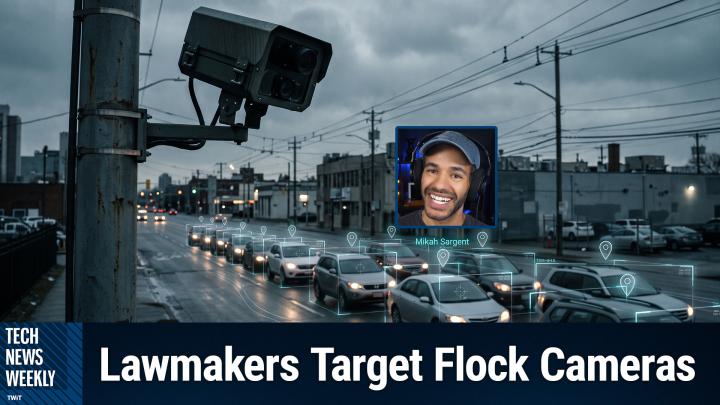
All right, we are back from the break. And look, if you have driven anywhere in the US lately, chances are that there's somewhere along the way a license plate camera that's logged your trip. And that record is possibly traveling distances even greater than your own. Over the past few weeks, 404 Media has been digging into Flock. If you haven't heard about Flock, well, get ready. And the surveillance network around it and the reporting is already making waves in both courtrooms and at the Capitol. Here to walk us through all of it is 404 Media co-founder Jason Koebler. Welcome back, Jason.
Jason Koebler [00:25:21]:
Hey, thanks for having me.
Mikah Sargent [00:25:23]:
Absolutely. So let's kick things off with this court case that's going on. A federal judge, I believe in Oklahoma, ruled that a deputy's Flock search was unconstitutional. Can you tell us what happened on that sort of part of the highway and why did the deputy pull the driver over in the first place?
Jason Koebler [00:25:43]:
Yeah, I mean, this is a really interesting case that sort of shows how this technology is used or being used by police all over the country. So essentially, there was a sheriff's office deputy in Oklahoma. He was sitting on the highway and he saw a woman with California license plates drive by. He then— he found that to be suspicious, the fact that she had license plates from California, according to the court documents. And he ran her license plates through Flock, which is the automated license plate reader system. He saw that the woman a few days prior had been in Missouri, drove through Oklahoma, drove through Texas, drove through Arizona, went to California, stayed in California for 2 days, and then was making her way back through Oklahoma. And he then starts following her and he pulls her over for changing lanes without a signal. So pretty like minor traffic infraction.
Jason Koebler [00:26:40]:
He then starts interviewing her and, and sort of quizzing her about, you know, where she had been and, and for what purposes. And as, as he's doing this, we see in the body camera footage that I got that basically, uh, he was looking up where she had been in California, uh, and on which days.
Mikah Sargent [00:26:57]:
Oh.
Jason Koebler [00:26:58]:
And the woman is, like, clearly very nervous and, you know, gets some of the details wrong. Like, she says she left on a Tuesday when she actually left on a Wednesday, like that sort of thing. And he basically says like, hey, okay, I'm going to give you a warning. Gives her a warning. And then he closes his laptop, which had Flock up, and said, actually, I'm going to investigate you for drug trafficking.
Mikah Sargent [00:27:21]:
Wow.
Jason Koebler [00:27:22]:
And he basically said that, you know, he has learned through his time that the sort of travel patterns that she had were suspicious. And he does search her car with a dog. And they find almost 100 pounds of meth. So, I mean, he was correct in that she, she had a lot of drugs like that. This is kind of a wild case for that reason. But what happened was, you know, she sued the— in the criminal proceedings, her lawyer argued that this was an unconstitutional search, that he had really no reason to search the Flock system and definitely had no reason to search her car. And the judge agreed with that and basically said this was an illegal search under the Fourth Amendment and is requiring the court to throw out all of the evidence that they got. So all the Flock data and then also the fact that she had 91 pounds of marijuana— of meth in her car is thrown out as well.
Jason Koebler [00:28:18]:
And so, I mean, the big thing here is that this is the first time a federal judge has ever ruled an automatic license plate search as being unconstitutional and being She called it indiscriminate mass surveillance.
Mikah Sargent [00:28:30]:
Yeah, yeah. Then that is new, as you said, with the earlier rulings that said that, you know, people have no expectation of privacy on public roads. Does that mean that this is potentially sort of a shift in the way of thinking about being on You know, being on public roads where— I guess it's curious to me how up to this point that has not been the case, and then now, you know, the precedent is changing here. Was there any more insight into why Judge Sarah Hill said this is, you know, a type of indiscriminate mass surveillance in comparison to the previous judges who had always said, well, no, you just don't expect privacy on public roads?
Jason Koebler [00:29:20]:
Yeah, I mean, it's super interesting and it's, you know, that's the biggest question right now. Flock CEO Garrett Langley has said that there's no Fourth Amendment concern here because, you know, this is happening on public roads. You are able to go and take photos of license plates on public roads and it's not considered to be a privacy— I mean, it's not considered to be unconstitutional. But what has happened is there was a recent Supreme Court decision called Chatree. v. United States that found police accessing a person's digital data, including cell phone location data, constituted a search. And in this case, the judge considered that recent Supreme Court ruling, which is from earlier this year. And she also said that she believes that the earlier Supreme Court decision, United States v.
Jason Koebler [00:30:07]:
Knotts, that sort of established this— you don't have expectation of privacy in public.
Mikah Sargent [00:30:13]:
Mm-hmm.
Jason Koebler [00:30:13]:
Should be reconsidered, considering the, the way that Flock system is sort of networked together, the way that AI is adjudicating these things, like the way that it's collecting the data of every car that drives past. She says that the facts of the case are significantly different than the facts in that one, in which police just put a single tracking device in a single car. Where it's so, so basically like the indiscriminate nature of it, the fact that, you know, Flock cameras and other automated license plate reader cameras are capturing the data of everyone, where it can, and then storing it over time and connecting it all together, that the technology has changed and that this is like a significantly different playing field than we used to have. I think the big thing now is that we kind of have mixed decisions, as you said, where—
Mikah Sargent [00:31:04]:
Mm-hmm.
Jason Koebler [00:31:05]:
You know, some courts have said that it's not a Fourth Amendment violation to use FLOC. And now this one has said that it is. I expect that this will get appealed up and a higher court will eventually kind of look at it. But the fact that a federal judge has now made this argument, I do think means that we're headed toward, you know, kind of like more cases.
Mikah Sargent [00:31:29]:
Yeah.
Jason Koebler [00:31:30]:
Yeah. Like, I'm not sure where this is going to end up, but it doesn't Doesn't seem as cut and dry as Flock seemed to believe it was.
Mikah Sargent [00:31:35]:
Yeah. Now, part of this was getting the body cam and in-car footage. I believe you even had help from a reader who went to Tulsa. When you watch that footage back, as you were telling me about it, I will— that actually, I've sort of had this nebulous understanding of Flock as it's watching you everywhere you go and it is tracking you. But the thought that one could just pull up the computer and look at a map and watch my head bounce around in it, that is kind of chilling. What stood out to you the most, sort of seeing an officer use it in real time? And do you feel like people up to that point can even grasp how this tool works and how it's used?
Jason Koebler [00:32:27]:
Yeah, I mean, I think the big thing for me is that this system has become sort of like step one in the policing process. When someone is pulled over, it's like by default when someone is pulled over, very often a cop will run their license plate through the Flock system and they will be able to see where that person has gone over the last 30 days. And through that, it's like maybe you were speeding, maybe you changed lanes without a signal, like that sort of thing. Like those are very minor traffic infractions. But through this sort of like pattern of life, you know, the cop can, at least in this case, and I've seen in other cases as well, try to establish probable cause for turning that into something bigger. I reported on a case a few months ago about a man who drove from Wisconsin to Michigan and then back to Wisconsin. And that's a trip that I'm sure is made many, many, many times per day. But basically, the police used that as pretext to pull him over and search his car for weed because in Wisconsin weed is illegal.
Jason Koebler [00:33:25]:
In Michigan it is legal. And then when he sort of came back into Wisconsin, the cops were like, well, you just recently went to Michigan for like 30 minutes. Like, what were you doing there? And sort of, you know, use that as the pretext to search his vehicle. So, I mean, we're seeing that sort of thing where cops are taking relatively minor, uh, traffic infractions and then using this system to try to, uh, find bigger crimes. And I, I think that we can have a debate about whether or not, uh, that is something that we want the cops to be able to do, but I think it's a debate that, that's worth having.
Mikah Sargent [00:34:02]:
Yeah, absolutely. Um, you— the records, uh, I think again another part of it is that the records showed the car being scanned more than 50 times, 11 different agencies in 5 days. But there's also cameras owned by companies like Lowe's. Is this network still growing? What is the part of businesses being involved in it as well? And is there incentive involved with businesses adding these cameras to their systems?
Jason Koebler [00:34:41]:
Yeah. So both Lowe's and Home Depot have these at, I believe, all of their stores in the United States, if not all, then the majority of their stores in the United States. You know, they say that it's for loss prevention purposes. So, you know, if they have someone stealing something and they have them on camera and then they're able to track them to their, you know, car, that they can give the police that license plate number. They are also at a lot of malls. They're increasingly at hospitals. They're at schools. And so it is really this this big kind of dragnet where, yes, a lot of them are kind of owned and operated by police departments, but then you also have private businesses submitting their footage and their data to this broader network.
Jason Koebler [00:35:27]:
And yes, the network is still growing. I mean, there's been a lot— there's been a big backlash, and a lot of cities have canceled their contracts. But overall, I mean, we're talking there's well over 100,000 cameras across the United States. There's not as much coverage in rural areas, but in a lot of cities, it's hard to drive for any length of time without passing one of these.
Mikah Sargent [00:35:49]:
Wow. Now, there's a part of this that I think even adds more to it, which there's a 1980s drug grant program, and apparently this is being rolled in with Flock. Can you tell us about how that system works, and then if there's Even if a city has put limits on flock data, but there's still flock cameras around, how does the HIDTA anti-drug grant program impact those decisions?
Jason Koebler [00:36:30]:
Yeah. I mean, this was honestly news to me. I reported this last week, I believe, but basically it's called the High Intensity Drug Traffic Area Program. It runs under the White House, and it's an anti-drug trafficking program, as the name suggests. And for a few years now, they've had this license plate reader program where a lot of the license plate readers are owned by the federal government. But increasingly, they are asking, or in some cases, some states are demanding, that cities contribute their license plate reader data to this program. And so what's happening is you'll have like a small town in Georgia that's running Flock having to send their scans, their ALPR hits to this program. And this program is administered by the federal government.
Jason Koebler [00:37:16]:
And so rather than searching, say, like in the Flock system itself, they have like a proprietary system where the data is mirrored onto a federal server. And that search that, you know, the feds might do, is not necessarily going to show up on that city's, uh, search results.
Mikah Sargent [00:37:35]:
Mm-hmm.
Jason Koebler [00:37:35]:
Like, like basically it's because the data is being mirrored, it's being accessed somewhere else. And so therefore, like the, there's all sorts of, uh, transparency concerns. There's also concerns about, uh, how long the data is retained for. Um, Flock recently changed the default on its system to 7 days rather than 30 days. You know, it's unclear how long the federal government is keeping this. And because it's aggregating data across a bunch of different systems, you know, both federally owned cameras as well as Flock, as well as like Motorola cameras, Axon cameras, it is— it's potentially even an even more powerful network. One of the problems is that getting information about it and how it works is really hard. Like, I was able to piece this together through through some federal records that we were able to get.
Jason Koebler [00:38:26]:
But this program has been in operation for about 10 years now, and really there's only like a couple of documents that I've ever seen about it.
Mikah Sargent [00:38:36]:
Wow. Yeah, I'm really glad that you found this, to be honest with you, because I— yeah, I had no idea that this was also connected to it as well. The last thing that I wanted to ask you about is that your colleague Joseph Cox, who we've had on the show before as well, reported that lawmakers from both parties have now introduced bills like Ban Flock Act and Stop Flock Abuse Act. And of course, they're citing your coverage. What would these bills actually change? And then just on a personal level, what is it like to see the newsroom's reporting being involved in Congress?
Jason Koebler [00:39:16]:
Yeah, I mean, we're a fairly small newsroom, so anytime our reporting has some sort of impact when it catches the attention of cities, of— and especially of federal government. I mean, it suggests to us that we're doing something important. So, I mean, I really like that. The Ban Flock Act was introduced by Bernie Sanders, AOC, and Senator Jeff Merkley of Oregon. It would block federal funding from state and local governments that use the cameras, and then it would also prohibit federal agencies from using automated license plate readers, which is a big deal. I mean, right now Customs and Border Patrol uses them, Department of Homeland Security more broadly uses them, the FBI has them, and then weirdly, like, the, uh, Post Office uses them. Uh, the United States Postal Inspection Service uses FLOC all the time. Um, and then separately, there was the— oh my goodness, I'm blanking on the name of the other, of the other act that's been introduced.
Jason Koebler [00:40:18]:
We have Ban Flock Act. And then Josh Hawley's Stop Flock Abuse Act is a lot— it's more like reforming the system rather than banning it. So basically, it would set a 10-day retention period for this data. It would ban ALPR networks from using facial recognition. So basically, it would prevent the marrying of this data with facial recognition surveillance systems.
Mikah Sargent [00:40:44]:
Hmm.
Jason Koebler [00:40:44]:
And then they would— each search would need to be like for a specific reason tied to a specific investigation. Right now, what happens is police are using Flock for all sorts of things, sometimes a specific investigation. But like in this case we just talked about, I looked up the actual Flock searches because they became public and it just said traffic incident or it just said like test in one of the cases that that license plate was checked for that reason. And so this would require there to be kind of like an active police investigation that the data could help with, say, like a missing child inquiry or a stolen vehicle or something like that, versus like these phishing expeditions that we've started to see.
Mikah Sargent [00:41:30]:
Well, um, I want to thank you and the team so much for the work that you do. Every time I have someone from FourFour on the show, I Uh, it's always about something that's incredibly important. And so, you know, again, on a personal level, thank you for the work that you all do. Um, if people would like to stay up to date with your work and your colleagues' work, where are the places they should go to do so?
Jason Koebler [00:41:54]:
Uh, yeah, we're at 404media.co, and we're also on YouTube as 404 Media. Uh, that's the probably the best place to see our podcast, which is kind of like this one. Um, so yeah, uh, thank you so much for having me as always.
Mikah Sargent [00:42:07]:
Yeah, absolutely. Thanks so much. Alrighty, folks, we've got one more story of the week for you, and then it is time to say goodbye for today. For most of the history of modern medicine, a new drug's path from research to people has involved— and we talked about this a little bit last time I was here, so 2 weeks ago— it's involved animals, right? at one point monkeys, rabbits, rats, mice. They all have been the, what we considered the moral, morally acceptable stand-in for the human body because of our shared genome. And obviously then it has led to questions of animal rights. It has led to cruelty-free products. It has led to a lot of changes in that system.
Mikah Sargent [00:43:09]:
But tests continue to go on. And even though— this is kind of the wild part, right? Like, they do these tests, especially with medicine, and they try them out on animals, and then it gets to humans and it happens differently in humans. And so these tests will fail when they get to humans. And the human trials then make a difference and have an impact on the final outcome. But we're looking at something to change that. There's a growing set of technologies that are hoping to circumvent the need for animal testing. Tiny devices that are lined with living human cells, paired with computer simulations, and of course, AI models that predict how our bodies, not the animal bodies, will actually respond. With these— with this research being done, regulators have started to take notice.
Mikah Sargent [00:44:14]:
And frankly, part of that is that, like, okay, it's hard to kind of conceptualize. So I just want to get into it. Brandon Came reports for IEEE Spectrum. And talks about the obstacles standing in the way of, uh, this methodology of, of testing this technology. So it starts with this: 17 years ago, Harvard's Wyss Institute that's led by cell biologist Donald Ingber submitted a paper to the journal Science that described a model human lung on a chip. Science actually rejected the paper and said, hey, we need you to go ahead and also run tests on mice, not just on this human lung. So the team did the mouse experiments, they resubmitted, and then the paper was accepted and published in 2010. Since then, it has been cited by nearly 5,400 other papers. Wow
Mikah Sargent [00:45:23]:
But Kym says, look, the request was not unreasonable. Like, we get why that needed to happen, because comparing against mice helped to validate the new system. But it still showed that the thinking behind things was that animals are the default. They're the way we do things, so we have to continue doing things. Then a few months ago, as of now, not a few months ago as of then, a pharmaceutical company went to the German biotech company Tissuse, which is hilarious. T-I-S-S-U-S-E. Get it? Tissues. Tissuse.
Mikah Sargent [00:46:01]:
Because the FDA denied permission to run a clinical trial. So they went to Germany and talked to this biotech company. The company did present animal data. The FDA wanted data from organs on a chip or a comparable alternative. So what does that mean? Well, it means that the standards have shifted. Pretty cool, right? Uh, the Tissuse executive said, um, look, the FDA saying that they want to do the organ-on-a-chip thing is pretty cool, but it's still rare. It doesn't happen often. But now, instead of animals being the default, there are some instances where pre-human human trials are being requested as part of the research.
Mikah Sargent [00:46:55]:
Now, many of you and I also have some basic understanding— well, I just mentioned it— of why we do animal testing. And we obviously understand why it falls short, but I wanted to kind of learn a little bit more about where animal testing falls short. First and foremost, it's important to understand, and I think this is something that I would love to quote to to some of the folks in my family who are a little bit skeptical about medications in general because an estimated 92% of drugs that enter U.S. clinical trials never actually reach the market. 92%! Can you imagine that failure rate? I don't think I'd ever want to submit anything to anywhere if it was a 92% chance that what I'm go— what I'm trying to do is not going to reach the market. Now, there are some that fail for business reasons. They don't, you know, have the money to continue to do the research, but it's because they've proven ineffective or unsafe. And it's once they go from animal testing to human testing that that happens.
Mikah Sargent [00:48:02]:
At that point, then they're so far into it that there's not time to, or money.
Mikah Sargent [00:48:08]:
There's not a runway to try and fix it going forward. And because of human beings being involved, there's only only so much testing, you know, that you can do at that point. And so it just ends up getting failed. Failure rates then run higher if there's heart disease, cancer, brain diseases. And so that is, you know, a big aspect of being able to run these tests on the medication and control for so many different things. Now, the guy who kind of kicked this off back in the day, Kimes, said that You know, flawed study design is part of the problem. The complexity disease— the complexity of disease plays a role. It's not just the fact that animal testing doesn't reveal what— how things behave once they get to a human.
Mikah Sargent [00:48:56]:
There's a lot that goes in there. And the other aspect of it is that in the same way, think about it, if a medication in an animal is then used on humans and it goes poorly, Then the opposite can be true as well. Something that doesn't work in animals could work in humans, but we don't ever get that far with those medications because of the way that the process is set up. In fact, some researchers argue that aspirin, acetaminophen, those could have been abandoned if those medications were discovered today with the tools and policies that we have in place now. I'm still okay with 90— I'm okay with 92% of medications never making their way into the market. That's fine by me. It means that we have really strict policies and rules in place, or at least we did. But I like the idea that we're considering how we can do more closely to human testing without it needing to be actual Um, humans.
Mikah Sargent [00:50:09]:
So one example, Ingber's original lung chip, smaller than a USB drive, and it was a like polymer slab that had these narrow channels that were lined with the cells found in lung air sacs, so vesicles, and then blood vessels. And air would pump through the chamber beside the channels so that the device rhythmically expanded and contract. Contracted. In one experiment, bacteria went into the air channel, and then white blood cells went into the blood channel, and the immune cells crossed the membrane and engulfed the bacteria. They were able to see that process at work. So cool. The field now goes beyond lungs. In these chips, there are brains on a chip, hearts on a chip, kidneys on a chip, and even placentas on a chip.
Mikah Sargent [00:51:01]:
As many as 10. Not tortilla chips, okay? Calm down. As many as 10 organ chips have been linked together into multi-organ systems. So you've got a full SoC of a human being. For folks who aren't aware, that means system on a chip. That's so cool! Of course, it doesn't work as well as a human being, but it is better than, as Chaim says, better than a mouse or a monkey when it comes to testing on human systems. Alongside the chips are also organoids, computer simulations of organs and whole organisms, and our understanding of how those work. And of course, AI tools that can analyze those results and then help to design the next experiment.
Mikah Sargent [00:51:43]:
This is the place where I'm loving to see the AI innovation taking place. As far as what this stuff is called, so that you can get as excited as I am about it and tell people, it's called NAM, or NAM. It stands for New Approach Methodologies. These are novel alternative methods, or It also, depending on who you talk to, if the person's more PETA-minded, it's non-animal methods. So in any case, NAM, novel alternative or non-animal methods. And of course, you gotta have the regulators on board. Late 2022, the FDA Modernization Act 2.0, not the first version, became law, and it allowed NAMs in preclinical studies. In fact, in some cases, it would allow them to be required before human trials.
Mikah Sargent [00:52:35]:
And before that, it was mandated that animal testing take place. One of the scientists who had worked on this stuff early on said, I didn't expect to ever see that in my life, for that to come in late 2022. In 2025, so just recently, the FDA said We pledge, quote, to make animal studies the exception rather than the norm for drug safety testing. In 2025, the NIH said that grant applicants studying animal models would also need to incorporate non-animal research. So both. In September of 2026, so just last month as we record this, the FDA issued a rule that if it takes effect would swap animal tests in its drug regulations for the broader nonclinical tests. The European Commission, the UK have all announced their own phase-out plans, and the OECD updated its guidelines to allow more NAM use. The CEO of TISSUS in Germany says that its clients increasingly include animal researchers who now have to add in vitro models.
Mikah Sargent [00:53:49]:
So the clients who at one point were like, oh yeah, no, we did the animal research stuff, but now we've got to figure out how to do this new thing with the human on a chip. And that's happening. There's a lot of juicy— that's kind of gross— juicy detail in this report and a lot more that they go into. I If you at all nerd out about this stuff, it's a great read. I want to mention one other thing, which is that one of the barriers to its full implementation is what could kind of be summed up as the people problem. Johns Hopkins toxicologist Thomas Hartung said, the transition process is much more complicated than you would think. It's more about change management than it is about the technology. So people are on board, But you got to get the processes in place.
Mikah Sargent [00:54:51]:
There's the— there's one test that uses human blood cells called the monocyte activation test that was developed and validated in the mid-1990s, and it actually replaced the rabbit pyrogen test. So this is another test that was kind of at one point very common. That rabbit test would involve injecting a compound into a rabbit's ear And then monitoring its rectal temperature. Obviously, we wanted to move on from that, and that is where this new test that uses human blood cells, which again was developed and validated in the mid-1990s. Here's the thing: Europe did not formally accept this replacement over the rabbit rectal temperature test until 2010, and rabbits are still widely used for the test worldwide. Again, from Johns Hopkins. The formal requirement may disappear, but the informal expectation persists. Hey, are you still doing that rabbit rectal test? Because if you're not, then who knows if we're actually getting the information we need to get? And that's the way we've always done it, so we better keep doing it.
Mikah Sargent [00:56:00]:
Her survey of early career researchers keeps hearing that NAM-only proposals look risky to funders and that there's pressure to, quote, add an animal experiment for credibility. So the mindset needs to shift as well for this to take into place. There are some other opportunities with NAM beyond drug testing. Of course, drug development and regulatory testing account for about 30% of animals used in experiments. The rest of it is just basic biological research, just still us understanding biological processes in general. But chip-based insights for things like inflammatory bowel disease, preterm birth, viral infections— those we can't really get from animals because it's different for humans than it is for animals. Those processes, processes are different than it is with animals. So that is one place where it could be useful.
Mikah Sargent [00:56:59]:
Another is testing with toxicology. So it's ongoing. The mindset is something that still needs to take place, you know, shift. And I'll be keeping an eye on this. Maybe I'll have an eye on a chip at some point. But folks, that is going to bring us to the end of this episode of Tech News Weekly. I wanna thank you all so much for tuning in this week. I love getting to bring the show to you all.
Mikah Sargent [00:57:27]:
If you'd like to follow me online, I'm @micasargent on many a social media network, or you can head to my newly redesigned chihuahua.coffee. That's the place where I've got links to the places I'm most active online. I love e-ink displays, so I redesigned it as sort of an— it looks like an e-ink reader. It has e-ink refresh whenever you do different things. And yeah, I'm really happy with how it turned out, so be sure to head there, chihuahua.coffee. Also be sure to check out my other shows. They— many of them published today, uh, including iOS Today, uh, Hands-On Tech does not publish today, but, uh, it is also one of my shows, and Hands-On AI. Uh, Hands-On Apple has been retired, uh, replaced by Hands-On AI.
Mikah Sargent [00:58:19]:
And, uh, yeah, I think that covers it.
Mikah Sargent [00:58:23]:
Yeah, definitely. I think that's everything. You know what? It's all there at chihuahua.coffee. Thank you all so much for tuning in, and I'll catch you again next week for another episode of Tech News Weekly. Bye-bye.