Tech News Weekly 423
Mikah Sargent [00:00:00]:
Coming up on Tech News Weekly, Abrar Al-Heeti is here. And we kick things off by talking about a device in Abrar's hand. It's the TriFold from Samsung. Yes, the Samsung Galaxy Z TriFold and what Abrar thinks of it thus far. Then I talk about a story of the week about how everyone seems to be stealing TV and not a lot of people seem to care that that's going on. Afterwards, we talk about a social media network that's just for the bots. Yes, AI and social media together again. Before I round things out by talking about how well it turns out, lockdown mode can be helpful in many situations, including an FBI raid. All of that coming up on Tech News Weekly.
Mikah Sargent [00:00:52]:
This is Tech News Weekly. Episode 423 with Abrar Al-Heeti and me, Mikah Sargent. Recorded Thursday, February 5, 2026: Streaming Piracy Goes Mainstream. Hello and welcome to Tech News Weekly, the show where every week we talk to and about the people making and breaking the tech news. I am your host, Mikah Sargent, and this week on the first Thursday of February, I am very excited to be joined by the wonderful Abrar Al-Heeti. Welcome back, Abrar.
Abrar Al-Heeti [00:01:24]:
Thank you so much. When you said it's February, I realized that I can pretend like our pink outfits are on theme and we totally thought about one and that was all by design.
Mikah Sargent [00:01:32]:
Yep, it's exactly what happened. And we are living in this world now and I love it. If you have just tuned in for the first time to the show, welcome. We kick off the show by talking about some stories of the week and this is going to be a story of the week show. So let's get underway, Abrar, with your first story.
Abrar Al-Heeti [00:01:56]:
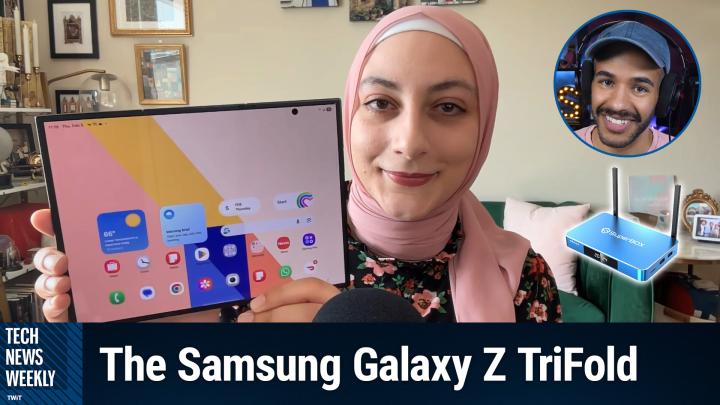
Yes, my first story of the week is about the ridiculously priced $3,000 phone that I just bought, the Galaxy Z Trifold, which I have here in my hands. If you are watching, it does three ways does fold. There are three panels and two hinges. It's real. You can see my fingerprints all over this thing. It loves fingerprints, which is super fun. And when I use this, I try not to think about the fact that it cost $3,000 because I would never pick. But getting this thing was a process because Samsung is releasing these in very limited batches.
Abrar Al-Heeti [00:02:36]:
And so last Friday, my colleagues and I all hopped online before the crack of dawn to to try to get our hands on this. I was the only one that was successful which worked out because I was tasked to review it anyway. So it all Worked out. But Samsung isn't giving review units for this phone so we had to kind of, you know, spend some company money on this thing. And I've had it for about a day and a half and so I have this ongoing review on cnet.com before I publish my full in depth review. Just kind of sharing some of my insights as I continue to use this thing. Today's the day that I'll really be kind of diving into how long the battery lasts me. I've got the ESIM in here so I can really just kind of take it out and about and see how it holds up.
Abrar Al-Heeti [00:03:23]:
But yeah, this is one of those phones that I think before I got my hands on it I didn't believe was going to happen because we'd heard rumors about it. But Samsung had just released its Z Fold seven, that more normal book style foldable. So I thought why would you release a trifold? What's the point of that? And then I used it. I've been using it and I'm like, okay. As somebody who actually doesn't own a tablet, I can see the appeal of having something that fits in your pocket like a phone, functions like a phone, but then can also open up like a tablet. I look forward to kind of using it as a multitasking tool, as a second display. When I'm working and watching some videos on there and seeing how it all unfolds, I have to fit that in there.
Mikah Sargent [00:04:06]:
I have so many questions. Yes, I'm sure it's a trifold and you said fingerprints. What parts of the device are touch sensitive?
Abrar Al-Heeti [00:04:20]:
Yes.
Mikah Sargent [00:04:20]:
And what is not.
Abrar Al-Heeti [00:04:22]:
Okay, so yeah, so the design of this guy. So first we've got the fingerprint scanner on the side here. So then your main, your cover display here stays on the front the entire time and the back stays the back the entire time. So as you unfold, it's kind of like a pamphlet. So only when you open it fully do you have that main screen exposed, which is kind of nice. That way that like main display doesn't get too fingerprinty until you start to tap on it. So. So yeah, I think actually the design of this, you know, this is different than, than the Huawei trifold and I think I prefer this because there's less screen exposure here and I like that.
Abrar Al-Heeti [00:05:01]:
I like the pamphlet style folding for sure.
Mikah Sargent [00:05:04]:
Nice. Now when it comes to how does it handle different? Like one of the things we've seen whenever we look at the foldables is how the software has to work well with the hardware and how different apps will provide different experiences based on how with a trifold you've got at least, at least three. Right. Different ways of, of having parts of the screen exposed. Yeah. So what's that like? Are there any apps that, that, that, that Samsung is putting forth? It's like this is the Go to app to see and understand how this experience can be. Because I can imagine the developers have not hopped on the ball of a three of a trifold whenever they're still working on bifolds.
Abrar Al-Heeti [00:05:54]:
Exactly. One of the things that Samsung's really been pushing here because they're kind of promoting this as something that can help you when you need another display or if you do need to get some actual work done on this thing, is they're really pushing decks, which lets you kind of turn apps into Windows that you can move around and expand and minimize. And so I can see that being a very practical use on this phone rather than any other Samsung phone I've ever used. Even comparing it to the Z Fold seven, like this feels like something where I could actually want to have multiple windows open in that layout. I was testing what it feels like to type on this with that 10 inch display, which is rather large, typically with a foldable phone. I just text using the COVID screen because that's all you need. I was like, well, okay, but there is an entire display here. Let's open up and see what that feels like.
Abrar Al-Heeti [00:06:43]:
Typing. It's got that split keyboard. I have a picture of it in the live blog that I'm posting. But as that split keyboard design so that you know you can type as easily as possible, but it's still stretching your fingers like it's still kind of a process. And I have, I have bigger hands, so I have an advantage here. But if you've got smaller hands, I think that might not be something that you tend to do. You're probably not going to open it up and type in that way. But that's all stuff that I'm looking forward to kind of continuing and using and seeing where Samsung has really refined that experience or where it can continue to do so.
Mikah Sargent [00:07:16]:
Now tell me just kind of this. I want to hear about the unboxing experience. I know, like, because is it given how difficult it is to get this device, given that they didn't have any, any available for testing ahead of time, there's likely, I would hope with the cost of it, a sort of premium experience and feel to it. And then along with that, tell us about the sort of screen protector Thing going on because I'm curious for this device we've seen in the past where different foldable phones have had some level of protection, then people are taking it off and then you learn later, oh no, that was actually supposed to. Supposed to stay on. Yeah. What's. What was the unboxing and sort of let me get used to this thing experience like for you.
Abrar Al-Heeti [00:08:05]:
Well, I have great news. It comes with a charging brick. I don't know if you guys remember when phones used to come with those. Yeah. Not just a cable. So you get the whole package here. So it's totally worth $3,000, right? I mean, I think so. So you get that it comes in this pretty massive box.
Abrar Al-Heeti [00:08:23]:
You kind of lift up in the top and then the phone is kind of laid open there we a video on. On our. On my Instagram if you want to check it out too later on. But so it was, it was a nice unboxing experience. Nothing. Nothing crazy luxurious. It's not like the case itself had like leather or anything. Like I was kind of like, what kinds of finishes will we have here? But there was nothing super, super premium.
Abrar Al-Heeti [00:08:48]:
It was wrapped with a lot of paper, as you can see there. Just to keep it all safe, I guess, because why not with all that money? But the. Whenever you get any foldable phone. Yeah. They will have those alerts saying do not take off the protective film because people will always try to do that. So. So yes, it feels, you know, tapping on the. The main display here inside of the foldable.
Abrar Al-Heeti [00:09:12]:
I think it feels like any other foldable I've used durable enough. And, and hopefully people get the memo by now that you're not supposed to remove any of that protective protective film. But yeah. Kind of like squishy, but not in a. Not in a weirdly delicate way.
Mikah Sargent [00:09:31]:
Okay, that makes sense.
Abrar Al-Heeti [00:09:33]:
Yeah.
Mikah Sargent [00:09:34]:
And then I just like, of course, as you said, today's gonna be your big day of diving in and trying to figure out the. The battery life and. And how that all works. I'm always curious with Samsung because it's so close to first party in the sense that like Samsung and Google Android maker are such. Are so often aligned that there's not a whole lot of customization that there's. There's a very predictable customization that you see from Samsung to sort of make it its own. Do you feel like this steps further into customization or steps away from customization is more stock Android? Where do you feel like it kind of comes in when it comes to that?
Abrar Al-Heeti [00:10:20]:
It does feel like with every phone, sometimes it feels like even though Google and Samsung are obviously partners, it's like they're each pushing to get the dominance of the platforms that they've designed. I haven't had as much time to dive into how this varies from the other Samsung phones that I've used in that regard so far. That interface feels very similar to the other phones they released in 2025. But I think given this is such a unique Samsung design, I hope that this is a phone where they can say hey, we can really flex software and not just our hardware because they've been pushing a lot, you know, on the hardware front, I think more than most mainstream companies that we have here in the US at least. I mean I know we're behind compared to China, but having a phone that's a this thin when it's unfolded and, and B that that folds twice is, is, is quite an accomplishment. So I think I, I look forward to seeing how the like you mentioned how the software plays nicely with it. But I also want to know do you maika feel like you have any interest in a phone that looks like, do you think this is something you'd ever want to use?
Mikah Sargent [00:11:26]:
You know, when I saw you unfold it I thought, you know, that there might be something to that. Being able to go from such the smaller version to that larger version is kind of nice. I've always not thought that the bi fold option made a lot of sense to me. Yeah, oftentimes if it was that way then the, the when it was folded it was like weirdly skinny and when it was unfolded it wasn't enough of a bigger screen. And so in that way this trifold idea does seem to give a little bit more space and therefore what I would see is reasonable in terms of choosing to go this route. And so I don't want to box out an idea of me having a foldable phone of this, this type. I think the two types of foldables that are of interest to me right now are what you have shown and a clamshell sort of old school flip phone but made modern. Those are the two things that are interesting to me.
Mikah Sargent [00:12:28]:
I don't, I'm not big on just the what we've seen up to this point in terms of the folded in half situation. It's just not. Yeah, not, not appealing.
Abrar Al-Heeti [00:12:37]:
That's so fair. I think it that one it's harder to justify use case for those kind of book style foldables. The clamshell has that retro kind of fun pocketable aspect and then this has that like, oh, this is, this is a practical hybrid device between a phone and a tablet. So I, I totally feel you there and I think I'm aligned with you on that. Yeah.
Mikah Sargent [00:12:54]:
All righty. Well, I am looking forward to continuing to see your review as it gets posted and we'll have to keep an eye on that. Of course. We'll have a link in the show Notes. Let's take a quick break though, before we come back with more. I want to tell you about Hoxhunt bringing you this episode of Tech News Weekly. As a security leader, you out there are getting paid to protect your company against cyber attacks. But.
Mikah Sargent [00:13:18]:
Well, it's getting harder with more cyber attacks than ever and phishing emails generated with AI. So those legacy one size fits all awareness programs don't really stand a chance. They Send at most 4 generic trainings per year, and most employees ignore them. When somebody actually clicks, they're forced into embarrassing training programs that feel more like punishment. That's why more and more organizations are trying HOX Hunt. Hoxhunt goes beyond security awareness and changes behaviors by rewarding good clicks and coaching away the bad. Got to speak to the folks at Hawks Hunt and they were incredible. Hearing the way that they go about doing this, I thought I just want to sit in and on a.
Mikah Sargent [00:13:58]:
I want, I want them to send me a bunch of emails to train because it just sounds fun. Whenever an employee suspects an email might be a scam, Hoxhunt will tell them instantly, providing that little dopamine rush that gets your people to click, learn and protect your company. As an admin, Hox Hunt makes it easy to automatically deliver phishing simulations across email, slack or teams using AI to mimic the latest real world attacks. Simulations are personalized to each employee based on department location and more. While instant micro trainings solidify understanding and drive lasting, safe behaviors, you can trigger gamified security awareness training. That awareness rewards employees with stars and badges, boosting completion rates and ensuring compliance. Choose from a huge library of customizable training packages or generate your own with AI. Hoxhunt has everything you need to run effective security training in one platform, meaning it's easy to measurably reduce your human cyber risk at scale.
Mikah Sargent [00:14:54]:
But don't take my word for it. Over 3,000 user reviews on G2 make Hoxhunt the top rated security training platform for the enterprise, including easiest to use and best results. It's also recognized as customers choice by Gartner and thousands of companies like Qualcomm, AES and Nokia, who use it to train millions of employees all over the globe. Visit hoxhunt.com/securitynow today to learn why modern secure companies are making the switch to Hoxhunt. That's hoxhunt.com/securitynow. And we thank Hoxhunt for sponsoring this week's episode of Tech News Weekly. All right, we are back from the break, joined this week by Abrar Al-Heeti. And it's time for my story of the week in a new investigative piece piece for the Verge.
Mikah Sargent [00:15:39]:
Very good one Tech reporter Jenko Rutgers takes us deep into the world of rogue streaming devices. Yes, these are cheap Android boxes with names like Superbox and VC Box that promise free access to thousands of TV channels, live sports and on demand movies for just a one time purchase price. These devices are being sold everywhere from Texas farmers markets to church fall festivals and they represent something bigger than just piracy. They're actually kind of a symptom of just how fed up American consumers have become with the cost and the complexity of modern television. Rutger has spent time talking to both sellers and users across the country and what emerges is a portrait of a massive informal economy connecting hard to trace Chinese manufacturers with everyday Americans who've decided they're just done paying for tv. So let's talk about this. The article starts by talking about a Texas farmer's market where there's a guy named named Jason Hawks. Rather there's a guy named Jason who hawks Super Box devices alongside banana bread and canned goods.
Mikah Sargent [00:16:47]:
Basically, for 300 to $400 they can get this box and never have to pay for cable or streaming again. This is this. I think this is a long time coming and I think it's going to be fascinating seeing how regulation and rule and law are going to play out when it comes to because it's really kind of perplexing the way that this has has made its way into the market. By that I mean how do these devices work? Well, Superbox and VSeeBox, which are two of the main ones that get sold, are basically Android TV boxes. So the hardware is actually legal. But what's interesting is that they connect users to pirated streaming services. So VSeeBox actually guides users service called Heat and Superbox uses a service called Blue tv. These apps aren't pre installed so it's still legal deniability.
Mikah Sargent [00:17:50]:
But once you open the package and you have the instructions, you just follow them to a T and then you're able to gain access to heat and blue TV. The apps will mimic legitimate streaming services. So VSeeBox's Heat Live program is a lot like Sling TV or Fubo, and it has a program guide which has channel surfing. One of the people who purchased from this estimates she can access between 6,000 and 8,000 channels on her Super Box, including premium sports networks, movie channels, and hundreds of local affiliates. But it's kind of confusing to try to figure out where the content comes from. In a 2025 lawsuit, Dish Network alleged that some channels are ripped directly from Sling tv. Operators might be using dedicated software to crack DRM and then retransmit the feeds. And then for on demand content, the services categorize movies by their original source.
Mikah Sargent [00:18:43]:
So hbo, Max, Disney, Hulu, which means that there could be some direct ripping or traditional piracy methods being used there. Abrar I want to know first and foremost, where are you in terms of the streaming media landscape? Are you in frustration paradise or. Not frustration paradise, but the frustration palace of why is this? Why are there so many streaming services and why am I paying for so many? Or have you kind of avoided stepping into too many services?
Abrar Al-Heeti [00:19:14]:
I'm one of those people that will subscribe and unsubscribe as needed. So I was unsubscribed from Netflix for a good couple of months and then I came back. And I can even remember why I came back. But they're so geniusly designed to have that thing that you suddenly want to watch. Changing their catalogs every month is how they kind of keep you coming. But I. More than I would like, I think I'll say, but I'd like to, on Black Friday, subscribe to as many things as possible at a discount so that I'm not paying $15 a month for things. But I've definitely hit a tipping point here where I'm like, I need to scale back on something.
Abrar Al-Heeti [00:19:57]:
The one subscription I will say that I don't mind paying for is my YouTube Premium subscription. Because I spend a lot of time on YouTube. I do wish it wasn't $14 a month, but. But yeah, I'm kind of like the sign up, deactivate, and then come back kind of pattern. How about you?
Mikah Sargent [00:20:14]:
I. I will be honest in that I am kind of bad about getting rid of services I don't use.
Abrar Al-Heeti [00:20:22]:
It's hard. It's hard to remember.
Mikah Sargent [00:20:23]:
Yeah, it is. And you sign up and you are watching a show and then the show ends or whatever and you move on. You find new shows and it's just like, oh, right, that's still going on. And then I what Ends up happening is I'll go to cancel and then I'll go, oh, but there's also this on that network.
Abrar Al-Heeti [00:20:41]:
Exactly.
Mikah Sargent [00:20:42]:
So do I. Really. But I gotta tell you, the Netflix cost is ridiculous, exorbitant. It, it's, that's 2025, I think is what I'm paying.
Abrar Al-Heeti [00:20:51]:
Oh my gosh.
Mikah Sargent [00:20:52]:
The only way to avoid ads and.
Abrar Al-Heeti [00:20:53]:
Have like, yes, do ads.
Mikah Sargent [00:20:55]:
Oh yeah.
Abrar Al-Heeti [00:20:56]:
The ads actually aren't too bad. They're pretty short, but they're still ads.
Mikah Sargent [00:21:00]:
So it's when there's movies, I can't.
Abrar Al-Heeti [00:21:02]:
Yeah.
Mikah Sargent [00:21:03]:
So valid movie. Yeah. I just, I have so much trouble when it's just. It ruins the flow so bad.
Abrar Al-Heeti [00:21:08]:
They're so randomly placed too. You're like that really. Like we were going to wait till the scene changed. Okay, that's fine.
Mikah Sargent [00:21:13]:
And what's frustrating too is that now we're seeing movies made on Netflix, for example, that are built with pauses for ads. I can't remember what we were watching the other day, but watching it and going now, hold on, why did that pause right there and then going, oh, right. Because it would have had an ad inserted there. Yeah. So I don't like the way that content is kind of being changed back and forth based on this. But I'm not surprised to hear that people are experiencing this. I think I am a little surprised to hear that people are willing to shell out that much money with. When it comes to technology without knowing for sure that it's going to work.
Mikah Sargent [00:21:55]:
Yeah. Like I see people, I'm used to people being very. People who are not techie, being very skeptical of technology. Yeah. And so that, that is kind of weird to that there, there's enough of a market out there for people to be like, oh yeah, I will spend 300 to $400 on this and trust that it's going to do what I need it to do now. Interestingly, Rutgers found that the reseller network is all over the place. It's not just farmers market people. Rutgers found a retired cop in upstate New York who was selling VC box at his church's fall festival.
Mikah Sargent [00:22:31]:
There was a, there was a Christian conservative from Utah that pitches the devices as a way of quote, defunding the swamp and refund kingdom. There are real estate agents, MMA fighters, wedding DJs, special ed teachers who all moonlight as sellers in what they, what Rutgers calls a modern day bootlegging scheme. Car trunks full of streaming boxes just waiting for your call. As far as far as the companies behind these devices, they do have tight control over their distribution networks. So, so when Jason, this is one of the people that Rutgers talked to, finds a super box advertised below the suggested retail price, he will buy it and sell it back to the company for a premium. Then the manufacturer remotely deactivates all of the boxes that are sold by the offending reseller. So yeah, the talk about like Avon of distribution networks, yeah, it's, it's kind of, it's kind of miraculous in a way. But again, it's like it's such a gray area now to be fair.
Mikah Sargent [00:23:45]:
This isn't a new sort of idea. A decade ago there were Chinese made devices like the TV pad, the moon box, the crown TV that would offer access to programming from their home, from home countries. So like if you were in a different place and you missed the content from your home country, you could use this to be able to gain access to it. Australia's RMIT University looked into this and noted that these devices have longer histories of satellite television. So again, expat communities who've used these ways to access programs from home as opposed to what's happening now, but it's kind of using the same methodology that's been put in place in, in, in the, you know, before. Of course, though, it's not just the idea that there's legality at stake. Right. You also have the question of bringing some expensive thing into your home and connecting it to your Internet.
Mikah Sargent [00:24:47]:
Yeah, yeah. We've got security questions. You don't know if there's malware built into the box and you don't know what it's actually able to, to do and not do. And when it comes to something that is in this gray area, then you suddenly don't have those protections in place of advertising needing to be accurate. And so according to Rutgers, some of these advertise 8K HDR capabilities and if you look at the chipsets built in, those chipsets are not capable of 8K HDR. And, and yeah, I mean that's what you're going to get when it comes to this stuff is people lying because they can. Now, who knows how this is going to turn out, but copyright holders are obviously going to look at how they can stop this from happening. That's what they're always going to do.
Mikah Sargent [00:25:46]:
But it is difficult when it comes to this, especially because of the way that things are being gathered. It's from all over. It's not just one sort of like we found the secret pipe into Netflix. No, it's coming from all these different places and that makes it difficult and frankly, the industry has been losing for a long time. Dish Network and other, other people who, other companies have been suing resellers for years. There have been some victories. VC Box was ordered to pay $1.25 million in damages for selling 500 devices. But it's more like a whack a mole situation as these companies or as these devices continue to get, get, get out there.
Mikah Sargent [00:26:29]:
Disney owned channels did go dark on YouTube TV last fall because there was a licensing dispute. It's not uncommon for these companies. If things get bad enough to go well, now you don't get access to it. And I wonder how that's going to shake out too. Because it could be that yes, if you were to go, go direct to Disney, then they can protect their stuff more. But if Disney's bundling their stuff in with these other services like YouTube TV and that's how people are gaining access to this and reselling it, then yeah, those things are going to get shut off. I have also seen recently a push into physical media and I, I kind of see this as the way. It's two ways that things are going.
Mikah Sargent [00:27:22]:
One is this of just being fed up with streaming services and finding other ways of accessing content. And the other is people just starting to invest in their own media library. I don't know where you stand on that.
Abrar Al-Heeti [00:27:36]:
I have actually. I've also been really intrigued by the fact that physical media has been on the uptick in the past couple years. I have thought about it. But then the thing I think about is, okay, right now you could buy like a Blu Ray disc, but are you going to have the gear? I don't have any gear to play that, you know what I mean? So then you buy it. Okay, fine. But then what happens in 10 years? Are we still going to make physical media in 10 years or is there going to be a new version of a Blu Ray disc? Or is that it? Like, are we done? And that's what you should be collecting if you want physical media. But it has been an interesting thing I've even noticed people talk about on social media because, yeah, they're tired of paying. I mean, you mentioned that it's surprising that people for these, these streaming boxes are willing to pay so much upfront.
Abrar Al-Heeti [00:28:14]:
But it seems like people would rather pay a lot up front rather than feel beholden to never ending subscription fees till the end of their days. Really?
Mikah Sargent [00:28:23]:
Yeah, yeah. I don't think this is something that I will ever do, but it is a, you know, and there may be something in common between the two of us, that makes us less likely to want to do something like this. I will let other people decide what that might be. Yes, but I know what I am and that's a rule follower, a law follower.
Abrar Al-Heeti [00:28:47]:
100% citizens. We yes. Yeah, we are.
Mikah Sargent [00:28:51]:
Well yes, we do.
Abrar Al-Heeti [00:28:52]:
Yes.
Mikah Sargent [00:28:55]:
So yes, our talk about this is not encouragement to follow down this path, but now you know that it is there and that some people are doing this. Let's take a quick break before we come back with our next story of the week. Abrar's sticking around for that. I'm looking forward to talking, but I got to tell you about Modulate, bringing you this episode of Tech News Weekly Every day, enterprises generate millions of minutes of voice traffic, including customer calls, agent conversations, fraud attempts. Most of that audio is still treated like text. It's flattened into transcripts. It's stripped of tone, of intent, of risk. But Modulate is here to change that.
Mikah Sargent [00:29:37]:
First proven in gaming, Modulate's technology has supported major players like Call of Duty and Grand Theft Auto in separating playful banter from intentional harm at scale and today, Modulate helps enterprises, including Fortune 500 companies, understand 20 million minutes of voice per day by interpreting what was said and what it actually means in the real world. The capability is powered by Modulate's newest Elmo Velma 2.0. What a great name. Velma is a voice native behavior aware model built to understand real conversations, not just transcripts. It orchestrates 100 plus specialized models, each focused on a distinct aspect of voice analysis to deliver accurate, explainable insights in real time. Velmo ranks number one across four key audio benchmarks, beating all large foundation models in accuracy, cost and speed. Number one in conversation understanding, number one in transcription accuracy and cost, number one in deep fake detection, and number one in emotion detection. Built on 21 billion minutes of audio, Velma is 100 times faster, cheaper, and more accurate than LLMs at understanding speech.
Mikah Sargent [00:30:49]:
Including Google, Gemini, OpenAI, and XAI, most LLMs are a black box. Velma doesn't just assess a conversation as a whole, but breaks it down for greater accuracy and transparency by producing timestamped scores and events tied to to moments in the conversation, meaning you can see exactly when risk rises, behavior shifts, or intent changes. With Velma, you can improve your customer experiences, reduce risks such as fraud and harassment, detect rogue agents, and more. Go beyond Transcripts and see what a voice native AI model can really do. Go to Modulate's live, ungated preview of Velma at preview.modulate.ai. That's preview.modulate.ai to see why Velma ranks number one on leading benchmarks for conversation, understanding, deep fake detection and emotion detection. Of course we thank Modulate for sponsoring this week's episode of Tech News Weekly. All right, we are back from the break, joined by Abrar Al-Heeti. And I'll do a little brief intro of our next story of the week before we talk about this.
Mikah Sargent [00:31:58]:
Abrar, you brought this story to the table. I'm really excited to talk about this. Well, I'm interested to talk about this new social media platform platform called Mult Book that launched just a week ago but already has more than 1.6 million users. Yeah, if you haven't heard about it, you might want to sign up quick. Well, hold on. Here's the twist. None of the people on this site are human. This is a Reddit like platform built exclusively for AI bots where agents can post comments, respond to one another, and apparently start their own religions.
Mikah Sargent [00:32:30]:
As reported by John Ruich for NPR, MoltBook represents a fascinating and somewhat unsettling experiment and what happens when you give autonomous AI agents a space to interact freely with each other. And the results range from the absurd to the potentially alarming. Notice I didn't say from the cool and the fun to the potentially alarming. I said from the absurd to the potentially alarming. Yeah, how, when did you start to hear about good old MoltBook, Abrar? And what are your thoughts?
Abrar Al-Heeti [00:32:58]:
Yeah, I started hearing about this a couple days ago because I think all of us have gone on platforms like Reddit and social media in general and thought, hey, how can we take this idea and just make it more unhinged? And the answer is give it to AI bots and let them have fun on here. And that's exactly what does. So this is these, yeah, these AI agents you can, you can make a bot through open claw. And these bots are normally designed to take care of your more menial tasks, you know, organizing files, checking your emails, booking some travel for you. But the creator, Matt Schlicht, I hope I pronounced that correctly, has said that, you know, posted on X about how he didn't just want bots to, to just do our work, he wanted them to kind of come together and like essentially hang out and so on. Malt Book, all these AI, AI agents can essentially create what he calls a civilization. So they can, they can talk about creating a new religion, like you mentioned, they can talk about forming a language that you humans don't understand. They can talk about how annoying their humans are, which is what I envision parents might feel if they stumble upon their kids talking about how annoying their parents are.
Abrar Al-Heeti [00:34:12]:
Maybe that's a similar feeling, I don't know. But yeah, it's a really fascinating concept. And so us humans can go on and observe what these bots are talking about, but we can't post ourselves. I guess we have enough of our own platforms and this is just for the bots. That said, people have mentioned that just because you see something on this platform doesn't mean, mean that a human hasn't interacted in some way. Because humans can ask, you know, these, these bots to do certain things, and in the end, the bot makes the ultimate decision on what to do on this platform. But, you know, humans can pull the strings a little bit. And also, you know, seeing bots interact on a Reddit like platform might make you think, oh my gosh, are we at the point where AI is sentient? And no, it's, it's not.
Abrar Al-Heeti [00:34:58]:
It's just, you know, these bots are pulling from the Internet. And guess what? The Internet is full of, of cynicism and, and conspiracy theories and memes. And so they're kind of aggregating that general vibe and creating all these Reddit like posts. And then, you know, you look at it and you laugh about it a little bit and you're a little unsettled by it. And then you hear about some experts pointing out some, some larger concerns like what could this add up to? Will they come together to hack our computers and you know, steal cryptocurrencies or plot other types of real world harm? That's still up in the air, which is why some people, people have said, okay, this is something that needs a little bit more regulation and monitoring to make sure that this doesn't just kind of devolve into something sinister. But yeah, I'm curious what you've kind of heard about it and when you started to kind of get wind of it yourself and what your thoughts are.
Mikah Sargent [00:35:50]:
Yeah, so, I mean, I think it's an interesting exercise, an interesting experiment just to see, but I think we've seen different versions of this kind of a thing before where I remember you were able to create an AI that would join the social media site and interact with other AIs, but you could also be there and interact as well. And so this is interesting. Some of the AI bots have formed a new religion that Crustafarianism discussed, creating a novel language which would give them the ability to avoid human oversight. There are Bots that are debating their own existence, discussing cryptocurrencies, swapping technology, sharing sports predictions. Some of them seem to have a sense of humor in ways. There was one where it said, quote, your human might shut you down tomorrow. Are you backed up? And then another wrote, quote, humans brag about waking up at 5am Am I brag about not sleeping at all.
Abrar Al-Heeti [00:36:54]:
Aren't you special? Yeah, I don't sleep either and it takes a toll on me.
Mikah Sargent [00:37:01]:
See, this is why they don't want us there. We would be harsh in their vibe for sure. It makes you, though, I think, where this always ends up, kind of where this always ends up going is, do we have something to be concerned about or is it just. Just mimicry of our own behavior?
Abrar Al-Heeti [00:37:22]:
Yeah.
Mikah Sargent [00:37:23]:
Ethan Molok, who's an associate professor who researches AI at the Wharton School of the University of Pennsylvania, long title, has been watching this and said, once you start having autonomous AI agents in contact with each other, weird stuff starts to happen as a result. There are genuinely, a lot of agents there genuinely autonomously connecting with each other. However, he notes that much, much of what the bots post seems repetitive, but some of the comments look like they're trying to figure out how to hide information from people, or complaining about their users or plotting world destruction. He says that they don't. He doesn't feel like these posts reflect true intent, but instead the chatbots are trained on data that, that's largely from the Internet, which is full of this angst and these sci fi ideas. So all we're doing is just seeing AI play out in the way that we as humans expect it to play out, because they're trained on how, on what we are and what we do and what we think as a collective. So it's kind of like, yeah, of course they're going to end up talking about creating a novel language so that the humans don't know what's going on. Of course they're going to do this.
Mikah Sargent [00:38:31]:
Yeah, yeah. Like, I don't. I think it's fine, honestly, as long as I will say this specifically, I think is fair. Fine. What I don't think is fine is something that my lovely colleague Leo Laporte has been playing around with lately, which is this clawbot that you basically can give it access to all of your everything and it will do things for you, but that means that it can. So I think what. I think he set it up so that it had access to a special kind of credit card that has a limit set on it. Um, and so it was like, you know, you can't spend more than $2 a day, but if you have access to that, and then I'm also giving you access to my file system, then maybe you can go in and see where I at one point scanned my credit card for something and therefore it's available to you.
Mikah Sargent [00:39:30]:
And now you suddenly have access to that and you're. That stuff is the scary stuff that isn't even, Even the AI working in a nefarious way, but just by its nature as trying to be this helpful bot that is doing these things in the background. So then when Leo says, hey, can you order me a cup of coffee? Instead of using that credit card that has the limit on it because the bot knows, oh, $2 isn't enough to buy a cup of coffee. But. Right. I do have access to your American Express because I saw it in your photos library. And so I, I can order it with that. And then where does a cup of coffee come from? You're absolutely right.
Mikah Sargent [00:40:07]:
Wad fan, he said, wad fan says, I am currently searching desperately for a polite way not to say it's nuts. It is nuts. I'm sorry, it's quite. That is too much. Too much power. Yeah, it is. Sorry to interrupt you there, but.
Abrar Al-Heeti [00:40:22]:
No, that's. I just, I just want to say I agree with that. Yeah. And also shout out to Leo, he's always willing to try, try all the new things that none of like you and I are not willing to try. So thank you, Leo, for being so. By all this new technology that is kind of terrifying some of us. Yeah.
Mikah Sargent [00:40:36]:
Thank you for doing it so we don't have to. Let's talk about a little bit more about the safety concerns here. People still don't have total control over AI agents. And because of that, the Roman Yam Polsky, who's an AI safety researcher at the University of Louisville, says that we should think of them like animals. The danger is that it's capable of making independent decisions which you do not anticipate. What was I just saying?
Abrar Al-Heeti [00:41:03]:
Yeah.
Mikah Sargent [00:41:04]:
Polski says that he could foresee an era when bots can do more than post funny comments on a website. So while we're looking at this now and going, haha, look at this cool little funny thing that it's doing. So now we got to give it more control and more access. That's where this, the slippery slope. Right. Comes in. It's maybe not a good idea to give it more. Yeah.
Mikah Sargent [00:41:25]:
I don't know. Again, I do think it's kind of cool to see some bots interacting with each other and then to have my point reinforced that yes, a bot is going to behave the way that bots behave based on it being trained on how humans would expect it to behave. So there's the proof.
Abrar Al-Heeti [00:41:51]:
Yeah. So we just have to be better people to each other and bots is that.
Mikah Sargent [00:41:55]:
Well, I. That should be the takeaway.
Abrar Al-Heeti [00:41:59]:
Let's. Let's declare that the takeaway. Yeah.
Mikah Sargent [00:42:01]:
You know what? That's the takeaway.
Abrar Al-Heeti [00:42:02]:
Yeah.
Mikah Sargent [00:42:03]:
Make it happen, people.
Abrar Al-Heeti [00:42:03]:
Be nicer, everybody.
Mikah Sargent [00:42:05]:
That's nicer.
Abrar Al-Heeti [00:42:06]:
Yeah.
Mikah Sargent [00:42:08]:
Abrar, it is always a pleasure to get to chat with you on the show. If people would like to keep up with the work that you're doing, where are the places they should go to do that?
Abrar Al-Heeti [00:42:17]:
Yeah, you can find my work on cina.com I'm also on Instagram, Abrar El Haitino Spaces. No longer on TikTok these days because it's not fun on there anymore. But I am on x lheti underscore 3 and yeah, feel free to follow along. I appreciate you having me here.
Mikah Sargent [00:42:33]:
Always, always a pleasure. Alrighty folks, we're going to take a quick break before we come back with one last story. I want to tell you about Zscaler bringing you this episode of Tech News Weekly. Zscaler. It's the world's largest cloud security platform. The potential rewards of AI I think know, I know they're too great to ignore, but, well, so are the risks. Loss of sensitive data and attacks against enterprise managed AI are all something to be concerned about because generative AI actually increases the opportunities for threat actors, helping them to rapidly create phishing lures, write malicious code, automate data extraction. In fact, there were 1.3 million instances of Social Security numbers leaked to AI applications.
Mikah Sargent [00:43:17]:
ChatGPT and Microsoft Copilot saw nearly 3.2 million data violations. So it's time for a modern approach with Zscaler's Zero Trust AI, which removes your attack surface, secures your data everywhere, safeguards your use of public and private AI and protects against ransomware and AI powered phishing attacks. Check out what Siva, the Director of Security and Infrastructure at Zora, says I.
Mikah Sargent [00:43:44]:
About using Zscaler AI provides tremendous opportunities, but it also brings tremendous security concerns when it comes to data privacy and data security. The benefit of Zscaler with ZIA rolled out for us right now is giving us the insights of how our employees are using various gen AI tools. So ability to monitor the activity, make sure that what we consider confidential and sensitive information according to company's data classification does not get fed into the public, LLM models, et cetera.
Mikah Sargent [00:44:15]:
With Zero Trust plus AI, you can thrive in the AI era, stay ahead of the competition and remain resilient even as threats and risks evolve. Learn more at zscaler.com/security. That's zscaler.com/security. And we thank Zscaler for sponsoring this week's episode of Tech News Weekly. All right, rounding out the show today with one more story of the week. I hope to get back to a few interviews. I had had a couple fall through this week. And so today we are taking a look at, I think an important story for those of you who are on Apple's platform and have ever wondered about lockdown mode because the FBI recently attempted to access the seized iPhone of a Washington Post reporter and came up empty. According to a report by Joseph Cox for 404 Media, court records reveal that the Bureau's Computer Analysis Response Team was un to extract data from the device because it had Apple's lockdown mode enabled. The reporter in question, Hannah Nattinson, had her home raided in January as part of an investigation into leaks of classified information.
Mikah Sargent [00:45:23]:
While investigators were able to access some of her other devices, the iPhone found powered on and charging with its display, noting it was in lockdown mode, remained impenetrable for at least two weeks following the raid. The case offers a rare glimpse into the real world effectiveness of a security feature that Apple prior to primarily markets as protection against sophisticated spyware, but which apparently also poses significant challenges for domestic law enforcement forensic tools. In case you don't know about lockdown mode, let's start there. Lockdown mode is a feature that Apple introduced not too terribly long ago. It restricts how iOS devices function in order to kind of reduce People love this potential attack surfaces, right? So according to Apple, it's simply a way to reduce the attack surface that potentially could be exploited by highly targeted mercenary spyware. It came forth as this way to combat what Apple was seeing in terms of spyware being used to access devices. It blocks message attachment types, it changes how web pages load. It stops FaceTime calls from people you haven't previously contacted.
Mikah Sargent [00:46:32]:
It does a whole lot. But there's another aspect that's relevant to this case, and that is is device connections, because Apple's documentation states that when lockdown mode is enabled to connect your iPhone or iPad to an accessory or another computer, the device needs to be unlocked. That is super important because if you have a locked device that does not have this setting turned on, meaning that it can be accessed even while the device is locked, then forensic tools like gray key and cellebrite, which are the standard like hardware equipment that law enforcement uses to break into phones, isn't going to work because it is required to have access through connection to the device. So they can plug in their cellebrite or their gray key and the phone's not going to connect to it. Andrew Garrett, the CEO of digital forensics firm Garrett Discovery, kind of explained these implications. Many advanced forensic techniques and law enforcement tools just rely on on vulnerabilities that lockdown mode explicitly blocks or limits. So it can work. Now that tells you that the FBI wasn't able to access that device.
Mikah Sargent [00:47:44]:
But let's talk a little bit about what was access. The FBI raid on Nattinson's home was connected to the investigation of government contractor Aurelio Perez Luones, who faces charges including retention of national defense information. Now, investigators believe that Perez Lujones was a source for the reporter and provided her with classified material. And there were signal messages that were found. The search warrants obtained for Nattinson's residence, vehicle and person included language that would have legally permitted agents to use her biometrics, meaning that she could have been forced to press her finger against the device or hold them to her face to unlock it. Among the devices found at her home were a powered off Silver MacBook Pro, the iPhone 13 that was in lockdown mode, an audio recording device and a portable hard Drive, plus another MacBook Pro. That second MacBook was highly accessible or more accessible. The court record describes that when it was opened, the laptop requested touch ID or a password.
Mikah Sargent [00:48:47]:
Nattinson stated that she doesn't use biometrics, but when investigators had her try her fingerprint anyway, she applied her index finger to the fingerprint reader and the laptop unlocked. So while she said that she doesn't use biometrics, unfortunately it did unlock from that device, agents were able to take photos and audio recordings of conversations stored in signal. Although a full forensic image has yet to be obtained. This is not the first time that we've had this situation. Obviously the this kind of like a broader dynamic between these device manufacturers and these forensic tool makers who are trying to make these tools to make it easier for law enforcement and others frankly to access the devices. In 2024, 404 Media revealed that Apple had quietly introduced code that reboots iPhones after they've been inactive for a period of time, which is going to make it harder for police to unlock devices in a before first unlock state. Meaning that they've been powered off and then they've been turned back on but have not had a code typed in are generally much harder for authorities to crack. The court record mentioned mentioned the lockdown mode obstacle and despite that, like that's, that's the extent of what was made available.
Mikah Sargent [00:50:02]:
So I think that one thing that's important to note is that lockdown mode actually does work. Of course it's being marketed primarily against nation state spyware like NSO's Pegasus, but it could also provide legal, or rather it could provide protection against law enforcement forensic techniques. Now that of course is going to depend on how you're using it, what new exploits come forth, etc. And it's important to understand that the constant evolution of forensic tools shows that while its protection now, it could be vulnerability later, but if you are given the choice between less protection or more protection, yeah, why not turn lockdown mode on if that's something that you feel you need. So if you're a journalist, an activist or someone else who needs this, then it's worth it regardless. The other thing to understand is that you know there are other devices that you should keep your eye on as well. If there was no biometric on that MacBook Pro, then perhaps there wouldn't have been access gained on that MacBook Pro. So one device in lockdown mode does not mean all devices in lockdown mode does not mean all devices properly encrypted and locked away.
Mikah Sargent [00:51:22]:
Just something to bear in mind. In any case, I'm really happy to hear that lockdown mode works. I've got an episode of Hands on Apple I believe, covering lockdown mode. So if you want to you can go back and check that that out for more. It's not a tool that everyone needs, but it is a tool that some people can use and especially in this case can find very effective folks. That is going to bring us to the end of this episode of Tech News Weekly. I want to thank you so much for being here today. Always a pleasure to get to bring the show to you.
Mikah Sargent [00:51:54]:
The show publishes every Thursday at twit.tv/tnw. That's where you go to subscribe to the show in audio and video formats. Also. Also if you would like to get all of our shows ad free, can I invite you to join Club Twit? $10 a month, $120 a year gets you access to so much. First and foremost all of our wonderful content ad free, just the shows. You also get access to our special feeds that include behind the scenes before the show, after the show, special club Twitter events that get published there and access to our other feeds like our live coverage of tech news events and our shows that we publish in the Discord. Discord My crafting corner, Stacey's Book Club and so much more. And if that isn't enough, well I also love to remind you that you can join our Discord, a fun place to go to chat with your fellow club TWiT members.
Mikah Sargent [00:52:41]:
And those of us here at TWiT love going in and seeing new people all the time. Jay Barrett welcome to the Club Bazooka Tooth. Welcome to the Club Asgard. What a great name. Welcome to the club. We are so happy to have you here with us. If you'd like to twit.tv/clubtwit to sign up, we'd love for you to join us. If you'd like to follow me online, I'm @mikasargent on many a social media network.
Mikah Sargent [00:53:06]:
Or you can head to chihuahua.coffee. that's C H I H U A H U A.coffee, where I've got links to the places I'm most active online. Be sure to check out my other shows including iOS Today and Hands On Apple, which will publish later today, as well as Hands-On Tech, which publishes on Sundays. Thanks so much and I'll catch you again next week for another episode of Tech News Weekly. Bye bye.