Tech News Weekly 410 Transcript
Please be advised that this transcript is AI-generated and may not be word-for-word. Time codes refer to the approximate times in the ad-supported version of the show.
Mikah Sargent [00:00:00]:
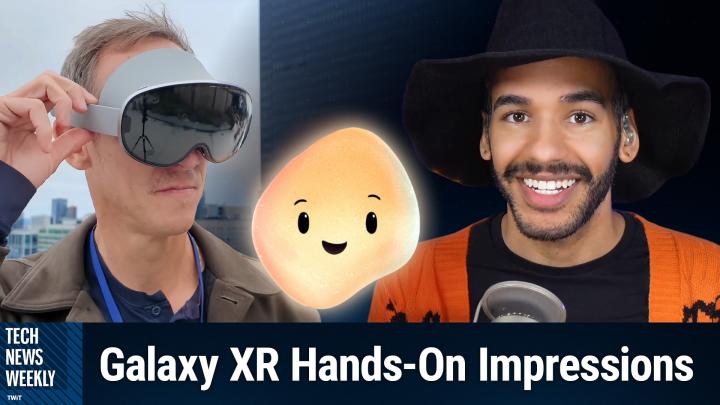
Coming up on Tech News Weekly, Emily Forlini is here. We talk about Microsoft replacing Clippy. We'll have to learn more about that then. Amazon is all over the show as we talk about it replacing some or many of its jobs with robots and also its glasses for its delivery drivers. Finally, we round things out with Jason Howell, who joins us to talk about the new Galaxy XR headset. Stay tuned for Tech News Weekly.
TWiT.tv [00:00:31]:
Podcasts you love from people you trust. This is Twit.
Mikah Sargent [00:00:40]:
This is Tech News Weekly, episode 410 with Emily Forlini and me, Mikah Sargent. Recorded Thursday, October 23, 2025. Samsung's $1,799 answer to Vision Pro. Hello and welcome to Tech News Weekly, the show where every week we talk to and about the people making and breaking that tech news. I am your host, Mikah Sargent, and this week on the fourth Thursday in October, I am joined by the wonderful, the ever so clever Emily Forlini. Welcome back, Emily.
Emily Forlini [00:01:17]:
Hello. And that was amazing.
Mikah Sargent [00:01:20]:
Well, I'm glad to hear it. You are joining us from your office. This feels very official.
Emily Forlini [00:01:28]:
Yes, PCMag has an office. It's actually very beautiful in a very nice part of New York. And it's not just PCMag. So the parent company Zip Davis, we have CNET now Lifehacker, Mashable, and then also tons of other companies. So it's a really, really nice building.
Mikah Sargent [00:01:45]:
Wow. You can hang out with all the cool cats.
Emily Forlini [00:01:47]:
Yes. And mostly there are free snacks, which is a big draw.
Mikah Sargent [00:01:51]:
That's choice. That is choice. For people who have not tuned in before, perhaps you just need a little reminder. This is the part of the where we share our stories of the week, the stories we think are interesting and want to share with all of you. Emily, tell us about your story this week.
Emily Forlini [00:02:07]:
All right, so hot off the press two hours ago. Two hours and 11 minutes ago. Is Microsoft launched a bunch of. It did the fall feature drop for Copilot? So copilot is its AI assistant. It did 12 things. It introduced 12 things. But of course, the most interesting is this new AI avatar, Mico. Mico.
Emily Forlini [00:02:29]:
Maybe we can debate how to pronounce it. Cause I only knew it existed for two hours. But yeah, it's like, I don't know if it's the new Clippy. I think it's pretty cute.
Mikah Sargent [00:02:38]:
What do you think it is very cute. I don't know if you've seen. Oh, goodness, was it in Howl's moving Castle? I think that's the one it's from. There's A little fire creature whose name is Calcifer. And definitely reminding me a little bit of Calcifer, this sort of glowing ember creature that has a smiley face that I want to hook.
Emily Forlini [00:03:01]:
I know I had kind of a macro thought about it on the train as I was coming into New York. I was like, so clippy. Clippy was a paperclip, like a very tangible item. And I feel like tech back then was very tangible, like hardware. You knew what the technology was. Now this Michael Mico guy is kind of like a blob with undefined, undefined etches. And I'm like, that's kind of how I feel about AI.
Mikah Sargent [00:03:28]:
Interesting.
Emily Forlini [00:03:29]:
Yeah, that's.
Mikah Sargent [00:03:30]:
Yeah, that's an interesting way to kind of think about it, where even, like, the loss of skeuomorphism. Right. Has its own level of sort of making this digital space ever changing. But then you. Yeah, you layer on this sort of aura kind of thing, and it does feel a little bit. A little bit blobby. Yeah, it is. It's blob and it's.
Mikah Sargent [00:03:52]:
That's like the tech is sort of blobby. It's a little bit spaghetti project at times. It's a little bit, you know, peanut butter all over the sandwich. I'm not going to keep going with the metaphors. There are plenty. I guess I'm kind of curious. Well, because we should come back to. I'm going to go.
Mikah Sargent [00:04:08]:
I'm going to go with Mikko, because it's like it just. It rings for me and then it's not as close to my name, which makes me feel weird. So I'm glad that it's Mikko and not me.
Emily Forlini [00:04:18]:
Actually, quickly, we could. We can dissect the name so it's a combination of Microsoft and Copilot.
Mikah Sargent [00:04:23]:
Oh, cool.
Mikah Sargent [00:04:26]:
Oh, no. Oh, darn it. Well, the low friend, because I want to talk a little bit more about it and where it pops up, but can you tell us about the other upgrades that are rolling out? Because this is one of the things about. Specific to Microsoft. We know that it relies a lot on the technology that it sort of leases from OpenAI. And so when it's announcing new features and upgrades, it can be kind of difficult to see them as truly new features or upgrades because OpenAI will have announced something before this. What is new with Copilot? And maybe the better question is, since there are so many of them which stand out to you. Outside of Mico, the one I liked.
Emily Forlini [00:05:20]:
The most, actually more than Mico, just laughing at that name now, is one called groups. And so, you know, group projects are just the worst, especially the worst. And it's just a total mess. So basically this feature you can invite up to 32 people to kind of like a copilot project and you're all talking and collaborating in the same space. And then copilot AI is taking notes, documenting next steps, kind of like nudging you along. So it's kind of leading the group project, which I think is pretty cool.
Mikah Sargent [00:05:54]:
And what's great about that is then you are not responsible for being the naggy person.
Emily Forlini [00:05:59]:
Right. The note taker.
Mikah Sargent [00:06:00]:
It's not me. I'm not the one that's telling you you need to keep doing this and that you need to be held accountable.
Emily Forlini [00:06:06]:
I wish.
Mikah Sargent [00:06:06]:
There's a. There's a group project coming up that I'm working on right now and I am having to be the naggy person and it's not fun. So if I could have, you know, this. This thing sort of tallying votes as it's as you show here, proposing options and making sure everybody knows what there's be so nice. I think it would reduce that friction because I have a feeling game recognized game here we were the people in the group project who weren't fans of group projects because we ended up wanting to take on most of the work just to make sure it was actually done and done correctly.
Emily Forlini [00:06:45]:
I feel seen and embarrassed retroactively for my high school college self.
Mikah Sargent [00:06:51]:
Yes. I remember working. I had like an. An all nighter and then some on a group project because I said, no, no, I'll just do the video part. Y' all don't need to be a part of this. It's so much hard, so much work trying to get everybody together. So that's really cool.
Emily Forlini [00:07:09]:
I think so. But there might be an even more annoying aspect where maybe the you and me on the project would be like, well, copilot says we talked about this. So you know, we only completed.
Mikah Sargent [00:07:21]:
I've got receipts, right.
Emily Forlini [00:07:22]:
4 of 10 of Copilot's action items. And you did say we should do that because it's in the copilot notes so it could stir the pot.
Mikah Sargent [00:07:31]:
Oh, that's funny. Now that makes me think though, because it says friends, classmates, coworkers. I can definitely see this very easily with co workers. Perhaps you have more awareness of this. When I think of college campuses, for some reason I wanted to say like campis or something. Multiple Camp High. When I think of college campuses, I'm seeing the apple logo everywhere. Do you Think this is something that we'll probably see more in the, you know, the professional workplace where people have Microsoft and are using Microsoft Teams and that kind of thing.
Emily Forlini [00:08:14]:
Yeah, I think on a larger note, Microsoft actually has a big problem. It's totally losing the younger generations to the Google suite, to Apple products. This is a smart feature where maybe, just maybe could get people to use its products. And the younger folks, because they have so many corporate contracts, which is great, people are using it all over workplaces. But those young people are growing up, they're starting startups, you know, they're moving into the working world and they're not going to use Microsoft unless forced, you know, because they just grew up somewhere else. So actually one other thing Microsoft launched today was more integrations with the Google suite to Copilot. So you can, that's clever. Copilot can look through your Gmail, look through your docs.
Emily Forlini [00:09:01]:
You know, of course there's data privacy issues it talked about, but you can kind of bring in your Google stuff. So I think Microsoft is kind of, you know, let's, let's be open to the enemy, bring them in. So I did that today.
Mikah Sargent [00:09:13]:
That makes sense. Now other than that, I see that the company has said, you know, what you need is a little buddy to talk to about your health. So interesting. Health advice from. Not from Clippy, from Copilot. What is the, what is the deal there? And more importantly, how is Microsoft handling what I think is easy to imagine the response is at first, which is should we really be talking to chatbots about it?
Emily Forlini [00:09:50]:
Didn't say. I think it might be too controversial. Controversial. So this announcement is very much a buffet of AI and they only gave us a couple sentences about each. They elaborated a little more on the new Clippy. Everyone's going to think it's Clippy, but the Myco, they elaborated on my go the group project thing that was really tangible, but when it came to things like health and education, they just said it will answer questions about your health, it will help you find doctors. That's all it said. It didn't get into, you know, it will abide by hipaa and you know, it's a full fledged X, Y, Z medical professional.
Emily Forlini [00:10:28]:
So it seemed like a limited vision there.
Mikah Sargent [00:10:31]:
Yeah, that's interesting. I wonder if we'll see it in the same way that we saw Microsoft rolling out that technology that would let you sort of rewind throughout your day and then it got blasted and then the company kind of had to work on it for a lot longer to make people feel a little bit more comfortable with it. Now, Mico being the copilot mascot, where do we know where Mico's going to show up? Is it like clippy in that sense of I'm working on a document and it sees me struggling and it pops in to say, hey, I can help you with that? Where? Or is this just kind of like a mascot of now? You know, it's got Microsoft's AI built into it.
Emily Forlini [00:11:19]:
It's a voice assistant. So it's going to pop up. You're going to be able to talk to it. You can make it go away if you want. It also sounds like a combo clippy and a mood ring because its color will change based on the conversation. So I guess if you're mad, it'll turn red or something. I don't know. This is silly.
Emily Forlini [00:11:41]:
What are we even talking about? You know? But it's true. It's what they wrote. And they're going to have different conversation styles where Maybe you like ChatGPT. Some people like it to be more encouraging. Some people like it to be super dry and straightforward. Just the facts. So Mico is going to have different modes. Oh, look at Mico right there.
Emily Forlini [00:12:00]:
You have a plane. Oh, hey, it's moving.
Mikah Sargent [00:12:03]:
And there's the Real Talk. Yeah, that's. I know, I see that. That feature, Real Talk, right?
Emily Forlini [00:12:07]:
Real Talk is kind of like your homegirl, your companion. Like Real Talk, you're going to talk about personal subjects and it's going to boost you up and yeah, it's so funny.
Mikah Sargent [00:12:21]:
You know what? I can't wait to meet the people who are in the outside world using this feature. Because there are some times where you hear about a feature being introduced and it just feels like someone in a room pitching an idea and saying, you know what would be really cool is if we did this. And I. It's odd because Microsoft is the telemetry company, right? Like, this is the company known for paying attention to what its users do, how they do it, what they like, what they don't like, where they click, where they don't click. No, I'm not going to say that because it's not true. I was going to say where their eyes look and where they don't look. That's. That's not the case.
Mikah Sargent [00:13:08]:
But given that does that. I always look at these different features and I go, does Microsoft know something I don't? Because I just don't see someone really wanting to have a Real Talk conversation with a little Microsoft mascot. That's the thing, because we've seen it with OpenAI, people are talking to their chatbots. So it's possible, but I don't know.
Emily Forlini [00:13:39]:
It hasn't caught on. No. I mean, voice tech, I really feel is probably one of the biggest failures of the tech industry. Voice assistants, they are not fun to talk to. It's weird to talk out loud to a piece of technology. They put a smiley face on it. Great. But it is still so much better to talk to a person than a computer.
Emily Forlini [00:14:00]:
I mean, they're better at natural language processing, but it's awkward. It's just very awkward. Adding something cute is nice, but just the voice component alone, I think would limit the relationship, if you can call it with Mico.
Mikah Sargent [00:14:16]:
Yeah, I agree. I agree 100%. There's a. Anthony, what was the. If you can remember the name of that thing where you were able to talk out loud and it was talking back pretty quickly and you mentioned it and then I ended up trying it later that day and I said there were times where I felt rushed. If Anthony can think of it, then he'll chime in. But regardless, this was a sort of system where it was supposed to be natural language. And I remember talking to it and feeling like, oh, if I don't keep talking, it's going to cut in.
Mikah Sargent [00:14:48]:
And so now I'm trying to think of what I'm going to say next. And there's a lot of pressure here. And that's not how it works for the most part with humans. Unless, you know, you're talking to a fellow person with ADHD and you can.
Emily Forlini [00:15:00]:
I had a good one. I had an aha moment where I was like, maybe it's getting somewhere. Let me look at my phone. It was a. I think it was a Google Gemini voice assistant. It was on my phone and I was talking and it was talking back and I was kind of like, wow, that's the most realistic I've ever felt talking to a piece of technology. So I was thinking that it could be going somewhere. I still don't like to talk out loud.
Emily Forlini [00:15:25]:
Maybe it's just my preference. You know, if I'm in the car, I don't really like it. I do. I certainly do not want to talk to Alexa. Like we're watching TV together or something.
Mikah Sargent [00:15:35]:
Yeah, yeah.
Emily Forlini [00:15:36]:
But people do like talking to ChatGPT and develop what they feel are very personal relationships. Almost like therapist, friend, lover, coworker. So the written form is strong, but voice tech is just not. I don't think it's clicking for Most people, yeah.
Mikah Sargent [00:15:52]:
At least not yet.
Emily Forlini [00:15:52]:
But not yet.
Mikah Sargent [00:15:54]:
We'll have to see how that goes. Is there anything else that bears mentioning here with the new updates? Updates, upgrades, changes to Copilot for Microsoft?
Emily Forlini [00:16:05]:
I think there's just so many things. So there were 12 things and if you, it's getting deep in the weeds to the point of if, if you are a Copilot user, like go check out the article and see all the new stuff. That's, that's probably my advice at this point. It's just too much. Just the buffet. You got to go pick. You want the pot roast, you want the mashed potatoes? That's, that's up to you. I can't choose for you.
Mikah Sargent [00:16:31]:
Very well. I agree. Go read the article. Let's take a quick break. We'll come back with my story of the week. Up next. I want to tell you about Vention bringing you this episode of Tech News Weekly. We've just talked about it on the show.
Mikah Sargent [00:16:46]:
AI is everywhere. And when it's used right well, it delivers results. Chances are you're already thinking about how to bring it into your business. But the question is, how are you going to do it without wasting time, a big one, wasting money, and without wasting momentum? Sometimes people forget about that. Momentum is very important. Vention has an answer. Backed by two decades of software delivery experience, Vention's AI workshops offer practical expert led sessions that give your team the insights and structure they need to make smart decisions. So you bring your product vision and your current stack and then Vention brings deep expertise in AI, deep expertise in engineering and even your business domain.
Mikah Sargent [00:17:32]:
Together, you'll work with them to turn high level ideas into a tailored roadmap that you can trust. It doesn't matter if you're a CTO or a tech lead or a product owner. All of you won't have to spend weeks figuring out tools and architectures and models because Vention helps assess your AI readiness, helps you clarify your goals, helps you outline the steps to get you there without the headaches. And if you need help on the engineering front, well, don't worry because Vention's teams are ready to jump in. As your development or consulting partner, it's the most reliable step to take after your poc. So let's say you've built a promising prototype on Lovable, for example, and it runs well in tests, but now you're going, so what do I do next? How do I sort of scale this? What about, how's do you open a dozen AI specific roll roles just to keep moving? Or do you actually bring in a partner who has done this across industries? Someone who can expand your idea into a full scale product without disrupting your systems or slowing your team? Even with modern platforms, prototyping can be draining. Once you get something working, chances are you're going to want to shift gears from that problem solving mode to the bigger picture view. And that's exactly why we've seen product leaders turn to Vention not just for their AI workshops, but also for the peace of mind that comes from knowing you're not building blind.
Mikah Sargent [00:18:54]:
So if you value speed, if you value clarity and impact and want to avoid second guessing your next AI move, learn more at ventionteams.com or book your workshop at ventionteams.com twit. You'll leave with a plan that works, a partner you can count on, and a lot fewer gray hairs. That's ventionteams.com TWIT. And we thank Vention for sponsoring this week's episode of Tech News Weekly. All righty. We are back from the break, joined this week by Emily Forlini. And time to talk about Amazon a little bit. Amazon, the company that revolutionized online shopping and became America's second largest employer after Walmart and technically the federal government, is the first largest employer, but second largest private employer, embarking on what could be its most transformative shift yet.
Mikah Sargent [00:19:52]:
It's a sweeping automation initiative that internal documents reveal could eliminate more than half a million jobs over the next decade. Now these were documents viewed by the New York Times and in its Amazon's robotics team aims to automate 75% of its operations, potentially avoiding the need to hire 600,000 workers by 2033. I don't know why I said 33 like that, but I did. While doubling its product sales, the plan centers on facilities like the Shreveport, Louisiana warehouse where 1,000 robots already enable operations with 25% fewer workers. And this of course serves as a template for the future of e commerce fulfillment. Of course. Before I even get into this, my first question for you, Emily, former Amazon engineer, what or do you did was the writing on the wall even while you were there?
Emily Forlini [00:20:53]:
This is a little personal for me, just personal experience. So I used to work in a part of Amazon. It started as Amazon prime and then it incorporated Whole Foods which needed both of those are really fast delivery. And then we also worked on enabling the same day Delivery Administration on Amazon.com so just really fast delivery models. And so I spent a lot of time in warehouses, the small ones and also the huge ones and also ones with robots. I spent a week working in an Amazon warehouse as part of a program.
Mikah Sargent [00:21:23]:
Wow.
Emily Forlini [00:21:24]:
So I know. And one of my takeaways from that week was, oh, my God, it's so much walking. Like, we need robots. Like, it was physically demanding. And so I was like, I'd be so much better if a robot could just bring me that item and then I would do something. So I kind of had mixed feelings about it. I do know that Amazon struggles to hire people, particularly in the holiday season. So you know, they'll hire hundreds of Thousands just for Q4.
Mikah Sargent [00:21:50]:
Like seasonal workers.
Emily Forlini [00:21:51]:
Yeah. So they do a gigantic ramp up around the holidays, and they're just temporary. So I wonder if this number, the 600,000, is focused on holiday. When they struggle, they do struggle. They've had commercials, they have billboards, they do recruiting events. They really try. They struggle to get as many people as they need because the ramp is, like, truly exponential from the people that are working there the rest of the year. So, I mean, I could talk on and on because I just have so much personal experience, but we did a ton of warehouse automation initiatives.
Emily Forlini [00:22:25]:
I mean, this is like Amazon's bread and butter. I am not at all surprised to hear about these documents.
Mikah Sargent [00:22:32]:
Okay, so first of all, that insight is really helpful, and I appreciate that you've provided that, because it does. That makes sense in the sense of if you always are having to do this ramp up and you're hiring these seasonal workers and it's this pain point for making things possible during those seasons. Yeah, that's sort of something to keep in mind. Now, this is, according to the New York Times, a sort of pivot given that the US workforce has tripled since 2018, nearly 1.2 million employees. The internal strategy documents say that executives are hoping that this means avoiding or that executives expect they're not. You shouldn't use the word hoping, but expect that they will avoid hiring more than 160,000 people by 2027. And that would mean saving approximately 30 cents on each item that is picked, packed, and delivered. One executive told Amazon's board they hope, quote, robotic automation would allow the company to continue to avoid adding to its US Workforce in the coming years.
Mikah Sargent [00:23:50]:
And even though they expect to sell twice as many products by 2033, close quote. Now, I do know that this is a company that traditionally is sort of a Wall street darling. And I mean that in the sense of like the favored child, where the company doesn't have to be performing well in terms of profit. And yet Wall street still is, is very much, you know, admires the company. And so we've seen the company regularly introduce products and ideas that haven't brought in a lot of money. But it's sort of like a, it's okay because, you know, in the long run this investment makes sense. So it's interesting hearing a little bit of the other side of things where we're going. Yeah, no, no, no.
Mikah Sargent [00:24:47]:
Now we're making more money and saving money given just how much money the company spends on delivery and you know, shipping and stuff like that. That's, that's an interesting aspect of it as well. Where did you, if you can share that, do you recall at least the, the like city of the warehouse that you went to?
Emily Forlini [00:25:11]:
I've been to many all over the country, yes.
Mikah Sargent [00:25:14]:
Have you been to the Shreveport one?
Emily Forlini [00:25:16]:
No, I haven't. I've been to Wisconsin, Virginia, Texas, Oregon, of course, Seattle where I was working. I mean there were a lot of work trips. I don't remember all of them. And they're also different types. So not every Amazon warehouse has robots. There's just some of them. It just depends on the function.
Emily Forlini [00:25:36]:
The robots are good at the smaller items. If you order a cell phone case, if you order a toothbrush or the game, like for PlayStation game, like the small items, the robots are good at that. But if you order a couch, like they don't have large arm robots for that. So it's just, it's depends on the sector of the business.
Jason Howell [00:25:57]:
Yeah, got it.
Mikah Sargent [00:25:58]:
Oh, and I guess now I, I missed this part. The facility in Shreveport, Louisiana only opened last year, so.
Emily Forlini [00:26:07]:
Oh, okay. Yeah, yeah, yeah, that's.
Mikah Sargent [00:26:08]:
I thought that this was like a long term one that they just updated, upgraded. So I missed.
Emily Forlini [00:26:12]:
No, some of them are mixed like that. But I mean I did work tangentially with that guy Udit, the executive quoted in the article. I know that guy. He, he was the leader of a team, the tech teams that worked with my team. So I've like been in meetings with him. But so I like, I know where this is coming from. It's just, but they do stuff like this all the time. I just don't know if New York Times does got a hold of this document.
Emily Forlini [00:26:38]:
I feel like I wrote documents similar to that. Like when you present any paper at Amazon, you have to quantify the impact. You cannot present a paper without a quantified impact. And so someone probably just did the math and was like, it'll, you know, save this many thousands of jobs based on XYZ may or may not be true, may or may not pan out, but in order to write and present an idea at Amazon, you have to have a quantified impact.
Mikah Sargent [00:27:03]:
So to me, this is the context we're looking for.
Emily Forlini [00:27:07]:
Yeah. So it doesn't mean that the whole company is focused on this now. It just means that whoever wrote this, it's probably a high level initiative, especially if that guy UDA is commenting on it. I'm sure they're working on it, whether or not it pans out and the manner in which it pans out remains to be seen.
Jason Howell [00:27:24]:
Yeah.
Mikah Sargent [00:27:25]:
And seeing Amazon's response on how it's saying like, hey, by the way, what we're really trying to look at over here is the, the robots that we're introducing. And according to the Verge article. Thank you, Scooter X. This is what was said in a statement to the Verge. Amazon spokesperson Kelly Nantel, or Nantel said the leaked documents reflect the perspective of just one team and do not represent the company's overall hiring strategy now or moving forward. So there's. Yeah, even more to kind of go along with that.
Emily Forlini [00:28:02]:
Now I just want to really clear, I'm not like an Amazon apologist, right. When I worked there, I fought against automating warehouse jobs and was able to can some initiatives that they had planned. So I am certainly not pro this. I'm just saying it is highly possible this report was taken out of context and is being blown up as like Amazon, all of Amazon is doing this now just because there's a very high volume of papers and meetings presented with new ideas at the company. I don't know how this paper got leaked. You know, like there's just some details. Is it new? Is it actually happening? Was it a draft? Was it a first, second, third, fourth, fifth draft? How many people have seen it? Is it really greenlit? Are they hiring for it? You know what I mean? Like there's a lot of questions that are not answered on how serious it is. Yeah.
Mikah Sargent [00:28:54]:
And yeah, I am glad that you, you said that. I will say too, you know, you, in hearing what you're talking about, again, you're just providing context that people wouldn't otherwise have. And so I think that that is, that's important as part of it. This, the Shreveport facility has some really interesting features and is looking to, according to the document, documents replicate the design in about 40 facilities. So in the Shreveport model, once an item is packaged, then a human barely needs to touch it again. It's expected to employ about half as Many workers as a traditional warehouse, more than 160 robotics technicians earning at least $24.45 per hour will be employed. And then regular hourly workers will start at $19.50 per hour again as part of this proposal. One thing that I think is probably where there's a lot of focus is the messaging and the PR aspect of it, where there's conversation about language that should be used in referring to this technology and this change in automation.
Mikah Sargent [00:30:09]:
So, in fact, I would be in trouble because I just said automation. Avoid terms like automation and AI according to the language guidelines. Use advanced technology instead of that. And then this one is the cringe one. Replace robot with cobot. So the idea is that the robot is collaborating with the human and therefore is not replacing the human.
Emily Forlini [00:30:33]:
You know what that reminds me of is the show the Last of Us or the game. And they didn't allow anybody on set of the filming to say the word zombie. You had to say infected.
Mikah Sargent [00:30:43]:
Oh, wow.
Emily Forlini [00:30:44]:
Because zombies are so silly. Like a zombie apocalypse. And they were like, no, no, it's infected.
Mikah Sargent [00:30:50]:
Infected in all ways. Okay, yeah, it does have that group think aspect of it that's just kind of like, okay, now given this, it is kind of, you know, a conversation surrounding this company that we've seen. We saw the thing about Amazon workers who said that they were urinating into bottles to continue to work and conversations surrounding that. I'm not surprised that the New York Times A, picked up on it and then B, that it sort of spread the way that it did. But now we have to see how this plays out. You know, you've got one of the largest employers in the United States, and if. If what it is, if what the company is doing is sort of protecting itself for the seasonal holiday aspect, what impact does that have on the seasonal workforce? Will it result in workforce changes as things currently stand? And I do wonder what the effect of Andy Jassy has had on Amazon as a whole. As we've kind of seen more of a shift toward focus on profitability and efficiency than perhaps we saw under the Jeffrey Bezos reign.
Emily Forlini [00:32:24]:
Well, Andy Jassy took over for Jeff Bezos because he used to lead aws, which was the only. The major profitable division of Amazon. So Amazon retail.com, where we all shop, is always in the green and the red. Hovering, hovering, hovering. It's red. It's never fully profitable, but it exists because it can mooch off of aws. So now Andy Jassy is leading the whole thing, and he's like, all right, I'm the profit guy.
Mikah Sargent [00:32:55]:
Watch the way I do it.
Emily Forlini [00:32:57]:
Watch me do it.
Jason Howell [00:32:58]:
Yeah.
Emily Forlini [00:32:58]:
And by the way, AWS crashed this week, so good luck.
Mikah Sargent [00:33:02]:
I know. I was just thinking, shout out aws.
Emily Forlini [00:33:04]:
Bad week for the Jasminator.
Mikah Sargent [00:33:08]:
Call them that nude. Yes.
Emily Forlini [00:33:11]:
If that wasn't already, that's about appropriate. I don't know how he's like a cool guy. He's kind of serious. So I think if I called him that to his face, he'd be like, run away.
Mikah Sargent [00:33:22]:
Self destruct. Well, of course, as we always say, we'll continue to watch and see how this plays out as the company maybe does or does not, you know, move forward. Move forward with this. We have to see how the SRI Port, Louisiana facility goes. For all we know, they start to look at the numbers and it's showing that there's been a drop in productivity or something. You know what I mean? Like, you just, you got to see how this stuff plays out. You can simulate things as much as you want, but the real world is very different from our computer simulations, at least as far as it goes. Well, Emily Forlini, I want to thank you so much for taking the time to join me today on Tech News Weekly.
Mikah Sargent [00:34:08]:
Of course, everyone needs to head over to PCMAG to check out your great article, but if they want to keep up with just the stuff you're doing, where are the places they should go to do that?
Emily Forlini [00:34:17]:
You can find me on all the things that just. Emily Forlini is my handle. So really easy. I probably post the most on Blue sky these days, but sometimes, sometimes I'll post on LinkedIn, sometimes I'll post on TikTok. If you want to see cringy videos of me, so. Or just want to read my work, of course, go to PCMag. So that's. Those are your best bets.
Mikah Sargent [00:34:37]:
Awesome. Thank you so much. We appreciate it.
Emily Forlini [00:34:39]:
Thank you.
Mikah Sargent [00:34:41]:
All righty, folks, we're going to take a quick break before we come back with a familiar face. Very excited about that. But first I want to tell you, I'm so excited to tell you about our next sponsor. I believe this is the first time. I don't know why I'm doing that horrible singing voice on this show. And that is Aura bringing you this episode of Text Tech News Weekly. Now, you are probably familiar with the digital photo frame, right? The idea that you can display a photograph from your phone on a. On a display frame, I was familiar with that too.
Mikah Sargent [00:35:21]:
I actually have had some of them in the past. They've got a wire that runs to them. They don't always sort of just, just they don't exist in an ambient capacity. And wouldn't it be so cool if you could have a Color e ink display that is your photo frame? It's called Aura Ink and it's the cordless Color e paper frame. This. This thing is awesome. So first of all, you can see that right now I've got it in portrait mode, but it can do portrait and landscape. And it is this gorgeous display that looks like a photo frame on your wall that you have matted and put up and it's printed out.
Mikah Sargent [00:36:17]:
It's going to blow your mind. So you got to meet Ink, which is Aura's first ever cordless Color e paper frame. Featuring a sleek 0.6-inch profile and a so lit 13.3-inch display, Ink feels like a print, functions like a digital frame, and perhaps most importantly, lives completely untethered by cords. With a rechargeable battery that lasts up to three months on a single charge, unlimited storage, and the ability to invite others to add photos via the Aura frames app. It's the cordless wall hanging frame you've been waiting for. Certainly the one I have been waiting for. I can't tell you enough. So we got to speak to the folks at Aura, and one of the things that I said is, look, I have seen E ink and I've seen color E ink, and I had to sort of match my expectations, right, for what it was going to look like.
Mikah Sargent [00:37:16]:
And so I get this frame, I follow the steps, I'm charging it, and I'm really excited to load a photo onto it. And I'm going, okay, it's time. And you gotta be prepared because it's Color e Ink. So it's probably not going to be what you were expecting, what you want. I looked at it and I had to do a double take because I thought this looks so much better than I expected it was going to look. I was shocked. I thought, how did you pull this off? It's really cool. And this is the thing.
Mikah Sargent [00:37:46]:
There are Color E Ink technologies out there. What Aura did was Aura said, we see what you can do. By default, we're going to make it even better. They have these custom dithering algorithms that work to improve upon the Color e ink display technology so that a photo looks really good on the device. Of course, if you're not familiar with E Ink, it's sort of like these tiny little ink capsules and you pass a charge through them and it allows those colors to kind of, of shift and display a certain color which from a distance then renders as a photo. And I say from a distance, I mean, I can look at this up close and it still looks like my beautiful, wonderful, lovely dog Mizzy. And that is awesome. Like to have this, what amounts to a print on my wall, but every morning I go and look at it and it's a new print on my wall and there's no cord running to it, so no one even knows that it's a digital display.
Mikah Sargent [00:38:54]:
Yeah. And something else that's great about Aura. Unlimited free photos. You're not worried about some subscription to make this possible? You download the Aura app, you connect it to WI Fi, you put as many photos as you want into it and then those photos will display. I think this is the perfect gift for anyone who wants that kind of like innovative design, who wants the latest. It's the perfect gift for me. Let's be real. And having that cutting edge technology, it's just this like E Ink.
Mikah Sargent [00:39:27]:
Ever since I watched Star Trek for the first time and saw their little pads, I think they are padd, if I remember correctly. And they're these sort of like. They reminded me of E Ink. I always wanted to have an E Ink device and then to take that technology and make it even better. Excuse me. I can put this up on the wall and have new. It's just awesome. So sleek, subtle and stunning.
Mikah Sargent [00:39:53]:
Ink blends the warmth of a printed photo with the versatility of an E paper frame. No chords, no fuss, just your memories beautifully displayed wherever you want them. Head to auraframes.com Inc. To see for yourself. Support the show by mentioning us at checkout. That's auraframes.com inc. Check it out. I think you're going to be amazed.
Mikah Sargent [00:40:17]:
I certainly have been amazed at what they have created. It's really cool. It's really cool. So thank you, Aura Frames, for sponsoring this week's episode of Tech News Weekly. All right, we are back from the break and joined by the Jason Howell. How the heck are you?
Emily Forlini [00:40:39]:
Good.
Jason Howell [00:40:39]:
How you doing? It's really good to see you again. It's been a little while.
Mikah Sargent [00:40:42]:
Yeah, it's been a long while. It's good to see you too. You had the opportunity to see some new technology. Can you first tell us about that experience, what you did, where you went, that kind of thing, before we dig into some of the questions I have?
Jason Howell [00:41:01]:
Yeah, well, a little background backstory, I suppose. On almost a year ago, Google invited me out to the campus in Mountain View to check out a few different XR related projects with Android XR and their Project Astra smart glasses with displays and everything. Another thing that I spent a bunch of time during that visit was Project Muhan which was a collaboration with Samsung on a full headset style XR glasses kind of approach, kind of like an Apple Vision Pro, definitely, you know, in the same ballpark as an avp. And so just last week I was invited out to New York, they had an event for you know, some journalists, including myself, to kind of see their presentation which actually was made public a couple of days ago when they kind of, I think they played a pre recording of that and then you know, announced that the Galaxy XR headset is now officially for sale and basically kind of buttoning up the Project Muhan headset that we've been hearing about in little bits and pieces over the course of the last almost year. Now we have the headset, $1,800 so definitely kind of undercuts the price on the Apple Vision Pro while kind of keeping locked into a lot of what the Apple Vision Pro promises. Definitely a step up from Meta Quest and that hardware. Yeah, it's an interesting device and at this point I've checked it out two or three times now so I have a good kind of idea of what its strengths are and everything.
Mikah Sargent [00:42:37]:
Yeah, I mean and that's, I love to see an announced sort of project idea that then becomes reality. That's always something worth celebrating. Is okay. Yeah, we said we were going to make this thing and it goes from, from project this to an actual real deal thing. I am curious, you know, you have gotten to test both of these. Can you kind of talk about how it has evolved from that prototype from your memory to what it is now at this eighteen hundred dollar retail product?
Jason Howell [00:43:14]:
Yeah, I mean to be completely honest, both of the hardware that I checked out a year ago and then the hardware hardware that I checked out just last week, very similar. Like there's it. It would be really hard for me to really pick out very many differences from a design perspective. Both of the devices are pretty darn close. I'm sure they probably made some adjustments over the course of the last year, but if they did, it was very difficult for me to spot it. You know, it's really well designed, nice metallic touches, very rounded and sleek and then fabric, you know, kind of like a comfortable fabric feel to a lot of the stuff that actually touches your face and everything. The comfort on the head that stayed the same. It's really hard to decipher exactly what is different between that old headset and this one? I'm sure a lot of what they were working on over the course of the last year, I'm guessing would be, you know, really related to the interplay of Gemini into the experience.
Jason Howell [00:44:13]:
Gemini. Gemini has, has, you know, evolved a lot in a single year, as all AI models and services are. They're evolving so rapidly. And so I have to imagine, because Android xr, which is the OS that this runs on, this is the first device that is launched running Android xr, which is basically Google's OS for all types of devices like this and smartwatches and everything. They made a very strong, strong point then and now to say that this is the first OS that they've built with, with their Gemini AI really integrated at the core from the beginning, not just tacked on the over the top, not, you know, install an app. And now you have AI, like it really is an integral part of the operating system. And you know, that Gemini Live Assistant is kind of always there, always running, very responsive, very aware of the context of everything that's passing through the headset, be it the pass through lens, be it your face, because there's downward facing cameras that shine down onto your face, your eye tracking, all of those signals integrate into information for Gemini to just understand your intent, what you're looking for, what you're looking at and all those kinds of things. So I have to imagine that's probably one of the bigger evolutions.
Jason Howell [00:45:33]:
Now I did spend close to a half an hour with this headset a year ago, and it was a very on the rails controlled demo, as was the demo that I checked out last week too. And I mean, it was capable of doing a lot of stuff, I would say. The one different thing that I saw this time is an unreleased feature that will be coming soon, which is essentially automatic real time auto spatialization of pretty much anything that passes through. And the best way to explain why this is neat is because they basically just went to YouTube and said, Pick any video. They asked me if I wanted to pick my own video, and I was like, no, that would be too distracting. I ended up picking a recording, a TV broadcast of an NBA game, just your standard TV broadcast, you know, down showing down on the court and all the people, you know, all the players running around and everything. And when you turn the mode on, it happens, it has a 20 millisecond latency, but it immediately snaps that video into spatialized and it does it in real time. And so that I'm almost certain they probably didn't have buttoned up then because it's not a launch feature right now.
Jason Howell [00:46:43]:
It's still just a demo, but it is coming soon, they told me. But that was really impressive. That was like, oh, wow. So you're telling me I could basically turn any video content that this headset sees into automatic spatialization. Is it perfect? No, but it's pretty darn good from what I saw.
Mikah Sargent [00:47:00]:
That's pretty powerful because certainly one of the things that you wonder in getting one of these devices is what am I going to be able to do with it, what content is going to be available to me? So that's a pretty powerful feature to just say, honestly, any of these videos can be your spatial content. That's pretty cool. One of the things I was curious about, you talk about using Gemini AI as part of that kind of pass through experience and having this context and awareness. What are some use cases you could see for that? My immediate thought is you break down and you realize that you're tired, needs to be replaced and you don't know how to change a tire. And then you've. Of course people would totally sort of laugh at, well, why would you put a big hole. But those kinds of experiences where it's sort of a how to situation, is that kind of the mindset there? What is the context for? Because this is a big old headset. So the idea that I would be wearing this to go outside and have it that give me directions to a local pub is.
Mikah Sargent [00:48:18]:
Doesn't feel as real for me, I guess.
Jason Howell [00:48:20]:
No, no. And it's not. I mean, it's pretty silly to think that anybody's going to be. Although I'm sure some people are going to do it.
Mikah Sargent [00:48:26]:
Some people will go viral.
Jason Howell [00:48:28]:
But, you know, it's pretty silly to think that the vast majority of people who buy this are going to go out into the world wearing it and throw it in pass through mode and then, you know, integrate Gemini Live with everybody. When you're in the house, you know, maybe, maybe it comes, you know, like the example that they showed off last year, I believe with Project Aster, which are the glasses that have a display is someone is, you know, putting, installing a shelf and they can't remember where they left, you know, their screwdriver. It's like, oh, it's on the dresser over there and they see it and then it instructs them on what they're doing as they're doing it. When I. So I have a video up that kind of talks a little bit about the strength of the package pass through from my perspective and kind of what it says about the future of smart glasses. And my point in the video isn't necessarily that this headset's going to be great to use for those scenarios because it is pretty ridiculous to throw this huge headset on. What my point was beyond that was this proves the case for smart glasses that do this. And it's the first, it's kind of the earlier version, the earliest version of, of proving that case.
Jason Howell [00:49:35]:
If you've got this headset, you can see how that might be actually immediately beneficial to have a pair of glasses that has a display with the AI that can walk you through these things or contextualize immediately. And I think all that does is that puts Samsung in a really strong position considering they're already kind of rolling out a product that can do this. So I would imagine this means that this is informing their next products. I have to imagine because they kind of alluded to it, you know, that the smart glasses XR glasses, personally I think the XR glasses are going to be a lot bigger deal than a large honkin XR headset. That's all about pulling yourself out of reality. I think the real strength of this platform and the technology is once it miniaturizes, just adding context to, to our world with very little extra effort on our part. And that's what the Pass through plus Gemini demonstrates. Maybe not necessarily the best way to do that sort of thing, but you get a taste of it if you have this headset and you do that.
Mikah Sargent [00:50:41]:
All right. Excited to be joined by Jason Howell to talk about Samsung Galaxy xr. Need to take a quick break though so I can tell you about our awesome sponsor, our friends at Outsystems bringing you this episode of Tech News weekly. Outsystems is the leading AI powered application and agent development platform for more than 20 years. At this point, the mission of Outsystems is to give every company the power to innovate through software. You know it. Teams typically have two choices. They can either buy off the shelf SaaS products for speed but in doing so lose flexibility and differentiation.
Mikah Sargent [00:51:17]:
Or they can build custom software but lose time and resources. AI forges the way for a better path. The fusion of AI low code and DevSecOps automation onto one development platform. Your teams will build custom applications with AI agents as easily as buying generic off the shelf sameware. And flexibility, security and scalability will all come standard with AI powered low code. Teams can build custom future proof applications at the speed of buying with fully automated architecture, security integrations, data flows and permissions. OutSystems is the last platform you need to buy because you can use it to build anything and customize and extend your core systems. Build your future with OutSystems.
Mikah Sargent [00:52:09]:
Visit OutSystems.com TWIT to learn more. That's OutSystems.com and we thank Outsystems for sponsoring this week's episode of Tech News Weekly. Let's head back into it. When you were writing for ZDNet, the title was or your headline, you said at the end of it I wasn't worried for smart glasses at all. As, as the idea that this, these VR or in this case, you know, mixed reality spots or offerings don't compare or can't compete with that more open experience that you can get with glasses. What different open glasses, AR glasses or devices have you used? And do any of them kind of stay in your mind as okay, I could see this as the way that.
Jason Howell [00:53:08]:
Things are going well, I mean, I mean first and foremost, the one that really is top of mind for me is the project Astra glasses from Google, primarily because when I saw that a year ago, I saw one with the single monocular display and then I saw another version of it with a display in both eyes. So you got the binocular view which added some depth, some spatialization to it and everything. Spatialization in glasses. It's kind of nice to to have. It's probably not even necessary, but I think the bigger picture is and the real differential. And then of course, by the way, I should also mention I have the Meta Oakleys, so Meta's Oakleys, you know, kind of similar to the Ray Bans, just different style. But when I went to Ireland a couple of weeks ago, I relied solely on those for my sunglasses specifically so I could test out like how useful is the AI just in a real world environment where I'm traveling in a place I've never been and it actually became became really useful for me to be like what am I looking at? What's the history of this thing? You know. And it would and it would know.
Jason Howell [00:54:07]:
I think the real big difference between what Samsung has here with this style of XR headset versus the glasses is that this style of headset that Samsung just released, the Galaxy xr, is really about blocking out the exterior world for the most part. It's about an immersive sink in entertainment experience. You know, maybe use the pass through like I'm talking about with Gemini to contextualize the world that's around you, but you're still locked into this huge headset that's blocking you off very visibly from everything else. Smart glasses, as they progress and as they develop, will get smaller, as well as staying and improving on how capable they are, how you know, how that AI interplays with and understands the world wherever you are. So the lift is very low for the wearer, I think, over time. And so they're just very different types of devices. Using this device made me really hopeful and really excited for the next phase of smart glasses, because it's like, okay, this is actually very cool, but I'm not going to wear this huge thing in order to do some of these things. But if this is in a pair of glasses that I can just pick up, throw on and go outside into the world and it's always there in an ambient setting that's incredibly powerful, I think those are going to be a really big deal once they finally hit their maturity.
Jason Howell [00:55:25]:
And I think we're a ways off from that, but it'll happen, in my opinion.
Mikah Sargent [00:55:28]:
Something about Apple and its hardware is typically, it requires a lot of sort of platform commitment, right? If you want to be able to use the Apple Vision Pro to its fullest extent, you need to have the phone for interfacing with it, and you would probably want a Mac for being able to display what's on screen from your Mac in your Apple Vision Pro. Tell me about what the lock in, or lack thereof looks like with the Samsung Galaxy xr. Can you buy it as someone without other Samsung stuff and use it to its fullest extent or what's it look like for sure?
Jason Howell [00:56:16]:
I mean, my understanding is that yes, you can. I'm sure Samsung's going to have some of its, you know, inside of the Samsung walls stuff integrated with it, and I'm not entirely certain what those are yet. I don't have the device, you know, outside of the Rails that they put me on, as far as Android XR is concerned, which really, at the end of the day, that is the operating system that is on here, Android. And the beauty of having this be based on Android is we do have the entire history of Android apps that are developed and all of those apps, I think Google would probably say the majority, most of those apps will work inside of this headset. Will they be designed for this headset? Will they be spatialized? Although if you have an auto spatialization mode, maybe they are automatically spatialized, but they're not all going to be curated and crafted around this headset. But you do get immediate access to those things within the headset. So do you have things that you can do inside? You're not waiting for absolutely anything?
Mikah Sargent [00:57:16]:
Sure.
Jason Howell [00:57:18]:
But I think at the end of the day, it's a real important point that you bring up. Are developers going to be compelled, motivated enough to create really wonderful curated experiences that are perfect for this type of hardware? And yeah, I think time and time again that's a real challenge for companies to convince developers that it's worth their time to do that. I'm hopeful, I'm not necessarily entirely optimistic that that field grows quickly, but I could be surprised. This is the starting of a new operation system, kind of tangent or sidebar for Google. It's got to build up from somewhere. I think the hardware and what it supports is really impressive. What it demonstrated to me anyways was very impressive and I would love to see a rich, vibrant made for XR as it will be called in the Play Store. It'll have that little logo kind of library of games and experiences.
Jason Howell [00:58:21]:
But I think we have to wait and see and I think it's an uphill battle.
Mikah Sargent [00:58:25]:
Well, Jason, I want to thank you for taking the time to come here and tell us about your experience with the Samsung Galaxy XR headset. Of course, everyone needs to head over to ZDNet to check out the article and head over to YouTube to watch the video because there's lots more information about it there. What are the places people should go to to keep up to date with what you've got?
Jason Howell [00:58:46]:
I mean if you go to YouTube just search for Jason Howell, you'll find me there. I have a link tree, you know, because there's so many different things I'm doing. So. Linktree.com Jasonhell just find me there and you'll see links to everything.
Mikah Sargent [00:58:59]:
Awesome. Thank you so much Jason.
Jason Howell [00:59:01]:
Thank you. So good to see you. Bye everybody.
Mikah Sargent [00:59:03]:
Have a good one. All righty folks, let's take a quick break so I can tell you about our next sponsor. This episode of Tech News Weekly brought to you by Threat Locker ransomware harming businesses worldwide. But ThreatLocker can prevent you from becoming the next victim. Use ThreatLocker's Zero Trust platform takes a proactive and this is very important Deny by default approach that blocks every unauthorized action so that you are protected from both known and unknown threats and Threat Locker trusted by Global Enterprises JetBlue Port of Vancouver. It shields you from zero day exploits and supply chain attacks while providing complete audit trails for compliance. As more cybercriminals turn to malvertising. Yes, that's the thing you got to look out for.
Mikah Sargent [00:59:53]:
You need more than just traditional security tools because attackers are creating convincing fake websites that impersonate popular brands like AI Tools, software applications. These are distributed through social media ads and hijacked accounts. Then they use legitimate ad networks to deliver the malware affecting anyone who browses on work systems. Traditional security tools often miss these attacks because they use fileless payloads that run in memory and exploit trusted services that bypass typical filters. But ThreatLocker's innovative ring fencing technology strengthens endpoint defense by controlling what applications and scripts can access or execute, containing potential threats even if malicious ads successfully reach the device. Brilliant Threat Locker works across all industries. It also supports Mac environments. It provides 24.7us based support and and enables comprehensive visibility and control.
Mikah Sargent [01:00:53]:
Jack senisap, director of IT infrastructure and security at Rednor's Markets, says quote when it comes to ThreatLocker, the team stands by their product. ThreatLocker's onboarding phase was a very good experience and they were very hands on. Threatlocker was able to help me and guide me to where I am in our environment today. So get unprecedented protection quickly, easily and cost effectively with ThreatLocker. Visit threatlocker.com twitch to get a free 30 day trial and learn more about how ThreatLocker can help mitigate unknown threats and ensure compliance. That's threatlocker.com twit all right, back from the break and I am excited to tell you about this next story of the week. This one, I like it because it combines the two things we just talked about. It combines Amazon that I mentioned earlier in the show with smart glasses which Jason talked about during our interview.
Mikah Sargent [01:01:53]:
Amazon is reportedly bringing augmented reality to the last mile of delivery with new smart glasses designed specifically for Amazon's delivery associates. These AI powered glasses represent a significant leap in wearable technology specifically for logistics, offering hands free navigation, package scanning and hazard detection right in the driver's field of view. After years of refining the delivery network through simulation, training and improved routing systems, Amazon is now putting this cutting edge computer vision and artificial intelligence directly on the faces of the drivers who deliver millions of packages daily. The glasses, which have been tested by hundreds of delivery drivers and shaped by the feedback provided by those drivers, promise to make deliveries safer and more efficient by eliminating the constant need to check phones while navigating neighborhoods. Yeah, I've certainly seen an Amazon driver get out of the car, pull up their phone, sort of look at the specific phone, look at a thing, see that it's oh, this is wrong. Oh, got to go here. Oh, got to do this. Oh, got to do that.
Mikah Sargent [01:03:05]:
And I could see it being a little annoying at times, particularly, what if the Amazon delivery driver accidentally leaves their phone back in the car and then they have to run back to the car and then it's cutting in on time. And this, it can be a bit of a hassle there. So in that way, this is interesting. According to this is, you know, direct from Amazon, Amazon has announced this itself. The smart delivery glasses use advanced AI and computer vision technology to provide this head up to display. And this is going to activate automatically. Not until the driver parks at delivery locations. So when that happens, then it activates and it helps to guide the driver through every step, locating the correct packages inside the vehicle.
Mikah Sargent [01:03:50]:
So instead of having to kind of like look through and find what you're looking for, it can use the different codes and stuff on the packages to quickly scan and go. Yep, that's the one provided. Turn by turn. Walking directions identify potential hazards, like letting the driver know that there's a pet at the house or pets at the house. And then also, and this is the big one, capturing proof of delivery. I think that's one of the things you see more than anything else is pull out their phone, take a photo, make sure that you see that they've delivered the package and that they have proof that you've delivered the package. And the great thing about it is because it just happens automatically, right, you're not necessarily worried that the driver forgets to take that photo. One test driver who got to try out this technology in Omaha said, I felt safer the whole time because the glasses have the info right in my field of view.
Mikah Sargent [01:04:47]:
So instead of having to look down at the phone, you can keep your eyes forward and look past the the display. So you're always focused on what's ahead. Now, when it came to this, here's what Amazon did in creating the technology to make it so that it was wearable over a long time, as opposed to having, you know, the driver feel like they want to take it off throughout the day or that it's uncomfortable. It's got a small controller that they wear on the delivery vest. It has a swappable battery so that they can keep it charged. There's an emergency button, so that's encouragement to use it as well because they've got a button they can hit really easily to say, okay, there's something going on. It also has support for prescription and transition lenses. And again, not having to look down and look away from what's going on.
Mikah Sargent [01:05:37]:
But be able to maintain the ability to look forward and see what's going on in the environment can be very helpful with this. This is sort of the current state of things. We talked about kind of turn by turn directions to exact delivery locations. But also I've heard this complaint before. Apartment buildings can be quite the pill. And so being able to get through an apartment building and know where they're supposed to go is something that can be very helpful. And then also kind of of providing that information right there that includes, like I said, a pet or whatever other hazards might be available will keep that person informed throughout the whole process. It does.
Mikah Sargent [01:06:26]:
The company says they want to expand on the technology so they can do like real time detection. If a delivery driver delivers a package to a wrong address and the the frame happens to catch that this is the wrong address, it can let them know right in that moment, hey, nope, this is not the place where it's supposed to go. Also, I thought this was kind of interesting. Light adjustment for low lighting conditions as well is something that they're working on adding. And it's only one part of what Amazon is working on with the drivers. But I think this is a fascinating, fascinating technology. Of course, as our wonderful. Who was that that said that? Oh, one of our listeners said, can drivers take them off for brakes? That is a question that I have as well.
Mikah Sargent [01:07:19]:
Right. These. When you're thinking about having this camera on your face. We already know that there's a lot of surveillance technology involved with these driver survival systems. One for how they're driving, where they're driving, accelerating brakes, all that kind of a thing. But also we've heard about even more technology being used to maintain awareness of what a driver is doing and how they're doing it, and balancing between the two of what Amazon is touting as a means of providing more safety and security versus a privacy implication for the driver. I certainly hope that they're able to take them off during breaks. If not, that will be something that I know is going to end up being a complaint.
Mikah Sargent [01:08:10]:
You should not have to have them on throughout the entire day. There's more that's going on. This came out of Amazon's delivery service partner program that was launched in 2018. And in it, the company has looked at some other means of helping its drivers, like doing simulation training systems, improving upon the package handling process, looking at new navigation tools in particular for complex environments like apartments, and of course, looking at more means of safety. I think One thing that's lacking when it comes to this is a non Amazon requested Amazon driver talking about this. And that's something where when this is rolled out to more people, we'll get to hear what Amazon drivers who are not part of that test process have to say about it. And that's what I curious about. I think that that will give us some better insight outside of the sort of flowery language that comes with any press release about a new technology.
Mikah Sargent [01:09:28]:
So we'll look forward to that for sure as Amazon introduces these glasses. This came I believe shortly after the robotics piece broke with the New York Times. And certainly that's something to keep in mind as you think about Amazon looking at the impact of a report that claims that the company is looking toward reducing its workforce or avoiding hiring more for its workforce. Folks, that is going to bring us to the end of this episode of Tech News Weekly. I want to thank you so much for tuning in. Always a pleasure to get to bring this show to you. Twit TV tnw. That's where you go to subscribe to the show in audio and video formats.
Mikah Sargent [01:10:12]:
We publish the show every every Thursday right here on the Twit network. If you would like to get all of our shows ad free, just the content, none of the ads. Can I invite you to join our club, Club Twit. Twit TV Club Twit. $10 a month, $120 a year. When you join the club, you gain access to that ad free content, but you also gain access to some other things as well. We've got feeds available to you, including our feeds from for the live coverage we do of tech press events. We have feeds for our bits and clips.
Mikah Sargent [01:10:46]:
Those are behind the scenes, before the show, after the show kind of stuff. And then also access to our special club shows. So that's Mikah's crafting Corner. I'm Mikah. Hi. As well as Stacy's Book club and so much more there now tomorrow as we record this on Thursday, October 23rd. Tomorrow will be Friday, October20, 24th. We are hosting in the club a Dungeons and Dragons adventure and you can watch it as a member of Club Twit.
Mikah Sargent [01:11:22]:
If you're not a member of Club Twit currently, now's the time to join 2:00pm to 5:00pm Pacific tomorrow with Jake Ward, Paul Thurat, Paris Martineau, Leo Laporte, Jonathan Bennett and Anthony and I will be there. Anthony behind the scenes making everything happen. He's done a lot of work for this and it's looking great. So far. I will be dming you will definitely want to tune in for that. So if you aren't currently a member of Club Twit, now is the time. Twit TV Club Twit. If you'd like to follow me online, I'm ichasargent on many social media network.
Mikah Sargent [01:12:00]:
Or you can attend to Chihuahua Coffee that's C H I H u a H u a Coffee, where I've got links to the places I'm most active online. Be sure to check out my other shows that'll publish later today, including iOS today and Hands On Apple, as well as my show Hands On Tech, which publishes on Sundays. Thanks so much for being here and Mizzy and I will catch you next week. Bye bye.