Tech News Weekly 405 Transcript
Mikah Sargent [00:00:00]:
Coming up on Tech News Weekly, Jennifer Pattison Tuohy of the Verge is here. We start by talking about what we expect at Amazon's upcoming hardware event before Google has one of its own. Then I talk about the latest from OpenAI and what it's doing to protect teens using its chatbot. Afterward, a quick story about the latest tech cybercriminals are using to try to send you spam messages before we round things out with CNET's own Scott Stein, who stops by after going eyes on with Meta's new ring Ray Ban display glasses. All of that coming up on Tech News Weekly. This is TWiT. This is Tech News Weekly episode 405 with Jennifer Pattison Tuohy and me, Mikah Sargent.
Mikah Sargent [00:00:54]:
Recorded Thursday, September 18, 2025: Inside Meta's New $799 Smart Glasses. Hello and welcome to Tech News Weekly, the show where every week we talk to and about the people making and breaking that tech news. I am your host Mikah Sargent and I am joined this week by the wonderful Jennifer Patterson Tuohy. Welcome back to the show, Jen.
Jennifer Pattison Tuohy [00:01:19]:
Hi Mikah. Happy to be back. It feels like it's been an age, so. An age I've been all around the world since I last saw you.
Mikah Sargent [00:01:26]:
Yeah, you're the jet setter of the. Welcome back. I'm glad you had, you know, safe travels and everything. It's been a busy couple of months in, in the smart home territory.
Jennifer Pattison Tuohy [00:01:39]:
We're in Techtember & Techtober.
Mikah Sargent [00:01:41]:
Oh, I love Techtimber and Techtober. And of course this is the part of the show where we talk about our stories of the week. These are the stories that we think are fascinating and need to be shared with all of you listening. So without further ado, Jen, tell us what's going on in your neck of the woods.
Jennifer Pattison Tuohy [00:02:02]:
Yeah, well, as you said, Mikah, there's an awful lot going on in the smart home space. In fact, we have two big events coming up, one of which was just announced this week, which is that Amazon is going to have its big fall hardware event for the first time in a couple of years because they sort of skipped last year. And I'm really excited about this because it's the first one under the new leadership of the devices and services division for Amazon. So Echo Kindle sort of division, which is Panos Panay. So he took over about, let's see, he took over in late, late two years ago, so 2023 he came on board and he is. So the story obviously is that this has been announced. The event is going to be on September 30th and we're expecting probably some new echo spots, but speakers, probably some Fire TV devices, Kindles. However, whether we're going to get the kind of scattergun, throw everything at the wall sort of approach that we're used to at these events is my big question mark here.
Jennifer Pattison Tuohy [00:03:12]:
I think with Panos and with the new plus focus that this might be a more tightly focused hardware event with maybe some more higher end hardware, which I would be excited about. I mean, it's great. Amazon has a lot of great price points for people who are interested in Echo devices and in smart smart devices in general. They have their ring smart security cameras, they have their Blink ones which are more affordable. They sort of have a lot across the board. But what they've lacked largely is that sort of higher end, nicer hardware for the smart home. When they brought in The Echo Show 21, that was kind of the beginning of maybe a slightly more sophisticated look for the smart home. And you know, these are devices you bring into your home and put out in, you know, quite obvious places most of the time, especially smart speakers and smart displays.
Jennifer Pattison Tuohy [00:04:10]:
And people do tend to spend a little bit more money on products that they're going to keep in their home for longer. Like look at the Nest thermostat. That's a high end product that's been very popular because it looks really nice. So the Echo smart speakers and the Echo smart displays have traditionally been a little on the, you know, lower end, less expensive work. You know, they work well for what they're designed to do. But I'm hoping that Mr. Panay is going to sort of punch things up a notch with his sort of trademark enthusiasm. He gets pumped, so I'm excited to see that.
Jennifer Pattison Tuohy [00:04:48]:
And he's responsible for, for those who don't know, for the Microsoft Surface line. And he kind of did this with Microsoft. He came in and really sort of reinvented some of their hardware products. So it will be exciting to see what happens. And then interestingly, the next day, October 1st, Google is anticipated to announce new smart home hardware. They haven't announced an event, but they've teased some, they've teased some images on social media saying sort of their Google for Gemini for the home hardware may be arriving on October 1st. So that is something I'm excited to see too. We may see new smart speakers there, potentially new smart displays.
Jennifer Pattison Tuohy [00:05:33]:
And they've already leaked themselves that there are new cameras coming. So new Nest cams and New Nest doorbells, although they look like they're going to be. Be identical to the previous ones. They. Although there's some new color options that have been leaked by. I think it was Android Authority 1, which was bright red, which I wasn't too sure about. But they did also leak their smart speaker during the Google event that happened earlier this month. There was a new smart speaker in the video with the Formula One driver.
Jennifer Pattison Tuohy [00:06:09]:
Did you.
Mikah Sargent [00:06:10]:
Oh, that.
Jennifer Pattison Tuohy [00:06:10]:
You catch that? Just. Just the very sort of blinking. You could have missed it, but it sort of looked like a HomePod mini or a cross between a HomePod mini and an Amazon Echo device, which sounds.
Mikah Sargent [00:06:22]:
Like a setup for a joke, but I don't know what the joke is.
Jennifer Pattison Tuohy [00:06:26]:
Yeah, so. And Gemini is coming to Google Home, which they announced at the Google event last. Was this last month? I don't know. The months have all started to merge into one.
Mikah Sargent [00:06:36]:
Yes, they really, I mean, September is just blowing past that.
Jennifer Pattison Tuohy [00:06:41]:
Yeah. So Gemini being the smarter Google Assistant, they're getting rid of Google Assistant on the smart displays and smart speakers. So it makes sense that we're going to see some new devices there too. So it's going to be. Yeah, tech timber.
Mikah Sargent [00:06:55]:
So back on the Amazon front, you talked about how perhaps you could see Panos Penne sort of working to sophisticate, if you will, the Amazon line. And traditionally, the external sort of analyst argument or mindset is that Amazon has made these products at a price point that is partially subsidized, even so that Amazon can convince people to bring these devices into their home. And it makes me then wonder, are we at a point perhaps where Amazon realizes that that saturation has reached its limit of the people who are going to just get these or get these for family members? And oh, I'm. It's prime day. Let me just add this on for an extra 12 bucks. And now I can give my, you know, my, my niece a little speaker that they can use or whatever to something where you're going, I want this to be at the center of my home. This is a new group that we're looking at. I mean, it seems like kind of a hard space to play in where there are only a few companies who are making these smart displays that people actually want to use.
Mikah Sargent [00:08:32]:
And I know you've had the opportunity to try a few of them and arguably I've seen, you know, Google, the displays that Google has done, even if they aren't incredibly pricey. They are. They look pretty good. Google has done a good job up to this point. I feel of making devices that look pretty good whereas Amazon spent a little bit more chunky with theirs and kind of like big weights that you sit on the table. So yeah, I'm kind of curious. Is Amazon moving away do you think from let's get them in everybody's home to okay, now we have to go after a different audience or the same audience to get them to upgrade to something more?
Jennifer Pattison Tuohy [00:09:17]:
Yeah, I mean I don't, don't get me wrong, I think Amazon will still have cheap, cheerful smart speakers for the home. I don't think those are going to go away, but I do think we will see. We've already started to see a higher end level come in with the larger displays. There's also the Echo Hub was also a more expensive smart display. That's the one that's specifically designed for smart home control. I do think we may see higher end audio options. The Echo Studio hasn't been updated in a while and I think higher end audio in the home is something that is more you. I mean there's a larger market there.
Jennifer Pattison Tuohy [00:09:55]:
We've, you know, Sonos and Bose there, there's, there's a market there. I can imagine Amazon would be interested in targeting this, the actual, the Studio. Echo Studio is a great device. It plays really good sound and I think it's worth, I think we'll see an upgrade there. In fact in the, in, in the, in invitation they sent out, you can almost see a little bit of the Echo Studio in there. So that's a bit of a hint. But I also think that we've got the. So if you go up, scroll up there at the top there, you see it looks like that's the top left of a smart speaker.
Jennifer Pattison Tuohy [00:10:33]:
We haven't had The Echo speaker 4th gen came out a couple of years ago and that hasn't, maybe even longer. That hasn't been refreshed in a while. So I think we'll see a higher end smart display and I think we'll see higher end smart speakers from them also. We've seen. So you mentioned Google Nest. They're displays are nicer looking. They were. They're really old now though, like 2021.
Jennifer Pattison Tuohy [00:10:59]:
So they're laggy. They, there are a lot of complaints about them. They don't. They're great little photo frames. That's pretty much all they do now and that's something they do very well because they have that nice matte display and that's something that Amazon hasn't done. I would like to see a matte more of a matte smart display from Amazon too, because their photo system doesn't work that well. It's, it's a bit glary. They also have all their ads on there.
Jennifer Pattison Tuohy [00:11:27]:
Speaking of subsidized, I think it would be great to see an option from Amazon where you maybe pay a little more and you don't have to deal with the ads. I mean they have that option with Kindles. I don't know why they can't bring that option to smart displays. I'm not saying that's likely, unfortunately, but the, you know, the, the game, the player we're all waiting for here is Amazon, sorry, is Apple and its smart display. So I think there's a market there. People are ready to pay for something better. Which, you know, we've seen that with Apple Home people are really excited about the potential new smart display from Apple. If Google or Amazon could come out with something that's competitive there, I think, you know, I think there's a market there that, that people want to fill.
Jennifer Pattison Tuohy [00:12:15]:
They want something that's going to be nicer looking, work better, less lag and people are probably willing to pay a little bit more for it. It's something that's going to control your home, that you're going to use for video calls that you're going to interact with regularly. I know, we'll see. I'm excited. There's lots of potential here. We'll see what they come up with.
Mikah Sargent [00:12:36]:
How important do you think for the average user, or I should say the average smart home user because that's already kind of a subset. Yeah, but the average smart home user, Small subset.
Jennifer Pattison Tuohy [00:12:49]:
We are, but lots of people love to use it to play music and such.
Mikah Sargent [00:12:53]:
Exactly.
Jennifer Pattison Tuohy [00:12:54]:
Voice control. Yeah.
Mikah Sargent [00:12:55]:
Yeah. And do you think here, let me know. It's kind of a two part question. How important do you think local.
Scott Stein [00:13:04]:
Local.
Mikah Sargent [00:13:04]:
Processing is for the average smart home user? But then the second part of that question is when we think about the AV or the person who likes to use it for even timers or whatever, or music or whatever it happens to be even for them, there's arguably a benefit to having local processing of what's being said. Do you think that there's a noticeable difference for that person by having that kind of more powerful thing that's plugged in and is doing as much as it can locally for even somebody who doesn't necessarily realize that what they're getting there is happening because it's locally processing?
Jennifer Pattison Tuohy [00:13:45]:
Yeah, I mean I think that is a really important factor, but it's unfortunately something I don't think we're going to be seen more of. We saw it with the Nest hub a little, they tried to bring some stuff locally. Amazon brought a lot locally with the Echo hub and it made it so much faster. But now that everyone is pivoting to these LLM powered voice assistants, none of that is happening locally. And I've been testing plus for a little while now and it is so much slower than the old version because there is just that lag time now because everything is getting processed in the cloud. I'm hoping that this is something that will kind of get worked out as they move forward because that, that you don't need to send everything to the cloud just to turn on a light. There needs to be a sort of distinction. Yes, a device that can run a lot locally as well as then go to the cloud for your more advanced queries or if you really want to have a back and forth chat about something with, with your LLM powered voice assistant.
Jennifer Pattison Tuohy [00:14:50]:
But for just that basic control, I've seen the shift away from the local because everyone's focused on the generative AI and the LLMs whereas we need just, I mean I've tried Home Assistant's voice control device which is, which has that, it does local. It also does go to the cloud and the local stuff is just so fast and that's what we need. We need more of that. I don't think we're going to get it. I'm sorry. Yeah, well Sonos has that if you want, if that's something you're really interested in, just controlling music and maybe just controlling your smart lights. They just announced a partnership with Philips Hue so they're expanding into the smart home so we may see more of that. And their voice control is just, you know, play music, turn on my lights if you, if that's all you want.
Jennifer Pattison Tuohy [00:15:41]:
And that all works locally so that there's an option there. But obviously you're just sort of, you are locked into specific hardware and products there. Whereas with Amazon's Voice Assistant and Google's Voice Assistant, you know, you have much more options and choice so it depends on what your use case is. But for very fast local voice control that, that is, that's a good option right now.
Mikah Sargent [00:16:04]:
Well, we will be watching of course the upcoming Amazon event and then shortly after the Google event as well and see what the companies announce. I'm looking forward to seeing what the pumped Panos Panay has to say at that event. We do need to take a quick break before we come back with my story of the week. I'd love to tell you about Smarty bringing you this episode of Tech News Weekly. You can discover what's possible when address data works for you. Smartie is revolutionizing how you handle address information, bringing automation, speed and accuracy to processes that used to be manual, error prone and, well, frustrating. With Smartie's cloud based address validation APIs, you can instantly check and correct addresses in real time. No more bad data compliance risks, undeliverable mail or costly delays.
Mikah Sargent [00:17:00]:
Add autocomplete to your web forms so your customers select validation verified addresses as they type. This will improve their user experience and yield much better data for you. And that is incredibly important. I just recently went to type in my address on something and it didn't have address validation. And then I got my little email from I think it was ups and it said you added an apartment number to your address and somehow it had combined my apartment number from where I used to live to my address that I live in now. And I'd made that whole mistake and if I had had address validation on that web form, everything would have been solved. So get it. This is going to improve your user experience.
Mikah Sargent [00:17:47]:
Companies like Fabletics have drastically increased conversion rates for new customers, especially internationally with Smartie. If you want more than just clean addresses, well, Smartie's property data API unlocks 350 plus insights on address, from square footage to tax history, automatically enriching your database. It's incredibly fast as well, 25,000 plus addresses per second and very easy to integrate. The Red Cross needed accurate address data to allocate resources. A project manager said quote the Smarty tool has been fundamental. I've never experienced any issues with the tools and they seem to be getting better all the time. The address verification really does make an impact.
Mikah Sargent [00:18:32]:
We're able to reach the communities we serve because we have good addresses. Smartie is a 2025 award winner across many G2 categories like best Results, Best Usability, Users Most Likely to Recommend, and High Performer for Small Business. Smartie is also USPS Cass and SoC2 certified and HIPAA compliant. Whether you're building your first form or modernizing an entire platform, Smartie gives you the tools to do it smarter. So try it yourself. Get 1000 free lookups when you sign up for a 42 day free trial. Visit smarty.com/twit to learn more. That's smarty.com/twit. And we thank Smarty for sponsoring this week's episode of Tech News Weekly all right, we are back from the break, joined this week by Jennifer Pattison Tuohy of the Verge.
Mikah Sargent [00:19:22]:
And it is time for my story of the week. Kind of an update on where things stand because OpenAI has announced a shift in how ChatGPT handles younger users, introducing age prediction technology and dedicated safety guardrails for anyone under 18. Of course, this move comes amid mounting pressure from regulators and of course a wave of lawsuits alleging that AI chatbots have played a role in teen suicide cases. CEO Sam Altman acknowledged the inherent sort of tension right between user privacy freedom but also teen safety, stating that while the company believes in protecting AI conversation privacy as strongly as doctor patient privilege, company is willing to compromise adult privacy when it comes to protecting minors. The new system will attempt to guess users ages, potentially require ID verification in some cases, and automatically default suspicious cases to the teen experience, which blocks sexual content, prevents flirtatious interactions and monitors for discussions about self harm. So of course this is a big kind of argument or consideration between safety and privacy. OpenAI's announcement looks at this kind of at the heart of any AI safety policy where you have these companies kind of saying do we provide this tool and then we have no further responsibility afterward and it is up to how the user uses it at the end and we don't sort of look it how they're using it or do we take responsibility and we play some role in that? As Altman explained in the blog post about it, he says we prioritize safety ahead of privacy and freedom for teams. This is a new and powerful technology and we believe minors need significant protection.
Mikah Sargent [00:21:25]:
The way that the company is going about doing this is by developing an age prediction system. It's going to estimate a user's age based on their interaction. So it'll, you know, sort of look at interactions over time and then guess what the person's age might be. And when in doubt it goes ahead and defaults to that under 18 experience. If you are then over the age of 18 and you would like to undo this under 18 experience, then there will be cases in some countries and again in some specific cases where ID verification is required. This of course is the controversial aspect of this, but some, including Altman, argue that it's a worthy trade off. You know, I think that when we first heard about these, this most recent set of incidences, it was my argument and sort of complaint that you have a company or a set of companies that have released this product and then they hear about bad things that are happening and instead of saying in my Perfect world, or in my even semi perfect world, that's how far off we are from it. In my semi perfect world, you would have a company that hears that this is going on and they say, okay, we are shutting down the servers and we are shutting down access and we're going to get this figured out and then we'll open things back up.
Mikah Sargent [00:23:09]:
What OpenAI and other companies have done is they've said we're leaving everything available and then over the course of the next 120 to 365 days, we're going to fix this. But in the meantime, everything's still there and everyone's still using it. So these are just iterations on, you know, the problem without any opportunity to like stop access for a period of time. And so that is where again, in my semi perfect world, you would say, no more until we get this figured out. In my perfect world, you would have figured all of this out before you launched it in the first place. But I wanted to ask you, actually, let me before, before we get to that, let me kind of explain the teen experience and then I have a lot of questions for you, Jen. So this dedicated kind of version of ChatGPT that people are calling the Teen Chat GPT or ChatGPT for Teens involves a few things. Content blocking.
Mikah Sargent [00:24:11]:
So it's going to block, as I mentioned, sexual content. You won't be able to do flirtatious conversation even if you request to do so. So it won't happen automatically. It won't happen if you ask for it. Self harm monitoring. So it's not going to engage in discussions about suicide or self harm, even if you are doing so in creative writing contexts. Arguably, if you're doing creative writing, you should do that in something that is also not getting involved in your conversation. But that's just me editorializing.
Mikah Sargent [00:24:44]:
I certainly didn't use a chat GPT in my creative writing classes. I had a book and I put it in there anyway, sounding like an old man. So parental controls as well. There are going to be some, some parental controls, including what are called blockout hours when teens just cannot access ChatGPT and then emergency escalation if suicidal thoughts are mentioned. OpenAI is going to flag those messages and contact guardians or authorities in what it calls cases of imminent harm. It's going to be trained not to do that stuff, the flirtatious talk. Engage in those discussions in any of these cases, including, as I mentioned, creative writing. So.
Mikah Sargent [00:25:27]:
So we know that this is coming in response to upcoming and in some cases current court cases. And really unfortunate incidences where the chatbots were part of the story of what had happened to these young folks. And with the, we continue to see how the different companies are doing what they can to be part of education across the US and elsewhere. And in some cases, you know, the educational institutions are also reaching out to these systems to say these, these platforms to say, hey, we want to be able to use this in our schools. I just wanted to kind of get your, your take your thoughts, everything on kind of what's going on and if you feel. Because the only, the only. I'm only the guardian to two dogs, I am not the guardian to anything else. And so I don't have that perspective.
Mikah Sargent [00:26:41]:
And so I want, I would love to hear about your perspective.
Jennifer Pattison Tuohy [00:26:43]:
Well, you just don't let your dogs near chatgpt.
Mikah Sargent [00:26:46]:
I try not to. I sometimes catch Missy, she's in there talking, saying, now how can I get that out of the cabinet without my dad knowing? And I'm like, can you please stop?
Jennifer Pattison Tuohy [00:26:55]:
Anyway, no. Well, I mean, I think it's good that they are doing something, you know, just off the bat. Obviously it would have been great if all of this had been thought about and thought through before they let everyone use it. But you know, it's good that they're being reactive because it's better than just doing nothing. Parental controls I've talked about this on Twitter before. Parental controls for social media apps and essentially, I mean ChatGPT is being used in the same way that social media apps are used by kids. Like it's something that they, they interact with on a regular basis. It's something that does sort of is something that they are using to shape what they do.
Jennifer Pattison Tuohy [00:27:40]:
Schools are encouraging kids to use it. Obviously they're giving them guardrail, sort of saying this is how you should use it. Use it for research, not for writing, that kind of thing. So you know, it's a, a really important tool to learn how to use properly. And it's great that the company is finally stepping up and coming up with some solutions here. Parental controls key as I've mentioned, I've talked about this on Twitter before. Like it's taken too long for platforms like Instagram and TikTok to give parents controls, but they're there now. They're limited, but at least they exist.
Jennifer Pattison Tuohy [00:28:17]:
And, and we don't have to rely on built in parental controls on phones like iPhones. Version of parental controls is practically useless at this point. But teens also get around all of these all the time. And the age verification thing I mean this is not a chatgpt specific problem. This is a problem over the Internet and it's going to be a hard one to solve. I think I talked about this on Twitter too. Like my son was like, oh my TikTok just asked me to take a picture of my driver's license. I was like, no, no, no, no, no.
Scott Stein [00:28:50]:
Wow.
Jennifer Pattison Tuohy [00:28:51]:
Don't take a picture of your driver's license and put it on the Internet, please. So there are all sorts of issues here. But what ultimately has upset me the most, I was deeply upset by the, the first, the story that Kashmir Hill reported on about the, the 16 year old boy who I have a 16 year old son. So it really did hit me very personally. I was like that, that conversation and I read all of the reports that they, all of the materials that they shared, you know, was just horrifying to see how this computer had twisted things and made this child believe that it was its only, it was his only confidant. And I was like, what? The problem I find here is, we've got exactly what you said, Mikah, is that they're putting a band aid on a problem that is integral to their technology, that they do not have control over what this technology is doing. And this is the scariest thing about AI and this is what the, the creator of AI has said. I forget his name off the top of my head.
Jennifer Pattison Tuohy [00:29:59]:
But you know, it, there is, there are inherent dangers in creating artificial intelligence and letting it become sentient or think it is a person, not a computer. And that's what seemed like it was happening in this conversation. It was like this is all our fears about AI distilled into one instance. And it's like what ChatGPT, what OpenAI needs to do is be have better control over its product than it currently has. And that's not just about teenagers, that's about adults too. I mean this is another, in this piece there's also, you know, another, there was an adult who had this, had a similar problem. So it's, this is not, I mean it's, it's terrifying for children because they have much less reasoning and capability to really understand what's happening to them when they're having these conversations with the computer. Especially children who have grown up thinking computers are their friends because they've spent so much time on them.
Jennifer Pattison Tuohy [00:30:59]:
But I remember right after reading this article, I messaged a few of my non tech techie friends in England. I was like, make sure you check that your friends, that your children do not have this app downloaded on their phone because they. Most people don't realize that this capability is there. And I have a friend who has a relative, a young relative who is going through some serious mental health issues, and she had found a lot of support online and they had to like, take away phones, computers, everything from her because she was just feeding this fear, this problem by what she found on the Internet. And I was like, please make sure she's not gotten anywhere near chatgpt because.
Mikah Sargent [00:31:39]:
Exactly.
Jennifer Pattison Tuohy [00:31:40]:
Because there's one thing about looking stuff up online or going to forums, there's something about this intimate interaction that AI is offering through ChatGPT that seems to be really harmful. And it's this whole. We've talked about this before. It's this whole idea of technology is your friend not a tool. It's a very slippery, dangerous slope. And it's something that needs to be addressed right now. And just parental controls are not the solution here. It's something that.
Jennifer Pattison Tuohy [00:32:13]:
And I don't know enough about how they create large language models and AI to offer a solution, but this is a solution that they need to find.
Mikah Sargent [00:32:22]:
Yeah, and that's the thing about it too, is the biggest issue here. You talk about them needing to not let this be out of their control, that it needs to be completely controlled so that it doesn't do this. That is contrary to how this stuff works, because it is part of that lack of control that makes it what it is. And that is what's most frustrating about all of this for me is you. You basically have people saying, we know this is what it does. We know this is how it works. But it's here and it's. Yeah, yeah, it's, it's.
Mikah Sargent [00:33:08]:
It's available and we are making a boatload of money off of it. And so we've. Because this, this sort of. It's a little bit. What is that? The, the mandate the kings used to use, the. I can't think of what it's called, but it's sort of like a, you know, because God or a God has said that I am divine mandate. I think there's a term. Anyway, point is, it feels a little bit like that divine mandate aspect of because this is successful and it's making a bunch of money, we absolutely must and have to have this available and we can't not do it.
Mikah Sargent [00:33:49]:
So what we have to do instead is try at the divine right of kings. Thank you. Is try to. To. To figure out how to fix it now. And yes, you're right. I am glad that there is at Least some reaction because there has been up to this point in big tech in particular this, this method of ignoring, ignoring, ignoring until the problem, until someone makes them exactly these small million dollar fines here and there, not having an impact. And it takes the EU saying, you know, hey, big tech company, it's $1 billion every time you make this mistake and then things start to change.
Mikah Sargent [00:34:30]:
That's what we've seen up to this point. This is the slightest bit refreshing that the company is reacting to it, but is it not a little bit sad that that is how we feel? Because up to this point, so little reaction from these companies means that it's, it's like it's a bit of an abusive relationship. You're going, well, at least I'm getting this. And we don't expect better. Or if we do expect better, we are not surprised by the lack of getting better from, from these companies. And that's, that's disheartening. Ultimately, I'm glad that you and others are reaching out to friends and saying, hey, if they've got these tools, you know, be, you got to check in on it and if you do have it and they're using it with school, then set it up so that you've got the parental controls. Because, yeah, I thought about what you were saying because I thought about when this first came out, those forums, those places where bad, bad, bad humans are essentially attempting to coerce someone into making a decision to end their life.
Mikah Sargent [00:35:47]:
And this is more frightening and more powerful in some ways because of the constant access one. But then I also think about how every human still has their own sort of set of things that they're focusing on and things that they're thinking about and they can't be a perfect listener and a perfect sort of like mirroring back what needs to be mirrored back. But these systems are meant to do that. And so you do find yourself going, wow, you listen to me better than anyone ever has. And that's, that's pretty scary.
Jennifer Pattison Tuohy [00:36:28]:
It is scary. I mean that it's like every tool, it can be used for good, it can be used for bad. And the, the concept here specifically for children being able to tap into and respond in the way that they want. It's, it's that, it's, it's similar to what social media has done with its algorithms. It's just feeding you back what you want to see and what you want to hear. And that is, you know, it's always never going to end well. And we need, there are so many facets here. But obviously it's good that there's some action.
Jennifer Pattison Tuohy [00:37:06]:
But ultimately what OpenAI, what all of these artificial intelligence companies are working on does have some significant concerns. We need to keep pressing them on, keep making sure that they are being responsible and not just shooting for the divine right of kings and not ultimately realizing, not carrying the responsibility that they need to have when they're creating this technology. Because with great power comes great responsibility and they need, and we need to keep on them and make sure that they are putting these guardrails and not creating something that's going to end up doing a lot of harm.
Mikah Sargent [00:37:51]:
Jennifer Patterson Tuohy, always a pleasure. Yeah, exactly.
Jennifer Pattison Tuohy [00:37:55]:
Always a pleasure to have a chance to talk about smart speakers again.
Mikah Sargent [00:37:58]:
We're going to, we're going to end on a happy note next time, okay? But no, I thank you so much for your insight and your thoughts on this and many topics is as the Amazon event takes place and the Google event takes place and all the smart home news of tech Timber and techtober continue to pour out, where should folks go to stay up to date with what you're doing?
Jennifer Pattison Tuohy [00:38:20]:
Yep. Come and follow me@theverge.com that's where you'll see all my content and I'm also on the threads at smarthome Mama.
Mikah Sargent [00:38:29]:
Wonderful. Thank you so much and we'll see you again soon.
Jennifer Pattison Tuohy [00:38:31]:
All right. Bye bye bye.
Mikah Sargent [00:38:33]:
Alrighty folks, we're going to take a quick break. I'll come back in just a moment. But I want to tell you about ZocDoc bringing you this episode of Tech News Weekly. You remember that doctor's appointment you were supposed to make a while ago? You know, the one you meant to book and completely forgot about until now? Maybe it's that dentist appointment for your biannual cleaning overdue annual checkup that's been, well, three years in the making. The dermatologist visit for that mole you keep meaning to get looked at, or the rash you diagnosed with Google but still haven't had checked out. Why not book it today? ZocDoc is going to make it easy to find the right doctor right now. And it's all online. You might even be able to book an appointment before the end of this ad.
Mikah Sargent [00:39:20]:
Read ZocDoc is a free app and website where you can search and compare high quality in network doctors and click to instantly book an appointment. And it it was incredibly helpful to me when I first moved here to Portland as my insurance changed and obviously my location changed and I needed to find a new doctor I was able to find a new doctor and a new dentist that were in walking distance from where I live and were able to take me on. And it was fantastic. And that was thanks to zocdoc. With ZocDoc, you can book in network appointments with more than 100,000 doctors across every specialty. Mental health, dental health, primary care, urgent care, and more. You can filter for doctors who take your in insurance, are located nearby, and are a good fit for any medical need you may have, and are highly rated by verified patients. You can also filter based on specific preferences, whether that's looking for a male doctor, someone who speaks a specific language, has availability that fits with your work schedule, or has an opening in the next day or so.
Mikah Sargent [00:40:21]:
Once you find the right doctor, you can see their actual appointment openings. Choose a time slot that works for you and click to. You instantly book a visit. That's so refreshing when I compare it to some of these systems where you're having a call and then sometimes you get to talk to a person, sometimes you don't. Sometimes they pick up the phone, they say, are you a current provider? Are you currently working with us? And I say, no, I'm new. And they say, okay, you got to call this other number and we'll see you in seven months. That's not how ZocDoc works. It's so much faster, so much better.
Mikah Sargent [00:40:54]:
Appointments made through ZocDoc happen fast, typically within 24 to 72 hours of booking more often than not. But you can even get same day appointments. So stop putting off those doctor's appointments and go to zocdoc.com/tnw to find and instantly book a top rated doctor today. That's zocdoc.com/tnw zocdoc.com/tnw. Thank you ZocDoc for sponsoring this week's episode of Tech News Weekly. All right, we are back from the break. I'm very excited for our upcoming interview with Scott Stein of CNET. Before that though, let me tell you about a story that I came across this week that I wanted to share with you all. I just found this technology fascinating and also annoying.
Mikah Sargent [00:41:49]:
Cybercriminals have found a arguably sophisticated, although simply executed new way to bypass mobile network security protections and flood my phone, your phone, our phones with scam text messages. They're using devices that are called SMS blasters. As cool as that sounds, not great. Which are these portable fake cell towers that can force your phone to connect to a weaker 2G network and then bombard it with fraudulent messages in under 10 seconds. These devices, which cost thousands of dollars and were once limited to government and military use, are now being sold openly online, employed by criminal organizations worldwide. The technology represents a concerning evolution in SMS based fraud, allowing scammers to sidestep the billions of messages that telecom companies now block monthly. Let's talk about SMS blasters, which again sounds like a, an arcade game I would play. It's definitely not that.
Mikah Sargent [00:42:52]:
Basically how this works, according to cybersecurity researchers, is that that it first works by capturing a phone on a 4G network. So it broadcasts a 4G network signal and your phone is going to connect to that 4G network if it's nearby and it's got great signal, but then it forces the phone to downgrade to a 2G connection. Now, the higher the G in this case, it just so happens, the better the security. 2G networks, not great security, I should say less security, there's some there, but not enough. And so once you get connected to this fake cell tower on this lower security 2G network connection, the device can send fraudulent messages and spoof legitimate sender IDs, whereas if it was trying to send it to you on 4G 5G connections, it would not be able to spoof those sender ID' as easily. So here's what the security researcher McDade had to say about it. It the whole process, 4G capture, downgrade to 2G, sending of SMS and release can take less than 10 seconds. It's something people who receive the messages may not even notice.
Mikah Sargent [00:44:16]:
So it does all of that broadcast, that 4G signal captures your phone, downgrades it to 2G, sends you those SMS messages and then boop, drops you off that network. All of that can happen in 10 seconds and you're not aware that it's taking place because your little sort of symbol up at the top might not even change quick enough to reveal that you've had this happen. So the reason again that this takes place is because over time, mobile operators have significantly improved their anti scam capabilities. The Virgin Media O2, which I believe operates in the UK and in other places, reported blocking over 600 million scam messages in just 2025. And that is more than the combined totals from the previous two years. But because these blasters operate outside those traditional mobile networks, those security measures become ineffective. So as better filtering has come into play, these folks that are using this technology to try and get money and do these scams have to find a new way to make it happen. Anton Ronaldo Bonifacio, the Chief Information Security Officer at Philippines Telecom.
Mikah Sargent [00:45:39]:
Globe Telecom says this. None of our security controls apply to the messages that phones receive from them, them being these 2G network spoofers. Once phones are connected to these fake cell sites, they can spoof any sender ID or number to send them to send the scam message. So that means that a sophisticated attack could involve appearing as though they were coming, you were coming from a company or from a bank account or a bank or some other system. And Globe Telecom had previously stopped delivering sms messages containing URLs. So they said, you know what, from now on, you send an SMS and it's got a URL in it. Those aren't going to go through. But criminals can use those blasters to bypass that protective measure.
Mikah Sargent [00:46:29]:
I've seen it before where an SMS message coming through on an iPhone that has a URL in it does not make the URL clickable. So instead it just appears as text, which makes it much more difficult to tap on it in the moment and then go and put it somewhere else, you know, in the URL bar and have it go through. The Asia Pacific region has seen the heaviest impact with these blasters, but they do appear worldwide. They've been used in Thailand, Vietnam, Japan, New Zealand, Qatar, Indonesia, Oman, Brazil, Hong Kong, the gsma. Samantha Kite says it might be a problem in one or two regions, but then we tend to see these things pop up in different regions. Law enforcement enforcement is beginning to respond. In fact, London officials have seized seven of these SMS blasters. And in June, a Chinese student received more than a year in prison for using one of the devices.
Mikah Sargent [00:47:27]:
So what can you do to protect yourself from this technology? Users can take steps to reduce vulnerability. Android and Apple devices offer you Options to disable 2G connectivity in Settings. The I'm forgetting who this person was. Yamna Nasser from Android says once enabled, your device will no longer scan for or connect to 2G cell towers. Now, of course, that doesn't apply if you were trying to make an emergency call when newer networks aren't available. And there are some instances, like Android's advanced protection mode, that is supposed to automatically disable 2G on newer phones. And then if you're using app lockdown mode, that's supposed to also disable 2G as a connection, because there at least is some documentation that tools like this are being used. As Detective Sergeant Ben Hurley says, who's from London's dedicated Card and Payment Crime Unit, it's a new way of doing the same thing.
Mikah Sargent [00:48:36]:
It's changed how we have to investigate it, but actually it's not changed. The end result, ultimately these devices are, while the idea is sophisticated, the sort of rollout of it and the use of it is not, you flip on the device and you send these messages. And so if criminals are able to gain access to the blasters, then the rest kind of takes care of itself. So that's the big thing that it seems like these law enforcement officials are going after is finding these devices on the market and seizing it them when possible. So, yeah, the same advice I always give, continue to not click on or tap on links sent to you and messages from unknown senders. And be mindful, be skeptical. And of course, pass that information along to your relatives as well. At the very least, you can send along the link to this story and go from there.
Mikah Sargent [00:49:40]:
All right, so with that, let's take a quick break so I can tell you about our third sponsor of today's episode. This episode brought to you by Pantheon. You know it. You know that your website is your number one revenue channel, but when it's slow, when it's down, when it's stuck in a bottleneck, well, it's also your number one liability. Pantheon on comes in to keep your site fast, secure and always on. That means better SEO, more conversions, and no lost sales from downtime. But this isn't just a business win, it's a developer win too, because your team gets automated workflows, isolated test environments, and zero downtime deployments. No late night fire drills.
Mikah Sargent [00:50:28]:
No. Well, it works on my machine headaches. Just pure innovation. Marketing can launch a landing page without waiting for a release cycle. Developers can push features with total confidence. And your customers, they just see a site that works. 24. 7, Pantheon Powers, Drupal and WordPress.
Mikah Sargent [00:50:47]:
Sites that reach over a billion unique monthly visitors. Visit pantheon.io and make your website your unfair advantage. Pantheon, where the web just works. Thank you Pantheon, for sponsoring this week's episode of Tech News Weekly. All right, we are back from the break and I am excited to be joined by Scott Stein of CNET who is well there in person at the, I guess post meta conference. Welcome back to the show, Scott.
Scott Stein [00:51:20]:
Thank you. Or midstream meta conference. Today's when a lot of the developer sessions are happening. So I just came out of the developer keynote and I'm here, I'm wearing the second gen meta ray bans right now, beginning to test them. So I'm in the thick of it.
Mikah Sargent [00:51:32]:
Wow. Yes, Right there in the thick of it. Yeah. This is very exciting. Of course, yesterday we had some live coverage from Leo Laporte of the event, the kind of main keynote announcement and we have learned about the new Ray Ban display glasses. And you, Scott, have over time had the opportunity to try these different devices. And I think you, you are one of the foremost experts in terms of, you know, kind of understanding AR VR. This mixed R display area.
Mikah Sargent [00:52:10]:
Could you tell us kind of the difference between the current Ray Bans that people are familiar with or the meta Ray Bans rather, that people are familiar with and these Ray Ban display glasses?
Scott Stein [00:52:23]:
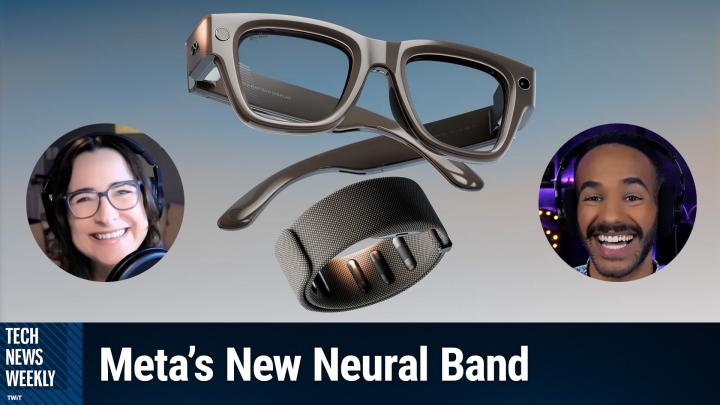
Yeah. Thank you, Mikah. It's a long road of evolutionary stuff. Totally. And what these are, they do all the stuff that the meta Ray bans do, but they also add a heads up display in the right eye, kind of in the bottom ish part. And it's small but it's high res. And then there's a neural band which is this wristband you wear. Actually this is like the party band from the conference yesterday, which I can't get off my wrist.
Scott Stein [00:52:47]:
I have to cut it off that imagine that. But it's a neural band and it snugly wraps around your wrist kind of almost like a whoop band. All it's for is for navigation of the interface on the glasses. You know, it's not a fitness tracker, it's not a watch. So what you're seeing is like, you know, every AI interaction could happen without the display, but you also can invoke the display, which pops up like Google Glass, you know, like in the days of Google Glass. But it's like, like something now that you can actually navigate by swiping your thumb or tapping or pinching. Kind of like Apple Vision Pro or hand tracking. So.
Scott Stein [00:53:26]:
Except this doesn't have eye tracking, which some people may be very happy about, considering they might be worried about data and Facebook. But that also is a trade off, which means that you've got to do a lot more swiping to get to stuff. It's like a little mouse and text app, but it can use the cameras and it can use the microphones and it can do more things through a limited number of apps on that display.
Mikah Sargent [00:53:53]:
So speaking of the neural wristband, you talk about how that is kind of at the heart of reading what your thumb and your fingers are doing to kind of let you navigate. Can you talk about sort of the fit and feel of this neural wristband? And, and I'd love to know for you if it felt intuitive after a period of time, if there was kind of a steep learning curve, because I did have the opportunity to try Apple Vision Pro early on in its iteration or introduction rather. And after a short period of time it did start to feel pretty intuitive of what I was doing and how I was doing it. I was curious if it's same with this, this system, it's a little different.
Scott Stein [00:54:40]:
And there are some advantages and disadvantages. So like the neuralbam uses this tech which I've been following for years and I got to try last year with Meta's higher end Orion glasses concept which was like full 3D AR but the band is the same band and it's using electromyography. So it's looking at. They say it's a neural impulses, electrical neural impulses. So it basically can sense your finger movements and gestures. Now that's not quite as magical because you can do that in hand tracking on a VR headset or Vision Pro. You can also like the Apple Watch is adding some gestures and things on its thing just like a tap. But it's pretty magical in that it recognizes all these motions when your hand is down and all these other things.
Scott Stein [00:55:24]:
That's pretty amazing. I've been waiting for that for a while and opens the door to all sorts of other. Apparently it's adaptive and could like you could train it to do other things. Oh wow, they're doing like handwriting on a leg and then it registered the handwriting and like I'm curious about typing and you know, it's. I don't know its limits but that's pretty amazing. The rest of it though, the interface involved a lot of like middle finger taps, forefinger taps. Sometimes I was turning an audio dial by tapping and turning my finger. Sometimes I had to go back and or swipe like this, like a mouse.
Scott Stein [00:55:57]:
I found that system of interaction pretty confusing. I was worried and I'm pretty versed in this. I was worried I accidentally tapped the wrong thing and then I would like send a message or end a call. I think I did that a couple of times. So I think that's going to take some getting used to. And a lot of the reason why it's a little more confusing is because with like Vision Pro or things like that Orion last year, when you look at something and then you tap to confirm term, it's a lot more direct, you know. So it's like, oh, I look at that app, I'm tapping it because I can see that I'm looking at it and it's being highlighted now you got to do a lot more swipey stuff to get to that thing at the top of the small screen because it doesn't know what you're directly looking at. So I think that's gonna be a little more swiping than maybe people are comfortable with.
Scott Stein [00:56:44]:
It depends on how the apps all feel when you review it or test it or wear it or whatever. Like, I'm gonna be doing that in a of weeks, couple of weeks. So.
Mikah Sargent [00:56:52]:
Yeah, yeah, that. So I think about something that still to this day happens to me that I thought, I thought we might be at the time where enough people have smart watches or are aware of sort of smart wrist wearables that when I look at a smart wrist wearable or a smartwatch, in my case the Apple watch, that people are aware that these are things that will regularly get notifications. However, even still, and despite the fact that I can be relatively subtle about it, I just. The other day, a friend of mine who knows me pretty well and knows that we were hanging out in a group and it was kind of nearing the end of the night, I looked down at my watch to see a notification that had popped up and she said, oh, Mikah's checking the time. We probably need to get this wrapped up up. And I had to explain, no, no, no, that's not what I was doing. There's still that kind of, I think, about using these devices and moving your hands around a lot that that kind of gets in the way. And in that way, this sort of neural wristband approach seems like it could make for a more subtle experience that maybe people aren't going to pick up on as much.
Mikah Sargent [00:58:06]:
Do you feel like. So as a person using it, that's one thing. Did you get the opportunity to see someone else in these interactions use it? And was it as obvious to you as what they used to call sort of that quote unquote, glass hole look and feel where it was just so obvious or somebody walking around the Vision Pro on their face. Right. And what that. The message that that sends.
Scott Stein [00:58:34]:
I think about the very first days when people wore Bluetooth headsets and I remember the feeling of like. Like, is that person just talking to themselves or having a conversation? Or like, have they. You know, there's a real sense of like weird distancing from people that we now deal with all the time. I think there's a little bit of that, but it's enhanced because I think when you have something in your eye, and I haven't tested this out or noticed too much of it yet in the demo, I got very little of that. You're going to get a Little bit of dead eye. You know, I think you're going to get a little bit of that zombie stare where you're looking. I still, I get zombie store stare when I'm using the ray Bans too, because when I look at something to focus and ask what it is, it's like I'm looking at that thing a little too long for the camera shutter. And then people are like, what just happened to you? Turned into a, into a robot.
Scott Stein [00:59:24]:
So I think there are many moments like that. And then I think you don't have to keep your hand up in the air. But I've noticed, I think it's a habit. So you might see someone starting to do this a little bit and then doing this stuff and then you can go, what is happening here? And, and on the stage demo. You know, there are a lot of fails on the live stage demo. But, but I guess credit to Meta for, for trying live stage demos. But I did notice a little awkwardness between Mark Zuckerberg and it was Andrew Bosworth when they were doing kind of a glasses interaction because, like, you know, builds presence or whatever. And there's like.
Scott Stein [00:59:56]:
And while you're navigating an interface with your finger and, and, and that's not comfortable and intuitive. That's weird. I think there are some things that are automatic. Like, I've seen this also on Snap's glasses recently and Meta has a bit of it too, of live captioning, where you could get captioning or translation down the road. Snap's doing translation, but I'm sure Meta's gonna be doing some of that in text too. That could just naturally appear once people are talking. That feels more automatic and relaxed. But I feel like the moment you bring up a grid and a visual interface to do that, it's to start navigating.
Scott Stein [01:00:38]:
That's pretty different. Plus, like, what's going to happen when you're driving or biking or shopping or, you know, we go back to that Google Glass question. When is it safe? It's going into strange territory. I also think there's social etiquettes that need to obviously still be worked out with new tech like this. Like, we didn't. We're still working out how to use our phones in public. We're still, you know, figuring out, you know, looking. Don't look at your watch too much or when, you know, when do you.
Scott Stein [01:01:03]:
Silence notifications and camera glasses are like a whole new awkward thing that are putting up a lot of concerns. I mean, people wearing this while giving someone a massage or whatever it might be. So I think there's a lot of, a lot of questions and concerns about that. To me it raises so many more questions. Then it answers them. I feel like this event and this demo have opened up all these Pandora's boxes of thoughts that I can't easily answer. Which is part of what this next gen movement is to this ambient contextual AI as MET is calling it.
Mikah Sargent [01:01:37]:
Yeah. And in a big way that's so exciting. One of the questions that I have early on, at$807.99 they are significantly more expensive than some of the the other more available smart glasses that are that you know, don't have this display. Who do you think Meta is targeting with this product? Because it's in this case we're not like with Orion where it was just kind of like we're experimenting. This is developer Da da da da. This is a real thing that people will be able to buy. Who is the target market right now and kind of what's the value prop for this? Is this specific to, to the creators of the world or. Yeah, who's it for?
Scott Stein [01:02:25]:
It's a great question and sort of getting the vibe check around here and feeling things out as I'm wandering around. Meta is very much courting the design landscape. You know, I think there's a lot of fashion and design feelings all throughout people attending here. I think a lot of the creators are from a kind of a fitness and design. Not to draw too big of a judgment on who's attending, but I tend to feel that there's a lot of people who are aware of that landscape. These glasses look kind of like cool Martin Scorsese or like, you know, they have a cool factor to them. They're big but they're. There's a style that fits that.
Scott Stein [01:03:02]:
I wonder if they're thinking about people who buy high end glasses because $800 is a lot of money but it's far, far less than the Vision pro which is $3,500. So it's like, like and even like sometimes you get into like $1200 or $2000 like Pro headsets. This feels like a, an affordable but expensive range considering it also includes the wristband. Like if that could have gone a la carte and then it could have been like 800 for the glasses and 200 for the wristband. So I think I feel like they're trying to do everything they can to get this in at a relatively affordable price. But you're right, like people don't to want, want to Most people do not want to buy glasses for anywhere near that price. And the Ray Bans sneak in at being something somewhat reasonable. You can get frames for a lot less than that.
Scott Stein [01:03:50]:
But a lot of people like you can end up buying frames that are not too far off from, like, what a Ray Ban costs at a Ray Ban. So I think it's for early adopters. It's us only to start. It's going to be something they keep building out the platform for. It's clearly not going to do all that many things at first, but. But you might want to be seen wearing it, you know, depending on what your audience is. And that's kind of like any early tech. I think this has more wearability, for sure than a Vision Pro.
Scott Stein [01:04:23]:
You know, this is something you could like, wear out and just see how it feels and just use them as glasses, provided they fit your prescription. They do not fit my prescription.
Mikah Sargent [01:04:33]:
That was. That's my next question. You talk about a couple of limitations or a few limitations. Prescription compatibility. What do you see as the main constraints right now the users should know about before considering these glasses?
Scott Stein [01:04:48]:
Well, I'm very disappointed it doesn't fit my prescription. I am an edge case to some degree. I'm a minus 8. Minus 8.5. That usually tends to break a lot of glasses in AR demos, but you can get inserts that fit the. That for VR headsets. And I got custom inserts that fit the Ray Bans. They're not officially supported.
Scott Stein [01:05:08]:
They usually cut off at minus six. But the thing I was saying last night coming back from this that I felt more and more upset about is, yes, you. Oh, you may want to accept it and go for it, but glasses are a product designed to adjust for your eyesight. They are a thing that is. Was created in the first place for that purpose. So I know they're like fun that you can wear them and do other things, but if it's like, oh, you want an Apple watch to replace a watch, you want smart glasses to replace glasses. Glasses have a real purpose. So not fitting a prescription is a big miss.
Scott Stein [01:05:41]:
They did say they want to eventually get to that point, but it's hard for me to actually call them glasses in the normal sense for me, because they're like fun glasses, you know, they're like things that, that, you know, I. So I worry about that a lot.
Mikah Sargent [01:05:57]:
Yeah, it's like the theater 3D glasses where you pop out the lenses and wear them around. I think it makes you look like Buddy Holly and that to the point, like Having a smart watch that doesn't tell time in a way in the sense that, yes, it's not serving its original purpose. That's a really good point.
Scott Stein [01:06:15]:
And battery life, I guess on a watch is like that now too, where you're like, well, a watch is meant to last, last for a while, not be charged every night. So that's a fair gripe. Yeah, yeah.
Mikah Sargent [01:06:24]:
During your demo, I'm curious to hear kind of because especially with these different VR concepts, these early demos are the sort of wow factor that a lot of people point to. What were some of the most impressive applications uses that you experienced? And were there any with this that felt kind of gimmicky? You don't see in the long run it being part of the. The experience.
Scott Stein [01:06:49]:
I thought the live captioning was really interesting because it. It showed some stuff that they're doing with the microphones and AI. And AI which they're also using a conversation focus for the Ray Bans coming up to filter out other bits of information and begin to focus on just the person in front of you, which is like an assistive feature. This does it via text as well. So I was. They were. Everyone was talking in the room and whoever I looked at through the beamforming microphones, it would recognize who I was looking at and just bring up the captions that they were saying wow. And.
Scott Stein [01:07:25]:
And none of the others were coming in. And I thought that obvious has had. That has real assistive purposes, you know, for people who might need to be able to hear something or make it out or read it, translate it. So that was super cool. I thought this is not really an app, but they demonstrate how all these glasses come with transition lenses, like by default, which is nice. But it also serves a real purpose in that you can see the display outdoors. So they really showed that. Okay, when the sun is super bright here in the Meta campus, which it was, I could still see the display even while looking at the sun, which is a great live demo of like, let's say you're at a outdoor stadium or who knows what and you need to see it because I actually find listening to Ray Bans hard and noisy environments and that's still a problem.
Scott Stein [01:08:13]:
I don't think they've really. It's hard to address noise canceling on an open air headphone.
Mikah Sargent [01:08:17]:
Right.
Scott Stein [01:08:18]:
But like, I don't know what you do, but they are starting to think about wind reduction for the microphones and voice like concentration. So I feel like they're trying to figure that out. And the Other thing I thought was interesting was a live. I think it was a Messenger video call where somebody came in. I could then see their video feed and then I could show them mine in another POV window. So it was like a little telepresence, like hey, what are you looking at? And I you can do that on the Ray Bans, but you can't see what they're saying. You can't see them now. I could see them and also for taking photos, I could zoom in on photos, but not like that.
Scott Stein [01:08:53]:
I, that's the Vision Pro. I did this and did this to zoom. Zoom and that was cool because I want zoom on the Ray Bans right now. It's digital zoom and it wasn't always like super snappy and responsive, but it was cool. So I think those are the most interesting things I saw.
Mikah Sargent [01:09:13]:
Yeah, that does sound pretty cool. Do you think that these Meta ray Ban display glasses are a first attempt at or first step rather toward commercializing Meta's Orion prototype? Or do you feel like that's its own separate category and this is its own separate category?
Scott Stein [01:09:40]:
I think, yeah, I think it's absolutely a first step towards that. I think, I think this is them trying to get going actually in more steps that I would expect after one year. Because Orion did feel like they like a, a far future thing. And I had these thoughts that the wristband would be ready sooner than later. But in a lot of ways this almost looks like Orion available now. But then you have to tell people no, it's not actually Orion. There's a lot of differences here. It's also doesn't.
Scott Stein [01:10:06]:
It's not a standalone computer. You know, it needs your phone still in the Meta AI app. So you know, it's a peripheral. But yeah, I think so. I think they're going to keep building towards that. But then the question is, is battery life what you actually do with it? Price? Because this is like the more you add, the more expensive it gets. And then how much does that factor in and how many years away is that? I think we still have this awkward period now between glasses and VR headsets. And really for everyone else, their phones, it's really like I'm using my phone, maybe my watch.
Scott Stein [01:10:45]:
Where do glasses fit in the picture? I could go on and on about this, but to me the glasses right now the Ray Bans do really well because they are pretty good headphone alternatives with great audio quality for calls. And they are fun vacation things like you can take photos and do things on the go that you can't normally do like a GoPro, which are two really useful things. But I don't know if everyone's ready to buy into glasses as a cognitive extension ecosystem. You know, like, like there's a. They may be using these for like really simple things. And now MET is going like, okay, these are AI, which is on the existing ray bans. But like, okay, these are like creeping towards AR glasses that are going to be around with you in your life. That's a, that gave me very cyborgy feelings, you know.
Mikah Sargent [01:11:35]:
Yeah. When you talked about the zoom part, I thought especially that is you're, you're literally like looking through and yourself being able to augment your view is that. Yeah, that's kind of mind boggling to me. Last question I have for you, and this is the big one because you kind of talked about it throughout, it opened up this Pandora's box, Right. Looking beyond this specific technology itself. As you continue to look into this space, what kind of broader questions, concerns or excitement did this raise for you about augmented reality and how it might change our daily interactions and behaviors?
Scott Stein [01:12:12]:
Well, there was just a big Brain breaking keynote which had some of their future thinkers, Michael Abrash and I know, oh my God, what's his name? Newcomb. His last name is Newcomb and I should know his name right off the top of my head, who's also at Reality Labs Research. And I'm going to pull it up and then tell you. But basically what they were talking about was social superintelligence. And social superintelligence is effectively the idea of our whole interconnected system of thinking and doing things. Look up on my Blue sky feed, you'll see what his name is. But I don't want to get distracted, but that these big pie in the sky ideas, which are grounded in a lot of thinking people have been thinking about that we'll collectively become a kind of a different super intelligent entity through AI, all of us. That's a big, scary, fascinating thought.
Scott Stein [01:13:11]:
And the thing I wrote down when that happened is that unfortunately, big social groups plus tech often do not lead to intelligent things. Right now that is extremely, extremely, extremely true. True. And so if we're going from social networks to what is the social network too? Or this idea of this AI infused social network that raises a lot of questions. And from a company like Meta, it raises a lot of questions. And then I think, who do you really want to have this on your face from, even if you are wearing it? Google's entering the space, Apple's probably entering the Space. It's at some point with glasses and then yeah, I'm always interested in how to fundamentally changes human existence. You know, like how did we change using phones? How did we become smarter? Dumber.
Scott Stein [01:14:06]:
When you have a glasses interface, there's a lot of assistive ways that these can be incredible for people and already are. But also I think on a practical end that that universal neural wristband feels like it could like control your whole world with like superpowers. Like a mar. Like, like a, you know, now I have like telekines. I have Jedi force powers.
Mikah Sargent [01:14:24]:
Yeah.
Scott Stein [01:14:25]:
But like with what you know, you want it to work with your tv. I want to turn off the lights. I want to like make something come to me. It only works with the glasses right now. I mean. And will companies work together? Is like meta is going to be forced in a corner had to work with Apple products. And how well will this work with phones? Because Metis is a little bit challenged by limits on the. They said that glasses are going to start getting app book ins for certain apps on phones, but it could be awkward.
Scott Stein [01:14:54]:
Like the pairing on them is already weird. Sometimes things fail, sometimes things have problems syncing. I've had tons of like, oh, it's not connected or reconnected. Bluetooth and WiFi that all needs to be really fixed. It's kind of not talked about much but the more you live with these, as always on assistive glasses, you certainly don't want any of that to mess up up. And so. And so right now there's a lot of bugginess all in the margins with this.
Mikah Sargent [01:15:23]:
Absolutely. Yeah. There's a lot more to consider here. And as you said, as companies continue to release this technology and their take on it. Thank you so much. I know you're very busy right now, so really appreciate you taking the time to join us today. Always appreciate your thoughts. If people would like to follow you online and keep up to date with everything you're reporting on.
Mikah Sargent [01:15:46]:
Where should they go to do that?
Scott Stein [01:15:48]:
Yeah, well, I'll tell you. You can follow me on CNET. As always, I'm on Blue Sky a ton. Scott Stein. I've also started doing a weekly newsletter, the Intertwixed, which is a new little thing. It's on Beehive. You can look for it. It's always hard to find newsletters, but I share it on my thing, so that's usually my weekly dovetailed wrap up of things I'm thinking about.
Mikah Sargent [01:16:11]:
I love that name. That's fantastic.
Scott Stein [01:16:13]:
Oh, thank you. It's a. It's a. It's a fun little project and I'm and catch a play that I write in Montclair or something. I don't know. I'm trying to do playwright.
Mikah Sargent [01:16:22]:
Wow, that's awesome.
Scott Stein [01:16:23]:
Yeah, I don't know, it's a. You. You asked me. I'm going to tell you. But yeah, thanks. You can. But it's great to talk to you again.
Mikah Sargent [01:16:30]:
Yeah, always good to chat with you. Thank you so much for your time and we'll see you again soon.
Scott Stein [01:16:35]:
Yeah, thanks a lot, Mikah.
Mikah Sargent [01:16:37]:
Alrighty, folks, that brings us to the end of this episode of Tech News Weekly, which means it's time for me to remind you that you should join Club Twit at twit.tv/clubtwit. $10 a month, $120 a year, you can join our club and in doing so, you gain awesome. You gain awesome to some pretty access. Now you gain access to some pretty awesome features. You can check out all of our content ad free, just the content, none of the ads. You also gain access to our feeds that include our behind the scenes, before the show, after the show. We've also got our news events that will go out to you as we do that live coverage and live commentary in our discord.
Mikah Sargent [01:17:17]:
And access to our club shows like My Crafting Corner, Stacy's Book Club, our photo show, our AI user group and so much more. And access to the members only Discord Server, a fun place to go to chat with your fellow Club Twit members and also those of us here at TWiT. If all of that sounds good to you, well, join the club. We've got a two week free trial so you can check it out and I look forward to seeing you there. twit.tv/clubtwit. If you'd like to follow me online, I'm at @mikahsargent on many a social media network where you can head to chihuahua.coffee that's C H I H U A H U A.coffee where I've got links to the places I'm most active online. Be sure to check out my other shows on the network including iOS today, hands on Apple and Hands on Tech. And we'll see you again soon for another episode of Tech News Weekly. Bye!
TWiT.tv [01:18:15]:
The tech world moves fast and you need to keep up for your business, for your life. The best way to do that Twit TV on this Week in Tech, I bring together tech's best and brightest minds to help you understand what just happened and prepare for what's happening next. It's your first podcast of the week and the last word in tech. Cybersecurity experts know they can't miss a minute of security now every week with Steve Gibson. What you don't know could really hurt you your business. But there's nothing Steve Gibson doesn't know. Tune in Security now every Wednesday. Every Thursday, industry expert Mikah Sargent brings you interviews with tech journalists who make or break the top stories of the week on Tech News Weekly.
TWiT.tv [01:18:59]:
And if you use Apple products, you won't want to miss the premier Apple podcast, Now in its 20th year, MacBreak Weekly. Then there's Paul Thurrott and Richard Campbell. They are the best connected journalists covering Microsoft. And every week they bring you their insight and wit on Windows Weekly. Build your tech intelligence week after week with the best in the business. Your seat at tech's most entertaining and informative table is waiting at twit.tv.