Security Now 1105 transcript
Please be advised that this transcript is AI-generated and may not be word-for-word. Time codes refer to the approximate times in the ad-free version of the show.
Leo Laporte [00:00:00]:
It's time for Security Now. Steve Gibson is here, and I have been waiting all week to find out what he thinks about the Microsoft Outlook outage, the FAA ground stop, the huge Patch Tuesday roller coaster, and, well, a whole lot more. That's next on Security Now.
Steve Gibson [00:00:20]:
Podcasts you love.
TWiT.tv [00:00:21]:
From people you trust. This is TWiT.
Leo Laporte [00:00:30]:
This is Security Now with Steve Gibson. Episode 1105, recorded Tuesday, November 17th, 2026. Formal code verification. It's time for Security Now. Hello everybody, Leo Laporte here, and so is our hero of the moment, Steve Gibson. Thank goodness there have been no security incidents this whole week. We could just talk about vitamin D the whole time.
Steve Gibson [00:00:55]:
It's one of those where like, well, let's just shoot the breeze.
Leo Laporte [00:01:00]:
This could be a 5-hour show if we cover everything that has happened. this week, including the NSA being down. But we'll get to all of that. What— Steve, hello. Steve Gibson, grc.com. I should mention that. I figure after 1,105 shows, everybody knows who everybody is on this.
Steve Gibson [00:01:17]:
I think that's probably true.
Leo Laporte [00:01:19]:
Uh, what's happened this week?
Steve Gibson [00:01:22]:
Well, we of course had a, depending on who you ask, somewhere between 26 or 24 and 48-hour famous, now infamous Microsoft 365 outage.
Leo Laporte [00:01:38]:
Yes.
Steve Gibson [00:01:39]:
And we think we know now what happened, even though they're still— they still haven't given us the fully detailed after-action report. Uh, and boy, we're gonna have a little fun at their expense because Mashable gave them— so like, like, did a timeline coverage And it just sounds like they do not know what end to plug in. It is just so—
Leo Laporte [00:02:05]:
Cory Doctorow said, this is what you get when you let a company become a monopoly. They don't have to invest anymore. They just fire everybody and they don't have to invest in security.
Steve Gibson [00:02:14]:
And haven't— how many times have we looked at egregious, like willful appearing mistakes and noted, well, that's going to cost them exactly no customers.
Leo Laporte [00:02:27]:
Exactly.
Steve Gibson [00:02:28]:
You know, and even this, and I was, I was saying to Benito, but before we, we began recording that, that they, they will not lose anyone for this outage because it's like there isn't really a good alternative. And if there were, or like, like pulling it back in-house, nobody wants to do that. It's like switching away is too expensive. And even though it was a huge inconvenience, even for governments that were like unable to— and like, I mean, it was a mess. People are just going to go, oh, well, it's better now. It's back up. It's back. So let's keep using it.
Steve Gibson [00:03:05]:
You know, so we had that followed by a, like, a bizarre FAA event. I'm dying to hear what you have to say about this. Oh, you're going to get a kick out of what actually apparently happened. Then, of course, we've got last Tuesday's Patch Tuesday roller coaster. And we'll take a close look at that. And then speaking of Patch Tuesday, the return of Nightmare Eclipse, because it wouldn't be a Patch Tuesday in 2026 if there wasn't a zero-day bomb dropped deliberately after the patches are out so that, you know, to maximize the pain that Microsoft feels. We've also got a Synology patch that I'm sure you and I both dealt with last month, but this is the backstory behind that. And yes, it's bad.
Steve Gibson [00:04:00]:
Um, we— oh, and Leo.
Leo Laporte [00:04:03]:
Yes.
Steve Gibson [00:04:04]:
The unexpected revocation of GRC's code signing certificate.
Leo Laporte [00:04:09]:
What?
Steve Gibson [00:04:10]:
What? That's what I said when I got the news on Sunday. It's like, it's Sunday and you have until 4 PM Monday, uh, because, uh, to respond. It's like, What?
Leo Laporte [00:04:25]:
What?
Steve Gibson [00:04:25]:
Anyway, that happened. So we'll talk about that. Then we've got a breakthrough in AI. And I know this is not the AI podcast. I'm going to have to do a little mea culpa here because, you know, we have spent some time establishing a foundation of understanding of how this stuff all works. Something big just happened. And I'm sure our listeners want to know when something big happens. And it did.
Steve Gibson [00:04:53]:
So they will. Uh, also a brief, uh, SpinRite for UEFI progress report. Uh, a listener wondered why encrypting only every 3rd block for that fast mode, uh, that Micah and I talked about is not okay, because after all, it like, it's every 3rd block, the file, you can't get the file. We'll talk about that. Um, and then. The big topic of the day, I, I didn't— I— all you see of the, of the title on the screen is formal code verification, but the official title of today's podcast is The Holy Grail of Formal Code Verification. Think about it. I mean, math— Math.
Steve Gibson [00:05:40]:
Being able to demonstrate with mathematical certainty In the same way that, you know, 2+ 2 is 4, that code does what you— what— that the operation of the code matches the specification that you wrote for it.
Leo Laporte [00:06:04]:
If somebody's not paying attention, they might say, well, of course. But no, this has not been easily done.
Steve Gibson [00:06:10]:
It's almost never been done.
Leo Laporte [00:06:12]:
Yeah,
Steve Gibson [00:06:12]:
I mean, because, because it turns out it goes exponential, um, in terms of complexity. You know, you can formally prove a trivial program, but trivial programs don't need formal proofs because they're trivial.
Leo Laporte [00:06:29]:
It's the PNP problem, right? It's NP, right?
Steve Gibson [00:06:32]:
It is, yes. And, uh, Google has made a breakthrough.
Leo Laporte [00:06:38]:
Wow.
Steve Gibson [00:06:39]:
And this changes everything. Because, because the old all software has bugs, which just grates like fingernails on chalkboard for me. It's like, yes, because you're lazy, uh, and you're making excuses. Um, but to be able to move formal code verification forward, uh, and, and what they did— anyway, we're gonna, we're gonna look at this whole field because this truly is the holy grail. for provably correct software, which except in extreme cases where we've had to have it or for trivial cases where it really didn't matter that much, it's not been available. And AI has made that happen. So I think great podcast. And Leo, we're gonna share a picture from your vacation.
Leo Laporte [00:07:39]:
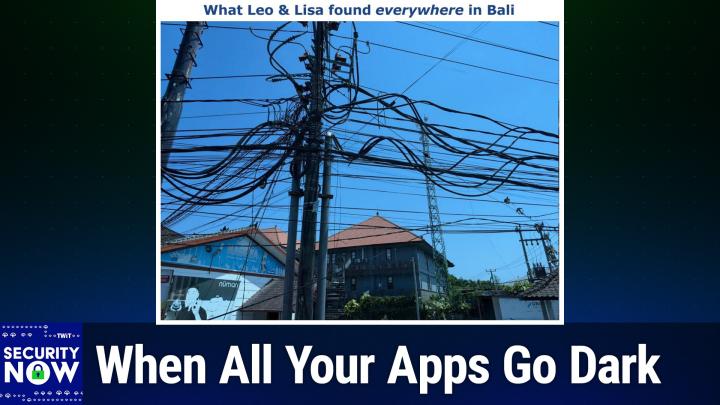
It's ironic because I've never had a picture the picture of the week, but this week Lisa does. I did suggest she take it though, and I passed it along to you. So,
Steve Gibson [00:07:53]:
well, it looks like the sky is blue in Bali. It's beautiful.
Leo Laporte [00:07:57]:
We had so much fun. Oh, I loved Bali.
Steve Gibson [00:08:00]:
So I gave your picture, uh, the caption, what Leo and Lisa found everywhere In Bali.
Leo Laporte [00:08:09]:
And this wasn't even the worst example of it, to be honest. Right. But this was the one we could get.
Steve Gibson [00:08:15]:
It's a little frightening because I see high voltage lines mixed in with this low voltage signaling.
Leo Laporte [00:08:24]:
Oh yeah, it's all messed up in there.
Steve Gibson [00:08:26]:
Oh gosh.
Leo Laporte [00:08:28]:
And the thing is, it continues like through trees, over signs, around stuff. It's just The whole thing is a, is a, uh, a rat's nest, I guess, is what my parents would have called it. A rat's nest of wiring.
Steve Gibson [00:08:44]:
Yikes.
Leo Laporte [00:08:44]:
Um, I don't know how they maintain it. It's crazy. But this is what I mean. Yeah, you see the high voltage in the background there coming right off of those? Yeah.
Steve Gibson [00:08:54]:
Yeah, like with big insulators and spark arrestors and— That's crazy. And then everything else, like, and a lot of phone lines and things. So you could, you could get a serious jolt out of your phone if—
Leo Laporte [00:09:06]:
You know, it's true though, and you can see in the background, cell phone service is great there. 5G everywhere.
Steve Gibson [00:09:11]:
Yeah, there's a tower in the background.
Leo Laporte [00:09:13]:
There's a tower. A lot easier to do wireless at this point. Pretty amazing. I loved Bali. Beautiful people, wonderful country, and I just wouldn't rely on the electricity.
Steve Gibson [00:09:23]:
Yeah, and be careful when you're holding a wired phone near, near your head.
Leo Laporte [00:09:30]:
All right. What's, what's, uh, gosh, so many outages this week. Holy cow.
Steve Gibson [00:09:35]:
As everyone knows, uh, the past week has seen 2 major massive service outages. First was Microsoft's shockingly long, uh, I had 14 hours, but it looks like it's more like 24. I, I think that at 2:10, I thought it was 2:10 AM when they posted something. It turns out it was 2:10 AM. PM later that day. So 24 hours, um, and in some cases I've heard people say 2 days, uh, which affected many of its 365— Microsoft's 365 services, um, of course most notably Outlook. Um, I've seen, uh, you know, again, like varied reports of, of what was out. And of course then the second outage that we talked about was the FAA's decision last Friday to shut down all domestic air travel takeoffs which were not bound for foreign destinations.
Steve Gibson [00:10:34]:
There were some that were leaving from, you know, like, like the Pacific side of the country, I know. But, you know, in the current climate, not surprisingly, you know, with the public expecting the world to end any moment once AI decides that it no longer needs us, uh, you know, and then there's the 700 French refrigerators having their temperatures turned up to 120 degrees Fahrenheit or higher. With all this, you know, in the background, it's no surprise that even my own friends were texting me frantically asking and even assuming or asserting that, you know, first Microsoft and then the U.S. airspace were victims of cyber attacks. You know, like, what do you think? I think it is. It's like, okay. So, uh, even today We bizarrely, in today's world, the details of these— I mean, the actual, you know, ground truth details remain somewhat foggy. And but at least we have the fact that those who are in a position to know are asserting that this was all just, I guess we'd call it natural causes, meaning, you know, at least not the result of malign actors.
Steve Gibson [00:11:52]:
And unfortunately, It actually— the phrase natural causes probably does fit a little more closely than we would like. Okay, so all that said, Microsoft's responses along the way were really downright bizarre. It sounded, from what they were posting on X, as though— and this is the official Microsoft channel— as if They really had no actual grip on what was going on for a lot longer than would seem reasonable. Um, you know, it's, it's as if the technology was magical. Uh, someone else had created it and they were just sort of kicking the servers with their feet in, in the hope that they would start up again somehow. I mean, okay, so here's what I mean. As I, as I said, Mashable reported the timeline. Which I'm going to share in chronological order.
Steve Gibson [00:12:51]:
So Mashable wrote on Thursday, a Microsoft outage affected Outlook, Teams, and other Microsoft 365 services starting around 12:30 PM Eastern time. They said in its initial update about the outage, Microsoft stated that Microsoft Exchange Online was at the root of the problem. Many users were unable to access Microsoft 365 services related to Exchange Online, including Outlook, Teams, SharePoint Online, Copilot, Defender XDR, and more. Exchange Online is the backend cloud-based tool that provides data updates for frontend user-facing tools like Microsoft Outlook. Okay, so that's at 12:30 Eastern, uh, or 9:30 in the morning for those of us who, you know, woke up to this or saw it early in our morning on the West Coast. 5 hours later, at 5:26 Eastern, 5:26 PM Eastern, they, they update. Microsoft services remain down. On Thursday evening as Microsoft acknowledged ongoing problems in an update posted on X.
Steve Gibson [00:14:13]:
So 5 hours go by and still down. Okay. Like, like all of this is down. Another hour passes. And at 6:23 in the evening Eastern, Microsoft states that it is bringing some servers back online. And, quote, they remain stable so far. Okay. Users should expect a gradual recovery are Microsoft's exact words.
Steve Gibson [00:14:45]:
So, you know, they remain stable so far. Sounds like we really, we don't really understand how any of this works, but we're hoping for the best. And so far, so good. An hour and a half after that, at 7:53 in the evening Eastern, Microsoft has issued a new update stating that the servers they've brought back online may become unresponsive again when they receive traffic. I was like, what?
Leo Laporte [00:15:20]:
What? So I guess the servers— They don't mean the same thing when they're brought back online as you do.
Steve Gibson [00:15:25]:
What are they going to serve? If not traffic.
Leo Laporte [00:15:28]:
Well, they're online, but they're not doing anything.
Steve Gibson [00:15:29]:
Yeah, the servers are back online, but if anyone attempts to connect to them, they might not reply, but they're not sure of that. What, did the voodoo incantation not take? Mashable wrote, the company is currently investigating the issue. Well, one would hope. And limiting the types of traffic going to these servers in some locations because, you know, you want to be gentle, apparently. 14 minutes passes. Now it's 8:07 PM Eastern. And we get Microsoft revises its list of features and services impacted by this outage to include, you know, they're adding now, uh, Microsoft Outlook, SharePoint Online, Teams, Copilot AI, and Microsoft 365. Though Azure appears to be operational.
Steve Gibson [00:16:22]:
Oh, good. Okay, so apparently they're still hopeful, but they're still not sure. It's coming up on 8 hours now, and Microsoft is kind of not sure even what's out, apparently. Another 3 hours pass, which brings us to 10:58 PM on the East Coast. Mashable writes, Unfortunately, Microsoft's efforts to bring servers back online are not going as planned. Microsoft wrote in an update on X, quote, we've monitored the status of the changes applied to improve serviceability and confirmed they're not taking as expected. What? You see what I mean about Microsoft apparently not being the master of their own domain here? You know, they presumably invented and created all of this. These are their servers running their software, but those servers are not taking to the changes they've applied to improve their serviceability.
Steve Gibson [00:17:36]:
What, they're not in the mood? None of this serves to inspire confidence. If I didn't know any better, I'd suspect that they'd already handed over all responsibility of the operation of all of this to some AI, you know, then offered all of those expensive humans who actually knew how it all worked that early paid retirement that we heard about. Uh, and as a result, nobody who's there actually understands how it operates any longer. I mean, this is what we're hearing. It's like, well, we applied some changes which we're hopeful about. And then a little way, a little while later, oh, well, those, the servers didn't take to those. What, you gave them a choice? Okay. So it gets more bizarre, believe it or not.
Steve Gibson [00:18:23]:
Another 2 hours pass, which brings us into Friday the 13th on the East Coast. Oh, boy. So it's now 1:08 AM and Microsoft is reportedly, quote, still looking into the cause of the outage. Okay, right, don't worry about it, we're looking into it. Okay, but states that at present it is, quote, not aware of any malicious activity that's causing this incident. Okay, so is not aware of, but also apparently doesn't have any competing theory. or explanation based upon the past, say, oh, 12 or so hours that the system which so much of the world depends upon has been mysteriously offline. Not quite sure why.
Steve Gibson [00:19:11]:
We hope— we're hoping it's good. It's, you know, it's— hang in there, right? So in the wee hours of the morning on Friday at 2:11 AM Eastern, Mashable writes Microsoft Has reported broad recovery and stability. And this is where I think it's actually PM and that it was like, so the afternoon of the following day, more like 24 hours rather than 14, as I was thinking. So Microsoft reports broad recovery and stability because that's what we want from our Outlook 365. We'd like it to be stable. Mm-hmm. And they published an apology on X, which was nice. Now, okay, now in fairness, I suppose that if one had a sufficiently massive cloud infrastructure, which we know they must, that depended upon all or most of its servers being up and running to handle what is, I'm sure, a constant, like incessant never decreasing global demand.
Steve Gibson [00:20:21]:
Such a system would have some form of load balancing and traffic distribution upstream of the large number of servers that were serving that traffic. So on some level, such a massive traffic handling and serving network does begin to resemble something organic. Like with a life of its own, because I mean, it's huge and stuff's going everywhere. So you, you do wind up, I can see that, with a system where you must, I mean capital must, have the required number of servers always up and online in order to manage that torrential flood of use. So what happens when you don't? If something goes wobbly inside some percentage of them, like some sort of internal self-health checks start to fail for some reason, which is what we later actually did learn as a consequence of some upgrades that were done way back in July, you know, like these health— these self-health checks get a little too picky, uh, resulting in many servers taking themselves offline for fear of, like, they're not healthy. Then as a result of that, there are fewer servers remaining to handle the amount of traffic that needs all or most of them in order to, like, deal with the traffic, which isn't going to go away. So the poor servers that are still available, they start suffering essentially a non-malicious DDoS attack created by the overwhelming level of demand that they cannot possibly handle by themselves after another bunch of servers said something's wrong here. We're taking ourselves offline.
Steve Gibson [00:22:27]:
I mean, and we've talked about the electric grid, right? How we have all these power generators. you know, strewn around the US, all tied into a single network. And when something goes down, it can like trigger a much bigger outage because everything's interconnected, and other networks will have to— will like sever their ties so that, so that they're not being asked to handle a load which is too great for them. This, that, this kind of thing, sort of an organic network effect. And in the early days of this podcast, we talked about how One problem with the TCP— with that, that TCP-style traffic has, um, is that since the internet's packet routing system is designed to drop packets, bad things can happen. Uh, you know, TCP and the internet in general uses, as we know, deliberate packet drops as a throttling feedback mechanism through retries, many retries, continual retries. So a weird thing happens, and we've seen this in other contexts before and talked about it. When TCP connections cannot be answered in a timely fashion, um, every client endpoint, all of those 365 users in the world that weren't getting satisfaction, they started retrying.
Steve Gibson [00:23:59]:
Every one of them retries again and again and again. So suddenly the traffic flood starts growing ever larger, and essentially a self-annihilating DDoS results. So I can understand how this— how like, like a Massive network with, you know, distributed traffic handling. If some part of it goes down, the rest of it can't handle the loss of that, that, that other part that was necessary, and it collapses too. But the most difficult thing to understand is how it could have taken Microsoft so long to determine what was going on. I mean, seriously, for me, If there's any takeaway, I can understand how this organic-y kind of network could collapse, but what the worrisome takeaway from the whole mess is that, that, you know, they— no one seemed to know. You know, at the end of last month, referring to jobs, Microsoft made headlines, right, by offering an astonishing 60,000-some of their employees, more than a quarter of the 223,000 total workforce, voluntary paid early retirement. It's like, hey, how about we'll pay you to go away? So you gotta wonder how many of those who accepted Microsoft's offer might have been the ones who knew how to fix this, you know, in fewer than 24 hours.
Steve Gibson [00:25:38]:
Um, some say 2 days that, that for full service restoration. I don't know, but you know, it's like, yikes. Um, it's, it's, you know, as we've said, anybody could trip over a cord, anyone can make a mistake, but it is how you handle it that matters. And wow, this— I mean, and Leo, I don't know, uh, I didn't— wasn't really tracking the economic cost. I saw something Like $7 or $8 billion. I don't know how or who anybody comes up with a number like that, but I mean—
Leo Laporte [00:26:12]:
It was global. That's part of it, right? It was everywhere.
Steve Gibson [00:26:15]:
Yes.
Leo Laporte [00:26:15]:
It wasn't just one region. And yeah, I mean, people just couldn't work. People went home. They couldn't get anything done.
Steve Gibson [00:26:26]:
Yeah.
Leo Laporte [00:26:28]:
Which some people saw as a blessing, I might add.
Steve Gibson [00:26:32]:
Free vacation day.
Leo Laporte [00:26:34]:
How does this happen?
Steve Gibson [00:26:37]:
Yeah, and
Leo Laporte [00:26:38]:
I mean, I
Steve Gibson [00:26:38]:
was talking, I was talking to Benito about this a little bit. One of the, one of the problems that we're seeing is, is that we've— we're losing the distributed design of the internet in the— in, in favor of convenience. Think of how many— we've talked about it, but not in the context of, of of a critical problem. Think of how many of the websites now are behind Cloudflare. I mean, and if Cloudflare were to go down, it would take out—
Leo Laporte [00:27:11]:
Single point of failure. Yep.
Steve Gibson [00:27:13]:
Yes. And that's the point, is that the internet was, you know, we've heard this nonsense about, oh, designed to survive an atomic blast. Well, yeah, right. Like, there was no— there— it was so distributed that there was no nothing you— that you could bomb or explode that would hurt those areas that weren't directly impacted by shrapnel. Um, everything else would just go, you know, route around the problem and, and continue. Where— what happened on Thursday demonstrates the degree to which we have lost that, because if everybody was still running their own email servers You know, I am, uh, I didn't go down. I didn't have a problem.
Leo Laporte [00:27:58]:
Didn't impact us. We're Gmail and FastMail. For me personally, we didn't, didn't even notice it. And I've never used Teams.
Steve Gibson [00:28:07]:
And so if, if, if everybody was still operating the way they used to, that nothing would have happened. Nothing.
Leo Laporte [00:28:13]:
Yeah. That's why you don't want a homogeneous environment.
Steve Gibson [00:28:16]:
And that's the problem exactly is that, you know, I mean, and frankly, if Gmail were to go down, look at how many people have a Gmail account. I mean, if it all somehow could go down. I don't know if it even can. Obviously my Outlook 365 can globally.
Leo Laporte [00:28:32]:
You just feel like they shouldn't— it could go down in region. It doesn't seem like the whole thing—
Steve Gibson [00:28:37]:
Yeah, like a bad design.
Leo Laporte [00:28:39]:
Yeah. So do we— don't— I mean, they said it was software upgrade went bad, but I mean, really, what—
Steve Gibson [00:28:47]:
The only explanation we have is that back in July, a They, they did an update to a health monitoring module of some sort. Checked out, looked fine until just last Thursday. It didn't false positive, but something caused this thing to trigger on Thursday on enough servers that they took them. They volunteered to go, to go offline saying. Believing that they were not— they were no longer healthy for some reason. And so they just backed out of the network, and the, the balance of load-handling servers couldn't handle not having all those that took themselves offline. And so they collapsed, and the whole system just kind of just collapsed, you know, like dominoes essentially. And, and the more that that went offline, the more the load increased on the remaining that were still online.
Steve Gibson [00:29:49]:
And so they were forced offline.
Leo Laporte [00:29:53]:
Hmm.
Steve Gibson [00:29:54]:
Yeah. So hopefully, I mean, again, the problem is, and we've seen this, how many times have we said in previous Microsoft messes, they didn't lose any customers. I'm sure this didn't cost them any customers. Everybody like, ouch, and picked up the pieces. And as we always do, we muddle along. You know, we had a global pandemic a few years ago that, you know, I mean, it was horrible, global. And here we are, most of us are still here and we just muddle along. So, I don't know what the incentive is.
Steve Gibson [00:30:34]:
Right. For Microsoft, I mean, they got, they took some reputational damage, but it's not clear that that affects their bottom line.
Leo Laporte [00:30:41]:
How many companies are saying, oh, quick, let's look at some alternatives? I doubt anybody.
Steve Gibson [00:30:47]:
You know, the US government is a huge customer and they're like, they got, they got impacted, but it's like, well, there's, you know, do better, Microsoft. Okay.
Leo Laporte [00:30:58]:
Do better. That's the problem. I mean, you could say, well, there is, there are competitors. There's Gmail. But there's no guarantee that moving to Gmail would not have, would make this any better. I don't know if—
Steve Gibson [00:31:09]:
Oh, and when you've drunk that Outlook 365 and all the 365 Kool-Aid, you're in. I mean, you got, the tendrils are so deep into your organization that there's just no hope. You do what it says.
Leo Laporte [00:31:26]:
And you can't multi-home something like this. You choose one. You can't say, well, we're going to use Gmail and M365. That doesn't make any sense. So you have to pick a winner. You have to pick one. I, yeah, it's not going to hurt them at all. That's the sad fact.
Steve Gibson [00:31:45]:
No, it isn't. And, and then, so the question is what drives them to fix it? Because,
Leo Laporte [00:31:50]:
right,
Steve Gibson [00:31:51]:
you know, that's Corey's point.
Leo Laporte [00:31:52]:
Once you're a monopoly, nothing.
Steve Gibson [00:31:54]:
Yep, exactly.
Leo Laporte [00:31:56]:
Zippity-doo-dah.
Steve Gibson [00:31:57]:
Okay, let's take a break and then we're going to switch to the second major outage. Surely there's
Leo Laporte [00:32:04]:
not another
Steve Gibson [00:32:05]:
Another one of last week? Yes.
Leo Laporte [00:32:08]:
Honestly, there's so many, including the NSA and this morning Apple, that you probably would never get to the bottom of it. It would just be by the time you finish talking about them all, there'd be a whole nother bunch of them. I feel like the whole thing, I, it's hard not to become a doomer here.
Steve Gibson [00:32:26]:
There is like a chickens coming home to roost, like, you know, how many, how many, I know it's like, All of our slop is piling up and it's beginning to overflow the rim.
Leo Laporte [00:32:38]:
Yeah.
Steve Gibson [00:32:39]:
Okay. So speaking of network effects, where a massive machine with an incredible number of interconnected moving parts, all having inertia, must suddenly be stopped. That's a fair overview description of the US commercial air transportation system. There's a fixed number of planes. Planes are in the air, travelers waiting to board, uh, travelers connecting to other flights, baggage being forwarded to its destination, sometimes on flights, you know, other flights leading to the same place, hotel, car reservations. I mean, it is a massive network all moving and just, you can't stop it. So, you know, in the same way as with the massive network service delivery system that Microsoft runs, the commercial air travel system only works when all of its component pieces are working like interlocking gear teeth. So the consequences of suddenly forcing all of the not-yet-airborne planes to remain at their departure gates It's— well, it's beyond profound.
Steve Gibson [00:33:57]:
Uh, and if history is any guide, the U.S., uh, and, and it did, uh, need days to recover, uh, like at least through the weekend. So what happened was that Friday, the entire country, after this ground stop was announced, waited a surprisingly long time, consider— especially considering the scale of the impact. Wondering, like, for 4 hours without any word what was going on. I was watching the news live and everyone was scratching their heads saying, uh, well, we, you know, we don't know. So after 4 hours of mystery, uh, what then the country got was sort of a muddled, confused, and even at points self-contradictory report about the cause of this nearly unprecedented, you know, nationwide ground stop. When, uh, the DHS head, Mark Wayne Mullen, and Sean Duffy, Transportation, when they finally addressed reporters, they could not clearly explain what had happened. It's really not their fault though. Neither of them are technical types, so they were only able to parrot what they've been told, which did not put them in a good position when the detail-hungry press began peppering them with questions.
Steve Gibson [00:35:20]:
And of course, as we said at the top, due to the current climate where like things like seem to be getting wobbly and AI is, you know, people are worrying about that, the was this a cyber incident question was loudly and repeatedly voiced. And given what had been explained up to that point, everybody was confused. Including those 2 who'd been thrust in front of the press. And, you know, you would think could have at least been expected to definitively answer that one obvious question. Um, and of course, Microsoft's outages were still fresh in everyone's mind and still ongoing in some places. So anyway, they mumbled something about— I kid you not, Old and little copper wires.
Leo Laporte [00:36:11]:
Yeah.
Steve Gibson [00:36:13]:
Okay.
Leo Laporte [00:36:14]:
Uh, turns out— We're talking about T1 lines, by the way, if you— I mean, if you care. Right.
Steve Gibson [00:36:20]:
Um, uh, apparently this is technology that dates from the late '80s.
Leo Laporte [00:36:27]:
Yeah. Um, TDM technology, right?
Steve Gibson [00:36:30]:
Yes, TDM technology. And there are actually I have a hard time believing this, but I got it verified from a couple directions that we even have a listener who was one of the guys servicing these 4,000 ground-based radar tracking installations. In the year 2026, with a global internet and actual artificial intelligence that works, The nation's more than 4,000 ground-based radar tracking installations, many of them are unmanned. They're just little outposts somewhere. They are interlinked by pre-internet era analog telephone-grade copper twisted pair leased lines with 19.2 K baud modems.
Leo Laporte [00:37:26]:
Oh, wow.
Steve Gibson [00:37:27]:
At each end.
Leo Laporte [00:37:28]:
But can I point out, if it got the job done and it has for the last many decades. Yes. That doesn't— I mean, it's not insufficient. Remember the lesson of Battlestar Galactica? Oh,
Steve Gibson [00:37:44]:
yes.
Leo Laporte [00:37:44]:
When the Cylons came, what got knocked out? All the new stuff and the Battlestar, which still had phones with little curly wires, connected to the handset, they survived.
Steve Gibson [00:37:58]:
That is absolutely true.
Leo Laporte [00:38:00]:
Uh,
Steve Gibson [00:38:01]:
I
Leo Laporte [00:38:01]:
don't know if that's instructive, but it's—
Steve Gibson [00:38:04]:
What I described is actually the way the system that was first installed in the late '80s is still more or less functioning today. What that means in practice is that as much as Russia, Iran, North Korea, China or anyone else might dearly love to remotely interfere with our airspace radar, what we have is far too antiquated to be reachable. Apparently, unfortunately, including by the modem-equipped communication link endpoints, which are actually still using 19.2 k baud modems. Okay, so the, the latest word is that a single misbehaving router located in southern Arkansas brought the entire 4,000-plus radar station network to its knees. The best I've been able to determine is that this router, instead of issuing a unicast ping, meaning addressed to a single remote endpoint, uh, it was either defective or misconfigured to send out multicast pings.
Leo Laporte [00:39:28]:
Hmm.
Steve Gibson [00:39:30]:
Meaning addressed— a ping that, that all receivers would perceive as meant for them. So a multicast ping, uh, would normally not be any problem, right? I mean, we have them and we're— everything works. But when your network is linked together with 19.2 k baud modems and its bandwidth is already stretched to the limit, it cannot withstand more than 4,000 replies coming back. I mean, it just collapses. Much like, you know, Outlook 365. Essentially, it appears that the FAA's radar network DDoSed itself, um, not through any external means but internally. And it would have been so nice if those guys could have at least just said it's not a cyber attack. I mean, but, you know, they said, well, there's no evidence.
Steve Gibson [00:40:31]:
Well, but that sounds like, you know, Mealy-mouthed, like, well, we're reserving the option for it to be a cyberattack if we need that to be later. So anyway, all of this weird multicast traffic flooded the network and caused communications to become flaky and prone to failure. So when that started happening, the FAA got worried. Reasonably and just thought, wow, we don't know what's going on, but we're not able to talk to each other and our ground-based radar is getting— is glitchy. And so we're just going to shut it down. We're just going to say no more planes in the air. We'll, we'll land the ones that are up there because we have no choice. But, you know, something's wrong.
Steve Gibson [00:41:21]:
So out of a reasonable abundance of caution, and, you know, And again, considering the current climate with Microsoft still recovering and AI still looming, the FAA just said, okay, no one else take off. So after Sean Duffy informed us of the little copper lines or wires, you know, and then again blaming switches and routers, which, you know, are just words that he was told to say because they don't know what that means.
Leo Laporte [00:41:51]:
Thousands of requests over 3 or 4 minutes. Yeah. Huh. Okay.
Steve Gibson [00:41:59]:
So he went on to explain that the network was overwhelmed by the volume of data, not knowing— we didn't know where that volume came from, but now we think we know. It was a, it was a unicast, it was a multicast that should have been a unicast, you know. So what he said was likely true, and He also said that newer IP-based equipment that the FAA has already installed stayed up the whole time. Right. We don't have a problem if we're running at normal speeds.
Leo Laporte [00:42:27]:
Right.
Steve Gibson [00:42:28]:
You know, only the legacy hardware failed. And again, this is consistent with the idea of most of the network links still running at 19.2 k baud. CBS, citing multiple sources, later reported that an update pushed to the network, which is run by L3Harris, triggered a reboot and then a crash. Okay, maybe that. I mean, again, no, we're not getting any real information. Mullen said the overload appears to have started while the FAA was adding new equipment and patching the existing system. I did hear that some engineer installed something Um, and they did it. I can't remember why.
Steve Gibson [00:43:12]:
There was a reason why it was done during the day rather than overnight. At night, you would think it would be better because that, like, you know, less traffic. But the problem is you have more problems getting support if there is a problem at night. So they do it during the day and didn't expect this to cause any problem. So what an anxious nation was waiting to hear was that this was not the result of any malicious activity. But the most Mr. Mullen would say, again, as I said, sounding kind of weaselly, was that they had no indication at this time that a cyberattack was the underlying cause. So today we know that it very much appears to have been a mistake made by one node on an already very rickety and finicky archaic network.
Steve Gibson [00:44:02]:
The question I have is that now that RadioShack and Fry's are both gone, where are they going to get replacement parts? Don't know. So, you know, were either of these major headline events the results of a cyberattack? Apparently not. Um, it seems that we did this to ourselves. As I said, natural causes. So, you know, Microsoft has promised to deliver a full after-action report Um, I think we have an explanation which will end up being verified. Um, so, you know, it just was, uh, in the Microsoft case, a collapse of a complex network which essentially collapsed itself. And in the case of the FAA, an overzealous, uh, I mean, a, a, a mistaken, uh, installation with a bad setting on a network that was— is already running at absolute capacity bandwidth, could not tolerate a flood of pings. And it got— it— I mean, the people using it thought, uh-oh, I couldn't hear that, say that again.
Steve Gibson [00:45:18]:
And the radar, you know, reports began getting sketchy, and they just said, well, we can't— you know, this is bad. And it was global. I mean, not global, it was nationwide. And so, you know, global for our nation. And so they said, okay, just stop. We have to stop until we, we figure out, you know, we like— our radar's going down. Wow. Um, okay.
Steve Gibson [00:45:45]:
Last Tuesday was our monthly round of patches from Microsoft, and as I noted last week, one dip Does not a trend make. So we can't read too much into the fact that this month's patch count dropped after a continually rising patch count. It dropped below October's, and that made it similar to September's. So are we truly on the post-max downslope? It's going to take a few more months to see. But what happened? Microsoft fixed 1,095 vulnerabilities across Windows, Office, SQL Server, and their developer tools. The release document lists 1,644 entries, but 258 are Azure Linux package updates. And 291 are republished Chromium fixes for Edge. So those are not counted in the total.
Steve Gibson [00:46:52]:
There was one zero-day. That's great. We had a whole handful last week, last month, only one zero-day. Of course, then Nightmare Eclipse dropped one, but we'll get to that in a second. And that was 2026-124194, which was a Microsoft Outlook spoofing vulnerability. That is being actively exploited. It's rated moderate with a CVSS of only 6.5, and the advice is to patch it first if you have an opportunity, you know, like some, some, uh, opportunity to, to like get involved in the sequence in which you apply patches. Um, no vulnerability— no vulnerabilities were publicly disclosed in this case Before patches had shipped.
Steve Gibson [00:47:39]:
So updating quickly protected everybody. Among those 1,095 security vulnerabilities, 64 of them, so 6%, were rated as critical. There was an Active Directory Domain Services RCE, you know, remote code execution, with a CVSS of 8.8, an Exchange Server RCE At 8.8, a Windows NAT RCE at 8.1, a Windows Secure Channel. That's— those are bad, but this was a CVSS of 8.1, and that was a Secure Channel RCE, by the way. The biggie had a CVSS of 10.0, which, as we know, it's hard to get. It's an intra-device registration elevation of privilege vulnerability. Its official page over at CVE.org confirms its criticality and that it's 10.0, saying, quote, authorization bypass through user-controlled key in Entra device registration allows an unauthorized attacker to elevate privileges over a network. So, you know, again, given it's, as I said, difficult to achieve CVSS of 10.0, 1.0.
Steve Gibson [00:49:00]:
I would imagine that entry users, hopefully everybody already patched it. If not, you definitely want to focus on that. Visual Studio Code had a pair of flaws, a security feature bypassed with an 8.8 score and a remote code execution at 8.6. And beyond those, there were many privilege of elevation flaws in Windows Installer, kernel, print spooler, and Winlogon. And mostly those were at 7.8, so not super critical. Uh, if we were to sort by exploit type, 536 were elevation of privilege, 297 remote code execution, 156 information disclosure, 46 denial of service, which, you know, just means you crash something. 27 were security feature bypasses, 22 spoofing, and 11 tampering. Um, you know, and it's, it's possible amid all of this to, you know, to overlook, but 297, nearly 300 of what were fixed just now were remote code execution, and 536 Or privilege elevation.
Steve Gibson [00:50:20]:
Chain any, any 2 of those, any one from each group, an RCE and a privilege elevation, and, you know, you've— you're running your code as root. So, you know, these are really serious problems compared to the normal number that we used to see back in the quaint old days before AI arrived. If we were to sort this by product, 65, the most of them, were found in Word. And maybe this is one reason that we are on a downslope, the fact that Windows was no longer the, the leader here. Now we're getting out into the apps. So 65 were in Word, 64 were in Excel, 53 were in SQL Server, Uh, 37 in Windows Advanced Rasterization Platform. Windows Installer had 36 problems. Windows Graphics Kernel, 35.
Steve Gibson [00:51:21]:
Windows Kernel itself, only 28. Only 28. So yeah, like Word was almost 3 times that many. So we may be seeing a shift in where the problems occur. SharePoint had 27 and Windows DNS, 22. So the good news is, um, I doubt we're gonna grow accustomed to fixing nearly 300 remote code execution vulnerabilities every month. You know, there just cannot be that many of those. And it must be that Microsoft and others will be vetting any newly released code through some serious AI vulnerability screening.
Steve Gibson [00:52:04]:
before it goes out the door in the future. So I think they're going to get ahead of this and that we're going to see this drop. Um, uh, and certainly it pays to do this at least once, uh, like fix everything and then don't mess it up again. Don't— so you don't have to revisit the code again. Um, okay, we're at an hour, Leo. Yes, sir. Uh, let's, uh, let's go talk, uh, let's take a break and then we're gonna dig into Nightmare Eclipse.
Leo Laporte [00:52:34]:
All right.
Steve Gibson [00:52:36]:
So Nightmare Eclipse, whose real name we now know is Abdulhamid Nassiri, struck again. It wouldn't be a Patch Tuesday in 2026 if it wasn't visited by the hacker who calls himself Nightmare Eclipse and a few other pseudonyms. As we know, he deliberately drops his zero-day bombs on Patch Tuesdays to maximize their effectiveness. Sadly, the damage he hopes to do to Microsoft is indirect, since it's the users of Microsoft's products who pay the price if his weaponized exploits are used against, you know, users of Microsoft software. None of this really makes any sense. Ars Technica headlined their coverage of last Tuesday's latest bomb with their headline Windows zero-day dropped by disgruntled researcher hands hackers system rights. And the subhead they wrote was SignDrop exploit lets local users gain all-powerful system rights. So Ars Technica explains, writing, Nightmare Eclipse, the pseudonym of a researcher with an ongoing, very public beef with Microsoft, has dropped yet another Windows zero-day.
Steve Gibson [00:53:59]:
On Tuesday, Nightmare Eclipse disclosed SignDrop, a vulnerability that gives local users full system rights on some versions of Windows. The vulnerability resides in the Common Log File System, CLFS, which Microsoft describes as a, quote, general-purpose logging service used by software clients running in user mode or kernel mode. By forcing a privileged process such as Windows Defender to open a crafted CLFS container, an attacker with ordinary user rights can abuse the privileged file creation to elevate privileges to system. The attack exploits the interaction of CLFS, Windows Defender, and Windows file permissions. The exploit uses Windows Defender to open a log file created by a standard user by calling ServerMPUpdateEngineSignature, a legitimate Defender function for processing antivirus signature updates. But by manipulating Windows Object Manager symbolic links— and I just want to say, this is a sophisticated hack. So it's sad that this guy's talents are being used this way. By manipulating Windows Object Manager symbolic links, the attacker causes Defender to open the CLFS container in the security context of the anti-malware engine, meaning Defender, if an associate— which is system privileges— if an associated authentication file is missing, CLFS creates it using Defender's system privileges.
Steve Gibson [00:55:47]:
Because CLFS assigns the newly created file the discretionary access control list, known as a DACL, of the original file, the attacker may gain access to a file created with system privileges, allowing the file creation operation to be abused as part of a privilege escalation attack. I mean, it's Kind of brilliant. Ironically, the vulnerability stems from a security measure— I love this— Microsoft introduced in October 2025 to prevent attackers from exploiting other vulnerabilities in CLFS. In other words, this hasn't been a problem historically. A little more than a year ago, like 13 months ago, This got added and this created the vulnerability. And this is my point about leaving stuff alone. Nightmare Eclipse wrote, if everything is chained— this is Nightmare Eclipse's voice now speaking— if everything is chained correctly, funnily, this legit security mitigation can be used against itself and allow an elevation of privileges. Everything is done properly by Microsoft here, but the logic allows abuse.
Steve Gibson [00:57:09]:
The researcher continued, what makes it funnier is the fact that it can be used against any anti-malware engine to bypass their self-defense or their tamper protection mechanism, as you can trigger arbitrary file creation in the context of their own anti-malware process. So from the perspective of their kernel drivers, the file creation request is coming from their own legit process, so it passes. This makes this vulnerability unique as it can in turn be used to turn off any antivirus, EDR, or endpoint defense. EDR. Nightmare Eclipse writes, Ars Technica said the exploit worked against Windows 11, 26H2, Windows 11 26H2 Experimental, and Windows Server 2025 Experimental. People can see if their systems are vulnerable by checking the CLFS authentication mode. If it's in learning mode or enforcement mode, then the system is vulnerable, and the proof of concept supplied in the post should spawn a system shell. Their researcher that ours always uses, Will Dormann, said in an interview that he has been able to reproduce the exploit and that it works as described, but not on all versions of Windows 11.
Steve Gibson [00:58:35]:
There's a catch, he said. The requirements are important in that it seems to require Windows 26H2 and one that has existed for more than 90 days. It seems, he explained. That is, you can't just take a new 26H2 system and install updates and have it work. For a system to be vulnerable, Dorman said, the HKEY_LOCAL_MACHINE\System\CurrentControlSet\Services\CLFS\AuthenticationMode value must be a 0 or 1. Of the many machines Dorman uses, only one met that requirement. Microsoft does staged rollouts of Windows updates such as 26H2, so it's not clear how many people have it. They wrote, you can check by running the winver command.
Steve Gibson [00:59:27]:
In a statement sent after this post went live, Microsoft said it was investigating the write-up and had no evidence the vulnerability was being exploited in the wild. The company also said Defender blocks potential exploitation. attempts, which is interesting. Did that happen since? I mean, we know that Microsoft does their monthly updates, but we also know they're able to use short-term mitigations implemented through Defender in order to block things maybe like this. So they may have been able to push a quick update to Defender in order to, to like immediately answer and address this issue. Now, I just want to say, I, I fully realize that I'm just a cranky old crank.
Leo Laporte [01:00:18]:
Well, now wait a minute.
Steve Gibson [01:00:19]:
No, it's true, Leo. I program an assembler, so it's hard to, hard to discount that. But I've been saying that the situation regarding Windows 10 is virtually perfect through this bizarre alignment of the planets. And here's another perfect example of why Microsoft stopped adding crap that breaks Windows 10 years ago once they switched over to breaking Windows 11. This latest zero-day is something Microsoft, as we just heard, recently did to Windows 11 that introduced an extremely subtle But serious security vulnerability. So we have a situation where they're no longer messing up Windows 10, but they're still patching it like mad thanks to AI. And they will be for at least another year and perhaps longer by next October when their most recent free support extension is due to expire. And I have a feeling that we're going to get another extension because the price of RAM is preventing anyone from upgrading their systems, which, you know, they require if you're, if you're running Windows 10 on hardware that won't run Windows 11.
Steve Gibson [01:01:42]:
So we're going to have more than a year of massive AI-enhanced vulnerability patching of Windows 10 without anything new being added to reduce its security. I believe that the likely result will be the most secure, mature, and stable operating system Microsoft has ever made, most likely thanks to them abandoning it and then AI coming along and fixing it. It's, it's perfect. It's what you want.
Leo Laporte [01:02:19]:
Yeah.
Steve Gibson [01:02:21]:
And as Admiral Hamid Nasiri, you know, when we covered this guy's self-doxxing, uh, a while back, I noted that he was looking for employment, which is sad. I mean, it's sad.
Leo Laporte [01:02:35]:
This is not the way to get a job, dude.
Steve Gibson [01:02:37]:
Exactly.
Leo Laporte [01:02:38]:
Yeah.
Steve Gibson [01:02:39]:
Yeah. I wondered at the time what ethical enterprise might ever consider hiring such a person. And in fact, since then, thinking about this further, Any above-board company that might hire him would likely be placing themselves in direct legal jeopardy by knowingly employing someone whose past behavior they would pretty much have to know about. If this person were then to do something untoward while under their employment, I would imagine that lawyers could make a real meal out of that one. Yeah. So, you know, the guy's really screwed himself. So it's unfortunate. I mean, the only job he's going to get is going to be underground, you know, with some sort of hacking group.
Steve Gibson [01:03:28]:
Okay. Uh, I've, I've, uh, I, I understand that I'm a broken record on, on The issue of never needlessly exposing any remote authentication service to the public internet. That's like one of my things. And even though we just encountered last week yet another example of this with the recent failure of SSH through that SSHole vulnerability, where any, any overly long password would authenticate a user to any Linux account that was supposed to deny all login, which are like many important system accounts typically, because no one's supposed to log into that. You know, it never hurts to show that something so bizarre as that one, even that is not a one-off. So here we are again today, just a week later, with another fresh example to demonstrate Why you must never needlessly expose, and I mean needless because there are ways you can do it otherwise, any remote authentication service to the public internet. Last Thursday, TechSpot's headline was Synology patches a critical NAS flaw that could let attackers in without logging in. Gee, imagine that.
Steve Gibson [01:04:58]:
Their TechSpot's uh, subhead was, no password, no problem. Attackers could read files, write files, and crash a NAS remotely. So they explain, despite recent controversies over its corporate policies, Synology still holds a large slice of the increasingly popular NAS market. When its devices are hit by dangerous security flaws, customers should take note. Hackers and cybercriminals certainly will. A newly published security advisory disclosed 2 serious vulnerabilities in DiskStation Manager, DSM, which is what all Synology users use, the Linux-based OS used in Synology NAS products. One of them rated critical. The storage maker warned that the flaws could be abused to remotely access and attack vulnerable devices.
Steve Gibson [01:05:56]:
Giving cybercriminals or rogue AI agents, for that matter, an easy avenue to wreak havoc on users' data and local IT infrastructure. Synology rates the SQL injection flaw critical. This is Synology's own rating, critical, with a 9.8 out of 10 score. Right up there. The flaw could be abused to remotely access and attack vulnerable devices. The advisory focuses on 2 vulnerabilities tracked as 76954 and 85101. The first is a SQL injection bug in DSM's auth API that lets remote attackers read or write arbitrary files or carry out denial of service attacks. The second was found in DSM's rsync tool that could let attackers bypass authentication entirely to read specific files, write arbitrary files, or launch limited DoS attacks.
Steve Gibson [01:07:06]:
Synology rates the SQL injection flaw as critical, as I said, with a 9.8 out of 10 in the common, you know, the CVSS system. The rsync bug is classed as important with an 8.6 CVSS. Both can be exploited remotely without logging in to attack vulnerable devices. Synology disclosed them roughly a month after releasing the DSM updates that fix them, a common practice that gives users time to patch before the details go public. And I know that I have 2 Synologies and they don't often agree on the need to patch. Well, one of them is sluggish. But it gets there. The NAS maker has shipped the fixed DSM versions in October, and, you know, 2026, last month.
Steve Gibson [01:07:53]:
And the company now considers the issue resolved. Users with automatic updates may already have the patch, but those on manual update policies should definitely check for the— for new DSM releases. Fixes are available for DSM 7.4, 7.3, 7.2.2, And 7.2.1. So I love my Synologies. I really do. I am, I am so sold. I, you know, I, I was using Drobo for a while. And when Drobo themselves kind of went belly up, I thought, okay, everybody says Synology is good.
Steve Gibson [01:08:32]:
You did, Leo. You love Synology. I'm with you.
Leo Laporte [01:08:35]:
Yeah, I am too.
Steve Gibson [01:08:36]:
I'm continually impressed by how well they operate. And needless to say, there is, for me, zero unfiltered access to any of their ports from the public internet. It can be done if you care to. The security— I will say it again, not for the last time, I'm sure— the security of remote authentication should never be relied upon. It doesn't work. Work. The evidence says it doesn't work. So enough said for now.
Steve Gibson [01:09:15]:
Okay, so now get a load of this personal adventure. I awoke 2 days ago, Sunday morning, to the very unwelcome news that my shiny new 3-year lifetime IDEN Trust code signing certificate had been misissued and would be revoked at 4 PM yesterday, 4 PM Monday afternoon. Now I realize, because I got the revocation email from their automated system, that they meant Eastern, which is, you know, not that it matters much, but I probably would have been using those 3 hours. Oh, boy. So what? I had questions. Regardless of anything else, as an aside, the timing of this could hardly have been any worse since I've had my eye on the approaching expiration this Thursday, in 2 days, of my existing Digicert code signing certificate. My plan was to switch over to my IdenTrust certificate urgently once this week's podcast was behind me. Like, like, I'm— I, I know that Thursday DigiCert goes— is, you know, it's no longer valid.
Steve Gibson [01:10:45]:
I got my 3-year run from it. And remember that I had, um, Oh, well, so, so my— so what happened was that was my plan. I had previously, months ago, because I've had this IDEN trust cert since I got it in mid-February, I had manually already re-signed all of GRC's freeware so that this new certificate would start earning a reputation with Microsoft's defenses. Um, but the, you know, GRC's on-the-fly commercial software signing of Spinrite and the DNS Benchmark, it's still been using DigiCert certificate specifically because I wanted to wait until Microsoft had settled into seeing and being happy with this, the use of this new certificate, which was obtaining massive visibility among Windows users. Thanks to its being used on all of GRC's freeware. I mean, the, the, the— I haven't looked recently, but ValaDrive alone is downloaded more than 1,000 times a day. So unfortunately, that Sunday morning email informed me that that certificate that I had been reissued in February, and I've signed all my freeware with would be revoked the next day at 4 or 3 my time. Okay, now the good news is, among all this bad news, the iDenTrust folks themselves have been even more amazing than they were last time that I worked with them back in mid-February, when, remember, I deliberately purchased this new certificate 9 months ahead of our current DigiCert certificate expiring, you know, in 2 days.
Steve Gibson [01:12:43]:
Uh, I made that early purchase because I wanted to obtain a code signing certificate with a 3-year life. You know, that was being shortened by the CA Browser Forum decree on March 1st of this year. Our podcast listeners heard the story of my adventures establishing a new trust relationship with Identrust, which involved me needing to fill out lots of forms and, and, and have notaries do things, and even needing to have our corporate CPA formally attest to GRC's identity and to his having a long-standing relationship with us. What I learned during a flurry of email with Identrust's people Saturday— I mean, And they're— this is not good news for them either. They were on this— was that back in February, iDentTrust's certificate generating system had failed to add a serial number into the subject data of the certificate they issued me. This was not the certificate's serial number, which all certificates must have, and and this one does have, that was there. And the certificate they issued was entirely valid. But inside the subject specification, you know, where data such as Gibson Research Corporation, Laguna Niguel, California, you know, USA lives, there is supposed to be an additional gratuitous serial number and it's not there.
Steve Gibson [01:14:27]:
Sure, that, that's true. So, okay, so first of all, it could hardly matter any less, right? I mean, it just— what? Who knows even why it's there? Just because the certificate Nazis decided, let's, you know, add a certificate to the subject data for some reason. Maybe it prevents something, but you don't even have to have it. Okay. The formal specification is unclear about its need. It is not required for the type of organization validation, OV cert, that I purchased from them in February. It's only required for EV certs. And sure enough, my DigiCert EV code signing certificate does have a serial number.
Steve Gibson [01:15:14]:
Embedded among its subject data. But that's because it's an EV cert, which my new replacement IdenTrust certificate was deliberately not because, well, we know the value and benefit of EV certs has been dramatically diminishing through the years to the point that they are now just a wasteful extra hassle. For one thing, or first of all, our web browsers decided to stop showing any extra goodness for them when they were used for TLS connections. You know, it was understandable in retrospect because consumers didn't have any idea what that green background in the URL field even meant. And malicious sites were able to obtain EV certificates. So the decision was made to stop showing anything at all because it was just confusing people, making them think something that wasn't true. And then more recently, as we know, Microsoft's increasingly stringent malicious code defenses also stopped offering EV-signed code any extra benefit, you know, and no benefit of the doubt because you were signed by EV. And for the same reason, malware was showing up carrying EV signatures.
Steve Gibson [01:16:32]:
So that whole idea was just kind of a bad idea. For, as it turns out, for the whole certificate world. DigiCert, which has now switched entirely to a subscription model, as you know, so much of the rest of the world, but certificates, really? Yes, they now ask what I consider to be a scandalous $972 US dollars per year for the privilege of supporting their EV code signing profit model, and they ask $696 every year for their lower-grade OV code signing certificate, which now works just as well as an EV because no one cares about the E. So this I don't know, $690, almost, you know, $4 short of $700 for attesting to the validity of my code signing certificate, which cost them exactly nothing on an ongoing basis. Well, I consider that unconscionable, and that's what sent me searching for an alternative and brought me to iDentrust last February. And just now I tried to go to IdenTrust to get their cost, their, their comparative code signing certificate. But as I'm writing this, as I wrote this yesterday morning and I've been checking since, their entire code signing site and infrastructure is currently down. It's offline administratively due to the discovery that they failed to add the unneeded serial number to— Leo, wait for it— 2 certificates.
Leo Laporte [01:18:30]:
Wow.
Steve Gibson [01:18:32]:
Mine and someone else's. I was able to use Google's search cache to see that IdenTrust's price is $225. Given that it doesn't matter at all who signs one's certificate, so long as their signatures are trusted by every operating system, as IDEN trusts are and have forever been, why would anyone pay more than the cheapest certificate you could find? You know, inertia is my only explanation, coupled with huge corporations not caring and just, you know, or maybe getting a whole bunch of other services that DigiCert offers and they do. And so just saying, well, you know, we already have an account, so let's, let's have them sign our code signing certificates too. Okay. As of Monday morning, iDentrust had already reissued the certificate I bought in February. That took, you know, an instant. But as I'm writing this, I do not yet have the replacement certificate because they will not provision it Even though it's been issued and I've got my 3 years.
Steve Gibson [01:19:42]:
That was one of my questions to them on Sunday was, hey, I bought this in February so that I would live for 3 years. Can I keep that? And they said, as long as it's reissued immediately before that 4 PM on Monday, then yes. That happened yesterday morning first thing. I'm good. But I don't have the certificate. They— because they cannot— they're not willing to. And I, I mean, they've got to play by the rules, right? We know about the CA, you know, the CAB, the CA Browser Forum. Um, they're not willing to provision it from their system until their stem-to-stern exhaustive internal audit of every certificate issued has been completed, and until they're able to understand how this happened and fix it.
Steve Gibson [01:20:31]:
So that it can't ever happen again. So what happened Sunday is that they already knew of the other certificate. There's actually a bug report in Bugzilla, and the gal that I was talking to at IdentTrust said that my certificate would become famous— which she didn't say famous, I'm saying that— because it'll be added as the other, the other of the 2 that were known to have been misissued. So they need to You know, it was missing its serial number. When they found that other one for which that was true, they then did an audit and my certificate popped up. Yep, 2 days ago on Sunday, uh, no, the other, you know, lonely certificate that had escaped their system without its serial number. So, you know, I keep saying that that serial number is unnecessary. But that's where things become somewhat murky.
Steve Gibson [01:21:25]:
Even though the certificate is an OV, it chains up to their code signing root through an EV intermediate. So that may be why all this happened. And that actually may be why something weird happened with their system. It was kind of a weird something that they weren't prepared for. Or perhaps it's because even OV certificates need to be underpinned by EV-style organization validation. Mine was, and I had to go get my CPA to sign an affidavit. So, you know, those are all the hoops that I was required to jump through last February. Whatever the case, they said maybe yesterday that they'd be able to provision my certificate, or maybe this morning.
Steve Gibson [01:22:16]:
Well, it's this afternoon and it hasn't happened yet. So, and the problem I have here is that, um, uh, code signing now must be in an HSM where they are, where my certificates are, both the new iDenTrust and the old DigiCert. Um, DigiCert knows me but wants me to— wants to charge me $700. Which I'm hard-pressed just as a matter of principle. I could probably get a certificate issued by them quickly because I've got an established relationship. I've got a certificate issued by iDentrust, with whom I established a relationship in February, but they can't give it to me, uh, and there's no time. They were even willing to give me a free— that they did on Sunday give me a free app, a, a, a free certificate from ssl.com Except that there's no time to jump through all the hoops that are necessary to prove who I am and sign and notarize and everything. So that doesn't work either.
Steve Gibson [01:23:22]:
So I'm just basically, I'm holding my breath at this point that before the, the boom gets lowered on the DigiCert certificate on Thursday, that iDenTrust will be able to provision the certificate that's waiting for me there that's got the serial number in it, in which case I'll be able to sign code. But that— we may have a code signing outage at GRC, but probably wouldn't last, you know, it wouldn't be long-lived even if it did happen. And I'm not sure it will
Leo Laporte [01:23:53]:
because it sounded like people have already downloaded, uh, the app and are running it now.
Steve Gibson [01:23:57]:
Should be all fine. I asked that question too. Um, it's weird because you would think that a revocation would, would show up like in code that was already signed. But I'm told it doesn't, that it— that if the certificate was valid at the time that the code— that it was used to sign the code, then it remains valid.
Leo Laporte [01:24:20]:
Oh.
Steve Gibson [01:24:20]:
So, and we know that that's true of expiration. I knew that because I've had, you know, code that I signed 20 years ago on certificates long since gone And they still show valid because I had a timestamp server attest to this. So at the time of the signing, which, which then shows that the certificate was valid. Revocation seems different to me, but I was told no, it'll be fine. So, wow. Interesting. Uh, not the way I expected to spend yesterday. And well, actually Sunday, because I mean, it was like Oh my goodness, what do I do? IdentTrust has been great.
Steve Gibson [01:25:01]:
They, and I would, I'm in 3 years from now, I'm going back for more because I have no problem with them and the way they handled this. We know that mistakes happen. They couldn't have been any more gracious and, you know, done everything that they possibly could. I talked to a manager of the reprovisioning system on Sunday afternoon, uh, and I got down into the weeds with questions that he couldn't answer. It was kind of funny. He said, well, actually, I'm a manager. That's why you're talking to me. I don't
Leo Laporte [01:25:37]:
know
Steve Gibson [01:25:37]:
nothing about it. So he said, can I have one of my— can I have one of my guys call you first thing in the morning, uh, on Monday? I said, sure. And the phone rang. And, and that's how we— you know, like, we immediately reissued this certificate. So it's safe, it's done. I don't have to worry about losing my 3 years. They were even willing to give me 3 1-year, uh, what do you call it, uh, uh, when it's like, uh, shoot, I almost had the word, uh, a, uh, not like to allow me to buy this thing from SSL. They were willing to give me 3 of them.
Steve Gibson [01:26:16]:
to make up for the fact that now certificates are all 1 year. Oh, no, I mean, IdenTrust was wonderful, you know, and they have to know the moment they know that there's a problem, they have to immediately shut down.
Leo Laporte [01:26:29]:
Yeah. They don't want to.
Steve Gibson [01:26:30]:
And we, how many other mistakes have we covered through the years?
Leo Laporte [01:26:33]:
Oh, where people just ignore it. Yeah.
Steve Gibson [01:26:35]:
Yes. Yes. All of the CAs that just hope nobody will notice and then somebody does. Typically.
Leo Laporte [01:26:42]:
Good for them.
Steve Gibson [01:26:43]:
Yeah.
Leo Laporte [01:26:43]:
Yeah.
Steve Gibson [01:26:43]:
So yes, good for them. Okay. We're going to talk about this breakthrough after this next break in something I just, I need to have a little divergence here. You know, put up with this. I think you'll get it that something serious happened at the MIT AI lab, which probably there's a little controversy associated with it, but probably changes the direction of the way we evolve AI.
Leo Laporte [01:27:12]:
Wow. Well, I can't wait now to hear it. All right. On we go.
Steve Gibson [01:27:15]:
So what is weight space programming? Uh, we all know that this podcast is not directly about AI. TWiT has Intelligent Machines podcast for that, but AI is obviously rocking the boat of everything we do on this podcast regarding cybersecurity. And so for that reason, and just for the sake of my own edification, I previously invested a bunch of time working to understand AI as much as I could and sharing what I've learned about it along the way. So when something truly fundamental and significant happens in AI, since we now have a foundation for putting such events in context and understanding them I'm going to take a moment to keep everyone current. Such a thing recently came to light with the publication of research out of MIT's AI lab, which has made a rather amazing AI-enabled breakthrough in understanding and deliberately modifying the hundreds of millions of weights within full-size neural networks. As we've covered before, pre-training is the process of training a model to predict next tokens by using gradient descent to tweak the values throughout a huge network to improve its prediction. That process ingests a massive volume of language, and then after training— well, uh, uh, I'm sorry, uh, ingests a massive volume of language. And then after training, which requires millions of dollars of compute, the result is a large model that models the language contained within the corpus it was trained on.
Steve Gibson [01:29:11]:
But that model does not yet have any behavior. So various forms of post-training are then used to imbue this model with behavior. You know, right before it— before that, it is behavior-free. It's just a statistical model. But, you know, it— the— this behavior turns it into a conversational chatbot which produces response that humans and sometimes, you know, other already trained models judge to be best as part of this whole feedback mechanism to keep training this. Okay, so the most important takeaway here is that at no point in any of this is there any attempt to understand the values of the many hundreds of billions of individual high-precision floating-point weights inside the model. We just stand back. And the magic somehow happens.
Steve Gibson [01:30:16]:
Even when ablation is used to remove behavior that has been imprinted onto a model through what's known as LoRA, low-rank adaptation— low-rank because not that many weights are changed— those removing unwanted behavior, such as a model's refusal to answer some questions They do that by observing the activations within a model while the model is refusing and then imposing a nullifying change to keep those activations from occurring. But again, no attempt even there to actually understand the why of the weights. The model is simply forced to reveal them, the important ones, to that refusal, at which point they can be nullified. What MIT has successfully accomplished is an AI-enabled breakthrough in large language model weight understanding. They are using one AI model to understand and deliberately alter the weights in another. In their research paper, the MIT researchers demonstrate that LLMs are surprisingly competent at understanding and deliberately editing the weights of another network. Um, to me, this seems likely to keep the AI doomers up at night. I'm going to share just the TL;DR at the top of the paper, which they, uh, posted last week, just to give everyone a sense for this.
Steve Gibson [01:32:07]:
So the 4 MIT AI researchers wrote, we find that frontier LLMs are surprisingly good at natively reading and writing neural network weights, much like code. Sometimes with tools such as a Python kernel, and sometimes from the raw weights alone. These results show sparks of weight space programming, which may extend beyond what we'd expect from humans or conventional algorithms. This might be a big deal for both optimization and interpretability. Just by looking at the raw weights, GPT-6 Astra can tell what a network was trained to do. And without any environment feedback, it has no trouble writing from scratch small game-playing networks that outplay networks trained with PPO, which It stands for Proximal Policy Optimization, which is a technology that I think it was OpenAI came up with for, for this sort of, for like game-playing optimization. So no problem writing from scratch small game-playing networks that outplay networks trained, essentially classically trained networks, for 100 million steps, that 100 million steps of, of gameplay training. They said likewise, when asked to make Quen 3.5.8B, so 800 or 0.8 billion, better at math without using gradients, Astra identifies an issue in its weights causing reasoning loops that Quen's own model card warns about.
Steve Gibson [01:34:08]:
And fixes this by natively editing 0.016% of the weights. With the same sampling settings, this weight correction raises QuEN's performance on the Math 500 benchmark from 7.9% to 48.1%. And generalizes out of the box to instruction following, raising IFEval, which is the instruction following eval benchmark, by a factor of 3. All of this is possible without Astra to write training loops. It uses its reasoning to figure out what each part of a neural network computes or should compute and changes the weights accordingly, much as a programmer reads and edits code. We call this concept weight space programming, treating the weights as a program to be read and written. Throughout the history, they, they conclude, of deep learning, we encoded our simplistic inductive biases into tiny symbolic optimizers like Adam or Muon. This is changing.
Steve Gibson [01:35:31]:
Our neural, our neural network weights will soon be natively optimized by LLMs that deliberately reason about their weights. And that's the beginning of a long blog. I've got the link to it in the show notes for anyone who's interested. And if a chill just went down your spine. That's because you've understood the essence of what this means. LLM technology is far beyond human understanding at the level of its weights. Hundreds of billions of parameters— we can't even truly conceive of that quantity, let alone the meaning of the various values of that many weights. You know, yeah, we managed to create it, and then we trained it through a process that's sometimes referred to as growing an AI.
Steve Gibson [01:36:33]:
But by their own frequent admissions, even those who do this do not fully understand how their own creations work. We use what amounts to brute force training to bootstrap an LLM into something, and no one is sure exactly what. But out of that, we then managed— we have managed, MIT has managed— to cobble together a reasoning model, and it turns out to be able to reason about its own model weights, which, as MIT researchers have shown, can be used to improve the weights carried by existing models and to even create outperforming— existing outperforming models from scratch. So anyway, there is a lot more in their paper and in the news reports. Um, so there, as I mentioned before, there's a little bit of controversy about this, which is interesting. Uh, but that always happens when you shake the foundation that's already been established, and this is foundation shaking. Um, many of the people who have seen this believe that it will change everything, and to me it makes sense that it will. Um, a brief note on the Spinrite front, uh, what we're calling Spinrite on UEFI, uh, which will become Spinrite 6.2, that project is proceeding with gratifying speed.
Steve Gibson [01:38:08]:
When I, when I wrote this yesterday, I asked Claude, uh, uh, and it's difficult for me to, you know, not say who, uh, uh, is serving as my project manager. Claude is serving as my project manager for this work, um, and helping me to keep track of everything. I asked for a count of machines that have been reported to successfully boot into Spinrite from UEFI firmware versus those that we are still working on. And this is now a day out of date, and things have been moving so quickly that the numbers are no longer any good. But essentially, 44 in total, completely heterogeneous collection of machines, are successfully booting. And among our testers, 4 we still have are tripping us up. And And there's something about the late model AMD Ryzen processors, which we've not yet nailed. But this is really moving quickly and the testers are having fun.
Steve Gibson [01:39:17]:
And essentially there's no showstoppers. I expect that when I check in next week, I wouldn't be at all surprised if we're running on everything everybody has. So we're just about there. And I did want to share one piece of feedback because there's an interesting inversion that surfaces from this question that, that although the answer is kind of obvious, the way of thinking about it I think is interesting. A listener of ours, Eric Michael, he said, greetings, Steve. Greetings, Steve. I listened to episode 1103 and your commentary on encryption fast mode where every 3rd block of a file is encrypted. How is this fundamentally different from modern ransomware, which frequently encrypts only portions of files because that's sufficient to render them unusable? We do not see tools capable of, of keyless recovery of ransomware-encrypted files.
Steve Gibson [01:40:23]:
Despite substantial portions of those files remaining unencrypted. He said, I agree that fast mode does not provide the same cryptographic protection as properly implemented full file encryption. However, if the practical objective is to prevent access to usable files without the encryption key, does encrypting every byte actually provide a meaningful advantage over encrypting just enough to make the files unrecoverable. Ransomware operators have effectively demonstrated that partial encryption can achieve that objective. It seems to me that the same principle applies to fast mode, even if it fell— even if it falls short of full encryption from a cryptographic standpoint. I look forward to your thoughts. Longtime listener and Spinrite owner, Eric. So, okay, I think that there's an interesting answer that a thoughtful— or an interesting lesson that a thoughtful answer to Eric's question can teach.
Steve Gibson [01:41:37]:
The reason partial encryption in the ransomware scenario differs from partial encryption in the personal data storage instance is the differing needs of their users. The need in the ransomware scenario is for the data's rightful owner to recover all of the lost data, whereas the need of the owner of data in the personal storage instance is to prevent any of their data from leaking. And those are very different requirements. We don't know how large the individual blocks of data might be, where this thing, this fast mode is— it— all we know is that it's every 3rd block it encrypts. Any key length of AES cipher uses a 128-bit or 16 8-bit characters block. But the lazy encryption or fast encryption might have been by storage media sector blocks, so, you know, 512-byte sectors. But regardless, looking at someone's archive, for example, of email, where only one-third of the total was gibberish, that would still reveal a great deal of potentially compromising information and would rightly horrify anyone who was assuming that they were being protected by, you know, military-grade whole device encryption, when in fact that was not there. So I do think that, that there is a difference between a ransomware bad guy encrypting a third of a victim's data and someone saying, well, you could run this encryption fast, and, you know, if it's only a third being encrypted, there's still a lot of information leakage.
Steve Gibson [01:43:43]:
Okay, so Leo, let's take our final break.
Leo Laporte [01:43:45]:
Okay.
Steve Gibson [01:43:45]:
And then we're going to dig into some— I mean, another— we've already talked about AI and this potentially groundbreaking innovation from MIT. Here's another one. The idea that we could actually finally prove math to a mathematical certainty that code is correct and bug-free and does what we want.
Leo Laporte [01:44:14]:
Wow. Yeah. What a show this has been.
Steve Gibson [01:44:18]:
So, yes, last Tuesday, a week ago, November 10th, Google DeepMind published a research post titled Introducing AlphaProof Code: A Breakthrough in Verifying Complex Software at Depth. Um, okay, so a little bit of background, and this is, I warn you, going to kind of be a conceptual thinking piece here. Um, for anyone who has spent their career around software Um, what Google is claiming reads almost like science fiction. AI agents guided by a small team of human experts produced a true mathematical proof that the actual compiled machine code— because that's what it used, it didn't use source, it used the machine code— of Signal's core cryptographic library delivers 4 specific security guarantees: forward secrecy, authentication, post-compromise security, and handshake secrecy. These were implemented in 2 parts of libsignal, uh, the PQ-XDH handshake which we talked about previously when, when Signal added quantum to their existing Diffie-Hellman, and the triple ratchet. And again, as I said, this was all done— this was validated at the compiled machine code level. I'm not going to get into the details of those 4 security principles since even though it's terrific that what was believed to be true and correct of them has now been proven to a mathematical certainty. The real story here is that extremely complex cryptographic code could actually be proven to be correct, which is huge.
Steve Gibson [01:46:26]:
And it's— well, we know about bugs, right? It's unimaginably important. The other nuance worth mentioning Is that it was not Signal's various protocols, nor even its source code, as I said, that was analyzed. The proving system worked from the machine code that was running on the phone that Google used. This allowed its proof— oh, and this is a static analysis. It didn't like run the code and watch it. It dumped, it dumped out the program. And then analyzed it, which it— so, so this allowed its— the proof that it— they were able to generate to encompass not only the protocol and not only the source code that was used to implement the protocol, but also the compiler that was used to turn the source code into machine language, which the machine would then execute. So it's as low as you can go.
Steve Gibson [01:47:26]:
And it cuts out all of the intervening opportunities for there to be an error. And it was not simple to do this. The proofs that were developed total about 6.5 million lines using the Lean— L-E-A-N— proof language. A 5-person team accomplished this in 4 weeks. And Google's point of comparison is that verification at this depth has historically taken teams of experts years when it could be done at all. Okay, so this brings us to what I want to spend the time on today, which— why has this been so hard for so long? And I guess the idea is kind of obvious, right? Um, that is the idea of doing this. The dream of proving— proving, meaning mathematically with certainty— proving the correctness of a program, well, it's as old as the world of programming itself. Yet for 60 years, that dream has been stubbornly, uh, you know, inaccessible.
Steve Gibson [01:48:40]:
It just— in, in the case of real-world software. And when you stop to think about it, the idea is not even on anyone's radar. We don't talk about it. Right? I mean, it's not something— it's like, oh, we got to go find the bug. There's— it's not even like— there's no idea that it's possible to prove something is bug-free. It's just so out of reach that no one even teases the idea. And, you know, I don't know if I can even explain how much I dislike the glibly rattled-off statement which we hear You know, and I mentioned before, all software has bugs. You know, I guess the reason it irks me so much is that it's used as a justification and an excuse for giving up on making code as perfect as it can be.
Steve Gibson [01:49:27]:
You know, the sentiment is, well, it's as— it's good enough, and we'll fix it when problems are discovered in the field, which is the experience we all have. Okay, so what's the problem with formal code verification? That has made it so difficult that no one even considers it a possibility. I mean, except way out. Everything we do to gain confidence in code, when you think about it— unit tests, code reviews, static analysis, fuzzing, penetration testing, bug bounties— all of that is actually a form of sampling. compared to rigorous proving, right? It's a, it's, you know, it's a form of sampling. We try some inputs and we see what happens. A famous computer scientist, um, Edsger Dijkstra, expressed the limitation perfectly back in 1970 when he said program testing can be used to show the presence of bugs But never to show their absence. But you think about it, I mean, that's the case.
Steve Gibson [01:50:38]:
Testing can be, can be used to show the presence of bug. That's what we do with fuzzing and with various types of testing. But how do you show— how do you prove a negative? How do you show their absence? And the problem is that things get complicated very quickly with— as we begin to scale. You know, a function that takes, for example, just as pure abstract, 2 64-bit values therefore has 2 to the 128 possible inputs. And if we just brute force this, if we tried to test a billion of those possibilities per second, we would still need on the order of 10 to the 22 years to try them all which is about a trillion times the age of the universe. So that's not going to work. Of course, real programs take kilobytes or megabytes of input and carry huge internal state, so vastly more complex than the idea of some function that takes 2 64-bit values, which makes that kind of exhaustive testing, you know, not merely impractical, it's not even a meaningful concept. You can't even get there.
Steve Gibson [01:51:59]:
As we all— as we have often observed on the podcast, this is the big asymmetry of security. The defender has to get every case right. The attacker needs to only find one input that nobody tried. Every buffer overflow, every use-after-free, every parsing bug which we've covered on this podcast for 20 years is at its root an input that testing never sampled. That's what that means when you find something that allows you to bypass the authentication on your Synology NAS. We never, we never hit that in testing, otherwise they would have removed it. So it was sampled. A proof, so, is different in kind, not just in degree.
Steve Gibson [01:52:51]:
A proof doesn't try various inputs, it reasons about all of them at once. You know, sort of the way you think of it, the Pythagorean theorem holds for every right triangle without anyone measuring even one. We know it's true. We can see it. We can see how it's constructed. If you, if, if you could prove that a program does what it is supposed to do, nothing more, nothing less, for every possible input, then entire classes of vulnerabilities would simply cease to exist. for that code. They wouldn't become rarer or more difficult to find.
Steve Gibson [01:53:39]:
That's, that's the hill we're climbing right now with AI vulnerability discovery, right? You know, it's like, oh, you know, and we just saw last week we got a stronger GPT and it found more problems that the previous one hadn't. So, but that's— this is different. That's why this is so fundamentally— I mean, in computer science, it is earth-shattering. Um, it changes everything. It, it is the Holy Grail. It has always been the Holy Grail, and it's not been available. So why not? Why hasn't anyone grabbed it? The first obstacle predates computers. Even back in 1936, the brilliant mathematician Alan Turing proved that no algorithm can examine an arbitrary program and decide whether it will ever halt.
Steve Gibson [01:54:37]:
It's weird to say that, but it's true. No, no algorithm can examine an arbitrary program and decide whether it will ever halt. Then in '53, Henry Rice generalized that into what's now called Rice's theorem. Um, any non-trivial question about what a program does— will it ever overflow its buffer? Well, will it ever leak a key? Does it compute the right answer?— is undecidable in general. So the fully automatic dream— feed in a program, press a button, get back correct or buggy is mathematically impossible. It's not hard, it's impossible. So say these early computer scientists. But there is a loophole in that argument, and it's the key to this Holy Grail.
Steve Gibson [01:55:37]:
Rice's theorem states that no machine can find the answer for every program. It says nothing against a machine's checking a proof that someone else found for one specific program. Finding a proof can require insight, you know, and some creativity and maybe lots of searching, but checking a proof that exists, that's mechanical. Does each step follow from the previous ones given the rules of the proof system? So a proof checker can be a small, simple, carefully audited program that can be known to be true. In fact, I suppose you could have it prove itself. So proof checking is easy, but generating the proof to be checked That's the hard part, and this has been on the minds of mathematicians. In 1986— uh, not 1967— Robert Floyd wrote Assigning Meanings to Programs, and a couple years later Tony Hoare published An Axiomatic Basis for Computer Programming. Those works, those 2 pieces, provide the core idea which is still used today.
Steve Gibson [01:57:04]:
Attach logical assertions to a program. This must be true before this statement runs, and this will be true after. So then you prove each step preserves those assertions. In Hoare's notation, it's curly braces around a P, then a C, and then curly braces around a Q. And that became the foundation of the field. Um, and at the time there was real optimism, uh, real optimism that programmers would soon— this was back in '67— soon routinely prove their code correct by the way mathematicians prove theorems. Not so easy. 10 years later, in 1979, a paper appeared in the Communications of the ACM titled Social Processes And Proofs of Theorems and Programs.
Steve Gibson [01:58:00]:
The argument made by its authors was that mathematicians don't believe a theorem because a proof exists. They say, well, okay, maybe they believe it— they believe the theorem because a proof exists— because and only when other mathematicians have read the proof, argued about it, simplified it, and used it in order— in other words, sort of proving the proof. Program correctness proofs, they argued, are enormous at, well, 6.5 million lines of, of lean code. Enormous, tedious, and here's another problem specific to just one piece of code. Who's going to read that? Nobody. And an unread proof, well, it's not able to convince anyone. And that's what we've been seeing with these breakthroughs in math, right? It's like, it's— you've got to read through this, uh, proof and, you know, try to understand it and then say, okay, that, that works. So, and as we know, because that, that was then and it hasn't happened, history pro— you know, proved them right.
Steve Gibson [01:59:15]:
In 1996, Hoare himself gave a talk with a title titled, How Did Software Get So Reliable Without Proof? And the answer to that question is the industry had found that testing, review, and good engineering was good enough most of the time and at a tiny fraction of the cost. In other words, sampling— just sampling some parts of the program's operation, it's like, well, okay, it seems to be working, and that was not expensive to do. Proving— so when I just like in a different dimension of, of expense. Okay, so this brings us to the question, what is it exactly that we want our proof to prove? In an absolute sense, you know, that a program has no bugs. or that it always does what we want, which brings us to the issue of needing a functional spec. In 1977, Donald Knuth ended a note to a colleague, and this was famous. I'd seen this a lot. Maybe our listeners will be familiar with it.
Steve Gibson [02:00:24]:
It's become one of computing's greatest one-liners. Uh, he said, beware of bugs in the code above. I have only proved it correct, not tried it. And so, you know, that was also Knuth's famous wit, but he was making a serious point. A proof never establishes that code is correct in some absolute sense. It establishes that the code matches a specification, a precise formal statement. of what the code is supposed to do, and writing that specification is itself a programming problem with its own bugs. Prove the code meets the wrong spec or an incomplete spec, and you have a terrific proof proving the wrong thing.
Steve Gibson [02:01:18]:
For something like, as you know, a sorting routine, the spec is simple: the output is a permutation of the input in order. But what is the formal specification of, you know, a secure messaging protocol look like? We need to express mathematically exactly what an attacker can and cannot do, what it means for a key to stay secret, what happens after a device is compromised and later recovers. Cryptographers spend their time working to get those definitions right. So with Google's DeepMind, those 5 guys spent their time carefully reviewing every specification for Signal. They were able to use AI to prove things, but it was they who first— who you know, just who needed to first decide what it was that it needed to prove. Now, we've often talked about the shockingly high cost of creating ultra-high-quality software, software, you know, that runs mission-critical systems like the U.S. space shuttle program, where bugs must absolutely not be allowed to cause critical harm. Creating perfect software is so surprisingly expensive that it is almost never done.
Steve Gibson [02:02:51]:
There are a couple examples. SEL4, back in 2009, a team at Australia's NICTA, their National Information and Communications Technology Research Center, they completed the first full function— the, the, the first full functional correctness proof of a general-purpose operating system microkernel. The kernel was described by around 8,700 lines of C++, about 600 lines of assembly. The proof, in something known as the Isabelle HOL theorem prover ran about 200,000 lines. So again, the, the, the kernel that they wanted to prove the correctness of— 8,700 lines of C++, uh, about 600 lines of assembly— 200,000 lines in this theorem prover dialect. It took 20 person-years of effort by world-class experts to, to produce that specification. And because the proof is tied to the code, every change made to the microkernel means revisiting the impacted portions of the proof. But in return for this gargantuan effort SEL4 is a true triumph.
Steve Gibson [02:04:35]:
It's used in defense and aerospace systems today. Its Wikipedia entry says SEL4, standing for Security Enhanced L4, is an open-source, high-assurance, capability-based microkernel. It inherits the performance and design characteristics of the L4 microkernel lineage but is implemented using high assurance methods. SEL4 uses formal mathematical verification to prove the system's confidentiality, integrity, and availability, among other properties. The initial paper outlining SEL4's verification was inducted into the 2019 ACM SIGOPS Hall of Fame. The kernel is extremely minimal, handling only memory management, process isolation, and scheduling. Its inter-process communication acts as a protected procedure call for cross-domain invocation rather than general-purpose message passing. SEL was developed as a from-scratch microkernel design influenced by the L4 microkernel kernel family with an explicit goal of enabling comprehensive formal verification while maintaining high performance.
Steve Gibson [02:06:03]:
In 2009, the SEL4 project reported a machine-checked proof of functional correctness spanning from formal specification to C implementation. So one thing to note Uh, is that that work, which was heralded as a monumental breakthrough in code verification, only verified that the C source code correctly expressed an implementation of the specification. That's what was being verified. That's what's different about what Google has accomplished. Their effort went another layer deeper, verifying that the compiled code regardless of its implementation language, you know, uh, the, the, the, the actual machine language that the processor silicon would be running perfectly and correctly implemented the design's specifications. So is going down to the bare metal actually important? Um, well, maybe. An effort known as CompCert is a formally verified optimizing compiler for a large subset of the C99 standard of the C programming language. Researchers at France's INRIA, their National Institute for Research in Digital Science and Technology, invested years building and proving a C compiler using the, the uh, the ROCQ prover.
Steve Gibson [02:07:44]:
ROCQ describes itself as a general-purpose, industrial-strength interactive theorem prover for mechanized reasoning in mathematics, computer science, and more. Using this ROCQ and their CompCert compiler implementation, the French researchers were able to demonstrate that the machine code it, the compiler, produces behaves exactly as the source program says. Then the value of that work was demonstrated a couple years later in 2011 when researchers at the University of Utah built a tool called Csmith, which generated random C programs to hunt for compiler bugs. They found hundreds of bugs in GCC and LLVM. Obviously 2 super useful and, and important compilers. But in CompCert's formally verified compiler, they found none. So there's still another problem with compilers that I remember we've discussed in the past, which is that allowing a compiler to optimize code might not change the program's behavior, but it might break impertinence important security guarantees. Ken Thompson made the famous version of this point, uh, in his 1984 Turing Award lecture, which he titled Reflections on Trusting Trust.
Steve Gibson [02:09:17]:
He showed how a compiler could be made to insert a backdoor— made to insert a backdoor— that appears nowhere in any source code that could be inspected and cryptographers have understood and fought the problem for decades. Following best security implementation practices, a careful programmer, say for example, deliberately zero-fills a buffer which was holding a sensitive cryptographic key, you know, and that's done the moment it's no longer needed. The optimizer notices that the buffer is never read again and quietly deletes it because it's obviously not needed. It can't be needed. Then code which has been painstakingly written to run in constant time so that it will not leak secrets through side-channel timing attacks, well, it becomes improved— I've got in air quotes— by the compiler into code that now has data-dependent branches. An examination of the source code, it looks perfect, but the binary that the compiler produces is not because it optimized the program and made it insecure. We've seen that such side-channel timing attacks are far from theoretical. All of those processor optimizations that resulted in the Spectre and Meltdown vulnerabilities came back to bite us, as we know.
Steve Gibson [02:10:52]:
So this is why DeepMind's choice of, of optimization target, which is to say the actual post-compiler compiled machine code, matters so much. Signal's libsignal crypto library is written in Rust. That's a good start. And as DeepMind's authors note, verifying at the Rust source level means trusting Rust C, LLVM, and a formal model of Rust's semantics. So they chose to instead prove the properties of the compiled AArch64 machine code. Just for the record, there have been other successful efforts at formal code verification when it really mattered. That infamous Remember the 1994 Pentium floating point, you know, the FDIV bug, uh, that was caused by a handful of missing entries in a lookup table. The cost to Intel in 1994 dollars was reportedly around $477 million.
Steve Gibson [02:12:02]:
After that, Intel and other chip makers invested heavily informally verifying their floating point and other logic. So it's doable, it's just hard as heck and expensive. Hardware, however, is well suited to formal verification. Designs are finite, specifications are precise, and it's important because a bug cannot be patched once the silicon ships. So getting the design right before fabrication will pay off even against a, a heavy headwind of expense. Formal verification has been used against critically important cryptographic primitives. Various labs including Microsoft's, France's INRIA again, and MIT have produced formally verified implementations of the low-level math underlying TLS— thank goodness— and other protocols. Verified code from those efforts lives in Firefox, in Google's Boring SSL, and therefore in Chrome, and in the Linux kernel.
Steve Gibson [02:13:09]:
They're all using formally verified instances of code. Amazon Web Services built an automated reasoning group that uses solvers to check things like IAM access policies and pieces of its own reduced-size TLS implementation. Implementation. We talked about AWS's TLS, which they rolled for themselves, you know, pulling forward none of the legacy crap that OpenSSL has and how much smaller it was. And before DeepMind came along, the Signal protocol was already one of the most formally analyzed protocols in existence. Academic teams have analyzed its design with symbolic and computational tools like ProVerif and CryptoVerif since at least 2016, and Signal's newer post-quantum designs ship with those formal models. However, importantly, that previous work did pay off and revealed shortcomings in the earlier implementations, which then led to their resolution. Okay, so The thing that is different about Google's DeepMind accomplishment is its scale.
Steve Gibson [02:14:27]:
And as we've seen, scale matters significantly because the complexity of the work escalates quickly at scale. Earlier work has always either been against a deliberately small kernel of code or an abstract model of a design. They were deliberately kept small because they could not be handled if they were any larger. As DeepMind notes, most protocol verification stops at the design level. The analysis proves the protocol on paper is sound, and then one or more people would write the real code hoping to make it match the spec, right? Until now, nobody had been able to similarly prove the operational security of any widely deployed protocol's actual running implementation because the cost to do so would just be stratospheric. This brings us back to what's been known about this problem, right? Generating a proof is the hard part, but verifying what is claimed to be a proof is comparatively easy. Historically, generating the proof required extensive slow, and painstaking human experts. DeepMind's work has shown that AI can take over the task of proof generation to make practical, much more sizable successes in formal code generation.
Steve Gibson [02:15:58]:
Now, AI making a proof— anyone who's worked for long with a large language model will have experienced their well-known characteristics of being fluent and confident, but sometimes wrong. Having one's AI produce a lovely legal brief complete with great-looking but hallucinated prior case law references has landed more than one attorney in hot water. But an interesting characteristic of the use of LLMs to aid formal code verification— and this is really interesting— is that for theorem proving, being wrong doesn't really matter. The reason is that the AI generating— the AI is generating the proof, and that does not need to be perfect. Every proof it produces is then handed to a proof checker, in this case the kernel of Lean, which is the proof assistant which Microsoft Research created back in 2013. Lean will only accept a proof where every single step in the proof is valid. Consequently, no hallucinated proof is able to slip through. The proof will simply fail to check.
Steve Gibson [02:17:26]:
And the AI will try again. The model in this case can be wrong 1,000 times. It only has to be right once. And the checker tells us when that happens. DeepMind has been working on this for a while. In July of '24, its AlphaProof system working in Lean reached a silver medal equivalent score at the International Mathematical Olympiad. solving problems that stump most of the world's best young mathematicians. AlphaProof Code takes that same proving engine from competition math to production software.
Steve Gibson [02:18:07]:
And this brings us back around to that 1979 paper published in the ACM, Social Processes and Proofs of Theorems and Programs. Those 3 authors argued that mathematicians don't believe a theorem just a proof of— just because a proof of it exists. They believe it because other mathematicians have read the proof, argued about it, simplified it, and used it. They noted that any program correctness proofs would be enormous, tedious, and specific to only that one piece of code, thus essentially rendering it, you know, the whole concept impractical. I would have titled today's podcast Practical bespoke proof verification. But, you know, no one would have known what to make of that. However, that's what just happened. Practical bespoke proof verification.
Leo Laporte [02:19:01]:
All right.
Steve Gibson [02:19:02]:
So combining a tireless AI-powered proof generator with a trustworthy and equally tireless proof correctness verifier, and we have another brand new AI-enabled capability that has never been remotely practical before. So that's the story of what Google has invented with this, you know, this AlphaCode Proof project. Uh, it's not clear where we're going to go from here. Um, uh, what it does open the door for is AI now, as long as you have a specification, that's— you still need to specify what you want to have done. Obviously, writing an exhaustive spec for Excel, for example, I mean, I can't even imagine something like that. You know, it was difficult enough to create a specification for what signals cryptographic algorithms do, but they did because it was important. What this allows us to do is take other large, important pieces of code and have an AI and create a spec for it. And oftentimes the specs are not complex, whereas the code is.
Steve Gibson [02:20:21]:
Create a spec for it, and then something like AlphaProof Code will be able to attempt to prove it by creating a proof which the checker will be able to say, yes, it is that is an absolutely correct proof or not. And if not, the AI will try again until it gets it right. So a very new piece of computer science technology that wouldn't have been possible without AI, because it turns out AI is able to turn specs into— hopefully into correct proofs. And we know that the AI is going to get better over time. So this is really a, a cool approach to tackling the problem.
Leo Laporte [02:21:06]:
Yeah. Very interesting. Very interesting. Um, and do you think ultimately it'll mean better code?
Steve Gibson [02:21:13]:
It's going to mean better code where it matters.
Leo Laporte [02:21:17]:
Yeah.
Steve Gibson [02:21:18]:
So, so, you know, all we've done, all we've been able to do so far is inspection and fuzzing and trying it and seeing if it works, you know, various types of sampling where in instances where something has to be absolutely correct. where you can't tolerate a bug, then as long as you can specify how you want it to behave, we now have the way of verifying that yes, that code absolutely behaves to the spec,
Leo Laporte [02:21:49]:
right?
Steve Gibson [02:21:50]:
Cutting out all uncertainty of, of human programmer or compiler error.
Leo Laporte [02:21:56]:
Yeah. Well, very interesting stuff. Very— a lot of speculative stuff in here and a lot of hardcore Real-world crashing kind of stuff. This is a good mix. Nice mix. Yeah, for today's security. Now, Steve Gibson is at grc.com, the Gibson Research Corporation. That's where you'll find Spinrite, the world's best mass storage maintenance, recovery, and performance-enhancing utility.
Leo Laporte [02:22:21]:
You should have a copy of that in your library, along with his DNS Benchmark Pro, which helps you find the best DNS server for your particular location. Both at grc.com. If you want to send Steve comments, suggestions, or pictures of the week, first you have to whitelist your email by going to grc.com/email. While you're there, you know, submit your email address. Below it, there are, uh, you can sign up for 2 different mailing lists. One is the show notes that come with every show. He spends a lot of time, 20 or so pages every week of great stuff. You get that emailed to you on Sunday or Monday before the show.
Leo Laporte [02:22:59]:
You can also sign up for his new product announcement. Now that you're using AI, Steve, I expect a new product every few days. We'll see. At least we'll know that'll be provably correct.
Steve Gibson [02:23:09]:
Better than every few years.
Leo Laporte [02:23:10]:
Yeah, every decade. Uh, grc.com. You can also, when you're there, get a copy of the show. He has unique versions of the show. When it comes to audio, 16-kilobit audio for the bandwidth impaired, 64-kilobit for those who know what they want, I guess. And the show notes are there for download and transcripts written by an actual human, Elaine Ferris. Hi, Elaine. Those come a few days after the show concludes.
Leo Laporte [02:23:40]:
We have on our website, we have a, I think it's 128-bit MP3 version of the audio. But we also have video, which no one else has. twitch.tv/SN. There's video on YouTube. There's a dedicated channel, great for sharing clips. And of course, the best thing to do is subscribe in your favorite podcast player and you can get it automatically as soon as we're done. You can even watch it if you want the freshest version as we do it live. We record the show immediately after MacBreak Weekly between 1:30 and 2:00 PM Pacific.
Leo Laporte [02:24:11]:
That's 4:30 Eastern. That's 21:30 UTC. You'll find us on all the, you know, streaming channels. Of course, club members get to watch behind the velvet rope in the Discord, but there's also YouTube, Twitch, X, Facebook, LinkedIn, and Kick. So pick your poison and watch live. We love having you on Tuesday because I watch the chat. And so it's nice to see the feedback as we, as we go through the show. Well, that's about it, Steve, for this Tuesday.
Leo Laporte [02:24:40]:
Next week. Another exciting edition.
Steve Gibson [02:24:43]:
Who knows what will happen between now and then, Leo?
Leo Laporte [02:24:46]:
It's Thanksgiving edition. It's going to be wild. I tell you, it feels like there's more to— more— the other shoe is going to drop or something. I don't know. We're living in interesting times. See you then.
Steve Gibson [02:24:59]:
Wouldn't have it any other way. Bye. Security Now.