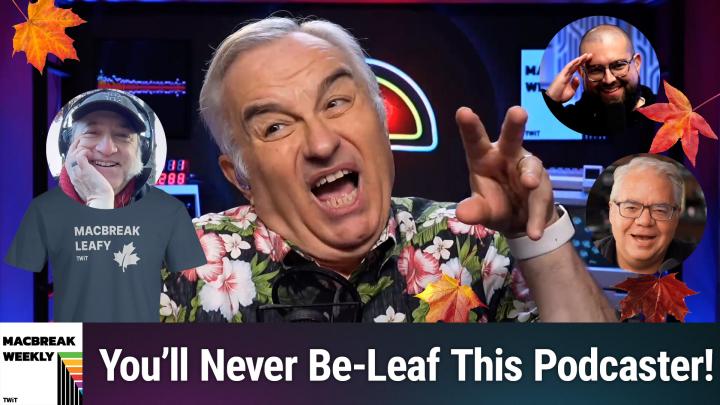
MacBreak Weekly 998 Transcript
Please be advised this transcript is AI-generated and may not be word for word. Time codes refer to the approximate times in the ad-supported version of the show.
Leo Laporte [00:00:00]:
It's time for MacBreak. Leafy. Yes, Leafy. You'll see why in a moment. Andy Ihnatko is in the great outdoors. Stephen Robles, the bearded tutor, filling in for Jason Snell. Alex Lindsay is also here. We will talk about the hot new Apple TV show and how it appears to have brought Apple TV to its knees.
Leo Laporte [00:00:19]:
The new Apple socks are here if you've got a couple of hundred bucks. And Apple has decided to use Google for Siri. All that more coming up next on MacBreak Weekly podcasts you love from people you trust. This is twit. This is MacBreak Leafy episode 998, recorded Tuesday, November 11, 2025. Touching grass. It's time for MacBreak Weekly, the show we cover the latest news from Apple.
Leo Laporte [00:00:59]:
Jason Snell, as we know, was on vacation today. But hey, we got the bearded tutor instead. Jason, Stephen Robles, welcome. Good to see you.
Stephen Robles [00:01:06]:
As always, good to be here, Leo. Thanks for having me.
Leo Laporte [00:01:09]:
It's nice to have you. Always like having you on. Also, Alex Lindsey is with us. Hello, Alex from officehours.global. Andy is working on his connectivity, but he may join us in a little bit. Stephen was saying it is Veterans Day, so thank you to all our veterans for your contribution, for your service to our country. We appreciate it. Are you a veteran? I didn't know.
Leo Laporte [00:01:34]:
I don't know. Stephen, are you.
Stephen Robles [00:01:36]:
No, no, I'm not. I just saw the Apple immersive thing pop up and reminded me that puts.
Leo Laporte [00:01:40]:
You right in the. It's an aircraft carrier, right?
Stephen Robles [00:01:45]:
See, it's called Flight Ready and it's an immersive video. Interestingly, not by the same studio. That's a. That other. Apple's other immersive content is through. So might be a different maker, but people are. 14 minute short film. It's on the USS Nimitz.
Stephen Robles [00:02:00]:
So. Yeah, I'm gonna go strap in later and check it out.
Leo Laporte [00:02:03]:
Very cool. Yeah. This is not our Vision Pro segment. I know. We are America's premier Vision Pro podcast. Most mostly because of a dearth of others.
Alex Lindsay [00:02:11]:
But.
Stephen Robles [00:02:14]:
I should have grabbed mine. I have mine in the other room.
Leo Laporte [00:02:16]:
Yeah, no, it's all right. Alex has one too. You don't have to wear it on the show.
Stephen Robles [00:02:20]:
That's fair. It's fair.
Leo Laporte [00:02:21]:
Actually, if Jason were here, would be the first time everybody had one. Oh, I still don't have one. That's right. Although I have pledged if Apple does Vision Pro for Formula One next season, I have pledged I will buy a Vision Pro or maybe borrow one from one of you guys.
Alex Lindsay [00:02:40]:
And that's probably why Apple is doing F1, I wouldn't think. One of the many reasons.
Leo Laporte [00:02:45]:
We'll see. I mean, we'll see. You've already talked about how it could make you a little queasy to be trying to watch race video on a Vision Pro.
Alex Lindsay [00:02:53]:
Well, I think that it depends on where you put it. I think putting it right on the car may be rough, but that's also technically very difficult. Even if you look at the little bit that they did with the F1, the movie, that was a pretty. They spent a lot of. It appeared that they spent a lot of engineering time and it was still pretty rough experience. So.
Leo Laporte [00:03:10]:
Yeah, so.
Alex Lindsay [00:03:11]:
So I don't think that. I think that there's still a long way to go to attach it to the cars, but there's still a lot of other experience stuff like being able. Imagine being able to live go to every pit. You know, like, you see one going in and you. And you're watching and you jump into that pit.
Leo Laporte [00:03:24]:
Love that.
Alex Lindsay [00:03:24]:
And get to see the guys running out there and it's like you're just standing there looking at it. And that's the kind of thing I think that'll be interesting.
Stephen Robles [00:03:29]:
Everybody did either you see the MotoGP one, the immersive MotoGP video in Apple Vision Pro? It was a short documentary film. It was very good. It was a French racer. It was the first time like the Motog. Yeah.
Leo Laporte [00:03:42]:
We talked about it and I think Snell saw it probably.
Stephen Robles [00:03:45]:
I think he saw was good. They had several places around the track where it would jump to immersive and you would be with the crowd. You'd see him in his trailer. So yeah, I think they could.
Alex Lindsay [00:03:53]:
I remember seeing little bits and pieces of it. I have to admit. It's not my cup of tea.
Leo Laporte [00:03:59]:
You're not a race fan?
Alex Lindsay [00:04:01]:
I'm not really a car person. Like, I'm one of those people that, like, if my car isn't working, I just. I'm going to take this to the shop and they're going to do things to it and then I'm going to drive it away. But I literally don't know, like, don't know anything about it because the problem with me is that I'm so. I get so obsessive and so deep into things that I'm afraid if I open. If I peeled open the. The seal of cars, like, it would just be like there's a whole nother world of things. I don't have time to do would become like, I'd be working on my car and, you know, souping it up.
Alex Lindsay [00:04:30]:
And it's what I do to everything else. I mean, you know, I can't even cook bread like a normal person, so. So, you know, I'm just afraid of. I'm afraid of letting the car seal open. That's the thing.
Leo Laporte [00:04:40]:
Don't unseal the car, baby. Yeah, I know how you feel. Because F1 is a commitment. It really is. There's a lot of races and it's a long time. And if you really get into it, then you start watching the practices of which there are two, and then you watch the qualities of which there is one, and then you watch the race, and sometimes there's even a sprint race, and pretty soon your whole weekend is shot.
Alex Lindsay [00:05:04]:
I mean, even with football, like, I used to just be very good at watching the Steelers, and then I was like, now that YouTube TV made it so easy to watch games. I was. I'm watching some. The middle of some game that I don't care. I care about these teams, like, why am I watching this? You know, and then I turn it off, you know, but we're a little.
Leo Laporte [00:05:19]:
Salty right now about YouTube TV. Don't, don't mention that around the Laporte household because their carriage dispute with Disney is still ongoing and we've now missed two Monday Night Footballs. Well, we didn't miss it because Disney got its way. We ended up subscribing to ESPN for $30 a month just for Monday night. But it was the packers and our son is a Packer fan and we had to. And maybe that was what Disney was hoping for.
Stephen Robles [00:05:46]:
I will say I signed my mom up for YouTube live TV the Thursday night before ABC left strictly because she'd been using an over the air antenna for years and I wanted to obfuscate the need for that. And then the next day she lost abc, and so I'm hoping it comes back.
Leo Laporte [00:06:02]:
Well, the next important date in this. And I know this isn't an Apple story, but it kind of is if you, if, you know, I mean, if you watch, you know, YouTube TV, the next important date is Disney's analyst call for its quarterly results, which just a week or so away in which they will have to explain how they are managing losing tens of millions of dollars a day by not being on YouTube TV.
Alex Lindsay [00:06:29]:
And I have to admit, I haven't spent much time paying attention to what the argument's about because I don't watch anything that I watch so little YouTube TV is football. And then a handful of things that are recorded.
Leo Laporte [00:06:40]:
Well, and this is football, though. I mean, it's not just Disney plus, it's abc. It's a whole bunch of stuff.
Alex Lindsay [00:06:48]:
Again, none. Nothing I watch normally, so. So it hasn't really affected me that much. But I don't know what.
Leo Laporte [00:06:52]:
Do you have Sunday tickets?
Alex Lindsay [00:06:54]:
I do have Sunday ticket, yeah.
Leo Laporte [00:06:56]:
So you are a football fan, but you want to see the Steelers. If the Steelers were on Monday Night Football, you would start caring the next time they're on because you wouldn't be able to see it because that is.
Alex Lindsay [00:07:05]:
On espn and the Steelers have lost every game that I haven't watched. You know, as a Steelers fan, I feel like I've let the team down.
Leo Laporte [00:07:10]:
Aaron Rodgers, so awful. Oh, my God. On Sunday. It was very sad. It was very sad. Anyway, I won't go. I won't. I won't hurt you with that.
Leo Laporte [00:07:19]:
Here's what's going on as far as I can tell. And Puck has very good coverage of this. And I think they have people on the inside. Disney, which is not a big. You know, people think Disney is a big company, you know, like. But its market cap is in the billions. Let me just see.
Alex Lindsay [00:07:37]:
Just so many billions. I think hundreds of billions. Not.
Leo Laporte [00:07:40]:
It's not okay, but billions is not trillions. Remember, they're fighting with something. Google. Oh, no, cap is three and a half trillion dollars.
Alex Lindsay [00:07:49]:
I think Disney is hundreds of millions.
Leo Laporte [00:07:50]:
Like 200, 205 billion.
Alex Lindsay [00:07:52]:
Yeah.
Leo Laporte [00:07:53]:
And according to Puck, Disney, which, as we figured out, is a $205 billion company, is in a fight with Google, which is a three and a half trillion dollar company. So right there, it looks like there may be equals. No Google. Apparently YouTube TV wants to pay less than market for all the Disney stuff. $10 per subscriber. ESPN alone with cable gets, it was my understanding, around $13 or $14 per subscriber per month so...
Leo Laporte [00:08:22]:
And apparently cable companies have most favored partner deals that say if you pay less to anybody else, we get that deal. So Google, if Disney exceeds to Google's demands, Disney would lose money, not just with Google, but with all of its most favored partners. So it would be a big hit. On the other hand, it's an even bigger hit because they're not getting anything right now, which is estimated to be about $30 million a day. So Disney says, no, no, no, no, you gotta give us the full amount of money. Google says, we don't have to. We're Google. And meanwhile, for three weeks, YouTube TV customers have not been getting any of the ABC content.
Alex Lindsay [00:09:06]:
Now the question is really $30 million a day though, because Google TV I don't think is that big. I don't think it's big enough to pay.
Leo Laporte [00:09:12]:
Well, that's the real question is, is Google TV the future of tv?
Alex Lindsay [00:09:17]:
Well, it is for me. I mean, I don't, I, but I haven't, I can't imagine going back to like any other format to watch tv. And I don't, I get, I don't watch TV that much and I haven't had regular cable since.
Leo Laporte [00:09:29]:
Well, that's the question. Would people drop, I don't know, would people drop YouTube TV and go back to cable? I don't think so.
Alex Lindsay [00:09:36]:
They might drop it. And to say that they're gonna, they. There's been reports that lots of people are dropping YouTube, but I'm like. And go where, where are you going to go if you go back to like, cable is such a precise, messed up, you know, like they're, you know, you don't have to be. We've talked about this before. If you're, if you're in the, in the woods and a bear starts chasing you, you don't have to be faster than the bear, you just have to be faster than the other guy. And so, and I think that Google, Google is not faster than the bear in the sense that they're a Perfect solution. It's YouTube TV, but they're so much faster than everybody else.
Leo Laporte [00:10:07]:
You know, ironically, the real competition to YouTube TV is YouTube.
Alex Lindsay [00:10:12]:
Well, yeah, I mean, I think that in general, the problem that all of these broadcasters have, and we've talked about this before, but is that they're getting squeezed between, you have, you know, Apple and Amazon, who are, you know, they kind of have a Kaiser Soze model. They always make more money than the job's worth. So it doesn't really matter to them whether they can keep on doing content forever. Then you have Netflix that just has scale, right? You know that Netflix is, it's big enough, it's going to go, it's going to be fine. And then you have. So those are the big ones. And Apple is distorting the entire market by overpaying for all of its content. By, I don't mean overpaying, but just throwing, not getting a bunch of content, but throwing enormous amounts of resources at the content that they do build.
Alex Lindsay [00:10:53]:
The problem with that is that everybody in Hollywood, especially below the line, want to work for Apple. And I know people that are on these Apple shows that's all you want to do is work for Apple because it's adults running the show. There's no producers yelling at you. There's no, like, it just runs. Right. And a lot of you get a lot of creative. You get, if you're a director or a writer, you get tons of creative freedom and tons of money. You know, I mean up front to do, to do your vision right.
Alex Lindsay [00:11:22]:
And so Apple's distorting the market because they made, they're just throwing money at things on the other side. YouTube is filling the world not with people building houses in Malibu, but quarter million dollar a year incomes in Nebraska. And there's an entire ecosystem building up around that with the new cameras and drones and stabilizers and everything else. And it just, it just really. I don't know how we're going to see some huge consolidation. I think Disney is probably at the top of that, not having to consolidate. But almost everybody else I think is all going to kind of fold into each other because there's just not enough people, not enough subscribers. And as everyone keeps on turning these, these subscriber costs up, people like me, I've already dropped most of my other stuff.
Leo Laporte [00:12:04]:
I dropped a lot. Look who's losing in this Disney YouTube TV. By the way, I will correct it. Morgan Stanley says Disney's losing 30 million a week.
Alex Lindsay [00:12:12]:
Yeah, that's like a day or 2 million a week.
Leo Laporte [00:12:15]:
But, well, but still, 30, a lot of money a week is a lot of money. So that's the pressure on Disney. The pressure on YouTube TV is that people might give up YouTube TV if you're, you know, if you're lucky enough to live somewhere where you can get over the air Monday Night Football, you're fine.
Alex Lindsay [00:12:32]:
But I just don't know what they would go to. They would go to something else over the air.
Stephen Robles [00:12:36]:
I guess you go to Hulu live tv.
Leo Laporte [00:12:37]:
I mean, well, that's, oh, and that's what complicates this because Disney is, has a lot of channels, including FUBU and Hulu. And Hulu does have live TV and Hulu does have Monday Night Football. I'm not switching YouTube TV for Hulu Live TV ever.
Alex Lindsay [00:12:53]:
But you can see how they might add it. They might go, oh, well, I'm just going to.
Leo Laporte [00:12:55]:
People might say, well, what we ended up doing is buying ESPN is what we ended up doing, which does benefit. 30 bucks a month benefits Disney. So it's, you know what, the whole thing is a complicated rigmarole anyway. It's not about Apple, but I thought I'd mention that we will talk about Apple TV towards the end of the show. Have you watched Pluribus?
Alex Lindsay [00:13:16]:
Haven't seen it.
Stephen Robles [00:13:17]:
Yes, I saw both the first two episodes.
Leo Laporte [00:13:19]:
Me, too. I had to. I thought. We're going to talk about it Tuesday. I better watch it.
Alex Lindsay [00:13:23]:
I had it on my list. I tried to watch it last night, but we were in something else.
Leo Laporte [00:13:26]:
Okay, don't say anything.
Stephen Robles [00:13:28]:
Yeah, I won't say anything. It's real good, though.
Leo Laporte [00:13:30]:
It's real good. We'll talk about it in a little bit. You're watching MacBreak Weekly. Andy is going to try to join us. He's having a little bit of trouble with his Internet connectivity. Let's see. What should we talk about?
Stephen Robles [00:13:47]:
Stocks, Socks, the new iPhone sock.
Leo Laporte [00:13:50]:
No, they don't have iPhone socks, do they?
Stephen Robles [00:13:53]:
You didn't see that today, so they just announced it's a sling.
Leo Laporte [00:13:56]:
It's not a sock. It's a sling.
Alex Lindsay [00:13:58]:
That's like a sock.
Stephen Robles [00:13:59]:
It's called the iPhone pocket. It's a new way to wear and carry your iPhone. And it's either 150 or $230.
Leo Laporte [00:14:08]:
What?
Stephen Robles [00:14:09]:
And it's iPhone sock. Yeah.
Leo Laporte [00:14:10]:
Oh, that's ridiculous. Now, see, they. I think they're doing well with their crossbody strap, right? So maybe that emboldened them. This is designed by Yoshiyuku Miami Miyame.
Stephen Robles [00:14:21]:
So, yeah, Miyake. And they were supposedly the ones who designed Steve Jobs's turtleneck. And so that's the connection between the design studio, the iPhone sock, and Apple. A lot of people are saying, this is.
Leo Laporte [00:14:32]:
That is hideous. I am not carrying. It looks like a macrame purse.
Stephen Robles [00:14:37]:
I'm sorry, this is not for the US Market. People are saying it's literally only being sold in one US store, the Apple SoHo one in New York. It's being sold in more international stores. Plus you could buy it online.
Leo Laporte [00:14:49]:
Apple says it explores the concept of the joy of wearing iPhone in your own way, in your own underwear. What the hell? That is the ugliest thing I've ever seen.
Stephen Robles [00:15:00]:
I was hoping for a new HomePod mini, but we got iPhone sock and.
Leo Laporte [00:15:03]:
What the hell.
Stephen Robles [00:15:05]:
Yeah, yeah, it's probably going to be big in other markets. It's not for the U.S. i guess. But, yeah, iPhone suck.
Leo Laporte [00:15:15]:
Jobs, besides getting him Miyake Design his turtleneck, approached him to create an Apple vest. But the idea, when he presented it. This is from Fortune when he presented it to staff. Hey, we're going to get company vests. Was booed off the stage. I don't think that's probably true, but they didn't do it. Nevertheless, he told Walter Isaacson that he had said to make a hundred black turtlenecks so he would never have to worry about buying a black turtleneck ever again. Must be nice.
Leo Laporte [00:15:52]:
Anyway. This is a bad idea. This is a bad idea.
Stephen Robles [00:15:57]:
Yeah, we'll see. I'm going. I'm going to get one to review.
Leo Laporte [00:15:59]:
Are you. Yeah. Well, it's good for clicks. It's good for clicks.
Stephen Robles [00:16:04]:
Yeah, that's. That's the only reason. But, yeah, it's fascinating.
Leo Laporte [00:16:07]:
So, yeah, the big if. That's. Andy, I'm not happy. What the hell? Andy, are you out in the. Where are you?
Andy Ihnatko [00:16:17]:
Yeah, my home, because.
Leo Laporte [00:16:24]:
Are you in the backyard?
Andy Ihnatko [00:16:26]:
Yeah, because there's a federal holiday on Tuesday, which means that I can't get access to the really, really good Internet at the conference rooms that I usually do in. And today was the day that my home Internet decided, hey, let's stop working about 20 minutes before showtime.
Alex Lindsay [00:16:39]:
So.
Leo Laporte [00:16:39]:
You know what? You sound great.
Andy Ihnatko [00:16:42]:
Good.
Leo Laporte [00:16:42]:
The picture's phenomenal. We're getting fall in New England.
Andy Ihnatko [00:16:45]:
Yeah, that's what I thought. I mean, it's going to be suboptimal because this is. Fortunately, in the nature trails where I am, there are, like, WI fi hotspots here and there. And so I thought, look, worse that happens. This is like.
Leo Laporte [00:16:59]:
Let me get this right. Fall special, because it's Veterans Day, you are out in a park using a hotspot. WI Fi provided by whom?
Andy Ihnatko [00:17:11]:
Actually, by the town.
Leo Laporte [00:17:13]:
By the town.
Andy Ihnatko [00:17:15]:
We have lots of nice trails, and, like, there are occasional places. This is like, sort of a. If this were a summer's day, there would be lots of people that are on, like, all these benches and exercising their dogs and stuff like that. But, yeah, I mean, unfortunately, the thing is, like, because the Internet at the conference room is so freaking good, like, one gigabit up and down, which I cannot afford, like, even in the best of circumstances at home. It's like, you know what? Why don't I just. I feel like I'm wasting money on, like, the big professional Internet that I used to have just to do MacBreak at its best. And why don't I just do the.
Leo Laporte [00:17:51]:
Show from here from now on? Frankly, I'm glad to hear.
Andy Ihnatko [00:17:54]:
Thank you. Thank you very much. I was concerned that it was going to be.
Leo Laporte [00:17:57]:
I was, too. I said, oh, don't worry about it, Andy. You can, you know, just enjoy the day off. But look at you. We're getting a little, you're touching grass, Andy.
Stephen Robles [00:18:05]:
Literally.
Andy Ihnatko [00:18:07]:
Yeah, exactly.
Leo Laporte [00:18:07]:
Actually, you know, he's touching it. He's been. Folks, he's bending over.
Andy Ihnatko [00:18:11]:
Those of you who are interested in, like, leaf peeping in New England, this is what you're. What you're what you're missing out on.
Stephen Robles [00:18:20]:
MacBreak Leafy. MacBreak Leafy.
Leo Laporte [00:18:22]:
Did you put a blanket around your microphone because you were afraid it was going to get cold, or is that soundproofing?
Andy Ihnatko [00:18:28]:
It's also kind of windy, so it's working. I'm just trying to. Even under suboptimal, it's possible to have optimal conditions under suboptimal conditions. And I'm aiming for both.
Leo Laporte [00:18:38]:
You're doing great. And welcome to MacBreak Leafy.
Stephen Robles [00:18:41]:
Can I just ask you, Andy, real quick, can you send yourself on your camera like your office sender?
Leo Laporte [00:18:46]:
Yeah, it's hard for us to put you in the three box if you're not right in the middle.
Alex Lindsay [00:18:50]:
Okay.
Andy Ihnatko [00:18:51]:
Oh, and we know that, by the way, I also have, because a leaf just blew by. You see, this is what, like, as I am, you'll not believe the amount of cursing that I was doing like, a half hour ago.
Leo Laporte [00:19:06]:
And I was doing it, too.
Andy Ihnatko [00:19:09]:
I was trying to cheer myself up by saying, if this is acceptable video and acceptable audio, it will actually be a very cool visual.
Leo Laporte [00:19:16]:
I think from now on, I want you to be out in the wilderness doing a show. I think it'd be great.
Andy Ihnatko [00:19:21]:
Plus, that means that, like, you can see how dashing my collection of scarves are.
Leo Laporte [00:19:24]:
I thought it was.
Stephen Robles [00:19:25]:
I thought it was the iPhone, Sock.
Leo Laporte [00:19:26]:
So did I. We were just talking about the iPhone, Sock, and we thought maybe Andy's already got one.
Stephen Robles [00:19:31]:
Yeah, yeah.
Leo Laporte [00:19:32]:
It's an iPhone muffler. Somebody in our Discord chat says, welcome to MacBreak Leafy.
Andy Ihnatko [00:19:39]:
Ah, there you go. You see, if we had more. If we had, like, if we were one of those, like, YouTube channel, like, really, really active, like, 10 million subscriber YouTube channels. Your back room people will be designing a MacBreak Leafy T shirt. And by the end of the show, we would say limited edition. We're only offering this on the store for the next 72 hours.
Leo Laporte [00:19:59]:
I give you the rights to that Stephen Robles, who does, in fact, as the bearded tutor, have a very popular YouTube channel. You want to see?
Stephen Robles [00:20:06]:
I'm going to make that merch while we record. It'll be up by the end.
Andy Ihnatko [00:20:10]:
But damn it, I cleaned my office for nothing.
Alex Lindsay [00:20:13]:
Do you realize, like, when I was.
Andy Ihnatko [00:20:14]:
Doing all morning long, it's not for.
Leo Laporte [00:20:16]:
Not because you're going to go home to a clean office. Think about that. This was breaking last week. We didn't really get much of a chance to talk about it. Apple, apparently, according to Bloomberg, is nearing a $1 billion a year deal to use Google's AI for Shlomo for Siri. Since that story broke last week, last, last Wednesday, a lot of people saying it's Apple capitulating. What do you guys think? Is this, Alex, is this Apple saying, oh, I guess we just can't do it ourselves, we're gonna have to do it with Google?
Alex Lindsay [00:20:57]:
I think a lot of people would prefer Apple to find another short term solution while they work on the long term solution, that they just want it to work, you know, and, and so I think that, I think Apple, it's easier for them to think about the long term when they're not trying to fix the train while it's running.
Leo Laporte [00:21:14]:
And Apple has promised to put Siri smarts in next year. Right?
Alex Lindsay [00:21:20]:
Yeah. So I think it makes a lot of sense. I don't think that it is. I mean, again, I have the only thing I expect Siri to do for me because, you know, I have Janet, which is my ChatGPT shortcut. And so for me, the only thing I expect from Siri is time and sometimes directions.
Leo Laporte [00:21:41]:
Do you even use it for setting timers for cooking?
Alex Lindsay [00:21:45]:
Yeah, I mean, we use that. We have the original HomePod that sits in the kitchen and it, that's your timer. There's a constant yelling at it for timers and so on and so forth. So it does most of the heavy lifting there. And I use my iPhone, iPhone as well for timers. But I usually do it by hand. I don't know, I don't find it to be very comfortable to try to. I don't trust it to do it that way.
Alex Lindsay [00:22:09]:
So. But again, for me with Siri, I expect so little of Siri that I don't think I would miss it that much. But I will say that as soon as someone realizes they can do a shortcut to go to ChatGPT voice mode, like that's the thing that once people understand that you can just use, there's a shortcut built into the shortcuts that is just ChatGPT. Once you've loaded ChatGPT, that's ChatGPT voice mode, it just immediately jumps into ChatGPT in voice mode and talks back to you. You kind of forget that you needed Siri to do anything else because it does it so well.
Stephen Robles [00:22:40]:
Well, a lot of people Already do that. I mean you can map the action button like you're saying to that shortcut. And this Gemini thing, I mean it's a stopgap until Apple actually launches its smarter voice assistant. Suppose it's going to run on private cloud compute. It'll be in the background. Who knows if Apple will even say the words Gemini in whatever event that it actually launches this or if it will just be in 26.4 next year. But this will hopefully make the assistant able to pull things like from your text messages, information from your email. Then you can actually ask it things like when is my mom landing at the airport? And it will just know, you know, all those things that it showed off at WWDC last year, you know, year and a half ago.
Stephen Robles [00:23:16]:
Hopefully those things will be made possible by this new integration.
Leo Laporte [00:23:19]:
It's a very smart model. It's a 1.2 trillion, what do you call it?
Andy Ihnatko [00:23:26]:
Parameter.
Alex Lindsay [00:23:27]:
Parameter.
Andy Ihnatko [00:23:27]:
1.2 billion parameter compared to with a T. I'm sorry, billion but, but no trillion.
Leo Laporte [00:23:34]:
1.2 trillion parameters.
Andy Ihnatko [00:23:36]:
But, but it compare but it compares with like the two like 150, 200 billion parameter model that they have running right now. This is, this is nothing but a win win for both companies. I'm, I'm so glad that Apple like was able to, there was, there was a time where the not invented here screed was would have been so loud that they would never have farmed this out to anybody else. But they are so, they are so committed to whatever their roadmap is for AI. It is so contingent upon having a functional version of an AI enhanced Siri next spring. As they delayed it out to that they say you know what, we are not going to get there on our own. We are just going to simply we're going to do the silly thing and basically write a big check to the company that's been doing this for 10 or 15 years that can basically write us a white label version of Gemini. This is not like Gemini.
Andy Ihnatko [00:24:25]:
This is not going to be Gemini on Apple Intelligence. This is going to be please build us a version of your Gemini model that meets our requirements. Specifically that will run on our super super super Apple privacy AI servers and we'll meet all the requirements that we had for our original models, but we will actually be able to ship this on time. And as Steven said, this gives Apple time to say the pressure's now not completely off, but we don't have to make stupid mistakes in the interest of making a spring deadline. We can basically take the next Year or two also, yeah, Apple's not going to. Apple's going to treat Google like a subcontractor. Just like they subcontract out a whole bunch of work. I mean, this is a big feather in Google's cap because it's not just, it's not that they.
Andy Ihnatko [00:25:15]:
Absolutely. A billion dollars a year is not a bad thing whatsoever. But what it also says is that it says to the rest of the world that, hey, Apple needed, and Apple needed a language assistant model and they contracted us to do it because we know what we're. We can absolutely deliver on that. If Apple decided that Google was the contractor of choice, perhaps you might also consider hiring us and contracting us for your AI work. It's again, it's a win win for both companies.
Leo Laporte [00:25:44]:
Yeah, I mean, honestly, if Google's already paying apple more than 20 billion a year to be the default search on Safari, a billion back, it's like after.
Andy Ihnatko [00:25:54]:
They did the tap to pay, there's a screen like, would you like to add another $1.2 billion as a percentage?
Leo Laporte [00:26:01]:
It is a 20% tip. Yeah, that's exactly right.
Stephen Robles [00:26:03]:
What will be interesting is OpenAI has the direct system integration right now, ChatGPT, in the settings app of Apple Intelligence. So I'm curious, there were rumors that they were going to add other options to that setting screen for Apple Intelligence. Will Gemini be there or will it strictly be behind the scenes? Is Anthropic going to be in there and will they eventually drop that OpenAI partnership once this Google Gemini thing goes through? So be curious how they navigate that if they're going to keep it siloed. Like you could still do OpenAI over here.
Andy Ihnatko [00:26:30]:
So see, this definitely seems like a totally separate thing where all along Apple's been talking about. We are not so delusional as to say that we are going to be one of the titans of artificial intelligence in two or three years time? They acknowledge that people are forming relationships professional and personal with OpenAI ChatGPT and with Gemini and with, and with perplexity and with Claude. And so if you want to use those bots, we will absolutely make it easy for those APIs to actually extend out and to let you use those things.
Leo Laporte [00:27:06]:
This is.
Andy Ihnatko [00:27:08]:
I'm going to do a really dangerous thing and try to use car lingo because I only know things about deep cars by watching videos. But it's sort of like we say, my God, this is the Lamborghini, blah, blah, blah, blah, blah. And then you open up the hood like, oh, it's Got a Toyota engine in it. Yeah.
Leo Laporte [00:27:23]:
Well, again, see Alex, we're going to suck you in eventually to the cars culture. I'm hoping at some point a mama bear and a baby bear wander by Andy and the baby says, look, mama, it's a podcaster. Don't touch the human. They're dangerous. Come on.
Andy Ihnatko [00:27:43]:
My God. It's a podcaster making money from their podcast. It's a, it's a rare, rare, rare commodity species. That's why, that's, that's why they're allowed to like, basically like, like cows in India, basically go wherever they want to go because they are blessed.
Leo Laporte [00:27:57]:
We'll continue with, on the trail with Andy. Not going just a little bit. Alex. Lindsay.
Andy Ihnatko [00:28:01]:
You know many parts of a pine tree are edible.
Leo Laporte [00:28:03]:
Is also here. Tastes, tastes just like what he said. Tastes like bark. I can't remember Yul Gibbons.
Andy Ihnatko [00:28:11]:
I don't know. I barely remember. Grape Nuts commercial.
Leo Laporte [00:28:15]:
It was Grape Nuts. That's what it was. Yeah. A rare outdoor podcaster. Look at his yellow coloring. It's because he hasn't seen the sun in days. Also with us, the bearded tutor. It's great to have Stephen Robles filling in for Jason Snell this week.
Leo Laporte [00:28:30]:
Nice to see you, Stephen. That's what a podcast studio should look like right there. Look at that. That is something we will talk actually about some changes to podcasting rot by a good old apple in just a little bit. Also, the Mark Gurman Sunday newsletter had a lot of interesting stories. We'll get to those too. You're watching Mac. What is it? Macleaf Breakly.
Stephen Robles [00:28:57]:
I'm making the shirt right now.
Leo Laporte [00:28:59]:
He's making the shirt. So we got to call it that. Thank you for being here. Our show today brought to you by Framer. Look at that. Look at that. That is Framer. That is something else.
Leo Laporte [00:29:11]:
If you're still jumping between tools just to update your website, Framer unifies design, CMS and publishing on a single canvas. This is amazing. No handoff, no hassle, everything you need to design and publish in one place. Framer has already built the fastest way to publish beautiful production ready websites. And it's now redefining how we design for the web. With the recent launch of Design Pages, a free canvas based design tool, Framer's more than a site builder. It's a true all in one design platform. From social assets to campaign visuals to vectors and icons, all the way to a live site, Framer is where ideas go live, start to finish.
Leo Laporte [00:29:58]:
And here's the best part. Framer is free A free full feature design tool. Free unlimited projects, free unlimited pages, free unlimited collaborators. All the essentials you get. Vectors, 3D transforms, gradients, wireframes. Everything you need to design. Totally free. What? Yes.
Leo Laporte [00:30:22]:
Framers. Your entire workflow in one place. You don't have to import from Figma anymore. No messy HTML. It's. It's faster, it's cleaner, it's more efficient because you work in one place right there. Design more than websites too. Framer.
Leo Laporte [00:30:35]:
You could even do our MacBreak leafy t shirt in there. It lets you create social assets, campaign visuals. Framer even lets you do icons and site resources all inside the tool. You don't have to switch back and forth anymore. Framer Love this. Stands above the competition because it's not just a site builder, it's also a true design tool that also publishes professional production ready sites ready to design, iterate and publish all in one tool. Start creating for free at framer.com/design and use the code MacBreak for a free month of Framer Pro. That's framer.com/design and use the promo code MacBreak. framer.com/design promo code MacBreak rules and restrictions may apply.
Leo Laporte [00:31:27]:
framer.com/design. Thank you Framer for your support. MacBreak Weekly Sunday of course, every Sunday Mark Gurman publishes his newsletter. Sometimes he doesn't have much to say, so it's all speculative. I feel like today, last Sunday he had a lot more to say.
Stephen Robles [00:31:50]:
Including.
Leo Laporte [00:31:51]:
News that might be disappointing to some or good news for others. I'm not sure we already know he's been talking a lot about and others have also been talking about the next generation redesigned MacBook Pro with an M6 processor and OLED screens. Maybe not the best news. He says it looks like if you want the OLED screen, you're going to have to get the top of the line M6 Pro or M6 Max. That the entry level low end 14 inch MacBook Pro will not have the redesign and will not have the OLED screen.
Alex Lindsay [00:32:28]:
That often makes sense.
Leo Laporte [00:32:30]:
Yeah, I guess so. It's a little disappointing.
Alex Lindsay [00:32:34]:
But I've expensive.
Andy Ihnatko [00:32:37]:
It seemed like they're going OLED everywhere, even on the iPad. So it's like, wouldn't that be nice if you just get OLED for free with everything? Unless you're buying the cheapest, cheapest, cheapest thing. Okay, fine, it's 2025. We will give you those sultry, sultry blacks and those wonderful penetrating colors with the Apple design color balanced eye.
Leo Laporte [00:32:57]:
Oh, it'll be gorgeous. And that was the rumor that Apple was going to do OLED everywhere. So that's apparently not true. I don't think Apple would have done OLED in the iPhone. Chip based, really, really inexpensive MacBook, but nobody would expect that. But at MacBook Pro, you kind of think, well, should have OLED everywhere. So the M6 Pro and the M6 Max MacBook Pro will have, according to Gurman, the thinner chassis touch screen. That's also going to be confusing if some MacBook Pros, you know, the Newman don't have touchscreen and some do late 2026, early 2027.
Stephen Robles [00:33:36]:
I don't think that's going to happen.
Leo Laporte [00:33:37]:
You're not a fan? You don't think it's going to happen?
Stephen Robles [00:33:40]:
I mean, it's been rumored so many times. I know a lot of people want it, but I mean, Apple's still all in on iPad. I mean, it has the M5 chip right now, tandem OLED. I just don't. I don't see it. I think we'll see a foldable iPhone before we see a touchscreen Mac.
Alex Lindsay [00:33:53]:
And I think it makes more sense to make the iPad more and more like a Mac than to try to make the Mac like an iPad. You know, I just think that it's. I think that it's easier for them to keep moving it that direction, but maybe not.
Andy Ihnatko [00:34:05]:
I'm totally with you, Stephen, because my problem with it is that, as such, is that I really, really think that if this is not a small thing, if Apple had the desire to simply say, okay, well, guess what, we will basically have a virtual mouse device as a touch screen and that'll be the end of it, they would have done that a long time ago. You can't just simply do that. You have to actually rethink the entire interface and in a much more aggressive way than they've done so with liquid glass. I feel as though if they were really thinking about doing that as early as next year, which is one of the rumors that Mark Gurman is passing along, we would have seen a lot of. We would have seen Mac OS 26 and everyone asking, why are the window buttons so big? Like, why are the default. Why are they so big all of a sudden? That's almost gaudy. And then we think, oh, maybe they really are doing a touchscreen device. But I'm going to believe it when I see it.
Leo Laporte [00:35:01]:
This, by the way, Today is the 10th anniversary of the release of the iPad Pro. It first came out November 11, 2015, and as David Pierce writes in the Verge, a decade of unrealized potential I disagree. I think this it is with iOS 26 or iPados 26, it finally has started to achieve its potential. I'm using the iPad Pro more and more, partly because of the OLED screen and the touch, to be honest.
Stephen Robles [00:35:29]:
So I will say I got the M5 iPad Pro as a review unit, did a video. It's great. The screen is amazing. The 13 inch. I came from an 11. I think windowing in ipados 26 makes a lot more sense on the larger screen. Oh yeah, I've been using it more even with Stage Manager. The problem with the iPad and I love it.
Stephen Robles [00:35:47]:
I edit podcasts every day on it. I actually prefer editing podcasts on the iPad with an Apple pencil. The problem is still the browser. And like, one of the reasons I'm designing our MacBreak Leafy shirt right now in Fourth Wall, which is like a merch design site. And you cannot design shirts on the iPad through the Fourth Wall website. You try to do it and Fourth Wall will just tell you you need to go to a desktop browser.
Leo Laporte [00:36:13]:
See, that's a limitation of Fourth Wall, not of Safari.
Stephen Robles [00:36:16]:
Well, even like squares, like Squarespace, I use a ton of Squarespace websites. I edit them. I've been doing it for years trying to edit a Squarespace website on iPad, which Squarespace will let you do it. It doesn't kick you out. It is a bad experience. Even using a trackpad with magic keyboard. And so I still think, even though.
Leo Laporte [00:36:32]:
Apple claims you don't think touch is better than a trackpad for that kind of thing, for any photo editing, touch is better. Or the pencil.
Stephen Robles [00:36:42]:
Well, pencil is great for like photo editing. Again, I prefer for podcast editing, maybe even for some video editing when you're trying to do a WYSIWYG website editor like Squarespace and drag blocks around so they actually go in the right order. It's not good on the iPad and I think it's because the Safari browser on iPad is still not the same as it is on the desktop.
Alex Lindsay [00:37:02]:
It's funny, I was thinking about when was the last time I was on. I mean, on my iPad, I end up in the browser by accident, but I never use my iPad with the browser. Like, I didn't really think about it until you were mentioning it and I was like, oh, yeah, I don't do that at all. I mean, I use apps on my iPad. I use a lot of different apps on my iPad, but I definitely view. Yeah. And I have to admit that I don't use the Safari on my phone much either. I Definitely am modal.
Alex Lindsay [00:37:33]:
As I was thinking through that, I realized that I don't view web experiences because of the ads and because of all the other stuff that pops up. I find that the web experience on both of them are not particularly a great experience. And if I need to do something on the web, I. And it's not. I mean, I'm on my phone and my iPad all the time, but it's all through apps, you know, it's all app driven.
Leo Laporte [00:37:54]:
Stephen, do me a favor. I hate to do this. This is a free plug for our sponsor. We just did an ad for Framer. They claim to work just great on ipados. I think if Squarespace doesn't, that's. I think you have to blame Squarespace. Not so much blame the Safari on the iPad, but give it a shot.
Leo Laporte [00:38:15]:
Just let me know.
Stephen Robles [00:38:17]:
I'll give it a shot. I mean, but even aside from the browser. So Apple clearly knows that creators using the iPad, podcasters, ipados 26 broad like mic input. You can finally, after 10 years, choose the mic input manually on the iPhone.
Alex Lindsay [00:38:31]:
And double end recording.
Leo Laporte [00:38:32]:
Yeah, yeah. I mean, Jason elt's doing that all.
Stephen Robles [00:38:35]:
The time now, but you can't choose the output. You can't manually choose the output. And so if you wanted to use AirPods with a USB microphone, you're kind of up a creek depending on what app you're using. And so it's like, it's so close to being that same experience. Like, I would love to run audio hijack on my iPad.
Alex Lindsay [00:38:52]:
What do you. What do you edit on? What are you editing? Podcasts.
Stephen Robles [00:38:55]:
Ferrite. Ferrite app.
Leo Laporte [00:38:57]:
That's what Jason uses. Yeah.
Stephen Robles [00:38:59]:
It's amazing. Yeah. And it's, you know, I can do chapters, chapter artwork, all that kind of stuff. And so some experiences are great and things like digital music. My wife uses her iPad. She plays in an orchestra. She plays flute. And so she'll use a Bluetooth foot pedal in the iPad, something a Mac could never do because you can't put a MacBook on a music.
Leo Laporte [00:39:15]:
You see iPads in concerts all the time now. All the time.
Stephen Robles [00:39:20]:
Yeah. And she's playing in a small wind ensemble this week. And they're all going to be using iPads. It's going to be, you know, woodwind quintet. So there's some place the iPad excels what's suffering. Pro device. But yeah, for music.
Leo Laporte [00:39:33]:
Yeah. Everybody agrees. Yeah, yeah, yeah, yeah.
Stephen Robles [00:39:38]:
You can even turn pages by blinking, which is amazing. I actually used a camera and you can turn a page by Blink or a mouth gesture or a head nod, which. Playing flutes, you can't really use those.
Alex Lindsay [00:39:48]:
You get something in your eye and you'll be like 20 pages ahead.
Leo Laporte [00:39:51]:
I was at Santa Rosa Symphony concert a couple of weeks ago, and the pianist was using an iPad. I was blown away because usually, you know, it used to be you'd have somebody sit just over your shoulder turning the page for you. You don't have to do that anymore. I wonder if she was blinking. I didn't notice how she was turning the pages.
Stephen Robles [00:40:05]:
So my wife is. Uses a Bluetooth foot pedal. So she'll connect a Bluetooth foot pedal and click that. And that turns the page forward and back. And so iPad is just incredible in so many use cases. They're just little things here and there that it's like it could almost get there. Just those little things holding it back.
Leo Laporte [00:40:19]:
Amazing. All right. Well, I honestly think touch should come to the Mac, not that you'd put a MacBook on your piano.
Stephen Robles [00:40:30]:
Do you remember Steve Jobs in that event? He was like, who's going to hold their arm up like this?
Leo Laporte [00:40:35]:
All I know is because I use the iPad Pro so much, I'm always touching the screen on my MacBook because I have that habit.
Andy Ihnatko [00:40:43]:
I'll just say I've always thought that Apple. Absolutely. That was one of Apple's, like, top three or four wrong calls in their entire life about saying, no, no, no.
Leo Laporte [00:40:50]:
No, no, no, no.
Andy Ihnatko [00:40:51]:
People don't want to do this. And you just want to say, actually, they're not doing that. What they're doing is like, they are. They are folding the screen 360 degrees for those situations where you kind of just want a tablet, little bit of an experience with. Or they're tenting it so that you can actually use it just as like sort of a video player thing, or they're drawing things on it, which are things that artists are very likely to do. Tim, it's like he tried to make fun of it as saying, oh, it's kind of like having a fridge toaster. That was like the exact quote. It's like they missed the bus, and now they can't catch that bus.
Andy Ihnatko [00:41:24]:
So they may as well forget that that bus existed.
Alex Lindsay [00:41:26]:
Well, I think also that I do when I, you know, I have some screens here that I can touch. And so they act as USB controllers back to my Mac. And so I have the experience of touch now on a computer. And the problem really is that the interface is not built for it. And so as a result, like Apple, there's really engineering on Apple's no.
Leo Laporte [00:41:47]:
They hit the touch target too small.
Alex Lindsay [00:41:50]:
And so you're just constantly frustrated by it. I do tap on things, but not very much because there's places where it makes sense. But for the most part it doesn't make sense because they would have. So I think that Apple would have to re engineer a lot of the os, which they haven't been willing to do. They'd rather just work on making the iPad work. You know, Apple tends to be kind of like, well, let's just make the thing that's built for it do the thing and then not.
Leo Laporte [00:42:13]:
All right, let's have a straw poll then. I think yes to touch screens on the next MacBook Pros. You say no.
Alex Lindsay [00:42:20]:
Alex, I'll say no.
Leo Laporte [00:42:23]:
Stephen, you said no, right?
Stephen Robles [00:42:24]:
No.
Leo Laporte [00:42:25]:
Andy, you're either going to put us in a tie or you're going to send me to purgatory.
Andy Ihnatko [00:42:32]:
This would have been a great idea for 2018. Of I don't. If they do it, I don't see it happening next year.
Stephen Robles [00:42:39]:
That's all.
Andy Ihnatko [00:42:40]:
I don't think. I don't think never. I'm just saying I don't see it happening next year.
Leo Laporte [00:42:43]:
All right, I'm going to be the lone holdout.
Alex Lindsay [00:42:45]:
I told you so.
Leo Laporte [00:42:46]:
Yeah, I will.
Andy Ihnatko [00:42:47]:
It's a great. Again, it's a great idea. If they had done this in 2018, I would have been so on board with this. But. And there is a good argument to be made that because they made the wrong choice all those years ago, okay, they were forced. That means that they were forced to turn the iPad pro into something that could do at least 70% of what a MacBook could do. And for that reason that removes a lot of the reasons why Apple would otherwise be kind of forced to do this sort of thing. And now they're not forced to do this thing.
Andy Ihnatko [00:43:16]:
They can basically get people to buy iPads instead. Was it Gurman who had the. Who a couple of weeks ago was saying not only foldable iPad, but folding 18 inch iPad. Which got me thinking that, okay, a again, wow. I'll put $10 against that because I bet I can get really good odds on it. But the thing is, if you're trying to like figure out why that would ever make sense if you think about the idea, well, what if we gave artists an 18 inch like easel sort of drawing surface already they have these like cintiq style like tablets, which is an integrated display that they do. You know, every comic book is written, is drawn on this certain sort of thing that would be kind of intriguing but oh my goodness, I can't Even imagine what 18 inch diagonal screen of iPad app would look like.
Leo Laporte [00:44:05]:
Well, since you guys don't believe that they're going to do a touchscreen Mac os, this is then a moot question. But you mentioned convertibles. I mean in the Windows world, of course, one of the advantages, probably the only advantage you have in the Windows world is a huge number of manufacturers trying all kinds of stuff. So there's a lot of choice. There are convertibles which are ones as you said Andy, that can flip all the way around. And now you've got a tablet with a keyboard in the back. It's a little weird, but there are detachables that you could detach the screen and turn it into just a tablet by itself. That's not a good design.
Leo Laporte [00:44:37]:
The machines I've had like that, like the Surface, not great. But there are choices. You think Apple, if they do do touch. Since you don't believe it, I guess it's a dumb question. Do you think they might make new form factors of laptops? Something not quite the same.
Stephen Robles [00:44:52]:
I think the form factor I'll be excited about and I think they might go back to is an even smaller laptop. Like I had the 12 inch MacBook.
Leo Laporte [00:44:58]:
The MacBook.
Stephen Robles [00:44:58]:
Sure, the MacBook. The 12 inch MacBook was great. I love the portability.
Leo Laporte [00:45:02]:
Everybody loved terribly.
Stephen Robles [00:45:03]:
Yeah, it was terribly underpowered at the time but now they can use their own silicon, make a 12 inch, one port, maybe two port computer and it could be great. So I think they might experiment more with those kinds of form factors before they do touch screens on the map.
Alex Lindsay [00:45:16]:
Mac.
Andy Ihnatko [00:45:18]:
Yeah, there almost be no point to just doing. Yeah, there'd almost be no point to doing like a MacBook with a touchscreen unless the only thing it's good for is like I, I do kind of like this thing where it's like I've just got my, I've just got my hand sort of resting on the side.
Leo Laporte [00:45:31]:
Yeah, that's what I do. I scroll.
Andy Ihnatko [00:45:32]:
But that scroll, that'd be just such a waste to just do that.
Alex Lindsay [00:45:35]:
Yeah, they'd have to do a new form factor and I, I still think that Apple would rather just keep evolving because they keep on adding laptop features to the iPad and it feels like that's where they want to spend their energy is make the iPad more like a Mac, not make a Mac more like an iPad.
Leo Laporte [00:45:49]:
What if they made a 12 inch MacBook? Nothing. But they put an M6 Max in it.
Andy Ihnatko [00:45:57]:
That's nice. Keep your hands nice and warm during.
Leo Laporte [00:46:00]:
Football games and stuff like that. Well, it's closer to the aluminum, so it, you know, it radiates.
Alex Lindsay [00:46:06]:
They should call. They have the Mac accordion where you just have them. They snap together and you keep on adding them. So if you want four of them, like, connected to each other, you just keep snapping them on.
Andy Ihnatko [00:46:15]:
If Samsung thinks they're big shots, will have having a trifold. How about a fourfold, a fivefold, A sector fold.
Leo Laporte [00:46:21]:
But we do agree that they seem.
Alex Lindsay [00:46:23]:
To be like Legos. So you can snap them up. So if you want a 3x2 or a 3x3. And they just all just kind of.
Andy Ihnatko [00:46:30]:
I want to make this like a room partition. Okay. Where you just sort of keep folding it out.
Alex Lindsay [00:46:34]:
But just think if they all had their own process. There's as you do that, it could become a. It could become a network rendering system. I mean, the thing could.
Andy Ihnatko [00:46:42]:
The Mac accordion. They kind of weird how like endorse it. Like he could do like the.
Leo Laporte [00:46:46]:
Anyway, you have seen the rollable thinkbook, right? Again, this is another example of diversity in the Windows world. This is a screen that rolls up. We actually demoed it on Windows Weekly a couple of months ago. When it came out, I think somebody had it. Brad. Oh, no. It was on Twitter. Was it Brad Sams who had it? Anyway, it rolls up.
Andy Ihnatko [00:47:12]:
So that you.
Leo Laporte [00:47:12]:
Can extra like this much and then it rolls down before you close it.
Stephen Robles [00:47:17]:
It was on the Tonight Show. Jimmy Fallon showed that off on the Tonight Show.
Leo Laporte [00:47:20]:
Yeah, it's cool.
Stephen Robles [00:47:21]:
It's cool. But I feel like, yeah, real life, I don't think you're going to see that kind of stuff out there. I think people just.
Andy Ihnatko [00:47:29]:
It's such a CES sort of thing where, hey, we want to show you that we're innovative and we're thinking about new ideas. And like Samsung and others. Hey, we want you to know that we are making so many different, different panel designs that no matter what it is that you want to do, no matter how drunk you get, no matter what it is you drop during Burning Man. That gave you a vision of whatever kind of laptop it was. We can build you a curved snake.
Stephen Robles [00:47:52]:
Snake. Snake.
Andy Ihnatko [00:47:53]:
Snakey type, folding, rolling, accordioning screen. Just as long as you could, like babble it into some sort of AI to get some sort of chat GPT image of it. We can actually make that for real. Just try us.
Alex Lindsay [00:48:07]:
I think the problem for me is that if I have a couple little dots on my screen, they bother me. Like little scratches. I put the screen protector on my phone because I replace it every two or three months. I just pull it off, put another one on because any little scratches or anything else, I'll let them build up a little bit and then I immediately get rid of the foldable phone. For me, every time I've seen a foldable phone, someone opens it. If my finger touches the fold, I literally get physically sick.
Andy Ihnatko [00:48:35]:
Like, literally.
Alex Lindsay [00:48:35]:
It makes me want to throw up in my mouth. Just that little groove there makes me very upset. And I just like, oh, I can't do that. And it's totally flat. It's just my finger goes over and I'm like, ah, no, no, no, no, no.
Leo Laporte [00:48:49]:
So you're not going to buy the folding iPhone 18.
Alex Lindsay [00:48:52]:
I have so little interest in a foldable phone just because again, that ridge, if they were able to perfect that ridge. But I don't know how, I don't know how you would do it. And I know how upset I am with it and so I can't, like, like to me, it's definitely not a possibility.
Leo Laporte [00:49:05]:
If you, you're saying if you touch, if you touch this, it would make you nauseous.
Alex Lindsay [00:49:10]:
It makes me nauseous. It makes me nauseous.
Andy Ihnatko [00:49:11]:
There's something about it.
Alex Lindsay [00:49:13]:
There's some weird thing about it. When I finger goes over it.
Andy Ihnatko [00:49:18]:
Yeah.
Alex Lindsay [00:49:19]:
As the screen's on, when I'm interacting with something and my finger goes over.
Andy Ihnatko [00:49:22]:
And I get sick. Alex, I'm just curious as to what happened. What happens to kids in Western Pennsylvania that gives them those kinds of lifelong phobias.
Alex Lindsay [00:49:32]:
It doesn't bother me. It doesn't bother me when the. It doesn't bother me when the screen's off. Only when the screen's on. There's something about the video and my finger going over the hump that makes me sick. And yeah, I don't know. I'm sure it has something to do with the tractor.
Andy Ihnatko [00:49:44]:
I respect it. I can overlook that really quickly because for me it's more like, my God, I'm actually reading a whole page of text or oh my God, I've got actually a really good writing set up here in a pocket sized thing. I am one of these people who will ignore it. I mean, it's not ideal, but it is not something that gets my nerves. But I could absolutely see where somebody with. Somebody as, with as good an eye as you thinking that. No, I can't. I'm having a genetic response to this.
Andy Ihnatko [00:50:11]:
Like I have a genetic response to.
Alex Lindsay [00:50:12]:
The brain for me.
Andy Ihnatko [00:50:13]:
So I just.
Alex Lindsay [00:50:14]:
I'm like, no, I can't. Like, I don't even want to. I don't. I wouldn't even go to the Apple Store to play with it. Like, it just, you know, like, that's how much I just dislike the idea.
Leo Laporte [00:50:24]:
All right, we're going to take a break. When we come back, the bearded tutor and I are going to talk about changes in Apple Podcasts.
Stephen Robles [00:50:31]:
Leo, breaking news.
Leo Laporte [00:50:33]:
Breaking news. Yes.
Stephen Robles [00:50:35]:
You now officially get the Max Break Leafy T shirt.
Leo Laporte [00:50:38]:
Wow. Wow, look at that. It's got a little leaf on it. It's available from the Bearded Tutors Merch Store. What's the address of that Stephen BeardFM store? Oh, my God.
Stephen Robles [00:50:52]:
Snack break leafy hoodie and a shirt, multiple colors.
Leo Laporte [00:50:57]:
I hope you sell hundreds of those. And, Andy, you've got to wear one the next time you're out in the wilderness. Oh, MacBreak Leafy. That is awesome. And, you know, you're. I have to point out you're very economic. The store is very economical. You're not making a lot of money on those things.
Stephen Robles [00:51:13]:
I think barely making anything. But I'll send you whatever profits I make. It's fine.
Leo Laporte [00:51:16]:
No, no, don't send me anything.
Andy Ihnatko [00:51:19]:
I'm going to have to give you because what you're going to need for this is a really good thumbnail. So I'm actually going to. While you're talking with Leo about podcasting, I'm going to mute my mic and.
Stephen Robles [00:51:27]:
I'm going to turn.
Andy Ihnatko [00:51:28]:
I'm going to. I'm going to turn, go to the other side of this table where you can see a beautiful, like more of a fall landscape behind me.
Stephen Robles [00:51:33]:
That's good, that's good.
Leo Laporte [00:51:34]:
And then you could do an outline, a silhouette of the. Of the. Of this mutton chops. It'd be perfect. Beard FM Store.
Stephen Robles [00:51:43]:
Very distinguished. Beard FM store.
Leo Laporte [00:51:46]:
Okay.
Stephen Robles [00:51:47]:
Yep, you can get everything there. I also have my shortcuts there, Merch. So it's. It's amongst other things, but It'll be a MacBreak leafy shirt and hoodie, or shirt and sweatshirt at the bottom.
Leo Laporte [00:51:56]:
You got some nice stuff in this store, actually. I like it.
Stephen Robles [00:51:59]:
Thank you.
Leo Laporte [00:51:59]:
You've been doing some great work with shortcuts. You like the new iOS 26 shortcuts.
Stephen Robles [00:52:05]:
And literally building a business on it. All the intelligence shortcuts, the automations. It's the one reason I tell people, like, if you're gonna upgrade, like, that's why I even get it. I got a mug, got a Shortcuts mug here. I made a little action.
Leo Laporte [00:52:19]:
It's awesome. What's your favorite shortcut that you've done lately?
Stephen Robles [00:52:23]:
So this one went viral on Instagram. And so if you see a recipe on Instagram and, you know, sometimes you could save the reel, but you never go back to it. I made this shortcut that if the creator put the ingredients and steps in the caption of the reel, you run this shortcut and it takes. It takes the caption, puts it through Apple Intelligence, and then it will use. It'll give you an ingredient list and a steps list and create an apple note. So you see an array with a recipe you want to keep, you run the shortcut, and just like that, it creates steps and ingredients. And so that one, it's got like 1.5 million views on Instagram right now. And so that's.
Stephen Robles [00:53:04]:
That's been pretty well. And Apple Intelligence enabled that to be pretty seamless.
Leo Laporte [00:53:07]:
You know, probably a lot of people are using it on my son's Instagrams because he never puts the recipes in the reel. He says, no, no, this is ASMR cooking. It's not. You're not supposed to think about making it. You're supposed to watch and drool. But people have demanded it. So he started putting it in his description.
Stephen Robles [00:53:26]:
Yeah. So it would work on that. It'll create an apple note and it puts a link back to the reel at the bottom of the note. So you can always refer back to it easily. And I've used it myself creating recipes from it or trying them. Yeah.
Leo Laporte [00:53:37]:
Nightscape in our Discord is suggesting that the profits from MacBreak Leafy T Shirts go to Andy so he can buy a better jacket. Are you freezing? Are you freezing cold out there? He looks a little chilly.
Andy Ihnatko [00:53:49]:
Sorry. Obviously, you're not New Englanders. You don't. A number one, this is not cold. This is crisp. Secondly. Excuse me. Layers.
Andy Ihnatko [00:53:58]:
Layers.
Leo Laporte [00:53:58]:
Oh, yeah, layers. I was watching Monday Night Football last night. It's 29 degrees in green Bay, Wisconsin, and they're wearing, like. Yeah, they're wearing, like, pullovers and stuff. And I'm thinking.
Andy Ihnatko [00:54:09]:
I got. I got. I gotta say that this is. This is like, what. This Ike jacket is just like a service jacket. And I just bought it, like, because of.
Leo Laporte [00:54:17]:
Perfect for Veterans Day. Yeah.
Andy Ihnatko [00:54:19]:
Yeah. And I thought. Well, I thought that I bought it just as a liner for my leather jacket for, like, cold days. But then, like, I just. It's actually pretty warm in and of itself. And when you layer it, it's like the Thing is, the reason why this works is that you are trapping layer, you're trapping warm air next to your body. And when you are exerting yourself, this perspiration, the moisture, it, it leaves, it leaves through. And so the last.
Andy Ihnatko [00:54:45]:
Anyway, so the last time I wore like a really, really thick, warm coat, I realized that I am sweating like a mojo in this thing. I wish I were wearing. I know I look. I know I look more like a functioning professional adult in this nice, nice coat, but I really wish I was wearing my cheap, like $8 thrift store jacket and a few layers underneath.
Leo Laporte [00:55:04]:
And we have our first order. Rhymes With Mogul has already ordered the MacBreak leafy shirt. So get ready, Steve, for an onslaught or seven orders. It's going to be crazy. It's going to be crazy. Yes. All right, we're going to get back to the show in just a little bit with Mr. Leafy himself.
Leo Laporte [00:55:24]:
The bearded tutor is here. And of course, Alex Lindsay. I don't have a nickname. I'm just some guy.
Stephen Robles [00:55:30]:
Your chief twit, Aren't you? Chief Twit?
Leo Laporte [00:55:32]:
Yeah, I'm the chief twit everywhere. Now, our show today, brought to you by this. I'm so excited about this. Oh, I love it. This is the new Aura Inc. Digital frame. And I'm not the egotist. This just happened to be the photo.
Leo Laporte [00:55:51]:
I change it every night. So every morning I get up and I have a new photo and I just love this thing. You know, Aura. I'm sure you know the name Aura because consistently the number one pick for digital frames by Wirecutter and everybody else, but they have just released something brand new that is very exciting. If you are an Apple lover, an Apple user, it's because as Steve Jobs said, it's the intersection of arts and science, right? Design and function brought together. That's why we love Apple and that's why you're going to love the Aura frame. It's technology that blends in with the rest of your home. Meet Inc.
Leo Laporte [00:56:31]:
Aura's first ever cordless color e-paper frame. Featuring a sleek 0.6 inch profile and a softly lit 13.3 inch display. Ink feels like a print, it functions like a digital frame, and perhaps most importantly, lives completely untethered by cords. With a rechargeable battery that lasts up to three months on a single charge, unlimited storage, and the ability to invite others to add photos via the Aura Frames app. It's the cordless wall hanging frame you've been waiting for. I love it and I think you're gonna love it, too. And it's perfect timing for the holidays. My mom's gonna get one.
Leo Laporte [00:57:14]:
You know, this would be a gift for anybody in the family because you can send pictures through the Aura app to them. And this breakthrough in e paper technology is very interesting. They have done a lot of work. Ink. The ink frame transforms millions of tiny ink capsules into your favorite photos. And it gives them a beautiful. I mean, like almost a vintage tone. It's not super saturated like an LCD screen.
Leo Laporte [00:57:41]:
It looks like a print. And it's also more mindful. Ink automatically transitions to a new photo. I would recommend doing it overnight once a day. Extends battery life gives you time to enjoy the photo, and it gives you a wonderful kind of feeling when you get up in the morning, as I do, and there's a, you know, there's a picture I haven't seen in a few years. It gives you a chance to stay a little bit longer with a single photo. You could adjust the schedule. You can update it up to every other hour if you want.
Leo Laporte [00:58:10]:
But I. I like it. This is. They have a thing. Do you know the Calm Tech Institute. This is Calm Tech certified. The Comtech Institute recognizes it as a product designed to minimize digital noise and distraction. It's got intelligent lighting.
Leo Laporte [00:58:28]:
It's not backlit. See, I just changed it to our kitty cat. It's a subtle front light, and it's very subtle. So it doesn't. It's not blinding you in the nighttime or anything like that. It just automatically throughout the day, turns off completely at night. But it means that even in broad daylight, and this, by the way, the studio is heavily lit. It still looks great.
Leo Laporte [00:58:49]:
You're going to get amazing, wonderful images. Let me. Let me pick a image. You can easily. There's buttons on the top so you could switch through the images to find one you like. But again, I suggest using the app, picking the image you like, putting a set of images up there, uploading it, and then you're going to have some beautiful images every morning when you get up and look at the detail. You can see in Lisa's sunglasses. You can see the rest of the stadium.
Leo Laporte [00:59:14]:
It's really cool. This is really cool. I just love it. And, yeah, there's a lot of thoughtful touches. It could go portrait or landscape, and they've got this really great little magnetic stand. If you want to put it on a dresser or a table, that will go on either side, and it just. It snaps right in. It makes it very easy to do this with its cordless design, ultra thin profile, softly lit display, and paper textured matting ink.
Leo Laporte [00:59:40]:
Looks like a classic frame, not a piece of tech. See for yourself at auraframes.com/ink oh, and support the show by mentioning us at checkout. That's auraframes.com/ink. auraframes.com/ink. Thank you Aura for supporting Mac. Break Weekly Apple Losing Podcast Legacy goes the story at beard.fm. Why it matters and how to save it. Now you're going to need to explain you're not a pod.
Leo Laporte [01:00:16]:
Are you a podcaster, Steven? I thought you were just a YouTuber.
Stephen Robles [01:00:19]:
No, no, I do. I've been podcasting for 15 years. I have a podcast now, a weekly show, audio and video.
Leo Laporte [01:00:26]:
And it's RSS like ours, right?
Stephen Robles [01:00:29]:
Rss. And well, here's the thing. I crashed out on my own podcast about these changes that Apple brought. And I don't know how much in detail I want to get, but you I wanted to ask you because the Twit network has been doing dual RSS feeds for video and audio for many years. Still do it to this day, and it's the only way to get video into Apple Podcasts. There's no mechanism. While the other players, YouTube, Spotify, and Spotify especially, has made it much easier for creators to have video and audio in one easy place. And even though I don't host on Spotify, my RSS feed is in Buzzsprout, but I can go to Spotify once my episode publishes and literally upload a video file.
Stephen Robles [01:01:11]:
And now those who watch or listen to my show on Spotify get one show. They can switch between audio and video seamlessly and it's a great experience for them. It's easier for me as a creator, and those are the kind of things that I would wish from Apple. But I'm curious, do you want those kinds of features for Apple? I mean, I don't imagine.
Leo Laporte [01:01:29]:
No. And I'll tell you why.
Stephen Robles [01:01:31]:
Okay.
Leo Laporte [01:01:31]:
And this is probably because we've been doing this for 20 years. And when we started, the whole idea of a podcast was simply you have an audio file. Later we've started doing video, but you have an audio file, you put it on a site and then you create an RSS feed, an RSS XML document that says where it is and updates, you know, whenever you have a new one. And then a podcast client periodically gets that feed, keeps track of how many it's already downloaded, said, oh, there's a new file and it downloads it automatically. It's Very simple. We like it because it's privacy forward. You know, we don't know anything about you except your IP address, which, you know, anytime you download something, we're going to see your IP address. And we can.
Leo Laporte [01:02:19]:
We control both the text file, the RSS file, and the content by hosting it ourselves. I've always resisted the idea of putting our content in other people's servers. You know, we use Cash Fly, so we do. But that's a cdn. I mean, we control it, basically. Right. And I don't. I didn't want to give Apple our.
Leo Laporte [01:02:42]:
Our content. I didn't want to give Spotify our content. I didn't want to give YouTube. Now, unfortunately, in order to use Spotify and YouTube, you have to.
Stephen Robles [01:02:50]:
Right, right.
Leo Laporte [01:02:51]:
And. And also there it's gotten more complicated because advertising has shifted to a direct ad insertion model. Model. We try to avoid it as much as possible. The ad I just did is me in the show doing the ad as opposed to. And you'll hear it later in this show. We didn't sell all four ad positions, so there's a fourth position. So the way we do remnant inventory, unsold inventory, is we give it.
Leo Laporte [01:03:17]:
Right now, we're giving it to Libsyn. We're assuming we're going to be giving it to a megaphone, and they will insert an ad. But in order for that to work, they have to host it. It because of the technology. They have to have the podcast, and as you download it, they shove the ad. And advertisers do like that for one reason. They can say, only us listeners because they know your IP address. Or if you're listening in North Carolina, put this ad in.
Leo Laporte [01:03:41]:
If you're listening to South Carolina, put this ad in. So, but we don't make nearly as much on direct ad insertion as a host red ad. The ads that I do, for obvious reasons there, you know, they're a little intrusive. They don't fit the content exactly. They're. They're the kinds of ads you see on TV and radio where they just, you know, you're listening and boom, there's an ad, and then you're listening some more. I prefer not to do that, but just as I prefer not to upload to Spotify. But times change and you kind of have to go with the times.
Leo Laporte [01:04:11]:
And so we have had to go with the times. But in general, my strong preference would be we host the video, we host the audio, we host the RSS feed, and that way we control it 100%. And if YouTube at some point says, oh, I don't. I think you're showing people how to crack the Microsoft login in Windows 11. We're going to take your channel down. They can't. Except they can't because it's YouTube. But that's the point is that I don't have to worry about being, you know, eliminated because somebody doesn't like what we do.
Leo Laporte [01:04:41]:
And I think in this day and age, more than ever, independent media that works without fear or favor and it cannot be taken down by the FCC or a big tech company that doesn't like what you say is more and more important. So I really think to the degree that we're able to, I want to keep doing that. So, no, I don't want Apple to own my podcasts.
Stephen Robles [01:05:05]:
No, no, no. And so a couple things. One, there's actually open standards that the RSS team is working on and some hosts have already implemented called alternative enclosure. So Transistor FM, you can upload your video to Cloudflare or CacheFly, actually insert a video HLS link into your RSS feed, and podcast players can then actually pull either or depending on what the audience wants. So you could have one feed, someone can tap video or audio. This works right now in apps like Fountain, which is a podcasting 2.0 standard. So there actually is a video standard already existing, but none of the big players support it, including Apple Podcasts. So one would be great if they did.
Leo Laporte [01:05:47]:
I don't support. I don't. I really dislike this podcast 2.0 thing. It's a. It's a power grab.
Stephen Robles [01:05:52]:
I don't do it RSS like something like hls. That's a. It's an RSS tag.
Leo Laporte [01:05:57]:
Tell me why you don't like hls, Alex. Lindsay.
Alex Lindsay [01:06:01]:
I love hls.
Leo Laporte [01:06:02]:
Oh, okay.
Stephen Robles [01:06:03]:
Yeah, yeah.
Leo Laporte [01:06:04]:
But this is. We're never going to stream in hls. I. It's. It's too limited.
Alex Lindsay [01:06:08]:
Yeah, I mean, the thing is that you want people to be able to download the whole file, you know, like HLS is really designed to stream it and there's a bunch of advantages to that, you know, because they don't have to ever again. It's a fast to start and it's, you know, and you, you know, but. And it doesn't stay on your drive, so, you know, it's got a time of life, so it's light that way. But I think that most podcasters, most podcast consumers, would prefer it to be downloaded and not have to think about whether they're connected or Not. I know that for me, I don't want to be caught up in that. Like, you know, I have enough problems with YouTube that way. So I think that the downside of HLS, I mean that HLS is, you know, transformational when it comes to.
Leo Laporte [01:06:48]:
For streaming.
Alex Lindsay [01:06:49]:
For streaming, you know, and that's what I mostly use it for. But for delivering something that's pre recorded, I would rather, I mean the advantage that it gives, you know, because hls is how YouTube delivers to you as well. The advantage is that everything's light, you go to the next page, there's nothing to clean up, there's nothing to go anywhere, there's nothing to download. You just go to the next thing and get it.
Leo Laporte [01:07:09]:
But, but, but you have to also have hardware and software that supports it, right? I mean, not really. I mean everybody supports HLS now because for a while you could only watch for instance Apple's live streams which were in HLS on a safari.
Alex Lindsay [01:07:22]:
But, but YouTube is HLS as well.
Leo Laporte [01:07:24]:
Like YouTube, you know, so everybody does HLS now.
Alex Lindsay [01:07:27]:
What. I think that the, I think Apple chose to, I mean, I don't. Apple's been available, I mean the Apple stuff's been available for at least a decade on anything. It usually performs better on Safari because Chrome and Android and Windows are so limited when it comes to vision and Atmos. So you're gonna, it's gonna look and sound way better on Safari on an Apple platform than it will on the other platforms. But, but they, but I don't, I think that they've been available, you know, it's just.
Leo Laporte [01:07:56]:
Yeah, I mean look, we stream now on YouTube, Twitch, Kick, who are all.
Alex Lindsay [01:08:01]:
LinkedIn, like all of it.
Leo Laporte [01:08:02]:
So you can watch us live streaming on any of those platforms. We want to give it in any form that our audience wants. I just don't want anybody else to host these files if possible.
Stephen Robles [01:08:13]:
Right. And I'm totally with it, like RSS being an open standard. I love that core of podcasting and it needs to endure. And so one of the other things that made me crash out was about the Apple podcast new features which are auto generated chapters. That's fine.
Leo Laporte [01:08:27]:
See I like that because everybody's asked for chapters for us for years and it's too much manpower. I don't want to devote the manpower. But if it's done automatically by Apple, I'm fine with that. That's great. That gives people what they want.
Stephen Robles [01:08:40]:
I am curious how big shows like Smart Lists and things like that who do dynamically inserted ads, will they Allow those auto generated chapters to stand and Apple create one that says because you.
Leo Laporte [01:08:51]:
Could skip the ad sponsor, sponsor break. Yeah.
Stephen Robles [01:08:53]:
And so creators can opt out of those auto generated chapters. I imagine some of those big shows will do that. They will opt out. But the second feature they announced last week was called Timed Links. And so this has been an RSS protocol for years where you can actually link a chapter in your MP3 file through ID3 tags and then someone in a podcast player can actually click that link while they're listening. This feature is available in Pocket, Cast and Overcast and a lot of third party apps where you can add a link to a chapter. Users can click.
Leo Laporte [01:09:21]:
Yeah, people have been asking, asking for that. It's just too much work for me.
Stephen Robles [01:09:25]:
But Apple Podcasts has not supported this. You cannot click.
Leo Laporte [01:09:28]:
That's another reason not to do it.
Stephen Robles [01:09:29]:
Yeah, but so now Timed Links that Apple has introduced is not. It is using this protocol to an extent, but it will only allow links to Apple services. So you can link Apple TV shows, Apple news articles, Apple music, Apple.
Leo Laporte [01:09:42]:
This is what I hate about all this stuff. It's fragmentation.
Andy Ihnatko [01:09:46]:
I don't like it.
Stephen Robles [01:09:47]:
This is the first time that Apple has not only ignored the open RSS protocol to link a chapter, but is now super like superseded it with its own protocol. But it's only going to show links to its products and services. And so that's why this seems like a first step in. Like this is now not good. Like this is not good. If Apple's going to do timed links and allow those links in the now playing screen and the transcript, it needs to be able to go to anywhere. Like if you have a sponsor break, that would be great. Link the sponsor in the sponsor break.
Stephen Robles [01:10:18]:
And if a podcaster, you know, or maybe someone has a guest on their.
Leo Laporte [01:10:22]:
Show and TV does that, I find it incredibly annoying. And when I'm watching YouTube TV it says, Leo, click here to go to the webpage. I don't, but it would be.
Stephen Robles [01:10:31]:
But it's on the creator to put those links in. You know, if you as a host wanted to link, you know, to one of your sponsors or whatever. So this is the first time Apple is like commandeering this that didn't support the open protocol. Now they're kind of supporting it, but only for its services. And so that's one of the things where I. And also just as a high level Apple used to have 80% or more of podcast consumption. Everybody used to go to Apple and itunes back in the day to listen to podcasts. They've now dropped to under 20%.
Stephen Robles [01:10:57]:
Many metrics say 15, 11% is the Apple podcast share of the podcast consumption market. YouTube is number one, Spotify is number two. So Apple has already lost ground as a place where people look for and discover podcasts, especially younger demographics like gen Z. Younger YouTube is how they find new podcasts and where they listen to it. And so Apple has lost its influence in cachet in the podcast industry.
Leo Laporte [01:11:19]:
That's true.
Stephen Robles [01:11:20]:
Also commandeering some of these open standards and for its own uses like these timed links. And so I was trying to just raise a flag to say this. Apple needs to refocus on what do podcast consumers and audiences want, can you offer those services and what tools can they continue to give to creators that will actually compete with Spotify and YouTube to keep it competitive in the space? And I think Apple has been a good arbiter, a benevolent dictator of podcasts for a long time. They had the podcast directory that they allowed any third party apps and services to hook into so you can search that directory. And they've been a great arbiter of podcast for years and I feel like they still need to do it. So there can be another player pulling on the opposite side of YouTube and Spotify trying to keep podcasts open, you know, acknowledging the standards of RSS and supporting that and not entering a closed system like things like these, timed links for only Apple services.
Leo Laporte [01:12:10]:
But you see, this is why from day one, Stephen, I don't want to get in bed with big companies on this. I want to preserve this as an open standard because inevitably companies are going to head towards profit. That's what they do. By the way, thank you for the nice plug in your article for Twit and MacBreak Weekly. Here's a question, though, for our audience. I don't know, you know, you say it's not good to have separate audio and video feeds. Does that bother you people? Would you prefer that there was one feed that you would choose audio or video?
Stephen Robles [01:12:45]:
Do you have data on how many people watch the video? RSS feed?
Leo Laporte [01:12:49]:
It varies. It varies. They don't watch it, they download it, but it varies. So this show, it's about 30%. I think there are some shows that are more visual, that it's more than.
Stephen Robles [01:13:01]:
Half, and that's pretty good. And one of the things is people want video. Younger generations want video. Obviously YouTube now being number one. Podcasting, obviously video is a thing. But for creators, especially smaller ones, hosting video is expensive. Finding a podcast host that you can work with and actually Afford to host all your video files is tough. And then for the audience, while HLS might not be the perfect protocol, downloading video files of a dozen podcasts that you might follow every week is not sustainable.
Stephen Robles [01:13:30]:
From just a storage thing on your phone to having to deal with all that. And so I feel like there can be a middle ground somewhere where you can offer video. I mean, the Apple podcast app is literally on Apple tv. There's not much video content in that app. And I think your shows, again, admirably, for one is offered video there, but just not many creators do it because it's complicated, it's expensive, and it's just.
Leo Laporte [01:13:52]:
Not something that building an automated workflow that does all of that. So it's not, it's no longer complicated. But it would be if you were starting from scratch for sure. I tell people, don't, don't ever do video if you're starting a podcast. But if that might be. But that's the worst, that might be the worst advice ever. Now that YouTube is so dominant.
Alex Lindsay [01:14:12]:
The hard part is that YouTube has gotten so big and it's weird to go to a YouTube one and not have video. That's the, you know, so it's. And that's the, you know, that people have little images up, they have whatever. But it definitely impacts average view time when you don't have video.
Leo Laporte [01:14:26]:
Yeah, I'm glad we started doing video early on because I had come from TV and I just liked it. But it's complicated. It adds expense, it adds production difficulty. But if you're too bad, I mean, audio podcasts, really, that was kind of a neat idea. It's very old fashioned, I think.
Stephen Robles [01:14:43]:
Well, and now I will say, I'm not saying that audio podcasting is going away. Like even if I look at my own data, we do a YouTube show the exact same as the audio. People listen for longer to audio. Still the retention rate and the percentage of an episode consumed on audio for our shows, about 60 to 70% that same episode on YouTube, only 20 to 30% gets consumed on average. So audio is still important. People still develop a closer relationship to creators and podcasters through that audio only medium. And I don't think it's going to go away anytime soon. But for new podcasts and those that want to grow their audience, video is a thing that they have to consider.
Stephen Robles [01:15:20]:
And Apple being one of the biggest players, or at least has been in the podcast space, it was nice if they thought about how they can build tools for creators and build a product where video Had a little bit more of an emphasis.
Leo Laporte [01:15:31]:
Yeah. This is a constant debate in the podcasting community. Yes.
Alex Lindsay [01:15:38]:
Think 3D.
Leo Laporte [01:15:40]:
Just think about it. No, no, no. 3D.
Andy Ihnatko [01:15:42]:
Stereoscopic.
Alex Lindsay [01:15:45]:
Stereoscopic webcams. Everything stereoscopic topic.
Leo Laporte [01:15:48]:
Do we.
Alex Lindsay [01:15:49]:
Yeah, I bet you we could do that with everybody.
Leo Laporte [01:15:52]:
We've done that one. We did one right in 3D, didn't we, with you?
Alex Lindsay [01:15:57]:
Oh, yeah, we did, we did, we did in space, but we could do it. But if everybody. If everybody had. I think you could do it. If Everybody had an iPhone 15 or above, you could build a podcast that was completely spatial.
Andy Ihnatko [01:16:13]:
Can I just point out that, like, my Internet situation is so bad that I am doing it at a parking, basically in a public.
Leo Laporte [01:16:20]:
But by the way, I like the new backdrop. You've moved. Moved the camera a little bit, Andy.
Andy Ihnatko [01:16:25]:
Let me tell you. I also moved the sun to gold.
Leo Laporte [01:16:28]:
Smart.
Stephen Robles [01:16:28]:
Yeah.
Leo Laporte [01:16:29]:
Golden hour. It's beautiful.
Alex Lindsay [01:16:30]:
The other thing, though, Andy, though, is that you would look so good in 3D right now.
Andy Ihnatko [01:16:33]:
Like the.
Alex Lindsay [01:16:33]:
All the. You'd have all these vanishing points and you'd have the mic up there and the trees and. Oh, that would have been scary. Everyone would have ducked right there.
Leo Laporte [01:16:41]:
My goal is really to give people what they want. So if there were huge demand for 360, we would probably do it. But I wouldn't want to because it's crazy. I like to. I don't know. I like how we do it, but it's very old fashioned, you know, and by. Everything's changing in podcasting so dramatically that I don't even know how much longer we're going to be able to do what we do. We're very old school.
Leo Laporte [01:17:07]:
Because I'm old.
Stephen Robles [01:17:08]:
Yeah. But I still think, you know, a lot of people said the last election was the podcast election, that it's more influential now more than ever.
Leo Laporte [01:17:15]:
Another reason why I don't want to participate.
Stephen Robles [01:17:18]:
But the data, too is like, 55% of Americans listen to podcasts monthly, but.
Leo Laporte [01:17:23]:
They don't listen to our podcasts. They don't listen to our style of. This is an old. We're very old school, aren't we? I mean, I don't feel like we're.
Stephen Robles [01:17:32]:
Yeah.
Andy Ihnatko [01:17:34]:
It'S kind of a bummer. They used to say the road to the White House goes through, like the Tonight show or whatever when Johnny Carson was hosting. Now it's like some bro that you've never heard of that nonetheless talks about nothing but supplements and his weight training regimen. And he's got, unfortunately, this guy with about 30 years of experience in the Senate and the governor's office has to talk for an hour and a half and say, yeah, well, I don't know. I don't know if I really have a favorite protein powder. I've been too busy trying to basically break bring jobs back to America to really think about whether it's whey or whether it's oats or whatever. But I'd like to know what you have to think.
Leo Laporte [01:18:19]:
It's. I'm an old man shouting at the clouds, and, you know, it's in.
Andy Ihnatko [01:18:24]:
It's sometimes out of line, Leo.
Leo Laporte [01:18:27]:
Sometimes they deserve to be shouted at. It's interesting to, from my perspective, to watch, you know, when I was young man, like you guys, I. I looked at old people, thought, boy, they're really out of touch. Now that I'm an old person, I kind of understand a little bit better the old person perspective. And things were better back in the day. I just want to keep doing what I feel like we should be sitting around a pickle barrel playing checkers is all I'm saying. And if we could figure out how to do that in spatial video. Well, all right.
Stephen Robles [01:19:03]:
The last thing I'll say. Podcasting as a medium is important because it is one of the few places free of algorithms.
Leo Laporte [01:19:10]:
Exactly.
Stephen Robles [01:19:11]:
Obfuscating the creator and the audience. And there's very few places like that, you know, paid private.
Leo Laporte [01:19:18]:
And this is one of the things I have against YouTube. Is it. Is it perversely incentivizes, you know, thumbnails and a certain kind of story, and keep it going. Keep people watching as long as possible. Don't give them the information they came for until they're 15 minutes in. So that we.
Stephen Robles [01:19:35]:
Can you do that one more time for me, please? Thank you.
Leo Laporte [01:19:38]:
Yeah, our thumbnail. We have to do this every time. I know.
Stephen Robles [01:19:41]:
I would. I would actually argue, though. My highest viewed video, which has almost a million views on YouTube, is an hour long, and the whole video is talking step by step, how to use your iPhone. And a lot of my content on YouTube is not outlandish or audacious. It's me talking about shortcuts for 20 minutes, and the only camera shot is my phone.
Leo Laporte [01:20:01]:
See, I think content.
Stephen Robles [01:20:03]:
And so that's what I'm saying. Valuable content will still win out over time. That's what I believe. And I think podcasting is one of those mediums that will still last the test of time. I just want other players, like Apple, who can still be influential, to keep affecting that medium and not just leave it to YouTube and Spotify to make all the calls. TikTok has said they're going to start getting into video podcasts. Netflix wants to do original podcasts, but all of these are closed systems and Apple was the only big player, at least bolstering that open system for a long time. I just want them to keep doing that.
Leo Laporte [01:20:38]:
I love this. In addition to that weird thumbnail, John Ashley, we want to use the heading, you'll never belief where this podcaster is. Okay. Just. I think we're going to get a million views. I'm just saying. Thank you rhymes with mogul for that suggestion in our Discord chat. You do a great job, Stephen.
Leo Laporte [01:21:02]:
And do you feel like you're on the right track, that this is something that's sustainable and you'd like to keep doing well?
Stephen Robles [01:21:10]:
That's one of the reasons why I push people into. I have a paid community now, just for shortcuts. That's been good for us, a more sustainable and regular source of income. But I do think YouTube specifically is going to be around for a long time, and a lot of people spend time there. It's interesting, the stats of how many people watch my videos on their TV as opposed to their phone and computer. Some of my shortcuts videos, it's like over 50% just watch it on the TV. And so that's one of the reasons why, if you're a podcaster, it's kind.
Leo Laporte [01:21:39]:
Of amazing, isn't it?
Stephen Robles [01:21:40]:
Yeah, it's a good place to be.
Leo Laporte [01:21:42]:
I've always said, just be where the audience is. Be where they want you to be. And so that's true.
Alex Lindsay [01:21:46]:
And I think that changes, you know, I know that for me, for whatever reason, I almost never watch YouTube on my phone. I watch it on my. On my tv, I watch it, and I don't even watch it on my computer that much. I go, I think of going to my living room, opening up Apple TV and going to the YouTube app and wandering around. And it's funny, I watch TikTok on my phone, obviously, you know, so TikTok and Instagram on my phone. But on. But YouTube has become. And I've talked to other people, it's definitely a trend where YouTube and part of it, I think, has to do with better audio quality, better video quality, better, you know, production quality.
Alex Lindsay [01:22:22]:
Now makes it feel like you're missing something if you're not watching on a larger screen. Because the quality. When we started YouTube, it wasn't worth watching on a big screen. It was pretty ugly. But now, you know, a 70 inch screen or 75 inch screen TV.
Leo Laporte [01:22:34]:
That's amazing, isn't it?
Alex Lindsay [01:22:35]:
You know, people are publishing in 4K with Sony cameras and, or Blackmagic cameras and they're, you know, they're.
Leo Laporte [01:22:41]:
See, that's the game. I don't want to, I don't want to try to compete with Marques Brown. I don't because I'll lose. I can't.
Stephen Robles [01:22:45]:
But, but you don't have to compete on that level of production. Like I don't. You know, I've been using the same camera for three years, the same setup. And again the camera that's people see most of the time is this top down $800 Sony that I got four or five years ago.
Leo Laporte [01:22:58]:
Right.
Stephen Robles [01:22:59]:
And so there is, yes, people with high production value can win on that level, but you can also win by the value you bring in your content, whether it's educational, inspirational entertainment. And that's why TikTok creators that only have their phone as their camera can also succeed because it's really about how valuable is that content?
Leo Laporte [01:23:16]:
It's the content I hope that stays true.
Alex Lindsay [01:23:21]:
And it's also the skill set. I mean, I watch the handful of times that I've watched Justine grab a camera or her phone or whatever, her ability to understand where that phone is and what she's framing is otherworldly. You just sit there and she does these crazy moves and all this stuff and then it all works out and, and I think that it really is the tool that you have. And I think that the value of what we have here on macbreaker, on Twitter in general is the discussion and a high base level of quality. Look at us, we've got mics. That's crazy thing for a lot of creators having actual mics, leafs and good connections and all these things that I think most people like. If you look at this show today and compare it to Sunday morning roundtables with the insert studios, we are doing better than they are.
Andy Ihnatko [01:24:18]:
Like we are.
Leo Laporte [01:24:20]:
That's really true. Every time I put my AirPods on and listen to the Sunday morning TV shows, I go, God, that audio is awesome.
Alex Lindsay [01:24:27]:
It's a bunch of hard surfaces with labs. I just did a show over the weekend with labs and I was like, I couldn't. I forgot how much I hate lavaliers. And so labs are part of the problem. But also so the insert studios have not been invested in for 15 years and because there's no money in it. And so. And as a, you know, as a result, everybody looks horrible. Like they all all the.
Alex Lindsay [01:24:47]:
All the talking heads that are coming in remotely look nasty, you know, like, it's. It's. You know, and. And so if you look at where podcasting has come, where Twit has come, and others in, I think what Twit does is that it does it live, which is very different. To get this quality live is a thing, right? And office hours does a reasonably good job at it as well. But we're some of the only ones that do it live. You see a lot of great stuff that people doing podcasts where they recorded it. That's easy, by the way.
Alex Lindsay [01:25:14]:
It's like, no, no, sorry. I don't mean to say it that way, but it's like, you know, it's a lot easier to do it that way. And I think that anyway, so I think that there's a lot of different ways that content, as Steven said, that content has value, you know, And I don't think. And I think that people get into this, getting millions of followers. I talk to YouTubers that they wish they hadn't done that because now they got all these follow followers that only want to have the crazy thing, and they feel kind of boxed in, you know, they. They feel boxed into the.
Leo Laporte [01:25:42]:
Even Mr. Beast feels a little boxed in as he makes a billion dollars a year.
Alex Lindsay [01:25:46]:
He could boil the ocean if he wanted to. Like, you know, like, it's just.
Stephen Robles [01:25:50]:
It's.
Alex Lindsay [01:25:50]:
I don't think he needs to. I mean, maybe he would lose. I don't. I think Mr. Beast could. Could afford to lose 50 million followers just to realign, to do things that he wanted to do. I don't think he. I think there's this thought process of you have to.
Alex Lindsay [01:26:04]:
It may be that is a small trap.
Andy Ihnatko [01:26:06]:
We spoil this ocean, and these hundred people, the last one to leave the ocean get to have a million dollars.
Alex Lindsay [01:26:13]:
We're gonna give everybody blocks of salt. You get a block of salt and you get. Because we're boiling the ocean, Alex. We got all this salt everywhere.
Leo Laporte [01:26:20]:
Were you surprised when you saw that the new Apple TV logo was shot with practical effects, with glass?
Alex Lindsay [01:26:26]:
Here's the funny thing. I saw it and I thought how hard that would be to do digitally. And I was like, I wonder if they. So I didn't know, but when I saw it happen, I was like, I don't think that that's a digital. Because there was interactions between the transparency planes that I was like, whoa, that's really pretty. I watched it. I remember when I first saw it, I kept on. My family had to Put up with me.
Leo Laporte [01:26:50]:
It's only a second long, right?
Alex Lindsay [01:26:52]:
I know.
Andy Ihnatko [01:26:52]:
I kept on pointing.
Alex Lindsay [01:26:53]:
Yeah, but what if you keep. I kept on playing it over and over again and the first time I had it, it was like in the middle of something, so I had to rewind, but not rewind. And I kept on watching it because I was like, that is beautiful. And then I was like, I don't think that. I think that that is physical. And I was like. And sure enough, it is. And it is so beautiful.
Alex Lindsay [01:27:11]:
And you know, Apple Insider has a.
Leo Laporte [01:27:13]:
Great picture actually comes from Ad Age. A great picture of one of the grips cleaning the glass with a rag. They must. So they mat out, they garbage matte out the holders and all that stuff. So in other words, getting that lighting like that would be hard to do in digital.
Alex Lindsay [01:27:31]:
It's the interaction between the transparency and the layers would be very hard to do and render out. Well, it's not impossible, but it would be very difficult. And when you do things physically, there are things that physical items do that it's hard to do digitally. I know that when they. On Mandalorian, when they started doing the actual. They were doing camera shots of the ship, right. They built a physical model of the ship and it changed the way the older ship that was fully digital was no longer sufficient to intercut with the physical one because there's just so much going on.
Leo Laporte [01:28:11]:
John Ashley, go to the Ad Age article.
Alex Lindsay [01:28:13]:
I didn't know for sure.
Leo Laporte [01:28:14]:
Scooterx just put bit a little link in the discord because there's a video of them making this so that you can actually see it. It's really kind of a. Kind of amazing. Go ahead and play that video. This is pretty impressive. You don't have to play the music because it's just. It's just somebody else's.
Andy Ihnatko [01:28:29]:
Yeah, the producer actually posted on his. On his Instagram. So.
Leo Laporte [01:28:32]:
Yeah, yeah. This is amazing. So there's what everybody wants around it.
Alex Lindsay [01:28:38]:
And so there's the reflections, there's the. And then how the. The. How the highlights happen across the. One of the things that's really hard to do well are those little highlights that go across the edges. Digital doesn't often do that as well, but if you look at how that those are interacting, it just amazing.
Leo Laporte [01:28:56]:
And they got Phineas, Billie Eilish's brother and producer to do the music for it. They must have spent a lot of money.
Andy Ihnatko [01:29:02]:
I mean it's like the amount of money you put into a logo, that's what everybody's going to see 100 times a day.
Alex Lindsay [01:29:08]:
I heard that they had to miss their rent payment for the Apple park because.
Leo Laporte [01:29:12]:
No, they didn't. No, no, no.
Alex Lindsay [01:29:15]:
That's the best part is Apple can.
Leo Laporte [01:29:16]:
Afford to do it.
Alex Lindsay [01:29:17]:
Why not?
Andy Ihnatko [01:29:18]:
But it's so great. It's like I read an article just last week or two about why car companies still use clay models for cars. Because yes, they can do amazing renders in CAD from their models. But the thing is, at some point you need to be able to walk around and see how those curves interact in a very real way and see how the light plays off of all of these edges. And they've never found something, any system that works better than that, not even.
Leo Laporte [01:29:44]:
Vision Pro, isn't that encouraging that the real world survives even in this, you know, AI driven digital?
Andy Ihnatko [01:29:51]:
It's more, it's more encouraging that there are people who realize that just they're, they're focused on what is the best solution to this problem that we're facing. As opposed to why are we still. As opposed to like the new CEO comes and say, will you believe that, that they're still using old fashioned. Why are we spending millions of dollars on clay models when we could all do it with the computer and with the AI and like, no, actually we do it this way because it's actually the better way of doing it. But I absolutely love this because I still remember being one of those snotty kids who loves movies and loves special effects and read CINEFX every month and was like, oh, I can see the that. You know James Cameron, I bet he's a fan of the VistaVision Live Action Place. So I bet he did a composite onto of this, that and the other. And then when you find out that no Andy, you read Cinefx like, no, Andy, the way they got that effect is that Linda Hamilton has an identical twin sister.
Andy Ihnatko [01:30:47]:
So they just simply paid the twin sister to get really, really buff to play the part of the T2. And that's when I realized that from now on, I will never, ever, ever pretend that I know how any special effect was done. Because it is such an amazing skill set and mindset of making things happen.
Leo Laporte [01:31:04]:
It is. I honor all those below the line people who do so much to make movies great. My favorite story is from 1939. You know the transition in the wizard of Oz when it goes from black and white to color. Right. They, you would think, oh, they just switched from black and white film stock to color. No, Dorothy, the house, it's all shot in Color, but they made it black and white. They made her dress black and white.
Leo Laporte [01:31:30]:
They used a stand in for Dorothy. She goes up to the door. Then Judy Garland jumps into the shot as it goes into color and she's wearing the colored dress. It was all shot in color?
Andy Ihnatko [01:31:43]:
Yeah.
Leo Laporte [01:31:44]:
Unbelievable.
Andy Ihnatko [01:31:45]:
There's some books on special effects techniques that are the simplest damn things that you don't. But the thing is, it's not just the technique that they used, it's how they directed the shot so that you don't notice that. Wow. But how if. When Fred Astaire like throws the cane on the floor and then like it leaps back to us. That's impossible. They couldn't have used wires. And then you have to like on the eighth viewing, oh, wait, there's a little bit of a camera move where he dances away from it just long enough for someone to grab it off the floor and replace it with a trick one like, oh, that was just good storytelling.
Andy Ihnatko [01:32:16]:
It wasn't necessarily amazing special effects.
Alex Lindsay [01:32:19]:
And when you. The one that a lot of us always go back to is in contact when she runs down the hall, when her husband, or not her husband, her father is having a heart attack. And the fall, the, the. The hall feels like it's stretching and then she gets to the window and you see her and then it opens up, but it's not, you know, like there's. That visual effects shot is probably from a physical perspective, one of the most complex, complex shots that a lot of us know.
Leo Laporte [01:32:42]:
I feel bad for you, Alex, because you know how these things are done. And so the magic is a little bit lost for, you know, I would.
Alex Lindsay [01:32:49]:
Say it's not as, it's not as. I don't know it as well. You know, it's changed a lot, you know, and I think that there was. I think that in the.
Leo Laporte [01:32:55]:
Right.
Alex Lindsay [01:32:55]:
When I was doing a lot of heavy visual effects, we were kind of in this happy medium in the early aughts, right? So between 1995 and 2005, we had this mixture of. We'll do it physically if it makes sense to do physically, we'll do digital, you know, if it makes sense to go digital. And we'll mix and match those. You know, like if you look at like a shot like when the black pearl goes into the water, there is a 12 foot black pearl, a full size beach, digital crabs and an amphibious unit running into the water to create the splashes for the thing and a real person in the foreground that crosses past their head or whatever. So there's all these. There was this kind of happy medium of let's use everything for what it's good for and not try to overuse it. And then we went digital. After somewhere in the late aughts we started just going, we'll just do it all digitally.
Alex Lindsay [01:33:50]:
I don't want to deal with, with, you know, people didn't want to deal with that. And then it just felt very empty because the physics isn't correct, the lighting isn't correct, the edges aren't correct. You know, like all these things were not fully featured, not fully fleshed out. And I think now we're kind of moving back towards the middle where you have the Christopher Nolan's and others that are like they're. It's not that they're not using digital effects, but when they use them they're spending enough money to do it right or they're having to just extend physical things. They claim there's no visual effects, which is total bs, but they are finding that middle and forcing it to be great. But again, being able to do it physically, there's something about the organic, unknown nature of it as well. It'll do things on the edges and it'll do things because the rendering system for what we call reality is so advanced and has so many variables.
Alex Lindsay [01:34:52]:
It does a great job.
Leo Laporte [01:34:53]:
We're going to take a little break, come back with lots more. You're watching Mac break. I'm sorry, Mac break. Leafy with Andy. Leaf Andy alone. They're saying Andy and Nako in the wilderness. I love this shot. Now it looks like the woods are behind you and the witch will be emerging any minute now, so just be careful, okay? Oh, he's muted.
Leo Laporte [01:35:21]:
Say again.
Andy Ihnatko [01:35:22]:
I just thought it would be a good time to recite some frost in winter in the woods Alone against the trees I go I mark a maple as my own and lay that Maple Low at 4:00 clock I shoulder X and in the afterglow I link a line of shadowy tracks across the desert as snow I see in nature no defeated one tree's overthrow Nor in myself As I retreat for yet another blow.
Leo Laporte [01:35:43]:
The original New Englander. Andy and Atko in the woods. Thank you, Andrew. Alex Lindsay's also here from Office Hours Global. And filling in for Jason Snell, the wonderful bearded tutor, Stephen Robles. It's great to have all three of you. Our show today brought to you by Melissa, the trusted data quality expert. They've been doing it longer than we have since 1985.
Leo Laporte [01:36:08]:
Recognized by G2 as leaders in Both data quality suite and global address verification, Melissa is trusted by businesses worldwide. Melissa helps them eliminate costly errors, boost efficiency and drive growth. I mean there's nothing more costly than having the wrong address for a customer or client. Another important thing Melissa does pipeline safety. One of those things that often goes unnoticed until something goes wrong. The Paradigm alliance exists. Now I know this is a from left field but let me explain. The Paradigm alliance exists to prevent incidences incidents with pipelines by keeping communities informed and pipeline operators compliant.
Leo Laporte [01:36:53]:
So I think if you think about it, you realize the vital necessity of accurate data for Paradigm Alliance. When there's an emergency, they need to find and reach the right people fast. With Melissa, Paradigm gained an extension of its team with faster access, more intelligent decisions. The president of the Paradigm alliance says Melissa's team doesn't just provide data, they provide solutions tailored to to our unique challenges. Imagine you know the issues if you're trying to notify people about a pipeline emergency and your address data is out of date. Now of course address validation is verification as a foundation of Melissa's services. They're more than that, they're data scientists. Melissa's data enrichment services go far beyond just simple verification.
Leo Laporte [01:37:43]:
Organizations like the Paradigm alliance can build a more comprehensive and accurate view of the their business processes by using MELISSA as part of their data management strategy. I'll give you another really good example. Health right the Parkinson's Institute and Clinical center has amassed an invaluable collection of clinical data over the last 30 years unmatched anywhere in the world. The relationship between MELISSA and pic PICC the Parkinson's Institute and Clinical center center opened up some really interesting, very transformative use cases they were able to use again Melissa's more than address verification. They're data scientists. They helped pick get improved understanding of how genes, proteins and treatments impact Parkinson's disease. They helped them with earlier identification of candidates for clinical trials or alternative treatments and of course secure and highly remunerative data sharing with collaborators. PICC's CEO says Melissa this is a quote.
Leo Laporte [01:38:49]:
Melissa has made it possible for us to transform our complex and diverse data into a unified research ready knowledge resource. That's good for pic, it's good for all of us. Data is safe, compliant and secure with Melissa. Melissa's solutions and services are GDPR and CCPA compliant. They're ISO SO 27001 certified. They meet SOC2 standards and of course from PIC's point of view, very important they also meet HIPAA high trust standards for information security management. Security's job one at Melissa get started today with 1000 records cleaned for free at melissa.com/twit melissa.com/twit. M E L I S S A.com/twit we thank them so much for their support of MacBreak Weekly and for the important work they do. So Apple on Friday debuted a brand new show.
Leo Laporte [01:39:44]:
There was a lot of attention because it came from Vince Gilligan, the man who created Breaking Bad and Better Call Saul. There was a lot of. I think Apple did a really good job and Gilligan did a very good job of teasing this without actually telling people what it's about. So there was a lot of interest. So much so that Apple TV went down beginning around 9:00 Eastern on Friday. Not a big deal.
Andy Ihnatko [01:40:12]:
Not ideal.
Leo Laporte [01:40:13]:
Not ideal.
Stephen Robles [01:40:14]:
That's a lot.
Alex Lindsay [01:40:15]:
By the way, if Apple goes down, the numbers are.
Leo Laporte [01:40:17]:
Can you imagine? Yeah, I didn't have any problem, but I watched the next day. Reports peaked into the tens of thousands. Apple acknowledged widespread disruptions to video delivery as well as Apple music and other services. They fixed it by November 7th. That's a good sign. The first Apple show to get 100% on Rotten Tomatoes. I think the reviews are very positive.
Andy Ihnatko [01:40:44]:
Yeah. Guardian had four out of five London Times, five out of five. The genre based reviews are all like ecstatic. New York Times was, they don't have a star system. But that too was like effusive. It was great. I've only seen like most of the first episode because at some point it just got so. I got so creeped out and was late at night that I was like, I'm just gonna give this a pause.
Andy Ihnatko [01:41:11]:
I'm gonna come back to it after. I have a little bit of recovery time because there's no spoilers whatsoever. But there's some intensity that maybe I wasn't 100% ready for at that time.
Leo Laporte [01:41:23]:
It's a. If. So we didn't know. All we knew was the, the tagline. What was it that.
Alex Lindsay [01:41:28]:
No, I still don't know anything. So I'm going to hold the space.
Andy Ihnatko [01:41:30]:
Of no, don't worry, we're not.
Leo Laporte [01:41:32]:
I won't do, I won't do anything.
Alex Lindsay [01:41:34]:
I want to see it. I just haven't had time.
Leo Laporte [01:41:36]:
They were, they were really smart about how they promoted it to drive interest without telling anybody much about it at all. In fact, when it started, when I started watching, I thought, this is what I. What is this? And it's great. If you like sci fi, it's great. I have a feeling it's going to break bad if you will, but we'll see.
Alex Lindsay [01:42:00]:
Everything's going to go horribly wrong. Yeah.
Leo Laporte [01:42:02]:
Yeah. The only two episodes have come out. Rhea Seehorn, who was, of course, one of the stars of Better Call Saul, is brilliant in it.
Alex Lindsay [01:42:11]:
I think Apple really has taken the place of where HBO used to be.
Leo Laporte [01:42:15]:
It's very clear now. They are the Prestige Network, aren't they?
Alex Lindsay [01:42:19]:
Yeah. Again, they're throwing so much money at things and then giving the creators. What we didn't think was going to happen. And what all the rumors were is that the creators aren't getting control. They're being told what to do by Apple. And there might have been some of that at the very beginning, but at this point, creators are like, here, here's a big bag of money. Go make something great. And being kind of let go to run down that path and then being given all the advantages.
Alex Lindsay [01:42:41]:
And I still think that that's also where, you know, Apple has an enormous amount of potential energy. I mean, all the things around, what could be done with the headset, what could be done with alternative, you know, all these other things. Apple hasn't even started leveraging that for these kinds of shows, but it really is. You look at the number of great. I just finished. I finally took me a little. It takes me a little while sometimes to get into it, but I'm in the middle of Last Frontier. I just finished the last Slow Horses.
Leo Laporte [01:43:10]:
I wish there were slow Horses every day. Every day. That's amazing. Yeah.
Stephen Robles [01:43:18]:
Back to the. The special effects thing, too. I saw a tweet where, no, this is not a spoiler, but there's a scene that shows Air Force One in. And you could see that Apple actually built the model in the middle and then used CG to extend it. And Patrick Tommaso, who tweeted that image, he was like, this is why AI will never win, because real models plus computers will always look better than fully digital created scenes.
Leo Laporte [01:43:44]:
In fact, Gilligan says, we are not using AI in any way in Pluribus.
Alex Lindsay [01:43:49]:
It's interesting. I think at the end of it, it says, made by humans. Like, it's. Yeah, Apple, literally, big deal, goes the other direction. And I think that. But that's also a great play from Apple's perspective, towards the creative market. So you've got all these companies that are spending millions and millions of dollars trying to figure out how to replace everybody that works on a film, and Apple is saying, hey, we're going the other direction. And it sets them up to get the best talent that want to do something With Apple as opposed to others.
Alex Lindsay [01:44:16]:
And again, this makes it. You start tying up all that high end talent you end up with. There are three or four bankable directors left. There's Nolan, there's Cameron. There's maybe three or four. If they do a movie, there's a pretty good chance that they're going to make the money back, but not many. And then after that you have all these people that want to do stuff for Apple and that what it does is it doesn't leave a lot of room, doesn't leave a lot of oxygen for everybody else to build prestige shows. That's the thing that makes it really challenging.
Leo Laporte [01:44:53]:
I love it that it's really tiny at the end of the credits, but it's the last thing that scrolls by. Made by humans in Albuquerque. By the way, he lives in Albuquerque now. I mean, I guess we talked about that last week. They got a big tax break initially and that he just. Now he's got everything.
Alex Lindsay [01:45:09]:
Well, Albuquerque was really good at getting the. Getting the tax break and then leveraging it into infrastructure. So there's enough infrastructure there to do almost anything.
Leo Laporte [01:45:17]:
Yeah, it.
Stephen Robles [01:45:18]:
It.
Leo Laporte [01:45:20]:
So somebody in the chat room says, I want Alex to explain why the show is shot the way it's shot. I didn't even notice it yet. So you don't watch anything?
Alex Lindsay [01:45:28]:
I haven't watched anything yet. I. I felt like I really need to sit down and watch it.
Leo Laporte [01:45:31]:
Like, it's like, like, I think you have to. In fact, I felt like an assignment before today that I had to because I. I knew people were going to want to know about it.
Alex Lindsay [01:45:39]:
I had a shoot over the weekend.
Stephen Robles [01:45:40]:
It's worth it to work and to. What Andy was saying, you know, I don't like super creepy stuff. And so as I was going through episode one, it got towards the middle and I was like, I'm gonna have to punch out. Like I'm gonna have a really.
Andy Ihnatko [01:45:51]:
Yeah, I got. No. I gotta say, it was. It wasn't. That was super, super creepy. It was that they did. They did such. Again, no spoilers whatsoever.
Andy Ihnatko [01:45:57]:
But they did such a good job of not glossing over how if you were in this situation that the protagonist finds herself in, how very intense and very real that situation would have been.
Leo Laporte [01:46:12]:
Yeah, they did. Yeah. And again, credit to Rhea Seehorn for embodying that, you know, she's incredible.
Stephen Robles [01:46:18]:
And I'll just say make it through episode two because it's a. I gotta.
Andy Ihnatko [01:46:23]:
Get to the whole thing. I just had.
Stephen Robles [01:46:24]:
Yeah, yeah, it's great. Great.
Leo Laporte [01:46:25]:
Well, that's all you get. And that kind of bugs me. Apple doesn't do binge watching. In fact, usually in the past, they've done three episodes. They only did two to launch it. I guess that two was enough. I'm hooked. I know where I'll be Friday.
Andy Ihnatko [01:46:39]:
All I'm saying is if you've been tempted by the really, really awful reviews of the new Kim Kardashian show on Hulu to say, oh, I've got to watch it because it's going to be so bad, please don't because I have watched the first episode of that. Your time is so much better spent.
Leo Laporte [01:46:54]:
I wanted to watch it for that very reason. I wanted to moc her. You're saying it's not even that, not even worth doing that?
Andy Ihnatko [01:47:00]:
I'm saying that I just felt so sad about my life that I'm watching this. I know I'm encouraging you to watch it, but it's just that every single line, even maybe as a professional writer, I'm like, I can't believe that you saw those words appearing on your screen as you were typing them and you did not hit command A and command A and then delete. Each line is just so poisonously badly written as if. And that's to say nothing of the fact that every shot is like a. Is like an ad for a $18 million wristwatch. It's like there's no opportunity to miss to say, by the way, the last 40 years of the economy of the world have been engineered specifically to make sure that middle income people can't afford to feed their kids so that people exactly like these lawyers can say, hey, I kind of want a knish. Let's take our private jet filled with jewels and fly to New York to get a good knish. Great.
Andy Ihnatko [01:48:13]:
Let us. But I have to change into my $80 million jumpsuit in or anyway, it's real.
Leo Laporte [01:48:19]:
Go see.
Andy Ihnatko [01:48:20]:
Go to Apple TV. Vince Gilgan has a wonderful show for you. Again, I wish we could. I'm so looking forward to having really great conversations about this show with everybody after people have actually seen it. I actually had an incident this morning during, like when I was out getting breakfast that like, oh, this is such a good thing to talk about in relation to the show. But I can't because I don't want even, I don't want to even say. All I can say is that like, if you put on a wristwatch in the morning and like, no, I don't even want to give because I hate it when people think that they're giving you a safe spoiler, but they're actually just like. But now I know that there's a twist at the end of Act 3.
Andy Ihnatko [01:49:09]:
I know. Thank you for not telling me what. What the twist is. But now I'm going to be doing nothing but evaluating what in the first 30 minutes of the show is now.
Leo Laporte [01:49:17]:
There's no twist. No, no, no.
Andy Ihnatko [01:49:19]:
There's no twist. That's what I'm saying. There isn't. I'm saying that's why I'm being so circumspect and saying. I don't even. I don't want to say anything about this except for it's really, really great.
Stephen Robles [01:49:26]:
Yeah.
Alex Lindsay [01:49:27]:
And I. And I. And I will say, you know, Apple gives everybody the freedom. My. My family. I haven't seen it, but my family has roundly. All three of them sat down to watch highest to lowest and. And said it was literally the worst thing they had seen in years.
Alex Lindsay [01:49:43]:
So I don't know.
Leo Laporte [01:49:45]:
That makes me want to watch it. And they all signed up.
Alex Lindsay [01:49:48]:
They all watched it because Denzel Washington is in it. And they all were all big.
Leo Laporte [01:49:52]:
It's so sad, the quality of the people in the show.
Alex Lindsay [01:49:55]:
And they were like, as soon as you see Denzel Washington, it's amazing. And the rest of it is horrible. I kept on going, oh, I gotta get around to watching. Because he got Denzel watching it, and they were like, no, no. While you were gone, we watched it, and they literally got like, a quarter of the way through and was just like, no. But I think that that points more towards Apple willing to take the risk of, you know, we're going to let people do what they're going to do more than they could have. It sounds like they could have killed it. Like, they could have just said, you know, this one didn't work out.
Alex Lindsay [01:50:29]:
But I think that that worked out better.
Leo Laporte [01:50:32]:
That's Hulu. Hulu doesn't kill anything, believe me.
Andy Ihnatko [01:50:35]:
Vince, I want to be honest with you. When we greenlit that, we really thought we'd see, like, some Los Pollos Hermanos in jokes or anything like that. There's nothing like that in the first episode, sir. And I don't know we're gonna let you do what you're gonna do, but we kind of thought that, like, you know, could Giancarlo. Can Giancarlo come in and just play a guy in a yellow shirt that comes by?
Stephen Robles [01:50:55]:
No.
Andy Ihnatko [01:50:56]:
No. This is absolutely exactly 100% of Vin Skilligan jam. And it's wonderful.
Leo Laporte [01:51:02]:
Yeah. And he has A style that is fairly recognizable. I mean you will, I think you will look at it and go, oh, Vince Gilligan.
Andy Ihnatko [01:51:10]:
Quality, quality, quality.
Leo Laporte [01:51:11]:
Yeah, yeah. But also there's certain things he does. He likes close ups of odd, you know, mundane items and things. They're just in odd angles. And I really love him, his style. So it'll be fun to get your take on it. Alex, next week you have an assignment. Dude.
Leo Laporte [01:51:30]:
Done two shows. That's all, that's all you gotta do.
Andy Ihnatko [01:51:32]:
And Jason will be back so we can borrow his spoiler horn from the incompetent. Okay, spoiler horn. Skip ahead to. Skip ahead to the next podcast chapter Mark generated by Apple Intelligence. If you don't want to hear anything about.
Alex Lindsay [01:51:47]:
There it is.
Leo Laporte [01:51:49]:
Is that, is that anything like his spoiler horn?
Andy Ihnatko [01:51:52]:
Kind of like it. Good enough.
Leo Laporte [01:51:54]:
Does it get the job done? Let's see what else Apple has acquired. And I guess this is something important. The manuscript. Fallen astronaut. Important enough. The deadline has the story.
Andy Ihnatko [01:52:13]:
Yeah, I put it in there because it's interesting. Number one, they were so hot about this that it was one of those things where we want the movie rights, the video rights before this can go to auctions. We're going to put in a preemptive high bid for this book that's not been published yet and paid close to.
Leo Laporte [01:52:29]:
A million dollars for the rights.
Andy Ihnatko [01:52:32]:
As opposedly, it also has like part of the story involves virtual reality. So you're wondering, is this going to be something that can either be a really good showcase for Vision Pro or is it just that maybe we can turn this into a Vision Pro movie or we can have like that flashing little thing at the bottom like they used to have in the old horror movies. Put on your $3,500 3D glasses now.
Alex Lindsay [01:52:56]:
Yeah, I actually think that they're going to turn that into a Vision Pro movie. I think that this may.
Leo Laporte [01:53:00]:
That's why they rushed.
Alex Lindsay [01:53:01]:
I think this has the potential of being the first like Vision Pro, Vision Pro feature where you're talking, you know, like a full length feature or at least an hour length feature that has all the money, you know, like that, that is required to, to make it. You know, I think Apple I think is definitely hungry to show that, that this is a feature level headset that you could really do things and do it in 180 degrees. So I wouldn't be surprised if this one turns out to be three years from now or four years from now on the next generation of the headset that's faster and even better. This might be the thing that they try to show us.
Leo Laporte [01:53:38]:
It sounds like. Well, Deadline says it's billed as Gravity meets A Few Good Men. You can't handle this space. I don't know. The production will be helmed by 1201 Films. Scott Glasgow's 1201 Films. I'm not familiar with them. Are they known for their 3D productions? I don't know.
Alex Lindsay [01:54:03]:
I don't think it would have to be. I mean a lot of times, for better or worse, a lot of times there's. They. Traditional directors will take a crack at immersive. The really challenge is that traditional directors have a hard time getting their head around what works and doesn't work in VR. And so they do a lot of things that don't work in VR. And so that's the challenge. But I think Apple has now done enough that they have a pretty good chance of being able to show someone and give them the experience.
Alex Lindsay [01:54:33]:
So they really. It helps them educate the filmmakers a little bit more effectively.
Leo Laporte [01:54:38]:
Yeah. Gurman has a kind of concerning report that the future of Apple Fitness plus is under review. He says it's not made hardly any money. It's one of the company's weakest digital offerings. High churn, little revenue. And that Apple is perhaps considering cutting it. You know, that would be disappointing to you.
Alex Lindsay [01:55:02]:
I doubt they would only because there's enough people to do it. Apple's not really a quitter, you know, and so I think they're still recovering from it.
Stephen Robles [01:55:09]:
Ping.
Alex Lindsay [01:55:10]:
Remember Ping, Ping and Ping. But, but Ping didn't get very far before they killed it. And you know, the last thing that I think really. And Apple usually gives you a lot of warning if they are, you know, the problem, you know, because I play with Apple Fitness a little bit and the problem really is is that the format of it is hard, you know, to kind of. Sometimes it really is a pre built workout and it's not as random. I, I don't feel like it's as randomly organized as something that you could do. I worked on another project with Adidas where they, I think it was called my, My Fitness or Me Fitness or. And you know what was cool about it was it designed it for you.
Alex Lindsay [01:55:47]:
Like it designed the whole workout for you. And it kept on changing it and it kept on.
Leo Laporte [01:55:51]:
This is more the peloton model where you get your machine or your, your equipment and then you watch a 30 minute or 45 minute.
Alex Lindsay [01:55:58]:
Well, I want you to do it.
Leo Laporte [01:55:59]:
With it with a leader and then there's some other People doing this, you.
Andy Ihnatko [01:56:02]:
Know, there's a, there's a real opportunity.
Alex Lindsay [01:56:05]:
I think though to. Yeah. And it's like P90X or whatever, you know, kind of.
Leo Laporte [01:56:08]:
Yeah. And I, I got rid of my peloton subscription and just use it on the Peloton bike because it's cheaper and.
Alex Lindsay [01:56:15]:
I, I feel like there's a. And you know, I don't know.
Leo Laporte [01:56:18]:
They're not as good as the peloton instructors. That's part of the problem is the instructors are.
Alex Lindsay [01:56:23]:
Yeah.
Leo Laporte [01:56:24]:
A little too.
Stephen Robles [01:56:24]:
My wife actually uses it pretty regularly and she enjoys it. The one thing is she came from a beachbody thing and there you have like a hundred day program and so you just open the app.
Alex Lindsay [01:56:35]:
It's 90 days to be technical. Not that I have haven't.
Leo Laporte [01:56:39]:
Well, there's not have a beach body, Alex.
Alex Lindsay [01:56:41]:
Not anymore. I did.
Stephen Robles [01:56:43]:
My wife did it admittedly, but she liked that she would just open the app on Apple TV and her next workout was like right there. She didn't have to think about what to do next.
Leo Laporte [01:56:51]:
And it ties to the watch. So you've got all the metrics on the screen which I like the burn bar and all of that.
Stephen Robles [01:56:56]:
It would be nice if Fitness plus had that kind of. If you want a hundred day plan.
Leo Laporte [01:57:01]:
Oh, I see.
Stephen Robles [01:57:01]:
Sign up for this. And then every day when you open the app you don't have to think about what you're choosing, what trainer you want to choose. You just press play.
Alex Lindsay [01:57:08]:
And the other, the other, the other problem is, is the cardio is not particularly effective. So, so that, so the issue is, is that a lot of these go towards cardio because it's easy to do a, do something around cardio. But, but if you really want to lose weight and you really want to get in good shape and everything else, you know, resistance training is really important. And so the, and the problem, the, the issue is all the resistance tools are complicated, you know, and there's some hit stuff and there's other things that are there. But I think that, you know, the thing that I think about when I work out all the time is wanting something that integrates with the, the equipment and figuring out some way to create kind of like a Apple home is not a good example, but some because it hasn't been very successful. But building something that, you know what I, you know, if you partnered with someone, you know, if, if you partner with Bowflex, because Bowflex is the biggest one out there. I have a, what's called a revolution, which they discontinued because it's complicated, but it's got these two bars and what you want to do is put motors on them and basically have it go, I know what you did the last time and I'm going to tell you, you need to get one more rep in this time, Right?
Leo Laporte [01:58:14]:
Yeah.
Alex Lindsay [01:58:14]:
And when you do it, I'm going to do all that work because the.
Leo Laporte [01:58:17]:
It'S basically a personal trainer in a box is what you want.
Alex Lindsay [01:58:19]:
Yeah. And I think that that would be explosive. Like it is. Like if you had it where it said, you know, and you could put those sensors into this, like when you use the, the Bowflex dumbbells there, you turn the dials and it grabs different weights.
Leo Laporte [01:58:33]:
Right.
Alex Lindsay [01:58:33]:
It could easily know what that is and know it could also tell you, you know, you could get down to the point where it told you whether your form's good or not, because it can tell whether you're swinging and whether you're doing all the other things that are there. But if it, if it was able to do that and then you were able to. It's constantly. The problem is, is that there's. Now some people will say muscle confusion isn't a thing, but I think it is like you have to be hitting the muscles slightly differently all the time. But the problem is no one does that because it's too complicated, you know, unless you're really committed to work. When I was, when I worked the in, out in high school, I was pretty, you know, two and a half hours a day and, and I was, and, and my workouts were constantly changing. Like there was all these grids of how I did everything and, and I think that it could take all that complexity away and you could have a, you know, some dumbbells and a little machine and everything else, and it's constantly pushing you through that workout, knowing a lot about it, about you.
Alex Lindsay [01:59:23]:
And, and in a way that I don't know if other, I would want other ones, other people to know, but it would know it has your heart rate, it has, you know, it would have your have what you did the last time. And I think that that is the missing piece for fitness. And I think that we would have to, you know, that's. If they figured that if they cracked that problem, I think it would blow up. But I think that more and more cardio or people doing this stuff, I don't know if that's, I don't know if that'll ever. There's a lot of things out there and that's the easier thing to do. This is the hard thing. And Apple usually exceeds it doing the hard thing, as long as they don't have to part partner with too many people.
Stephen Robles [02:00:00]:
I'm curious about that Churn rate because, I mean, we have an Apple one subscription and Fitness plus is just in there. So I'm not going to stop paying for Fitness plus because it's in that. I'm curious how most people actually do this. Is it like individually people do Apple music, Apple TV plus, and then Fitness Plus. Or more people sign up through that, like Apple one subscription. So I don't know. I find that churn curious.
Leo Laporte [02:00:22]:
Yeah. I mean, 10 bucks for fitness plus all by itself. I mean, I seems high. Yeah.
Alex Lindsay [02:00:27]:
I will admit, if it wasn't part of my Apple, like, larger.
Leo Laporte [02:00:30]:
Yeah, I have Apple one, right.
Alex Lindsay [02:00:32]:
I have Apple One as an individual thing. I definitely would have canceled it. Like, I don't think I would have used it enough to do it. But as an app part of Apple One, I.
Leo Laporte [02:00:43]:
It seems like Apple's missing a bet here. I mean, because people have the watch, which is a, you know, a sensor that they could do more customized plans.
Alex Lindsay [02:00:54]:
Again, I think that if they, if they really broke into it and looked at, like. And again, I wouldn't partner with everyone. I would just partner. The only one that, you know, really matters is Bowflex. They own everything. You know, they own all the pieces that you need. So you do it with. The problem is they'll get into a conversation and go, well, we have to include these peloton or whatever it is, right?
Leo Laporte [02:01:10]:
Yeah.
Alex Lindsay [02:01:11]:
If you just partner with Bowflex, they have all the tools, make it all work with Bowflex, get it all running and then. And then expand to other people if they want to play. But. But Apple sometimes tries to make it too much of an open field and then nothing happens like Apple Home, which is just a disaster.
Leo Laporte [02:01:27]:
According to B and H, the HomePod mini is discontinued. They're listing all HomePod mini models as discontinued, no longer offering them for sale. B and H is a big retailer. It could be a mistake, but others are doing the same. Or it could be we've got a new one coming, right?
Andy Ihnatko [02:01:47]:
Yeah, that's been rumored for a little bit, especially that they might be coming in during the holiday buying season, which is the perfect time for a cheap home Mini to actually go on sale. It's way, way overdue for refresh. It's like, if you had any indication of how little Apple might care about this particular product, it's like how old the chips are. In this thing. And the most interesting thing about the rumors about the refresh is not necessarily that. Okay, well now the WiFi. WiFi Bluetooth chip is going to be Apple's own N1 chip. It's the idea of we need a more up to date neural processor to handle what we hope to be able to announce next year with Shlomo.
Andy Ihnatko [02:02:31]:
So that this device is going to need a lot more neural processing than the George W. Bush era hardware that we've got in there right now.
Alex Lindsay [02:02:41]:
I wonder whether they look at the user. I'm sure Apple has some kind of usage numbers. Maybe not. They're pretty private but when I look at it, I bought all of these at some point and the HomePod is used in my house at least the original HomePod is being in some version of usage 6 to 8 hours a day. Like it is a constant. It's playing music, it's doing timers.
Andy Ihnatko [02:03:07]:
It's just bitcoin with it or something.
Stephen Robles [02:03:09]:
No, no, no, it's that original homepage. HomePod is so slow. I have no idea how you're still using it. Just, just for context. The HomePod mini is still using the S5 chip but it was an Apple watch chip.
Alex Lindsay [02:03:19]:
All it does is play music. It doesn't do anything other than play music and do timers and.
Stephen Robles [02:03:23]:
And so bad at that though. Like the only reason I know is my kids have. I don't know if this is going to sound weird or not, but we have HomePods in our like bathrooms HomePod minis to play music and so they'll want to like play music when they take a shower or whatever and like they shout at the dingus the assistant to play something and like nine times out of ten it just cannot get it.
Alex Lindsay [02:03:40]:
I don't know about doing the shower is.
Leo Laporte [02:03:42]:
I mean we.
Alex Lindsay [02:03:42]:
I'm amazed that in. At least in my house some the music's playing full blast and someone says you know, hey slow mo, stop. And it just stops. And I'm just like how does it even do that? Like I don't like it is. And they wrote a paper about it so I kind of know how it doesn't. But the. But the but it's just, it's kind of an amazing thing. And again it just sits in a corner between, between my June and my.
Alex Lindsay [02:04:02]:
And my hot water and that's you know and it just sit. And it's just. Is constantly working. The HomePod minis are in a shelf somewhere. Like I put them, I put them in a box like they're so useless. Like, I found them to be so difficult. To your point, I found the Homepod Minis to be so squirrely as far as when they turn on, when they wouldn't turn on, what they would do and everything else. I found them completely useless and I put them in a.
Alex Lindsay [02:04:26]:
They're in some box somewhere on some shelf. So the HomePod itself, the original HomePod I work, I use all the time. The Homepod Minis I found to be just a waste of time, money.
Stephen Robles [02:04:35]:
And you never got the Homepod too, because that original HomePod is slow.
Alex Lindsay [02:04:39]:
I wanted to, you know, it was one of the things, like, I didn't get around to it. I think it's discontinued now. Like, it was one of those things. I just was like, well, this one still works. You know, I've not had any. Literally. It's been running busy. Every once in a while I have to go over and tap it because it's like not listening to you or something.
Alex Lindsay [02:04:56]:
But it's like. But like that's like once a month you're like, hey, hey, hey. You know, like, you know, hey, hey, hey, hey, hey, hey. So.
Leo Laporte [02:05:04]:
All right, we're going to take a little break. Final break. Your picks of the week, gentlemen. If you would prepare them, I would be grateful. You're watching MacBreak Leafy with Andy Ihnatko in the snow and your voice is getting a little gravelly. I'm worried you're going to get pneumonia. We're going to wrap this up here.
Andy Ihnatko [02:05:18]:
Yeah. Thank you. The thing is, like, the wind is picking up and the wind chill factor is now actually in the 20s.
Leo Laporte [02:05:25]:
You're like a CNN reporter getting ready for a major weather event.
Andy Ihnatko [02:05:29]:
You know, Liz, make this a complete New England jam. I am the Shelby Scott of this panel. Shelby Scott, the WBZ legendary local reporter who would be sent out in the middle of the blizzard to stand or do the. To do the remote because why does she do it? Because she's Shelby Dam Scott.
Leo Laporte [02:05:46]:
I'm standing in the middle of a hurricane, wondering how I got here. I'm GLAD you're here, Mr. Mc.
Stephen Robles [02:05:54]:
Thank you.
Leo Laporte [02:05:56]:
Also here, Alex Lindsay from Office Hours Global. And filling in for the Jason Snell, it's Mr. Stephen Robles. You'll find him at Beard FM. And you'll find the MacBreak Leafy T shirts at BeardFM Shop Store.
Stephen Robles [02:06:14]:
If you go to Beard FM, just click Merch. You'll find merch.
Leo Laporte [02:06:18]:
And thousands already sold. So hurry before they sell out, out. No, I'm just making it up.
Stephen Robles [02:06:27]:
Can Confirm.
Andy Ihnatko [02:06:29]:
Ironically, we're going to have to deforest like nature in order to make up get all the resources we're going to need in order to make they're made with leaves.
Leo Laporte [02:06:37]:
It's a new technology.
Stephen Robles [02:06:38]:
It's exciting, free range, organic.
Leo Laporte [02:06:44]:
Our show today brought to you by the most important people in the world, our Club Twit members. Members. Without them, poor Andy Ihnatko to have to broadcast outdoors. Wait a minute. Without. Without our club members we wouldn't be able to pay the light bill. That's true. 25% of our operating costs are paid by Club Twit members like you.
Leo Laporte [02:07:06]:
So I just want to thank you. You guys make a huge difference. And if you're not in the club yet, I'd love to invite you to join. 10 bucks a month gets you ad free versions of all the shows as we were talking about earlier. It's really important down the road for the future of independent podcasting and our future that people who listen to these shows support them. That's really how they're going to survive. We try to make it worthwhile. Not just ad free versions of the shows.
Leo Laporte [02:07:32]:
You get access to our Club Twit Discord, which is a great place to hang, not just during the shows, but all the time talking about all the things Geeks care about. We also do special programming in the club Twit Discord that you can't see anywhere else. We did our AI user group on Friday. I had to miss it unfortunately, but very interesting as always. It's the last, the first Friday of every month. Stacy's Book Club is coming up. We've got the photo. This Friday we're going to do our Chris Marquardt's photo show.
Leo Laporte [02:08:05]:
Balanced is the assignment. We'll find some balanced photos. Monday we resume our Horror in the Cornfield Dungeons and Dragons adventure. We're about halfway through. Join our Dungeon Master Mikah Sargent with Paul Thurrott, Paris Martineau, Jonathan Bennett from the Untitled Linux Show. Jacob Ward and me as Sagbottom the Cheerful, your bard as we attempt to get out of the corn maze. That'll be Monday, November 17, 2pm Pacific, 5pm Eastern, 2200 UTC. We love having the club members in there.
Leo Laporte [02:08:43]:
In fact, I think the next time we're going to have some club members in the dungeon with us, which should be a lot of fun. Home Theater Geeks is doing its chat room Q and A next Wednesday. So is Micah's crafting corner. That'll be next Wednesday. These are all things we do because we Love you. We love the club and we love hanging out with the club and you give us the opportunity to do it. So if you're not a member, find out more at twit.tv/clubtwit. There's a two week free trial.
Leo Laporte [02:09:10]:
There's a coupon in there right now for the holiday. Whether to give it to yourself as a gift or somebody you care a lot about, the geek in your life. 10% off with a yearly membership. We also have corporate memberships and family plans. Find out more. twit.tv/clubtwit. So thank you, thank you to all our Club Twit members and welcome to our new members. Go on, let's, let's get you in the club.
Leo Laporte [02:09:33]:
Andy. We're going to start with you so we can get you out of the cold. Andy. In that goes. Pick of the week.
Andy Ihnatko [02:09:37]:
Yeah, actually my pick of the week, I have two picks of the week. The first is actually Club Twit because like, yes, yes, it's nice to like earn some money this week, but I was so determined, like, what is the. What even if I have to just at the, at 10 minutes after, 15 minutes after the start of the show, after realizing that no, this problem is not going to get fixed anytime in the next half hour, I. Damn it, I'm going to throw my laptop in the bag, I'm going to throw my microphone in the bag, I'm going to throw my biggest battery bank in the bag. And at least if I'm not not on the show this week, it's because I tried almost literally everything short of just dialing a phone number and calling in. And the reason why is that this is such a great show. I look forward to it every single week and I look forward to the reactions from all the people who like watch and listen to the show. And it's like, I don't want to lose this chance to hang out with my friends both in this chat and in the larger community.
Andy Ihnatko [02:10:33]:
So thank you all of you who contributed and helped support us through Club Twit. Because this is the reasons why we do the things that we do. Because this is such a wonderful space, Leo. No small thanks to you and the environment you create. But this is the reason why it would be so easy for me to stay home and just say, you know what, I'm taking the week off, I'm chilling out. But it was not preferable to sitting out here now in the encroaching darkness in 20 degree wind chill and enjoying it as, as leaves continue to dramatically fall onto my MacBook Pro. So thank you very much for your support.
Leo Laporte [02:11:09]:
My second peak, I appreciate your dedication. Thank you, Andy. I really appreciate it.
Andy Ihnatko [02:11:13]:
And my second peak is central heating, which I hope to be exper ten years from now. Thank you everybody, very much. Love you all.
Leo Laporte [02:11:21]:
Go take care, Andrew. Go get warm. Stephen Robles filling in for two Jason Snell this week. What's your pick?
Stephen Robles [02:11:30]:
Well, I'll do two picks as well. My first pick is podcasting. Open and free. Keep it going. Podcast.
Leo Laporte [02:11:37]:
I agree, I agree.
Stephen Robles [02:11:39]:
And number two is actually an app that I call it's Food Knobs. Food Knobs is the app and I've been, I've tried several different food tracking apps over the years and none of them just really clicked with my mind. And I've been using food doms for the last four or five months. I've lost a bunch of weight doing it. It's actually stayed on track, helping me, you know, actually track what I'm eating. It's incredible. It was updated with iOS 26. It's beautifully designed.
Stephen Robles [02:12:04]:
It supports a bunch of shortcuts. It has widgets where you can log your favorite foods and recurring things quickly right from the home screen or I do it from the today view. And it also has this AI built in where you can take a picture.
Leo Laporte [02:12:16]:
Of whatever you're eating.
Stephen Robles [02:12:18]:
Yeah, take a picture.
Leo Laporte [02:12:19]:
Is it pretty good? Is it accurate?
Stephen Robles [02:12:21]:
Really? It's really good, actually. I've compared it with like what I actually know is calorie wise and done the food noms AI. And what's great is you can not only take the picture but actually type context. And you could say, I'm eating a bowl. It has rice, chicken, pickled onions, whatever, and even say where it's from. You could say like, I'm eating a chipotle bowl with this and that. And it's very good. And it will actually break out the ingredients.
Stephen Robles [02:12:43]:
The AI adds it all, tallies it up, you can add. And I love that it syncs with Apple health. So as you are actually doing things during the day, you move minutes, whatever. If you do a workout, food noms, if you're trying to be in a calorie deficit, it will automatically adjust your total calories for the day. So if you do a big workout, you're going to get more calories. You're going to see that immediately reflected in the app. It's beautifully designed, it works great. It's the first one that I've stuck with.
Stephen Robles [02:13:10]:
It earned a spot on my home screen. Like it is Right in the dock. And I use it every day, multiple times a day, and it's great. So Food Noms, I highly recommend.
Leo Laporte [02:13:19]:
I am going to try it. I've been using Chronometer, but I really would like something that I can. The whole thing about food logging is the pain in the butt to enter it. And I would like something I could take a picture and get something accurate out of. It would be really cool.
Stephen Robles [02:13:34]:
So I'm going to try picturing the AI is key. And then you can also create recipes or meals. And so my wife, who does a lot of recipes, she'll create the recipes recipe in Food Noms, saves it to her Food noms library, and then she can airdrop me that recipe so I can track the same thing. And so it has all the features you want. Again, I think the design is top notch. Really quick to see am I in a deficit, how many calories I got left. Whatever macros are important to you. Even water, you can do all of it in there.
Stephen Robles [02:14:00]:
Food Noms, highly recommend.
Andy Ihnatko [02:14:02]:
Yeah.
Leo Laporte [02:14:02]:
And when you search for it, you'll search for Food Noms, but it'll come up as Nutrition Tracker, colon Food Noms. Look for the orange icon. That's probably the easiest way to find it. Yeah, I just downloaded it. I'm gonna give it a try because I do log. My pick of the week is Ozempic, but that's for another day. You have to get a doctor to write you a prescription, but that's been very helpful. Also, I'm a big fan.
Leo Laporte [02:14:28]:
I'm a type 2 diabetic and I'm on Medicare, but Medicare covers it for type 2 diabetics and it has gotten my A1C, which, if you're a diabetic, you know, that's your measure of blood glucose and it measures your last 90 days. It's a pretty accurate way without a finger stick. And my blood glucose had hit 8.4, which is way too high. It's dangerously high. And I said, I gotta do something. I asked my doctor, he said, have you, would you be willing to try Ozempic? I said, said, well, yeah. And it's down, down to after, after I think six months, it's down to 5.2, which is normal, normal, normal. And, and I've lost about 30 pounds.
Leo Laporte [02:15:12]:
So ask your doctor. Don't, don't buy, don't get it online. Don't get it just because you want to lose five pounds. But if, but if, especially if you're a type 2 diabetic, it's a Pretty amazing drug. But that in conjunction with food noms is what I'm saying, because you do. You really do have to kind of keep track of all that stuff. Stuff too. Alex.
Leo Laporte [02:15:32]:
Lindsay, your pick of the week.
Alex Lindsay [02:15:33]:
So my. My daughter is 16 and she plays in a bunch of bands, but she also loves to go see live music. And so she drags me to these bands and I. I don't know anything about them. I. I just show up. I'm the muscle.
Leo Laporte [02:15:44]:
The muscle.
Alex Lindsay [02:15:45]:
I'm the muscle that pays for the shirt and the poster and the tickets. And so. So anyway, you know, to. To go hang out and. And we went to see this band that I had no expectation to. You know, I was like, oh, the. So it will be enjoyable. I'm hanging out with my daughter.
Alex Lindsay [02:15:59]:
It's not really the kind of music I would listen to normally. What, a live show? Like, just an incredible live show. And it's a band called the oh, hellos.
Leo Laporte [02:16:07]:
Oh, hello.
Alex Lindsay [02:16:08]:
Oh, hello.
Leo Laporte [02:16:09]:
Oh, hello.
Alex Lindsay [02:16:11]:
And so they are playing tonight in Dallas and tomorrow in a couple days in Houston and then a couple days in Austin. I think they're from Austin. This may be their last tour. That's the rumor. That's why we went to see them instead of Axe and the Hatchet Men, which were very high up. And they're both playing the same night, only about eight blocks apart. And we had to make a decision about it because I love Axe and Matchmen. And so.
Alex Lindsay [02:16:31]:
So anyway, worth. Worth checking out. There's a tiny desk that they did quite some time ago, but it's really hard. I mean, what I will say is that they're really good and listening to them is really good. If you are in Dallas, Houston, or Austin, run, not walk like it is. You will not. You will listen to the music and you will not understand how full the music is. And because they're very vertical, it's kind of this weird Celtic, bluegrass, rock and roll kind of thing with like 12 people up there.
Alex Lindsay [02:17:01]:
And I was just blown away at, you know, and what I was amazed by is how often there are just so many bands like this that I've never heard of that are doing great music every night somewhere in the world. Like, it just, you know, and I work on concerts, you know, like, the concerts is what I do. And so I feel like going there every once in a while. And they're not all. I don't feel that way all the time. But here, this was a really good one. So if you get a chance, this.
Andy Ihnatko [02:17:24]:
Is what they look like.
Alex Lindsay [02:17:25]:
On. Oops. This is what they look like on stage. And there's a lot of the audience have these little head things on.
Leo Laporte [02:17:32]:
They're wearing garlands in their.
Alex Lindsay [02:17:34]:
Well, and a lot of people in the audience, too. And a lot of the audience knows all the words. And there's the. And just really exceptional. Yeah. Except. And even my phone can't capture it. Like, it was just.
Alex Lindsay [02:17:50]:
I was really kind of blown away by the live experience there. So if you're in Texas, think about it hard about whether you want to go out and spend an evening if you don't like it.
Stephen Robles [02:17:59]:
I'll.
Alex Lindsay [02:18:01]:
I was gonna say I'll buy your ticket, but I won't.
Leo Laporte [02:18:02]:
But you have to go to Austin. That's the only drawback.
Alex Lindsay [02:18:05]:
Dallas, Houston, or Austin, if you're in that area.
Leo Laporte [02:18:08]:
But otherwise, check out great live music in Austin. It's kind of amazing. There's so many good bands.
Andy Ihnatko [02:18:14]:
I guess I feel like there's great.
Alex Lindsay [02:18:15]:
Like, I will admit having a daughter that's willing to let me go to concerts with her has reopened my eyes to how many great bands.
Leo Laporte [02:18:23]:
Is she in Texas now?
Alex Lindsay [02:18:24]:
No, no, no, no. They played in San Francisco last Thursday.
Leo Laporte [02:18:27]:
Oh.
Alex Lindsay [02:18:28]:
So we went.
Stephen Robles [02:18:28]:
We just went.
Alex Lindsay [02:18:29]:
We saw them in the Fillmore.
Leo Laporte [02:18:31]:
Fun.
Alex Lindsay [02:18:31]:
But they were playing the Fillmore. Axe and the Hatchet Men, who was an incredible band to watch, was playing at the Independent. We almost. We were trying to. As a former music director, I was like, let's watch the beginning of the first one, and let's watch. Watch the back end of the second one. And she was like, no, I'm not gonna do that. Because I used to see two or three bands a night, you know, like, that was kind of my.
Alex Lindsay [02:18:48]:
Like, I just bounce around. And so. And these are rel. The cool thing about these. Going to shows that have less than a thousand people is the. The tickets are relatively normal, 20, 30 bucks. They're not like these $300, $500 tickets. And so you can kind of bounce around and see these little bands.
Alex Lindsay [02:19:04]:
And. And it's. Anyway, they're. I would highly recommend also just looking at local. Your local in San Francisco, at least, there's probably a great concert. Probably two or three great concerts every night.
Leo Laporte [02:19:16]:
Yeah, it's true. It's really true. And there's so many talented musicians who don't have record labels, don't have YouTube channels, don't have Spotify.
Alex Lindsay [02:19:24]:
You know, the. If you go up. If there's a. My daughter's. The band my daughter's in now is A band called Fat Betty.
Andy Ihnatko [02:19:31]:
So they.
Alex Lindsay [02:19:32]:
And so Fat Betty is up on YouTube and they've got about, about. They've got about 8, 8,000 or 9,000 followers, but they've got like a couple of them have like a half a million views and, and, but you just realize that it's so hard to get.
Leo Laporte [02:19:47]:
Yeah.
Alex Lindsay [02:19:48]:
To turn the corner as a band, you know.
Leo Laporte [02:19:50]:
Absolutely.
Alex Lindsay [02:19:50]:
And they're very talented. So it's, it's, it's hard A lot of practice. Like I, I listen to the practice all day, which I love. I love listening to people practice. I love listening to my kids practice. At least the.
Leo Laporte [02:20:00]:
Oh hellos will be in Dallas, Houston and Austin next.
Alex Lindsay [02:20:03]:
Over this week.
Leo Laporte [02:20:04]:
Over this week. Yeah. Go see them. Where are they based though? Are they based there?
Alex Lindsay [02:20:09]:
I think that they're based in Austin, but there was some, there was some stuff on. I think one of their socials like this might be the farewell tour. I think it's.
Leo Laporte [02:20:15]:
Oh, it's been around for 10 years.
Alex Lindsay [02:20:17]:
They've been around for 10 years and it may just be so that's why I would say that if I, I wish I had seen that. I wish they had played San Francisco earlier than I would have told everybody when at the beginning of the tour. But I didn't know.
Leo Laporte [02:20:27]:
There's a video on their website from their Tiny Desk concert which I wish I'd heard. Maybe I would have gone to see him. But. Thank you. Alex. Alex, Lindsay is at Officehours Global. You can get him at 090 Media if you want to hire him. What? You got anything to plug?
Alex Lindsay [02:20:44]:
We're going to be doing another immersive. So at the oh global-immersive YouTube page which has been very anemic, I keep on trying to. My day job has gotten completely bonkers. So I've been running around and haven't put as much video up as I thought like. But Sandwich is going to be on tomorrow to talk about. We talked about the behind the scenes from last week. We talked about the. So we're going to talk about that along with just other general immersive discussions.
Alex Lindsay [02:21:12]:
So that'll be tomorrow at 6 on the oh Global Dash Immersive.
Leo Laporte [02:21:17]:
Excellent. Excellent. Thank you, Alex. Steven Robles, thank you so much for being here. We really appreciate it. Beard fm, what would you like to plug? Your shortcuts are amazing. If you want to plug those.
Stephen Robles [02:21:31]:
Yeah. If you go to Beard fm, I have my latest videos linked. But you can also click Community. That's my shortcuts community. And I have, I'M doing weekly live streams for paid supporters. I do like Shortcuts of the Week. I have a custom trained shortcuts GPT that you get access to when you support the community. So yeah, Beard FM click community and you can listen to my podcast PrimaryTech FM.
Stephen Robles [02:21:51]:
But Leo, thanks for having me this week and thanks for all you've done for podcasting for for so many years, spearheading it early on and still doing it even to this day. And so yeah, thanks for all that you have done.
Leo Laporte [02:22:01]:
I fortunately Stubborn yeah your chatgpt shortcuts are very interesting. If people are interested in using AI, this is a very interesting way to incorporate it into your Mac. I highly encourage you use our bearded tutor at Beard. Thank you for the kind words Stephen. Thank you for carrying the torch, carrying the flame, keeping it going. We do MacBreak Weekly every Tuesday 11am Pacific, 2pm Eastern, 1900 UTC. If you want to watch us live, as I mentioned, we stream it on YouTube, Twitch, Facebook, LinkedIn, X and Kick. But you don't.
Leo Laporte [02:22:44]:
And of course in the club to a discord. But you don't have to watch live because it is a podcast. We make this thing called an RSS feed. Here's your choices. You go to our website twit.tv/mbw. There's audio and video there. You can watch it in the website if you want, but there's also links to our YouTube channel where you can watch the video. Great way to share little clips with other people if you saw something you wanted to tell other folks about.
Leo Laporte [02:23:10]:
And there is also a link there to a number of different podcast apps like Pocketcast and Overcast and just the raw RSS feed which you can then add to your podcast app subscribing is probably the best way to do it because then you get it automatically. Choose audio or video? Yes, we don't have any magic way of doing a single feed with both, but you get to choose audio or video. You could even download both if you were if you were a glutton for punishment. Thank you for your support, MacBreak Weekly listeners, our Club Twit members, and even those of you who don't watch because you'll never see this. So who cares? We will see you again next time. And as it has always been my sad and solemn duty at the end of every show to tell you, get back to work because break time is over. See you next week. Bye bye.