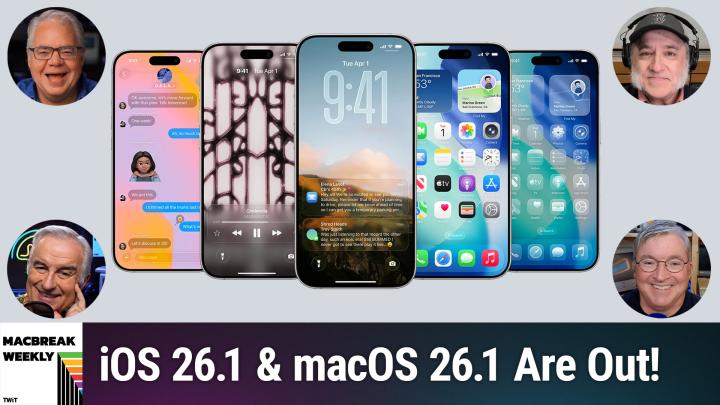
MacBreak Weekly 997 Transcript
Please be advised this transcript is AI-generated and may not be word for word. Time codes refer to the approximate times in the ad-supported version of the show.
Leo Laporte [00:00:00]:
It's time for MacBreak Weekly. We have lots of news, including Apple's third quarter results. Or is it their fourth quarter? It's their fourth quarter results. And yes, they had a pretty good quarter. Yet another record quarter. But there are some nuances. Jason Snell has all the color graphs to show you. Rumors about a new inexpensive MacBook seem to be coming true.
Leo Laporte [00:00:24]:
And Tim Cook celebrates a important birthday. All that more coming up next. Oh, plus a look at 26.1. Stay tuned. MacBreak Weekly's next. This is MacBreak Weekly, episode 997, recorded Tuesday, November 4, 2025: Dunkin' and Dodgin'.
Leo Laporte [00:00:56]:
It's time for MacBreak Weekly, the show. We cover the latest news from Apple and there is quite a bit of news. I don't know where to start. You know what? Let's start with the thing that's most important to real people. iOS and iPadOS. 26.1. Introducing, ladies and gentlemen, from right to left, Mr. Alex Lindsay of officehours.global.
Leo Laporte [00:01:14]:
On the right in the center, Andy Ihnatko from the library, which is kind of a leftist thing, but we'll say he's in the center. And on the left, Jason Snell sees.
Alex Lindsay [00:01:26]:
The means of production.
Leo Laporte [00:01:27]:
He went to UC Berkeley. So, you know, you know, hello, everybody.
Andy Ihnatko [00:01:32]:
Hello, boys. Hello, squares.
Leo Laporte [00:01:37]:
Yes, it is like Hollywood Squares or the Brady Bunch. So we're going to save your beautiful charts and apples results to the second strike.
Alex Lindsay [00:01:47]:
Nobody cares about that.
Leo Laporte [00:01:48]:
They do. I know they do. But honestly, Slide Over Kids is here.
Andy Ihnatko [00:01:53]:
Yes.
Alex Lindsay [00:01:54]:
Yeah, Point One is here. Right? And that is a big thing because this is the OS that will probably be inflicted on everyone.
Andy Ihnatko [00:02:03]:
And this really was the release of. Okay, you babies, we heard you complain enough. Fine, you can have slide over back. Fine. You can have the slide to lock and unlock thing back. Fine. You can turn off liquid glass if you don't like it. Happy now?
Alex Lindsay [00:02:16]:
Yep.
Leo Laporte [00:02:18]:
It is Apple's retrenchment. It is the retrenchment.
Alex Lindsay [00:02:21]:
As a podcaster, I'll say it. Also, it was fine. I suppose if you're recording a podcast on an iPad or an iPhone, you might want to have a gain control so that your microphone doesn't blow out when you're talking to people. Okay, so they did. They added that too, to their new podcasting feature. You can. You can make that microphone a little quieter and choose where to save the file when you're done. Little stuff.
Alex Lindsay [00:02:44]:
But. But I think. Good, right? Because the alternative would be that they wouldn't say, oh, fine, they would just ignore you. And that's happened a lot in the past. So in the 0.1 to have some kind of glaring issues. Fine. You can make, you know, liquid glass more opaque if you want and it's not necessarily.
Andy Ihnatko [00:03:00]:
Okay.
Leo Laporte [00:03:01]:
So I am now in my settings on my iPhone. Where do I do that?
Alex Lindsay [00:03:04]:
Appearance. It's like setting a dark mode. You can set.
Leo Laporte [00:03:06]:
Oh, I don't have to go to Accessibility.
Alex Lindsay [00:03:07]:
Yeah, yeah, that's the key. And in fact, if you've got a bunch of accessibility things turned on.
Leo Laporte [00:03:12]:
Oh, you might want my tip to.
Alex Lindsay [00:03:13]:
You, but my tip to the listeners out there, if you, if you're trying to mitigate Liquid Glass by using accessibility features is you might want to turn those off first because they do have some weird kind of interactions and just see what this gets you. But it should, there should be in, in point one, under appearance, there should be a Liquid Glass option.
Leo Laporte [00:03:31]:
Appearance. I never. Where is appearance? I don't.
Alex Lindsay [00:03:35]:
Is that in general display and appearance? No, it should. I think it's at the top level.
Leo Laporte [00:03:38]:
Oh, it's in display and brightness.
Alex Lindsay [00:03:42]:
No, I think there should be an appearance. It's where you set dark mode.
Leo Laporte [00:03:44]:
You could also settings.
Alex Lindsay [00:03:46]:
By the way, I don't have my phone here, so I can't walk you through it. This is like talking to my mom.
Andy Ihnatko [00:03:49]:
And trying to troubleshoot.
Leo Laporte [00:03:52]:
Glass. Ah, here it is. It's under Display and brightness.
Alex Lindsay [00:03:54]:
Display and Brightness.
Leo Laporte [00:03:54]:
So clear or tinted. That's the two choices.
Alex Lindsay [00:03:57]:
Those are your choices. Well, tinted is sort of off and iOS Previous version is totally off, so.
Leo Laporte [00:04:04]:
It'S no longer transparent. It's basically the way it was.
Alex Lindsay [00:04:08]:
Yeah. And that is going to allow them, I think they have an easier future support burden when they push this out to everybody. Where people are like, I can't read what's going on. You'll be like, okay, turn on this feature and it will make everything better for you.
Leo Laporte [00:04:23]:
Thank you, Apple. I do notice the folder backgrounds are still clear. Doesn't turn it off completely.
Alex Lindsay [00:04:30]:
No, it just, it just.
Leo Laporte [00:04:31]:
And I saw the new icon stuff. Right.
Alex Lindsay [00:04:34]:
So, yeah, I mean they're not, they are not going to give you a button to revert to the previous design, but they think that this, this, this will drop a lot of the things that are the primary offenders to some people, which is, I can't really read with clarity the stuff I'm seeing on my screen because it's too. Right, it's just too see through.
Leo Laporte [00:04:51]:
Yeah. And that, that really was kind of an issue. If I go to search, see, it's still a little. It's still a little gooey, but.
Alex Lindsay [00:05:01]:
And I'd imagine that that will change throughout this entire cycle and of course into next year if. If iOS7 is our model here. Right. Like, iOS7 was pretty extreme and even in the beta they were walking it back and you know, over the whole course of that year and the next couple of years, they kind of refined and backed off the stuff that everybody kind of agreed didn't work. And, you know, we're in the middle of that right now. Yeah.
Andy Ihnatko [00:05:25]:
The fun thing is to imagine that this was. It was basically a lot of people inside of Apple who are now basically smug, justifiably smug during the next conference call saying, see, I told you we were hitting this too hard and I told you that people needed this feature and now we should put it back. And now they have the armament that they need to basically win the argument that they lost like four or five months ago.
Leo Laporte [00:05:50]:
All right, 25 new actions in shortcuts, right? That's cool. Are they useful? Matthew Castanelli is our shortcuts guru.
Alex Lindsay [00:06:01]:
Actually, so is varying degrees, but there's some nice ones in 26 in general. Adds a whole bunch of things that you might not know. Like the calculate expressions block will let you do real currency and stuff that it didn't used to do. So that's pretty cool. You can just translate from US dollars to great British pounds on the fly if you really want to.
Leo Laporte [00:06:27]:
Did they fix Spotlight by any chance?
Alex Lindsay [00:06:31]:
I've heard varying degrees about whether the Spotlight bug has been crushed in point one.
Andy Ihnatko [00:06:35]:
Yeah, I will say that the bug that I was complaining about last week about how Spotlight launching of apps wasn't working for some reason. Whatever minute little detail or code or key that was inside, deeply inside my library had been fixed and updated and now it's actually working again. But there are a lot of. There was one little update that I spotted that I thought was kind of interesting, where now you can now have more control over how long Spotlight will maintain an index of your clipboard so that if you want to say no, actually I would like you to hold onto my clipboard for 30 days. Or no, I actually want you to trash it almost immediately because I don't want anything in my clipboard to persist more than, let's say, say a half an hour. There's now a fine grained control within Spotlight you can activate.
Leo Laporte [00:07:24]:
That's a good idea for security. It looks like things malware often does is look at your Clipboard.
Alex Lindsay [00:07:29]:
Yeah, I think they have eight hours and now they let you choose. At least in the 0.1 that I'm seeing here, they let you choose 30 minutes, eight hours or seven days, which I think is actually pretty. Covers a lot of the use cases, which is don't hold onto it very long at all, whatever, or I want it forever, you know, and they're like, well, seven days is all we're going to hold it for. But that's, that's pretty good because I, I heard from a lot of power users who are like eight hours is not enough. Which I always thought really funny because I always laughed when I saw things on my clipboard from the previous day. I'm like, yeah, that was yesterday. I've moved on clipboard, but you can now do that.
Leo Laporte [00:08:08]:
Well, there are tools if you really do want to save your clipboard.
Alex Lindsay [00:08:10]:
They're a way to have forever that notes always. This is always going to be Clipboard Apple implementing this feature, which I think is like one of the great last fundamental Mac features that they just sort of never implemented in the os. You know, if you still have an array of other utilities that will let you do lots of cool stuff with your Clipboard that go beyond this kind of basic set. But I think they've addressed with. With this time thing. The, the most fundamental. Yeah, a really simple one, which is. Some people said that's not enough time.
Alex Lindsay [00:08:43]:
And they're like, okay, have, have a week. See how that works.
Leo Laporte [00:08:48]:
Your password manager undoubtedly has a setting to delete passwords from the clipboard within 10 seconds or that kind of thing.
Alex Lindsay [00:08:55]:
Yes. And Apple's passwords manager works the same way that there's an API. I think there's actually. I think there's an API for that. That the idea that you pass something to the Clipboard and say that it's a password and it gets wiped out.
Leo Laporte [00:09:10]:
Yeah, yeah, here's the one I'm really. I mean, maybe it's just me, but it was always weird that I could automate my. I could shortcuts on my Mac with triggers by time of day and so forth, but couldn't on iOS, but they've now added those automatic shortcut triggers to iOS. So finally, including time of day alarm, email message folder, isn't that the inverse?
Alex Lindsay [00:09:37]:
The Mac did not.
Leo Laporte [00:09:37]:
Oh, it's the other way around. You're right. What am I saying? Have they added it to the Mac?
Alex Lindsay [00:09:41]:
They added it to the Mac Mac in 26, which is really nice because you can actually do that.
Leo Laporte [00:09:45]:
Thing where I wasn't paying attention. I knew I was adding it was.
Alex Lindsay [00:09:49]:
Maddening because it's like, well, wait a second, it works on the iPhone, but the Mac has no concept of automation.
Leo Laporte [00:09:54]:
What I wanted my wallpaper to change via a shortcut and I could do it on the iPad, but I couldn't do it on my Mac. Okay. Yeah. In fact, I downloaded third party tools to do that and I don't need those anymore. So shortcuts much improved. I think that's a, that's a nice change. There's of course, as always, security fixes, which means you should do 26. 1.
Leo Laporte [00:10:16]:
It's available as of yesterday for.
Alex Lindsay [00:10:20]:
Yeah, I think if you're on Tahoe, you should absolutely update. And if you're not on Tahoe, I.
Leo Laporte [00:10:24]:
Would say on the Mac too, you say yeah.
Alex Lindsay [00:10:27]:
Oh, yeah. iOS and Mac, I think on all of them you should. If you're already on 26, please go to the new version because it really is. You could argue that this is the, the real version for everybody and that that was a beta and all because you had to choose to be on the Point Zero version. And so now we're at 0.1. It's more broadly available. I would say that if there are people who are like, ah, I want to do it, but I'm just kind of not sure Point One is a good time to jump on. Nobody has to, like, nobody's going to force you onto this new version.
Alex Lindsay [00:10:56]:
But I have heard from a lot of people who are like, I'm interested, but I'm a little reluctant. I want them to get some of the bugs out. And I think Point One is right. This year is a good time to jump on because they seem to have addressed a lot of the major issues. And you know, I think it's, I think it's very usable on all those platforms now.
Leo Laporte [00:11:14]:
Hallelujah. Although if you're Alex Lindsay, you'll wait to 26. Or is it 0.2, UA, 2.4?
Alex Lindsay [00:11:22]:
I mean, I, well, for my. I have one computer that's for the Mac is up to date because there's features I need on it. But the. My main Mac that I do most of my interaction with is going to be a year behind. Yeah, it's going to stay that way.
Andy Ihnatko [00:11:37]:
Classic hold on for quantum computing.
Alex Lindsay [00:11:40]:
Yes. No, no, it's just, it's just a, it's just a comfortable year. I move up to Sequoia when Tahoe comes out. You know, like, it's just like, okay, that one's stable and not going to go anywhere.
Alex Lindsay [00:11:49]:
And working in tech publications over the years, one of the things that I learned in the corporate environment was all the editors were on the cutting edge and our IT people would kind of yell at us. That was a terrible job to be the IT person for a tech magazine writer or editor, because they're like, oh, you should probably shouldn't update. And we're like, oh, no, we're on the cutting edge beta sor. But the production staff, our designers and artists and stuff, we're always a year behind. And because if you've got an entire production process going and one thing deviates or breaks or is different or requires, it upsets the whole chain of production. And so we would just pass the files over and they're like, stay away from me with your weird operating system. Just give me the file I need. And it makes a lot of sense.
Alex Lindsay [00:12:38]:
The lens. The lesson for me was somewhere in the mid-90s, we had. I had this. I don't remember what the tool was that did this, but there was a script that would do all the classified ads into a magazine I was working on from FileMaker. So it would take FileMaker and it would export them all out and it flowed them all incorrectly with a whole bunch of rules into Quark, you know, like. And then we.
Alex Lindsay [00:12:58]:
The hand of Sal Segoe inhabiting.
Andy Ihnatko [00:13:00]:
Yeah, yeah, there was.
Alex Lindsay [00:13:01]:
But there was a. There was this. It was. It was an Apple scratch that was. That would do this very complicated thing and there was an update and someone ran the update on the computer that does that thing. And we almost didn't publish. It was just like one little. And it was like one call didn't work.
Alex Lindsay [00:13:18]:
But then you're digging through all this code and there's mass chaos and there was a day of running around and everyone yelling at each other and we found an old computer that hadn't been upgraded yet and ran it and everything was fine.
Alex Lindsay [00:13:28]:
And the good news is Apple knows this. And this is why if you're on, like Sequoia or you're on previous versions of iOS or iPadOS, if there's a security issue, you will be offered an update on for that security issue on that version. It won't be like, well, you're just insecure. Unless you come to 26, they're not going to make you do that for like a year or two. So you've got time, because they know that you know. And this is what I always say during the beta period too, is like, you know, if you've got stuff you rely on. You got to be really careful because that's where that, you know, do not break your business because you were curious about clipboard history in Spotlight, right? Come on, don't do it.
Alex Lindsay [00:14:09]:
Well, and the thing is, is that like with Windows, I don't understand how people live that way. I mean, like, it's like this crazy unless you have Enterprise and you can say, I never want to move this up. If you have Pro or, or a consumer version of Windows, you know, you're just in this. To me, what feels like a chaotic state. You know, I had a, you know, regular Pro license on a Windows computer when I was using the Oculus when I first started using it. And every time it updated, my Oculus broke. It was like every single time I was like, okay, now I got to figure it out. You're going to wait a couple days, then I'm going to have to patch it.
Alex Lindsay [00:14:42]:
Then I have to do this thing. And I finally. It was what killed my usage of Oculus was just dealing with the PC updating.
Alex Lindsay [00:14:50]:
Yeah, I'm going to do a little footnote here because people were asking in the discord. Sal Segolian was the AppleScript product manager at Apple for years. But before he was that, the reason he got that job is that he was the magic applescript man. The first time I saw him was at a conference. I think it was at a worldwide developer conference, Apple conference back in the 90s. And his demo, his go to amazing. You won't believe this demo was FileMaker Database. AppleScript laid out an entire Classified section in QuarkXPress using nothing but a script because all the necessary logic was implied in the data in the database.
Alex Lindsay [00:15:25]:
And I saw it and I still remember. I remember what the room looked like. I remember watching that. I remember my mind being completely blown. And I was not surprised that like a year later, oh, he actually works.
Alex Lindsay [00:15:37]:
At Apple now on Apple Sky.
Alex Lindsay [00:15:38]:
Oh, I see. I see where it was life changing.
Alex Lindsay [00:15:41]:
Before I got to the magazine, it was. They were doing it by hand and I was like, how about we do it this way? And, you know, it was like a day or two of me fiddling with the data and everything else. And then I pushed it all out and they're like, so how long does it take to do it again? Another two days? I'm like, no, it takes about a minute.
Alex Lindsay [00:15:54]:
No, that's the case. We'll get those two days back in the next two months.
Andy Ihnatko [00:16:00]:
Utter utter legend, like, where he would just simply say he could either if he needed a feature to be added to Mac to the Macintosh operating system to make applescript better, he could either use the regular chain of command to pitch to management to enter the chain, or he could simply like say, basically go into the right engineer's office, lay out some cash saying, hey, here's X dollars. Could you just like tweak this and it will do it. Famous for jumping up and down on the desk of somebody who is basically trying to kill applescript because they're not getting it. Famous for when, when Steve Jobs came back and had the big all hands meeting like at town hall to basically shout at every project manager, tell them that their work is a piece of crap and that they're bringing the company down. Being the one person who shouted back, you don't know, you don't know what you're talking about. And then basically saving applescript because he would not back down. And Steve was just testing him.
Alex Lindsay [00:16:51]:
Yeah, the legendary. For those who don't. For those who do not know, I'll just say if you live through those darkest times of the Mac. One of the reasons that Macs stayed in use when Windows was 95 especially was taking over was that people had written these enormous production systems that were automated with AppleScript and they literally couldn't move off the Mac. And that helped save the Mac for long enough for it to come back and for Steve Jobs to be there. And then yes, there was the, in the transition to OS10, there was a real question of were they going to bring AppleScript back? Because you know, they could have dumped it and it would have left all those again, all the publishing customers would have left and gone to Windows.
Alex Lindsay [00:17:32]:
And it was a big, I mean Apple was a much smaller company so publishing was a big part of that. And I, I was given a PC in the early 90s to do publish, you know, to do pre press and working with service bureaus with a, with a I've got a Windows machine was a nightmare. Like it was just, it was literally years of just trying to explain to them and trying to figure out how to get files back and forth because the entire world was Mac. Like everything there, you're, you're, you were, you were. It was the one place where you were in this tiny little minority of people just because that's what Prime Sports Network bought me to do the work.
Leo Laporte [00:18:06]:
Sadly, it did not save Sal Segoyan's job at Apple.
Alex Lindsay [00:18:09]:
No, but he's working on Omni Group. Yeah, he's working at omnigroup. And I Actually just got. They're coming out with a new version of Omni Outliner and they've built an entire thing that is actually kind of what everybody's doing now, which is they're building a JavaScript set of JavaScript frameworks that are cross platform that you can use. And then if you want to connect to AppleScript or Shortcuts or whatever, there are like, they're like shortcuts hooks to run a particular JavaScript script or to run actually arbitrary JavaScript that you send. So it makes. They basically have built a whole new app scripting framework using JavaScript. And they're not the only ones.
Alex Lindsay [00:18:46]:
My beloved audio hijack from Rogue amoeba, that's all JavaScript scriptable. And Sal has been one of the really key people in working on that stuff. I just talked to him like last week about what he's doing at Omni. They're doing some very cool stuff. And the nice thing there actually is that Apple allow. Apple's got a core of JavaScript framework that is available on all a runtime that's available on all their OSes. So you can, you can count on that JavaScript being runnable on Mac and iPad and iPhone and that's a, that's a big win for them. So he's still, he's still kicking even though AppleScript is.
Alex Lindsay [00:19:18]:
And AppleScript is still kicking because nobody's really properly replaced it yet. So it just sort of sits there.
Leo Laporte [00:19:23]:
Sal always said that. He said they can't kill applescript because it's still used in production. Nightscape in our club. Twit Discord. Hi Nightscape says I was working at Gannett, a little paper in Minnesota around the same time. Helped with the TV guide regional layout script in AppleScript. Never do a task a third time. St.
Leo Laporte [00:19:42]:
Cloud Times was one of the first daily papers online. It was all AppleScript and Miva Miva, which I'm not familiar with. No, me and a buddy programmed that about six weeks.
Alex Lindsay [00:19:53]:
That's amazing.
Leo Laporte [00:19:53]:
Yeah, Another Sal Segoyan tidbit. In some ways he's responsible for the beginnings of Mac Break. Right, Alex?
Alex Lindsay [00:20:01]:
He was in our first episodes. Yeah. So he was in the very first, that infamous capture on Green Screen where I think we caught 25 episodes and then couldn't process any of them because I didn't know how to do 1080p yet. And so we had a camera. We just didn't know what to do with the edit part.
Leo Laporte [00:20:21]:
But can I say now you bought Lucas's.
Alex Lindsay [00:20:24]:
So what happened was is that ILM had two. Two of these F950s. There's one behind me, kind of hidden behind all that stuff.
Leo Laporte [00:20:31]:
And it's now an antique, of course.
Alex Lindsay [00:20:33]:
Yeah, it still works. It still looks great. But. But, yeah, it's. It's. So they had these two F950s and they decided they were going to move completely to digital and they'll hire out any. Any kind of physical production that they're going to do. And so they had these two cameras, and I had a friend who.
Alex Lindsay [00:20:48]:
I was able to just write a check for it, but they were. They were for the cool price of $165,000 for the two of them, you know, and so. So it was $82,000 each, and it was the biggest purchase I had ever made. And. And so I, you know, worked with the San Francisco Film School to Digital film school to. To. To build a. You know, they had a green screen and they went half with me on the camera until I could pay them back for it.
Leo Laporte [00:21:14]:
Was it really expensive?
Alex Lindsay [00:21:16]:
It was $82,000 for what that's used. Used. It was $82,000.
Leo Laporte [00:21:22]:
This was not 1920, by the way. This is like 2000.
Alex Lindsay [00:21:26]:
2000. Five.
Leo Laporte [00:21:27]:
Five. Yeah.
Alex Lindsay [00:21:29]:
And so. But it was the only 444 camera. It was 20 years ago, though, in Northern California. So it was. And literally we did stuff for Macworld and we did it for Vision 3 and everything else, partially because we could pull great green screens because we had a 444 camera.
Leo Laporte [00:21:44]:
1080P kids.
Alex Lindsay [00:21:46]:
1080P. Yeah. Not anything bigger, just 1080p. But. But the. But it was a. And back then, it was huge. It was 250megs a second, which was the capture, you know, which now is nothing.
Alex Lindsay [00:21:57]:
But. But back then, I had to. We bought 2x rays just to support the two cameras. So an X ray for each camera, and we had a Mac for each camera. We were capturing out a final cut. I was trying to explain that something needed to be fixed. I was talking to Aja about their. They had these I O boxes, and they said, you know, you're the only one doing this.
Alex Lindsay [00:22:15]:
I just want to make sure you're clear. Like, we'll try to fix it, but we're not going to get around to it immediately because you're the only one. And anyway, so we did that runaround episode one, and then Amber and Emery and Sal Segoyan and you, Leo, of course, and myself. And I think that was the big group. And we all shot one episode after Another demoing stuff. And he did all the Apple script stuff. And then he also did. When 4K came out, we did a Mac Break the first, I think it was the first video in 4K that went out.
Alex Lindsay [00:22:51]:
So when 4K was released on YouTube the same day or the day after, Sal came into the office and we shot a 4K version of Mac break to show, you know, to do it all. Of course that drove us into the ground too, because we didn't.
Leo Laporte [00:23:03]:
Is any of this on YouTube we can watch?
Alex Lindsay [00:23:06]:
Not a lot on YouTube. It was all, you know, it was all subscriber stuff. We should probably put it on YouTube.
Leo Laporte [00:23:13]:
I think now you could. I think YouTube can handle 1080p.
Alex Lindsay [00:23:16]:
I know exactly, exactly.
Leo Laporte [00:23:19]:
How much pain was involved in that.
Andy Ihnatko [00:23:21]:
There's still that eight minute limit though, however.
Alex Lindsay [00:23:25]:
Well, the funny thing is that we, you know, the day to day after that first push, we got to a point where we could just produce 1080p. It was a hard thing to do, but we got to the point where we could, could shoot 25 in a, in a day and deliver them all in a week. You know, from, you know, the pipeline got really, really refined. But it was, it was hard when we first started.
Leo Laporte [00:23:49]:
It's why the first Mac break weeklies were audio.
Alex Lindsay [00:23:53]:
Yeah, yeah, we gotta do something.
Leo Laporte [00:23:55]:
We wanted to put them out the same day that we recorded them.
Alex Lindsay [00:23:58]:
The road, the road to 1080p was the most viewed Mac break video is the road to 1080p. And. And it was only done because Leo was. Was.
Leo Laporte [00:24:10]:
Where the hell is it?
Alex Lindsay [00:24:11]:
We got to put something out. You got to put something out. Like we put one out, you got to put the other one out. And I was like, okay, okay, okay. And I just did this. I scribbled on.
Leo Laporte [00:24:18]:
We do have that on the website, by the way. Yeah, you want to watch, watch that in glorious 1080p.
Alex Lindsay [00:24:25]:
Yeah.
Leo Laporte [00:24:25]:
Same music too, by the way.
Alex Lindsay [00:24:27]:
Yeah.
Leo Laporte [00:24:28]:
Wow.
Alex Lindsay [00:24:29]:
Talk about, you know, how we do it.
Leo Laporte [00:24:31]:
There's the green screen and there's that Sony physical set F950, which by the.
Alex Lindsay [00:24:35]:
Way, sounds like what's called a Sony cine alta F950.
Leo Laporte [00:24:39]:
Oh, I thought it was you, Alex. I thought I was interrupting you.
Alex Lindsay [00:24:42]:
It was.
Alex Lindsay [00:24:43]:
This is the recording past Alex.
Alex Lindsay [00:24:48]:
So.
Andy Ihnatko [00:24:48]:
And if you look at, if you.
Alex Lindsay [00:24:49]:
Look at the immersive video I did a couple weeks ago, you see, I haven't gone very far. Just draw on the screen like.
Leo Laporte [00:24:54]:
Doubt you had telestrator. Am I looking at this at the highest possible quality?
Alex Lindsay [00:24:59]:
Yeah, it Was captured at very low quality. It was. It was not. It was a road to 1080p. It wasn't actually 1080p.
Leo Laporte [00:25:05]:
Oh, that's why.
Alex Lindsay [00:25:06]:
Yeah, yeah, yeah, exactly.
Leo Laporte [00:25:07]:
Oh, yeah. I think this one was Mach Break SP1A. The road to 1080p. Wow. Here's fun new products. But that I think this one have been.
Alex Lindsay [00:25:18]:
I think this was. This might have been 1080p here.
Leo Laporte [00:25:21]:
Oh, really fun new product. Should I go back?
Alex Lindsay [00:25:22]:
Maybe not. Hold on.
Leo Laporte [00:25:24]:
Sp. I think it was. That doesn't look like it's video. This one is video part two.
Alex Lindsay [00:25:31]:
And then I.
Leo Laporte [00:25:32]:
How come we haven't updated the music? That's 20 years old music. Here's another video. This is XP on Mac. Yeah.
Alex Lindsay [00:25:40]:
And then if you jump in there it's. Yeah, this is.
Leo Laporte [00:25:42]:
And why are we on a green screen?
Alex Lindsay [00:25:44]:
Because I think we couldn't publish it. So I couldn't pull a key. So here's the problem was, is that.
Andy Ihnatko [00:25:49]:
I thought I had this great idea.
Alex Lindsay [00:25:50]:
That I would have the table. I had this great idea that. And I think we were in the mode. We were just like, just publish it. Like you were just saying, like, just publish it. Like it doesn't matter. Just get it out.
Leo Laporte [00:25:59]:
Oh, there's a green. There's the green. There's Emery Wells, now billionaire. Thank you, Adobe.
Alex Lindsay [00:26:07]:
Yeah.
Alex Lindsay [00:26:07]:
So.
Alex Lindsay [00:26:07]:
So then we were. And there was me with so much darker hair.
Leo Laporte [00:26:11]:
Oh, yeah. It doesn't. See, this doesn't feel like 20 years ago to me. But then I look at you and I go, oh yeah, it was 20 years ago. Here is road. The road to 1080p part three.
Alex Lindsay [00:26:23]:
And I'm sure. I'm sure I would. Yeah.
Leo Laporte [00:26:26]:
I knew I'd find Sal Segoyan eventually. There he is in his famous trademark beret, which was hard to key.
Alex Lindsay [00:26:32]:
And his hair was particularly hard to key. So that was the why I used it.
Leo Laporte [00:26:36]:
A good test.
Alex Lindsay [00:26:37]:
Big soft hair in the back there. Had to. Had to figure it out. And so I think we were showing how we were actually pulling the key for that.
Leo Laporte [00:26:43]:
Oh, that's cool. Oh yeah, look. See the hair, soft, man, all the details. This is great. Wow. Memory lane, kids. Anyway, these are all a lot of them anyway on our website.
Alex Lindsay [00:27:02]:
We should probably download and put them on YouTube. I think I'll work on that.
Leo Laporte [00:27:05]:
Yeah. I don't know if any of the actual 1080p stuff is on our website.
Alex Lindsay [00:27:11]:
Is it.
Leo Laporte [00:27:12]:
There you are at Mac World Expo.
Alex Lindsay [00:27:15]:
Yeah.
Leo Laporte [00:27:15]:
Looking at the latest Mac Mini, I guess. Wow. Or is that Cesar. Nab. Nab. Wow. So this is back in the day, ladies and gentlemen. We're going to take a little.
Andy Ihnatko [00:27:30]:
Oh.
Leo Laporte [00:27:31]:
Anything else to say about 26.1. I didn't realize. So it's Tahoe, it's Apple TV, it's everything.
Alex Lindsay [00:27:37]:
All the things.
Leo Laporte [00:27:39]:
Watches also, you know.
Andy Ihnatko [00:27:43]:
Oh, no, just, just about an hour ago, Apple dropped 20 betas of developer betas of 26.2. Oh man. Interestingly, for everything except for Tahoe.
Leo Laporte [00:27:53]:
Ah, interesting.
Andy Ihnatko [00:27:56]:
It's not unusual for them to like drop it like one day after the major release.
Leo Laporte [00:27:59]:
I left out the most important new feature. The alarm clock snooze button is harder to snooze. You can't hit it by accident. You have to slide it over. What a relief if you were one of those people that accidentally snoozed your way into a. Being fired. Have we. Oh, and of course the new series here, right?
Alex Lindsay [00:28:25]:
No, in the coming year, which Tim Cook now says very specifically is next year.
Andy Ihnatko [00:28:30]:
With a little help from their friends.
Leo Laporte [00:28:32]:
In the coming year. Who. Well, who are their friends? Do we know?
Andy Ihnatko [00:28:36]:
There's a.
Alex Lindsay [00:28:38]:
There's a story about it. Yeah, there's a.
Andy Ihnatko [00:28:39]:
There's a story about it that basically Apple is now saying, hi, Hi Google, could you build us a version of Gemini that runs on our secure AI platform that could basically do most of the heavy lifting for Apple intelligence, at least until we can figure out how to get our own foundation models doing and performing exactly the way you do. So it's not, it's not as though they're basically farming this job out. It's not as though they're subcontracting Google to run Apple intelligence on their servers. They're literally saying, basically build us a version of the Gemini foundation model to our specifications that will have the privacy things that are built in to our.
Alex Lindsay [00:29:18]:
Yeah. Runs on our platforms and white label it. And it will be Gemini white labeled. So it won't like be like, hey, I'm Gemini. It'll be whatever is running on private cloud compute would be Google's thing that.
Andy Ihnatko [00:29:31]:
It built for Apple, which I think is terrific news for both companies. A it validates exactly how good Google is at this sort of stuff. But also, aren't you kind of relieved at least this rumor that Apple is saying, we don't want to delay this into infinity. We would much rather. We don't have. We don't have so much ego that we're not going to basically hire somebody to help us out if they have knowledge and expertise going back A decade and a half that we don't have. We'll just write the check and we will still work on our own foundation models, but we want to deliver this important feature and make our products better and we don't want to delay any further.
Leo Laporte [00:30:09]:
They may live to regret this. They may live to regret this. Google had to pull its Gemma model from AI Studio after it fabricated defamatory stories about Marsha Blackburn. Senator Blackburn.
Alex Lindsay [00:30:23]:
So, well, I think if Apple, that's, if, if it's bad for Apple, it's bad for all AI models everywhere. I think that that's the, that's the beauty of this is if, if they're going to pick off models one by one like this, then they're all going to get picked off because they're all, they all are going to do this sort of things. And so it's. Apple's going to rise or fall with the boats. But I agree with Andy. This is using, using things they can control, which is their commitment to having it be in private cloud compute. So they're not, what they're not doing is kicking it to Gemini and giving all your data to Google. They're saying, no, we're not going to do that, we're going to run it.
Alex Lindsay [00:30:57]:
And because it's white labeled, if they have a different partner down the road, if they build their own model and replace it, no one will even see it because it's all happening in Apple's cloud and Apple, that's how Apple likes it.
Leo Laporte [00:31:08]:
This is a little different from the way Apple works now with ChatGPT, with OpenAI's ChatGPT because it says, oh, I can't help you. Maybe I could hand it off to ChatGPT. Is that okay with you? And then you say yes. And then it calls an OpenAI on OpenAI servers.
Alex Lindsay [00:31:23]:
Right.
Leo Laporte [00:31:24]:
This would be different.
Alex Lindsay [00:31:26]:
And computer is running now, but it's running now with Apple's foundation model. So the idea here is that those would be replaced or would be augmented. Depends on what the, what the task is. By a Gemini model that Apple, that Google built for Apple, for Apple specifications, but based on Gemini. And they have a tight relationship. They have a lot of money changing hands. I'm sure that's a part of this story, the fact that Apple is going to pay for its own hardware. So Google doesn't have to worry about that.
Alex Lindsay [00:31:53]:
It's just a licensing of their model and a building of a custom version. I think it makes sense and it gives Apple a lot of flexibility if they want to change down the road. The only troubling thing about that report is the suggestion that they did a Bake off and that the Perplexity model was actually better, but they didn't make the deal with them because the terms weren't as favorable. And so there is a question of, you know, is Apple doing only the best for our customers or is Apple doing well. Only the best. That fits. Right. That we could fit in here.
Alex Lindsay [00:32:24]:
But, but Google is not thought of as having an inferior model. They're thought of having a very good one.
Alex Lindsay [00:32:28]:
So yeah, I mean they have a really good model. Maybe it was a, maybe it was a little bit better. But I mean any. Everything's ten times better. And I think the question is whether it's nine times better or ten times better.
Alex Lindsay [00:32:37]:
In six months it'll be a totally different model that's ten times better. And that's just sort of how it goes.
Alex Lindsay [00:32:42]:
Yeah. I think the most fascinating thing I saw last week was an article where Microsoft said that they may just not anywhere to. They may not be able to have enough electricity. Not that they can't buy enough electricity. They're like literally they're going to run out of electricity to do. To do at any price. That's why there's three now Microsoft is investing in nuclear power plants.
Andy Ihnatko [00:33:01]:
That's happening to everybody. I think Microsoft is reactivating the Three Mile island plant. There was a news release.
Leo Laporte [00:33:09]:
Well, we kind of know, actually.
Andy Ihnatko [00:33:13]:
Fix they label that valve and Google had a deal to basically launch a new reactor or reactivated reactor somewhere in the Midwest. I think that's, I mean, because there just is not enough capacity on the grid to support all of this stuff. So they basically have to basically reactivate all of these, put all these investments into nuclear power because otherwise, otherwise we won't be able to have a chatbot lie to us about, about simple mathematics.
Leo Laporte [00:33:42]:
Well, we're going to get to Apple's financials because this is really now becoming a financial story. We talked a lot about it on Sunday on Twitter with Alex Stamos and Stacy Higginbotham and Jill Duffy. We're going to talk about it tomorrow on our AI show, Intelligent Machines. Everybody seems to think the AI crash is just around the corner. I'm not sure. I don't know what would. It's certainly a financial story. The, the financial story of Apple's results coming up in just a moment.
Leo Laporte [00:34:08]:
You're watching MacBreak weekly with the man of many colors. Well, not many, just six. Mr. Jason Snell, he's got his charts ready. We will get graphic in just a minute. Also, Alex Lindsay from officehours.global and the creator of 1080p podcasts. I just read an article by somebody who came to podcasting I think in 2022, 2021 and who we wrote an article saying the bubble is over and it's like wait a minute dude. Podcasting did not begin in 2021 and it's not going to end in 2025 and you are just not.
Leo Laporte [00:34:48]:
It's a certain kind of podcasting maybe. We've been doing this for 20 years. Thanks to you Alex who started it all way back in the day.
Alex Lindsay [00:34:55]:
Just following along.
Leo Laporte [00:34:57]:
Appreciate it. Yeah, appreciate you as the kids say. And Andy Ihnatko who's in the library because he's a studious, studious fellow. We will get back to back break weekly in just a bit. We're glad you're here. Our show today brought to you by ZocDoc. I'm glad ZocDoc is here. The Story of ZocDoc.
Leo Laporte [00:35:17]:
I was just reading about the founder. The story of ZocDoc is great. Let me tell you a bit, a little bit about what Zoc Duck has done now. I work out every day now because I realize that's the most important thing. Working out is a great way to take care of your body, but getting truly healthy takes more than just hitting the gym. It takes consistent annual checkups with your doctor getting things checked out that feel off or are not normal. You know, if you feel symptoms, don't rub dirt on it as we guys often do. It also requires a quality nutrition regimen.
Leo Laporte [00:35:51]:
Taking care of your mental health, it's.
Leo Laporte [00:35:53]:
A lot of things.
Leo Laporte [00:35:53]:
And ZocDoc makes it easy to start your health plan by helping you find and book doctors in your area who are right for you. It's quick and easy. And yes, it's not just doctors. It can be dentists. It could be mental health professionals, nutritionists. ZocDoc is a free app and website where you can search and compare high quality in network doctors and click to instantly book an appointment with ZocDoc. You can book in network appointments with insure that your you know, insurance doctors will take your insurance. With more than 100,000 doctors in every specialty, mental health, dental health, primary care, urgent care and more.
Leo Laporte [00:36:37]:
I use it for my parents to find gerontologists. If you're looking for a great dentist, they're there. You can filter for doctors who take your insurance. You can filter for doctors who are located nearby so you don't have a long drive. Eye doctors just got my eyes checked. Right. And by the way, I'm going back. So this is a good example where if you don't have the regular checkups, I'm going back because they said we gotta check again on something else.
Leo Laporte [00:37:06]:
We're gonna do another test. This is important. I feel like my eyes are fine, but it's really important you keep up on this stuff. ZocDoc, you can filter for doctors to take your insurance. They're located nearby, they're a good fit for any medical need you may have. And they're highly ranked by verified patients. That's important to me. I like to read the reviews.
Leo Laporte [00:37:24]:
You could filter on specific preferences, whether that's looking for a male doctor or, you know, a female ob. A doctor that speaks a specific language, has availability that fits with your work schedule. A doctor with openings tomorrow, if you put it off, that may be what you're doing, like I need it now. But they can do that. Once you find the right doctor, you can actually see their actual appointment openings. You can choose a time slot right on the screen that works for you and click to instantly book a visit. And appointments made through Zocdoc happen fast, typically within 24 to 72 hours of booking. More often than not, you can even get same day appointments.
Leo Laporte [00:38:03]:
I love ZocDoc. I use it and you should too. Stop putting off those doctor's appointments and go to zocdoc.com/macbrek to find and instantly book a top rated doctor today. That's z-o-c-d-o-c.com/macbreak. zocdoc.com/macbrekI recommend it highly. All right, Jason Snell, I'm ready to go to sixcolors. Com. You've already done the podcast after listening to the analyst call.
Alex Lindsay [00:38:35]:
Oh yeah, so much, so much money.
Leo Laporte [00:38:38]:
Oh, I just got a text from my doctor. You have an appointment Thursday, 11:40am Yes, I know. To get my eyes. Thank you. ZocDoc. Apple's fiscal 2025 in charts. Revenue number goes up.
Alex Lindsay [00:38:54]:
You're jumping to the annual. So the quarterly's K. Oh, you're looking at my annual charts, which I follow.
Leo Laporte [00:39:00]:
So this quarter is the fourth quarter. The fiscal fourth.
Alex Lindsay [00:39:03]:
The fiscal fourth quarter. Which means yes, we can look at it from an annual basis, but the news is in the their physical results quarterly. And then we'll do the annual 2025.
Leo Laporte [00:39:13]:
So I went to the first thing I found.
Alex Lindsay [00:39:15]:
It was an all time record which happened for really for Q4. Shocker. It is a thing that Dan Morin and I, who does six colors with me have been talking about for a while, which is one of these quarters. There's just going to be a boring non holiday quarter that's going to casually go over 100 billion and this was it, 102.5 billion for just kind of a quarter in revenue. And the thing you need to know is that they only sold iPhones for about. This is never like the biggest quarter because they only sold iPhones new iPhones for about a week and a half in this quarter. So.
Leo Laporte [00:39:49]:
So really services up Mac up.
Alex Lindsay [00:39:52]:
Yeah. And you'll see and I think in some ways the biggest news is they provided some what they call guidance which is suggesting what their results are going to be like next time. And that's going to be, they said, an all time record quarter with all time record iPhone sales.
Alex Lindsay [00:40:08]:
They just say hold on to your lug nuts.
Alex Lindsay [00:40:10]:
You could see them, I mean you could, you could see the glee where they said, you know, not only is this a record, not only does that mean this fiscal is a record, but we think that we're going to do double digit growth in iPhone sales and set an all time record quarter for iPhone sales and for overall revenue. Which is those are going to be massive numbers. And the fact that they've got the confidence to do it I think stems from the fact that, that they know how the sales went the following four weeks. Right. Not just the ones that they're reporting in the quarter.
Leo Laporte [00:40:40]:
They kind of have an indicator, they.
Alex Lindsay [00:40:41]:
Know what happened in all of October and they know that basically that this cycle is going to be a hit for them. So they're going to make a lot of money in the next quarterly results. So they put that out there. But otherwise, you know, the Mac was up. IPad and wearables were flat. Services continues to just grow and grow and grow. It's sort of the same old story. I think they did warn about the Mac.
Alex Lindsay [00:41:02]:
The Mac has had two really good years but they pointed out that, that they're going into the holiday season this year with just that one M5 MacBook Pro. Whereas last year they had practically every Mac was new. And they said, yeah, we're not going to sell a lot of Macs next quarter. It's going to go down because so they're like, don't freak out when the Mac goes down next quarter because it is what they call a tough compare because last year's numbers were so good. So when you compare this year's to last year's it won't look so good. But that, that's in part because they turned the whole product line over last fall and this time they just did that one little. The base model MacBook Pro is all that they did. So.
Leo Laporte [00:41:38]:
So the next quarter is starting a new fiscal year. It's going to be Q1. That's traditionally the biggest quarter because it has the most holiday quarter.
Alex Lindsay [00:41:44]:
Yeah, yeah.
Leo Laporte [00:41:45]:
Most iPhone revenue in it this year. Q4, this most recent quarter ending in September was profit of 27.5 billion. This is $9 billion a month tossed off.
Alex Lindsay [00:41:58]:
$27.5 billion in Again, I'll point out one of their boring quarters.
Andy Ihnatko [00:42:04]:
Yeah.
Leo Laporte [00:42:04]:
Because last holiday quarter they made $12 billion a month.
Alex Lindsay [00:42:08]:
Yeah, that's just it.
Leo Laporte [00:42:12]:
Next quarter.
Alex Lindsay [00:42:13]:
Yeah, I mean, yeah, I think so. I think they're going to exceed all of those things and they have great confidence in it. And that's the thing. In fact, one of the things that also was funny, one of the boasts that we got from Tim Cook in this event, Tim Cook and Kevin Parrack is cfo, was somebody asked about the fact that they said that they were actually a little supply constrained with the iPhone, which is interesting, right? Because it means, that means that either they misjudged how many iPhones they would sell because they would prefer, you know, to, to be able to make exactly as many as they could sell. But they, they felt like they didn't make enough. And it could, it could be that the, there's more demand. It could be that they failed at their, at their judgment. And somebody said, well, well, you know, is this a, is this a ramp up issue? Is it just that you couldn't.
Alex Lindsay [00:43:00]:
So many companies have that with a new product. They're like, we couldn't make enough in time.
Leo Laporte [00:43:03]:
Apple really does.
Alex Lindsay [00:43:04]:
Cook was like, it's not a ramp problem. It's. It's demand. I mean, he just said it. He's like, we can make as many. You know, we made a lot and still wasn't enough. People wanted more. And that, that is again him kind of like doing this boast of.
Alex Lindsay [00:43:18]:
This is why next. Just wait for next quarter.
Leo Laporte [00:43:20]:
Everybody to any hints about the air at all?
Alex Lindsay [00:43:25]:
None. None. I mean, other, other than, than, you know, they were generally very positive about it about the phones in general. Also, we don't know like ch Air only went for sale in China late and, and, and overall composition. Like they don't, they don't talk about that stuff. Sorry, Andy.
Leo Laporte [00:43:43]:
Sorry, Doc. Go ahead.
Andy Ihnatko [00:43:43]:
Oh, no, I, I was just saying that it Was, it was interesting. They, they kind of broke.
Leo Laporte [00:43:47]:
They.
Andy Ihnatko [00:43:47]:
He answered the question twice, once by saying that the problem with not being able to furnish enough iPhone 17s was because demand was incredible. Then he was asked, I think he said something separate about the iPhone 16, saying that they just didn't make enough, which seemed like exactly the same thing, but phrased in a different way. But it was interesting to me that he broke it out in a different way way. He also, he was also a couple of times asked specific questions to, hey, can you break things down a little bit? And he basically decided to sort of like, you know, punt the question saying, oh, well, we don't, we don't have granularity on 17 versus 17 Pro. We don't have granularity on what is driving these things. We don't have granularity on. He wasn't saying these things, but basically saying we. And saying, well, we, we can't say whether or not AI features are driving sales of the iPhone 17 because we don't have enough numbers yet.
Andy Ihnatko [00:44:49]:
But as Jason said, it's interesting that they seem to be very, very optimistic in a venue in which if they are misleading, knowingly misleading investors, they are in deep, deep trouble saying that, yeah, we think the next quarter is going to be really, really good after we factor in all these iPhone sales.
Alex Lindsay [00:45:05]:
Yeah, you can't lie in this stuff. You can spin, but you cannot lie. You can refuse to disclose, but you cannot lie or you're getting sent to the gray bar hotel. So I would say, yeah, he says they were actually constrained on several iPhone 16 and 17 models in the quarter. That's probably in part because they were, they were stopping production of, of 16 models and then they were starting production of 17 models. But, and actually it's funny, and you mentioned the AI thing because given I think the opportunity by an analyst to say people just buy our phones because they love them and Apple intelligence isn't really part of the equation. And Tim Cook refused to do that. He said, I do think that Apple intelligence is one of the reasons that people buy phones, which, you know, we can all be.
Alex Lindsay [00:45:50]:
Continue if we want to be skeptical of that. I thought that was funny. I think that, I think that's a sop to the investors who are very concerned about Apple and, and what it's doing with AI. But I, but I will say this. This was one of those quarters. We talk about it here a little bit. This is one of those quarters where, because I only Watch CNBC for 30 minutes. Minutes a quarter, right? The 30 minutes before the Apple results come out.
Alex Lindsay [00:46:10]:
I'm kind of curious what they say and I will say this. They're still obviously they want it's AI AI, AI everywhere. But I did hear from a few analysts it was kind of like oh it's so refreshing. Apple just sells products and makes lots of money. Interesting model there of selling products for profit. But that's that and that is Apple's what Apple is best at that and that is what Apple is doing well here.
Andy Ihnatko [00:46:36]:
Yeah and that's, and that really, that's something that struck me about having the, having the Google's quarterly results and Apple's almost back to back. The striking difference in the prepared comments between Sundar Pichai and Tim. Tim's prepared comments were practically a marketing pitch for people who are interested in buying Apple hardware. It was all about oh when the new AirPods probe with a new something something and now the new we released a brand new watch and blah blah blah and the wonderful new photography features of xxx. Whereas Google's pitch was again they also had a really, really great quarter and they're saying basically taking a victory lap on Here is why we have, here's why we had to suffer through a lot of these quarterly calls by explaining how much money Google Cloud is losing. Like oh hey great news, we only lost $400 million this year. Well because we were investing in and basically the future of our business being to provide compute services and AI services. So they were basically talking about a larger strategy and specifically here's where our investments are taking off.
Andy Ihnatko [00:47:39]:
I thought it was interesting how again it was you basically cut and paste from like the Apple Store pages on a lot of the stuff that Tim was talking about because as we've been saying they are a products company. They, they did, they did have to address AI their, their, their spend. I think they said that they had adjust up that they thought that their capital expenses were going to be something like 10 to 11 billion. It was actually a couple billion more than that. And they said and it's going to be even 2 or 3 billion dollars more in the next quarter or something because of course they have to build out their Apple intelligence compute, their Apple intelligence infrastructure. But yeah, as I say that they are making so much money off of, of nothing, off of air, off of services. And you could see some questions directed by analysts that were like very, very pleased that you are selling electrons of which there are an infinite number in this universe. You're just packaging them and put a nice logo on them and we like how much money you get back on selling people electrons.
Alex Lindsay [00:48:38]:
Well, but again, those electrons, the reason they're able to sell those electrons is because they're sold through a hardware platform that all ties together.
Alex Lindsay [00:48:49]:
Frosting on top of the iPhone.
Andy Ihnatko [00:48:51]:
He mentioned that too, that, that once, once people own the Apple product, we try to, we try to encourage them that, hey, look, we've got also products as well. I think it's almost a direct quote from Tim. So, yeah, they are, they are really hedging on the, on the, the sales of, hey, we are a. I don't want to. It sounds like I'm belittling them by saying we are a gadget company, but essentially they, the analysts love to hear them say, yeah, we're a gadget company that have, that can sell not cheap hardware at really, really good margins. And we are bringing in, we're not just getting repeat customers, but we are bringing in people switching from other platforms at rates that we've never seen before.
Alex Lindsay [00:49:28]:
And I think that they had to make people not feel like they were not worried about AI. But at the same time, if anyone was really thinking that Apple's in some kind of existential crisis, they can probably stop talking about that. And I don't think Apple wanted to say that, but it was kind of like, okay, you don't need to talk about that anymore because look at what we just did and what we're probably going to do next quarter and probably the quarter after that. And the. But I think that also the 17 is in a super cycle in the sense that the, I mean, as someone who has family members that all have different phones, the lightning is old in the tooth. You're kind of like, so if you're Sitting on a 14, USB 2.0 is. Yeah, yeah. Like, if you're sitting on a, if you're sitting on a 14, you're now getting to that number of, of versions where you're looking for, when do I stop doing this? And in addition to that, I do think that oftentimes it still comes down to the camera.
Alex Lindsay [00:50:15]:
And the camera is my wife. I was shooting something. I think I showed it before. He just looked at what I was shooting. He's like, I'm not gonna even bother, like, because I was shooting it with the 17 and it was just, it's the, the tracking footage. As a parent, the 17 is, you know, like what you can shoot of your kids at a long distance away, stabilized is at a whole different level. And that's, you know, that's selling cameras. I Think it's.
Alex Lindsay [00:50:37]:
I mean, I think it's. I, I keep on not referring to it as a phone anymore. I just refer to the camera that makes phone calls. And I keep on saying, well, I got these cameras and I got this camera and, and it's. And I think that that is, you know, I think that's part of the super cycle. I don't. I think it's the camera upgrades still, you know, are more important for the 17 than any kind of AI yeah.
Leo Laporte [00:51:01]:
China down a little bit.
Alex Lindsay [00:51:03]:
It's interesting to see like all of this growth is happening while China is muddle, you know, muddling along. Like if you look at the. Over the last two years, you know, this, there's been this slow drop in demand from China and it hasn't. You know, I think that at one time people thought that China had. Was part of Apple's. You know, it was intrinsic to Apple success. And I think Apple is slowly weaning its way away from that.
Alex Lindsay [00:51:28]:
China Cook did say he thinks that China will grow next quarter. So he thinks that they're going back to growth there and that the iPhone still sells pretty well there. And they've said some record records in some other categories like Mac in recent quarters. So I think that the China business is obviously tough and we'll see if there's much growth left for them, but they have built it into a fairly large business.
Andy Ihnatko [00:51:50]:
And they did say There was a Q4 record of revenue from China, so they're doing well. They also asked a question about subsidies in China and how that was affecting iPhone and device sales and saying, well, unfortunately we're kind of priced out of the. The root were kind of priced out of the price range for which those subsidies are available in China. However, we did react to that and that's, I think, reflected in some of the numbers.
Leo Laporte [00:52:16]:
How about tariffs? Did he address the costs?
Andy Ihnatko [00:52:22]:
He mentioned that actually the tariffs were 1.1 billion and expected to be 1.4, I think for the quarter.
Alex Lindsay [00:52:29]:
For next quarter.
Andy Ihnatko [00:52:30]:
For next quarter. So he.
Leo Laporte [00:52:32]:
So Apple, does Apple absorb, absorb the cost of tariffs? They don't pass it along to customers.
Alex Lindsay [00:52:41]:
Here's the thing is their profit is not changing. Their margins aren't really changing. So I think that the answer is there are always some tariffs and there continue to be tariffs, but they're reducing them as much as possible. I think they've also found ways where the 17 Pro starts $100 higher and yes, it's got more, more storage than. Than. But they're not selling a 999 model. They think their places around the edges.
Leo Laporte [00:53:06]:
They can play with that a little.
Alex Lindsay [00:53:08]:
Exactly. And I think that they, they prefer to do that sort of thing. So they don't seem to be, you know, and all of their forecasts are, by the way, unless something changes, right? Like they, they, if, if, if they were to get whacked with something, then them talking about these, this great quarter, they're going to have something terrible happens and then they can't do it. But they, they seem to be, be pretty comfortable. Somebody did ask, by the way, about Google search and it's very funny how you can. You try to get Apple to say things and they don't say things, but they, the subject came up about Google search revenue and the way that the analyst approached it. This is Wamsey Mohan from Bank of America. He said, he said, we've heard stories about search revenue, about search on the web going down because of AI, which is funny because one of the sources of that is Eddie Q in court.
Alex Lindsay [00:53:58]:
Has that affected, you know, materially your growth and is it going to affect your growth in the services category? Because that is part of what you make money on. And Tim's response is kind of amazing. First off, he says, well, that's our advertising category. So that's something. I don't think I knew that they put all the Google search stuff and all of that in their advertising bucket. He said it's a combination of third party and first party. He says it sold a record. And Wamsey Mohan's response is, oh, so is that the third party and the first party both set records? And Tim Cook's answer is, I'm going to dodge that question intentionally.
Alex Lindsay [00:54:34]:
That's literally what he said. I'm dodging the question intentionally because don't.
Andy Ihnatko [00:54:38]:
Split it at that level.
Alex Lindsay [00:54:39]:
At that level. And he actually says we don't divulge. And then he pauses and he's like, no, I'm dodging that. I'm dodging. I'm not going to tell you.
Andy Ihnatko [00:54:45]:
You.
Alex Lindsay [00:54:46]:
It was a record.
Leo Laporte [00:54:48]:
In fact, that's the, that's the title of your article. Holiday Dunks and Questions Dodged.
Alex Lindsay [00:54:53]:
Dodged. Yeah. There's a lot of dunking attitude. They were doing a lot of celebrating and then they were dodging. Like he's always dodging questions. But I like that he just admitted it. That was.
Andy Ihnatko [00:55:02]:
Yes, me too.
Alex Lindsay [00:55:02]:
Come on. Just. It's like I'm dodging it.
Leo Laporte [00:55:05]:
That's what, Donuts Day last Thursday.
Alex Lindsay [00:55:08]:
Yeah, they're dunking. They were doing donuts in Apple park and they're dunking and all that. I mean that moment where they're like oh we are not ramping. We just have a massive demand for our profitable product.
Leo Laporte [00:55:18]:
Well, as many hard as we can.
Alex Lindsay [00:55:20]:
I think you can say you're just dodging it when you, when you just feel pretty smug. Like, like I don't have to try to explain this to you. I'm not in a corner like you know, like, you know none of these.
Alex Lindsay [00:55:29]:
Analysts, all these analysts know that they're not going to answer that question. I am. But I appreciate the try by Wamsey Mohan. I think he did a, I think he put like it on like extra layers of secret sauce and like conundrums inside conundrums to try and get. And Tim was like ye, no, you almost got me.
Leo Laporte [00:55:47]:
But no, yeah, well, but he did get a revelation, something that we didn't really know which is it's, it's an advertising.
Alex Lindsay [00:55:52]:
Advertising and that it set a record. Right. Like so, so I guess that was a disclosure. I think what he basically is saying is whatever reduction might or might not be happening in search ad revenue is being offset by other aspects of Apple's ad revenue business because it set a record. So you know, he's not going to tell you more than that. But that's, I mean it could be interesting to calculate it that way if you're thinking of like if, if the Google search deal is going to decrease in value over time, which we don't know. But if that's the case, Apple sort of winking at the fact that they've got other stuff that can pick up the slack.
Andy Ihnatko [00:56:27]:
Yeah. It feels like it felt like, like he saw an opportunity for another Flexi. Well actually advertising set another record that oh, I can't make, I can't break down that. So I'm going to make. I have to close. I have to tamper my enthusiasm for saying how awesome a quarter we had.
Alex Lindsay [00:56:40]:
Yeah. I mean the question is that a Google record. And Tim's like Matt, no, you're not going to get me to answer that.
Leo Laporte [00:56:46]:
We've always said the Google money went into the services.
Alex Lindsay [00:56:51]:
Yeah. This is advertising. It's a subcategory of services. Apparently that's.
Leo Laporte [00:56:54]:
So it is in services.
Alex Lindsay [00:56:55]:
It is all in services. But they then roll all that up into advertising and declared that a winner, like an all time winner. But that's, that's as low as, as Tim will go.
Leo Laporte [00:57:05]:
Which does Apple make a lot of money on advertising?
Alex Lindsay [00:57:09]:
They have a whole like senior Vice president of advertising. They did. They have like all the, all the App Store search ads and I think there's stuff in news and they're going to bring advertising to more places as well. There's a story about how it's going to be in maps. I still, I still believe that one of the side effects of them raising the price of Apple TV is that they'll be able to do a cheaper version of the Apple TV service that has ads in it at some point.
Andy Ihnatko [00:57:34]:
Actually, we might be jumping ahead a little bit, but there was a really good interview with Eddie Q and the head of Apple tv and Eddie Q explicitly said that, no, we're not looking for, let's see, it was asking about ad supported tier. He said, quote, nothing at this time. If we can stay aggressive with our pricing, it's better for consumers not to get interrupted with ads. Unquote.
Alex Lindsay [00:57:57]:
Yeah, nothing at this time. At this time is doing a lot. I get it. I actually would hate it.
Andy Ihnatko [00:58:03]:
And this isn't a quarterly, so he's not going to get sued for misleading people.
Alex Lindsay [00:58:06]:
Yeah.
Andy Ihnatko [00:58:07]:
Still. Yeah, that, that, that's, that's sticking his neck out a little bit.
Alex Lindsay [00:58:10]:
What's really interesting is that other CEOs have already said that one of the reasons they're raising the price of the no ad tier is to push people into the ad tier because they like money. They make more money on the ads than they do on the. And, and I, I have to say that I just can't. I don't know how people know that way. Like, it's not. I'd rather have less. I've gotten rid of services. I just canceled a bunch of services so that I could focus on the ones that I'm watching videos from.
Alex Lindsay [00:58:31]:
Yeah.
Andy Ihnatko [00:58:32]:
Just.
Alex Lindsay [00:58:32]:
I want to say it's not so much that they're raising the price in order to push people to the ad tier. It's more than. If you're making. It's not that though. What. I would say that technically what's happening is if you make $5 from somebody on your AD tier and only $3 from somebody on your premium tier because of the ad revenue you're making, you should raise the premium tier by $2. Right. Like, I think that's the idea is there's no way you should be losing money on people who are paying you more money.
Alex Lindsay [00:58:58]:
And so they raise that tier because it doesn't make sense for them to, to, to do that. And the net result is the same though, which is if you don't want to See ads, you're paying more. And that's because there's so much money to be made in ads, which is why I think it's inevitable that Apple TV will have ads only because they have an executive who's in charge of ads. And if Eddie is in those meetings saying, we don't need to do this, bless him. I was in a lot of meetings when I was at idg where I fought against intrusions into more and more things that I think are audience would hate. And it's a tough battle when you're fighting against somebody who says, but I could bring in more money. So even if it all user friend.
Leo Laporte [00:59:37]:
I think it also talks and Snell walks well.
Alex Lindsay [00:59:40]:
But I think story. But I also think that it's. It is where. Where is Apple financially? I think if Apple's selling iPhones like hotcakes, it gives Eddie Q more like, we don't need this right now. Like, we don't. Like I don't. We don't need to go down this path. If they start getting squeezed or something gets pulled back, then it's like, let's pull out all the stops, you know, to make sure that we make it.
Alex Lindsay [00:59:58]:
But I think that that's where, that's where it comes into it, where Apple's worried about it. But I think if Apple's not worried about revenue in the way that they are right now, I think if they lost the Google deal, for instance, because of the legal challenges and everything else, now they have to, you know, like, where do we come up with $20.
Alex Lindsay [01:00:12]:
Billion worried about demonstrating services growth at a time when other parts of their business are not growing? Right. That's always been. The services has been there. So, like, if you've got a slow iPhone year or two, they can say, but services. Oh, look. And like, yeah, I agree. It's a way to goose that services line when they need it.
Alex Lindsay [01:00:30]:
Because right now, I mean, I do feel that they really are becoming the next hbo. I mean, you look at the stuff. I mean, the stuff. I just finished the newest episode, the newest series of Slow Horses, the new, you know, episode that was just amazing. Oh, my God.
Leo Laporte [01:00:44]:
Such a good show.
Alex Lindsay [01:00:45]:
Which is so good. And took me so long to get into Slow Horses. I kept on looking at going, oh, I'm not sure. And now I'm looking at doing the one with Emma Thompson just because of Slow Horses.
Leo Laporte [01:00:53]:
It's not as good. It's the same author as another book series. It's a little weird.
Alex Lindsay [01:00:58]:
But then I'm.
Leo Laporte [01:00:59]:
I watched it because of Slow Horses.
Alex Lindsay [01:01:01]:
And I'm watching Last Frontier, which is really well made. There's weird decisions. But, but the, the but, but just I feel like there, you know, the filmmaker, the craft is so high.
Leo Laporte [01:01:13]:
It's like the old HBO days, isn't it?
Alex Lindsay [01:01:15]:
It is. That's what I'm saying. I think it's the new HBO where they just, you know, money is, it feels like money is no object. And when you talk to people who work on those teams, they feel that way too. You know, like it's, they're doing Apple maybe doing less features and less things, but when they do something there's a, you know, it's like what do we need to do to make this as good as it can be?
Andy Ihnatko [01:01:33]:
Yeah. And that's, that's more stuff that comes out in that interview where they're really stressing that like we're putting, we're, we. They. Eddy Q. Speaks of Apple TV as an extension of Apple's stated core philosophy, which is that it all starts with the human touch and humanity. And that's why no matter what kind of a series or movie we do, there has to be connection to humanity at the core of it. And reiterating we're doing quality over quantity. He also said that there was a, I don't think we even called a rumor, but last week, the week before that, oh well, what if Apple's in talks to buy the Paramount library? Library or whatever.
Andy Ihnatko [01:02:13]:
And he basically said yeah, we're not, thank you very much. I knew I got that wrong. But saying that yeah, we're building an all original service. We're not building on the back of a pre existing IP or library. Eddie promised us time and patience. That's exactly what he's delivered. You're now seeing the culmination of that time and patience and incredible partnerships with the best storytellers in the business. That was Jamie Ehrlicht, the co head of Worldwide Video.
Alex Lindsay [01:02:35]:
And the other thing is that, that when you look at F1 and MLS and, and, and, and, and some of the MLB stuff, they're sitting on an enormous amount of potential energy. It's just like they haven't even started to pull the value out of that, those relationships on what they can do immersively, what they can do with added content. I mean no, no one's doing that very well right now. But there is so much content. When you, when you have the, the production capacity that Apple has and then you add these, these, these sports, there's so many other pieces of content that could be created that they haven't done yet. So it must be really.
Leo Laporte [01:03:08]:
And you know, of course it's a, it's kind of self reinforcing when you, when you do well, then you get people like Vince Gilligan coming to you and, and suddenly you. I think, you know, Friday Pluribus launches could very well be the hit of the season because this is from the same guy to breaking Better Call Saul. And it's got Rhea Seehorn from Better Call Saul. Social.
Alex Lindsay [01:03:31]:
Social was really complicated. I. Until the last one of the most recent trailers. I'd see these trailers come by and I was like, I have no idea what this is about.
Alex Lindsay [01:03:38]:
Like, he doesn't, he doesn't want you to know. There's. I read an interview with Vince Gilligan. They're like, what should, what do people, what do you want people to know about. About this show? And he's like, nothing. Yeah, so he's being very oblique. And there's a, there's a log line that I suspect is not entirely accurate about how it's the last happy happy or last unhappy person on earth because.
Leo Laporte [01:03:57]:
Everybody else was happy on earth. Must save the world from happiness is the long line.
Alex Lindsay [01:04:02]:
Yeah, but that's. What does that mean? Like, it's all just kind of out there. But yeah, the. More the latest trailer, I was like, yeah, yeah, okay.
Leo Laporte [01:04:10]:
One of the greatest shows. Two of the greatest shows on television. Yeah.
Alex Lindsay [01:04:13]:
And for people who don't know, like, why would the Breaking Bad and Better Call Saul guy do a sci fi show on Apple? The. The answer is before he would. Did that, he did the X Files. He was one of the producers of the X Files, so he's got a genre background and I think he was very excited to get back into that. And they're shooting in Albuquerque. He's using basically the same crew they use for Breaking Bad and Better Call Saul. And he said in the interview I read, he said, you know, yeah, it probably doesn't make sense that it's in Albuquerque and not some other city, but we just didn't want to go somewhere else or change all the lights literally, or change all the license plates to not be New Mexico license plates. So we just say that it's in New Mexico again, but there's no reason.
Alex Lindsay [01:04:48]:
People are like, how is this related to Breaking Bad? And he's like, it's not. I just wanted to employ those people who live in New Mexico.
Andy Ihnatko [01:04:54]:
You know, there's, there's a long New York Times article interview with him that's really really worth reading.
Alex Lindsay [01:04:59]:
Yeah. Such an interesting guy.
Alex Lindsay [01:05:01]:
I was part of, I was in some meetings in New Mexico in early days of the, of the incentives and it was like, you know, you just have to stick with them, you know, and keep them going and people are going to build up and then you're going to have infrastructure and then you're going to have, and then people will just do this because they just want to be here, you know, and, and they've really, I mean they were, that was like patient zero. Right. I mean outside of Canada, New Mexico was the first incentive state, you know, that, that really, you know, leaned into.
Leo Laporte [01:05:27]:
So they get some good tax benefits by being there?
Alex Lindsay [01:05:29]:
Oh yeah, yeah. Well, no one makes movies in states they don't get tax benefits. Right. Like, like, like if you're not a, if you're state not. I mean it's, it's, it, it's how good they are. But the other side of that is how much infrastructure is available in, in New Mexico because it's the first one outside of Hollywood has got the most infrastructure that's available, probably followed by Georgia. You know, all the marvel stuff was done outside of Atlanta and in Georgia and then Louisiana is probably after that. And, but these are all.
Alex Lindsay [01:05:57]:
But they're all incentive states. You can't produce films without incentives at this point.
Leo Laporte [01:06:02]:
Let's take a break. When we come back, I've got an incentive to buy a new laptop, but we'll talk about that. Just a moment. You're watching MacBreak Weekly with Alex, Andy and Jason. Our show today brought to you by a name. I know you know 1Password, but here's the thing. 1Password is more than just passwords these days. It's about extended access management and it solves a real pain point in enterprise.
Leo Laporte [01:06:26]:
Over half of IT pros say their number one challenge is securing SaaS apps. With the growing problem of SaaS sprawl and shadow it, it's not hard to see why. And I think AI contributes a lot to that. Right. Thankfully, 1Password's got the answer. Trelica T-R-E-L-I-C-A by 1Password. Trelica can discover and secure access to all the apps you're using, managed or not. Trelica by 1Password inventories every app in use in your company. I don't care how secretive your employees are, if they go into the men's room to use it.
Leo Laporte [01:07:07]:
If they're on the network, Trellica will find it. And then pre populated app Profiles assess the SaaS risks letting you manage access. You can also optimize spend. You can enforce security best practices. They make it super easy across every app your employees use, including shadow it. Finally, you can manage shadow it. It's also great for securely onboarding and offboarding employees. And of course it meets your compliance goals.
Leo Laporte [01:07:38]:
Unified SaaS governance it's kind of a dream come true. Trelica by 1Password provides the complete solution for SaaS access governance. It's just one of the ways 1Password's extended access management helps teams strengthen compliance and security. Of course you know 1Password's award winning password manager. Trusted by millions of users. Over 150,000 businesses from IBM to Slack. Now they're securing more than just passwords with 1Password Extended Access Management. And from day one, 1Password has been about security.
Leo Laporte [01:08:11]:
They're ISO 27001 certified, regular third party audits and the industry's largest bug bounty. 1Password in every way exceeds the standards set by various authorities. They're a leader in security. So take the first step to better security for your team team by securing credentials and protecting every application, even unmanaged Shadow it. Learn more at 1password.com/macbreak that's 1password.com/macbreak all lowercase 1password.com/macbreak we thank him so much for supporting MacBreak weekly. Gurman today, this morning, just before the show began, Apple prepares to enter low cost laptop market for the first time. We've known about, about this for a while. This is the laptop with the iPhone chip in it.
Leo Laporte [01:09:03]:
He says his code name J700 he says will be sold for well under a thousand. You know, if you can get a, an M4 MacBook Air for 8.99 now, which you can on sale at Walmart.
Alex Lindsay [01:09:15]:
Yeah, yeah, maybe for 8.99 you can get it for 6.99 I think or 5.99 you can get an M1 at Walmart. Oh, and M1 and this, this feels to me very much like that, that this is, this is what Apple is building. So yeah, you're right. This is the first time Mark Gurman I think has reported about this. Digitimes reported back two years ago that Apple was working on a low cost laptop that they, they spun as, like, as a Chromebook replacement, which I think is probably the wrong spin. But that was all they knew about it. And then Ming Chi Kuo in July said no, no, no, no, no, it's going to have an A18 Pro, which is like last year's iPhone pro chip. And you know, I did back then when he announced that I, I looked at the, the lab testing and like that's, that's a chip that's roughly as fast as the M1.
Alex Lindsay [01:10:06]:
It's actually faster for some things. And Gurman's report is very similar. He doesn't say what the chip is that's in it, but he says it's an iPhone chip and he says it will have a, a lower quality display that will be a little bit smaller than the one in the current MacBook Air. But you know, he, I feel like he's just describing the M1 MacBook Air because that's got a 13.3-inch diagonal instead of 13.6. So the more and more I hear about this product, the more it feels like Apple has been doing this really interesting test where they've still been selling M1 airs in Walmart for a very low price. And I think they must be happy with what they're seeing and happy having that product there. But it's an M1. Are they still making M1 chips anymore? How many can they have left? So it's like, well, what if they took that and put a comparable speed chip, which would be a more modern iPhone chip, and just keep it rolling and sell that across the board.
Alex Lindsay [01:11:00]:
And so German, not first to the story by any means, but he is bringing his sources to bear to say, yeah, this is going to happen. It's going to happen first half of next year.
Leo Laporte [01:11:09]:
First half of next year. He says it's an active testing at Apple and already in early production with overseas suppliers.
Andy Ihnatko [01:11:15]:
Remember that just what we talked about earlier today, that during the earnings call, basically he said that, oh yeah, Macs are not going to do gangbusters in the next quarter. So that means that, okay, we're definitely not seeing the cheap MacBook coming in the next quarter, but the quarter after that, like after January, like sometime in the spring, particularly the time when there's a lot of bulk sales that are happening to corporations and education. It's a really interesting idea as. Because what I liked about Gurman's article is that like Jason said, it's not as though this is breaking surprising news. We've seen it from other places. But he also basically collected together a lot of the arguments about why this is such a good idea, including Microsoft Sunsetting Windows 10 and basically throwing a lot of people under the bus who now basically have to buy, they feel like they're going to have to buy new hardware anyway. This is a good time to attack a vulnerable market because there's 100% of the laptop market under $800 to $900 is Windows. So there's nothing to do but sabotage that.
Andy Ihnatko [01:12:24]:
And so that's a, that could be a pretty, pretty big deal and it'll.
Alex Lindsay [01:12:27]:
Be interesting to see. I mean theoretically, I mean they could, it depends on how hard they want to play. I mean there's always. Apple tends to make move slightly less than scorched earth. So you know, like, like 399 is scorched earth. I think the most likely number, if I was going to guess is 6.99 or I'm sorry, 599 with an educational price at 499 is probably what I.
Alex Lindsay [01:12:49]:
Think is 599 is the Walmart price right now for the. So let's.
Leo Laporte [01:12:52]:
So yeah, the chat room, the discord is competing to find the lowest price. Jason has the lowest so far, 5.99. But that's an annual M1.
Alex Lindsay [01:13:01]:
That's what I'm talking about. Yeah. The M, the M4, which is the current model will go down to, on sale to, to 799.
Leo Laporte [01:13:07]:
It's 799 right now. Can't be that Best Buy.
Alex Lindsay [01:13:09]:
But the, but the M1 Costco, brand new is available at, at Walmart for 599. And that is, that is the experiment I'm talking about where Apple's like, let's take this old laptop that we're still making and it's still pretty good and we'll sell it through a very specific channel at a very low price and see how it does. And my guess is that that is what they're replacing with this product is, is that Walmart experiment of a 599 or less computer. Now keep in mind also that when, when it comes out, it will cost the most it will probably ever cost because it takes time for the margins to build up on these things. So it might start at 599. It wouldn't surprise me if after a year it was 499, something like that.
Leo Laporte [01:13:51]:
That, that puts them in a whole different realm, doesn't it?
Alex Lindsay [01:13:54]:
Right.
Andy Ihnatko [01:13:55]:
Also, also because of the question of how many people are only spending $1,000 on MacBooks because they're forced to. I'm sure that part of the calculus that Apple's doing right now is that. But if we put a $500 MacBook in the product line, how is that are we going to sell enough of them to offset the sabotage of people who weren't necessarily interested in spending $1,000 for a MacBook Air but were willing to because they had to the other interesting question though is how much is Apple? I mean this is in a positive way. How much will Apple decide is, you know, what if we really are attacking low prices where we don't necessarily want to have an MSRP of 699 or 799, we actually want to drive it down to $500 at some point. What can we sacrifice and still give people what we consider to be a Macintosh experience? Again, smaller screen, it's not going to be oled, it's going to be an inferior quality display. Are we going to say we are not going to give you MagSafe? We are not even going to give you two USB Cs we're going to give you one USB C that is for data and charging, just like an iPhone. And if you want extra ports, congratulations, you just entered the dongle academy. The trackpad.
Andy Ihnatko [01:15:09]:
Can they, they even consider, what if we don't go for haptics? What if we make that just simply a clicky trackpad? It's going to be, I don't, I don't pretend to know what these, what these final decisions are going to be, but it's interesting when Apple releases this to see what Apple considers to be the basic table stakes of if we are. We're not willing to cut things even any lower than this in terms of features, component quality, build, build quality, because then we don't feel as though we can call this a Mac anymore.
Leo Laporte [01:15:40]:
So who should buy an M1 MacBook Air with eight gigabytes of RAM? And that's what is that? A four year old.
Andy Ihnatko [01:15:47]:
A five year old RAM is going to be the big limit.
Alex Lindsay [01:15:50]:
Eight gigs of RAM five years old.
Leo Laporte [01:15:52]:
It feels like for 200 bucks more you get 16 gigs, you get an M4.
Alex Lindsay [01:15:56]:
It feels like, yeah. So this is the balancing point though is that Apple doesn't want to pull people from the, the modern MacBook Air. They want to reach people who are not going to spend 200 bucks more on a computer that maybe 499 or 599 is kind of a big ask for a new computer.
Leo Laporte [01:16:15]:
Plenty of Windows PCs are down that, right.
Alex Lindsay [01:16:18]:
So that's what they're going for. And I know we've said this on a previous show, but I'll just restate. This is what Apple Silicon has wrought, which is like Apple Silicon is so good that they look at the MacBook Air and it's like, wow, even a five year old MacBook Air is pretty good. So it gives them the ability to build a much cheaper Mac that still meets their. They'll say it's the quality bar. I think is what Tim Cook always says that that that will match that. I think. I think that's what it is.
Alex Lindsay [01:16:43]:
And I think. And to answer Andy's question, I wish this was more of a mystery. I kind of got feel like the parts are going to be what's in the MacBook Air M1. I feel like that they're just going to like they're already got. They got gigs, you think? I mean they might. They. Yeah. I mean maybe there's an option for 12 or something like that, but they might do.
Alex Lindsay [01:17:00]:
Do 12, but that not right. They want to keep.
Leo Laporte [01:17:03]:
Can that iPhone chip do more than 12?
Alex Lindsay [01:17:06]:
I don't know if it needs it. I have a bunch of Mac Minis that are. I mean the Mac Minis that run office hours in the morning are all 8 gig and they're doing four 1080p streams out of each one of them. And these are the Generation 1 M1s with eight gigs and they're barely, you know, barely working, you know. And so if you're looking at. We have to look at what we're doing. I mean they're really. They're at like 12% capacity, you know.
Alex Lindsay [01:17:28]:
And so the. So the main thing is that. All I was going to say is that. That there's plenty of things. If you're doing. If you're surfing the web and you're doing documents and you're doing a bunch of other. This 8 gigs is enough, you know, like we have to remember it's not right. What do you want for everything? But I'm, you know, I have a little.
Alex Lindsay [01:17:45]:
Again, another. I have a little M4 that M4 Mac mini that might have 16 gigs in it now. But the thing is, is that it's. I can't. You know, it screams. And so the thing is, is that the. These base units. I know I buy stuff at 96 gigs or above, but when I think about little tools and what my kids would use for school, there's nothing that they're doing at school that would require more than eight gigs.
Alex Lindsay [01:18:14]:
And that's what that M1 error is. And I think that this is kind of a product that doesn't have configuration options probably at all. Because your configuration option is go up to the M4 or M5 MacBook Air at that point. Not to up configure this thing. Like it's not the. And if it is that, that. That processor from last year. Yeah, I don't Know if it can do more than eight gigs of, of ram.
Alex Lindsay [01:18:36]:
And maybe that's the whole point is that this is it. It's a, it's Apple's, you know, one size fits all, lower price laptop. And if you want to go from here, get a different model.
Andy Ihnatko [01:18:45]:
Yeah. And to anybody who's like concerned about like M1 level performance, I, I'm live streaming in HD right now from a 2020 M1 original like Apple Silicon and MacBook Pro with 16 gigs of RAM. Okay, fine. But still I don't feel as though I'm really constrained by the cpu. This is also an opportunity to say okay, well what if we've never had a. How long have we had, has it been since we've had a MacBook with really interesting colorways where every year we look think are we going to get a lime green one? Are we going to get a pink one, Are we going to get a yellow one? This would be such a great opportunity, particularly if they are going for education to say, you know what, we, you don't have to just cover it with stickers. It actually might be so cool looking that you don't want to cover it with stickers.
Alex Lindsay [01:19:31]:
Yeah. Quo suggested in his report that this thing would potentially have colors that they were experimenting with that idea. We'll see how that goes. And, and just to, to say it again, the A6, the A18 Pro CH chip, 18 Pro chip that was in the iPhone 16 Pro is faster single core than the M1 and faster at GPU tests than the M1. The only place where it's the same speed as the M1 is in multi core because the M1 I think has more cores than the, than the A18 Pro. But like in every other way, not only is it not a chip that Apple is probably not not making anymore in any volume, but it actually is a better chip. It's not as good as even an M2 but like that M1 performance is still great. And that's my point about like how great Apple Silicon is that it makes this possible.
Alex Lindsay [01:20:24]:
Is yeah, they can take a chip with performance characteristics that are sort of like four years ago. Ish. And the truth is that it's still pretty great as a computer for especially if it's 499 or remember like I think the cheapest Mac ever sold was the Mac mini at 499. So if this thing is 599 occasionally on sale for 499 and it's a whole laptop, you know, the Mac Mini didn't come with a display or keyboard or mouse famously. Right. That's pretty big.
Andy Ihnatko [01:20:54]:
I gotta say that I'd be really surprised if it were as low as 500. They don't. They barely sell a phone for $500. And that's like a very old model.
Alex Lindsay [01:21:02]:
599 with occasional sales maybe.
Andy Ihnatko [01:21:05]:
Yeah. I'm thinking 699 and I agree with you that they're going to try to shave the price down but they're going to have enough headroom that for they can occasionally do a Black Friday sale or an educational discount that will bring it down to 599.
Alex Lindsay [01:21:16]:
Sure, sure.
Leo Laporte [01:21:19]:
Dell and HP stock prices went down when this.
Alex Lindsay [01:21:22]:
Well, that's Bloomberg.
Leo Laporte [01:21:23]:
There are many other reasons.
Alex Lindsay [01:21:24]:
Bloomberg marketing, Bloomberg, like by definition Bloomberg editors have to insert a thing about the companies that they wrote about in the story an hour after they wrote about it and claim that Bloomberg moved.
Leo Laporte [01:21:37]:
See, we moved the market. Yeah.
Alex Lindsay [01:21:39]:
And I do think though, I mean I think that. I think 599 is the. Is the. Makes. Makes sense as the MSRP with a 499 educational price potentially sale at 499. I will say if Apple did 499 with a 399, it's like scorched earth. You know, like it, it is like I would definitely be selling Dell stock if that happened. I mean if educators can get it at 399, I don't think it'll happen.
Alex Lindsay [01:22:01]:
But we always look at these options that Apple could just dive into a market and dig into it without as much margin as an ecosystem builder. But I don't think that. I think 599 is the most likely.
Andy Ihnatko [01:22:13]:
I think ain't less than that. And we start wondering if Apple will revive the Slogan unapologetically. Plastic iPhone 6C or whatever it was.
Leo Laporte [01:22:22]:
I don't know. Want a plastic Mac?
Alex Lindsay [01:22:24]:
I'm sorry, I don't. I think like I said, I think I, I would be surprised if it, it isn't mostly made out of M1 air parts.
Andy Ihnatko [01:22:31]:
I really, I mean it has to be, it has to be a really, really strong frame because they are not going to tolerate like they're not going to tolerate the test where every time you, you, you. Every time you get a, a Windows machine, a Windows laptop that's below a certain price, you just want to like hold it in your. They're very plastic and see how, how much twisting and, and torquing you can put into it. And I don't think Apple will tolerate like they will Understand that this is not going to be able to take an immense amount of abuse or as much abuse as a MacBook Pro.
Leo Laporte [01:22:59]:
But they're going to say interesting because if Apple can sell a inexpensive laptop that still feels premium, then they're not really compromising the brand much. Right? Yeah, they'd be worried about that.
Andy Ihnatko [01:23:11]:
It's going to be a question of what do they feel as though they can compromise on and still be able to call it a Mac MacBook.
Leo Laporte [01:23:17]:
Yeah.
Andy Ihnatko [01:23:18]:
And, but, and, but, but, and to.
Leo Laporte [01:23:19]:
Be and to Materials are really a big thing for Apple. That's a big deal for them any.
Andy Ihnatko [01:23:24]:
But even, you know, even their $329 iPad is still all metal. It's not like they decided to go for cheaper build quality. They're not going to make a premium looking thing.
Alex Lindsay [01:23:33]:
Yeah, they're not going to make a cheap plastic laptop. I mean aluminum is their, like that's their medium. If they were an artist, their medium, primary medium would be aluminum. That's what they're going to, that's what they're going to do. And yeah, I think that, I mean again, I think this all would seem so outlandish if they hadn't just kind of kept that M1 around at Walmart. That is the thing that you're like what are they doing? And it feels like this is what they were doing. They're like this is really interesting. Can we get away with this? That's a, that's a laptop.
Alex Lindsay [01:24:02]:
That is a. And they're still making them like those aren't sitting around in a box somewhere from two years ago. That is a laptop that they're comfortable selling. Selling at 599. That's really interesting. Right. And so like, and I feel like that, that points the way to this weird place that Apple hasn't really been before.
Andy Ihnatko [01:24:19]:
And on top of that I'm sure they're looking at numbers of if we can get somebody to buy even the cheapest bare bones model MacBook Air, will that get them to convince them to make their next phone an iPhone? Will that get them to buy AirPods? Get them to buy an iPad, Apple Watch and all the services that are tending to it because on the Windows side, the accessories market and the phone market, it's so diffused rather that you're not going to capture those people. They're going to go and buy whatever the hell they want. Whereas Apple is like they said right in the earnings call, once we get somebody we are very much interested in educating them that there's A whole bunch of other Apple products that work extremely well with whatever it is they put bot.
Leo Laporte [01:25:01]:
Time to take a break. We're going to lose Jason about half an hour. So we will do the Vision Pro segment in just a moment.
Alex Lindsay [01:25:07]:
Okay.
Leo Laporte [01:25:09]:
Short though it may be, you're watching MacBreak Weekly with Jason Snell, Andy Ihnatko and Alex Lindsay. Guess which two of the four panelists have Vision Pros. I don't think it's that hard. I think it's pretty obvious. We'll be back in just a moment. Our show today brought to you by ThreatLocker. Oh, they agree. Ransomware is harming businesses worldwide.
Leo Laporte [01:25:34]:
All you have to do is listen to our next show. Security. Now, it's actually depressing, but there is a way to not be the next headline ThreatLocker. It can prevent you from being the next victim to ransomware. And how do they do it? Zero Trust, the world's leading zero trust platform. How does Zero Trust work? Well, it's very simple. It takes a proactive deny by default approach. That's the key.
Leo Laporte [01:26:03]:
Everything is denied unless you explicitly allow it. It blocks every unauthorized action, which means you're protected not just from the known threats, but even unknown threats. Zero days, brand new stuff no one's seen before. Doesn't mean it doesn't matter. It still can't access your apps. It still can't wander around your network. That's why companies that can't afford to be down for even a moment use threat locker like JetBlue and the Port of Vancouver. ThreatLocker shields them and can shield you from zero day exploits and supply chain attacks.
Leo Laporte [01:26:38]:
And just as a benefit, side effect of Zero Trust, providing complete audit trails for compliance, you know exactly who accessed what and when, just like you know what they can't access. Be a cyber hero. As more cybercriminals turn to malvertising. Oh, we've been talking about this with security. Now you need more than just traditional security tools. Attackers create fake websites. They're convincing. They impersonate well known brands, AI tools, software applications like that.
Leo Laporte [01:27:13]:
They advertise them. They actually advertise them through social media ads and hijacked accounts. And then they use legitimate ad networks. They put these ads on legitimate sites, sites you know, and allow on your network. And they deliver malware affecting anyone who browses on a work system. This is hard for traditional security tools to stop. They, they can't because these attacks use fileless payloads. There's nothing to scan.
Leo Laporte [01:27:42]:
They run in memory. They exploit trusted services. They basically bypass almost all existing Security, but not ThreatLocker. ThreatLocker's innovative ring fencing technology strengthens your endpoint defense by controlling what applications and scripts can access or execute. So even if a malicious ad gets clicked on, they can't execute. It's they're contained, they cannot execute. That is a miracle. ThreatLocker, it works in every industry.
Leo Laporte [01:28:15]:
Yes, it supports Mac as well as PCs. They've got great US based support. Their heroes are there 247 for you. And of course with ThreatLocker you get comprehensive visibility and control. Jack Sennasap, he's the director of IT infrastructure and security at Redner's markets. They use ThreatLocker. He says, quote, when it comes to ThreatLocker, the team stands by their product. ThreatLocker's onboarding phase was a very good experience and they were very hands on.
Leo Laporte [01:28:44]:
Threatlocker was able to help me and guide me to where I am in our environment today. And they can do exactly the same for you. Get unprecedented protection quickly and easily and cost effectively with ThreatLocker. Visit threatlocker.com/twit to get a free 30 day trial and learn more about how ThreatLocker can help mitigate unknown threats and ensure compliance. threatlocker.com/twit, you need this. You need it. threatlocker.com/twit we thank him so much for supporting MacBreak Weekly. On we go with the show.
Leo Laporte [01:29:23]:
Ladies and gentlemen, it's time for the Vision Pro segment. Oh yeah because we never said goodbye last week. We were still in.
Andy Ihnatko [01:29:38]:
This has been a week long unbalanced parenthesis error.
Leo Laporte [01:29:40]:
Yeah, yeah, exactly. A week long Vision Pro segment. Now let's begin this week's Vision Pro segment.
Leo Laporte [01:29:54]:
This is something you're not going to hear on Windows Weekly.
Alex Lindsay [01:29:59]:
Definitely not.
Leo Laporte [01:30:00]:
You're going to barely hear it on this episode because there's not a whole lot of vision.
Alex Lindsay [01:30:05]:
I have a story though.
Leo Laporte [01:30:06]:
Oh, good.
Alex Lindsay [01:30:07]:
I have a story of understanding how Apple does things and succeeds at things that we don't think that they're going to succeed even when they're late. I, you know, I've been shooting a bunch of footage and I have some 3D footage and I needed to show it to somebody on a meta quest and so, and this person's not technical, so, so I, they didn't want to, you know, side loading was not going to be something that we could do. So where do I put it so that they can watch it. And so we said, oh, I talked to some folks, I just put it on YouTube, okay? So I put it on YouTube side, side by side. Video that they can watch. No, no, no. That just shows up as 2D. To get it to show up on YouTube, I need to download some weird little thing from GitHub, put it in.
Alex Lindsay [01:30:50]:
Put the file that I want in that folder and then run a script that will then spend two hours clipping, you know, doing something to my file that allows it to. Allows YouTube to see it. And the fact that Both Meta and YouTube haven't done anything to make this easier, you suddenly realize now, and once it's done, it's kind of cool. Like, if you go to. I'm not going to leave it up. If you want to go see it, you can see it on my YouTube page. It'll show up in anaglyph now because it's in 3D. But the thing is that.
Alex Lindsay [01:31:26]:
But it's just such a clear example of when I want to share something with Jason or one of my friends that has a headset, I send them a link, like, here, just download this. And it just watches. And it's Apple's attention to the ecosystem. Like, it's not just having the technology. You actually have to make it easy to do. Like, it has to be easy to work with. It has to be something that you can just share with other people. You can't.
Alex Lindsay [01:31:56]:
It can't require, like, it. I'm not. I mean, I'm not the smartest guy in the world, but I'm not the dumbest guy in the world either. For me to spend two or three hours trying to figure out why this thing isn't coming out the other end, you know, was kind of crazy, you know, And I have to admit that.
Leo Laporte [01:32:10]:
But, Alex, come on. That's one interpretation, but it's the same kind of interpretation. Somebody running an Amiga might say, you know, look how well Commodore has made this Amiga. You can't run Amiga stuff anywhere else.
Alex Lindsay [01:32:22]:
No, but. But the. The thing is, is that just. But anybody who wants to share, like anybody who wants to share a video with somebody else, you know, for the.
Alex Lindsay [01:32:32]:
Record, I. I had to run that same script on a360 that I shot on an Insta360 camera, because YouTube apparently just doesn't process those files, right? And it's. I don't get it. I don't. I don't. I mean, there's. Yeah, they're not paying attention to that category at all.
Alex Lindsay [01:32:48]:
It's like the technology exists. The they YouTube was ahead of everybody, you know and meta is ahead, is way ahead of Apple and has way more people but they're not paying attention to hey, it'd be great if I had a. If I could just add something that would export like work with shutter encoder to do it work with you know, whoever build your own little. All this is like I'm probably going to vibe code a droplet so that I don't have to think about it anymore. And if I do, I'll publish it somewhere. I'll just make it available like here's, you know, make it $2 and put on the app store or something. But it just like here's a droplet. Drop your video on it, wait two hours, it'll come out the other end.
Alex Lindsay [01:33:22]:
Upload it to YouTube. Someone could have done that. But the, the thing is is that they're way out ahead but they're. And it gets back into this.
Andy Ihnatko [01:33:29]:
Oh people.
Alex Lindsay [01:33:30]:
You know, no one's. We might as well just drop this because it's not working. Well, half baked bread is still dough. And so what people have told you is they don't like dough, you know, like, you know, like, you know, and so, and, and everything. Like there's so many parts of this environment right now that are so half baked, you know and I think that that's the, you know and, and I think that a lot of people have given up. I think go way too earlier they had, they, I mean they had lidar. They had, you know, stereoscopic. They had all these other things and they just kind of gave up, you know, without finishing it and finding out whether if they actually cooked the bread for another 20 minutes, whether it was actually going to work, you know, or not.
Alex Lindsay [01:34:05]:
They didn't even know whether people liked it or not.
Alex Lindsay [01:34:07]:
So I'll tell you who sent me a link this week was sandwich video.
Leo Laporte [01:34:14]:
Oh yes.
Alex Lindsay [01:34:15]:
And that, that was a. That was an immersive link and an immersive file and they posted it in various places. They shot a normal commercial and then they generated an immersive version just as an experiment. Adam Lissagore basically shot with the same locations and actors as the 2D standard commercial, but shot a take of them in immersive and then just as an experiment.
Leo Laporte [01:34:44]:
And then Ursa.
Alex Lindsay [01:34:45]:
Do you know it is an Ursa. And he had just taken it gotten his. Because they bought one so he just got it. So he took it with him to Nashville where they shot this commercial and he just decided to shoot those scenes Just to see. And then he was looking through all the footage. He's like, we should do something with this. So what they did is they composited the 2D version of the commercial as a floating pane in the immersive scene that represents the same scene. And so it's kind of a commercial.
Alex Lindsay [01:35:11]:
It's kind of behind the scenes of the commercial commercial. It's different, but it was a lot of fun. And in immersive, it's actually kind of a blast because it's like you're there while they're shooting the commercial, kind of. Yeah. And talking to him about it was.
Leo Laporte [01:35:25]:
Very much, look around, you see their cameras. You see in some of the scenes.
Alex Lindsay [01:35:29]:
You do, or you see. You see a light reflector, or you see a boom mic. Not. Not the whole crew, but you see some of that. But so it's really interesting. Also. Also, when talking to Adam about it and talking to Dan Sturm, who worked on this project as well, they reinforced what I said last week, which is the tools really are still not all there. Right.
Alex Lindsay [01:35:50]:
They wanted to drop this. It looks really like a simple idea that in the midst of this scene is a 2D plane playing the video back. And they said that was so hard to do with the current set of tools. It took them so much time to do it, but. But it's a fun example. They're calling it the world's first immersive commercial. It kind of is kind of isn't. But, like, as an experiment, it was a lot of fun.
Alex Lindsay [01:36:16]:
And I love the idea that Adam Lissicker is just out there saying, why don't we shoot this immersive and see what we get? And what he said was what he got back when he went back home was so good that he decided he didn't want to just leave it as test footage. He wanted to see if they could actually roll it out. But it was not part of the project.
Leo Laporte [01:36:34]:
If you look at it on YouTube, you can kind of get an idea of what it might be. I mean, obviously, you need a vision pro to get the real effect, but the inset is the. Is the actual commercial.
Alex Lindsay [01:36:41]:
Yeah.
Leo Laporte [01:36:42]:
And then if I move around in YouTube. Yeah, there was the light reflector real quickly. Yeah. You don't see a whole lot of the background crew.
Alex Lindsay [01:36:48]:
Yeah, there are a couple of shots where you see it more than others. But the idea was they weren't supposed to shoot it in immersive. The client didn't know. Like, it was just Adam experimenting. And in the end, he obviously got Everybody to sign off on it.
Leo Laporte [01:37:00]:
And I'm sure robot.com, they're like, oh.
Alex Lindsay [01:37:03]:
This is a fun idea, because we're going to. People are going to play that commercial for no reason other than to look at Adam's stuff. But it's cool because then you're in the room. Also, I'll say as an aside, people always talk about how they don't like CGI and stuff like that. It is really funny to look at the scene that's immersive in the scene that's in the final, because you can see all the VFX shots that are in this perfectly normal commercial. Like, most of the displays on the robots are vfx. There's a billboard that's entirely vfx. There's a lot of VFX that you never know are there in everything you watch, including this commercial.
Alex Lindsay [01:37:36]:
And there's one, I am told, one VFX shot in the immersive version, too, but interesting. Just one.
Alex Lindsay [01:37:42]:
Well, and what's. What's really interesting is this is what we're going to start seeing more and more of as the. As the cameras proliferate, is that people just experimenting. They're just going to. I'm just going to go shoot something with it and see how it turns out, and you're going to see more and more creativity. I. I got to see someone doing some. Someone sent me some ballet, you know, and it was amazing.
Alex Lindsay [01:38:01]:
Amazing, you know, and I was. And I think that I. I think it's going to be really interesting to see as people experiment, what works and doesn't work. Because I think sometimes we don't know, you know, like, we don't know exactly what's going to work until we see it.
Leo Laporte [01:38:14]:
Apple has made the Vision Pro app available for the iPhone and the iPad. Right. Is that new?
Alex Lindsay [01:38:19]:
IPad Might be new, I think.
Andy Ihnatko [01:38:21]:
New for the iPad.
Alex Lindsay [01:38:22]:
Yeah.
Andy Ihnatko [01:38:22]:
Okay.
Leo Laporte [01:38:24]:
Not 21. That's a 26. One feature.
Alex Lindsay [01:38:27]:
But. But, yeah, but the sandwich video is fun. Fun little. Like Alex said, what's cool about it really, is that people are getting these cameras and trying them out.
Alex Lindsay [01:38:34]:
Yeah.
Alex Lindsay [01:38:34]:
And, like, we'll see.
Andy Ihnatko [01:38:36]:
This is with.
Alex Lindsay [01:38:37]:
This is with like 30 or 40 cameras in the world or something like that.
Alex Lindsay [01:38:39]:
I mean, there's not many.
Alex Lindsay [01:38:40]:
It's not. I don't know what the number is, but it's not. It's less than 100, probably.
Leo Laporte [01:38:43]:
Yeah.
Alex Lindsay [01:38:43]:
And. And so there's a handful of people having them, and you're starting to see this thing. Wait until there's, you know, 500 or a thousand of them. There's going to be a lot of content.
Alex Lindsay [01:38:51]:
Excellent. Now close the. Do the thing.
Leo Laporte [01:38:54]:
That's it. The Vision Pro segment. We will close it out. This. No, we're not going to do a week long video.
Alex Lindsay [01:39:01]:
We did it, everybody.
Leo Laporte [01:39:02]:
We did it. We did it.
Alex Lindsay [01:39:03]:
All relief.
Leo Laporte [01:39:06]:
Hey, speaking of doing it, you can now do the App Store in on the web.
Alex Lindsay [01:39:12]:
Yippee.
Andy Ihnatko [01:39:14]:
Disappointing kind of pointing because like I was kind of hoping that they were going to when I read the release, like, oh, wow. So doing like that really cool thing that the Google Play Store does where like if you don't necessarily have your phone in front of you, but you've just found a blog post about someone who's recommending this really great app, you can just open up the App Store on the web and then click, hey, please install this on this phone that's signed into my icloud account. And it automatically installs like, no, it's like, it's just a better like shopping and discovery experience. And then you could just, just pop out a link.
Leo Laporte [01:39:45]:
Google's done that practically since the beginning. And I always thought that was a really nice feature. And you can even say which Google device you want.
Andy Ihnatko [01:39:53]:
Here are all the devices that are associated with your Google account. It's, it's a nice way to do it. Matter of fact, when they introduced this, they actually, this is, this is back when like Google's like, like young punk sort of phase, like, come on, Apple, this is the, this is the way to do it. It's like, yeah, okay, fine, be nice.
Alex Lindsay [01:40:10]:
Yeah, I wonder.
Leo Laporte [01:40:11]:
I mean, so before you would just get a static picture and you would then click it and the App Store would open.
Andy Ihnatko [01:40:17]:
Yeah.
Leo Laporte [01:40:18]:
Unless you were on a Mac, in which case nothing would happen. Yeah.
Alex Lindsay [01:40:22]:
Or the Mac App Store would open and say, you can't, you can't have it. I will say they did when they added the Vision Pro app on the iPhone and the iPad. One of the things you can do there is buy apps and send them to the Vision Pro and the Vision Pro downloads them.
Leo Laporte [01:40:39]:
That's nice.
Alex Lindsay [01:40:40]:
Like on, on the Meta Quest app. I do wonder if maybe that is a starting point for being able to do that on something like the web version down the road. Because that's the first time Apple has ever really allowed that part of it to, to, you know, get an app and on one device and say, send it to this other device. So maybe there's something working on the background because I agree with Andy. It's sort of, you look at this. And you're like, yeah, but you can't do anything.
Andy Ihnatko [01:41:06]:
An iPhone is not a really great service. Surface for trying to explore. Gee, I really want to get a new markdown editor. Like, you can't really make that decision by surfing. By using the App Store app on the iPhone. It's something you would do on the desktop and then say, great, put it on my phone. But they don't make that easy.
Leo Laporte [01:41:21]:
Yeah. Apple has debuted a new Apple TV intro with music by Phineas, which is nice. Billie Eilish's brother. Yeah.
Alex Lindsay [01:41:33]:
Very talented guy.
Leo Laporte [01:41:34]:
Yeah.
Alex Lindsay [01:41:34]:
It sort of sounds like almost like a backmasking, kind of like backward playing.
Leo Laporte [01:41:39]:
How do I play it?
Alex Lindsay [01:41:41]:
Am I going to chime?
Leo Laporte [01:41:43]:
Or do we just have.
Alex Lindsay [01:41:43]:
And it's got the little colors kind of turning into the Apple logo. It's nice.
Andy Ihnatko [01:41:48]:
It feels like the HBO pre roll of like, hey, here's the logo. Plus some static.
Leo Laporte [01:41:53]:
I still get excited when I hear HBO thing. So.
Andy Ihnatko [01:41:58]:
Time for Arlis.
Leo Laporte [01:42:02]:
Oh, Phineas. I wonder how much he got paid for that corn.
Alex Lindsay [01:42:08]:
There's a. I think on 20,000 hertz, they went through, like, how the work it took to do the little dong at the end of TikTok, you know, just that little bloop. And so you think there's a lot.
Leo Laporte [01:42:19]:
Of money goes into these things.
Alex Lindsay [01:42:23]:
Yeah, that's it. Yeah. For Windows xp.
Leo Laporte [01:42:25]:
Yeah.
Alex Lindsay [01:42:27]:
It's a little sting. Also, Apple, I mean, Apple has friends in the music industry, right? So that's part of what's going on there. It's like, oh, fitness. Phineas loves Apple and Apple loves Phineas. And. And so he was like, sure, I'll. I'll do a thing. And they.
Alex Lindsay [01:42:39]:
I think it's a good idea. I love that they used to just use a Mac startup sound essentially, as their. As their thing, but I think that this is part of that rebranding. It's funny. They didn't exactly flip the switch all at once, did they? They, like, announced it and then some of the ads still have the old, old name and. And now they've just added this thing to, you know, this week. So, like, they didn't.
Leo Laporte [01:43:02]:
I didn't.
Alex Lindsay [01:43:02]:
It's not exactly the most kind of crack marketing rollout I've ever seen from someone, but they're getting there.
Leo Laporte [01:43:08]:
I hear Google TV is going to use Ferb for their. There's their logo.
Alex Lindsay [01:43:12]:
Heard that joke.
Leo Laporte [01:43:14]:
You already heard that one.
Alex Lindsay [01:43:15]:
Yeah, I have, I have.
Andy Ihnatko [01:43:16]:
Or.
Alex Lindsay [01:43:17]:
Or they could use Billie Eilish. I mean, that would be the other.
Leo Laporte [01:43:19]:
Way, wouldn't that be cool?
Alex Lindsay [01:43:20]:
You could do that.
Leo Laporte [01:43:21]:
And I learned something here. Phineas, on his Instagram said, created the new mnemonic for Apple tv. I did not know that that's what those little stingers. Is that what they call them in the. In the business? Alex?
Alex Lindsay [01:43:33]:
I've never called him anything.
Alex Lindsay [01:43:34]:
Yeah, I've heard it called an audio logo. I've heard it called a Stinger. Yeah, I've heard it just called the pre roll.
Alex Lindsay [01:43:42]:
Yeah, we usually think of him as Stingers. Not. But it's what he said. I'm sure that. I'm sure he was in a lot of meetings and that's how they refer.
Leo Laporte [01:43:49]:
You know, like.
Alex Lindsay [01:43:55]:
Yeah, we did a thing. I did a quiz on with Mike Hurley this summer where I played him all those Stingers of all the streaming services and had him try to guess what they were. Some of them you can tell, and others of them you can't. And then the worst one is if you watch an FX show on Hulu that's on Disney plus and you end up with like this stack of them and you're like, how many of these am I going to have to hear before I can watch Only Murders in the Building. Building.
Alex Lindsay [01:44:20]:
I always.
Andy Ihnatko [01:44:21]:
I hate it when you play them all.
Leo Laporte [01:44:22]:
Yeah, a lot.
Alex Lindsay [01:44:23]:
When you're watching like an independent film, when there's like all these little pre.
Andy Ihnatko [01:44:27]:
Trailers that pop up, you know, that.
Alex Lindsay [01:44:28]:
Are like all five or six seconds long.
Alex Lindsay [01:44:30]:
So I got a rule. New rule, Alex. Now that I rule the world, I'm going to make a new rule, which is you can either get your little 5 second animated logo at the beginning of the movie or in the opening credits, it can say the name of your company. You don't get both because it'll be like five obscure animated things with little stingers. And then. And then the movie starts and they list those five again, one at a time. And it's like, I just saw their names. Why are you listing them again?
Leo Laporte [01:44:55]:
Well, it's.
Alex Lindsay [01:44:56]:
It actually has to do with their credits, you know, like, yeah, the credit rules. And then they know. And then part of their little things. They want their little animation, but they can't.
Alex Lindsay [01:45:02]:
One or the other.
Alex Lindsay [01:45:03]:
When I see it, though, I'm like, wow, this was hard to find, wasn't it?
Alex Lindsay [01:45:06]:
Yeah. Yeah, that's right.
Alex Lindsay [01:45:08]:
You had to scrape, scrape together.
Leo Laporte [01:45:11]:
You love from people you trust. This is twit. Simple. Simple, straightforward all the time. Yeah, and we play it at the beginning of every damn show. And I know people yell about it. Even the short Ones they did convince me on the short ones just to say this is twit, not the whole podcast you love from people you trust. I thought that was 20 years ago we started doing that.
Leo Laporte [01:45:34]:
Although back then we called it Netcasts. Back in the day, before the podcast.
Andy Ihnatko [01:45:39]:
Bubble, I think you were favorite.
Alex Lindsay [01:45:40]:
You were trying to get away from Apple. Apple exerting its rights over the next name the word pod.
Alex Lindsay [01:45:46]:
I think my favorite part of editing because I edited for a little while, edited the twit one. And the fun part was trying to go find in the pre show. Trying to find things that we could sew into the. Into the post credits.
Leo Laporte [01:45:57]:
Wish we still did that. That was my trick. That was my trick to get people to listen to the whole show is the bloopers at the end, like in, you know, Smokey and the Bandit.
Alex Lindsay [01:46:06]:
Yeah.
Leo Laporte [01:46:06]:
You know, otherwise you might leave the movie during the credits.
Alex Lindsay [01:46:10]:
It wasn't for footage from the. It wasn't from.
Leo Laporte [01:46:12]:
It wasn't from the pre show.
Alex Lindsay [01:46:13]:
It was from the pre show. Yeah.
Leo Laporte [01:46:15]:
So nobody.
Alex Lindsay [01:46:16]:
That's a great. We should just do that completely inorganically. We should just. Before we start, we should create a post credit sequence.
Leo Laporte [01:46:22]:
Yeah.
Alex Lindsay [01:46:23]:
And then have that insert.
Leo Laporte [01:46:24]:
That's why I have still the habit of before the show begins, kind of chatting with you guys. Partly it's because, you know, this is the only time we get together, so it's catching up. But it's also. I was. And you know, it's just what happens. I used to do it for every show.
Andy Ihnatko [01:46:37]:
Show.
Leo Laporte [01:46:37]:
But once you delegate, it kind of falls by the wayside. Thank you, Alex, for doing that.
Alex Lindsay [01:46:42]:
That was fun.
Leo Laporte [01:46:43]:
I appreciate that. I didn't. How many did you edit? I forgot you'd edited some of them.
Alex Lindsay [01:46:48]:
I think I. Maybe it wasn't a ton of a lot to add like 10 or something like that. Well, because it was.
Andy Ihnatko [01:46:54]:
We recorded it.
Alex Lindsay [01:46:54]:
Like, I was like, hey, I can do this.
Leo Laporte [01:46:56]:
Oh, that's why.
Alex Lindsay [01:46:57]:
So that's why we were doing it. It was. I brought it on myself. It's not like you handed it off to me. It was because we were doing the videos and I barely understood how to do the videos. Like, I was like, multicam. How do I. You know? And then we got cameras and then we got.
Alex Lindsay [01:47:09]:
You know, at first it was patched together, but pretty quickly you got a bunch of cameras.
Leo Laporte [01:47:12]:
And then apparently I didn't know this. Patrick Delahany said that the show open was different for Mac Break or for this goes back. How do I play it? Download options, audio the button at the top. Podcasts you love from people you trust. This is the Twit podcast network. The great Jim Cutler voicing that we ended up doing that was way back when. We ended up doing something a little different with some. With Jim, me and a woman named Laura.
Leo Laporte [01:47:53]:
Who was the third voice? People always ask me, who is that? And we still use it. Still use it. In fact, it was Netcast for a long time. And then Jerry Wagley was our marketing director. A few years ago at Podcast Expo, he told me, you know.
Alex Lindsay [01:48:11]:
It never took off.
Leo Laporte [01:48:12]:
Could you please just call it a podcast? I said, well, yeah, but I don't know where we would. Turned out. We had some outtakes. It said podcast. So we were able to make that change. How about that, kids? You're learning something every day. It's now a mnemonic. It is a mnemonic.
Leo Laporte [01:48:28]:
I mean, that's the point.
Alex Lindsay [01:48:28]:
So you remember on the invoice, it said mnemonic, $1 million.
Leo Laporte [01:48:32]:
$1 million? Yeah. How much did Phineas get? A million, Right? Sure. It's Apple. They have infinite money. Take some of that Google Money. From ScreenDaily.com, an interview with Eddie Q, Zach Van Amberg, and Jamie Ehrlich talking about a bunch of stuff. F1 Emmy's success, the upcoming slate, launching a platform. Where.
Andy Ihnatko [01:49:03]:
Where.
Leo Laporte [01:49:04]:
What are they at the. At there? At the launch of the F1 movie? No, they. They just green screened them on that. They don't. He doesn't look like he's even there. Who is Zach Van Amber and Jimmy Ehrlicht? Who are they?
Alex Lindsay [01:49:17]:
They were the producers. They were at Sony guys, and they were hired to come over and see start the originals. So they were the. They were the actual people who understood. That's when everybody was like, oh, Apple doesn't know how to make TV shows. They made planet of the apps. It's like, yeah, those. That was not these guys.
Alex Lindsay [01:49:32]:
These guys came in and they are. No, they will not. But. And so people like, well, so this Apple thing is going to be a failure. It's like, no, you don't understand. They hired these two guys and they have lots of connections in Hollywood and they know what they're doing and they're going to make it. They're going to make it work. And they have been the ones running the.
Alex Lindsay [01:49:49]:
The whole thing since.
Leo Laporte [01:49:51]:
For seven years now.
Alex Lindsay [01:49:52]:
Yeah.
Leo Laporte [01:49:52]:
Wow. Very. You know, time for them to take a victory lap. I think that's great. You can read it@screendaily.com yeah.
Andy Ihnatko [01:50:00]:
A lot of Good stuff by there. It's not your typical, like, hey, I've granted this interview because I'm trying to hype up the next season of TED Lasso. It's like, no, it's actually a fairly wide ranging and interesting, interesting conversation about what their strategy is and where they're going. Actually, I think Zach said something that they've got something new every single week for 2026, which I wasn't aware of.
Leo Laporte [01:50:30]:
The folks that did shortcuts before it was Shortcuts have now been acquired by OpenAI. Yeah, kind of interesting.
Alex Lindsay [01:50:43]:
Yeah. These are the guys who, they did shortcuts. They got bought by Apple.
Leo Laporte [01:50:46]:
It was workflow at the time.
Alex Lindsay [01:50:47]:
Workflow. They brought it inside and then they left Apple after their, you know, whatever period was over and went and started this company software applications. And they, they showed a thing called sky, which was basically a way of using an LLM. It was using ChatGPT, in fact to do a lot of Mac UI and application automation.
Leo Laporte [01:51:09]:
So it's like shortcuts plus AI sort of.
Alex Lindsay [01:51:11]:
It was, I would say it was not really like shortcuts. It was kind of like imagine using an LLM to do almost AppleScript. Like.
Alex Lindsay [01:51:22]:
I mean, it's kind of like, hey, when I. Without having to figure out how to program, it's like, you know, when I get up tomorrow morning, just make sure that whatever's running or every Tuesday I need you to, you know, like the idea is that you can just kind of talk and just tell your assistant what you want and it's going to go out and figure out all the things it needs to do to make that happen. Which you would have to know a lot about AI and you'd also have to know a lot about. About shortcuts.
Leo Laporte [01:51:44]:
Is this a response to Apple using Google for Siri or is this OpenAI in the press release says we will bring Sky's deep macOS integration and product craft into ChatGPT.
Andy Ihnatko [01:51:56]:
No. The next field of battle between OpenAI and Gemini and everyone else is agentic. AI. Not simply a chatbot will give you the answer, but the chatbot will actually go out and do things for you. Such as, hey, find out. Go put these following four things on my calendar and make sure you email everybody that I'm going to be meeting with and tell them that they're going to be. That we're going to be 20 minutes late. And also book me a, book me an Uber.
Alex Lindsay [01:52:22]:
That's a lot of that agent agentic stuff right now is sort of like using APIs for cloud services. And what sky did, you know, it was just really a tech demo, is drive your computer for you. So you could actually say it doesn't. Your apps don't need to know. It doesn't need to be a web service. You can literally just say, hey, do this thing. And this is the dream of all of these assistants, right? Is they should be able to drive your ui. And you say, can you do this thing? And instead of writing a script to do it or building a shortcut to do it, it just does it.
Alex Lindsay [01:52:53]:
And then you can say, remember to do that later. And that was the premise of sky, was it should just be able to. It's hooked into all of the accessibility frameworks in macOS in order. It can see what's on the screen, it can control every single user interface element. Kind of like imagine something like Keyboard Maestro, where it's got kind of its hooks into everything, but it's all being driven by an LLM. And they. They were using ChatGPT, which is why it's not that surprising given that they left Apple and that they were using ChatGPT. It's not all that surprising that they got bought.
Alex Lindsay [01:53:26]:
The question is, are. Are they getting bought so that that Chat GPT app can be an interesting proof of concept for driving a Mac? Or did they get bought because they like the idea of doing this sort of thing and they want those involved, but maybe the Mac isn't the canvas they're going to use. I don't know. I kind of hope the Mac is the canvas they're going to use because there's a lot of really interesting potential to have. You know, you don't have to write a shortcut or a script. You can just tell an LLM to do a thing on your Mac and it does it. That's pretty interesting.
Andy Ihnatko [01:53:55]:
But what occurred to me was that this sounds like exactly the sort of thing where if Apple suddenly decided that they don't want this to happen, they could make this so that it can't happen. Like in terms of these functions working. So I was wondering if it really was a. Hey, we like the way these guys think, think these people think. We think that they are. We. We really want to move towards a like user interface control, a device sort of AI extension for Chat GPT. And these are the people who can architect that for us.
Alex Lindsay [01:54:21]:
I gotta go.
Leo Laporte [01:54:23]:
Thank you.
Alex Lindsay [01:54:24]:
No pick this week for me. Maybe we'll force Leo to pick something this time. But I'll see you in a couple weeks.
Leo Laporte [01:54:30]:
Okay, Thank. A couple of weeks, you know, be here next week.
Alex Lindsay [01:54:32]:
I'm out next week, too.
Leo Laporte [01:54:33]:
You're going? Where are you going?
Alex Lindsay [01:54:36]:
I'm going to London, actually. So, yeah. Fun.
Leo Laporte [01:54:39]:
Have a great time. All right.
Alex Lindsay [01:54:40]:
Thank you.
Leo Laporte [01:54:41]:
Say hi to Mike.
Alex Lindsay [01:54:41]:
Go see abba.
Alex Lindsay [01:54:42]:
I will.
Leo Laporte [01:54:43]:
Okay. Going to see abba.
Alex Lindsay [01:54:44]:
No, go see abba.
Leo Laporte [01:54:45]:
All right.
Alex Lindsay [01:54:45]:
I'm gonna go see the. My neighbor Totoro.
Alex Lindsay [01:54:48]:
I think ABBA experience.
Alex Lindsay [01:54:50]:
It's supposed to be very interesting. Yeah, yeah, I heard good things.
Leo Laporte [01:54:53]:
Oh, that's the holographic hologram abba. Have fun. Jason, go get your plane. Take care of.
Alex Lindsay [01:54:59]:
Thank you.
Leo Laporte [01:55:00]:
Jason will be back in two weeks and next week, Stephen Robles will fill in the bearded tutor. Fill in for Jason snell. What else? WhatsApp now is on your watch. I think more apps should do this. I would love to see more messaging apps. This means you can take calls, you'll get notifications, you can converse.
Andy Ihnatko [01:55:23]:
Yeah. Especially considering that WhatsApp is like the SMS RCS or Apple Messages are the rest of the world. Right?
Leo Laporte [01:55:30]:
Yeah.
Alex Lindsay [01:55:30]:
Yeah.
Andy Ihnatko [01:55:31]:
Like, it's amazing it took this long for it to arrive.
Leo Laporte [01:55:33]:
Yeah, that's not Apple. That's, that's of course meta that had to do that. But yeah, it's good and I'd love to see other apps do that. I wonder if Apple, how Apple feels about it. Do you think they mind? They couldn't stop it, I guess.
Alex Lindsay [01:55:49]:
But I mean, you have to, I mean, you have to let them do what they're going to do, you know, So I don't think Apple has any strong opinion. It probably is good for Apple to see other things in the ecosystem system that they didn't make hard.
Leo Laporte [01:56:00]:
Right.
Andy Ihnatko [01:56:01]:
You can, you can certainly do that on, on an Android Watch.
Leo Laporte [01:56:04]:
So it's Right.
Andy Ihnatko [01:56:05]:
Why, why would Apple do anything to oppose that or stop them from having your own Apple Watch?
Leo Laporte [01:56:09]:
Well, because they could say, well, we already have a phone app because they already have a messaging app. We already have a browser. Why would you want to add anything else?
Alex Lindsay [01:56:18]:
Like, do you use your watch a lot to call and do messages?
Leo Laporte [01:56:21]:
Inadvertently, I answer my.
Alex Lindsay [01:56:23]:
Inadvertently I do. That's the problem is, is that I'm usually only desperate when I can't remember where I put my phone.
Leo Laporte [01:56:27]:
I don't make outbound calls, but I do 10 take inbound calls fairly frequently.
Andy Ihnatko [01:56:31]:
I do know a lot of people who are using like a watch as a substitute for their phone when they can get away with it, meaning that if they're doing something that they feel is social or active, where they're not really not supposed to spend a lot of time on their phone like they would particularly. This is one of the reasons why they bought a cellular version of that watch so that they could basically have the option of leaving the phone behind. And there are some people who just, just like very Watch centric. So it's the idea of quickly not necessarily having a conversation, but at least being able to see that, okay, someone has messaged me on something that requires me to say, yes, that's good, I'll meet you at six. Or no, I can't do that, let's meet at nine. You don't necessarily need to unholster and unlock your phone for that. So yeah, it makes sense.
Leo Laporte [01:57:15]:
Yeah, I use it. I think it's. Yeah. Canva is, you know, there's been some weirdness going on since Canva acquired Affinity. It was unclear for a while. It looked like they were offering Affinity's apps for free without knowing it. Now they have created a single unified affinity app that has all of the affinity apps in it. And I think it's free, right?
Andy Ihnatko [01:57:41]:
It is 100% free. As a matter of fact. They've had so much trouble convincing people that this isn't some sort of a scam, that there's actually like a set. They actually put a separate blog post that now is like a banner on the website that says, here is what here is. Here is why this is not a scam. Here is like why we are making this for free. Free forever. Yeah.
Andy Ihnatko [01:58:01]:
And this and they basically and other, other outlets have been a little bit more explicit saying that this is the situation where Canva is making so much money as servicing creatives who are like working in marketing that they can afford to buy this app suite just to enhance the features that they have for the cow for the company. And they also happen to be committed to say, well, why wouldn't we make, why can't we make this free? Why can't we make this free forever without data collection? And it's pretty darn good. I did download and install it. I think you do need to have an Affinity or Canva account, but it's a free account. I was able to just sign up with Google and I can take or leave the Photoshop style app. But I, I don't pay for Adobe Illustrator, so I could use that. I could definitely use the layout app. The layout features.
Andy Ihnatko [01:58:55]:
I forget where I saw this, but someone wrote a piece that basically compared to DaVinci resolve that basically saying that, look, it's kind of like that Model where they have a business in which this is a complimentary product that they don't necessarily need to charge for that helps them to make money for the cash cow that they actually have.
Alex Lindsay [01:59:14]:
So.
Andy Ihnatko [01:59:14]:
So again mostly just convincing people. Don't worry, it's not as though like we have. The only features you don't have access to are some of the like advanced AI features that require like remote compute that would that actually cost the company money to run.
Leo Laporte [01:59:27]:
How did you find it? So I'm on the new web based App Store interface. Search for Affinity. This is the old app, right? Affinity Designer 2. Photo 2, Publisher 2.
Andy Ihnatko [01:59:38]:
Go to Affinity. Go to Affinity Studio. Studio.
Leo Laporte [01:59:42]:
Affinity Studio. This is Apple's really gotta fix this search. This is crazy. I mean I found Canva right away. Yeah, okay. I searched for Affinity Studio and I've got Affinity Designer 2.
Andy Ihnatko [01:59:53]:
No, no, no, leave the App Store. Leave the App Store. Go to a web browser type Affinity Studio.
Leo Laporte [01:59:58]:
But it's an app.
Andy Ihnatko [02:00:01]:
Yeah, they also made the individual old fashioned apps free. However, the new version of it, the version that will be continually updated, I don't know if it's on the App Store, but it's definitely at Affinity Studio. There's a big.
Leo Laporte [02:00:15]:
Well, it has to be on the App Store. You can't get it otherwise, right?
Andy Ihnatko [02:00:19]:
No, you can click on the Get Affinity button at Affinity Studio and download a dmg.
Leo Laporte [02:00:23]:
Oh, for the Mac. So is it only for the Mac?
Andy Ihnatko [02:00:27]:
Yeah, right now it's only for the Mac.
Leo Laporte [02:00:28]:
Oh, that's my problem. I was searching on the phone. I wasn't searching in the Mac App Store. Okay, so if I search. Let's see Affinity and search in the Mac App Store. I'll get canva Photo, Mater DaVinci Resolve, Pixelmator Pro. They really gotta fix this Lightroom.
Andy Ihnatko [02:00:49]:
This is a side quest. I know, but I've never had a great experience with the App Store. Whenever it's like the situation that I'm the circumstance, as I mentioned before that gee, I really want to take a look at markdown editors. It's like you can't. It's so hard to drill down and see. Please just show me a category of apps that are just about writing tools. It's like, no, here are the ones that we're trying to promote. Here's the ones that we are being paid to advertise towards you.
Andy Ihnatko [02:01:14]:
It's not. I realize that the App Store is huge, but maybe I actually do want to scroll through a list of every single word processor that you actually have because I feel Like, I'm missing out. I feel like I'm missing out on all the really great stuff. The only time I ever find something digging deep into the App Store is when it was recommended to me by someone on Reddit or someone on social media or someone who just messaged me about it.
Leo Laporte [02:01:35]:
So unfortunately, probably the only way to really get it is go to Affinity Studio, sign up for a Canva account, then click the link, and then it will take you to the App Store. Because the App Store is so nonsensical. How could Apple. This is a big company. Company. Oh, I guess it's not on the App Store.
Andy Ihnatko [02:01:55]:
Like I said, you downloaded file.
Leo Laporte [02:01:57]:
It's not. Oh, okay, I get it. Never mind. It's not on the App Store. I wonder why it's not on the App Store.
Alex Lindsay [02:02:02]:
It's probably because they want to license it. They wanted that, you know.
Leo Laporte [02:02:05]:
Yeah.
Alex Lindsay [02:02:05]:
They want to sign up information that we can sign up.
Leo Laporte [02:02:07]:
Okay, I misunderstood.
Alex Lindsay [02:02:09]:
So that's the trade.
Andy Ihnatko [02:02:11]:
They want to do that thing that Apple wants to protect developers from, I. E. Having a direct relationship with the people who use their product.
Leo Laporte [02:02:17]:
I apologize. I was being unintentionally. But now you know how to get it. Yes, because don't do what Leo did. You can get it yourself. All right, what else? Is there anything else we should talk about before we wrap this up and get your picks of the week? There were a lot of stories. Oh, Tim Cook, happy birthday. Forgot to mention.
Leo Laporte [02:02:43]:
Yes. He turned 65 on Friday.
Andy Ihnatko [02:02:50]:
Yeah. And I only learned about that because of all the articles saying he's 65. So he's definitely going to retire. Like, no, he's not.
Leo Laporte [02:02:56]:
No, he's not.
Andy Ihnatko [02:02:57]:
He's not a.
Leo Laporte [02:02:57]:
How old is Leo now?
Andy Ihnatko [02:02:59]:
He's not a commercial pilot or a government employee. That's forced.
Leo Laporte [02:03:02]:
No.
Andy Ihnatko [02:03:03]:
He's going to keep on going until he drops.
Leo Laporte [02:03:05]:
Yeah. Yeah. Lisa asked me. She said, I hear Tim Cook's retiring. I said, no, I am. I'm retiring. No, Tim Cook is not retiring anytime soon. Even though, as Jason Snell has pointed out many times, Mark Gurman does get lots of links by implying that somehow John Ternus is suddenly going to become CEO.
Leo Laporte [02:03:25]:
I think there's no reason to pretend to go anywhere. In fact, he seems like he's in pretty good shape. There are lots of reasons for him to stick around. There's a great article which Andy brought to the table from the Wall Street Journal about what a great job. Job Tim has done in this difficulty.
Andy Ihnatko [02:03:43]:
It wasn't just kissing. Not just kissing butt. But they basically went almost step by step by step that making sure that ADQ was gonna be a soldier for the DOJ antitrust remedy phase against Google to basically protect that $20 billion a year, the iPhone 17 services revenue. It's a very good and very timely piece.
Leo Laporte [02:04:03]:
How Tim Cook evaded disaster at Apple this year. And I think we've been talking about that all year long. The amazing politics and politician that Tim has become.
Alex Lindsay [02:04:17]:
I haven't actually worked with Tim Cook, but I've worked with a lot of executives. And I will say that one thing that you see when you see the great executives are their ability to separate their emotion or what they think is whatever and just go, what's the best outcome for the company? You know, and what's the best outcome for the employees?
Leo Laporte [02:04:33]:
Some have pointed out that, that maybe it's a morally gray area that, that Tim is, you know, Apple has built the ballroom. They contributed, helped build the ballroom. They contributed to the inaugural. And there are a few people, I mean, I guess it depends on how you feel about Donald Trump, but there are a few people I think should be taking a stronger stand against.
Andy Ihnatko [02:04:53]:
I think, I think that, that this is a, that's a circumstance in which I feel generally that multiple things can be true, that Tim is doing what he feels is necessary for the company, particularly given that this is a. There's a tariff hammer that's hanging over Apple's head at all times that could drop and do immense amount of damage.
Leo Laporte [02:05:10]:
Yeah. Look at this graph from the Journal. This is the, the Apple stock price on Liberation Day. Yeah, the. The day that Trump announced all those tariffs and it just plummeted. Yeah.
Andy Ihnatko [02:05:21]:
And. And at the same time, I don't feel as though. I feel as though that is part of the conversation, but also part of the conversation is that doesn't mean that we let you off the hook for co signing on a whole bunch of policies to this level. It really. I won't get too deep into this. It's just that really honked me off that you didn't have to donate to the destruction of the east wing of the White House. I kept thinking back to remember like last year where they had that ad in which, hey, here are all musical instruments and paintbrushes and typewriters and all the instruments of creativity that we will now crush under a 40 ton hydraulic press. And it seemed as though they said, you know, that bad press, we like getting that bad press.
Andy Ihnatko [02:06:04]:
What if we. To extend that to the destruction of the People's House?
Leo Laporte [02:06:07]:
It's probably not a conversation for this show, but I think that it is a conversation that people should be having. What do business leaders owe their stakeholders versus what they owe their customers versus what they own government.
Alex Lindsay [02:06:23]:
Well, and also what they owe their employees. I mean, a massive change in, well, stakeholders includes employees. But I mean, it's not just stockholders.
Leo Laporte [02:06:30]:
It's everybody who's invested in Apple.
Alex Lindsay [02:06:31]:
But I mean, we're talking about potentially thousands of employees that might lose their job. Because one thing Apple's pretty good at is not laying a lot of people off.
Leo Laporte [02:06:38]:
Right.
Alex Lindsay [02:06:39]:
And, you know, and part of that's managing things so that you don't need to lay a lot of people off. You know, and these are, I'm sure.
Leo Laporte [02:06:45]:
The crux said about, you know, 1933.
Alex Lindsay [02:06:49]:
I don't think we're in 1933 right now. So, so the, so the. I mean, I think that, I mean, I'm no fan, but I will say I've done a bunch of events in the east, in the East Room. So, so I know these well. But I will say that I, I, as I'm, I.
Leo Laporte [02:07:04]:
Have they consulted you on why putting the ballroom for.
Alex Lindsay [02:07:08]:
I don't know how. It seems like a really big cavity that they're building right now. So I don't understand.
Leo Laporte [02:07:12]:
A little echoey.
Alex Lindsay [02:07:12]:
But I will say that. I will say that that the. It was pretty hard to do work there. Not because the, the, the services were great from the White House staff, but the place.
Leo Laporte [02:07:22]:
It's a, it's built in 1946.
Alex Lindsay [02:07:24]:
45. 46.
Andy Ihnatko [02:07:25]:
A new update.
Alex Lindsay [02:07:26]:
You know, I don't, I think they went a little overboard on what they did, but it.
Andy Ihnatko [02:07:29]:
A little.
Alex Lindsay [02:07:29]:
I, I am, I'm. But I'm.
Leo Laporte [02:07:31]:
But again, like I said, it's not a conversation for the show, but it is an important conversation.
Alex Lindsay [02:07:35]:
But I just want to say I.
Andy Ihnatko [02:07:36]:
Think, I think both, I just think both things should be mentioned A, that, that Tim Cook has to. To do some things that are not palatable big for the, for the success and the survival of the company, its employees. And also you're. It's perfectly okay for us to judge those choices for the full parameters of what they indicate.
Alex Lindsay [02:07:53]:
And I definitely think that you have to make those decisions. All I'm saying is I don't know if I would draw the line at tearing down an antiquated room and putting a new one in. Like, I just don't know the entire.
Andy Ihnatko [02:08:03]:
Damn thing without permission to do so when you promise that you are not going to do that, that you're going to leave it alone. It's not even going to anyway. So that's, honestly, we're not going to go into this.
Leo Laporte [02:08:13]:
Depending on where you stand on the Trump derangement syndrome scale, destroying the East Wing doesn't seem to be the worst thing.
Alex Lindsay [02:08:21]:
That's all I'm saying is that there's places that I would draw a line and I'm not going to get into it here in how I feel about Trump on this show. But I will say that the, you know, it will be better to do events, you know, like in that. And I don't know if I would have, I just don't know. I mean, because I don't have. I just don't think that that's where Apple needed to draw the line.
Leo Laporte [02:08:43]:
And I also, by the way, don't think that that's what the President's thinking about.
Alex Lindsay [02:08:47]:
No, I mean, I don't.
Leo Laporte [02:08:49]:
You know, hundreds and hundreds of millions of dollars collected from corporate executives in the United States who wanted to curry favor with the administration, most of them.
Andy Ihnatko [02:08:58]:
Who have contracts with the government, is somewhat corrupt.
Leo Laporte [02:09:00]:
Corrupt.
Alex Lindsay [02:09:01]:
It's, But I, I, I just want to, it's, this has been happening forever. Like, I just like, like the amount of corruption. No, no, I'm just like, but the amount of corruption in this. Oh, no, it's not like this. Absolutely like this.
Andy Ihnatko [02:09:14]:
No, not like, look, I don't want.
Alex Lindsay [02:09:15]:
To take this show down this path, but I'm just telling you this is.
Andy Ihnatko [02:09:17]:
Not a, this is not a 15 minutes before the end of the show conversation.
Alex Lindsay [02:09:20]:
So I'll, all I'm going to say is do a little research about how Monsanto trains farmers across the country and the interaction that it has with the, the U.S. government. And this is a drop in the bucket compared to that. You know, and so the thing is, and that's just one little example of this, so that this has been, we've been corrupt for a long time. So again, there are many things that this admin. Yes. Like this. The thing is that there are many things that I don't agree with what the administration is doing, especially in foreign policy and, and in a lot of domestic policy.
Alex Lindsay [02:09:57]:
But I'm just saying that for us to think that somehow it was shiny before.
Andy Ihnatko [02:10:02]:
No one thinks it was shiny before. This is the difference between, well, again, this is not a 15 minutes before the end of the show conversation. I'm just saying I disagree with you.
Alex Lindsay [02:10:11]:
Okay.
Leo Laporte [02:10:11]:
And Tim has avoided disaster, evaded disaster. Whether you agree with the way he, whether you agree with the gold bar, Piece of glass or not. In fact, there's a great graph here. Top market gains, market cap gains by CEO. And while, of course, nobody competes very well with Jensen Huang, who has taken Nvidia from 0 to 5 trillion, almost $5 trillion. Cook's done fairly well there. He's right next to Satya Nadella, who's also done very well for Microsoft's market cap. He's beat everybody else, including Zuckerberg, who fleet that bar might be getting shorter.
Leo Laporte [02:10:49]:
Amazon's Jeff Bezos. Bezos. And Sundar Pichai at Alphabet. So if all you look at. And again, I'm saying you have a choice about what to look at, but if all you look at is how he's done for the company, he's done very well for the company.
Andy Ihnatko [02:11:03]:
Except exceptionally well. Yep.
Leo Laporte [02:11:04]:
No one would deny that.
Andy Ihnatko [02:11:06]:
Yeah. I mean, Google was. Was thrilled to try saying, hey, you know, this is our. This is our first $100 billion quarter ever. Like, Apple's like, yeah, this is our nth $100 billion quarter. We're doing extremely well.
Leo Laporte [02:11:18]:
Well, it is, yeah. Google had an amazing quarter, by the way.
Andy Ihnatko [02:11:22]:
Really well.
Leo Laporte [02:11:22]:
Yeah.
Andy Ihnatko [02:11:23]:
Another success story.
Leo Laporte [02:11:24]:
Six colors. I'm sorry that Mr. Snell's not here to talk about Apple One and their new logo. They have brought back the colors, although they're a little. It looks like a Jenga game now. Andy, you said this is not the first time we've seen this logo.
Andy Ihnatko [02:11:38]:
Yeah, this was. This was all over the. This new story is all over the place because it's. Apple one used this logo, like, sparingly a while ago. It's just that it's popped up again and people missed it the first time. So it is like a. Almost like a really nice 2025 version of the classic, like, Apple logo. And so it's just people are reacting so positively to it.
Andy Ihnatko [02:11:58]:
It's like, I know that, like, Google makes a. Makes a sport of. How can we modify our logo during the Google doog to, like, kind of, like, make them exciting? I would kind of like to see Apple kind of do some of that themselves, too. Like, they only seem to change it for the invites to the media events and for, like, Earth Week. But it kind of like to see, like, what could. What. How would the. How could they redesign it for special events just to make it a little bit more dynamic? I'm sure that they've had consultants pitch them on that idea.
Leo Laporte [02:12:29]:
Yeah. So they have used it before, but they're using it according to Mac rumors They're using it more now.
Andy Ihnatko [02:12:34]:
I'd buy that on.
Alex Lindsay [02:12:36]:
I mean, really, the last five to seven years, they went from making no adjustments to the logo ever to having a lot of fun with it, which is.
Leo Laporte [02:12:42]:
Yeah, MTV really, I think, started that. They were very innovative. Remember all those great video promos? They went out to all the best artists, all sorts of people and, and it was really breaking the mold because up to then, you know, the NBC peacock looked the same all the time. And MTV said, hey, we're going to be different. We're going to be fresh, we're going to have a different flavor and we're going to be hip and we're going to have. Every time you see the logo, it's going to look different.
Alex Lindsay [02:13:07]:
I'd love to see one of the. If you know, bioptic of like a biopic of, of like, like we saw with, with the run up to Saturday Night Live. It'd be really fun to see the run up to mtv, you know, like, because it, it, it's a crazy.
Leo Laporte [02:13:19]:
I feel like I saw a documentary about this documentary.
Alex Lindsay [02:13:22]:
How I feel like. Yeah.
Leo Laporte [02:13:23]:
How I know about this whole icon thing, you know, or the mnemonic. But they, they were very, very creative. There's a, A MTV films logo history now. That's. The films, though, I think that's a little bit different. They have, they, they. I'm just looking on YouTube. They did a lot of really cool.
Andy Ihnatko [02:13:44]:
I don't, I don't have the article in front of me, but there's a. There was a really great piece that got published, I think concurrent with the empty with MTV going away, I think in the, in the Europe or the UK about the history of the MTV logo, where it was very, very flat for a while and then they came up with this idea of what if we just make the M. A container for whatever is relevant for whatever we're airing today or whatever part of the show is. Right. And it's been hailed as like one of the most impressive logos just ever.
Alex Lindsay [02:14:10]:
I thought MTV went away in 1995. True. It just became irrelevant.
Leo Laporte [02:14:14]:
They became irrelevant because they stopped playing music. I mean, it was.
Andy Ihnatko [02:14:18]:
Well, the thing is, like, now they're. Now that you can see a music video just by like on demand, by just no reason to see.
Leo Laporte [02:14:25]:
What's the point?
Andy Ihnatko [02:14:26]:
You know, you don't have to like watch TV to wait for Mambo.
Alex Lindsay [02:14:29]:
No, I'm just saying they had another decade. They had another decade. That's all I'm saying is they had another decade in them and they left. They left. I just remember being in the music industry and MTV was the thing. Like, it's the. I remember being transformed.
Andy Ihnatko [02:14:42]:
Music was the thing.
Alex Lindsay [02:14:43]:
Yeah, yeah.
Leo Laporte [02:14:44]:
No, it transformed every. Everything, and it created a whole. I mean, Alex, I would say your. Your industry was one of the real beneficiaries. It created a real market for short videos.
Alex Lindsay [02:14:55]:
Oh, yeah, yeah, absolutely. And. And I think that. And. And for bands, it was. I remember when Live came out with Pain. I don't. I think it was when Live's first video came out, they had made it for, like, $5,000, and the president of MTV just showed it to every person that walked into his office going, they made this for $5,000.
Alex Lindsay [02:15:14]:
They made it for $5,000. And. And it made this band, you know, like, it was. You know, the fact that they wanted to put it on hot rotation, you know, and that's all it took. It didn't matter what the Airplane looked like before that. Everything just kind of flipped the switch.
Leo Laporte [02:15:26]:
I swear I watched a really good documentary about mtv, but I cannot. I'm looking for it, and I just. I cannot find it. Maybe it's. Maybe it's from A and E. I want my mtv. It's a documentary. Maybe that's the one I saw.
Alex Lindsay [02:15:39]:
Yeah.
Leo Laporte [02:15:40]:
Hour 23 minutes. Maybe that was.
Andy Ihnatko [02:15:43]:
I think there's actually a new memoir by an executive who basically started off, like, as a marketing guy at the. What preceded MTV and became the head of the whole thing. And he basically tells the whole history of the 80s and the 90s and the early 2000s with MTV, and mostly stories about, like, we would hire somebody in January and then three months later, when we needed to fire them, we'd have to find out what rock stars. Hobby Hotel suite, where they. Naked and drugged up in right now. Which made it hard to fire them.
Alex Lindsay [02:16:12]:
I.
Leo Laporte [02:16:13]:
The. The guy who was the programming guy who started tech TV came from mtv. Greg Drebin. And so, you know, I felt like we were, in some ways, a successor. MTV started in 81. We started in 98. So it's considerably.
Andy Ihnatko [02:16:27]:
Oh, you know, they were. They were the channel that said. Said to Weird Al Yankovic, here's three hours of airtime. Do whatever you want with it.
Alex Lindsay [02:16:33]:
Yeah.
Andy Ihnatko [02:16:34]:
So that they received the grateful applause of a grateful nation.
Leo Laporte [02:16:37]:
This might be. This might be the documentary. It's on YouTube from Sundown Films. I want my MTV. I think this is probably it. And. And you can see many of the logos and many of the videos, which, you know, if you're of A certain age, we know them all will resonate.
Andy Ihnatko [02:16:56]:
Remember, it was. It was a huge deal when they, the whoever, whatever company, conglomerate, like, bought mtv, decided to take down the entire MTV News.
Alex Lindsay [02:17:05]:
Exactly.
Andy Ihnatko [02:17:06]:
They decided the MTV News archive, which was a exhaustive history of music and culture in the 80s and 90s, was just. It cost them nothing to keep it on a server. They said, nah, let's just get rid of it all. And, like, you lost, like, interviews with the biggest stars of today as they were coming up and events that were shaping the culture and shaping in generations of people. And congratulations, you just decided that the electrons were not worth preserving.
Alex Lindsay [02:17:34]:
Yep.
Leo Laporte [02:17:36]:
We are going to take a break and come back with your picks of the week. And I guess it's up to me to come up with one since Jason Snell is already gone. Alex Lindsay is still here. He has a cursor on his face, though. Can you move?
Alex Lindsay [02:17:49]:
Sorry about that.
Leo Laporte [02:17:50]:
The chat rooms are saying, why does Alex have a little pointer on his forehead? Thank you. Thank you. He's also joined by Andy Clicker.
Andy Ihnatko [02:17:59]:
Get off the podcast putt.
Leo Laporte [02:18:00]:
Yes, thank you.
Alex Lindsay [02:18:01]:
So how long has the cursor been there?
Leo Laporte [02:18:03]:
It's been there a while. The whole show.
Alex Lindsay [02:18:05]:
I didn't see it.
Leo Laporte [02:18:06]:
No, it's fine. It started about five minutes ago. Not that long. Okay. And actually, as the documentary pointed out, maybe you can say MTV was, you know, kind of started by the Beatles on A Hard Day's Night and Help. Which really did.
Alex Lindsay [02:18:22]:
Yeah, it was interesting. There was, you know, through the 70s, you saw, you see a couple videos where people were like, we're gonna do a video version of the band. You know, we're gonna do a recording of the band doing something, you know, and trying to. To get that. So there was like, little pockets of that and. But barely enough to start a station when you were in 1980. Like, there wasn't a lot to play.
Leo Laporte [02:18:41]:
Right. Pretty short playlist.
Andy Ihnatko [02:18:44]:
The Beatles were very, very famously said that it's at some point with, like, we don't want to tour anymore. We don't want to promote stuff anymore. But we just. We realized that if we just make a nice little film of us with the song, we could send that out on tour. We can send that out to make an appearance on the Insolvent show.
Alex Lindsay [02:18:59]:
No matter what they say in public, if you talk to any band, I mean, I work in concerts. If you talk to any band, when they look at any opportunity to not have to tour, they're all like, how do. And they love touring to do. They love doing like 15 gigs. It's the 50 gigs that they don't want to do anymore, you know. And so they're like, we want to just go to the cities that'll be big and we'll have fun and we always know that they, they're great. And then the rest of it, we want to find some other way to make money.
Leo Laporte [02:19:27]:
We will be back with more in just a little bit. You're watching MacBreak Weekly. Our show today brought to you by Framer. Oh, I think you need to know about Framer. If you're still jumping between tools just to update your website. Oh, I'll do a little there, a little there. Use this tool. That tool, Framer brings it all together.
Leo Laporte [02:19:45]:
They unify design, CMS and publishers on a single canvas. There's no handoff, there's no hassle. Everything you need to design and publish is there in one place. Framer already built the fastest way to publish beautiful production ready websites. And it's now redefining how we design for the web. With the recent launch of Design Pages, which is a free canvas based design tool. Framer is more than a site builder. It's a true all in one design platform.
Leo Laporte [02:20:17]:
From social assets, assets to campaign visuals to vectors and icons, all the way to a live site, Framer is where ideas go live, start to finish. Framer is a free full feature design tool. I mean think unlimited projects, unlimited pages. Yes, free unlimited projects, free unlimited pages, free unlimited collaborators. All the essentials, free vectors, 3D transforms, gradients and wire frames, frames. Did I mention it's free? Everything you need to design, totally free. So there's no reason for you not to go right now to framer.com design and try it out. Framer is your entire workflow in one place.
Leo Laporte [02:20:59]:
You don't have to import stuff from Figma. You don't have to worry about HTML at all. It's faster, it's cleaner, it's more efficient. You can design more than websites too. It's a design tool. Framer lets you create social assets and campaign visuals and icons and site resources and all without leaving the tool. No switching back and forth. So you kind of get everything you need to get done in one place.
Leo Laporte [02:21:22]:
Framer stands above the others because it's not just a site builder. It is a full fledged true design tool that also just, you know, also publishes professional production ready sites ready to design, iterate and publish all in one tool. Start creating for free, free framer.com/design and use the code MACBREAK for a free month of Framer Pro. That's framer.com/design and Use the promo code MACBREAK framer.com/designn promo code MACBREAK. Rules and restrictions may apply. Thank you, Framer. Thank you. And now, ladies and gentlemen, the moment you've all been waiting for.
Leo Laporte [02:22:05]:
Andy Ihnatko's Pick of the week.
Andy Ihnatko [02:22:09]:
I accidentally have two now because I did find that MTV logo history article that I was talking about.
Leo Laporte [02:22:14]:
Oh good.
Andy Ihnatko [02:22:15]:
It's on creativeblock.com, creative bloq.com, written by Natalie Fear. It's called the MTV Logo history. How in 1980s, how an 80s icon became a Pop Culture Legend. And it's worth the read. It's a really, really good article about. About the subtle thing. Again from a creative blog, not just music fans or hey, remember the 80s?
Leo Laporte [02:22:33]:
Hey, remember MTV?
Andy Ihnatko [02:22:35]:
It's like, no, here's why this logo works. Here are the people who developed it and here are the people who discovered like how impactful it was.
Leo Laporte [02:22:41]:
The moon man. Remember the moon man?
Alex Lindsay [02:22:43]:
Yeah.
Leo Laporte [02:22:44]:
And they had just all of these logos were all different artists and everybody at the time said, no, no, you got to pick one. No, no. That was beautiful. That was really beautiful.
Andy Ihnatko [02:22:52]:
Exactly. My other pick is. So we're talking about like the classic Apple logo and we're also talking about changes in the user design language of macOS. There is a project on GitHub little app called Logoer L O G O E R and all it does is it replaces the boring 2020s monochrome Apple logo with the original 6 color Apple logo that you know and love from the time when Apple was doomed. The first and second time, if all you want to do is replace it with the, the apple, with the color apple logo, great. It's just an app. You don't have to install an extension or anything. You just run the app.
Andy Ihnatko [02:23:31]:
As long as the app is running, it's on Homebrew. Even.
Leo Laporte [02:23:33]:
So that makes it easy. Yeah, exactly.
Andy Ihnatko [02:23:35]:
So you can install it as a dmg, you can install it as a homebrew. Works really great. There are some options that are kind of tricky to do. Like if you want to have optional versions of the logo where I don't necessarily know how to make that work because really all they wanted to do was replace the Apple logo and they added a couple extra features. But the thing is like, yeah, it is. I have to admit that like, oh, there's my old friend. There's the upper left hand corner that I knew and loved and lusted after and I realized that I will never, ever Ever be able to afford a Mac 2 with color graphics? I really wish that this were sort of an Easter egg that Apple implemented where like if you, if you go to system settings and if, if you like, like if you go to like of I'm suggesting like go to about this Mac and you click like the MacBook Pro. There's an image of my MacBook Pro.
Andy Ihnatko [02:24:31]:
If you click on the MacBook let's say 12 times in a row it will just simply change the Apple logo to the Apple the color Apple logo. Until the next time you restart something where that would be cool by accident. Accident word will spread amongst people who want the color Apple logo. I mean I know it's to hard, hard to do fun stuff like that when you're a $4 trillion company. And I don't mean that as a way to denigrate Apple. I'm saying that it's difficult to manage.
Leo Laporte [02:24:57]:
It's probably too joyous for Apple 21st year.
Andy Ihnatko [02:25:01]:
Well also, also you have to figure out how can this possibly break something because if it breaks something we're going to feel stupid for implementing this. But at least, at least on GitHub someone has addressed this. And again I'm just surprised at how happy it makes me to see this the six color Apple logo in the upper left hand corner of my Mac again.
Leo Laporte [02:25:18]:
Logoer baby. Logoer.
Andy Ihnatko [02:25:21]:
Oh and by the way of course because this is like the no Fun era of macOS. MacOS will warn you in the most ungodly. And don't worry, you are about to install an app from GitHub. I've stopped you from doing that and stopped you from destroying not only this Mac but all Macs and all things that are run on risk based technology. You're welcome. And even if you know that. Okay, well actually I'm going to go into like security settings and basically try to override that. It will still say okay, but I'm going to need your fingerprint because I want no responsibility for the ungodly.
Andy Ihnatko [02:26:02]:
The veil between the living and the dead. That will be rain in Twain. Rent in Twain. Because you decided to install an app outside of the App Store. That's, that's from a different developer on GitHub. But don't worry about it. I am running macOS tahoe and it does work just fine even though it hasn't been updated in about a year.
Leo Laporte [02:26:21]:
Don't worry, don't worry. We did mention that Omni Outliner is going to be updated. I got the email from Naomi saying that people can try it now. Is that right? I don't look at the email. Maybe that was just for the press.
Andy Ihnatko [02:26:39]:
I think you can get on the beta, but I don't think that it's actually released yet. I don't think I'm breaking any rules.
Leo Laporte [02:26:51]:
To say, well, it's a blog post, so you can't read that. Yeah, so it says, testing the next Omni Outliner. Oh, yeah, there is a test page, so you can actually Test Flight. Yeah, this is for everybody. You can try it in Test Flight. So if you are interested in seeing what's coming, including a Vision Pro version of Omni Outliner, you do have to join Test Flight. And as always, Test Flight has a limited number of test versions. So I wouldn't.
Leo Laporte [02:27:18]:
It won't necessarily be available if you delay.
Andy Ihnatko [02:27:23]:
And I mean, omniautliner is one of those apps that I could recommend. I could recommend each and every week. Like after, after, after talking to. After talking to everybody at Omni last week and Sal and Naomi, I was like, there's a certain major project that we've been talking about off and on for the past several months. And I'm like, damn it, there's one. There's a tool that I haven't been able to find. I should just do this in Omni Outliner. And I quickly made this tool in Omni Outliner and then quickly, like went into AppleScript because of the scripting support is really, really good.
Andy Ihnatko [02:27:55]:
Like the shit show notes that you're looking at right now are written in omniautline. And now I just simply trigger a single Apple script that turns it into a CSV file that can be imported directly into Google Sheets in exactly the format that like, that twit uses for, like, its format. And it was not that hard to do. Again, I love these apps where it's not necessarily. If you just want to use it to like keep notes and write outlines, yes, it will definitely do that. Just like if you go to Maine or Idaho, yes, they can sell you as many potatoes as you want. Yes, that's definitely like their core competency. But really it is a resource for if you have information that you need to collect, collate, organize, manage, it will let you build what you need to do that without having to do any scripting, any writing, any vibe coding.
Andy Ihnatko [02:28:45]:
Just there are so many features in this that are hidden behind the simple idea of an outline that you can build whatever you want. And like I said, I've been looking for a certain tool to manage an ongoing process project for Months and months and months found so many things that were designed specifically for the thing I was trying to look for that weren't quite it. And within 20 minutes I had something in Omni Outline that was absolutely the perfect thing. And about 20 minutes after that it was pretty much damn near perfect.
Leo Laporte [02:29:10]:
So you can test it. You don't actually, I don't think you have to do Test Flight unless you want to test it on an iPhone or an iPad. If you want it on the Mac, you can just download it. The big new thing is it's a universal app, which means you can use it on Mac, iPhone, iPad, any and someday soon. Vision Pro this has always been one of the great apps the Omni has been around for the Max Kent.
Andy Ihnatko [02:29:36]:
They started out as the premier next step developers and so this is they know their stuff again. They have a pedigree. As I thought last week, essentially there are two I was born into the Mac ecosystem with BBEdit and Omni Outliner strapped to my back. I will die die on the Apple ecosystem with BBEdit and Omnia Outliner my back.
Leo Laporte [02:30:01]:
So you have a chance to try it right now for free and help them develop the next version of Omni Outliner from the Omni Group. So that was one pick. But as long as we're talking about classic Mac developers, I want to mention something from Icon Factory that I use all the time. I think I've mentioned it before. So one of the things, things that's kind of job one for me on Twitter is to go out every single day, sometimes several times a day, and look at all the tech news and select what I want to make sure we talk about on this show and on all the other shows. And for a long time I used a variety of different news readers. Once I found Tapestry on the iPad, I stopped using a Mac for this and I used my iPad Pro almost exclusively for this. A Tapestry is an RSS reader, but more than an RSS reader because you can put YouTube videos in it, you can put blog posts in it, anything that has a feed and more.
Leo Laporte [02:30:58]:
Blue Sky, Mastodon, Tumblr, rss feeds, podcasts, YouTube videos. It has so many thoughtful features. It is so beautiful and it is so easy for me to use to do the job that I have to do every, every day I. I've looked for something similar and I just. There's nothing. So if you're looking for a great feed reader and more and I guess if you look at the connectors, you'll see a lot more than just RSS feeds it. It works with Hacker News. It works with Pixel Fed.
Leo Laporte [02:31:33]:
If you use Feed Bin, you can read your Feed Bin subscriptions in Tapestry. So you can do both, which I. I do your Gmail, Apple AppsToday, Apple Newsroom. So these can all be connected in and along with every single RSS feed in a beautiful way. I would show you, but I'm on a Mac. This still makes me very sad that I can't use this on a Mac. I've not found anything quite as good.
Andy Ihnatko [02:32:03]:
You can't run it as an iPad app on an Apple. Still looking.
Leo Laporte [02:32:06]:
That's a good question. Not that I know of.
Andy Ihnatko [02:32:09]:
Can you install from the App Store?
Leo Laporte [02:32:13]:
I can view in the Mac App Store. Let's see. Maybe I can. That would solve. I've been looking for. I guess I can. Never mind. So gosh, thank you, Andy.
Leo Laporte [02:32:25]:
Yes, I can Love Tapestry. I pay for it. It's fabulous. Highly recommend it. If you haven't tried it and you're looking for a great feed reader, this is it. It's now syncing up with my icloud and all my subscriptions and so I'm going to be ready to go. Oh, thank you, Andy.
Andy Ihnatko [02:32:44]:
The Apple platform absolutely rocks.
Leo Laporte [02:32:46]:
It's like there's a reason to stick in the heat.
Andy Ihnatko [02:32:47]:
Oh, you're using this on iPad? Oh, that's right.
Leo Laporte [02:32:49]:
We can do that.
Andy Ihnatko [02:32:50]:
We're using icloud to sync. So don't worry. Give us 10 seconds. It'll be just like what you're doing.
Leo Laporte [02:32:55]:
Alex Lindsay, your pick of the week.
Alex Lindsay [02:32:58]:
I was. I thought I had done this one before but I look went back to MacBreak picks and didn't see it. Shutter encoder. So Shutter encoder. I mentioned a little bit earlier in the show in passing but this is a. It's free. I think that they suggest hard that you donate $10 for it but what it is is it's basically a combination of lots of different open source tools. Everything from FFMPEG to exif tool to Media Info and DVD Author and many other things.
Alex Lindsay [02:33:25]:
It's kind of a Swiss army knife for encoding. So. So it just has almost every version of. Of an encoder that you might need is this.
Leo Laporte [02:33:37]:
So instead of Handbrake kind of thing.
Alex Lindsay [02:33:40]:
This is kind of the pro version of Handbrake.
Leo Laporte [02:33:41]:
Okay so.
Alex Lindsay [02:33:42]:
So, so this is so like Handbrake is.
Leo Laporte [02:33:44]:
Is Handbrake's just a front end ffmpeg right.
Alex Lindsay [02:33:47]:
This one's a little bit more detailed and there's a lot of things that I can do, you know like for instance I, in a project that I'm working on right now, I have to convert 5.1 audio to AC3 or E A C3 and in that environment there's not that many things to, there's not many things that will convert it. You know like I can just take a 5A video with a 5.1 file and convert it over. So this is the kind of thing I use it for. Okay. Compressor is easy and fast and I use it a lot but I need to do some detailed like very complex know mixing and matching of what I'm doing and it, it does this. You know this is the kind of the deep tool that I, that I have that is relatively inexpensive to, to run on on and it runs on a lot of different operating systems.
Leo Laporte [02:34:31]:
I, I use it on Mac, Windows, Mac and Linux.
Alex Lindsay [02:34:33]:
Yeah, yeah, yeah. And it's. And again it's wow. I mean they suggest that you, you give donationware. Yeah, yes. Donation where 10 bucks and, and I do every time I install it on a new machine and I send him 10 bucks, I'm like I'll send you 10 bucks for this. And it's. But it's a really powerful tool that gives you just about every dial that you would need to do to an encode.
Leo Laporte [02:34:55]:
Does images as well, not just video does audio and images.
Alex Lindsay [02:34:59]:
So yeah, it will convert those.
Leo Laporte [02:35:00]:
Everything.
Alex Lindsay [02:35:01]:
Yeah, it's a really all inclusive tool to use there and so it's definitely worth it. Again, it's not the thing I use to compress everything that I do. Someone always asks, well this is the only thing you're using. No it's not. The compressor is easier and there's a lot of things about it that are fast and it works. Well I will say that Shutter knows how to use your entire computer. Like no matter what you have, you turn this thing on it's like I will use all of it, you know. And so it's a pretty powerful tool as far as you know.
Alex Lindsay [02:35:30]:
And again it does things that nothing else on the Mac will do when it comes to.
Leo Laporte [02:35:34]:
It has a downloader built in.
Alex Lindsay [02:35:36]:
Yeah, yeah. Along with Downey.
Alex Lindsay [02:35:39]:
Right?
Alex Lindsay [02:35:39]:
Yes.
Leo Laporte [02:35:39]:
Yeah yeah. Wow. It has. They use YT DLP so an EXIF tool which I've recommended before. So they actually as an open source project they also have incorporated a lot of other open source tools.
Alex Lindsay [02:35:51]:
Right.
Leo Laporte [02:35:52]:
This seems like the ultimate Swiss army knife. Again it's not.
Alex Lindsay [02:35:56]:
You have to know what you're doing. Like this isn't the one you open up if you just want to throw, do a quick compression. But it is the one like, oh, I have a batch process and I've got a bunch of things I need to do and I need to do.
Leo Laporte [02:36:06]:
All these FTP server support built in. Yeah, get FTP it also.
Alex Lindsay [02:36:11]:
Wow.
Leo Laporte [02:36:12]:
This is. Somebody decided, you know, I'm going to just put everything in front of it.
Alex Lindsay [02:36:16]:
It's all the things. So it's pretty slick.
Leo Laporte [02:36:19]:
Batch file renaming. Wow. I don't know how you've not mentioned this before.
Alex Lindsay [02:36:23]:
I'm sure I know. I was like, I think sometimes what happens is I put something in and then I pull it out because I thought of something better or whatever. And I think I must have done that a year ago or two years ago. I've been using this thing for a long time.
Leo Laporte [02:36:36]:
So yeah, it's shutterencoder.com Great URL too.
Alex Lindsay [02:36:42]:
How do you get that?
Leo Laporte [02:36:45]:
Shutterencoder.com yeah. Wow. Good pick. So you got a few extra picks here. This is a good week for picks. Thank you, Andy Ignaco. I hope that project you're working on with Omniautliner comes to fruit fruition again.
Andy Ihnatko [02:37:02]:
Check your inbox Save. This is, this is. This is. This is the week of long nights and second. Second.
Leo Laporte [02:37:12]:
And so you create. Maybe I should start doing this. You create the rundown in Omni Outliner and then it, it has an export to Google Sheets or no, I, I'll.
Andy Ihnatko [02:37:20]:
I'll, I'll, I'll, I'll show you. I'll. I'll email you and show you what it is. But basically I basically just create an outline that is, is like here are the link.
Leo Laporte [02:37:27]:
Can you paste it in?
Andy Ihnatko [02:37:30]:
I usually cut and paste on the morning of. I just basically cut paste links into it. I could probably make it more efficient by creating a script that simply.
Leo Laporte [02:37:40]:
Your show notes are much better than mine.
Andy Ihnatko [02:37:43]:
So basically I compose it and write it in Omni Outliner and then I have an Apple script that says, okay, take all, all the data that's in here, export it as a comma separated values file that has all the stuff that it needs in order. So I can simply paste it into what your template is. And so the morning of when I finish organizing my contributions, I just simply open up your template, paste it in. And I haven't gotten around to having Google Sheets do the formatting for me. I could do that, I suppose with some sort of script, but I just simply. Yeah, I just, I, it's 98% of it is done via Omni Outliner and An Apple script that I wrote that exports it into the format that like your spreadsheet wants. The nice, the, the, the shaded boxes and the bold face like that I have to like select the column and format.
Leo Laporte [02:38:35]:
Oh, you do that by hand, huh?
Andy Ihnatko [02:38:36]:
Yeah. And I know that there's a, there's a Google Sheets has an app script sort of thing that I could possibly do, but it's like it takes me exactly 30 seconds to do it manually and how much time would I spend perfecting that script to actually fire off and Google.
Leo Laporte [02:38:50]:
You do such a good job, Andy, that I'm starting to think maybe I will stop putting my links in this and just let Andy do it. We pretty much do the same stories, you know, I mean, but still yours are much more organized than mine.
Andy Ihnatko [02:39:03]:
I will, I will say that my, my, my work in contributing to this, this sheet for the past couple years has caused me to realize that. Wow, this larger project that I've been working on, that would be a good thing to. That's a good thing that I could use for this other project, isn't it?
Leo Laporte [02:39:19]:
Yes.
Andy Ihnatko [02:39:20]:
I have MacBreak to. Thanks for making me think, hey, what if we didn't make this as easy as possible so that I could actually create this stuff really easily.
Leo Laporte [02:39:28]:
Thank you, Andrew. And not go on Blue sky, soon to be in a browser near you and ladies and gentlemen, Alex Linda is all over the place. Not just the east wing, but you will find many of his finest works at Office Hours Global. I bought the Baseball cap so you'll be seeing my address float by your living room sometime. Sometime soon. What's the special show you're doing tonight?
Alex Lindsay [02:39:54]:
David Paskin has been. He has been dealing deep into. He's one of our hosts and he hosts a show on one of our shows on Thursday night and, and, and the called the Rundown. And he is really been digging into AI and so he's going to talk about AI tonight.
Leo Laporte [02:40:13]:
Very interesting. How AI will change your life for better or worse.
Alex Lindsay [02:40:18]:
I don't know. I don't know. I don't think he necessarily says all of it's positive, but I think it's good.
Leo Laporte [02:40:21]:
It doesn't have to be. It's going to change your life. That's all that matters. There's also a special coming from last week, sorry last month on dante, which we had talked about before. You do a lot of fun stuff. All of this is available at the website Office Hours Global including the baseball cap and the Office Hours YouTube channel, which is YouTube.com office hoursglobal thank you. And Mr. Alex, Lindsay, how are you still doing the gray matter?
Alex Lindsay [02:40:50]:
We're going to be doing. We're going to change it. It's coming out in a couple of weeks. Krasny conversations. So we're going to rebrand it a little bit. We probably should used Michael Krasny's name in the first place.
Leo Laporte [02:40:59]:
That definitely helps the brain.
Alex Lindsay [02:41:01]:
Yeah, yeah. So we're gonna, we're gonna. We had. We wanted to stop and regear. We're moving to substack and.
Leo Laporte [02:41:07]:
Oh, good.
Alex Lindsay [02:41:07]:
And then we'll be kind of moving forward from that. From that position.
Alex Lindsay [02:41:10]:
Excellent.
Leo Laporte [02:41:11]:
Thank you, Andy. Thank you, Alex. Thank you. In absentia to Jason Snell, who's running to the airport. Jason won't be here next week, but as I mentioned, the bearded tutor will fill in for him. Stephen Rose, Robles. Andy and Alex will also be here and I hope you will be too. We do MacBreak Weekly every Tuesday.
Leo Laporte [02:41:29]:
It's 11am Pacific, 2pm Eastern Time, 1900 UTC. And when we do it, we stream it live. So you can actually watch live. If you're in the club, and I hope you are, you can watch it inside the club. Twit Discord. But there's also YouTube, Twitch, Facebook, LinkedIn, X.com and Kick. We stream on all of those platforms and with where they're, I think they all have chat, but if they don't, most of them do. I see the chats on my screen, so you can always chat with us there.
Leo Laporte [02:41:58]:
But the best way to chat is in the club. Twit Discord. That's the fun place where the cool kids hang out. Those are the people who are members of our club. The club is a very important part of the operation. It funds 25% of our costs. That may well be going up, you know, as time goes by. I suspect it will.
Leo Laporte [02:42:18]:
I hope it will. Will. Ultimately, I'd love to be funded entirely by the audience and not have to worry about advertising. That would be nice. But in the meantime, you make a big difference to us and we reward you with ad free versions of the shows. Now, I was trying to figure out if we charge you enough to make up for the amount of money we lose for not playing you ads. And I have no idea. My guess is the 10 bucks a month you pay is probably less than what we would make by making you listen to ads.
Leo Laporte [02:42:44]:
Ads. Nevertheless, it seems like more than enough. If you want to pay 10 bucks a month, support what we do, get the ad free versions of the shows, get access to the discord. All the special programming we do. Our AI user group is coming up Friday. We're going to do MCPs. We're going to build an MCP on Friday. That should be fun.
Leo Laporte [02:43:02]:
We have the book club. We have the photography with Chris Marquardt every month. Lots of special stuff. Twitter TV club Twitter. If you're not up member it helps us out. That's the main reason to do it. It keeps these shows going and on the air, keeps the staff employed, keeps the light bills paid and all of that twit.tv/clubtwit. Thank you.
Leo Laporte [02:43:22]:
After the fact. You can of course get shows for free ad supported at our website twit.tv/mbw. There is a YouTube channel with even more ads that's handy though because the YouTube channel lets you clip bits. So if you wanted to share, you know, the good news about OmniOutliner 6, for instance. Instance, you can just click that and send it to friends. It's the easiest way for them to see what we're up to. Easiest way for you to get the show. Subscribe in your favorite podcast player.
Leo Laporte [02:43:49]:
That way you get it automatically. Audio or video, or both. Take your pick. There are of course, we're on every podcast client there is, if yours, whether it's Apple podcast or overcast or Pocketcast, whatever. If it allows reviews, please leave us a good review. Help spread the word. When you've been doing a show for 20 years, it's hard to kind of be be the flavor of the month. But with your help, maybe that goal, we can achieve that goal.
Leo Laporte [02:44:12]:
Once again, thank you everybody for joining us. We will see you next week. And it has been my sad and solemn duty for the last 20 years. I must tell you it is time to get back to work because break time is over. See you next time. Bye bye.