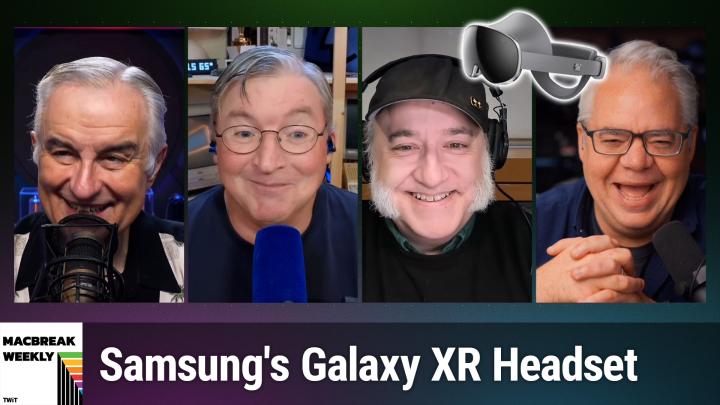
MacBreak Weekly 996 Transcript
Leo Laporte [00:00:00]:
It's time for MacBreak Weekly. Andy, Alex and Jason are here. Yes, Alex is back. We'll talk about the iPhone Air. Is it selling well or is it not selling at all? It's unclear. We'll also talk about more litigation in the UK, Apple seeds, the latest versions of iOS, both public betas and developer betas. We think this is the release candidate and John Prosser's day in court. Not all of that and more coming up next on MacBreak Weekly.
Leo Laporte [00:00:32]:
This is MacBreak Weekly. Episode 996 recorded Tuesday, October 28, 2025: The Billion Dollar Scratch. It's time for MacBreak Weekly. The show we talk about the latest news from Apple. Alex Lindsey' we missed you, sir.
Alex Lindsay [00:00:59]:
It's good to be back. It was a busy couple weeks. Where were you the first week? I was. I went. I was in Liditz, Pennsylvania, a place called Rock Lidditz. It's just north of Lancaster, Pennsylvania.
Leo Laporte [00:01:13]:
Is that the famous Studio City? Rock Litz?
Alex Lindsay [00:01:15]:
Well, Rock Lidditz is where basically every tour starts. So if it's Taylor Swift or Beyonce.
Leo Laporte [00:01:20]:
Or whatever they small venue that they can try stuff out at.
Alex Lindsay [00:01:23]:
Yeah, they have a couple of warehouses, each one big enough to almost hold. I said all of Taylor Swift's stage, but they said, well, almost not quite that big, but. And so they do that. But we're working with a partner called Arena1 that is built a stage. This is what the stage looks like. They said it was okay, I could show a couple pictures behind the scenes of the stage.
Leo Laporte [00:01:44]:
Holy gamoly ga gaboli.
Alex Lindsay [00:01:46]:
So now this stage is basically the nicest concert stage you're going to have, but very small and really just designed just for theaters. So theaters come up on this wall here. So. So if you.
Jason Snell [00:01:57]:
If we.
Leo Laporte [00:01:57]:
Wait a minute. So this the audience is where the wall is.
Alex Lindsay [00:01:59]:
Yeah. So you don't. There's nobody in the. In the thing. So here's. This is the verb. Pipe my.
Leo Laporte [00:02:04]:
Oh, I see.
Alex Lindsay [00:02:05]:
So this was.
Leo Laporte [00:02:05]:
They're going to show it on the movie screen.
Alex Lindsay [00:02:07]:
Exactly, exactly. So this is the whole control room for these. For this.
Leo Laporte [00:02:12]:
Holy cow. That's like the truck at Thursday Night Football.
Alex Lindsay [00:02:15]:
Yeah, it's like five grand mas here. You can see this is. I was shooting some immersive. There was fire. Yeah, we had fire in there. It was really funny the way it comes up on the cameras though, people. I had to show this picture because they were like, is the fire real? Because it just looks like you know, the way we.
Jason Snell [00:02:28]:
This is real.
Alex Lindsay [00:02:28]:
This was a test. This is real. It was absolutely.
Leo Laporte [00:02:31]:
But you could. But on the cameras, you. You would assume it's fake.
Alex Lindsay [00:02:33]:
The reason this immersive camera is over here is because I was borrowing it. And the other cameras are right here. And they are. It was too close, so I was not going to put my camera that close. You can kind of see the flame, the flamethrowers there. There was smoke and flame.
Leo Laporte [00:02:45]:
And so the band does see the audience. There's.
Alex Lindsay [00:02:48]:
Yeah. And so we had. We had audiences in LA and in New York and New York and in Penn Cinema, which is near ludicrous. And so here, this is kind of what the Raw.
Leo Laporte [00:02:58]:
They have giant sound stages, movie style sound stages that you could build sets on.
Alex Lindsay [00:03:02]:
And this is. But this is kind of a permanent one so that you can kind of design anything into it. So this is kind of what it looked like during the show. You know, some of the test stuff. But it can also switch to LEDs there and they rotate. So those are lights on one side. And then it rotates to the LEDs, which is pretty cool. Here you can see like what they can.
Alex Lindsay [00:03:21]:
You know, this is the different theaters that they can see off in the distance there. And there's. When it's all lit up, so they kind of see an arena in front of them.
Leo Laporte [00:03:29]:
Oh, that's neat. That really looks real. That's pretty cool.
Alex Lindsay [00:03:32]:
And then from the theater, that's what it looks like. And for some of these theaters, the lights, those lights at the bottom are driven by the lighting control at the stage.
Leo Laporte [00:03:41]:
So they control the lights in the.
Alex Lindsay [00:03:42]:
Theater too, the interactive lights. And then we were testing lots of stereo cameras. This is my little iPhone rig, my little stereo iPhone rig. But we had different. Different stereo rigs in the main. The main camera there. So that's. So that's what I.
Leo Laporte [00:03:56]:
Main camera that looks like some sort of cinema camera.
Jason Snell [00:03:59]:
Yeah, it was a.
Alex Lindsay [00:04:00]:
It was a Sony Venice with. With a removable optical block called a Rialto. And so. So that's what we were using for that. The Rialto makes it nice and small and easy to move around. So. So anyway. So.
Alex Lindsay [00:04:10]:
Yeah, that was the.
Andy Ihnatko [00:04:11]:
That was the one.
Leo Laporte [00:04:12]:
Well, we forgive you.
Alex Lindsay [00:04:13]:
Anyway, that was. And then last week I got to see Jason.
Jason Snell [00:04:17]:
True.
Alex Lindsay [00:04:17]:
Jason, can we say where you were.
Leo Laporte [00:04:20]:
Or is it a secret?
Jason Snell [00:04:21]:
It's not a secret. It's on YouTube.
Alex Lindsay [00:04:22]:
Yeah, it's on YouTube. Yeah, they put it on YouTube. So.
Leo Laporte [00:04:26]:
Okay, let's introduce Jason Snell of sixcolors.com in that case.
Jason Snell [00:04:29]:
Hello.
Alex Lindsay [00:04:30]:
Hello.
Jason Snell [00:04:30]:
I was also there last week.
Leo Laporte [00:04:32]:
Andy. Andy Inaco. He's in the library. But were you there last week?
Andy Ihnatko [00:04:36]:
No. It's kind of like how the Secretary of Agriculture. Somebody has in another room just in case there's a disaster.
Jason Snell [00:04:43]:
Safe. It's a good idea because I would.
Andy Ihnatko [00:04:45]:
Have been invited to whatever this thing was, but I was.
Leo Laporte [00:04:47]:
So is this on the Apple.
Alex Lindsay [00:04:50]:
Apple Developer channel? There's a separate channel for Apple Developer, I think.
Leo Laporte [00:04:53]:
Oh, developer.
Jason Snell [00:04:54]:
It's a two day developer event about immersive video.
Leo Laporte [00:04:57]:
Because I have that in the stories that they were going to be doing that.
Jason Snell [00:05:02]:
We've tricked you into the Vision Pro segment.
Leo Laporte [00:05:06]:
Ladies and gentlemen, we welcome you to the number one Vision Pro podcast in the world.
Jason Snell [00:05:16]:
Gotcha. Yeah.
Leo Laporte [00:05:19]:
Okay, so this was a big event, was for two days.
Jason Snell [00:05:24]:
It was Tuesday and Wednesday. I went Wednesday because Tuesday I had a podcast to do this one. And also online.
Andy Ihnatko [00:05:33]:
Whoa.
Jason Snell [00:05:34]:
It's Serenity Caldwell.
Leo Laporte [00:05:35]:
Wait a minute, it's Serenity. Oh, that's so cool.
Jason Snell [00:05:38]:
She's developer relations for a bunch of Vision Pro stuff.
Leo Laporte [00:05:42]:
So she was nice to see her. So that's what she's doing these days.
Jason Snell [00:05:45]:
She's she developer relations at Apple. So this was Alex.
Leo Laporte [00:05:50]:
Did you tell her where the premier Vision Pro podcast.
Jason Snell [00:05:53]:
It did come up, yeah. Okay. Actually I told them that. And also that last week Alex wasn't here so you and Andy could cyberbully me. Anyway.
Andy Ihnatko [00:06:00]:
Did you mention that Leo and I are the only ones who don't have a Vision Pro?
Jason Snell [00:06:05]:
Yeah, I mean they're aware, they're well aware of what we say here.
Andy Ihnatko [00:06:09]:
So if I don't have one, that all is as it should be.
Alex Lindsay [00:06:12]:
Okay.
Jason Snell [00:06:12]:
Yeah, yeah. Anyway, it was, I mean, the thing that blew me away and Alex was there both days, but the thing blew me away about it is I didn't quite understand. First off, it was a room full of mostly, you know, filmmakers and interactive, basically filmmakers who want to do immersive content. And Apple said up to now it's been a lot of like somebody says, I'd like to make an immersive thing. And Apple's like, okay, we will go tell you how to do that. Because nobody there's like, nobody knows how to do it except Alex, Lindsay and these cameras are coming out now. But the thing that really struck me about the event was people were really hungry to make this kind of content and experiment with this. And they think that there's a real interesting potential future for immersive content in general.
Jason Snell [00:06:54]:
Not necessarily tied to the Vision Pro, but just in general in future display technology being able to do this stuff. But what really I walked away with is the fact that everything is new and kind of in beta and nobody really knows what any of the rules are. And that for all of our. Our frustration at Apple not putting more content on the Vision Pro in terms of immersive stuff, I walked away. Think that I know why, which is the cameras were bodged together things and there's no software to do. Only now, like, I literally had an interaction with somebody who said, we have an app that's in beta that is doing an immersive thing. But our new beta uses. Is updated to use a.
Jason Snell [00:07:32]:
A different beta for the tools that we use to make the beta that we make. And I thought, oh, it's betas all the way down. I see what's going on here. All the tools are like, not done yet. All the cameras are just coming out and it's like, oh, that. It just. I think between that and the revelation that we got last week that the M5 Vision Pro can render more pixels on the display that the Vision Pros always had suggests that all of this stuff is still kind of not even fully baked. Like there's.
Jason Snell [00:08:02]:
They're only now. And talking to blackmagic a little bit informally, I also got the sense that that camera that we've been talking about and that Alex has been salivating over for six months, like they did not anticipate the demand, that it's actually got way more demand. But that also means that nobody can get their hands on cameras to shoot this stuff. So I don't know. It just. It struck me as being a bunch of enthusiastic people trying to get in on the ground floor of something that is still like, all the tools are still not done. Like, everybody's just kind of inventing it as they go. And that was interesting to me.
Alex Lindsay [00:08:33]:
And I think that one of the exciting things about and this is usually the place that I am most of the time is something where there's not a lot of other people. As soon as there's a lot of people, I'm like, oh, it's time for me to go on to something else. So. So yeah, next. And so kind of these kind of open areas. And what's nice about that is that, yes, there's not a lot of guide posts and there's not a lot of roads yet and everything else, but it also means that you don't have a lot of competition, so you're able to kind of figure these things out. And if you're the only one doing it or one of. I think that that was the largest collection of.
Alex Lindsay [00:09:05]:
I mean, I saw a lot of folks that I've seen that I've known for years doing this. There's not that many of us out there that are doing it. And so it's kind of a really interesting camaraderie of trad notes and talking about it. That. That's interesting. I will say that it's the second time I've been to the developer Center. That is the nicest theater I've ever watched an event in. Like it.
Alex Lindsay [00:09:25]:
You know, I just want to say that as a side, as a side note, since they already broadcasted it, you only get to see what they broadcasted. But as someone who's worked in many, many corporate theaters, that is the best built corporate theater in existence. Like, it's just, it is so, so well put together.
Jason Snell [00:09:39]:
Other than the Steve Jobs theater, probably.
Leo Laporte [00:09:41]:
Well, no, no, it's not the Steve Jobs theater.
Alex Lindsay [00:09:43]:
I had the opportunity, I've had the opportunity to sit in both of them. And I think that the. I actually like the smaller one. Just because you feel like everybody is right in front of you, no matter what seat you are in, it feels like everybody's really, really close to you all the time. And the screen is really integrated well and you know, everything else. And so. But you know, I think that Apple, you know, I think it had a little bit of the sheen that, you know, Apple everything is, you know, word for word figured out before they, before they say it. But we had some Q and A.
Alex Lindsay [00:10:15]:
And what was really great was the time in between the sessions. Now you can watch the sessions on YouTube on the developer channel. The two days of sessions they cut out about the last two or three hours in the second day was only for people that were in the room. And that was really the hard. That was really the nitty gritty workflow stuff that they were showing there. But outside of that, a lot of the more general stuff was there. One of the things I think I also left with is, man, you just really get the sense that Apple is at the very beginning of what they're doing. Like, they're not, like, they're not thinking about, like, there's no, like, is this going to work over the next couple of years? I mean, they don't even expect it to be mature for two or three more years.
Alex Lindsay [00:10:50]:
I mean, there's like, they don't have any, you know, like, this is all you know, and there's little things that they're doing. One of the things that they talked a lot about at the session was foveated rendering, which is that you are. The things in the center where it matters are the highest. What they call acuity, you know, which is the sharp, sharpness to it. It's kind of hard to consider it resolution because of the way that your eyes work.
Jason Snell [00:11:11]:
And yeah, they say think of it more like seeing 2020 on an eye chart.
Alex Lindsay [00:11:14]:
Yeah, acuity. So the acuity is the highest in the center, in the. In this foveated render. And then it gets softer as it goes out and has to be rendered. Now that's one of the big things that the M5 can render more of those pixels. And so more of it feels sharp and immersive. But it gets back to things that we talked about in the past, which is that this, this headset is it's minimum viable product for what they're trying to do. And they had to start somewhere.
Alex Lindsay [00:11:39]:
But this is a. The first headset, the M2, was minimum viable to do the kind of quality and level of work that they wanted to do. And the next, you know, the M5 takes them another step forward. And I think that they're going to have probably another. My guess is they have another pro that's going to be an M7 or M8 or whatever in a year, year and a half or two years. The next. At the same time, they have to figure out how to miniaturize it all. So they're figuring out how to do it all first and then they have to figure out how to make it smaller.
Alex Lindsay [00:12:08]:
But. But I think that there's a lot in the first day that's mostly around kind of the interactive tools, which I think this could have been probably two separate events. It could have been one that was just interactive tools and one that was just video. There's a little bit of video on the first day, which is had we had people like me show up there, but really the second day was all.
Leo Laporte [00:12:25]:
Yeah, is it worth. For somebody who's just mildly interested watching, watching these, it feels like, I have to say now, I say, feel like it's a renaissance for Vision Pro. Like, maybe there is something.
Jason Snell [00:12:39]:
I mean, last week it was funny being there because last week Samsung announced its, you know, basically productized XR product. And, and all the people there were like, yep, this is a validation that there's something going on here. And I think a lot of the filmmakers were like, you know, when they weren't too close to an Apple person. They were like, you know, obviously we're trying to make these things so they can go anywhere. And the idea is they might be best on Vision Pro, but they want their films to be seen. So if there are Android XR headsets and there's. There's quests of various resolutions, you do a version, maybe it's not as nice, but you can still do it. And they want to.
Jason Snell [00:13:17]:
They just think that there's going to be a device that will allow you to view these things down the road. And they want to get in like Alex on the ground floor here also. I was just staggered. I think a lot of us are so used to how powerful computers are now that other than Alex, maybe we lose track of the fact that some of the stuff we're asking these devices to do is ludicrous. Like the Apple immersive video format, like the RAW before it gets compressed and delivered where, where they, they do some, some compression and, and foveation and all of that. Like, it's. What is it? It's like 8k by 8k. It's an 8k image at 120 frames per second.
Jason Snell [00:13:55]:
Yeah, it's a stereo.
Leo Laporte [00:13:56]:
It's a big.
Jason Snell [00:13:57]:
What you're saying, stereo 8k at 90 frames a second. It. It's enormous. Those files are just impossibly large. It's. It's hilarious. And then, and then they have to figure out how to compress them and.
Leo Laporte [00:14:07]:
Put it on your head.
Jason Snell [00:14:08]:
Yeah, and then they got to do that for the, for that Lakers game that we talked about. They got to do that live. Like it's. It turns out that when you. When you're dealing with this level, everything that I think we just get kind of complacent because the personal computer stuff that we're all used to is pretty easy now, I mean, in the grand scheme of things. But this stuff is bananas.
Leo Laporte [00:14:26]:
If that's what you want to do, why don't you make something that's attached to a Mac with a 200 gigabyte?
Alex Lindsay [00:14:31]:
There's a certain level of portability, though, that makes it a different product. I don't watch it. I don't use my headset. I mean, I sometimes use my headset near my computers, but not very often. Usually I'm on a plane or I'm in a hotel room or I'm in my living room and being able to use it and.
Leo Laporte [00:14:46]:
Well, I understand. Is that critical, though, to the.
Alex Lindsay [00:14:48]:
I think it's pretty critical. I mean, I think that that was definitely where Apple wanted to. I mean, I had a, you know, I was doing testing for the early Oculus where we were tethered to a computer. And I mean, there were two big problems. One is the tether.
Leo Laporte [00:15:02]:
Well, for 30 years these have been tethered to computers. I remember going to the photograph in the early 90s and I was tethered to a Silicon Graphics when I went.
Alex Lindsay [00:15:09]:
Mainframe sgi and they had a helmet that you put on.
Leo Laporte [00:15:12]:
It was a giant helmet, huge tether.
Alex Lindsay [00:15:14]:
That came from the ceiling that was suspended to keep it there. And it was, you know, you could see what was going to happen. You just thought it would happen a lot faster than it has. But the, But I think that the portability makes. It makes a difference. I think Apple has again, you know, I mean, I think that so far, I mean, I haven't gotten a chance to look at the Samsung Galaxy yet or put it on yet. But from the people that I've talked to that have, you know, it just turns out if you spend half as much money, you get half as much product. Like, it's like, you know, like it's like it doesn't track as well.
Alex Lindsay [00:15:41]:
The resolution, the field of view isn't the same. The resolution isn't the same, you know, like, you know, it turns out what it. I think it validates that Apple, what Apple's doing is really hard, you know. And, you know, and while that video, you want that video to be going, going everywhere, when you look at the level of detail that Apple is applying to, you know, the other headsets don't need you to calibrate your lenses and they don't need to carry the metadata all the way through and they don't need to do those things. And it looks way better. Is everyone going to buy one? Probably not. But not everyone buys a BMW either.
Leo Laporte [00:16:14]:
Andyou said that you thought the Samsung Galaxy XR was the kind of the Vision Pro Apple could have made, maybe should have made, had they tried harder.
Andy Ihnatko [00:16:24]:
Not so much should have made. It struck me and I was not part of the Raw last week, but I've been talking to a lot of people who were there and a lot of people who have opinions on it. And what I came away with is that this is kind of like what Alex was saying. It feels like if Apple decided that price was in any way one of their constrictions, this is what they could have made it feel. It feels like it's a really, really good piece of hardware. It works really, really, really well. It doesn't have the exact same specs as the Vision Pro, but it also doesn't have that stupid holographic simulated eye display in the front.
Leo Laporte [00:17:02]:
It looks a lot like the Vision Pro.
Andy Ihnatko [00:17:04]:
Oh, well, yeah, I mean I guess.
Leo Laporte [00:17:07]:
There'S not that many form factors. You can have.
Jason Snell [00:17:11]:
All these human heads look alike.
Andy Ihnatko [00:17:12]:
Okay, again, well, the thing is.
Leo Laporte [00:17:14]:
Okay, but that's the point is that it's not a copycat device. It's its own thing that perhaps is as good.
Andy Ihnatko [00:17:22]:
Well, it's good. I will say that. Get out of Sketchpad and say oh by the way, you want a wide field of view set of goggles that is light proof, you will come up with something that looks a lot like the light proof. Moving on. However, the thing that was very interesting though is that in Samsung's press release and blog post and Google's press release and blog post, it wasn't really being said as here is a breakthrough in spatial computing, here is a breakthrough through in immersive entertainment. It was all about this is the new future in AI because look at how well everything works with Gemini. And that is interesting. I love it when two different platforms go in their own different ways with the exact same emerging piece of technology.
Leo Laporte [00:18:04]:
But Samsung's done that with everything, everything Samsung's put out, including their tablet and their phone. It's all about Gemini, which is interesting.
Andy Ihnatko [00:18:12]:
Well remember that this is not just Samsung doing their own thing. This is a real from two years ago, from the very beginning these companies were saying there's a partnership between. Google is going to make the operating system for, they're going to make Android xr, Qualcomm is going to make the chipset for it and Samsung is going to do the actual material design and the, and the production.
Leo Laporte [00:18:31]:
Really a three way collaboration.
Andy Ihnatko [00:18:33]:
Yeah. So, so what is so what? What I was about to say was that whereas Apple is saying that this is going the future of this and the reason for a device like this to exist is going to be immersive content. And essentially what Alex talking about on the Android XR platform, they are saying immersive content is going to be a big part of this. However, when we finally make these smaller, more compact, less expensive, lighter weight, something you might actually carry in your bag like a pair of sunglasses to put on what you wanted, what's going to make the difference is not the fact that this has the most immersive experience, but the fact that this has the best artificial intelligence, that it is the most aware and helpful of integrating yourself into your environment. As opposed to putting hobbits on the table in front of you while you eat breakfast.
Leo Laporte [00:19:19]:
It's interesting. It seems like there are three different ways you could go. Meta's decided that these things are for gaming. Samsung and Google have decided they're for AI. Apple seems to think Apple has content.
Jason Snell [00:19:30]:
I think Apple hasn't decided. I think that's the problem with the Vision Pro, if there is one, is they just put like, literally the Vision Pro is a product where they're like, let's just have it do anything and see what happens. And I don't think that in the long run it. I think it might be that there is a super lightweight thing that you tether to something that does immersive content and screen sharing. And there's a different kind of device like it 10 years out, you might have a bunch of different devices that do different things. Apple, if you recall the last 15 years, right, like, Apple's really good at saying, look, if you want an iPad, get an iPad. If you want a Mac, get a Mac. We're not making a combo.
Jason Snell [00:20:05]:
You just buy. Why not buy both? And so I wouldn't put it past Apple to do that. If that's where the technology goes, if that's where the market goes. I think Apple does believe that there's a future worth following in terms of immersive media. But it may be that the immersive media player is a different context than an AI, you know, augmented reality assistant. They may be similar because you look at them through your eyes and they're on your face, but they may be different beyond that. And I think Apple right now, it strikes me as like immersive content. Yes.
Jason Snell [00:20:37]:
Spatial computing. Yes.
Alex Lindsay [00:20:39]:
I.
Jason Snell [00:20:40]:
We know Mike Rockwell really wanted this thing to be entirely Siri driven. And he was very frustrated that they completely failed him. And so a reward, he was put in charge of Siri. Good luck, dude. I think Apple is at that point now where they don't know where it's going. And they've, they've made this thing that's like super capable and expensive and heavy as a way to sort of say, okay, let's see what happens. And we don't know what's going to happen.
Andy Ihnatko [00:21:03]:
I'm just, I'm just a little bit concerned that Apple is going to make the same. I don't know if we'd call a mistake, but the same step that they made with a Macintosh, where they made this beautiful $3,000 computer that runs this wonderful, incredibly almost optimal version of a graphic user interface. And then the Microsoft side of the world said, that's great. I bet we can make that almost as good for half the price. And that's kind of what happened. So we'll see.
Alex Lindsay [00:21:27]:
Slow down the entire development of the human race. I mean, you know, like Windows, I'll say, anyway, accessible.
Andy Ihnatko [00:21:33]:
You're not meant to look at technology from the other side of a glass window and say, goodness, wouldn't it be lovely to be able to use one of those things? Unfortunately, I'm not part of the expensive elite that can actually afford it. You make technology. Technology comes from when you make it accessible to the most people whatsoever. Even you have to sacrifice an optimal version of that thing.
Alex Lindsay [00:21:52]:
I have to be in a teams meeting every day and it's just.
Andy Ihnatko [00:21:55]:
Okay.
Alex Lindsay [00:21:55]:
It's just like dragged along the asphalt. What a problem.
Jason Snell [00:21:58]:
He's a victim. Give him credit for that.
Alex Lindsay [00:22:00]:
Anyway, so anyway. But the thing is that I don't think that this is a product. So I think that's the issue, is that it can do all of these things. I think Apple needed to do R and D, it needed gamma testers, not alpha testers or beta testers, but gamma testers. And there was a certain number of people, about 400,000, that were saying, hey, me, I want to be part of the future. I want to play with it. I don't think Apple's trying to sell millions of this headset. I think that they are developing it and watching what people do and watching because there's a whole lot of.
Alex Lindsay [00:22:33]:
Inside of this world, and especially inside of this headset specifically, there's a whole lot of, huh. I wonder if that would work. I wonder if this, like, I got this. I haven't gotten to use it very much yet, but I got the little logi pen and I started thinking about how to relate that to the things that are in my world. And when I asked someone, could it do what a microscrub does, nobody knew, like, well, we'll have to try it, you know, like, like. And so. And so the so. And you can see people experimenting with it.
Alex Lindsay [00:23:00]:
But I think that's the whole thing. This is an experimental platform. It's very unusual for Apple to experiment in public. And I think that. But I think that they are. They're building this tank that can do anything. A lot of times when I build systems, the first time I build it, it's way overbuilt. It's got way more hardware than I need.
Alex Lindsay [00:23:16]:
And then we slowly figure out what we need and what we don't need and we pull things out, we move these things around and you end up with something le. And I think Apple needed to see what people do with it. But. But if you make it, if you make it less powerful, people will build into that smaller, that smaller room and then not know what to do with the bigger room. And what Apple did is built a bigger room.
Jason Snell [00:23:33]:
I wanted to talk about the. How this fits with the personality of Apple. And I know Apple's not a person, it's a corporation, but in terms of Apple's culture and in terms of the people who work there and why, what kind of fuels them, I will say that experience that I had last week and that Alex had, it reminded me that this is one of those places Apple likes to be. Apple likes to be in a place where they are perceived as enabling creativity, enabling creative professionals and building tools or enabling the building of tools that allow new creative endeavors to occur. And, you know, and this goes back a long way. It is in the company's DNA. Is it what pays the bills? No, but Apple really, really likes, I think, I think from a. What, you know, what are the fringe benefits of being seen as being a friend of the creative community and building tools that they really rely on? I think that there are a bunch and I think it's just a thing that's built into Apple, this idea that they want.
Jason Snell [00:24:30]:
So, like immersive video, Is it a thing now? No, but you get, I got the sense that if we're talking about, like, does Apple believe in any of this is a cutting bait on this stuff. It's like Apple's investing a lot of resources into immersive video. They think there's something there and they want to be the leader in it. And what they're doing by having having shipped the Vision Pro and put it out there and gotten blackmagic to build a camera and all, and all those tools that are in beta that are starting to be built around this and now the filmmakers are coming into it. Apple is trying to help define what it wants to be like the future of the immersive video format and all the tools that are built around it. Even though it won't in the long run, if it's successful, it won't be an Apple specific thing. Apple loves being there and having all those creatives in a room excited about these new tools. And I do think that is a motivator for them on a corporate level.
Jason Snell [00:25:16]:
It's not about selling a lot of iPhones, but it is people who buy a lot of MacBook Pros and Mac Pros and things like that. And they're, and they also kind of rub off on Apple because they are incredibly creative people who want the technology to, to fulfill their visions and so that it hits Apple in the sweet spot when it comes to that.
Alex Lindsay [00:25:35]:
And Apple has an enormous amount of potential energy that they, they haven't really tucked into at all. They have this huge mine, these huge mines of content called MLS, F1, the Apple TV plus music, all of these things that they've built out that at any point in time they can flip us. I think that they, they haven't flipped much of those switches because they're still figuring out what the format looks like. They're figuring it out like what does that actually have to look like and what does it have to do. But they have an enormous amount of built in opportunity that they can turn on. I guess the rumor is, and I don't know anything about whether this happened or not, that they used a hundred cameras, 100 of these cameras in, in Real Madrid last week or something like that. And I, I don't know if that's true or not. There was a rumor that was bouncing around that they took 100 cameras out there.
Alex Lindsay [00:26:22]:
That's the kind of stuff that Apple can do that not many other people can do because it's probably two or $3 million activation just to see if things work, you know. And so I think that we're going to, you know, I think it's going to be really interesting that they have a lot of other things they could be doing with the, with the headset that they haven't even started doing yet. So I think it'll be really interesting to see what the next couple years look like.
Andy Ihnatko [00:26:42]:
It is absolutely a wonderful path and wonderful thing, destination people who are observers and fans of technology as we are, to have a seat and be able to watch this because this is an exciting time for the technology. I do think, however, that the problem, I do take your point, Alex, about how you have to basically create a room in which ambitious things can happen. However, there's going to be a point in the future, it's not right now, but in the future where Apple's, where they're going to have to say if we continue to make a $3,500 one of these, a $3,000 one of these, even a $2,500 one of these, it will be a niche product that golfers and F1 fans buy, but it's not going to do anything for the actual consumers that are out there, the actual markets out there. And people aren't going to be supporting it with software and content because unless they need to market something towards golfers and towards F1 race fans. There's a point, there's. We're at the early stage in which Apple should dream big about this. Samsung should maybe dream bigger than this. Google I think is dreaming very big about this.
Andy Ihnatko [00:27:48]:
But they have to make sure they have that spot on the timeline in which we have to say we have to figure, we have to now put some walls in and figure out how we can succeed and excel within the cost of a mid range laptop. Let's say $1,000 to $1,500. Because if they, I mean for all the, I love that we see this Goldilocks sort of progression, we have the meta version which is all we want to do is sell a $500 headset to people who want a game and people who want to have some semblance of experience in this. Samsung and Google and Qualcomm which are saying this is still kind of experimental, this is still in its Google Glass phase. However, this is going to be more accessible to more developers that can actually build things not in a hypothetical way, but on actual hardware. And Apple, which is saying for creators who actually want to see how good an experience they can build to get the sort of experience together that will convince them, you know what, we should put some more time in this, we should put some more effort in this because the creative possibilities to create art here are so immense when we're not being constrained that we want to continue to develop this. The only thing I want to say is that I think that as we continue to refine our reactions to Apple's release last year, I really, really wish Apple had followed the Google Glass template all along. Remember that Google, it's Google Glass which is ridiculed and said as a failure from day one.
Andy Ihnatko [00:29:11]:
Google said, this is an experiment. We don't see this as an actual product. We have some ideas and we're not going to see which of these ideas are valid until we figure get some actual hardware on people and get feedback. I mean, it was 1,500 bucks, which was not cheap. And also I had to go to New York City to an actual little salon that they'd set up for like to give you your hardware after waiting on a wait list. That's how gamma testing this list was. I wonder if Apple would be, if people like me would have been a little less harsh on Apple if they stopped saying oh, no. Come to the Apple Store.
Andy Ihnatko [00:29:46]:
We're stocking this on shelves as any other Apple product. And said that the hardware is really, really great. We're still working it out. You'll be on the early sort of list of Explorers, so to speak. You can actually do stuff with it. It's not like it's broken stuff. But realize that you might not get as much value out of this as you would $3,500 worth of a MacBook and an iPhone and an iPad.
Alex Lindsay [00:30:09]:
Maybe people thought that they were going to get. I mean, I think most of people that I knew and myself and I think Jason to some degree knew that this was an R and D project that we get to be part of. You know, I don't think that any of us were not sold on that. And I think that, you know, I think that the challenge really is to make something compelling is that you do have to get over some edge. I don't. There's lots of people that have. I mean, I have. I have three or four of the Meta headsets, you know, of different ages and times and everything else.
Alex Lindsay [00:30:34]:
I use them for Supernatural. Like, that's what I use. That's what I put it on. I do Supernatural, and that's it. And I take it off. I don't really have, like, on my Apple headset. I put it on and I'll forget hours that I, you know, like, I don't have. Whatever the sickness is that people have about it being too heavy, it doesn't bother me at all.
Alex Lindsay [00:30:49]:
Maybe I have a big head, you know, and so in relative terms, that doesn't really bother me at all. And I'll sit there for hours doodling around with things. Oh, I'm going to look, look at a couple things. Then suddenly I realize that two or three hours have gone by and I wasn't. Because I was playing some game. I just don't. I was just fiddling about, you know, and I. Because I'm doing the immersive stuff.
Alex Lindsay [00:31:07]:
I have it on all the time. And so. So I think that. I think that the. That what will be interesting to see is. Is that where is that line where people go, oh, that's really something great and inspiring. A lot of times you can save a lot of money, but if you stay below that line, people never see the vision. They never see what's possible in that area.
Alex Lindsay [00:31:27]:
You know, I have a. There was the pans that I talked about on the show a long time ago. You know, they just ended them. The Heston pans. That, you know, the pan talks to the phone, the phone talks to the thing. And it was. I really loved it. Except that the Bluetooth was just a little quirky.
Alex Lindsay [00:31:40]:
I'm sure they saved some money on it and they made it all work.
Andy Ihnatko [00:31:42]:
But it was a little quirky.
Alex Lindsay [00:31:43]:
And so there was never. There wasn't certainty as to whether it was going to work every single time you pull it out.
Leo Laporte [00:31:48]:
That's not good for a cooking device.
Alex Lindsay [00:31:50]:
Well, it was, but it was like, when it worked, it was magical. It just didn't work all the time. And the problem is, is that you have to get to a point where it's reliable and then it just does the thing and that it has the resolute. Like, the problem is that, I mean, as someone who's been working with immersive content for over a decade, that you always felt like you were looking at 320 by 240 video. You know, like, everyone would be excited about the 3D, but it wasn't like, oh, my gosh, I'm in it. And even now, I would say we're just getting to the point where I feel like, oh, it's pretty good. It's pretty fun to watch. And we're waiting for the Next.
Alex Lindsay [00:32:24]:
Not the M5, but, like, the M7 or M8, where we're actually going to be able to render the actual pixels that we're shooting. Like the camera.
Andy Ihnatko [00:32:31]:
Yeah.
Alex Lindsay [00:32:31]:
Apple knows it's road flashing twice, so.
Leo Laporte [00:32:34]:
They know what they're coming. What's coming.
Alex Lindsay [00:32:35]:
The camera is shooting twice the resolution that I can deliver to the M5 headset right now. So the camera is already shooting past. Like, it will take years, it'll take the next headset or the headset after to properly play the video that we're capturing on the camera right now, you know, like. And so that's how hard what we're doing is. But when you start to see those resolutions, you start to go, you know, it does feel differently than any of the other headsets that we've seen, and I don't. And you're never going to get people to build that kind of content unless you have something that can get even close to playing it back.
Andy Ihnatko [00:33:11]:
That's fine. All I'll say is that it's. Remember that Steve Jobs looked at the $10,000 Lisa and said, yeah, but that's savagely overbuilt. And it's not for. It's not built for purpose. I bet we can do that for $1,000. And he was massively Wrong. But he still managed to bring it in at a quarter of the cost.
Andy Ihnatko [00:33:29]:
And Lisa was D E D D D dead at that point. So I'm saying is that Google class?
Jason Snell [00:33:35]:
But I mean the Apple ii, the.
Andy Ihnatko [00:33:37]:
Cost of the app, Apple ii in that stated as. As a research project, it was not stated as a good.
Jason Snell [00:33:42]:
I mean the Apple 2 is the what I keep thinking back to and it was very expensive and it didn't really do anything, but you got the sense that it was the future. And look, I'll try to. I'm going to try to split the difference here. I think the Vision Pro is so far away from being a product category that could sell to the masses that it's perfectly fine for Apple. I Wish it was $2,000 right. Instead of 3,500, but I don't think it's going to be a long time before it really needs to product that reaches a broad audience. I think that this is some of the tension we have between building a product that is remotely technologically capable today, which is what Apple drew a line and made the Vision Pro versus a product people wanted today, which is the Meta Ray Bans. And I think that this is the tension which is there is a line toward products people might actually want to buy that is down on the low end, that is very lightweight, that has a little bit of computing in some very light headwear.
Jason Snell [00:34:40]:
And the idea there is you might actually sell some of those to people in 2026, right? Apple might. And Meta's doing that today. And that there may be a growth path there versus something like the Vision Pro or the Samsung headset, which, you know, I think really is sort of science project. Let's see where it goes, let's experiment, let's build the foundation, let's learn what's bad and what's good and that eventually everybody sort of has faith that in the future the technology is going to advance where it's going to be lighter and more capable. But I do think that there's a fundamental tension there because the Vision Pro is doing a science project thing at the high end. And the. I think Apple's mistake was not thinking that they needed to do both. And now they've changed their mind and they are doing both.
Jason Snell [00:35:27]:
And Meta, I think, showed them because Meta's doing both, right. Meta's got the Quest and it's got the Ray Bans and the Ray Ban are going to sell more. And a product like that is going to sell more than a big headset just because it's going to be cheaper and it's going to be less consumer resistance. So I think both are perfectly fine. I think one of them is more of a short term growth thing and the other one is a long term, let's experiment. And you know what? I think that's okay.
Alex Lindsay [00:35:55]:
I think that, I don't think Apple, regardless of the rumors, I don't think Apple has changed its direction for very much at all. I think that they always knew that there was an army Ray Ban kind of thing somewhere in the future when they miniaturized it enough to get there. And I think that they, they had, they started where they could start. And, and I think that they aren't, you know, they're not as interested, you know, and Apple's notoriously not good at doing both things, two things at the same time. And I, but I don't, I think the AR1 was always 2027, 2028, you know, kind of thing.
Jason Snell [00:36:22]:
Their mistake was pooh poohing. I think the Ray Ban thing and saying that's not, that's, you know, Apple does it a lot where they draw a line. They say product below this level of functionality isn't worth making. And I think they maybe made a mistake the kind of interest in what Metta was doing and they thought, oh, I think they were like, oh, AirPods and glasses is dumb. We're just, we can make that but we're not going to bother. And then Meta starts to get publicity for, for doing that and then adding in a display and I think that Apple kind of recalibrated a little bit because I think maybe they set the bar too high. And honestly I'm not, I can't lay this entirely on Jony, I've. But I get a little vibe the whole approach here of being a very high end, aspirational and very much like we're going to use the most expensive materials and we're going to spare no expense and also kind of poo pooing lesser products that are not as fully featured.
Jason Snell [00:37:11]:
And you know, I don't know whether that was Jony I've or other people who made those decisions, but back in the day when they were thinking about the Vision Pro to begin with. But it does feel to me like Apple turned its back on some categories as being not worth trying. And Meta, I mean Meta showed them that people were sort of interested in those products and they have turned, they have changed. Now. I think it's very clear from all the reports that Apple gets it now that, that they should not have left it for as long and that they should approach from that direction too. So we'll see what they do. But I think both are valid.
Alex Lindsay [00:37:43]:
Like, who's using the meta Ray Bans a year from now? I mean, I know that we'll see. For me, you know, every time I end up in a lot of places where security is important. And the first thing we've had a couple people come in with, with the Ray Bans and immediately like, you got to take those off.
Jason Snell [00:37:56]:
Yeah.
Leo Laporte [00:37:56]:
There's also places where you put your phone in a skiff in a bag.
Alex Lindsay [00:37:59]:
It's not that bad. I don't have to do it that way.
Leo Laporte [00:38:01]:
But I'm just saying if you really want security, don't bring your phone in either.
Alex Lindsay [00:38:04]:
No, no, I'm. But I'm saying that people are. Yeah. And I work in a lot of places where I put stickers over the phones, you know, that. That kind of thing. But the. But I feel I will. I admit, even as someone who used Google Glass and was constantly told by people sometimes at Google to take off the glasses that I'm.
Alex Lindsay [00:38:19]:
I think I've become very sensitive when I see a lens, you know, in a. In a something, people are just casually walking around. I definitely don't feel comfortable, you know, like, it's definitely not something that I prefer that I like.
Andy Ihnatko [00:38:32]:
There is a small issue. There's something that I've been noticing because I watch a lot of YouTubers who are based in the UK and that's where I noticed, I came to notice like a couple years ago that you see what's on their wrists and it's not an Apple watch. It's always like a Fitbit or something made by Garmin or something made by Samsung. And the reason being because. Because in the UK and in Europe, of course, this is not necessarily where Android kind of is king over there. So as a result, they wear the watches that work well. They don't wear Apple watches because they don't have iPhones. If they don't have iPhones, they can't have an Apple watch.
Andy Ihnatko [00:39:10]:
And so that could be another twist towards Apple's drive towards success in these wearables. If they are going to make. It still doesn't make any sense to me that, that you have to have an iPhone in order to activate an Apple watch. Even an iPad won't do. Even a MacBook won't do. You have to own an iPhone. And I don't think that makes any sense in 2025. So if they're also going to gate the possible success of a platform by saying that, yeah, we have this really nice wearable, but we're not going to let 82% of phone users, excuse me, of mobile users out there, use it because we're going to gate that to an iPhone for reasons that we're not really going to explain.
Andy Ihnatko [00:39:49]:
And there's plenty of time, time for them to solve this and address this. But that's just one thing that's on my mind when it comes to are they really, do they want to make something that will really penetrate society, that can possibly help people and be of a service? And if it's just an accessory for an iPhone, that's a very, very limiting sort of concept for creativity.
Alex Lindsay [00:40:09]:
Evidently it's had a huge impact on their financials, you know, like, you know, to be focused on just their market. So the, you know, they're doing okay. So I think that the thing is, is that they, that they. I think the problem is anytime as someone who built stuff on a, built software on an Apple platform and then thought we were going to expand our market by going into the Windows world, it was a disaster. And the thing is that what I'm left with is having to interact with other operating systems is never as simple as it seems. And so the thing is that Apple, I don't think Apple, it's whether I think they just don't care. I think they have their ecosystem, they want to work on their ecosystem. They don't want to spend extra energy on something outside of their ecosystem.
Alex Lindsay [00:40:49]:
They just want to work on the thing that they want to work on because they want to create what they want to create. And I think that there's, I think that, I don't think that, for instance, I think that even if all these other headsets do well, when Apple comes around with their headset, their version of it, that's $1500 or $2000 or whatever, the advantage they're going to have is a whole bunch of Apple users that have, that are in the ecosystem that are going to do it. Is it the largest market that they could possibly have? I don't, I don't know. But I don't think Apple really cares about trying to get into the largest market because they're financially doing okay with the market that they have.
Andy Ihnatko [00:41:16]:
All I'll say is that a company can be great for lots of reasons and for many of these reasons simultaneously, one of them is financial. And Apple just turned over $4 trillion this week. Congratulations, Apple. My personal point of view is that a Company that wants to gate itself and say that we want to make great stuff, but we're not really interested in penetrating the culture, making something that most people will have access to this, most people will be able to benefit from this. That to me is a limit on, that's. I'm looking for the right words, but I think that in the four or five categories that make a company great, the idea that we don't want to just make something that, hey, if you've got eight grand, if you got four grand, if you've got two grand and you own our other products, we are willing to let you be the beneficiaries of this breakthrough we made. That's a nice way to be a boutique company. It's not an ambitious goal.
Andy Ihnatko [00:42:13]:
An ambitious goal is to say that we make. We're basically designing this platform that will work with pretty much anybody if you are anywhere in the world, within certain parameters. We are not going to put in completely artificial barriers to you benefiting from our technology. To me, that's a little bit of a statement that we're not all that ambitious. This is really, we're not that proud of it. We don't think it could have that big of an impact. We want to contribute to the lock in of our platform. Not to basically change somebody's life in a materially good way.
Alex Lindsay [00:42:46]:
I think that you also just have to figure out what your strengths are. I mean, you know, like, I work on a lot of live events, but if you come and ask me to do something that's on a laptop with some, with some webcams, I'm like, you're talking to the wrong person. Like, I don't know how to do that anymore, you know, and so like, I can't, I can't, I can't. I'm not efficient. Like you can find other people to do that, but it's not going to be me. And it's just because that's not how I, it's not the infrastructure that I need to do that thing. And I think that Apple, you know, has, this is the way that they, this is what they know how to do well and I think they can leave it to the rest of the rest of the market. Every company doesn't have to solve every problem.
Andy Ihnatko [00:43:19]:
Yeah. All I will say, I don't want to keep repeating myself. So I think I've talked a lot during this segment, but it's again, when it's, when it's, it's not. When it's not a case of, well, we Want to sort of lower our standards to the point where just we're making the same trash commodity phones. We're making the same trash, trash commodity laptops, the same trash commodity whatever as everybody else. That's something that's to be avoided, particularly for an Apple like that, that has so much success in not doing that. But when you have something like the Apple Watch, which is that. No, that's an arbitrary constraint.
Alex Lindsay [00:43:50]:
It's not arbitrary, though. It's effort. No, it isn't developer relation effort. It is absolutely effort.
Andy Ihnatko [00:43:57]:
It's not arbitrary in the sense that we do have documentation of them discussing it and saying, no, we don't want to make it easier for people to make a decision to buy an Android phone. We actually have that on paper because of. Because of depositions. Okay. And I'm not even necessarily saying that they should allow Android users to activate on Android. I'm saying that I've got an iPad in front of me that I spent 13 or $1400 for. I've got a MacBook in front of me that I've spent $1500 to $2000 for. I wish Apple could explain to me why I cannot activate an Apple Watch on either one of those things, given that once this thing has been activated, a very, very useful standalone device that just needs contact with WI fi in order to be updated in order to basically be nearly as much as this thing can possibly be.
Andy Ihnatko [00:44:46]:
Because I have an Apple Watch, I have it because I have an iPhone that is in my library. Apart from once or twice a year when I need contact with the iPhone to do something including updating system software, I think I don't need it for what I want this Apple Watch to do. So that's what I say when I say that this is an arbitrary thing, that they're putting a limitation on the reach and the impact of this device simply because they are not that ambitious. And that's the sort of. I don't think it's wrong. I don't think it's something that they should be punished for. I'm saying that if I'm the person whose charges to assign a point score to how great a company is, is this is where Apple like loses, loses and loses lots of points. And that's sort of like where they.
Alex Lindsay [00:45:31]:
Chose to put their last thing. The last thing I'll say was 30 seconds is I don't even know if their own consumers want that, though. I mean, I went into the Verizon store and asked how the air was selling versus the pro and they couldn't remember the last time they sold one of the airs. They said the pros sell every day. They couldn't remember the last time they sold an air. Like, you know, they just said it was a complete.
Andy Ihnatko [00:45:49]:
I'm sorry, iPhone air.
Alex Lindsay [00:45:50]:
The iPhone air. Sorry.
Andy Ihnatko [00:45:51]:
That's a story. It's on the list.
Alex Lindsay [00:45:53]:
Yeah, but what I'm but what I'm saying is that I don't know how many of the Apple people who buy Apple Apple products, evidently you make it smaller and cheaper. And they're like, I just don't want.
Leo Laporte [00:46:03]:
My pro debate over whether the air is selling. But we'll talk about that in just a little bit. You're watching MacBreak Weekly, Andy and not go. Alex Lindsey is back. Jason Snell and I want to talk about our sponsor for this segment. This portion of MacBreak Weekly brought to you by Aura. You know the name Aura. Probably you do if you've ever to listened looked for a frame or a consistently number one rated by Wirecutter and others.
Leo Laporte [00:46:31]:
Perhaps because they look beautiful and they work great, they've got the best software out there. I love it. When this is why we love Macs. We love Apple. When design and function are perfectly balanced and the technology just blends in. Especially if that technology is hanging on the wall of my home. I want you to meet Ink. Wait a minute.
Leo Laporte [00:46:50]:
I got it right here. Maybe you noticed. Sure. Of a harbor seal hanging on my wall. This is Ink Aura's first ever cordless color e paper frame. Featuring a sleek 0.6-inch profile and a softly lit 13.3-inch display, Ink feels like a print on your wall, functions just like a digital frame and perhaps most importantly, lives completely untethered by cords. With a rechargeable battery that lasts up to three months on a single charge, unlimited storage and the ability to invite others to add photos via the Aura Frames app. It's the cordless wall hanging frame you have been waiting for.
Leo Laporte [00:47:35]:
Just beautiful images that are, because it's e-ink, absolutely static. There's no flicker, no blinking and no cord. It's a breakthrough in e-paper technology. Ink. The Aura frames ink transforms millions of tiny ink capsules into your favorite photos, rendering them in vintage tones. It's perfect for more mindful viewing. I have it set and I think I would recommend this to transition overnight. So every morning I get up and there's a new picture.
Leo Laporte [00:48:11]:
You put all your most favorite beloved pictures in there and so can your family and friends. They can text message them, they can email them and I don't have to worry about battery life. If you do it overnight, it lasts months. It also gives you a chance, and I think this is important to really look at a single photo a little bit longer to really absorb it. You can also adjust the schedule, of course, if you want. You can change it every other hour if you want want. It's Calm Tech certified and I think that's the point. Right.
Leo Laporte [00:48:43]:
It's recognized by the Calm. Calm Tech Institute is a product designed to minimize digital noise and distraction. Frankly, it doesn't feel like a digital device. It feels like a painting, a portrait on your wall. They also use really interesting intelligent lighting. There's a very subtle front light that automatically adjusts throughout the day. Turns off at night. Another way to conserve battery.
Leo Laporte [00:49:09]:
So yeah, at night it's beautiful. These images just stand out. But as you can see, I'm in a very brightly lit studio. They look great too, in the sunlight, wherever you are. With its cordless design, ultra thin profile, softly lit display, and paper textured matting ink looks like a classic frame, not a piece of tech. See for yourself atauraframes.com/ink. Oh, and support the show by mentioning us at checkout. That's auraframes.com/ink.
Leo Laporte [00:49:39]:
We thank them so much for supporting MacBreak Weekly. They knew that the MacBreak listeners would be interested in something that wasn't really a piece of technology, but it was a piece of art hanging on your wall. auraframes A-U-R-Aframes.com/ink. I think you will. You'll really love this. I'm changing the. There's a button so you can change the photos manually if you want. So I have a black and white image on there that I took a couple of.
Leo Laporte [00:50:10]:
I think it was a year ago. I just, I just love how they look. Anyway. auraframes.com/ink. All right, let's talk about the iPhone here. Now we're gonna find out a little bit more Thursday, right, Jason? That's when Apple will announce its quarterly results.
Jason Snell [00:50:30]:
Maybe there's only a couple of weeks of iPhone sales. So what would happen there is Apple would. Will be given an opportunity to characterize iPhone sales. My guess is that they will only they're not going to break it a little bit because it's such a small part of the quarter. I think that for us to really get a sense of what might be doing well and not it'll probably be in three months when they do the holiday quarter earnings because that's when they're going to have a much better read on how sales are going, they might do it this time. It usually comes in the form of something like some independent, you know, researcher says that the top four iPhones in urban China or top four phones in urban china or iPhones or something like that, that's, that's usually what the boast is. So because apple doesn't break out by, by category or by individual iPhone product other than in boasts like that, so we're not going to know like how the iPhone air is doing. And like there are a lot of conflicting signs.
Jason Snell [00:51:26]:
I know these are the stories that we're, that we're going to get to of like Apple's expectations for it might have been high. Which doesn't actually say what their expectations were.
Leo Laporte [00:51:34]:
Well, worse than that. An analyst said they have supply chain analysts said they have cut. Yeah, well, iPhone air production to zero practically.
Jason Snell [00:51:42]:
Well, that has to do with their expectations. But also then there's the story about apparently they sold out in China. I don't know.
Leo Laporte [00:51:47]:
Yeah. In fact, apple insider says not so fast. iPhone air production cut orders may not be true. So there is some debate about it. TD cowan stepped in to denounce the claims as apple insider. Apple isn't changing how many iPhone air units it'll produce this year at all, according to their investor note. I mean, this is what analysts want to figure out.
Andy Ihnatko [00:52:16]:
I think.
Leo Laporte [00:52:16]:
There's no question though, that the iPhone 17 in all its forms is selling very well. Better than perhaps last year seems to be.
Andy Ihnatko [00:52:25]:
Exactly. And even if there's a demonstration that the iPhone air is a niche product, even Samsung, there's another analyst report on the Android side that says that Samsung's own ultra slim phone, that they're not necessarily planning on doing an update next year, they're keeping in the price. And that wouldn't be true if they felt as though this was a gangbuster. So, I mean, this is a suite of phones. This is not necessarily one product. This is why apple did not say, guess what? We've redesigned the iPhone 17 to be super slim. And that's all you get. It's.
Andy Ihnatko [00:53:00]:
No, we've decided to expand the range just like they decided to do an iPhone mini a few years ago. Even that was not necessarily updated every single year. It was just an addition to the line to fill in a void that they thought that existed in the market.
Leo Laporte [00:53:14]:
So.
Andy Ihnatko [00:53:14]:
So like Jason said, we're not going to find out for real for another few months. What we will find out during the analyst call is as Jason indicated, that if they have something to boast about then that will be in Tim's opening comments. And particularly if they can say that, oh, my God, we have never sold as many iPhone 17s in China as we have. Maybe they even can drop the. In parentheses in urban markets in. In which there is a major league soccer league. It's hard, but they try. Exactly.
Jason Snell [00:53:47]:
They'll try and they do. One thing is the quarterly results only cover about two weeks of iPhone sales. But they know how the iPhone sales have gone for the four weeks after that.
Leo Laporte [00:53:58]:
I certainly hope they would.
Jason Snell [00:54:00]:
Yes. So they know. I mean, that's the thing is like Apple knows in detail what's going on. Right. So. So if they want to make a broader characterization to analysts and say, you know, in general, we've seen the first six weeks of sales and we're very happy, they. They can and may do that. It's just.
Jason Snell [00:54:20]:
They also could refrain right now because it is early enough and that.
Andy Ihnatko [00:54:24]:
And.
Jason Snell [00:54:25]:
And they could hold that for the holiday quarter results in January. So we'll see. But. But every, you know, all. All eyes on Apple. Right. They. They have an opportunity to do some disclosure.
Jason Snell [00:54:35]:
But it does sound from everything else that we've seen that this has been a good cycle for them, that for whatever reason, the changes have been successful. And I keep hearing that, you know, the iPhone pro and the pro max have sold very well in all over the place. And, you know, I don't know how many of those are orange and how many are blue, but they seem to be that. That big. The anodized back and all of that. Like, whatever the reasons, it seems like a lot of people are jumping this year.
Leo Laporte [00:55:03]:
And I want to say my orange has not turned pink despite what others have said.
Jason Snell [00:55:08]:
Mine too is still just a delightfully orange.
Andy Ihnatko [00:55:12]:
This is why it's always like, you don't necessarily dismiss early reports of, oh, gosh, this thing is scratching up like no one's business. Oh, gosh, this is discoloring. Because it's possible for both things to be true, that A, lots and lots of people are experiencing this phenomenon and B, that does not necessarily reflect a manufacturing defect. So, yes, we're seeing all over the place, social media posting. Yeah. Why is the camera shopping shroud pink all of a sudden? I've only had it for a couple years and it turns out that, yeah, turns out that you shouldn't been using that kind of cleaning fluid on the thing because, yeah, it did discolor this component, but not the rest of it. I mean, that's a mistake that anybody could make it's like once you. If you've been cleaning your previous devices with sanitary fluids, that has not made any sort of a ding and you did it for the first time a couple times on your, on your brand new phone and nothing happened.
Andy Ihnatko [00:55:59]:
That's not your first go to. It's like, okay. It turns out that they were serious about saying do not use peroxide based cleaners. Do not use this kind of a cleaner. This time. We actually absolutely do mean it.
Leo Laporte [00:56:09]:
Okay. I don't want a whole. Spend a whole half hour on pink. So let's start.
Alex Lindsay [00:56:12]:
All I'm saying though is that I still think it comes down. Talking to the folks at Verizon, the number one question was which was the best cameras like I had. I really. This poor guy at Verizon, like, you know, just asking him like, who's buying what and what are they buying and why do they buy it? And he's just like, well, they just want to know which one has the cameras. You know, like, you know, and that's what. You know, this is just informal. It's not like I did a research also.
Leo Laporte [00:56:32]:
Battery life. I think people are concerned about battery life on the air. Although I just saw somebody wrote an article saying you get all day battery life. I mean it really is all day battery life is decent on the air. We thought, when people saw the air, we thought people go, oh, this is beautiful. I have to have it. The problem is we don't know. We just really don't know.
Jason Snell [00:56:53]:
We don't, we don't know. And the, I mean the Chinese argument is interesting because it has generally been thought that China in particular and, and a lot of Asian markets in general, there is more interest in does this phone look different than in other. It's just a different reason to upgrade than in other markets that people in China. IPhone buyers in China really like having a new look to their iPhone and that's a stronger motivator than maybe in some other parts of the world. That's been a. I mean it's, it's.
Leo Laporte [00:57:25]:
That's why I bought orange. I wanted everybody to know I have the latest iPhone.
Jason Snell [00:57:29]:
Yeah. It's generally thought that that's the case. Case. Well, if this story is true, if it's accurate, that after going through all the issues with getting ESIM only phones to work in China, which delayed the launch, that there's actually some interesting level of demand for the iPhone air in China. That. That's an interesting data point. I also keep thinking what I said, I think when they came out which is this feels like a kind of a grower of a phone where people are going to see it, people are going to think about it more casual, people are going to go into the store. Store and go, ooh, that's pretty.
Jason Snell [00:58:01]:
And that it may be more successful in month three or four than in month one. But that said, it's probably never going to be more successful than these mainstream iPhones and that's okay too. So we'll see. I mean, like, only Apple knows for sure because. Right. We don't know how many minis they sold or pluses they sold. This is in that same slot. What did Apple think this phone was going to sell and is that good enough? I think, think it's interesting that it doesn't have a number on it because that might suggest that Apple thinks that this is more like an se, which is now like the iPhone, but like it's more like a phone that just kind of is out there for 18 months or two years and then gets an update and is not on the treadmill of every year.
Jason Snell [00:58:40]:
And that would say something about their expectations of this model too.
Leo Laporte [00:58:44]:
So I think it'll be. We'll find out Thursday, but I think it'll be clear that the iPhone 17 is a good.
Alex Lindsay [00:58:50]:
Good.
Leo Laporte [00:58:50]:
Is a, is a good seller.
Jason Snell [00:58:52]:
I think so.
Leo Laporte [00:58:52]:
Maybe better than the 16.
Alex Lindsay [00:58:54]:
A good earner.
Leo Laporte [00:58:54]:
Yeah, good. A good earner. And I think the only negative that I can think of is liquid glass. And a lot of people are not liking liquid glass. It's not stopping them from buying the phone.
Andy Ihnatko [00:59:07]:
Yeah, that's fine. And that's something that, I mean, even in the latest beta. Congratulations. Now there's basically a switch. We can, you can turn it off. Turn off a lot more. And they're going to continue to. I think by the time we get to iOS 26.3, maybe we'll see it absolutely where they think it wants to be.
Andy Ihnatko [00:59:23]:
Apple has to make a compromise between. There are reasons why we decided on this brand new design language. A lot of them are apparent right now. Some of them won't be apparent until you see our product lineup in two years from now or three years from now. However, those are really, really important reasons. So we're going to stick to it. However, we acknowledge that we listen to people, we get feedback. The arguments that we've been having internally for the past year are ongoing and we basically are able to adjust what we think because we are not idiots.
Alex Lindsay [00:59:50]:
So I also think the display itself isn't as bad as the bugginess. I mean, I think I restart my messages like once every two days, you know, like things get locked up where you just can't type anything in, you know, so it's that kind of thing. But that's what happens with a new version of Things. But I think that, that I don't find the display itself to be particularly problematic other than just things getting hungry up.
Jason Snell [01:00:14]:
Also, keep in mind that all of us really plugged in people are on iOS 26. Anybody who bought a new phone is on iOS 26. Everybody else is not. Basically that point one update that's going to come out that is going to fix some bugs, that is going to add the feature. And it's not an accessibility, it's in displays a feature that says make the glass frosted, that's going to ship in 26:1, which presumably is the one that they will finally push to people and say, do you want to update now? Instead of sort of like right now to get that 26 update, if you didn't buy a new phone, you just gotta go to the settings and say yes, and actually scroll down to the one that's like, also you could go to 26. It's this slow rollout. And so this is why they do that, right? This is exactly why they do that. Because they're like, do we want to inflict this on everybody yet? Not yet.
Jason Snell [01:01:03]:
Not yet. Let's wait.
Andy Ihnatko [01:01:04]:
Also, can we maybe. Maybe the people in this conversation have had different experiences than I, but I can't remember another set of releases that have been before 26 have been so filled with really serious bugs that are making my life difficult on iOS a little bit on iOS, but also on Tahoe, like this weekend I finally gave in and said, guess what? I'm creating a folder and I'm full with aliases to my favorite apps. I'm going to drag that folder inside the dock because that's the. Because Spotlight is absolutely not willing to be act as an app launcher every time for time immemorial, I've command space, type bb and there's bbedit. Launch it. And now no matter what I do, no matter how many times I rebuild the index or whatever it says bb, edit, here's the dictionary of db. Here's where you can find. Here's where you can find it on the web.
Jason Snell [01:01:56]:
And what's funny is I have had no problems with Spotlight, but I know numerous people who have. It's clearly a problem, it's clearly a bug that they need to fix.
Leo Laporte [01:02:05]:
I use Raycast, so I don't see that. But that is.
Jason Snell [01:02:07]:
Spotlight in Tahoe is great, I guess, if it works. But it works for me and it's great. And I've stopped using Launch Bar because I think spotlight gets me 95% of the way to what I need. But. But I've heard, you know, you're not alone, Andy. A lot of people have had those issues and it's a it. The funny thing is they have issues and everybody's like, oh, do this to fix it. And there have been like eight different suggestions to fix it and people try them and say, that didn't fix it.
Jason Snell [01:02:29]:
So, so what's going on? I don't know. It's weird.
Andy Ihnatko [01:02:33]:
I kind of don't want to complain because like, how much space do you have in the tweet or in the blue sky say, okay, first of all, I've tried the following six things because I didn't just simply say, oh, this doesn't work. It must be Apple's fault. It's like, I don't want to have to answer 8 million. No, yeah, I tried that. Yeah, I tried that too. Yeah, indeed, I tried that as well. I think this thing is just doggone busted. And I've got the download page for Launch Bar in front of me because maybe I should just.
Andy Ihnatko [01:02:59]:
Maybe this is what gets me to stop using Spotlight for launching.
Jason Snell [01:03:02]:
Oh, it's the wrong time to stop using Spotlight. It's actually gotten good. It just has to work.
Andy Ihnatko [01:03:06]:
That's the problem. It's got to work. It has to work.
Jason Snell [01:03:09]:
You can have my licenses.
Andy Ihnatko [01:03:10]:
I'm done.
Leo Laporte [01:03:12]:
Raycast is free. Just going to say that. Open source and very, very powerful. Actually, that's the only negative on Raycast is that you have to kind of. There's a lot to learn, but Raycast is amazing.
Andy Ihnatko [01:03:24]:
Best launch apps for me. That's all I'm asking you to do. I don't believe it's an unreasonable request. I believe this is attainable. Our lifetimes that we can.
Leo Laporte [01:03:32]:
For years we've had this conversation. And Andy, you make a very good point, which is you don't want to use a Mac that doesn't have this on it. So you don't like these third party UI apps because you will feel weird when you go to another Mac. That's a good, reasonable argument.
Andy Ihnatko [01:03:45]:
And also, I'm aware I'm stuttering. I shouldn't have initiated that downloaded. But yeah, but, but also because I've had a feature that has.
Leo Laporte [01:03:52]:
Are you downloading? Wait a minute, are you downloading Watch Bar.
Andy Ihnatko [01:03:55]:
I got excited. I'm downloading Watch Bar Inside and Break podcast. But, yeah, the thing is, like, it's. I haven't. The thing is, like, it's been working so well that I've never really, like, needed to leave and check out other alternatives. It's been. Made me very, very happy. And the fact that is absolutely, desperately, utterly and incontrovertibly broken.
Andy Ihnatko [01:04:18]:
Yeah, it's broken, and I don't know when it's going to be fixed. It's like, I can't be. I can't be, like, having to open up my applications folder every time I need to open Photoshop. I'm done with that. I've.
Jason Snell [01:04:28]:
I've moved on.
Andy Ihnatko [01:04:30]:
I've moved out of the caves into civilization. I'm not going back into the caves.
Jason Snell [01:04:34]:
There's definitely something happening with Spotlight in Tahoe, because while I just said it works for me, it works for me, until occasionally it just stops working for me and I have to restart, which is actually where I am right now, where I can't find anything, and the clipboard history has disappeared and all of those things. And it's like, yeah, that. I mean, what I haven't done is gone to 26.1 beta and see what's in there, because maybe they have fixed it. I don't. I don't know. But this is. I mean, to pull back a second, this is actually why Apple has built over the last 10 years a system that does not inflict a point zero OS update on every single user of all of its devices. I mean, after, I think, iOS7 and the big redesign there, they spent several years building a whole system where they can kind of like titrate out the releases and they wait and push it later and.
Jason Snell [01:05:25]:
And they've even changed the presentation where if you're on a. On a phone that has a minor update, the minor update shows up at the top, and then down below, there's a little thing that's like, try iOS 26. And it's just like, don't, don't tell that there's a new operating system. And they do that because the fact is they ship these things, things, and they. They still have bugs or they uncover new bugs. And so I think it's. I think it's really good. Of course, all of us and everybody who listens to this podcast, we inflict this on ourselves.
Leo Laporte [01:05:55]:
But Apple, the reason I brought it up is if you bought a new iPhone, you got iOS.
Jason Snell [01:05:59]:
If you bought a new iPhone, you got it. Yep, yeah, yep.
Leo Laporte [01:06:02]:
So there's one thing I really, I want you to help me and really annoys me. Notice there's a little notification on my settings, on my phone. Notice on my Mac there's also little notification say, oh, I think, oh gosh, I must have an update or something. No, it's trying to sell me AppleCare. I don't want AppleCare. Plus I have AppleCare on the things. I have it. I don't want it on everything.
Leo Laporte [01:06:25]:
It is. Why am I getting. And how do I get rid of this? I don't want this.
Jason Snell [01:06:30]:
Yep.
Leo Laporte [01:06:32]:
Is there a way to get rid of it? Because that's worse than putting an ad in Maps, which is apparently coming as well. But what, why, why are they doing that to me? Can I stop it?
Jason Snell [01:06:42]:
I have eight of those right now.
Leo Laporte [01:06:44]:
Yeah, I searched and apparently you can't turn it off.
Andy Ihnatko [01:06:48]:
Yeah.
Leo Laporte [01:06:49]:
Will it go away?
Jason Snell [01:06:50]:
Eventually.
Leo Laporte [01:06:50]:
I don't remember them doing this before.
Jason Snell [01:06:53]:
Sure. After they. Those devices no longer can be covered.
Leo Laporte [01:06:56]:
24 days. Okay, great.
Andy Ihnatko [01:06:59]:
We have another story in which Apple services went above $100 billion in revenue for the first time. Like maybe this is how they're doing it by being a lot more annoying about selling services.
Leo Laporte [01:07:09]:
Well, yes. Oh, and by the way, so yeah, only 23 days left on the phone, but it also Sundays there are 44 days left to renew your coverage for your Mac.
Jason Snell [01:07:21]:
Yeah.
Leo Laporte [01:07:22]:
So now I'm going to see this every year. I'm going to see for 60 days or something a renewal notice. Apple, knock it off. I know services are important to you.
Jason Snell [01:07:34]:
You.
Leo Laporte [01:07:35]:
But that's really annoying. What will services, what will they announce for services in a couple of days? Jason, is it going to be a big quarter for services?
Jason Snell [01:07:44]:
I'm sure it's going to be. One thing you can do, believe it or not, is I think you can go to. Can you go to notification center and turn off. No, I think you can't. I think you can't turn off notifications.
Leo Laporte [01:07:58]:
And sounds because it's important. Important for updates.
Jason Snell [01:08:02]:
Well, I mean, we'll see. But services are just going to go up. That's just, that's just how it is. The number just goes up. And that's why they do it is because it is. Just to be clear, Apple services are not a new revenue line. They're a way to get more revenue out of people who buy Apple other Apple products, especially the iPhone. It's just, that's what they are.
Leo Laporte [01:08:20]:
It's all about the arpu.
Jason Snell [01:08:22]:
Yes. Average revenue per user.
Leo Laporte [01:08:27]:
Like the NFL is all about the yak. Yes. By the way, did you stay up. How late did you stay up last night, Jason?
Jason Snell [01:08:37]:
I stayed up till the. Till Freddie Freeman hit a home run in the YouTube inning. I did. I was doing a podcast, so I came out and my wife was like, oh, you almost missed the game because it was the ninth inning and, oh, no, you didn't. I did not. I saw nine more innings of nothing.
Leo Laporte [01:08:51]:
I gave up in the 14th inning at 11pm I can only imagine the East Coasters, you know, that means it probably ended at three in the morning for the East Coast.
Jason Snell [01:09:00]:
Three in the morning for the East Coast.
Alex Lindsay [01:09:01]:
Yeah.
Jason Snell [01:09:02]:
It's true.
Leo Laporte [01:09:05]:
I think we're talking about the World Series, if you don't know. We're talking about the baseball World Series.
Jason Snell [01:09:09]:
Yes, the baseball World Series, which, thanks.
Leo Laporte [01:09:11]:
To the Dodgers, really is a World Series now that they have almost entirely a Japanese pitching staff.
Jason Snell [01:09:15]:
Yeah. And they're playing a team from Canada, so they got that going. It's international. It is. I'm just gonna say this is controversial. I'm a big baseball fan, but I'm just gonna say I kind of think that after you hit a certain number 12, maybe 15, you should call it a tie, let everybody go home and just play it from the start again the next day. I think it's very silly to have everybody sit around for nine innings as nothing happens and everybody is tired, and we're just hoping that some tired pitcher throws to a tired hitter and he.
Leo Laporte [01:09:45]:
Runs into it and it's the only way it ends. That's literally.
Jason Snell [01:09:48]:
You remember, Leo, the Giants played a game like that in 2012. I want to say, where? Against the Nationals, where Brandon belted a home run in the 18th inning and they won the game. And it's just. It's. It's ridiculous. So, I mean, that's. I. I guess I'm a.
Jason Snell [01:10:01]:
I'm not enough of a baseball purist. I think at some point you gotta call it and just say, this game is done. I mean, Dave Roberts, they were getting up a starting Pitcher who pitched two days ago to pitch the 19th inning because they had run out of pitchers.
Leo Laporte [01:10:13]:
I'm just glad Kershaw got one last.
Jason Snell [01:10:16]:
Chance and almost flew it, but he.
Leo Laporte [01:10:18]:
Did one last shot to get in the World Series. All right, we're going to take a break now that we've got a little sport talk in there.
Jason Snell [01:10:25]:
Sports talk? Just the sports league?
Leo Laporte [01:10:27]:
No, the sports leader. The giant 68.
Jason Snell [01:10:35]:
We're not the sports leader here. We're the vision. Pro leader.
Leo Laporte [01:10:38]:
Pro leader.
Andy Ihnatko [01:10:39]:
I'm Falcon Crest. He's the booger man.
Leo Laporte [01:10:41]:
We'll be back and find out. Oh, yeah.
Jason Snell [01:10:45]:
Oh, yeah.
Leo Laporte [01:10:49]:
Our radio pasts are catching up with us. You're watching MacBreak Weekly. This is a podcast where we have thoughtful conversations.
Jason Snell [01:10:57]:
Erudite.
Leo Laporte [01:10:58]:
Yes. Yeah. Oh, yeah. And we definitely, no matter what, we don't use sound effects. Oh. Oh, yeah. Oh, yeah.
Andy Ihnatko [01:11:09]:
Actually, we have sound effects. I approve of the Disney princess like Sparkle. That's.
Alex Lindsay [01:11:13]:
That's.
Andy Ihnatko [01:11:13]:
That's good. As long as it's not that air horn thingy. That's. I. I think that's a good touch. We. We have our own. We spread our own magic pixie dust like Tinkerbell over the tech news of the week.
Andy Ihnatko [01:11:27]:
I'm very proud of that.
Jason Snell [01:11:29]:
Leo muted himself. He pressed too many buttons, and he got put in sound effect jail.
Andy Ihnatko [01:11:33]:
Exactly.
Jason Snell [01:11:34]:
Yep.
Andy Ihnatko [01:11:34]:
Bruce is like, yeah, we're just.
Jason Snell [01:11:36]:
Sorry. That's it, Leo. You can talk anymore. You're done.
Leo Laporte [01:11:38]:
Oh, I pressed. There's a button on here. I don't know what it does. It's called trash talk. But I think it's so that I can say bad things about my co hosts without being heard on the air.
Jason Snell [01:11:51]:
That's what the discord's for. Come on.
Andy Ihnatko [01:11:54]:
It's always very, very implied.
Jason Snell [01:11:56]:
Okay.
Leo Laporte [01:11:58]:
Our show today. Everyone agrees with me.
Andy Ihnatko [01:12:01]:
Yes, thank you.
Leo Laporte [01:12:04]:
Our show. When I used to do a radio show with John C. Dvorak, he would so clearly get bored by about the first hour of the show that I gave him a soundboard. And that was the biggest mistake of my life. Not a good thing. That's why I have all these sound effects. I collected them for John. Our show today, brought to you by Zapier.
Leo Laporte [01:12:27]:
Oh, you know, I'm just thinking about a new workflow I could do with sound effects in Zapier. Zapier is a massive time saver for me because I use it to automate the thing I do every day, all day long, which is bookmark stories for the show. I use Zapier for a lot of things. I have a lot of. They call them zaps. But the one I use, you know, without thinking I'm not even aware of it, is every time I bookmark a story in Raindrop IO, which Andy recommends, that's connected to Zapier, Zapier wakes up, and it's totally without me doing anything, because I said it once I set it up, you set it and forget it. I set this up years ago. Zapier goes, oh, new story.
Leo Laporte [01:13:08]:
Posts it to my mastodon instance under our News Links account, automatically formats it just right for a Google sheet. Puts a line in a Google sheet that our producers then have access to so they can build our rundowns. It's just, it's amazing. In fact, I don't use anything if I can't connect it to Zapier. Fortunately, Zapier connects more than 3,000 of the apps you already use, so pretty much everything. Well, now Zapier, they've really enhanced it in a way that I am very excited about. We talk, as you know, a lot about AI. We even got a show about AI.
Leo Laporte [01:13:41]:
But let's face it, talking about trends doesn't help you be more efficient at work. In fact, maybe that's even a little frustrating. Help me. You need the right tools. You need Zapier. Zapier is how you break the hype cycle and put AI to work across your company. Yes, Zapier has added AI to one as one of the things it connects to. Zapier lets you deliver on your AI strategy, not just talk about it.
Leo Laporte [01:14:09]:
Zapier is now basically. Look at that, look at that web just before. Pause there. John Ashley. That's. This is from their website. This is, is how you can use Zapier, their AI orchestration platform, to build the power, bring the power of AI to any workflow so you can do more of what matters. Connect it to everything you've got, add the AI.
Leo Laporte [01:14:28]:
And by the way, it's got all the AI, the top AI models you could use, Chat GPT, you can use Claude to the tools your team already uses so you can add AI where you need it, whether that's an AI powered workflow, an autonomous agent, a customer chatbot. I can put Claudia in my workflow to automatically synopsize the stories and create a briefing book for me. Not that I would take that shortcut. Gentlemen, it is a really wonderful tool to have. It is, it is like, you know, makes. It's a superpower. You can orchestrate it, whatever it is you want to do with Zapier, Zapier is for everyone. You don't have to be a tech expert, you don't have to be a coder.
Leo Laporte [01:15:07]:
Teams have already automated over 300 million AI tasks using Zapier. Join the millions of businesses transforming how they work with Zapier and AI. Get started for free by visiting zapier.com/macbreak. That's Z-A P I E R.com/macbBreak and if, and if you want some ideas, they've got a whole bunch of Example zaps with AI that are just so impressive, so inspiring. I am, I love it. zapier.com/macbreak. Thank you Zapier, for not only supporting MacBreak Weekly, but for making my life a lot easier. The UK CMA, the competition markets regulator, says that both Apple and Google are big tech groups. They have special status under the new digital laws, in particular the app stores. So there'll be.
Leo Laporte [01:16:13]:
These rules will be imposed on how Apple and Google run their mobile platforms. On Wednesday, the CMA said the create. This is from the Financial Times said the creator of the iPhone and Android smartphone operating systems will be later labeled as having SMS strategic market status. So, so they have to be a little bit more open. The Designation lasts for five years. The fines are dramatic. Up to 10% of global revenue if you breach the content rules. Google didn't like it.
Leo Laporte [01:16:48]:
They said the decision was quote, disappointing, disproportionate and unwarranted. Your honor. They also argued that mobile platforms, their mobile platforms offer clear benefits to consumers and businesses. And we face intense competition from Apple. Apple says Apple faces fierce competition in every market where we operate and we work tirelessly to create the best products and services and user experiences. The UK's adoption of EU style rules would undermine that, leaving users with weaker privacy and security, delayed access to new features and a fragment, fragmented, less seamless experience. Often the way Apple responds to these kinds of regulations is by withdrawing features. So that's true, you get delayed access to new features.
Leo Laporte [01:17:35]:
They're going to challenge it, they're going to appeal it in the EU because they got a similar ruling in the EU and I imagine they will do the same in the uk. Our government says, hey, that's our job, stop messing, stop messing with big tech in the us. That's what we're here for. I'm not sure exactly what these rules are, but given Apple and Google's response, they probably have something to do with opening up the stores, I would guess.
Andy Ihnatko [01:18:06]:
Yeah, there was a bunch of action this week, including another action in which Apple's being ordered to the app. App privacy protection there that's coming up once again, I think in the UK.
Leo Laporte [01:18:24]:
About yeah, they don't like this is what. Consumers love this and the EU doesn't like it.
Andy Ihnatko [01:18:29]:
It's, it's weird. You know what, I see both sides here. The EU's complaint is that, yeah, it's great that you have this little pop up that says that, hey, would you like, would you like to prevent this app from like being able to track you and yes. No, Agree or disagree. That's, that's wonderful. But they're saying that. Yeah, but why don't you also allow users to. If users don't want your own apps to track them, why don't you also pop that up there? And Apple's response is that, well, the thing is like, we hold ourselves to a much higher standard than the average app user.
Andy Ihnatko [01:18:59]:
I hope this ends with Apple being able to continue to do what they're doing, but nonetheless forced to demonstrate to the EU that here is, don't just take our word for it, here is actually data on how we actually run Apple Maps, here's how we run Apple Music to make sure that, again, don't just take our word for it. We're not just thumbing your nose at you. We're actually producing an argument that is rational and based in fact.
Alex Lindsay [01:19:24]:
I think that Apple has outlined that. The fact that there's not communication between the apps, they're built that way from the ground up. And I don't know how you explain it to neophytes, which are what most of the EU that are making these decisions are trying to make. They obviously don't understand the technology if they're saying that it's the same. So as soon as they say it's the same, you're like, you're an idiot. So like, so you just go, as soon as they say it's the same thing. Because it's not the same. What it's protecting us from is passing that between, you know, it's third party data.
Alex Lindsay [01:19:52]:
Apple's not doing third party data. So it is, at its core, it is not the same. And as soon as you, what about.
Leo Laporte [01:19:58]:
The argument though, that Apple is first party data, so Apple gets all that information even though they're telling meta data.
Alex Lindsay [01:20:05]:
What we don't want is them to be selling our data to Safeway. Like, you know, like, you know, the thing is that the whole thing here is people is the user being able to say, I don't, you know, know it's not about that company. Whether it's the first party data. It's, it is. I mean, they have the data, they, they, that's how we interact with them and with gdpr.
Leo Laporte [01:20:25]:
Well, and, and they're using, they're going to. And they're using it for ads, right?
Alex Lindsay [01:20:28]:
Yeah, but it's still first party data. You know what? All they did was say if you're, if you're going to sell this data to other people, that, or if you're going to use it and pass that data around, which is a huge business that uses us basically like cattle as users. If you're going to treat us like cat, if you're going to treat the user like cattle, then they get to ch. Want to be cattle or not. Like, you know, like that's all it is. Like that, that's saying. They're not saying they're cutting it off, they're just saying users get to choose whether they want to be cattle, you know, like and, and, and be, and be traded around like a stuck pig, you know, one, one or the other. So the thing is, is that is.
Alex Lindsay [01:21:02]:
But, but the point is, is that, and what, what this underlines over and over and over again is the EU is not about the users. It is about big companies. They are big companies, billion dollar companies that want. Can't figure out why and the EU can't figure out why. They're not competitive. They're not, not competitive like it's, they're not. I have, I have a developer in Belgium. The amount of work that it takes to build a business in Belgium is insane.
Alex Lindsay [01:21:29]:
Like it is, it is totally insane. And it totally became clear to me that, that the, the EU will never compete with the United States on a business level because the way the structures that they've set up make it so difficult for someone to be a successful entrepreneur. But the companies, these big billion dollar companies tell their representatives who are trying to figure this out because they don't understand technology, they're trying to figure this out and they're saying, well, if you, only if you made us, we could be more competitive. If you make Apple do these things, make us, you know, allow us to do that. They're not gonna, it's not gonna work. It's just that it, but it's gonna keep on pounding on them and they're trying, you know, you have these politicians who don't know any better and big companies that are constantly, that they are the proxy for Spotify and they're the proxies for all this. And our government, if it does anything, will be the proxies proxy for Apple and Google and everyone else. Because that's how we use governments.
Alex Lindsay [01:22:17]:
We use them as our proxy to have this argument for us. And you know, so the government, the EU is doing what their job is, which is protecting their own, and eventually our government hopefully will protect our own, you know, like, you know, and, and that's, that's how this is going to probably fan out.
Leo Laporte [01:22:32]:
Judge Yvonne Gonzalez Rogers has done something to protect Apple. On Monday Yesterday she decertified the class action lawsuit about Apple's App Store, which is funny because a year ago she had certified it. She reversed her decision, which let Apple account holders who spent $10 or more on an app or in app content within the last 17 years sue is a group saying that Apple monopolizes the market for iPhone apps by banning purchases outside the App Store. I guess it's sort of a technicality. She decertified the class saying the plaintiffs had failed to provide a model capable of reliably showing class wide injury and damages. In one stroke. You have to show that somebody's being damaged.
Andy Ihnatko [01:23:15]:
Apple commissioned a study that basically says, here's how the plaintiffs have set up. Here's how we're going to define the people who've been affected and people who have not been affected. And this report convinced the judge that, yeah, this is bogus. This is a bogus system. You're gonna have to try again. So it's not as though, not as though he said this is ridiculous. This is a ridiculous case. It's that you've basically based this upon something that I can no longer certify.
Leo Laporte [01:23:36]:
She also said that an expert hired by Apple found alarming errors in the plaintiff's models. They had one plaintiff named Robert Pepper who was different people despite sharing home addresses and credit card information.
Jason Snell [01:23:52]:
Yes, Dr. Pepper, or is it Sergeant.
Leo Laporte [01:23:54]:
Dr. Robert Pepper or Sergeant Pepper. They also lumped together more than 40,000 payment records for people whose first name was Kim, but otherwise had nothing in common. So there was, there were some technical errors with the plaintiffs, a little bit.
Andy Ihnatko [01:24:08]:
Of Chicago electioneering going on. This is a fine tradition of going to the graveyard and signing up new people. That's fine.
Leo Laporte [01:24:14]:
Yeah. Apple says we're pleased with the decision and that's all there is to say about it. Apple, you mentioned it earlier, a $4 trillion company, the third stock in history. They have the US stock market, top $4 trillion in market value. This is due to a rally which is, you know, this is, isn't it pretty common, Jason? Right before the earnings announcements, the stock.
Jason Snell [01:24:41]:
Goes up in anticipation of earnings. Yes, that's the phrase.
Leo Laporte [01:24:47]:
Yeah. The other phrase is you. You buy on the rumor, sell on the news. So often the stock goes up right before quarterly results and then goes down during quarterly results. So don't be shocked if you see that on Thursday day. The market is a beast with its own brains. Shares in Apple have rallied more than 56% since April.
Andy Ihnatko [01:25:11]:
Yeah, Microsoft crossed that barrier. Nvidia also crossed that barrier. So There's a lot of excitement about tech. I wonder how much of that is genuine value versus how much of it is. This is a good time to be buying Apple specifically. And a tech stock like Apple's gold.
Leo Laporte [01:25:26]:
Is going up too. So gold's at a record high. Apple, Microsoft, and Nvidia all over $4 trillion. Actually, Nvidia is the highest of the bunch. They're getting close to 5 trillion. It's kind of amazing.
Jason Snell [01:25:42]:
Yeah, yeah. What happens when everybody says, okay, we don't need any more GPUs? Don't ask.
Andy Ihnatko [01:25:49]:
We're good.
Jason Snell [01:25:50]:
Don't ask.
Alex Lindsay [01:25:51]:
They have seemed like they jumped from one thing. It was bitcoin and then it was AI. I mean, mvp.
Leo Laporte [01:25:57]:
They've been very smart. They started with games, gaming, then there was crypto. Right.
Jason Snell [01:26:00]:
They're kind of. They're kind of neutral on what you use their GPUs for as long as you just buy them.
Alex Lindsay [01:26:04]:
Well, they also invest pretty heavily. They're pretty aggressive about investing heavily in the people who buy the chips. And so it's a. Yeah, I saw that somewhere.
Jason Snell [01:26:13]:
I mean, I don't know.
Leo Laporte [01:26:13]:
Circular graph.
Jason Snell [01:26:14]:
I don't know if you guys. I don't know if you read. Matt Levine, who is a hilarious. I know this is weird, but hilarious financial columnist for Bloomberg. He is hilarious. His column makes me laugh every time, every day. And he's talking about the driest subjects, but he's a very funny guy. And he did a piece that was basically open air, going to in video and saying, well, we need, you know, many billion dollars in GPUs.
Jason Snell [01:26:39]:
And they're like, great, why don't you write us a check? And they're like, how about we don't? And instead what we'll do is we'll announce that we're buying GPUs from you, which will send your stock up by the amount that we would have given you. You. And you've made the money. And they're like, I think you should pay us. And they're like, okay, what if we pay you half of that? But then we announce it and it goes up and we sort of share 50. 50 on your. On your stock going up. Because they did.
Jason Snell [01:27:06]:
They did a transaction where basically they announced they were investing or something like that, and then the stock goes up and they. And it's like, well, I guess your GPUs are free now. And it's. It is. When you boil it down like that, I mean, it makes sense logically. But also, as Matt Levine likes to Point out it also viewed from another angle, does not make sense at all. It's like what if we didn't pay you but we got your stock price to go up? Would that work? And that is where we are right now is there's a lot of circularity. I mean, look folks, even Sam Altman will tell you that there is a bubble and it is going to burst because that's what bubbles do.
Jason Snell [01:27:40]:
And it's just a question of when and who gets damaged by it. And I think Nvidia is on one level, I mean there, look, a bubble bursting will hurt Nvidia. But I think Nvidia is one of those companies that has a long, has plenty of cushion. And I think, I think it is true that we haven't seen yet where people don't need GPUs for something. Even if it's not necessarily what you thought it was five years ago.
Andy Ihnatko [01:28:04]:
Yeah, isn't that, isn't that weird that like this thing that used to, that when not too long ago in our collective memory was oh, I, I want World of Warcraft to work better on my old PC. And now GPUs are simply the heart of everything. Even when Apple announced the M5 processors like last week, their big highlight was look at how much we've improved our GPU performance. It wasn't specifically anything else, wasn't even specifically their neural engines. It was look at how much better our GPUs are. And that will have an immediate effect upon the creative community.
Leo Laporte [01:28:35]:
Well, maybe here's a hint to today Nvidia, Nvidia took a billion dollar stake in Nokia. So there must be something, there's some market there for Nvidia's GPUs in the 5G equipment Nokia makes.
Jason Snell [01:28:49]:
Right? What if we invest in you and you give us phones or chips for.
Leo Laporte [01:28:53]:
5G and guess what? Nokia stock went up 26%. And I bet you, I mean if they could, they probably just sell the stock back and they'd have made money.
Jason Snell [01:29:04]:
Yep.
Leo Laporte [01:29:05]:
It's amazing when you're that big how you can move the market. It's just incredible.
Andy Ihnatko [01:29:09]:
And also where you can just say, well, what if we, gosh, well what if we were just simply buy this company outright? Could we do that? Like, yes, we can. Like, are we sure that's a good idea? No, but we've got so much money that we don't rerun the numbers. And if we lose a little bit of money on this deal a year from now, it won't really, really screw us.
Leo Laporte [01:29:25]:
Oh Here you go. Here you go. Nokia said it will adapt its 5G and 6G software to run on Nvidia's GP chips and we'll collaborate on networking technology for AI. So there you go. You scratch my back, I'll scratch yours. That's a billion dollar scratch.
Jason Snell [01:29:44]:
Yeah, I'm available for a billion dollar investment by the way.
Leo Laporte [01:29:48]:
I'll take, I think Jason, our stocks would soar if Nvidia. Oh wait a minute. First we have to have a stock.
Alex Lindsay [01:29:56]:
Yeah.
Jason Snell [01:29:57]:
Invest in six colors and the chart charts will just be great. Yeah, charts will go high, charts go boom, charts go up.
Leo Laporte [01:30:06]:
One place you won't find Nvidia chips in Apple's American made AI servers now shipping from Texas.
Jason Snell [01:30:13]:
These are. So this is Apple's been using for private cloud compute. They've been using what Mac Minis I think or Mac Studios. They've been using stock Macs and that was because for expediency sake they are building, you know, they're building their AI models and all that. Whoever is left at that at Apple to build those models is, they are building them on Apple is working on. Yeah, the goal, the goal is, the idea is though they, they want to have models that run on Apple's hardware. They optimize for that running on their phones and their Macs and all of that. And what they don't want is a separate code base for their cloud servers.
Jason Snell [01:30:46]:
So what they did was they used and they are also controllers of the chips. So they know like they're not going to get bitten by a security bug in, in Apple Silver Silicon or if they are, they're going to have complete control over it and they can handle it and they like that. So they built a parallel cloud infrastructure based on Apple Silicon with this. What they're doing is they're actually now building custom servers because anyone will tell you that like a lot of stuff that's in a Mac, anybody who's, who's put a Mac server at like one of these Mac hosting things. Right. Like a lot of Apple's consumer features of Macs are not necessary in, in a, in a server rack. Like they're not necessary. So Apple has built basically custom, I don't even know if that you call them Macs, although I think but it is Apple Silicon and these are computers and they are booting whatever system allows them to run that thing that they put up for security researchers to look at that is secure and that that is private and that will run their models on Apple Silicon.
Jason Snell [01:31:49]:
But now they're building these in I think Houston. And it's so, so it's like they're no longer going off the rack with, well, they're going on Iraq. Oh, this is so confusing. They, they're no longer using Macs to do that. They built custom systems to do that, which is probably way, way cheaper and, and more efficient.
Leo Laporte [01:32:07]:
Absolutely.
Alex Lindsay [01:32:07]:
Yeah.
Leo Laporte [01:32:07]:
So yeah, and every company, Google and Meta have done this as well. It's much more efficient to build your own custom servers to do exactly what you want.
Jason Snell [01:32:16]:
Exactly. In the early days, days Apple's like, well, we got computers, we'll just use those. And they have now gotten to the point where they don't need to do that. And this is something that they obviously also realized is a thing that they could do as American manufacturing and that, you know, wins the brownie points with the White House. And you know, they've got a lot of data centers in the U.S. too. So they're shipping, you know, in the U.S. from the U.S.
Jason Snell [01:32:36]:
a lot of advantages there without actually, I think having to worry about the fit and finish that might be, you know, harder to do in a US Factory.
Leo Laporte [01:32:47]:
Let's take a little break, come back with more. You're watching MacBreak Weekly. Alex Lindsay is back. It's great to have you, Alex. Jason Snell, 6colors.com. He'll be working on his inkjet printer tonight to get it ready for the color charts. On Thursday, Apple's results will be out. And of course Andy and Oko, who's in the library.
Leo Laporte [01:33:10]:
Our show today, downloading software on the free WI fi as fast as his.
Andy Ihnatko [01:33:16]:
Little I'm a Studio.
Leo Laporte [01:33:20]:
Our show today, brought to you by our good friends at OutSystems. You've heard of the old build versus buy conundrum in business, right? Do you build your own software? Do you buy it or. We now have a third way. OutSystems, the number one AI powered low code development platform. Organizations all over the world are, are not buying kind of, you know, undifferentiated SaaS software to solve their problems, even if it doesn't quite fit. But they're also saving on the great expense of developing their own software. They're creating custom apps and AI agents on the OutSystems platform. And with good reason because OutSystems is all about outcomes.
Leo Laporte [01:34:04]:
Get it? Helping teams quickly Deploy apps and AI agents and deliver results. And the great thing about OutSystems is when you use it all integrations, security, reliability, performance, all come built right in. The success stories are endless. For example, they Helped a top US bank. You would know the name deploy an app for customers to open new accounts. And it's great because it was cross platform on any device. It delivered 75% faster onboarding time. Nice.
Leo Laporte [01:34:36]:
Let's talk beer. Right? They helped one of the world's largest brewers. Again, you would know the name Deploy us. Well, there it is right on the screen. I guess I don't have to be so cagey anymore to deploy a solution to automate tasks and clear bottlenecks. Well, they might be more kind of green. Which delivered a savings of 1 million development hours. When big companies, companies like that, like these use a system, you know it's good.
Leo Laporte [01:35:06]:
OutSystems even helped a global insurer accelerate the development of a portal and app for their employees, which delivered a 360 degree view of customers in a way for insurance agents to grow policy sales and then deployed it to thousands of agents globally. Man, this solves a build versus buy conundrum. The OutSystems platform is a game changer for developers. Development teams with AI powered low. I love this A. Let me say it again. AI powered low code teams can build custom future proof applications and AI agents with the speed of buying. But you get all these benefits.
Leo Laporte [01:35:46]:
Fully automated architecture, security integrations, data flow permissions are all built in. Because OutSystems has been doing this for years, they know what business needs. Without systems, it's so easy to create your own purpose built apps, apps and agents. There's really no need to consider ill fitting off the shelf software solutions. Again, why? Why buy software off the rack when you can have it perfectly tailored to your needs? OutSystems Number one AI powered low code development platform. Learn more at outsystems.com/twit that's outsystems.com/twit this is the solution you've been looking for. Okay, okay. All right.
Leo Laporte [01:36:33]:
Jon Prosser still clammed up. He has not indicated when he will respond.
Jason Snell [01:36:40]:
He didn't clam up. He talked to the Verge.
Leo Laporte [01:36:43]:
Oh, wait a minute. He didn't clam up, but he just didn't talk to the judge?
Andy Ihnatko [01:36:48]:
No.
Leo Laporte [01:36:49]:
So Apple's going to file a default judgment against Prosser. Remember, Prosser was sued by Apple saying you kind of incented one of our employees to leak the design of the new operating system and then put a video of it on your YouTube channel featuring the employee's bedroom. So we kind of knew who it was. The employee was fired. But Prosser has been sued.
Jason Snell [01:37:16]:
Somebody recognized the bedroom. I love that. Like, oh, that's, that's been there. That's raising house. Oh, no.
Andy Ihnatko [01:37:23]:
That's stuff.
Jason Snell [01:37:25]:
So this is, this is so what Prosser said to the Verge is. All I can tell you is that regardless of what is being reported and regardless of what the court documents say, I have in fact been in active communications with Apple since the beginning stages.
Leo Laporte [01:37:38]:
So he's been negotiating.
Jason Snell [01:37:39]:
The notion that I'm ignoring the case is incorrect. That's all I'm able to say. Now. The problem with that is there is a court case going on and he's supposed to say things to the. The court or the court could, could just rule against him in a summary judgment because he hasn't responded. And I'm just going to say I don't we. Lot of water under the bridge with me and Jon Prosser. I'm not his biggest fan, but at the same time I'm a little worried about him.
Jason Snell [01:38:05]:
I don't think you one should be talking to the Verge about this and to never use the phrase regardless of what the court documents say. The court documents say things that are important. Please do not disregard them. I know you're. Who you gonna believe, me or these court documents? Well, friends, maybe the court documents.
Leo Laporte [01:38:27]:
Maybe those a lawyer.
Jason Snell [01:38:29]:
And I hope he has a lawyer, although the fact that he's talking to the Verge suggests that maybe he doesn't.
Alex Lindsay [01:38:36]:
Not a very good one.
Jason Snell [01:38:37]:
Not a good one.
Alex Lindsay [01:38:38]:
Yeah, I mean, I think that he's got better calls.
Jason Snell [01:38:41]:
His, his, his alleged co conspirator apparently has found a lawyer and is communicating with the judge in the case. But that we have not seen any evidence of that other than John Prosser talking to the Verge.
Leo Laporte [01:38:52]:
Yeah. Ramakati said he had no intent to monetize the information, but this is the problem. Prosser clearly did because he put it on YouTube, on his YouTube channel.
Jason Snell [01:39:03]:
That's not great.
Alex Lindsay [01:39:05]:
I think the challenge really is. I think what he doesn't want to do is get himself caught up in a deposition or in testimony because it will weaken any settlement that he has because he probably doesn't have anything to stand on.
Leo Laporte [01:39:17]:
Right.
Alex Lindsay [01:39:17]:
And so he knows that. And so he's trying to figure out a way to settle this without having to actually show up for anything. Because if he showed up for things and that ended up as part of the record, that that is part of the suit and that weakens his position. And so I think that that's his. That I think most like. This is not. I can see what his fear is. This is not a good way to.
Jason Snell [01:39:34]:
Go about it, because Apple can ask the judge for a summary judgment against him and then he has no say in that.
Alex Lindsay [01:39:40]:
And then this is a horrible. If you're listening, kids at home, this is not the way to do this. Like, this is not.
Leo Laporte [01:39:46]:
Not in Thursday's filing, according to the Verge, Apple said, quote, it intends to file a default judgment seeking damages and an injunction. They could take them off YouTube.
Alex Lindsay [01:39:56]:
They could, they could take.
Leo Laporte [01:39:57]:
But presumably Prosser has, like, it's, let's.
Alex Lindsay [01:40:00]:
Be clear, like, this is a big. It depends on if they get. Here's the problem. If they get a summary judgment, if it's, all bets are off. Like, you know, like, this is one.
Jason Snell [01:40:08]:
Of the things they're asking.
Alex Lindsay [01:40:09]:
You don't want to go down this path.
Jason Snell [01:40:10]:
One of the things they're asking is that he ever report about anything unreleased by Apple ever again, which would kind of. I mean, it's not the only thing that he does on front page tech, but it's the reason he made his name. And if he can't do that anymore, it's going to be hard for him to make a living.
Leo Laporte [01:40:27]:
He couldn't be on this show. All right, well, John, we wish you the best. Get a lawyer. I think what seems to me is that he is in negotiations into negotiations with Apple and he believes that they.
Jason Snell [01:40:41]:
Will have a settlement before that is judgment. I think that's the most reasonable read on this, is that he's not engaging with the court because he had hoped to settle with Apple. But the problem is at some point you got to engage with the court.
Alex Lindsay [01:40:52]:
And the problem is, is that the longer this goes on and the more weird it gets with the court, the more it falls into Apple's, you know, their leverage keeps getting better.
Jason Snell [01:41:00]:
And you don't, you don't make a settlement. If you are, on the other hand, also not being involved in the court case. Like, part of your leverage for a settlement is I will fight you if we cannot come to a settlement. Not, I have rolled over in court.
Alex Lindsay [01:41:13]:
And the problem is he doesn't have anything to fight with. And that's why he's just like, I don't want to go down.
Jason Snell [01:41:16]:
That's not good.
Alex Lindsay [01:41:17]:
And the answer was really to settle almost immediately. Like to just like, hey, hey, sorry, I'll never, I won't, I won't do whatever that is again, was probably the right, the right path there.
Jason Snell [01:41:28]:
Step one, get a lawyer.
Alex Lindsay [01:41:29]:
Yeah, talk to, talk to the lawyer. Figure out what the lawyer will tell you, the best way out, whether you can actually win or not. And once the lawyer says we don't think we can win, if you have a good lawyer, then you find a way out quickly before it gets to the. It takes years to get to the court case. Like this isn't like this happened two months ago, this happened years ago and. Or I don't know how long ago, but not like a month ago.
Jason Snell [01:41:52]:
It was like the spring. Yeah, spring.
Alex Lindsay [01:41:53]:
So I mean the thing is, is that there was time to make this all work.
Leo Laporte [01:41:59]:
Why did Apple make a new framework to let iPhone users migrate app data to Android?
Alex Lindsay [01:42:05]:
Right.
Jason Snell [01:42:07]:
Was a law or regulation involved?
Andy Ihnatko [01:42:11]:
Yes.
Jason Snell [01:42:13]:
Ding, ding, ding.
Leo Laporte [01:42:14]:
Yeah. This is to make a court happy somewhere, probably in the eu.
Andy Ihnatko [01:42:19]:
Yeah. And it's not a brand new thing. I think they just added, they added stuff to what they had already built for a migration assistant a few years ago. But this is now like an official framework so there's like a lot more future. On the one hand they could have said, well, let's just make this as sturdy as possible. On the another one could have been if we make this into a framework, it will be easier for us to either A, adjust it to respond to future as yet unknown regulations or B, let's fine tune this for each place in which there are laws about this so that we can switch things on and off. But I'm glad it exists. I think that this is an area in which regulation is almost required if you're going to make it obscenely difficult to switch from Android, iPhone or iPhone to Android or anywhere else.
Andy Ihnatko [01:43:04]:
It's like, let's just make sure you're kind of like in check here.
Leo Laporte [01:43:07]:
Does Google do the same thing?
Andy Ihnatko [01:43:09]:
They have a migration assistant. I don't think they have something as big as a platform. They do, but they also don't make it quite as easy to switch from one to another.
Leo Laporte [01:43:18]:
So yeah, it's just good for consumers to not be locked in.
Andy Ihnatko [01:43:22]:
Exactly.
Leo Laporte [01:43:22]:
And Apple has sufficient kind of incentive lock in incentive with their ecosystem. I don't think they need to make it hard to do. People are going to stay in the iPhone ecosystem because of the ecosystem and.
Andy Ihnatko [01:43:35]:
You notice that they haven't been doing a lot of really, really visible verbal fighting over these kind of regulations. These are the sort of things where they seem to be able to say that, okay, we're not going to fight absolutely every attempt to regulate us whatsoever. We can give you this one.
Leo Laporte [01:43:50]:
Well, because it goes both ways too. It's also to go from Android to iOS.
Andy Ihnatko [01:43:55]:
Right. They benefit from the same regulations.
Leo Laporte [01:43:57]:
Right. Your next iPhone might have service from SpaceX. Not just the satellite connectivity that we've got now, the emergency connectivity, but actual 5G cell phone connectivity. This comes from the information Wayne Ma and Aaron tilley say that SpaceX is actively chasing Apple for the deal and that furthermore Global Star, which Apple uses right now and in fact Apple invested in, might be for sale. James Monroe, the chairman of Global Star says he's considering selling his satellite company.
Alex Lindsay [01:44:38]:
I just don't. The problem with Global Star is that it's based on a technology that at this point is relatively obsolete. Like it's, you know, it's. So they're going to have an issue with like why would you buy that now? Like, you know, when you have SpaceX that is putting out X number of satellites and right now they just bought.
Leo Laporte [01:44:53]:
$17 billion worth of spectrum from EchoStar so they have the technology to. In fact I have. My T mobile iPhone has SpaceX connectivity.
Jason Snell [01:45:05]:
That's right, because SpaceX, because I mentioned this a couple weeks ago, I think but like they used the power of their reusable rockets which meant that the launch costs came way down especially for them to build a whole other business, which is this satellite Internet business. So they, they do it in bulk. And we talked about, Andy had a story about when those things decay, what do they put, what's it putting in the atmosphere? And are there going to be a chain reactions of that? But leaving that aside for the second, they, they, you know, they launch hundreds and hundreds and thousands and thousands of these satellites into low earth orbit, which means they're moving because to be geostationary, like a lot of things, you have to be much higher up. And SpaceX is like no, we're going to be low down, we're going to be high volume. So there's always going to be satellites visible. And that's how they could do relatively low for satellite latency and relatively high bandwidth for satellite. And now you put in that you're using spectrum, that is cellular spectrum and you have this ability to be like, essentially you probably wouldn't want it as your primary cell service, especially since it doesn't work inside, but you so having it as a fallback cell service that essentially what T Mobile is doing is when you're not in T Mobile range, it uses the satellite instead to give you your full T Mobile service. That's something that Global Stars infrastructure kind of can't compete with because they are higher up, less bandwidth used only in emergency situations, low data rates, all of those things.
Jason Snell [01:46:29]:
And, and it's just, you know, SpaceX has a big advantage here and there's nobody else. A lot of people are trying to compete with them, but they're in the lead role right now.
Leo Laporte [01:46:38]:
In fact, they're, according to the information, negotiating with chip makers to get them to put starlink connectivity into the chips. Yeah, and Apple uses its own chips, the N1 and the C1. So presumably they're negotiating with Apple. But I imagine they're also. Yeah, they're, they're talking about Qualcomm as well, I'm sure.
Alex Lindsay [01:46:58]:
And, and this is a huge disruption problem for the cell phone companies.
Leo Laporte [01:47:02]:
Good.
Alex Lindsay [01:47:03]:
Because no one likes, no one likes them. And this is, the problem is there's a lot of potential negative energy which is that most of us hate our cell phone companies and would leave them in a heartbeat if the service gets into that whole, like the Comcast thought.
Leo Laporte [01:47:17]:
That you would leave the cell phone company for Xfinity. What they didn't take into account is you hate the cable company even more than you hate the cell.
Alex Lindsay [01:47:25]:
The challenge is that these big companies get into this thing where they're using users and it's just all this like ticky tack stuff that they do to you constantly. And, and they're, and it's called ification.
Leo Laporte [01:47:37]:
There's a book about it, it's run.
Alex Lindsay [01:47:39]:
By accountants instead of by the people who are actually paying attention to the user. And so the, the issue is, is that the accountants are like, oh my God, we could save $10 if we did this and we could say we could shave off a nickel if we did this. And the problem is, is that it, it creates these, these negative experiences that have people like, basically there's a bunch of negative potential energy. Like we're still like, I'm, I'm AT&T. I don't really like AT&T. I just know that my wife's Verizon service is worse. And I used to have T mobile, which is not, didn't work anywhere. And so, so the, so I'm kind of there.
Alex Lindsay [01:48:10]:
But if I saw that SpaceX was even close to AT&T as far as effectiveness, the chances of me leaving would be very high. Especially if I felt like I could roam anywhere. And I mean right now it's just, it's so, you know, I, you know, I think. But if, if SpaceX cannot screw up the user experience, which so far, far. I will say that while it doesn't work for me, I have a SpaceX satellite dish or whatever, Starlink, Starlink dish. I Have the Starlink dish. I have the version 2. It didn't work for me for what I needed it for.
Alex Lindsay [01:48:41]:
So I have it turned off right now just because. But the service is excellent compared to AT&T.
Jason Snell [01:48:48]:
Yeah. I think the challenge is that volume. I don't think SpaceX even believes at this point that that cellular service is a business that they're going to be able to handle on their own in volume. Like we don't need towers anymore, we just have satellites. I think the way they're viewing it I think is working with these cellular carrier partners because then you use the existing cellular infrastructure for when you're, you can see a tower and then everywhere else, which is a lot of coverage worldwide, you get into dead spots. Like my neighborhood doesn't have T Mobile and Verify Horizon because they just. The tower, their hills all around and they only at&t shows up here. People won't supplement.
Alex Lindsay [01:49:32]:
People don't want to put the towers near their houses. And so that becomes the, that becomes a huge problem in a lot of expensive areas is you don't get, you don't get coverage because no one wants the towers.
Jason Snell [01:49:40]:
The long, the long run of it is interesting and it makes me wonder if they're. What happens to the existence of cell carriers versus something like SpaceX and are there mergers or, or cross investments or whatever? Because one of the things that could happen is the T Mobile might say, well with this deal we don't need to invest in towers anymore. Right. Like we, we're good, we're, we've got enough coverage and we're not going to go to some far off place. And I have a lot of people I know who live in rural communities that have the good news about Starlink is that they don't get served by broadband or good cellular service. Right. I mean my hometown a few years ago, so everybody I knew there was like, yeah, we're still on, you know, we're still on LTE if we're lucky. And that, that is just the truth of it.
Jason Snell [01:50:28]:
That could be a big deal.
Alex Lindsay [01:50:29]:
My parents are still on five megs up and down and I have a friend that owns an ISP and just said I can't afford to make, to connect that house. You know, like, you know, and so, so there's a. And, and that's not an insignificant number of people in the United States.
Andy Ihnatko [01:50:42]:
Oh yeah, but that is kind of a problem that that's being illustrated though however, that it's Starlink for instance, is great because you can give an underserved community or an individual service like within the week just by mailing them a package. However, what the real goal should be is to let's create infrastructure that we continue to build on and scale up over the next, over the future. And I get very, very worried when we start to consider a future in which no low earth orbit satellite communication communications belongs to Starlink, it belongs to SpaceX, it belongs to Elon Musk. Because a. That means that great, we're all relying on one company and the whims of one CEO who is interesting to say the least. And what happened and what happens when, what happens when they say. What happens when they say that? Oh well, actually why don't. I'm having problems negotiating with this country.
Andy Ihnatko [01:51:32]:
So guess what? You don't get, you don't, you don't get access to the Internet.
Jason Snell [01:51:35]:
Don't worry, don't worry, Andy. There'll be competition. Jeff Bezos will also have a network of satellites up there.
Leo Laporte [01:51:40]:
Well, this is really, by the way, this is really a much larger issue which I think one of these days we're gonna have to talk about on all of the shows, which is it's all becoming a bottleneck. Corey had a really good piece. Cory Docter wrote a really good piece on the kill switch that big tech has now on all of us.
Andy Ihnatko [01:52:00]:
Yes.
Leo Laporte [01:52:01]:
And we reported this a couple of months ago ago. But President Trump has lifted the restriction on using Pegasus in the United States. So ICE and DHS and the feds have now access to this zero click technology for hacking iPhones which they will be using on American citizens. They say it so. And we have, as Corey said, a company, Apple, that is willing to bend the knee. They, they just donated money for this stupid ballroom. We are in a world of hurt here. If you were worried about privacy, I used to poo poo it because, well, so who cares if an advertiser knows about me.
Leo Laporte [01:52:45]:
But it is a different thing if a militarized federal government has information about decides they don't like.
Jason Snell [01:52:53]:
You think about the scenario where the world's two richest men will be able to launch mega satellite constellations which not only. And you're like, well yeah, but you don't have to use that. But what if the existence of them becomes so ubiquitous and so cheap because space is a better place to be that all the, all the carriers basically either fold or merge or have to merge with them and you're left with a scenario where the two world's two richest men control all global communications. It's not Great.
Leo Laporte [01:53:23]:
Sunday. Sunday, Alex Stamos will be joining us on Twitt. And Alex, of course, is a wonderful security expert. He was at Stanford in their disinformation group and as an expert in security, agreed to by everybody, one of the best. I will ask him what is it that we can do to get off of big tech's teat and start controlling our data. Even Signal went down when Amazon went down, when AWS went down. And Meredith Whitaker at Signal says, well, you can't run a global messaging system if you're not on one of the big three. It's like we are in a world of hurt here.
Alex Lindsay [01:54:05]:
And I don't know what would fix that. But I think the other problem with Starlink is mostly that we're all going to end up with kind of, you know, nothing much better or probably worse than what a lot of us have now. I mean, I have for 100 bucks a month, I've got a one gig down, 300 megs up. Yeah, but you can't get, you're not going to get any kind of that kind of speed with. But it's a good battery backup, but it's not bad backup.
Leo Laporte [01:54:25]:
I have it as a backup and.
Alex Lindsay [01:54:26]:
Mine just drops out 20 seconds every 45 minutes. And so for whatever reason. And so, so the, anyway, but the, the thing is, is that what we don't have the intestinal fortitude to do anymore is what we did before. We ran power to every house, we ran telephone to every house, we ran plumbing to every, almost every house or figured that out. And, and the thing is, is that what we should be doing here is running fiber to every house. You know, where we have of. It's one gig now it's 10 gigs, tomorrow it's 40 gigs, the next day it's 100. Whatever we need, we could be scaling up, but we would have.
Alex Lindsay [01:54:58]:
The problem is the existence of Starlink makes that almost impossible because good enough is going to trump having something that actually is scalable as an infrastructure.
Andy Ihnatko [01:55:07]:
And that was the policy of the FCC before this administration. And then as soon as the new administration basically, oh, no, no, we don't have to run fiber optic too. To all communities. Starlink is a good solution.
Alex Lindsay [01:55:18]:
It's like, it's great.
Andy Ihnatko [01:55:21]:
So long as right now it's kind of a niche thing where you, it's.
Leo Laporte [01:55:23]:
Not the only people who have 500 bucks to start and 90 bucks a month.
Andy Ihnatko [01:55:26]:
But what happens when it becomes like the default, oh, if you have the Internet, at some point it goes through Starlink I don't know if this one company is going to be able to do all.
Leo Laporte [01:55:35]:
Well, the government is giving them subsidies to wire rural areas.
Alex Lindsay [01:55:41]:
And the problem is that like it's not going to be somebody else. I guess last week or the last, over the last month NASA was just gutted, you know, like just gutted of everybody that knew what they were doing. And so the thing is, is under.
Leo Laporte [01:55:51]:
The auspices of the Commerce Department, there's.
Alex Lindsay [01:55:53]:
No, there's like there's no space program outside of the commercial space programs at this point. Like as of, as of, probably by the end of the year, everybody could have put something in space. Won't be.
Leo Laporte [01:56:04]:
Look at the consolidation of media. You, I know you know that David Ellison, Larry Ellison's son, the man billionaire, Oracle billionaire, purchased Paramount's and now is trying to buy Warner Brothers. Interestingly, Warner Brothers, which is the parent of hbo, cnn, the Warner studios, they've already received three offers from Paramount, Skydance. But interestingly, Zaslav, the CEO at Warner Brothers, apparently today, I think told senior executives of the company that Netflix, Comcast, Amazon and Apple are also. Yeah. Isn't that in the market?
Jason Snell [01:56:55]:
Sure, I think I saw a report that said. Eddie Q said, sure, we'll take a look.
Leo Laporte [01:56:59]:
Yeah, I don't think Apple's gonna buy hbcu.
Jason Snell [01:57:03]:
David Zaslav really wants to have a bidding war for his company and not just have a single bidder. And also Zaslav, I mean there's a whole big backstory here. But Zaslav came in, he, he's getting paid a lot of money to increase the value of, of this company. And his big plan is to split it into two companies and load the cable companies onto an ice flow, the ones that generate a lot of revenue but are not long term. Push them out there, cnn, tnt, and then keep, yeah, and then keep the, the, the streaming service and the studios and all of that and then sell that. And he thinks that if you make two separate sales, you will end up making more money than just selling the whole kid and caboodle to David Ellison and he makes more money when he does that. The question is going to be what does the board think? Like if the, if the Warner Brothers Discovery board is like, you know what, just give just, we just want the David Ellison money, then they'll do that. I think Zaz really wants to have a bidding war because he gets more money that way and his argument is it increases shareholder value.
Jason Snell [01:58:00]:
Another fact is Netflix and Apple aren't interested in owning cable channels right Zas's whole plan to push those things on the ice flow is in part to create another business that tech companies might buy. Because if the tech companies start bidding for it, the. The price goes sky high. And. And so we're in a real. It's almost like a little sky.
Leo Laporte [01:58:21]:
It's a tech company. Do you consider them a tech.
Jason Snell [01:58:23]:
No, no, certainly not. Certainly not. They just got tech money from Oracle. But the thing is, if Apple and Netflix and maybe Amazon start bidding for it, there's reasonable bidders, even if it's just a stalking horse.
Andy Ihnatko [01:58:33]:
Right.
Jason Snell [01:58:33]:
It drives up the price that David Ellison would pay in that scenario. And that's what Zaslav wants. So that's what's going on here, I think. Would Apple or Netflix, neither of whom have shown any interest in buying rather than building, be interested in Warner Brothers as a studio and the contents of hbo? Max, I think the is.
Leo Laporte [01:58:52]:
Answer.
Jason Snell [01:58:52]:
Answer is maybe more than you think, but probably not very much. We'll see.
Alex Lindsay [01:58:58]:
And I think that the problem is that Apple, one show after another, has become the next hbo. Like, they are producing the highest quality content out there right now, you know, and it is not. It's not close.
Jason Snell [01:59:09]:
They would look at HBO and say, boy, and then we buy HBO on top of that. And then we've completely cornered the market on that kind of content.
Alex Lindsay [01:59:15]:
I just think that they. I think they figured out the model. Like, why. Why would you. All they have to do now. I mean, there are so many studios that are empty. They can get ahold of anybody.
Jason Snell [01:59:23]:
Eddie said as much on Matt Bellamy on the Town. He said, like, why would we. We've already done it. Like, now we've got a bit of a catalog, and we're really happy with the quality. Why would we buy someone else's content? And I think that's a really strong argument why they won't buy Warner Brothers.
Alex Lindsay [01:59:37]:
And I think it's not just that Apple has developed the content. They've developed the stable. So I know a bunch of people that work on Apple, one Apple show after another other, and they're like, these are the best people in the world that do what they do. You know, every person down to the PA is better than everybody else that we work with anywhere else, you know, and Apple has figured out how to tie that all together. And so they've got the best creatives they've got, and it took them a long time to get there, and they made a lot of missteps on the way there. But now when they're Turning that, when they turn that engine on, they are turning that, the engine that HBO used to turn on, which is that we're going to build something that is that people want to aspire to. And you know, I think that even I thought that they were a little too vertical when they started. But they've proven that if we just don't try to do every.
Alex Lindsay [02:00:19]:
Like Netflix tries to build something for everyone and that has been, you know, they've started to pull back a little bit from that as well. But I think that the problem is, is that you have that on one side for these broadcasters. And I've said this before, you've got Apple on one side that'll pay whatever they need to pay to make the great content. And then you have, and not maybe not a lot of it and maybe less movies, but they're when, when they commit to it, it's whatever is necessary. And then you have YouTube where you have these creators that, that are making a solid living, not Malibu living, a solid Portland, Kansas City living, doing what they love to do and serving millions of people watching. I don't know why anyone would buy a broadcast station, any kind of broadcast network at this point. It just seems like suicide.
Leo Laporte [02:01:04]:
We're going to take a break for your picks of the week. But real quickly before we do, breaking news just came out about half an hour ago. No, five minutes ago. Apple has just seeded iOS 26.1, iPadOS 26.1, Tahoe 26.1. These are the release candidates now out to developers and public beta testers. So we're getting close to 26.1. See, if I didn't have an alert already to upgrade to Apple Care Plus, I would know that, but I, I just assumed that that red button means nothing. All right, we're gonna take a little break.
Leo Laporte [02:01:41]:
When we come back, your picks of the week. Prepare them. Gentlemen, you're watching MacBreak Weekly. We're glad you are. We welcome our Club members, especially who make this show possible. If you're not a member of the club and you hate ads, join the club and you'll get no more ads. You won't even get this plug to join the club. You'll get access to the Club Twit Discord, which is a wonderful place to hang out and find fact.
Leo Laporte [02:02:03]:
That's where I learned this breaking story from Lou Piker. Thank you. That 26 one was out. Now, if you are not yet in the Club twit.tv/clubtwit, please. There's the discord. Lots of stuff Going on. Oh man, did we have a good time on Friday. We did our D and D.
Leo Laporte [02:02:21]:
Mikah Sargent, Paris Martineau, Jacob War, Jonathan Bennett from The Untitled Linux show. Oh, we had so much fun. And Paul Thurrott from Windows Weekly as we adventured together. Part two of that adventure is coming soon. We're working on a date for that. We do a lot of fun things in the club. The user group is coming up on November 7th, every first Friday of the month. I have a lot of stuff to talk about in the AI user group.
Leo Laporte [02:02:49]:
I'm excited about that. Photo time with Chris Marquardt, Mikah's crafting Corner Home theater Gate weeks. The chat room Q and A is coming up next month. We got some great things. If you're not a member, visit twit.tv/clubtwit and join us. Join us please. There are some reasons to go there. Right now we have a coupon which makes it less expensive but also is great for gifting.
Leo Laporte [02:03:14]:
And I think if you have a geek in your life, you should consider giving them a Club Twit subscription. We also have a two week free trial. We have family plans, we have group plans for companies. Twit tv, Club Twit. It makes a big difference for us. Makes a big difference. It's about 25% of our operating costs. It keeps us on the air, it keeps us able to do all this extra stuff.
Leo Laporte [02:03:38]:
So please join the club. We'd love to have you.
This episode of MacBreak Weekly is brought to you by CacheFly.
For over 20 years, CacheFly has held a track record for high-performing, ultra-reliable content delivery - serving over 5,000 companies in over 80 countries. At TWiT.tv we've been using CacheFly for over a decade, and we love their lag-free video loading, hyper-fast downloads, and friction-free site interactions.
CacheFly: The only CDN built for throughput! Ultra-low latency Video Streaming delivers video to over a million concurrent users. Lightning Fast Gaming delivers downloads faster, with zero lag, glitches, or outages. Mobile Content Optimization offers automatic and simple image optimization so your site loads faster on any device. Flexible, month-to-month billing for as long as needed, and discounts for fixed terms. Design your contract when you switch to CacheFly.
CacheFly delivers rich-media content up to 158% faster than other major CDNs and allows you to shield your site content in their cloud, ensuring a 100% cache hit ratio.
And, with CacheFly's Elite Managed Packages, you'll get the VIP treatment. Your dedicated Account Manager will be with you from day one, ensuring a smooth implementation and reliable 24/7 support when you need it.
Learn how you can get your first month free at cachefly.com/twit. That's C-A-C-H-E-F-L-Y dot com slash twit.
Leo Laporte [02:06:16]:
Time for our picks of the week. Let's start with you Alex. Lindsay. It's been a long two weeks without them.
Alex Lindsay [02:06:36]:
I don't remember when I recommended this in the past, but I used it over the last two weeks and I'm just amazed at what blackmagic's done with their camera. And I should have looked at the Mac break weeks. I mean I don't know if I did it recently or a long time ago.
Leo Laporte [02:06:50]:
Doesn't matter. You've mentioned it several times.
Alex Lindsay [02:06:53]:
It's amazing. So it's my recommendation.
Leo Laporte [02:06:55]:
Good reminder like it is.
Alex Lindsay [02:06:56]:
If you're not using the blackmagic camera, here's what made it crazy.
Leo Laporte [02:06:59]:
Should it be my default camera app.
Alex Lindsay [02:07:02]:
When I pick stuff up when I'm like when we were looking at I visited the thing with Jacob Collier yesterday. You know, I just use the regular camera app for that. It's not like I'm going to turn all those little buttons on. But if you're doing anything professional or anything that you want to have A lot of control over. You just open up almost all the tools that are available in the. In the camera with the. With the blackmagic camera app. But what's really interesting is the interaction they've built between the cameras.
Alex Lindsay [02:07:27]:
So when you have that blackmagic camera, I have a little stereo rig that I built with two phones. I can control both of those phones. One can control the other one, or I can have a third phone control those phones.
Leo Laporte [02:07:37]:
They sync up, don't they?
Alex Lindsay [02:07:38]:
You can set them up as if they just have wifi on. If they're on the same WI FI network, you can have them follow all the settings. So you have two phones, and when you change the ISO or you change the focus or you change the changes on. On both phones at the same time, when you hit record, it records to them. So if you have one that's a controller and one that's a remote, you can do all of those things.
Leo Laporte [02:08:00]:
There's a lot of buttons, though. You're right. I'm not sure I'd want that to.
Alex Lindsay [02:08:02]:
Be my default camera. I don't know if I would do it as my default. But what I will say is that every time I go, okay, now I'm ready to do something serious, I'm going to actually use this footage for something. It really is an amazing application. They really. And they keep on making it, you know, better. I don't know how someone. I mean, I think that there is the, I just want to capture something.
Alex Lindsay [02:08:25]:
Then there's the, I want to capture something, and I want a little bit more control. And I think Kino is probably a great app that's kind of halfway between your basic one. And then I think there's the blackmagic camera. And I just think that it's. It's amazing what they've already added to it. And it ties into the blackmagic cloud and it. On top of being able to build.
Leo Laporte [02:08:42]:
As well as video. Right. It's not just video.
Alex Lindsay [02:08:44]:
I've never used it for stills. I'm sure, I'm sure. Like, it's your video camera. It's my video camera. And. And the. But the other thing is, is that not only will it control, like I was controlling my. The immersive camera with the iPhone camera.
Alex Lindsay [02:08:59]:
So when you go. When you set it up as a controller and you say, I want to remote control something, you get this list of all the other cameras that are on the WI FI network and you just go, oh, I'll take the immersive one. And I'll run that in. And I had it in a place on the stage that was not somewhere I could get to. So I had to be able to jump on there and make it work.
Leo Laporte [02:09:16]:
I was kind of, you know what, go ahead.
Jason Snell [02:09:19]:
Major League Baseball did their iPhone stuff as they were running blackmagic camera and then they had the blackmagic app to do it remotely. I was talking to somebody at that Apple event last week who said that a side effect of blackmagic camera is that you end up with these people using the blackmagic camera camera app on their iPhone as, like, kids. And then. And then they step behind a blackmagic expensive camera for the first time and they know how to use it in the same interface.
Alex Lindsay [02:09:46]:
Yeah, yeah.
Leo Laporte [02:09:46]:
Use it in the classroom.
Alex Lindsay [02:09:48]:
Genius.
Leo Laporte [02:09:48]:
I will put a plug in for Project Indigo, which now finally works on iOS 17. So this is the Adobe experiment, iPhone 17, right? What did I say?
Jason Snell [02:09:58]:
IOS.
Leo Laporte [02:09:59]:
Oh, that wasn't the. IOS wasn't the problem. It was the iPhone.
Jason Snell [02:10:02]:
Yeah, exactly. The phone hardware wasn't supposed to.
Leo Laporte [02:10:04]:
Yeah. So now you can. So I go back and forth between having my camera button open, Project Indigo or Halide or the default app. I just can't decide. But I think Project Indigo, especially now that it doesn't overheat as badly, is probably going to be my default choice. I think they do a pretty good job.
Jason Snell [02:10:23]:
Really interesting.
Andy Ihnatko [02:10:24]:
It's nice.
Leo Laporte [02:10:24]:
It really makes good choices.
Andy Ihnatko [02:10:26]:
It's like the old days of actual film photography where you would choose, choose which film stock do you want to use Fujifilm for this? Do you want to use Kodak film with this? Because they both have different ways of interpreting light into pictures.
Leo Laporte [02:10:39]:
And remember in the early days of the iPhone, camera, camera plus, everybody was using camera plus, remember Lisa Bettany's app? So there's been a long history of this and kudos to Apple for letting people do that. I mean, I could easily see them saying, no, no, we have a camera app.
Alex Lindsay [02:10:56]:
Well, and I think part of it is also. Also, like, now you can do prores, you can do. You know, there are some versions of Prores, for instance, that you have to have an external drive and a really fast one to make some of this work. So, you know, it really has become a, you know, a production. I don't think that Apple's overselling it, saying that especially with this app with an external drive, with the external stuff that you might tie in, it really does become a production tool that can be used. It's pretty amazing.
Leo Laporte [02:11:24]:
There you go. You just got like Three camera apps in a row. I got a pick for Andy. It's just kind of. Kind of goofy. But did you see. I know, Andy, you're a fan of the Casio watches. Did you see they made a Casio ring watch that look like.
Andy Ihnatko [02:11:42]:
That looks like a miniature G shock.
Leo Laporte [02:11:44]:
And it's just a finger.
Andy Ihnatko [02:11:47]:
Yeah, that's. That's really, really cool. I don't. Yeah, I'm very, very tempted because it's just a cool object. It just goes to show that, like this, like, Casio's, like, watch designs, they're like. They are legit design classics. It's like you can make a ring out of it and people will recognize. Oh, that's.
Alex Lindsay [02:12:06]:
That's a.
Andy Ihnatko [02:12:07]:
That's a classic. That's like. That's the classic, like, Casio design as we. As. As it happens. Like, I was. You just caught me, like, this morning. I was on Amazon on.
Andy Ihnatko [02:12:16]:
It's like, I haven't bought a $28 Casio watch in a while. I wonder which one. I think it's time that I added a Royale to my collection.
Leo Laporte [02:12:24]:
Now, unfortunately, it's not as cheap. It's $94 right now, Japan only. Although they say it will be available at some point elsewhere. Boy, I'd love to have one of these. Anyway, that's just for you, Andy. It's not a pick for anybody else. What's your pick of the week, Andy?
Andy Ihnatko [02:12:44]:
Mine is kind of a twin pick. I was reminded that Susan Kerr, who designed, like, so many icons and stuff, the original Mac that were present, the original Mac interface, she has. She. I mean, she's a working graphic artist, and she has a portfolio on. On the Behance platform. So if you want to go and, like, revisit what all those classic icons where the classic typefaces were, can go to behance.net susancare and there are beautiful bitmaps of all the system icons of the complete San Francisco font and the Monaco font and all those original fonts, Claris the dog. And they're just. I mean, I don't like nostalgia.
Andy Ihnatko [02:13:28]:
I think nostalgia is kind of like a kind of poison. But the thing is that. That this is just good design. It's just like. It's just as a static object. And I'm sorry. Oh, goodness, I'm so sorry. I had a different pick before, and I've run afoul of the problem where.
Jason Snell [02:13:48]:
It's.
Leo Laporte [02:13:48]:
All right, I got the link. I got the link. Thank you very much. Behest.netsusancare right.
Andy Ihnatko [02:13:53]:
And it's just again, it's not just nostalgia. It's like you just come to realize, especially when if you haven't looked at the macpain icon in a long, long time, you just look at it and realize that my goodness, this is just a pretty object. And it also, I think that Jason will. Will attest to this. She also has Susan Care Prince. If you go to care prince k-a r e p r-I n t s.com you can buy a lot of these like icons and objects just as.
Leo Laporte [02:14:16]:
Oh, I want the place mats.
Jason Snell [02:14:18]:
Yeah, yeah, you can get them and they're art prints and they are signed and numbered. And I say that as somebody who has. Yeah. Print. Oh, I have signed by Susan Kerr and numbered on my wall. It's.
Alex Lindsay [02:14:31]:
Yeah.
Jason Snell [02:14:32]:
I mean, you know, for people of a certain demeanor who love this stuff and love her, I kind of.
Leo Laporte [02:14:38]:
That's a classic thing.
Jason Snell [02:14:39]:
Now to own a print that is signed by her of her classic Mac work is the best.
Leo Laporte [02:14:46]:
You're acknowledging her for what she's done. Exactly, exactly.
Andy Ihnatko [02:14:49]:
That's what I was saying. It's, it's, it's a lot. Lovely piece of.
Leo Laporte [02:14:52]:
Oh, wait a minute. I want the hand painted pirate flag.
Andy Ihnatko [02:14:55]:
Yeah, she will do that too.
Leo Laporte [02:14:57]:
Did she do the flat original flag of her banley3? I guess she did.
Alex Lindsay [02:15:01]:
Yep.
Andy Ihnatko [02:15:02]:
That, that, that some. That's a little bit spendy. But that's like a hand painted object. It's not like something that they're.
Leo Laporte [02:15:07]:
Oh, it is a little bit. $19,500. But you know what, to fly that over your home painted thing and it would be worth it.
Andy Ihnatko [02:15:14]:
It's like on the one hand you. It's lovely that these things are. They stand up even when you make them into a huge print. There's. It's a beautiful object on the wall. And also there's something about like I just want to give her some money.
Leo Laporte [02:15:26]:
Yeah.
Jason Snell [02:15:28]:
I want making beautiful things.
Andy Ihnatko [02:15:30]:
I want her to like say I want her to like buy a muffin in an airport on the way to a conference. And maybe I think that part of that like $6.20 that she spent because it is an airport. Like perhaps that came from part of the money that gave. That I spent on that print. It's a, it's a, it's just gorgeous, gorgeous work. She needs to be continually honored.
Leo Laporte [02:15:50]:
Yeah. And you can just get the skull and crossbones as a print if you want for a lot less. But there's a lot of stuff here.
Andy Ihnatko [02:15:57]:
If you go to behance.net you can just see the bitmaps and still appreciate them.
Leo Laporte [02:16:00]:
I'm jealous, Jason, of your happy Macintosh on bright yellow. Wow.
Andy Ihnatko [02:16:05]:
I believe. I imagine if you order now, you will be able to get them in time for a Christmas present. For. For something.
Leo Laporte [02:16:10]:
They have escape keys you can add to your keyboard. That's really cool.
Jason Snell [02:16:16]:
Oh. Oh.
Leo Laporte [02:16:18]:
Oh, my. Look at her working on the Mac. Paint wood cut Japanese woodcut. Oh, how much is that? That's got to be expensive. It's not bad. Wouldn't you like to have that?
Andy Ihnatko [02:16:29]:
Yeah.
Leo Laporte [02:16:30]:
Thank you, Andy. Good picks. Jason Snell, you are the last, the.
Jason Snell [02:16:34]:
Final last to pick really quick. There's an app. If you. If you've ever complained as a Mac user about the music app, itunes turned into this amalgamation of itunes and the itunes store and Apple Music, and they're all kind of slammed together. There is a brand new app that just came out for the Mac called Daft Music. It is DaftMusic app. It is $1.99 a month or $17.99 a year. It is an Apple Music client.
Jason Snell [02:17:00]:
That's what it is. It is not for all of your library. It is for using Apple Music. And so if you wanted to see what would be an app just designed for Apple Music to use Apple Music, that's what that app is. I think it's really interesting. I think in using it, it reminded me both of what Apple does right with music and what it does wrong with music. And because the thing. Thing about the music app is I know it frustrates all of us, but it does everything thing because it's had years to answer every user request and all of that.
Leo Laporte [02:17:36]:
It's awful.
Jason Snell [02:17:37]:
It. It. Yes. But it also does everything. And I would find, like, D Music, you know, it's like, oh, if I shuffle a playlist, it always plays track one first and then it shuffles the rest. I'm like, nope, that's not how you do that. There. There are a lot of.
Jason Snell [02:17:50]:
It is a lot of rough edges. It's a one. It's a. You know, it's a new app. But what I appreciated about it is somebody has decided, okay, I'm not just going to complain about music. I am going to make an Apple Music client the way that Apple should have. Probably, instead of turning itunes into. Into music, it should have kept itunes and then made music.
Jason Snell [02:18:10]:
That's what Daft Music is. So, you know, it's a subscription app. Give it a try, give it a trial if you want, but if you're a Mac user who's frustrated by the music app, I think there, there are a few of these apps coming out that are kind of like alternate music clients and I like the idea. But it also did remind me that it is a simplified experience because the one thing that I'll say about music is that it has thousands of features built up over 20 plus years, 25 years. And sometimes if there's a feature you rely on and then you get the new app and you're like, oh, why doesn't it do this? The answer is because it's not the music app. It's its own thing. But it's an interesting idea that I think that if you're for somebody who's an Apple Music user frustrated with the music music app, I think it's worth trying to see if it sticks for you.
Leo Laporte [02:18:56]:
And I am able to import, which I like. I'm able to import all my artists and albums and songs. So I'm doing that right now.
Jason Snell [02:19:02]:
Yeah, it's, it's. There are issues and I think that it's a little cutting edge. I think there are some issues with getting everything over from Apple Music. But you know, it is. I love that they're trying it and I think people should give it a try if they're frustrated with music and try it out.
Leo Laporte [02:19:17]:
Basically it looks like Apple Music Music but with minus all the other. The store.
Jason Snell [02:19:22]:
Yeah, all the other stuff and written with modern frameworks, et cetera, et cetera.
Leo Laporte [02:19:25]:
So it's importing now. My Ben Folds collection.
Jason Snell [02:19:29]:
Yeah. And all the other things.
Leo Laporte [02:19:30]:
This is great.
Jason Snell [02:19:31]:
Yeah. Interesting app.
Leo Laporte [02:19:33]:
Really interesting.
Andy Ihnatko [02:19:34]:
Isn't it disappointing that the music app isn't such a superstar app that no one would even consider making an alternative to it?
Jason Snell [02:19:41]:
People have been trying to make alternatives to the music app for like 25 years now. They haven't killed it yet. But yeah, it's never been. I mean even back in the, in the early days, it's never. ITunes was never anybody's favorite, but it soldiers on.
Leo Laporte [02:19:53]:
You know what this needs if you. I've been using Click, which I actually discovered is a sponsor of yours for Sonos. If they would merge these two, I would be really happy because Click's Apple music integration isn't great. It's great for. So it works with Sonos. So much better than the Sonos app. So I'm very happy happy with it paid for.
Jason Snell [02:20:12]:
But wouldn't, wouldn't it be nice if some of these third party apps added Sonos support? I think that is a good point. I think that's a really good feature request.
Leo Laporte [02:20:19]:
Yes.
Jason Snell [02:20:19]:
Yeah, I should say one of the big issues here is that Apple has, and I think this is known inside Apple and they're working on it. But one of the quirks is all of these third party Apple music players can't airplay directly from the app. They can only airplay by setting your whole max audio to go to an airplay speaker. And that is a, I believe, a known issue inside Apple now. But that's one of those things where it's like you gotta, you gotta say, wait a second, Apple Music can do it, so why can other apps not do it? And I think the answer is that they're supposed to, but they don't. So that, that is a frustration with this. If you rely on an airplay source, you kind of gotta change your workflow. But anyway, interesting.
Jason Snell [02:20:59]:
I'm sure there's somebody out there whose ears perked up like yours did.
Leo Laporte [02:21:02]:
Leo of like, I've already paid for it.
Jason Snell [02:21:04]:
Maybe I can replace. Worth a try. I love that they're trying it. I think that that's a really nice sign that people are like, let's make alternatives to the vendor.
Leo Laporte [02:21:14]:
We need to do it so badly. Apple's app is terrible.
Jason Snell [02:21:18]:
Well, and the truth is, good or not, whatever it is, like Apple's priorities in building that app are not necessarily the priorities of the people who use apps like that. And so having someone else take a cut at it and be able to take a cut at it is, is great.
Leo Laporte [02:21:33]:
The one feature I really do like about Apple's music app is I can follow Jason Snell and listen to all the songs he recommends, which is very nice. Well, it's very helpful because you're a young person. Yeah.
Jason Snell [02:21:47]:
As a music listener, I am a younger person.
Leo Laporte [02:21:50]:
Very eclectic. And I do, I learn a lot of great stuff. Not just you, but I follow a lot of people on Apple music because that really is a nice discovery tool. And that's another thing that's missing from this. So you're not going to throw away your Apple music, but this is a nice thing if you just want to play some music.
Jason Snell [02:22:07]:
Yeah.
Leo Laporte [02:22:08]:
Thank you. Jason Snell. 6colors.com he's got a busy week ahead. He's going to be doing those color charts. The best place to know what Apple announced in its quarterly report is to is to go to 6colors.com we'll have.
Jason Snell [02:22:21]:
A summary, we'll have charts, we'll have.
Leo Laporte [02:22:23]:
You and Dan will do a podcast around.
Jason Snell [02:22:26]:
I think we'll probably do like a video reaction and we'll. And we'll talk about through the charts and what Tim Cook said on the call and all of those things. If you're curious about sort of how Apple's business is going that side of it, that will be Thursday afternoon, Pacific time, evening, Eastern time, night, everywhere else, I guess. But it should be an interesting. It's always, there's always a tidbit or two in there that's worth talking about.
Leo Laporte [02:22:50]:
How's Glenn doing? He had his surgery. Have you heard from him?
Jason Snell [02:22:53]:
Glenn has not had his surgery. Surgery yet. He's about to.
Leo Laporte [02:22:55]:
He's getting set.
Jason Snell [02:22:56]:
He's getting set for it. So we wish Glenn Fleischman all the best. He's preloading our CMS full of articles to run while he's gone. Nice. That's what he's doing right now.
Leo Laporte [02:23:04]:
Nice.
Jason Snell [02:23:05]:
A freelancer's work is never done.
Leo Laporte [02:23:07]:
No, it's really true. Buy his books and support him and support sixcolors.com become a premium member. It really is worth every penny. Sixcolors.com Jason for all of the wonderful shows Jason does, including. Including his very own D and D podcast.
Jason Snell [02:23:23]:
That's true. Total party kill.
Leo Laporte [02:23:24]:
Total party kill.
Jason Snell [02:23:26]:
Listen to silly people play D and.
Leo Laporte [02:23:27]:
D. I wish I had listened to before we did ours and learned about how to play because I have no idea. I had no idea what I was doing. That's at the Incomparable, isn't it? Total party kill. Yes, it's at the Mothership, as they call it. Thank you, Jason, Andy and Ako. Anything to report?
Andy Ihnatko [02:23:45]:
I am sleep deprived. I am panicked. I am worried, which means that things are. Things are. Are almost done.
Alex Lindsay [02:23:51]:
Good.
Andy Ihnatko [02:23:52]:
I wish, I wish I had. I wish I hadn't taken two days off to travel last week. That's all I'm saying.
Leo Laporte [02:23:56]:
Oh, where'd you go? Somewhere fun?
Andy Ihnatko [02:23:58]:
Oh, no, just my speaking gig at the Museum of Science in Boston.
Leo Laporte [02:24:01]:
Oh, yeah. Oh, how did that go? I forgot. That's right. How did that go?
Andy Ihnatko [02:24:04]:
It went really nicely. And they'll be. They recorded it and it'll be like on the Museum of Sciences YouTube channel soon. And I'll put that in the show notes. It was, it was a hell of a lot of fun. A good, good conversation. Met a couple of Mac Break listeners. Thank you for coming out to talk.
Andy Ihnatko [02:24:17]:
And the fact of the matter is, any talk that happens with an enormous planet Earth behind you and a life size accurate T. Rex within view of the stage, I think you're setting yourself up for victory.
Leo Laporte [02:24:31]:
Thank you, Andy. We'll see you again next week. And of course, thank you, MacBreak Weekly founder, president and stalwart Alex Lindsay, who now has an official office hours baseball cap for sale. So that's really exciting news.
Alex Lindsay [02:24:47]:
You can buy a baseball hat. It pays for the servers, you know.
Leo Laporte [02:24:54]:
Yeah. This is the first time you've monetized in any form or fashion.
Alex Lindsay [02:24:57]:
We have a. We sold a T shirt. We sold a bunch.
Leo Laporte [02:24:59]:
Oh, you did? Okay.
Alex Lindsay [02:25:00]:
And we may sell them again and then. But like about once a month we think we're gonna.
Leo Laporte [02:25:04]:
That's actually a pretty nice design. It doesn't say office hours, it just shows.
Alex Lindsay [02:25:07]:
It says it on the back.
Leo Laporte [02:25:08]:
Oh, okay.
Alex Lindsay [02:25:09]:
It says it on the back.
Leo Laporte [02:25:10]:
It's a good looking design though. I like it.
Alex Lindsay [02:25:12]:
You know, that's why it takes so long is because like they had to send me one and I had to wear it and I had to see how it worked and you know, like there was a lot of back and forth over like what the hat was going to look like.
Leo Laporte [02:25:22]:
Alex going to work Google Pay. Really?
Alex Lindsay [02:25:26]:
I don't know. I don't know how that. I have to admit. I thought it was something else.
Leo Laporte [02:25:29]:
Maybe somebody else is doing the back end. Be nice to have Apple pay. It would be, but I have Google Pay. I'm buying one right now.
Alex Lindsay [02:25:36]:
We're just, I'm just happy that there's a website because I kept on going, I'll get to it. And then that didn't happen for a very long time. So. Yeah, so we're. It's.
Leo Laporte [02:25:44]:
It's chino twill fabric too. You know, if Alex did.
Jason Snell [02:25:47]:
It's hard.
Alex Lindsay [02:25:48]:
Well, and then we have an international group and so literally just that you can imagine a whole bunch of hats are going to show up my house and I'm gonna, we're gonna have a pizza party and pack them all and send them out because we couldn't find an affordable way to send them to.
Leo Laporte [02:25:59]:
Oh, you're gonna do the fulfillment.
Alex Lindsay [02:26:01]:
Here's the problem is you, you can't. It's hard. Hundreds. It's not thousands. I mean, I've done thousands.
Leo Laporte [02:26:06]:
Well, it might be thousands now. I gotta.
Alex Lindsay [02:26:08]:
I know, exactly.
Jason Snell [02:26:09]:
So.
Alex Lindsay [02:26:10]:
But the we, the challenge that we have is that to get the hat that I wanted, I can't use something like Cafe Press or something like that.
Leo Laporte [02:26:19]:
No, no. Yeah. It's a nice hat.
Alex Lindsay [02:26:23]:
So the mixture of that became. The last time we did the T shirts, they were nice T shirts and we just couldn't do it internationally. So people had to figure it out themselves. They'd get a friend to order one and then mail it to them. So I was like, okay, we'll just do it. We'll just do it this way. It turns out fine. We think other than that or I'll have to sell my house.
Leo Laporte [02:26:40]:
You're gonna have quite a party.
Alex Lindsay [02:26:42]:
It won't be that. I mean when we first did. When we were first.
Leo Laporte [02:26:45]:
What kids are for. Put the kids to work.
Alex Lindsay [02:26:47]:
Exactly, exactly 20 bucks an hour. My son will do it all. And so the, the when I was first on tech tv, you know, we would do these, you know, I would do these little Photoshop tips and I'd say, you know, I didn't have enough time to do the whole thing. But if you want to see a step by step, you can download the PDF and blah blah, blah. We generated a thousand emails a week, you know, with that little mention. And so when we went to sell the CDs I figured well, I'll sell a couple hundred of these CDs and yeah, and we sold 2,000 in the first week. And we had one little like we did go out and buy a 10 CD printer as opposed to the one printer that we thought would work. And there was lot of, there's a lot of printing going.
Alex Lindsay [02:27:26]:
A lot of CD printing going on.
Leo Laporte [02:27:27]:
To survive that office hours global. They have a baseball cap and they also have some, you know, really good shows.
Alex Lindsay [02:27:33]:
Some questions now and again every once in a while.
Leo Laporte [02:27:37]:
Every morning. Every freaking morning. Thank you, Alex. And of course if you want to hire Alex, obviously the best in the biz because the best hires him 090 Media. I hate saying that because it just means more time away from the show.
Alex Lindsay [02:27:51]:
But you know, I, I, I, I, I do do a handful of jobs for a handful. But most is just movies to the or concerts to theaters. And so that's kind of my.
Leo Laporte [02:28:00]:
That's just your. Now you're special.
Alex Lindsay [02:28:02]:
You watch my Instagram account or you watch some of the other stuff. I'll post more stuff about it now. They let me. They said I could post the stuff. I have just haven't gotten around to it yet.
Leo Laporte [02:28:11]:
So you should because it promotes the fact that they're doing it and.
Alex Lindsay [02:28:14]:
Exactly.
Leo Laporte [02:28:15]:
And people can also the fact that.
Andy Ihnatko [02:28:16]:
They'Re hiring the best people to do it.
Leo Laporte [02:28:18]:
That's there will be quality production.
Alex Lindsay [02:28:20]:
I will say that it, it's incredible to you know the like lighting designer is the guy that works with the Rolling Stones and Elton John. And so it's like you're like this is really good lighting. It turns out he's got experience and the sound folks are. Do the Oscars. And at every place that you see someone working on it, they're the best in the world. So I'm pretty excited about that.
Leo Laporte [02:28:42]:
Well, the fact that they're using rock Liliths by itself says something, right? That's going all the way.
Alex Lindsay [02:28:48]:
Yeah.
Leo Laporte [02:28:49]:
Did you use. Which studio did you use? 1, 2, 3, 4 or 5?
Alex Lindsay [02:28:52]:
It's actually Aurora films, which is technically, I shouldn't say which pod, but it's another pod on the space. So it's.
Leo Laporte [02:29:01]:
This is a big campus. It's huge.
Alex Lindsay [02:29:03]:
It's a hilarious campus. We have a shot of a farm, like an Amish farm that's within sight and you have a little drone shot that comes up and suddenly you see this huge.
Andy Ihnatko [02:29:14]:
This huge facility.
Alex Lindsay [02:29:17]:
It's.
Leo Laporte [02:29:17]:
It's.
Alex Lindsay [02:29:17]:
It's pretty massive. It is a. And it's the coolest, you know, the coolest bar.
Leo Laporte [02:29:24]:
They have a rock climbing wall.
Alex Lindsay [02:29:26]:
I haven't been to the rock climbing wall. I'm sure they have a gym there somewhere. Because these were like the. The artists stay. You know, because they stay there.
Leo Laporte [02:29:31]:
They stay there. That's right. Yeah, yeah, yeah.
Alex Lindsay [02:29:33]:
So the crew and the artists and everything else, they stay there at the Hotel Rock, which is like, you know, if you thought that. That the Hard Rock Hotel was cool, this is like at.
Leo Laporte [02:29:44]:
Is there anything else in that area? Or you would have to be going to Rockwood.
Alex Lindsay [02:29:48]:
Well, I'll be honest, it was so busy. I ended up staying in Lancaster while I was there. So I know a lot about downtown Lancaster.
Leo Laporte [02:29:54]:
Lancaster.
Alex Lindsay [02:29:54]:
I was staying at the home.
Leo Laporte [02:29:57]:
Lancaster is the home of scrapple and pretzels.
Alex Lindsay [02:30:02]:
You know, I didn't have any scrap. I'm used to scrapple from the east Pennsylvania, like Hatboro, Hirsham and stuff like that, which I'm a. I love scrapple. Anyway, so. And so I don't ask kids.
Leo Laporte [02:30:14]:
Trust me, you don't want to know.
Alex Lindsay [02:30:15]:
You don't want to know what's in it. Don't ask that question. You know, you just enjoy it. You want it thinly sliced and fried very heavily and it just at about a quarter inch thick under a deep fry.
Leo Laporte [02:30:28]:
That does not sound appealing, but I'll. You grew up with it. You don't know any better.
Alex Lindsay [02:30:34]:
I mean, I feel like it's. I feel like it's. It's the legal version of haggis.
Leo Laporte [02:30:38]:
Yes, that's a good description.
Alex Lindsay [02:30:40]:
Yeah.
Leo Laporte [02:30:41]:
Pretty much tells you everything you need to know.
Alex Lindsay [02:30:43]:
And Knowing crispy haggis. When I went to Scotland, the law.
Andy Ihnatko [02:30:46]:
Hasn'T caught up to it yet. Exactly.
Alex Lindsay [02:30:49]:
When I went to. When I went to Scotland, it was just haggis and haggis. And I had haggis for breakfast. I had haggis for lunch.
Leo Laporte [02:30:55]:
The meat packer dream.
Jason Snell [02:30:56]:
Yeah.
Leo Laporte [02:30:58]:
Thank you, Alex. Thank you, Andy. Thank you, Jason. Thanks to all of you for joining us. We do Mac break Weekly on Tuesdays, 11:00am a.m. to Pacific, 2:00pm Eastern, 1800 UTC. Are we gonna. This might be the last1@ 1800 UTC because I think we're setting the clocks.
Alex Lindsay [02:31:15]:
I think we fall back this weekend.
Leo Laporte [02:31:17]:
Yeah. So. Yeah, we do this weekend. So next. So next Tuesday it will be at 1900 UTC, if my math is correct, which is probably not. I think so. Right. Spring forward, fall back.
Leo Laporte [02:31:31]:
Which means we lose an hour. We gain an hour.
Jason Snell [02:31:37]:
We.
Alex Lindsay [02:31:37]:
We.
Jason Snell [02:31:38]:
Yeah, we drift an hour further away from utc.
Leo Laporte [02:31:41]:
So that makes it.
Andy Ihnatko [02:31:43]:
We're moving towards darkness is what we're saying. It's official. It's official.
Alex Lindsay [02:31:49]:
Step forward until we push him back.
Leo Laporte [02:31:50]:
Swallowing the sun as he does. Every.
Alex Lindsay [02:31:53]:
I just want to point out right before every. Before every election, they keep on telling us they're going to get rid of this stupid idea. Idea. Keep on. Here's.
Leo Laporte [02:32:01]:
There's just. They lack the will, I guess, to. To buck the. Whoever it is that's opposing this. And I don't know who it is, to be honest with you. Anyway, you can watch us live on YouTube, Twitch, Facebook, LinkedIn, X.com and Kick. You can, of course, if you're in the club, you can watch in the club Twit Discord as well. Although honestly, most people, I think watch on YouTube just because it's a little bit better.
Leo Laporte [02:32:26]:
Stream after the fact. On demand versions of the show available at our website, twit.tv/mbw for MacBreak Weekly. There's a YouTube channel dedicated to MacBreak Weekly. That's for the video. You can get the audio and video from the website or subscribe audio or video on your favorite podcast client. Leave us a good review though, would you? That's a. It's free. But if you leave us a nice review, we'd all be very happy.
Leo Laporte [02:32:51]:
Thank you for watching. We'll see you next time. It is unfortunately my sad and solemn duty to tell you now though, break time's over, so get back to work. Thanks for joining us. We'll see you next time.