MacBreak Weekly 995 Transcript
Please be advised this transcript is AI-generated and may not be word for word. Time codes refer to the approximate times in the ad-supported version of the show.
Leo Laporte [00:00:00]:
It's time for MacBreak Weekly. Jason Snell's here. Andy Ihnatko's here. Alex has the week off. The embargo has been lifted. So Jason Snell's review of the M5 MacBook Pro, iPad Pro, and Vision Pro, all the Pros with M5s coming up in just a little bit. We'll also talk about Apple TV and how it could be better, chiefly with the price and how to figure out if electron apps are slowing down your Macintosh. That and more coming up next on MacBreak Weekly.
Leo Laporte [00:00:38]:
This is MacBreak Weekly, episode 995, recorded Tuesday, October 21, 2025. Fuhgeddaboudit!. It's time for MacBreak Weekly, the show we cover. The latest news from Apple. Jason Snell is here from sixcolors.com.
Leo Laporte [00:01:01]:
And I am here, longtime editor in.
Jason Snell [00:01:03]:
Chief at Macworld, many, many years ago now. But yes, it's true. Picture back when magazines existed and roamed the Earth.
Leo Laporte [00:01:11]:
He has a little plastic ax to prove it. Also with us, Mr. Andrew Ihnatko. He's in the library. Hello, Andy.
Andy Ihnatko [00:01:21]:
Hello.
Leo Laporte [00:01:22]:
Hello.
Andy Ihnatko [00:01:23]:
It's nice to be supporting local infrastructure. Exactly.
Leo Laporte [00:01:26]:
That's not a queen wave. That's a princess wave.
Andy Ihnatko [00:01:29]:
Ye as. Yeah. Jamie Stewart described that way, the screw in the white screw in the light bulb wave. Yeah.
Leo Laporte [00:01:36]:
Once you see that, you never can stop seeing it. And no Alex Lindsay again this week. He is on Assignment Secret. We shall find out where that assignment is someday.
Jason Snell [00:01:47]:
No, I don't think we will. I think it might be declassified by a future president. No.
Andy Ihnatko [00:01:52]:
Maybe he was at a no Kings protest. The zipper got stuck in his frog costume. They don't want, they don't want to cut it off of them because that's like $18.
Leo Laporte [00:02:01]:
I was shopping for inflatable costumes actually, for Saturday, and I found one where you can wear a chicken suit and walk, but you're out of the chicken suit. You're like walking chicken. And I thought, that's a perfect one because I can see what's going on.
Andy Ihnatko [00:02:14]:
I just, I keep remembering, like, in the, in the lore of the DC graphic novel, the Watchmen, like, there's a reason why, like, superheroes, like, started wearing, like, masks and costumes. And, and it's like, it absolutely tracks with what's, with what's happening right now. It's like, it's because first, first the police officers, like, didn't want their identities to be known, and then the criminals are like, well, if you. Oh, no, the Criminals, like, started masking up and then the cops were like, well, like if we're at a disadvantage of our identities. And then it kind of spiraled up from there. So I don't know what's going to. What's going to happen 15 years from now. It might be cool.
Andy Ihnatko [00:02:51]:
We never know.
Leo Laporte [00:02:51]:
We could all be wearing inflatable costumes. I actually have to get a costume for. There it is, by the way. I just think that would be so fun, especially in Petaluma, the chicken capital of the world. It would be appropriate. So maybe I should. I should just order that. I presume they come with a little fan built in.
Leo Laporte [00:03:07]:
Yeah, that's what keeps it. I used to have a sumo suit like that.
Jason Snell [00:03:10]:
Yeah. Yeah.
Andy Ihnatko [00:03:11]:
Adam Savage on his tested channel, had on a couple of cosplayers who, like, specialize in making inflatable costumes and was showing off, like, all like the technologies that they figured out that, okay, well, this. We used to use a leaf blower, but it was a too, too much and also too loud. We found these little circ circulating fans and it's like, oh, wow. I imagine that engineering was part of it, but didn't realize how much trial and error had been involved.
Leo Laporte [00:03:34]:
Ladies and gentlemen, can you hear that sound? The creaking sound of chains and metal? That's the embargo being lifted. What a relief hanging over our heads now, the M5 iPad, the M5 MacBook Pro, and the new double knit band.
Jason Snell [00:03:55]:
And amazing M5 Vision Pro. Whoa. It'll change nothing, really.
Leo Laporte [00:04:02]:
Hey, let's start with the Vision Pro because then we can play. I forgot last week to play the Vision Pro theme. Ladies and gentlemen, what do you see?
Andy Ihnatko [00:04:09]:
What do you know? It's time to talk to Vision Pro.
Leo Laporte [00:04:13]:
With only half the Vision Pro users of our normal complement.
Jason Snell [00:04:17]:
Yeah.
Leo Laporte [00:04:18]:
This means that Jason Snell has the onus, the burden.
Jason Snell [00:04:21]:
We're really bearing the burden here on the Vision Pro.
Leo Laporte [00:04:24]:
You did. You went out, bought PlayStation VR 2 for your review.
Jason Snell [00:04:30]:
Yeah, I have PSVR controllers that I bought because I didn't realize that. I didn't realize that those were officially supported. Now, I know Apple said they were.
Leo Laporte [00:04:41]:
We talked about it on the show.
Jason Snell [00:04:42]:
Well, Apple said they were, but I had. I've never seen anybody talk about it.
Leo Laporte [00:04:47]:
Well, they weren't selling them separately.
Jason Snell [00:04:48]:
Well, so. So that's it. But. But I didn't know that they worked and they do. And so I bought a PSVR2 and just took the controllers and paired them to the Vision Pro and they work just fine. There are Only about four that use them and one of them is in beta. But, you know, it's the Vision Pro. That's not surprising.
Leo Laporte [00:05:03]:
Did you get the Vision, the VR2 helmet as well, even though you don't?
Jason Snell [00:05:07]:
Oh, I did, because they're not sold separately yet. Apple's going to. Here's the. Here's the deal. If you're a Vision Pro person who's curious about this and you have a PlayStation, just buy the PSVR2.
Leo Laporte [00:05:16]:
How much is it?
Jason Snell [00:05:16]:
Just the PSVR2. You can get them used now. You can get them used and reconditioned for like 300, 350. And it's 250 for just the controllers when Apple and Sony sell those separately. So if you've got a PS5, you should just, you should just pay the extra hundred dollars or whatever, especially since you can find a lot of these out there used on ebay or as a refurb on Amazon. And I haven't even tried the helmet yet.
Leo Laporte [00:05:41]:
You don't need it. You've got a VR Vision Pro. So how do the controllers, how responsive are they? How do they work? Tell us about that.
Jason Snell [00:05:49]:
They're pretty good. I mean, it's hard. I have a quest 2 and 3, so it's familiar. I was wondering. Here's the funny thing. So there's a ping pong game on vision pro and 11 table tennis is my favorite game on Quest. It is a ping pong game that uses the hand controllers that come with the Quest. Quest is like, you know, 500 bucks and it's great.
Jason Snell [00:06:11]:
And the ping pong game on the Vision Pro I'm using with my hands, you know, like holding an invisible paddle and trying to do it that way. And like, it's got adjustments and stuff. It just doesn't work. It's so frustrating. I get it like perfectly lined up with my forehand and then I turn it to the backhand and it's completely wrong. And it's like, this doesn't work. So I thought, okay, the hand controllers, I'm going to get those. It's going to make sense.
Jason Snell [00:06:32]:
And I pair the hand controllers and I go into that ping pong game and it's not very good. And I realized, oh, I think it's the app. I think the app isn't, isn't as good as 11 table tennis. I don't think it's the Vision Pro. I don't think it's the hand tracking. I think that is not a very good app. Sorry to those people, but I've used 11 table tennis and it's very good. I did get to use Pickle Pro, which is in beta right now, in test flight, which is a pickleball game for the Vision Pro.
Jason Snell [00:06:59]:
And it was great. It was at the level of quality. I would say it had a few bugs, but it is still in beta. But I'd say it was at the level of fun of 11 table tennis. And it's, it's really well done. So there's. Look, nobody in their right mind should pay 30, $500 for Vision Pro. And then on top of it, pay 3 or $400 for PSVR controllers.
Jason Snell [00:07:23]:
It's just. Or 250 if you get them. Like, don't do that. $500 quest 3. It's really good. And I'm the guy who likes the Vision Pro. Just get a quest 3 if you want to play games, it comes with hand controllers. They're included.
Jason Snell [00:07:36]:
It's amazing. But I still.
Leo Laporte [00:07:38]:
$1,500 for the quest, whatever. The Quest.
Jason Snell [00:07:41]:
Yeah, the Quest Pro, which then they discontinued. You can buy three Quest 3s for that now. So here is what I would say though, if you have a Vision Pro or also if Apple is trying to build out content, because we, as we've detailed here for the last year here on the world's leading Vision Pro podcast, one of the big struggles with the Vision Pro, yes, it's too heavy and too expensive, but the other problem is there's just no content on it. Even people who like it, all of us who like it say, when I'm using it, I keep trying to find excuses to keep using it after I put it on. And the problem is it's work, right? Because there isn't a lot of content for it. Well, if you have hand controllers, at least you could port games to it. At least the games would be there along with the immersive video and all of that. And if Apple is building a platform and one day there's going to be something that's cheaper and, and lighter and fits better on your head, then you would like there to be games built for it at that point.
Jason Snell [00:08:41]:
So it's a good step in that direction. Apple's not making the controllers and they're only these weird Sony controllers. But when it's all said and done playing that Pickle Pro game, I was like, okay, this is acceptable. It basically is. This is like what I thought it would be like. You can navigate the interface with the controllers. You know, if you're using the controllers, you don't have to put them down in order to like navigate around the Vision Pro. It works just like the, you know, the quest.
Jason Snell [00:09:06]:
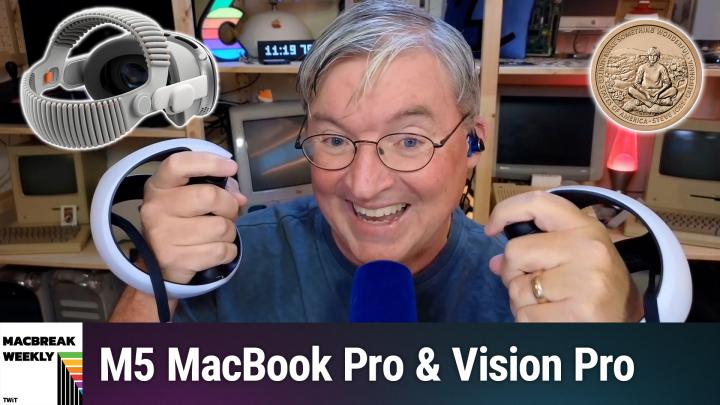
You can. You can point a laser beam basically and click. But if you get an eye tracking mode and Vision Pro is all eye tracking. You look at something and then you click the trigger and. And it's like you tapped your fingers together. You can navigate through the whole Vision Pro even when you're holding the hand controllers. So, by the way, for those who are not watching the video version of this, I'm holding my hand right now and I know enough about the people who work at MacBreak weekly to know that they are going to take a still of this and use it as the thumbnail for this episode. So anyway, the people.
Leo Laporte [00:09:39]:
The people are.
Jason Snell [00:09:40]:
John, actually go back. I smiled. You just write it. Write the time code down.
Andy Ihnatko [00:09:46]:
No, no, I need to. I need you to do back one more time. I know direct, good directors don't give notes, but you were holding the control.
Jason Snell [00:09:55]:
On your left the wrong way.
Andy Ihnatko [00:09:56]:
That's why I'm making you redo it again.
Jason Snell [00:09:58]:
Oh, yeah, yeah, yeah. That was it.
Leo Laporte [00:09:59]:
Wait a minute. You should do a three shot though, with us all holding our control.
Jason Snell [00:10:02]:
Yes. Anyway, so it works. It's impractical, like everything in the Vision Pro, but. But I'm glad they did it. And the, the. The non bundled version will be out. The. The real story is they announced this months ago.
Leo Laporte [00:10:21]:
Why is it taking so long?
Jason Snell [00:10:22]:
I think it's because Sony has to go into their warehouse and rebundle all of those. Unbundle and rebundle all those things. So they also released the knit band for 100 bucks, which is available to anybody who's got a Vision Pro, the double dual knit band. And it's very good. And it's the one they should have.
Leo Laporte [00:10:38]:
Shipped with the first product, a headpiece.
Jason Snell [00:10:41]:
It's got both of them above and behind and a single dial that can adjust either one of them. It makes it much more comfortable.
Leo Laporte [00:10:49]:
A lot of people bought it third party aftermarket.
Jason Snell [00:10:51]:
Yeah, there's a Belkin one that's pretty good. This is, I think, nicer than the Belkin one, but the Belkin one was. Is pretty good. That's the best one I ever found. And then this one that I'm holding is also the M5. And I think the. Again, nobody should upgrade. If you have a Vision Pro, stay where you are, remain in your seats.
Jason Snell [00:11:06]:
Everything will be fine. But I think one apple wanted to stop making the M2 chip. Right? Like so. And it's. And it's a two. It's a kind of a free thing to keep it rolling and they can keep selling them and they can keep it existing, but without, they don't. They're not ready. And we know they're not going to be ready for a long time to come out with something that's like a real rethink of this.
Jason Snell [00:11:26]:
Because I think the tech is just too far out to make it actually lighter and cheaper the way they want. So it keeps the product alive. What the tidbit that I thought is interesting is it turns out, funny, Apple didn't talk about this when they released this product, but it turns out that the M2 processor is not actually powerful enough to fully use the resolution of those Sony OLED displays that are in the Vision Pro.
Leo Laporte [00:11:51]:
You're kidding.
Jason Snell [00:11:52]:
No, no. So even though, even with foveated rendering, which for people who don't know, that's the idea that if you're not looking straight at something, your brain doesn't actually, you know. Right. It's like the detail, it doesn't notice a lack of detail off to the side. And so VR headsets keep running into.
Leo Laporte [00:12:08]:
Cars at stop signs.
Jason Snell [00:12:10]:
VR headsets are know this. And so they don't. They save processing power by highly resolving things in your direct field of vision, which they know you're looking there because of eye tracking, but off to the side, it's all a little fuzzy. And if you take a Vision Pro screenshot, you can see it. You can see that there's a clear part and a not clear part. But even in the clear part, the, the M2 couldn't. Was not resolving it at the full resolution of those Sony displays. Now is the M5.
Jason Snell [00:12:40]:
I don't know. Apple won't say, but they did say it's resolving it with 10% more pixels being rendered. So everything. And here's the. Well, I don't know. The M5 might not not even be powerful enough at. At full frame rate to do that. I think that.
Leo Laporte [00:12:54]:
Are they 8k, 4k? What are the.
Jason Snell [00:12:57]:
I don't know what they are. I think they might be 4k. But here's what you notice in practical terms by going to the M5 and increasing the rendering. The place you notice this the most, honestly is in one of its best features, which is the Mac virtual display. Because we're all used to what. We all know what a Retina display looks like, right? And so if you're looking because the reality is all weird shapes and shadows and stuff and like you may not be like, aha. That's not as sharp as it should be. But on a Mac display, you know, and so there, there it looks clearer because when you're looking at your Mac display that you expect to be sharp.
Jason Snell [00:13:34]:
It's sharper on the M5. So I don't think it's a reason for anybody to upgrade again. Because you should.
Leo Laporte [00:13:39]:
Do movies do that?
Jason Snell [00:13:42]:
I don't. Not that. Not so that I noticed.
Leo Laporte [00:13:45]:
I always seemed, by the way to be.
Jason Snell [00:13:46]:
They also always look good.
Leo Laporte [00:13:47]:
One use of the Vision.
Jason Snell [00:13:49]:
Yeah, no, this is the movies immersive or 3D or even just big movies that look beautiful on a giant screen. So yeah, movie theater theoretical. Theoretically, they will look better if they have the resolution for it because the foveated area is going to look better. So that's something.
Leo Laporte [00:14:09]:
Even if you're looking at a movie, they don't bother rendering the edges as precisely.
Jason Snell [00:14:14]:
I think not because they have to. Because they're rendering in a virtual space. Right. They're not just rendering the rectangle, they're rendering your whole virtual space. The movie theater, the environment, whatever it is. And as you turn it, the rest.
Leo Laporte [00:14:27]:
Of the environment's static. Oh, I guess it's not if you move your head.
Jason Snell [00:14:30]:
Well, that's right. Exactly. Exactly. And the way it works is it's refreshing so quickly that by the time your eyes move to focus on something different, it's moved where it's rendering at the high quality. That's how the foveated rendering works. I'm never ever, ever like looked to my left and gone, aha, I caught you. You're not like that. No, it happens that fast.
Jason Snell [00:14:50]:
So anyway, that's funny. It's a funny little quirk and it's good. But there's almost nothing in the Vision Pro that I ever thought. If only it had more processing power. Obviously all the power is being used to create that virtual environment. But like the only place I noticed that it was faster, like in a computer terms is making a spatial Persona, which usually makes you wait like a minute and it wait. I only had to wait like 20 or 30 seconds. But I mean it's really not the point of it.
Leo Laporte [00:15:16]:
Nobody would Upgrade their no M2 to M5.
Jason Snell [00:15:20]:
Maybe if you were a. Maybe if you were a developer or something and you. And you. But.
Leo Laporte [00:15:25]:
Or the company's paying.
Jason Snell [00:15:26]:
No, it's really there. It's really there. So that Apple going forward will sell this instead of the other one. And the. I think my headline buyers. Yeah. Is the experiment continues. Because that's really the story here is it's just they're continuing this weird platform that is not a platform for people right now just in the hopes that it will evolve into something and they'll find content and they'll find a purpose for it to exist.
Jason Snell [00:15:54]:
And it's so, you know, if you bought one today, you'd get a nicer strap and you'd get a better processor. And it means that when this is still on the price list in two years, it's not using a processor that's six years old. Which is, I think, the real sense.
Leo Laporte [00:16:08]:
And we should point out the PS2 hand controllers also work with the original Vision Pro. You don't need to upgrade for that.
Jason Snell [00:16:15]:
No, no. It's a Vision OS 26, supports the Sony hand controllers. And so yeah, you compare those. All this stuff, the strap like Apple is not leaving. Apple knows that the people who are in Vision Pros at all are their astronauts. They are their explorers. Everything that they're making available is also available on the older model.
Andy Ihnatko [00:16:36]:
Yeah, but go ahead and don't put things down. I mean, benchmarks would indicate that it is now 40% faster at sitting in a drawer doing nothing for months on end.
Leo Laporte [00:16:48]:
Oh, Andy, if that's not. I'm trying to. Not to bully Jason. Trying not to bully him.
Andy Ihnatko [00:16:54]:
Well, that's why I have been forced.
Leo Laporte [00:16:56]:
To because we could gang up on him now that he doesn't have his partner.
Andy Ihnatko [00:16:59]:
We don't have to play a zone defense. We can play Amanda offense.
Leo Laporte [00:17:02]:
Here is a Reddit video.
Jason Snell [00:17:03]:
It's offensive. All right.
Leo Laporte [00:17:05]:
From spatially me, that shows the difference in rendering speed of the M2 versus the M5.
Jason Snell [00:17:13]:
Yeah. And the other funny thing is it's, it goes up to 120Hz, which is what we learned. Apple trying to differentiate the M2 to the M5. And the vision Pro has actually revealed all the places where they're much vaunted. Apple silicon processor actually couldn't keep up with the quality of their display that Sony displays. So they, they couldn't do the refresh rate or the rendering use all the.
Leo Laporte [00:17:39]:
Pixels in their knock, really on the M2. It's a not. It's just doing a lot.
Jason Snell [00:17:44]:
Well, that's right. What it turns out is the most advanced piece of tech in the Vision Pro are those Sony screens. They're like the size of a postage stamp. And they're like 4K OLED screens.
Leo Laporte [00:17:53]:
Yeah.
Jason Snell [00:17:53]:
And the processor can't run them at 120 frames at 1 to 1 resolution because it's too hard because that's a lot in real time. So with the M5, they're closer to. It is basically.
Leo Laporte [00:18:11]:
I can't imagine spending the money for a second one. I guess maybe you. Is there a good resale price for the M2?
Jason Snell [00:18:18]:
I mean, you see them. There are a lot out there and you see them, I don't know, 1500 bucks. I mean, there are people who are unloading them.
Leo Laporte [00:18:26]:
Is there an Apple trade in? Can you trade in the M2?
Jason Snell [00:18:28]:
You cannot. They don't want them back.
Leo Laporte [00:18:31]:
Okay. All right. So it's. I mean, I'm looking at this video. Thank you. Spatially, me, and it's clear that it is faster for rendering. I mean, the pizzas appear much more quickly in your space.
Jason Snell [00:18:43]:
Yeah, everything's going to be a little bit faster. But like I said, I never really felt like I was waiting around for a lot of stuff in the Vision Pro. I think that the biggest changes are going to be that the rendering is higher quality and that the frame rate is able to peak much higher. Which in a. If Alex were here, he would say something about 120Hz being much more realistic and the idea that the reality around you will seem a little more real if it's able to update at 120 on today's show.
Leo Laporte [00:19:10]:
I'm sorry to say.
Jason Snell [00:19:11]:
Sorry.
Leo Laporte [00:19:12]:
Why did Apple not embrace gaming? That's what meta did and it certainly sold a lot more meta quests. Why did they not embrace gaming?
Jason Snell [00:19:20]:
I think part of it, I think maybe they were too proud. They're like, no, no, no. We're revolutionizing computing with this. It's also possible that they knew that the thing they wanted to build, this super high end, all these sensors, $3,500 thing, could not even plausibly be described as a gaming thing. But I think they just didn't want to have gaming in the conversation that that was where what Metta was doing and that they were trying to build a SP and not a game playing device, which the quest is. I mean, quest is. That's what it is. Right.
Jason Snell [00:19:49]:
But I think it's a mistake because like, like I said earlier, this thing needs content. It's hungry, it's desperate for content. And games is content just like immersive video is content. And so, you know, I'm glad at least there's an option for it. It's still not like in the box or anything, but at least you can do it. That's a start. We'll see what they do.
Leo Laporte [00:20:10]:
Yeah, somebody in the discord pointed out the iPhone really wasn't a gaming platform until the market made it, so.
Jason Snell [00:20:17]:
Right, yeah. Apple, Apple. Apple's relationship to gaming is basically it builds platforms and then hopes games happen there. But. But with the hand controllers, they had to enable support for third party hand controllers before you could even go down that path in Vision os, which they have done now or at least for Sony. We'll see. I don't know if that opens it up for other controllers or if it's explicitly wired to the PSVR control right now. It would be nice if there was some competition on the hand controller front.
Leo Laporte [00:20:46]:
Yeah. Do you want to talk about the NBA? This is something that is planned. Apple's going to shoot a basketball game with.
Jason Snell [00:20:57]:
Yeah, so. So I can't wait for Alex to be back so we can talk about this. But it has been announced that they're going to be some Lakers games that are going to be broadcast in immersive, which will be the first live immersive of using the Black Magic.
Leo Laporte [00:21:09]:
Whole game.
Jason Snell [00:21:10]:
The whole game live. We don't know how that will work. Nobody knows. It's going to happen early next year and then. But there'll be several Lakers games and they'll be live to people who get access to the Lakers. So it's like live in market. But then they'll be also available for playback on the NBA app afterward. So we'll all get a chance to see sort of like what is it like to have a whole live sporting event happen.
Jason Snell [00:21:32]:
And you know, are you, are you courtside? Are you, you know, can you choose a view courtside or behind the baskets? Does it choose for you or do you sit there? We don't know. But I think the NBA is the perfect platform for that because, you know, courtside, you're right there. Yeah, you stay in a wide there.
Leo Laporte [00:21:50]:
But you look back and forth.
Jason Snell [00:21:51]:
The three dimensionality of it means something. I mean, there's just big sweaty men right in front of you. Like it's a whole thing.
Leo Laporte [00:21:58]:
I sat courtside once at a Warriors game.
Jason Snell [00:22:01]:
Scary.
Leo Laporte [00:22:02]:
It's a little scary because they are tall and they're big and they're right there in your lap app. It's a little scary. Anyway, Spectrum Sportsnet will power the live immersive streams for Lakers fans through a new Sportsnet app right on Apple TV or on Vision Pro Megabits. So that's interesting. You know what? Actually, I hate to even say this, but I would consider buying a Vision Pro. The other story is Apple spent $750 million and announced on Saturday that they'd have indeed purchased the US Broadcast rights for Formula One racing.
Jason Snell [00:22:41]:
It's true.
Leo Laporte [00:22:42]:
ESPN has those rights right now. It doesn't do a very good job. In fact, for a while they were sticking ads in the middle of the race, which really was not a good thing. And there was some concern. The reason this took so long, $750 million for five years, by the way. The reason it took, which is like twice or three times what ESPN was paying. The reason it took so long is Apple wanted Formula One to stop using its F1TV app as streaming service in the US and they agreed. So Apple's taken the whole kit and caboodle off over.
Leo Laporte [00:23:19]:
Now. I know I'm the only one in this show who actually watches Formula One, but I do really love the streaming app. And if they were somebody briefly made a demo of this, which I think Apple asked them to take down of Formula One because F1TV streaming has. You can watch the broadcast pictures, but you can also watch. Each driver has a camera and there's driver radios. There's really a lot more going on. There is a view of the track where positions are on there. There's a lot of data that is.
Leo Laporte [00:23:49]:
And you can watch all of that. I use something called F1 viewer on the Mac to watch it. It's incredible.
Jason Snell [00:23:57]:
So it would not surprise me if Apple works with F1 to bring the data that's in F1T to the vision Pro. Right?
Leo Laporte [00:24:06]:
I would hope so. And that mine might actually spend 3,500.
Jason Snell [00:24:09]:
That's the thing is the killer app we talk about Vision Pro, like if the killer app. That's why I think the live basketball is so interesting is if. If you're a huge basketball fan and your team says next year all the home games are going to be courtside, immersive or whatever like that. There are people who. That will sell the headset.
Leo Laporte [00:24:28]:
Oh, absolutely.
Jason Snell [00:24:28]:
You just need one. One real good reason to do it.
Leo Laporte [00:24:32]:
It.
Jason Snell [00:24:32]:
Whatever it is. If there was a. A comprehensive live like a comprehensive Broadway content package with lots of great shows that were like it only takes one, but nobody's really found the one yet. So. But it's all still experimental. But Apple's partnership with F1 makes it possible that that will be part of the experiment. Is some stuff with. With F1, I think not like immersive video.
Jason Snell [00:24:56]:
Like you're there because the speed of the cars going around the track, it kind of doesn't make sense. But a thing like some of the apps that we've seen, including the one that was there. Hold the idea that you've got all that F1 data and all those different camera angles and it's all kind of in F1TV. Could you make an immersive kind of cockpit of all of that around you in Vision Pro? Maybe. You know, that could be interesting. So we'll see what they do with it. But it's a big deal. This is Apple's, you know, end to end.
Jason Snell [00:25:23]:
They're going to get all. In the US they're going to have all rights, like the F1 TV subscriptions. You get it if you're an Apple TV subscriber watching the live races. You get it if you're an Apple TV. That's it. Period.
Leo Laporte [00:25:36]:
I pay 150 bucks a year. Actually, it was less. It was like 80 bucks. But they've raised it to watch F1TV.
Jason Snell [00:25:42]:
Yeah, you won't have to do that anymore.
Leo Laporte [00:25:43]:
It's 24 races. There's a lot of races. And it's really a fun way. Much better way to watch than on espn. Yeah, I hope Apple does justice to it. I mean, they spend enough money that one hopes they will. One thing they should not do is shoot the F1 race with an Ursa, because I think maybe there's one Ursa at the finish line or something. I, I that doesn't seem, I don't really want to.
Jason Snell [00:26:09]:
I, yeah, I think, you know, I, I was talking to somebody who said that maybe you do an immersive lap at every track or something like that, but the actual race viewing immersive doesn't make sense.
Leo Laporte [00:26:20]:
Throw up.
Jason Snell [00:26:20]:
If they did that and the cars are just zooming by and there's not. No, I think you, I think what you do is you put, you're in the, like, ultimate cockpit of like, I've got video and I've got data and I've got, I've got a virtual. Maybe there's a virtual track beneath you that shows where everybody is. And like, it's more like data overload, not immersion with being there. It's immersion with the data. And, and that's a very different thing than Ben Thompson. The analyst was talking about doing a courtside immersive for the NBA. And he's like, you don't need anything.
Jason Snell [00:26:50]:
And he's kind of right. When you think of it, it's like you don't need graphics because if you want to know the score, guess what you do. You look up at the scoreboard. Mike. Yeah. That is a really good place for immersion because you're there and you can just look at the scoreboard if you want to see the score. But F1 is not like that.
Leo Laporte [00:27:07]:
No, this is, I guess there is an app. I didn't realize this, this is Laps Lap Zed.
Jason Snell [00:27:14]:
Yeah. I think, I think it died though, didn't. Isn't that the one that got pulled from the store? And, and there's a lot of conspiracy theories. I, I would not be surprised if it comes back as an official something. Yeah. But I don't know about it.
Leo Laporte [00:27:30]:
They would sell me a Vision Pro if I could do this.
Jason Snell [00:27:34]:
Yeah. And this is why they want to experiment with this stuff because maybe that's a killer app for race fans in the US Anyway, so we'll see.
Leo Laporte [00:27:42]:
I feel a little sad that, I don't know, I feel like the Vision.
Andy Ihnatko [00:27:49]:
Pro.
Leo Laporte [00:27:52]:
I don't know, it's, it's just not, it's not going anywhere.
Jason Snell [00:27:57]:
You know, I feel like it's going, it's moving forward in terms of development, but it's a, it's a years long thing. I mean like all, everybody needs to be, everybody at Apple needs to be accepting of the fact that like the whole idea here is you're building a platform and exploring something, but it's like it's not going to be a thing for a while. And I think that's true of all of the big helmet things. Right. The big nerd helmet things. Like, they're just too expensive and too clunky right now and they make too.
Leo Laporte [00:28:24]:
Many people ill. Yeah. To be honest, I think that's never the problem.
Jason Snell [00:28:28]:
I've never had anything like that with the Vision Pro and really even with the Quest. But, but people do and it's an issue. So, so yeah, it's just, I, I, I hope Apple keeps with it because I will tell you, the OS updates and the content updates, they are happening. It is progressing. But, but it's going to take a long time. There's no, there's no, like short of a, you know, killer app thing. Whether it's F1 or the NBA or, or something else like that. It's going to be years because this technology is so far out there.
Jason Snell [00:28:58]:
The fact that Apple's chips, which are so advanced, even struggle to drive the display, that's interesting. It's the current display that Alex wishes were higher resolution even than that. Like we're talking, this is like our conversation last week about the coming from the glasses side. It's like you can't just wave a Magic wand and make this stuff happen. Getting that kind of processor power and being able to update those kinds of displays or getting the, the vision path to get true AR overlays on the actual world out there, like this is all so hard and, and all the willpower in the world can't make it happen. That stuff needs to get invented and it's going to take years.
Andy Ihnatko [00:29:39]:
Yeah, yeah. And just, I mean we have a lot, we have, we have a lot of fun arguing about this, but I still say it's yet to be demonstrated that this is even a viable product. Which is not to say that it isn't a viable product, but I'm saying that this is still a faith based initiative on Apple's part, on Samsung's part and on everyone else's part. Yeah, it's, I mean, and I also don't think that Apple is pouring billions of dollars into the Vision Pro with the idea of, oh, we know that this isn't going to go anywhere. This is just a platform that we need to create so that we can create the smart glasses that we want to create. So Steve Jobs used to speak of the Apple TV after it failed to immediately set the world on fire, to say, oh well, we're sort of experimenting with it or we're dabbling with it for now. And I think that's definitely, I think it's a similar thing where it's a face saving sort of thing where people who can afford it and can buy it when they can like it and that's great. They were always going to be display component limited and how many they could ship anyway.
Andy Ihnatko [00:30:43]:
So they definitely didn't expect us to ship in iPhone numbers. But even all of that said, this is not the only time that I kind of figure, oh this is, this is a good place to have a discussion about. It is when people think, oh no, no, no, no, no, no. As soon as they get the price down on those goggles, as soon as they get the makeup them light enough, as soon as the content is there for the goggles, that's when everybody's gonna have one and you're gonna wonder, hey, remember those days when we used to do things over smartphones? Who can even remember? Like, okay, again, it's good to have, it's good to love things, it's good to have faith in things. It's a good thing to be excited about things but just keep one foot in reality that I do believe that this is a faith based based initiative.
Jason Snell [00:31:23]:
Especially if you're from Minnesota. I want to Say so that's what.
Leo Laporte [00:31:28]:
It sounds like to me.
Jason Snell [00:31:29]:
Yeah, I mean, I think you can look at spatial computing and you can look at immersive and you can look at like all these different things that are sort of being tried on this platform. Part of that is like, is this a thing? Is this a thing?
Andy Ihnatko [00:31:42]:
Is this anything?
Jason Snell [00:31:43]:
Yeah, is this a thing? And like I, I think that if, if there's something that costs, look, you know, I don't think there's necessarily an all one size fits all kind of product down the road here. But like, like, could it be that if you're somebody who uses a computer all the time that in five or ten years it's totally worth it to spend $1,000 on a thing that's an extended display because you travel and it's, it's primarily just Mac virtual display, but it means that wherever you're working you can have a high resolution display for your computer. Maybe. Is it for theater? Is it for sports? Is it like again, is it a thing? There may be and there's some industrial things that are, you know, that Apple's trying out too. But you're right, Andy, that the, the, there is a leap of faith about, well, in the future will we all just have these VR helmets that we put on versus like a really lightweight AR kind of thing? I think nobody, anybody who is certain that we will is making it up. Because you could even look at how Apple is approaching the content on the Vision Pro and it's very much like seeking whether it's a thing or not. And while I think that stuff like immersive video and definitely just having a giant screen where you can't have a giant screen, whether to watch a movie or using your Mac might be one of those applications that you want to follow that thread right now. There's no thread to follow right now.
Jason Snell [00:33:10]:
They've thrown the whole ball of yarn in and are like, we'll see, you know, let's see what develops. And we don't, we just don't know how to any of it's going to react. If I had to guess, I've always thought that the spatial computing thing was a little curious. I think that there was some pride on Apple side and like look, it's a complete computer platform and there's a question of like, do we and will we ever want a 3D spatial computing platform? Is that a thing that people want and will find useful? Especially if it's a whole bunch of 2D planes hovering around us? Well, we have, have the Mac is pretty good at hovering 2D planes already, right? Do we need more of that in a 3D space? Maybe not. I, I, I think I, I, who knows. But I do think there's also a quest to like drill down and like find that thread that's like, oh, that could be a product. And maybe it is just a, a Mac display or a, or a movie watching thing like the xreal glasses are right, where it's just like, it's way cheaper, it's way less complicated. But it's good because you can bring your Mac with you and have a gigantic display or you can watch movies on the plane.
Jason Snell [00:34:17]:
And you don't need a Vision Pro for that. Right? But the Vision Pro is like, let's just pour it all in there and see what happens. And that's where we are.
Andy Ihnatko [00:34:24]:
Yeah. And I will say also that F1 is a really great match for this sort of thing because the people who are into F1 are probably not the kind of. More people who are into F1 are the kind of people who either already have a Vision Pro or are like, wow, that sounds like a really great way. If again, if the platforms deliver like, wow, you know, $3,500 is not no money. But hey, I'd buy that to appreciate this.
Jason Snell [00:34:48]:
You just need one killer app. And then there's, you'll find an audience.
Andy Ihnatko [00:34:52]:
A killer app for an audience. And audience that can feel like $3,500 is a reasonable amount of money to spend that. Again, $3,500 for most people is going to be okay. Instead of buying a really good laptop and a really good phone and a really good tablet and that watch that I've had my eye on, that's a few hundred dollars. I'm going to buy these pair of goggles instead. And it's the thing is like it's not going to be able to live up to the expectations of $3,500. Investment in a group of computing platforms to solve problems. Make my life, life more fun, more interesting, make my work easier to get through.
Andy Ihnatko [00:35:35]:
That's a big ask. And right now I don't think the Vision probably do that.
Jason Snell [00:35:40]:
You're saying most, most people. I think, I think it's more like are, are there 20,000 NBA fans who would buy a Vision Pro tomorrow if they could watch every game of their team courtside and immersive maybe like, but that's what it would be. It would not be most people. Like, we're what, I don't know if we're ever going to be at most people want to strap a big thing on their face. Yeah.
Andy Ihnatko [00:36:05]:
It's really the other things, like, particularly when you get to like entertainment and watching sports for a lot of people, that's a communal activity and that's, that's one of the simple things that are.
Leo Laporte [00:36:17]:
Almost not F1 fans.
Andy Ihnatko [00:36:20]:
No, no F1 fans.
Leo Laporte [00:36:22]:
Watch In Solitude, I promise you.
Andy Ihnatko [00:36:24]:
In the middle of the night. That's what I'm talking about. About the big difference being like again, someone could in terms of making entertainment like movies and other things like that, you're still thinking, well, I can only be in my own private little bubble watching this. I can't share that. I can't be watching this movie with other people. I can't be watching the game with other people. Unless my friend Group also has $3,500 goggles. This is why I'm most excited right now in terms of fully immersive VR is just give me a dumb display that is reasonably good quality display that is good enough at tracking my head movements that I'm not going to get motion sickness.
Andy Ihnatko [00:37:05]:
Because right now the killer app for that is again is virtual displays. That's. I mean, just speaking personally, as much crap as I give Vision Pro, if I could find an $800 pair of goggles like that, that would be. And if I happen to be in a year where I was doing lots and lots and lots and lots of travel, I could see me saying, you know what? I've had it with, like having to. I want to have a greater experience during these six hour transcontinental flights and transoceanic flights I'm having. I want, when I'm set up in a hotel room for two or three nights, I don't, I want to be able to have two or three displays in front of me without necessarily having to bring two or three displays with me. I could talk myself into that. And none of that seems to be something that requires three five hundred dollars worth of hardware.
Andy Ihnatko [00:37:52]:
Apple not knowing what the audience was going to be shot for the moon. Because again, if we can only sell a few hundred thousand of these, no matter what we do, even if it's a runaway success, we may as well make it the biggest and the best platform that we can and then scale it back down.
Leo Laporte [00:38:06]:
And that's your Vision Pro segment, Nancy.
Jason Snell [00:38:10]:
Now you know, Very good. We're done talking. The Vision. Vision Pro.
Leo Laporte [00:38:18]:
I would buy. I'm not kidding. If they do F1, and I think they probably will on the Vision Pro, I actually Might. Maybe I'll buy one of yours. You got two now, right, Jason?
Jason Snell [00:38:27]:
Well, this is an Apple loaner, so it's gonna have to go back. But yeah, I'll bring mine up and you can try it out. How about that?
Leo Laporte [00:38:32]:
Man, I think that would be so cool. And since I do watch it alone in my private bedchamber, I think I could, I could probably enjoy that. We're going to take a break. When we come back, there are other new Apple products to talk about. And Jason has all the reviews. Don't play that song again. Please, I beg of you. Once is enough.
Leo Laporte [00:38:53]:
You are watching MacBreak Weekly, the number one premier vision Pro podcast in the entire world. Our show today, brought to you by Framer. If you're still jumping between tools just to update your website, you have my sympathy. You need Framer. Framer unifies design, CMS and publishing on one canvas. This is kind of super cool. No handoff, no hassle, everything you need to design and publish in one place. Framer has already built the fastest way to publish beautiful production ready websites. And it's now redefining how we design for the web.
Leo Laporte [00:39:36]:
With the recent launch of Design Pages, a free canvas based design tool. Framer's more than a site builder. It's a true all in one design platform. From social assets to campaign visuals, to vectors and icons, all the way to a live site. Framer is where ideas go live, start to finish. This is how this is designed. The way you think, design the way you want it, design the way you would do it if you had a modern platform. And now you do.
Leo Laporte [00:40:05]:
Framer F R A M E R. It's a free, yes, free, full feature design tool. Think unlimited projects, unlimited pages, unlimited collaborators, and all the essentials. You get vectors, you get 3D transforms, gradients, wireframes. I mean, I know people don't believe this. Everything you need to design totally free Framer is your entire workflow in one place. No importing figma stuff, no messy HTML. This is how you want to work.
Leo Laporte [00:40:39]:
It's faster, it's cleaner, it's more efficient. You can design more than websites. It's really a design tool that lets you create social assets, campaign visuals, icons, site resources, all inside the tool. You've got them now. You can use them anywhere. You don't have to switch back and forth. Framer stands above the others because it's not just a site builder, it's a true design tool that also publishes professional production ready sites ready to design, iterate and publish all in one tool. Start creating for free at framer.com/design and use the code MacBreak for a free month of Framer Pro.
Leo Laporte [00:41:18]:
That's framer.com/design and usethe promo code MacBreak framer.com/design promo code MacBreak rules and restrictions may apply. I think you'll be impressed. All right. MacBook most of, by the way, what Apple shipped last week, it is now next week.
Jason Snell [00:41:41]:
Announced last week, shipping the end of.
Leo Laporte [00:41:43]:
This week, ships at the end of this ship's Friday or tomorrow maybe.
Jason Snell [00:41:46]:
I don't know.
Leo Laporte [00:41:47]:
Oh, okay. Anyway, the embargo lifted. So you've got advanced units.
Jason Snell [00:41:52]:
I do.
Leo Laporte [00:41:52]:
Most of it is incremental upgrades of existing products. Using the M5, right?
Jason Snell [00:41:58]:
Exactly. The iPad Pro got updated last spring 24. Spring 24, 18 months ago with, and I love my M4 with the new M4 design. And so the M5 iPad Pro is the same as the M4.
Leo Laporte [00:42:13]:
Okay. Now it's a different screen.
Jason Snell [00:42:15]:
It's a brand new design. I mean, yeah, it's got the, it's the same. It's the tandem oled which is the best screen Apple's ever made. It's super thin, especially the 13 inch is the thinnest thing Apple's ever made. Basically. It is. It is that with the M5 in it. And so the M5 chip is really kind of the story.
Jason Snell [00:42:31]:
And the same for the MacBook Pro. They only updated the base model. There's no M5 Pro or M5 Max chip yet. It's just the base. So they decided to roll out that base 14 inch MacBook Pro as an M5 as well. But again, that's a design that's been around for a while. That was the, in the M1 generation that design started. And it's got the really bright display with the notch in it.
Jason Snell [00:42:56]:
It's really a really good Mac display. It's got promotion.
Leo Laporte [00:43:00]:
It's not as good as the iPad.
Jason Snell [00:43:03]:
It's not as good as the iPad. And the rumor is funny, I find.
Leo Laporte [00:43:06]:
Myself using the iPad Pro just because the screen screen's better.
Jason Snell [00:43:09]:
No, the screen's the best screen that Apple's made, I think, period. But the rumor is that the MacBook Pro is going to get its update maybe in a year with the M6 generation where they will have some things that are different, including Mark Gibbons as a touchscreen.
Leo Laporte [00:43:22]:
Some so and OLED touchscreen, although not tandem oled.
Jason Snell [00:43:26]:
Right? Single oled. Yeah. Well, yeah, it's interesting the decisions that they have to make. So anyway, this is a generation for Both of them. I think the iPad Pro, it's going to be a while for the MacBook Pro and maybe next year. But this is an interim step and the changes are minor because of that. The chip is the biggest change. If we throw in the other chips in the iPad Pro, they are also a big change because it's using Apple's chip for WI Fi and Bluetooth and it's using Apple cellular chip and the iPad Pro for the first time.
Jason Snell [00:43:57]:
And so, you know, I did, I am not a wireless tester, but I did do some wireless testing in a difficult wireless environment, which is my backyard where there's no Verizon and no T Mobile and only a little bit of at&t. And what I found is basically Apple's chip for me in my testing was slightly slower at downloads, like 10% slower and it was like seven times faster. It uploads. So in my backyard in a couple of days, it did pretty well, I would say.
Leo Laporte [00:44:27]:
Even picked up Verizon which and it.
Jason Snell [00:44:30]:
Got borrowed from Verizon and pulled down some data. And I'll tell you, everybody who comes to my house who's like a solar installer or a plumber or whatever, they're like, can I get your WI Fi password? Because they can't. They're variety. I like Verizon. Huh. Because it's just, it doesn't, doesn't show here and there. They managed to get a little data through even in my backyard on Verizon. So that was pretty good.
Jason Snell [00:44:52]:
So that's, that's.
Leo Laporte [00:44:54]:
Are not in the MacBook Pro. They're only in the iPad. Is that right?
Jason Snell [00:44:58]:
I mean my review on six colors, I took my shots. I think that now that we live in a world where Apple's got its own chips that do those things, why does the MacBook Pro not support Wi Fi 7? Why does it not support Bluetooth 6? Why does it not have a cellular option? Like, they're probably waiting for a redesign next year. But like, I think we got a column on it. Like you make your own cellular chip now. It's cellular has been in the iPad since day one and you still don't make cellular Macs. And I just think it's stupid. I think it's a choice people should have. I find I buy a cellular iPad because having that cellular tethering is a very nice fallback.
Jason Snell [00:45:34]:
Yeah, but it's not as fast. It uses device another device's battery. It's not as fast. It can be finicky. Having it on device, having used the cellular iPad for a while, I'm a believer. It's great. I would love to have it on a laptop. And now that Apple makes their own, they have even less excuse not to do it.
Jason Snell [00:45:53]:
So that's kind of a bummer. And Wi Fi 7 as well. Like the wi fi speeds I can get on my, on the, on the M5 iPad Pro, very impressive because they're using the Wi Fi 7 router that I have here and that's an upgrade that the MacBook Pro doesn't get. So that's kind of a bummer. And then the M5 is exactly what they said it was. It's exactly what we found the A19 to be in the iPhone, which is, you know, the CPU core goes up 10% in speed every year it seems like. But the GPU went up more. They threw in some machine learning accelerators.
Jason Snell [00:46:25]:
So if you're running machine learning processes there are APIs you can write to, some of which are out now and some of which are forthcoming. They're updating all their MLX frameworks and things that a lot of stuff that's machine learning based, that uses GPUs will be like maybe two, three times as fast as it is now. But it's the same old story. Most of the ML applications that people use are in the cloud, not on device and so they won't see any difference there. But Apple's hoping over time that their processors are so powerful that more people will use them for on device machine learning tasks. Because then it's local, it never, your data never leaves your computer and we'll see if they're successful at that. They've certainly got the chips to do the job. So yeah, so that's, that's basically it.
Leo Laporte [00:47:14]:
I, like Mike Mark Gurman, are, I'm going to wait till next year, I'm going to get an M6 and I want an OLED screen, I want touch.
Jason Snell [00:47:23]:
Yeah, I think there's, there's, if you're in the market for a MacBook Pro today, I actually was thinking about this.
Leo Laporte [00:47:29]:
Should you wait for the M5 Ultra?
Jason Snell [00:47:32]:
I think the curse, the curse of Apple Silicon for Apple is that it's so good that it actually makes it hard to sell high end systems. And these, these higher end MacBook Pros are starting to feel more and more niche to me. Like it used to be the low end MacBook Pro was like that's not a MacBook Pro. It doesn't have that extra port or that screen or whatever. Remember it was kind of A lesser computer that they slapped the label on. But today I Look at this M5 MacBook Pro and I think how many people really need a faster processor?
Leo Laporte [00:47:58]:
You know where I would disagree with you? You is AI.
Jason Snell [00:48:02]:
Oh sure. I mean local AI.
Leo Laporte [00:48:04]:
When I say not many people are doing local AI. When I say niche, those who are really.
Jason Snell [00:48:08]:
When I see niche, yes, I think that's true. And if given, given the GPU acceleration on the base M5, if you're a GPU AI person, I've got to assume that the, with the so many more GPU cores on an M5 Pro or M5 Max, that those things will be screamers when it comes to GPU machine learning stuff. But I think for regular people, even.
Leo Laporte [00:48:31]:
The benchmarks of the M5 showed fairly improved.
Jason Snell [00:48:36]:
Oh yeah, the M5 in machine learning on GPU is really impressive if you use the ML accelerators that are in the GPU now. So there's a lot to be said for that. I think for a lot of regular people maybe that base model MacBook Pro is, is fine. And the question I have about the M6, if it truly has OLED and, and touch and all of that, is I Wonder if the M6 MacBook Pros will be the higher end ones and that this one won't inherit that design right away for margin reasons, basically to keep a low priced MacBook Pro in the line. But it's a good computer. I, I question how many people need it and not just a MacBook Air, honestly. Because the MacBook Air will presumably get the M5 in the spring too. And I mean, I know it's not quite the same.
Leo Laporte [00:49:27]:
This is a MacBook Air with more ports basically.
Andy Ihnatko [00:49:29]:
Right?
Jason Snell [00:49:30]:
More ports, better screen, maybe some more. And a fan. Yeah, those are the, those are sort of the big ones. Yeah, more ports, better screen, better battery. And a fan. So it'll run.
Leo Laporte [00:49:40]:
Fan means it can run faster because it doesn't.
Jason Snell [00:49:42]:
Even with the same chip, it'll run a little bit faster. But the MacBook Air, you know, you trade some of that in for thin and light and really nice. So it depends on your priority.
Leo Laporte [00:49:53]:
Pros are still pretty thin and light. I mean, they're not massive machines. They really look good.
Jason Snell [00:49:59]:
Yeah, they're really nice.
Leo Laporte [00:50:00]:
Especially when you pose them next to a phaser.
Jason Snell [00:50:02]:
Well, okay, so there's a classic Star Trek episode where there's AI that's trying to take people's jobs and is actually very bad. How timely. And it's called the M5. It's the ultimate and when they announced the M1, I was like, well, in five years, I'm gonna make a lot of Star Trek references. And today, friends, so today is the day. So that picture that you were showing on our video feed, not only is there a phaser next to it, but the wallpaper on there, that is the M5 computer from Star Trek.
Leo Laporte [00:50:31]:
Oh, man, I missed the whole joke.
Jason Snell [00:50:33]:
Yep, that's it. That's it. The Ultimate Computer was the name of that episode, which is also the headline of my story. So.
Leo Laporte [00:50:40]:
Oh, man, you're really going deep on this.
Jason Snell [00:50:43]:
I'm done now.
Leo Laporte [00:50:44]:
How many people recognize that?
Jason Snell [00:50:45]:
They're old. Older people recognize it. I guess that's. That's what we're left with now. So, yeah, my iPad review has a little communicator. John Moltz, my friend John.
Leo Laporte [00:50:54]:
Did you get it?
Jason Snell [00:50:55]:
He 3D printed those, the communicator and the phaser for me.
Leo Laporte [00:50:59]:
Oh, nice.
Jason Snell [00:51:00]:
That I used as props in this. And then I will also have at Halloween. And I could be Captain pike for Halloween.
Leo Laporte [00:51:05]:
Are you going to be Captain Pike?
Jason Snell [00:51:06]:
I am going to be captain.
Leo Laporte [00:51:07]:
You're going to be the hell.
Jason Snell [00:51:08]:
I got the gray hair. I got the gray hair. So I can't be Captain Kirk. I got to be Captain Pike.
Leo Laporte [00:51:11]:
Got to be Pike.
Jason Snell [00:51:12]:
Yeah.
Leo Laporte [00:51:14]:
Wow. If I were going to do that, I'd probably do Honeymooners references. So it's probably best.
Jason Snell [00:51:20]:
Well, you're older than me.
Leo Laporte [00:51:21]:
Yes, that's fair.
Jason Snell [00:51:24]:
I encourage you, especially, I encourage people to find the ultimate computer episode of Star Trek. It's on Paramount plus here in the US it is really interesting because I think what they're trying to talk about primarily is the idea that the threat in the 60s, like, are computers going to replace people? So it's sort of about replacing labor and automating. I think it has its heart in like, the. In factories and like being concerned that factories are going to replace laborers with machines. But I'll tell you, it has added resonance today. If you think about AI, the idea that there's this smart computer that's going to take Captain Kirk's job and guess what? It starts blowing things up. It's actually really bad. And they gotta shut it off.
Jason Snell [00:52:08]:
And that's what the episode is. So I think it's a timely watch for today.
Andy Ihnatko [00:52:11]:
And the biggest failings throughout the entire episode, that computer did not try to hit on any of the female ensigns even once. Not even like a little bit of a pass.
Leo Laporte [00:52:20]:
You know what? I love our audience. You don't know that Our audience is so in tune. Oscar Castillo in the YouTube says, well, you know, Dr. Daystrom went mad, but he loved his M5.
Jason Snell [00:52:31]:
He did. He loved it so much.
Leo Laporte [00:52:33]:
And out of sync says, it's Daystrom's ultimate computer.
Jason Snell [00:52:36]:
The ultimate computer.
Leo Laporte [00:52:37]:
People remember this stuff. I'm impressed.
Jason Snell [00:52:40]:
I've been waiting. Since I was five years old, I've been waiting for this day.
Leo Laporte [00:52:44]:
I'm five, baby. And you're gonna be the. The healthy pike, not the face melted version.
Jason Snell [00:52:50]:
I'm not gonna sit in a chair with beeps. Maybe at the end of the night. I'll be really tired by then. I'll just sit.
Leo Laporte [00:52:56]:
Your face will melt.
Jason Snell [00:52:56]:
I'm going to be our active. Strange new worlds Captain Pike. Anson mount is my.
Andy Ihnatko [00:53:03]:
I know this is a potential red hole, but didn't it bother anybody else watching that for the first time that all they could wire him up for is yes or no? It made me think, as though they didn't want to hire this actor in a speaking role.
Jason Snell [00:53:19]:
He wasn't available. That's the thing, is the original actor, the reason he's in the chair at all is because Jeffrey Hunter would not come back to be in another episode. He was in the pilot, and then they did the new pilot with William Shatner, and so he was supposed to.
Leo Laporte [00:53:33]:
Be the official captain. Yeah.
Jason Snell [00:53:34]:
And so they made it. They made it look sort of like him and the beeps and they didn't want him to talk and all, but. Yeah. You think advanced technology, if you wire enough into the brain to beep, you could probably get like a speech synthesizer or.
Andy Ihnatko [00:53:46]:
Could they? They could have hired someone to, like, actually read the lines and sort of even in a computer voice. I think it was like a money thing. I think they did. They did. They did want to hire a voice actor to. To have to pay them, like, union scale for a speaking role.
Leo Laporte [00:53:59]:
Wow. You guys spend way too much time with cheap skates. So thinking about this, he's.
Andy Ihnatko [00:54:07]:
He's also the guy who, like, wrote false fake lyrics to the theme song just so he could take half of the royalties. Steal half the royal.
Leo Laporte [00:54:14]:
That's right. That's right.
Jason Snell [00:54:15]:
Yep.
Leo Laporte [00:54:19]:
Okay.
Jason Snell [00:54:21]:
Any questions? Any more questions about Star Trek and. Or, And, Or Apple Computers? Yes, either way, I'll take it.
Leo Laporte [00:54:29]:
As you say in your review, no one should consider the M5 iPad Pro. If you've got an M4 iPad Pro. Right. There's no.
Jason Snell [00:54:36]:
Yeah, I feel like if You've got an iPad Pro with an M on it, you're probably okay also.
Leo Laporte [00:54:43]:
Well, it's faster. I mean it's surprisingly fast.
Jason Snell [00:54:45]:
It is, it is faster. And, and with ipados 26, I think the truth is we've reached the point where I no longer need to write an iPad review and say it's great hardware let down by software because the software is way more capable and Apple has added a bunch of functionality to it that makes it a much more plausibly professional device than it was, you know, a few years ago. And so I think that it's got a lot going for it and it's got more RAM on all the configurations, not just for AI stuff but also because there's a multi window mode where you've got a whole bunch of different windows open at once and you actually need RAM for that. So you know, it's fast, it's impressive. I think if you've got an M4 or even an M2 and probably an M1, you're fine. And the other fact is it's expensive. It costs basically what a MacBook Pro costs. Ish.
Jason Snell [00:55:34]:
And I would say the Mac or the iPad air is a. Is basically what the iPad Pro was a couple years ago, honestly. And I think I have a hard time recommending the iPad pro because for people who like they need it, I don't think anybody needs the iPad Pro. I think the iPad Pro at this point, given what it costs and given some of its really, really nice features, it's very much a buy this because you really want the nicest iPad and there's nothing wrong with that. But like I don't think it's actually really much more capable than an iPad air. It's more like you pay for it because it's super thin.
Leo Laporte [00:56:15]:
It's got that amazing screen screen might be worth it. I really love it.
Jason Snell [00:56:19]:
That's the reason you buy it?
Leo Laporte [00:56:20]:
Yeah, yeah. And it's hugely expensive. We should point out it is more than a MacBook Pro. I mean it's a.
Andy Ihnatko [00:56:27]:
Especially when you add. Depends on what you buy. But you keyboard. I mean I justified the. I think that it can be justified again we're going back to like if you happen to have $3,500 and this seems to work for you. But I justified my M1 iPad Pro by realizing that a. I do a lot of travel in which I need a bridge device. I don't necessarily need to bring an entire laptop with me and also that I felt as though it was going to fill a lot of different niches, particularly with continuity and its tandem features with my MacBook.
Andy Ihnatko [00:56:57]:
So it's going to be a really interesting year next year. If I've been like very, very close to upgrading my M1 MacBook Pro and my M1 iPad Pro over the past year, now I'm really kind of eager to wait until next year only because a these two devices still suit the purposes that I want them to serve and they also still run OS26 without any problems. So that's not a reason, but also that there's going to be such motion over the next year over the future of the Mac as a platform. I mean, we're seeing Gurman has been saying, okay, there's going to be a touchscreen. And other supply chain analysts have been talking about, oh well, there's going to be a touchscreen MacBook coming up next year or the year after that. I don't know how to deal with those rumors because.
Jason Snell [00:57:49]:
It'S.
Andy Ihnatko [00:57:50]:
It seems like something where Apple would have to have a really long Runway to make that happen. And you would think that we see some signs of shifts in how they're moving the UI towards that. I'm not sure we're seeing that. And I'm also not sure how an iPad, how iPadOS and Mac OS can coexist if you have a really, really attractive touchscreen super slim MacBook in the lineup alongside a comparably priced iPad, iPad Pro that now has the same kind of UI in front of it, can run a lot of the same apps in different ways. I think that, as always, you hold off until you see a device that makes you think, wow, my life will be a lot simpler and I can do a lot more things if I buy this new thing instead of sync with the old thing. But I also think that 2026 is going to be a really interesting year.
Jason Snell [00:58:40]:
Yeah, I would just say I think the big difference will remain the fact that the laptop is a laptop and it's shaped only like a laptop and you can't tear the screen off of it. And that is, in my opinion, the number one reason why the iPad Pro is so great is because it can be a laptop when you want it to be, but you can also just tear it off and make it a touch tablet. And it works great like that too. Also unknown if they'll do like Apple pencil support, but even if they did, I can't really imagine using an Apple pencil in a laptop configuration where you're kind of leaning over. So the shape of the device is very different, even if they've got some things in common. And that's, I mean, in My, in my iPad review, that's one of the things that I wrote is I feel like the iPad, ironically is now more Mac. Like at a time when it's no longer needs to be the replacement for the Mac that I think that they thought it was for a while. I think that it gets to be its own thing and take things from the Mac when it makes sense.
Jason Snell [00:59:38]:
And I think the Mac is going to be its own thing and take things from the iPad where it makes sense. But unless, I mean, look, if Apple makes a convertible MacBook Pro that turns into a tablet, then I think we have a problem. Or maybe it's great, but it certainly is an identity crisis. But I think if all it is is a laptop with a place you can touch to do some scrolling and stuff, I don't think it's a big crisis exactly.
Andy Ihnatko [01:00:01]:
It's like if you're, if you're just saying, Here's a MacBook that acts as a classic MacBook only now you can do the thing where you sort of like are sitting at the table and you're just hugging like this and using your thumbs to scroll and occasionally tapping things because sometimes you've been using your phone for a while and you find yourself tapping, tapping on a non, non touchscreen screen, then what's the point of it? So if Apple really is developing this, if they really are targeting this for 2026 or shipping late to 2027, I hope it becomes something like a yoga configuration where it is like a permanent mechanical hinge, but you can flip the screen all the way to the other side and either hold it like a tablet in your lap or use it as a sort of an easel that's on your, on your table. For all the reasons why an easel works out really well. So it's hard to figure out. That's not, I'm not saying. I doubt it's going to. It exists. It's just that I, in October of 2025, I feel as though the Apple world and their understanding of what the product line is would have to change a hell of a lot in the next 10 to 12 months for us to see that happen. I can't.
Jason Snell [01:01:11]:
Yeah, I don't think, I don't think it will happen. I think that Apple, I think if you asked an Apple person and they were being honest, they would say, we think making a convertible Mac laptop makes the laptop so much worse that we would rather just make a really great laptop that we've been good at making for the last 15 years. And if you want something that's convertible, there's the iPad, and they're converging in terms of features, but they're coming at it from different directions and they do different things. And I mean, I love the iPad, but one of the reasons I love it is. And I love my Mac too, right? So, like, if I could get two great tastes that taste great together, that would be great. But I think if you asked Apple, they'd say, we like our MacBook laptops to be good laptops. Not kind of, because if you look at those convertibles, weird physics considerations go into them, right, where they're thicker or they've got weird weighting issues or things like that. And my guess is that they're going to say, nope, nope, we'll give you a touchscreen so you can like scroll and tap and do those things, but we're not going to let you fold it over backwards.
Andy Ihnatko [01:02:15]:
Yeah, I mean, this would have been a great idea 8, 9, 10 years ago when Tim was saying, oh, no, this would be like having a toaster fridge. These two things don't go together. While all the time in the Windows world, Dell and Samsung and others were saying, no, actually, this is a really great thing that people love. And we sell a lot. We sell enough of them, but we keep, like, making more versions of these. But everybody, I think they waved at that bus 10 years ago and they could have. The other problem is that Apple is the sole supplier of all the laptops and manufacturers of all of the Mac laptops that exist. Whereas Dell and Samsung can say, you know What? We have 10 or 12 or 15 or 18 laptops in our lineup, and we're going to be putting three or four of them into this mode where they are detachable screens or they're yoga screens or touch screens, because there are enough people who are buying laptops that we can serve those people who want them.
Andy Ihnatko [01:03:05]:
Whereas Apple has to say, yeah, we don't want to have something that we don't. We don't dare call it like the. We don't give it a number or product name because we don't want to telegraph the fact that it's been four years since we've updated this because there aren't enough buyers for it.
Jason Snell [01:03:21]:
Dell and Samsung also don't have access to a viable tablet operating system. And that's one of the differences, is when you're a Windows licensee, you make Windows Convertibles. If you're Apple and you've got the Mac and the iPad as separate operating systems, it's very easy to see the world as separate it. And I'm not saying that any either view is lesser. I'm saying that if you've got, you know this, if you've got a flathead screwdriver, you do one thing and if you've got a Phillips screwdriver, you do your view is different based on your priors. Right, Apple, Apple's got two operating systems, so they make two products. A Windows licensee has one and so they make a convertible.
Andy Ihnatko [01:03:58]:
And also, and also to give justice to both Google and Microsoft, they both, both, Google particularly, they did a smashing job creating, updating the UI so that it makes sense. If you deploy this on a touchscreen device, it feels like a touchscreen device. If you have this on a traditional desktop, it feels like it makes sense on a traditional desktop. And it's not as though they're two different modes. They just simply designed a design language where this makes total sense, whereas Apple has not done that. That's part of the sweat equity that I'm talking about where I would have if Apple were really deciding that, nope, we've got the target date, we're going to try to ship it in 2026. Failing that, 2027. I feel as though if they'd gone through all the trouble of designing a brand new user interface design language for OS26, we would have seen those kind of little early signals of, oh, this feels like it could really work well for touch spots on this display, even though it's not a touch display and I'm not seeing that yet.
Andy Ihnatko [01:04:57]:
So. So Microsoft and Samsung, Microsoft and Google, again, knowing that they have to satisfy OEMs that have to build all the hardware that everybody's going to know, we're very, very motivated to decide that, well, we don't want to produce a sidecar version of Android or a sidecar version of Windows just for touchscreens. I mean, Windows did that and failed absolutely abjectly. We're going to create a brand new design language that suits both cases and works very, very well. So it's again, I think that again, if Apple had gone on this path 10 years ago, I think they could have done something very, very interesting. And the iPad could be along the lines of like the iPhone touch, where it's mostly a content consumption device. Yeah, we have some big iPhone apps that are available on it, but no one's going to be spending $1,000 for a productivity oriented version of this device. This is just a $300 thing to play games on and watch movies on and read the web on.
Andy Ihnatko [01:05:56]:
That's the reality I think we'd be facing had they made that choice 10 years ago. Right now they've got two very, very, very, very mature operating systems that can coexist very, very nicely.
Leo Laporte [01:06:07]:
We're going to take a little break. We want to welcome retcon5 back into our chat room. He says it's not M5 on Star Trek, it's M5. Let's get that straight.
Jason Snell [01:06:17]:
I put the screenshot in there. It's actually M and then like almost like a little dot or something and then a five in the stylized screenshot. So.
Leo Laporte [01:06:25]:
You do you the pedantic among us just want to let you know it's not exactly the same. More to come in just a bit. Including yes, we may not have seen all the products Apple has to ship this year. What might else might be they up to? We'll talk about that in just a little bit. Bit. Mark Gurman has some thoughts. You're watching MacBreak Weekly Acts. Lindsay has the week off but of course Jason Snell is here from sixcolors.com that's where all his reviews are and the benchmarks to six colors.com Andy Inaco also here.
Leo Laporte [01:07:00]:
It's great to have both of you talking about Apple. Our show today brought to you by our friends at OutSystems. OutSystems. They're the leading AI powered application and agent development platform and they've been doing this for as long as we've been doing this for more than 20 years. The mission of OutSystems is to give every company the power to innovate through software. But OutSystems does not rest on their laurels like we do. OutSystems is always improving and now they've got AI and this is a very exciting, exciting moment in time. IT teams. You know, this is the old story.
Leo Laporte [01:07:41]:
They have two choices. The old build versus buy conundrum. You can buy off the shelf SaaS products for speed but you lose flexibility, you lose differentiation or you can build custom software but that's going to cost you time and resources. AI has now given us a way for a third path. It's the fusion of AI low code and DevSecOps automation into a single development platform that's out system. Your team will build custom applications with the help of AI agents. They'll do it as easily as buying generic off the shelf sameware. And because it's OutSystems flexibility, security and scalability come built right in standard.
Leo Laporte [01:08:27]:
So you get AI powered low code opportunities. Your team can build custom future proof applications really as fast as you could buy. With fully automated architecture, security integrations, data flow and permissions. That's all built in. OutSystems is the last platform you need to buy because you can use it to build anything. You can even use it to customize and extend your existing core systems. It's pretty amazing. Build your future with OutSystems.
Leo Laporte [01:08:58]:
Visit outsystems.com/twit to learn more. That's OutSystems.outsystems.com/twit Deploy apps and agents worldwide. Deliver innovation with OutSystems. outsystems.com/twit. It's a perfect marriage. It is. So what did we what is still perhaps on the agenda? Remember Mark Gurman Saying Apple has five products that they could ship by the end of 2025. We've seen the first three M5 based Vision Pro, MacBook Pro and iPad Pro.
Leo Laporte [01:09:39]:
What about the HomePod?
Jason Snell [01:09:42]:
What about the HomePod, the Apple TV, the new AirTags? I think it's possible we'll see those in the next. I think they got about a week. I think they got until their results, which is a week from Thursday. If not, then my guess is next year. I think that's it.
Andy Ihnatko [01:10:00]:
We've been hearing consistent rumors that Apple is preparing kind of an overhaul or almost a relaunch of their entire home world of products. And it's possible that they say, well, why are we just doing an incremental update to our $100 HomePod that people who are interested in it already have one. They're not particularly interested in a slightly better version of that. Why don't we introduce this when we try to get attention attention for the entire platform of hey, we've got this new device with a screen that has our smart assistant. And hey, we're not even making air quotes around the world's word smart. It's actually we've got it up and running and it's really, really working great. And we've got security cameras, we've got a whole bunch of other like home stuff. They may as well release a constellation of products rather than something try to.
Leo Laporte [01:10:48]:
Get people excited about HomePod. Dribble it out, huh? Yeah, show some something fully formed. Gurman says that Apple plans to team with BYD. That's a name you might know from very popular EVs in China. You can't buy them in the US but BYDs are huge in China. BYD also manufactures and they will, according to Gurman, take over manufacture and assembly. There'll be final assembly, testing and packaging and they'll be doing it in Vietnam, not China. So this, he says, Apple to build tabletop robot.
Leo Laporte [01:11:26]:
I wish they wouldn't call it a robot, but all right. And Home Hub in Vietnam. So he's talking about two different products for the upcoming Home Hub. It's going to look like basically a HomePod mini with a screen glued on top of it. According to Gurman. The hardware was completed nearly a year ago, he says, with a 7 inch square shaped display originally slated to come out this past spring because that was when the new Siri voice assistant was supposed to come out. So now he says it isn't going to be this year, it's going to be so spring 2026, which I think I agree with you guys, makes a lot more sense. That's when the new Siri in theory will be coming out.
Leo Laporte [01:12:18]:
There are two versions. The codename J490 is that one I was talking about. With a display on a HomePod mini base. The J491 is designed to be hung on the wall, which makes a lot of sense. That's what a lot of people do now with their home assistant tablet displays for home automation. Hang it on the wall, you can have it when you come in the door. You can have it maybe in the bedroom or the living room. Both devices will have a FaceTime camera built in a software interface that dynamically adjusts depending on who's using it.
Leo Laporte [01:12:52]:
The software will recognize users when they approach the display. Amazon's already doing that with their Echo display. So is Google with their displays. This has been around for some time. That's the funny thing. Apple targeting. According again to Gurman, this is none of this confirmed by Apple. $350 for the new device, which is more expensive even than the big boy homepod.
Leo Laporte [01:13:16]:
And he says, far above competing products from Amazon and Google.
Andy Ihnatko [01:13:21]:
Yeah, if all they do is apply Apple privacy to a smart display, they've already got a big win.
Leo Laporte [01:13:27]:
I would abandon in all of my echoes and all my Google devices if Apple had a compelling the problem is the voice assistant and there is still trouble in paradise when it comes to that.
Andy Ihnatko [01:13:38]:
Especially because Apple Google just did such a really good flex with putting Google Gemini attached to their smart assistants and their home devices that now you can ask a camera things like hey, what time did my kid get home and did they leave the garage door open again? And it will just simply answer the question. Or every morning at 6am if there. If every morning at 6am I want you to turn on all the lights in the house except for the ones on the first floor and it will actually understand that and do it and figure out how to do automations for you automatically. That's a big. That's where a lot of people I think might think that yeah, Apple's privacy is much, much better than Google's but Google's Smart Assistant is much, much better than their privacy is worse.
Leo Laporte [01:14:27]:
Yeah, I also don't think, I know I have the I won't say it out loud the A word AI A word plus on my Amazon devices. It is not impressive. It is awful. It's not any much better than the Echo original Echo Assistant and I haven't yet tried the Google Gemini enabled ones. You have, I presume? Not yet, no, no. See I think they promise a lot, but I think it's hard to do.
Andy Ihnatko [01:15:00]:
Well, yeah, it's hard to do, but they do tend to actually deliver. Maybe not on day one with their AI stuff, but by the time they start getting people using these things and they've got again those faceless underpaid human people who are evaluating how well these things work and are retraining the model to work even better again. I use Gemini several times a day. There's always at a couple of windows open with Gemini and the stuff that it was not very good at even six months ago are now just 100% spot on reliable. So as a result I simply have a lot of faith, I have a lot of faith in Gemini that if it doesn't work great right now, it will probably work better in a few weeks time. So unlike other chatbots, it's like okay, I've got these apps, I've got these accounts, occasionally I dip into them to see how much, much better they are than they used to be. But I've never seen enough of an improvement to think that yeah, I'm definitely going to have an app like that on my phone 24 7. I'm definitely going to have a couple windows like that open because it's just that useful rest.
Andy Ihnatko [01:16:07]:
Gemini tends to come through.
Leo Laporte [01:16:09]:
Yeah, Apple is losing more AI talent. Another executive, K. Yang, who was recently appointed to lead Apple's AI driven web search effort, has gone to Meta, according to Mark Gurman. Just more defections like crazy. This is the Apple Answers Knowledge and Information group which was supposed to make Siri smarter. It's getting dumber.
Andy Ihnatko [01:16:34]:
Yeah, I mean this is kind of when we started hearing stuff like this, there were a lot of explanations that we could put into the pot, including, well, Apple can't compete with these wonderful job offers because they are not an AI first company. Okay, that's rational. Or AI or Apple is like, has chosen which parts of its team it wants to keep and which parts it's willing to let go. Okay, again, rational. The thing is, it's been such a.
Leo Laporte [01:17:01]:
Regular drum, a dozen team members.
Andy Ihnatko [01:17:03]:
It's a lot we really have to keep. Like, we really have to keep like on a separate, like little pedestal with a light on it. Maybe things at Apple are not really going well in terms of AI and there's still looking for their car keys, so to speak.
Leo Laporte [01:17:19]:
Gurman also says Apple is interviewing replacements for JG John Jannandrea, who was at the time the big get from Google and put in charge of AI and Siri and he's been slowly moved, you know, to the back burner and now apparently they're looking to replace him.
Andy Ihnatko [01:17:35]:
I mean, that one, yeah, they were an amazing fit. And the only reason why Google lost them is because they did that big reorganization of saying, okay, are we going to. Is the head of our AI going to be the Google guy who's been doing this all along or is it going to be the head of DeepMind, this company that we're now integrating fully into the company? Somebody had to lose and it was John Andrea. That's the one where it's like, you know what? Maybe as he was such an early acquisition, maybe he just wasn't a good fit or he had a vision that was going to work in a structure like Google but was not going to work for Apple. That one I'm not quite so worried about. Again, it's the, this regular drip, drip, drip, drip, drip of okay, another AI team member left. Okay, another AI team member left. Another AIT DM member left.
Andy Ihnatko [01:18:20]:
That's what gets me really, really worried that if Apple is going to ship a brand new Smart assistant by spring and it's going to be good, they will. They will surprise. They will. A lot of people will be very pleasantly surprised. I will be very pleasantly surprised. I'm not. Again, I wish the best for them. I also realize that, that Apple does not have to achieve nearly as much as Gemini or OpenAI does or a whole bunch of these other companies have to because they're not an AI first company.
Andy Ihnatko [01:18:48]:
But nonetheless, I will be pleasantly surprised if the new, I'm not saying the name, but if the new smart Assistant ships in the spring and it is nearly as good as anybody thinks it has to be in order to be an actual, like something they put on the website of saying, hey, here's a feature of your iPhone that you're going to use in life.
Jason Snell [01:19:07]:
I mean, we'll see. And it explains why they're also talking to partners. I'll just say I got a couple points here. One is Mark Gurman is obviously very tied into these people leaving. People leave Apple all the time. But Mark Gurman doesn't write stories about them. He writes stories about this because he thinks that this is a narrative that people want to hear about and he's got sources that are watching as these people leave. And the other thing I'll just say is these are the people who failed to ship a good model and as a result they got people.
Jason Snell [01:19:36]:
People got fired or retasked and are on the outs. And Apple changed who's in charge and is changing their approach. So I don't know these people. I don't know how good they are. But I will say this. It's not surprising that people are leaving Apple when they've basically been told you failed and we're going to try something different. And who knows what I mean? What I don't know is who is working on Apple's next generation of models. Because a lot of these people are also in model research where it's like bad for Apple's long term foundation model future, but not necessarily at the implementation of what they're trying to build for the spring.
Jason Snell [01:20:14]:
So I agree it sounds bad, but I want to just do a little footnote of things happen all the time that don't get reported by Mark Ehrman. But this fits a narrative and it fits his sources. And true, let's not forget that these are the people who built the models that didn't work and maybe it's not their fault and maybe they're a bad fit for Apple and Apple's looking at this wrong. I'm not trying to say that. I'm just saying is I'm not surprised that the people who are perceived as having made the product that didn't work right are leaving. Right. Because that's a bad whether. Right.
Jason Snell [01:20:50]:
Because if you're that person, you're like, wasn't us, we did what we were asked. They, they aren't grateful for our work. Work. I'm out of here. I'm valuable and Meadow wants to pay me lots of money. I'm just going to leave. Like, I feel like in some ways this was inevitable because what happened is Apple basically said, you blew it. We're, we're Scrapping it and putting new people in charge.
Jason Snell [01:21:11]:
And at that point, yeah, that team's going to leave. They're going to leave.
Andy Ihnatko [01:21:15]:
Yeah, but that's, it's. Again, there's so many things that we have. I'm sorry, I know that my frames are dropping. All reset after I make my pithy comment.
Jason Snell [01:21:23]:
Just be very still while you do it.
Andy Ihnatko [01:21:25]:
Exactly. Again, we have to be very, very aware. You're absolutely right. We have to be very, very aware that many, many things are possible. And all of this is conjecture. And one of the things that is possible is that Apple's AI strategy is so messed up that it is just simply not an atmosphere in which great, ambitious AI projects can succeed. And one of the things they're learning is that, okay, hey, we didn't allocate enough resources here. We didn't have enough personnel here, or we thought we hired the right kind of person.
Andy Ihnatko [01:21:58]:
We don't need that kind of expertise. We need this kind of expertise. And gee, if we thought that we could do this just by simply renting out compute, that's not going to work. We're actually going to have to start taking the reins there at some point. I'm sure that in five or ten years time on a computer history page, we will learn exactly what was going on and what a colorful time it was between 2022 and 2026 to try to get AI going. And once again, as fun as it is to talk about this sort of stuff, and there's no schadenfreude involved in this discussion. But not only that, again, Apple is not an AI first company. They are not betting the farm on AI.
Andy Ihnatko [01:22:40]:
They just simply have to make sure that their hardware and their own operating systems are as coherent with AI and are as relevant in an AI world as any other platform. And also they still have some time before people demonstrate that, no, I'm not going to buy an iPhone because I'm going to buy this Android phone, because this Android phone has much better, has all the AI features that Apple I absolutely love and count on that are part of the operating system and are not simply an app that I can download from just about anywhere and run on just about anything. So Apple has time to fix this. I just hope that they fix it.
Leo Laporte [01:23:19]:
How about airtags? Should I not buy any new airtags or should. Is that. How soon is that?
Jason Snell [01:23:24]:
They've been out for so long. I would say, do you need an airtag? If you do, you should just buy an airtag. If you don't Then don't. And then eventually they'll get updated. I think it's okay. I think they'll, you know, know. I'm sure they'll be better in some way, but I, I think they're fine as it is. And if you've got a pressing need, you should, I mean, if, if you need an air tag tomorrow, you should buy an air tag.
Leo Laporte [01:23:48]:
The prices are gone, going down too. I mean, it's cheaper than ever. So.
Jason Snell [01:23:52]:
Yeah, sure, yeah, they're nice. Yeah, I probably need an air tag. I should probably do that sometime. I'll, I'll wait. I don't think, I think I can wait a little while, but yeah, it's, it's, it's, it's. Put them in your bag.
Leo Laporte [01:24:02]:
How much better could they be? I mean, how different could they be exactly?
Andy Ihnatko [01:24:06]:
The future of the platform is an interesting question. Like, can Apple make it better by making it more sensitive and making it easier to get more pinpoint? Oh, not only is it in your sofa, but I can tell you which cushion is actually underneath. Well, that's 10ft away. I mean, that's useful. Or can they simply say, guess what? Now it's now you get six for a hundred dollars or now the minimum cost is $15 and so you can actually afford to like, not have to decide which of, which of my, which of my four children's backpacks do I want to be more, have more recoverable? You say no. Every kid's bike, every kid's backpack, everything that is going to get could get lost. That would break my heart if it got stolen. I'm going to put an airtag on.
Leo Laporte [01:24:48]:
Yeah. What else was going to come out? There were a few others.
Jason Snell [01:24:53]:
Apple tv. Oh, Apple TV Update. Who knows?
Leo Laporte [01:24:56]:
I am all in on Apple tv. I use it like crazy. I don't need any new features, but if Apple releases a new one, I'd probably get it.
Jason Snell [01:25:02]:
You know, it's funny, there are a thousand things that I would improve about the Apple tv. I am so frustrated that they haven't made it better. They seem to just not prioritize it. That all said, it is the best product in its category by far. Far, by far. Everybody else is obsessed with selling you something cheap and they are cheaper that will sell you products or consume your data or watch what you're watching. That seems to be the business model that almost everybody else has. Disappointingly because I did this, we talked about it, whatever.
Jason Snell [01:25:34]:
Six months ago, I bought all these streaming boxes and I found out that like Amazon's really Great, except that everything is marketing at you and I couldn't take it anymore. And that the Google box is really good. But I think Google is, is not going to make it anymore. Which is sad because I the, I thought the Google one was almost as good as the Apple tv.
Leo Laporte [01:25:51]:
And if you're in the Shield, which is a remarkable device but I still use the Apple tv.
Jason Snell [01:25:57]:
Yeah, I think maybe the Nvidia Shield is the best other product other than the Apple TV in this, in the.
Leo Laporte [01:26:02]:
Same market by the way.
Jason Snell [01:26:03]:
But the Apple tv, like it's really good but I wish it was so much better. And mostly that software.
Leo Laporte [01:26:09]:
Right? Is it a hardware complaint?
Jason Snell [01:26:11]:
Cvos? It's like all of Apple, Apple's products now. It's totally over engineered. It's got more power than it can do. It can do with anything. Right. Like it, it. That's not the problem. The problem is that on the software side they just don't seem to be doing anything.
Jason Snell [01:26:28]:
And like if looking at what Google and Amazon have done on their interface side, Apple TV seems kind of old and behind the times. Like it, it has this non unified interface where it's kind of got a TV app over here that's sort of the home screen but also the app interface over here here which is sort of from back when the future of TV is apps which it isn't anymore I guess. But like I wish it was better. They don't have, they don't have good coverage of live. There's so much stuff that is live streaming on fast channels and they just basically don't do it. I have a whole, I mean there's a whole litany of things. The Apple TV should be so much better. Which is why when you brought up Apple tv Leo, I wanted to say, oh, it's so good.
Jason Snell [01:27:07]:
It's like no, it's not so good. You're right, it is the best.
Andy Ihnatko [01:27:13]:
Yeah. My problem with it is just that it's not 120. You can have $129 streaming box in your product lineup. When your cheapest streaming box is $129, you need to figure out how to make that same device for 50 or $60 for 100. When you compare even. I mean the biggest difference is that you get a serious amount of storage. If Alex were here, he would talk all about video codecs and all the different things it does. To give you a better picture, my reaction would be yeah, but I've got a TV that works great that I paid $400 for.
Andy Ihnatko [01:27:53]:
It works well. Enough. When we talked about the Nvidia Shield, it's like for their amount of money that you get their $149 box, the 128 gig storage, Apple TV 4K.
Jason Snell [01:28:09]:
They.
Andy Ihnatko [01:28:09]:
Will give you a box that will actually upscale HD content into 4K and do it extremely well and give you a whole bunch of extra features that the Apple Box doesn't really, really give you. And I think they'll give you a comparable amount of storage or even more storage than that in addition to having USB ports so that if you want to add on more storage and run like a media server on it, you can do that as well. I mean, I think we can all agree that the Roku streaming sticks and the Amazon streaming sticks are kind of just legitimate trash.
Leo Laporte [01:28:40]:
They're trashy.
Andy Ihnatko [01:28:41]:
But you can buy streaming sticks from Google that aren't trash and cost like and we'll give you 4k streaming for 50 bucks or less. And no, it doesn't have 64 gigs of storage. There might be a point at which you have to decide which is the 14th or 12th app that you can install on this without removing a different app. But the thing is, for people who just, hey, I've got, yes, I'm willing to spend $150 for the box that's in my living room on the really, really good set, but I just want something in the bedroom. I just want something in the kids room, you know, and I don't necessarily need to feel as though I need to spend $130 for it.
Jason Snell [01:29:15]:
That's. I mean, you said needs, needs to, Apple needs to. Apple doesn't need to. Right. Apple seems perfectly happy selling a 129 streamer box and leaving it at that. I think we would all love to it if a company that cares about the people buying their products and not using it as part of a multi tiered surveillance and or marketing strategy could, could be down there other than Google. Like I said, I think Google, I question. I think I read something that Google's commitment to the streamer box is fading, which is really disappointing because it was the best I tested outside of the Apple tv.
Jason Snell [01:29:47]:
I think we would all agree it would sure be nice if regular consumers had access to a decent streaming stick or box that didn't surveil their viewing, that didn't endlessly try to upsell them or market products to them like Amazon and Roku. That would be nice. I, I don't. And honestly, Andy, like I said, it's so overpowered. I really don't understand why there isn't a base model Apple TVOS object that you could purchase for, let's say $79. Right. Like, like I. It.
Jason Snell [01:30:21]:
They don't. Obviously they don't have to and they don't care to go down there. But like, I don't see how it would kneecap the product to be a little bit lesser just to give them like every, every F1 fan who maybe they think I mean, Apple TV, the app is on every connected TV and stuff, so they don't actually have to sell an Apple TV box. But it would be really nice if you're picking up a whole sport in the United States if you had a, a really, really nice affordable thing for you to stick on that TV that you watch F1 on that had Apple's whole ecosystem on it that they could use and that that wasn't 129. I, I share your frustration there, but I would say that at 129, the Apple TV is, is not a terrible deal. It does do a lot of good things. It's just that it is disappointing that that's where you have to go if you want a product that is not devoted to surveilling you or marketing to you.
Andy Ihnatko [01:31:11]:
Yeah, I get. If I did say they, they have to do doesn't sound like something. I'm not sure I said that, but if I did, if I did, then that was incorrect. What I meant to say is that it limits the reach of the device and it's kind of clueless to think that. No, no, no. $129 is what people are building. Again, there's a reason why people are buying these $30 sticks. It's not because they're idiots who don't care about privacy.
Andy Ihnatko [01:31:35]:
It's not because they're not annoyed by the ads that are in a fire TV stick. It's because they look at all the devices that are available to them. All these things are hanging off of pegs or behind glass at the, at Walmart or Best Buy or whatever. And they're saying I $129 is not worth, not a worthwhile investment for me for the TV that again, is in the kid's bedroom.
Jason Snell [01:31:56]:
I could buy roku for, for 4K Roku for $30. Right. Like, yeah, that's. And I don't expect Apple to sell a 4K box for $30. Right. But. But for $70, for $50, for $60. Is there something there? It would be nice if they were able to do that because that platform, even though I'VE said I have a list of complaints.
Jason Snell [01:32:18]:
So many complaints. It is really good. It is very good. And, and, and doesn't. It treats you with respect. Right. And it is a shame that the people who are buying these devices are stuck with the boxes that don't treat them.
Andy Ihnatko [01:32:33]:
Yeah.
Jason Snell [01:32:34]:
With respect.
Leo Laporte [01:32:35]:
And if you aren't going to buy an Apple tv, I have to say the Google TV is probably the next best.
Jason Snell [01:32:41]:
Especially if you're in the, if you're in the Google. I would say if you're in the Google ecosystem. Deep. If you use YouTube TV, who does watch your TV channels?
Leo Laporte [01:32:48]:
Who doesn't? I mean, you have to live in the Google ecosystem if you watch YouTube at all.
Jason Snell [01:32:53]:
No. Yeah, but if you. I'm saying if you use YouTube TV instead, which I do, instead of like Hulu or Fubo or, you know, Sling or whatever, this is a natural way if you spend a lot of time watching YouTube TV and YouTube.
Leo Laporte [01:33:05]:
Yeah.
Jason Snell [01:33:06]:
I mean the Google box is great. It really, it really is very good. It is, it is kind of at the Apple TV level. I've got some quibbles, but it also does a bunch of stuff way better than Apple does. So it's a good product. I was surprised that was the one that I. It's frustrating because the one that's got the best features is Amazon, but there's so much junk that you just can't swallow it. It's just so overwhelmingly full of things that Amazon is trying to sell you like the, like the echoes and all of that.
Jason Snell [01:33:34]:
It's just there's too much pollution in the, in the Amazon ecosystem because they're trying to upsell you. Whereas Google's is nice and pure and it's a good design and they do a good job with it for sure.
Andy Ihnatko [01:33:45]:
And you point out like the other, the other problem that we're. That Apple's. Excuse me, that I think that Apple's facing here is that people have preferences for. I'm using. I'm a Mac user and not a Windows user because I've tried both. I like the MacBook better and I'm also locked in. But that's, But I like the Mac better. Same thing.
Andy Ihnatko [01:34:04]:
I use an iPhone instead of an Android phone because there are material differences between the two and I prefer the iPhone. The thing is, with streaming boxes, there's a reason why the Apple TV box, manufactured by one of the most amazingly designed forward tech companies in the world, it's just an unassuming black box where even the logo is just like a slightly embossed thing in the side of the plastic. Because for most people, they barely underst. They barely clock that this is an Apple product. This is just the platform that they launched the Netflix app from, that they launched the YouTube app from, that they launched the Hulu app from. And so it's really, really hard for them to add value in a way that really, really comes through to says, yeah, this is a reason why I spent $130 for this. Because, boy, in those four and a half seconds when I navigate to the YouTube app and click the bottom button before the three hours I spend watching YouTube, Chef's Kiss, great experience.
Jason Snell [01:34:56]:
The other thing that we haven't talked about that we should mention is if you bought a TV in the last five years, it's probably a connected tv. So it's got a Roku or. Or something else inside it that's running, that will run apps and play things. Now, if you ever tried any of these, they're slow because guess what? TV processors are poor and the software is bad. And it's also probably going to try to track it.
Leo Laporte [01:35:22]:
You.
Jason Snell [01:35:22]:
But that's the. That's kind of the baseline. So you could argue that this whole category where the Apple TV plays is for people who care enough to go beyond what's on their TV set.
Leo Laporte [01:35:33]:
That's true.
Jason Snell [01:35:34]:
So you.
Leo Laporte [01:35:34]:
Most people probably aren't.
Jason Snell [01:35:36]:
You're seeking. You're seeking a somewhat discerning customer. And that, I think, speaks to actually what Andy was saying about Apple's opportunity here. I want to frame this for a second. As, you know, they did mls. They've got some baseball. And every time, like, the Yankees are on Friday night baseball, everybody in New York's like, how do I watch the Apple tv? Fuhgeddaboudit!. Or whatever.
Jason Snell [01:35:55]:
I don't know. New York, New Jersey, whatever. It's the anklet territory.
Leo Laporte [01:35:58]:
Fuhgeddaboudit!.
Jason Snell [01:36:00]:
And it's an opportunity. And F1 is going to do this to Ted. Lasso is a hit. Severance is a hit there. These are moments where Apple tv, the service can sell some hardware for people who are like, yeah, I guess my TV does that. But it's no good.
Leo Laporte [01:36:16]:
Partly because the Apple TV app is terrible on all other platforms.
Jason Snell [01:36:21]:
Yeah. And mostly because, I mean, it's okay, but it's as bad as those platforms are. Right. Like, if you use, like, I've got Roku on my tv and when I erased it. Right. I decommissioned it. But when I was using it, I was like, it's so slow. So this is an opportunity for Apple to make A sale.
Jason Snell [01:36:37]:
And right now they're coming in and their sale is 129. And I guess the argument is maybe they're happy that that's where they're trying to convert people. But I think Andy and I are saying, you know what, if it was 79, maybe you would get more people who would actually wire. And once you're in, you're in their ecosystem. You're renting movies, you're buying movies, you're using their apps. And, and I can tell you a lot of those apps have features that are either only on Apple TV because it's got so much more processor power or best on Apple tv like some of the multi view stuff, even Netflix.
Leo Laporte [01:37:13]:
Is best on Apple tv.
Jason Snell [01:37:14]:
It's like there's so much stuff that, that runs so much better on it. There are reasons, but you got to convert them from the little cockamamie, you know, processor that's running inside their TV set. Having an Apple show or sport or something is an opportunity. But right now you're, you're going to hit up against 129.
Leo Laporte [01:37:31]:
Price is really an issue. It is, you're, you're right versus $20 for.
Andy Ihnatko [01:37:35]:
Yeah. And that is an excellent, that is an excellent point that people are getting, getting streaming platforms built into their TVs.
Leo Laporte [01:37:40]:
Or as somebody just pointed out in our discord on their game platforms, 32% of all streaming stuff is done on gaming platforms, says Anthony Nielsen.
Jason Snell [01:37:53]:
Yeah, I had a friend who worked at the Xbox Movies service that got shut down by Microsoft and it is fascinating to know that so many people, look, look, if you've got it, then you've got a piece of hardware that'll run the app and that's great. Although I would argue that it's a nice upgrade to not have to watch every movie you want to watch with your game controller as the remote controller.
Leo Laporte [01:38:17]:
Remote control is really what I hate.
Jason Snell [01:38:18]:
And so again, that's the thing they're competing with is well, this can do it. So this is good enough. And then maybe their partner is like, how do I posit, is it the square? Is it the triangle?
Leo Laporte [01:38:31]:
I think you made an important point point. Once people get into the Apple ecosystem, they end up buying more and more Apple stuff.
Jason Snell [01:38:39]:
That's the game.
Leo Laporte [01:38:39]:
It's smart for Apple to have a loss leader that gets you into the system.
Jason Snell [01:38:44]:
I mean, Apple's never going to have a loss leader, right? They just are never going to do it. But it feels like the margins for a streamer box are there, right? Like it feels like, think how it.
Leo Laporte [01:38:54]:
Would sell if they had a 79.99 Apple TV. That would be such an opportunity. And then it gets you into home automation. I mean, it gets you into Apple TV plus the home hub.
Jason Snell [01:39:05]:
And they're trying to push home stuff. Right? Like, that's. They've got the screen that you just talked about. They've got the. They've got home pods out there. Mark Gurman says they're going to make like a weird tabletop robot, like if you're going into the home. Also a doorbell or a surveillance camera, like if you're going into the home. The one like the TV product is your home hub.
Jason Snell [01:39:23]:
It does a lot of other stuff. You want it in people's homes because it fits. Then you're building that ecosystem out. It interfaces with. Well, with your iPhone. Once you like Alex. If Alex were here, he would talk about how he hates logging into apps on the Apple tv. Right? Like, it's.
Jason Snell [01:39:38]:
Everybody can. Who's playing the Alex drinking game? I'm adding Alex.
Andy Ihnatko [01:39:43]:
We're here as a potential show.
Jason Snell [01:39:44]:
Yes, I think so.
Leo Laporte [01:39:46]:
I honestly, I think Apple's trying to solve this. They're making notice.
Jason Snell [01:39:49]:
This is what I was going to say is like, if you're in the iPhone ecosystem and the Apple EcoSystem, the Apple TV is so much better because these days for apps that have been updated. I don't know if you've noticed this, but, like, you open an app and you need to log in and it's better. Oh, just log in with your phone and you literally just face id, unlock your phone and it's like, boop, I'm logged in. Just like that. Like, that's how they built it.
Leo Laporte [01:40:14]:
More and more are doing that.
Jason Snell [01:40:16]:
And that's Apple's game. Right. It's like it's all kind of conducive to, like, oh, yes, well, you have an iPhone and you have an Apple TV and, and. And so getting it in more. Yes, more people should have the Apple tv. It's a good product.
Andy Ihnatko [01:40:27]:
Yeah. My other disappointment with Apple TV has always been that, wow, it has so much as a computer that is always connected to the Internet and inside your house and always turned on. Amazing to think about all the things that that could do to enhance the Mac experience and the iPhone experience and every other experience that you're doing. I mean, even just the idea of, hey, I'm on my phone, I've just spent $1200 on my iPad Pro, but I want to run a Mac app and to be able to Connect back to your house and connect you to the Mac Mini that is also a very, very low power device that is also plugged in and on standby and connected to the Internet and be able to simply open up a window without having to, oh, have you, what is your tunneling protocol? Have you opened a proxy and what is the. No, no, the Apple TV will take care of it. It knows where your computers are, it knows what their IP addresses are. It will make sure that one can connect to the other and find each other without any problems whatsoever. And that's just one example of what the idea of an always on, always connected to the Internet very, very low power Apple device could do inside the house.
Leo Laporte [01:41:33]:
Let's take a break. Well, actually, let's not take a break. We have a bunch of little stories we should do and then we'll take a break and get your picks of the week. I hate to prematurely cut this conversation off. There's so much good stuff, but I must move on to other wonderful things real quickly. We mentioned the F1 thing. That's good. Tim Cook vows to boost China investment despite governmental pressure.
Leo Laporte [01:42:02]:
By the way, moving to Vietnam doesn't really cut your tariffs all that much. Okay, but a little bit. A little bit. What else? Just going through all the stories. You put in a whole bunch of stories, Andy. I want to make sure we get to all of those. Anything that you, that I've missed in.
Jason Snell [01:42:24]:
The future, they'll be available on Andy's website.
Leo Laporte [01:42:26]:
Yes, someday. Someday. Andy, do you still do the video recap of MacBreak Weekly?
Andy Ihnatko [01:42:32]:
After MacBreak Weekly, I'm recording them. My focus is on getting the blog, getting the blog launch, but I'm recording stuff and learning the techniques for trying to take, for trying to do this in a way that does not take me eight and a half hours spread across two days. I am actively. I enjoy doing it. I enjoy the end product. What I don't enjoy is that, hey, that's great. So I got eight and a half minutes of video without wasting anybody's time and it only took me a day and a half. Okay, soon that's, that's, let's, let's improve on that.
Andy Ihnatko [01:43:02]:
So it's still there. I, I like the of. So Apple released like a new, I think you actually call it like a new branding campaign with a new video on YouTube called Save It.
Leo Laporte [01:43:15]:
Let's take a break and then do that.
Andy Ihnatko [01:43:16]:
I like that.
Leo Laporte [01:43:18]:
Thank you.
Andy Ihnatko [01:43:18]:
Lots of good surprises in there. Yeah.
Leo Laporte [01:43:20]:
Yes. And then with a certain person.
Andy Ihnatko [01:43:24]:
A certain person.
Leo Laporte [01:43:25]:
Yes. We will Talk about that in just a bit. Andy Ihnatko is here. Jason Snell. Alex has the week off our show today, brought to you by Zapier. And when I say brought to you by Zapier, I mean it. That's how I work on the show. I love Zapier.
Leo Laporte [01:43:37]:
Zapier connects all the tools, thousands of different tools that you use, no matter what you use together to make workflows, and it does it so easily. I use Zapier to prepare our shows. I'm constantly going through news stories, tech news and all that. Every day I spend, you know, hours looking at the different stories, and when I see one I want to talk about on the show, I bookmark it. I use Raindrops, so I booksmark into Raindrop. Thank you, Andy, for recommending that. But then Zapier is monitoring Raindrop because it's one of the apps that I've hooked into Zapier and then sees that I put something new in there, automatically posts it on Twitter, social. We have a news links feed there, also automatically puts it into a Google spreadsheet that our producers then can use to build our rundowns.
Leo Laporte [01:44:31]:
And now I'm thinking, because Zapier's added a new feature, I'm going to make this even smarter. You know, we're always talking about AI on this show, and over the last few months, that's all anybody can talk about. But talking about trends doesn't necessarily help you be more efficient at work. For that, you need the right tools, and that's where Zapier comes in. Zapier is how you break the hype cycle and put AI to work across your company. So, for instance, I can now use Zapier's AI Orchestration in my existing workflows. I can take the stories that I've bookmarked and have maybe Claude summarize them and generate questions to ask about them and that kind of thing. With Zapier's AI Orchestration platform, you can bring the power of AI to any workflow, Connect the top AI models, they've got Chat, GPT, they've got Claude, and on and on, and you can connect them to the tools you're already using to even the zaps, the workflows you've already built.
Leo Laporte [01:45:30]:
So you can add AI exactly where you need it, whether that's AI powered workflows, an autonomous agent, a customer, chatbot, whatever it is, you can orchestrate it with Zapier and now add AI. Zapier is so cool. You don't need to be a Geek to use it. It's for everyone. Tech expert or not. Teams have already automated over 300 million AI tasks using Zapier. Join the millions of businesses transforming how they work with Zapier and AI. Get started for free by visiting zapier.com/macbreak that's Z-A P I E R.com/mabreak When Zapier turned on these AI workflows, it changed my world.
Leo Laporte [01:46:13]:
It will change your world. It is amazing. zapier.com/macbreak. Great ideas. Start on Mac now. Because this is an Apple ad, I cannot play it for you because I will get taken down. But tell us about it, Andy, because you've watched it. Yeah, it's really cool.
Andy Ihnatko [01:46:37]:
It seems like sort of an ad campaign, at least ad age, the trade newspapers seem to think it was. And it's just all about like. Like there's a blank screen and there's a. There's like a blinking cursor with nothing on it. And a really endearing voiceover. Talks about, hey, every great idea started off as nothing. Everyone, everything started off as a blank page.
Leo Laporte [01:47:00]:
Writer's block, you know, when you identified with this, Andy.
Andy Ihnatko [01:47:04]:
I know that's like, I thought I was okay for the first couple seconds, but the curse, that blue cursor just kept blinking and blinking and blinking and I felt very, very, very triggered. But, but it's actually a very, very nice. It's a. It's very nice. It's all, it's all about the idea. It's all about the idea of look. Like every great idea that you. Everything you wished existed at one point started with someone like you basically starting with a blank sheet of paper and basically positing the wall.
Leo Laporte [01:47:27]:
This is so much better than crushing cellos and pianos with a giant press. And.
Andy Ihnatko [01:47:32]:
And the voiceover is from. Is by Jane Goodall, who was.
Leo Laporte [01:47:36]:
I didn't know. This is part of the Think different campaign.
Andy Ihnatko [01:47:39]:
Yeah.
Leo Laporte [01:47:41]:
So Jane Goodall, of course, recently passed Dr. Jane Goodall was studying chimpanzees. Very famous and a great person. So I hope her estate's getting all the money. I mean, I'm sure they are.
Andy Ihnatko [01:47:57]:
There's a lot of stuff. She's also the. I don't know if you like the British show Portrait Artist of the Year, but she's having the finale. The winner of that competition, and I don't think the episode's aired yet, is painting a portrait for the National Gallery of Jane Goodall.
Leo Laporte [01:48:17]:
Oh, that's neat.
Andy Ihnatko [01:48:19]:
I'm glad lots of good things happened, like under the water like that. Including that Netflix. Good heavens. So Netflix created. There's a Scandinavian show that Netflix bought or basically decided to do a series of, in which the most incredible. This has nothing to do with Apple, but you're going to enjoy this incredible concept which is we are just going to interview great people and it's just going to be no micro. Nobody in the, Nobody in the booth in the studio has access to the microphones. It's just a conversation that's private between this one host and the individual.
Andy Ihnatko [01:48:55]:
And the individual is speaking with the knowledge that. That none of this will be played back, edited and aired until after they die. I think it's called Last Words. And as it happens, they recorded Jane Goodall doing an episode of Last Words like a few months ago. And again, part of the premise of the show is no, we will not confirm that anybody has ever done the show. After they pass, we then spend a very fast 48 hours playing back the tapes and editing together like an hour long thing. And the. There's one segment of it where Jane Goodall is like literally, I believe, alone in the studio.
Andy Ihnatko [01:49:29]:
Even the host leaves and she's the only one who knew that this is gonna be. For the next five minutes, this is going to be something that only you know, actually exists and will not be shown to anybody or heard by anybody until after you pass. That is an. For someone who is truly great like Jane Goodall, as opposed to someone who wants to bury a lot of hatchets, it's quite a powerful premise. So that's part of the lineup of things. Like I'm glad that time was taken to get her comments, get her participation in a bunch of things so that we could. We don't feel as though her passing was quite so abrupt. But this, but getting back to the great ideas.
Leo Laporte [01:50:06]:
She was 91.
Andy Ihnatko [01:50:07]:
She was 91.
Leo Laporte [01:50:08]:
Exactly that abrupt.
Andy Ihnatko [01:50:10]:
Well, I mean, I mean she was.
Jason Snell [01:50:12]:
Very active and speaking.
Leo Laporte [01:50:14]:
I know she was on a speaking tour.
Andy Ihnatko [01:50:17]:
What I mean is that like at some point we're gonna find out that Mel Brooks is dead. And that's not happened today, I'm saying, but at some point. And it's just going to be, oh, at first. And Mel is not going to talk to us about his life after he has passed and we're not going to find out. Oh well, actually that happened like two weeks after there was this amazing like 90 minute like special in which he talks about the producers and he talks about this from a selfish point of view when there's somebody that the society loves and rightly so passes away. It's nice to have a little time to process that and it's nice to have a little something to sit around and talk about while they're going through. But this, but this getting back to it. It is, I mean, I'm glad you mentioned, like, hey, let's crush all.
Andy Ihnatko [01:51:04]:
Let's, let's crush this piano and crush this art.
Leo Laporte [01:51:07]:
Yeah. This is a very much better way to think about this is this is, this promotes creators.
Andy Ihnatko [01:51:12]:
This is classic Apple. This is exactly what they want people to think about in terms of Macs particularly, and what credibly they can claim to be, because they are. They've veered to the left, to the right, up and down from the central tenet of their founding. But it is a platform that really likes to help creative people create great things.
Leo Laporte [01:51:33]:
Ad Age pointed out, and thank you for quoting it, because I don't have an Ad Age account. Among the creators featured are Bruce Strickhot, an ocean engineer who's been using a Mac since the CL years. It's funny, the Clinton years is now a long time ago to share discoveries from the sea floor. It is actually, isn't it? Ruchika Sashdeva, whose brand bodice reimagines Indian workwear through indigenous craft. And Alice Wong, the activist behind the Disability Visibility project and the robotics team from One X Technologies. They're designing. In fact, they just released videos of their first humanoid robots for the house.
Jason Snell [01:52:16]:
I don't know if I want a.
Leo Laporte [01:52:18]:
Extra strong machine wandering around my home.
Andy Ihnatko [01:52:21]:
Yeah, it's like there's only these wonderful demos, but it's like all I can see is very, very powerful motors and pinch points in the joints of those motors and thinking there's a reason why every time that Boston Robotics had those Atlas videos of the robot doing amazing things, there is not a sole human being anywhere near the thing and it's operating inside a chain link fenced cage because if once it, God, there are YouTube videos of like bots in development where it just, oh, well, it turns out that we should have put a 63 in this value instead of a 52 and it just starts flailing and tearing itself apart because of a, a certain mistake.
Leo Laporte [01:53:03]:
I mean, I like the idea of a robot vacuuming the house, but I would like it if it was a small flat disc instead of something that.
Andy Ihnatko [01:53:11]:
Looks like Commander that the kitty can ride on.
Leo Laporte [01:53:13]:
Yeah, the kitty can ride on amusing everybody.
Andy Ihnatko [01:53:17]:
But there's one other story that I, I, I don't know if we want to wait for Alex but it's like there. So Steve Jobs is going to be on a commemorative coin next year.
Leo Laporte [01:53:25]:
Yeah, I saw that. Isn't that nice? It doesn't look like Steve. I know. They're taking at a. I know.
Jason Snell [01:53:29]:
It's like some other hippie wandered in. Yeah.
Andy Ihnatko [01:53:32]:
And it's like, definitely, definitely. I'm glad that they showed him, like, not like in the iPhone, iPad keynote version of him, but the guy who's absolutely just dropped acid.
Leo Laporte [01:53:44]:
He does. Yeah, he's in the apple orchard, actually. Probably at Reed. But it's not Steve's face. I don't know whose face it looks.
Andy Ihnatko [01:53:52]:
Well, it's. To be. To be fair, it's really, really tiny and it's like. And so it's not like it's.
Leo Laporte [01:53:59]:
It's not a.
Andy Ihnatko [01:53:59]:
It's.
Leo Laporte [01:53:59]:
It's not. Is it legal tender? Can you use it?
Andy Ihnatko [01:54:02]:
It's.
Jason Snell [01:54:03]:
You can, but it's worth a dollar and it'll cost you, what, $20 to buy it.
Leo Laporte [01:54:07]:
You probably shouldn't.
Andy Ihnatko [01:54:08]:
It's not. It's part. It's part of it. There's a. The U.S. mint is doing like a series of. Just like they did the US Presidents, just like they did like a whole bunch a series of coins. Yes, they are legal tender and maybe you will get some in change that people like happen to spend it.
Andy Ihnatko [01:54:20]:
But even mostly people, hey, give us, pay us more than face value for this and then don't actually reintroduce it.
Leo Laporte [01:54:27]:
You can't buy them in rolls of 25 and bags of 100. If you want to hand them out.
Andy Ihnatko [01:54:32]:
I wonder, I wonder, I wonder if Woz will add that to his repertoire in addition to the pads of two dollar bills. It will be like, I saw an.
Leo Laporte [01:54:39]:
Article yesterday that cracked me up that said Steve Jobs princes. I mean, Steve Wozniak, Prince's own money money and hands it out. And they. They were in on the jokes was buys these uncut $2 bills from the US Mint. They're real legal tender. And then tries to trick people into thinking he printed it himself because he.
Andy Ihnatko [01:55:03]:
Has the sheets perforated by like an actual. Put some in a pad to like a gummed pad. So he's actually like tearing off like one of these bills like from it from a perforated sheet. And then maybe, oh, it's $6. Here it is from the.
Leo Laporte [01:55:15]:
Half.
Andy Ihnatko [01:55:15]:
The entire sheet from the pad.
Jason Snell [01:55:17]:
So, yeah, that was. But he is buying those. Those bills for $2 per bill. Right. That's the difference.
Andy Ihnatko [01:55:23]:
He realize that again, he did sell off his apple stock like a number of years ago. He is not, he's not, he's no longer wealthy enough to buy himself out of that level of trouble. So he's, he's not printing his own money.
Leo Laporte [01:55:34]:
Yeah, he's not. And, but somebody fell for it. I saw an article today that said.
Jason Snell [01:55:38]:
Steve, there's something about gentlemen of certain age and the $2 bill. There was a guy who was a friend of my grandmother's who, it's a long story. He, I think he was in the, like in the mob in Philadelphia, but he had retired, he had survived and he was just in his retirement. This little old man who lived next to my mother, who, my grandmother, who was also retired, and I visited her in Pennsylvania and we listened to like the Phillies games on the radio and talked about baseball. And he gave me a two dollar crisp two dollar bill. But I still have. But that was his thing, was like, kid, here's a $2 bill. And you never even see a $2 bill.
Jason Snell [01:56:12]:
And you're like, Whoa, thanks mister. So that's gentlemen of a certain age with the two dollar bills.
Andy Ihnatko [01:56:18]:
And the kid asks, what side of this do I tap on the kiosk in order to pay for something?
Jason Snell [01:56:23]:
Yeah, I don't know exactly how does.
Andy Ihnatko [01:56:24]:
That work, but how do I get it back? You don't.
Jason Snell [01:56:26]:
I tried to put it in the soda machine and it wouldn't accept it. Well.
Leo Laporte [01:56:31]:
Actually this is a 14 year old interview from the Engadget show. Joshua Topolski is apparently fooled.
Jason Snell [01:56:39]:
Steve brought these pads. Kevin, can you, can you. One of our interns is going to bring this out. Can you tell us a little bit about this pad?
Andy Ihnatko [01:56:46]:
Steve, he gave me some sheets off of this pad.
Leo Laporte [01:56:49]:
This is right about when he gave us these sheets. Right?
Andy Ihnatko [01:56:53]:
But basically, yeah, basically I got a printer in my hometown of Los Gatos, California to make these pads for me. And I got him the supplies from a higher quality printer. And they're perforated so you can tear them off like green stamps. I don't know if it's the right president. The serial numbers are very suspicious.
Leo Laporte [01:57:09]:
But see, he's trying to trick him.
Andy Ihnatko [01:57:10]:
I still smell the ink, so don't touch it because it's a little wet. They meet the SPECs of the US government. So by law these are legal tender? Cause they are. Yeah.
Leo Laporte [01:57:20]:
I have in my hands two of these that was assigned to my son, which I forgot. Forgot to give him. But you see, yeah, they're perforated and they would come on a pad. It's hysterical. But this is real $2 bills, you know.
Andy Ihnatko [01:57:35]:
Anyway, Salt Lake is doing well though. He doesn't need, he doesn't need the money.
Leo Laporte [01:57:37]:
I'm keeping them. You're right. The hell with that kid. He doesn't need my money anymore. He should be giving me money. So anyway, thank you to Governor Newsom who recommended Steve Jobs for the coin. And I think that's really cool.
Andy Ihnatko [01:57:52]:
Cool and also, also compared to the others like. So the first four are Iowa, Wisconsin, California and Minnesota. Iowa is Dr. Norman Borlag who did something amazing with grain. Wisconsin chose the Cray 1 supercomputer. Good choice. And it's actually cool looking thing. Minnesota decided to honor mobile refrigeration.
Leo Laporte [01:58:10]:
Hey, don't knock it. That's a huge deal.
Andy Ihnatko [01:58:12]:
Yes, again, I enjoy having vegetables that we're not grown within 50 miles. To me that's fine. It's just that it's not very inspiring.
Leo Laporte [01:58:21]:
It's like not much of a coin.
Andy Ihnatko [01:58:23]:
Was there. Was there a human being involved in the. Basically put on.
Leo Laporte [01:58:26]:
Here's what the coin looks like. It's got a cute little truck on it with the words Minnesota.
Andy Ihnatko [01:58:32]:
Yeah, I mean I don't, I don't want to. I don't want to coin shame any state. I'm sure it's fine.
Leo Laporte [01:58:41]:
No coin shaming.
Andy Ihnatko [01:58:43]:
Also, also I acknowledge that anytime you want to, anytime a state is invited to create a commemorative coin or put a statue someplace, there are so many people from so many communities that deserve that honor. It might be part of the thinking process that no one deserves to be felt as though they're not heard and not represented. Let's choose something so that nobody feels left out. And I think that's a legitimate thing if you're trying to pick a subject for that. So. But nonetheless, again, it's just a side view of a truck. I drew that when I was in fifth grade.
Leo Laporte [01:59:16]:
Well these are. So we don't know what's gonna get picked. These are all the candidates and I like the one that's the steering wheel and it's by the way leather wrapped. But I don't think that's gonna get selected. These are all candidates. This is according to somebody the recommended designs. One of the two will be likely chosen. The Secretary of the treasury gets to.
Andy Ihnatko [01:59:38]:
American Innovation series mobile refrigeration.
Jason Snell [01:59:42]:
I'm surprised that it that they didn't coin something like 3M. Right. Like 3M is in, in Minneapolis. They they is there not like some really great adhesive related innovation Post it notes Post it notes. You know what?
Andy Ihnatko [01:59:57]:
There is a good Minnesota connection because Mystery Science Theater 3000 did a riff on a 1950s short about. About refrigerated trucks called the Truck Farm.
Jason Snell [02:00:06]:
Well, that's right. Why don't they put MST3K on the Minnesota coin then?
Leo Laporte [02:00:10]:
That's a very good idea, by the way. This is the final design. The one that got picked was the one with the truck on the side, and the Statue of Liberty is on the other side.
Jason Snell [02:00:19]:
Okay.
Andy Ihnatko [02:00:19]:
But on the Mystery Science Theater 3000 innovative coin, is it. Do you choose Mike or do you choose Joel?
Jason Snell [02:00:25]:
It's just a silhouette that you have to guess.
Leo Laporte [02:00:27]:
Servo, obviously.
Andy Ihnatko [02:00:30]:
Silhouettes. Making fun of, like, the American eagle. That's on, like, the 1950. Making fun of the 1953 silver dollar.
Jason Snell [02:00:36]:
It should be. Of the refrigerated truck. It should be. Somebody needs to get that coin and then do, like, a little sticker you can put on it that gets MSD3k to riff on the coin.
Andy Ihnatko [02:00:46]:
This is a third marketing opportunity.
Jason Snell [02:00:47]:
We got it, Andy, you and I, we figured it out. We ripped it out.
Leo Laporte [02:00:50]:
Here's Iowa's With Dr. Norman Borlaug, the inveterate of wheat. I guess one of the other commemorative coins. I think I have a whole bunch of them here. Let me see.
Jason Snell [02:01:02]:
This is.
Leo Laporte [02:01:04]:
Oh, the Cray supercomputer from Wisconsin.
Jason Snell [02:01:07]:
Yeah, that one's really good. With stylized overhead view of the supercomputer in the letter C of the Cray. Yeah, that was.
Leo Laporte [02:01:14]:
And then, of course, from California, Steve Jobs. Doesn't look like Steve, but. Yeah, it's really tiny again.
Andy Ihnatko [02:01:22]:
It is really tiny.
Jason Snell [02:01:23]:
That Iowa.
Andy Ihnatko [02:01:23]:
It's a nice piece of work.
Jason Snell [02:01:25]:
It's interesting. Norman Borlak, I don't know, but that's like, you know. Yeah. Hey, we got a Luther Burbank coin or something, right? It's like. Well, he was really good with plants.
Leo Laporte [02:01:33]:
He did pioneering work developing resilient crops capable of feeding a growing global population.
Jason Snell [02:01:39]:
Good job, man. Good job. Innovation.
Andy Ihnatko [02:01:43]:
Legitimately great stuff.
Leo Laporte [02:01:44]:
And, you know, he probably never thought he'd have a coin, so. Pretty good.
Andy Ihnatko [02:01:49]:
You know the valve stem on a tire.
Leo Laporte [02:01:52]:
Yeah.
Andy Ihnatko [02:01:52]:
Guess. Guess what state innovated that. South Dakota. It's like. Yeah, but you know what? It's probably something. It's hard to translate into a really, really compelling, like, intaglio base relief design for the obverse of a coin. That's all I'm saying.
Leo Laporte [02:02:12]:
There's probably no Apple connection. The Amazon Web service outage, which was a big deal. A lot of sites went down. Was it yesterday? I guess it was, yeah.
Andy Ihnatko [02:02:23]:
Like Apple Music went down.
Leo Laporte [02:02:24]:
A couple of things did it go down? Okay, so there is an Apple connection.
Andy Ihnatko [02:02:27]:
Yeah. And just, it's just a reminder to.
Leo Laporte [02:02:29]:
Like the entire world that yeah, everything runs on Amazon.
Andy Ihnatko [02:02:33]:
There are very few servers that run most of what you need on a day to day basis and that when one of them has a DNS failure and as the saying goes, it's always a DNS failure. Yeah. Guess what? You're going home at 2pm because there's no reason to stay in the office.
Leo Laporte [02:02:48]:
Apple tv, Apple Music and the App Store all suffered outages. I didn't notice it, so I must have been when I wasn't awake or something. But still Jammer B says he noticed things were down. So. Yeah, okay, so it's good. We talked about that. Ladies and gentlemen, I think we should now get prepared since it is already quarter after one. We've got security now coming up in just a few minutes for our picks of the week.
Leo Laporte [02:03:15]:
Andy Ihnatko, Jason Snell. I'm Leo Laporte. Alex of course has the week off. You're watching MacBreak Weekly. One of the things I always like to do on these shows is to thank our club members for making everything we do here possible. Club Twit, which was a genius idea Lisa came up with during COVID now three or four years in represents a quarter of our revenue. It's keeping us on the air. We would have to cut way back if it weren't for your helpful support.
Leo Laporte [02:03:48]:
We try to reward you, of course. We do a lot of interesting things in the club. This past week we had Stacy's Book Club which was a lot of fun. We're voting now on the next book if you are in the club. We also had the Photo a show with Chris Marquardt, which you do every month. Coming up Friday. It's something once in a lifetime. Mikah Sargent, our dungeon master, will guide Paul Thurrott, Jonathan Bennett from the Untitled Linux Show, Paris Martineau from Intelligent Machines and Jacob Ward, all of whom I think have played DD many times and me who have.
Leo Laporte [02:04:25]:
I have never played D and D. I have created a character, Sagbottom the Cheerful and I look forward to playing. We're going to the Harvest Festival, an autumn fair filled with games, laughter and after sundown, a few surprises. So that's going to be a lot of fun. I hope you'll join us. 2:00 o' clock Friday afternoon, 2:00pm Pacific, 5:00pm Eastern, 2100 UTC. Mikah says it's going to last about three hours, so bring lunch. That's just one of many things we do because we can, frankly, because the club really makes it possible.
Leo Laporte [02:05:03]:
We're very, very grateful for your support. If you're not a member of the club though, I'd love to get you in it. It's easy enough. Go to Twit TV Club Twit. There's a two week free trial so you can see what it's like. You get ad free versions by the way of all the shows. So if the ads are grading on you, I understand. It's how if we, if you don't join the club, it's how we have to support what we're doing here because it's expensive to do this.
Leo Laporte [02:05:29]:
But if you do join the club, well we don't need to show you any ads so that's good. You get the special content. You also get access to the Club Twit Discord which is a wild and crazy place to hang out. It's so much fun and there's smart people. In fact Darren is saying it was Amazon east that went down. So because it was the middle of the night for me on the west coast, I did not experience it. I guess JammerB, you were up late. Anyway, join the club.
Leo Laporte [02:05:57]:
We'd love to have you great people in there. Great to hang out. Oh, Paul said that. Sorry. That's right, Paul said that. Another great person in there. In fact, Paul and Darren are superb coders and we will probably be doing the advent of code in December again. We did it in the club last year.
Leo Laporte [02:06:17]:
It was so much fun, fun. So maybe that's another thing we can do. Actually Paul's trying to convince me to do Everybody codes which starts at the end of this month at Halloween. So maybe we'll have a little coding. We have our AI user group too every first Friday of the month. It's so much fun. Please, please join us in the Club Twit TV Club Twit. We would love to have you.
Leo Laporte [02:06:41]:
Now, time for the picks of the week. I'm going to kick it off because I've got two little programs that I think are kind of interesting. I don't usually do picks of the week but this one was just fascinating to me. Craig Hockenberry made an Apple script that finds a bug. There's a bug in Electron which causes system wide slowdowns in Mac OS Tahoe and I'm going to load the Tahoe Electron detector which is free. It's a Utility you can download from Craig. Uh oh, I think I just broke my computer. It's spinning.
Jason Snell [02:07:20]:
It's gonna spin for a while.
Leo Laporte [02:07:23]:
That's something else. I don't know what that is. Let me see what's going there.
Jason Snell [02:07:26]:
It is.
Leo Laporte [02:07:26]:
It's spinned. Oh, look at that. So I have a lot of Electron apps on my MacBook here, most of which are vulnerable to the slowdown. They're bugged. There is a, I guess there's a patch for electronic, can be fixed, you can update your Electron only bit Warden and Notion are currently up to date. But Discord, Slack, Raindrop Dot, New Netron, Cursor, Chatd, reor, signal, anything LLM, Jan, multi viewer for F1. That's the one I was talking about. Any type, Bellina, Etcher, Cluley and Joplin and Obsidian are all slowing down my Tahoe maybe.
Jason Snell [02:08:07]:
I think I read a follow up that said that it's possible, like Discord is an example where they may have not been able to go to the. Because it's, it's based on what version of Electron? Because the right Electron, you know, version that fixes this issue is out there, but not all the apps have used it yet. And I think I read somewhere that it's possible that Discord has patched it, like done a partial patch. It's, there's a, there's a complexity level here. But you know, you don't necessarily have to import the whole, whole of Electron to address this one issue. And, and so yeah, but it's good to know, right, that you may have some Electron apps that you should either ask the developer if they're aware of the issue or do an update yourself if there's a, an update to be downloaded or whatever. Because there's a, you know, there's a problem, there's a bug in a framework that's very common that causes a slowdown. It's not great.
Leo Laporte [02:08:57]:
It's that Craig, it's worth taking a look at. And what I really like is it highlights how much of what we use today is written in Electron, which is a version of Chrome Chromium. It actually puts a full browser into each app. So it's a complete waste of space and it can slow down your machine, but it is cross platform. And so a lot of companies that want to design, like Notion, that want to design a tool that runs on Mac, on Windows and Linux, will use Electron to do so. So it's kind of just, just a educational tool. Thank you Craig, for writing this. And actually he's basing it on something that Thomas Kafka wrote originally.
Leo Laporte [02:09:36]:
So furbo.org is Craig Hockenberger's blog. Hockenberry's blog furbo f U-R-B o.org the other thing I wanted to talk about is I haven't tried this, but I'm very interested in it. It's got a terrible name. Notepad Exe. Yes, it runs in the Mac. It is a if you don't want to use Apple's Xcode but you still want to write Swift, this might be an interesting thing to look at. It is a lightweight editor for Swift or Python. You can actually run your Python, your Swift apps, SwiftUI apps in it.
Leo Laporte [02:10:20]:
They even have built in a iOS emulator and all of it much lighter than Xcode. So I think this might be something worth taking a look at. It also supports Python scripts, so I think this is kind of a cool little editor. It can be used for free, There is a $25 a year subscription option and there's also a lifetime license of a hundred bucks. A native for the Mac, Swift and Python editor named Notepad Exe just to mess with your brain. Isn't that hysterical that they named it.
Andy Ihnatko [02:10:56]:
A nod towards tradition?
Leo Laporte [02:10:57]:
Yes, but it looks really cool. I haven't played with it yet, but I think it might be worth taking a look at anyway. Andy Inocco Pick of the Week I've.
Andy Ihnatko [02:11:08]:
Been sort of taking a look at grammar checkers after reinstalling Grammarly for the first time in years to see how that works out and being so horrified by the experience. It's like, I mean, I'm sure, I'm sure there are people who use Grammarly who maybe know how to use it better than I do, but I installed it and then suddenly it's like I couldn't type. Okay, the th and suddenly Grammarly is exploding all over my screen, trying to autocomplete things and saying, oh, you shouldn't start things with a definite article there. Actually, do you want to. If you.
Leo Laporte [02:11:42]:
If you.
Andy Ihnatko [02:11:43]:
If you want us to change those first two letters into a first, like shut up. I've forgotten the sentence I was about to write. I can't uninstall you fast enough. And so I've been looking at alternatives and I found a grammar checker called Harper.
Leo Laporte [02:11:57]:
Oh, I use Harper. I love Harper.
Andy Ihnatko [02:11:59]:
It is open source. It's basically supported by the development is supported by. It's one guy and the development supported by Automatic. The folks who make WordPress. It's entirely hosted and run on device like on your MacBook. And it's a much calmer version of Grammarly.
Leo Laporte [02:12:20]:
It doesn't do nearly as much as Grammarly does, obviously.
Andy Ihnatko [02:12:23]:
Exactly.
Leo Laporte [02:12:24]:
For some, that's exactly what you want.
Andy Ihnatko [02:12:26]:
What I'm looking for is a reminder that. Oh, well, you type the word the twice like.
Leo Laporte [02:12:30]:
Oh, that's right.
Andy Ihnatko [02:12:31]:
Thank you.
Leo Laporte [02:12:31]:
I use this in Obsidian because they have an Obsidian plugin that runs in Obsidian and I love it.
Andy Ihnatko [02:12:35]:
It's not available everywhere. Again, another advantage of Grammarly is that any place where you can face a blinking cursor, it will actually, you can actually use it. This one, it's, I guess not as ambitious as that, but it has, it will. There's a, there's a Firefox plugin, there's a Chrome plugin. So anything that you're doing editing like Google Docs or anything that's on, that's on there. As you said, there's an Obsidian plugin. There are plugins for a couple other things. It's also a.
Andy Ihnatko [02:13:00]:
You can also access it via the command line so that if you want to try it via write automations that do grammar checking, it's a good solution. I mean the two biggest selling points is that it's free, free, free comma, free. And also it runs completely on device so you don't have to worry about am I wise to allow this third party code to observe literally everything that I'm writing in every app that I'm using to write with. And it's worth a try. You go writewithharper.com as the sentence goes. And it's worth checking out. There's also of course a demo area you can type in. I have the plugin working in Chrome and I've been using it and I've been enjoying it a lot.
Andy Ihnatko [02:13:42]:
I'm not sure if it's the perfect solution for what I'm looking for. I really wish that they'd make a Ulysses plugin, even though Ulysses, I think Ulysses does do grammar checks, but it's not working the way that I would like it to work. But again, definitely worth checking out for the price. And also very, very flexible and very, very privacy focused.
Leo Laporte [02:13:59]:
And it does spell checking as well. So that's.
Andy Ihnatko [02:14:01]:
Yeah. And again, I'm not looking, I'm not looking for someone to say, oh, here's a way to tighten that up or oh well that's kind of formal or attack me for using the word hey folks like, oh, that's kind of like informal, don't you think? Again, I want My brain is a little bit neurospicy. Sometimes I will type a word twice, or sometimes I will like end a sentence, three words before it actually is supposed to end. That's all I want you to do. I use Gemini as a grammar checker as well. And my prompt and the Gemini gem that I have basically says that you are not to edit based on style. You're not edit based on rewriting. You're just simply here to copy, edit and check for grammatical errors, spelling errors and flow and basic style like that.
Andy Ihnatko [02:14:44]:
Yeah.
Leo Laporte [02:14:45]:
And they have a list of some of the basics that they fix, which is, I think, really cool. Never say more unique again. You know, there's just certain things you should really not do and you can add to them, which is nice. And you can turn them off too, which is also.
Andy Ihnatko [02:14:59]:
Literally has an actual dictionary definition that we would like you to observe from moving forward.
Leo Laporte [02:15:05]:
Yes. Oh, I love it. Yes. I'm a big fan of Harper, actually. It's really great. Mr. Jason sniff. Mel, your pick of the week.
Jason Snell [02:15:15]:
Yeah. I have the same outdoor string light LED string lights that literally everybody has in their home or at and every restaurant has outside and everything. You know, little, you know, string lights that you put up.
Leo Laporte [02:15:29]:
Do you wrap them around your trees in the backyard?
Jason Snell [02:15:32]:
It is. It passes through the branches of my tree and then goes back to my house again and it lights up my backyard. And I. So I had a home kit thing that sort of worked and it died last week that let me control it and time it and it had a dimmer, you know, support and all that. And so I bought a new one and it's better. So I'm going to recommend it. It is from Tapo. It is the Smart WI Fi outdoor plug.
Jason Snell [02:15:57]:
It is rated for outdoors. It supports dimmers. It is a matter device, so it was very easy to.
Leo Laporte [02:16:05]:
To.
Jason Snell [02:16:05]:
To link it in. And it works with all of my stuff, $23. And especially I would say if you do not have something like this for your string lights, I really recommend it because here's what we used to have. The string lights. And when you turn them on when you went out, like for the evening or something like that, and hung out in the backyard. But what I found that I really like is we watch TV in a room with two big French doors right next to a our patio. And it was always just like a black void out there. Right.
Leo Laporte [02:16:37]:
That's not good. You don't want that darkness outside, especially when you're watching horror movies.
Jason Snell [02:16:42]:
It eats into your soul. So and my house is very small. So now I have the string. Lights come on fairly dim at sunset. It's reassuring and stay until like 11:30. And it means my house feels bigger because when we're sitting in the living room, we can see our patio. It's visible. It also is good for when we let the dog out.
Jason Snell [02:17:04]:
And you can then buy, if you want to, a little HomeKit remote switch. And I've got one stuck to the wall that lets me turn it on and off from a physical switch as well. It's like a little remote control, but it feels like a light switch. I'm using the Philips hue one, but there are lots of those too. But just the automation really wins the day. And that it's dimmable means that I can put it on like not at full blast because I don't want that. But I do want it on at like 25% in the evening when we're, you know, eating dinner and watching TV and stuff like that. So this is not only the Tapo one, which seems to work great and is outdoor rated and uses matter, but also just the concept there.
Jason Snell [02:17:47]:
These things are out there in so many places and they're all dimmable and they're all automatable. And all you need to do is spend 23 bucks and add it to your, your HomeKit network or whatever and it will make things nicer. I think it's just kind of nice to have. I have a bunch of things now. My number one use of my smart home, honestly is some lights come on when it gets dark like that. Like it's in, in the dead of winter, it's really nice for me to leave my office and walk into my living room and the lights are on, on because at sunset or like 30 minutes before sunset, it puts my living room lights on like 25, 30%, not 100, but like it means I'm not stepping into a, a black, black house, right? Like there's nothing here. It's a void. It's nice to have.
Jason Snell [02:18:32]:
It makes everything feel a little warmer. And having that outside is a really nice treat too. So there you go.
Leo Laporte [02:18:36]:
Tapo.
Jason Snell [02:18:38]:
Yep. Smart outdoor plug in dimmer. Yeah, I got on Amazon 23 bucks.
Leo Laporte [02:18:44]:
Yeah, very nice. Good recommendation.
Jason Snell [02:18:46]:
I guess. 30 is the standard price, but it's currently on sale. Your mileage may vary, but I think it has added far more than $30 of enjoyment to my house.
Leo Laporte [02:18:56]:
Thank you, Jason Snell. Your6colors.com is worth every penny I pay for it, which is nothing.
Jason Snell [02:19:01]:
But if people can become A member. And then you get a podcast, which is really fun that Dan Moran and I do every week that people really like. But yes, we give away many things for free, including all of those M5 stories where you can read about the many, many M5s, Star Trek and otherwise on Six Colors.com this week. And of course next week we'll have colorful charts because next week is Apple's financials.
Leo Laporte [02:19:25]:
Yay. Yeah, well, we'll talk about that before they come out. And then after.
Jason Snell [02:19:29]:
And then after. It's beautiful. It's content for two weeks.
Leo Laporte [02:19:32]:
Two weeks.
Andy Ihnatko [02:19:33]:
Maybe it'll be a $4 trillion company by then. They almost did it on Monday.
Leo Laporte [02:19:36]:
So close. So close. And of course, Jason has many podcasts@sixcolors.com upgrade.
Jason Snell [02:19:44]:
Well, slash Jason. But you're thinking of upgrade. I was thinking of your upgrade podcast, Relay FM Upgrade. Yeah, we did. Mike Hurley and I did an episode Time to the Embargo. So it's just a whole conversation about the embody stuff over there this week.
Leo Laporte [02:19:58]:
Nice. Very good. And I maybe should subscribe to Six Colors since I do really spend.
Jason Snell [02:20:04]:
I can hook you up.
Leo Laporte [02:20:05]:
No, no, no, no. I don't want it for free.
Jason Snell [02:20:07]:
Okay.
Leo Laporte [02:20:08]:
I like to support journalists.
Jason Snell [02:20:10]:
Independent media.
Leo Laporte [02:20:11]:
Yeah, independent media. So important.
Andy Ihnatko [02:20:15]:
Now after flashing that. Flashing that big wall.
Jason Snell [02:20:17]:
Two dollars bill.
Leo Laporte [02:20:19]:
Yeah. Not one, but two. Two dollar bills. I could buy one Steve Jobs coin.
Andy Ihnatko [02:20:27]:
I just. I just. I just wish. Do you have a two dollar bill that has a less problematic president on it? He's.
Jason Snell [02:20:34]:
Who is that?
Leo Laporte [02:20:34]:
Jefferson.
Andy Ihnatko [02:20:35]:
Yeah, Jefferson.
Leo Laporte [02:20:36]:
Was. Was he problematic? He was a slave owner. Yes. And he was. He had a relationship with Sally Hemings. That's right. I forgot. Yeah.
Leo Laporte [02:20:44]:
Okay. I guess I. I'll give this back to Steve and see if he has any Ben Franklins. That would be better. Was Ben. Ben was. Okay. Right.
Andy Ihnatko [02:20:54]:
Bit of a horn dog.
Leo Laporte [02:20:56]:
Well, who is it these days?
Andy Ihnatko [02:20:57]:
He wasn't abolitionist.
Leo Laporte [02:20:59]:
However, at least he was an abolitionist. That's right. That's Andy Inoco, ladies and gentlemen. Someday, any day soon.
Andy Ihnatko [02:21:08]:
It's. There's a. There's a. It's close enough that I'm pretty much consumed by tension and anxiety. So.
Leo Laporte [02:21:14]:
Yes.
Andy Ihnatko [02:21:14]:
Yes. Very, very soon.
Leo Laporte [02:21:16]:
Yes. Actually, come to think of it, there isn't a US currency I could. I could really use. Except for Franklin's. The Benjamins. I'm going to stick with. With. You don't want the one Lincoln's.
Leo Laporte [02:21:27]:
Okay. You could. Is he on the five? He's on the five, right?
Jason Snell [02:21:30]:
Yeah.
Leo Laporte [02:21:31]:
Okay, so fives or hundreds. That's it. Is it Andrew Jackson on the 50s, something like that?
Andy Ihnatko [02:21:37]:
No, he's on the, he's on the 2020 grant. He did. He fought on the right side U.S. grant.
Leo Laporte [02:21:42]:
He's kind of okay. He wasn't a great president. I don't know. It's tough, you know, it's tough picking the right president.
Andy Ihnatko [02:21:51]:
Yeah.
Leo Laporte [02:21:51]:
You picked the right podcast. That's the thing that matters. We do MacBreak Weekly every Tuesday, 11 Pacific, 2pm Eastern Time, 1800 UTC. I do hope you will join us either live if you want to watch live in the Club Twit Discord if you're a member or on YouTube, Twitch, not TikTok. We took it off TikTok, x.com, only because it was too complicated for us. No reflection on TikTok, X.com, Facebook, LinkedIn and kick.com so we're still on six public platforms. If you want to watch live after the fact though, you get audio or video of the show at our website, Twitter TV. There is a YouTube channel dedicated to MacBreak Weekly which is great for sharing a little clips with friends and family.
Leo Laporte [02:22:33]:
Do that helps us spread the word. We appreciate it. Unlike some companies, we like it when you show us in your podcast and you can of course subscribe in your favorite podcast player and that way you get it automatically. Do leave us a five star review if you can. We'd love the support. Thanks to our Club Twit members for making this possible. Thank you Andy and Akko. Thank you, Jason Snell.
Leo Laporte [02:22:55]:
Well, maybe Alex will be back next week. Depends if he's done. I think he's working on the ballroom is what he's doing. I don't know. We don't know what he's doing. But he does.
Andy Ihnatko [02:23:06]:
He, he, he is, he has license for heavy, for heavy equipment.
Leo Laporte [02:23:09]:
He's been removing the, the east wall.
Andy Ihnatko [02:23:12]:
He got a lot of experience working on the golf course with his family operating a bucket loader.
Leo Laporte [02:23:16]:
So maybe, maybe we don't know because.
Andy Ihnatko [02:23:18]:
He's a little extra scratch on this.
Leo Laporte [02:23:19]:
We should make up a lot of of things that Alex could be doing when he's not here, I think because.
Andy Ihnatko [02:23:26]:
7 out of 13 of them would probably be likely true.
Leo Laporte [02:23:30]:
Likely true, exactly. Thank you everybody for joining us. We'll see you next time. But now it is, I'm sad to say, my solemn important duty to tell you. Get back to work.
Leo Laporte [02:23:41]:
Break time is over. See you next time.