MacBreak Weekly 989 Transcript
Leo Laporte [00:00:00]:
It's time for MacBreak Weekly. Andy Ihnatko here. Jason Snell is not. Mikah Sargent's filling in for him. Alex Lindsey is also. We're going to talk about the Apple announcements this morning, including new AirPods, new Apple watches, new iPhones. We'll break it all down for you next on MacBreak Weekly. Podcasts you love from people you trust.
Leo Laporte [00:00:24]:
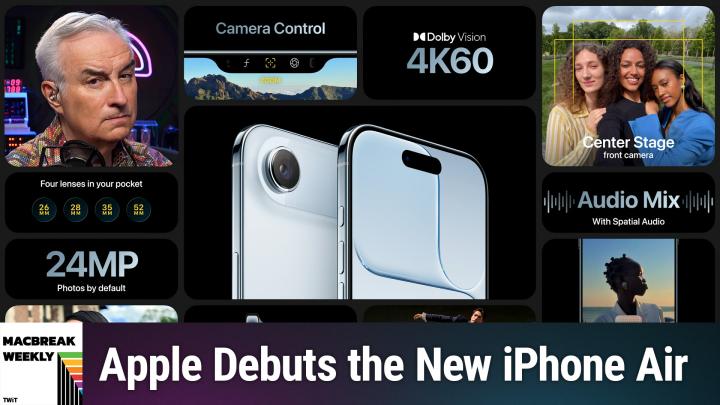
This is twit. This is MacBreak Weekly, episode 980 recorded Tuesday, September 9, 2025. Orange is the New Black. It's time for MacBreak Weekly, the post Apple jaw dropping event episode. Jason Snell is in Cupertino. So Mikah Sargent has agreed to stick around after our coverage of the Apple event in the club. Hi, Mikah.
Mikah Sargent [00:00:53]:
Hello, Leo.
Leo Laporte [00:00:54]:
Good to see you. And your mustache, I think. Is this a debut of your mustache on the on Mac break?
Mikah Sargent [00:01:00]:
I believe so.
Leo Laporte [00:01:01]:
So I should explain to. It looks like Tom Selleck has joined us. I know it's confusing, but it's not good to see you. Mikah, of course, host of Hands On Tech and Tech News Weekly and iOS Today. IOS Today.
Mikah Sargent [00:01:15]:
Hands on Apple.
Leo Laporte [00:01:16]:
Hands On Apple. I try to do it all regular. Just a regular guy. Also here from the library, Andy Ihnatko. Hello, Andrew.
Andy Ihnatko [00:01:25]:
Hey there, Heather. Oh, there.
Leo Laporte [00:01:26]:
Did you watch the event?
Andy Ihnatko [00:01:27]:
Yes, I did. I was very excited to watch a pre recorded thing from start to finish.
Leo Laporte [00:01:34]:
Good. All right, we'll talk about the announcements. Yeah. And then also Alex Lindsay, I know he watched in Office Hours that I.
Alex Lindsay [00:01:42]:
Got pulled into a, I got pulled into a work meeting. So I, oh no. I have seen highlights of it, but I haven't seen, I didn't get to.
Andy Ihnatko [00:01:48]:
See the whole thing.
Alex Lindsay [00:01:48]:
Oh, good.
Leo Laporte [00:01:48]:
So you, you let us explain what happened. I was going to ask you because.
Alex Lindsay [00:01:53]:
There'S a couple things I know, but.
Leo Laporte [00:01:54]:
For one thing, this was in an hour and 11 minutes, which is an odd length.
Alex Lindsay [00:02:00]:
Yeah. That usually means that they really felt like everything was necessary. That's my guess because normally you try to go down to an hour. If you were an hour, up to an hour and a half, well, you wouldn't want to. I think that one of the things, the great things about it being pre recorded is, is that there's no reason to go up like you're not going to add unless you really feel like if you get an odd number because we've had a couple of these keynotes come back at 59 minutes or 60 minutes and you know that they just went, okay, that's the, that's the target here. They obviously cut it down. I obviously I think they cut it down. And then I said, well, we got to put this in.
Alex Lindsay [00:02:33]:
Like this is worth it. And probably people fought for it, but I'm glad that it didn't go to the. Some of them were starting to get kind of long and so it feels like they were. They were efficient.
Andy Ihnatko [00:02:42]:
Yeah. I thought that this was the longest. The longest buy. Longest pre canned video for their concept of buy an Apple watch because otherwise you and your loved ones will all die horribly. It was. It was a long. That was a long stretch for that video. It seemed to go on kind of forever.
Leo Laporte [00:03:01]:
It seemed like. Yeah, I feel like. Okay, so what we've often looked for in these, and thanks to you, Alex, is an inopportune edit. And there was this moment at the very end when we went from the iPhone pros and we went to a long. Well, it didn't show up here, but a long fade to black. Like longer than it felt like it needed to be. And Tim. And I was thinking, is that an edit point? And I thought maybe this is a longer show that they didn't.
Andy Ihnatko [00:03:31]:
I don't know.
Alex Lindsay [00:03:32]:
It's unlikely. I mean, a lot of the stuff gets.
Leo Laporte [00:03:36]:
So an hour and 11 is exactly how long it needed to be. No more, no less.
Alex Lindsay [00:03:39]:
Yeah, I think so.
Leo Laporte [00:03:40]:
Okay. I don't know enough conspiracy theory.
Andy Ihnatko [00:03:44]:
I feel as though they know that they've got the audience that are tuning in for this and there is lots of space they could cut all the drone helicopter shots of every time they switch to a new topic. Let's take a helicopter from Marin to Miami to talk.
Alex Lindsay [00:04:00]:
I think that's actually the most important part of the whole thing.
Andy Ihnatko [00:04:03]:
Yeah. Again, it's. It's something that could cut. I don't know. I.
Leo Laporte [00:04:06]:
Well, don't misunderstand me. I'm not saying it was long. I'm saying. Yeah, that maybe it was short, that they had a five minute thing they.
Andy Ihnatko [00:04:13]:
Cut out, but maybe not like.
Leo Laporte [00:04:15]:
Like they're not trying to hit a number is what I was saying.
Andy Ihnatko [00:04:18]:
Okay.
Alex Lindsay [00:04:18]:
I don't.
Andy Ihnatko [00:04:19]:
Maybe there was something that up until two weeks ago they. That was in there that they took out.
Leo Laporte [00:04:23]:
Yeah, we've seen that in the past.
Alex Lindsay [00:04:24]:
And so I just was like that might have happened. I don't think there's anything that. I think they would have tidied it up to where they. It was what they meant.
Leo Laporte [00:04:32]:
Right.
Alex Lindsay [00:04:32]:
But I think that the. But I.
Leo Laporte [00:04:35]:
It was like. No, it was.
Alex Lindsay [00:04:36]:
It was common for all keynotes to cut things out, you know, like you have. Because you don't know what you're going to do even in a pre record. It's even worse because you're oftentimes recording these pretty far in advance. But I worked on keynotes where things were in the keynote until the day before and they were like, you know, this isn't quite ready yet. Let's just pull this out. You know, like.
Leo Laporte [00:04:55]:
So what we saw was new AirPods, AirPod Pros didn't even mention the AirPods just to updated. So we saw a new Apple Watch 11, Apple Watch SE, and Apple Watch Ultra 3. We saw the iPhone Air. We now know it is the air, not the iPhone 17 slim, it's the iPhone Air. And we saw the three versions of the iPhone 17, the 17, the 17 Pro and 17 Pro Max. What? We did not see a lot of conversation about Apple Intelligence. We did not. We saw very little conversation about Liquid Glass.
Leo Laporte [00:05:30]:
We saw very little conversation about 26. For any of the things.
Andy Ihnatko [00:05:35]:
I will say that I was a little bit surprised they didn't mention. They gave iOS 26 a little and Liquid Glass a little bit of a tickle. But chiefly because when they were talking about new watch faces on the Apple Watch, but I thought that they handled Apple Intelligence in a very, very smart, strategic way. It is a little bit of spice that they've just dipped into through the throat. They didn't have a moment saying, and because of the breakthrough product Apple Intelligence, which will transform the entire product line, they were talking, they were talking about all the CPUs, the A19 pros and stuff saying, well, here's the new GPUs we've got and here's how, here's how it affects AI performance. They mentioned Apple Intelligence where it was appropriate to basically remind people that, yes, we are not stupid. We do understand that AI is a thing. We don't necessarily have something to put on a huge pedestal right now, now, but we are at least going to remind you that Apple Intelligence is something that is still going to be part of.
Leo Laporte [00:06:31]:
What they didn't mention is Siri. Oh, yeah, they didn't say the S word.
Andy Ihnatko [00:06:35]:
Well, they're not, they're not, they're not suicidal. No.
Leo Laporte [00:06:38]:
At all. So I thought, you know, it's interesting. I mean, look, they stuck to the script. There were no surprises. Right? We, everything that we saw was exactly what Mark Gurman and Ming Chi Kuo and John Prosser said we were gonna see.
Andy Ihnatko [00:06:55]:
Yeah.
Leo Laporte [00:06:56]:
No. No surprises. All right.
Andy Ihnatko [00:06:58]:
Yeah, it was good.
Leo Laporte [00:06:59]:
Then let's, let's go through the feature quilts in that case. Okay. The one thing I thought was interesting is that Tim Cook started and ended.
Andy Ihnatko [00:07:06]:
Yeah.
Leo Laporte [00:07:07]:
With a tribute to design. Yeah.
Andy Ihnatko [00:07:10]:
I thought that was an opening with a title card that had Steve Jobs like, oh, design is not about what. It's not just how it looks. It's about how something, how something actually works. I thought that that was another really, really smart diplomatic part of the messaging too. Because at, at this point, there's not going to be a revolutionary new phone. Although the air was okay, very, very different. It's all going to be. All this.
Andy Ihnatko [00:07:34]:
Everything that they talk about is going through. This whole episode today was going to be about the engineering and the design that they put into these things. Not just how something looks, but also here is how we got the battery life even longer. Here's how we made sure that we got heat management going in here. So I thought that that was playing to their strengths. Again, if they. You're right. If Apple Intelligence and Apple Intelligence features, number one, it's an OS feature.
Andy Ihnatko [00:07:56]:
So it doesn't really belong in a hardware thing. But that would have been super, super weak sauce. But by saying that, yes, we've got some phones that are built on the outside, on the inside, extremely well. Design is one of the core things you get when you pay, whatever it is, you pay extra to get an Apple product and we will deliver on that thing that you try to get for design. So I thought that was very, very smart.
Leo Laporte [00:08:17]:
Yeah. Although I thought, well, that means we're going to hear a lot about Liquid Glass, which is the chief new design element here. A whole lot about it is odd, right?
Mikah Sargent [00:08:26]:
I mean, WWDC had a lot of coverage of it, but as we were leading up to the event today, Leo, you would ask me what are you most looking forward to, given that it seems like we know a lot of what's happening. And I said one thing that I always enjoy is seeing what, what software feature or sort of somewhere in between hardware, software feature. Did Apple hold back wwdc? That's going to be exclusive to one of these phones because we've seen that in the past with Dynamic island. That was sort of software and you know, many a feature where the new Pro is the thing that has it. And yeah, there wasn't as much of that this time. And I'm surprised to not see more of Apple preparing its users for this huge design change. And that makes me wonder what's happening there.
Alex Lindsay [00:09:21]:
I think there's been some controversy over the interface and I feel like them digging into that. I can Definitely see them wanting to keep the presentation streamlined. They're making a big change. They had two ways to go to either sell it hard or just let it roll out, have people get used to it. And I think they chose to. Hey, let's keep our elbows in. I think that that's the. I actually like the design changes, but I think that there's a lot of folks that have.
Alex Lindsay [00:09:47]:
There's been a lot of friction. So I think that's one of the.
Leo Laporte [00:09:50]:
I mean, they did say something like, oh, look how beautiful it is, right?
Mikah Sargent [00:09:54]:
Yeah. But it was, as Andy pointed out, almost exclusive to when they were talking about the Apple Watch, which I thought was odd. There was so much focus on the hardware side of iPhone. And at the same time, that makes sense, given the new air. They only had so much time to fill the air with the iPhone, and so you didn't get as much of an opportunity to say, look how this all kind of works together. And I guess that's kind of what the beginning was. We design all of this stuff to work so well together. Now let's quit talking about it because we've got a lot of hardware we need to mention.
Andy Ihnatko [00:10:25]:
It almost seemed like maybe they were also thinking that you don't want to scare people off by saying, oh, and by the way, when we release this new thing next week, your phone will look and act way different than what you've been used to for the past five years. So I could see how you can do that, too.
Leo Laporte [00:10:40]:
Don't really want to do that, do you? All right, well, let's start with where they started with the AirPods Pro. Yes. As expected, the heart rate sensor, which was in, as you know, was in the Powerbeats Pro, did show up in the iPod AirPods Pro. They also increased the battery life. They say better active noise cancellation, thanks to the new H3 processor. And you made a big point, I guess. Your ear size is tough to fit, Mikah, because they have five tips now, five options.
Mikah Sargent [00:11:15]:
Yeah.
Leo Laporte [00:11:16]:
And they're definitely even made a big deal about their better fitting. Right.
Mikah Sargent [00:11:19]:
Yeah. Even the design itself is slightly redesigned. Not just the ear tip, but they talked about how the stem and yes, the actual part that goes in your ear, it's all a little bit more streamlined to try to fit more ears, which I think is fantastic. I will say I practically live in my AirPods Pro, and so I think.
Leo Laporte [00:11:39]:
A lot of people do.
Mikah Sargent [00:11:40]:
Yeah. Any improvements here, I think are great. I fall asleep wearing one because I'm a side sleeper and I listen to audiobooks as I fall asleep and so have already pre ordered the new Air even though I have the two, I've already pre ordered the three because I just I always want the newer, better version of AirPods Pro for myself.
Leo Laporte [00:12:01]:
Because you live in them, I live.
Mikah Sargent [00:12:02]:
In them, so I might as well. You know, if you're going to go to town, you might as well go to Lincoln.
Leo Laporte [00:12:06]:
Who should buy these new ones? If you have I have a type C AirPod Pro 2. Should I buy this again?
Mikah Sargent [00:12:14]:
If you live in them and you feel like they're even the slightest bit uncomfortable, then that might be a reason to have Also better battery life with the active noise cancellation if you use that regularly, if those kinds of things are important to you, then perhaps but you pointed to a person who might be on AirPods Pro 2 and want to upgrade and that is folks who are on the AirPods Pro 2 that have the lightning case because a you'll get USB C you'll get the wireless charging but on top of that it also means that your AirPods Pro battery is getting long in the tooth and so getting a new battery is going to be helpful in general and then anything before the AirPods Pro 2 I think you'll probably be happy with it. The active noise cancellation on these very small things you stick in your ear is already really good. At least that's been my experience and they say two times better than the Pro 2, of course four times better than the Pro 1 so that improvement will be something that you can look forward to as well. I will be honest, the heart rate stuff does not that's not what draws me in. It is the better fit and shape and the better noise cancellation that are what matter to me.
Andy Ihnatko [00:13:33]:
I thought I actually made a note here that they used a phrase I don't I can't remember them using previously which they called it. I think if this is a quote that's accurate. They call the AirPods Pro 3amust have upgrade which is unusual because the usual usually they'll say oh it's two times better than this. The battery life is better than this. Now you can now it's a full on fitness device without even having an Apple watch or an iPhone in your pocket. I've yet I can't remember the last time that Apple has said oh well this is if you're if you have an existing pair of AirPods Bro, you're going to definitely want to upgrade right now. Which seems like more of a hard sell than I'm used to seeing in an Apple keynote event.
Mikah Sargent [00:14:07]:
Interesting.
Leo Laporte [00:14:08]:
Yeah.
Alex Lindsay [00:14:08]:
Yeah. And I think that for me, I have the USB C AirPod 2 Pro. Better fit, I think is interesting to me because I've had the same problem between. I'm halfway between medium and large and I just can't quite get the right one to work.
Leo Laporte [00:14:22]:
I was surprised a lot of people in our broadcast said they had custom like third party. Yeah, you have third party tips, right, Mikah?
Mikah Sargent [00:14:29]:
Yeah, I do. I've. I've actually used a few. Comply makes a really good pair. I know that the wonderful John Selenina is a big fan of those, but I recently switched to a pair called Spin Fit. And it's interesting because the. They have this sort of tip that has a gel pad in between the tip and where it connects and so it moves kind of at a 3, 360. And so when they're in, I would have an issue sometimes where the AirPod itself would kind of jostle back and forth and make a, make a sound.
Mikah Sargent [00:15:02]:
And so I've found these Spin Fits to be good. But now that the AirPods Pro have gotten that foam added to them, I do think that's going to cut back on my specific issue, which was the jostling that would take place. That foam should help to kind of deaden that jostle. Deaden the jostle, Ben.
Leo Laporte [00:15:20]:
The jostle.
Mikah Sargent [00:15:21]:
I don't know what it is.
Leo Laporte [00:15:22]:
I think that's what Captain Bly shouted in the Mutiny on the back on the floor deck there, look Hardy. Okay, so we'll deaden the jostle. We'll get better. There's other features that they showed and I don't know when they're going to be available, chiefly the live translation. Now, remember, Google showed this at their Pixel 10 announcement. In fact, they showed simultaneous translation and it changed the voice to sound like your voice. Apple's not doing that. But what they are doing is if the other person has AirPods and they didn't specify they have to be AirPods Pro 3 or 2, I don't know, then you can have a conversation back and forth, kind of like the Babel fish, which is very cool.
Andy Ihnatko [00:16:10]:
Yeah, we'll see how well it works. I was also pleased to see that a lot of the stuff is rolling out in multiple, multiple markets, not just, oh, if you're in the United States and you want to speak French or Spanish, we gotcha. But it seems like this is, this is, this is actually a deal. The if you don't have one, then you can simply hold up, basically hold up your phone so the other person can see it and then what you say will be translated into their language natively. Again, a lot of really smart people are going to spend the next three or four weeks after this is releasing exactly how well it works and how it's effective. It's going to be. This is one of those areas where as much as we made fun of the Jimmy Fallon Pixel event, doing that stuff as a live demonstration, where you see. No, there didn't seem to be much of a delay.
Andy Ihnatko [00:16:58]:
No, that voice actually sounded really good. No, the Spanish speaker was speaking in a very, very natural cadence for her. It wasn't as though she was speaking to someone who doesn't speak the language very, very well. And it all seemed to work with the. When you're doing a canned presentation, such a choreographed one we basically have. It's one of those many things in which by nature you have to be. That will be very trust but verify this will be interesting if it is true. And we're going to have to spend the next month of people trying this out and see exactly how useful it is with Apple product.
Andy Ihnatko [00:17:33]:
I mean as I was joking before the show that about a certain feature. Oh well, it's not a Samsung product. It's probably working as a real thing. Apple tends not to ship something unless it's actually. Unless it's A finished or B not an artificial intelligence product. But we're gonna have to see how well that works. But it was a good demo.
Leo Laporte [00:17:51]:
Yeah.
Mikah Sargent [00:17:52]:
Apple says live translation with AirPods is it works on AirPods 4 with active noise cancellation. So that's great. And then AirPods Pro 2 and later with firmware.
Leo Laporte [00:18:03]:
So if that's a feature you want, you don't need to get the new.
Mikah Sargent [00:18:05]:
You don't need to get the newest.
Leo Laporte [00:18:06]:
Ones for that heart rate sensor. You do. Yes, that's something because it's a new sensor that's built in to the AirPods Pro. That'll be nice for working out. In fact, they kind of emphasized now you don't have to wear your watch when you go running, but you still have to carry your phone. So I'm not sure what you have gained.
Alex Lindsay [00:18:24]:
I just can't think. I mean the only time I don't have my phone and my watch are when I'm swimming and I usually have my watch, you know. And so it's, you know, I think that that's good for the folks who have AirPods I guess that don't have an iPhone or not have a watch. I bet you there's Not a ton of people with AirPods with no watch. Like I just don't think, I mean there could be.
Leo Laporte [00:18:42]:
I don't know.
Alex Lindsay [00:18:42]:
They know better than they do.
Mikah Sargent [00:18:44]:
What would you be listening to if you didn't have your air. If you didn't have your watch or your phone with you though?
Leo Laporte [00:18:51]:
Nothing. You have to have your.
Alex Lindsay [00:18:53]:
I think nature.
Leo Laporte [00:18:54]:
Nature, nature, nature would want nicely muted in surround sound.
Alex Lindsay [00:18:59]:
You would listen to nature in surround.
Leo Laporte [00:19:02]:
Hearing aid feature still there. Hearing test still there. They did say improved sound quality. I don't know. This is one of those things where it's right on the cusp of whether you'd want a new I think that.
Alex Lindsay [00:19:13]:
If you had an older version 2 or you had the version 1, this is one of those skip overs that you're gonna. If you have an older one, this is the. It's a good one to upgrade to if you have the newest one. Maybe not. I mean, I mean I'm gonna probably go slow on, on this one.
Leo Laporte [00:19:29]:
Yeah. All right, let's take a break then we will talk about the new watches and of course the new phones. You're watching Mac Break weekly. Our post Apple summary were we. Did we get put in the reality distortion field or not?
Andy Ihnatko [00:19:44]:
I don't think so. There wasn't a whole lot apart from the hey, this is a must have upgrade. I think that they were very par for the course for Apple where here's some data, here's some information. We're going to say this is two times, this is three times, this is 40% greater. They didn't have a lot of. I don't think they had any apart from saying that this is the best, the best earbuds like you can buy anywhere. I don't think they did any comparisons to like non iPhone models. So they were pretty much straight for the course.
Leo Laporte [00:20:12]:
Yeah, they did make a comparison between the new A19 Pro processor and last year's which shocked me. We'll get to that in just a little bit. Andy Ihnatko, Alex Lindsey and Mikah Sargent filling in for Jason Snell. We are talking awe dropping but not reality displacing. That's the key. That's the key. Our show today brought to you by Starlight Hyperlift. Actually this is a product from Spaceship.
Leo Laporte [00:20:39]:
We've talked about Spaceship before. I love Spaceship. This is their new cloud deployment platform for launching containerized apps with zero infrastructure headaches. You've probably seen all these great containerized Docker apps that you can easily install but maybe you didn't want to. I Don't know, put it on your own machine. Well, now you can go from code to cloud fast with GitHub based deployments, real time logs and I love this pay as you go pricing. No servers, no YAML files, no DevOps, just your project in the cloud in seconds. We've talked about Spaceship for a while now.
Leo Laporte [00:21:18]:
They are amazing. A domain and web platform that is very modern. They have totally simplified choosing, purchasing and managing domain names and web products. That includes hosting. And now with Hyperlift, Spaceship takes that same philosophy and brings it to cloud native deployment. This is for devs or people like me, kind of indie hackers who want to try stuff out. Innovators who need to test fast, put that MVP up and running, iterate faster and ship Smarter. Go to spaceship.com/twit to find more information about Starlight Hyperlift and get custom deals on spaceship products.
Leo Laporte [00:22:00]:
That's spaceship.com/twit. These guys are innovating so fast, so impressed. And by the way, below market domain registration prices too that are just incredible. I love it. Spaceship, take a look at Hyperlift. Starlight Hyperlift powered by Spaceship. Sounds modern, doesn't it? I think it is. All right, let's move on to the watch. They actually updated all three models of the of the Apple Watch including the SE which I don't know.
Leo Laporte [00:22:36]:
Were we expecting an SE update? I might not have been.
Andy Ihnatko [00:22:39]:
I don't know. It's a big one. The fact that you can now have the always on display and I think that I think use of gestures is.
Mikah Sargent [00:22:46]:
Also new for the SE is new and that I think is important because. Especially because while I think that feature is very handy and I did not mean the pun there it is something that I haven't seen a whole lot of people use and I think part of that is because we haven't seen it brought to the whole lineup where it becomes a little bit more, more useful and more sort of available in my, my knowledge where I go, oh right. I don't have to actually put the thing down in my right hand to stop the timer. I can just do a little pinch and then it's going to stop. I think it's a very clever feature but I always forget it's there. So in a way I'm glad to see it come to more because it means I'm more likely to see other people doing it and go right, that's a feature that they added that's very clever and will work. And yeah, having. I think it gets a little bit muddier now between Which Apple Watch you're.
Leo Laporte [00:23:38]:
Going to choose somebody that I can't figure out. Which feature quilt is the SE and which feature quilt is the new 11. I don't, I can't tell.
Mikah Sargent [00:23:47]:
It's the series 11, the one that you're just on.
Leo Laporte [00:23:50]:
So this was the 11, that's the 11 and this must be the se then.
Mikah Sargent [00:23:53]:
Yeah, that's the se.
Leo Laporte [00:23:54]:
Okay, thank you. I don't know how you could tell, but that's the point. They're very similar.
Mikah Sargent [00:23:59]:
They're very similar. The difference I think big difference you're going to see is that display. Right. So the display on the series or excuse me, there I go on. The sequence is not as big and nice as the series 11 and it doesn't have that thinner bezel that you get or actually thinner case I should say that you get from the Series.
Leo Laporte [00:24:20]:
11, but you get what is 100 bucks less.
Mikah Sargent [00:24:23]:
Yes, exactly.
Andy Ihnatko [00:24:25]:
And on top of that, wrist temperature sensing, sleep apnea and the new sleep score feature, which I'm sure we'll talk about when we talk about the main phone, a speaker which. Okay, that's nice but you got it fast charging, which, which they didn't have before. It really seems like more of a. Less of a. We've designed a lesser version of the Apple Watch for budget users and more of a We're going to try to get like the great, the greatness that we had a couple of generations ago and figure out a way to sell it for 250 bucks.
Mikah Sargent [00:24:53]:
Yeah, Apple wants everyone to have an Apple Watch. I mean, and now it's not just the current administration who wants everyone to have a wearable.
Leo Laporte [00:25:02]:
This makes sense. You know, get them started with the lowest price product and you'll have them probably for life. I mean once you.
Andy Ihnatko [00:25:10]:
Well also there's so much competition in this space. If they didn't have like what they could term a budget oriented version, they're not going to get, they're not going to have a great amount of success. It's just with people who can afford to spend $350 to $700 on a watch because there are actually some great ones. Xiaomi makes some really nice ones that only cost $80 or $90. Fitbit also makes some nice ones that sell that sold for less than 150 bucks and they don't do nearly as much. But not everybody wants to have, wants to be able to have 5G satellite connectivity from a watch. They just want heart rate steps, notifications, simple apps and the ability to have the really cool Snoopy watch face on.
Alex Lindsay [00:25:49]:
It and going down market is pretty, pretty predictable from Apple. Like just trying to find cheaper ways to do it. If they can find ways to get it down. I bet you in a year or two if they could find a way to get to 150 or 200, they would, you know, they want to get down there and make sure that there's not a lot of room for, you know, if, if someone's selling something down there, they want to make sure that the margin is very small. So.
Leo Laporte [00:26:12]:
So good. All 5G modems now and all three.
Mikah Sargent [00:26:17]:
Watches which Apple says is battery efficient.
Leo Laporte [00:26:20]:
Yeah, yeah, you don't need this. I mean you don't really need the speed, but it is battery efficient. They did have a. I, you know, maybe you thought it was a little long, Andy, but I really thought it was very impressive. The life saving features. The guy who had a stroke and then, you know, he was, he didn't know what was going on. But the watch said you, you, you should I call 91 1. And they did.
Leo Laporte [00:26:43]:
And I mean if you have a stroke, the sooner you get to the hospital, the sooner you get treatment, the better your prospects. And he seemed like he'd fully recovered, so that's pretty impressive.
Andy Ihnatko [00:26:53]:
I also like that they had a story from a kid who was such a. It was hard to figure out from the, from the video, but there was a mention of mental health has helped my mental health so much.
Leo Laporte [00:27:02]:
Yeah, exactly.
Andy Ihnatko [00:27:04]:
Again, these are very, very useful things. I'm just, it just seemed like a lot.
Leo Laporte [00:27:07]:
You're a cynic. You're just a cynical son of a.
Alex Lindsay [00:27:10]:
You're trying to explain that as more than a watch.
Andy Ihnatko [00:27:12]:
I'm also, I'm also saying that, yeah, we don't want to save the lives of Android users.
Leo Laporte [00:27:18]:
Android users, no, you guys could suck. Suck. But if you're an Apple watch. YZF donor says. I don't know if he's being sarcastic. I cried three times. It was, I might, my lip might have been trembling. It was very.
Leo Laporte [00:27:31]:
I thought it was.
Mikah Sargent [00:27:32]:
I think that's the point Andy's kind of making. Right?
Andy Ihnatko [00:27:35]:
I'm not making, I'm not making fun of it. I'm just saying it was gratuitous. It was, it was like those of us who are old enough to remember like the Jerry Lewis telethon. It's like there's a video about like the medical stuff they're doing which is that, wow, you are really. It's, I don't know, it's, it Seems, it's.
Leo Laporte [00:27:51]:
It seems ratiating a little bit like they're trying too hard to.
Andy Ihnatko [00:27:56]:
I thought I. I thought that it was. I thought it was just too much of a serving of that topic.
Leo Laporte [00:28:02]:
That's all I said.
Andy Ihnatko [00:28:04]:
Especially because it's not as though this was.
Mikah Sargent [00:28:06]:
I always get too much cranberry sauce and I never eat all of it.
Andy Ihnatko [00:28:09]:
It's, you know, my eyes are bigger than my head. I always get too much stroke prevention and I don't have to just throw a quarter of that. I mean, that was a compelling story, particularly because this is the sort of thing that it was specifically the sort of story that gets people to buy a device like this. It was because I guess he had a ring video from his ring doorbell or whatever. He was just in his driveway, saw him fall, preparing to act, to work out. He dropped, didn't know what was going on. And this phone gave him that interaction. And it is very, very true that a stroke is like, you can either be 100% recovery if you are attended to almost immediately, or for every five or 10 minutes.
Andy Ihnatko [00:28:46]:
That's another part of you that's going to take another six months to a year of rehab or you will never get it back. So that's what he was a very, very happy fella and for many good reasons why.
Alex Lindsay [00:28:55]:
And I know people who are buying their parents and I did, you know.
Leo Laporte [00:28:58]:
I bought my mom a watch in her 90s because I was. She was falling and I was worried about it and she wears it. I said, mom just wear this all the time. And I was really glad she did. And she still wears it even though she's now in a nursing facility where she probably somebody would come pretty quickly, but still. She also, by the way, can't figure out how to make phone calls with her phone, but apparently can with her watch.
Alex Lindsay [00:29:22]:
I'm surprised with the watch in general is how good the audio quality is. You know, I'll answer the phone.
Leo Laporte [00:29:28]:
Oh, yeah.
Alex Lindsay [00:29:28]:
And Carlita is always surprised that I'm on the. So I'm like, I'm on the watch. And she's like, really?
Leo Laporte [00:29:33]:
It's like when they first got cell phones and phones and airplanes. You won't believe where I'm calling from.
Alex Lindsay [00:29:39]:
Yeah, exactly.
Leo Laporte [00:29:39]:
I'm in the airplane, I'm on my watch. It's very Dick Tracy. It's nice.
Alex Lindsay [00:29:45]:
I like, I have so many Apple devices, though. I just never know what's going to happen. Like, you know, like, yeah.
Andy Ihnatko [00:29:54]:
If I.
Alex Lindsay [00:29:54]:
Walk around, I don't know if it's Going to go somewhere else or do something else.
Mikah Sargent [00:29:58]:
That home pod suddenly talking, I'm like, yeah, exactly.
Andy Ihnatko [00:30:02]:
Getting back to health. It's like, this is also. You're also hoping that, okay, I'm going to give you a few hundred bucks. I'm also going to to put myself to the trouble of having to charge this damn thing each and every night and not forget and get in the habit of wearing this watch every day instead of a variety of watches, which is what I might be used to. Like the new. There were some rumors of high blood pressure detection and it happened pretty much the way that we figured that was going to happen, which is that, no, it's not going to read you your blood pressure. Over the course of a month it can get some. It can accumulate enough data to say that perhaps you have hypertension.
Andy Ihnatko [00:30:34]:
Give you a hypertension alert alert of high chronic high blood pressure. Again, it's over a 30 day period. They saying they don't have FDA clearance yet. They expect to have it in 150 countries this month. So they're pretty much sure that that $600 billion is going to deliver once again. But they saying we expect to diagnose 1 million people in the first year.
Mikah Sargent [00:30:55]:
That number that they put out.
Andy Ihnatko [00:30:57]:
And I'm just saying that this is. If you're trying to sell somebody a fitness watch, that's what they're hoping to get out of it. That, gosh, I had no idea that I was basically having a heart attack each and every night until my watch after three months, three weeks, saying, okay, you definitely want to talk to your doctor about this. Here's some data that we're kind of alarmed by. We're not going to diagnose something, but hey, this is going to be worth the copay to have yourself checked out for this. That's the fantasy of saying, I know there must be something wrong with me. I'm hoping that I can figure out what it is before there are actual symptoms of it in three or four years from now.
Leo Laporte [00:31:34]:
Steve Gibson, who in his earlier life apparently did some blood pressure coding and hardware building says very difficult to take spot check blood pressure, these sphygmomometers that squeeze you and so forth. It's a complicated thing. And he said it's very unlikely you'd ever get a watch to be able to do that. You've got to do that squeezing that the sphygmoma does. But this is a very interesting way of adding that capability. And remember that hypertension is a silent killer, people. It's not Symptomatic people who have high blood pressure will go years not knowing it unless they check. And most people don't have.
Leo Laporte [00:32:18]:
I have a blood pressure cuff I wear all the time. Not wear all the time, I use all the time.
Mikah Sargent [00:32:22]:
It's on you right now.
Leo Laporte [00:32:23]:
You've probably seen me wearing it around. It's a little weird looking but. But no and it's important and I'm on medication for hypertension which has brought it down to normal. I love by the way that my watch also shows my blood sugar. Cause I'm wearing that Dexcom Stelo and I see that my blood Sugar is at 80 which means I'm faint headed right now.
Mikah Sargent [00:32:42]:
It's gone down from earlier. It was 96.
Leo Laporte [00:32:44]:
I don't know why it's going down but anyway been working out and that's a complication on my watch too. The other thing I love on the watch is when it says it's 90dB and it has been for 10 minutes. You should wear hearing protection.
Mikah Sargent [00:32:57]:
Yes.
Alex Lindsay [00:32:57]:
I think the features are really valuable in general. I think that you know, Tim Cook said quite some time ago that they think that Apple will impact health more than any. You know, that's what their products. I mean I think that's definitely a focus for him and I think he's right. I mean I know that for me I thought that the closing the rings was a silly thing but I pay attention to my steps and my ring.
Leo Laporte [00:33:17]:
I do too. I do too.
Alex Lindsay [00:33:19]:
It's kind of like this constant little like thing that I'm working through and I'm, you know, I use it for when I'm doing laps in my pocket pool and I use it for, you know, there's so many things and I, I would say that other than a timer, the number one use for my phone or my watch is, is all the health things, you know, tracking all of those, all those bits and pieces. So, so it, I think it does make sense that they have focused on it now that the, the ultra can do second hands. I'm pretty.
Leo Laporte [00:33:45]:
I thought, you know, when I saw that I thought Alex is gonna be happy. Even in the.
Alex Lindsay [00:33:49]:
I got like six tactics texts like, like six different people texted me like you know and, and just said, just said second hands.
Leo Laporte [00:33:56]:
Just so people understand. Of course it is secondhands when it's active but when it's in the always on sleep mode those seconds go away. Except they won't anymore.
Alex Lindsay [00:34:05]:
Yeah.
Leo Laporte [00:34:06]:
And they say without draining battery.
Alex Lindsay [00:34:07]:
We'll see when you're doing production, you want it, you're trying to get things to a certain time and you don't want it to keep on disappearing. You don't want to keep moving your watch together. You want to look down at it.
Leo Laporte [00:34:16]:
And just say, just, just, just keep.
Alex Lindsay [00:34:18]:
Doing the seconds, you know.
Leo Laporte [00:34:19]:
So, yeah, the Ultra 3 is available for order now and will come as with will, all the other things we've talked about so far on Friday the 19th. Personal beast they call it on the webpage, which is great satellite communications, which is going to be useful if you hike or you go out and Free for the first two years, which I thought was really interesting, much like the phone.
Mikah Sargent [00:34:46]:
But yeah, Apple has been saying free for the first two years for different devices for what feels like longer than two years at this point. So it almost feels like they keep putting, I should say.
Leo Laporte [00:34:57]:
Well, I know T Mobile now charges me for satellite connectivity.
Mikah Sargent [00:35:00]:
Oh, interesting.
Leo Laporte [00:35:01]:
Yeah. Okay.
Mikah Sargent [00:35:02]:
I have not seen that yet on at&t.
Leo Laporte [00:35:04]:
Yeah, well, T Mobile is using Starlink, so that's probably why they're charging. I was able to, I wasn't sure if I would get this until I found out that I could get $335 on my last Ultra 2. Yeah. Which, you know, almost cuts the price in half. That makes it pretty attractive. Now my Ultra 2 is in perfect condition, but that's another testament to the, the quality of the screen and the quality of the titanium build and so forth.
Alex Lindsay [00:35:31]:
It is a crazy thing, though. We somehow got to a point where we're spending an awful lot on watches and then swapping them out. That's, that's years triumph.
Leo Laporte [00:35:40]:
Yeah, but Alex, I know people who spent $120,000 on a watch. Sure. They're going to be able to give it to their kids.
Alex Lindsay [00:35:48]:
I get it. I, I, I had a citizen that was like a 600 citizen or something like that. And I had that for a decade. Like, you know, it was, you know, and it, it did what I needed it to do.
Leo Laporte [00:35:57]:
And, but so like $450 for the new Ultra 2 because of the trade in.
Alex Lindsay [00:36:02]:
That's not, yeah.
Leo Laporte [00:36:03]:
Bad for two years. I think that's not bad.
Andy Ihnatko [00:36:06]:
As long as you love it. I mean there's a, I do love it. Garmin, Garmin released a new Fenix that they tried, they tried to scoop Apple by saying, oh well, we've got satellite connectivity. We announced it before you did, so. Yeah. But yours, your watch is what, $2,000?
Leo Laporte [00:36:19]:
Yeah, well, that's the other end. We talked about the low end, but there is the other End. And the serious runners, the serious athletes often do buy Garmin and other, other models. Apple's saying the best GPS in a sport watch on their website so they know where their competition is for ultra athletes.
Alex Lindsay [00:36:40]:
Yeah. And the hard part is if you're Garmin, I mean at some point you just, there's this massive company with a lot of resources that are gunning for you. It's gotta be a, you know, you can stay there for a little while, but if Apple keeps just slowly iterating towards you, it seems like a hard place to be.
Andy Ihnatko [00:36:55]:
Yeah, well, I don't know. The thing is like people when I every time I have friends who marathon and when I see like video of all the pictures of like the serial various.
Leo Laporte [00:37:04]:
They're all wearing cars.
Andy Ihnatko [00:37:06]:
Yeah, exactly. They're not that, that's not the, that's not the, the cultural choice for it. And also realize that the Apple decided to make the ultra in response to how much success that Garmin and other makers were having with these active with these like adventure watches. So I do I absolutely take your point, particularly because Apple can deliver a lot of things that Garmin can't deliver, which is, hey, if you got an iPhone, boy will this work really great with it. But I do believe that there's usually a difference between the originator of someone who a company that understood the market so well that they built the thing that everybody wanted to have versus the company that looked at the sales numbers that, ooh, we should build something like that. And this is one of those categories where Apple is just building something similar to the thing that lots of people have been buying before.
Alex Lindsay [00:37:53]:
It's just a question of can you hang on to the same size of the pyramid? Because you're at the top of the pyramid and you're the very tippy top. And what we see in a lot of other markets, whether it's avid or whether it's other specialty things, someone's got, they got that tip, they got the top of the pyramid, but that rest of that pyramid keeps moving up towards them and just chewing away and every little inch that the bottom of that pyramid gets chewed away is a lot of sales. And that's the hard part. And it doesn't have to be that it goes to zero. It just if it's 15, 20% in, it becomes problematic.
Leo Laporte [00:38:28]:
Apparently with the Apple Watch, they practically kill Swiss watch business, right?
Alex Lindsay [00:38:33]:
A lot of watch business.
Andy Ihnatko [00:38:34]:
Yeah, yeah, yeah. They took a lot of money away. But that's odd to me.
Leo Laporte [00:38:40]:
Well, I'm sure the, you know IWC $150,000 watch businesses haven't changed. But they only sold a few of those a year. Right. How many of those do they sell? But this. But swatch and people like that. The low end Swiss watches apparently just got decimated.
Andy Ihnatko [00:38:57]:
Well, it's a different market and to Alex's point, there are a lot of. You look at all the people who buy $20,000 Rolexes and wow. This is tested to 200 meters. And the choice of aviators and scuba divers. Yeah, these are just people hanging out at a bottle service bar. I think there are a lot of people who are buying the Ultra not because they want to. Oh, I need to something could be a dive watch. I need something that will.
Andy Ihnatko [00:39:25]:
When I'm. When I'm backpacking through the Himalayas it's like no, I want the big dial with a big like.
Alex Lindsay [00:39:32]:
I think I'm going to go hiking. I need to totally prop up.
Leo Laporte [00:39:34]:
That's just buying it. Not the marathoners.
Andy Ihnatko [00:39:37]:
Yeah. We were in.
Alex Lindsay [00:39:38]:
We were in cort of Madera and going to the jeep dealership and taking jeeps out and we said. I made the mistake of asking like so what's the number one person that buys jeeps here? And he's like Marin Moms.
Leo Laporte [00:39:49]:
Absolutely. No, like who do you think's driving all those big trucks? It's not lumberjacks.
Andy Ihnatko [00:39:55]:
Right.
Mikah Sargent [00:39:55]:
It's aspiring lumberjacks.
Alex Lindsay [00:39:58]:
It's an SUV without being an SUV. You know, it's.
Andy Ihnatko [00:40:01]:
It is here is. There is $5,000 cash, sir. If you can tell me with correctly within plus or minus five bales how many 50 pound sacks of peat moss your pickup truck at home you will have. I will give you this $5,000.
Leo Laporte [00:40:16]:
Battery life on the Ultra 3. Boy. They're claiming a lot. Up to 42 hours in normal use. But if you want to work out for 14 hours. Yeah, go ahead. GPS and heart rate readings. Fantastic.
Leo Laporte [00:40:28]:
Finally. I've been waiting for that.
Alex Lindsay [00:40:29]:
If you're doing ultramarathon, you're good but you're probably using a garment.
Leo Laporte [00:40:32]:
If you're using low power mode. 72 hours, 35 hours of outdoor workout with GPS and LTE in low power mode with fewer GPS and heart rate ratings. In other words, more than all day battery life. Although I don't know, I'm just used to charging it every night.
Mikah Sargent [00:40:48]:
I mean, yeah, I don't.
Leo Laporte [00:40:49]:
Apple wants you to wear it overnight too though. They want that sleep stuff, right?
Alex Lindsay [00:40:53]:
I have places to put my watch all the time. Both my phone and my watch have Mag saved somewhere, like everywhere I sit down or drive or whatever has some charger. So I have a tendency to just not think about battery life that much when I'm at home, at least.
Leo Laporte [00:41:08]:
By the way, find my. Also works with satellite, which is very cool. So if you're lost.
Andy Ihnatko [00:41:13]:
Yeah, absolutely. Well, that was another one of the. Getting back to the video. The most dramatic one was, oh, I was lost, young adventurer. I was lost. And I didn't have my iPhone. Didn't have anything like that. And boy, when I saw that helicopter from the sky, like some avenging angel to save my life.
Leo Laporte [00:41:31]:
I like the one where I crashed into a swimming pool.
Mikah Sargent [00:41:35]:
Yeah. My word.
Andy Ihnatko [00:41:36]:
Okay, first of all, I was drunk off my butt, man. I shouldn't have been driving. But how else am I gonna get the car home?
Leo Laporte [00:41:44]:
They had video of the car going off the road through the garage.
Andy Ihnatko [00:41:47]:
I'm not saying I'm sorry.
Mikah Sargent [00:41:49]:
And then later, clear. And he's doing it down in the swimming pool.
Andy Ihnatko [00:41:52]:
I'm sorry. I did not know he was much. I was. I was basically saying that they don't. They don't, they don't. When people email.
Leo Laporte [00:41:58]:
No one was drunk here.
Andy Ihnatko [00:41:59]:
First of all, I'm not going to stop drinking. You got to accept me for the faults and everything. But now because I have an Apple Watch, boy, I got pulled out of so many dishes, I was too drunk to even know my name, let alone where I was.
Leo Laporte [00:42:11]:
That's not what the guy on the video.
Andy Ihnatko [00:42:13]:
That's not what the guy.
Leo Laporte [00:42:14]:
This is Andy talking about himself, ladies and gentlemen.
Andy Ihnatko [00:42:19]:
I'm a journalist. I can't afford to own a car.
Leo Laporte [00:42:21]:
Come on.
Andy Ihnatko [00:42:22]:
Let alone afford a drink.
Leo Laporte [00:42:23]:
He walks to the library, everybody. Don't you forget it. I. You know, the Apple Watch every day. I was a little skeptical in the beginning, I have to say. I'm completely a convert. And it's been. As they've slowly added must have feature after must have feature.
Leo Laporte [00:42:38]:
I use it for working out. I use. And it's really, really useful on your wrist now in a way that a regular wristwatch just isn't.
Alex Lindsay [00:42:48]:
And I. And I really want the second hand, but I don't. I think I'm probably gonna still, like, I don't know if there's still enough in the new one, you know, as I have the ultra. I have the first ultra, which I spent a lot of money on. And I'm kind of like, well, I'm still waiting for glucose.
Leo Laporte [00:43:02]:
I'm not gonna get glucose. But you wear. You wear a cgm. Right. You just. I do. I do. Having that as a compl application.
Leo Laporte [00:43:08]:
Your watch is pretty close. It is.
Andy Ihnatko [00:43:10]:
I.
Alex Lindsay [00:43:11]:
If I could do it without the tag on the back of my arm.
Leo Laporte [00:43:13]:
I'm so used to it now, I don't even.
Alex Lindsay [00:43:15]:
Yeah.
Leo Laporte [00:43:16]:
Not even aware of it. Yeah.
Andy Ihnatko [00:43:18]:
I wonder. I wonder what company can do something to get after to win over people like me where. I appreciate that. Geez. It's. It. It only takes like a half hour to 45 minutes to charge it up for. For the entire day.
Andy Ihnatko [00:43:29]:
If you're wearing. Even if you're wearing it overnight, just pop it on the charger when you wake up, and then when you come back from breakfast and showering, it'll be ready for you for the rest of the day. It's just that I will do that. That for X number of days in a row. And then there'll be the day where I happen to. I was working at my desk. I took it off because it was bothering me to have this on my wrist and I left on the desk. And then because I needed to get somewhere in the morning, I kind of just.
Andy Ihnatko [00:43:50]:
Oh, I'll just. I'll just take my Casio with me. And then, like, it'll break the habit. And I just can't get that into part of my life. I. I wonder what company. This is one of the reasons why I'm looking forward to the pebble that I'm thinking that if. If you.
Andy Ihnatko [00:44:01]:
If it has to be charged every day, you're probably not going to get me. If I can. I think I can commit to once a week charging it. But it's interesting that there are people like me that just as much as I appreciate the technology, as much as I appreciate stroke prevention, fall prevention, accident prevention, it's just such a hard thing for me to commit to.
Leo Laporte [00:44:21]:
Yeah.
Mikah Sargent [00:44:21]:
I was going to say you're not. Of course, you know, you're not alone in that. But I do think that it's those of us who use it regularly and charge it all the time. It is hard to imagine. I. I was talking to someone just the other day and they were talking about how both they and their husband did not have any interest in the Apple Watch because of the charging in every day. And I was just like, every night I just put it on the charger and then everything's fine. And they're like, no, I just don't.
Mikah Sargent [00:44:48]:
I don't do that. I can't see myself doing that. I just don't. I don't think it's gonna happen. And then I'm just. And it just blew my mind because I think I put my phone and then I put my watch and then that's it. And then I wake up in the morning and I put on my watch and I grab my phone. I feel naked if I don't have my watch on.
Mikah Sargent [00:45:06]:
And so it's all very much just second nature for me. But if it isn't second nature for you, then, yeah, it's. It's hard to get into that groove. So I can understand that.
Leo Laporte [00:45:17]:
Every. Every morning as I get up and go out the door, it's spectacles, testicles, wallet and watch. It's just. Wait a minute. No, that's wrong.
Andy Ihnatko [00:45:25]:
You're basically. Basically said that's. That's. That's Catholicism you're referring to.
Leo Laporte [00:45:28]:
Yes, I'm sorry, that was the wrong kind of religion. That's when I go into church. Anyway, we just got a. Pushed a update to the public beta, which I suspect now we're at RC because. Did they mention. They didn't mention. In the event, I think we've seen some news sources say that 26 will come out on the 15th. Is that what you said? Somebody said something.
Mikah Sargent [00:45:49]:
What was it John Ashley?
Leo Laporte [00:45:51]:
Did John ashley say.
Mikah Sargent [00:45:52]:
Yeah.
Leo Laporte [00:45:52]:
No.
Mikah Sargent [00:45:53]:
9 to 5 Mac is reporting that Tahoe 26 will be launching on September.
Leo Laporte [00:45:58]:
15, which means they probably all launched the same day.
Alex Lindsay [00:46:00]:
Yeah.
Leo Laporte [00:46:01]:
So if you are on the public beta, you're going to be probably getting the release candidate and then you won't have to worry about it next week. One week off. All right, we're going to take another break and come back. And now, finally, after all of this, we've been teaching you how to defer your impulses. It's all about impulse control on this show. We will talk.
Andy Ihnatko [00:46:22]:
Congratulations. Your two marshmallows are coming right after the spot.
Leo Laporte [00:46:26]:
We'll talk about out the phones in just a bit. Watch your MacBreak Weekly. Mikah Sargent filling in for Jason Snell. It's great to have you. Always great to have you, Mikah. Appreciate it. From Tech News Weekly, iOS Today, hands on Tech and Hands on Apple, which we was. Hands on Mac, we've renamed it because you like to cover all the Apple stuff.
Alex Lindsay [00:46:47]:
All the stuff, yeah.
Leo Laporte [00:46:48]:
And those are club shows. So if you're not in the club, get in the club. Get in the club. Get in the club. Twitter, tv Club it. Also here, Alex Lindsay from Office Hours Global. I'm so disappointed that you don't have all of these notes on the production. We noticed.
Alex Lindsay [00:47:04]:
So I didn't get parts of it. I, I, I will say that I didn't get to watch the whole thing, but I did watch parts of it. I don't, I, I, I don't know if the color is quite nailing it compared to what it was before they were using the phone. I can't quite figure out what they did say.
Leo Laporte [00:47:18]:
This was shot on an iPhone the.
Alex Lindsay [00:47:20]:
Entire they've been shooting them last couple on an iPhone and I, I'm, there's something that's not at least on the monitor that I'm looking at.
Leo Laporte [00:47:28]:
Does it make here's a question that Mike and I both were asking.
Mikah Sargent [00:47:32]:
Yeah.
Leo Laporte [00:47:33]:
Does it make people bow legged? Yeah.
Mikah Sargent [00:47:35]:
Everybody looks like their legs were kind of bowed out.
Alex Lindsay [00:47:38]:
I did notice that it just might have been not the angles that I, that I saw when I think it's.
Leo Laporte [00:47:42]:
Wide angle parts of it. I think it's the wide angle.
Alex Lindsay [00:47:44]:
I think that you will get that if you're shooting with the ultra wide. So if you're shooting the ultra wide you definitely get some stretching along the edges and so that would be problematic. So that could have been something that affected it. Yeah. But ultra wide is definitely a distorter on the sides.
Andy Ihnatko [00:48:01]:
It's also a testament to apparently the Apple presenter's stance is an official and enduring thing. People actually were starting to write about it like a year or two ago, but they've got these they stand heroically with their feet apart. They've been coached and counseled about here's how to stand so that your people will pay attention and believe you and have authority.
Leo Laporte [00:48:21]:
And so, yeah, and then steeple the fingers occasionally to show that you're thoughtful. Great to have all three of you. We will come back and talk about the phones in just a moment. This episode of MacBreak Weekly brought to you by 1Password. I know you know the name 1Password, but now 1Password does even more. It solves a problem that is right now a big one. In enterprise, over half of IT professionals say securing SaaS apps is their biggest challenge. With the growing problems of SAS sprawl and shadow it, it's not hard to see why.
Leo Laporte [00:48:59]:
Thankfully, Trelica by1Password can discover and secure access to all your apps, managed or not. Trelica. T-R-E-L-I-C-A by 1Password inventories every app in use at your company, whether you approved it or whether they're just, you know, using something they like. Then pre populated app profiles assess the SaaS risk. And by the way, they're profiles for every app so they assess the SaaS risks and then let you manage access, optimize, spend and enforce security best practices across every app your employees use. Yes, it's a way to manage shadow it. You can also use it to securely onboard and offboard employees to meet your compliance goals. Trelica by 1Password provides a complete solution for SaaS access governance. And it's just one of the many ways that extended access management helps teams strengthen compliance and security.
Leo Laporte [00:49:55]:
1Password's Award winning password manager trusted by millions of users in over 150,000 businesses from IBM to Slack. And now they're securing more than just passwords with 1Password Extended Access Management. 1Password is ISO 27001 certified with regular third party audits and the industry's largest bug bounty. 1Password exceeds the standards set by various authorities and is a leader in security. Take the first step toward better security for your team by securing credentials and protecting every application, even unmanaged. Shadow it. Learn more 1password.com/macbreak. That's 1password.com/macbreak, all lowercase. Thank you 1Password.
Leo Laporte [00:50:42]:
Orange. That's all. That's the only word of the day. Orange.
Andy Ihnatko [00:50:48]:
Orange is the new almost black for colorways. It is.
Leo Laporte [00:50:53]:
I actually. So we, there was a lot, a lot of talk that there was going to be an orange phone. Then people said, no, no, it's copper. You're just thinking it's orange. No, it's orange. Yeah, it's orange.
Mikah Sargent [00:51:03]:
Cosmic even.
Andy Ihnatko [00:51:04]:
Was anybody else so pleased by this? It's like, it's not like, oh, it's blue. No, it's not blue. It's gray with some blue in it. Hey, it's orange. No, it's not orange. It's sort of a warmer version of gray. This is freaking orange.
Leo Laporte [00:51:16]:
There's no question.
Andy Ihnatko [00:51:17]:
Freaking blue.
Leo Laporte [00:51:18]:
It's one of three stunning finishes for the iPhone pro. There's silver, there's black, and there's orange.
Mikah Sargent [00:51:25]:
Well, the black is actually blue.
Leo Laporte [00:51:27]:
Oh, is it a bluish black?
Mikah Sargent [00:51:28]:
Yeah.
Leo Laporte [00:51:29]:
Funny, it doesn't look bluish. Okay, maybe that's just my screen. Okay, thank you, Andy. I got it.
Andy Ihnatko [00:51:36]:
I got it. Very good Spaceballs reference.
Leo Laporte [00:51:41]:
I appreciate that. I guess I shouldn't start with the Pro. I should start where Apple started with what we now know will be called the air.
Andy Ihnatko [00:51:54]:
Yeah, I wish that we had figured that out earlier on. We're always referring to the iPhone 17 Air, but it makes sense that just with just like with their budget phone. Excuse me. Not just with, but it makes sense that something that they may not want to commit to updating Each and every year it makes sense for them to say, okay, this is the air and this is the first generation Air. There'll be a second generation, third generation.
Leo Laporte [00:52:16]:
They announced four phones. They did not announce an se. This. This might lend some credence to the rumor that they were going to start doing releases twice a year so that they can kind of spread the production out and spread the sales bump out. But we did get four phones and the Air is actually gorgeous except for a giant camera bump which they call plateau.
Andy Ihnatko [00:52:39]:
Exactly. Yeah. You know, they weren't going to call it a bar or a bump is. No, it's a plateau.
Leo Laporte [00:52:45]:
I call it a beautiful shoot because it really. The plateau is a description of the flat surface on top. But really the dominant feature of this is the rise. You've got this very thin phone, almost looks top heavy, and then this very large bump at the top.
Alex Lindsay [00:53:02]:
It's a physics problem.
Leo Laporte [00:53:03]:
Right. You can't get to the camera in the.
Alex Lindsay [00:53:05]:
And. And the reality is it's still. Even though if you're going to reduce the number of cameras, cameras are still one of the most important part of the camera. So. And most important part of the phone. And so that you have to give it the space that it needs to do that. I don't think that they can cheat their way. If they could, they would.
Leo Laporte [00:53:21]:
It's not just the camera. They said we also put the CPU in there.
Andy Ihnatko [00:53:25]:
A 19 pro. The same. Same one as the. As the.
Alex Lindsay [00:53:28]:
I heard the kitchen sink in there. They.
Leo Laporte [00:53:32]:
Were.
Andy Ihnatko [00:53:32]:
I gotta say, I was very impressed because we've been discussing for months like, oh well, you know, there are a lot of people that might want. Might not mind having a lesser phone because they like the design or like the style of it. I think the messaging, at least of what they are talking about, the iPhone air is to make it. Make it. Make it very, very clear at least in their messaging that this is not a lesser version of the iPhone. This is a smaller, thinner version of the iPhone. You're going to get. We.
Andy Ihnatko [00:53:53]:
Here's. Here's. And tailing back to that opener about design. Like here's all the engineering and design we did in order to make sure there's room for a larger battery. Here's all the engineering design we made to make. Give it the fastest CPU in every smartphone, make it more, I'm quoting here, more durable than any previous iPhone, which is something that we're all going to be worried about. But having a super, super thin saying that going to like this new frame design. We've got this new modem is up to twice as fast as the C1 modem.
Andy Ihnatko [00:54:19]:
Uses 30% less energy. The most power efficient iPhone ever.
Leo Laporte [00:54:24]:
Using the same thing they claim all day. Battery life, which is. It sounds like it's basically the battery life of the 16.
Andy Ihnatko [00:54:30]:
Yeah.
Leo Laporte [00:54:31]:
Because the 17 pros have much, much more power.
Alex Lindsay [00:54:34]:
And just think now that it's that much thinner, you can now put it into a battery case.
Leo Laporte [00:54:38]:
That showed.
Alex Lindsay [00:54:39]:
Yes.
Leo Laporte [00:54:40]:
Special magsafe battery that you could put on there.
Alex Lindsay [00:54:43]:
I don't even know if I can.
Leo Laporte [00:54:44]:
Think of the point of it.
Alex Lindsay [00:54:46]:
A lot of people are going to get cases and those cases are going to be smaller now.
Andy Ihnatko [00:54:49]:
So that's good.
Alex Lindsay [00:54:49]:
I mean, they have a new. Because, you know, like it's. My phone is this big with the case.
Leo Laporte [00:54:56]:
Look at this ridiculous smaller. But.
Andy Ihnatko [00:54:59]:
But it's nice to have that option that if you've. If you're going dinner, if you're going out day to day, you have the smaller, lighter phone. If you're in New York for a couple days on business, it's nice to. Okay, I can slap a battery pack onto it that makes it about as thick as a regular phone and not feel as though like I'm.
Alex Lindsay [00:55:15]:
Well, yeah. I do think the battery case that you're gonna. That a lot of people are gonna put on this phone is just gonna make it like the last phone was, but with a lot more battery.
Leo Laporte [00:55:25]:
I think you don't need a battery case. I think the idea is if you can get through the day and most people can, they do what you do, Alex. They charge it when they're sitting at the desk. The real question is durability. And they really doubled down on durability for all the new phones. They're saying they've got more durable screens. They've got the ceramic overlay. I just use glass front and back.
Alex Lindsay [00:55:47]:
My wife puts hers in her back pocket. And I just feel like this is.
Leo Laporte [00:55:51]:
Oh, you sit on this.
Mikah Sargent [00:55:52]:
It sits on it.
Leo Laporte [00:55:53]:
Yeah, she does. But no, don't get that crossbody strap and you can show off your. Oh, God.
Alex Lindsay [00:55:59]:
That's the new fanny pack.
Leo Laporte [00:56:02]:
I thought it would go well with my fanny pack, actually.
Alex Lindsay [00:56:05]:
You can attach it to your. What they need is a little strap that attaches to your fanny pack.
Leo Laporte [00:56:09]:
I see a lot of young women with crossbody phones. Usually they're kind of glittery and they have. You know. But still, I mean, there's. Yeah, I just.
Andy Ihnatko [00:56:20]:
And it attaches magnetically. And I'm sure we will find out by people making YouTube videos and TikTok videos about this. But. But how difficult is it going to be to simply come by on a motor scooter and just yank that? Just like you're taking a number at a deli. Just. Thank you.
Mikah Sargent [00:56:33]:
I met the DMV.
Leo Laporte [00:56:34]:
Yeah, that's what Keith. Keith512 in our Discord says crossbody strap equals please mug me. Yeah, well, no, but we know stealing.
Mikah Sargent [00:56:44]:
An iPhone is only crossbody their cameras.
Leo Laporte [00:56:47]:
Yeah, I do that. Yeah. And I keep a hand on it.
Andy Ihnatko [00:56:51]:
There's like a web strap and it's like attached by a really, really thick lugs. And if you try to yank it off of me, you're going to be me with you. And trust me, you don't want me with you on a motorcycle.
Leo Laporte [00:56:59]:
Yeah, they did emphasize that. We've got the A19 Pro in here. It's not quite as fast as in the Pro phones, but.
Mikah Sargent [00:57:08]:
Correct.
Leo Laporte [00:57:09]:
It's pretty close. They've got neural processing, they got GPUs, they got Ray tracing. What?
Mikah Sargent [00:57:16]:
Ray tracing.
Andy Ihnatko [00:57:17]:
Ray tracing, that was another reoccurring theme. They wanted people to make sure that this is a great gaming platform. You to want to game on this phone, no matter the entire line. Our phones are great for gaming. They're great gaming devices. You want to game on this?
Alex Lindsay [00:57:32]:
Like, okay, the funny thing is I think the game, at least the games I play on my phone are not like ray tracing wouldn't make them any better, you know.
Leo Laporte [00:57:40]:
Well, you can get Xbox games on iPhones now, so.
Alex Lindsay [00:57:43]:
Yeah. And I have to say that I don't know how many people on a small screen are going to notice the difference in the reflections that the ray tracing provides. Maybe I rendered a shiny ship for Star wars without any ray tracing.
Leo Laporte [00:57:55]:
Right. So as a result of how long. But how long did it take you?
Mikah Sargent [00:57:58]:
73 years.
Alex Lindsay [00:58:00]:
45 minutes a frame.
Leo Laporte [00:58:01]:
A frame.
Mikah Sargent [00:58:03]:
45 minutes a frame.
Leo Laporte [00:58:05]:
A frame.
Mikah Sargent [00:58:05]:
That's kind of frames.
Alex Lindsay [00:58:08]:
My longest shot was 239 frames, mother. And so it took a week for.
Leo Laporte [00:58:14]:
You to render this image?
Alex Lindsay [00:58:16]:
No, no, no. It would render overnight. Every night I would render it because I worked on that shot for 239 frames for nine weeks. And so. So the. And people would see like, what are you doing? You're on the same thing. I'm like, well, it's 239 frames. And everyone would be like, okay, never mind.
Mikah Sargent [00:58:32]:
Oh, now that's a lot of.
Alex Lindsay [00:58:34]:
That's a lot of frames.
Leo Laporte [00:58:34]:
And so 10 seconds of film.
Alex Lindsay [00:58:36]:
You know, in visual effects, you spend A lot of time now, I think you could probably render something almost the same quality, you know, in real time, you know.
Leo Laporte [00:58:42]:
Right. This was Princess Amidala's ship, right?
Alex Lindsay [00:58:45]:
The ship, yeah.
Mikah Sargent [00:58:46]:
The very shiny, pretty one was it.
Leo Laporte [00:58:48]:
And it looked like an iPhone. Air. Come to think of. Of it. Yeah.
Andy Ihnatko [00:58:51]:
Not to make this into too much of a rat hole, but was that. Was that 1080 resolution or what was the resolution of your question?
Alex Lindsay [00:58:58]:
I don't know. I don't know if I'm allowed to say so, but. But I think that on a show, in front of a lot of people.
Andy Ihnatko [00:59:04]:
But I'm just. I'm just asking.
Alex Lindsay [00:59:07]:
It was roughly. It was roughly hd, which you see here's the hard part is if you look at 4K render 4K versions of both episode one and the Matrix, you'll see the difference. Where they did a lot of effects and when it was just film because the sharpness is different, you know, especially the Matrix. I went to see it at the Dolby Cinema when it came, when they did a 2323 release. And it just was like shocking. Like it was.
Leo Laporte [00:59:32]:
Oh, yeah.
Andy Ihnatko [00:59:33]:
Because we.
Alex Lindsay [00:59:33]:
None of us could, you know, rendering when you say 45 minutes a frame rendering an HD or a UHD version would have been four times that, you know, like. So it would have been, you know, three and a half hours or whatever, a little over three hours to render every frame. And so it would, you know, that would have been unique, unworkable. And so a lot of that was also calculated to go on rat hole for just a second. A lot of this was calculated on looking at what makes a difference on film when you watch it after it's been reproduced. So you make. You strike the master and then you make copies of those. And people, some golden eyes went in and looked at it like, where do we.
Alex Lindsay [01:00:08]:
What. When does the resolution make a difference so that we're not rendering any more than we have to. And so that's how the resolution was derived. But the problem is that that didn't give it a lot of shelf life when we went to uhd, you know, but. But you wouldn't notice it in the theater when it came out because people are pretty careful about it. But you're looking. When you go to a theater, when it was filmed back in the old days, you were looking to the third to fifth generation of the film, right. You know, as it was as.
Alex Lindsay [01:00:32]:
As those were struck. So. So that's up now. You see, you see exactly the artist's intent from day one. And you see the same thing at day one.
Leo Laporte [01:00:41]:
Now the Grand Moff Tarkin looks like a fish.
Alex Lindsay [01:00:44]:
I mean, it's. What's interesting is again, to go. You know, I know I'm going to go into Apple Vision Pro, but. But where you really start to see resolution is the difference. You can really see the difference in resolution when you're looking at movies.
Leo Laporte [01:00:56]:
So do not watch Epperson Episode one in your Vision Pro is what you should.
Alex Lindsay [01:00:59]:
You still should watch it. You should definitely buy it. No, wait, I don't get any. I don't get any real.
Leo Laporte [01:01:05]:
And look for. What was the name of that character? Slag. Tough.
Alex Lindsay [01:01:08]:
Rum Slag.
Andy Ihnatko [01:01:09]:
Rum Slag. Rum Slag.
Alex Lindsay [01:01:11]:
Here he is. I got. This is my own. When I. When I. When I did it, they had me do it a T pose. And I said, what's the T pose for? And they said, for the action figure.
Leo Laporte [01:01:18]:
I was like, figure?
Alex Lindsay [01:01:19]:
Of course I'm gonna have an action figure.
Mikah Sargent [01:01:20]:
Yeah, that would make me gasp, too. I keep trying to.
Andy Ihnatko [01:01:24]:
I keep trying to find it for you, but because there's a guy who's doing like a. Doing regular runs of custom, like Lego Star wars minifigs, and he does occasionally a run of Rum Slag. Lego minifigs.
Leo Laporte [01:01:34]:
Wow.
Andy Ihnatko [01:01:35]:
I always miss it by, like, this much.
Alex Lindsay [01:01:38]:
I collect. They had the part. They had the. The. The parts that were used to make the character on ebay. And I was so close. I was just like.
Leo Laporte [01:01:48]:
I was like, buy your old costume.
Mikah Sargent [01:01:50]:
You should get a.
Alex Lindsay [01:01:51]:
Discount pieces for the character. Yeah, I wanted to ping him and.
Mikah Sargent [01:01:55]:
Say, hey, that's so that's me, and I deserve a $300 discount at least.
Leo Laporte [01:02:01]:
So not only does it have the new A19 Pro in the Slim, it has the new C1X in the Slim. Them. In the. I'm calling it the Slim butt version. The promontory phone. It also has. No, no, no VPL on this one. There's no.
Leo Laporte [01:02:25]:
It's not wearing panties. And that's the beauty.
Mikah Sargent [01:02:27]:
Okay, moving on.
Leo Laporte [01:02:30]:
It's the Commando phone, we call it. They have the C1X. The C1X modem chip that Apple. You know, this is the first time Apple's released the C1X. They had the C1 and it wasn't quite up to the Qualcomm standards of previous phones. This, they claim, is faster than on the iPhone. Extra.
Mikah Sargent [01:02:51]:
Better.
Leo Laporte [01:02:51]:
Yeah. And better battery life. That's a big deal. It sounds like Apple's got the modem locked.
Andy Ihnatko [01:02:58]:
Yeah, well, there's also a study. I don't have it in front of me. But a long term study about it was the company that does speedtest.net I think think and they've been doing a cumulative study in which they've concluded of the iPhone 16 versus the iPhone 16e basically is a comparison between the Qualcomm modem and Apple's C1 modem. And they've come to the conclusion that depending on the network they're very, very, very close. If you've got it it's, it's basically, it's very much local network dependent. For instance in Japan there's a very, very large gap between the two simply because Japan's network are 100% modern. On in other countries including our own they're a lot closer because there isn't a whole much. There's a whole, there's a whole, there isn't a whole bunch of fat on the, on the, on the, on the table to go get it at.
Andy Ihnatko [01:03:46]:
So anyway, so it's, there's, it's not a failure by any means and it's interesting. It'll be cool to see what the.
Leo Laporte [01:03:50]:
Benchmarks are and one chip as well. So they have their Apple intelligence hardware in there along with the A19 Pro and the C1X modem. And one of the things they've optimized for is efficiency because the battery is inevitably smaller.
Andy Ihnatko [01:04:07]:
Yeah, they came back to esim. What a brilliant, what a brilliant way of messaging, of saying there are going to be some people that are complaining that oh God. Well here's another just, it's the headphone jack all over the gui. There are, there are reasons why I like to have a physical sim. It's so easy to swap between two or three phones I have in the household. But they're basically saying, well we were able to give, give you more battery life because again because we are such design geniuses, we took the, the space that was occupied by that slim SIM card, that slim tray and put, designed a better, bigger battery to fill that space. So across the product line, turning that into a positive, I still think you're.
Alex Lindsay [01:04:39]:
Going to see Apple just slowly get rid of everything other than one big chip. You just open up the camera and there's just going to be a chip with a handful of other little things because it allows them to get smaller and more powerful and more integrated and faster.
Mikah Sargent [01:04:51]:
They put so much of it in the plateau already.
Leo Laporte [01:04:53]:
Yeah, this is kind of nice. They have a little comparison if you want to know what you're getting with the current phone models. The Air vs 17 Pro vs 17. And I was asking, and you were right, Mikah. The biggest difference in processor between the 17 Pro and the Air is that it's a five core GPU on the Air and a six core GPU on the 17. In fact, you can really see this is really smart of them.
Mikah Sargent [01:05:21]:
I like this. This is good.
Leo Laporte [01:05:23]:
So you know what you're getting. It's pretty clear they are claiming 27 hours of video playback on the air compared to 39 hours. Big bump on the 17 Pro. But what's interesting on all the phones is they're claiming much faster charge time.
Mikah Sargent [01:05:39]:
Yeah, they're very much touting this faster charge time because they've also released in the store store a what they call a dynamic power adapter. So this is a normally 40 watt power adapter that can charge up to 60 watts max for iPhones now. So they're saying, look, even if you aren't getting that full day battery life, plug this in for 15 minutes while you go, I don't know, have a margarita. I don't know, people do. And come back and it's ready to roll, it's ready to go.
Alex Lindsay [01:06:09]:
And this may be probably less than less technology. Battery technology and more how you manage that power. You can dump an enormous amount of power into the battery until you get to a. It starts to get full, then you got to slow down or you're going to, you know, light it on fire or reduce its overall health over time.
Leo Laporte [01:06:26]:
It's the same with EVS. With cars they talk about charging to.
Alex Lindsay [01:06:30]:
70 or 80 and when they charge that really fast, the reason they're doing that is because they're just dumping it with an enormous amount of as much, as much power as they can put into it and then slowing that all down to let it cool back down again.
Andy Ihnatko [01:06:40]:
Yeah, yeah, that reminds me, I can't wait for the Ifix a tear down of this. I can't imagine what it's going to be like to try to replace a battery, let alone a screen in this thing. It might be just buy new ones. Buy a pop tart. Yeah, you don't, you don't repair it, you don't fix it, you just consume it.
Mikah Sargent [01:06:56]:
Specifically the air you're talking about.
Andy Ihnatko [01:06:58]:
Yeah, specifically the air. I mean also the, also the, the pros because they were making a big deal, we'll get to it. But they're, they're making a very, very big deal about all the reasons why they went to an alu min body design. And so that's. It would be. I would be disappointed if they kind of took a step back because they've been doing a really, really good job of making their iPhones easier to repair. Basically saying that you no longer have to disassemble the entire. Every layer of the phone to get at the battery to replace it.
Andy Ihnatko [01:07:27]:
Now you can basically just flip it over, get at the battery, replace it. Because the acknowledgement that replacing a battery is not always going to be as easy as popping by an Apple store that's in your neighborhood. Neighborhood. Sometimes it's like, A, I can't afford the charges, the prices you're charging. B, I don't have access to an Apple store, and I can't afford to simply ship it off and have. And receive it back. So IFIX is going to have a. Is going to do a lot of really, really great work for the community.
Andy Ihnatko [01:07:52]:
And with their report, they did keep.
Leo Laporte [01:07:54]:
The titanium for the air, and they're polishing it to a mirror finish. And it actually.
Mikah Sargent [01:07:59]:
Which I think is a travesty. I love the natural look.
Leo Laporte [01:08:04]:
I do, too. I have a natural. My watch is natural.
Alex Lindsay [01:08:06]:
Yeah.
Leo Laporte [01:08:07]:
Yeah.
Mikah Sargent [01:08:07]:
I'm sad.
Leo Laporte [01:08:08]:
I agree. And I have a titanium band that's natural, and so it goes nicely together. The colors are fairly muted. I'll stand corrected. Mikah, if I'm saying this wrong. Black, white, light gold, rose.
Andy Ihnatko [01:08:23]:
Maybe that's what we're used to from Apple.
Alex Lindsay [01:08:25]:
Yeah, yeah.
Leo Laporte [01:08:27]:
Very muted colors. I think the white would probably be the way to go, especially with that polished titanium. I think that's pretty gorgeous. And in fact, that's the model that they show. 80% recycled titanium. That's nice.
Andy Ihnatko [01:08:40]:
What do we think about the reinvention of the bumper case?
Mikah Sargent [01:08:44]:
I was so excited about that. I always thought the bumper case was amazing. You missed it. I got my free one back in the day, and so I was really.
Andy Ihnatko [01:08:52]:
Excited to see when Steve Jobs had that event, which basically said, okay, you babies, if you insist on not losing three bars by holding it.
Leo Laporte [01:09:01]:
Right.
Andy Ihnatko [01:09:02]:
Wrong. We'll give you a bumper case. It'll shut you up and make you learn about how we actually do everything perfectly. But we'll make you, make you happy. Now it's going to be a voluntary thing. That's the first completely voluntary bumper.
Mikah Sargent [01:09:13]:
That's what it is. They just want to make us, but they're going, remember when we gave you a free one? Well, now you're going to buy one, loser.
Leo Laporte [01:09:20]:
It's slim and lightweight. The bumper perfectly frames and showcases the thinness of the iPhone air.
Andy Ihnatko [01:09:26]:
Yeah. We should have been able to Predict that too. Because if you're, if you're selling people on this beautifully designed super smart slim phone, you're gonna want to give them an option for a protective case. Whether it's the most durable thing they've ever made or not. People are gonna want a case. And you can't just trust basic like case makers to honor the. Honor the intentions of your super, super light airiness of it.
Leo Laporte [01:09:48]:
So they do have a kind of a clear, very thin shell. Yeah.
Mikah Sargent [01:09:54]:
Less than 1 millimeter. The shell case less than 1 millimeter thick on the back.
Leo Laporte [01:09:59]:
Right. I mean, yeah, that is a bumper.
Andy Ihnatko [01:10:01]:
And that's a thing they've carried. There are also clear cases in the iPhone 17 Pro which makes you kind of leans credence to the theory that was offered by. I can't remember the head guy of Icon factory saying maybe it's not just that. Maybe liquid glass is not just a software thing. They are anticipating feature hardware physical designs in which that's going to play off very, very nicely. And if that were true, then having clear cases to give you the idea to make the idea of translucency. Can transparency float around to the actual back of the device itself.
Mikah Sargent [01:10:32]:
Not transparent aluminum.
Leo Laporte [01:10:35]:
Yeah. So if you're showing off your color, the color shines right through and it's thin enough so the thinness shines right through. But yeah, I don't know. $49 for little pieces.
Mikah Sargent [01:10:48]:
The one thing I'll say about the clear cases that is a positive is Apple really has nailed the not letting the clear plastic turn yellow over time.
Leo Laporte [01:10:59]:
Yes.
Mikah Sargent [01:11:00]:
Almost every third party clear case starts to yellow and it feels like no time at all. And I have not had an. Because I started rocking the clear case probably two models ago and it wasn't until this model that I ended up switching to a non clear case. And yeah, I've never had it yellow on me. They've. They've nailed whatever unless needs to happen.
Leo Laporte [01:11:24]:
You buy the intentionally yellow?
Mikah Sargent [01:11:26]:
Yeah, I guess so.
Leo Laporte [01:11:28]:
This is the orange tech woven. This is their new fine woven which with a coating it says as a coating. So don't try to scratch this in the store, you hooligans, you.
Andy Ihnatko [01:11:40]:
That's, that's an interesting development because they got, they got a lot of, they got a lot of flack for how badly those things aged almost immediately and correctly so. But they're just. It shows in any case that internally they must be very, very committed to the idea of we want to have, have a premium case experience but we can't use Leather anymore. So what are we going to do? So the fact that went back to the drawing board, I think is really interesting.
Leo Laporte [01:12:01]:
I want to charge $50, so we gotta have something.
Andy Ihnatko [01:12:06]:
We want you to round it up to the nearest thousand, no matter what you're buying.
Leo Laporte [01:12:09]:
$60 for it. Yes. Go ahead, Mikah.
Mikah Sargent [01:12:11]:
I was just gonna. I wish they did cactus leather. Like, that's. This is cactus leather. And this is made by Otterbox. I haven't had an Otterbox kill all the cactus. There are plenty of cacti. They probably grow them just for that.
Andy Ihnatko [01:12:22]:
They're not cute.
Mikah Sargent [01:12:24]:
It's so pretty, and it feels like real leather. But somebody said it could be that you're not getting much improvement environmentally by using cactus leather because the process to turn it into a leather.
Leo Laporte [01:12:37]:
Yeah.
Mikah Sargent [01:12:37]:
Is maybe still not great. So that could be why Apple's like, well, if we're going to do something, it needs to be fully woven.
Leo Laporte [01:12:44]:
Yes. All right. Well, that's the air. Very attractive. I must say, I was tempted. It's. It looks. It looks gorgeous.
Leo Laporte [01:12:52]:
Comes in some very pretty colors. And I like the plateau, the pronatory, the beaut, whatever you're going to call it. Now, what's interesting is they are doing something with the cameras. They call it fusion. And I'm not sure I fully understood this. That means that this single camera on the air can really be four different. Different cameras. Alex, did you understand any of that? Or maybe you didn't see that part.
Alex Lindsay [01:13:23]:
It. I did not see that part.
Leo Laporte [01:13:25]:
Yeah, shoot. They're calling it Fusion. It has. It can. And all of the new phones have it. It's a 48 megapixel.
Alex Lindsay [01:13:36]:
Fusion means that usually when someone says fusion, it means we didn't optically figure this out. We're gonna cheat, and we're going to do a bunch of machine learning and a bunch of AI stuff, and we're going to put it all together. But usually when I hear fusion, I'm not that interested.
Leo Laporte [01:13:55]:
Well, let me read.
Alex Lindsay [01:13:57]:
Okay, I got it.
Leo Laporte [01:13:58]:
And maybe that will help you. Apple's iPhone 17. Well, for one thing, they finally put a decent camera in the selfie camera. So that's also fusion. It's got a center stage front camera that advances the photo experience.
Mikah Sargent [01:14:14]:
Most importantly, because it's a square sensor as opposed to a rectangular one. That's what makes it special.
Leo Laporte [01:14:20]:
18 megapixels. Up to 18 megapixels, you don't have to rotate the phone to take a landscape selfie. It crops it somehow.
Andy Ihnatko [01:14:28]:
Yeah.
Leo Laporte [01:14:29]:
Because that's where so there's actually four different aspect ratios you can choose from, including the widest. And it also gives you ultra stabilized 4K HDR video stabilization built in to the front camera. They're acknowledging that, you know. Yeah, we realize most people shoot most of this stuff with the front camera, especially when.
Alex Lindsay [01:14:55]:
When people are buying these little monitors that snap onto the back of your camp. Yeah, that's a sign I bought one.
Leo Laporte [01:15:00]:
Yeah, better small rig. Yeah, yeah, yeah.
Mikah Sargent [01:15:03]:
And also people. A lot more people FaceTime than I realized.
Leo Laporte [01:15:07]:
I hate, I hate.
Mikah Sargent [01:15:09]:
Don't call me at all, but especially don't call me on FaceTime. But everybody. I'm surrounded by people who are three, four years younger than.
Leo Laporte [01:15:22]:
They're lonely regularly and they all call.
Mikah Sargent [01:15:25]:
Each other on FaceTime. And it just boggles the mind for Me.
Leo Laporte [01:15:29]:
Me. So 17 has helps too. All 48 megapixel rear cameras, which is funny. Oh, that's the 17. The 48 megapixels. Okay, so let me see if I can find the air because I guess this is the press release about the 17, but it says the Fusion camera is 48 megapixels. Shoots sharp detail with an integrated optical quality 2x telephoto integrated. So same sensor.
Andy Ihnatko [01:15:57]:
Yes. Yeah, that's the part I don't understand. I can understand the idea of, hey, we've got a huge, huge sensor. We've got enough pixels on the sensor that we can essentially fake any lens, focal length that we actually want. What I don't understand is the implication, which is consistent across the way they market this, that. No, no, no, there's also like a separate 2x lens that almost is implying that you want. Implying that, oh, no, it shifts in and out to this special 2x lens, which of course it can't possibly do. I think that they're doing a lot of heavy lifting to try to avoid the idea of.
Andy Ihnatko [01:16:30]:
No, this isn't just. We haven't just reinvented putting a big a 48 megapixel sensor there and just simply digitally zooming in and out. We basically want you to think that there are actually four different settings, four different physical lenses in here and not having one in my hand to try out. I don't know how much of that is malarkey and how much of that is just simply effectively saying no. We actually, actually put a whole lot of work into making this work extremely well.
Alex Lindsay [01:16:58]:
I'm sure they put a lot of work into it.
Andy Ihnatko [01:17:01]:
But you know what? But you know what? I mean, it's like we have a history of it's only in the past like five years that anything that's even smacks of digital zoom is in any way usable whatsoever. So if they were simply saying that we have a different model for what we consider the telephoto mode, we have a different AI model for the wide mode, a different amount of model for like an intermediate portrait mode. And that's why we are claiming that this is like having four lenses in your pocket.
Alex Lindsay [01:17:27]:
Yeah, I think that. All I say is, I think they're trying to get away from that. Exactly what you're talking about, which is they don't want to call it digital zoom, they want to call it fusion, but it's just a really, really good version of digital zoom. And they say optical.
Mikah Sargent [01:17:40]:
Optical quality is what they say.
Alex Lindsay [01:17:44]:
Yeah, yeah, yeah, yeah.
Leo Laporte [01:17:45]:
So the custom main lens enabled enables the popular 28 millimeter and 35 millimeter focal lengths. So users have more option to frame their shot. They are Fairly large sensors, 2 micron quad pixel sensors. So there's binning involved, sensor shift, ois, which is nice, you know, if you're facetiming somebody, at least it won't be shaky because it's a 2 micron sensor. They say it sells in low light. Users can also get closer to the subject. This is on the air with the 2x telephoto photo. It's up to 8x in the Pro, which is pretty impressive.
Leo Laporte [01:18:19]:
Yeah, so, yeah, so it is. So then it's AI, it's digital enhanced somehow. Yeah.
Alex Lindsay [01:18:29]:
And again it's AI that they spend a lot of time on and they've got a lot of engineers and the processors are there, they're taking advantage of it. So I think that it's producing great imagery. But I've noticed a little bit, even with my current phone, I still have a 15, so I'm probably going to get this one I skipped last year. I think that in low light especially is where you start to see some of this computational photography start to fall apart. So it just, you know, you take a bunch of things that you think are going to work out well. And some low light works great, but you're trying to do the 48 megapixels or you're trying to do any kind of high res stuff at.
Leo Laporte [01:19:03]:
With low light that's when you get.
Alex Lindsay [01:19:04]:
Halide or doesn't have enough information.
Leo Laporte [01:19:07]:
Yeah, yeah. I made a Boo Boo. The N1 is not the AI processor, it's the network working chip.
Andy Ihnatko [01:19:15]:
Wi Fi 7, Bluetooth 6 and Thread all in one chip. Nice.
Leo Laporte [01:19:18]:
Yeah, Thread's interesting. So it sounds like you might use this as almost as a hub in your home automation.
Mikah Sargent [01:19:25]:
Yeah, I think really here. Jennifer Pattison, TUI has touched on this before. The more devices that you have that it's the one unique thing about Thread that makes it so special is unlike when you have multiple routers in your home that start overlapping and it messes with the signal or more multiple things setting up Bluetooth, it messes with it. The more thread devices you have, the more robust the thread network becomes. So any opportunity to improve upon that and also to have more points of control is going to see improvements in latency and connectivity. So it just makes sense to put Thread where you can.
Andy Ihnatko [01:20:01]:
It's a mesh network. Yeah.
Leo Laporte [01:20:02]:
You're watching MacBreak weekly, our post Apple event analysis with a our trained professionals. Mikah Sargent stepping in for Jason Snell who is in Cupertino. Mike, of course, the host of iOS today. Hands on Apple, Hands on Tech and Tech News Weekly. It's so nice to have you.
Mikah Sargent [01:20:21]:
Can I make a correction, Leo? Jason AGI didn't go to the event.
Leo Laporte [01:20:24]:
He did not go. No, he's just playing hooky. So he was not able to get an invite, it sounds like.
Mikah Sargent [01:20:30]:
No, he did a live recap on Relay FM afterwards.
Leo Laporte [01:20:33]:
Words. Okay.
Andy Ihnatko [01:20:37]:
I keep telling you, he's a maverick. He can't be controlled.
Mikah Sargent [01:20:40]:
You did call him a maverick.
Leo Laporte [01:20:41]:
That's funny.
Andy Ihnatko [01:20:42]:
He's unbroken. He's untamed.
Leo Laporte [01:20:43]:
That's Andy Inako, who's a danger of power structure. Thank you, Andy. We appreciate it on that. So nice to have you and thank you, Mel Gross, who just did a Super donation on YouTube of $10.
Mikah Sargent [01:20:56]:
Thank you.
Leo Laporte [01:20:57]:
Appreciate it. What do they call those? Super tips? Super chat. Super chat. Thank you, Mel, we appreciate it. And also, of course, Alex, Lindsay of office hours.
Alex Lindsay [01:21:08]:
I just want you to know I miss my own show.
Leo Laporte [01:21:10]:
I know. Thank you. Thank you. Some people care around here. Actually, Jason's going off to Memphis for the Relay FM fundraiser for the Shriners, the annual fundraiser. He's going to be on the marathon or telethon, I guess you could call it. Mikah, did you. You've done that in the past, haven't you? I've.
Mikah Sargent [01:21:29]:
I've not participated in the main thing, but each year, and I will be doing it again this year I run a. A live DND show where when you donate to the game, you're actually donating to St. Jude and in doing so you can make changes to the game so you can add in new enemies for people to fight you can add in weapons. So we'll be doing that again this year on September 26th. So I'll have more information as we get closer. But yeah, I call it D and D and Donations is the name of the event that we've been doing every year. So far, just the D and D and Donations campaign has raised $10,000 for the Kids of St. Jude.
Leo Laporte [01:22:15]:
In total, Relay FM has raised more than a million, I think for seven million. Seven million. Did I say Shriners? Is that the same? It's not St. Jude's St. Jude's Shriners.
Mikah Sargent [01:22:26]:
St. Jude Children's Research Center.
Leo Laporte [01:22:29]:
Yeah. Very good. Very good group. You're going to do a one shot D and D for us in the club at some point.
Mikah Sargent [01:22:34]:
Yes, I'm very much looking forward to that. That's going to be right around the corner as well. So if you aren't a member of the club, you should join if you want to watch that. I know for sure we've got Paris Martineau joining as a player there and I am.
Leo Laporte [01:22:48]:
Has she decided on what class she will be or do we not get to do that yet?
Andy Ihnatko [01:22:52]:
We.
Mikah Sargent [01:22:52]:
Yeah. I'm waiting to see how many. I've never ended up saying dmd. Are you wanting to do it, by the way?
Leo Laporte [01:22:57]:
Yeah, but I've never done it. I've never played D and D in my life.
Alex Lindsay [01:23:01]:
That.
Mikah Sargent [01:23:01]:
Don't worry, that's going to be part of the fun, I think.
Leo Laporte [01:23:03]:
Okay.
Mikah Sargent [01:23:04]:
I am. I will say, if there's one thing I'm good at being, it's a dm. For new players in particular.
Leo Laporte [01:23:09]:
I'm a noob. Yeah.
Mikah Sargent [01:23:11]:
Yeah. I like.
Leo Laporte [01:23:13]:
I'm going to get slain by a GRU every time. It'll just be.
Mikah Sargent [01:23:16]:
Yeah.
Andy Ihnatko [01:23:18]:
Can I just tell you, Mikah, God bless you. Because I've played D and D exactly once at summer camp and every time I've told people how bad an experience it was and why I've never played it against, they always say, oh, your dungeon master was a jerk. But they don't say jerk. They use a more colloquialism.
Leo Laporte [01:23:35]:
Yeah.
Andy Ihnatko [01:23:35]:
So God bless you.
Leo Laporte [01:23:37]:
And those stories break my heart.
Mikah Sargent [01:23:39]:
Yeah. You gotta have somebody who's. It's because my first time was with somebody who was kind and did not make me feel like an idiot because I didn't know how to play. And so I said anytime I do that, that's how I want to be for whomever we're playing with.
Leo Laporte [01:23:52]:
So. Yeah. So we're going to do that in the club. A date to Be named later.
Mikah Sargent [01:23:56]:
Yes.
Leo Laporte [01:23:57]:
I can't wait. We. We missed our photo time last week. Chris Mark. Where I had a family emergency so we've rescheduled that for Friday. Delightful is the subject matter. You still have time to submit a delightful photo to Flickr. That's the assignment.
Leo Laporte [01:24:13]:
We're going to do the Meta Connect event. They're going to announce the next generation of their metal glasses. We believe that's a week from Wednesday. Right after Intelligent Machines. You're crafting corners the 17th. Love that. Are you still doing Lego succulents?
Mikah Sargent [01:24:28]:
We are off Lego succulents now and probably going to miniatures again. If we don't do some yarn crafts I'm might.
Leo Laporte [01:24:40]:
Oh, yarn.
Mikah Sargent [01:24:41]:
We're going to do some material stuff again, so.
Leo Laporte [01:24:43]:
And actually good point. Thank you to the club members who suggested because Bite for Byte said. Joe said because Chris was deferred. That's good. Now you can ask him about the iPhone cameras. Oh, very true. So we'll talk about that on Friday. Home Theater Geeks is going to do a chat room Q and A right after the Meta event.
Leo Laporte [01:25:04]:
So that's going to be a jam packed day. Our AI user group went so well. Well, last Friday we talked about N8N with Dr. Dew. October 3rd is the next scheduled one. Then there's lots more including. Oh, we've set a date for your one shot, have we? No, this is that poll.
Mikah Sargent [01:25:22]:
Yes, that was just the poll.
Leo Laporte [01:25:23]:
Okay.
Mikah Sargent [01:25:23]:
I'm not sure how to get rid of it because now that we've got it figured out, I want to get.
Leo Laporte [01:25:27]:
Rid of that one.
Mikah Sargent [01:25:27]:
So it has confused a few people.
Leo Laporte [01:25:29]:
This is all just fuel for grist for the mill to join the Club, please. If you're not a member of the club, it is how you can support what we do here. 25% of our operating costs now paid by Club members. And that's a huge amount. Without it we'd have to cut way back. Someday I'd like to see 100% of our costs paid by Club members. That's just a dream I have. But we would like to have you ad free versions of all the shows.
Leo Laporte [01:25:56]:
Access to the club to a disco. I'm sorry, Discord.
Mikah Sargent [01:26:00]:
I love it. The disco.
Leo Laporte [01:26:01]:
I hope we've opened up the disco. Go and let's see. You get the special programming and you get for instance the keynote coverage that Mikah and I did earlier today in the Twit plus feed. That's club members only, so twit.tv/clubtwit. If you're Not a member. Also, thank you, Hassan, who just did a Super Chat $5 donation. But he did have a stipulation. He said, I'll give you the five bucks, but you have to give Jason Snell, the same lawyer look Steve Jobs gave you on stage when you had your iPad facing him.
Leo Laporte [01:26:37]:
Jason.
Mikah Sargent [01:26:38]:
Somebody capture that. It's going to be there for Jason.
Leo Laporte [01:26:41]:
Jason. Okay. But he's invited back, unlike me. So there on we go with the phones, the 17 Pro. Wait a minute. We should say there is a 17. There's. I think the distinction is now getting very thin between the 17, the 17 Pro and the 17 Pro Max.
Leo Laporte [01:27:04]:
And the Air, it's clear that's a very thin phone, the 17. What is it?
Alex Lindsay [01:27:11]:
Apple likes it to look like a gradient, not like a staircase.
Leo Laporte [01:27:14]:
Okay. Okay. So it is only two. Two cameras on the back on the. And it's a smaller plateau. Look, if you don't like the plateau.
Mikah Sargent [01:27:23]:
Yeah, there you go.
Alex Lindsay [01:27:24]:
I'm really curious, like, who buys the middle one? Because a lot of times with Apple, people buy the smallest one or they buy the biggest one, and the middle one kind of ends up falling to the side.
Leo Laporte [01:27:33]:
I'm gonna guess it's their best seller, but I could be wrong. I don't know. The Air will certainly complicate things. So they're gonna do the same fusion camera on the back, going up to 2x telephoto, and then the second lens will be the ultra wide camera. They're going to do the same. Now, promotion is now available in all the iPhone screens, which is probably a good thing only because of the fact.
Mikah Sargent [01:28:00]:
That it can drop so low to.
Leo Laporte [01:28:02]:
Save bad, down to one frame a second.
Mikah Sargent [01:28:05]:
That's why everyone should care about promotion. When they think about it, they're going, why do I need to care about this?
Leo Laporte [01:28:10]:
Well, but it goes up also to 120 frames. Right. Or something like that.
Mikah Sargent [01:28:15]:
I just don't think that's necessary. Yeah, that's. That's compelling for us nerds. But I think especially for the standard, it's like, oh, it saves me battery life. That's fantastic.
Leo Laporte [01:28:23]:
All the new phones will have the ceramic shield 2. That, of course, is the same material that Tim Cook presented the president with on a gold bar. This is made by. They never mentioned Corning. It's so funny. But they did it at the time, made by Corning in an American factory. They say it's tougher than any smartphone, glass or glass ceramic, with three times better scratch resistance than the previous generation and reduced glare. So that's good.
Leo Laporte [01:28:52]:
Yeah. All the phones now start with 256gigs of storage and the base model, that's also good. And for most people that's all you'll ever need. I always buy. They now offer a two terabyte version.
Andy Ihnatko [01:29:03]:
Of the Pro for video people.
Alex Lindsay [01:29:06]:
I hit about. I'm at like 600 so I'm kind of like, you know, because I shoot a bunch of stuff on video so I. I think 1 TB is still enough for me. I don't think that's going to get too bad.
Andy Ihnatko [01:29:16]:
My speed spot is 512. I just want whatever much I need. I always get the next level up because I never ever ever want to have to remove something to make room for something else. And 512 means that the one time I've hit it it's like oh, that's because you were flying and you put 40 gigabytes worth of movies at 4K resolution because you didn't want to downgrade them. Like that was my own fault.
Leo Laporte [01:29:37]:
But that's when you do it right.
Andy Ihnatko [01:29:39]:
And because Apple charges through the nose for storage, that's why they have to have all those different tiers. Because you can't get someone who's on the fence to switch to a Pixel or switch to a Samsung simply because they don't have the extra $250 in the budget for the amount of storage that they need. And they're one of those people who don't see a huge amount of difference between platforms.
Leo Laporte [01:29:58]:
I wasted money last year on my 16. I got a terabyte model and I've only used 200 gigabytes of it. So. So but I can't imagine buying 256 gigs. Maybe that's just me.
Mikah Sargent [01:30:11]:
I'm at 512 and have been for some time.
Leo Laporte [01:30:13]:
I think I'll go five 12.
Mikah Sargent [01:30:14]:
I don't come close.
Leo Laporte [01:30:15]:
Yeah, not two terabytes which is now available for all these phones including the air pre orders begin this Friday. Availability ships a week later. Friday the 19th.
Alex Lindsay [01:30:27]:
I will say as we talked about the Pro Phone, if you're gonna record with the Pro Phone, get an external drive. Drive?
Leo Laporte [01:30:33]:
Yeah, even two terabytes when I start that.
Alex Lindsay [01:30:36]:
I think a big chunk of what is on that pushed me over 512 was just because when I first started with that phone I started recording. I'm going to do proper prores and before you know it I was like huge. Like 38 gig files in one in three minutes or four minutes. That kind of thing.
Leo Laporte [01:30:50]:
Oh wow. Let's see. All right, so that's. I think the 17, 4K, 60 frames a second. Dolby Vision video's improved a lot. We'll talk about video on the pros because that's where it's really improved the most. Video is captured with spatial audio. Audio mix lets users adjust sound after capture to boost voices and reduced ambient sound and wind noise reduction.
Leo Laporte [01:31:14]:
That's pretty cool.
Mikah Sargent [01:31:15]:
Yeah, we've seen that before on the Pro models, so I guess it's okay. So that's when we got it on the 17.
Leo Laporte [01:31:21]:
Yeah. 6.3-inch screen. That's probably the thing that most people will notice that in the two cameras. Yeah.
Andy Ihnatko [01:31:30]:
They were mentioning that they made the bezels even smaller than they were before just to make room for the larger screen.
Leo Laporte [01:31:34]:
Yeah. Hey, was there a change in the dynamic dynamic island? Yeah, because there were rumors about that. I. They didn't. I didn't see anything.
Andy Ihnatko [01:31:43]:
I think so. I don't have one.
Leo Laporte [01:31:45]:
Yeah. And then let's move on to the 17 Pro and the Pro Max, which I think for our audience is probably the models people are thinking about. Yeah. Again, the A19 Pro. Six GPUs, six cores, four efficiency and two performance. Better battery, much better battery life, they're claiming. And of course, the new colors, deep blue, silver, and everybody's favorite, cosmic sherbet. I mean, cosmic orange.
Leo Laporte [01:32:21]:
I think I am going to order the orange sherbet version. I really am. I. I just pretty.
Andy Ihnatko [01:32:27]:
They should have. They should have licensed it from the, from the. For the frozen treat maker just called it the Creamsicle. The Creamsicle.
Leo Laporte [01:32:32]:
Oh, it is a Creamsicle.
Andy Ihnatko [01:32:34]:
They missed a trick.
Mikah Sargent [01:32:35]:
They missed.
Leo Laporte [01:32:36]:
It is aluminum no longer titanium.
Andy Ihnatko [01:32:39]:
Can I just say that how I. I'm not. I'm not proud of this, but I was so thrilled to hear like an English voice say in the. In the big video, aluminium. Once again.
Leo Laporte [01:32:47]:
It just took me back the whole show and it was for aluminum. Aluminium. I'm sure that's why they did that. It's a tip of the hat to Johnny. I've.
Andy Ihnatko [01:32:55]:
But yeah, it's.
Mikah Sargent [01:32:56]:
And that's.
Andy Ihnatko [01:32:56]:
And this is where we get back to again. I just want to say I think.
Alex Lindsay [01:33:00]:
Aluminium sounds better when you're replacing the titanium with it. I think if you just said aluminum, I think that there was a.
Leo Laporte [01:33:06]:
Like, they're making it out of tin can.
Alex Lindsay [01:33:08]:
Add in a little bit of. A little bit of bling there. Like, let's get someone to say aluminum.
Leo Laporte [01:33:11]:
Oh, it's not just aluminium. It's lightweight, aerospace grade 7000 series aluminum. Right.
Alex Lindsay [01:33:17]:
You had to do something to say, well I'm taking this away, I'm going to use it.
Andy Ihnatko [01:33:21]:
But this part getting back to again right at the top, talking about, oh, we're designers, everything has to not only look good, it also function great. They're taking so the first. I think they're saying that this was the first iPhone with the unibody aluminium design, but also making the point that it's not just because we wanted to use aluminium, it's like because it's part of the heat sinking of the entire phone.
Leo Laporte [01:33:43]:
So don't put in a case, kids.
Andy Ihnatko [01:33:45]:
Yeah, maybe not. But also, I gotta wonder they made so much, so importantly making the point of how much thought and work and engineering they put into to do something about the heat that's being thrown off by this phone that they've built. It's not just the V chamber but.
Leo Laporte [01:34:01]:
Also cooling chambers calling out that it's.
Andy Ihnatko [01:34:04]:
Comfortable to hold and that it's also hopefully not going to throttle the CPU at times.
Leo Laporte [01:34:10]:
First water cooled phone, is it? Yeah, it's got deionized water sealed inside a vapor chamber laser welded to the aluminum aluminum chassis.
Andy Ihnatko [01:34:20]:
I don't know if it's the first one ever. I would want to see someone else talk about that. But definitely, I mean certainly the most ambitious cooling system they put into. I mean there are gaming phones actually designed to be gaming phones that have almost like desktop technology for cooling inside them. So I'd be surprised if no one has, has ever like, oh by the way, you have to carry around this water bottle full of ice because it's a water cooled phone.
Alex Lindsay [01:34:43]:
We are starting to see the, the, you know, we're running, running into physics. Like when you, when they talk as much about heat dissipation as they do on this in this event.
Andy Ihnatko [01:34:53]:
But also I was joking when they introduced the, when they introduced the. The. When they sent out the invitations and of course we're all doing crystal balling so why does, why does the Apple logo and the invitation look like that? I was joking that wow. They're making. It looks like a heat map. Almost as if they were trying to make. They're trying to point out that this thing's going to overheat. So I really think that that's what they were referring to.
Andy Ihnatko [01:35:12]:
That that's. They're. They're making an oblique reference to all of the heat management they're putting into the 17 Pro this time.
Leo Laporte [01:35:18]:
So this heat sink moves the heat throughout the Phone where then it dissipates into the body. This is Jaws talking about the vapor chamber, which is laser welded into the chassis to move heat away from the. The components. Now we know why that. That Apple was. Was looking so hot. They. They were actually talking about that.
Andy Ihnatko [01:35:41]:
See if there's going to be like a new case that has like little like grill marks on it. So if you get two of them, you can turn into like a George Foreman grill for sliders.
Leo Laporte [01:35:50]:
Why aluminum instead of titanium? What does that get them? Is it. It's lighter? No, it's not lighter.
Mikah Sargent [01:35:56]:
Is it easy? Is it better at transferring heat?
Alex Lindsay [01:35:59]:
Heat?
Leo Laporte [01:35:59]:
Oh, maybe that might be. That's interesting.
Andy Ihnatko [01:36:03]:
I would think either heat management or the ability to make a unibody out of that thing at scale. Right, but that's the sort of stuff where I talk to my metallurgy guy to get the straight dope on.
Mikah Sargent [01:36:16]:
Oh, do you talk to Vlad too?
Andy Ihnatko [01:36:19]:
Actually, it's Keith.
Mikah Sargent [01:36:20]:
Oh, Keith.
Andy Ihnatko [01:36:22]:
They were in the same fraternity together at UMass Amherst at the Medellin. Allergy department there.
Mikah Sargent [01:36:27]:
Oh, nice. I'll have to mention Keith next time I'm talking to Vlad.
Andy Ihnatko [01:36:29]:
I'm glad they're still in touch. They were really at loggerhead.
Leo Laporte [01:36:32]:
Keith Keef. Yeah. Get it straight. Ceramic shield on the back as well. Four time. Better resistance to cracks. Do you think Apple wants people to not buy cases?
Mikah Sargent [01:36:47]:
I think that's a. I think especially with the air. Why? I know that this isn't the air, but I'm saying with this being the year of the air, the air, if you will. Apple probably does want you to go caseless as much as possible.
Leo Laporte [01:37:01]:
Show it off.
Andy Ihnatko [01:37:02]:
I think not only that, but they know that. What are problems that people are aware of without having to be engineers about it? Well, I dropped it and now the screen cracked. Or I dropped it and now this thing broke throughout the entire line. They're talking about durability. They were talking about the ceramic shield. They're talking about scratch resistance. They're talking about we've got this new type of glass that nobody else has. That is the sort of thing where if you imagine that you have to score a minimum of 80 points out of 100 for the consumer to get them to buy your product from someone else's.
Andy Ihnatko [01:37:28]:
That in itself is probably worth 15 points right there.
Leo Laporte [01:37:31]:
The line that I really picked up on, and I'm not sure if this is a little fudging it a little bit, is a 19 Pro. Enables iPhone 17, Pro and Pro Max to deliver up to 40% better sustained performance than the previous generation. Are they talking about the 16 Pro Max? 40% would be a jump, a huge jump.
Andy Ihnatko [01:37:56]:
Yeah, I just have 16 pro in my notes here. But mentioning photo and video editing also again running. They mentioned how good that's going to be for running large language models directly on the device. Again, making sure that they acknowledge the world of artificial intelligence, that this phone is going to be ready for it, even if they don't necessarily have an Apple intelligence reason to buy for this sort of stuff. They said again, quotes that I'm not necessarily used to to seeing. Tim started off that section by saying this is our most pro phone yet by a lot. And he was very for animated. For Tim, Jaws led off by saying this is our most powerful iPhone ever by far.
Andy Ihnatko [01:38:38]:
Obviously the new iPhone is going to be better than whatever they had last year and the year before. But the fact that it's interesting that they really wanted to hammer that point that no, no, not just a little bit better. We're trying to make you think that this is much more, much better. There's a leap forward.
Alex Lindsay [01:38:50]:
They're adding timecode and genlock. They have a phone that has genlock.
Andy Ihnatko [01:38:54]:
I wanted to ask you about that phone that has. So what Genlock, how big a deal is that?
Alex Lindsay [01:38:59]:
Yeah, well, if, if, if you're. I, I don't know why, like, I, I'm kind of like, okay, if you're.
Leo Laporte [01:39:04]:
Shooting a bullet time scene with 40 phones.
Alex Lindsay [01:39:07]:
So my guess is, is that when they were shooting 20, 28 years later, somebody in the production said, you know, this would be a lot easier if these were genlocks. So, so if you think about all those phones in 28 years later when they had that array of them, you need. So what the genlock does is it allows the cameras to time. So they're all firing at exactly the same second, not just within. You told them all to start, they're firing off and they're scanning their sensor exactly the same time. And that's important if you're interacting with LED walls, it's important if you want to have two cameras, cameras that do exactly what, what they're trying to do. And it's. And especially if you wanted to do something like bullet time or you want to do something like that with the phone, you need to be able to genlock those sensors.
Leo Laporte [01:39:49]:
And so here is the Danny Boyle image. So that, that is phones.
Alex Lindsay [01:39:56]:
I'm sure that they didn't have it when they did that. And my guess is somebody a year ago like, hey, you know, it'd be a lot easier if this. If we could genlock this. You know, have you seen the movie yet?
Leo Laporte [01:40:06]:
I'd love to see what this scene looks like.
Alex Lindsay [01:40:08]:
I haven't seen that movie. I don't. I think that he did that a couple times because those phones were so light. He could do this thing where he kind of jerks you back and forth and around, right. In a way that he couldn't do with a bunch of big cameras. And so that's the. But I think that the. So the genlock.
Alex Lindsay [01:40:22]:
The timecode. Timecode. Okay. I want to have a whole bunch of phones all shooting and I want to be able to bring those back in and not try to figure out how to align them all. The time code will just tell me where they all belong on my timeline. And so the time. And if I'm tying that back to recording audio separately, you know, having all that time code. But, you know, you can have time of day and they're kind of close, but if you want them spot on, you need the time code to do that.
Alex Lindsay [01:40:45]:
And so that's the. Those are some of the things that they've added to it. Of course, Next Generation log and, you know, a lot of other things there as well. But it's. I mean, it. It's a camera that you could probably shoot a. I mean, people are shooting movies with it. But I mean, it's now getting to a point where, especially with the rigs that be script and other people put.
Alex Lindsay [01:41:03]:
Have. Have built for it, that you're seeing that Apple uses that Danny Boyle was using for his. That other people are building. You know, I don't think that it's a replacement for an ARRI or a blackmagic camera, you know, for many, many things that we use it for, or a Sony camera. But it is.
Leo Laporte [01:41:22]:
I loved it that they shouted out blackmagic for the dock Genlock.
Andy Ihnatko [01:41:28]:
I was trying to figure out, does that mean that. That you would need an external doc in order to get genlock, or are you genlocking directly on the device?
Alex Lindsay [01:41:35]:
Well, you're going to need a device that's going to be able to hear that, that's going to be able to get the GenLock. So Blackmagic's working. I think that. Yeah, so you would need a dock initially to get the time code in. So I think that that's what the dock would be for. And again, what you're also seeing is this close relationship between Apple and blackmagic where, you know, some of this Stuff is getting solved by blackmagic in places where it seems like Apple has kind of. There are certain parts of that pro camera pipeline that Apple's happy to have blackmagic work on as opposed to them worrying about it.
Leo Laporte [01:42:11]:
So the blackmagic, they even mentioned the blackmagic camera app.
Alex Lindsay [01:42:15]:
Right. Because. Because it is the one that takes, you know, other than. I mean, I don't know if they've changed the app. I haven't seen them add spatial to the blackmagic camera app. But outside of that, it is the most full feature that you have on the phone. So if you want something easy, you want to pick it up and just start shooting video, you're probably just going to use the Apple version. There's a Kino is one that's in between, but the blackmagic one is where you really have all the dials and everything else that you would need to shoot.
Alex Lindsay [01:42:45]:
So that's where, again, it's way more complicated than the market that Apple goes towards, so it makes sense to let blackmagic do it. And it's free. And the blackmagic camera, by the way, when you have the immersive camera. I was borrowing the immersive camera a couple weeks ago and I borrowed again next week. When you have the immersive camera, the blackmagic camera on your phone can control the blackmagic Ursa cameras. So the immersive camera, I can hit stop and record. I can change settings. Everything else, it goes into kind of a control mode mode, which is kind of a crazy thing in itself.
Leo Laporte [01:43:23]:
What do you think Apple sees as the market for this? It's not obviously, Danny Boy.
Alex Lindsay [01:43:28]:
Well, you have a lot of creators, so. Yeah. So Kodak doesn't make. Didn't. When they were doing film, they didn't make. They gave film away to a lot of the big filmmakers. And so they were giving them film. Like, here's all the film you need to shoot your movie.
Alex Lindsay [01:43:42]:
They still had to buy the film to do the distribution, but they got all the film they needed to shoot their movie. If you're a big filmmaker. Filmmaker, because Kodak was selling film to everybody else, you know, and so, you know, the idea is, is that there's an aspirational mechanism when someone is going to be a creator on YouTube. They're going to think about what is the best phone that I can have that's going to let me create, you know, create great content.
Leo Laporte [01:44:04]:
Yeah.
Alex Lindsay [01:44:05]:
And so, you know, what. What you don't want to say is, oh, this is just for Creators, then they feel like they're just being, this is for the kids. This is like, this is a filmmaking device. And the reality is it is, it has, it's putting in big boy tools. I mean, you know, with, with Aces, with, with the time code, with the Genlock, with the, you know, being able to record log, being able to do, you know, log. I mean, Apple raw, it's, it is adding things where you can really do serious production. But it also is a nod to the, you know, the creators are going to look at it and aspirationally this makes sense for them to, to get, quote, unquote, the best camera. And it really is the problem with Samsung is that they don't really understand how to save files.
Alex Lindsay [01:44:46]:
And so when we get, you know, like, so Samsung can have a great camera, but the, but what it records to drive is junk, you know, and so, and so it's super hard to work with. So one of the other things you saw here is broadcast formats. You have all this. So Apple is talking to professionals about what those cameras have that, that, that they want if they're going to shoot a small commercial, a documentary. One of the things about this is you go into a country that is adversarial and you want to shoot a documentary. You're getting to a point where like I used to not take big cameras into some of the countries that I've worked in because I didn't want to explain them, you know, but now it's just my phone and I'm able to shoot really, really high quality footage. And so, so there's a lot of advantages. Again, it's light.
Alex Lindsay [01:45:31]:
It's. When I shot, I've shot a couple concerts with, for my daughter's, one of her bands. And I've shot a lot of it with the iPhone because, you know, a big old camera is weird and it's big and it gets a lot of attention and it's bulky and the iPhone works great. So, so that's the, that's the, that's the real, you know, the advantage for that. So I think that it's aspirationally pushing it forward, but I also think we're getting, we're very barreling down a place where people are, especially for content for the world, Web content, you know, smaller, you know, screen content, even potentially bigger screen content. I've taken spatial content from the iPhone and projected it on big, big theaters.
Leo Laporte [01:46:14]:
Image stabilization probably helps a lot for that as well.
Alex Lindsay [01:46:18]:
Yeah, and, and, and Apple has the opportunity. I don't know what Apple's going to do about frame rate. But it's really interesting that they keep on talking about 120 frames a second. So we mostly think about 120 frames per second as a, as a slow motion tool. But with promotion, with, you know, a lot of sport, like let's see what happens with Apple tv. If Apple TV suddenly says, oh, by the way, we're now using the newest HDMI format and you can, your Apple TV will support 120 frames a second. You have all these phones that can shoot 120 frames per second. Dolby Vision that, that's in the phone.
Alex Lindsay [01:46:55]:
And what's interesting about that is that you can't shoot that almost anywhere else. So the phone becomes a content creation device that is paired up with a lot of the Apple's other devices and doing something that almost none of the cameras out there can do. So I think that there's some really interesting, like they have the ability to build, as they build towards this, of creating an ecosystem that is difficult. And what happens is, is if people start watching their home videos shot at really high quality at 120 frames per second on their, you know, on their Apple TV because all your TVs can do 120. Like anything you bought in the last five years will do 120 frames a second. It's mostly who makes the content to go onto those. And when they get used to that for reality stuff, I'm not talking about film. Film makes sense at 23, 98 or 24 frames a second.
Alex Lindsay [01:47:44]:
But it, but when you're shooting your home videos and everything else, you get used to 120 frames per second. And I can tell you as someone who does a lot of 120, 20, the lower frame rates start looking really chunky. Like you just, I just see your, your brain starts to tune to it and it starts going like even a big, a big pan in most films I'll see frame, frame, frame, frame, frame, frame, frame, frame, frame.
Leo Laporte [01:48:03]:
What's ACEs?
Alex Lindsay [01:48:05]:
That is the color. That is the color correction. It is a, well, it's a, it's a color standard, you know, cinematography standard that, that says, okay, if, if we all support the same standard, we can get in and out of different color spaces accurately. And so the ACES color format means that you're now again in a color standard that is going to, that is supported in Resolve and many other things. But it's all part of, it's a Hollywood standard for color. And I say kind of standard because people shoot all kinds of stuff. But Aces really Makes it easier for you to make the color process more predictable. And what's really interesting about it is that, you know, the phone right now is one of the most accurate color space, you know, color screens that I have.
Alex Lindsay [01:48:58]:
I mean you can spend a lot of money, you're going to spend 5, $10,000 on a color correct monitor. And if you don't have that though, the next best thing is to look at it on your phone. It's like not very high res, not very big. But if you want to know like how is the color looking? A lot of times if I'm not going to have a really exp. Expensive color correct monitor, I'm going to look at my phone and say, okay, what does that actually look like? If I turn off all the settings, what does that look like? And I'm probably pretty close to what I need.
Andy Ihnatko [01:49:25]:
You've got me thinking just quickly that this is all really impressive and really great stuff for professionals. But most of the people buying this, they want a camera that will take really, really great photos of their grandkids or when their kids are playing softball or whatever. I'm starting to wonder if when they're doing these presentations, these keynotes, they're not, not really telling these people that all the stuff, the phone that you will have with you when the best moments of your life happen, this is your greatest chance of getting a beautiful picture of that by spending so much time talking about, well, now that we've shot this entire presentation with our pro videos and here's a gen locking and here's ProRes. Where's that? Like the general consumers don't understand. I do remember a time when they did just say we got skin tones are much, much better. Our low light performance because you're not always taking pictures. Sometimes you're taking pictures at a party where the lights are low or a restaurant where the lights are low. Don't worry, we got your back there.
Andy Ihnatko [01:50:14]:
I just wish they start to, they go back to that a little bit.
Alex Lindsay [01:50:18]:
It does all that like, you know, like that. It's really good at that. And the issue is, is that they're playing to a place that the other manufacturers, whether it's Google or Samsung, what Apple is doing is not only useful for filmmakers makers, it's really hard. It's really hard to do what they're doing to be able to save. And what Apple likes to do is go, let's go down a path and educate people to what they're doing and why it makes a difference so that they look at the other options as kind of like toys, you know. And so because the thing is, is that what Apple does by having aces, by having, by having Genlock, by having these things, it makes anybody who, you know, again, we people buy Jeeps, they're not going to always go off roading, you know, like, you know, and so the thing is, is that when they're buying the camera and they, you know, the geek, if you're a geek that's buying the camera and you want to talk about what it is, this, the, the formats that it's saving in the color space that it's supporting, the frame rates, all of these things for, for some people, I think a sizable number of the target audience for this phone, it invalidates Google and Samsung's phones because they can't save anything that's worthwhile. Like, you know, and so, and that's the.
Leo Laporte [01:51:36]:
So like unless you're doing strange messaging though, because I, Mike and I are watching it and we're thinking, well who is this Genlock aimed at? Who do they think they're going to.
Alex Lindsay [01:51:46]:
Sell these things to? Again, they, I think that it's, it is a, I think wait until the accessories come out. So that's part of it.
Leo Laporte [01:51:54]:
No, I don't think so. But maybe it does give you the feeling that, well, I don't know what that is, but it must be good.
Alex Lindsay [01:52:00]:
But Genlock is not just between the phones. Genlock is also connecting it to other camera systems. So I want to use a little camera system with bigger camera systems. I want to have a lot of those other things.
Leo Laporte [01:52:09]:
It's smaller than the 1% of the people buying iPhones.
Alex Lindsay [01:52:12]:
Tiny fraction smaller than 1% of someone who buys a Jeep is going to take it out into the mud. Like they stay pretty clean. I'm in Marin, man.
Leo Laporte [01:52:20]:
It's like, well, that's what I'm saying is that somehow this must communicate to normies like me that it's.
Andy Ihnatko [01:52:25]:
Well, I don't, I don't know what.
Leo Laporte [01:52:26]:
Prores log is, but it must be good.
Andy Ihnatko [01:52:29]:
All I'm saying is stuff like.
Leo Laporte [01:52:33]:
All.
Andy Ihnatko [01:52:33]:
The stuff that Apple puts in its keynotes that are again, super technical, super, super impressive and I'm sure contribute to great snapshots for just casual photographers. Meanwhile, Google has stuff that, oh yeah, remember how like you were taking your picture of taking pictures of your kid playing baseball, but there was this wire fence between you and that just type in, just use the keyboard and say please remove the wire fence and it will remove the wire fence from this picture.
Leo Laporte [01:52:55]:
Or the camera coach where you don't know how what you're doing, but we can help you.
Alex Lindsay [01:53:00]:
Yeah, yeah.
Leo Laporte [01:53:01]:
And I think it's the exact opposite end of the spectrum.
Alex Lindsay [01:53:04]:
But I think that, you know, the creator market, which I think is the primary market for a pro is the creator market is because the only creators that I see regularly shooting with an Android phone phone are people who are paid to shoot with an Android phone or they're trying to make it like everybody else is on iPhones, you know, and so.
Leo Laporte [01:53:25]:
Or a better camera or a Canon.
Alex Lindsay [01:53:28]:
But I'm saying. But if they're on a phone, if they're shooting with a phone. Right. They are using an iPhone and the.
Leo Laporte [01:53:33]:
Chances are they're not. They're shooting with an FX3.
Alex Lindsay [01:53:35]:
No, I mean like look, you look at Tick Tock. I mean Tick Tock is a pretty phone driven system. You know. Tick Tock is Tick Tock.
Leo Laporte [01:53:42]:
My son never used a camera phone once in his videos.
Alex Lindsay [01:53:47]:
I mean there's a lot of tools in some of these apps and so on so forth on the phone that makes it. You can obviously Snell is in our discord.
Leo Laporte [01:53:57]:
Maybe that look I gave him.
Alex Lindsay [01:54:00]:
Maybe so but I think anyway, so I think that that's. I think that there is a pretty large market for people who want to be able to shoot content and use their phone to do that. That again I've had situations where I had a whole camera system go down pretty big event and while we were bringing it back up we had to do a red carpet and I just took my phone out and shot the red carpet on us with a stabilizer, brought it back in, dumped it off the phone and no one knew. The one knew while we were getting everything back up that that was, that that was coming off of a phone, you know, and that's the. And so but I think that there's a lot of creators that, that are going to. They want to hang on to that market because it's not just that it's a, it's not just that they're creating content with it or they're selling to the creators. There's a glow when you see the creators using those phones and when their followers see them using those things. There's a glow to that.
Alex Lindsay [01:54:54]:
That also sells phones.
Leo Laporte [01:54:55]:
Right. Fair. They have offered an API for a dual capture. A couple of versions ago, in fact, Filmic Pro made an app that would use it.
Mikah Sargent [01:55:07]:
App specific for it.
Leo Laporte [01:55:08]:
Yeah. But now they've surfaced it in their own camera app. App.
Alex Lindsay [01:55:12]:
Yeah. I think they I think that was a little.
Leo Laporte [01:55:14]:
That. What's that?
Alex Lindsay [01:55:15]:
You know, if you're. If you're doing interviews. So it's for people who want to do. I. They show kind of an odd use case for it. But if you want to do interviews and be able to cut back and forth between.
Leo Laporte [01:55:23]:
Okay. So it's designed to be embedded in the video. You can have two video streams, basically.
Alex Lindsay [01:55:28]:
Well, the way the API worked, at least I. I don't know if that's how it looks there. But the way the API worked is you get two separate files, so you would. So that way.
Leo Laporte [01:55:36]:
That's different. That makes sense. Yeah. Yeah. So I'm interviewing you and I can cut to me and I can cut to you. You got a really small camera shoot with one phone.
Alex Lindsay [01:55:43]:
Yeah, exactly. Tiny little kit that you're. That fits in your.
Leo Laporte [01:55:47]:
That's awesome.
Mikah Sargent [01:55:48]:
I think, too, though, Leo, we have to look back again to what I was saying earlier, which is that folks who are five, six years younger than me already love to use FaceTime to communicate with one another. So think about when your friend isn't available. You are out camping and you want to show. Show how you're reacting to this moment as you're walking around. And then you get to send that video later to all your friends if it is embedded. Like that's a common thing that somebody's.
Leo Laporte [01:56:13]:
Yeah, they show it as if younger people. Grandpa at a baseball game or something. I can't remember what. Right.
Mikah Sargent [01:56:19]:
And you get to see the person and their reaction stuff is big. You want to see how you. Yeah. So I think either way, having each of them independently, but also that, I think is the place to have it together, where you can say, I'm out here doing this thing. Look around. Can you see everything? Wow, look at me. I'm looking excited. Is.
Leo Laporte [01:56:37]:
Final thoughts, everybody, because we're going to wrap it up. Unless Jason Snell wants to come in here and say something. I don't think he does Anything we're missing anything that you thought was big that we didn't talk about. What are you most excited about, Mikah?
Mikah Sargent [01:56:53]:
Very excited about the AirPods Pro 3 again. Any.
Leo Laporte [01:56:56]:
What are you buying? I guess I should ask. Which of these things are you buying?
Mikah Sargent [01:57:01]:
My personal bank account has bought the AirPods Pro 3.
Leo Laporte [01:57:04]:
Yes.
Mikah Sargent [01:57:05]:
The. The iPhone.
Leo Laporte [01:57:07]:
I think we buy you the iPhone. Right. Yeah.
Mikah Sargent [01:57:09]:
That I will be getting. I will just get. I don't. I'm not going to get cosmic orange. I'll leave.
Leo Laporte [01:57:16]:
I'm getting orange.
Mikah Sargent [01:57:17]:
Yeah. I'll leave that to you that put.
Leo Laporte [01:57:19]:
Me over the top. I wasn't going to buy a new phone. I told you guys, tie me to the mast. Yeah, and you didn't. So I think I like the orange. I kind of like like it. Yeah.
Mikah Sargent [01:57:29]:
But nothing else here is speaking to me or I need or anything like that.
Leo Laporte [01:57:32]:
So yeah, I was able to get a good trade in on my Ultra 2. If I, if I hadn't gotten 335 bucks on the Ultra 2, I don't know if I'd buy the new Ultra 3. But boy, that makes it, you know, like, well every two years.
Mikah Sargent [01:57:45]:
It just didn't feel like enough of an upgrade this year.
Leo Laporte [01:57:47]:
Yeah but, and I. Yeah, and I think the simultaneous translation is great but you don't need to buy new AirPods for, for that so.
Mikah Sargent [01:57:55]:
Correct.
Leo Laporte [01:57:56]:
Alex, you're not buying anything.
Alex Lindsay [01:57:58]:
I'm going to get the phone. Yeah, yeah, the phone.
Mikah Sargent [01:58:00]:
Enough.
Alex Lindsay [01:58:00]:
Which one? 17 pro at max. I got the.
Leo Laporte [01:58:05]:
It's the Asus that sold you, isn't it?
Alex Lindsay [01:58:07]:
The Asus has been there. The. But the being able to shoot the broadcast formats having. For me, I'm the guy that you. I am the guy that that phone was designed for.
Leo Laporte [01:58:18]:
Yeah, that's clear.
Andy Ihnatko [01:58:19]:
So, so, so you know, so like.
Alex Lindsay [01:58:21]:
You know it's got the frame rates, it's got the gen log timecode like all of those things. Having 48 megapixels I, you know, I skipped last year so it's a little easier for me. It's not like I'm going from 60. If I was at a 16 I'd be like ah, like the only thing that I'm really missing is I was really hoping to see spatial go to 4K60. That's the thing that. No, probably another year before that happens.
Leo Laporte [01:58:41]:
But they didn't talk about spatial at all, did they?
Alex Lindsay [01:58:44]:
No, yeah, they've left that out it looks like because I don't think. Because they didn't update it. So. So but, but I think that 4K60 spatial as someone who uses a Vision Pro would be, would be.
Leo Laporte [01:58:56]:
And are you going to go with raspberry red, lemon yellow or orange? Orange. Oh no, I'm sorry, those are fruit.
Alex Lindsay [01:59:01]:
I get the same thing. The darkest, blandest version of everything. Yeah, the deep blue is probably.
Andy Ihnatko [01:59:07]:
Do not look at my expensive phone too closely people. I just. This is, this is, this is just. I assure you this is, this is a Samsung A20 standing series, cheap phone and a mid range case.
Alex Lindsay [01:59:19]:
It's what, it's what the marketing department uses. Not what? The production part. There's a very heavy culture in production of dark, muted, cool colors.
Leo Laporte [01:59:29]:
Yeah, I want orange and I'm not putting a case on that, baby. And I'm going to have orange icons. It's going to be orange all the way around.
Mikah Sargent [01:59:38]:
Orange.
Leo Laporte [01:59:39]:
Orange is the new black. And Andy, what are you excited about? Anything that we didn't mention or that you want to emphasize?
Andy Ihnatko [01:59:47]:
Nothing I'm particularly excited about. I didn't come away thinking that next year when I buy a new flagship phone, God, I can't wait to see what the iPhone 18 is going to be like. Although it's got to be. Definitely worth taking a look at. This is one of those events where I found the event itself, like how they crafted the messaging, what points they made. Sure they repeated in product after product, after production after product. How they decided to start off the messaging, how they decided to end the messaging. I thought that was very interesting.
Andy Ihnatko [02:00:13]:
I thought this was a very nicely cohesive. They didn't have anything for the first major new design of a phone in years. The air. I was surprised that it all just seemed like, here's the stuff that we're making this year. We have not done anything that's sort of breakthrough. Ish. They're just trying to say that this is what the Apple brand is related to or associated with really great engineering, really great physical product design. And now we can actually give you bright colors.
Andy Ihnatko [02:00:42]:
That in itself is worth a trip.
Leo Laporte [02:00:45]:
Do you guys want to do picks or should we forget?
Mikah Sargent [02:00:47]:
I've got no pick.
Leo Laporte [02:00:49]:
I got no pick.
Andy Ihnatko [02:00:50]:
I haven't picked, so I'm good.
Leo Laporte [02:00:52]:
Tip is good. I'll take a tip. All right, let's take a little break. We'll wrap it up. There are a bunch of other news stories that we didn't talk about because of the event. So maybe we'll give you a little. A little potpourri, a salad of other stories when we continue. You're watching MacBreak Weekly with Andy and Iko.
Leo Laporte [02:01:07]:
Alex, Lindsay, Mikah Sargent filling in for Jason Snell. And Jason's in the club Twit disco just hanging out.
Andy Ihnatko [02:01:15]:
He misses us. That's great. I love that.
Leo Laporte [02:01:18]:
He did. That was nice. All right, let's. No picks this week because we had. Well, I tell you what my pick is. I'm going to get the. The AirPods update. Why not? I'm going to get the ultra Watch and yeah, I'm going to get the orange.
Leo Laporte [02:01:33]:
I thought I wasn't going to get anything, but sigh. Instagram is coming to the iPad.
Andy Ihnatko [02:01:44]:
They finally figured out how to make an iPad app good for them after 10 years.
Leo Laporte [02:01:47]:
You know what, I had a theory about this, that this is in response to the rumored folding phone next year.
Andy Ihnatko [02:01:54]:
Oh, that's a good guess.
Leo Laporte [02:01:55]:
That maybe they thought maybe we should probably make a larger format version of Instagram and get ready. Not wait till next September, but get ready for it. I mean, because otherwise it's really the same.
Alex Lindsay [02:02:09]:
Yeah.
Leo Laporte [02:02:10]:
It doesn't change anything.
Mikah Sargent [02:02:12]:
Well, that's the thing. It's not quite the same. Right. They have made the focus of the iPad version the reels portion of the app.
Leo Laporte [02:02:21]:
That's true. You go right to reels instead of to stills, don't you?
Mikah Sargent [02:02:24]:
Yes.
Leo Laporte [02:02:25]:
And the comments are visible on the right, so you can keep them open if you want. I guess that's a change, which, I.
Mikah Sargent [02:02:34]:
Mean, in that case I understand that makes it feel like they're using the screen that's there, the screen availability.
Leo Laporte [02:02:41]:
Yeah, but the images themselves aren't any bigger, right?
Mikah Sargent [02:02:44]:
Yeah, I think it was more a. I think you might be right, honestly, because I kind of wondered what's the reason for doing it at this point.
Leo Laporte [02:02:52]:
And with ipados 26, it didn't matter because your size, you have Windows now. So anyway, it's a little late, but honestly, I think it's going after the folding phone. And by the way, that's probably the point of the Slim too, is this is the beginning of the folding phone.
Andy Ihnatko [02:03:12]:
I just decided that I don't need to have a meta app on one of my most popular devices. It's fine. Bad enough I have it on my phone. We got. Because a lot of the people that I interact with have great stuff on Instagram and a lot of artists I like are Instagram. I'll make that sacrifice, but maybe I don't need to have it on my iPad.
Leo Laporte [02:03:28]:
Adobe is going to put Premiere on the iPhone as a free app.
Alex Lindsay [02:03:32]:
I think Adobe's still trying to figure that out, like how to get into that market. I mean, there are definitely the, you know, the high, higher end social folks are using Premiere for some of the stuff that they're doing. But. But I think that in general, you know, Adobe had Adobe, Rush, that didn't go anywhere. And so I think that, that I think they're trying to figure out. I think not. I think Rush, they charge, you know, I think that they. I think people are afraid of what comes next with Adobe, I think that's the hard part is eventually they're going to pay a subscription, you know, and So I think that that's the hard.
Alex Lindsay [02:04:08]:
The hard process.
Leo Laporte [02:04:09]:
It's hard to invest into anything Adobe does because you know at some point that they're going to squeeze you.
Alex Lindsay [02:04:15]:
Yeah.
Leo Laporte [02:04:19]:
There was a vulnerability disclosed that allowed Keychain and the iOS app to be decrypted without the password. Cool.
Mikah Sargent [02:04:27]:
Love that.
Andy Ihnatko [02:04:28]:
Good.
Leo Laporte [02:04:28]:
This was announced at Nullcon Berlin CVE 2020 524204. It allows attackers to read the memory of any process, even with system integrity security protection enabled. Now, I'm not expert enough to, you know, validate this, but it sounds bad. Apple removed the entitlement in Mac OS 15. 3. So it sounds like it's been patched. Yeah.
Andy Ihnatko [02:04:59]:
And this is why the sell by date of your phone and iPad and Mac actually do matter. Like, it's great. It's great that they might make this hardware that actually lasts 10 years, but at the time which Apple stops patching things because it's a 10 year old device or a 5 year old device. Not that you're a particularly ripe target as an owner of. If you're still using a MacBook that's six years old, maybe you don't have enough bitcoin to make a hack on your device worth the effort, but nonetheless, that means you're not getting these updates.
Leo Laporte [02:05:28]:
How did we feel, and we've commented a little bit about this about out Tim Cook. I mean, he joined all the biggest executives in tech. Mark Zuckerberg, Bill Gates, Sundar Pichai, Satya, Nadella, and on and on and on. The only people who weren't at the the President's tech dinner this week was Elon Musk. Yeah. For obvious reasons.
Andy Ihnatko [02:05:53]:
Check must have bounced.
Leo Laporte [02:05:54]:
Yeah. It was one of those places like cabinet meetings where it seemed de rigueur to offer the President unfettered praise. Cook said, I want to thank you for setting the tone such that we could make a major investment in the United States.
Andy Ihnatko [02:06:15]:
He thanked him eight or nine times during a two minute.
Leo Laporte [02:06:17]:
Yeah, thank you.
Andy Ihnatko [02:06:20]:
That's why it's like this was technically a dinner, but it really was. Let's have all the richest and most powerful tech people in the world spend two minutes each thanking the President, saying, thank you for your leadership, thank you for your insight, thank you for your courage, thank you for this. It was. I mean, the fact that this was not the most embarrassing thing that Tim Cook has done in public this year says a lot about what he's been doing.
Leo Laporte [02:06:41]:
Well, and also he was not alone, unfortunately.
Andy Ihnatko [02:06:43]:
Of course.
Leo Laporte [02:06:43]:
No, again, probably the most telling moment was the Hot mic moment where Mark Zuckerberg, after announcing we're going to invest 600 billion into the United States States, leaned over to the president, says, is that the number you wanted me to say?
Andy Ihnatko [02:06:55]:
Yeah, exactly.
Leo Laporte [02:06:56]:
Is that right? Is that what you wanted me to say is performative? But you know what? You'd have to be naive to not understand that everything companies have been doing all along is performative. Their DEI initiatives were performative. They were so quick to drop them the minute it wasn't, you know, fashionable. It's all about making more money. And I guess, I guess we shouldn't be surprised. By the way, not only Elon Musk, but Jeff Bezos and Jensen Huang from Nvidia were not there. Interesting. I'm not sure.
Andy Ihnatko [02:07:33]:
Soccer practice.
Leo Laporte [02:07:34]:
You can't. Yeah, soccer practice. I have to wash my hair. You can't really blame them. Doing what they need to do is.
Andy Ihnatko [02:07:44]:
You don't have to blame them, but you have to hold them accountable as well. This is not. They're savvy enough to understand that video that's being released to the press pool of all these incredibly important and wealthy and successful person basically thanking and kissing the boot of the president. That has a value that is not going to be that a lot of people who feel as though they've been negatively affected by the policies and the dogma of this administration, that it's going to affect those people and we're not. Again, we don't necessarily have to blame them, but that doesn't mean we don't hold Tim Cook accountable for. For going full bore into this. And. Yeah, so I'm going to shut up because we're close to the end of the show.
Leo Laporte [02:08:24]:
Emmy Awards are in a couple of weeks, but there's so many of them and so many categories. They actually start the awards season a couple of weeks early. The Creative Arts Emmy awards gave Apple 15 wins Saturday night. 15 including the studio, which got nine wins. That's the Seth Rogen send up of Hollywood. That was the most ever Creative Arts Emmy award wins for comedy, including Bryan Cranston, who was very funny in the studio. I must admit Severance got six wins, including an outstanding guest actress for Merritt Weaver. She was.
Leo Laporte [02:09:07]:
She had a small role but was. That was a good role. There's Bryan Cranston who was hysterical as the studio owner who got wasted at the Comic Con. If you haven't seen the studio spoiler.
Alex Lindsay [02:09:24]:
And it's common to get the studio is the kind of thing that because it's being voted on by people that are in the industry. Oh, yeah, they love to get all the inside jokes. A lot of us have talked about them, like, oh, yeah, we've been there. A lot of us have seen that meeting. You know, like, we've been in that meeting or been yelled at that way or, you know.
Leo Laporte [02:09:44]:
The Primetime EMMY awards are September 14th. That's the really the important awards, the big awards. But hey, congratulations to Apple for winning so many. And the severance certainly deserves them. I think also Slow Horses also got some, didn't they? Or did they not?
Andy Ihnatko [02:09:59]:
Yeah, 20.
Mikah Sargent [02:10:02]:
Certainly in your heart. They did.
Leo Laporte [02:10:03]:
In my heart. Art. Outstanding drama series nominations, Severance, Slow Horses for Comedy Studio and shrinking. Those are nominations. They had 81 nominations for Apple TV Plus.
Andy Ihnatko [02:10:16]:
This is. They. They can't. Apple TV plus can't deliver audiences the way that a lot of the platforms can, but they can deliver. Hey, you're going to be doing great. You're going to be able to do great work with not as much interference as you're getting for other places. And we will deliver you those, those Emmys, those awards that will, that's important. That will let you get the actors you want, let you get the directors you want.
Alex Lindsay [02:10:35]:
Yeah, yeah, it does. Like, talking to folks that have worked on Apple projects, they just, they're just like, it's, it's kind of intoxicating for them to be able to be in it. Like Apple spending less on total films, but they're not spending less when they're actually doing the show and just saying, hey, you know, it'd be really good if we had this one extra thing or whatever. And there's no fight with the producer or the studio. They just like that hundred thousand dollars is spent. Like, like, how do we make this a great. You know, like. And they say that every time you leave the.
Alex Lindsay [02:11:03]:
You work on an Apple show and then you go back to working on everybody else's shows and you're like, oh, like, this is hard.
Andy Ihnatko [02:11:09]:
So that's.
Alex Lindsay [02:11:09]:
And I think Apple's doing that part right. As far as they may not be put producing as much. They may not have as many people watching it, but it gives you a place if you're a good director or a good. You know, it gives you a place where you're not, you're not going to feel like the studio cut all your wings while you were trying to. You know, you hear so many. You know, the classic one is Forrest Gump that they ran out of money and, and it turned out to work. Work out in Tom Hanks favor. But but they had to split the cost of the, of the jog across the country because, and they paid for it out of their own salaries to, to, to get that done.
Alex Lindsay [02:11:48]:
Wow. And, and now they, he ended up making $40 million on that because they got extra points on the film instead.
Leo Laporte [02:11:54]:
So it was worth, it was a good investment.
Alex Lindsay [02:11:55]:
It's a good story. It's a good story. But the point is, is that there's all this. Like the studio told us we couldn't spend money on this and the studio told us we couldn't do this and we're way over budget and you just don't have that. I'm not saying you have no conversations, but talking to people, they're like, I haven't seen that conversation yet. It might be happening closed doors. But usually you hear people complaining about it in person. Like, you know, and I think that that's what Apple.
Alex Lindsay [02:12:15]:
That's why Apple keeps on winning these awards is because. Because they're giving talented people the resources they need to produce good work.
Leo Laporte [02:12:23]:
Back in 1983, Steve Hayden was a copywriter for the legendary ad company Chiat Day. Steve Jobs came to Chiat Day, told the agency he wanted a commercial for the Macintosh that would stop the world in its tracks. The creative team brainstormed about a theme surrounding 1984. Given. This is a quote from Steve Hayden in an oral interview he gave the New York Times last year about the making of the commercial. Given the sunny good nature of the average person, wouldn't this be a great tool to rebel against government overreach? Especially in parts of the world where news is suppressed, manipulated, or so tightly controlled it was useless to people. There wasn't a lot of copies. In fact, I think there was only one line in the whole ad.
Leo Laporte [02:13:14]:
Yeah, this January, what was it? Apple will show you why 1984 won't be like 1984 or something like that.
Andy Ihnatko [02:13:22]:
Big Brother has some, has some lines. There's also the cry of effort from the sledgehammer thrower.
Leo Laporte [02:13:27]:
But the lines are mostly the thing.
Andy Ihnatko [02:13:29]:
That sells, that sells the product is just. And it doesn't even mention the, doesn't even say why this is going to be okay. It's Macintosh. A new type of insulated hoodie we.
Leo Laporte [02:13:38]:
Didn'T know we hadn't seen.
Andy Ihnatko [02:13:39]:
Is it a tire? An all weather tire.
Leo Laporte [02:13:42]:
Steve Hayden, the writer behind that commercial, passed away this week at the age of 78. One of the greatest commercials of all time. Credit two to Ridley Scott, the director, for giving it that great atmospheric.
Mikah Sargent [02:13:54]:
You know, it's A little Ridley Scott.
Leo Laporte [02:13:56]:
Yeah, a little Ridley Scott in there.
Alex Lindsay [02:13:58]:
By the way. This is when we were talking about the filmmaking. This is the. This is that dock we were talking. That. That's. That's neat.
Leo Laporte [02:14:05]:
Oh.
Alex Lindsay [02:14:05]:
So this is the Blackmagic Dock. It's only 300 bucks, but it's got extra USBs. Leo do not your time code.
Leo Laporte [02:14:11]:
I'm gonna buy it because I need Genlock for my production HDMI out power that you could.
Alex Lindsay [02:14:17]:
You could. You know that you can use a more traditional power source for. It's definitely not something that LEO needs, but something that would it go with.
Leo Laporte [02:14:24]:
My small rig screen that I no longer.
Andy Ihnatko [02:14:27]:
That's. That's a great. That's a great too. Hey Hey. A lot of people have a. Have a screen on a professional screen on their phone. But I got a screen and Genlock.
Leo Laporte [02:14:34]:
So what is it?
Mikah Sargent [02:14:35]:
What does it plug in with? I couldn't see.
Alex Lindsay [02:14:36]:
It plugs in with a usbc. So basically USBC into it. You know. So you have just so you get.
Leo Laporte [02:14:42]:
Video out of it all to. Could it go to a hard drive.
Alex Lindsay [02:14:44]:
Then you could go to a hard drive out of one of these USB Cs. You could have an audio interface. You have HDMI out. You have your.
Leo Laporte [02:14:51]:
Pretty much does everything you need.
Mikah Sargent [02:14:52]:
Anthony, you might want to.
Andy Ihnatko [02:14:53]:
That.
Alex Lindsay [02:14:53]:
A lot of us have. Have a bunch of different little things that haven't been as expensive. They've been 80 bucks or $90 or whatever that are our interfaces. And this one is a step above that.
Leo Laporte [02:15:05]:
And so it's got Genlock.
Andy Ihnatko [02:15:07]:
It's got.
Mikah Sargent [02:15:08]:
It's got Gen, but it's got a lot of.
Alex Lindsay [02:15:10]:
I mean a more standard power source makes it a lot easier for us to. To. To power it up. So.
Leo Laporte [02:15:16]:
Yeah, no, It'll sell at 300 bucks. It'll sell a few of them.
Alex Lindsay [02:15:19]:
I think everyone who buys it buys the phone first for Genlock. We'll buy.
Leo Laporte [02:15:23]:
Yeah. You need it.
Alex Lindsay [02:15:24]:
Yeah.
Leo Laporte [02:15:26]:
All 54. This is the final story as we wrap this up. This. This Eddie was your pick and I'm going to steal it. All 54 lost click wheel iPod games have now been preserved for posterity.
Andy Ihnatko [02:15:40]:
Yep.
Alex Lindsay [02:15:41]:
Thank goodness.
Leo Laporte [02:15:42]:
Whoa, there's Sonic the Hedgehog. Must have been something playing that game on an ipod. But all you had to do is go backward and forward and I guess jump. So you know, it's perfect for the click Wheel.
Andy Ihnatko [02:15:54]:
I just. I love the fact that for every mutt in a shelter there is someone who wants that mutt and loves that mutt and the fact that the community realized that well, here's a whole catalog of games that is going to disappear because nobody was able to like get the actual digital files. And also the device that actually runs them doesn't exist anymore. This, this concerted project to get a platform to get access to this code and actually get it running on a simulcrum of the original ipod, games, software, everything. These are all creative things. These are all works of creation. And as soon as a work of creation, whether it's a movie, a piece of art, a piece of music, disappears for good because no one remembered it. That's us being lessened as a culture a little bit.
Andy Ihnatko [02:16:39]:
And so I'm so glad there are people who wanted to save these things and make sure that they actually work.
Leo Laporte [02:16:44]:
It's the Ipod Clickwheel games preservation project on the GitHub. You do need ipod not provided. So you need a 5th generation or later iPod Classic or an iPod Nano 3G or 4G or a 5th generation iPod Nano with black borders because the screen is too large. I have some ipod classics that I freed from my mom's possession. I gave her three back in the day and we were two crate. I would put books on them and then send it to her and she would send the old one back and I'd put new books and I have them somewhere. I hope I didn't give them away because that'd be kind of fun to play these. These old games.
Leo Laporte [02:17:25]:
Anyway, I'm sure it's completely illegal. I don't know.
Andy Ihnatko [02:17:30]:
They did have to break the DRM on it in order to get this to work. So that was.
Leo Laporte [02:17:34]:
Yeah, well we know that's illegal according to the dmca. So there you go. I won't say any names. Andrew. Anako, thank you so much. That was a good pick. I appreciate it it and I stole it from you.
Andy Ihnatko [02:17:45]:
No worries.
Leo Laporte [02:17:47]:
We will see you next week.
Andy Ihnatko [02:17:48]:
Yes, yes, absolutely.
Leo Laporte [02:17:49]:
In the library and not go on Blue Sky. I H N A T K O Alex Lindsay is at officehours Global. His coverage. Actually you weren't there but the coverage that Office Hours did of the Apple event is available on the YouTube channel. Yes.
Alex Lindsay [02:18:06]:
Nope, nope, nope. It's all private so like yours you have to be there in zoom to watch it. But I did get the first video done for the oh Global Dash immersive on on YouTube. So if you want to see my a little bit of behind the scenes of me scrolling over it's I. I have a hard time with trying to do like super finished videos Because I get caught up in like wanting to re edit it. Re edit it. Re edit it. So it's an actual presentation that I capture it for some reason.
Alex Lindsay [02:18:39]:
It works for me and I can I do it here. So I just, just put, I just made it public. It's been up there for a little bit, but.
Leo Laporte [02:18:45]:
Oh, good.
Alex Lindsay [02:18:46]:
Okay. But anyway, but the. You'll see me talking about it and as you watch it, I, I scroll. You know, there you go, me drawing on it with my little.
Leo Laporte [02:18:54]:
And you're getting, you're getting the second loan of it.
Alex Lindsay [02:18:57]:
I'm getting it. I'm getting it back. So I'm gonna do more of these videos. So this is the first one. There's like four more videos coming pretty quickly. And then, and then I'm going to be shooting some more next week.
Leo Laporte [02:19:06]:
Nice.
Alex Lindsay [02:19:06]:
Be fun.
Leo Laporte [02:19:07]:
Oh, interocular distance.
Alex Lindsay [02:19:09]:
I can see interrupt how interaxial interacts with the millimeter. So, so the, so it's. That's kind of the. And. But it's all done if you're watching it, it's all done in keynote because I, I'm really comfortable in keynote. So the whole video is done in keynote. So it's, it's, it's awesome. Yeah.
Alex Lindsay [02:19:28]:
So, so like even that little like animation of that coming in, it's just keynote like awesome. I, if I get into the editing thing, I get locked up and I will spend way too much time editing it. So forcing myself to just do a presentation is more straightforward. It seems more straightforward. Except that I do it like you know, 20 times.
Leo Laporte [02:19:49]:
YouTube.com, search for ohglobal-immersive and you can watch the video. Thank you, Alex and Mikah, thanks so much. You been here all morning since 10am hanging out with you. So glad to have you filling in for Jason Snell. Mikah does so many shows on Twitter. He's my right hand iPad. I'm sorry. IOS today.
Leo Laporte [02:20:14]:
Hands on tech. Hands on Apple. And of course Tech news Weekly Thursday. What you going to cover?
Mikah Sargent [02:20:22]:
Well, we are probably going to cover the stuff that didn't get announced at the event would be one of the things. So anything between now and Thursday we.
Leo Laporte [02:20:32]:
Learn stuff that was missing.
Mikah Sargent [02:20:33]:
Yes, yes. As well as. Well we'll see what the stories of the week end up being. I'm kind of.
Leo Laporte [02:20:39]:
Yeah, we don't know often on Tuesday. I mean things happen between Tuesday and Thursday. Yeah. Twitter, twit.tv/tnw. Thanks to all of you for joining us. Thanks to our Club Twit members who made our coverage of the in fact make everything possible. If you're not a member, please join the club. We want to have you twit.tv/clubtwit.
Leo Laporte [02:20:59]:
We do MacBreak Weekly every Tuesday. We were a little late today because we had a little thing with Apple going on. Don't expect to see that Apple coverage. By the way, on our regular feeds. You have to be in the club. It's on the Twit plus feed only. But of course this show appears not only live when we do it normally 11am Pacific, 2pm Eastern, 1800 UTC of a Tuesday. We stream it live in the discord for club members, but also YouTube, Twitch, TikTok, X.com, Facebook, LinkedIn and Kick.
Leo Laporte [02:21:29]:
So you can watch there, chat with us there after the fact. On demand versions of the show are available at our website. There's audio and video at twit.tv/mbw. There's video on the YouTube channel dedicated to MacBreak weekly. Great way to share clips with friends. Friends if there's something you saw or you wanted to tell somebody, hey look, you should get this watch or whatever. Those clips are easy to do on YouTube and of course everybody can see something on YouTube. Best way to get the show I think probably subscribe in your favorite podcast client and if you do that, do us a favor and leave us a five star review.
Leo Laporte [02:22:02]:
Tell the world about MacBreak Weekly. If you are a club member or even if you're not and you want to know what's coming up this week and every week on TWiT, don't forget to subscribe to our free TWiT newsletter. Ty puts that together every week and it's a great way to find out what's coming up. I'll tell you what's coming up next. Steve Gibson if you're watching Live Security now, running a little bit late because of the Apple event, but we're going to get to him soon. Meanwhile, for the rest of you, it is my sad and solemn and yet I think important duty to tell you, get back to work. Break time's over.
Leo Laporte [02:22:36]:
We'll see you next time. Bye bye.
Leo Laporte [02:22:38]:
Hey, thanks for tuning in to TWiT, your tech hub for intelligent, thoughtful conversations. If you want to take your experience to the next level and support what we do here at TWiT, say goodbye to ads and say hello to Club Twit. With Club Twit, you unlock all our shows ad free. You also get exclusive members only content. We do a lot of great programming just for the club members. You also get behind the scenes access with our Twit plus bonus feed and live video streams while we're recording. And don't forget the fantastic Members Only Discord. It's where passionate tech fans like you and me hang out, swap ideas, and connect directly with all of our hosts.
Leo Laporte [02:23:17]:
It's my favorite social network. I think you'll like it too. Club Twit. It's not just a subscription, it's how you support what we do and become part of the Twit family. You remember so directly supports the network, helping us stay independent and keep making the shows you love. If you're ready to upgrade your tech podcast experience, head to Twit TV Club Twit and join us today. Thanks for being here and I'll see you in the club.