MacBreak Weekly 986 Transcript
Leo Laporte [00:00:00]:
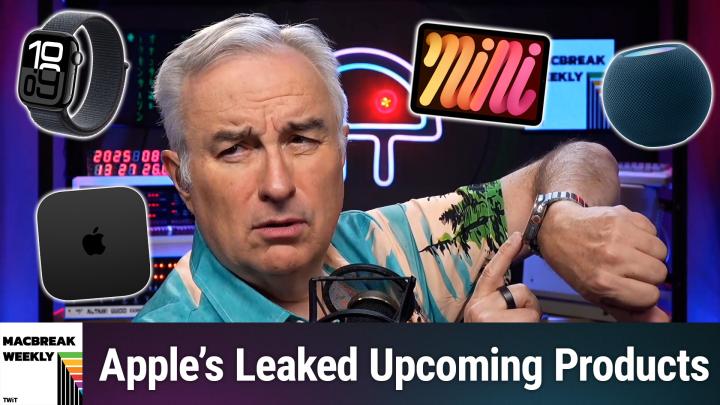
It's time for MacBreak Weekly. Alex, Andy, Jason are all here. We will talk about some interesting revelations found in Apple's beta code. Turns out Mark Gurman was right about seven. Yes, count them, seven new Apple products. They aren't out yet. We'll talk about the big Apple event coming up in just a couple of weeks. And then the Apple Watch.
Leo Laporte [00:00:20]:
Some thoughts about the future of the Apple Watch, including the question, why can't I put custom faces on here? All that and more coming up next. MacBreak Weekly time. This is MacBreak Weekly. Episode 986, recorded Tuesday, August 19, 2025: Movies on the Moon. It's time for MacBreak Weekly.
Leo Laporte [00:00:53]:
The latest Apple news is here with Mr. A. Alex Lindsay from officehours.global. Lisa. Lisa went to YouTube yesterday morning. She says, Alex is there every morning, isn't he? I said, yes, he is just about. That's his business. His office hours are always on the air.
Alex Lindsay [00:01:13]:
It's a pattern. It's a pattern. I get up, I don't really think about it. Next thing I know, I'm, yeah, it's easy.
Leo Laporte [00:01:18]:
It's your ritual.
Alex Lindsay [00:01:19]:
Yeah.
Leo Laporte [00:01:20]:
Well, it's good to see you, Mr. Lindsay. Also with us, Mr. Jason Snell, who probably around September 9th will vacate the premises. I don't know why, but he just does that sometimes possible first week of.
Jason Snell [00:01:32]:
Their kind to me, I, I, I'm only here because two burly men in uniforms tossed me into my office and said, we have vase of making you talk, which is a podcast is the way it turns out.
Leo Laporte [00:01:45]:
We put a microphone in the podcast.
Jason Snell [00:01:47]:
So. Okay, you got me, you got me. Fine, I'll do it.
Leo Laporte [00:01:51]:
And Mr. Mr. Who did I forget? Andy Ihnatko from the library in Beautiful. I don't know where you are. Sudbury, Massachusetts or somewhere. Hello, Andrew.
Andy Ihnatko [00:02:03]:
I'm hanging in, hanging on, hanging in there. I'm excited about wearing long pants again for the first time in two months.
Leo Laporte [00:02:09]:
Is it warmer? I mean, cooler?
Alex Lindsay [00:02:10]:
Cool?
Andy Ihnatko [00:02:11]:
It's actually nippy a little bit.
Leo Laporte [00:02:14]:
Really?
Andy Ihnatko [00:02:14]:
Yes.
Leo Laporte [00:02:15]:
It's cooling off in Spain as well. Although my lovely wife is in Dallas, Texas for the podcast movement where the high today will be 108 degrees.
Andy Ihnatko [00:02:25]:
Maybe that explains a lot. I would be oopsy too about a lot of issues if I had to deal with 108 degree weather regularly.
Leo Laporte [00:02:32]:
You know, I think I'm convinced this podcast movement does it because they, it's. Look, let's face it, podcasters they get.
Jason Snell [00:02:40]:
A deal nobody wants to be.
Leo Laporte [00:02:42]:
So they're always in the worst place in the summer, Chicago in the summer.
Alex Lindsay [00:02:48]:
Seagraph used to go to like New Orleans in August. And it was, I mean.
Jason Snell [00:02:55]:
That'S how I always felt about Macworld Expo being in Boston in August. It was like, what are you doing to us? Why? Why?
Andy Ihnatko [00:03:02]:
Not only that, like the fact that like it was split between two venues and the cdc. The other venue was so far away from public transit that you had to walk about a quarter mile to a half a mile and like blighted industrial. No shade, no nothing.
Jason Snell [00:03:21]:
No, it was great. You get a sheen of sweat all over you and then you can see like a power Mac or something.
Andy Ihnatko [00:03:28]:
I think it was Mac. Yeah, it was definitely Mac user that had the brilliant idea of nobody wants to be here. I know we will rent out one of these parking lots, put up a giant air conditioned tent.
Jason Snell [00:03:38]:
That was us, that was Mac user.
Andy Ihnatko [00:03:40]:
Where people could just sit and not be sweaty.
Jason Snell [00:03:42]:
Yes. We were right next to where Power Computing, the clone maker had their giant bungee platform. So you could hear people screaming as if they were going to die as you had your little beverage in the.
Andy Ihnatko [00:03:52]:
And that was when. That was when the harbor was just clean enough that maybe you could get a permit for that, but not clean enough that you wouldn't want to have a couple.
Jason Snell [00:04:00]:
You could be there, but you. It wouldn't be. So it wouldn't smell good. But you are legally allowed to be there to linger a little while.
Andy Ihnatko [00:04:08]:
As a lifetime Boston adjacent resident. I said, no, I don't know Boston.
Jason Snell [00:04:12]:
In August, it's so I always tell people I'd be like, I've only been ever been to Boston in August. Like, why? What, what are you doing to yourself? I don't go to Boston in the summertime. It's a strict rule.
Leo Laporte [00:04:23]:
Well, good news, you may be going to Cupertino in September. Also warm, but not unbearably so.
Jason Snell [00:04:30]:
No, it's not humid down there. It's just warmer. Warmer than up here where I live. It's always 10 or 15 degrees warmer down there. Yes. If I get, if I get an invitation, I'll say it again because, you know, invitation even for. I mean, I've been to almost every Apple event since like 98. But it's a tough ticket because the iPhone is the most important thing in Apple's universe.
Jason Snell [00:04:52]:
And they're, you know, and that goes with commensurate media interest. So if you've ever been to one of these things, you will know that it's a different crowd than like WWDC or a Mac event or something like that because the iPhone, there's huge international media there, a lot of broadcast media there. Apple's, you know, that's the one where like the A list is very large and, and global and they all want to be there. And so that's the, that's a tough ticket for me. Like I there sometimes I just get the invite. All the times I don't get the invite.
Leo Laporte [00:05:28]:
I've not been invited.
Jason Snell [00:05:30]:
I, I have. I'll just say for the iPhone event I sometimes have to talk to contacts and say could I get invited to. And I never have to do that for other events, which is great. I really, you know, again, I think we all know take assume nothing when it comes to Apple. But, but the iPhone, I'm saying it's a tough ticket. You know, it is just because world is watching that event. It means so much more than any other PR anything that Apple does the whole year because of the iPhone.
Andy Ihnatko [00:06:02]:
Also I also I think that the reasons for Apple hosting that event have certainly changed over the past 10 years. I think that's true of all tech companies like even Google. Google's having their Pixel event tomorrow and I'm surprised at the people. I'm not, I'm not necessarily surprised that I didn't get an invite, but so many people that are just every single time because they're doing. They're. They're the designated Google slash Android reporter for a very, very reputable outlet. They didn't get an invite this year. So I'm curious to see if all the news we get out of that is hey, from this.
Andy Ihnatko [00:06:34]:
From the same like fake living room set, so to speak. So it's, it's very, very weird. Don't. Don't remember. Remember when there used to be like this leaderboard about someone used to. Used to track here's who got invited to this. Here's who got like advanced hardware. Here's who got like hardware on the regular release day.
Andy Ihnatko [00:06:56]:
And as if that was some sort of a clout meter. Now as always, you really have to assume that there are reasons that we are. The Sphinx will not reveal its secrets very, very easily. It doesn't mean anything positive or negative. It means that you fit into whatever plans Apple has for getting information out about the latest release.
Leo Laporte [00:07:17]:
So if it is September 9th, this is the fallow period between now and then the next three weeks where we have nothing to say except rumors, right?
Jason Snell [00:07:26]:
And betas which are, you know, they're happening every week.
Leo Laporte [00:07:31]:
They did push out two betas in the week, right. For Tahoe.
Jason Snell [00:07:36]:
I think there might have been a quick step update, but we're basically in the one beta a week, usually on Mondays.
Leo Laporte [00:07:42]:
At this point, I know we're in the final stage because this is the part where you install the public beta and it gives you a big welcome.
Jason Snell [00:07:52]:
All the onboarding is coming in. Also, you know that it's. We're reaching that point because all of the online discourse has gone from outrage to resignation, complacency.
Leo Laporte [00:08:03]:
Okay, I guess we're getting it.
Jason Snell [00:08:06]:
Make the best of it. This is what we're doing. Like, all the developers out there are like, well, I thought this might change because developers, you know, they're trying to hit a moving target in the first part of the summer, but they get to this point, they're like, all right, I guess this is it. I guess I gotta do this now. In order to get their apps ready for the.
Andy Ihnatko [00:08:21]:
Yeah, but it's good to see that. I mean, we all expected when we saw the first public demo, not even the public beta, but the first public demo, that this is. Anytime they're doing something this radical to the design language, they are going to be fine tuning it over the weeks to come with feedback from so many different nations, so to speak, that you can't even really count them on one spreadsheet. And I do think that with a. The public beta, this week's public beta I installed yesterday, and I think they got it dialed in very nicely, where the changes are not so bold as to be intrusive. This isn't an iOS7 situation. However, it is significant enough to be an interesting and fresh change. But there was.
Andy Ihnatko [00:09:07]:
Did you see that piece by Craig Hockenberry on his blog? He wrote a piece that was basically saying it was called Liquid Glass. Why? And he kind of equates it to, if this isn't a UI update that users have asked for and they have, and if this isn't a UI interface that developers have asked for and they haven't, who is it for? And he was like, he cited a time when Apple made a weird change to how iOS developers could put things at the top of the screen. And that was sort of a feint towards in the future the iPhone getting a notch in that space. And so he suggested suggesting that maybe this Liquid Glass is kind of a similar thing where it's kind of in service of a future iPhone that is a true edge to edge display, which.
Jason Snell [00:09:56]:
I think that's really Smart read that Apple, Apple knows what it's building years out. And Apple's OS and its hardware often move in sync. The iPhone is always the priority. And I think Craig is really right. I mean, whether this is the only motivation. I think it is a motivation for doing this. I would also say when you say, who's it for? It's. It's always for Apple.
Jason Snell [00:10:17]:
Doing a redesign is always for Apple because nobody is ever going to say, I'd really like a redesign. It's always more like the platform owner is like, okay, we're going to reset for reasons. And one of the reasons is probably, you know, the new number one is new iPhone hardware. We know that there's going to be a thin phone, there's going to be a folding phone. They probably are pushing other aspects of the phone design. Clearly, if you've used these betas, the metaphor makes the most sense on an iPhone because it's a little tiny piece of glass that has little tiny bubbles of glass on top of it. Makes less sense increasingly on the iPad and then on the, on the Mac. You could even argue that it makes more sense on the Apple watch because it's also a small little bubble of glass.
Jason Snell [00:10:57]:
But. But yeah. So new hardware like Apple makes its software designs completely cognizant of what, what hardware is coming for the next few years. So I think Craig's, you know, right.
Alex Lindsay [00:11:06]:
Here and I think, I think that Apple is still moving towards headset world. Whether it's. It's not this headset, this is the R and D headset, but this is a, you know, whether it's a clear phone or whatever. I think you are looking at Apple still seeing and what they're doing that is very hard for anybody else to do is. And that's what Apple likes. I think Apple likes to look at is like, what can we do that no one else can do? And one of those things is this kind of building an interface so that there's a smooth landing for anybody who, that if you get whatever the next lighter, cheaper headset is in 2027 or 2028, you don't think about it at all. Like, the interface all makes sense. It all looks like everything else you're doing.
Alex Lindsay [00:11:46]:
You know, if you jump, like I notice in the Vision Pro and I obviously you're very clear of the interface change when you're switching from your screen share to your apps like, you know, that are in the. And I think that there's a point where I think that Apple may be trying to get to is you don't think about it that much. Like there's a computer supplying a screen over here and then there's apps over there and they're all kind of similar and in look and feel. And I think that that's, that's kind of where Apple's kind of going is blending all of the experiences together so that the interface makes sense no matter what device you have open.
Andy Ihnatko [00:12:18]:
Yeah, Mac OS. My MacBook is still the only machine that I haven't put any of the developer betas or public betas on. So I'm really keen to see what the experience is going to be like once that is part of the mix. I mean, I even got my Apple watch like out of mouth mothballs. So this is the first time in a long time I've been using Basically my entire iOS with the iPad and with the watch and the phone and it does work very well together. It's a very. It's as successful as material design was when Google decided to. There must be a way we can unify all these experiences into one thing.
Andy Ihnatko [00:12:50]:
And it seems as though you're insulting yourself by saying, oh thank God. It's so hard to maintain the mental bandwidth of switching from one windowing environment to another. But it really does ease things nicely when you're walking home or you're on the bus and you're doing things on your iPhone and you're taking notes on something you want to do when you get home or when you get to the office and then when you get to the office and your head is still inside that lens language. It really is a very nice thing. And I think that Apple operating systems are about to be unified in a way they've never had before.
Leo Laporte [00:13:23]:
Hockenberry, who of course is icon factory and does a lot of app development. Beautiful legend, wonderful app development says I could see this new physical design being very successful with touch oriented devices. It feels natural with phone, tablet or watch. I'm having a much harder time seeing how Liquid Glass will benefit other platforms like the Mac or Apple tv. Forcing tactility where it's not needed or wanted to or available, I might add. Feels like a misstep. I added that part. Until then, he says developers stay away from the edges and wait for Apple to reveal the real reason for Liquid Glass.
Jason Snell [00:14:01]:
Stay away. It's good. It's like he could be a good lifeguard. Stay away from the edges. But it is, you know, this is one of those things where I having used the betas all summer, I would say the Mac there's some debates about like weird visual quirks in macOS Tahoe. But when I hear from people who are like oh, I hear lots of debate, maybe I shouldn't update to Tahoe. It's like, trust me, the design of Tahoe is fine. It's fine.
Jason Snell [00:14:24]:
It's different a little bit Tahoe and there are many productivity improvements in Tahoe. But it is the least touched of all of these and I think for the reason that Craig says which is it's also kind of the least relevant and I think the metaphor breaks down. Now we've talked on this very, on this very show. I know we're the leading Vision Pro podcast but we discuss other regrets. Other, other Apple platform. You've regretted it since week two, day one.
Alex Lindsay [00:14:50]:
Yeah.
Jason Snell [00:14:51]:
The other platforms are also available. We've talked about how the Mac may be getting touchscreen MacBook Pros in a year, year and a half, something like that. And so like there are tactility on a Mac interface may also be a thing that's relevant down the line and that maybe I, I think that Apple does everything for the iPhone. I think that the Mac, the design on macOS may be considering some of that. They may also think that they don't really need to lean into it because it's going to couple of years and they're, they're going to have at least one OS cycle before they have to get there. So I think that they're, they're not that worried about it. The iPhone is the priority though. It's always going to be the iPhone.
Jason Snell [00:15:30]:
It's half their business. It's, it's the iPhone.
Alex Lindsay [00:15:32]:
I will say that the changing from medium to medium. I've spent a lot of time because I was doing all this stuff, all this post production with, for the headset with the immerse immersive camera and so I have the headset on all the time and then I'm doing stuff on the computer and then do it and I find myself tapping the screen when I'm not supposed to. Pinching at the screen, pinching at the like you know, like there's you're so, you know this, this. There's all these different ways of interacting with these things and I do think that that, that there, there's an attempt there. It may have been someone looking at it from a science perspective like hey, we have people. There's too many different ways that they can do it and we're now integrating all of those so that you can be in that environment all at the same Time and I think that that's a, you know, that's a pretty interesting challenge to work with. I also think that the, you know, when you look at the. But it's going to be really important for developers to pay a lot of attention to this because, you know, Alex Goldner, who's a friend of mine, brought something up on X that I hadn't thought about is that of how important it's going to be to write to.
Alex Lindsay [00:16:27]:
If you, if you want your apps, especially productivity apps to work well on the new laptop. If that actually happens with the 18 processor, you better hope that you're writing things to the, you know, inside of the OS like you were using the architecture. If you're making up your own stuff, you may find that the performance isn't nearly the same, you know, which is interesting.
Leo Laporte [00:16:48]:
So I suppose I'll ask this question every week for the next three weeks, but what do we expect on the, let's say September 9th on the apple?
Alex Lindsay [00:16:58]:
I'm rooting for the. I don't know what we can expect. I can say what I'm rooting for is 4k spatial. That's like, that's what I, that's why I didn't buy the 16 was because I was like I'm ready to buy if I get 4k spatial. Because the spatial video. I think for those of us who have headsets, the spatial video looks amazing. It's just a little low res, you know, like you just feel like if.
Leo Laporte [00:17:18]:
You just got there be any they wouldn't have to move the lenses apart further right.
Alex Lindsay [00:17:23]:
We wish they would, but they don't have to like it would look nicer if they, if they had, if they had done it so that you could set your phone up vertically and the two eyes were, you know, on either corner of a max it would be a great experience for the person. I don't think they're going to do that. I think logistically I think that's too complicated. So. But it works fine. You get a stereo experience with it and I think it looks good. They're doing some stuff I think on the back end to make it more stereoscopic than it would be otherwise. So I think that.
Alex Lindsay [00:17:50]:
And it's a very comfortable view but it's just again a little too low resolution. If we just got 4k per eye and it was a little cleaner, one eye is using the wide angle lens and you can feel that a little bit. I'm told that you feel it less in the 16 but on the 15 you feel it and so I think that if we get a better. That upgrade would be, you know, for those of us who have headsets would be a big deal.
Jason Snell [00:18:14]:
Yeah, you got to upgrade that second camera.
Alex Lindsay [00:18:16]:
Yeah.
Jason Snell [00:18:17]:
So that. And, and yeah, you've got to have the throughput. But they could do it. It'll be interesting to see if they can increase that feature. Although the thought occurs to me, Alex, that maybe somebody should sell a camera that attaches to the other end of the phone at USB C. And, and that would give you. Yeah, A little, it would be a little wider than, than the interocular distance, but it would be better than sitting next to each other. That would be an interesting sort of like cheaper than that $30,000 camera.
Jason Snell [00:18:46]:
Yeah, it's, it's. What's expected is they're going to do an iPhone, a thin iPhone instead of an iPhone plus so it'll be iPhone. What number could it be? 26. Could it be 17? Nobody really knows. I would say so far but like a standard, a pro A. And then this maybe air thin phone which is also then laying the groundwork to do a folding phone next year. The thin phone. You know a lot of questions right, like what's it going to cost? Is it going to be about the same? Is it going to be a premium? I think it'll probably be a premium.
Leo Laporte [00:19:23]:
And who wants it cost more for less battery?
Jason Snell [00:19:25]:
Yeah.
Leo Laporte [00:19:26]:
And possibly I'm seeing rumors that it will have processor as well.
Andy Ihnatko [00:19:31]:
Less gpu.
Jason Snell [00:19:31]:
Yeah, yeah, yeah, all that. But the idea there is. Is that what you. So is it a premium or is it just that you want something that looks different and is thin and has all those things going for it, which there are the, the piece that I wrote for Macworld last week was basically riffing off of the stuff we talked about about earnings, which is Apple's so huge at this point that the way Apple grows in part is by finding little corners of the audience that they are not serving. Well, whether it's a cheaper Mac, we talked about that. Whether it's a cheaper new iPhone like the 16e, something like a thinner phone. Like is it mainstream? Is it going to be the best selling iPhone? Probably not. Right.
Jason Snell [00:20:14]:
But I bet Apple thinks there's an audience that wants the thinnest newest looking iPhone and is willing to pay for it and it gives them. Remember it's one of four or five modern iPhones being released in a six month span. So they can afford to have like that be appealing to a specific audience. I do think there's an audience. Maybe tech nerds are all going to turn up their noses at the features, but other people might really love the fact that it's just thin and light and looks different from recent iPhones.
Andy Ihnatko [00:20:44]:
And there's some irony here. Whereas Steve Jobs was in a rage about Samsung stealing everything from Apple, now you've got, okay, so Samsung led the industry with a folding phone. Now Apple's coming up with a folding phone next year. Samsung seemed to lead the industry with let's make a device that's really, really thin. Here comes the iPhones. The iPhone slim, or the iPhone whatever, air, whatever you're going to call it. There was some analysis on CNBC that suggested that where Samsung is chipping away at Apple, it's responsible for all these, the variety of devices that Samsung provides. And as you said, Jason, all these devices that certain segments of at least the US Market wants that Apple is not able to provide.
Andy Ihnatko [00:21:24]:
And the people that are in the camp of, oh well, gosh, all phones are pretty much, much the same. I really like the idea of a folding phone or I really like the idea of a slim phone or in largely in Samsung's case, their A series phones. I only have three or four hundred dollars to spend like on a decent phone. These are all things that Apple, Apple is now in the business where they have to go out and find all the customers that aren't buying Apple right now and try to chip away at those reasons they have for not buying. This will never be a situation where they will try to make Apple. I don't think they can make a sub $500 phone, but if they could find a way to do it without reducing the Appleness of it, they would try to do it because again, those are people they're not getting right now and they've got to go get those people.
Leo Laporte [00:22:10]:
This is Samsung's new throwing phone. You could really hurt somebody with this. Yeah. So it makes sense they're doing a slim phone because they want to do a folding phone next year and so they want to get the.
Jason Snell [00:22:21]:
It's logical, just a real logical.
Leo Laporte [00:22:23]:
How slimmer is it though? Is it so slim that if you carry it around without a case, which of course makes me nervous, people go, ooh, what's that? You have a slim phone.
Andy Ihnatko [00:22:32]:
I think the people who.
Leo Laporte [00:22:33]:
It's only a few millimeters, right?
Jason Snell [00:22:35]:
Yeah.
Andy Ihnatko [00:22:35]:
But in the hand, I mean, so you, I mean you've got the Samsung slim phone in the hand. Again, I've. So I've made so much fun of Apple. Take, oh wow, this is the slimmest MacBook we've ever made. Yeah. Great. Two millimeters. Thanks a lot.
Andy Ihnatko [00:22:47]:
I can, again, I can put a quarter in my laptop, but that I was not able to slip in my blackpop bag before. But when you have something that's being held in your hand or something that's being worn on your wrist, boy, do you feel that slimness. It amplifies the sense of having a lightweight personal device. And the thing is, I don't think that the reduction in battery life or the reduction in performance is going to be an issue or the people or the idea of if you put it inside a case, you remove every reason for owning it. That's not gonna be an issue for the people who are going to buy this phone. Cause I would be very concerned if they decided that, hey, all base level iPhones are going to be super slim from now on. That would be a dumb thing to do. But the thing is, you can still get the pro line, you can still get the base level line.
Andy Ihnatko [00:23:32]:
And if you want something that's super stylish and slim, boom, we will take your money too.
Jason Snell [00:23:37]:
Yeah. I think if you look at the iPad, right, they came out with the thinnest Apple device ever, right? Which is the iPad Pro. And if you look at that compared to the iPad air, what's the difference? It is 0.8 millimeters. Right. But I will tell you, you notice it's real. It really is noticeable.
Alex Lindsay [00:23:58]:
And the problem is I pick it up and I'm like, oh, I'm gonna break it.
Jason Snell [00:24:00]:
Yeah.
Alex Lindsay [00:24:01]:
It feels like I don't. Yeah. And you know, of course, I think the. Still, the bulk of the users are not gonna get this one, but they do, as you said, have to cater to everyone because they're the only ones there, so.
Leo Laporte [00:24:13]:
Yeah.
Jason Snell [00:24:13]:
But if it's truly, like rumored to be like 5.5 or 6 millimeters, like the existing iPhones are all like 7.8.
Alex Lindsay [00:24:23]:
Yeah, it's a lot. I just feel like I'm gonna put. Man, I just. I don't. I just feel like a lot of people are gonna sit on it. I mean, I watch. I watch people put it in their back pocket and I just put their current phones in the back pocket. And I'm just always like, what are you doing?
Jason Snell [00:24:36]:
AppleCare is a service that generates revenue.
Alex Lindsay [00:24:38]:
I'm like, have an otterbox.
Andy Ihnatko [00:24:41]:
It's a pur phone. It's an inside jacket pocket phone.
Alex Lindsay [00:24:43]:
That's true. That's true. I mean, I. There are places where I can't Put the phone. Because it's too. You know, I'm. It's in a case and it's the max and everything else.
Andy Ihnatko [00:24:51]:
So I'm worried. I mean, I'm even worried as hell about my. About my iPad. It's like this is a 1200 device. And I was. I'm surprised and pleased that it is as durable as it is, because I've had for five years. No bends, no cracks, no creases, no scratches, but the same. But at the same time, I don't try.
Andy Ihnatko [00:25:08]:
I don't put it inside an overstuffed laptop bag. I don't put it inside an overstuffed laptop because I don't want this to be the sacrificial backing board that saves my laundry from getting bent.
Alex Lindsay [00:25:20]:
I never leave the house without it in a case. You know, it's in a case the moment it leaves.
Leo Laporte [00:25:26]:
But you take it out of the case when you get home.
Alex Lindsay [00:25:28]:
Yeah. I have stands for it right here. I have two of them. And so I set them on there, and that's kind of where they sit as controllers and other things. And so I use them there. But as soon as I leave, I put them back in their case.
Jason Snell [00:25:39]:
Yeah. I guess what I would say is that all those discussions we're having here indicate that we are not the primary audience for this phone. And that's okay. Right? That's the whole power. We're worried about the facts.
Leo Laporte [00:25:48]:
It's fashion. It's.
Jason Snell [00:25:49]:
It is. I mean, and look, those definitions are not as clear. There are people who are fancy themselves aficionados of Apple products who when it push comes to shove, do I lose that one camera? And like I said, I got the iPhone mini. And that was a step back, but I did it because I wanted the smaller phone. Right. People have different priorities. So for some people, this will work. Or at least Apple hopes it'll work.
Jason Snell [00:26:14]:
We'll see. Because Apple's other attempts here with the mini and with the plus to fill that slot haven't worked. So I think this is a much more powerful than its bigger or smaller argument, and I think it will have appeal.
Alex Lindsay [00:26:27]:
I think they should release it in rose gold. Bring back the old rose gold. So it's thin and it's nice and it's shiny.
Leo Laporte [00:26:34]:
Well, this one will be colors, right?
Jason Snell [00:26:35]:
I think you're right.
Alex Lindsay [00:26:36]:
Yeah.
Leo Laporte [00:26:37]:
This is going to be colorful. More colorful.
Alex Lindsay [00:26:40]:
Yeah.
Leo Laporte [00:26:40]:
Orange.
Andy Ihnatko [00:26:41]:
I'm just glad to see Apple do it. Apple is such a great design company that to their detriment in the public eye, there was a Time when they were just thought to be, oh, this is a company just does all style, no substance. But if they were doing all style, no substance, no one could do it better than Apple. I'm really excited to see them open their imaginations to the idea of let's do an iPhone that is simply desirable, that is just a lovely object. Just in the same way that in the 20s and 30s, Cartier and other jewelers would make cigarette boxes that are just showing off. Here's what our design, here's our. Here's how good we can manufacture something and here's what our eye to design is like. Given that phones are not getting people excited for the features anymore because they seem to have plateaued in what they can actually do for your daily life.
Andy Ihnatko [00:27:30]:
Let's give you something that feels like. Like your phone. Exactly. A beautiful piece of jewelry that every time you put on your watch, you put your wallet and your keys, where you put your wallet and your keys and then you take the phone off the same, same shelf in your dresser and put it in your pocket. That this is part of your style, part of something you touch every single day that makes you feel happy because it is a part of your experience.
Leo Laporte [00:27:52]:
There's an analog to that, which is the. The fountain pen or the pen.
Andy Ihnatko [00:27:56]:
Exactly.
Leo Laporte [00:27:58]:
There really isn't a lot of different functionality. You either have a ballpoint. I bought for ridiculously large. Well, it wasn't thousands, but for more than $100, I bought a brass pen because it's brass and it's heavy and it feels good. It doesn't write any better than a 29 cent Bic.
Alex Lindsay [00:28:16]:
Well, if you're happy about it, it might write better. You might write better, I write better, feel better.
Andy Ihnatko [00:28:21]:
And honestly, there have been times like I'm out in public or even even like getting ready for the show that like I'm getting dressed and I got my cup full of like nice pens and I put this in. I'll put like this, you say rose gold. Last time I was at the Apple campus, like in the store, I got like this rose gold apple pen. It's a nice pen. They subcontracted out. And I'll put in my pocket because it's just a nice piece of jewelry just to have in my pocket to break up like this, this field of black that I've got going on.
Jason Snell [00:28:51]:
And I feel like that actually is a good way to view the point about. It's not for everybody is we do all sorts of things because not because they're logical. And it's very easy. And I think a lot of computer nerds like us do this where it's like, well, that's totally unnecessary. You know, I'm not going to write with a pen or. And it's like, that's not always the point. And it's okay for people to like things that are impractical or weird.
Alex Lindsay [00:29:13]:
Like, look at this, look at this. You know, this is the side of the headset and I took it off because I wanted to put the, you know, the USB connection to the developer strap on. So I took this off. The developer strap comes with a tweaker. That is literally the nicest.
Jason Snell [00:29:30]:
I mean, it's like the mother of all sim.
Leo Laporte [00:29:32]:
Save that though. That's a sim poker.
Alex Lindsay [00:29:35]:
It is literally like a little clean.
Leo Laporte [00:29:38]:
Your ears jewelry, slash.
Jason Snell [00:29:39]:
Yeah, like somebody at Apple caring about that.
Alex Lindsay [00:29:44]:
And again, it changes the way you feel about things, you know, and, and it's such an important thing. But I watch when I pulled it out, I looked at it and I was like, what though?
Leo Laporte [00:29:52]:
I was like, so look at the ridiculous amount of money I've spent on. And you could argue that fountain pens are not as functional or as effective as a rollerball pen. But you know, I collect them because.
Jason Snell [00:30:01]:
You'Re talking to somebody who. Mike Hurley, my, my, my co host on Upgrade, has been hosting. Co hosting the Pen Addict podcast for more than a decade. Yeah, it is a real thing. And again, is it practical? Well, it doesn't have to be, but also, but that's okay because sometimes the night, sometimes it's nice to have nice things. So I think that's always been an argument against Apple is like, well, I can get a computer for cheaper. Why does it. Why would I spend more money? And it's like, well, maybe it doesn't matter to you.
Jason Snell [00:30:32]:
Maybe the reasons people buy Apple hardware are transparent to you. They're meaningless to you. And in which case don't spend your money right. Like you, you, you get. You don't see the value that other people see in it, but it doesn't mean that it isn't there for people who care about that. By the way, Leo, the iPhone airs are rumored to not come in the same colors. They're going to be black, white, light blue and light gold, which is your Alex jewelry color. And we'll see because they're.
Jason Snell [00:30:59]:
They're models are apparently getting slightly different colors.
Andy Ihnatko [00:31:03]:
And there's some really interesting rumors coming out that Apple intends to absolutely bifurcate their iPhone releases, that the pro models will be released in the or the expensive models will come in September. Spring will be for the less expensive.
Jason Snell [00:31:17]:
The base model and whatever, but starting next year. And this is. I mean, you mentioned Samsung earlier, Andy. This is again, my pal Mike Hurley has been talking for a while now about how he expected Apple to eventually go to a bifurcated strategy. And when the 16E came out this spring, Mike leaned forward a little bit. He's like, ah. And then there was this report that Apple is very seriously considering releasing, starting next year, the pro phones in the fall. So it would be the pro Promax and the fold, possibly.
Jason Snell [00:31:46]:
Right. And then the regular phone, the non profone and perhaps the iPhone the following spring.
Leo Laporte [00:31:55]:
Google and Samsung already do. It's exactly the bumps.
Jason Snell [00:31:58]:
And remember what I said before about how important the iPhone event was to Apple because all eyes around the world are on Apple. Well, you know what, you could do it twice, right? Like, I mean, they would all come back for another iPhone event. I think Apple would get more attention if they had two iPhone events. And if they're gonna. I don't know if they're truly going to have a differentiated product line with as many as six new iPhones every year, they probably don't want to do that in a single event. So this may be. Yeah, you're right, Andy. This might be the last time we get the.
Jason Snell [00:32:32]:
All the iPhones at once in the fall.
Andy Ihnatko [00:32:35]:
Yeah, I mean, like Leo said, there's.
Leo Laporte [00:32:37]:
So many places for me not to get invited. I'm so excited. So thrilled. All right, we're going to take a break. There are some even more interesting rumors from a leak last week of Apple source code. We'll get to that in just a bit. You're watching MacBreak weekly. Andy and Ako.
Leo Laporte [00:32:53]:
Alex Lindsay, Jason Snell. I'm Leo Laporte. Our show today, brought to you by the same people bring you our website. I'm really thrilled. I don't, you know, it's Pantheon. I love this. Welcome, Pantheon. You should have been advertising with us from since we moved to you.
Leo Laporte [00:33:09]:
We love Pantheon on your website is your number one revenue channel. But if it's slow, people don't wait. And slow can mean a couple of seconds to load. I. I know I've left sites where they go it's not loading and move on in seconds. If it's down even worse or stuck in a bottleneck, then it can not only be your number one asset, it could be your number one liability. That's why we rely on Pantheon. Pantheon keeps your sight fast, secure, and always on our Entire back end relies on Pantheon's Drupal technology.
Leo Laporte [00:33:47]:
That's. Remember, we have a headless Drupal install and that's our API. If you do a front end for us, if you're doing an app, as others some seem to be doing now with Vibe coding of our website, it's all ran. And all our editors, they're always using Pantheon on. It's incredible. Better SEO, more conversions, no lost sales from downtime or even slow time. But it's not just a business win, it's a developer win too. Your team, our team loves it.
Leo Laporte [00:34:16]:
Automated workflows, isolated test environments, zero downtime deployments. And Pantheon handles it all for us. No late night fire drills? No, it works on my machine. Headaches? Just pure innovation. You've heard that before. Works on my machine.
Andy Ihnatko [00:34:31]:
I know what you're talking about.
Leo Laporte [00:34:32]:
No, not from Pantheon. They're great. We love Pantheon. Right? Patrick Marketing can launch a landing page without waiting for a release cycle. Developers can push features with total confidence. Your customers, they love it. They just see a reliable, beautiful site. They don't know you don't know.
Leo Laporte [00:34:52]:
They just see a site that works 24. 7, right? We love Pantheon. Pantheon powers not just Drupal sites, but also WordPress. Sites that reach over a billion unique monthly visitors. A billion unique monthly visitors. Wow. We love Pantheon. Visit pantheon.io and make your website your unfair advantage.
Leo Laporte [00:35:14]:
Pantheon, where the web just works. pantheon.io could not be happier. WordPress for Drupal and for next JS as well. Thank you, Pantheon. Thank you. Really appreciate it. It's funny, like Lisa said, hey, do you know who Pantheon is? I said, yeah, I know who Pantheon is. They want to advertise.
Leo Laporte [00:35:36]:
I said, yeah, that would be okay with me. Can you give them an endorsement? Uh, yeah.
Leo Laporte [00:35:43]:
So last week, Apple released software code that included, of course, you can't do this. Hardware identifiers to numerous unannounced products. The Sleuths. Oops. The Sleuths jumped in. Mac Rumors has a list of, well, hardware products that are unreleased. New HomePod mini with updated chip. New Apple TV with a 17 Pro chip.
Leo Laporte [00:36:11]:
New Apple Studio display 2. None of this will be a surprise, but it just kind of confirms what we've been saying, right?
Jason Snell [00:36:17]:
Mark Gurman wrote a story. He was basically like, see, I told you.
Leo Laporte [00:36:20]:
Yeah, I told you that. New iPad mini with a 19 Pro chip. New low cost iPad with a 18 chip. Apple Vision Pro with M5. Now, there has been some debate over whether it be the M4 or M5, right?
Jason Snell [00:36:33]:
Herman says he has also heard M4, so they may not be sure.
Leo Laporte [00:36:37]:
Okay. But the leak says M5 and a 2025 Apple Watch with a new, well, not so new chip. A chip very similar to the current model. In fact that's led to stories saying, well, don't get so excited about. The Apple Watch is going to be not much more capable than the existing one. Okay. We confirm Mark Gurman was right.
Jason Snell [00:37:04]:
Sure looks like it.
Leo Laporte [00:37:05]:
Anything to say about any of this? Is anything. No surprises, right?
Jason Snell [00:37:09]:
No, I mean Apple iterates. Right.
Leo Laporte [00:37:11]:
We're a little disappointed. I'm a little disappointed. I wear an Apple Watch Ultra, which I love, but it is going to be two years old this fall. The Ultra.
Jason Snell [00:37:19]:
I'd be surprised. I would. I'd be surprised. There is if there isn't an Ultra.
Leo Laporte [00:37:22]:
3, but if it's the same chip.
Jason Snell [00:37:25]:
Not necessarily. They say Apple Watch, that doesn't necessarily mean they may be. There may be a new version of essentially the SE that will use the existing chipset that we know now and coming next spring. And that's different from new Apple watches this fall. I don't think that there's any clarity there.
Alex Lindsay [00:37:40]:
They're also in that cycle of people with older Apple watches waiting for enough new things to be there for them to upgrade. You know, like it's because I, I have a hard time understanding like it. For me it's. It's all about glucose. As soon as glucose happens, I upgrade the. The watch. But I can probably. Unless my battery dies on my altar.
Leo Laporte [00:38:01]:
How about blood pressure?
Alex Lindsay [00:38:05]:
I mean I, it would be great. I just think I have a. I guess I haven't.
Leo Laporte [00:38:08]:
You don't care about blood pressure as much. If you were my age and my weight, you might.
Alex Lindsay [00:38:12]:
I take my blood pressure almost every day, so I guess it would be something you already know to me. I felt like the. I guess I feel like the glucose thing. You know, having that, seeing that happen in real time has such an impact on behavior.
Leo Laporte [00:38:27]:
Well, that's what's interesting about blood pressure. Like glucose, it changes dramatically over the day. So one taking it once a day isn't as. Just like glucose isn't as useful as getting a graph of the whole day. I, I love. I put the glucose on I as I like you, I use the Dexcom Stello continuous glucose monitoring. I can see my glucose right there on my watch at all times. Yeah, it's incredible.
Alex Lindsay [00:38:51]:
Yeah, definitely.
Leo Laporte [00:38:53]:
So I don't. So in a way because I have to put this thing in my arm, you know, it'd be nice if that's what I'm saying.
Alex Lindsay [00:38:58]:
Like, if Apple figures out, I mean, and I think everybody, it may not.
Leo Laporte [00:39:00]:
It's hard to do.
Alex Lindsay [00:39:01]:
It's really hard to do. But that's why Apple's working on it, of course, is that it's really hard to do. And I think that. But I think it will again. I, I, especially after testing it with the, with the glucose monitor. I just feel like, like it'll be the biggest change in a lot of people's behavior because it just, you just look at, you look at certain foods as the enemy after very quickly. Like, it's like it's a behavior.
Leo Laporte [00:39:22]:
I also see why Apple might not worry so much about upgrading the chip, because do you need more power? One thing I was thinking I would like to see a battery to talk to an AI. And of course I could talk to Siri, but that's not an AI.
Alex Lindsay [00:39:37]:
Yeah. I think the problem is, like the most useful things on my phone are, you know, timers and fitness trackers and, you know, all these things that are not very, you know, not high performance.
Leo Laporte [00:39:50]:
Right. Yeah, that's right, exactly. My point is you don't really need a new, more powerful.
Jason Snell [00:39:55]:
Right. And the, and the turnover is, is long for these. Apple said that half of the Apple Watch buyers last quarter were new, which means that you're getting a lot of people who hold onto their watch for a long time and then there are people who are still coming in and buying it for the first time. And I agree with Alex. I think a lot of times what motivates you is a design change or a sensor update, something like that, where you're like, oh, this is, this is worth it for me. I sat on the sidelines for a few years and I bought a series 10 mostly because I liked that it was, you know, that they did the new kind of thinner design. I liked how much thinner it was and I thought this was probably worth it for me. But like, those are the kind of things that motivate people.
Jason Snell [00:40:36]:
Not if there's a product that is about as far away from speeds as feet and feeds as could be. I think it is the Apple Watch. Right? Like, it's, it's, it's about, you know, size and looks and, and maybe sensors, and that's probably about it.
Alex Lindsay [00:40:49]:
I think it'll be interesting to see with a big upgrade potentially, according, according to the rumor of the Apple tv, how much Apple points more towards gaming. You know, it potentially is a great gaming platform that they haven't. I think that's A lot of unlocked potential for Apple that they just have. I haven't quite unlocked that treasure chest yet.
Andy Ihnatko [00:41:09]:
Yeah, I'm kind of wondering how far away we are from Apple doing a redesign of the base Apple Watch. I mean, it served Apple and Everybody well for 10 years, but is Apple happy with this same design? Are there technical things and manufacturing processes they could use if they decided to go with harder edges instead of soft pillows? And just speaking for myself, it's like I only started to. My problem with the Apple Watch is largely that I just feel like another stiff with an Apple Watch in my community. Who has one. And I liked it a lot more once I started. I put this rugged armor case on it that kind of makes it look a little bit like a G shock. And now I actually enjoyed a lot more.
Jason Snell [00:41:52]:
I have a fun. I have a fun band. He said earlier he's doing some testing little iOS 26.
Andy Ihnatko [00:42:00]:
I have to.
Leo Laporte [00:42:01]:
I haven't put watchos 26 on my watch yet.
Jason Snell [00:42:04]:
Should I. I mean, it's fine. It's not that big a deal. It's just. It's. It's. It is what it is. The Workouts app looks a little bit different.
Jason Snell [00:42:13]:
I'm glad Andy brought this up because I. This is literally the. The main focus of my. Of my Macworld piece last week was when we're talking about Apple being so huge and reaching so many people that you need more phone models to reach people who aren't going to buy the phone that you already had out there. The Apple Watch came up in a conversation I was having after the results. It was when I was talking to Dan Moran after. After the results came out, and I had this realization, which is, we keep talking about the Apple Watch. Like, the question is, will Apple redesign the Apple Watch? Will they ever make it look different? Because it looks basically the same as it has.
Jason Snell [00:42:52]:
Not the Ultra, but the base model.
Leo Laporte [00:42:54]:
It's the same square pillow.
Jason Snell [00:42:55]:
You can see it is a round wreck. It is an Apple shape given form. Right. Okay. At the same time, I could argue that it's kind of iconic. Everybody knows what an Apple Watch looks like, and there's value in that, too. But this is my point. I don't think it's either or.
Jason Snell [00:43:11]:
I think with something like the Apple Watch, Apple is so big and its markets are so large and that so many people 10 years in are still, like, buying their first Apple Watch. There are a lot of people out there who are iPhone users who have never even considered an Apple Watch. I think Apple has the freedom like if Apple wanted to do it, a WatchOS based fitness band with a little teeny tiny readout and no screen, I think they could do it. And it doesn't. How, how does that affect the Apple Watch? It doesn't. It's just a different product in the line. I think if Apple had a good idea for a watch with a round face, the debate was always, will Apple replace the Apple Watch with one with a round face? And what I realized in this conversation is the answer is it doesn't have to be about replacing Apple at this point could do a completely new look Apple Watch and continue selling the other Apple watches and be fine. Because in fact the company is so huge now that we get, we get so obsessed with like Steve Jobs and the four product grid, which by the way, that lasted, that was, that was tearing down the old stuff.
Jason Snell [00:44:17]:
He then immediately was like, Also there's a G4 cube and also there's an X serve.
Andy Ihnatko [00:44:20]:
Right.
Jason Snell [00:44:20]:
Like, it was just a moment of discipline. Following it was good, but it was followed by expansion. And I just want to say this. Apple, Apple. Now, if you view, if you view how many people have iPhones and how many of them have Apple Watches, you'll see there's this enormous number of people who have not yet been convinced to get an Apple Watch. And at Some point after 10 years, you have to say, maybe we need a different kind of Apple Watch, and that's okay. So I think there are no rumors to this, to this at all that there might be Apple changing it. But I think Andy's feeling about the Apple Watch is really relevant, which is Apple at some point might want to vary that product line a little bit because there are people who for whatever reason are just not buying an Apple Watch.
Jason Snell [00:45:05]:
And maybe that's because they only really sell the one kind and that maybe it's time after 10 years to do some different kinds and keep the old kind. Because obviously it's iconic and people like it too. Yeah.
Andy Ihnatko [00:45:18]:
And we were talking, we were just talking about how phones are kind of a people of personal jewelry. And I mean, this is literally, literally a piece of jewelry that. Yeah, that this is really part of the presentation you're making to the public. And sometimes it's not the, the, the sometimes it's not even the image that you want to project. It's. You want the things that you wear on your body to reflect who you think you are. And it's. If it's not an Apple Watch, if it's not a square pillow watch, you're out of luck.
Andy Ihnatko [00:45:49]:
I mean I do have such a preference for my favorite wearable right now is the Pixel Watch. Because I just love that, I just love that circular watch face. It's just such a natural fit. It's still like maybe it's because I grew up before the Apple, I was born before the Apple watch and I'm not used to digital things. It's just that, I mean I find that even on this one I spent so much time when I got this set up again, again after not wearing it for about a year trying to find a watch face that I could actually tolerate. And it is a round watch face. It's not because I'm old fashioned, it's because when I do this, I'm not trying to find out if my flight is going to be taking off in 30 minutes. It's because trying to figure out what time it is.
Andy Ihnatko [00:46:31]:
And that's the quickest answer to that question. So if Apple were to create a round version, that would be wonderful. Apple were to create a flatter version that would be wonderful if what would be doubly wonderful is if they allow developers to create create their own watch faces. Because I'm really, I'm finding that I'm very, very sorry. It's weird. I know it's just a matter of style and taste but on the Pixel Watch I found, even the built in ones I found a dial that I liked within like the first couple of minutes and that's been my dial and they're third party dials that are really, really nice too. With the Apple watch it was a case of okay, I guess here are the three that I don't like like less than I don't like the others. And here's how I can configure it so that I don't like it least of all and I would like to see them address that.
Alex Lindsay [00:47:21]:
I agree. I've been wanting my own watch faces pretty much since version one and it's just so frustrating and for me, and I know that it's whatever, I finally have a watch face that will show seconds if I look at it long enough. I guess I don't know if I turn it up and look at it, if I move my watch it'll, it'll like show me the seconds. But like I work on production and I want to see the seconds and it's almost impossible to have an Apple watch face. I'm just like, let me design my own watch face if you're not going to give me what I'm Asking for, you know, and I don't.
Leo Laporte [00:47:49]:
And I get a battery life concern.
Alex Lindsay [00:47:51]:
I know it's a battery life concern. And I, and the thing is I'm willing to live with like as a user, I'm willing to live with the battery life thing. I was talking to the guy from Goring who makes the atomic clock which I use on a lot of my devices and stuff like that. And I was like, this is so great. If I just wish on my phone it would stay on. He's like, oh, Apple won't about this. I can't do that.
Leo Laporte [00:48:10]:
Yeah. I mean when you buy a petite Philippe for $125,000, nobody says I wish I could change the face on this thing.
Alex Lindsay [00:48:20]:
I know.
Jason Snell [00:48:21]:
Well, because.
Andy Ihnatko [00:48:21]:
Well, because they got a box full of watches and they switch watches for whatever, whatever the day is and whatever the, whatever the, whatever the mood is. So it's like, I mean I'll probably, I feel as though I'll probably have like a couple hundred. I'm edging towards the idea that it would be nice to spend two or three hundred dollars on a new watch sometimes sometime the next year. And I really am flipping. Apple Watch is not on the menu right now. It is between a Casio either traditional Casio G Shock, one of the nicer ones because I just like the, I like the styling of it and it does what I want a watch to do. Casio also makes smartwatches with week long battery life that has a better display and will do heart rate and will do like tap to pay and stuff like that. And Pebble.
Andy Ihnatko [00:49:03]:
I'm so hyped for Pebbles.
Leo Laporte [00:49:05]:
Pebbles look interesting.
Andy Ihnatko [00:49:06]:
They look great. There was just an update on the blog a couple weeks ago where it seems like the world wants this thing to exist because Google, they asked Google, hey, could we have Pebble OS back? Google said give us some time to open source it, but sure. And then the last blog post, we basically found it really, really easy to get back the trademark for Pebble. So now we can actually sell what we're going to. We can actually call a Pebble watch. And what they're showing off is actually very, very nice. Something with a long battery life that is primarily a timekeeping device that has a couple of digital features on it that make it very, very useful. Useful in 2025.
Andy Ihnatko [00:49:39]:
Whereas a lot of smart watches, Apple watch included, but also wear os, Garmin watches included. It's just a screen full of lots and lots of stuff that no matter what it is, I've picked up my watch to look at. It's probably a hard thing to find and I don't want that.
Alex Lindsay [00:49:58]:
Yeah, I think that for me with the watch, it does what it needs to do. Like for me, I do notice that as a piece of jewelry, you do know, it's a weird thing that people will, I notice that people will look at your watch and then they, you're like, you, you sit somewhere. Like I have, I have the, I have this watch but not that watch. And there is this, like, it feels like there's a pecking order inside of when people look at your watches of making some decision about what you, I don't know what, how apple you are.
Andy Ihnatko [00:50:25]:
Can I, can I shout out to my. One of my late uncles who was a bank vice president. He had lots and lots of money. His suits were tailored, very, very nice. He wasn't pretentious at all. And his, he, he wore his favorite watch every day, which plastic swatch that looked like an orange.
Alex Lindsay [00:50:41]:
Right?
Andy Ihnatko [00:50:42]:
Because, because it made it, because it made him happy. And that's what he wanted to put on every single day.
Alex Lindsay [00:50:46]:
And people are, people are weird.
Andy Ihnatko [00:50:48]:
And that's why we love our, that's why we love the human race.
Alex Lindsay [00:50:51]:
And it was funny. You know, I, you know, I've had good watches for a long time, but the idea that I would even change every couple of years. I mean I had Citizen, you know, these Citizen, you know, I don't. Nighthawk watches or whatever that, that are pretty expensive. I mean there are five or six hundred dollars and I, and I really liked it, but I would keep it for a long time, you know, and, and then it was an interesting thing to switch over to where, oh, I can buy a watch, like a three or $400 watch regularly. But once I went to buying the, the Ultra, I was kind of like, yeah, I'm waiting for one thing now. Like, you know, like I don't. It does everything I need until it gets to a point where it can't last the whole day.
Alex Lindsay [00:51:27]:
Then I, you know, and with the battery, then maybe I will consider it. But right now it's fine and I'm not going to do anything until, until I have glucose.
Jason Snell [00:51:36]:
Andy mentioned the pebble. I had an original pebble and I used it with a custom watch face the whole time, a third party watch face because they were available from the start. And I think it's very funny that, you know, here we are ten years into the Apple watch and you still can't do that. And look, I've heard from a lot of people. That argument that it's like, well, you're going to kill the battery life and all those things. Like it strikes me as being one of those arguments that the Apple can do anything except the thing that you want it to do, in which case that's impossible and Apple can't solve that problem. Apple could very, I mean, okay, I'm not going to say easily in the sense of they could do it tomorrow. I'm saying if Apple put its mind to it.
Jason Snell [00:52:18]:
Is Apple capable of coming up with a third party watch face API that uses existing, you know, existing system elements that they're using behind the scenes in order to do something that is, you know, it's allowed, it's going to be approved before it gets in there. So it doesn't violate trademarks, it's going to use Apple, Apple's existing deep APIs so that it's not going to kill your battery life. Like it's going to have the space for the complications. Like, of course it obviously hasn't been a priority for them and maybe they feel like they don't want to let it happen, but I think it's a mistake. And again, when it was year one, I was willing to give it to them, but now it's coming up year 11 and they haven't done it. And like I said, I used a pebble for whatever two or three years with a custom face from day one and it was delightful. And after all this time, WatchOS should be robust enough that Apple should be able to allow this because we've seen developers. David Smith, who does a whole bunch of different iPhone apps, he has a little hobby where he writes Apple watch apps that do watch faces for fun.
Jason Snell [00:53:29]:
And also just because he, he likes a proof of concept that says yes, they could be brilliant and a lot of them will be garbage. Right? The Pebble Store, certainly most of those watch faces were a, you know, an image downloaded from the Internet with a, with a, some text of a time on it.
Andy Ihnatko [00:53:47]:
Ditto for WatchOS apps. So you have to, there's a lot of crap.
Jason Snell [00:53:51]:
But, but again the argument is not oh no, there will be bad things because of course there will be bad things. Also, I'll point out that, that Apple completely controls its platforms and would just not approve things if it didn't like them for whatever reason. It could do that. And then you could also just ignore them and download the great things. So the existence of bad things is not a reason for good things not to exist. Right? It's a bad way to live.
Andy Ihnatko [00:54:14]:
There's also one other fact that I wonder if it is an actual factor. Part of why I like third party watch faces in WatchOS is that they have absolutely no regard whatsoever for intellectual property. It's like, oh, you like the Omega. Great. Here's a watch face that copies the Omega watch face exactly. You like this Patek Philippe. Here's a watch face that copies this very well known watch face exactly. And even like my favorite watch face on wear os.
Andy Ihnatko [00:54:42]:
I can't remember which one it is, but it's not a ripoff. It's not a clone of a very, very certain model of a very, very popular expensive watch. But you could see where they said, that's a good idea, let's interpret it for wear os. I wonder if they. I'm just saying I wonder if they'd have the same like YouTube has, where we have to police our own. Our own content library for content violations that will get us in trouble.
Leo Laporte [00:55:06]:
You're talking about a company that has had the same launcher on its iPhone for.
Jason Snell [00:55:13]:
What is it?
Leo Laporte [00:55:14]:
Since 2007. I mean, this is a company that doesn't really care about your desire to customize.
Jason Snell [00:55:20]:
I mean, that's not true. You can put the icons anywhere and you can put, and you can put widgets on it. I don't know what you. I don't know what you want, but like, it's not Android, but it's also not the same as it was in. They have in the last five years still finally allowed you to make changes to your home screen. So it's not entire.
Leo Laporte [00:55:39]:
I want. And however crazy I want it to look.
Jason Snell [00:55:41]:
Okay, but that's, that's a different argument than, than that Apple hasn't done anything.
Leo Laporte [00:55:45]:
The watch faces, it feels similar.
Jason Snell [00:55:48]:
It's similar. I mean, there's somebody in the, in the discord right now saying it has nothing to do with Apple watch tech. It's about control. Well, okay, that's true. But also it's a lazy argument because. Sorry, apologies.
Leo Laporte [00:56:00]:
There's demand for this.
Jason Snell [00:56:01]:
It's. I do think people would love it. Here's why. So I mentioned David Smith. David Smith makes Widget Smith, which is a utility that lets you completely trick out your iPhone with custom widgets in colors. And like, it is a sensation. It is a TikTok sensation. He is.
Jason Snell [00:56:16]:
He has built a huge business based on customizing people's iPhones. Absolutely. There is a desire by people to customize their devices. And the reason why saying it's about control is lazy is if it were really I mean there's variations of. It's about control. If Apple wanted complete control, there wouldn't be third party apps, right? There wouldn't be. But they let go of that control and it was a benefit to them. I do wonder if Apple has licensing agreements from the people who have certain watch face designs that limits legally what they can do on their watch faces.
Jason Snell [00:56:53]:
I do wonder if there's like a secret reason that they don't do this at all. Because it seems to me to be kind of a no brainer. Not everybody's going to want to do a custom watch face. But I think David Smith's experience both in making watch apps and in making this very successful customization stuff for iPhone suggests that, yeah, there's kind of an audience for that out there. And again, Apple could build it where they exert their control in other ways. They exert their control by only approving, you know, certain developers to do those.
Leo Laporte [00:57:23]:
Apps to open up that Pandora's box.
Jason Snell [00:57:27]:
You're right. Maybe Apple is too poor to make watchos better. That would be sad.
Andy Ihnatko [00:57:34]:
Let's pass the hat. Well, there is, there is one good.
Leo Laporte [00:57:38]:
Thing which is they figured out a way around Massimo's blood oxygen patent. So people who bought newer watches, older watches, continue to work with the old system, but they have found a workaround that allows them to reactivate the blood oxygen sensor on a new Apple watch.
Alex Lindsay [00:57:55]:
I think now it goes around, it like goes to the phone and then.
Andy Ihnatko [00:57:57]:
Yeah, sends the sensory data to the phone.
Jason Snell [00:57:59]:
It's a data log.
Leo Laporte [00:58:01]:
Yeah.
Jason Snell [00:58:02]:
Just in the US and just for those models sold since January of 20.
Andy Ihnatko [00:58:06]:
Gosh, God, but what a long time for the wait. That was such a weird thing to not have blood oxygen levels on the Apple watch. You figure that they would either have validated this legal workaround earlier or they would have just said, you know what? We hate you. We hate you to death. We hate you. With a violence of a million burning suns. But how big a check do we have to write to be able to re enable oxygen levels on our devices?
Leo Laporte [00:58:30]:
If you you're watching MacBreak Weekly. Andy Ihnatko, Jason Snell, Alex Lindsay. We'll have more in just a bit. Our show today brought to you by Melissa, the trusted trusted data quality expert since 1985. Melissa's address validation app is now available. You'll be very happy to hear from merchants in the Shopify App Store. This is fantastic. I gotta tell Henry about this.
Leo Laporte [00:58:55]:
Enhance your business's fulfillment and keep your customers happy. Happy with Melissa. You know when somebody orders something on your site, you're going to presume they're putting in the right address, right? It's their address. Well, how often we've all done it. Do you accidentally type the numbers reversed? And that could be a nightmare. Enhanced Address correction is certified by all the leading postal authorities everywhere in the world, which is great if you are international. It corrects and standardizes addresses in more than 240, 40 countries and territories. And smart alerts allow customers to fix the errors to update their information before you see it, before the order is processed.
Leo Laporte [00:59:36]:
So you know you're always going to have accurate address information and your databases. That's super important. Look, businesses of every size benefit from Melissa. Their data quality expertise goes far beyond just address validation. That's how they started back in 1985. But they have not rested on their laurels. They're really data scientists and they have some of the most interesting, powerful tools. Data cleansing and validation.
Leo Laporte [01:00:03]:
So important not just in mailing pickles to your customers like my son, but in fields like healthcare. You know, 2 to 4% of contact data becomes outdated every month, which means you've got millions of patient records in motion. And in healthcare, precision is vital. It's a life or death matter. Melissa helps it deliver. By using Melissa's enrichment as part of their data management strategy, healthcare organizations build a more comprehensive view of each patient. This also adds a predictive analytics, allowing providers to identify patterns in patient behavior or medical needs that can inform preventative care. I'll give you some examples.
Leo Laporte [01:00:43]:
e-toro. Their vision was to open up global markets for everyone, to trade and invest simply and transparently. But before they could do it, they had to have a streamlined system for identity verification. You know this, know your customer. These are, these are strong rules in every country. After partnering with Melissa for electronic identity verification, e-toro received the additional benefit of Melissa's auditor report, containing details and an explanation of how each user was verified. Vital for all the international regulators. The e-toro business analyst gave us this quote.
Leo Laporte [01:01:17]:
He said we find electronic verification is the way to go because it makes the user life easier. Users register faster and can start using our platform right away. Development of the auditor report was an added benefit of working with Melissa. They knew we needed an audit trail and devised a simple means for us to generate it for whomever needs it, whenever they need it. End quote. Melissa is such a valued partner in so many businesses. Your data is safe. Of course with Melissa, it's compliant, it's secure.
Leo Laporte [01:01:51]:
Melissa's solutions and services are GDPR and CCPA compliant. They're ISO 27001 certified. They make SOC2 and HIPAA high Trust standards for information security. Of course, they do get started today with 1000 records clean for free. melissa.com/twit it's more than just addresses, it's data. melissa.com/twit we thank them so much for their support of MacBreak Weekly. Let's see, we've taken a look at the betas that are out now for everything. We've talked about the Watch more than- We are now, by the way, the premier Apple Watch podcast as well as the premier.
Andy Ihnatko [01:02:36]:
We need a jingle watch.
Jason Snell [01:02:40]:
We got watch looks, everybody. Oh no.
Andy Ihnatko [01:02:46]:
What time is it? Time for Apple Watch News.
Jason Snell [01:02:52]:
Let's just change the sign off to be as looking at the Apple Watch tells me break time is over.
Leo Laporte [01:02:58]:
Okay. Except I just took my watch.
Jason Snell [01:03:01]:
Oh no.
Leo Laporte [01:03:02]:
Well, I thought since we were talking.
Andy Ihnatko [01:03:04]:
About it, I should update my Apple Watch. Tells me information about time can find be found on Wikipedia.
Leo Laporte [01:03:10]:
Here's what I found on the web about what time it is. Disney plus Alien Earth have you been watching the Alien Earth?
Jason Snell [01:03:19]:
I saw. I saw episode one. I haven't watched episode two yet.
Leo Laporte [01:03:22]:
Yeah, I loved Alien. I loved Aliens. I love Prometheus. This one's okay. It didn't cry.
Jason Snell [01:03:30]:
I thought the first episode really did a good job of making you feel like you were watching the first Alien movie again. Again.
Alex Lindsay [01:03:38]:
Yeah, because.
Leo Laporte [01:03:39]:
Right.
Jason Snell [01:03:39]:
It tried to honor it. I think it's set almost at the time of the original Alien. It's a couple years before Alien and it's set. You know, it's a, it's a wild idea. It's Noah Holly, who did Legion, which was great, and Fargo, the TV series.
Leo Laporte [01:03:54]:
I think he's brilliant. Fargo is one of the best TV series ever made. And Legion has high expectations.
Jason Snell [01:04:00]:
Maybe that's why mind bending tv, it's. I mean, I don't even want to say it's based on. On the X Men because it's really like you would never know it watching it. It's bizarre.
Leo Laporte [01:04:10]:
Feels like it though, doesn't it?
Jason Snell [01:04:11]:
It is. But. But Alien Earth, Yeah. I think it's got a lot of potential. The reviews are pretty good. And. And yeah, it feels like he's trying to honor that. But also the thing that's interesting for our viewers is one of the things that a modern artist like Noah Hawley is going to take from those Alien and Aliens movies is synthetic people and artificial intelligence.
Jason Snell [01:04:34]:
Right. Like that was an aspect of those movies. And everybody gets focused on the Xenomorph, for obvious reasons, its blood is acid and it will kill you. But, like, the fact that there's also, like, a synthetic person whose blood is like milk. And there are, like. There's a question of, like, what artificial intelligence is versus human intelligence. And Alien Earth seems to be, like, about that. Like, yes, there are monsters.
Jason Snell [01:05:00]:
Right. But also it's about different kinds of artificial intelligence, which makes it, I think, probably a good theme for 2025 for a TV show.
Leo Laporte [01:05:10]:
Well, that brings us to our Vision Pro series.
Jason Snell [01:05:14]:
What do you see?
Alex Lindsay [01:05:15]:
What do you know? It's time to talk to Vision.
Jason Snell [01:05:24]:
Speaking of Alien Earth, now you can.
Leo Laporte [01:05:27]:
Go into the containment room in your Vision Pro.
Jason Snell [01:05:30]:
You can. Disney added another environment to the Disney app in Vision Pro, which is the creepy containment room from Alien Earth. I kind of admire that. They're like, yeah, watch a whole movie in this place and just spend all the time waiting for an alien to kill you. Great.
Leo Laporte [01:05:48]:
So wait a minute. So the whole idea is a screen, a movie screen is now in this room and you're just sitting there.
Alex Lindsay [01:05:53]:
Oh, yeah, yeah. The interesting thing about these. These immersive environments is the screen's not big enough for me. So I'm just like, okay, well, that's great, but I'm not never going to watch.
Leo Laporte [01:06:02]:
What do you watch your movies in, though? You don't watch them in the. In the Disney plus Theater.
Alex Lindsay [01:06:05]:
So you set your background, you set your environment to be something, and that's usually one of the Apple ones. And then you. Then you open the screen inside of that environment, then you can make it as big as you want to make it.
Jason Snell [01:06:16]:
Right. In the, in the video player virtual environments, there's no grab handle on the. On the video player to make it bigger.
Alex Lindsay [01:06:23]:
Yeah.
Jason Snell [01:06:23]:
Which is a real limitation because I agree. I watch them bigger, too. I want them to be bigger. Like, I've got a gigantic tv and they said it a little more conservatively. And so, yeah, I will end up using. And unfortunately, you can only use them in that context in that app at that size. And so, yeah, I end up watching a lot of movies at Joshua Tree or on the moon.
Alex Lindsay [01:06:44]:
Joshua Tree is my big Joshua Tree is my number one Joshua Tree at night.
Leo Laporte [01:06:49]:
But you hardly see it, right? I mean, it's not.
Jason Snell [01:06:51]:
Well, it's all around you.
Alex Lindsay [01:06:52]:
If you stop playing the movie, you hear it. Like, you hear all the stuff going on.
Andy Ihnatko [01:06:55]:
Oh, really?
Leo Laporte [01:06:55]:
You hear crickets and things?
Alex Lindsay [01:06:57]:
Yeah, you hear, like, stuff going on. And then you go. And on a flight, it's kind of surreal because you're just, you know, you, you just disappear into some other world and you come back out and it's.
Jason Snell [01:07:06]:
A little shocking on an airplane. I love that they're doing this. But speaking of, we talked about the Apple Watch Watch Face API. This is another one of those things where it feels like Apple is like just right on the verge with these environments which are. I think people who like the Vision Pro would say one of the better features of the vis is this idea that you can put dial up these environments and the fact that you can't. It seems like such a natural that apps that generate environments should be able to contribute them to the environments list. So if I want to be in the containment room while I'm. I mean, I don't want to be in there, but like if I wanted to be at Avengers Mansion, Avengers Tower, which is an available Disney or on Tatooine, I should be able to do that anywhere in the Vision Pro.
Jason Snell [01:07:49]:
But I can't. I can only do it while watching a video in the Disney app.
Alex Lindsay [01:07:53]:
App.
Jason Snell [01:07:53]:
That's too bad, right? That needs to be a thing that Apple adds. And unfortunately it's not in Vision OS 26 because the environments are awesome. They're like again, up there with spatial video environments and spatial Personas. Like these are all great things that the Vision Pro does really well, but they're still these walls up, which is too bad.
Alex Lindsay [01:08:16]:
Yeah. And a lot of it, I think again comes down to performance, comes down to again some control over the brand, making sure people don't do anything. I think that's the. It's always, I think it could still go through a whole bunch of approvals. Like to your point, like they could say, well, there's a handful of companies that you like. When I, when we had a partner that when they started doing donations on their social site or whatever, there were four companies that could do it and mine was one of them. So you had to call one of us to do your event.
Jason Snell [01:08:45]:
It's called entitlements. Right. Like this is like you, you, if you want to have an app that does that shows up in Carpet Play, you have to ask Apple for permission. You have to ask for what's called an entitlement. You have to apply to say, I would like to be a CarPlay. And there is a group that looks and says, is this a legitimate thing for CarPlay and does it follow the CarPlay rules? So you could definitely do that. Where it's apply for an entitlement to have an environment that they check your environment, they make sure that it's okay. My, my conspiracy theory here is that that Jupiter environment, which is still not in any of the Betas for Vision OS 26, but they showed up it off.
Jason Snell [01:09:19]:
But that's one that's got a whole UI and you can change what's in there. My theory is that this is Apple. This is actually my theory about the Apple Watch faces too. It's like Apple's not happy with the thing that they've got. It was there to get it shipped and now they're like what do we want in our environments going forward? And the Jupiter 1 is like the test case of what if you can change the time of day and you can change the speed of the animation and you can go to a different portion of the, of the environment. And so the, the positive spin would be when they figure out and ship Jupiter, maybe that opens the door to more complex environments and contribution of third party environments. Maybe they're just, it's just too early and I, unlike the Apple Watch, which is a 10 years for faces, I feel like too early is a, is a good excuse on Vision os. Yeah.
Alex Lindsay [01:10:06]:
And I think that, I think that sometimes the, you know, if we gave you the development tools, you'd realize the corners we cut to make that work, you know, you know like, you know like you'd realize why you can't, oh, you can't do well, the original iPhone.
Jason Snell [01:10:18]:
I remember talking to people at Apple about the original iPhone and talking to people like Craig Hockenberry who are trying to jailbreak apps into the iPhone before the App Store debuted. And the reason the App Store didn't debut until in, what was it, a year after the iPhone came out is because Apple was like, no, we don't even know how to make apps yet. Right? Like we can't let third party. Like you've got to understand the system yourself and get it usable internally before you can even think of productizing it and making it available to other people. And I think a lot of stuff in the Vision Pro is at that level. But it would be nice because the other thing I'll say is I expect that every one of these apps on Vision Pro that has an environment, I expect that they worked very closely with Apple, even possibly to the point where they like had Apple build it for them from their assets. Like, I expect that Apple is intensely involved in some of this stuff even so just to get it in apps, let alone in the, in the os. So yeah, and maybe, maybe Disney is Uncomfortable having, you know, their intellectual property appear out in the system level.
Jason Snell [01:11:26]:
Although I don't know, it seems like that wouldn't be that big a deal, but maybe it is. Maybe there's a lawyer somewhere who says, no, no, no, no.
Alex Lindsay [01:11:32]:
It seems like a lot of brands would love to do that, like they'd be able to make things. It feels like there's just. So I guess with the, with the Vision Pro and you know, that it's just early and it's just hard to develop for and they're figuring it out, but really, you know, using a development platform that people were allowed to buy. But the, but I feel like, you know, like the alien interface. That alien interface is great, but what would would have been really great is 180 degree video of that space or 180 degree video behind the scenes of them shooting one of the scenes, you know, like, you know, that people would jump on that in a heartbeat, you know, and I, and I think that, you know, I think that'd be great. I do think that one of the challenges for indoors stuff now that I've had the camera is, you know, a lot of light. So, you know, like for that camera. So.
Andy Ihnatko [01:12:15]:
So I think that that's the, that's.
Alex Lindsay [01:12:16]:
The one thing that, that I'm probably. I, I understand it now, you know, for, for that process, but I still think that behind the scenes and things that are more tangential, I don't think you need to make whole alien TV shows on the Vision Pro, but doing little, you know, extras would be great. But I think also. So I get the feeling that really there was no way to really shoot these effectively until this camera started.
Leo Laporte [01:12:39]:
Yeah. Maybe now the Ursa's out. You're going to see.
Alex Lindsay [01:12:41]:
I think you're going to see a lot more. I think it's just going to be.
Leo Laporte [01:12:42]:
A lot great to have a second unit Ursa on some of these things and make content like that. Exactly.
Alex Lindsay [01:12:47]:
You spent millions of dollars on the set. Let's capture some fun stuff even.
Leo Laporte [01:12:51]:
It's just. Even if still is doing that with severance right now.
Alex Lindsay [01:12:55]:
You hope so.
Leo Laporte [01:12:56]:
Would hope so.
Alex Lindsay [01:12:57]:
Yeah.
Leo Laporte [01:13:00]:
Any. Will there be Vision Pro anything at the iPhone event?
Jason Snell [01:13:05]:
No, I doubt it.
Alex Lindsay [01:13:06]:
I don't think so.
Leo Laporte [01:13:08]:
Do you care whether there's an M4 or an M5 in the next Vision Pro?
Alex Lindsay [01:13:12]:
Oh, yeah.
Leo Laporte [01:13:13]:
You. Do you want the biggest, most powerful chip, I mean put in there.
Alex Lindsay [01:13:16]:
The, the current one that shipped is still. I mean, it's expensive and it was hard. Is it an M1? It's A, it's an M2, M2 with. And then it's got the other chips. But so it is at. I, I still consider it minimum viable product. And, and the, you know, like it wants to be 120 frames a second AK per eye or, or even maybe a little higher than that. And so, and, and there are, you know, the Facebook's starting to show off that $10,000 headset, letting more people see it.
Alex Lindsay [01:13:44]:
It's so heavy that you have to hold it up. I haven't seen it, but I was talking to somebody and they were like, yeah, you have to hold it up to, to, to, to look into it because it's heavy because, you know, it's, it's truly a development platform. But they were talking about the resolution, the brightness, everything is incredible. But it's $10,000 a unit. And so I think that, I think that Apple, I do think that eventually they're going to have to figure out how to make it less expensive, but I do think they have to get that the product line up to a solid 8k per eye at 120 frames a second. It makes a big difference. There's a Little Hill at 96 frames a second that we've noticed in other things that I've worked on that once you go over that, your brain looks at it differently and so you really have to. We're under that hill and it still looks amazing, but when we get over that hill, it starts to be an entirely different product.
Alex Lindsay [01:14:34]:
So I think they have to put that chip in.
Leo Laporte [01:14:35]:
Did you send the Ursa back?
Alex Lindsay [01:14:37]:
I had to, yeah.
Leo Laporte [01:14:38]:
Oh, how was your week with Ursa?
Alex Lindsay [01:14:41]:
It was so nice. Nurses. I mean, you know, it was, it was great. My. I, I think, hold on. I, I, you know, I think that there's so much from an experiential level that is available with it. I, I know that there's lots of like, hey, we can build videos with it. But it's also, Let me see.
Alex Lindsay [01:14:59]:
This is, this is. But I think that there's, you know, and I talked about it, I think I shot this before the last show. But like the stuff like the glass blowing, you know, I just, it's mesmerizing. The whole thing. I mean, I now have the whole thing.
Leo Laporte [01:15:10]:
When are you going to put that out?
Alex Lindsay [01:15:11]:
I just have to figure out where, you know, can you put it out.
Leo Laporte [01:15:14]:
On the Vision Pro or.
Alex Lindsay [01:15:15]:
No, you know, I can put it out. It's a big file. Like, it's how people watch it. Would they, they don't you download it and throw it into icloud. Like, it's not hard to watch.
Jason Snell [01:15:25]:
Yeah, I airdropped it to my Vision Pro, but, yeah, it'll work. It's huge.
Alex Lindsay [01:15:29]:
It's just huge. And then. But like, this kind of stuff, I could watch art. This one. The one. This one is about 13 gigs, which is massive.
Leo Laporte [01:15:37]:
That's nothing. I think the video games. Bigger than that.
Alex Lindsay [01:15:39]:
No, I. But I have to.
Leo Laporte [01:15:41]:
Cyberpunk was bigger than that.
Alex Lindsay [01:15:42]:
I have to pay for the. The bandwidth. Think about it. But the. But this is my brother. So my brother has this. What's called a Trinity rig.
Leo Laporte [01:15:51]:
If you decide if you've got some. I wouldn't say like a bunch of them, but if you've got one thing you really want people to see, let us know. We'll put it on cash Catch.
Alex Lindsay [01:15:58]:
Why? Okay. Okay. Yeah.
Leo Laporte [01:15:59]:
Put in our account.
Alex Lindsay [01:16:00]:
Yeah. And I will let you know. So. Yeah, so the. So this is the. This is the. The Trinity rig, which is the heart. This is a Steadicam, but it's got this.
Alex Lindsay [01:16:11]:
It's got a stabilizer on the top of it, you know, and so we did this over the last last couple days with my brother. My brother, that's really cool for films.
Leo Laporte [01:16:19]:
He's a Steadicam operator, so he's.
Jason Snell [01:16:21]:
Yeah.
Alex Lindsay [01:16:21]:
And the Trinity, this. The hard part is like. Like, this part is about $200,000. This part is $110,000.
Leo Laporte [01:16:31]:
And his back's going to hurt at the end of the day, I promise.
Alex Lindsay [01:16:33]:
You know, he.
Andy Ihnatko [01:16:34]:
He.
Alex Lindsay [01:16:34]:
He's pretty good at it. Yeah, he. He has a way to manage a lot of that. But one of the things that we were doing was, you know, this camera really requires this head. This. This head to. To really go well, you know, because it needs to be stabilized.
Leo Laporte [01:16:46]:
Stabilizes it.
Alex Lindsay [01:16:46]:
Yeah, well, it stabil. It doesn't like R roll. So roll, you know, causes. Causes some. Some challenges. And so. But here you can see my. My son being our.
Alex Lindsay [01:16:57]:
Being our. Our test case here. We tried it with smaller Steadicam setups, and it was not a, you know, super successful experience. So. So the. But the camera, I. I don't know, I just feel like it opens up this whole, like, between the concert and the glass and some of the other stuff that we did, I think that when this camera starts to roll out and people start to. When more footage starts to hit, we had on extra hours yesterday, we had the person who created Explore POV on, and his stuff is amazing, but he's just starting to shoot with the new camera.
Alex Lindsay [01:17:30]:
And it's just the workflow again, the workflow for all of us that have been doing this for years is so dramatically easier and so dramatically better than it was before. The only other thing is you have to figure out is how you're going to deal with storage. I shot in one week. I shot 24 terabytes. And I was doing tests. I was doing like a little 1 minute test and 3 minute tests and everything else. And you. So you are, you are pulling a lot of data from, from the raw, raw footage, but incredible camera.
Andy Ihnatko [01:17:58]:
Can I ask you a personal question, Alex?
Alex Lindsay [01:18:00]:
Sure.
Andy Ihnatko [01:18:02]:
How late up until the moment when you had to hand the camera over, over to FedEx or whoever, were you shooting video? Were you stretching it out saying, let's shoot, let's shoot something in the car on the way over?
Alex Lindsay [01:18:14]:
So, so it was to your point. I know you, you asked the best questions. Anyway, so, so anyway, so I was supposed to.
Andy Ihnatko [01:18:21]:
It was.
Alex Lindsay [01:18:21]:
FedEx was supposed to come pick it up on Friday. So I put it, you know, I got it all set up. I put a sign out on my door that says FedEx hit the doorbell and then FedEx never came. And I was like, hey, what happened? And FedEx said they had it and FedEx, you know, and wasn't. I won't the one that booked FedEx. So, so I said, oh, it didn't, FedEx didn't come and which they didn't. And then the FedEx said, oh, we didn't know we had to ring the bell. I'm like, there's a sign outside that says FedEx, please ring the bell.
Alex Lindsay [01:18:45]:
Anyway, so. So then I ended up. I had to, you know, I had to have it for a couple more days while, you know, because then I was going to drop it off. And yeah, I was probably. I shot some. It was, it wasn't that I shot all the way up to it, but. But I definitely took advantage of the fact that there was another morning that I could shoot. I had shot something that once I shot it.
Alex Lindsay [01:19:05]:
This is the problem. You shoot it and then you look at it and you go, oh, I shouldn't have done it that way. But the only way I could shoot it is in the morning at. There's like literally a 10 minute window to shoot sunrise where it's just the right thing. And so I had to. Each morning I was trying to figure out how to shoot that. And they didn't work for different reasons. So I finally got one and then when I looked at it, I was like, oh, that's not right.
Alex Lindsay [01:19:26]:
I need to do that again. But I know I was going to give back the camera, so I went out and shot that and, and, but a lot of it was like pickup shots of just like when I do. So I'm going to put out a new channel hopefully next week. I put the channel up. It doesn't have any content in it yet on YouTube, but I'm going to put a channel up just on Immersive. And so I, I realized put the.
Leo Laporte [01:19:49]:
Learnings up there would be valuable.
Alex Lindsay [01:19:52]:
My plan is to dump everything I've learned so far and then hopefully get the camera back again and do more and answer people's questions.
Leo Laporte [01:19:58]:
And what will the channel's name be so we can.
Alex Lindsay [01:20:01]:
It's, it's, it's, oh, it's oh, Global Dash Immersive. So it's still office hours. It's just that it's, if I go.
Leo Laporte [01:20:10]:
To office hours global, will you have a link there?
Alex Lindsay [01:20:12]:
I don't have it yet. I mean it's literally once you do. Yeah. So, but I, we, I realized that it's, it's enough different kind of content that didn't make sense to put on the main channel. So. Yeah. And if you go, but if you go to like, oh, I think it's ohg. I think it's actually ohg.
Alex Lindsay [01:20:28]:
Dash Immersive. You might see, you might see a picture, you know. You know, like, like there's a, like I got the whole page set up. Let's see if that gets you there. I don't know if it's, I don't even know if the search engine will find it right now. Yeah, but it's published, but it's not there yet. So anyway, so that'll be getting a.
Leo Laporte [01:20:46]:
Bunch of Yu Gi. Oh cards for some reason.
Jason Snell [01:20:48]:
Exactly.
Alex Lindsay [01:20:49]:
Anyway, so, so I'm gonna, But yeah, my plan is to. Everything I'm learning as I'm learning it based on all the other stuff that, you know, I'm gonna post as much as I possibly can. So. Coming up soon.
Jason Snell [01:21:00]:
Nice.
Leo Laporte [01:21:00]:
That's great. Thank you for doing that.
Alex Lindsay [01:21:02]:
Yeah.
Andy Ihnatko [01:21:02]:
I'm so freaking proud of you, Alex.
Alex Lindsay [01:21:04]:
Even though.
Andy Ihnatko [01:21:07]:
It'S, it's, it's great. I mean, it's great. We knew that, we knew that you were gonna get this wonderful, wonderful toy. And it's like, I can't, I can't wait for him to open that present and see his face light up and see what he does with it.
Alex Lindsay [01:21:19]:
You know, I, I, I think I was the thing I was worried about the most. Now that I've given the camera back, the thing I was worried about the most is that I'd be horribly disappointed. Like, I'd open it up and I'd be like, like they, you know, and, and, and it was just like, oh, this isn't quite.
Jason Snell [01:21:31]:
It.
Alex Lindsay [01:21:31]:
This isn't quite going to work. And I, I don't. I don't think I've ever had more fun shooting with a camera than I've shot than, than that camera. Like, it just, it was like. It's like this whole. Like, very rarely do you feel like you're just in a whole different world, like there's a whole new place that you're going with it and, and it, it just works like that's.
Leo Laporte [01:21:46]:
I bet your brother was happy too.
Alex Lindsay [01:21:48]:
My brother had a lot of fun with it.
Andy Ihnatko [01:21:49]:
Yeah. He's.
Alex Lindsay [01:21:50]:
He's ready to do more and, and chance.
Leo Laporte [01:21:51]:
What an opportunity for him.
Alex Lindsay [01:21:53]:
Yeah, yeah, he's, you know, he. I think he was having a lot of fun. It's. It's really hard because he's so used to. This is what you do. Like he was doing some stuff with the camera and we shot it all. So I. One of the things I wanted to do is shoot things that should work and then shoot things that don't work.
Alex Lindsay [01:22:06]:
Right. So like a Steadicam operator will want to turn and go sideways while the person's talking. And that's a really uncomfortable thing to do in the head. So we wanted to shoot that footage. And I'll be. So not only am I going to put up footage that is. That is, you know, good examples of stuff that I think is fun to watch. I'm going to put up lots of footage that makes your eyes hurt for.
Alex Lindsay [01:22:25]:
For a second. So you. So that. Because one thing for people to say, don't ever lean the camera sideways, but it's another thing to see what happens when that happens. Like, you know, so that you can understand it. You know, so if I tilt it down or I tilt it up or I'm too high or too low, like they say all those things. But what I want to do is show everybody, you know, like, so if you watch it, here's a bunch of things like that will that. That you probably want to think about.
Leo Laporte [01:22:46]:
Here he is it. I don't know if search is working but. But Jammer B was in YouTube.com immersive hey man, you must be famous. They YouTube without any videos on there, gave you the at sign. That's good.
Alex Lindsay [01:23:03]:
I think it's because it's very original. I don't think. I think I made it something that.
Leo Laporte [01:23:06]:
The only one.
Alex Lindsay [01:23:07]:
I wasn't competing with anybody, so.
Leo Laporte [01:23:08]:
One and only. He's not a Pokemon, guys. He's always global Dash. Immersive.
Alex Lindsay [01:23:12]:
Yeah. So. So anyway, so if you. But that'll. That'll have more stuff in about a week.
Leo Laporte [01:23:16]:
This is why we love having Alex in the family because he always gets the coolest stuff. It's like kind of our. You know, he's like, what is it? Who is that guy? Tony Stark of the. Of the channel.
Jason Snell [01:23:29]:
And that's why we are the world's leading Vision Pro podcast.
Leo Laporte [01:23:34]:
Don't you forget it. And that's our Vision Pro Segue segment.
Alex Lindsay [01:23:37]:
Now you see, now you know, we're done talking.
Leo Laporte [01:23:40]:
The Vision Pro. We're certainly the only Vision Pro podcast with this crappy jingle, that's for sure.
Alex Lindsay [01:23:50]:
Well, no one else has a jingle at all.
Leo Laporte [01:23:52]:
At all.
Jason Snell [01:23:53]:
They don't even try.
Leo Laporte [01:23:55]:
Why would they? Yeah, you're watching the MacBreak Weekly show with featuring Vision Pro Pro and Alex Lindsay and Danny Ihnatko and Jason Snell. Two of the four of us have Vision Pros. Take a wild guess which two those are. All right, more. Let's see what else is going on in the world of Apple. Touch ID could be coming to the Apple watch according to more code leaks. I don't know how they would do.
Andy Ihnatko [01:24:26]:
That under screen sensor.
Alex Lindsay [01:24:32]:
I think it'd be on one of the side buttons. Would make more sense.
Jason Snell [01:24:34]:
Maybe a capacity but like it by right now it already biometrically authenticates by being on your wrist. So I'm not sure why they would need more.
Leo Laporte [01:24:42]:
I would even knew that.
Andy Ihnatko [01:24:43]:
Yeah, for passkey support maybe like for sign ins you can just basically.
Leo Laporte [01:24:48]:
No, it works that way already. I double tap so it says okay and you can confirm on the watch. Because the watch has been on my wrist and has already unlocked because I've unlocked it with biometrics on my phone. I could double tap the watch and then it authenticates it so that it already. That already works. Yeah, I don't know.
Andy Ihnatko [01:25:05]:
I don't know.
Leo Laporte [01:25:06]:
That may be a misreading of the code, to be honest. Coders will be perhaps happy if not surprised to hear that the next version of MAX of Apple's coding environment Xcode will include Claude integration. Claude code is really the best way to. To code. I think Vibe code. And Apple is apparently prepping native cloud integration. That's for Manthropic.
Alex Lindsay [01:25:30]:
I think that's Going to be a big deal. Like, I think that this is where Apple can, you know, use partnerships and so on and so forth to really accelerate. I have so many friends right now and I'm doing a little bit as well of just. It's not. We're not trying to write apps that are going to be huge business things. We're just fixing things. Like, I need to build this one little thing to do the thing, and I need to do this and being able to just, you know, do it with AI and Vibe code, something that is, you know, a small fix or a small app, maybe become something down the road. But I.
Alex Lindsay [01:26:00]:
And there are lots of people who are actually publishing Vibe apps. I don't know, you know, I'm a little worried about that. Like just the stability of.
Leo Laporte [01:26:07]:
Yeah, we had. When we did our AI user group last month, we have a regular in the user group and in our club who has Vibe coded and released on the App Store a to do list app.
Alex Lindsay [01:26:19]:
And if you keep it simple enough, like I think if you're making. Excuse me.
Leo Laporte [01:26:21]:
Yeah, that's really simple.
Alex Lindsay [01:26:22]:
But I think that it changes the. It changes the business model in the sense of I can build a simple app that I can sell for $3 or $4 or $5 or whatever that took me a weekend to make, not a month, you know, and that changes the. That changes the calculation of what becomes an app that can be put out when it's taking two days or three days instead of. Instead of two or three months to produce. And it comes down to like, people. Like the people that I know that are doing it are people in production who need production tools who don't have. No, their market is too small for them to. For anybody to write code to do that.
Alex Lindsay [01:26:59]:
It's too small for them to hire someone to do it. It's too like, it's a very vertical, very vertical problem that they're trying to solve. And that's where suddenly all of these tools are allowing folks to do that. And so I think that's going to be really interesting. I think that there's gonna be a lot more little apps that are written because I think the big apps is where AI doesn't work as well. You know, when you start building large architecture that requires, you know, some thought process there. I think single mission stuff is where it. Right now.
Alex Lindsay [01:27:26]:
I think it's where its sweet spot is.
Leo Laporte [01:27:29]:
So Apple moved all the. Apparently moved all the iPhone 17 production to India, expecting massive tariffs on China. They may have been surprised because the tariffs on China have now been delayed for three months. The tariffs on India have now gone into effect. But I think Apple seems to be exempt from tariffs. So I don't know. Anyway, the story from Bloomberg is all, your new iPhone 17s will be made in India, designed in California by Apple, assembled in India. India.
Andy Ihnatko [01:28:03]:
This will be the first time the entire iPhone line has come out of India, and that is almost exclusively, probably exclusively for. For American use. And as we know from. From the. From the golden. From the golden calf that was presented inside the Oval Office, Apple is 100% immune from tariffs, even though it's just that simple.
Leo Laporte [01:28:20]:
Kids. Just give them some gold.
Andy Ihnatko [01:28:22]:
Yeah. And which is. Which is good news because the administration is making a lot of rumbling about increased tariffs on India because they're buying fuel from. From Russia.
Leo Laporte [01:28:32]:
Right.
Andy Ihnatko [01:28:33]:
So they're trying to put more pressure on applicants. Say, we don't care. Not our. Not our circus, not our monkey anymore.
Leo Laporte [01:28:40]:
We hope. I mean, I don't know if you can guarantee that at any point, but.
Alex Lindsay [01:28:43]:
I mean, even if there was any delay, I think that A, diversifying from China is a good idea. It's a good thing anyway, even if something rushed them to do it. And B, you know, the process of diversifying from China makes it easier for Apple to think about how to diversify to other countries. And I think that they're gonna. I think that they're gonna not want to put. I think Apple. I think this is gonna be one of those moments where Apple got really settled. This is what happens with companies.
Alex Lindsay [01:29:09]:
It's happened to me. You. You get settled into a process, and everything just works. And so why break? Why move something that's not working? Yeah. Then you have an existential threat that you have to immediately adjust. But once you adjust, you start adjusting all the time. Once you figured it out, once you've unlocked that. So I think that you'll see Apple open other factories in other parts of the world.
Alex Lindsay [01:29:28]:
World. Because it just. They're going to start diversifying. That risk of not letting this happen again.
Leo Laporte [01:29:34]:
You may remember we told you a few months ago that Foxconn had recalled hundreds of Chinese engineers and technicians from the iPhone factories in India. But what Apple did in response was they flew in engineers from Taiwan and Japan at a higher cost. But according to Mark Gurman, that kept overall production on track. Track. So they are really. It must be an interesting war room they've got.
Jason Snell [01:30:01]:
Guess what Apple's good at. Operations.
Leo Laporte [01:30:04]:
Yeah. The Tata Group is the Indian iPhone assembler. It bought out Wistron and it owns a controlling stake in Pegatron. Two names you might remember from previous years.
Alex Lindsay [01:30:17]:
I think it owns Jaguar.
Leo Laporte [01:30:20]:
It's a big company. Yeah, it's a car company too. That's right.
Alex Lindsay [01:30:23]:
And construction and power and lot. Like it's, you know, it's big, it's big company.
Leo Laporte [01:30:28]:
So Foxconn is involved, but Tata is doing the. Now this is assembly. Right. Most of the stuff is.
Alex Lindsay [01:30:35]:
Yeah.
Leo Laporte [01:30:36]:
Parts are coming from China still.
Andy Ihnatko [01:30:38]:
Yeah, absolutely.
Leo Laporte [01:30:40]:
Okay.
Alex Lindsay [01:30:41]:
And I think there's a dance, I think there's just a dance where if Apple went too fast, it's just that, you know, they, they have to diversify. If they went too fast, I think they'd probably end up with more trouble with China. So I think it's. There's. Both of them need each other.
Jason Snell [01:30:53]:
So.
Alex Lindsay [01:30:53]:
So there's a little bit of back and forth there, but I think that it, it you. I think overall it just makes sense to, to diversify those things. I think in some ways the tariffs give, and all this instability gives Apple a little bit of COVID of being able to say to China like, you know, like, we have to do our business. And, and I think if they just did it without any of the tariffs and without any of the other stuff, China might get much more upset. But then I think it's much more understandable that they're doing it under all these pressures.
Andy Ihnatko [01:31:20]:
Yeah, but Apple's still starting off with, obviously with low hanging fruit. Assembling a device from components produced elsewhere is the easiest thing to do and the quickest thing to accomplish. When you get to. If they ever get to the level where they say, no, we're going to have to manufacture. We can't just simply ship glass panels from Corning in the United States overseas to be turned into screens. We actually have to build the screens here. We can't just Simply ship in CPUs. We have to actually build the CPUs and in here, build the CPUs here.
Andy Ihnatko [01:31:52]:
So it's going to be an ongoing process. And I'm wondering how much. I bet that there has to be a game plan for. In three years the world changes again. And it might change in such a way that we will be able to take the benefits of diversifying our supply chain without having to go so deeply into it as to risk our ability to continue to produce iPhones at scale.
Alex Lindsay [01:32:16]:
I think the thing is that the good news is a lot of manufacturing may come back to the United States. The bad news is, is that the, the war of AI and robots is going to change the way this is going to come back, but it's all, it's not going to get, it's not going to employ more people when it comes back to the United States. There's going to be so much automated, you know, from that system that, you know, it's not going to make a sizable difference. But you know, the robots in the next decade are going to be at a whole different level than anything we've seen before. And where, where, where you can really put a robot is a manufacturing line. You know, especially with AI like it can get to a point where it can work 24 hours a day. It can do that thing, it can do all the things that are necessary for those decisions.
Andy Ihnatko [01:33:01]:
You know, one of the, one of the few absolutely time tested maxims of technology development is that if there's a technology that will allow a large corporation to fire a whole bunch of humans, there's going to be billions and billions and billions of dollars invested in that technology until it works. If it can work, be made to work, it will be made to work. Which is why there's still people pursuing self driving, self driving trucks, self driving taxis. And that's why these bots are going to get better and better and better.
Alex Lindsay [01:33:27]:
Yeah, and I think that, you know, it's, it's so, I think that, that they, they're just trying to buy time, you know, like that, you know, you're really just buying time, diversifying risk so that you don't have a shock. Because the, the concern is there's this, this sword rattling that's happening around like China has to be ready to invade Taiwan in 2020 27, you know, and, and so everybody's got that date floating around. Whether that's true or not, it's unknown. But it is a. But everyone's got a date rolling around. Like when that happens, it makes what's happening in the Ukraine look like a walk in the park, you know, for, for the instability from our, our entire supply chain process. You know, that's there and I think that that's the, that's what we, I think that all the companies that are in China have to be thinking about that this could get really complicated really quickly.
Andy Ihnatko [01:34:15]:
What's 2027? Was that just Arbitra pray?
Alex Lindsay [01:34:17]:
Xi Jinping said that, that it. He said that the military has to be ready to, to in. He said that it has to be ready to invade Taiwan in 2027 publicly.
Andy Ihnatko [01:34:27]:
Like, like it's not like a secret.
Alex Lindsay [01:34:29]:
There's not like anything he's he's said it, you know, and so, so that's what.
Andy Ihnatko [01:34:33]:
I did not have that in my notes. It is now in my notes.
Alex Lindsay [01:34:37]:
You obviously don't read Foreign affairs cover to cover, so.
Leo Laporte [01:34:39]:
So, like, are you still getting the paper version of that?
Alex Lindsay [01:34:43]:
I don't read it.
Andy Ihnatko [01:34:44]:
I read Le Monde. Was it in Le Monde?
Alex Lindsay [01:34:46]:
I listened to it, yeah. Yeah.
Jason Snell [01:34:47]:
It was summarized in Le Monde by a blogger from my wife. I was watching.
Leo Laporte [01:34:54]:
Would one of you please summarize the results of the Apple workshop on Human Centered Machine learning from last August? Because I tried to read this and nope.
Jason Snell [01:35:04]:
Nope.
Leo Laporte [01:35:05]:
Okay.
Andy Ihnatko [01:35:05]:
It's from March. Yeah. They had the summit with a lot of different players, not just Apple.
Leo Laporte [01:35:09]:
I fell fast asleep. It's very complicated. Complicated.
Alex Lindsay [01:35:11]:
Couldn't.
Andy Ihnatko [01:35:12]:
Yeah, me too. So it was in March, but they just released the videos and stuff like this this week. Mostly it was about showing off what they're doing in differential privacy and essentially doing AI the Apple way.
Leo Laporte [01:35:26]:
Here's a, here's a diagram that will help you understand everything that's going on. Just so you know, if you want, we can't report on this in any reasonable way, but you can look at this and say, oh, I see the nearest neighbor histogram is giving you private evolution versus by adding Gaussian. Actually what this is about is their so called differential privacy. Apple is doubling down on the notion that they can collect information but not have it be tied to any individual. And that's what a lot of this was to justify that.
Jason Snell [01:36:03]:
This is one of those examples where Apple, Apple, you know, Apple's doing research to fit in with its goals of protecting user privacy in a really interesting way where there are, you know, again, I don't want to overstate it because it's very easy for people to overstate it. But I will say a lot of tech companies and companies in general don't either don't care about your privacy or actively subvert it, or they, or they really don't want you to have it. Yeah. And Apple most often the case. Apple does care and it's not its business model to surveil you. And they, they, they feel they can differentiate on this. And this is a, all this differential privacy research is a part of that right. Which is like we think we can use our technology to collect data from our users in a way where they're still private.
Jason Snell [01:36:51]:
And it's such a great idea. And the question is like, well, why don't other companies do this? And that's the answer is the other companies don't want to do it.
Alex Lindsay [01:36:58]:
Well, it's, it's who, it's, whose business model is where. Apple's business model is selling you hardware, their business mod, selling your data, you know, and, and, and, and services. But I mean, but the services, but not, not in this, but not your personal information. Personal information, yeah. So, so, and, and Apple is slowly, what starts off as a cool feature or a white paper that Apple's doing is slowly building into the OS this idea that they're, they're slowly knocking off all the branches like so you don't have to say where you're from, you don't have to, you don't have to share any of these things. And what they're doing is slowly pulling it out of the OS in a way that, that means that even if you wanted, you would, they would, it means that governments would have to force them to code new things as opposed to tell them to open something up by. If they're, you know, they're, they're, you know, focused on removing those things permanently in a way that would be very, very difficult for them to put back. And if, and all someone would have to do to thwart it is not upgrade, you know, and I think that that's the, you know, because that's, it's not, that's not because they're a good, good company.
Alex Lindsay [01:37:55]:
It's because that's their business model. Their business model is your privacy and selling you hardware and services, you know, and, and they, and, and so that's in line with that business model. It's not in line with everybody else's business model, which why everybody else is so upset.
Andy Ihnatko [01:38:09]:
And that's why it's such a thorny, thorny issue. I did skim through it, I did not read it and God forbid, even understand it. But one of the examples they're trying to illustrate is that it's handy to. If someone takes a picture and the Eiffel Tower is in it and they need to identify where was this taken? And they can't do that on device. They have to send a photo somewhere. And that's a problem. They also have to get the information back. Oh that's absolutely.
Andy Ihnatko [01:38:35]:
Paris or Las Vegas. And that information has to be handled in a way that observes privacy. And so they're proposing like a whole bunch of different solutions for that. And yeah, I mean, you're absolutely right, but it is a little bit in flow. With Google, for instance. Yeah, their business is advertising. However, however that's the same way that Apple's business is the iPhone. You can see how many services, how many products they have, but still half their money comes from the iPhone.
Andy Ihnatko [01:39:06]:
Just with Google, half their money at least comes from advertising. So which is why they're trying to make sure that they can continue to do what they need to do in a very unstable world of regulation and being able to prove that oh no, no, no, we don't have to, we're going to be able to comply with future privacy privacy regulations because we have this technology that allows us to share this information in a way that doesn't compromise someone's location data. And as you said, we also need technology so that they can say no, no, no, we don't actually have access to that information. Look, all of our algorithms, we never as a company see the actual location, we never see that picture of the Eiffel Tower because this is fundamentally how all of this works. And as it happens, yesterday we finally closed the door on the uk insisting that Apple provide the government with unencrypted imessage and icloud backups. The Director of National Intelligence last night announced that London has backed down from that and that's going to be a continuing problem. They're going to continue to be pounding on the door of privacy and we need companies and governments that can pound.
Leo Laporte [01:40:18]:
So I wonder if Apple will then bring back the advanced data protection feature in the UK that they withdrew after that maybe request.
Jason Snell [01:40:26]:
Well, unfortunately we just don't have the clarity from Tulsi Gabbard's tweet about this. That doesn't say. Jason.
Leo Laporte [01:40:34]:
The only reason the American government was upset about it is because that's our job to spy on our citizens before.
Andy Ihnatko [01:40:42]:
You misinform the public. She's a verified X user which means she could use the longer two paragraph tweets.
Jason Snell [01:40:47]:
It is one of those cases where she's focused on the American people. So she's like, aha, we win. They're not going to spy on Americans and everybody else including in the UK is like only Americans or everybody what? And there's no information forthcoming so we don't know.
Leo Laporte [01:41:05]:
It'll probably get out restoring advanced data protection.
Jason Snell [01:41:09]:
ADP comes back in the uk, we'll know.
Alex Lindsay [01:41:10]:
Yeah, they're going to make all these announcements but then the agreements are they can't. Apple couldn't tell us even if they decided not to do it there legally.
Leo Laporte [01:41:18]:
So it's under the Investigatory Powers act in the UK or the so called Snoopers Charter and we don't have any information from Apple or the UK just from Tulsi Gabbard's tweet. So we'll take it as written. Samsung's starting to take market share from Apple. Apple according to cnbc, as folding phones gain momentum. So maybe it is time for Apple to make a folding phone.
Andy Ihnatko [01:41:44]:
Yeah, once again like we said earlier, it's like the report doesn't suggest that Apple's turning this way specifically because of Samsung. But yeah, it mentions that there are a lot of things that Samsung makes that Apple does not make and the fact that, that people have to turn to Apple. People have to turn to Samsung if they want a folding phone. People have to turn to Samsung if they want like a stylish thin phone. People have to turn to Samsung if they want a decent inexpensive phone or commodity phone. And that it behooves Apple to simply say how many of those customers can we turn back to us if we simply were to start making those things regardless of how much we had to charge for them.
Leo Laporte [01:42:24]:
Also, although I should point out that this is a, this is a kind of a, a conclusion derived from a semi fact based conclusion.
Jason Snell [01:42:33]:
Yeah, it's narrative building. It is, right? It's like Samsung, the headline is Samsung takes market share from Apple in US as foldable phones gave momentum. There's no connection given between those things. It's just saying, well they are getting, they have foldable phones and that's probably helping Samsung.
Leo Laporte [01:42:49]:
There could be a lot of other reasons.
Jason Snell [01:42:51]:
It is, you know. Yeah, Apple's Apple. Apple still leads in the category. Apple still Samsung, as we've said, Samsung's.
Leo Laporte [01:42:58]:
Market share and this is according to Canalis because Apple or Samsung don't tell went from 23 to 31% which is significant. And Apple's market share declined from 56 to 49%. So that's a significant. But it's Canalis, it is a thing.
Jason Snell [01:43:14]:
And it's in one quarter and it's probably the best quarter for Samsung and the worst quarter for Apple. But also I would say, you know, and it doesn't take into account that, you know, the profits that Apple makes because Samsung plays in categories that aren't as profitable because they want to play there. And that's Samsung having a wider spread of products than Apple is willing to do, which we talked about earlier today. So yeah, it's, there's, there's a lot of. This is a writer who wants to build a narrative about folding phones. Right. But the fact is Samsung does really well in the US and Apple does really well in the US and, and I do. I think it's true that if I Apple rests on its laurels in a high margin, high price category, it will hurt because that's Apple's turf, right? So.
Leo Laporte [01:43:58]:
Well, somebody who doesn't do very well in the US is Google and most Android phones sold in the US are Samsung's. Tomorrow, Google is going to announce its new Pixel 10s with a star studded lineup. The insufferable Jimmy Fallon will host. Oh, that'll be great. I have to to watch this. By the way, we're going to stream our coverage of it. Micah Sargent and I will be doing that starting at 10am Pacific, 1pm Eastern, 1700 UTC only in Club Twit because we don't want to get taken down. So I don't think Google would.
Leo Laporte [01:44:34]:
But Google's happy to get any coverage. But just in case, we're not going to stream it anywhere but Club Twit. So if you are not yet in the club, join the Club Twit TV Club Twit. And you can watch our live coverage coverage of the Google event. Many celebrities will show up along with Jimmy Fallon. I think Steph Curry is supposed to be there, a bunch of people whose names I've completely forgotten because I don't really care. But anyway, we'll find out more about the new Pixel 10. We're also expecting to see Pixel Buds and Google's Pixel Watch.
Jason Snell [01:45:09]:
I wanted to, speaking of Android, point out a great little piece on the Verge by Alison Johnson in advance of the announcement. It's called it's Google's turn to convince us to care about AI on our phones. And I think it's a really interesting piece because I would say it's a pro Android piece. The premise of it is sort of that Google's ahead everywhere and Gemini is way ahead. Yeah, I'll get there. But I mean she does a lot of sort of leaps where it's sort of like, Well I used iOS 26, but I mean it's very much a preference that this writer is sort of like, I just like Android more and that's fine. But the core premise is, okay, so Gemini and Google are ahead in AI. Does anybody care? And I think this is a really interesting point because AI is not an end in and of itself itself.
Jason Snell [01:46:07]:
It is meant to get customers, people who buy and use these products to love them. And I think Alison Johnson is absolutely right in saying one of the things that Google and Apple ultimately need to do is make their AI infused products must have in ways that maybe they haven't yet. And I feel strongly and I know there are uses for AI. I'm not an AI, like super skeptic or anything, far from it. I think that there are a lot of potential uses and a lot of marketing that's going on out there. But I think in the end what you need is stuff that people want to use and that stuff, stuff that people value. And that's the. I think Allison's point is sort of like you can be ahead in AI all you like, but what you really need is to make people want features based on AI.
Jason Snell [01:47:01]:
And that is the real challenge when you look at Google tomorrow and when you look at Apple next month.
Alex Lindsay [01:47:05]:
Well, and I think, I think that the, I think there's lots of bread and butter stuff that both of them can do that and I think like VO3 is really amazing. Like it does great stuff. I don't know how many people need to use it every day in that process and it's really expensive so that becomes more problematic. But I think that Apple like again partnering with, to really integrate Claude into Xcode means that there's an explosion of new little tools that people, people want. I think that just me being able to search my email with plain just talking to it would make people, would make me feel like AI was doing something for me. You know, if Apple eventually got to a point where it could make images that weren't dorky looking with Apple intelligence that'd be, that'd be interesting, you know, for presentations like presentation. Like there's so much time that I spend, like I used to spend doing going to istockphoto when I'm building a presentation that, that I now just go to midjourney for. Like I just, I don't, I haven't used iStock photo since Midjourney was you know, since Midjourney version 6, you know, like that's when it ended, you know.
Alex Lindsay [01:48:06]:
And so, so being able to just go up there and because it's not because of the money, it's because the, I can design exactly what I want, you know. And, and then I think that, you know, the, I think that one of the things is really being able to get. I think there's a huge opportunity for Apple related to shortcuts and for Google as well. But this idea that I can say hey, when, when I do this, like I don't have to figure out all the little buttons and the little things or whatever when I walk into my house and I say this, I want you to do this or I want this to go over there. I want this to. And I think that the home, the home OS that Apple's talking about or that's being rumored is really important in this, in this environment because you say, you know, when it's after night, when it's after 7 o' clock and you can build all these shortcuts but they're niggly and the average person isn't doing that. So it's like when I come into the house after seven, I want you to turn the lights on in the living room or, and I want you to turn this on. I want you to make this go over.
Alex Lindsay [01:48:55]:
And then, but then when it, when you, then when you decide you don't like that, say hey, you know when I told you to do that, let's have it do this. And it just all does those things, you know, I think that those are not heavy lifts in the sense that I don't think that they are the breaking the cutting edge of all this AI stuff. But to, to your point, Jason, it would make me feel like I was in the future, you know, and they're like low hanging, low hanging things that have me feel like I'm, I'm, I'm getting somewhere.
Leo Laporte [01:49:21]:
Allison writes, maybe now's the right time for Android to make some big bets and present itself as something different from the iPhone. Is the Pixel 10 going to win over a lot of iPhone owners frustrated with Siri's lack of AI smarts? No. Will a new color palette convince the youth to ditch their iPhones?
Alex Lindsay [01:49:37]:
No.
Leo Laporte [01:49:38]:
But she even says, I doubt it. But if there's time to try and emphasize Android as a wholly different experience from iOS, now is as good as any. It is an lot of awful open race. People say let's Google something to search for something. They don't say, let's Gemini something to do AI.
Jason Snell [01:49:52]:
I think one of Alison's points too is that, is that people are using AI, but they're not. The operating systems of smartphones are not where they're using it. It is like what she says is, you know, people are using ChatGPT or Claude, they're downloading apps onto their phones. They're not wondering why Siri isn't running LLM than just opening ChatGPT. And so this is an opportunity for Google. It's a way where Apple is not necessarily as far behind in reality as it is in technology, which is kind of a weird thing. I don't know whether Google is going to lean even further into this. Gemini certainly is very powerful, but I Just, I love that, that Alison, somebody who is, I would say on the Android side more than the iPhone side is looking at this and going like, is that this, is this really a product that people want? And, and if you're Google, is it an opportunity for you to strike at that moment when your opponent is kind of on the ropes a little bit before they get a chance to come off and invest a lot of money in this? I don't know, I just think it's really provocative that saying, maybe we're, we're so excited about this AI race.
Jason Snell [01:50:58]:
And she takes a step back and says a lot of what Alex has been saying, which is, I use AI all the time. I'm not using the OS version, I'm just using the apps to do my job or as she says, to find a mattress, whatever, just not a big deal.
Andy Ihnatko [01:51:12]:
And Google has been confronting Apple in their teaser videos for this event for the past month or so about, oh well, why wait a couple years for a promised thing that hasn't been coming and you can actually get it right now if you get a pixel. One of the things though is that I think that Google has been doing a much better job of Apple than Apple than explaining that they have a concept for artificial intelligence that in Google I o they spent the entire hour giving a very focused talk about. We have this thing called Gemini. It is bacon. It is like the salt that makes the flavor enhancer that is making everything great. Even the stuff that you're not always aware is actually being powered by AI. It's the reasons why your mail is going to be, is and will be more efficient. It's the reason why our smart assistants are and will be more powerful in the future.
Andy Ihnatko [01:52:07]:
And I also think that they have in the post Covid era of Keynote events, I think they're doing it. I think they figured out a better way of doing it than Apple has. It feels like they've taken the best of both worlds where they are still giving a live sort of excitement, excitement, sort of venue where you feel like you're not just there on slideshow day at grammar school. That feels like something that is actually interesting and exciting where you can see the enthusiasm of the people who are making these things. But most of all, I think that they're doing a good job of telling the story of promoting the app, but also saying that this is what you get when you get not only just Android, but when you get a Pixel phone, where we have actually designed the hardware around all of these, these features. I will still Say that like I'm glad that Apple is catching up with live translation and a whole bunch of other things. I don't mean that in a way of denigrating oh look, oh look. Welcome to the welcome to the club.
Andy Ihnatko [01:53:03]:
Three years later. But the thing is though, every single time that someone has seen me with a Pixel phone and asked about it and seen a feature like call screening where it's just or call it just simple things like call on hold where I got to talk to customers through service, I can just simply press a button. It will listen to the call on hold music for me and then alert me when there's finally a live human on the other end of the phone. Those are stuff that are really, really complicated, require a lot of AI savvy to make work properly and they're just working great. So it's going to be fun to watch tomorrow because I agree that it's going to be a while before AI becomes, let's say the camera of the phone where people will immediately say, wow, why do your pictures look great and my pictures pictures look like crap? It's going to be a while before AI is like wow, why is it that it's taking me 20 minutes to go through this stuff and you're going through your inbox and your messages in about 10 seconds. But the thing is, if Google is telling that story and there are those people that are of the of the belief that well, a phone is a phone is a phone, every couple of years, every two or three years I go into the store and swap out for something new and I can't differentiate between an iPhone, a Samsung phone or Pixel phone. Once you get this demo and see the, well, here's the thing that this can do that not only iPhone can't do, but no other Android phone can do. That's how you get those people who are on the fence to tip over into one side.
Leo Laporte [01:54:33]:
We'll find out tomorrow. 10am Pacific, 1pm Eastern. Micah Sargent and I made by Google in the club Twit Discord. Let's pause for station identification. Your picks of the week coming up next. You're watching MacBreak Weekly with Andy Anako, Alex Lindsay and Jason Snell. Picks of the week time. Mr.
Leo Laporte [01:54:55]:
Snell, kick them off please.
Jason Snell [01:54:57]:
Right. This is a non technical product that I use for technical purposes. They're mesh zipper pouch bags. Look, I did a podcast in 2017 where I described reorganizing my all of my cables and wires in my office and that is useful that I did a podcast about it Because I can then tell you that it took eight years for them to revert to the state of being just a rat's nest of torn, you know, completely tangled together cables. And I organized some of them, but I used like freezer bags, zip top bags. They're not rugged enough or anything like that. So a friend got me on to these. They're.
Jason Snell [01:55:40]:
They're cheap.
Leo Laporte [01:55:40]:
I mean it's like 30Amazon for 13.
Jason Snell [01:55:44]:
There's nothing. It's nothing. But they are, they are zipper bags that are reinforced. They are more rugged than your freezer bag is going to be. And so what do you do?
Leo Laporte [01:55:54]:
You put like all the type A to C cables.
Jason Snell [01:55:57]:
Purple one, I'll tell you. Yeah, so I've got like, I got hdmi, right? I got, I got the old ones. I got like, you know, firewire in a bag that's just like for, for old computers and stuff like that. But I ended up doing this time because time has moved on as well. And that changes the composition of what you keep and what you save and how you organize it is. I've got a bag of USB C cables that are like C to C. I've got a bag of USB C to various cables that's like I need to go from C to something. That bag has it.
Jason Snell [01:56:27]:
I've got a, an A to various. That's probably not going to get opened, but it's like the next reorg. It'll all get thrown out probably. But for now I'm keeping it around. I mean, I still got like optical audio cables in a bag. It's awful. But you know, I have enough old computers now that I want to keep that stuff around anyway. So it's cheap.
Jason Snell [01:56:48]:
And like again, it took me a couple hours to do it, but like, I highly recommend that I have some hard plastic like cases. The problem with that is that with the cables, it's hard to fit them in there. And then there's a lot. I feel like there's a lot of wasted space. There's like air. And so I have, I do the bags.
Leo Laporte [01:57:06]:
So you used to do what I'm doing here. I bought a bunch of these and just labeled them, but they're all, they're.
Jason Snell [01:57:12]:
All stuffed in there in plastic drawers. Right. So I would say for those who are so inclined, think of it like packing cubes. I've got bins in an Ikea Kallax and the bins are full of these bags, bags with, with cables in them. And I think that's the way to do it.
Andy Ihnatko [01:57:28]:
Yeah.
Leo Laporte [01:57:29]:
I'm gonna have to get some, some of these bags because I, I mean I bought like seven of these and they're all labeled. You could see lightning. This is USB type A, this firewire and that. It did save my life because I can now get a cable pretty quickly. But they are tangled inside here. But at least they're all the same Ill.
Jason Snell [01:57:47]:
So here's. Yeah, I've got, you know, and then, and they're cute. These ones in particular, I mean I'm.
Leo Laporte [01:57:52]:
Sure they're semi transparent so you can kind of see there's, you can see what's in there.
Jason Snell [01:57:55]:
But so they've got that extra kind of reinforcement as well. And the zippers seem okay. And again they're cheap but I feel like this is a level of thickness and heaviness that they're going to not fall apart like my little zip top bags do. And I, and then I use a label maker and, and put little labels on them saying this is where the.
Leo Laporte [01:58:10]:
And then you put those in a bigger bin.
Jason Snell [01:58:13]:
Exactly. Put those in a bin. So yeah, power is another big one where I've got, you know, a bunch of power adapters. I've also got a bunch of power cables. Cables. A bunch of the different kind of power format cables. And it's just been really nice.
Leo Laporte [01:58:27]:
Anybody's doing this for any length of time, a wire drawer or a wire box. I remember at the early days of twit we were giving away Patrick Norton's box of crap.
Jason Snell [01:58:38]:
It was just a giant box. It all gets, it's so easy for it all to get tangled and then. So partially my pick here is get organized a little bit. But like those bags are really helpful. And then the other thing that you can do is if there's a technology that feels like it's coming to the end of its life, like I've got a bag full of lightning stuff, right?
Leo Laporte [01:58:55]:
Yeah.
Jason Snell [01:58:55]:
I don't know what's lightning is just about. I put it all in the bag. But I think the next time I revisit that, what I'm going to do is count out how many of a thing I've got and then I'm going to say I only need two of those or I only need three of those also. This is a great opportunity. If you've got one of those testers like I think Andy has talked about, see if all those cables are good, good, maybe they're bad and you can toss them. I found one where I like, I held it up and the USBC was like at a 30 degree angle bent and I was like, nope, gone. Throw it away. Right.
Jason Snell [01:59:30]:
Because I knew I had eight others. I didn't need to save that one anymore. So, anyway, get organized and like, $13 worth of zip bags on Amazon will help you get organized. Then do it.
Leo Laporte [01:59:43]:
I've been to Andy's cable closet, and it looks a little bit like this. I said it looks a little bit like this. There we go. Thank you. Way to kill a joke. All right, Mr. Nako, you're next.
Andy Ihnatko [01:59:58]:
I'll piggyback on Jason's because, I mean, again, every week I have my mobile live casting unit here that I put into a backpack. And the thing is, like, these bags are so good to organize with my adjustments. Additional recommendations are Klein Tools.
Leo Laporte [02:00:16]:
Oh, look at that.
Andy Ihnatko [02:00:17]:
A long, long list of different bags at different capacities. You can buy like a three pack. This bag is big enough to hold, when I'm just going to the library, everything I could possibly need. And there are sub bags. The second recommendation, again, Klein, they're tool bags, and so they're made of canvas. So this one is absolutely perfectly the right size to hold, like two of my lights and the power adapters they go into. So that goes into bag. I know that it's all together.
Andy Ihnatko [02:00:48]:
If you go to Home Depot, Husky also makes a bunch of zippered bags. And again, you can buy like three of them or they're sort of like zip tied together and they're like 10 bucks. This one is the absolute perfect size to hold two of my Anker identical Anker power adapters and four cables so that I can charge up and power up everything that I'm using when I'm at the library. And then when. Then if I need the whole thing, I put this inside here.
Leo Laporte [02:01:13]:
Andy, do you take everything to the library?
Jason Snell [02:01:16]:
No, no.
Leo Laporte [02:01:16]:
Just you're prepared. Yes, sir.
Andy Ihnatko [02:01:18]:
Again. Again, If. Again, it depends. Again. But the nice thing about having these things organized is that, like, when I'm just going to. Like when I'm just going to take commuter rail to the Boston for the day, really all I need are power adapters. So I simply take this bag. I know because this has been packaged together with the cables that I need.
Andy Ihnatko [02:01:36]:
I need. I know that if I have this in my laptop bag, I'm good. If I'm. Again, if I'm going for like four or five hours, I'm going to be doing out of office stuff. If I take this, I not only have all my chargers, but I also have. I have a USB hub. I've got adapters for certain cables. And I've got storage anyway, so just.
Andy Ihnatko [02:01:59]:
It's such a great thing when you realize that you can actually have things all tied together. You never know how things have gotten lost. One of the biggest gifts I gave, gave myself is when every time I do my house cleaning, every time there's a bag that looks too good to throw away, I just put it inside this big, like, Comic Con like bag. And so when it became time to, oh, I need, I need a bag that can hold my, my, my, my camera and this little stand for it and the cables that go with it, boom. Perfect size as a pencil case. So, yeah, definitely get yourself an influx of different sized bags because once you have the situation where, where I know where the charge. Oh, where's the charger? I think it's plugged in the living room. Okay, but I also need two USB C cables.
Andy Ihnatko [02:02:42]:
Okay, but which ones are the good ones? As opposed to. If I grab this bag, I've got everything I need. The other. But my previous pick of the week is actually something I've recommended before. Since we were talking about Craig Hockenberry before. Icon Factory has a tool that I absolutely love and really couldn't do without. It's called Tot Tot and go. The URL Tot rocks.
Leo Laporte [02:03:03]:
Jason, you've picked this before too, haven't you? I feel like you've taught it probably.
Jason Snell [02:03:07]:
In the past, way back when.
Andy Ihnatko [02:03:09]:
I know I picked this like five or six maybe.
Leo Laporte [02:03:11]:
You did. Okay, yeah, I guess I remember.
Andy Ihnatko [02:03:14]:
It's technically a notes app, but it's focused on. Just imagine a notes app with just seven pages to it. So it's not there for like to get a thousand different notes in. It lives in the menu bar. It's really easy to put things into it. You can script it, you can do whatever you want with it. It's just seven color coded pages and what I use it for is just. I just need a quick typing surface because someone is giving me a phone number over the phone and I need to write it down.
Andy Ihnatko [02:03:43]:
Or there is a. What is the. What is the URL for this zoom meeting that I have to do every two weeks? Each and every week I. Each and every week. This shows my participation. This show starts with my clicking the tot icon in the menu bar, selecting the green page, and then because the passcode for the zoom is already highlighted, copy paste in. It's good. It syncs to all your devices via icloud.
Andy Ihnatko [02:04:14]:
It's available for Watch. It's available for iOS, available for macros, the macOS version is free. If you want the iOS version and for it to sync between those two, it's 20 bucks, but 20 bucks extremely well spent. It's also because it's an icon factory app. It's just a beautifully done Mac app and beautifully done iOS app. Again, I could live without it, but oh my God, would I be lost and confused for several months. Getting used to a life without Tot. One of my favorite favorite apps in the world.
Leo Laporte [02:04:46]:
A life without Tot. Sounds so sad. Actually, I use the icon factories. They were talking about this on iOS today, on RSS Readers, and I. I use their incredible RSS Reader Tapestry, which I think you also recommended in the past. And it has turned my iPad Pro into my main work machine because I could do all my news collection on this. So Craig's. The Icon factory is fantastic.
Andy Ihnatko [02:05:13]:
I'm going to change my recommendation to iconfactory.com go there, support them, support them.
Leo Laporte [02:05:18]:
Because stuff that in fact I use Fantastic. I'm a subscriber to Fantastical and Carpool Hop, their calendar and contacts replacements. And they're just fantastic too.
Jason Snell [02:05:30]:
Everything that they do, they designed the icon for that. Fantastical is not from Icon Factor.
Leo Laporte [02:05:34]:
Oh, it's not from the icon.
Jason Snell [02:05:35]:
In fact, you clicked on the Fantastical icon right next to that. The logo for the Incomparable. Because I also use the icon.
Leo Laporte [02:05:42]:
They did that too.
Jason Snell [02:05:43]:
They did.
Leo Laporte [02:05:44]:
They do Tapestry, Wallaroo, Triode, which we've recommended in the past. Ollie's Arcade. I'm not familiar with with that.
Jason Snell [02:05:51]:
Just sort of a collection of games. But Todd is.
Leo Laporte [02:05:54]:
Yeah, Web and I Pulse. Great stuff. Thank you, Andy Todt. And now, last but not least, Mr. Lindsay.
Alex Lindsay [02:06:03]:
The guys were taking it easy on everybody, giving them something relatively inexpensive. And I felt like I needed to.
Leo Laporte [02:06:09]:
Wait 30 bags for 20 bucks.
Alex Lindsay [02:06:12]:
So this is. I talked about this, the. The USB version of this before, but this is the Voyage Spatial Mic. This is the. The bigger brother of the other one, which is the Dante version. So if you look at it here, you'll see that there's. This is. And I showed a little bit of it while I was shooting last week.
Alex Lindsay [02:06:29]:
So the, the big advantage of this one is is that it. The other one is nice because you can plug it into the phone. This one is just Ethernet. But what's coming out of that Ethernet is up to eight channels of audio. So you just plug it into a POE switch. So it's powered by the poe. And if you look at it here, you can see it. You can see Me talking kind of near it and you can see all those channels.
Alex Lindsay [02:06:47]:
So those channels are coming out so live. And this mic control is something that comes with it and it just, it just finds it over the Internet. Now you can go down to first order Ambisonic. For some reason you wanted to do that. But the real cool thing for, for me, for anybody listening that would be interested in this kind of thing is the ability. It's got a DSP processor built into it so that what you can do is you can set the output over Dante to other another set of channels. So it's not just getting the eight channels. It can process those eight channels channels into 5.1, into 7.1, into 5.12, into 404.
Alex Lindsay [02:07:26]:
So these are all different versions of Surround and it will then output those and then you can run them in especially in a live environment. That becomes important because for instance we've done some streaming to 5.1. The problem that I had with Ambisonic mics was that I had to process the Ambisonic to be able to put it into a live view, to send it to YouTube with five. And with this one you can just say hey, just send out 5.1, you know. And then this can plug into your laptop if it's on the network over Dante. I have it plugged into a sound devices Scorpio which has got Dante in it. So have a little, you know, just little self power battery powered switch that's POE that plugs into this in my bag and I'm off to the races. So I was using it last week and it's, they lent it to me for a little while to play with and I, I.
Alex Lindsay [02:08:16]:
It's my favorite mic right now. So, so, so I.
Leo Laporte [02:08:21]:
$3,000.
Alex Lindsay [02:08:22]:
Turns out that these kind of things are complicated and hard.
Leo Laporte [02:08:25]:
20 Alex's big deal.
Alex Lindsay [02:08:26]:
Yeah, yeah, yeah. So yeah, what I will say is that I, it's not that it's one or the other either. This one for the kind of the, the environment stuff that we were doing is, is really good. The one that's a thousand dollars which I talked about a couple weeks ago. So what's cool about that one is that you can plug your phone into it and so like I now have a quiver for it that is literally like a, you know, like you put arrows into it except it's got a little tripod and it hang over your head. No, no, it just hangs on my quiver so I can go for walks. So I just walk into the woods and when I Hear something that, oh, this is kind of a cool place to record. I just pull this thing out.
Leo Laporte [02:08:58]:
That's a good idea.
Alex Lindsay [02:08:59]:
And like two minutes later I'm recording atmosphere, you know. And then I can. But it just makes it nice to easy to hike around with. This one is a little bit more again for the live and more production based stuff. This is a.
Leo Laporte [02:09:10]:
You should get a little hard hat that you can glue it onto. And then that way you just walk.
Alex Lindsay [02:09:14]:
Around capturing random stuff. I'm sure the clicks and the bangs and everything else won't bother anybody at all. So. So anyway it's, it's just like if, if, if someone, you know, someone's looking for these kinds of things.
Leo Laporte [02:09:25]:
This is Voyage Audio. The spatial mic is very special that.
Alex Lindsay [02:09:30]:
I. I bring this up in Mac break because spatial is really important. When you look at Apple. Spatial. Apple, their new spatial audio format is very related to Ambisonic. So you want to be thinking about Ambisonic mics and you want to start moving past the base one first order and look at higher order. This is the beginning of that. There's ones that have 64 mics on them.
Leo Laporte [02:09:55]:
Is there a way to go from Ambisonic to Dolby Atmos or.
Alex Lindsay [02:09:59]:
Yeah, yeah. I mean you can.
Leo Laporte [02:10:01]:
Is it automatic?
Alex Lindsay [02:10:02]:
It's not automatic. You would use. There's a variety of different pieces of software that would put it in. It would. It would. It would apply it to what's called the beds. It's not going to be an object, it's going to be in the beds. But you can then push it out to whether it's a 514, 712 or 916.
Alex Lindsay [02:10:17]:
You can push it into the beds from there. And there's a variety of pieces of software that will make that conversion for you. In fact this one will do it live on the way out. Out. But you can have other ones do it in post. Take the raw data and make that conversion out there. And so then you get it as those into the. And that becomes your environment inside of Atmos.
Alex Lindsay [02:10:37]:
And then you start moving objects inside of that.
Leo Laporte [02:10:39]:
Nice. Thank you, sir. officehours.global is the website of course. Office hours global on YouTube and the new immersive Office hours some days.
Jason Snell [02:10:51]:
Coming soon.
Leo Laporte [02:10:53]:
Coming soon.
Alex Lindsay [02:10:54]:
I almost had the video ready for today. It's not quite.
Leo Laporte [02:10:58]:
It'll be there. Oh, Global Immersive. Right? Is that right? Yeah. And anything you want to plug from those various ventures. We should plug your day job which is 090 Media. If you want to hire the Best darn guys. The guy who knows how to do it, man.
Alex Lindsay [02:11:19]:
Yeah, the. Yeah. So. But no, I think that we answer the questions. Your questions every morning. I think that's the thing that I most mornings, 7 o' clock in the morning, Pacific Standard time.
Leo Laporte [02:11:31]:
Pretty much every morning.
Alex Lindsay [02:11:32]:
Yeah, almost. Almost.
Leo Laporte [02:11:33]:
When I'm traveling pretty close.
Jason Snell [02:11:35]:
Yeah.
Leo Laporte [02:11:36]:
Thank you Alex. Andy Inotko, great to see you from the Liberry.
Andy Ihnatko [02:11:42]:
Now it's time to put everything back into.
Leo Laporte [02:11:44]:
Put it all back in the bags. Time to go home actually.
Andy Ihnatko [02:11:47]:
Enjoyable.
Leo Laporte [02:11:48]:
Tell the Librarian. Andy does do a lovely YouTube video after show video which is a kind of synopsis of the show he also hosts. You might be surprised to hear an Android podcast called Material on Relay FM with Florence Ion. Yes.
Andy Ihnatko [02:12:03]:
So I'm going to be very, very alert tomorrow.
Leo Laporte [02:12:04]:
Tomorrow's a big day for you and Flo. Have a great time. Jason snell is@6colors.com his podcast@6colors.com Jason, anything particular you want to mention?
Jason Snell [02:12:18]:
Yeah, I'll plug. I'll take a little side trip if you're fans of or haven't even tried like a actual play D and D podcast. My podcast, Total Party Kill, we just posted, I think it's an eight part the final episode of an eight part adventure called Talkworth's Clockworks, which is very funny and doesn't really require any continuity. And so if you've ever thought about giving a try to a D and D podcast, they're funny and fun or you need another one to listen to. I would Recommend the last 8 episodes of total Party Kill at the Incomparable. It's a nice little self contained story that is fun and I'm in there making jokes, cracking wise, doing my thing and yeah, we had a good time. Turned into a liar.
Leo Laporte [02:13:05]:
EPK to the aficionados, of course.
Jason Snell [02:13:08]:
Yes, yes.
Leo Laporte [02:13:09]:
Total pockets.
Jason Snell [02:13:10]:
We're rolling one a lot is what I'm saying. We're rolling ones, not 20s.
Leo Laporte [02:13:16]:
Actually Micah wants to do. I know he's been on Total Party Kill. He wants to do.
Jason Snell [02:13:19]:
Oh yeah.
Leo Laporte [02:13:19]:
I am a one shot D and D in our club. We've got a little poll going on on that that'll be a lot of fun.
Jason Snell [02:13:26]:
He'll be the dm. In that archive you'll find a lot of Micah, including a thing we did where he was the dm where we have to find a unicorn's horn is stolen and we have to get it back and that the Micah did that one. And it's hilarious. I mean the way I describe it to people and people are like, what, what are you talking about? A D and D podcast? It's like, it's kind of like improv. Like, I mean, that's basically what it is. The, the, the random dice rolls in the story are there to provide a framework and then we don't take it that seriously. We follow the rules and everything, but like, it is an opportunity to make jokes and do stupid stuff.
Leo Laporte [02:13:59]:
Turns out you've been doing this, I think longer than anybody, but this has become the hot format in. I mean, it is. Some of the top podcasts in the world are these D and D games.
Jason Snell [02:14:09]:
We were there before them and never became even remotely as popular as them. So you be the judge. But I think, yeah, 515 episodes in. I think there's a lot of fun stuff. But, but yeah, if you're looking, everybody's like, oh, that's too many episodes. I don't have an access point. It's like, all right, how about eight episodes? The last eight episodes of TPK are a good starting point. And then you can dip into the archive from there.
Leo Laporte [02:14:30]:
So is it, is it a different adventure each time or do you continue? Continue.
Jason Snell [02:14:33]:
So we have seasons. So if you go to, to the incomparable.comtpk you'll actually see we have a bunch of subcategories. You can actually subscribe to a particular like, subcategory, which is like a group that. And that. So there are longer short stories and shorter stories. We have, we have one that's been going on since the very beginning, but we have a bunch of them that are these tiny self contained adventures that are not too much. And this is one of those, the, the talkworks Clockwork is. It's part of a larger set of stories, but they're all fairly short.
Jason Snell [02:15:04]:
So like eight, Eight episodes. Eight hours. Ish. Instead of it being like, oh, you got to listen to 70 hours. And if you don't listen to them in order, it's not like, I think.
Leo Laporte [02:15:13]:
The best way to think of this. It's an improv group. And the, and the D and D is just the backbone.
Jason Snell [02:15:18]:
Exactly. You get, you get out of your skin. You're playing a different kind of character and they've got different quirks and, and everybody gets to be a little bit different and then ridiculous things come up and you know, it's just, it's, it's.
Leo Laporte [02:15:31]:
An inspired, I think, format for a podcast.
Jason Snell [02:15:35]:
I think that's why those actual play podcasts have become so popular, is that, yeah, there are a Lot of them with professional actors and comedians. And guess what? They're. They're good at them. My favorite one is called Dragon Friends, which is a bunch of comedians in Australia. A little mini pick of the week for you here. And it's brilliant. And it's, you know, it's probably because it's some of Australia's best comedians. Comedians playing D and D.
Jason Snell [02:15:57]:
And yeah.
Leo Laporte [02:15:58]:
You want improv comics ideally to do this because that's really what it is.
Jason Snell [02:16:03]:
They are.
Leo Laporte [02:16:03]:
And you need a bunch of sand.
Jason Snell [02:16:05]:
Types for a bunch of tech nerds. I think we do a pretty good job.
Leo Laporte [02:16:08]:
I think you do too. Total potty kill, everybody. Thank you for joining us. Speaking of tech nerds, this is the show the number one Vision pro and Apple Watch podcast in the world called MacBreak Weekly. Maybe we should change the the name. I don't know if that would help, but we'll stick with MacBreak Weekly. We do MacBreak Weekly every Tuesday, 11am Pacific, 2pm Eastern Time, 1800 UTC. You can watch us live if you're in Club Twit.
Leo Laporte [02:16:37]:
Of course you can watch us live behind the velvet rope in the Club Twit Discord. But if you want to be with the unwashed masses, hey, that's your Choice. We're on YouTube. TikTok, x.com they're really unwashed there. Facebook, LinkedIn Kick and I must have left something out. Anyway, there's eight of them total. Pick your poison. Watch live.
Leo Laporte [02:17:00]:
But you don't have to. That's the beauty of it. In fact, most people don't. Most people end up downloading a show from the website twit.tv/mbw. You get your choice of audio or video there. You can also go to YouTube.com there's a. In fact we have the link at the website. There's a MacBreak weekly YouTube channel dedicated to the video of the show.
Leo Laporte [02:17:21]:
Great way to share clips with friends. Friends and family. My preferred method. I think many people's preferred method subscribe. And your favorite podcast player. Yes, we're a podcast who to thunk it. That way you get it automatically the minute it's available. Again, audio or video, your choice, no charge.
Leo Laporte [02:17:38]:
But do subscribe, do tell your friends and if you can leave us a great review, we'd love that too. It helps spread the word about the law. I think Jason, you would know. Are we the longest running Apple podcast cast? I think we must be at this point.
Jason Snell [02:17:51]:
At this point. Well, there was the like the Mac cast or something and they stopped doing it. I think that makes Mac break probably the most running.
Leo Laporte [02:17:58]:
Yes, exactly.
Jason Snell [02:17:59]:
Still. Still in existence.
Leo Laporte [02:18:00]:
We weren't the first, but we're the only ones. We're the survivor so far. And it really credit to Alex Lindsay who started this show as Mac break way back in. Was it 2005? I think 2004? Something like that?
Alex Lindsay [02:18:13]:
2006, I think six. Okay.
Leo Laporte [02:18:16]:
Thank you everybody. Thank you. Alex, Andy, Jason, have a great week. But now according. What did I, what was I supposed to do? Say according to my Apple Watch.
Jason Snell [02:18:24]:
Yeah, that's right. Product placement. Get it in there.
Leo Laporte [02:18:26]:
According to my Apple Watch. It's time to get back to work because break time is over. We'll see you next week. No matter how much spare time you have, twit.tv has the perfect tech news format for your schedule. Stay up to date with everything happening in tech and get tech news your way with twit.tv. Start your week with this Week in Tech for an in depth, comprehensive dive into the top stories every week. And for a midweek boost, Tech News Weekly brings you concise quick updates with the journalists breaking the news. Whether you need just the nuts and bolts or want the full analysis, stay informed with twit.tv's perfect pairing of tech news programs.