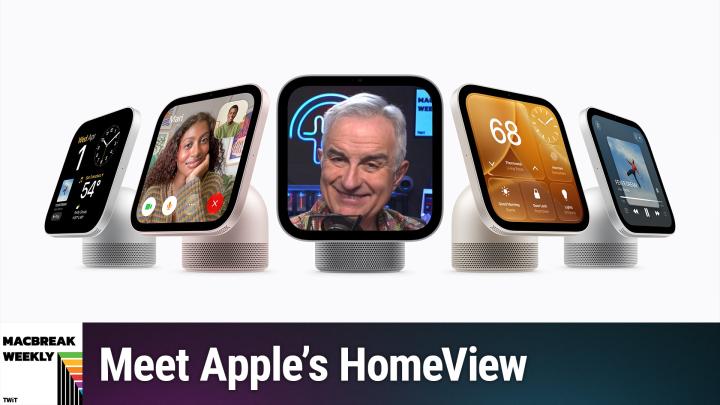
MacBreak Weekly 1065 Transcript
Please be advised that this transcript is AI-generated and may not be word-for-word. Time codes refer to the approximate times in the ad-free version of the show.
Leo Laporte [00:00:00]:
It's time for MacBreak Weekly. Andy, Jason, and Christina are all here, and yes, there's new Apple hardware. We're gonna talk about the HomeView, the new Apple HomePod Minis, the new Apple TV. Is it too expensive? There's a lot to talk about. MacBreak Weekly's next.
Leo Laporte [00:00:24]:
This is MacBreak Weekly, episode 54. Episode 1046, recorded Tuesday, October 13th, 2026: Trust Agnes! It's time for MacBreak Weekly, the show where we cover the latest Apple news. And there is Apple news this morning. So we're glad that, uh, Jason Snell got up early to write. I noticed—
Jason Snell [00:00:50]:
Bright and early today. 6:42 in the cloud.
Leo Laporte [00:00:54]:
Yeah,
Jason Snell [00:00:55]:
I was up at 5:45 because it's a 6 AM press release drop here on the West Coast. And so that's what we do. You, you knew it would happen.
Leo Laporte [00:01:01]:
I got up Uh, too, not that I had to file anything, but I, you know, I was so excited.
Jason Snell [00:01:07]:
It's like Christmas morning, isn't it? There's new Apple stuff under the tree, or at least will be under the tree in a month.
Leo Laporte [00:01:12]:
Yeah.
Jason Snell [00:01:12]:
Or longer.
Leo Laporte [00:01:13]:
Yeah. That's weird, isn't it?
Andy Ihnatko [00:01:14]:
With many of its launch features, but not the one that they want you to use.
Jason Snell [00:01:17]:
But not the one. Yeah. We'll get into it, but it's weird.
Leo Laporte [00:01:19]:
We'll get into it. That's Andy Ihnatko in the library, back in the library where he belongs.
Andy Ihnatko [00:01:25]:
Yes.
Leo Laporte [00:01:25]:
Good to see you, Andrew.
Andy Ihnatko [00:01:27]:
Apologies for last week's internet. It works just fine until the one time that
Leo Laporte [00:01:31]:
it doesn't,
Andy Ihnatko [00:01:32]:
doesn't need to, doesn't work fine until it doesn't.
Leo Laporte [00:01:35]:
That's okay. That's okay. I'm— Support your local library. I appreciate the attempt. So is that why you go to libraries? Because your internet at home is not so good?
Andy Ihnatko [00:01:42]:
Uh, no, it's mostly because like there, there can be ambulances and police and like people on motorcycles.
Leo Laporte [00:01:48]:
Yeah, you live in the center of town at like the crossroads where everything's happening. Yeah.
Andy Ihnatko [00:01:53]:
Yeah. And, uh, and also I like the fact that like this, the background has been pre-cleaned and pre-tidied for me before I get here, as opposed to, uh, crap, what can I, what can I hide in the bathroom for the next 2 hours?
Leo Laporte [00:02:05]:
I have stood outside of Andy's apartment looking up at his window in the rain with tears flowing. I don't want to—
Andy Ihnatko [00:02:12]:
holding up an iPod, uh, well, okay, iPod, whatever, whatever that big speaker was. Thank you very much.
Leo Laporte [00:02:19]:
Also, Christina Warren, from GitHub fame. You know, tomorrow, uh, Martin's gonna be on Intelligent Machines.
Christina Warren [00:02:27]:
That's awesome. Everybody should definitely tune in. Um, yeah, I will be one of them because Martin's great. You guys are gonna have— I can't wait for you guys to geek out together because you're exactly the same type of like tech nerd in the best possible way. And so that's, that's going to be great.
Leo Laporte [00:02:40]:
I can't wait. I've, uh, you know, he's the one I think who kept sending me these lovely badges from GitHub Universe.
Christina Warren [00:02:45]:
Yeah.
Leo Laporte [00:02:46]:
And I have them all and I love them all. And, uh, good. I can't wait to talk to him. That'll be a lot of fun. Is he, what is his title? Vice president?
Christina Warren [00:02:54]:
Yeah. He, yeah, he's VP of Developer Relations and Community, um, at GitHub. He oversees a bunch of stuff and he's been around for— He's your boss. He's my boss. Yeah. He's my boss's boss. And, um, and yeah. Uh, so, so say nice things about me, of course.
Christina Warren [00:03:05]:
Um,
Leo Laporte [00:03:07]:
I will. I'll say how much we love Christina Warren and how brilliant she is. Oh yeah, don't worry. That's a given.
Christina Warren [00:03:15]:
Okay. Well, appreciate that. No, but you guys are going to have a great time because he's the best. The two of you can have like a 32 off because the stuff that he likes to build and make and show off is great. And then he has some very, very smart and interesting things to talk about with when it comes to the AI of it all too.
Leo Laporte [00:03:34]:
Oh, I can't wait. That's gonna be a lot of fun. That's tomorrow on Intelligent Machines, 2:00 PM Pacific, 5:00 PM Eastern on most of these same bat channels. Also, let's— oh, that's it. That's the whole panel. There's no one else to introduce. I was gonna introduce somebody else. There's John Ashley, boy producer.
Leo Laporte [00:03:51]:
He hates it when I call him that. He's a full-grown man. He's a woman in a man's body.
John Ashley [00:03:54]:
You know, it's been over a year since you called me a boy producer, and now you had to bring up those repressed memories I had bottled inside.
Leo Laporte [00:04:01]:
Poor guy. He's going through—
Andy Ihnatko [00:04:02]:
Leo, you make it sound like you carved him out of wood. Like a month ago.
John Ashley [00:04:06]:
I've managed to suppress the idea of boy producer, and I have to deal with Christina Warren. Christina's talking about Taylor Swift hate, and I—
Leo Laporte [00:04:14]:
Not today.
Christina Warren [00:04:15]:
Not today.
Leo Laporte [00:04:15]:
Today we're gonna talk about Hailee Steinfeld. She was prominent at the football game last night on Monday Night Football. I guess she's married to one Josh Allen, famous quarterback.
Christina Warren [00:04:28]:
Yep, she's great.
Leo Laporte [00:04:29]:
Yeah, she both— it's funny, they kept going to the wives of the game because it was this real seesaw battle. and the ups and downs. And they were— and Haley was going, oh, she was so nervous she couldn't stand still. It was very exciting for me. Okay, let's talk about the real excitement, which happened at 6 AM. Apple, uh, now they had an event too in New York today, right? Are we seeing, uh, press from that yet?
Jason Snell [00:04:54]:
Yeah, there's an experience they had where they got— some people got to get their hands on, uh, the new products and take their video shots.
Leo Laporte [00:05:02]:
And Jason, in the words of Jimi Hendrix, are you experienced?
Jason Snell [00:05:05]:
I am not experienced. I have not experienced experienced them yet. I have not, uh, I'm, I'm talking to— can I say? Yeah, I mean, I'm talking to them later about it, so I'll get a briefing, but I haven't.
Leo Laporte [00:05:15]:
Jennifer Pattison-Tui went there. She's great from The Verge. We love Jennifer. Uh, she's of course a regular on Tech News Weekly. And there it is. This is it, the new— it just, you know, by the way, credit where credit's due, Mark Gurman nailed it in every fashion. This is the Home View 7-inch screen. Kind of hard to tell from the pictures.
Leo Laporte [00:05:35]:
I'm glad Jennifer put her finger in there because it's not that big.
Andy Ihnatko [00:05:39]:
One thing, one thing that Mark Cuban did not get right, but it maybe was one of those ideas that they were experimenting, experimenting with, and they decided that maybe we could get the price down below $300 if it did not have a robotic arm that pivots and automatically turns towards the, the viewer.
Leo Laporte [00:05:54]:
There is no arm.
Andy Ihnatko [00:05:56]:
But it's a, but it's a $299 device, which is not terribly spendy. It's, it's definitely accessible, especially considering that Boy, did they design this to look very, very handsome. The idea of a square display automatically promotes it as, no, no, no, this is not a widescreen display. Do not associate this with your laptop or your TV or anything like this. Associate this with your Apple Watch. That's the level of intimacy and simplicity that it's presenting.
Leo Laporte [00:06:23]:
It does. Now that you say it, it looks like a giant Apple Watch.
Jason Snell [00:06:26]:
It does. Apple is so good at reusing their technology, and this product is a great example of it. Although, it's funny. You know, according to Mark Gurman, and I've heard this from other sources as well, they kind of had it done 2 years ago. Yeah. Like literally 2 years ago, it was supposed to ship early last year. And, and, you know, the hardware was in testing before that. Obviously it's been a couple of years.
Jason Snell [00:06:47]:
The truth is, um, some of the stuff we see as recycled in this product might have been recycled from this product, but who knows? They shipped out of sequence, but like it's got Apple Watch bits in it. It's got widget bits in it. It's got CarPlay bits in it, apparently. Um, And, you know, so yeah, it looks like a standby iPhone or a watch face. And then they've got, they've got the Siri AI connectivity in there. So it's like a whole bunch of stuff. It's a little like an iPad. It's a little like an Apple TV.
Jason Snell [00:07:15]:
It's a little like CarPlay. They really, I mean, that's why they had this product 2 years ago was like, they've got all the pieces to build this product. And as somebody who has tried several other home screen controller thingies in my kitchen and I hate them all so much, I've wanted this product for 2 years. I'm looking forward to trying it out. But yeah, It is funny that a lot of the— they even call them faces. It's like, yeah, it's kind of like a big Apple Watch and it's not that big. It's kind of, it's a tiny—
Leo Laporte [00:07:42]:
7-inch square. Yeah. So it's a waffle. Yeah, it's a waffle.
Andy Ihnatko [00:07:46]:
It's the iWaffle.
Jason Snell [00:07:47]:
It's adorable. A little guy. Yeah.
Christina Warren [00:07:50]:
Yeah. There's rose gold.
Jason Snell [00:07:52]:
There's a rose gold, Christina. I thought of you.
Christina Warren [00:07:54]:
Thank you. I'm glad.
Leo Laporte [00:07:55]:
Well, they're very, uh, subtle colors.
Jason Snell [00:07:57]:
They are. It's typical Apple.
Leo Laporte [00:08:00]:
I don't know. It's like ivory, I guess. It's this—
Jason Snell [00:08:03]:
There's a silver. There's a silver and a space gray, and then there's starlight.
Leo Laporte [00:08:07]:
Starlight is what I got.
Jason Snell [00:08:08]:
And then, and then rosy pinky.
Leo Laporte [00:08:11]:
Yeah. Um, and it is going to replace the, uh, that does swivel.
Jason Snell [00:08:16]:
Yeah,
Leo Laporte [00:08:17]:
in my, uh, kitchen. One of the things that's kind of cool about it is it has face recognition in it, and as you approach it, it will know it's you, so the screen will change to fit you. Up to 6 family members.
Andy Ihnatko [00:08:28]:
It's finally a multi-user iOS device. I hope this trickles down into the $2,000, the $1,500 iOS devices.
Christina Warren [00:08:35]:
Seriously, please come to the iPad. We beg you. Like, we need it. Like, please.
Leo Laporte [00:08:39]:
Uh, calendar, messages, relevant information. Uh, of course Siri AI is in it.
Jason Snell [00:08:47]:
Yep.
Leo Laporte [00:08:48]:
And I guess Siri is going to talk to it just the way
Jason Snell [00:08:50]:
you— Siri AI is in it. It's not in the HomePod, but it is in—
Andy Ihnatko [00:08:54]:
oh, sorry,
Jason Snell [00:08:55]:
it is in it. Uh, the HomePod puzzlingly doesn't have it, but yet asterisk.
Leo Laporte [00:08:59]:
That's confusing.
Jason Snell [00:09:00]:
But yeah, but like, just, just holding on, on Home View for a minute, like one of the things that they had to figure out is so much of Siri AI is tied to personal context. And what do you do with personal context on a device that is not capable of— it doesn't even have all your personal data, right? Because your personal data is on your phone or your iPad. And so this is what they've done is It will connect to your phone or iPad and basically you'll give it a Siri AI command that asks for personal context. It's handing it off to your iPhone or your iPad.
Leo Laporte [00:09:32]:
So it doesn't have the processing to do it.
Jason Snell [00:09:34]:
Exactly. And then I think that when you, when you're not a person, that means that also they need to recognize your voice. They do a second authentication. Is your phone around and has it been unlocked recently?
Leo Laporte [00:09:45]:
Within the last 8 hours. Because it's not Face ID.
Jason Snell [00:09:47]:
So instead they're using a couple different points. in order to grant access to your iPhone. So it doesn't have face recognition?
Leo Laporte [00:09:52]:
How does it know you're approaching?
Jason Snell [00:09:54]:
It has some face recognition, but it's not Face ID, right?
Christina Warren [00:09:58]:
It's different.
Jason Snell [00:09:59]:
And it's using a bunch of things, camera, voice, and then your presence of your iPhone on the network that has been unlocked fairly recently. I think it's the last 6 hours or something in your home.
Leo Laporte [00:10:10]:
'Cause you can FaceTime with it.
Jason Snell [00:10:11]:
You can do FaceTime, right? So they're trying to make it, and their demos show, I mean, their demos are really bold, but like the idea here is, If you ask it a question, it will, that requires your personal context on your iPhone or your iPad, it will use your personal context on your iPhone or your iPad. And then if somebody else asks it a question, it will use their personal context. And if it's somebody who does not have an iPhone or iPad, a guest, a kid, whatever, then it will just be generic sort of Siri AI, which I suspect is largely happening in the cloud, right? That's the fallback Siri AI. I think the Apple Watch probably does that too, where like, beyond a certain point, you're just like, it's kind of like old Siri, don't tell anybody, um, in that it's just kind of a cloud model that you're using for basic information. But, but they have done— I'd say this is the most multi-user functionality they've ever done in a, in a mobile-ish device like this,
Leo Laporte [00:11:07]:
isn't it? Yeah, but that makes sense because you're in a house with a family.
Jason Snell [00:11:11]:
Yeah, yeah, they have a great video about showing a family getting ready to go to work and school in the morning, and it's very much like, uh, the daughter calls up something personal and then the son like tries to peek over and see it after she's left and, and, and it fails to authenticate him and he can't see it to get the message across that like your requests are just for you.
Andy Ihnatko [00:11:30]:
Yeah.
Jason Snell [00:11:31]:
Um, and that's how it, it's like code switching almost between like who is talking to it. 'Cause they know this is a, this is a, uh, in a public place and it's gonna be a shared unit. And so they had to deal with it. And again, it's a hard problem and it's not a problem Apple has. I mean, anybody who uses an iPad with kids and stuff knows Apple has done a whole lot of like, nope. Just buy another one. Nope, nope. And they know that they're not going to be— you're not going to have 5 HomeViews in your— on your kitchen table.
Andy Ihnatko [00:11:54]:
Yeah, and that's, and that's something that's— I'm keen to see how families interact with this, because for years and years and years, like up to today, and a device that I actually ordered like a month ago that's not gonna be shipping for another couple months, uh, technology— tech companies have been promoting the idea of, oh well, here is like the— here's the, the fridge door where people leave notes for each other and where the calendar is for everyone's soccer practice, and everybody's gonna be coming to this one screen to get all this information and as a family hub, but it hasn't really super taken off because I'm not sure if people— it's— I wonder if it's just hard to get people to be trained to, you are going to go to this one location because we can't afford to have 4 or 5 of these, have one of these in every room, and that's where you're gonna check in, and that's where you're gonna let us know what time you plan to be home today, and that's where you're gonna find the shopping list. That's the— I don't— I, from the— from my glorious 4 hours worth of knowledge and experience and research into this device, it doesn't look like $299 is a lot lot of money for this device. However, I do notice that, uh, like my $99 smart— like screen-assisted smart speakers, they're at least cheap enough that there is one of these screens pretty much wherever I might want to interact with my voice assistant with the screen attached to it. So Apple might have created such a wonderful experience that people are going to actually want to check in and might, might actually adapt their behavior in the household to basically be wanting to glance at the screen when they come home, glance at that screen before they leave. And it'll all come down to the interface.
Leo Laporte [00:13:26]:
It is kind of, you know, I have to say it's a little personified. It's kind of cute.
Andy Ihnatko [00:13:30]:
It is.
Leo Laporte [00:13:31]:
Uh, I, and I think they, one of the reasons they made it this size is because it's not just for the kitchen. I can see this on a, on a person's desk, even an executive's desk.
Jason Snell [00:13:41]:
And it'll go, and on a nightstand. Um, I, I don't think I would do that, but they, it goes down to like 0.3 lux or something. They said it can be very dim, so you can have this you know, at night and not wake you up. So you may have it on a nightstand or an end table or something like that.
Leo Laporte [00:13:55]:
I do that with my phone, you know, when you put it sideways and it turns into the nighttime display. It's like a nice clock. Um, this is— so you can order it today for $299. There's also a wall-mounted for $299.
Andy Ihnatko [00:14:09]:
Exactly. That— I'm sorry, go ahead.
Leo Laporte [00:14:11]:
Does that— does that— that loses the bass, obviously. Does it still have speakers and everything?
Andy Ihnatko [00:14:15]:
It does have speakers. Doesn't have the same bass speakers Uh, and the weird thing is you still have to spend $60 for whatever mount you decide you want for it, whether you want to— whether you want to plug it into the wall for current, whether you want to get power over Ethernet, whether you want to basically drill a hole in your wall and basically have an electrician like basically put a power—
Jason Snell [00:14:35]:
Yes, yes.
Andy Ihnatko [00:14:36]:
But yeah, there's a PoE. It's weird you can't do anything with it until you've, you've paid money for this wall mount, unless there's— unless there's a USB port for power and it's bring your own adapter.
Jason Snell [00:14:45]:
There is a USB USB port for power. So you can do that yourself, but then you're like sticking it to the wall, but they've got a bunch of different mounting options, including like a VESA mount. If you've got a VESA stand, you want to put it on or—
Leo Laporte [00:14:56]:
So it does have a VESA mount. Okay.
Jason Snell [00:14:58]:
Built in or? Well, there's an adapter for it that is available and they're all like $70 or more, but, but they are there. And, and I heard somebody was, was like, why would you do power over Ethernet? But it's like, I think Apple. I mean, they're right if they think this, which is some people are gonna just pay an installer to come and create— remember like X10 and all of that where it's like, well, we're gonna make your home real smart and there's gonna be a controller. Well, people are gonna be able to come in and like wire up your home with these various devices that we're probably gonna talk about today and other smart home devices that are out there and a HomeView that they're gonna put on the wall. And it's gonna be wired in on the back from coming from inside the wall. And they wired a bunch of power over Ethernet everywhere.
Leo Laporte [00:15:40]:
I have. And you can just plug it in that way. In my front entryway, whoever built the house, was planning for that. There was an Ethernet wire sticking out. I've kind of buried it and routed it because— Yeah, you can do that if you want. But I could open up the wall. There's an Ethernet jack.
Jason Snell [00:15:52]:
Or USB.
Leo Laporte [00:15:53]:
That has PoE.
Jason Snell [00:15:54]:
Straight up power to USB.
Leo Laporte [00:15:55]:
I could put it there.
Jason Snell [00:15:56]:
Yeah, yeah, with that—
Leo Laporte [00:15:57]:
I'm not sure I want— it's the first thing I want somebody coming in the door to see. But I,
Jason Snell [00:16:01]:
yeah,
Leo Laporte [00:16:01]:
I guess if you turn off your alarm system when you come in or whatever.
Jason Snell [00:16:04]:
And the truth is you might, you might not— like, I, I have a, a new HVAC system that I really love, but I hate the controller. The controller is like something from Windows Phone era in terms of of its UI. It's very Metro knockoff design. It's slow and it's bad. And I thought, well, you know, you put one of these on the wall, it's going to be a much nicer interface to control the thermostat than the stupid thermostat's interface is. I'm like, yeah, maybe, maybe. But like, I'm going to start with one.
Leo Laporte [00:16:31]:
She is making a thermostat that's compatible too. We'll get to this. Yeah.
Jason Snell [00:16:34]:
Well, that's the problem is that if you, if you have a lot of the third-party thermostats don't really work well with existing HVAC systems, the, you're, you know, I, I, I, Trust me, I've looked into it, but, um, you really need to use the one that comes with it.
Leo Laporte [00:16:49]:
Then whatever that S— whatever cable is, that weird little cable.
Jason Snell [00:16:52]:
There are a bunch of— I mean, this is the thing I did. I actually did a— at one point I did a Wirecutter story about smart thermostats back in the day, like 10 years ago, early days of the Wirecutter. And that's one of the things the HVAC experts told me is like, you know, if you're retrofitting an old system, buying a smart thermostat is nice. But if you get a new system, like there are a bunch of special features that only their controller does, and you're probably better off using their controller. which is true even though mine is terrible. So, but it is on HomeKit, so I can actually do something like this. I might, I might do that at some point. But, um, you know, so it's— I think that's one of their motivators for, for having the wall version of this is to say, if you would like a, a dashboard for your home on the wall, we can do that.
Jason Snell [00:17:34]:
If you like a little pal who sits on your kitchen table, we can do that too. It's the same product.
Andy Ihnatko [00:17:39]:
Yeah, it has to be wherever the family or the user expects it to be. So this is very, very smart that there are so many mounting options. I just, I just hope that when you do your unboxing, like, you'll see that they don't just expect you to go to Home Depot and pick up a pack of those like 3M foam, like, stick-it-to-the-wall mounting hooks. Because it's a $300 device, I'm surprised they don't have— I would be very, very disappointed if it doesn't come with some robust way of putting it on the wall. Even if you, even if you're not offended by a visible power cord, uh, USB cord going into the wall, uh, I, I would hope that you don't— that the— you don't— you— that they're not demanding that you buy something extra to make it look nice on your wall or make sure it doesn't You get woken up at 1:30, 2:30 because the cat found a way to jump from the bookshelf to take out this brand new device.
Leo Laporte [00:18:26]:
Uh, the one with the arm, you said, Jason, uh, will be next year maybe, you think?
Jason Snell [00:18:32]:
Gurman says that they're all— because remember, this hardware has been out, been ready to go for a couple years.
Leo Laporte [00:18:37]:
Why, by the way, why did it take so long?
Jason Snell [00:18:39]:
Because they wanted to launch with Siri AI, and the original Apple Intelligence launch was so fraught that they're like, forget it, we can't launch until Siri is better. That's because they expect this to be a key feature of this. But Gurman says they've been working in the background on a thing that he calls the tabletop robot. Now I roll my eyes because it's not a robot, it's just a thing that sits on your table, but it will move and it will have more of an arm to it than this one, which is kind of like just a hinge. And if you can imagine a HomeView, HomeView 2 will be like, have that little arm on it. And then if you're walking around in the kitchen, it can, it can follow you, it can change the position for FaceTime. And for your eyeline, and that'll be the next one.
Leo Laporte [00:19:16]:
Yeah, because in this Apple video, the poor wife has to actually manually turn it like an animal. And, uh,
Jason Snell [00:19:24]:
next year, stay tuned for the sequel next year.
Leo Laporte [00:19:27]:
Um, actually, I don't, I don't really like, uh, the Alexa following me around. It's a little creepy, and it does, and when you talk to it, it whips around to say, what? It's a little, a little creepy. I will be glad to replace it. The other thing I don't like about the Alexa Is it'll do a photo slideshow. Used to do it. Now Amazon wants $3 a month. Yeah. For that, which is very annoying.
Jason Snell [00:19:51]:
Hard no.
Leo Laporte [00:19:51]:
Hard no. Hard no. So this presumably Apple Photos will be one of the screensavers.
Jason Snell [00:19:56]:
Yeah. Yeah, sure. And access to all your featured and albums and whatever.
Andy Ihnatko [00:20:00]:
I, I do hope that it's open enough that at least through third-party support, if you've got all your photos on Google Photos and all your photos are on whatever, on Dropbox or Google Drive or whatever, you can't hook it up to that because one of
Leo Laporte [00:20:11]:
these— What are you smoking, Andy? Are you kidding me? I know, but that's a no.
Jason Snell [00:20:14]:
You'll need to import that.
Andy Ihnatko [00:20:16]:
Well, that's it. But that would be— that would be a stupid— I will— I'll say this as a pundit, that would be really obnoxious and stupid for Apple to not— to not allow a third to— if Google wanted to say, hey, by the way, the Google Photos app on your phone can now basically keep this— to keep your Apple device updated so that you will be able to see nice family pictures and family memories as you pass by checking to see whether you need a coat today. Well, if Apple says that, screw you, switch to— switch to an iPhone to get that functionality. It would be A, not something I wouldn't expect from Apple, and B, one of the reasons why Apple is sometimes really obnoxious.
Jason Snell [00:20:50]:
Okay, so a couple of things there. One is they don't do that on any of their other platforms really too, that are like Apple TV and, and Watch, where you have access to the system, um, screensavers or watch faces. Um, Photo, to a certain point, you know, you get your 5 gigs of storage or whatever, putting things in iCloud Photos is essentially free. So you could do that. That's what I do with my Google Home product and what I used to do with my Amazon Home product is I have to go to their thing and import my photos from Apple Photos in order to put them on theirs.
Leo Laporte [00:21:23]:
Oh, that's true. So
Jason Snell [00:21:24]:
I think that's— I, I, the app issue more broadly, I think is an interesting thing. It feels like they've done the minimum here where there are some hooks to third parties. They say that it's gonna ship with Spotify. There was one report that said that, that there are certain apps are gonna be able to use essentially CarPlay apps on the screen projected from your phone.
Leo Laporte [00:21:46]:
You know, that's interesting because CarPlay has ChatGPT and—
Jason Snell [00:21:51]:
Well, here's the thing though. I think, and again, I don't have more information about this now, but I think the idea there is they may only have it for media playback apps. And even then it may be for partners that they've blessed. So we'll see how that goes. I feel like this is a 1.0 of their story here, 'cause they didn't wanna do an app store, which I think is a good move. But I think that there's probably more for them to do here and that this is like the bare minimum to get it launched. But it would be really nice if apps, for example, that can do CarPlay could say, oh, if I know it's you, I'll let you put up your, you know, Overcast or whatever. And it doesn't need to even be residing on the system.
Jason Snell [00:22:32]:
And you've already built a nice simple interface for this thing. So we'll see about that. But I think it's less likely to Andy's point that they're gonna say, say now you can put any of, you know, your Google Photos onto a— what, essentially a watch face? Because they don't do that.
Leo Laporte [00:22:47]:
They don't do it.
Jason Snell [00:22:47]:
They just don't do that. And their competitors don't do that. Yeah, like they basically say you got to use our photo library for this. And so I sync them to Google Photos.
Andy Ihnatko [00:22:55]:
I, I respect that. And also it's, it's obnoxious on any platform. And I'm— when you have something that is really promoted and designed to be part of not just house infrastructure but family infrastructure. If you can't personalize this to the social environment of that, that personal home environment and family environment, that's at best a huge missed opportunity. Because it's— I already think it's very, very annoying that, like, I can get a— I can— that I can't get a custom watch face that looks exactly the way I want to. I can put my own photo in the background and That's fine. That's not— that's better than nothing. But I think it's obnoxious that I can't make this as personable as what I would pick out if at a watch store or out of a catalog.
Andy Ihnatko [00:23:42]:
But, and I'm just saying that if Apple were to say, guess what, you can have like special Snoopy animation because we own Snoopy, you can get a special time-limited Severance animation because we own Severance and we want to promote Severance. What you can't do is if you have video of Mystery Science Theater 3000 that you really enjoy, you can't have backgrounds that are Mystery Science 3000 or give you that same sort of experience.
Jason Snell [00:24:03]:
Or maybe you can. I mean, I would say it's unlike— nobody's going to use this thing who doesn't have an Apple device in their house. And you can, you can do, you can push those images to Apple Photos from your other apps on your iPhone or your iPad or your Mac, and it will pick those up. And that is, I don't think it's— I think that's fine. I don't think it's perfect because it means you have to manually do that. Which is what I, why I have to do that every so often with my Google device is the same, same deal. But I, you know, you can, it's not that you can't do it. It's that it requires a step unless somebody writes a, somebody should vibe code a syncing engine that just takes your particular album in Google Photos and make sure that it just gets auto-added on a Mac every so often to the photo library on the Mac.
Andy Ihnatko [00:24:49]:
But I'll just, I'll just wrap. I don't want to turn this into another 20 minutes, but I'll just say that it One of the reasons why the iPhone is so cool is that Apple didn't say, oh, by the way, there is no way in hell you can get this to work unless you have a MacBook. It's great that AirPods work. Bluetooth is Bluetooth. It's extra good if you've got it with Apple, but it's basically everybody will have an opportunity to use these great things. One of the things that, on an ongoing basis, I think is disappointing— I won't use a stronger word than that— disappointing about Apple is that it is hard to do something in a multiplatform way. It is harder to create an Apple Watch software stack that can work with with other platforms. And also, when they feel as though they're feeling pressure from competition, they've got no problem doing a really good Google TV app for Apple TV.
Andy Ihnatko [00:25:36]:
They have no problem making a really good Android app for Apple Music. But when it comes down to other things, they'd much rather just stand in the back of the batter's box, let the pitch pass them by. And at best, it's a missed opportunity. At worst, it's Again, I have to use the word obnoxious.
Jason Snell [00:25:53]:
Well,
Andy Ihnatko [00:25:53]:
the idea of we have, we want to protect our ecosystem and we don't want to give people an excuse, make it easier for people to choose something other than an iPhone for this device.
Jason Snell [00:26:01]:
I think a lot of this is the expediency of them having to ship this product without an App Store, which I think was probably a good move, but it does shut out other people. And I think that that's just part of it. I will also say that they chose to make this work apparently with the iPad, at least to a certain extent, which I'm not sure that they've done before. It's been kind of like an iPhone-only kind of thing, and it seems like like you can have an iPad backing Siri AI and that will actually work for things like context requests at least. So that's, I think, encouraging. But I, you know, I don't know. Some of this is like, you know, yeah, you can't, you can't use Google Photos for an Apple Watch face either. And some of it is just that expediency.
Jason Snell [00:26:38]:
And the other thing is like, if you look at these announcements, like this product didn't even ship for 2 years because they couldn't get the software to a point where it was usable. I think you see that in a bunch of places that it's like they They barely got this over the finish line as it is, and other capabilities for third-party apps and stuff are probably going to come in some form, but not yet.
Andy Ihnatko [00:26:59]:
Early days. You're right. I agree with that. The history of Apple is always, we ship something, we want to make sure the features that we gave you are rock solid. We have the opportunity to add more features later. This is something that Google did not seem to understand with Google Books, just as a counterexample.
Christina Warren [00:27:13]:
Right.
Leo Laporte [00:27:14]:
So, just to underscore what What Jason already said, there's no app store. This is CarPlay style. It comes with Apple Podcasts, Apple Music, Apple News, Calendar, FaceTime, Messages. And then if your app, I guess, shows up in CarPlay or there's a CarPlay-like interface.
Jason Snell [00:27:30]:
Apparently, yeah, apparently there is. They have some partners 'cause they said Spotify will work on it apparently.
Leo Laporte [00:27:36]:
So there'll be a switch to a Sony app.
Jason Snell [00:27:36]:
But the question is, will there be a Spotify app or will it be sort of beamed from your phone? These are all kind of unclear, But first off, barometer. Remember Apple 5 years ago even seemed to have the attitude that like everything needed an app store, Apple Watch app store, iMessage app store, like everything had an app store and with diminishing returns, right? 'Cause, 'cause we, the iMessage doesn't need an app store and the Apple Watch really doesn't need an app store. Um, sideloading those apps from your iPhone with the Apple Watch extension is probably just fine. And I wonder if they're going that direction with this product line as well, the idea that Yeah, you're not going to have a full app, but will your phone or iPad will get something that'll run on it instead of having an app store on it?
Leo Laporte [00:28:23]:
I suspect it's constrained in the same way CarPlay is constrained. I think that's it, RAM and processor.
Jason Snell [00:28:30]:
Yeah.
Leo Laporte [00:28:30]:
And, uh, CarPlay is a projector, and so I think that it's safe to say this will be a projector.
Jason Snell [00:28:34]:
Or Apple Watch. It's got the same, you know, it's got power like an Apple Watch has power though. So it could, it could, and more than an Apple Watch. I think it's got an A18 in it. So that's a really— A17, A18. So it could do it, but I think I think the attitude is more Apple Watch here, which is like, keep it simple and with a little bit of CarPlay mixed in. And CarPlay is pretty, that's clever. If they're really using CarPlay for this, that's clever 'cause that gets, people have built those apps already and they probably adapt to this screen size and shape just fine.
Jason Snell [00:29:05]:
And if it knows who you are and what your iPhone is and it gives you a selection of apps, even if it's not all of the CarPlay apps yet, But it's some of them. That's encouraging, right? Because frankly, I don't want another App Store. I don't think they should be launching an App Store for every feature that they do. That was very much like a hammer in search of, you know, a nail. We're like, oh, App Store worked great, everything should have an App Store. Wrong decision. Um, and they seem to have learned from it. Where they go from here is a mystery because again, it's unclear like what the story is, but you can't watch this without saying, yeah, app, your Spotify Music will play.
Jason Snell [00:29:42]:
So
Andy Ihnatko [00:29:42]:
yeah,
Jason Snell [00:29:43]:
they can compete somehow.
Andy Ihnatko [00:29:45]:
Yeah,
Leo Laporte [00:29:47]:
it makes, it makes perfect sense. It's an A18, uh, 12-megapixel Center Stage camera with f/2.4 aperture, FaceTime video, Center Stage. So, so even though the screen doesn't move, it'll follow you around.
Andy Ihnatko [00:30:01]:
Oh God, you just had me hoping that people are— there are such wonderful maniacs in the Apple development community saying there must be some way we can get macOS at least running in a, at least running in like a lame, we won the bar bet by getting this to run.
Jason Snell [00:30:16]:
They haven't gotten iOS to run on a Studio Display yet, to my knowledge. So there's probably some really nasty security in there. But, um, but yeah, it's, it's because they were just, it's Apple. They're re— they, all the parts get reused, right? Like they all get remixed and reused. And this product is made up of like parts from all sorts of other parts of Apple, which is fascinating to watch. And I can't wait for people to start breaking it down. Like now that it's out or now that it's announced, they can start explaining what the developer story is. And I'm sure we'll hear more about that.
Jason Snell [00:30:44]:
'Cause I'm sure there are a bunch of developers who are like, I wanna be on that thing. How can I be on that thing? And is it CarPlay? Is it widgets? Like what is it? We
Andy Ihnatko [00:30:52]:
don't know. And also to be fair, part of the messaging that they have been promoting just even just today is like the, it's not in the first half of the press release, but the second half is all about everything is secure enclave. The microphone is, the audio from the microphone is secure enclave. The video is secure enclave. Don't worry about having an open mic Like somewhere inside the house. So I'm sure that they want to be able to promise users by— not a— but yes, that would be hysterically funny if someone got like macOS 6.02 running on, on this, on this device. But we have locked it down so well that it protects, protects you from evil people who want to steal your data and also fun people who want to run like classic games on this new device.
Leo Laporte [00:31:32]:
Here's the list of built-in apps from the Apple website. Alarms, calendar, FaceTime, Find My. Find My is kind of cool. We'll talk about the Apple TV has Find My now for the remote home. And yeah, finally, intercom. That's interesting. Messages, music, podcasts, reminders.
Jason Snell [00:31:48]:
They've done intercom on the HomePods for a while. And I just, if you've got a big house, my house is so small that I always laugh at intercom because you should just say
Leo Laporte [00:31:55]:
it.
Jason Snell [00:31:55]:
I can hear it anyway. But like, if you've got multi-story house and all of that, you can actually currently send like a page to all the HomePods in your house with a message. And so that's what that is.
Leo Laporte [00:32:05]:
So, uh, timers, weather, world clock. Interestingly, Safari is on it, so you can— I guess you can browse. And then it says apps available from the iPhone, which is interesting. Classical Music isn't on there, but it's available from the iPhone, as is Audiobooks, News, and Apple TV. You— they don't show this anywhere. Could I watch an Apple TV show on it?
Jason Snell [00:32:26]:
I bet you can. I bet you can, but it may be projected from your iPhone, right?
Christina Warren [00:32:32]:
Maybe. That's the interesting— that'll be interesting to see.
Leo Laporte [00:32:35]:
It'll be a weird square.
Jason Snell [00:32:36]:
Well, somebody pointed out today that, you know, they adapted CarPlay so that if cars are in park, they can play video now.
Leo Laporte [00:32:42]:
Right.
Jason Snell [00:32:43]:
So here's that, like it's playing video via CarPlay on a screen that's actually— that's capable. We can do that now.
Andy Ihnatko [00:32:51]:
Yeah. You think—
Christina Warren [00:32:52]:
I do have to say, sorry, sorry. I was just gonna say the one thing that does kind of strike out to me about this, and we'll talk this more as we talk about the Apple TV. But when you meant, but this just occurred to me because we're talking about potentially being able to, to project or playback video on this device, whether it's off of, you know, your authenticated device or not, is that when I look at this and when I look at the price, that is one thing where I wish I'm like, could you, could you just put an HDMI out on this? Could this also have been, you know, an Apple TV? Like, could we have done everything in, in one hub? Yeah. Here, you know, I don't know that that's just, that's just kind of a thought because to me, you've got the hardware capabilities to be able to do that. And it, it strikes me as, as being kind of superfluous to have this and a new Apple TV because they do, they have very similar hardware capabilities and obviously they're tasked at different things, I guess. But in most cases, you're not going to be using them all the time. It's going to be kind of a, you know, I, I don't know. That, that would, that would have been a nice thing.
Christina Warren [00:33:51]:
It would have been nice if this would have been a thing you could have said, yeah, you connect this even if it was through wireless or something to be like, you know, you can, you can project this to your, to your television and use this as a, as an Apple TV as well. But alas.
Andy Ihnatko [00:34:04]:
Yeah. Uh, go ahead. I'm sorry.
Leo Laporte [00:34:06]:
No, you go ahead.
Andy Ihnatko [00:34:06]:
I was, I was just going to ask, like, cause I'm curious what other people think. Do you think that this is the sort of device where Apple will kind of want to protect the experience by saying that, yeah, I mean, this could easily be a video player, but that would be such a terrible experience on this tiny screen and you'd have to like sit in front of it and move it. We're gonna— we're not gonna allow that freedom because we want to, at least for the first couple years, define how people interact with it.
Leo Laporte [00:34:30]:
So I can order it today, you can order it today as I did, but it won't come for a month?
Jason Snell [00:34:36]:
Yeah.
Christina Warren [00:34:36]:
Yeah.
Leo Laporte [00:34:37]:
What is that all about if you've had it sitting on in the warehouses for 2 years?
Christina Warren [00:34:43]:
That seems like there's gonna be something in 27.2 that they're Yeah.
Jason Snell [00:34:46]:
Get the software ready and also start to load it, load it in the channel and all those things. Um, to answer Andy's point, I don't know. I mean, I, it's a good question. Will you, will they, I think they're not leaning into watching video on it, but I also think that the other devices proved that sometimes you do wanna watch video on it. It's that whole kitchen television set phenomenon, which is like,
Christina Warren [00:35:07]:
mm-hmm.
Jason Snell [00:35:08]:
Also, I think that they would say like, so you wanna watch a YouTube video of cooking or something?
Leo Laporte [00:35:13]:
Yeah, sure.
Jason Snell [00:35:14]:
Safari is on it. So I think you're gonna be able to watch whatever you want on it. But I think they're not leaning into it as a use case because it won't be super satisfying, right? It's a teeny tiny square screen.
Christina Warren [00:35:25]:
Yeah, until they sell us the 13-inch version that has, you know, right, which was actually—
Leo Laporte [00:35:31]:
In fact, the ARM version probably will be bigger.
Andy Ihnatko [00:35:32]:
That has the MacBook panels they're no longer using.
Jason Snell [00:35:34]:
Yeah,
Christina Warren [00:35:35]:
right,
Jason Snell [00:35:35]:
exactly.
Leo Laporte [00:35:36]:
All right, well, that's just the first of a number of products Apple announced. And I think really importantly, there are a bunch of accessories that aren't made by Apple but are designed to go with the HomeView. We'll talk about that in just a little bit. You're watching MacBreak Weekly with Andy, Jason, and Christina. We're glad you're here on a new product day from Apple. I think it's really interesting. I can't remember Apple doing this before, but along, right alongside the HomeView are a bunch of accessories designed by LG and others to go with the HomeView. This is Apple's new Home Play.
Leo Laporte [00:36:13]:
In fact, there's a whole section on the, uh, on the store now that just says Home. That's where you'll see the HomePod Mini, the Apple HomeView, the new Apple TV. We'll talk about that in just a little bit.
Jason Snell [00:36:25]:
They're not hiding it, right? They're saying this is their whole home collection, and they say we worked with, uh, LG and that other company I forget now that's making the mounts and the, and the, and the other thermostat. Schneider Electric.
Leo Laporte [00:36:39]:
Yeah, Schneider.
Jason Snell [00:36:40]:
Yeah, it's kind to see Schneider Electric. Uh, you know, he was working on One Day at a Time for all that time.
Leo Laporte [00:36:46]:
Sorry, that's a reference for old people. Actually, I have a bunch of Schneider. They bought— yeah, they bought APC, so I have a lot of Schneiders. So UPSs—
Jason Snell [00:36:55]:
they— Apple's like admitting it. They're like, yeah, we work with them. Um, I mean, not that you couldn't tell because they're like an elegant, simple design. It's like, oh yeah, it's Apple was involved in this. Like, no logos on anything visible, all very Very austere, kind of simple. Um, but they don't have to—
Leo Laporte [00:37:11]:
It looks really cool.
Jason Snell [00:37:12]:
But, but it gets to be on Apple Store, it gets to be in Apple retail. Uh, these are the ones that people are going to be able to buy when they walk into the Apple Store. And like, sure, you could be a smart shopper and choose other things, but these will be easy for people to buy. Yes, which is important. It's like, it's like when you go to the Apple Store and you buy a case, it's like you could go find a different case online, or you could just get the case now that is very easy and they're handing it to you. And so So we've got, uh, an outdoor camera, an outdoor camera with 2 big floodlights on it, an indoor camera that has like a, a tilt feature so that like you can set it up so that when, when somebody in your home is in the house, it tilts down so it can't see anything.
Leo Laporte [00:37:49]:
I love this privacy feature. It's really cool. So as, as somebody— as if nobody's home, it's on. You could set it this way. And if somebody comes home, anybody comes home in the family, it goes, I can't see. What? I don't want to look at you. I think that's really nice. That's a, that's a security camera that answers, you know, Lisa won't let me put cameras in the house.
Jason Snell [00:38:10]:
Yeah.
Leo Laporte [00:38:10]:
Because she wants privacy.
Jason Snell [00:38:11]:
This might beat the resistance on that. And then they got like a doorbell camera, um, that's wired. It's not wireless, but they got a wired doorbell camera. They got a smart lock too. A smart lock is ultra-wideband. This is the third, I think, that I've seen of these. I, I've tested the first 2. They're great.
Jason Snell [00:38:27]:
Ultra-wideband lock is the lock If nobody's ever done a smart lock before, ultra-wideband lock is the lock to get because it knows when you're approaching the door, it unlocks, and it doesn't— you don't have to tap it, you don't have to do weird Bluetooth shenanigans. It's really good to do it that way. So they've got, you know, it's a really nice collection of, of smart home items. And then 2 thermostats, 2 smart thermostats that are like— I mean, how are they different from other smart thermostats? Unclear, but they have them.
Leo Laporte [00:38:55]:
They're home again.
Andy Ihnatko [00:38:56]:
I think, yeah, I think the big selling point is gonna be that yes, Apple knows that these devices exist, they co-developed them. So this is probably gonna be the one version of a doorbell or a camera or whatever that is not going to drive you up a tree trying to get Matter or Threads or whatever you're using in your house to recognize it. If you've got the Apple device that's running Matter or Threads, it will know about this thing's existence and you will never have to troubleshoot, hopefully never have to troubleshoot it. Certainly not do it every like 5 to 6 weeks, generally the case when you do shop around and try to find something that is affordable in this price range. I think most people would much rather spend a little bit, 20% more money, if it means that again, the tree will not be climbed up in frustration by you any more than it is absolutely necessary for the use of any technological product.
Leo Laporte [00:39:45]:
Yeah, I think, uh, and I think the market for— I mean, these are all relatively, uh, affordable. They're the same price as the, uh, The other guy's stuff, I think. Incidentally, they're doing a deal with ADT to install the HomeView on your wall if you want to use it with your ADT alarm system.
Jason Snell [00:40:05]:
Yeah, I mean, again, I— it's not necessarily like these are special. There may be some secret sauce in here, we don't know. Maybe there's like an NFC setup.
Leo Laporte [00:40:15]:
I'll tell you right now, because people— a lot of people have Ring cameras And they're very well aware that Ring will share that video with law enforcement and stuff. Yeah, this goes to— you get iCloud Plus, it's, you know.
Jason Snell [00:40:26]:
Yeah, it's a— oh yeah, that's all true. It's in Apple's network. I just, I wanted to make the point that there are other third-party products out there that I think probably do all the same things these do,
Leo Laporte [00:40:34]:
right?
Jason Snell [00:40:35]:
Not necessarily the ones that people are buying, but there are other ones out there that do a lot of these things. I don't think these are necessarily coming from a position of privilege where like only the Apple partner products can
Andy Ihnatko [00:40:45]:
Sure.
Jason Snell [00:40:46]:
Do— can do setup. Like, but what it does mean is that there's a guarantee, like you don't need to download a crappy app to use it.
Andy Ihnatko [00:40:52]:
Right.
Jason Snell [00:40:53]:
It just works with the Home app. You, you know, that's like Apple obviously put its stakes in the ground is like easy setup, bring it near an iPhone, add it to the Home app, done. Like that's all you need to do. Whereas some, but, but there are some devices out there that do work that nicely and are very nice. Um, but like with Apple, that's the guarantee is you have to do it that way. You're right. Leo, you also get HomeKit Secure Video, which, you know, if you're like me and you pay for 2 terabytes of extra storage, it's unlimited cameras, you know, with Secure Video. Yeah.
Jason Snell [00:41:24]:
And even if you're just paying for a little bit of iCloud Plus, you'll get a camera, or I think the lowest tier is 1 and the mid-tier is 5 cameras. So like, it's not that hard. And that's all encrypted. Apple can't see it. The camera maker can't see it. It's completely just you and your iCloud key, which is, I mean, in Apple's videos, they make a point of saying privacy and security is part of the story here. It's like you trust— what Apple's basically saying is you trust us more than you trust Ring. And, you know, maybe, yeah, yeah, a little bit, maybe.
Leo Laporte [00:41:58]:
Yeah. Um, for me, uh, one of the things that would stop me on this and has stopped me with other cameras is, uh, bandwidth. And people should probably be aware of this. The things that upload to the cloud use your bandwidth. And because I'm streaming here all the time, I don't want 8 cameras streaming to the cloud. That's a considerable amount of bandwidth that's used upstream. And most people don't have unlimited upstream bandwidth. That's the one that you don't get as much of.
Leo Laporte [00:42:26]:
So everything I have records locally, but that's more expensive.
Andy Ihnatko [00:42:31]:
But it's more about the— it's when devices like this, it's more, It's, it's about more than just the hardware and more about the cost of purchase. So many times, like, I get kind of interested in a certain product, but then to get the good stuff, to get the— actually, I want to, I want to see like more than an hour's worth of video because it kept— something happened yesterday that I want to check up on. But no, because I didn't spend $15 a month for that kind of tracking, no, I don't get that. And of course, Right. Bandwidth, bandwidth on the server costs money. Storage on the server costs money. I know that. But sometimes it really bums me out to do the math and figure out that Here's how much it's going to cost me to operate this.
Andy Ihnatko [00:43:08]:
And I will only regret cheaping out if something happens and I didn't get footage of it happening to, you know, help me out of a jam. And I do— Apple's done such good work, especially with Apple Health about this, where you buy the Apple Watch and it's not— and you can pay extra for extra features, but all of the good stuff that you bought this for, you get with the watch. I hope that it's much the same scenario with these cameras.
Leo Laporte [00:43:34]:
Uh, then of course there is the new Apple TV. Now tell me the story because this looks exactly like the old Apple TV.
Jason Snell [00:43:43]:
Well, part of the story is I'm going to depress a lot of people here because part of the story is that Apple only revs the Apple TV very rarely and then they keep it on the price list forever. And as a result, what they do is when it comes out, they over-spec it because they know they need to sell this thing for 5 years, uh, which means yes, this Apple TV will probably be the Apple TV that's current in 2030. Just putting it out there. Uh, and as a result, you know, it's, it's pretty, I mean, my understanding is it's super, it's super responsive because it's got a great processor in it and all of that. But what's actually new feature-wise is support for Siri AI, including like a new overlay that's supposed to not disturb your video. If you ask a question while you're watching video, I think it's putting up like a little lower third overlay kind of thing instead of blasting out and covering your video, which is kind of That's kind of smart. It remains to be seen how Apple TV-focused Siri AI is, but, uh, we'll give it a go. And again, it will use your iPhone or your iPad that's on your network.
Jason Snell [00:44:40]:
And I think if you're, if you're making context requests, the remote got precision finding and has a little speaker in it. So it'll chirp, I think, if, if you're trying to find it, which is great. It's basically like a little AirTag. That's nice. And it's got microphones on it. So if there's not—
Leo Laporte [00:44:55]:
Let's just make this clear. There's microphones on On the Apple TV. On the Apple TV, right.
Jason Snell [00:44:59]:
So, so if you, if you previously have been like, ah, I don't have HomePods or whatever, and I don't have an Apple device that's just listening in my house to whatever I wanted to say, if you get this, you do have one of those that you can give those Siri commands to and it will listen to you. Mine's in a, in a, in a closet. Mine's in a cabinet. So it doesn't work for this. But if, if you have it out or someplace where it, you know, through mesh or something, a speaker grill, it can listen. Um, it'll do that. Uh, that's all great. And because they've specced it really high, the specs are very impressive and they'll allow them to sell it until 2030.
Jason Snell [00:45:35]:
The thing is, a year ago, I think the low-end Apple TV 4K was like, what, $139?
Christina Warren [00:45:43]:
It's $129. It's $129. I'm pretty sure.
Jason Snell [00:45:46]:
This is $299.
Christina Warren [00:45:49]:
Yes.
Jason Snell [00:45:50]:
And that's it for the Apple TV. And while I am open to the idea that there, that the smart TV market is not what it used to be because every smart TV comes with a smart TV platform that's got all the apps on it. Yeah. And therefore a vast majority of people who buy a TV don't wanna attach anything to it, uh, other than maybe their cable box, but they don't need a, a computer box. The TV's got a computer in it. Now the rest of us are, are the ones who are saying, wait, wait, wait, wait, wait though. It might be spying on me and it's really slow and it's ugly and I hate it. It's like, yeah, but that's the, that's a bifurcation.
Jason Snell [00:46:26]:
So they're like, there's almost everybody who just doesn't care. And then there's this kind of higher end, like, but I do care market. And Apple's, that gives Apple a little leeway, but, and also Apple TVs last forever. They last a very long time. If you, if you buy it, you will be using it in the 2030s, right? Like that is probably certainly true. Right. That said though, $300 as your only entry to tvOS.
Christina Warren [00:46:51]:
As your only—
Jason Snell [00:46:52]:
Oh,
Andy Ihnatko [00:46:54]:
great falsifier. Yeah. Yeah.
Christina Warren [00:46:55]:
I mean, to me, it makes me like, look, I have no doubt, like Jason said, that we'll be using it well into the 2030s, right? Like if you buy this, I think that Apple will support for quite some time, but it does make me think more broadly, like, okay, what is Apple's commitment to this ecosystem? Because if this is the only device you're putting out, they dropped the model that the That was the lower margin item that did not have the Ethernet port, and so this one does have the Ethernet, and it's you know got 128 gigs of storage and the eight gigs of RAM, which is kind of ridiculous. You know, if you think about it for something that you talk about something you want to run macOS on, this would be a great thing to put macOS on far more than the Home View, in my opinion. But yeah, $300 like you know two years ago you could get. a Mac Mini for $500 every day of the week. And, and, and that, that's the thing that just kind of makes me depressed. I understand that we are where we're at. I understand that this is not Apple's fault, but at the same time, I don't think that I can recommend to the average person, period, end of story, to say, yes, you should spend $300 on an Apple TV. No, I can't say that because I don't think that for most people it's worth it unless you're— I, I just don't.
Andy Ihnatko [00:48:07]:
Yeah, I think you're absolutely right, especially because we're not— I don't— you don't even have to compare it to the free streaming streamers that you get free with that, with those terrible LG TVs. We can compare it to really good $50 streaming plugs that run, run Google TV and run other operating systems. That again, for the people who just want really, really good 4K streaming from all of the apps and services they use, that's as— I will say, I will say this, and if Alex is listening, I'm sorry to send you a conniption. It's going to be just as good as anything that they will get from that Apple TV. What would seal the deal is if they went something like Nvidia's streaming box, where, yeah, they are definitely positioning it as a premium device because we're charging at least $200 for it. But the thing is, as the good points that we've been making, that you're going to have this for 5 years, it has to be bulletproof and future-proof. But you never know, like 2 years from now, it's like, gee, there's this app that I can actually have a home media server so that I can actually have all of my home videos, like not just available on this big TV, but everywhere like inside the house. Like, oh wow.
Andy Ihnatko [00:49:15]:
And I can actually just install it on my $200 Nvidia box. Or I could, all this other stuff that I was able, that I'm able to do on this Nvidia that I didn't really figure on the first year that I was using it, including just, oh, well actually maybe I do want to, I have this old SSD. That I've just pulled out of like a broken laptop that I don't use anymore. Wouldn't it be great to basically put all my favorite movies on there and just attach it locally? All the stuff that you can grow into, and it can do things that you didn't imagine beyond streaming YouTube and streaming, right, Netflix. And the idea of what do I get for $300 with this Apple TV? And I wish that Apple had a better solution that, well, if you buy our $150 smart speakers, you can do surround sound really easily. And boy, it's great for if you've got an Apple Games subscription. Like, again, those are good points, but it's not selling me a $300 box yet.
Jason Snell [00:50:06]:
Yeah, I'm okay with this existing, but I'm not okay with it being the only one, right? Like, and honestly, with all the prices rising, that $129, $139— I'm okay with Apple not making a $40 streaming stick because totally they're not— they're gonna be slow, they're not gonna be great. I did
Andy Ihnatko [00:50:24]:
it
Jason Snell [00:50:24]:
And having tried all of those streamers last year, all those streaming boxes, you know, ironically, I think the Google TV one was the best experience. And I think that they've, they're kind of like decided they don't care about it so much anymore. Apple TV is great. It's, it is, it is top. It is the best of what's out there, but at what price? And that's why, like, again, they don't need to be at $40 in Walmart. They don't need to be at $80, but $129. No. $299 would be like something in the ballpark.
Jason Snell [00:50:54]:
So you could take a friend and say, I know you hate this stupid box or the stupid thing that came with your TV and that all the apps are slow and you're frustrated. Let's go buy you an Apple TV, but not for $299.
Andy Ihnatko [00:51:06]:
Yeah,
Christina Warren [00:51:06]:
right, exactly. Because I think the problem with $299, especially being the only device, and I think this goes to both what Jason and Andy said, and hearing Andy talk just kind of solidified this for me, is that I think this puts you into a different price comparison if you're a shopper, right? Because it was one thing when you were $150 or $180 set-top box in a sea of $30, $40 devices. You could still, to Jason's point, you could make the justification. This is why the Apple one is better. It works with all my stuff. I know that it's going to get a long time of support. I don't have to think about it. I don't have to worry about it spying on me.
Christina Warren [00:51:39]:
Great points, right? But when you move into the $300 realm, and I'm not even saying that I, like Jason, I don't have a problem with this existing, but with this being your only option at that point at $300, if I'm going to care enough about these things because I want the privacy and this and that, then I'm looking at mini PCs. I'm not looking at set-top boxes anymore. I'm now looking at mini PCs. And that's a very different conversation because if I'm already over the hurdle where I'm saying I'm going to spend $300 on this device that has all these things, then to Andy's point, I don't want to worry about, well, what walled garden am I in? I'm going to be about, okay, well, Well, I might as well just get a little mini home lab and then, you know, use LLMs to help me configure it if I need to. But people are doing great things with GUIs and, you know, great stuff in terms of app support across that stuff. And so I think that this is a problem if this price stays because, or if this is the only product, because I don't see who enters your ecosystem. I think that you have existing owners who will maybe upgrade something and keep it going or whatever the case may be. But I don't see how you get anybody new into your ecosystem at all, which is not a good thing for the ecosystem.
Christina Warren [00:52:51]:
And I say this as somebody who's owned, I think, every single generation of Apple TV, including the very first one that was macOS-based. And, um, you know, and I have them all over the place and I'm a fan. I hate it, but I love it. It's the worst, but it's also the best of all the things that are available on the market. But I look at this and I'm like, you know, $300. If I could do more on this, that would be one thing. Um, but otherwise, like, yeah, no, I, I, I might as well get like a, a used mini PC or, or something else and, and hack my way onto it if that's what it's going to be. I just, I, I don't see the, the value here for the average consumer.
Christina Warren [00:53:30]:
And that makes me sad because I really don't want Apple TV to die.
Andy Ihnatko [00:53:34]:
Right.
Leo Laporte [00:53:35]:
Well, They're already making the old ones, what do they call them, vintage?
Andy Ihnatko [00:53:42]:
I think they announced today that the first edition of the Apple TV 4K is now obsolete.
Leo Laporte [00:53:48]:
Obsolete? That's worse than vintage.
Christina Warren [00:53:52]:
That's from what, from 2015?
Leo Laporte [00:53:54]:
It's pretty old.
Jason Snell [00:53:56]:
Yeah,
Christina Warren [00:53:56]:
from 2015, I think.
Jason Snell [00:53:58]:
It's pretty far back there. I think the second generation forward all get a version of Siri. I
Christina Warren [00:54:03]:
was gonna say, I was gonna say the 2022 forward, which is not bad.
Andy Ihnatko [00:54:09]:
I'm sorry, it's, it's vintage, not obsolete. There's actually a distinction. Obsolete means that no, you're not, you're not getting jack from us from the future. Whereas this is like, okay, it's time to start saving your money because next year or the year after, you're definitely going to have to replace this.
Leo Laporte [00:54:23]:
Could this kill Apple TV? Is this like a bad thing? I mean, it feels like—
Jason Snell [00:54:27]:
I think this is temporary. I think they do actually. I mean, at $299, I actually kind of think that they know that they have to create a lighter version of Apple TV. To, and they just can't. I mean, part of it is the weird times we're in. I think that, I think that they need to put a chip in it that they can get and it's expensive and it comes with RAM that's expensive. And they just sort of like, again, that they need to build a product that they can ship for 5 years because they don't want to iterate 4 years. They don't want to iterate the Apple TV every year.
Jason Snell [00:54:53]:
It does. I can't imagine that there isn't somebody at Apple saying what is going to ultimately replace that low-end model that, and that they will do something at some point. But kill it? I think it's got momentum because of its install base, because of Apple's ecosystem and the fact that it's good. And I think that the big problem that all the streamer box makers are facing is that for a lot, for most, like I said, most people, what's on your TV is good enough. But in the long run, I think everything we've said here goes, which is it is what you want is a way to make the sale on somebody who is One admitted that their TV apps are terrible and need something else because it's just really bad. And two, maybe a tech-forward person has said that, you know, you can go buy something that's way better than that. And it's like, three, how do you convince them they're in the Apple ecosystem? How do you convince them to buy an Apple TV? And right now it's a brick wall after three for most people. And so that I've got to believe, and I know I'm being a little Fox Mulder here, I want to believe that somebody at Apple is saying that they are gonna, you know, 'cause Apple does things in dribs and drabs and sometimes the product lines don't make sense for a little while and you're like, why did they do that? And then 6 months later you're like, oh, okay.
Jason Snell [00:56:10]:
They don't line everything up. I have to believe that somebody is trying to make some tvOS device that doesn't cost $299. Yeah. But today, I mean, look for refurbs, look for used, look for things in the channel. Maybe you just wanna pick up one of those old Apple TV 4K. I
Andy Ihnatko [00:56:28]:
think, I think you're right. If I'm gonna, if I'm gonna take an optimistic point of view, $299 might be appropriate for a device with what, like 8 gigabytes of RAM and 128 gigs of storage? And $299 gives them a lot of headroom to introduce a later $129 version of it without making people think, well, why would I— why, gee, if this, if the, if the really good one is $189, why would I not spend an extra $40 instead of buying this weaker $129 version of it. So that's something to think about, maybe.
Leo Laporte [00:57:00]:
Okay. Yeah, it's an interesting play from Apple's point of view. I guess it is the times. I just, you know, Roku just got bought by Fox.
Christina Warren [00:57:09]:
Yeah.
Leo Laporte [00:57:10]:
I mean, that's the— that was the low-price leader. You can get $89, you can get a TV stick. I guess Fire TV sticks are cheap too.
Jason Snell [00:57:17]:
Oh yeah, I mean, you could get a Roku stick. I bought one for my mom from like $20. Yeah. Yeah. At Walmart.
Leo Laporte [00:57:23]:
Yeah. Yeah.
Jason Snell [00:57:23]:
Yeah.
Christina Warren [00:57:23]:
The Onn TV stuff from Walmart actually is really good. Uh, like that, that brand Onn, um, they're, they are no longer as readily available because component pricing has gone up, but like you could get a Google TV device from Onn. Like I got one like a year ago because like Jason and I just like to test these things and it was $50 or something and it was actually quite good. It was quite a good experience. Um, now I don't even think that they have them available, but Uh, and then this is actually part of the problem too. And I think this is why, like, because, uh, you know, Fire Stick prices are kind of out of control as well. There are a lot of these things where, you know, because it's not the most important use of your RAM and of your, you know, components, the prices go up because most people, to Jason's point, are just going to be using what's built into their television. You're not going to be thinking about anything else.
Christina Warren [00:58:11]:
Or if you're like my dad, you're not even using the superior LG apps that are built into the TV. You're using the stuff that's on like the Comcast box. So you're going through like a third party and you have an Apple TV that you have an Apple TV 4K that's connected that I bought you that I could, that like I set up for you that I've been begging you for 4 years to use.
Andy Ihnatko [00:58:30]:
It's making, you're making Leo dyspeptic. Sure. Don't stop talking about those cable boxes.
Christina Warren [00:58:34]:
I know it's awful, but I'm, but I'm, but I'm saying like, I know, I know how this goes because I've been trying to get my parents for years and years and years into using the right things, and, and you're just going to use what you're comfortable with. And so I think that's, that's the hardest thing that any of these manufacturers have to overcome is, is just the, okay, well, this is built in and this is good enough.
Leo Laporte [00:58:54]:
It's point of access, you know. People are just going to do whatever's easiest, whatever's right there, and they don't care like we do about quality.
Jason Snell [00:59:02]:
Right, right. So the market for Apple TV is the people who care enough to go beyond, right? And that, and because what's in the box used to be nothing or no good, and now it's okay what's in the TV. And so there is a leap there, but I don't think it goes to $299. I
Christina Warren [00:59:19]:
don't think it's $300. Well, exactly. Because again, my point is that if you're spending $300 and you are wanting those things, then I think a lot of the people are going to go, okay, well, if I spent $400, what could I get from, you know, a mini PC? And, and how difficult would that be to convince?
Leo Laporte [00:59:35]:
I think that's 5%. TVs they're buying at Best Buy or Target. I think you're right. 5%.
Christina Warren [00:59:40]:
But I think that it's, I still think most, I think that's maybe more than 5% just because I think if you're spending $300 on an Apple TV, you are more inclined to be somebody who's going to be spending that type of money on a, on a mini PC.
Jason Snell [00:59:51]:
As somebody who hooked up a PC to the TV in the past, I would never do that again because it's a nightmare and I would much rather have something that's pre-baked. But, but you're right. I mean, all, everything's on the table when you're looking at a $399 price tag. That's the bottom line. It's just, it's just not— again, I think, or sorry, $299. It's just not. Let's just cut it away here.
Leo Laporte [01:00:12]:
$6,000.
Jason Snell [01:00:13]:
It's $1,000, kids. It is.
Leo Laporte [01:00:15]:
It's $1,000 in 2050 money.
Jason Snell [01:00:17]:
It's a conversation ender. And I don't think, given the specs, I don't— and given the weird times we're in, I don't think that price alone is completely unreasonable. What's unreasonable is it's the only price.
Christina Warren [01:00:31]:
It's the only one. Exactly. Exactly. Like, I think that if you— and I think this is honestly one of the few times that I think we've kind of seen, and it's because of this supply chain shortage of various components where you see, I think, Apple optimizing for using the same chipsets and the same types of components again and again, where this hurts them because they're now using a higher margin chip that they used to be able to just kind of write off. And now they're saying, okay, but this costs money now. This RAM has a real cost now. We don't have another SoC that we can slot in here. We can't you know, afford to, um, reduce, um, uh, fab time to make lower tier processors that might be cut down or binned or whatever the case may be for the Apple TV.
Christina Warren [01:01:12]:
It doesn't tell enough of us we've got to make as many chips as we can so that we can shove them in iPhones. And that, that, that becomes a problem when, when that happens, because it's great that you can diversify or not diversify. It's great that you can, uh, reuse your components the way that you can, but it's bad when you don't wind up having kind of a, a low cost, you know, um, uh, go-to component that you could put into a HomePod or a HomeView or an Apple Studio Display or, you know, an Apple TV. And instead you're reliant on these higher-end, um, uh, components that have a much, uh, greater value, frankly, in, in other products that you could sell to people. So that, that's kind of a weird situation that Apple is in where they can't just just take a MediaTek thing off, off the street, you know, that, that's got less RAM and, and less processing power and put it out cheaper. Like they have to make all their chips themselves and they haven't designed lower cost chips, um, other than I guess for, for the Apple Watch, which, you know, maybe soon that would be able to get to the point where you could put that in an Apple TV, but that's not what they're designed for. And even then, you know, an Apple Watch is going to cost you about the same as an Apple TV does right now, which Which that's ridiculous. Like that in and of itself, the fact that an Apple Watch and an Apple TV costs the same is, is a little bit—
Jason Snell [01:02:29]:
I also want to throw out while we're, while we're piling things on the Apple TV, they still haven't come out. This is a home, big home day for them. They still haven't made what I feel like is the most obvious product for them to make in this category, which is they, they did announce you can now get 4 HomePod Minis and array them and do surround sound, which is fun.
Leo Laporte [01:02:48]:
That's gotta sound interesting.
Jason Snell [01:02:51]:
It might actually sound good. I don't know, but we'll see.
Andy Ihnatko [01:02:53]:
Also, you can repurpose with this.
Jason Snell [01:02:55]:
Here's what they're missing is like, okay, you've got all the pieces here. Why would you not make a soundbar that has got, it's got your HomePod speakers in it. It's got the microphone that's in the Apple TV now. It's got, you could put a camera in there, a Center Stage camera for FaceTime on Apple TV. Apple, for a few years now, I've been saying this. I'm like, they could make a soundbar product. That's the product that costs $499. Um, that would be really good.
Jason Snell [01:03:22]:
That's like, it's an Apple TV and a soundbar all in one. Are you getting it? Um, and it, that is a really interesting home opportunity and they have all the pieces of it, but they just won't do it. It's bizarre. I don't know.
Andy Ihnatko [01:03:36]:
I think, I think a lot of it could be just nomenclature. This was something that was going through my mind as I was A, going through sticker shock at the $299 Apple TV box, but also going through on the product page and the tech page saying, wow, this really is— it's not simply overpowered because it needs to be 5G. There's a lot of potential here. And a lot of the stuff that it's doing as, again, as a Matter and a Threads controller box, like, I'm wondering— I'm not suggesting that this is the smart play for them to do, but I wonder what would happen if they decided to go for broke and say, okay, we're going to embrace the fact that this is $300. We're going to call this— we're going to revive the iPod name and call this the TV Pod. And because one of the brilliant things about the iPod name was that they didn't announce that, oh, by the way, here is our MP3 player, which would lock it to, oh, this is a music player and file MP3. It says, no, here is a pocket-sized computer that is— it's focused towards media, but it means that 5, 6, 7 years from now, we can have it run social media apps, we can have it run games, we can have it run streaming stuff without having to change the name because it is a pod. It is a portable container for stuff that you want to carry around for you.
Andy Ihnatko [01:04:41]:
If they change the name to Yeah. And simply say, here's a $300 device that is going to be delivering you services that are completely relevant to a device that's attached to a TV, a device that is on 24/7, and a device that is always connected to the internet. That would be an interesting way to think about it, particularly if the engineers and managers inside of Apple also embrace that idea that we don't have to think about this as a streaming device. We can think about this as, what would we do with a computer with those broad specifications?
Leo Laporte [01:05:12]:
Okay, there's the Apple TV in a nutshell. I actually bought one and I hate myself for it.
Jason Snell [01:05:21]:
Yeah, yeah,
Christina Warren [01:05:22]:
I've thought about it and I hate myself for it too.
Andy Ihnatko [01:05:25]:
You're all fine people, don't hate yourself for any reasons. As an objective third party, you're both wonderful.
Jason Snell [01:05:29]:
Sometimes you're just gonna buy new technology, that's just how it goes in the biz.
Leo Laporte [01:05:32]:
I don't even need one. There's no— there literally is no reason for me to buy one.
Christina Warren [01:05:36]:
This is why I've held off, and this is why I'm like, okay, I think like making that— making the determination as time goes on, because It's not like these things are going to be sold out. Like they're, they're, they're not, they're not, they are not priced to move. They are priced to stay exactly where they are. Um, but yeah, I mean, you know, I've, I've had, cause I was like, oh, well, you know, I'll just, I'll, I'll upgrade to the other one. And the problem is that I have is that I know that Apple's not going to do anything with this extra hardware and software. I know they're not. Uh, they could, but, but that would have required investment that we would would have needed to see years ago. And I just don't expect it to happen.
Christina Warren [01:06:12]:
And I don't expect it to happen on any sort of timeline where I need to spend $300 today on something that is going to, yes, support a different type of video codec, which is great, and a newer Bluetooth standard and faster Wi-Fi. Excellent. But otherwise, it's going to be basically the same experience, slightly snappier than the experience that I've been using for 4 years, which was the same experience that I'd had for, I think, you know, the 4 years prior to that. And, you know, that was slightly upgraded from prior to that. So it's just, I would like to, I would like to give them money. I would like to give them money, but I just, I, I'm having a hard time.
Leo Laporte [01:06:44]:
Like, I'm— They're gonna get so much money from me in a couple of weeks.
Christina Warren [01:06:47]:
I was gonna say they're gonna get money from me next Friday, but I was, I was looking forward to giving them, you know, money today. And I'm like, I just, I don't know if there's anything for me that I
Leo Laporte [01:06:55]:
can buy.
Andy Ihnatko [01:06:56]:
Can I just, can I just say, can I just say to you and everyone else who's listening, if you're gonna fall from a height of 30 feet versus falling from a height of 40 feet, You may as well do the 40-foot fall.
Leo Laporte [01:07:07]:
Jump out of the airplane.
Andy Ihnatko [01:07:07]:
It's gonna be painful that way.
Leo Laporte [01:07:09]:
It's the same splat.
Andy Ihnatko [01:07:12]:
You're gonna be in traction for 8 months anyway. You may as well enjoy the more thrill of it.
Leo Laporte [01:07:17]:
All right, we will. We have other things to talk about. We will do that in a moment. You're watching 2 suckers and 2— no, wait a minute. I'm the only sucker. Jason's gonna get one just for review.
Jason Snell [01:07:28]:
Yeah, sure.
Leo Laporte [01:07:29]:
And he doesn't even have a TV.
Jason Snell [01:07:31]:
I'm gonna tell myself.
Leo Laporte [01:07:32]:
And Christina's just smarter than me.
Jason Snell [01:07:34]:
Smarter than us, yeah.
Leo Laporte [01:07:34]:
Yeah. Yeah.
Christina Warren [01:07:36]:
So what we say, what we say this, and then, and then Christina might very much wind up buying one.
Jason Snell [01:07:41]:
Christina, don't buy an Apple TV. You don't need another one.
Leo Laporte [01:07:47]:
No, I don't.
Christina Warren [01:07:47]:
I don't. But
Leo Laporte [01:07:48]:
the one justification, actually there's two. One is find my remote.
Christina Warren [01:07:53]:
But you can buy the remote separately.
Jason Snell [01:07:54]:
You can buy the remote separately. Yep. And Siri AI is gonna come into software.
Christina Warren [01:07:58]:
It's coming to the other ones. I was gonna say the Siri AI coming to the last 2, that was the thing for me. I went, oh, maybe I don't need to buy this, especially although I don't want to be able to shout
Leo Laporte [01:08:07]:
at the room. Hey, Sarah, what did you just say?
Christina Warren [01:08:10]:
And, and then that's a, that's a valid upgrade. I will say this too, I think I was wrong. I was like, I was like, I was like, why can't the, um, you know, uh, HomeView be an Apple TV? I actually think that I was wrong. I think what really we should be asking is why can't the Apple TV be HomeView? Like, why couldn't that be an app on the Apple TV, which you could pull up on your TV screen and then have the same type of display and then connect one of those external cameras to it, right? Like in my mind, if you, if you told me that, bring your own, you know, camera, which is going to cost whatever to do the FaceTime or whatever the case may be. Um, or, or don't even do the FaceTime stuff and just do the talk to it stuff for $400, for $300, I'm going to be much more inclined to buy that as a product. Um, but if it's just the TV box, you can do
Jason Snell [01:08:56]:
FaceTime on Apple TV. But you need that, you need to have like an iPhone in order to connect to it, which is what, again, a missing product that needs to exist is a camera that will work with the Apple TV. So you can just like put it on the top of your TV or whatever and use it for FaceTime. And they haven't done that either. And I don't understand. Again, I don't understand why, because, you know, hooking up your iPhone is really awkward to do that kind of thing with continuity cameras. So just sell a continuity camera. But they haven't, so I don't know what they're doing.
Christina Warren [01:09:28]:
Yeah, or partner with somebody, right? Like, if you don't want to do it yourself.
Jason Snell [01:09:32]:
A trusted partner in the Apple Home collection. It's right there.
Leo Laporte [01:09:38]:
It's from Schneider.
Jason Snell [01:09:40]:
Yeah. Hey, Mrs. H, I made you a webcam. Wow, the old sitcom references are coming fast and furious.
Leo Laporte [01:09:48]:
Uh, you know, only those of us who remember that wonderful show would know what we're talking about.
Jason Snell [01:09:53]:
From the '70s. I mean, RIP to Pat Harrington Jr.
Andy Ihnatko [01:09:56]:
You know, if you haven't heard of it, it stars like the, the, the, the gamine who, uh, who rose to fame with, uh, the— on the Broadway smash hit Applause. Yes, exactly.
Leo Laporte [01:10:05]:
Yeah, Applause, Applause.
Andy Ihnatko [01:10:06]:
Stealing the scene, stealing the, stealing the show very much.
Leo Laporte [01:10:08]:
And, uh, Schneider had always had his keys on that, that extensible chain.
Andy Ihnatko [01:10:12]:
Yeah, to this, to this day, that's my Schneider belt.
Jason Snell [01:10:16]:
It was remade on Netflix.
Christina Warren [01:10:18]:
I was gonna say, I was gonna say It was on, um, it was on Pop TV and then I think Netflix. It was great.
Leo Laporte [01:10:23]:
What was the name of it?
Jason Snell [01:10:24]:
One Day at a Time.
Leo Laporte [01:10:25]:
One Day at a Time.
Andy Ihnatko [01:10:26]:
Rita Moreno starring. Yes. That alone made it extremely watchable, extremely worth checking.
Leo Laporte [01:10:33]:
Yeah. All right.
Jason Snell [01:10:34]:
He got—
Andy Ihnatko [01:10:35]:
Yes, exactly.
Leo Laporte [01:10:37]:
He got—
Andy Ihnatko [01:10:37]:
For— with cause.
Christina Warren [01:10:39]:
Uh,
Leo Laporte [01:10:40]:
yes, you're watching Good Cause, uh, MacBreak Weekly. We're thrilled you're here. What's coming? Something exciting, but we'll talk about that in just a moment with Andi, Jason, and Christina. Mr. Gaiman, a few days ago, said Apple set— he was, by the way, I should point out, I think 100% right about today's event. Yeah, except for the ARM, but that's still to come.
Jason Snell [01:11:06]:
ARM is next year. Yeah.
Leo Laporte [01:11:08]:
Uh, so I'm gonna give him some credence and say this is probably the case. Apple set to debut touchscreen MacBook We know this is coming. We've been hearing about it and a new iPad mini in late October. He says on or around, on or around Tuesday, October 27th. So I think on is probably the likely bet. And I remember they also said that the Mac Studio 512 gig would be available in late October. So I'm thinking a Mac event all around at that time. Event or just video?
Jason Snell [01:11:43]:
Product launch with some, some in-person influencer event experience things, I think.
Leo Laporte [01:11:48]:
Was it he who said LA?
Jason Snell [01:11:50]:
Yeah.
Leo Laporte [01:11:52]:
Okay, so, uh, like its smart home event on October 13th, the next launch will include an online video presentation and an in-person component for the press. Los Angeles, kind of like the one they did in Los Angeles in 2024.
Andy Ihnatko [01:12:09]:
Yeah, I'm, I'm kind of paying close attention to this because I don't know what's go— what's been going on since the last time I bought an iPad Mini, which was a while ago, but I'm just really excited about having like a modern iPad Mini with Apple Pencil support and a really, really good screen and using it as an accessory for my— um, just, I don't like the— I mean, it's got the— Gurman's been saying, oh, this is for a while, that's going to have an OLED screen. It might be $200 more expensive, but what isn't going to be $200 more expensive? The, the The difference between what an iPad Mini was capable of 5 years ago versus what it's capable of when it's built on those kind of specs today is considerable. I'm more excited about upgrading my iPad Mini than I am about upgrading my 5-year-old iPad Pro at this point.
Leo Laporte [01:12:57]:
These will be M6 Macs, right?
Jason Snell [01:13:01]:
Yeah, base model M6.
Leo Laporte [01:13:03]:
M6. There will also be MacBook Pros. So there's K114 and K116, lighter than current models, OLED touchscreen, screens. OLED's nice. I'll be happy to have an OLED. The M6 Max, J8004 and J833.
Jason Snell [01:13:20]:
M5.
Leo Laporte [01:13:21]:
Those will be M5. Are these Macs Mini? Mac—
Jason Snell [01:13:26]:
The MacBook Pros, remember there's no M6 Pro and Max, so it's M5 Pro and Max, the same chips that are in the current MacBook Pros.
Leo Laporte [01:13:32]:
Okay, so that'll be that, and then there'll be an M6 MacBook
Jason Snell [01:13:37]:
Uh,
Leo Laporte [01:13:37]:
but it'll just be, it'll just
Jason Snell [01:13:39]:
be the low-end base
Leo Laporte [01:13:39]:
model. M6 nothing. So which should you get, the M5?
Jason Snell [01:13:43]:
Well, that, I think those OLED models are going to be real expensive.
Leo Laporte [01:13:46]:
Yep. Ah,
Jason Snell [01:13:47]:
so they make the M5, which is kind of like a MacBook Air, but it's got a fan, it's got a cooling system, so it'll run a little bit. And there are also some people who will not buy a MacBook Air, so they'll buy that low-end MacBook Pro. But yeah, I think the real question is, do they continue to sell the higher-end MacBook Pros that don't have OLED touchscreen, uh, or do they just rip the bandaid off and say, no, those are gone. And now they're— because presumably these are going to be way more expensive because they are OLED and touchscreen and we live in the current AI-driven chip and RAM hellscape that we do.
Leo Laporte [01:14:20]:
So I'm confused. Will there be a MacBook Air?
Christina Warren [01:14:24]:
No,
Jason Snell [01:14:24]:
no,
Leo Laporte [01:14:25]:
no,
Jason Snell [01:14:25]:
no. The M6 MacBook Air is next year, I think. Okay.
Christina Warren [01:14:29]:
Yeah, it's usually, it's usually March.
Leo Laporte [01:14:32]:
So in 3 weeks, 2 weeks, they will announce 2 or 4 new Macs. I'm very confused.
Jason Snell [01:14:39]:
No, no, there'll be— it's going to be an M6 MacBook Pro base model and then an M5 Pro and Max MacBook Pro OLED touchscreen new design.
Leo Laporte [01:14:47]:
The base model will not have OLED or will?
Jason Snell [01:14:49]:
It doesn't. No, no, it'll be the low cost because the whole point of that system is for it to be a really low price point.
Leo Laporte [01:14:54]:
So there's an inexpensive MacBook nothing.
Christina Warren [01:14:56]:
Right.
Jason Snell [01:14:58]:
Right? No, MacBook Pro.
Leo Laporte [01:14:59]:
It'll still be a Pro.
Christina Warren [01:15:00]:
It's a Pro.
Leo Laporte [01:15:01]:
It's an expensive MacBook Pro, but that's the M6 with this LCD screen. Old design. No touch. Yeah, unless they, as you say, rip the Band-Aid off and go all—
Jason Snell [01:15:10]:
No, no, that one they can't. That one they can't because of the way it's priced. They got, they got that to be the entry level.
Leo Laporte [01:15:15]:
My only question is, $2,000?
Jason Snell [01:15:18]:
Oh no, that one's— well, I don't know what it is now.
Christina Warren [01:15:21]:
I think it's $1,999 now, I think.
Jason Snell [01:15:22]:
Yeah. Yeah. So, uh, yeah, that's the idea.
Leo Laporte [01:15:25]:
So this will be an upgrade to that or that's still here?
Jason Snell [01:15:27]:
No. Okay.
Leo Laporte [01:15:28]:
I'm sorry. So, so right now, remember, I'm the guy who bought an Apple, a new Apple TV.
Jason Snell [01:15:33]:
So right now, talk to me like I'm a St.
Leo Laporte [01:15:35]:
Bernard.
Jason Snell [01:15:35]:
Right now Apple sells 3 essentially MacBook Pros, the M5 model and the M5 Pro and the M5 Max. And they're all using essentially the same design. What this will probably do is they will keep that old design and rev that from M5 to M6 in the cheap low-end model. At the high end, they're going to keep those chips, the M5 Pro and the M5 Max, because they're currently offering—
Leo Laporte [01:16:01]:
they're already offering—
Jason Snell [01:16:01]:
they've been out for a year.
Leo Laporte [01:16:03]:
Okay.
Jason Snell [01:16:03]:
But they're going to update those laptops with a new design that has OLED and a touchscreen and is a lot lighter, but the chips won't change. That is the report.
Leo Laporte [01:16:13]:
The 14-inch MacBook Pro with M5, nothing, is $2,000 now.
Christina Warren [01:16:17]:
Right.
Jason Snell [01:16:18]:
Right. I assume it will still be that price because they already raised the price and it's just going from an M5 to an M6 because why not?
Leo Laporte [01:16:26]:
And then, um, is there going to be a 16-inch or is it just going to be, there'll be a 16-inch?
Jason Snell [01:16:31]:
I imagine they'll do the 2 sizes.
Leo Laporte [01:16:32]:
Okay.
Jason Snell [01:16:33]:
Like always.
Christina Warren [01:16:34]:
Well, I think they'll only do the 16-inch for the OLED. I'm not, I don't think they're going to do an M6, um, uh, with nothing. No. Right. Because they haven't done that before. The base MacBook Pro is just the 14-inch. So I think the 16-inch and the 14-inch will be redesigned for OLED. Those will be your M5 Pro, M5 Pro Max, and then your base, or, and then your M6 design, like, you know, kind of $2,000.
Christina Warren [01:16:58]:
I don't want a MacBook Air, um, but it's basically a MacBook Air will be the, the $2,000 device.
Jason Snell [01:17:05]:
Yeah.
Leo Laporte [01:17:06]:
So, I mean, these are really expensive now. An M5 Pro is $3,000. An M5 Max is $4,400.
Jason Snell [01:17:16]:
Why I mentioned ripping off the Band-Aid is there's one theory that what these new high-end OLED touchscreens are going to be is like a different set of SKUs that are above MacBook Pro. I, I don't think I believe it. I think that they're just going to replace the ones that are there because they're already very expensive, but they may be more expensive still given that they're OLED and a new design.
Leo Laporte [01:17:37]:
And they don't have a choice of RAM. It's 48 gigs of RAM.
Christina Warren [01:17:42]:
No, you can, you can upgrade. Um, that's only if you get the, the base. If you upgrade—
Leo Laporte [01:17:46]:
Oh, you can go up. Oh yeah, $2,000, you can get 128 gigs.
Christina Warren [01:17:50]:
Exactly.
Leo Laporte [01:17:51]:
Yeah, that's $7,000 they got up to now on the 16-inch. Yeah, yeah, yeah.
Andy Ihnatko [01:17:56]:
But, but don't, but don't you think they have to change the nomenclature if there is one model of MacBook that has a touchscreen and all the rest of them do not, to basically establish that you're not— don't expect to get this if you were to not getting this particular model? Would it actually be like a, a custom option saying, do you want the— when it takes you through the options when you're basically ordering a MacBook, say, oh, do you want the touchscreen? Do you not want this touchscreen?
Jason Snell [01:18:19]:
Apple's track record says no, because that low-end MacBook Pro has been very different. It— what happens is over time it drifts closer to the high-end models, right? But it's— when it started out, it was very different, and they just said, yeah, it's still a MacBook Pro, even though it was like the old design. And eventually it picked up the new design.
Christina Warren [01:18:39]:
picked up the new stuff, right?
Andy Ihnatko [01:18:40]:
But what I mean is that the touchscreen is, I hope, transformative, as opposed to, oh well, here's an alternative mouse. So I'm just— I'm not— I'm not— again, I'm not saying they should or that it's an opportunity.
Christina Warren [01:18:53]:
I mean, maybe it's a MacBook Pro with a touch. I don't know.
Andy Ihnatko [01:18:55]:
Yeah, I'm interested to see if they— I don't know how they do— how they decide to basically mark this occasion where for the first time in history, after lots and lots of years of adamantly insisting that touch does not make sense for a desktop operating system or for a Mac, are they going to do it with a little bit of fanfare? I don't think so. Simply say, here's an option, you get the screen in matte, shiny, and you can also get—
Jason Snell [01:19:19]:
Not an option. It'll be those high-end Pro and Pro Max chips that come with an OLED touchscreen. There's no option.
Andy Ihnatko [01:19:25]:
So, so if you're paying top whack for the highest configuration, for the highest configuration of CPU, you're getting a touchscreen whether you want it or not.
Jason Snell [01:19:31]:
Just to be clear, it's 2 different computers. The low-end MacBook Pro is not the same computer as the high-end MacBook Pro models. It's, it's, it hasn't been, it isn't, but they market it that way. I think again, because there's some companies that will not buy a MacBook Air, so they sell them a MacBook Pro. And there's some customers who will not buy a MacBook Air. That's a consumer laptop. I want a pro laptop. It's like, all right, all right, okay, we'll give it to you.
Jason Snell [01:19:52]:
But it's a totally different thing. So your choices are gonna be, and they have done this in the past and it's very weird, but it's like, yes, here's what you can buy. There's this thing that only does this one thing. thing. And then these things that you can choose and do all these other things, and they're way more expensive, but they're way better. I think that's how they'll do it. And in terms of how they play it, I think, I, I think Apple being so late to the party with touchscreen, I think they're going to say it's not that big a deal. It's like, ah, some customers want it.
Jason Snell [01:20:16]:
Isn't it nice? We did a great implementation.
Andy Ihnatko [01:20:18]:
I
Christina Warren [01:20:18]:
guess, or they're going to sell the iPad app compatibility.
Andy Ihnatko [01:20:22]:
Or it, it, it depends on the roadmap that they're going to follow with this. If they're— again, one way, one way that they could follow is just simply say Okay, you know what, we've— it now makes financial sense and marketing sense for us to simply say we want to make sure that there is a touchpad, there is a touchscreen option. We've decided to put it in our top-level things. Or are they simply saying that— are they going to be taking a tack of not announcing that this is only the first MacBook we're making with touchscreen, but also saying that we are— we have at least played with the idea inside the office of what if we actually did, uh, a, a, a Yoga-style MacBook that has a 360-degree hinge? that can be used as a tablet for artists for whom that would make sense. That— I, I, it would be— to me, I think that would be a shame if they did not make that attempt.
Jason Snell [01:21:06]:
Yeah.
Andy Ihnatko [01:21:07]:
And but—
Jason Snell [01:21:07]:
and if you're feeling okay, because they're never ever ever ever gonna talk about anything that they're planning.
Andy Ihnatko [01:21:12]:
No, I'm sorry, but, but that's why I'm saying we're, we're on, we're on a podcast so we can conjecture and we can ask about what the best, what the best route for them is. Oh, oh yeah, that's why, that's why, that's why I, I, I wonder if Part of the market, the way that they market— there are— we have MacBooks that are touchscreen and MacBooks that are not touchscreen. Are they going to make that a category, or are they just going to simply say, as they go for the next 5, 6, 7 years, some models just happen to have touchscreen, some models just happen not to have touchscreen?
Jason Snell [01:21:42]:
As frustrating as it is for those of us who really like our product lines to be clear, I think that's exactly what they're going to do, is that everybody's going to be like, oh yeah, the high-end MacBook Pros have touchscreens, and somebody who doesn't know will be like, wait, what What? Why? And it's like, look, it's Apple. That's just what they forget about. It's Chinatown. I mean, I think, I think so. I, 'cause I do think in the long run they do have a plan to bring it everywhere if it goes well. If it doesn't go well, they'll stop that plan, but that they're starting here. And, and I mean, I think they probably want to do OLED everywhere too, but if it goes well and, and not for like the MacBook Neo is not going to get it anytime soon. So I don't know.
Jason Snell [01:22:16]:
It's, we'll see how it goes. I having used it with GoldenGate using a Sidecar on an iPad. It just is normal. Like, it's just normal.
Andy Ihnatko [01:22:24]:
Yeah.
Jason Snell [01:22:25]:
Um, I do wonder, you're right, other bigger conversation, but like Apple's, Apple seemingly have settled that only this one laptop design is ever what anybody could want or need. It does make me wonder sometimes, like, again, would you not consider what it might be if you had a laptop that you could fold in a different direction and use with an Apple Pencil, let's say, as something that's a little more iPad-like? iPad-like but is not an iPad. And they've maybe, I mean, they probably tested all this stuff inside the lab, but like, I think they have very strong orthodoxy that's like, no, our laptops are like this, our iPads are like this. Yeah, that's it. And like, this is maybe a crack, but I, I'm not even sure if, if it is a crack yet or if it's just like, yeah, everybody's used to touching screens, so let's let 'em scroll on a screen and see, see what happens.
Andy Ihnatko [01:23:13]:
Yeah. I mean, and that, and that would be a shame 'cause in the past, I don't know what, what, why in the past month and a half, 2 months, I've been really experimenting with different layouts of mobile computing. And I've come to really appreciate the flexibility of my 12.9-inch iPad Pro because when I want it to be a laptop, I pop it into the Magic Keyboard and it really is for all intents and purposes a laptop, a laptop that's hard to balance on your knees, but let's not go there. If when I want it to be a tablet, whether it's because I'm reading comics or because I actually wanna sketch and draw and take notes that way, it's a tablet. And when I, even when I want it to act like a desktop, I can basically, with Bluetooth or USB or just by plugging into a hub, I can connect it to an external display, which is nice and big. I can use my big mechanical keyboard. I can use my big comfortable mouse and it can operate as a desktop. It would be disappointing if Apple chose one of the options that you outlined, which is simply say, okay, we're going to throw a touchscreen panel on MacBooks and call it a day, or at least just observe things.
Andy Ihnatko [01:24:15]:
Because the ability to simply say, by the way, here is a tablet MacBook, we're not even necessarily saying that it's an art tablet. We're just saying that if you want to pop it into a $300 Magic Keyboard, it's a laptop. If you want to pop it onto your— plug it into your desktop displays, it will be a desktop Mac. And if you want it to basically be a tablet Mac, we're happy for it to be a tablet Mac as well. You choose what makes sense for you and also what makes sense for you today, this afternoon versus this morning when you were flying in on the plane. Versus tonight when you've got 4 hours worth of work to do in the hotel room. I think it would be a darn shame if Apple decided to simply pigeonhole it as, yeah, we decided that, hey, we can buy a version of this panel that has a touchscreen, so why not, we'll put a touchscreen right there.
Leo Laporte [01:24:56]:
So one thing I for sure hope at that price, they'll include the polishing cloth, because you're gonna need it.
Christina Warren [01:25:05]:
Oh, come on, Leo.
Jason Snell [01:25:05]:
True.
Andy Ihnatko [01:25:06]:
If only for the flex.
Jason Snell [01:25:07]:
But you're gonna have to pay for it.
Christina Warren [01:25:08]:
Yeah, of course you're gonna have to pay for it. Yeah, they don't even give you a sticker anymore. Like, they took the stickers out.
Leo Laporte [01:25:13]:
They don't even give you a sticker anymore.
Christina Warren [01:25:15]:
You don't even get a sticker.
Leo Laporte [01:25:16]:
Yeah. Is there a good screen cleaner? Because we're gonna need one.
Christina Warren [01:25:20]:
iClear is who I've used over the years. iClear is good.
Leo Laporte [01:25:23]:
I like iClear. Yeah, I use them too. In fact, I have a bottle right here. I think this—
Andy Ihnatko [01:25:30]:
I like, I like my screen to show people that I'm so focused on work that sometimes I do work while I'm chewing and spitting stuff and I'm eating a sandwich. This actually—
Leo Laporte [01:25:39]:
that's called
Andy Ihnatko [01:25:39]:
Flix
Leo Laporte [01:25:40]:
Koala. I know, but you know, I think it's just water.
Christina Warren [01:25:43]:
I was gonna say it's usually just isopropyl alcohol. Um,
Leo Laporte [01:25:46]:
you don't want alcohol on those screens though, right? That's dangerous.
Christina Warren [01:25:49]:
I mean, I think so, but I think it's like a very small amount. I don't know, I— there, there's some sort of— I don't know. I've bought—
Leo Laporte [01:25:54]:
this is designed for performance.
Jason Snell [01:25:56]:
Buy screen cleaner. Yeah.
Leo Laporte [01:25:57]:
And then this one, which I recommend, is called Apple Juice, which—
Christina Warren [01:26:02]:
oh, that might be what I've used.
Leo Laporte [01:26:03]:
They probably can't sell in America because kids will drink I don't think you can drink it, but it smells just like apple juice, and it's, it's, it says it's apple scented.
Andy Ihnatko [01:26:12]:
If it's got alcohol, people are gonna drink it anyway. Some people really are that desperate.
Leo Laporte [01:26:16]:
A screen device cleaner. No, I, yeah, I think this probably has— well, it's non-toxic, so you can drink it. It says 100% real, not from concentrate.
Christina Warren [01:26:27]:
Okay, so you're putting sugar in your own glasses.
Andy Ihnatko [01:26:29]:
Damn EU regulations. gone too far.
Leo Laporte [01:26:32]:
Mine doesn't have an ingredient list, so—
Christina Warren [01:26:35]:
That, that, that's worrisome.
Leo Laporte [01:26:37]:
It says turn off device and let cool. Spray a corner of an AJ Cleaner cloth with AJ Cleaner. Well, I just like it because it smells like apple juice. Um, this one is the one I use on my glasses though, because that— I don't want to destroy my glasses. Oh, wait a minute, this has dye plus H2O. What the hell is that?
Andy Ihnatko [01:27:02]:
You know, the weird thing is like I just, I just use like a clean microfiber cloth and that they— the old, the old process of soak it and run it under, underwater, wring it out until it's as dry as you can possibly make it. And I've never had it like on any of my Apple devices, no matter what they are, not get the screen completely clean without any fuss whatsoever. That's— so I don't trust— I mean, Christina, like I've done the same thing. It's like I isopropyl on a screen. I don't— I'm— maybe, maybe, maybe common wisdom has changed since the time I was taught to be extremely fearful of—
Christina Warren [01:27:33]:
I mean, people say—
Andy Ihnatko [01:27:34]:
Of destroying a screen with isopropyl, but—
Christina Warren [01:27:36]:
Yeah, I mean, people say that it'll, it'll take this stuff off, and I think it's got to be like the right concentration. I don't know. All I know is I've bought things off of, you know, like iClear used to be who it was, and then there was some other company that made stuff, but I, I've bought stuff over the years that lasts forever, or, you know, just using To your point, Andy, yeah, a microfiber cloth. I like Quinn's a lot actually, and Snazzy Q's, and just, you know, putting that underwater and that works pretty well.
Leo Laporte [01:28:01]:
Yeah, I think that's— well, this, I mean, this is— so Scooter XS Di-H2O is deionized water. So this is basically just water, very, very expensive water. Yeah. But it has nothing in it. And then you use— That's the key is you wanna use a lint-free cloth that, you know, won't scratch the screen or anything. I think water's probably better than alcohol, but I don't know.
Christina Warren [01:28:24]:
Yeah, I mean, I think you're right. Like, and I might be wrong. Like, I think it's supposed to be some sort of like mixture of like a certain amount of water and alcohol.
Leo Laporte [01:28:31]:
It's coatings on my glasses that I don't want. So I got this for my glasses.
Andy Ihnatko [01:28:35]:
Yeah, that's why. Yeah. It's kind of like our conversations about screen protectors where there's a, I trust the opinions of people who are very, very smart who say that like a screen protector is unnecessary, including you, Christina. I would trust people who say that, well, yeah, that's old thinking from 10 years ago, Andy. You can have alcohol in these cleaners by a certain amount and it'll work fine. And, but the thing is like, my fear is that until the time when I find that I've destroyed my screen and I'll say, oh, okay. Right. It's like, I worry about things.
Andy Ihnatko [01:29:05]:
We know not to use Windex.
Leo Laporte [01:29:05]:
Don't use Windex.
Christina Warren [01:29:06]:
Yeah, we know not to use Windex, but I think that there's mixed stuff 'cause I've gone down this myself. What bothers me, what actually gets messier more than my screen is like my keyboard. keyboard area. And my whole thing is that, like, you know, the, um, just the way that the natural oils of my hands are, like, certain keys show wear more than others. And Apple's plastic that they use, like, gets shiny really quickly, and there's nothing you can do about that, which is— but that's a whole—
Andy Ihnatko [01:29:33]:
That's a badge of honor. I kind of like, I kind of like the fact that, like, certain keys have been polished to a mirror brightness because I'm just that focused on my work, darn it. Uh, but has any— have you guys used, like, I keep getting I'm worried about crumbs and dust. Have you even used that, that, that like putty sort of stuff that just basically lifts up all the stuff and conforms into little nooks and crannies? I've never tried it myself, but I haven't.
Christina Warren [01:29:54]:
But I think that's a good idea. I mean, I, I— it's not a bad idea. I usually just—
Andy Ihnatko [01:29:57]:
Mostly sold for that product, for that process. But once again, it's like, it's something I've never used before, and I just— I, I, I still see the $2,200 I spent for this thing, and I don't want to like destroy it because I bought like a $5 AliExpress
Christina Warren [01:30:11]:
Right, right. Yeah, I know. I, I'm in a similar situation, but I— where I look at this, I'm like, oh, please don't anything go wrong. Although, you know, AppleCare.
Andy Ihnatko [01:30:18]:
But I used to have crumbs on the keyboard. Now I've got putty in the keyboard.
Leo Laporte [01:30:21]:
I've probably gone—
Andy Ihnatko [01:30:22]:
well done, Andy—
Leo Laporte [01:30:23]:
too far down this rabbit hole, but I did go out and get Mr. Sega ultra-fine microfiber cloths for glass. He's got a nice mustache and a top hat. These are really nice. These are really good. They have—
Christina Warren [01:30:37]:
don't use a Magic Eraser. No,
Leo Laporte [01:30:39]:
no, don't use— because that's abrasive.
Christina Warren [01:30:41]:
That's abrasive, exactly.
Leo Laporte [01:30:42]:
And then I, I, I— maybe again I went down this rabbit hole a little too far. I got some special microfiber wash because apparently— I could see you giggling, Christina.
Christina Warren [01:30:54]:
I'm— I am giggling because, because here's the thing. The reason I'm giggling is that I could have gone down this exact same rabbit hole, Leo. I— Amazon could have gotten me for this exact same I researched this. And like you, it would be unused. It would still be in its packaging, unused.
Leo Laporte [01:31:12]:
But you know what I have? So the thing is, you're not supposed to wash your microfiber cloths with other clothing, other stuff, because it'll pick up all the lint.
Christina Warren [01:31:20]:
Correct.
Leo Laporte [01:31:20]:
And, and so I have a bag of old used microfiber cloths which has not filled up sufficiently to use my microfiber wash, which you're right, was sealed. By the Chemical Guys, so you know it's good. And, uh, the whole idea is that you wash your microfibers separately.
Christina Warren [01:31:38]:
Yeah, you should hand wash them.
Leo Laporte [01:31:40]:
Yeah, I thought you would hand wash them.
Andy Ihnatko [01:31:42]:
These things are so cheap. It's like for $10 you get a bottle of— you get a bag of like an infinity number of them. I basically keep— I keep the bag intact. When I have it, when I need a new cloth for, for washing a screen, cleaning a screen, cleaning my glasses, cleaning whatever, I take out I— that's where I get it from. And then when it looks like it's starting to get a little bit long in the tooth, I relegate it to, okay, now you're on kitchen duty, now you're on like back pocket handkerchief duty. I'm not gonna use this cloth anymore for anything that I don't want to scratch. And then I get another fresh—
Leo Laporte [01:32:13]:
But this is a hyper-efficient specialty detergent that restores softness. I think you want this.
Andy Ihnatko [01:32:20]:
I thought it was only efficient. Now that I know there's hyper-efficient, you turned me around.
Leo Laporte [01:32:23]:
By the way, I also iron my handkerchiefs. So I don't know.
Andy Ihnatko [01:32:27]:
You're the Felix Unger of tech. I'm learning new things about you. This is wonderful.
Leo Laporte [01:32:32]:
There is, for some reason, I think it all started way back in the day when some company— do you remember they would have a booth at Macworld Expo and they would— you would say— they would say, come over, let me clean your screen?
Christina Warren [01:32:47]:
Yeah.
Leo Laporte [01:32:47]:
Who was this? It was iClear or somebody like that.
Christina Warren [01:32:49]:
It was iClear, or there was There was one that was like ice cream. There were a couple of different ones. And they would sell—
Leo Laporte [01:32:55]:
And this guy was like the showman, and it was like a business. It was like— I wonder if he's still around. Anyway, it was a big deal. So there was that. And then somebody sent us a case of this foaming stuff that we used for years in the studio that I really liked, which I can't find anymore.
Andy Ihnatko [01:33:10]:
Also useful when a lithium battery ignites.
Leo Laporte [01:33:13]:
Oh, and by the way, you're right. C. Poitier in our, uh, in our Discord says do not put these in the dryer. Air dry because they are, uh, they have— I don't know what.
Christina Warren [01:33:27]:
Yeah, yeah, yeah. You put those on a drying rack, um, or to Andy's point, you just buy new ones if it's really like— They're not that expensive.
Leo Laporte [01:33:34]:
You could buy 1,000 of these for the price of one Apple polishing cloth.
Andy Ihnatko [01:33:38]:
And to be clear, I don't throw them away again now, but now I can use it to like in the kitchen for wiping Well, exactly, you can use them for other things.
Christina Warren [01:33:44]:
I'm just saying—
Andy Ihnatko [01:33:44]:
It's just not going to be trusted for a screen. Exactly right.
Christina Warren [01:33:46]:
I get you. Yeah, yeah, yeah.
Leo Laporte [01:33:48]:
All right, well, I think we've pretty much covered that topic. Uh, let's take a little break. When we come back, it's Duo time. A duova. You're watching MacBreak Weekly with Andy and I. What are you laughing at?
Andy Ihnatko [01:34:06]:
No, I just, I just, I'm both sad and overjoyed when we disappoint John so much.
Leo Laporte [01:34:11]:
John is so disappointed. Jason feels a little disappointed, too. I can feel that radiating.
Christina Warren [01:34:17]:
Jason peaced out like
Jason Snell [01:34:20]:
20
Christina Warren [01:34:20]:
minutes ago.
Jason Snell [01:34:21]:
I got my, uh, Snazzy Labs cloth right here. You guys are talking, I'm just wiping my, uh, screen down.
Leo Laporte [01:34:29]:
You be talking, I be wiping.
Jason Snell [01:34:31]:
It got so exciting in here that I gotta wipe the screen down now.
Andy Ihnatko [01:34:34]:
I want a GIF of John like shaking his hand in mild disgust and respect.
Leo Laporte [01:34:39]:
But I gotta say, Apple people haven't had to worry about this, but now we're touching the screen. You gotta think about these things. This is gonna become a big issue in Apple land.
John Ashley [01:34:50]:
Sorry, I have the rathole button ready to go.
Andy Ihnatko [01:34:53]:
You are seen and loved, John. We love you so freaking much. I'm sorry.
Leo Laporte [01:34:58]:
It could be Taylor Swift. It could be
John Ashley [01:35:00]:
That's true. That's true.
Leo Laporte [01:35:02]:
Jason Snell's also here and Christina Warren. All right, I don't know if you know, but I got up this morning and I said, wait a minute, the Duo can now be— well, not exactly pre-ordered, but you can say
Andy Ihnatko [01:35:15]:
you can pre-stage
Christina Warren [01:35:15]:
your pre-order. You can pre-stage your pre-order, which I did.
Andy Ihnatko [01:35:17]:
You start camping out outside the store in a virtual sense.
Christina Warren [01:35:21]:
Yeah, I did this yesterday. I've got it in my calendar ready to go. Um, me too. And you can actually put—
Leo Laporte [01:35:26]:
you can actually pay for it, sort of.
Christina Warren [01:35:29]:
Like, well, you can set everything up, right? Yeah, like I've got mine set up with the— mine says iPhone Duo 512GB Star White.
Leo Laporte [01:35:37]:
Me too, that's exactly the one I'm getting. Oh, except T-Mobile.
Andy Ihnatko [01:35:40]:
You're gonna be competing head-to-head, this will be fun.
Christina Warren [01:35:42]:
And, uh, and then, you know, and then basically I'm gonna do it, you know, $91.62 a month for 24 months at 0% APR, or $2,199 total. Um, and then, you know, my one-time Verizon upgrade charge— thanks, Verizon. Um, etc., etc. AppleCare One, because I will definitely be—
Leo Laporte [01:35:57]:
No, okay, so I had a question, because for the— you get $19.99, you can cover one, or for $19.99 you can cover 3. I don't understand what's the difference. It's the same price. One is theft and loss, I guess,
Christina Warren [01:36:13]:
right? Which, which I think they require you get now for AppleCare. I think it's basically, are you going to get the AppleCare One, which will give you 3 devices, and then you can add additional— and then you can add additional things beyond that, but, but you are limited to it just being one individual. Uh, you have to get the family plan, which is $50 a month if you want multiple people.
Leo Laporte [01:36:30]:
I'm confused because it's the same— they both were the same price. I don't understand. Is there a difference?
Christina Warren [01:36:36]:
I think that the difference is, is that one is you could potentially just buy it for a 2-year period, and the other is an ongoing—
Leo Laporte [01:36:45]:
ah, every month.
Christina Warren [01:36:47]:
Okay, right, right. The other was just kind of like in perpetuity, right? So I already have AppleCare One, so I'm I'm just gonna slot that in. Um, but, uh, yeah, I, um, but this is definitely a getting AppleCare on my 16 Pro.
Leo Laporte [01:37:01]:
And I am trading in. I, I know you're gonna keep your iPhone 17 Pro Max, but I'm gonna trade mine in. Like, it's almost $1,000. It got $650.
Christina Warren [01:37:07]:
I was gonna say, you probably get most of it back. And I would definitely get a lot more for it if I did. I just, I'm too concerned that I would be—
Leo Laporte [01:37:14]:
I like to keep that.
Christina Warren [01:37:15]:
Yeah. Yeah, no, I just, I just know that the, the, the camera is going to have trade-offs that I'm not going to be willing to make. And I don't wanna be in a position where now I can't even get an iPhone 17. Pro, you know, I have to get an iPhone 18 or whatever. Like, because I know myself, I know that there will be circumstances where for most things that I do, the Duo will be great. But when I want to go to a concert, when I want to take certain photos of my nephew, when I want to take video, when I want to, you know, just whatever the case may be, or I just want to even be in a scenario where I don't necessarily want to have this very delicate $2,000— I mean, you know, from all intents, it seems like it's fairly durable, but I don't know. Sometimes you don't want to have the $2,000 device that you're worried about, you know, shattering in your pocket. So, you know, 3-Phone Life it is.
Leo Laporte [01:37:58]:
I am, uh, I am getting a little excited. I can't wait. Now we can order it, what, Friday morning?
Christina Warren [01:38:04]:
Friday morning at 5 AM.
Leo Laporte [01:38:05]:
5 AM Pacific, uh, whatever time that is.
Christina Warren [01:38:08]:
Whatever time it is for you locally.
Leo Laporte [01:38:09]:
Neck of the woods. So I guess I have to set the alarm, get up early to order that.
Christina Warren [01:38:13]:
Yeah, I was gonna say, I'm gonna have to have an alarm set at like 4:30 and then like another one at like 4:45 and then one at like 4:50.
Leo Laporte [01:38:18]:
Do you think it'll be hard to get? I, I saw one rumor that they're making, they're making more.
Christina Warren [01:38:22]:
They expect to sell all of them. Yeah. So, well, that's what's interesting in Apple and Jason could speak to this far better, I think, than any of us here. Um, Andy too, but you know, Apple knows their supply chain so well and they know what sells so well that it, there was an interesting report that basically came out that said that they were, I guess, like lowering their yields on the 18 Pro and Pro Max. And I don't think it's, and I don't think that's because, uh,
Leo Laporte [01:38:45]:
that happens every year,
Jason Snell [01:38:46]:
actually
Christina Warren [01:38:46]:
lowering on
Jason Snell [01:38:47]:
the Pro and raising on the Pro Max, I
Christina Warren [01:38:48]:
think. Oh, raising on the Pro Max. Okay. Well, that is interesting. And that kind of makes some sense to me. But what I kind of— my read on that was not that the demand is necessarily softer. It's that there are a lot of people who would typically be Pro or Pro Max owners who are going to be waiting for the Duo. And so Apple's looking at their demand curve.
Christina Warren [01:39:08]:
They're looking at all the signals that they get from people showing that they're interested in things and watching the keynote and all the other signals that they've got. Which, you know, they have with aplomb. And they're saying, okay, we would rather allocate more of our resources to building out more Duos, right? So it's kind of the inverse of what they did with the iPhone Air, where that I think very quickly became obvious, oh, this is not gonna be our next big device. So we can cut back on production of that and we can pump that into the, into the Pro and Pro Max. And, and this, I think it's just a matter of saying, okay, hopefully the supply won't be constrained. That said, I'm still gonna be getting up at 5:00 AM because for the first time in I don't know how many years, I do have like a concern of like, okay, I need to make sure that I can get this release day, right?
Leo Laporte [01:39:51]:
Yeah.
Andy Ihnatko [01:39:51]:
Yeah. Yeah, because most, a lot of the stories we're hearing is about problems in yields that they're not, working displays are not coming off the line as, at the rate that they would like them to. Working devices are not coming off the line at the same rate they have to, which Which doesn't indicate a problem, it just means inexperience in building this specific thing. So yeah, if you want one first shot, yeah, this is definitely a time where you're not being foolish to, again, camp out, virtually speaking, and make sure you get in the first line. Because I'm confident that anybody who wants one will be able to get one in the next 6 months. But if you want one before the end of the year,
Christina Warren [01:40:32]:
it's
Andy Ihnatko [01:40:32]:
definitely worth drinking all the Mountain Dew you need to to make sure that you're awake. Right.
Christina Warren [01:40:40]:
And I think you put a good point, Andy, which is, yeah, I think it's by the end of the year. And that I think is just going to come down to like personal decisions about like, do I need to wait or not? And like for me, the way that I view it, because I upgrade every year, I want to buy the phone as early as possible because the longer that I wait, the lesser value, quote unquote, I get out of my phone by the time the next one comes out. So, you know, like I'm trying to kind of lock in. I'm like, okay, I know that I'll get a Duo 2 or whatever next year. Smart. So I want to buy this the minute it comes out so that I get as much value with it as possible because I don't wanna be in a position where I've waited 6 months and then 6 months later the new device comes out. I'm like, well, now I have to get the new one.
Leo Laporte [01:41:17]:
This is gonna be— now here's, uh, this is a, a leak from PDFU on, uh, Twitter. This makes me, uh, this makes me wanna, this makes me wanna, wanna buy one of these. Look at this, how the book is gonna look. You're gonna have a 2-page layout on your book. I think that's gonna be nice. Yeah, I think it's gonna be nice.
Andy Ihnatko [01:41:34]:
I'm really encouraged by the fact The pictures are
Christina Warren [01:41:36]:
beautiful.
Andy Ihnatko [01:41:36]:
I've seen a lot of like developers in their personal blogs talk about, yeah, actually I've got all 3 of my apps are now updated for the Duo. It wasn't hard at all. It was just basically coming up with a couple of new ideas that made sense. And it was a very, very friction-free experience. That is going to be like part of the pleasure of owning this, of buying this device. The fact that I feel as though if you'd spent $2,000 on any device and it was like, oh, it really is just like any other phone, just stretched bigger. No, there's a whole new world of apps that are optimized for exactly this experience. And that's gonna help me.
Andy Ihnatko [01:42:13]:
That's gonna make you, make a lot of people forget about the price of this. If it's a great experience, you tend to, and you could afford it to begin with, you forget about how much money you spent.
Leo Laporte [01:42:22]:
It's the same processor as in the 18, right? So.
Christina Warren [01:42:26]:
Well, from what we know, yes. But like they're saying it's the same, but we don't know. Like we haven't seen a teardown. And so the fact that it doesn't have the, Um, uh, the thermal, uh, yeah, the vapor chamber, the heatsink, the vapor chamber. Thank you. Yeah. The fact that it doesn't have the vapor chamber and other things leads me to think that similar to the Air, because like the Air had the same processor as the Pro and the Pro Max, but the Pro and the Pro Max were better performing devices because it had a vapor chamber. Right.
Christina Warren [01:42:53]:
And, and so it's just, it's just physics. It's just, okay, well, you know, if you've got this thing that's this thin and that, you know, doesn't have like the, the vapor chamber and the heatsink, so to speak, to, you know, dissipate it, then it's going to have to throttle down. And so I imagine that for day-to-day performance, you won't be able to tell a difference. If you were to run it through Geekbench, you might be able to see something because then you're, you're doing excessive, um, uh, calls. Um, I think that my big concern, and I've been, I've been clear about this from the beginning, and there I've started to see more people kind of, you know, say this too, is that because of how cagey they've been about the camera, I think that that's like an area where, again, like I think people just need to set their expectations. This is not going to be, uh, an iPhone 18 Pro camera. This is not going to be an iPhone 17 Pro camera. This is not going to be an iPhone 16 Pro camera.
Christina Warren [01:43:44]:
And, and that's okay. But I, I, I just, I, I think people need to like understand that, that, okay, just because I'm buying the most expensive phone does not mean that I'm getting the most expensive optics or the best optics.
Andy Ihnatko [01:43:56]:
You just, you just made me think about what a wonderful, like, uh, MagSafe accessory it would be. Just a, like, a 2-way MagSafe accessory that lets you MagSafe your old iPhone 17 Pro to the back of the Duo so you can still take good pictures with this device.
Leo Laporte [01:44:10]:
Now, I, I'm reading an interview in PC Magazine that Eric Zeman had with, uh, the guy who did the thermal design. for both the iPhone 18 Pro and the Pro Max. And he says there is, uh, there is a, a, uh, whatever that's called. A
Christina Warren [01:44:33]:
vapor chamber.
Leo Laporte [01:44:33]:
Vapor chamber.
Christina Warren [01:44:34]:
I'm sure there is, but yeah, it's not going to be the same. Like,
Leo Laporte [01:44:39]:
no, it isn't the same. What they did, which is kind of interesting, is because it's a 2-part device, they actually have little tube that goes from one—
Andy Ihnatko [01:44:49]:
In the spine, yeah.
Leo Laporte [01:44:50]:
In the spine.
Christina Warren [01:44:51]:
That's cool.
Leo Laporte [01:44:52]:
That goes so that the vapor cooling— for the Duo, the team created a different vapor chamber that's thinner than the one in the iPhone 18 Pro, integrated into the A20 Pro chip. But rather than serve as a central piece of the support structure, it floats in the middle. So because of, you know, it is thick when you close it. So Mehrabani, who is the designer, says this was one of the most technically challenging aspects of our design. They've— they routed a flexible graphite pipe through the hinge itself to transfer heat between the 2 halves.
Christina Warren [01:45:27]:
That's so cool.
Leo Laporte [01:45:29]:
Sounds very interesting.
Christina Warren [01:45:31]:
Yeah, and that photo that they, that they have of the internal view, that's awesome. I haven't seen this before, but that's awesome.
Leo Laporte [01:45:37]:
Yeah, so, uh, and of course this is an issue because it, it does affect the speed because you don't want it throttling because of thermal. And it sounds like they've really done everything they can to, to keep the performance up by giving it, uh, good cooling. So we'll see when we get them. You also don't want them to be hot in your hand.
Andy Ihnatko [01:45:59]:
Yeah, so that is 100%, 100% giveaway that you're holding— you're using a kind of a cheaply made rushed product. And that's, and that's, and that's one of the subtle, one of the subtle signature features of the iPhone is It's like, it just— damn, do they, do they do a good job of looking at those little details.
Leo Laporte [01:46:18]:
So, so both, both phones have vapor chambers, they're just different.
Christina Warren [01:46:21]:
It's just different. I mean, and look, it's just, you know, that one is, is like half the width of the other. And, and so when they made a big deal about at the 18 Pro Max launch and Pro launch that, you know, it has like the even more than, than the 17, and it's basically its longest lasting battery ever and all those things. And like, that's all stuff you get by Getting the thick boy, right? But for the phone that has to fold in half, you can't necessarily do that.
Leo Laporte [01:46:45]:
I see Cold in our YouTube chat says he's going to name his phone Duo Lipa.
Christina Warren [01:46:51]:
I like that. I like that. That's actually very funny. That's very good. Duo Lipa.
Leo Laporte [01:46:54]:
He names all his phones, apparently.
Christina Warren [01:46:57]:
I love that. I love that. No, this is an interesting one. C Session mentions in the chat that most people will have no idea that it doesn't do Face ID and will be I actually agree with that. I think that that's gonna be something that I know I'm going to have a hard time getting used to again is using Touch ID instead of Face ID. And I think that that's gonna be something that will definitely take muscle memory to kind of get used to. I hear everybody say that.
Leo Laporte [01:47:19]:
And I use the iPad Mini, which doesn't have Face ID.
Christina Warren [01:47:23]:
Yeah, same.
Leo Laporte [01:47:23]:
And I'm very used to touching it and I prefer it because maybe it's my face, there's something about my face, but the Face ID doesn't work half the time for me.
Andy Ihnatko [01:47:33]:
I've actually heard a lot of people say that, that they like the idea that it's Touch ID ID. And Face ID works great 98% of the time, except for the times when you feel as though you actually have to aim it at your face to unlock it, which happens still enough times that it's like, gee, if I— I remember that I— my— I remember my last phone that had— my last Pixel that had a fingerprint reader on the back, where by the time I had it out of my pocket, my finger had found that little divot in the back and it was unlocked 100% of the time. Right. So there'll be people who are fans of Touch ID. Touch ID, I'm sure.
Christina Warren [01:48:05]:
I think it'll just, it's just going to become what you're used to. Because I agree with you, Leo. I actually don't mind it on the iPad at all. And in fact, I actually on my iPad Pro, I find that Face ID oftentimes on my new M5 or M6 or whatever the one that came out last year was that I bought, girl math, I girl mathed my way into buying before the price went up. So go me on that. That, that one, it, you know, the sensor just doesn't see me sometimes. And so that's That's, that's annoying. Whereas I love that I can just touch it on the iPad Mini.
Christina Warren [01:48:37]:
I think it's just gonna come down to placement and what you're used to. But on my phone, I'm just so used to glancing at it. This is gonna be one of those things that—
Leo Laporte [01:48:43]:
I think though, because of the way you're gonna hold it when it's open, you're— and the way the thumb is right where—
Christina Warren [01:48:50]:
I think when it's open, it's fine. I, I think, I think when it's open, it's fine. My, my, I guess my bigger concern is when it's closed. Yeah, exactly. And so that's what I'm trying to kind of like prepare myself for mentally is like, okay, when it's closed, you're going to have to get used to a new way of interacting with something.
Leo Laporte [01:49:04]:
You wear an Apple Watch though, right?
Christina Warren [01:49:05]:
I do, yeah.
Leo Laporte [01:49:06]:
Because that unlocks it, right, Jason?
Christina Warren [01:49:08]:
That will unlock it as well.
Leo Laporte [01:49:09]:
That's right. Yeah, yeah. So I'm, I'm not too worried about it. I'm actually, I'm actually, I like Touch ID. Now one thing people do say, it's not as secure as Face ID,
Christina Warren [01:49:19]:
right? But it's not. But at the same time, there are more, if you care about this sort of thing, there are more established procedures in terms of giving up your fingerprint versus giving up your face,
Leo Laporte [01:49:30]:
right?
Christina Warren [01:49:30]:
So I mean, in either event, like, before you enter the country or TSA or whatever, like, you should not have biometrics enabled on your device, in my opinion. But if you do, you know, it's, it's a lot harder for, for courts to, um, force you to give up your fingerprint than to, you know, just glance at something and unlock it. So it's less secure, but at the same time, maybe it's better for privacy. I don't know.
Andy Ihnatko [01:49:50]:
It might be secure enough.
Leo Laporte [01:49:53]:
I think it's secure enough. I think, I think it's absolutely because could do it from the guy who, you know, he could come over and he could
Andy Ihnatko [01:49:59]:
just be— just because something is better doesn't mean the other one isn't, isn't excellent. So that might be the situation.
Leo Laporte [01:50:04]:
No, it's good enough.
Christina Warren [01:50:06]:
Now, this is one thing that I do hope they actually bring to the Macs when we talked about that. And I don't know if this rumor has happened or not, but Face ID coming to the Mac when they do the, the OLED Macs with the touchscreen, I would love to, to finally see that. I don't know if we'll, we'll get that or not. But, you know, Windows Hello has been around for a really, really long time. And it is one of those things where I don't mind the fingerprint. Um, again, like that's, that's fine. And I actually prefer it in some senses because I can have multiple fingerprints enabled. And in fact, on my mom's computer, I can even have my fingerprint registered.
Christina Warren [01:50:37]:
So when I'm using her computer, I don't need to type in her password, which is very nice. But, you know, I, I, I do hope that if we're not getting Face ID on the Duo, maybe we'll get it on the— Yeah.
Andy Ihnatko [01:50:47]:
That could be a bummer for me because I'm— I've got my MacBook Pro is also my desktop. And so when I'm using it on my office desk, I'm not looking square at the MacBook screen. I'm looking square at the really nice full screen display. And for me to have to like crane my neck and go— exactly. Well, no, I mean, I want Touch ID on.
Christina Warren [01:51:05]:
Oh yeah. Yeah. And I don't want them to get rid of Touch ID. I'm just saying that I would like—
Andy Ihnatko [01:51:09]:
I'm sorry. I misunderstood.
Christina Warren [01:51:10]:
No, no, I wasn't saying, I wasn't saying swap it out. I'm saying if you— I would like to have the feature added. If you're going to,
Andy Ihnatko [01:51:15]:
yeah,
Christina Warren [01:51:16]:
you know, have a stupid notch, might as well use it.
Andy Ihnatko [01:51:18]:
Give me something, but don't take something away that I like.
Christina Warren [01:51:20]:
Right.
Leo Laporte [01:51:22]:
Uh, Apple has made an acquire. This is kind of an interesting story.
Christina Warren [01:51:27]:
Yeah, so this—
Leo Laporte [01:51:28]:
you remember NotebookLM, uh, from Google, now called Gemini Notebook? Uh, and a much beloved— it was an experiment. Uh, it was, it was Labs.
Christina Warren [01:51:37]:
It was— yeah, it came out of Labs, Josh Woodward's group, and was very successful. I would argue probably the most successful consumer, you know, related, like, you know—
Leo Laporte [01:51:47]:
Clearly Google's most successful AI product.
Christina Warren [01:51:48]:
I was gonna say Google's most successful, like most viral, like Google AI product. Like the one where people who, I was working at DeepMind when it was a thing, and it was definitely one of those things where like everybody, we were having a hard time getting people to talk about Gemini, but people loved NotebookLM.
Andy Ihnatko [01:52:03]:
Yes, yes, yes.
Christina Warren [01:52:04]:
So—
Andy Ihnatko [01:52:04]:
It immediately communicated itself. Here's how I can help your life. Don't try to ignore the fact that this got AI involved. You don't pretend it doesn't just make this, this magic thing that will take 50 sources of information and make it all like conversational and navigable. Like, everybody jumped on it.
Leo Laporte [01:52:20]:
And one of the things it did that was kind of wild was it would turn your information into a podcast with 2 smarmy people, a guy and a gal, talking about, you know, whatever weird stuff you, you know, let's talk about gear ratios in a camshaft, uh, So, you know
Andy Ihnatko [01:52:37]:
what I really like
Jason Snell [01:52:38]:
about those? Funny thing about gear ratios is that people don't know this, but,
Leo Laporte [01:52:43]:
uh, yeah. It was weird.
Andy Ihnatko [01:52:44]:
Yeah, it was a rabbit hole of Gold Toe socks and things like that. So we're get— we are, we are a value-added proposition.
Christina Warren [01:52:50]:
I was gonna say, you don't go on a rabbit hole on, on how to clean your screen the right way. You don't spend 10 minutes.
Leo Laporte [01:52:54]:
It really was the best rabbit hole app. You just give it a bunch of crap and they make a rabbit hole podcast. Absolutely. A few of the creators went on, Raza Martin, Jason Spielman, and Stephen Hughes, to start something called Hux. And I remember when it started up, H-U-X-E, and the idea was to take that technology and personalized listening, uh, and have, uh, generate, uh, audio briefings based on your material, your emails, your calendars, the things you're interested in, make podcasts for you. Hux, weirdly, at the end of May, just said, we're done, and wound down. Well, now we know why. Apple, a few days later, notified the EU that it was planning to hire, basically an acquihire of the Hux employees.
Leo Laporte [01:53:41]:
So now that's kind of interesting. Apple's gonna do, you think they're gonna do something like NotebookLM or Hux?
Christina Warren [01:53:50]:
Well, I think it'd be more like the customized podcasts, right? Like, I feel like that would be a thing that you would be very easy to add add with Siri AI to add that into your podcast app where based on the things that you've added in your notes or other things or wherever the case may be, it can now give you a customized digest. These are the things I've collected. These are the other things I've done. And now in my podcast app, I have this customized, you know, um, uh, dispatch, uh, built in that's been curated from all the different things that I've, I've used with Siri AI. I think that's, that's probably what the play will be. Um, Uh, I don't necessarily think it, it's demonstrably different than any, any of the number of other solutions you can get from other people, but I don't think that matters, right? It's more about keeping people in the ecosystem, um, not making people have to seek out to go use a third-party service to get, uh, similar functionality and, and a nice value add. And I could see them potentially making that as part of, uh, what I'm fully expecting to be kind of like a Siri AI Plus subscription that they add onto like the, the iCloud, you know, like Plus thing. Because I, I think that will, will come in time.
Christina Warren [01:54:53]:
Like, you know, obviously first they need to get it good enough and they need to get people using it. But at a certain point, I fully expect that they're going to be going after the same type of premium, you know, add-on type of stuff that Claude and ChatGPT and Gemini do. And one way I think to do that would be to be like, oh yeah, we're giving you audio digests based on whatever. I
Leo Laporte [01:55:12]:
love that. it. So now we know what happened to Hux. I have it still. Now we know what happened. It just stopped working.
Christina Warren [01:55:19]:
I was gonna say they shut it down in, in, in, in May, but, um, yeah, you know, hey.
Leo Laporte [01:55:25]:
Uh, interesting, uh, piece in, uh, um, 9to5Mac. Apple may have to officially support Apple Intelligence removal. As much as you and I, Christina, love AI, there are those who loathe AI.
Christina Warren [01:55:41]:
Oh yeah. And some of it's regulated stuff too.
Leo Laporte [01:55:44]:
They want to figure out how to take it off their iPhone and their Mac. And there are third-party tools to do this.
Christina Warren [01:55:52]:
There's some out there.
Leo Laporte [01:55:54]:
I think we've talked about Om Lahore's removal tool. It's on GitHub.
Andy Ihnatko [01:55:59]:
It's been refined even.
Leo Laporte [01:56:00]:
Remove Mac AI. And now there's an— I think there's an app to do that as well. By the way, this was a number one repository of the day on TrendShift. So
Andy Ihnatko [01:56:10]:
it just goes to show that I think that people want to have control over the AI, or at least— That's what it is. Perceived control. I'm fine with it so long as I can have a master kill switch. Like, they've— on, for instance, on every camera app, like particularly my Pixel 11, it's like the AI camera features often do a really good job, but I really wish that there was a switch to simply say do not put any AI of any kind. I don't care if the zoom kind of stinks now I don't want any— you use, use machine learning if you want to, but don't use anything that's generative, no matter how good you think it will improve my picture. Give me an off switch and I will be very, very happy. I won't begrudge the fact that there is at least the presence of AI unless I'm running out of storage, in which case I will begrudge the fact that I've got 18 gigabytes of my storage tied up with this model that I don't use.
Leo Laporte [01:56:58]:
Ironically, I want a switch to remove everything but the AI. Macintosh.
Christina Warren [01:57:04]:
Well, no, you, you don't. You, but you, you don't want the Siri AI on it either. You, you want to, you want to—
Leo Laporte [01:57:09]:
I want my AI. I want to use it as an inference machine and nothing else.
Christina Warren [01:57:14]:
And right, but you don't want the Siri stuff on there. Like, no, that's true.
Leo Laporte [01:57:18]:
Yeah.
Christina Warren [01:57:18]:
So I mean, and the reason Ohm made the app, and, and I think it's a great reason to, and, and, um, is that if you've got a 256 gigabyte machine, which they still sell, which is okay, and it's taking up 14 gigs gigs, you know, of storage. And, and yes, Apple can say that that's in a cache layer and we will, you know, free that up and, and purge it based on, on your needs and this and that. But like, we all know that takes time and that it does, it's very easy to fill up a 256 gig, uh, drive, even just normal day-to-day use. If, especially if you're going to be doing more callouts to the web and having things downloading and using anything like agents and whatnot. So, uh, you know. I understand why he created that application. Like, if I have something that I'm not primarily using to run Siri AI on, and I have limited storage, I don't necessarily want those models there. But yeah, it's interesting that they might be required for regulation reasons.
Christina Warren [01:58:11]:
I would say, I think it would just be good practice in general. Like, Microsoft has to do this too. Like, we have— there are businesses out there that for whatever reason, they're in regulated industries, might not even come down from the government. It might just be like, this is the space that we're in, nothing can leave where we are. And so you have to remove certain types of features. And, you know, I mean, it, to me, it would just make sense to make it difficult to do, but at least have something that at the very least the, the, you know, MDM makers, the Jamfs of the world or Ravel Configurations, whatever, could, could disable those, those, those flags if, if, um, needed, because that's already possible on a number of Apple features. People don't realize, like, you can turn off certain features that are built into macOS. OS depending on the policy of a machine.
Christina Warren [01:58:55]:
I'm sure that that's probably a thing that exists where you could turn off as a policy Apple Intelligence or Siri AI. Um, but I, I think the, the nice thing would be, okay, can we both turn it off and give back the space?
Leo Laporte [01:59:08]:
Save, save our 16 gigs.
Christina Warren [01:59:09]:
Save the space. Yeah.
Leo Laporte [01:59:10]:
Yeah. A lot of businesses are very nervous, understandably, about employees bringing their AI into work. Uh, and especially now that you're hearing all these stories stories about a rogue AI. They don't— I'm sure Apple's AI is not going to go rogue, but I'm gonna, you know, there's, there's rules. So,
Christina Warren [01:59:27]:
I mean, I mean, at Google we were not allowed to use Handoff. So, right, you know, on our laptops, like, they, they disabled that feature. They disabled the iPhone mirroring. Like, there were a lot of macOS features that were just completely disabled. And, um, but again, like, there's a difference between, you know, disabling a feature that doesn't take up space and disabling in a feature that might also be consuming 16 gigs of storage.
Andy Ihnatko [01:59:50]:
Yeah, as someone who often had problems on my old MacBook keeping 30 gigabytes free on a 512 gigabyte SSD, that doesn't sound like a lot of space, but if I could have deleted 30— if I could have deleted a feature I never use and regained 13 gigabytes, that would have been an important 13 gigabytes. And that's the sort of control you expect to have over a desktop PC.
Leo Laporte [02:00:10]:
Something about this picture just tickles the hell out of me. There's Tim Cook, uh, the King of England.
Christina Warren [02:00:17]:
Yeah.
Leo Laporte [02:00:18]:
Elton John.
Christina Warren [02:00:19]:
Sir Elton John.
Leo Laporte [02:00:20]:
And I think on the right, Sky Newman, just standing there all together as one does.
Jason Snell [02:00:25]:
Quite a police lineup, huh?
Leo Laporte [02:00:27]:
What a lineup. What a lineup. That's at the new Apple Music Hall.
Andy Ihnatko [02:00:32]:
Yep.
Leo Laporte [02:00:32]:
Uh, Elton performed for the King and Tim, or is it the King and Charles? I don't know. Anyway, uh, This was, uh, to raise money for the King's Trust Creative Labs.
Jason Snell [02:00:45]:
Yeah.
Leo Laporte [02:00:46]:
So for a good cause.
Andy Ihnatko [02:00:48]:
They had a couple of photo ops. There was also an event at, uh, that Tim was like sort of the Apple's representative showing off a new like music education program that they were doing that was based on at the, at the music hall, at which the, the king was there and a couple of the luminaries. There was a couple of, and they, and Apple like basically gave press access to Tim for a bunch of people. So he's still very much the ambassador for Apple internationally.
Leo Laporte [02:01:12]:
Yeah, this is the role that he wants, right? This is chairman of the board.
Andy Ihnatko [02:01:15]:
Stand next to a king?
Leo Laporte [02:01:16]:
Yeah.
Andy Ihnatko [02:01:17]:
There are worse ways to spend a Tuesday afternoon.
Leo Laporte [02:01:19]:
And he's still doing the same kind of, let me introduce you to whoever these people are. And I think that's great. Good for you, Tim. It's nice to see that you're keeping up in your retirement. He's the king. Okay, uh, there is no Vision Pro news, I'm sorry to say. There's no— absolutely zero excuse to play the Vision Pro theme.
Jason Snell [02:01:44]:
Oh, there is a little bit.
Leo Laporte [02:01:47]:
Oh my God, play the Vision Pro theme!
Christina Warren [02:01:51]:
Oh,
Leo Laporte [02:01:51]:
we're gonna do the,
Jason Snell [02:01:54]:
uh— Oh wow. Oh, Vision Pro,
Leo Laporte [02:02:03]:
Vision Pro, please don't go. It's going. Any, any big news, Jason?
Jason Snell [02:02:12]:
All right, it's, it's more Vision Pro content. On Thursday, users of the Vision Pro can have the stuffing scared out of them because, uh, Ti West's, uh, Remnants will be released on Thursday, placing you in 19th century London in a haunted house where spooky things happen and you will be immersively frightened.
Andy Ihnatko [02:02:39]:
Apple even like distributed videos of like people watching the videos. Reaction videos.
Leo Laporte [02:02:43]:
You know, I think an immersive horror film kind of makes sense because what's more scary than that?
Andy Ihnatko [02:02:48]:
I don't want my brain broken that way.
Jason Snell [02:02:50]:
Yeah, so you can see all the people just being terrified. by the—
Leo Laporte [02:02:53]:
Yeah, because you can't see the video of them, but you can see them.
Christina Warren [02:02:57]:
And it's 27 minutes long. Okay.
Andy Ihnatko [02:02:59]:
That's a long time to spend. Also, like, you're—
Jason Snell [02:03:03]:
sorry. Yeah. For a certain horror fan.
Leo Laporte [02:03:06]:
These are real reactions from first-time viewers.
Andy Ihnatko [02:03:12]:
Ooh, there's actually a kicker. Ooh.
Leo Laporte [02:03:14]:
I was never more scared than when I put on the Meta Quest. There was a game in the Meta Quest where you would be at a high building, walk out on a board, and it was, it was very viscerally terrifying. So I think this is a— this is probably a good idea. All right, there you go. That's a great Vision Pro segment.
Jason Snell [02:03:32]:
You're welcome.
Leo Laporte [02:03:33]:
For the spooky season. Thank you.
Christina Warren [02:03:37]:
Cool.
Jason Snell [02:03:38]:
And that's Vision Pro.
Leo Laporte [02:03:39]:
Oh, sorry. And they're not going to do it. I wish they would.
Andy Ihnatko [02:03:47]:
That's great. So good. Royalty this week.
Leo Laporte [02:03:49]:
No Man's Sky is coming to the iPhone and the iPad, which was a, you know, I didn't realize it was 10 years ago.
Jason Snell [02:03:54]:
Yeah. Yeah. And they promised that it'd be on iPad like 2 years ago.
Christina Warren [02:03:57]:
I was just going to say, it's been a really long time.
Leo Laporte [02:03:59]:
This would be a very good Vision Pro game. Yeah.
Andy Ihnatko [02:04:03]:
Actually, it's part of their, they've, they're doing Indie Games Week this week. So a lot of cool stuff hitting the, hitting the, uh, the Arcade.
Leo Laporte [02:04:11]:
Oh, is this going to be in Apple Arcade?
Andy Ihnatko [02:04:13]:
Oh, I'm sorry. I didn't mean Arcade. Uh, it's, uh, it's the App Store, but the App Store is promoting indie games all week this week. Yeah, so
Leo Laporte [02:04:18]:
yeah,
Christina Warren [02:04:18]:
yeah, I was gonna say, I was like, I, I, I don't think they put games like— exactly, come on now,
Leo Laporte [02:04:25]:
come on now. All right, let's take a break and then your picks of the week. Ladies and gentlemen, you're watching MacBreak Weekly. Andy Inaco, Christina Warren. When is GitHub Universe?
Christina Warren [02:04:35]:
It is, um, October 28th and 29th. So we're gonna miss you a couple of weeks. Yes.
Leo Laporte [02:04:39]:
And, and where is it this year?
Christina Warren [02:04:41]:
It is at, um, Fort Mason, uh, Center for the Arts in San Francisco. Yeah,
Leo Laporte [02:04:44]:
I should. If I were in town, I should.
Christina Warren [02:04:46]:
I was gonna say, I was gonna say we would love to have you there, but you will be on a boat. So—
Leo Laporte [02:04:50]:
I will be in Southeast Asia. I was gonna say enjoy the monsoon season.
Christina Warren [02:04:54]:
I was gonna say enjoy the rain and enjoy the—
Leo Laporte [02:04:56]:
Lisa's very nervous because the State Department says whatever you do, don't go to Thailand right now. Well, I guess there's big flooding and the hotel that we were scheduled to stay in apparently is underwater. So I don't know. I don't— I may still be here. I don't know what's gonna happen. I said, Lisa, there's— there is some good news in this. At least we're on a boat.
Christina Warren [02:05:19]:
Yeah. Yeah.
Leo Laporte [02:05:21]:
Um, yeah, so, uh, there's that. Pick of the Week time. Let's start with Christina Warren this time. Hi, Christina.
Christina Warren [02:05:31]:
Hello, Leo. Okay, so this— and I, I will, I will preface this by saying that I do not know how much this will be yet because this is going to be crowdfunding, and this is like a teaser for a crowdfunding campaign. But it looks really cool, and friends of mine shared this, and so I wanted to share this along. This is called the Sprout Pi Mainboard, and it is a modern RP2350-powered motherboard for iPods. And specifically, they are for the 3rd, 4th, and 3rd and 4th generation iPod. So not the iPod Video, that was the 5th generation, and the iPod Mini.
Leo Laporte [02:06:03]:
So you'd have to open it up and take it apart.
Christina Warren [02:06:06]:
Yes.
Leo Laporte [02:06:06]:
But then you could put a Raspberry Pi in it and it would work again.
Christina Warren [02:06:10]:
Basically. And what it will do is that it will add in all kinds of additional features. So you'll be getting saying, you know, Wi-Fi and USB-C support for charging and a microSD slot, you know, for, for more storage and, you know, a wired remote connector. Um, it's claimed that it's not going to require, you know, any soldering. You just need a screwdriver and a plastic opening tool. No tools. Exactly. And so I, I think that this is great.
Christina Warren [02:06:34]:
Like, I got, um, an iPod Mini. Um, a friend sent one, uh, to me earlier this year, um, because he found one, um, like kind of at a garage sale or something. And I'm very excited about being able to basically, you know, hack my, my, my, my old, my new iPod thing.
Leo Laporte [02:06:52]:
I wish I had 3 or 4 iPod Classics I got rid of. I wish I'd saved them.
Christina Warren [02:06:57]:
Well, and the thing I like about this too is a lot of people are spending a lot of money on iPod Videos right now or iPod Classics. And, and they always have had pretty high resale value and people putting custom firmware and hardware and things like that on them. The thing is those are relatively, those are harder to get because it has the video playback and whatnot. But if you don't want the video playback, way back. You can find the iPod Mini and you can find the 3rd and the 4th generation iPod. You could get the U2 edition, um, uh, relatively, like those are not too hard to find or that expensive. So, um, I don't know how much this board will be. Um, uh, but they released a video and I'm very excited about this.
Christina Warren [02:07:37]:
Also, they're going to put all the files on their GitHub before the end of the campaign. So people will be able to, you know, it's completely open source so people can, you know, do things with their own schematics and whatnot and then file bug reports and whatnot. So
Andy Ihnatko [02:07:48]:
yeah,
Christina Warren [02:07:49]:
I, I really like this.
Andy Ihnatko [02:07:50]:
I got to second this. I, I saw this a few days ago myself, and I once again, I signed up for the newsletter because I really wanted to find out how much this costs because it ticks so many of the boxes. It's not— it doesn't look like one of those like YouTube videos that says you'll either have a successful upgrade or you will have a completely broken thing. It's like Nope, right? It's not— it's not the easiest thing in the world, but it's basically pop out the old board, pop in this brand new board, this board, and it's completely reversible. So if you want to have like a classic iPod back, you will be able to reverse it. The idea that it looks not like something— I've been playing around with— there's an open source project that basically flashes a brand new operating system on—
Christina Warren [02:08:28]:
Like RockBox or something?
Andy Ihnatko [02:08:29]:
Exactly. And it works, but it's really janky and I didn't like it, so I basically put it back to where it was. This looks like if Apple decided to— I don't know, if technology did not move forward the way it was supposed to, or if Apple became like a $20 billion business that was just updating iPods, it looks like this is what— how they would have moved it forward, including support for Spotify and Apple Music. It's— it looks really attractive, and let's see if they— how well they deliver. But I definitely want to— it got— it got me like once again going back to the idea of I like the— I like my old iPods, they're wonderful, I don't use them because it's a very nostalgic sort of thing. Like, I don't want to— I want to be able to play all my FLAC files, for instance. This looks like everything you like about the iPod, but very, very modernized in a very, very copacetic way.
Leo Laporte [02:09:16]:
Cool.
Andy Ihnatko [02:09:16]:
Exciting.
Leo Laporte [02:09:17]:
Jason Snell, pick of the week.
Jason Snell [02:09:19]:
Yeah, a little weird one for me. Home Assistant Green, which is available for $200.
Leo Laporte [02:09:24]:
In my hands right now.
Jason Snell [02:09:27]:
So I had issues with Home Assistant that I think a lot of Mac users users will. It's a very clever thing to integrate a whole bunch of smart home stuff. And today is Apple's Home Day. Things that aren't compatible or things that are need, you know, they can be controlled much more in a much more sophisticated way, including being like scripted and automated using Home Assistant. The problem is, as a Mac user, Home Assistant really wants to be in a Docker container and running a Docker container on a Mac is, it's kind of a mess and it can really break. Like the networking is broken and like I've just never had any luck running Docker containers on my Mac. I can install Homebridge, which is a different product on a Mac, no problem. But Home Assistant was always a pain.
Jason Snell [02:10:05]:
So $200, it was $120 when I bought it, but it's $200 now. You get a box that just runs Home Assistant. You plug it into your network and then it runs there. That's step one. I also found Home Assistant really hard to use and kind of confusing. And I'm a fairly technical person and I keep, I kept, every time I tried to use it, I kept beating my head against it.
Leo Laporte [02:10:24]:
Me too.
Jason Snell [02:10:24]:
The other part of my recommendation here is you use an LLM to tell you how to set up Home Assistant.
Christina Warren [02:10:33]:
Absolutely.
Jason Snell [02:10:33]:
Because Home Assistant is weird and hard, but the LLMs can do it for you. They can say, paste this YAML code in over there and press save, and then it will do what you want. And those 2 things unlocked have allowed me to do all sorts of things. things with Home Assistant Green and Home Assistant that I, I wanted to do, but I did not know how to do. So if you're somebody who has said, I don't know about Home Assistant, it looks hard. And also it's hard to set up on a Mac. Guess what? Buy a box, use your LLM of choice, and it works a lot better than it used to. So interesting, very interesting product.
Leo Laporte [02:11:11]:
I know you have to get out of here, Jason. Thank you so much, Jason Snell. He does so many great podcasts. You'll find him at sixcolors.com. Appreciate it. Have a wonderful day. We'll see you next week. Appreciate it, Jason.
Leo Laporte [02:11:24]:
I'll tell you what my LLM did. I have, I use, turns out Gemini 3.8 Flash from Google is really good at being a sysadmin. By the way, really good with Home Assistant. It's weird. I don't know. Maybe it's trained in a lot of user manuals. I don't know what. I've named it Agnes.
Leo Laporte [02:11:46]:
And, uh, and I said to Agnes— she has, by the way, the voice of Marisa Tomei from My Cousin Vinny, so she sounds like Agnes— I said, Agnes, I'm going crazy here. Every— I do this show and every time I'm trying to use Apple's Universal Control, going back and forth, and half the time it dies on me. And I have to, you know, I fortunately I have an MX Anywhere mouse that has 3 Bluetooth connections, so I press the button, I switch to that computer, it But I'm, I'm using 3 Macs. I have 2 M1 Mac Minis left over from the old studio, an M2 MacBook Air. That's what I used to do the show. And I just— Universal Control would come and go. She said, oh yeah, Leo, you know, Universal Control has a lot of trouble with radios and you're getting interference. She knew this.
Leo Laporte [02:12:34]:
I don't know how she knew this. She get— you're getting interference. She gave me some few fixes. You know, it turned out I was using Wi-Fi and Ethernet. You have to leave Wi-Fi on. So there's a problem there. Anyway, she said, oh, Leo, let me install DeskFlow. I said, what's that? She said, you remember Synergy? I said, yeah, I used to use Synergy all the time.
Leo Laporte [02:12:54]:
I loved that. Well, I stopped though, because they got sold and they became commercial and it was expensive. It didn't work as well. Said, well, good news. The guy who made Synergy has an open source project called DeskFlow. So I guess he left after he sold the company. He, for a while, he couldn't do a competing product, but now it's open source and it's, I've been using it and it's fan— it's, it's, Agnes was right. Trust Agnes.
Christina Warren [02:13:21]:
No, trust Agnes for real. I can plus one this because I went through, uh, I don't have as many machines that I'm trying to navigate as you, but even if you have just a couple, um, and again, like I've worked at places where they will not let you use like the, the universal control. Oh, right. Multiple devices, right? Like, like, like Google would turn that off. And I'm like, I'm like, and I'm like, okay, well, okay. I don't want to have to set up a new keyboard and mouse for the whole thing. Can I use Synergy? Can I use DeskFlow? And DeskFlow is great.
Leo Laporte [02:13:49]:
It is basically, there were, there was a successor to Synergy. This is the successor to the successor. Uh, it is free. It is open source. Uh, it Works flawlessly. It does it over Ethernet, so you can't see it, but I can move my mouse to the left and be using the screen, uh, of the computer on the left, to the right on this computer on the right. And it's cross-platform. It does Linux, uh, it does Mac.
Leo Laporte [02:14:15]:
It's over the network, and it has been rock solid. So highly recommend DeskFlow. If you have an Agnes in your life, you could, you could get her to set it up, but it isn't It isn't that hard. So I just wanted to, I just wanted to mention, uh, I'm so relieved I found this. DeskFlow. It's open source. It's on, guess what? It's on GitHub.
Christina Warren [02:14:38]:
It's on GitHub. Of course it is.
Leo Laporte [02:14:39]:
Of course it is. Where else would it be? And now Andy and Notco, his pick of the week.
Andy Ihnatko [02:14:46]:
Well, I'm happy to say that it's time for a beloved holiday tradition that MacBreak Weekly users have, listeners have been expecting. and loving for years and years. Yes, it's time, it's time for Andy and Atko to complain about the fact that Apple owns all the rights to the Charlie Brown specials and will not let you watch them unless you're an Apple TV subscriber. Uh, so let's take that as read. Uh, exactly. They, uh, so however, they do throw people a bone even though they won't let you like even buy them digitally so you can play them like on whatever device you want. That kind of stinks. They're, they're super, super classic specials, but oh well.
Andy Ihnatko [02:15:22]:
But they do throw us a bone by saying, by saying we will have one free weekend for each of these specials. And this weekend, Saturday, October 17th, and Sunday, October 18th, if you want to watch It's the Great Pumpkin, uh, Charlie Brown, you can just go to Apple TV and watch it for free. You do not have to sign up. You do not have to subscribe. They will just simply let you stream it for free.
Leo Laporte [02:15:42]:
I'll tell you how old this show is. I was 10 years old when it came out. I think this is the Peanuts show, right? I don't know if it was the first one.
Christina Warren [02:15:53]:
It's the second. I think The Christmas was the first one.
Leo Laporte [02:15:55]:
This is the best one though. This is the one. This is the one.
Andy Ihnatko [02:16:00]:
If for the war documentary of Snoopy the flying ace fighting the Red Baron in the middle of a Halloween special for kids, like, no, I'm just gonna have like an air fight. Imagine an air fight between Scooby on his doghouse and a killer from World War I? Yep, let's go with it. This is the sort of wonderfulness that you got with holiday specials from— with under the Peanuts logo. So,
Leo Laporte [02:16:25]:
uh,
Andy Ihnatko [02:16:25]:
definitely spread the news because, again, not everybody subscribes and everybody wants to subscribe. Not everybody wants to do a sign-up just to get access to this one thing. This is your families' and friends' opportunity to huddle around the, the TV set in the living room, get some Dolly Madison snack cakes. You can get— you can't get Hostess— the Hostess Corporation bought out Dolly Madison, so you can get Zingers, which was advertised during all of the specials back in the day. Have some Zingers snack cakes, watch it, draw people close, and have your kids understand exactly how awesome these specials were.
Leo Laporte [02:16:59]:
The voice of Charlie Brown was played by 9-year-old Peter Robbins.
Christina Warren [02:17:04]:
Ah, so good.
Leo Laporte [02:17:04]:
He passed away a few years ago, but Yeah, it's just awesome. Just awesome. And a great way to celebrate Halloween is the classic.
Christina Warren [02:17:13]:
Absolutely. No, it's the classic. There used to be, um, a, a company who made iPad, um, uh, apps, um, uh, something Crow, and they made, um, a couple for the Peanuts. And basically they took the books and they were almost like— it was almost like a visual representation of, you know, the old pop-up book type of thing, and you could interact with them. And they had like The Adventures of Peter Rabbit, and they had, um, uh, It's a Great Pumpkin, Charlie Brown, and they had Charlie Brown Christmas. And my nephew still— the apps barely work, but they do still work. Like, they just get— they just, just get updated enough. And my mom still loves to show them to my nephew, um, those, those, those books because she was just enamored with them.
Christina Warren [02:17:53]:
And so, yeah, the Peanuts are forever. And, and, and thanks for sharing this, Andy. I put in the, in the chat Um, if you do want to get it on DVD, because before Apple bought the rights, it was on home media for quite some time. You can get the DVD really cheap and there's even a 4K version that came out in 2017. Why you would need to see it in 4K, I don't think. Yeah. That, that I don't think you really need. Like, let's be honest, it was on like, you know, like, like, like 320 by 5 by 280 or whatever the, the resolution was.
Christina Warren [02:18:21]:
But, um, the, the DVD will be just fine. But you can at least get it on, on old media. But otherwise, stream it this weekend.
Andy Ihnatko [02:18:28]:
Can I just, can I just say though, it is quite a thing when— because these are really good Blu-ray transfers, and to see them like, no, here is— it is— these are cells stacked on top of each other on top of a background. You can see like the little shadow lines. Yeah, each of these things. And it's just such a beautiful, beautiful thing. And yeah, and if you don't know it, and if you think you don't have a DVD player, there are free, uh, open source utilities that can take that DVD and rip it into an MP4 file that you can play on any device. you own ever. So
Christina Warren [02:18:57]:
yeah, yeah. And you can get one with that software pre-installed fairly inexpensively. You can basically buy an external Blu-ray drive if you needed to and, and rip those things quite efficiently.
Andy Ihnatko [02:19:08]:
Lastly, I will say that in a Rage Against the Machine moment, if you look around, there is on the internet an archive site in which people have uploaded these, these, these
Christina Warren [02:19:22]:
Specials.
Andy Ihnatko [02:19:22]:
Yes, somewhere on the internet. It's the— but it's an archive on the internet. There's an archive of these.
Christina Warren [02:19:28]:
So you're saying it's an internet archive?
Andy Ihnatko [02:19:30]:
Yeah, it's kind of like an archive org, you might say. Okay, an organization, an archive organization.
Christina Warren [02:19:37]:
So it's an internet archive org. Okay, so many words.
Andy Ihnatko [02:19:43]:
Yeah, so many.
Leo Laporte [02:19:43]:
And just so many words. Yeah. Thank you, Andy and I. The website is i-h-n-a-t-k-o.com. Become a premium member, support this poor ink-stained wretch in his quest to put words together to make sounds and sentences that are entertaining and informative. We appreciate it, Andy. Thank you. Thank you for being here.
Leo Laporte [02:20:06]:
Christina Warren gonna be here next week, but not the week after.
Christina Warren [02:20:09]:
Not the week after, that's right.
Leo Laporte [02:20:10]:
So I won't either. So there you go.
Christina Warren [02:20:13]:
I know we're gonna miss, um, our impressions of the duo. I'm might record something and send it in to the—
Leo Laporte [02:20:18]:
I could do that. I'll be on a boat in a flood, but I could do that.
Andy Ihnatko [02:20:22]:
Yeah, I'm hoping to hear like, what is your ship date? Because if anybody should get like in the first— I'll be first in line, get one in the first round. I'm hoping— I'm pulling for you. All of the karma that I'm not using myself on getting one the first round, I am transferring to you guys.
Leo Laporte [02:20:37]:
Okay.
Christina Warren [02:20:38]:
Yeah, no, I'm— look, I'm fully committed that I'm gonna have one on the 23rd. If I don't, I'm gonna be very, very upset. upset. So we're going forward that we— we're putting this out in the ether. I'm gonna, I'm gonna go to Phoebe Bridgers and have my iPhone Duo on the 23rd. Those are both things that are happening. So if
Andy Ihnatko [02:20:54]:
you believe in Oprah Winfrey Show's The Secret— I know it's baloney, but still, that you will put— if you put that thought out there, the universe will give you, or at least charge you $2,000 for an iPhone Duo on the 23rd.
Leo Laporte [02:21:06]:
And if you are at GitHub Universe, you could ask Christina to show you her brand new—
Christina Warren [02:21:11]:
Yes, if you are— yes, if you're at GitHub Universe, I will be so happy to show you, uh, my phone, and I will be so happy to like show you like all my stupid web games that I've updated to work on the iPhone Duo. So, um, with using Copilot, genuinely, that's like a thing that I've, that I've been doing. So yeah, um, walk through there, that'd be great.
Leo Laporte [02:21:26]:
Oh, so you're making all your games work on the 2 screens? Yes. Oh, that's nice. Yeah, well, I'll have to download the new versions. Unfortunately, I will be out of the country when it ships. I'm going to come back You're gonna come
Christina Warren [02:21:37]:
back to
Leo Laporte [02:21:37]:
it. Oh wow. Okay.
Andy Ihnatko [02:21:38]:
Later.
Christina Warren [02:21:39]:
Oh my gosh.
Leo Laporte [02:21:40]:
It's gonna be very frustrating. But maybe if, you know, God willing and the cricks don't rise, I'll be able to also come home to a new Mac Studio. That would be nice. I would like that.
Christina Warren [02:21:50]:
That would be great.
Leo Laporte [02:21:50]:
Yeah.
Christina Warren [02:21:51]:
I mean, hey,
Andy Ihnatko [02:21:52]:
look, maybe not. Sitting in the porch for 10 days. I hope. Again, I'm gonna put some more karma out there for you.
Christina Warren [02:21:57]:
Yeah, we were gonna say we're gonna send this directly to like a post office box or something.
Leo Laporte [02:22:03]:
Sit on the porch. It'll sit there for 2 weeks. It'll be safe.
Christina Warren [02:22:06]:
God, can you imagine?
Andy Ihnatko [02:22:08]:
Like Totoro's house.
Leo Laporte [02:22:09]:
No, we have a very nice person sitting, house sitting for us. She will bring it inside the minute it arrives, along with all the other packages that will no doubt arrive during our trip. Thank you, Christina Warren. Thank you, Andy Ihnatko. Thanks in absentia to Jason Snell. And thanks to all of you for being here. We do MacBreak Weekly every Tuesday. 11 AM Pacific, 2 PM Eastern time, 1800 UTC.
Leo Laporte [02:22:34]:
You can watch us live as we do it in the Club Twit Discord or YouTube, Twitch, x.com, Facebook, LinkedIn, or Kick. After the fact, on-demand versions of the show, audio and video, available at twit.tv/mbw, uh, or on YouTube. There's a YouTube channel dedicated to MacBreak Weekly. All the Twit channels start at youtube.com/twit. So go there, you'll find links to MacBreak Weekly and all of our other shows. Or probably the best thing to do, find a nice podcast client and subscribe. That way you'll get it automatically the minute we're done on a Tuesday. Thanks to John Ashley, our producer and TD and editor.
Leo Laporte [02:23:13]:
Thank you all for being here. We'll see you next time. Now it is, I'm sorry to say, my sad and solemn duty to tell you, get back to work. It's break time. It's over. Bye-bye.