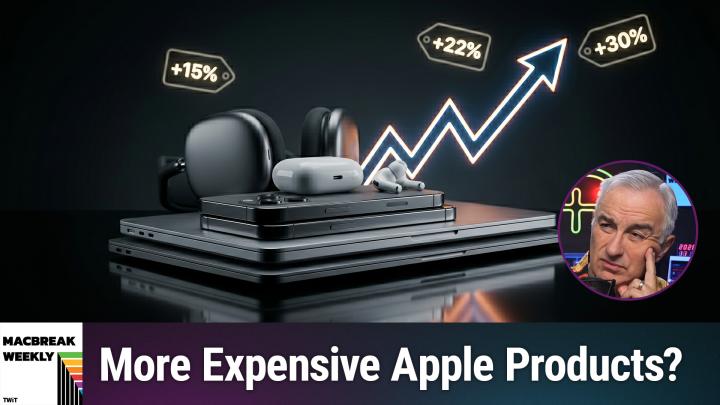
MacBreak Weekly 1030 Transcript
Please be advised that this transcript is AI-generated and may not be word-for-word. Time codes refer to the approximate times in the ad-free version of the show.
Leo Laporte [00:00:00]:
It's time for MacBreak Weekly. Jason Snell is back. Andy Ihnatko's here. Christina Warren, too. Tim Cook says price hikes are on the way, but how much and how soon? We'll also talk about mysterious game code that's showing up in the Vision Pro and why you might want to be careful next time you use your Beats headphones. All that and more coming up next on MacBreak Weekly.
Leo Laporte [00:00:31]:
This is MacBreak Weekly, episode 1030, recorded Tuesday, June 23, 2026. Impulse Pork Lo Mein. It's time for MacBreak Weekly, the show where we cover the latest Apple news. Let's say hello, everybody, to our MacBreak Weekly panel now with Jason Snell.
Jason Snell [00:00:52]:
Hello, everybody. It's good to be back. I missed you all.
Leo Laporte [00:00:55]:
Why are you wearing a Where's Waldo shirt?
Jason Snell [00:00:57]:
Well, you found me. Good job. You get a Tootsie Roller.
Leo Laporte [00:01:00]:
Where's your job?
Jason Snell [00:01:02]:
Good job. I do have. We have a Where's Waldo concert. This is the. I'm wearing a soccer jersey because it's the World cup and I went to the World cup and I had a lot of fun. I went to a match with countries that I am not affiliated with in any way, but it was available on a weekend in my local area, and we had a great time. And now I am wearing the jersey of my national team, which is playing their best ever.
Leo Laporte [00:01:26]:
Yay. Yes, they are.
Jason Snell [00:01:28]:
And as a longtime reader of the classic blog uniwatch and be interested in uniform design, I also am very excited that I think the US Has a jersey that isn't bad for the first time in decades. So I enjoy it.
Leo Laporte [00:01:42]:
I don't remember the old jerseys, but I have to say that when they ran on the field the first time, Lisa said, are they prisoners?
Jason Snell [00:01:49]:
I love it.
Leo Laporte [00:01:51]:
Christina Warren is also here from GitHub. Hello, Christina.
Christina Warren [00:01:55]:
Hello, Leo. I do not have any soccer merch on, but you know what? I'm rooting for Go, Go Team. Right? I'm.
Jason Snell [00:02:03]:
I'm gonna go Go Team.
Christina Warren [00:02:05]:
Go, go Team. Or actually go all. No, actually, no. Elmo got in trouble for that. Like he be. Because he. He was not as teams matter. So.
Christina Warren [00:02:13]:
Exactly. So, no. So go, go Team usa. But I. I don't. I don't know when anyone is playing, but enjoy, everyone.
Jason Snell [00:02:19]:
It's fine. They're doing. They're. They're doing fine. Christina. Yes.
Leo Laporte [00:02:22]:
Yeah. Even without you. They're doing okay. Also here, Mr. Andy, Major Domo of. I think that's what you Call a webmaster these days of inotco.com. hello.
Andy Ihnatko [00:02:34]:
Yeah, I am wearing a black cap with no Red Sox logo on it in honor of the Red Sox being virtually mathematically eliminated from postseason play before the All Star.
Jason Snell [00:02:45]:
I need a Giant's hat like that. How could that be?
Leo Laporte [00:02:48]:
It's June.
Andy Ihnatko [00:02:50]:
That's almost impressive.
Jason Snell [00:02:52]:
Some seasons. Some seasons you just know the smell hits by Memorial Day and you're like, yeah, it's over already.
Andy Ihnatko [00:02:59]:
Basically, it's. It's a gift. If you ever thought, you know what? I'd love to go see the. See the Sox play. But who can get a ticket in this. In this month or. No, you can just basically walk in. They'll wave you on in, actually, like, you hear the crowd noise.
Leo Laporte [00:03:12]:
Socks are winning or losing. Fenway is a great place to.
Andy Ihnatko [00:03:15]:
It really is game.
Leo Laporte [00:03:16]:
I really.
Andy Ihnatko [00:03:16]:
Especially when you have Scots there again.
Leo Laporte [00:03:18]:
Oh, and the Scots, they really took over the place in their kilts and their crazy songs. The hot soccer hooligan songs. No, you didn't tune in ESPN by accident. This is actually MacBreak Weekly.
Jason Snell [00:03:32]:
And it's not World cup weekly.
Leo Laporte [00:03:34]:
World cup weekly.
Jason Snell [00:03:35]:
It's hard.
Leo Laporte [00:03:36]:
You know, it's funny. I fall in love with soccer every four years, and then shortly after the finals, I fall back out of love.
Jason Snell [00:03:43]:
It is the highlight of the soccer calendar. It's pretty exciting. And it's very exciting. And it is kind of hard to. I mean, it is. It is the peak. Although this is the men's tournament, the women's tournament will be next year. That's also a good time.
Jason Snell [00:03:54]:
But. But, yeah, international soccer, this is as good as it gets. I think so, yeah.
Leo Laporte [00:03:59]:
Although now I think I should start watching the Premier League because half these players are from the Premier League. Yeah.
Jason Snell [00:04:05]:
That's the best on the planet. Best on the planet. But, you know, you don't get to see Cape Verde. That's true. In the Premier League, but you get to see him here or Curacao. Yeah.
Andy Ihnatko [00:04:16]:
It's also a lot more fun when you're not emotionally invested in the outcome.
Christina Warren [00:04:19]:
This is so true. Genuinely. Like, I love being a bear with a fan.
Jason Snell [00:04:24]:
That's called being a neutral, and it is a thing. In soccer, it's good to be a neutral.
Christina Warren [00:04:29]:
Well, no, sometimes it's just like. Cause here's the thing, I get into certain sports. Soccer, I'm going to be honest with you, is not one of them, but I get into certain sports, but only in the post season because I'm. I just don't have the Commitment to care up until that point. But then I get really into it. But, like, I could be, like, friends of mine who are really into soccer and really into the World cup keep sending me, you know, memes and information about stuff, and I see the appeal and I'm like, okay, I have no emotional attachment to any of this, but if you're excited and if I can get a good storyline, I'm in. This is great.
Leo Laporte [00:05:00]:
It was like watching the Knicks win.
Andy Ihnatko [00:05:03]:
Yes. 100%.
Leo Laporte [00:05:04]:
We all became fans, right?
Christina Warren [00:05:05]:
Yeah. I was actually invested there. But, yes, it's 100%.
Leo Laporte [00:05:11]:
Yeah. Okay, let's talk Apple. Tim Cook began what I consider, I think is going to be a campaign to let everybody know the drum's going to slowly beep louder and louder, that it's going to cost more this fall.
Christina Warren [00:05:29]:
Yes.
Leo Laporte [00:05:29]:
Gave an exclusive interview to the Wall Street Journal, Apple to raise prices due to memory chip crunch. Tim Cook says.
Andy Ihnatko [00:05:39]:
Can I just say that this is like, as, as, as I was reading this. All of us who read, like, who read and report on the news, there are levels that escalate as you read a story. It's like if it's a rumor from a rumor site. Okay, interesting if true. If it is an unsourced article from the Wall Street Journal, okay, that's serious. Because that was probably a deliberate leak from Apple. If it is a sourced story from a high Apple executive. Now you're like, oh, my God, this could be important.
Andy Ihnatko [00:06:09]:
And then when you check your watch and you realize that this dropped after the market closed for the day, you're like, oh, dear, this is really a thing. I'm just amazed they didn't hold it until Thursday because then they would. The markets would have closed for, like, the federal holiday weekend Hol.
Christina Warren [00:06:23]:
And it would have been. Yeah, I, I also. Can I just say, I. I feel almost weirdly psychic because I brought this up, this very topic at the end of our show last week where I literally said, I don't know, guys. Are they going to be able to keep the prices the way that they are? I have a feeling they're going to have to raise prices and. No, no, no, no. They'll be fine. They'll be fine.
Leo Laporte [00:06:43]:
Okay. You were right.
Christina Warren [00:06:45]:
I don't like being right. I don't like being right here. But this is. I want to be very clear on that. This, this is very upsetting, but I just thought the timing was funny.
Andy Ihnatko [00:06:53]:
And here, here I. All the listeners who are too lazy to actually check the recording. I supported you last week. I was the only one, and I'm very, very proud to have done so.
Leo Laporte [00:07:05]:
So, you know, I think obviously when Apple goes, and as you say, Andy, it goes on the record to the Wall street journal, it's clearly to Send a message. 5pm on Wednesday after, as you point out, after the market closes, they're saying, look, get ready. And I have a feeling we'll see more interviews over the next few months as we lead up to September. But how expensive can it be? The journal actually did some math. I think they said the new iPhone could cost as much. Wait a minute, am I reading this correctly? As 2,200 bucks? No, I'm sorry, 1,299 bucks. Okay, we did the math.
Andy Ihnatko [00:07:45]:
And that's the Pro.
Leo Laporte [00:07:46]:
That's the 18th Pro that says Nicole Wen and Rolf Winkler on why the iPhone 18 Pro could cost $12.99. That's what, 300 bucks more? 200 bucks more? Okay, yeah, that's about what I'd expect, a couple hundred bucks more.
Christina Warren [00:08:00]:
Right, which is What? That's an 18% increase. And then if you live in a state with high sales tax like California or Washington or New York, then you get to add another 10% to that. So, yeah, the
Leo Laporte [00:08:17]:
head of nothing pay said that memory was going to be about half the cost of the phone going forward. So that's a huge price jump. It's not that way. According to the journal, in the iPhone of the 1299, 145 bucks would be the memory cost, but that's up for 39 bucks. So that sounds like Apple's absorbing some of the extra cost in the market.
Christina Warren [00:08:44]:
I should hope so. I should hope so. I mean, you're the richest, you're one of the richest companies in the world in terms of cash. You have margins on margins on margins. You can absorb this. I'm not saying that you have to do it forever, but I think where I'm personally concerned is that what does this like? It's one thing if you have an existing share of class of devices. You have an iPhone air. You have a regular iPhone, you have an iPhone pro and a pro max.
Christina Warren [00:09:12]:
And if you're going to increase those by 100 or $200, you know, per thing, that's, that's significant. But you, you can probably find a way within your own accounting and to cover that up. Where I do get very concerned is when you look at the rumored MacBook ultra, you look at the rumored iPhone ultra. These are brand new device categories, which means that no one knows what they were going to cost. Right. Except for Apple. So none of us knew what they were going to cost. I, my, my prediction had been before all of this starting at 1999 and then probably going, you know, 100 or $200 up there depending on storage.
Christina Warren [00:09:48]:
Now I mean they very could easily just be like it's starting at 2499 top cost. It is. And the laptops, I mean if you're talking about the high end ultra laptop with the touchscreen and everything else, I don't even know where that's going to start. 35.99, 3999. I don't know. And that's the thing is that that's an area where, and this was part of, I think what I was thinking a little bit last week. I was hoping that it wouldn't go to the regular models but I really was concerned. I was like, okay, if they have to make up their margin, they're going to make it up in the new device categories where they can completely fleece everyone because they don't have any more.
Christina Warren [00:10:33]:
Well, I mean, I mean, but I mean look, sheer.
Leo Laporte [00:10:37]:
How about sheer.
Andy Ihnatko [00:10:38]:
No, I see what you mean.
Christina Warren [00:10:40]:
Yeah, I mean, I mean look again, I'm not saying I don't want like the company to be able to make a profit, but they are the ones who are insisting on making sure that they keep their profit margins above a 30, 35% threshold which they've had for years.
Leo Laporte [00:10:52]:
Conspiracy theory from geeking Tom in our club twit. It sets the stage for Turnus to drop the price later.
Andy Ihnatko [00:11:01]:
That's the thing I'm kind of afraid of that they are going to find out that particularly with the higher end models that you know what, maybe it was because every phone by every maker is going up for the same reason. But we have realized that it didn't lead more people to decide to drop down to the 18 nothing. Maybe there is more elasticity in the price than we thought. And when the price goes down, it will not go down by the original $200. It'll go down by maybe $100.
Leo Laporte [00:11:26]:
Right. And maybe put now to point. The journal's math is interesting because the 1099 iPhone 17 Pro, the current model had an estimated 47% profit margin. That's almost half if they do raise it 1299. Again, these are all estimates. Apple doesn't tell anybody. And so a lot of this comes from an analyst at Memory Insights, Tom Howard or Mike Howard, I'm sorry, at Tech Insights. But he says the if they do raise it 1299.
Leo Laporte [00:12:02]:
That would be roughly a 44% profit. So that's only, you know, slight difference from the original. Now, that doesn't include the new camera, which Ming Chi Kuo says will be 50% more than the previous camera. So that could even increase it another. The journal says $100 to 1399.
Jason Snell [00:12:23]:
I mean, the good thing about Apple having these huge margins, other than the fact that it means they make a lot of money and investors are happy, of course. Yes, yes, yes. Profits, okay. Is it gives them latitude to make strategic decisions about how, where, where they want to eat margin and where they don't. Because I'm sure that when it comes to the next quarterly result after these products come out, they're going to, you know, they have to release their profit margin numbers. And Wall street loves to see them and loves to see them be big. And they're going to have to manage that even if they're already. I mean, obviously this is the first salvo in a managing of expectations that is going to be going on for the next six months with Wall Street.
Jason Snell [00:13:01]:
But it does mean that they can and eat margin in certain places and not in others and hold down some, some of the opening prices at the bottom of the line so that they can, they can do the classic marketing bit of saying starting at 1199 or 1299, but as you, you know, increase the specs and maybe even the ram of the, of the systems, the margins go up too. And they, they, you know, they can do that. I think that that is one of their great strengths, is that they've got that latitude to say on this particular sku, it's strategic to us, like them, let's take the MacBook Neo. Like the MacBook Neo, the price is so important that I'm not saying they won't raise the price, but I'm saying they have the latitude to maybe keep a foot down on it, whether it's not raising it or only raising it by a smaller amount. And the existing MacBook Neo, I mean, we already talked about this with the chips. They're not getting a 50% margin on that thing. Right? Like, because they chose to strategically. So they can do that across their line if they want.
Jason Snell [00:14:01]:
Now, what's going to be interesting is to see how that manifests because we don't know actually what their strategy is here. And while they're not going to break out margin by product category, we're going to be able to see what the price changes are. And that might tell us Something about how they have prioritized their product line in terms of sort of strategically offering prices that they think are okay in some places. Because keep in mind, some percentage of Apple's audience is not that sensitive to price. And that's always been the case. And when the iPhone 10 came out and they started raising the price of iPhones and finding out that for a certain part of their audience they didn't care, they're happy to pay more to get the best iPhone or the best Apple products. So they've got some strategy to work out here given the constraint that they've got.
Andy Ihnatko [00:14:50]:
Yeah, and strategic is a good word to operate here because one of the things that works out for them is that they can cut their profit margins while still being profitable. Which means that in lots of, as the premium smartphone market becomes more and more competitive, competitive, they have the ability to project out and say, you know what, we're going to accept lower profit margins for the next year and a half because it's going to hurt all of our competitors who cannot afford to keep the prices low or not raise them as much as, as we're going to raise the, excuse me, raise them less than we are going to raise them. So in a market where they're losing, where they feel as though they're feeling some pressure from like Huawei, where they're feeling pressure from Samsung, from other makers, if the, if the top tier equivalent to the Pro Samsung or Huawei phone is now $250 more expensive, but the top tier iPhone is only $100 more expensive, that works. All to the good. And Apple doesn't have to. Apple is not going to be attacked for. Oh wait, you're basically losing money to gain market share. No, we're not.
Andy Ihnatko [00:15:50]:
We're just cutting our mark to get, to help our customers through this crisis. We're only accepting a paltry 33% profit margin. And if that means that now we are the cheapest high end luxury market, premium smartphone in the market case, c' est la vie.
Leo Laporte [00:16:06]:
Apple's kind of stuck though between a rock and a Siri place because in order to do the new Siri AI they need a lot of RAM. They cannot. They're going to have to do 12 gigs. So this means that they're going to go. It's almost a 350% increase in memory price. Incidentally. Storage prices are also going up by 3x. So your NAND costs also go up.
Leo Laporte [00:16:32]:
I don't think the new AI requires a lot of storage. Well, I guess you have to have those models. But I don't think you have to bump the storage by they're already giving them 256 gigs.
Jason Snell [00:16:42]:
I wonder about that too that are they changing the specs around to maybe, you know, sometimes they have high end models that have more RAM and they don't ever talk about ram, but it's there, right? They just don't want to talk about it. But the other thing is Leo, you know, they may vary because they do so much varying on storage and not ram. And even though we all know that RAM is the bigger problem in terms of price, storage is an issue too. But RAM is the big problem. Doesn't mean that they won't use the storage as the leverage to get people to pay them more. Right. They may, they may take more of a bath on the low configuration. And then as you crank the storage up, they crank their margins up.
Jason Snell [00:17:22]:
They've done that all along. Even if they, and nobody's going to say, I mean we might say, but nobody's going to say, well wait a second, why are you cranking up the margins on the storage when it's the RAM that costs more and there's the same amount of ram, it's like that's not even a conversation. It's just, it costs more. That's just how it is and that's how they recoup their, their margin.
Christina Warren [00:17:39]:
The disappointing thing with all of this is that like there was this very brief window where even before the current kind of ramp up clips where you had like for the first time ever, Apple actually in, I'm not going to say a value category but like was genuinely like the best bang for the buck that you could get. Like the, you know, the Mac Mini when it was available for 599 or 499 if you were able to get it, you know, at a student price and you know, the, this, this year's iPhone 18 or 17, which is one of the best iPhones they've had in years. The fact that they upgraded finally, you know, like all the MacBooks to, except for the Neo to 16 gigs of RAM. Like we were finally in a place where again, I'm not going to say that you can make the argument, oh this is the, you know, the value company, but it was the best bang for your buck company. And now because of all these issues, which to be clear are not Apple's fault but, but also that Apple I think is happy to, you know, make the maneuvers they need to make so that they can keep their profit margins that's just going to go all out the window. And, and that, that's, that's disappointing because we had like this really nice period of time where you could buy a Mac, a very good Mac for under $1,000. I don't think other than the Neo, that's going to be. The interesting thing is, I think is what does this do? Especially since they start, you know, chip production.
Christina Warren [00:18:57]:
Do they hold off on any O2 and on updating that? Like what happens to that? Because that's one of those that, you know, crisis of RAM and storage and anything else be damned. That product only works at the price point that they're selling it at. It does not work. If you, if you raise the price $200, that completely goes away and the entire value proposition is completely gone. So, you know, which leads me to think similar to what Jason Andy said, like, okay, maybe they will take, you know, it on the chin on the Neos so that they can extract, you know, higher profit margins and other items. But yeah, I mean, you know, they've always, and I will say fleece here because this is just the truth. They've always fleeced us on storage prices. Always, Always.
Christina Warren [00:19:45]:
There's, there, there's, there's no argument you can make with a straight face that says they have not charged 4, 5, 6 times what their wholesale, 7, 8, 9, 10 times what their wholesale prices were. Especially when NVME stuff storage was cheap, which it was for a long time. They were charging ridiculous prices on that. I do understand now that prices are, are higher and that they might now have to sell closer to cost if they were to keep their, their prices consistent. But yeah, I think that that's a very easy way and a very common way that unfortunately all of us Apple users have become accustomed to, which is, yeah, unfortunately you, you pay for as much storage as you can get because you know you will never be able to upgrade it aftermarket. But don't get 4 terabytes if you're not going to use it because they will charge you an obscene and, and frankly insulting amount of money for that.
Leo Laporte [00:20:37]:
Yeah, there's another something I think is a little weird. I don't believe this, but Mark Gurman says that the price increases could hit the 17 as well. Like Apple, when it announces its back to school sale, might also announce a hike in current iPhone prices.
Andy Ihnatko [00:20:54]:
I don't know about that. I did, I did, I did read it. The idea of raising the price on an existing product versus doing an invisible price hike by removing the least expensive and the Most affordable ones. That's a very, very dramatic step. But I did like his observation that he was asking the question, he was asking himself the question, why now? Why did Tim make this announcement on that Wednesday?
Leo Laporte [00:21:16]:
Well, that's a good question.
Andy Ihnatko [00:21:18]:
And so his speculation, which is not totally off the off the mark, is that this is about the. If they're doing a back to school promotion, they might need to lay the groundwork for expect the discounts to be not quite as good as they used to be. I don't know if I don't believe that they would ever do a thing where whatever they said, whatever they put on the sticker at release is going to be going up. However, it could mean that they're going to try to lure people in with. Now how about we give you two pairs of AirPods and only half the discount as opposed to what we're going to give you before. A lot of this is so interesting because there's at least two new iPhones coming out where Apple could have been when they're setting the price. They could have thought that, you know, what with the iPhone 18 Pro, we are creating a brand new camera system that we can talk, we can have an entire event just about the camera system between this new sensor and the new variable aperture lens that we're putting on this. Maybe it's okay if we raise the base price of the pro by a little bit and I think people will pay it for that.
Andy Ihnatko [00:22:21]:
With the iPhone Ultra. With the iPhone Ultra, as Christina said, it's not. The price has not been announced yet. So they could invisibly hike the price up without suffering any sort of a lash back. But maybe that one too. They said this is a brand new device. The cost of this panel is fricking insane. The engineering on the hinge is fricking insane.
Andy Ihnatko [00:22:45]:
We set out hoping we could undercut the price of the Samsung fold somehow. We know we can't. As a matter of fact, I think we're going to go a couple hundred bucks more expensive. But I'm sure that'll be okay. And now if that were true, they lost all of the wiggle room that they had in price because now they have to basically tack on another $100, $150, 200 DOL that going to do to the price? I mean, when we talked about the ultra, we were always talking about how $2,000 feels about right? $2,100 seems like as far as they can go. If the minimum buy in is $2,500, we're talking about a super ultra niche product. But they might be in a position where they can't build it and sell it for less than that right now. And I'm sure there's a lot of very, very nervous conversations in conference rooms
Leo Laporte [00:23:32]:
in Cupertina right now over Journal also asks or answers the question why Apple's war chest can't win the memory war. They say that Apple, which of course dominated purchases, I mean, pretty much owned TSMC's output. Yeah. No longer. You know, they're competing with Nvidia basically. Nvidia's even buying more.
Andy Ihnatko [00:23:56]:
So they're like the Blanche Dubois. They're saying, oh, back in the day when TSMB call, many gentlemen callers did I have. And now they're just like, like, please, please, please.
Leo Laporte [00:24:07]:
I've always relied upon the kindness of tsmc. We're the only, they quote Jensen Huang. We're the only chip company that buys directly tens of billions of dollars of dram from all the dram makers, says Jensen Wong of Nvidia. The only one. Well, Apple's in there probably, but so yeah, that makes sense that they're, they're now competing with some other whales. They were the only whale in the sea, but now there are some other whales out there and worse and worse
Andy Ihnatko [00:24:37]:
than that, they are, it's not as though, hey, if I, if we just write the big enough check, we'll get it. It's like there is not enough supply for everybody who wants to buy it. So there's going to be, there's going to be constraints. I think we're, we are entering whatever happens to prices. I think that we're entering into a position where if you know that you need a new phone, if you know that you need a new MacBook, go ahead and get it. Like, don't, don't buy something crazy that you don't, you don't actually need. But if you basically, if you basically had put money put aside and you already sort of configured inside your head and you knew that sometime the next two or three months, I think probably by the end of the year, I should probably, this is probably a good time for me to, I'll probably make that decision. No, you should do that.
Andy Ihnatko [00:25:17]:
Like, I think you should do that sooner rather than later. As, as a matter of fact, I made on Wednesday I made two impulse purchases. One was a pork lo mein for a local market and the other was a brand new MacBook Pro, which Pork
Leo Laporte [00:25:29]:
lo me was a little less than the MacBook Pro.
Andy Ihnatko [00:25:33]:
I thought it was. Well, it's less like noodles. Plus the pork is sort of like a barbecue. Yeah, I, I, Max. The thing, the thing is like when I, when I say I, it was an unplanned purchase, but not an impulse one. It was actually already inside my cart. That's exactly what, like I, what I'm talking about where I knew that, yeah, sometime I'll probably let me just marinate on this for a while. Like maybe in case there might be an expense that comes up in the next three or four weeks where I would rather shift that to the end of the year.
Andy Ihnatko [00:26:00]:
But yeah, I'm, I'm. Because of most. Because most of my work is just pushing a cursor to the right. I didn't need like an M5 max or even M. I do some 4k editing. I do some Photoshop. As a matter of fact, on my 2000 M1 MacBook Pro, I do that just fine. So this is the first time that I maximized RAM.
Andy Ihnatko [00:26:21]:
So I basically topped out the RAM at 32 gigs. The configuration I got has a terabyte of storage, which is going to be more than enough. Interestingly enough, I ordered on Wednesday and it just shipped to the store. I'm going to be picking up that up at today. Whereas, because I was annoyed because I thought that if I ordered on Wednesday, I might have it by the end of the week, I checked to see like, well, now if you. If I made the exact same order today, it's going to be a whole month before it comes in. So clearly I'm not the only one who's reacting that way. Again, don't panic.
Andy Ihnatko [00:26:52]:
Buy. But again, this was something that I knew that by the end of the summer, certainly by the end of the year, I'm going to be buying an M5. I'm not going to. I don't think this is going to be an M6 in my price range, my configuration worth waiting for. So, I mean, it became, I got the money, it's been set aside. Why wait? There could be consequences to waiting. Mostly we've been talking about price changes to the iPhone line. We haven't been talking about price changes to the MacBook line.
Andy Ihnatko [00:27:19]:
But that's certainly. You can't assume that's going to be immune either.
Christina Warren [00:27:23]:
No, I was going to say, I'm so glad you got a Mac, Andy, because I was thinking about you this week or end of last week and even today I was like, Andy needs to buy a Mac now.
Andy Ihnatko [00:27:33]:
Yeah, exactly.
Christina Warren [00:27:33]:
Because. Because we don't know if they are going to be Raising the existing prices or not. I have a feeling game console, you know, people have done it, Apple has done it. You know, after the break, we're finally
Leo Laporte [00:27:43]:
seeing the Steam Machine.
Andy Ihnatko [00:27:45]:
Oh, my goodness.
Christina Warren [00:27:45]:
Oh, my God. I was going to say the Steam Machine thing is a great example, right, Where Valve has not said what their original price was, but we think that. But they did say that to someone that it was about the same price difference about how they really raised the Steam deck to what it is now. And so that's about, you know, 200 to $250. So you can go and say, okay, something that was going to be, you know, an 800, $850 console now being 1079 before you get a controller involved, you know, which I almost immediately when I saw the price and I was like, okay, I'm out. I wanted it, but I can't justify a PC as cool as it is that is in many ways less powerful than my PS5 for this, especially when I have other ways to play games and I have other computers. But the pricing is the pricing. So there is precedent for that.
Christina Warren [00:28:39]:
But I was concerned when I saw German's report. I was like, oh, okay, Andy, please buy your laptop now. And I have a feeling that what will happen is that retailers who have a lot of inventory will potentially even take advantage of the fact that they have that inventory at the price they have it at if they need to run sales or anything else for back to school. But yeah, I think we can't expect, like I said, the halcyon days of us finally getting 16 gigs of RAM and a MacBook Air and 512 gigs of storage standard, I feel like, for a somewhat reasonable price, I feel like those days are unfortunately over.
Leo Laporte [00:29:18]:
Yeah.
Andy Ihnatko [00:29:20]:
And as an aside for anybody who's making this same sort of decision again, people like me who again spend most of their time pushing a cursor to the right. Most of the load of performance is just having lots and lots of apps open and lots and lots of tasks. And the biggest, I still love my M1. I'm going to continue to use it because it's a damn champ. There's nothing broken, not even any keys, no screen squirreliness. The battery life is down to 80%. But that's, that's perfectly fine. I'm looking forward to simply having enough RAM that I don't necessarily have to do a full shutdown and restart before I'm doing a live stream, just to make sure that there isn't any stuttering, there isn't any gaps.
Andy Ihnatko [00:29:59]:
In the stream, stuff like that. It really is the vogue is to get more RAM to make sure that you can run local AI models. But it really is the key to making sure you can do lots of tasks switching very quickly. So I'm. I could have spent a little bit more money for a 24 gig M5 Pro, but I would not have seen. I don't think I'll see the same kind of performance I'm going to see from getting a 32 gig M5 nothing.
Leo Laporte [00:30:24]:
Yeah. And of course I'm in the market for an AI machine so I need to spend much more money. I don't think I can afford actually an Apple.
Andy Ihnatko [00:30:37]:
Listeners to people in the discord. If you have an old Mac, Mac plus or Mac SE that is just for display, take out the DIMMs and send them in to Leo.
Jason Snell [00:30:48]:
I'm sure that we can, we can
Andy Ihnatko [00:30:49]:
chatgpt a solution to actually be able to like multi bank them or something.
Jason Snell [00:30:53]:
Yeah, create a wall of ram. I have a friend who was thinking about buying a laptop and was like, I want to wait for maybe next year in that new MacBook Pro, but it's so far away and his current laptop is not doing it. And I said you should go ahead and buy something now for that same reason. Which is in addition to everything that Andy said. And we may be getting price increases and you don't know about availability and the availability, you know, every day they shift further away and is the price going to change? I would also say if we're entering an era where prices are going up and I can't believe I'm making this argument, but I'm going to make it. Which is buying a computer now, even if you think you might buy another computer in a year, I feel like the resale value of the computer you've got like if you get an M5 Air today, is the M5 Air not going to still be worth a pretty decent amount next January, next February, something like that? I think it will because I think all the prices are going up. I wouldn't say you should buy computers as an investment. That would be crazy.
Jason Snell [00:31:55]:
But a lot of times when you're making these value calculations, it's about, okay, I'm going to get this thing and I'm going to use it for a year and then I'm going to either trade it in or I'm going to sell it. I'm going to use that money toward the new thing and then I'm only paying the Delta. And now feels like a time where A brand new computer in a year is probably going to have a lot of value because all the computers in a year are going to be expensive. So I think it's, I think if you, if you're ready to jump now is not a bad time. If you can get one to jump and get your new computer now you
Leo Laporte [00:32:28]:
know what's not going to appreciate in value? Somebody in the I think the YouTube chat mentioned this that iPhone ultra the phone. No that's going to depreciate right?
Christina Warren [00:32:40]:
Yes.
Leo Laporte [00:32:41]:
Because of the folding.
Christina Warren [00:32:43]:
Well and because it's the first gen right.
Leo Laporte [00:32:46]:
We're already seeing a rumor they're going to do a second gen immediately after next year.
Andy Ihnatko [00:32:50]:
As an aside there was a story this week a company that specializes in I think trade ins basically issued a report basically saying that at least for the Samsung folds the trade in basically the resale value is like once you take it off the lot you lose about 40 something percent of the value. Like you're not gonna. It does.
Leo Laporte [00:33:09]:
It's not gonna hold the value like my electric car.
Andy Ihnatko [00:33:12]:
Yeah.
Leo Laporte [00:33:13]:
Is it because of the folding mechanism? Is that, is that why people don't think gonna.
Andy Ihnatko [00:33:18]:
Because I think it's just because there isn't enough, there isn't enough a market for it. I don't think they get. They went to an else but it
Leo Laporte [00:33:24]:
might be different for Apple.
Andy Ihnatko [00:33:26]:
I don't know I mean but you're also right that a plastic coated screen is not gonna look really great. The folding is going to again it'll be great if you, if you're into using it for the next two, three, four or five years. If you want hand one that looks very, very pretty you might not have much to pick from. So yeah don't buy, don't buy it as an investment.
Christina Warren [00:33:44]:
No no. I mean and I think that that one it's hard too because again like it's, it's a first gen product and with very few exceptions first gen Apple products like most version products there, there are bugs and I'm it will, it will actually depend on the price. I'm, I'm not overly like like price sensitive but at a certain point you go okay if I know this is going to be a Gen1 product that's going to be replaced anyway. Do I want to pay the inflated price on top of the inflated price for a thing I'll use for a year? I don't know. This is where typically and hopefully they'll still have this for the, the iPhone Ultra or folder whatever they're going to Call it where the Apple upgrade program is actually useful because you can basically, at least with Apple, you can guarantee about 50% trade in value on the high end phones every year. And so if that would make sense, then you're like, okay, if I Pay, you know, 50%, where I get 50% of my credit and I can put that then towards, you know, kind of, to Jason's point, the delta that of course assumes the prices will be the same and not go up. But that, that's harder to see. But yeah, I think folding phones are a difficult market compared to others pre Apple entering the fray just because the market isn't that big.
Christina Warren [00:34:56]:
And then there's the durability factor. And I will say this outright, the only way I would buy a refurbished, you know, iPhone, you know, Apple foldable would be if it were directly refurbished from Apple. There, there is no universe. Yeah, but like you could get like a used iPhone, you know, from, from Best Buy or that's true, you know, other people and, and it might not have the best screen, it might not be whatever, and it could be fine. There is, there is no universe where I would get anything other than an officially Apple refurbished phone that has a folding mechanism.
Andy Ihnatko [00:35:28]:
And you did point out another thing that Bear's mentioning as we're having this conversation about like buy now or buy later. It's always tempting to say, oh, but geez, they haven't like redesigned the MacBook Pro in X years. It's due for design refresh and maybe I want to wait for that. The good news though is that if this is the last generation of this body build for the M5 MacBook Pro, they have figured out how to manufacture these things with zero defects in the first year. It's not that they're shipping things out half baked, but those are the generations where two years later, why is there this green line somewhere on my screen? Or why is it that when I bump this connector, I have this intermittent fault and that's when. If you have AppleCare, you're great. If you don't have AppleCare, that's too bad. So sometimes there's something to be said for whatever problems they've figured out, whatever problems in the manufacturing, whatever problems in the engineering.
Andy Ihnatko [00:36:26]:
This is not a revision a board hardware. This is not the first 10,000 off the assembly line. This is really, really good, tested hardware.
Leo Laporte [00:36:37]:
All right, let's take a little break. More to come in just a bit. Glad to have you back, Jason Snell. Yay, we missed you. We didn't hear anything about Your experiences at the campus.
Jason Snell [00:36:48]:
So many experiences.
Leo Laporte [00:36:50]:
I'd like to hear a little bit about that when we come back. And now we know where Waldo is. He's been all over. Yeah. You took a vacation, too?
Jason Snell [00:37:02]:
I went to my son's college graduation.
Leo Laporte [00:37:03]:
Oh, that's right. Congratulations on that. You and Gruber both celebrated graduations and Syracuse.
Jason Snell [00:37:09]:
Yeah, like, it's in the. And David Letterman. I guess we all have sons the same way.
Leo Laporte [00:37:15]:
One of these is not like the other, but okay. Yeah. Well, congratulations. That's fantastic. Was he a duck?
Jason Snell [00:37:21]:
He was a duck, like my daughter. Both my kids are organized.
Leo Laporte [00:37:25]:
Oh, you're a double duck. Okay.
Jason Snell [00:37:26]:
Y. Y. Like a little flock of ducks. You know, as we were leaving the ceremony, we were driving down a street and a car in front of us stopped. And I am not making this up. A mama duck and her little ducklings cross the street in front of us and we're like, well, that was symbolic, wasn't it?
Leo Laporte [00:37:43]:
Yeah.
Andy Ihnatko [00:37:43]:
And that's when I started crying. Crying.
Jason Snell [00:37:45]:
And then I started singing inspirational songs. You know, the wings between little boys. Wings, Whatever. Yeah, exactly.
Leo Laporte [00:37:54]:
Hey, that's. Now, you're not an empty nester yet, or are you?
Jason Snell [00:37:58]:
Oh, I've been an empty nester for. For four years.
Leo Laporte [00:38:01]:
Oh, wow.
Jason Snell [00:38:02]:
Yeah, there's no. There's no kids left here.
Leo Laporte [00:38:04]:
No kids. Dogs and cats.
Jason Snell [00:38:05]:
Yeah. Yeah.
Leo Laporte [00:38:06]:
Although teenagers are animals of another species.
Jason Snell [00:38:09]:
Boy, are they. They.
Leo Laporte [00:38:13]:
They often talk about the pitter patter of little feet, but those people never had teenagers, apparently, because. Because the pitter patter is replaced by elephant horde. Thundering. Well, congratulations. That's great. It is good to have you back. It was great to have Jon Gruber on. I acted as if I'd never met him, and I was informed he's been on the show before.
Leo Laporte [00:38:32]:
Many times. It's like, oh, and then you're gonna be on the talk show with him.
Jason Snell [00:38:36]:
Yeah, it just came out.
Leo Laporte [00:38:38]:
Nice. Okay.
Jason Snell [00:38:40]:
Very timely. I think we talked like, a week ago, but it's out.
Leo Laporte [00:38:43]:
It's out now, mixed together. Microsoft says Apple's WebKit performance leaves iOS browsers stuck in the slow lane. Now, remember, Microsoft makes a browser, so take this with a chromium based.
Christina Warren [00:39:02]:
That's chromium based.
Leo Laporte [00:39:03]:
Yeah, right, Exactly.
Andy Ihnatko [00:39:04]:
It's based on the Blink. Based on the Blink engine. So they aren't necessarily promoting their own stuff. They're basically making the point of if you take the handcuffs off of us, Apple or regulators, we can basically create a better, better, better, better browser experience for everybody. Using iPads and iPhones and maybe convince the Safari team that it shouldn't be 30% slower than a Chromebook.
Leo Laporte [00:39:26]:
For those who don't know, because of Apple's rules, every browser you use, including Chrome and Edge on iOS is WebKit based. It's not Blink based.
Andy Ihnatko [00:39:39]:
To be accurate, they did lose an EU ruling that forced them to allow the use of third party browsers with third party engines. However, they kind of scuttled it by basically saying no, you can't just. The makers of Chrome can't just simply update Chrome with this new engine. They have to release a brand new browser and lose all of their existing users and use it as a side project which is like, I don't know why that is.
Leo Laporte [00:40:06]:
Yeah, Mozilla said that's a non starter. We don't have the resources to do one browser for the EU and another one for the rest of the world. Now if the rest of the world were to say as the EU did, you got to open up the platform, then presumably Chromium and Mozilla and every other browser would say, okay, good, we're going to make it worldwide. Then it makes sense, we're going to update our browsing worldwide. But to my knowledge, is there, is there anybody doing a non WebKit browser in the EU?
Christina Warren [00:40:35]:
I don't think so.
Andy Ihnatko [00:40:36]:
Again, it makes no financial sense for them to do it. That's what the heads of those teams have been saying that. Look, under these circumstances it doesn't make us sense for us sense for us to fork into two different products and now have two different communities of users.
Leo Laporte [00:40:49]:
So what's the differential? According to Microsoft, if they were to use the Chromium Blink engine on edge on iOS it'd be almost a third faster. 28.6% faster in one benchmark and 13%
Jason Snell [00:41:05]:
in another and 2% in another.
Andy Ihnatko [00:41:07]:
But that's an Apple's own benchmark.
Jason Snell [00:41:09]:
Yeah, but it's, it's all, it's all cherry picked and theoretical and even the guy who wrote it says look, I just did this on my system and all of that. But he is a developer who's like, well wait a second, why? And the other point here is this is not the case on macOS where there's browser competition. So what does that.
Christina Warren [00:41:28]:
I was going to say that's the interesting thing. Right. And I will disclose Kyle Fluke, who wrote the original post, who's group manager of Edge at Microsoft, he's a great guy and, and I know him. I, you know, have nothing else to, you know, Kyle's Credit.
Leo Laporte [00:41:46]:
He used as. As you said, Jason, Apple's own speedometer.
Christina Warren [00:41:50]:
Right.
Leo Laporte [00:41:50]:
Their own benchmark.
Christina Warren [00:41:51]:
Well, but what I was going to say though is that it is really telling how big of a differential there is, you know, with macOS versus iOS that.
Leo Laporte [00:42:00]:
Do you think?
Christina Warren [00:42:01]:
Well, I think Jason nailed it. You have competition and let's be honest.
Leo Laporte [00:42:05]:
But isn't it the same engine on both WebKit's the same on both iOS and macrosos? I don't understand why it would be faster on macOS.
Christina Warren [00:42:14]:
I don't know.
Leo Laporte [00:42:15]:
More ram, maybe it thrives in a more RAM environment.
Christina Warren [00:42:19]:
Yeah, I mean, I think there are differences and Jason or Andy might know more than I do. I think that there are some Differences with how WebKit works on iPhone versus on Mac OS. Like there are some, some. Some different features and some different.
Leo Laporte [00:42:33]:
You know what I'd love to see is how does WebKit do on a MacBook Neo, which is essentially a phone
Andy Ihnatko [00:42:38]:
process and it needs all the performance you can get out of that processor, so.
Christina Warren [00:42:42]:
Yeah, but again, it might come down to an operating system layer too. Right. Like when you have an operating system that has allowed you to handle certain events in certain different ways versus one that is very closed down and, you know, kind of has an embedded thing. And, and look, I, I'm not unsympathetic to Apple's position of like, why they don't want to just allow anybody to bundle a web browser on their platform. I understand that. I do feel like when you have big companies who are very vetted and are, I'm going to say it better at this than Apple is. I think that the Chrome team is better at this than Apple is. What's the harm in allowing them to at least make a version that could run on your device? Devices.
Christina Warren [00:43:26]:
Most people are still not going to choose Chrome as their default browser on an iPhone. I think most people do use it on a Mac, even if they could. Yeah, I think that there are just too many integrations and too many like, specific points. And also just the way that Google does their, their UX on. On mobile, which is a very Android way of doing things, isn't going to appeal to a large group of people.
Leo Laporte [00:43:46]:
I have to say though I have Chromium on my Macs, I'm using it right now because so many tools like the Restream tool we use and that require Chromium Chrome, it works better for a lot of things.
Christina Warren [00:43:58]:
I agree. Look, on desktop I think is very different, but I'm just saying on phone, I feel like There are still some.
Leo Laporte [00:44:02]:
It wouldn't happen that way.
Christina Warren [00:44:03]:
I don't think it would. Which would. And if nothing else, I think that it would force Apple to finally maybe take some things seriously and improve things. And I don't have a problem browsing the web on an iPhone in general, but sometimes I use an Android device and I go, yeah, this is actually really nice that you can have extensions and that Firefox can work in a way that it might really want to be able to work and you can do more advanced things and automations that just are not possible for any reason other than Apple does not see the platform as a way that you should be able to use the web. They silo it for their own purposes.
Leo Laporte [00:44:42]:
They don't do PWAs, for instance, progressive web apps.
Christina Warren [00:44:46]:
They do, but they don't do them the same way that everyone else does. And I personally don't think that they do them in a very good way. But it is better than say like two years ago, it was a nightmare. It's a lot better now. But yeah, I mean, Apple Chromium, when
Leo Laporte [00:44:59]:
I want a pwa.
Christina Warren [00:45:00]:
Absolutely. I mean, you know, and I was adherent to using Safari on the desktop for a very, very long time. I don't anymore. I mean, I obviously test things in Safari, but I don't anymore. And it's the same reasons that you said, like there are just too many applications that just don't work correctly. And, and that's a shame.
Leo Laporte [00:45:17]:
Yeah, actually that is a shame because I don't want it to be that way. I continue to use Firefox because I want there to be diversity in the browser world. I don't think Google should own the Internet, the World Wide Web. I don't think that's okay. And to that point, I don't think speed is the only criterion. I mean, obviously Firefox is not as fast as either Safari or Chrome.
Jason Snell [00:45:40]:
By the way, our good listener Dustin just ran speedometer on a MacBook Neo and it's the. It's the same as any other Mac. It's faster on Safari. Oh, isn't it on Chrome or Firefox? Yeah, I wonder what the technical issue is. And is it just that they haven't bothered optimizing on iOS? I mean, look, this is a moment in time when the people who think that Apple needs to open the browsers on iOS have a data point that they can use as a lever to say, see, this is why we need competition and good for them, they should do that. I do wonder, was it like this a year ago? Will it be like this a year from now? Is this a current state of affairs in WebKit, where WebKit, you know, on iOS is, has not yet shifted gears to the next step where it's going to get faster again? I don't know. It seems really weird and unfortunate that it might be the case that Safari is great on the Mac and for some reason on iOS it just, just isn't like that shouldn't be. And if it is, and if it is as simple as we don't even bother optimizing it on iOS, which I don't think Apple would do that.
Jason Snell [00:46:49]:
But like, there's no competition, so there's no way to tell other than if you're somebody at Microsoft who can build the code and run it on their personal device and say, actually it works pretty well. So I mean, this is this. It's a frustration, but because it does. I know that Apple has been proud of Safari performance for a long time, but the thing is, on the Mac, we can measure it it in a way that we can on iOS.
Leo Laporte [00:47:11]:
Yeah. 36.4. Dustin says in the speedometer.
Jason Snell [00:47:15]:
I don't even know what that's. That's for Firefox 52.9 for Safari 27.
Leo Laporte [00:47:21]:
So it is slow and 51. Wow.
Christina Warren [00:47:25]:
So it's very close. It's very close on Chrome and Safari. But yeah, Firefox is, is.
Jason Snell [00:47:30]:
It's not, not 30% faster for sure.
Leo Laporte [00:47:33]:
And I use Firefox because, I mean, I, I don't. Speed is not the only criterion for me. Right.
Andy Ihnatko [00:47:38]:
Yeah. Especially if you're using an iPad as your sole computer, which a lot of people are doing. I'm doing a project right now that involves a lot of CSS that I've never done before. And I have to have three different browsers with three different engines open because it will work fine on one, and then the weirdest things will happen on number two or number three. And what if your bank or your school or some other community service requires a web front end that will work great on a Chromium browser, will not work great on a Safari browser, or just acts unpredictable in JavaScript and forms because it does not support something that the latest hotshot web developer decided, ooh, I can solve a problem. I can cut a thousand lines of code just by using this new CSS style that has not yet been approved and is not yet supported by Safari, but it is supported by my favorite browser. So just on principle, unless this is one, I don't think it's a horrible shame for Apple that they are locking people into Safari. However, we're now at the stage where if there was a reason for them to make that a requirement when they launched iOS and iPados I'm not sure that that is still operative.
Andy Ihnatko [00:48:50]:
If it's a security issue or privacy issue or battery performance issue if there is a reason I think they need to defend that choice or just simply allow Firefox, allow Chrome to create use whatever engine they want and not make it so painful to do so that they're not going to avail themselves of freedom.
Leo Laporte [00:49:08]:
I think you you nailed it. The difference between iOS I really find it fascinating that the Neo which is a iPhone chip is as fast as other Macs is the differentials there and I suspect you're right Andy, it's about power. So that's the only thing I can think of is that they are conserving battery on iOS which makes it slower and in fact I think anecdotally people do say that chromium is a pig.
Andy Ihnatko [00:49:34]:
Well you know what they that was exactly. It was Apple. Absolutely true. It was a big resource hog. Both power and memory and both performance. Right. They've been a lot of improvements since then to the extent where I really don't notice, I really don't notice that much of a dip or at the very, very minimum for me the benefits of having a cross platform browser where all of my history and all my bookmarks apply to hardware device I have outweighs whatever power and savings if any there is any.
Leo Laporte [00:50:04]:
Yeah. You're using it on Android we should point out because if you use chromium on iOS it doesn't. That's you're still using WebKit.
Andy Ihnatko [00:50:10]:
Well no, but, but it's. But I still get again browser, browser history and browser book.
Leo Laporte [00:50:15]:
Yeah, you plug in sync. That's right, exactly. That's why I use Firefox because the Firefox sync. Hey, here's some good news. The president says Apple will build chips with intel in the U.S. so congratulations.
Andy Ihnatko [00:50:28]:
Well, problem solved. Thank you.
Jason Snell [00:50:30]:
Tips of some of kind kind A
Leo Laporte [00:50:32]:
year after Washington took a 10% stake in the chip maker which I just want to say that sounds like socialism to me but okay.
Andy Ihnatko [00:50:39]:
Well also you know what? Apple hasn't confirmed this even though they've been reached out and intel hasn't confirmed this but he did say while taking a post at every at all of his political enemies that only he and only he was able to get this deal to happen.
Christina Warren [00:50:51]:
So.
Leo Laporte [00:50:52]:
Okay by the way, not the CPUs not the main processors in all likelihood.
Jason Snell [00:50:58]:
I mean, it depends. Maybe some, you know, lower, lower speed, or maybe it's other components that are legacy together. There's lots of, there's lots of ways for them to slice it and it may happen over time. But, yeah, this seems to be what happens now is that Trump hears about something and he just posts about it
Andy Ihnatko [00:51:13]:
and everybody heard about this. There have been rumors first that they've been talking and then there's a. Rumors that they have like an agreement that hasn't been signed yet, but they have an agreement.
Jason Snell [00:51:21]:
So also there's one of the things that, that I noticed. You know, Tim Cook has said that one of their issues is that there are Chinese RAM suppliers that are not basically allowed to be used by American companies. And I, I do wonder if there might be a quid pro quo going on here where if you want Trump to maybe do a temporary waiver that allows you access to this RAM in a time of RAM shortages, maybe the quid pro quo is, yeah, we're going to make that deal with Intel. This is just temporary. We're going to get our chips in the US but they put on the jersey, they're like, we're ready to go, but right now we need the chips from China. Can you get us the chips from China? But this is all part of that, you know, that same negotiation that happened. This is what Tim Cook's job is now.
Andy Ihnatko [00:52:08]:
Jason, congratulations. You just made that souvenir shirt. Tax deductible.
Jason Snell [00:52:11]:
It's business expense. Should use the other credit card now.
Leo Laporte [00:52:16]:
I, yeah, I don't want to be political at all, but we've, we've given Tim a hard time for kind of of the gold bar and all that. But increasingly, when you're in an autocrat, the fable banning is what brought this to mind. When you're in an autocratic regime where a simple word from the president can destroy you, you don't have much choice but to play the psychology game. And Apple is doing it adeptly. I mean, if Trump could say, we're going to ban an AI model for foreign use, which bans it effectively for everybody, he could just as easy, because it's a security hazard, which is unproven. He could just as easily say, we're going to ban the iPhone because it's made in China, it's a security hazard and put Apple out of business. So you need to, you know, as much as we've been hard on Tim Cook. Cook, you kind of need to, in this kind of Autocratic regime.
Leo Laporte [00:53:20]:
You need to kiss the ring.
Jason Snell [00:53:22]:
I would say also there is an argument that the more you are getting the President to focus on manufacturing and having manufacturing jobs and factories in America and have that be the context in which you have your discussions.
Leo Laporte [00:53:40]:
Yeah.
Jason Snell [00:53:42]:
It means that they're not having a conversation about encryption, access to data and servers and other things that Apple would maybe have, maybe a harder time with. But like if you frame it as, oh, when I talk to Tim Cook, it's always about bringing factories and production back to the U.S. you know. Yeah. I mean, in a way, you know, you can have different feelings about the strategy of it and the feelings of why are you playing ball? But like it's capitalism. It's, you know, there's, there's a whole other thing here.
Leo Laporte [00:54:14]:
Capitalism. This is a cratic regime.
Jason Snell [00:54:17]:
It's capital, it's capitalism in the sense that in the end Tim Cook is thinking about the stock price because he's
Leo Laporte [00:54:22]:
a CEO, saying in business is what he's thinking.
Andy Ihnatko [00:54:24]:
Well, I mean there's, I won't go into the long term read about this. I think that, I think that Apple, Apple has always, and other companies, just like it has always had the need to, no matter who's in power, they have to have a good relationship with whoever's in power.
Leo Laporte [00:54:36]:
Absolutely.
Andy Ihnatko [00:54:37]:
A lot of the moves that they make, a lot of the choices they make are to keep, keep making sure that when they make that phone call they can get. The White House will accept that call and they can have a voice in whatever happens.
Leo Laporte [00:54:47]:
But the risk is higher. But now.
Andy Ihnatko [00:54:49]:
Exactly. But what I'm saying is that my disappointment with Tim is that I feel as though he's doing a lot of things that go beyond what is smart to do for the success, continued success of Apple and goes towards support of some of the broader package of ideology. I feel as though he does a lot of things that are not necessary to further that agenda. I mean, did he have to write a check to say, oh, he wants to tear down the east wing of the White House even though that everyone says that's not possible. That's not, that's what I'm saying, Andy. Sure. We live in a sort of stuff that gets me.
Leo Laporte [00:55:21]:
That's what I'm saying. We live in a time of existential dread. And the fable thing really brought this home to me. I mean he's an effectively shut down anthropic with its top model. And the fact that he can do that without any restraint, without going to Congress, without explaining it in any way brings home the issue that you've got to play the psychological game. I think you're right, Jason. He's, he's, he's adroitly keeping it about manufacture, which is a win for the President. But you gotta play that psychological game.
Leo Laporte [00:55:55]:
And I, you know, I would bet that Tim has advisors in there. Yeah. Saying, okay, this is what you need to do, because the risk is existential. And I think that's what, in my mind has changed. I. Okay, but I agree with you, Andy. I thought, well, he's, he's going, he's bending over backwards. You know what? The risk could be so high in an autocratic regime where you need.
Leo Laporte [00:56:15]:
No, there are no guardrails.
Andy Ihnatko [00:56:18]:
And to be clear, I'm not saying that I know exactly what I would do if I were in Tim's position. He is operating at such a much higher intellectual level and strategic level that I'm even capable of. That would be ridiculous for me even to suggest that. All I'm saying is that we can't give him a free pass. We can acknowledge that he's doing something that's a safer play, that is better to ensure, to minimize risk to his company and to Apple's interests and to the employment of 140, 150,000 people. However, that doesn't mean that we have to deny that he could have done something a lot more in many of these, in some of these choices, he could have done something that was more courageous, and he declined that opportunity. We can't simply say, oh, well, we can't give him a complete free pass. We can't say, thank God he was brave and bold enough and, and political enough and smart enough, strategic enough to play the game smartly.
Andy Ihnatko [00:57:13]:
Because there are people who are saying, you know what? I'm not playing balls. Anthropic said, you know what? We're not going to give the Defense Department free rein to turn our AI into killbots. We're just not. Even though. And they paid the price for it. That was a brave thing to do. And it's not brave unless there's some risk involved. End of sermon.
Leo Laporte [00:57:31]:
Yeah, I'm giving him a little bit more of a pass. You know what? Part of this is because I'm reading a really great novel which I recommend called the Orphan Masters Son, which is about life in North Korea. And it really brings home. It's easy to say courage until your life's on the line.
Andy Ihnatko [00:57:50]:
Okay, but Tim's life is not on the line.
Leo Laporte [00:57:52]:
No, but his company's life might be on the line.
Andy Ihnatko [00:57:57]:
Slightly diminished profitability of his life might be. Of the company's life might be on the line.
Leo Laporte [00:58:01]:
I don't know.
Andy Ihnatko [00:58:02]:
I'm saying that, I'm saying that. I'm not saying let's turn feather him. I'm saying that let's make sure that we all have to make compromises to our ideals. Compromises by using Instagram. Even though I don't like the company that runs it, I don't like the policies, I don't like the person who runs the company. However, I acknowledge that this is part of the fabric that keeps my social net together. It is hypocritical to a lot of my beliefs that I continue to use it. I have to acknowledge that if I decide that I'm going to continue to use it, I don't want someone to give me a free pass and saying, well, your principles absolutely do not matter because you're getting the thing that you want.
Leo Laporte [00:58:40]:
I feel bad about eating meat, but I still.
Andy Ihnatko [00:58:42]:
Exactly. I mean, all I'll say is there are all kinds of people who are working extremely hard to fight climate change, but they have to fly commercial flights in order to get to these conferences. They can't walk to every conference that they go to. And that is a hypocritical gesture, you could argue, because of what the damage that does. But the thing is, you have to acknowledge that they're doing some damage, but they feel as though there's a larger good to it. But don't diminish the fact that you are making a compromise to something that you believe even.
Christina Warren [00:59:09]:
Well, and not only that, but, like, I don't want to go on a whole tangent on the climate change thing, but sometimes I think people shame themselves too much when, yes, we should all do our part. But, like, the real people who are actually causing climate change are not people who are taking commercial flights and regular individuals, but are the massive corporations that are, you know, dumping, you know, they're. They're using tons of energy or they're
Leo Laporte [00:59:29]:
running natural gas generators to power their data centers.
Christina Warren [00:59:36]:
Exactly. I'm not going to ever feel guilty about taking a flight or going on a cruise or driving a car.
Leo Laporte [00:59:42]:
I am proud to say I do not have a private jet, and I will never, ever have a private jet. So I'm taking a stand.
Andy Ihnatko [00:59:49]:
Not all live streamers can say that, by the way. That's actually as of 2026.
Leo Laporte [00:59:55]:
As an influencer, I'm proud to say. All right, let's take a break. Enough of that.
Andy Ihnatko [01:00:02]:
I Can't afford to fly on a jet, let alone own one. I, I need to, I can only fly one of those little Buddy Holly models. That's what.
Leo Laporte [01:00:09]:
There you go. There you go.
Andy Ihnatko [01:00:10]:
But I'll say it's. I'm doing it out of principle.
Leo Laporte [01:00:12]:
AirPod 3 AirPod Pro 3 heart rate sensor nearly matches the Apple watch in an accuracy test. This is CNET Labs. They tested the PPG sensor against a Polar H10 chest strap which is the gold stick standard for heart rate measurement and found a mere 1.67% average error. And in another peer reviewed study independently measured 2% which is close. More than close enough. That's one. That's less than one beat per second. I think that's.
Leo Laporte [01:00:47]:
Or maybe two beats per second. That's, that's pretty darn good. That's interesting. And by the way, way it places AirPods through Pro3 ahead of every smartwatch and fitness tracker CNET tested, except for Apple's own watch. So I think this is good. Vanessa Hand Orellana did the article. I actually haven't used the heart rate Sensor in my AirPod Pro.
Christina Warren [01:01:14]:
I was gonna say I haven't either. I've used it a lot on my watch and once I do it every
Leo Laporte [01:01:21]:
day on my watch when I work out. Yeah, yeah.
Christina Warren [01:01:23]:
Well, I mean one time it even caught. I had a resting heart rate was like 150 or something. It was not good. And I wish. Yeah, exactly. And so I, I went, I wound up getting like a heart study done. I. We never really figured out what was going on.
Christina Warren [01:01:39]:
It wasn't anything that was major, but it was at least something like my watch was what alerted me like, yeah,
Leo Laporte [01:01:43]:
you want to pay attention to that.
Christina Warren [01:01:45]:
I got out of the shower and it was like, hey, this has been the case for however long. That was fantastic. But yeah, I haven't ever used it with my AirPods. But that's great to know that it's that close in accuracy because I think just bringing that information, some people maybe don't need to know all the details about their health, but I think having that information is a lot better than not having it. So that's excellent.
Andy Ihnatko [01:02:11]:
Particularly if it's a free thing for people who don't own a fitness watch, don't own an Apple watch. They just bought them because they want to listen to music, music on the subway. And suddenly it's telling me there's something you want to have checked out data they would not have had access to otherwise. That's very, very impressive.
Leo Laporte [01:02:27]:
Yeah. Can you use it with the Apple Fitness plus app instead of an Apple watch. I haven't tried that. I should try that either.
Christina Warren [01:02:35]:
I should.
Leo Laporte [01:02:36]:
Yeah, I usually, I mean, I always wear my watch because you see the watch metrics up on the screen, which is really hAndy.
Christina Warren [01:02:42]:
It is interesting though, right? Because AirPods, you know, the. Since the Pro Twos and obviously with the Threes are even better because they can be, you know, over the counter hearing aids, which I think is excellent, especially at the price point. And you know, now with the heart rate sensor stuff for the threes, you're talking about something that. For its price point because. And this is something that still goes on sale, knock on wood. Relatively frequently. To Andy's point. If you don't have a watch, maybe you don't want to wear a smartwatch.
Christina Warren [01:03:10]:
Maybe you don't want else. This is actually a pretty great kind of universal kind of device. I mean, you have to charge them is the one thing. Although the battery life has gotten pretty good. But you know, you could, you could do a workout, you know, assuming they'll stay in your ears. And if you are also using them as a hearing aid, you know, type of thing, like.
Leo Laporte [01:03:33]:
Well, I gotta mention, it is prime day and Amazon's now selling the threes for 179 bucks.
Christina Warren [01:03:40]:
That's great.
Andy Ihnatko [01:03:41]:
There are a lot of really good deals.
Leo Laporte [01:03:42]:
That is a huge discount.
Andy Ihnatko [01:03:44]:
Again, again, it's a great sales event for stuff that you have already had in your wish list for a long, long time.
Christina Warren [01:03:52]:
Yes.
Andy Ihnatko [01:03:52]:
And finally, there are a couple things that surfaced out of my wish list because. Oh, for $200. No, for $150. Yeah, I'll give that a try.
Leo Laporte [01:04:00]:
Yeah.
Andy Ihnatko [01:04:00]:
And yeah, a lot of the Apple stuff is like, maybe I should have a pair of AirPods just in the library so that I can test things out. Like, no, I was not planning on buying them, but the price was low enough. I'm like, geez, I could buy AirPods
Leo Laporte [01:04:15]:
Watch 11 is down 30%. The Watch SE is down 20%.
Christina Warren [01:04:20]:
Wow.
Leo Laporte [01:04:20]:
AirPods. I'm not recommending them, but the AirPods Max 2. No, a mere $400.
Christina Warren [01:04:28]:
Okay, I will say this, and again, I won't recommend them and I bought them twice. But $400, we're getting within the realm of like, what they should cost.
Leo Laporte [01:04:39]:
Yes, yes, they list for $550.
Christina Warren [01:04:43]:
That's what I'm saying. No one should. No one should ever pay 550 for them, ever. 400 I still think is overpriced for what they are. However, if you appreciate the whole ecosystem thing. It's not bad. And then the new, the, the air. The Air tag twos, the four pack for 90 bucks, that's not bad either because that's like 22, 23 at 20 piece.
Christina Warren [01:05:03]:
So that's, that's not bad.
Leo Laporte [01:05:04]:
Yeah. Just looking at all of the prime deals here, I don't. I usually stay away from prime days just because I figure, I don't know, I just feel like it's, it's again
Andy Ihnatko [01:05:17]:
there's some things that are kind of reliable. Like don't. Like I, I bought know what you're.
Leo Laporte [01:05:22]:
What they should be, I guess. Exactly.
Andy Ihnatko [01:05:24]:
That's why, that's why you have Camel, Camel Camel like in another tab to immediately check in to see. Okay, that actually is the lowest price this has ever been. And. Or you find out or, and, or you check out that. Oh, the reason that has a really good price for that. But the reason why is that there is like this is a four year old model of these earbuds and a new model came out just a year and a half ago. Which doesn't mean that 40 bucks as opposed to 100 bucks is not a good deal. But just understand that.
Christina Warren [01:05:48]:
Just understand what you're getting.
Andy Ihnatko [01:05:49]:
Exactly.
Leo Laporte [01:05:49]:
Exactly.
Christina Warren [01:05:50]:
Well, and I think that the thing too like prime day is what, like 11 years old now? I think the first year was 2016, so 10 years. I guess this is probably that it's anniversary. It was a really in the beginning like an actual great event. Like they had deals that you would not see any other time of the year. Now it's like okay, A, there are like four prime days a year and, or, or prime day like things and so that's one of them. And B, you know, as, as Andy pointed out and you see this a lot on Amazon and a lot of the, the shopping sites, but Amazon is especially guilty of this where it'll show, show you. Oh, you're saving this much of a price. And it's like, no, actually you're not.
Christina Warren [01:06:27]:
You were selling it for less than this last week, but now you're highlighting this percentage off for this special promotion. So yeah, Camel, Camel, Camel is your friend for sure.
Leo Laporte [01:06:40]:
Beta 2 for the iOS 27 developer preview is out. Jason, have you already installed it?
Jason Snell [01:06:48]:
Yeah, I'm on beta 2 everywhere and now.
Leo Laporte [01:06:50]:
Big difference. No more reliable. We didn't see the crashes that we've seen in previous dev betas. Right?
Jason Snell [01:06:58]:
Hard to say. I mean they're bugs, but there are always bugs and it's only been a day. I'm sure there, I'm sure there's something that I'm going to run into where I'm like, ah, this doesn't work now because that's just how it is. That's summer. That's summer life in the beta land. But you know, it's proceeding. It's, it's good. I mean, I think they're all usable.
Jason Snell [01:07:16]:
They're just every now and then you run into something and you're like, oh, that didn't work right. Or that didn't make sense. Or you know, and you maybe you file a feedback. If you open the feedback assistant you say, hey, this thing doesn't work. And then they maybe will fix it and maybe they won't, you know, cross your fingers.
Andy Ihnatko [01:07:33]:
It's a good peek at what we're going to be getting in September because they don't talk about the really cool, the stuff that's going to affect you. Personally, I was pretty excited to see you report about how it's adding even more RCS messaging features where now you can long press on a message an imessage in an RCS chat and get inline replies the way that they're supposed to work and that now if you favorite something you will actually see the actual icon appear, not just and you're not oh favorited love.
Christina Warren [01:08:00]:
Right.
Leo Laporte [01:08:01]:
I should mention that our friend Matthew Casinelli has a Siri shortcut or a Mac shortcut that will enable Siri AI take you off the waitlist instantly in case you're still on the waitlist wait list. You're not on the waitlist, are you, Jason?
Jason Snell [01:08:15]:
Oh no, I, I, When I was at wwdc, they literally were like, give us your Apple ID and we'll take you off the waitlist.
Christina Warren [01:08:22]:
Yeah, I was gonna say you, you were, you were hAndy like. Of course, yeah. As you should be. Right.
Jason Snell [01:08:27]:
Well, I mean they literally gave us a briefing about Siri AI and they're like, but you can't use it.
Christina Warren [01:08:33]:
Too bad. Well, no, I, I, because I, I've been on both sides of that. I've been the person who like controls who has access to the base beta things and I've been the person who's been given the beta access and yeah, no, it makes complete sense, Jason. You absolutely should have like and I,
Leo Laporte [01:08:44]:
I am on the other side of the wall just peering over looking at you guys with sadness.
Jason Snell [01:08:50]:
Well, can't peer over the wall, it's too tall. Sorry, I did that before.
Christina Warren [01:08:53]:
I was gonna say you should just use, use Matthew Shortcut Right.
Leo Laporte [01:08:56]:
Yeah. No, I don't. I'm not. I haven't put the beta on there. Are you kidding? I'm not crazy.
Christina Warren [01:09:00]:
Well, okay, I was. I was gonna ask Jason this. So I have an iPad. I. And I'm not. I can't do it on my phones. I just can't do them anymore when it's not my job. I have, like, too many work things that I run dev betas on my phones.
Christina Warren [01:09:13]:
However, I do have an M5 iPad Pro, which I bought dumbly, like, two months ago. Is it worth putting it on that, do you think? Or are all of your devices now on iOS 27? Or do you have anything that's super on 26? Because that's always my fear.
Jason Snell [01:09:31]:
My phone, my. My phone, my Mac, and my iPad are all on 27 beta now, which is like. But again, it's. It is my job.
Christina Warren [01:09:39]:
But it's your job. Yeah, no, I totally get it.
Jason Snell [01:09:41]:
I would say, yeah. I mean, like, the iPad's a great example of like, just, yeah, update that. Take it for the test drive. It's all usable still. And you will get to, you know, test out Siri AI stuff, which I think is. I think it's good. I think it's got flaws, but, you know, perspective here. We've been asking for a better Siri, what, like, five, 10 years? And it is a better series.
Jason Snell [01:10:04]:
Like, there's no question about that.
Leo Laporte [01:10:06]:
We haven't talked to you since you were at the events. I mean, you've been writing about it at six colors.
Jason Snell [01:10:15]:
You covered it all like it is it. I mean, the event itself, it was. It was interesting. They had. I think the one part that made me laugh is there was the moment where they talked about the consistent corner radiuses on Windows, on Mac os, in Golden Gate, the most nerdy thing ever. And the crowd cheered because it's developers. Right?
Andy Ihnatko [01:10:36]:
That was a cry of pain. That was a cry of pain and relief.
Jason Snell [01:10:39]:
Right. I mean, it's a shame in a way that the people watching the live stream, your. The event stream, don't get to have a live audience reaction to the statements, because it is telling when the developer crowd is sitting there cheering various things and what they cheer like corner radius in Kos, which is a real thing, but like, what a thing to be an applause line. And yet it was. And then we got. I mean, the real interesting thing in terms of live was that they had a tech talk with Craig Federighi, Mike Rockwell, and a couple of other people who were. It was basically, let's explain how our AI strategy is working now. And that was in their developer theater.
Jason Snell [01:11:21]:
So it was a relatively small group. Not even all the press got to go. And that was really interesting. I also ended up sitting literally behind Tim Cook. Like right behind Tim Cook. It was me and Gruber and Federico Viticci. And like we have pictures. I have a picture of.
Jason Snell [01:11:39]:
It's like Craig Federighi on stage while Tim Cook and John Ternus, who are sitting next to each other are looking at him. And like that was my view the whole time I'm sitting there.
Leo Laporte [01:11:47]:
And it really stare at the back of Tim Cook's picture of things that
Andy Ihnatko [01:11:51]:
can't pop Tim Cook because they don't let Tim Cook sit close to.
Leo Laporte [01:11:55]:
Did you compare hair colors?
Jason Snell [01:11:57]:
He came right. I mean gray. Gray is great.
Leo Laporte [01:11:58]:
He.
Jason Snell [01:11:59]:
He doesn't have any. I have a little left. He doesn't have anything left. But he, he. That's why he buzzes it.
Leo Laporte [01:12:03]:
But did you post pictures of the back of his head? Probably. You can't.
Jason Snell [01:12:06]:
Yeah, there's. There's a picture of them watching Craig and is that on Insta?
Leo Laporte [01:12:10]:
Where is that?
Jason Snell [01:12:11]:
It's on six colors. I think I put it in a story there. But, but, but the thing about it is that they're looking up at Craig. It's hard not to think. Think, geez, Craig, don't mess this up.
Andy Ihnatko [01:12:22]:
Yep.
Leo Laporte [01:12:23]:
You're sitting in front of the boss, the old boss and the new boss.
Jason Snell [01:12:26]:
Yeah, right. Old boss and new boss, they're both sort of looking up at him and he, you know, and Federighi, his stage presence is a little chaotic. So it was like, Craig, hold it together. Craig, hold it together. But it was good. I mean they were trying. That was the session where they tried for the press to demystify how they're approaching the Google collaboration, which is that they're using it. It looks like, like to, you know, they're using it to distill based on Google Frontier models, their models.
Jason Snell [01:12:50]:
But they're also. They are also not just white labeling Gemini, which is what I think a lot of us thought they might end up doing and how they built their own infrastructure and where the Google partnership happens and where it doesn't. And to me, the surprising fact that the. That private cloud compute has been redefined to include some stuff that's happening in Google's cloud cloud using Nvidia and Intel stuff. But that Apple made the point of like, but we control those servers and we sign those servers and those. If those servers were to be altered Our, you know, our cryptographic signature would break and. And no queries would be allowed to go through. So they're like, we're.
Jason Snell [01:13:30]:
We're confident that this is following all the same security protocols, which is, you know, that was the funny thing. They announced Private Cloud Compute two years ago as being like, we need this so that we can do cloud stuff that still has our privacy thing. And then not too long after, Google said, we're going to do that too, because there really is a great use case for guaranteeing privacy of your data when it's being processed in the cloud. But what that did is it means that all of those progressions give Apple the latitude to redefine what they call private Cloud compute to use other data centers. As long as the fundamentals of nobody can see your data, it's end to end, encrypted, it gets thrown away after your query. All of those things are still true, and that it's verifiable by security experts who can say they aren't tinkering with this. It totally works. So that was an interesting part, too.
Jason Snell [01:14:19]:
So that was the. That was the unique, for the last few years, actual live event that you had to be there basically to see it. And it was Mike Rockwell.
Leo Laporte [01:14:30]:
They didn't put it on YouTube or stream.
Jason Snell [01:14:32]:
No. And Mike Rockwell, who's in charge of Siri, that's the part that really like. It's really. So the story, the backstory is Mike Rockwell shipped the Vision Pro. And one of the backstories that has come out, I think Mark Gurman reported it, is that he wanted to be very Siri forward and was disgusted by how bad Ciri was and he couldn't use it. And now it's like, be careful what you wish for, because now you're in charge of Ciri. But, like, it feels like a little like Rockwell's revenge. Like, there's now like a glowing Siri orb in beta 2 on the vision Pro where you can just look at it and give it.
Jason Snell [01:15:05]:
That's totally what Rockwell wanted it to be all along. Right. But he had to go in and get Siri to work before he could do that. And the line of the week was Rockwell talking about Siri because he said, a year ago, we had Siri up and running and it wasn't good enough. And then we tore it to the ground and built a new Siri in the last year. And I thought, he's got to take great pleasure in the visual of tearing Ciri to the ground because it frustrated him so much. When he was building the Vision Pro. But I think it also maybe is telling all our complaints over the years about Ciri.
Jason Snell [01:15:41]:
There's always been this feeling like it's a house of cards or it's like a little. Like a little structure that's, like, so brittle that they just keep sticking things onto it, but they can't. They can't actually deal with the underlying failures of Ciri because it's so old, but they don't want to throw it away. And it's clear that a year ago, because of all the problems Apple has had with AI and Siri, that Mike Rockwell was able to say, tear it to the ground. We're just going to do it. We're going to. We're going to do what we need to do here. We have to completely replace this thing.
Jason Snell [01:16:10]:
And that's what Siri AI is. It is actually a complete replacement. And I just. I think that's really interesting. And my other big takeaway would probably be nobody gets features fixed in Apple's OSes like Apple Apple, by which I mean, like. Oh, you mean Siri AI needs access to a really, really good search engine full of all of your metadata. Well, Spotlight, isn't that so there's a new Spotlight now. And mail.
Jason Snell [01:16:39]:
Ranking messages in mail for relevancy is very bad, but it has to be good so that they can do queries via Siri AI. So guess what? It's better now. They fixed that part. Part. And Shortcuts had a bunch of things that were missing, like, basic stuff, like if else statements. And the people who are working on the shortcuts read a shortcut with a statement in text very clearly. They're like, what do you mean it doesn't do if else? What do you mean? You have to schedule everything in a separate automation tab and it's not attached to the shortcut. And so they fix those things and all of us get to benefit.
Jason Snell [01:17:14]:
Spotlight gets to be better for everybody, not just Siri AI. Mail Search gets to be better for everybody, not just Siri AI. And Shortcuts gets to be better for everybody, not just the fill in the prompt shortcuts building feature. But it does really emphasize to me, like, we were feeling that pain for years, and it was like, well, too bad it's not a priority. And then Apple needed it for Siri AI and suddenly they fixed it.
Leo Laporte [01:17:39]:
Does this mean Mike Rockwell's more powerful than Apple ever?
Jason Snell [01:17:43]:
I don't. I think he's auditioning right now. I think Rockwell, if Rockwell can pull this off, Gurman had a story where he. He would really like to be like, the CTO or in the C suite somewhere. And John Ternus is building his C suite. I mean, honestly, those guys on stage, it was the. It was the head of AI and. And the head of Siri and the head and the EVP of software, Craig
Leo Laporte [01:18:05]:
Federation, head of Tim Cook in the back of the. By the way, here's the picture. Yeah, in the back of the head.
Jason Snell [01:18:11]:
Yeah, yeah. Don't mess it up, Craig. Don't mess it up.
Leo Laporte [01:18:14]:
You've got a fantastic picture.
Jason Snell [01:18:17]:
That is those people on stage are all, I think, auditioning to be key C suite members of John Ternus's leadership team. Craig Ho. Not Craig Hockenberry. We love Craig Hockenberry. Shout out to him. Craig Federighi is not the chief software officer. Like Johnny Sruji is the chief hardware officer. Right? He could be, maybe, but he.
Jason Snell [01:18:42]:
He needs to execute. And if Rockwell wants a place there as the guy who's like, he fixes stuff and he's great and he's a star and we don't want him to leave, this is the opportunity for him to step up, do something like this and have them say, you did a great job. Go, go, go. And obviously, the person who's in charge of AI, huge, important person who needs to execute as well. But. And part of it is, yes, I was sitting behind John Ternus and Tim Cook, and so I was kind of putting myself in their shoes a little bit. But I think it's true. I think everybody up on that stage was feeling the pressure that they need to deliver for their career.
Leo Laporte [01:19:15]:
Right. And they're. And they're the judges sitting there.
Jason Snell [01:19:17]:
It's like a shark. It's shark.
Christina Warren [01:19:18]:
It was succession. It's succession.
Jason Snell [01:19:21]:
It is succession. Yeah, yeah. So you could feel it. And I could feel. I mean, I could. I could see him sweating a little bit. But I think. To your point.
Jason Snell [01:19:29]:
Yeah, yeah. Rockwell strikes me as a person who has the most to gain by having this all go well, because he's not. He. He doesn't report to. I think he reports to Craig Federighi. Right. He, he, he, he. If he pulls this off with Siri and makes Siri not bad, which it looks promising, right.
Jason Snell [01:19:49]:
That's going to be really good for his. His. His stock and his career. But all of them are feeling, this is the part of Apple that really, really. Look, they. They screwed it up two years ago, so this is the part of Apple that has to deliver. But if they do deliver, they Will, I think, be rewarded for it to
Leo Laporte [01:20:05]:
enter the octagon, but only one will emerge. Incidentally, speaking of Matthew Castanelli, he says he's found references to a shortcuts language.
Jason Snell [01:20:17]:
Yeah, it's. I mean, that story got updated. What they're using, they're using Python as an intermediary. If you scroll down in that story, you'll see that Federico Vitici, who, Who has done incredible work deconstructing everything that is happening in shortcuts. Yeah, it's called short PI, and it's this internal language where basically the prompt in the LLM that builds your shortcut hands you back this short pie, which is like simple Python, and then they have a compiler that converts it into shortcuts from Python into the individual shortcut statements. So they're using it basically. Basically as an intermediary. They must have realized that it was going to be hard to get the LLM trained on Shortcuts XML, and that LLMs are really good at doing things like writing scripts in languages like Python and so that they seem to have done that here.
Jason Snell [01:21:10]:
But it's not like there's a secret Python language that is just shortcuts, and that's not quite it. They're doing a bunch of stuff and that Federico has looked into it. But I mean, it is really interesting to see, see all the technical challenges that they've had to do here to get their existing systems to mesh with the output from an LLM, because, like, they, they weren't designed to go together, but they got to go together. So how do you do that? How do you get an LLM to write a shortcut? And the answer is, in part, they created this Python intermediary. Such a weird thing, but they did it. We're not even supposed to know it
Leo Laporte [01:21:44]:
exists, but it actually makes a lot of sense and answers the question, you know, they had a hard time. There was an impedance mismatch between the Siri chat and these LLMs. And it makes complete sense to me as somebody who uses LLMs a lot and somebody who loathes Apple Talk, AppleScript as a programming language, it makes perfect sense that they would use an intermediate language that an LLM would be more comfortable with. So, you know, my LLM will not attempt shortcuts. It'll say, well, here, try typing this in.
Christina Warren [01:22:20]:
What's funny is that a of couple. Couple of months ago, and I stopped doing it once Jason said that Federico was doing something similar. I actually was trying to do ironically similar through an LLM, obviously similar To I guess what this Python interpreter, decompiler, whatever, intermediary, whatever we want to call it, thing is because I was having the same problem where I was like, I really want to write a shortcut to do something. I loathe the shortcut interface.
Leo Laporte [01:22:48]:
So awful.
Christina Warren [01:22:48]:
Loathe it. It's awful, it's awful. I understand anybody's ever coded.
Andy Ihnatko [01:22:52]:
It's awful.
Leo Laporte [01:22:52]:
It's just humans.
Christina Warren [01:22:53]:
But I, I understand who it's for.
Leo Laporte [01:22:55]:
Yeah.
Christina Warren [01:22:56]:
I would argue that even the people that, who it's. It's for, there are layers of complication that have really impeded its, its adoption. And I, and this is why I think it's so great that having the, you know, like dictate what you want your shortcut to do feature is going to be so important. And, and I, I was 27 and, and I'm glad that we're, you know, having this ability to do that. But it was funny because one of the things that I think it was OPUS that basically suggested was like, okay, we're gonna have to basically create our own kind of like, you know, scripts to then get the output that you can then use for your shortcut. I was like, oh, okay, well that makes sense. And didn't quite work correctly and I abandoned it. But, but it took us.
Leo Laporte [01:23:37]:
OPUS said to me, it said, you better tell me. Type this in.
Jason Snell [01:23:40]:
This is.
Leo Laporte [01:23:41]:
It's not for me.
Andy Ihnatko [01:23:43]:
Yeah.
Jason Snell [01:23:43]:
I think part of the frustration about shortcuts is like I built lots of shortcuts. It is the top level Apple choice of how you do scripting and it. And it works across all their platforms. Whereas like AppleScript and stuff like that or running a shell script are really just Mac things. But, but the pro. The problem is it's it. That's it. Right.
Jason Snell [01:24:05]:
And if you are a more advanced user, there's nowhere to go. Like Federico is decompiled like the XML that's happen and all of that. And other people have tried. There was a guy who actually tried to make a regular computing language that would compile to shortcuts and you could do that. But like that's the issue is that we don't. That shortcuts is it. And if, if, if. But it's designed in this like building block kind of level and it would be nice if there was something else, but there isn't right now.
Jason Snell [01:24:34]:
So I think that's part of the frustration is there's only one tool that Apple gives you across all of its platforms and it's this super simplified tool and wouldn't it be nice. Wouldn't it be nice if there really was a Python bridge that did the same thing that ran on all of Apple's platforms? But there isn't.
Leo Laporte [01:24:49]:
There was an opportunity there. I mean osascript, there was at one point this idea of making a language that would be an operating system language. AppleScript was compliant with OSA script, but I guess it was a band.
Jason Snell [01:25:05]:
I think the dream is alive. I think the ultimate dream that goes all the way back to hypertalk. This is a thing that the beta is really. Because I got. One of my experiences was I got to sit actually next to Federico and they had us write a bunch of shortcuts on a Mac and an iPhone and an iPad using the new just type what you want me to do interface and it builds you a shortcut, which when it works, it is staggering, but it is is. That's the dream. The dream, it turns out, is not. I would like to write a computer program in sentences that read like English, which is sort of what.
Jason Snell [01:25:41]:
And then AppleScript we're getting at is this idea of like a little more of the idea that regular people can build software. But it turns out the actual dream is I am going to tell an LLM what I want and it's going to write a program for. For me. And then if I don't like exactly what it does, the way the shortcut system works, you can then say actually can you add this thing and modify this thing and then it does that too. That I think is the closest we've ever come to that dream of I shouldn't have to write the program, I should just tell my device what I want it to do. We are. And obviously at a high level we've been able to do this for a while with LLMs and like I've written a Mac app now and like all these crazy things that have happened, happened. But to have it be just in shortcuts in Mac or in Mac OS and iOS and iPados and.
Jason Snell [01:26:31]:
And lets a normal person who would never write a computer program say hey, at 6am every weekday can you look at my calendar and my to do list and send me like a little message about what I have to do that day and that's it. And it's done.
Christina Warren [01:26:48]:
And.
Jason Snell [01:26:48]:
And it. That's now a feature of your phone. That is amazing.
Leo Laporte [01:26:52]:
Yeah, I do that actually with my agent right now. This is what you're trying to do is make it easy for people to do what regular people, advanced users of AI, semi advanced in my case not advanced at all. Are able to do with their agents. Sure. I have. You know, Hermes does that for me and it sends it on telegram every. Every morning. Everything I got to do and all of that stuff.
Leo Laporte [01:27:14]:
Stuff. And I think now is. Is the watch integration yet in there with beta 2? Because that I'm really. Right now I can talk to my agent through my watch through the action button. But it's an Apple script call and all of this stuff I had to do a lot of manipulating but it's really useful. I can. I'm now logging my food, my exercise and all that stuff just by talking to my watch. That would be pretty cool.
Leo Laporte [01:27:38]:
This is. This is something that I think Serie A AI should do. Yes. In WatchOS 27.
Jason Snell [01:27:45]:
That is something I haven't done is WatchOS 27. And how. Because Siri fragmentation is actually going to be a big issue for the Watch and for HomePods and for the Apple TV, which is we talked about two years ago and then it didn't matter because it didn't ship. But Siri fragmentation, you have this issue now where you say something as a command in your house. All your Apple devices hear the word and activate and then they do like a quick little blit among themselves where they're like, who wants this? Who's closest? Who's in the right context? Who can handle this? And one of them takes it. So you don't have all your devices answer you at the same time. Right. They really need.
Jason Snell [01:28:24]:
And I asked them about it and there was no answer. They really need once Siri AI ships to have those devices. Know. Know. Oh, there's a Siri AI device here. Let's use them because they're going to give a way better answer and they need to do that. Right. Like if I'm talking, if I'm asking a general question, I don't want my home pod that's using dumb Siri to answer it ever.
Jason Snell [01:28:46]:
Right. Like ever. But I don't know if they're going to be able to handle that or if what they're going to say is, Jason, buy. Buy our new home pod with Siri AI instead. Which they may do.
Leo Laporte [01:28:56]:
It's a persistent ban. This morning, Lisa and I had an battle in the kitchen. There's in the gym. And if you talk loud enough, both can hear you. And she was playing up first on my. I was listening to a book. She got the book on hers and I got up first on mine. And it was a.
Leo Laporte [01:29:14]:
It was an battle. That's why I made it so that I pressed the action button. And I suspect that people who use Siri a lot on the iPhone have a. Have used the iPhone button as opposed to saying, hey, Shlomo.
Andy Ihnatko [01:29:26]:
That's why I think that the Apple Watch is going to be a real sleeper. I think six months from now, maybe a year from now, we're going to be surprised at how many people can think of Apple Watch not as a health watch, but as the interface to Siri, assuming that Siri delivers all the features that Apple is hoping to deliver by then. Because the idea of having an explicit motion that we just simply lift this thing up, press this button, say, do this thing, and then. And trust that the thing is going to be done when we get home and we pick up our phone or we pick up our. Maybe turn to our MacBook. That's kind of a big, big deal. Much, much bigger, I think, than smart glasses and much, much bigger than.
Leo Laporte [01:30:06]:
Well, and they add smart glasses to it, Andy, and you really got something, right?
Jason Snell [01:30:10]:
I would say any of these Apple Watch, AirPods, any of these devices, I mean, again, we said this two years ago, and then they fail. But all of those devices that Apple has that you, like, have in your ears or on your wrist or like, or on your face, if they have glasses, right, all of them become vastly more valuable if they can talk to Siri AI. And Siri AI is good like, and we know based on Mark Gurman's reports, they got a whole stack of products that they've built that they can't ship because they rely on Siri AI being good and, and like, it unlocks a huge amount of value for Apple's platforms. If they. This is, again, this is why Mike Rockwell is on stage saying, let me show you what we did. Because it's a big it, strategically for Apple. It's huge. It's.
Jason Snell [01:31:01]:
It's the cornerstone of so many products that they, that they sell. And yeah, I mean, it makes your AirPods and your Apple Watch more valuable if they are able to be super intelligent and, and deal with everything you want to do, everything you want to ask. So, I mean, I can't wait to see if that happens. But that's the dream. And I mean, that's why they got to do this. That's why Siri has been such a weight on Apple for the last few years. It's not just that AI stuff exposed how bad Siri was. The thing is, AI showed how good it could be be in a world where Siri was still, like, bad at the baseline bad not just bad compared to AI, but just bad.
Jason Snell [01:31:45]:
And now it's really, really bad. And I mean, I have only used Siri AI for a week, but I can, I can say it's pretty good. Like, is it cutting edge? Is it the best of the best? Is it like talking to ChatGPT? I don't know. But it's got, it's got some advantages and disadvantages. The advantage is that it's got access to Spotlight and it can look at everything on your phone phone and tell you the answer, which is when it works. Amazing. So like the, the early look, the devil's in the details. And they fooled us two years ago, but at least I think there is a path here for them to ship something that's actually good and fulfills their needs.
Andy Ihnatko [01:32:27]:
Yeah, I hope that, I hope that historically we don't overlook or even Apple and Google and, and everyone else is operating the space. They don't overlook how useful a text interface is, whether you are typing something in and seeing like a text message come back or speaking text and hearing text coming back. Because again, if you want to spend $2,200 for this enormous pair of glasses with these comically big Snap is trying to make it look like, oh no, these are just like the usual like stuff, side earpieces and they're, but they're the size of like novelty hockey sticks you'd buy at a game or something. Okay, that means, okay, fine, that's nice that you've got this immersive augmented reality thing, but just the ability to use my $30 earbuds or my $200 watch or just type something, speak and speak to, type something into and get, get, get an answer like, hey, who's going to be at that, at that party, at that dinner party that I'm going to, to tomorrow night? And for it to simply say, okay, the RSVPs were through this Gmail account. Here's all the people who RSVP'd. Here's a list of the people who are going to be at the dinner party tonight in case there are people that you need to remember what their names are. That's impressive. That's useful.
Andy Ihnatko [01:33:39]:
That's what turns you into a customer and a user forever. Not the idea of, oh look, I see an animated fox that's gambling and romping and playing on the sidewalk in front of me and beckoning me to follow it to get to the True Value hardware store that I'm to trying, trying to navigate to. It's like, again, nice demo, but I really just want text.
Jason Snell [01:33:56]:
That's a lesser scene in Ready Player One, the animated fox that takes you to the hardware store. But, yeah, you're 100% right. One of the things that I always. So I do this silly podcast with my friends about old episodes of Magnum PI which is a pandemic project that's gotten out of hand. And we're at this point, I think, I guess we're going to watch them all. I don't know. I don't know what's happening there. But we agree, after we record, we agree what the next two episodes are going to be.
Jason Snell [01:34:19]:
And it's in an image message thread. And what invariably happens is a couple weeks later, I'm like, oh, yeah, I got to watch those Magna PI episodes. And I'm scrolling back. I'm like, when did we do it? Did we do it in email or did we do it in messages? When. What are the episodes? And all of that? And eventually I find it, but, like, it's. It's scrolling back through that chat, which is full of all sorts of nonsense. And last week I said to Siri, what are the next two episodes we're doing Dave, David and Phil and I are doing for the Magnum podcast? And it spun its little thing, and then it said, here they are. And it had them.
Leo Laporte [01:34:55]:
You got them from email or text from. From.
Jason Snell [01:34:57]:
From messages.
Leo Laporte [01:34:58]:
Nice.
Jason Snell [01:34:59]:
There was a. It. It looked. It did a messages search, obviously, on some keywords. Because one of the great things about asking an agent to search is that it's not going to be confined to, like, really strict searches. It's very fuzzy and it'll find things. But anyway, agents did it and. And, like, again, not a big thing, but, like, if it saves me from having to open messages, go to that thread and then, like, scroll back and keep scrolling and like, is that it? You know? No, this is it right here.
Jason Snell [01:35:28]:
And then I'm going to grab that. Like, instead I just said, hey, what were those episodes? And it said, these were they. And it was totally right. It's just that's. That's the kind of stuff that. That solves people's problems and makes their lives easier.
Andy Ihnatko [01:35:39]:
Yeah. Not something match. Do something magical. And they will. They will be curious to see. See what. What it can do after that. That's deliver, Deliver, deliver, deliver.
Leo Laporte [01:35:49]:
You're watching MacBreak Weekly with Andy Ihnatko from ihnatko.com, christina Warren, developer relations at GitHub and many other places. Do you do a podcast anymore besides this one, Christina?
Christina Warren [01:36:03]:
I have a podcast called Overtired with Brett Shirpstra and Jeff Severance Gunzel. It's been a while since we've done a show.
Leo Laporte [01:36:09]:
Too tired to do it.
Christina Warren [01:36:09]:
That's. Yeah, we've been too tired to do it. And, and. And I. I don't know. I. I kind of. I still have an itch.
Christina Warren [01:36:15]:
Might have to talk to Jason Offline for advice since he does all the podcasts about, like, I kind of want to do another podcast again, but what
Leo Laporte [01:36:24]:
would you do if you wanted to do it?
Christina Warren [01:36:26]:
I don't know. I miss Rocket sometimes and. I don't know, it was really good and something kind of like that, but with more of a culture edge, because I feel like I get to talk about tech a lot, but there are other things that are.
Leo Laporte [01:36:40]:
Do you ever want to talk shoes or Taylor Swift on this show? Please. Okay, go right ahead.
Christina Warren [01:36:46]:
Well, I will.
Leo Laporte [01:36:48]:
I found it a little bizarre that Snaps announced. That was it. Snap Meta announced that Ky, there's going to be a Kylie Jenner range of Meta Glass coming out. And now you have to explain to me. I actually asked my wife and she explained to me, but you have to explain to the rest of us why Kylie Jenner should be fronting a line of Meta glasses.
Christina Warren [01:37:12]:
I mean, she's the ultimate influencer. I mean, she made a billion dollar business. I mean, kind of. I mean, you know, at this point, she's ridiculous.
Leo Laporte [01:37:21]:
Let me get this straight. She's a Kardashian.
Christina Warren [01:37:24]:
Yeah. Well, okay. So sort of.
Leo Laporte [01:37:26]:
So married into the Kardashians.
Christina Warren [01:37:29]:
No, no, no, no, no, no, no. Her half sisters are the Chloe, Courtney and. And of course, Kim. Right. And then. And then she and Kendall are their. Their mom's kids with Caitlyn Jenner. And so they were all on the television series Keeping up with the Kardashians from 2009 through 2007.
Leo Laporte [01:37:52]:
So Kylie was on that, too.
Christina Warren [01:37:53]:
She was starting as a small child. And then. So literally, Kendall and Kylie, I honestly will give them a pass on a lot of things. Sorry to go on this digression that.
Leo Laporte [01:38:04]:
Is she dating Timothee Chamolay?
Christina Warren [01:38:06]:
She is, she is. And she has two children with. With. With Tyga, I think, and Chalamet. Yeah. So, but she. She's been with Chalamet for a couple of years now, but she got like a decade ago, lip kits were a big thing. She had.
Christina Warren [01:38:21]:
It was clearly lip filler, but she convinced everybody to kind of do lip kits. And that was one of the very first really huge celebrity makeup brands that genuinely became like, A billion dollar and enterprise. And so she still is very successful when she wants to promote things and is, yeah, famous for being famous. But also she was genuinely a small child, did not have a choice in being on the television show, but continued to like, you know, be on the television show and make a career of herself and do other things.
Leo Laporte [01:38:51]:
And then she was at the Knicks game sitting in between next to Shamalay. She was Chalamet. You can see I'm not of your generation. I'm like your grandpa here. What is this with Kylie Jenner? Anyway, I hope that satisfies scratched a little bit of that itch that you might have.
Christina Warren [01:39:13]:
No. Well, look, she was a very good girlfriend to like show up at the, you know, at the Knicks game courtside and. Because that's apparent unless you're Spike Jones. Who pays for Spike. Sorry, who pays for his tickets. The implicit agreement when you are given the courtside celebrity road tickets at the Knicks game is that you will be excited. You'll show up, you will wear the merch. That's why Taylor Swift and the Heim sisters made the custom T shirts because like, you know, so that was so
Leo Laporte [01:39:42]:
they could get free tickets. The richest woman in music so she could get free courtside seats. Actually, even if with all the money in the world, you probably couldn't get the court side.
Christina Warren [01:39:51]:
I was going to say it's not even about the money thing at that point. It is literally a list that the next organization in Madison Square Garden has where they choose who can be where and, and then they will move people around based on who was important and what.
Leo Laporte [01:40:03]:
Whose seats were those that they lost it to. Kylie Jenner, though. That's my question.
Christina Warren [01:40:07]:
Oh, no. Shalamet is a genuine, hardcore, longtime Knicks fan.
Leo Laporte [01:40:11]:
They are going to let seats probably.
Christina Warren [01:40:13]:
Yeah. And, and she's as plus one. And of course they're going to let a very famous influential girlfriend who's going to show up and. And cheer. Of course they're to going. Going to give him a seat. It's like, you know, Ben Stiller always brings his wife. Right? Like no, like that's.
Christina Warren [01:40:26]:
You get the plus ones of celebrities, but no Charlamagne, like skips the Met Gala one year to go to the Knicks game. Which baller move. So he's. He's a real one. So
Leo Laporte [01:40:40]:
there was a very. Thank you. This is all to just scratch Christina's rocket itch.
Christina Warren [01:40:48]:
Thank you very much. Thank you for indulging me. And I'm sure like, genuinely, like 90% of the audience hated all of this. I apologize.
Andy Ihnatko [01:40:56]:
No, in TV terms, Jason, isn't this called a backdoor pilot?
Jason Snell [01:40:59]:
Yeah, yeah, that's. That's exactly right. It is a backdoor pilot.
Andy Ihnatko [01:41:02]:
Barry visits. Visits the. The gang at the Brady Bunch and say, hey, we've just adopted three.
Jason Snell [01:41:06]:
The regular. The regular viewers of the show are like, this is not the show I signed up for. And they're like, too bad. We were trying something out here. And we'll see. I. That. That whole time, too, I, like, I'm putting myself in the mind of Leo, that it's like.
Jason Snell [01:41:18]:
What do you mean? Like Robert Kardashian?
Leo Laporte [01:41:21]:
Yeah, I think back to O.J. that's where I go with that.
Christina Warren [01:41:24]:
Yes.
Leo Laporte [01:41:25]:
That's how it all started, of course.
Christina Warren [01:41:27]:
I mean, that's how we all know.
Jason Snell [01:41:28]:
Never lived to see it.
Christina Warren [01:41:29]:
Well, that's how we know their names, really. You know, many of. Well, you know, you know, Kendall's middle name is Nicole.
Jason Snell [01:41:35]:
Oh, man.
Leo Laporte [01:41:37]:
Oh, there's some trivia.
Christina Warren [01:41:38]:
Yeah.
Leo Laporte [01:41:39]:
Who's Kendall?
Christina Warren [01:41:41]:
She's the model sister because she's, like, two years older than Kyle. Kylie. And so the order goes. Kourtney, Kim, Khloe, Rob. We don't care about Rob. Kendall and Kylie.
Leo Laporte [01:41:55]:
I just saw at the Knicks game, the four of them, there was. What is it? Chalamet.
Christina Warren [01:42:03]:
Chalamet.
Leo Laporte [01:42:03]:
Chalamet and Kylie. And then on either side, there were two other people. I can't remember who they were, but it was a very funny meme on x.com of the four of them sitting there.
Christina Warren [01:42:15]:
Yeah, I think that at one point he was sitting next to Tina Fey, I think at one point in one of the games.
Leo Laporte [01:42:20]:
Because all of them.
Christina Warren [01:42:23]:
Exactly. And some of them always get courtside, like Ben Stiller, who is now doing, like, a documentary with HBO and the Knicks organization and on his iPhone. So this is now actually relevant to this podcast. Like, shot some of the most amazing courtside footage that you'll ever see in your life on his freaking phone and then shared it on Twitter. Are awesome. But, yeah, there. There are people who will always be allowed to be courtside. Spike.
Christina Warren [01:42:49]:
Spike Lee has famously pays for his seat, so he doesn't have to follow any of their BS. But he's also admitted that he's paid over $10 million the next organization the last four years, which I think were 50 years, which is insane, but, you know, good for you, Spike.
Leo Laporte [01:43:05]:
Yeah. Okay, there we go. We got all that in. And I hope you don't.
Christina Warren [01:43:12]:
Thank you.
Leo Laporte [01:43:12]:
Yes.
Andy Ihnatko [01:43:13]:
Christina, not only. Not only do I want to listen to whatever the next episode of the show is. I want to be. I want to be a guest.
Christina Warren [01:43:19]:
I want you to be a guest.
Andy Ihnatko [01:43:20]:
I'll be a producer. I'll just be. Bond the scenes, like occasionally, you know.
Christina Warren [01:43:23]:
Are you kidding me? We could talk so much about Sondheim and Broadway and. Okay, let's confab offline because, yes, there's something here.
Leo Laporte [01:43:32]:
I watched the movie Marty Supreme. That should count for something, right?
Christina Warren [01:43:35]:
It was a great film. It was a great film. Yeah. No. You didn't like it? I thought, I thought he was. I thought it was good.
Leo Laporte [01:43:40]:
Yeah.
Christina Warren [01:43:41]:
Yeah.
Leo Laporte [01:43:43]:
And that's Jason Snell, by the way. If he only had a watch cap would look exactly like Where's Waldo wearing the USA jersey.
Jason Snell [01:43:53]:
Yeah, that's good. I like it.
Leo Laporte [01:43:55]:
Appreciate it. It's good to have all, all of you here explaining to this old man what's really going down in the. Since we were talking the Jenners, we might as well talk Android briefly. Very briefly. Don't get your. Don't worry. But there are some nice features which Andy, I'm sure can talk about in the new Android 17 switch, which will suck up your Mac or your Apple iPhone settings, including your home screen, your wallpaper. They've really done a bang up job on this.
Jason Snell [01:44:25]:
Yeah.
Andy Ihnatko [01:44:26]:
And I keep wondering like how, like who befriended whom between Apple. Is there like a Capulet and Montague sort of thing where they're meeting each other by the garden wall?
Leo Laporte [01:44:37]:
Well, you know how that ended? With a kitty cat. Messages migration, including SMS, MMS, RCS and iMessage history, including media stickers, et cetera. Go over intact your home screen, wireless transfer using WiFi passwords, passkeys, Wi FI credentials, alarms, App developers can allow in app data transfer between devices, call history, calendar attachments, Apple notes and attachments and labels. That's pretty amazing.
Andy Ihnatko [01:45:11]:
Yeah, that's pretty comprehensive. That's pretty much the whole lot. And anybody who's ever switched from one platform to another knows that there's like the 20% that's dead easy. There's. There's the 40% that's possible and then there's the remainder which is like, maybe I don't need that data because it'd be so hard to move it over.
Leo Laporte [01:45:32]:
I wonder if Apple did a tit for tat and said, okay, knowing that they're the stronger of the two. Maybe if we give you this on Android, you could do the same for us. Because they know there'll be more Android
Andy Ihnatko [01:45:43]:
switchers to iOS and also they're dealing with A regulatory worldwide environment where it's going to be very, very helpful to have all that already in place and it doesn't really cost them anything, so why not?
Leo Laporte [01:45:56]:
There are some security issues you should know about and privacy issues. Apple did patch a high severity eavesdropping vulnerability in the Beats Studio Buds. What? Can I listen in on Somebody's Studio Buds CVE 2025? It's a year old. Yes. 2025 allowed improper authentication of the firmware running on Bluetooth related chips, which meant that people with signal range within signal range could impersonate devices previously paired with earbuds so they could eavesdrop on your conversations when you're paired with the Beats. Wow.
Christina Warren [01:46:38]:
This was an older or might have
Leo Laporte [01:46:41]:
been a year old.
Christina Warren [01:46:41]:
Well, I was going to say I remember reading, reading about this Bluetooth bug. If it's the same one that I'm thinking of. Yeah, it would have been about a year ago. And look, hey, at least they patched
Jason Snell [01:46:51]:
it because just now.
Christina Warren [01:46:53]:
Well, honestly I'm not even going to shame them that much for it because if it's the bug that I was thinking of that I think they showed off at like, you know, hacker congress or one of those things. Most of those manufacturers are never going
Leo Laporte [01:47:07]:
to update their we're going to Black Hat. And one of the things they say when you're going to Black Hat and defcon is do not bring Bluetooth devices of any kind or if your iPhone has Bluetooth, turn it off. I guess this is why. Yeah, Bluetooth snarfing I think is what they call it. There are unpatchable exploits for the A12 and A13 older chips, admittedly in Apple devices. Researchers at Paradigm Ship Shift have published the details of USB Leader 8 new unpatchable iPhone boot ROM vulnerability ability that enables arbitrary code execution on devices powered by the A12 and A13. I think you probably have to have access to those devices, although what often happens with other security flaws if including zero click flaws is they chain them. So knowing that you have USB Leader 8 sitting around, you could chain that with some sort of zero click on messaging, for instance.
Andy Ihnatko [01:48:11]:
And maybe according to the report I'm looking at right now, it has to be in DFU mode. Also has to be connected via USB to a dedicated Raspberry PI. Well, like, yeah, I mean but, but the thing is like if someone there, there are a lot, there are a lot of. When you, when you move through borders now, you're kind of expecting to hand over your phone, take it to a back room. So any vulnerability is a bad vulnerability at this point. It would, it would have been a different sort of thing. It would, oh well, what a fun echo academic impractical thing seven or eight years ago and now it's like this is the reason why I have an older phone that still runs that I can wipe whenever I travel and I have to cross a border.
Leo Laporte [01:48:48]:
And by the way, there is a exploit, a proof of concept already on GitHub. So presumably nation states have access to this as well. You do have to be tethered. But again, anytime you see an exploit like this, there's always the risk down the road of it being tied to other exploits.
Andy Ihnatko [01:49:06]:
Yeah, but this is just one way to exploit a certain that's one expression of a larger problem that has not been really investigated yet.
Leo Laporte [01:49:15]:
Yeah, and there is a Apple High Alert scam out there. You might have seen the icloud storage is full scam. This is now the Apple High Alert scam. Past company warning people it's a phishing scam. And I'm warning you, don't fall for this. Consumer affairs notes the messaging offer includes phrases like security breach detected, your iPhone has been compromised. And high alert you'll get a phone call, an email, a text message or a browser pop up claiming to be from Apple. Don't fall for it, okay? It's, you know when you see something that says high alert you kind of go oh.
Leo Laporte [01:49:56]:
And that's why they do that. You might jump tell your friends and family too. Apple doesn't do that. And if the URL does not have apple.com as the as the main domain, not apple.com. badguysr us.com then you're probably not better off not clicking. It should end with apple@apple.com Apple actually has a support document might send to people on how to recognize and avoid social engineering schemes which is probably unfortunately, it's a support document most people will never see. But you can send the link to friends and family, say grandpa Leo, don't open that.
Jason Snell [01:50:43]:
What?
Leo Laporte [01:50:43]:
But it's a high alert.
Andy Ihnatko [01:50:46]:
The reason why I and so many of us have like that site bookmarked is because when we get pushback again against okay, fine, don't trust me. Here is a Apple support document that echoes exactly what I just told you.
Leo Laporte [01:50:59]:
Yep. And now it's time for the Vision Pro segment. Oh, we got the Ulti Vision Pro. Vision Pro, the soulful version. Look at Jason,
Andy Ihnatko [01:51:20]:
please don't go.
Leo Laporte [01:51:25]:
Vision OS27 is available in beta. Some interesting new features. Actually I Think it's Nightscape in our club. Twit singing its praises. I, of course, don't have a Vision Pro. I haven't played with it. Jason, you probably haven't put 27 on your vision Pro.
Jason Snell [01:51:46]:
I have. Have. I have. But I haven't done Beta. Again, if you got a Division Pro, why are you not on the Betas? Just be on the Betas.
Leo Laporte [01:51:52]:
Might as well. That's why you're here.
Jason Snell [01:51:53]:
The whole point is the future, it's not the present.
Andy Ihnatko [01:51:55]:
It's going to disrupt your daily work.
Jason Snell [01:51:56]:
Oh, my work. I need it for my work. Need it for the future to put the Betas on it. But the beta 2 has the Siri stuff in it, so I haven't updated to that one yet.
Leo Laporte [01:52:06]:
Yeah, okay.
Jason Snell [01:52:08]:
But I look forward to it because the glowing orb of Ciri then can be in your house.
Leo Laporte [01:52:12]:
Oh, that's not until beta 2. 2.
Jason Snell [01:52:13]:
It's in beta 2.
Andy Ihnatko [01:52:14]:
The beta. It's going to be floating on your desk.
Leo Laporte [01:52:18]:
Yes, that is pretty cool. He says you can also invoke. Invoke the new AI. I'm trying to scroll back through his messages through, I think a pinch as well. So.
Andy Ihnatko [01:52:30]:
Look, it's an augmented reality cat telling you that there's a smoke. Smoke alert in the other room.
Leo Laporte [01:52:35]:
Please follow it and the fox will take you to the store. Just follow the fox. Oh, there's a little kitty.
Jason Snell [01:52:43]:
Yeah, looking my. My cat is investigating my shelves. That's happening.
Leo Laporte [01:52:50]:
The same shelf it's always been, but you know how cats are.
Jason Snell [01:52:53]:
Actually, I moved some stuff around so now there's more room up there for a cat to jump up. But she didn't jump up. Despite the fact that there's room for her to jump up. There needs to be a cat bed in the one shelf right back there. The cat beds are. The cat beds are in the part that you can't see. But what if you wanted to see. What if you wanted to see the cat? You make a good point, John Ashley.
Leo Laporte [01:53:12]:
You should put it somewhere we can see it. That's what. That's what Anthony Nielsen does. He's got attached to his desk. And Tiberius will just sleep right there over his shoulder. I guess we should mention. We already mentioned a little bit. But Snap has launched what is essentially a Vision Pro competitor.
Leo Laporte [01:53:31]:
At least price wise. $2,195. And this is the one that Andy sent compared to a souvenir hockey stick. You're actually right.
Andy Ihnatko [01:53:45]:
They think the pictures do not do justice. Like when you see the CEO of Snap the event and he turns to his side and you're like, that can't possibly be the real thickness and size of those side pieces.
Leo Laporte [01:53:57]:
That's what happens when you don't have a phone to attach to. You have to put it all in the glasses.
Andy Ihnatko [01:54:01]:
Yeah, it's like Charles Nelson Reilly from the front, but from the side. It's. I don't know what it is.
Leo Laporte [01:54:06]:
Yeah, they also. Evan is not wearing them during the Bloomberg Technology Summit, but they did, they did have an event announcing these glasses. It look, it's not a VR helmet, it's an augmented reality device, but apparently has a bigger display than the Meta display, wider display. You know, it's.
Andy Ihnatko [01:54:29]:
I mean, it's for. I mean, I maybe shouldn't make so much fun out of these because these are first generation things. Okay. And they are like independent. They don't. They're not tethered to anything else, which is a big step forward. But I mean, even like looking head on because you can see out of them, but like even everyone outside is trying to see in. There's like this little haze over your eyes for people interacting with you and they look kind of crazy on your face.
Andy Ihnatko [01:54:57]:
Face. And I mean, as usual, I love the idea of these glasses. Like, again, not just simply there's a
Christina Warren [01:55:04]:
little
Andy Ihnatko [01:55:06]:
side wave display that pops up, little alerts and little widgets. I'm saying it is supposed to be like an actual augmented reality, a layer of reality over what you're actually seeing through these glasses.
Leo Laporte [01:55:17]:
That's what we want. Of course.
Andy Ihnatko [01:55:18]:
Yeah. As with Vision Pro, I can see putting them on. I could see them like a laptop where you raise the lid and you expose the screen and you do the thing you want to do for 10 minutes or four hours. And then when you're done with the thing you wanted to do, you close the lid. That is, you take off the glasses. I don't see people walking around with this particular sort of thing on a day to day basis or even for like two or three hours, unless there is a specific. They want to sit down and have a workspace in front of them. Again, in terms of.
Andy Ihnatko [01:55:51]:
Just last Friday I was using one of my favorite features of Google Maps, which is you are being very confusing. Google Maps. You're sending me through the Harvard Business School campus and I don't know that you're telling me to take this footpath or this main sidewalk. And if you simply hold up the camera, it will superimpose big, huge cartoonish arrows over the video, live video. And we'll say, no, no, this way, this way, this way. That's great. But we're a very long way from the sort of world in which I would be wearing a pair of glasses. That would be worthwhile.
Andy Ihnatko [01:56:20]:
The battery, the price, the weight, the disruption of my goofy face just to have it when I need that little functionality.
Leo Laporte [01:56:27]:
From time to time, Snap CEO Evan Spiegel addressed the competition, saying, those copycats up north, I think referring to Meta, aren't going to be stealing this one. We filed more than 7,000 patents and when asked about the $2,195 price, Price pointed out, not very helpfully, that the original 1984 Apple Macintosh would cost $8,000 in today's currency.
Christina Warren [01:56:53]:
So there, yeah, that worked out really well for everybody who was like, who used that. Same argument about why the Vision Pro is going to sell gangbusters. And Guess what? No.
Leo Laporte [01:57:04]:
$2,000 in today's currency is $2,000 in today's Currency. So that's meaningful. Anyway, anyway, I'm glad, you know, I'm really glad people are doing these devices and somebody up front is going to take the arrows in the back or in the front. We're all over to the knee for sure. Let's hope they, they advance the technology to the point where at some point we really get something that's useful. I think it's got to be Apple. It's got to be somebody who makes
Andy Ihnatko [01:57:30]:
a phone because someone is really good at computer, really good at designing fashionable things.
Leo Laporte [01:57:36]:
Ah, that's true, too.
Andy Ihnatko [01:57:37]:
That's why Apple, Apple has a large leap ahead, even if they come in a year later.
Leo Laporte [01:57:41]:
Good point. And Andy found this one. The latest version of Apple's Reality Composer 3, which is used to build spatial experiences for Vision Pro, apparently contains traces of a game called the Machinery. What is this, Andy?
Andy Ihnatko [01:58:00]:
It's actually a game engine that apparently was being worked on for a long, long time and then mysteriously abandoned in 2022.
Leo Laporte [01:58:10]:
Was it being worked on by Apple?
Andy Ihnatko [01:58:12]:
Unknown. Apparently it was. Now, this is based on code that was discovered inside the Inside Reality Composer Pro 3. It just happened.
Leo Laporte [01:58:22]:
Intriguing that maybe Apple was behind the machinery.
Andy Ihnatko [01:58:26]:
MacRumors has some background on this, that there was. They were building this, a company was building this entire game engine. And it's not known whether Apple licensed this game engine or acquired the company that was producing this game engine. But the fact. As I'll quote here, but the presence of the identifiers throughout Apple's code suggests at least some of the project's ideas have somehow found their way in Apple's spatial computing development toolset. Which would make sense because if in the early 2000s, when they have decided that the Vision Pro is going to be a thing and that this is not only just going to be a thing, but a category, the ability to create a spatial environment with graphical elements, you're basically going to need a game development platform for that. And if you're just simply going to buy this thing that's sort of fledgling, that has a lot of promise, it's a good foundation to build upon. Whether or not any of this stuff is actually still working or whether this is just simply bibs and bobs of old code that are now serving new functions is unknown.
Andy Ihnatko [01:59:32]:
But it's interesting. It's always fun when a beta comes out and people, whether it's a Google product, whether it's a new phone or an Apple product, they're just looking for these strings that reference things that have only meaning to people inside the spaceship. And it could mean everything, could mean nothing. But it's interesting that you see this. Nothing ever truly does. When a company gets acquired, when a project gets canceled, the legacy still remains. The fingerprints, the perfume lingers.
Leo Laporte [02:00:01]:
And as MacRumors points out, the founder and CEO of the machinery which made the machinery now works in Apple's spatial computing developer tool team. So, Tricia Gray. So maybe Tricia Gray just liked those variables names and just kept using them. I don't know. Who knows? I think that's. I love that. That's a. That's a little mystery.
Leo Laporte [02:00:26]:
Yeah, maybe. Maybe solved. And that is your Vision Pro segment. Do we have a close with Quincy Jones?
Christina Warren [02:00:34]:
We're done talking the Vision Pro.
Leo Laporte [02:00:37]:
Okay. Quincy did not survive to make the
Jason Snell [02:00:40]:
clothes the budget did not call for.
Leo Laporte [02:00:43]:
Couldn't afford it. Okay, good.
Andy Ihnatko [02:00:45]:
It was too mellow, man.
Leo Laporte [02:00:47]:
You're watching MacBreak bleakly, Andy, Jason and Christina, we're so glad you're here. A special thanks to our club members who make all of this possible. Now time for our picks of the week. Let me. Jason's got them all saved up from weeks away. What is your pick?
Jason Snell [02:01:03]:
I'm doing a sneaky pick. Cause you know, we don't always just pick products here that we pick other stuff. I bought my daughter a new computer this week to work on my. Here's my plug to work on the video edit version of Design in California. My new podcast that is coming out. The Kickstarter is still going.
Leo Laporte [02:01:23]:
You're keeping it in the family.
Jason Snell [02:01:25]:
Kickstarter's still going. Yeah, she's our video editor for upgrade and she's going to do this but we're going to use a different process and we're going to use Final Cut Pro and she's using a 13 inch M1 MacBook Air. So design FM if you want to support the Kickstarter, it's still going through the end of the month. Thank you for your consideration. And here's my pick. Apple.com shop refurbished a great place to get good warranty right from Apple. It's stuff that's been returned, it's stuff that's verified as being functional and you will get them for a great price. I got my daughter a 15 inch M4 MacBook Air with 16 gigs of RAM and a 1 terabyte hard drive for $1,000.
Leo Laporte [02:02:10]:
What? That is a good price.
Jason Snell [02:02:12]:
Yeah.
Leo Laporte [02:02:13]:
Wow.
Jason Snell [02:02:14]:
Yeah. And since she lives in Oregon, no sales tax, so the, the a varying. You know, it's not. You may be able to find better prices elsewhere right now actually because of Prime Day. You may find some good prices at Amazon for some Apple stuff.
Leo Laporte [02:02:29]:
I have to say though, you don't know who refurbished this stuff you get at Amazon.
Jason Snell [02:02:32]:
Exactly. This is Apple refurbished from Apple. Apple stands behind, behind it. You're basically, you know, something goes out and then it gets returned. They can't sell it as new anymore, but they can put it in the refurb store, verify that it all still works, wipe it down, do some UV light, make sure that it's all clean, put it in the box. But then you get, you get a deal. And if you're, if you're looking for a deal or in, in this case too, like I don't need the latest. Latest.
Jason Snell [02:03:04]:
Do you have like the M4? I don't need the M5. How about about the M4? That'll be fine. And you can get a deal on that. So there's lots of stuff like that that you can do where you can get a pretty good deal, but also that confidence that you're buying from Apple. I bought a lot of stuff from the refurb store. I definitely recommend it if you don't know about it. If you search Apple Refurbished you will get a link to this. But it's apple.comshop refurbished.
Jason Snell [02:03:28]:
Just if you're thinking of buying something and you're like, it doesn't need to be brand new. Latest and greatest cutting edge.
Leo Laporte [02:03:35]:
It's good as new though, right? I mean enough. It is, it is unused.
Jason Snell [02:03:38]:
It is essentially.
Christina Warren [02:03:40]:
It's essentially unused. I mean they have new housing, new new accessories come in the box. I mean, even, even the box itself, it doesn't have like the, the logo on it, like, like the printing stuff. But the, even the opening the box experience is the same as what you would get.
Leo Laporte [02:03:55]:
This kind of all started when California made a law said once a box has been opened, it cannot be sold as new. And so anytime something's returned, even if it's never been used, used, it cannot be sold as new. And so that's when the refurb store opened up. And I think I would agree with you, Christina, you should only buy refurbished products from the original manufacturer, because I think so you're going to stand behind.
Jason Snell [02:04:18]:
Otherwise, you're buying a used product. Just let's say what it is. You're just buying it used, but from Apple. Apple refurbs. Yeah. And Apple stands behind them, you know, with their warranty, and you can put them on AppleCare and all of those things that make them good, good. And the deals are good. Like, again, depending.
Jason Snell [02:04:34]:
I, I always go there first because it's like if I'm going to buy something and they have that model in that SKU and. And sometimes they don't. Sometimes don't have the color you want. They don't have the exact SKU you want. But if they have it, even if I save like 50 or 100, it's like, why would I not just get the refurb?
Leo Laporte [02:04:53]:
It isn't just as big a discount as you might see Elsa elsewhere. Because it's kind of as good as new.
Jason Snell [02:04:59]:
Because it's as good as new. But it's. It's like the secret. Yeah. The reason it's different is because it's not well known. There is a limited supply. They only can sell the ones that they've got. It varies over time.
Jason Snell [02:05:11]:
It's all these things that Apple doesn't like. They want you to just pick the thing and buy it. And here it's like, I went this week and I didn't find it. I happened to go this week and I found the one we wanted and so we got it. But, like, it's variable like that. But the benefit is save 50 bucks, 100 bucks. You know, that's good. Saving money is good.
Jason Snell [02:05:28]:
So Apple Refurb, more people should know about it.
Leo Laporte [02:05:31]:
Very Good. I agree 100%. Thank you very much. I want to mention something that actually I'm going to give credit to Chris Marquardt. We did a club show on Friday, our photo show with our photographer, Chris Marquardt, and he mentioned this and I thought, this is great. I should tell the Apple crowd about this. Yes, we scan yes, we scan.com it turns out. And this is a good use case for Chrome.
Leo Laporte [02:05:59]:
Chrome supports something called web USB. I used it to install GrapheneOS on my Android, for instance. You can literally install stuff from a browser from Chrome. In this case, if you have an old USB scanner that no longer has drivers for your Mac, you can actually use this website.
Andy Ihnatko [02:06:18]:
Wow.
Leo Laporte [02:06:18]:
To do the scanning, they also have a USB version for printers called printervention, which will let you print to a printer that's usb. Now, that's the catch. They have to be usb. Now, we're not talking parallel port printers, but if it's an older USB printer with no driver, you can actually use this to print. So two great sites to know about if you have older, harder. Yes, we scan. Yes, we scan. I'm sorry, app.
Leo Laporte [02:06:51]:
Let me get that right. Yes, we Scan app and printervention app. And a perfect example of taking advantage of Chrome capabilities that aren't built into Safari. And this works on anything that's supported with Chrome, including a Chromebook, Windows, of course, Android and Linux, as well as Mac. Christina Warren, Pick of the Week.
Christina Warren [02:07:16]:
Well, first, I want to just thank Zarf for sending me the Apple water bottle from.
Leo Laporte [02:07:23]:
You got the water bottle?
Christina Warren [02:07:24]:
I did get the water bottle. Yeah. It's in the other room. I'll have it. I'll show it up next.
Leo Laporte [02:07:28]:
Apple's only new product at wwdc.
Christina Warren [02:07:30]:
Exactly, exactly. Got that. And then my friend David Murphy got me the. The crew neck. So I'm good on that, but thank you.
Jason Snell [02:07:36]:
50th anniversary shirt is really, really nice.
Andy Ihnatko [02:07:38]:
I got one of those.
Christina Warren [02:07:39]:
Oh, that's awesome.
Jason Snell [02:07:40]:
Yeah, that's awesome.
Leo Laporte [02:07:40]:
Wear that next week.
Christina Warren [02:07:41]:
Okay. Yeah, you should wear yours. And I'll. I'll wear my. We'll. We'll see how hot it is. Because I can't have the air on while I record and it's hot right now, but anyway. But I'll wear this sweatshirt.
Christina Warren [02:07:51]:
I'll have the water bottle, but thank you, Czar, for that. But my pick, actually. So one of the things that Apple showed off at WWDC was container machines, which is.
Leo Laporte [02:08:01]:
I was going to make that the pick last week, but yeah,
Christina Warren [02:08:06]:
and it's great. Basically, the idea is that it's kind of like the way my friend Clint described it was like Apple kind of created like a. Instead of like the Windows subsystem for Linux, it's like the Mac subsystem for Linux. And it's just an easier way to basically have access to virtual machine stuff with a lot of Linux utilities and whatnot from a container based system where you're directory environments and dot files and things would be aliased with your actual path and stuff like that. But what I did want to point out is that if you are interested in doing things with virtual machines but you want on a Mac and yeah, I know this is a little bit nerdy but, but, but you don't want. There are still some limitations with what Apple's first party solution is, which to be clear, I think it's great that they're doing that. There is a fantastic, fantastic application called orbstack which is how I basically use Docker or any sort of container stuff on my Mac. I don't use Docker, I don't use podman, I use orbstack.
Christina Warren [02:09:06]:
It is, it's free. If you are an individual, the Pro plan is $8 a month and you get support that way. But they, but this way, like it's the best way that I've, I've found of running containers of any sort of type.
Leo Laporte [02:09:21]:
So give me an example. Some of the containers you're running on your Mac.
Christina Warren [02:09:24]:
So a lot of times I use this in dev environment stuff. Right. So I'm trying to like build something and I want to test it and I want to make sure. But I don't want to like bog down my own system with various versions of Python or Ruby or anything like that. Right. And so basically I have you know like my coding agent configure to just create a container and it'll use orbstack on the backend to do that and deploy whatever I want.
Leo Laporte [02:09:49]:
And you can run Linux in it too?
Christina Warren [02:09:50]:
Oh yeah, you can run full Linux in it. You can do, do all kinds of stuff. I just typically use it for developmental tasks.
Leo Laporte [02:09:55]:
For Docker kind of stuff?
Christina Warren [02:09:56]:
Yeah, for Docker kind of stuff. Yeah.
Leo Laporte [02:09:58]:
Very nice. Yeah, I use a lot of Docker on my AI machine on my framework because often that's the simplest way to get a server spun up or whatever
Christina Warren [02:10:07]:
I was going to say. And that's the thing too. And so if you have a Mac Mini or something like that, you can even use this. Like if there are applications that you want to run that maybe you know are maybe web applications and whatnot and you want to access it from a server, whatnot, turn into a server, turn into a server and use something like securely. Exactly. And use orbstack. Docker Desktop a few years ago made some Changes which were not ideal in my opinion. And this has the same container engine underneath, but it runs on macOS in a much more efficient and native way.
Christina Warren [02:10:37]:
Then you have access to things like USB and other types of things which you don't get if you use the official.
Leo Laporte [02:10:44]:
Does this use the new container machine machines?
Christina Warren [02:10:47]:
It's better than the new container machines, actually, in my opinion. So the new container machines are great, but this actually is a little bit better because like I said, you can use it with USB and some other stuff and you can still invoke it from the command line. And the kid who develops it is incredibly talented.
Leo Laporte [02:11:02]:
And so it looks really sweet.
Christina Warren [02:11:05]:
Yeah. So Orb Stack is my thing. And the reason I actually chose this is because I saw that you were going to mention the container which machines last week and we never did get to it, and I was like, actually, for anybody who might be into this sort of thing, OrbStack, Orb Stack is something you should definitely check out.
Leo Laporte [02:11:20]:
Yeah, yeah, yeah. Very nice. Thank you. What a good pick. And now, finally, last and not least, by the way, that is an error. It is not the security now show yet. Soon, soon. I got to turn off that automated that's running on my framework.
Leo Laporte [02:11:38]:
Andy Inocco with his pickup the week.
Andy Ihnatko [02:11:40]:
Well, we talk about a lot of different picks each and every week. And what could be more exciting than a pick? That's a font.
Leo Laporte [02:11:48]:
Love fonts. What are you talking about?
Andy Ihnatko [02:11:50]:
I'll tell you what could be more exciting. A monospace font.
Jason Snell [02:11:53]:
Ooh, yeah, baby. Now you're talking my language. One character at a time.
Leo Laporte [02:11:59]:
Exactly.
Andy Ihnatko [02:12:00]:
We spent like. Like I said, I spend most of our time pushing a cursor to the right most of the time in. In a markdown editor, sometimes in a code editor. And that means that I've availed myself of the right to knock, to blow off work for days, if not weeks, just to choose the perfect monospace font.
Leo Laporte [02:12:19]:
I've been using Maple Mono a lot lately.
Christina Warren [02:12:21]:
That's a good one.
Leo Laporte [02:12:22]:
You tell me if there's something better.
Andy Ihnatko [02:12:24]:
Well, my. Okay, my Maple Mono. I'll check that. It might be on my list.
Leo Laporte [02:12:27]:
If it's not, I'm a fan of Maple Mono.
Andy Ihnatko [02:12:29]:
Yes, well, so after f. After. But the last time I made a big, like, look around, I. I settled on Jetbrains Mono, which is excellent. Which is. Which is excellent. It's my standard on every single. However, this week I discovered Mono Lisa M O A was a good one.
Jason Snell [02:12:47]:
Good time for it.
Leo Laporte [02:12:48]:
Are you smiling?
Andy Ihnatko [02:12:49]:
It's been around for six years and they can continually updating. Got in. It got my attention this week because they came up with an entirely new version of it, which is lots and lots of stuff that only type nerds would understand. But also they also have a. Now there's Mona Lisa code, but also Mona Lisa text, which is variable width. And it is such a pretty, pretty, pretty. I set it up in Ulysses the other day and I'm really, really liking it because the whole point of a monospace font, at least the way I use it in Ulysses and BBEdit, is that it's not supposed to call attention to itself. It's supposed to be very, very practical, very, very functional.
Andy Ihnatko [02:13:33]:
If you put in a terminal, you're basically. It's not. There's no confusion about what command you're about to enter, that sort of thing. But because I'm writing a lot of text, like thousands of words, I like it to be a little bit pretty. It doesn't have to be fancy, but a little bit easy on the eyes. And it is a little bit of an upgrade over Jetbrains Mono. It is little bit wider than Jetbrains, so there's that.
Leo Laporte [02:13:54]:
But.
Andy Ihnatko [02:13:55]:
And it's also a very, very subtle, very, very pretty piece of text typeface. It's. It's open type and has again, I, I do not have the vocabulary of, Of. Of.
Christina Warren [02:14:07]:
Of.
Andy Ihnatko [02:14:07]:
Of font wonks to understand all the stuff that they've added to this and all the things that are, that they've. They've wired into this. All I'm saying is that it's, I'm really, really enjoying it. It's making my very, very bare bones markdown editing environment even prettier. Now there's good news and bad news on how to get it. You just go to Mona Lisa.dev no problem. There is a trial version that is free. The only limitation is that it doesn't have like the million and one, like Unicode, like extended sets.
Andy Ihnatko [02:14:36]:
It's perfectly good for what I do, which is writing. Maybe it wouldn't be good for coding, who knows. And also you only get the regular and the, the bold variants of it. That's just the demo version and you can keep it forever. They have two different other versions that give you the entire thing, the Developer Edition and the Creator edition. And I've been looking at this site ever since I decided that I really, really like this font. I cannot decide whether the font costs $50, $150 or like $300 because there is some sort of a background basket and you can't just simply click. Yeah, I just want markdown.
Andy Ihnatko [02:15:12]:
I want bold, face, and italics, but that's it.
Leo Laporte [02:15:14]:
But every time I click 50 per weight.
Andy Ihnatko [02:15:19]:
But I'm like, okay, I really only need one weight. And no matter what I click, it turns into 150 or 300. So I don't know what to do. However, there's a. Again, download the test. You can also. There's also a type specimen box. You can check it on the site.
Andy Ihnatko [02:15:33]:
Definitely worth taking into. Definitely worth giving a test. Test drive. But again. And I actually spent some time this afternoon, this morning looking for an email address so I can email them and ask if I just want to use it in Ulysses. I want to give you some money, but if I don't have to give you $300, I would like to not have to give you $300. What do I click to get the font?
Leo Laporte [02:15:54]:
Yeah, yeah,
Christina Warren [02:15:57]:
I've bought this from them before. I just checked. Did you? Yeah, yeah, I bought. Bought it multiple times, actually. And so apparently to upgrade it. And this is also confusing. So I'm with you on this part where, like, it'll let me upgrade to the Mona Lisa code and text, and apparently my upgrade price will be $79.60. But then it's like, it tells me that I can use it for personal and web, but I can't use it on desktop.
Christina Warren [02:16:21]:
And I'm like, okay, but that doesn't mean I can use it in my applications. Unclear. But it's a great font. It's beautiful.
Andy Ihnatko [02:16:27]:
Yeah.
Leo Laporte [02:16:27]:
Mona Lisa. M O N O L I S a dot dev.
Andy Ihnatko [02:16:32]:
I'll give them five bucks just for the name. That's a. That's a good name for Monica's font.
Leo Laporte [02:16:36]:
It's a great name. Thank you, Andy. Andy Nako's new website. Is it in Mona Lisa?
Andy Ihnatko [02:16:43]:
No, no, no. It's in whatever fonts I could get for free from Google.
Leo Laporte [02:16:48]:
I H N a t k o.com loitering at text intersections and you will find it and lots of content there because he's been filling it up with content before the grand opening a couple of weeks ago. Congratulations, Ihnat.
Andy Ihnatko [02:17:04]:
Thank you, man. Thank you. For everyone who's been signing up. It's been. I'm relieved to find that there's an actual audience for the stuff that I write. I wasn't, like I said, was 100% sure.
Leo Laporte [02:17:13]:
Support independent journalism. It's important. Speaking of Which, Jason Snell, 6colors.com is also a very important site for anybody following Apple and his podcasts. Are@sixcolors.com Jason.
Andy Ihnatko [02:17:28]:
Yes.
Leo Laporte [02:17:28]:
And you can join and become a premium member and support him in his work.
Jason Snell [02:17:32]:
Yes. And. And once again I'll plug. Because it's. It's just through the end of the month. Designed fm. If you'd like to support Design in California, which is a whole podcast telling. Talking about the history of Apple stories from all of.
Jason Snell [02:17:45]:
All across Apple's 50 years existence. And it's going to be good.
Leo Laporte [02:17:48]:
Lots of support. I'm really happy to see that. That's really great. Seven days to go. If you want to become one of the now 2000 backers, that is a lot of interest. And you've got an enamel pin design. You've got.
Jason Snell [02:18:01]:
Oh, yeah, there's levels. I mean, you can just sign up to be a member and get the ad. Free episodes that drop all at once. You can get the pin, which is amazing. We made a new animal. We can't decide if it's a bear. Cow or a dog. Bear.
Jason Snell [02:18:13]:
Bear. But that's in the spirit of Claris. We've got that on the pin with a California flag designed in California flag. And we're. There's an art print level where you get two. Used to be one, now it's two different art prints, one of which will be signed by me and Mike. Lots of different options there. And then sample episodes are in the upgrade feed this month too.
Jason Snell [02:18:32]:
So plenty of things if you want to support us. We would love it.
Leo Laporte [02:18:35]:
Yeah. Designed D, E S I G N E D M D. Is that right?
Jason Snell [02:18:41]:
Fm.
Leo Laporte [02:18:41]:
Fm.
Jason Snell [02:18:42]:
We're not doctors. We're not licensed to practice medicine in any way. But we are podcasters. It's like a radio fm.
Leo Laporte [02:18:49]:
I get it. Yeah. I have leo.fm. I like having the fm. Who is that?
Jason Snell [02:18:56]:
Federation of Micronesia.
Leo Laporte [02:18:58]:
There you go. Thank you. Micronesia.
Christina Warren [02:19:00]:
Yeah.
Leo Laporte [02:19:01]:
Actually, they should thank me.
Jason Snell [02:19:02]:
I'm sorry. I think we're keeping that country's budget full.
Leo Laporte [02:19:07]:
I think. I think so. I think so. Thank you, Jason. Thank you, Christina. Thank you, Andy. Thanks to our club members for supporting us. Thanks to all of you for watching the show.
Leo Laporte [02:19:16]:
We do MacBreak Weekly every Tuesday, 11am Pacific, 2pm Eastern Time. That's 1800 UTC. You can watch us live if you want in the club. Twit Discord, of course, but also on YouTube, Twitch, X.com, facebook, LinkedIn and Kick. Chat with us and watch live after the fact. On demand versions of the show up on our website, both audio and video at twit.tv/mbw. There's also a YouTube channel dedicated to MacBreak weekly. Great way to share clips with friends and family. Help support the show by sharing the wealth and easiest thing to do.
Leo Laporte [02:19:54]:
Subscribe in your favorite podcast client. No chapters available for ad supported versions of the show. Just because we don't know how long the ads are. They're inserted after the fact. But if you are a club member, now we have chapters. Also, I want to invite you to subscribe to our free newsletter. twit.tv/newsletter. Great way to keep up with what's coming up on all of our programming, especially that club programming. twit.tv/newsletter I think that's all I have to say, except thank you for watching.
Leo Laporte [02:20:23]:
And for those of you at work, get back to work because break time is over. See you next week. Bye Bye.