MacBreak Weekly 1022 Transcript
Please be advised that this transcript is AI-generated and may not be word-for-word. Time codes refer to the approximate times in the ad-free version of the show.
Leo Laporte [00:00:00]:
It's time for MacBreak Weekly. Jason and Andy and Christina are here. We will talk about all of the rumors and stories about John Ternus, Apple's next CEO, who's going to get to announce some pretty nice products. We'll talk about those. We'll also talk about a smarter Siri maybe and a big award for Pluribus. All of that and more coming up next on MacBreak Weekly.
Leo Laporte [00:00:36]:
This is MacBreak Weekly, episode 1022 recorded Tuesday, April 28, 2026 ultra expensive. It's time for MacBreak Weekly, the show we cover the latest Apple news. Say hello to Christina Warren from the fabulous GitHub where she's Developer Relations. Hi Christina.
Christina Warren [00:00:57]:
Hello, Leo.
Leo Laporte [00:00:58]:
You'll be glad to know that the founder and CEO of Framework joins us tomorrow.
Christina Warren [00:01:03]:
Oh fantastic.
Leo Laporte [00:01:04]:
Should I ask him about your 13?
Christina Warren [00:01:05]:
You should know. You should know. You shouldn't ask him about that. You should ask him about the keyboard, about all the Pro and all the new stuff they announced because that's super exciting.
Leo Laporte [00:01:12]:
I think that's why he wants to come on is talking about the Pro, but I want to talk about the Framework desktop which everybody still says is probably the best choice for local inference.
Christina Warren [00:01:21]:
I mean it's one of the few. I mean even with the price increase like that Strix halo that AMD came out with is a very good machine especially and it's interesting is like the studio Mac Studio is obviously great but you know, it's almost impossible to get
Leo Laporte [00:01:35]:
and you can't get one because everybody's buying them. Actually they're all buying the Minis.
Christina Warren [00:01:40]:
Yeah, the Minis.
Leo Laporte [00:01:41]:
Everything's about and I, I guess I should consider myself lucky to have an M4 Pro 64 Gig Mini. Not that I use it for any, but I could if I wanted to. Also hear Andy Ihnatko. He's in the library where nothing is mini. It's all giant.
Andy Ihnatko [00:01:57]:
The ideas are big, the hope is
Leo Laporte [00:01:59]:
big, the budget is small.
Andy Ihnatko [00:02:02]:
It's a wonderful day in New England, Leo.
Leo Laporte [00:02:04]:
Hello Andy. Is it is spring here?
Andy Ihnatko [00:02:08]:
It keeps wavering, it keeps flip flopping back and forth. I know it's confusing. So again I'm dressed perfectly, but only because I brought like two light layers in my backpack because in four hours time it might be back to 43 degrees. Everything's fine. The planet is doing great. I'm sure everything's fine.
Leo Laporte [00:02:26]:
You never know in New England what you're gonna and here's Jason Snell who's celebrating the triumph of the nerd.
Andy Ihnatko [00:02:33]:
Hello.
Jason Snell [00:02:34]:
It's always good to be here. Happy to be with my selection of my close personal friends. The old computers behind me and the young people in front of me.
Leo Laporte [00:02:44]:
The young, young people. I guess really the big story still this week lingers about is John Ternus. A lot of articles. I put a sampling of them in our show notes John Ternus. First big problem is AI says the Verge. Who is John Ternus? Says 9to5Mac. John Ternus says Apple's about to change The World says 9 to 5 Mac. TechCrunch says John Ternus will run one of the most powerful companies in the world.
Leo Laporte [00:03:12]:
The job is a minefield. Fast company says Apple stock is having a surprisingly muted reaction to Tim Cook's exit. He here are three reasons why. But my favorite is Jon Gruber taking a little, he calls it claim chowder Taking a little run at Mark Gurman. Yeah, I don't think we, we, we might have mentioned this.
Jason Snell [00:03:37]:
We briefly touched on it. But the idea here is the financial look. This is, this is the sequence. The Financial Times camp broke a story that said Cook's gonna leave soon.
Leo Laporte [00:03:45]:
Actually before that Gurman had been saying all last year, yes, Cook will leave at some point and turn this is his likely success.
Jason Snell [00:03:53]:
And he's the one who said Turnus is going to be the replacement. Almost certainly. Absolutely. Mark Gurman deserves all the credit for that. But then in December there was this very well sourced like four different reporters in the byline detailed story in the, in the Financial Times that said Cook is going to leave and turn this is going to be the CEO and they're working on it and it's going to happen next year, first half next year.
Leo Laporte [00:04:14]:
Should I say, should I mention that one of the authors of that story is kind of the chief rival to Mark Gurman for Apple rumors.
Jason Snell [00:04:25]:
They're on the Apple beat right at the FT for sure. So look at the time I think we all said this feels like a leak from the board. Right. Because you mentioned in passing that headline that was Apple stock muted at this. Well, the reason the Apple stocks muted at this is because there was a big fat leak in the Financial Times in December that prepped everybody for Tim Cook leaving. And like the whole market got to be ready emotionally for what was going to happen.
Andy Ihnatko [00:04:49]:
And so parenthetically and parenthetically so Financial Times got this amazing scoop months in advance. Nobody said beforehand that, hey we, we got, we have, we just got some hot rumors that Tim Cook is definitely going to be announcing sometime in the next couple of weeks. That was an actual secret.
Jason Snell [00:05:06]:
Yeah, that was. But it was like a time frame. And then Gurman's response. And I remember saying this at the time, Gurman's response was interesting because it was strangely kind of catty. But what he didn't do is say they were wrong. He sort of said that's not what I have heard. Which was really suspicious to me because it's like past tense. And he's not really reporting.
Jason Snell [00:05:28]:
Right. He's reporting on what people had previously told him. And if, if the board had decided to do a disclosure to the ft, he wouldn't have heard about it because it would have been a more recent decision to do that. But he came out a little too aggressive and he was like, no, no, no, no, no, it's not going to happen in the first half. That's not going to happen. And you know that was wrong. So like Gurman, it's, it's funny, I think it was just that Gurman got beat on a story because it got leaked on purpose to someone who was not Mark Gurman because he is Mark Gurman and he's so good at this. They weren't going to come to him with this.
Jason Snell [00:06:03]:
He had already kind of spoiled it. So they went to the FT instead.
Leo Laporte [00:06:07]:
It also sounds like Mark might have gone to his sources at Apple who told him no or.
Jason Snell [00:06:11]:
Yeah, well, I mean in that initial report it was more like that's not what I've heard, which was past tense. Like he, he had already done that reporting previously and if it had changed, he didn't know. But like, so it's fair. Like he, I think he overreacted to the FT thing because I think he got caught a little flat footed because they didn't pick him and they. That a controlled leak directly from people at Apple, which is absolutely what that FT story was, is always going to beat a, a very slow leak through the grapevine all the way to one of Mark Gurman's sources. But, but we, Mark credit Mark Gurman is why we all knew who John Tertis was when the FT story broke.
Andy Ihnatko [00:06:47]:
Also, also, I don't know if we talk about this later, but he had some reportage like a couple days later about like here's what was going on behind the scenes. Apparently he talked to some new people to find out that, well, maybe one of the, one of the touch points for this was Surrugi saying, look, telling Tim, look, I'm burned out. I'm sick of managing all this Apple Silicon stuff. I'm really thinking of leaving and Tim either directly or indirectly saying we've got to keep this guy at all costs. How can organized the company to make that happen. And the implication being that although that certainly discussion started with okay, we'll elevate you to a C suite position, it might have figured out into Tim, as he said at this big town hall meeting last week, there are three things that had to happen for me to decide to retire. One of them is we had to have an awesome. The company had to be in great shape.
Andy Ihnatko [00:07:35]:
We had to have a really awesome roadmap ahead of us for hardware and John Turner's needed to be ready. And one, two, three things were ready. So I decided to go. But it does, so he does have his sources. I'm not going to, I'm not going to editorialize on like how he must have felt or how he might have felt because that's like again there's a point which becomes like Real Housewives of Macintosh Tech Press and no, nobody, nobody, nobody looks good in that for sure.
Jason Snell [00:08:02]:
Yeah, he gets his laurels for doing the right thing. And people who beat up about that the Johnny Sruji news, they beat, they beat him up over the Johnny Sruji news too where he reported that Shrugie was thinking of leaving. And then two days later Shrugie said, no, no, no, I'm staying. It's very clear that what was happening is that he was negotiating what he was going to do and if they were going to retain him by giving him more responsibility and a new title, which is what they did.
Christina Warren [00:08:25]:
Absolutely. I mean, I mean, and I don't pretend to know who his sources were and any of that. But I would not be surprised if they came to close, you know, people close to the situation in terms of knowledge that that Surrugi basically said I have other options. Right. And I promise you that that reporting helps his case.
Leo Laporte [00:08:43]:
When it came to the leakage have happened under Jobs because it does feel like there was a lot of back and forth thing. I mean some of this was placed and we know Jobs used to do that with Walt Mossberg in the Journal and other places.
Christina Warren [00:08:56]:
But I mean, I think, I don't know, I don't know if we can comment if it would have happened or not. I mean the demand is leaky though, don't you? Yeah, but it's not leaky compared to a lot of other companies first of all. And I also, and I think that it's, it's difficult to say, well what would have happened 15 years into a company's evolution. You know, since 15 years since Jobs was CEO. Companies change, cultures change. I don't know, I don't think that this is in any way an indictment of Apple which is still, I think one of the more locked down companies out there comparatively to others. And this thing, I mean as Jason and Andy pointed out, it was very clearly leaked early because they wanted the, the, you know, financial community to be able to kind of weigh in on what their choice was going to be. And when they saw that it was, you know, the reaction was basically like, okay, if that's your guy, that's your guy.
Christina Warren [00:09:48]:
Then you're like okay, well then we don't, we're not getting any sort of massive backlash, then we can feel confident going forward with this. Yeah.
Andy Ihnatko [00:09:54]:
And also the, in not beyond the tech press, the word leak has assumed a broader meaning that it was never. That isn't always applicable. Sometimes it's just good reporting. It's the case of someone developing year long relationships with people you have never heard of who nonetheless have their ear to the ground. And when you're trying to gee, A, B and C, it makes sense that D, E and F, how do I, how would I confirm D, E and F and spending many weeks or months trying to confirm that with again these very, very deeply seated, very, very long relationships. So it's, it's bothersome when the word leak is used as though Harry. It implies, it implies an irresponsible or disgruntled person handing a story to somebody who simply writes it down and then clicks publish. So credit where credit's due.
Leo Laporte [00:10:45]:
You think it's more subtle than that? You think it.
Andy Ihnatko [00:10:47]:
Oh yeah.
Leo Laporte [00:10:47]:
That there's like hints. I mean it is leakage.
Jason Snell [00:10:51]:
Well yeah, but so there's different ways. I mean Gurman, for example, like he's cultivating sources and having conversations and checking things out. He's not a, it's not a passive thing. Right. Which I feel like leaking. Sometimes you sit there with bucket and wait for the leaks to drop in your bucket. And that is not what Mark Gurman does. He is far more active at that.
Jason Snell [00:11:08]:
I also think it's a little rose colored glasses like Apple has always leaked. There have always been leaks all the way back to the very beginning. That has always been the case. And Apple has never been not only larger in terms of people who could leak, but more scrutinized than it has been over the last 15 years. Like there is no company that is, that is tried to, you know, be Scrutinized about the secrets that are in there. And even so, you know, they do occasionally surprise us but then you also get reporters like Mark Gurman. I think it's more impressive that Mark Gurman has no competition. Like he has competition but there's nobody like who's the Salieri to his Mozart who's like also breaking Apple news.
Jason Snell [00:11:51]:
A lot the information is maybe the closest but even then it's not. It's like almost all of the leaks that come out are from Mark Gurman. You get some supply chain leaks, Ming Chi Kuo, there are some leakers in China. The information has some stories that they do. But like Gurman is way ahead and that's actually a little surprising because there is so much focus on Apple because it's so huge and people want to know.
Leo Laporte [00:12:15]:
Yeah, well anyway, it's exciting.
Jason Snell [00:12:21]:
It's an exciting time.
Leo Laporte [00:12:23]:
Exciting time.
Andy Ihnatko [00:12:23]:
Again, moments of transition. Yeah.
Leo Laporte [00:12:25]:
And it is getting the, as we mentioned last week, the September 1 start date because that's just in the nick of time to announce for the iPhone. The iPhone. And apparently the fold is kind of his prize. Oh by the way, we got a name for it. We'll talk about that in a second. Oh yeah, the fold, we'll call it that until we reveal the name is kind of his project. Right. This was he shepherd this According to the stories I've read, shepherded this along.
Andy Ihnatko [00:12:54]:
The story that's been repeated a couple different times again including that some of Grim's coverage last week was that it surprised me that the transition is happening so quickly. I mean not that I'm. This is, I'm a guesser, not an analyst and I but I would have guessed that they would had a longer period transaction transition. But the story that's being reported is that quite intentionally Tim is out on September 1st so that, so that Turner's can hit the ground running with a very, very flashy, very, very hardware focused thing that he's been intimately involved in. So the coverage and the reportage. Excuse me, the messaging could be. No, this was something that exists largely because stewardship as the head of hardware and also to put like a very, very high ticket expensive item in the quarterly results so that whatever happens he will have a really, really good first quarter. And in retrospect, yeah, that does make a lot of sense.
Andy Ihnatko [00:13:42]:
Although I do hope that they give Tim a really good victory lap because he definitely deserves one.
Leo Laporte [00:13:47]:
Yeah, well, I think he'll get one. I think he's leaving on a high note. Apple stock price is very High. Although everything's firing on all cylinders, the AI is the only question mark. And I guess next month is when we're going to fig out what the plans are there, right?
Jason Snell [00:14:04]:
Yeah. Well, in June, it's not. It's still April. This is the longest April of all time.
Leo Laporte [00:14:08]:
But it's May already in June.
Jason Snell [00:14:09]:
I know, I know. It's still not.
Leo Laporte [00:14:11]:
It's May on Friday.
Christina Warren [00:14:12]:
We'll know in, like, six weeks.
Leo Laporte [00:14:13]:
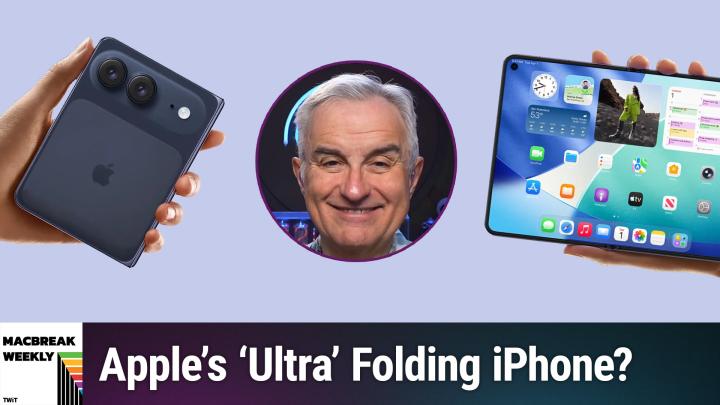
Yeah, we'll know in six weeks. Thank you. All right, we can say the name now. Ultra. Ultra. Mac World magazine has this scoop. Apple's Ultra Roadmap confirmed. Felipe Esposito writing iPhone, MacBook and more on the way.
Leo Laporte [00:14:31]:
They're going to call the fold the iPhone Ultra without a number, according to Philippe, which makes sense because, like the air, this is going to be a perennial. There's also the MacBook Ultra, which is that M6 OLED we've been talking about. And that will be Ultra because it's going to be so much more expensive
Andy Ihnatko [00:14:53]:
than the other MacBooks.
Leo Laporte [00:14:56]:
And maybe there'll be other Ultras, I don't know. But it sounds like Apple. I mean, they own the trademark. They've had Ultra chips, they have an Ultra watch. So it won't be too much of a surprise, right? Did you say Andy?
Andy Ihnatko [00:15:11]:
Only because I was thinking about this the other day. I'm thinking. I was like, how many cleaning products and shaving products and other consumer house cleaners? And like,
Leo Laporte [00:15:27]:
you're right.
Andy Ihnatko [00:15:27]:
It's like it's one of those meaningless terms you attach to something to make it sound special. And in the end, they can call it. You know, the history of product marketing is we will make up a word because we don't want to trademark something. It's. It is meaningless. We shouldn't really fuss about it, but it's like it gets us back to where we've been for many years of. Okay, does the word pro actually mean anything or is it just a synonym for it's going to cost you, brother?
Leo Laporte [00:15:51]:
So According to the OED, Ultra was first used in 1815 by Byron, Southey and Bentham from the French politics. Ultra royalist. Extreme royalist. Of course, it has a Latin origin and OED says in very common and steadily increasing use from about 1830. So it is not a new word. Ultraviolet. Right.
Andy Ihnatko [00:16:12]:
Don Ultra is a hell of a cleaner. And I don't. I'm not even joking about it.
Leo Laporte [00:16:15]:
Whatever.
Andy Ihnatko [00:16:16]:
Anything you're trying to clean. Don Ultra on the R Cleaning subreddit. Every solution is Don Ultra.
Jason Snell [00:16:22]:
Yeah, he's pretty good, but he's very busy these days.
Leo Laporte [00:16:24]:
Don Ultra is a Latin advert that means beyond on the other side, on the far side, passed over and across.
Jason Snell [00:16:35]:
I mean look, there's a long tradition of us hearing Apple product name tags and being like, I don't know. And then you know what, they use them and they market them and they make it clear and then everybody gets used to them. And they can mean like Quest Pro doesn't mean what it literally professional, right. Like there's an Apple watch, you know, Ultra, right? We've got that now. We've got all sorts of pro. There's a phone Pro. How is it a professional phone? And the fact is like that's not what it means. It means something but it's got a very specific kind of like tag in Apple's universe.
Jason Snell [00:17:08]:
Exactly right. And we all get over it. So like I think an UGG today is perfectly reasonable knowing that, you know, six months or six weeks or six days after it gets announced, we'll all just shrug and be like, yeah, of course, of course.
Leo Laporte [00:17:20]:
And Esposito says in Macworld there'll probably be an iPad Ultra and AirPods Ultra as well. There might be a whole luxury line, maybe a leather covered line of Apple stuff.
Jason Snell [00:17:32]:
Look, I like the idea because I think Apple, I don't mind the idea that Apple pushes like with the iPhone 10 pushes the cutting edge and releases a product like if, if Apple is going to be restrained and has some features that they're like, we can't do that this year because it's going to be too expensive. I actually kind of don't mind if they have the ability to put that out at a higher end while also making all their other products available. I'm kind of okay with that. The idea that it gives them an out, a place where they can experiment with brand new stuff that will come down over time. But it gives it because the alternative is they just don't release that product. And I don't like that.
Christina Warren [00:18:15]:
No, I don't like that either. We'll go back to, go back to the name for a second. The only thing I kind of take umbrage with a little bit because you're exactly right, Jason. We will get used to the name
Leo Laporte [00:18:23]:
Umbrage, the Latin for shadow.
Christina Warren [00:18:26]:
But you know, but how is this going to be, are we going to have a MacBook Ultra, you know, M6 Max, you know, whatever. Like this is where the naming becomes clunky because we've added all these suffixes to the Chip names and to the other things. And you're right, like MacBook Pro is cease to have any sort of meaning, right? Because you have the like the 14 inch MacBook Pro. You've got like the, the base model and then you've got the one that actually is the good one. And then you have like, you know, the max, you know, chip versions and whatnot. And so that's where I do like roll my eyes a little bit because I'm like, okay, we're now adding all these, you know, various, you know, like things to the name and it's just, it doesn't roll off the tongue easily. But we will get used to it, I'm sure.
Andy Ihnatko [00:19:15]:
Yeah, but I agree with you 100%, Jason. I feel as though it'll legitimize itself if it means that no, this isn't the same unit but with more storage and more memory and a better camera. It's no, this is a almost completely revisualized. It would be prohibitive for us to make this at scale. We can only probably make a couple of million of these max. But we are going to make the maximal version of the iPhone, the maximal version of the iPad, the maximal version of an Apple Watch and we will call it the Ultra. We're not expecting this to be a reasonable purchase for most people. Again, it'll just be if it does become like the Pro, that will kind of bore me.
Andy Ihnatko [00:19:56]:
I'm kind of more interested in the idea of in the iPad line using the NEO tag as here is the one where we are going to expect you to be. We are making something, we're maximizing economy and this is targeted at people that are willing to forego the alternate of this device in order to be able to afford this thing. Because the iPad absolutely needs some pruning and house cleaning. Because I have to remind myself, wait, is the iPad nothing the intro one, or is it the iPad Air? Because Air is smaller or I mean that would be a line we're adding Neo to the end of. Here is the $329 iPad works great. It's not going to be a replacement for your main device, but you can buy one for each of your kids. They can have your own private experience and it's built to the speck of an Apple quality product. So I would love to see an infestation of neo.
Andy Ihnatko [00:20:49]:
I'd love to see the Apple Watch Neo, for instance, the AirPods Neo. So you know when you walk into the store that I don't really have $300 just I don't know how much the really, really good AirPods are, but I know that I don't have that kind of need for it. Show me the Neo first, and if that doesn't work, then I'll think I'll consider an upgrade.
Jason Snell [00:21:05]:
The ipod is also. Or, sorry, the iPad, not the ipod. The iPad is a good example of. Even though it's called the iPad Pro, what I'm talking about, about, like having the Ultra line is like the iPad Pro, and we've talked about it here, it costs a lot of money, but it's got that tandem OLED display and like, it has so much amazing tech in it that, you know, most people probably don't need if they're buying an iPad. IPad Air is a better fit probably than. Than the Pro, but I'm glad the Pro exists and, and people buy it because they want the very best of, you know, whatever iPad they happen to be buying. But I like the idea of getting these product. They're never going to be perfect.
Jason Snell [00:21:46]:
People who write about this and talk about it like us are always obsessed with sort of getting everything in a perfect line, where every product lines up and all makes sense and like they don't release all the products at once. It's always in flux. It's always a little bit of a mess. But I do like the idea of maybe saying, you know, these adjective lists, tag list, product names are a little confusing. It's like if they had called the MacBook Neo the MacBook, we would have been like the Mac, you know, a MacBook. Well, no, no, no. Not the MacBook, just a MacBook, like the MacBook or the MacBook Pro or the MacBook Air, and instead we can say a MacBook like the Neo or the Pro or the Air, and it's clearer. I kind of like that better.
Jason Snell [00:22:22]:
Maybe they need to get those tags on everything. I think that might be a better thing.
Christina Warren [00:22:27]:
Yeah, I mean, I think, I think that's true. I think at this point, I think that originally, like when we. The first MacBook going back to 2006, that fit exactly where it needed to be. And then I think that the first kind of original sin was the 2015 MacBook, reintroducing that name when it was a different class of product. Right. And kind of repurposing the Air into what had been the MacBook role. And so, yeah, I'm with you. I think that if you're going to go down that kind of sequential line, that's kind of how I feel about the.
Christina Warren [00:22:53]:
The Pro Lineup with the MacBook Pro right now where it's like, okay, it gets a little bit confusing. So yeah, I mean, I don't mind look as long as. And I'm even okay with them having like super high end or very expensive, you know, machines that are not set to appeal to the mass populace. What I do hope, and I'm not overly concerned about this, especially not on the phone at first, the laptop maybe a little bit, is that it won't become an excuse for Apple to try to, you know, push up, you know, average selling price and, and you know, not bringing things back down, you know, over time and trickling down like that. That's the only thing I don't want to see. Oh, we used to have these features
Leo Laporte [00:23:33]:
I've seen a lot in the financial press is how well orchestrated this handoff is, the timing, the way they've handled it. Tim's going to get a farewell at wwdc. Turnus is going to get an introduction in September for the big, you know, the most important launch. He'll also get the most important quarter as his first quarter for financial results. And there's a, you know, according to Bloomberg's Power on newsletter, Gurman's Sunday newsletter, there's a pretty strong lineup, just as there was, it turns out for Tim Cook when he took over, there's a pretty strong lineup of products about to hit the pipeline. Ternus at the town hall in which he was introduced to Apple employees last week said Apple's about to change the world and described the company's pipeline as the most exciting of his career. According to Gurman, they've got the smart home hub, which is that home pod with a screen. Yeah, I know.
Andy Ihnatko [00:24:29]:
It always is.
Leo Laporte [00:24:31]:
The tabletop robot, which is the home hub with an arm. So there's one with a screen and one with a limb. It's not a limb. It can move the screen around. I don't know why they call it a limb.
Jason Snell [00:24:41]:
It's like the iMac G4.
Andy Ihnatko [00:24:43]:
It's a Jibo.
Leo Laporte [00:24:44]:
Yeah, security device. We've heard rumors about this and Mark is kind of confirming that there will be a privacy focused home security system. I wonder about that. It seems like a long shot. Smart glasses. We do know that Tim was very excited about that and has been for a while and that's a hot category. AirPods with AI and perhaps low resolution cameras and a pendant. Gurman says Apple's working in a small circular device with a computer vision camera system that can capture data and feed it to an iPhone's AI and Siri features.
Leo Laporte [00:25:22]:
You know, people have tried this before. This is something Gordon Bell was pushing with his. What did he call it? The meme? Can't remember. He had a name for it. I remember talking to Gordon about it and I always loved this idea. But this really is going to take a society that is just suddenly so used to being on camera at all times that they can tolerate it. I mean, people didn't like the Ray Ban, the meta Ray Bans. Yeah.
Leo Laporte [00:25:43]:
If you've got high around your neck.
Christina Warren [00:25:46]:
Right. I mean, if, if anybody can pull it off, it would be Apple. But I don't expect the reception to be like people to be falling all over themselves for it because you have other pen, other AI pendants, like, and
Leo Laporte [00:25:57]:
I mean, especially they're with microphones, though, not cameras.
Christina Warren [00:26:00]:
Totally. But, but, but, you know, having that idea. Well, didn't, what was the. The humane. Didn't the humane pen. Didn't they have a camera?
Leo Laporte [00:26:09]:
There was a camera that came out a few years ago and it didn't do well because they realized that the pictures it was taking were not at eye level.
Christina Warren [00:26:20]:
Well, this is part of the problem too. I mean, I don't know if any of you remember, but Casey Neistat had like a thing like this like 10 years ago. It's called Beam that CNN then bought for some reason. And I remember having a conversation with Casey at like one the of launch events and I was like, I totally understand what your idea is. Have you realized that where this is placed for 50% of the population is in a really inopportune spot and doesn't fit well like on, on your chest, you know.
Leo Laporte [00:26:47]:
So here's. So I found the story about Gordon Bell. This goes back 20 years. His wife, Gwen Bell had Alzheimer's and he wanted to help her remember stuff. So he created something called My Life Bits when he was at Microsoft. It came out of Microsoft Research in England. The Sense Cam, that was part of My Life Bits took a picture every 30 seconds. If you walk up to a person, it senses a change in infrared triggers.
Leo Laporte [00:27:14]:
It says, oh, you're, you're standing in front of somebody, captures that and then remembers it in a database. So that every 30 seconds, every there's a picture, every keystroke on your computer, every mouse click, basically all of your life. He was motivated to help Gwen, but I think he also had the idea that someday people will want this. And I've wanted this ever since I interviewed Gordon about this 20 years ago.
Andy Ihnatko [00:27:42]:
Yeah. And Google also had a project that was kind of similar to the bean one. Yeah, it was like, just like they did something legitimately kind of revolutionary by having a cardboard VR set up for a phone. Basically their idea is, well, what if we just have a holder for the phone? So you could, so people who, who can benefit from a phone camera as an assistive device. To explain, here's what's in front of you, here's where the traffic is, here's the product that you're holding right now. Just simply wear it like around your, around your chest so that you can basically, you know where the camera is. You can, you know that you can give presence to that. It's.
Andy Ihnatko [00:28:16]:
But it's. We've, we've talked about this in different ways before, but I do think that I love the idea of Apple doing a pendant possibly mostly because they are the people who can do two things extremely right. They can get the privacy right and they can get the hardware right. The manufacturing of this idea of trying to do a pin that is not going to get over hot. It's not going to Last only like 2 hours on battery, it's not going to be wireless happy. It's actually going to be practical. And I do love the idea of a PIN format because the idea of a camera in front of you is super, super useful in so many situations. And in every situation which it is not appropriate to be wearing a camera, you take it, you unclip it from the magnet, you flip it over, you clip it back on the magnet with the camera facing towards your chest.
Andy Ihnatko [00:29:03]:
And now it's just simply a microphone. If there's a company that can do this correctly, I think it's Apple, but I'm not 100% sure that it can actually be done.
Christina Warren [00:29:13]:
Well, but can they do the software?
Jason Snell [00:29:16]:
Yeah, the thing this is all incumbent on Siri.
Leo Laporte [00:29:20]:
Right?
Christina Warren [00:29:21]:
I mean, that's what the rumor is. And I'm just going to be totally candid right now. Even if you shove Gemini into it, I don't know if they have that part of it because I agree with you. I think they can make the privacy argument, whether that's a cope or not. I think that they can definitely make the hardware not terrible. But can you have a good software experience?
Andy Ihnatko [00:29:42]:
I think they have enough time. I keep saying this and I don't know they have enough time to try to pull that off for reasons that are kind of hard for me to explain my thinking. I do think they have plenty of time to figure that out if that's where they want to go. Also every time that they publish AI papers and there's an AI conference going on which you see the AI group or the machine learning group published, hey, here are all the papers that we're publishing for this conference. Almost all of them have to do with, you know what, you don't need a large model to do this. Or this is you can do inference without having to have a huge amount of compute. Basically this the standard way of doing things. And you'd probably know better than I how valid these arguments are.
Andy Ihnatko [00:30:29]:
But everything that they're focusing their research on, release their published research on, seems to be on. We can do things on a tiny little power, power sipping device without many resources that are not going to have the same sort of requirements as the larger models and larger plans that other people are. So it's something they're very, very interested in. Again, I don't know how you're right. They do have to get the software exactly right. The problem is that I don't know, I still don't know how the average consumer balances the difference between I want privacy versus I want this to be as functional as possible. Where is the middle ground that they're willing to accept? And I don't know what that is.
Leo Laporte [00:31:11]:
Gurman also says that Ternus had a high priority for a foldable iPad. A roughly 20 inch foldable iPad. He says it may end up being a wacky experiment that doesn't see the light of day according to several people
Jason Snell [00:31:24]:
who have worked on it.
Leo Laporte [00:31:25]:
But it was Turner's priority.
Jason Snell [00:31:26]:
I mean, I actually feel this way. We're talking about the pendant too, or the pin or whatever it is. First off, like socially, is that going to work? I think Apple doesn't. Here's the thing, Apple has let things go like the glasses and then regretted it. Yeah, because they got behind, I think something like a pennant. Like either they'll do it right and people will accept it or people will learn to accept it because everybody else is doing it. Or they'll put it out and nobody accepts it, in which case they're not behind. Right.
Jason Snell [00:31:57]:
Because they didn't, they didn't mess it up. I think to do this you can't, you can't sit on the sideline with something that might be a thing. So I think that's important. And this folding iPad, weird. Like this is the thing that's like, it's like a laptop but it's an iPad, which I don't. I. All the reports about this that Mark Gurman has done, I don't Understand what this product is. It doesn't make sense.
Jason Snell [00:32:21]:
But you know what? Why not in first off, they investigate stuff like this all the time. It's surprising that this got reported on. But like, obviously they're experimenting with it and that John Ternus is intrigued by the possibility. And like, why wouldn't you explore that? The question is like, either do they figure it out and go, oh, I see, why, why people would want this? Or they go and, you know, nah, they had the discipline to just walk away and say, no, this didn't work out. But like, they, it's. This is their job. Right. Like, we don't usually see into this part, but they, they need to try this stuff.
Jason Snell [00:32:59]:
They need to be planning for, like, what. What does this new bit of technology enable us to do? And is that a thing that makes sense? And sometimes you can only do that by trying it and learning. Oh, no, this, this doesn't make sense. Let's not. That's okay. I think it's okay for them to, to walk away if, if it seemed like a cool idea, but in the end they can't figure out why anyone would buy it.
Christina Warren [00:33:21]:
Yeah, I mean, I agree with you. The only thing I would kind of push back on that a little bit is like, you look at the Vision Pro, which is not a success at all, which, you know, I don't know why they're continuing down that. That realm. And I think that, I think all of us would agree that they probably would have been better suited pivoting from that into some other areas earlier. So on the one hand, I totally agree with you. I would love to see them be able to experiment more even if it doesn't work. I think the problem is when we look at things like the Vision Pro, when that's released, and I go back to. I think the failure of the Vision Pro was completely in how it was positioned and that was completely Apple's fault.
Christina Warren [00:33:57]:
I think of Apple had positioned it as a dev kit that everyone could. Can buy and kind of an experiment. I think that the perception would have been better. I think we probably would have had more adoption. We might even have more apps. The level set would have been correct. But the problem is because Apple doesn't typically experiment. Even though I agree with you, I think they should do more of that when their products come out.
Christina Warren [00:34:17]:
They have to sell us this vision of this holistic ecosystem and all of these use cases. And then if it doesn't live up to that, people have a hard time kind of, you know, being like, well, that was a flop or that didn't work or that wasn't that like, there, there is this expectation that if Apple is going to release something that's going to. They're going to kind of be in it for the long haul. And I don't know how they change that perception. Maybe the way they do that is just by experimenting more and maybe getting people used to being like, okay, you know, the, you know, HomePod is not going to be long for this world until we bring it back randomly, you know, a few years later. I don't know this.
Jason Snell [00:34:52]:
You pose an interesting point. Just because, like, it's a developer kit and an experiment, and I firmly believe that. I firmly believe that Apple should have the ability to launch something publicly that is not meant to be marketed as the next huge thing.
Christina Warren [00:35:07]:
I agree. But they can't.
Jason Snell [00:35:10]:
Like, yeah, they seem to have failed at that. And yeah, in hindsight, what I would say about the Vision Pro is, first off, I think it was a misguided product direction and that some of that goes back to Jony. I've. And that if you can only sell it for $3,500, you probably shouldn't sell it. And you should wait, like, what was the rush? And I think the rush was they were looking at Meta and they're like, oh, man, we got to catch Meta. And now you look at Meta and you're like, oh, no, you did not need to do that. And you'd be better off holding this technology another five or ten years and using it then. But I think that, that, I mean, this is an opportunity for a new leadership to say, you know, when we, when we evaluate products like this, we either need to find different ways to launch them.
Jason Snell [00:35:50]:
Like, should Vision OS have just been a developer kit only available to developers? And, you know, everybody would talk about it, but, like, it wouldn't be judged as a product because it doesn't make sense as a product or, you know, or trying things out and killing them. I don't know. It is an opportunity for Turnus the hardware guy, to maybe have a different take on what they say yes to. And it could be like more strict of like, say no to more things. Or it could be, can we find a way to say yes to some weird things and see what happens
Andy Ihnatko [00:36:24]:
to the point of the Vision Pro, Apple stepped on its own on a rake by. They did not position it as, this is a development kit, this is an experiment. They said, this is the thing. You want to be first in line for the next huge platform.
Christina Warren [00:36:36]:
And that was the problem, huge mistake.
Andy Ihnatko [00:36:38]:
But the idea of a laptop with two screens, this is one of the very few things that I really, really do envy about the Windows world, that there's so much competition that several companies are saying, you know what, what if we do put a two screen laptop in the, in the lineup? And it's actually, the ones that I've seen are actually very, very compelling if you need like a mobile to two screen display, totally. It's, it's wonderful. But the Apple's problem is that they, they have to make this laptop for the entire world of Apple like desktop Mac OS users and they can't if they have a slot available for another model of MacBook, they have to make sure they can sell it to as many people as possible. So they're kind of hamstrung there because if they only sell a million of these, even if they say overtly, hey this is a boutique product, we really, really want to see this exist. And also this is a good test of technologies that we might be able to put into future more mainstream devices. Everyone's going to say yeah, but wow, what a huge flop that was. What a stupid idea. It's very, very difficult to be in John Ternus' even I'm guilty of this, of saying I really want to see them take more chances.
Andy Ihnatko [00:37:50]:
But nonetheless, if they take a chance in a way that I didn't have a cookie that day, I'm a little sleep deprived. And so rather than saying wow, that was actually some interesting ideas. Implementation was off, but it's a very interesting idea saying oh my God, why is Apple wasting their time on this? And John Ternus is going to be a test of his bravery is going to be, I think this is a great idea and I think we should do this. And I know that in the next year every single, not even misstep, but even half step that I take is going to be criticized 10 times worse than, than anything I did. But I'm going to do it anyway because I think that's what's good for Apple's story, Apple's product line and Apple's users.
Leo Laporte [00:38:29]:
All right, well it's going to get interesting because there is some competition which we're going to talk about in just a little bit. But we got to take a break first. You're talking, you're watching MacBreak weekly. Andy Inacco, Christina Warren, smart people here. Jason Snell with a great conversation. All right, Ming Chi Kuo. Now first thing I should say, OpenAI, which had been on a tear right up till about yesterday is now people are starting to look at him like, you guys are going to run out of money, aren't you? There's going to be some problems here. We got some problems coming up.
Leo Laporte [00:39:05]:
There's an IPO coming up. You know, people are starting to look askance a little bit, especially with anthropic success. However they are working and maybe I don't know if this is the jony I've product that they paid $3 billion for or if this is something else they're working on. A smartphone. Ming chi Kuo says OpenAI is set to redefine smartphones media tech which by the way, I want to say I was talking to Jeff Atwood the other day. He said, you know, this MediaTek processor is amazing. I said, I know, terrible name. But they actually have, they have a processor that's on a Chromebook which I actually purchased.
Leo Laporte [00:39:44]:
So has he. And it's amazing. It's a really good ARM implementation. Very impressive. So MediaTek, while that may sound like, you know, second tier processor manufacturer, it is I guess pretty good. Qualcomm's involved and Luxshare, which is a contract builder contract manufacturer are key to the AI agent phone. So Qualcomm and MediaTek are doing the processor. Luxshare will do this KISS System Co Design and manufacture Quo says mass production expected in 2028.
Leo Laporte [00:40:19]:
And I have a feeling that whether Apple knew about this or not, this is why they're working so hard and fast. Because they know the competition's breathing down their neck and their number one product, the one that keeps them alive right now is the iPhone. AI agent redefines the smartphone says Quo. Users are not trying to use a pile of apps. No apps. They're trying to get tasks done and fulfill needs to the phone. So they I know it says I made a smartphone interface concept design shown at the end of this post. Comparison with today's model using the iPhone as example.
Leo Laporte [00:40:52]:
So you basically talk to the phone, you tell it what you want to do. This is what was. Wasn't this the idea behind the rabbit R1 which had a very early Android, old Android operating system. I have one and the idea was you talk to it, you don't need an app. It will figure out what to do.
Christina Warren [00:41:10]:
And now the technology is actually at that point where you can do more of that. Whereas when the R1 came out, agents weren't even a thing and they were really running VMs in the back end that were running Playwright scripts.
Jason Snell [00:41:22]:
It's pretty good.
Leo Laporte [00:41:23]:
Now in fact, you can run openclaw.
Christina Warren [00:41:24]:
Yeah, no, I know, I know. Now, now, now it's like several years later. It's, it's finally okay and Look, I paid $100 for it. I don't care. I'm just always their, their marketing wasn't is cute but they're the, the. I mean honestly, I've been expecting this. I don't know what it will look like, but I've been expecting this for
Leo Laporte [00:41:40]:
somebody was going to do it if not open AI.
Christina Warren [00:41:42]:
Yeah. Because I mean I've been expecting a phone, I've been expecting like a operating system them because you can just kind of see the direction things go in where if I think most of us agree that AI, for better or worse is the next big computing paradigm and it is transformative in the same way that smartphones were. And that doesn't mean that all the changes will be good and that doesn't mean that, that everything old goes away. But it does mean I think like a very clear rethinking of what the old way of using your phone, of getting things done was. And now you could potentially put things into a new perspective and whether this is task based. What is this about? But being about, okay, I want to get this done. I don't need to worry about rather than there's an app for that. No, I can just, you know, tell the, the machine what I want it to do and it will figure it out for me.
Christina Warren [00:42:30]:
There's something compelling there. And, and I think that you know, like Apple, Google, all the, the incumbents have to be aware of this because certainly the, whether it's OpenAI or anthropic or some startup that we've never heard of, who's going to come in and try to own this space? This, this is an area that I think is right for disruption and will be because when we look at the last 20 years of kind of the modern smartphone era. Right. Okay, well what, what do we look like? What does the next 20 years look like? And I don't think that it is a grid of apps on, you know, a vertical screen. I just don't think that it is.
Andy Ihnatko [00:43:05]:
Yeah, I think, you know what I was reading, I was reading this, his post on X and I actually would say oh really? You really think that's really. And after a little bit more thought though, I kind of put myself in the mode of everybody who could not imagine a smartphone that does not have a physical keyboard on it. But as soon as you showed them one. Okay, that now makes sense. And then all of a sudden, all the companies that had built all of their software based on the idea of having physical keyboard, physical control buttons, they were not in a position to throw away everything they've done and rebuild it based on multitouch. And if, if AI represents that kind of threat to Apple and to Android and to all these other platforms, it is because we can imagine a layer of AI that interacts with the user and the user interface and exists alongside it. It is hard for us to imagine one that replaces entirely. And it would seem to be almost impossible for a legacy operating system to be rewired to be an AI first user interface as opposed to a secondary interface.
Andy Ihnatko [00:44:15]:
So, yeah, I'd love to see it happen. And I admit that I'm not going to fully understand how well that experience would be until I actually see one. Unfortunately, I lack that kind of imagination. I mean, I still think about all the different things that I use use for my, that we use smartphones for, and not all of them is, I'm going to give you a task which I would like you to perform. It's, hey, I just want to listen to some music or gee, I wonder, like, if my friends have posted anything on their blogs today. I just want to take a look at that. I don't understand how that interaction would work without a standard user interface. And I don't understand a scenario in which I would prefer to ask an AI assistant to please show me Jason's latest blog post on Macworld or Six Colors.
Andy Ihnatko [00:44:58]:
I would more appreciate that. Hey, look, I've got a shortcut here that I simply tap this button and now I see this as rss. So lack of imagination is the killer for almost every industry. It's not that things can't be done, it's just people can't imagine how well how it would work. And it would take a company like OpenAI or Anthropic to basically create the revolution because they have no baggage.
Jason Snell [00:45:18]:
I think the danger is that it's also, it's not just lack of imagination that's involved here, but it's also sort of like overestimation is a problem because I am also intrigued by this. On the one hand, there are lots of the streets are littered with the bodies of companies that thought they could build their own smartphone. But at the same time, one of my arguments about why Apple has a good chance of surviving an AI transition is because they're so good at making smartphone hardware. And that's an argument for the smartphone as a piece of hardware. Which is what the counter argument would be is like, yeah, maybe OpenAI does need to make a smartphone, because a PIN is not gonna do it. And the. You're gonna either have to. If you don't make your own smartphone, you're gonna play ball with Apple or Google, whereas if you make your own, you can do whatever.
Jason Snell [00:46:07]:
I, I just something you said there, Andy. This is what I keep coming back to is it's so easy in a way to say, well, in the future, we just won't have what we have now. We'll have a new thing and everybody will use the new thing and that'll be all it is. And it's more complicated than that, right? Like, I, the one that I always get is like, well, in the future we'll just talk and things will, you know, we'll talk to something and it'll talk back to us. And it's like, I don't, I don't, like, I have so many devices in my life that I can talk to. I do not talk to them. I don't want to talk to them. I don't want them to make noise.
Jason Snell [00:46:38]:
I want to look at a screen. Now, I would also say with AI, here's a good example of this, we don't know how good it's going to get, but what I would say is AI has proven to be amazing, especially at coding, Right. And you can build your own apps. And that's true. And I could see a level where you're like, look, this is what I want you to do, and your phone kind of like just does it and makes an interface for you. That said, I am skeptical that most people are going to want to have to convince their phones to make things in a way that pleases them, as opposed to having somebody, perhaps a developer or what we think of now as a developer who might not be using traditional tools to have some thought into, like, here's a way you could do this thing, and you build an interface that I might prefer to use. So, like, I feel like there's complexity here, and it's not like we're going to toss it all out and replace it with something new. Because I think we, I think we're a little over.
Jason Snell [00:47:35]:
Sometimes the hype gets people excited. It's like, in the future there'll be nothing and you can just talk and things will happen. It's like, I'm not sure people actually want to be that rootless. I think it's change, but not necessarily wholesale. I do think it, you know, if I was open AI, I'd be interested in making a smartphone because I would think I don't want to be under Apple's thumb, I don't want to be under Google's thumb. And, and I personally, Jason, am super bullish on the fact that the smartphone is a great object that people are going to want to keep in their pockets for lots of reasons. So if that's all true and I can't work with Apple, I got to make this thing myself. I get it, I get it.
Andy Ihnatko [00:48:13]:
Yeah, you need, you need, you need a display, I think, because again, I'm totally with you. I'm not going to be simply speaking to do everything I want. I like the idea of AI generated interfaces that are custom to the task where again, if I do tap the button to read your feeds, it will generate a user interface that's appropriate to that moment in that task and it'll learn how to make that interface better and better and better. But to your point, that is an excellent point. You think about it, the design of a laptop has not really changed fundamentally in 35 years. The controls, the control. If someone from 1930 were to jump into a car made in 2026, they would understand how to operate that car because that control interface and user interface has not substantially changed in 100 years. The difference becomes we get to, we keep the things that continue to work, we throw away the things that are no longer relevant.
Andy Ihnatko [00:49:01]:
We don't give that industry five years of advance. Oh, by the way, in five years time, nobody's going to want that keyboard on your phone. So try to figure that out. It's a trial by fire. And that's the thing that I didn't like about that tweet was the idea of this being a huge disruptive sort of device as opposed to an interesting alternative that people are going to take a look at. But again, if someone does crack the idea of a completely AI interface forward phone, it is, it's, it's harder to imagine Google cracking it or Apple cracking it than a company like OpenAI or Anthropic. Again, only because they don't have, they don't have their investment.
Christina Warren [00:49:41]:
Well, exactly. I mean, I was just going to say, I mean, that's why Apple was able to disrupt the smartphone industry is they didn't have the existing, you know, baggage of mobile devices. The way that, you know, you'd palm and you'd blacker, you had Windows Mobile and you had these things built on certain paradigms. And so they were kind of locked into a, what Those things were. And now the, the, the two people that really kind of. The two players that really pushed it forward were Android, which Google acquired and, and you know, what Apple was doing with iOS. Now, I don't think that. And I think a smart.
Christina Warren [00:50:10]:
I don't think smartphones are going away and I don't think that user interfaces are going away, but I do think the way that we interact with our devices are already changing. And you already see this just in the last couple of years. The way that people use agents, interact with agents, interact with, with chatbots is very demonstrably different. The way that people go about seeking out information is very different now than it was three years ago. And people who are coming up on these tools now don't have that baggage of, okay, I'm going to go to Google for these things. I'm going to go to my RSS feeds and go to my blogs for this. They're much more used to asking questions or interfacing directly. I don't know what the future will look like, but I do feel strongly that it will be.
Christina Warren [00:50:49]:
Be different. And I also feel strongly that the people who will be best primed to be able to do the disruption are people who are not, to your point, encumbered by, by the baggage that they have. Moreover, the only way this really works, and this is whether it's with Google or Apple or anyone else, is if you own the entire stack. And so you need all that information, you need all that context, you need to own the entire stack. This can't just be a layer that you license. This is, this has got to be something where me as the user, I agree that I have my very personal relationship with my device and I'm willing to give it all of my info and in return it's going to give me what it gives me. But it's not something that you can just slap on. Which I think was the problem of like the, the littered bodies of smartphones past that, the Amazon devices, the Facebook phones, all those things, they didn't work because they didn't own the whole thing.
Christina Warren [00:51:38]:
They didn't own the whole relationship. And I think that, that AI assistance, again, for good or bad, I'm not saying it's a positive thing. People have very strong relationships with those tools already where they're already sharing their information with them. And so if you can take that and then, you know, modify that into like what a, you know, smartphone of 2030 or 2035 looks like, I think it's interesting.
Jason Snell [00:52:00]:
And to take the Apple angle here. What I would say is if I, if I were at Apple, I said what I would do if I was at OpenAI, if I were at Apple, I mean I would be looking really heavily and there were some rumors Mark Gurman talked about that they were actually looking into this in a Vision Pro context. And I wonder if they're looking more broadly now, which is you own the full stack including the development tools now your LLM, you know, you got Gemini now, great. But like if I were at Apple thinking about this, that's what I would be thinking is I want, since I've got all the APIs, they've got app intents, they've got Xcode. Start thinking or continue thinking, please have already started about ways in which your AI agents can build interface elements, build things that are like apps, but aren't apps that, that allow users to use AI tools to build elements and add them to the collection. Maybe it's to add app intents so that then when you ask your, your device to do something, you've already taught it what that means and now it can just execute it. Because they do have the advantage of having their development environment, their API set all the way down to their chips. And if they embrace the idea that one of the new paradigms going forward is going to be something that's not just a pre baked app from a developer, but might be things that are kind of generated on the fly or are presets created in a process and then executed when the user wants, they could do this.
Jason Snell [00:53:32]:
It's not impossible for Apple to embrace this idea because they've got all the ingredients. It just breaks the app store paradigm and they have to be willing to do that. And what we've seen in other areas that granted are not technical areas, they're more financial power based areas. They've been very reluctant to do literally anything that breaks the App store paradigm. But I think this might be the one.
Andy Ihnatko [00:53:56]:
Yeah. And when you put it that way, Google is probably the only company on the playing field that has even more, more of the stack than Apple does because they designed their own Tensor chips, they've got the operating system, they've got the cloud compute everywhere and basically they've already built their business.
Christina Warren [00:54:15]:
Yeah, yeah.
Andy Ihnatko [00:54:17]:
And they basically built their business around like so long as more people use our thing, we win. So let's help everyone use our thing. We will help. We be great. If they use our AI based phone, it'll be great if they use our AI agent on whatever phone they want to bring it's again, it's. It's a lovely. It's always fun to live in these times of transition where you can imagine anything happening or none of that being. Or being everything you can imagine being insufficient for what the landscape is going to be five years from now.
Andy Ihnatko [00:54:46]:
I'm humbled at trying to figure. Again, that's why I say I'm a guesser, not an analyst. I will stand by my guess. I will not stand by my analysis.
Jason Snell [00:54:55]:
Being humble, it's a good time. It's a good time to be humble. But I find it funny that, like, we ended a kind of smartphone malaise because the smartphone is just. It's so revolutionary as a product and it's gone everywhere and it's changed the culture and society and all of that. But, like, then there was a period where it's like, okay, and now we're starting to see, like, well, maybe this will change. I think it's very funny, though, that I still. It's the app paradigm that I think I'm wondering about more than it is the. The fact that you want a device with a really nice screen and a big battery and a great network connection that's on your person.
Jason Snell [00:55:28]:
Right. I think that I am kind of a believer, but the rest of it, it's kind of up for grabs. It's exciting.
Christina Warren [00:55:35]:
No, Yeah, I fully agree. I think the app paradigm is what is up for disruption. But, no, I don't think that at this point anybody is going to be. And I think that if you'd ask somebody in the early mid-1990s, when cell phones were first starting to kind of gain popularity, I think even then people would have been like, yes, this is going to be a thing we will have for a very long time. I don't think that that, that's like. I don't see it becoming glasses, I don't see becoming pendants. You know, it's going to be a phone. But what we do in the phone and how the, you know, there's an app for that, I do think that that is going to change and I
Andy Ihnatko [00:56:06]:
think it's already changed.
Leo Laporte [00:56:08]:
Go ahead, Andy.
Andy Ihnatko [00:56:09]:
I will say one thing that's. That's kind of relevant. I was actually thinking about this the other day, that this is definitely. I bought. Every time I buy a new phone, it really is. I very, very close between sticking with Android and switching to iPhone, because they are. They're both excellent phones. The operating systems are both excellent.
Andy Ihnatko [00:56:25]:
They have some nuances that are largely a matter of taste and what you want out of a phone. The last time I spent like $1,100 on a smartphone, it was for the Pixel 6 Pro. And the reason why was because of that Tensorship, because I was intrigued by Google thinking we are actually going to be making AI part of the hardware because we think AI is going to be really, really big in the future. And then subsequently, again, things got closer and closer. And again, if I bought a phone last year, it would have been very, very close between the two this year, however, where I really am kind of urgently saying, okay, look, I'm going to lose support for this phone by probably this year. This is probably the last version of Android I'm going to get for the Pixel 6, so I should really buy a really, really good phone sometime this year. I have to say that I'm more intrigued by what Google's game plan is going to be in terms of maximizing AI on the hardware, hardware with the services, with the operating system, than I am with Apple. I think this, I think with Apple, it's going to be certainly a lot more relevant by the time I buy my next phone after this.
Andy Ihnatko [00:57:23]:
But I have to say that Apple is really going to have to pull the damnedest rabbit out of their hat with the iPhone 18 or the iPhone 19 to get me to switch back to iPhone.
Leo Laporte [00:57:31]:
At this point, what's really clear is that OpenAI wants to be an operating system, a platform. So everybody wants to be a platform.
Jason Snell [00:57:38]:
Sure, sure. It's just easier said than done. I think that's very difficult from their perspective of is they, they have to, they have to start from kind of nothing and like saying, well, we've got an LLM and some stuff. I mean, they've got a lot of stuff, but it's not a, it's not a piece of hardware and it's not an operating system.
Leo Laporte [00:57:53]:
Here's my. In my opinion, what they're betting on is that people want to be able to talk to their devices and have them do stuff. What they miss is there are stakeholders, the app makers, who want to own the data more closely. I mean, there's already a fight over AI ingesting content, AI stealing traffic from web pages. They're just, they're disintermediating all of this stuff and they're suddenly saying, no, no, come to us and we'll handle it. But that is not what the content creators, it's not what the app makers, not what the businesses they're dealing with want because they lose access to their customers.
Jason Snell [00:58:26]:
It's also not a Moat because every smartphone you can talk to and execute
Leo Laporte [00:58:30]:
and that's the other side of it is what is going to stop Apple from doing this? Nothing. And Apple can do it in a more graceful way by having a.
Jason Snell [00:58:37]:
And Google can.
Leo Laporte [00:58:38]:
And Google right. On Android, they still have the apps, but you have an AI agent layer that manipulates the apps. You don't need to get rid of the apps, you just need to layer also probably will debut that this fall, I'm guessing. Yeah.
Andy Ihnatko [00:58:51]:
And also if people already have relationships with OpenAI as a chatbot, with Gemini as a chatbot, with Claude as a chatbot, it's going to take some doing to convince him. By the way, you should fire this personal assistant that yeah, the training period was really, really horrible. But now that they've been in this job for a couple of years, they really know you very, very well, you know how to interact with it. It's going to take a lot to convince somebody, please fire that person. And here's someone who just came out of college who has no job experience from a company that really isn't very good at training these people yet. And please develop a relationship with this one too. There are a lot of variables for Apple to navigate.
Leo Laporte [00:59:37]:
So I, what we're, you know, I understand why OpenAI would do this. I, I, I just think this is more in their interest than any than its users, than the users.
Andy Ihnatko [00:59:46]:
They got, they got to pull the lever of every single slot machine that can possibly get their hands onto this.
Leo Laporte [00:59:50]:
Yeah, I completely understand why they're doing this. I am a little skeptical about their ability to, to kick Apple off the king of the, off the top of the hill on this one.
Christina Warren [00:59:59]:
Yeah, it would also be, I mean you have to think about like other parts of like for smartphone, for lock in and again, I think fully understand why they're doing this. I'm sure they're also looking at desktop operating systems. You need to have kind of this whole stack. It's true.
Leo Laporte [01:00:10]:
On the desktop too. Right. You just want to talk to it. But I will, as somebody who has been developing my own agent to do that. I love the idea. In fact, one of the things I'm really working hard on is getting it so that it can listen to me everywhere and I can say, hey, Kenobi, book a Uber for us on Friday. And it can just do it. I, I wonder, I mean, first of all, most people don't have the technical skills to do that, but I wonder if people really want that.
Leo Laporte [01:00:40]:
I mean, Amazon's trying to do that. With the echo, you know, I wonder, do people really want that? Is that, is that something people understand and want, you think?
Jason Snell [01:00:53]:
I don't know.
Christina Warren [01:00:54]:
I mean, I think it depends because I, I go back and forth about it myself. Like I personally could automate a whole lot more of my life than I do, and then I'm just too much of a control freak and I don't necessarily trust it.
Leo Laporte [01:01:03]:
Home automation.
Christina Warren [01:01:04]:
Yes.
Leo Laporte [01:01:05]:
Everybody thought, everybody wants home automation. Oh man, this is going to be huge. And then only the geekiest people did it and even they are going, what a pain in the ass.
Christina Warren [01:01:15]:
But if you can set it up
Leo Laporte [01:01:16]:
easily, just give me a button.
Christina Warren [01:01:18]:
But if you can set it up easily and if it actually works, which is the big thing, that's the big thing. If it works, it can be really, really powerful. Powerful.
Leo Laporte [01:01:24]:
It'll work eventually.
Jason Snell [01:01:26]:
This is the dream, right? The dream is you teach an agent to. This is, I mean, we all do this. If you're using like cloud code or whatever, you do this thing, right? You say, I want to do this thing. And it tries it and you're like, no, no, no, no, you need. And you become like a product manager and you say, it needs to do this, it needs to do this, it needs to do this. And then you're going to run this or, or it builds a script that runs. It's an intern and you, and you get it, you get it to do the way that you want. And then the next step is in all of these device interfaces we've got, it's like, okay, I've now taught you how to do X.
Jason Snell [01:01:59]:
When I ask you to do X, you now know how to do it. Remember that forever and have it go, yep, got it, Jason, no problem. And then the next time, the next thousand times I need to do it, I say, hey, do X. And it's like, got it. And it, right? But, but what happens a lot now is that most people are not comfortable spending cycles in Claude code or whatever to get to be a product manager. And that's why I think there's still going to be a place for programmers or developers or what you ever want to call it, because those are the people who are going to have to hold in their minds the structure and know how to talk to other databases and all of that to have it be friendly. Now maybe it'll be more like app intents, where it'll be less about the UI and more about like, like structuring all the, all the data and thinking about how people want to interact. But like that's the, that's the big leap for me is is that not everybody's going to want to do that.
Jason Snell [01:02:52]:
But also I think it would be pretty cool to get to the point where all I have to do is describe what I want to happen to an agent, to a voice agent or whatever. And once we both agree that it works, it now just does that every time I ask it. That would be very nice.
Andy Ihnatko [01:03:07]:
There are three levels here. Level one is that I ask it to make me a coffee and it remembers how I like my coffee. We're nearly at level two where it understands that, oh, it's 9:04am and he usually wants coffee at 9:04am and so when I get to my desk, there's a hot coffee waiting for me. Level three, which is what everyone wants, is that, gee, it's 2:12 in the afternoon and he rarely has coffee now, but I sense that he will really want a coffee right now. So I'm at least going to ask him or at least I'm going to have that waiting form. That's what the desire is to again have an assistant that's so well trained that I don't even have to ask anymore. It knows what its job is and it gets to be a little bit proactive. Although that is such a big leap between level two and level three because I made you a coffee.
Andy Ihnatko [01:03:53]:
And I also deleted our entire customer database in a way that it's impossible to ever recover. Is there anything else I could do for you today, Angie?
Leo Laporte [01:04:03]:
We're gonna take a break and come back. We have lots more to talk about. You're watching MacBreak Weekly. Andy Inaco, Jason Snell. Christina Warren. It's nice to have smart people here discussing this. I hope Apple's listening and open AI too. I think we brought up some interesting, interesting points.
Jason Snell [01:04:19]:
We're available. I don't know, we are actually available.
Leo Laporte [01:04:23]:
Consultation fee Giving away all our great
Jason Snell [01:04:25]:
ideas on a platform podcast.
Leo Laporte [01:04:27]:
I know. What is wrong with you guys?
Christina Warren [01:04:28]:
Please consult with us. We will be consultants.
Leo Laporte [01:04:32]:
Let's see what else. Well, we can talk about the rumor mill if you want. We talked a little bit about the iPhone 18's camera. It's interesting story in 9to5Mac. Ryan Christoffel. IPhone 18's new specs might bring subtle regressions to cut costs. We've been talking a lot about the supply chain issues caused by a variety of things. AI, data centers, tariffs.
Leo Laporte [01:05:01]:
So Apple, he says this is speculation, might make the display and chip downgrades to cut costs and Actually inspired by a Weibo leaker, Fixed Focus Digital, who said the A team will be late launching later than usual. We've heard that also the 1818 E will debut simultaneously. The leaker said. Now normally the 18 would come first in the fall and the 18 E would come later. Right in the middle of the year and the following year. Is that right? Am I thinking of Google's.
Christina Warren [01:05:32]:
No, it's the same thing. It's like six months later, so.
Leo Laporte [01:05:36]:
Six months later. Yeah, but that. I don't know if that means the 18E moves to the fall or the 18.
Jason Snell [01:05:43]:
No, I can't.
Christina Warren [01:05:44]:
No, no. I think they put it at the both of them in March, in the spring.
Leo Laporte [01:05:49]:
You think this is going to happen?
Jason Snell [01:05:51]:
Yeah, yeah. This is their. They've been planning this for a while now to separate the iPhone into two launches.
Leo Laporte [01:05:57]:
Okay.
Jason Snell [01:05:59]:
Samsung does it.
Leo Laporte [01:06:00]:
There's something to be said in the fall as well as the Ultra, the
Christina Warren [01:06:04]:
Pro and the Ultra and the fall
Leo Laporte [01:06:05]:
and then the regular, the 18 nothing. And the E would come out in the spring.
Jason Snell [01:06:09]:
In the spring.
Leo Laporte [01:06:09]:
Okay.
Christina Warren [01:06:10]:
I do wonder. I mean that does make sense. And you know, maybe it doesn't matter as much for the E versions because they're probably just going to continue to keep the hardware largely the same and then just swap the chip out. But, but it is interesting, I think, to kind of position it that way because like the, the E being behind the, the full, you know, 18 or 17 as it was this year, I guess with 18, 17 this year and the, the 16 before, I think there's been like enough time so you can kind of see the value differentiation. But I do wonder if that lessens the value prop a bit on the E series if you're going to launch that alongside, you know, the main phone, which is $200 more but usually a lot more featured. I do wonder how that will work out.
Andy Ihnatko [01:06:58]:
Yeah, it's also, I think a lot of people are also wondering, do supply constraints and the rising cost of RAM and storage, are they going to affect what their baseline models are going to be like? There was actually. A financial analyst based in Taipei had a tweet just the other day, sorry, just last week, basically co signing on something that was reported last week that the iPhone 18 is going to be based on TSMC's 2 nanometer fab. But also adding he also thinks it's going to actually have 12 gigabytes of RAM.
Christina Warren [01:07:34]:
Yeah, I saw that.
Andy Ihnatko [01:07:36]:
So I don't. Which is. Yeah, exactly. I don't know if Leo was talking about the Same stories that were making the rounds a week ago or the week before. But there were some rumors that said, well, actually Apple is either going to hold the line with memory and storage or try to figure out how it can basically make the same phone at the same price without having to absorb too much of its profit margin with supply shortages. Part of that story was basically about actually was that some of the approaches that they have won't affect the price or won't affect usability at all because they are simply getting much, much more adept at manufacturing, particularly at fabricating these aluminum cases, and that basically they're saving a lot of money in the manufacturing and the assembly and that might offset these side things. I have to say that it's a very, very positive rumor that the idea of RAM still creeping upward, upward, upward. It's a bad canard about how, oh gosh, Apple, the iPhone only has 8 gigabytes of stor gigabytes of RAM.
Andy Ihnatko [01:08:35]:
The Neo only has 8 gigabytes of RAM. That's not nearly enough for modern computing, particularly with AI not taking into account that Apple manages its system memory extremely, extremely well. Nonetheless, that's the sort of thing that keeps. That's the sort of reason why you might be able to still use a phone in five, six or seven years instead of around three or four years thinking, gosh, it really would be nice to be able to use these great new features of iOS 28, 29, 30 that aren't accessible to me.
Leo Laporte [01:09:08]:
MacBook Pro. I'm excited about the M6 MacBook Pro. I know it's going to be an ultra expensive year for me. Ultra is right. I want to get the folding phone and I think this M6 max, it
Jason Snell [01:09:21]:
may not be because might be next year. Mark Gurman says, I mean he, look, he was already on the fence from the beginning and saying they want to ship it at the end of 26, but it may not make it. And it sounds like maybe the, the RAM shortages and all these other things have conspired to push it into early 27, which is fine. Like they just did a MacBook Pro refresh, I think so. Leo, I don't know how you rejigger your taxes to make that Capital hit in 27 instead of 26 when you buy the MacBook Pro, Ultra Pro, whatever it's called. I don't know.
Leo Laporte [01:09:53]:
I'll give my piggy bank time to recover from the Ultra Phone.
Christina Warren [01:09:58]:
Exactly. We're all, we're all going to have the Ultra Phone. And I mean, are you, are you
Leo Laporte [01:10:02]:
going to do it. Is everybody going to do it?
Christina Warren [01:10:04]:
I think so.
Leo Laporte [01:10:04]:
I think people are. Some people are very skeptical.
Jason Snell [01:10:07]:
They, like people should wait for the reviews, but.
Christina Warren [01:10:09]:
They should.
Jason Snell [01:10:09]:
But some of us, we won't.
Christina Warren [01:10:12]:
Right? I mean.
Leo Laporte [01:10:13]:
And you'll be writing the review.
Christina Warren [01:10:15]:
I, I will probably. Look, it'll depend funnelly on like the price. Like if it does come in at $3,000, I'm gonna be honest, I don't know. Just because a Gen1 product, I think that will be hard if it's, you know, 2500 and less. Again, I will be reading Jason's review for sure, but I can make that argument more. But in terms of if the Pro gets pushed into next year, the touchscreen whatnot, like, I think that's okay. I don't know how many people are actually really clamoring for a major redesign of the MacBook Pro.
Leo Laporte [01:10:48]:
It's pretty perfect.
Christina Warren [01:10:49]:
It is. That's the thing. It's like, like it was redesigned to give us back what they took away from us when they did the touch bar unit. So part of me is like, I don't want you to. I mean, if you have a better screen, if you have touch screen stuff, if you have some other things, that's either.
Leo Laporte [01:11:04]:
I do want the OLED screen though.
Christina Warren [01:11:05]:
That is, yeah, I want the OLED screen.
Leo Laporte [01:11:07]:
I really like OLED screens.
Andy Ihnatko [01:11:09]:
I think the biggest advantage of whatever the next generation hardware is going to be is that more power for the exact same price, even more storage and more RAM for the exact same price. Because like we were saying earlier, Apple just keeps getting better and better at how to design these things for manufacturer and how to basically optimize to make this as cheap to build as possible While still maintaining 100% of the quality you're expecting from an Apple device. So if it's not flashy at all and we don't figure out what's so innovative about it until iFixit does their teardown, I think I'm perfectly okay with that.
Leo Laporte [01:11:39]:
Yeah, that one I can wait for the reviews.
Andy Ihnatko [01:11:43]:
I'm weird to see. The thing is like never. The classic Maxim is always like when, whenever a company has a 100% new top to bottom design of something, don't be first in line to buy it. Wait until the revision B comes out of the same hardware because they're not going to figure out how to make this efficiently until they've run about a million or 2 or 3 million of these through the, through the line.
Christina Warren [01:12:06]:
Oh, without a doubt. Like, I want to be clear, like I'm almost certainly buying the foldable, but I'm also. I under no illusions that this is going to be like a great Gen1 product.
Jason Snell [01:12:14]:
Don't be like us.
Christina Warren [01:12:16]:
Right. And I wouldn't recommend other people do it either. And this certainly like my mom, who I did. She did buy a MacBook Air or, sorry, iPhone air this year to replace her. I guess it was a few years.
Leo Laporte [01:12:28]:
Was it your mom that didn't want to give up the note that was exploding?
Christina Warren [01:12:32]:
Yes. No, it wasn't a note. But she did have an older phone, but no, but she didn't have an Android.
Leo Laporte [01:12:37]:
It wasn't a note that mom would not give up the phone, even though it was, you know, the one that was exploding.
Andy Ihnatko [01:12:43]:
Oh, what's life without a little bit of adventure?
Leo Laporte [01:12:46]:
I've bought every fold, every single fold, and I even bought the flip and I don't use them.
Christina Warren [01:12:52]:
Right.
Leo Laporte [01:12:53]:
You could see the crease on this. I will be very interested to see what Apple does about the crease. They say they. They don't have a crease on theirs.
Christina Warren [01:12:59]:
Yeah, I mean, I think that it'll probably. I think if anybody's going to be able to nail it, they will nail it as good as anyone. But I'm sure that the second generation will be like the iPad2, which was leaps and bounds better than the original iPad. Right. It'll be like the, you know, the subsequent iPhone releases. Like, they get better every single time.
Leo Laporte [01:13:15]:
And so you think it'd be 2500 bucks.
Christina Warren [01:13:18]:
I think it's going to start at 2000 is my guess.
Andy Ihnatko [01:13:20]:
I agree. I think that would be if Apple goes substantially higher than 2000, let's say. I don't think they can exactly. If I would say 2200 would be the. The absolute ceiling. And I think that they are struggling. They are basically making sure that, no, let's hold the line at 2000. But 2200 would be the maximum they could do for a base model.
Andy Ihnatko [01:13:39]:
One, if they were to say, to even come within breathing distance of $2,500, they would have to give you a list of compromises that is maybe a fortune cookie long. They would have to say that the battery life is the best of any phone you will ever use. It uses the exact same camera array as the iPhone 18 Pro. Or even better, they would have to basically say, you don't have to give up a single darn thing. For me, I'm just as excited about the idea of a foldable. I'm more excited about a foldable iPhone than I am about any foldable Android phone. At least until Google finishes getting its act together about multiple apps. But the thing is, I'm not willing to have a subpar camera experience.
Andy Ihnatko [01:14:23]:
I'm not willing.
Christina Warren [01:14:24]:
That's gonna be the thing. What are their trade offs going to be? Because I think that they can make the. I have a. This is obviously not based on anything, just my gut. I'm thinking 1999 would be the base price and then they're gonna, you know, cycle up $200 for storage.
Andy Ihnatko [01:14:41]:
There'll be a $2,700 one that has like 2 terabytes of storage.
Christina Warren [01:14:44]:
More storage. More storage. Right. But, but I feel like the, in the way that Apple will justify it, part of it will be assuming that they do this will be okay. It's like you're getting an iPad and a phone in one. Right. So, so if that's what it winds
Leo Laporte [01:14:58]:
up doing, that would be. It might be.
Christina Warren [01:14:59]:
And, and I think that you could make that. And I think you could make that argument. You could say, hey, I love my mini. I love my mini. Right. So you're saying instead of spending 600, 500 on an iPad mini, you're getting the mini and you're getting the phone. But to Andy's point, what are we going to be giving up on battery? What are we going to be giving up on on camera? And, and that. I don't know.
Leo Laporte [01:15:16]:
I don't think you'll give up anything on battery. I think you actually have more real estate for battery. But camera, because it needs to be thin.
Christina Warren [01:15:22]:
Right.
Leo Laporte [01:15:23]:
I'm pretty convinced unless there's a massive camera bump, you're gonna give up a lot on the camera.
Andy Ihnatko [01:15:28]:
And durability is gonna be another thing where I'm happy, happy. But at least I'm content spending 11 or $1200 for a phone supposedly because I've had that, I had that iPhone 6 Pro for six years. Okay. And the thing is like every until. And the thing is, is it got laid low by a manufacturing defect that existed on day one. And even with a manufacturing defect, it lasted six whole years. I really do expect at this point five years of use out of a phone. And it's still unknown how well a foldable phone is going to handle all of the little accidents that accrue year to year to year.
Andy Ihnatko [01:16:08]:
It's not the first drop that takes out a phone, it's the sixth, seventh and eighth drop when those little micro fractures in adhesive or in a display, they start to add up. And I would be as bummed as I was when even my 6 year old phone died. I would be super bummed if in three years time I broke my $2,000 phone. That's going to cost at least $1,100 to repair. So repair is going to be another thing that they're going to have to address too. Unfortunately for Apple, this is no longer 2017 where they can just basically say whatever cost to repair tough darts, it's going to cost that much to repair. They are now going to have to deal with a lot of new some new regulations at the eu. The EU has a new battery replacement regulation that's coming into effect next year.
Andy Ihnatko [01:16:56]:
It doesn't. Meaning that it has to be easy to repair. It doesn't have to be like pop out like a Lego. Right. It basically has to be. You shouldn't have to disassemble the entire phone. It should not be prohibitively expensive to replace a battery and a phone that's based on what the regulation says. The current, current generations of iPhones probably are not going to be affected because it also says but if you design the battery and the power system such that for the legitimate life of the phone, the battery will not lose more than 20% capacity, you're exempt.
Andy Ihnatko [01:17:28]:
Will that also apply to a foldable? I don't know. Can they assemble this in such a way that they can be easily disassembled or are they going to be able to figure out how to make these super flat batteries in a way that will be exempt from this thing? There are so many questions that are not going to be answered until again, ifixit does that teardown.
Leo Laporte [01:17:44]:
Enough of this September. What of next September? The 20th anniversary iPhone. According to another Weibo leaker digital chat station, Apple has tapped Samsung to produce curved displays for the 20th anniversary iPhone. A four micro curve OLED panel. I don't know what that means. Four micro curves.
Andy Ihnatko [01:18:10]:
I assume they mean something similar to what I've got like on my Pixel phone. It's just a gentle curve that wraps around the corner.
Christina Warren [01:18:16]:
Samsung does this on some of their devices too, I think.
Jason Snell [01:18:18]:
Yeah.
Andy Ihnatko [01:18:19]:
And the effect, at least according to some of the rumors I've seen, is that not so much to basically make it look like the top of an Apple watch, but more to basically make the bezels disappear completely, which is cool. And Apple could do extremely well as usual. I'm just concerned that if it makes makes. If it makes a phone at least a tiny percent less durable and resistance to a drop, it's probably not worth it but I figure that Apple can knows this and they, they spend enough, they spend enough time having to fix broken phones to not want phones to break if they can possibly make that not happen.
Christina Warren [01:18:55]:
Yeah but then they also love to sell their Apple Care. Right. Like I mean that's the thing too is that there's all kind of companies with service thing. I will say like regardless like if I get wind up getting the four foldable. Anybody who does get the Apple care to your point about there's never been a product in existence more that you have to buy the Apple Care than with the foldable phone and I would
Leo Laporte [01:19:14]:
say that with anyone. The aspect ratio of the front too. I like the little pocket square.
Christina Warren [01:19:19]:
I do too. If that's what it's actually going to look like. I actually quite like that a lot. It's like because to me it's like oh, this is kind of like my Game Boy, you know, like mini and you know and that would be like kind of the perfect kind of thing. Like I'm.
Leo Laporte [01:19:30]:
Will apps have to be adapted? They will, won't they?
Jason Snell [01:19:33]:
Yeah, that's to me I wonder now that if the bigger question about the iPhone ultra or whatever it is is how's it going to be to use it as a phone in folded up mode because that's a weird shape and size for an iPhone these days. And when I used an iPhone mini there were apps where very clearly the developer was not aware that the iPhone mini existed. Right. And so that's what I wonder is like well let's look, let's look at wwdc how much emphasis Apple puts.
Andy Ihnatko [01:20:08]:
Yes.
Jason Snell [01:20:09]:
On making sure that your apps follow all these size class restrictions so that they can get bigger and they can get much smaller. Just no reason just what if they
Andy Ihnatko [01:20:19]:
did get much smaller and also that it could change that with moment for moment where it starts life as a widget on the lock screen turns into a full screen thing on a static display and then two seconds later is supposed to be an iPad mini. What does that transition look like? Should it be really really subtle or should it be really, really explicit? This is part of the human interface that Apple does so well. That makes me keen to see what Apple's thought of for this.
Leo Laporte [01:20:46]:
Yep. Should be fun. Something to spend our money on. Cases will be challenging. Cases are really challenging for folding phones.
Christina Warren [01:20:55]:
Yeah, cases are going to be. I mean and that's such a huge like accessory market driver. But yeah, I don't even.
Leo Laporte [01:21:01]:
I usually have in fact I have on my iPhone or I Had on my iPhone a wallet. But I went back to a regular case and got, and bought a wallet so I would be ready. I got a little wallet so I can carry my stuff in the wallet. There won't be a wallet case for this thing I don't think.
Andy Ihnatko [01:21:21]:
I'm just so terrified of using a phone without a case on it. I know and again Apple builds them really, really solidly. They're wonderful. But I am so terrified of using any phone without some sort of a case on it to basically get, I feel as though that will give me the final like 9 to 11 months out of this phone.
Leo Laporte [01:21:38]:
There are a lot of people though that don't. You don't use cases?
Christina Warren [01:21:41]:
Yeah, I'm usually a case free person but like this year weirdly like I just, because I think they made the size of the phone bigger and thicker and then like they changed like from like the ceramic to the aluminum or whatever. I went back to a case because I was like I'm gonna drop this thing and, and now and, and it's gonna scratch and my beautiful orange color will be, will be dinged up. But I don't know, I usually kind of go back and forth. I don't, I don't even know how you will do a case case on unavoidable though, you know.
Leo Laporte [01:22:09]:
Well, the ones I've had aren't even really cases. They're like a little layer that goes on right side, a layer that goes on the other side that doesn't protect any skins. Yeah, yeah, they're more like skins. So.
Christina Warren [01:22:19]:
And you can't put a screen protector on it either because it folds and you know, like there, there's, there's going to be and then the things are softer. Yeah. Look, I, I, I'm excited about this new device but I'm also very like opening myself up being like, like this is not going to be durable. This is not going to be the best design. This is going to be one that you are hopefully going to trade in in a year and then get the better version or 2 years or however long they do it.
Leo Laporte [01:22:41]:
I'm hopeful because they've learned from Samsung.
Andy Ihnatko [01:22:43]:
It's not like Samsung learned from Samsung and they're making the display
Leo Laporte [01:22:49]:
and as I learned you don't put a screen protector on there. It already has one because I removed.
Christina Warren [01:22:54]:
Well a lot of people did when this first came out, everybody, because they weren't.
Leo Laporte [01:22:57]:
There's a screen screen. There's a, I don't, yeah, the Motorola
Christina Warren [01:23:00]:
ones had that issue too where People when they first got those, you know, foldable phones, like, were like, don't remove this layer.
Andy Ihnatko [01:23:07]:
You know, essentially you mentioned Motorola. So they're having their big media event tomorrow and Motorola is unexpectedly turned into the king of foldables.
Christina Warren [01:23:15]:
Yeah.
Andy Ihnatko [01:23:16]:
So it'd be. I'm really, the thing is, I'm not really concerned about competition with Samsung, I'm concerned about competition with Motorola because they are really, really good at putting an immense amount of value into a affordable for whatever class of phone they're making. It is just mind boggling. When you look at the specs of what they can do for $500, it is baffling to see what they can do for $150. Like, they're not great phones, but they are not subpar devices for what you're doing. So I'm keen to see what they're going to do for the next, their next generation of foldables, if that's one of the things they're announcing tomorrow.
Leo Laporte [01:23:49]:
Interestingly, their invite says intelligence meets art.
Andy Ihnatko [01:23:53]:
Oh, I hope it's AI. I hope it's AI. I hope they're putting AI into a phone.
Leo Laporte [01:23:57]:
Come on, stop it.
Andy Ihnatko [01:23:59]:
Slash this.
Leo Laporte [01:24:00]:
The Edge 50 Neo, the Moto G35.5G and the Moto G55.5G. I used to be a big Moto fan, I have to say, but you know, it's the Google sold them and
Christina Warren [01:24:15]:
you know, again, Lenovo is just a different company. But, but, but, but to Andy's point, like they, they do make very good value devices.
Leo Laporte [01:24:24]:
Yeah, they're good phones. Actually my daughter, I usually get my daughter a Motorola because they're less expensive and they're good. Anyway, we'll see, we'll see tomorrow. We'll report back to you. Let's take a break. Then we will talk about Google had its event or an event last week. Cloud Next. And they did mention Siri.
Leo Laporte [01:24:43]:
We'll talk a little bit about that. Just a second. Also, there's a big day coming up Thursday. Jason Snell's getting the ink ready.
Jason Snell [01:24:51]:
More to come. Charts, charts. Money, money, money.
Leo Laporte [01:24:56]:
So Google was talking a little bit about their partnership with Apple. At Google Next, they confirm a content aware Siri built with Gemini at its heart. Their LLM model will debut this year. Google's Cloud CEO Thomas Currian talked about Apple as a key customer of the company and you could kind of tell because there was an Apple logo on the screen behind him.
Jason Snell [01:25:21]:
Yeah, he literally didn't say anything that wasn't in the press release. Like Literally, it's like he read the press release.
Andy Ihnatko [01:25:27]:
It was like, it was like one
Jason Snell [01:25:28]:
line loaded into the teleprompter. He read the same phrase that they used in characterizing the relationship and then they moved on. But, but they put the logo up. They were obviously very proud about this deal. They wanted to mention it in the Google Google Cloud conference. Like, like it, it matters. Even though it's very funny where Apple is like not a word, nothing, not a word that we didn't approve. All right, okay.
Jason Snell [01:25:52]:
But they cared enough to say they
Leo Laporte [01:25:53]:
let Google do it. And obviously Google's not doing without their permission, so. Exactly.
Andy Ihnatko [01:25:58]:
And it is part the. I mean, I was surprised. Like, I wasn't even. I was, it was, it was a two hour long presentation. And oh my God, the money that was on that stage, because they're selling, they're basically selling Google AI and Google Cloud services to people who are writing billion dollar checks. And so they're the difference between this event and hey, wow, let's have Jimmy Fallon do a fake talk show to roll out the new phone. It's like, no, it was so much money there.
Leo Laporte [01:26:23]:
Even the podium looked expensive. It was fancy.
Andy Ihnatko [01:26:26]:
It was, it was amazing. Oh, and, and the Apple logo, it was, it was the dramatic picture of him like in front of just the stark Apple logo, which looked amazing. But like, it seemed as though like every 10 minutes they'd have another, like, wallpaper of. And here are all the different, different Fortune 500 companies that are using our services. And here's all the, here's testimonials from these wallpaper companies that have been using our new agenic AI services. It was such a battleship, it was such a mayday parade of firepower to basically make the case that like every single one of you jerks a few years ago who said, ooh, ooh, you didn't do a chatbot, you're so far behind. It's so embarrassing. Well, I've got a hat here and you're going to eat every damn stitch of it.
Leo Laporte [01:27:12]:
Yeah, it's pretty impressive. And it really is interesting the distinction between this and wwdc, which is aimed at the geeks and this is aimed at the money.
Christina Warren [01:27:21]:
This is an enterprise conference, right? IO will be the actual developer thing and that will be, I'm sure, just like last year, very AI focused. But yeah, this is the enterprise show and it's all about the cloud and it's all about showing. Oh, our cloud also includes our AI cloud. And look at all these people, including our biggest competitor. Also has to use us at the end of the day because the implicit message being they couldn't do it themselves, they had to partner with us, which is fair.
Andy Ihnatko [01:27:53]:
One thing that was a little bit interesting and again this was a demo and of course this is designed to impress and to get people to write a billion dollar check. But it was interesting where they're trying to give practical examples of here's what an agentic workflow will be like at a marketing company for a big international furniture showroom store using not just having developers at that company write workflows for them, but having just a marketing person be able to essentially construct say genic workflow and here's how quickly they can turn things around. Again, this is a constructed demo to sell a very, very expensive service. But it is a peek into what one vision of an agencic future is. It's not just simply, hey, schedule this appointment and make sure you loop in Jim, Steve and Dorothy. It's here's 11 people we can fire right now because now, just like for 50 years of business until the 1980s, executives used to type their own letters. Now we don't need to pay dozens of people to type things because now the executive will type things themselves. And now they're building a future which now you don't have to hire analysts, you don't have to have the staff of people to do these research reports because now the executives who are supposed to be doing that will now do that themselves.
Andy Ihnatko [01:29:05]:
That's another thing that they'll be able to have to do for themselves. It's interesting, powerful and very, very scary.
Leo Laporte [01:29:11]:
Day after tomorrow, Q2 2026 financial results from Apple. You'll be prepared with your. I think you have like a sleeve garters, a little visor.
Jason Snell [01:29:23]:
Yeah, the green eyeshadow of like an accountant. I've got my adding machine over here that does the paper tape coming out of it.
Andy Ihnatko [01:29:30]:
I like to imagine like you like a mission control thing where like all kinds of people in like ties and short sleeve white shirts smoking and just looking at displays.
Jason Snell [01:29:41]:
Yeah, it's an AI simulation of that. But yes, that's what it is inside my numbers app.
Leo Laporte [01:29:47]:
Christina, do you get PTSD when you think about the quarterly results time?
Christina Warren [01:29:52]:
Oh no, I mean, not really. I mean like I'm just glad I don't have to cover them anymore. I'm glad that Jason is, is his. Is. Is doing that. He does the most amazing job. No, I used to always go on TV usually to talk about the earnings and the only stressful thing with that was that oftentimes the earnings would not be out and I would already be like mic'd up on set and so they would be reading them into my ear right before they would cut to me. So I'd have to do all the math in my head about like, okay, what was the analyst prediction? What is this? Was the eps was this do all the math and then, and then they'd come to you and you, and you know, you have like 45 seconds max to basically get your, your analysis across and they cut off.
Christina Warren [01:30:27]:
So I'm glad to have avoided that. I am curious, I'm Jason, since you're like the expert here, do we think that John Ternus will, will make an appearance on tomorrow's call?
Leo Laporte [01:30:36]:
Oh, good question.
Jason Snell [01:30:38]:
Yeah, it's a good question. I mean it would not, it would not surprise me if he did. It would also talk about it. Yeah, I mean they will undoubtedly talk about it, but I mean it would be something like, hey, let's introduce John Ternus and he's going to say something about it. Maybe the other alternative is right, that they'll wait and let him introduce himself, you know, in when he takes over and, and they won't have him on. They could do it either way. I think one of the questions I've got going forward is how this maybe matters only to those of us who have to cover this closely. But like Steve Jobs didn't come to every call.
Jason Snell [01:31:15]:
Tim Cook is there for every financial analyst call because it's Tim Cook, he's that kind of guy. But Steve Jobs would just kind of like pop in from time to time and, and then he'd leave and Tim would have to do the call or this or the CFO would have to do the call. So I do wonder if, if Turnus is going to be there every time. I think he'll probably be there at the beginning. They make, they may put Kevin Parrack, who's the cfo, they may have him do more and more. I mean even now what Tim Cook really does is read a statement and parrot reads long. Yeah, he reads a longer statement, the CFO does and then they answer some questions and then they're done. So it's not nearly as as much of a back and forth.
Jason Snell [01:31:57]:
It's a lot more pre cooked than it used to be. So he might, he might come but if not, he'll be there probably, you know, the next one and certainly the one after that.
Leo Laporte [01:32:06]:
So yeah, still doing the, the puns you did on an upgrade with his name. You had the cookbook and now you're talking pre cook and.
Jason Snell [01:32:13]:
Yeah, I mean you gotta, you gotta, you gotta cook the books. If it's the financial results. They cook the books. They've been cooking the books for 15 years, folks.
Leo Laporte [01:32:22]:
And so now in the kitchen.
Jason Snell [01:32:24]:
And by the way, I also wanted to say based on their estimate, which is that they think three months ago they said they estimated company revenue to grow between 13 and 16%. I believe this will be the first corporate second quarter Apple has ever done. Over 100 billion. They did. The fourth quarter was over 100 billion.
Leo Laporte [01:32:50]:
That's what the analysts are expecting.
Jason Snell [01:32:51]:
And so I think. What, yeah, because they did 95.4 last time.
Leo Laporte [01:32:55]:
And so if we A low of Yahoo. Saying a low of 107 and a high of 115.
Jason Snell [01:33:00]:
Yeah, I think, I think 110, 112, 115 is probably what we're talking about here. And I, I, I, I mentioned this. I mean, you know, 100 is meaningful in some ways because we got, you know, 10 fingers, 10 toes, whatever. But the idea that a routine non holiday quarter for Apple generates more than $100 billion of revenue would have seemed madness like three years ago. It would have seemed like madness four years ago. Like in, in 2021 fiscal, those quarters were like 89, 81 and 83. And that, that is a, like the numbers are so big and you lose track of it. But the ratcheting up of Apple's quarterly revenue, it just keeps happening.
Jason Snell [01:33:44]:
And there was a big jump last fiscal to 95, 94 and 102. And it feels like this year it's going to start at 110. So like it's a, they are a machine that generates cash. Like that is the truth of modern Apple is that they throw off enormous amounts of cash.
Andy Ihnatko [01:34:07]:
Yeah, I wonder. That's another, another brick that's in John Turner's backpack in terms of pressure. Like, yeah, that's like it's almost an unfair amount of growth to basically to say, oh, by the way, and now here's the ball. You're expected to set the same amount of records that Tim has.
Jason Snell [01:34:23]:
That said, and he does have enormous, an enormous amount of cash at his disposal. Which means that like Apple doesn't spend a lot on capital and R and D, they spend, I mean they spend a lot compared to like what I spend on it.
Leo Laporte [01:34:37]:
But it's a lot more than you
Jason Snell [01:34:38]:
and I. Yeah, I mean I'm in my garage here for Pete's sake. But, but relatively to some of the tech companies that are out there.
Christina Warren [01:34:45]:
Oh, they're not.
Jason Snell [01:34:46]:
Right. So if they wanted to buy something, if they want to build something, if they want to create a whole crash program, they want to throw away $10 billion on a car that they never ship, for example. Just saying they can do that. They have the power and that gives Turnus a lot of flexibility. But Andy's absolutely right. It also is pressure because it doesn't matter how big that number is. The next year Wall street will say, why is it not even bigger?
Christina Warren [01:35:10]:
Right. Yeah, yeah. And that's going to be, I think that the thing that you'll see just to see how much things change or don't change is do they continue to take the same, you know, tactic towards acquisitions and, and other types of things. Right.
Leo Laporte [01:35:26]:
What do you think the product winner will be this quarter? Will it be the neo?
Jason Snell [01:35:31]:
I think they're going to call out the neo and I think that is one of the, on the top of my list of things because you got the tea leaf reading when, when they come out with their statements and obviously they don't break out max sales by, by unit. So they will need to add some what they say, some add some color there. And I think they will. And what will that be like? How will they characterize MacBook Neo sales? Because I betcha they're going to have some real good words that they picked out of the dictionary to use to characterize that for Wall street and everybody else who's listening to them there. So I think that'll be a question. I think ongoing iPhone sales continue to be a question as well. And then everybody's going to want to know what the forecast for next is and what they say about, about like ram. Right.
Jason Snell [01:36:14]:
Because they've, they've been pretty over it up to now and then, but there may be a time where they're like, yeah, okay, this is going to actually impact this. But Yeah, I think MacBook Neo, we can all like speculate on it. But, but since they don't break it up per, per product, the only way you'll get a sense straight from the horse's mouth about how it's doing is if they decide to characterize it, which given that it's probably really good news, they probably will.
Andy Ihnatko [01:36:42]:
Yeah. I figure that it's. If I can bet on one thing it's going to be that they will at least say here's how many percentage of NEO buyers are first time Mac buyers or even better, new to the Apple ecosystem. Yeah.
Jason Snell [01:36:56]:
Or they'll say 60% of new Mac sales were to brand new users and that's a number driven by MacBook Neo, something like that. But they will not rest if they've got a stat like that. Andy, you are 100% right?
Leo Laporte [01:37:06]:
Yeah, yeah.
Christina Warren [01:37:08]:
And that's what I think they'll do is they'll really highlight how many new, new users they're bringing into the ecosystem. Because, because that I think is going to be, I mean that's, that's the most exciting part of this release. Right. And even if they did break out the number, which they don't do, I have a feeling the revenue number just because the ASP is so low.
Jason Snell [01:37:25]:
Yeah.
Christina Warren [01:37:25]:
Wouldn't be as impressive. So it's going to be much better for them to manipulate average selling. Average selling price.
Jason Snell [01:37:31]:
Yeah. Neos aren't going to throw off a lot of revenue or profit because they are even if they're a middling margin profit or product and they're, they're very cheap. So they may not move the Mac revenue number that much, but they'll move the new to Mac number. And probably, yeah, the ideal, Christina, is that stat that is like, you know, 80% of MacBook Neo buyers had never used a Mac.
Christina Warren [01:37:55]:
Exactly.
Jason Snell [01:37:56]:
They have. If they have a number like that,
Christina Warren [01:37:57]:
like that and then that, and then that fills your whole growth strategy story and really let's makes analysts happy about that because hey, these are new Mac customers so they might even be. And if they can even say new to the Apple ecosystem, that's even better. Right. Because then it's like okay, if you buy a Neo then maybe you'll buy a phone and you know, you'll buy
Andy Ihnatko [01:38:15]:
services and all that CIRP has been doing. I don't know if this is the theme of April, but it seems like every week they do a new report on essentially the Apple, the behavior of Apple owners and Apple buyers about how meaningful it is that, that look, only 45% of I think last week's or was it this report basically saying that only 40 something percent of people and the people have smartwatches. But of Those people like 85% of those people, 88% of iPhone users have bought Apple watches as opposed to anything that competes with it. And in previous weeks they've done breakouts like that about how many, I think something in the middle mid-40s of people own both a MacBook and an iPad and an iPhone. Basically the halo effect of if you buy one Apple item, you are probably going to be buying a lot more Apple hardware in the Future. So that's another thing that analysts are going to just sip up like a cat to cream the idea of if we're building the people who are new to the Apple ecosystem are people that are next going to buy an iPhone, next going to buy an Apple Watch, next going to buy an iPad. It's just not nothing. It's hard to know the end of the good news regarding the MacBook Neo.
Andy Ihnatko [01:39:27]:
It's just nothing but good news.
Leo Laporte [01:39:29]:
The old stock market adage is buy on the rumors, sell on the news. So both Apple and Microsoft, Microsoft's earnings are tomorrow. Apple's are on Thursday going up in a very bleak market in general. Even Google and Meta suffering.
Andy Ihnatko [01:39:43]:
Google's call is tomorrow too. Oh is it? Yep.
Jason Snell [01:39:46]:
Tomorrow.
Leo Laporte [01:39:46]:
Yep.
Christina Warren [01:39:47]:
Google's a swarm.
Leo Laporte [01:39:48]:
Nobody's buying on the rumor for Google.
Andy Ihnatko [01:39:51]:
100 and Christine, what was it like 120 I want to say $127 billion. They said they might be outlaying in capital expenditures this year alone.
Leo Laporte [01:39:59]:
They said yeah, 180 wasn't it? It was huge.
Christina Warren [01:40:02]:
Maybe 150. I mean and then they just you know also made get another agreement, you know for something. Yeah, I mean it's at least money. That's the thing. They're making money and, and every money
Leo Laporte [01:40:14]:
on advertising not on well but the
Christina Warren [01:40:16]:
thing too is that everybody analyst looks at the companies differently. Right. So a company like Apple you expect to kind of have like a hoard of cash because that's how they've always operated. Whereas Google, as long as they bring the revenues in like their cap, their, their capital expenditures are usually judged differently.
Andy Ihnatko [01:40:31]:
But Google Cloud is actually very profitable. We used to joke at least so on the material podcast I do with Florence Ion of course we talk about the quarterlies and the running joke used to be and Google Cloud posted a record, a wonderful record quarter. They only lost $650 million this quarter. That's. That's champagne pop. And now saying no, here's how much is now basically it's now all that, all that investment is now paying off
Leo Laporte [01:40:56]:
and it's just still dwarfed by AWS and Azure. But still.
Christina Warren [01:40:59]:
Yeah, but still. But they've done a really good job coming out. Yeah, Azure and AWS are still way higher. Meta's earnings are tomorrow too. So tomorrow's the trifecta of Google, Meta and Microsoft stopped very big.
Andy Ihnatko [01:41:09]:
We've stepped up our abuse of the society in many ways that have profited as much. You know that 19 billion evil is its own reward. But we're also doing stock buybacks. So there's also that.
Leo Laporte [01:41:20]:
And we're gonna fire 8, 000 people. That's a tragedy. Geez.
Andy Ihnatko [01:41:25]:
Yeah.
Leo Laporte [01:41:27]:
All right, let's take a break. We've got a few more stories before we wrap things up. And of course, our picks of the week coming up. 2. Apple did fix that bug that allowed the FBI to extract signal messages from iPhones. Turned out if you had left notifications on for signal, those notifications got stored in plain text. Even if you deleted signal, they would persist. That's what the FBI used to get the deleted chat messages from iPhones.
Leo Laporte [01:41:58]:
Apple Chief update in 26, which came out a couple of days ago, was to fix that flaw. So Apple did not like that, nor did Signal for that matter.
Christina Warren [01:42:13]:
No signal is very upset, understandably.
Leo Laporte [01:42:15]:
But you know, and of course our advice at the time was, well, just why do you have notifications in plaintext turned on for signal anyway? But I guess people do. There is a new form of Mac malware that is going this will be the new thing to go after going after developers tokens and keys. This is was discovered April 22nd. It's called the Phoenix Worm and Shade Stager 2 unknown malware 0 days undetected by antivirus engines as recently as a few days ago. And the whole idea is to get on your system and look for tokens and if they can find tokens, they can spend them. SSH keys, cloud credentials from Azure aws, oh and Google Cloud kubernetes, configuration files and authentication data tied to Git and Docker. Also browser profiles. They're just getting everything, everything.
Leo Laporte [01:43:16]:
User privileges, hardware data, network configuration, environment variables. That's where those tokens live anyway. You know, I don't know what you should do. Be careful I guess and Apple will undoubtedly fix whatever it is that they're using to get in. Gapl does a pretty good job with Gatekeeper and so forth. But still, it's important to remember malware still can affect you. NASA has published more videos from the iPhone, including Earthshine from the Orion really amazing iPhone video. I'm glad they brought the iPhones.
Christina Warren [01:43:56]:
Yeah.
Andy Ihnatko [01:43:58]:
Have you figured out like I was trying to. I was trying to figure out like when the all the pictures that come out of those Nikons are belong to the public because the they're public cameras on a public mission who owns the copyright to the iPhone pictures. Are they also public domain? Like can Apple. I think they are just use them. Okay.
Jason Snell [01:44:13]:
I think they. I think they're probably NASA owned anything
Leo Laporte [01:44:15]:
NASA produces spaceport and by the way, you could see in the window the reflection of the iPhones. That's how we know. No, it was done in life on it.
Andy Ihnatko [01:44:23]:
That's one of the benefits of the orange. It's like.
Leo Laporte [01:44:25]:
Yeah, it stands out. That's Christina Cox's capture of the earth 54,000 kilometers away, shining through the. That's beautiful. Shining through the window.
Jason Snell [01:44:40]:
I mean, we always talk about the Apollo missions and the Earthrise, and the idea that you see that perspective of everything that's ever happened in human history is just on that little dot in the midst of all that blackness out there. But I think one of the things about them bringing the iPhones on, even though obviously their, you know, Nikon camera is going to do a better job, is we live in a world where so much of our context is the videos and photos we take on our phones. And so to have just a phone shot of whether it's a selfie or just right out the window, I mean, I. Whenever I fly transatlantic, if we go over Greenland, I take a bunch of pictures out the window of Greenland, because, like, it's Greenland. That's green. Cool, right? And so something about being on a spaceship looking at the Earth from your phone camera, I think in a 21st century context, I think it hits different, which I think is great.
Leo Laporte [01:45:30]:
It's more accessible than a hustleblot.
Andy Ihnatko [01:45:33]:
Not only that, but the thinking that goes into it. Like, even with a pocket camera like this, it's like, there's something very, very deliberate about, okay, here's the lens, here's the focus, here's. Here's the settings, here's this, here's that. Whereas it's very, very thoughtful and methodical. Whereas when you take a picture where the camera's like, oh, my God, that looks great. Click, click, click, click, click, click, click, click, click. Those are the shots that are not being covered by those Hasselblads and by those Nikons. That's just such a cool view out of the window.
Andy Ihnatko [01:45:59]:
I gotta take a picture of that right now. Or. Oh, my God, Steve, hold up that bag. Cause I definitely want to remember this. There's a whole bunch of the story that hasn't been told, and it really is super exciting.
Leo Laporte [01:46:12]:
Yeah. And, you know, it's funny. I was taking a walk with my daughter in the Japanese tea garden in San Francisco yesterday, and I was so beautiful, I thought, oh, shoot, I forgot my good camera. And then I remembered, well, actually, I might have my good camera with me. I have my iPhone, and it did a great job I mean it really is an amazing camera and you get such great shots with it.
Andy Ihnatko [01:46:34]:
So.
Leo Laporte [01:46:35]:
Yeah, but it is more, you're right, it's more personal. It's less fussy to see those shots from the astronauts and you could see the phone in the reflection and stuff.
Jason Snell [01:46:44]:
And it's familiar to our context of life on Earth. Right. So I feel it adds something to have it just be. Those are people. They got a phone like my phone. They're pointing out the window and it's not Greenland down there. It's like all of planet Earth.
Leo Laporte [01:46:58]:
Yeah. Finally a couple of Peabody awards for Apple TV Pluribus and Come See Me in the Good Light. Both winning Peabody awards in the 86th Peabody Awards. 2 wins pluribus in the entertainment category. Come See Me in the Good Light in the documentary category. So good on Apple.
Christina Warren [01:47:20]:
And the Ted Lasso teaser was released today.
Jason Snell [01:47:24]:
Yeah, Ted Lasso's come out in August 4th season four teaser. Yeah.
Leo Laporte [01:47:29]:
Did you watch it? Are we excited?
Jason Snell [01:47:31]:
It appropriately scored with a Marcus Mumford song. You gotta get that in there. It's Rubber Band man in there. Yeah.
Leo Laporte [01:47:37]:
Why is that appropriate? Tell me.
Jason Snell [01:47:38]:
Because he does the theme song. Oh, Ted Lasso. So it was another Marcus Mumford. So the, the, the, you know, the vibe of it and the singing of it is exactly the same as the Ted Lasso theme song.
Leo Laporte [01:47:48]:
So yeah, I always loved Mumford and Sons. So yeah, I guess I, maybe I'll watch that show pretty good. This is the fourth and fifth season.
Christina Warren [01:47:57]:
Well, we don't know because they, they ended it after season three or so we thought like the, the, the kind of, the, the arc was concluded and, and then I guess Apple and Warner Brothers and whoever else kind of came back together and they were like, we want to do more. Not everyone will be back, but most of the main leads will. And now Jason Dick is I guess will be. Ted Lasso will be coaching a woman's team.
Leo Laporte [01:48:21]:
And I think I saw Tracy Ullman in the teaser.
Jason Snell [01:48:24]:
Yeah, she is in the teaser. See, there's a bunch of interesting new actors. The way that they framed it is that they had a three season story. They told it obviously it was a global phenomenon. Apple got the money, backed it up to I guess to Warner Brothers and then a smaller truck of money backed up to Jason Sudeikis his house. There's like a whole chain of money trucks out there. But this is so, this is like there. I think they haven't said, but I assume that they've got another little story they want to tell and they figure that they've got two or three seasons to tell it.
Jason Snell [01:48:58]:
That's my guess is that this is like, like what's the next chapter? They wanted to tell the story of Ted running away from his divorce and being sad and finding a place in the world and kind of coming to cope with the changes in his life and then stopping. Stop running and go back to Kansas City. Right. That was the story they wanted to tell in that three season arc. And presumably they now have a new thing which is going. I don't know what it's going to be, but it's about Ted, you know, in a different place in his life and what that means going forward.
Leo Laporte [01:49:30]:
As long as Hannah Waddingham is in it, I.
Jason Snell [01:49:32]:
And she's in it.
Christina Warren [01:49:33]:
She's in it.
Jason Snell [01:49:33]:
She's absolutely in it. She's fantastic.
Christina Warren [01:49:35]:
I mean, yeah, the bulk of things there and. Yeah. So Bill Lawrence, who created Ted Lasso, he also is the creator of Shrinking, which has done kind of a similar thing where it had a three season arc. They told the story, they have said they're coming back, but have made it clear it's not going to be like a continuation of where we were before. It will be setting up like another kind of era of story. So it's not like, oh, this will be, you know, five weeks later. It'll. It'll be, you know, kind of at a different moment, which I like.
Christina Warren [01:50:04]:
I like that type of storytelling. And so I was initially kind of hesitant. I was like, I'm not really sure if we need another Ted Lasso season because they ended the way they ended it. But if they are going to kind of tell a whole new kind of nut story, then I like the characters.
Jason Snell [01:50:17]:
I'm happy that he's coming back to Richmond, but it's not to coach the men's team, it's to coach the women's team. I like that. Right. Because it's not the same story. It would have been disappointing if it was like, oh, never mind, I'm back doing the same thing that I did before.
Christina Warren [01:50:32]:
It would have felt hollow. Like the whole buildup that we'd had the previous three seasons were for nothing but for him to come back in a different capacity, tell a different thing, but still have those same characters that we liked a lot, which is kind of what the teaser indicated. Right. Which was kind of him familiarizing himself with some of the townsfolk who are now mad at him for different reasons. And that was cute and it was a nice thing. So it's a great show. I was glad to see that teaser
Jason Snell [01:50:57]:
this morning and to have it be supportive of women's soccer, which is really kind of having a moment and was a very US thing for a long time. And now European women's soccer is becoming a thing. I went last fall, I went to a Chelsea Arsenal match, women's match, and it was awesome. And it was such a great environment with families there, like just moms and dads and kids all having a great time. It's a real kind of cultural moment moment. And so for Ted Lasso to put the stake in the ground and say, yeah, we're going to tell a story about women's football. I'm also really excited that they chose
Leo Laporte [01:51:29]:
that Pick of the week coming up. You're watching MacBreak Weekly. I'll kick. I like to kick things off. I will kick something off because I like Patrick Wardle. I think Objective C does amazing tools, a whole bunch of them. They're free, they're open source to secure your Mac. And I just thought I'd mention one that anybody who's interested in privacy might want to know about called Oversight, which will let you know if your Mac's mic or webcam has been turned on and will allow you to block it if, if you don't want it to be turned on just in case something else is running.
Leo Laporte [01:52:08]:
Objective C stuff is nice, it's free, it runs in the background. They have, you know, Lulu's, they're probably one of their best known, but they have so many little tools. You should have probably go there, there and, and look at them all and see he just made a version of his firewall for the Linux which was very kind of cool. I, I don't like it. I don't use it, but I think. Was it knock knock? I think it was knock knock. Anyway, I will just mention oversight at Objective C and their website is objective-s e.org Christina Warren, your pick of the week.
Christina Warren [01:52:51]:
Yeah. So there were a couple of blog posts in the past week. I think Nick here was, was the ones who I saw primarily and kind of started a discussion about how icloud photos like, you know, iphoto libraries are not necessarily reliable and kind of getting off of that train can be really difficult and really expensive. Especially, especially if you fill up your, you know, Apple, you know, your icloud account amount. Like if you hit that two terabytes, the price they want you to pay beyond that can be really excessive. And there's also difficulty in like, okay, how good of a download am I really getting and how much of the state is really protected, there are lots of issues with that. What made me think about was I'm really glad that I have an app called Power Photos which is by Fat Cat software. So.
Christina Warren [01:53:38]:
So it's fatcatsoftware.com or just Google Power Photos. And it's, it's 39.99. So it's, you know, not inexpensive. But it's a really, really good app if you deal with a lot of like large icloud iphoto libraries where basically you can manage multiple libraries, it can help you find duplicate items, it helps you merge libraries, handle all the metadata, information extract, extracting and exporting photos from various things. It's really, really good. So if you have a big photo collection or if you're somebody who's maybe hesitant, I've been reading those things, like maybe I want to have a dual backup strategy or not have all of my things in one basket. This was an app. I thought about it because I was like, oh, I have this app and I've used this and this has been really useful for me.
Christina Warren [01:54:24]:
So this is, this is just one that I figured I would, I would recommend how many.
Leo Laporte [01:54:27]:
I have 62,000 photos in my photos library. How many photos do you have? What are you laughing at? I bet you have more than that. Andy.
Andy Ihnatko [01:54:35]:
I just, actually, I just offloaded. I did, I just did an extraction of all the, my data from Flickr and that was in. Its in itself was like 10 to 11,000 and I haven't put anything on it in the past three or four or five years.
Leo Laporte [01:54:48]:
So yeah, everything goes in because even on my fancy cameras, because I don't want to use Lightroom, everything goes into Apple's Photos. So it's basically. It's 10 years. When did I start using. It's 15 years.
Andy Ihnatko [01:55:02]:
Google Photos is my central truth for photos
Leo Laporte [01:55:06]:
of photos. Yeah, I have Google Photos and Amazon Photos and I even have it on my nas. Yeah, I was gonna say I have multiple photos.
Christina Warren [01:55:14]:
Yeah, I try to have multiple things, but it can be difficult. Again, like, but the Apple's Photos app, which is my source of truth too, like it can be difficult to deal with multiple libraries and getting all that stuff off. And so yeah, this is, it's, it's a, it's a good, it's a good app.
Leo Laporte [01:55:26]:
As long as I'm in the Apple ecosystem, I'm just going to use Photos. You know, when I take good pictures in my Leica, they still goes into photos. I can edit it with anything else. Later because Lightroom. I just don't want to pay for Lightroom anymore. I'm just done with that. I will take a look at power photos. It looks very cool.
Leo Laporte [01:55:42]:
The ultimate toolbox. For photos on the Mac. Andy and Ako Pick of the week.
Andy Ihnatko [01:55:46]:
I have two related picks. The first, first May of every year is Free Comic Book Day. That's a special sort of like celebratory day in the comic book retail industry, where they basically, it started off like the first, when the first Fox Spider man movie came out as a way, hey, maybe we can, like, use all the attention that this, the movie is getting to like, get people to come to comic book stores and maybe become comic book readers. And so basically it's an open house sort of thing. I know that their stores are open all the time anyway, but the stores that participate will have free comics for basically anybody who wants to come by. A lot of these are actually specially printed comics that DC Comics and other publishers produce just specifically for Free Comic Book Day. But they usually also have sales. They have events.
Andy Ihnatko [01:56:35]:
One of my local stores had pancakes. They just basically, for some reason, they just set up an electric skillet and was making pancakes for everybody on top of everything else. I don't know if, like, maple syrup on fingers is good for a browsing sort of experience for retail, but it's a fun day. Depending on how into it your local comic book shop is. If you go to freecomicbookday.com, you can basically look up and find a local comic book store in your neighborhood that is actually hosting it. That was basically the whole point of this is to basically make people aware that, hey, look, there's actually a comic book store within 8 miles of your place. And speaking of comic book stores, I need to recommend my platonic ideal of a comic book store is a store called the Million Year Picnic in Waltham, Massachusetts. It is every single thing you want in a comic book store and none of the things you do not want.
Andy Ihnatko [01:57:27]:
It's a store that's packed full of new comics, trade paperbacks, used paperbacks, used comics, statues, toys, games, all kinds of things. And yet it's not cluttered. The aisles are wide and open. Everything is really, really wonderfully well lit. The proprietor, Steve Higgins, is an amazing retailer. He's been in this business since the 80s. There is a certain time limit on this visit because after 40 years, he is retiring and closing the store on July 31st. And I really, really encourage you to.
Andy Ihnatko [01:58:01]:
This used to be my regular, regular comic book store. And it kind of killed me when I moved, like, a whole. Like, a prohibitive distance away. Even. Even then, I was still coming in once a month because you took me there.
Jason Snell [01:58:13]:
You took me there. When you came up to see me in Boston. We went out to Waltham. Yeah, absolutely.
Andy Ihnatko [01:58:19]:
It's amazing.
Leo Laporte [01:58:19]:
And also it's Waltham, where the big prison is. Also, I think I. On Ray Donovan. I know he's talking about it. Yeah, he's up at Waltham.
Andy Ihnatko [01:58:28]:
I would.
Leo Laporte [01:58:30]:
Comic books.
Andy Ihnatko [01:58:30]:
You know, that's not how I would describe Brandeis University, but, you know, if you had a bad experience in college. But what. What is there is on Moody street, it's worth a trip because it's also on this street that is packed full of, like, restaurants. There's a Dozer Hut right across the street. Like, there's an Italian Doza Hut.
Leo Laporte [01:58:48]:
Whoa.
Andy Ihnatko [01:58:48]:
That was. That was actually the running joke for years because someone rented it and, like, put all these, like, steel, like, trays on the front of it, and it was vacant. But with the signage up for, like, a decade, leading to people rumoring that it must be a front for something because they've been a week away from. But they actually did open it. So there's ice. There's ice cream. There's a thrift store. It's a great place to just hang for a day for Saturday afternoon.
Leo Laporte [01:59:14]:
It's probably because of the Brandeis community supporting it, right?
Andy Ihnatko [01:59:17]:
Certainly, partly.
Leo Laporte [01:59:18]:
It's always a great. Yeah, it's always great.
Andy Ihnatko [01:59:21]:
I've been going there since, like, the 1990s, and it's one of the rare places where, you know, like, Newbury street certainly changed since I started going there in Boston. Boston, The Davis square in Somerville, 100% changed in the years since I started going there. But Moody street and Waltham is still the same. Really fun, accessible, charming.
Leo Laporte [01:59:40]:
What's the Million Year Picnic? Because it says, this is called the Outer Limits, this comic book store.
Andy Ihnatko [01:59:44]:
Oh, I'm sorry. The Outer Limits. I'm so sorry. Millionaire Picnic is another very, very famous, very, very good store.
Leo Laporte [01:59:51]:
You can see my confusion.
Andy Ihnatko [01:59:53]:
I had the correct. Correct URL. I'm so, so sorry.
Leo Laporte [01:59:56]:
You did. I went to the URL and it's the Outer Limits Comic Book Store.
Andy Ihnatko [02:00:00]:
It's the only comic book store on
Leo Laporte [02:00:02]:
Movie Street, 437 Street. Basically, I'm gonna be in Kona on Saturday, and there's no comic book stores in Kona, unfortunately. So, yeah, I just have to drink more coffee, I guess, and find something
Andy Ihnatko [02:00:14]:
else to do in Hawaii.
Leo Laporte [02:00:15]:
Find something else to Do. I don't know. Is there anything else to do? The Outer Limits.
Andy Ihnatko [02:00:20]:
The Outer Limits, basically.
Leo Laporte [02:00:21]:
I love their website. It's got an Outer Limits TV and it's got some fun.
Andy Ihnatko [02:00:26]:
Hasn't updated since, like early teens. It's a nostalgic look. Steve updates regularly on Facebook. That's where he like, posts most of his stuff. And also the store is. The Outer Limits is legendary enough that he doesn't necessarily need to like, promote it really. I was surprised when I, when I did a Google to make sure I had the right URL for the Outer Limits. E.
Andy Ihnatko [02:00:46]:
Outer limits.com, like, all that was turned up was like testimonial after testimonial after testimonial in every regional page paper about, oh, my God, this, this stalwart or this, this legendary landmark of Waltham Stores is closing. I can't believe it. What's it going to be like without. Without the Outer Limits?
Leo Laporte [02:01:04]:
He's got a personnel. I like this. This is great. Do they all have Massachusetts accents when you go in there?
Andy Ihnatko [02:01:11]:
Some of them do. Steve is. Again, he is the anti California.
Leo Laporte [02:01:16]:
So he's not.
Andy Ihnatko [02:01:16]:
Yeah. Again, everything, everything that you might. That people parody about comic book shops is not applicable here. Although his Facebook. I think you can find that link from E. Outer limits.com he does occasionally post to Facebook about his experience with certain regular customers over the past 40 years that are interesting, interesting customers that because he has to stay behind the counter and run his store, if they drop in and they're not being disruptive and they have. Have weird questions that are not impolite and require him to eject them, he just simply has to tolerate them. And fortunately he plugs.
Andy Ihnatko [02:01:54]:
He writes Facebook posts about them. So at least he did not have to suffer through those six minutes of people asking, is this a chandelier store? Even though it's clearly not a chandelier store, at least he benefited. We benefit from entertainment.
Leo Laporte [02:02:06]:
Where are the chandeliers? I heard there was a chandelier store. Try the DOSA store across the street.
Andy Ihnatko [02:02:12]:
Did this used to be a chandelier store? Thank you, Andy.
Jason Snell [02:02:17]:
Leo, I think all your Boston accents are from Brooklyn.
Leo Laporte [02:02:19]:
I know I don't have a good Boston. I have to work on it. Do you, Jason, do you have a good Boston accent?
Jason Snell [02:02:25]:
I don't. I don't. Park the car. It's a wicked pisser. Park the car.
Leo Laporte [02:02:32]:
There you go.
Jason Snell [02:02:34]:
I'm gonna pick another, like just a nice Mac utility. I was doing some work, some research work on the Apple 50 episode that we did on Upgrade where I had to dig into a lot of old Apple media, like books and magazines and stuff, and I wanted to have quotes from these things. And I thought, okay, I could like get a PDF and sometimes you get a PDF and the system will OCR it for you automatically and put that in there, then selectable text and you can paste it. But the thing is, sometimes you get the PDF and it was a PDF generated so long ago based on a scan that the, the text is bad. It's really bad. And I thought, you know, the system, there's so many modern ways of doing OCR that are better. And I ended up going all the way down the rabbit hole to a utility called Text Sniper, which is amazing. And if you're ever grabbing text off of your Mac's screen in some form, I highly recommend it.
Jason Snell [02:03:40]:
You can get it in Set app or there's a relatively small price to buy it in the Mac App Store. And it sets command shift 2 so just to the left of the screenshot command. If you're somebody who grew up on old Macs, don't worry, there is no longer a second floppy drive that will eject if you hit command command shift 2. But that's why we don't. That's why it's 3 sidebar. That's why it's command shift 3 for a screenshot is because 1 was to eject disc 1 and 2 was to eject disc 2. True story. Anyway, Tech Sniper gives you a little target like you're taking a screenshot, except
Leo Laporte [02:04:17]:
it works with video. It works with YouTube video.
Jason Snell [02:04:20]:
So you go command shift two and you marquee tool over the text on your screen and that's all you do. You let go and the full editable text is on your clipboard to paste wherever you want. And the, and the, and the OCR is good even if you're grabbing, let's say a scan of an old out of print book. Just saying that, that I, I could retype it but like, surely there's a better way here. And this is the answer. Text Sniper. So if you ever find yourself frequently in that thing where you just are trying to grab some text out of an image or, or a, or a bad PDF scan or whatever it is like you, you set this up and forget about it until you need it. And then you do Command Shift two and the workflow.
Jason Snell [02:05:01]:
I mean there's really nothing to it. I was literally like, this paragraph is really fun and I want to quote it Command Shift 2 marquee Switch to my text editor command V. Done. And it was a good OCR of it. So really it's got some settings. It's very nice. So I know it's a very specific kind of utility. But like, if you're ever.
Jason Snell [02:05:20]:
And more to the point, if you ever find yourself where you're like, I need to, you'll be like, oh, Jason recommended something, right. And you can go to mbwpix.com or whatever and search for it. It's text knife. Check it out. It's very, very good.
Leo Laporte [02:05:33]:
Yeah. I mean, I can do this by screenshotting and giving it to Claude and.
Jason Snell [02:05:37]:
Yeah. Or opening preview and you can do Apple's text thing and that will work pretty well. But like to not have an intermediary, it literally goes from you like you're taking a screenshot and then there's text on your clipboard and there's no step in between. Yeah, it's really good.
Leo Laporte [02:05:54]:
Now you, you guys always mention Set app. Is that worth the 10 bucks a month to get all those apps, including Tech Sniper?
Christina Warren [02:06:00]:
I think it's a.
Jason Snell [02:06:00]:
So it depends. But like, they have a lot, a lot of these picks. I'm like, oh, this is a good one. And then I realize it's also in set app. So if, especially, I mean, I want to say it also because if you are a SetApp subscriber and back in the day, it's been a long time, they, they, they were a sponsor of my site, but like, not for ages now. But like, if you're already in there, then this other utility is just like, you already have it. You can just run it and then you've got that one too. And that's really nice.
Jason Snell [02:06:27]:
So depends on, you know, your uses. The SetApp's got a lot of stuff.
Christina Warren [02:06:30]:
Stuff.
Jason Snell [02:06:30]:
This is not a setup pick, but they do have a lot of stuff that if you use even two or three of those apps, it's probably worth it. But you can also just buy this
Leo Laporte [02:06:37]:
Mac app for $9.99 a year. You get that and more. So yeah, if you're about to buy.
Jason Snell [02:06:43]:
Really nice. Highly recommended.
Leo Laporte [02:06:45]:
Yeah, yeah, very nice.
Jason Snell [02:06:47]:
Love a Mac utility that lives in the menu bar and is super unobtrusive and does a very focused thing. Right? Like that's, this is like, I love these kind of utilities. It's like, it's really good at what it does. What it does is very nice. And that's all it does.
Leo Laporte [02:07:00]:
Nice.
Jason Snell [02:07:00]:
That was a Wolverine reference there. But anyway, for the comic book Nerds out there at the Outer Limits in Waltham, Mass. That was a wolverine.
Leo Laporte [02:07:09]:
Check his adamantium clause, ladies and gentlemen. Thank you, Mr. Jason Snell. You will find him with his with colorful charts@sixcolors.com. he's gonna be doing the charts in two days. Sixcolors.com and all his podcasts. Sixcolors.com Jason, you can get all the Tim Cook puns, an upgrade with Mike Hurley the cook and all that.
Jason Snell [02:07:30]:
Yep.
Leo Laporte [02:07:31]:
Thank you, Jason.
Jason Snell [02:07:32]:
Thank you, Leo.
Leo Laporte [02:07:33]:
Thank you, Andy, and not co for spending time with us and sharing your Waltham finds.
Andy Ihnatko [02:07:37]:
Glad we've had this time together.
Leo Laporte [02:07:39]:
Why don't you have a Massachusetts accent?
Andy Ihnatko [02:07:42]:
Funny story. My mom is from outer Boston, so she packs a cat in Havid yard. My dad is from western western Pennsylvania, so he porks the corn. He parked the corn in Horford yard.
Jason Snell [02:07:52]:
Oh, he does his washing in Washington, doesn't he?
Andy Ihnatko [02:07:54]:
The 2x accidents. The two accents like each other.
Christina Warren [02:07:57]:
Yeah.
Leo Laporte [02:07:57]:
Yeah, it was.
Andy Ihnatko [02:07:58]:
It was kind of funny because my. I don't know if it's still true, but my name is actually hard coded into Apple speech synthesis to pronounce it correctly. Like, an engineer actually, like, called me and said, give you. And so I was very. As soon as it was active, like, I went to my, hey, look. Hey, your boy's doing okay. I thought. I thought I'd be impressed with it.
Andy Ihnatko [02:08:17]:
And he's like, oh, wow, that's really great. Until he realized that, well, you know that like, you. You pro You. He was like.
Leo Laporte [02:08:25]:
He.
Andy Ihnatko [02:08:25]:
He pointed out that, like, everybody in his family pronounces it differently. Like, so basically like he. I pronounce it like someone who grew up, like, in the Boston area. And he said, well, I'm sorry, dad, it's now 50 million max versus you and your four brothers.
Leo Laporte [02:08:41]:
How does. How does dad pronounce Anatka?
Andy Ihnatko [02:08:44]:
He used to go Anatko in that.
Leo Laporte [02:08:47]:
In echo. Yeah, but.
Andy Ihnatko [02:08:49]:
Wow. I used to anato like aunt an art I do not know.
Leo Laporte [02:08:54]:
Thank you, Josh. Now I have no idea. Christina Warren. Thank you so much. Senior developer relations at GitHub. She's film girl. Thank you so much for being here. We appreciate it.
Leo Laporte [02:09:06]:
Anything you want to plug?
Christina Warren [02:09:08]:
Not right now, but. But I'll. I'll hopefully something. Oh, you know what? I found it. Tomorrow I'm gonna be unplock on a clockwork. So I'll. Yeah. With Micah.
Christina Warren [02:09:16]:
Yeah, so I'll. I'll plug that.
Jason Snell [02:09:18]:
I'll be on clockwise.
Leo Laporte [02:09:19]:
Is fun.
Christina Warren [02:09:19]:
It is fun because you.
Leo Laporte [02:09:20]:
It's 15 minutes right, exactly.
Jason Snell [02:09:23]:
It's 30 minutes.
Christina Warren [02:09:24]:
It's 30 minutes. It'S 30 minutes.
Jason Snell [02:09:25]:
But yeah, but it's never more than that. Yes, we, we as the, as the, I'm the co creator of Clockwise. It's a great podcast. I love it. I, I don't do it anymore except many, many. I'm the fill in post now, basically. I, I, they call me when Dan
Leo Laporte [02:09:40]:
out of town for the many, many people who say, why is your show so damn long? I tell them, listen to Clockwise if you don't want.
Jason Snell [02:09:47]:
That's why we did it. It's like it's just an alternative. You want, you want four tech topics in 30 minutes on, on relay. There it is.
Leo Laporte [02:09:54]:
When I did it, I thought it was 15, but it just, that's because it goes so fast.
Jason Snell [02:09:57]:
Yeah, yeah. Everybody takes turns so there's not really any interrupting. It's like it's very structured.
Leo Laporte [02:10:02]:
That's what we're the opposite of this show.
Jason Snell [02:10:04]:
We structured it like a game show. Basically a couple. Except it's not a game show but it's structured like one.
Leo Laporte [02:10:09]:
Right. I think it was a good idea. Have fun with it tomorrow. Christina. Thank you all for joining us. We do this show every Tuesday, 11am Pacific, 2pm Eastern, 1800 UTC. You can join us and watch it live if you want. If you're in the club, of course you get access in the Club Twit Discord.
Leo Laporte [02:10:25]:
Special access. But everybody can watch on YouTube, Twitch, TikTok, Facebook, LinkedIn, or Kick. And if you do watch chat because I see the chats from all of those sites and I like seeing all you talking back after the fact. On demand versions of the show available at the website twit.tv/mbw. There's also a YouTube channel dedicated to MacBreak Weekly. Great way to share clips with friends, help spread the word about the show. And of course you can also subscribe in your favorite podcast client. That's probably the best thing to do.
Leo Laporte [02:10:58]:
Get it automatically. And if you do that, leave us a nice 5 star review if you don't mind. Help spread the word. Thanks to our club members for making this possible. Thanks to Jason, Christina and Andy for always being fun to spend some time with. We'll see you next time. Oh, I'm sorry to say it is my sad and solemn duty to tell you at this point of the show, get back to work because break time is over. Bye bye.