MacBreak Weekly 1021 Transcript
Please be advised that this transcript is AI-generated and may not be word-for-word. Time codes refer to the approximate times in the ad-free version of the show.
Leo Laporte [00:00:00]:
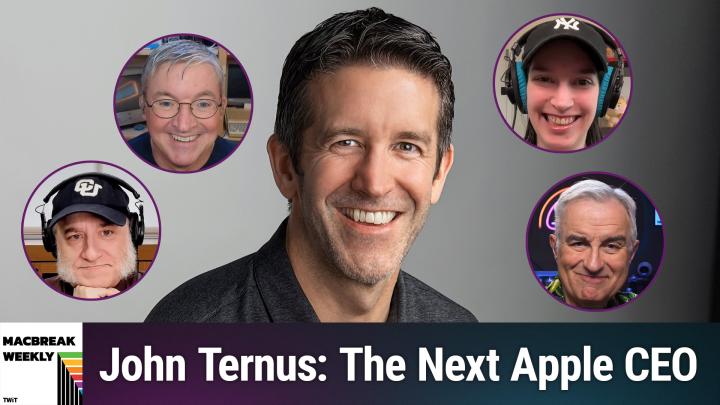
It's time for MacBreak Weekly. Jason Snell is here. Andy Ihnatko, Christina Warren, and I can't think of a better group of people to talk about the big news this week. Tim Cook announces his plans to step down. John Ternus is taking over. What will the new CEO do at Apple? What does it mean for Apple? AI? What does it mean for Vision Pro? That's all next on MacBreak Weekly.
Leo Laporte [00:00:36]:
This is MacBreak Weekly, episode 1021, recorded April 21, 2026: Too Long in the Monkey House. It's time for MacBreak Weekly, the show where we cover the latest Apple news. Jason Snell is here. Stayed up late with the BBC.
Jason Snell [00:00:56]:
Yeah, there's a lot going on. Did something happen? What?
Leo Laporte [00:00:59]:
I don't know. I don't know. I don't know what we're going to talk about today. We'll find something. Andy Ihnatko also with us from the library, and Christina Warren, senior developer relationship fellow person. Are you senior? Yes, Senior developer relations at GitHub. I don't want to make you a senior if you're a junior or she
Jason Snell [00:01:19]:
gets a senior discount and everything.
Andy Ihnatko [00:01:21]:
She gets to wear the bowler hat instead of the trilby.
Leo Laporte [00:01:23]:
Thursday is grocery day here in the Laporte household because I get the senior discount and I think it's worth it. You know, once you turn 65, you know, things happen, you just kind of slow down. Life changes a little bit. You maybe you want to take advantage of some of those perks, the Medicare benefits, the senior discounts at the grocery store, early bird seeding at Denny's, that kind of thing. And I guess, I guess that's what Tim Cook's looking forward to because, yes, there is a little bit of news today. I know you already know this if you don't know.
Jason Snell [00:01:55]:
Sit down gently, Leo.
Leo Laporte [00:01:59]:
Tim Cook's retiring. It's funny because this does vindicate that Wall Street Journal article, which it seemed as if everybody, Apple, was saying, oh, no, even Tim. Financial Times, was it. I'm sorry, ft. I'm going to stay here. I'm happy.
Jason Snell [00:02:12]:
Mark Gurman, I mean, oh, man. So there's so much to cover here, right? So I think we got a whole show to talk about it. But, like, Mark Gurman's been on the John Ternus is going to be the next CEO path for a long time. And then the FT did this story where they're like, aha. And going to happen as. And they did that ridiculous thing where they're like as soon as early next year, which is like as soon as early is like that means sometime between January of 2026 and the heat death of the universe, Tim Cook's going to retire. Yeah, yeah, I think that's going to happen. And German then comes and says, no, no, no, no, no, no, no, no, no, no.
Jason Snell [00:02:43]:
It's going to be like not in the first half of the year. So they kind of both get half credit for this because they were not either. I would say dead on. But we all knew that this was going to happen. Right. And that probably it was going to happen soon. In fact, I thought it was probably going to happen this year sometime. I mean nobody really had Monday, a Monday at one in the afternoon on the bingo card.
Jason Snell [00:03:09]:
But there, there we are.
Leo Laporte [00:03:11]:
Let me just.
Jason Snell [00:03:12]:
You did, you won bingo.
Leo Laporte [00:03:13]:
Who haven't been following as assiduously as we have every moment of Apple News. Apple put out a press release yesterday. Tim.
Jason Snell [00:03:22]:
On 4:20 out of three press releases. Yeah.
Leo Laporte [00:03:24]:
On 4:20, Tim Cook to become Apple's executive chairman. You know the kind of bearing the lead that he's going to leave the CEO chair at September 1st.
Andy Ihnatko [00:03:35]:
He got promoted. Good for him.
Leo Laporte [00:03:36]:
Yeah. John Ternus to become Apple CEO. Lovely picture of Tim and John laughingly walking the walk.
Jason Snell [00:03:42]:
It's like you're wearing the uniform now.
Leo Laporte [00:03:45]:
Got the black shirt, black jeans. I guess Tim's handing them off. Yep. Ternus, who is currently senior vice president of hardware engineering, will become the next CEO on September 1st.
Jason Snell [00:03:55]:
Right.
Leo Laporte [00:03:56]:
Board of directors approved this following a thoughtful long term succession planning process which we denied constantly.
Jason Snell [00:04:03]:
Exactly. But has been there, I mean, Germany for a year and a half.
Leo Laporte [00:04:07]:
They don't want to tank that.
Jason Snell [00:04:08]:
Well, no, I mean they need to do it in their own time. Although I will say that Financial Times story was totally planted by Apple as a way. Because what you don't want to do is scare the market. You don't want to surprise anybody. Right. You don't want to surprise everybody. But the. So those two things happened and simultaneous with that, Apple announced that Johnny Sruji, who was the subject of a Mark Gurman story about how he might have been thinking about leaving.
Jason Snell [00:04:30]:
And then he said, no, no, no, no, no, I'm very committed. Which was the surface version of oh, Tim's leaving and I'm not going to be the CEO and I'm, you're giving my peer the job and he's going to be my boss. Maybe I'll look around. They're like, no, no, no, we value you and they showed their appreciation for Johnny Sruji who has led Apple's chip effort. He's the king of Apple Silicon. They promoted him to chief hardware officer which is a position that did not exist before, which is in the C suite and which comprises not only his entire empire of Apple Silicon, but John Ternus, his former empire of hardware. And Johnny Sruji gets that job. And that's folks, that is how you retain somebody.
Leo Laporte [00:05:12]:
Yeah. Arthur Levinson, who has been Apple's non executive chairman for the past 15 years. Interesting. Will become its lead independent director. Ternick will join the board also effective September 1st.
Jason Snell [00:05:27]:
But Tim becomes the executive chairman which is sort of like I'm on the board but I'm also, I work here also.
Leo Laporte [00:05:32]:
Sort of the boss. Interestingly, they also said he would continue to handle government relations among his other jobs as executive chairman. Which is. Was actually my thinking was that's why Tim's leaving is he couldn't take one more dinner with.
Christina Warren [00:05:45]:
No, it's the reverse.
Jason Snell [00:05:48]:
It's the reverse. He's taking the heat off of John Ternus. He's going to be the one who
Andy Ihnatko [00:05:52]:
shifting to an ambassador.
Leo Laporte [00:05:54]:
I think that's very selfless of Tim because I'm sure Tim grits his teeth at night, but I think it's very selfless saying, you know what, this is a perfect job for me to continue to do to take the heat. He's got the burden off of John.
Jason Snell [00:06:05]:
He's got personal relationships. And you need to know. Look, look no further than today's post on Truth Social by Don Trump praising Tim Cook in his own inimitable way where he sort of praises himself mostly, but also Tim Cook and I, and I, you know, I know a lot of people who looked at that and they're like, this is really gross, Tim. And I looked at it and said, oh, so there is one person on the org chart who still reports to Tim. It's Donald Trump. Because he's got that guy wrapped around his finger. Like he's like, oh, he's so great. He calls me, talks to me and I'm like, that is what Tim Cook has been doing is trying to get benefit for Apple but by working the President of the United States and nobody has to like it.
Jason Snell [00:06:45]:
I think it's kind of gross. But like that post on True Social was like, see, let me read it.
Andy Ihnatko [00:06:51]:
Yeah, yeah, it's really interesting.
Leo Laporte [00:06:53]:
I wish I could do a Donald Trump impersonation.
Jason Snell [00:06:56]:
It's mostly self aggrandizing as always.
Leo Laporte [00:06:58]:
I have always been. Of course it Starts with I, a big fan of Tim Cook and likewise Steve Jobs. But if Steve was not taken from the capital P, planet, capital E, Earth, so young and ran the company instead of Tim, the company would have done well, but nowhere nearly as well as it has done under Tim. Okay, for me, it began with a phone call. For me, it began with a phone call from Tim at the beginning of my capital F, first capital T term. He had a fairly large problem that only I, as president could fix. Most people would have paid millions of dollars to a consultant who I probably would not have known, but would have said he knows me well.
Jason Snell [00:07:37]:
He's given away a lot there, right? About people who hire people who have access to the president.
Leo Laporte [00:07:41]:
Maybe Rudy Giuliani wasn't the first person you should call Tim. The fees would be paid, but the job would not have gotten done. Hint, hint. When I got the call, I said, wow, it's Tim Apple Cook calling. You know, he's making fun of himself. I kind of like that.
Jason Snell [00:07:58]:
Yeah, I like that moment. I'll never call him Tim Apple ever again.
Andy Ihnatko [00:08:02]:
Can I say that I like the affirmation, the reassurance that, okay, he does know his last name. Some sort of a synapse misfiring, that calling.
Leo Laporte [00:08:10]:
How big is that? How big? I wish I could do a Donald Trump. I was very impressed with myself to have. I was very impressed with myself. Have you ever said I'm impressed with myself? I was very impressed with myself to have the head of Apple calling to, quote, kiss my ass. End quote. Sorry, Tim. Anyway, he explained his problem. A tough one it was.
Leo Laporte [00:08:31]:
I felt he was right and got to take care of. Taken care of quickly and effectively. That was the beginning of a long and very nice relationship. Do we know what that problem was by any chance? I don't know. During my five years as president, Tim would call five years, okay, I get it, four plus one. Tim would call me, but never too much, okay? And I would help him where I could. Years later, after three or four capital, big capital helps. I started to say to people, anyone who would listen, that this guy is an amazing manager and leader.
Leo Laporte [00:09:03]:
He keeps calling me. He makes these calls to me. I help him out, but not always because he will on occasion be too aggressive in his ask. And he gets the job done quickly without a dime being given to those very expensive millions of dollars consultants around town who sometimes get it done and sometimes don't. Let's not forget, he gave me a million dollars for my inaugural and I don't know how much for the ballroom. And let's not forget that bar of gold. Anyway, Tim Cook had an amazing career. Almost incomparable.
Leo Laporte [00:09:31]:
Nice plug, by the way, for the incomparable. I think that's nice.
Jason Snell [00:09:33]:
Yeah.
Leo Laporte [00:09:34]:
And he'll go on and continue to do great work for Apple and whatever else he chooses to work on. Quite simply, Tim Cook is an incredible guy. President Donald J. Trump. I'm surprised he didn't say thank you for your attention. He usually does. I don't know.
Jason Snell [00:09:48]:
Also reading between the lines there. We'll continue to do great work for Apple. He totally got a call from Tim Cook. He said, let me explain what's happening. I'm not leaving. Yeah, we will still talk, you and I. Don't call John Curtis. He won't take your calls.
Jason Snell [00:10:03]:
We're protecting him from you. He's right.
Andy Ihnatko [00:10:05]:
He's slipping a little bit. There are at least two places he could have put in a dig. Dig at Biden. But he didn't like. Of course. Of course he taught his relationship with Biden because he knew that Biden couldn't get stuff done and wasn't the Great Deal maker. Oh, dear.
Leo Laporte [00:10:18]:
I do you. So you think Tim wants the job of the president or is he being selfless?
Jason Snell [00:10:25]:
I think Tim cares about Apple and he knows that this is his most important remaining role is being. There was a piece five years ago in the New York Times about how Tim Cook was one of America's diplomats to China, basically because he had so many connections in China. And you've seen his connections and we've all talked about them with the White House as well. Like, Apple is huge. Apple's bigger than some countries. Right? Like, Apple is an enormous global player and Tim knows all the players, and it's been the thing that he's cultivated over the last decade. And so, like, if you are trying to set up John Ternus for success, having him not have to deal with all of that, build those personal relationships sort of slowly over time instead of throwing them in the deep end and not maybe get his hands dirty with some of this stuff and let him kind of focus on the products and the rest of the company. I think that's why Tim Cook did it.
Jason Snell [00:11:16]:
I'm sure he doesn't like it, but I think he thinks it's the right thing to do for Apple.
Leo Laporte [00:11:21]:
And he may be of the, you know, he's certainly of the generation, my generation, that used to say, you know, you. You want to get things done, you do it from the inside. You join the establishment to get things Done. And he may feel that way also.
Christina Warren [00:11:32]:
I mean, maybe. I. I don't know. I still feel like. I. I mean, look, is this a smart move for him to continue to grease the wheels and kiss up to this. This person? Yes, of course it is. You know, like, being on good terms with.
Christina Warren [00:11:47]:
With world leaders is. Is a good thing.
Leo Laporte [00:11:49]:
And she, you know. Yeah, well, no, that is job, too.
Christina Warren [00:11:53]:
Oh, no, completely. Right. Like, it's not just Trump. It's she. It's. It's any of the world leaders he needs to be on good terms with. But I don't know. I can't help but feel like all of this is just so unseemly and so just obsequious and gross, frankly.
Christina Warren [00:12:05]:
And I'm not saying that it's not the correct business decision. I'm not making a judgment about that. I am gonna make a little. I am going to, like, be like, oh, well, maybe he doesn't want to do this. I don't care. He's still doing it. He doesn't get. He doesn't get any moral points, whether
Leo Laporte [00:12:18]:
he wants to or not.
Christina Warren [00:12:19]:
Well, I don't actually care because he doesn't get any. But I'm not gonna give him any moral grace at all because he's made his decision.
Andy Ihnatko [00:12:24]:
Yeah, yeah.
Jason Snell [00:12:24]:
No, he.
Andy Ihnatko [00:12:25]:
I agree. I agree.
Jason Snell [00:12:25]:
His feelings are irrelevant. The point is he's decided that this is the thing that he needs to do for Apple and it's the right and for himself.
Christina Warren [00:12:33]:
Let's be very clear. Like, I also don't want to pretend like this is some sort of altruistic greater.
Jason Snell [00:12:39]:
He has a lot of money in Apple stock.
Andy Ihnatko [00:12:40]:
Yeah, I. I do. I do think that he's been in the monkey house so long that he kind of now he no longer can smell the smells that a newcomer would smell. My problem has never been that seriously, I mean, it's.
Leo Laporte [00:12:53]:
Welcome to the monkey house what gets up my.
Andy Ihnatko [00:12:55]:
What gets up my nose. But Tim's behavior. Tim's choices has not been the sort of open diplomacy that you have to play with the leaders of all the countries you operate in. That's absolutely true. Not even like some of the things that are maybe not.
Jason Snell [00:13:11]:
Are not.
Andy Ihnatko [00:13:11]:
Are not very flattering to his public image. What I don't like is the stuff that he does that seems to be absolutely optional and extracurricular and stepping over the line where he did not have to go to the world premiere of the $40 million movie that Amazon paid for. XYZ, double A, double B, double C. All these Things are like, I don't think, I think that's what crosses the line between I'm doing what I have to do to protect my company and crosses the line into I want to be able to. I don't want to be the push e I want to be the pusher. I want to have this weapon at my back that I can inflict against my foreign enemies, which is the United States State Department. And that's the sort of stuff where you cross the line because there are a lot of companies and industries that don't have that kind of access, can't simply say, hey, awesome idea about the tariffs. How about you leave us out of it? That sounds great.
Andy Ihnatko [00:14:06]:
There are smaller industries like food industries, ranching, manufacturing that don't have that benefit and they're getting clobbered. And that's why I see that as worse than unseemly. So I'm on your side, Christina. I'm not going to condemn him for what he did, but I'm also not going to give him a free pass for the questionable things that he's also doing.
Leo Laporte [00:14:26]:
All right, we can move on. We both agree. I think we all agree. Tim Cook, 15 years CEO of Apple. Nothing but success.
Christina Warren [00:14:36]:
I mean, I think it's been a mixed record, but I think that I made a comment on this on social yesterday and I had some people kind of trying to disagree with me and I don't really think that from pure numbers perspective that there is any way you can disagree that I don't think that there's a better non founder CEO of a major public company that has had this sustained of a run as chief executive. Like there have definitely been founders, you know, like non founder, like CEOs who've done very well for stretches of time in a company. And Tim Cook has had some failings and I think the last couple of years have been kind of rough. But you know, if you look at the stock price, if you look at the market position, if you look at the number of users and people using the products, those numbers are all through the wazi.
Leo Laporte [00:15:20]:
Has he been a steward of Steve Jobs legacy? Is that kind of how you put it? That he took a company that had created some very, very good valuable stuff and has been a good steward of it, shepherding it to lofty success. He's not somebody you would call an innovator. No Steve Jobs, the Register, Matt Ross.
Christina Warren [00:15:43]:
But he's an optimizer.
Leo Laporte [00:15:44]:
And the Register wrote this world's blandest man steps down from CEO job to spend more Time in tastefully appointed home. That's a little mean.
Christina Warren [00:15:54]:
That is a little mean. But even if you were to say that's true, and I don't think that it is, I don't know how much that matters. Right. Because the CEO doesn't always have to be the most interesting, charismatic, enigmatic person. Right.
Leo Laporte [00:16:08]:
In fact, often that's the wrong person.
Christina Warren [00:16:10]:
Right. Exactly. And in fact, sometimes you really do just want somebody who's gonna be able to get the trains running on time and optimize the heck out of the supply chain, which he's done better than any other person on planet Earth.
Leo Laporte [00:16:23]:
Yeah.
Christina Warren [00:16:23]:
And yeah. And do me, Do I like, as an Apple lover, like, love the way that everything has been squeezed and optimized to get as much services revenue as possible? No. Do I like that that has been maybe put ahead of like the finer details? No. At the same time, you know, I think that he's trusted people that were either put in place before he joined and then made changes after he was CEO to try to keep the product spirit alive. Do you miss out on some of the innovation and other stuff? Absolutely. Does it matter? No. But what I would also say is this. It's incredibly difficult to take a company that was as successful as Apple was in 2011 when Steve Jobs had to finally step down and was.
Christina Warren [00:17:06]:
It was ascendant. Right. Was. It was rising in a way that, you know, none of us, I don't think ever would predict it, certainly not a decade earlier, and not only sustain that momentum and that growth, but even go beyond that. Right. So even if you don't have another iPhone level product, well, okay, there's probably, there are probably only a handful of iPhone level products that will ever exist in the next, you know, like 100, 150 years. So not having iPhone after iPhone, to me, I don't look at as a failure. I think the fact that the businesses continue to sustain and grow and bring in new people is a real accomplishment because that's not a given for the
Leo Laporte [00:17:44]:
success of the iPhone. He managed that supply chain masterfully. That really was his, his real accomplishment.
Jason Snell [00:17:51]:
The iPhone has progressed a lot since the four, which was the last one that Steve Jobs, this is part of Tim Cook's story is him. Yes. He is an efficiency guy on operations guy and has presided over iteration that I think gets short shrift. There are a lot of stories that are like, oh, but what did he really do in terms of innovation? There's the Apple watch and there's AirPods and there's the Vision Pro and whatever. But it's like most important thing Tim Cook did was Preside over the iPhone 5, 6, 7, 8, 10. Right. Like that is Apple's cash cow. And it just, it's never going to totally blow you away, but they do iterate.
Jason Snell [00:18:31]:
And then you look back over 15 years of iPhone innovation and there's a lot there. So I think that that's a big part of it. And then also you don't get a lot of credit. I think maybe that is actually due for saying that managing growth, managing how Apple went from the size it was to the size it is, which, you know, its growth almost went exponential for a little while there in the 2014, 2015 period, especially when the iPhone 6 and 6 Plus came out, it really kicked off this enormous set of enormous growth on the iPhone side and like totally transformed how Apple had to think of its business. And having honestly an operations guy in charge to manage the growth is, was, was fortunate for Apple because you could have mismanaged that and he didn't. But at the same time he knew he wasn't a product guy. I think getting a product guy in there after Steve Jobs would have been impossible anyway.
Leo Laporte [00:19:31]:
Right.
Jason Snell [00:19:31]:
Like what an act you could not follow. You know, when we, when we talk about turn, as I'll say, it's kind of nice to have a product guy back in the seat. But I think managing that growth and taking those products, especially the iPhone, from where they were to through this giant growth period could, we can't take that for granted. It could have been mishandled. I don't think you could, could say that all of that growth was just there on a platter for somebody to deal with. I think Tim Cook was, had a good set of skills to manage that.
Leo Laporte [00:20:00]:
He was the quintessential CEO as manager, not visionary. Maybe not. I don't, I can't judge on leadership. Only people who work for him probably could judge that. But. But it must have been successful because they've done well. So he was maybe the right person at the right time. I also want to give him credit and Rostov does this in the Register article.
Leo Laporte [00:20:21]:
He was the first major company CEO to go public that he was gay. And I think that that was not only courageous, but I think fairly important culturally and I think he should get credit for that.
Andy Ihnatko [00:20:35]:
Yeah. He also turned around Steve Jobs policies kind of against a lot of the Apple philanthrop and a lot of the Apple like echo messaging and social justice messaging. I think that we shouldn't in an Environment in which Google and other companies went from, yes, Dei, yes, Dei, yes,. We're going to for sure. We're going to publish diversity statistics. Google went from that to all of a sudden, gee, and all their keynotes. Suddenly they're not putting pronouns next to these lower thirds. For all their executives, Apple has pretty much stuck to their guns.
Andy Ihnatko [00:21:13]:
They released their environmental report this year. They're still sticking to those guns. And I think that that's one of Tim's signatures. And when he talks about health being Apple's most important product, I really think that he's absolutely sincere about that. That's not marketing speak. I believe that that affects.
Leo Laporte [00:21:31]:
His letter was quite moving. His letter to the public was quite moving. I saw.
Jason Snell [00:21:36]:
Yeah.
Leo Laporte [00:21:36]:
And in which he did really assert, you know, how great it was to wake up every day and read these emails from customers to know that they were making a change in the world, that were making people better and making the world better. And I think he really cherished that. I can understand why he might want to continue on.
Andy Ihnatko [00:21:56]:
And that's an interesting thing about Apple, isn't it? Because a press release would have done it. Okay. But there was a press release plus a personal letter from CEO from the former CEO to the Apple family of users and community, which is not something that would ring as sincere from any other CEO that's out there. So that's one of the things I was thinking about when I read the news last night, that I hope that we don't force John, collectively, I hope we don't force John Ternus to be the dad of the dad of Apple, the dad of the Apple community, because that's a big burden to put on anybody to basically suddenly become a person. That is a answer to a trivia question that only people who are listeners to this podcast and related podcast be able to answer to a celebrity CEO who is being judged for their. Every time they do, every time they show up at a government function anywhere in the world, maybe some people like us are going to judge him from. For that and sort of try to. And even today as people are trying to unwind his brain and figure out, well, of course I don't.
Andy Ihnatko [00:23:03]:
Being a product guy, he was very, very much anti the. The vision pro from the start. So I feel as though we're going to see reduced resources. Like, where.
Leo Laporte [00:23:11]:
Why are we.
Andy Ihnatko [00:23:12]:
We're already like guessing what's inside his brain. That must be a very, very stressful thing. I bet that when he got the. When he got the. The.
Leo Laporte [00:23:19]:
The. The.
Andy Ihnatko [00:23:19]:
When he Signed the contracts, whatever, a few months ago. I bet that he just spent, if he's smart, he spent four months seeing a shrink twice a week just to get him ready for being under that kind of a scrutiny and those kinds of expectations. Because that's a lot for someone to go from a very, very responsible technical business relationship with inside a company to again, being sort of like the pseudo dad or the stepdad of a community of Apple users. That's a heavy, heavy load.
Leo Laporte [00:23:45]:
You can, and you can make a score sheet of Tim's successes and failures, and there are both columns. But one of the greatest successes of Apple in the last 15 years is Apple Silicon. And Ternus and Suriji were somewhat the architects of that. So that's what's going to be interesting about the next generation. Well, let's take a break. I think we can honor Tim. There'll be lots of honors between now and September 1st, and I'm sure we'll do that. But I'd like to talk about what's next for Apple when we come back and about John Ternus and who he is and what kind of CEO.
Leo Laporte [00:24:21]:
Kilby, you're watching MacBreak Weekly with Andy Ihnatko, Christina Warren, Jason Snell. All right, let's talk about John Ternus, who has been with Apple since 2001. It's really pretty much his entire career with Apple. How old is Ternus?
Jason Snell [00:24:38]:
He's 50 and he's worked at Apple for 25 years. So you do the math. Half his life.
Andy Ihnatko [00:24:43]:
All but four of his professional working years working at Apple.
Leo Laporte [00:24:48]:
Yeah, he has a bachelor's in mechanical engineering from the University of Pennsylvania. Worked as a mechanical engineer for a few years in his early career at a company called Virtual Research Systems. I'll probably have to do some research on who that is, but he came to Apple in 2001 as part of the design team, product design team, which is interesting. Almost immediately became vice president of hardware and engineering. Well, it took 12 years, but that's immediate in corporate terms. 2013, eight years later, joined the executive team. Senior vice president of hardware engineering. Every time.
Leo Laporte [00:25:24]:
You know, we've seen him on stage a lot for Apple, introducing the iPad and other products, and he's always been impressive, I think. But what do we know about John Ternus? What kind of CEO is he going to be? Is he a visionary? Is he a manager? Is he a leader? Do we know anything?
Jason Snell [00:25:42]:
Well, I mean, I think the most important thing we know about John Ternus is that he's deeply connected to Apple's Hardware team and has led it. And that means he's a product guy who knows details about how Apple develops products at a level that Tim Cook's never going to know. Right. And is he a visionary? I don't know. Does the CEO need to be visionary or does the CEO need to understand the process that leads to the products that Apple makes? You know, we could argue about it. There are reports from sources that say that he's a, he's a good decider, which is good.
Leo Laporte [00:26:24]:
That Tim Cook is more decisive.
Jason Snell [00:26:25]:
Yeah, the. Tim Cook did a lot of consensus building and all that. And John Ternus is a little more like, let's do this. And you go in and you get an answer and you might not like the answer, but you get your marching orders and you go out and you do it. I, you know, and those people can be right or wrong. I mean that's the, that's the challenge with somebody like that. But I, I am really encouraged by the fact that John ternus has spent 15, 20 years, 25 years really marinating in Apple's product process. So he knows how to, how it works, what they're capable of, how Apple products come to be.
Jason Snell [00:27:04]:
I think that's important. I think that, that Tim Cook, for all of his strength, he did have to rely on the wisdom and expertise of others, including John Ternus. Let's. Including for the last five years on hardware, John Ternus. So, so, you know, I'm encouraged by that. But you know that he's a product guy and that he's been deeply involved with Apple hardware, which honestly we talk about my report card here every year. Right. Like Apple hardware is doing pretty good.
Jason Snell [00:27:31]:
Like they, that is a skill set of that company that is working at a high level right now.
Leo Laporte [00:27:36]:
It's kind of interesting. When Ternus was at U P, he developed a mechanical feeding arm for individuals with quadriplegia that could use, use it for head movements. And that's how he got his first job, which was designing, interestingly, virtual reality headsets. That's what VR systems did. So that's kind of intriguing. His first job was working on the Apple Cinema display. He oversaw AirPods, Mac and iPad product lines. Put in charge of iPhone in 2020, taking over from Dan Riccio.
Leo Laporte [00:28:12]:
So yeah, I think this is kind of interesting. Is the youngest member of Apple's executive team.
Christina Warren [00:28:18]:
That's a good thing.
Leo Laporte [00:28:19]:
He could have 15 years.
Jason Snell [00:28:21]:
It's a different generation, different.
Leo Laporte [00:28:22]:
Same age as Tim Cook when he took over.
Christina Warren [00:28:25]:
Yeah, exactly.
Andy Ihnatko [00:28:26]:
That's, it's. He, it Seems as though he understands that his job is to take the football from Tim and continue to make yardage, just like Tim took the football from Steve, meaning that he's not going to run the same plays as the predecessor did, but they're on the same field doing the same thing, trying to get the same goals together. This is not. If they had gotten somebody from a different part of Apple or with less experience at Apple, this person might have taken the football and try to shoot a basket with it, which is not going to work. Apple. It's always been said that Steve Jobs most important product at Apple was Apple itself. And the Apple culture and the teachings that you get through Apple University to hand down the Apple philosophy of what this company is about, what it's here to do, what doesn't interest it as an organism and the things that. Things that it can succeed at.
Andy Ihnatko [00:29:23]:
This person is absolutely marinated in that culture. So the fact that he is of a completely new generation means that he can bring fresh eyes to that playbook, which is going to be very, very interesting. But we're going to, there's going to be a lot of tea leaf reading for the next couple of years. We're going to find out a lot about what dogma inside of Apple was simply cultural and cannot be burned off of that campus and what was brought in by and reinforced by Tim. Like, are we going to see hardware become a little bit more open? Is Apple going to be a little bit less vitriolic about making sure that we keep this as a closed ecosystem? Or is we're going to see an Apple that at least says, you know what, notifications on a third party watch. We're going to let that happen. Or we're going to let the Apple Watch pair with a non. We're going to let you activate it with, with a MacBook or with an iPad.
Andy Ihnatko [00:30:15]:
You don't necessarily have to activate it on an iPhone. It's going to be fascinating to see where Apple goes for the next couple years. It's not going to be a revolution, it's going to be a progression. But the thing is he's going to be driving the ship in his own direction. I've already used three metaphors, I'm not going to use a fourth. Basically, we're going to see a different style of leadership as opposed to a different company from, from now on.
Leo Laporte [00:30:46]:
All right, so we just don't know.
Christina Warren [00:30:49]:
Yeah, I mean, that's really kind of what it comes down to. Right? We don't know. I mean, and unlike it's a little bit different than the situation when Tim Cook took over because obviously he had been interim CEO before he was, you know, chief operating officer. So we knew a little bit more about what to expect from him because he had stepped into that role before. And Ternus, we don't know as much, but what we have heard, I mean, I think it's encouraging. I think the fact that he does come from, to Jason's point, even if he's not necessarily like the big visionary, he is still a product guy. Like, he understands what it takes to get these things made and done and what else is going on on that level, which I think is a good thing. So I'm, I'm, I think that we all saw the tea leaves that this looks like this was going to be the guy.
Christina Warren [00:31:39]:
And I don't think there's any reason to, I guess, expect anything but hopefully positive things from this. But I think there will be changes that I think I agree with Andy. That will be the interesting thing to see what changes in the company culturally, but also from a product perspective and from anything else that happens. And I think that's a really interesting reset because, because with Tim Cook, you know, it's been 15 years, but kind of looking back on it, it felt like especially for the first couple of years, there was a real hesitance to do anything different from what had been kind of the status quo with Steve Jobs. Right. So there were already these products in the pipeline. There were already these things that were happening. Scott Forstall, before he was ousted, was still kind of the face of things for a bit.
Christina Warren [00:32:24]:
Jony, I've still had a big public facing role and Tim Cook has kind of helped, helps keep things even and then started to make changes and introduce things that really left his footprint on it. It'll be interesting to see how long that takes for, for John Ternus to come in and maybe make decisions that are clear that say, okay, this is not what our executive chairman would do, but this is what I'm doing. That's going to be, I think, an interesting thing to look at too, which is, you know, Tim Cook is still executive chairman. Is he going to still have like a hands off kind of approach and just kind of, you know, make the decisions as a board member to approve various things and then do the government relations part, or is he going to have more of a strategic kind of conferring and consigliere kind of relationship? I think that'll be interesting to observe too.
Leo Laporte [00:33:13]:
Amanda Silberling at TechCrunch did a little oppo research on Mr. Ternus. She found out he does not have an X account, which in my book is a good thing. I approve, even though I have one and have always had one. And she also quotes his 2024 commencement speech at Penn at the engineering school. There he said, always assume you're as smart as anyone else in the room, but never assume that you know as much as they do. With this mindset, you'll find the confidence you need to push forward, but more importantly, the humility to ask questions. I guess that's something you would like in a CEO, right? He talks about his early time at Apple in this commencement address.
Leo Laporte [00:33:57]:
At some point in my first year, I found myself at a supplier facility. I was far away from home, probably China, well past midnight. I was using a magnifying glass to count the number of grooves on the head of a screw. And I was arguing with the supplier because These parts had 35 grooves. They were supposed to have 25. I distinctly remember stepping back for a minute and thinking, what the hell am I doing? Is this normal? It is for Apple. It is for Apple. So I guess he's got the Apple mindset, the Steve Jobs mindset.
Leo Laporte [00:34:32]:
Even talks about Steve Jobs talking about the furniture with the carpenter and the backside was just as beautiful as the front side and all of that. The famous anecdote he was involved in Apple Silicon, which is, I think, arguably Apple's greatest success of the last decade. And the Neo, which is probably a good thing, although, you know, it's so hard in a company like Apple to give any one person credit.
Jason Snell [00:34:57]:
Exactly. Better to say that he was in charge of the hardware machine that was generating all of this hardware for the last five years. And before that he was a senior member of the hardware team. And then like some of the credit for a lot of the stuff you mentioned, it's got to go to Johnny Sruji and his chip team. And that is, to me, that's the other big announcement here. I said it earlier, but like, you got to retain your most important and valuable people, right? And they. That that story was really scary because I think when that story came out that he might be leaving, I was like, oh, no. Like a brain drain from Apple Silicon would be exceedingly bad for Apple.
Jason Snell [00:35:33]:
And I mean, but they knew that. And that's why he is now chief hardware officer.
Christina Warren [00:35:38]:
Right.
Jason Snell [00:35:38]:
And gets to pick up. So one of John Ternus's trusted lieutenants is going to be in charge of what John Ternus used to be in Charge of. But he's not going to report to John Turner. He's going to report to Johnny Sruji. So Johnny Sruji gets that ass aspect of hardware as well. And they're going to. And there's a story, Mark Gurman has a story with a memo and how they're going to lay out all those groups. If you're really a Kremlin Ologist, you can check it out.
Jason Snell [00:36:01]:
But the bottom line is they also kept Sruji in a role where he feels apparently good about not being the CEO, but being loved that he's in the C suite. That's a big deal to be cheap.
Leo Laporte [00:36:14]:
Everybody seems to love for as much as John Ternus is kind of an unknown, everybody seems to love Johnny Sruji. Yeah, I remember the first time he appeared in an Apple keynote, which wasn't so long ago. The panel was just like, it's Johnny. Everybody was very, very happy because he gets so much credit. He led the development of the A4, which is the Apple first Apple SoC. So if anybody gets credit for Apple Silicon, it might be a Sruji. In fact, intel was looking at him a few years ago, according to Wikipedia, to be its next CEO. So he's probably had several opportunities to leave.
Christina Warren [00:36:56]:
Yeah, I'm sure he has. And I think that giving him, Jason's point, giving him that title of Chief Hardware Officer is a really nice way of kind of, you know, letting down gently, like if you really did think that you were in contention for the CEO role, creating a whole new position and having a bunch of people under you and, and putting all of the hardware under this figure who's well respected is, is a real coup. Sometimes what you see companies do is that they will create CEOs, various divisions, like, you know, like Phil Spencer was CEO of Xbox and they'll elevate those titles and you know, but yeah, the fact that they gave him that title and that he's clearly had other offers, they've made it worth his while. Yeah. You know, because, because honestly, he would not have been a bad person to consider in the musical chairs game of intel CEO. Like, there's, there's an argument to be made that intel probably would have done better with him than if they had, you know, Geithner. Right. Like, I think that, that there's an argument made there.
Leo Laporte [00:37:54]:
But because of those rumors, Suruji actually had to write a memo to his team in December saying, I love Apple, I love my team, and I don't plan on leaving anytime soon. There was real Concern.
Jason Snell [00:38:06]:
Yeah. I think that's when. I mean, literally, I think the way it went down is Tim's not going to be here anymore. Your peer as an svp, John Ternus is going to be the new CEO and he's going to be your.
Leo Laporte [00:38:17]:
This all happened in December, really, right? This.
Jason Snell [00:38:20]:
Yeah. I think this was happening when those reports like, people are like, haha, Gurman's got egg on his face. Three days later that memo came out and it's like, I think Gurman was right. I think that they were negotiating. I think you're Johnny Sruji and you're like, well like, how are you going to show me the love? If Tim's going to leave, maybe I should leave too. Everybody wants to hire me and you know, and you're making my peer my boss. I don't. Nobody's going to really love that.
Jason Snell [00:38:43]:
Honestly. Even if you like the person, it's like, that's a weird feeling. And so obviously they're like, what do we, what can we do to keep you? We'll give you his division and we'll give you a C suite job title and you will be Mr. Hardware at Apple. And. And that's what he is. So I think that that was behind his. I'm very happy here at Apple.
Jason Snell [00:39:02]:
He knew what his new job was
Andy Ihnatko [00:39:03]:
going to be and that's very, very significant. It's not like when Jony I've was quote, promoted, unquote. Whenever you see in any industry,
Leo Laporte [00:39:12]:
the
Andy Ihnatko [00:39:12]:
announcement, the promotion says, oh, he'll be reporting directly to the CEO. Okay, that's nice. But who's reporting to him? The fact that he has an entire tree underneath him of responsibilities means that yeah, he is not only is he valued as, he's valued as something way, way more than we don't want intel or somebody else to hire him away from us. We want to keep him where he is. It's like, no. His experience, his contributions, his knowledge, his part of the whole ecosystem of how Apple develops products is way too valuable for us to lose. It will be a void that's going to take a long time to fill in. And so if we have to basically redraw the entire org chart to make sure that he is very, very happy with his leadership position inside the company, we are going to redraw that damn org chart for him.
Christina Warren [00:39:56]:
Yeah. One thing I'll also say about Johnny is as much as he's respected and I don't know what went into Apple's decision about like, why they were going to choose One person over another. But he's in his early 60s. And so I think that, you know, you have to kind of look at that. If you're thinking succession, you know, do we. Do we want to replace, you know, one person from one generation with basically someone from the same generation? And I think that giving him as much gravitas as he's earned and making him sappy as possible to keep him in place for as long as possible is a good thing, because, you know, we don't know what he would want for his career aspirations or future either. Right. Like, how much longer he's planning on wanting to do all of this.
Christina Warren [00:40:40]:
I mean, to Jason's point, I'm sure that no one likes having to report to a peer. But at the same time, if you're kind of looking at your career and aggregate and you're going, okay, if I'm going to really have control, have a lot of people under me and be in a good place where I don't feel compelled to stay longer than I have to just because I now have this lofty title of CEO, I think that's a good thing.
Jason Snell [00:41:00]:
What you have to say, what other jobs would Johnny Suriji take? Right? And it would be, you know, maybe for a major chip manufacturer or maybe it would be a competitor of Apple's in some way. But I guess, and this is the question is like, does he want to be the CEO? Because we just been talking about all the other parts of the job that go along with being the CEO. And he knows how good his team is, and he knows that Apple's kind of a leader in this and that he doesn't have to worry. He's got a good partner in tsmc. He's got a plan. He's got. He is making bespoke chips. He doesn't have weird, like, customer relationships with a bunch of different potential customers.
Jason Snell [00:41:39]:
There's just Apple. He gets to collaborate with the hardware designers on what the plan is. It's a unique job, and there's a lot to be said for it. And if I was giving, it's like, I'm doing it right now. Johnny, please stay. I'm giving you the pitch. He's staying. He's staying.
Jason Snell [00:41:52]:
But, like, these are reasons to not go. If you can be, like, the idea that not only now are you in charge of the chips that are syncing with that hardware, you're also in charge of the hardware. You're in charge of that whole synergy between those things. Like, you just need to make it sweet enough that unless Johnny Scruje like absolutely, positively needs to be a CEO somewhere, that that's a better deal. And I think a lot of, a lot of people who've left Apple have found that being a CEO of a lesser company is not all it's cracked up to be. I'm thinking of Ron Johnson going to JCPenney. Right? Like, yeah, I mean, yeah, you were the CEO, but was that a better job really than being the head of retail at Apple? I don't know, maybe not. It depends on what you're goals are.
Christina Warren [00:42:37]:
But like, and then, yeah, and then it's the inverse, right? Because I think the Angela aren't who I, I liked her. I think that she maybe gets kind of a bad rap. But I don't think that being the head of Apple retail was better than being the CEO of Burberry. Right. So it can go the other ways too. But yeah, to your point, Jason, I think that's a great point. Like he might not want those other roles and, and certainly I'm sure as interesting as it would be to take on something like intel, which I'm sure was, was floated towards him, that also could end very, very badly.
Leo Laporte [00:43:07]:
Somebody pointed out that the next CEO is almost always the head of the most profitable division company. If you promote from within, it's not surprising that both Ternas and Suriji got big promotions. But I think we'd all agree that while Apple excels at hardware, their software, especially lately, hasn't been great. Is this a problem that the hardware people are now being ascendant? What happens to Craig Federighi and the other software guys? Are they gonna step up? Cause that's where we really need them to step up, don't we?
Jason Snell [00:43:42]:
The last few years have really felt like the software has let down the hardware at Apple. And if you put the hardware guys in charge. Well, if I'm a software person, I'm sweating a little bit.
Leo Laporte [00:43:52]:
Oh, so maybe they spank the software saying catch up, catch up.
Christina Warren [00:43:55]:
I mean, I think so. I mean, and it's interesting, right, because it's kind of the reverse of where we were a decade ago, where the hardware, hardware was, was at least on the Mac side was, was really hurting their products. And, and that did lead to disruption. Whether it was, you know, I mean, Jony, I've was, was more than a lot of those things, but that was part of, I think some of the tension there. So yeah, I mean, I think this is, this, I think is what the interesting opportunity will be for John Ternus, the CEO is what happens with software and what decisions he makes, who decides to keep in place, who he decides to maybe move into new positions. Because if I look at Apple right now, that is the area where I think they have the most opportunity because the hardware is firing on all cylinders. I don't think anybody has any complaints about that. It's the software which for those of us who have been around for a long time are starting to have complaints and where I think the disruption possibilities really exist.
Leo Laporte [00:44:55]:
That might always have been the case with Apple though. I mean, I think back there have been many. We were talking a couple of weeks ago about how God awful the memory management was before OS X. I mean, yeah, it's true Apple's had a lot of software letdowns, but their hardware has been consistently impressive.
Andy Ihnatko [00:45:11]:
Apple's always been a hardware first company. They still make more than half of their money off of one product or excuse me, one product line. So the thing is if you. Basically it's important for them to diversify a little bit because services is pretty much free money. So when there's a bag of money on the table, you should probably pick up that bag of free money. But the thing is, if Apple ever fails to produce a phone that is more desirable than any of the hundred other phones like it on the market, if Apple fails to do a laptop that feels like a more premium experience, like a more pleasurable experience than the hundred other laptops on the market, that's not a dive that you recover from.
Leo Laporte [00:45:52]:
You're watching MacBreak Weekly. We're analyzing the big Apple news from this week. The departure or planned departure on September 1st of Tim Cook and the rise of John Ternus and Johnny Cerugi. It's great to have Christina Warren. You know what's really good about this panel is all of you have been covering Apple since before Tim Cook. Well before Tim Cook. You've really got the background, the history, the context of all of this going way back, which is impressive for such a young bunch. Christina Warren's here.
Leo Laporte [00:46:20]:
Andy Inacco, well, she's the only non gray hair anyway in the bunch. And Jason Snell. We continue on. I guess I need to ask about AI because right now that's. And WWDC is next month. We're waiting to hear what they do with Siri. The rumors are of course strong that this will become the new chatbot Siri with Gemini built in. What does this changeover portend for AI? Or is it just going to be business as usual?
Andy Ihnatko [00:46:56]:
Business as usual. It's the Apple has a very, very, very long Runway for AI, longer than anybody else. So long as their hardware continues to be a really, really good platform for researchers and dabblers. There are just, there's nothing but upside. So long as all these, as long as it becomes so much easier to create apps that suddenly Apple is, is. Apple has no problems keeping the App Store fully loaded with new apps and they're making money off of these apps. Again, Apple's doing great, but they can't. But they, they have to make sure that whatever comes in three months time and whatever comes in three years time, they have the hardware that can support whatever AI is going to be, is going to help them to sell more hardware.
Andy Ihnatko [00:47:40]:
So yeah, it all comes down to hardware always.
Leo Laporte [00:47:46]:
Okay, good. How about Vision Pro? It is interesting that Ternus earliest job experience was building VR headsets. We don't know where any of these people stand in the Vision Pro. Pro and Con. I've heard people say both Vision Pro and here.
Jason Snell [00:48:02]:
I don't think Pro and Con covers it remotely. Right. Like, I think there's complicated things. What you're saying, where they take it and where they go from here is more of it. Like, who knows? Like, I get the sense that Johnny, I've had a lot to say about the Vision Pro, right. And he's long gone, but he was a huge mover in that. And my understanding is, and there are reports about this, like they were going to do the thing that was much lighter and tethered and there was going to be a wireless trans in transmitter on a, on a desk. And then you'd be.
Jason Snell [00:48:30]:
And then Johnny, I was like, no. And they had to, you know, change the design in order to make it what it is now. So the question is, where does he want to go with that? There was a story I saw that said he's been a champion of smart home stuff, of doing more smart home stuff. Another area, by the way, where they've been let down by the software side and they've had to delay a bunch of hardware because the software and the, and Siri isn't good enough. But yeah, for something like Vision Pro, I think the real question is, is there a path forward for that platform and what is it? And is he going to be patient? Does he think it's a dead end or does he think it's a thing that just needs to kind of be brought along so that it might be something in 10 years? Like, those are, those are the tough questions. But he certainly was involved, so he knows what all the issues are again, that's why I'm encouraged by having a product guy in the mix because he knows what those trade offs were that were made to make the vision pro, what it ended up being and what was right and wrong about it. But I don't think he was pro or con. I think it was more complicated than that.
Andy Ihnatko [00:49:27]:
Yeah, yeah. And on that point, Tom's Guide got the. What great timing. They got. They got an interview with Jaws and John Ternus last week. So basically the last interview with him before the knighting and he did specifically say that combining the digital and physical world via VR is inevitability.
Leo Laporte [00:49:48]:
They said specifically spatial computing was the future. Right?
Andy Ihnatko [00:49:50]:
Yeah. So that doesn't sound like.
Leo Laporte [00:49:53]:
Which I completely agree with, but. Okay.
Andy Ihnatko [00:49:55]:
Well, I feel we've had a conversation before. I just feel like it's not necessarily a product that they can ignore. Ignore at this point. They have to just like that the folding phone is not necessarily going to be the biggest seller they've ever done, but it's time for them to play in that playground. Similarly, it's time for them to play with glasses.
Leo Laporte [00:50:15]:
Whenever I hear them say, oh, spatial computing is the future of computing, I just get shifts.
Jason Snell [00:50:21]:
Well, they're not going to throw their shipping existing products under the bus and they're not going to tell you about what they think the actual, the actual thing is until they ship a new product. So like let's not forget when Satya
Leo Laporte [00:50:31]:
over at Microsoft, one of the first things he did was throw out the Surface Mini. Right?
Jason Snell [00:50:37]:
I mean, okay, but what you're asking for is for them to them to just throw things out before they make product announcements. And they're never going to do it. So you can complain about like it's just pr. They're just saying the company line. Well, they're the company, they're going to say the company line until they make a change. Spatial computing is the future. Just like Steve Jobs saying that nobody wants an ipod with video until he like a week later introduced the ipod video. So like ipod photos.
Jason Snell [00:51:04]:
So.
Leo Laporte [00:51:04]:
And it does seem that Ternus is the kind of guy who will sit back and as you said, Andy, take a couple of years before he makes any big decisions. But I do have to remember when Satya Nadella took over at Microsoft, they dumped the Nokia, they dumped the smartphone, they killed the Surface RT which had already been built and was sitting in warehouses and was about to be announced.
Jason Snell [00:51:24]:
This is the most important part of this is it's a new person in charge and, and like, even Tim Cook. We saw Tim Cook taking over for the, you know, beloved, sainted Steve Jobs. One of the first things Tim Cook did was like, okay, this policy about not matching employee donations is ridiculous. We're going to change that right now. And that's, that's a little corporate thing, but, like, being not the person who used to make the decisions and now you get to make the decisions means you can make different decisions a lot easier because they weren't. That you don't have to own the old decision. You can, you can change your way of thinking. I think that's the biggest deal about literally anybody stepping into this role is it's an opportunity for Apple and John Ternus to look at what's going on and revisit things that they've.
Jason Snell [00:52:14]:
They, that they've taken. Is like, we made a decision and we're going with it. It's like, well, new. New guys in charge. And even if he was a senior leader before, like, he. Now he's the CEO and he may say, I don't like how we did that. Let's not do that anymore. And that is an opportunity to do.
Jason Snell [00:52:29]:
Whether it's something very dramatic, like taking products that are sitting in a warehouse and putting them in a landfill, or whether it's a little less dramatic than that. That's the huge opportunity here for John Ternus is he's not Tim Cook. He can make his own decisions and he can change the, the aspects of what Apple is trying to do.
Andy Ihnatko [00:52:46]:
That's the value of being able to make decisions uncontaminated by ego. It's like, it helps that. Well, I didn't. I like this project. This was, this wasn't something that I promoted. And I'm looking at it objectively. This product doesn't make a whole lot of sense for us right now, so.
Leo Laporte [00:53:00]:
Might be a little harder for somebody stepping into that role, though, at a company that is so successful. You know, I don't know. Were you at Microsoft when Nadella took over?
Christina Warren [00:53:11]:
No, no, no, no, that was much later. Yeah, it was much later. Although I did go, I think, like three times that, that day, similar to what Jason had to do for the, The John Ternus announcements. I kept getting called into that, but. No, but, but I will say, even though I joined Microsoft a few years after that, you still felt the reverberations. Like, there were still people who were kind of like, you know, from the Ballmer era and then people in the, the Satya era and the way that things had changed internally from what People told me was that it was. There was a lot of differences now that I think was probably a necessary thing. And that's one of the reasons why I think Satya made the decision that he made, and some because Ballmer wasn't
Leo Laporte [00:53:49]:
the success that Tim Cook has been.
Christina Warren [00:53:51]:
Correct.
Leo Laporte [00:53:52]:
Although you could look at the stock price at Microsoft. And he was a success.
Christina Warren [00:53:54]:
Well, he was a success. But. But there were, you know, but there. There have been layoffs, there have been downturns. They'd lost, I think, like, you know, market credibility in a certain extent, you know, and mind share, I guess, would be the better. Better framing. And Satya came in and he'd been there for a long time, but no one really knew who he was. He was the cloud guy.
Christina Warren [00:54:11]:
And very clearly, I think the interesting thing about Satya was that it was very clear from the minute that he was anointed as CEO was that Microsoft was basically telegraphing, the center of our ecosystem is no longer Windows, but it is the cloud, it is the data center, which I think was very prescient and ultimately a very good move. Apple doesn't have that same, I think, kind of like necessity to have to make immediate changes the same way because the hardware is already incredibly successful. For the complaints that we have about the software, it's still very, very good. And the profits in the stock are obviously through the roof. Right. But there are areas where there are opportunities, AI being a big one. And so I think this, again becomes like the interesting opportunity when you have a new person in charge who does no longer having to do the status quo, who can actually or not SaaS, quote, but is no longer having to follow orders, but is actually able to dictate them, to be able to come in and look at things and say, okay, this is the change directionally I want to make. And I don't know how long it will be before we start to see those changes.
Christina Warren [00:55:18]:
What's also been interesting is that you've seen over the last couple of years, just because this generation of Apple executives have started to age out, that some of the transition might be able to just be kind of more natural. And it's a course. But it'll be interesting, I think, to see, you know, who's chosen to go into those roles.
Leo Laporte [00:55:36]:
All right, we spent an hour on this, and I'm sure you all are talked out from all of your appearances on various.
Jason Snell [00:55:41]:
It's real important, though.
Leo Laporte [00:55:42]:
But I mean, it certainly is important. And I mean, unfortunately, all we can really say is, well, it's a Bunch of question marks.
Andy Ihnatko [00:55:49]:
But can we just offer our gratitude to Apple for making this announcement the day before we have to do a show instead of like a week before.
Leo Laporte [00:55:57]:
Lisa's come running in and said, turn on the cameras, start doing something. I said, I don't have anything to say.
Andy Ihnatko [00:56:02]:
I don't know.
Leo Laporte [00:56:03]:
I mean, I guess I could. It is breaking news. But I thought, you know, tomorrow's MacBreak Weekly. These guys will have the most insightful things to say and incisive. And also I think there really isn't yet anything much to say except thank you, Tim Cook, for doing a great job for 15 years. Good choice, I think on the CEO, right? We'd agree on that.
Andy Ihnatko [00:56:30]:
Absolutely.
Leo Laporte [00:56:30]:
I can't think of anybody better to take the reins. He'll be a steady hand on the tiller, there's no question about that. Glad to see Surruji staying and enhancing his role. I think we have rightly concerns about software. Let's hope that that software division gets kicked in the butt a little bit. Big question marks about AI and Vision Pro spatial computing, but that's the future. You don't think that Mr. Turnus has in his back pocket of plans for an exciting, exciting new product that no one's ever thought of before? Right? He's not that kind of guy.
Andy Ihnatko [00:57:09]:
Well, it's a ship. The captain can steer it, but it will take years for it to actually change course. That's not how Apple. Like we said a little while ago, Apple is a group think organism that has a leader that makes decisions. However, it's not someone storming into the room saying suddenly we will make cookies, custom birthday cookies shipped on demand, like, okay, we'll get rid of that.
Leo Laporte [00:57:33]:
It has happened. There have been CEOs who've done that. Finally, by the way, I'm sorry that Alex Lindsay didn't get the job. And Alex, I know you went there with hopes, but that's what happens. But has anybody talked to anybody inside Apple? What is it? How is it, how are the. You know, we haven't heard how the rank and file are taking this. Are they happy?
Andy Ihnatko [00:57:54]:
I haven't, I haven't.
Christina Warren [00:57:57]:
The people that I spoke with, I mean, honestly, like I was, I was sending messages to some of my friends and it was. We were just kind of sending memes back and forth. I don't really know if anybody has any sort of opinion one way or another. It didn't seem, certainly no one seemed upset and no one seemed. At least the people that I talked to, no one seemed to overly Surprised. So, I mean, I think that it'll. It'll all come out as things progress. But the fact is, like, the one mo of this guy is that he was nice.
Christina Warren [00:58:24]:
And which is a really. Which is. Which is a really good sign. Right. Like, so. So. So this wasn't one of those cases where people are either going, huh? Or oh, no. At least the folks that I've talked to.
Christina Warren [00:58:35]:
But. But who knows? I mean, all this will trickle down. But also, like I said, like, this has been an interesting era. Just the last year or so, we've seen kind of this, I think, preparation for this moment of the C suite getting ready to cycle itself out. And I think that'll be what will be interesting to see how that winds up looking a year from now, 18 months from now.
Leo Laporte [00:58:58]:
One of the things a lot of people would say is, oh, the third CEO of Apple, people who have not been around for a long time, he's actually the. The eighth Apple CEO. New York Times had a very nice retrospective of Apple CEOs through the years, including the first CEO, Michael Scott. Not of the paper company.
Jason Snell [00:59:17]:
Michael Scott. Yeah, yeah. I mean, he had some similarities in how he treated his employees to Michael Scott of the paper company, though.
Leo Laporte [00:59:23]:
But, yeah, there for four years, actually, which is.
Jason Snell [00:59:26]:
Yeah. And then he laid a bunch of people off and he got. Then. And Mike Markala got rid of him and was the temporary CEO until they
Leo Laporte [00:59:32]:
hired Scully and then the guy from the Pepsi company who was there for
Jason Snell [00:59:36]:
10 long, long years.
Leo Laporte [00:59:38]:
Years. And really put his mark on Apple, but not necessarily in a good way,
Jason Snell [00:59:41]:
but actually, you know, I think he is underappreciated. I think that John Scully is the reason that the Mac was a success, not Steve Jobs, because the Macs got it out of failure, but it was. It was a business failure. And Jobs resisted all the reasons that they were trying to make it successful. And when Jobs left, they put Jean Louis Gasse in charge, and then it was successful. But over time, you know, John Scully's era did kind of erode away, and they replaced him with Diesel Mike. Mike Spindler, the sales guy from Germany. It didn't work out.
Jason Snell [01:00:13]:
And then it was like Gil Amelio boxing up all the assets and trying to figure out whether they were selling or buying. And, you know, he bought and he bought a box and opened it up and Steve Jobs was inside.
Leo Laporte [01:00:24]:
Oh, good job. Steve is not. That's the first time he was CEO. Yeah, he never came back.
Jason Snell [01:00:32]:
Yeah, he was. No. I mean, in those. In those early days, I just did A bunch of research about this for. We did a kind of history episode of upgrade for the 50th and like these were smelly kids. Like Steve Jobs didn't wear shoes. The people who were investing, like Mark, Mike Marco believed in these kids and their computer and stuff. But like there was no way they were going to loan money or give a credit line with Steve Jobs.
Jason Snell [01:00:59]:
Like Steve Jobs was not going to run that business. Which is why they found Mike Scott as just like a guy they knew. A guy that Markela knew who was a tech executive who they brought in to like be the business dude. So Steve was not. Yeah, he was not prepared at any point in his first run at Apple to be the CEO of Apple. Not even a little bit.
Leo Laporte [01:01:21]:
So as bad as Gil Amelia was, if he wasn't there that long, it just felt like a long time. He was only there for a year.
Jason Snell [01:01:30]:
On the firing line, right, Exactly.
Christina Warren [01:01:33]:
I was going to say he's there a year and a half. His book, which is again incredible. I can't recommend it enough.
Leo Laporte [01:01:37]:
It's bananas.
Christina Warren [01:01:38]:
It's so good. But no, I mean I think that he was probably like, I don't know, Michael Spindler was probably the worst CEO. Right.
Leo Laporte [01:01:44]:
We didn't like him much at all
Christina Warren [01:01:46]:
because he was the one who kind of got everything into like, I mean Apple was, you know, running on fumes and was. Was over leveraged out the wazoo and you know, potentially having to take.
Leo Laporte [01:01:57]:
Who did the clones.
Christina Warren [01:01:59]:
Yes, he ultimately started the clones. Emilio continued the arrangement. Jobs shut it down instantly. But I think it started under Spindler. But he was like, you know, they just lost so much money and they were like over leveraged to all get out based on his, I think bad kind of estimates on product success and whatnot. Yeah.
Leo Laporte [01:02:23]:
Then Jobs, who was there for actually quite some time from 97 to 2011, but really the longest tenured CEO is Tim Cook. 15 years in office saw a lot of changes, a lot of transitions. And now John Ternus at September 1st can say I'm CEO the 8th I am CEO the 8th I am. So yeah, it's interesting to watch the progress of Apple. It's really a very different company.
Jason Snell [01:02:57]:
It's been through so many. It's different from when Tim took over. Right. And then obviously when Jobs took over it was an entirely different company. And when they corporatized in the early 80s, it totally transformed from being this real kind of like makeshift thing into a corporate. That's what John Scully did even more than Michael Scott is sort of provide the adult supervision. And you know, they, for, for right and wrong. Right.
Jason Snell [01:03:24]:
Because they lost a lot of that pirate flag ethos and became much more of a 80s corporation with waste and bureaucracy and stuff. So they Apple, it's not talking to Pogue like we did. Right. And his book, which is a biography of the company. 50 years. Apple has lived a lot of lives. Like I think anybody who lives 50 years, they have lived a lot of lives and they've had a lot of different eras. And today's Apple is like so different than even the Apple of 15 years ago.
Leo Laporte [01:03:53]:
Yeah.
Andy Ihnatko [01:03:54]:
One thing we can also look forward to is Tim had this gold plated bulletproof vest on. Every single time he talked to analysts, every single time he talked to investors, he said, I basically he didn't have to say that he turned Apple into a $4 trillion company. So if he was suggesting something that might have been slightly unpopular, then Tim could simply say, well, we feel as though your money is very good safe with us in Apple stock. If you don't like this policy, you're free to invest in another company. And now we're bringing in somebody who has no track record of turning Apple, generating $3 trillion in valuation. So. So it's not as though Apple is known for its bizarre and whip quick moves that make people go, huh? But I wonder when's going to be the first meeting where shareholders say we're not confident in this direction that you're taking the company and we want to know if you're going to respond to these complaints. We're putting more questions on the ballot on the proxy ballot this quarter this year.
Leo Laporte [01:05:04]:
You're watching MacBreak Weekly. Andy Ihnatko, Jason Snell, Christina Warren. We're glad you're here on a very important episode talking about the transition. But there is other news on Sunday. Before the breaking news of Monday, Mark Gurman spent many hundreds of words talking about the glowing 26 in the WWDC. Invitation apparently decided that this was somehow an indication this would be Siri's new look.
Andy Ihnatko [01:05:40]:
Yeah. He's saying that the point of interface for Ciri on the phone is going to be the dynamic island. That what you see, that white glow that you see around the WWDC 26 is the glow that will surround the dynamic island when you're talking to Siri.
Leo Laporte [01:05:58]:
Okay. I'm sure he has inside information. He usually does on this. He also, there's actually quite a bit in the Sunday newsletter, for instance, this really worried some people industry wide memory shortages could push back Apple's next Mac upgrades, the Mac Studios and the touchscreen MacBook Pro could debut later than the company initially planned. Company's been saying over and over again no delays, no delays on the folding phone. We'll see what they say about this shortages. Pushing back shipments of current memory heavy models already. He says the new Mac Studio models may be several months delayed, not until October and I don't know where that puts the laptop.
Leo Laporte [01:06:52]:
Might even be in 2027.
Jason Snell [01:06:54]:
Yeah, Gurman has always said that might be early next year and not late this year, that they wanted it to be late this year. But I get the sense that that was one of those sort of like once you're starting to talk about Q4 it may be Q1 of the following year. That's just what happens sometimes.
Christina Warren [01:07:10]:
And we've seen that, we've seen that happen before and, and I feel like on the, the Mac Studio if those reports are accurate and I have no reason to doubt them, that probably is simply a component price thing where they, you know, pre bought maybe up to a certain amount of RAM for certain configurations for their M5s but if they're going to be doing an Ultra or something else, that, that might be an issue that they want to think about. Okay, how much are we going to have to raise pricing in order to, if we have to in order to keep our margins or, or whatnot. And I mean look, it's disappointing for people who want those machines but at the same time it's not like you can't configure out an M5 Macs, you know, on a laptop today if you need one.
Leo Laporte [01:07:53]:
It is, it feels a little to me though like missing an opportunity because there is huge demand for Apple chips, for AI, for local AI, of course. Well, yeah, and Mac Minis are sold out. I mean Apple if, I mean obviously they want to make more.
Christina Warren [01:08:08]:
Yeah, I mean like to me the missed opportunity is not so much this because like what can they do right? Like you can't get more chips than you can get. Right. And I'm sure they bought up all the time that they can. I'm sure that they are going to be very aggressive with that. I also don't feel like Apple's the sort of company that even in the short term would be. I mean I argued last week that they probably could take it on the chin for the Neo if they needed to pay more to get to keep that up and going and I would stand by that. But with a smaller, you know, a product that doesn't sell as many units like, like the studio. I don't know if that makes the same amount of sense.
Christina Warren [01:08:42]:
What I do feel like is the missed opportunity is, and this is becoming more clear than ever before is, is the fact that like, Apple really does control so many facets, the supply chain. They make the chips and whatnot, but they don't make the memory components. And I wonder if that's something that they will start to think about differently going forward, if these sorts of constraints are going to continue. Because even though it can take many years to create fabs, to create memory chips and whatnot, that's the real constraining factor here that everyone is facing.
Leo Laporte [01:09:12]:
Yeah, they have no choice.
Andy Ihnatko [01:09:15]:
There was also a rumor about the iPhone 18. A fixed focus digital over on a Weibo was saying that Apple is looking at certain manufacturing downgrades, which might be a translation that added some color that might not exist in the original one. But basically the rumor that they're putting forward is that Apple is looking for ways to not cut corners, but to make the iPhone 18 in any way they can make it less expensive to manufacture and basically taking a lot of the stuff that they learned and putting together the iPhone 17e and seeing can we apply that towards the iPhone 18 while still making it into a premium product. It does mention downgrades to manufacturing processes, chips, memory, et cetera. To quote, effectively bring it in line with the 18e model, which you can read into whatever you want. But the thing is, if that is even marginally true, it does suggest that Apple has hunkered down for a long, long winter and being able to get. Get the components they need at the prices that they're used to being able to pay. So if they can find a way to mill the aluminum cheaper per unit, if they can find a way to make cheaper memory perform like better memory, they're definitely going to be well motivated to try to find it in the next year.
Leo Laporte [01:10:38]:
All right, anything else to say about that? I think WWDC is going to be interesting, super interesting. We expect what we'll see. This will be series debut. The new series debut.
Andy Ihnatko [01:10:54]:
You think they gotta, they gotta show if iOS 27 is coming later this year and it is going to have the new series, they're gonna have to start sharing it with developers at wwdc. I don't think they can delay time. I think this is going to be one of the most exciting WWDCs in a long time, as far as I'm concerned. Because when you think about all the products that are very, very Hard. Very, very well. Substantiated rumors that will require Apple to basically prepare the entire Apple development community to. Here's what happens if, I don't know, let's say that you're an iPhone screen spontaneously becomes horizontal and twice as big. Here is what would happen if, I don't know, someone were operating.
Andy Ihnatko [01:11:36]:
Operating a MacBook with a mouse that was about the size of a fingertip. Hypothetically speaking.
Christina Warren [01:11:41]:
Hypothetically, yeah.
Andy Ihnatko [01:11:42]:
So there's so much stuff on the table and this has just added stuff to it. Given that this is going. Given the date that they set for John Ternus takeover, the launch of the new iPhones is probably going to be his first media event in the keynote seat. So this is probably going to be Tim's last drive in the keynote seat. So I don't know if they're going to make a golden staircase that he descends down while violins play. He definitely deserves a major send off because there's a lot of love for the guy and a lot of people who want to make sure that love is felt.
Leo Laporte [01:12:18]:
Yeah. All of a sudden that will be a big part of wwdc. You're right. I didn't even think of that.
Jason Snell [01:12:22]:
Right. But since it's not a live event, I mean, I imagine Tim will come out and all the developers will give him a standing ovation and he'll be there with John Ternus, who will also get a standing ovation and then they'll both speak and then they'll play the video. But I would imagine that in the video, Tim will be on briefly and we'll see more of Ternus and maybe we'll even just see Turnus, who knows?
Leo Laporte [01:12:42]:
Wouldn't that be interesting?
Jason Snell [01:12:43]:
Yeah, but by the iPhone event, it's, you know, it's over. It's all Turnus all the time.
Leo Laporte [01:12:47]:
That's why September 1st, isn't it? So that he can helm the iPhone event.
Andy Ihnatko [01:12:51]:
If he ditches WWDC to go to a cookout at Mar a Lago, I'm going to be super disappointed with man.
Leo Laporte [01:12:57]:
Well, there is one little tidbit in Amanda Silberling's TechCrunch deep dive. The only political contribution she could find for John Ternus was 2,600 bucks to Chuck Schumer's campaign a few years ago. I don't know what that means, but
Andy Ihnatko [01:13:15]:
Tim's contributions pre Trump were also pretty much minimal, like the maximum of personal donation could do. They were not eye raising by any way, shape or form.
Leo Laporte [01:13:23]:
And Mashed Potato has generated a. A little Bit of a preview of wwdc as Tim Cook, a legend and a legacy, sends onto the roof. To the roof of these spaces.
Jason Snell [01:13:37]:
Go up there with Phil Schiller on the roof.
Christina Warren [01:13:39]:
Yeah.
Andy Ihnatko [01:13:40]:
Was called home to his home planet.
Christina Warren [01:13:42]:
I was. I was about to make the Poochie. I was about to make the Poochie joke. You beat me to it. I was literally about to make the Poochie joke. That's so good.
Jason Snell [01:13:48]:
Did we get to the fireworks factory finally? I guess.
Leo Laporte [01:13:53]:
All right, all right. Let's see what else is going on. It's so easy for those big stories to swamp all the rest of them. We will cover, by the way, June 8th, the WWDC keynote. Micah Sargent and I will do that. Any of you want to join? That's more. You're more than welcome. The more the merrier.
Leo Laporte [01:14:11]:
We usually stream those live. We were thinking last year we did the State of the Union talk afterwards, thinking that that would have a lot of juicy tidbits in it. And it didn't. So I don't know if we'll do that this year. We'll just. We'll certainly give you the beginning, the first keynote, which is usually where they announce all the new features. And the focus will absolutely be on iOS 27 and the Siri overhaul. Apple has talked a little bit about some of the other features in iOS 27.
Leo Laporte [01:14:41]:
Some design changes, some new features. Nicolas Alvarez has looked at the backend code of 27 and Macrumor has confirmed some new visual intelligence features. The ability to scan a nutrition label and learn more about the ingredients. Maybe that would be part of a new Apple health feature. Not. Not clear. Also, the ability to add new people, phone numbers and addresses to contacts by scanning the people. Wait a minute.
Leo Laporte [01:15:18]:
What?
Christina Warren [01:15:18]:
Oh, I don't like that. I don't like that at all.
Leo Laporte [01:15:22]:
What? Oh, you could add events by scanning flyers. Yeah, it's just scanning more things, I think. Maybe not the people themselves, maybe their business cards. I don't know what you would get from the people unless you did face recognition. I doubt Apple would.
Christina Warren [01:15:35]:
No, I doubt they would, but that's where my mind was going. I was like, oh, they'll recognize that, you know, this person is in your, you know, photos or your address book. Right.
Leo Laporte [01:15:43]:
Film girl.
Christina Warren [01:15:43]:
Yeah, I don't like that.
Andy Ihnatko [01:15:45]:
Can I say that I'm very proud of Apple, because it would have been. I wouldn't have put it past them five years ago to say, you know what, if you. You shouldn't be associating with people who don't have an iPhone and you can't exchange contacts with simply by tapping. We're just protecting you from filthy Android users by not allowing you to simply scan a business.
Leo Laporte [01:16:02]:
That is our nice feature. Yeah.
Andy Ihnatko [01:16:04]:
So they're becoming open. I shouldn't. I don't know why I'm complaining.
Leo Laporte [01:16:06]:
I actually have tapped my top of my phone to the top of other people's phones in a kind of salacious gesture many times. And I have too.
Christina Warren [01:16:15]:
No, I like that. I like that feature.
Leo Laporte [01:16:17]:
Buzzes a little bit.
Christina Warren [01:16:17]:
It buzzes. It's nice. The only annoying thing is I have two phones. I have my personal phone and my work phone and if I bring them together sometimes, like I'm holding them both, then like that they'll immediately kind of get activated. I'm like, no, I don't need you to switch. I don't need you to transfer anything. I promise. This is fine.
Leo Laporte [01:16:33]:
The report also says, and I like this, that you might be able to scan physical passes, like a gym membership pass, and put it into your Apple Wallet.
Christina Warren [01:16:43]:
Okay, now that's slick.
Leo Laporte [01:16:44]:
Wouldn't that be cool?
Christina Warren [01:16:45]:
Yeah, I like that.
Andy Ihnatko [01:16:47]:
That was. I mean, I like the headline and I read the story and I was kind of disappointed because this does seem like simple stuff that you didn't need advanced Apple intelligence to do. No, this is not an Android is better argument. Just saying that, like I. My library card, I just, I simply had to take a picture of with Google Wallet and suddenly it's my digital library and it's not a photo. It's like it found the barcode.
Christina Warren [01:17:07]:
It found the barcode and created a new thing. Yeah.
Andy Ihnatko [01:17:09]:
Which was created a pass. So it seemed I was all excited about, oh, visual intelligence. That means it's going to be able to do like smart. It can do things like I'll take a picture of like a bookshelf and it'll recommend the book. Now it's like, okay, I'm glad to see good things moving forward. This is going to be an improvement thing. But that's not. That's not going to be the item bullet item number one on the iOS 27 section of the WWDC keynote, for sure.
Christina Warren [01:17:32]:
No.
Leo Laporte [01:17:32]:
Oh, you know what else won't be the new system Wide liquid glass slider. This is not a guaranteed. But I hope they don't actually do this. This is totally not functional. I'm sure you'd agree. Christina, I know you're not a fan of liquid Glass. This is.
Christina Warren [01:17:53]:
No, no, here's my feeling on this. Like, if you have to go through all those gyrations to make it more usable, then you have to accept that it's not usable. Right? Like, you know, if you have to. If you have to give it that many layers where I have to have a slider so I can say, well, how visible do I want this to be? Then something is more fundamentally wrong. And that's how I kind of feel about liquid glass. But the people I really feel for genuinely is an accessibility issue. If you have people who don't have eyes that are as, you know, good as they used to be or have other kind of vision impairments, it can be very difficult sometimes to see what you're supposed to be looking at. And I don't know, I just feel like that's just a failure and just like basic design and user, you know, human user interface guidelines.
Christina Warren [01:18:36]:
If that's. If you have to go to the point where you're like, oh well, you can control it as much or as little as you want. Okay, well what was the point of all of this? This feels.
Leo Laporte [01:18:45]:
Looking farther ahead to September, manufacturing according to 9 to 5 Mac is starting for the iPhone 18 camera. China's sunny Optical not a company a rumor mill has. Oh no, it is a company I like the name. Has reportedly begun manufacturing a key component need to control the iris in the lenses in the iPhone 18 Pro and Pro Max including. It looks like a really huge optical zoom. So you'll. And the ability to set apertures which is something good cameras, you know, fancy, you know, real cameras can do.
Andy Ihnatko [01:19:26]:
But and realistically we're talking about switching between two different kinds, two different apertures but still that's a. The ability to like be able to stop down and super bright light or the ability to choose an aperture for a certain optical effect is still a big deal.
Leo Laporte [01:19:44]:
You can change the depth of field with a wider aperture.
Andy Ihnatko [01:19:50]:
Next year could be super interesting because there's also rumors Samsung and Apple are both developing a sensor based on a brand new technology that is super, super good in low light, particularly with video. It basically does HDR right on the sensor. So basically it takes the compute load off of the cpu. It can do a lot of tricks just with a video stream. So the 19 could be super, super interesting if those rumors turn out to be true. Apple went public with a patent on this technology. Samsung actually announced this sensor for their own usage earlier this year. So this isn't like a wild rumor, but it wouldn't be if it were to appear.
Andy Ihnatko [01:20:32]:
It wouldn't be before 2027 and here,
Leo Laporte [01:20:35]:
this is the one I really like. A Mac World exclusive. Dark cherry.
Christina Warren [01:20:40]:
Yeah.
Andy Ihnatko [01:20:41]:
Call it Burgundy. It's. Don't fear the seventies. Call it Burgundy.
Leo Laporte [01:20:44]:
I like dark cherry.
Christina Warren [01:20:45]:
I like that wine. Wine is what I would call it.
Leo Laporte [01:20:48]:
Oh, it is wine.
Christina Warren [01:20:49]:
I would call it wine. But no, that's. If that is the color, like, that's beautiful. I mean, I like that light blue as well, but no, but that wine color, that kind of purple, you know. Auberdine, however you would say.
Andy Ihnatko [01:20:59]:
Itine.
Christina Warren [01:21:01]:
Yes, thank you. Eggplant. Yeah. Yeah, that would be a beautiful, beautiful color. Like, I'm into it. Well, it's funny because I keep saying it's like, oh, I want that one. I'm like, no, you're not buying that. You're going to get the fold and keep your orange.17 Pro Max.
Leo Laporte [01:21:17]:
Unless you think that these as often as the case that these images, fake, imaginary images are off in the color. Macworld's source actually has the pantone.
Jason Snell [01:21:28]:
Remember, they got this last year and they were right.
Leo Laporte [01:21:30]:
Light blue, dark cherry, dark gray and saturated.
Christina Warren [01:21:33]:
I was gonna say the colors, they're usually, at this point, they're fixed. Yeah. The mock ups that they make that we see online might not be accurate, but usually, like, the reports of what the color will be are probably.
Leo Laporte [01:21:44]:
Yeah, we don't know how saturated. We know what the color will be, but how saturated will it be? Exactly like a Neo, where it's barely there.
Andy Ihnatko [01:21:51]:
Interestingly, when dummy folds started appearing again, the dummies that are basically sold for case manufacturers to make sure they get the fit and function as best they can from whatever information they have. Might be a coincidence, but the samples were burgundy in color. And since it came out, I thought, ooh, I would love it if that were the actual color. I love the idea of super, super bright, citrusy colors, but until I actually have to use it day to day. And I realized that. Oh, wow. So you can totally see the reflection of this color, like on selfies and on, like, in different kinds of photos. So I do like the darker colors, but, oh, burgundy.
Andy Ihnatko [01:22:30]:
When was the last time you saw
Leo Laporte [01:22:31]:
that colorway in a phone, Paul, in our club. Twit Discord says it's the same color as the buses in Edinburgh.
Christina Warren [01:22:39]:
That's awesome.
Leo Laporte [01:22:41]:
And it's maroon. If you're a fan of the hearts, it's the Hearts maroon. Macworld sources also had access to CAD drawings of the new phones. Macworld says those documents support the rumors that the 18 Pro and Pro Max will look pretty much the same, although a Smaller Dynamic island, which all of this kind of confirms other rumors we've heard earlier. Yeah, and a Weibo leaker said that Apple will adopt a new process to minimize the color difference between the glass and the aluminum frame. Apple's always looking for a glass that goes all the way, or at least appears to go all the way to the edge.
Andy Ihnatko [01:23:21]:
Apparently, they're putting more of the face ID sensors, like, under the screen so they can make the Dynamic island smaller. I hope they never solve that problem entirely, because I do think the Dynamic island is one of the most brilliant things that come up with. It's not just a hack to say, to make an excuse for this.it's like, no, it actually gives that dot a purpose and a function.
Leo Laporte [01:23:40]:
While I do not like the notch on the laptops. I love the Dynamic Island.
Christina Warren [01:23:44]:
No, I feel the exact same way. I think the notch on the. Well, you know what? Why? I think it's because, like, the notch on the laptops, A, it's. It's too big. B, it takes away space that we used to have and used to know. Well, I've got all this space and now I have a limited amount, which was not ever a problem on the phone. We didn't have, you know, a top menu bar running across the top of our phones. So it's.
Christina Warren [01:24:04]:
It's almost the inverse. Right. Like on the phone, it's an additive thing because now I have this extra indicator that I can tap on. I can control. I can see notifications on I. I can see, like, alerts of how long before my delivery is going to be. But on the. The laptop, it's.
Christina Warren [01:24:19]:
It's the opposite. It takes, you know, things away because it's just like taking up the middle of my screen that I stare at literally right this second.
Leo Laporte [01:24:27]:
Yeah. And that's the menu bar. And I need that real estate.
Christina Warren [01:24:31]:
That's exactly what I'm saying. I need that real estate. Right. Like, whereas, like, you know, on the phone, it was. Didn't take anything up. Yeah, yeah.
Leo Laporte [01:24:36]:
Phones got plenty of screen. I think I probably. I know what I'm going to do. I'm going to buy the folding phone. I really love the idea that it's kind of like a. I think the screen aspect ratio is going to be awesome. This is what Macworld says. The colors will be black and silver and then an indigo option similar to the 17's deep blue.
Leo Laporte [01:25:00]:
I guess I'll get the indigo. I don't know. You know, on folding phones, cases are problematic. There really isn't A good way to put a folding phone and protect it. So in this case color is going to be more important I think.
Andy Ihnatko [01:25:14]:
Yeah, I still, I'm not down on the form factor. It's just I, I will have to actually hold one and use one to figure out if the transformation from phone to something larger than a phone is dramatic enough to justify it. I love the idea of going, of going a little bit for broke and basically making something that is a substantial like almost an iPad mini size device. This does not seem like it's going to be that it's going to be bigger. It's going to be certainly proportioned very, very well for watching movies like in full, like HD widescreen. But I'll have to use it for a little while to figure out if I can actually get more done with it than I could by just, you know, holding, saving half the money and squinting just a tiny little bit.
Jason Snell [01:26:00]:
I feel like, I mean that, that aspect ratio when it's open, I think it's going to be close to being an iPad.
Leo Laporte [01:26:06]:
Yeah.
Jason Snell [01:26:07]:
And, and that's gonna be the question. But I was gonna say, I mean Leo's not gonna be able to restrain himself.
Leo Laporte [01:26:11]:
But I had, I know I had
Jason Snell [01:26:13]:
a couple people say oh, I'm gonna really want that folding phone. And what I keep saying is wait for the reviews on that because, because like I also am really intrigued by that product but it's all gonna be about the execution and until we see it and until the reviewers get their hands on it and talk about the. But like you know, we don't know and I think it's the biggest question mark in an Apple product in a while of like how is it actually like because they're gonna, they're gonna have to tell us a whole story about what they've done to the software and how it all works and all that and like it could be great but like also if I wouldn't want to put my money down today on it.
Christina Warren [01:26:51]:
No, I mean I think that's the thing, right? Like that's this is gonna be like the kind of the epitome of like an early adopter product. And I think that one of the lessons with Apple, especially when they enter in a new category, it's kind of a truism that's kind of existed since the beginning of time. There are exceptions always, but for the most part it's good to wait when they enter a new category, a new form factor to see to Jason's point what those reviews are or how things are really working because oftentimes it's the second generation when the bugs really kind of get worked out and when you really start to see the real possibilities of what they can do.
Jason Snell [01:27:28]:
Yeah, especially I'm excited by it though. I think it could be really interesting. But it is. Yeah, it's complicated.
Andy Ihnatko [01:27:36]:
I mean, Samsung launched this category and you could tell from the first 1, 2, 3 iterations that we are a display panel company that is using this as a proof of concept to basically continue to develop our display panel folding panel technology that we hope to sell to Apple and other people in the future. Whereas Apple will start with the, with the benefit of having waited for this thing to mature, will start with the user experience and then see what components they can actually execute that with. So like we discussed before, I'm less concerned about any ditch that might be between the two halves of the screen and more interested in seeing again. I take out my phone, I get an email, it's like, oh, I actually want to, like, I need to look something up to respond to this. What is the transition from opening it up and continuing that thought and continuing that workflow on the inside screen? I feel as though Apple will have a really good solution to that if their solution is simply that it's the Mail app, but it's bigger. Or, hey, you can have an app on one half of the screen and then another app on the other half of the screen. And don't worry about the second and a half pause during the transition because just keep, you know, just keep saying in your mind the thing that you're trying to do and you'll, you'll, you won't forget about it. I think that they'll have a better answer than that.
Leo Laporte [01:28:47]:
Here's a little cause for concern for those of us who've been looking forward to a smarter Siri. Apple, according to the information, is sending Siri staffers to a coding boot camp to learn how to vibe code. I can't believe that anyone who's coding these days hasn't already played with it,
Jason Snell [01:29:08]:
but maybe not well, especially if it's not right. Like if your job is at Apple and they're like, you know, do not you only use the allowed tools and all of that.
Leo Laporte [01:29:19]:
There's been a little battle going on at Google. Steve Yegi used to work at Google, Smart guy. We've interviewed him. He wrote some really cool vibe coding tools, has said from his sources at Google that only the. And maybe Christina might want to weigh in or out on this one. Only the DeepMind people at Google have access to Claude, which of course is not a Google project. Everybody else at Google is forced to use Gemini, which is deemed substandard, and they tried to take Claude away from the DeepMind crew and they said, over our dead bodies. And now a number of Google executives have taken pains to deny all of this, but Yegi says it's really holding back engineering at Google because they're forced to dog food their own.
Jason Snell [01:30:05]:
I'd like. Can I have a theory? I want a theory here. I have also, is that one of the places that Apple needs to be better is in making its platforms better for Vibe coding. And if you're somebody who's an OS engineer, you're not Vicod apps, right? You're doing your OS stuff. And I think what's going on here is they're like, you need to see what the real world is doing with your tools. Because I heard from a friend of mine who said he's been vibe coding Mac apps and he's got all these issues.
Leo Laporte [01:30:31]:
I've done it. SwiftUI is incredible.
Jason Snell [01:30:34]:
One of the opportunities Apple has is to be better at that because, like, you still have to do Xcode and it's still a lot. And like, maybe, I think maybe there should be a Vibe code mode or even a Vibe code app so you can make simple apps without maybe all of the overhead that comes with Xcode. But if you're an OS developer and you're working to the bone at Apple and you're not going home and building your or side Hustle app, and even if you are, you're probably not vibe coding it because you're thinking, I learned how to build apps and you don't do that. You need to get them in the mindset of how their customers are using these tools to build better.
Leo Laporte [01:31:11]:
Already. You have Perplexity Computer, you have Claude Cowork, you have a Codex, They've been
Jason Snell [01:31:17]:
going down this path.
Leo Laporte [01:31:17]:
There's actually Google just put out a Gemini for Apple.
Andy Ihnatko [01:31:22]:
Well, that's part of what's gonna make WWDC so interesting because they're going to have to. They really going to have to keep Xcode up to date. And developers are going to expect not necessarily Vibe coding entire app, but at least build me an interface for this or build me a prototype for this that we can take into the conference
Leo Laporte [01:31:39]:
room and show off. Is saying the Siri team has a reputation as a laggard struggling with AI advancements. The company plans to send a significant chunk of people working on Siri, a group that totals in the hundreds to a multi week boot camp to learn to code using AI.
Jason Snell [01:31:57]:
Get with the program everybody. Why do you think Siri is so behind?
Leo Laporte [01:32:00]:
The changes will leave around 60 members of the core Siri development team behind. An additional 60 will work in a group that evaluates how Siri is performing. That's not exactly coding, that's more testing. Did you want to say anything about this, Christina? You can recuse yourself.
Christina Warren [01:32:19]:
No, no. I mean the only thing I would say is that obviously I work to DeepMind and so my experiences there are going to be different than what the maybe the average like Google engineer would have been having said that. You know, some of Steve's initial comments did not ring true to my experiences in terms of what he described as I guess like the kind of the internal hesitance to adopt AI. Now I'm not going to comment on what models are or not allowed to be used internally. That's, I won't talk about that, but I don't think that it was a fair representation at least in terms of like how engineers were adopting AI tooling regardless of either on their personal projects or on unofficial Google things. I worked at DeepMind, but I often worked with people who worked in other parts of the company and observed their conversations and their feedback on things. And I don't think that was at least it didn't match what my experiences were working there.
Leo Laporte [01:33:14]:
Okay, good. That's what others have said.
Andy Ihnatko [01:33:18]:
Apple really is going to have to though think about how they integrate. I'm sure they have a plan for how they integrate AI internally because it's not just like the tools, the tool set that the people they hire are going to be used to using. It's also like last week one of the big stories was of course Mythos and the fact that this is such a dangerous AI. Excuse me, this AI has coincidentally happens to be so adept at finding and exploiting security weaknesses in any OS or software you throw at it that we are giving Apple and other interested other vitally invested parties early access so they can figure out what the hell happens to their software with it. And tools like this are going to discover so many new vulnerabilities that will have to be addressed that they're going to be coming in much faster than old fashioned coders can actually address them. They're going to have to be corrected by AI if they're going to be keeping up to security standards. So yeah, I the scale of this problem inside any shop, Apple and everybody else can't be. It's hard to, it's hard to really fathom how big, how important it is for them to basically make sure that they switch from manual labor to manufacture to automated assembly line, so to speak, because they got to start cranking out code a lot faster than they were, than they were able to get away with 10 years ago.
Leo Laporte [01:34:39]:
Yeah, well, we'll just see. You know, the good news is, no matter whether you're using Apple products or not, you still have access to all these great tools. Siri doesn't have to do any of this.
Andy Ihnatko [01:34:52]:
Yeah. Again, that's why Apple's in such a great position. Like we keep saying, all Apple has to do is make sure that whatever tools you're going to use, whatever tools exist today, whatever tools exist a year from now, two years from now, this is, your Apple hardware is going to be a really, really great home for that code, for that, for that platform. They don't necessarily, they can make a bundle off of AI without actually being an AI forward company.
Leo Laporte [01:35:16]:
Yeah, I'm, you know, I guess I could admit this. I'm doing something I never thought I would do. I'm retiring the homepods. And by the way, I had to convince Lisa of this and replacing them with Sonos speakers.
Christina Warren [01:35:27]:
Yes.
Leo Laporte [01:35:28]:
And, and I'm doing that because I have worked for some weeks now with Claude to create a personal agent, which it took me some time because Sonos interface is so horrible, but Claude and I finally reverse engineered it and we're able to talk to it directly. It can talk to me through Sonos. I can get Sonos to play music, books, podcasts using Claude. And now I'm recoding my ESP32 interface and I'm going to put those all over the house so that instead of saying, hey, Shlomo, I can say, and we've just trained it to do this. Help me, Obi Wan, because that's its name is Obi Wan, of course. And I can talk to it. It can talk back through the Sonos speakers and do a much better job of responding than Siri and do all the things that the HomePod did with Siri better. And so I've completely done an end around on Apple and I think that this is doable for people and it's a much better solution because this agent knows me and knows a lot about me, knows my habits and so forth.
Leo Laporte [01:36:37]:
I use it to log, exercise and food and do research for the shows and all sorts of stuff.
Andy Ihnatko [01:36:42]:
Yeah, it's such a strange world because people have, I'll say in air quotes, Relationships, unquote, with the AIs that they've been using for the past year or two. And they're like, oh, why would I fire my assistant that's been working for me for the past year and a half who knows me inside and out, that I know exactly how to communicate with it and it knows exactly how to do what I need it to do? Why would I essentially fire this assistant for this new person called Siri who just came out of AI Assistant school that I'm just going to have to develop a brand new relationship with? It's a very pretty speaker and I love the sound for it. But I. You can keep your Apple personal assistant. Let me take Claude with me, Let me take OpenAI ChatGPT with me, let me take Gemini with me.
Leo Laporte [01:37:27]:
Well then that's the beauty is I can talk to my Apple Watch, to my agent through Apple Watch. I have a little shortcut that we wrote together. For that I can use Telegram. So Telegram works on the Apple Watch works on the iPhone. All the interfaces are there, you don't really need Apple. And I can do it on an Android phone just as well. But since I'm kind of all in on the Apple, I'm doing it on the Apples. So honestly, I'm not.
Leo Laporte [01:37:56]:
I used to really care about the new Siri, now I don't. It's fine, whatever. Whatevs.
Christina Warren [01:38:04]:
Yeah, I think the defaults are always an important thing to look at and having.
Leo Laporte [01:38:09]:
Yeah, I'm not in an unusual position. I wouldn't expect most people. People to do what?
Christina Warren [01:38:12]:
Well, no, totally, no. But the fact that you were able to do that is impressive enough. And I think honestly that would be the thing that if I'm Apple that I'm looking at, I'm concerned with. Right. Because part of the reason that you want to keep people in your ecosystem is that you don't want basically all this free data to go to your competitors who can. You know, Apple might take great pains to talk about how they're not doing post training or taking your information and using that to make their models better and this and that, and that's fine. But that's not going to be the case for anthropic or for OpenAI or for Google outside of the confines of however it runs directly within Siri. So if it's easy enough for people to create their own alternative assistance, then A, Apple's not getting that amount of user lock in and B, it's like, well now their competitors are actually getting more data on the users than they are.
Christina Warren [01:39:04]:
So. So having defaults are positive, but I am hopeful that they will, at least to Andy's point, make it a better place for you to be able to run these tools, whatever they might be. But I certainly hope that Siri might someday be better than where it has been. I mean, if we're up to me, I would just say scrap the name. Just start over.
Leo Laporte [01:39:24]:
Yeah. Start with something new. Yeah. Obi Wan is available. I'm just saying.
Christina Warren [01:39:27]:
Yeah.
Leo Laporte [01:39:31]:
John Prosser, Apple says, has only partially complied with the subpoenas. This is the leaked case that just will never end. I'm convinced Prosser feels like he's getting more value out of the negative attention.
Christina Warren [01:39:44]:
Well, he finally hired a lawyer, so, yeah.
Leo Laporte [01:39:46]:
Oh, well, that's huge.
Christina Warren [01:39:48]:
Yay. He finally filed a response and said, even though there was a summary judgment against me because I never bothered to hire a lawyer to respond to these very serious legal claims, now I am. Okay. Now he has and agreed to work with Alex where Apple is like, okay, we won't go through the course, and we will just accept that. We will defer this summary judgment so that you can have your deposition and we can, I guess, continue to work through other things.
Leo Laporte [01:40:15]:
But we've always said that Apple really doesn't want to put Jon Prosser in jail or get $100 million settlement out of him.
Christina Warren [01:40:23]:
Well, they're not gonna get any money out of him at all. And he's not gonna go to jail. He didn't commit any sort of crime that would do that. But, like, come on, John, why did you not get a lawyer until now?
Leo Laporte [01:40:34]:
Well, I'm telling you, I think he is making the calculus of how far he can push it because he's going to get all the negative attention. We're talking about him. It's good for the YouTube channel.
Christina Warren [01:40:44]:
Is it, though?
Leo Laporte [01:40:45]:
I don't know.
Andy Ihnatko [01:40:46]:
That's. I don't know.
Leo Laporte [01:40:49]:
That's set up in such a way that any attention is good attention because you get monetized.
Andy Ihnatko [01:40:54]:
Whether he's getting monetized a hell of a lot because he's got the 4 trillion dollar company blown down his snorkel, and that's not fun, nor is it cheap. That could have very, very serious repercussions. And the thing is, Apple absolutely has to move forward with this because this wasn't. Oh, gosh darn it. Someone reached out to him on signal and gave him some secret information that he screwed up. That was nuts. Apple has to basically make it very, very clear that if you are try if you are looking to repeat the behavior that was engaged against Apple in this operation is not something we are willing to tolerate. We have to basically make sure that there are.
Andy Ihnatko [01:41:34]:
This is the line you are not going to cross and we will not. You're not acting like a journalist, so we are going to not treat you with the respect of a journalist. So I hope this ends well for all parties.
Christina Warren [01:41:46]:
Yeah, yeah, for sure.
Leo Laporte [01:41:48]:
I should have mentioned this when we were talking about chatbots, but you can now use perplexity, Chat GPT and other chatbots in your car on CarPlay. I put Chat GPT on there. It's not as easy as just saying, you know, hey, Chat GPT. You have to, you know, tap the screen and stuff, but you can talk to it. I'm going to work on ways to talk to my. Can you. Can you run short? You probably can't run shortcuts from CarPlay. That's the next step.
Leo Laporte [01:42:16]:
If I could run a shortcut from CarPlay I could talk to my, my personal assistant in the car too. Now I have to do it on the watch anyway. That's part of OS iOS 26. For AI chatbot apps, Perplexity and ChatGPT are the first to arrive. You do have to have a Pro subscription for Perplexity, apparently if you're going to use the voice chat. And finally, I don't know about this, maybe you can explain it. Unless this is from Apple Insider. Unless you reboot every once in a while, your Mac will get kicked offline every 49 days.
Jason Snell [01:42:57]:
Yeah, if you're running Tahoe. This is a story that came out a few weeks ago. If you're running Tahoe on a Mac that has network activity and stays online after 49 days, there's a. Jon Gruber investigated it. There's literally a like a 32 bit sign number that overflows and some.
Leo Laporte [01:43:13]:
Somebody put in the wrong 17 hours, 2 minutes and 47 seconds.
Jason Snell [01:43:16]:
A little birdie told Jon Gruber like here's the line in Apple's open source that they changed for Tahoe, that they messed it up and it's a relatively simple fix. But it does mean that if you're running a company that does Tahoe does server hosting for Macs, they have Macs in a cluster. They saw this issue. They're the ones who first noted it.
Leo Laporte [01:43:37]:
We use Max Stadium.
Jason Snell [01:43:38]:
That may explain really minor. It does seem to only be Tahoe. I want to confirm this, but I've just been waiting. I still have 10 days.
Leo Laporte [01:43:46]:
Are you really. You're trying to do it.
Jason Snell [01:43:48]:
I have a Mac server. But the problem is, unless you're running a cluster, your Mac server crashes and you're like, all right. And you reboot it and you don't write down when it happened or note that it happens at the same time every time. Only if you've got like hundreds of them do you notice that. But it is true that just set your Mac to reboot every time, every 30 days and you'll be fine.
Leo Laporte [01:44:09]:
Probably doing that anyway, I would imagine.
Jason Snell [01:44:11]:
Yeah.
Leo Laporte [01:44:12]:
Let's talk. As long as we're talking about Tempests in a teapot. Marques Brownlee did a collab with Veritasium, both very, very popular YouTube channels showing how $10,000 could be stolen from a locked iPhone in a controlled setting using Touch to pay. But they maybe knew, but didn't mention or maybe didn't know is that it only happens if you're using a Visa card and it's hooked up to your autopay on your Express Transit feature.
Christina Warren [01:44:44]:
Right, Exactly.
Leo Laporte [01:44:46]:
So this is kind of not a big deal, right? Or is it?
Jason Snell [01:44:50]:
No. If you've got a non Visa credit card and you use Express Transit, you should change to the non Visa credit
Leo Laporte [01:44:56]:
card until this is addressed.
Jason Snell [01:44:57]:
Yes.
Leo Laporte [01:44:57]:
Just to be safe.
Christina Warren [01:44:58]:
Yeah, I was going to say. I looked at that and I was like, oh, well, mine is. Is American Express on my Transit thing, so that's fine. But yeah, I mean, look, it's not
Leo Laporte [01:45:06]:
an Apple issue, we should point out
Christina Warren [01:45:07]:
that means it's a Visa issue and Visa is trying to downplay what it is.
Leo Laporte [01:45:12]:
They say we'll cover the loss, so.
Christina Warren [01:45:15]:
Well, good.
Andy Ihnatko [01:45:16]:
Yeah, I think.
Leo Laporte [01:45:18]:
Let's find out.
Andy Ihnatko [01:45:20]:
I think you can also turn off that feature. The reason why it works is because basically it would suck if you had to, like. If you had to, like.
Leo Laporte [01:45:28]:
I turned it off because I was in New York City. I could walk up to the subway.
Christina Warren [01:45:33]:
Subway. Exactly.
Leo Laporte [01:45:33]:
And tap my wristwatch on the subway and precisely buy a token. Not have to even buy a card is incredible.
Christina Warren [01:45:40]:
Yeah. I mean, they don't even sell the cards anymore. The Metro cards are gone. So. Yeah.
Andy Ihnatko [01:45:44]:
Can I also say that also means that we're. No, I'm no longer paying like the $70, like, tax on every. Because it's never. Gosh, how. If they never allow you to feed them, if they would not allow you to feed the card for the exact amount you need for 10 rides would always be $20. So. Oh, there'll be a $40 left over. So basically, congratulations, it's a $40.
Andy Ihnatko [01:46:06]:
That always. It's just a $40, but it's just annoyed the hell out of me. It's just as if you. I know what you're doing, Rudy. I know what you're trying to get away with here.
Leo Laporte [01:46:14]:
I have a bunch of those cards with. With a small amount of money.
Christina Warren [01:46:17]:
Oh, yeah, well, that was. The real thing is they expire. Right. Because I used to always just buy them monthly and just, you know, get. Get them, you know, get a monthly Metro card. And now it's just like it will charge you up to the, you know, weekly or monthly amount and then won't charge you any more than that once. Once you've hit that.
Leo Laporte [01:46:35]:
Now they have O, M, N Y. Oh, my New York cards, which is the replacement for the Metro card.
Christina Warren [01:46:44]:
Yep.
Leo Laporte [01:46:44]:
But if you have an Apple watch or an iPhone, just hook it up to anything but a Visa card and you just tap it and walk right through it. It's a wonderful thing.
Andy Ihnatko [01:46:52]:
Wonderful thing.
Leo Laporte [01:46:54]:
A couple of TV notes. Pluribus Season two. We've been trying to figure out how long we're gonna have to wait to find out what the heck happens. They are gonna. According to Carolina Widra Zosa, they are gonna start filming this fall. Yay.
Jason Snell [01:47:12]:
It's gonna be a long wait.
Leo Laporte [01:47:13]:
It's been a long wait. But you know what? I'm not gonna forget what's going on in this show. I think this is one of those. Like we talked last week. I have no idea what happened to Euphoria five years ago, but I will remember what happened at Pluribus no matter when it comes back. Also, if you've been waiting for the Jessica Chastain show, the Savant, it was pulled after Charlie Kirk's assassination, and according to Chastain, it will be released this summer. She wasn't. So she said I was not aligned with Apple's decision to pull.
Leo Laporte [01:47:49]:
Not aligned.
Andy Ihnatko [01:47:49]:
Yeah, that was super suspicious. Like, rather. Excuse me. The environment that we're in right now, particularly with Tim, left us not inclined to simply assume that they were waiting for another slot in which they could air this series that was all wrapped and ready to go and promote it correctly. It was like, okay, maybe it is something innocent or maybe it is being buried because politically it's an unpopular show to put on the air at this time.
Leo Laporte [01:48:17]:
Well, and to be fair, Chastain is also a diplomat. Chastain is currently filming two new shows for Apple tv. A limited series with Ben Stiller called the Off Weeks and a drama called the Dealer with Adam Driver. So she clearly doesn't hate Apple. Oh no, she's just not fully aligned.
Andy Ihnatko [01:48:36]:
Boy, what a. What a perfect statement though. It's like, okay, people know exactly how I feel, but I have not burned any bridges.
Leo Laporte [01:48:42]:
Right? We agree to disagree. Yeah, there are some complaints about Chance Miller's complaint is probably the most noisy. Netflix ruined its Apple TV app by switching to a custom video player. Actually, they switched to the Netflix video player. They hadn't been. They stopped using the native tvos video player in favor of the one they use everywhere else. I haven't really noticed. It is different.
Leo Laporte [01:49:11]:
Yeah, I don't know. Are you guys unhappy about it?
Christina Warren [01:49:14]:
Look, it is what it is. I think this is difficult. This is honestly kind of, I think when like some of Apple's stuff comes home to roost and when they're, I think a failure a little bit in developer relations really kind of comes to bite them. Because Netflix is not incentivized at all, so wants to maintain multiple types of, of players for all their different types of devices. Especially when I'm sure Apple TV is a much smaller percentage of the actual players for their content than Roku boxes or fire TVs or what's built into the TV itself. And it's one of those things where you maybe would see more goodwill if you weren't constantly at loggerheads over who gets 30% and who doesn't based on.
Leo Laporte [01:50:02]:
Oh, do you think that's what this is about?
Christina Warren [01:50:05]:
I mean, I think it comes down to some of that. Yeah. I think the fact that Apple makes it difficult for Netflix to. That Apple seems to think that they are indebted to a certain percentage of every dollar that Netflix makes their rent sucking. Right. The fact that they think that I think is probably a disincentivizes Netflix to want to follow all of Apple's guidelines for their own players. Okay, that's just my personal take. I don't know.
Leo Laporte [01:50:35]:
I bet most people don't even notice.
Christina Warren [01:50:37]:
No, I don't think they do. I mean, and here's the thing, not that I need to cape for any multi billion dollar company, but the thing I would say, I guess on Netflix's defense slightly is even though I agree with Chance's critique that the player is not as good as if you are someone who is using Netflix, you want consistency. I think Netflix probably wants consistency.
Leo Laporte [01:50:58]:
This will look the same on Roku, on Google tv.
Christina Warren [01:51:01]:
And that's the thing, I think that most people are just accessing Netflix. And this is the thing I don't Think Apple quite understood until they had to basically enter in that agreement with Amazon to finally get Prime Video on Apple TV and not make Apple tv. Like kind of an abject embarrassment is that if you, when people are coming to watch these services and the content, the, the platform that they're watching it on is secondary, they don't care. Right? I'm watching Netflix. That's who I have the relationship with. I'm not looking at this as, oh, this is my Apple TV experience. And I think the same is also true for like Apple's, you know, whatever experience they have on Roku or on Fire Sticks or built into LG or Samsung TVs, you know, they, and they do better or worse jobs depending on what product they're on with those. But like, that's when my relationship is with Apple.
Christina Warren [01:51:48]:
Apple's the one who controls that app experience. I'm not thinking about who the set top box maker is, but the inverse is true too. Like, I'm here to watch Netflix. I'm not here to deal with whatever UI paradigms Apple has created for the Apple tv.
Jason Snell [01:52:02]:
Yeah, I just want to say I agree that that is what Netflix thinks and I completely disagree with it because when I'm using an Apple tv, that's my box. That's the box I'm using. I'm not worried about, oh, how does this feel on some other box that I'm not using? I think about, about consistency on the box and, and if some apps behave a certain way on that box and then others app, other apps behave differently. I don't think, well, at least this is how Netflix also behaves on Roku or on a Fire tv. I think, why is it different than the other thing that I was just using? And like, from Netflix's perspective, it's like, I don't think it's, I really don't actually think it's about consistency. I think it's about they want control and they're not happy with what Apple is providing to them. And I think that goes to the root of it being a bad relationship with Apple. But like, it is the same argument that Microsoft made about making Microsoft Office as Windows, like as possible on the Mac because they wanted consistency with Windows.
Jason Snell [01:52:56]:
You know, like, but I'm a Mac user. I'm not using Windows, I'm using the Mac and I want it to look like all my other Mac apps. And they're like, well, that's not what we're prioritizing. We're prioritizing consistency of our product across interfaces. And the fact is, you know, this can be a tempest in a teapot too. But I will say consistency in behavior, how the remote works when you play video on any of these set top box platforms. It's nice, it's nice when you don't have to say oh now I'm in prime video. It behaves totally different when I pause
Leo Laporte [01:53:27]:
video then from YouTube off and on a lot. And it's a completely different way to do it on the Netflix app than it is on the app.
Jason Snell [01:53:33]:
But if you are Apple and you control that platform, this is where so I kind of, I mean I don't think Netflix is in the right here but I will say it this way. Apple as the platform owner needs to do a good job of 1 evangelizing why it's important 2 making it worth motivating them to spend development resources to standardize three come up with player APIs that allow the Netflixes of the world to do what they want with the player while it is still the standard player. And like, like it takes two to tango here and so I don't we can bellyache and I will about Netflix ditching the Apple player and going to its own non standard player. But it does take two to tango and I suspect the real reason it happened is because Netflix wants to do some stuff on its app that Apple's player won't do and they the right way to handle that is you have a conversation and Apple goes oh yes Netflix, you're an important partner, we want to update the API for you. And maybe some of that conversation happens. I kind of doubt it but maybe, but like it's incumbent on Apple too. So I think the sad thing is because those two are not tangoing me as an owner of an Apple TV box I get a substandard experience where instead of just watching TV I have to remember the context of what app I'm in to know happen when I press a button.
Christina Warren [01:54:51]:
No, look, I want to be clear. I completely agree with you. And my only defense of Netflix is to say I think they have their own business realities that are completely separate from Apple's and Apple is doing nothing to incentivize them. Right. And look, as an end user I'm completely with you. I don't like that I have applications that act differently depending on what happened and unfortunately Netflix isn't alone in that. YouTube TV is like that too. Like there are a lot of like apps that on Apple TV are inconsistent and I do Disney plus does not
Leo Laporte [01:55:18]:
use the tvos native well a lot of them don't.
Christina Warren [01:55:21]:
And so at a certain point I have to look at, okay, well, if we're Apple, to Jason's point, make it why worthwhile? Make it worthwhile. Make it more extendable or enforce it. Right. And if it were, if you were that important to you to have the consistency, then enforce it. Since they don't. I kind of can't blame the companies for wanting to do their own thing
Leo Laporte [01:55:41]:
because it's a bit of a flex for Netflix too, because Apple can't say, oh, no, Netflix for you. That would be.
Christina Warren [01:55:48]:
Well, no. Well, that's the thing. Well, that's the thing. Right. And I think that Apple and Netflix clearly don't have a good relationship, but it is kind of one of those things where they. They both know that they need the other. Yeah.
Leo Laporte [01:55:58]:
Netflix for years has not been part of the Apple search.
Christina Warren [01:56:00]:
No, absolutely. And I don't blame them.
Jason Snell [01:56:03]:
But like, again, it's one of those things where, like, we can shame Netflix, but it does take two. And Apple doesn't want to give Netflix what Netflix wants and Netflix doesn't want to give. And like, there's probably a really nice quid pro quo that could happen there, but they're just not going to do it. And the result is the product suffers. It's just too bad.
Leo Laporte [01:56:20]:
And the user suffers. We suffer.
Jason Snell [01:56:22]:
And honestly, in TVOs right now, if I'm going to give the benefit of the doubt to anybody, whether it's Apple or the app developers, I'm going to give it to the app developers because TVOS is a product in Apple's lineup. But, like, they, There are so many things that they could do to make it better. And it moves at such a glacial pace that I, I have no doubt, I don't actually know this, but I'm just going to say, undoubtedly a lot of these app developers who have Apple TV apps are like, come on, Apple, here are the things we need for the player. And Apple's like, yeah, okay. And then nothing happens. Like, nothing happens. And so I'm inclined they have to build their own. That tvos needs more attention.
Jason Snell [01:57:07]:
John Turner's Hey, John.
Leo Laporte [01:57:09]:
John. Software. Remember software? So important.
Jason Snell [01:57:11]:
Better. Maybe they don't.
Leo Laporte [01:57:13]:
The problem is they don't need to make a better Apple TV box.
Jason Snell [01:57:17]:
They don't. Other than they're going to run out of chips at some point.
Christina Warren [01:57:20]:
I was going to say, I mean, like, I'm actually a little bit surprised that we didn't see when we got all the other kind of, you know, updates that we didn't get an Apple TV box out of that too. Which says one of two things. One, they have something ready to go. Maybe we'll see it in a couple months or two. And this is the sadder thing, because I love my Apple tv. I think Jason Snell is the only one who probably likes an Apple TV TV more than I do in a certain extent, even though I get frustrated with it, is that they're just not selling enough. And so they have plenty in the warehouse that they can continue to sell.
Leo Laporte [01:57:46]:
They must know.
Andy Ihnatko [01:57:47]:
Yeah.
Leo Laporte [01:57:47]:
They must know that they don't need to. Yeah, yeah, yeah. By the way, thanks to Rasmus, Larson wrote an excellent piece on this in Flat Panels hd@flatpanelshd.com and has a list of all the features you lose
Jason Snell [01:58:06]:
by
Leo Laporte [01:58:06]:
not using Apple's native TV OS player. But you may discover those yourself as you used Netflix. Let's see one final story and then we'll get to our picks of the week. Paul McCartney shared a little three minute video of a behind the scenes at the Apple park concert. We talked about that that he did for the 50th on March 31st. It's a fun little video to watch with an awkward couple of conversations between Sir Paul and Tim Cook. It's kind of really funny to watch this, but I recommend it. I can't play it, of course, because I don't know, I just, I don't want to get taken down.
Leo Laporte [01:58:50]:
But you might want to might take a look at it. It's on Paul McCartney's YouTube channel and a little bit of get back
Jason Snell [01:58:58]:
also.
Leo Laporte [01:58:58]:
And I don't know if you guys worked with him or knew him, but we should perhaps mention the passing of John Martellaro, a longtime Apple reporter. He wrote about Apple at the Mac observer and for several other Mac sites as well. And we're sorry to lose one of our own. RIP John Martolaro. Our picks of the week are next. You're watching MacBreak Weekly. Christina Warren, Jason Snell, Andy Inotko. Let's kick things off with Christina Warren.
Leo Laporte [01:59:35]:
Your pick of the week.
Christina Warren [01:59:36]:
Yeah. So this is an app called Pica P I C A and it is by Josh Puckett. So it's at Pica joshpucket with two t's dot com and this is basically just like a font manager app. It's free.
Leo Laporte [01:59:54]:
It's because Pica is the size of the font, right?
Christina Warren [01:59:57]:
Yeah, yeah. Or pica. I guess that's how you say it. I thought it was pika, but yeah, pika. And he's someone who, he used to work at Wealthfront and Dropbox and Groupon Design and he's built a new font manager app. And so basically this is just kind of like an alternative to the, the standard font app. And I saw this font book, I guess I saw this on social media the other day and I really like it. I like, you can kind of create.
Leo Laporte [02:00:27]:
It's about time we needed a better font book. Has been the same for years.
Christina Warren [02:00:33]:
Yeah, this is free. It's really lovely. You can create watch lists, you can create custom collections. Makes it easy for one click activation. I remember many years ago I used to pay for, I think it was called Suitcase or something like an expensive kind of like font manager. And you know, these days like you don't really need to manage fonts the same way you used to because it's usually fine. But in terms of like, if you want, if you have a lot of fonts you want to look and see, okay, which one do I want? Which size do I want? How do all my different styles look? What are the different open type, the supporting features? You usually have to use a different tool for that. And now I found this one and it's free and I like it.
Christina Warren [02:01:12]:
So that's my pick.
Leo Laporte [02:01:13]:
Very nice. Pika. I just installed it because I'm ready for something different now. I wish you'd write it for Linux. There is really not a very good selection of font apps for Linux at all. No, no. I bet he could do that. I bet he vibe coded.
Leo Laporte [02:01:31]:
I have a feeling we're just gonna see a lot more apps.
Christina Warren [02:01:33]:
Yeah, I was gonna say, I mean a lot of them that I've seen lately, like you can tell and like. But again like if the quality works and if he does what they need to do, I thought that's, that's great. Something like this. I'm like, yeah, this is. I just literally wanted a better interface than what I already have from font books. So.
Leo Laporte [02:01:47]:
Pica Joshpucket me J O S H P U C K E T T and Pica's Pica Andy Anako pick of the week.
Andy Ihnatko [02:01:56]:
Just a quick sort of like non technical one. Joyce Giannano is my, one of my favorite opera singers, favorite mezzo and every year or two she gives two or three days worth of master classes at Carnegie Hall. These are two hour sessions in which student quote unquote singers who have already had like 8, 9, 10, 11, 12 years of opera training. Basically she and she and the student go through an aria together and really take it apart the meaning behind it. Like how to basically get all of the emotion, all the character, all the, the importance of this aria within the larger story. Basically how to dig down and basically be a creative singer as opposed to just a pretty singer. And it works for us as a two hour each bit of background ASMR while people talk and sing beautiful, beautiful music.
Leo Laporte [02:02:49]:
That's cool.
Andy Ihnatko [02:02:50]:
But also as a creative person, it is super, super inspirational because it reminds me and everybody that creativity is never a solved problem. One thing she keeps coming back to with most of these students over the years is that look, I mean, okay, great, you got through this aria. You did a great job today. That doesn't mean like the next time you sing this aria, you solved it and you're gonna sing it the right way. No, that means that these are the tools you need to always, every moment, try to find something new and find something creative to do. And it's like, God dang it, that's right. It's never a solved problem. Even if I'm just writing like a silly like 800 word thing, it's like, no, I still have the responsibility to find a new way of doing this because I don't have.
Andy Ihnatko [02:03:33]:
Because I'm not using the benefit of AI. It means that I'm always needing to find new ways to write the next thing. So it's very, very inspirational. And even if you don't need to be inspired, it's just a pretty two hours worth of noise and it's like two or three days worth. Actually, I think the last one of this series is actually live streaming right now. I think they started the stream at 4pm but definitely there are a bunch of these past master classes that are in my downloaded my iPad because there are times where it's like I just can't get my head into the game. And there are a couple of specific ones that are like, ah, damn it. When she was guiding the singer through Panjiero de Whatever, Cleopatra.
Andy Ihnatko [02:04:18]:
It's like, oh, damn it. That is really, well what it's all about. And you get excited about making the next thing.
Leo Laporte [02:04:23]:
I'm going to have to listen to these. That's really cool. It's on the Carnegie Hall YouTube channel. And you're right, she's doing one right now as we speak. So a few people, few opera singers not listening to MacBreak weekly right now, instead listening to this.
Andy Ihnatko [02:04:38]:
Joyce, if you are put down your phone. You're supposed to be learning. This is a great experience.
Leo Laporte [02:04:44]:
Cool. Yeah, I think you described it well. Asmr I, you know, I'll be listening to it. I won't know a thing about it, but I'll be listening to it, and it'll be wonderful.
Andy Ihnatko [02:04:52]:
It's. It's actually. It's actually very accessible. It's not like she's not doing technical stuff, but. Well, your. Your vocal mask is. But it's like. No, she really is.
Andy Ihnatko [02:05:00]:
It's really about creative, not technical. It really is about the feelings and about the creativity.
Leo Laporte [02:05:04]:
Nice. That's very accessible. Last week, Jason Snell waved a really big pin at us.
Jason Snell [02:05:10]:
It's back. But I. Could I use it now.
Leo Laporte [02:05:14]:
Tell us about this.
Jason Snell [02:05:15]:
My pick is the Logitech Muse. It is a pencil stylus for the Vision Pro, and it is. So it's like a 3D apple.
Leo Laporte [02:05:25]:
Thank you, by the way, for preserving our status as the number one Vision Pro podcast.
Jason Snell [02:05:29]:
We didn't get to that segment, and so instead, it's going to be a pick of the week. So I've used it a little bit. The challenge, as with anything, the Vision Pro is like, what's the software that's best for it? But yes, you can write, like, on a surface, and that'll work with some apps.
Christina Warren [02:05:40]:
Apps.
Jason Snell [02:05:41]:
There are all these 3D. Like, 3D painting apps where the primary interface is like, you pinch and then move your hand and you can create things. Paintings in 3D space. But even better than that is the ones that work with this. You literally. I was like, painting and then like, painting like, through the hole of the other thing that I had painted and then. And. And then, like, tapped on a little palette and then painted something else.
Jason Snell [02:06:04]:
Just really interesting as a. So it. It's. It's got the sensors in it for full 3D positional. So that's what makes it more than just an Apple pencil, is that it. It is moving through space and knows how it's moving through space, which is just kind of amazing. So, like, what's the practical application of this? I don't know. I think if you're using, like, 3D apps in vision Pro, this is a way for you to do it more tactically, tactilely.
Jason Snell [02:06:31]:
It's like Apple Pencil is for 2D. This is for 3D. It's incredible. I have no use for it. Right. Which is like Vision Pro in a nutshell. But if you're somebody who is messing around with stuff on the Vision Pro. Oh, also, it works with a fishing app, I just want to say, which is hilarious, because you could literally just use the fishing app and do it.
Jason Snell [02:06:53]:
That way. And that's, I mean, it's $130 for a virtual actual fishing pole, but you could do it. But it's an amazing piece of tech. Like so much with a Vision Pro, it's like, wow, this is really interesting. It enables a lot of just crazy stuff. For what it's worth. That's what it's worth. It's weird and interesting and I'm glad.
Jason Snell [02:07:17]:
I mean, this also tells you something, right, that like, how long has the Vision Pro been out? And there are still things coming out for it that are like, like, it has game controller support now through the Sony controllers, and now it's got this stylus. It's like slowly they're accumulating things that probably should have been there on day one or maybe day one should be now and not, you know, two years ago or whatever. But that said, it is very cool. So, you know, for what it's like,
Leo Laporte [02:07:41]:
what do you see? What do you know? Jason's talking. The Vision Pro. That's it. It's a mini Vision Pro.
Jason Snell [02:07:47]:
Thank you. But anyway, that's the Logitech.
Leo Laporte [02:07:49]:
The Logitech Muse, which you'll find on the Logitech website. Muse for Apple Vision Pro. Ladies and gentlemen, I think we have wrapped this episode up. We did it.
Christina Warren [02:08:02]:
We did it.
Leo Laporte [02:08:03]:
And we didn't say one word about Tim Cook. It's amazing. Jason Snell. There is an upgrade to Upgrade. It's funny. He did the upgrade and then they had to upgrade it.
Jason Snell [02:08:14]:
Yeah, we did. We had to do a two point update to upgrade in the middle of production. But we did it. And that's how people can listen to that. And then we also did a. We did a very silly draft of 50 Apple products from 50 years where we just picked 50 Apple products for fun.
Leo Laporte [02:08:29]:
Oh, that's fun.
Jason Snell [02:08:29]:
So that's on that. That episode of Upgrade and, and I have a. I'm not gonna spoil. I'm not gonna spoil today, but I will say Jeopardy. Update. Is that the guy who beat me still playing? And he's now in the all time top five.
Leo Laporte [02:08:41]:
Oh, man.
Jason Snell [02:08:42]:
So feeling my, my, my performance gets better and better and I'm not even playing.
Leo Laporte [02:08:46]:
I'm just saying. Fleischman on Twitter on Sunday and he, he pointed out three incomparables have now appeared on Jeopardy.
Christina Warren [02:08:54]:
Yep.
Leo Laporte [02:08:54]:
But you're the only one who faced a super.
Jason Snell [02:08:56]:
I ended up fancing a super champ when we didn't know it. But he's still playing and like, I'm gonna be sad when he loses because anybody brings up Jeopardy Me, I'm like, my response is, that guy's still playing.
Leo Laporte [02:09:05]:
I got beat.
Jason Snell [02:09:06]:
We watched it last month. I was, I was like, yeah, that guy's still playing.
Andy Ihnatko [02:09:08]:
The road to the record had to go through Mr. Jason, you want to prove yourself to be the best or
Jason Snell [02:09:14]:
right through me, like tearing through paper.
Andy Ihnatko [02:09:16]:
But I was gonna put it that way.
Jason Snell [02:09:18]:
But no, actually, the more people he destroys, the better my performance looks. Keep it going.
Leo Laporte [02:09:25]:
You're in a very elite crowd.
Jason Snell [02:09:27]:
Keep it going.
Leo Laporte [02:09:28]:
Sixcolors.com Jason, if you want to see all the podcasts, Jason does. And of course, J6 colors is fabulous. Glenn's there.
Jason Snell [02:09:35]:
Thank you.
Leo Laporte [02:09:35]:
Dan Moran.
Jason Snell [02:09:37]:
John Moltz.
Leo Laporte [02:09:38]:
John Moltz. You really put together. You basically put. Brought the team together, the old team back together. And I think it's great. Christina Warren is a senior developer relations specialist@GitHub.com she's back at work at FilmGirl. Don't forget tomorrow. Christina.
Leo Laporte [02:09:56]:
10:30, big framework announcement.
Christina Warren [02:09:59]:
I know, I know. I'm excited.
Leo Laporte [02:10:01]:
I'm going to turn on the cameras early before Windows Weekly because I'm very interested and I think we are going to talk to the founder of Framework in a couple of weeks.
Christina Warren [02:10:09]:
Yeah, he's a great guy. He's a great guy.
Leo Laporte [02:10:12]:
I'm a fan.
Christina Warren [02:10:13]:
Disclosure, I am a very small investor. But yeah, they're really.
Leo Laporte [02:10:16]:
You can invest in Framework.
Christina Warren [02:10:18]:
Well, they did a community round. They did.
Leo Laporte [02:10:20]:
I should get. I should. I've invested in the sense that I bought many of their products. I've spent a lot of money with them. That's awesome. Yeah. Framework. I have the Framework desktop.
Leo Laporte [02:10:30]:
That's my.
Christina Warren [02:10:31]:
Yeah, same the desktop. I obviously they have laptop. They just came out with a. Announced a new keyboard, I think.
Leo Laporte [02:10:38]:
Yeah. And third parties are now making compatible motherboards in our motherboard, which is very exciting.
Christina Warren [02:10:44]:
Which is very cool. Yeah.
Leo Laporte [02:10:45]:
What do you think they're going to announce tomorrow?
Christina Warren [02:10:47]:
I don't know. I have no idea. Genuinely. It's a hard. I feel for them because I think this is a difficult time for them to be in this business because of the component pricing and everything is so ridiculous. But I think. But what they are doing is so important which is why I bought the Framework. Literally when it came out I heard about it and I immediately pre ordered one.
Christina Warren [02:11:07]:
Immediately. I think it was in the very first batch that shipped and I evangelized the product because I was like, look, I'm a Mac user but if I were going to use Linux or Windows Laptop, I really like this I think the way they built this and made this upgradable and delivered it as a 1.0 product was fantastic.
Leo Laporte [02:11:23]:
Was the announcement today? I thought it was. Was tomorrow.
Christina Warren [02:11:27]:
Yeah.
Leo Laporte [02:11:27]:
So they made an announcement. It is. Was today they announced the Laptop 13 Pro, the MacBook Pro for Linux users. Well, it's for you. There you go. It's a premium framework. Nice, interesting.
Christina Warren [02:11:40]:
Nice. Yeah, I saw. The only thing I saw was I guess they have like a keyboard that basically is like a. I guess for like HTPCs that has like the built in trackpad and stuff on it like as a standalone keeper keyboard. That's pretty cool. So that might be a thing that I get.
Leo Laporte [02:11:54]:
This is machined out of aluminum haptic trackpad. They really are making a MacBook Pro. Yeah, but it loads. It's. It's loaded with Ubuntu.
Christina Warren [02:12:04]:
That's awesome.
Leo Laporte [02:12:05]:
Which is interesting. Yeah. Now I may have to take a look at this. They even say it beats the 14 inch M5 MacBook Pro for battery life
Andy Ihnatko [02:12:17]:
and we'll find out. But I just love the fact that they're putting pressure on every manufacturer. That said, look, we could make it really, really our laptops really, really easy to repair and upgrade, but trust me, you would not want to use what would result because all the things that make your laptop great are things that make it also hard to repair. Unfortunately it's like okay Framework laptop like okay. Yeah, but they're special.
Leo Laporte [02:12:44]:
Oh, I feel bad. I thought it was tomorrow or I would have covered it today. Oh, well, there you go. Thank you, Christina. Thanks for the work you do. We appreciate you taking the Alex Lindsay Memorial Chair and turning it into something all your own. You're kind of the John Ternus of this show.
Christina Warren [02:13:05]:
No, that's completely inaccurate, but thank you. I'm trying to keep. Keep Alex's chair warm. Hope that he's doing well.
Leo Laporte [02:13:13]:
Yeah, I haven't heard a word and I really wonder what he's thinking right about now. But I guess we'll never know. Andy Ihnatko at the library. I H N A T K O on Bluesky and soon on the web. Thank you, Andrew. Thanks, appreciate seeing you. We do MacBreak Weekly every Tuesday, 11am Pacific, 2pm Eastern, 1800 UTC. You can watch us live.
Leo Laporte [02:13:35]:
Live? Of course everybody can watch. You don't have to have access to the club to watch us live. We're on YouTube, Twitch, X.com, Facebook, LinkedIn and who did I leave out? Oh, kick.com
Leo Laporte [02:13:47]:
But after the fact, you can download copies of the show, audio or video or both from our website twit.tv/mbw. There's also a YouTube channel dedicated to MacBreak weekly. Great way to share videos clips. In fact, if you you see something you think others might be interested in, it's a great way to tell other people about this show or subscribe in your favorite podcast client. That way you'll get it automatically as soon as we're done. Any way you listen, we're very glad you're here and we look forward to seeing you next week. But it is I now have to tell you my saddened solemn duty to have to say get back to work. Break time is over.
Leo Laporte [02:14:24]:
See you next time.