MacBreak Weekly 1009 Transcript
Please be advised this transcript is AI-generated and may not be word for word. Time codes refer to the approximate times in the ad-supported version of the show.
Leo Laporte [00:00:00]:
It's time for MacBreak Weekly. Andy Ihnatko here. Jason Snell's here. Dave Hamilton fills in from MacGeekGab. We're going to talk about a lot of things, including the newest Apple product. Don't get that excited. Also because of it, a new update for iOS and iPadOS. We'll talk about some of the rumors about Siri and maybe even about some MacBooks.
Leo Laporte [00:00:26]:
Lots more to come. MacBreak Weekly is next.
Leo Laporte [00:00:36]:
This is MacBreak Weekly. Episode 1009, recorded Tuesday, January 27, 2026: We Don't Have Room For Bryan. It's time for MacBreak Weekly, the show we cover the latest Apple news. Andy Ihnatko is snowbound in the library. He's actually been there since last Tuesday. Hello, Andrew.
Andy Ihnatko [00:01:01]:
It's kind of like that episode of Cheers where Normie was locked into the bar overnight. At first he's like, hey, wait. I'm locked inside this fully stocked library full of books with gigabit Internet.
Leo Laporte [00:01:13]:
We used to sneak into the college. We would sneak into the library after hours, hoping we could spend the night there. But it wasn't to read books, I can assure you. Good to see you, Andrew. How is the weather in? Beautiful.
Andy Ihnatko [00:01:26]:
You know, where I live. We got out, we squeaked by with just 16 to 17 inches of snow. Not as bad as the Boston area directly, which got close to. Close to 2ft. But the problem, that was a lot of snow. Yeah. And the problem was it was like all. We don't get, like, the mass effect sort of thing.
Andy Ihnatko [00:01:44]:
It's more like it just starts snowing, like, Sunday morning and does not stop until, like, late Monday night. So that's like two days in which it's not like, okay, wow, here's all the snow. And then the next day, it's like, no, you got two days. Days of dealing with more and more snow.
Leo Laporte [00:01:58]:
So, yeah, yeah, it was like it melts. And when I was growing up in Providence, if you got snow, it wouldn't be there the next day.
Andy Ihnatko [00:02:05]:
Yeah, I mean, I'll tell you, like, I was certainly thinking that, like, okay, well, maybe the library. It's possible. Library will be closed, and maybe it'll be possible. I don't want to walk to the library today, so maybe I'll do the show from the office. But today I was like, I want to leave my house. I don't care if I have to have a walking stick with a little iron tip at the end to make sure I don't fall on my butt, I am walking to the library and snowshoe both ways in the snow. Yes.
Leo Laporte [00:02:31]:
Well, let's get the weather report from Jason Snell of sixcolors.com. Hi, Jason.
Jason Snell [00:02:36]:
Leo. I can report to you that it is currently 58 degrees in Mill Valley, California, with partly sunny skies, but rain is expected later this evening. Yes, back to you.
Leo Laporte [00:02:51]:
That's California. Well, we have found somebody who is even more snowbound, believe it or not. Joining us from Mackie Gab, it's Dave Hamilton. Hey, Dave.
Dave Hamilton [00:03:01]:
Hey. Thanks for having me here on National Chocolate Cake Day, which I can eat an entire one because I've been shoveling about the same 16, 17, 18 inches of snow for the last two days.
Leo Laporte [00:03:10]:
You're in New Hampshire.
Dave Hamilton [00:03:11]:
I'm in New Hampshire, yeah. Right near Maine. And there is a, there is a.
Leo Laporte [00:03:17]:
Is that what you call people when you say, where do you live? I live right near Maine. It's a state called New Hampshire.
Jason Snell [00:03:22]:
Yeah.
Dave Hamilton [00:03:23]:
No, there is a defining line when you cross from New Hampshire into Maine. Things change. It is different in Maine, for sure. Yeah.
Leo Laporte [00:03:30]:
Really?
Dave Hamilton [00:03:31]:
Yeah.
Leo Laporte [00:03:32]:
What's the difference?
Dave Hamilton [00:03:33]:
It's palpable. The pace is slower. It's like something about crossing the Piscataqua river changes everything.
Jason Snell [00:03:39]:
I don't know what it is.
Leo Laporte [00:03:40]:
I had no idea. And like I said, I grew up in New England and I was not. All I knew about Maine was, you can't get there from here.
Dave Hamilton [00:03:46]:
Yeah, that's correct.
Leo Laporte [00:03:48]:
Yeah, that's all I know.
Dave Hamilton [00:03:49]:
Big state. It's much bigger than you think when you drive through it. Yeah. Anyway, thanks for having me. I love it.
Leo Laporte [00:03:55]:
Well, great to have you. Nice to have you. Did you see the guy with the $4,999 autonomous snowblower who was using it to clear his yard this, this week?
Dave Hamilton [00:04:09]:
Yeah.
Leo Laporte [00:04:09]:
The way to do it is you get it, is you let it run the whole time it's snowing.
Dave Hamilton [00:04:13]:
That's the key, is it runs the whole time. Right.
Leo Laporte [00:04:17]:
So I feel kind of bad for it because it kind of has to come back.
Andy Ihnatko [00:04:21]:
And I feel kind of bad for any raccoons or squirrels or neighborhood dogs.
Leo Laporte [00:04:25]:
Get sucked right up into that.
Andy Ihnatko [00:04:27]:
Does it, does it have an algorithm that says, oh, by the way, if you see something moving in front of you, for God's sake, stop? Or is it like, no, we don't have time for, for, for four legged critters? We barely.
Dave Hamilton [00:04:35]:
Not when it's snowing. Two inches an hour. Get out of the way. We got to go. No, I, I, I Did. I had a similarly functioned robot lawnmower that we ran this past summer. And I'll tell you, it's life changing. It was.
Dave Hamilton [00:04:50]:
And it was one of the. It was the ufi.
Leo Laporte [00:04:51]:
Which one do you have? You had a ufi?
Dave Hamilton [00:04:53]:
Yeah. The UV was the first one to market that just used, you know, stereo cameras. It didn't rely. It has gps, but it doesn't rely on it, and it doesn't use any of the barrier wire. You literally just put this thing in your yard like a vacuum in your house. Right. And it just let it go. And it took.
Dave Hamilton [00:05:13]:
It took a while to map the yard because it basically had to mow the yard without the blades going to get the full map. But then after that, it's the same kind of thing. You just let it mow every day, and it was amazing.
Leo Laporte [00:05:27]:
Constant haircut.
Dave Hamilton [00:05:28]:
In other words, the constant haircut. That's a great way to look at it. Yeah. Total game changer. And I think the price on that thing would have been about 1800 bucks last year. This year, I already saw it. CES, there's way more capable mowers for like 9.99 now. And we would.
Dave Hamilton [00:05:47]:
We did not pay our lawn guy. Like, we, We. We canceled the. The person that would have mowed our lawn last year, and that would have cost us about 900 bucks. So two years. And that thing last year would have paid for itself.
Jason Snell [00:05:58]:
Yeah, yeah.
Leo Laporte [00:06:00]:
I had. We. I was trying one of the very early one earlier than that. I did a review of, but we were on a hill, just fell over.
Dave Hamilton [00:06:08]:
They've solved that problem now, have they?
Leo Laporte [00:06:10]:
They can go uphill now.
Dave Hamilton [00:06:11]:
Yeah, yeah, yeah.
Leo Laporte [00:06:12]:
It's not ideal. I imagine it's best on, you know, you probably have one of those, you know, kind of British lawns that spread out down to the fountain and then go a little farther down to the maze. And then you have the, you know, you probably have one of those large, flat lawns that would be perfect if only.
Dave Hamilton [00:06:29]:
No, our lawn is like, we have one area that's. That's maybe like that. And then we have the one area that I named on the map in the UFI app. Mossland. Mossland. And we have like five different separate places, so it's kind of cool to see it, you know, deciding to drive across the patio to get from one section to the other. But no, our lawn is not friendly for a mower, and it did great.
Jason Snell [00:06:54]:
It really. Yeah.
Leo Laporte [00:06:56]:
Well, I hope all of you, all of our wonderful listeners and viewers survived the ice storm and are now heading into spring. No, not yet. No, no, not yet. Don't forget, there's February 1st. Let's talk about Apple. Apple announced a new product just for us, just in time for us. It's true.
Jason Snell [00:07:19]:
It's true. The first product of 2026 is here at last.
Dave Hamilton [00:07:25]:
Yippee.
Jason Snell [00:07:26]:
Surely it is one of the largest and most.
Leo Laporte [00:07:30]:
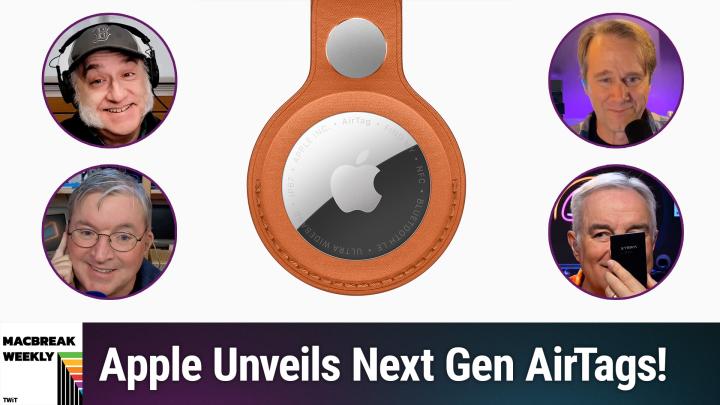
It's going to be like everybody's going to say, this is the one I have to have. This is the thing I have to have. It's a new airtag. And by the way, it kind of looks a lot like the old airtag.
Jason Snell [00:07:42]:
In fact, I think that's good, right? To take your old pockets and.
Leo Laporte [00:07:46]:
But it'd be nice if it had. Look, just one thing, a little hole so I could put it on my keychain would be nice.
Andy Ihnatko [00:07:52]:
It's good that it fits all the same accessories as you've had for the past three years. It's bad because you. You can't flex that. You upgrade it to the very latest air. Hey, I don't need a new airtag, but, you know, I'm just such an Apple fan and thank God I've got enough discretionary income to blow $30 like that.
Leo Laporte [00:08:09]:
But it's kind of an incremental upgrade, right, Jason?
Dave Hamilton [00:08:12]:
Oh, it's definitely an incremental. Sorry.
Leo Laporte [00:08:14]:
Yes, Dave, you go ahead.
Dave Hamilton [00:08:15]:
No, it is an incremental upgrade. I mean, it's got, what, longer range for the uwb, Finding the uwb. And then it's got a louder bell on it so that we don't lose our microphones when. When, you know, we can find them when we have to push the button.
Leo Laporte [00:08:31]:
What does it sound like? I don't. I've never. It's more like a chirp, right?
Jason Snell [00:08:35]:
Yeah, it's a little. Little chirpy thing. So this will be louder, which I think is good. And it also means that it's harder to, like, hide it somewhere and not know that it's there. If it has to set that, like somebody's following you, kind of alert that it sends. And yeah, it's the U. It's a UWB. It's the second generation UWB chip, which we can't call the U2 chip because of Bono.
Jason Snell [00:08:54]:
And. But that means that there's more, which means it'll be found more easily if they do the little, like, drive by Bluetooth tracking, which is how you find this thing. If it's like completely lost, that has more range, which means that it's more Likely to be spotted. It. You know, it is better at it because it's been five years since the airtag came out and the technology has moved along. This is not a product that needs to get updated every year. Right. But five years have passed.
Jason Snell [00:09:19]:
There is better technology now. And so they, they've updated it and I bought some, right. Like, I, I've spent the last year thinking I could probably use a few more air t. But surely it will be updated soon. And, you know, so now we'll, we'll get it. But it's convenient. I have backpacks and suitcases and stuff that I stick them in and I like, I like having them. So good for them.
Jason Snell [00:09:39]:
They made it better. And uwb, I know I ranted about UWB last week when Stephen Robles was here because we talked about the door locks that use uwb. But like, that technology being able to provide an absolute position in 3D space is huge for stuff like locks and car. Car keys and for airtags because, you know, the more precise and the more distance you've got, that means you're wandering through your house trying to find whatever that thing is, and it will tell you it's over there. Instead of the old Bluetooth method, which was like, it's somewhere warmer, warmer, colder, colder. Right. Well, it'll be like it's right over there. And that's, that's the beauty of getting a UWB device on your.
Jason Snell [00:10:18]:
On your stuff.
Leo Laporte [00:10:19]:
One of the number one uses for this is putting it in your luggage. And that's actually a really good thing to do because Apple points out many airline customer service teams use the share item location to help you find your luggage. They say, according to Sita, this is from the Apple press release, that using share item location has reduced baggage delays by 26% and reduced incidences of truly lost or unrecoverable luggage by 90%. Let's not forget that time when the guy followed his luggage to an empty warehouse and found people trying on his clothes. There's that too classic.
Dave Hamilton [00:11:01]:
We had an incident early, early on with airtags where we knew because of the airtag that the luggage hadn't even gotten on the plane. And we went up to the counter and said, we want to file a missing bag thing. And. And they said, well, you have to wait until all the luggage is on the carousel. Like, yeah, but by the time all the luggage is on the carousel, this line is going to be 40 people long. We know that our bag's not here in Boston. And they're like, wait, you do? And we said, yeah, we showed them on the phone. They're like, great, we can fill out the form now.
Dave Hamilton [00:11:33]:
And then we just left.
Leo Laporte [00:11:33]:
And they believed you? Oh, that's great.
Dave Hamilton [00:11:35]:
Yes, they actually believe this. This was early enough on that that it was new, but not in that weird middle period when airlines were saying that they, this was against their policies because it was RF and I mean that was short lived obviously, but there was that period of time, I think.
Leo Laporte [00:11:52]:
There were some airlines that were booting them off.
Dave Hamilton [00:11:54]:
Yeah, Lufthansa was saying, you're not allowed to do this. And people were like, okay, stop me.
Leo Laporte [00:11:59]:
Tanza. Yeah, sure, find it.
Jason Snell [00:12:01]:
One of the cool things about this is you might ask yourself, why aren't more airlines supporting this? And mostly it's just a matter of integrating it with their backend tools. There, there, there was a story, I think we might have even mentioned here about how Delta, I think had finally integrated it. And it was really just an issue of, you know, it's not a story about airtags and it's not a story about policy. It's a story about these airlines having back end tools for luggage tracking and first off, backend tools or anybody who's not used one who, they're usually terrible and because they don't, they're in customer facing. They're just for the employees. The employees have to be subjected to these terrible tools. And for an airline, you got to roll it out at all your different airports. Which, you know, do you have the same technology stack? Are you dealing with different stacks to do in different ways? So it's complicated, but it sure feels like since airlines are rolling this out and they're already, you know, more than a dozen, that in the long run every airline is going to just integrate with this.
Jason Snell [00:12:56]:
So, you know, if your favorite airline hasn't yet, just wait and it will because it benefits them. Like they, they really want to know where your bag is too so that they can get it to you. So I think it's very cool. It's a great use case and days right there was that moment where they're like, no, no, don't put an airtag in your bag. And you're like, well, I' to do that anyway. And now, now they've integrated it, a lot of them. And I think eventually everybody will. It's great.
Leo Laporte [00:13:22]:
So should I buy the new air? I mean, I still have the four air tags. Its price is the same, by the way. 99 bucks for four of them.
Jason Snell [00:13:30]:
Happy With a new one, I don't see why you would. I think. I think if you're buying new ones or thinking of having more, these new ones will be more capable. I suppose if you've got it everywhere and you really rely on it and you want that extra range and all of that. If you're a heavy traveler, I mean they're cheap. You can get four for what, four for 99, one for 29. It's.
Dave Hamilton [00:13:51]:
Yeah.
Leo Laporte [00:13:51]:
Same price.
Dave Hamilton [00:13:52]:
The only problem with them looking the same is I immediately went to Amazon to see if I could get them on discount. And you can, but I don't know if they're the new model or old model.
Leo Laporte [00:14:02]:
This is an Amazon issue, obviously.
Dave Hamilton [00:14:04]:
Yeah, yeah. But if they looked different then I'd be able to tell. But you can't. So you just gotta wait.
Leo Laporte [00:14:10]:
Okay. If it's an scooter, X says. If it's an AirTag one, the back will say airtag. Designed by Apple in California, assembled in China, Bluetooth LE Ultra Wideband. If it's an AirTag 2, look at the text on the back. It will say airTag Find my NFC, Bluetoothle UltrawideBand IP67, Apple Inc. It won't say anything about design in California, made in China, any of that stuff. So you could tell if you read the fine print, I guess on the back.
Leo Laporte [00:14:38]:
Oh, it's all in caps. That's the other thing. Except for the.
Andy Ihnatko [00:14:43]:
This is why I actually have like a little paint marker or something on each of my different air tags, just so I know which one is which. Because if I have one with a dead battery and I might have pulled it, I'm not going to know. Which is.
Leo Laporte [00:14:52]:
Oh yeah, that's until I mark it.
Jason Snell [00:14:53]:
Yeah.
Andy Ihnatko [00:14:54]:
And you can put in different cases too. The only thing that we haven't talked about yet is. Well, a couple things we haven't talked about yet. That new feature for. I think it's just the new hardware now you can actually do the tracking from your watch. So you can actually do that.
Leo Laporte [00:15:09]:
Yeah, that's nice.
Andy Ihnatko [00:15:10]:
That's a big deal. They also put in a blurb basically trying to. They didn't make a big deal out of the personal security problems raised by the first generation, particularly in the first year. But they did say, oh by the way, we have a brand new wave of industry first security protections to basically protect someone from tracking you against your knowledge, against your will. Suite of industry first protections against unwanted tracking, including cross prophecy, cross platform alerts. That would be the joint Google Apple announcement about How a couple years ago about how we're going to develop a platform so that we can track each other's stuff and also unique Bluetooth identifiers that change frequently. And of course, the response to that is that it wasn't doing that already. That seems like something that you'd want.
Leo Laporte [00:15:55]:
So what about. I bought some Chipolos just to try them out, but those don't. Do they use the Find My Network or.
Dave Hamilton [00:16:04]:
They totally use the Find My Network.
Leo Laporte [00:16:06]:
Okay, so are they as good as an airtag?
Dave Hamilton [00:16:09]:
It depends. On.
Leo Laporte [00:16:09]:
They don't have uwb. They don't.
Dave Hamilton [00:16:11]:
They don't have uwb.
Leo Laporte [00:16:14]:
I put it in my hat, but it's not a hat I wear every day. So every day that I leave the house, Mike Chipotle says, hey, you left. You left your hat behind.
Andy Ihnatko [00:16:23]:
This is. This is one of those. This is one of those instances in which there's a difference between the best choice for people in the United States or the North America or European versus the best choice for people everywhere else. Because in the US Even if you're an Android user like me, you would almost certainly want to buy an airtag because that's where all the iPhones are. There's 100% chance that it's going to be basically picked up and tracked by people passing by with an iPhone. However, in, like, Eastern Europe, in the Middle east, on the African continent, you're going to encounter more Android phones. And therefore, yeah, maybe you do want to get a Chipolo, because all the phones are going to be finding your piece of luggage or your whatever are going to be Android phones.
Leo Laporte [00:17:04]:
Yeah. You said, Jason, you have that Nomad wallet, right? That has Fine My in it.
Jason Snell [00:17:09]:
That has Fine my. So. So, yeah, there's two different kinds of Find My, right? The Find My network works with this Bluetooth thing where you see an ID and it gets relayed back and you know where it is.
Leo Laporte [00:17:17]:
And that's good because there's so many iPhones in the world that you're really.
Jason Snell [00:17:20]:
Very likely to be somewhere they will spot it. And this is what happens is if your iPhone sees, like, random Bluetooth signals out there for these devices, it basically tells Apple, I saw this one here.
Leo Laporte [00:17:30]:
And you don't know it's doing that. It just does it, right?
Jason Snell [00:17:32]:
Just does it in the background. And what's the distance?
Leo Laporte [00:17:34]:
Is it meters or.
Jason Snell [00:17:36]:
It's BTLE Bluetooth Low Energy. Right. So it's not. It's not 30. It's like maybe, I don't know, 10 meter no, it's not even that. It's five meters. It's not close. It's not a lot, but it's, it's close enough for I think a lot of people's usage.
Jason Snell [00:17:50]:
UWB works in an airport where it's.
Leo Laporte [00:17:52]:
Stuck in a tube to. Leading to a conveyor belt or something.
Jason Snell [00:17:55]:
Yeah, but somebody working there has an iPhone and so, so it sees it. So yeah, it is. So the UWB is precision finding and that's much more battery intensive and complicated and that's what the airtag offers you, which something like a more generic find my product might not.
Leo Laporte [00:18:14]:
Okay.
Andy Ihnatko [00:18:19]:
So.
Leo Laporte [00:18:21]:
Apple did do an update. Everybody got new iOS, iPadOs, watchOs mostly just for the new airtags. I mean I did it, it didn't take very long. 26. I think it mentioned a security fix or bug fixes along with bug fixes, but they didn't really specify. And since I don't have the new airtags, I'm wondering did I really need to do this? But why not? You know, one thing I do want to give Apple credit for, they updated the iPhone, I think 11.
Andy Ihnatko [00:18:53]:
They updated something starting with iOS 12 all the way, all the way up.
Leo Laporte [00:18:59]:
Since 202313 year old iPhones got an.
Andy Ihnatko [00:19:02]:
Update all the way back to the iPhone 5s. And it wasn't. And it wasn't, it wasn't necessarily oh congratulations, you now get liquid glass. It's more like mostly they upgraded all the, they updated all the certificates on those devices so that they could continue to participate in imessage and other Apple services and FaceTime which is, which is definitely something that Apple did not have to do. And I'm glad that someone thought of this, someone championed this and the right number of people said yep, that's a great idea, let's do that. Why abandon people with an iPhone 5.
Leo Laporte [00:19:27]:
6 plus the 2013 iPad Air and the iPad Mini 3. I bet there are a lot of actually iPads out there that benefited from this. So that's good. Good on you Apple. I mean contrast that with say Android where you know, it's a big deal that they promised seven years.
Jason Snell [00:19:43]:
Yeah, I was gonna say this is, please, this is a great example to cite. When people say, oh well you know, Apple builds everything to automatically self destruct so you have to go buy a new one. And they do say it with that tone of voice. Exactly.
Andy Ihnatko [00:19:55]:
By the way.
Leo Laporte [00:19:56]:
Exactly like that.
Jason Snell [00:19:57]:
You know, that's not their intent. It does happen. And you know, if Apple made an iPhone that you Ever had to buy another iPhone, they would go out of business pretty fast. That's true. But you know, they don't need to. Tech moves so fast anyway that they don't need to do stuff like that. Is a great example to make you.
Leo Laporte [00:20:12]:
Want the new thing instead of obsoleting the old thing.
Jason Snell [00:20:15]:
Exactly. I do think they feel some level of responsibility and that it's actually even part of their brand promise is that they're going to not, they're not going to. They're going to give you a reasonable amount of time to continue using that product and not just shove you out the door.
Leo Laporte [00:20:27]:
This is a huge issue. Google just made the first generation Nest thermostats useless.
Dave Hamilton [00:20:33]:
I've got one. I had to side load that no longer evil thing on it and now it works great.
Leo Laporte [00:20:40]:
It's still working. But no thanks to Google.
Dave Hamilton [00:20:42]:
But no thanks to Google. Yeah, no, there was a challenge put out and a team of folks, I love it. What's called no longer evil. Yeah.
Leo Laporte [00:20:52]:
Willing to reverse engineer firmware and make it work. The Wemos, you know, same thing. Let's give credit to Apple. 13 year old phone, you're getting an update.
Andy Ihnatko [00:21:05]:
It is weird, I mean because you kind of want to be a fly on the wall on what those discussions inside every single hardware manufacturer are like because yeah, Google has done that a couple of times and that stinks. However, they also basically say if you buy a Chromebook, we will guarantee 10 years worth of updates. If Chrome OS does not exist in 6 years, you will still get 4 years of updates after that. And you have to, and you got to imagine that these are all like semi tactical decisions, like what is their benefit to the user, what is the benefit to Apple? And sometimes you just simply have hardware that absolutely they'll have this, a new API or a new idea or a new system that is awesome. But getting it backwards compatible is going to be an absolute nightmare and will affect only about 4% of the installed user base. We just have bigger fish to fry than that. So yeah, I mean like Jason said, it's tempting to use the use of the voice and say that you know, what's next, what's next Apple? How about the very first marzipan circuit boards will actually dissolve in your hand while you're using it. Is that your end game, Mr.
Andy Ihnatko [00:22:12]:
Man? Apple. And again you both do that twice. Because we've been in this business for a long, long time, Jason, you know that we've heard, we've heard so many things said in that voice before.
Jason Snell [00:22:24]:
I think you'll find, Andy, that it's the case that Apple does time things to be obsolete. It's planned obsolescence.
Leo Laporte [00:22:31]:
You know what I got to tell you, that original Mac that was sitting behind me, that started to smell like burning fish.
Jason Snell [00:22:38]:
Oh, the magic smoke came out of it.
Leo Laporte [00:22:39]:
The magic smoke came out. Burke's got it and he. It's all stock components. Inside he has the specialty Torx.
Jason Snell [00:22:47]:
You know, typical Apple, 42 year old computer. 42 year.
Leo Laporte [00:22:50]:
He's replacing the caps.
Andy Ihnatko [00:22:51]:
This is what, this is what I'm on about from the design level up. What if we put these little canisters full of chemicals that are going to degrade over time and make it impossible to use in 2026? It's right there, man.
Leo Laporte [00:23:04]:
You know, really, really, really held the place together, man. Well, I'm hoping we're going to get it back. Burke. I told Burke though, before you, when you turn it on, make sure you're outside with a fire extinguisher just in case.
Andy Ihnatko [00:23:17]:
I used to be more into like vintage computing than I used to be until it was fun. Up until like 2002, 2003, when all of those capacitors starting to leak and going off. And it's like now it is way too much trouble to now that I can Simply go to archive.org and just basically launch an emulator that will give me the perfect Mac Se. Why would I want the mess of trying to get this thing so it doesn't start a fire to begin with? And then actually it's like, okay, that's my level of fun. Above this it's work. Above this it's fun. I'll see you in emulator land. Thank you very much.
Leo Laporte [00:23:52]:
Thanks to Dave Hamilton again of Mackie Cab. Here is the link. No longer evil breathing new life into bricked and outdated NES Gen 1 and 2. Oh, they obsoleted the Gen 2 as well. I didn't realize that they've got a.
Dave Hamilton [00:24:05]:
Great, like a great updater that you launch on your Mac. It updates. You plug it in. You've got to use the right USB cable. That's the only thing I will share.
Leo Laporte [00:24:16]:
It has to be a data cable probably.
Dave Hamilton [00:24:18]:
It has to be a data cable and it's like mini usb, micro usb. And it's micro usb.
Andy Ihnatko [00:24:25]:
Well, the back.
Leo Laporte [00:24:26]:
Yeah, that's a good reason to obsolete.
Jason Snell [00:24:28]:
It, to be honest. Fair, fair.
Dave Hamilton [00:24:31]:
But yes, it's on. You're right, Jason, it's on the back. And you. It. I plugged it in. It was like nothing's here. And then I looked in system information and it was like, oh yeah, it's like it's not showing up trying to evil dot com.
Jason Snell [00:24:44]:
That's the reason that I know that is that I used to have a heating only system because California and it normally those smart thermostats get their power from a neutral wire, but they can run. Many of the especially early nests could run without a neutral wire. They would just use their battery and they would charge when it was on. So when it was heating or cooling, it would charge itself using the actual power from the wires that control the thing. Except if you don't heat for eight months, the battery dies and you're like, what do I do? And the answer is take it off. And there's. There's a mini USB on the back and you can charge it back up. And now you can turn on your heater again.
Jason Snell [00:25:23]:
Sir.
Dave Hamilton [00:25:24]:
I finally wired a C wire up because I still have it here in the studio. That same gen 2. I'm running no longer evil on it. And I finally ran a C wire that just plugs into the wall.
Leo Laporte [00:25:33]:
Did you put it through the wall?
Dave Hamilton [00:25:35]:
No. You can buy an AC outlet. Like you plug into an AC outlet and just run the C wire.
Leo Laporte [00:25:43]:
That's good.
Jason Snell [00:25:43]:
And it gives you a fake common wire. I found out that I did. I thought I didn't have a common wire. Actually the reason I didn't have a common wire is because the previous heater didn't supply power. The current heater I had at that time did. But nobody had bothered to wire up a common wire. So I just wired the C wire and I was like, okay, look, I'm so handy homeowners. And then I got to run the nest.
Jason Snell [00:26:05]:
But yeah, it's a shame. I will say this is what is so great about open source firmware stuff. Leo and I were talking before the show about my pick a couple of weeks ago. The XT and X5, which is much better with this totally open source firmware that you can literally flash from Chrome. Like you don't even need to download a thing.
Leo Laporte [00:26:24]:
That was wild. I thought I was going to have to hook up a cable from Chrome.
Jason Snell [00:26:28]:
Via USB and it just kind of like zips right over. Yeah, that's really great. I'll throw in stuff like Homebridge which allows like compatibility with things that, that the manufacturer is like, I don't care, I'm not going to make it homekit compatible or whatever and there. And people have figured out like you get your like some of it Is is literally like load the web page of your thermostat now go to the cookies in your browser and find the secret code and paste that in your settings, at which point you can just use the home app. And like, I love those people. I love that they've done this for the nest. And like this is, this is the thing, right? The problem. And I know Cory Doctorow talks about this a lot.
Jason Snell [00:27:07]:
The problem is that once they've sold it to you, they kind of don't have any motivation to keep it running for very long because they do want to move on Google. Google is. It's part of their culture. Is like ship it and kind of forget about it and move along. And so to have somebody else be able to kind of pick it up and say, we can make that useful again, I love. That's one of my favorite things about the Internet and about geek culture is exactly what Dave's describing.
Dave Hamilton [00:27:34]:
It's the best.
Leo Laporte [00:27:35]:
Go ahead.
Dave Hamilton [00:27:36]:
No, it's the best.
Andy Ihnatko [00:27:38]:
It's the best.
Dave Hamilton [00:27:38]:
That's all there is. That's all I have to say.
Leo Laporte [00:27:40]:
It's the best.
Dave Hamilton [00:27:40]:
That's what I love about being a nerd. Like I love being. I'm super nerdy about certain things, but I'm nerdy enough to know that if somebody else has figured out how to solve it, I can probably follow their instructions to get it done. And that was the case. This no longer evil thing, when I installed it, it was not ready for prime time. Like it's not like you would get today.
Leo Laporte [00:28:02]:
It's gotten better.
Dave Hamilton [00:28:03]:
It's gotten way better.
Leo Laporte [00:28:04]:
I think has a vibe coding, honestly, I think Claude code is going to change a lot of that. Even people will do their own thing. You know, I've had this home assistant green server forever and it's just been such a pain to connect everything.
Jason Snell [00:28:19]:
I have one too and it's just a pain.
Leo Laporte [00:28:21]:
I'm thinking I'm going to get Claude to do it and write me a dashboard and do the whole thing. By the way, if I'm suddenly near sighted, I'm going to blame you, Jason, because this is the smallest thing.
Jason Snell [00:28:32]:
You just make the type bigger. You can do that. You can make the type bigger.
Leo Laporte [00:28:35]:
Type bigger. But then the page will be.
Jason Snell [00:28:37]:
Well, you can make the type bigger. You can turn on hyphenation. That's a new setting that they added. And also you can, you can, you can have it go in, in horizontal instead and get.
Leo Laporte [00:28:45]:
Yeah, that might be a little bit.
Jason Snell [00:28:46]:
A little wider color.
Leo Laporte [00:28:47]:
I like to have a. This Is very cool though. And you know, I'll just. I'll just read like this. I didn't know I bought it by the way. My finger must have slipped when you were talking about it the other day. Common I got a package yesterday.
Jason Snell [00:29:02]:
I didn't buy it. I just. My finger slipped.
Leo Laporte [00:29:05]:
My finger must have slipped. It just appeared in my mailbox.
Dave Hamilton [00:29:08]:
It happens to every guy, Leo. It's totally normal.
Leo Laporte [00:29:10]:
Is it normal? Okay. I've heard my wife used to say that. This is the crosspoint router. As long as we're talking about custom firmware for the XT Ink X4E paper display reader. It's on GitHub. Just search for Crosspoint reader. I was impressed by the install because you just do it from Chrome. The Crosspoint reader is based on ESP32 and apparently has WI FI in it.
Leo Laporte [00:29:35]:
So you just turn on the WI fi, join the network and then you don't have to do anything else.
Jason Snell [00:29:40]:
Yeah, you can, you can load across with a browser and then it actually it supports Caliber Web. So Calibre is this great.
Leo Laporte [00:29:46]:
That's what I've been using.
Jason Snell [00:29:47]:
It's a great tool for this that you can add on. You can do an add on for the app that, that gives it a web interface and a bunch of people have hacked it to like use it instead of like Kobo, you can point Kobo at Caliber Web instead of a Kobo and then you can just auto sync your files from there. But it supports Caliber Web as well. So if you get that up and running, then all you need to do is turn on the WI Fi and pull books right off of your server. So lots of ways to load it. Also you can pop out the SD card and just load things on that way if you want to.
Andy Ihnatko [00:30:15]:
I mean this is a great conversation because it shows you there are two ways to get a around obsolescence. One of which is Apple, which is we are just going to aggressively try to support our hardware as long as it is humanly possible to do so. Despite people thinking that we want them to buy new phones every two years. We would love it if you did. That would be great. But no, if there's a way we can make your iPhone5s work, we understand that there are people who are still using iPhone5s's out there. Why wouldn't we do this? The other side of that is Google does have an approach where again, things get obsoleted, but they also ship phones and devices with unlocked bootloaders.
Leo Laporte [00:30:47]:
So basically that's true at the Point.
Andy Ihnatko [00:30:49]:
At which which Google stopped supporting it. It's like this isn't a trivial thing to do, but if you want to say, hey, I've got a Pixel 2 phone or got a Pixel 5 phone, how can I get a modern safe operating system on it? They say, okay, great, here's the steps to unlock the bootloader, here's how to install like an open source bootloader, here's how to get grapheneos on it. If you want to remove everything Google on it, here's how you do that too. So there are different ways of approaching that and it's just worth mentioning, although.
Leo Laporte [00:31:16]:
I have to say times are changing a little bit on third party ROMs, even on the Pixel, and Google is really locking things down a little more.
Jason Snell [00:31:26]:
I legitimately worry about the future. I mean, I know I'm sure we will find a way to solve it because it always does seem to happen. But like it's really easy to run old hardware like classic Mac OS or even early Mac OS 10. But we now live in an era where Apple is sign code signing everything and they stop signing. And it doesn't mean you can't run it, but it makes it harder to get the software and harder to run it because you have to turn off a bunch of security things and all of that. And like that's what It's a little bit like lockdown game consoles where it just concerns me a bit that I understand why the platforms, platform owners feel they need to lock it down. But in the long run they're not the best stewards of history. They're not interested in history.
Jason Snell [00:32:13]:
Again, it's that same story, like saying Google likes to just move along. If you're a business and you look at it, you're like, well, you know, I'm not in the business of keeping a museum of old Nintendo games. Like if I can't sell them on my current platform, I literally don't care. And the problem with that is history does matter. Old stuff does matter. If it doesn't matter to you as the owner, it still matters. And that's why I'm at least encouraged that some companies, including Apple, seem to have like, there's the guy. Remember we talked about the little mini Mac and I've got one behind me that Andy mentioned.
Jason Snell [00:32:46]:
It's like a little mini Mac that you can plug in and it runs Mac os and Apple came to him and basically said, you can't sell it assembled as a Mac, that's a little too far. But they didn't Tell him to cease and desist everything. He can still sell the parts and tell people how to put it together and run it as an emulator. And I feel like Apple in general is like, they're okay with infinite Mac.org emulating old Macs. You know, they're okay with Apple II emulators. They're okay with that even if they can't like legally say, right, yes, because a lot of those things are encumbered. And if you were an attorney, you could. You would risk being sued by somebody who, you licensed something and put it in the Apple II code and nobody remembers it except the guy who has the license.
Jason Snell [00:33:25]:
And they'll immediately sue Apple for a lot of money. So I'm encouraged that there are some companies out there that are at least like, we'll let you do it. We're not going to complain about it, even if we can't endorse it, because we risk losing important parts of, of computing history as well as the fact that especially games, old games are fun to play even now. And I know if you're a maker of a new game console, that might be a bummer to you, but like, for Pete's sake, we need to not lose this stuff. And the more locked down it gets, the more danger there is that you won't be able to ever play it again, or for network games, play it the way that you would have played it when there were other people playing it with you.
Andy Ihnatko [00:34:03]:
Yeah, I mean, this is part of a culture that we're in danger of losing completely by virtue of the fact that we don't have something that can, we don't have working hardware that can play this. And also, just like we have the same problems with music and with video and with movies where this thing was made in 1957. The copyright was correctly filed. However, who knows who owns the Monogram Pictures library right now because it's been bought and resold and bought and resold. If you wanted to produce a version of this, you will have no idea of tracking down who to get the rights from. And so, given that nobody's monetizing this silly 1953 movie that's charming, but not necessarily life changing for anybody. Like, it's okay that this kind of piracy exists, just like it's okay that games from the 1980s and 1990s on certain platforms exist, just like it's completely okay for hackers to basically break the security on a Dreamcast or on a Nintendo platform to make these ROMs available. Because if you have to give A better argument against.
Andy Ihnatko [00:35:11]:
If a creative work is going to disappear forever, you have to give a greater argument supporting that result than simply that commerce. It's like, again, if you. You have to have a better argument than that.
Leo Laporte [00:35:24]:
By the way, I'm making a little visual pun here in the studio. You could see that Mini Leo who is sitting on his mini exercise ball is using that Mini Mac. Can you zoom in, John? Ashley? I don't know if you have that capability anymore. That was a tricaster thing. Because if you looked really closely, you could see it's actually booted into System seven. Is it System seven, Jason? I can't remember.
Jason Snell [00:35:45]:
Oh, no, it's that. I think that one's running like one.
Leo Laporte [00:35:48]:
It's really original.
Jason Snell [00:35:49]:
1.0 original with Mac Paint and stuff.
Dave Hamilton [00:35:51]:
Yeah, system seven had multitasking. I don't think that was on that.
Jason Snell [00:35:55]:
No, it's a 128. It. It is. Although it's funny, it turns out that the 128, he couldn't. It couldn't load a bunch of stuff. And so now there's a new firmware that's like a slightly more ram. And he's like, don't tell anybody. It's got a little more RAM in it, in the emulator, so that it can run Mac paint and you can draw stuff with it and all that.
Leo Laporte [00:36:14]:
You're watching MacBreak Weekly. We're so glad to have you. We're glad to have Dave Hamilton from Mac Geek Gab. Long time Mac podcast. When did you start Mac Geek Gab? I think you predate us.
Dave Hamilton [00:36:28]:
We started June. We launched the first episode June 13th of 2005.
Jason Snell [00:36:34]:
Wow.
Leo Laporte [00:36:34]:
I think you do predate us. Yeah.
Dave Hamilton [00:36:36]:
Yeah, we're at. We're at like a episode I can't remember. I think this week we'll record episode 1127.
Leo Laporte [00:36:42]:
Oh, yeah. Way ahead of us.
Jason Snell [00:36:43]:
Yeah. 2005, that was the ground zero. That was when Steve Jobs came out on stage at the D conference. I was there and said we added podcasting support to GarageBand. And that was sort of the birth of podcasting in a way. Everything before that was almost like prehistoric.
Leo Laporte [00:36:55]:
It was simultaneously the birth and the death.
Andy Ihnatko [00:36:58]:
Yes.
Dave Hamilton [00:36:59]:
Yeah, right.
Jason Snell [00:37:01]:
And it came back later. But that was the. That was the Apple kind of the embrace, the death embrace, if you like. But a lot of podcasts started in 2005, and then most of them stopped.
Dave Hamilton [00:37:10]:
In 2006 and then stopped. We started MacGeek. So he announced that you're right at the D conference, but it wasn't Going to launch until macworld Expo. Right. Or write about Mac World Expo, which was July Update. Yeah, yeah, in. Right. In July of.
Dave Hamilton [00:37:28]:
Of. Of 2005. So we started the show, obviously, two weeks before that. That's just sort of how it worked out. It wasn't intentionally that way. But as soon as we launched it, I started calling everybody that I knew at Apple because I wanted to make sure I was in the directory on. On day one, you know, when this launch was only two weeks away, of course. And of course, this was at a time when Steve was running Apple.
Dave Hamilton [00:37:48]:
And so everybody was like, well, I'm not the one who runs it, but. And I don't want to introduce you to the wrong person in case I get fired in an. After, like, the seventh conversation like this, I thought. I just got frustrated. I'm like, what a stupid way to run a company. This is literally your CEO's pet project. He was on stage, like, two months ago, and he spent 15 minutes talking about this. And so I wrote to Steve.
Dave Hamilton [00:38:16]:
Twenty minutes later, my phone rings. Hey, this is Keith in the Apple podcast. We got your email. I didn't send you an email, you know, and. And he says, yep, we've already got you in the thing and everything's good, and we're going to feature you on day one. And we were off to the races from there.
Jason Snell [00:38:30]:
So, Yeah, I just. Funny. Just the other day I heard the story about how Dan Carlin started Hardcore History. And the answer is that somebody who worked with them had worked at Apple, worked with him and said. And. And he was like, yeah, I've got this idea for a thing. I don't know what I'm going to do with it. And.
Jason Snell [00:38:45]:
And this person was like, it would be really, really. This is 2005. It would be really, really good if you launch that as a podcast. And then he's like, podcast? Nobody does podcasts. He's like, no, no. It would be really, really good if you launched that as a podcast. And then Apple made that announcement and they were there and they got to be part of that initial.
Leo Laporte [00:39:04]:
I was sitting at that event with Ray Slizz Slickinski, who had written one of the early ipod podcasters.
Jason Snell [00:39:13]:
Podcasters. Right.
Leo Laporte [00:39:14]:
Ray's a great guy, and his whole world just crumbled when Apple made that announcement. It was the end. I can't remember the name of the program, but it was the end of that. And he.
Jason Snell [00:39:23]:
Because they put it in itunes. Yeah.
Dave Hamilton [00:39:25]:
Yeah, they put it in itunes. Yeah, that was the thing.
Leo Laporte [00:39:27]:
Need a podcaster anymore Although ironically, they're back.
Jason Snell [00:39:31]:
Well, the smartphone turned it all upside down. Right. Because once. Once the device could get its own podcasts and you didn't need to sync them.
Dave Hamilton [00:39:37]:
That.
Jason Snell [00:39:37]:
That was a really nice thing for podcasts. That's why podcasting came back, really, in the. You know, in the 2010s, smartphone is because with a smart smartphone, not just that everybody had smartphones because people had ipods, but it's because a smartphone could get the podcast itself.
Leo Laporte [00:39:54]:
Yes.
Jason Snell [00:39:55]:
Like, that was such a big thing, because it was. I mean, back then, it was like, oh, did a new Mac break come out? I will get my ipod and plug it into my Mac and press sync.
Dave Hamilton [00:40:03]:
Literally with a USB cable. Oh, it was a big time.
Leo Laporte [00:40:08]:
Podcasting will not be successful until it's as easy as pushing a button on your radio to listen to the radio. And of course, now it's even easier. It's always there. There's a.
Jason Snell [00:40:18]:
And radios don't have buttons anymore.
Leo Laporte [00:40:20]:
And radios don't have buttons anymore.
Andy Ihnatko [00:40:21]:
So there.
Leo Laporte [00:40:23]:
So there. Hey, I do want to say one other thing. I'm gonna get a little serious on this. There's another thing we can be very grateful to Steve Jobs for, and smartphones. Cause I think Steve really was the first to realize you put a camera in one of these things. There were cameras in them before, but the iPhone really elevated that. And we're seeing something happen in the United States today that without the ubiquity of smartphones with cameras that can video. Yeah, we would not know what happened to Alex Brady.
Leo Laporte [00:40:54]:
Yeah, we would not know what happened to Renee Goode. History is full of what's going on in Minnesota.
Jason Snell [00:40:58]:
History is full of government authorities who have hurt or killed with impunity. And people have disputed. And it's been very much a. Like, no one really knows what went on there. And we had. Within 24 hours, we had like, five different angles of what went on there.
Leo Laporte [00:41:16]:
And we knew an amazing job of taking all the videos, editing them.
Andy Ihnatko [00:41:20]:
Everybody did New York Times, basically, when the job. There is no question here we have it from multiple angles at very, very high quality from multiple sources.
Leo Laporte [00:41:30]:
You know, if we'd had smartphones in 1963, we'd know who shot JFK. I mean, we.
Andy Ihnatko [00:41:36]:
You know, I would put it to you that we do know who shot.
Jason Snell [00:41:40]:
I think we cracked that case.
Leo Laporte [00:41:42]:
Oh, I'm being frivolous now.
Jason Snell [00:41:43]:
We'd know. We'd actually. We'd know all that. The people who have these. But what abouts would be wrong because they'd be like, hey, look, there's nobody.
Leo Laporte [00:41:50]:
On the grassy knolls and there's no one on the grassy knoll. Exactly. So we live in different times. And I think really a lot of credit goes to Steve and Apple. You know, they're not all iPhones. I'm sure there's plenty of Android phones out there. But if it weren't for the ubiquity of video, I think they definitely recognize.
Jason Snell [00:42:08]:
That the camera was vitally. This is that. I think it is a little bit the Steve Jobs kind of liberal arts thinking about products in a way that maybe nerds don't. So much thinking. The camera is really important here. Right. Like, we got to push the camera. This is going to be a huge thing and it has been a huge thing for all of society.
Leo Laporte [00:42:29]:
I didn't mean to get heavy, but I've been thinking about that all week and really very grateful that we have that, because you're right. There'd be no way to counter the authoritarian narrative. Anyway, we're glad you're here. Dave Hamilton, thank you. Thank you for making macgeek Gab and I will give you credit for starting this back in 2005. We're following in your footsteps. I still kind of like I was.
Dave Hamilton [00:42:55]:
One of the late ones. So go ahead. Yeah, make your announcement, please.
Leo Laporte [00:42:58]:
Yeah. Because of course, for the last few weeks, we've been putting a lot of wonderful people in Alex, Lindsay's old chair. Alex has gone to the fruit company and disappeared entirely, as is often the case. Actually, Alex sent me a text just the other day, so I just texted him saying, how you doing? Are you enjoying your long commute? But all along, from day one, I had a vision of who I wanted to have replace Alex, but it was kind of a complicated process. The person I wanted was working for another company. She had to get permission. I've spoken to her. I have now confirmed that Christina Warren, film girl, will be joining us as a regular on MacBreak Weekly starting in one month.
Leo Laporte [00:43:48]:
And I'm very excited to have her. She won't be here, actually. This John, you gotta fill in next weekend and the week after. But she won't be here for a.
Dave Hamilton [00:43:55]:
Couple of weeks, probably until late February at this point.
Leo Laporte [00:43:58]:
Yeah, I think it's about one month, but we're very excited. I think Christina Long, you know, she was a journalist before she worked at GitHub, before she worked at Google, DeepMind, before she worked at GitHub, she was at Mashable for a long time. She's been a Podcaster for years. Of course regular on our shows, covered.
Jason Snell [00:44:17]:
Apple unofficial Apple Web Blog 2. Wow. Yeah.
Leo Laporte [00:44:21]:
And in fact has been a Mac and Apple fanatic as long as we have. So she's certainly very qualified. We wanted to make sure that GitHub was okay with her doing it. She says yes. She says she's very excited.
Andy Ihnatko [00:44:33]:
So yeah, everybody should be excited. Yeah, that's a huge get for the. That's a huge get for the show. We're looking forward to Christina being as Persona non grotted at Apple as pretty much all of us are after.
Leo Laporte [00:44:46]:
Yeah, I feel bad.
Andy Ihnatko [00:44:47]:
That's the.
Leo Laporte [00:44:47]:
I should have warned her, shouldn't I, that she'll never be invited to another Apple event. That maybe, maybe she. I should have told her that. But she gets.
Dave Hamilton [00:44:54]:
It's a good list to be on. It's totally fine.
Leo Laporte [00:44:57]:
Do you get to go, Dave?
Dave Hamilton [00:44:59]:
It, you know, it, it, it comes and it goes. I'm, I'm currently in a go not goes phase. I. So no, they don't do all the.
Leo Laporte [00:45:07]:
Way from New Hampshire.
Dave Hamilton [00:45:08]:
Yeah, yeah, yeah. They, they. Can I, can I, can I tell an inside baseball Apple story that somebody will probably get mad about?
Leo Laporte [00:45:16]:
But hold that thought. I'm going to take a break and then I, and this is a good teaser. You listen to the commercial because coming up, a unknown tale from the front with Dave Hamilton. We're glad you're here on MacBreak Weekly. Thank you, Dave.
This episode of MacBeak Weekly is brought to you by CacheFly.
For over 20 years, CacheFly has held a track record for high-performing, ultra-reliable content delivery - serving over 5,000 companies in over 80 countries. At TWiT.tv we've been using CacheFly for over a decade, and we love their lag-free video loading, hyper-fast downloads, and friction-free site interactions.
CacheFly: The only CDN built for throughput! Ultra-low latency Video Streaming delivers video to over a million concurrent users. Lightning Fast Gaming delivers downloads faster, with zero lag, glitches, or outages. Mobile Content Optimization offers automatic and simple image optimization so your site loads faster on any device. Flexible, month-to-month billing for as long as needed, and discounts for fixed terms. Design your contract when you switch to CacheFly.
CacheFly delivers rich-media content up to 158% faster than other major CDNs and allows you to shield your site content in their cloud, ensuring a 100% cache hit ratio.
And, with CacheFly's Elite Managed Packages, you'll get the VIP treatment. Your dedicated Account Manager will be with you from day one, ensuring a smooth implementation and reliable 24/7 support when you need it.
Learn how you can get your first month free at cachefly.com/twit. That's C-A-C-H-E-F-L-Y dot com slash twit.
Leo Laporte [00:48:24]:
So let's talk about the goss. We got some goss from The Information. Apple is developing a wearable AI pin-
John Ashley [00:48:37]:
Wait, hold on Leo: I thought there was some gossip.
Leo Laporte [00:48:40]:
That's gossip? You don't- Oh, from Dave.
Andy Ihnatko [00:48:43]:
Actually that's.
Leo Laporte [00:48:44]:
Oh wait a minute. We gotta do Dave's gossip. You're right. I apologize. Dave, what was the story you were gonna tell us?
Dave Hamilton [00:48:51]:
Yeah, so just in terms of going to Apple events, have we oversold it now?
Leo Laporte [00:48:55]:
Are you.
Jason Snell [00:48:56]:
No, no.
Dave Hamilton [00:48:57]:
Well, I mean. I mean it's probably.
Andy Ihnatko [00:48:59]:
If you want. I don't want to oversell this, but if you want to take a moment, we'll talk about another topic. Go to the kitchen. Feel the shelf like a nice champagne flute with like so that just like On Bravo, you could just fling it at somebody to show you how displeased you were.
Dave Hamilton [00:49:14]:
That's right.
Andy Ihnatko [00:49:17]:
I don't want to stage manage your story.
Dave Hamilton [00:49:18]:
Thank you. No, I appreciate, I'll take all the stage management direction that I can possibly get. I'm, I aim to be coachable. This will come as no surprise to anyone of the three of you here. But, but just to sort of paint this picture, since we were talking about, you know, getting invited or not getting invited, there was one iPod event, iPad event, I believe, late October, one year. And I know that's when it was because the way Apple would do it back then, and I think it's similar now, is, you know, they would send out media invites about a week before and summon you to, you know, wherever that was going to be. And this one was going to be in San Jose and it was going to be the day before my wedding anniversary. Oh, and of course to get to an Apple event, if it's on a Tuesday, which it was, I would have to fly out on Monday to make sure I'm there for Tuesday morning.
Dave Hamilton [00:50:09]:
And then there's all the follow up stuff that happens afterwards. So generally I wouldn't fly out until Wednesday. So it's, you know, it's whatever, 50 hours of traveling for a 90 minute event and, and ensuing coverage. But okay, fine. Normally I would do it just fine. But on my wedding anniversary, which was that Wednesday, I, we had concert tickets in Boston. And so I was like, I wrote them back, I said, thanks for inviting me, this is great, but I can't make it because it's my wedding anniversary. But my business partner Brian could go now.
Dave Hamilton [00:50:47]:
Apple would go back and forth. They would invite Brian for a couple of years and they would invite me for a couple of years. And sometimes there would be overlap, but it would be this kind of swimming thing. And so it was in one of those periods where it was just me that was getting the invites. Fine. And so I, I said, but you know, Brian can go. And they wrote me back very quickly and said, oh, sorry, we don't have room for Brian. And I knew what they were saying.
Leo Laporte [00:51:10]:
They're the same size as me.
Dave Hamilton [00:51:12]:
Yeah, yeah. And I knew what they were saying, but I was like, you know what, I'm gonna make you say it. And so I wrote him back and I said, oh, I'm sorry, I don't think you understood. I knew darn well they understood. I'm sorry, I don't think you understood. I'm not going to be able to Be there so Brian could sit in my seat. And they wrote me back, I'm sorry, we don't have room for Brian. And this is just how Apple was.
Dave Hamilton [00:51:40]:
And it was just one of those things. So I flew out. We made the timing work. I, I, My wife picked me up at the airport. We went to the, went to the concert. But.
Leo Laporte [00:51:47]:
Yeah, yeah, that's very understanding, I must say.
Dave Hamilton [00:51:50]:
Yeah, yeah. My wife is a very understanding human.
Leo Laporte [00:51:53]:
She, yes, she, yeah, we, we have not told Apple that Jason Snell's on the show, so he gets to know it.
Jason Snell [00:51:59]:
Everybody keep it under your hat.
Dave Hamilton [00:52:00]:
That's right.
Jason Snell [00:52:01]:
Yeah.
Leo Laporte [00:52:02]:
I feel like, I feel like I'm.
Jason Snell [00:52:06]:
In the Renee chair. Right. So we get.
Leo Laporte [00:52:08]:
That's right. The renewal chair gets to go.
Andy Ihnatko [00:52:10]:
Luckily, Jason fit in that same chair, or else he was going to be out owt.
Dave Hamilton [00:52:15]:
That's right. If they didn't have room, they didn't have room. That's right.
Leo Laporte [00:52:19]:
I'm really hoping that Alex will somehow find the blackboard with the list of people who are Persona non grata and let me know if my name's on that. You know that John C. Dvorak told that story that Microsoft used to have an enemies list, And John was wandering the halls and looked in a room, and there it was on the wall, like on a whiteboard, and his name was on it. And he actually asked somebody and they went, no, no, no, no. You saw nothing. You saw nothing. I think all companies do that, whether explicitly or implicitly. They know who they want to show up and who they don't want to show up.
Leo Laporte [00:52:59]:
And Brian. There's just no room for Brian.
Dave Hamilton [00:53:02]:
No, there was no room. Sorry, we don't have room for him. That's right. Yeah, yeah. It's just, it was like, let me print and frame this. That's perfect.
Leo Laporte [00:53:10]:
Well, it's, it is going to be the title of this show, so if you want that will work. There it is, preserved for posterity, served to memorialize Brian. All right, back to the AI wearable pin.
Dave Hamilton [00:53:23]:
You can go back now.
Leo Laporte [00:53:24]:
Yes, we can now go back to the other gossip. I don't know. What do you, what do you think?
Andy Ihnatko [00:53:30]:
I like this.
Leo Laporte [00:53:31]:
The rumor is they'll do it this year and.
Andy Ihnatko [00:53:33]:
Oh, no, I think.
Jason Snell [00:53:34]:
No, no, no.
Andy Ihnatko [00:53:35]:
They're saying, they're saying 2020. The information had this, had this. And they said that 2027 at the very earliest.
Leo Laporte [00:53:41]:
Oh, oh, okay, good.
Andy Ihnatko [00:53:42]:
And, and it was still in very, very early stages. But the broad strokes of this prototype. Exactly. The broad strokes of this is an airtag style device, even airtag size in terms of diameter, but thicker that will have a microphone, a speaker and even two cameras on it. So for local, local would be an AI pin. I like the idea of this because for God knows how long, every time the idea of wearables in the form of like Vision Pro or Meta Specs come up, I was saying all I think you need is a wearable camera and wearable microphone so that I can talk to my AI and hear stuff back. And if visual information will help with the AI helping me, then that's great. Having access to the camera.
Andy Ihnatko [00:54:26]:
I love the idea of a wearable pin. If it's done correctly, an Apple can definitely build something that will actually work and will be attractive to wear. Because I was thinking as soon as I thought about it that this could be brilliant. Because one of the impossible to solve problems of these types of wearables, and particularly glasses, is that you have cameras that are pointing at every person you're talking to and they may not want you to have point cameras at them or you might be in places where, where even you instinctively know that I should not have cameras here. And the ability to simply. I would assume that it would be attached like magnetically. The ability to simply pull it off, flip it over and put it back on so the cameras are facing towards your, towards your shirt. So that I can still have access to the microphone, the speaker, but the cameras are going to be inactive and, or if there's.
Andy Ihnatko [00:55:12]:
If it's a complete no go, I can simply pull it off and stick it in my pocket, which is something you cannot do with glasses or goggles. This form factor I, I love and the fact that it's failed spectacularly a couple times before with startups that really didn't know what they were doing. And we're trying to get funding as quickly as possible and spend it as quickly as possible before they imploded or got bought out. Likely. The second thing that is irrelevant when you talk about a company like Apple. This is at the intersection of what they can do correctly.
Leo Laporte [00:55:39]:
But again, what would a pin do though that a watch doesn't do?
Andy Ihnatko [00:55:43]:
Look, again, basically my being able to be inside this library and looking at a shelf full of books and we were talking before the show about the book sale that happens like in most libraries, this library has a great book sale. Like everybody's taking donations at all times, there's always a section and the ability to simply be standing in front of these shelves of books that are just a buck or two each and be able to just simply say, computer, is there anything here that you think that I would like? Actually, I've been reading a lot of Ercoup Poirot recently. Are there any mysteries that are kind of clashing detective stories like this that you can see on these shelves? And it will say, yeah, a third shelf down, look for like the orange spine that looks like, here's a summary of this book. Like, thank you very much. I've done that just by holding up the, holding up the Gemini with my phone. But the ability to do things like that, like whether at a store saying, these two look like the same kind of product, but one is like a generic brand generic soup that's about a buck a can less. Are there any real differences between these two? And once again, getting that information back, that seems like exactly the sort of way that AI can help me in a practical way and in a way where I don't have to disrupt my life by wearing a pair of glasses that, I mean, if I, if I walked around everywhere, like wearing this, like, even like at a. Like you would say, why are you wearing glasses? No reason.
Dave Hamilton [00:57:04]:
Yeah, right. Yeah, yeah, I've, I've done what you just described. At the pharmacy, I was looking for something very specific as an oral probiotic, because I was like, I had, I was on antibiotics, the whole thing, when I had Lyme disease last summer. And I, you know, you get to the pharmacy and it's this 15 foot long aisle with tiny little shelves with all the tiny little things on them. And I just, you know, going back and forth and trying to find. I'm like, I wish I could just type into a search engine what I want, but I want to buy it today. I don't want to go on Amazon and have it delivered, you know, tomorrow or two days from now. And I thought, wait a minute, I might have that.
Dave Hamilton [00:57:42]:
And I fired up ChatGPT and I said, it took two pictures of the shelves because that's what it took to get all of them. And I said, find me the oral probiotics. And it said, right about three shelves up from the bottom, in the middle, you'll see a cluster of orange things. To the left of that is where you're gonna find it. And it was like, oh, now I will admit that I kind of looked over both shoulders before I did it, because I knew that people were gonna think I was crazy. But. But that world is coming. Like, it's only because I'm doing it before most people do this.
Dave Hamilton [00:58:15]:
And when you have the little pin on that, does it? Great. I mean this is like the limitless.
Leo Laporte [00:58:20]:
Thing that be a requirement, don't you think? This is for sure. As we start to more and more incorporate AI into our lives, it's going to be more and more the expectation. I do like though, I have to say the intentionality of taking the phone and taking a picture. It's less surreptitious.
Jason Snell [00:58:37]:
Well, there's going to be cultural issues here, but I think if you're Apple, what you're thinking of is, I mean glasses would give you a front facing view. But not everybody's going to want to wear glasses.
Andy Ihnatko [00:58:47]:
Probably.
Jason Snell [00:58:47]:
I think Apple is probably thinking, and I kind of agree with this, we don't know how this is going to go, but the idea that they're going to be a constellation of devices that people are going to choose from. Right. And not everybody's going to use all the same ones. You might not have an Apple watch, you might not have have glasses. You might choose what you want. But Apple, from Apple strategic perspective, what you will have is an iPhone because the iPhone has a super fast connection and a battery and a really nice screen if you want to look at something and it's in your pocket. But the problem is it's in your pocket. It can't see out, it can't hear out.
Jason Snell [00:59:20]:
So you need a peripheral if you're not going to wear glasses because AirPods are not going to have good cameras that are facing where you're looking. You need something to see for your iPhone to see outside. And you know, the humane AI pin which everybody you know, went to and was like, oh, that thing was just a flop. But part of the problem was that it wasn't tied into an ecosystem. And part of it was that it really wanted to be kind of another phone. And I view this as being, you know, this is an accessory to the iPhone, just like everything else Apple makes. And the idea that your phone could, depending on what the cultural significance is, see where you are. They've got that feature in Apple maps where if you're in a, in a big urban canyon and you can't get a GPS satellite, it can you are and put a dot on the map based on looking at the buildings around you.
Jason Snell [01:00:04]:
Right. Because it can tell what buildings they are and put you in that place. Well, there are lots of really useful things if your iPhone can see out of your pocket. So I like it. I think it's a really nice idea. It's not necessarily for everybody. And that's okay too. I think that's something to keep in mind when we talk about all of these kind of AI powered smartphone peripheral devices is I don't think most people are going to have all of them.
Jason Snell [01:00:28]:
They're going to choose the ones that work for them. But I really do see the application of even if all I have is else is a smartphone to have the ability for that phone to see what I'm seeing and hear what I'm hearing you know based on my settings and cultural norms. Because of Dave's example is a great one. You know there are or even if it's just like a log of like when was the last time I talked to so and so like if everybody's okay with that saying oh yeah, well we you know you talked to them last week or whatever. I think there's value here. It's not a be all end all. It's not a one product for to rule them all. It's part of a bigger smart devices peripheral strategy I think.
Andy Ihnatko [01:01:09]:
Yeah. Apple wants to have a chip on the table. It's a roulette game. They don't know if they're going to win, they're going to lose but they feel that this is a place where they've chosen the task that they can excel at. And creating an entire LLM and an infrastructure for a brand new language model is maybe not their speed but creating a very attractive piece of hardware that is going to wear like a piece of jewelry. Leveraging off of the design knowledge and the marketing and the fashion knowledge they've gained by creating Apple watches and Apple watch bands over the past 10 years. That's something that Apple can do very, very well.
Leo Laporte [01:01:47]:
Yeah. And this may be the same thing that Jony I've is developing for OpenAI. First of all, we should say Apple does a lot of prototypes and not all of them make it to market. And this very likely is somewhere in the lab somewhere.
Jason Snell [01:02:02]:
This is an experimental thing. It is not like going to come next year. They're working on it.
Leo Laporte [01:02:08]:
I love what you said though Jason. I think you're exactly right. There is no one device but Apple because they have right now the one device the iPhone really doesn't want to be left behind when the next one one comes along.
Jason Snell [01:02:22]:
And this is.
Leo Laporte [01:02:23]:
I love the idea that you could choose glasses, you could choose a pin, you could choose, I don't know, a hat. Whatever else it might be, it's gonna happen.
Andy Ihnatko [01:02:31]:
I'm still.
Leo Laporte [01:02:32]:
I think we're all in agreement. Smart hats are the future.
Jason Snell [01:02:34]:
Smart headband.
Dave Hamilton [01:02:35]:
Smart hats could hold more batteries than a smart little pin could. Sure, right?
Leo Laporte [01:02:39]:
And I gotta tell you, every guy wears ball caps now. I don't. You can't go anywhere smart. Whether it's a symphony, the opera, or a restaurant where there's some. Not some guy wearing a baseball.
Jason Snell [01:02:48]:
We joke about it, but, you know.
Andy Ihnatko [01:02:50]:
One removes one's hat at the rest of that. At the opera, there's an actual shelf underneath the seat for your collapsible.
Leo Laporte [01:02:56]:
Is it really for your collapsible opera?
Andy Ihnatko [01:02:58]:
Actually, on the older opera houses, there actually is like a little shelf for your hat.
Leo Laporte [01:03:03]:
I am so relieved because honestly, it's one of the things that's kept me from the opera in my hat.
Jason Snell [01:03:08]:
Yeah, you gotta have a hat hold.
Andy Ihnatko [01:03:09]:
Well, because that's a Slash tribute band hat.
Leo Laporte [01:03:12]:
You know, it would be really cool if hats came back. And I can see with the modern hipster crowd that may be the case. I wish it weren't baseball caps. That's dopey. But if, you know, just really nice hats came back and it turned out that the hat band had all the things and you're right, Dave, More battery life. You could. I mean, this is practically a vision pro. You know, you could do the whole thing.
Leo Laporte [01:03:33]:
It could slide. I could have little goggles that slide down if you wanted.
Andy Ihnatko [01:03:36]:
But nonetheless, imagine having the same kind of infrastructure as. As the. Or accessory world, as the. As the air tag where some people want to have it as part of a luggage tag, some people want to have it part of the keychain. So imagine being able to mechanically click it into just a clip so that, yes, I could actually clip it to the berm of my hat if I want.
Leo Laporte [01:03:55]:
Could be anywhere.
Andy Ihnatko [01:03:56]:
Yeah. Or clip it to my lapel. Or again, have a magnetic attachment so that it is a communicator computer.
Leo Laporte [01:04:02]:
You could strap it to your forehead.
Andy Ihnatko [01:04:03]:
Away team.
Dave Hamilton [01:04:05]:
Would a Slash tribute band play songs that Slash played that weren't in Guns N Roses? Like. Like. I think he played Break like the wind. Right, There you go.
Leo Laporte [01:04:15]:
Break like the wind. A little Spinal Tap.
Dave Hamilton [01:04:18]:
I'm pretty sure that was Slash.
Leo Laporte [01:04:20]:
You're a drummer, right, Dave?
Dave Hamilton [01:04:22]:
Yes, I am. I hang around with musicians.
Leo Laporte [01:04:26]:
Ah.
Jason Snell [01:04:27]:
So I wanted to make one more point about this thing, which is just to say, remember how Apple kind of blew it with the meta Ray Bans where they poo pooed it and now they're trying to rush to make some. Some vaguely smart glasses. Not super smart, but like start that process of building up from. From zero. This Rumor tells me that they're not willing to make that same mistake again. Right. This feels very much like you could poo poo it at the Humane AI pin. Really easy to poo poo it and say, I forget that that's a loser.
Jason Snell [01:04:58]:
I think this shows an Apple that has learned a little bit of a lesson, which is you got to have, like Andy said, you gotta keep this in play, you got to experiment, you got to see where it might lead. And you need be caught flat footed at a collection of devices that might make the iPhone less relevant. Right. Instead, what you want to do is make the iPhone more relevant, like the AirPods make the iPhone more relevant. The Apple Watch, I would argue, makes the iPhone more relevant. Even though you can use it sort of standalone. It's an iPhone accessory. And so this, I think is very smart of them and shows that they're not doing the same thing that they did with the glasses.
Andy Ihnatko [01:05:35]:
Yeah. And it's interesting because the, the same, I think, I don't know if it was the exact same report from the information or a second report from the information, but they also had a really nice. They had a couple sources that talked about Craig Federighi's stance about how Craig Federighi is running AI at Apple. And one of the pullouts from that story was that he is being very, very conservative about expenditure. Not just on, hey, we're not going to buy billions and billions of dollars worth of compute to support this, we don't have to. But also we are not going to necessarily invest in making products and services unless we have a very, very clear idea of what they're going to do, what role they're going to pursue and how it's going to essentially create, like you said, enhance the portfolio of hardware that we already have. So I don't think it was contradictory that this interesting device that is still quite speculative would be part of the same report in which Craig is saying we don't want to make the same mistakes that we see pretty much every other, every AI company making, which is that we are going to rush features out there and rush all the infrastructure out to support those features without knowing sure yet whether or not this is something that is relevant to anybody, which is still very much an open question right now.
Leo Laporte [01:06:44]:
Speaking of rumors, there was a. I don't know, there's a lot of betting going on right now in the prediction markets about whether Apple will Release a new MacBook Pro today or tomorrow. Here's why that's coming. First of all, there is an Event, none of which we're invited to in LA today through Thursday for creators, the Apple Experience for creators. Presumably to show them I would guess the new creator studio. I don't know.
Jason Snell [01:07:17]:
Yeah, yeah that's what it is. Yeah, it's the new creator studio and.
Leo Laporte [01:07:23]:
You know they have an earnings call on Thursday. Jason's firing up the inkjet for.
Jason Snell [01:07:29]:
Yeah, we're loading all the colors for the charts.
Leo Laporte [01:07:31]:
All the colors. So does it, where, what's, what's your, what what's your speculation? Will Apple announce something in the next couple of days?
Jason Snell [01:07:41]:
I think what I would say. So first off I can, I can be the canary here and say that I haven't gotten any indication that there's new hardware.
Leo Laporte [01:07:48]:
Okay.
Jason Snell [01:07:49]:
And if I had I would have to be coy. I'd be like, I don't know Leo, we just don't know Andy, over to you. But no, I, I would also say that if it was going to happen I feel like it would have happened this morning.
Leo Laporte [01:07:59]:
Yeah.
Jason Snell [01:08:00]:
And it didn't happen. Yeah, we had air today but so that's, that's my gut feel. I mean it's not impossible that they would do it tomorrow but I think, because tomorrow is the, is I think the release of that suite. But I think that this is just a misread and that, that, that is all about this suite and not about the hardware and that hardware will come probably come just later.
Andy Ihnatko [01:08:25]:
The fact that, the fact that it's a multi day event suggests that they are creating either they want to get a lot of people through the, through the queue with hands on demonstrations of things that they could then take back and turn or not take back but on their YouTube channel turn, turn into something to post or there are some somewhat complicated experiences that they set up that involves people climbing into golf carts, being taken to a second location and then having this being put up, having this helmet, this harness put on and this repellent gear. I'm sure again and it's I, I, I almost, I'm almost not joking because you see some of these experiences that they've set up for like, for other like photo, photo youtubers for other like device youtubers which is like wow, you've really had to send somebody to like a mount to anyway. It's like these really complicated things because, because they want to not just say oh go out, go go forth to love and serve the, serve the Lord. It's like no, here is specifically, here's the model that you're going to be photographing here is like the skateboarder that you're going to be taking video of here is. We are not going to basically give you a shot list of things to create for your video, but we are basically going to make it as easy as possible to create an amazingly stunning video that just so happens to show off the synergy, the explosive, dynamic creative synergy that's only possible with Apple hardware and Apple services.
Leo Laporte [01:09:43]:
Dave, is Brian at the creators event?
Dave Hamilton [01:09:46]:
No, I don't. I don't think so. I did. I did run into some people. That's a good question. I did run into some people. I was in Anaheim for NAMM last week. Actually had to fly home early.
Leo Laporte [01:09:56]:
I want to hear about that after this. Okay, but.
Dave Hamilton [01:09:59]:
But I did run into some people who mentioned that they were sticking around to go to this thing. Some of them who have names, you know, and some who have names that you don't know.
Jason Snell [01:10:09]:
But yeah, I would also, just for a little more color about this, say that, um, it's a complicated suite. So I think you can. It is not hard to imagine that Apple, a company that really likes to drill down into all the details of their messaging, they are going to do that to these people for, for, you know, just get ready. The drill is coming. Final Cut has new features, and they'll probably extol the virtues of Final Cut in general. They got. They'll do that with Logic, they're going to do that with pixelmator, and then they're also going to talk about Main Stage, and they're also going to talk about Compressor, and then they're going to talk about numbers.
Dave Hamilton [01:10:49]:
Be careful you don't break any NDAs here.
Jason Snell [01:10:50]:
Jason, after lunch. And they're going to talk about Pages three Hours, seminar keynote, all of which have features that are tied into this, including their, you know, their library and the AI features and all that. My point is, even if. If as a civilian you looked at this and said, well, I mean, it's really just a few features in each app, how long could that take? I can tell you from history that when Apple says, here's our app with.
Dave Hamilton [01:11:18]:
One new feature, 10 Things About Mac OS X, that's all we need to talk about.
Jason Snell [01:11:23]:
They got to tell you about the whole app and then also that feature because they want to tell a story and they want to explain it and all. And again, I understand this from a PR perspective, as a journalist perspective, it is one of those exasperating things where you realize it's like, yes, Apple, I am aware of the Mac, you Know, tell them. But, like, if you get like a MacBook Air last year, and they're like, People love the MacBook Air. They use it in all sorts of ways. I'm like, yeah, it's the MacBook Air. We know defense.
Leo Laporte [01:11:52]:
Right.
Jason Snell [01:11:53]:
But, you know, the fact is they're not. And part of it is too, that I know. Right. But that person from that radio station or that newspaper or whatever, or even that creator who's. Who's adjacent, but not a tech YouTuber. They don't necessarily know and they want to tell the whole story. So with that in mind and a whole group of creators that Apple's trying to pitch this with, that's why it's going to take so long, is because they're going to tell a big story about all their apps. It's not just going to be like a bulleted list of this new thing in Final Cut, this new thing in Logic, you know, oh, boy, there's a keyboard player in Logic now.
Jason Snell [01:12:28]:
Great, done. No, they're going to, like, talk about why Logic is great, and they're going to bring out some famous musician who's going to be like, I love Logic. And they're going to say, thanks, famous musician. And then they're going to do a lengthy demo of adding the new intelligent AI keyboard guy to a project. Right. Like, it takes time. So that's what's going on. That's why I think there's probably not Laptops boot camp.
Andy Ihnatko [01:12:50]:
You're right.
Leo Laporte [01:12:51]:
App. According to Mark Gurman on Sunday, Apple's next slate of Mac laptops and desktops is ready to go.
Dave Hamilton [01:12:59]:
Yeah, maybe they come out after the earnings. Maybe. Maybe earnings aren't going to be so good and. And they want to have nice news.
Jason Snell [01:13:06]:
It's going to be the best earnings ever. It's going to be the best earnings ever.
Leo Laporte [01:13:09]:
It will be.
Jason Snell [01:13:10]:
I think. I think.
Dave Hamilton [01:13:11]:
Yeah, I think you're right.
Jason Snell [01:13:12]:
In the next few weeks, they will make those announcements for sure.
Andy Ihnatko [01:13:15]:
Now, I should, I should say to everybody, that does not count as the spot on the Mingo card. It only counts when Tim says, this has been our best ever.
Leo Laporte [01:13:23]:
Yeah.
Jason Snell [01:13:24]:
I mean, they forecast it, though. That's the problem is they already. I mean, that bingo card hit.
Leo Laporte [01:13:29]:
This is the traditionally the big quarter.
Andy Ihnatko [01:13:31]:
Because of the iPhone space in the center of the car.
Leo Laporte [01:13:33]:
Yeah, yeah.
Jason Snell [01:13:34]:
And they said, they said three months ago that it was going to be their. You know, it's all the number.
Leo Laporte [01:13:39]:
November, December, biggest quarter of all time.
Andy Ihnatko [01:13:41]:
And every analyst is saying they're even like, crediting the new iPhones with the rebound from the Chinese market, that's like, they're very, very happy. There's going to be a, there's, Tim is going to be looking, saying, you know what, you can ask me whatever you want about my relationship with Trump. I have numbers to say that I'm doing the right thing. No matter what it was I've been doing over the past year. No matter how much you've been offended by it, no matter how much I've.
Jason Snell [01:14:02]:
Disappointed, I'm doing the right thing. For a specific definition of right.
Dave Hamilton [01:14:07]:
Oh, for the, for the stock price, for the shareholders, which is his job. I mean, like, he is the CEO of a publicly traded company. His one job is to increase the share price.
Jason Snell [01:14:18]:
This is, is this, I mean, we kind of backed into this topic. But I'll just say, yeah, I mean, I think don't expect courage from somebody who's, who's made a lot of money and whose job it is to be in business. And I'll just say, so. So, yes, a person was gunned down on the streets by government agents. And later that day, Tim Cook was at the White House watching the Melania documentary.
Leo Laporte [01:14:39]:
Oh, my God.
Jason Snell [01:14:40]:
And if you're looking for courage, you're not going to find it there. But I will say this. A few months ago, they, the White House said, we're going to do a little field trip to Saudi Arabia. Who's in? And Tim Cook was like, I got a thing. And the entire trip, Trump was like, tim Cook's not here. What's wrong with Tim Cook? What's his problem? And it's very clear that at that point, somebody at Apple, including Tim Cook, some group said, we got to go. We got to say yes to every single thing that he invites us to. Because otherwise, because, because the truth is, if you make an enemy of the President of the United States in today's world, he could destroy your business.
Jason Snell [01:15:13]:
And so they've just decided they're not going to do that. And you don't have to like it. I don't like it. I understand why they're doing it. I hate it. And I especially hate what happened in the juxtaposition of those two events on Saturday. And the other thing I would say, I also have come to hate Tim Cook posting these really kind of mealy mouthed, talking about social justice on his, on his Twitter feed. He should just stop that.
Andy Ihnatko [01:15:37]:
Yeah, I don't want to let him off that easily.
Jason Snell [01:15:41]:
Go for it. Get him.
Andy Ihnatko [01:15:42]:
I don't, because I don't Think it was again in January when, when the, in December of 2024, when it was revealed that, gee, Tim Cook has never made a substantial contribution to the inauguration committee for a president before. Hey, he suddenly decided that he wanted to donate a million dollars to Donald Trump on that, on that date. I was thinking, okay, you know what? You do have to play ball according to whatever crooked rules exist at the time that you're playing this game, or you can stop playing the game. And Apple is not in a position where they can stop playing the game. However, over the course of the year, it's not just simply we want to make sure that this administration doesn't hurt us. I think there's been ample evidence that Tim. Tim's opinion, or excuse me, collectively Apple's opinion, I should say collectively Apple's opinion is this is an unprecedented opportunity for us to gain so many freaking advantages that we would never have gotten gotten under the, under Biden, under Obama, under even the first Trump administration. This is a huge opportunity.
Andy Ihnatko [01:16:41]:
We're going to seize it with both hands to get every advantage we possibly can. If that does mean that we're going to do something that seems completely unnecessary, like attending the documentary that Netflix, that Amazon paid $40 million to acquire, I think that's the record for Amazon spending money to acquire any one movie or thing. Doesn't mean that, hey, Amazon was hoping to curry favor, but hey, whatever, you can argue that maybe it wasn't necessary for him to attend that screening, but attend that screening he did.
Leo Laporte [01:17:14]:
So that's, I have to say, it wasn't merely attending the screening. It's this photo selfie with Brett Ratner, the director of the Melania movie, which.
Andy Ihnatko [01:17:23]:
In itself is dangerous.
Leo Laporte [01:17:26]:
I do wonder. I mean, of course the president, United States can kill Apple's business, but so can Apple's customers. This is a, for some will be a bridge too far, you think? Or is Apple customers just going to go, yeah, I still have to get that iPhone?
Dave Hamilton [01:17:39]:
Well, Tim wanted to send somebody else, but they didn't have room in his seat.
Leo Laporte [01:17:44]:
They wanted to send Brian just said Brian, yeah, just sent Brian.
Jason Snell [01:17:47]:
Brian, you want to go?
Andy Ihnatko [01:17:48]:
Come on, there's a gift.
Jason Snell [01:17:49]:
No, there's no room for Brian. Only room for Tim.
Dave Hamilton [01:17:51]:
Only room.
Andy Ihnatko [01:17:53]:
You might get to meet Mike Tyson. Not promising anything, but he's going to be.
Leo Laporte [01:17:58]:
Yeah, Mike Tyson was there too. You gotta think Tim must have been miserably unhappy there. He knew about Alex Preddy by then. That happened earlier in the day.
Jason Snell [01:18:09]:
A lot of people have speculated about this. I believe That I think that Tim Cook is not actual fan. But, you know, if you wanted to argue the reverse, that he's actually a huge MAGA guy, you know, he could be. What's the evidence?
Leo Laporte [01:18:23]:
But why is he standing next to Brett Ratner smiling for us? A photo opportunity. That, that I would have said, no, I don't have to do that.
Jason Snell [01:18:32]:
Yeah. Like I said, I think. I think they just saw what happened when he refused to go. I mean, to be clear, that was the moment where Apple was like, you know, Tim's not going to go to Saudi Arabia and meet MbS because of what happened to Jamal Khashoggi, et cetera, et cetera.
Leo Laporte [01:18:44]:
And Tom, and because of Saudi Arabia's.
Jason Snell [01:18:47]:
Point of view about Gary, etc. Yes. And Trump spent the whole time bellyaching and when he got back, he was still complaining about, like, oh, Tim doesn't love me and all that. And like, the message was clear. And they just decided.
Andy Ihnatko [01:18:59]:
I think that you mess. I think the message was clear is that there is no making this person happy because you are one perceived slight away from being back on the dumper list. And let's also call out that Sam Altman of OpenAI went on a company wide slack and basically condemning the events, I will say to be delicate, of Saturday where he didn't have to do that. That's certainly going to create risks for his company. But he felt the need to do it and he went and did it. That's the difference between. That's by. Courage is not deleting a headphone jack from a phone.
Andy Ihnatko [01:19:29]:
Courage is basically putting yourself at actual risk and basically deciding that five years from now, 10 years from now, I'm going to be ashamed of myself for having done this.
Leo Laporte [01:19:36]:
Yep. You're watching MacBreak Weekly. We are very glad you're here. Andy Inocco. Through the snow, through the sleet. He's like the postal service. He will not be deterred from his appointed rounds.
Andy Ihnatko [01:19:50]:
And I'm not wearing shorts in this weather. I did see one mail carrier a few weeks ago ago who was wearing shorts who was trying to win that, that $30 bet at the, at the station.
Leo Laporte [01:20:00]:
I bet you Jason Snell is wearing shorts because It's a balmy 58 degrees in beautiful Marin County.
Jason Snell [01:20:06]:
I'm not. I'm wearing sweatpants because it's a balmy. I mean, it is now. My heater has come up a little bit. It's like 68 degrees in the garage. But not shorts weather.
Leo Laporte [01:20:15]:
Oh, wow.
Jason Snell [01:20:15]:
Not shorts weather.
Leo Laporte [01:20:16]:
It's Great to have you, Jason. Of course. 6colors.com Jason is enjoying the brief respite before Thursday.
Jason Snell [01:20:23]:
Yeah, all the charts.
Leo Laporte [01:20:24]:
How long does it take for you to generate all those color charts?
Jason Snell [01:20:28]:
Actually in the moment it takes a couple of minutes because I've got it automated to, you know.
Leo Laporte [01:20:32]:
And that was before Vibe coding kids. He did it himself.
Jason Snell [01:20:35]:
Yeah, yeah, yeah, There was a lot going on there. And then, and then comes the analysis after that. But yeah, the charts are. I, I have a. I have an automation. Actually. I do have a Vibe coded Python script that is pretty good at ripping the numbers out of the PDF PDF that Apple provides and putting it on my clipboard. At which point, or actually I think now I switch.
Jason Snell [01:20:55]:
I feed it to a script that switches to numbers and paste it in and then I make sure the numbers look okay. And then I've got a script that exports everything and cuts it up into little things and posts it on the website and puts HTML on the clipboard and then I write around that. So I've automated as much as I can. It's still very busy, very busy day. And then, and they do their, they do their call and I transcribe that and it's a whole, whole dog and pony show.
Leo Laporte [01:21:17]:
Oh, you don't have to type it in anymore though, do you? Don't you just.
Jason Snell [01:21:20]:
No, I don't have to type it anymore. But what I, what I do is listen to the entire thing and correct all the mistakes and because there are lots so that it's actually what was said.
Leo Laporte [01:21:29]:
Okay.
Jason Snell [01:21:30]:
And then, then I quote from that when I write my piece about it afterwards.
Leo Laporte [01:21:33]:
We always look forward to that. Next Tuesday we will have all the color charts.
Jason Snell [01:21:37]:
Yes, I will not be here because I'm going on vacation, but you will have my charts and my charts can spot speak for me.
Leo Laporte [01:21:42]:
I guess your charts will have to speak for you.
Andy Ihnatko [01:21:44]:
Yes.
Leo Laporte [01:21:44]:
Okay. Also 11 labs.
Andy Ihnatko [01:21:48]:
Sorry, do we have an account with 11 labs?
Jason Snell [01:21:49]:
Just do a fake. This is the voice of Jason giving you the charts.
Leo Laporte [01:21:54]:
Oh, 11 labs is amazing. I actually Jason's in the way.
Andy Ihnatko [01:21:57]:
Spot on as usual. But why does he keep saying trial version?
Jason Snell [01:22:02]:
Look at this quarter for Apple trial.
Andy Ihnatko [01:22:05]:
Version upgrade to the full 11 labs for only $18.
Leo Laporte [01:22:10]:
I. They've added Michael Caine's voice to 11 labs. So now my 11 reader. I have everything in my Michael Caine's voice. Hysterical. It doesn't matter what it is if Michael Caine is reading it. Here's the wizard of Oz read by. Let's see if I make sure that Michael Caine is in here.
Leo Laporte [01:22:33]:
Oh, no.
Dave Hamilton [01:22:34]:
It's Judy Garland film brought to life with an immersive soundscape of music and effects.
Leo Laporte [01:22:40]:
But that's not really Judy Garland, you know, that's.
Jason Snell [01:22:44]:
Pretty big.
Dave Hamilton [01:22:46]:
And is available exclusively on 11.
Leo Laporte [01:22:49]:
She's even lisping.
Dave Hamilton [01:22:50]:
Wait, Julie Garland didn't read ads for 11 labs before they existed? Is that what you're telling me, Leo?
Jason Snell [01:22:57]:
Oh, no, no.
Leo Laporte [01:22:59]:
Dave Hamilton is also here. Mackie Cab, the original Apple Podcast. Wow, you are. You have been doing a lot of these shows. It's kind of amazing.
Dave Hamilton [01:23:11]:
Yeah, I'm not the original Mac. I would give that. I believe. Adam Christensen with Mac Cast. But he ended Mac Cast a couple years ago and then came and joined Mac Geek up the day that he ended Mac Cast.
Leo Laporte [01:23:22]:
So you're trying. What you're saying is you want us to stop doing MacBreak Weekly so that you have undisputed dominance in this area.
Dave Hamilton [01:23:33]:
No, it's totally fine. I love that we all do it. You know, I just. I. I have competitive things about my nature, but that's not one of them. No, I love that we all do. This coopetition has been at the. At the foundation of my career, so I.
Dave Hamilton [01:23:47]:
I love that this.
Leo Laporte [01:23:48]:
I think podcasting, because there's so little money in it, it's one of the last best.
Jason Snell [01:23:54]:
We do it for the love of the game.
Leo Laporte [01:23:56]:
We do it for the love of. The love of it is why we do it. 1126. 1126 episodes. Your latest car as a service@macgeekgab.com. thank you, Dave, for being here. Thanks for having me, and thank you all for being here. You're watching MacBreak Weekly.
Leo Laporte [01:24:12]:
Hey, everybody, it's Leo laporte asking you, begging you, pleading with you. There are only a few days left to take our annual Twitch Survey. This is the best way we have of knowing more about our audience. Help us out. Let us know what you like, what you don't like, who you are. Just fill out the survey. It's on our website. Should only take a few minutes.
Leo Laporte [01:24:29]:
TWiT TV survey 26. Survey closes January 31, so don't delay. And thank you very much. We really appreciate it. Let's continue on with the Apple news. Will we see? I mean, you know, Gurman's saying. What was the exact phrase he used? Like, just a host of new Apple products, as many as 20 this year. It's going to be an amazing year for Apple products.
Leo Laporte [01:25:03]:
Is that the case? I mean, do we feel like it's, like, mind blowing?
Jason Snell [01:25:09]:
Well, there's a lot to update. Right. There's going to be all they've really done so far with the M5 is that low end Mac Book Pro and, and the Mac Mini. Right. Is that it? No, not. They haven't even done the Mac Mini, just the low end MacBook Pro. So there's going to be a whole M5. Like every Mac will have an M5 in it and that'll be this year.
Jason Snell [01:25:31]:
That's a lot of products.
Leo Laporte [01:25:32]:
Right.
Jason Snell [01:25:32]:
They're going to be. Right. They only did the MacBook Pro and the, and the iPad Pro. So there's going to be. IPads will turn over again. They're going to be multiple new iPhones, there's going to be a new, probably a new iPhone E in the spring and then there will probably be a bunch of new iPhones in the fall and then they. It sounds like with the Gemini deal they're finally going to be able to start shipping their smart home products which are waiting on a better Siri Foundation. So that would be the smart display that's like a HomeKit controller as well as Gurman says, a either a security camera or a doorbell or both.
Jason Snell [01:26:11]:
So there's a bunch of stuff in the pipeline that sounds like it's going to pop out in 26.
Leo Laporte [01:26:16]:
Here's the question quote. German says the flurry of releases should make 2026 the most exciting year for Apple's computer line in quite a while.
Jason Snell [01:26:24]:
Interesting.
Leo Laporte [01:26:24]:
Yeah. So he's really.
Andy Ihnatko [01:26:26]:
Yeah.
Leo Laporte [01:26:26]:
He thinks it might even be two tranches of MacBook and he says yeah.
Jason Snell [01:26:30]:
M6 MacBook Pros in the fall with touchscreens and OLED screens, which is a big deal.
Leo Laporte [01:26:34]:
So M5 this spring and M6 this fall. Yeah, it's not unprecedented. They've done that before.
Jason Snell [01:26:41]:
Exactly.
Leo Laporte [01:26:43]:
All right.
Jason Snell [01:26:46]:
I'm going to put my prediction. This is not a Mark Gurman report. I'm going to put my prediction chip down, which is that those M6 MacBook pros I think might be the first Macs to have cellular. That's my prediction.
Andy Ihnatko [01:26:59]:
They have.
Jason Snell [01:26:59]:
They were going to do it. That would be when. Right. Apple's built their own modem. It's going to be a new design, new hardware enclosure for it. If they were ever going to do it, it feels like that would be when they would do it.
Leo Laporte [01:27:11]:
That's when you put the plastic strip.
Jason Snell [01:27:13]:
In for the, you could engine for cellular as a, as an option.
Andy Ihnatko [01:27:16]:
Arguably you could say that if ever Apple was going to do it, they would have done it in 2013. 2014. But. But beggars. I'm glad they're glad now they have their own motive.
Leo Laporte [01:27:26]:
They don't. They're not beholden the Qualcomm and they.
Jason Snell [01:27:28]:
Have gradually over the last. The problem with what Andy says is that macOS was never built to be aware of what network it was on and change. And so it would have murdered your phone bill with data back then. And over the last few years, Apple has done some work to make macOS a little more aware of whether it's, you know, on WI Fi or Ethernet or cellular for tethering. And it's a better citizen. And I think that that's all because they're headed here. But I think if they're going to do, I mean, to Andy's point, if they're ever going to do it now that they have their own chip that supports it, now would be the time if they're ever, ever going to add cellular to a map.
Andy Ihnatko [01:28:07]:
If they were waiting for an ideal set of circumstances, now that they've proven that they can make this chip and it's. And it can work internationally. Yeah, there's no. If it doesn't happen immediately soon, then you're like, okay, I guess they just have like an allergy against peanuts, gluten and onboard cellular for macOS devices.
Leo Laporte [01:28:25]:
Talk about allergies. They've been allergic to touch too, right?
Dave Hamilton [01:28:29]:
Yeah, the allergy against the cellular is. I mean, well, then do you need that iPhone still?
Jason Snell [01:28:37]:
Oh, I don't think so. I mean, of course I don't know who is like, I only have my iPhone to tether. I mean, come on.
Dave Hamilton [01:28:42]:
I guess that's fair.
Leo Laporte [01:28:43]:
It seems to be universally felt that tethering hotspotting with your iPhone is not nearly as good as having built in 3G.
Jason Snell [01:28:49]:
Yeah, it's better, but it's not as good. And I always hear people who are like, oh no, you just tether, it's fine. So why, why would Apple. Every iPad has come with a cell option forever.
Leo Laporte [01:28:59]:
That's true. Cellular option.
Jason Snell [01:29:01]:
Right. So that's not it. I think really what it is that macOS was. I used to use an app. I forget the name of it now. Trip mode, I think. And the whole idea of that was it was built to shut off network connections when you entered this mode so that you didn't blow out your cellular plan the moment that you tethered your Mac because your Mac sees a. Sees a WI Fi tether.
Jason Snell [01:29:24]:
Back then your Mac would see a WI Fi tether and say, yay. I'm on wi fi, I'll use all the data. It's like no, no, no, no, no, no, no. This is cell phone. No, no. So that was, that was bad and they've had to overhaul that infrastructure and my understanding is that it is better now so they might be better are inclined. And then yeah, to your point Leo, have they been working on things in the background to make make a touchscreen Mac more useful and relevant again a thing that has been in every PC laptop or not every but most higher end PC laptops forever.
Leo Laporte [01:29:58]:
Well be interesting. It's going to be expensive fall if they do that. And they also do a folding phone iPhone.
Andy Ihnatko [01:30:07]:
Actually. Another interesting piece of story. Another story about. So it's been established that Samsung is making the display, the famous creaseless display that Apple is demanding. And now there's new rumor in like in Samsung world that actually they decided that if Apple is going to come up with a passport sized foldable, maybe we should have a passport size foldable instead of like the big like standard smartphone sized one. And so there's a rumor that they're going to show it off at the, the next Samsung unpacked event in a couple months.
Leo Laporte [01:30:33]:
Yeah, it's coming up. Yep, March 17th, St. Patrick's Day. Yeah. And the rumor is also they'll be using that creaseless display. So this will be a little preview maybe of what we can expect. Now Gurman also talked about Siri saying there's going to be kind of two different versions of Siri and one of them may involve Google's servers as opposed to Apple's servers. Servers.
Dave Hamilton [01:31:02]:
Yeah, I think that's. Go ahead.
Andy Ihnatko [01:31:04]:
I'll just quickly say that yeah, the reporting this week mostly from Gurman was that there's going to be basically two phases this year that in the spring there's going to be the first updated version of Siri. In the fall there's going to be a super updated version of Siri and Apple Intelligence. And also there's some speculation. I think part of this was also echoed in the information report that Apple is talking with Google about the best way to implement what they want Apple Intelligence's model to do. And part of that might involve actually hosting, running some of it through the TPUs that Google has in its own server clusters.
Leo Laporte [01:31:40]:
This is Gurman's quote. He says down the road, as part of a full Siri overhaul Included in the iOS 27 and Mac OS 27 OSS, the custom model would be enhanced and run directly on Google's infrastructure Yeah.
Andy Ihnatko [01:31:55]:
And Google, for the record. I'm sorry, David, go ahead.
Dave Hamilton [01:31:58]:
No, I was going to say that one coming in the fall is, is rumored to be a chat, a very interactive chat bot. Whereas what we get with like 26.4 again rumored would be just much better. Siri?
Andy Ihnatko [01:32:13]:
Yeah, there's a, I mean there's, there are a couple, there's a one, two punch of really interesting information about Apple's AI strategy. One of them being that again, that piece in the information that talked about where Craig Federighi's head is at with AI things like he vetoed an idea about, well, what if we had Apple Intelligence rearrange the icons on your home screen, on your iPhone. He said no, that's something that the user should have control of. And also mentioning that what we know, we don't know of course very much about Apple's, the details of Apple's deal with Google, but it is a multi year deal, but would lead one to at least wonder if Apple is like, you know what, we're pretty happy with Google providing us with foundation model services for the foreseeable future. The information is saying that no, it is a multi year deal, but it is very much perceived as a stopgap measure to give Apple enough time to finish the work that they need to do, which mostly is about taking existing models and basically figuring out how to pare them down, get rid of all the stuff that's not necessary for the ambitions of Apple intelligence so that they will all run completely on device as much as possible.
Dave Hamilton [01:33:21]:
Yeah. LLM as a service with Google for now, Yep.
Leo Laporte [01:33:26]:
Is that going to be a problem for people who are, you know, excited about the fact that Apple's going to run it on in a private fashion?
Dave Hamilton [01:33:35]:
I think it is a necessary step for Apple. But yes, I think people will have a problem with this and I think Apple's messaging around it is going to need to navigate those waters of. You know, we've been talking, this is one of those scenarios where Apple usually talks the talk and walks the walk and they have been right, but the walk has been kind of a slow crawl whereas everybody else has been running. Right. And so in order to walk at the same pace or perhaps faster, but at least at the same pace as everybody else, they have to. There's a sacred cow here that, that is going to need to be sacrificed and it's that. Right? So is there, is there a middle ground? And that's the question, you know, where is this going to run? Is it going to be on Apple's you know, private cloud infrastructure and all that stuff. Like, who knows? Like we will find out.
Dave Hamilton [01:34:28]:
But. But I think there's going to be some very careful language around how this is being implemented and why we, Apple believe it's okay, even though it's not what you. And we promised you you wanted.
Andy Ihnatko [01:34:43]:
Yeah, Apple's gonna have to do some carry the Apple's gonna be carrying some water for Google explaining that here is why we. Here's why even Google cannot have any access to any of the data. Not that they've signed an agreement promising not to. It's like, no. Here is their engineering on their servers that makes it app. They announced this and detailed it in a white paper last fall. About here is why we have our own version of private cloud compute and which we don't. We can't.
Andy Ihnatko [01:35:06]:
Not only do we promise not to, not only do we have a user agreement saying that we can't, but literally once things are processing through this AI workflow, it is not even possible for data to be retained, let alone used to train Gemini or any other Google product. So Apple's going to be spending a lot of time, I think because it was such a clean statement that you trust us, your data will never leave Apple for any reason whatsoever. And we've actually written we're not only having brand new CPUs, we have a brand new operating system that even technically, mechanically, this operating system is incapable of storing data in a permanent fashion. That's how serious we are about this. And that was like, great, I trust Apple. You seems like you've drawn the eyes. I see that you're all. It's all being contained within the Apple ecosystem.
Andy Ihnatko [01:35:49]:
I'm good. Now you have to basically say the second least trustworthy publicly company. God forbid it was meta. But Apple would not. Apple doesn't even. Apple would explode into a green glow globule like a Spinal Tap drummer if they ever set foot on them at a campus for any kind of deal like that. But Google is not necessarily trusted. Despite what they might have done correctly, they're not generally trusted by the public for good reason.
Andy Ihnatko [01:36:15]:
And Apple needs to basically explain that this is not a compromise of our promise. There are multiple layers that make it technically impossible for us or Google or anybody to access your data.
Dave Hamilton [01:36:23]:
Maybe that's why it's taking so long to come out, is they've got to write all that up and get it right.
Jason Snell [01:36:28]:
When Apple announced its ChatGPT integration, it did detail sort of like in labels in software as well as when it announced it what was getting passed through and how they were doing some anonymization so that what ChatGPT saw as a query was not coming directly from you, but was being laundered by Apple unless you logged in. I would assume they would do some of that with Google as well. And also, you know, Google has their private AI compute strategy, which is basically private cloud compute. So it's possible that what Apple and Google will do is use Google's TPUs and Google's platform, but have some degree of it. The private stuff that you'd prefer to be private be running in there too. And Apple will just need to explain where it draws that line.
Dave Hamilton [01:37:15]:
Yeah, I think if Apple doesn't explain this though, there's a lot of people, and I think I'm one of them, who a year from now wouldn't own an iPhone if it's not going to be my AI companion. I want Jane from Ender's game. Right.
Leo Laporte [01:37:31]:
I agree.
Dave Hamilton [01:37:32]:
And I am willing to give up some privacy. I've already given up a crap ton of privacy.
Jason Snell [01:37:39]:
Live in the 21st century.
Dave Hamilton [01:37:41]:
Yes, I want Jane and whoever can deliver that to me sooner. And I could get it now. I mean, I could get it better than what Apple can deliver me now, but I haven't taken that leap yet. But within the next year I absolutely will. I don't, I don't want to miss out on this.
Leo Laporte [01:37:59]:
I've left in full with both feet. Dave.
Dave Hamilton [01:38:02]:
Yeah, same.
Leo Laporte [01:38:02]:
I really. And I, you know, I got the b, I got all this stuff because I really want this and I don't care about privacy, but I know Apple users do.
Jason Snell [01:38:11]:
This is the thing about it is Apple is, is trying to say we, we, we care about privacy. But Apple's take is always like, we want you to be informed and make informed, informed decisions. And I think that the counter is always that if you're a company like Meta, I think we could argue strongly that Meta does not want you to be informed and does not want you to make decisions. They just want to have your stuff and do what they want with them. So I think where we may see Apple go here is just ask and say, look, we're going to do some awesome stuff. You're going to, they're going to, hey, Dave, you're going to get Jane, but you got to agree to share some data. And Dave's going to be like, yep, okay, already agreed. Good people will.
Jason Snell [01:38:51]:
And like I was shouting while Dave was talking there. Do you live in the 21st century? I mean, You've made this trade to a certain degree. There are very few people who are totally pristine who haven't said, okay, you can have some of my data in exchange for or just I will use your website in, which means that you know something about me. So I think with Apple, consent information is kind of at the core of it. Like know what you're going to get because yes, in 2024 Apple launched a bunch of features the tied to ChatGPT and like literally it's just like, hey, ChatGPT is going to get this. Are you okay with that? And you say yes, and it passes it on. So they can do that as long as they warn you and as long as they detail sort of to the press and to the public. Here's how we're approaching this.
Jason Snell [01:39:34]:
I think it's going to be okay.
Dave Hamilton [01:39:35]:
You make a really good point. It's not just about consent because we already have that infrastructure and we've had it for years baked into, you know, 45 page EULAs and all those things. Right? But, but it's been there, but it's been hidden consent or masked consent or maybe not quite the clearest explanation of what you actually agreed to consent, but I think you're right with Apple it's communication before communication and then consent and they're going to over explain what it is you're doing and what it is you're giving up. And then you're right, that's still Apple walking that wall.
Andy Ihnatko [01:40:16]:
And it's good to see. I don't know my biggest. Usually when Apple does something to the user experience that frustrates me, it's that no, no, we have decided unilaterally that you don't want to do this and you don't need to do this and this feature is unimportant, it's too dangerous and you just screw it up. If we let you do this, I like the idea. For instance, the example I always cite is that sideloading apps on Android, it's like it's not an easy thing to do. It's not a feature you will stumble upon upon but you can do it and it will warn you how to do it. Like putting it, putting the phone into developer mode. I love that there's this secret knock that okay, open that you that you think is like the most ridiculous really.
Andy Ihnatko [01:40:52]:
I go into the about section of the settings and look for like the version number and tap it 10 times in a row and then at number seven it says okay, you're about to enable developer mode. But if you keep on tapping it, you'll only enable. Okay, that is cool. And you can't do that by accident and you can't find out about that by accident. It's like these. I feel as though if I spent particularly if I. It doesn't matter If I spent $1,000 or $100 on this device. I own this device.
Andy Ihnatko [01:41:16]:
Do I want to feel as though I'm in control of the good decisions and the bad decisions. I should be able to do that. And so it's good to see Apple not, not deciding that. Look, we think we. We feel as though artificial intelligence using. Using language models that we did not develop ourselves is a breach of user privacy. Obviously, given that it's a black box. Therefore, we are not going to allow.
Andy Ihnatko [01:41:37]:
If people want to use these things on their device, they're going to have to install a separate app and then be. We will simply allow this app to exist. I like the fact that at least seeing some daylight that there are circumstances under which they were saying we are perfectly willing to let you get into a little bit of trouble. We're not going to let you throw yourself off the cliff, but we are willing to let you have a bad experience if you feel as though the upside is going to be worth it.
Dave Hamilton [01:41:59]:
It.
Leo Laporte [01:42:01]:
You'Re watching MacBreak Weekly, Andy and Iko, Jason Snell, Dave Hamilton filling in. It's great to have you and we're glad you're here. Good news for Apple. F1 got nominated for an Oscar 4, right? Yep.
Jason Snell [01:42:21]:
Technical awards and Best Picture.
Leo Laporte [01:42:22]:
Yeah. Right.
Jason Snell [01:42:23]:
Pretty good.
Leo Laporte [01:42:24]:
I could see all of the ones but Best Picture, I was kind of surprised.
Jason Snell [01:42:27]:
But honorable honor just to be nominated.
Andy Ihnatko [01:42:30]:
Right?
Leo Laporte [01:42:30]:
Honor.
Jason Snell [01:42:31]:
Just nobody, nobody really expected that.
Andy Ihnatko [01:42:35]:
It's an honor just to be nominated. Really. It's an honor to be nominated alongside such wonderful people. And plus we're very excited about a slate of movies that our customers have never been more happy with.
Leo Laporte [01:42:46]:
Yeah. Let's see what else? Oh, Gregory Fowler said I let Chat GBT analyze my Apple watch data and then I called my doctor. Apparently ChatGPT's new health feature didn't do such a good job understanding what the watch could and couldn't do. I actually been using ChatGPT Health and it he gave him an F. Gave me a B mile so. But it's because they misinterpreted the watch data. Right? The VO2 max data.
Andy Ihnatko [01:43:18]:
Yeah. The money quote was that I'm of turns out that I'm of such low risk that my insurance will not even allow me to have. Have a test for the things that chatgpt insists is correct. Because all the other data, again, maybe, who knows this insurance company, but like, yeah, all the other data says that. No, no, you're. That's insane. There's no data supporting that. And, yeah, that's one of the most dangerous things, because one of the most seductive features of AI is all of these stories that you hear so many times about, oh, well, I happen to have.
Andy Ihnatko [01:43:44]:
I've been. I've been. I've been dealing with this. With this problem for the past 12, 13 years. I have reams and reams and reams of test results and data, and I fed it to ChatGPT and it said, hey, why don't you have your dashboard doctor ask for XYZ tests? And it turns out that it was this rare thing that no one had ever looked before. Huzzah. And I'm finally free of this. But the thing is, like, you never know again, it's a black box.
Andy Ihnatko [01:44:04]:
You never know if. Are they. Are they. Are they flagging an MRI imagery result? Because it is intelligently figured out that, no, that is consistent with a diagnosis of this, or is it simply saying that. I have been trained to. I've been trained to think that anything that is a bump that is right there must be. It must be a tumor. And therefore, I'm not going to simply give you the odds or anything like that.
Andy Ihnatko [01:44:27]:
I'm going to say, yeah, that's consistent with something very, very dire. So, again, the black box nature of AI is just never going to be solved until an entirely new way of creating these foundation models is created. And until then, God help anybody who's looking for advice of the most important nature of all, which is health. Nature.
Leo Laporte [01:44:47]:
Yeah. Yeah. I mean, I don't know why Gregory got such a bad score, but I'm glad he's healthy.
Jason Snell [01:44:58]:
I will say I know some doctors who are excited about the application of AI in targeted medical contexts. Not. Doctor, it hurts when I do this. Just. Claude, it hurts when I do this. Right, don't do that. But actual. Sorry, like, in.
Jason Snell [01:45:15]:
In dealing with. Because what. What machine learning in general is very good at is analyzing, like, enormous data sets and seeing patterns. And like, I know a cancer doctor and like this is anything using DNA sequencing, anything using various test results like that is going to lead, I think, has already led to breakthroughs and will continue to lead to breakthroughs. So even if, you know, an AI doctor is maybe a bad idea, a doctor with AI power a good idea.
Dave Hamilton [01:45:47]:
So it's a fantastic idea.
Jason Snell [01:45:48]:
It's like all the stories of AI I feel like I'm a broken record. Kids ask your parent grandparents what a record was. I feel like I'm repeating myself. I feel like I'm a loop of a small short on on tik tok. How about that? I AI is all about how it's applied. Right. Like and if it's applied, amplifying human brain power and knowledge to, to use its superpowers to augment what we know know, it's amazing. But when it's like, I don't know, I don't know anything, let's just have the AI do it, that's when we kind of start to have trouble.
Jason Snell [01:46:20]:
So AI and medicine is actually a huge deal. But I'm not sure I want to be diagnosed by something by it.
Leo Laporte [01:46:27]:
Well, that's kind of what I was saying about Gregory Fowler's article and I'm glad you said it much more articulately. If you use AI dumbly, you're going to get a dumb result.
Jason Snell [01:46:36]:
Yeah, it's garbage in, garbage out, right?
Andy Ihnatko [01:46:38]:
Yeah. There's a reason why you can buy aspirin over the counter, but other drugs you need to have a prescription for, you need to have a guiding, guiding human intelligence saying that yes, this is applicable given your symptoms.
Jason Snell [01:46:46]:
It's why I ask chatbots to write me Python scripts to solve a complicated data management problem instead of uploading a data file and saying tell me the answer. Because first off, a lot of times that answer just totally wrong. But I. But it is good at writing code that I can see and I can watch it be executed and I can see whether it works or not. Right. Like it's. Just apply it better and you'll get.
Dave Hamilton [01:47:09]:
A better where I think it makes a huge difference. It already makes a huge difference in medicine is think of a radiologist. Right. If that person had a bad morning, mad they didn't sleep well that night, they got in a fight with their partner that morning, whatever. Now they're looking at your X rays, evaluating whether you do or don't have something that if you have it and is treated now, you're going to be fine. But if you wait six months to treat it, it not fine. Right. So having the AI engine look through and evaluate that and tell the human, here are some things I want you to focus on before you make a diagnosis.
Dave Hamilton [01:47:52]:
They might catch something that the human would miss. In fact, that definitely will happen.
Jason Snell [01:47:57]:
It's the equivalent of an expert, which this also happens, but it's the equivalent of an expert doing an initial markup and circling some stuff and saying, hey, Doctor, Doctor, these are some things you might want to look at and leaving them a note and then walking away. And so then you're the doctor and you pick it up and you're like, oh, the genius down the road who developed this, or whatever. I mean, I'm acting like they pick up an actual X ray, they're looking on a screen, but it's the same thing. It's marked up. I was like, maybe check these out. That's all right. And then that focuses their mind. And at that point they're an augmented.
Dave Hamilton [01:48:28]:
Human, which is now you get the benefit of the human human without boring the human to tears trying to do pattern recognition, which AI is much better at than we are.
Andy Ihnatko [01:48:39]:
But the problem is that we always wind into the same problem, which is the ideal. And the facts, as this technology starts, is that these 20 diagnosticians can do work that is much, much better and much more accurate, much more efficient. And then once they prove that the system works great. So we only need five of them and we can can triple their workload because we can just say, oh, well, here's a yes or a no button. And if you contradict what the AI says, you're going to have to fill out an immense amount of paperwork with a carrier explaining exactly why you denied. You overrode what the AI said. Humans are wonderful in that they can create the most fantastic, altruistic, beautiful things that can create paradise. And also figuring out that we don't have to do that, do we? Isn't there a way we have could just bring shareholder value? Let's turn this into a tailwind.
Leo Laporte [01:49:30]:
I'm going to end on some on a high note. Ming Chi Kuo says Apple is in great shape with memory due to its contracts with suppliers, and he thinks that the iPhone 18 will not cost more because Apple is immune from the ongoing RAM crisis. Everything else is going to cost more, but not your iPhone.
Jason Snell [01:49:55]:
Yeah, I expect that this will be one of the analyst questions that they get on Thursday afternoon and that will get a little more detail or as they like to say, more color about what is going on there. They already asked this question last time and they said, we think we're fine. I'm sure it is. It is only magnified over the last three months. So I'm sure that they will give some sort of reassuring statement about where they are in terms of. Of seeing issues involving component prices and margins and headwinds and tailwinds. And all of those Things.
Leo Laporte [01:50:25]:
He says iPhone memory pricing is now negotiated quarterly. That is a change. It used to be twice a year. So expect another hike in Q2 26. Now, I don't know if he means Calendar or Apple's fiscal Q2, so that's unclear. He says right now the Q2.26 QoQ increase, quarter over quarter increase looks similar to the first quarter of 2026. Higher memory costs will hit the iPhone's gross margins. But Apple's playbook is clear.
Leo Laporte [01:50:52]:
Use the market chaos to their advantage, secure the chips, absorb the costs and grab more market share. Certainly Apple has headroom to absorb those costs. And he says, and this is pretty important to understand Apple's strategy these days, they'll make it back later. On the services side, it's all about the arpu.
Andy Ihnatko [01:51:16]:
So are we absolutely locked in on the first title we chose? Because I really want, I really want to advocate for it.
Leo Laporte [01:51:22]:
I feel like it's all about the arpu. Could be every week.
Jason Snell [01:51:24]:
I don't know. I think, I think something involving Brian, not.
Leo Laporte [01:51:28]:
I think Brian is definitely.
Dave Hamilton [01:51:30]:
Just make sure you spell Bryan with a Y.
Leo Laporte [01:51:32]:
Okay. Oh, that's good. Good input. Let's get it right here.
Dave Hamilton [01:51:35]:
Yeah. If we're going to do it, we're going to get it right.
Leo Laporte [01:51:37]:
Yeah, yeah. Not Life of Bryan. Bryan. It's a different Brian.
Dave Hamilton [01:51:40]:
It's a different Brian. You got it.
Leo Laporte [01:51:42]:
All right. Are you ready with your picks of the week? Because I'm ready to do some picks of the week. And I know our audience is champing at the bit, as they say. Not that our audience are horses or anything. Actually, our audience is a wonderful group of people who have supported us through thick and thin, through Club Twit. And we are so grateful to all of our Club Twit members who are making a huge difference for us.
Leo Laporte [01:52:05]:
This has been a very tough quarter. We changed how we do ad sales and it has hurt us quite a bit. We're. We're a little bit underwater. But you know what's good? The club members are making up the difference now. 25% of our operating costs paid by club members. And I think that's going to be closer to 50% before this year is over. If you like what you hear, if you want this show to continue, all our other shows, if you want our hosts to get paid, if you want the lights to stay on.
Leo Laporte [01:52:31]:
Doesn't go into my pocket. It really goes to keeping the programming going, Go to twit.tv/clubtwit. Ten bucks A month. But you get so much for it. Ad free versions of all the shows, access to the Club Twit Discord, which is the best darn hang in the business. I mean it is a lot of fun. You can go in there any time of the day or night.
Leo Laporte [01:52:52]:
There'll be smart geeks talking about all the things geeks are interested in and also, also talking about the shows. So it's one of the places you can go to chat about the shows and watch the shows. There are special, there's always special programming going on for our club members. We've got nine events coming up this Thursday. Johnny Jett is back, my old travel guru from the radio show. I said, Johnny, I haven't talked to you in a while. Let's get him on. So we'll talk about better travel through technology on Friday.
Leo Laporte [01:53:23]:
It's the book club and I am loving the heist of Hollow London. If you haven't started it yet, start it, read it because we're gonna talk about it on Friday with all sorts of spoilers. Best description I think is Brave New World meets Ocean's Eleven. It's a heist in the future and it's got, it's great. It's really great. I highly recommend it. We do our hands on tech show in there. Home theater geek.
Leo Laporte [01:53:51]:
Excuse me. The AI user group is also something we do on the first Friday of every month. And we have so many people in the club who are really using AI in interesting smart ways and they're always in there. Darren Okey and one armed Manny and It's really fun. LRAU Lawrence Gold. So join us on the first Friday. It'll be February 6th of next month. For the AI users group.
Leo Laporte [01:54:15]:
You can, if you're a club member, of course, Mikah's Crafting Corner. twit.tv/clubtwit. Join the club. Be one of the cool kids. But more importantly, support what we do. Because without you, there is no twit. That is really the truth. twit.tv/clubtwit.
Leo Laporte [01:54:34]:
Nightscape says I am still grandfathered in at the $7 price for the club. Yeah, all the existing members didn't get the price hike. He says raise my cost to 10. You can do that yourself, Nightscape. You can go to the website and turn it up, but you don't need to. We're very happy, happy to have you as a longtime member. We're really glad to have all of our members. Well, we're also really glad to have MacGeekGab's host, founder and A longtime drummer for Spinal Tap, which for Spinal Tap is about a month.
Leo Laporte [01:55:04]:
Dave Hamilton.
Dave Hamilton [01:55:06]:
It's a dangerous job.
Andy Ihnatko [01:55:07]:
It's a dangerous job.
Leo Laporte [01:55:09]:
Dave, you got a pick for us?
Dave Hamilton [01:55:11]:
I do. I got to see this at ces. It is the new Anker prime wireless charging station. Three in one travel charging station. And it's an evolution of what they've done before. It's now 25 watts, Qi 2.2. It's got a little.
Leo Laporte [01:55:29]:
For wireless. Wow.
Dave Hamilton [01:55:30]:
I know. It's got a little fan in it that they say is only like 19 decibels. I couldn't hear it. I wondered if the fan would be loud enough to be like white noise in a hotel room. It's not. Not even close to. But it's a stand.
Leo Laporte [01:55:43]:
Right. You put it on the.
Dave Hamilton [01:55:45]:
What I love about it is. Yeah, it folds down to about the size of a deck of cards. And when you open it up, the watch puck pops out and is on the top. Now.
Leo Laporte [01:55:57]:
Better.
Dave Hamilton [01:55:57]:
Which is much better. It used to be on the bottom.
Leo Laporte [01:56:00]:
Yeah.
Dave Hamilton [01:56:00]:
The band gets stuck and the band would pop the watch off the charger.
Leo Laporte [01:56:03]:
Yeah.
Dave Hamilton [01:56:05]:
So now, yeah, the watch puck comes out the top.
Andy Ihnatko [01:56:07]:
Top.
Dave Hamilton [01:56:08]:
It's got a little fan inside there, which is hard to see.
Leo Laporte [01:56:12]:
So here's my question, because I've got a variety of these. And Lisa always complains because she can't get her phone off without tipping the whole thing over how easy it is to get the phone off the magnet.
Dave Hamilton [01:56:23]:
Let's do an experiment here. Let's put the phone up. One thing I will point out, I use one of those open cases on my phone so I can see the orange back. And on the old one, though, you could put it on in. In portrait mode, but you couldn't rotate it to landscape. Now you. Now you can. I just did it wrong.
Dave Hamilton [01:56:40]:
But. But let's see. Yeah.
Leo Laporte [01:56:41]:
Because I always wanted landscape for the. You know.
Dave Hamilton [01:56:44]:
Yeah, exactly. You want. You want it like that. That's nice. It's really nice.
Jason Snell [01:56:49]:
Yeah, yeah, yeah.
Dave Hamilton [01:56:50]:
And so let's see what happens if I put this.
Leo Laporte [01:56:53]:
She wants one that's weighted because.
Dave Hamilton [01:56:55]:
Yeah, this is fairly weighted. If I take it off it.
Leo Laporte [01:56:58]:
Oh, look.
Andy Ihnatko [01:56:58]:
Look at that.
Leo Laporte [01:56:59]:
Okay. I'm gonna get this released, Lisa. Okay. Off.
Dave Hamilton [01:57:02]:
It comes out in February. It's 150 bucks.
Leo Laporte [01:57:05]:
Not till February, but not till February. Yeah, yeah, yeah, yeah. It says that on the anchor site right now. Coming soon.
Dave Hamilton [01:57:10]:
Yeah, yeah. They told me February. Maybe they. Maybe they lied. Maybe. Maybe they changed it to now it's just coming soon.
Leo Laporte [01:57:16]:
But I think, I think that.
Dave Hamilton [01:57:18]:
I think, I think they meant February.
Leo Laporte [01:57:19]:
I think they mean soon. February soon. That'll be.
Dave Hamilton [01:57:22]:
February is soon. Very soon.
Leo Laporte [01:57:23]:
We love anchor stuff. Good pick.
Dave Hamilton [01:57:25]:
Yeah, for sure. Yeah. It's always good stuff. I will say, hey, it comes with it. It comes with its own power brick. It comes with a 45 watt power brick and you need to use at least 45 watts to do everything with this because I guess because of the fan and the Qi 2 and all of those things. So. Yeah, that's a lot.
Dave Hamilton [01:57:44]:
That's a lot of juice.
Leo Laporte [01:57:45]:
A lot of juice. Andy Nako, pick of the week.
Andy Ihnatko [01:57:49]:
Mine's kind of like a baker's dozen only. Okay, three, but still that same attitude sort of thing. I've been looking at like systems for generations charts in honor of Jason's wonderful charting scripts. Thank you very much. And I've been finding a lot of really interesting developments and ways you can basically frameworks and markdown like languages that will automatically create charts and diagrams. Like there's a system called Mermaid. If you go to mermaid.js.org, this is like a markdown style language for generating all kinds of charts, but primarily like flowcharts and diagrams of high how what structures are like.
Leo Laporte [01:58:29]:
It's pretty cool. I really like Mermaid a lot and I've used it in a lot of ways. It's text based, so you enter the text based and then it makes a graph.
Andy Ihnatko [01:58:38]:
Right. So basically given that like charts and charts less than flowcharts, but the idea that the organization is like something you can easily describe via text, it's almost easier I find, to basically describe it via a markdown language then to simply, okay, I'm going to draw this box, I'm going to connect this box to this box. Then what happens if the relationship between two different things changes? Okay, well now I got to change how this one connects to the other. No, you just simply change the markdown style file. And also that means that it's very, very scriptable. So that if you are adept at AppleScript, Python, pretty much anything or you know how to basically tell Claude, AI or Gemini.
Leo Laporte [01:59:16]:
Yeah, I could totally vibe code Mermaid.
Andy Ihnatko [01:59:20]:
Here's the data that I want you to visualize for me. Use and specify. I want you to generate Mermaid style markdown and then basically there are online editors and online interactive guides to it. And then you can simply embed this in a notes app. Like my favorite notes app. Joplin has a plugin for Mermaid so that if there's something that I do want to visualize, I want to keep it as a note. I can just simply create a mermaid. Create a block of content that says oh by the way, this is mermaid script.
Andy Ihnatko [01:59:44]:
And then suddenly every time I update that, that's going to be the right thing. But on top of everything else there is like I started thinking about, well, part of my ongoing evolution with chatbots, particularly bots that create code, is that they work best when you really are the project manager and you're telling it exactly what to do. Like we just got a message in the discord about how nanobanana is really, really good at generating charts. However, if you want a little bit more control over it, which kind of I do, you can simply say here is the data set that I want you to draw from. Here is the element that I want you to draw the data from. And then I want you to create JavaScript using the chart js or system or the d3 or d3 JavaScript libraries. And then it will just generate you an HTML file that will create you a beautiful interactive graphic that you can either embed inside, inside a website and make it interactive or even just simply capture it to a presentation. D3 is really, really sophisticated.
Andy Ihnatko [02:00:47]:
If you learn about the library and you know exactly what to ask Claude or whatever to do, you can really get phenomenal results. And particularly if you know what sources you want to draw from and how you want that data to create. For instance, I did, I to used, used it in just during one of the breaks in a way that I would never use for like a live fire exercise. But I just simply said, hey, I want you to create a chart of Apple's services revenue over the past 10 years. I want you to draw from Apple's official quarterly reports that are available at Investor Relations on apple.com and I want you to create a very, very attractive interactive visualization using the D3 library. And it percolates, percolates, percolates, percolates, percolates and then spits out here's an HTML file. Then when you open that in any browser, it's this beautiful little line chart that's animated on opening that shows you the trend. And then you simply, you can click on any part of it to get the actual details of any item from it.
Andy Ihnatko [02:01:42]:
And then even I think the bonus part was that they said well what if I just add like little summaries at the bottom of it with like very tightly CSS styled elements that show you what the overall trend is. And that was something. Now again, normally if I, if I were to use this in a publishing sense, I would have cure. I would have done it kind of like I think how Jason was suggesting earlier that I would have created. Step one, I want you to create a CSV file of the. I wanted you to pop out the. The data of how much services revenue Apple has made over the past 10 years, quarter by quarter using the source. Then I can actually examine that data to make sure that it actually got that data correctly and then say, I want you to use the.
Andy Ihnatko [02:02:21]:
The CSV file to create the following visualization. But I did like double check and it did seem within the limitations of checking things during an ad break, it did seem to get the correct information from the source. But it is quite interesting that so many things that are like, gosh, I really, really want this to look a lot prettier than what I'm doing right now, which is I'm just dumping it into a spreadsheet and then doing a screenshot of a chart. Like, I really would like this to be more interactive and I'd like the data to be something that people can actually work with and the ability to simply say, oh, now that I have assistance that can do that for me, provided I tell it exactly what I want it to do and how I want it to do it. Really cool stuff.
Leo Laporte [02:02:58]:
So remember now for Jason Snell has to go back to the drawing board, do it all over again.
Jason Snell [02:03:05]:
I have my ways, I make my choices.
Leo Laporte [02:03:09]:
There's a statistics language called R, which I don't know how to write, but Chat GPT knows how to write it quite well and has very extensive charting capabilities, as you might imagine. So I just tell Claude, hey, write me the R code for this and make a chart. And you can tell it just same thing, very much like D3 and it will generate the chart. And it's amazing. We live in interesting times where knowing how to code is going to be less important than knowing the tools that you can create these charts with. Yeah, it's pretty exciting.
Andy Ihnatko [02:03:46]:
I keep thinking back to something I read a long time ago about the evolution of what defines a good pilot, that it used to be a good pilot, like up until like the 30s, 40s, 50s, 60s, used to be someone who has just an instinctive sense of what do they feel through the pedals, what do they feel through the control yoke, what do they feel through the vibrations of the airplane. And then when automation hit 70s and 80s, suddenly the definition of a good pilot is someone who is really, really good at managing all of these onboard automated Systems, which is still flying. It's just flying much more safely, much more efficiently. And you have to let go of the idea that I don't have the silk scarf, I don't have the goggles. Yeah, if you were doing that, you probably would have crashed four times within a 10 year career.
Leo Laporte [02:04:25]:
It's all fly by wire, so you don't have a feel for it.
Andy Ihnatko [02:04:28]:
Yeah, I don't think that will be completely replaced software development, but part of it's going to be the definition of a kind of a good developer is somebody who knows how to manage these automated systems that generate code, meaning I understand what JavaScript is. I can look at this code and understand what it's doing, so I can be responsible for integrating it into a larger project. And I have the ability to look at the data that it's generating and making sure that's valid. It's not necessarily as important to just instinctively burst out line after line after line of code that I have to type myself. Myself.
Leo Laporte [02:05:01]:
Right. Jason Snell, Pick of the week.
Jason Snell [02:05:05]:
Yeah. There's a guy named Matt Birchler who's a podcaster and video creator and a blogger and a very nice guy, and he decided to write an app. So I use a free app from Marco Arment called Forecast to encode all of my MP3 files for podcasting. And if you're a podcaster, if you have a podcast.
Leo Laporte [02:05:29]:
There might be some people in here who there might be.
Jason Snell [02:05:33]:
So you might. Matt Birchler, who is also a YouTuber. Right. So he's got this kind of whole thing going on. He built an app that does the same thing. It's called Chapter Pod. So it will do a nice encoding of your file. Chapter markers is an important thing.
Jason Snell [02:05:46]:
What Matt's app will do is it will take in YouTube style chapter markers, which are just time codes in plaintext, and it will turn them into the chapter markers that you will mark for your MP3 to export it. It will also go MP3 chapters out to YouTube style chapter markers. So if you're doing a YouTube version of your podcast and a MP3 version of your podcast, this will let you kind of migrate them both directions, which is kind of cool. You can play at the chapter marker and make sure that it's in the right location, which is very nice. He's added a whole bunch of other features that are really good. He just added an update to support markers dropped in Logic, which we use to do our chapter markers while we're editing. You know that that's a very common thing to do he's got a transcription tool that's built in that uses Apple's local transcription technology to build a transcript. You can use the transcript then to mark where you want the chapters to go and then it will put the chapters there and you can of course save that transcript out and use it on YouTube or elsewhere.
Jason Snell [02:06:48]:
So. And he just. Oh, his update just made an adjustable bit rate so you can choose what bitrate you prefer to export at. So I'm still using Forecast, but I'm definitely going to try Chapter Pod out. One of the nice things about it, free for five uses. And then if you like it, pay 20 bucks and you get it forever. It's very simple business model. Try it, see if you like it and then you can use it.
Jason Snell [02:07:08]:
So if you're a podcaster who does a lot of encoding because you know you, your exporter is probably like a wav file maybe with markup, you might want to add show art, you want to add metadata, you might want to add chapter markers. Chapter you can do, you can use Forecast for free, which is great by Marco. And then now you can try ChapterPod if you'd like. It's got some nice little frills extras and especially I feel like people who do a YouTube version will love the idea that you can go either to or from your YouTube chapter markers.
Dave Hamilton [02:07:37]:
If you are someone who records live like this episode and you want to log chapters in real time while you are recording in that YouTube format. It so happens, yes. I wrote an article nine years ago, something that I created a keyboard maestro thing where I can just hit one keystroke and it logs the elapsed time since the beginning of the recording.
Jason Snell [02:08:05]:
Of the recording.
Dave Hamilton [02:08:06]:
Yep. And I put it down my agenda document and then by the time I'm finished recording I have that YouTube style thing. So if you want to use that with Chapters Pod, it would work fine.
Leo Laporte [02:08:18]:
This is on the Mac Observer.
Dave Hamilton [02:08:19]:
Mac observer, yeah.
Leo Laporte [02:08:20]:
How to log chapter timestamps with keyboard.
Jason Snell [02:08:23]:
Maestro Dan Moran and I did a version of that is more comprehensive because it also includes notes to give to a third party editor saying somebody coughed, somebody swore some stuff like that in there as well. But yeah, that's the secret, right Dave? You know it. You figured it out. I had to figure it out for my myself too. That what you. The secret is if you look at when the, the recording started, you can. You've got a time code, you've got it, you, you and you, you got it right there.
Dave Hamilton [02:08:47]:
I have a keyboard maestro script that populates the Variable of when the persistent variable of when the recording started. When I actually start that also then starts my recording. So I can never forget to do it because I don't ever start the recording other than with the macro. And so then I'm off the races.
Jason Snell [02:09:06]:
That's. That's very nice. Yeah. Yeah. So that. That will get you those chapter markers in that direction too. So it's very cool. These are pro tips.
Leo Laporte [02:09:12]:
I'm gonna get an infinite number of emails. Tell you. Why don't you do chaptered markers in Twitter? I don't know.
Dave Hamilton [02:09:18]:
You could totally do it with either Jason's thing or my thing or one that you cooked up by yourself and ask Chat GBT to build for you say that.
Leo Laporte [02:09:25]:
Why don't we do chapter markers? John Ashley, do we do chapter markers? I don't think.
Jason Snell [02:09:29]:
Well, you're using DAI and most of the DAI stick systems. One support chapter.
Dave Hamilton [02:09:33]:
It's a DI system. But also the way we are publishing all of our podcasts at simultaneously. It's. There's a lot the.
Leo Laporte [02:09:39]:
More in the back, we. Too many moving parts.
Jason Snell [02:09:41]:
It's too technical.
Leo Laporte [02:09:42]:
It's too technical.
Jason Snell [02:09:43]:
It's more of a handcrafted podcast thing.
Dave Hamilton [02:09:45]:
Yeah, handcraft each. Every single podcast.
Jason Snell [02:09:49]:
Yeah.
Leo Laporte [02:09:50]:
We have a workflow we have to modify. Yep. I have nothing against chapter markers. Even if it allows you to skip all the ads.
Jason Snell [02:09:58]:
Well, there are tricks, right? Like, I don't put my chapters. I don't put ads in chapters. I put the call to action at the end of. At the beginning of the next chapter. So if people want to skip it, they'll get the call to action.
Leo Laporte [02:10:08]:
That's a good idea. Just decide that's not the reason we don't do it. We don't do it for technical reasons. I would love to do it, and I know our audience. They've been asking for it for years.
Jason Snell [02:10:18]:
Well, the Germans love their chapter markers.
Leo Laporte [02:10:20]:
Duh. You know, that's the only thing about our fascist government. The trains still don't run on time. And that's Irving me.
Jason Snell [02:10:28]:
If you. If you read history or listen like I listen to the rest is history a great podcast. Nazi Germany. The trains did not run on time, people.
Leo Laporte [02:10:36]:
Okay.
Jason Snell [02:10:37]:
Did not run on time.
Leo Laporte [02:10:38]:
Then we're not missing anything.
Jason Snell [02:10:40]:
That's a very you got to hand it to them kind of statement. You did not, under any circumstances, got to hand it to them.
Leo Laporte [02:10:46]:
The trains did not. Did not run on time.
Dave Hamilton [02:10:48]:
And as far as my daughter tells me, they still don't run. She lives in northern Italy Right near Austria. She missed a train by about 30 seconds that she should have made by about 40 minutes.
Leo Laporte [02:10:59]:
You know where they run on time? Japan.
Jason Snell [02:11:01]:
Yeah. What? Wait, Dave. A train in Italy didn't run on time.
Dave Hamilton [02:11:06]:
There's a train in Austria. In Austria. She lives very close to the. To the Austrian.
Leo Laporte [02:11:10]:
Austria is kind of halfway between Germany and Italy, both psychologically and geographically.
Dave Hamilton [02:11:16]:
Well, where she lives was Austria less than 100 years ago or maybe about 100 years ago.
Leo Laporte [02:11:20]:
So you can say that about a lot of places.
Jason Snell [02:11:25]:
But enough about.
Leo Laporte [02:11:26]:
Enough about Germany.
Jason Snell [02:11:27]:
Let us.
Leo Laporte [02:11:28]:
Let us thank Dave. It's been great having you, macgeek Gab.
Dave Hamilton [02:11:34]:
Easy for you to say.
Leo Laporte [02:11:36]:
You know, you've stuck with that for 20 years. Do you have an easy time saying that, Macgeek Gab?
Dave Hamilton [02:11:42]:
Yeah, I have no trouble saying it whatsoever. I had to train. You know, it's like theater people, you know, you just make that funny.
Leo Laporte [02:11:49]:
Oh, it'd be good. Warm up. I could do that for my. Instead of red leather, yellow leather, yellow leather.
Dave Hamilton [02:11:54]:
Mackie cab. Yeah. You just gotta pull your face tight and then everything comes right out. It's no problem.
Leo Laporte [02:11:58]:
I love seeing you, Dave. It's so great to have you on. Thanks for having me.
Dave Hamilton [02:12:01]:
This was a blast. Thanks for good seeing all of you.
Leo Laporte [02:12:03]:
Yeah. Thanks for this, Andy and Iko.
Andy Ihnatko [02:12:07]:
I still have shoveling to do, and metaphorically and in real life.
Leo Laporte [02:12:11]:
More shoveling for you, sir. Stay warm. Good luck with this snow. Thank you very much. And it's not the ice. Yeah.
Andy Ihnatko [02:12:21]:
As Dave and I understand, it's like, oh, so great. So it's also going to be, like super sub freezing for an entire week. So we're not going to get the free sidewalk clearing that God often lets us have. It's like, okay.
Leo Laporte [02:12:32]:
Purely coincidentally, I was watching a couple of days ago, Ang Lee's brilliant movie the Ice Storm, which one of my favorite movies. And then there was an ice storm. And I thought, the universe is listening. It's paying attention. Ang Lee's movie. They had to use hair gel for the ice in the ice storm because it didn't. It was spring and it wasn't convenient. And then, of course, my dear friend Jason Snell, who will be off next week.
Leo Laporte [02:13:00]:
Have a wonderful time.
Jason Snell [02:13:02]:
Thank you.
Leo Laporte [02:13:02]:
Are you going somewhere warm and sunny and beautiful?
Jason Snell [02:13:04]:
I am going somewhere warm and sunny.
Leo Laporte [02:13:06]:
So.
Jason Snell [02:13:06]:
So long, suckers.
Leo Laporte [02:13:10]:
Well, have a. And you'll be back in two. Two weeks.
Jason Snell [02:13:12]:
I'll be back in two weeks.
Leo Laporte [02:13:13]:
Okay, good. Well, we will find somebody to fill the Snell seat.
Jason Snell [02:13:17]:
Thank you. You have two. Yeah, two. Two fill ins next time.
Leo Laporte [02:13:19]:
I got two fill ins next week and as I.
Jason Snell [02:13:21]:
Or maybe just one and just have. I mean it's fine. You don't.
Leo Laporte [02:13:24]:
Frankly, Andy could just do the show by himself. He's very good at that.
Jason Snell [02:13:28]:
The Andy Leo Hour.
Leo Laporte [02:13:29]:
Andy Leo.
Andy Ihnatko [02:13:31]:
I. I would want some concessions for my dressing room. I believe that that would be the week I saying no, I get the mini fridge with the diamond Ms. Oh.
Dave Hamilton [02:13:39]:
We'Ll send a MIDI fridge into the library.
Jason Snell [02:13:41]:
Excellent.
Andy Ihnatko [02:13:42]:
There you go.
Leo Laporte [02:13:43]:
It will be February, I think 24th. Christina Warren will become a regular member of this panel. We're very excited Christina could do it and we thank GitHub for letting her do it. We're just thrilled. So in about one month, Christina Warren. Until then, many fine people that you've seen before and we'll see again on the show. Thank you everybody for joining us. We do MacBreak Weekly every Tuesday, 11am Pacific.
Leo Laporte [02:14:09]:
That would be 1400 East coast time, 1900 UTC. You can watch us do it live on six different platforms. Discord, of course, but also YouTube, Twitch, x.com, Facebook, LinkedIn and Kick. That's seven, seven different ways you can watch us live. You don't have to watch us live. We have on demand versions of the show. It is after all that thing we still call a podcast. On demand versions of the show.
Leo Laporte [02:14:35]:
Audio or video available without chapters. I'm Sorry at twit.tv/mbw. Add your own. You can add your own, right? Just add your own chapters.
Andy Ihnatko [02:14:45]:
We just don't want you to miss any of these golden jewels that we drop in after minute after minute.
Leo Laporte [02:14:51]:
We also have a YouTube channel dedicated to the show. That's a good way to clip any part you like. Or add your own chapters. You could do it right there. Why not not? And then of course you can subscribe in your favorite podcast client and get it automatically the minute we are done fixing it up. Thanks to John Ashley, our technical director and producer and editor. Yes, John editor too. Yes, yes, you could put.
Dave Hamilton [02:15:15]:
I could.
Jason Snell [02:15:17]:
But he won't. No one would see them.
Leo Laporte [02:15:20]:
No one would see them. The chapter is at 0000 max break weekly beginning. Yes. And at 0214 MacBreak Weekly ends. Ta da.
Andy Ihnatko [02:15:31]:
Okay, I can't keep. I can't keep quiet every more anymore. John actually makes chapters for his entire for his personal copy.
Dave Hamilton [02:15:40]:
It's all my servers.
Andy Ihnatko [02:15:44]:
Big laugh at everybody's expense.
Leo Laporte [02:15:47]:
Thank you everybody for joining us. Now it is, I am sorry to say, my sad and solemn duty to tell you gave. Get back to work. Break time is over. We'll see you next week.