Home Theater Geeks 536 Transcript
Please be advised that this transcript is AI-generated and may not be word-for-word. Time codes refer to the approximate times in the ad-free version of the show.
Scott Wilkinson [00:00:00]:
In this episode of Home Theater Geeks, I have some additional advice for a listener whose question I answered in episode 531. So stick around. Podcasts you love from people you trust. This is twit. Hey there, Scott Wilkinson. Here, here, the Home theater geek. In this episode, I want to follow up and offer some additional advice to Zorawar man, who sent in a question that I answered in episode 531. Since then, I have received some additional information, including some advice from a listener, another listener that I'd like to share with you here.
Scott Wilkinson [00:01:00]:
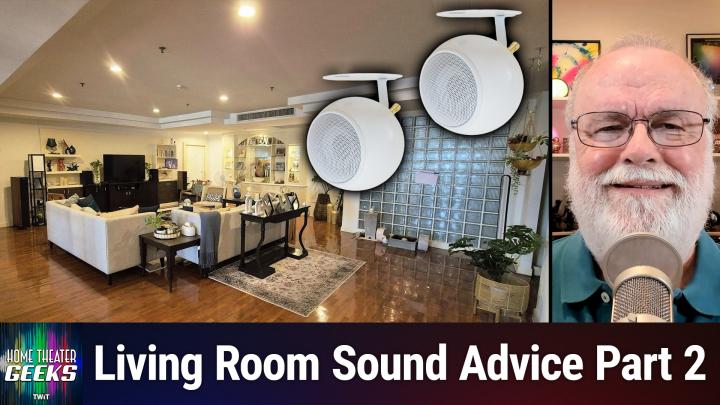
And he came up with some good ideas. So let's get into this. So to remind us, I want to show you the living room of Zorawan man, who had a speaker system set up that was pretty unusual, not ideal. And if we look at graphic 1A, we can see that he's got an open, open living room. He's got two floor standing speakers way outside the TV area, two bookshelf speakers closer into the TV and no center channel. And his original question was, what do I get for a center channel? But though, and here's another picture of it, we can see it's an open floor plan. It's not in a dedicated room, it's in a living room. And so I had originally said you should put speakers, the surround speakers, next to the back, back behind the couch, a little bit in the corners there where there are currently end tables.
Scott Wilkinson [00:02:07]:
The way he had the system set up was very strange. Looking at the next picture, we can see it has he had the Yamo S606s as his front left and right speakers and the B W 600s 3s as the surrounds. They're all in front. And I said, no, no, don't want to do that. Use the B and Ws as the front left and right because they're closer to the screen and they would make good front left and rights. Can't really put the yamos in the place where they need to be for surround speakers because you've got those end tables there. And his wife didn't want wires along the floor. And I can understand that.
Scott Wilkinson [00:02:55]:
That makes total sense. So he also can't drill holes in his ceiling to mount in ceiling speakers, so can't have those either. I was at a little bit of a loss. I offered some advice, but he needed a lot more than a center channel speaker. And he also wanted to add Atmos overhead sounds. But again, he couldn't put in ceiling speakers in that ceiling because it's anticipating maybe moving. So using up Firing Atmos speakers might be the only way to go there, so I couldn't offer that much helpful information about surrounds because I didn't see a good solution. But another listener who goes by the screen name Garst posted this in the Twit community forum quote I do have a solution for not running wires that is not necessarily a good one if you don't want to buy a new receiver.
Scott Wilkinson [00:04:12]:
But Yamaha receivers have a setting for speakers that are in the front of the room and the receiver uses digital processing to virtualize surround speakers even though the speakers are physically located in the front. I do not know if Denon receivers have a similar feature. As an aside, the original listener is using a Denon X 1300, so it's definitely something to check out before buying a new receiver. Of course, room design may limit how effective this type of setup is, but and you might be happy running 3.1.0 that is 3 left center right speakers in the front, a subwoofer and nothing surround in the surround speaker area or or above or a 3.1.2 which would be front, left center right, one subwoofer and two overhead speakers. Maybe those up firing types. Garst goes on to say also if you have small enough speakers, you can hang the surround and or height speakers from something like 3M command hooks and run the wires through the 3M command. He calls them hook things like they might be cable channels that are more barrel shaped close to the ceiling to make the wires less noticeable. So in other words run the wires along the ceiling.
Scott Wilkinson [00:05:43]:
They wouldn't be on the floor for somebody to trip over. You might also add decoration and or lighting that could make the wires running to the back of the room less objectionable and you could get speaker wire that matches the color of the ceiling which in this case is white. So thanks Garst, I really appreciate you sending me those suggestions and they're very good ones and it leads me to encourage other listeners to submit their comments about my answers. And if you come up with something I forgot or didn't think of, go for it. Love to hear from you. So I looked this feature up on Yamaha receivers and Garst is correct and it would even work with your current setup with you have all those speakers in the front of the room. In this case I would use the B and Ws as the front right and left and the Yamos as surround right and left, keeping them in the front of the room and enable something called Yamaha Virtual Cinema front and you can see here this is a diagram from the Yamaha Manual for one of the receivers that does this. And you can see that the surround left and right are sitting there in front of the room.
Scott Wilkinson [00:07:02]:
In the front of the room, on the outside of the front, left and right speakers. In Zorawar's case, the bookshelves would be on the inside and acting as the front right and left. And the yamos, the floor standers would be on the outside, which is currently what they're where they're positioned. Now, the Llamos as surround seems a bit of overkill, but that's what you got. So, okay. Now, will this work in your area without walls? I don't know, but it would probably not be as effective as it would be in a room that had walls because there's probably some dependence on reflection from the surround speakers in front to make them seem like they're in the proper location to the rear and to the sides. Now, I found one Dolby AV receiver with this Virtual Cinema Front feature. It's called the RXV 385.
Scott Wilkinson [00:08:13]:
It's a 5.1 receiver. It does not have any Atmos as a result, and Its cost is 400 bucks. So not that expensive. I looked at other models on Yamaha's website and they. A lot of them have what's called Dolby Height Virtualization. So they simulate Dolby Atmos type overhead speakers without actually having them. But those product pages do not mention Virtual Cinema Front. Except for the V385.
Scott Wilkinson [00:08:48]:
Some of them might have it. I actually asked Google AI and it said that the RXV4A and the RX A780 have it. But the RXV4A page on Yamaha's website only mentioned Dolby Height Virtualization, not Virtual Cinema front. And the RX A780 is a discontinued model, so I was unable to really find out about that. I also looked into the Denon AVR X 1300, which you have already, and it does have a virtual setting that simulates a surround sound field from just two speakers, front, left and right. If you were to go that route, I would retire the Yamos altogether. And there's no. No, even.
Scott Wilkinson [00:09:44]:
There's no need to buy a center channel speaker either, because it will simulate that in this virtual setting. I would guess that it's not as good as Yamaha's Virtual Cinema Front. That's kind of a cool idea that I had not heard of before. I looked at some of the product pages of some of the other Denon models like the AVR X 1800 and the X 1700. But they only mention this height virtualization. They do not mention surround virtualization as the 1300 has. They might have it, but there wasn't anything highlighted on the product pages. So you could either buy a Yamaha X385, a V385, sorry.
Scott Wilkinson [00:10:41]:
And try this virtual front virtual cinema front feature, or you could try the virtual setting in the Denon X 1300 that you already have, in which case you wouldn't even use the Amos. I'd put them in another system, have a nice two channel system somewhere. Another thing Garst reminded me of is that you could mount small surround speakers or even height speakers on the ceiling, not in the ceiling, which would leave only tiny holes where the anchors would be if you, if you screwed them into the ceiling. In fact, this is how my own system is configured. That's exactly what I do in my room because I have one wall that's completely open and you could run the ceilings along the wires along the ceiling and they wouldn't be on the floor. Your wife still might not like that. You could run them in above the ceiling, that is in the crawl space or the attic area above the ceiling. If you wanted to get fancy, then you wouldn't see them.
Scott Wilkinson [00:11:56]:
He also mentions these things called 3M Command Hooks and that's a brand name from 3M. They're called Command. And I've read about a bunch of home theater people who hang small speakers from these 3M command hooks which use adhesive rather than screws to affix to a wall or a ceiling. And they claim to be removable and leave no residue. So that'd be great for you in terms of wanting to make sure that you can be ready to sell the house and not worry about holes in the ceiling. So you know, that's another possibility. Now for small unobtrusive on ceiling speakers, I recommend a company called Orb Audio and we'll put their link to their website in the show notes. They make small spherical high quality speakers that can be mounted just about anywhere and they come in white or black.
Scott Wilkinson [00:13:08]:
So here's a pair of white ones which would be I would recommend for your place and they'd be close to invisible sitting on your wall on your ceiling. These are the called the mod one and they are single spheres. Here's a picture of them on a ceiling. They sell for 189 bucks each or a two pack for 369. And the mounts that, that you can get for them are about 25 bucks. So this is a nice solution, I think you could use these for the surrounds and also the Atmos speakers. Put the surrounds above and slightly behind the couch and the Atmos speakers slightly in front of the listening position, aiming down at the listening position. And.
Scott Wilkinson [00:13:57]:
And that would work great. Now, in episode 531, I did not get specific about up firing Atmos speakers. So if you wanted to go that route, you have a ceiling that would accommodate that. And you mentioned the Polk XT90 and you said it didn't get great reviews. So I've got a few other suggestions for you to check out. They include the Sony SS CSEM 2, which are seen here. Single driver speakers. They sell for 200 bucks a pair, which is really good.
Scott Wilkinson [00:14:39]:
I did mention Elac, but I didn't mention any specific models. So there's The ELAC debut 2.0 Atmos sell for 3.99 a pair. Also single channel, actually dual concentric. There's a tweeter at the center of the. Of the larger woofer driver. And Elac, they make great speakers. So those would be good, I'm sure. There are the Klipsch RP140SA speakers, which are bigger, have two separate drivers.
Scott Wilkinson [00:15:12]:
They're about $500 a pair. And Polk also makes another pair called the Reserve R900, which are also dual driver larger, and they sell for $600 a pair. So if you're looking to save money and not spend very much, I'd look at the Sonys or the elacs. Those. Those are the two I would look at. But I would also consider hanging some little orb speakers from your ceiling. If you can get the wires there in a nice way, that will be acceptable to your wife. And that way you would.
Scott Wilkinson [00:15:57]:
That is a better solution for overhead sound and for getting surround sound to your particular location than any of these virtualization things would be. So there you go. I'm glad to be able to add some extra information, and I thank Garst very much for his input into this problem. And again, I encourage anybody else who listens to any answers I give and says, hey, what about this? Send it on in. I would love to hear about it and always love increasing my knowledge and sharing that knowledge with you. So if you have a question for me, you can also send it on to HTGTWIT TV and I'll answer as many as I can right here on the show. And if you have a home theater you're proud of, send me some pics. I'd love to see them.
Scott Wilkinson [00:16:54]:
And maybe get you on the show to talk about it. Until next time, geek out.