Home Theater Geeks 530 Transcript
Please be advised that this transcript is AI-generated and may not be word-for-word. Time codes refer to the approximate times in the ad-free version of the show.
Scott Wilkinson [00:00:00]:
In this episode of Home Theater Geeks, I profile a home theater by an owner who takes DIY to the next level. So stick around. Podcasts you love from people you trust. This is Twit. Hey there, Scott Wilkinson here, the home theater geek. In this episode, I'm going to profile a home theater that I Originally profiled on AVS forum way back in 2014. The Home Theater was built by Bjorn Eric Forberg, Norwegian, who built this theater in his home near Oslo, Norway. Now, not only did he build the theater itself, he built the speakers and the acoustic diffusers in the room.
Scott Wilkinson [00:01:08]:
This is DIY to the nth degree. Now the theater is built in a long narrow basement, in half of it, I should say. And the other half was going to be his workshop where he built everything from scratch. So here you can see these, this long narrow basement. And he built basically a room within a room. You can see in this plan drawing which he created. Look at this as if the central section is sort of the view from above. And the four side sections are the walls.
Scott Wilkinson [00:01:51]:
Imagine that if you had a box, an open box, and you folded down the sides of the box, that's what this would be. So those four side panels are the side walls. And you can see there that you can see the speakers in the front wall. You can see the absorbers are in yellow, the diffusers are in green, you can see the seats there, and so on. So it's a very nice way to do a floor plan, or rather a plan drawing I should say, because it's not only the floor, it's also the walls in two dimensions. It's. It's pretty cool. So Bjorn built a room within a room for maximum sound isolation.
Scott Wilkinson [00:02:41]:
He really wanted to be able to crank it up and to not bother other people in the house. So the next graphic we can show you is the drywall, the room within the room. And you can see that the walls are double layer plasterboard with green glue in between the layers. And you can see there in the doorway that there's actually an air gap as well. So there is significant sound isolation between this room and the rest of the house. Now in the next graph we can see one of the speakers being built, and that is based on a design by a fellow by the name of Stig Eric Tongan. But Bjorn modified the design, as he put it. The LCRs include three Bama 15 inch woofers to reproduce the range from 25 to 200Hz, a tad 12 inch mid range to cover 175 to 2000Hz and a Bama horn tweeter that goes from 2200 up to 21,000Hz or 21 kilohertz.
Scott Wilkinson [00:03:59]:
All the surround channels are based on the same principle with a Bama 15 inch woofer covering 25 all the way to 900Hz and a Bama horn tweeter from 900 to 21Khz. They all have the same sonic signature as the front speakers, which is great in my opinion. Now, the subwoofers were designed to blend well with the main speakers. And these of course, were also built by Bjorn. He used Bama 18 inch drivers that extend down to 13 Hertz. And as he he wrote, when I tested the system, there were only level adjustments that were needed. I did not. You could not hear the sound cross between the mains and the subs.
Scott Wilkinson [00:04:52]:
Also, he said the subs are only used for LFE low frequency extension. All the main channels are set to large speakers, so the speakers themselves can reproduce full range. They're not crossed over as in most home theaters. And those large speakers can play from 28Hz all the way up to 20Khz and a little beyond. So, you know, he's not following the traditional wisdom, shall we say, of crossing over the main speakers to the subwoofer so that all channels get reproduced by the subwoofer, the low frequencies, but only the LFE channel gets reproduced by the subwoofers. So an interesting approach and his system can certainly handle it. Not many can. So here's a great picture of the.
Scott Wilkinson [00:05:46]:
In an intermediate stage of development, here's Bjorn sitting atop the center speaker to give a sense of the scale of that whole front center, that whole front system there. It's really remarkable. It's quite big. And here in this picture we can see the complete front speaker setup which fills the entire wall behind what will be the screen. The sensitivity of these speakers is remarkable. 103 DB per watt per meter for the front LCRS, 101 DB for the surrounds and 100 DB for the subs. He says he's measured the main speakers at 134db SPL, which is way louder than I would ever want to listen to this system. But it's one reason why he really wanted to build a room within a room that isolates from the rest of the house.
Scott Wilkinson [00:06:46]:
So Bjorn used a program called Acoustic Calculator to determine that the most problematic frequencies, in terms of reflection from the ceiling anyway, extended from about 750 to 3500Hz. And the areas that would create the most problems were down in the middle and near the walls. So he used 2 by 2 inch lumber cut into different lengths to build a bunch of diffuser panels, which we can see in the next graphic. These are com. This is a common design for diffuser panels. And he built some that were very long to place along the ceiling, which he said was one of the big problems of concern. And he also built some for the back wall, which we can see in the next graphic. In the back wall, he wanted to extend the frequency diffusion down to 200 hertz.
Scott Wilkinson [00:07:54]:
So he modified his diffuser design a bit and covered the back wall with these panels after all the treatments were installed on the ceiling and the back wall. Bjorn says the sound is very natural and open, which I wouldn't doubt. He's not using a lot of absorption except at the first reflection points on the side walls. So he's getting. I think I agree with. He must be getting a very natural and open sound. And he says the frequency response of the room is flat, down to 13Hz and up to 21Khz. But he says he adjusted, adjusted it to add a bit more weight to the lfe, those really low frequency rumbles for greater effect on movies, as he said.
Scott Wilkinson [00:08:42]:
You can see in this picture that the two DIY 18 inch subwoofers are in the lower corners. And all of this, the speakers and the diffusers were subsequently covered with acoustically transparent fabric. So Bjorn talked about the projection screen and he said he had a real challenge picking a good one. He tried 10 different screens, he says, and finally found one that does not destroy the sound and gives a good picture at the same time. It's 138 inch wide, 2.35 to 1 acoustically transparent woven screen from a Norwegian company called Dream Screen. And he built the frame for the screen with a hinge at the top so it could be lifted out of the way to access the speakers behind it. Good idea. I like that idea a lot.
Scott Wilkinson [00:09:41]:
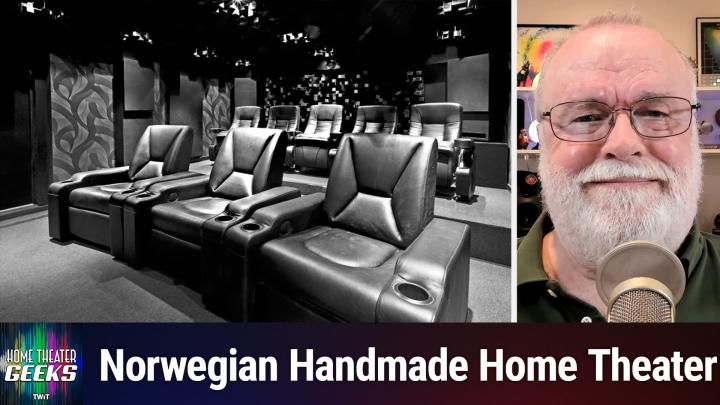
The seats which you can see in here in the next picture a little better, are also from the company Dream Screen. The front three are the Cinese seat promoter and the rear three are the theater model. So they look mighty nice to me. Now in the next graphic we can see some of the equipment that he is using. He's using Crown Itech amplifiers to provide all power to all those speakers, an active crossover and DSP. The surround processor is a shareborn PT730. Remember this is from 2014. And two Blu Ray players, the Oppo BDP 95 and 103, monster cables throughout.
Scott Wilkinson [00:10:34]:
And all these electronics that you see here are located outside the theater and controlled by IR repeaters. So let's take one final look at this wonderful theater. It's a really beautiful job if you ask me. I love that cloth on the, on the walls there with that swirly curvy pattern, all in blacks and grays. Beautiful, just beautiful. The projector, by the way, is the Sony VPL VW55ES. Now, as I mentioned before, he built everything himself. And as a result, the total cost of the room he reports was no more than about $8,000.
Scott Wilkinson [00:11:22]:
But the gear was another story. Bjorn estimates that the total equipment cost was maybe around $140,000. As he, as he explained, the VAT or value added tax is 25% in Norway, so everything costs more there. And okay, I can I get that. But I have no doubt it's worth every penny. I really think it, it's beautiful. Now we're going to put in the show notes a link to the build thread that Bjorn put up for his theater. And he joined in 2012 and he started this thread in 2012 as well.
Scott Wilkinson [00:12:09]:
I, I featured the theater in 2014 and if you were paying attention to the equipment, you probably noticed that the system is only high definition, not ultra HD or 4K. And it's 7.1 audio. There's no atmos. Unfortunately, Bjorn has since moved from this house and he couldn't bring the theater with him. According to his build thread. If you go to the last page, you will see a heartbreaking sight. He actually tore down the theater. So unlike many home theater owners, he didn't have the opportunity to upgrade that Beautiful system to 4K Atmos High Dynamic range.
Scott Wilkinson [00:13:02]:
I really wish he had been able to do that. But even without those enhancements, I'm sure that this theater was exceptional, spectacular in every way. And I hope it serves as an inspiration for others to dig into their hobby, their home theater hobby as diyers, because it's well worth it. If you have a question for me, send it on along to HTGWIT TV and I'll answer as many as I can right here on the show. And if you have a home theater you're proud of, send me some pics. I'd love to see them and maybe we'll get you on the show to talk about it. Until next time, geek out. .