Home Theater Geeks 524 Transcript
Please be advised this transcript is AI-generated and may not be word for word. Time codes refer to the approximate times in the ad-supported version of the show.
Scott Wilkinson [00:00:00]:
In this episode of Home Theater Geeks, I talk about Sony's 2026 audio and video product announcements. So stick around. Podcasts you love from people you trust. This is TWiT. Hey there, Scott Wilkinson here, the Home Theater Geek. In this episode, I'm going to talk about Sony's 2026 audio and video product announcements. Now, unlike most companies, Sony no longer announces their new products at CES in January. Instead, they wait until the spring and they announce their products at that time with online briefings, sometimes in-person briefings.
Scott Wilkinson [00:00:58]:
In this case, for me anyway, it was an online briefing, and they show you a PowerPoint and they tell you all about the new products. So that's what I get to tell you about. Now, most of the announcements this year were for audio products, but there was one new TV, so I'll tell you about that at the end. So first up is a new addition to what Sony calls the A-Series, or the premium line of soundbars, and it's the Bravia Theater 7. Has the official model number of HT-A7100, and it joins the Bar 8 and Bar 9. They're all roughly the same. They have different numbers of drivers and they're of different sizes, but, uh, you know, they're just different variations on a theme, shall we say. So the BAR 7 has 9 drivers, including 2 woofers, 2 tweeters, a center channel driver, 2 side-firing drivers, and 2 up-firing drivers for Atmos.
Scott Wilkinson [00:02:19]:
And it also has 4 passive radiators, which is meant to improve the bass performance. Now, the left and right front channels are actually two-way speakers, if you will. They each have a woofer and a tweeter. The center channel is a single driver, and it looks like it's maybe the same driver, or similar anyway, to the side-firing drivers and the up-firing Atmos drivers. And so all of that gives you a pretty nice spatial immersive type sound field. Now just for comparison, the Bar 8 has 11 drivers. We're talking 9 here in the 7s. The 8 has 11 drivers.
Scott Wilkinson [00:03:11]:
The 9 has 13 drivers. And though those two upper end models are a little bit bigger than the Bar 7. So the BAR 7 implements Sony's 360 spatial sound mapping and sound field optimization, and it gives you really a more immersive sound field with what are called phantom speakers, which they illustrate here with a nice little diagram. And, uh, I've heard examples of this in the past. I haven't heard this particular product, but I've heard examples of it in the past, and it's pretty effective, works pretty well. Now, the MSRP for the BAR 7 is $870. By the way, all the prices I'm going to give you today, Sony, um, specifies them as one penny less. So the actual MSRP of the BAR 7 is $869.99.
Scott Wilkinson [00:04:19]:
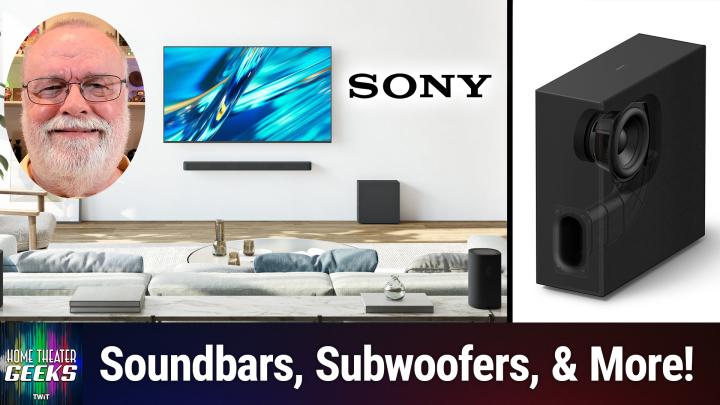
Well, I really hate that, and for my entire career as a journalist, I have rounded it up. When they give me a price like that, I rounded up a penny to make it much nicer. So I'm gonna say $870 list price for the Bar 7. Now, the next product category that they announced some new items in are subwoofers. And they announced 3 new wireless subwoofers that you can add to the theater bars, to this new Bar 7 and the Bar 8 and 9. And they are the Bravia Theater Sub 7, which has an official model number of SASW7, the Sub 8 and the Sub 9, with corresponding official model numbers, but that's what they call them. Now, these replace the— there were two subwoofers in 2025, the SW3 and SW5. Now, the Sub 7 has a 5.25-inch driver in a ported cabinet, and the pictures I'm going to show you are what are called X-ray renderings.
Scott Wilkinson [00:05:36]:
So they you can sort of see into what they look like. You saw some of that with the Bar 7 as well. So the Sub 7 has a 5 1/8-inch driver. The Sub 8 has a 7 7/8-inch driver. Say that 5 times fast. And the Sub 9 has dual 7 7/8-inch drivers in an opposing configuration. So that's kind of cool. Now Sony doesn't reveal specs like frequency response, so I don't know how low they go.
Scott Wilkinson [00:06:14]:
I would assume that the, the 7 goes down a certain ways, the 8th goes lower, and the 9 goes even lower. Now all 3 of these can be positioned in one of 2 ways. You can either position it up flat up against the wall with the port aiming sideways, or perpendicular to the wall with the port aiming straight out. You can also use them in a dual sub configuration with these, with the soundbar, the new Bar 7, as well as the other theater bars. And you can do it also, you can use— these are wireless, by the way, I should say, wireless subwoofers. That connect to the soundbars wirelessly. And you can do— you can use two of them, which I always recommend if you can afford it and you have the space for it, because it helps to tame room modes if you place them judiciously. You can also use dual wireless subwoofers, two of these new ones, with several Sony AV receivers such as the STR-A AZ7000ES, AZ5000ES, AZ3000ES, AZ1000ES, and the AN1000.
Scott Wilkinson [00:07:39]:
Um, so that's a nice feature. I like that quite a bit. So MSRP's— the Sub 7 is $330, Sub 8 is $500, and the Sub 9 is $900. Now interestingly, the, uh, Bar 7, which I talked about a little earlier, can be purchased in a bundle with the Sub 7. And so that would give you a, uh, that would give you the extra bass frequencies with that soundbar. And that bundle is, uh, has an MSRP of $1,100, which is $100 off the combined MSRP of the two products separately. Also announced from Sony, uh, is a new rear— or I should say surround satellite speaker. It's called the Bravia Theater Rear 9.
Scott Wilkinson [00:08:38]:
Uh, official model number is SA-RS9, and it replaces the RS5. Uh, whereas the rear 8 remains in the line. But as you'll see, I'm going to recommend if you're going to spend money on, on these wireless surround satellites, the rear 9 is, is really going to be worthwhile. The rear 9 has 3 aluminum drivers and 2 passive radiators. The front-firing portion of the speaker is a two-way design with a, with an 80mm woofer and a 16mm tweeter. There's also an 80mm up-firing driver for reflective Atmos, so that's cool. The rear 8 does not have up-firing drivers or passive radiators, and its diaphragms are made of paper instead of aluminum. So Sony's claiming higher quality there, and they also make a wireless connection to the soundbar just like the subs.
Scott Wilkinson [00:09:47]:
However, you do have to plug them into the wall because they are amplified. Another interesting sidelight here is that you can get new wall mount brackets which swivel over an angle of 60 degrees. You can also place them on a tabletop or a regular stand but I like that wall mount where you can aim them where, where they need to go. The Rear 9 also works with the Bravia Connect app for easy setup and operation, and it can be controlled directly from a Bravia TV. So, you know, that, that integrates things nicely if you stay within the Sony ecosystem. So how much? MSRP is $800 a pair. as opposed to the rear 8, which is only $450. So you're spending almost twice as much, but you're getting a lot more for it.
Scott Wilkinson [00:10:49]:
And if you can afford it, I'm, I'm thinking that's, it's, that's going to be worthwhile. Finally, in the soundbar category, they've also added something new to the S series, which is what Sony calls the foundation model rather than entry level. They don't use the word entry level, but foundation. Okay, I accept that. The Bravia Theater Bar 5, with an official model number of HT-B500, replaces the S400, and it's a package that comes with the soundbar and a dedicated subwoofer. Which is not one of the new models. It's specific to the Bar 5. So the system is 3.1 with a dedicated center channel and a right and a left, and then the subwoofer is the 0.1.
Scott Wilkinson [00:11:49]:
And the Bar 5 also uses Sony immersive virtualization, shall we say, called S-Force Pro. And vertical surround engine, which simulates the effect of height. And there's also a nice feature called voice zoom, which lets you adjust the level of the dialogue separate from other elements of the soundtrack, which is always a really big problem for a lot of people because they can't hear what's being said. Almost the most important part of it, of anything in a movie or a TV show. It also supports Dolby Atmos and DTS:X, even though you can't add surround speakers or anything to it. This immersive virtualization technology does give you a nice, a nice immersive sound field. You can also control it from a Bravia TV or the Bravia Connect app. MSRP is really nice, $350 for a 3.1 system with a soundbar and a subwoofer.
Scott Wilkinson [00:13:01]:
How well does it perform? I don't really know, but, uh, for it's cert— I have no doubt it's better than the TV sound. Okay, they, they announced one new model of television in their foundational line, not in their premium line. and it's the Bravia 3 Mark II, which is an upgrade from the Bravia 3 from 2024. It's an LED backlit LCD TV, as you would expect from the foundational line. The Bravia 3 had no local dimming, so I tend to doubt that this one does too, although we were not informed of this, and my question about that I'm still waiting for a response, so I'm going to assume not. And if it is, sorry Sony. It does have a number of significant upgrades from the Bravia 3 that I have to mention. Upgraded processing for sure.
Scott Wilkinson [00:14:07]:
XR processor, XR Triluminos color— Triluminos Pro, I should say. XR Clear Image processing of upscaling and reducing noise and jaggies, as well as motion blur reduction. So those are all processes— processors from the premium lines of Sony TVs. It's now migrated down into the Bravia 3, which is great. And they claim up to 25% brighter picture than the Bravia 3. Also really good, also really good is a native 120Hz panel. The Bravia 3's refresh rate, native refresh rate, is 60Hz. So that's a big improvement right there.
Scott Wilkinson [00:15:01]:
And it has 4 HDMI 2.1 inputs. The Bravia 3 is, uh, implements HDMI 2.0. So there's more gaming capability in the new set, such as 4K 120, variable refresh rate, VRR, and eARC. So that's a pretty big improvement right there as well. Sony claims that the Bravia 3 Mark II is perfect for PlayStation 5. It has HDR tone mapping, auto HDR tone mapping, auto genre picture mode selection. So when you turn on a PlayStation 5, it switches to game mode, and when you go back to movies, it switches back to standard mode. I, I hope there's a way to set it so that it'll switch back to cinema mode or to your custom calibration mode, although a TV at this level, you're probably not going to get custom calibrated.
Scott Wilkinson [00:16:07]:
So I would just pick cinema mode. Um, you can even stream PS5 or PS4 games from another location, another room in your house or something like that. It also has a dedicated game menu, so that's pretty cool if you're a gamer. Now, it's a Google TV smart platform, and it's the first Sony to incorporate Gemini AI. So that, that can help you search for content or even ask questions about the content. I don't know if you've played around much with AI, but, uh, it can be pretty useful if you're a little wary of the results and take it with a grain of salt. Uh, you'll be able to ask Gemini just about anything about anything on the Sony TV. So this just illustrates how much AI is being incorporated into the products we use every day.
Scott Wilkinson [00:17:10]:
It has live TV streaming with over 800 channels, 10,000 apps, and curated content with individual profiles that you can set up in the TV. And you can update the watch list from anywhere. It also, of course, implements voice commands, smart home control, um, stuff like that. So it's pretty cool. So what about the MSRPs? It comes in a wide range of sizes, from 43 inches up to 100 inches. That's a big TV. The, uh, so I'll give you the prices. Uh, 43 inches at $600, uh, 50 inches at $700, 55 at $800, 65 at $900, 75 at $1,200, 85 at $1,600, and the big whopper 100-inch TV at $3,100.
Scott Wilkinson [00:18:15]:
Now, the Bravia 3 doesn't come in a 100-inch size, but it comes in all those other sizes, and the prices for the Bravia 3 are $100 to $300 less than these prices I've just mentioned here. Um, so, you know, you're saving a little bit with the Bravia 3, but I think you're getting well worth the extra money in the Bravia 3 II with 120Hz panel, the upgraded processing, um, 25% brighter. There's a lot to like about this TV. Uh, so I would certainly recommend that you, if you're shopping for a new TV and the Sony Bravia 3 was in your, in your, uh, crosshairs, I would take a look at the Mark II for sure when it ships, which they didn't tell us when it's going to ship. Sometime this year, probably not too long from now. So there you have it, Sony's new audio video products for 2026. Some interesting stuff in there, I think, uh, and if I get a chance, I'll certainly, uh, give them a test run and let you know what I find out. Now, if you have a question for me, send it on along to htg@twit.tv, and I'll answer as many as I can right here on the show.
Scott Wilkinson [00:19:41]:
And if you have a home theater you're proud of, send me some pics. We might just put it on the show and might just get you on the show to talk about it. So I hope you'll do that. Until next time, geek out.