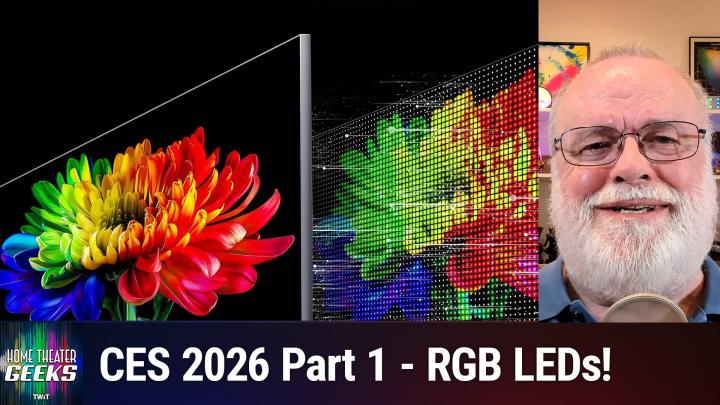
Home Theater Geeks 514 Transcript
Please be advised this transcript is AI-generated and may not be word for word. Time codes refer to the approximate times in the ad-supported version of the show.
Scott Wilkinson [00:00:00]:
In this episode of Home Theater Geeks, I begin my coverage of CES 2026 with my good friend Mike Heiss. So stay tuned.
TWiT.tv [00:00:12]:
Podcasts you love from people you trust.
TWiT.tv [00:00:16]:
This is Twit.
Scott Wilkinson [00:00:28]:
Hey there, Scott Wilkinson here, the Home Theater GE. Well, it's January 2026, which means it's time for CES. And back from his sojourn to that August institution is my good friend, industry journalist, consultant, and jolly good Cedia fellow, Mike Heiss. Hey, Mike. Welcome back.
Michael Heiss [00:00:51]:
Hey, Scott. Yeah. Oh, brother. What a fun filled six days in Las Vegas. It was. I, I, I've lost track. I think this was like my 46th or 47th or 48th. And next year is the 60th year of CES.
Scott Wilkinson [00:01:09]:
Wow. Wow. Well, I meant I might have to then decide to go back. I've gone about 30 times, I think, and I went, last time I went was January 2020. Just before COVID hit.
Michael Heiss [00:01:21]:
Right. Yeah.
Scott Wilkinson [00:01:22]:
And I haven't been back since, so maybe it's time to go changed.
Michael Heiss [00:01:25]:
I mean, the convention center is, you know, all the renovations are pretty much done. There are no buses in front. The taxis aren't there. Oh, wow, the cockamamie Tesla thing.
Scott Wilkinson [00:01:37]:
Right.
Michael Heiss [00:01:38]:
They kind of sort of, but really haven't announced the attendance figures. It looked like it was busy, but it's hard to tell. But it was, it was an interesting show. I'm tempted to say different and, and I think it's, it's at an inflection point. Next year might be a good time to, you know, we should all live and be well and we'll meet there next year.
Scott Wilkinson [00:02:02]:
Yes, next year in Vegas.
Michael Heiss [00:02:05]:
Next year. Oh, brother. But it's interesting there, you know, the Mirage is closed and they're building a big guitar. You know, I, I think if, if.
Scott Wilkinson [00:02:14]:
It'S becoming a hard.
Michael Heiss [00:02:16]:
If the tribes who I believe now own it were more into know wind instruments and that's part of their ceremonial practice. You know, you could, they could build a big tuba.
Scott Wilkinson [00:02:28]:
Exactly. Well, I hope they do. I wish they would.
Michael Heiss [00:02:30]:
That'd be great.
Scott Wilkinson [00:02:32]:
Well, listen, there's so much to cover that we're going to split this into three parts. And the first part is the big story in TVs, I think, which is called RGB Mini and RGB micro LED backlights on LCD TVs.
Michael Heiss [00:02:55]:
Say that fast three times.
Scott Wilkinson [00:02:57]:
Yeah. Really. So let's explain kind of what the basic idea is here.
Michael Heiss [00:03:06]:
Well, it's, you have to remember, you really do have to go back to basics. That's the key word. You have to remember that these are cold LED TV sets, but they're not. They're still, for the most part now even I'm doing it. LCD. LCD TVs. You know, it's complicated. When I'm slowing down, there still is a liquid crystal display that is the, the light gate that's shuddering on and off to determine whether there's some thing to be shown.
Michael Heiss [00:03:43]:
What is behind that is a backlight. In the origin of lcd, it was a ccfl, a cold cathode fluorescent tube. A fluorescent tube then. And that's why they were so thick in those days that lit up the LCD. But then they went to LEDs. Because they're more energy efficient.
Scott Wilkinson [00:04:03]:
Yeah, they're more energy efficient. And, and, and they're. They're little tiny spots of light rather than lines of light.
Michael Heiss [00:04:14]:
Yes. Well, and again, we went through the whole thing of whether it's edge lit or backlit, and now pretty much everything is, is backlit. But they went from LEDs to mic to mini LEDs to micro LEDs, which determines the size of the actual LED. Right. But they were either white or they were filtered. They were blue and filtered to colors, and that's what determines how the set works. But LED is a nice thing to sort of, you know, hang your marketing on. And that's what the brands did.
Scott Wilkinson [00:04:48]:
Yeah. And most of them are called LED TVs, or when.
Michael Heiss [00:04:52]:
And that just drives me crazy.
Scott Wilkinson [00:04:53]:
I know, Me too. Me too. And then more recently, quantum dots were put into the picture, and so they became QLEDs.
Michael Heiss [00:05:02]:
Right. And quantum dots for those of them. I'm sure everybody here knows it better than I do. That's the, the dope, the stuff, the goop that goes onto the LEDs to fine tune the color.
Scott Wilkinson [00:05:15]:
Well, actually, allow me to, to refine that a little bit. So with quantum dots, you have blue LEDs in the backlight and then red and green quantum dots embedded in a plastic film film that sits in front of the LEDs. And the blue light from the LEDs causes the red and green quantum dots to glow red and green and with.
Michael Heiss [00:05:39]:
Much more precision than previously. And that's the whole appeal. That's where the QD thing became a big benefit.
Scott Wilkinson [00:05:48]:
Right. And some of the blue light from the, from the LEDs passes through and doesn't hit any quantum dots. So coming out of the film, you have red, green, and blue that combine to form white. Then that goes through the LCD shutters, which have little color filters. Red, green, and blue color filters that actually form the picture. Well, now we have this new technology called RGB mini LED or RGB micro LED in which instead of having blue LEDs shining through quantum dot film, you actually have red, green and blue LEDs in the backlight forming what I would call a low res version of the image that's going to be on the screen.
Michael Heiss [00:06:45]:
And the best way, if people are looking for, you know, something to resonate and explain this, if you hearken back to my good old days of CRT projectors, CRTs at all, there were red, blue and green guns in the OR tubes in the CRT or the, or the projector. And this is sort of analogous to that. We have individual RGB light sources.
TWiT.tv [00:07:14]:
Right?
Scott Wilkinson [00:07:15]:
Exactly. And so these just pass right through the LCD layer and through. There are still color filters on each of the red, green and blue subpixels within the LCD layer and you end up with a high resolution image. Now the advantages of this, they are claimed advantages are better color, higher brightness, no white haloing. That is if you have a bright object on a dark background with these backlit LCD TVs, you can sometimes see a halo around them. And there's many, many dimming zones because.
Michael Heiss [00:08:01]:
That'S where the micro part comes in. Correct, because There are more LEDs to be individually turned on and off. But that's one of the things where to sort of jump ahead to the next part. That's where the OLED folks say, but we can turn on and off every pixel where these guys, where the, the Mini or micro LED guys can't.
Scott Wilkinson [00:08:27]:
Right now this technology does have a few problems of its own, which we're going to talk about a little later. But for the moment, so let's, let's go into some of the products that were at the show.
Michael Heiss [00:08:42]:
So one of the things that you have to sort of add in here going forward is that the whole dynamics of the TV business, the TV set business has changed dramatically over the last few years. With the original initial American legacy brands, the RCAs, the Zeniths, the, you know, Dumont if you will, you know, Motorola, Quasar, that whole lot of folk folks, for a variety of economics and political reasons, they were surpassed by what then became the dominant legacy Japanese brands, the Sonys, the Panasonics, the Toshiba's, the Hitachi's, Sharp, who came back this year, that group of companies. And they dominated the business for decade or so. But then on the scene came the Korean brands, the LG and Samsungs, and, and they've sort of just steamroller the other folk out of the market. But now in the last 10 years, you've seen the rise of the Chinese brands and predominantly the Hisense and tcls of the world. And they're not quite number two, but they're gunning for it. But if they're not number one, we're number two. We're number two.
Michael Heiss [00:10:01]:
And that's really changed it so that if you look on the floor, you saw LG in their usual place. You saw. Oh, you didn't see Samsung. Samsung totally decamped from the convention center and they took over a huge ballroom in the Wynn Hotel, the space that was occupied in past years by Samsung. The largest booth on the CES floor was now the TCL booth. And where the TCL booth was was the Hisense booth. So that's a business and marketing thing. But that was what all the noise was about at ces.
Michael Heiss [00:10:39]:
And then that turns back to what Scott was saying about this year. Yes. AI, AI, AI, AI. Okay, I got it. But the technology was the front story this year with all of these new backlight Blu backlight unit combinations of, of different flavors of mini LEDs or micro LEDs backlighting the LCD screen. So I hope that, you know, sort of explains it rather than makes it more complicated.
Scott Wilkinson [00:11:16]:
Well, we have a little bit of historical context, which is good.
Michael Heiss [00:11:19]:
Well, but it's important because, I mean, these guys were, you know, I wouldn't say it was fisticuffs, but it was marketing fisticuffs because they were each staking out their place in the market and their technology. And to some extent it's analogous to Dolby vs. DTS. Or let's see, what's another? Well, Atmos vs. DTS X or Dolby Vision vs. HDR10. HDR10+ where there are different companies, different technologies trying to do the same thing and reach the same goal, but through a different path.
Scott Wilkinson [00:12:04]:
Right. Well, let's take a look at some of the products that you saw. The first one that I have up is the Hisense 1 6.
Michael Heiss [00:12:13]:
Name, name an RGB technology. And they had it.
Scott Wilkinson [00:12:16]:
Yeah.
Michael Heiss [00:12:18]:
And. And through a vast. And they don't do OLED. So this was all LED. Now what you have on the screen, this 116 UA, 116 UXs, RGB. But it's not RGB, it's RGBC. Because if you can have three colors of RGBs, why isn't four better? So they've added a cyan and as huge as 116, the picture was great. Do not anybody please ask Me whether this thing know which one was better because other than one display that I'm sure we'll get to later on or in the next episode.
Michael Heiss [00:13:01]:
With tcl, you couldn't see these things side by side.
Scott Wilkinson [00:13:05]:
Right.
Michael Heiss [00:13:06]:
So you had to rely on your visual memory to say which one was better. But they were all pretty bloody good.
Scott Wilkinson [00:13:13]:
Yep, yep. So this one adds a cyan sub pixel and I wanted to mention that it's got an audio system, a built in audio system by a company called devialet which is very high end.
Michael Heiss [00:13:30]:
And again with the noise floor of the convention center.
Scott Wilkinson [00:13:35]:
Oh, who can tell, you know, I.
Michael Heiss [00:13:36]:
Mean for goodness sakes, you couldn't, you couldn't tell. But I mean De Violet has a very good reputation and you know, I've heard them at Cedia and they're very, very highly respected.
Scott Wilkinson [00:13:50]:
Yep.
Michael Heiss [00:13:51]:
And of course AI to do this and AI for, you know, content recommendation. But again this year the focus on AI along with its place in the content recognition was the picture pixel control. Because when you've got these millions of little Mini or in some cases with Samsung and others, micro LEDs, the control of them requires quite a fair amount of processing power that all goes into the Cuisinart and you press the button and mix it and see how it comes out.
Scott Wilkinson [00:14:30]:
Right. These all have AI based processors and AI based user interfaces and recommendation engines.
Michael Heiss [00:14:40]:
And those were the pitches at the press events and in the booths.
Scott Wilkinson [00:14:45]:
Right. Hisense also had two less. Well, lower end, if we can even call them that, RGB mini LEDs. The UR9 which has screen sizes, will have screen sizes from 55 to 100 inches also.
Michael Heiss [00:15:05]:
Which, which. Yeah, I have to interrupt there because that's another trend. It's definitely continued through CES and the European shows, ISC and IFA and Cedia where bigger is better. There weren't a small set to be seen. They still make them. But 43 is small. Yeah, I mean you just, you know, put yourself in the time capsule and go back and say a 43 inch set is small.
Scott Wilkinson [00:15:35]:
Yeah, I remember when that was huge.
Michael Heiss [00:15:38]:
Yeah, I remember when you couldn't do that.
Scott Wilkinson [00:15:41]:
Yeah, yeah.
Michael Heiss [00:15:43]:
So you know, to see these, these large size screens not being considered large was, was pretty interesting.
Scott Wilkinson [00:15:51]:
Yep. And then the step down from this is the ur8, same thing, RGB mini led. I don't think these two have cyan sub.
Michael Heiss [00:16:00]:
No, they don't. No, the cyan is. I mean that's a higher end. Yeah, you know, thing. Yeah.
Scott Wilkinson [00:16:05]:
And both of these also though have audio systems. By deviala.
Michael Heiss [00:16:09]:
So and I would hope that somewhere along the line I'll find someplace where I can go and actually listen to them and see. Because you know again these are high end audio systems but with little teeny tiny speakers instead or with you know, satellite speakers for the surrounds.
Scott Wilkinson [00:16:34]:
Right.
Michael Heiss [00:16:35]:
Right.
Scott Wilkinson [00:16:36]:
Now hisense did have one micro LED direct view which is not.
Michael Heiss [00:16:43]:
And and for that, that says micro led but just for clarity let's call those DV LEDs because it, the DV stands for direct view because there, there ain't, there ain't no stinking filter, there ain't no sticking LCD. You are looking at, at the panel, at the LEDs and what some of the brands called it to avoid because they, they as well wanted to avoid the confusion. They call these direct emissive.
Scott Wilkinson [00:17:16]:
Right.
Michael Heiss [00:17:16]:
As opposed to backlight. But generally when, when I'm writing about this for residential tech today and hidden wires you call these DV led and that's the categorical name for these Right.
Scott Wilkinson [00:17:31]:
Now this is a giant. This is 163 inches.
Michael Heiss [00:17:34]:
Yep, yep, yep.
Scott Wilkinson [00:17:35]:
And interestingly they also added a fourth sub pixel this time yellow which interestingly.
Michael Heiss [00:17:43]:
Is something that sharp back in.
Scott Wilkinson [00:17:47]:
Now it was Phillips I thought.
Michael Heiss [00:17:49]:
No, sharp. Also back in the day they had a yellow led maybe memory as they say, memory fades.
Scott Wilkinson [00:18:00]:
Right.
Michael Heiss [00:18:02]:
But I mean it's not a new concept but it is now done with these micro LEDs and the picture was, was, was really really good and the price was really, really really really high.
Scott Wilkinson [00:18:16]:
If you, you know, if you have to ask, you can't afford it.
Michael Heiss [00:18:19]:
Exactly.
Scott Wilkinson [00:18:20]:
Well, LG was also in on the micro LED backlight TV game.
Michael Heiss [00:18:28]:
But not to the exclusion of oled.
Scott Wilkinson [00:18:31]:
Correct, I'm talking about OLED in the next episode.
Michael Heiss [00:18:35]:
Right, but, but you know, because that's where we are now in the discussion. But you know, leave anyone not to be confused that, that they're still pushing OLED big, big time.
Scott Wilkinson [00:18:47]:
Yeah, yeah. But they had a micro RGB LED backlit LCD tv.
Michael Heiss [00:18:53]:
And if you notice in this slide that you've gotten LG both had an off site press briefing presentation that I attended as well as the booth. And the things on that slide also show where LG in this case in particular and the other brands in general were pushing the feature set which is over on the right hand side. 330Hz motion booster. Now it's really 165 but that's significantly faster than we used to see and that is an appeal to the gaming world at the other end. Where you see 100% of BT 2020, that was something that up until recently, like within the past year, you could only do in a projector. You could only do when we used to go to the TV Academy and watch the, you know, six head Christie Dolby Vision Projector.
Scott Wilkinson [00:19:53]:
Right.
Michael Heiss [00:19:53]:
That could do 100% of BT 2020, but you couldn't do that on a set.
Scott Wilkinson [00:19:59]:
Now you can actually, actually, no, you can't. This I believe, this I believe is a deceptive marketing practice and we're going to talk about that in a minute. So let's put that aside just for the moment.
Michael Heiss [00:20:16]:
Well, but I did also run into our friend Joe Kane.
Scott Wilkinson [00:20:20]:
Oh, did you? I haven't seen him in a while at the show.
Michael Heiss [00:20:22]:
Yep, he's, he's Joe Kane, you know, and, and God bless him, he's, he's a great guy.
Scott Wilkinson [00:20:28]:
Yep.
Michael Heiss [00:20:28]:
And you know, and he would just sort of grouse about this as, as is his nature. Because he's a color purist.
Scott Wilkinson [00:20:35]:
Yes.
Michael Heiss [00:20:36]:
And you go, well, there is no BT 2020 content, so what's the big deal? And, and I've heard that other. But it's a great marketing thing and it takes people like you to set the record straight on this. But notice what's on this side.
Scott Wilkinson [00:20:58]:
What do you mean that this is.
Michael Heiss [00:21:00]:
Something that they're promoting?
Scott Wilkinson [00:21:01]:
Oh, yes, yes, yes. And, and I'm gonna, I'm, I am gonna do my best to, I mean. Yes. To debunk it to some degree because it's not entirely correct.
Michael Heiss [00:21:16]:
But that won't stop people from promoting it. No. And to be fair to lg, they were all doing it.
Scott Wilkinson [00:21:23]:
Yes, correct.
Michael Heiss [00:21:24]:
They were all doing four brands. LG, Samsung, TCL and Hisense were all saying 110% of BT 2020, which is.
Scott Wilkinson [00:21:33]:
Which is physically impossible.
Michael Heiss [00:21:35]:
Well, so what?
Scott Wilkinson [00:21:36]:
Yeah.
Michael Heiss [00:21:37]:
Oh, I'm sorry. I said I wouldn't make you laugh.
Scott Wilkinson [00:21:40]:
That's right.
Michael Heiss [00:21:40]:
But you know, but it's, it's a marketing thing.
Scott Wilkinson [00:21:44]:
Exactly.
Michael Heiss [00:21:45]:
And, and, and you know, and, and all of the brands were pushing this, which gives you a feeling as a consumer, Mr. And Ms. Listener out there. That's, that's what you're gonna see. You're gonna be bombard when these sketch sets start to roll out. You're going to be bombarded with this stuff.
Scott Wilkinson [00:22:04]:
Yep, yep. Well, one more TV to take a look at. And that was from Samsung, the R95H. Another micro RGB TV. Here's a picture you actually took on the show floor.
Michael Heiss [00:22:17]:
Yep. That was in their display in The Wynn. And because they weren't in the convention floor. And it is the same design language that they've used before with their 85s, but now it's this sort of easily kind of thing. And again, you know, with the caveat that these shots were taken either with my old Sony Nex 3, which I'm afraid I may have to get rid of because it's not as good as it used to be at one point, or with my Pixel 9 XL Pro. So it doesn't do it justice. But the, the picture was. Was really, really good.
Scott Wilkinson [00:22:57]:
This, I believe, was the largest micro RGB LCD TV on the floor at 130 inches.
Michael Heiss [00:23:05]:
I believe so. Or on the. In the exhibit.
Scott Wilkinson [00:23:08]:
In the exhibits. Yeah. Not on the show floor. Yeah, yeah, yeah. Last year they showed one like this at 115 inches with a list price of $30,000.
Michael Heiss [00:23:20]:
And I don't believe the price and availability has been announced for this yet, but if you can afford it, you don't have to ask. More power to you.
Scott Wilkinson [00:23:30]:
Exactly. But the press release did say that 26, 20, 26 would see 55, 65, 75, 85, 100, 115 inches. So as we were saying before, a lot of quote unquote, smaller sizes as well.
Michael Heiss [00:23:45]:
Well, smaller relative to 130.
Scott Wilkinson [00:23:48]:
Right.
Michael Heiss [00:23:48]:
And one interesting thing when we were talking just a little bit ago and I was mentioning dvled that again, if you roll the pages back on the calendar two or three or four years, both to CES and cd, the big focus was the wall, right. From Samsung and not mentioned, you know where to go. It's still there. And they have a big business in that, particularly in the commercial, industrial and enterprise world. But that was not the focus at all. It wasn't even mentioned.
Scott Wilkinson [00:24:25]:
Wow.
TWiT.tv [00:24:26]:
Hey, Scott. Hey, everybody. This episode of Home Theater Geeks is brought to you by my mattress. No, I'm not asleep right now. And you're not dreaming. How are you preparing for winter if we're in the northern hemisphere, summer in the southern hemisphere. If you're up here, you're probably spending as we are, more time indoors. If you're in the southern hemisphere, you're probably a little warm at night.
TWiT.tv [00:24:49]:
Perfect time to invest in a new mattress. In both cases, stay comfortable inside with your Helix mattress. I love our Helix mattress. No more night sweats, no back pain, no motion transfer. Don't settle for a mattress made overseas with low quality and questionable materials. Rest assured, your Helix mattress is assembled, packaged and shipped from Arizona within days of placing your order. You can also take the Helix Sleep quiz. We did that which will match you and your sleep style with the perfect mattress.
TWiT.tv [00:25:21]:
It's based on your personal preferences, your sleep needs. You know, Helix Sleep did a Wesper sleep study. They measured the sleep performance of participants after switching from their old mattress to a Helix mattress. And just in my own experience, this is exactly what I found too. 82% of the participants in this study saw an increase an increase in their deep sleep cycle. In fact, they averaged 25 more minutes of deep sleep per night. That's the sleep that fixes you up, that's crucial to health. Participants in this study on average achieved 39 more minutes of overall sleep per night.
TWiT.tv [00:25:54]:
It really helps time and time again. Helix Sleep remains the most awarded mattress brand tested and reviewed by experts like Forbes and Wired. Helix delivers your mattress right to your door with free shipping in the US and rest easy with seamless returns and exchanges. The Happy with Helix guarantee provides a risk free customer first experience. They really are serious about this ensuring you're completely satisfied with your new Mattress. Go to helixsleep.com theater for 20% off site wide during the new year sale extended. That's helixsleep.com theater for 20% off the new year's sale extended. Now this offer ends January 15th, so hurry.
TWiT.tv [00:26:33]:
Make sure you enter our show name after checkout so they know we sent you. And if you're listening after the sale ends, don't worry, check them out. They've got great deals@helixsleep.com theater home theater geeks. Please use that address so they know you saw it. Right here with Scott, Helix sleep.com theater thank you, Helix. Thank you, Scott. Now back to the show.
Scott Wilkinson [00:26:54]:
Okay, well I want to address in the last part of this episode the this 100% BT 2020 claim that all of them were making. My friend and yours, Jeff Jurich, who is the VP of marketing at Nanisys.
Michael Heiss [00:27:13]:
And who guy who knows what he's talking about.
Scott Wilkinson [00:27:15]:
He knows. He knows his technology really, really well.
Michael Heiss [00:27:18]:
Yep.
Scott Wilkinson [00:27:21]:
He pointed out to me that no LCD based Display can reach BT 2020. 100%. It can only be done with carefully tuned lasers since the BT 2020 primaries are what are called monochromatic. And he sent me a graphic to show what this means that here on the, on the left you can see true BT 2020 where the primaries are these thin little lines, right? Yep. But on the right you have the spectrum of of a tv, probably a Mini or a micro led RGB LED backlit LCD tv say that five times fast, as we know. And it's not super thin lines, it's peaks and valleys. And that means it can't be done. So it's.
Scott Wilkinson [00:28:30]:
It's a little misleading. And I'm going to keep saying that. Now they do get closer than TVs in the past, probably around 91, 92%. He says the previous record holder was the Vizio R series, if you can believe that, at 87%. Now, Jeff goes on to say that claims of 100% BT 2020 coverage are likely based on the area of the coverage triangle in the CIE chart. But that triangle doesn't perfectly align with the BT 2020 triangle. We have that in a graphic as well.
Michael Heiss [00:29:14]:
Yeah.
Scott Wilkinson [00:29:16]:
So the. In this graphic, you can see the black triangle is actually BT 2020, and the white triangle is the color gamut, if you will, of an RGB Mini LED model in which the red, green and blue were measured separately or sequentially. And then the third triangle you can see there is in kind of gray is the same RGB MINI LED with RG and B on at the same time. And then just measuring the green, the blue and the red. So they're not aligned perfectly with BT 2020, but the area might be close to the same in terms of area measurement.
Michael Heiss [00:30:07]:
But that there. And there are other things that I know you're going to talk to, and this is something that's, you know, we'll hold over, I guess, to the. To the next episode. That tcl, when they were talking about their SQD sets, which are not rgb, that they were, you know, talking about some of the other issues that can happen with the RGB, just because of the nature of having three LEDs per color as opposed to one and the filters. So there's no perfect. Jeff is clearly right. There's nothing perfect in any of these. And each manufacturer will promote their own technology and what they feel is.
Michael Heiss [00:30:56]:
Is delivering the best picture. Clearly it'll be theirs right at the end of the. At the end of the day, it's up to the viewer. You know, what I think is a good set is likely to be different from what our buddy Joe Kane thinks. And what you see, it's in the eyes. It is literally in the eyes of the boulder.
Scott Wilkinson [00:31:15]:
True enough.
Michael Heiss [00:31:15]:
And again, I have to say, in fairness to all the brands, all of these sets look really good when viewed in a vacuum. When you put them together then. Which you don't get very often.
Scott Wilkinson [00:31:32]:
You mean next to each other?
Michael Heiss [00:31:34]:
Yeah, together, yes, obviously next to each other. You Know, then you can say, oh, yeah, that one's better. That one, not so much. Wow, that one's really good. But individually, each of these is significantly better than what we've seen in past years.
Scott Wilkinson [00:31:48]:
Yeah. Yeah. I just wanted to quickly mention a couple of problems that other artifacts that these RGB LED backlights can exhibit. For example, color haloing. You know, I mentioned earlier that with a white backlight, you can see white halos around bright objects on dark backgrounds. Now you're going to see colored halos, which could be even more distracting. Hard to say.
Michael Heiss [00:32:21]:
And TCL pointed that out.
Scott Wilkinson [00:32:23]:
Yeah. And there's another thing called color crosstalk. For example, the. You might get some crosstalk, some green bleeding into the blue, or vice versa, and you can see some hue shifts in real time, especially evident in skin tones. For example, did any of the demos you saw on these sets include human faces?
Michael Heiss [00:32:50]:
Nope.
Scott Wilkinson [00:32:51]:
I would bet not.
Michael Heiss [00:32:53]:
And human faces with a diverse group of people, even more so. Different skin tones, which is even harder.
Scott Wilkinson [00:33:04]:
Yes.
Michael Heiss [00:33:04]:
Because everybody's, you know, skin pigmentation is different.
Scott Wilkinson [00:33:10]:
Right.
Michael Heiss [00:33:10]:
And there was none of that. It was typical classic demo material. Right. Even the set, even the slides that you showed, you could see what, what they were, what they were using.
Scott Wilkinson [00:33:25]:
Right, Right. Exactly. Hey, everybody.
TWiT.tv [00:33:28]:
Leo laporte here with a. A little bit of an ask. Every year at this time, we'd like to survey our audience to find a little bit more about you. As you may know, we respect your privacy. We don't do anything, in fact, we can't do anything to learn about who you are. And that's fine with me. I like that. But it helps us with advertising, it helps us with programming to know a little bit about those of you who are willing to tell us.
TWiT.tv [00:33:53]:
Your privacy is absolutely respected. We do get your. Your email address, but that's just in case there's an issue. We don't share that with anybody. What we do share is the aggregate information that we get from these surveys. Things like 80% of our audience buy something they heard in an ad on our shows, or 75% of our audience are IT decision makers. Things like that are very helpful with us when we talk to advertisers. They're also very helpful to us to understand what operating systems you use, what content you're interested in.
Michael Heiss [00:34:22]:
So, enough.
TWiT.tv [00:34:24]:
Let me just ask you if you will go to TWiT TV Survey 26 and answer a few questions. It should only take you a few minutes of your time. We do this every year. It's very helpful to us. Your Privacy is assured, I promise you. And of course, if you're uncomfortable with any question or you don't want to do it at all, that's fine too. But if you want to help us out a little bit. Twit TV survey 26, thank you so much.
TWiT.tv [00:34:49]:
And now back to the show.
Scott Wilkinson [00:34:51]:
One last thing to show before the end of this episode. And that's a little video clip that Jeff Urich at Nanisys also sent me. Admittedly, this is from lg, illustrating one potential artifact with this new RGB mini LED backlight technology. Take a look. So here we can see some color, color crosstalk on an OLED on the left. They, they look nice and sharp and crisp, but there actually is some bleed. I'm sorry, that wasn't an OLED on the left. That's, that's an RGB mini led.
Scott Wilkinson [00:35:42]:
And local dimming can cause this really bad crosstalk at the boundaries between colors.
Michael Heiss [00:35:52]:
It's interesting that you're showing this, Scott, because in the LG off site suite they showed a demo very similar to what Jeff has constructed here of a mini RGB versus an oled.
Scott Wilkinson [00:36:10]:
Right. And here we can see dragging a white flag, but you can see the color of the plane affecting a little band of color on the white flag color smear. And the previous little bit was showing how flesh tones can, can be affected by the color of the background. So, and I must say, this is not from the. Jeff didn't put this together. This was put together by lg.
Michael Heiss [00:36:44]:
Okay, well then, then, then that's exactly. I, I thought you said that Jeff, Jeff sent it to you, but it.
Scott Wilkinson [00:36:51]:
Was put together by lg.
Michael Heiss [00:36:53]:
So that is exactly the demo that. Not with the, with the airplanes, but they have one with a little choo choo train and they had the exact same type of demo to prove that point where even though LG is using both technologies, their heart belongs to lc. I'm sorry, Their heart belongs to oled.
Scott Wilkinson [00:37:15]:
Correct, correct.
Michael Heiss [00:37:16]:
And, and that exact demo, and they even had a screen with the LCD panel removed. And you were just looking at the backlight through the filter to show to, to prove that point. So for all the noise at CES about all of these new variations of LED backlight technology there. Don't take that, dear viewer listener, to think that OLED is dead.
Scott Wilkinson [00:37:48]:
Right, right, right. You are. Even though LG is working on the same technology.
Michael Heiss [00:37:55]:
Well, you know, they, as my father used to say, they got to make their numbers.
Scott Wilkinson [00:37:59]:
Right?
Michael Heiss [00:38:00]:
And, and, well, it's not. I mean, and it's more than that because of all the competition from the other brands. They would be remiss if they didn't have RGB sets. Yep. Or just regular LED backlit sets because the rest of the market is being, you know, drowned in it. That and given the price differential and given the, the brightness, although that they were claiming up to 4,500 nets for, for OLEDs. But, you know, good luck with that. But, you know, TCL was claiming 10,000 nets for their, for their SKDs.
Michael Heiss [00:38:43]:
So it's necessary for them to, from a financial marketing standpoint, to have something. So they're, you know, playing both sides of the. The fence.
Scott Wilkinson [00:38:54]:
Yep. Yep. Well, listen, that's enough for now, I'd say.
Michael Heiss [00:38:59]:
We got so much more to talk to everybody yet.
Scott Wilkinson [00:39:03]:
We got a lot more to talk about. We'll do that in the next couple episodes. For now, why don't you let us know where people can find you online?
Michael Heiss [00:39:13]:
You can find me online in residential Tech Today, ResTech Today.com and Hidden Wires. Hidden Wires.co.uk you know, sort of two different markets with different views. And you'll see my coverage there. And as always, I welcome the opportunity to help Scott out with home theater geeks.
Scott Wilkinson [00:39:34]:
Well, thanks. And don't forget your own website, michaelheist.com Yep.
Michael Heiss [00:39:38]:
Yeah, that guy. Who is that guy? And whoops, where are they? And these guys?
Scott Wilkinson [00:39:43]:
Well, thanks, Mike. I really appreciate it.
Michael Heiss [00:39:45]:
Anytime, Scott.
Scott Wilkinson [00:39:46]:
Yeah.
Michael Heiss [00:39:47]:
So I'm gonna send you some chicken soup.
Scott Wilkinson [00:39:49]:
Oh, thank you. Thank you. I appreciate that. I could use it. So. So that's part one of three of our coverage of ces. Most of the time, though, I love to answer listener questions. So if you've got one for me, send it along to HTGWIT TV and I'll answer as many as I can right here on the show.
Scott Wilkinson [00:40:14]:
I'm also looking for interesting home theaters from our listeners. So if you have one, send me a couple of pics again to HTGWIT TV and maybe we'll get you on the show. Until next time, geek out, Sam.