Home Theater Geeks 506 Transcript
Please be advised that this transcript is AI-generated and may not be word-for-word. Time codes refer to the approximate times in the ad-supported version of the show.
Scott Wilkinson [00:00:00]:
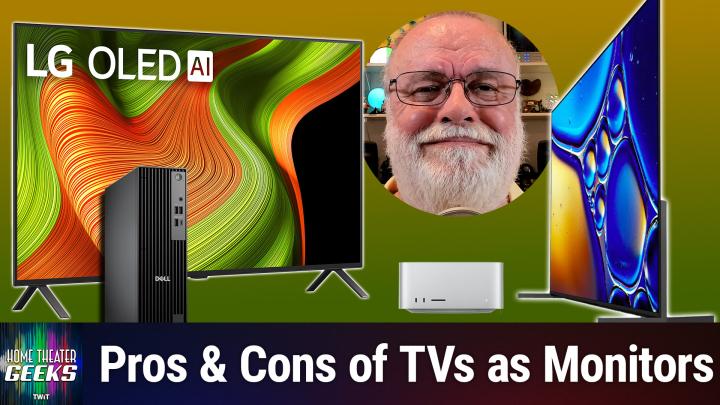
In this episode of Home Theater Geeks, I answer a question from John Hunter who wants to use a high end TV as a computer monitor. Good idea or not? Stick around podcasts you love from people you trust. This is twit. Hey there, Scott Wilkinson here, the home theater geek. In this episode, I answer a question from John Hunter who writes I have a question about using high end TVs as primary computer monitors. For my current setup I use two 43 inch Samsung TVs side by side with a Mac studio and the massive 4K workspace is fantastic. I believe this is an underappreciated use case offering incredible screen real estate for much less cost than traditional computer monitors. Now I'm building a second workstation and I'm strongly considering the new Sony Bravia 865 inch QD OLED.
Scott Wilkinson [00:01:20]:
The problem is that most TV reviews focus on movie and gaming performance, but rarely cover the specific details for desktop use. What are your thoughts on using a premium TV like the Bravia 8 as a primary monitor for a computer like a Mac studio? Any guidance on whether this is a brilliant idea or a costly mistake would be greatly appreciated. Well, thanks John. I appreciate the letter here. First, let's get the model number straight. The Sony Bravia 8 is a conventional OLED, what's often called WRGB or W OLED, while the Bravia 82 is the QD OLED. So that may be the one you're thinking of. Sony's nomenclature is quite confusing here, but it is what it is.
Scott Wilkinson [00:02:16]:
You're right that large TVs are quite a bit less expensive than comparably sized computer monitors. Large monitors can be very expensive. I think they're mostly intended for corporate use or studios or something like that with deep pockets. But you and I don't have deep pockets. So what about using a big TV as a computer monitor? Well, there are several things to consider. First of all, of course, as I said, the TV is bigger. It might seem like a good thing, but. But let's say you have a 32 inch monitor and a 65 inch TV and they're both 4K ultra HD.
Scott Wilkinson [00:03:01]:
They have the same number of pixels. Which means that in the larger TV the pixels are much farther apart. Which means, in other words, to say, the pixel density, it becomes much lower. If you sit 2ft from a 65 inch TV, you're going to see those pixels, those individual pixels, and that's going to be a real problem. Plus you won't be able to see the whole thing at once. You're sitting so close and the TV is so big that you're going to have to scan around to see the whole screen. It'll also feel overwhelming. I would think so.
Scott Wilkinson [00:03:42]:
Let's take a look at this chart which I got from ratings.com it's common chart. It's around, it's been around a long time. So according to this chart chart which shows you the optimal viewing distance for different sizes and resolutions, if you take a look at the 65 inch along the horizontal axis and you go up to the lower line of the HD Worth it area, you're going to see that's at 4ft. So if you sit at 2ft, you're definitely going to see those pixels. Another related consideration is viewing angle. With a super wide viewing angle, which is what you're going to have if you sit really close, parts of the screen in your peripheral vision will look worse than what's right in front of you. So speaking of viewing angle, the for movies and TV, the recommended viewing angle, that is the angle that the TV subtends in your vision is 30 to 40 degrees. For a 50 degree angle you'd need to be around 5ft away.
Scott Wilkinson [00:04:55]:
At 2ft away the viewing angle is greater than 90% which you can see in this graphic. Here you can see the recommended viewing distance viewing angle of 30 to 40 degrees. 30 in orange, 40, 40 in blue, 20 degrees doesn't really matter. In your case, 50 degrees is the green dotted line and at 65 inch size that's 5ft away. So at, at 90 degrees or more or at 2ft rather, you're going to have a viewing angle of 90 degrees or more probably. So that's, that's really big. Now I mentioned ratings.com they have a really good article on TV size versus distance and includes considering, considering the resolution as well. But it's geared toward viewing movies and TV shows.
Scott Wilkinson [00:05:53]:
Doesn't really have calculations for sitting very close to the screen. We'll put the link to that article in the show notes and that's something I recommend that you read for sure because it'll give you some good information, some of which I've given you here. But there's more to it. Now if you're doing content creation, color accuracy is paramount. Modern high end TVs do have very excellent color accuracy by default in the filmmaker mode or the cinema mode. But if you're doing content creation, you probably want to get it fully calibrated. And if you don't have the skills and equipment to do that, you're going to have to hire somebody and I really highly recommend doing that. And be sure to turn off any color processing that the TV might be doing.
Leo Laporte [00:06:47]:
Hey everybody, Leo laporte here and I'm going to bug you one more time to join Club Twit. If you're not already a member, I want to encourage you to support what we do here at Twit. You know, 25% of our operating costs comes from membership in the club. That's a huge portion and it's growing all the time. That means we can do more, we can have more fun. You get a lot of benefits ad free versions of all the shows. You get access to the club, Twitter, discord and special programming like the keynotes from Apple and Google and Microsoft and others that we don't stream otherwise in public. Please join the club.
Leo Laporte [00:07:27]:
If you haven't done it yet, we'd love to have you find out more at TWiT TV Club TWiT and thank you so much.
Scott Wilkinson [00:07:35]:
You mentioned video games and you didn't seem too concerned about that. But I will mention that if you are playing video games on your computer, which so many people do, many monitors have a variable refresh rate or VRR and TVs now are starting to have that as well. The Sony Bravia 8.2 does have VRR up to 120Hz using Nvidia's G Sync software or algorithms I guess you'd say to to manage that, a few TVs can go up to 144Hz or higher. The LG G5 goes up to 165Hz and it supports AMD's FreeSync, which is an alternative platform for variable frame rate, which is free as opposed to Nvidia's which you have to manufacturers have to pay for. Now the Bravia8.2 has a game menu with the its gaming features there. But the trick is if you're going to be playing video games, you want a TV with as low an input lag as possible and you want to look for reviews that measure this, which ratings.com reviews do. The Bravia 8.2has an input lag roughly 8.6 milliseconds at best. Depends on the circumstances.
Scott Wilkinson [00:09:07]:
It can be a lot greater than that, but that's the best case scenario. Whereas the LG C5 has 5.3 milliseconds, so it's better. And input lag and response time are also important for monitors. For overall things like mouse movements, you don't want to move your mouse and have the cursor move a perceptible time later. Another thing to keep in mind about OLED TVs in particular is that they can suffer from image retention. So if you have things on the screen that are static for long periods of time, like say a task bar or documents that are on the screen that don't move around, then it could cause image retention, which can be temporary. But if left on for really long periods of time, it can become permanent. So you don't want to keep stuff static on the screen for hours or days because that will certainly lead to Image retention.
Scott Wilkinson [00:10:20]:
So ratings.com also has a great article on what they consider the best TVs to use as computer monitors, addressing your very question. In that article they stress the importance of something called chroma 444 support. That's 4 colon 4 colon 4. It's a, an encoding of color which does not compress any of the colors in the image. And that's really important for text clarity. So the, the that article really makes a point of, of that and I think it's a valid point. Absolutely. They also talk about input lag and response time being important, good viewing angle, especially if you're sitting close to a large screen.
Scott Wilkinson [00:11:12]:
And so they give four picks for their best TVs to use as a computer monitor. Keeping these factors in mind, they include the Samsung S95F, which is Samsung's QD OLED. Very similar to the Bravia 8. 2, except it has a native refresh rate of 165Hz instead of 120, doesn't support Dolby Vision, but that's not important in a computer monitor. So I think the Samsung is fine. They don't mention the Bravia 8 Mark 2 in this article. So perhaps, I'm guessing maybe it doesn't handle chroma444 very correctly. I don't know.
Scott Wilkinson [00:11:54]:
That might be true or not, but they say nothing about it. And they say nothing about it in their Bravia8.2 review either. The other TVs that they mention as being good for computer monitors are the LGB5, which is a step down from the C5, goes to 120Hz and supports G Sync and two TCL models, the QM7K and the QM6K, both of which go up to 144Hz. So I would look at one of those and I would place your 65 inch model, whatever, whichever one you happen to get more than four feet away, I hope you can do that because that way you won't see individual pixels, you'll be able to see the whole screen a little better. And since these TVs all handle chroma 444 properly, you'll see crisp text. They have low input lag, I'm sure, which means the mouse will mouse response will be good, and everything will be good. So there you go. Thanks for writing in.
Scott Wilkinson [00:13:07]:
Now, if you have a question for me, send it on along to HTGWIT TV and I'll answer as many as I can right here on the show. Until next time, geek out.