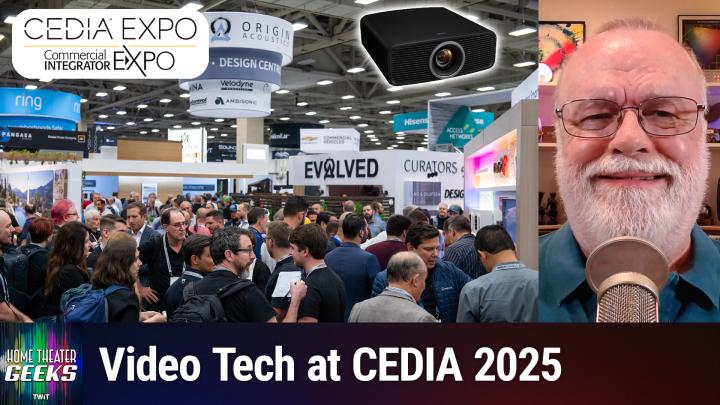
Home Theater Geeks 499 Transcript
Please be advised this transcript is AI-generated and may not be word for word. Time codes refer to the approximate times in the ad-supported version of the show.
Scott Wilkinson [00:00:00]:
In this episode of Home Theater Geeks, I'm joined by my friend and industry consultant Michael Heiss, and we're going to be talking about the recently finished CEDIA 2025 Expo. So stay tuned.
Scott Wilkinson [00:00:32]:
Hey there, Scott Wilkinson here, the home theater geek. In this episode we're going to be talking about cedia, the Custom Electronics Design and Installation association, which had their expo last week in lovely Denver, Colorado. And I'm joined by my good friend, industry consultant and journalist and jolly good CEDIA fellow, Michael Heiss. Hey, Mike, welcome back to the show.
Michael Heiss [00:01:03]:
Hey, Scott, how you doing? It's been a while and happy to do a report on the convention from the convention center behind the Big blue Bear.
Scott Wilkinson [00:01:12]:
The big blue Bear. I remember it well. Now this I don't know about you. I went to CEDIA for at least 20 years, probably more. You've been probably going for 30 or more.
Michael Heiss [00:01:25]:
I have an asterisk like Roger Maris used to. Everyone except for one during COVID one after Covid, and one like six weeks after my stroke. And I was sort of advised that it wouldn't be a good idea.
Scott Wilkinson [00:01:41]:
Not a good idea.
Michael Heiss [00:01:42]:
But I've been through and instructed at every one.
Scott Wilkinson [00:01:46]:
Wow. And you're wearing your CEDIA instructor T shirt there.
Michael Heiss [00:01:50]:
So we all know and instructed four courses in one panel, which is why I'm a little ditzy right now.
Scott Wilkinson [00:01:57]:
Yeah. And you just got back like yesterday, right? Or day before.
Michael Heiss [00:02:01]:
Yes, Saturday night.
Scott Wilkinson [00:02:02]:
Yeah. Yeah, man. Well, thank you so much for coming on, even though you're probably still a bit jet lagged. And so we're going to talk about the show in two parts, two episodes. This part we're going to focus on video. And one of the important parts of this story is what was not at the show. I mean, that's. That was quite amazing to me.
Scott Wilkinson [00:02:28]:
What, what can you tell us about that?
Michael Heiss [00:02:29]:
Well, there are one or two things, I think that, you know, industry and business writ large and tariffs and all that nonsense. That could be one factor. The other factor is that the same week, last week as CDA was ifa, the International Funkenstanken in Berlin, which is a. It is, you could call it the CES of Europe. Except a couple of the days are open to the public and picture, you know, 150,000 people coming to a venue that's the size of a good community college. But a lot of the exhibitors that weren't at CEDIA were, were at high, high sense being one of them. With some very important announcements. Just chose not to come to see you this year because they were already.
Scott Wilkinson [00:03:21]:
At IFA in Berlin.
Michael Heiss [00:03:24]:
Yep, yep. But, you know, LG wasn't it. It was a good show.
Scott Wilkinson [00:03:29]:
LG wasn't it. They had a meeting room, but they didn't have a booth. Digital projection, planar. There were a number of companies that weren't there. The other interesting thing, sort of non thing was that almost all of the products that you saw there were not introduced or announced at cedia. A lot of them were introduced at ifa. So IFA kind of took cedia's thunder a little bit, huh?
Michael Heiss [00:03:58]:
Well, I think again, there are some, you know, things amiss in the world at the moment that is responsible for that. But I don't think it's necessarily a bad thing that there weren't any new. New. New. Never saw it before first showing up because that shows that there's some stability in the business. Because it's interesting when you, you know, spelled out C E D I A. Just like NPR is not National Public Radio anymore, it's npr. The NAB is not the national association of Broadcasters.
Michael Heiss [00:04:31]:
It's NAB because the membership is. Is comprised of many other people. So now it's cedia and it's the home for smart. Oh, man, I'm gonna get. I'll have to look it up. Smart home professionals. But it is because it's not just the home theater people anymore. There's a heavy, you know, sorry, it was a heavy dose of lighting and shades and men.
Michael Heiss [00:04:59]:
Home control, of course, and backup power and things of that nature that are not traditional or home theater at all. But the industry, as the industry has grown, what the people who practice in it have grown to do other things than just home theater.
Scott Wilkinson [00:05:17]:
Right, right. Last year you told us about the. The laundry chute system that people could.
Michael Heiss [00:05:24]:
Put in their home. But I got a better one for this year.
Scott Wilkinson [00:05:26]:
Yeah, you got a better one for this year. We'll talk about that later. Let's do start with TVs, however, because, you know, T. TVs are an important part of. Of any home system. And TCL was there, for example, with their QM9K. That's a pretty new model, brand new.
Michael Heiss [00:05:47]:
Announced at the show.
Scott Wilkinson [00:05:48]:
Oh, this was one that. This was an exception. This was actually announced at the show.
Michael Heiss [00:05:52]:
Well, ECO has done a very interesting thing. They had a huge booth at CES this year, as they always do. But rather than sort of show everything that they were going to announce for the year at ces. They did a very interesting thing and they did phased introductions. So since CES, you've had the QM7, the QM8 and now the QM9. So they're sort of bringing them out in bits and pieces. And I will say the TCL, which is now about 20 years in the US market, where some people used to say, yeah, you know, that's just for warehouse clubs.
Scott Wilkinson [00:06:27]:
Right.
Michael Heiss [00:06:27]:
The fact that TCL for the second year in the row was at the Cedia Expo shows where they're going. And that set, that QM9, that was, you know, the match for almost anything.
Scott Wilkinson [00:06:42]:
Yeah. You said it looked really good and I believe you. It's a quantum dot mini led backlight, LCD TV, 4K, 144Hz refresh rate. So it's good for gaming. Supports all the high dynamic range systems powered by Google Gemini, which is, I believe, Google's AI. Right.
Michael Heiss [00:07:04]:
Yes. If we just go back to ces, it was one of those strange things where LG and Samsung are going with Copilot and Hisense and tcl, which are kind of the top four brands these days. The positioning may vary, but they're the top four brands who Hisense and TCL went with. Google. Yeah, Gemini.
Scott Wilkinson [00:07:25]:
Yeah. And TCL also had in their booth their 115 inch behemoth, the QM7K, which you took a picture of. And here it is. And I use this picture. You sent me several of it. And I use this one because there's a picture of what a 75 inch.
Michael Heiss [00:07:44]:
Yeah.
Scott Wilkinson [00:07:44]:
Is inside the, the frame of the 115 inch. So that's quite a bit more screen real estate.
Michael Heiss [00:07:53]:
And in fact, when I sent you that picture, I looked at, I said, did I send them the one of the 115 or the 75? And then when you see that black border around it, you realize what they're doing.
Scott Wilkinson [00:08:04]:
Yep, exactly. Which I thought was very cool. Okay, next up we have Samsung and they a few months ago announced, along with a couple other companies that they were going to start doing LED backlights, but not white backlights, but rather red, green and blue RGB backlights.
Michael Heiss [00:08:26]:
Yep.
Scott Wilkinson [00:08:27]:
And they announced either at Cedia or shortly before that, those LED backlights were going to be micro scale, not mini LEDs like most high end TVs today. But micro RGB LEDs are still backlights to an LCD panel.
Michael Heiss [00:08:45]:
But they did announce that, or they said that they were going to do it back at ces. And I did see it at CES in the secret room behind the Secret room.
Scott Wilkinson [00:08:57]:
Right.
Michael Heiss [00:08:58]:
So that was the first time that I'd seen it. And at that point it was an 85. The one they had on the floor both at IFA and Cedia was a 115. And I gotta tell you Scott, that was if I had $30,000 I'd be buying one and a room where I could fit it and the money to punch a hole in the wall to get it in the house. I'd be getting one of those. It was the best flat screen I've seen ever. Wow.
Scott Wilkinson [00:09:27]:
Wow. Beating out.
Michael Heiss [00:09:28]:
Oh yes.
Scott Wilkinson [00:09:31]:
And in your opinion.
Michael Heiss [00:09:32]:
Interesting. The other two, in my humble opinion and the other guys that are doing that are hisense which are also doing an rgb but they're doing Mini, not micro.
Scott Wilkinson [00:09:45]:
Right.
Michael Heiss [00:09:47]:
So the technology that's in the Samsung is the same thing that's in the DV LEDs but it's used as a backlight. And interestingly Samsung, which had they said the largest booth on the show floor, but the Harman luxury audio people and their associated brands were also in that booth. They for the first time since they introduced it, did not show the wall. So they had this big RGB backlight set but no direct view LEDs in the Samsung.
Scott Wilkinson [00:10:17]:
How very interesting. Wow. They claim to that this marketing decision. Yeah, yeah, yeah. They claim that it hits 100% of BT 2020 color space which is the ultimate color space. And as you said before, it cost $30,000. Now very interestingly they have another 100. Go ahead.
Michael Heiss [00:10:38]:
No, but, but, but. Damn. Well, you know, Curtis Mathis, for those of you of a certain age, their advertising slogan was the most expensive TV set when TV sets were 21 inches. Most expensive TV set and damn well worth it. Yep, yeah, and I can say that about this one.
Scott Wilkinson [00:10:58]:
Yep. Well, interestingly Samsung had another 115 inch TV, the QN90F which is also 4K. It's I think it's a mini LED, conventional mini LED backlight that's in the next graphic set. That's a good looking set I'm sure. And they, and they charge $27,000 for that. So you know, you know it's like really you're gonna.
Michael Heiss [00:11:25]:
The pundits on the show floor that I spoke to said I'll bet they'll be lowering that price soon.
Scott Wilkinson [00:11:34]:
That picture we saw of it that you took also had a smart TV kind of theme to it which indicates Samsung and other manufacturers are banking on the TV becoming the smart hub of the entire home.
Michael Heiss [00:11:50]:
Well that, that shot that John just put up there, that was of matter and Matter Matters Media, you know, is the association for Smart Home Professionals or Residential Technology Professionals or I'm gonna probably get drunk. They're gonna take my lifetime achievement to work because I can't remember the day what they, what they are these days. Don't take it away from me. But that was a high point of showing the integration of the TV set as the center of control for the home. And that actually is not the micro RGB set.
Scott Wilkinson [00:12:28]:
No, I thought it was the Mini.
Michael Heiss [00:12:30]:
The Mini rgb, yes, that one was the Mini. That's what micro. They didn't show the smart things. Yeah, yeah, yeah. I mean, that's just showing how all these technologies are blending together.
Scott Wilkinson [00:12:41]:
Right, Right. Now, one category that you mentioned to me that I, I've seen for a few years now and it seems to be gaining steam is what are so called ART TVs, that is when you're not watching a TV show, they put art on the screen, you know, from museums or wherever. And we have a few pictures of those two. Skyworth, which is a Chinese company only now making, starting to come into the US Market. Right.
Michael Heiss [00:13:10]:
Yeah, they, they, you know, they've been around when, when I go on my business trips to China, they're all over the place. But for the past two or three years, they are very gradually, they're not just blasting in, they're doing this in a very determined manner. And they have some outdoor sets and then they have their one that you're showing the canvas set and it's 100 inch and it's a very good set. And you know, it's one of those things where the true test of all of these and it's Samsung's the frame, they kind of started this and TCL has the next paper and canvas from Skyworth and we on speakers are doing that in conjunction with Sony Bravia. The true test is if you look at it and you poke it, you want to say that looks like it's a real canvas. No, it's a TV set. And it is a growing category in the sense that if two years ago there was one and last year there were two, and this year there were three or four, that shows that the manufacturers wouldn't be making these things if there wasn't a market for.
Scott Wilkinson [00:14:17]:
Correct. And that's right.
Michael Heiss [00:14:19]:
Clearly there must be.
Scott Wilkinson [00:14:20]:
Right? Right. Samsung was also showing this on one of their 115 inches. I don't know whether it was the micro LED or the RGB or whether it was the regular LED that's the next graphic.
Michael Heiss [00:14:30]:
I was so wowed by the micro that I didn't pay attention of what they were showing it on.
Scott Wilkinson [00:14:38]:
Well, here's an example of them getting content from MoMA Museum of Modern Art that you can get and put on your TV when you're not watching a show.
Michael Heiss [00:14:49]:
Yep. And in fact it's interesting. In the early days of large screen says the first one was, I think it was the 103 inch Panasonic Plasma.
Scott Wilkinson [00:15:01]:
If you. 103.
Michael Heiss [00:15:03]:
I remember well when Bill Gates built his house, his big house on the lake up in Washington, he had I think about two dozen of them and he used those sets, albeit how many years ago for 103 inch plasma to show art.
Scott Wilkinson [00:15:20]:
Right, right. Exactly right. As you mentioned, TCL also had has an art based tv. Sony is partnering with Leon Speakers to do a studio frame series. They put a custom frame around Bravia 8 or 9, their current TV.
Michael Heiss [00:15:39]:
And you can do it with any of them. Yeah, the trick with this you can do it with, you know, you could do it with the, the set I bought at the yard sale last week. But the trick is it won't look too good. But the trick with these is that as you said, they package collections of art and a certain amount of it comes with the set. And then what a shock. You can subscribe for more art or as the CDFolks say, RMR recurring monthly revenue. Because when was the last time you had some software? You know, you can't get Adobe any of the Adobe things as a one time you gotta subscribe. You don't get Windows for free or not.
Michael Heiss [00:16:21]:
Windows Office 365.
Scott Wilkinson [00:16:24]:
Right. Microsoft Office.
Michael Heiss [00:16:25]:
Yeah, right. And they're all using that model so that, you know, good for them, good for them.
Scott Wilkinson [00:16:32]:
They make more money.
Michael Heiss [00:16:33]:
Yep.
Scott Wilkinson [00:16:34]:
Next.
Michael Heiss [00:16:35]:
Nobody made. No, no. Nobody makes money on TVs.
Scott Wilkinson [00:16:38]:
No, no, no, no. They make money on the subscriptions.
Michael Heiss [00:16:42]:
Exactly. Well why? Not to digress, but why stop now? Why did Walmart buy Vizio? Because they bought an ad channel and a way to deliver it. Of course nobody makes money on the TVs. But Walmart saw that there was a reason to buy a TV company who, you know, two or three years ago when we'd be talking about this, who'd have thunk it?
Scott Wilkinson [00:17:08]:
Yeah, yeah.
Michael Heiss [00:17:10]:
They were clearly not at.
Scott Wilkinson [00:17:13]:
Yeah, yeah, Vizio or Walmart.
Michael Heiss [00:17:17]:
Right.
Scott Wilkinson [00:17:19]:
Okay, next category is what you have called, and I think rightly so, DV led, Direct View led, what most people call micro led. Just to add to the confusion that is LED screens where the LEDs are microscopic and you're looking at their output directly, not through an LCD panel or anything like that. And there were a number of those because CD tends to cater to the, to a higher end clientele. And these things ain't cheap. There's the Quantum media systems. They've been there for a few years. Their XDR 4 dash 8K extreme is a micro LED direct view, 20ft wide. This is a, you know, a stock shot that the beauty shot that provided by Quantum that shows it in a, you know, a big residential home theater.
Scott Wilkinson [00:18:20]:
It's their fourth generation.
Michael Heiss [00:18:22]:
Remember Scott, that one of the advantages of this cost notwithstanding is that these things are modular. Yes. So that when you say it is an excise screen, it depends on how many module bricks you put together.
Scott Wilkinson [00:18:37]:
Correct.
Michael Heiss [00:18:38]:
And that also determines the resolution, which is a whole nother story. So they are. The DV leds appeal to the CDF because you can fit them to the room size.
Scott Wilkinson [00:18:50]:
Right, Right.
Michael Heiss [00:18:52]:
And you can fit them through the door.
Scott Wilkinson [00:18:54]:
And you can fit them through the door, which you couldn't with that Panasonic 103.
Michael Heiss [00:18:59]:
There was one that was put in a building in New York on the billionaires row that they had to haul up with a crane like you would a grand piano.
Scott Wilkinson [00:19:08]:
Yep, yep, I remember that. But that thing achieves 2000 nits of peak brightness which is, you know, that's. You can't get a projection system to do anywhere near that. It's also decent.
Michael Heiss [00:19:23]:
They didn't hesitate to say that.
Scott Wilkinson [00:19:25]:
Right.
Michael Heiss [00:19:25]:
And in fact where they have now gotten DCI approval for that system and it's getting put into some screening rooms and some, you know, places around here and in, in the entertainment community. And the only other one like that was the old Samsung Onyx. Now there are actually a few of them in the, in the theaters that Amazon owns down in Culver City, which I've been to. And one of them is ak and it's really good. But it this one, you know, year after year when Quantum has been there, they were clearly the best with the runner up in case Miss America cannot perform her duties to the Sony Sea leads. And they showed them there and interestingly they showed the C version, not the B version of the Sony is of Sony. I apologize. Yes.
Michael Heiss [00:20:17]:
The Sony B version is what they use for virtual sets. The C version is the kind of. Is for higher contrast and it was good, but it just, you know, nothing that I've seen compares to the Quantum.
Scott Wilkinson [00:20:31]:
Right. There's a couple graphics about, regarding the quantum number seven that I sent along here, let's take a look at that one. Which refers to. It's supposed to reflect about the DCI certification, which is Digital Cinema Initiative.
Michael Heiss [00:20:53]:
And the interesting thing that they were. What that slide is showing you is you can get way more brightness out of this than you can out of a projector.
Scott Wilkinson [00:21:04]:
Right.
Michael Heiss [00:21:04]:
Regardless of. Of which projector, whether it's a Barco or Christie, you can get way more brightness out of this greater than what the standard allows you to do. And that's what they're showing in that slide. So this is beyond cinema, like Dolby Vision. And they're all talking to each other about how to do this. But again, they're good guys, but. But not shy about saying how good it was.
Scott Wilkinson [00:21:34]:
And you know, okay, so they're blowing their own horn. That's fine. Another DV LED that I found very interesting that you told me about was from a company called awall A W, A L L, which is a company that also makes the AWALL AWOL UST Ultra Short throw projector. But now they've got a DVLED in sizes of throw.
Michael Heiss [00:22:02]:
I knew that all along. I actually didn't realize that until I asked them. And this year they did not bring any of the ultra short throws, but they. The only ultra short throw was a little Epson in the classrooms that I was teaching in. There were no ultra short throws on the floor. But they are. They apparently have been making walls for a while and, and they. And again, anything that comes to this market baseline is going to be good.
Michael Heiss [00:22:28]:
The question is how much better does it get given brand preference of the client and the budget.
Scott Wilkinson [00:22:36]:
Right, Exactly.
Michael Heiss [00:22:37]:
There was one other one that I apologize, I didn't send before.
Scott Wilkinson [00:22:41]:
Before you get there. Before you get there, I have a couple of graphics of the. Of the. A wall.
Michael Heiss [00:22:46]:
Sure.
Scott Wilkinson [00:22:47]:
That I wanted to show that you took. That you took the most of these pictures you. You took. So I thank you for that. There's 129 inch, but notice that there.
Michael Heiss [00:22:56]:
Are different pixel pitches at these.
Scott Wilkinson [00:22:58]:
Right. This is a 0.0, 0.9 which is fairly common these days. That's the distance between individual pixels or LEDs on the screen. And this one is a 21 by 9 ultra wide. So it's basically for wide. It fills up with widescreen movies.
Michael Heiss [00:23:17]:
Well, but again, remember it, remember it's determined. The resolution is dependent upon how many.
Scott Wilkinson [00:23:23]:
Bricks, how many tiles you put together. Right, exactly. And you also took a picture of the 163 inch, which I believe is probably. Yeah, that's a 16 by 9 same pixel pitch.
Michael Heiss [00:23:38]:
Because it's the same modules.
Scott Wilkinson [00:23:41]:
Right.
Michael Heiss [00:23:41]:
In a different configuration.
Scott Wilkinson [00:23:43]:
A different configuration. Now the quote that I got from their press release, which I thought was really interesting was they're claiming that they are going to be a quarter of the cost of their closest competitors. Now, of course, very few people talk about pricing at the show.
Michael Heiss [00:24:02]:
Not in this market.
Scott Wilkinson [00:24:03]:
Not in this market. Yeah. If you have to ask, you can't afford it, but.
Michael Heiss [00:24:07]:
Exactly.
Scott Wilkinson [00:24:08]:
But they are claiming, you know, that they're going to be 25% of what most other DV LED walls cost. So I'm going to be really interested in this one.
Michael Heiss [00:24:20]:
Yes, I agree.
Scott Wilkinson [00:24:23]:
You said you had another one in mind.
Michael Heiss [00:24:26]:
Yes, it's called C Seed and you may have seen this before.
Scott Wilkinson [00:24:32]:
Yes.
Michael Heiss [00:24:32]:
It rises up and then it unfolds. Yes, actually three panels and they are advancing that. And, and again, that is definitely. And if you have to ask, you can't afford it. But that's the nature of the custom market in, in the seated market. And I know a lot of the people who do the, you know, start homes of the stars kinds of things there. If you're doing Spielberg's house or Arnold's house or one of those. Excuse me.
Michael Heiss [00:25:06]:
The quality better be good because those guys know, last year the keynote speaker is. Your call was Barry Sonnenfeld. You didn't want to put a lousy system in Barry Sonnensfeld's house because he'd tell you.
Scott Wilkinson [00:25:17]:
Yes, in no uncertain terms.
Michael Heiss [00:25:20]:
Oh, very. No one, sir. He's the guy who stood up before an audience and again, it's worth repeating. I'm sorry. Of you know, more than a couple hundred CD guys. And he said, and you know what? HDR sucks.
Scott Wilkinson [00:25:36]:
Yeah, I know.
Michael Heiss [00:25:38]:
And you heard. Yeah, but you know, but. But then there's another portion of the market where it's. The bigger is better and the design perhaps is more important than the quality, which may not be. If you're a home theater geek, that's one thing. But you know that there are people in the market that are looking for different things. And the CC is not the best quality perhaps, but it fill. But it's really good and it fills the need.
Michael Heiss [00:26:07]:
And that's what the CD member community is all about.
Scott Wilkinson [00:26:11]:
Right, right. There were also DV LEDs from Barco and Sony. The C LED. Crystal LED. Yep. And again, those are, you know, very expensive and in some professional installations and, and screening rooms and stuff, but they ain't going to be in the average home anytime soon. This awol, who knows? We should.
Michael Heiss [00:26:36]:
We'll see. I mean, Samsung has been promising smaller and lower priced direct View, not the micro LED that we've been talking about, but full on direct view. Direct view. I guess that's what the, you know, the DV is for.
Scott Wilkinson [00:26:54]:
Right.
Michael Heiss [00:26:54]:
They've been promising smaller sizes, but I think it's quite possible that by the time they're done with the technology and the micro or RGB set, it's not worth having them be any smaller. And that way you'll never get the price down. So that's one, you know, I'll let you know after. Cesar.
Scott Wilkinson [00:27:14]:
Right, right. Well, you're coming back in January to talk about ces, so.
Michael Heiss [00:27:18]:
Yes, I am not my reservations.
Scott Wilkinson [00:27:22]:
Now, Cedia used to be a big projector show and it just wasn't as much this time and it seems to have been declining a bit over the years.
Michael Heiss [00:27:32]:
Well, yeah, all of the demos, except for one were projectors and they were not only projectors, but they were big projectors and especially the one put together by Seymour Screens and Storm Audio and a bunch of Sendo and they had a huge Christie and there were signs and they'd say when they did the intro and before they ran the demo, do not look at the projector or you'll never look at anything again. And they weren't kidding.
Scott Wilkinson [00:28:09]:
Right.
Michael Heiss [00:28:10]:
And they were like, you know, laser warning labels. I mean, you know, serious stuff that some insurance company probably made them put up. So the pictures were bright, the pictures were good. But once again, the. With one exception, which I unfortunately didn't hear one demo that I know you're going to mention that you still can't poke holes in a direct view screen. And there are people that for imaging stake, they want a projector or you know, there's a cost and quality consideration, they want to be able to raise the screen, you know. So projectors are far from dead.
Scott Wilkinson [00:28:48]:
Oh no, no, I never meant to imply that. However, we. There were several projectors at the show, none of which were new. So Bravia. Sony had its Bravia 7 projector, which is.
Michael Heiss [00:29:02]:
Which they. Which was really good, by the way.
Scott Wilkinson [00:29:04]:
Yeah. And it's, you know, that's a $10,000 projector and it's qu. Good. I know Epson had nothing new. Well, I guess the newest was their LS9.
Michael Heiss [00:29:15]:
Small ones. Yeah, that's one or two small ones.
Scott Wilkinson [00:29:18]:
The S. The LS9000 is $4,000, so that's relatively low for the CDM market.
Michael Heiss [00:29:26]:
They also have the heart of that market. Yeah, because for all the guys doing $300,000, Christie's Embarcos where the average installation for a CDF firm is still in that 7025 to $75,000 range. All in.
Scott Wilkinson [00:29:48]:
Right.
Michael Heiss [00:29:48]:
A $4,000 projector is the heart of the market. A couple of years ago it's CDS. Sony's shtick was 4k for 4k.
Scott Wilkinson [00:30:00]:
Yeah, exactly, exactly. And all the Epson projectors now are 4k or pseudo 4k because they kind of do some pixel wiggling.
Michael Heiss [00:30:10]:
Pixel shift.
Scott Wilkinson [00:30:11]:
Pixel shift, right. JVC had nothing new.
Michael Heiss [00:30:16]:
They had an 8k pixel shift.
Scott Wilkinson [00:30:18]:
They had an 8k pixel shift, which is the DLA NZ 900, which is $30,000 or back up into that range.
Michael Heiss [00:30:24]:
And it was good. I saw it.
Scott Wilkinson [00:30:27]:
The DLA NZ 700 is 4K, that's $10,000. They call it the world's smallest native 4K Dila projector. Well, okay. There are no other Dila projectors except from jvc, so they can claim almost anything.
Michael Heiss [00:30:47]:
Dila and SXRD are sort of second cousins twice removed.
Scott Wilkinson [00:30:54]:
Well, they're very similar. They're based on the same technology called lcos.
Michael Heiss [00:30:57]:
Exactly.
Scott Wilkinson [00:30:58]:
Liquid crystal on silicon. That's a reflective technology. We. We don't need to get into that right now. And then there were the higher ends of course, that were in most of the demos. Probably the Barco Heimdall plus which was shown on 174 inch screen with Meridian speakers. That was probably a pretty nice demo. And The Christie Eclipse G3, third generation native 4K with RGB lasers.
Scott Wilkinson [00:31:27]:
The Barco also has separate red, green and blue lasers. They claim 20 million to one contrast ratio.
Michael Heiss [00:31:34]:
Those are the. Don't look at them.
Scott Wilkinson [00:31:36]:
Those are the. Don't look at them. Right. And of course, if you're going to put a projector in a theater, you need a screen. And there were a couple of interesting ones I saw in the press releases and stuff. EVP had the Dark Star UST3 elevate, which is a screen that motorizes up from the floor.
Michael Heiss [00:32:00]:
I did see that Stuart has had. Well, that's the thing about cdfoka. That is something that a lot of them have done before because you can take a Steward or a Seymour or you know, a DNP or whomever you are, an evp. And you can, yeah, you can do that by turning it around. And the seedy people, the good ones, and most of them are, are able to do that on their own. The advantage of what you just saw is that It's a package. So that means that they're, by putting it together like that, they're broadening the market.
Scott Wilkinson [00:32:41]:
Right, right. The other screen announcement that I thought was really interesting was from Screen Innovations and their Kaos KAOS screen, which weren't.
Michael Heiss [00:32:54]:
They the bad guys and get smart?
Scott Wilkinson [00:32:56]:
They were the bad guys and get smart, Exactly. They have this motorized screen intended for outdoor use in high wind conditions. They say it'll, it'll withstand winds up to 110 miles an hour.
Michael Heiss [00:33:12]:
If it's 110 miles an hour, I'm not being outdoors watching.
Scott Wilkinson [00:33:17]:
Oh, of course not.
Michael Heiss [00:33:20]:
Well, but you know, but Scott, you know, you know the area. You know, you, you lived here for many years. You know the area where I live. And one of these zoning things now to prevent McMansions, they found a way to do it Is they're using ADUs, like the turn your garage into a living unit.
Scott Wilkinson [00:33:38]:
Yeah, right.
Michael Heiss [00:33:38]:
Building these silly houses. And the ADUs, and one of the ones in my neighborhood, there was a projector in the overhang of the house and then the pool. That's typically the way they are. And then there was a screen that dropped down from the adu. So that's not as crazy as an application as it sounds.
Scott Wilkinson [00:34:01]:
As it sounds. Okay. All right. There was a number, but not in a hurricane. Not in a hurricane, for God's sake. There was at least one processor there. There were a couple that are used typically in high end installations. One is from a company called Lumigen.
Scott Wilkinson [00:34:20]:
The other is from a company called MadVR. And they had a fairly new one called the Core Mark 2, which for them is inexpensive. It's six or seven thousand dollars.
Michael Heiss [00:34:33]:
I'll take two.
Scott Wilkinson [00:34:35]:
Really. The Pro Mark 3 is $11,000 and the one that most people use, NV Extreme Mark 3 for 16 grand. And they all support 48 gigabit per second HDMI, which is the current maximum rate. So I just wanted to.
Michael Heiss [00:34:56]:
They all look good. But it was difficult going from demo to demo to separate the projector from the processor. Was that a MAD VR or was it a Lumigen? And unfortunately there's no way to really compare unless they're side by side.
Scott Wilkinson [00:35:11]:
Yeah, yeah. Now you mentioned to me that the 8k association was, was there and making its for 8k. Tell us a little bit about that.
Michael Heiss [00:35:24]:
Well, you know, people are saying 8k, what do you need it for? Why? You know, it's another thing. But there is a group within the gaming industry, the Hollywood Studios, if you will, whatever they're calling themselves these days and the consumer electronics world that are still increasingly pushing 8k. And the reason why they were there and they took a decent sized space on the floor was to show that some of the studios are remastering for 8K because if it was shot on film, if there's a good negative, if it was, you know, shot in three stripe Technicolor and you've got a good print and you've got a high res scanner, you can make really good video. There's a lot of stuff at ak and I did ask the AK association folk if there was any news. I mean coming up in the next couple of years and a lot of it's going to happen here in the US Super Bowl, World Cup, Winter Olympics, Summer Olympics, end of the world watching. Come on honey, we got to go. No wait, I'm watching it over there and there was no, I'm sorry, there was no, nothing that they could give me yet on whether or not there'll be any 8k out of the, out of the Winter Olympics. But you know, the real question is what are you going to view it on and how is it going to get to you? And 8K report.
Michael Heiss [00:37:00]:
Let me summarize it by this way. Reports of 8K's death are greatly exaggerated. Paraphrase, I guess Mark Twain.
Scott Wilkinson [00:37:08]:
Right.
Michael Heiss [00:37:10]:
And keep, keep a lookout on 8K. It's, it's, there's going to be a concerted effort and there are applications where it makes a lot of sense. And again especially CD Aware. Price is not always the object. It makes sense.
Scott Wilkinson [00:37:29]:
So you took a couple pictures I want to show of. One of them is, well, they're adopters, people who are actively working on creating 8K products or content.
Michael Heiss [00:37:42]:
There you go.
Scott Wilkinson [00:37:43]:
And here it is.
Michael Heiss [00:37:44]:
Especially mgm now owned by Amazon. They got a lot of movies. They got all hiker, got a lot of movies. And if you've got IMAX, I'd love to see an 8K of Oppenheimer because that was filmed in IMAX. Yep, much to the dismay of the studio. But you know, you don't argue with Christopher Nolan and Warner Brothers. He got a lot of movies. So look what they've done with.
Michael Heiss [00:38:14]:
What are they showing at the Sphere now in.
Scott Wilkinson [00:38:16]:
Oh, a Wizard of Oz.
Michael Heiss [00:38:18]:
Wizard of Oz, okay. There's a three strike technical.
Scott Wilkinson [00:38:23]:
They remastered that in 16k for the sphere.
Michael Heiss [00:38:28]:
So now the job's already done.
Scott Wilkinson [00:38:30]:
Yeah, really. Not only that, but digital movie cameras these days there, there are increasing, increasing numbers of them that'll go to 4k 8k rather oh, a lot of.
Michael Heiss [00:38:43]:
Some of The Reds are 12K.
Scott Wilkinson [00:38:44]:
Yeah, yeah, exactly. Also, there was another slide I wanted to show real quick of the. Of the ecosystem that they put up there. And look at all those companies that, that can handle 8K.
Michael Heiss [00:38:59]:
And, and I. And I have to say that there wasn't some, some guy in the front putting his camera up. That was in the slide.
Scott Wilkinson [00:39:08]:
That was in the slide. Okay, then all we need are 8K displays. And there are. Samsung is one company that's particularly interested in that.
Michael Heiss [00:39:16]:
And Sony has the projector.
Scott Wilkinson [00:39:19]:
JVC has the projector. So there are companies from which you can buy an 8K display and show that content.
Michael Heiss [00:39:26]:
I'm saving up for the Quantum.
Scott Wilkinson [00:39:28]:
There you go. I wouldn't blame you a bit. Just a couple other quick things before we end this episode. Kaleidoscape, which was the source device of choice for all the demos I think that you saw.
Michael Heiss [00:39:43]:
And all the, all the demos I saw and all the demos I didn't see because there was nobody else other than a couple of people where for a variety of reasons, they were playing stuff back from streaming. But Kaleidoscape, that a couple of years ago, I kind of poo pooed. They own it.
Scott Wilkinson [00:39:59]:
They own it.
Michael Heiss [00:40:00]:
Own it. And I didn't remiss in not pointing out to you that especially since Panasonic wasn't there, there were nary an optical video player on the floor.
Scott Wilkinson [00:40:13]:
Actually, I did read of one from a company called Magnetar.
Michael Heiss [00:40:18]:
I didn't see them there. I saw them at ces.
Scott Wilkinson [00:40:21]:
Yeah, no, apparently they were media. You know, you were busy.
Michael Heiss [00:40:26]:
Somebody else. No, they may have been in somebody else's.
Scott Wilkinson [00:40:29]:
They might have. They might have.
Michael Heiss [00:40:30]:
But if. If my oppo ever gives up the ghost, I'll have to get a Magnetar.
Scott Wilkinson [00:40:37]:
Yeah, I'm afraid so. Kaleidoscape introduced. Or suit, not. Not long ago, introduced the Strato E player, which is $3,000, which is their lowest cost player in their lineup. And it's 4K, so probably doesn't have.
Michael Heiss [00:40:52]:
Much storage of them.
Scott Wilkinson [00:40:54]:
Yeah, yeah, yeah. And the other thing that you brought to my attention that I wanted to. To just mention real quickly is from the company, Eero E E R O, they have something called the Signal. And tell us about that.
Michael Heiss [00:41:10]:
Okay, so, not to belabor the point, I get up on Father's Day. It's Father's Day. Why did I get up early?
Scott Wilkinson [00:41:17]:
Why did you get up early?
Michael Heiss [00:41:18]:
I got up because I'm crazy and I had to check my email problem. No email. Okay. I'M a smart guy, I'm a CD guy, I'm a cd, blah, blah, blah. I'll reset my switch, I'll reset my cable modem, I'll reboot my computer and then I'll call Spectrum. And as it turns out, there's been a rash of cable thieves in this area. And in fact, in Pasadena, up near where you used to live, there were people stealing fire hydrants and selling them for the base metal. And a bunch of thieves, probably not too smart, early in the morning before Father's Day cut what they thought were some telephone trunk lines.
Michael Heiss [00:42:07]:
Jokes on them. It was all fiber. So there was no Internet for any Spectrum customer for about 18 hours in most of LA and Ventura County.
Scott Wilkinson [00:42:19]:
Wow.
Michael Heiss [00:42:19]:
So, and I actually wrote an article about this in the current issue of Hidden Wires about always have a plan B. And I hot spotted from my phone. But so what Eero has now, and I actually am using Eero as we, as we speak here is a little widget that was in that picture and it's basically a 4G and 5G device. Guess what the device is $99, but it requires a subscription, of course. That into the back. Hey, you know, Jeff, Jeff Bezos ain't no fool. So you plug that in the back of one of your units and if the, if the Internet goes out, which these days is pretty, you know, hard for a lot of people, you got a backup source. And so that's, that's a very smart device.
Michael Heiss [00:43:10]:
But hint, you can hotspot it from your phone, but don't tell them I told you.
Scott Wilkinson [00:43:13]:
Okay.
Michael Heiss [00:43:14]:
All right, but I'm getting one of those.
Scott Wilkinson [00:43:16]:
Hmm. Well, it'll be interesting to see do a comparison between your phone and that thing, see which one does better.
Michael Heiss [00:43:22]:
Well, I mean, for the same reason there are UMA. If anybody's familiar with UMA VOIP phones, they have a similar kind of device because it's a plan. It really is a plan B. And in this day and age when everybody is so Internet dependent for your phone, for this, you know, thing that we're doing here, if you, if I wanted to find out what was going on, I couldn't turn, I could turn my TV set on, but I wouldn't see anything because I can't stream because there's no broadband.
Scott Wilkinson [00:43:51]:
Right, right. Well, man, that's an awful lot of stuff we just covered and it's not even the end. We're going to do a part 2, 2 here and talk more about audio and some of the mega demos that were there and that's going to come to you next week. But for now, why don't you tell our audience where they can find you? Online.
Michael Heiss [00:44:12]:
You can find me online in articles I write for Residential Tech Today,restechtoday.com and Hidden Wires, a very interestingly named publication, been around for many years. It mostly covers the European market, but they have some amazing installation things and some contribute contributions for myself, which is hiddenwires.co.uk. Why can't they be a dot com like everybody else?
Scott Wilkinson [00:44:45]:
Because they're in the UK now, before we go, before we go on you, you sent me the URL Hidden Wire, but I think with plural it should be plural.
Michael Heiss [00:44:55]:
Or, or you can complain that, you know, I'm losing it here to michael heist.com your own website.
Scott Wilkinson [00:45:02]:
And I just took a look at it because I didn't realize you had one before. And it's really nicely done.
Michael Heiss [00:45:07]:
Thank you. Thank you.
Scott Wilkinson [00:45:08]:
Yeah, yeah.
Michael Heiss [00:45:08]:
Especially the notary public part.
Scott Wilkinson [00:45:14]:
Okay, great. Well, listen, we're gonna go, we're gonna continue this on part two, but for now, thanks a lot for being here. In some episodes, I love to answer questions from listeners, so send yours along to htg@twit.tv and I'll answer as many as I can right here on the show. And as you know, all of TWiT's programs are available on YouTube for free, but with ads. If you want to go ad free, join the club, go to twit.tv/clubtwit and join today. Until next time, geek out.
TWiT.tv [00:45:52]:
Hey, thanks for tuning in to TWiT, your tech hub for intelligent, thoughtful conversations. If you want to take your experience to the next level and support what we do here at TWiT, say goodbye to ads and say hello to Club Twit. With Club Twit, you unlock all our shows ad free. You also get exclusive members only content. We do a lot of great programming just for the club members. You also get behind the scenes access with our Twit plus bonus feed and live video streams while we're recording. And don't forget the fantastic members only discord. It's where passionate tech fans like you and me hang out, swap ideas and connect directly with all of our hosts.
TWiT.tv [00:46:31]:
It's my favorite social network. I think you'll like it too. Club TWiT.
TWiT.tv [00:46:34]:
It's not just a subscription. It's how you support what we do and become part of the Twit family. Your membership directly supports the network, helping us stay independent and keep making the shows you love. If you're ready to upgrade your tech podcast experience, head to twit.tv/clubtwit and join us today. Thanks for being here and I'll see you in the club.