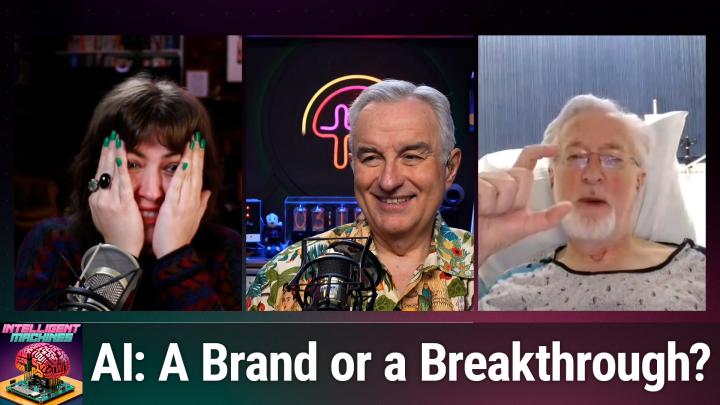
Why "Artificial Intelligence" Is Mostly a Marketing Term: Insights from Thomas Haigh
AI-generated, human-reviewed.
AI isn’t just technology—it’s a brand, shaped by decades of hype, disappointing setbacks, and strategic marketing. On Intelligent Machines, historian Thomas Haigh unpacks the real story behind “artificial intelligence,” revealing why familiar narratives about so-called AI winters may miss the bigger picture.
What Really Happened During the "AI Winters"?
Popular accounts of AI history often describe a series of boom-and-bust cycles known as "AI winters"—periods where optimism and funding crashed following overhyped promises of machine intelligence. But according to Thomas Haigh on this week’s Intelligent Machines, the reality is more complicated. Haigh’s research shows that while elite labs at MIT, Stanford, and Carnegie Mellon faced funding "frost" in the 1970s, the overall field wasn’t in crisis internationally or for most working researchers.
Key membership numbers, conference attendance, and international spread of AI research all grew in the so-called "winter" years. The idea of a deep freeze mainly came from insiders at a handful of privileged labs losing easy government money, rather than true global retrenchment.
The Role of Branding in Artificial Intelligence
Thomas Haigh traces the origins of the term "artificial intelligence" to John McCarthy at Dartmouth in 1955, where it was first used to draw in research funding. Since then, AI has functioned as a shifting brand—a way for researchers and companies to market their work and attract support. Sometimes, core technologies (like neural networks) fell out of the brand’s scope, only to return decades later under new names like "machine learning" or "deep learning."
According to Haigh, this branding matters. The name “artificial intelligence” sets grand expectations, framing computers as artificial brains and fueling science fiction scenarios of near-human or superhuman machines. This brand-driven hype cycle is what leads to repeated over-promising (and inevitable disappointment) in AI, not just technical limitations.
How Did the Narrative of "The AI Winter" Start?
The phrase "AI winter" itself originated in the mid-1980s, around the time leading thinkers were enjoying record funding and industry attention—but worried it wouldn’t last. Haigh points out that early panel discussions didn’t even mention a previous “winter.” Instead, later accounts—especially from MIT insiders in the 1990s—retroactively labeled the late ’70s as a period of “global retrenchment,” a view that was not supported by broader data. Much of what we think we know about AI’s history comes from a small group’s perspective, not the experience of the wider field.
Why Does This History Matter for Today’s AI Boom?
Understanding AI’s branding legacy and the myth of multiple winters lets us recognize today’s hype cycles for what they are: strategic marketing with deep roots. Thomas Haigh cautions that the language of artificial intelligence has always set up expectations it struggles to fulfill. When today’s "generative AI" tools claim breakthroughs, they’re tapping into decades-old promises—and risking the same swings between funding booms and skeptical busts.
As the field consolidates under big tech and resource-intensive research, knowing the real story helps professionals, investors, and the tech-curious gauge which advances are lasting and which may be swept away in the next branding reset.
Key Takeaways
- "AI winter" is mostly a myth spun by a few elite labs, not a universal crisis.
- Branding—not just technical breakthroughs—shapes public and professional perceptions of artificial intelligence.
- Naming conventions drive the hype cycle, with "AI" triggering grand expectations of near-human cognition.
- Technologies like neural networks often lived outside the AI brand for decades.
- Global metrics show AI research expanded even during supposed winter periods.
- Understanding past hype cycles prepares us for today’s booms and possible busts.
- AI’s brand survived through science fiction, influencing funding and research directions.
- Current discussions on AI safety, utility, and consciousness echo familiar patterns from the past.
The Bottom Line
On Intelligent Machines, Thomas Haigh revealed that artificial intelligence is less a steady field of progress and more a product of shifting brands, hype cycles, and the narrow perspective of elite researchers. Recognizing the difference between branding and reality enables us to make smarter decisions about AI’s future.
Stay informed on the history and future of technology—subscribe to Intelligent Machines for more expert insights: https://twit.tv/shows/intelligent-machines/episodes/854