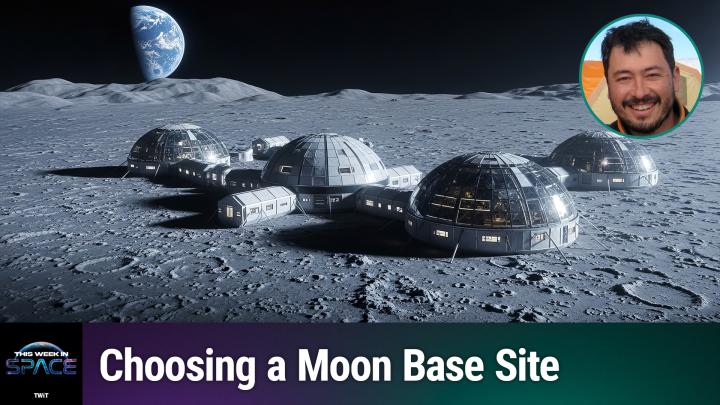
Where Should NASA Build Its First Moon Base?
AI-generated, human-reviewed.
NASA and the global space community are moving rapidly toward establishing a long-term human presence on the Moon. But according to planetary scientist Dr. Pascal Lee, who joined This Week in Space for an in-depth discussion, the current focus on the lunar South Pole could create major challenges and missed opportunities for lunar exploration. Instead, Lee recommends NASA look to sites like Clavius Crater, offering greater safety, accessibility, and scientific value for the future of lunar bases.
Why Moon Base Location Is Critical to Mission Success
On This Week in Space, Dr. Pascal Lee explained that “location, location, location” is the top consideration for any lunar base. Where NASA chooses to build will define not just what is possible for early missions but also the long-term sustainability and impact of our lunar presence.
Lee argues that the lunar south pole, though promising in terms of potential water ice, comes with many operational drawbacks:
- Extreme cold: Shadowed regions can reach temperatures near 50 Kelvin (or minus 370 degrees F), as cold as Pluto’s surface, making human activity and the operation of machinery far riskier.
- Rough, mountainous terrain: The highlands around the lunar south pole are challenging for landing, mobility, and construction, especially for the heavy equipment needed to support a lunar base.
- Complicated lighting: Most areas near the south pole are only illuminated 20-25% of the time, creating continuous cycles of weeks-long darkness—not ideal for solar power or routine surface operations.
Revisiting the Science and Hype Around Lunar Water Ice
A key driver behind selecting the lunar south pole has been the hope of abundant water ice for fuel, life support, and more. However, Dr. Lee cautioned on This Week in Space that the real story is complex:
- Water concentrations are low: Even in the “best” sites, such as Cabeus and Amundsen craters, ice content is estimated at 0.5 to 1.5% by weight, meaning that extracting usable quantities would require processing enormous volumes of lunar regolith under subfreezing conditions.
- Uncertain economics and logistics: The infrastructure needed to extract, transport, and store water across the lunar surface doesn’t yet exist. According to Lee, the focus should be on developing proven robotic prospecting before investing in risky human outposts for mining.
- Robots first, people later: Lee advocates aggressive robotic exploration of polar regions—using mobile “Moonfall” drones and nuclear-powered rovers—to map resources and find the best sites over time, instead of betting everything on one hard-to-reach spot.
The Case for Clavius Crater: A Strategic Lunar Hub
Dr. Lee is a strong proponent of developing the first major exploration and logistics base at Clavius Crater, located at about 60° south latitude on the Moon’s near side. Here’s why:
- Favorable terrain and lighting: Clavius offers stable terrain, regular day/night cycles (unlike the poles), and less severe cold, allowing for easier construction, operations, and surface mobility.
- Accessibility: Similar to McMurdo Station in Antarctica, a Clavius “hub” can support exploration throughout the Moon, including excursions to the poles using advanced mobility systems.
- Better for technology and international cooperation: Bases in less extreme environments allow for safer early human missions, routine equipment testing, and shared infrastructure—enabling scientific, commercial, and even tourism activities.
- Flexibility: By starting from a strategic, accessible location, NASA’s base can grow and adapt as new discoveries are made, rather than being anchored to a spot that may never deliver on its early promise.
What This Means for NASA and the Artemis Program
The conversation emphasized that the real long-term value of a Moon base is as a platform for global collaboration, high-return science, and as a stepping stone for Mars and deep space. Dr. Lee’s perspective encourages policymakers and mission planners to prioritize logistics and safety over short-term “resource rush” incentives.
He also highlighted the analogy with Antarctic exploration: build the base for easy access and as a logistics hub, and use robotic scouts extensively to find where high-value resources and scientific targets actually are. This approach minimizes risk and maximizes return on investment for both public and private stakeholders.
Key Takeaways
- Base location is the single most important factor for lunar mission success
- The lunar south pole is much colder, rougher, and more poorly lit than often advertised
- Water ice exists, but is in low concentrations, and extracting it will likely be much harder than headlines suggest
- Robotic missions should map and evaluate resources before committing to a permanent human presence at the poles
- Clavius Crater offers a safer, more accessible starting point for exploration and future expansion
- Centralized “hub” bases enable better mobility and adaptability as lunar operations scale up
- Strategic site selection supports collaboration, science, and commercial activities—advancing both US and international goals
The Bottom Line
Dr. Pascal Lee’s insights on This Week in Space challenge traditional thinking about lunar base planning. By reevaluating where and why we establish humanity’s first lunar foothold, NASA and its partners can build a program that is safer, more sustainable, and ultimately more valuable for science and society. The conversation underscores the critical need for careful, evidence-based choices as lunar exploration moves from vision to reality.
Want to stay on top of the latest debates and discoveries in space? Subscribe to the show for more expert insights:
https://twit.tv/shows/this-week-in-space/episodes/218