What Makes Human Intelligence Unique in the Age of AI?
AI-generated, human-reviewed.
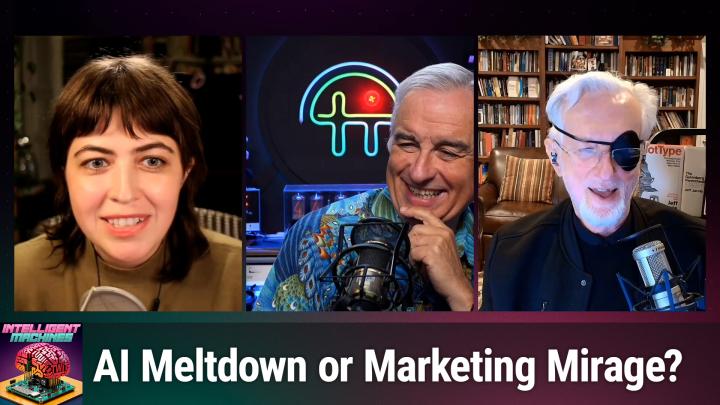
Artificial intelligence is advancing rapidly, but critical differences remain between machine learning models and the workings of the human mind. On Intelligent Machines, acclaimed science fiction author Daniel Suarez joined the show to explain why AIs, even the most cutting-edge language models, cannot truly replicate consciousness or creative innovation—and what that means for the future of technology and society.
Can AI Achieve Human-Like Consciousness?
A central question facing both technologists and the public is whether AI models can become genuinely conscious—aware, self-improving, and creative like people. According to Daniel Suarez on this week’s episode of Intelligent Machines, the answer is no, at least for now. Suarez emphasized that current leading AI systems, such as large language models (LLMs), are fundamentally different from human intelligence. These models process enormous amounts of data to predict likely word sequences, but they lack an internal sensorium or awareness of reality outside text.
Key terms explained:
- Consciousness refers to self-awareness and subjective experience, something humans (and some animals) possess but AI does not.
- LLM (Large Language Model) is a machine learning system that produces text by predicting the next word in a sequence, based on vast training data.
According to Suarez, the current structure of AI—training on data sets and performing tasks by statistical inference—means AI can imitate intelligent conversation but does not understand meaning or experience as humans do.
How Human Brains Differ from AI Models
During the episode, Suarez and the hosts discussed the biological and evolutionary basis of human intelligence. Unlike digital machines, the human brain evolved for complex problem-solving, innovation, and relating concepts across domains—a process that requires not just memory or data, but also creative synthesis and contextual judgment.
Suarez explained that the human brain’s low power usage and analog components enable a kind of cognition that is both efficient and deeply contextual. Important concepts include:
- Encephalization: the ratio of brain size to body size and its correlation with intelligence.
- Astrocytes and analog processes: unique cellular structures contributing to our mental flexibility.
Even the ability to “connect the dots” between seemingly unrelated fields, or to invent new products (like combining a phone and a computer into a smartphone), is a result of this kind of human brainpower, not something current AIs are equipped to do.
The Limits and Potentials of Today’s Artificial Intelligence
While AIs are becoming essential tools in many industries, Daniel Suarez noted their current capabilities are best leveraged in narrow, well-defined domains. For instance, specialized AIs can assist lawyers and insurers by handling large datasets quickly and reliably. However, expecting general creativity or common sense from these systems is unrealistic given their structure.
Suarez and the hosts also addressed concerns around energy consumption, surveillance risks, and social impacts:
- Modern AI models require tremendous computing power, raising concerns about environmental impact.
- The proliferation of data centers and surveillance capabilities could reshape privacy norms.
- There is a risk that relying too much on automation and AI could atrophy certain human skills, much like widespread GPS usage has weakened map-reading abilities.
Suarez suggested that the contractual relationship between society and technology must be continually examined: every technological adoption involves a negotiation of what is gained and what is sacrificed.
What’s Next in the AI Debate?
The possibility of recursive self-improvement—AIs making themselves smarter in a feedback loop—was also discussed. Suarez expressed skepticism, pointing out that the current architecture of AIs does not allow them to redesign or enhance themselves without outside intervention. He, along with the hosts, views bold predictions about rapid, unchecked AI “takeover” as more marketing hype than imminent reality.
Instead, the near future will likely include the proliferation of purpose-built, local AI models that serve specific business or research applications. The conversation touched on global policy challenges, including U.S.-China tensions over chip exports and open access to advanced AI.
Key Takeaways
- Current AIs lack consciousness and true understanding—they process data without awareness or subjective experience.
- Human intelligence is distinct in its efficiency, creativity, and context sensitivity, which arises from unique brain structures and biological evolution.
- AI excels in narrow, specialized applications, not general cognition or creative innovation.
- The future of AI is likely to see more localized, industry-specific models, not sudden leaps toward general artificial intelligence.
- Concerns remain about energy usage, privacy, and the social contract around new technologies.
- Fears of imminent self-improving, uncontrollable AI are not supported by current technical reality.
The Bottom Line
On Intelligent Machines, Daniel Suarez made it clear: while AI will continue to transform industries and workflows, there remains a fundamental gap between even the most advanced machine learning models and the conscious, creative intelligence of humans. Continued vigilance, policy debate, and public awareness will be crucial as technology advances—but for now, human creativity and judgment are irreplaceable.
Catch every in-depth conversation and critical update by subscribing to Intelligent Machines:
https://twit.tv/shows/intelligent-machines/episodes/897