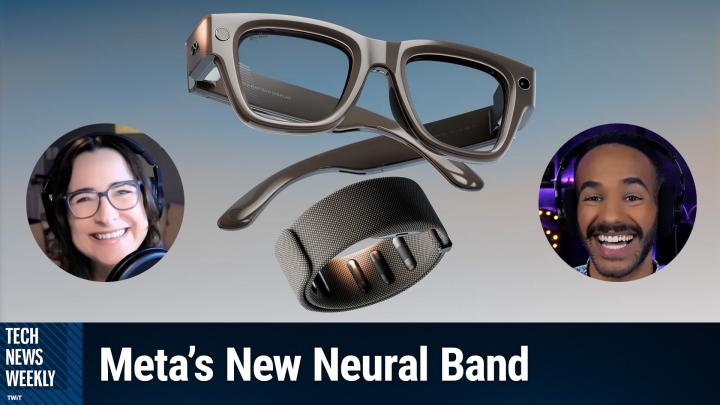
Scott Stein Explains Meta’s Ray-Ban Display Breakthroughs
AI-generated, human-reviewed.
Meta’s new Ray-Ban display glasses aren’t just incremental upgrades—they represent a major leap toward making smart eyewear mainstream. On Tech News Weekly, CNET’s Scott Stein provided an in-depth hands-on analysis of the $799 wearable, breaking down its real-world advantages, unique interface, and the challenges Meta still has to overcome. Here’s what you need to know—including who these glasses are really for and what their arrival means for the future of wearable technology.
What Are Meta Ray-Ban Display Glasses and How Do They Work?
The newly announced Meta Ray-Ban display glasses blend a classic Ray-Ban aesthetic with next-generation wearable tech:
- A built-in high-resolution heads-up display (HUD) in the right lens
- AI-powered voice and visual features
- Embedded cameras, microphones, and speakers for hands-free media capture and communication
- A novel Neural Wristband for gesture and navigation control
According to Scott Stein on this week’s episode, these glasses go beyond previous models (and rivals like Google Glass) by combining stylish form with a subtle interface, freeing users from pulling out their phones to access information, notifications, or capture content.
Core Features and User Experience Highlights
Stein explained that interacting with Meta’s display glasses involves:
- Wearing a Neural Wristband that detects finger gestures and movements, enabling users to navigate the glasses’ interface
- Voice commands, which trigger the Meta AI assistant for tasks like taking photos, answering questions, or translating speech
- A discreet heads-up display (HUD) in the lower portion of the right lens, surfacing text responses, notifications, and video chats
The glasses can also livestream from the built-in cameras, display captions for audio in real-time, and use beamforming microphones for focused speech recognition.
Who Are Meta’s Display Glasses For?
Stein pointed out on Tech News Weekly that Meta is currently marketing these glasses to:
- Tech early adopters who want to experiment with ambient, always-available digital assistants
- Content creators seeking new POV perspectives for hands-free video or social livestreams
- Fashion-forward consumers eager to wear tech without “cyborg” or awkward vibes
At $799, Meta’s Ray-Ban display glasses are more expensive than typical smart eyewear, but cost considerably less than mixed reality headsets like Apple Vision Pro. The design also positions them as everyday eyewear—though users need to ensure their prescription can be accommodated.
Limitations and Points to Consider
According to Stein’s live demo recap:
- Prescription support is limited: Stronger prescriptions may not work with these frames
- The Neural Wristband, while innovative, requires users to learn new touch and swipe gestures—potentially confusing at first
- Battery life, syncing issues, and phone tethering are still concerns
- The current app ecosystem is small; future updates may unlock new use cases
- Social etiquette, privacy, and the potential for awkwardness are still unresolved, especially around camera and recording features
How Do Meta’s Glasses Compare to Previous Smart Eyewear?
Scott Stein highlighted key differences:
- The display is sharper, more visible in bright sunlight, and more readable than past attempts (such as the original Google Glass)
- Voice AI is more deeply integrated, making hands-free operation more practical
- The Neural Wristband’s gesture controls echo Apple Vision Pro’s hand tracking, but with a focus on subtlety and hands-down use
- Meta is positioning these glasses as stepping stones toward full augmented reality (AR)—but currently, they are best at providing minimalist, glanceable info and capturing POV video
Key Takeaways
- Meta Ray-Ban display glasses mark a significant upgrade, combining a heads-up display, hands-free AI, and gesture controls in a stylish package
- Neural Wristband navigation is a leap forward, but may require a learning curve and adaptation for new users
- Ideal for early adopters, creators, and those seeking subtle wearable tech—but not a must-have for everyone just yet
- Prescription compatibility, battery life, and current feature limitations are important downsides to consider
- The product signals Meta’s intent to push toward more advanced, integrated AR wearables, but mainstream adoption will require broader compatibility and etiquette shifts
The Bottom Line
Meta’s Ray-Ban display glasses showcase how wearable technology is evolving from novelty to potential utility, marrying style, ambient computing, and hands-free convenience. As CNET’s Scott Stein described on Tech News Weekly, the device is an exciting glimpse of what’s possible—though it still appeals most to early adopters and those comfortable with learning new ways to interact with smart devices. As the technology matures, expect more powerful, user-friendly, and socially acceptable wearables to follow.
Want more expert technology insights like this? Subscribe and never miss an episode:
https://twit.tv/shows/tech-news-weekly/episodes/405