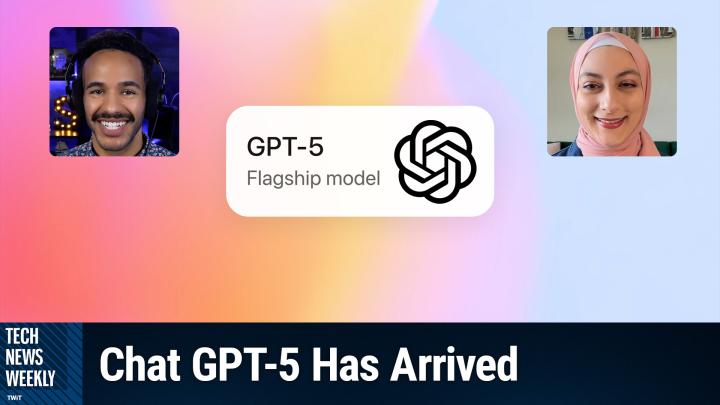
OpenAI's Latest Model: GPT-5
AI-created, human-reviewed.
OpenAI has officially launched GPT-5, and according to ZDNet senior editor Sabrina Ortiz, this release represents "one of the rare cases where what you expect is actually what was released in the best way." Speaking on Tech News Weekly with hosts Mikah Sargent and Abrar Al-Heeti Ortiz highlighted how the new model addresses one of AI's most persistent user experience challenges.
The End of the "Alphabet Soup" Problem
The standout feature of GPT-5 isn't necessarily raw performance improvements, though those exist. Instead, it's the elimination of what Ortiz calls the "alphabet soup" of OpenAI models that has confused users for months. "There's O3, O4, this, a mini, that and then you would ideally pick the one that was best suited for your own prompt," Ortiz explained during the podcast interview.
GPT-5 solves this by incorporating two distinct models within a single interface. The system automatically determines whether a query requires the advanced reasoning capabilities typically found in models like O3 and O4, or if it can be handled by OpenAI's general-purpose GPT model. As Ortiz noted, "It'll automatically be able to pick it for you, depending on what you input."
This intelligent selection process means users no longer need to understand the technical differences between models or make educated guesses about which tool might work best for their specific task. The system handles the optimization behind the scenes, balancing speed and quality without requiring user intervention.
Comprehensive Capabilities Remain Intact
Despite the streamlined user experience, GPT-5 maintains all the multimodal capabilities users have come to expect. "Everything you were able to do before you'll still be able to do now," Ortiz confirmed. Users can still analyze photos, generate images, work with code, and handle various other tasks through the unified interface.
The model represents what Ortiz described as "truly" an all-in-one package, preserving the versatility that has made ChatGPT popular while eliminating the complexity that often deterred new users.
Significant Performance Gains Across Multiple Domains
Beyond user experience improvements, GPT-5 delivers measurable performance enhancements across several key areas. Ortiz emphasized that "all around it's going to be better performance," with particularly notable improvements in coding capabilities and health-related queries.
The coding improvements were demonstrated during OpenAI's live presentation, where Ortiz witnessed the model's ability to build functional web applications from natural language prompts. "It's truly outstanding and amazing how fast it can build like a website, a functional web app from a natural prompt," she observed, noting that tasks which typically require extensive manual coding in JavaScript and CSS can now be completed quickly and efficiently.
Health-related query handling has also seen significant advancement, with new benchmarks showing improved accuracy when users ask about symptoms or treatment options. This enhancement addresses a growing use case as more people turn to AI for preliminary health information.
Expanded Access to Advanced Features
One of the most significant aspects of the GPT-5 launch is the democratization of advanced capabilities. Previously, OpenAI's reasoning models were exclusively available to paying subscribers. With GPT-5, free users gain access to these sophisticated problem-solving capabilities for the first time.
"Free users previously didn't have access to any of these reasoning models," Ortiz explained. "Now, because it's in GPT-5 and everybody's getting access to GPT-5, you'll be able to do the same queries you used to do before, but now also do those bonus like really complex math coding problems."
This expansion includes advanced voice mode, which Ortiz described as her favorite ChatGPT feature. The conversational voice assistant, previously limited to paid subscribers, is now available to free users, though with some usage limitations.
Safety and Reliability Improvements
OpenAI has emphasized safety enhancements in GPT-5, though Ortiz cautioned that these claims should be evaluated carefully. "We have to take it with a grain of salt," she noted, explaining that "it is ultimately an AI company claiming that's making a model safer, but they're also in the interest of developing these super intelligent models."
The primary safety improvement focuses on reducing hallucinations, instances where AI models generate plausible-sounding but false information. GPT-5 is designed to be more honest about its limitations, with Ortiz explaining that the model will "try to tell you, hey, actually, that what you just told me, I don't have the tools to give you the right answer, or I actually don't know the answer."
OpenAI has made their model safety card available for public review, allowing users to examine the benchmarks and evaluations supporting these safety claims.
Personality Customization and User Experience Enhancements
GPT-5 introduces personality options that allow users to customize the tone and style of their interactions. This addresses feedback about GPT-4's sometimes overly enthusiastic responses, which Ortiz described as "overly cheerful" with "a ton of emojis and all of that kind of thing."
The new system offers four different personality options through custom instructions, allowing users to choose between more sarcastic, cut-and-dry, or polite interaction styles. These personalities affect how ChatGPT communicates rather than changing its underlying capabilities.
Additional customization features include the ability to select interface colors, representing OpenAI's focus on improving user experience through both functional and aesthetic enhancements.
Developer and Enterprise Benefits
The GPT-5 release extends significant benefits to developers and enterprise users through API access. The model's enhanced coding capabilities make it particularly valuable for development workflows, with OpenAI positioning GPT-5 as their best option for developers.
The API includes different pricing tiers and configuration options, allowing developers to optimize their implementations based on specific requirements. The reduced hallucination rate and improved accuracy make the model more suitable for production applications where reliability is crucial.
Industry Impact and Future Implications
Ortiz expressed optimism about GPT-5's potential to broaden AI adoption by eliminating barriers that previously discouraged users. "One interaction of it where it works not to the level they're expecting, it will put them off forever," she explained, suggesting that automatic model selection will help users experience higher quality responses from their first interaction.
This improved first-user experience could lead to increased AI adoption across various industries and use cases. As Ortiz noted, "I think there's some really good practical applications for people's everyday workflows and I hope that people are more open to explore it now."
The release represents OpenAI's continued focus on making advanced AI capabilities more accessible and user-friendly, potentially setting new standards for how AI companies approach user experience design in their products.
GPT-5 is now available to both free and paid ChatGPT users, with API access available for developers and enterprise customers seeking to integrate the enhanced capabilities into their own applications and workflows.