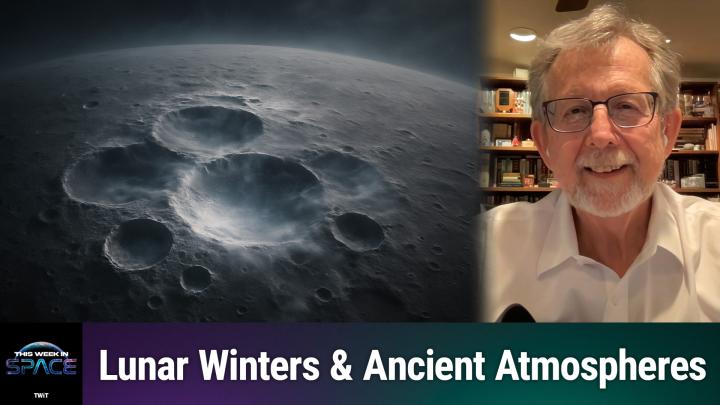
Dr. Jim Green Explains Ancient Lunar Weather
AI-generated, human-reviewed.
Could the moon have once seen snowfall in a cloudy sky? Yes—and understanding this ancient lunar weather opens up new scientific frontiers. On This Week in Space, former NASA Chief Scientist Dr. Jim Green joined Tariq Malik and Rod Pyle to reveal how Earth's satellite once had a thin atmosphere, a protective magnetosphere, and even snowfall—all of which profoundly affect future lunar exploration and our view of Earth's history.
The Giant Impact: How the Moon Was Born
The prevailing scientific explanation for the Moon’s origin is the "Giant Impact Hypothesis." As Dr. Jim Green explained, early in the solar system's history, a Mars-sized body dubbed Theia collided with the proto-Earth. The impact created a disk of debris, some of which re-accumulated to form the moon just four Earth radii away (only about 15,000 miles above Earth’s surface at the time).
As both bodies cooled, tidal forces caused the moon to recede to its current distance and slowed Earth's day from five hours to twenty-four. Notably, analysis of Apollo lunar samples proved Earth's and Moon's rocks share unique isotopic signatures, cementing their common origin.
Did the Moon Once Have an Atmosphere and Magnetic Field?
For a period after its formation, the moon did have a noticeable atmosphere and a magnetic field. According to Dr. Green, volcanic activity and outgassing of volatiles (like water vapor and carbon dioxide) from impacts, including during the "Late Heavy Bombardment," created this temporary lunar atmosphere.
The moon’s interior remained molten long enough to generate a magnetosphere, briefly shielding these atmospheric gases from the harsh solar wind. Uniquely, Earth's strong magnetic field at the time was close enough to link with the moon's, funneling material—such as nitrogen—from Earth's upper atmosphere onto the lunar surface.
The Curious Case of Lunar Snowfall
One of Dr. Green’s most surprising insights: as the moon’s magnetosphere faded and its thin atmosphere cooled, volatile compounds like water and carbon dioxide "snowed out" at the lunar poles. These permanently shadowed regions collected layers of ancient ices, now prime targets for scientific drilling by NASA missions like VIPER.
Volatiles in these polar ices are not just relics of lunar volcanoes or impacting comets—they include ancient traces of early Earth’s atmosphere. Today, scientists hope drilling into these layers will help reconstruct conditions on both the moon and a young Earth, offering clues to the origins of life and planetary evolution.
What Could We Mine or Learn from Lunar Volatiles?
These polar ices and volatiles (substances with low boiling points, like water, CO2, nitrogen, and sulfur) have tremendous scientific and commercial value. Dr. Green emphasized their utility for:
- Supporting future lunar outposts (providing water, fuel, and oxygen)
- Fertilizer production with nitrogen and sulfur compounds
- Offering insights into Earth's and the moon’s shared past
He cautioned that careful scientific sample collection must precede widespread resource extraction, so that we don’t lose unique historical records before we understand them.
What You Need to Know
- The moon was born from a giant impact and was once much closer to Earth.
- It had a brief atmospheric and magnetic "childhood," which preserved unique ancient materials at its poles.
- Episodes of snowfall (volatile ices) on the moon led to clues about the early solar system and Earth’s environment.
- NASA missions like VIPER aim to drill into and study these frozen records before they are harvested for resources.
- Lunar mining may one day provide rare metals as well as water and air for space settlements, but scientific study must come first.
The Bottom Line
According to Dr. Jim Green on This Week in Space, the moon’s early history isn’t just an academic curiosity. Understanding its volatile-rich poles—and the ancient atmospheric connections with Earth—could answer questions about planetary evolution, resource potential, and even the emergence of life. Before industry harvests these ice deposits, thorough scientific coring and analysis are essential.
Don’t miss future cosmic insights! Subscribe to the show at: https://twit.tv/shows/this-week-in-space/episodes/186