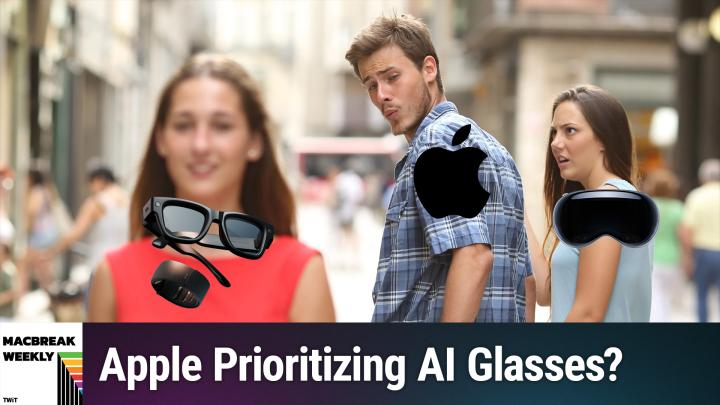
Is Apple Refocusing on AR Glasses?
AI-generated, human-reviewed.
Apple is not killing the Vision Pro, but according to this week's MacBreak Weekly, the company is making a significant strategic shift: they’re investing heavily in developing AR glasses, potentially leaving the future of affordable Vision Pro hardware on the back burner. If you’re wondering about Apple’s spatial computing roadmap, here’s a breakdown of what’s changing, why it matters, and what to expect next.
Why Apple Is Reprioritizing AR Glasses Over a Cheaper Vision Pro
On a recent episode of MacBreak Weekly, hosts Leo Laporte, Jason Snell, Alex Lindsay, and Andy Ihnatko discussed recent reports that Apple is diverting resources away from developing a lighter, less expensive Vision Pro headset to focus on AR smart glasses. This move comes as Apple faces intense competition from Meta, which has been making progress with consumer-friendly AR eyewear like the Meta Ray-Bans.
Key details from the episode include:
- Apple will still update the current Vision Pro with new chips, such as the M5, but has paused plans for a more affordable, mass-market Vision Pro device.
- Teams that were working on the next-gen Vision Pro have been reassigned to accelerate AR glasses development, aiming to bring Apple closer to Meta’s progress in this area.
- Apple’s leadership reportedly recognized that their original "top-down" approach—starting with a high-end, expensive headset and iterating downward—was too slow to compete with rivals focused on modular, accessible, lightweight AR solutions.
What Are Apple’s AR Glasses and When Are They Coming?
According to the analysis on this episode, Apple is now prioritizing two main smart glasses products:
- A first-generation model (dubbed N50) that pairs with an iPhone and lacks its own display, possibly launching as soon as next year.
- A more advanced version—similar in concept to the display-equipped Meta Ray-Bans—tentatively planned for release in 2028 (or sooner, thanks to the renewed focus and additional personnel).
This shift means that Apple is betting big on more accessible, consumer-friendly AR experiences—potentially sacrificing the short-term roadmap for Vision Pro in favor of a long-term strategy surrounding wearable AR tech.
Is Vision Pro “Dead” or Just Changing?
Despite speculation, the hosts agreed that Vision Pro is not being killed off. Instead, it’s being repositioned within Apple’s ecosystem:
- The Vision Pro will continue to receive updates, but don’t expect a groundbreaking new version or a drastic price drop soon.
- For Apple, Vision Pro remains a “development platform and public experiment”—essentially a test bed for spatial computing and developer feedback.
- Lessons learned from Vision Pro’s release, including interface data and ecosystem growth, will feed directly into Apple’s AR glasses and other wearable products down the line.
This approach is similar to how Apple treated the original MacBook Air and other first-generation devices—as a way to learn, iterate, and build excitement for the eventual mainstream product.
How Will This Affect the Future of Spatial Computing?
The panel’s consensus is that the true mainstream breakthrough for mixed reality will come from lightweight, comfortable, privacy-respecting AR glasses, not from bulky, expensive headsets like Vision Pro.
However, the big question remains: is there even a viable mass-market for AR glasses? The Meta Ray-Bans have yet to prove explosive popularity, and Apple’s push faces technical, privacy, and cultural hurdles.
What’s certain is Apple intends to be positioned to compete if—and when—AR wearables truly take off, rather than be left behind as technology evolves beyond smartphones.
Key Takeaways
- Apple is shifting resources from affordable Vision Pro hardware to accelerate AR smart glasses development.
- Vision Pro isn’t going away; it will continue to see incremental updates, but remains a niche, developer-focused product.
- AR glasses are now Apple’s primary focus, with two versions in the pipeline: a basic, iPhone-paired model and a more advanced display-equipped variant.
- This strategy change is aimed at catching up to Meta and bringing spatial computing to mainstream consumers faster.
- The spatial computing market is still speculative; real success depends on overcoming privacy, technical, and use-case challenges.
The Bottom Line
According to MacBreak Weekly, Apple isn’t abandoning the Vision Pro—they’re shifting their strategy to play the long game in spatial computing. AR glasses are now the crown jewel in Apple’s future plans, with Vision Pro serving as a foundational experiment. For users, it’s a signal that Apple wants to bring augmented reality to everyday eyewear, but fully immersive, affordable headsets may be years away.
Stay tuned: what happens in AR over the next 3–5 years will define the next era of Apple devices—just don’t expect Vision Pro to kill the iPhone any time soon.
Want more expert Apple insights every week? Subscribe to MacBreak Weekly: https://twit.tv/shows/macbreak-weekly/episodes/993